The following letter was written by Henry Lauren Lane of Plymouth, Connecticut, who enlisted in February 1862 as a private in Co. H, 13th Connecticut Infantry. He died of chronic diarrhea while in the service on 5 May 1863 at New Orleans.
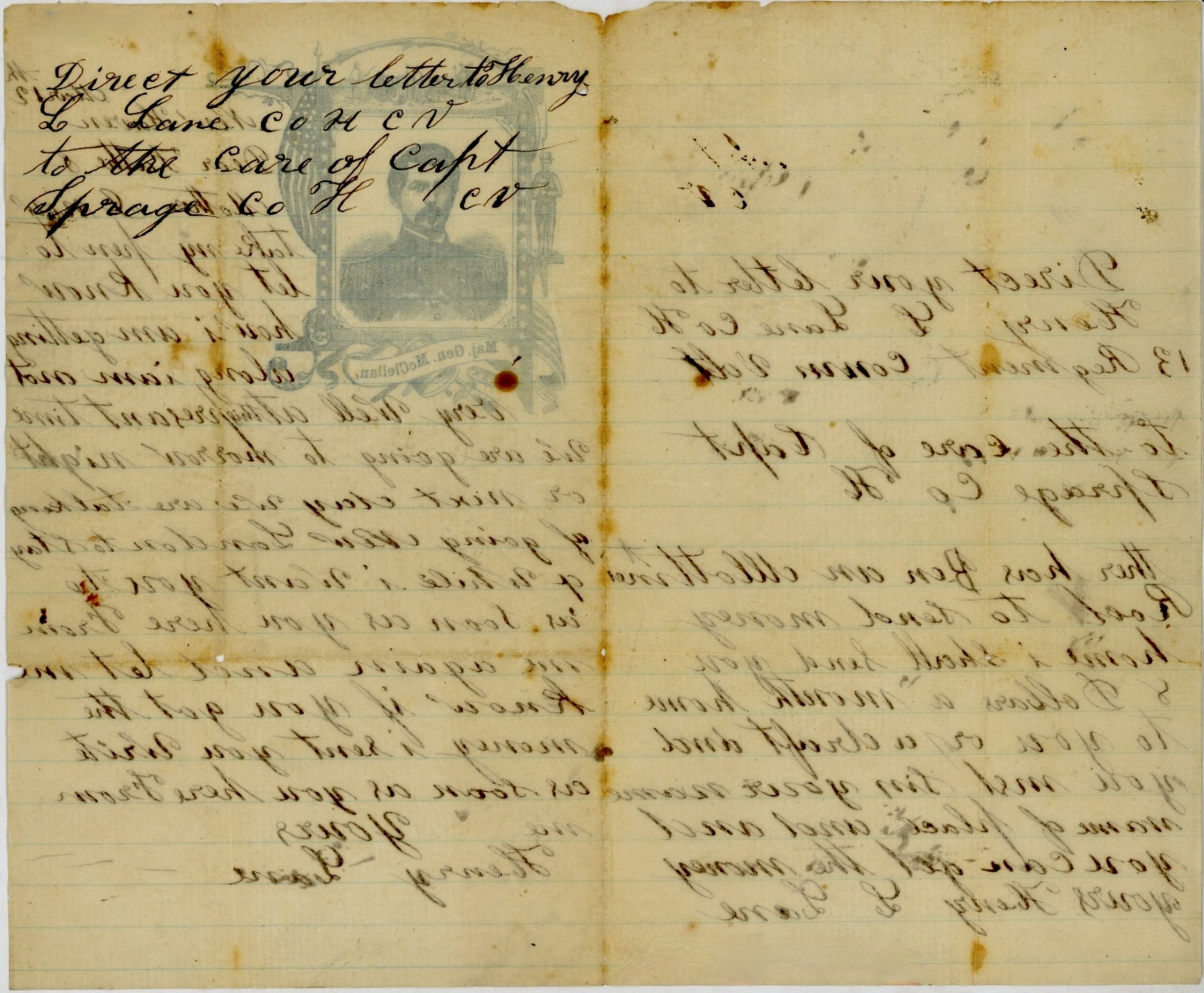
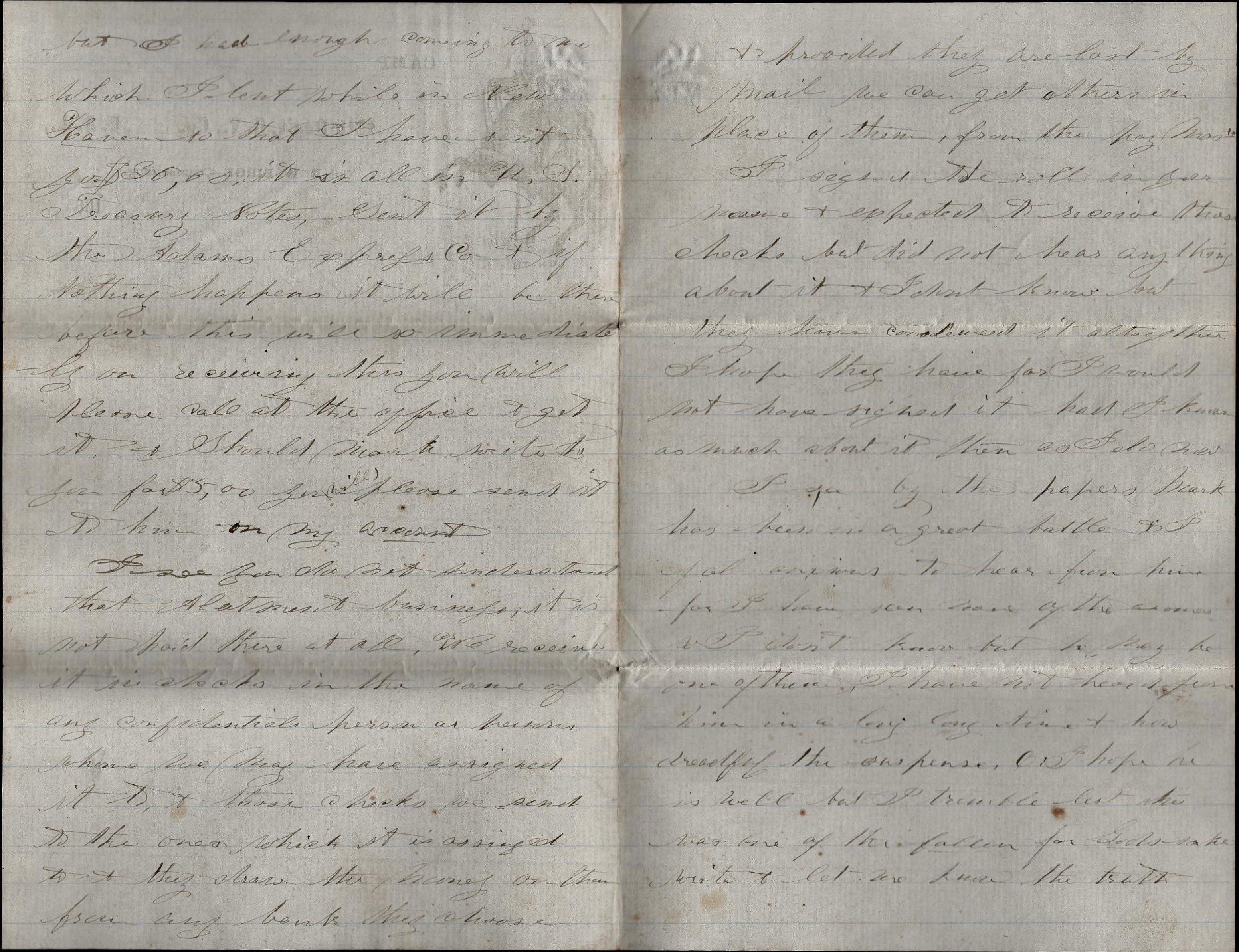
Letterhead of patriotic stationery featuring lithograph of Maj. Gen. McClellan
T R A N S C R I P T I O N
New Haven [Connecticut] March 12th [1862]
Dear Father & Mother,
I now take my pen to let you know how I am getting along. I am not very well at this present time. We are going tomorrow night or next day. We are talking of going [to] New London to stay a while. I want you to [write] as soon as you hear from me again and let me know if you got the money I sent you. Write as soon as you hear from me. Yours, — Henry Lane
Direct your letter to Henry L. Lane, Co. H, 13th Regiment, Conn. Vols. To the care of Capt. [Homer Baxter] Sprague, Co. H.
There has been an allotment roll to send money home. I shall send you 8 dollars a month home to you or a draft. You must sign your name, name of place, and you can get the money. Yours, Henry L. Lane
I would not find an image of William but here is Edwin L. Nickerson of Co. C, 13th Connecticut proudly wearing his newly issued epaulets or “brass kettles.” (Cornwall Historical Society)
The following letters were written by William Wallace Jones (1839-1896) of New Canaan who enlisted in Co. B, 13th Connecticut Infantry. Company B was recruited by Captain Apollos Comstock of New Canaan who travelled the state looking for marksmen to create a company of sharp shooters. He had to give up his test of marksmanship by the middle of December in order to fill out his company.
William was taken prisoner at the Battle of Winchester on 19 September 1864 and later paroled. He mustered out of the regiment on 29 December 1864. In the 1880 US Census, William was still single and enumerated in his father’s home in New Canaan as a 36 year-old carpenter. His parents were John Jones (1801-1891) and Ann Tong (1811-1853).
Letter 1
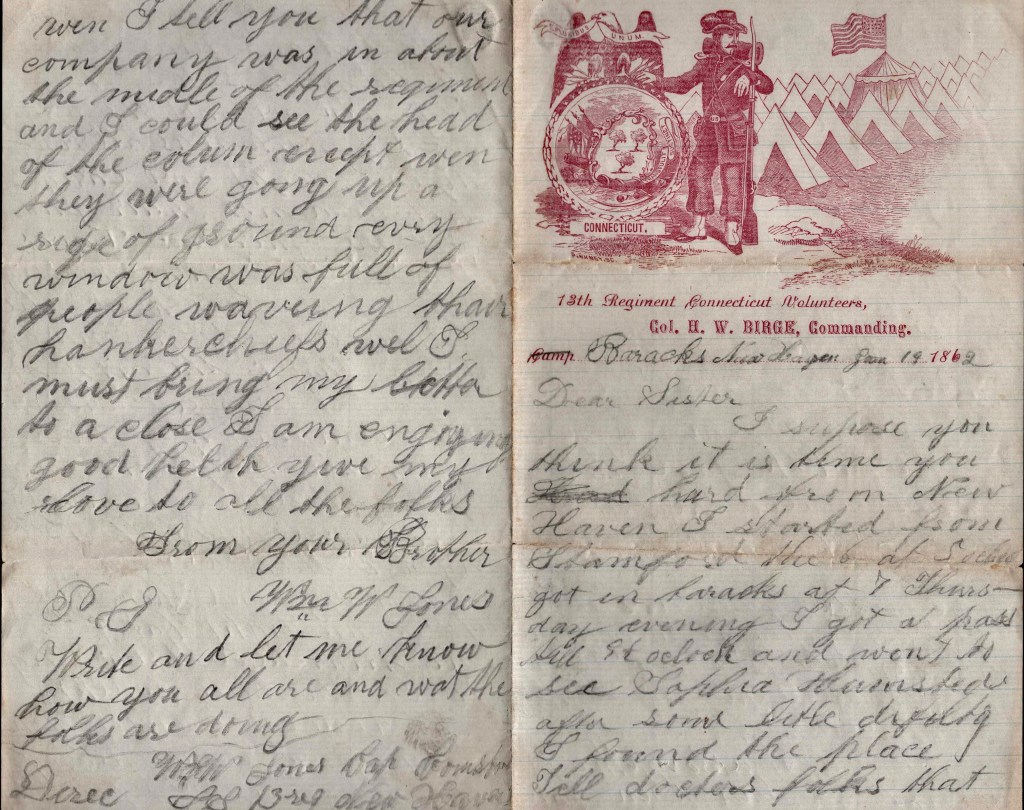
13th Regiment Connecticut Vols. Barracks New Haven [corner of Chapel & Hamilton streets] January 14, 1862
Dear Sister,
I suppose you think it is time you heard from New Haven. I started from Stamford the 6th at 5 o’clock. Got in barracks at 7 Thursday evening. I got a pass till 9:30 o’clock and went to see Sophia Humsted. After some little difficulty, I found the place. Tell doctor’s folks that I am glad that I went. Saturday we received our brass epaulets or brass kettles as some called them, and then we had to sew then on and fix for a dress parade on Monday. Sunday we went to church in the morning and evening. The whole regiment went. They filled the church full.
Well, I suppose you would like to hear of the dress parade we had yesterday. In the morning we had a Battalion Drill. In the afternoon the whole regiment turned out to escort the 1st Connecticut Light Battery through the city to the steamboat. We marched up Chapel Street above the Depot and then turned to the left and marched to the north side of the city when we met the battery which was all equipped except two carriages which had not their guns yet. The other four was brass rifled guns making six in all. We throw the salute and then marched down through the city. In front was an independent company of horse in showa [?] uniforms and presented a splendid appearance. Next the 13th Regiment C. V., then a company of cavalry, and the the 1st Connecticut Light Battery. As we marched through Chapel Street, the side walks was densely crowded. You may form some idea of the appearance we presented when I tell you that our company was in about the middle of the regiment and I could [not] see the head of the column except when they were going up a ridge of ground. Every window was full of people waving their handkerchiefs.
Well, I must bring my letter to a close. I am enjoying good health. Give my love to all the folks. From your brother, — Wm. W. Jones
P. S. write and let me know how you all are and what the folks are doing.
Direct to Wm. W. Jones, Capt. [Apollo] Comstock, S. S. [Sharp Shooters] 13th Regiment, New Haven
Letter 2
[Note: This letter contains a good account of the Red River Expedition in which the 13th Connecticut Infantry participated.]
Camp 13th Regt. Ct. Vols. on the west bank of the Mississippi River Above St. Francisville, Louisiana May 25th 1864
Dear Sister,
I received two letter and a Harper’s Weekly the other day from you and Helen. You say you would like o know who is in command of the regiment. C[harles] D. Blinn is Colonel. [Homer B.] Sprague [is] Lieutenant-Colonel. [William E.] Bradley is Captain of our company. We are in the 2nd Brigade, 2nd Division, 19th Army Corps commanded by Gen. Griver. Colonel Mulnor is in command of the brigade.
I have not heard from Haze [Hurlbut C. Hayes] or [Edward C.] Lockwood since leaving Thibodaux. Lockwood went to Napoleonville and Haze [Hayes] to Homer. I received a letter and that Memorandum book while at Alexandria. I wrote two letters. I suppose they were captured by the rebs on Red River. I never received a letter from Helen last winter that you speak of in your letter. I suppose you have heard long before this of our retreat from Alexandria. Our men had to build a dam below the falls on Red River to get the gunboats over. We had some fighting coming down. I wasn’t in it much as I was sick most of the way down. I was quite sick at Simmerport [Simsport] for a day or so. I had to ride some in an ambulance. None of our company got hurt as I know of. Hotchkiss is missing probably taken prisoner. I don’t see as the 13th Army Corps are so badly cut up as you tell for there wasn’t only part of the Corps in the fight.
The rebs only drove us the first day. They had to come to a halt when they came to the 19th Corps. One of our regiment was talking with one of Nims Battery men. He said they only had four men hit in the whole battery and they were in the thickest of the first days fight. When they had orders to retreat, they were mowing the rebs right down with grape and canister. I suppose you hear all sorts of stories from Red River. The men are down on Gen. Banks and I don’t blame them much. He don’t march into enemy’s country and treat them as enemies as Smith an other generals do. He would use half of his army to guard rebel plantations. If I were a reb, I should like him first rate. He would guard my property while the army marched through. I was not in the retreat from Grand Ecore. Some of the boys told me that the 19th Army Corps would put on a guard at the plantations [and] when Smith’s men came by, they burnt the plantation dwellings that the 19th Corps were so careful to guard.
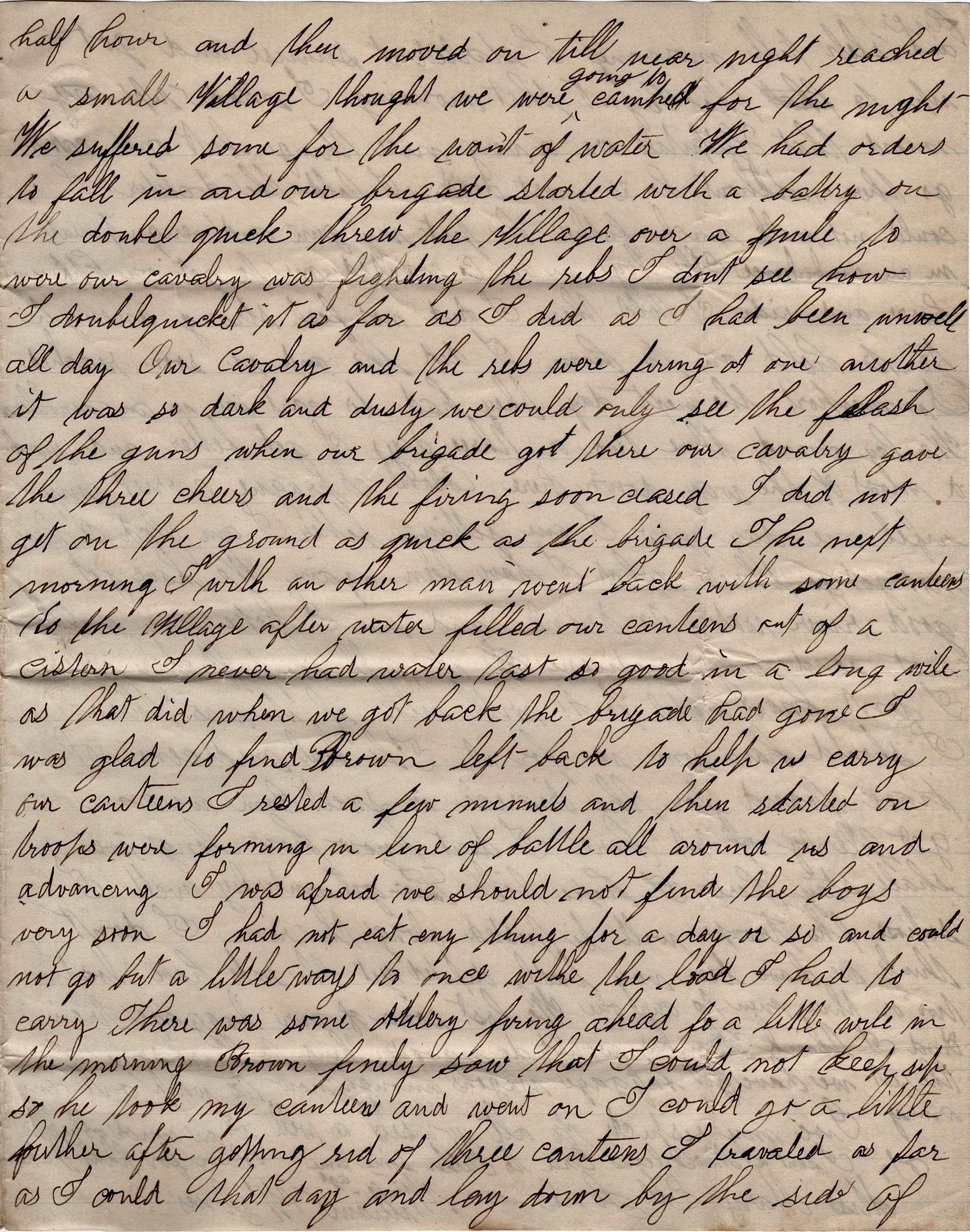
We stayed at Pineville outside Alexandria some 18 days before we left on the Alexandria side of the river. The ground was level while across the river is hilly and we got good spring water. We left Alexandria the 11th. Our Division had the advance. We lay still the 12th three or four miles below Alexandria. Started down the river the 13th. We got where the rebs had the river blockaded in two days march and camped for the night. The next morning we marched through woods, crossed a small bayou, and came out on an open prairie. In the afternoon, formed in line of battle and rested some half hour and then moved on till near night. Reached a small village [where we] thought we were going to camp for the night. We suffered some for the want of water. We had orders to fall in and our brigade started with a battery on the double quick through the village over a mile to where our cavalry was fighting the rebs. I don’t see how I double quicked it as far as I did as I had been unwell all day. Our cavalry and the rebs were firing at one another. It was so dark and dusty we could only see the flash of the guns. When our brigade got there, our cavalry gave the three cheers and firing soon closed. I did not get on the ground as quick as the brigade.
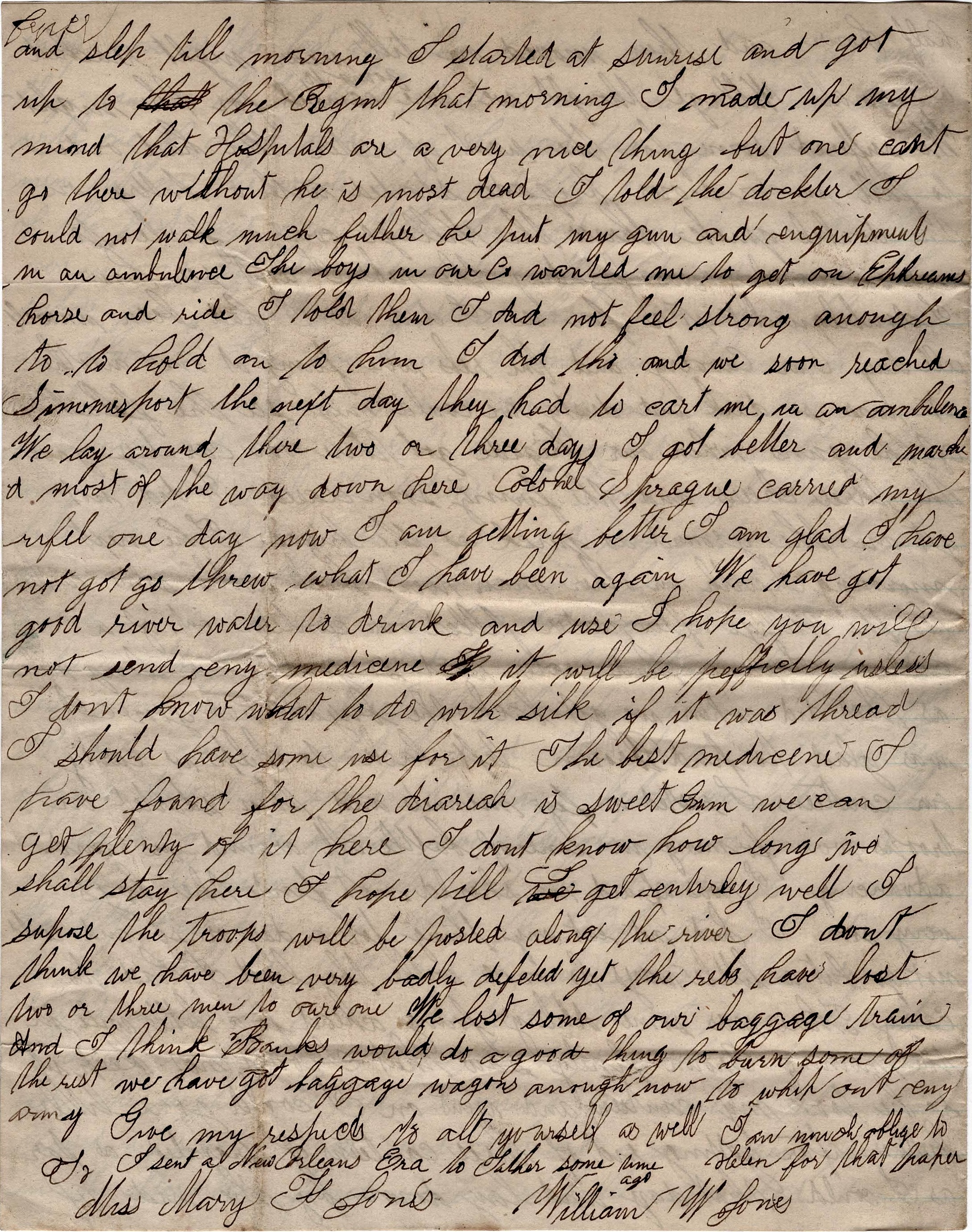
The next morning I with another man went back with some canteens to the village after water [and] filled our canteens out of a cistern. I never had water taste so good in a long while as that did. When we got back, the brigade had gone. I was glad to find [John W.] Brown left back to help us carry our canteens. I rested a few minutes and then started on. Troops were forming in line of battle all around us and advancing. I was afraid we should not find the boys very soon. I had not eat anything for a day or so and could not go but a little ways at once with the load I had to carry. There was some artillery firing ahead for a little while in the morning. Brown finally saw that I could not keep up so he took my canteen and went on. I could go a little further after getting rid of three canteens. I traveled as far as I could that day and lay down by the side of a fence and slept till morning. I started at sunrise and got up to the regiment that morning. I made up my mind that hospitals are a very nice thing but one can’t go there without he is most dead. I told the doctor I could not walk much further. He put my gun and equipment in an ambulance. The boys in our company wanted me to go on Ephraim’s horse and ride. I told them I did not feel strong enough to hold on to him. I did though and we soon reached Simmerport [Simsport].
The next day they had to cart me in an ambulance. We lay around there two or three days. I got better and marched most of the way down here. Colonel Sprague carried my rifle one day. Now I am getting better. I am glad I have not got to go through what I have been again. We have got good river water to drink and use. I hope you will not send any medicine. It will be perfectly useless. I don’t know what to do with silk if it was thread. I should have some use for it. The best medicine I have found for the diarrhea is sweet gum. We can get plenty of it here. I don’t know how long we shall stay here. I hope till I get entirely well. I suppose the troops will be posted along the river. I don’t think we have been very badly defeated yet. The rebs have lost two or three men to our one. We lost some of our baggage train and I think Banks would do a good thing to burn some of the rest. We have got baggage wagons enough now to whip out any army.
Give my respects to all—yourself as well. I am much obliged to Helen for that paper. — William W. Jones
Edwin L. Nickerson (Collection of Cornwall Historical Society)
The following letter was written by Edwin L. Nickerson (1842-1863) who enlisted as a private on 25 February 1862 in Co. C, 13th Connecticut Infantry. He was promoted to a corporal in November 1862 but was killed at Irish Bend, Louisiana on 14 April 1863 during the Teche Campaign.
Edwin was the son of Smith Nickerson (1804-1853) and Mary Ann Davidson (1806-1845) from Cornwall, Litchfield County, Connecticut. He had three brothers who served in the military; Uriah Nickerson (1838-1895), who fought in Company E of the 7th Connecticut Infantry, Henry F. Nickerson, who was part of the 10th Connecticut Infantry, and Mark S. Nickerson (1843-1915), who served in Company A of the 10th Massachusetts Infantry. In his correspondence, Edwin expressed profound concern for his brother Mark’s safety upon receiving news of the Battle of Fair Oaks (Seven Pines), during which the 10th Massachusetts endured 27 fatalities and 95 injuries in savage hand-to-hand combat. Remarkably, Mark survived the war and passed away at the age of 72. Ironically, it was Edwin who would ultimately fail to return home.
Edwin datelined his letter on 23 June 1862 from the Custom House in New Orleans where they quarters with Gen. Butler’s Headquarters and performed provost duty.
Transcription
Patriotic heading of Edwin’s letter
Custom House, New Orleans 13th Regt. C. V. Co. C, USA June 23, 1862
Dear Sister,
I received yours of May 27th the 12 of June & was very glad to hear from you again & I should have answered it before but I thought I had written several that not answered & would wait until we were paid off, hoping to receive another from you, but have not. I am well once more & am getting somewhat used to warm weather so I think I shall stand it. I don’t hear anything about the yellow fever now so I guess it has died out.
We were paid off the 18th instead of. and were paid only two months pay which took it up to the 1st of May but I had enough coming to me which I lent while in New Orleans so that I have sent you $30. It is all in U. S. Treasury Notes. Sent it by the Adams Express Co., and if nothing happens, it will be there before this will so immediately on receiving this you will please call at the office & get it. Should Mark write to you for $5, you will please send it to him on my account.
I see you do not understand that allotment business. It is not paid there at all. We receive it in checks in the name of any confidential person or persons whom we may have assigned it to, & those checks we send to the ones which it is assigned & they draw the money on them from any bank they choose & provided they are lost by the mail, we can get others in place of them from the paymaster.
I signed the roll in your name & expected to receive those checks but did not hear anything about it & I don’t know but they have [ ] it altogether. I hope they have for I would not have signed it had I known as much about it then as I do now.
I see by hte papers Mark has been in a great battle & I feel anxious to hear from him for I have seen some of the names & I don’t know but he may be one of them. I have not heard from him in a long, long time and how dreadful the suspense. Oh, I hope he is well. But I tremble lest he was one of the fallen. For God’s sake, write to let me know the truth.
But I must close as I have not time to write any longer. Direct to New Orleans, General Butler’s Expedition. We had green corn here the middle of May and the markets are now crowded with watermelons, muskmelons, plumbs, peaches, new potatoes, blackberries, &c. & have been since the middle of May. Please remember me kindly to all, not forgetting that I am still your brother, — Edwin L. Nickerson
The following incomplete letter, written in pencil, lacks a signature page, leaving virtually no tangible evidence to determine its authorship. The heading indicates it was composed by a member of Co. B, 13th Connecticut Infantry, and the content aligns with that identification. However, upon reviewing my Spared & Shared archives of transcribed letters, I found that in 2015, I published 13 letters authored by Franklin S. Twitchell of Co. B, 13th Connecticut, who similarly wrote them in pencil and addressed them to his sister, just as this letter does. By examining the handwriting of this letter and the letters within the archive, I concluded they were penned by the same soldier. Notably, there exists a letter dated “May 1862” in that collection which may represent the conclusion or continuation of this correspondence. See: Franklin S. Twitchell~Co. B, 13th Connecticut Infantry.
Franklin Twitchell (1844-1864) was the son of Isaac Spencer Twitchell and Charlotte Benham. According to a family history, Isaac was born in Oxford, Connecticut about 1807. “He was a watch and clock maker; also a manufacturer of jewelry. Shortly after attaining his majority, he removed to Ballston Spa, New York, where he engaged in the lumbering business in the Adirondacks. Having disposed of his timber and lumbering interest, he removed with his family to New Haven, Connecticut, where he engaged in the manufacture of silverware, in partnership with a person whose name is not now recalled. During Mr. Twitchell’s absence from New Haven, his partner made substitution of some base metal for the percentage of silver stamped upon the manufactured product and before Mr. Twitchell’s return left the country. These deceptions were discovered by purchasers of the silverware and Mr. Twitchell was left penniless in his efforts to make restitution and to secure a return of his good name. He returned to his trade of watch and clock repairing. With his son, Sherman, he finally left Connecticut, and settled in the state of Minnesota where he died.” [Source: Genealogy of the Twitchell Family]
The letter describes the transport of the regiment from Ship Island where it had been since mid-April 1862. The letter contains a description of Fort Jackson, the scene of the late April bombardment, now in possession of the Union army.
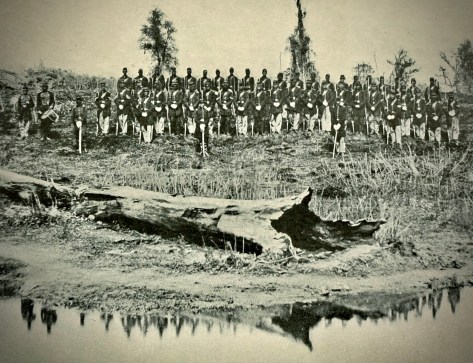
One of the 13th Connecticut Infantry companies on the Banks of the Mississippi River.History of Civil War 1861-1865, Pictorial Works.
Transcription
Transport Ship City of New York 13th Regt. C. V. Co. B, USA Col. H. W. Birge, Commanding May 7th 1862
Dear Sister,
As soon as I mailed my last letter we had orders to march for New Orleans. We struck our tents Sunday afternoon and started. They had an old river steam boat to take us to the ship. We being the last company, we did not get on board till the next morning. We had to lay on the sand through the night. Most of the men spread their blankets and went to sleep. I thought I would not as I expected we should get on board then. I soon got sick of waiting and lay down with the rest and went to sleep.
In the morning we slung our knapsacks and went on the old steam boat to get to the ship and a crazy old craft it was. It was like the pictures you see in the geography of steam boats on the Mississippi river. We have got our same bunks that we had before on board this ship. We have our rifles to sleep with. I found a slave and his family on board that the 9th Regiment C. V. brought from Mississippi with them. I asked him what the Rebels thought of the Yankees. He said they thought they—the Rebels—would get whipped. He said his master had two sons in the Rebel army when the 9th landed. He said that the Rebels had 1,000 men to oppose them but as soon as they got in sight, they took to their heels with the cry, “Gen. Butler’s Division is coming!”
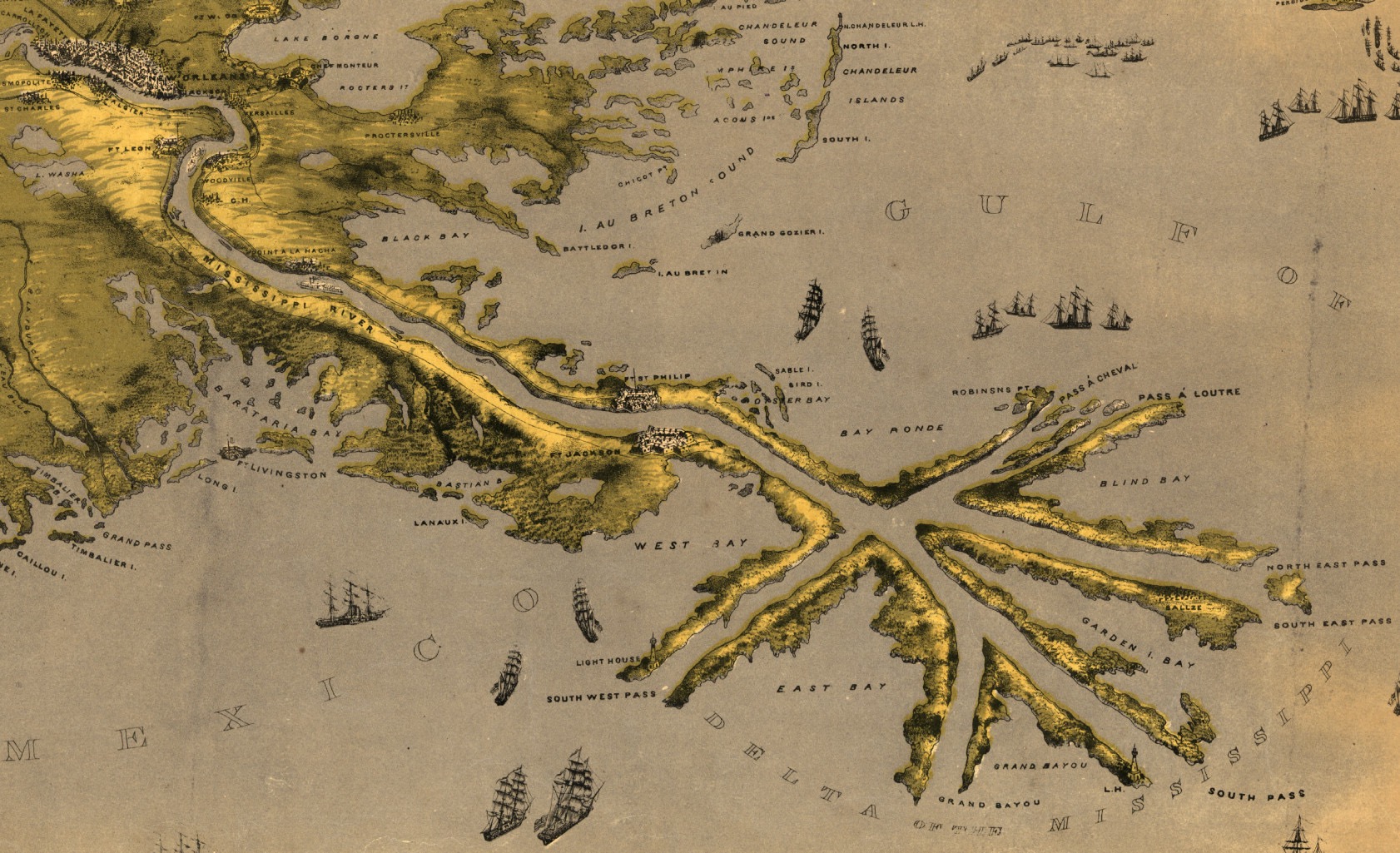
Yesterday we were to work heaving ballast overboard so as to lighten the ship so as to get over the bar to the Mississippi river. Today we are off the mouth of the river. The water looks like the wash off a road after a shower. It is full of floating drift wood.
May 9th. Since writing the above, we have got over the bar in the entrance of the Mississippi river. The current is very strong. There is a narrow strip of land on both sides of us beyond the water as far as I can see. We are opposite a small village. The land is covered with tall grass. It makes the houses look well.
Sketch of scenery on the Mississippi delta.
I guess I had better dry up on trying to draw. I expected to send this today but the steamer has gone. We are going up the river towed by a steam boat. The current is so strong that we make but little headway. The river is very narrow. It almost runs over the banks. I have been watching to see if the side [sight?] made any difference. I have watched the banks some four or five hours & I cannot see any. We are now some six or seven miles from the mouth. The water is higher here than outside as every little break in the bank we can see the water running through very swift.
We passed a small house surrounded with beautiful trees. I should have liked to have stayed there two or three weeks. Well I must stop writing till some other day.
May 10th. We are opposite Fort Jackson, the scene of the recent bombardment. The walls are of brick in here as guns in casement. On the top is earth covered with grass. The fort shows the effect of the bombardment. We can see the two guns lying dismounted in the grass, the turf torn up, the walls broken in places. There are some small buildings one side of the fort. They looked hard. We could see where a ball had gone right through the chimney. Another had a ragged hole through the side of the window.
We are at anchor off the fort. The tow boat is taking in coal. A man came on board. He said he lived a half a mile from here. Someone asked him about the bombardment. He said it lasted six days and nights. Someone asked him if it wasn’t time for the Rebels to give up. Not yet you….[remainder of letter is missing]
Detail of Birds eye view of Louisiana, Mississippi, Alabama and part of Florida. Bachmann, John, 1861. Geography and Map Division.











 Spared & Shared 23