Category Archives: Occupation of New Orleans

Diary of James R. Holt, Co. G, 12th Maine Infantry: 1 Nov 1862 thru 31 May 1863

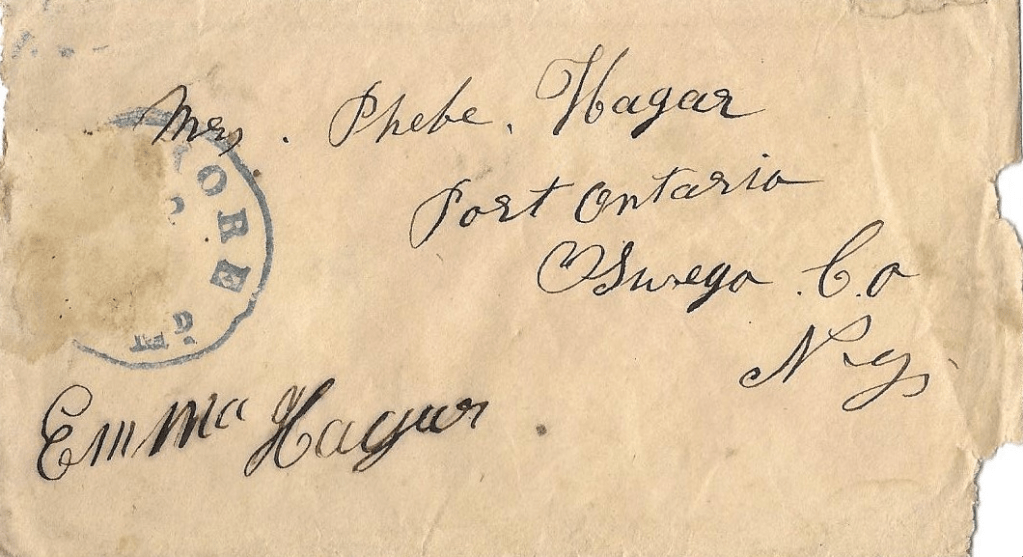
This diary was kept by Pvt. James Redlon Holt (1845-1864), a 16 year-old youngster when he enlisted on 15 November 1861 with Co. G, 12th Maine Infantry. James was the son of Rev. Dudley Barker Holt and Susan M. Redlon from Gorham, Maine, who grudgingly must have given their consent to let him collect a bounty and enter into the service.

In the sweltering heat of Louisiana, where the 12th Maine was stranded for most of its service, James poured his heart onto paper. But just as the light at the end of the tunnel seemed near, with mustering out on the horizon, fate had a cruel twist in store. The regiment was called back East, only to face the brutal carnage of the 3rd Battle of Winchester in September 1864, where James met a tragic end on 19 September 1864—“killed by a cannon ball”—just two months before completing his three-year enlistment. What a visceral reminder of the brutality of war and the fragility of life!

Serving with James and mentioned in some of his letters was his Uncle Darius Holt (1820-1875) who enlisted at the age of 42 and served several months until his health failed and he was discharged for disability. Darius was living in Minot with his wife, Mercy Ann (Lord) Holt (1828-1902) and six children when he enlisted.

This diary is from the private collection of a Holt family descendant and scans were sent to me for transcription and publication on Spared & Shared by express consent. A dozen of James’ letters were recently published on Spared & Shared from the same source. To read those letters, see—1862-64: James Redlon Holt to Dudley Barker Holt.

The first year of James’ diary can be read here: Diary of James R. Holt, Co. G, 12th Maine Infantry: 1 Nov 1861 thru 31 Oct 1862
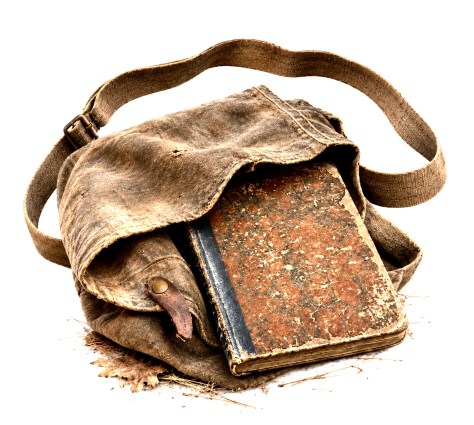
“….containing personal adventures, interesting facts about regiment, places, Rebs, &c.”

T R A N S C R I P T I O N

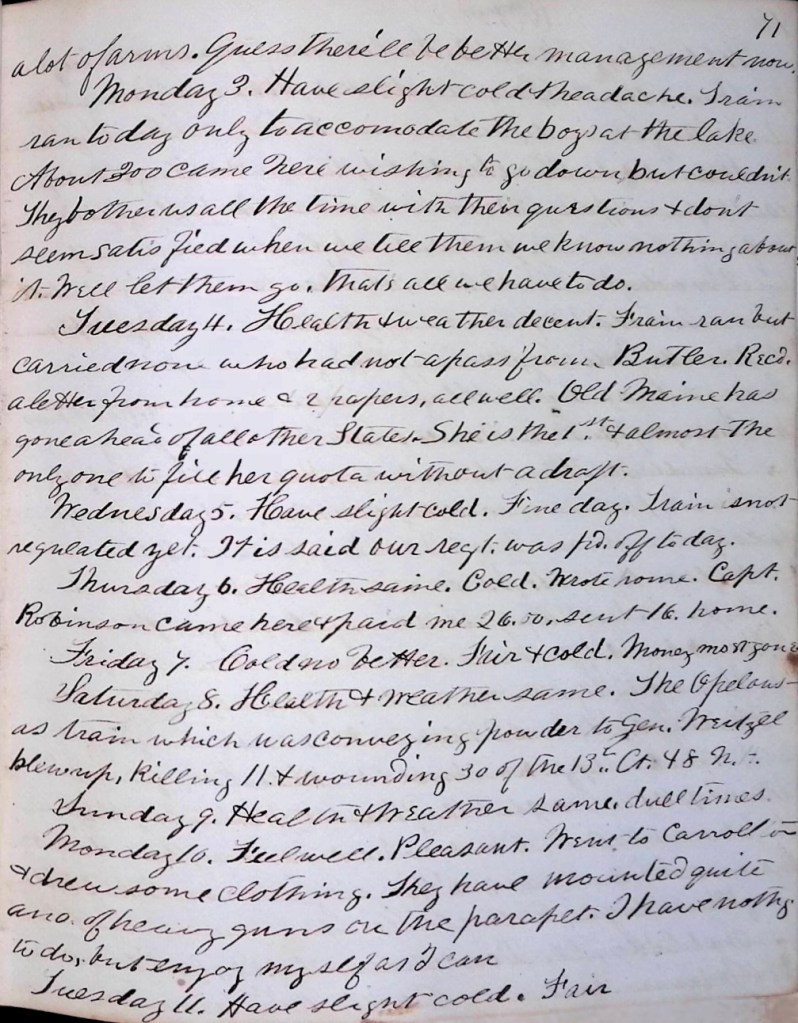
Saturday, November 1, 1862—Have cold in my head. Pleasant. Went to Carrollton to get some clothes but couldn’t. They have stoves there now & live well. Live easy & have little to do.

Sunday, 2nd—Feel well. October weather. Capt. Sawyer of Co. H, 9th Connecticut, went to lake today, taking charge of the train, bringing Proctor, Armstrong, &c. & a lot of arms. Guess there’ll be better management now.

Monday, 3rd—Have slight cold & headache. Train ran today only to accommodate the boys at the lake. About 300 came here wishing to go down but couldn’t. They bother us all the time with their questions & don’t seem satisfied when we tell them we know nothing about it. Well let them go. That’s all we have to do.

Tuesday, 4th—Health & weather decent. Train ran but carried none who had not a pass from Butler. Received a letter from home & two papers. All well. Old Maine has gone ahead of all other states. She is the 1st and almost the only one to fill her quota without a draft.

Wednesday, 5th—Have slight cold. Fine day. Train is not regulated yet. It is said our regiment was paid off today.

Thursday, 6th—Health same. Cold. Wrote some. Capt. Robinson came here & paid me $26.50. Sent $16 home.

Friday, 7th—Cold no better. Fair & cold. Money most gone.

Saturday, 8th—Health & weather same. The Opelousas train which was conveying powder to Gen. [Godfrey] Weitzel blew up killing 11 & wounding 30 of the 13th Connecticut & 8th New Hampshire.

Sunday, 9th—Health & weather same. Dull times.

Monday, 10th—Feel well. Pleasant. Went to Carrollton & drew some clothing. They have mounted quite a number of heavy guns on the parapet. I have nothing to do but enjoy myself as I can.

Tuesday, 11th—Have a slight cold. Fair.
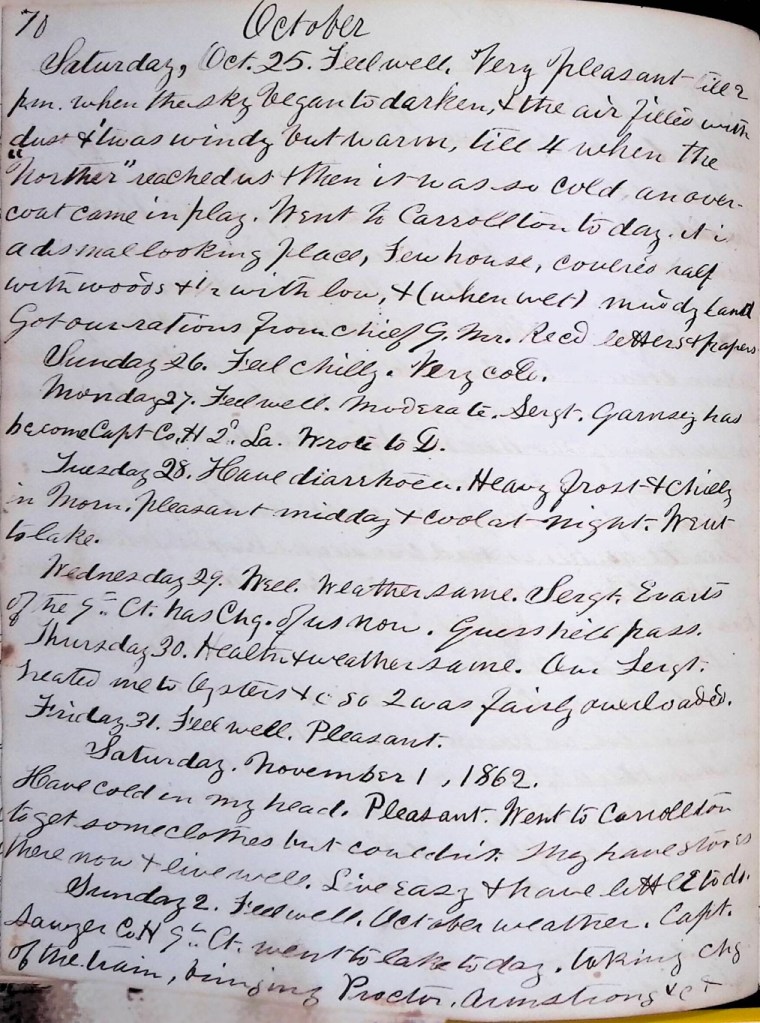
Wednesday, November 12 [1862]—Feel same. Cloudy & rainy.

Thursday, 13th—Have slight cold. Warm & rainy. Dull.

Friday, 14th—Haveslight cold in head. Rainy. Dull.

Saturday, 15th—Have bad cold. Warm & rainy. Out of 10. I kept to [ ] this time. I’ve only four left. Spent half for books so it’s not entirely lost.

Sunday, 16th—Health & weather same. Mighty dull. Since I came here I’ve read Authur Conway, Robert Oaklands, Waverley, New England’s Tale, Captain’s Ward, & Lanman’s Alleghanies.

Monday, 17th—Heath same & weather ditto. [ ]

Tuesday, 18th—Health & weather same. Lieutenant of 9th [Connecticut] goes with the train so we’ve nothing to do. Our regiment goes off tomorrow. Wish I could go too but I can’t. All of our boys are sick here.

Wednesday, 19th—Health same. Cloudy. Nothing to do. Regiment moved off somewhere.

Thursday, 20th—Health & weather same.

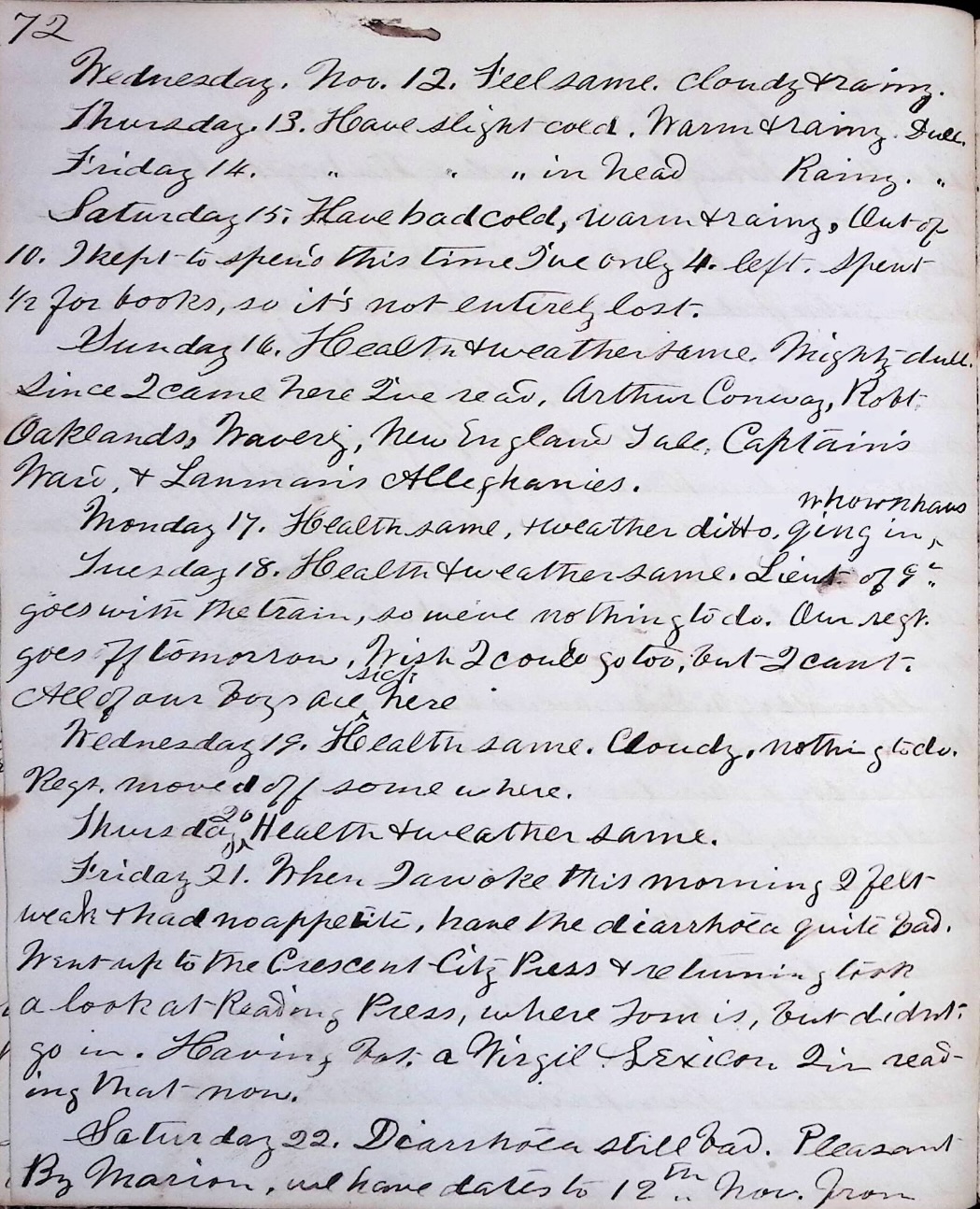
Friday, 21st—When I awoke this morning I felt weak & had no appetite. Have the diarrhea quite bad. Went up to the Crescent City Press & returning took a look at Reading Press where Tom is but didn’t go in. Having bought a Virgil Lexicon, I’m reading that now.

Saturday, 22nd—Diarrhea still bad. Pleasant. By Marion, we have [news that] dates to 12th November from New York. Potomac Army still progressing. Gen. McClellan has been relieved by Burnside per Presidential order. This is mean anyhow. After all he has done, he is left without command. It seems as though some dire fiend was pursuing him, depriving him of the pleasure of expected victory. It is honor enough, however, to any one man to have been so beloved by his men. His parting from them is said to have exceeded anything ever recorded in history (save that of Napoleon parting from his generals) in solemnity. But the noble young general makes no complaint, quietly submitting to his superiors. It may be just, but I look upon it as another yielding of our President to Radicals.

Sunday, 23rd—Diarrhea still continues. Pleasant [day]. When I awoke this morning, a policeman came and told us that our sergeant was in the calaboose. About 9 last night as he was walking down to the market, a policeman asked him if he had a pass. He replied in the negative. Well, says the policeman, let’s go see the clerk & he’ll give you one. He went. They shoved him in the ‘boose. We’ve got him out since though. Went to see Tom but found the [Reading] Press shut up. Heard that they had been in Parish Prison on account of some $1,000 worth of goods being stolen but they’ve since been removed as innocent.
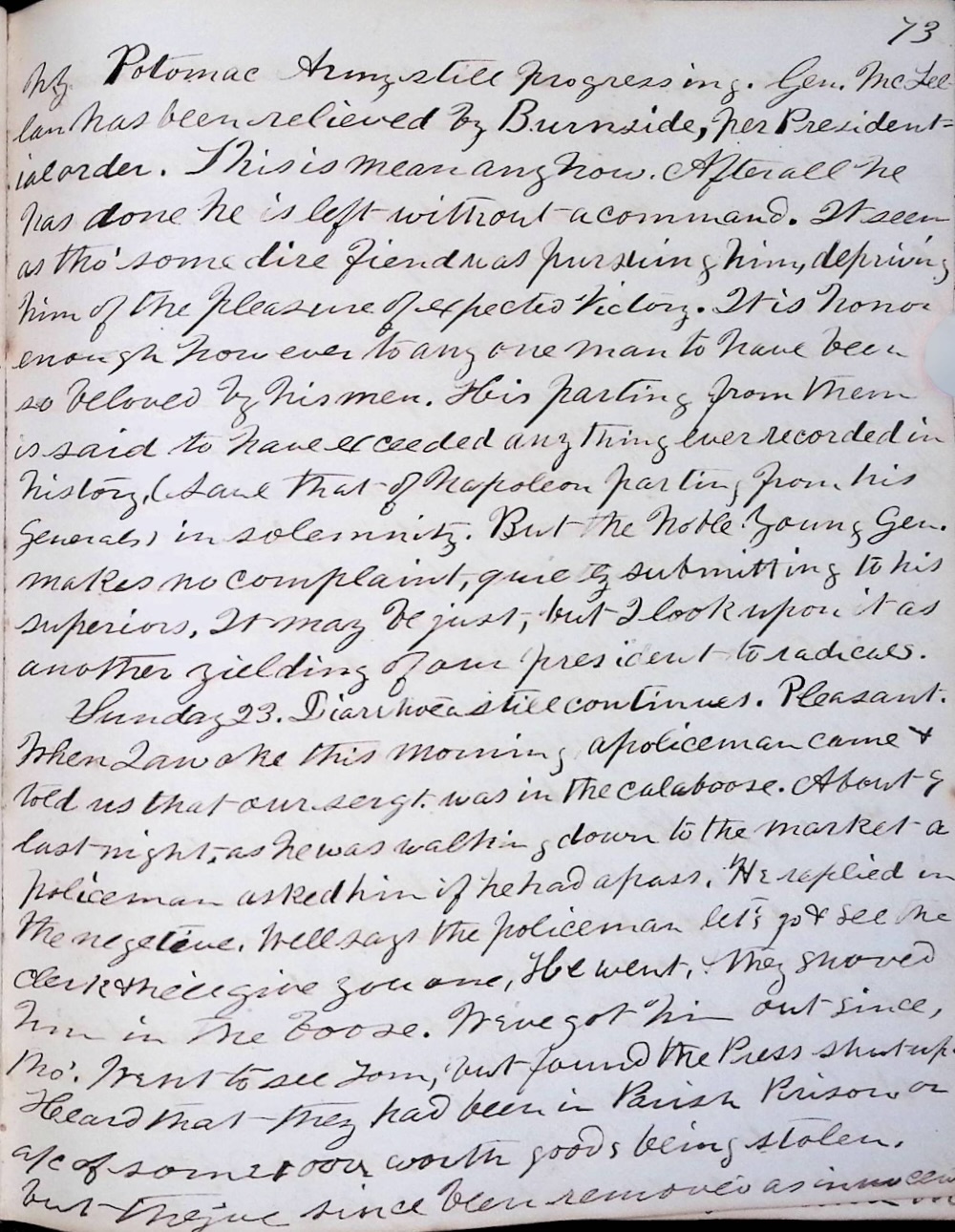
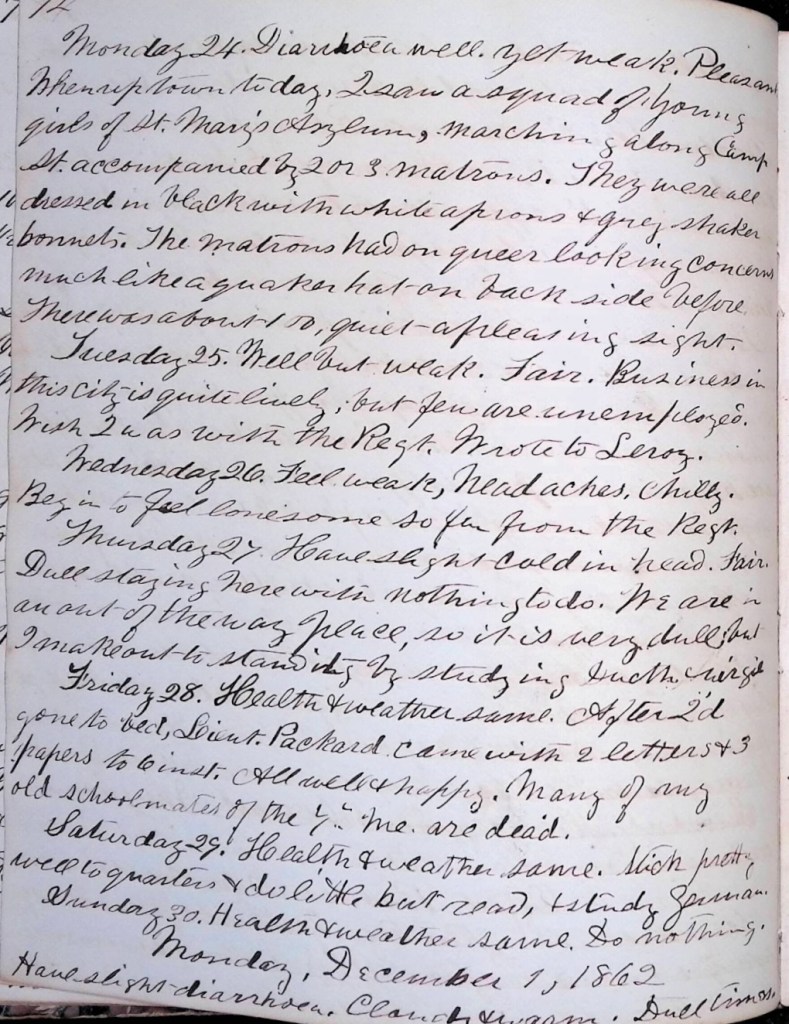
Monday, 24th—Diarrhea well, yet weak. Pleasant [day] When up town today, I saw a squad of young girls of St. Mary’s Asylum marching along Camp Street accompanied by two or three matrons. They were all dressed in black with white aprons & grey shaker bonnets. The matrons had on queer looking concerns, much like a quaker hat on back side before. There was about 100—quite a pleasing sight.

Tuesday, 25th—Well but weak. Fair [weather]. Business in this city is quite lively; but few are unemployed. Wish I was with the regiment. Wrote to Leroy.

Wednesday, 26th—Feel weak. Headaches. Chilly. Begin to feel lonesome so far from the regiment.

Thursday, 27th—Have slight cold in head. Fair. Dull staying here with nothing to do. We are in an out of the way place so it is very dull but I make out to stand it by studying Dutch [German] & Virgil.

Friday, 28th—Health & weather same. After I’d gone to bed, Lieut. Packard came up with two letters & three papers to the 6th instant. All well and happy [at home]. Many of my old schoolmates of the 7th Maine are dead.

Saturday, 29th—Health & weather same. Stick pretty well to quarters & do little but read and study German.

Sunday, 30th—Health & weather the same. Do nothing.

Monday, December 1, 1862—Have slight diarrhea. Cloudy & warm. Dull times.

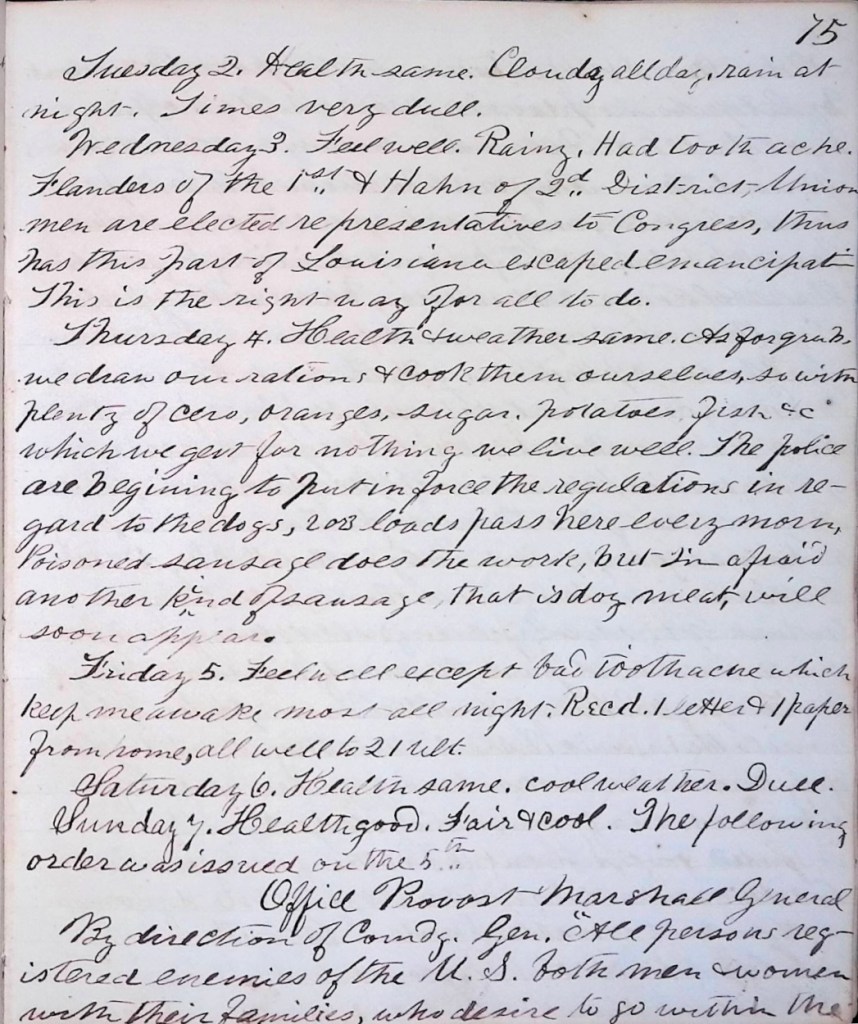
Tuesday, 2nd—Health same. Cloudy all day. Rain at night. Times very dull.

Wednesday, 3rd—Feel well. Rainy. Had toothache. [Benjamin] Flanders of the 1st & [Michael] Hahn of the 2nd District, Union men are elected Representatives to Congress. Thus has this part of Louisiana escaped emancipation. This is the right way for all to do.

Thursday, 4th—Health & weather same. As for grub, we draw our rations & cook them ourselves, so with plenty of cero, oranges, sugar, potatoes, fish, &c. which we get for nothing, we live well. The police are beginning to put in force the regulations in regard to the dogs. Two or three loads pass here every morning. Poisoned sausage does the work but I’m afraid another kind of sausage—that is, dog meat will soon appear.
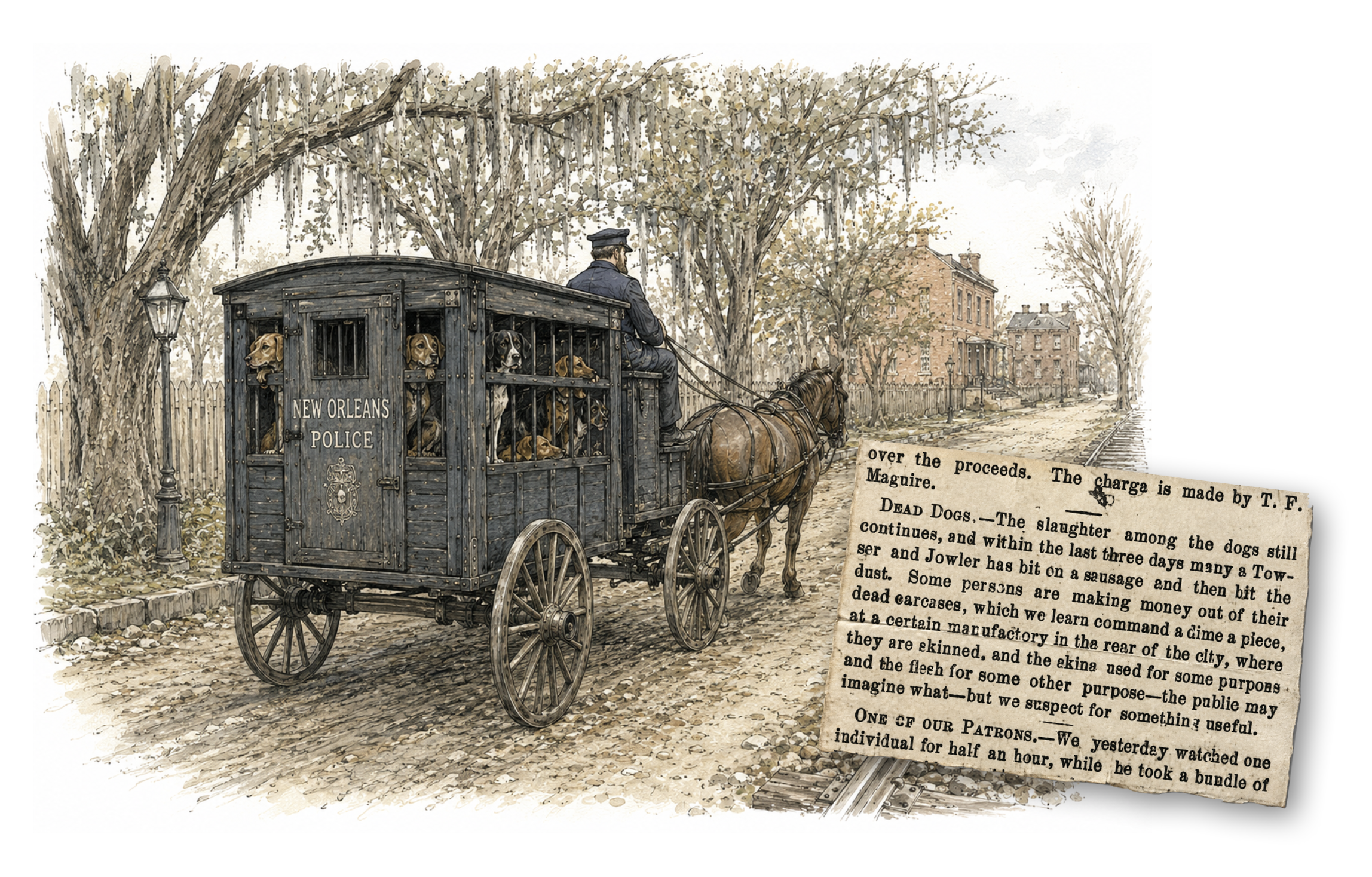
Newspaper clipping from the Daily Delta, December 11, 1862

Friday, 5th—Feel well except bad toothache which keeps me awake most all night. Received one letter 7 one paper from home. All well to the 21st ult.

Saturday, 6th—Health same. Cool weather here. Dull.
Sunday, 7th—Health good. Fair & cool. The following order issued on the 5th:

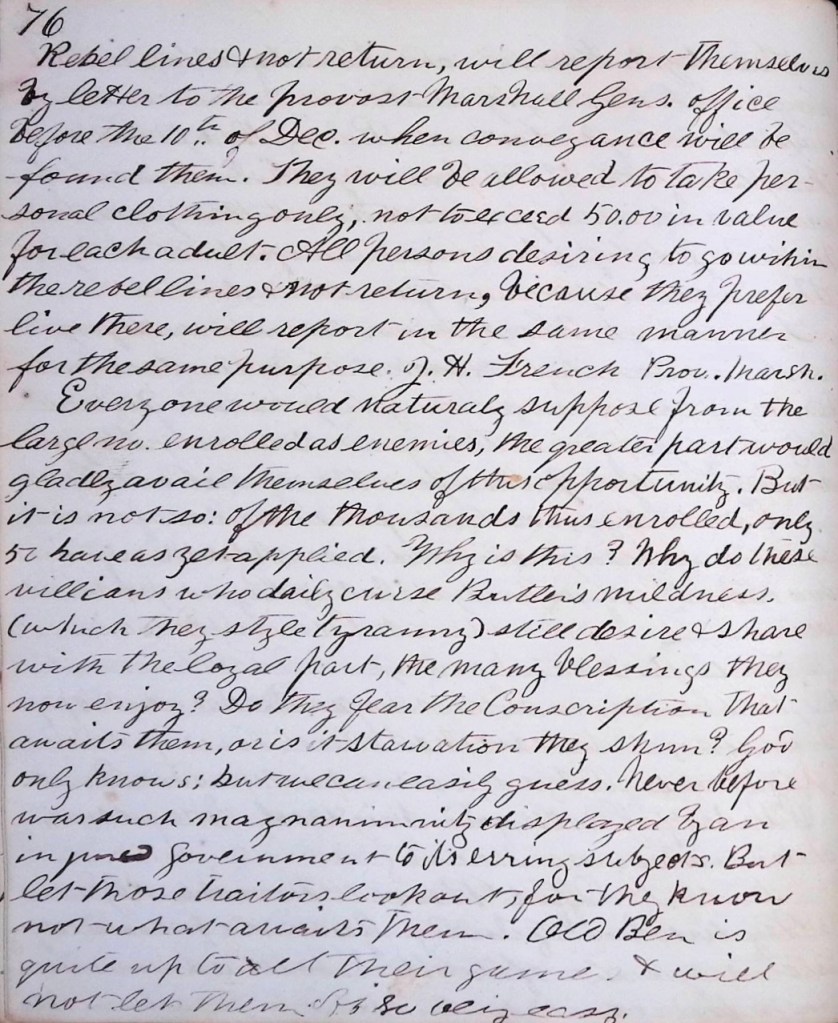
Office Provost Marshall General. By direction of Commanding General, “All persons registered enemies of the U. S., both men and women with their families, who desire to go within the Rebel lines and not return, will report themselves by letter to the Provost Marshall General’s Office before the 10th of December when conveyance will be found them. They will be allowed to take personal clothing only, not to exceed $50 in value for each adult. All persons desiring to go within the rebel lines & not return, because they prefer to live there, will report in the same manner for the same purpose. J. H. French, Prov. Marsh.

Everyone would naturally suppose from the large number enrolled as enemies, the greater part would gladly avail themselves of the opportunity, but it is not so. Of the thousands thus enrolled, only 50 have as yet applied. Why is this? Why do these villains who daily curse Butler’s mildness (which they style tyranny) still desire & share with the loyal part the many blessings they now enjoy? Do they fear the conscription that awaits them, or is it starvation they shun? God only knows, but we can easily guess. Never before was such magnanimity displayed by an injured government to its erring subjects. But let those traitors look out for they know not what awaits them. Old Ben is quite up to act their game & will not let them off so very easy.

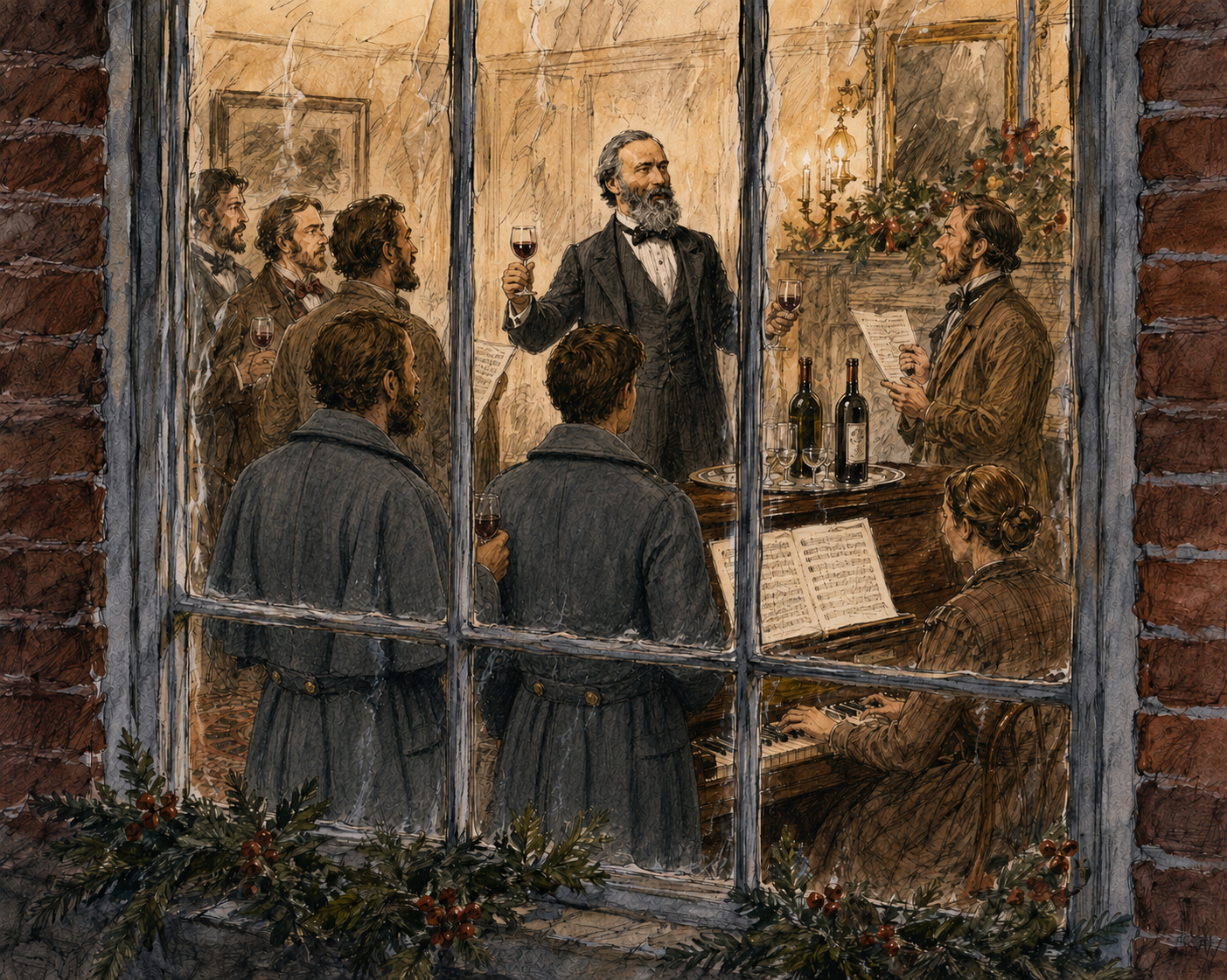
Monday, 8th—Health good. Pleasant. After cruising about the city till 10 o’clock, I made one of a party with a band who serenaded Benjamin F. Flanders, the Representative Elect from the District. He called us in, for we were few, and treated us to brandy, whiskey, &c. We had a good time talking, singing, &c. till two. Mr. Flanders is a grey headed & bearded man, tall and good looking. I guess this District has got a good man to represent her in the coming Congress. Hope the damned Radicals will find enough like him to defeat their hellish plans. They are resolved to put down slavery or destroy the Union.
Tuesday, 9th—Health & weather same. Some talk of our being relieved soon. I don’t care how soon. Our regiment is part at College Point, part at Bonnet-Carré, & our company at Prenier [Prieur?] & Desair [Desiré] on Jackson Railroad. Wrote home.

[Editor’s Note: College Point was located about 40 miles upriver from New Orleans in St. James Parish, named for the prominent bend in the river where Jefferson College and a Catholic convent school were established. Bonnet-Carré was roughly 33 to 40 miles above New Orleans on the east/north bank of the Mississippi River in the German Coast region (near present day Norco and Montz).]

Wednesday, 10th—Health & weather same. 200 have reported to leave the Federal lines. Just read [Alexander] Pope’s Homer’s Odyssey. Quite a fine production.

Thursday, 11th—Lame in my back. Tooth aches. Moderately cool & rainy. Nothing to do.

Friday, 12th—Health & weather same. Read “The Revenge” by Greenbow [?]. Smutty but interesting.

Saturday, 13th—Health & weather same. President’s Annual Message has arrived. Little too sanguine, I think, of the result of his emancipation schemes but it can do little harm to try it on, [even] if it does no good.
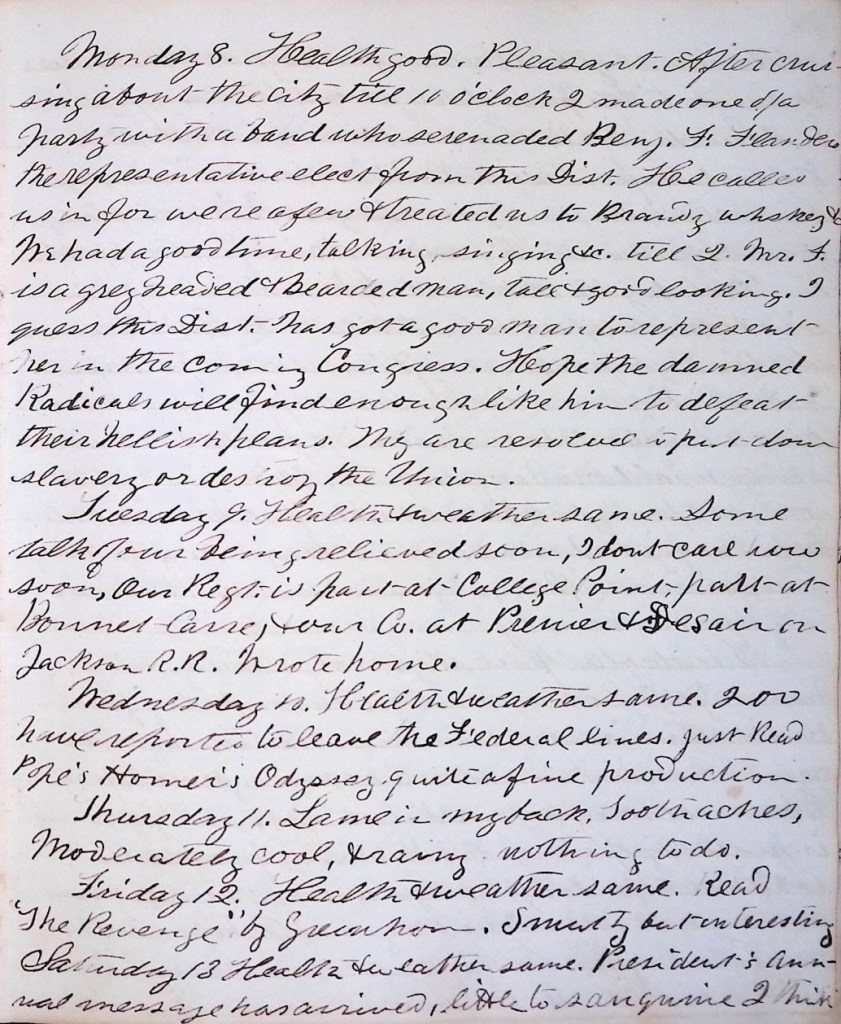
Sunday, December 14—Lame in back. Dull & cloudy. Nine steamers filled with Bank’s men came in tonight so it seems that wherever he goes, he’s not going to make Galveston his rendezvous as at first supposed.

Monday, 15th—Feel well. Fair. About 10 a.m. received orders to report to Co. A to go to the regiment tomorrow. All our regiment is to be got together except perhaps Cos. H & D. Reckon will have a chance to fight soon. Went to the Varieties Theatre [on Gravier Street] last night & saw the Swiss Cottage & Soldier’s Daughter acted. Thought it quite good though perhaps I should not if it had not been the first I ever saw. At any rate, I got my quarter’s worth. I’ll go again when I can though Lord only knows when.
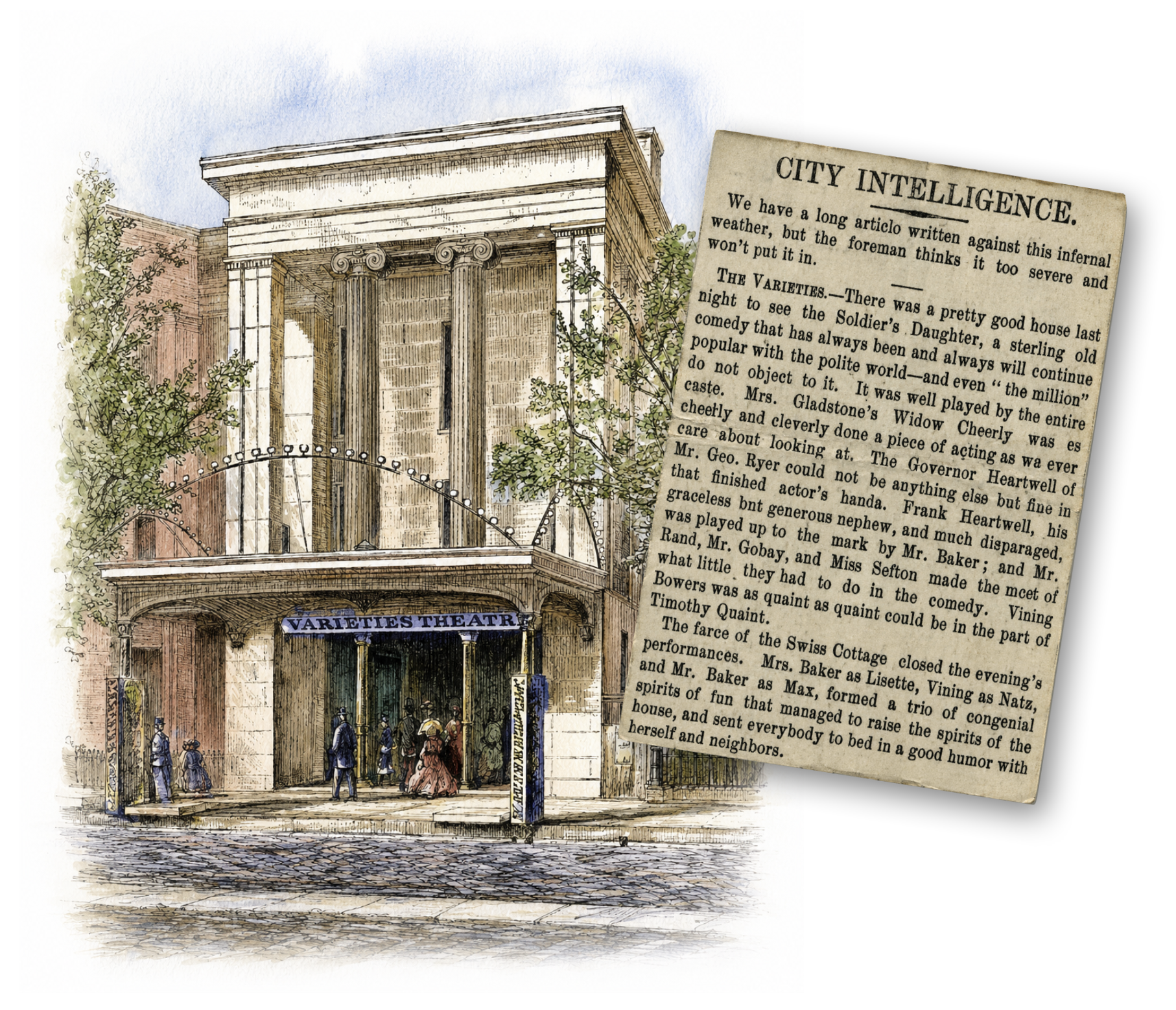
Newspaper article clipped from the Daily Delta of December 16, 1862.

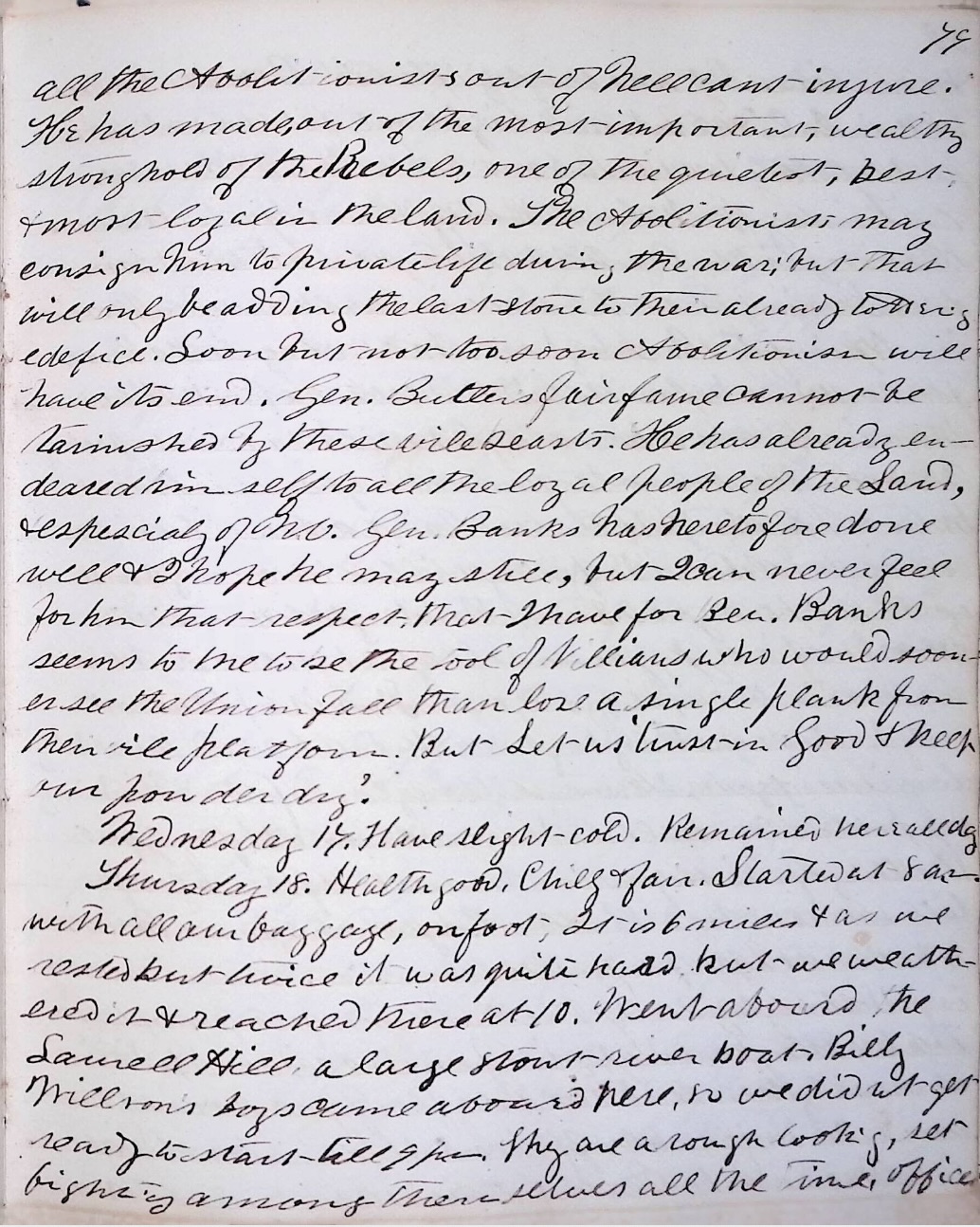
Tuesday, 16th—Have a slight cold. Chilly. Stayed here at Co. A’s quarters all day. At noon today, Gen. Butler committed his command to Banks, by order from Washington. All is to be changed, no doubt. What will become of us, I know not. This exchange is probably a part of the Abolition program which is to put Republican generals in all the important commands. But though they may prosper in this awhile, they’ll find out their error. Like Gen. McClellan, Butler has won a name which all the Abolitionists out of hell can’t injure. He has made out of the most important, wealthy strongholds of the Rebels, one of the quietest, best, and most loyal in the land. The Abolitionists may consign him to private life during the war, but that will only be adding the last stone to their already tottering edifice. Soon—but not too soon—Abolitionism will have its end. Gen. Butler’s fair fame cannot be tarnished by these vile beasts. He has already endeared himself to all the loyal people of the land—especially of New Orleans. Gen. Banks has heretofore done well & I hope he may still, but I can never feel for him that respect that I have for Ben. Banks seems to me to be the tool of villains who would sooner see the Union fall than lose a single plank from their vile platform. But let us trust in God & keep our powder dry?

Wednesday, 17—Have slight cold. Remained here all day.

Thursaday, 18th—Health good. Chilly & fair. Started at 8 a.m. with all our baggage on foot. It is 6 miles & as we rested but twice, it was quite hard. But we weathered it & reached there at 10. Went aboard the Laurel Hill—a large stout river boat. Billy Wilson’s boys came aboard here so we didn’t get ready to start till 9 p.m. They are a rough looking set [who were] fighting among themselves all the time, officers & men alike. It was mighty cold. At Bonnet-Carré, took in Co. C & about midnight we arrived at a place ten miles above where Cos. I & F were.
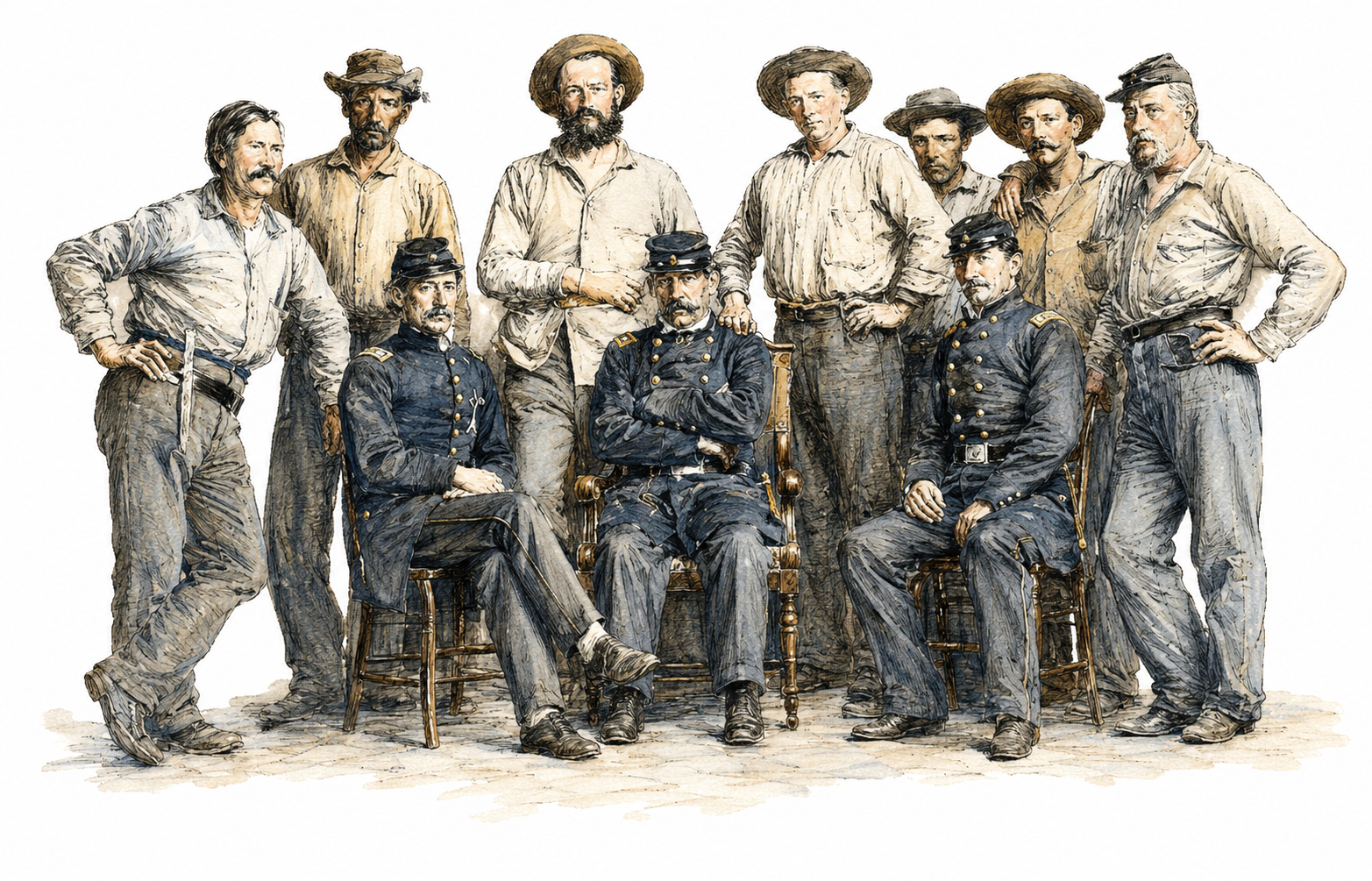
William Wilson was a controversial New York City political pugilist who commanded the 6th New York Infantry—famously known as “Billy Wilson’s Zouaves. They served principally inn Florida and Louisiana in 1862 and 1863.

Friday, 19th—Feel rather stiff & lame. Quite warm. Having taken Cos. I & F aboard we started at sunrise. Saving that the river is lower & wider than in spring, the country looks very like that for twenty miles below New Orleans, though there are a few better mansions & more houses. It makes quite a pretty scene. The smooth, quiet, and huge river flows between two strips of cleared land about one mile wide covered with pretty villas & waving cane with a background of thick green woods.

Arrived at Jefferson College at noon where we took in the rest of the regiment. This is a pleasant little village. Billy’s boys scattered abroad, knocking down niggers, stealing all they could find & kicking up particular hell. One sergeant was shot by an officer. Nothing of consequence was seen after we left till we reached Baton Rouge at 8 p.m. Received two letters & 6 papers [from home]. All well.

Saturday, 20th—Feel well. Went into camp near the battleground one and a half miles from the river. Baton Rouge is nearly deserted. There are a few fine houses in it. It is on a bluff about 10 feet above high water. Saw the Essex [gunboat]. She is rusty so she looks like a house top covered with slate. Laid on our arms all night as it is aid the Rebels are not far off. Very cold.

Sunday, 21st—Have bad cold. Quite warm. At 4 a.m. we were awakened by the firing of three guns & fell into line of battle but no Rebels appeared. No one seemed afraid to turn out. At parade tonight, orders for two hours drill were given. We sleep on arms no more till further orders. Col. [Halbert E.] Paine [4th Wisconsin] commanding. The field we are on is about 80 rods (440 yards) square covered with grass. Close to the wood. There are graves all about here. 4th Wisconsin & two batteries came here today with 2nd Louisiana. Let the Rebels come if they will & if they don’t, we must go after them.

Monday, 22nd—Health & weather same. I went to the Penitentiary & brought off a moss mattress which makes a fine bed. One drill. 133rd New York came in here.

Tuesday, 23rd—Health same. Foggy all day & rainy at night. On brigade guard 1st time in 5 months though got some wet. Had easy time. 173rd New York came in here. Live on hard bread, coffee, salt junk & beef & poor at that. Wrote to Darius.

Wednesday, 24th—Feel well though stiff. The cavalry brought in some guerrillas & a lot of cattle & cotton. We are turned out at 10 by the New York Band beating reveille at 10 instead of 8:30. One man shot on picket tonight in the 2nd Louisiana. He saw & fired on a lot of niggers & then ran to the reserve, when a sergeant halted him & shot him as he did not answer.
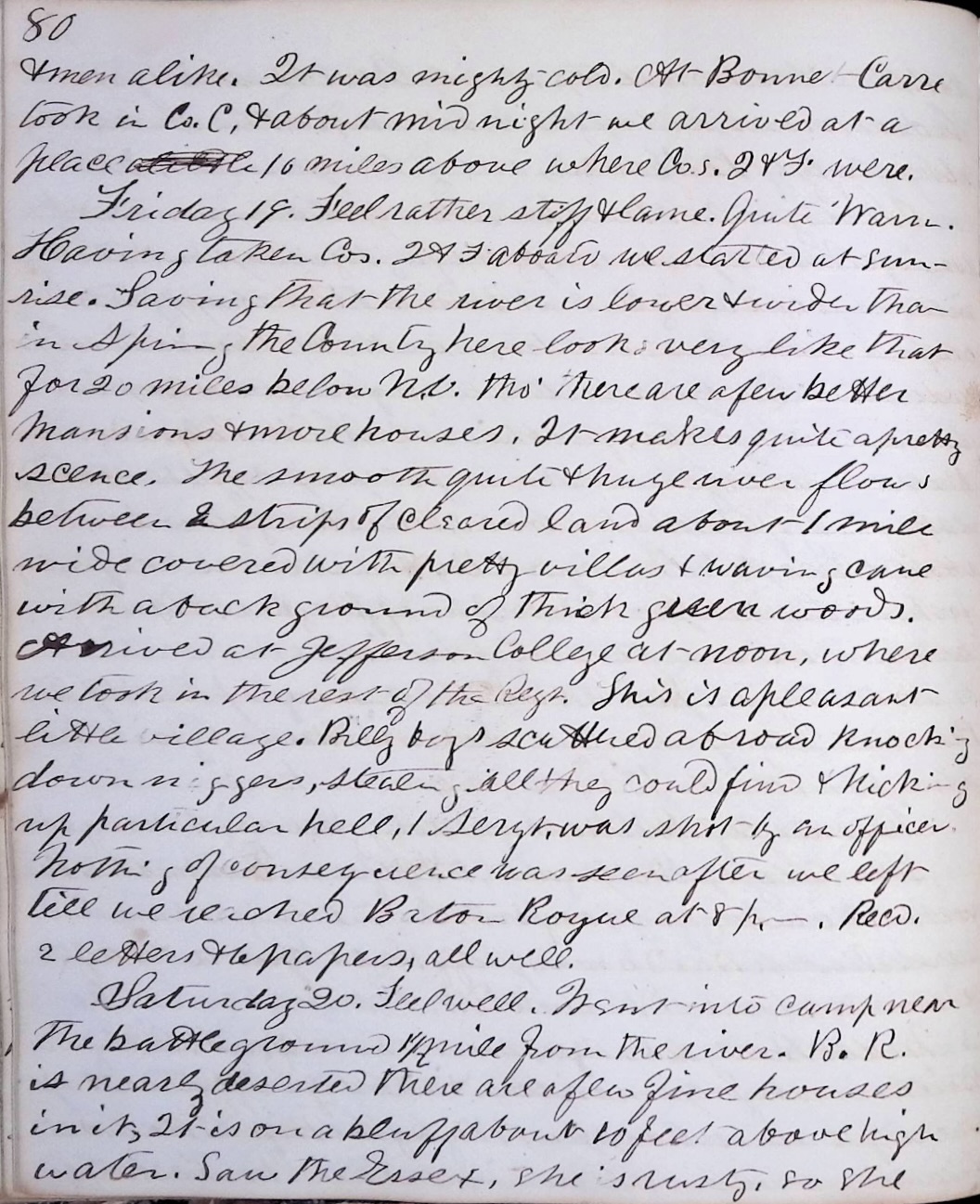
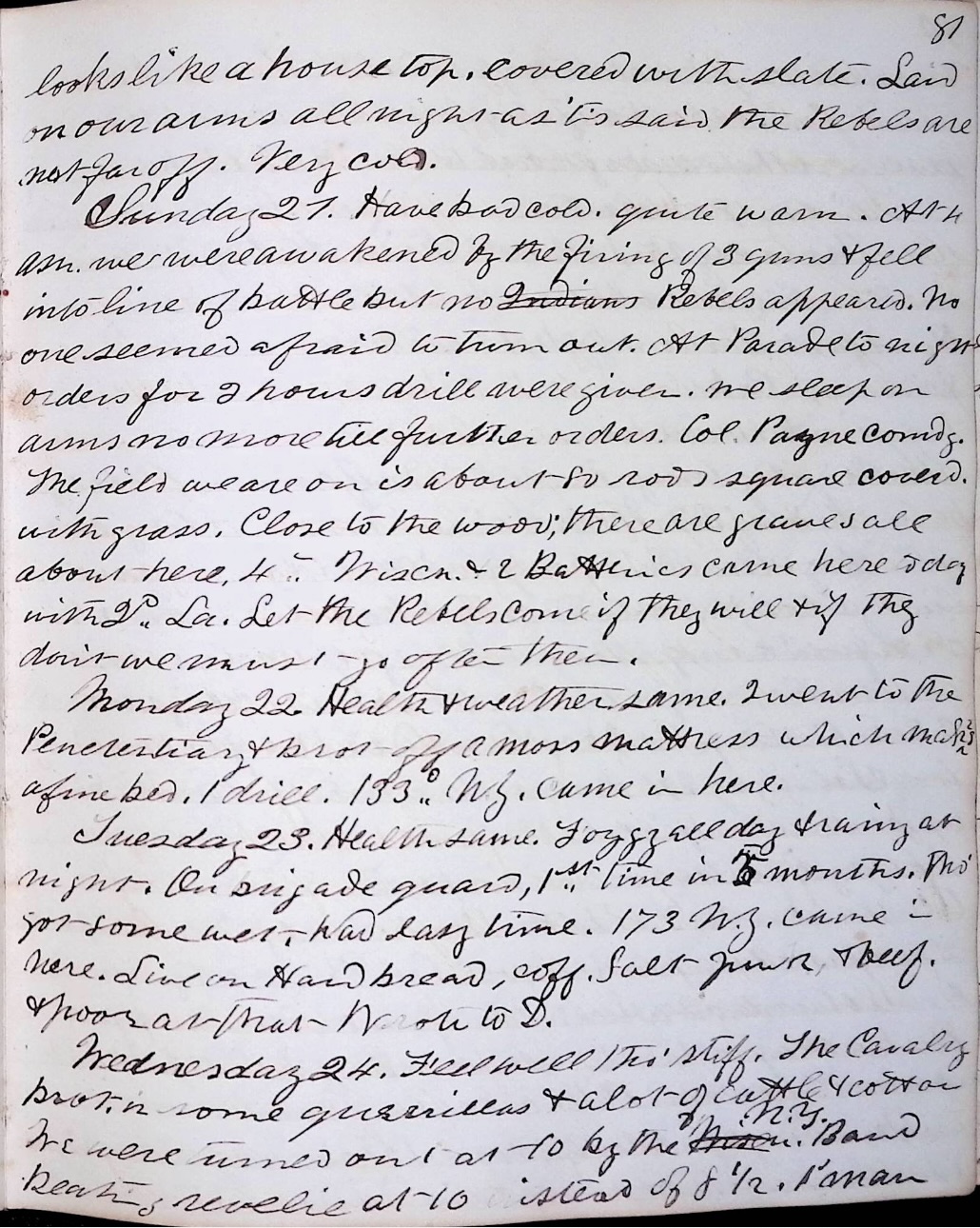
Thursday, 25th [December 1862]—Feel well. Fair. Today is Christmas & so I’ll tell what we had to eat. Breakfast—beans, coffee & hard bread. Dinner—Pork. Supper—Fresh meat. The cavalry brings in all kinds of animals & things.

Friday, 26th—Well. Fair in morning & rainy rest of the day. Our company is on picket today. I was lucky enough to stand only two hours. We were half mile from camp. We got plenty of molasses, cow meat, calf and sheep. It rained all night & I had to sleep as I could under the fence.

Saturday, 27th—Feel same. Cleared off at noon so we got it all on picket. Relieved at 10 & then had to prepare for tomorrow’s inspection.

Sunday, 28th—Feel better. Hot & cloudy. Were inspected by & passed in review before Col. Paine, Acting General. Have about 15,000 here. News from the North says Burnside, after taking Fredericksburg, had to fall back. Guess they’ll want McClellan soon.

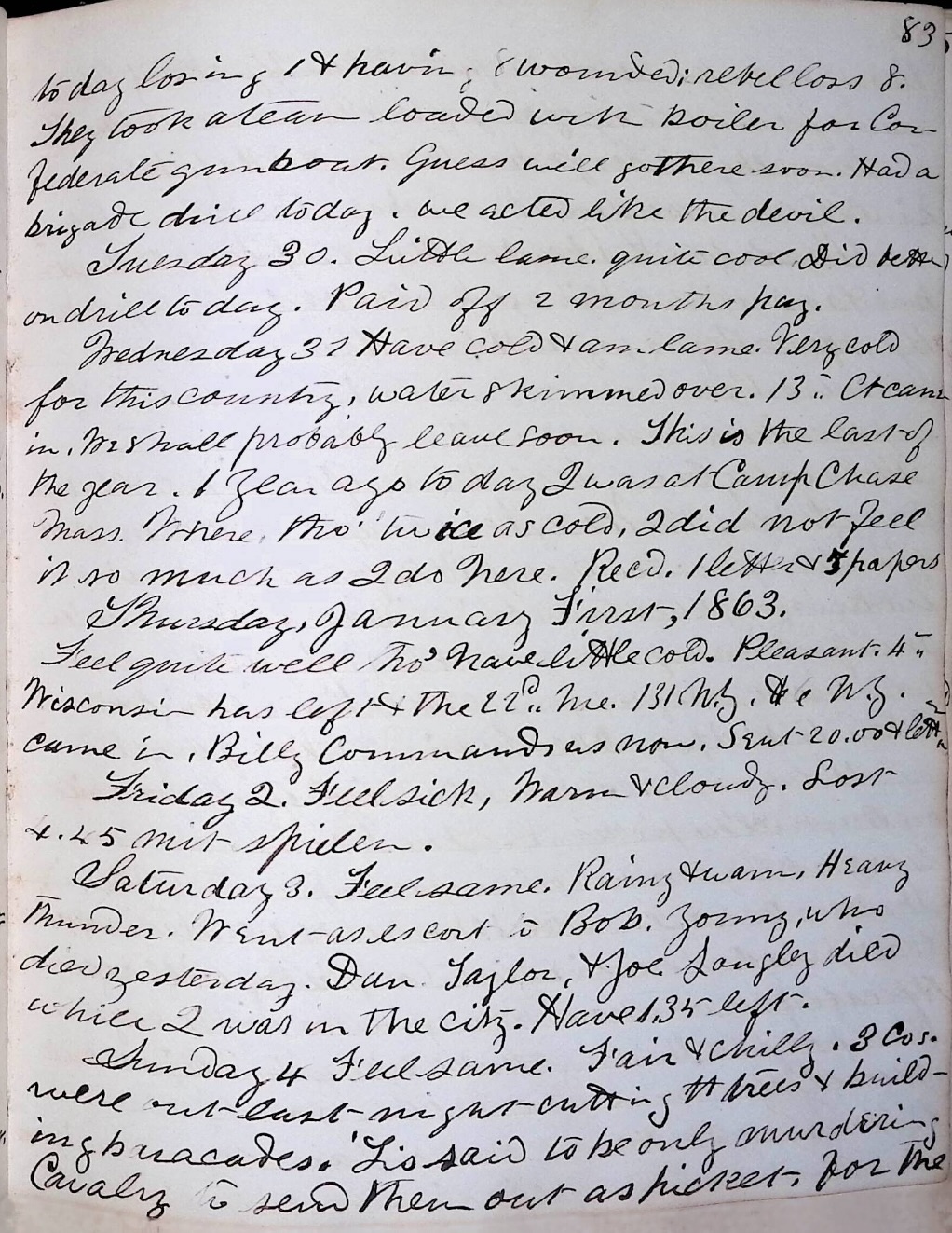
Monday, 29th—Health same. Fair day. Wet night. Our cavalry had a small skirmish with the Rebels today, losing one and having eight wounded. Rebel loss 8. They took a team loaded with boiler for Confederate gunboat. Guess we’ll go there soon. Had a brigade drill today. We acted like the devil.

Tuesday, 30th—Little lame. Quite cool. Did better on drill today. Paid off two month pay.

Wednesday, 31st—Have cold and am lame. Very cold for this country. Water skimmed over. 13th Connecticut came in. We shall probably leave soon. This is the last of the year. One year ago today I was at Camp Chase, Massachusetts, where—though twice as cold—I did not feel it so much as I do here. Received one letter & five papers.
Thursday, January 1, 1863—Feel quite well tough have little cold. Pleasant. 4th Wisconsin has left & the 22nd Maine, 131st New York, and 6th New York came in. Billy [Wilson] commands us now. Sent $20 & lent $2.

Friday, 2nd—Feel sick. Warm & cloudy. Lost $4.45 mitspielen [gambling].

Saturday, 3rd—Feel same. Rainy & warm. Heavy thunder. Went as escort to Bob Young who died yesterday. Dan Taylor & Joe Longley died while I was in the city. Have 135 left.

Sunday, 4th—Feel same. Fair & chilly. Three companies were out last night cutting the trees & building barricades. ‘Tis said to be only murdering cavalry to send them out as picket for the Rebels lying in the woods pick them off. We send out infantry now which is much better.
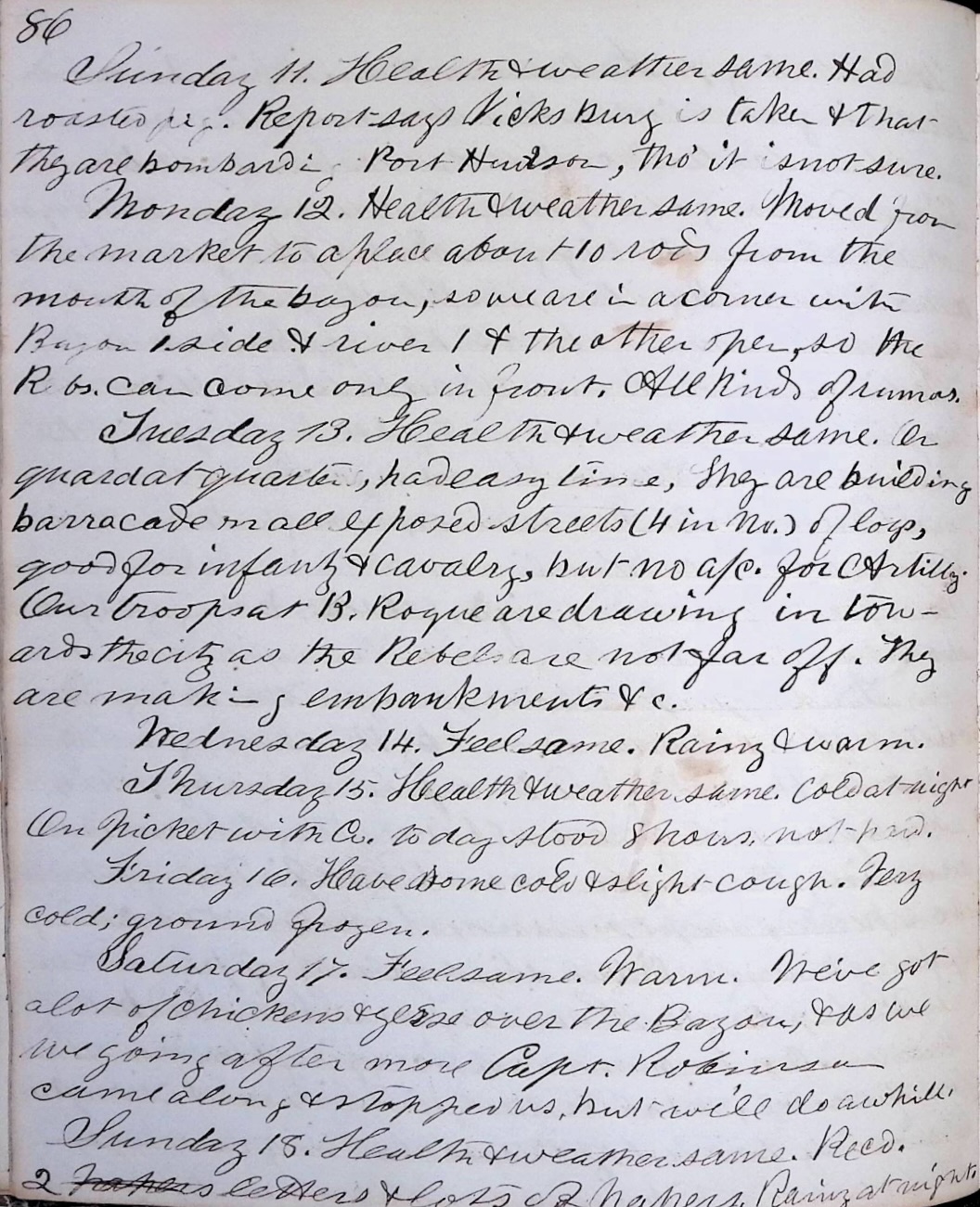
Monday, 5th—Feel same. Rainy all day. All kinds of rumors are abroad about the Potomac Army.

Tuesday, 6th—Had orders to go on picket today but as we got into line, we were ordered to pack up and be ready to go on board the gunboat Albatross which took us to Plaquemine City, twenty miles down on the other side where the Rebels have lately troubled our transports. Four companies [of the[ 52nd Massachusetts are here. We camped at the Market, a few rods from the levee. Plaquemine is a fine little city of 4,000 inhabitants. It is in form of a triangle between the river & the Bayou Plaquemine which is a creek running out of the river down to Berwick’s Bay & bids fair to be one day the main channel of the Mississippi. It runs half a mile on Bayou and one-quarter on river. The houses are low except one dozen or so & nearly all wood, painted white. There are two churches, 6 or 10 stores and two or three taverns & a market. There is quite a pretty village of large plantation houses across the Bayou. The people dress coarse & plain & live mostly on corn meal & meat of all kinds but have no flour or other luxuries.

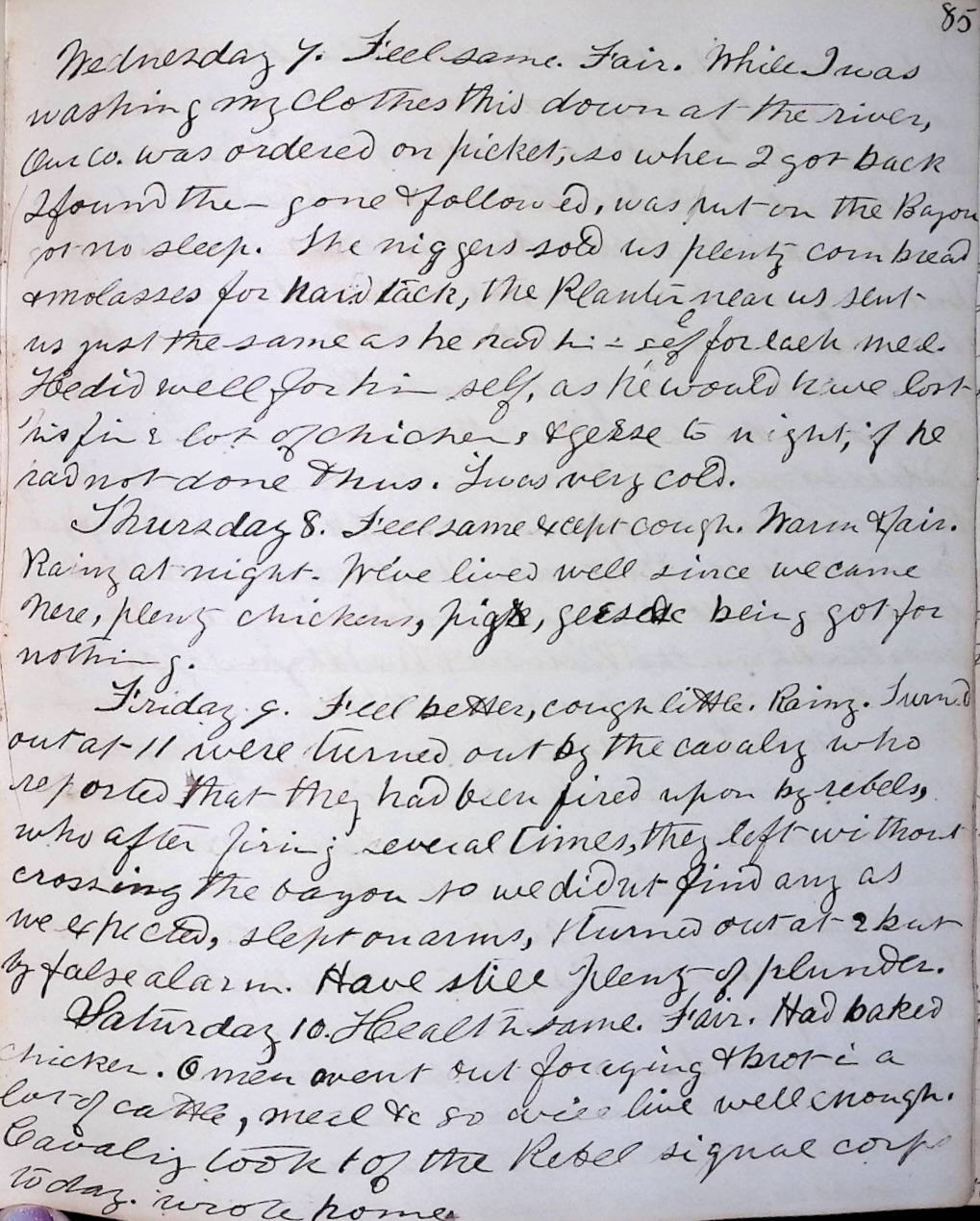
Wednesday, 7th—Feel same. Fair. While I was washing my clothes this [morning] down at the river, our company was ordered on picket so when I got back, I found them gone & followed. Was put on the bayou. Got no sleep. The niggers sold us plenty of corn bread & molasses for hard tack. The planter near us sent us just the same as he had himself for each meal. He did well for himself as he would have lost his fine lot of chickens and geese tonight if he had not done thus. I was very cold.

Thursday, 8th—Feel same except cough. Warm & fair. Rainy at night. We’ve lived well since we came here. Plenty chickens, pigs, geese, being got for nothing.

Friday, 9th—Feel better. Cough little. Rainy. Turned out at 11. Were turned out by the cavalry who reported that they had been fired upon by rebels who after firing several times, they left without crossing the bayou so we didn’t find any as we expected. Slept on arms & turned out at 2 but by false alarm. Have still plenty of plunder.

Saturday, 10th—Health same. Fair. Had baked chicken. Six men went out foraging & brought in a lot of cattle, meal, &c. so will live well enough. Cavalry took one of the Rebel signal corps today. Wrote home.
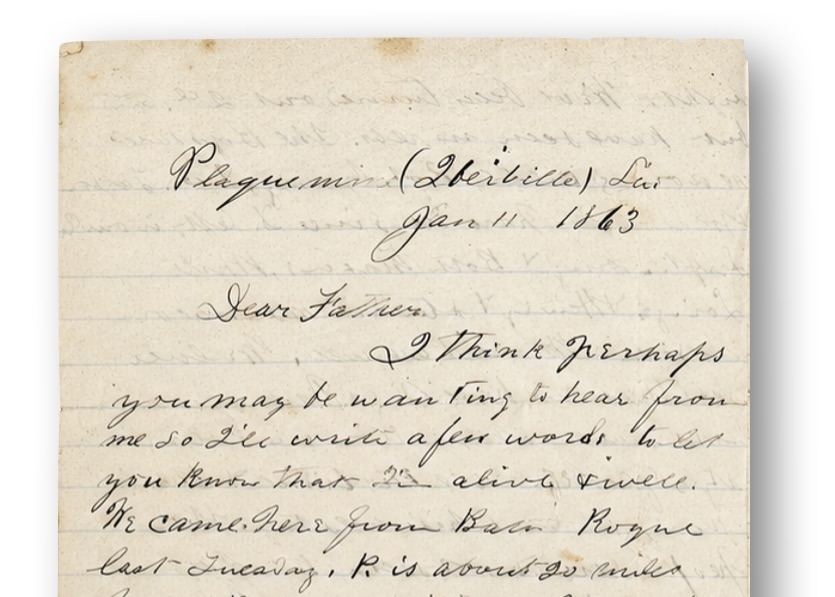
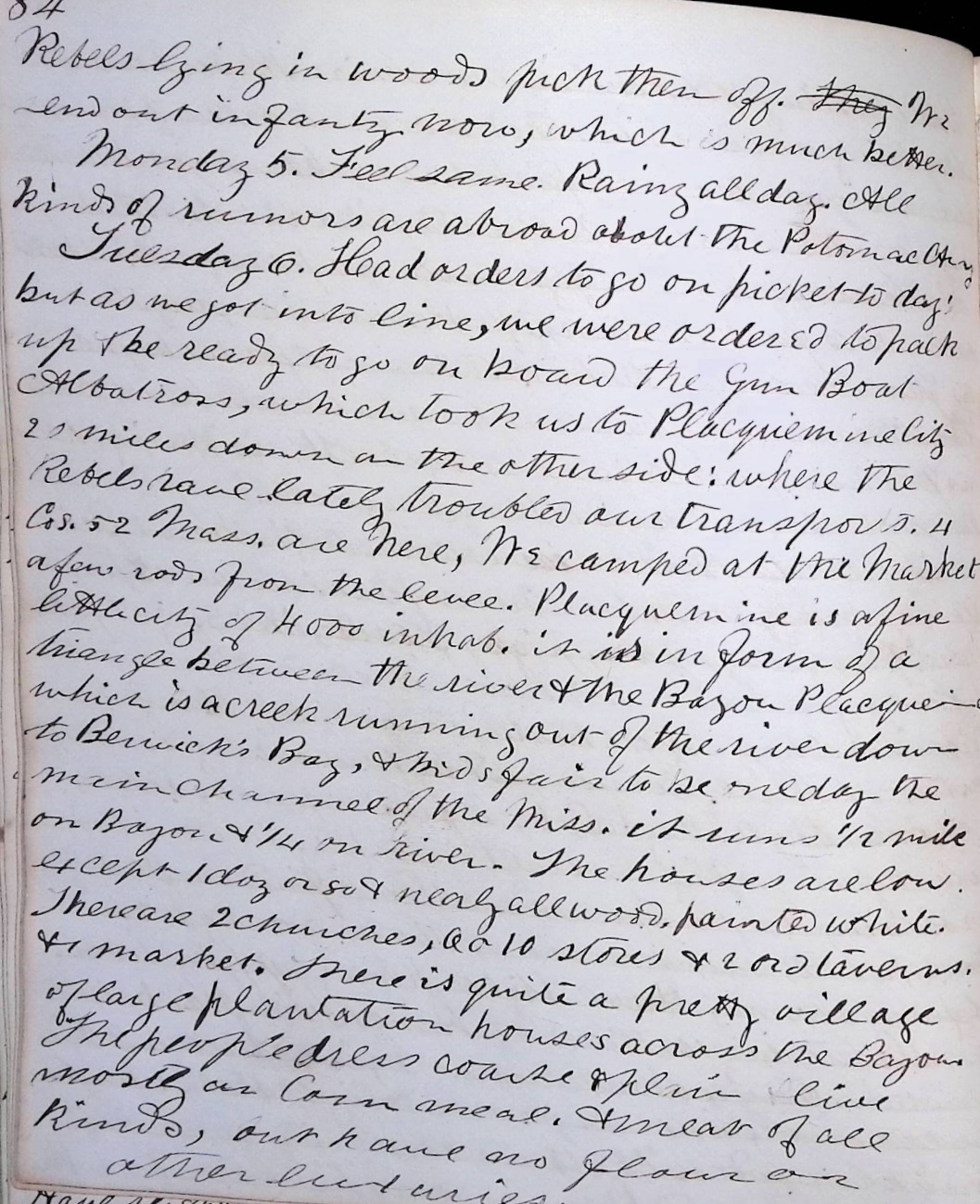
James addressed his 4th of 12 surviving letters from Plaquemine, Louisiana. He informs his father that “We came here—that is, Companies G, H, I, & K under command of Capt. Robinson to assist the 52nd Massachusetts in holding this place so as to protect the transports from the guerrillas who are a few miles from here on an island in Bayou Plaquemine.” To read the full letter, see Letter 4.

Sunday, 11th—Health & weather same. Had roasted pig. Report says Vicksburg is taken & that they are bombarding Port Hudson though it is not sure.

Monday, 12th—Health & weather same. Moved from the market to a place about ten rods from the mouth of the bayou, so we are in a corner with the bayou and [Mississippi] River and the other open, so the Rebs can come only in front. All kinds of rumors.

Tuesday, 13th—Health & weather same. On guard at quarters. had easy time. They are building barricades on all exposed streets (four in number) of logs. good for infantry and cavalry, but [of] no account for artillery. Our troops at Baton Rouge are drawing in towards the city as the Rebels are not far off. They are making embankments, &c.

Wednesday, 14th—Feel same. Rainy & warm.

Thursday, 15th—Health & weather same. Cold at night. On picket with company today. Stood 8 hours. Not paid.

Friday, 16th—Have some cold & slight cough. Very cold. Ground frozen.

Saturday, 17th. Feel same. Warm. We’ve got a lot of chickens & geese over the Bayou & as we were going after more, Capt. Robinson came along & stopped us. But we’ll do awhile.

Sunday, 18th—Heath & weather same. Received two letters & lots of papers. Rains at night.

Monday, January 19th [1863]—Feel same. Tooth aches. Rainy. Plenty of ducks &c. for a week.

Tuesday, 20th—Health & tooth same. Fair & cold. Our boys crossed the bayou today & got 40 hens, 8 ducks, 2 geese, and 1 turkey. The old planters looked blank, but, but of no use. I do but little but read except when I am helping fix things & cut wood.

Wednesday, 21st—Tooth easier. Health same. Fair days and cold nights. Little done.

Thursday, 22nd—Health & tooth same. Fair & cold. A cavalry man being across the bayou with four others was shot by one on plantation yesterday night.

Friday, 23rd—Health same. Tooth ached all night & day. On picket. Stood 10 hours. River is rising & the bayou is filled with driftwood which makes great noise. Another cavalry shot by his mate.

Saturday, 24th—Feel sick all over. Tooth uneasy.

Sunday, 25th—Got some cold. Tooth bad. Fair & mild.

Monday, 26th—Feel about sick. Hot & chilly. Tooth aches. On guard. Cold & rainy. Heard sounds like chopping wood & felling trees over bayou which I took to be Rebels preparing to cross. Since found ’twas a jam breaking.

Tuesday, 27th—Better. Tooth easy. Fair & cold. Quiet.

Wednesday, 28th—Feel same. Still cold & fair. See by papers that Gen. Butler was enthusiastically received at home & is an Abolitionist. Well so be it. As for me, I hate the niggers more & more. They are so damned saucy to privates. Many officers think more of them than us. The cavalry & one gun crew from the Albatross went down two miles & drove off Rebel picket & burnt their camp. No loss.
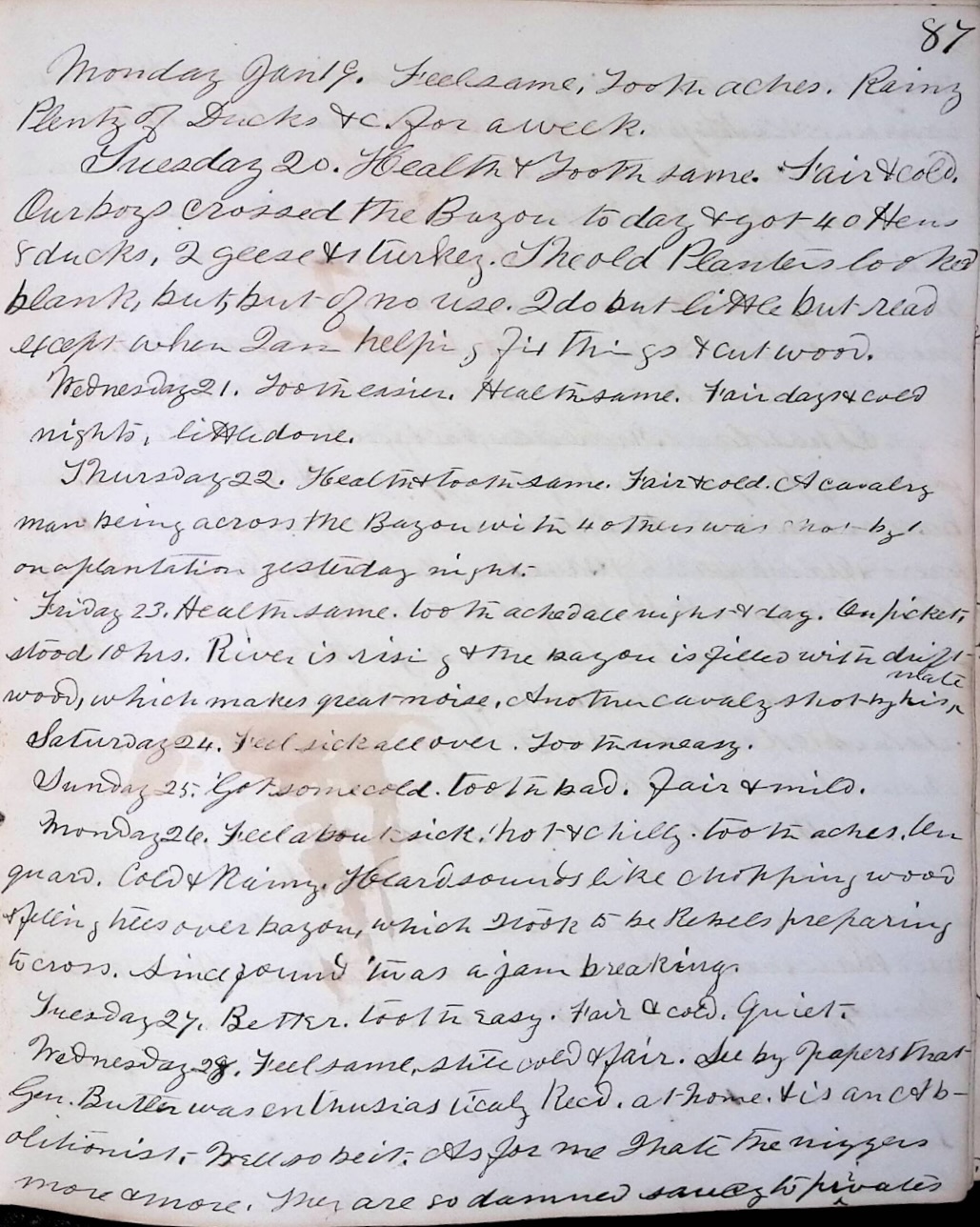
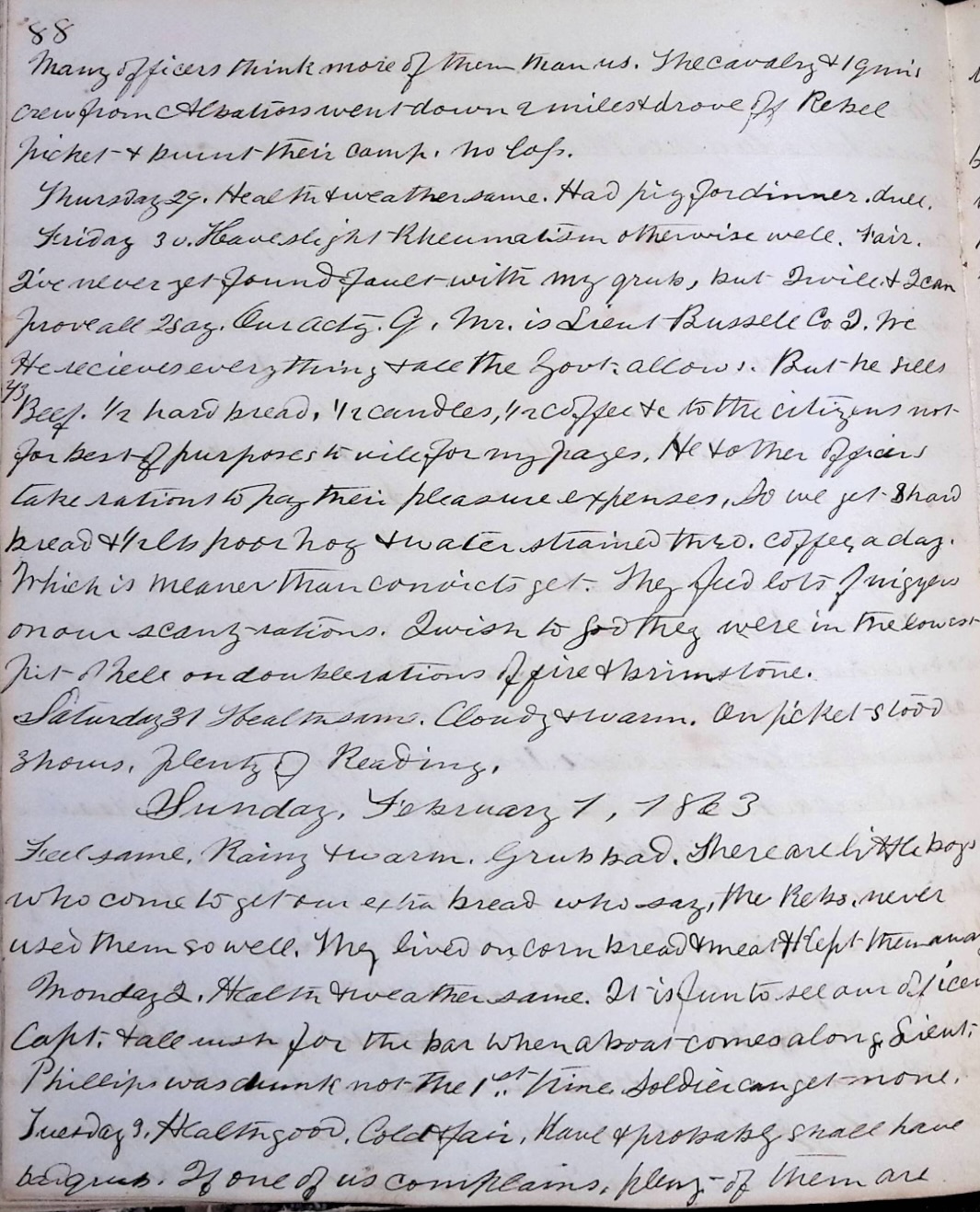
Thursday, 29th—Health & weather same. Had pig for dinner. Dull.
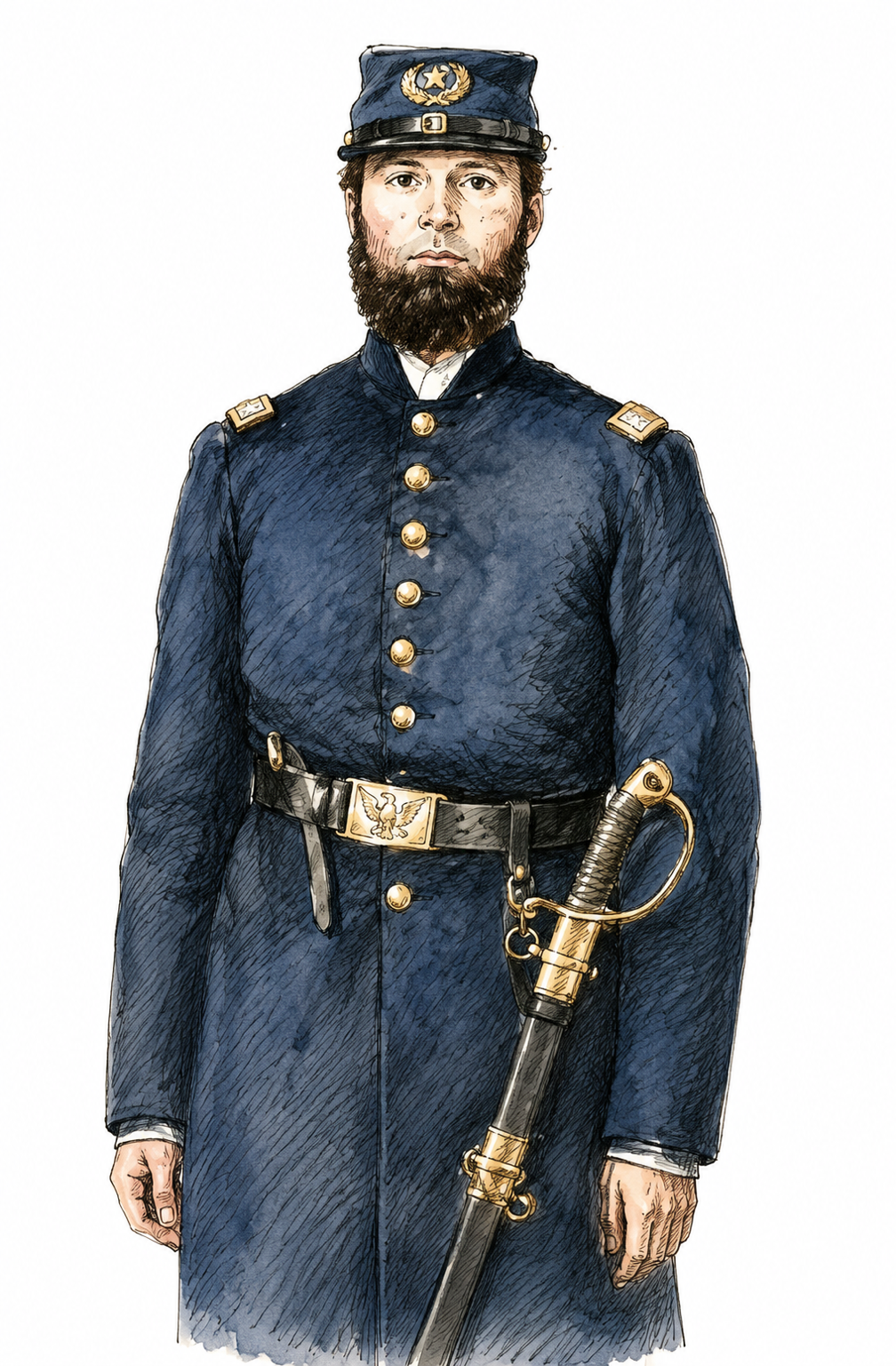
37 year-old Lt. Charles H. Buswell of Co. I, 12th Maine Infantry was acting as the regimental quartermaster in January 1863; James accused him of graft while carrying out his duties (privately in his diary). Buswell mustered out of the regiment in 1866 as Quartermaster Sergeant.

Friday, 30th—Have slight rheumatism. Otherwise well. Fair. I’ve never yet found fault with my grub but I will & I can prove all I say. Our Acting Quartermaster is Lieut. [Charles H. Buswell, Co. I. He received everything & all the government allows. But he sells beef, half hard bread, half candles, half coffee, &c to the citizens, not for best of purposes to [ ] for my pages. He & other officers take rations to pay their pleasure expenses so we get hard bread & half pound poor hog & water strained through coffee a day which is meaner than convicts get. They feed lots of niggers on our scanty rations. I wish to God they were in the lowest pit of hell on double rations of fire & brimstone.

Saturday, 31st—Health the same. Cloudy & warm. On picket. Stood 3 hours. Plenty of reading.

Sunday, February 1st, 1863—Feel same. Rainy & warm. Grub bad. There are little boys who come to get our extra bread who say the Rebs never used them so well. They lived on corn bread & meet & kept them away.

Monday, 2nd—Health & weather same. It is fun to see our officers, Captain & all, rush for the bar when the boat comes along. Lieut. Phillips was drunk—not the first time. Soldiers can get none.

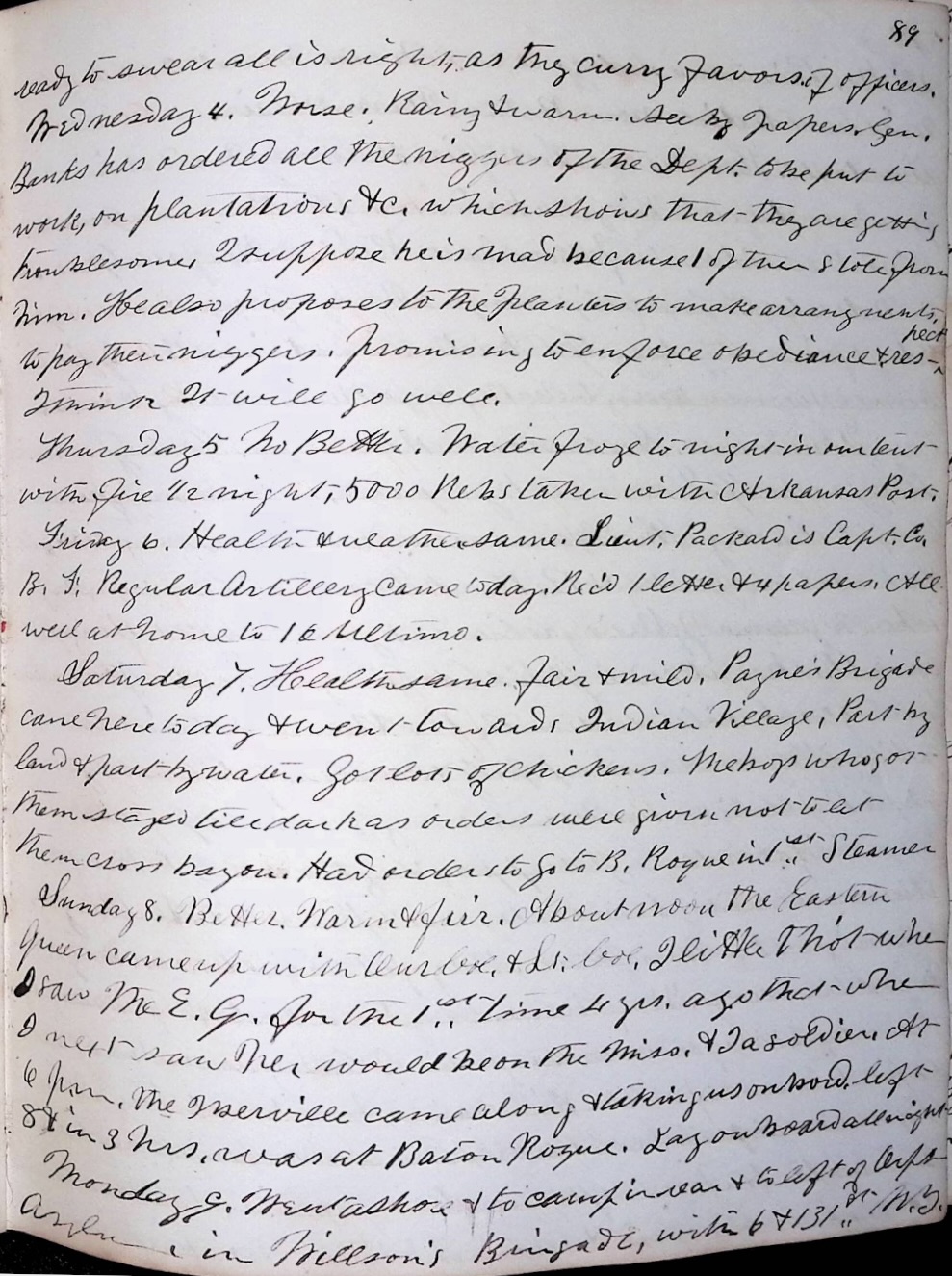
Tuesday, 3rd—Health good. Cold & fair. Have & probably shall have bad grub. If one of us complains, plenty of them are ready to swear all is right as they curry favors of officers.

Wednesday, 4th—Worse. Rainy & warm. See by papers Gen. Banks has ordered all the niggers of the Department to be put to work on plantations, &c. which shows that they are getting troublesome. I suppose he is mad because one of them stole from him. He also proposes to the planters to make arrangements to pay their niggers, promising to enforce obedience & respect. I think it will go well.

Thursday, 5th—No better. Water froze tonight in our tent with fire half the night. 5,000 Rebs taken with Arkansas Post.

Friday, 6th—Health & weather same. Fair & mild. Paine’s Brigade came here today & went towards Indian Village, part by land and part by water. Got lots of chickens. We hope who got them stayed till dark as orders were given not to let them cross bayou. Had orders to go to Baton Rouge in 1st steamer.

Sunday, 8th—Better. Warm & fair. About noon the Eastern Queen came up with our Colonel & Lt. Colonel. I little thought when I saw the Eastern Queen for the first time four years ago that when I next saw her, would be on the Mississippi & I a soldier. At 6 p.m. the Merville came along & taking us on board, left at 8 in 3 hours was at Baton Rouge. Lay on board all night.

Monday, 9th—Went ashore & to camp in rear & to left of Orphan Asylum in Wilson’s Brigade with 6th & 131st New York. 22nd Maine paid two months today. Wrote home & sent $3 to father. We’ll have to drill now. Better. Warm & fair.
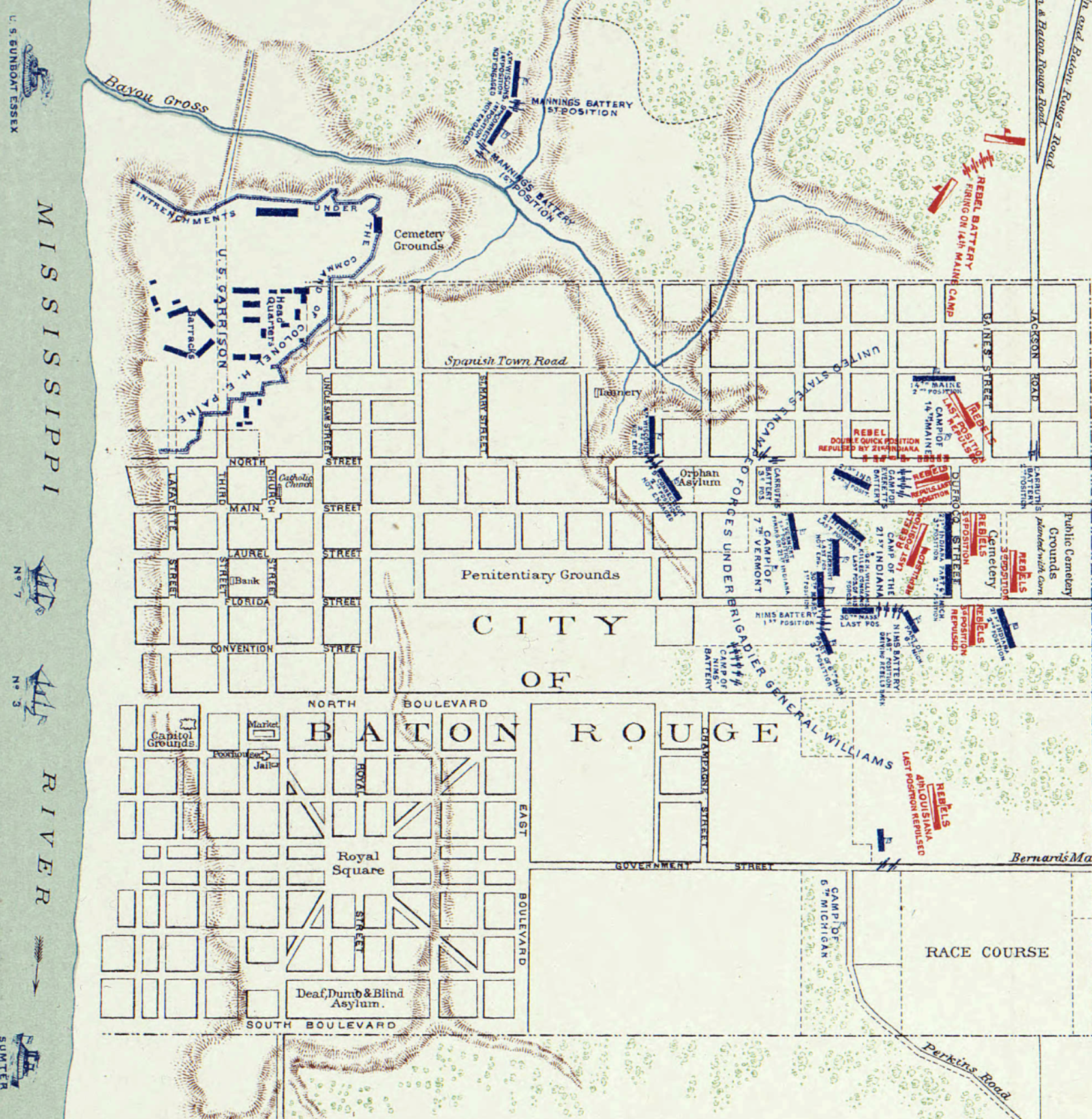
An August 1862 Map of Baton Rouge. The Penitentiary Grounds are seen at center; the Orphan Asylum is just above and to the right of those grounds, some 12 city blocks back from the Mississippi River.

Tuesday, 10th [February 1863]— Health same. Hot & fair. Had very hard drill for so hot a day. Old Billy [Wilson] is a hard one. The Provost guard raise the devil with fellows here. Received a letter from [brother] Gran[ville Holt].

Wednesday, 11th—Have slight cough. Dewey & foggy mornings & dry & fair rest of the day. Had Battalion Drill. The officers & some of the men seem to have forgotten all they knew.

Thursday, 12th—Health same. Showers. One of our company, James O’Donnell by name, came in from hospital today. He & bunkee were with a small detachment on Jackson Railroad at Desair Station & when they came off (being relieved by some of the 31st Massachusetts), [John] Casey (his bunkee) left his cartridge box and after he had gone six miles down the railroad, the two set out to get it. They went on happily & carelessly till they got nearly to the station when seeing three men approaching, they said good evening (supposing them 31st Mass.) & [the greeting] ’twas returned. Time about 8 p.m. As they had on Yankee uniforms, they got close to our boys before they recognized them. They then ordered our boys to give up their guns which Casey was about to do as Jim had none, when O’Donnell said, “Don’t let them have the gun, Casey, & grabbed it when he was struck on the head with the butt of a musket & felled to the ground. Casey then wheeled & ran. The Rebs fired after him but missed & he got back after wandering here and there through the swamp. O’Donnell was then struck on the knee which brought him to & told to get up, which he did & was again struck on left arm. They took him a little way above on railroad. O’Donnell asked them what they were going to do with him & was told he would soon see.
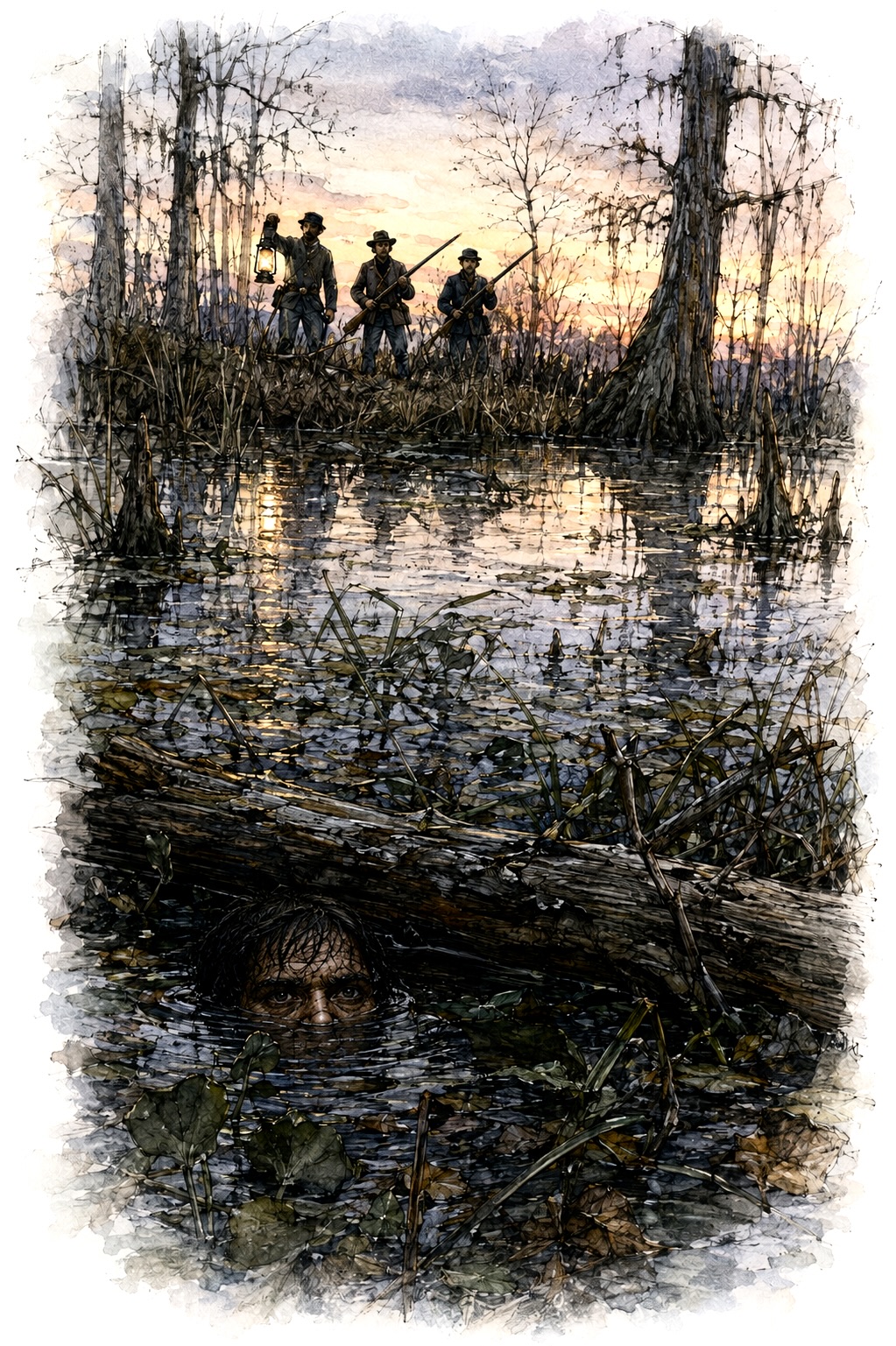
Thinking it his only he hope, he sprang away from them & ran into woods & into a duck pond where he lay—only his head above water three hours. Then, all being still, he crawled on hands and knees to a shed & crawled beneath but some hogs drove him out, smelling his blood & then he crawled along and got into the shed in some hay & slept. When he awoke, it was light & the place was still. He tried to get up but he was so weak that he fell as fast as he raised himself up on his knees. He knew that unless he got help soon, he must die so he yelled as loud as he could & an old Dutchman [German] came out & told him to lie still and he would help him. So he brought out some beef tea & brandy &told him to try and get along till night and he would see what he could do. At night, he and two others and a young fellow of the 31st Massachusetts & his sergeant, both severely wounded, were taken aboard a little schooner & taken to New Orleans where they were well care for. But the sergeant died. He said he & 15 privates under a lieutenant were attacked by guerrillas, two shot and one killed & the rest took to woods. Some got away & some were taken. Guerrillas were called good Union men Capt. Robinson when he was there & treated as such. They were very cruel to prisoners but paroled them. Baton Rouge is looking livelier.
Friday, 13th—Health same. Hot & fair. Rain at night. Inspection. Gen. inspected us. Nine months men here are of little account. They say they didn’t enlist to fight but for bounty. Many Wide Awakes [among them]. They are mad if you say fight.

Saturday, 14th—Health same. Damp. Hot, &c. Nothing special. Troops arriving daily.

Sunday, 15th—Health & weather same. Rainy at night. Usual inspection.

Monday, 16th—Health decent. On picket. Damp but warm all day. Little rain in night.

Tuesday, 17—Health same. Rainy, windy, & warm. Sergt. [William] Bearce is made 1st Lieutenant & Sergt. Co. A [made] 2nd Lieutenant of our company. Lovejoy acts as Orderly [Sergeant]. Guess they’ll do well. Our company gave $40 for sword & sash for Bearce. I gave nothing.

Wednesday, 18th—Have a cold in head & cough. Gen. [William] Dwight commands our Brigade, the 1st of [Gen. Cuvier] Grover’s Division. Had hard drill. Troops still come. Two pickets shot. Signs of moving soon to fight.

Thursday, 19th—Health same. Fair & mild. On guard. Received letter & paper of January 31st. All well at home. Had drill. It seems as if our officers knew less every day. They care only to gratify their lusts & passions & the men taking pattering from them. [only] a very few like Packarrd and Appleton take a little pains. Wrote home.

Saturday, 21st—Better. Rainy all day & cool at night.

Sunday, 22nd—About so so. Fair & cool. Usual inspection. Orders that no man of suspicious character can have a pass. Hatteras has been sunk by [Confederate] Alabama

Monday, 23rd—Have slight cold. Fair & cool. Usual drill. Sent $10 by letter today.

Tuesday, 24th—Health same. Warm & fair. Target practice at which I do badly.

Wednesday, 25th—Health same. Cloudy. Rainy & hot. A man who ran away from Rebs last May & enlisted in Co. C was taken prisoner at Ponchatoula, recognized at Camp Moore, taken to Port Hudson, tried & sentenced to be shot. By the kindness of a sentry who took his irons off, he escaped & after three days, arrived here, nearly naked, trim and handcuffed. He says there are 12,000 at Port Hudson and strong earthworks.

Thursday, 26th—Better. Cloudy all day. Rainy after three p.m. On guard at Lt. Colonel’s. Fair on 1st tour. Rain 2nd in adjutant’s tent. Got drink of whiskey. Stood only 4 hours. No newsy mails.

Friday, 27th—Cloudy but no rain till night. Slight cold. Reports of the presence of Queen of the West made a little stir among fleet. Mortars all down below Essex.

Saturday, 28th—Well as ever. Rainy till noon, then fair. Mustered. Gen. Hooker commands Potomac Army. Hope he’ll do well but I fear he won’t.
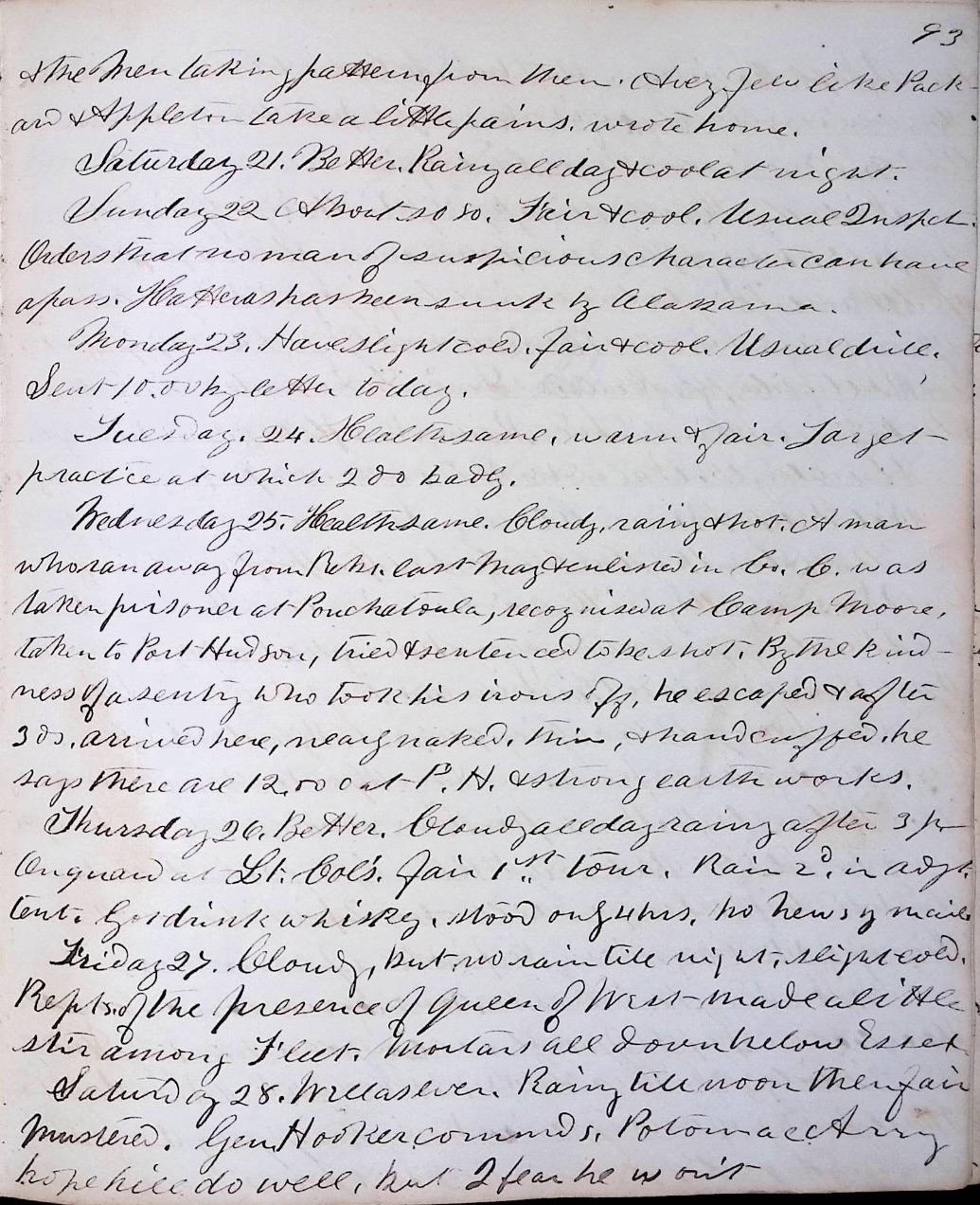
Sunday, March 1, 1863—Have slight cold. Cold & fair. Usual inspection. Plenty rows.

Monday, 2nd—About sick. Chilly & fair. Usual drill.

Tuesday, 3rd—Worse. Chilly & fair. Hit target for once.

Wednesday, 4th—Health & weather same. Received 5 papers.
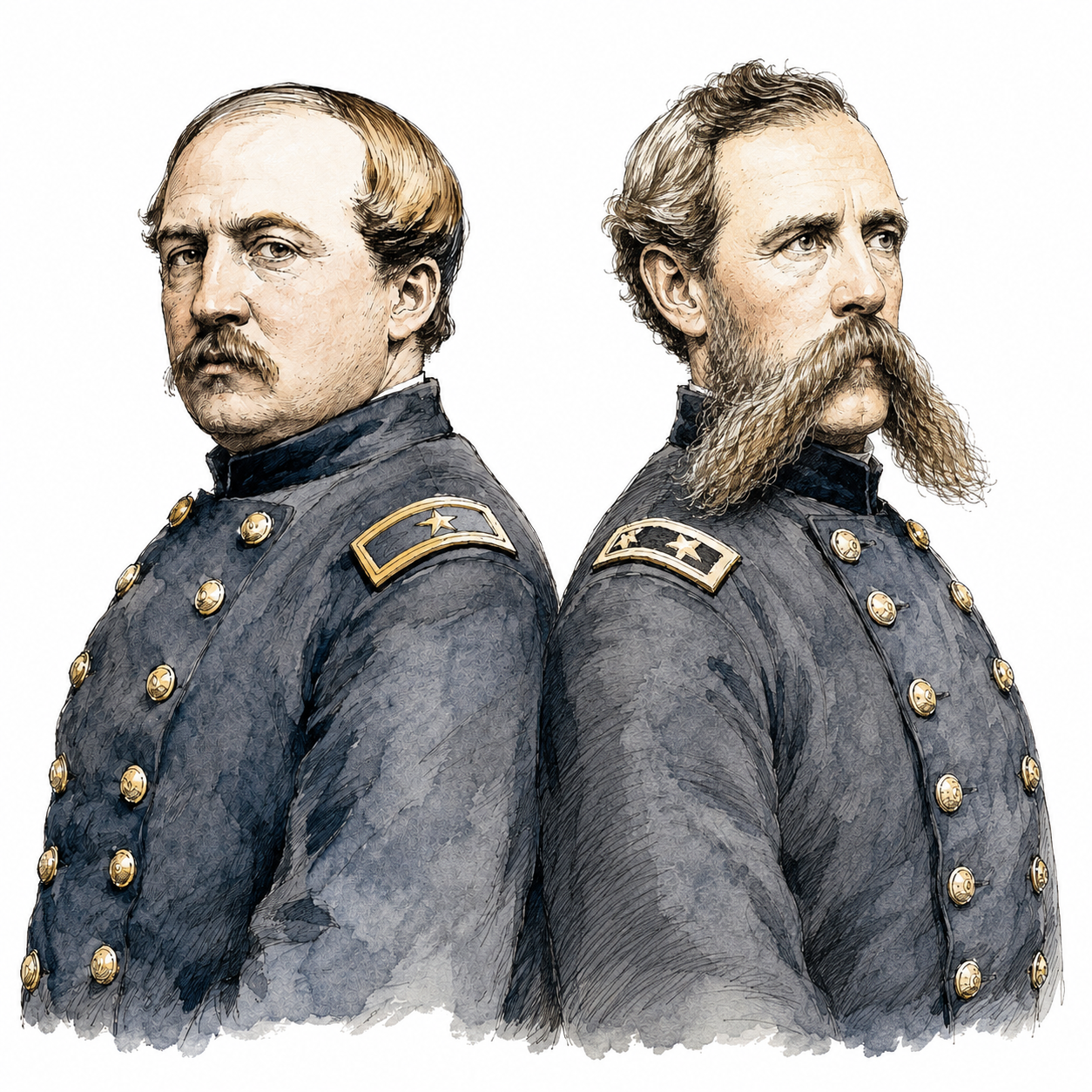
Gen. William Dwight (left) and Gen. Christopher C. Augur. “Augur is a fine looking officer, grey-bearded. Dwight—a damed shit.”

Thursday, 5th—Health & weather same. Gen. Dwight and in afternoon Gen. Augur reviewed us. Gen. [Christopher Columbus] Augur is a fine looking officer, grey-bearded. Dwight—a damned shit.

Friday, 6th—Have bad cold. Rainy. On picket but being on reserve, I had to stand none. Received one letter & two papers from home.

Saturday, 7th—Worse. Cloudy. Trees are beginning to leaf out & some have already. Troops keep coming.

Sunday, 8th—Same health. Warm & fair. Have orders to hold ourselves in readiness to march at any time so I guess we’ll go soon. Wrote home.

Monday, 9th—Better. Fair & warm. Have orders to be ready to go by tomorrow morning. Have 60 rounds ammunition, two days cooked rations, packed extra clothing in box.

Tuesday, 10th—Bad cough. Rain little. Struck half tents so we had to pitch our shelter tents we just received. Troops still coming. All sorts of rumors.

Wednesday, 11th—Feel same. We will not leave till all the fleet get up. The folly is order of march. First, 6th New York; Second, Battery third, 22nd Maine; fourth, 131st New York; fifth, 12th Maine. He (Dwight) says we’ve only to approach the enemy to see him run. I reckon so (over the left).
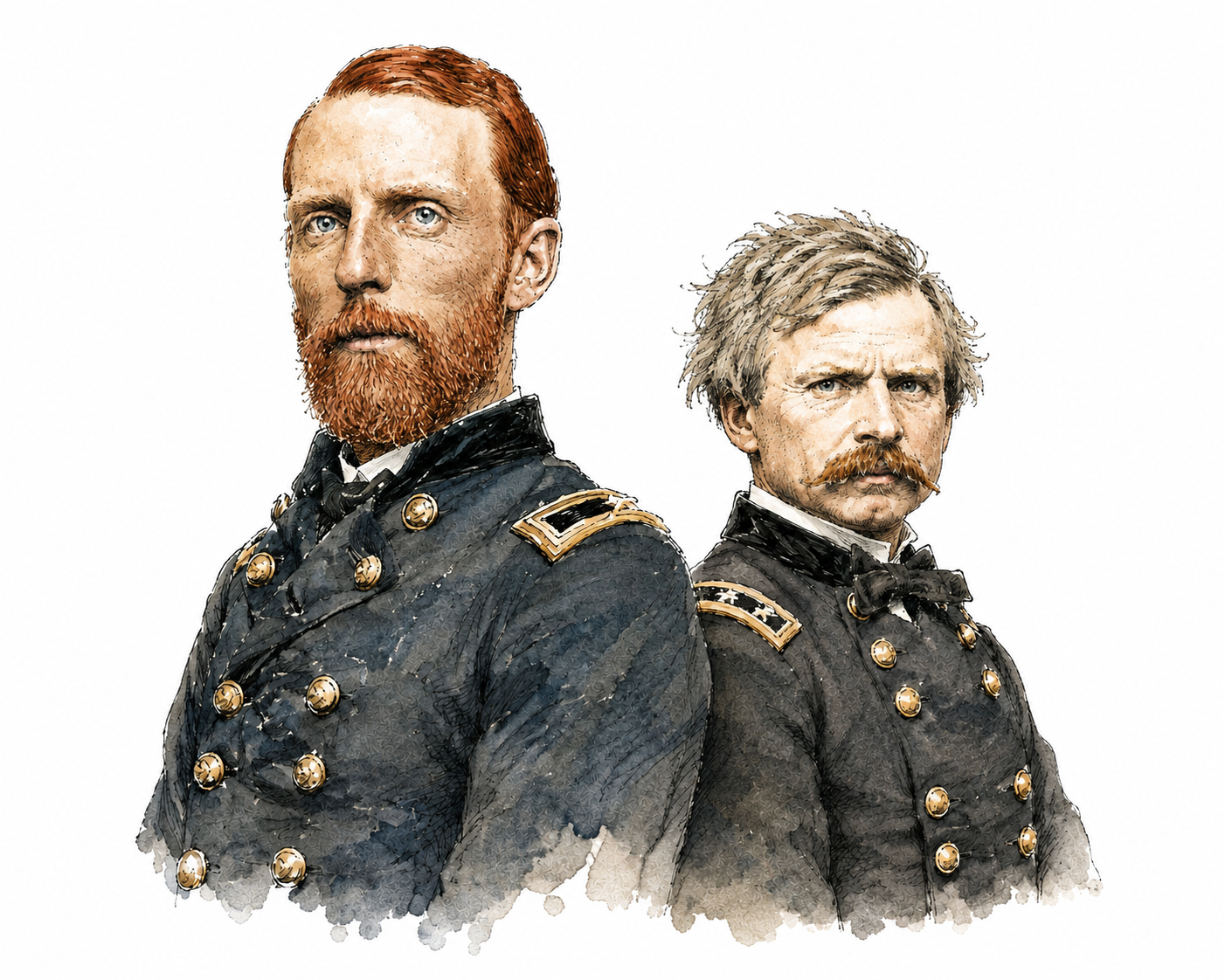
“Gen. Grover (left) is fine looking tho’ rough, red complexion and hair. Gen. Banks is an insignificant looking man, short, squint-eyed.”

Thursday, 12th—Health & weather same. Gen. Banks inspected us & all the rest. He is an insignificant looking man—short, squint eyed, &c. Gen. Grover is fine looking though rough, red complexion, & hair. The fleet is all here.

Friday, 13th—Better. Weather same. On guard as I came off at 12, we received orders to get ready & in one hour we started in the prescribed order, and marched very fast for four miles which we made in an hour & then we went at a hop, skip, hobble & crawl pace three miles further on Port Hudson Road over one bayou to a plantation seven miles from Baton Rouge and encamped. On guard again. Got about two hours sleep. Feel tired. All the troops are in motion. Dudley’s Brigade was within three miles of Port Hudson & drove in rebs pickets and returned.

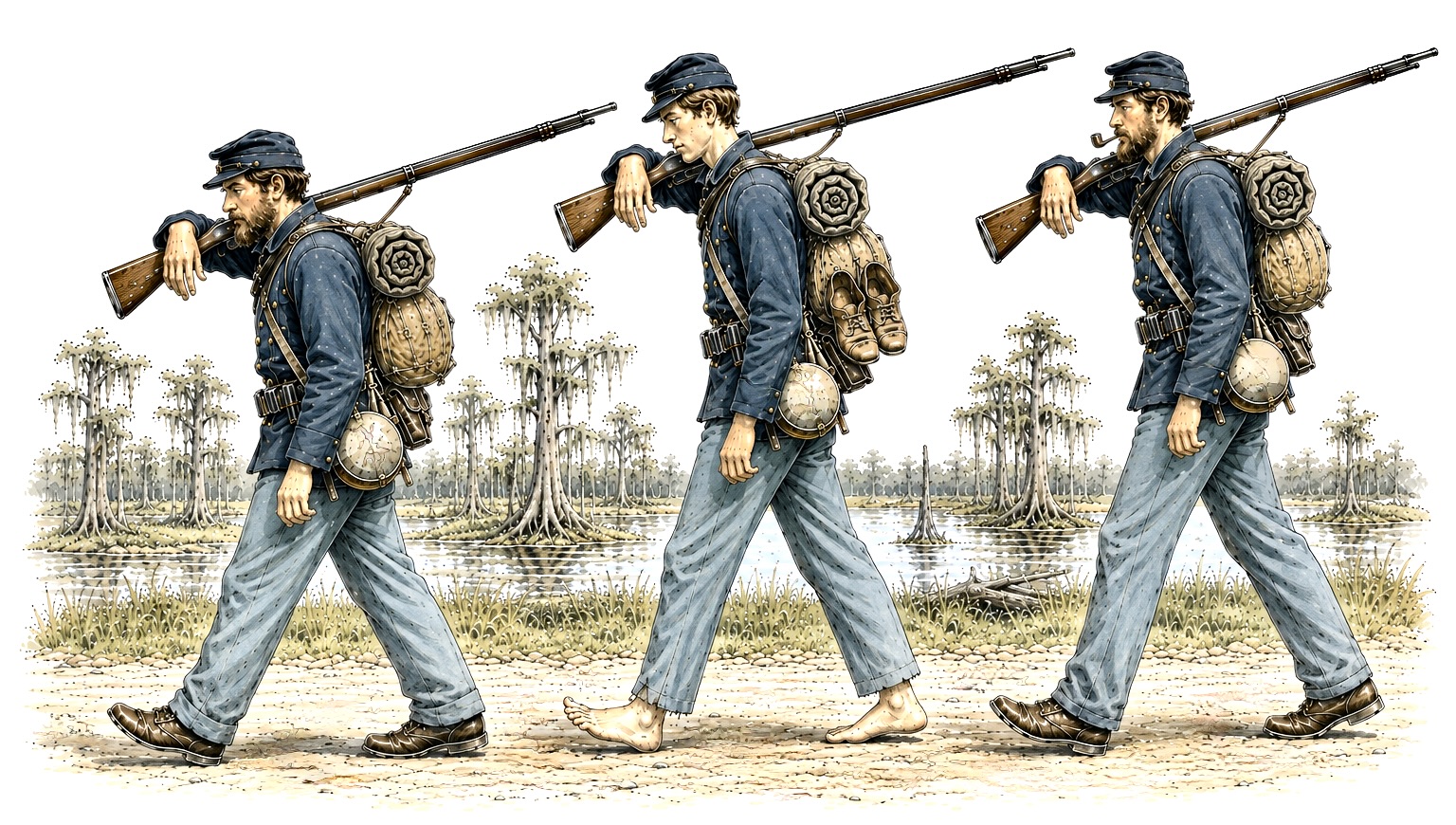
Saturday, 14th—Stiff & weak. Routed at 4 and started at 6. Marched on same road seven miles more to Springfield Church & halted. Awful hard. Knapsacks cut our shoulders & our feet blistered. A few fell out but none of our regiment. Billy Wilson’s [6th N. Y.] men threw away their knapsacks. Our regiment is close to the little white church in a pretty grove, open fields around where others are. Few shots in afternoon on river. Suppose fleet. Turned out at midnight by a terrific firing when at 1st seemed close by. But as ’twas Bearce called us, we soon turned in & went to sleep.
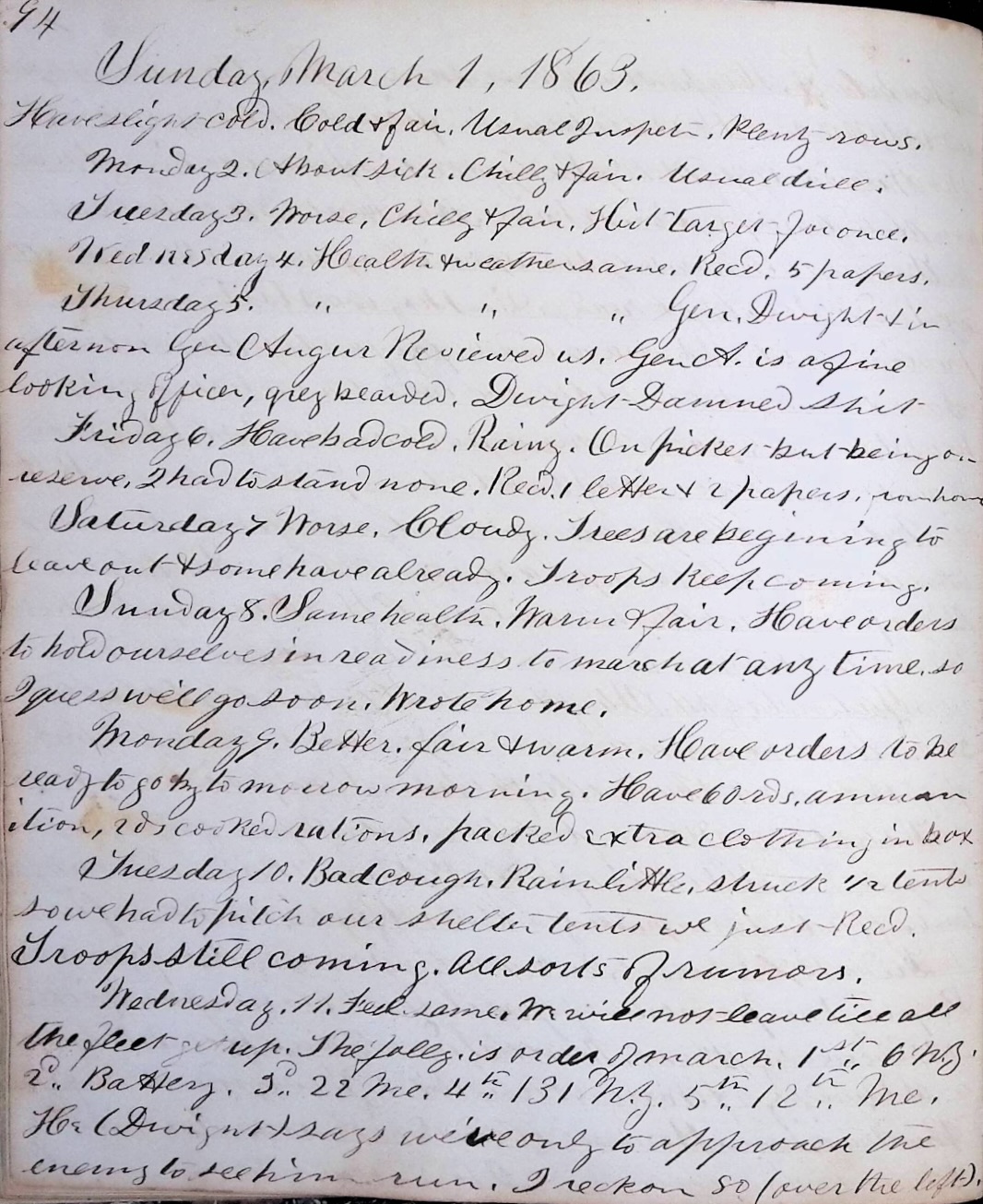
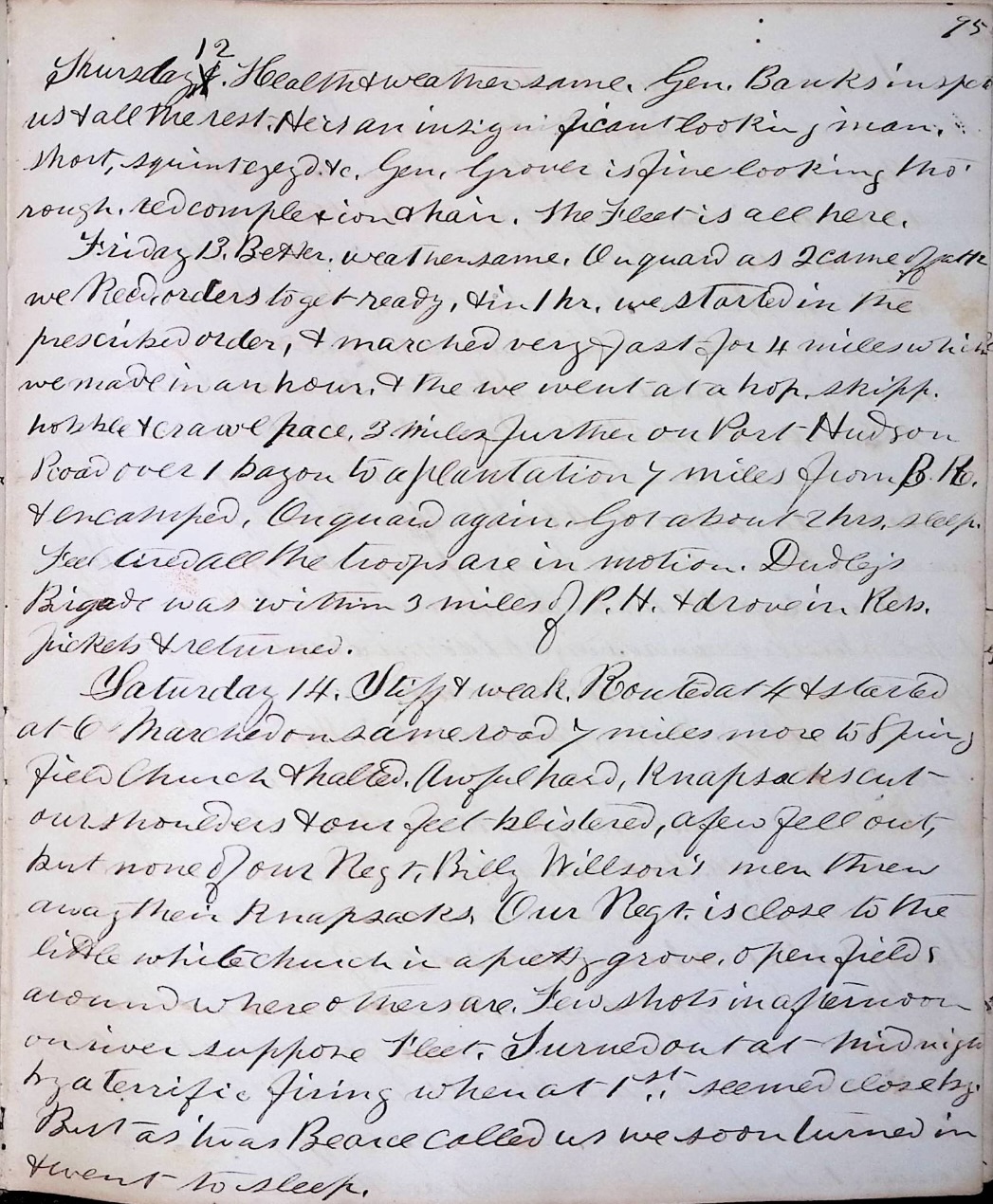
Sunday, 15th—Health same. Hot in forenoon. Routed at 2 and firing soon ceased. About 4:30 we saw a great fire down river & heard quite a number of guns & by and by a great explosion. Many comments excited by it. Started back at 2 & went five miles without halting but three times. Then it began to rain & we kept on three miles further in a pelting rain & went into a flooded field for the night, collected rails, built a rousing fire & sat by it all night. Slept but little. It rained by spells all night. They say that Banks has accomplished all he started to. Farragut in the Hartford &the Albatross passed Port Hudson & the [USS] Mississippi is blown up. Hope so.

[Editor’s Note: On the night of March 14 into the early hours of March 15, 1863, Union Admiral David Farragut attempted to run a fleet of seven warships past the heavy Confederate artillery batteries at Port Hudson, Louisiana. The midnight operation resulted in a fierce engagement where five Federal ships were disabled, and the warship USS Mississippi ran aground and was burned by its crew. Only the Hartford and the Albatross made it past the bluffs.]

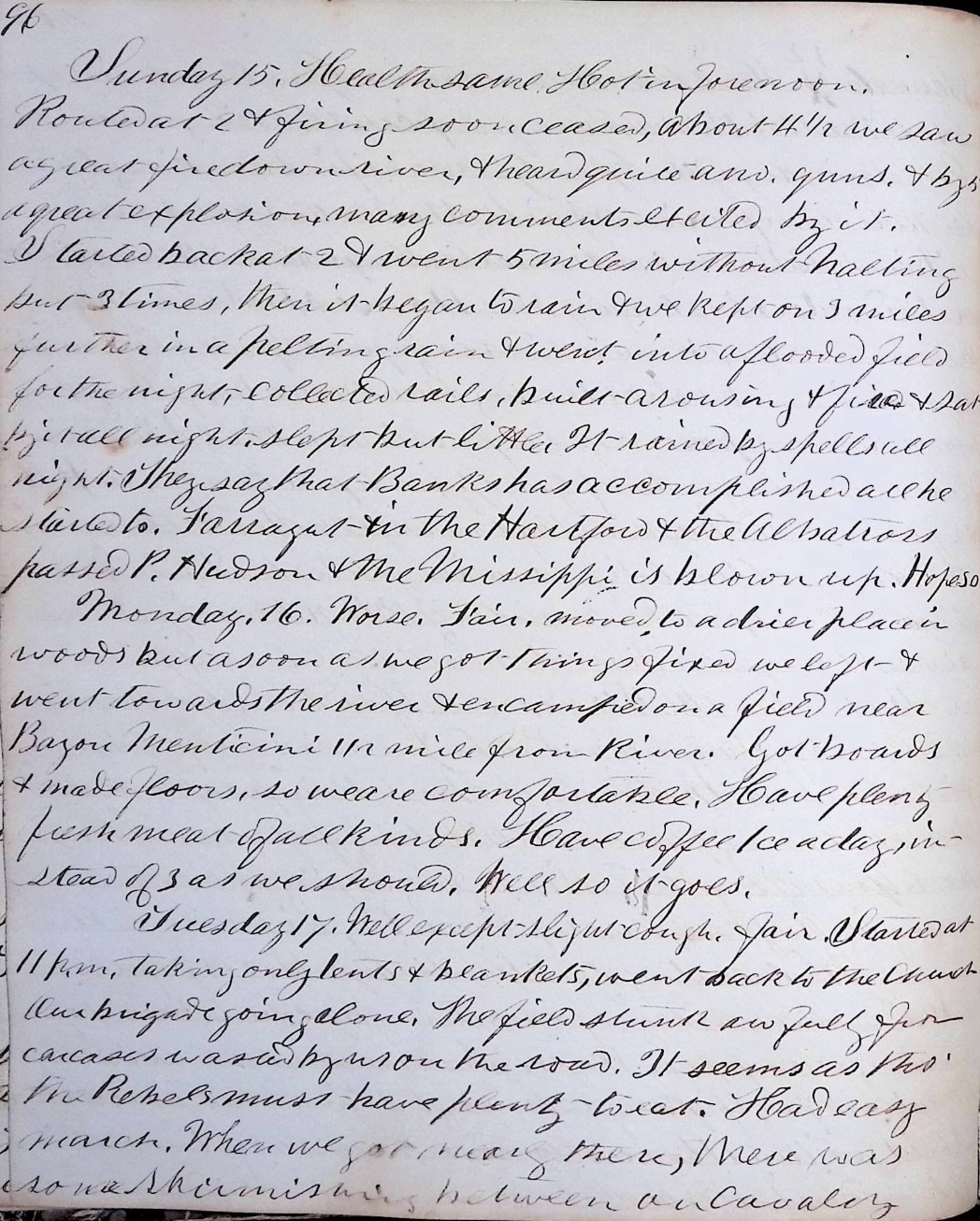
Monday, 16th—Worse. Fair [weather]. Moved to a drier place in woods but as soon as we got things fixed, we left & went towards the river & encamped on a field near Bayou Menticini, half mile from the river. Got boards & made floors so we are comfortable. Have plenty fresh meat of all kinds. Have coffee one [ ] a day instead of three as we should. Well, so it goes.

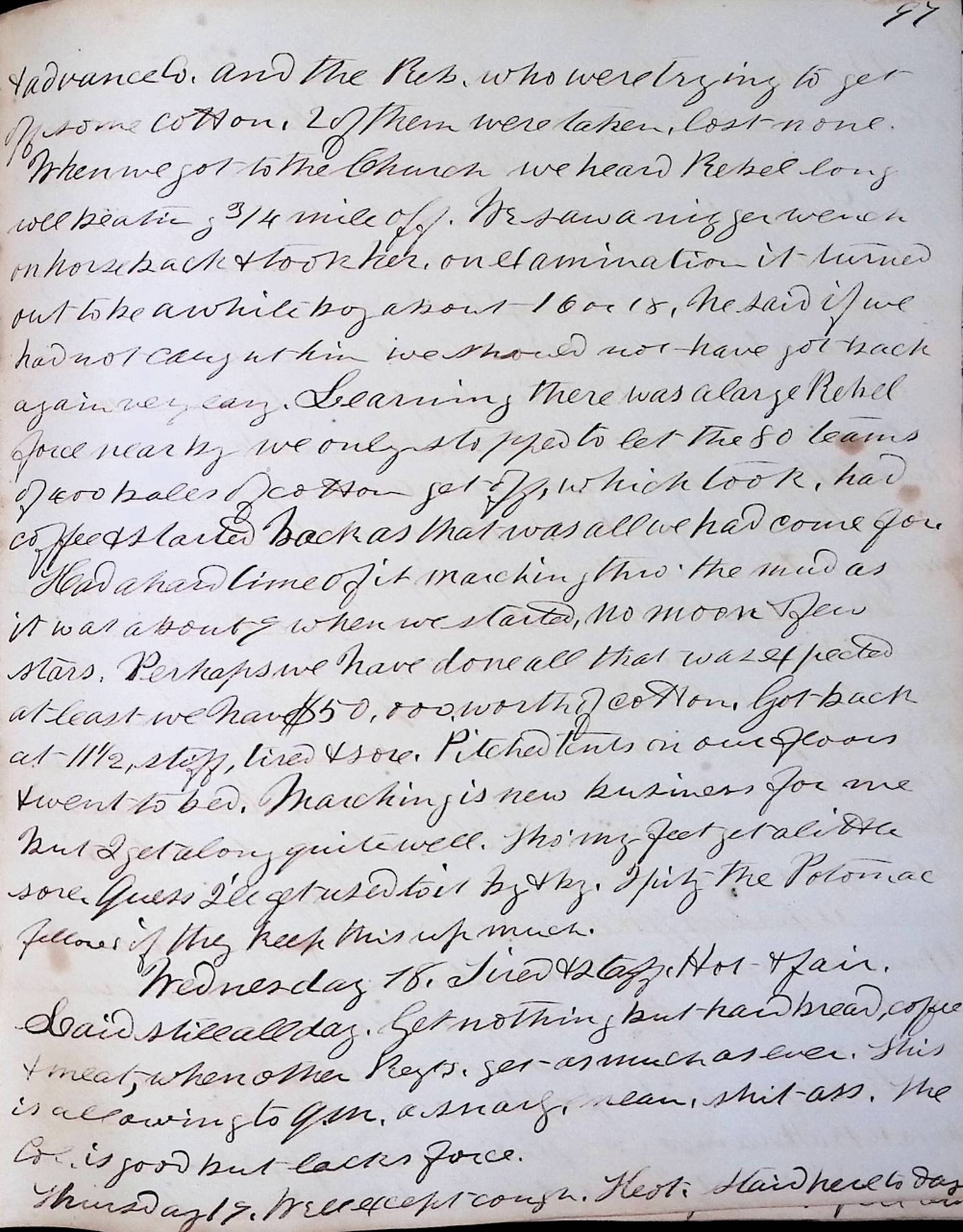
Tuesday, 17th—Well, except slight cough. Fair [weather]. Started at 11 p.m. taking only tents & blankets, went back to the church. Our Brigade going alone. The field stunk awfully from carcasses wasted by us on the road. It seems as though the Rebels must have plenty to eat. Had easy march. When we got nearly there, there was some skirmishing between our cavalry & advance company and the Rebs who were trying to get off some cotton. Two of them were taken, lost one. When we got to the church, we heard the Rebel long roll beating three-fourths of a mile off. We saw a nigger wench on horseback and took her. On examination, it turned out to be a white boy about 16 or 18. He said if we had not caught him, we should not have got back again very easy. Learning there was a large Rebel force nearby, we only stopped to let the 80 teams of 400 bales of cotton get off, which took, had coffee & started back as that was all we had come for.

Had a hard time of it marching through the mud as it was about 9 when we started. No moon and few stars. Perhaps we have done all that was expected. At least we have $50,000 worth of cotton. Got back at 11:30 stiff, tired & sore. Pitched tents on our floors & went to bed. Marching is new business for me but I get along quite well though my feet get a little sore. Guess I’ll get used to it by and by. I pity the Potomac fellows if they keep this up much.

Wednesday, 18th—Tired & stiff. Hot & fair. Laid still all day. Get nothing but hard bread, coffee, and meat when other regiments get as much as ever. This is all owing to our quartermaster—a snarly, mean, shit-ass. The Colonel is good but lacks force.

Thursday, 19th—Well except a cough. Hot. Stayed here today. Had short inspection. At parade, received congratulations of Grover & curses of Dwight, who may yet meet William’s fate [alleged to have been shot by his own men when in battle].
Friday, March 20th—Health & weather same. Left at 2 p.m. & marched to our old camp in Baton Rouge in three hours, stopping only once. Put up tents and slept all night.

Saturday, 27th—Health same. Cloudy. Went on picket on Clinton Road two miles off. Our regiment moved today with Brigade on Hamburg Road close to picket. Up nearly all night. Dark & cloudy. Guerrillas fired on our cavalry advance picket killing two and two escaped.

Sunday, 22nd—Health & weather same. Rainy night. Our Colonel is to be Brigadier General & we go with him to Thibodeaux. Hope to get rid of Dwight soon.
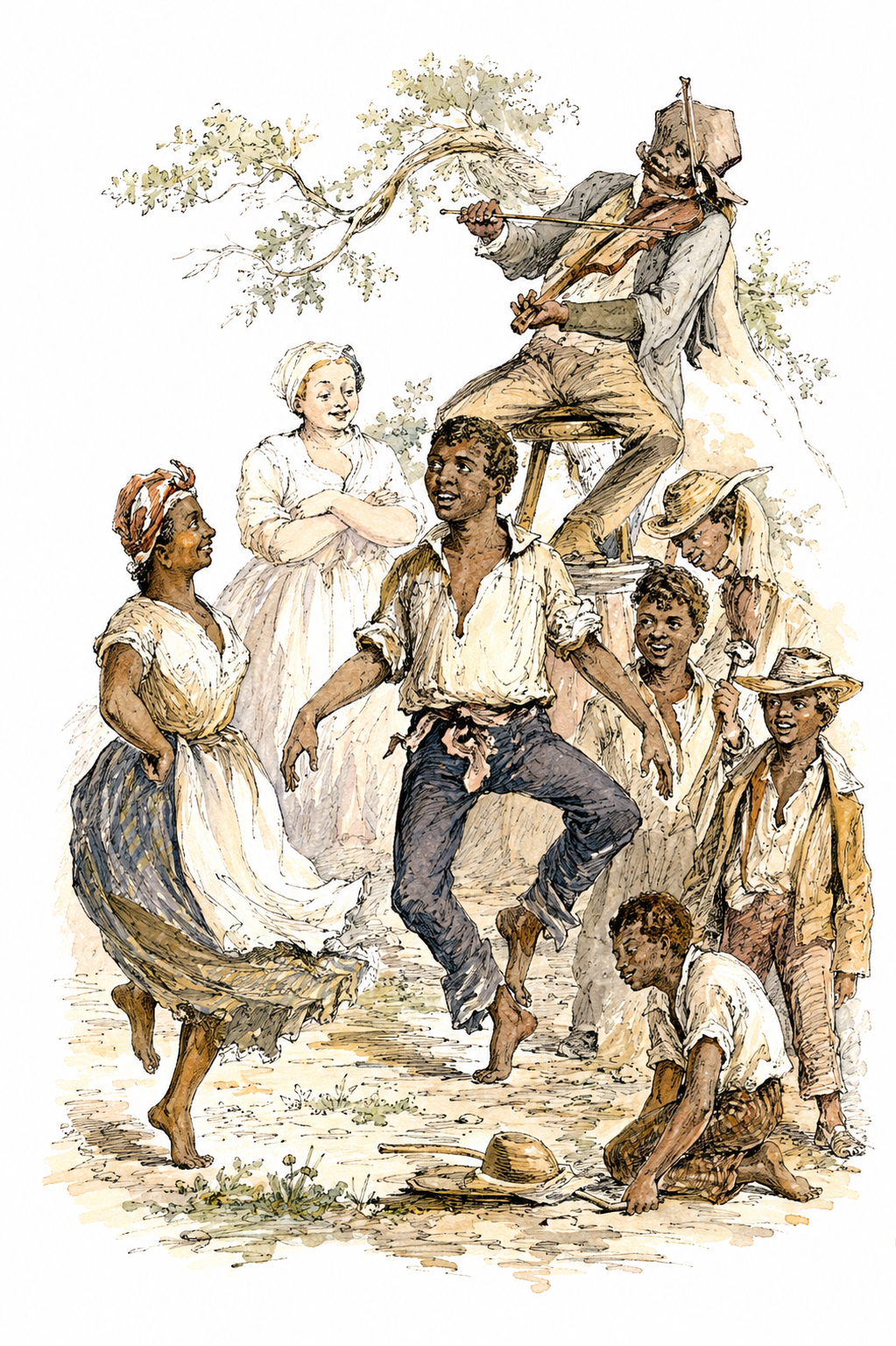
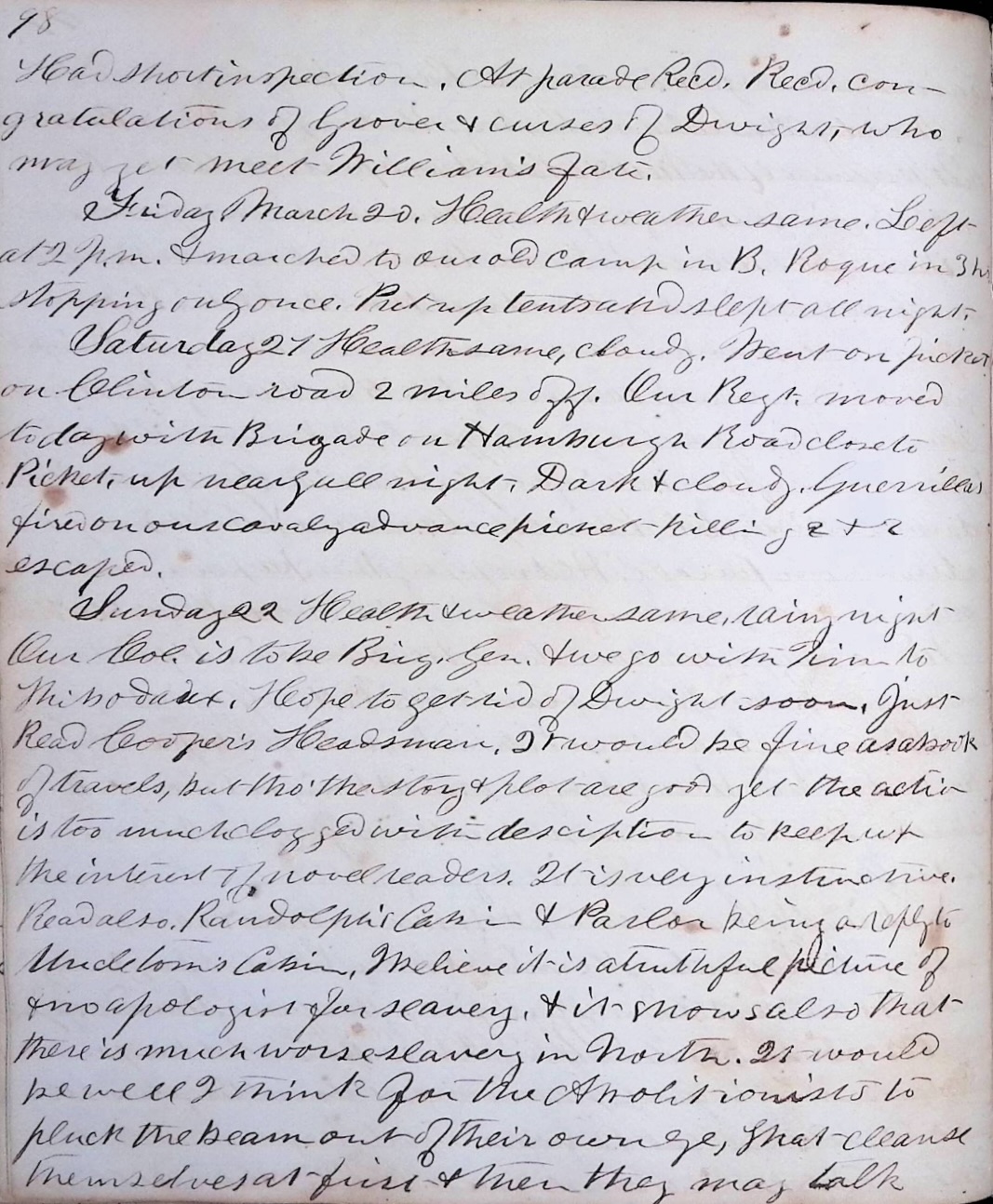
A frontispiece illustration from J. Thornton Randolph’s “The Cabin and Parlor, or, Slaves and Master.” Published in 1852, the novel is an antebellum “anti-Tom” novel that defends the Southern plantation system by contrasting the supposed security of enslaved people with the hardships of Northern and British industrial labor.

Just read Cooper’s The Headsman. It would be fine as a book of travels but tho’ the story & plot are good, yet the action is too much clogged with description to keep up the interest of novel readers. It is very instructive. Read also Randolph’s Cabin & Parlor, being a reply to Uncle Tom’s Cabin. I believe it is a truthful picture of & no apologist for slavery & it shows also that there is much worse slavery in North. It would be well I think for the Abolitionists to pluck the beam out of their own eye, that cleanse themselves at first & then they may talk against slavery. Wrote home. Received two papers.

Monday, 23rd—Feel same. Rainy. Better grub. It is reported that the Queen of the West & 6 Rebel transports are taken. Our ground here is low, rough, and muddy. But we [have a] decent floor.

Tuesday, 24—Feel same. Clear. Moved from our camp to one near the Gas Works, much better & drier than the other. By orders on parade, Col. Kimball assumes command of the 2nd Brigade, Grover’s Division, consisting of 12th Maine, 24th Connecticut, 52nd Massachusetts, & 41st Massachusetts. Dean is Adjutant General. Goddard is quartermaster of the Brigade, &c. Plaquemine Buswell is our quartermaster. Guess we’ll starve entirely. Old Phillips (our new adjutant) was half drunk on parade. He dropped his papers, cut corners & faced wrong. Received one letter.

Wednesday, 25th—Weather same. Health good. Received clothing we boxed up when we started for Port Hudson. Quiet.

Thursday, 26th—Health & weather same. Left at 4, having packed all but blanket, extra shirt, and knapsacks, and went in boat to Donaldsonville where the rest of the Division went today.

Friday, 27th—Health same. Hot. Went ashore and camped on Bayou Lafourche half a mile down. Pitched large tents.

Saturday, 28th—Bad cold. Chilly. On guard.

Sunday, 29th—Ditto.

Monday, March 30th [1863]—Health and weather same. Put knapsacks on teams & started at 9 a.m. and went down bayou with whole Division. Went 12 miles near to Napoleonville & camped at 2. Our regiment did well. Many others fell out.
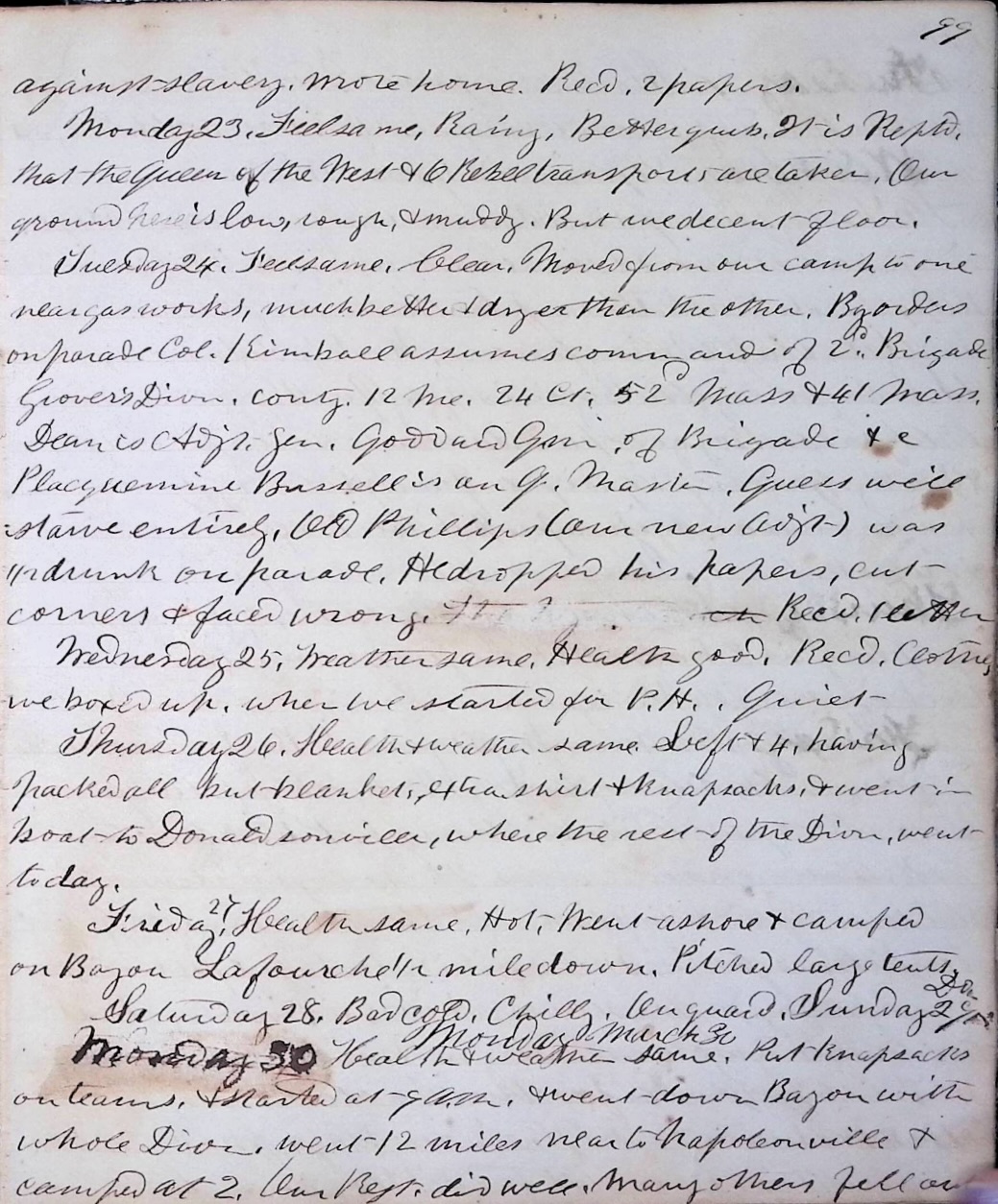
Tuesday, 31st—Started early & went 13 miles near to Labadieville & camped at 12. Same as to holding out.

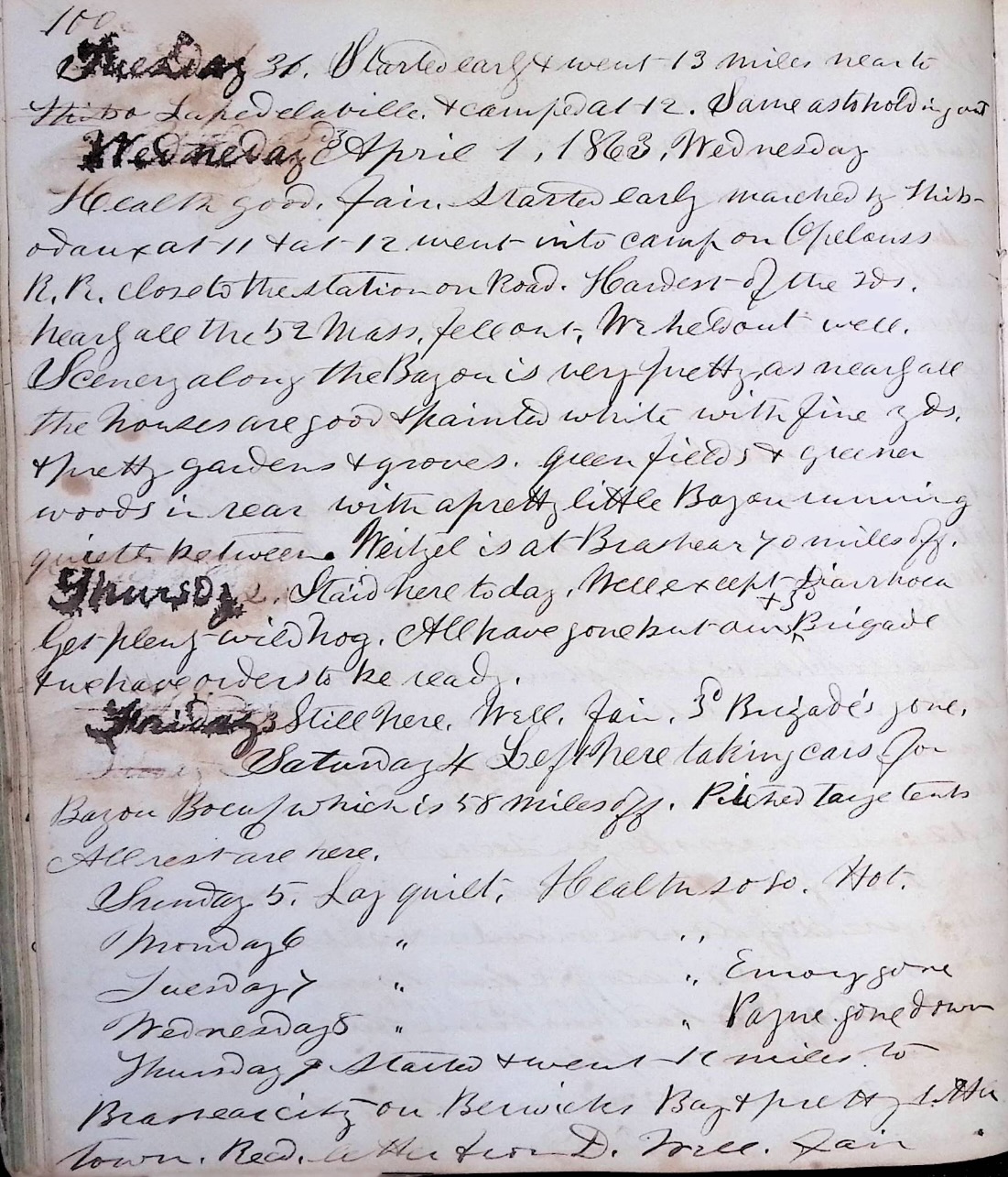
Wednesday, April 1st 1863—Health good. Fair. Started early. Marched by Thibodaux at 11 & at 12 went into camp on Opelousas Railroad, close to the station on road. Hardest of the two days. Nearly all the 52nd Massachusetts fell out [but] we held out well. Scenery along the bayou is very pretty as nearly all the houses [which] are good & painted white with fine yards & pretty gardens & groves, green fields, and greener woods in rear with a pretty little bayou running quietly between. Weitzel is at Brashear 70 miles off.

Thursday, 2nd—Stayed here today. Well except diarrhea, Get plenty of wild hog. All have gone but ours & 3rd Brigade & we have orders to be ready.

Friday, 3rd—Still here. Well. Fair. Third Brigade’s gone.

Saturday, 4th—Left here taking cars for Bayou Boeuf which is 58 miles off. Pitched large tents. All rest are here.

Sunday, 5th—Lay quiet. Health so so. Hot.

Monday, 6th—Lay quiet. Health so so. Hot.

Tuesday, 7th—Lay quiet. Health so so. Emory gone.

Wednesday, 8th—Lay quiet. Health so so. [Gen.] Paine gone down.

Thursday, 9th—Started and went 12 miles to Brashear City on Berwick’s Bay & pretty little town. Received a letter from Darius. [Am] well. [Weather] fair.

Friday, 10th—Health same. Fair. Wrote home. Received letter & papers. At night our whole Division went on boats. Our brigade, half on Arizona, rest on Laurel Hill, Estrella, Calhoun, St. Marys, &c. [Gens.] Emory & Weitzel went across the Bay and go by land.
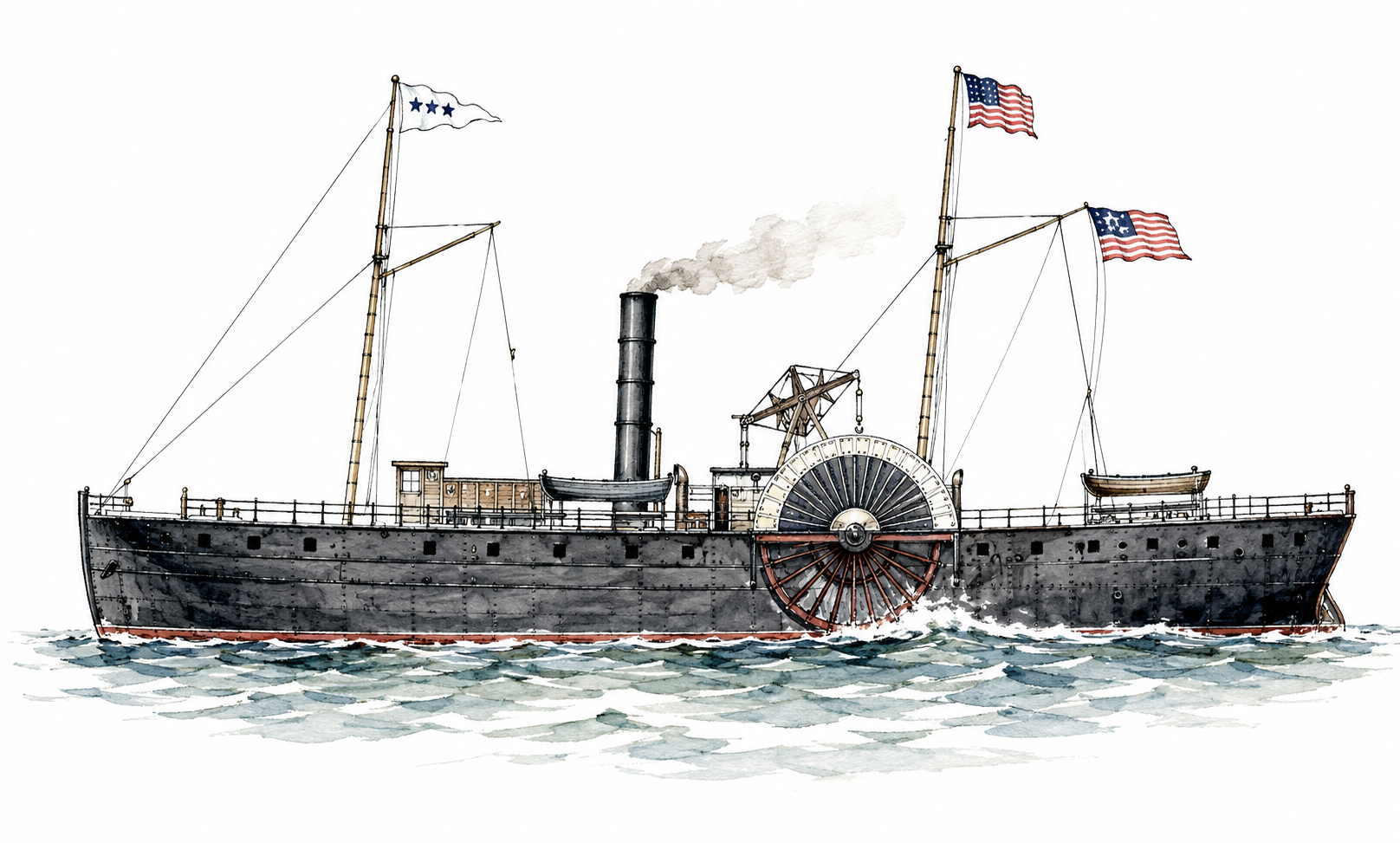
The USS Arizona, a side-wheel, iron-hulled merchant steamship seized by the Rebels early in the war but captured by US Navy and played a significant role in the West Gulf Blockading Squadron. She joined a naval force commanded by Commander Augustus P. Cook which, in cooperation with troops commanded by Maj. General Banks, was operating in the swampy backwaters of the Louisiana lowlands weather of the Mississippi.

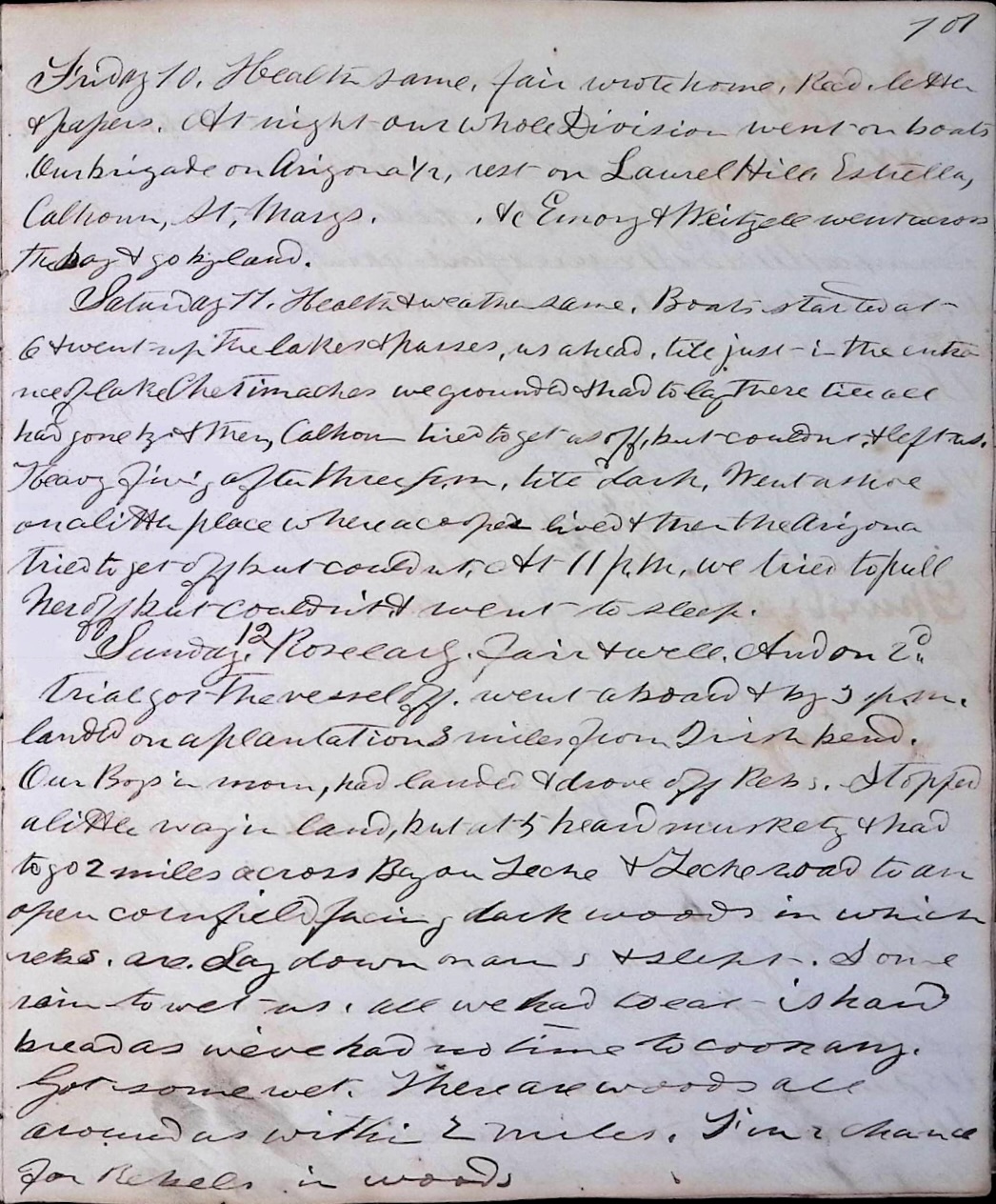
Saturday, 11th—Health & weather same. Boats started at six and went up the lakes & passes, us ahead, till just in the entrance of the Lake Chetimaches we grounded & had to lay there till all had gone by & then the Calhoun tied to get us off but couldn’t and left us. Heavy firing after three p.m. till dark. Went ashore on a little place where a cooper lived & then the Arizona tried to get off but couldn’t. At 11 p.m. we tried to pull her off but couldn’t & went to sleep.

Sunday, 12th—Rose early. Fair & well. And on 2nd trial, got the vessel off, went aboard & by 3:30 p.m., landed on a plantation three miles from Irish Bend. Our boys in morn had landed & drove off the Rebs. Stopped a little way inland, but at 5 heard musketry & had to go two miles across Bayou Teche & Teche road to an open cornfield facing dark woods in which Rebs are. Lay down on arms & slept. Some rain to wet us. All we had to ear is hard bread as we’ve had no time to cook any. Got some wet. There are woods all around us within two miles. Fine chance for Rebels in woods.
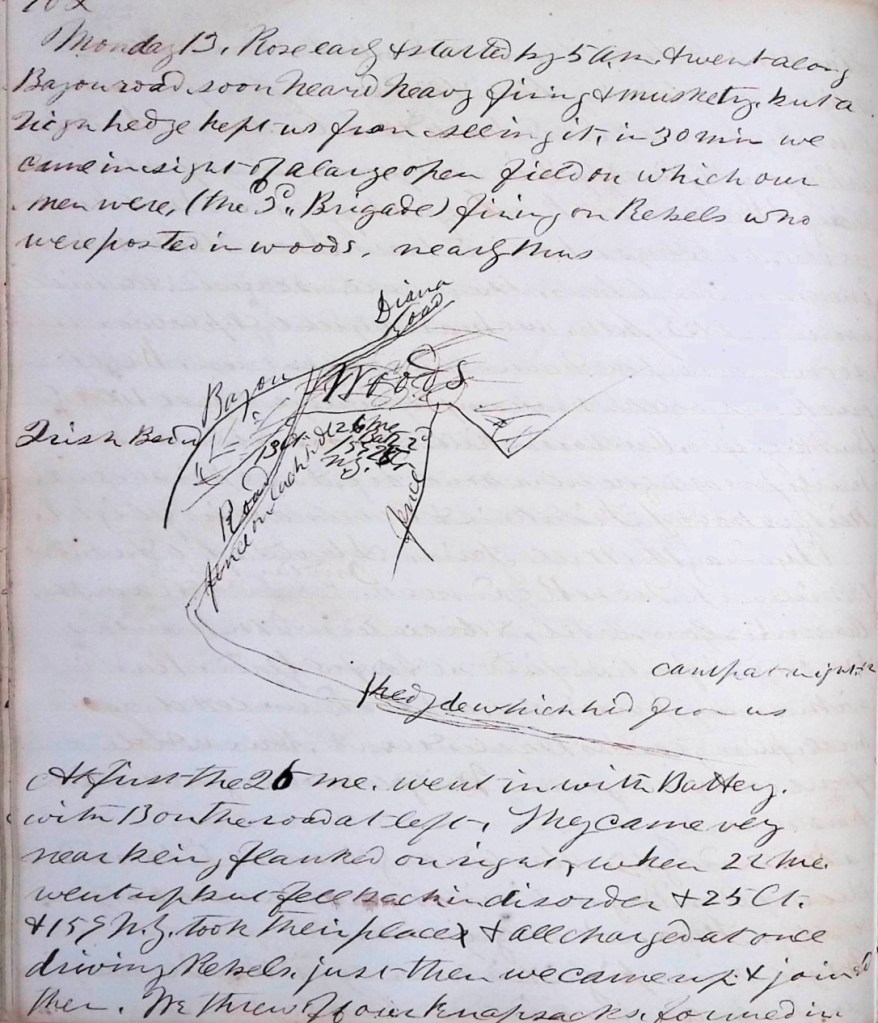
Monday, 13th—Rose early & started by 5 a.m. & went along Bayou Road. Soon heard heavy firing & musketry but a high hedge kept us from seeing it. In 30 minutes we came in sight of a large open field on which our men were (the 2nd Brigade) firing on Rebels who were posted in woods, nearly thus:

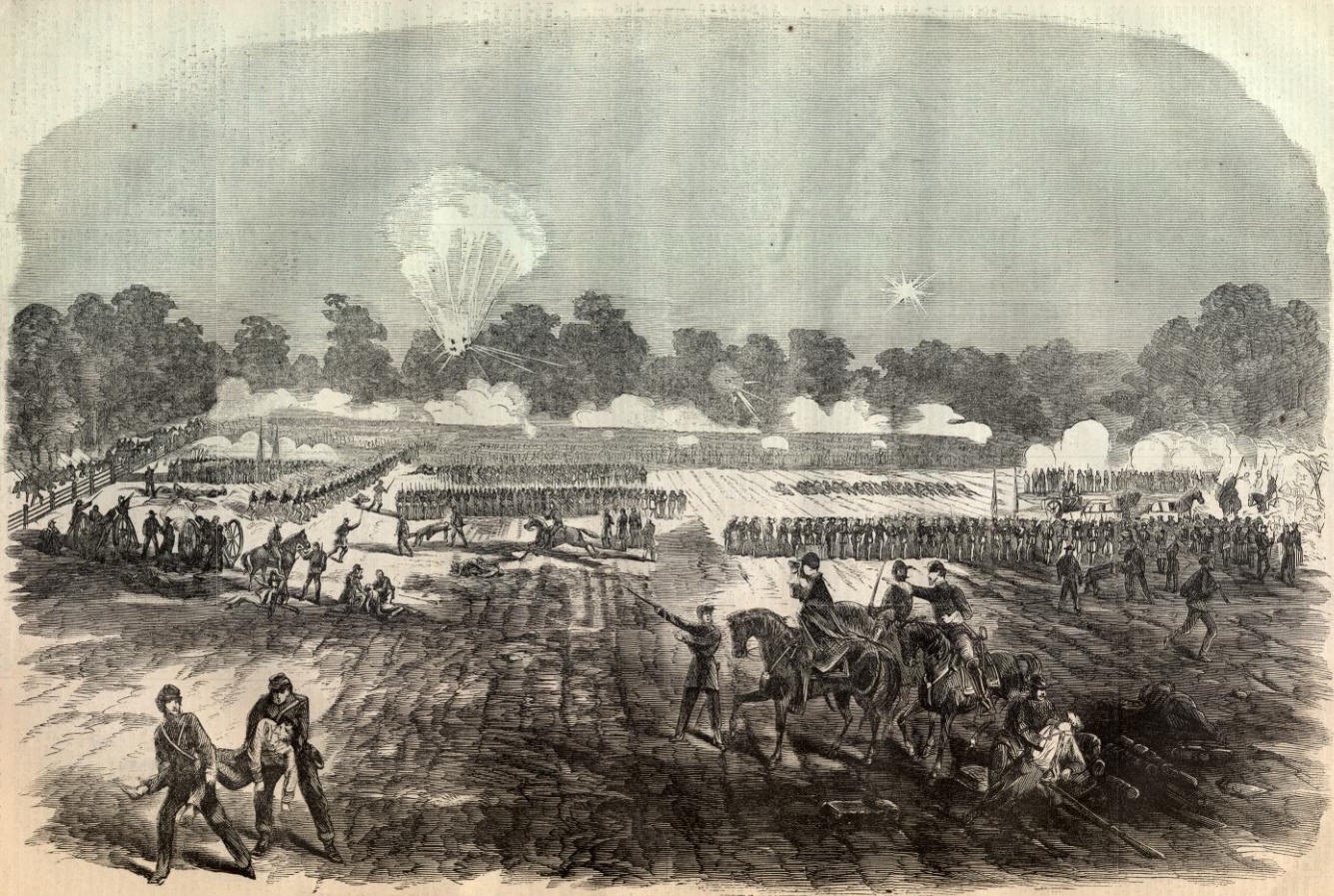
James’ hand drawn sketch can be seen in his diary (see Page 102 below) but the scribbling is difficult to decipher. Using AI, I have recreated his sketch identifying the landmarks of the scene as James marked them as best as I could determine. The 12th Maine came marching up the road at bottom right and were shielded from view of the battlefield until they passed the tall hedge. They joined in the later stages of the battle which became known at the Battle of Irish Bend. That same battlefield was depicted in a drawing of the battle that appeared in Harper’s Weekly below.

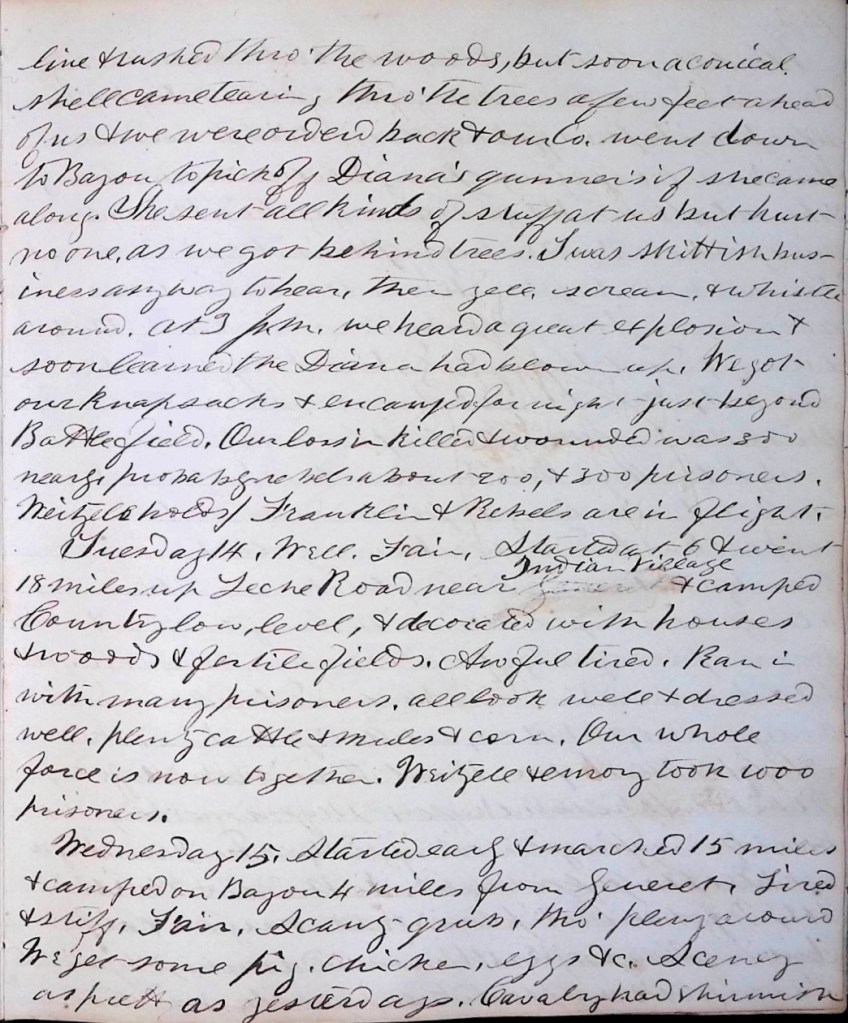
At first the 26th Maine went in with Battery with 13th [Connecticut] on the road at left. They came very near being flanked on right, when the 22nd Maine went up but fell back in disorder, & the 25th Connecticut & 159th New York took their place & all charged at once, driving Rebels. Just then we came up & joined them. We threw off our knapsacks, formed in line & rushed through the woods, but soon a conical shell came tearing through the trees a few feet ahead of us & we were ordered back & our company went down to Bayou to pick off [Confederate gunboat] Diana‘s gunners if she came along. She sent all kinds of stuff at us but hurt no one as we got behind trees. ‘Twas skittish business anyway to hear them yell, scream and whistle around. At 3 p.m., we heard a great explosion & soon learned the Diana had blown up [scuttled by retreating Rebels]. We got our knapsacks & encamped for night, just beyond the battlefield. Our loss in killed & wounded was 300 nearly. Probably rebels about 200 & 300 prisoners. Weitzel holds Franklin and Rebels are in flight.

Tuesday, 14th—Well. Fair. Started at six and went 18 miles up Teche Road near Indian Village & camped. Country low, level, and decorated with houses & woods & fertile fields. Awful tired. Ran in with many prisoners. All look well ^ dressed well. Plenty cattle & mules & corn. Our whole force is now together. Weitzel & Emory took 1,000 prisoners.

Wednesday, 15th—Started early & marched 15 miles & camped on bayou four miles from Generet. Tired & stiff. Fair. Scanty grub tho’ plenty around. We get some pig, chicken, eggs, &c. Scenery as pretty as yesterday’s. Cavalry had skirmish.
Thursday, 16th—[I’m] well. [Weather] fair. Marched 12 miles to New Iberia which we reached 3 p.m. and at 5 started with part of the 41st Massachusetts & 24th Connecticut under [W. K.] Kimball, leaving everything but rubbers, taking one and a half days rations & went one mile on wrong road, then six miles over a rough, low, boggy prairie, having several times to wade deep mud holes. We couldn’t see a house or anything else, but our road & hardly that. Encamped at 12 p.m., cold, tired, & stiff & slept.

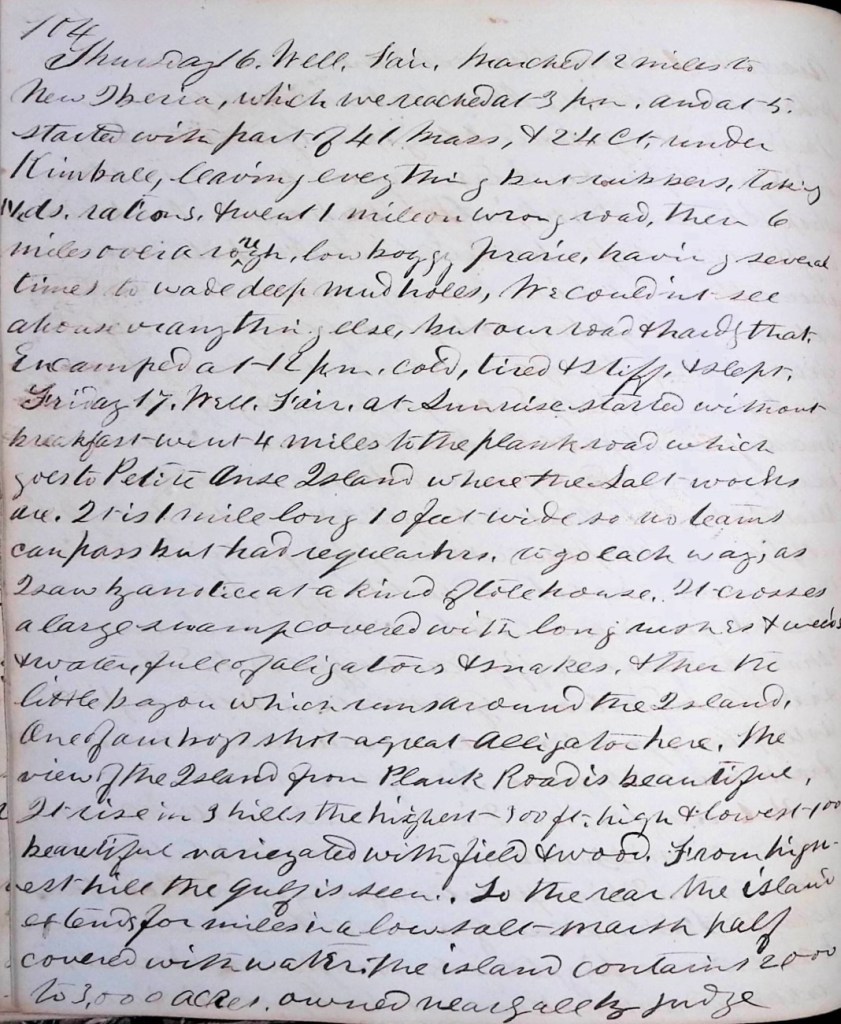
Friday, 17th—Well. Fair. At sunrise started without breakfast, went four miles to the Plank Road which goes to Petite Anse Island where the salt works are. It is one mile long, ten feet wide, so no teams can pass but had regulators to go each way, as I saw by a notice at a kind of toll house. It crosses a large swamp covered with long rushes & weeds & water full of alligators & snakes & then the little bayou which runs around the island. One of our boys shot a great alligator here. The view of the island from Plank Road is beautiful. It rises in three hills, the highest 300 feet high & lowest 100 feet, Beautiful variegated with field & wood. From highest hill, the Gulf is seen. To the rear, the island extends for miles in a low salt marsh half covered with water. The island contains 2,000 to 3,000 acres owned nearly all by Judge Avery who discovered & worked the mine which has paid him well.
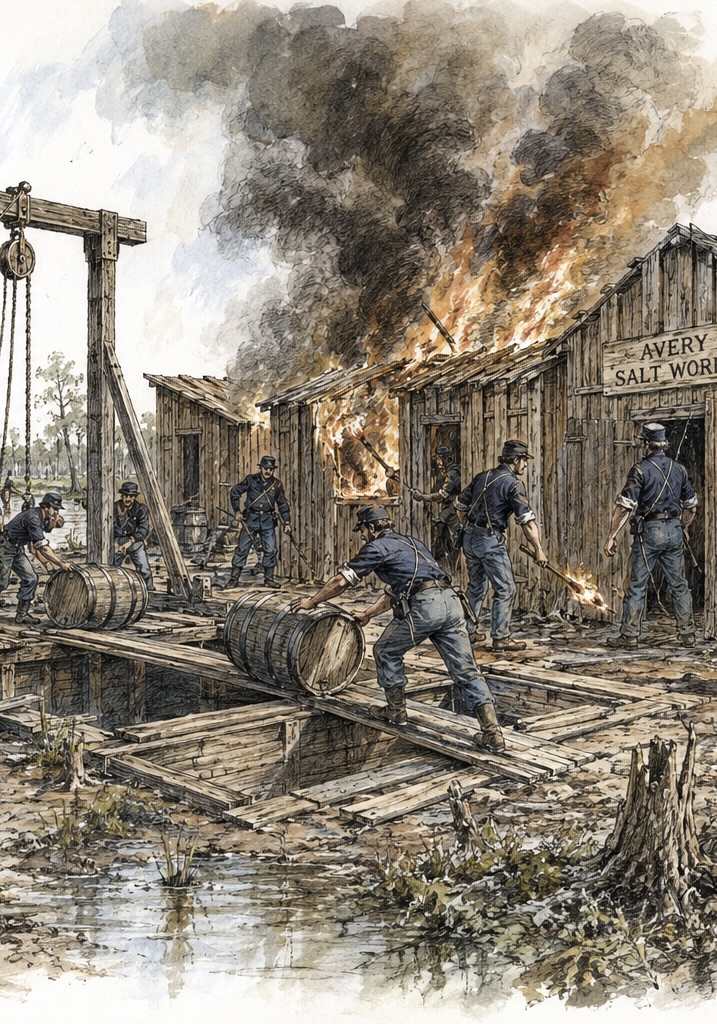
Reached the [salt] works about 9 a.m. They consist of about one dozen pits of various sizes covered with rude sheds, several houses, and one tool shop & carpenters’ shops. We burned the building and rolled all the barrels in the pits, worked about one hour. Tho’ we’ve made complete work of it, yet in a few hours, they can get salt again. After finishing up this part, we went to Judge Avery’s farmhouse & helped ourselves & got a fine meal. Plenty of all kinds. The salt looked like ice—is very good and pure. All the water here is brackish. Marched back again & reached New Iberia at 9 p.m. The place is an open prairie & has many houses, somewhat boggy. Oxen, mules, sheep & feed in abundance and in common. Many were brought off. Each officer had one and each company had a team of three mules. Feel very tired & stiff. Our grub is out so we have to do with fresh meet and mush.

[Editor’s Note: In 1863, the salt works on Petite Anse Island (now known as Avery Island, Louisiana) served as a vital, highly strategic rock salt source for the Confederacy during the American Civil War, producing millions of pounds of salt before Union forces under Colonel W.K. Kimball seized and destroyed the facility in April 1863. Transport relied on the raised plank road through the surrounding cypress swamp and salt marsh, where wagons operated on strict single-direction hourly schedules before transferring barrels onto bayou steamboats. At least 500 enslaved people were put to work manually excavating and processing the salt deposits. Union troops captured the works on 17-April 1863, burning 18 buildings, smashing mining equipment, and destroying hundreds of barrels of prepared salt.]

Saturday, 18th—Have diarrhea. Fair. Started at 10:30 & marched 8 miles by 2 p.m. & then halted one hour to get dinner. Made pig 7 potatoes—very good. Rode one hour. Started again & went 8 miles to Vermillionville where we encamped at 8. Had mush & meat. As a bridge was burned here, Grover’s and all were delayed till tonight building it. They had some skirmishing. Saw several dead cavalry horses on our route today. which lay thro’ a prairie with a few plantations. We have left the Teche & are between Black and Vermillion Bayous. Rain at night.
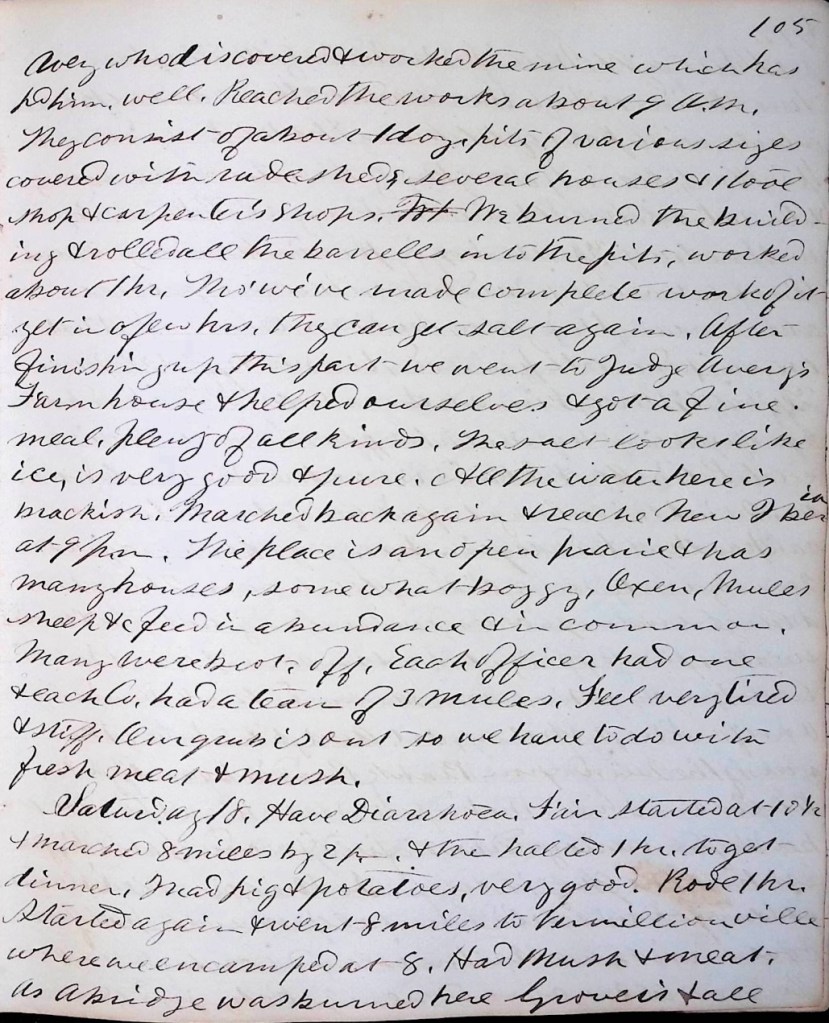
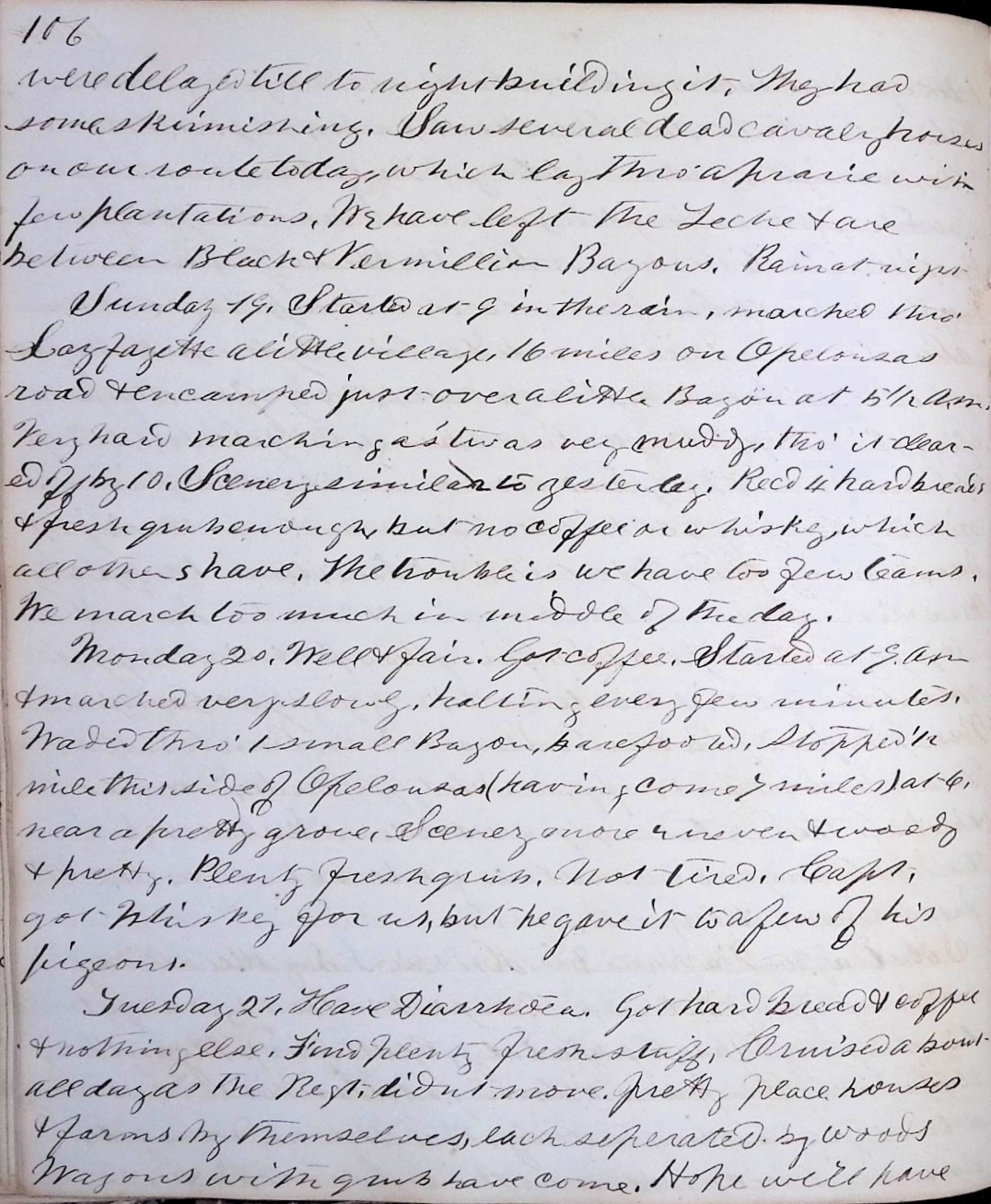
Sunday, 19th—Started at 9 in the rain. Marched thro’ Lafayette—a little village, 16 miles on Opelousas Road & encamped just over a little bayou at 5:30 a.m. Very hard marching as ’twas very muddy tho’ it is cleared off by 10. Scenery similar to yesterday, Received four hard breads & fresh grub enough but no coffee or whiskey which all others have. The trouble is we have too few teams. We march too much in middle of the day.

Monday, 20th—Well & fair. Got coffee. Started at 9 a.m. & marched very slowly, halting every few minutes. Waded thro’ one small bayou barefooted. Stopped half mile this side of Opelousas (having come 7 miles) at 6 near a pretty grove. Scenery more uneven & woody & pretty. Plenty fresh grub. Not tired. Captain got whiskey for us but he gave it to a few of his pigeons.

Tuesday, 27th—Have diarrhea. Got hard bread & coffee & nothing else. Find plenty fresh stuff. Cruised about all day as the regiment didn’t move. Pretty place. Houses & farms by themselves, each separated by woods. Wagons with grub have come. Hope will have better now. Our knapsacks were sent away. My other things were stolen. Blanket, tent, pants, socks, & shirt.

Wednesday, 22nd—Have diarrhea. Fair. Went to a house one and a half mile off belonging to a judge who has run off & I got Brooks’ Ovid & a little memorandum. A lot of splendid furniture is spoiled. Live well. Went on picket at 5 p.m.

Thursday, 23rd—Diarrhea bad. [Weather] fair. Got up at 4 & went to a plantation one and a half miles off & got fowl & garden stuff. It is said that Vicksburg, Charleston, & Richmond are taken & Gen. Banks says in an order that we’ll get home in three months. I guess so (over the left). Someone cut the levee at Thibodeaux, thus stopping the cars.

Friday, 24th—Diarrhea bad. Fair. Washed & went off to a plantation which is deserted where I got Campbell’s Poems, & Life of Putnam. Reviewed by Banks. Have plenty bread & fresh meat but no salt, soap, or whiskey. We need soap most as we can’t keep clean without. Some are lousy but I am not. Make tent of rubber, sleep on blanket.

Saturday, 25th—Diarrhea bad. Hot & fair. Lay still all day reading Life of Putnam & Campbell’s Poems, which I think very fine—especially Gertrude of Wyoming & Glencoe. On parade tonight. Banks orders very strict punishment against plundering, &c. Guess ’twill not work very well tho’.
Sunday, 26th—Health better. Fair. Started at 6:30 a.m. & marched 8 miles when a bayou bridge broke under the cavalry who were crossing, killing several horses. We were delayed four hours & then went one mile further to Barres Landing on Bayou Courtableau, which we reached by 4 p.m. Got nothing but coffee and bread to eat. A great amount of cotton has been confiscated & brought here, which is being hauled in as fast as possible to be taken by bayou to New Orleans.

Monday, [27th]—About well. Some rain. Went on a foraging scout but got nothing. On picket. Slept from 10 till 4. We will remain here till all the cotton is gone. River boats are taking it off. All the boats have artillery and infantry to protect them against guerrillas. Charleston is not taken but we lost the Keokuk in the attack.

Tuesday, 28th—Well. Fair. Got badly poisoned between my legs by using leaves when I had diarrhea so I can hardly walk. Received one letter. Commenced reading Brooks’ Ovid. They are getting all the sugar and cotton they can find. Hundreds of bales and barrels are piled here and hundreds come in daily. Guess we’ll stop a month or so.

Wednesday, 29th—Well except poison. Fair. Got soap. Have plenty [ ]. Wrote home. Received letter & paper, handkerchief and stamps. News about so-so.

Thursday, 30th—Well. Fair & hot. Mustered. Over 1,000 teams are hauling here and thousands of bails are here.

Friday, May 1, 1863—Slight toothache. Pain. 13th Connecticut came in today having the Rebel flag [that] once belonged to the St. Mary’s Cannoneers, presented by ladies of Franklin and taken at Irish Bend. The niggers who follow us are the dregs of the race, the best & smartest having sense enough to stay at home. Some say they had a skirmish at Washington, Louisiana, today taking 200. Have four hours drill which is useless.

Saturday, 2nd—Have piles. Fair [weather]. Cotton still comes in.

Sunday, 3rd—Health and weather same. Inspection. Begin to feel like moving. Dull staying here.

Monday. 4th—Health & weather same. On picket. Slept after 11 as well as mosquitoes would let me. 900 cavalry arrived at Baton Rouge lately from Memphis.

Tuesday, 5th—Health good. Fair. Taken off picket at 8 a.m. & found preparations being made to leave. 3rd Brigade left at 11 and we fell in at one but started at 2:30. Only 24th Connecticut & us going in our Brigade. Marched slowly & stopped often till sunset when we reached Washington past 8 p.m. and then crossed Bayou & put on five miles & camped. Was awful tired & so were all. Passed about 600 niggers. It is said that Capt. [Howard] Dwight [younger brother of Gen. William Dwight] was shot on this road by guerrillas altho’ he surrendered. Very dusty. Land on route apparently new corn two and a half feet high & other things in proportion. Only few houses & those good except at Washington which is low & dirty & small. Read Shakespeare’s Tempest & three other pieces—very good.
Wednesday, 6th. Well, but foot sore. Started at 5 a.m. & marched 15 miles & halted at 11 a.m. one hour to eat, and then went five miles more, going into camp at 2:30. Much cotton burnt on the way. Stopped in a cornfield after crossing Bayou Boeuf. Took the corn for bed. Not very dusty. This bayou has banks 20 feet high at high water. Cleared one mile back each side with woods in rear. Quite a number of pretty plantations averaging one or two a mile. Many slab huts.

Thursday, 7th—Well. Sore feet. Fair. Started at 6 making 15 miles by 3:30, halting 7 times. Passed thro’ a country of scattering plantations. Little cotton or sugar plantations—mostly corn. Plenty cotton in store. Some mud houses along road, being a frame filled with mud for boards. Not dusty. Passed little village of Holmesville. Quite tired. Get plenty to eat. [Generals] Dwight, Emory & Weitzel are ahead. Banks passed today. 159th New York came up with us having come from Washington 35 miles in 24 hours.

Friday, 8th—Well, but stiff & sore. Started at 5:30 a.m. and marched till 11 when halted for dinner one hour. Then started & marched til 1:30, crossing Alexandria Railroad & Bayou Boeuf & camped on Thompson’s Plantation. Same scenery as before. Bayou is very crooked & as the road follows, we’ve had to go three miles to get two ahead. Marched 15 miles. Passed through Chaneyville at ten—a pretty little village nearly deserted.

Saturday, 9th—Slight diarrhea. Stayed here all day. Heavy firing was heard after ten to the east. I guess it is at Port Hudson.

Sunday, 10th—Health & weather same. Fixed up a hut of branches & twigs. Hear firing towards Port Hudson. Getting ready to leave. Hot days and cold nights.

Monday, 11th—Started at 8 a.m. & marched four miles to Well’s Plantation on same bayou. Made a board house. At parade, orders were read against marauding. Offenders to be sent to New Orleans to clean streets. Guess it won’t work. Received six papers and one letter. All well [at home].

Tuesday, 12th—Diarrhea. Have sore heel. Fair till sunset, when it rained two hours, wetting me thro’ my boards.

Wednesday, 13th—Well, tho’ I have a boil on heel. Fixed my tent. It is said Port Hudson is taken. Well, I reckon also that Farragut is captured. Guess so. Orders to start at 4 tomorrow. Reveille to be at 3 a.m.

Thursday, 14th—Started at 4:30 & marched briskly, stopping every three miles, thro’ Chaneyville, crossed Bayou & went into camp. It began to rain when we were about halfway ^rained by spells till sunset. Marched 12 miles. Just as we fixed up a squall came up which sent the rain thro’ my tent. But little tired tho’ foot was bad. Slept well. Went with one foot bare.
Friday, May 15th [1863]—Started at 7, tho’ the head of column left at 5 as our train is five miles long. Passed 8 miles along the bayou & then struck off to northeast & soon came to old bayou—a sluggish stream. Went 8 miles & camped. As I gad to go barefoot, the march for the last six miles was all I could endure. I was just going to the ambulance when we halted. Land here seems rough & new. Few plantations & many poor houses. Fair [weather]. [Am] well

Saturday, 16th—Foot sore. As I got socks, I wear shoes. Walked along bayou 5 miles & then left & soon struck Bayou Des Glaises—a very large stream. Houses mixed in character. Arrived at Moreauville at 11 a.m. It is a little place of six houses (1 shop & 1 coffee house). Marched 15 miles. As we go along the niggers come out & sit & stand gaping at us. No man who has a mother would ever call one of those ape-like things a man. Corn planted all about. Some cotton in field & store. As we were in advance we went very fast averaging three miles an hour. Other regiments call us devils. Feet ached badly & I was so bad off, I couldn’t look around for something good to eat so had to take government grub.

Sunday, 17th—Started at six and marched in rear to Yellow Bayou which we crossed & went one mile beyond to Atchafalaya Bayou at Simmesport which contains five houses—two being coffee houses—and one tavern. Country is rough & low & boggy. Encamped at 11 having come 12 miles. Well, but foot still sore. Some men and wagons crossed bayou on flats. Found a Rebel mail here & papers.

Monday, 18th—[Am] well, feet still sore. Crossed Bayou at 10 a.m. It is 200 yards wide. Marched one mile to a splendid plantation higher up the bayou. It has a beautiful two story wood house painted white with green trimmings, with yard of pretty trees & flowers, fine stables, & neat slave huts. We are in a pretty place just above, all surrounded with trees. So much stealing was carried [on] that we had to fall in, but Kimball interceded with Andrews, commanding general, and we stayed. Received Harpers [Weekly Magazine] of April 28th. A man who has spent the last 9 years in Shreveport and vicinity, brother to one of our company, German by birth, has just arrived from Alexandria where he had served as Engineer for Rebs. He knows Weitzel & was at school & in the army with Sigel. He says when we left Franklin, troops at Alexandria blew [up] their fort on account of a rumor that we were near. All that gives courage to the Rebels is Northern Copperheads. He has seen letters sent to our soldiers who were taken [prisoners], telling them to desert for something was soon to be done.
They had about 7500 men at & about Franklin. Thinks Vicksburg & Port Hudson will fall, their only hope being to reach Bragg. Flour was $125 per barrel at Alexandria. Rebels have gunboats & fortifications at Shreveport. They reported great victories just before we came along. He says every northern man at the outset had his choice to enlist or leave & as he couldn’t leave, was forced to enlist. He says he knows whole regiments of good Union men. Harpers Weekly, which I received tonight, is the best & most straight forward & honest paper I know of. Always bold & cheerful. Saw a copy of the Southern Illustrated News today. Its general reading is good but the paper is poor & only two pictures, one portrait and the other comic. Price 25 cents a number. Of the Franklin fight, Rebels say we were repulsed & that Banks has sent to New Orleans for surgeons, &c.

Tuesday, 19th—Little diarrhea. Detailed & mounted guard but didn’t go on as company was called for picket. Just as we’d got ready, we had orders not to go. Had such pain in stomach, I never slept till 2 a.m. New from North to 8th, discouraging. Hooker has received just such a repulse as Burnsides did. Yet I still have hope & put my trust in that God who rules the storm & sways the destiny of nations.

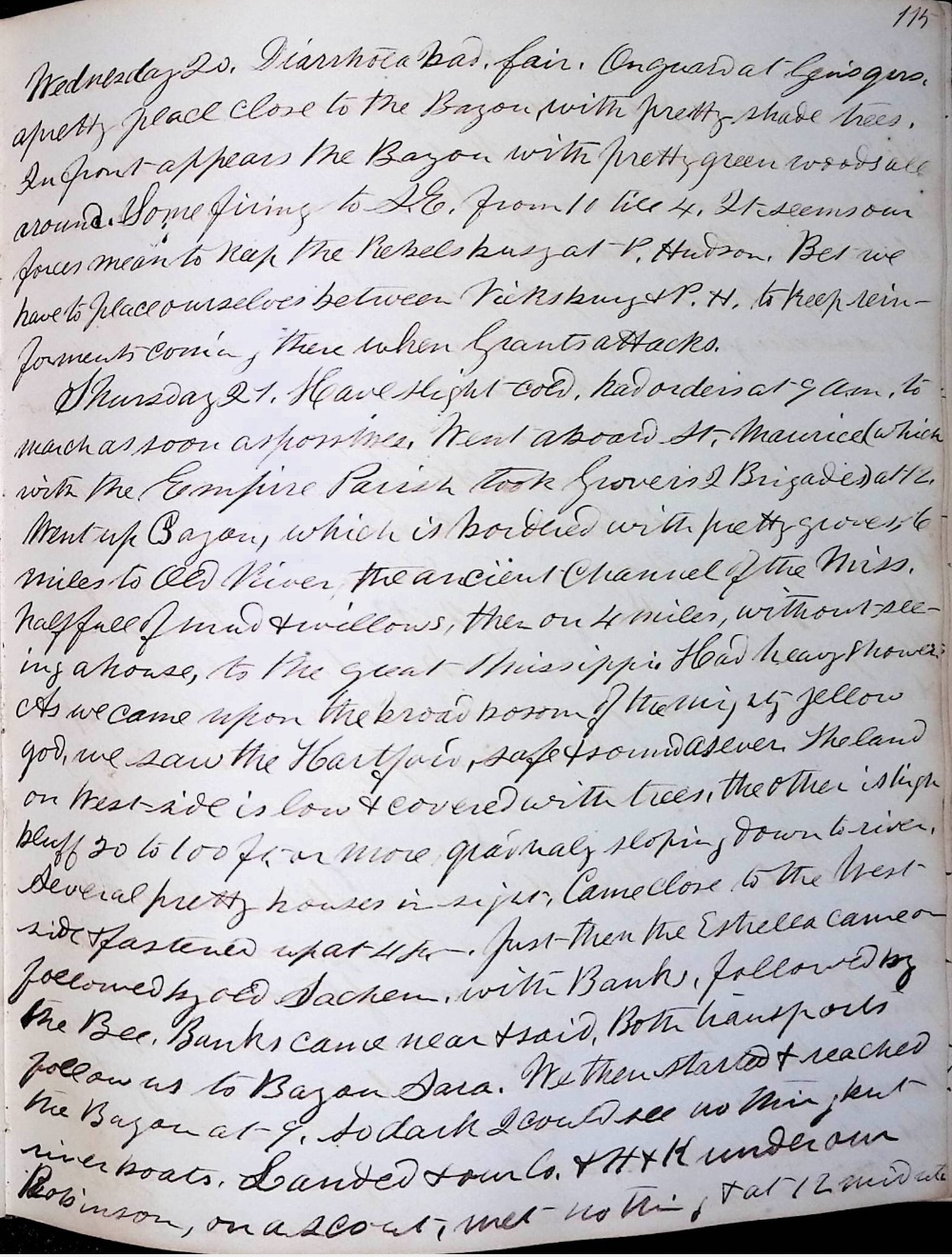
Wednesday, 20th—Diarrhea bad. Fair [weather]. On guard at Genreal’s quarters—a pretty place close to the Bayou with pretty shade trees. In front appears the Bayou with pretty green woods all around. Some firing to the southeast from 10 till 4. It seems our forces mean to keep the Rebels busy at Port Hudson. Bet we have to place ourselves between Vicksburg and Port Hudson to keep reinforcements coming there when Grant attacks.

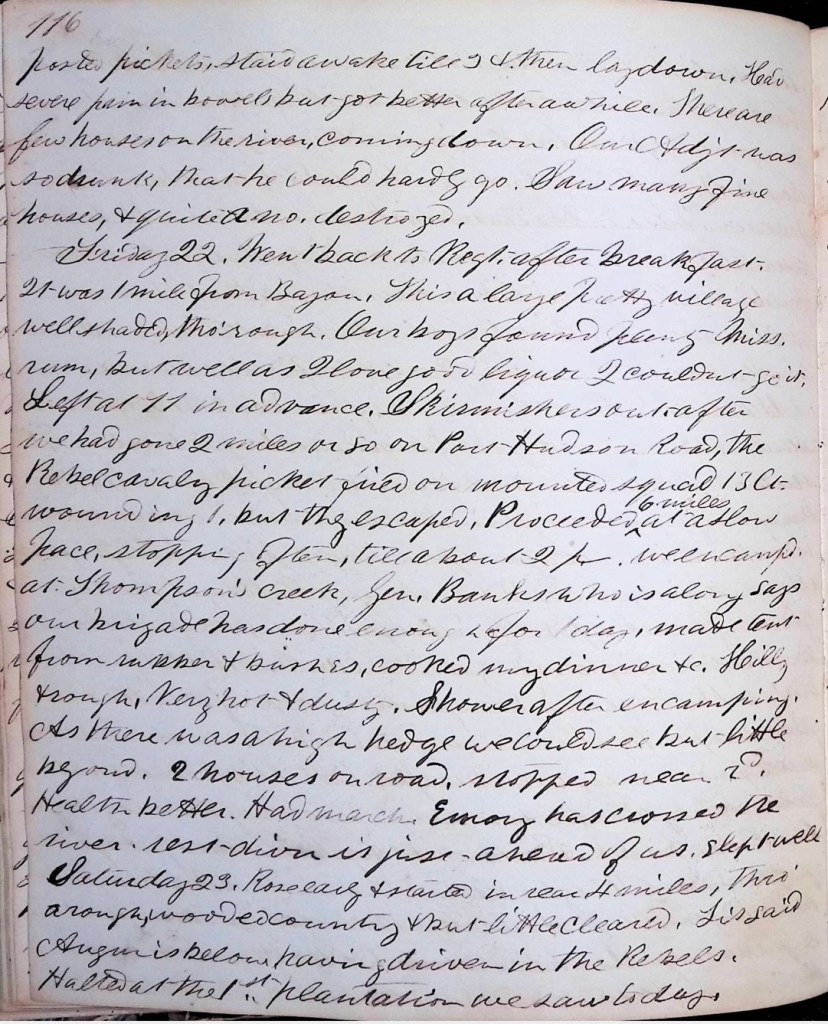
Thursday, 21st—Have slight cold. Had orders at 9 a.m. to march as soon as possible. Went aboard St. Maurice (which with the Empire Parish took Grover’s two brigades) at 12. Went up Bayou which is boarded with pretty groves six miles to Old River, the ancient channel of the Mississippi, half full of mud & willows. Then on four miles without seeing a house to the great Mississippi. Had heavy showers. As we came upon the broad bottom of the mighty yellow God, we saw the Hartford, safe and sound as ever. The land on west side is low and covered with trees. The other [side] is high bluff, 20 to 100 feet or more, gradually sloping down to the river. Several pretty houses in sight. Came close to the west side and fastened up at 4 p.m. Just then the Estrella came on followed by old Sachem with Banks, followed by the Bee. Banks came near & said, “Both transports follow us to Bayou Sara.” We then started & reached the Bayou at 9—so dark I could see nothing but river boats. Landed & our company & H & K under our Robinson, [went] on a scout, met nothing & at 12 midnight posted pickets, stayed awake till 3 7 then lay down. Had severe pain in bowels but got better after a while. There are few houses on the river coming down. Our Adjutant was so drunk that he could hardly go. Saw many fine houses & quite a number destroyed.
Friday, 22nd—Went back to regiment after breakfast. It was one mile from Bayou. This a large, pretty village, well shaded, tho’ rough. Our boys found plenty Mississippi rum, but well as I love good liquor, I couldn’t see it. Left at 11 in advance. Skirmishers out. After we had gone two miles or so on the Port Hudson Road, the Rebel cavalry picket fired on mounted squad 13th Connecticut, wounding one, but they escaped. Proceeded 6 miles at a slow pace, stopping often till about 2 p.m. We encamped at Thompson’s Creek. Gen. Banks who is along says our Brigade has done enough for one day. Made tent from rubber & bushes, cooked my dinner, &c. Hilly & rough. Very hot & dusty. Shower after encamping. As there was a high hedge, we could see but little beyond. Two houses on road. Stopped near 2nd. Health better. Hard march. Emory has crossed the river. REst of division is just ahead of us. Slept well.

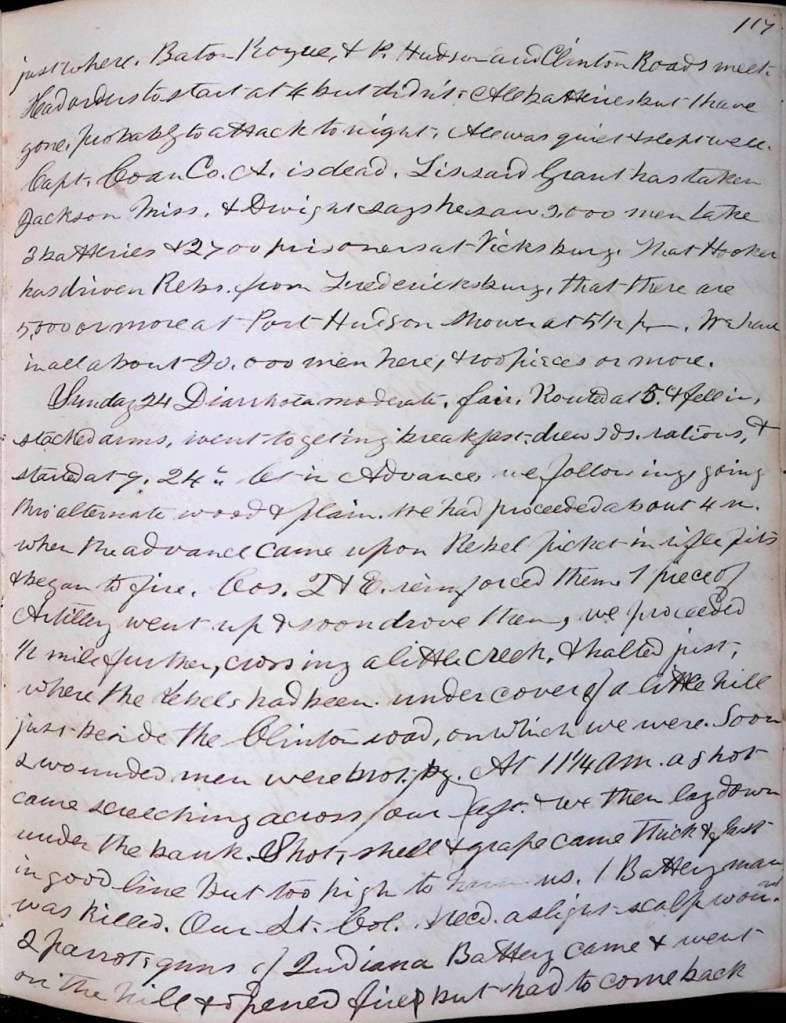
Saturday, 23rd—Rose early & started in rear four miles, thro’ a rough wooded country & but little cleared. Tis said [Gen.] Augur is below having driven in th Rebels. Halted at the 1st plantation we saw today just where Baton Rouge & Port Hudson and Clinton roads meet. Had orders to start at 4 but didn’t. All batteries but one have gone, probably to attack tonight. All was quiet & slept well. Abbott Coan, Co. A, is dead. Tis said Grant has taken Jackson, Mississippi, & Dwight says he saw 2,000 men take three batteries & 2700 prisoners at Vicksburg, that Hooker has driven Rebs from Fredericksburg, that there are 5,000 more at Port Hudson. Shower at 5:30 p.m. We have in all about 20,000 men here & 100 pieces or more.

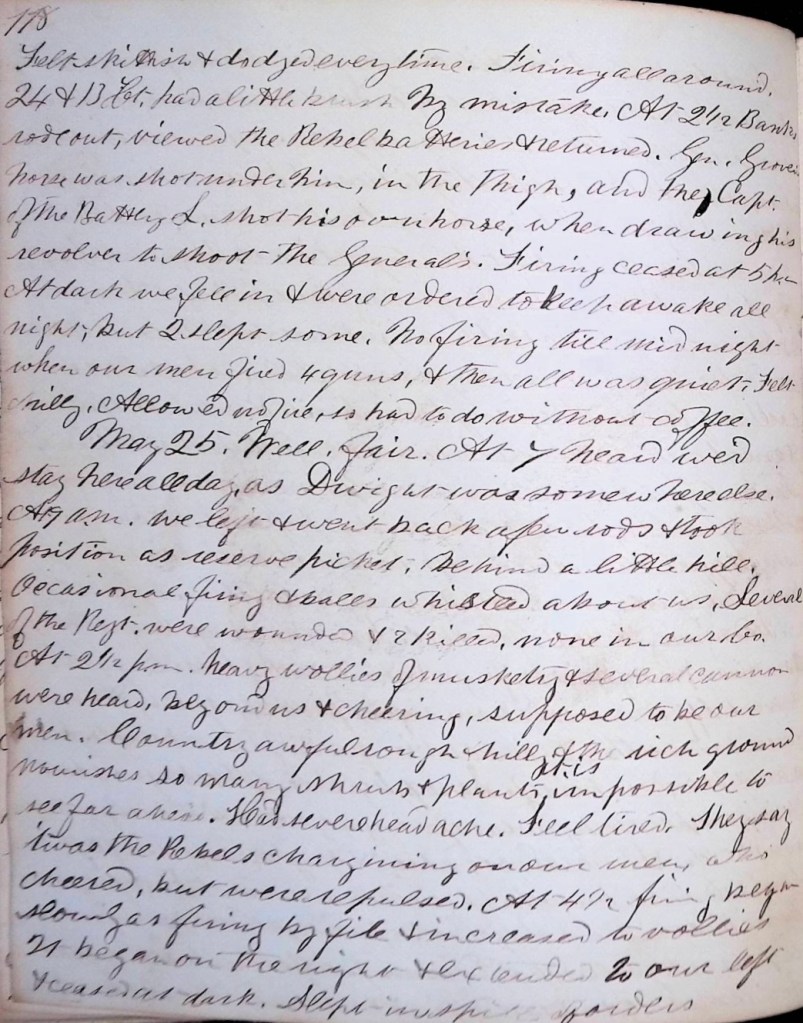
Sunday, 24th—Diarrhea moderate. Fair [weather]. Routed at 5 & fell in, stacked arms, went to getting breakfast, drew three days rations, & started at 9. 24th [Connecticut] in advance, we following. Going thro’ alternate wood & plain. We had proceeded about 4 miles when the advance came upon Rebel picket in rifle pits & began to fire. Cos. I & E reinforced them, one piece of artillery went up & soon drove them. We proceeded half a mile further, crossing a little creek, & halted just where the Rebels had been under cover of a little hill, just beside the Clinton road, on which we were. Soon two wounded men were brought by. Ay 11:15 a.m. a shot came screeching across our left & we then lay down under the bank. Shot, shell, and grape came thick and fast in good line, but too high to harm us. One battery man was killed. Our Lt. Colonel received a slight scalp wound. Two Parrott guns of Indiana Battery came and went on the hill & opened fire but had to come back.
Felt skittish & dodged every time. Firing all around. 24th & 13th Connecticut [regiments] had a little brush by mistake. At 2:30, Banks rode out, viewed the Rebel batteries & returned. Gen. [Cuvier] Grover’s horse was shot under him in the thigh and the Captain of Battery L [Capt. Henry W. Closson of US Artillery] shot his own horse when drawing his revolver to shoot the General’s [horse].

Firing ceased at 5 p.m. At dark we fell in & were ordered to keep awake all night but I slept some. No firing till midnight when our men fired four guns & then all was quiet. Felt chilly. Allowed no fire so had to do without coffee.

[Monday] May 25, [1863]—Well. Fair. At 7 heard we’d stay here all day as Dwight was somewhere else. At 9 a.m. we left & went back a few rods & took position as reserve picket behind a little hill. Occasional firing & balls whistled about is. Several of the regiment were wounded and two killed, none in our company. At 2:30 p.m., heavy vollies of musketry & several cannon were heard beyond us & cheering, supposed to be our men. Country awful rough., hilly & the rich ground nourishes so many shrubs & plants it is impossible to see far ahead. Had severe headache. Feel tired. They say ’twas the Rebels charging on our men who cheered, but were repulsed. At 4:30 firing began slowly as firing by file & increased to collies. It began on the right & extended to our left & ceased at dark. Slept in spite of orders.

Tuesday, 26th—Some diarrhea. Fair. Some firing around the picket. Got coffee & meat for breakfast. Only occasional shots till we were relieved at 9 a.m. & went to the road side where the rest of the regiment was. Two killed & 12 wounded in our regiment. Our boys drove the Rebels inside their entrenchments but had to fall back. Several nigger regiments came along. Little firing done today. At 5 p.m., the 28th Connecticut came here & stacked arms just in our rear. They number 400. They think they’ve suffered awfully what I should call easy times. They say the’ve had to march 12 miles & once! a shot came within 100 yards of them!!! For the first time in three nights, I had boards to sleep on. Shell fired by fleet all night. 28th Connecticut went back to guard wagons as 200 Rebels made a dash on it but were driven back by [6th or 7th] Illinois Cavalry.

Wednesday, 27th—Well. Fair & hot. Firing by Augur began at 7 a.m. & was pretty brisk for an hour or so. At 10 a.m., we fell in and went off thro’ woods to our right, passing many wounded men on our way & came out in front of Rebel breastworks about 300 yards ahead of [us]. Saw quite a number of heads just above their parapet who were firing at our artillery which was here. There is a road running along a ridge to their lines on which we marched. The ground here is terrible rough, steep ridges, deep ravines, gullies, knolls, and stumps and fallen trees as all were cut for 300 yards all around their works.
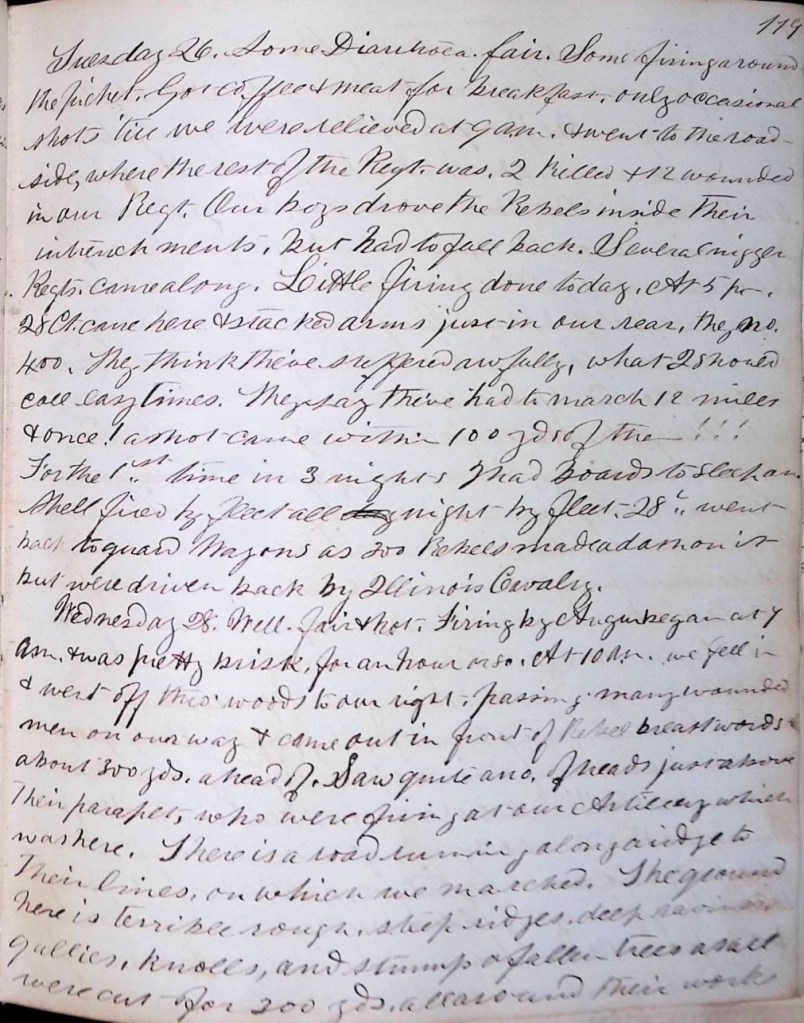
Just as we had all got out in fair sight, a whole volley of buck & ball came whistling over our heads, making us fall. We jumped up & started again & then came an order which spoilt all our work—that was to deploy out into the ravines each side of the road. I jumped ahead as did the rest thro’ a perfect hail of balls & never stopped till I ran against a Lieutenant & [ ] who were on picket behind a large stump. I laid down & fired & loaded. When looking back, I saw our flag two rods behind & heard several wounded men cry out. Then the order was given to advance & the Lieut. Col. came along & drove me off & fell down in my place so I just laid down by another stump close by & fired several times. Then another order to advance was given and I ran with balls whistling all around & got behind a heap of corn about four rods [22 yards] from the parapet where lay a dead man. Soon the Colonel came along, skulking thro’ the ravine behind me and about a dozen others saying, “On to the parapet!” &c. and Lieut. Bearce stood in the ravine crying out the same. We told him we’d go if he’d lead us & called him a coward but he wouldn’t start. Six men went ahead about a rod and got behind a stump but I lay still while balls flew over my head, both from Rebels and [from] our own men who were behind. My corn heap was no protection but as it hid me, I stuck to it, tho’ ’twas awful hard, being obliged to lie flat so long in the awful heat as my water soon gave out.

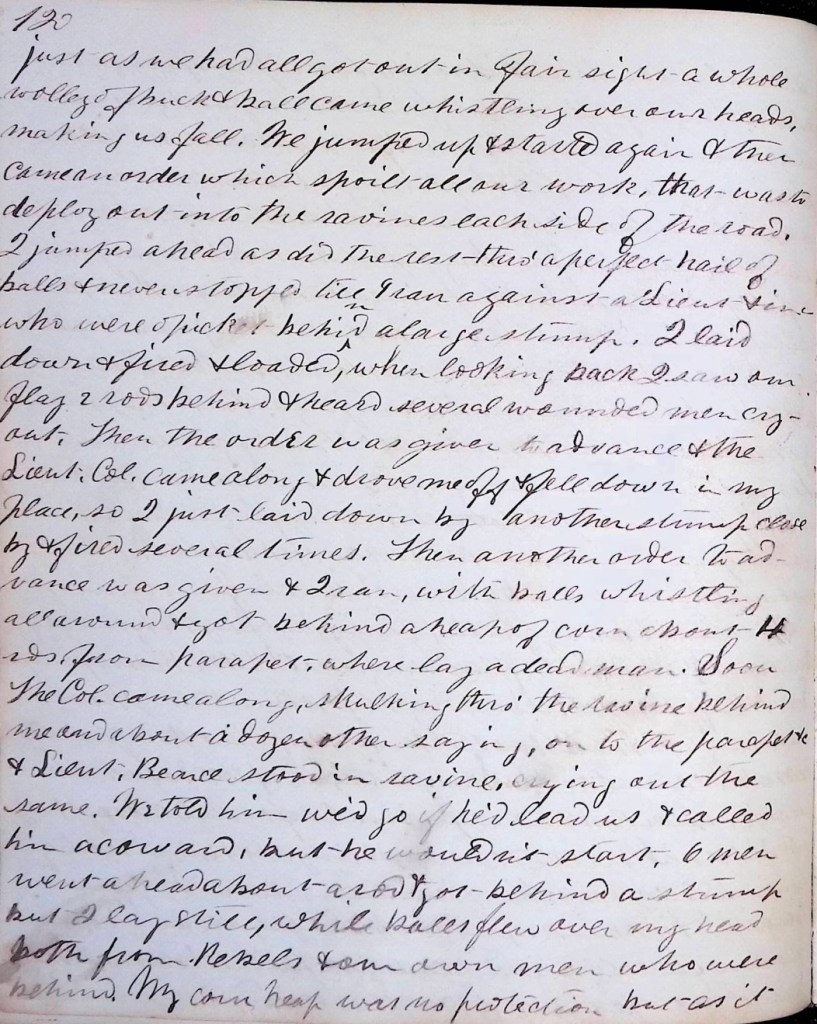
After about half an hour, I heard [George] Linnell of our company call out for water as he was wounded. I told Bearce but he did nothing. He lay an hour before anyone went to him. After about two hours, he was brought into the ravine but he lived only a few minutes. He was hit in the groin & bled to death. About three, I moved down behind a stump as Rebel fire had slackened long ago. But they soon got a cross fire on me & I left that & got between the roots of a great stump where I was safe & to my great relief I found a canteen of water.

Our artillery threw shell and shot over us and rebs threw some also. At 5 I went to where a lot of our company were when we had heavy firing to right & in half hour a flag of truce was raised. All firing ceased & the Rebs jumped on their parapet & we rose and talked to them. No one seeing us then would have thought we had just been killing each other. But so it is. And such is war. We looked up our company, found Casey & Linnell killed, Sergt. [Sam’l] Brown and [Leonard] Briggs severely wounded, & Watson, [Nathaniel] Marden, [Eliab] Averill, [and Hazan] Grover [all] slightly [wounded]. Fell back near woods & lay on our arms & soon firing began slowly. In one hour, all ceased. I have not felt at all afraid today since we charged tho’ I was when I first saw them. Slept soundly. It is said that the flag of truce was raised for some trivial purpose by one of our Majors who is under arrest. Our regiment lost 8 killed & 46 wounded.
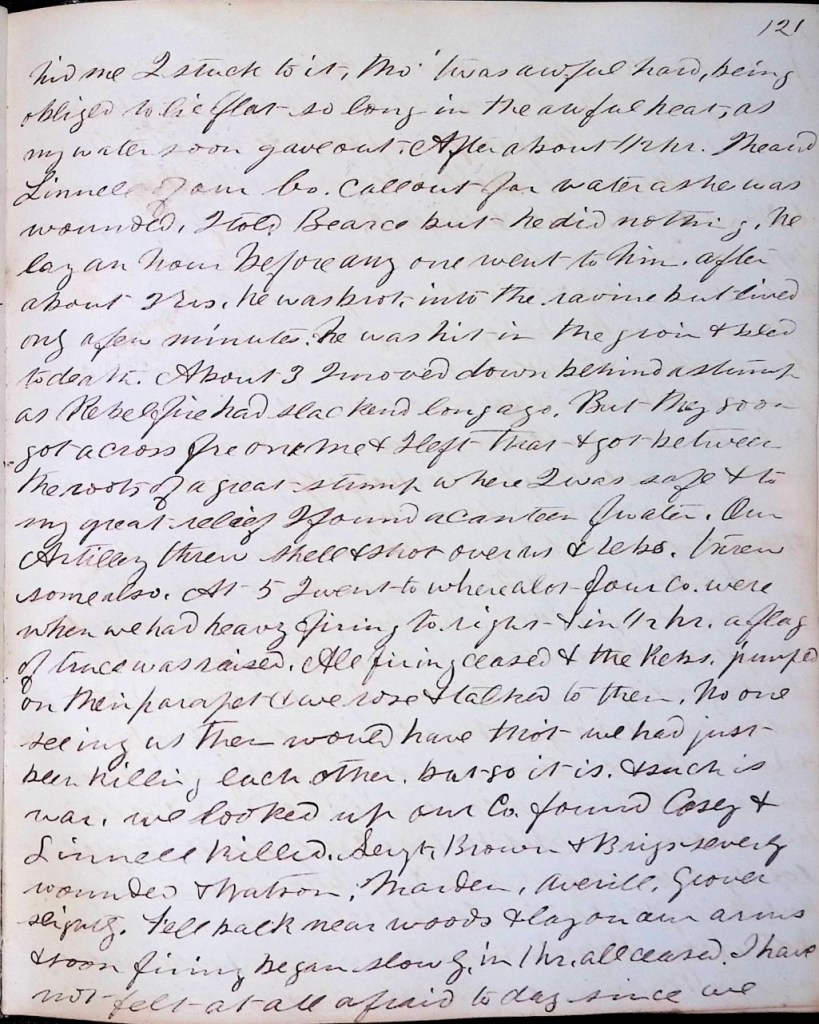
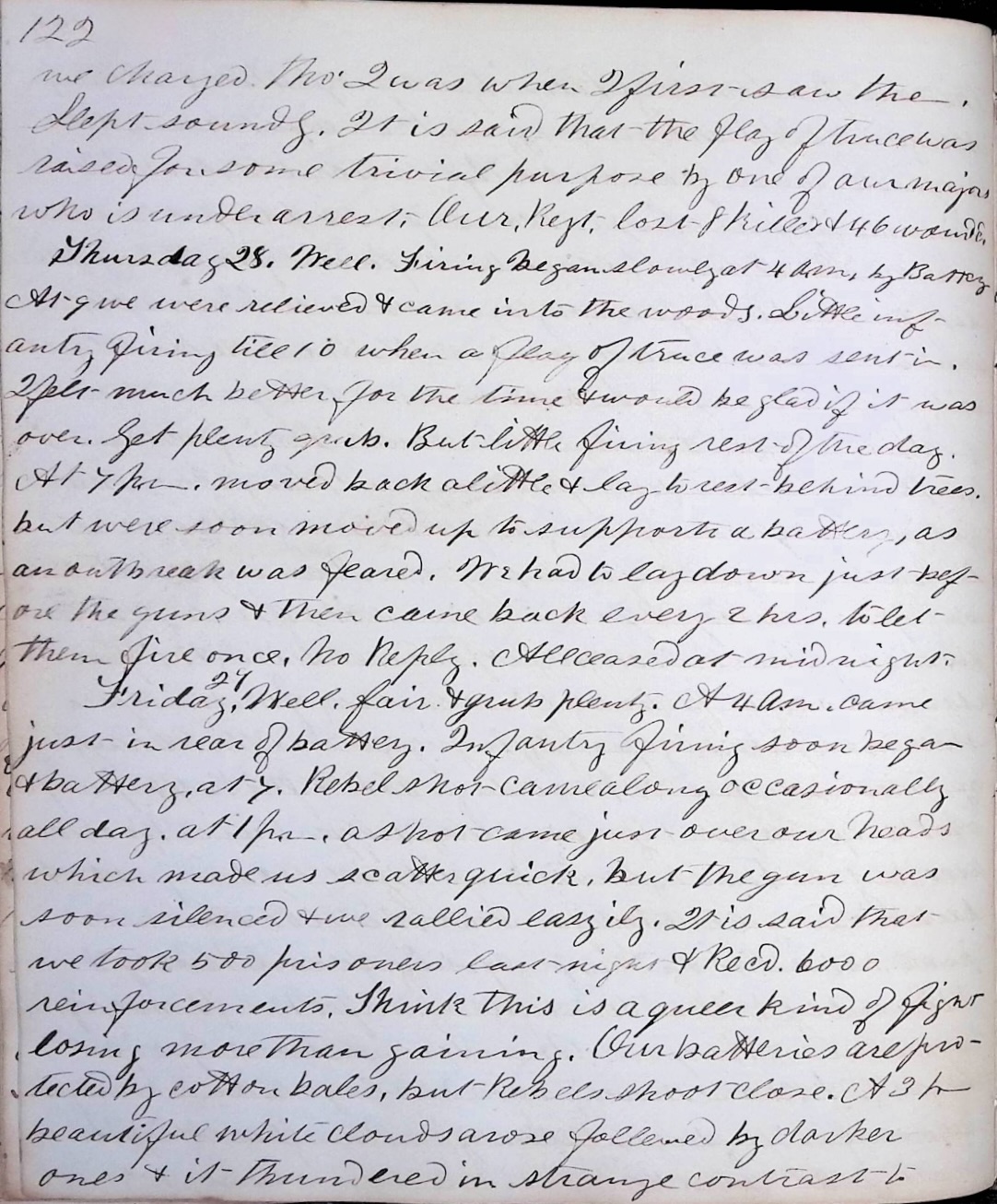
Thursday, 28th—[I’m] well. Firing began slowly at 4 a.m. by battery. At 9 we were relieved & came into the woods. Little infantry firing till 10 when a flag of truce was sent in. I felt much better for the time & would be glad if it was over. Get plenty of grub. But little firing rest of the day. At 7 p.m. moved back a little & lay to rest behind trees but were soon moved up to support a battery, as an outbreak was feared. We had to lay down just before the guns & then came back every two hours to let them fire once. No reply. All ceased at midnight.

Friday, 29th—[I’m] well. Fair [weather] and grub plenty. At 4 a.m., came just in rear of battery. Infantry firing soon began & battery at 7. Rebel shot came along occasionally all day. At 1 p.m., a shot came just over our heads which made us scatter quick but the gun was soon silenced and we rallied easily. It is said that we took 500 prisoners last night and received 6,000 reinforcements. Think this is a queer kind of fight, losing more than gaining. Our batteries are protected by cotton bales, but rebels shoot close. At 3 p.m. beautiful white clouds arose followed by darker ones & it thundered in strange contrast to the roar of our artillery. Rained fast from 4 till 6 & then it was not fair. Lying on ground without cover as we have the last week gives me a kind of chills. At dark we went out in front on picket close to the parapet, relieving the 38th Mass. Tho’ we went all around before we found our place, the Rebels didn’t fire at us. They do not seem to care to trouble us when we let them alone. But little firing at night. We lay safely in a ravine.

Saturday, 30th—Cloudy. About well. Firing began slowly by sunrise & few shots flew over us. Many of our men fire like fools, endangering themselves more than the Rebels. Our cook came along with coffee, &c. having hunted us up tho’ some balls flew around him. At 8 a.m., two of the few pieces which have been engaged opened, eliciting the fire of a 10-inch Rebel gun probably fixed last night. Some of our shell burst just over us, flying very near Co. I. Heavy guns have been planted here today. Hot & fair adter 10 a.m. As our boys are out of money, they suffer much for tobacco but I am lucky, having left off at Opelousas. At dark we advanced to the front to relieve Co. A. I was posted behind a log. Heavy firing several hours.

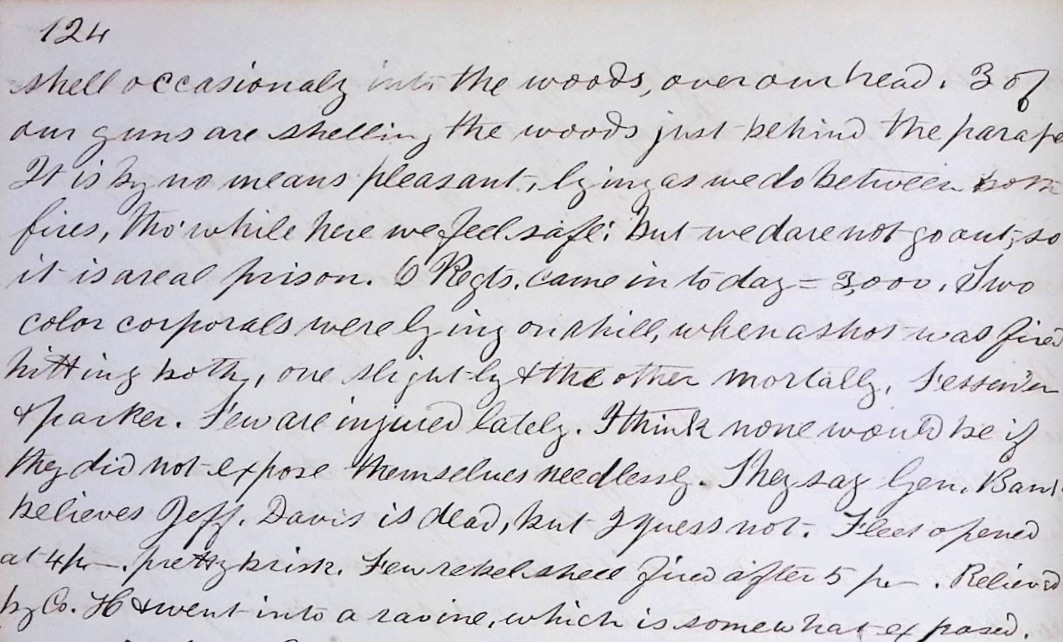
Sunday, 31st—Some tired & uneasy. Awful hot. Some firing by all hands. At 9 we moved down into a ravine just below to get some shade. Seven men who were taken last night report that for 48 hours, they’ve had nothing but stagnant water, but I don’t believe it. Rebels keep sending 10-inch shell occasionally into the woods over our head. Three of our guns are shelling the woods just behind the parapet. It is by no means pleasant lying as we do between both fires, tho’ while here we feel safe. But we dare not go out, so it is a real prison. Six regiments came inn today—3,000. Two color corporals were lying on a hill when a shot was fired hitting both—one slightly and the other mortally—Fessenden & Parker. Few are injured lately. I think none would be if they did not expose themselves needlessly. They say Gen. Banks believes Jeff Davis is dead but I guess not. Fleet opened at 4 p.m.—pretty brisk. Few rebel shell fired after 5 p.m. Relieved by Co. H & went into a ravine which is somewhat exposed.
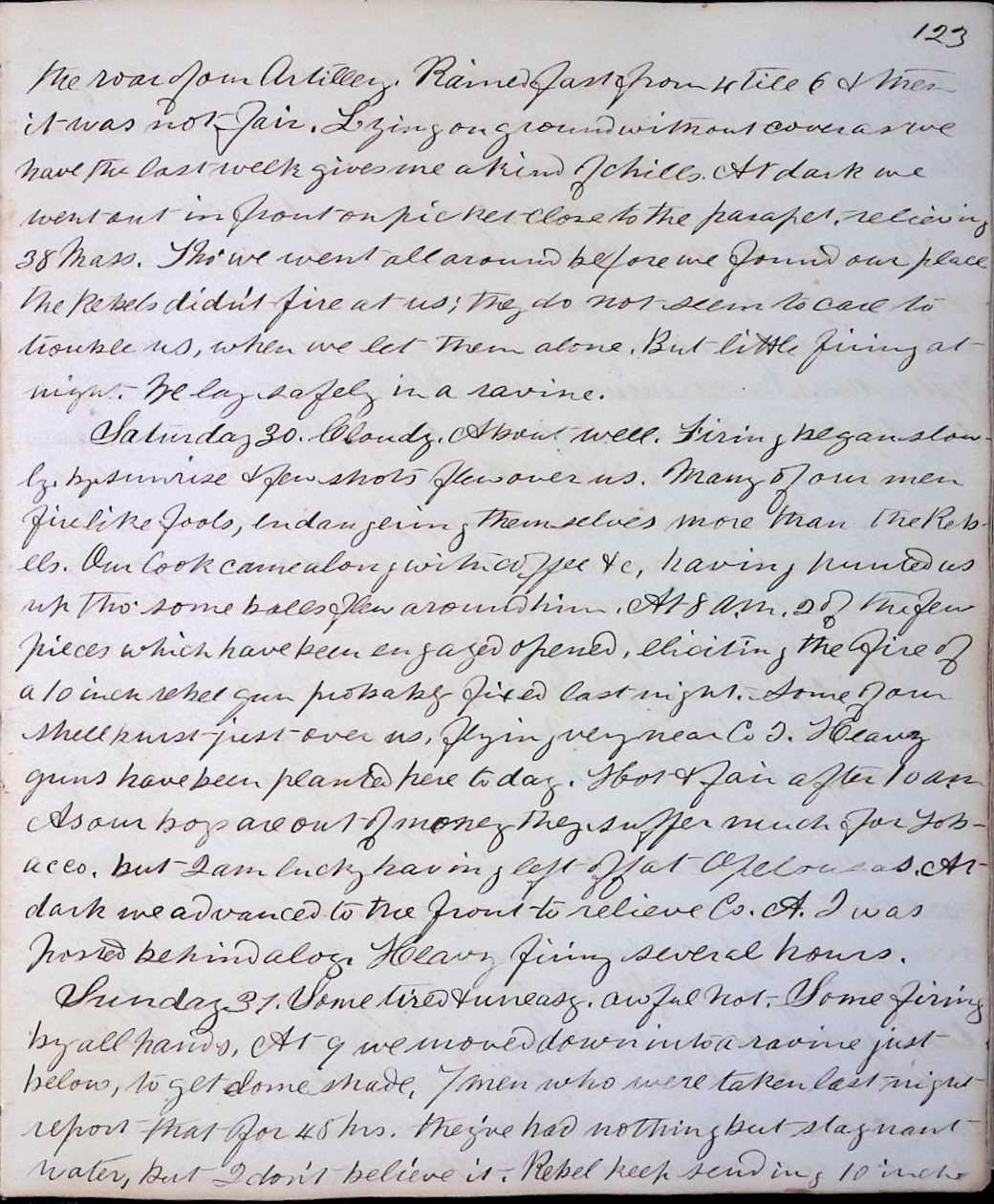
TO THE NEXT PAGE OF THE DIARY

1862: Edwin L. Nickerson to his Sister

Edwin L. Nickerson (Collection of Cornwall Historical Society)

The following letter was written by Edwin L. Nickerson (1842-1863) who enlisted as a private on 25 February 1862 in Co. C, 13th Connecticut Infantry. He was promoted to a corporal in November 1862 but was killed at Irish Bend, Louisiana on 14 April 1863 during the Teche Campaign.

Edwin was the son of Smith Nickerson (1804-1853) and Mary Ann Davidson (1806-1845) from Cornwall, Litchfield County, Connecticut. He had three brothers who served in the military; Uriah Nickerson (1838-1895), who fought in Company E of the 7th Connecticut Infantry, Henry F. Nickerson, who was part of the 10th Connecticut Infantry, and Mark S. Nickerson (1843-1915), who served in Company A of the 10th Massachusetts Infantry. In his correspondence, Edwin expressed profound concern for his brother Mark’s safety upon receiving news of the Battle of Fair Oaks (Seven Pines), during which the 10th Massachusetts endured 27 fatalities and 95 injuries in savage hand-to-hand combat. Remarkably, Mark survived the war and passed away at the age of 72. Ironically, it was Edwin who would ultimately fail to return home.

Edwin datelined his letter on 23 June 1862 from the Custom House in New Orleans where they quarters with Gen. Butler’s Headquarters and performed provost duty.

Transcription

Patriotic heading of Edwin’s letter

Custom House, New Orleans
13th Regt. C. V. Co. C, USA
June 23, 1862

Dear Sister,

I received yours of May 27th the 12 of June & was very glad to hear from you again & I should have answered it before but I thought I had written several that not answered & would wait until we were paid off, hoping to receive another from you, but have not. I am well once more & am getting somewhat used to warm weather so I think I shall stand it. I don’t hear anything about the yellow fever now so I guess it has died out.

We were paid off the 18th instead of. and were paid only two months pay which took it up to the 1st of May but I had enough coming to me which I lent while in New Orleans so that I have sent you $30. It is all in U. S. Treasury Notes. Sent it by the Adams Express Co., and if nothing happens, it will be there before this will so immediately on receiving this you will please call at the office & get it. Should Mark write to you for $5, you will please send it to him on my account.

I see you do not understand that allotment business. It is not paid there at all. We receive it in checks in the name of any confidential person or persons whom we may have assigned it to, & those checks we send to the ones which it is assigned & they draw the money on them from any bank they choose & provided they are lost by the mail, we can get others in place of them from the paymaster.

I signed the roll in your name & expected to receive those checks but did not hear anything about it & I don’t know but they have [ ] it altogether. I hope they have for I would not have signed it had I known as much about it then as I do now.

I see by hte papers Mark has been in a great battle & I feel anxious to hear from him for I have seen some of the names & I don’t know but he may be one of them. I have not heard from him in a long, long time and how dreadful the suspense. Oh, I hope he is well. But I tremble lest he was one of the fallen. For God’s sake, write to let me know the truth.

But I must close as I have not time to write any longer. Direct to New Orleans, General Butler’s Expedition. We had green corn here the middle of May and the markets are now crowded with watermelons, muskmelons, plumbs, peaches, new potatoes, blackberries, &c. & have been since the middle of May. Please remember me kindly to all, not forgetting that I am still your brother, — Edwin L. Nickerson

The Civil War Letters of John Hager, Co. B, 110th New York Infantry

Pvt. John Hager, Co. B, 110th New York Infantry

The following Civil War letters were made available for transcription and publication on Spared & Shared by Sue Hager, a descendant of the veteran soldier John Hager (1829-1897) of Oswego who served in Co. B, 110th New York Infantry Regiment. According to military records—where he was carried as “Hagar” on the muster rolls—John enrolled as a private in August 1862 and mustered out with the company on 28 August 1865 at Albany, New York (3 years, 23 days). The enrolling officer described John as 5′ 7″ tall, with blue eyes and sandy hair.

John’s parents were Gardner Hager (1784-1844) and Submit Presson (1878-1850). John was married to Phoebe Alice Calkins (1831-1898) about 1850 and two of their children, Charles (b. 1853) and Emma (b. 1858) were living at the time of the 1860 US Census when John was identified as a “cooper” in Richland.

The 110th New York Infantry was sent to Baltimore, Maryland on 29 August 1862 where they were on duty until 6 November 1862. They were then shipped to Fort Monroe, Virginia, and then sailed for New Orleans on 4 December, arriving at Carrollton on the Mississippi river 26 December. They remained on duty there until March 1863, participating in operations on Bayou Plaquemine, and then engaged with Banks’ army against Port Hudson. They were present in the siege and assault on Port Hudson culminating in its surrender in July 1863. They then were placed on garrison duty at Baton Rouge and elsewhere before participating in the Western Louisiana Campaign and eventually relocated to Key West, Florida where they were garrisoned at Fort Jefferson until their term of service ran out. The regiment lost a total of 210 men during service; two officers and 14 enlisted men killed or mortally wounded, three officers and 191 enlisted men died of disease.

I have searched high and low on the internet to find a regimental history of the 110th New York Infantry without success—in any form. There are a number of unpublished letters and diaries by members of the regiment housed in libraries. Those that I am aware of include letters by Samuel J. Bass who served in Co. C (died of chronic diarrhea, August 12, 1863, at Convalescent General Hospital, Baton Rouge, La.). His letters are held at Cornell University.

There is a partial 1863 diary that was kept by Charles M. Byington while serving at quartermaster sergeant of the regiment. His diary contains a first hand account of an engagement near Port Hudson, in which the USS Mississippi lost its rudder and exploded. In mid-April, he wrote about the Battle of Fort Bisland, including nearly getting hit by shells and seeing white flags hung outside of “most every house,” reportedly by Confederate women frightened of the Yankees (April 19, 1863). In June, he described frequent foraging, his health problems, and the Battle of Port Hudson, in which several men he knew were wounded and killed (June 14, 1863). He also recounted a surprising assault by Confederate cavalry, which he and several officers fled by boarding a ship that was “peppered by bullets” (July 2, 1863). On July 18, 1863, he mentioned a visit to the decimated Port Hudson (July 14, 1863: “The buildings inside were literally torn to pieces”). The diary ends with a search for a coffin for “one of our boys” and a church visit on July 19, 1863. This diary is housed at the University of Michigan.

There is an 1862-63 Diary kept by Sgt. Thomas Hall (died of sunstroke and disease, August 25, 1863, at Arsenal Hospital, Baton Rouge, La.) which provides some detail of the passage from Baltimore to Ship Island, noting the mechanical problems, extreme weather, his ship-related duties, health concerns, his surroundings, and shortage of food. He also describes the bombardment of Port Hudson as “fire & explosion on river” (March 15, 1863), and gave an account of a march through knee-deep mud (March 18, 1863). On April 12 and 13, 1863, Hall briefly commented on the Battle of Fort Bisland, noting that fighting had ended at 6 p.m. and the Confederate band had played “Dixie.” Subsequently, he mentioned the capture of Confederate prisoners near Franklin, Louisiana, (April 15 and 16, 1863) and the poor condition of the men in his regiment due to a lack of regular rations and the absence of the quartermaster (April 25, 1863). On May 26, 1863, he discussed a skirmish near Port Hudson, stating that “marshy ground” had caused the Union artillery to fail. Other entries note the surrender of Port Hudson (July 8, 1863), the suicide of a man in the regiment (July 8, 1863), and a Zouave’s failed attempt to escape from Port Hudson (July 9, 1863). This diary is also held at the University of Michigan.

During his three years in the regiment, Claudius W. Rider, a fifer in Co. C also kept a diary. Though his diary entries are brief, he refers to life in camp, weather, military and other music, practicing and rehearsing, socializing with fellow soldiers, marches, disease, fatalities, voyages, the presidential election of 1864, the assassination of Lincoln and ceremonies held in his honor at Port Jefferson, daily occurrences at the prison, and the arrival of the four conspirators in July 1865. This diary is held at the New York Historical Society.

Finally there was another diary kept by Henry B. Whitney during his three years of service in Co. B. His diary particular describes his service as a guard at Fort Jefferson, a prison for Confederates in the Dry Tortugas, Fla., 1864, including a description of the arrival of four civilian prisoners convicted of conspiring to assassinate President Abraham Lincoln. His diary is located at Duke University.

As warned by Sue Hager, his descendant, John Hager’s letters are challenging to read due to his informal education (he admits never having written much until he was 20 years old). His poor grammar, spelling, and lack of punctuation have made transcription difficult but every effort was made to retain John’s vernacular and yet make them readable. Sue informs me that the letters were not discovered among the family’s possessions until 1993 when a house and garage was being cleaned out. They were nearly tossed into the trash but thankfully discovered and preserved.

John and Phebe (Calkins) Hager—reunited after three years of war.

Though somewhat deteriorated and rodent nibbled, John’s letters reveal the hardships endured of three years service and separation from his wife and two children. His frequent letters—sometimes two or three written in a week’s time—not only inform us of the regiment’s movements, but we learn of John’s patriotic spirit that induced him to enlist, of his struggles to stay healthy while so many of his comrades fell ill or died from disease or malnutrition, and of his devotion to his family and the anxiety he felt when he learned of their hardships and could offer little relief due to delays in his receiving pay. These hardships placed an incredible strain on his marriage that tested both John and Phebe and yet they emerged from the war as partners.

Like most Northerners, John held clearly racist opinions about Negroes but it is interesting to observe the changes in his thinking over the course of the war as he observed their plight—particularly in Louisiana where he spent much of 1863. He notes that slaves were treated worse than he imagined and, as a fighter himself, he grew a new-found respect for the race as soldiers once they donned the union blue.

John’s letters mention many of his comrades in the 110th but those mentioned most frequently include Ransom (“Rans”) A. Soule (b. 1833), George S. Filkins (b. 1836), William C. Weed (b. 1829), and Jason B. Wright (b. 1831). All of these men were from the Richland area who joined Co. B and were of an age comparable to John.


Editor’s Note: The number of letters in this collection (171) compels me to post them on multiple webpages so that the files will load more quickly. As such, John’s letters written in 1862 (1 through 29) will appear on this page and his letters from 1863, 1864, and 1865 will appear on the following pages:

John Hager’s 1863 Letters (30 through 115)

John Hager’s 1864 Letters (116 through 148)

John Hager’s 1865 Letters (149 through 171)

The 110th New York at Camp Patterson Park, Baltimore, Maryland, 1862

Letter 1

[New York City]
August 29, 1862

Phebe Hager,

I have got to New York [City] all right. We expect to go on today. We are on the boat now all right. When we get down there, I will write again. — John Hager


Letter 2

Camp Patterson, Baltimore, Md.
September 7, 1862

We went in swimming last night. It is salt water. This city is under martial law now. They put one of our boys in the guardhouse but they let them go in about an hour or two—one was Ramson Soule. I han’t been down to the city, some come here. Lester Pitcher has been here last Friday to see the boys but there wasn’t nobody but me and the Lester boys and they was in the guard house when he come here. Let is about a mile from here. He is in sight.
There has been a good many sick in our company but they have got better. William Weed has been sick all of the time since we have come here but has got better now. The boys that I tent with are all well and right yet. I am as tough as a bear now. I have fatted up like “hog” since I have come here.

The report was that Stonewall Jackson was coming here to take this city but we are ready for him. Now we have got our guns and ammunition. And we sleep on our arms one night since we came here. But it is rebel times now. There has been a good many soldiers along by here since we have come here. They say that there is some men down to Weston that they can’t feed them. But we have had enough to eat here since we have been here and good enough for any white men to eat. There is niggers enough here.

I don’t know what to write to you but I thought I would because I han’t got anything to go to today. But to go to meeting today at 3 o’clock in the afternoon on the ground here. I ain’t homesick yet any, but I thought I would like to see you and the children. But I am here and you are there. I have got a New Testament now. This from John Hager to Phebe Hager.

Direct your letter to Co. B 110 Reg N.Y., Camp Patterson, Baltimore.


Letter 3

September 8, 1862

Old General Wall (Stonewall Jackson) has been here and we expect to be hard answering. Colonel Littlejohn is (related to?) to lated to John?

Old Well Davison (?) is right here, close by here and I have seen him myself. He is an old grey man. I have to salute him according to war duty orders. I was on guard duty that day and to ? with him myself. I think we shall go in his army when we get deviled(?) so we know how to fight. Then we will give them hell then.

Some of our boys are ready to fight. They say they want Jackson to come on if he dare. He has started, but he han’t got here yet. I don’t believe I would like to see him myself. Then I could know that he was coming here or not. They is [with]in 40 or 50 miles of us. When we was down in a line the other night, the boys was a good many sick just then. We expected Jackson was coming in this city but I was all right myself.

I don’t know whether you can read this or not but I han’t no place to write—only on my knapsack. If I write as much every week as I have since I come here, I shall write a good deal more than I expected when I started from home. But I have a good deal of time since I come here and will keep you a reading this damn poor writing. But I want to bother you some if I am away down to Baltimore. It is a good place down here. Tell Charles and Emma Hager that I am well and han’t shot a gun since I left home. I expect to when we get where the rebels is. Then I will shoot like a good feller.

We have got news that Jackson is within 12 miles of us here now. We have been called out since 5 o’clock tonight. I thought I would write this down here to night but it is dark now.

Direct your letter Co B 110, Maryland Baltimore. It so dark. — J. Hager


Letter 4

September 24, 1862

Phebe, you don’t like to write much, do you. I will write to you about every day while I stay here, then after that maybe I can’t write so often for I don’t know where we shall go from here. But we shall go somewhere I guess, pretty soon, but maybe not at all. But I am ready anytime.

Bumpus is in the hospital yet, but he is getting better. So is Shannon. They han’t drill[ed] none yet. The rest of us are pretty well drilled. It han’t rained but once since we have been here.

If you can, I hope you will all be good Christians. I will too. I hope if we never meet together in this world, we will in another. I hope we shall live so that we shall meet in heaven, if not before. That book was given to me in N.Y. I have got another that is the book that they sing in here, and you can carry it to meeting with you to sing in. I am [still] the boy that I was when I start[ed] from home. Never meant to do nothin very bad. I always want to do about right.

But it rains now here and our company is all on guard today. But we have all got overcoats and we can deep dry and nice. My pants is about as good as when you seen me. And the rest of my clothes is too. Some of the boys has got holes in [theirs], some has ripped to pieces, but mine is all right now. How does your’n stand it?

You hain’t got wet yet, I hope. May God bless your old soul and our children too. Don’t forget to pray for me and yourself and the children too. Learn them to pray.

I will tell you something about soldiering. Some of it is pretty hard work and some ain’t hard at all. Tain’t as hard as cooperin’ is. My hands don’t look as they did when you seen them, but I feel as well as I did then and a good better. I hope you do too for if I didn’t feel very well then. You know that yourself. Nothing more to write. Take good care of yourself, my dear wife and friend. Don’t worry about me for you and I are better off than a good many hain’t got nothin at all.


Letter 5

[near Baltimore]
[Sunday, 25 September 1862]

Phebe, it is Sunday today. The boys have all [gone] down to City to meeting but Robert and me today. We stay and keep house alone. But we have a meeting here at 3 p.m. every Sunday.

We all have our belts on with our bayonet too. We don’t carry our guns to meeting. We have our dress coats on, and our boots blacked, and wear white gloves, and our hair combed and then we look pretty well. All stand up.

Phebe, I have heard from the 147th [New York] Regiment. They are 6 miles from Washington. They say they han’t got as good a place as we have here.

This to my Emma. This is the way that we do in these war times. Emma don’t you see the smoke [referring to cannon fire on stationery heading]. My little girl, my girl when you look at this, then think of pa. And Charley, you can see.the smoke in this gun, can’t you? This is the way that we do in these war times my boy. When you see this, remember your pa. And try to be a good boy and then everybody will like you.

Emma, I have seen thirty big guns today. Do you go to school yet? Emma, I have seen a lot of little girls when we went over to Fort McHenry. We stayed there 30 minutes. Didn’t stay long. The New York 17th and the Massachusetts 15th was outside of the fort. They are the boys that can fight. They are tough hard boys now, I tell you. They brought their guns with them and their tents too. But they look dirty and hard. They don’t look half so well as we do. We keep clean and nice in our camp.

We have went down to the bay in swimming four times since I have been here. We keep clean and nice Emma. I have a good place to sleep, one blanket under me and another over me. A pine board to sleep on. But I sleep in a white house. We all do. When we are off to war, ma can tell you about that and so can Charley for he has seen our house in Oswego. This to my daughter Emma Hager, my girl.

This from your pa away off to war. Emma, when you get big enough then you must write to me. Won’t you, my girl? So good bye for this time.


Letter 6

[Near Baltimore, Md.]
October 2, 1862

Phebe, I got your kind letter today and was glad to hear that you was all well. I sent you a letter today just before I got yours. I wouldn’t have sent it if I had known that you had wrote some, but [I was] glad to read it. I like to read your kind letters.

Well, Phebe, if you don’t want me to write so often, you must tell me so and then I won’t write no more often than you want me to. But I want you to write to me as much as 3 letters a week. That will be 9 cents a week for you and 9/18. That ain’t much to pay for letters. I could send three times that but I will save it so you and I can write. I want you to write to me 2 letters a week and if you can, 3 or 4. It don’t cost much. It’s worth 25 cents every letter if you answer what I write to you.

I will answer anything that you ask me to. I don’t care what it is. I ain’t afraid to talk with you. And I hope you aren’t with me.

Well Phebe, I han’t but one story to tell this time. [It’s] this. There was a boy in the 81th [New York] regiment. His name was Harry. He lives, when he was to home, in Albion. He has been in the hospital about 3 months last Saturday and his sister come Monday to see him and he was buried. But they dug him up and carried him home. He was wounded in his leg but he took poison and [ ] 9 days. One of our boys went and sat up with him 3 nights. He was a young man but his sister didn’t come soon enough to see him. I should thought that she would come before. That’s all about this boy.

Phebe, I don’t want you to trouble yourself about me. You must try to send me money unless I send for it, then there will be time enough then. Phebe, you feel pretty poor now, don’t you. But I don’t feel pretty sick now-a-days myself and I wish you did too. But Phebe, it will learn you and I both to write. If we write 3 or 4 letters a week.

This from your soldier — John Hager

to my wife and friend Phebe.

There is a dozen in the tent tonight so I can’t think of nothin’ to write but after you answer my last before this, then I can answer all that you can write. Now try your best.


Letter 7

[Near Baltimore, Md.]
October the 8, 1862

Phebe, you didn’t tell me how you got along with your harvesting. I hope that you won’t try to do it alone. Phebe, I don’t want you to try to dig the potatoes yourself for I think that you ain’t able to do it and I wouldn’t try to do it. What is potatoes worth there now? I hope that you will have some to sell… They han’t been no frost here yet. Today is as warm as any day since I have been here.

Our company is all on guard today but it ain’t very hard work. I have to stand on post two hours and off 4 hours. That’s the way that we work it here. But we have to keep walking all the time and we can’t talk with nobody when we are on duty for we have got 10 rounds in our cartridge box.

The election is today in this city of Baltimore. They said that they should tear down all of the flags that is in the city, but they doesn’t come no such thing. If they do, we will give them all that they want, for we have got the tools to do it with. And they all know it too. The majority is Union men in the city.

Phebe there is about 20 in our company of sick men. But they ain’t but 2 that is much sick. The rest ain’t only grumble sick. They will be all right in a day or two I guess. I han’t missed a roll call yet since I come here and I feel pretty well pleased about it. I wish it would rain a little here for it is getting pretty dry here now, and dusty. Phebe, it ain’t half as hard work now for me as it was at first. It comes pretty easy now for me to deal now days. But it was most darned hard when I first come. But we have more to do, but it don’t seem half as hard.

You said that you hope that I would be contented here. Phebe, I am contented here and have been all the time and I meant to be. I like it better than I expected that I should. You know that I always was a Union man when I was to home and I am the same here. And I only will be till I die. You can tell that to anybody that you see. I don’t care who it is nor where they live. For I come here to fight. I didn’t come for nothin’ else—only to fight and that only.

Phebe, I don’t expect to make much at it, but I guess I can help you some. I might be sharing of my money as I can, and send it to you. I have used a good deal of money I know since I see you. It was for things that we need to use. I will write what I use my money for if you want me should and I will tell you what I do with every cent if you want I should, and what it is for, all of it is for.


Letter 8

[Baltimore, Md.]
October 9, 1862

Phebe, my dear, I thought of a hard thing too when I was on guard last night but I can’t think of nothin’ now hardly to write. But my dear, I can tell one thing—that is, that I ain’t sorry that I enlisted, for you know that I wanted to go and help fight and I han’t altered my mind from that yet. And I don’t think that I shall. But I hope that the war won’t last long. And I hope that I shall come home again. But I am ready to fight anytime now.

We have had marching orders two or three times and we have got them now. But I don’t think that we shall go in a month yet, but maybe we shall go in 2 days. But guess not. But if we do, I am ready every time.

This from your best friend, I know it is in the world for think that you be mine.

Phebe, if I should be sick as Bumpus is, I should want you to come and see me before I should die for they won’t let nobody go home. For there is more then 4 bushels of letters been sent to Washington to see if they discharge the sick and wounded. Stanton says he han’t time to read them. They come so fast. That the reason that Tom Whitney han’t been discharged. I know this to be a fact.

Our Captain offered to send Bumpus home and pay the money himself if they would let him go, but they can’t do it—not till he can get his discharge. Then he can go. But I think that he will die in less that one week. But maybe he won’t. I han’t seen him today but Mr. Homes, Jesse Homes’ boy has seen him. He was acquainted with him. He goes over there every day to see him and he wrote to his wife for him a week ago.


Letter 9

[Maryland]
October 16, 1862

I got your kind letter today and I was glad to hear that you was all well and your letter found me well too. Phebe I like my new home first rate, although it’s pretty sickly here now. But I guess it won’t be long for it getting some colder here now than it was. Phebe, we don’t have to drill half as much here as we did to Camp Patterson, but we have to go on guard almost every day here. But we have two men on one post every night but only one in the daytime. So it makes it a little better for us to have two on in the night so it ain’t so lonesome for us. It ain’t hard work—not at all—for us to guard the railroad.

This railroad is guarded all the way from Philadelphia to Washington. It has to be guarded. If it ain’t the rebels would take it all up. Here is where we went by when we went to Baltimore. This ain’t but 9 miles from Baltimore where we be. But you must send your letters just the same that you have, for the mail goes every other day here… Maybe we shan’t stay here more than one week but I think that we shall stay a month or two, and maybe longer. But I can’t tell much about it myself.

But Col. Littlejohn han’t resigned yet. About all that we know about it, we read in the papers. The Pulaski paper will tell you something about it. But I guess that he will stay with us till next fall, then I think he will leave but I hope not, for he is just the man for us.

But I think that the war will be over in less than one year, but maybe not, but it looks like it to me. There have two regiments gone by today. There has more than two a day ever since we left Oswego. Our lieutenant was down to Baltimore. He says that there was 30 regiments went to Washington today and last night the folks in Baltimore, they think that they has folks enough gone by to eat up the whole south. That what old man told me. He said that he had lived there over 60 years. He said that he hope that this war would be over right off, for he said that they can’t do nothin but work. For the said that they han’t done nothin but work for the government. All that they had done ever since the war began was to work for the government.

The poor folks han’t nothing to do. Phebe, we came by apples for 50 cents here, but potatoes are 100. We done have them but one in 2 days, and we have to buy some, as we don’t have to, but we do. It goes a little better the (cleg?) bread and meat fat. We have enough of that, but if we had a little butter it would be pretty good, l guess. But I can stand, it I guess.


Letter 10

[Maryland]
October the 20, 1862

My dear,

I have wrote more now than you can read, but I will write a little more to you. I got Chester’s letter the same time that I did your’n. We don’t get them only every other day. Phebe, I don’t know how long I shall stay here but I would like it if I had a bed quilt for it is pretty cold nights here now. But I s’pose that you can’t send one to me for you hain’t got money to send it with. Dick said that he wished that he had one quilt too, and some cheese and some butter too. He wanted I should send with him to get them. That was a week or two ago and I told him I didn’t want nothin’ but now I would like a comforter to put over me. But maybe we can get another blanket. But we can’t not now for Walter tried it. But I guess that I can stand it if the rest can. But it has been most all mighty cold here for three or 4 nights.

Phebe, it comes here by a box that 129 pounds will cost $2.50. But if you could send some butter and one comforter, one pound of fine cut tobacco. Get that is good. That is all that I want. The reason that I hain’t sent for a comforter is I didn’t know when we should go away. But maybe we shan’t stay here two days. But if you are a mind to rush it, I am waiting to hear you send a small box. But don’t send much for maybe we shan’t stay stay here long. And if it’s butter and cheese, then I can sell it. Then I won’t have to throw it away. Phebe, when we had marching orders then we had to give our meat and bread away. But I sold that bacon for 10 cents. We expect to go into action right off then and we wasn’t allowed nothin’ but our clothes. So I sold the bacon.

Phebe, I can’t get no tobacco that is worth a cent here. If you send anything don’t send much for maybe we shan’t stay here long and I don’t need much. I can get along without any. Then if you send, you had better send it right off as Sunday. You can send it to Richland Station. Chester will make the box for you. Have him make it small and light if you conclude to send it. You won’t send it unless you think it is best. But if I could stay here I could need more clothes. But maybe that we shall go on south. But I guess not. Boys around here say that we never will go no farther south than here but I don’t know nothin’ about it myself.

Phebe, I guess that we shall get some money next month. Then I will send some to you. I have got mine most all used up, but I have 200 dollars yet. I guess that will last me till I can get more. Phebe, I think this is a pretty small letter. I hain’t time to write much this time but I will try to write more the next time. So, excuse my short letter. To you my dear, for this time, this from your soldier.


Letter 11

[Maryland]
October 21, 1862

My dear, I got your kind letter last night and I was glad to hear that you was all well for I am well too. And I feel as nice as you please here in Maryland for we have good times here now, for we can go off in the woods to shit here, and that is worth a good deal to me. You don’t know how good it seems to have the privilege of going where I have a mind to shit. But when we was in Camp Patterson Park we all had to shit in one house. That you, know was hard for me.

We have been here one week today and I like it first rate here. Phebe, I han’t been homesick not at all yet since I have been gone from you, and I hope that I shan’t, but I have thought of home some.

Phebe, I write just as I think to you. Phebe, I can write a good deal better since you said that you would live and die my own wife. I always said that I never would know no other woman but the one I have got. I could not marry, never again if I could come home tomorrow if you was dead now for I promised myself that I would have respect enough for my good wife for she is the only one that l ever thought enough of to marry. And if I should live till I was 100 years old, I never will. No woman but my hebe. So follow me, my dear, for I am yours truly. And if I should die today, I should think the same by you my dear Phebe. You may think that I am trying to flatter you but this is what I think. If I should die tomorrow I shan’t wan’t this [ ] not at all for it is so, my dear.


Letter 12

October 23, 1862

Phebe I wrote a letter yesterday but I will write a little today. I am well and I hope this will find you well too.

Phebe, I have sent two maps to you that they will go to Pulaski in a package. The boys have all got some. You can send and get them as soon as you get this. I give 50 cents for them. You can give one to Chester Hager and you can keep the other if you want it. And if you don’t want it, then you can give it to Ezra Whitehead for I think they are something pretty nice. But maybe you won’t think so. You may keep both till you hear from me again. Phebe you can see where we sleep in tent #9. Right by the tree.

Map showing Tent No. 9 in the line of tents occupied by Co. B, 110th New York Infantry at Camp Patterson Park.

I am off to Stemmer’s Run now but I think that it all looks natural to me. The officers and colonel seem to me but I s’pose it don’t to you. But if you have seen Col D. C. Littlejohn, he looks natural. So does [Lt.] Col Sage. If you ever seen him, they are noble looking men, all of them I think, don’t you? But maybe you hain’t seen them yet.

The images John is referring to in the preceding paragraph.

Phebe, this long crooked [steak] is a bank [earthwork] that was made in the last war [1812]. This shows everything just as it was in Patterson Park where we stayed 46 days. And here is the place where we was brigaded in General Emory’s Division. This Brigade has got 4,000 men in it. We have been brigaded now two weeks under General Wool but we shall be under General Emory. But I hain’t seen him yet. But I expect too sometime. But maybe we shan’t have to leave here—not this winter. And maybe we shan’t have to stay here two weeks. I don’t know nothing about it, but if we go from here, I will write to you.

Phebe, the boys say that I wrote home that we had 150 boys in our company that had the clap. Lester is awful mad about it and Sam too, and he don’t like it, I guess. George—he don’t say nothin’ about it, not to me. Sam’s brother wrote that I said that to him, but you know that there ain’t but 92 [men] in our company. You know I didn’t think that you would tell anything that I wrote, so to hear it come back into the company. I don’t care much, but it hurts them some, I guess.

But they told the 147th [New York] boys when they was here that there was more than 100 men that had the clap in the regiment. But I don’t care one damn for none of them. They are hard boys and I don’t think much of them now—none of them.

Phebe, I hope that I have one friend that I can put confidence in, that I can write what I am a mind to and not have everybody know it. But I don’t think you will tell all that I write to you and I guess you don’t.


Letter 13

Baltimore [Maryland]
November 3rd, 1862

I got your box today, but I don’t know what to do with this bed quilt. But I can send it home again. But maybe we shan’t go in two or 3 days. But the boats that they sent for to New York has come to carry us off, we seen them when they come in the harbor. I guess we shall get ready to start about Wednesday this week. I guess you will get this about the time that we shall leave for Dixie. If you know where that is, you know more than I do, for I don’t know, nor the Colonel don’t either—[at least] I don’t think he does. If he does, he don’t tell us. But I don’t care as I know of, for I s’pose it is to fight and I s’pose that we can do that right up. For old Jeff, I want to shoot at him once or twice.

A blue wool kepi with leather visor and chin strap with 16 mm brass New York state “Excelsior” buttons, leather sweatband, and brown cotton lining. Underside of sweatband initialed “S.B.” This cap belonged to Samuel Burnside of Co. H, 110th New York Regiment. He died of disease on 25 October 1862 in Baltimore, Md. (Hindman Auctions)

For when we was down to Stemmers Run, we shot our guns at a mark. The first time I didn’t hit the target, but I have hit every other time that I shot at it. It was 80 rods that we shot our guns, but will carry a mile they say. But Phebe, I s’pose that we shall go down to help take Richmond. I think so myself. But I can’t tell—not till I get down there. But Phebe, I am ready and waiting to go. But somebody will get hurt there if they stand their ground which they probably will. But I think that we will be enough for them. I think so anyway. I think so myself, for there is a lot of us to go. I wish we was there now for I think that we have stood here long enough.

Well Phebe, we have had our orders. [Here’s] what we can carry with us. We can’t have but one change of clothes [and] 2 shoes, for the Colonel says we are going where we can’t get them—not every day. Tomorrow we are goin’ to have our things all inspected so we have to have them all carried up. But I guess I shant draw no clothes for mine ain’t half worn out yet. Phebe, I think we shall get our pay before we go, but they say we shan’t get but one month and 7 days. That’s all we shall get this time. There will be 20 days for New York State to pay sometime. If you don’t get it, you can get it. But I expect to come home next spring for I think the war will be over by that time. Phebe, I am well and I feel first rate tonight. Now 90 you can see on your map that we can’t set up no longer. If you have got it. If you han’t, you can buy one to Pulaski for 25 cents. I want you to give one to Chester. You can read this to him.

I would of sent one to Charles and Nancy but I han’t got money enough to spare. If I had, I would of sent one to Ezra Whited, but I han’t the money to spare.


Letter 14

[Baltimore, Maryland]
November 4th, 1862

Phebe, I thought I would write a little more tonight for I han’t had a moment of time today. We was inspected and he didn’t find no fault with my things. Phebe, I bought some new buttons and sewed them on my coat. Our Colonel likes to have us look pretty nice. We have to have our boots well blacked and our clothes well brushed up. So you can see that he likes to have us look pretty nice. He made a short speech tonight. He said that we must be ready at a minute’s warning and he said we mustn’t carry nothing but what the government furnished us. He said that the boat was ready to carry us now. So you can see that I don’t know when we shall go.

Phebe, I don’t want you to worry about it for I guess it will come out all right. I guess it will. Phebe, I will excuse you for reading that letter but I shan’t of thought that them darn fools would [have] told that. But it ain’t nobody [but] them damned old whores and their followers. You know that they are always the ones that want to make a row. I seen two of them boys. They said as much to say they was out with two whores the night that we left Stemmers Run. When we was on the cars, it was dark, but I seen them. I might of seen them at it if I got out of the cars. I could tell more but I ain’t [got] time tonight. But it is all right with me and you. I don’t think it makes it any better to have me say anything about it or have anything to do with it. When I want his help, I will ask for it so I burnt that [ ] up for he just got a letter from home.

George ain’t very well today but he says that he shall go with us. He is in the hospital now but he ain’t much sick. I guess he will be able to go but don’t you tell that I said he was in the hospital for if you do, I shall hear of that. After this, I will tell you what I don’t want you to tell but I ain’t afraid that you will do it again. I guess we shall start tomorrow. The boys all say it. But if we do, I am ready to. But we shan’t get no pay. There is about 26 dollars coming to me besides my bounty. I guess I can get it when I get on the boat. I han’t had time to write much…

This from your best friend in the whole world. I know I am. So I must say goodbye, my dear, for this time. This your friend and soldier, — John Hager


Letter 15

[On transport vessel]
November 6th, 1862

Phebe, we have got aboard of the boat. We are a waiting for the rest of the fleet. We shall start tomorrow morning. I understand that there is 50,000 men agoin’ with us.

There are 1,000 on our boat. We have got 6 days provisions on board. We have got a middling good place on here to stay but we are in the hold of the boat. But that is good enough for soldiers. Phebe, I don’t know where we are going to. The orders will open when we get outside.

Phebe, I guess your letters will follow after us, but I don’t know about that. But you can write once a week.

When I get to our stopping place, then I will write again. The mail is coming onboard tonight. I hope I will get one more letter before we leave here. I went and told the Colonel that I wanted to see George and he let me. George is pretty sick but he has got in a good place. He said he would like to go with us, but he cannot.

Phebe, I han’t time to write. This from your soldier –John

To my dear wife.


Letter 16

Addressed to Mrs. Phebe Hager, Port Ontario, Oswego, N. Y.

[Baltimore, Maryland]
[7 November 1862]

Phebe it is the 7th and we are in sight of Patterson Park yet. We have been here two nights and I guess we shan’t start tonight. Our letters all come on board last night but I didn’t get none. I guess I shall get one tonight. It is so dark down here I can’t hardly see, and it snows up on deck. Snow is one inch deep now. The boat that we are on is the Ericsson from New York. It was made there. The same man made it that made the Monitor. It draws 30 feet of water when she is loaded. But 1000 men and our possessions and our horses and all don’t [pack?] it down but 24 feet.

Phebe maybe you won’t get another letter in one month, but if you don’t, you must not worry about me—not at all, for we are all right I guess. For we are going to rout old Jeff now. I s’pose you will hear of something being done when we get down there.

Phebe I can’t hardly write for there is so much noise down here. There ain’t but 9 [ ] in this boat so one company have to stay on deck. But some of them has come down here. The Major come down here and had us all lay down to see how many more could sleep in our place. This is a pretty noisy place here now, I tell you, to write. Phebe, I am glad of this tobacco that you sent to me, but they have got some on board to sell that sells for 3 cents perhaps for 20 cents apiece. They don’t ask but 7 cents when we first came to Baltimore. But you know they charge more on the boat. I like this that you sent me first rate. I thank you a hundred times for it, and for the rest of the things. I have got my box on board. I put the things all in one and give the other to the Lieutenant Fellows to put books in. The boys are dancing to set right here. They hit my hand most every time that they promenade around.

This is a hard place to write, so I think it is. I can’t think of nothin’ to write much. I see Fuller today. He is as fat as a hog. He ain’t been sick—not at all. He is in Co A. He told me to tell Chester and Jan he would write when we get to our stopping place.

I have been 30 minutes in writing this and snow is 3 inches deep now. Phebe, I wrote you a letter yesterday and one day before too so I haven’t much to write now. I ain’t sure that I can send this… Phebe we shan’t get no pay, not till next payday… I have got one dollar and 25 cents now—that is enough for me now. This is to my wife, Phebe Hager


Letter 17

[On board ship]
November 8th, 1862

Phebe, we are here about 5 miles from the Park. We are waiting for the wind to go down so the tide can come in. Then we shall start. We are all ready now. There is 80,000 men a goin’ with us. I guess we are a goin’ to do something now. Phebe, you can keep writing just as you have for General Wool will have them forwarded right on to my company. The captain said for he was the only man in Baltimore that knew where we was a goin’ to. He will forward them right to me, so we shall get them.

Phebe, we have an awful storm here. Snow on deck is 4 inches deep but the sun has come out now and is pleasant today. But it won’t be so cold when we get out one 100 miles from here.

Phebe, I thought that I would write every day while I was here, so to let you know when we started to fight, for I s’pose that’s where we are a goin’ to now. I am ready to go. That is what I started to do when I left home. Old Abraham says that we share this right along. Now Phebe, I understand that the Democrats has carried the day this fool for Governor. Some think it will be settled now cus they have got their man but the way they have got it is because they are most all to home. That is the reason. You can tell Da[ ] Flemmings of that and see what he will say. He always said of the Democrats that was off to war, but it ain’t the Republicans that run over to Canada to get away from the war. I had rather be where I am than to run [off from] my country. And you can tell them all. So if they say anything to you, if a mind to.

I han’t heard much from the 147th [New York] regiment. The boys all told me that they would write but they han’t none of them wrote to me—not yet. Nor old Harkemer han’t wrote neither. Nor I guess she won’t but I don’t care if she don’t.

They was here after the mail. But I han’t hardly begin mine then, so they give us a little more time to write. But I shall get another letter tonight, I guess. I han’t had none since Tuesday. It is Saturday today.

We shall leave tonight now, so good bye for this time. This from your friend and soldier — John Hager to his wife Phebe Hager. That is all for this time.

We are all on board of the Ship Ericsson from New York. It 4 o’clock now and we are all on deck now. The boys are a dreaming now to have a little fun. They make a lot of noise. I guess they do. Phebe, I feel first rate and I hope that you do too. There has one boat gone by just now with soldiers on. We went up and cheered them all. Phebe, I did think I won’t send this, but I have made up my mind that I would so 1 will. I write this on rail of the ship. That all my dear, this all.


Letter 18

[Enroute to Fortress Monroe, Virginia]
November 9th, 1862

Phebe, I got your kind letter last night. I was glad to hear that you was all well. I am myself. We have started. We started at 8 this morning. We have got almost to Fortress Monroe. Now when we get there, I can send this. Phebe, this is just what I have been looking for, so you see I ain’t disappointed—not a bit. This is what made me write so often to you. I am satisfied with what you have sent me. I can’t write much for it is pretty cold on deck. The sun shines, but the wind blasts pretty hard here. But I ain’t seasick yet. It is about 100 miles from Baltimore to Fortress Monroe. But we are going on [ ]. We got six months provisions on board of this ship and ammunition enough to last six months. So you can see we have enough to eat. I have got some butter left yet and apples too.

Phebe, maybe you won’t get another in a month. You mustn’t write till you get another from me, for maybe I shan’t get them. When we get off [the boat], then I will write where I am. That’s all that I can think of now to write. I hope when I write again It will be a little warmer, for it is most damn cold here where I am. The rest of the boys say they won’t write now.

November the 10 1862

…We are right in sight of the place where the Monitor and the Merrimack had their fight. This is a nice harbor her as I ever saw in my life. It is a fine day today. It is warmer here than it was yesterday so we are pretty comfortable now here. Yorktown is 12 miles from here. Phoebe, you hain’t told me whether you got them maps yet or not but you will get htem if you hant…

November the 12 1862

We still lay her to Fortress Monroe. Yesterday we went to Newport News. We went on shore there and drilled a spell. It is seven [miles] from Fortress Monroe. We lay now right between the fort and the Rip Raps. I must tell you about the city there to Newport News. You have read of this place. Well, it is a hard looking place. Their buildings are made of round poles about 4 inches big but they are most all are whitest on the outside. There ain’t as good a building in the whole city as my old shop is. They are all blacks that live there, but the government supports them. They have all got government clothes on. I should think that there was 150 acres of land there, all cleared up nice. They ain’t a stump on the whole place. It did belong to the rebels till our men took it away from them.

This is to the mouth of the James River. The Monitor lays there. She lays right by the side of the Cumberland. That is the ship that the Merrimack sunk. But it don’t look so it would take much to sink the Monitor, for she is most all under now. She ain’t out [of the water] more than two feet besides her little cheese box that I should think was 14 feet abreast it. And her boiler is about 10 feet high, I guess.

By the looks of things we shall leave here before long. There are two more ships come in today with soldiers on. There about 10,000 here now and I can see two more ships a coming. So I guess we shall start in a day or two. I hope that we shall, for I am getting tired of laying around so long. For we shall all get lazy before long if we don’t get on shore. But when we land, I think it will be to Charleston. I did think that we should go to Texas but I don’t think so now.

Phebe, I thank you a thousand times for them things that you sent me. For the tobacco that you sent me is first rate. That tobacco that we get here ain’t fit to use. And they ask $2 a pound. That is a big price to pay in this war times.

Phebe, I feel contended here on the Ship Ericsson as I would on land. We go up on deck and drill one hour every day, one company at a time. So, we get a lot of exercise on her. It is nice weather here today… You may show this to Chester, or I guess it will take you to read this. Then you can’t hardly, but maybe you can make out a little of it and guess the rest I don’t hardly tell how them houses was. They set their poles up in, and but they made one or two log houses. The rest is set up in end, there a lot old wenches there but they all look [ ] than look plump.

This is all I have to write this time when I get another letter maybe I should have more to write then. I have heard more than 50 guns today. They are off a good way from here. So, I must say goodbye for this time. This from your friend and soldier, — John Hagar to Phebe Hagar


Letter 19

Fortress Monroe
November 14th [1862]

I got your letter tonight so I will answer tonight for it will go on shore in the morning. We are on the Ericsson Ship. We lay right where we have for a week or more. We all went on shore today to wash our clothes and we stayed there all day. We went from the ship on a steamboat and come back on it.

I sleep first rate here on the ship. It has been nice here today. It looks like spring of the year here today. I don’t need no coat here for it is warm enough without it. I don’t know when we will start from here but I guess it won’t be long but the government is pretty slow, [at least I think it is. But for my part, I’m ready to start anytime, even if it was tonight. There has 4 more ships come here today loaded with soldiers. The 114th New York Regiment has come today. There is as many as 1,000 soldiers a waiting at anchor right here. We are most all well.

This is 9 days since I came on this ship. It don’t seem so long as that but it is. Even so, I am well and hope you are well at home. I haint heard from George since we left there but I thought he would be with us before this. The doctor said he had a fever of some kind but they have good doctors there where he is. He was able to write when I left him. We left 2 or 3 others there.

Phebe, your last letter was just 3 days a comin’. You may direct just as you have all the time. I guess I shall get them if we leave here. Phebe, you may tell Chet he has got plenty of money and he can send me a few stamps for when we was to Baltimore. we thought that we should get our pay but we didn’t get it so I didn’t buy no stamps and here I can’t buy them. But I suppose I could send them and let you pay the postage when you get them. My light is [inadequate]. They don’t allow us to have no candles [as] there is so much gun powder. We have two lamps here—2 globe lamps. We burn them night and day. I can’t see the lines half the time but I suppose you think I must write anyway whether you can read it or not.

I must say good night so good night, my dear, for this time. John Hagar to Phebe

I thought I would send Emma these sea shells I found on the sea shore in Virginia. Phebe, them maps was all sent to Chester. I know they will come sometime. They was 50 or 60 of them. If they haint you may buy one if they don’t come. I understand the 147th is gettin sick of their bargain. I guess they are all [ ] I know they haint drilled yet. They was a braggin’ about their Col. whenever they was to Baltimore. This from your soldier — John Hagar

Phebe, don’t go to fretting nor stewing about me—not at all. I guess I shall come out all right. If I don’t, I s’pose it will be all the same. I don’t want nobody to shed not one tear for me for I think it will be well with me. When I die, let me die where I will. This is what I think.

Our mail has just gone out and I will write a little more. I am 70 miles from Richmond from here. I think that is the place where we shall go to but I don’t know. But it don’t make no [ach?] where for I am ready every time. You will hear of something been done before long. I think you will. I guess I han’t no more to write now. Write my dear when you get this.

I han’t sent it, so I will write a little more. I want to tell you what I have seen. I have seen the Monitor. She looks like a raft with a cheese box on top. She looks so she was sank all the time. But they say she can whip Johnny full, and all the rest that gets before her. There is an English Man-O-War close, right side of us. She is a big three master but she don’t trouble us.

Now I guess I will send it. Phebe, you may direct to Baltimore just as you have all the time, for maybe we shall stay here a week or two. But I don’t know that. The mail is come from Baltimore now and I will send this.

This from your friend John Hager to his wife Phebe Hager


Letter 20

[On board ship]
November 20, 1862

I thought I would write a little more for I was in a hurry when I wrote the last letter. We still lay here on the Ericsson ship. We lay here to Fortress Monroe but I don’t think we shall stay here much longer. The boys say that there are a going to keep us here till the war is over but I don’t think so.

George has got here today. He has got well. I got a letter yesterday from you that was wrote the 6th. It got delayed somewhere, I guess. It was all the letters that came for Co. B but I was glad to get it to read. It done me good to read it. I guess I get all of your letters. I got one letter today from Gardner and maybe you can tell them I am well and all to write here to Fortress Monroe on the Ship Ericsson.

I have seen something that I never saw before. I seen today in th Navy Yard a pile of cannon balls about four feet. There is two acres in the yard, I should think. There is bullets enough to shoot the whole South I should think but damn, I am in a hurry to fight them. I don’t care how much we get down for I think this is a pretty hard place on board of this ship for there is too many of us together and I think it is unhealthy on here too.

Our boys have got lazy now but I hain’t not got. But I shall if we stay here long. O’d rather go right into battle than to stay on here for it is warm weather. If it was cold, it would be better for us.

Well, Phebe, I feel pretty well today and I hope that you do to. I sent you $10. I sent it to Mr. Clark to Pulaski. You can get it any time, I hope what you don’t need, you will keep. Write when you can. You said you were wearing [a] short dress but I think maybe that you ought not wear them for folks will think kinder strange of you for they know I am off to war. I had a little rather you won’t wear them much till I come home. Then we will talk about short gowns. Then we will talk about matters and things.

This from your friend and soldier to his ever dear wife and friend Phebe, — John Hager.

I don’t think I’ll send my letter this morning so I…will write a little more today and put it in later. I went on shore yesterday but I didn’t feel none the best. I hain’t had much appetite to eat for a few days past. I have had the jaundice. I look rather yellow yet. Our company has all had them [adn] what hain’t will have them.

The 114th New York was on shore. Some of them said they had got the jaundice and the measles both together. They have had one die since we have laid here. They say we shall start the 28th but they don’t know when we shall no more than I do and I don’t know nothing about it. I guess we shan’t stay on here much longer. I hope not for I am afraid if we do that we shall all be sick for the water ain’t very good here. But I guess I can stand it if the rest can. But I am content with my lot. I get along a good deal better than a good many of our boys do. I got all of your lettres but some of them have been a good while a coming. But they all come.

It rains today so I have to sit down in the hold. We was a going on shore today but it rains so we don’t go… This is all I have to write this time so I must say goodbye to my dears for this time. — John Hager


Letter 21

Fort Monroe
November 24-26, 1862

This is Monday noon now and we have gone on shore today to stay an hour. George will stay to the fortress hospital. He come out yesterday but he didn’t come today. There is a good deal of men would like to play sick now for they think they had something too and they are cured. I am willing to go and help fight it out. And Mr. White is too. That is about all that is ready and willing. There may be some more but I don’t know who they be. But if you do, I wish you would tell me who they be. But I think that when we get it, then our boys will do as well as any of them for we have got the hardest company in the whole regiment a good deal. And they all is men.

I write this on the seashore at Fortress Monroe. When we get started, I will finish it, if I don’t before. It is Wednesday today and we han’t start yet. The order has been countermanded and they have took us back on shore today. So we didn’t go to drill. It rains here today so we didn’t go to drill. George is getting better now. I guess he has concluded to go when we do but I won’t wonder if we stay here some time yet. It is so dark and cloudy, I can’t hardly write down in the hole. We are down three pairs of stairs. That ain’t all, there is a hole about 6 feet across it for the light to come down. The rain scatters on my paper some, but I will send it.

Maybe it will do you some good to see it. I know it does me good to hear from you. If I had a letter every day it would be much too often while I am here, for this is rather hard times. For we can’t more than half, take our vittles here on this ship. But we have enough to eat [even] if it was half cooked. But there is so many of us that they can’t do any justice.

It is the 26th. I had a letter the 21st. That is the last. But I think I shall get one today. I hope so, for it seems a good while to me. But I feel better than I have since I have been on the ship. You can tell Chester to write how he is. I shall tell him bugger it all up and send the account to me. I want to know how it is. I want him to get you what wood you want this winter. It is so dark here I can’t half write. But I will send it maybe you can read some of it. I han’t much to write this time so I will close by saying good bye for this time. — John Hager

To his dear wife Phebe Hager.


Letter 22

Thanksgiving Oysters, Confederate land
November the 27, 1862

I got your kind letter today when we was a eating our Thanksgiving dinner our on shore. We had oysters for dinner. We bought 3 barrels full of oysters and we ate them all up for dinner. It was a good dish.

Now I tell you we have started for the ship. We are a waiting for the steam boat now. So, I wrote a little. We went out in the country about 2 miles. It was a nice place. The man that owned that place he went in the Southern army. He is killed.

His place was confederate and his wife and family has left his land. He had a nice house as you ever saw.

I have got on the ship now so I will finish my letter that I began when I was on the wharf. When we went from the ship we landed. We went right across the ship that Cal Bonet was on but I don’t know it. I felt I could have seen him. I could have seen him. The way I found it out: one of the 110 NY boys see him. They said he was well. There was 6 guns on the ship that he is on. That boat is a going with us when we go. If we ever get ready to start. I don’t know as we shall ever get ready to go. We lay right here where we have for the last 22 days. I won’t wonder if we sit here a spell yet before we go. But don’t care now for I have got a first rate appetite now. I feel first rate tonight so I must tell you of it. I had all the apples I could eat today. 2 for 5 cents on the ship. They sell for 5 apples but I han’t bought them on board but when we go on shore then I buy 3 or 4. Then they taste pretty good. Now I tell you George is getting pretty smart now. He told me to tell you so.

I sent 3 maps to Pulaski. One for John Calkins if he han’t got none. One for Charles M. Smith if he han’t got none. The other for Gardner. I know he han’t none, or you can do as you think.

I sent one to Ezra Whithead. I sent his to Mexico. I might of sent yours to the Port Ontario, but better sent than let it go.

The way I do with mine (letters), I read them three or 4 times first. So good bye my dear, I got two of your letters.


Letter 23

[Fortress Monroe]
November the 29, 1862

I thought I would write a little tonight for I don’t have no time to write—only nights—and then not much time to write. We been on the shore today to drill. They put us right there on double quick. It warmed us up first rate. But I stood it first rate. I have got a good appetite to eat as ever l had, and a little better, I think. I feel I feel pretty well now. I han’t been excused but one day. Then I went on shore with the rest but I didn’t carry my gun that day. I look some yellow yet, but I feel pretty well. I have eat a good many apples today. We have to pay 5 cents for 2 apples, but they taste good.

Now I tell you our horses here gone on shore to stay 20 days. So, I guess we shall stay here. We have all been inoculated for the small pox. But they han’t no one got it—not as I know of. But there is a good many of us together here.

Phebe, I got them stamps. I got that [ ]. I did sleep under that quilt one night at Patterson Park in tent No 5. That is where we slept the last night that we stayed there before we went to Stemmers Run. You can see it on your map.

I don’t want you to pay Sam Stone no money, nor nobody else unless I tell you to. There is time enough to pay. I want you to keep all the money you can till I come home. I shan’t like it not a bit to have you pay no debt that I owe now. I want you to remember this. I didn’t cost but 15 cents to send that quilt for he paid me back the 25 cents. The (stage cleaner?) must of charged 10 cents for fetching it to you. So, you see it didn’t cost much to send it home. I had just bought a pound of sugar so l didn’t need that that you sent. George han’t got so he can drill yet but he went out on shore to day with the rest of the sick boys. But he is getting better.

I think lately, all of our sick is a gettin’ better now. I han’t got much to write not now. Maybe I shall have something to write the next time. So I can’t write no more tonight. So, I must say good night to my dear.


Letter 24

[Anchored at Port Royal]
December 8, 1862

My dear,

I will write a letter tonight. We are anchored at Port Royal. We lay between there and Hilton Head. We are a goin’ on to Mobile. We go round by the Gulf of Mexico. It is a 6 day sail from here. The rest of our fleet didn’t stop here. There has been two gun boats here to lead us. We are about 36 hours behind the rest of our boys. The boys say we are a gettin’ a good ways from home but it don’t seem a good ways to me. It’s about 700 miles from New York to Port Royal. I don’t know if I have spelled it right or not. It is 8 at night. They said we must put all letters in at 9 so I haint got much time to write. You direct to Fortress Monroe, 110 Regiment, Mr John Hager, Co. B.

Well Charley, I must write some to you. Well Charley, I have seen 2 or 3 whales. I have seen a good many porpoises as the sailors call them. Charley, I have seen the gunboat they call [Comet?]. It has 6 big guns on it.

A little to my little Emma. You must be a lady. You can eat Pa’s part of meat and taters so to grow big and be a lady, when Pa comes home. Tell Charley to be a good boy and learn all he can when he is in school. I want him to learn to write so he can write to me and when you get a little bigger, you can to. I am off a good ways from but I hope you won’t forget me if you don’t ever see me again. But I expect to come home when the war is settled. I don’t want to come home before—not as I feel now.

This to Charles Hager and Emma Hager, my two children. Charles, I hope you get so you can write better than this but I write this on my knees by a globe lamp and 100 men all a talkin’ at once, so you see, I don’t have much chance to write.

Phebe, my dear, one more word. Keep a stiff upper lip and do the best you can. Be careful not to get sick, take good care of yourself and I will do the same. Good night my dear.


Letter 25

December 9th, 1862

We are at Port Royal today. We laid here all night. We lay within sight of Fort Beauregard. It looks like a small fort. The Union flag is there now. We are taking on coal and water now. We shall start this afternoon. It is a nice day here today as I wish to see. Our boys all feel pretty well. We have got [ ] guns in [ ]. I have got 26 dollars due me now but I ain’t payday—not till the first of January. But we don’t expect to get it then. But we will have all the more when we do get it. If you can wait for it. I can borrow what I need here of Peter. I shan’t want much to use, I don’t think. If I do, I will let you know it if I do. I know I have used a good deal since I started but I thought I needed all I bought. I spent one dollar for apples since I have been on the ship. But we can’t get them now. I have got some money left.

DeWitt Clinton Littlejohn served as Colonel of the 110th New York Vols.

They thought that the 81st more around a good deal, but we are a going right away from them. But I don’t find no fault. I am willing. I go where DeWitt Clinton Littlejohn does. I think he is a good man. I like him first rate. So does all the rest. They think he keeps us pretty close when we are on land.

We shall let that old propeller stay her till she is repaired up. Then she will come on after she would have went down if we hain’t happen’d along to here. She had on 3 or 4 hundred soldiers on—a part of the 114th New York on board. She rolled so they was all seasick. They was a hard lot of boys now, I tell you, and so was we for one or 2 days. I wasn’t much sick but I couldn’t eat much for the rest spewed so much that I couldn’t eat more for the sight of vittles. It was a hard looking sight for any white man to see. They laid right down in the [ ] and laid there [ ] see [ ] on deck for two days but he is getting smart now. But he hurls up pretty [ ]. He is pretty tender. He can stand much hardship. He hain’t got half the snap that I thought he had, but I guess he will fight pretty well when he gets into it.

I forgot to tell you that I seen the blockade at Charleston. Our gunboats lay along there, for a number of miles we could see them. Charleston—that belongs to the rebels yet. We have got one rebel prisoner on this ship. He is one of the sailors. They call him Stonewall Jackson. We all call him so. He has been on here 2 or 3 months. He would go into the rebel army if he could get away. It hurts him to be called Stonewall Jackson but we can’t help it. We have been here so long that we have got pretty well adjusted with the sailors. This from your soldier — John Hager

to his wife Phebe Hager

December 9th 1862

Chester and Jan, I will write a little to you. I am at Port Royal and we shall start this afternoon for Mobile—about 100 miles farther. And what will be done there, I don’t know nor care, for I am ready for anything that comes now. I am as tough as a bear now. But when we sailed around Cape Hatteras, I tell you my hair pulled some. Then it rained and the wind fly some now, you had better believe. The waves rolled as big as a gimlet handles. Now you had better believe that.

Well Chet, if you can wait for what I owe you a spell longer I wish you would. But I don’t know when I shall have any money now, for we are agoin’ off somewhere far from home. I came on this ship November the 5th. Now it is December the 9th. We shall have to stay on here 7 or 8 days longer. If we unload as quick as we land, I hope we shall, for it ain’t a very comfortable place for so many men to stay so long. I think we have stuck by this ship pretty well.

This is all for this time. I wrote to Phebe since I come here. You can see them. Direct to Fortress Monroe, General Banks Division,110th New York Regt., Co B. It will come on. This from the Soldier John Hager. I see Fuller and he is well and tough and so be I. This to Chester Hager


Letter 26

[Ship Island, Gulf of Mexico]
December the 14 1862

We are on Ship Island. We came on here yesterday. We have put up our tents. We are a going to stay here 10 days, then go to New Orleans and take Old Butler’s place. I expect there ain’t a [ ] tree on this island. It is all covered with sand. It looks like snow but I han’t seen no snow since we had that snowstorm the next day after we started from Baltimore.

It is warm weather here now. There is about 7,000 men on this island. There is some houses on here. It did belong to the rebels but it don’t now. There is lots of old ships come on shore all around this island. We came off on small boats for the Ericsson draws 20 feet of water. We have been getting wood today. Old plank and baskets—that is what we bake our vittles with. We [ ] go before but can’t get no boat. Our boat can’t run up the Mississippi river. Our captain said direct to Ship Island. One word to my dear wife—I am well and hope you will be when you get this.


Letter 27

Ship Island
Today is [December] the 18th, 1862

We are on Ship Island. I am in a tent with Jason Wright 1, Randy Soule 2, George Filkins 3, and William Weed. 4 That is five in our tent. It is a good lot of boys. We picked out our boys ourselves so we are suited with it. We have all got a good appetite to eat. We can eat all before us, but we have enough to eat. And we can cook it [too].

I don’t think we shall stay here more than 10 days but maybe we shall. We can’t tell nothing about it. I am well and so is George and all the rest of the boys. This island han’t got no timber on it. We can see Cat Island from here. It ain’t more than 2 or 3 miles off from here. That has got trees on it. It is as white as snow with sand. And so is this. It drifted last night a foot deep in some places.

Well Phebe, we expect to start to New Orleans in 10 days but maybe we shan’t in 4 weeks. And I would like it if you could send me about 5 dollars if you can send it by express. If not, don’t send more than 1 dollar at a time. I guess that Chester will carry it to the station. I don’t know when I shall get any pay here. I guess I won’t write no more this time for here is more than you can read now. So good bye my dear. Write when you get this.

1 Jason B. Wright, age 31. Enlisted August 6,1862 at Albion to serve three years: mustered in as a private Co. B, August 13 1862 promoted sergeant, August 21, 1862: first sergeant, May 1, 1862, Mustered out with Company August 28, 1865 in Albany N.Y.

2 Ransome A. Soule, Age 29 years. Enlisted August 7, 1862 at Richmond to serve three years: mustered in as private Co. B, August 13, 1862: mustered out with company August 28, 1865 in Albany N.Y.

3 George S. Filkins, age 26 years. Enlisted, August 9, 1862 at Richland, to serve three years: mustered in as private Co. B. August 13, 1862: mustered out with company, August 28, 1865 at Albany N.Y.

4 William C. Weed, Age 33 years. Enlisted, August 6, 1862 at Richland, to serve three years: mustered in as private, Co. B. August 13, 1862, Died of typhoid fever, April 21, 1863, at Marine Hospital, New Orleans, La.


Letter 28

Addressed to Mr. Charles Hager, Port Ontario, Oswego county, New York

[Ship Island, Gulf of Mexico]
December the 21, 1862

This is to Charles,

I am on Ship Island. There is water all around the island. This island is 7 miles long. There is a few houses on this island and little houses here. They are a building a fort here. They are a building this fort of brick—there ain’t no stone here. There is plenty of sand here. We went after wood yesterday. He have to go 3 miles and fetch it in our arms. What do you think of that? My boy, we han’t no horses here and sand is over shoes every step. Sand does drift here like snow. Some nights it has drifted two feet deep. What do you think of that my boy?

Charles, I will send you some shells that I got when I was after wood on Ship Island. Emma, I will send you some shells. You can [ ] them your little own self. Some of them has got holes in them. I wish I could send you some fish, and there is some nice ones here. Charles and Emma, I am well and hope you all be.

This from you pa to Charles and Emma Hagar


Letter 29

[Ship Island, December 1862]

Phebe, I have got paper and stamps but I hain’t no money—not a cent—only what I have. I don’t need much but you know I want some. I want you to send it as soon as you get this letter. You go and see Chester if you hain’t got the money. Let him read this all there is. I wrote it in a hurry. I hain’t had time to write much. Chester will carry the money to the office and have it forwarded to me. Maybe I can get my pay by the middle of the month. I hain’t drawed no more clothes since I left Oswego. The last letter I got from you was the 28th of November. I got it the morning we left Fortress Monroe.

Well, Charles, I have got to where the Rebels have been but I hain’t seen none—only prisoners on this island. They are building a fort. They are a hard-looking lot of men. I would write some more but I hain’t got time to [write] Emma. You can tell her I am well and hope she is too. [When] I [think of] her, I see her little white head.

1862-64: Albert T. Wharton to Sarah Ann (Leland) Wharton

I could not find an image of Albert but here is one of George W. Harriman who served as a private in Co. D, 14th Maine Infantry. (Photo Sleuth)

The following letters were written by Albert T. Wharton (1839-1920) of Hallowell, Maine, who enlisted on 11 December 1861 to serve in Co. F, 14th Maine Infantry. Though he was reported sick in New Orleans for a period of his enlistment, he survived the war and mustered out on 13 January 1865.

Albert was the son of Hiram W. Wharton (1810-1879) and Sarah Ann Leland (1810-1888). He was born in Enfield, Penobscot county, Maine, but in the 1860 US Census, the Wharton family was living in Portland, Cumberland, Maine. Albert was married in 1867 to Mary Ellen Libbey (1847-1870).

“This regiment was organized at Augusta, from Dec. 3 to Dec. 17, 1861, to serve for three years, and left the state for Boston Feb. 5, 1862. It sailed at once from there for Ship island, Miss., where it arrived on March 8, and remained in the South until July 13, 1864, during which time it saw an unusual amount of trying and dangerous service. Its first serious engagement was at Baton Rouge, Aug. 5, 1862, where it lost in killed, wounded and missing 126 men. Other engagements in which they participated were at St. Charles Court House, Civiques ferry, and the assaults on the fortifications of Port Hudson, May 27, and June 14, 1863. During the campaign from May 7 to Aug. 5 of this year, the regiment was without tents of any kind, and their only camp equipage was their camp-kettles. Both officers and men were forced to sleep in the open air, and they suffered much from chills and fever. In Jan., 1864, all but 40 of the available men of the regiment reenlisted for an additional term of three years, and on Feb. 10 they left New Orleans for Maine on a furlough of 30 days. They rejoined the regiment at New Orleans May 19, 1864.

On the arrival of the 14th at Bermuda Hundred, Va., July 22, 1864, it was at once assigned to Gen. Butler’s command. Joining Gen. Sheridan’s forces at Berryville, Va., on the 18th, it took an important part in the battle of Winchester on Sept. 19, losing 60 killed, wounded and prisoners, or about one-third of the number engaged. Subsequently it participated in the assault and capture of Fisher’s hill and joined in the pursuit of Gen. Early to Harrisonburg. At the battle of Cedar creek it again suffered severe losses. Of the 200 men in the 14th who entered this fight, 80 were either killed, wounded or captured, Lieut.-Col. Bickmore being among the killed. Shortly after this battle the regiment moved to a position near Kernstown, where it remained until the expiration of its term of service, Dec. 23, 1864. The original members who had not reenlisted were mustered out at Augusta, Me., on Jan. 13, 1865.”

A sketch of an eagle that Albert drew on his letter of 22 July 1864

Letter 1

New Orleans [Louisiana]
May the 20th 1862

Dear Mother,

I now seat myself for the purpose of writing you a few lines to let you know I am well now and hope you are all well and happy. We are now quartered here in New Orleans. We left Ship Island the 17th of May. We went on board of the ship Premier a week ago yesterday and got here Saturday and came ashore yesterday. New Orleans is quite a large city and looks very well. The people are very civil here now and many seem to be greatly rejoiced to see our troops here. As I came from the ship yesterday up through the streets, I talked with several men and women and they all seemed to be glad to us here. There is some stiff neck bugers here yet though but they keep themselves shady and have but little to say. Anyway, there is a good many people here from some of the Middle and Western states and they are all in for the Union. Secesh is about played out.

We are quartered on the outskirts of the town. Most up to the upper end in a lot of a cotton depot. We have a pretty large roomy yard to stir around in and a plenty of air and water handy. It is about as good a locality as we could get here. I think if the men all try to take care of themselves, I guess we shall get along very well. I don’t know how long we may have to stay here but I hope we shall be a getting north soon.

There is four regiments here now—the 12th and 14th Maine, a Vermont, and Massachusetts regiment. The 13th and 15th Maine are on the Island yet. We are here to police the city and keep the citizens from fighting among themselves and to see that everything is kept straight and in order. Most things are pretty high here now. All kinds of fruit is high. Oranges from 5 to 10 cents apiece and other things ditto. But we don’t want their stuff. They will give almost anything for hard bread, beef, or any sort of grub…

…a slight cough and yesterday a coming up I fell in with an old fellow and he gave me some of this junk candy and it went well and helped my cough considerable. But I saw citizens eat off the same piece before I took any of it. But they dare not play their tricks on soldiers now for if there is any of the kind carried on, Old Butler will play the devil with them. We don’t have much fear of their games now but it is well enough to look out for ones self. Still I haven’t drank any strong drink since we left Augusta excepting aboard the ship in Boston [where] one of the fellows had some good brandy and I took a small drink and it done me good for I had a cold and it helped me. But that will do for strong drink this time.

We received your letters of April 13th and was very glad to hear from you all. You wrote that you had heard from [ ]. I am glad you have heard from him. We was glad to hear from him and Rance too. I shall write to them both soon. I wrote in answer to Lizzie’s letter a day or two before we left the Island.

I must close now. I shall write again soon. Goodbye for the present. — A. T. Wharton

Albert’s sketch of New Orleans showing the Premier docked in the river

Letter 2

Carrolton
Monday, November 3, 1862

Dear Mother,

It is with pleasure that I now seat myself to answer your kind and welcome letter of the 27th of September which I received about a week ago and should have written before but I had nothing to write with before. I am well now and hope this will find you all well and happy. John is well and hearty. We have got a good place here to camp but I don’t know how long we shall stay here. I hope we will stay here through the winter for it is a good, healthy place. We have not been in any more battles since we left Baton Rouge but some of our force is up the river now at Donaldsonville and have had a little fun with them Rebs and have taken some prisoners and some guns. I don’t know how many rebels there is up there but there is quite a force of them, I believe. We have got a regiment of darkeys and they done well up there in the fight but I hope this business will be over soon for it is bad business. Anyway, I don’t think it will last much longer. I hope we shall all be at home in the spriong if we live.

The weather is warm and mild here now and it is comfortable getting around now. There has been pretty cold days which took hold of us pretty sharp at first but it is never very cold here at all. I am glad Sewell Douglas has got home and brought the things that I sent to you for them socks will be a nice fair for the old gentleman to wear this winter and them mittens are a pair that I found on Ship Island and I thought I would save them and send them home if I got a chance to as Hubbard says and the mate to that odd one I lost on board the North America a coming out. I was sorry to lose it for they were such a good pair of mittens. Let the old gentleman have them all to wear this winter if you please for I suppose he will need then. I suppose Sewell thinks himself a great warrior now. I wonder if he has seen the bloomer since he has got home. Perhaps though however she can’t have the honor of walking by the side of Sewell’s new coat and pants this season. I should think it doubtful but she must keep up good courage about it. Poor Sewell. I am glad he has got where he can whistle as much as he is a mind to for this is rather a hard chance for anyone.

We are expecting every day now to get paid off with two months pay and then there will be twenty dollars more a coming to you. I hope you get things enough to keep you comfortable. Father’s little crop that he has got will be a little help, I suppose. I am glad his things have done so well. That gal of ours has got a pretty dress and opera and I suppose she feels pretty grand with them too. The names he has given to my old hen will do very well, I guess, for I am not very particular as to names. She is a very noble old hen. I have no doubt but I don’t want that gal to have any of her eggs to eat though. Ha Ha. That was a nice little envelope of herbs that you sent. It tasted good. We don’t get any such thing out here. I will try and send you my likeness after we get paid off and I guess John will send his too.

Have you head anything from Big Billy and his household pets lately? Gosh, I wonder where they all are gone to—Cuba Island I guess. Has that gal got her kitten Flora yet? I suppose she has got to be a real mouse and rat catcher. And Old Watchey, is he a trotting around yet? Poor old fellow. Marm, I want you to use as much of the money as you have a mind to but I don’t think it is a very good plan to buy that gal much of anything with it than you can get her a stick of candy or something of that kind once in awhile and I guess that will do her for her poor old critter. Most everything is very high here now. Butter is forty-five and fifty cents a pound and cheese 25 and 30 and apples 5 and 10 cents apiece. Eggs 90 cents a dozen. Tobacco a dollar a pound and poor stuff at that. Potatoes 7 and 8 cents a pound adn everything else ditto.

I guess I must close now for I can think of nothing more at present to write…When you write to me again, Marm, I wish you would send me a few postage stamps if you will for they are rather hard to get hold of out here unless one has hard money to pay for them with and then they like to have just the right change handed to them. My love to all. Goodbye this time. I want you to write often. — Albert T. Wharton


Letter 3

Grant Point
Monday, March 2nd 1863

Dear Mother and Sister,

It is with the greatest pleasure that I seat myself to write you a few lines to let you know how we are. We are all well and hearty and I hope these few lines will find you all well and doing well. We got your letters February 28th and was very glad to hear from you all. I am glad that your health is better than it was through the winter, Mother, but I am sorry that Father’s finger is so sore. I hope it is better now for it must make it rather bad for you all I should think.

We are down in the swamp yet by the old sawmill on picket duty. The weather is getting rather warm here now and the flies and mosquitoes are getting pretty thick and the alligators and snakes are pretty plenty but they are harmless.

I don’t know how long we will stay here. We have had no orders yet to move from here but I should like to get out of this swamp before it gets very warm weather for I think it will be unhealthy here. But if we keep a picket here through the summer, I suppose we will be relieved.

We expect to get paid off again this month and then there will be 30 dollars more a coming to you. Hope you get your money and goods regular for I don’t want you to go without things as long as my wages will keep you comfortable. I calculate for you to use it as your own and indeed, it is your own. If I knew that you went with things that you need, I should be sorry you spoke of getting or that you had got a few articles of furniture and so you had better get all you can while you have the opportunity and then you will have them. I suppose that gal wants something once in awhile. Has the poor old thing got a reticule yet. I suppose you must get her what she wants marm if it is a farm leaf pen knife or something of that kind. Poor darling. Wish we was where we could eat some of the currants.

You wanted to know who our Captain was. A. K. Bolan is his name. I do not know yet who’ll take command of the regiment if Nickerson is promoted. The prisoners that we lost at Baton Rouge was E. Barker, H. Moor, and Luce E. R. and H. M. have been home and are there now unless they have started to come back. Cunningham is well. Banks is our Major General commanding this Division.

We have a plenty of clothing and blankets all the time. More dry good than food as a general thing although we are fed pretty well this winter. I had pretty good care taken of me when I was in the hospital. I wish you might get a letter from poor Hie. I want to hear from him very much. I hope he is still alive and well. Poor boy. We had a letter from Elsie when we was in New Orleans but neglected to answer it. But I am a going to write to her again soon. I suspect grandmother had got pretty feeble before she died. It seems that Miss Add and Miss L. L. L. are in for Union these days. Go it while you are handsome for beauty will fade. Mrs. Shoe, Bill Western, and Mrs. Solong Bran. Good luck. Take care yourselves. How’s that hay?

I must close now. Give my love to Aunt and family and to all inquiring friends & to Lizzy. Give my love to Hatty Jordan and tell her for me to be a good gal. I should like to come home and eat that little egg. I am in hopes we shall be at [home[ before long. You must be a good gal, darling, and I guess marm will get you some playthings. Wish we had some warm biscuits now to eat. I shall want you to get me a good big stick of candy when we get home for I haven’t eaten much candy since I have been out here. I saw Ranty—poor boy—the morning they left Augusta. Was on guard by the road when they came up from Hallowell. You must try and bear the sad tidings as well as you can, dear ones, for we may hope the noble boy is with God in heaven.

Goodbye dear ones and God bless. — A. T. W.


Letter 4

Algiers
Monday, September 14, 1863

Dear Friends,

I take this opportunity to write you a few lines to let you know where I am. I am now in Algiers—right across the river from New Orleans. We came here the other day from Sabine Pass, Galveston. We left Port Hudson and came down to Baton Rouge and stayed there a week and then came down to New Orleans and went on board of a ship and went to Sabine Pass just to tame them devils there and unfortunately lost two gunboats but we will have them back again by and by. The gunboats fought well. One run up under the Reb battery a giving them a broad side to a lick, but she got aground and could not weave ship and so the rebels got her and one other one too.

The Second Battle of Sabine Pass, fought on 8 September 1863, resulted in Gen. Magruder defeating Gen. Franklin’s amphibious force that included gunboats and 6,000 soldiers. The Confederate force was heavily outnumbered but the guns of Fort Griffing damaged two of the Union gunboats and forced one to run aground. The troops transports did not even attempt a landing and returned to New Orleans without firing a shot.

We had a pleasant trip both ways with the exception of being very much crowded. We lost one poor fellow overboard a coming back. I don’t know how long we shall stay here. I expect not long enough. We shall have to keep a moving now pretty often I suppose until we get the rebs cleaned out. I guess they will get about played out this winter. Anyway, I hope so.

The reason I have not written oftener was because I could not get time and things to write with. I wrote one letter when we was at Port Hudson. I wrote the letter the 7th of August but made a mistake and dated it the 7th of July. I hope you have got it. I have had no letters from you since the 29th of April until I got this dated August 20th. Lizzie said you had written eight letters before this but I did not get them. I am sorry for I have wanted to hear from you all very much. Whenever you write to me, always direct your letters to New Orleans and no where else/ for we move around so much it is doubtful of our getting them, so the best way is to direct to New Orleans and then we are pretty sure of getting them.

We had a pretty hard time at Port Hudson a laying in the trenches with the hot sun a beating down upon us. We had no chance to rest there until we took the place and then we stayed there about a month and we commenced our trip as I have told you before.

My health has been very good this summer. I have a good appetite most all the time and we get enough to eat now—such as it is. Hard tack and beef and sometimes potatoes and onions and ham once in awhile.

In the last letter that I got from you, you wished to know if I knew George Barnes. That last summer I did know him. I got acquainted with him on board the ship North America a coming out. His brother was wounded at Port Hudson but he has got about well now. I have never written to Elsa Wharton yet but I think I will before long. I should like to hear from them all again. I suppose Joshua will stand a chance of a draft as well as all the rest. I am glad you have got a letter from Hie. I hope he is doing well where he is and I hope he will go home before long. I should like to go home and find him there with you. Poor boy.

I hope you get your goods and money regular so that you can live pretty comfortably. I suppose Father’s lame finger has got all well now. I hope so for it must have been painful and troublesome. I suppose he finds work to do about all the time. I hope you can get your vegetables and things again this fall as you did last so that you can get through the winter pretty well with what I can help you. I suppose that gal has got a [ ] and jackknife by this time. Poor old thing. I suppose she ought to have some candy once in awhile too. That feather that I sent to her was a woodcock’s scalp. I haven’t had anything else to send to her lately. I don’t want her to eat any of my old hen’s eggs. She must eat her own and not touch mine at all. I suppose you have Wattel and Flana yet. Do you hear anything from those two young married ladies lately? I suppose they enjoy theirselves amazingly and do so far.

William will pop off next. Pop goes the weasel. Poor doctor. I suppose Louisa is round Chelsea somewhere in search of Whiskers and Talmen, a flouring down the state. Lizzie, do you hear anything from Hatty Jordan now-a-days? Give my love to her when you write to her. I got a paper when I was in Port Hudson—the Portland Transcript—sent to me from Portland but there was no name signed to it. I didn’t know but some of Jordan’s folks might have sent it and perhaps they might have told you something about it. I can’t think of much more to write this time so I guess I will close soon.

Give my love to family and to all enquiring friends. Write soon and tell me all the news. It is getting late now and I will close. We are well now and I hope this will find you all well and doing well. —Albert T. Wharton


Letter 5

Bermuda Hundred [Virginia]
July 22, 1864

Dear Mother. I take this as an opportunity to write a few lines to you to let you know where I am and where I have been since I wrote to you last. We went from Baton Rouge up the river to Maganzia and stayed there 4 or 5 weeks, and then came down to Algiers and stopped there a week and then took transportation for this place and got here this morning. I seem to like the looks of this place very well what I have seen of it. I should have written to you long ago but we have had a good deal of duty to do and I hant had any postage stamps but I shall write as often as I can now and I shall write to sis too. And I want her to write often and write all the news and tell me how her young lady friend is that she wrote to me about.

I shall send you some money, Marm, just as soon as I get some more. We have lived so poor since we left home that most all of the boys have had to take up orders on the sutler or go hungry but I hope we shan’t have to do it again. I haven’t got time to write much this time but I shall try and write oftener than I have. I hope that if you get this, it will find you all well and doing well. I am sorry that I can’t send you some money now. You must write often, Marm, and tell me all the news that is a going. Direct your letters to Co. F, 14th Regt. Maine Vol., 19th Army Corps, Washington D. C.

— A. T. Wharton