The following letters were written by Shatteen Claude Mitchell, Jr. (1839-1864), the son of Shatteen C. Mitchell (1802-1866) and Mahala Jane Burdett (1805-1852) who had an estate in Griffin, Spalding county, Georgia, called Double Cabins Plantation. Shatten wrote the letters to his wife, Chloe Bartlett (1844-1905), with whom he married in May 1861. Chloe was the daughter of Dr. Myron Bartlett who founded the Macon Telegraph newspaper in the 1820s.
Shatteen enlisted in Co. I (the “Stark Volunteers”), 13th Georgia Infantry and was commissioned Jr. 2nd Lieutenant on 8 July 1861. We learn from the letter that he was promoted to 1st Lieutenant of his company on February 1863, and was elevated to captain a year later. Sadly, he was killed in action at the Battle of Third Winchester in September 1864. His cenotaph in Griffin, Georgia, claims that “his remains rest in the consecrated mound of the Unknown” somewhere near Winchester, Virginia.
I note that Shatteen signed his letter, “Chlovis Claude” which I assume was intended to shelter the couple’s identity should the love letter end up in the wrong hands.
See also—1861: Shatteen Claude Mitchell to Chloe (Bartlett) Mitchell
Letter 1
[Note: The following letter is from the private collection of Greg Herr and was offered for transcription and publication on Spared & Shared by express consent.]
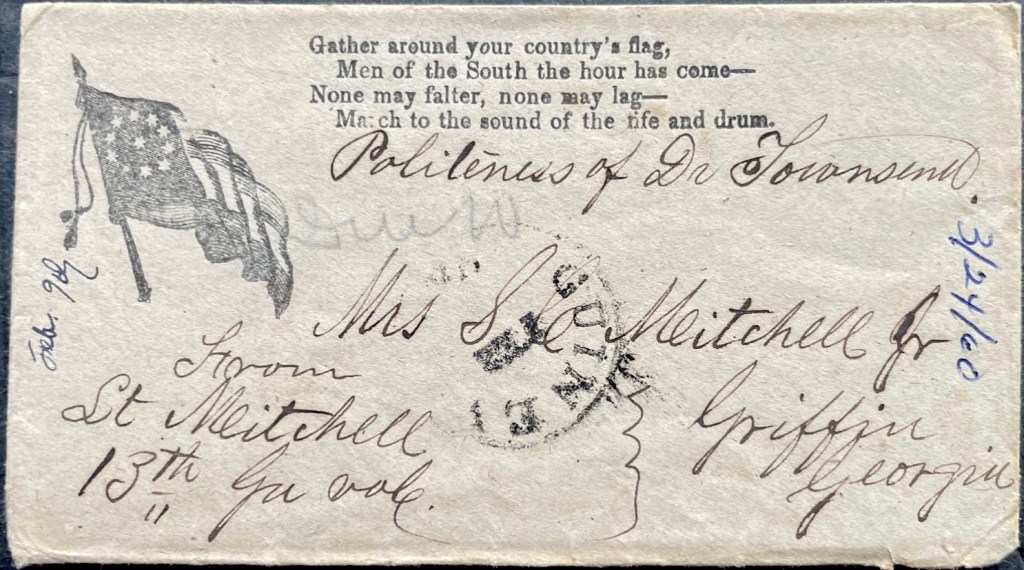
Camp near Port Royal
Monday, February 9th 1863
My own darling,
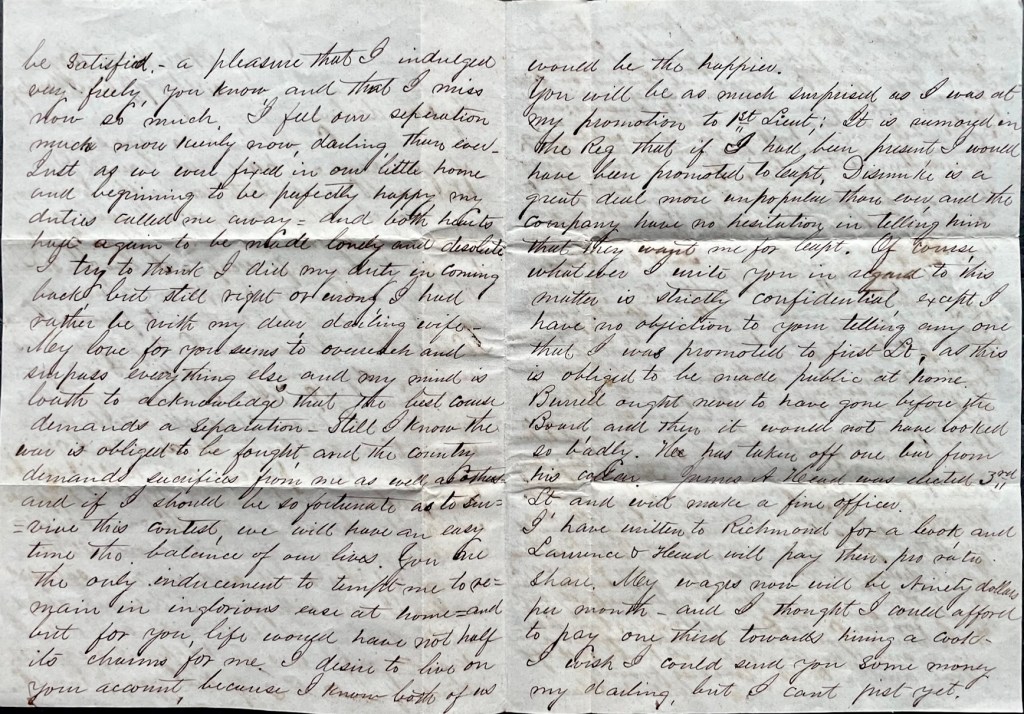
I have no news since mine of yesterday. I have just learned Dr. Townsend would start for Griffin tomorrow and concluded I had as well write you a short letter by him. I never let an opportunity to write to my wife escape. I love you so much that my inclination prompts me to write every day—and if I had nothing to prevent, I would. It is such a pleasure for me to get your letters and I judge you by yourself, It is a good rule—ain’t it? When I measure your love by mine, I know it is all absorbing in its nature—endless in its duration—giving your own heart pleasure and happiness as well as infusing into mine a degree of happiness which it seems to me no other man ever felt. I love you my dear wife above all the things of this world, and am never satisfied unless I am with you. I dreamed about little darling all last night, and when I kissed you, I was so happy.
I frequently think if I could only kiss you, I would be satisfied—a pleasure that I indulged very freely, you know, and that I miss so much. I feel our separation much more keenly now, darling, than ever. Just as we were fixed in our little home and beginning to be perfectly happy, my duties called me away, and both hearts had again to be made only and desolate. I try to think I did my duty in coming back, but still right or wrong, I had rather be with my dear darling wife.
My love for you seems to overreach and surpass everything else and my mind is loath to acknowledge that the best course demands a separation. Still I know the war is obliged to be fought, and the country demands sacrifices from me as well as others, and if I should be so fortunate as to survive this contest, we will have an easy time the balance of our lives. You are the only inducement to tempt me to remain in inglorious ease at home, and but for you, life would have not half its charms for me. I desire to live on your account, because I know both of us would be the happier.

You will be as much surprised as I was at my promotion to 1st Lieutenant. It is rumored in the regiment that if I had been present, I would have been promoted to Captain. [Frederick D.] Dismuke is a great deal more unpopular than ever and the company have no hesitation in telling him that they want me for Captain. Of course whatever I write you in regard to this matter is strictly confidential, except I have no objection to your telling anyone that I was promoted to 1st Lieutenant as this is obliged to be made public at home. Burrell ought never to have gone before the Board and then it would not have looked so badly. He has taken off one bar from his collar. James A. Head was elected 3rd Lieutenant and will make a fine officer.
I have written to Richmond for a cook and Laurence & Heind will pay their pro ratio share. My wages now will be ninety dollars per month and I thought I could afford to pay one third towards hiring a cook. I wish I could send you some money, my darling, but I can’t just yet.
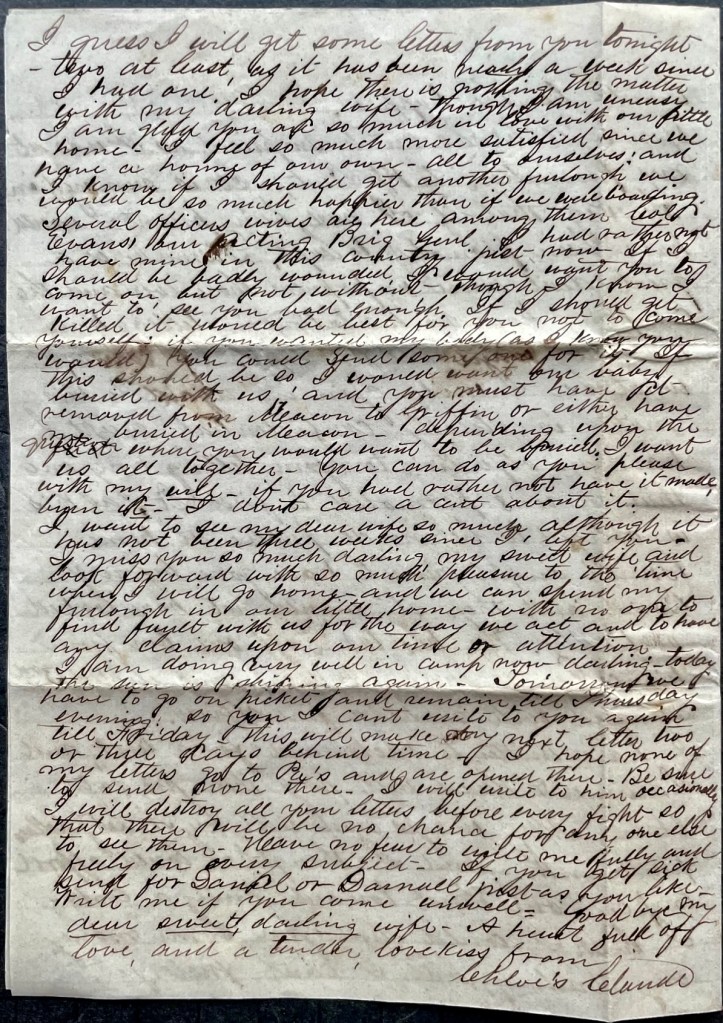
I guess I will get some letters from you tonight—two at least, as it has been nearly a week since I had one. I hope there is nothing the matter with my darling wife though I am uneasy. I am glad you are so much in love with our little home. I feel so much more satisfied since we have a home of our own—all to ourselves. And I know if I should get another furlough, we would be so much happier than if we were boarding. Several officers wives are here. Among them Col. Evans, our Acting Brig. General. I had rather not have mine in this country just now. If I should be badly wounded, I would want you to come on but not without, though I know I want to see you bad enough. If I shoiuld get killed, it would be best for you not to come yourself if you wanted my body (as I know you would). You could send someone for it. If this should be so, I would want our baby buried with us and you must have it removed from Macon to Griffin, or either have me buried in Macon—depending upon the question where you want to be buried. I want us all together. You can do as you please with my will. If you had rather not have it made, burn it. I don’t care a cent about it.
I want to see my dear wife so much although it has not been three weeks since I left you. I miss you so much darling, my sweet wife, and look forward with so much pleasure to the time when I will go home—and we can spend my furlough in our little home with no one to find fault with us for the way we act and to have any claims upon our time or attention.
I am doing very well in camp now darling. Today the sun is shining again. Tomorrow we have to go on picket and remain till Thursday evening so you [see], I can’t write to you again till Friday. This will make my next letter two or three days behind time. I hope none of my letters go to Pa’s and are opened there. Be sure to send none there. I will write to him occasionally. I will destroy all your letters before every fight so that there will be no chance of anyone else to see them. Have no fear to write me fully and freely on every subject. If you get sick, send for Daniel or Darnell just as you like. Write me if you are unwell. Goodbye my dear sweet darling wife. A heart full of love and a tender love kiss from— Chlovis Caude

Letter 2
[Editor’s note: Written just a couple of weeks before the Battle of Chancellorsville.]
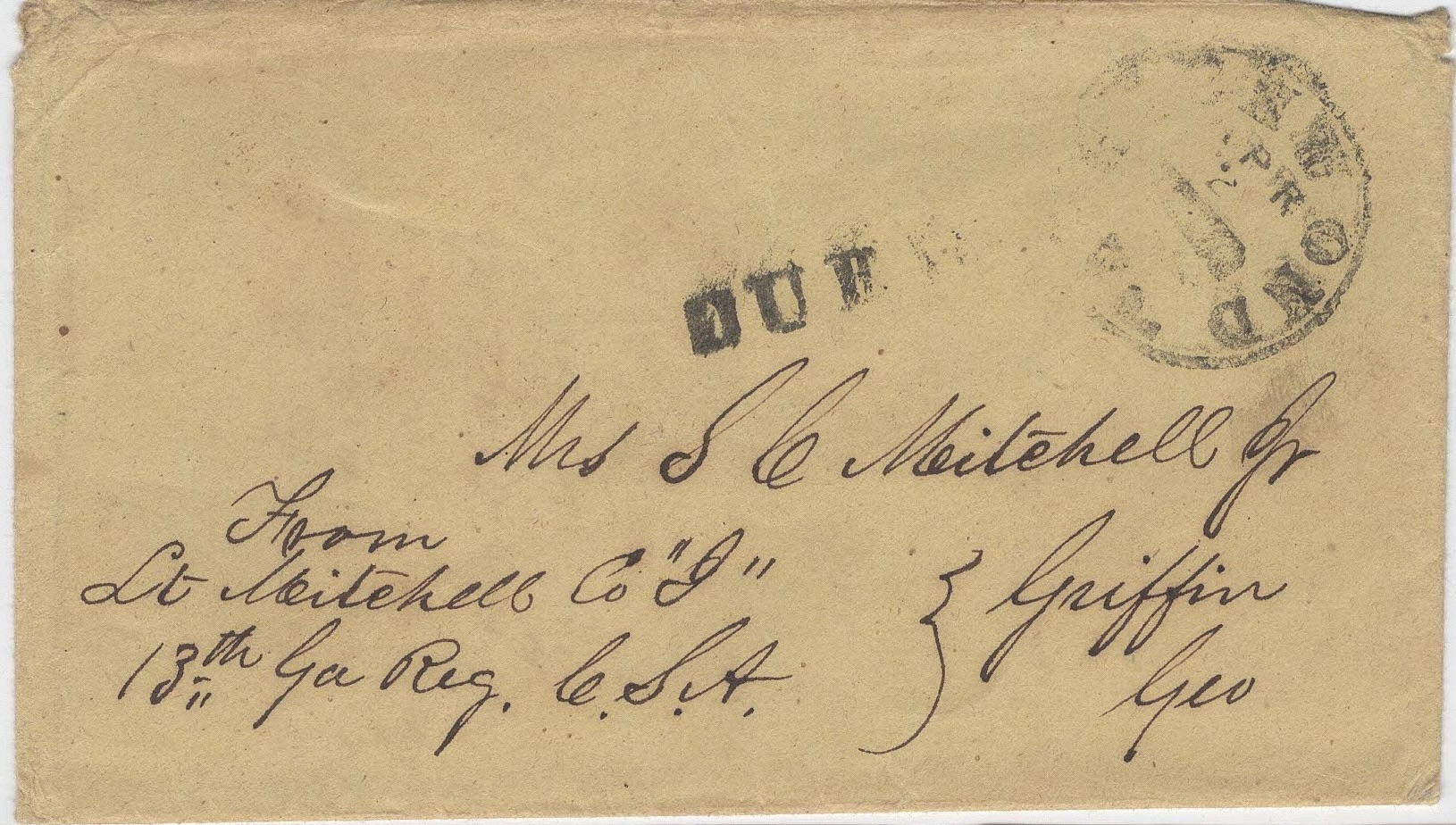
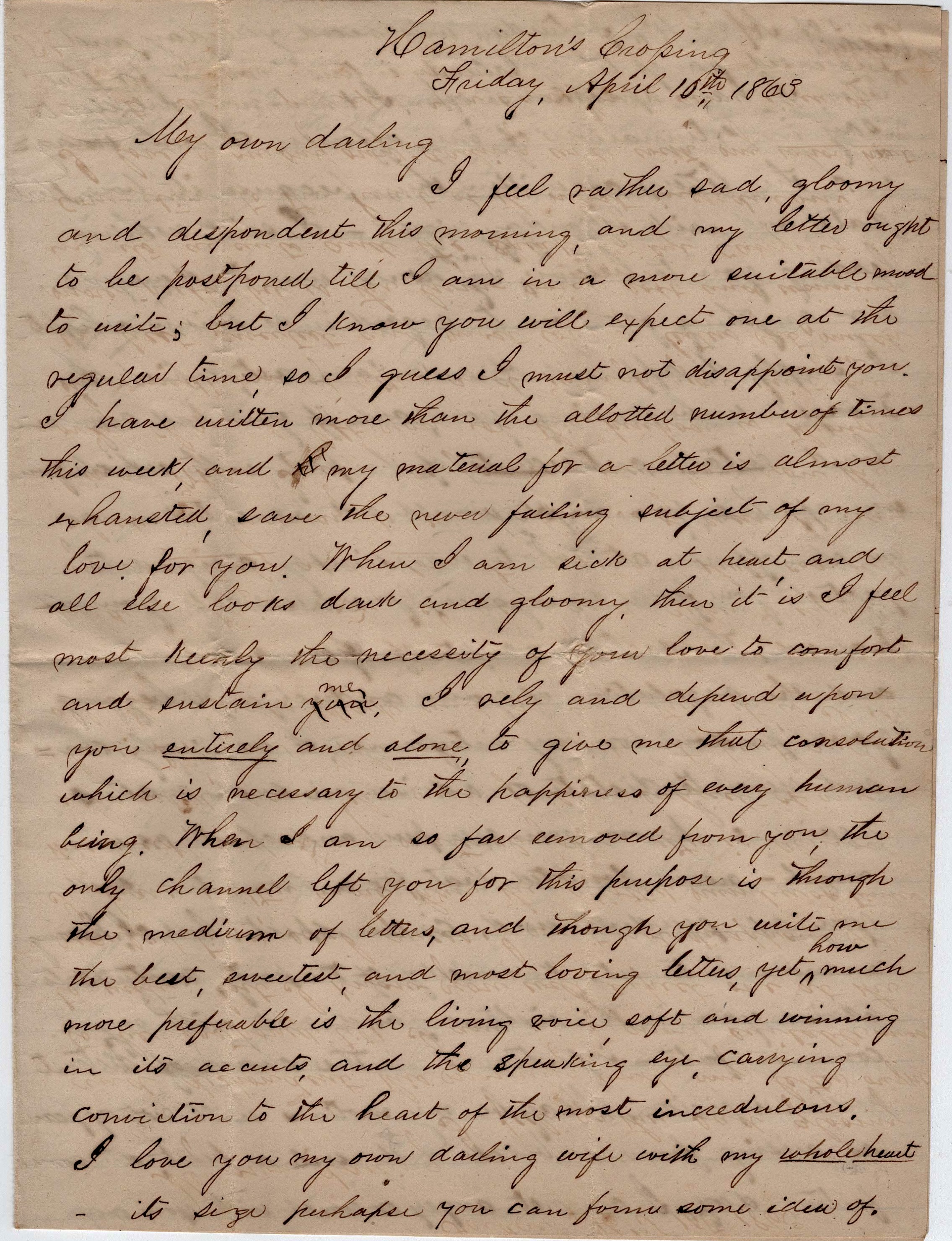
Hamilton’s Crossing 1 [Virginia]
Friday, April 10, 1863
My own darling,
I feel rather sad, gloomy and despondent this morning, and my letter ought to be postponed till I am in a more suitable mood to write; but I know you will expect one at the regular time, so I guess I must not disappoint you. I have written more than the allotted number of times this week and my material for a letter is almost exhausted, save the never failing subject of my love for you. When I am sick at heart and all else looks dark and gloomy, then it is I feel most keenly the necessity of your love to comfort and sustain me. I rely and depend upon you entirely and alone to give me that consolation which is necessary to the happiness of every human being. When I am so far removed from you the only channel left you for this purpose is through the medium of letters, and though you write me the best, sweetest, and most loving letters, yet how much more preferable is the living voice, soft and winning in its accents, and the speaking eye carrying conviction to the heart of the most incredulous. I love you my own darling wife with my whole heart—its size perhaps you can form some idea of.
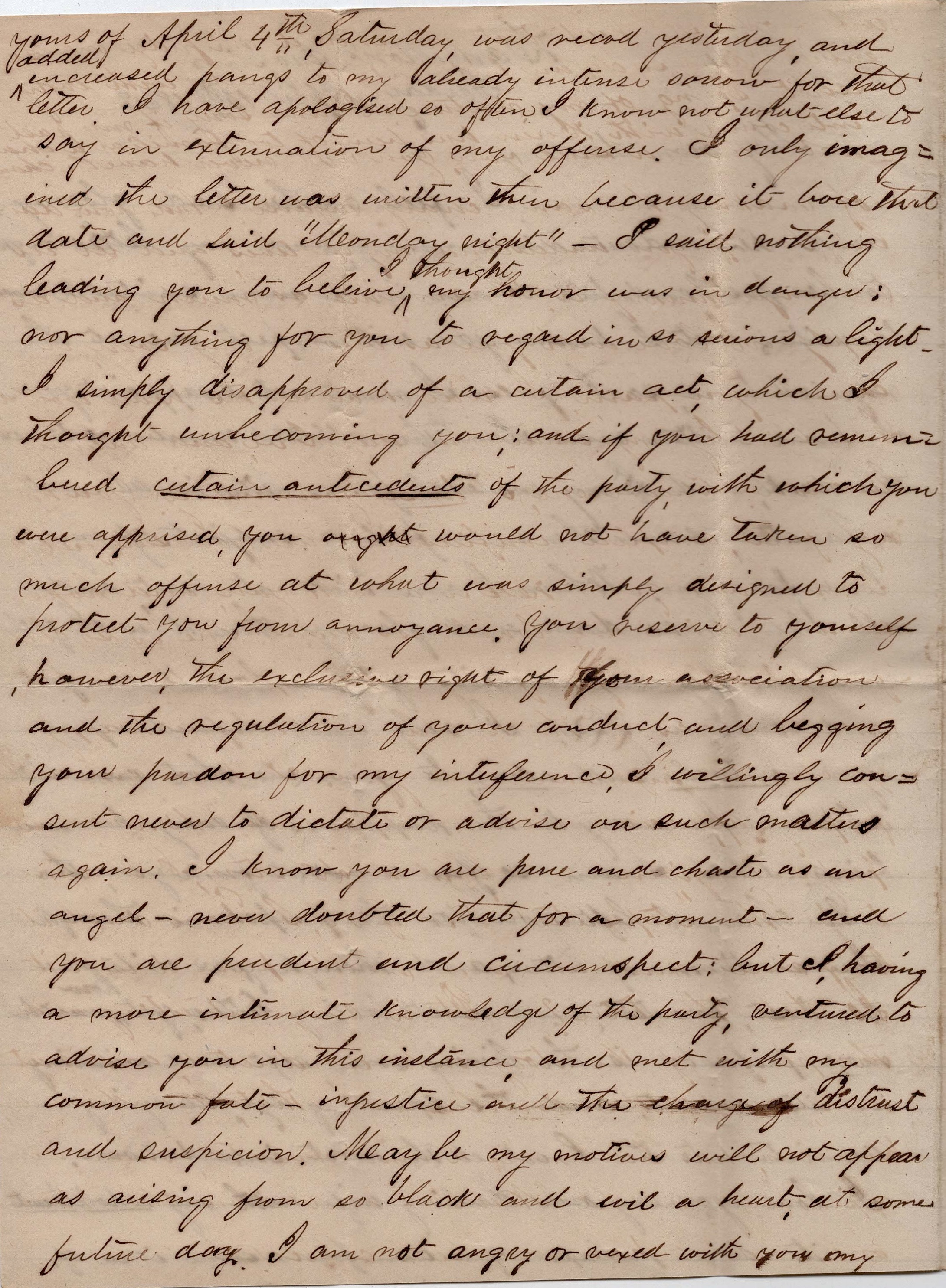
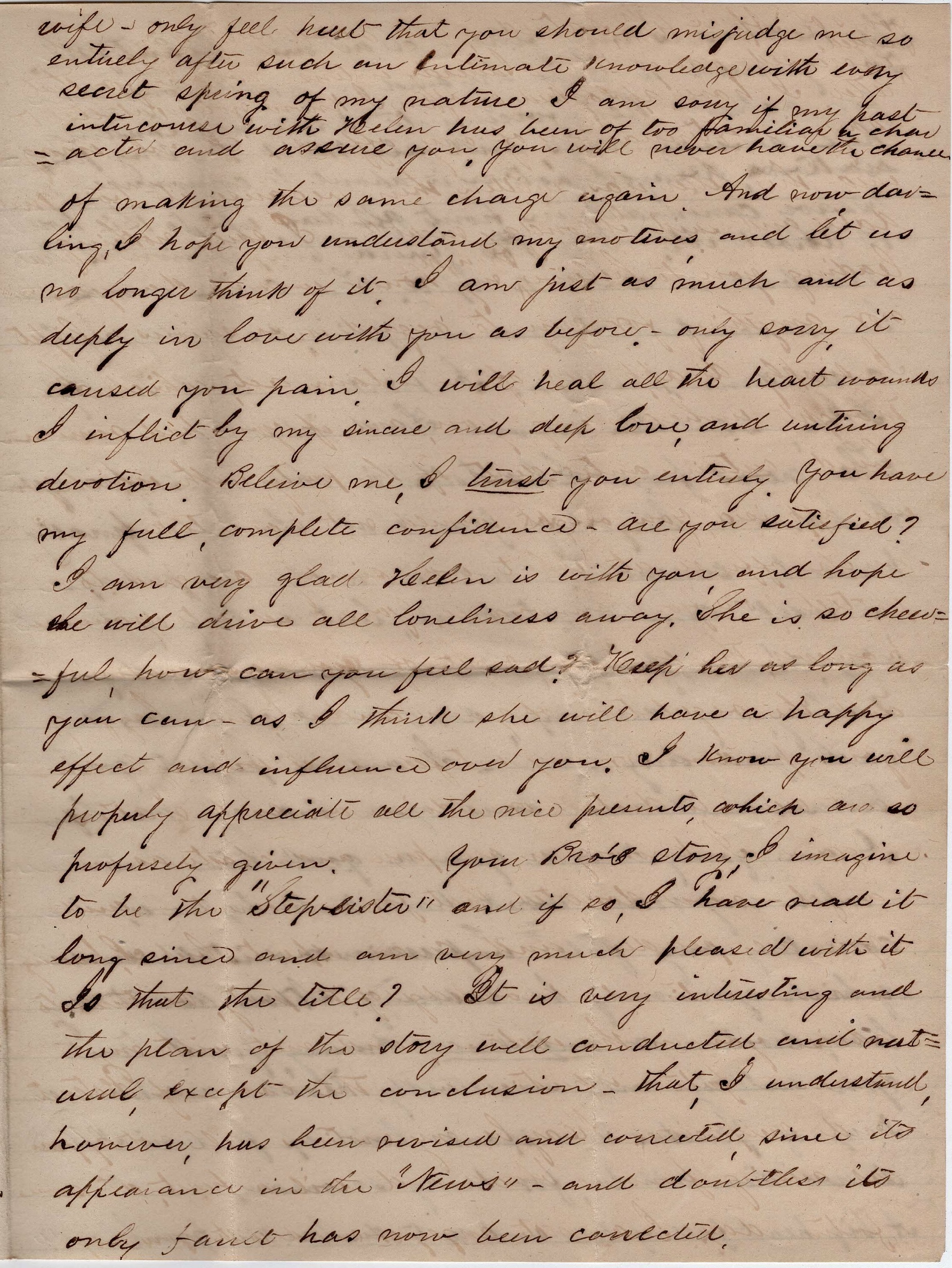
Yours of April 4th, Saturday, was read yesterday and added increased pangs to my already intense sorrow for that letter. I have apologized so often I know not what else to say in extenuation of my offense. I only imagined the letter was written then because it bore that date and said “Monday night.” I said nothing leading you to believe I thought my honor was in danger, nor anything for you to regard in so serious a light. I simply disapproved of a certain act, which I thought unbecoming you; and if you had remembered certain antecedents of the party, with which you were apprised, you would not have taken so much offense at what was simply designed to protect you from annoyance. You reserve to yourself, however, the exclusive right of your association and the regulation of your conduct and begging your pardon for my interference, I willingly consent never to dictate or advise on such matters again. I know you are pure and chaste as an angel—never doubted that for a moment—and you are prudent and circumspect. But I, having a more intimate knowledge of the party, ventured to advise you in this instance and met with my common fate—injustice and the charge of distrust and suspicion. Maybe my motives will not appear as rising from so black and evil a heart at some future day. I am not angry or vexed with you my wife—only hurt that you should misjudge me so entirely after such an intimate knowledge with every secret spring of my nature. I am sorry if my past intercourse with Helen has been of too familiar a character and assure you, you will never have the chance of making the same charge again.
And now, darling, I hope you understand my motives and let us no longer think of it. I am just as much and as deeply in love with you as before—only sorry it caused you pain. I will heal all the heart wounds I inflict by my sincere and deep love, and untiring devotion. Believe me, I trust you entirely. You have my full, complete confidence. Are you satisfied? I am very glad Helen is with you and hope she will drive all loneliness away. She is so cheerful, how can you feel sad? Keep her as long as you can, as I think she will have a happy effect and influence over you. I know you will properly appreciate all the nice presents which are so profusely given.
Your brother’s story, I imagine, to be the “Stepsister” and if so, I have read it long since and am very much pleased with it. Is that the title? It is very interesting and the plan of the story well conducted and natural except the conclusion. That, I understand, however, has been revised and corrected since its appearance in the “News” and doubtless its only fault has not been corrected.
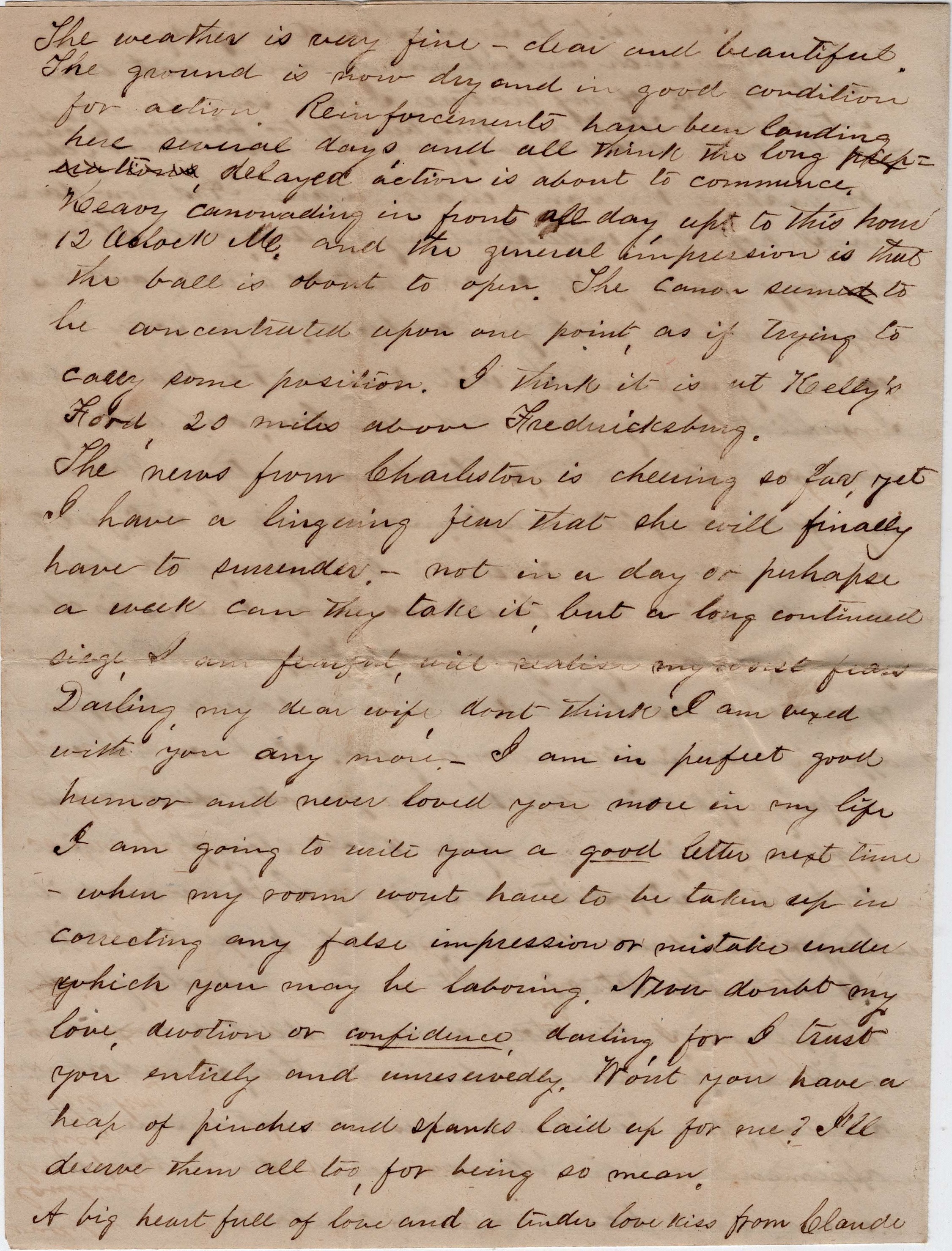
The weather is very fine—clear and beautiful. The ground is now dry and in good condition for action. Reinforcements have been landing here several days and all think the long delayed action is about to commence. Heavy cannonading in front all day, up to this hour, 12 o’clock M, and the general impression is that the ball is about to open. The cannon seem to be concentrated upon one point as if trying to carry some position. I think it is at Kelly’s Ford, 20 miles above Fredericksburg.
The news from Charleston is cheering so far, yet I have a lingering fear that she will finally have to surrender—not in a day or perhaps a week can they take it, but a long continued siege, I am fearful, will realize my worst fears.
Darling, my dear wife, don’t think I am vexed with you any more. I am in perfect good humor and never loved you more in my life. I am going to write you a good letter next time when my room won’t have to be taken up correcting any false impression or mistake under which you may be laboring. Never doubt my love, devotion, or confidence, darling, for I trust you entirely and unreservedly. Won’t you have a heap of pinches and spanks laid up for me? I’ll deserve them all too, for being so mean. A big heart full of love and a tender love kiss. From Claude
1 Hamilton’s Crossing…The railroad traversed the Rappahannock River valley and connected Fredericksburg, about five miles north of Hamliton’s Crossing, with Richmond, about forty-five miles to the south. The railroad was a vital link between the Confederate Army and their supplies. Facilities here consisted of a small station building where the Mine Road intersects the railroad. a telegraph shanty, and likely a quartermaster tents and several sidings.