The following letter was written by Calvin H. Orcutt (1836-1921), the son of John Loomis Orcutt (1793-1855) and Elizabeth van Gorder (1812-1885) of Chemung county, New York. The letter was written in late July 1863, just after Lee’s army was turned back by defeat at Gettysburg, and at roughly the same time that Calvin had to register for the draft at his place of residence—Towanda, Pennsylvania. In that registration, he identified himself as a 26 year-old “clerk”, yet unmarried, and yet without any military service. If Calvin was drafted, he must have paid for a replacement for there is no military record of his having served in the Civil War despite the claim in his obituary that he was a “Civil War Veteran.” I don’t think that employment as a sutler exempted him from the draft, but I may be mistaken.
From this letter we learn that Calvin was employed by grocer Daniel V. Barnes of Barnes & Co., 481 9th street in Washington City. It appears that Daniel was assigned by his employer to serve as a sutler to the 141st Pennsylvania Infantry. Sutlers were civilian merchants who sold provisions to an army in the field, in camp, or in quarters. Typically, when an army expected to be engaged in battle, the sutlers were ordered to the rear or some safe location until after the battle was over. To read more about sutlers, see “Sutlers of the Civil War” by Claire Prechtel-Kluskens.
After the war, Calvin worked in the real estate and insurance business in Harrisburg, Pennsylvania.
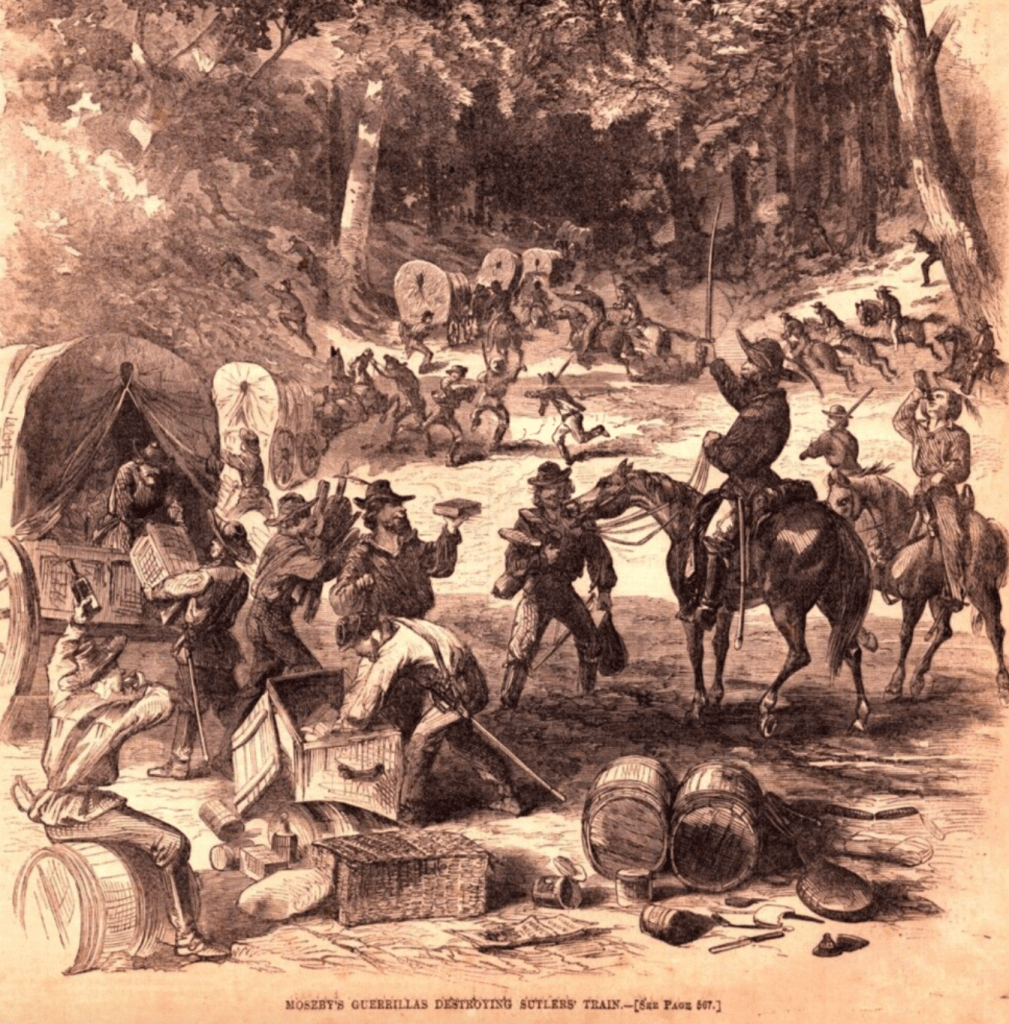
Being a sutler was not without its dangers. Sutlers often traveled in wagon trains for mutual protection against attack by guerrillas.
Transcription
Addressed to D. L. Orcutt, Box 446, Elmira, New York
Washington D. C. July 28th 1863
Brother Daniel,
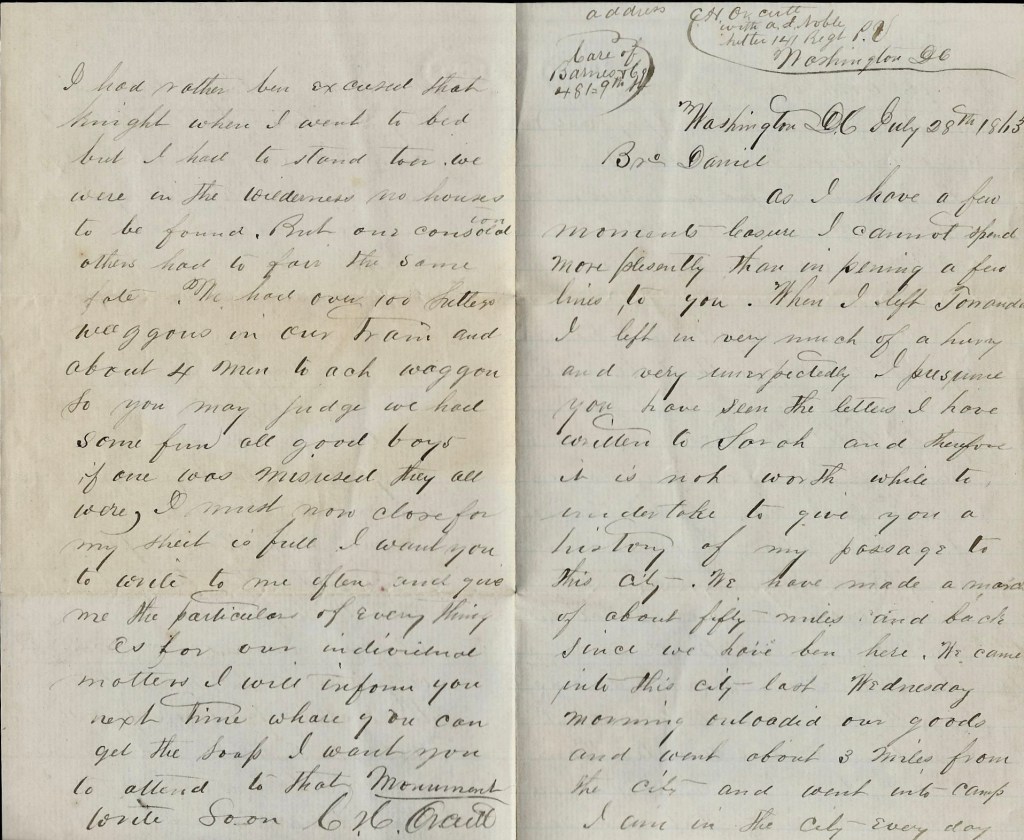
As I have a few moments leisure, I cannot spend more pleasantly than in penning a few lines to you. When I left Towanda, I left in very much of a hurry and very unexpectedly. I presume you have seen the letters I have written to Sarah and therefore it is not worth while to undertake to give you a history of my passage to this city.
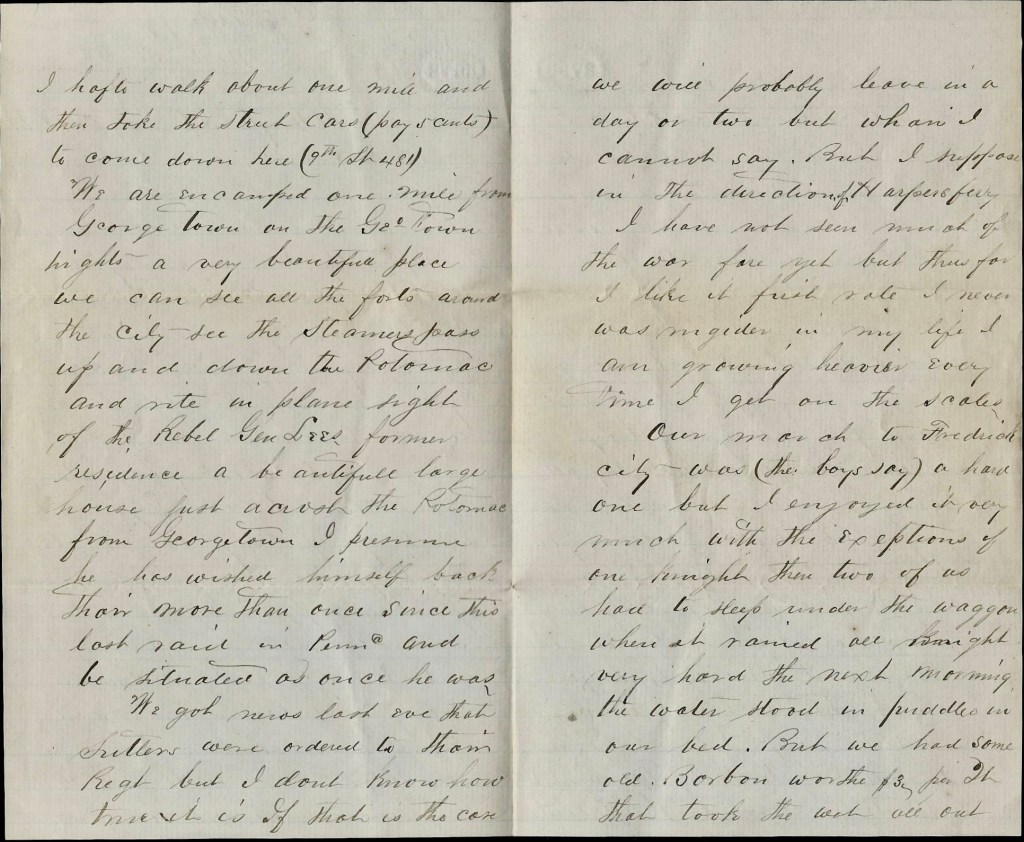
We have made a march of about fifty miles and back since we have been here. We came into the city last Wednesday morning, unloaded our goods, and went about three miles from the city and went into camp. I am in the city every day. I have to walk about one mile and then take the street cars (pay 5 cents) to come down here (9th St. 481).
We are encamped one mile from Georgetown on the Georgetown Heights—a very beautiful place. We can see all the forts around the city, see the steamers pass up and down the Potomac, and right in plain sight of the Reb. Gen. Lee’s former residence—a very beautiful large house just across the Potomac from Georgetown. I presume he has wished himself back there more than once since this last raid in Pennsylvania and be situated as once he was.
We got news last eve that sutlers were ordered to their regiments but I don’t know how true it is. If that is the case, we will probably leave here in a day or two but when I cannot say. But I suppose in the direction of Harpers Ferry.
I have not seen much of the warfare yet but thus far I like it first rate. I never was ruggeder in my life. I am growing heavier every time I get on the scales.
Our march to Frederick City was (the boys say) a hard one but I enjoyed it very much with the exceptions of one night there two of us had to sleep under the wagon where it rained all night very hard. The next morning the water stood in puddles in our bed. But we had some old Bourbon worth $3 per quart that took the wet all out. I had rather been excused that night when I went to bed but I had to stand to her. We were in the wilderness—no houses to be found. But our consolation, others had to fare the same fate. We had over 100 sutlers wagons in our train and about 4 men to each wagon so you may judge we had some fun. All good boys. If one was misused, they all were.
I must now close for my sheet is full. I want you to write to me often and give me the particulars of everything. As for our individual matters, I will inform you next time where you can get the soap. I want you to attend to that monument. Write soon. — C. H. Orcutt
Address C. H. Orcutt with A. I. Noble, Sutler, 141st Regt. P. V., Washington D. C., Care of Barnes & Co., 481 9th Street
I could not find an image of Benjamin but here’s one of Henry Baker who served in Co. H, 141st Pennsylvania Infantry (LOC)
The following letters were written by Benjamin M. Dunham (1840-1863), the son of John L. Dunham (1811-1861) and Laura Cheney (1812-1894) of LaPorte, Sullivan county, Pennsylvania. Benjamin enlisted as a private in Co. K, 141st Pennsylvania Infantry. Benjamin enlisted with his older brother Henry R. Dunham (1838-1877) who was made the 1st Lieutenant of the same company for his efforts in raising the company. However, ill health resulted in his resigning is commission in late December 1862 and returning home where he remained until 1864 when he accepted a commission in Co. E, 13th USCT.
According to the regimental history, Benjamin M. Dunham was a young man of more than ordinary ability and character. Said one who knew him: “He was characterized by untiring energy and intense application to his studies. No lesson or duty was ever assigned that he did not grapple with all his powers. He loved study. He was impetuous almost to a fault. Whatever he did, he did with all his might. His moral character was without reproach. He could be relied on implicitly in all he said or did. He was, in ‘ short, one of Nature’s noblemen, an honest man. His dear remains rest in an unknown grave, on hostile ground, and his spirit has gone to God who gave it.” Benjamin was killed at Chancellorsville.
Letter 1
In Camp near Falmouth, Va. February 24th 1863
My dear Mother,
I yesterday received a letter from you full of your anxious fear about me. I hear nothing from you but a constant lament that I am where I am! Nothing but worriment about & fears that I am suffering here where I am. Now let this be enough for you, Mother, as it ought to be for anyone to know that I am doing well, getting over my lameness, and in fact, I have almost gained my flesh again. I have been on duty and took no cold from it & I hope I am none the worse for it. I asked to be put on [duty], it is true, for I knew there were some who would think I did not want to do [my] duty, but I did and so I went on. And as I said before, I am not sorry.
Now, Mother, what more under the light of Heaven could a son write to a Mother that would be of more cheering—I mean real cheering news—than what I have just written to you which is God’s truth and no deception, for I have not now nor never intended to deceive you. I know, Mother, there is news that I could write that might be more pleasing such as that I was coming home soon or something like this. But do I not tell you, Mother, that if I have my health, which I now hope to get, that I had just as leave be in the army here at such a time as this as at home. Maybe you think I lie, but I tell you that I can stand it here from my friends & family, if old grey-headed men who have children & a wife to think of & long to see, for this is the great, the most difficulty the soldiers has to contend against.
Don’t understand me to say that I like the hardships & hard marching of our life. But Mother, I do say in view of all things now, I—a single man [with] no one to depend on me [and] no one to suffer from my loss if should be the case, and no one’s support arising from my earnings—I say I and those in like circumstances are just the ones to be where I am if they have their health.
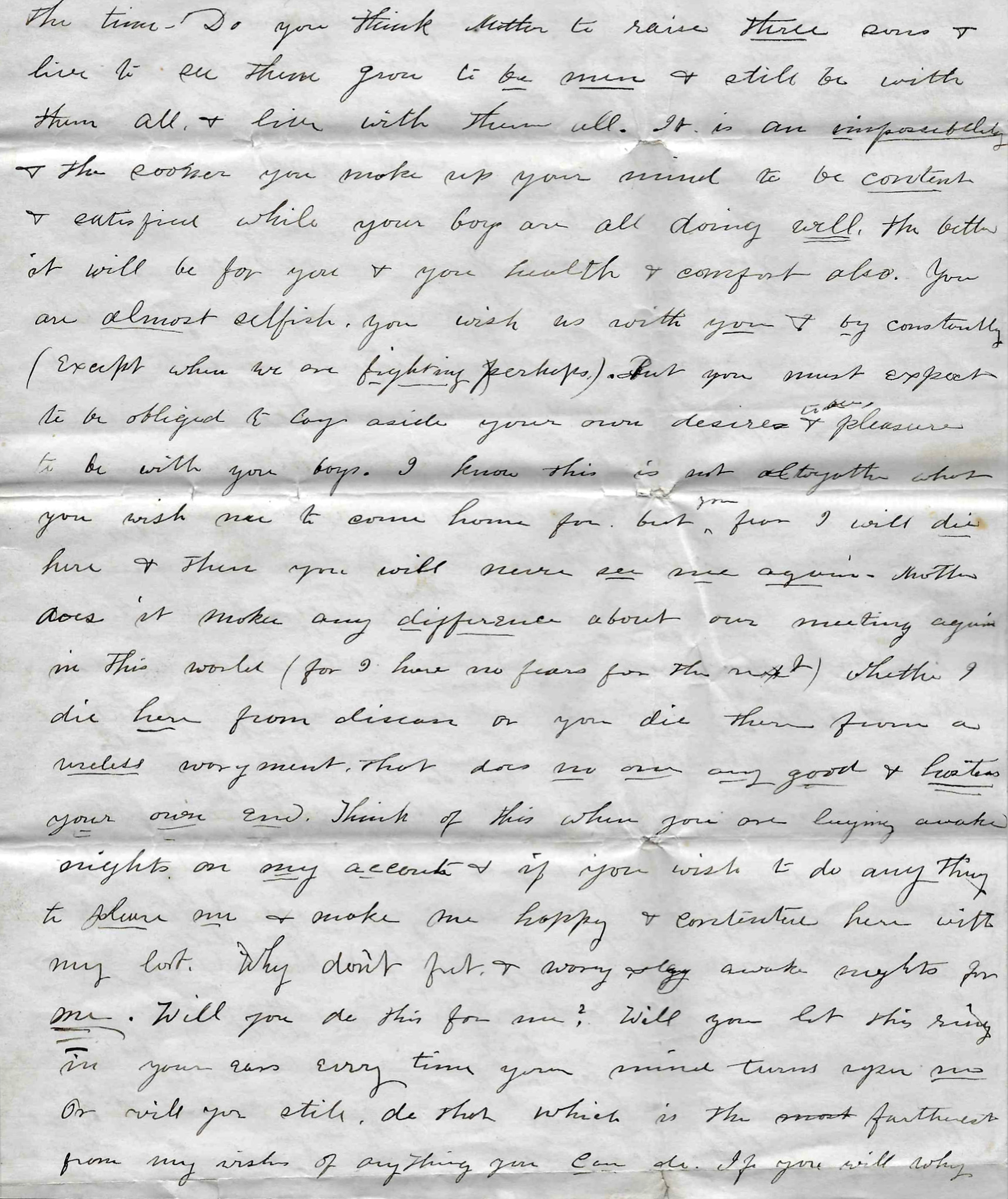
Mother, be reasonable! Look about you & see if you can point to another Mother who has three able bodied (for such I am now called & hope Henry is) Republican son who have no wives & little ones, no farms & workshops to hinder their being in the army of our Nation. I say, see if you can find another Mother who still has two sons with her at home all the time. Do you think, Mother, to raise three sons and live to see them all grow to be men & still be with them all & live with them all? It is an impossibility & the sooner you make up your mind to be content & satisfied while your boys are all doing well, the better it will be for you and your health and comfort also. You are almost selfish. You wish us with you & by constantly (except when we are fighting perhaps). But you must expect to be obliged to lay aside your own desires to see & pleasure to be with your boys.
I know this is not altogether what you wish me to come home for but you fear I will die here & then you will never see me again. Mother, does it make any difference about our meeting again in this world (for I have no fears for the next). Whether I die here from disease or you die there from a useless worriment, that does no one any good & hastens your own end. Think of this when you are lying awake nights on my account & if you wish to do anything to please me & make me happy and contented here with my lot. Why, don’t fret and worry & lie awake nights for me. Will you do this for me? Will you let this ring in your ears every time your mind turns upon me. Or will you still do that which is the farthest from my wishes of anything you can do? If you will, why then I cannot help it.
Again, my complaint (diarrhea & rheumatism), Mother, is not a thing you need to worry about at all. Why, do you not know that those who die with the chronic diarrhea live for four or five months & that there is no need of men to be sick that long in this army and not be sent home. As to the rheumatism, I do not fear death from that at all. So be contented & satisfied with your lot.
Mother, as to what you say about getting into this army, you did not such thing at all. I came of my own free will & you never asked me to come at all so I want you never to think of that again. Oh! you are a queer woman, Mother, & I hope you will try and exercise a little more your reasoning & relective faculties a little more & your caution a little less and it will be better for us both.
Our Captain has returned & I like him very much indeed so far & all the boys seem to almost worship him. We have just received orders to be ready to move over into Ward’s Brigade & the 4th Maine is to come into our Brigade. It is but a few rods between us. The trade is from some cause, I know not what. Time will tell.
Brewster, I think, will come home on a furlough but I do not know whether he can get it or not. Hank Gunn too, if he’s able. I shall try and get one if I can but I have little hopes as there is so many ahead of me. Do not build up any hopes of my coming home this winter.
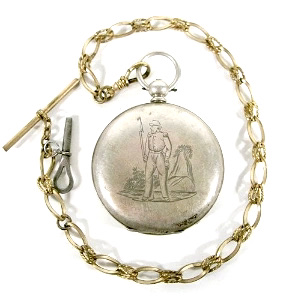
An J. H. Winslow silver watch with engraving of soldier, perhaps like the one Benjamin purchased.
I yesterday received returns from my little investment (J. H. Winslow and Co., of New York) and I have me a larger patent lever silver watch and gold chain for which I have been offered $20 in cash besides selling some ten dollars worth of tickets to the boys and keeping for myself a ticket that calls for a watch worth fifteen dollars & ever so many other tickets calling for articles valued at eight and ten dollars. In fact, Mother, I have an agency here from which I can make double my wages & do it just as honestly as anything else.
So be content. Be satisfied & do not for God’s sake, kill yourself by worrying yourself about me. Have you any help yet? I will send you a circular of J. H. Winslow & you can see what I am doing. — B. M. Dunham
Letter 2
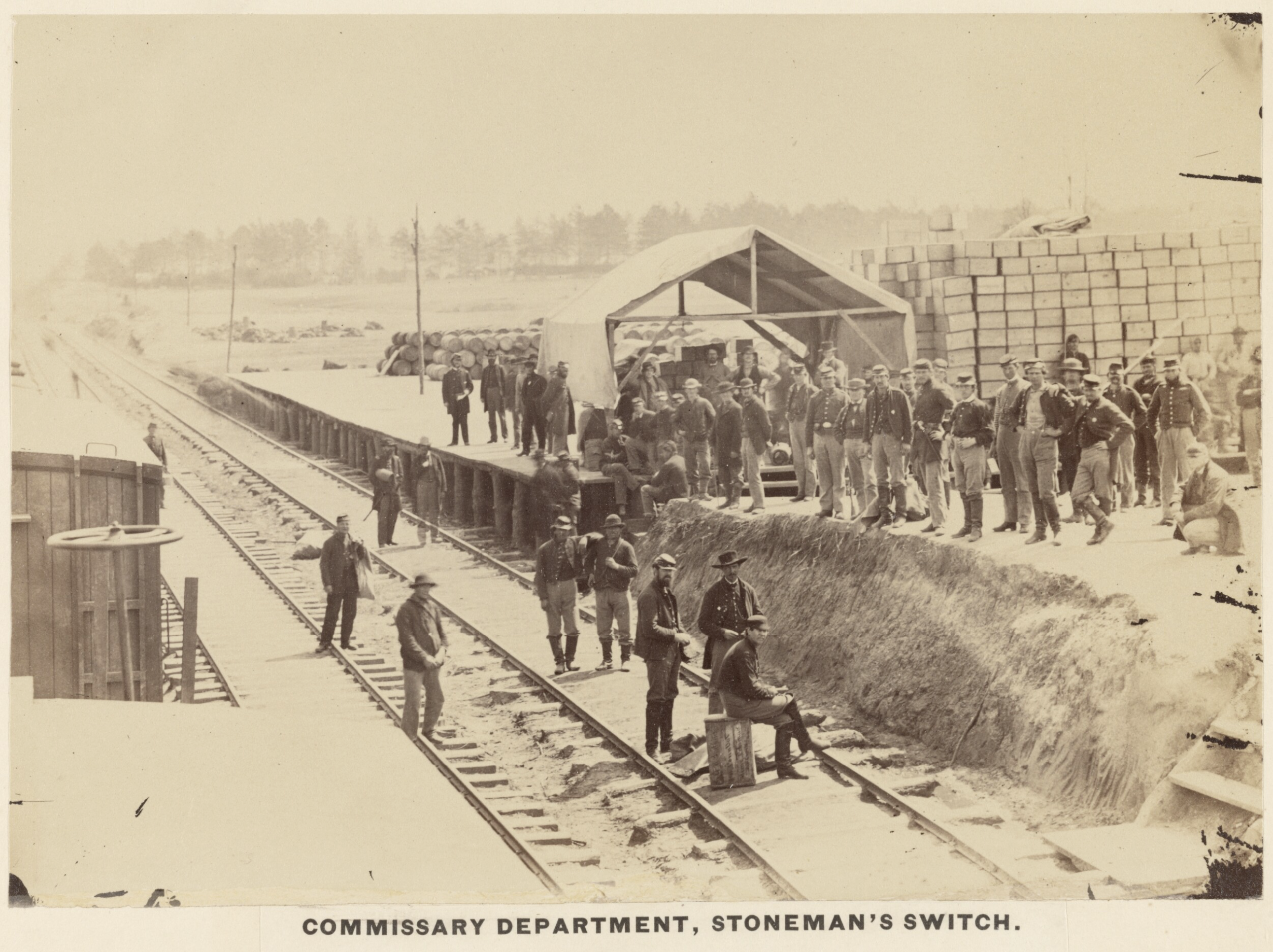
Stoneman’s Switch in May 1863.
[Note: This letter is from the personal collection of Keith Fleckner and was offered for transcription and publication on Spared & Shared by express consent.]
In Camp near Stoneman’s Switch Wednesday, April 8th 1863
My Dear Mother–
I have at last succeeded in getting you a picture which I hope will be satisfactory to all. I think if you compare this with those taken before I left home, you will find I am still “the same old six pence.” I have the locket filled which I think will be—or at least I hope will be—satisfactory to you also. I have been asked by several for pictures and all want photographs which I cannot get here in the army as there is no one who takes them on this side of the Potomac that I know of. The only way I can think of to get them is to send this to [ ] with Edwin and let Mr. Wood copy it. Then when you get a negative, I suppose you know you can get as many as you choose & give them to whom you choose. If you think this one not large enough, I will get a half-sized picture and let that be used in its stead.
Mother, have you received that package of old letters I sent home some time ago but have not heard from them. I do hope they are not lost for I value them too highly to lose them now. I wrote to Edwin day before yesterday. Have you received that yet? I have just received your letter of March 31st also. I am very glad to say it was the most encouraging thing I have had for many a day. It cheered my feelings very much & I hope I will not run to enquirer “if there is any letters for me” very often without being answered in the affirmative.
Well Mother, I have seen Honest Old Abe, President of these Dis-United States and I consider it one of the greatest treats I have had since I left Little Sullivan. As you are aware if you have read my letter to Edwin, this Brigade is on picket for three days and I was left behind for camp guard. I was relieved yesterday and had the day to myself, so I took a french furlough and went over to Stoneman’s Switch after the pictures I now send to you. While there, I heard the awfullest cheering and shouting heard in all my life and was soon told that the President was with Hooker reviewing the Army, or rather riding around from regiment to regiment as they were drawn up in line to receive them. Out I went and took across the fields on double quick to where I saw a long line of troops drawn up. It was quite a piece but on I went, through mud sometimes nearly to the top of my big boots, but I got there just in time to have him ride close along side of me. He was followed by General Hooker & staff, and one battalion of Rush’s Lancers. (I believe they called them Rush’s Lancers). He was then, at the time I saw him, just reviewing Berdan’s Sharpshooters.
I then turned and went back, and as I crossed the road, I looked behind me and saw him & [ ] coming at a full gallop. I stopped—there was four or six with me—and they did the same. They all fell back from the road and said, “Oh, don’t stand so close! Don’t stand so close.” But I didn’t run all this distance to spoil it all now, so I stood in front and when the honest old fellow came along, I gave him a military salute and he returned it with all the grace imaginable. Three cheers for our President was then proposed, and if I didn’t give my old Methodist lungs rent then, I never did. It raised Old Abe’s hat right off his head and he smiled as pleasantly as you please. It did me good I can tell you, and I guess if he ever hears me cheer again, he will know he has heard me before. When he took off his hat, I could see he looked for all the world just like the pictures of him. He rode a very beautiful horse on which was a very handsome saddle but not a very handsome man. He wore a tall black hat which was put on the back of his head and made him look like an old farmer by the side of the many dashing looking exquisites who call themselves officer who followed him. I saw old Gen. Hooker and a number of other Major Generals I did not know.
I began to think Mother from appearances that we are not agoing to be moved from here right off. I do not think now we will move before the last of this month and perhaps not before June or July owing to the weakening of our army by the leaving of many troops. Both the nine-months men from Pennsylvania and the two-year men from New York leave about the same time which will weaken us until their places are supplied by other troops which will take some time to do—two or three months at least. I will put this in the mail and the locket the next if I cannot get it done up for this one. If I do, I will send it in this. Sam sits here as I write and wishes me to say that he sends his best wishes to you and all the family. I wish to be remembered to all who inquire after me, especially to Mrs. Finch. Tell her I will write to her in a day or two or as soon as I can find time. I wish Aunt Annie would write to me. Has she forgotten me or has she no time to do so as I hope all will write often.








 Spared & Shared 23