
The following letter was written by Stiles Smith Twitchell (1838-1877), the son of Bennett Twitchell (1807-1853) and Polly Caroline Smith (1806-1892) of Bethany, New Haven, Connecticut.
Stiles enlisted in Co. H, 15th Connecticut Infantry in late August 1862 and remained with the regiment until 1 August 1863 when he was transferred to the Veteran Reserve Corps. The 15th Connecticut saw action at Fredericksburg before being sent to Suffolk in March 1863. This letter to a friend, describes the actions of the 15th during the Siege of Suffolk in April 1863.
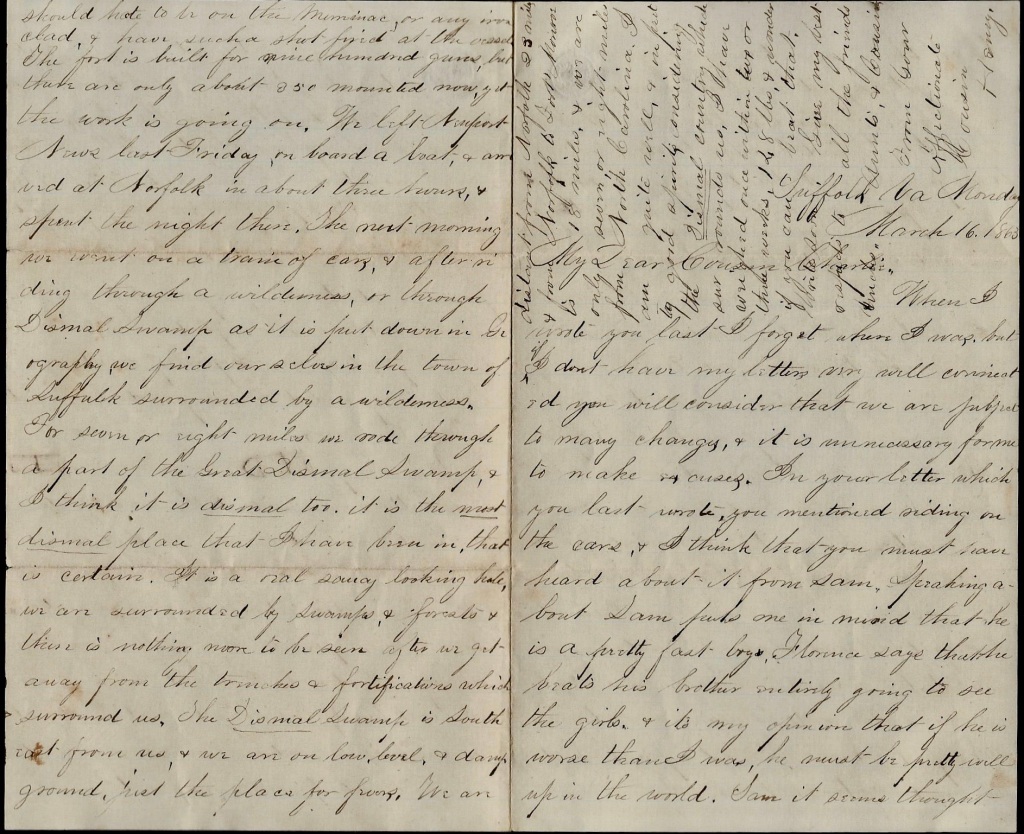
T R A N S C R I P T I O N
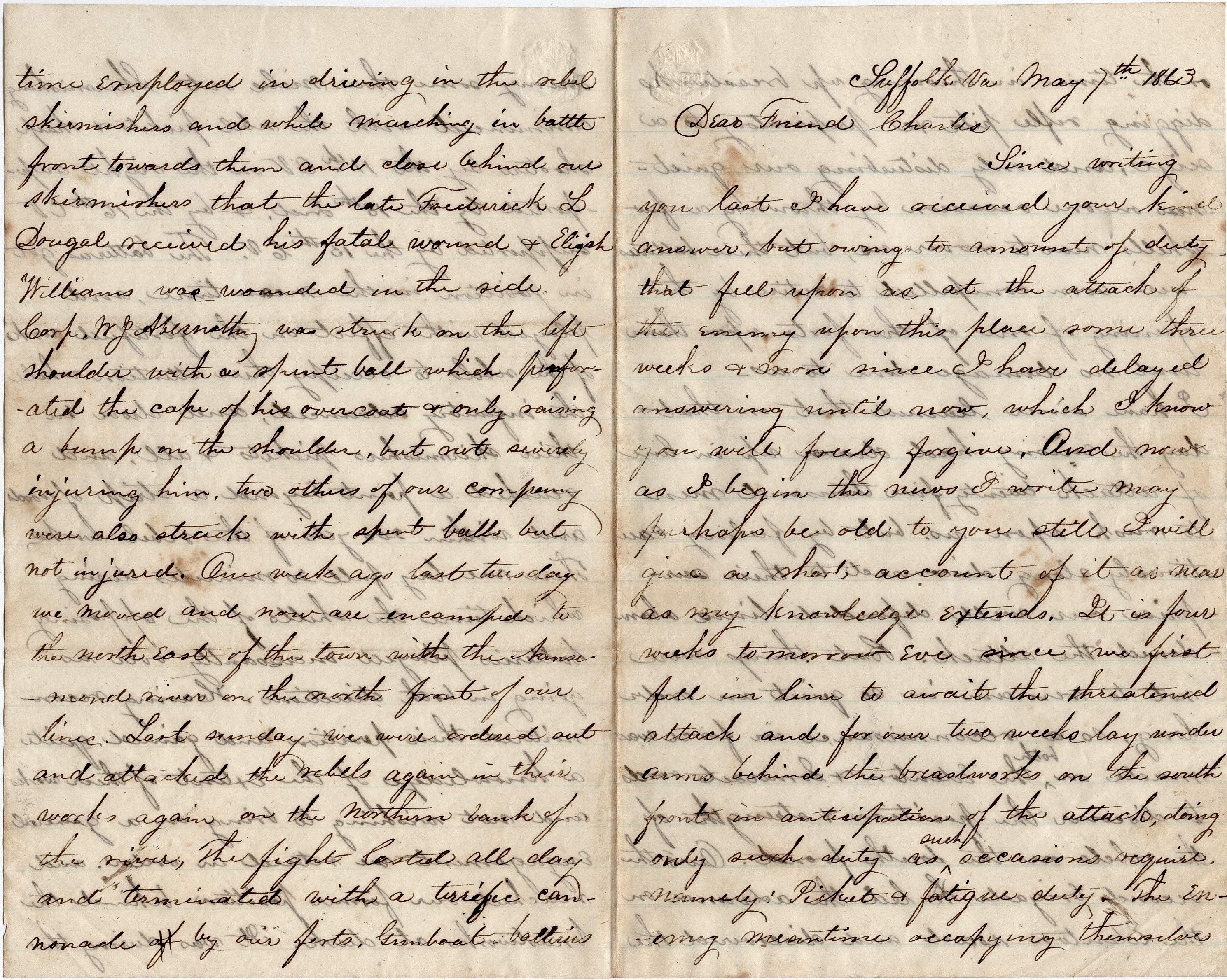
Suffolk, Virginia
May 7th 1863
Dear friend Charles,
Since writing you last, I have received your kind answer but owing to amount of duty that fell upon us at the attack of the enemy upon this place some three weeks & more since, I have delayed answering until now, which I know you will freely forgive. And now as I begin, the news I write may perhaps be old to you, still I will give a short account of it as near as my knowledge extends.
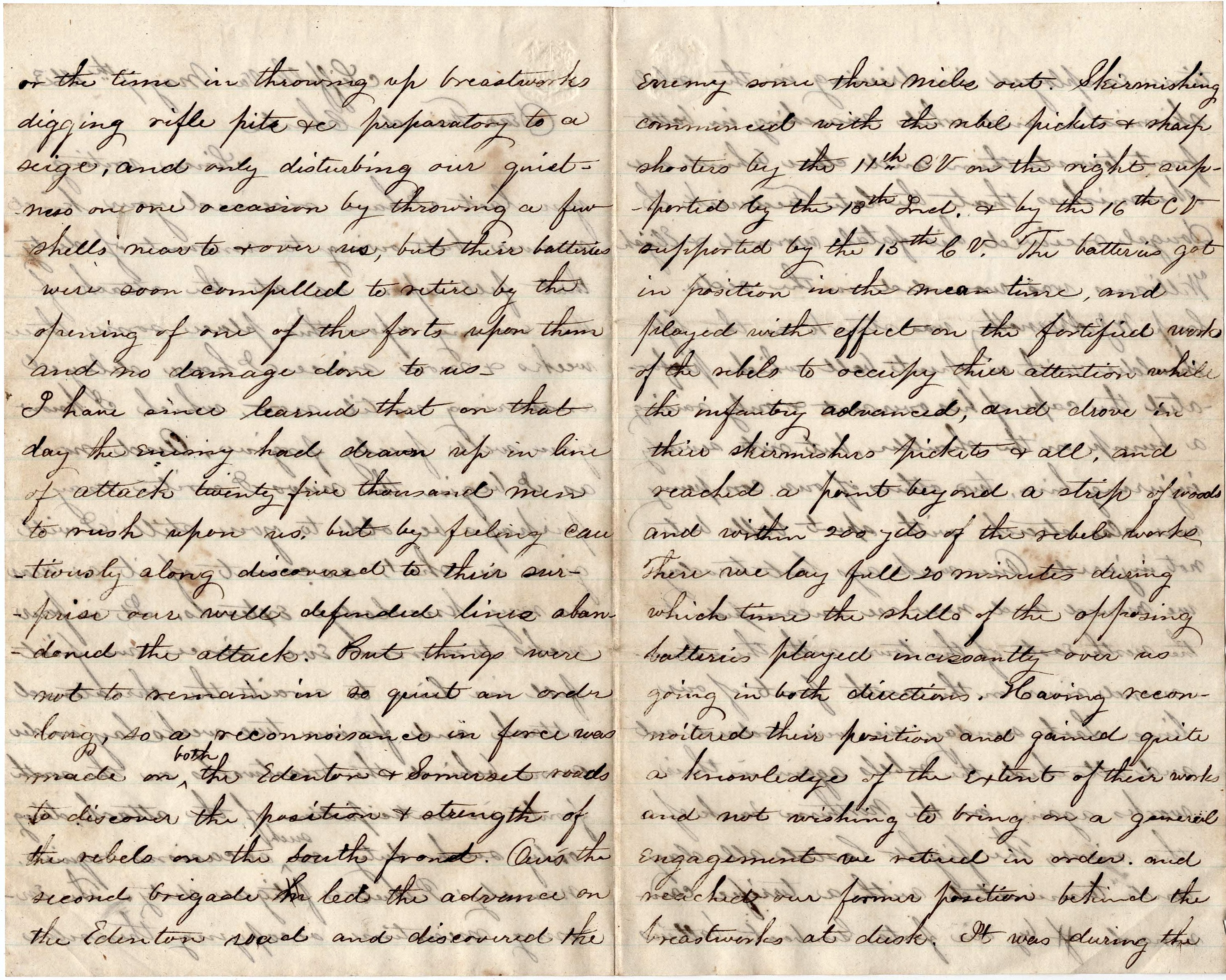
It is four weeks tomorrow eve since we first fell in line to await the threatened attack and for over two weeks lay under arms behind the breastworks on the south front in anticipation of the attack, doing only such duty as such occasions require—namely, picket & fatigue duty. The enemy meantime occupying themselves or the time in throwing up breastworks, digging rifle pits, &c. preparatory to a siege, and only disturbing our quietness on one occasion by throwing a few shells near to & over us, but their batteries were soon compelled to retire by the opening of one of the forts upon them and no damage done to us.
I have since learned that on that day, the enemy had drawn up in line of attack twenty-five thousand men to rush upon us but by feeling cautiously along discovered to their surprise our well defended lines and abandoned the attack. But things were not to remain in so quiet an order long, so a reconnaissance in force was made on both the Edenton & Somerset roads to discover the position and strength of the rebels on the south front. Ours—the 2nd Brigade—led the advance on the Edenton road and discovered the enemy some three miles out. Skirmishing commenced with the rebel pickets and sharp shooters by the 11th Connecticut Vols. on the right supported by the 13th Indiana and by the 16th Conn. Vols. supported by the 15th Conn. Vols. The batteries got in position in the meantime and played with effect on the fortified works of the rebels to occupy their attention while the infantry advanced and drove their skirmishers, pickets and all, and reached a point beyond a strip of woods and within 200 yards of the rebel works. There we lay full 20 minutes during which time the shells of the opposing batteries played incessantly over us going in both directions.
Having reconnoitered their position and gained quite a knowledge of the extent of their works and not wishing to bring on a general engagement, we retired in order, and reached our former position behind the breastworks at dusk. It was during this time employed in driving in the rebel skirmishers and while marching in battle front towards them and close behind our skirmishers that the late Frederick L. Dougal received his fatal wound & Elijah Williams was wounded in the side. Corp. W. J. Abernathy was struck on the left shoulder with a spent ball which perforated the cape of his overcoat & and only raising a bump on his shoulder, but not severely injuring him. Two others of our company were also struck with spent balls but not injured.
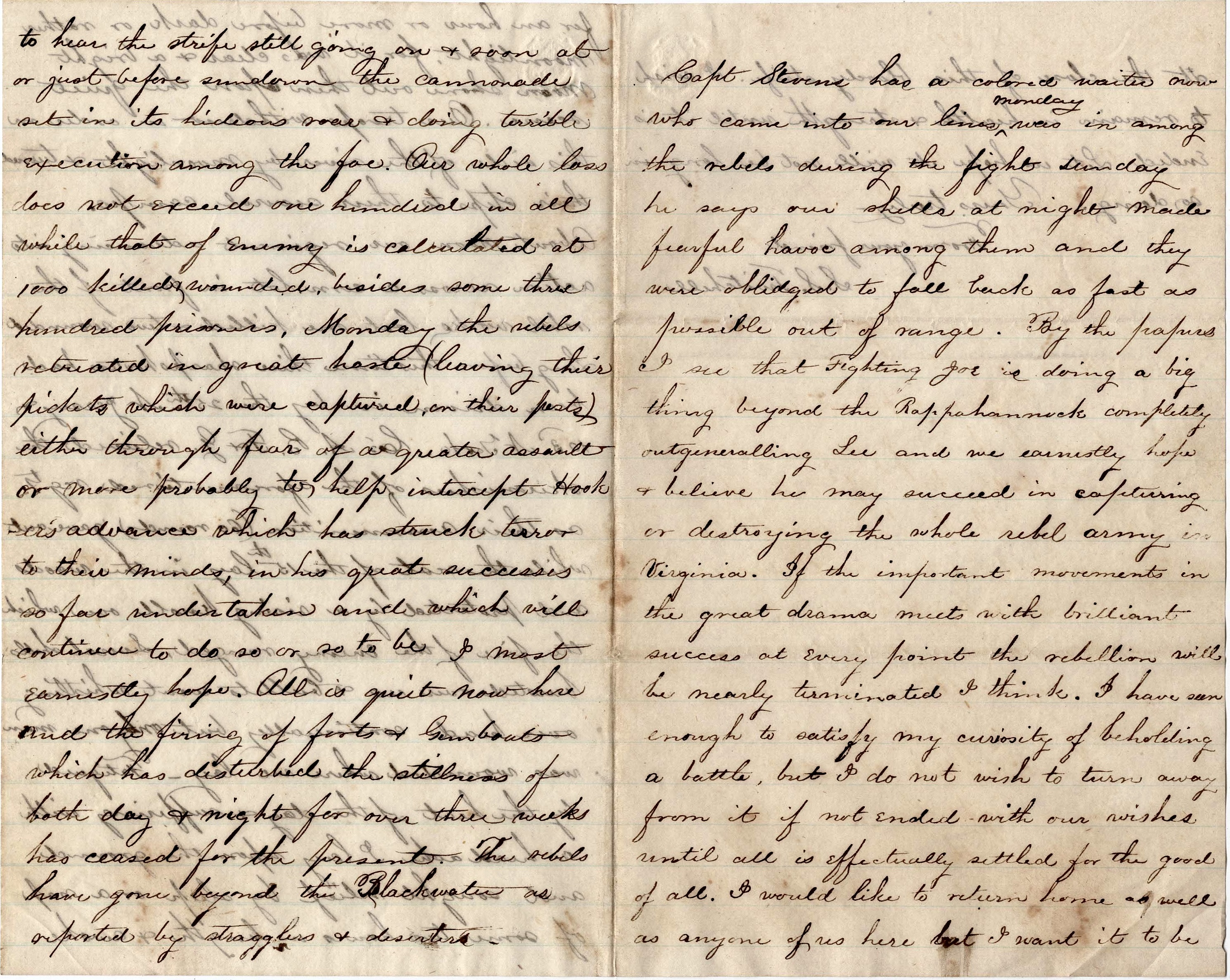
One week ago last Tuesday we moved and now are encamped to the northeast of the town with the Nansemond river on the north front of our line. Last Sunday we were ordered out and attacked the rebels again in their works again on the northern bank of the river. The fight lasted all day and terminated with a terrific cannonade by our forts, gunboat’s batteries for an hour or more before dark, or rather moonlight, for it was clear and bright moonshine out then upon the quiet scene. Our troops withdrew in order on this side of the river by moonlight & turned their steps to their several camps.
About noon our regiment advancing into action across a corn lot in front of the rebel works, lost one killed & two wounded. Long before this time, their sharpshooters had been driven in by the 25th New Jersey & 103rd New York. Companies A, B, F & G relieved the skirmishers of the aforementioned regiments as their ammunition (60 rounds) gave out. While the rest of the 15th lay in the woods and protected by a rising knoll over which the fire of the enemy ranged, several shells bursted over us and bullets went whistling overhead continually, but only one man was wounded where we lay. Fatigued by the heat of the day & suffering with a headache, I lay upon the ground and sought relief by sleep or a nap of some two hours in length, and awoke to hear the strife still going on. And soon at or just before sundown, the cannonade set in its hideous roar & doing terrible execution among the foe. Our whole loss does not exceed one hundred in all while that of the enemy is calculated at 1,000 killed, wounded, besides some three hundred prisoners.
Monday the rebels retreated in great haste (leaving their pickets which were captured on their posts) either through fear of a greater assault or more probably to help intercept Hooker’s advance which has struck terror to their minds in his great success so far undertaken and which will continue to do so, or so to be I most earnestly hope. All is quiet now here and the firing of forts and gunboats which has disturbed the stillness of both day and night for over three weeks has ceased for the present. The rebels have gone beyond the Black Water as reported by stragglers & deserters.
Captain Stevens has a colored waiter now who came into our lines Monday. He was in among the rebels during the fight. He says our shells at night made fearful havoc among them and they were obliged to fall back as fast as possible out of range. By the papers I see that Fighting Joe [Hooker] is doing a big thing beyond the Rappahannock completely outgeneraling Lee and we earnestly hope & believe he may succeed in capturing or destroying the whole rebel army in Virginia. If the important movements in the great drama meets with brilliant success at every point, the rebellion will be nearly terminated, I think. I have seen enough to satisfy my curiosity of beholding a battle, but I do not wish to turn away from it if not ended with our wishes until all is effectually settled for the good of all. I would like to return home as well as anyone of us here but I want it to be at the close of this bloody strife.
I wish to remain in health and strength until it is ended. Let us hope it will not be long in so doing. Yours truly. From your friend, — S. S. Twitchell





 Spared & Shared 23