Category Archives: 166th Ohio Infantry

1864: Edmond Quincy Marion Leach to friend Ella

The following letter was written by Edmond Quincy Marion Leach (1847-1917) of Plympton, Plymouth county, Massachusetts who served in Co. A, 3rd Massachusetts Heavy Artillery. He began his service in December 1862 as a private and mustered out as a sergeant in January 1863. After he returned home to Plympton, Edmond remained very active in the GAR.

Edmond was the son of Erastus & Maria B. Leach. He was married in 1876 to Sarah Elizabeth Weston (1848-1923). He died in 1917 and was buried in Vine Hills Cemetery.

T R A N S C R I P T I O N

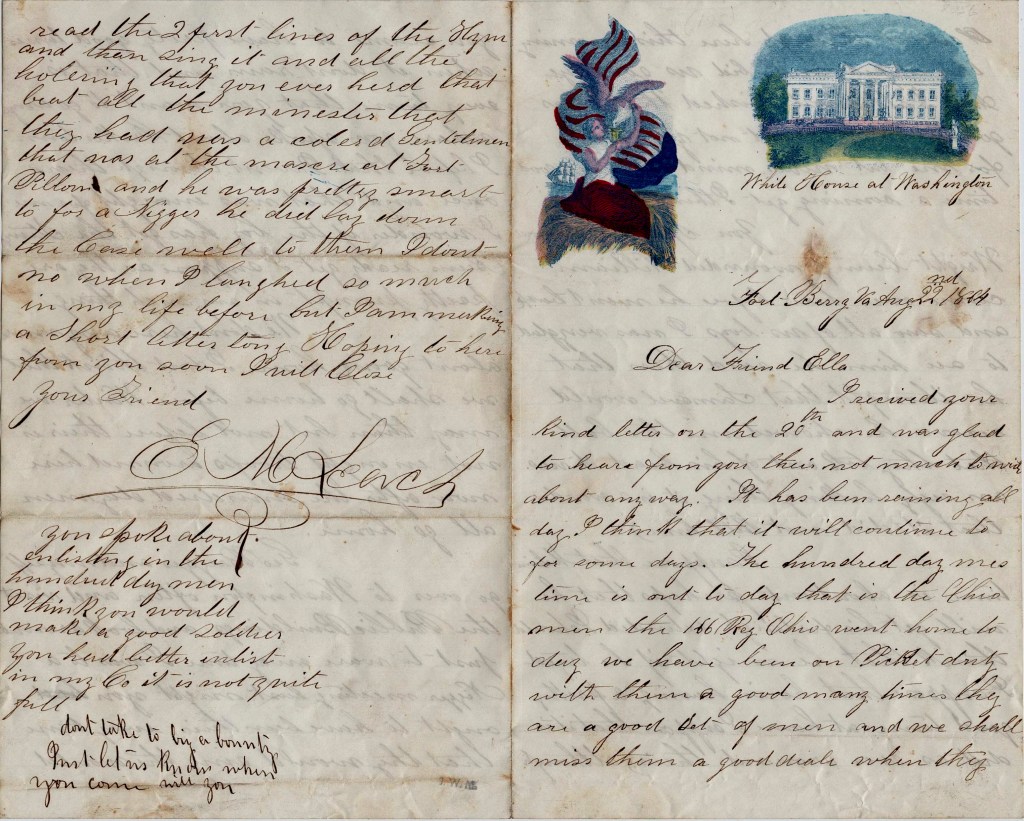
Fort Berry, Va.
August 22nd 1864

Dear Friend Ella,

I received your kind letter on the 20th and was glad to hear from you. There’s not much to write about anyway. It has been raining all day. I think that it will continue to [rain] for some days.

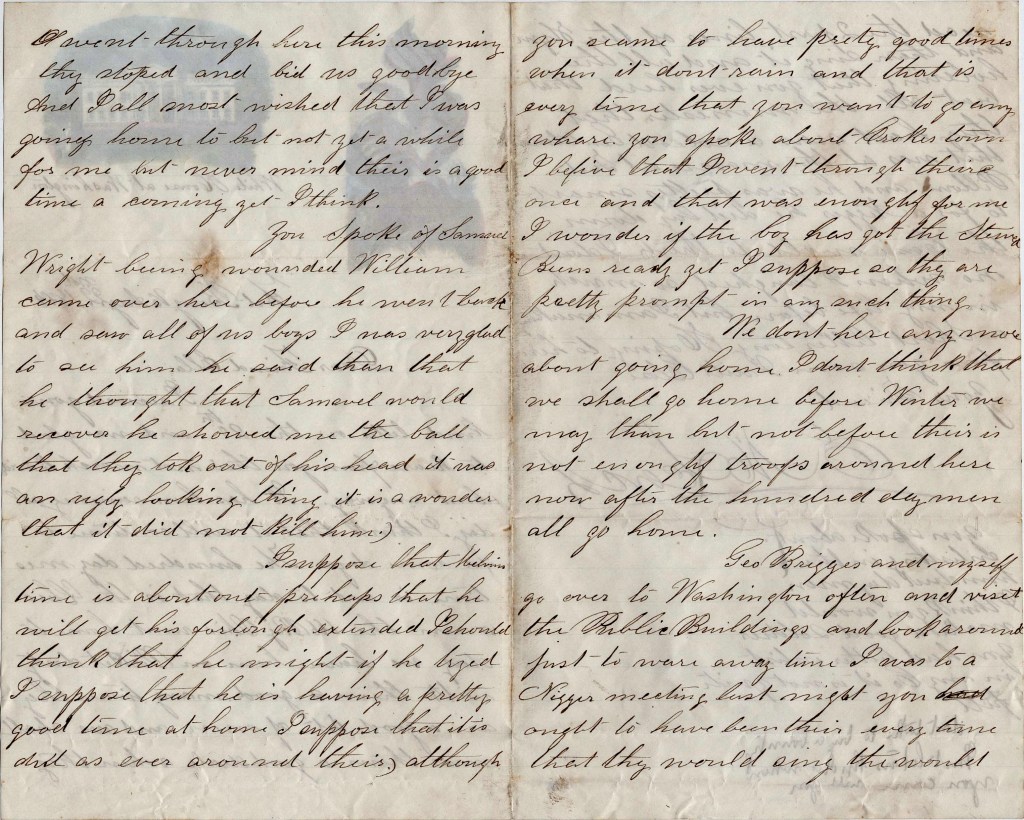
The Hundred Day Men’s time is out today—that is, the Ohio men. The 166th Reg. Ohio went home today. We have been on picket duty with them a good many times. They are a good set of men and we shall miss them a good deal. When they went through here this morning, they stopped and bid us goodbye and I almost wished that I was going home too but not yet a while for me. But never mind. There is a good time a coming yet.
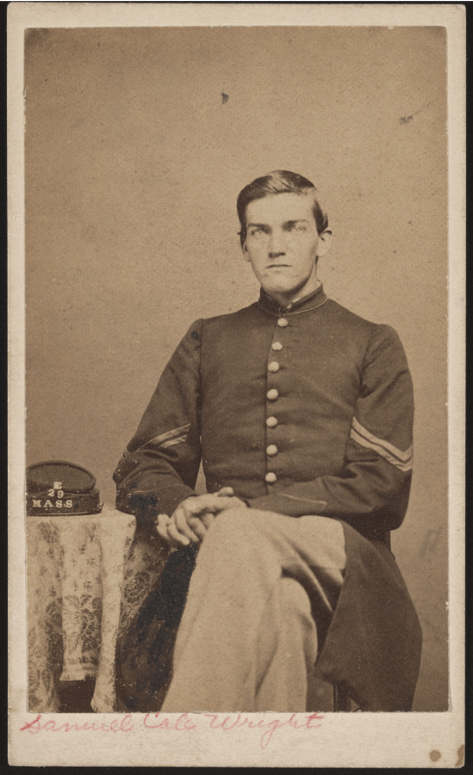
Samuel Cole Wright (1842-1906) of Co. E, 29th Massachusetts Infantry. At the Battle of the Crater, a bullet destroyed his right eye and lodged in the back of his skull.

You spoke of Samuel [Cole] Wright 1 being wounded. [His older brother] William came over here before he went back [to Plymouth] and saw all of us boys. I was very glad to see him. He said then that he thought that Samuel would recover. He showed me the ball that they took out of his head. It was an ugly looking thing. It is a wonder that it did not kill him.

I suppose that Melvin’s time is about out. Perhaps that he will get his furlough extended. I should think that he might if he tried. I suppose that he is having a pretty good time at home. I suppose that it is dull as ever around there although you seem to have pretty good times when it don’t rain and that is every time that you want to go anywhere. You spoke about Crokestown. I believe that I went through there once and that was enough for me. I wonder if the boy has got the stewed buns ready yet? I suppose so. They are pretty prompt in any such thing.

We don’t hear any more about going home. I don’t think that we shall go home before winter. We may then but not before. There is not enough troops around here now after the Hundred Days Men all go home.

George Briggs and myself go over to Washington often and visit the public buildings and look around just to wear away time. I was to a Nigger meeting last night. You ought to have been there. Every time that they would sing, they would read the two first lines of the hymn and then sing it. And all the hollering that you ever heard! That beat all. The minister that they had was a colored gentleman 2 that was at the massacre at Ft. Pillow [April 1864] and he was pretty smart too for a Nigger. He did lay down the case well to them. I don’t know when I laughed so much in my life before. But I am making a short letter long.

Hoping to hear from you soon, I will close. Your friend, — E. M. Leach

You spoke about enlisting in the Hundred Days Men. I think you would make a good soldier. You had better enlist in my company. It is not quite full. Don’t take too big a bounty. Just let us know when you come, will you?


1 According to a great article by my friend, Ron Coddington, entitled, “Samuel Cole Wright: The Talisman,” Samuel Wright of Plympton, Plymouth county, Massachusetts, had a combat record that left one with the impression that he was indestructible. “He refused to leave his comrades after a shell fragment struck him in the head during the Battle of White Oak Swamp, part of the Peninsula Campaign, in June 1862. A few months later at Antietam, he led a force of 75 men to pull down a fence at the Bloody Lane under heavy fire and suffered gunshot wounds through both legs at the end of the successful mission. A six-mule team trampled over him during the autumn of 1863, and the wagon to which the animals were tethered narrowly missed killing him.5 A musket ball ripped into his left arm at the Battle of Cold Harbor on June 3, 1864. The following month at the Battle of the Crater, he suffered his fifth and final wound of the war when a bullet destroyed his right eye and lodged in the back of his skull. Medical personnel dug the 1.25 ounce lead slug out and upon examination determined it to be from a Belgian-made gun.” Samuel had the bullet encased in gold and carried with him as a remembrance of his service. In February 1865 he received a disability discharge and returned to Massachusetts. Samuel’s letters can be found here: Letters Home.

2 There were churches for Black congregations in the District of Columbia prior to 1864 but White pastors had always been appointed to lead them. It wasn’t until 1864 that the first Black pastor was appointed at the Mt. Zion Church in Washington D. C.
1862-64: James Liggett, Jr. & Cyrus Spink Liggett to their Parents & Sister

These letters were written by James Liggett, Jr. (1838-1916) and Cyrus Spink Liggett (1834-1908), both sons of James Liggett (1797-1891) and Maria Quick (1803-1883) of Washington township, Holmes county, Ohio. During the summer of 1864, James & Cyrus signed up together to serve 100 days in the 166th Ohio Volunteer Infantry (OVI)—recruited to garrison the forts of Washington D. C. while the old garrisons were sent an infantrymen to the battlefront with Grant’s army.

Mentioned in one of the letters is their younger brother “Tip”—William Henry Harrison Liggett (1840-1863)—who enlisted in the spring of 1861 to serve in Co. H, 23rd Ohio Volunteer Infantry (OVI). Tip’s letters may be found published on Spared & Shared at 1861-62: William Henry Harrison Liggett to his Family.

The 166th OVI left for Washington on 15 May 1864 and were assigned to garrison duty at Fort Richardson, Fort Barnard, Fort ReynoldsFort Ward, and Fort Worth (with regimental headquarters at Fort Richardson), defenses of Washington south of the Potomac River, until September. They participated in the repulse of Early’s attack on Washington July 11–12. Both brothers mustered out on 9 September 1864.


Letter 1

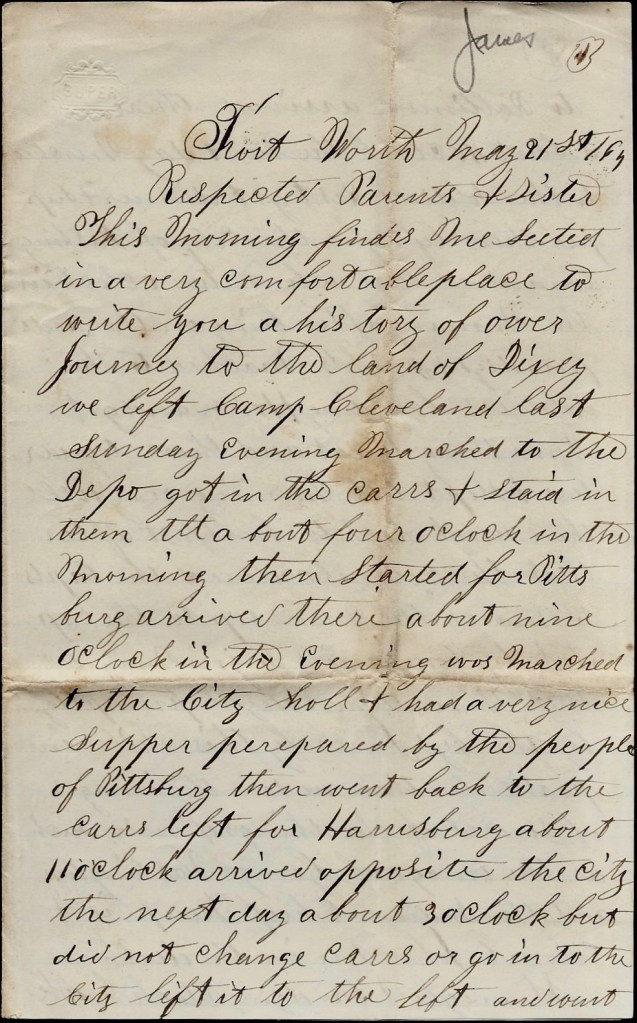
Fort Worth
May 21, 1864

Respected Parents & Sister,

This morning finds me seated in a very comfortable place to write you a history of our journey to the land of Dixie. We left camp Camp Cleveland last Sunday evening, marched to the depot, got in the cars and stayed in them till about four o’clock in the morning. Then started for Pittsburg. Arrived there about nine o’clock in the evening. Was marched to the City Hall & had a very nice supper prepared by the people of Pittsburg, then went back to the cars. Left for Harrisburg about 11 o’clock, arrived opposite the city the next day about 3 o’clock but did not change cars or go into the city. Left it to the left and went to Baltimore. Arrived there about 11 o’clock the next day. Marched to the Soldier’s Rest, got dinner, and supper, then left for the city of Washington. Arrived here about two o’clock in the morning after being on the road four days and three night.

Marched to the Soldier’s Home Boarding House and got something to eat and then to quarters & slept till morning very well. Then went to breakfast. After that the Colonel ordered the captains to march the men up to the Capitol by companies so you may bet that this order was obeyed promptly by the boys. By the bye generally, this child in particular. There we saw the images of several of the things of note such as the image of George Washington and the Indian Chief Tecumseh & Col. Johnson in the death struggle, & the dying Blackhawk—the very bullet hole in his head. Then there is a great many other things that I cannot describe.

The Senate chamber is a very nice place though I cannot give you a description of it. The Capitol is a very magnificent building though the city is a very inferior place to be—the metropolis of this great Nation. Tip used to give us descriptions of this place so that I wasn’t disappointed in not finding any greater show of things than I did.

The White House and the Smithsonian Institute that he used to talk so much about I did not get to visit though intend to visit them when we are returning home, let be the consequence what it may. The City of Baltimore is far the nicest city of the two with the exceptions of the public buildings.

From Washington we marched to Fort Richardson.


Letter 2

Fort Richardson
May 29, 1864

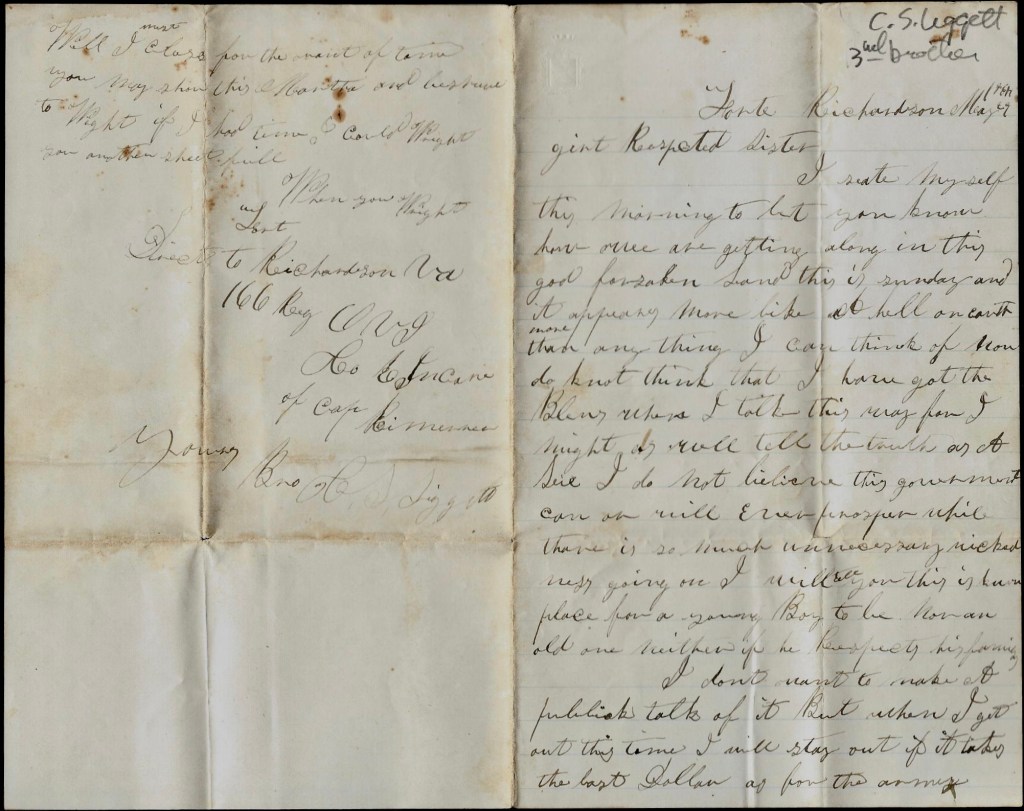
Girt, respected sister,

I seat myself this morning to let you know how we are getting along in this God forsaken land. This is Sunday and it appears more like hell on earth than anything I can think of. Now do you think that I have got the blues when I talk this way for I might as well tell the truth as a lie. I do not believe the government can or will ever prosper while there is so much unnecessary wickedness going on. I will tell you this—it’s no place for a young boy to be nor an old one neither if he respects his family.

I don’t want to make a public talk of it, but when I get out this time I will stay out if it takes my last dollar. The army is getting along. I suppose you get more correct news than we do. They say that Grant is within 8 miles of Richmond but you can’t believe one word you hear here.

I wish you could be here and see this country. We are on Old General Lee’s property now and I have not [seen] one rail fence since we have been here. There is hundreds of acres laying here to the commons and no kind of grain being raised scarcely, but all kinds of fruits. We can see Washington every day from here. Oh! how I [wish] you could see the Capitol House and the nice yard and the pool of water with those yellow fish in it. I’ll bet Father would like to see them. Tell him and mother to take the world easy for what they work for, some person will spend in the future.

Well Girt, have written three letters home since I have been here and have not received one. I want you to sit right down as soon as you get this and write me an answer and tell me how they get along, how the children is, and so on. It is probably they did not direct them right.

The boys are all well but myself and I feel some better than I did yesterday. I have got my old disease or rather the camp diarrhea. I will tell you the truth about it. We are starved sick here, out in day after day on two hard tack and a little colored water, cold coffee without sugar or cream. Still the government is not to blame for it but the Quartermaster and the Orderly is to blame for it. I have seen my dogs and your dogs eat more and better than we get sometimes–that is the truth of it. I care not what the rest of the boys says.

Well, I must close for the want of time. You may show this to Martha and [ ]. If I had time I could write you another sheet. When you write, direct to Fort Richardson, Virginia, 166th Regiment OVI, Co. K in care of Capt., Kirnerer

Your brother, C. S. Liggett


Letter 3

Fort Ward
June 12, 1864

Sister Gert,

Your letter of the sixth came to hand in due time and found us in the best of health. I was glad to hear that you were all getting along so well. This is Sunday but it don’t seem very much like Sunday, notwithstanding we was to hear a sermon. It seemed more like going to a political meeting than to church. The preacher’s name is Whiteman—I believe a Congregationalist—and not very much of a preacher.

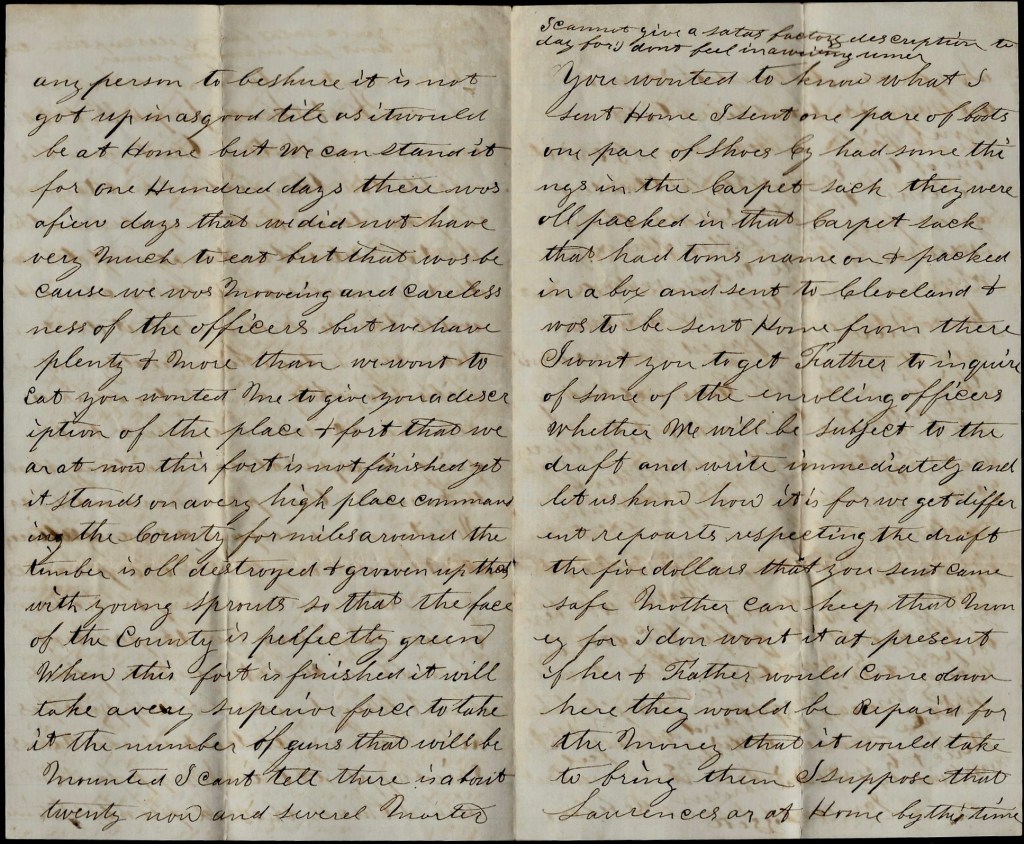
You said you was sorry to hear of our suffering for the want of something to eat. We have plenty of soft bread, pork, beans, potatoes, rice, sugar, coffee, tea and sometimes dried apples and twice a week, fresh beef. I think this is a plenty for any person. To be sure, it is not got up in as good style as it would be at home, but we can stand it for one hundred days. There was a few days that we did not have very much to eat but that was because we was moving and carelessness of the officers but we have plenty & more than we want to eat.

You wanted me to give you a description of the place & fort that we are at now. This fort is not finised yet. It stands on a very high place commanding the country for miles around. The timber is all destroyed & grown up with young sprouts so that the face of the country is perfectly green. When this fort is finished, it will take a very superior force to take it. The number of guns that will be mounted I can’t tell. There is about twenty now and several mortars. I cannot give you a satisfactory description today for I don’t feel in a writing humor.

You wanted to know what I sent home. I sent one pair of boots [and] one pair of shoes. Cy had some things in the carpet sack. They were all packed in that caret sack that had Tom’s name on & packed in a box and sent to Cleveland & was to be sent home from there. I want you to get Father to enquire of some of the enrolling officers whether we will be subject to the draft and write immediately and let us know how it is for we get different reports respecting the draft.

The five dollars that you sent come safe. Mother can keep that money for I don’t want it at present. If her & Father would come down here they would be repaid for the money that it would take to bring them. I suppose that Lawrences are at home by this time so you can all read this and answer it together.

Gert, your Rilla is here. He is, I think, one of the easiest frustrated fellows that ever I saw though I guess pretty fine fellow other ways. Well, I can’t write today worth a cent. When you write, tell me whether Jake Quick has paid Father and how does my [ ] nag look by this time, &c. Tell Father he had better not pitch in too hard. He had better buy some kind of stalk that will make beef in the fall or let them eat the grass. Cows sell here from [ ] & ffty dollars a head.

Panter was here. He has one hundred & fifty cattle on the way for Washington City. You must excuse this letter for I was on picket last night and don’t feel very much like writing. Write soon. Direct to Fort Richardson as before. All well. — James Liggett