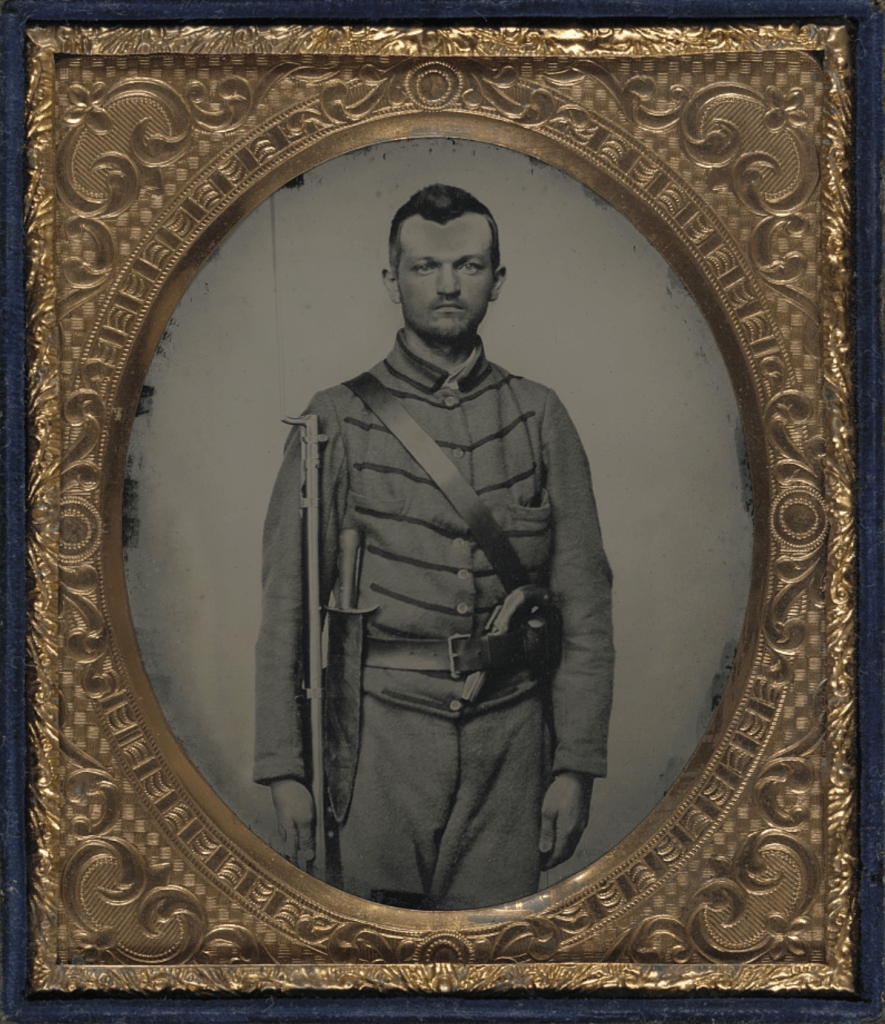
I could not find an image of George but here is one of John G. Lee of Co. H, 18th Virginia Infantry (LOC)
The following letter was written by George M. Setszer (1843-1863) of Co. F (“the Farmville Guards”) of the 18th Virginia Infantry. He can be found in the Virginia muster rolls under the name “Setzer” or “Sitszer.” When 18 year-old George enlisted in Capt. Booker’s company in April 1861, his occupation was recorded as “carpenter.”
In March 1862, George was detached from the regiment to report “with his tools” to Lt. W. S. Maury, Indiantown, Fish Hall Station, Y. R. R. R. to work on gunboats. In April 1862 he was promoted from private to corporal. In June 1862 he was listed among the casualties in the engagement at Darbytown, Virginia on 30 June 1862. He was with his regiment at Gettysburg in July 1863 where he went missing on July 3rd. Subsequent muster records state that he was “killed at Gettysburg on July 3rd 1863.” No doubt he was cut down on the field in Pickett’s charge.
George was born in the Shenandoah Valley, the son of Daniel and Amelia (Fisher) Setszer. By 1860, the Setszer family had relocated to Farmville, Prince Edward county, Virginia, where George and his father made their living in the carpenter’s trade.
Transcription
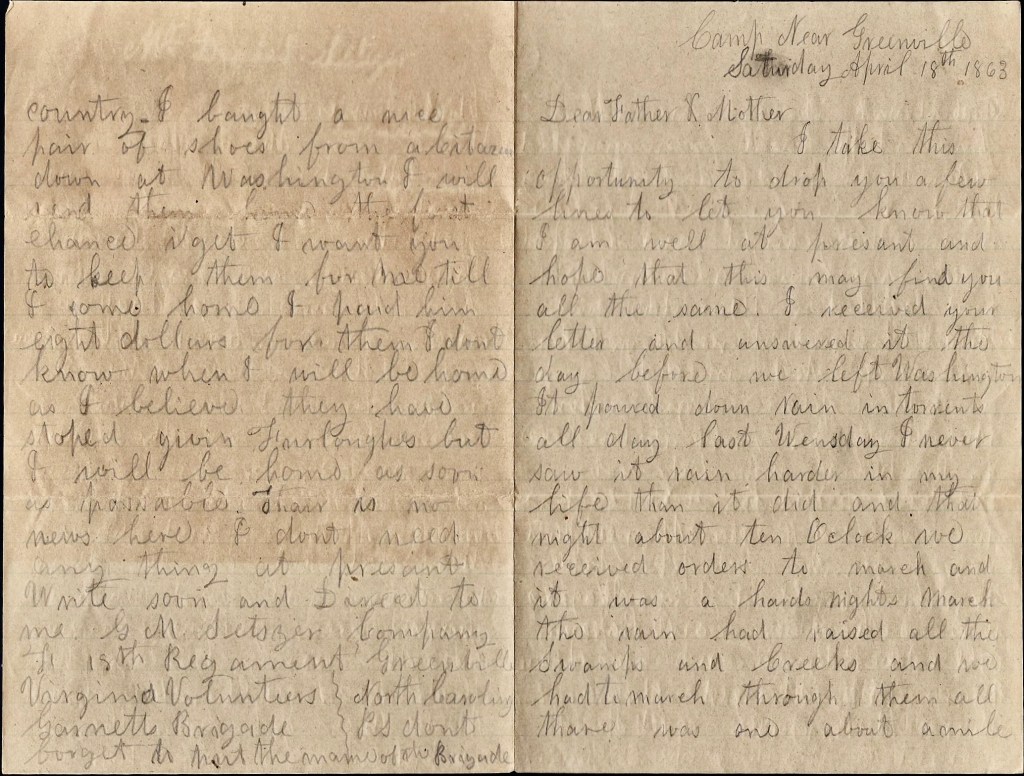
Camp near Greenville Saturday, April 18th 1863
Dear Father & Mother,
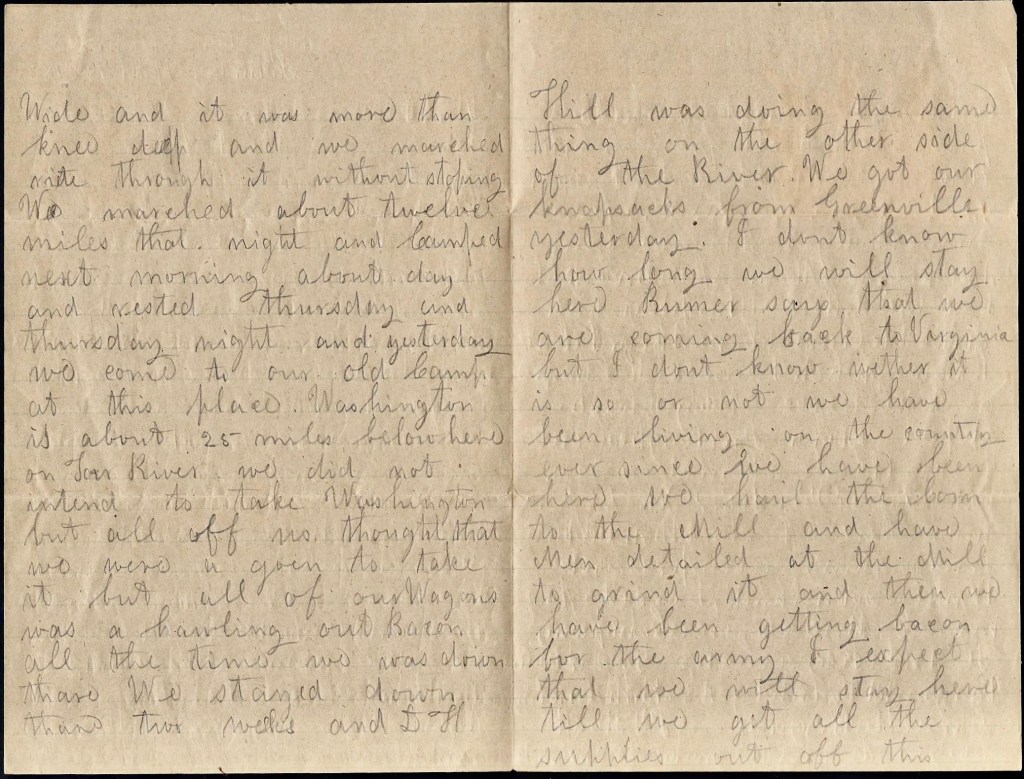
I take this opportunity to drop you a few lines to let you know that I am well at present and hope this may find you all the same. I received your letter and answered it the day before we left Washington. It poured down rain in torrents all day last Wednesday. I never saw it rain harder in my life than it did and that night about ten o’clock we received orders to march and it was a hard night’s march. The rain has raised all the swamps and creeks and we had to march through them all. There was one about a mile wide and it was more than knee deep and we marched right through it without stopping.
We marched about twelve miles that night and camped next morning about day and rested Thursday, and Thursday night and yesterday we came to our old camp at this place. Washington is about 25 miles below here on Tar River. We did not intend to take Washington but all of us thought that we were a going to take it but all of our wagons was a hauling out bacon all the time we was down there. We stayed down there two weeks and D. H. Hill was doing the same thing on the other side of the river.
We got our knapsacks from Greenville yesterday. I don’t know how long we will stay here. Rumor says that we are coming back to Virginia but I don’t know whether it is so or not. We have been living on the country ever since we have been here. We haul the corn to the mill and have men detailed at the mill to grind it and then we have been getting bacon for the army. I expect that we will stay here till we get all the supplies out of this country.
I bought a nice pair of shoes from a citizen down at Washington. I will send them home the first chance I get. I want you to keep them for me till I come home. I paid him eight dollars for them. I don’t know when I will be home as I believe they have stopped giving furloughs but i will be home as soon as possible. There is no news here. I don’t need anything at present. Write soon and direct to me. G. M. Setszer, Company F, 18th Regiment, Greenville, Virginia Volunteers, Garnett’s Brigade, Greenville, North Carolina
P. S. Don’t forget to put the name of the brigade.
These two letters were written by Edmond “Lockett” Womack (1834-1913), the son of William A. and March (Lockett) Womack of Prince Edward, Virginia He was married to Sallie Emmett Elliott (1827-1918) in May 1857 and had several children born before, during, and after the war.
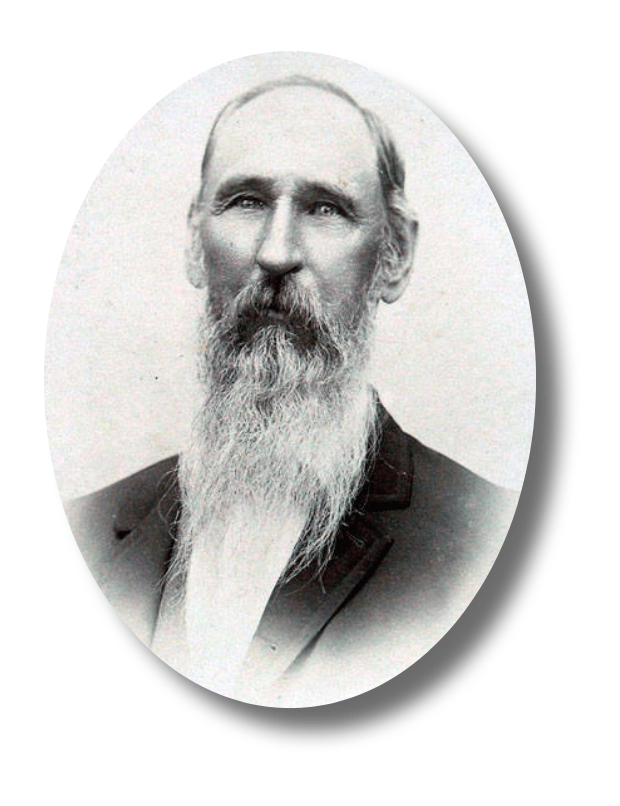
Edmund Lockett Womack(ca 1895)
Lockett entered the Virginia Military Institute (VMI) in July 1853 but was dismissed in December of that year for neglect of duties and studies.
During the Civil War, Lockett enlisted in Co. D (the “Prospect Rifle Grays”), 18th Virginia Infantry as a private in early 1861 and was quickly made a corporal. At the time that Lockett wrote these letters in late 1864, the 18th Virginia Infantry was still serving in Pickett’s Division, 1st Corps, Army of Northern Virginia. Both letters were written from the encampment of the regiment near Chester Station on the line between Richmond and Petersburg.
By this late stage in the war, most picket lines were generally quiet at night—both Union and Confederate soldiers themselves having agreed to, and abided by, an understanding that they would not fire on one another. This gentleman’s agreement fell by the wayside, however, once the Union army started assigning Negro soldiers to picket duty. Lockett’s letter of 1 December 1864 gives yet another account of Rebels firing on Negro pickets. This increase in nighttime firing was not limited to musketry; segments of the Union lines known to be manned by USCT regiments were also targeted purposely by the Rebel artillery. [For other accounts of Confederate soldiers firing on USCT pickets, see “Confederate Soldiers in the Siege of Petersburg….” by Matthew R. Lempke]
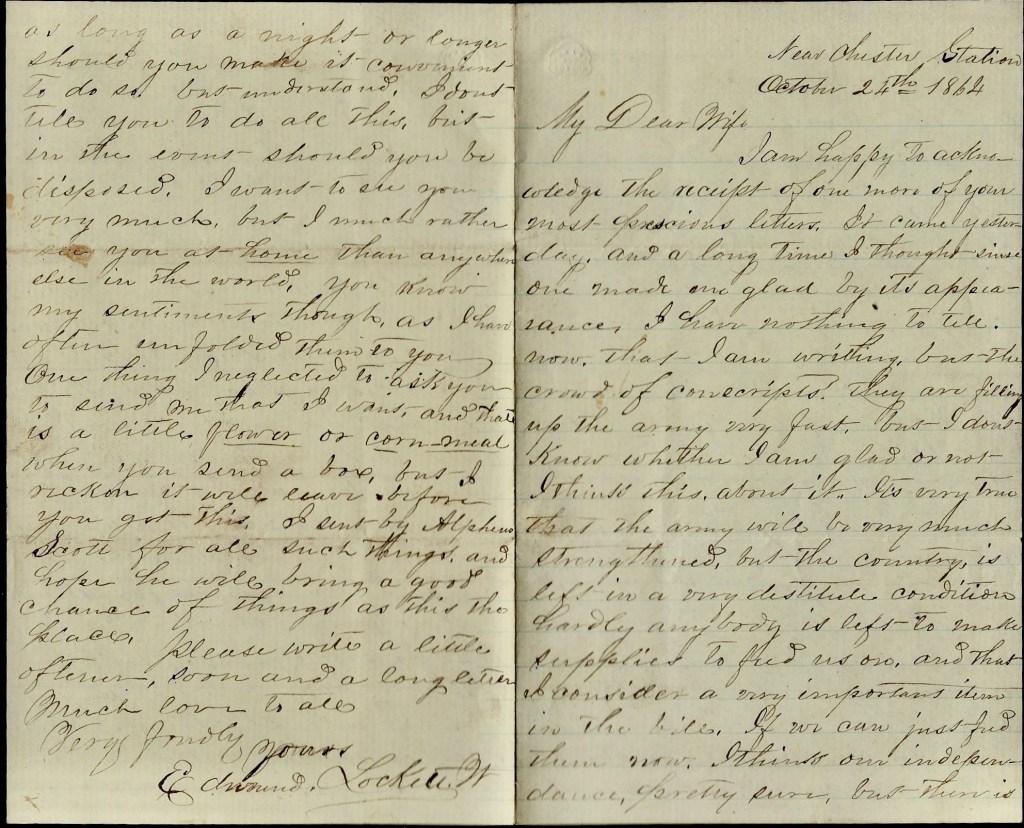
Letter 1
Near Chester Station October 24th 1864
My Dear Wife,
I am happy to acknowledge the receipt of one more of your most precious letters. It came yesterday and a long time I thought since one made me glad by its appearance. I have nothing to tell now that I am writing but the crowd of conscripts—they are filling up the army very fast but I don’t know whether I am glad or not. I think this about it. It’s very true that the army wil be very much strengthened, but the country is left in a very destitute condition—hardly anybody is left to make supplies to feed us on, and that I consider a very important item in the bill. If we can just feed them now, I think our independence [may come] pretty soon, but there is great fears entertained in respect to the negroes destroying what has already been made and then again of their not making much more as there are but very few men left and they old men. Though we can only hope for the best should the worst come.
My greatest hope is in the Presidential Election. I am very much in hopes that will end the thing in our favor. I just stopped a little while to see Mr. Wilbourne. He is in at last. Is now sitting down in my house and talking very much to our amusement. He thinks the army is a terrible place. He is in Rice’s Depot Company but very anxious to come to this regiment and get n our company but I don’t think there is much chance for that, for our company is about filled up now. I think we have about fifty men for duty in our company, some sick in hospitals, and William Hunt is one. You may tell Mr. Hunt’s folks when you see them he is slowly improving. I think he is a little low-spirited.
When you come down to Richmond, tell Pa to come with you. They have no right to interrupt him, and if I can, I will come to see you. But I don’t want you to come out here. It is no place for ladies. Pa can come but not you. If I didn’t love you, probably I might tell you to come, but under the circumstances I do not not. I want to see you the worst in the world and you can come as far as Chester but no farther, or rather I wouldn’t like to see you any farther this way. I can come up there any time and will. Should you come, I reckon we can procure a room there should you want to stay as long as a light or longer should you make it convenient to do so. But understand, I don’t tell you to do all this, but in the event should you be disposed. I want to see you very much, but I much rather see you at home than anywhere else in the world. You know my sentiments though as I have often unfolded them to you. One thing I neglected to ask you to send me that I want, and that is a little flour or corn meal when you send a box, but I reckon it will leave before you get this. I sent by Alpheus Scott for all such things and hope he will bring a good chance of things as this the place.
Please write a little oftener, soon and a long letter. Much love to all. Very fondly, your Edmund Lockett W[omack]
Letter 2
Near Chester [Station] December 1st 1864
My Dearest Sallie,
Agreeably to promise, I hasten to comply though but little of importance has transpired since I saw you last. As soon as the cars left that day, I started for camp. hurried on and to my great surprise and mortification I was informed immediately after arriving at camp of the death of Charles Richardson & Thomas Weaver, both of the Farmville Company [18th Va., Co. F]. They both were killed by the fragments of the same shell while on the picket line, and I understood they were both asleep at the time—shot through the head. I saw Charley—brought him off myself. The ball or fragment entered the back of his head and came through the right jaw a little below the mouth, cutting the face frightfully. I didn’t see the other man atall, but he had just gotten back off furlough and I think that was the first time he had been on picket.
The cause of the shelling was from our men shooting at their negro pickets, but today has been remarkably quiet. They hollowed to our men this morning early not to shoot, that they had no negroes on them, called our men, “Johnny Reb,” and we call theirs, “Corporal Dick and Joe”—real negro names you know. I expect we will have hot times again tomorrow from the fact that a deserter came over to us tonight and said they had on negroes again, but I reckon they will take them off before light, which if they do, all will be quiet again as today has been.
I told Ed what you said and said that he though more of you than any of the rest of his sisters or brothers but as he had said that he wouldn’t come to see any female relative near the army, he thought he would be as good as his word. But I don’t think that was his best reason, though I am not able to say what it was. I am glad to say that John Womack received a box this evening with potatoes, apples, meat, and several other things [including] two spoilt chickens which we had to throw away of course. This I believe is all that has transpired of any note since I parted with you.
Now hoping that you will have a safe and pleasant trip home, I must close by asking you to remember me to the family by presenting my best love and kindest wishes to them all. Kiss all the little ones for me when you see them together. Write soon after arriving at home and be sure don’t forget to tell Pa to send a statement of what Scott got and what he paid as it will be of service to me.
I am devotedly yours, &c., — Lockett
P. S. Please send for my puppies at Uncle Cobbs.
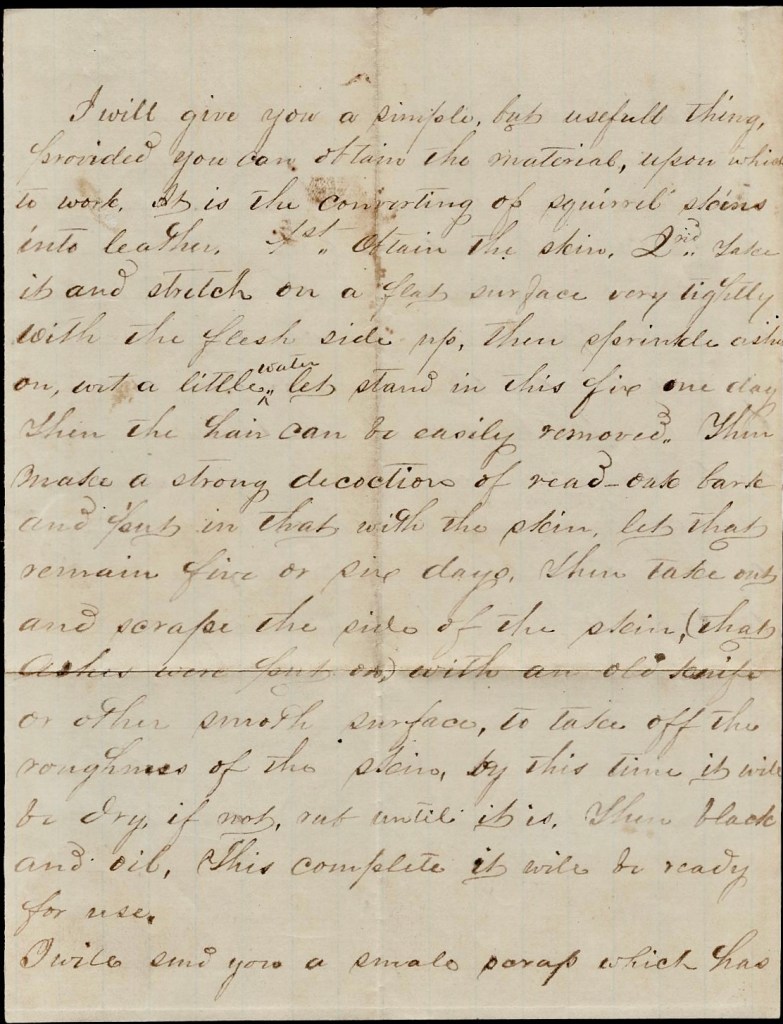
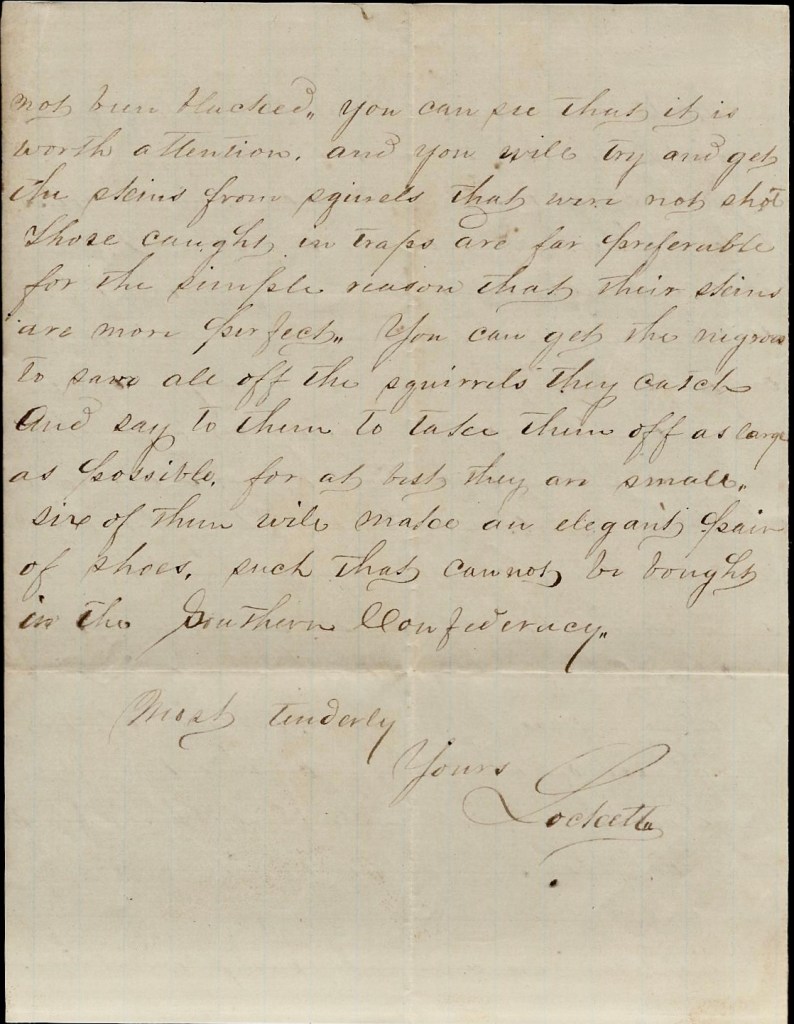
[There is an attached document that I did not transcribe describing the skinning of squirrels. It ends with thee following; “Try to get the skins from squirrels that were not shot. Those caught in traps are far preferable for the simple reason that their skins are more perfect. You can get the negroes to save all the squirrels they catch and say to them to take them off as large as possible for at best they are small. Six of them will make an elegant pair of shoes such that cannot be bought in the Southern Confederacy.“]



 Spared & Shared 23