The following letter was written by William Orr (1838-1867), the son of James Orr (1815-1895) and Julia Ann Hopping (1817-1869) of Albany, Delaware county, Indiana. William was employed as a lawyer prior to his enlistment in July 1861 to serve as a 2nd Lieutenant in Co. K, 19th Indiana Infantry. He received a gunshot wound to his left breast at the Battle of Antietam but recovered and was promoted to Captain of his company shortly afterwards. In August 1864, he was promoted to Major of the regiment but soon after transferred to the 20th Indiana Infantry where he was promoted to Colonel. He mustered out of the service in May 1865.
William wrote the letter to James Campbell of Selma, Liberty Township, Delaware county, Indiana. Two of the Campbell boys served in Co. K, 19th Indiana with Orr. Historians will recall that the 19th Indiana became part of the “Black Hat” or Iron Brigade.
William’s letter gives a great description of the hospital set up in the US Patent Office in the fall of 1861. We learn from Orr’s letter that it was predominately occupied in October 1861 by sick soldiers from the 19th Indiana Infantry. Records show that the Patent Office was used as a hospital from October 1861 to January 1863. During the fall and winter of 1861–1862, the 19th Indiana Infantry was severely impacted by disease, with over 60 soldiers dying from sickness between August 1861 and the spring of 1862. Typhoid and malarial fevers, prevalent in the crowded camps, plagued the regiment early in its service near Washington D.C.
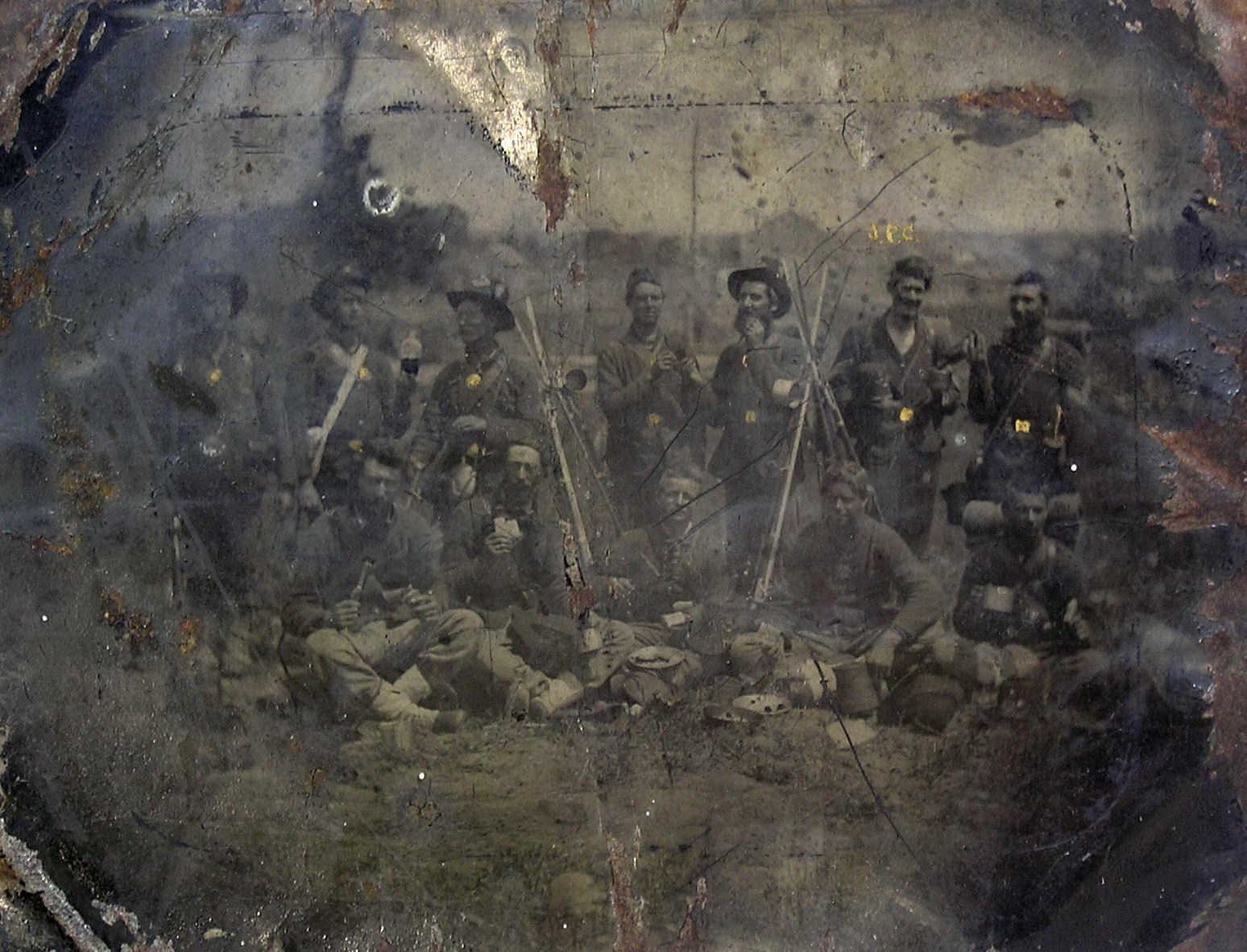
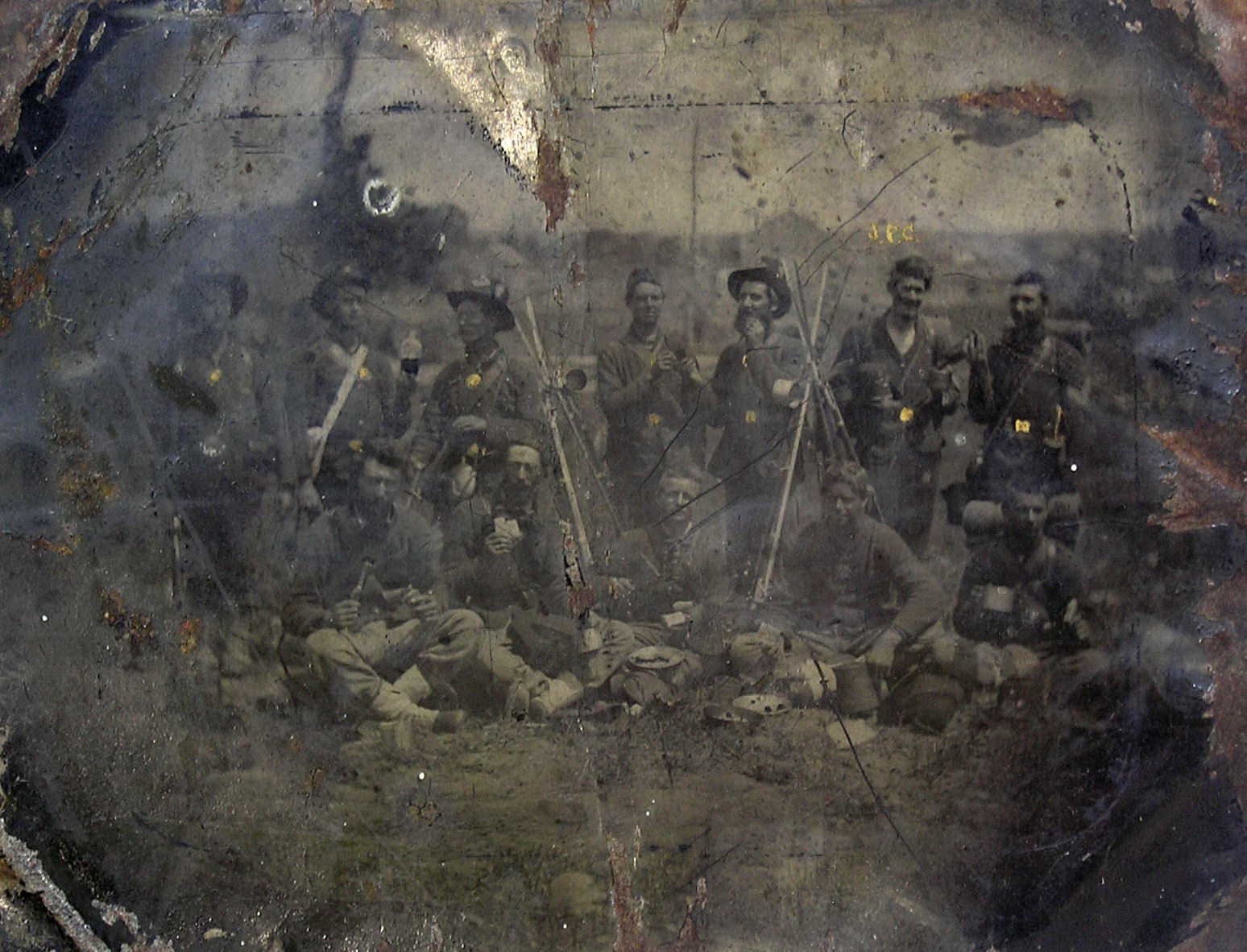
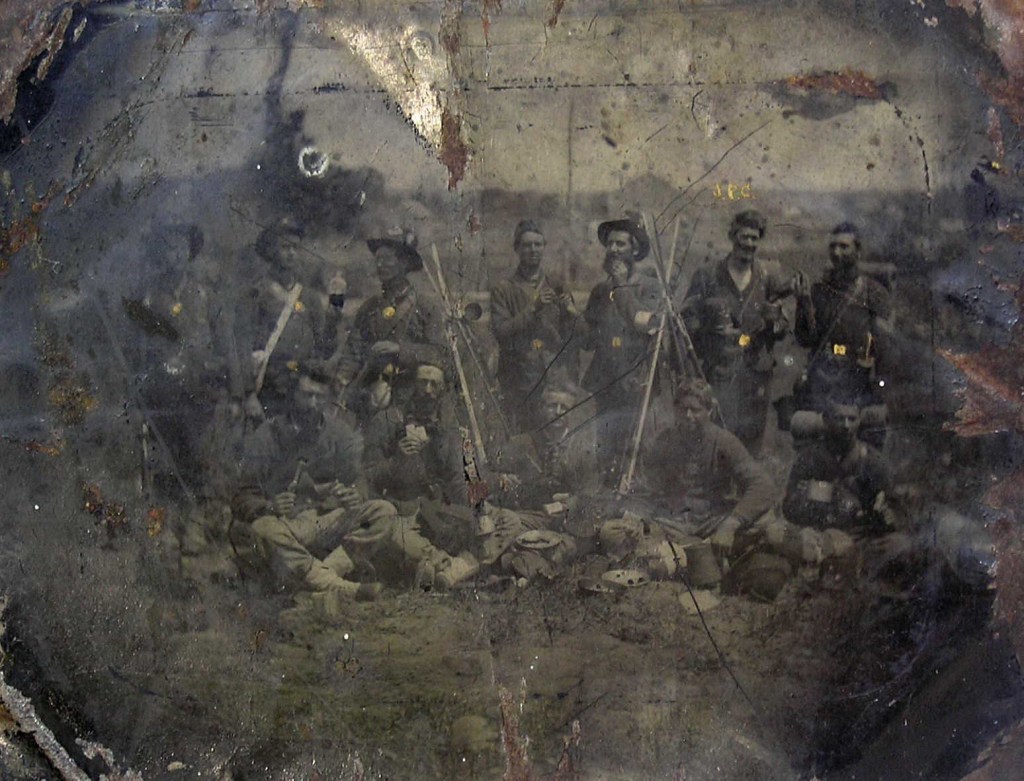
Some of the boys from Co. K, 19th Indiana Infantry
T R A N S C R I P T I O N
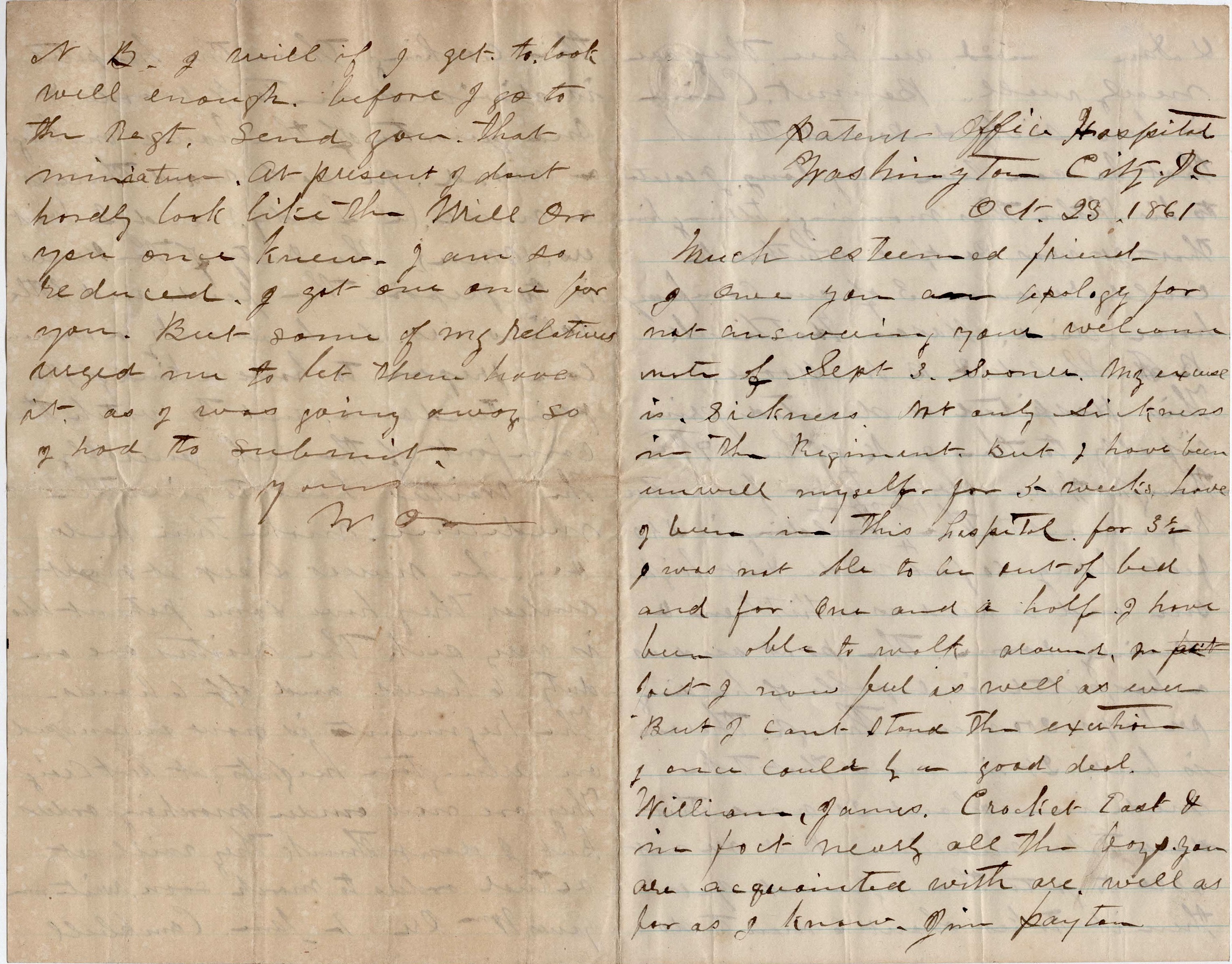
Patent Office Hospital Washington City, D. C. October 23, 1861
Much esteemed friend,
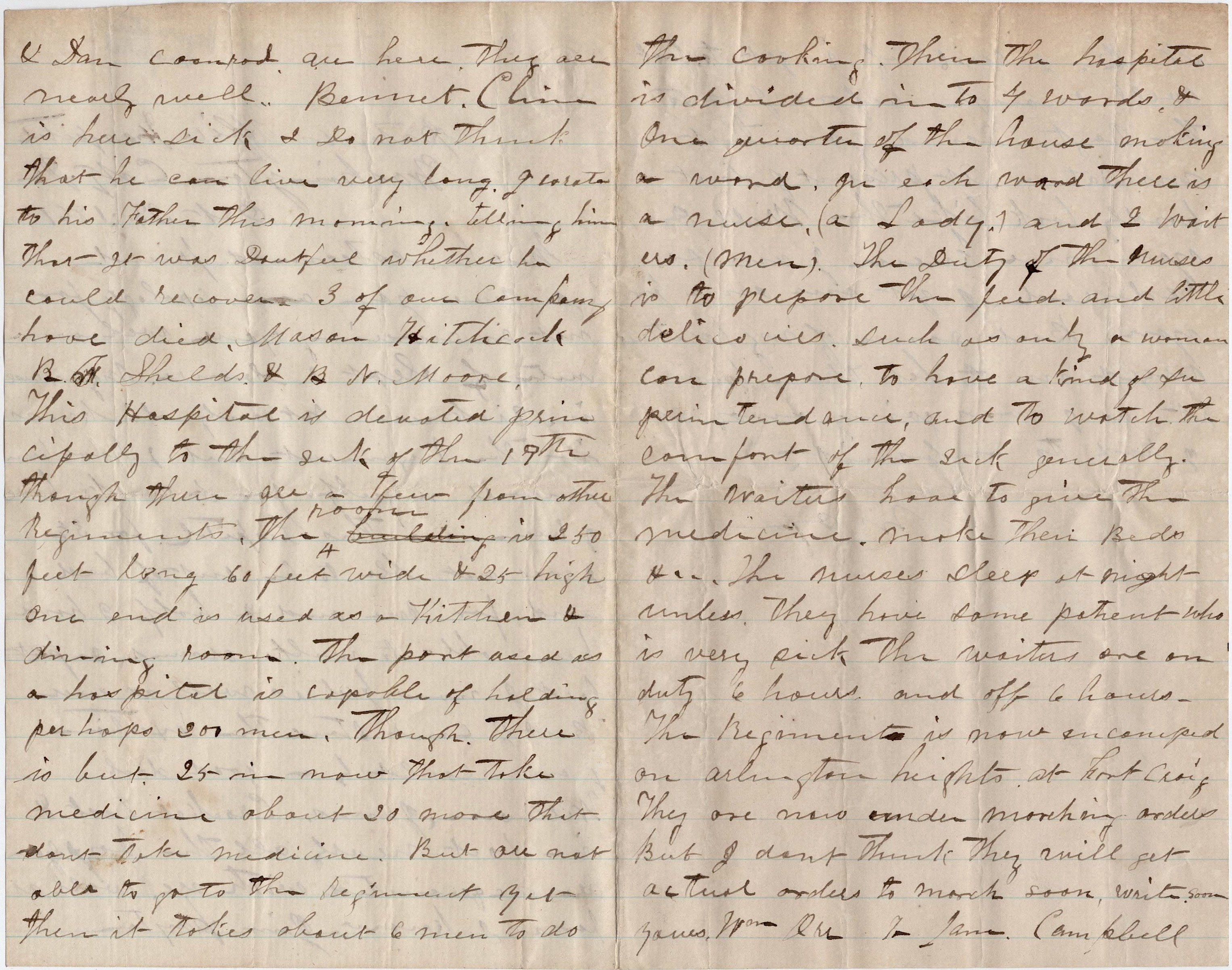
I owe you an apology for not answering your welcome note of September 3rd sooner. My excuse is sickness—not only sickness in the regiment but I have been unwell myself for 5 weeks. Have been in the hospital for three and a half. I was not able to be out of bed and for one and a half I have been unable to walk around. In fact, I now feel as well as ever but I can’t stand the exertions I once could by a good deal. William [Campbell], James [Campbell], Crocker East & in fact nearly all the boys you are acquainted with are well as far as I know. Jim Payton & Dan Conrod are here. They are nearly well. Bennet Cline is here sick. I do not think that he can live very long. I wrote to his father this morning telling him that it was doubtful whether he could recover. Three of our company have died—Mason Hitchcock, B[enjamin] F. Shields, & B[enjamin] N. Moore.
This hospital is devoted principally to the sick of the 19th [Indiana] though there are a few from other regiments. The room is 250 feet long, 60 feet wide, and 25 high. One end is used as a kitchen & dining room. The part used as a hospital is capable of holding perhaps 200 men though there is but 25 in now that take medicine [and] about 20 more that don’t take medicine, but all not able to go to the regiment yet. Then it takes about six men to do the cooking.
Then the hospital is divided into four wards & one quarter of the house making a ward. In each ward there is a nurse (a Lady) and two waiters (men). The duty of the nurses is to prepare the feed and little delicacies such as only a woman can prepare to have a kind of superintendence and to watch the comfort of the sick generally. The waiters have to give them medicine, make their beds, &c. The nurses sleep at night unless they have some patient who is very sick. The waiters are on duty six hours and off six hours.
The regiment is now encamped on Arlington Heights at Fort Craig. They are now under marching orders but I don’t think they will get actual orders to march soon.
This letter was written by James Madison Campbell (1840-1891) of Selma, Liberty Township, Delaware county, Indiana. His parents were Samuel Graham Campbell (1797-1873) and Elisabeth Goings (1804-1882). He wrote the letters to his older sister, Jane Campbell (1835-1906). James enlisted as a musician in Co. K, 19th Indiana Infantry on 29 July 1861. He mustered out as a corporal on 28 July 1864 after three years service. The 19th Indiana was, of course, part of the famed Iron Brigade or “Black Hat” Brigade during the Civil War.
Serving with him in the same company was his older brother, William Harrison Campbell (1838-1912), who also wrote several letters home. They can be found at—1861-62: William Harrison Campbell to Jane Campbell.
Some of the boys of Co. K, 19th Indiana Infantry after the Battle of Antietam
T R A N S C R I P T I O N
Fort Baker, Virginia September 22, 1861
Dear Sister,
I received yours of the fifteenth instant and was sorry to hear that you was so uneasy about Will and I. Will got here last Tuesday week and on Wednesday following he went out with us to the fight but unfortunately we were too late by about two minutes to get into the fight for it was over before we got there though there were several shots fired from the cannon after we got on the ground where they were fighting.
A word of explantation with regard to the fight. In the morning there was five companies of our regiment went to the town of Lewinsville in company with the 3rd Vermont on a kind of scouting expedition and after they had finished their work and started back to the camp and had not come but a short distance when the Rebels opened fire on them from the brush and thickets where they were concealed. Our men immediately returned the fire and fired several rounds but to little effect, when there was a brass 32-pounder brought on the field and opened fire on the Rebels and the first shot struck one of the caissons and knocked it off the wheels and killed nine men. They fired twice at the artillery, then turned it and fired in another direction at a cavalry company and made great destruction among them.
The number of Rebels killed was about thirty and a great many wounded. Our loss was four killed and five wounded (some say seven). There was some firing last night among the pickets and we hear this morning that there was a Captain in the California Regiment killed 1 and four Rebels also. This is about all the fighting that has been here that I know of.
There is a great deal of sickness among the soldiers at present and been several deaths but there has been no deaths in Co. K but several sick and not dangerous. Capt. Williams is getting better. Ben Harter is about well again. Will Orr is better. Crack East is well. James Goings is better. Brother Will is well and I am as stout and hearty as a buck and can jump twice as far, I expect. Our boys are all getting better. You need not be uneasy about us for we are as safe here as if we were at home. No more at present, — J. M. Campbell
Tell Marthy Black if she wants to kiss me, I will give her an opportunity when I come back.
1 Capt. James W. Lingenfelter (1836-1861) of Co. B, 1st California Regiment was killed in the skirmish near Lewinsville, Fairfax county, Virginia, on 21 September 1861. At the time of his death, Cap. Lingenfelter was in command of a scouting party, when finding himself surrounded by a body of rebels, and scorning to retreat, he was shot in the head and immediately killed.
The following letter was written by Thomas Winset (1838-1863), who enlisted as a corporal in Company K of the 19th Indiana Infantry on July 29, 1861. He subsequently rose to the rank of sergeant. Thomas met his end at Gettysburg in the afternoon of July 1, 1863, as he and his fellow soldiers in the 19th Indiana—part of the esteemed Iron Brigade—valiantly resisted and repelled the Confederate assault in Herbst’s Woods during the first day’s engagement, striving to gain precious time for additional corps of the Army of the Potomac to reach the battlefield. William Murray of Co. K witnessed the death of Sgt. Winset who was killed instantly when he was shot in the forehead. Murray was standing only two feet away from him at the time and later described the fighting: “The slaughter in our ranks became frightful, beyond description. The dead lay piled up on the ground, and the shrieks and groans of the wounded was too horrible for contemplation.”
By the time of the Battle of Gettysburg, the Iron Brigade had established a formidable reputation as a fierce adversary, having endured the trials of Second Bull Run, South Mountain, Antietam, Fredericksburg, and Chancellorsville. They were distinguished throughout the conflict as the “Black Hats,” a name derived from the black Hardee hats of the 1858 model that were issued to Regular Army soldiers, contrasting with the blue forage caps worn by the majority of other Union Army units.
Thomas was the son of Gilbert P. Winset (1811-1898) and Emma Dodson (1818-1872) of Selma, Delaware county, Indiana.
T R A N S C R I P T I O N
Addressed to Miss Jane E. Campbell, Selma, Delaware county, Indiana
Camp Craig, Fairfax County, Va. October 25th 1861
Much beloved and ever remembered one,
In reply to your very kind and interesting epistle dated the 8th, I deferred answering it before this time but it has been so I could not until now partly because I haven’t had time and partly because nothing of much interest has transpired for the past two or three weeks except the recovery of several of our sick boys has returned from the hospital.
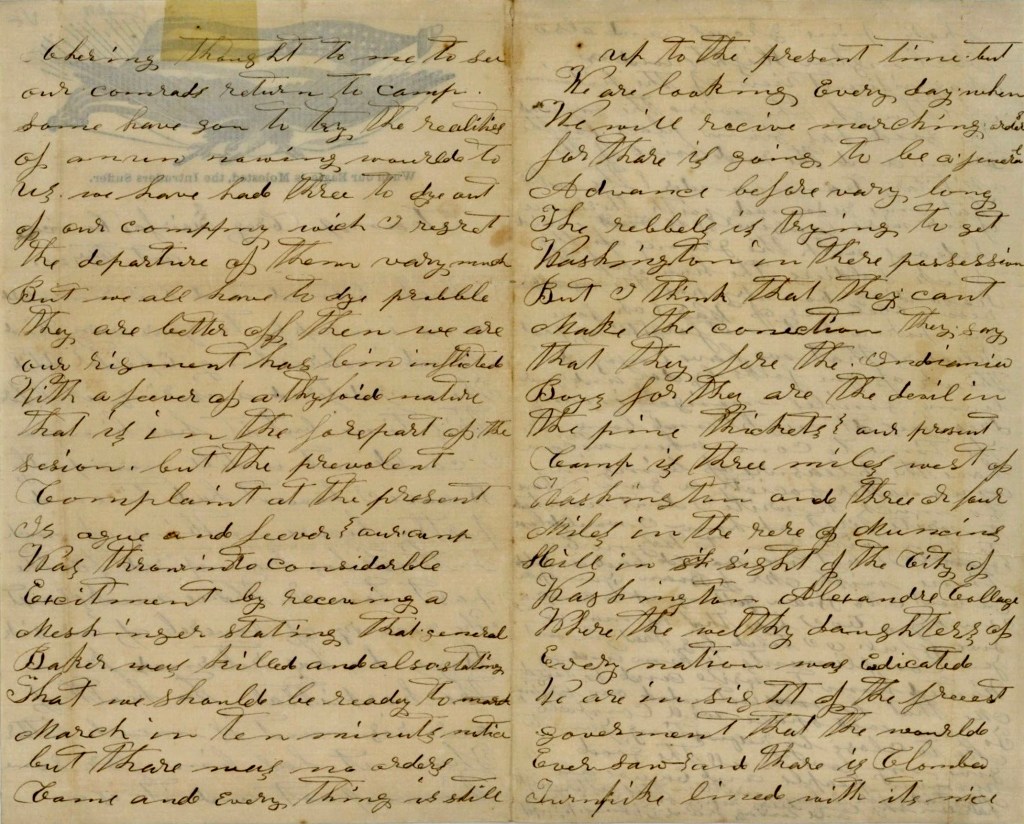
The health of our regiment is much better than it has been for some time past and it is a cheering thought to me to see our comrades return to camp. Some have gone to try the realities of an unknowing world, to viz: we have had three to die out of our company which I regret the departure of them very much. But we all have to die. Probably they are better off than we are. Our regiment has been inflicted with a fever of a typhoid nature that is in the forepart of the session, but the prevalent complaint at the present is ague and fever.
Our camp was thrown into considerable excitement by receiving a messinger stating that General Baker was killed [see Battle of Ball’s Bluff] and also stating that we should be ready to march in ten minutes notice but there was no orders came and everything is still up to the present time. But we are looking every day when we will receive marching orders for there is going to be a general advance before very long. The rebels is trying to get Washington in their possession but I think that they can’t make the connection. They say that they fear the Indiana Boys for they are the devil in the pine thickets.
Our present camp is three miles west of Washington and three or four miles in the rear of Munson’s Hill in the sight of the City of Washington [and] Alexandria College where the wealthy daughters of every Nation was educated. We are in sight of the freest government that the world ever saw and there is Columbia Turnpike lined with its nice shady pine groves and also Arlington Heights and a magnificent view of the Potomac. Although the wise, the song and the good [?] has given place for the drum and the rude noise of the military commander, the walls that once resounded with the eloquence of our wise lawgivers is now made hideous with the groans of the sick soldiers [and] the houses of the resounding country has the resemblance of war.
Oh Jane, you spoke about not forgetting past pleasures that we have enjoyed. I think of you folks by day and your loving smiles mingle in my dreams at night and I long for the time to come when we can have the pleasure of being in one another’s society again.
I have so much to write, I don’t know what to write first. Oh, how I would love to been with you to Wayne county. I’ll bet we would have had a nice time with Mr. J. Bean. You spoke about Mr. Bean getting up to campaign in Wayne county. I hope that he may be successful. I told Lige that you sent your compliments to him and wanted him to write and he fold me that he intended on writing to you. Well, space will compel me to close by requesting you to give my love to all the good Union people and excuse all mistakes for I have written this after night. Pardon my long delay. Reply soon. Your true and loving friend, — Thomas Winset
I could not find an image of Aaron, but here is James M. Stewart of Salem who served in Co. E, 19th Indiana. He was killed in the fighting at Brawner’s Farm in August 1862. (Ancestry.com)
The following letter was written by Pvt. Aaron Kirt Ellenwood (1842-1872) of Co. H, 19th Indiana Infantry. Aaron was the son of Adolphus Ellenwood (1796-1858) and Fanny Hendrix (1802-Aft1850) of Jennings county, Indiana. Aaron’s muster in date is given as 29 July 1861 but there are no other remarks in his military record. The 19th Indiana Brigade website states that Aaron was discharged early in the war because of disability but does not provide the date.
Most history buffs will recognize the 19th Indiana as part of the famed Iron Brigade who saw action in many of the Army of Potomac’s largest battles—Gainesville, Antietam, Gettysburg, and Petersburg. It isn’t known whether Aaron participated in any of these, however.
After the war, in 1866, Aaron married Mary Kiger (1846-1913) in Shelby county, Indiana. Aaron was buried in Crown Hill Cemetery in 1872; reinterred from Greenlawn Cemetery. No headstone marks in gravesite.
T R A N S C R I P T I O N
Camp Advance, September 22nd 1861
Dear friend Hattie,
As I have been writing letters to nearly everybody today, I thought that I would write to you. I am tolerable well & hope you are the same. We have had tolerable hard times since we came over on this side of the Potomac. One night when I was on guard, the long roll beat and we did not know where we had to go so we did not bring any clothes with us here. We had to lay on the cold ground some two weeks without tents. All we had was our oil cloth and blanket for bed and cover. It was on a side hill and it rained nearly every night and the water running under us. But now we have our tents which is better for us. Tomorrow I understand that we go back on the other side of the river. That will suit me the best kind.
Capt. Johnson was here today. He looks fine. All of his boys are well. I think that we will be in the same brigade that he is in so there will be a good many of us boys from Edinburgh here now and all together. I suppose that [you] heard all the news from here by someone else. We have been in one little fight already. 1 Did not lose many of our men. I believe they killed five of our men and wounded two out of our regiment. Most of the Edinburgh boys are all well. Dude Gray is sick in the hospital.
I have received several letters since I have been here. Mag has written to me several times. She said in her last letter that you was well. Gave me your respects also. This is the first time that I ever wrote to you and likely I have taxed your patience already. I will stop by giving you my best respects. Give them to all the family and friends. — A. K. Elenwood
Co. H, 19th Regt. Indiana Volunteers, Washington City, D. C.
You would laugh to hear the boys singing this evening. This is Sunday here, I believe, judging by not having to work today. Our preacher preached a good sermon today. His name is Rev. [Lewis] Dale
1 Aaron is probably referring to the minot skirmish at Lewinsville that took place on 11 September, 1861.
The boys of Co. K, 19th Indiana Infantry, after the Battle of Antietam
These letters were written by William Harrison Campbell (1838-1912), a 23 year-old school teacher from Selma, Liberty Township, Delaware county, Indiana. His parents were Samuel Graham Campbell (1797-1873) and Elisabeth Goings (1804-1882). He wrote the letters to his older sister, Jane Campbell (1835-1906).
Will enlisted in Co. K, 19th Indiana Infantry on 29 July 1861 as a first sergeant and was promoted to 2nd, then 1st Lieutenant during the war. The 19th Indiana was, of course, part of the famed Iron Brigade or “Black Hat” Brigade. He was discharged for medical disability in October 1863 on account of the wound he received in the right hand while fighting Pettigrew’s North Carolinians in the afternoon of July 1st above Willoughby Run near Gettysburg.
After he was discharged from the service, he worked on his parents farm for a few years and then went to Newton, Iowa, where he worked as a clerk in a dry goods store. He then returned to Indiana and worked in the dry goods business at Anderson. He married Nancy Clyne (1849-1920).
Letter 1
Addressed to Miss Jane E. Campbell, Selma, Delaware county, Indiana
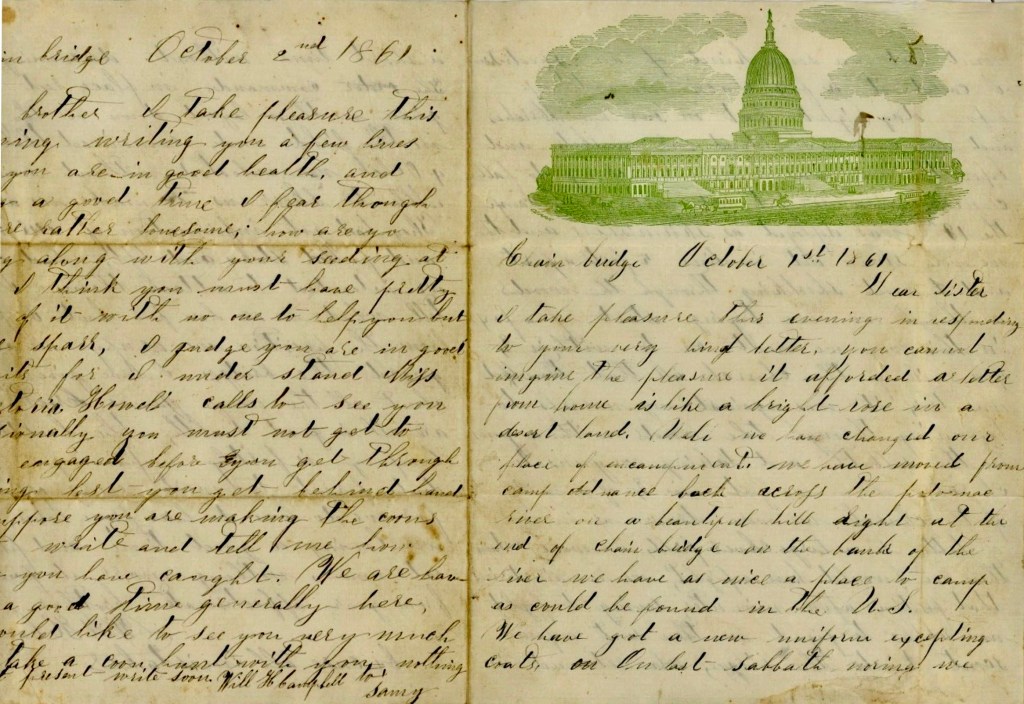
Chain Bridge October 1, 1861
Dear Sister,
I take pleasure this evening in responding to your very kind letter. You cannot imagine the pleasure it afforded [me]. A letter from home is like a bright rose in a desert land. Well, we have changed our place of encampment. We have moved from Camp Ordnance back across the Potomac river on a beautiful hill right at the end of Chain Bridge on the bank of the river. We have as nice a place to camp as could be found in the U. S.
We have got a new uniform excepting coats. On last Sabbath morning we went out on some kind of an expedition. I called it a fox chase. We got up before daylight, put on our new britches and new caps, shouldered our muskets and before the sun was up were marching to Falls Church. When we got 2.5 miles from camp, the 19th was deployed as skirmishers and then we were strewn out in line five feet apart and went skulking through the woods as though we were trying to start up a fox. In this way we went on to within three-quarters of a mile of the church. All that troubled was this. It was against our morals to be running through the woods with a gun on the Sabbath and taking our guns to church.
We were drawn up in line of battle in a large clover field. We were certain then we would have a fight. We remained in that position a few minutes [but] seeing no rebels to fight, we then sent a few scouts into the village who returned in a short time without discovering any. The command, “in place rest” was given. We then laid down in the ground in the field and remained there till 9 o’clock unmolested without seeing any. rebel to skeer us or make us afraid. They had got information of our approach and pulled stakes and left. Hard learned we intended to attack them. I can’t tell you what we are here for but I judge from the position we occupy we are to guard the bridges.
I have given you about all the news. James Crock [ ] are all in good health. The health of the company is fastly improving. Don’t forget to write every opportunity for we do love to hear from home. We are having a good time and plenty to eat now. Nothing more at present. From your affectionate brother, — Will H. Campbell
Excuse all mistakes.
[Note: Fort Craig was a small lunette constructed in September 1861 less than a mile from Arlington House, the estate of Gen. Robert E. Lee.]
Letter 2
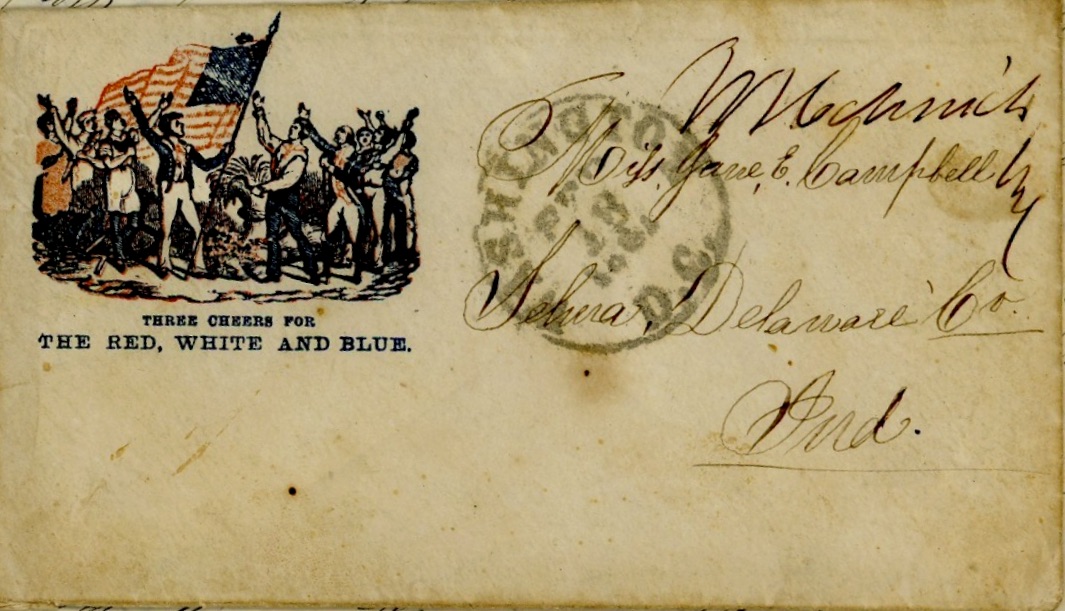
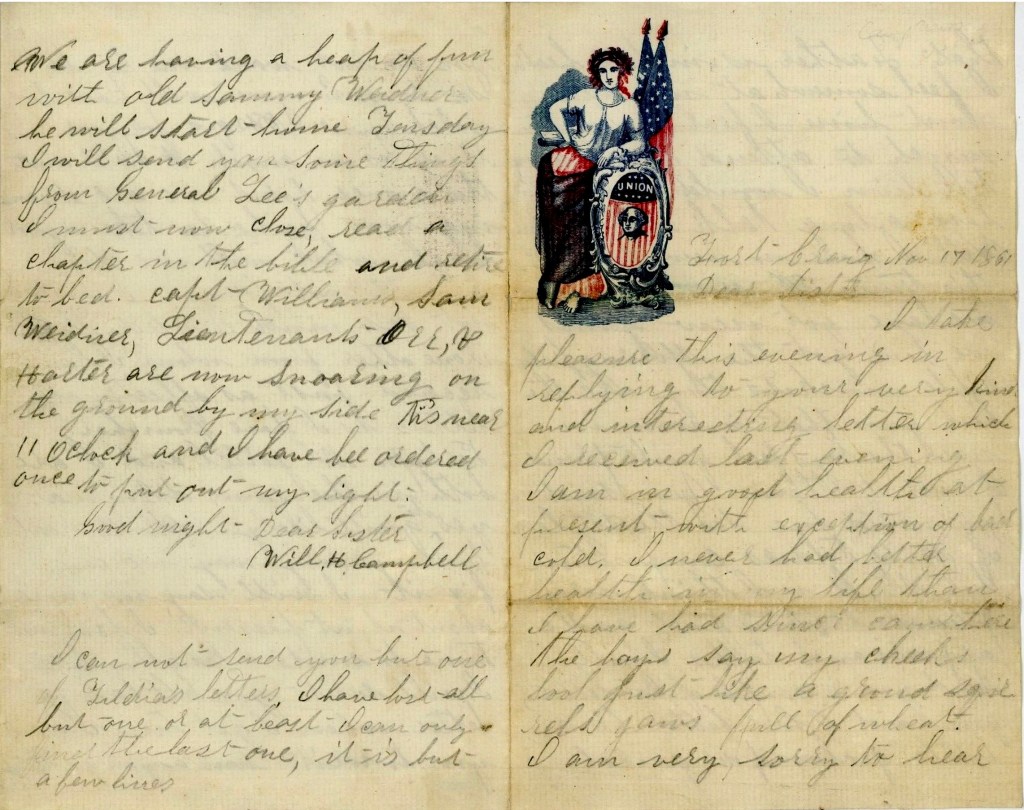
Patriotic stationery on Will’s letter of 17 November 1861
Fort Craig November 17, 1861
Dear Sister,
I take pleasure this evening in replying to your very kind and interesting letter which I received last evening. I am in good health at present with the exception of a bad cold. I never had better health in my life than I have since I came here. The boys say my cheeks look just like a ground squirrel—jaws full of wheat.
I am very sorry to hear that Father is in bad health. I feel somewhat uneasy about him. I fear he has too much to attend to at home. Tell him I would love to have a long talk with him.
Well, I have no news to write this time more than we have got new guns. We have got the Springfield rifle muskets. They are the best gun that is now in use. The boys feel quite proud over of them.
You said you would love to see the style of Miss Tildra’s composition. Her style is, I think, very pleasant. It is just as she appears and talks. I will send you a couple of her letters. You said I had better be a little jealous of Mr. Jarrel. You do not want me to be so, do you? You will have to watch your P’s & Q’s fr your rival is an angel. Sister, ain’t this a nice point we are discussing now? ha-ha-ha. Take a good laugh. What will we do? Were it not for you, I would not be so much troubled. There is one other from whom I have received just as affectionate letters as I have from her. Perhaps Mr. Jerrel and I are both in the same dilemma. Yes, it’s quite likely. Well, it’s real fun anyway we can fix it. I will say no more about it at present.
I have not time to write a lengthy letter. I will write you all a long letter when I get time. I want you to write as soon as you get this.
We are having a heap of fun with old Sammy Weidner. He will start home Tuesday. I will send you some things from General Lee’s garden.
I must now close, read a chapter in the bible, and retire to bed. Capt. Williams, Sam Weidner, Lieutenants Orr & Harter are now snoring on the ground by my side. Tis near 11 o’clock and I have ben ordered once to put out my light. Good night, dear sister, — Will. H. Campbell
I can not send you but one of Tildia’s letters. I have lost all but one, or at least I can only find the last one. It is but a few lines.
Letter 3
Addressed to Jane Campbell, Selma, Delaware county, Indiana
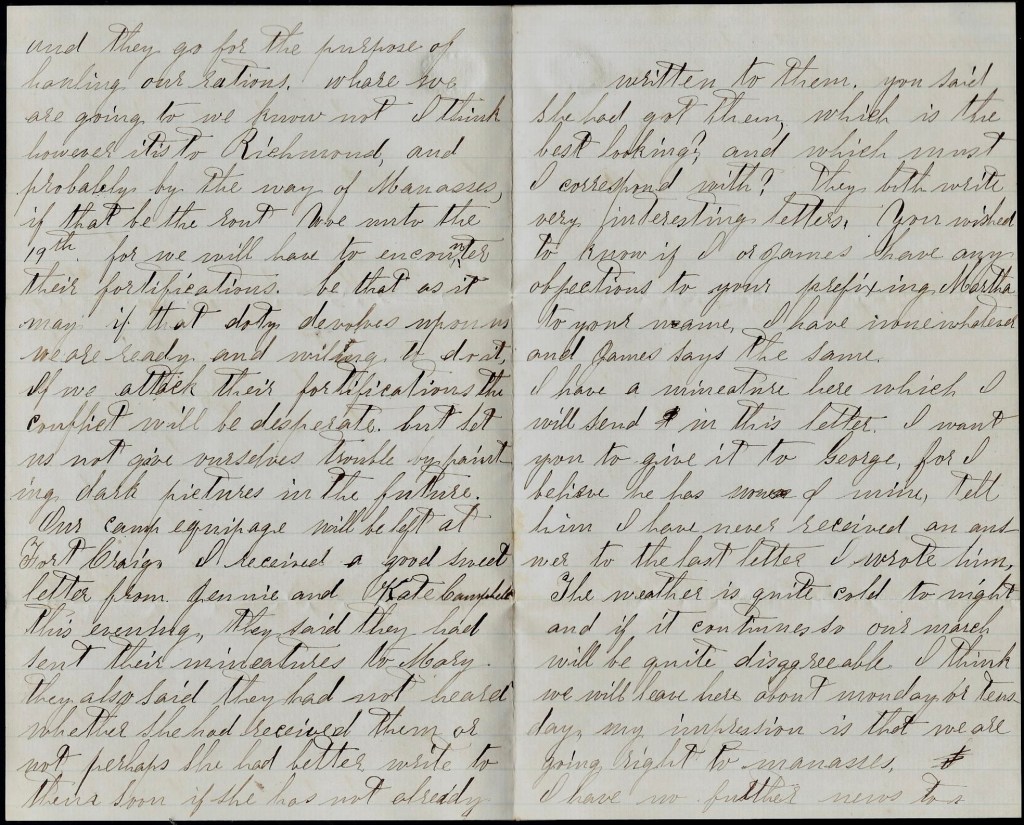
I take the pleasure this evening in replying to your very kind letter. I am in good health at present and as fat as a pig. The health of the regiment is good. The boys are all highly set up with the idea of a forward movement. We are now under marching orders. When we will be called out, I cannot tell. Our orders are to hold ourselves in readiness to march at a moment’s warning. We are allowed to take with us only one blanket, one change of clothes, and a small shelter tent which we have to carry in our knapsack. But 4 wagons is allowed to go with the regiment and they go for the purpose of hauling our rations.
Where we are going to, we know not. I think, however, it is to Richmond and probably by the way of Manassas. If that be the rout of the 19th, we will have to encounter their fortifications. Be that as it may, if that duty devolves upon us, we are ready and willing to do it. If we attack their fortifications, the conflict will be desperate. But let us not give ourselves trouble by painting dark pictures in the future. Our camp equipage will be left at Fort Craig.
I received a good, sweet letter from Jennie and Kate Campbell this evening. They said they had sent their miniatures to Mary. They also said they had not heard whether she had received them or not. Perhaps she had better write to the soon if she has not already written to them. You said she had got them. Which is the best looking? and which must I correspond with? They both write very interesting letters. You wished to know if I or James have any objections to your prefixing Martha to your name. I have none whatever and James says the same.
I have a miniature here which I will send in this letter. I want you to give it to George got I believe he has none of mine. Tell him I have never received an answer to the last letter I wrote him.
The weather is quite cold tonight and if it continues so our march will be quite disagreeable. I think we will leave here about Monday or Tuesday. My impression is that we are going right to Manassas. I have no further news to write at present. Give my love to all inquiring friends, reserving a portion yourself. Your affectionate brother, — Will. H. Campbell










 Spared & Shared 23