
“I have letters of Civil War soldier Charles C. Palmer of Exeter Maine to his sisters. Charlie served in the 1st Maine Cavalry in Washington DC and then in Virginia. He was captured in late 1864 and died at Salisbury prison in January 1865. Would you like to take a look at his letters from Camp Butler and Fredericksburg?” So wrote Kathleen Mikaelian to me recently after discovering the box of letters among her husband’s family heirlooms. She later told me that she hoped to keep Charley’s history alive by showcasing his letters on Spared & Shared.

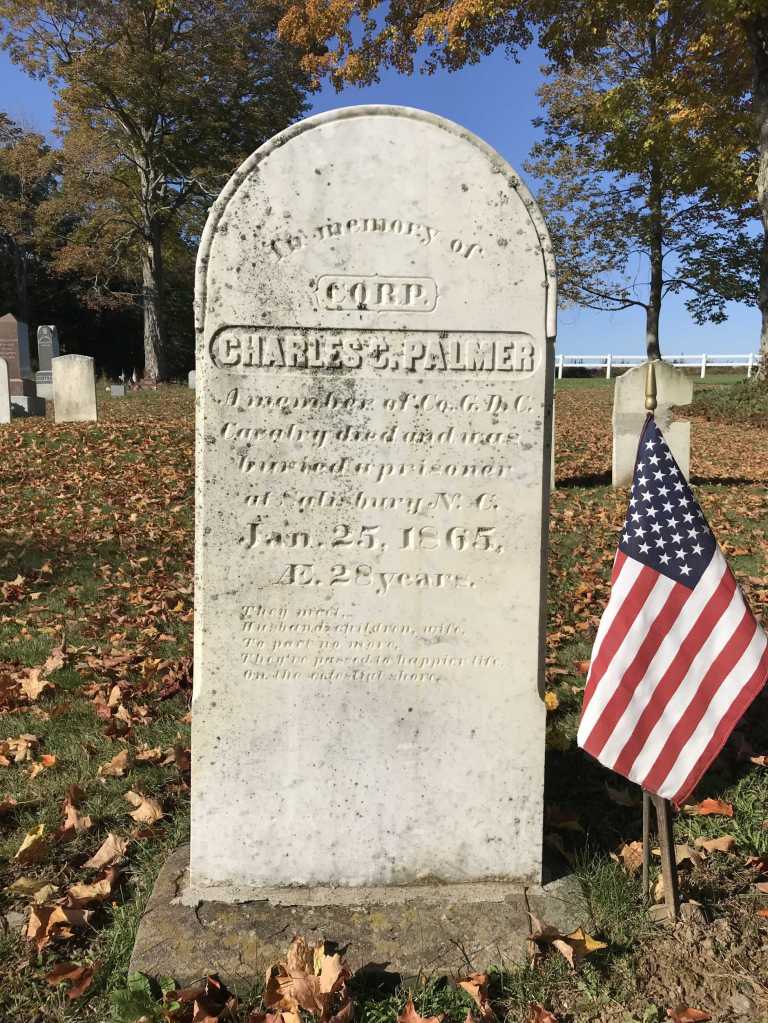
Charles C. Palmer (1837-1865) was the son of William Palmer (1789-1865) and Susanna Treadwell (1793-1864) of Exeter, Penobscot county, Maine. He was married in October 1858 to Nancy Jane (“Jennie”) Neal (1838-1863), was childless and working as a miller in Exeter when he enlisted as a corporal in Co. L, 1st Maine Cavalry early in the war. After this initial stint in the service, Charlie returned to Exeter where tragedy greeted him. In October 1863, Charlie’s wife delivered stillborn twins and suffered so much physically and emotionally that she died two months later, leaving a grieving husband to mourn the loss of his entire family. With nothing to hold him in Exeter any longer, Charlie left his teaching job and re-entered the service, this time in Co. G, 1st District of Columbia Cavalry. His muster date was given as 19 February 1864 at which time he was described as 24 years old, standing 5 foot 11 inches tall, with hazel eyes and brown hair.
Charlie was no long with the D. C. Cavalry when he was promoted to corporal. Except for a period of time when he was hospitalized at the Point of Rocks in mid-summer, Charlie appears to have been with his regiment though he may have found it dull at times. So much so that on 25 May 1864 he was known to have sent a letter to General George F. Shepley requesting special duty. His letter was found in military records and reads as follows:
Camp Conger, 20 May 1864
General Shepley, Sir, I trust you will pardon me for intruding upon your much valued time. But my object in so doing is to see if through you or your influence I can obtain a position on one of the many confiscated plantations under your jurisdiction, and if not, some other position which may be of better advantage to me and also serve my country truly for I would scorn the thought of trying to obtain any position where I could not serve my country in this her hour of peril.
I am a native of Exeter, Maine, and for the few years past have been engaged in teaching. But in my younger years was a farmer’s boy. If you wish for any recommendations, I can get them and good too in my own regiment—and also from many influential men in Maine, among them Adjt. General Hodson. But if I get anything, I had rather my own merit would claim it as rightly its own. I came into my company after it was organized and am now corporal.
I trust you will give this note due consideration and shall hope soon to hear from [you]. But yet I know that your time must well nigh be occupied and labors hard. Yours respectfully, — Charles C. Palmer, 1st D. C. Cavalry.
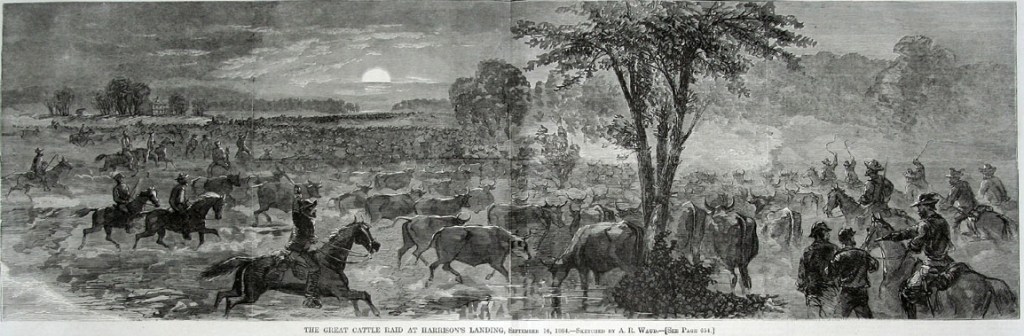
The position Charley sought was to oversee the work on one of the many plantations in Virginia that were being operated by the Federal government to employ the slaves who had come under federal protection. School for the freedmen were also being set up on or near these plantations. It does not appear that Charlie was ever offered such a position and his aspiration for such an assignment may have waned when he became ill later in the summer. It seems he remained with his regiment until 16 September 1864 when he was taken prisoner at Sycamore Church, six miles below City Point on the James River, along with other members of the 1st D. C. Cavalry who were caught by surprise in their beds by Confederate Major General Wade Hampton in what has come to be known as the Great Beefstake Raid. In 30 minutes, the Confederates killed, wounded, or captured 219 startled troopers. Charlie was initially confined in Richmond but then sent to Danville on 24 September and admitted to the hospital at Salisbury, North Carolina, on 31 December 1864 suffering from chronic diarrhea. He died on 26 January 1865.
Letter 1
Camp Butler, Virginia
May 3rd 1864
Beloved sisters,
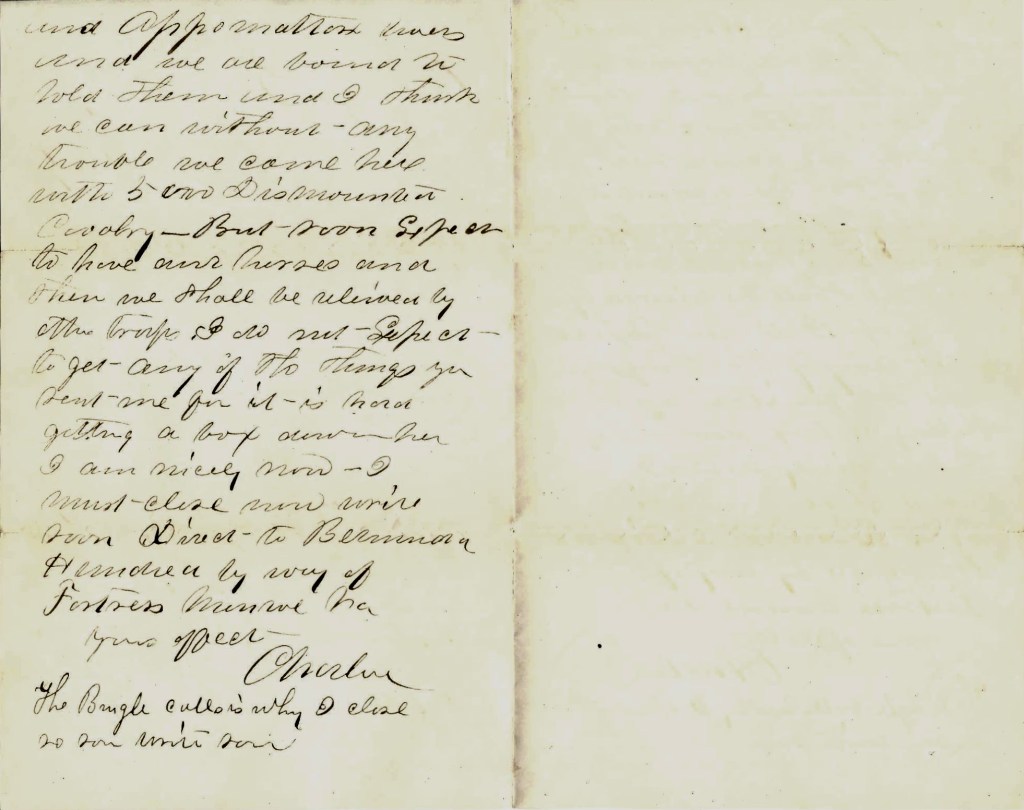
Your kind and welcome letters came to hand this morning and was glad to hear from you both again. I did not receive any mail from the time I left Washington until today and then I get 11 letters and this is the last I have to answer. We have not been here but a few days yet our work has been very hard, there being but a few troops here and the Rebs have been trying to break our center but in vain. We have lost but a few men and only one from our regiment.
I like it much and am glad that I am here. We have a line of defenses on the James and Appomattox rivers and we are bound to hold them and I think we can without any trouble. We came here with 5,000 dismounted cavalry but soon expect to have our horses and then we shall be relieved by other troops. I do not expect to get any of the things you sent me for it is hard getting a box down here.
I am nicely [situated] now. I must close now. Write soon. Direct to Bermuda Hundred by way of Fortress Monroe, Va.
Yours affectionately, — Charley
The bugle’s call is why I close so soon. Write soon.






 Spared & Shared 23