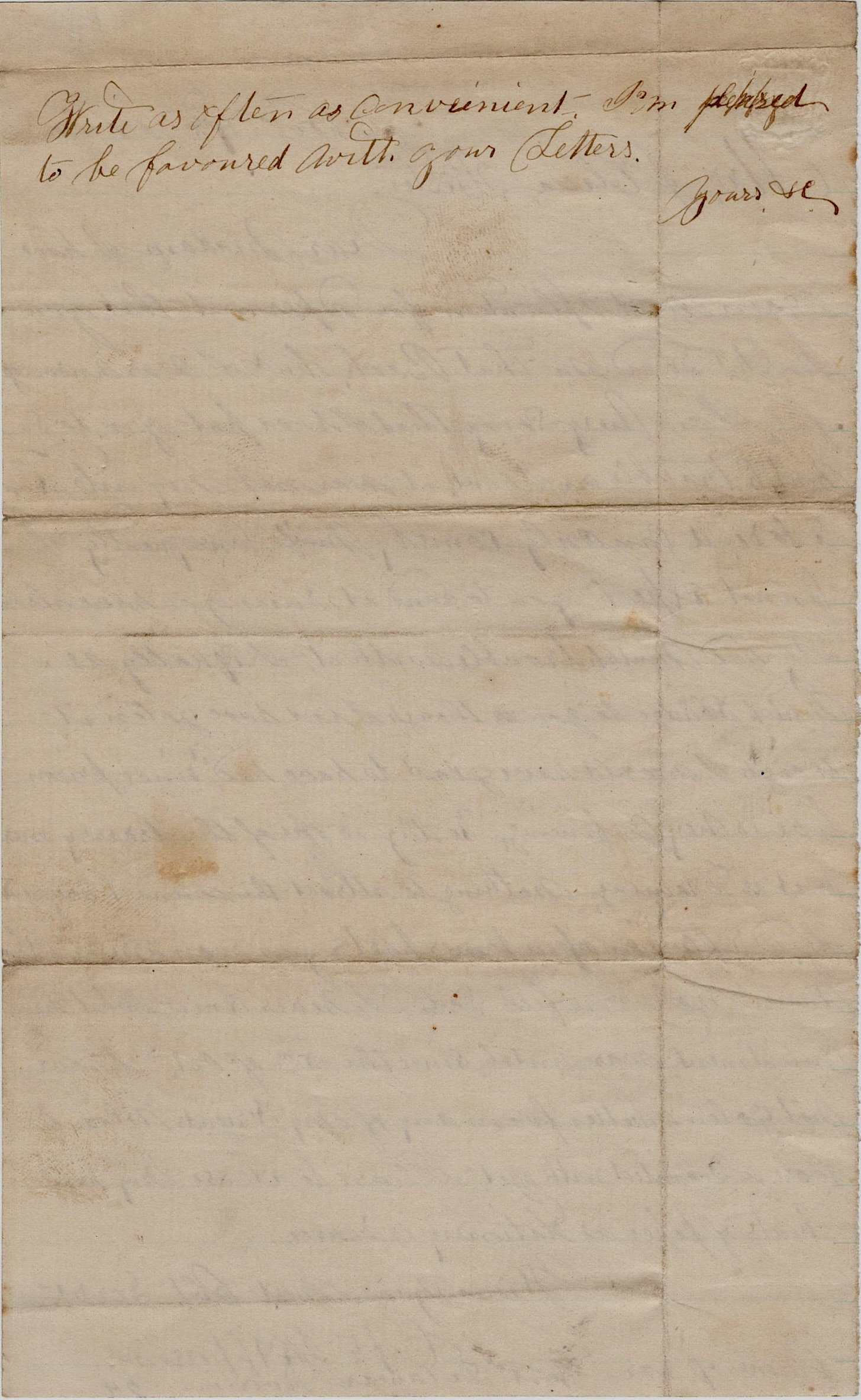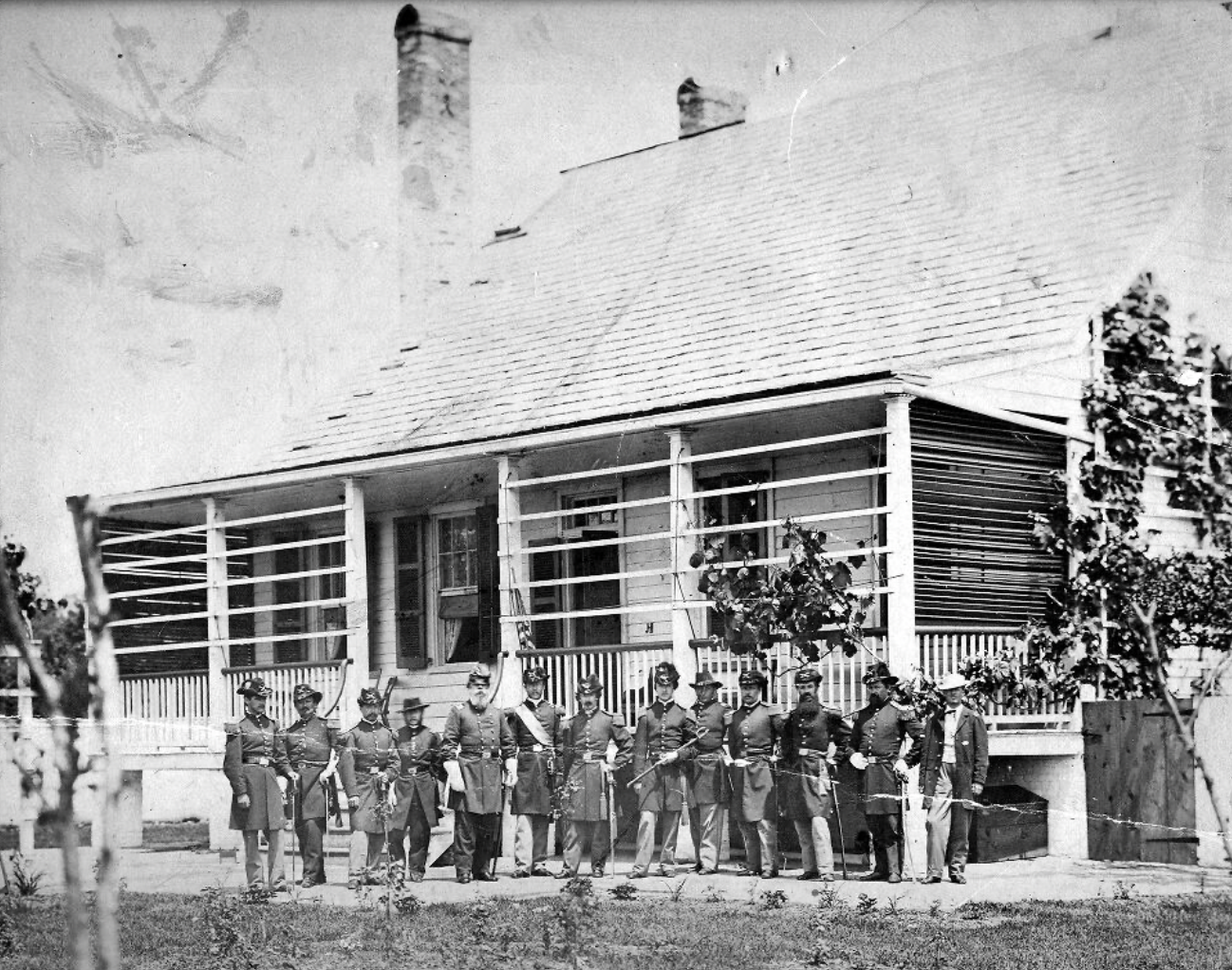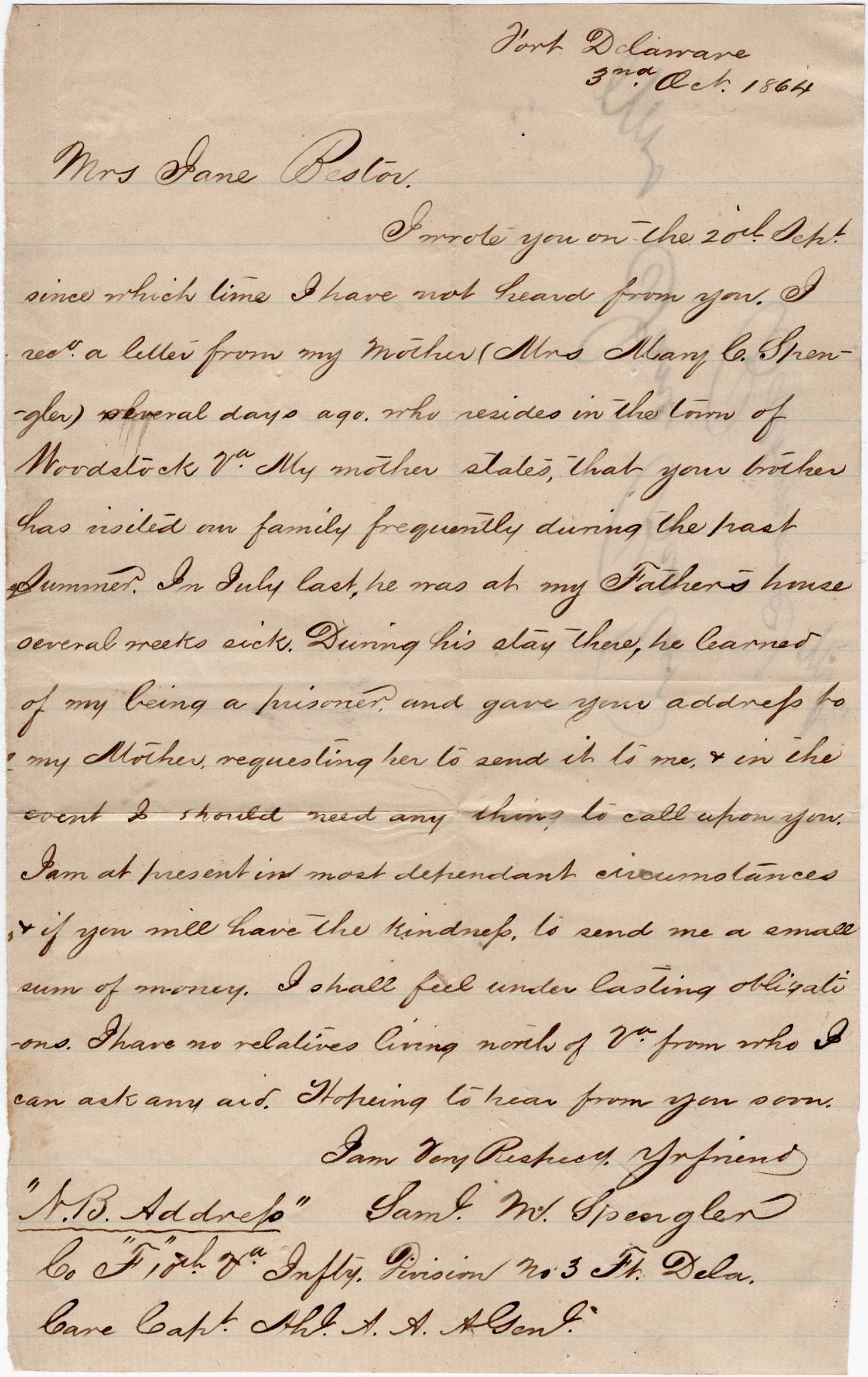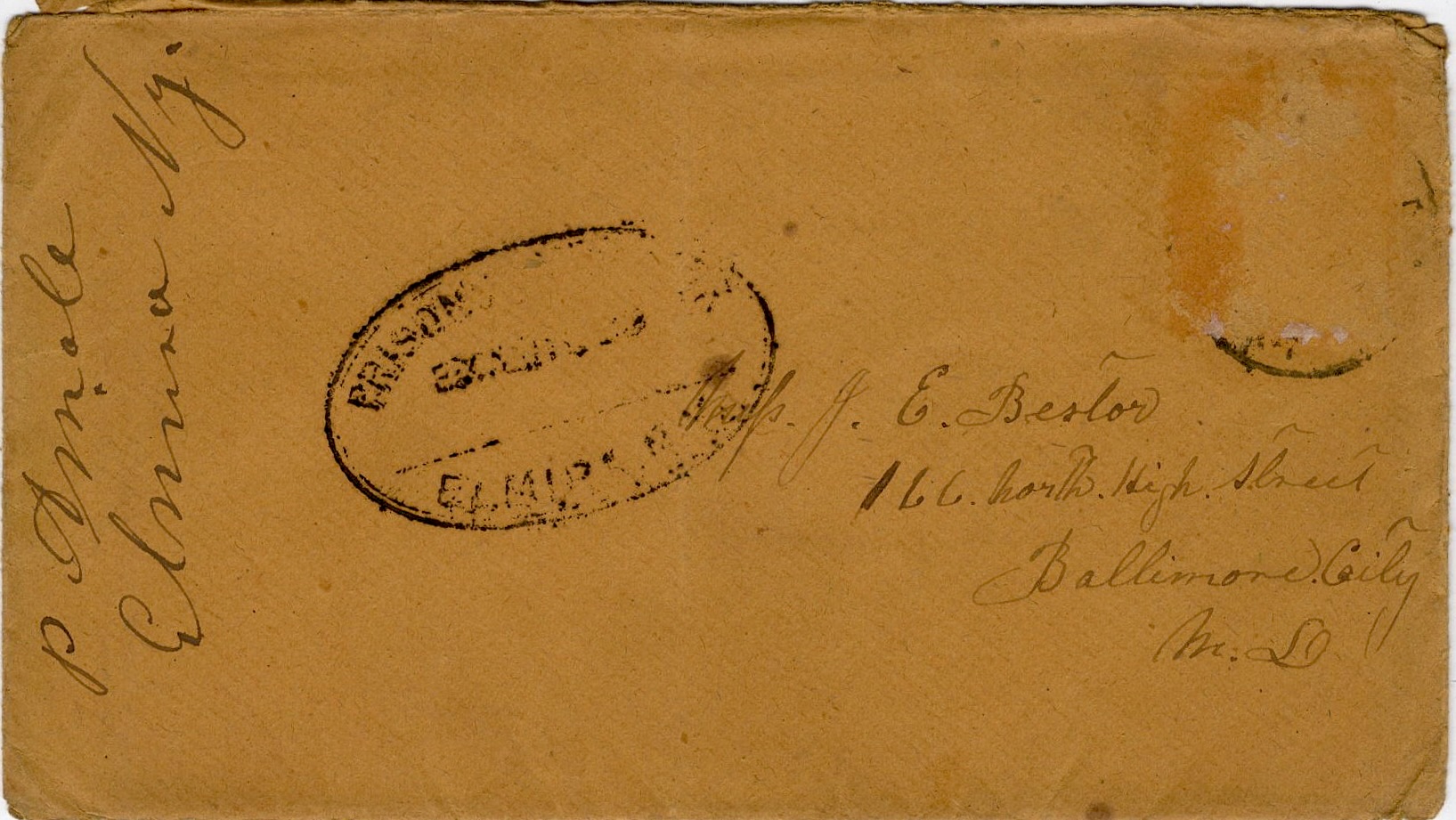
Category Archives: Prisoner of War

1862: John M. and Parney (Hastings) Anderson to John Emerson Anderson

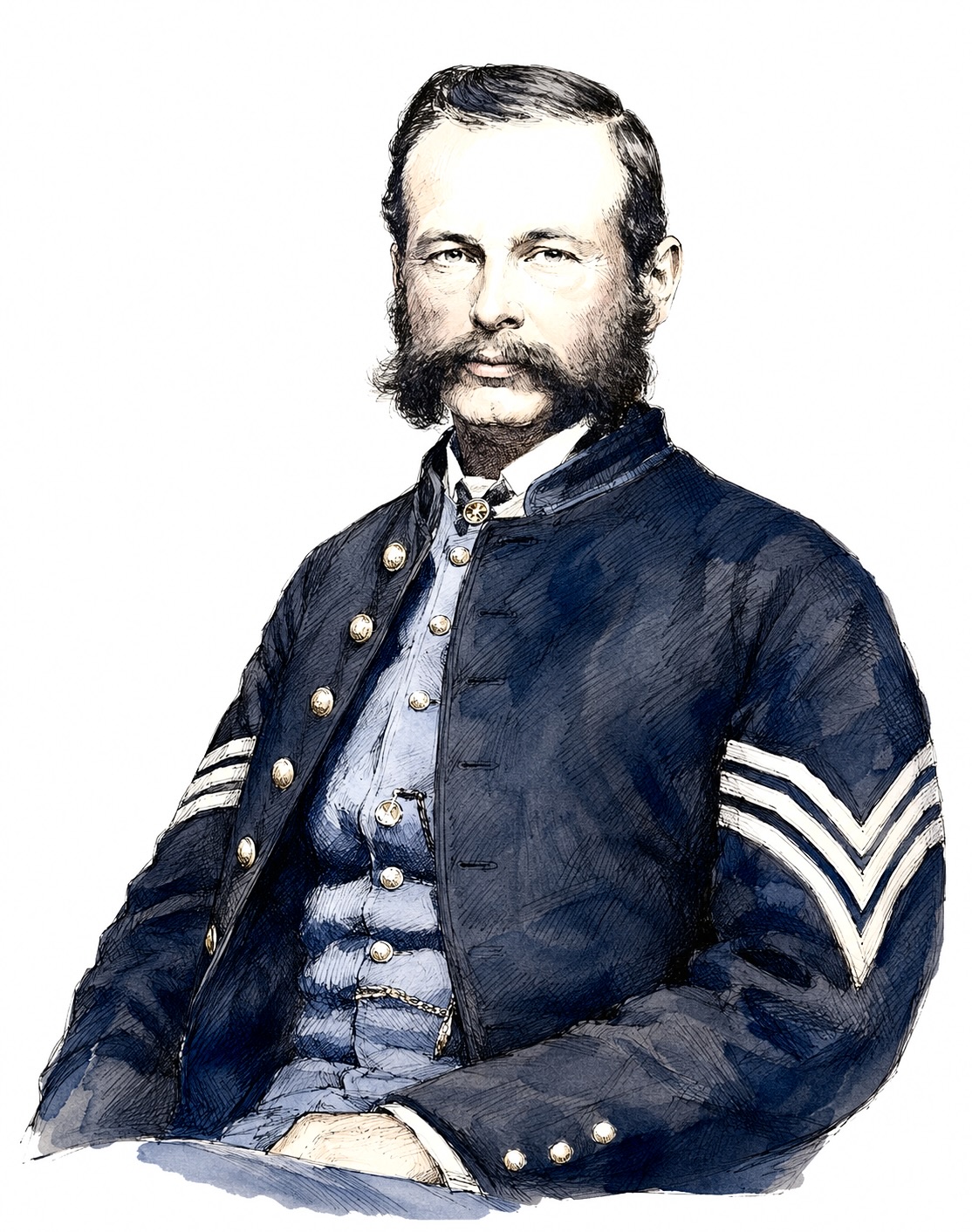
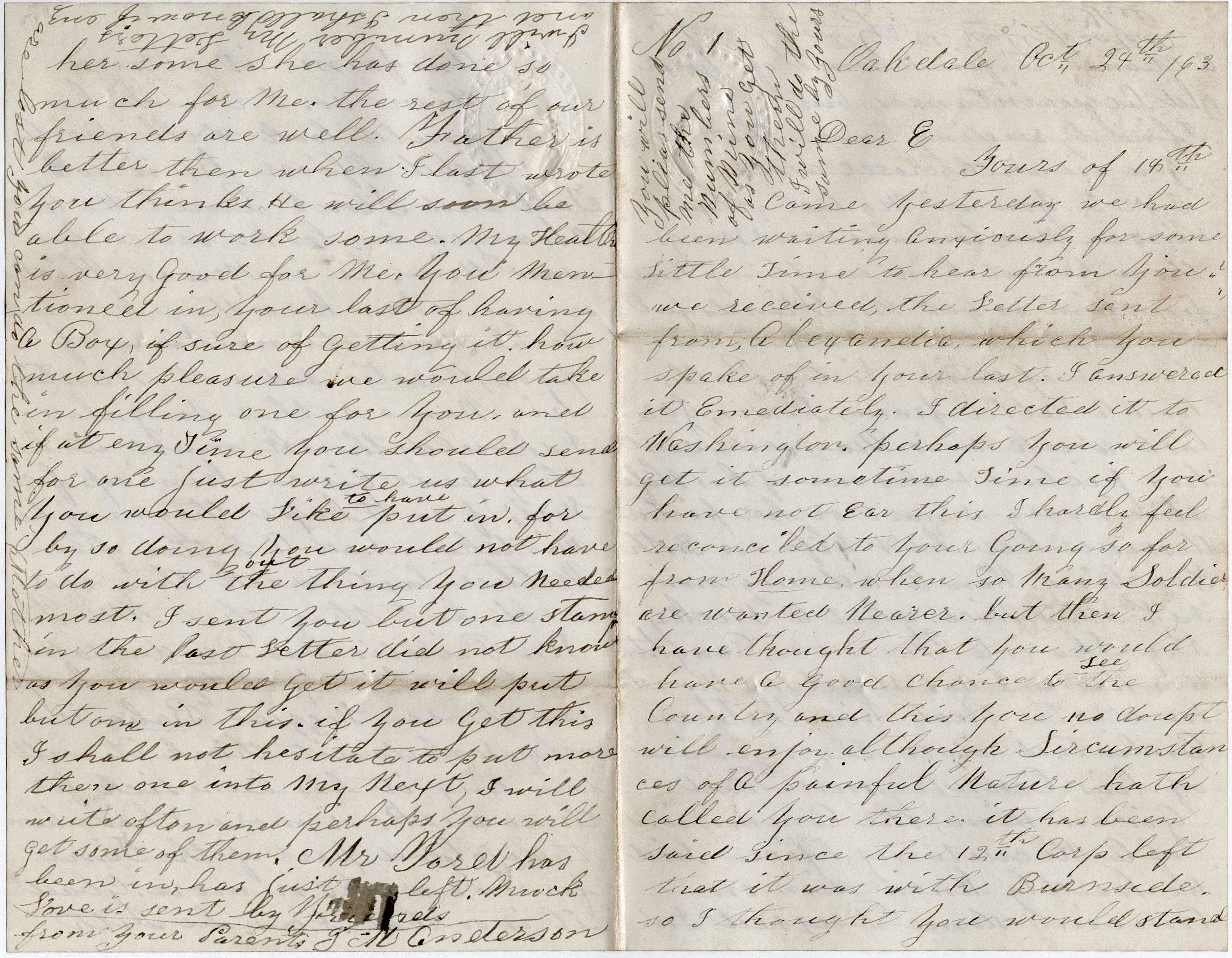
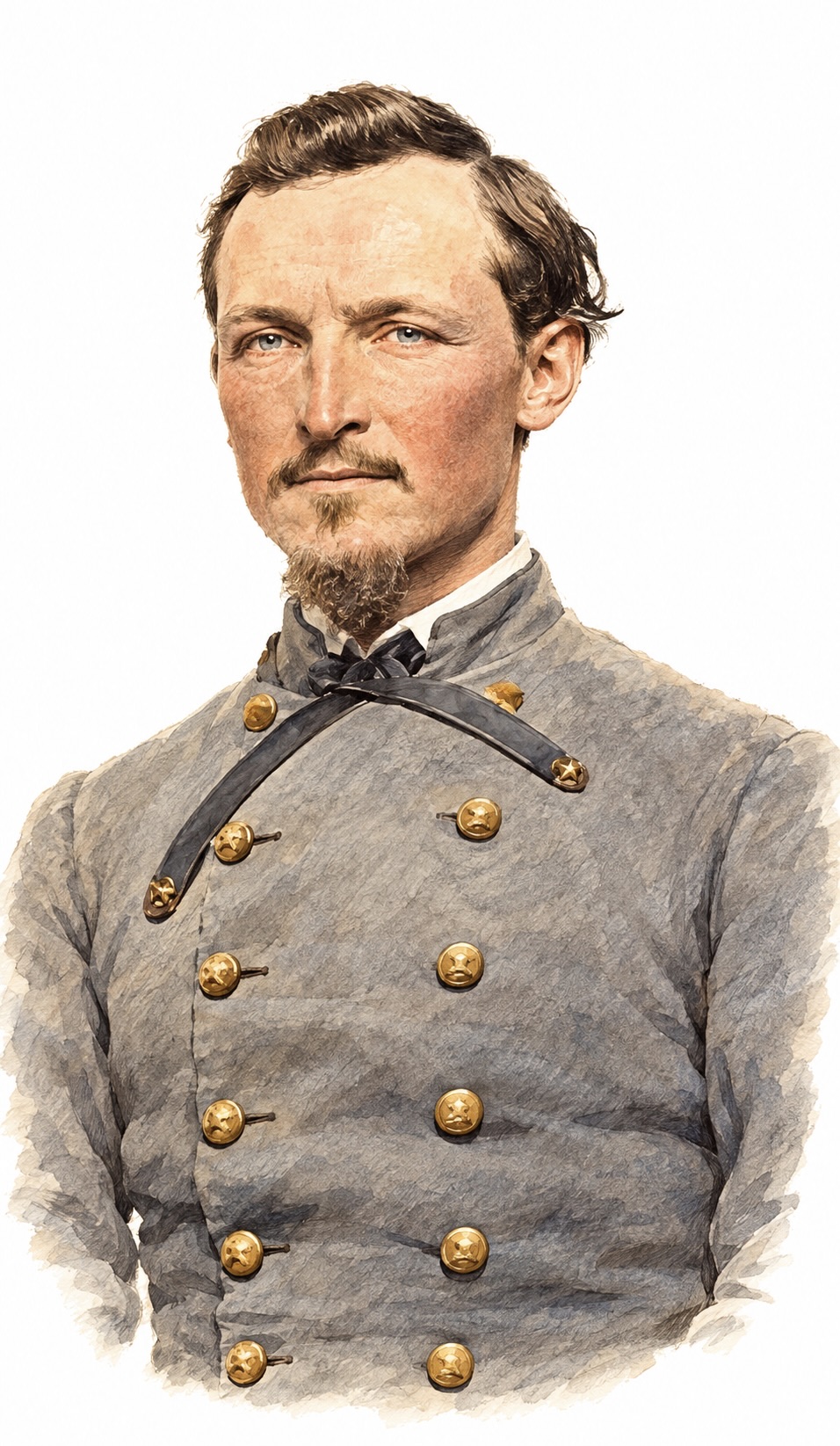
John Emerson Anderson, 2nd Mass. Vols., taken prisoner at the Battle of Winchester on 24 May 1862 and paroled in June.

The following letters were written by Parney (Hastings) Anderson (1810-1905) and/or her husband John May Anderson (1809-1865) of Oakdale, Worcester county, Massachusetts. The letters were addressed to their son, John “Emerson” Anderson (1833-1896), a boot maker by trade before the war. Emerson enlisted on 25 May 1861 as a private in Co. D, 2nd Massachusetts Infantry. He was taken prisoner on 24 May 1862 during the battle of Winchester but was paroled in June 1862 and promoted to sergeant, mustering out of the regiment in mid-July 1865. The 2nd Mass Vols. participated in the battles of Cedar Mountain, Antietam, Chancellorsville, Gettysburg, Resaca, Kennesaw Mountain, Siege of Atlanta, March to the Sea, Savannah, and others.
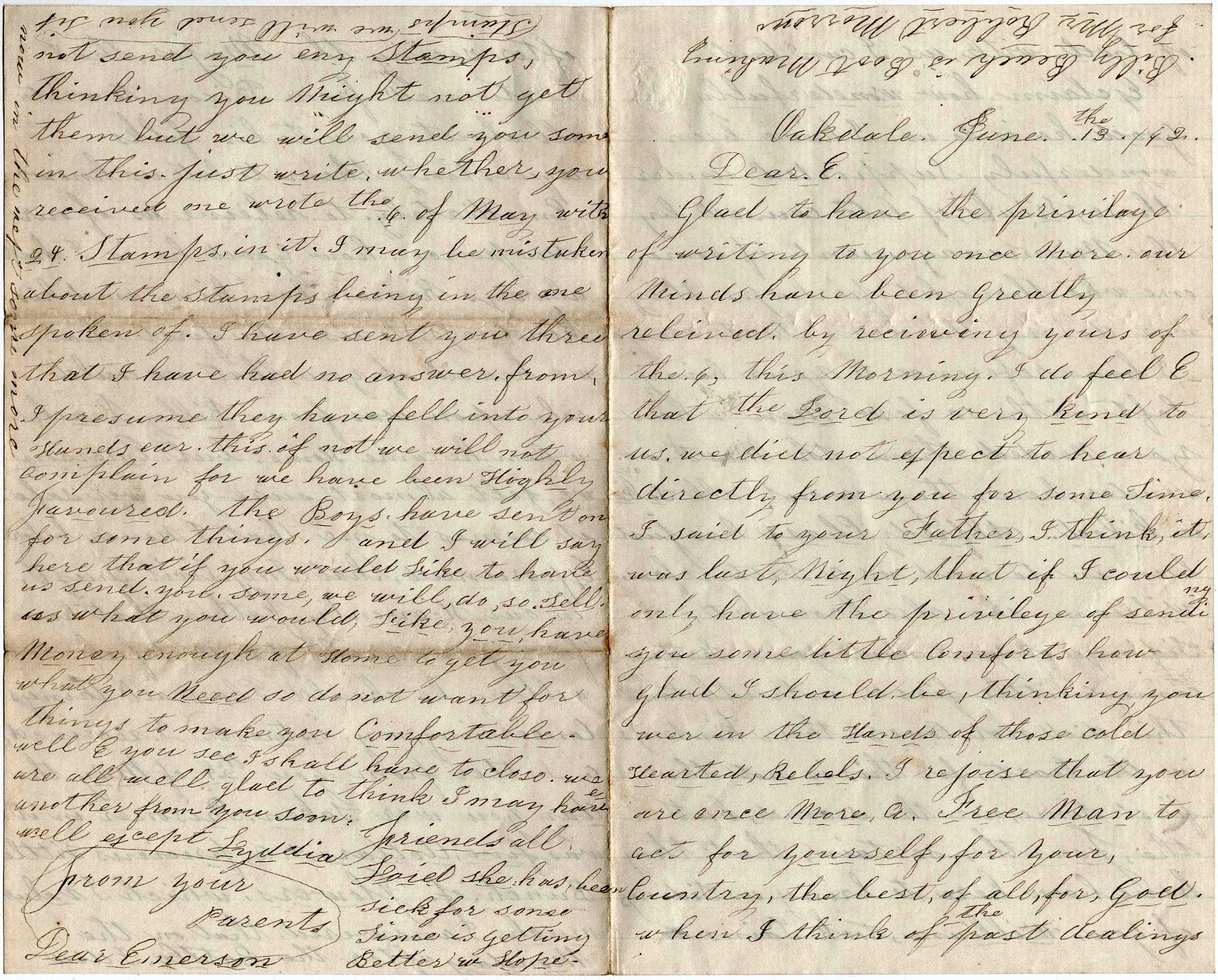
Parney’s letter of 13 June 1862 expresses relief at hearing of her son’s safety following his being taken prisoner during the Battle of Winchester in May 1862.

To read the large collection of letters that Emerson wrote home to his parents, see—1861-65: John Emerson Anderson to his Parents.

Letter 1

Oakdale [Massachusetts]
June 13, 1862

Dear E[merson],

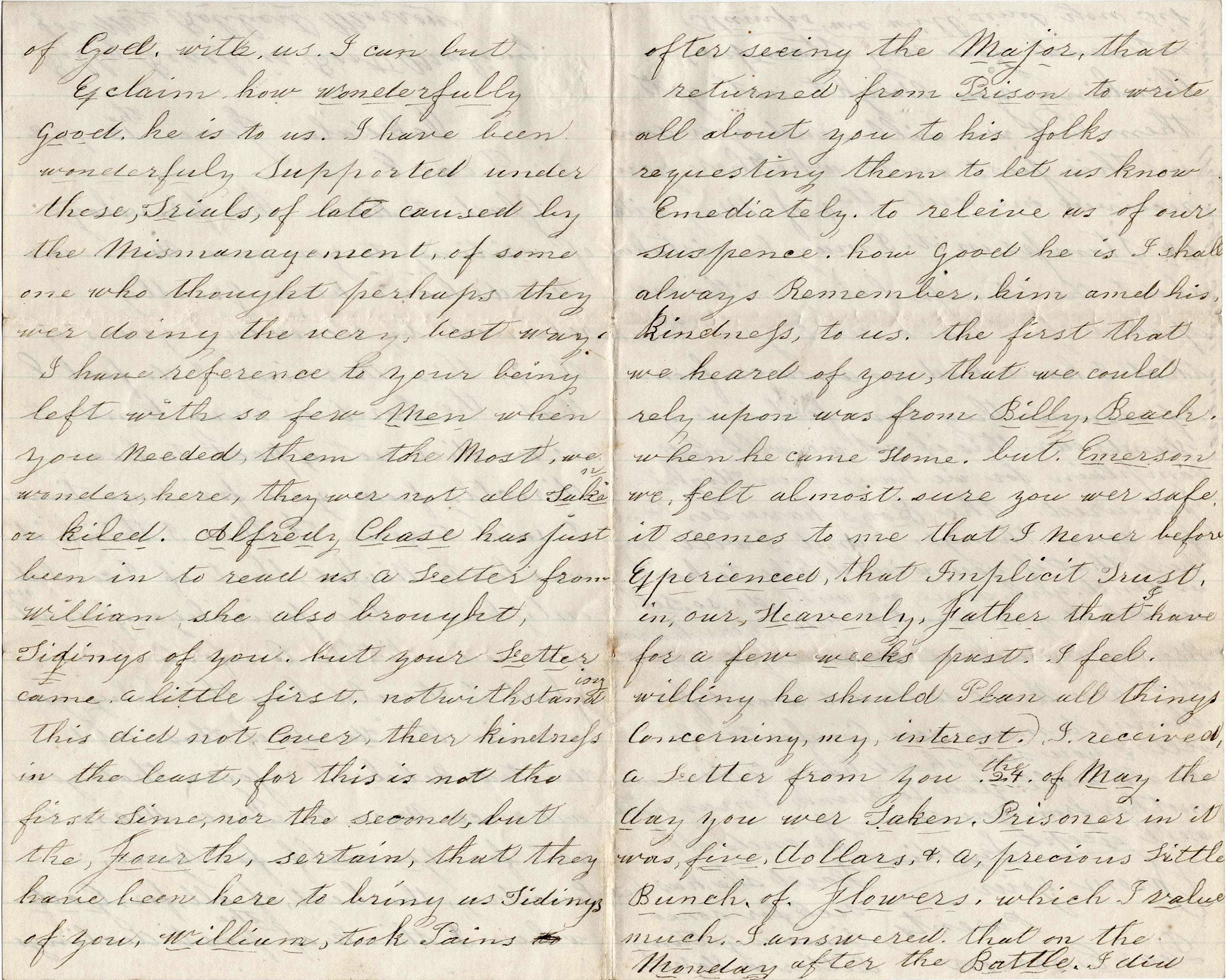
Glad to have the privilege of writing to you once more. Our minds have been greatly relieved by receiving yours of the 6th this morning. I do feel, Emerson, that the Lord is very kind to us. We did not expect to hear directly from you for some time. I said to your father, I think it was last night, that if I could only have the privilege of sending you some little comforts, how glad I should be, thinking you were in the hands of those cold-hearted rebels. I rejoice that you are once more a free man to act for yourself for your country, [and] the best of all, for God. When I think of the past dealings of God with us, I can but exclaim how wonderfully good He is to us. I have been wonderfully supported under these trials of late caused by the mismanagement of someone who thought perhaps they were doing the very best way. I have reference to your being left with so few men when you needed them the most. We wonder here they were were not all taken or killed.

Alfredy Chase has just been in to read us a letter from William. She also brought tidings of you but your letter came a little first, notwithstanding this did not cover their kindness in the least for this is not the first time, nor the second, but the fourth, certain, that they have been here to bring us tidings of you. William took pains after seeing the Major that returned from prison to write all about you to his folks requesting them to let us know immediately to relieve us of our suspense. How good he is. I shall always remember him and his kindness to us. The first that we heard of you that we could rely upon was Billy Beach when he came home. But Emerson, we felt almost sure that you were safe. It seems to me that I never before experienced that implicit trust in our Heavenly Father that I have for a few weeks past. I feel willing he should plan all things concerning my interest.

I received a letter from you the 24th of May—the day you were taken prisoner. In it was five dollars & a precious little bunch of flowers which I value much. I answered that on the Monday after the battle. I did not send you any stamps thinking you might not get them but we will send you some in this. Just write whether you received one wrote the 6th of May with 24 stamps in it. I may be mistaken about the stamps being in the one spoken of. I have sent you three that I have had no answer from. I presume they have fell into your hands ere this. If not, we will not complain for we have been highly favored.

The [Oakdale] Boys have sent on for some things and I will say here that if you would like to have us send you some, we will do so. Tell us what you would like. You have money enough at home to get you what you need so do not want for things to make you comfortable. Well, Emerson, you see I shall have to close. We are all well. Glad to think I may have another from you soon. Friends all well except Lydia. Said she has been sick for some time since. Getting better we hope. From your Parents.

Billy Beach is boot making for Mr. Robert Morrow.


Letter 2

Oakdale, [Massachusetts]
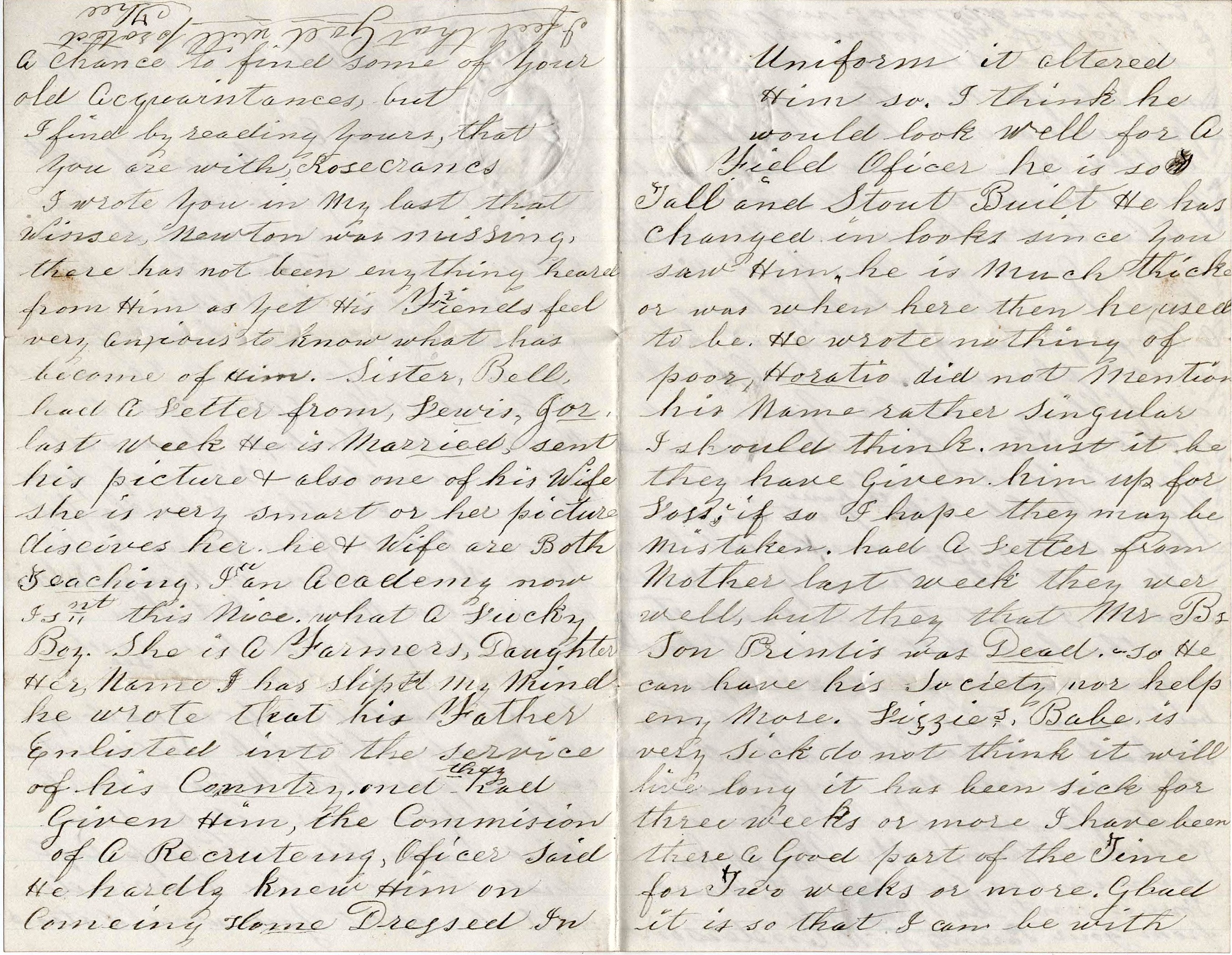
October 24th 1863

Dear Emerson,

Yours of the 18th came yesterday. We had been waiting anxiously for some little time to hear from you. We received the letter sent from Alexandria which you spoke of in your last. I answered it immediately. I directed it to Washington. Perhaps you will get it sometime if you have not ere this. I hardly feel reconciled to your going so far from home when so many soldiers are wanted nearer. But then I have thought that you would have a good chance to see the country and this you no doubt will enjoy although circumstances of a painful nature hath called you there. It has been said since the 12th Corps left, that it was with Burnside so I thought you would stand a chance to find some of your old acquaintances, but I find by sending yours that you are with Rosecrans.

I wrote you in my last that Winser Newton was missing. There has not been anything heard from him as yet. His friends feel very anxious to know what has become of him.

Sister Belle [Isabella (Hastings) Bigelow] had a letter from Lewis Jor last week. He is married. Sent his picture and also one of his wife. She is very smart or her picture deceives her. He and wife are both teaching in an academy now. Isn’t this nice. What a lucky boy. She is a farmer’s daughter. Her name has slipped my mind. He wrote that his father enlisted into the service of his country and they had given him the commission of a recruiting officer. Said we hardly knew him on coming home dressed in uniform—it altered him so. I think he would look well for a field officer—he is so tall and stout built. He has changed his looks since you saw him. He is much thicker, or was when here, than he used to be. He wrote nothing of poor Horatio. Did not mention his name. Rather singular I should think. Must it be they have given him up for loss? If so, I hope they may be mistaken.

Had a letter from Mother last week. They were well but they [said] that Mr. B’s son Prentis was dead so he can have his society nor help anymore. Lizzie’s babe is very sick. Do not think it will live long. It has been sick for three weeks or more. I have been there a good part of the time for two weeks or more. Glad it is so that I can be with her some. She has done so much for me. The rest of our friends are well. Father is better than when I last wrote. You think he will soon be able to work some. My health is very good for me. You mentioned in your last of having a box, if sure of getting it. How much pleasure we would take in filling one for you and if at any time you should send for me, just write what you would like to have put in for by so doing, you would not have to do without the thing you needed most. I sent you but one stamp in the last letter. Did not know as you would get it. Will put but one in this. If you get this, I shall not hesitate to put more of them in my next. I will write often and perhaps you will get some of them.

Mr. Ford has been in [and] has just left. Much love is sent by friends. From your parents, — J. M. Anderson


Letter 3

Oakdale, [Massachusetts]
November 28, 1863

Dear Emerson,

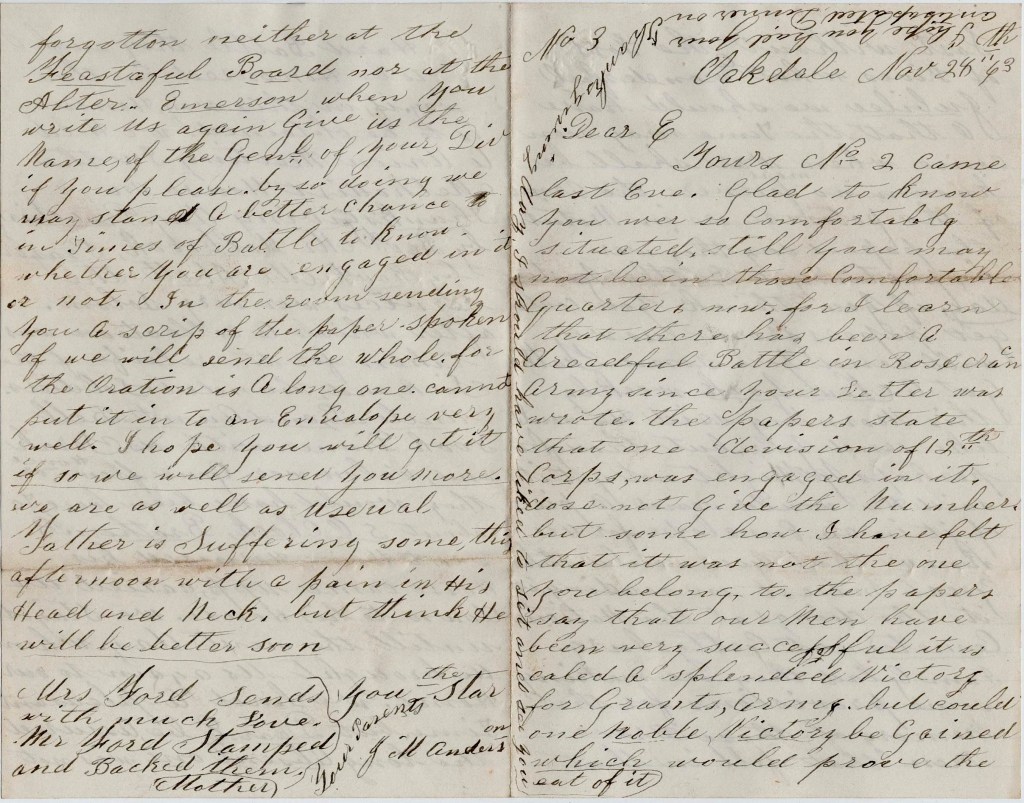
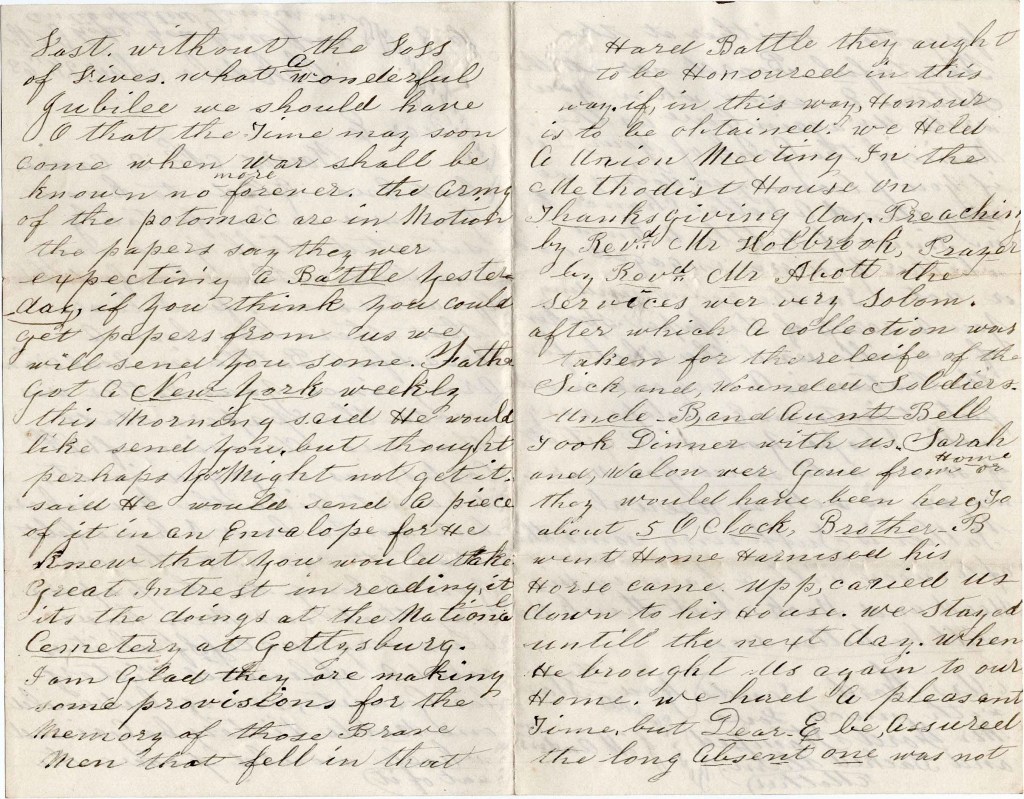
Yours No. 2 came last eve. Glad to know you were so comfortably situated. Still you may not be in those comfortable quarters now for I learn that that there has been a dreadful battle [at Chattanooga] in Rosecrans’ army since your last letter was wrote. The papers state that one division of the 12th Corps was engaged in it [but] does not give the number. But somehow I have felt that it was not the one you belong to. The papers say that our men have been very successful. It is called a splendid victory for Grant’s army. But could one noble victory be gained which would prove the last without the loss of lives, what a wonderful jubilee we should have. Oh that the time may soon come when war shall be known no more forever.

The Army of the Potomac are in motion. The papers say they were expecting a battle yesterday. If you think you could get papers from us, we will send you some. Father got a New York weekly this morning. Said he would like to send you but thought perhaps you might not get it. Said he would send a piece of it in an envelope for he knew that you would take great interest in reading it. It’s the doings of the National Cemetery at Gettysburg. I am glad that they are making some provisions for the memory of those brave men that fell in that hard battle. They ought to be honored in this way. Honor is to be obtained.

We held a Union Meeting in the Methodist House on Thanksgiving day. Preaching by Rev. Mr. Holbrook, prayer by Rev. Mr. Abbott. The services were very solemn, after which a collection was taken for the relief of the sick and wounded soldiers, Uncle B and Aunt Belle took dinner with us. Sarah and Walon was gone from home or they would have been here too. About 5 o’clock Brother B. went home, harnessed his horse, came up [and] carried us down to his house. We stayed until the next day when he brought us again to our home. We had a pleasant time. But dear Emerson, be assured the long absent one was not forgotten, neither at the Festival board nor at the alter.

Emerson, when you write us again, give us the name of the general of your division, if you please. By so doing, we may stand a better chance in times of battle to know whether you are engaged or not. We are as well as usual. Father is suffering some this afternoon with a pain in his head and neck, but thinks he will be better soon. Mrs. Ford sends with much love. Mt. Ford stamped and backed them. Your parents, Mother

I hope you had your anticipated dinner on Thanksgiving day. I should have liked to sit and see you eat of it. Your parents, — J. M. Anderson


1862: Robert Hindman Ray to William Ray

Robert Hindman Ray (1841-1871) was twenty years old when he enlisted on 10 June 1861 to serve in Co. C (the “Dixon Guards”), 11th Pennsylvania Reserves (40th Pennsylvania Regiment). He was promoted to corporal in April 1863 and mustered out of the regiment in June 1864. He was the son of John Ray (1798-1876) and Ann Smith (who died in 1850). The family residence was in Fairview, Butler county, Pennsylvania. Robert wrote the letter to his older brother, William Ray (1826-1873).

[Note: This letter is from the collection of Keith Fleckner and was offered for transcription and publication on Spared & Shared by express consent.]

This early-day view of Fairfield, Butler county, Pennsylvania states that the house under the arrow was where Robert’s older brother, Matthew Smith Ray (1830-1908), “went to housekeeping” in 1854.

T R A N S C R I P T I O N

Camp at Brooks Station, Virginia
November 25th 1862

Dear brother,

I seat myself to pen you a few lines to let you know that I am well, hoping these lines may find you the same. I should have written to you sooner and will have to ask your pardon for not doing so, but we were always moving and I thought that I would wait until we would stop someplace to stay awhile but it appears that that place will not be found for a while. I do not know where to begin nor where to end this. When I wrote to you last, we were at Fredericksburg, only about ten miles from where we are now. But shortly after that we went to the Peninsula and joined McClellan’s army. We were there about two weeks when we got into a fight [at Gaines’ Mill] and a hard one it was. There was 4 killed and 22 wounded in our company. [Lt.] Newton Redec was killed. The remainder was taken prisoners. We were taken to Richmond and kept there from the 27th of June till the 5th day of August. We got pretty hard usage but I have not time to give you a full account, but we spent some hungry times.

We were exchanged and put right into the service again. We were brought back here and joined Pope’s army. Then came the Battle of Bull Run where we suffered heavy again. Lieutenant [John C.] Kuhn was killed there also your old friend Samuel Christley. Then when the Rebels went into Maryland, McClellan got command and we whipped the Rebs at South Mountain and Antietam. And [just] when he got his army again ready and had commenced to move, he was removed, which was the ruination of our army. But we can’t help it.

I have great reason to be thankful that my life has been preserved.  We are expecting another battle soon. I had a letter from home yesterday. They are all well. I do not know that I have much to write that would be of any interest to you. It appears to me that this is being made a political war. I hope we may be victorious but the war must be a long one—it cannot be otherwise. We need not talk of starving them out. That is “played out.” They have a large army and will fight and are determined to fight as long as there is one of them left. I hope the war may soon be over. All hope this. I have seen enough to satisfy me.  

I saw William Starey yesterday. He is well. I heard that you were talking of coming home. Let me know when. Let me know what you are doing and all the news that you can of. I would write more but I have nothing to write that would interest you. Write soon. Nothing more but remain your brother, — R.H. Ray

William Ray

Direct to R.H. Ray, Co. C, 11th Regt. PRC

The owner of this image says the reverse side identifies one of these Union privates as Robert H. Ray but can’t be certain which. He thinks it to be the one at left but my interpretation suggests it’s the one at right and his facial features more closely align with those of a brother identified on Ancestry.com

1864: Reuben M. Colby to Eliphalet Smith

The following Prisoner of War (POW) Letter was penned by Reuben M. Colby (1839-1893) who served in Co. B, 20th Ohio Volunteer Infantry (OVI). He entered the service on 27 April 1861 as a sergeant in Co. H and was promoted to sergeant in Co. B in September 1861. He was next commissioned a 2nd Lieutenant in January 1863 and a 1st Lieutenant in July 1864. He finally mustered out as a Captain on 15 July 1865. In 1850, 10 year-old Reuben was living with his parents, Simeon and stepmother Marianne (Porter) Colby in Roxbury, Norfolk, Massachusetts. In 1860, Reuben was working as a carpenter in Louisville, Kentucky.
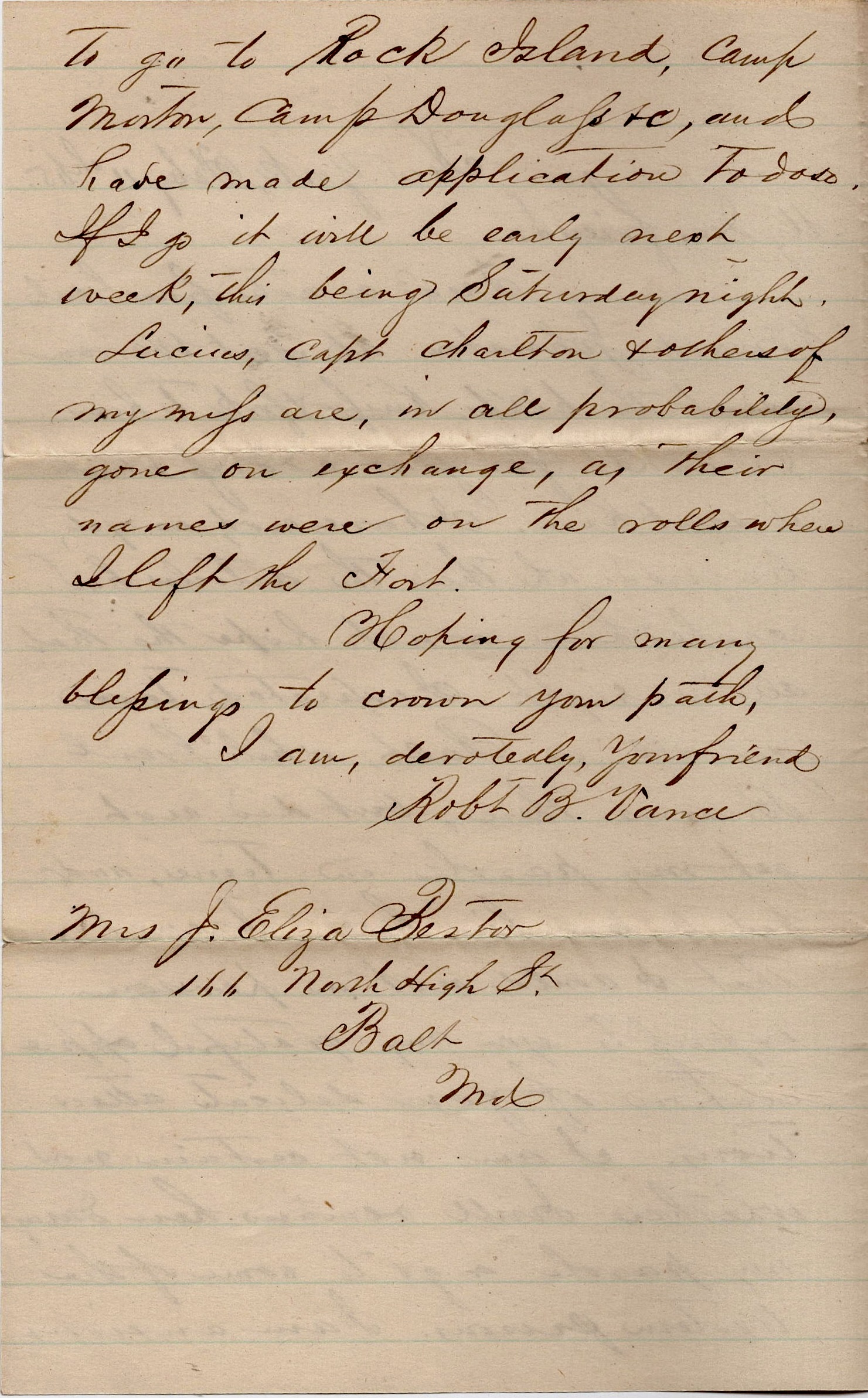
In his brief letter—limited to one page by military authorities—Reuben informs his correspondent that he was taken prisoner at the Battle of Atlanta on 22 July 1864 and was imprisoned a month later in Charleston, South Carolina, after being held briefly at Macon.

The Charleston City Jail was used to hold Union Officer Prisoners. Over 2,000 were held here in the fall of 1864 though many of them had to sleep outside. (LOC)

T R A N S C R I P T I O N

Addressed to Mr. Eliphalet Smith, West Cambridge, Massachusetts

Military Prison, Charleston, S. C.
August 21st 1864

Dear friend Lipha,

Here I am actually caged a Prisoner of War after so long. I was captured on the 22nd of July at or near Atlanta. I was sent from Atlanta to Macon, Georgia, and then here. We are receiving better treatment here than at any place we have been yet. I hope soon to be exchanged for this thing of being a prisoner is anything but pleasant I assure you.

Please write to Dr. L. W. Jenness, Lowell, Mass., and tell him of my misfortune. Give my love to Clara and all friends. Respectfully in haste. — Lieut. R. M. Colby

Please write me soon and let me know all the news. Also I would like you to write to Lieut. Colonel John C. Fry, commanding 20th Regiment O. V. Infantry and tell him to send you my personal effects as I had a valuable lot of things in my valise—that is, to me. Yours, — Rube

1865: John Francis Locke to Mary Moore (Adams) Locke

The following letter was written by John Francis Locke (1844-1924), the son of brick mason Jonathan Frost Locke (1806-Aft1880) and Mary Moore Adams (1812-1887) of North Somerville, Massachusetts.

When he was 18 years old, John enlisted as a private in Co. E, 39th Massachusetts Infantry. He was among the 2500 Union soldiers taken prisoner on 19 August 1864 in the Battle of Globe Tavern (2nd Weldon Railroad). Being a clerk with excellent handwriting, John probably enjoyed better than average privileges than some of his fellow prisoners and we learn from this letter datelined from Richmond on 1 April 1865 that his Confederate captives had placed him on “parole of honor” meaning he was trusted not to aid the enemy until formally exchanged. The very next day after writing his letter, Richmond was evacuated and we don’t know what happened to John between that date and his record of exchange two weeks later. The “boats” that John refers to were POW Exchange boats that carried prisoners from Richmond down the James river to City Point where they were loaded onto transports and taken to Camp Parole, Annapolis, Maryland.

[Note: This letter is from the private collection of Greg Herr and was transcribed and published on Spared & Shared by express consent.]

Transcription

Addressed to Mrs. Mary M. Locke, North Somerville, Massachusetts

Richmond, Virginia
April 1st 1865

Dear Mother mine,

You must have been looking for your son John, after receiving that letter by Sergt. Wood, yet here I am still in the Confederate lines. We have been looking for instructions from Washington for some time past, but as yet they have not come. Meantime I have got about tired of waiting and think if asking Capt. Stewart to let me go on the next boat as I think I have done my duty thus far by him and my government, and, it is now time for someone else to take a hand and relieve me.

It has been a very pleasant stay for me. Capt. Stewart have been very kind indeed to me. I am acting as his clerk & cook. None of us have any money so we are obliged to do our own cooking which you may well know is not much of a burden to me. I get nice potato yeast and make quite light & nice bread. I have all I wish in the eating line. Being on parole of honor, I of course have more liberty than the rest of the prisoners, I have found some good friends among the sesesh. Capt. John M. West 1 of the Exchange Bureau, C. S. A.—a New Hampshire man by birth—has been very kind to me. Then there is a young Louisianan, messenger to Major [Thomas P.] Turner, Commandant of the Richmond Prison, with whom I am pretty intimate. 2 I have been presented with some sheet music—Southern though—by a young lady I have never seen, a niece of Capt. West’s. There is a nephew about Allie’s age also that is with me a great deal. Tell Allie that he has given me something to carry to him from Richmond.

Mother, I am actually fat. I may be exaggerating it & won’t say how much but my weight is less than two hundred. I have almost got a double chin. Mother dear, do you realize that you have no boys now—that they have all reached manhood. Those little babies that you used to rock to sleep and tended, nursed, cared & prayed for have all entered upon their duties of life. O Mother, may they be true to their early teachings and grow up in the way thou hast taught them.

Mother, this boy will never be free from his love for his mother. He will always come when he is in trouble & affliction and lay his head in his mother’s lap and pour out his joy or sorrow, sure of your sympathy. Seems to me these beautiful words; My mother dear, my mother sweet, my gentle, gentle mother never were so dear to me. Also that beautiful hymn you learnt us. Father! what ‘ere of earthly bliss thy sovereign will denies, how often have they been on my life. But for those beautiful songs of Christian faith and my memories of my younger days, it seems I could not have stood what I have. I have been so confident all along that things would turn out right and I should be permitted to see you again that it seems as if it was an answer for my faith.

Ask Mary & Willie if they remember Capt. Swords. 3 He was home winter before last and danced with Mary at Belmont. He was also at home last winter and brought me news from Uncle George’s family. He is now on Maj. Gen. [Orlando B.] Willcox’s staff, well acquainted with the Bowman’s. He was captured at Petersburg when they attacked the 9th Corps [see Battle of Fort Stedman] this day week. He promised to take a letter for as he is going on the first boat, being a friend of Col. [William H.] Hatch—a commissioner of exchange, CSA. Hoping that I may greet you with a kiss instead of a letter, I close. From your dutiful son, — John F. Locke.

Love to Father, sisters & brother. Also Allie and all good friends, — John


1 Probably the John M. West (b. 1828 in New Hampshire) who was working as a bookseller in Richmond as early as 1850.

2 Major Thomas P. Turner, commandant of Libby Prison and Belle Isle late in the Civil War, fled from Richmond on April 3rd on the day Union forces entered the city. His escape to Cuba was told in a letter which can be found in the following: Major Turner’s Escape.

3 Capt. Henry Leonard Swords (1843-1929), of the 59th Massachusetts Infantry. He was taken prisoner at Fort Stedman on 25 March 1865.

1862: Prisoner of War Circular

Recognizing the haphazard administration of the various POW camps in the Union, Colonel William Hoffman attempted to impose order through a uniform set of regulations. Of particular interest is the decision to withhold rations, sell the resulting surplus, and create a general prison fund with the proceeds, to improve the conditions for the prisoners.

The controversial Col. William Hoffman stands at right under the Office sign. (LOC)

Transcription

CIRCULAR.

The following regulations will be observed at all stations where prisoners of war are held:

I. The Commanding Officer at each station is held accountable for the discipline and good order of his command, and for the security of the prisoners, and will take such measures as will best secure these results. He will divide the prisoners into companies, and will cause written reports to be made to him of their condition every morning, showing the changes made during the preceding twenty-four hours, giving the names of the “joined,” “transferred,” “deaths,” &c. At the end of every month, commanders will send to the Commissary General of Prisoners a Return of Prisoners, giving names and details to explain “alterations.” Where rolls of “joined” or “transferred” have been forwarded during the month, it will be sufficient to refer to them on the Return.

II. On the arrival of prisoners at any station, a careful comparison of them with the rolls which accompany them will be made, and all errors on the rolls will be corrected. When no roll accompanies the prisoners, one will immediately be made out, containing all the information required, as correct as can be from the stater ents of the prisoners them-selves. When the prisoners are citizens, the town, county, and State from which they come will be given on the rolls under the heads—rank, regiment, and company. At the same time they will be required to give up all arms and weapons of every description, and all moneys which they may have in their possession, for which the Commanding Officer will give receipts.

III. The Hospital will be under the immediate charge of the senior Surgeon, who will be held responsible to the Commanding Officer for its good order and the good condition of the sick. The “Fund” of this Hospital will be kept separate from the fund of the Hospital for the troops, and will be disbursed for the sole benefit of the sick prisoners, on the requisition of the Surgeon, approved by Commanding Officer. When the fund is sufficiently large, there will be bought with it, besides the articles usually purchased, all articles of table furniture, kitchen utensils, articles for policing, shirts and drawers for the sick, the expense of washing, and all articles that may be indispensably necessary to promote the sanitary condition of the Hospital.

IV. The Commanding Officer will cause requisitions to be made by his Quartermaster, on the nearest depot, for such clothing as may be absolutely necessary for the prisoners, which requisition will be approved by him after a careful inquiry as to the necessity, and submitted for the approval of the Commissary General of Prisoners. The clothing will be issued by the Quartermaster to the prisoners, with the assistance and under the supervision of an officer detailed for the purpose, whose certificate that the issue has been made in his presence, will be the Quartermaster’s voucher for the clothing issued. From the 30th of April to the 1st of October, neither drawers nor socks will be allowed, except to the sick.

V. A general fund for the benefit of the prisoners will be made by withholding from their rations all that can be spared without inconvenience to them, and selling this surplus, under existing regulations, to the Commissary, who will hold the funds in his hands and be accountable for them, subject to the Commanding Officer’s order to cover purchases. The purchases with this fund will be made by or through the Quartermaster, with the approval or order of the Commanding Officer, the bills being paid by the Commissary, who will keep an account book, in which will be carefully entered all receipts and payments, with the vouchers; and he will keep the Commanding Officer advised, from time to time, of the amount of this fund. At the end of the month he will furnish the Commanding Officer with an account of the fund for the month, showing the receipts and disbursements, which account will be forwarded to the Commissary General of Prisoners, with the remarks of the Commanding Officer. With this fund will be purchased all such articles as may be necessary for the health and comfort of the prisoners, and which would otherwise have to be purchased by the Government. Among these articles are all table furniture and cooking utensils, articles for policing purposes, bedticks and straw, the means of improving or enlarging the barrack accommodations, extra pay to clerks who have charge of the Camp Post Office, and who keep the accounts of moneys deposited with the Commanding Officer, &c., &c.

VI. The Sutler is entirely under the control of the Commanding Officer, who will see that he furnishes proper articles, and at reasonable rates. For his privilege, the Sutler will be taxed a small amount by the Commanding Officer, according to the amount of his trade, which tax will make a part of the general fund.

VII. Prisoners will not be permitted to hold or receive money. AIl moneys in possession or received will be taken charge of by the Commanding Officer, who will give receipts for it to those to whom it belongs. They will purchase from the Sutler such articles as they may wish, which are not prohibited, and on the bill of the articles they will give an order on the Commanding Officer for the amount, and this will be kept as a voucher with the individual’s account. The Commanding Officer will keep a book in which the accounts of all those who have money deposited with him will be kept; and this book, with the vouchers, must be always ready for the inspection of the Commissary General of Prisoners.

VIII. All articles contributed by friends, for the prisoners, in whatever shape they come, if proper to be received, will be carefully distributed as the donors may request; such articles as are intended for the sick passing through the hands of the Surgeon, who will be responsible for their proper use. Contributions must be received by an officer, who must be held responsible that they are delivered to the persons for whom they are intended.

IX. Visitors to these Stations, out of mere curiosity, will in no case be permitted. Persons having business with the Commanding Officer or Quartermaster, may, with the permission of the Commanding Officer, enter the camp, to remain only long enough to transact their business. When prisoners are seriously ill, their nearest relatives, parents, wives, brothers or sisters, if they are loyal people, may be permitted to make them short visits; but under no other circumstance will visitors be allowed to see them without the approval of the Commissary General of Prisoners.

X. Prisoners will not be permitted to write letters of more than one page of common letter paper, the matter to be strictly of a private nature, or the letter must be destroyed.

XI. Prisoners will be paroled or released only by authority of the War Department, or by direction of the Commissary General of Prisoners.

W. HOFFMAN, Colonel 3d Infantry, Commissary General of Prisoners.

OFFICE COMMISSARY GENERAL OF PRISONERS, Washington, D. C., , 186 .

OFFICIAL: Assistant Adjutant General.

1863: Godfrey Daniel Dotson to Hospital Stewards at Annapolis

The following letter was written by Godfrey D. Dotson (1827-1919) of Lawrence county, Kentucky, enquiring on the life of his son, Andrew Dotson, an exchanged prisoner in the hospital at Annapolis, Maryland. Unfortunately I cannot conform Godfrey Dotson’s residency in Lawrence county, nor do I find a son of his by the name of Andrew in on-line genealogical and census records. I cannot even find a military record or POW record for Andrew searching under the name Dotson and Dodson.

Transcription

State of Kentucky
Lawrence county
August 7, 1863

To the Stewards of the General Hospital of Annapolis, Md.

Dear sir I take my pen in hand to inform you that I have a son that was captured a prisoner on the 7th day of December last by John B. Floyd’s Brigade of Rebels and sent to Richmond, Virginia, and was swapped out by the Yankees party on the 4th of April last. My son was in the hospital at Maryland, Annapolis, on the 3rd day of May. That is the account we have heard of him to be sure.

We heard that he deceased at that place. We then heard that he did not so I want as a friend to make strict inquiry and write to me if you please and you will oblige a friend and distressed parents on the account of a lovely son. Also write to me where to mail my letters and what will satisfy you for your trouble and I will send you the money.

The name of the boy is Andrew Dotson. His age is 17. His complexion is reasonable fair, yellow hair, blue eyes, and raw bond. His form is tall & spare built. I will say, dear son, if you be on the stage of action and gets word from your parents, come without delay to Louisa, Kentucky, and then inquire for me.

Another line to the steward of hospital [and] that is to direct your letters to Lawrence county, Kentucky, Louisa Post Office. Write to me, let the case be as it may. So no more at present—only remaining your friend until death. From Godfrey D. Dotson

to the steward of the General Hospital of Maryland, Annapolis.

1861-64: Charles C. Palmer to his Sisters

“I have letters of Civil War soldier Charles C. Palmer of Exeter Maine to his sisters. Charlie served in the 1st Maine Cavalry in Washington DC and then in Virginia. He was captured in late 1864 and died at Salisbury prison in January 1865. Would you like to take a look at his letters from Camp Butler and Fredericksburg?” So wrote Kathleen Mikaelian to me recently after discovering the box of letters among her husband’s family heirlooms. She later told me that she hoped to keep Charley’s history alive by showcasing his letters on Spared & Shared.

Charles C. Palmer, 1st D. C. Cavalry

Charles C. Palmer (1837-1865) was the son of William Palmer (1789-1865) and Susanna Treadwell (1793-1864) of Exeter, Penobscot county, Maine. He was married in October 1858 to Nancy Jane (“Jennie”) Neal (1838-1863), was childless and working as a miller in Exeter when he enlisted as a corporal in Co. L, 1st Maine Cavalry early in the war. After this initial stint in the service, Charlie returned to Exeter where tragedy greeted him. In October 1863, Charlie’s wife delivered stillborn twins and suffered so much physically and emotionally that she died two months later, leaving a grieving husband to mourn the loss of his entire family. With nothing to hold him in Exeter any longer, Charlie left his teaching job and re-entered the service, this time in Co. G, 1st District of Columbia Cavalry. His muster date was given as 19 February 1864 at which time he was described as 24 years old, standing 5 foot 11 inches tall, with hazel eyes and brown hair.

Charlie was no long with the D. C. Cavalry when he was promoted to corporal. Except for a period of time when he was hospitalized at the Point of Rocks in mid-summer, Charlie appears to have been with his regiment though he may have found it dull at times. So much so that on 25 May 1864 he was known to have sent a letter to General George F. Shepley requesting special duty. His letter was found in military records and reads as follows:

Camp Conger, 20 May 1864

General Shepley, Sir, I trust you will pardon me for intruding upon your much valued time. But my object in so doing is to see if through you or your influence I can obtain a position on one of the many confiscated plantations under your jurisdiction, and if not, some other position which may be of better advantage to me and also serve my country truly for I would scorn the thought of trying to obtain any position where I could not serve my country in this her hour of peril.


I am a native of Exeter, Maine, and for the few years past have been engaged in teaching. But in my younger years was a farmer’s boy. If you wish for any recommendations, I can get them and good too in my own regiment—and also from many influential men in Maine, among them Adjt. General Hodson. But if I get anything, I had rather my own merit would claim it as rightly its own. I came into my company after it was organized and am now corporal.


I trust you will give this note due consideration and shall hope soon to hear from [you]. But yet I know that your time must well nigh be occupied and labors hard. Yours respectfully, — Charles C. Palmer, 1st D. C. Cavalry.

The position Charley sought was to oversee the work on one of the many plantations in Virginia that were being operated by the Federal government to employ the slaves who had come under federal protection. School for the freedmen were also being set up on or near these plantations. It does not appear that Charlie was ever offered such a position and his aspiration for such an assignment may have waned when he became ill later in the summer. It seems he remained with his regiment until 16 September 1864 when he was taken prisoner at Sycamore Church, six miles below City Point on the James River, along with other members of the 1st D. C. Cavalry who were caught by surprise in their beds by Confederate Major General Wade Hampton in what has come to be known as the Great Beefstake Raid. In 30 minutes, the Confederates killed, wounded, or captured 219 startled troopers. Charlie was initially confined in Richmond but then sent to Danville on 24 September and admitted to the hospital at Salisbury, North Carolina, on 31 December 1864 suffering from chronic diarrhea. He died on 26 January 1865.

Waud’s sketch of the Great Beefstake Raid, 16 September 1864

Letter 1

Camp Butler, Virginia
May 3rd 1864

Beloved sisters,

Your kind and welcome letters came to hand this morning and was glad to hear from you both again. I did not receive any mail from the time I left Washington until today and then I get 11 letters and this is the last I have to answer. We have not been here but a few days yet our work has been very hard, there being but a few troops here and the Rebs have been trying to break our center but in vain. We have lost but a few men and only one from our regiment.

I like it much and am glad that I am here. We have a line of defenses on the James and Appomattox rivers and we are bound to hold them and I think we can without any trouble. We came here with 5,000 dismounted cavalry but soon expect to have our horses and then we shall be relieved by other troops. I do not expect to get any of the things you sent me for it is hard getting a box down here.

I am nicely [situated] now. I must close now. Write soon. Direct to Bermuda Hundred by way of Fortress Monroe, Va.

Yours affectionately, — Charley

The bugle’s call is why I close so soon. Write soon.

A cenotaph in Exeter Maine to the memory of Charles C. Palmer

1865: War Department Memo signed by Edwin M. Stanton

The following War Department memo written and signed by Secretary of War Edwin M. Stanton pertains to the confinement of James Washington and Herbert Alexander, Prisoners of War (POW), at Ft. McHenry in Baltimore.

Edwin M. Stanton

Herbert Lee Alexander (1846-1866) was the son of William Pearson Alexander (1801-1863) and Hannah Lee Washington (1811-1881) of Claymont (name of farm), just west of Charlestown, Jefferson county, [West] Virginia. According to a letter by Col. John Peter Shindel Gobin, 47th Pennsylvania Infantry, Herbert was arrested in his own home when a note was found in his pocketbook identifying him as a conscript and with instructions to report to the 12th Virginia Cavalry. He was unarmed and apparently frail in constitution. “His mother, an estimable lady [with ancestral ties to George Washington], is exceedingly fearful a rigorous confinement will completely prostrate her son, his health being naturally precarious.”

Muster roll records for Co. A, 12th Va. Cavalry, state that Herbert was captured on 31, 1865 and confined at Fort McHenry on 8 February 1865. In the remarks, he is identified as a “Guerrilla: not to be exchanged during the war. By order of Maj. Gen. Sheridan, commanding Middle Military Division.” While at POW at Ft. McHenry, Herbert was sent to the post hospital suffering from anemia. He was eventually released from Ft. McHenry on 27 April 1865 and he died at home on 3 October 1866, probably from tuberculosis.

The other prisoner identified in the memo only as “James” was Pvt. James Cunningham Washington (1847-1865). Though James and Herbert were relatives, they were not brothers as might have been presumed by Edwin Stanton. James was a member of Co. B, 12th Virginia Cavalry and he was taken prisoner with Herbert at the Claymont Farm near Charlestown, also labeled a “Guerrilla, not to be exchanged during the war.” According to family legend, 17 year-old James was starved and inhumanely treated by his Yankee captors and he died in the post hospital on 24 February 1865, less than four weeks after he was taken prisoner. Curiously, the National Park Service website for Fort McHenry claims that, “in contrast to the high death tolls at other prisons, the death toll at Fort McHenry was only 15.” Color me skeptical of that number.

Mrs. Lyle, mentioned in the memo, was Herbert Alexander’s aunt.

Transcription

Memo kept in an envelope with the annotation: “Letters referring to the most heart-rending grief of my life, March 1865.”

War Department, February 20, 1865

Case of James [Washington] & Herbert Alexander, Prisoner of War in Ft. McHenry

Referred to General [William Walton] Morris to permit Mrs. Lyle to have an interview with them under usual regulation. — Edwin M. Stanton, Secretary of War

1863: Amos Reeves to A. E. McClane

I could not find an image of Amos but here is one of Henry Benjamin Davis who served in the 64th Illinois and was killed at Marietta, Georgia, in August 1864. (Ancestry.com)

The following remarkable letter was written by Amos Reeves (1835-Aft1910) of Sterling, Whiteside county, Illinois, who enlisted as a private in Co. B of the 64th Illinois Infantry (“Yates’ Sharpshooters”) in November 1861. In his four-page letter to his cousin, Amos tells the tale of his capture along with James Fitzgerald of his company by Gen. Philip Roddey’s guerrillas in northwest Alabama on 29 May 1863. For the next several weeks the captives were shuffled under guard from one Confederate encampment to another while Amos says he tried “to make the best of a bad bargain.”

While a prisoner, Reeves learned that many of the rebels who guarded him were conscripts and had little interest in waging war. He says that he worked deceptively with his captors to gain favor whenever possible and to encourage rebels to desert, reassuring them that they would not be exchanged back to the Confederate army where they would be shot as deserters. Eventually Reeves and Fitzgerald were delivered to Libby Prison in Richmond, Virginia, where Reeves claimed they remained but four days before being exchanged and delivered to Camp Parole in Annapolis and later to Washington D. C. where he wrote the letter in August 1863.

Reeves was eventually sent back to Illinois, reenlisted as a veteran, and then ordered to his regiment where he resumed service and mustered out on 11 July 1865 at Louisville, Kentucky. Apparently Fitzgerald had had enough, He did not reenlist as a veteran and mustered out on 31 October 1864.

It does not appear that Amos ever married. He was enumerated in the 1910 US Census and he was mentioned in The Rockford Daily Register-Gazette in April 1897 where he was credited with having invented a “shoe scraper and cleaner which can be opened and closed so that is it not dangerous when there are children around…it cleans both the sole and the side of the foot.”

[Note: This letter is from the personal collection of Richard Weiner and was transcribed and published on Spared & Shared by express consent.]

Transcription

Addressed to Miss A. E. McClane, Sterling, Illinois

Parole Camp, Virginia
August 11, 1863

My dear Cousin Lida.

Though far away and long silent, I often think of thee and memory and fancy bring many pleasing pictures to my mind, and though I see many dark pictures and gloomy clouds, the bright ones are the prettiest and I love to look at them.

It has been a long time since I have had an exchange of thought & sentiment with you though I have heard from you (I saw a letter Jennie sent to Stephen) and I always think you are among friends and enjoying life.

Well, my dear cousin, I am enjoying life. Life is as dear to me as ever though I remain in the army. I expect that you have heard that I have been making the Rebs a visit. So I have and had an interesting time of it though I was an unwilling guest. A sergeant of my company, Joseph Fitzgerald, and I were captured on the 29th of May and were robbed of our money, hats, and boots, &c. and we found ourselves among robbers, murderers, highwaymen, and that we would have to take things easy and not hoist false colors but keep our colors covered at times and then sometimes I could hoist before them the good old flag with all its glories and blessings and the pictures of the American Revolution, its heroes, the levers of justice, the cowboys and skinners, the tories and savages, and then I showed them their own perfidy and treachery.

But while I was with Gen. Roddey’s Guerrillas, I passed for a good Vallandigham man among the officers and most of the men and I found many of them that were conscripts and only wanted a chance to escape. They were ashamed of their crowd and as they had been told by their officer we made every deserter enlist or we sent them around for exchange so as to get one of our soldiers for them, they were afraid to come over. So I told them the truth and during the ten days that I stayed in their camp, there were over 30 of them deserted and went to our camp. Then I was taken to Tuscumbia, Alabama, where I stayed a week and found friends. Some of the men who were guarding us were good Union men and a good lady sent us a plenty of milk and some nice biscuits and butter twice and some ginger cake once. Then we were taken to Huntsville—Gen. Pillow’s Headquarters. From there to Chattanooga, then almost to Knoxville when the Yankees came in ahead of us and tore up the road and we had to go back, and then down to Atlanta, Ga., and from there to Augusta, Ga., then to Columbia, S. C., and Raleigh, N. C., Petersburg, and Richmond, Va. Stopped in Richmond in Libby Prison four days, then came by the way of the James River & Fort Monroe to Annapolis and from there to Washington D. C.

And here I found lots of friends (of whom I will tell in my next) and have been seeing the sights & learning all I could and trying to make the best of a bad bargain. I am sorry that I delayed writing so long and I wish I could give you a full history of my expedition.

Yours, — Amos

1864: Frank Prior to Samuel Prior, Jr.

The following letter was sold to a client of mine stating that it was penned by a Union soldier named “Frank Prior” to his father, “Capt. Samuel Prior, Jr.” but I am unable to see a signature and I cannot identify the Prior family correspondents. It’s possible this information was simply made up but on the outside chance it’s true, I pass on the “provenance.”

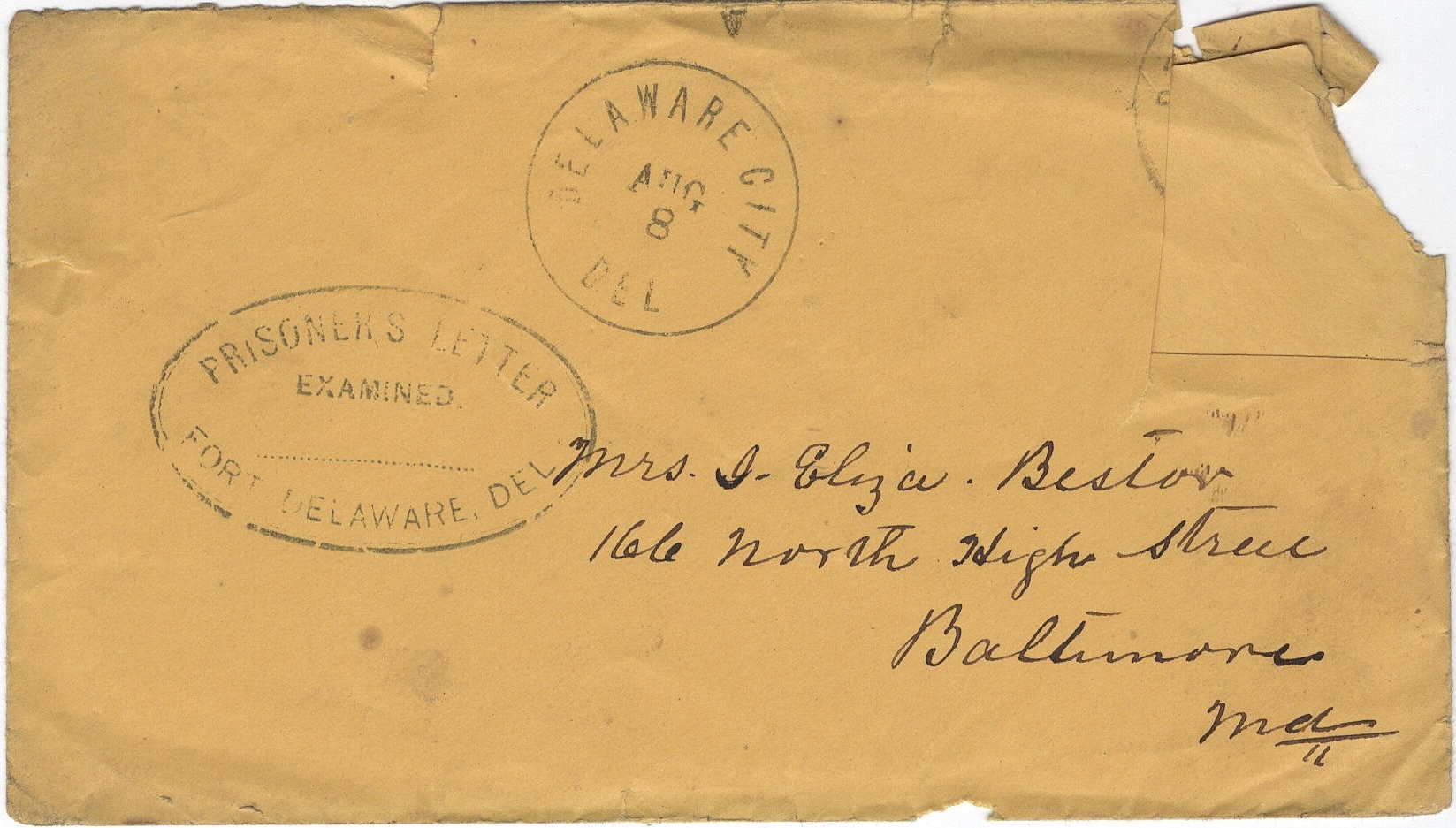
The letter describes an August 1864 incident pertaining to the Major Reybold, a steamer operating on the Delaware River, in which a number of Confederate prisoners were transported by her from Philadelphia to Fort Delaware. After dropping off the prisoners, it was discovered they were one short which triggered the whole fiasco.

The Major Rebold was built in 1853 in Wilmington, Delaware. She was the first iron vessel to see service on the Delaware, plying between Salem, New Jersey, and Philadelphia until 1906. During the Civil War she was retained on the river on account of Fort Delaware and was for a long time the only steamboat running below Wilmington, carrying thousands of troops and prisoners to the fort.

The Major Reybold, ca. 1908. She remained in regular service until 1906.

Transcription

Steamer Major Reybold
August 15, 1864

Dear Pa,

Your very welcome letter was received Friday evening. I was glad to hear you had found the boat so soon. By what Captain Loomis (who was on board of us Friday in Philadelphia) said, I was afraid you would have trouble finding her.

We were fired into by a gunboat from the Fort on Friday evening. The way of it was this. We landed some forty-five prisoners there that evening and after we had left, they found out that there was one short. They fired two musket shots to attract our attention but there being a very stiff breeze from the eastward, we did not hear them. They then ordered their gunboat which lay at the East wharf after us. It was high water and we were running directly across and by the time the gunboat got under weigh, we were pretty well over.

She fired a blank shot at us as she left the wharf but it was not heard on board by us owing, I suppose, to the wind and the noise of the machinery. They then fired three more shots—the last one, which was a shell, exploded about twenty-five yards from our stern and was the only one which was heard or seen by anyone on board.

The Daily State Gazette, 22 August 1864

Captain and I were in the office and did not know anything about the firing until some of the passengers who saw the shell explode came and told us. Captain came out immediately and ordered the boat to turn around and go back. We were then in “Hinchman’s reach,” We went about and run back. When we got to mouth of creek, we were met by a small boat from off the gunboat with an officer in charge who ordered us to proceed to Ft. Delaware at once, which we did. When we got there, we were informed that the man had got away in Philadelphia and that they were very sorry they had caused us so much trouble. It seems that when they found out that there was one man short, they did not even wait to ask the officer in charge where he was but sent the boat immediately after us. After she left, they found out where the man escaped and tried to recall her but could not for the same reason I suppose that prevented us from hearing.

The idea of the boat shooting at us with the intention of hitting us as the Lieutenant in charge of her says he did, is preposterous and should be reported from his actions. When he boarded us, I should say he was drunk and that may have been a reason for his firing at us. If the shell had struck us in the saloon, it would have caused a great loss of life in there at the time.

Thomas Bond has a claim against you of $32 for hay. Shall I settle it? We told John Mulford about it and John told me.