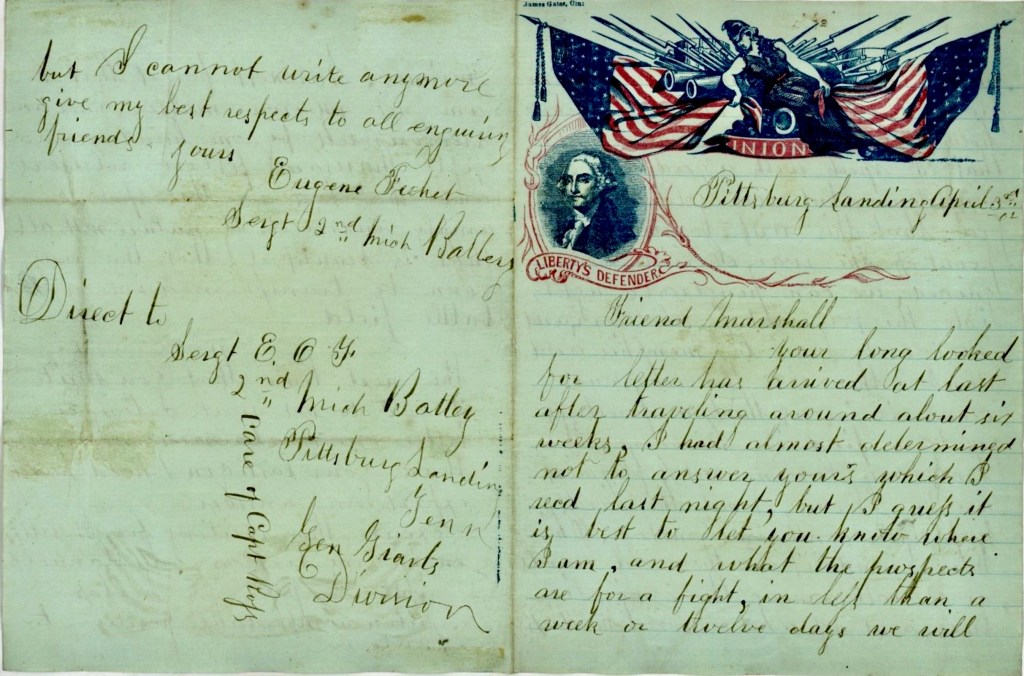
This letter was written by Eugene Oscar Fechet (1846-1925), the son of Alfred Edmont Fechét (1817-1869) and Mary de Garmo Buel (1823-1905). At the start of the Civil War, Eugene’s father raised a unit that became Battery B, 1st Michigan Light Artillery. Eugene enlisted as a Corporal in the unit on 10 September 1861; his regiment departed to St. Louis, Missouri on 17 December 1861. Battery B performed duties in the District of West Tennessee till March 1862 until it was attached to General Stephen A. Hurlbut’s 4th Division, Grant’s Army of the Tennessee to April, 1862. The Regiment moved to Pittsburg Landing, Tenn. During the Battle of Shiloh on 6–7 April, the Battery was heavily engaged at the south end of Sarah Bell’s peach orchard and later at Wicker Field where they were surrounded and captured at about 5:30 p.m. by the 1st Mississippi Cavalry. Five of the six cannons were claimed by the Confederates and Eugene was one of the artillerists taken prisoner on April 6, 1862. The prisoners were later exchanged in November 1862.
From this letter we learn that Eugene was promoted to Sergeant prior to the Battle of Shiloh. He reenlisted in a Veteran Volunteer Regiment as a First Sergeant on 23 December 1863 until he was discharged on 10 April 1864 to attend the United States Military Academy at West Point (Class of 1868).
Though Eugene states he was in the “2nd Michigan Battery,” he was actually in Captain William H. Ross’ Battery B (or “Second Battery”), 1st Michigan Light Artillery
Transcription
Pittsburg Landing April 3rd 1862
Friend Marshall,
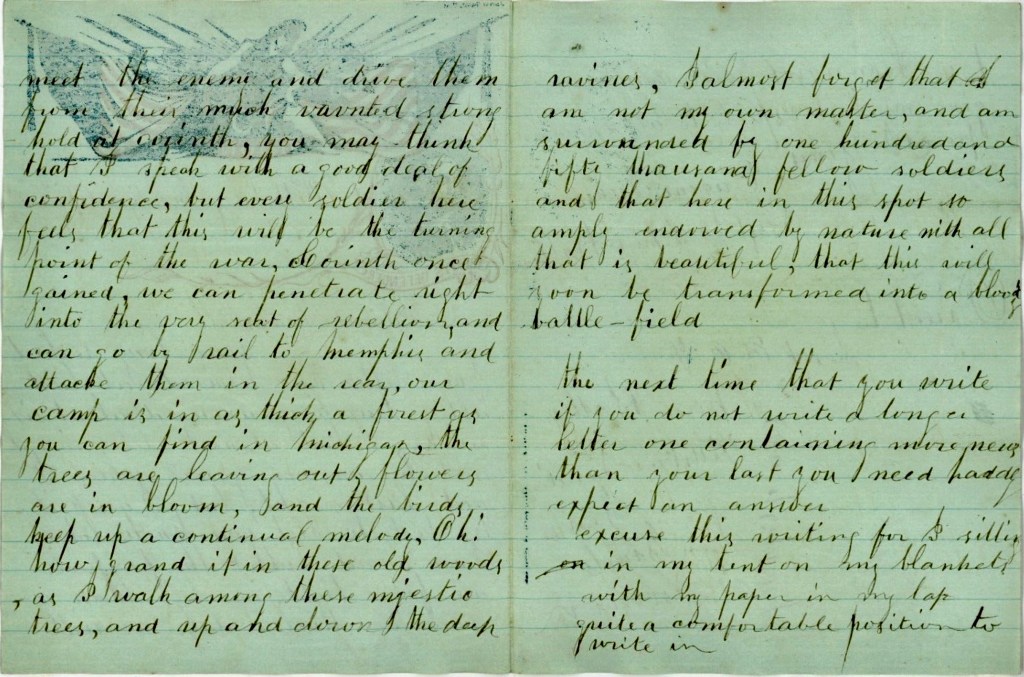
Your long looked for letter has arrived at last after traveling around about six weeks. I had almost determined not to answer yours which I received last night, but I guess it is best to let you know where I am, and what the prospects are for a fight. In less than a week or twelve days we will meet the enemy and drive them from their much vaunted stronghold at Corinth. You may think that I speak with a good deal of confidence, but every soldier here feels that this will be the turning point of the war. Corinth once gained, we can penetrate right into the very seat of rebellion, and can go by rail to Memphis and attack them in the rear.
Our camp is in as thick a forest as you can find in Michigan. The trees are leaving out, flowers are in bloom, and the birds keep up a continual melody. Oh! how grand it is in these old woods as I walk among these majestic trees and up and down the deep ravines. I almost forget that I am not my own master, and am surrounded by one hundred and fifty thousand fellow soldiers, and that here in this spot so amply endowed by nature with all that is beautiful, that this will soon be transformed into a bloody battlefield.
The next time that you write, if you do not write a longer letter—one containing more news than your last, you need hardly expect an answer. Excuse this writing for I [am] sitting in my tent on my blanket with my paper in my lap. Quite a comfortable position to write in. But I cannot write anymore. Give my best respects to all enquiring friends. Yours, — Eugene Fechet, Sergt. 2nd Michigan Battery
Direct to Sergt. E. O. F., 2nd Michigan Battery, Pittsburg Landing, Tennessee, General Grant’s Division. Care of Capt. [William H.] Ross
The following affidavits were written by Thomas Robert Harvey (1840-1926), a native of Upper Clapton—a suburb of London—England, who came to the United States prior to the American Civil War and while living in the States, volunteered for the US Navy and served as an Ordinary Seaman from 27 May 1861 to 12 September 1862. Following his discharge from the Navy, he then voluntarily accepted payment from a draftee and went as a substitute into Co. A, 1st Michigan Light Artillery where he served as a private (later corporal) from 27 February 1863 to 28 July 1865 under the alias, Samuel Hanning.
The two affidavits transcribed below summarize Thomas Harvey’s war experience rather extensively as he was required to provide ample evidence of his service to qualify for a pension—particularly since he had served under two names. The process of filing for a pension was compounded by the fact that he returned to London sometime after the war and did not begin the process of seeking a disability pension until the turn of the century. He worked as a mariner for a long time until cataracts—a common affliction in career mariners—caused him to give up the sea as a profession. He married a semi-crippled woman named Mary Sharp in 1914 who managed to take care of him late in life but lived in relative poverty in his final years.
I was requested to transcribe these documents by my friend Gina Denham of the United Kingdom who is compiling material on the 137 members of the London Branch of the US Civil War Veterans. Through her efforts, much has been learned of the service of these members and she hopes to publish a book on the subject which promises to be quite interesting.
A record from Thomas R. Harvey’s Pension File (as are the other documents) although these are not available on Fold 3.
London, 17/5/1903
Messrs. Longshaw and Ballard Dear Sirs,
Maj. Gen. James Blair Steadman and Major S. B. Moe
Yours of April 5th [came] to hand for which I thank you very much. I appeared before U S. Consulate gents to London. As my business brings me here at present. He questioned me for about an hour. During our conversation, I told him I was Dispatch Orderly for Gen. James B[lair] Steadman of Ohio. When he asked me who was A. A. Gen’l. for Steadman, I told him Maj. S. B. Moe. He told me he was a particular friend of his and advised me to write to him which I have done mentioning several things which transpired while serving as Orderly under him so he ought to know my statements are true and that I am what I represent myself to be—Thomas R. Harvey and Samuel Hanning.
Council General asked me about our battery as to position we were in at Battle of Chickamauga and I told him we were ambushed and lost the guns. He told me my statement was correct and that he was close to Battery A, 1st Michigan Artillery at the time. I also told him that Gen’l Starkweather charged with his Brigade and saved four of our guns. We got one more gun back after the Battle of Missionary Ridge. The other one we heard was thrown in Chickamauga Creek, but however we never saw it again. When we got the guns back, most of the prolongs were lost so me, being a sailor previous to this, I told Capt. Edward Hale if I could get rope, I could make the prolongs which he did so as we could handle the guns and I made them. This was during the siege of Chattanooga. We were then stationed at the foot of Cameron Hill near the Tennessee River but as most of our horses were killed at Chickamauga, we were finally stationed at Fort Creighton [on the high ground east of Chattanooga] facing Missionary Ridge which Rebels still held at this time and also Lookout Mountain on our right. From this fort we fired minute guns for Abraham Lincoln after he was assassinated. 1
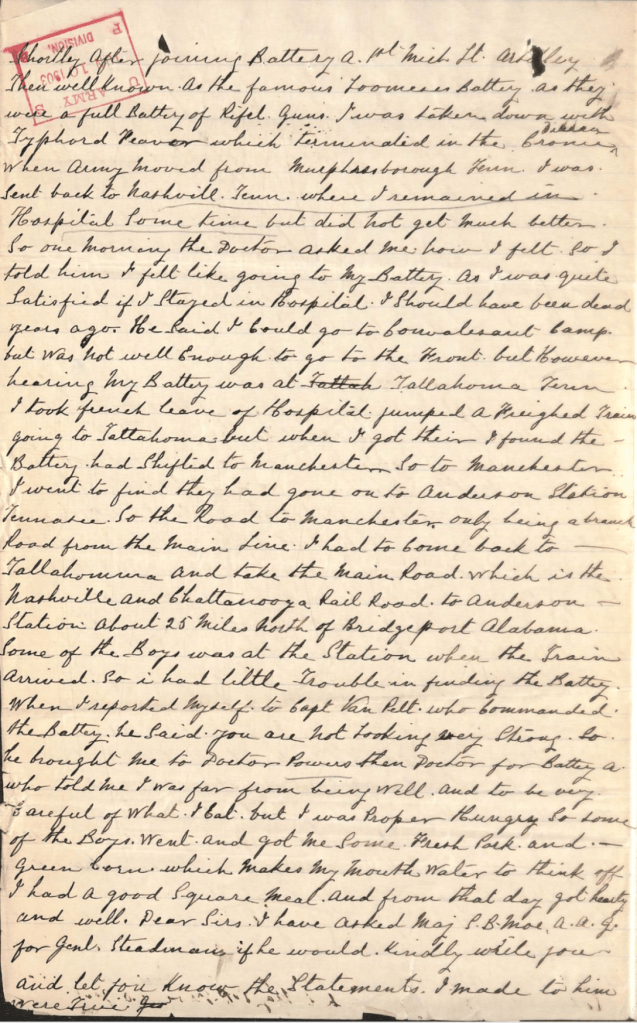
Shortly after joining Battery A, 1st Michigan Lt. Artillery, then well known as the famous Loomis’ Battery as they were a full battery of rifled guns, I was taken down with typhoid fever which terminated in the chronic diarrhea. When the army moved from Murfreesboro, Tennessee, I was sent back to Nashville, Tennessee., where I remained in hospital some time but did not get much better. So one morning the doctor asked me how I felt so I told him I felt like going to my Battery as I was quite satisfied if I stayed in hospital, I should have been dead years ago. He said I could go to Convalescent Camp but was not well enough to go to the front but however, hearing my Battery was at Tullahoma, Tenn., I took french leave of hospital, jumped a freight train going to Tullahoma, but when I got there, I found the Battery had shifted to Manchester so to Manchester I went to find they had gone on to Anderson Station, Tennessee. So the road to Manchester, only being a branch road from the main line, I had to come back to Tullahoma and take the main road which is the Nashville and Chattanooga Railroad to Anderson Station, about 25 miles north of Bridgeport, Alabama.
Some of the boys was at the Station when the train arrived so I had little trouble in finding the Battery. When I reported myself to Capt. Van Pelt who commanded the battery, he said, “You are not looking very strong,” so he brought me to Doctor Powers, then Dr. for Battery A, who told me I was far from being well and to be very careful of what I ate. But I was proper hungry so some of the boys went and got me some fresh pork and green corn which makes my mouth water to think of. I had a good square meal and from that day got hearty and well.
Dear Sirs, I have asked Major S. B. Moe, A.A.G. for Gen. Steadman if he would kindly write you and let you know the statements I made to him were true. If not, would he kindly write to me. There is a fact I did not mention to Maj. S. B. Moe which I thought better not to mention but I know had I have mentioned same he would recognize me right away, and that is this. Once every week I came on Orderly for the General. On this occasion, you acted as body guard for him and rode four paces in rear of him no matter where he went. You were not supposed to carry any dispatches when you were orderly for the General unless there was an engagement on somewhere near and then if he saw fit, he could send the dispatch with his Orderly. It so happened I was Orderly for the General this day. The General J. B. Steadman and Capt. Kirk, Capt. of Commissary Department, rode over to Lookout Mountain together. Capt, Kirk’s Orderly was with him so we and him rode four paces in rear of the General & Capt. Kirk. As we were coming home from Lookout Mountain it came on to rain very heavy. We tried to find shelter but as we got wet through before we could find any, we let the horses walk but the first camp we struck the General and Capt. Kirk went into the sutler’s and invited myself and Kirl’s Orderly in to have some bread and cheese and a bottle of beer. While there, I heard the General tell Capt. Kirk he would go home and put on dry clothes and would not go out anymore that day. Well you see me being Orderly for him this day, as long as he did not go out, I was not supposed to go. So I put my horse up and then changed myself. Having the colored woman that cooked for the Orderlies ask me if I wished and dinner, I told her no. All the rest of the Orderlies out when I turned in for a sleep, it appears they got a wore shortly after. There was trouble. Only a short distance away I think it was at Lafayette, Georgia, but however the House Orderly brought a dispatch to me and said I was to carry same. I told him I was Orderly for the General this particular day and was exempt from carrying dispatches so he took the dispatch back to Maj. S. B. Moe, A. A. G. who sent it back to me. I was just going back to sleep again when the House Orderly came back with the dispatch again. I asked him said I was to carry same. He said Maj. S. B. Moe, A. A. G., do I said without thinking what I was doing, and not knowing there was trouble going on at the time, told the Orderly to tell Maj. S. B. Moe to put the dispatch where Paddy put the dollar. Of course you know where that was, never dreaming he would do so, which however he did.
The 29th Indiana Infantry were acting as Headquarters Guard. Maj. S. B. Moe, A. A. G., called one of them and sent in to arrest me and put me in the guard house. Gen’l Steadman brought me out again the next morning. I was at Headquarters for about two weeks after coming out of the guard house but not put on actual duty—simply keeping my horse and accoutrements clean. Sargeant Peet, Sargeant of Escorts, asked me to say I was stubborn and would not submit so he went me back to my battery again. This is the only trouble I got into all the time I was in the army. Had the Orderly told me they were fighting only a short distance away, and the rest of the Orderlies were out with dispatches, then I should have understood what was wrong and carried the dispatch.
Mr. Longshaw, I think if you would drop him a line—address Maj. S. B. Moe, Chattanooga, Tenn.—he is well known there. I am giving a description of myself when a soldier as near as I can. Hazel eyes, dark hair, height 5 feet 6.6 or 7 inches. Complexion dark. [Tattoo of American, English, &French Flags on right arm. Also bracelets in wrists.]
I have a sister living here in London. If I can find her, I will send a photograph of myself while in the army. I think she has it yet if you think it will doo any good. P. S. Write soon with good news.
I remain your humble servant, — Thos. R. Henry, alias Samuel Hanning, O. T. 1282648
Kindly address all letters for me to Mr. William Vert, Margaret Road off Stuart Road, Liverpool. They will forward same on to me.
1 Battle of Chickamauga September 19-21; 5 pieces captured after 27 Officers and men and 50 horses had been killed and disabled; one with 3 caissons was recaptured on September 19, and two more on the 20th, but all were unfit for duty and the Battery was ordered to Chattanooga; one gun was recaptured at Mission Ridge and the last at Atlanta. Siege of Chattanooga, Tenn., September 24-November 23. Battles of Chattanooga November 23-25. Battery stationed at Chattanooga as garrison till July, 1865.
Affidavit of Service, dated 2 February 1904
Joined the navy on or about May 1861 at Peck Slip, New York, and was discharged at Boston, Mass., on or about September 1862. When I went by way of Fall River to New York and thence to Buffalo where sailed on the Inland Lakes until the the vessels laid up for winter. When went to work in Chicago at V. A. Turpin’s Packing House, corner of Grove and 22 Streets, Chicago, Ills. and afterwards worked for A. B. Meeker & Co., corner of Archer Road and Ogden Slip, Chicago, Ills. until coming on spring when went to Detroit in the State of Michigan. Thinking I might get an early chance to ship as I was then below the Sea in the Straits of Mackinaw, alsi in Michigan, but come to the conclusion I would enlist.
I did go as a substitute but the man I went for—I don’t know his name. He said as long as I intended going in the army, I might go in his place. I rather think he gave me 150 dollars. I think he belonged to Cassopolis in State of Michigan. My reason for assuming an alias was simply because my parents while I was serving in the Navy wished me to come home to England as soon as my time was up in the Navy which I promised them I would do, but instead of doing so, I enlisted in Battery A, 1st Michigan Light Artillery on or about February 1863. C[yrus] O. Loomis was in Detroit at this particular time recruiting for the Battery. He had a talk with and finally enlisted him in Battery A, 1st Michigan Lt. Art. Was sent from Fort Wayne, Detroit, to Murfreesboro, Tennessee, to join the battery shortly after the Battle of Stone River.
Shortly after joining Battery A, 1st Mich. Art., was taken down with typhoid fever which finally ended in the chronic diarrhea when I was sent from the hospital at Murfreesboro, Tennessee—forget whether it was No. 1 or No. 2 Hospital I was in at this time but remember it was near Stone River. When the army moved from Stone River, I was sent back to Nashville, Tenn. I rather think the Hospital I was in here was the Zollicoffer Building.
After being there about two months I should think, the doctor wanted me to go into the Convalescent Camp but I returned to Battery A, 1st Michigan Lt. Artillery [instead], then at Anderson Station, Tennessee, and remained with them until Gen. James B. Steadman took command at Chattanooga of the army when I was detailed as Orderly for J. B. Steadman for about 6 months, when I was sent back to my battery again, then stationed at Fort Creighton and camped close to Chattanooga & Knoxville Railway where remained in the Artillery Reserve until the war was finished and the battery ordered to Jackson, Michigan, where was discharged on the 28th day of July by mustering out of battery.
Battles
Chickamauga, Siege of Chattanooga. Held a position on Chattanooga Flats near the creek the time General Hooker stormed Lookout Mountain and was in the reserve camped at foot of Cameron Hill during the Battle of Missionary Ridge. At Chickamauga, we lost our guns for a while, being led into an ambush. Van Pelt was captain commanding us at this time. He lost his life in the battle. After the Battle of Lookout Mountain and Missionary Ridge, his wife sent to Capt. Ed. Hale, then commanding the battery, requesting Captain Hale to get his remains if possible which we finally did and sent them to her to Coldwater, Michigan, where Mrs. Van Pelt lived at the time. Sergeant George Jack was severely wounded in the same battle. Myself, F. Upton, S. Griffin, J. Johnson, carried him into our lines after dark the same night. I have had the pleasure of seeing him once since. I have merely mentioned the facts so as you can ask any of my comrades if these statements are true or not. If you find they are not, then I can’t be the man I represent myself to be.
List of Comrades in Battery A, 1st Michigan Lt. Artillery
A cdv of Samuel W. Finton who served in Battery A, 1st Michigan Light Artillery. Lookout Mountain 1864.(David Daily Collection)
Captain C. O. Loomis Captain Van Pelt Capt. Edward Hale Capt. Wilbur —-Sergeants—- Ed. Vanderhoff George Jack William Peet Bruce Hawley —-Corporals—- Solomon Mann Fritz Upton Davis —-Lieutenants—- Gus. Bauchman Mitchel Roerdon Doctor Powers —-Privates—- H. Bluff J[ames] Johnson S. Griffin Jack F[ranklin] Hyde P[eter] Montavaun Starr Munger Searles S. Lawrence T. Mott H. Vorhees T. Robinson A. Patterson A[ndrew] Hanna Murry D[aniel] Warren J[ames] McCarty C[harles] Lee Garrison
Navy
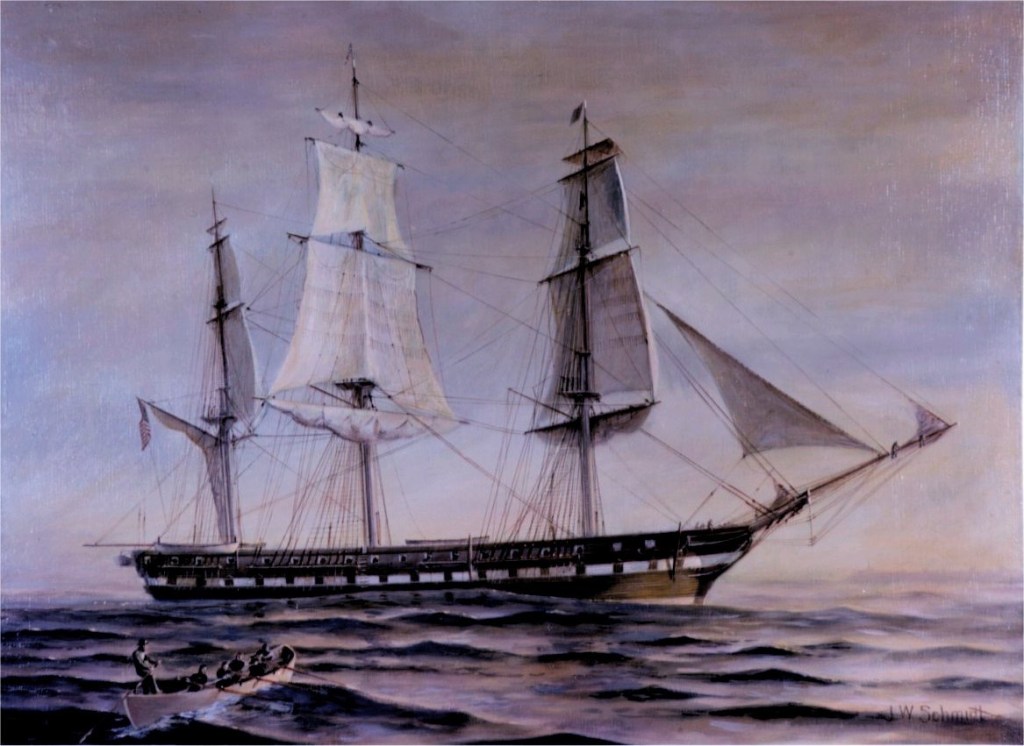
Capt. Henry Eagle of the USS Frigate Santee
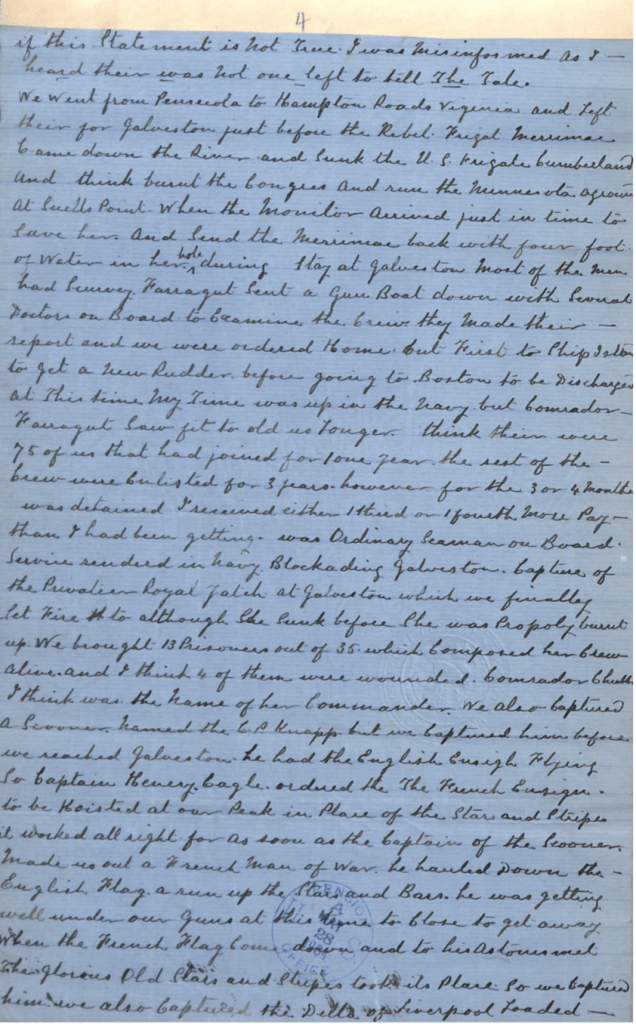
When I first joined the Navy in New York, was sent on Board the Receiving Ship North Carolina, then laying off the Battery in New York Harbor, when was transferred to the U. S. Frigate [Santee] then laying at Portsmouth, New Hampshire, Mass. From Portsmouth we sailed for Pensacola, Florida. As we had some cases on board for Billy Wilson’s Zouaves, then stationed at Fort Pickens which we took on shore in our boats, pulling up the river to land them at Fort Pickens past Fort Brancas and Fort McCrea—two of the Rebel forts. We were armed with a cutlass and revolver so as to defend ourselves in case they sent a boat or boats to try and capture us. Captain Henry Eagle telling us as we pulled from the ship we might have to fight for it but he did not think they would be mean enough to fire on our boats from the forts, however they did not bother us so we landed the cases and the soldiers showed us around the fort. Poor fellows. I little thought at the time I should hear afterward that the fort had been taken and the men all massacred. If this statement is not true, I was misinformed as I heard there was not one left to tell the tale. [See Battle of Santa Rosa]
USS Frigate Santee
We went from Pensacola to Hampton Roads, Virginia, and left there for Galveston just before the Rebel Frigate Merrimac came down the river and sunk the U. S. Frigate Cumberland and think they burnt the Congress and run the Minnesota aground at Sewell’s Point when the Monitor arrived just in time to save her and send the Merrimac back with four feet of water in her hold.
During [our] stay at Galveston, most of the men had scurvy. Farragut sent a gunboat down with several doctors on board to examine the crew. They made their report and we were ordered home but first to Ship Island to get a new rudder before going to Boston to be discharged. At this time, my time was up in the Navy but Commodore Farragut saw fit to hold us longer. Think there were 75 of us that had joined for one year. The rest of the crew were enlisted for three years. However, for the 3 or 4 months, was detained, I received wither one htird or one fourth more pay than I had been getting. Was Ordinary Seaman [OS] on board. Service rendered in Navy Blockading [at] Galveston. Capture of the Privateer Royal Yacht at Galveston [7 November 1861] which we finally set fire to although she sunk before she was properly burnt up. We brought 13 prisoners out of 35 which composed the crew alive, and I think four of them were wounded. Commander Chubb, I think, was the name of her commander.
We also captured a schooner named the C. P. Knapp [27 October 1861] but we captured him before we reached Galveston. He had the English Ensign flying so Captain Henry Eagle ordered the French Ensign to be hoisted at our peak in place of the Stars and Stripes. It worked all right for as soon as the captain of the schooner made us out a French Man-of-War, he hauled down the English flag and run up the Stars and Bars. He was getting well under our guns at this time—too close to get away—when the French flag come down and to his astonishment, the glorious Old Stars and Stripes took its place so we captured him.
We also captured the Delta of Liverpool loaded with saltpeter. She was trying to get into Galveston at night when a gun from the frigate brought him to. We boarded her [and] made prisoners of the crew. Put a prize crew on board and sent her home, I think, to New York, but I am not quite sure whether it was New York or Boston.
Was also for a time in a pilot boat mounting two guns cruising around the coast of Texas. We captured a schooner loaded with tobacco trying to get out of Galveston. The captain’s name was Anthony Frietas. I knew him before the war started as I boarded with him when he kept a sailor’s boarding house on Front Levee in New Orleans. A good few of our boys knew him. He introduced a bucket full of liquor to the boys and they were silly enough to drink too much of it. The consequence was he was trying to get away with us in the place of us running away with him, but the officers kept sober so we made a prize of her.
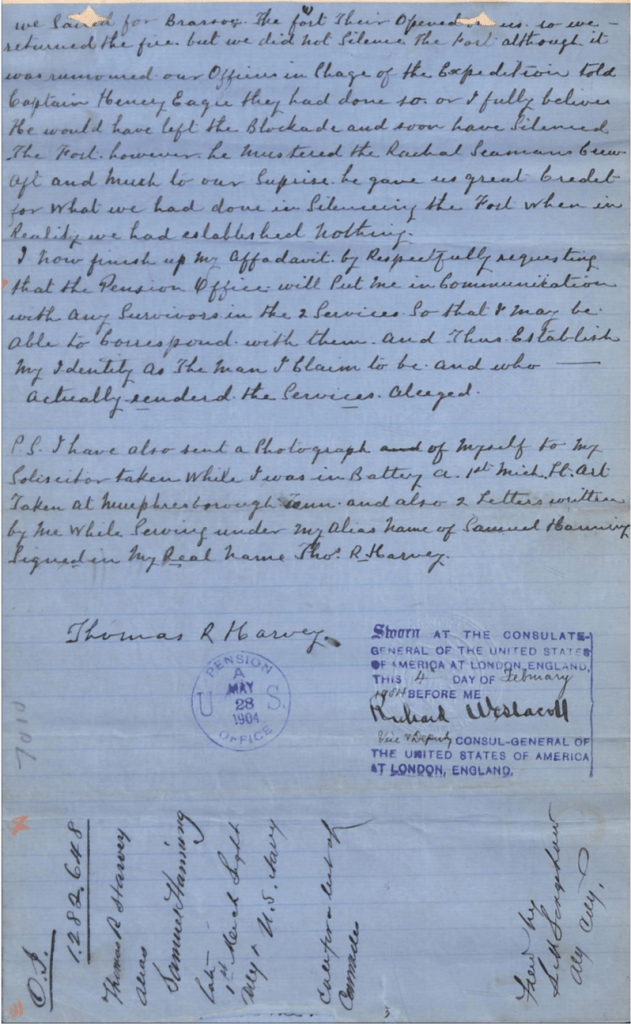
The Santee was a sailing frigate so we often run short of water as we had no way of condensing it without steam so we had two tenders to supply us—one a schooner called The Rachel Seaman, the other the barque Arthur mounting seven guns. They also cruised around the coast looking for blockade runners. One morning the captain of the barque Arthur reported to Captain Henry Eagle, commanding the U. S. Frigate Santee, that he had been fired upon from a fort down the coast. Think it was at Brazos. Captain Eagle asked him if he returned the fire. He said no. So he told him to go back and return the fire. He also sent the schooner Rachel Seaman mounting two guns with him and 10 men of a crew with orders to silence the fort and then for the Rachel Seaman to enter the river and fill some empty water casks she had on board and bring back for the Santee’s crew as they were suffering very much at the time for both food and water. Was one of the men on board the Rachel Seaman at this time. We first went to Madagorda and fired away for a while but as they did not respond, we sailed for Brazos. The fort [Fort Velasco] opened on us so we returned the fire but we did not silence the fort although it was rumored our officers in charge of the expedition told Captain Henry Eagle they had done so, or I fully believe he would have left the blockade and soon have silenced the fort. However, he mustered the Rachel Seaman‘s crew aft and much to our surprise he gave us great credit for what we had done in silencing the fort when in reality we had established nothing.
I now finish up my affidavit by respectfully requesting that the Pension Office will put me in communication with any survivors in the two services so that I may be able to correspond with them and thus establish my identity as the man I claim to be and who actually rendered the services alleged.
P. S. I have also sent a photograph of my myself to my solicitor taken while I was in Battery A, 1st Michigan Lt. Artillery taken at Murfreesboro, Tenn., and also two letters written by me while serving under my alias name of Samuel Hanning signed in my real name Thos. R. Harvey.
— Thomas R. Harvey
List of officers and comrades in U. S. Frigate Santee in 1861 and 1862 while blockading Galveston, Texas post.
Capt. Henry Eagle —Lieutenants—- Harold Jewett Mitchell —Midshipman—- Rogers Brown —-Petty Officers— Boatswain’s Mate Couners Capt. of Forecaste Murray Capt. Fore Top Murray —-Seamen— George Beacher Peter Winter Billy Shine J. Murphy Brown Garsha C. Hawkins Master’s mate Lambert
London, February 2, 1904. Thomas R. Harvey, alias Samuel Hanning, O. T. No. 1282648
The following letter was written by Byron Densmore Paddock (1833-1920), the son Henry Paddock, Jr. (1791-1854) and Silence Hard (1800-1850). He wrote the letter to Harriet A. Crippen (1839-1903) with whom he would marry on 27 December 1865.
Byron enlisted in the 1st Michigan Light Artillery Regiment, Battery F, at Coldwater, Michigan, in October 1861. He was formally mustered into the Union Army on January 9, 1862, and served with the regiment until receiving his discharge on April 6, 1865. Paddock was promoted to quartermaster sergeant, lieutenant, and captain during the course of his service.
[Note: This letter is the property of Michigan’s Military Heritage Museum and was transcribed and published on Spared & Shared by express consent.]
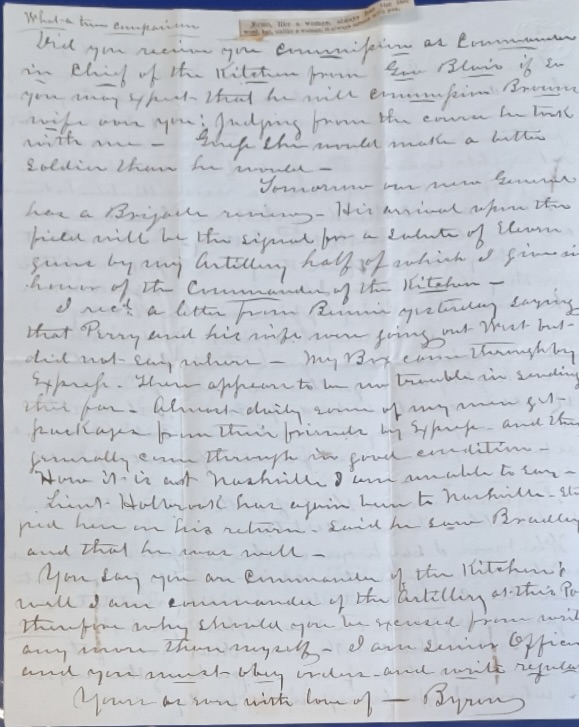
TRANSCRIPTION
Bowling Green, Kentucky March 22nd 1863
Dear Hattie,
It is Sabbath morning and one of those bright and beautiful ones that the Sunny South is so famous for. All nature looks gay, and seems striving to make me for get that this once happy country is now involved in a civil war. But I have only to listen and can hear the beating of the drums at guard mounting. Have only to look around me and can see the tents of the soldiers scattered in all directions.
Out yonder a few hundred yards from out in front of my camp is that of the 25th Michigan [Infantry]. 1 In one place I can see a squad of them playing ball. In another wrestling and jumping seems to be the order of the day. Then half a dozen or more are lying and sitting upon the ground enjoying the bright sunshine. But yonder in another part of the camp a different scene is being enacted. A hearse bearing the remains of a deceased soldier is moving along proceeded by a band with muffled drums and followed by a squad of soldiers with their guns reversed who are thus following their late comrade to his last resting place. Thus numbers are buried and soon forgotten by all save some dear ones at home.
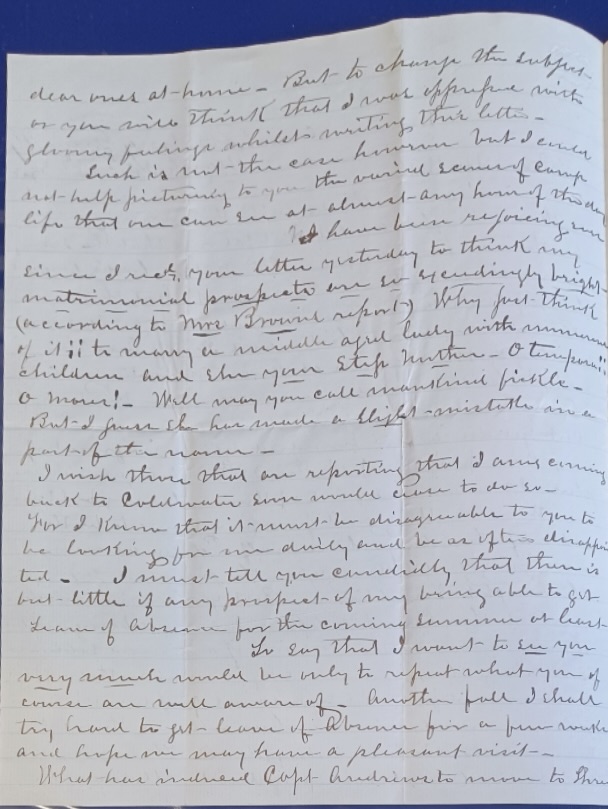
But to change the subject or you will think that I was oppressed with gloomy feelings whilst writing this letter. Such is not the case, however, but I could not help picturing to you the varied scenes of camp life that one can see at almost any hour of the day.
I have been rejoicing ever since I received your letter yesterday to think my matrimonial prospects are so exceedingly bright (according to Mrs. Brown’s report). Why just think of it—to marry a middle aged lady with numerous children and she your step mother. O tempora!! O mores! 2 Well, may you call mankind fickle. But I guess she has made a slight mistake in a part of the name.
I wish those that are reporting that I am coming back to Coldwater soon would cease to do so, for I know that it must be disagreeable to you to be looking for me daily and be as often disappointed. I must tell you candidly that there is but little if any prospect of my being able to get leave of absence for the coming summer at least.
To say that I want to see you very much would be only to repeat what you of course are well aware of. Another fall I shall try hard to get leave of absence for a few weeks and hope we may have a pleasant visit.
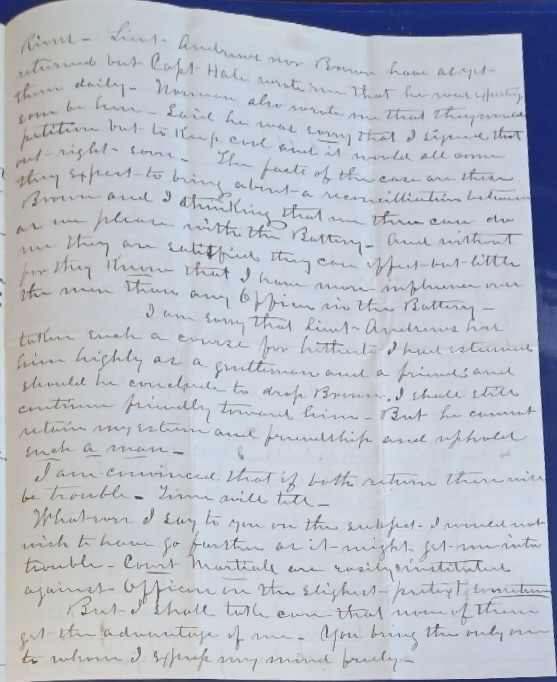
What has induced Capt. Andrews to move to Three Rivers? Lieut. Andrews nor Brown have as yet returned but Capt. Hale wrote me that he was expecting them daily. Norman also wrote me that they would come here. Said he was sorry that I signed that petition but to keep cool and it would all come out right soon. The facts of the case are these. They expect to bring about a reconciliation between Brown and I thinking that we three can do as we please with the Battery. And without me they are satisfied they can effect but little for they know that I have more influence over the men than any officer in the Battery.
I am sorry that Lieut. Andrews has taken such a course for hitherto I had esteemed him highly as a gentleman and a friend and should he conclude to drop Brown, I shall still continue friendly toward him. But he cannot return my esteem and friendship and uphold such a man.
I am convined that if both return there will be trouble. Time will tell.
Whatever I say to you on the subject I would not wish to have go farther as it might get me into trouble. Court martials are easily instituted against officers in the slightest pretext sometimes. But I shall take care that none of them get the advantage of me—you being the only one to whom I express my mind freely.
Did you receive your commission as commander in chief of the kitchen from Gov. Blair. If so, you may expect that he will commission Brown’s wife over you, judging from the course he took with me. Guess the world would make a better soldier than he would.
Tomorrow our new General has a Brigade Review. His arrival upon the field will be the signal for a salute of eleven guns by my artillery, half of which I give in honor of the commander of the kitchen.
I received a letter from Bennie yesterday saying that Perry and his wife were going out West but did not say where. My box came through by express. There appears to be no trouble in sending that far. Almost daily some of my men get packages from their friends by express and they generally come through in good condition. How is it at Nashville, I am unable to say. Lieut. Holbrook has again been to Nashville. Stopped here on his return. Said he saw Bradley and that he was well.
You say you are commander of the kitchen? Well I am commander of the artillery at this post. Therefore, why should you be excused from writing any more than myself? I am Senior Officer and you must obey orders and write regularly. Yours as ever with love of—Byron
1 The 25th Michigan Infantry was posted at Bowling Green, Kentucky from 8 January 1863 to 26 March 1863.
2 O tempora, o mores is a Latin phrase that translates literally as “Oh the times! Oh the customs!” first recorded to have been spoken by Cicero.
This letter was written by Dr. Bradley Crippen (1835-1909) of Coldwater, Branch county, Michigan, who enlisted on 1 October 1861 as a hospital steward in the 1st Michigan Light Artillery and then transferred on 27 April 1864 into the 16th Michigan Infantry as an Assistant Surgeon. He mustered out of the service at Detroit in 29 October 1864.
Crippen’s biography states that he served in Co. A (Loomis’ Battery) while in the 1st Michigan Light Artillery but the officers’ names mentioned in this letter suggest he at least initially served in Battery F commanded by Capt. John S. Andrews of Coldwater. The battery left the state for service in Kentucky on 3 March 1862, two weeks before this letter was written, and were for several months in garrison at West Point. In March 1862, Luther F. Hale was the 1st Lieutenant of Battery F. Lt. Holbrook would later command Battery F.
Loomis’ Battery was engaged in action at Elkwater and Greenbriar, W. Va, Bowling Green and Perryville Ky: Bridgeport, Gunthers Landing, Athens and Whitesboro Ala: Stone River and Hoovers Gap, Tenn: Chickamauga Lookout Mountain and Mission Ridge. In the Battle of Perryville, Loomis’ Battery is reported to have fired the first and last artillery rounds of the battle.
Bradley wrote the letter to “Dear Hattie” who was Harriet E. Harris (1845-1936). The couple were not married until October 1866 and so the envelope must date to a later period. The letter was datelined from Camp Gilbert outside of Louisville, Kentucky, and not far from “Springfield,” the boyhood plantation home of Zachary Taylor and the location of his final resting place.
The original Taylor Family vault where Zachary Taylor was buried in 1850 on the Springfield Plantation near Louisville.
Transcription
Camp Gilbert March 16th 1862
Dear Hattie,
Had intended to go to church today but it os one of those rainy, muddy ones such as we have so often in Michigan. For the past forty-eight hours it has rained constantly and what is still worse, it is very cold.
There are a few of the men sick but the officers are all in hood health. This weather makes some of us look a little homesick—the captain 1 among the number, but he don’t like to acknowledge it. At breakfast this morning said I, “Captain how would you like to be at home today?” which he answered by person (meaning you). My answer you well know.
We have to undergo many hardships and be deprived of many of the conflicts of life but this I knew, ere leaving Coldwater and do not complain. And had we stoves which neither the captain, lieutenants, nor myself have, it would be a little more agreeable. But there are none for us and we have to go to the privates’ tents to warm. Yet we live in hopes that they will send us farther south soon where it is warm and comfortable.
Expected to have got a letter from you yesterday but none came and now shall look for one on Tuesday. And you will not disappoint me, will you?
On Sunday last, having no place to go to church (for the cars do not run on the Sabbath and we have not got our horses yet), the captain and I took some of our men and went out to General [Zachary] Taylor’s Plantation and were kindly shown around by his nephew and taken to the vault that contains all that is mortal of the Old herve 2 and Ex President of the United States. His wife lies by his side.
By permission, I broke a small piece from one of the granite rocks of the vault and cut a twig from an arbor vitae (or tree of life) that grows by and waves its boughs over his tomb. Enclosed I send you the twig. Ere leaving we formed the company in two ranks around the vault and at the word, silently uncovered our heads in token of our respect to the honored dead, Peace to his ashes.
[George] Holbrook has just gone to bed to get warm and want to know what his Mother would say could see see him now. Lieut. [Luther F.] Hale also lies covered up and occasionally says how cold I am. And it is cold, damp, and lonely. But then we are soldiers and must bear it manfully.
There are a great many plantations around here occupied by very refined and well educated people and those of strong Southern principles too. They own a great many slaves and do not want slavery abolished.
Yesterday as I was coming from the city on the cars, two gentlemen sitting on the seat before me were conversing together about the prisoners that we have confined at Indianapolis. One of them had been there to see them and the other was enquiring how they were treated and if they were comfortably cared for. And receiving an answer in the affirmative said he wished the war would close either the one way or the other—he did not care which party was victorious.
Said I, “Sir, please excuse me for interrupting you but I must say that your last remark I did not like.” He turned very suddenly and appeared quite angry at first, and said, “I presume you are a Northern man?”
“No Sir, I am a Union man,” said I. “and yet I know that you and I do not differ but little in regard to slavery.” Told him that I did not want to see it abolished and would not have come here to fight had I thought that the war was waged for that purpose.
[end of letter is missing]
1 The captain of Battery F was 40 year-old John Sidney Andrews (1820-1909).
2 Old herve is English or French in original and means “eager for battle” so he probably meant the “old warrior.”












 Spared & Shared 23