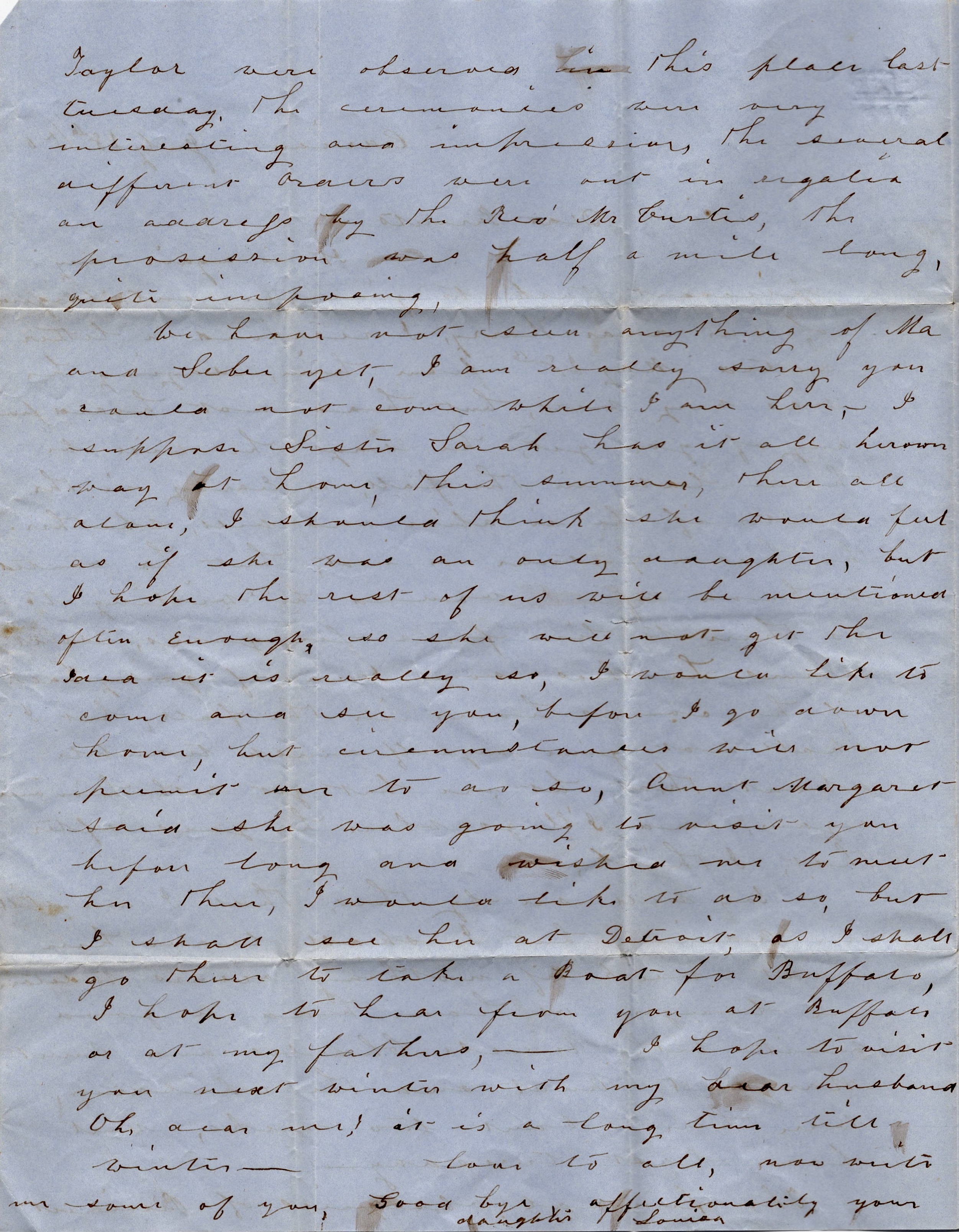
The following letter was written by Louisa (Rounds) Fairman (1822-1899), the wife of Harry A. Fairman (1818-1857). The couple were married on 30 July 1843. Harry was the son of Jared Fairman (1784-1874) and Hannah Howard (1797-1878).
T R A N S C R I P T I O N
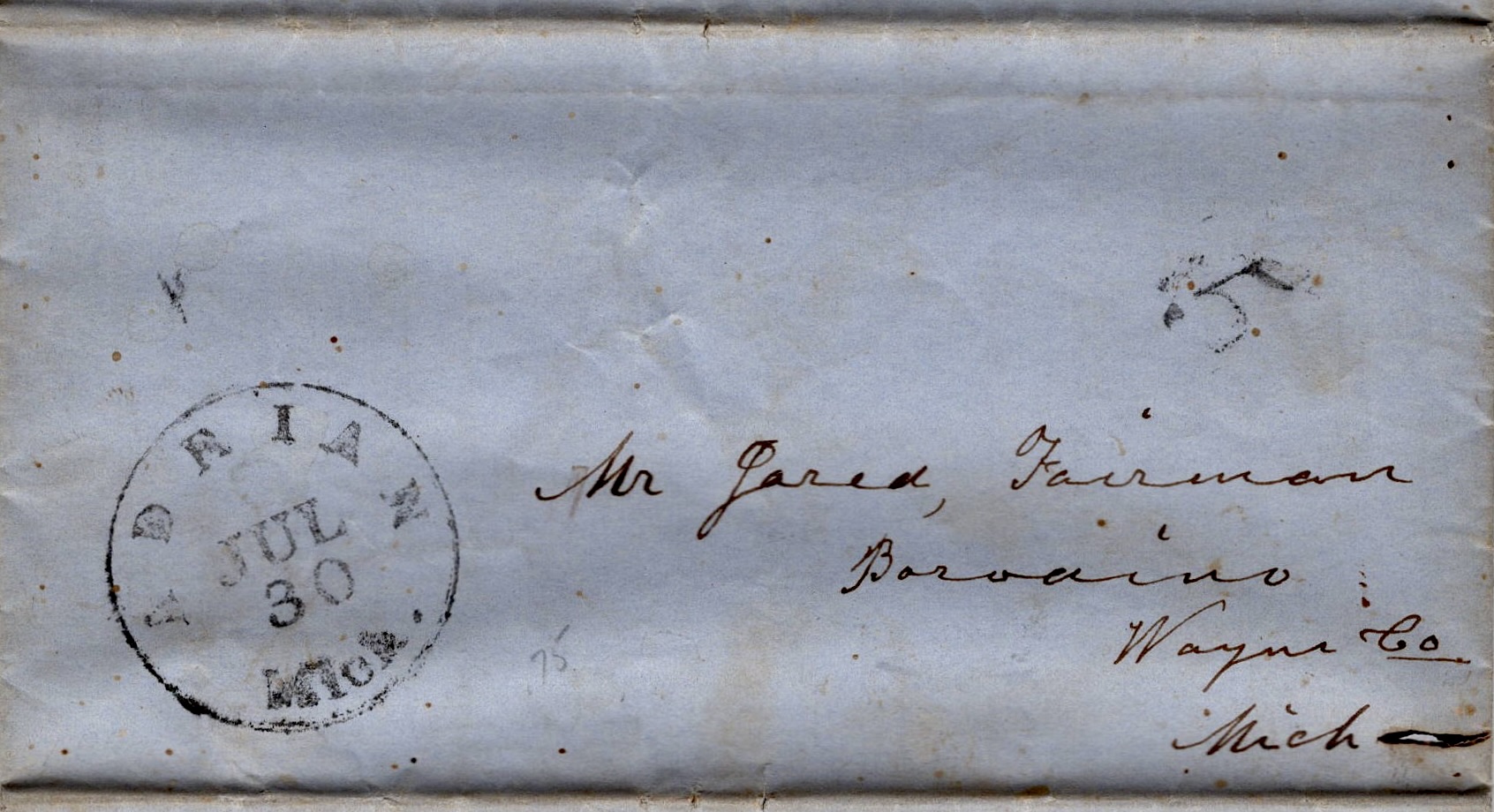
Addressed to Mr. Jared Fairman, Borodino, Wayne county, Michigan
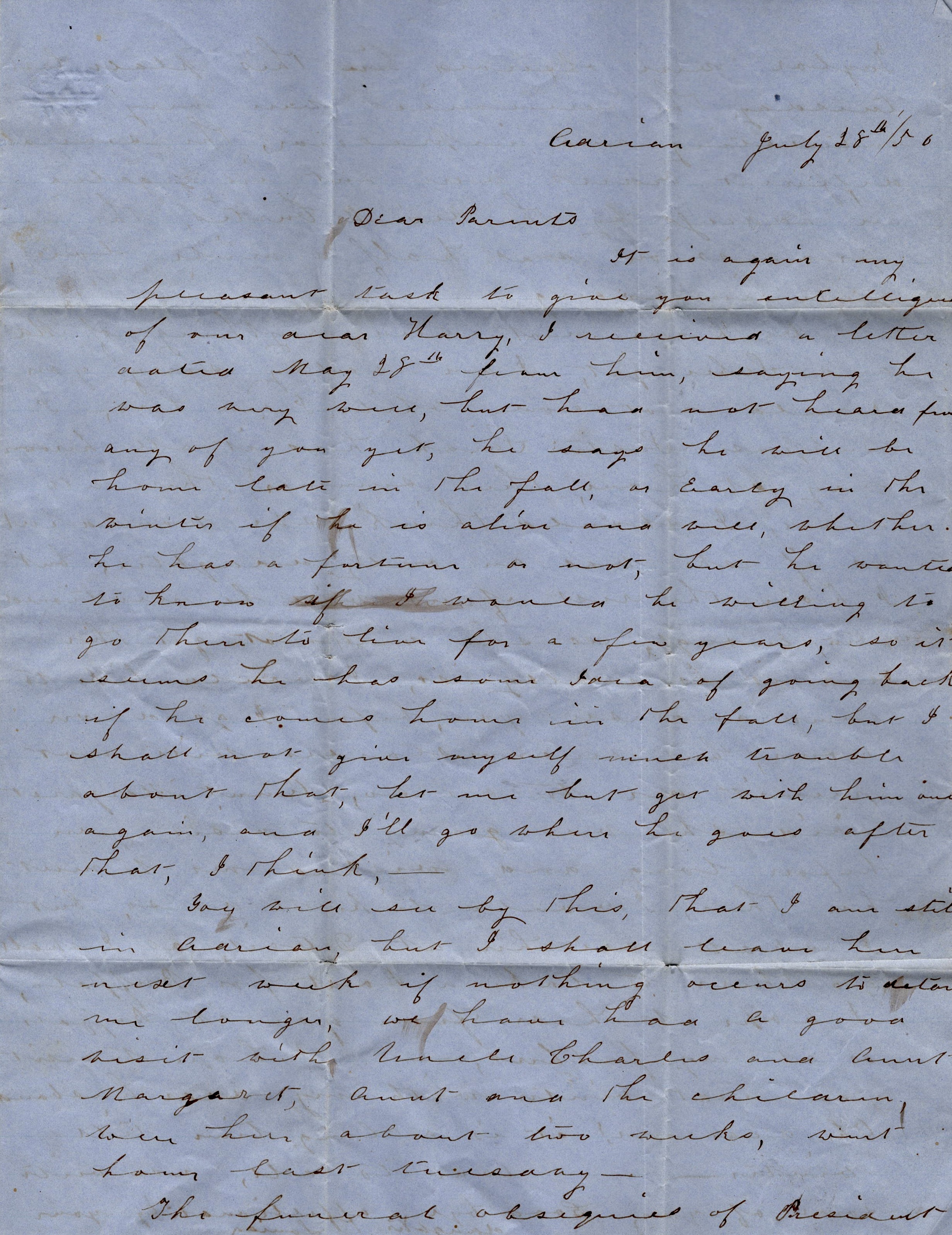
Adrian [Michigan] July 28, 1850
Dear Parents,
It is again my pleasant task to give you intelligence of our dear Harry [1818-1857]. I received a letter dated May 28th from him saying he was very well, but had not heard from any of you yet. He says he will be home late in the fall, or early in the winter if he is alive and well, whether he has a fortune or not. But he wanted to know if I would be willing to go there to live for a few years, so it seems he has some idea of going back if he comes home in the fall. But I shall not give myself much trouble about that, let me but get with him again, and I’ll go where he goes after that, I think.
You will see by this that I am still in Adrian but I shall leave here next week if nothing occurs to deter me longer. We have had a good visit with Uncle Charles [D. Howard] and Aunt Margaret [Vosburg]. Aunt and the children were here about two weeks. Went home [to Detroit] last Tuesday.
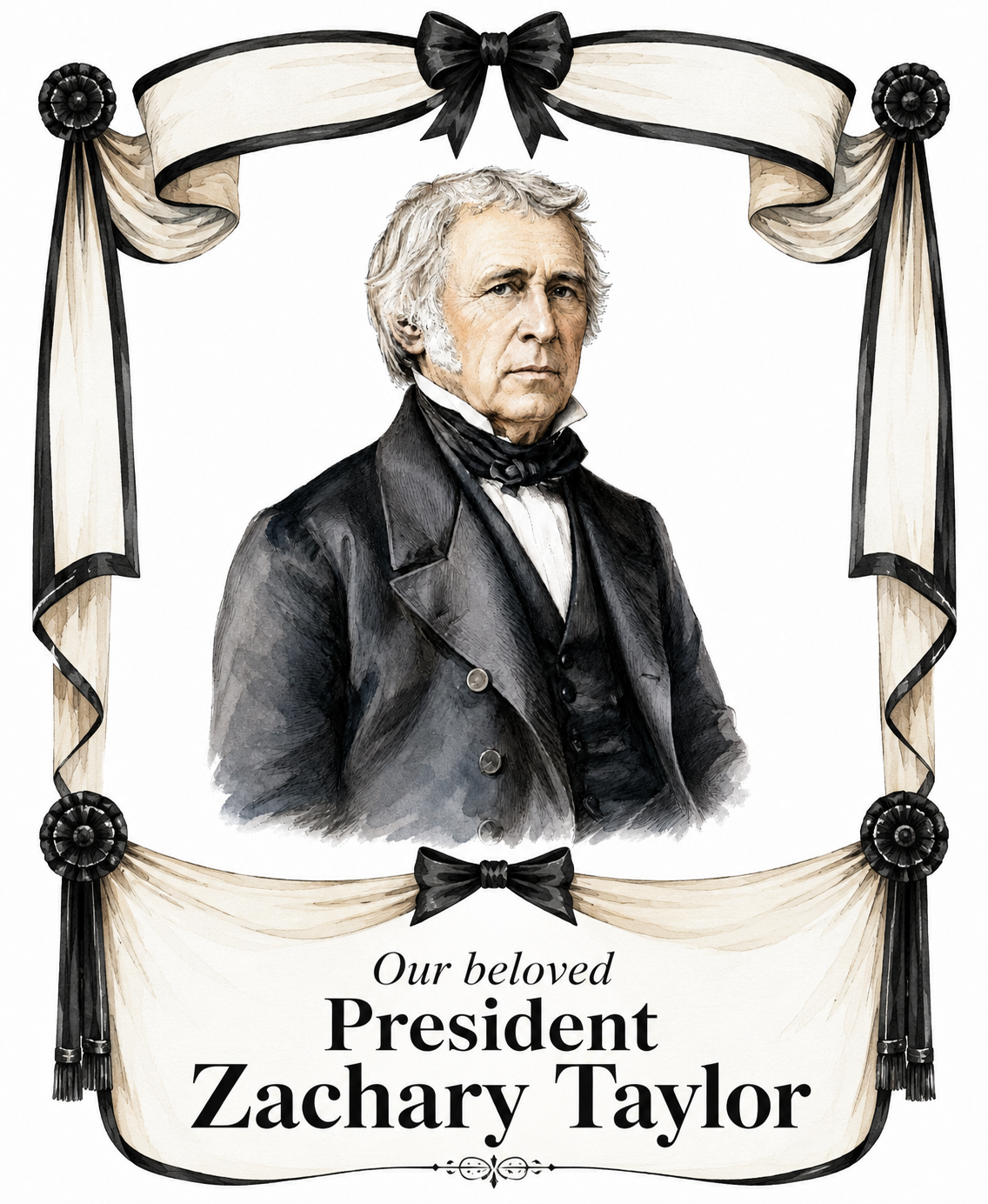
The funeral obsequies of President [Zachary] Taylor were observed in this place last Tuesday. The ceremonies were very interesting and impressive. The several different orators were out in regalia. An address by the Rev. Mr. [David A.] Curtis. The procession was half a mile long—quite imposing.
We have not seen anything of Ma and [brother] Sebre [Howard Fairman (1837-1911) yet. I am really sorry you could not come while I am here. I suppose sister Sarah [H. Fairman (1820-1866)] has it all her own way at home this summer, there all alone. I should think she would feel as if she was an only daughter. But I hope the rest of us will be mentioned often enough so she will not get the idea it is really so. I would like to come and see you before I go down home, but circumstances will not premit me to do so. Aunt Margaret [Howard] said she was going to visit you before long and wished to do so, but I shall see her at Detroit as I shall go there to take a boat for Buffalo.
I hope to hear from you at Buffalo or at my father’s. I hope to visit you next winter with my dear husband. Oh! dear me, it is a long time till winter. Love to all. Goodbye. Affectionately, your daughter, — Louisa
This letter was written by Dr. Bradley Crippen (1835-1909) of Coldwater, Branch county, Michigan, who enlisted on 1 October 1861 as a hospital steward in the 1st Michigan Light Artillery and then transferred on 27 April 1864 into the 16th Michigan Infantry as an Assistant Surgeon. He mustered out of the service at Detroit in 29 October 1864.
Crippen’s biography states that he served in Co. A (Loomis’ Battery) while in the 1st Michigan Light Artillery but the officers’ names mentioned in this letter suggest he at least initially served in Battery F commanded by Capt. John S. Andrews of Coldwater. The battery left the state for service in Kentucky on 3 March 1862, two weeks before this letter was written, and were for several months in garrison at West Point. In March 1862, Luther F. Hale was the 1st Lieutenant of Battery F. Lt. Holbrook would later command Battery F.
Loomis’ Battery was engaged in action at Elkwater and Greenbriar, W. Va, Bowling Green and Perryville Ky: Bridgeport, Gunthers Landing, Athens and Whitesboro Ala: Stone River and Hoovers Gap, Tenn: Chickamauga Lookout Mountain and Mission Ridge. In the Battle of Perryville, Loomis’ Battery is reported to have fired the first and last artillery rounds of the battle.
Bradley wrote the letter to “Dear Hattie” who was Harriet E. Harris (1845-1936). The couple were not married until October 1866 and so the envelope must date to a later period. The letter was datelined from Camp Gilbert outside of Louisville, Kentucky, and not far from “Springfield,” the boyhood plantation home of Zachary Taylor and the location of his final resting place.
The original Taylor Family vault where Zachary Taylor was buried in 1850 on the Springfield Plantation near Louisville.
Transcription
Camp Gilbert March 16th 1862
Dear Hattie,
Had intended to go to church today but it os one of those rainy, muddy ones such as we have so often in Michigan. For the past forty-eight hours it has rained constantly and what is still worse, it is very cold.
There are a few of the men sick but the officers are all in hood health. This weather makes some of us look a little homesick—the captain 1 among the number, but he don’t like to acknowledge it. At breakfast this morning said I, “Captain how would you like to be at home today?” which he answered by person (meaning you). My answer you well know.
We have to undergo many hardships and be deprived of many of the conflicts of life but this I knew, ere leaving Coldwater and do not complain. And had we stoves which neither the captain, lieutenants, nor myself have, it would be a little more agreeable. But there are none for us and we have to go to the privates’ tents to warm. Yet we live in hopes that they will send us farther south soon where it is warm and comfortable.
Expected to have got a letter from you yesterday but none came and now shall look for one on Tuesday. And you will not disappoint me, will you?
On Sunday last, having no place to go to church (for the cars do not run on the Sabbath and we have not got our horses yet), the captain and I took some of our men and went out to General [Zachary] Taylor’s Plantation and were kindly shown around by his nephew and taken to the vault that contains all that is mortal of the Old herve 2 and Ex President of the United States. His wife lies by his side.
By permission, I broke a small piece from one of the granite rocks of the vault and cut a twig from an arbor vitae (or tree of life) that grows by and waves its boughs over his tomb. Enclosed I send you the twig. Ere leaving we formed the company in two ranks around the vault and at the word, silently uncovered our heads in token of our respect to the honored dead, Peace to his ashes.
[George] Holbrook has just gone to bed to get warm and want to know what his Mother would say could see see him now. Lieut. [Luther F.] Hale also lies covered up and occasionally says how cold I am. And it is cold, damp, and lonely. But then we are soldiers and must bear it manfully.
There are a great many plantations around here occupied by very refined and well educated people and those of strong Southern principles too. They own a great many slaves and do not want slavery abolished.
Yesterday as I was coming from the city on the cars, two gentlemen sitting on the seat before me were conversing together about the prisoners that we have confined at Indianapolis. One of them had been there to see them and the other was enquiring how they were treated and if they were comfortably cared for. And receiving an answer in the affirmative said he wished the war would close either the one way or the other—he did not care which party was victorious.
Said I, “Sir, please excuse me for interrupting you but I must say that your last remark I did not like.” He turned very suddenly and appeared quite angry at first, and said, “I presume you are a Northern man?”
“No Sir, I am a Union man,” said I. “and yet I know that you and I do not differ but little in regard to slavery.” Told him that I did not want to see it abolished and would not have come here to fight had I thought that the war was waged for that purpose.
[end of letter is missing]
1 The captain of Battery F was 40 year-old John Sidney Andrews (1820-1909).
2 Old herve is English or French in original and means “eager for battle” so he probably meant the “old warrior.”