The following Prisoner of War (POW) Letter was penned by Reuben M. Colby (1839-1893) who served in Co. B, 20th Ohio Volunteer Infantry (OVI). He entered the service on 27 April 1861 as a sergeant in Co. H and was promoted to sergeant in Co. B in September 1861. He was next commissioned a 2nd Lieutenant in January 1863 and a 1st Lieutenant in July 1864. He finally mustered out as a Captain on 15 July 1865. In 1850, 10 year-old Reuben was living with his parents, Simeon and stepmother Marianne (Porter) Colby in Roxbury, Norfolk, Massachusetts. In 1860, Reuben was working as a carpenter in Louisville, Kentucky.
In his brief letter—limited to one page by military authorities—Reuben informs his correspondent that he was taken prisoner at the Battle of Atlanta on 22 July 1864 and was imprisoned a month later in Charleston, South Carolina, after being held briefly at Macon.
The Charleston City Jail was used to hold Union Officer Prisoners. Over 2,000 were held here in the fall of 1864 though many of them had to sleep outside.(LOC)
T R A N S C R I P T I O N
Addressed to Mr. Eliphalet Smith, West Cambridge, Massachusetts
Military Prison, Charleston, S. C. August 21st 1864
Dear friend Lipha,
Here I am actually caged a Prisoner of War after so long. I was captured on the 22nd of July at or near Atlanta. I was sent from Atlanta to Macon, Georgia, and then here. We are receiving better treatment here than at any place we have been yet. I hope soon to be exchanged for this thing of being a prisoner is anything but pleasant I assure you.
Please write to Dr. L. W. Jenness, Lowell, Mass., and tell him of my misfortune. Give my love to Clara and all friends. Respectfully in haste. — Lieut. R. M. Colby
Please write me soon and let me know all the news. Also I would like you to write to Lieut. Colonel John C. Fry, commanding 20th Regiment O. V. Infantry and tell him to send you my personal effects as I had a valuable lot of things in my valise—that is, to me. Yours, — Rube
I could find no image of David but here is an Ambrotype thought to be John Cramer of Co, A, 20th OVI. (Ohio Memory)
This letter was written by David Harrison Thomas of Co. D, 20th Ohio Infantry. The regimental roster informs us that David enlisted on 3 October 1861 when he was 23 years old. He was promoted to corporal in February 1863 and he died on 25 May 1863 from wounds received in the siege of Vicksburg.
David was the son of Welsh emigrants Owen (1800-1868) and Mary (1813-1893) Thomas of Radnor, Delaware county, Ohio. David mentions two of his siblings in the letter, Margaret (b. 1833) and Joseph (b. 1840).
At the time that David wrote his letter in July 1863, the regiment had participated in the Battle of Fort Donelson and at Shiloh where they had considerable loss.
T R A N S C R I P T I O N
Grand Junction, Tennessee July 20th 1862
Dear father and mother,
I take the pleasure this Sunday morning to write a few lines to you to inform you that I am able to walk around. I had a hard spell of the chills and fever for three days. I thought it was going to turn to some other fever but I got it broken. I got Amos [C.] Mounts to write a few lines to you to let you know. I did not then know what I would go to the hospital but I have been so lucky so far as to keep out of there.
We are still here at Grand Junction and I think it is likely we will remain in here for a while & we have brought in a good many hundred bales of cotton since we have been here at the Junction. These guerrilla parties are getting pretty numerous around here. We are called out in line of battle pretty often but they are careful not to come too close. The only remedy for them is when [we] catch them, hang them.
And I see an account in the papers that there is a call for more volunteers. I think McClellan will need them before he can take Richmond. I suppose the enemy is very strong there. They have concentrated the greater part of their forces there.
We had a very hard rain here yesterday. There is plenty of green corn and ripe peaches here now. The most of our company will be together in a few days. There is one or two comes in every day from the Northern hospitals. I expect [Cornelius] Hull and Joel Lloyd and [James] Henry Cratz will be here soon. [1st Sgt.] Joseph Curren arrived here yesterday. He says he that you was all well. I wrote a letter to Joseph and Margaret last week and will expect to hear from them soon. I have not heard whether you got that money I sent you or not. I sent the receipt in a letter. It calls for thirty-five dollars. I have nothing more at present. All of the boys is well.
Write soon, one and all. Yours respectfully, — David Harrison Thomas
I could find no image of David but here is an Ambrotype thought to be John Cramer of Co, A, 20th OVI. (Ohio Memory)
The following letters were written by David Harrison Thomas (1838-1863), the son of Welsh emigrants Owen Thomas (1800-1868) and Mary Thomas (1813-1893) of Radnor, Delaware county, Ohio. David enlisted on 2 October 1861 to serve three years in Co. D, 20th Ohio Volunteer Infantry. The regiment was reorganized at Columbus, Ohio, from August 19 through September 21, 1861, and mustered in for three years service on October 21, 1861, under the command of Colonel Charles Whittlesey.
According to a “Graves Registration Card,” David died of wounds received 25 May 1863 at Vicksburg—a gunshot wound to the spine. He was mustered out of the regiment on the day he died, 10 June 1863, and his body lies buried at the National Cemetery in Vicksburg.
Letter 1
October 13, [1861]
Dear Father,
I will pen a few lines to you hoping that you are all well. I am well and all of the boys. Henry Wood and Mother was here yesterday to see us. They went back to Columbus. Mother was on her way to Charleston.
We don’t know when we will leave here. We drill about 4 to 6 hours a day. There is about 225 secessionist prisoners here. They came here ragged and dirty.
Tell Joseph to be contented at home. There is more there than he can do. Give my best word to all of the friends.
No more at present. — David Harrison Thomas
Direct letter to 20th Regiment OVM in care of Capt. [Charles H.] McElroy [Co. D]
Letter 2
Camp King, Kentucky November the 1st 1862
Dear Father and Mother and All,
I take the pleasure of writing a few lines to you to let you know that I am well and hoping that these few lines will find you the same. I am well and all of the boys. We have been here in Camp King, Kentucky, over a week. There is batteries planted all around the camp. There is about 800 hundred here. It is very hilly around here. Our company was on picket guard last night. We did not come across any secessionists. [Charles] Whittlesey is our Colonel. [Manning Ferguson] Force is our Lieutenant-Colonel. They are brave men.
Manning F. Force commanded the 20th OVI at Vicksburg in 1863.
The measles is breaking out in our camp. There is a good many sick. I have gained 12 pounds since I have been in camp. Price Peny is very hearty and the rest of the boys. I got a letter from Granville last week. Joseph and the family is well. We have plenty to eat here so far. We do not know where we will go next. Perhaps we will go to the Tennessee line near Cumberland Gap, Kentucky. We don’t know when we will start until we swing knapsack.
We drill about 6 hours a day here. I would like to hear whether Mother arrived safe or not. No more at present. Write soon. — David Harrison Thomas
Direct to Camp King, Ky., 20th [Ohio] Regiment, Co. D, in care of Capt. [Charles H.] McElroy
I could not find an image of George but here is one of William H. Oury of Co. E, 20th OVI (Ancestry.com)
These letters were written by 23 year-old George W. Modie (1838-1913) of Company A, 20th Ohio Infantry. He wrote the letters to his parents, William Modie (1799-1872) and Margaret Gates (1811-1880) of Chester, Morrow County, Ohio. George married Isabelle (“Belle”) Nye (1848-19xx), the daughter of W. W. Nye and Martha Ball in 1870. He died in 1913 and is buried in the Dayton National Cemetery, Section 1, Row 10, Site 42.
George served with the 20th Ohio from October 1861 until July 1865 — nearly the entire four years of the war. In the second letter, written from Camp King, near Covington, Kentucky, George informs his parents of the inclement weather and the need for another blanket. The regiment remained at Camp King until 11 February 1862 when they participated in the investment and capture of Fort Donelson and then on to Shiloh.
I received a few lines from you yesterday after and was glad to hear that all are well at home. When I wrote last I was quite unwell. I had the rheumatics and a fever for a few days but have got well and enjoy good health again. I slept in a warm place at Cincinnati and when I got here I slept in a tent on the ground and that is what made me sick. If I had not stopped there, I would not have been sick, I do not think.
We are still at Camp King or close by. Co. A was sent out on picket guard today to stay three days. We are divided into squads of 18 men and are stationed on the hills with four 32-pound guns placed as to protect the City from any enemy. The squad I am with is placed on a hill where we have a fair view of Cincinnati, Covington, and Newport. Two of our guns are placed in range with the railroad and two more of a few hundred yards off. Our 18 men have charge of these four guns for three days and then go back to camp and 18 more take our place. Some of us has to stay by the guns at night and two of us has to go off about 1 mile on picket guard and I am one of them tonight and Joel Howe is the other. I must stop writing for I have togo on at 8 o’clock and it almost time to go.
I was sorry that Mr. and Mrs. Demitt was one day too late to see me at Camp Chase for I would like to have seen them. Besides, I would like to have had the cake she brought for me. I wrote to them yesterday. I had a letter partly wrote when I got your letter yesterday and sent it this morning. But I must stop for tonight and finish it in the morning. So I will load my rifle and start.
Tuesday, October 29th
I have just come in from guard and eat my breakfast and thought I would finish my letter and take it to the Office. I can go just where I please and I intend to scout around today.
We have plenty to eat. Have bread and meat and sugar and rice and coffee more than we can use. We make it three times a day. I have some milk this morning given to me by a neighbor. Our neighbors are mostly Dutch and very clever. Once in a while I come across one I take to be a secesh. They do not have much to say. When they had their election here, the Union men were only 14 men ahead in this county. So you see there are some secesh here. But I guess I will stop. Write soon and often and I will do the same. Yours, — G. W. Modie
Letter 2
Patriotic letterhead celebrating Kentucky’s Loyalty to the Union
Camp King, [near Covington] Kentucky Thursday, November 28 [1861]
Father and Mother,
I write you a few lines again to let you know I am well. I received a letter from Sanford last night and was glad to hear you was all well. J. Runyan also arrived last night. He told me he saw you. We have had some very cold weather for a few days back. It snowed last Saturday and Sunday and Monday it froze hard with only about half an inch of snow and Tuesday night we had a hard thunder shower and the next night it froze hard again and this morning it rains again which makes it very disagreeable for us here.
I would like for Mother to send me a blanket if she has one to spare. Sanford spoke of sending me his horse blanket but I fear it would be too heavy to carry in my knapsack so if you can send me a lighter one, it would come very handy. I have been very comfortable so far but we look for colder weather soon. It makes no difference what kind you send. Some old one will do as well as a new one. We expect to leave here soon but do not know where we will go. If you will send it to Sanford, he might find a chance to send it down as some of the boys are home every few days. If you get this in time, you might have a chance to send it when Capt. Hyatt comes down with his recruits. If you send me one, I will bring it back when the war is over. I do not think I shall be home until then if we all keep well.
I have nothing of interest to write today. Nothing of importance has transpired but things move on as usual. I will look for a letter from Martin next week. Tell R. Wilson I received his letter and was glas to hear from him. Yesterday one of the boys in Co. F got shot through the right hand and left arm by accident and the other night one of the sentinels had a finger shot off by a rebel.
Tell Dave Bre__ I look for a letter from him. I heard he has got home.
The mud is about knee deep here and we hope to get out of here soon. General Fremont was at the city yesterday but I did [not] get to see him. We received our regimental flag this morning. If I had room on this paper I would tell you what it looks like. It is a beautiful flag. We have plenty of daily papers to read every day.
Tell Mary I received her letter the next day after it was mailed. I would like to hear from some of you often. No more at this time. Yours, — G. W. Modic
Letter 3
Addressed to Mr. William Modie, Lucerne, Knox county, Ohio
Hospital 17th Army Corps Marietta, Georgia Tuesday evening, August 17, 1864
Friends at home,
I wrote to you only a few days ago but I heard some bad news from Martin 1 today and it may be you have not heard from him so I will let you know all I can from him. I received a few lines from Reed Runyan today stating that Martin was wounded. He had lost both of his thumbs shot off and a flesh wound in the arm above the elbow. It is a bad wound. Still it could have been worse.
The boys of our company whose time is out came in today and are here waiting for transportation home. The rebels have destroyed the railroad between this place and Chattanooga and they may be obliged to stop here a few days but they expect to go tomorrow. Reed Runyon is not with the rest of the boys as his time is not quite out yet. The boys say they seen some of the boys of Martin’s company and said Martin was working on the breastworks when he was wounded. I do not know at which hospital Martin is at but suppose he is still at the field hospital and I expect he will be sent to this place or farther north soon. I will do all I can to get to see him. I am able to get about by carrying my arm in a sling.
Well, I almost forgot to tell you I expect to start for home in a few days on furlough as we are of no account here and they want us to go home out of the way. Only a few of us are going at present. Two of the Fredricktown boys are going with me and one to Mt. Vernon. We will not likely get our papers in time to go with the non veterans but our furloughs are sent to headquarters to be signed and will be back in a few days. You must not look for me until you see me for if Gen. Blair should refuse to sign our furloughs, we will stop where we are a while yet. I thought I had best accept a furlough as times passes very slow with me at the hospital. I hope Martin will get home soon and no doubt he will. I suppose he is done soldiering. You must not feel uneasy about him. His wound is not dangerous and he will be well taken care of and will get along as well as if some of you was with him.
My hand is still very sore but is doing well. Well, it is not necessary for me to write much this time. If I get home as I expect, I can tell you the news. I have not had a letter from any of you since I wrote last. I suppose the reason is the railroad is destroyed and I suppose it must be repaired before you get this. Do not write again until you see me or hear from me again. No more this evening.
Respectfully yours, — George W. Modie
I have not heard from Dave Bruce but suppose he is all right yet as I have no account of him being hurt. Reed Runyon got a light soup spilled in the bargain. It appears that I and Martin have all our bad luck at once after going through so many hard fights, but the fortunes of war are very uncertain. But I am willing to try my luck again soon as I am able.
1 Martin G. Modie (1840-1911) was George’s younger brother. Martin served from August 1862 to April 1865 as a priate in Co. G, 121st Ohio Volunteer Infantry. He was discharged for disability.
I could not find an image of either Ed or Dan Roberts in uniform but here is William H. Oury who served in Co. E, 20th OVI(Ancestry)
The following letter was written by 20 year-old Edward H. Roberts and his brother, 25 year-old Daniel Roberts, both privates in Co. D, 20th Ohio Volunteer Infantry (OVI). The brothers enlisted together on 3 October 1861 to serve three years. Daniel mustered out at the end of his term of service; Edward mustered out as a corporal in July 1865. They wrote the letter to their older brother, George W. Roberts (1829-1900).
The Roberts boys were the children of Morehouse Roberts (1790-1847) and Susannah Newman (1806-1898) of Delaware county, Ohio. I previously transcribed an 1863 letter by Daniel Roberts which can be found at—1863: Dan Roberts to George W. Roberts.
The 20th OVI was organized at Columbus, from Aug. 19 to Sept. 21, 1861, to serve for three years. During the winter it was employed in guarding several batteries in the rear of Covington and Newport, Ky. In February 1862, a month after this letter was written, it participated in the battle of Fort Donelson, Tenn., “with no little credit to every man. It also participated in the battle of Shiloh, with considerable loss, and it is fully entitled to a share in the glory of that victory.”
Transcription
City Barracks Cincinnati, Ohio January 21, 1862
Dear Brother,
I now will take up my pen and try to write you a few lines to let you know we are all well. I hope these lines will find you and family the same. Well George, I am almost ashamed to try to write to you. it has ben so long since I have written to you. I wrote you a letter before I went to Illinois. I did not get no answer from it. It was not the reason which I did not write. It was that I was such a poor writer and I would hear from you every little while from home so I thought if you wanted to hear from me, you would write to me. You must excuse me this time and I will do better next time.
Our regiment has come back to the City Barracks. I expect we will stay here awhile. It may be that we will stay here till spring. We came here last week. We did not do any fighting when we was in Kentucky.
I would druther be in our tents than here. We are kept in like prisoners here. Ed and Tip is well and hearty. Ed is as fat as he can hardly be. Well, George, he eats a nuff, if that will make anybody fat. We have plenty to eat such as it is.
We hear from home every week. They was well last week. George, you orty [ought to] see Giles. You would not know him. He is about as tall as Old Calwell . I don’t think I ever saw a boy grow as fast in my life as he did while I was gone to Illinois. Well, George, if he is tall, he is awful good boy. He is very hard working boy.
I was home two weeks last fall. He worked hard all the time while I was home. He is very good to Mother. I am going home as soon as I can get a furlough. Ed was home while we was in Kentucky.
I got a letter from our neighborhood last week. They say that Melissa Clark is getting very fat. I can’t hardly believe it. We have not heard from Benjamin and John for about a month. They was at Cairo then. They was both doing duty then. We wrote to them about three weeks ago and have not heard from them yet.
Well, George, I guess Jim Herron 1 has got dinner ready and I must go and help him get rid of some of it. No more at present. Please write soon.
Dan wanted me to write a few lines but he has written all the news so I will not write anymore. Please write soon and direct to City Barracks, Cincinnati, Ohio, Co. D, 20th Regt. Ohio Vol. [Infantry], USA
Your brothers, — Ed and Dan
1 James J. Herron was killed in the Battle of Bolivar, Tennessee, in August 1862.
The following letters were written by Benjamin Franklin Roberts (b. 1835), the son of Morehouse (“Morris”) Roberts (1790-1847) and Susannah (“Susan”) Newman (1806-1898) of Sunbury, Delaware county, Ohio. Ben was 26 years old when he enlisted as a sergeant in Co. D, 20th Ohio Volunteer Infantry (OVI). He was with the regiment until the spring of 1862 when he became ill and had so much difficulty regaining his health that he was actually discharged from the regiment in July 1862.
In the first letter that follows, written from Sunbury, Ohio, in September 1862 to his older brother George Washington Roberts (1829-1900) of Ottawa, Illinois, Ben expresses some desire to return to his regiment though feels his health won’t allow it yet. In the second letter datelined from Helena, Arkansas, in mid-November 1863, we learn that Ben has regained his health and is serving as a Sergt. Major in the 15th Illinois Cavalry. He later served as Sergt. Major of the 4th Louisiana Colored Cavalry and left the service in October 1865.
In his letters, Ben mentions several brothers: Giles Hartley Roberts (1845-1908) who enlisted at the age of 18 in Co. G, 96th Ohio Vol. Infantry (OVI) in August 1862. He was transferred to Co. D of the 17th Veteran Reserve Corps in January 1864. He also mentions brothers Lord Byron Roberts (1827-1889), Edward Henry Roberts (1841-1912) who also served in the 20th OVI, and John L. Roberts (b. 1838) in the 18th Illinois Infantry, later the VRC.
After the war he eventually moved to Labette county, Kansas, where he lived out his days.
Letter 1
Home [Sunbury, Delaware county, Ohio] September 15, 1862
Dear Brother,
I thought I would try and answer your letter for Mother although I am in a dull mood for writing. I have been quite unwell for the last two weeks. I had the ague one week. Have got it broke but don’t feel any better.
[Brother] Edward is, I suppose, a prisoner if not released. He was taken at a battle near Bolivar. James Herring was killed. They are the only ones that met with any misfortune of our acquaintance. The word came by letter written by Lieut. Hill of Delaware to his wife. Lieut. Hill is a member of that company. He did not give the particulars of the battle. I think Edward will be home before long as they don’t hold prisoners long. Communication is cut off so we don’t hear from the boys often.
[Brother] Giles has enlisted. He went with Joe Kimball of Sunbury. I think Joe will make a good captain. We have not heard direct from him since the fifth. He was at Covington, Kentucky, at that time. I think they are there yet. There is quite a number gone from Sunbury & Gang Street in the same company. Some of them are writing nearly every day as we hear from them often. Giles wrote he was getting fat and liked camp life much better than he expected. Giles ought to of stayed at home with mother. He was not subject to a draft. Mother wanted him at home.
If I don’t hear from the boys soon, I will go to them providing I can & I think I can. I have not heard from [brother] John since I left. That was the last of July. I came by Clear Creek, stopped there two weeks, tried to sell out, but everything is dead in that country. Can’t sell a feed of corn there now. I did not think of staying here long when I came home but mother won’t listen to my going away this fall or winter. I don’t know how it will be yet. It is owing how my health gets. I shall try and see the boys before long anyhow. I sometimes think I am going to get well right away but as soon as I take cold, I am sick and I take cold so easy.
I will promise again to come and see you if I go west soon. I should of come that way home but I expected to go back that way soon & mother was so anxious as well as myself to get home. The excitement is pretty high here at present.
Mother is washing today. Her health is good. Burt is plowing for wheat. I was at Aunt Julie’s yesterday. Vance was at home. He saw [brother] Byron the night before. He is well. There is some southern sympathizers here—Searles, Cigs Drent, Squire Wilson, Old George Clark & his boys. Jim has had fits every day since they talked of drafting. There is an awful sight of invalids here at present. The Hartford Fair commences Wednesday. I had anticipated a good time there but I am afraid I shall not be able to keep up my end.
Tell me when you write what the chance will be there this fall and winter for light employment with indoors for I must do something this winter or I shall die with the blues. My love to you and yours. write son. — B. F. Roberts
Letter 2
Headquarters 15th Illinois Cavalry Helena, Arkansas November 15th 1863
Dear Brother,
Your letter has just come to hand but not until it went the rounds from Memphis. It was sent to Vicksburg & back here ere it reached me. My health has got quite good again. We have a good deal of duty to do of late—scouting and guard duty.
I forget whether I told you or not in my last letter I expected to go into an American Regiment of African Descent. The adjutant and I have positions offered us providing we will accept which we have. Maj. Wilson, formerly of this regiment, is Colonel with the privilege of choosing his own officers and has chosen the adjutant and myself from this regiment. It is a cavalry regiment. Col. Wilson is now in Texas with Banks. He expects to fill his regiment there.
I received a letter from [brother] Ed not long ago. He had got to his regiment. Said he was fat and in as good health as ever. The other boys was well. I hear from [brother] John quite often. He is well. Wants to go with me. The adjutant and I will do all we can to get him in. I suppose you have heard that John has a commission but can’t get mustered as the company is so reduced that they are not entitled to but two officers.
We are having beautiful weather here now—very warm and dry—but the citizens say when it begins to rain that it don’t quit until it rains out & the soil is such that when it gets muddy, there is no bottom.
We have some gay times running guerrillas around here of late & with pretty good success too. We have caught a good many lately. We are going out tomorrow or the next day with three rations. I anticipate a good time going where the bushwhackers are thick and lots of chickens, any amount of girls. Such scouts make a soldier fat. Write soon. My compliments to family. Yours, &c.
— B. F. Roberts, Sergt. Major, 15th Illinois Cavalry
These letters were written by Daniel N. Roberts (1836-1906), the son of Morehouse Roberts (1790-1847) and Susannah Newman (1806-1898) of Sunbury, Delaware county, Ohio. Daniel was 25 years old when he enlisted as a private in Co. D, 20th Ohio Infantry on 3 October 1861. He remained in the service for three years, mustering out on 17 October 1864.
In his first letter of 24 April 1861, Daniel recounts the significant events of the Battle of Shiloh, which occurred near Pittsburg Landing on April 6-7, 1862. The 20th Ohio Infantry was consolidated with other Ohio regiments within the 3rd Brigade of Maj. Gen. Lew Wallace’s 3rd Division within Grant’s Army of the Tennessee. Despite being within a reasonable distance to reach the battlefield by noon of the first day’s combat (just six miles), a tangle of confusing orders and miscommunications led to a tardy arrival, which only allowed them to engage in the fighting on the second day.
In his second letter of 7 September 1863, Dan writes considerably about his brother Giles Hartley Roberts (1845-1908). Giles enlisted at the age of 18 in Co. G, 96th Ohio Vol. Infantry (OVI) in August 1862. He was transferred to Co. D of the 17th Veteran Reserve Corps in January 1864. He also mentions brothers Lord Byron Roberts (1827-1889), Edward Henry Roberts (1841-1912) who also served in the 20th OVI, John L. Roberts (b. 1838) in the 18th Illinois Infantry, and Benjamin Franklin Roberts who served in the 18th Illinois Infantry and later in the 15th Illinois Cavalry.
After the war, Dan settled in Ottawa, LaSalle County, Illinois, and was married in 1870 to Julia Branin (1845-1923).
Letter 1
Pittsburg [Landing], Tennessee April 24th 1862
Dear Brother,
I received your welcome letter yesterday and was very glad to hear from you. We are all well at present. I have been sick ever since the battle here, My disease was mostly bowel complaint. I have gotten over that now and getting quite hearty again. Edward is as hearty as anyone in our company. He has been hearty most all the time. Ben and John is camped about two miles from us. Tip and me was down to see them last Monday. They was both well then. Benjamin came up from Cairo the same night the fight ended.
Our division was down the river about six miles from here when the fight commenced on Sunday. We was ordered to march Sunday after noon. We reached the battlefield that night and was out in line of battle that night for next morning. The ball opened about daylight. We was put on the right wing. The most of the fighting on that day was done on the left and center. We only had one killed and about fifteen wounded in our regiment. I don’t believe none hurt htat you was acquainted with.
George, it was [an] awful sight the next day on the battlefield to see the dead. I never want to see another such a battle. I expect we will have a big one to Corinth about 18 miles from here. I can’t tell when we will move. There [are] troops coming up the river every day now.
Well, George, we was badly whipped Sunday but the rebels got it worse Monday. I don’t see how our men let them come on them Sunday morning like they did. George, we wrote to mother right after the battle. Edward has done the writing since the battle for I have been sick. It was no wonder I was sick for we did not fetch our tents here when we came here. We laid out four nights and [it] rained every night. As quick as we got our tents here, it quit raining.
It has been very sickly in our regiment since that exposure. Two men died in our regiment yesterday. Well, I must close. I came very near forgetting about that money you spoke about. You can have it. I don’t expect I will want it that soon. Please write soon. Yours truly, — D. N. Roberts
Letter 2
Vicksburg [Mississippi] September 7, 1863
Dear Brother,
I received yours of the 14th and was very glad to hear from you once more but was sorry to hear that your children had such sore eyes. My health is very good now. Ed has gone home on a sick furlough. He left here the 23rd of August. He was getting better all the time. Most all the boys that had been sick or was not well got a sick furlough. I have not heard from him since he left here. Sanders and John Mayfield got a furlough too. Tip has not got back yet. He has been gone over a month.
I have not had a letter from home for a long time. I got one from Giles last night. His health is very poor yet. He has the chills yet. Giles is talking about going to his regiment. He says he can’t get his discharge. He thinks if he was to his regiment, he would get it. The 96th [Ohio Infantry] has gone to New Orleans. Giles is now at Schofield Barracks Hospital, Mo. I wish you or Byron would go and get him home. He would get his discharge. I think you had better write to him and see what he says about it. I do wish he had his discharge and at home for Mother worries the most of her time about him.
I heard from John about a month ago. He was at Helena then. He said they had marching orders then. He thought they would go up White River. John was not very well then. He had been quite sick but was getting a great deal better then.
I had a letter from Ben about the same time I got one from John. Ben was well. He was at Corinth, Mississippi, then.
Well, George, we just got back last Thursday night from a long march. We was gone fifteen days. We went to Monroe, Louisiana. We got on the boats here and went up the river sixty miles. We got off the boats then and it was 75 miles to Monroe. We had to walk. The weather being very warm, it made a very hard march. We suffered a great deal for water.
The rebs had quite a large force of cavalry at Oak Ridge, about fifty miles from the river. They heard it was Johnny A. Logan’s rats 1 that was after them [so] they pulled up stakes and the way they went for Monroe. We followed them [and] we expected to have a fight when we got there but they did not stop there. They left a good many sick there in the hospital. George, it was the lonesomest country that I was ever in—nothing but woods and swamps and any number of rattlesnakes. I saw one killed seven feet long. It had 13 rattlers on. There was a boy bit by one of them. He did not live one hour after he was bit.
Well, George, I must now close by asking you to write soon.
Your brother, — Dan
1 John Alexander Logan (1826-1886), nicknamed “Black Jack” was at the height of his popularity at the time this letter was written, having lead his division with distinction in campaign to capture Vicksburg, most notably in the assault following the explosion of a mine. I have not been able to find any other references to Logan’s men being called “rats.”
I could not find an image of John but here is one of L. Smith Cogswell who also served as a sergeant in Co. E, 18th Illinois Infantry (Photo Sleuth)
The following letters were written by John L. Roberts (b. 1838), a native of Wyoming county, Pennsylvania, who was earning his living as a farmer in Clear Creek township, Alexander county, Illinois at the time the Civil War began. When he enlisted as a corporal in Co. E, 18th Illinois Infantry on 28 May 1861, he was described as a 5 foot 7 inch tall, brown-haired, blue-eyed, single, 23 year-old farmer. John had recently been promoted to a sergeant before the Battle of Shiloh which he describes in some detail in the first letter. In that two-day fight, the regiment lost 10 killed, 63 wounded and 2 missing—all on the first day. The 3 color bearers who carried the flag in the first day’s conflict were all killed while supporting the banner.
John Roberts’ actions in the battle no doubt earned him recognition and he was later commissioned a lieutenant by Captain Charles H. Reed. Also serving with him in the same company was his older brother, Sgt. Benjamin Franklin Roberts (b. 1835) who became seriously ill in the spring of 1862 and had to be discharged for disability in July 1862.
The 18th Illinois Infantry saw its first major action at Fort Donelson in February 1862 where it occupied the right of Oglesby’s brigade, on the right of the line of battle, and during the second day’s fight lost 200 men in killed and wounded, 50 dying upon the field and 10 soon afterward. The regiment during the battle bravely and persistently maintained the position to which it was assigned in the early morning, and not until its ammunition was spent was the order to retire given.
Letter 1
Pittsburg, Tennessee March 31st [1862]
Dear Brother & Sister,
As I have a little time this morning I will write you a few lines in answer to yours of the 27th. I have just received a letter from Benjamin. He is a Clear Creek [and] has been very sick but is now able to be around. He will stay there till he is able for duty.
I saw the boys of the Ohio 20th a week ago. Tip was not very well. Dan and Ed are both very fleshy. Ed is much larger than either of us. I received a letter from Giles the other [day]. They are well at home.
We have been here since the 22nd. We stopped two days at Savannah. Our Colonel who was wounded returned a few days ago. He leaves again this morning for home—is not able to take command yet. Our Major who has been under arrest so long has resigned. Our Lieut. Colonel is still under arrest. The boys that was wounded are all getting well. But one has died since I last wrote (that is, from our camp). We don’t have but very little sickness [in the] regiment. We have but one in our camp. He stays in my tent and is quite sick and there is but little attention paid to him by the doctors. We have no hospital tents with us.
We have orders to be ready to march at a moment’s warning. There is but three tents to go with the regiment so we will have to stem the weather without tents from this on.
You said you had sent us some papers. We did not get them. Our mail is very uncertain. The news here that the Rebels are fortifying Corinth about twenty miles from here. My opinion is that there will be a big fight or a big dud. I should rather think the latter as we have a large force here.
We have been having very fine weather here for a week past. The fields begin to look quite green with grass wild plums, and peach trees are in full bloom.
I will now close as it is impossible for me to write when there is from one to a half dozen talking to me which is the case this morning. I will write again as soon as convenient. Ben says he will probably sell out before he comes back. If he does, we will make you a visit as soon as we are discharged and spend a few weeks at home. I will enclose your letter in an envelope which was sent to me from a friend.
Direct to Pittsburg Landing, Tennessee
Respectfully yours, — J. L. Roberts
Letter 2
The Battle of Shiloh
Pittsburg [Landing], Tennessee April 10th 1862
Dear Brother,
As you have doubtless heard of the late battle here, would be anxious to know how we came out. I am happy to [say] Ben and I luckily came through without a scratch, although Benjamin was not in action as he did not get here from home till we had been thrown back in the rear as a reserve.
Our regiment did not suffer here as they did at Donelson—only 9 or 10 killed and 18 or 19 wounded which we thought very lucky as we was engaged a part of two days. We lost the most of our men the first day. We was ordered to retreat by our Major [Samuel Eaton] who was in command of the regiment—an order which he had no occasion for giving at that time although he was wounded. That through us in confusion and some of them retreated so far that they could not be found to rally again.
Mason Brayman (1813-1895) of Springfield, Illinois (Heritage Auctions)
After we had rallied the men that was left, the rebels came up again and undertook to charge a battery but failed in the attempt. We had a good position and just raked them from two [directions]. Major [Mason] Brayman took the flag and rode up and down our lines and cheered us on (Brayman is a staff officer of our division). 1
Monday we followed close in the rear of the forces that was engaged until late in the day [when] we was ordered to charge a battery which had been charged twice by our force but could not hold it. We charged it and held it and gave them about forty rounds of canister before they got out of range of the battery. Our Captain [Charles H. Reed] fired a gun three times before he could get a man to help him. He then was assisted by our 2nd Lieutenant [Daniel W. Flick] and Capt. [Henry S.] Wilson [of Co. B] and myself. The General 2 told our Captain he should have the battery so we hitched on and soon was ready for action again. 3
I cannot tell you but little about the battle—only what I saw myself [and] that was but a small portion. But one thing I know, that there was a perfect stampede of our forces on Sunday. They conducted themselves shamefully—both men and officers. They run and left but few braves to face the enemy who kept them from all being taken prisoners or brutally slaughtered. I will now close hoping to hear from you soon. I will write when I have time.
— John L. Roberts
1 Major Mason Brayman, an AAG on the staff of Gen. McClernand, is credited with helping to rally the troops of McClernand’s command to make a stand.For his bravery at Shiloh, Brayman was promoted to a Colonelon 15 April 1862 and given the command of the 29th Illinois Infantry.
2 Roberts does not identify the general by name but the first general in the Union chain of command of the Division in which the 18th Illinois was a part of would have been Major General John McClernand. The 18th Illinois was commanded by their Major Eaton). The 1st Brigade, of which they were a part, was commanded by a Colonel (Ware), and they were a part of McClernand’s 1st Division of Grant’s Army of the Tennessee.
3 One source describes this action as follows: “On the morning of the 7th the regiment fell in as a reserve to General Thomas L. Crittenden’s brigade. At about 2 PM they charged a Confederate battery, capturing two 6-pounder brass field pieces, one of which Captain Charles H. Reed, of Co. E loaded and brought to bear upon the retreating enemy, giving them three shots unassisted. He was then assisted by Captain Wilson and Lieutenants Daniel Flick and John Davis [could they mean John Roberts?], and fired 15 or 20 rounds into the retreating Confederate cavalry. [see Shiloh National Military Park]
Letter 3
Map of area between Pittsburg Landing on the Tennessee River at bottom right and the Confederate Stronghold at Corinth, Mississippi, at upper left. Roberts wrote the 2nd letter from near Monterey located at the center of the map.
Army in the field Camp near Monterey [Tennessee] May 26, 1862
Dear Brother,
I have not received any letters from you for a long time but as our mail is very uncertain, I account for it in that way. I went to the river with Benjamin the 14th of this month, but him aboard a hospital boat (or rather a receiving boat for the hospital). He had been quite sick but was better when I left him than he had been for several days before. I have been watching the papers daily to see him name among the list of sick arriving at the hospital. I have not heard from him yet. He took with him his Descriptive Roll so that he could get his discharge which he perhaps has got and gone home to Ohio.
I received a note from Ed yesterday. They are camped at Shiloh Church about 14 miles from here [and] 3 miles from the river landing. They are having considerable sickness in the regiment. Ed Perfect 1 died not long ago. Leroy [Perfect] and Henry Wilson has gone home. Henry was very sick when he left. They are camped on the battlefield. I expect the stench from the carnage is what causes them sickness. I camped at the church a few nights ago [and] the stench was very disagreeable then. I did not know that the boys was there at the time. I am in hopes they will soon be relieved as they are there guarding the road from the landing.
Our Division is one of the reserve divisions. We are on the right and rear of the extreme right. We have heavy duty to do here standing guard [and] building breastworks, but we are pretty healthy. We can hear skirmishing along the lines every day, sometimes pretty heavy.
This is our fifth camp since we commenced advancing. I saw Henry Case about five weeks ago. He is in the 34th Illinois Regiment and Sam Beaty is in the 9th Indiana. I have not heard from home lately. The last I heard they was well. I will now close. you will direct to Pittsburg Landing. Write soon. — John L. Roberts
1 Edwin R. Perfect (1839-1862) was the son of William Perfect (1797-1882) and Maria Stark (1804-1870) of Trenton, Delaware county, Ohio. Ed was a corporal in Co. D, 20th Ohio Volunteer Infantry. He died of disease on 3 May 1862 in Shiloh Church which had been converted into a hospital.Leroy Perfect (Edwin’s cousin) and Henry Wilson also served in the same company. They both contracted typhoid fever and were put on a steamer and taken to a hospital in Cincinnati.[See 20th Ohio Vol. Infantry]
Letter 4
Jackson, Tennessee September 16, 1862
Dear Brother,
As I have a little time this morning, I will improve it by writing. General R____ Division passed here yesterday on their way to Corinth. I saw Dan and Tip. They was engaged in the fight at Bolivar which you perhaps saw an account of (Aug. 31st). James Herron was killed. Ed was taken prisoner. He has not been heard from since. There was some prisoners paroled down on the River a few days ago. We are in hopes that Ed is among them. There was two companies taken of the 20th—K & G. Ed was at the spring about a half mile up when the alarm was given and did not get to camp in time to fall in with his company as they had been deployed in advance. He was with Company K when taken. Giles has enlisted in the 96th Ohio Regiment. Joseph Kimball is their Captain (Company G is their company). They are at Covington, Kentucky. Benjamin is at home. He has hte ague.
We have a great deal of duty to do here. We are on guard every other day. I think we do a great deal of guarding that is uncalled for.
There was quite an excitement here about ten days ago. We expected to be attacked. If we had have, the boys would have burned the town. As it was, there was several fires. I would have been glad to saw it burn. We then would have less guard duty to do.
George I am getting disgusted in the way this war is carried on. Men that we know to be the most rabid secesh are granted all the privilege they ask for. They are allowed to extortion on the soldiers in every way they can, [yet] we are not allowed to forage at all. Vegetables are sold so high that a private cannot afford to buy them. The soldiers here have but little confidence in our General. They doubt his loyalty.
I will now close hoping to hear from you soon, — J. L. Roberts
Letter 5
Patriotic stationery used by John L. Roberts in his letter of September 18, 1862
Jackson, Tennessee September 18, 1862
Dear Brother,
I have just received your letter of the 14th and now attempt to write a few lines in answer. Benjamin is at home. He has the ague. He will be back to Illinois again this fall.
I wrote to you a few days ago. I believe I told you that Ed was taken prisoner about the last of last month at Bolivar. He has not been heard from since. Rufus Davis [?] passed on here on the way to Corinth. I saw Dan and Tip when they passed. Giles [H. Roberts] is in the 96th Ohio, Co. G. Joseph Kimball is their captain.
You say you are out of business. Now if you will go to trading with the soldiers, I will insure you to make money. Anything that can be eaten will sell at high prices. I know men that are making fortunes trading with the soldiers. One man discharged from our camp told me that he made $72 clear in two weeks at Helena. I know he has but small capital. He was up here last week with a stock and sold out at wholesale. He has gone for another stock. I expect to help him sell out when he comes. He is going to buy tobacco, cigars, oysters, sardines, canned fruit, crackers, cheese, nuts, and stationery &c. He has to have everything shipped by express from Columbus up and pay $250 a hundred. So you see that takes off some of the profits. But keeps traders out and a few men here have the trade monopolized here. I should like to have you come down and try your luck. After the first trip, you can tell what you can do and what you can sell best. Butter sells here at 25 cents per lb. I don’t know where I could buy a pound at that. It is very scarce. I think you might bring a lot and sell at wholesale and pay the expense of a trip.
There is no danger of Jackson being evacuated as is reported. There is quite extensive fortifications going up here. I will now close hoping to hear from you soon. — John L. Roberts
I could not find an image of Charles but here are four members of Co. H, 20th Ohio Volunteers; Downs, Quackenbush, Ohl, & Wonder (Al Niemiec Collection)
The following letters were written by Sergeant Charles (“Charlie”) Darwin Carpenter (1839-1925), the son of David Cooley Carpenter (1805-1886) and Sarah Cleveland (1809-Aft1880). Charlie’s father was a stone cutter turned farmer in Berkshire Township, Delaware County, Ohio. He wrote most of the letters to his sister, Martha J. Carpenter (1837-1921). Martha married Charles Pierson in McLean County, Illinois on 10 February 1869. They resided in Decatur, Illinois. Some letters were written to his brother Corwin (“Cor”) Carpenter.
Charlie served in Co. D, 20th Ohio Infantry, enlisting as a private on 24 September 1861 when he was 22 years old. He was made a corporal a couple of weeks later and promoted to sergeant on 15 May 1862. Charlie was mustered out of the service as the first sergeant of his company on 28 September 1864 after three years of service.
After the war it appears that Charlie took up farming near Bloomington, McLean County, Illinois and married Hanna Maria Cravath (1846-Aft1920) on 3 July 1872. Maria was the daughter of Myrtillus and Polly Cravath of Pittsfield, Michigan; later Bloomington, Illinois.
The couple eventually relocated to Fort Scott, Bourbon County, Kansas, where Charlie became a nurseryman. His last residence (1910) before retirement was in Parsons, Kansas, where he worked as a teamster for a dairy. He is enumerated in the 1920 Census residing in the household of his son, Ernest Fay Carpenter (1873-1852) in Center Township, Vernon County, Missouri. Ernest was married to Agnes D. Estes (1873-1953). Pension records suggest that Charlie died in 1925.
Letter 1
Addressed to Miss M . J. Carpenter, Galena, Delaware county, Ohio
Fort Donelson, Tennessee February 18, 1862
Dear folks at home,
It has been so long since I have heard anything from you that I thought I’d just drop a few lines to let you know that I’m all right. The boys are all well. Of course you know all about our leaving Cincinnati. We went down river about 480 miles to Paducah, went to bed and next morning found ourselves going up Cumberland river to the fort where we are now. The gunboats were playing on the forts finely when we got here. They were not long in silencing the guns at the fort but then the work was not quarter done. The fort is as strong a one as the rebels have and then their entrenchments extended about five miles down the river. They would come out and fire on our men and then retreat to their ditches. We had a force of about fifty thousand here. I can’t tell anything about the rebel force.
One thing certain, we have got ten or twelve thousand prisoners for I have seen them. Our regiment is going down river with them. Co. B is on board a boat now expecting to start every minute. We have about twelve hundred on board. They are going to Cairo or St. Louis.
If I was at home, I could give a description of the fort and the fight but I can’t do it now. We were not in the fight. We were held in reserve for a charge bayonet but they surrendered before it came to that. We were held so close that the balls whistled around our heads some but we didn’t have any of the fun.
The loss was heavy on both sides. Can’t tell what it is. We have Buckner & Johnson are our prisoners, sure. To attempt a description of the battlefield would be useless. Dead rebels & horses piled around without number. It was enough to make anybody sick. The rebels fought like madmen but our men were too much for them. The rebels stacked their guns Sunday morn. They had a large amount of prisoners and ammunition which is in our possession.
Letter 2
Camp near Pittsburg Landing May 7th 1862
Sister Mat,
I received yours & mother’s good letters on the 5th and would have written immediately but could not do it. We were camped out towards Corinth when I got it and before I’d got it half read, our regiment was ordered back to the old camp. So we won’t be in the fight at Corinth at all. I have been on duty so much that I couldn’t write before. Last night was the first night’s sleep I’ve had out of three but that don’t happen often. My health is good—better than it has been this time of year for two years.
Of course you have heard of Ed Perfect’s death by way of Ken Sherman before this time. He was sick some time. I would have written and sent by him but thought I might as well send one by Orleans as by him for when we asked him how our folks were, he said didn’t know; he had not seen any of them. We boys thought that was rather mean in him so we didn’t send any word by him. The letter that you & Cor wrote, I never got. Don’t much wonder that you were sick. Your tramp was nearly equal to some of our marches. I wish I had been with you. But never mind. I expect to be up there to fish before long. I’d like to see you all once more, you had better believe.
I have got the appointment of sergeant in the company so I shan’t have as much to do and will get $17 per month. I should have seen Daniel’s brother but we had to move in such a hurry the other day that I couldn’t do it. His regiment was camped about one half mile from us. Give my respects to O. G. when you write to him. You must excuse this short letter for we expect to get our pay in a day or two and then I shall write again. Tell the boys that I think if they want to keep a pet, they’d better keep a pig or a calf though I suppose a fox is a very valuable animal when he is tamed. Give love to all the folks and believe me as ever, — Charley
Mother, you seem to doubt some whether I am well or not. I don’t know as there is anything the matter with me but consumption—and that is consumption of crackers and coffee. If you think I need any medicine for that, you can send some but I don’t think I need any. You wanted to know how about my clothes. I have drawn a new blouse and the other day found a new pair of pants where a regiment had left in a hurry. They were first rate ones, so you see I am well enough off for clothes. My boots are good yet.
Doc Beech is assistant surgeon in our regiment. I hadn’t seen him to speak to him yet as he has been here but a short time. The boys are all well but John D. He is not very well.
Letter 3
Camp Shiloh May 25th 1862.
Dear Folks at Home,
I just received your good long letter about two hours ago and if ever a fellow was glad to get anything, I was to get that. Was glad to hear that you are all well. My health is good—better than it generally is this time of year. The boys are all well that are here. John Dustin left us sick about two weeks ago. Haven’t heard from him since. Presume he is in a hospital on the river somewhere. Should thought he would have written home before this time.
We are still camped where we were when I wrote last. Are having quite easy times now. Don’t know when we will have to start though. I hope next time we move, it will be towards old Ohio but don’t want to go till they all go and I think that will be before long. Would like to have slipped in while Uncle Joel, Grandfather & Grandmother was there and had a good time with you all. Think it is kind of funny Grandfather can’t be contented there, but I guess he will be better off in Vermont. Hope Grandmother won’t go.
You wanted to know what my duties were now. I can hardly tell you now. Will tell you all about it when I get home. Our orderly has been sick and I have been acting in his place about two weeks and have been pretty busy. (Don’t want you to say anything about it. Folks will think I am conceited you know.) Am glad you are getting so you can walk to town so easily because you know I won’t know how to do anything but walk when I get back.
How I should like to hear some music this afternoon. I think about it every night about dark—just about the time you always play so much. Just play some for me when you sit down some night. I see they still keep having parties yet. Should think they would play out before long.
Gill & I went on a tramp the other day and of all the looking girls & women that I ever saw, that took the lead. All they have to eat is corn pone and buttermilk. Well, I just wish you could be down here and see some of them. We are right in the meanest part of the state. It’s a perfect wilderness of woe. But I will have to stop for it is almost time for dress parade.
Got your picture safe and sound. Think it is a splendid one. I wouldn’t take a small farm for it. I am going to send the old one back and I want you to be sure to keep it for me for I have carried [it] so long that I want to keep it for it has been the rounds sure. Now write very soon—all of you. Tell Father I want him to be ready to go west when I get back. Love to all. Good bye. From Charley C.
26th. Cor, I couldn’t finish my letter yesterday so I will do it this morn. The company have all gone out on picket this morning. Think you are getting along finely with your work. Tell Matt I would like to have a drink of milk from that durham of hers. The orderly & I are going out fishing this afternoon. I just thought I would write a little this time.
Letter 4
Grand Junction July 21st 1862
Dear Folks at Home,
I received your letter dated July 8th on the 17th and was glad to hear from home. You may know I intended to answer it yesterday but our company had to go out on a foraging expedition. Had a good time. There was fifteen wagons and about 100 men to guard them. Got them all loaded with new hay. You see we give them an order on Uncle Sam and then if they can prove that they never helped the rebel army and are good Union men, they will get their pay for their things. If not, they can whistle for it.
We are expecting an attack from rebel cavalry every day, but I guess we are enough for them. I know now the reason why I didn’t get your letters any better. That train that started from Memphis for Grand Junction was run off the track by the rebels, and they got a large mail in their possession that was for our brigade. So I suppose that has gone up the spout.
It is very warm here but I suppose not much warmer than it is up there. I think you must be enjoying yourselves first rate—plenty of good fruit though I guess we are a little ahead of you in that line for yesterday we had plenty of peaches, melons & apples. You must have had gay times the Fourth [of July]. I should like to have been there very much.
12 o’clock p.m. I have been to the pond to bathe. Got back, ate dinner and will write a few lines more. Gill is on picket duty today. Zeph has gone up to town. Bruce is sitting here fighting flies. It is very hot but we don’t seem to mind any more than we would at home. The Galena boys are very healthy. There are only five excused from duty by the surgeon in our company. We have got tanned so that we look like so many Indians. Don’t know whether it will ever get off or not. Don’t care.
Am sorry John D. don’t like the army any better. I suppose he don’t put on a very bright face about it. Hope he has got a discharge anyhow. Several of the boys have got back that went home on sick leave. I never thought John would come. Give him my respects and tell him that we are all as fat as pigs and bound to see the show over with or die in Dixie. Love to all. Goodbye. From your Brother
Cor., how do you get along these warm days? Suppose you are through cutting wheat by this time. Glad things looks so well up there. Hope there will be an abundance of everything for once. We have plenty of green corn and fruit. You must have had grand old times the fourth. It was as dry as a chip. Mat, I am obliged for this paper. I have a little here. Why can’t you slip down sometime and see a fellow a little while? But I must stop. So good bye. — Charley
Letter 5
Bolivar, Tennessee September 28th, 1862
Sister Mat,
It has been so long since I’ve had a letter from home that I don’t know what to make of it. Haven’t heard a word since Cor. wrote. I don’t blame you for I suppose you have written but if us boys don’t get a letter from home every week, we get very impatient. I do for it’s mighty little that I hear from there unless it comes directly from my own folks. That accounts for my impatience. So you see ,you’ll have to write pretty often or I shall lose track of everything. I am enjoying excellent health at present which is about as much as I can ask while I am in the service.
We have had big times since I wrote last. If I should undertake to give you a history of our tramp, it would take two or three sheets of paper. We went to Corinth via Jackson, from there down to luka where Price was. But we were about three hours too late. The bird had flown. We were only about four miles from there at the time of that hard fight between Price and Rosecrans’ men. We hurried up to help them, but were too late. Better believe we had a sweet time. It rained most of the time—no tents, sleeping on the wet ground, hard crackers, raw meat and coffee, &c. &c. Well, in fact it was what you might call a pleasure trip in a soldiers’ life. But then the war will soon be closed now. Abe is going to free the niggers. (It will be closed over the left though) and then we will be at peace again I hope.
Our regiment has been out on two foraging expeditions since we got back here. Had a train of teams about three miles long. Loaded them mostly with corn. The way us boys went for sweet potatoes, tomatoes, chickens, and such things was a caution. Got enough to last us a good while. We are living now on the top shelf. Have tomatoes & bread cooked every meal. We had turkey for breakfast, tomatoes & sweet potatoes for dinner and don’t know what we shall have for supper.
But to change the subject, how do the forlorn ones get along since their men went to war? Pretty lonesome I expect. Suppose you hear from Hem now & then. How does he like it? He has an easy place. He couldn’t help liking it. Oh yes, did you ever get the things that Gill, Zeph, & I sent? We sent them to Lewis Center by a fellow that was discharged from our company. His name was William Kellar. The things for you were all marked. If you get them, please tell me. I must stop for it is most dress parade time. Write soon. We get a mail every day now. All write. Love to all. Good bye. From your brother, — Charley
Letter 6
Bolivar, Tennessee October 12th, 1862
Dear Folks at Home,
I received your letter dated 5th this morn. We were just falling in for inspection and had to wait till that was over. I was mad I tell you, but got it tonight quick when I got a chance. Never was so glad to get a letter as I was to get this one. Glad to hear that you were well but sorry that Scott is sick. I know how it goes when he has the chills. Hope he is well by this time.
My health is good. I am not as fleshy as common as a matter of course, and I am glad of it, but I never enjoyed better health in my life. We have been marching a good deal lately. That takes the flesh off some. Since the first of September we have marched about four hundred miles and slept fifteen nights without tents. Some of the time it rained like fury. We were at luka, but not in the fight. Were also at Matamoras near Corinth. Got in there about three hours after the fight. We always seem to get back to Bolivar again. Just got back last eve from a tramp into Mississippi. Went down below Grand Junction to burn a railroad bridge—burned that and a water tank. Then went across to La Grange (a very pretty [village] on the Memphis R. R.) and stayed all night. Returned last eve to Bolivar.
You see we are after old Price—he running regular Missouri style. You know about how we’ll have it while we have him to deal with. I wish the 96th [Ohio] boys were down here. Perhaps they would find out what soldiering is for. They don’t know anymore about it more than you do. You spoke of getting a letter from Brad. I didn’t know anything of it until sometime after and didn’t care about sending much word by him anyhow. When we left Corinth for luka, he was left behind not very well and then he can find a good deal more time to write than I can. You know some folks always have plenty of time to do everything. Perhaps I’ll learn to take time too, but I can’t find time to do any more than my duty here and that I must attend to sure. Brad has always had a good many correspondents, but I guess it don’t amount to much.
Looking for [Joshua L.] Dunlevy every day now. I am not suffering for the things though. They will be very acceptable. How I should like to have been up there to help eat that turkey. Guess we had some fowl too. Eat all the chickens and turkey we could carry while we were out the last time. Tore down five or six bee hives for one man that were full of honey. Eat just all we wanted. Guess I must take another sheet.
Mother, I must write you a few lines before I stop or else I wouldn’t think I had got through. I am thinking that you worry too much about me. I don’t want you to because if anything happens to me, I shall let you know it. I am glad you didn’t send the shirt & socks for I have got as much as I can carry now and I will need them worse when I get home. Those cotton shirts you made me are as good as ever. That was good advice you gave me about taking care of myself. I do it as well as I can under the circumstances and that you know wouldn’t be any too good part of the time. There is a nice run close to camp and I visit it pretty often to wash my face, neck and feet. I should like to be up there in time to get some strawberries but don’t expect that will be hardly possible. you must excuse these short notes for I have had so much on my mind for a week or two that I couldn’t think of anything hardly. Give my love to Grandfather, Grandmother, and all the rest. From C. D. C.
Letter 7
Monday Morn October 13, 1862
How do you all do this fine morning. Ell & I have just been up town on some little business. Saw them start off with the prisoners that were taken out at Matamoras. There was bout three hundred of them. Have gone to Holly Springs for exchange. There was some from most every state in the South. Pretty hard-looking fellows too. They say they are coming back here in a few days with guns in their hands. We told them to come along, we’ll give them the best we had in the shop. The ladies too made a great fuss over them. Told them to hurry back for they didn’t want the Union flag hoisted over their houses. I believe they beat the northern ladies for patriotism anyhow.
You say [Joshua L.] Dunlevy is there yet? I suppose he has had a good time. He has done just as any of us would—didn’t care whether school kept or not, so he had a good time at home. Glad you got that box. It was not of much account though. That picture is a very poor one. It is natural but it was taken by a poor artist. It looks just about as black as I am. I was taken in Bolivar.
Oh yes, you wanted to know something about Bolivar. Well it is a very pretty town—a county seat, three churches, a good court house, five or six stores, some splendid dwellings, and a few goof-looking ladies but they are about as severe as hen’s teeth. The majority of the inhabitants are niggers.
I should like to have been there to attend [James J.] Herron’s funeral. He was a good fellow and liked by every man in the company. He was a brave fellow and died like a soldier with his face to the enemy.
I was not a bit surprised to hear that Uncle Joel & Hannah had parted. If I was in his place, I would give here a nice little sum to get rid of her. Hope Hem & M. W. will have a good time writing to one another. I guess the thing has about played out here.
But I must stop. It is most mail time and I want this to go out today. Mat, that piece of your dress—I shall keep it—is very pretty. I’l write again in a few days to the boys. Goodbye, — Charley Carpenter
Letter 8
In camp on Yochnapataffa River [Little Tallahachie River?] December 17th, 1862
Brother Cor.
I received your good long letter on the eve of 14th and was very glad to get it, I assure you. Sorry that you are all so unwell. Hope your throat is well by this time. My health is good. The boys are all well. I couldn’t find a man to go to surgeon’s this morning. I would have answered this before this but the next day after I got it, was sent out with the teams after forage and it rained all day too. I never got so wet in my life. It took me about two days to dry out, but I am all right now. Got a big sack of sweet potatoes while out so we have been living pretty well for a few days. Wirz & Ed Allen have just got in off picket bringing chickens, potatoes, &c. Then we have driven in all the cattle, sheep & hogs there is in the country and are killing them every day. Our fires we make of rails. You can’t find a rail in the country where our army has been.
We are encamped on a small stream about forty miles below Holly Springs near the Mississippi Central R. R. It is a beautiful place with plenty of wood & water. They are repairing the railroad between here and Holly Springs. When that’s done we expect to move on again. They all seem to be enjoying themselves up there–having oyster supper and even sucks. Hope they will keep it up for they have not much else to do while we are down here fighting for them. I think such lubbers as those had better be at home with their ma’s.
Was very sorry to hear of Mr. Allen’s death. Don’t see what they will do now. Hem will get a discharge I suppose. There, I hear the Captain calling for “Co. D” to fall in so I must stop and see what is going on.
3 o’clock p. m. Well, we have been out on a scouting expedition. Co. D & Co. E. went out about 4 miles and back again already. Saw no rebs. Eat some turnips but didn’t see anything much worth taking. Gen. [James W.] Denver’s Division is encamped on our right. We went to their picket. But I must stop for drill and I want to fix up our tent a little better this afternoon. Wirz, Ed A., Frank P., Ame Mounts, Lee Sherman, Gill & I bunk together. We have some gay times you can bet. If anything new happens here I will write. Want you to write just as often as you can. Love to all of you. Hope this will find you all better than when you wrote. Good bye. From your brother, — Charley
P. S. Direct to Holly Springs, Miss.
Letter 9
Memphis Tennessee February 6th, 1863
Sister Mat,
I received your letter of January 26th on the 31st—the first for four weeks. Perhaps you can imagine how anxious I was to hear from home but don’t believe you can. It makes me so mad to think that I don’t get all your letters that I can hardly contain myself. But its nothing when a fellow gets used to it. I should have been more prompt in answering but had just written a day or two before yours was received.
My health is good. Galena boys are all very hearty. We are having a pretty good time here. Don’t have a great deal to do and get to go up to town quite often. 3rd Division is being clothed and fitted out (I expect for down river). General Logan says his men can’t fight until they get good warm clothes. When they get them, they can help take Vicksburg. The snow is about an inch deep here and it freezes every night like fury. Co. D don’t suffer much for all have brick fireplaces by our tents. Gill, Ame Mounts, Len Sherman & I bunk together. Wish you could see our rig. We have a floor in our tent and a large fireplace in one end of it (one of our own make) and we can keep as warm as you please. Have been drawing new tents (the wedge). Guess they are better than the “dog tents.”
February 8th. You see I have made quite a jump here, but I’m glad of it for I received your other letter yesterday dated January 12th so I didn’t lose anything by waiting a day or two. I am sure you don’t get all my letters for I most always write two for every one I get. Glad that Jud has got home. Hope he will get a discharge. Think it’s quite strange they should have an aid society meet at Nic Arnold’s. I do hope that their donations will benefit some poor soldier but am sorry to say that our regiment has never had much good of them. Perhaps others have.
The 32nd [Ohio] are encamped close to us. Have seen all the boys from that country. Lieut. Adams, I suppose, has resigned. Does he contemplate going into business at Galena? I perceive he is up there quite often. Very pretty present he made you. Think I shall send you my photograph before long. Wish I was up there today to hear your new music. There is no good music store in town or I would send you some. It is quite muddy or I should attend church. Guess I’ll wait till next Sunday.
I have sent you a record of our company. The boys were all getting them and I thought perhaps you’d like to see names of all the boys. I know I shall value it highly if I ever get home. Sometime when I send some money home, get it framed. If it ever gets there. Please tell me whether any of you get that money or not that I sent. Write very soon all of you. Good bye. From your brother, — Charlie
P. S. Tell mother I think her head is clear on the war question. She looks at it in the same light that I do, and the majority of the northern soldiers think the same. Tell her to write more next time. Has D. E. W. called yet? Give him my best respects. Love to all.
Letter 10
Memphis, Tennessee February 8th, 1863
Brother Cor.,
How do you do this morning? All right though I hope. Suppose you attend church Sunday up in North America as the niggers call it. But you see here we have inspection, dress parade, &c. &c. the same as any other day. We have a chaplain now. He is a good man too. Preaches every Sunday (when it don’t rain). Don’t see but what you are enjoying yourselves as well as need be, going to parties. I’m glad of it too. I’m afraid though that the girls will lose all their feelings for soldiers. I hope not though. Do you and Scott go to school? Who is your teacher? Scott, do you rabbit hunt any this winter? I wish I was there to go with you a few times. How does Tray & Spry get along? Both of you write a good long letter next time.
Cor., if I get hold of a reb gun, I will be sure to send it to you. Love to all. Good bye. — C. D. C.
Letter 11
Camp near Vicksburg June 7th 1863
Sister Mat,
I wrote a letter a day or two ago but having a chance to send word directly home I thought I must write a line or two. Norton T. Longwell ¹ of Eden has got a furlough. He belongs to our company. Has been Col’s ² orderly ever since we have been in the service. Is a good little fellow too. I believe he gets to go home on account of his father’s illness.
My health is good. The only thing we can complain of is it is very hot here. We are lying in sight of the rebel forts. It’s of no use for me to try to tell you anything for you can see it all in the papers. If you don’t take Harpers Weekly, get one occasionally. He has an artist here. He draws some faithful sketches. I have seen some of them in the paper.
Drawing by Harpers Weekly artist of Vicksburg Siege
We have been drawing new clothes. Feel somewhat better. Tell Father I would like to have him get me another pair of boots. The boys are nearly all going to send and they can all come in one box. Nort says he will bring them through for us. I want a pair of light kid-lined all through, with heavy soles. Get them made where he did before, if possible. My boots are not worn out yet but will be by time I get another pair.
Nort Longwell is going in a few hours so I can’t write much. I have so much to do that I can’t write much at a time anyhow. Write often. Love to all. Good bye.
From, — Charlie Carpenter
The other boots were just the right size.
P. S. Mat, please send a towel or two. Can’t get any good ones here. Mat. Please send me a few postage stamps if you can as well as not.
¹ Norton Thurston Longwell (1842-1930) was the son of Ralph S. and Elizabeth (Thurston) Longwell — early residents of Berkshire, Ohio. Norton T. was the tenth of a family of thirteen children. One who was a surgeon in the army with the rank of Major, and died at Camp Chase. Norton enlisted in Co. D, 20th O. V. I., and served three years; he was Orderly on the Colonel’s staff throughout the war. After the war, “Nort” return home to a farm of 164 acres situated north of Eden. In 1867 he married Ella E. Hyde (b. 1848), the daughter of Udney and Olive (Hunter) Hyde.
² The Colonel of the 20th Ohio at the time was Manning Ferguson Force (1824-1899). Force was born in Washington, D.C., where his father, Peter Force, was the mayor. He attended Harvard College until 1845, and graduated from Harvard Law School in 1848. The following year, Force moved to Cincinnati, Ohio, and began his law practice. Colonel Force’s 20th Ohio bore the brunt of the Battle of Raymond, Mississippi, in the Vicksburg Campaign. Osborn Oldroyd related the number of casualties from the 20th Ohio to his commander: “I took the roll-book from the pocket of our dead sergeant, and found that while we had gone in with thirty-two men, we came out with but sixteen – one-half of the brave little band, but a few hours before so full of hope and patriotism, either killed or wounded. Nearly all the survivors could show bullet marks in clothing or flesh, but no man left the field on account of wounds. When I told Colonel Force of our loss, I saw tears course down his cheeks, and so intent were his thoughts upon his fallen men that he failed to note the bursting of a shell above him, scattering the powder over his person, as he sat at the foot of a tree.” After the war, Force returned to Cincinnati, where he became a justice of the Superior Court of Cincinnati. He also authored several law books and became a prominent writer as well as a lecturer. [Source: Wikipedia]
Letter 12
Vicksburg, Mississippi September 3rd, 1863.
Sister Mat,
It may seem rather hard that I have not written before, but it was only because I couldn’t do it. I received a good long letter from you & Cor[win] on the 21st of last month just as our division had got ready to start into Louisiana on a big tramp. Started to the boat about an hour after I got it. Was glad to hear from you two.
We just got back last eve. Had a very hard trip too. Traveled about a hundred miles by river and 175 miles by land. Went out on Bayou Macon and Washita River. Saw some beautiful country and some miserable. Plenty of bear, deer, rattlesnakes, and almost everything else you can think of.
Found Lieut. Humiston here when I got back. He had a letter for me. Was so glad he visited you. He said he had a very pleasant time at our house and heard some good music. By the way, he plays some on the violin, piano, melodeon. Did he play any for you? Well, he is a pretty good fellow. He said he didn’t hardly know how to get along with you for you tried to make him promise to give me a furlough and he couldn’t do that very well. I never asked for a furlough but once and then I got it and I think it will be just so when I ask again. I could have had a furlough before this time, but to be gone just thirty days from camp and have the distance to go that we have to get home, it will hardly pay. It would only be an aggravation. Lieut. says he thinks there will be a chance between this and Christmas if I want to go.
There are a great many absent on sick leave but as my health is always good, I don’t come in on that you know. If I live, look for me in about one year. I’ll be pretty apt to take a leave about that time for good. Was sorry to hear that Jud’s health is so poor. Give him my respects when you see him and tell him I will write him soon.
You wanted to know whether I had a good visit or not with Lieut. Very good. He has just been down for me to go up and help him make out muster rolls, so you see I’ll have to finish this some other time. I meant a portfolio like yours—only perhaps little larger.
How do copperheads thrive up there? I should think that so many soldiers going home would keep them Union. I guess Vallandigham will stand a poor chance. I know he would if he had the soldiers to depend on. Think you must feel quite patriotic when you and the boys ran out to hurrah for [John] Brough when Townley and band were passing. I glory in your spunk. It is time the ladies took in hand. The men seem to be afraid of those fellows. It wouldn’t do for them to hurrah for a rope to hang Grant [in effigy] before one of our boys for their lives would have to pay for their folly. The ladies up there had ought to go armed and then say and do what they pleased. That’s the way they do here (some of them). Have you seen Capt. Hills yet? If you and Cor[win] would go to Del. and him and wife you would have no cause to be sorry, I assure you. But I will stop. I want to write some to Mother this eve. Love to yourself and all the rest. As ever your brother, — Charlie D. Carpenter
9 o’clock p.m. Mat, enclosed you will find a photograph. I want you to keep it for me. I shall want it when I get home. He is a member of Co. D and a particular friend of mine. His name is Charles Weisner—a first rate fellow too. Used to go to school in Delaware.
Letter 13
Vicksburg, Mississippi September 14th, 1863
Brother Cor[win],
I don’t want you to get mad now because I haven’t written to you before. I thought I would [write] to one at a time and you would hear from me oftener. Not feeling very bright this morning. You needn’t be surprised if this is a very uninteresting letter. I did not sleep more than a half hour last night on account of the infernal mosquitoes. So after roll call, I laid down to take a nap. The boys didn’t know where I was so I lost my breakfast. But the sleep done me more good than that would. You can’t sleep a bit here without covering up your face, feet, & hands, and then these darned mosquitoes will bite you through two thicknesses of cloth. You can’t imagine how thick they are.
My health is very good. It is very hot here yet but I hope it won’t stay so all winter. I haven’t seen any cold weather since I left home and you had better believe I would like to be where there was plenty of snow and ice for about six months. We can get a drink of ice water once in a while for a dime but that don’t do a fellow much good. But then there’s a “better time coming,” I hope.
You said when you wrote that you had had one mess of green corn. The corn here then was all ripe. Some of it was put in the cribs. Here you know they never cut their corn nor husk it either. Just strip it off the stalk. Then strip the leaves and stack them. You never see any hay here.
You spoke of your health being poor. I’m very sorry to hear it. Hope you are well by this time. I should think a fellow ought to feel pretty well to hold his own with those copperheads up there. I suppose they are a little more quiet than common and they will be more so after the election. Let them hiss. The day is soon coming when they will have to bow to the will of “Lincoln’s minions.” Then they will be sorry that they opposed this war. Their punishment will be a sure one and severe too. It will be remorse of conscience and that is certainly the worst they could receive. I don’t see how they can look a soldier in the face. Those fellows must have felt pretty [big] that passed our house on road to Del., marshaled by Townley, hurrahing for Val and for a rope to hang Grant. It makes my blood boil to think of it. I told the boys here about it. They said they would have given anything to have been there with their muskets and fired a volley or two into them. Genl. Grant is worshiped by his men here and they wouldn’t hesitate much to shoot a man that hurrahed for a rope to hang him. Tell Scott that every opportunity he gets I want him to hurrah for U. S. Grant. And if they ask him why he does it, tell them he does it for me. If they don’t like it, they needn’t ride. They can walk. But enough of this.
I am much obliged for the “local news” you gave me. (About the young folks I mean.) I should liked to have been a mouse about the time you & Mat were having the talk about the girls. Now I don’t pretend to know much about these things as we don’t speak to a white woman once in three months (or a black one either). But I can’t see any harm in your going with the girls some. And about the pin feathers. Guess that don’t make much difference to the girls for probably they are in the same fix. Then I think you must have shed yours some time ago. You said you was going to see a girl when you finished your letter. Who was it? You needn’t be afraid to tell me for of course I’ve no objection. I think it all right. But I must stop. Now Cor[win], I want you & Scott to write me a long letter when you get this. It is the third one I have written though. Enclosed you will find two songs written by some of the boys down here. I thought perhaps they would suit you songs & Scott pretty well. Love to all at home. Write soon. Tell Good Mat I will look for one from her about twice in a while. — Charlie C.
Letter 14
Vicksburg, Mississippi October 5th, 1863
Sister Mat,
It has been such a long long time since I received a letter from home that I thought I must write a little. The last one was dated Aug. 26th. That one I received by O. H. Just think of it—five long weeks without a word from home. The other boys get letters often. Why can’t I? This is the third one (the fourth I believe) since I received one from home. Well, if I don’t get one in a day or two, I guess I’ll have to write to someone else. I believe I can find someone that will write.
My health is good—never was better. The boys are all well, I believe. We are enjoying very pleasant weather now. Expect we’ll get it after while. We live in hopes that they will leave us here this winter. Don’t know how it will be yet. Sherman’s Corps has all left to reinforce Rosecrans. Glad it wasn’t us for I shouldn’t like much to spend a winter up in that country. I do hope our troops will be successful there for I think that is going to decide the length of the war—that, and the election.
I received a letter from Joel P. yesterday. Shall answer it in a day or two. My respects to him if you see him. Lieut. [Joshua L.] Dunlevy’s wife [Mary (Torrence) Dunlevy] is here. She made a very narrow escape on the river. The boat she was on burned about fifty miles above here. They had to jump into the water about two hundred yards from shore. She managed to save herself some way. Don’t hardly know how. There was about thirty lives lost. When D.’s wife gets home I want you to see her. You will like her very much I know. She is a very pretty woman. Now I only wrote this note to let you know that I was alive and that my P. O. address was Vicksburg, Mississippi, and I would be more than glad to hear from you often. Love to all. Good bye. Please don’t forget that you have a brother in the army. — C. D. Carpenter
To Mattie Carpenter
Letter 15
Vicksburg, Mississippi December 17th, 1863
Sister Mat,
Zeph[ania Cook] returned yesterday and I received such a good long letter from you & Scott that I am tickled to death most. Had been looking for a letter several days but I was just as glad when it came. The things came through all right. We had the cake for supper [and] sausage for breakfast. All decided that the cake was very nice indeed. Sausage and butter too. We all know how to appreciate such things now, I do believe. The cook is going to boil the cabbage for dinner.
I know that Zeph had a good time. Have been talking to him most all time since he got back. He is the only one that ever went home and back that could tell me anything that I wanted to hear. He is well posted, I think. Says the best music he ever heard was at our house. Mat & Cor. got Mrs. Kenniston through safe, I believe. Haven’t seen her yet.
I am enjoying the best health so you see your dream hasn’t come to pass yet. I dream about home almost every night. It’s always something good though. Never mind it’s only eight or nine months more. Then, if we all live, we will have some good times yet. Don’t suppose I would know any of the young ladies in Galena now. Could get acquainted I guess. have to learn to dance now as you are all dancers. Zeph says you are the best dancer there was at the party. Galena must be coming out, sure enough.
There is quite an excitement here about enlisting [as] Veterans. Not one of Co. D will go — not but what we are just as patriotic as ever. But we are bound to see some of those cursed Copperheads drafted first. Another thing is they are giving new recruits just as much for enlisting as for old soldiers. Now that won’t work with us. If after serving “Uncle Sam” almost three years and suffering what we have we are not worth anymore than a “raw recruit,” why we are worth just enough to serve our time and then go home and let them draft. That’s the way to raise an army now anyhow. They hadn’t ought to allow another man to volunteer. Get soldiers by a draft every time I say. Then a Copperhead is as like to go as a Union man. I do hope that Congress will annul that $300 Exemption Act the first thing they do. I want to see the rich and poor shoulder the musket together. No man should have a chance to show his cowardice by paying over three hundred dollars (although some of them would it be worth half as much as their money). I believe the latter are a great deal more patriotic than the men. Perhaps I am mistaken but think not.
What an awful thing it was to let John [Hunt] Morgan escape. ¹ Don’t believe there was a bit of need of it. Should suppose that Union men would begin to open their eyes by this time and not be duped by Northern traitors any longer. But it is dinner time and my sheet is full so I’ll quit and commence on another one.
Give my love to Hattie & Mattie Allen for me. Mat, I don’t want my pictures to be scattered around the country if it can be helped (around Galena, I mean). When the artist gets through printing for you, tell him to stop.
[unsigned]
¹ Confederate cavalry raider John Hunt Morgan escaped from the Ohio State Penitentiary at Columbus, Ohio, on 27 November 1863.
Letter 16
Columbus, Ohio June 8, 1864
Dear Mother,
I was not gone as long as I expected to be so thought I’d write you a few lines to let you know where I was. We only went as far as Davisville, Kentucky. Was gone four days. I received a letter from Mat and the boys since I returned. My health is good. Have just been detailed to go to Vicksburg. Will be gone until about the first of July so you’ll not hear anything more from me until I return.
Capt. [Arthur] Humiston is going. So is “Snook.” I thought I’d just as leave travel on the river as to stay here in these old barracks this hot weather.
Oh yes! I heard some Galena news that you never told me. A gentleman told me yesterday (no one from Galena) that Gill Hoover had been getting into a scrape with one of the “fair ones” at that illustrious place. I was not at all surprised. The girls must be in a very bad way indeed, I think.
You see I’ll have to close this. With much love, I am as ever, — C. D. Carpenter
This letter was written by John Thomas Hathaway (1834-1923) of Co. F, 20th Ohio Volunteer Infantry. He was the son of Eleazer and Sarah Hathaway of Perry Township, Shelby county, Ohio. He mentions a younger brother, David H. Hathaway (1845-1912), recently discharged from Co. H, 134th OVI.
John enlisted as a private and was still a private in January 1864 when he reenlisted as a veteran. He was made a corporal just prior to mustering out of the regiment on 15 July 1865.
When he returned from the war, John married Harriet E. Blake (1836-1875) and resumed his farming vocation. After her death in 1875, he married Margaret Ellen Wilson (1843-1921). I have not attempted to learn the identify of his friend, “Mrs. E. R. Andrews” to whom the letter was addressed.
Sherman’s army marches out of Atlanta on 15 November, 1864
Addressed to Mrs. E. R. Andrews, Hale, Hardin county, Ohio
Near Marietta, Georgia November 7th 1864
Dear Friend,
I received your very welcome letter in due time but could not answer immediately. The last raid was one month & one day of almost continual labor. We started out from Atlanta, Georgia, traveled 20 miles the first day & did not fool about it at all until the Johnnies left the railroad. Then we turned back through the country traveling slowly from 7 to 10 miles per day foraging our living off the country. Found plenty to subsist on. It abounds with sweet potatoes, corn, and fresh meat & Uncle Sam’s boys know how to help themselves.
Many of the boys have gone home—the non-vets mustered out, the sick and wounded on furlough, J. T. Neal among the number. You will see him if you go to D. D. Neal’s for there is where he stays.
Today we got the long looked for greenbacks. I will be able to send a couple of hundred home. We drew eight months pay & some bounty. I don’t expect we will lay still very long for there are arrangements being made for another raid. I guess it will be south to Mobile or Savannah, S. C. It is not likely there will be any communications with us and civilization until we reach our destinations but our mail will be there waiting us.
I have not had any letter directly from home for two months but got one from Orin dated the 18th ult. stating they were all well & of course they think I am. Since Dave got home, they forget there is one more boy in Dixie or else the Johnnies have captured the letters on the road.
Most of the territory passed over by us in Georgia has been rough with many nice small valleys & beautiful water. I never saw the boys in better health or spirits than on the last raid. [They] was always ready to march when the bugle sounded fall in & I never heard so little complaint on a march in any life. Their faith is strong in the downfall of the rebellion.
I am not in a writing mood this afternoon. Excuse bad writing as this is a miserable pen. Give my best respects to all the friends at home & abroad. Write soon. Direct to Atlanta, George.
Co. F, 20th O. V. V. I., 2nd Brigade, 3rd Division, 17th Army Corps.



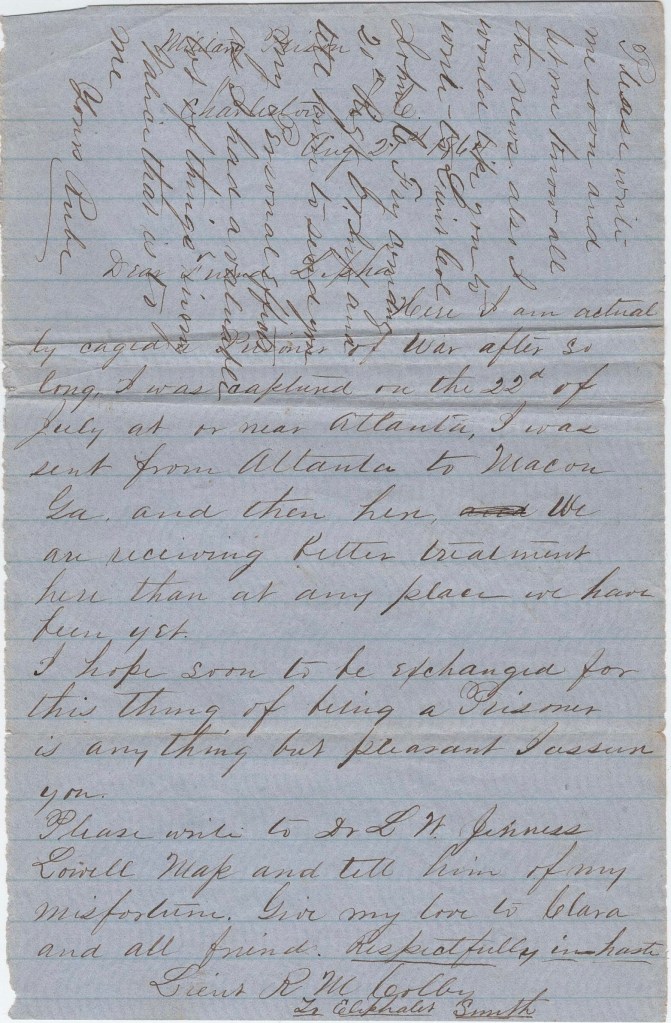
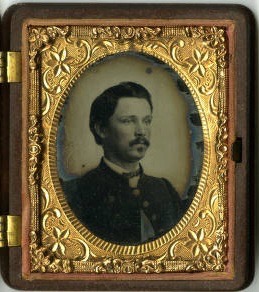

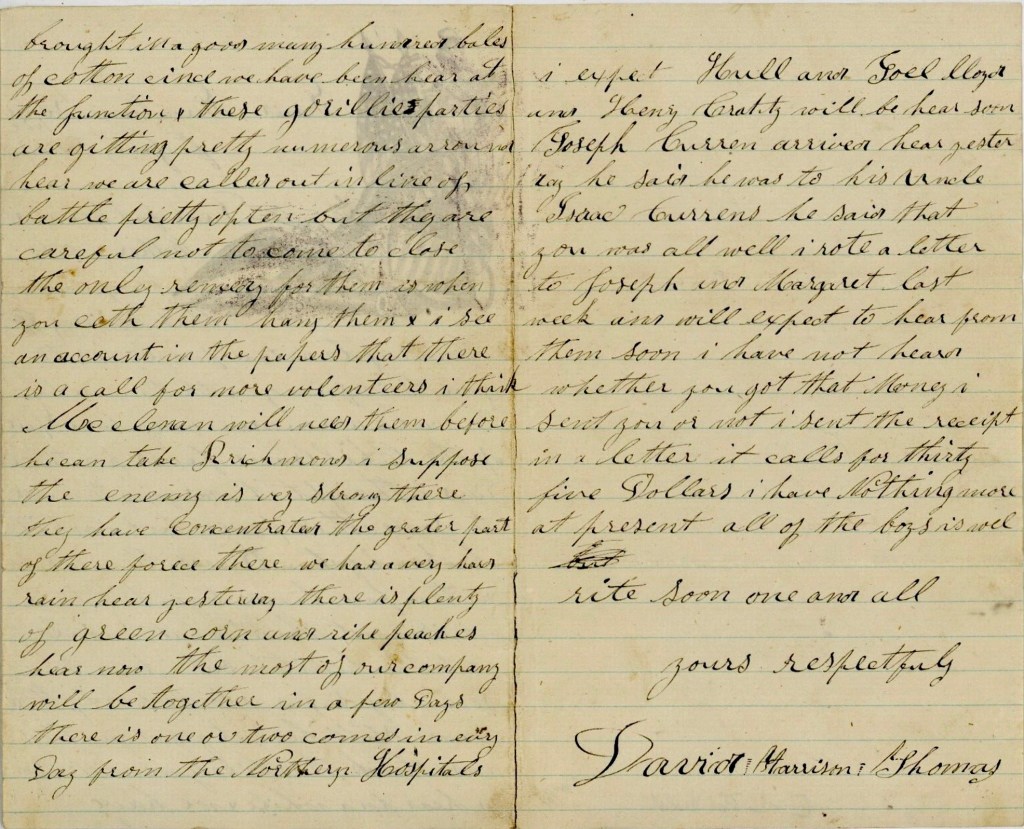






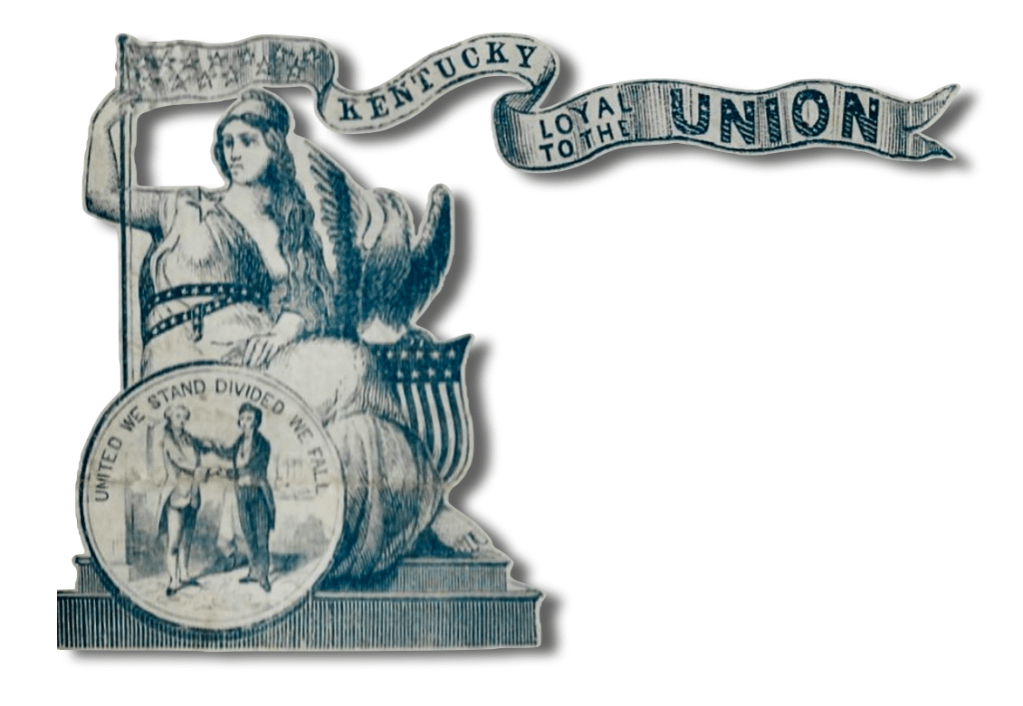

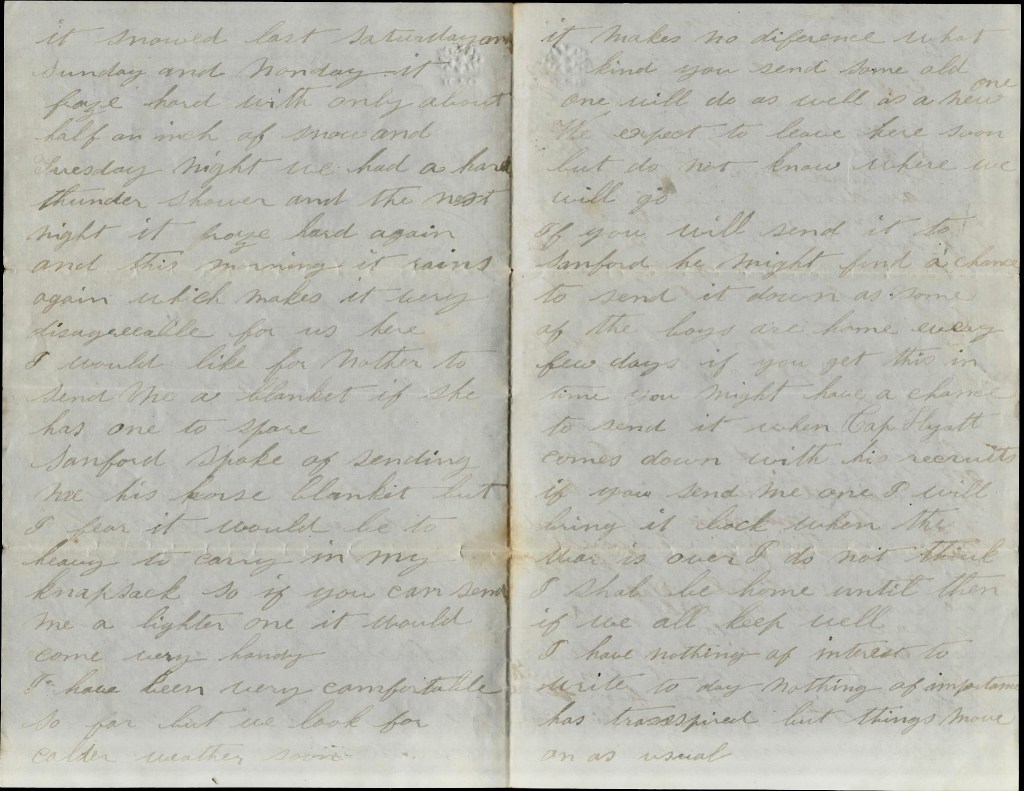


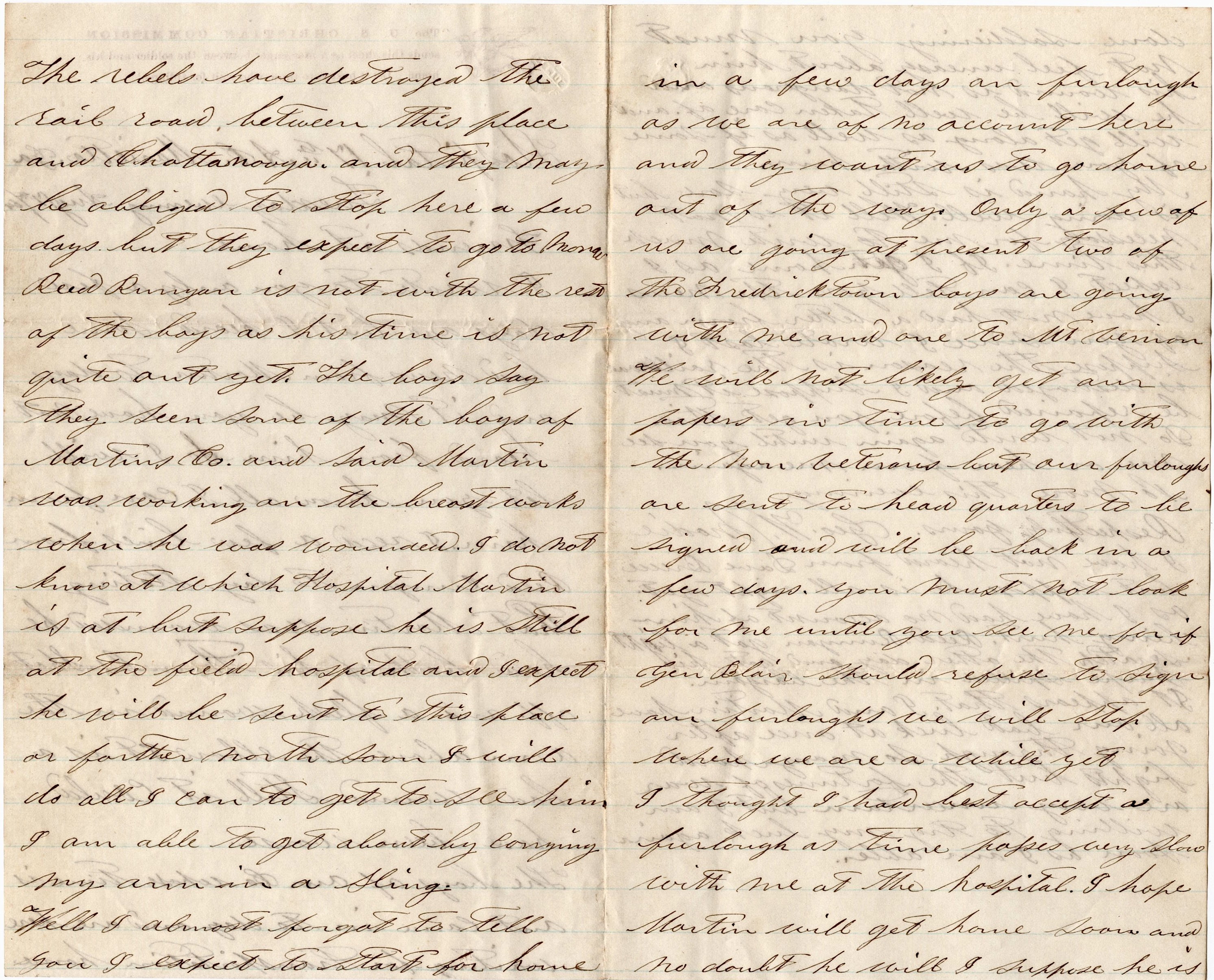


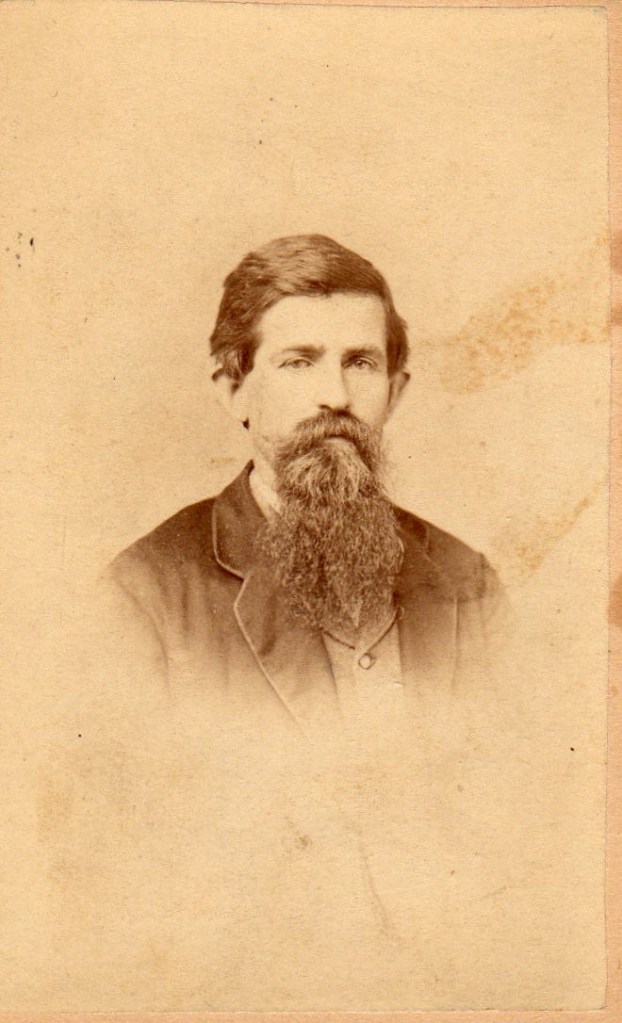

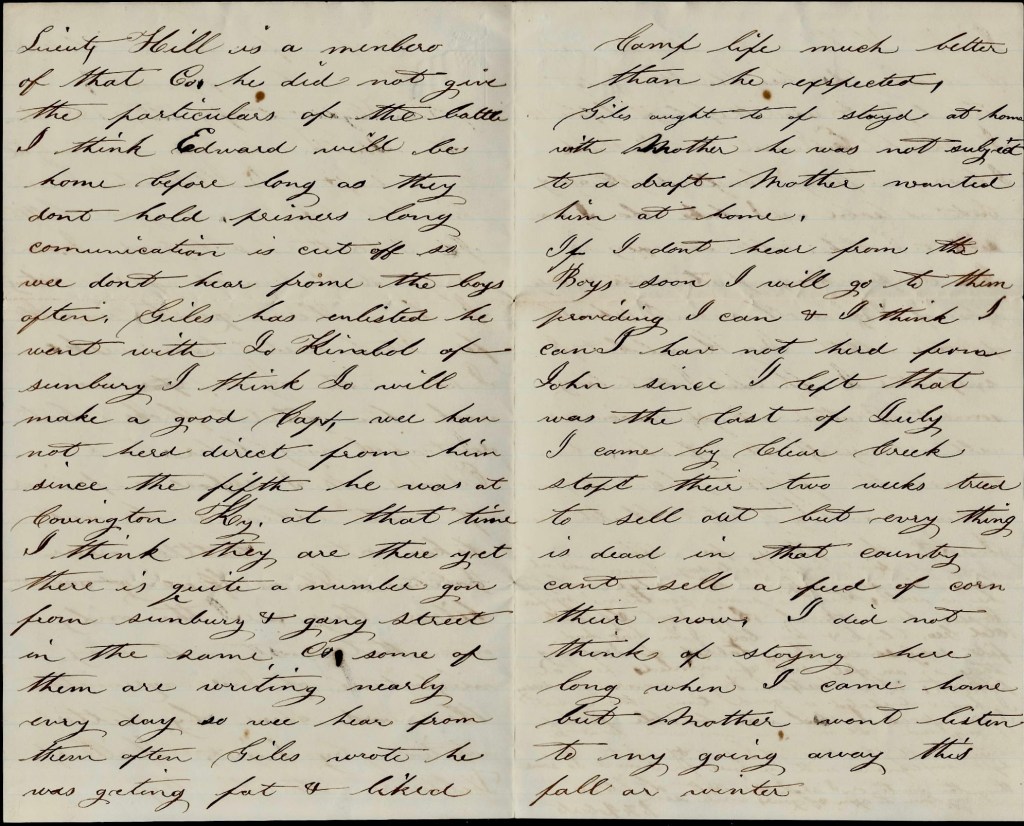


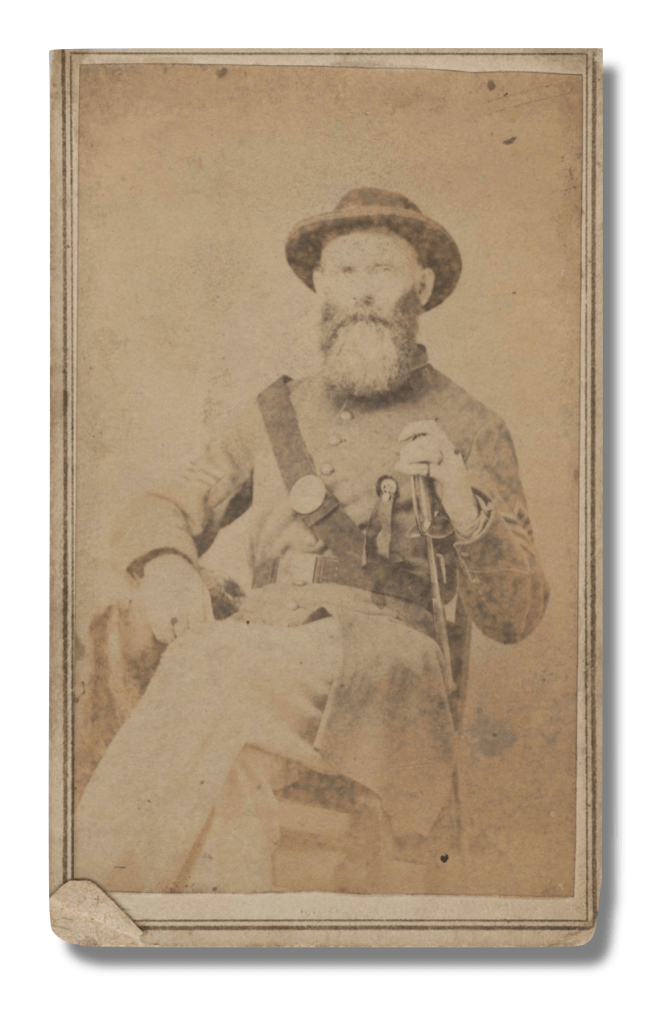

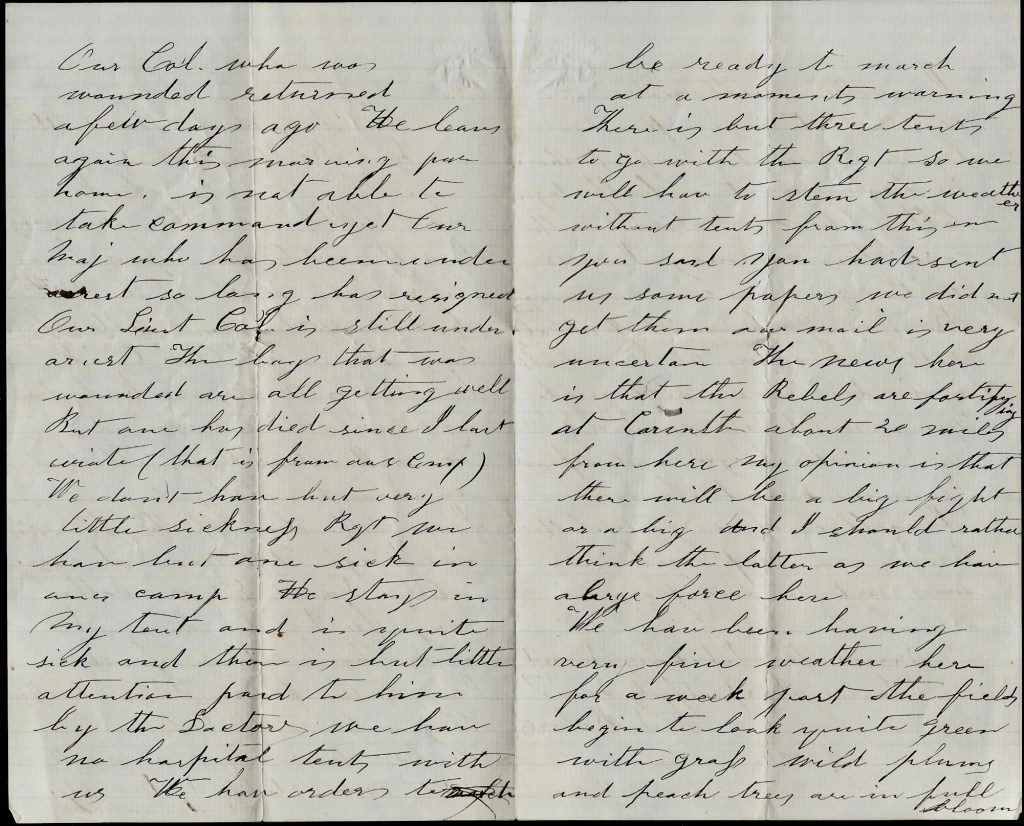
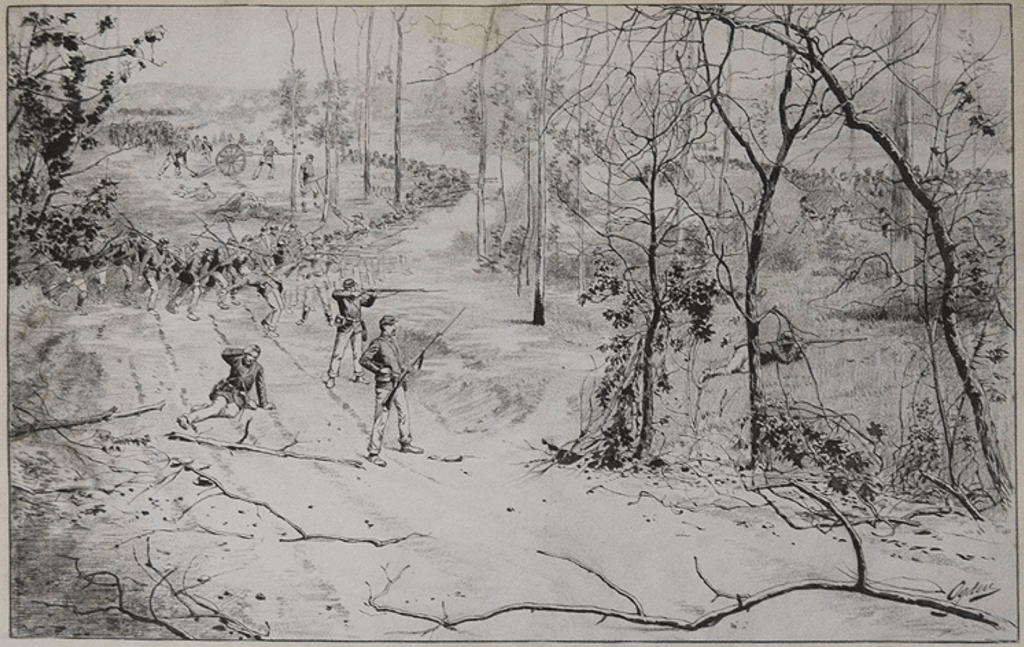


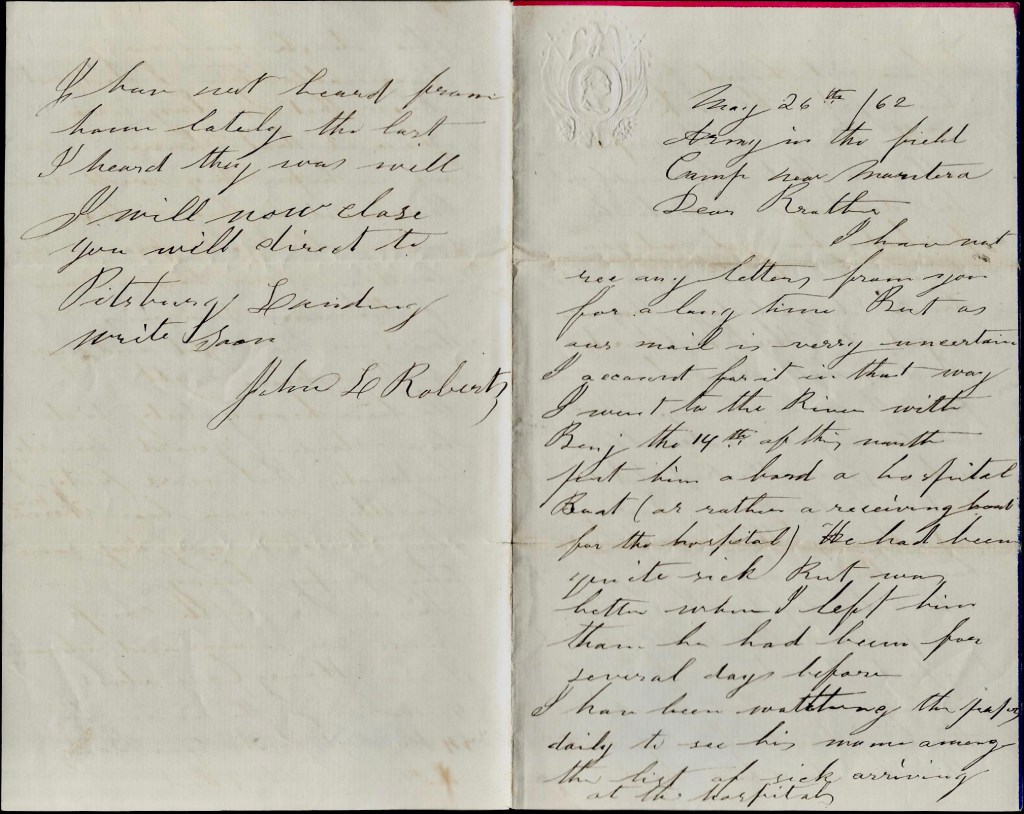



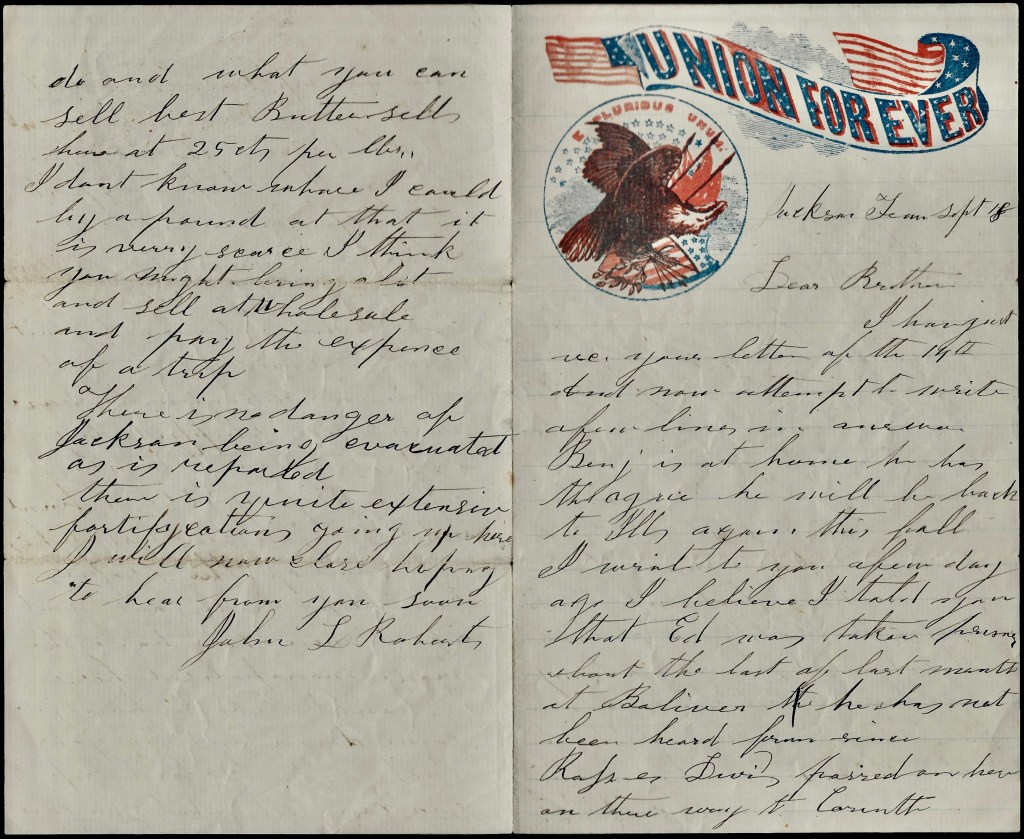

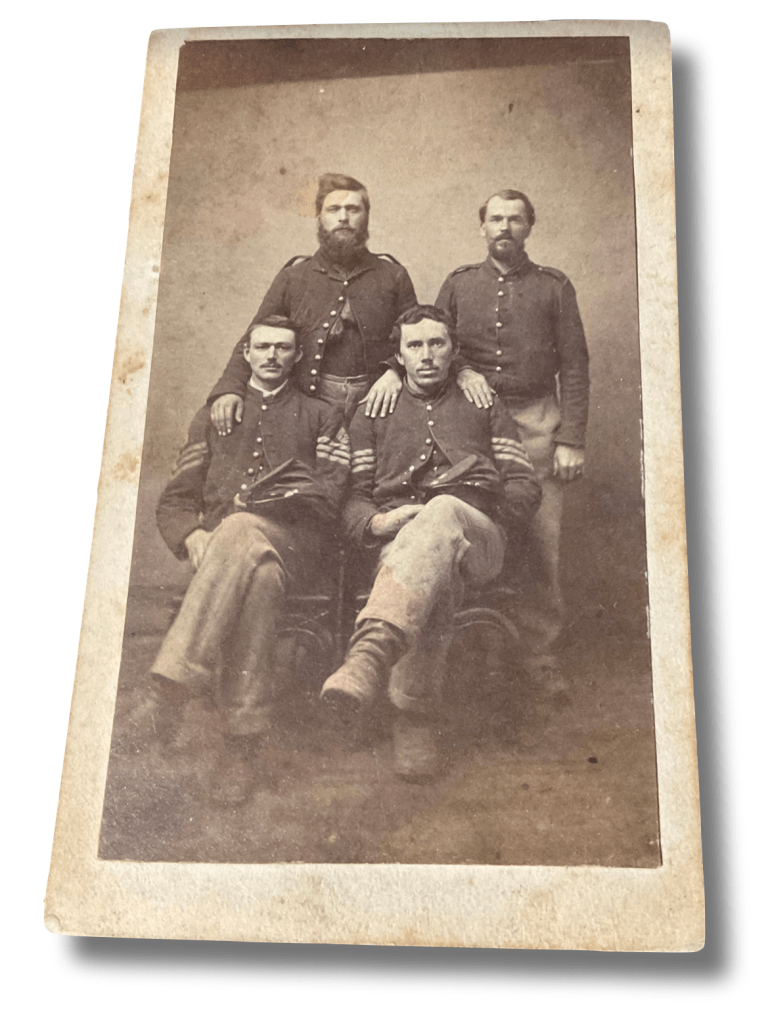


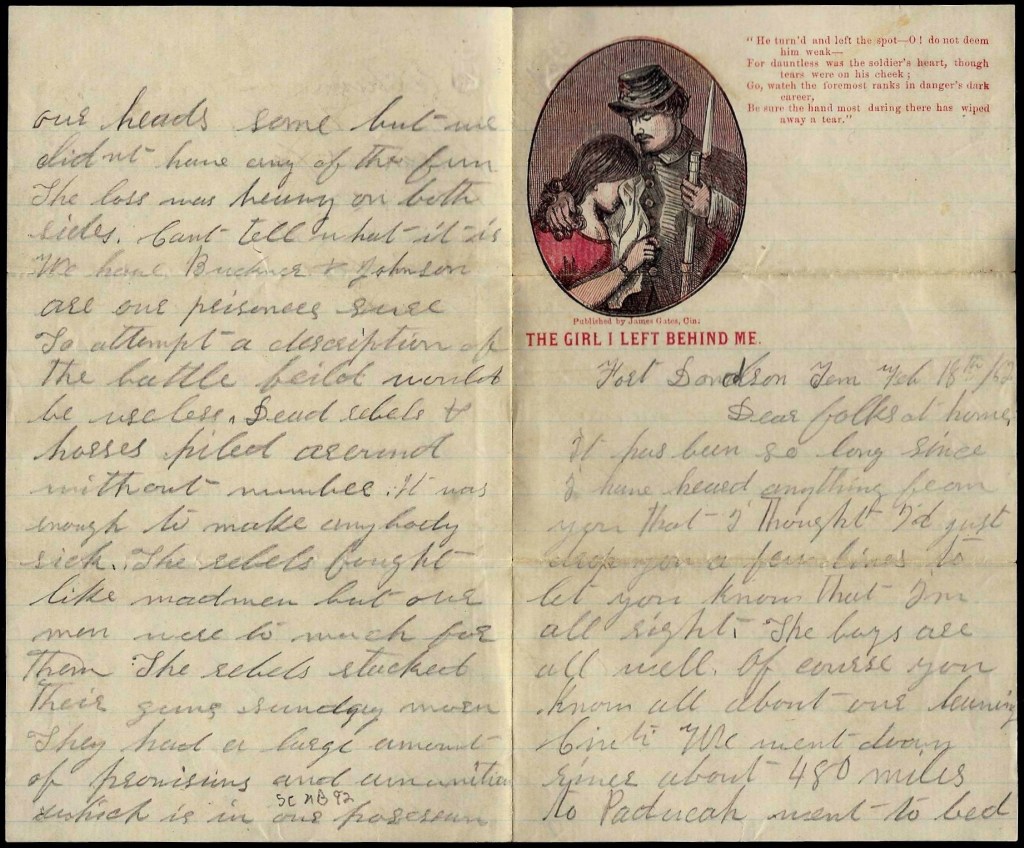


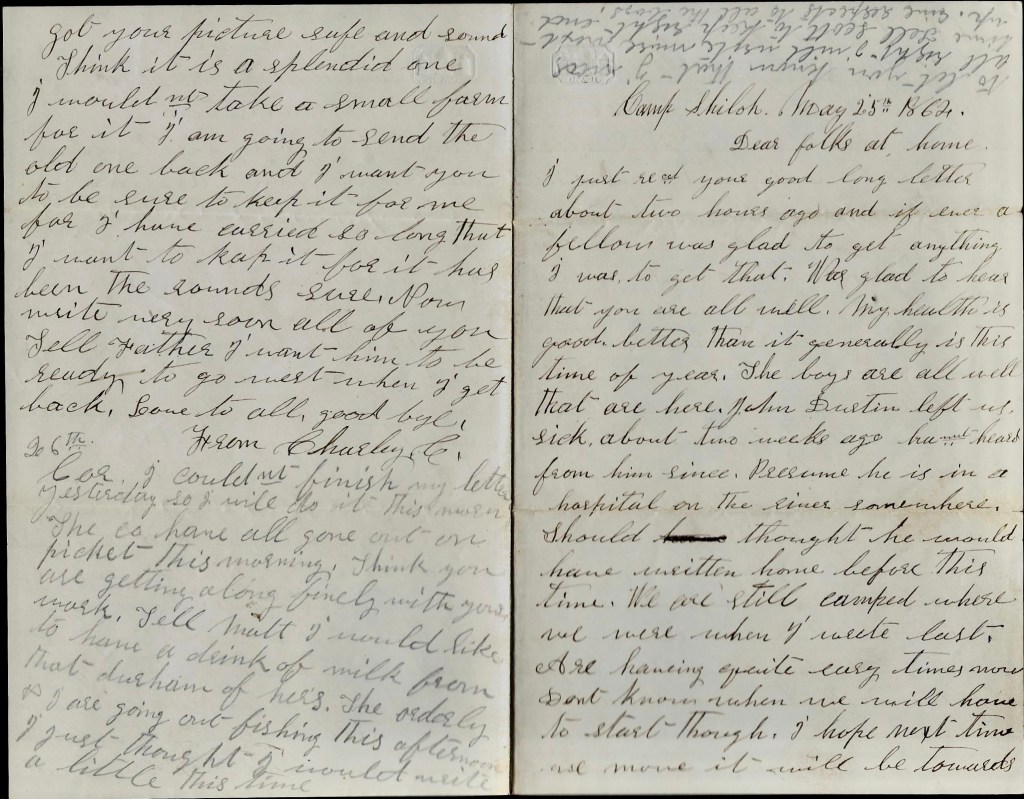


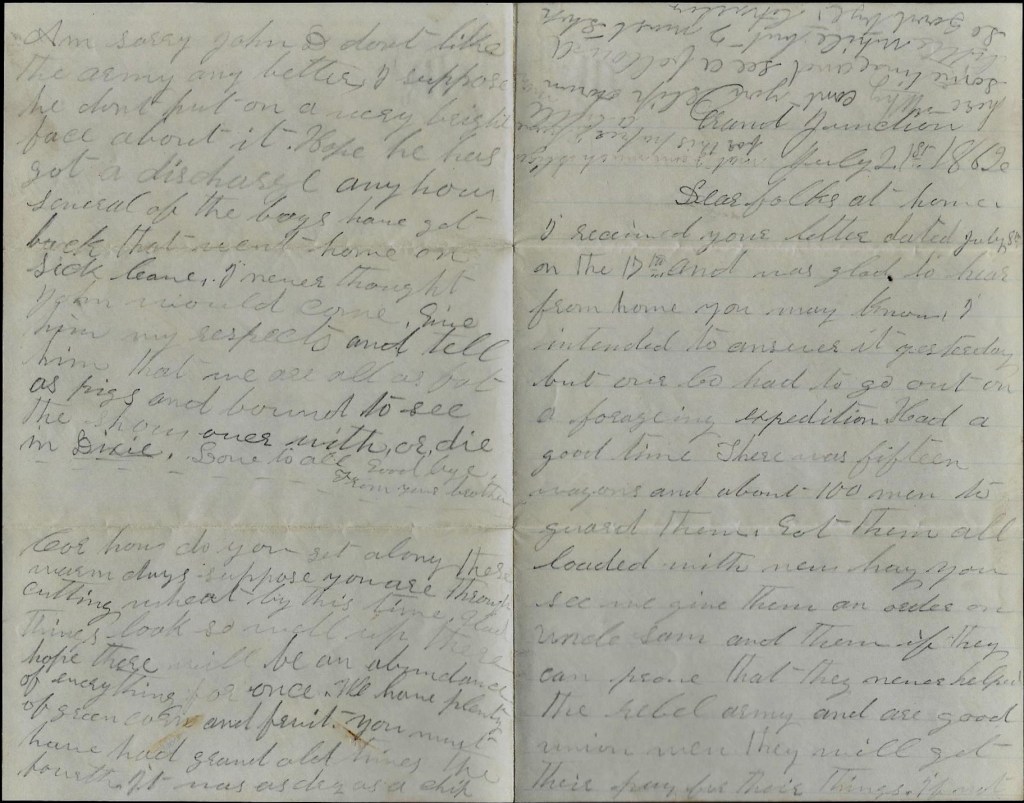


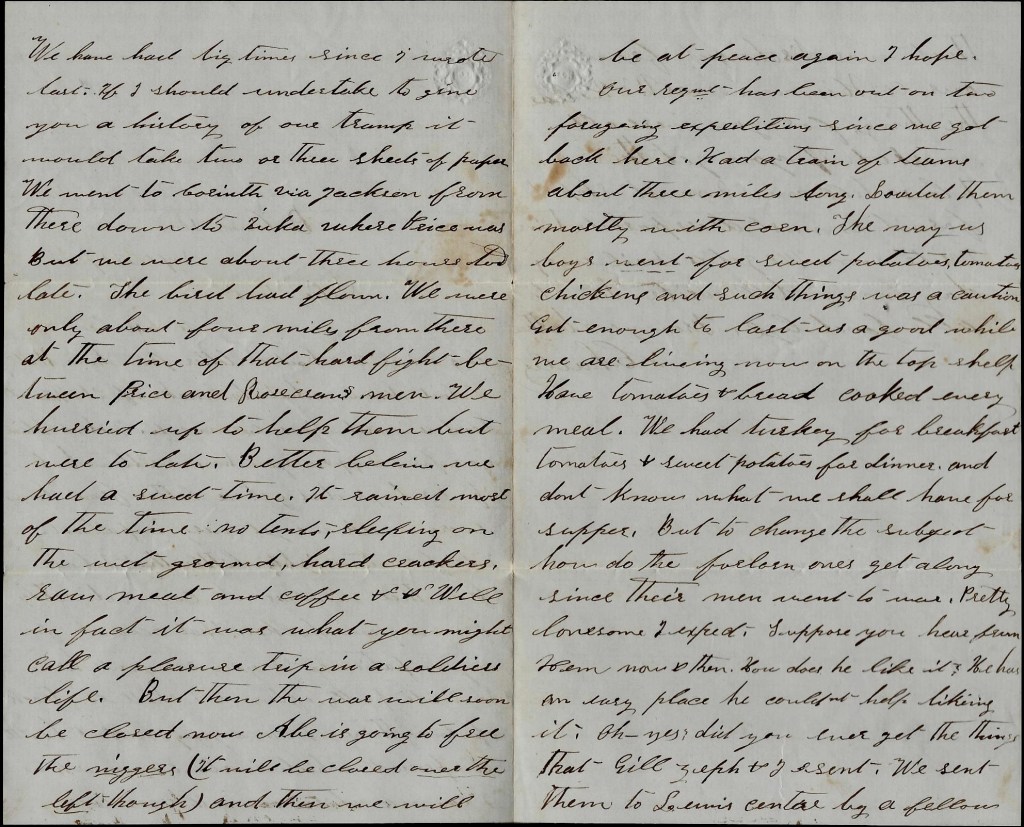

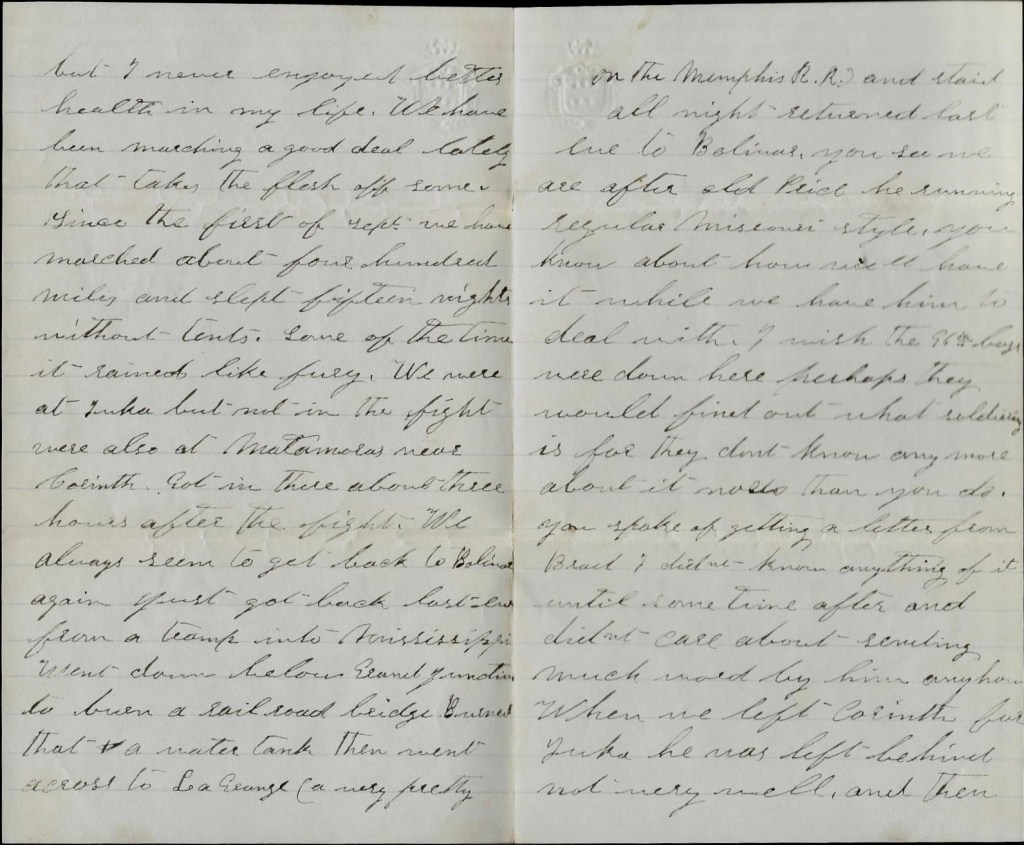
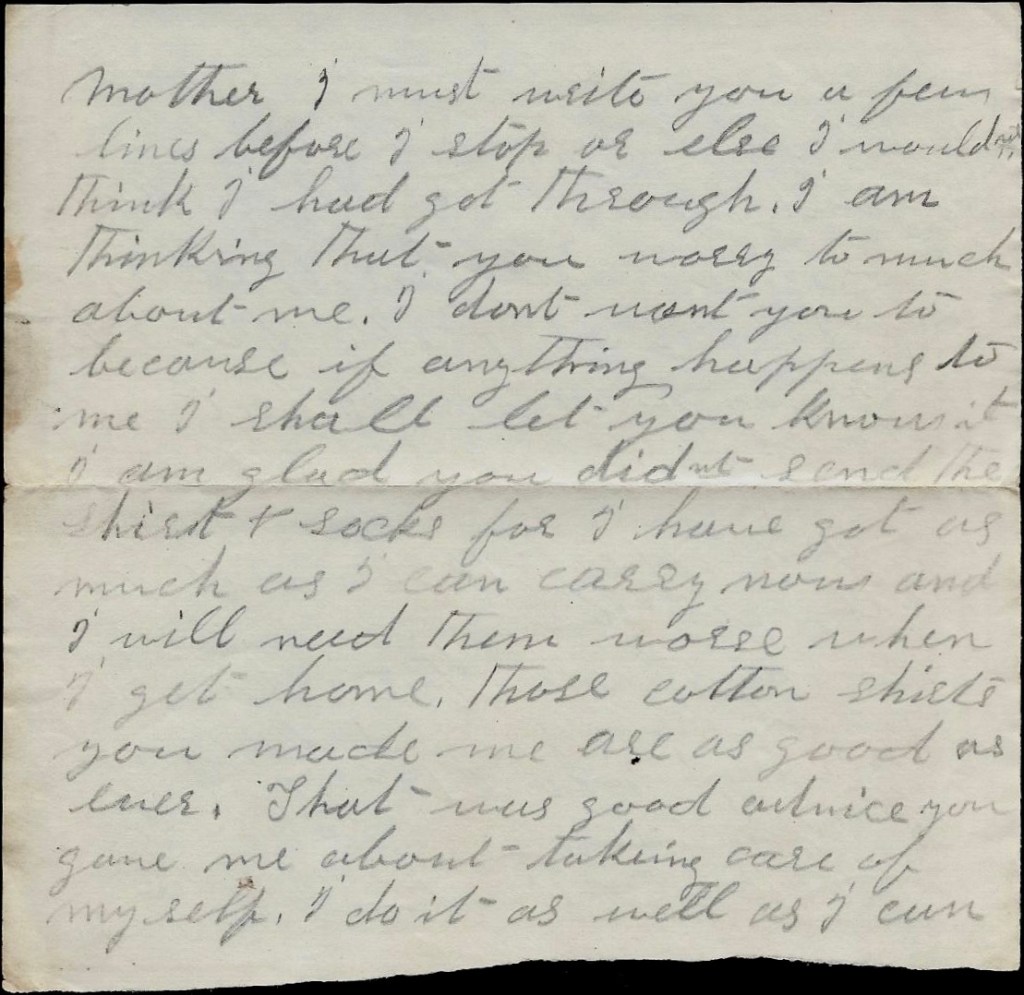


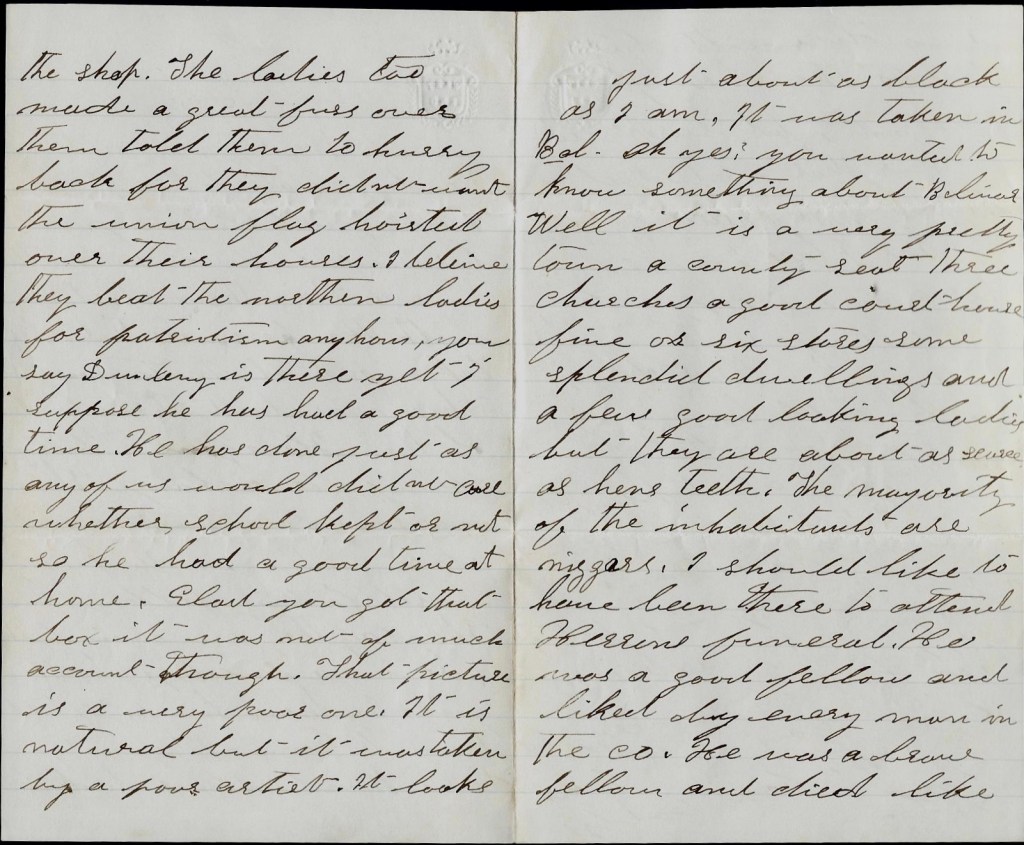
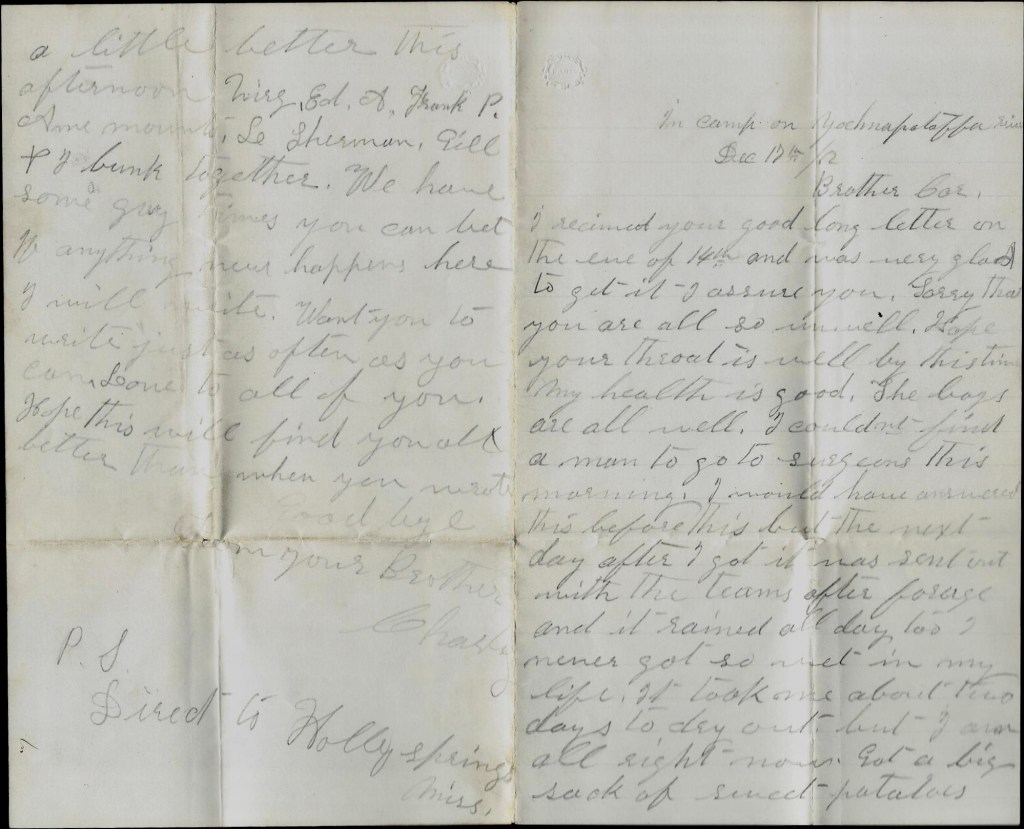
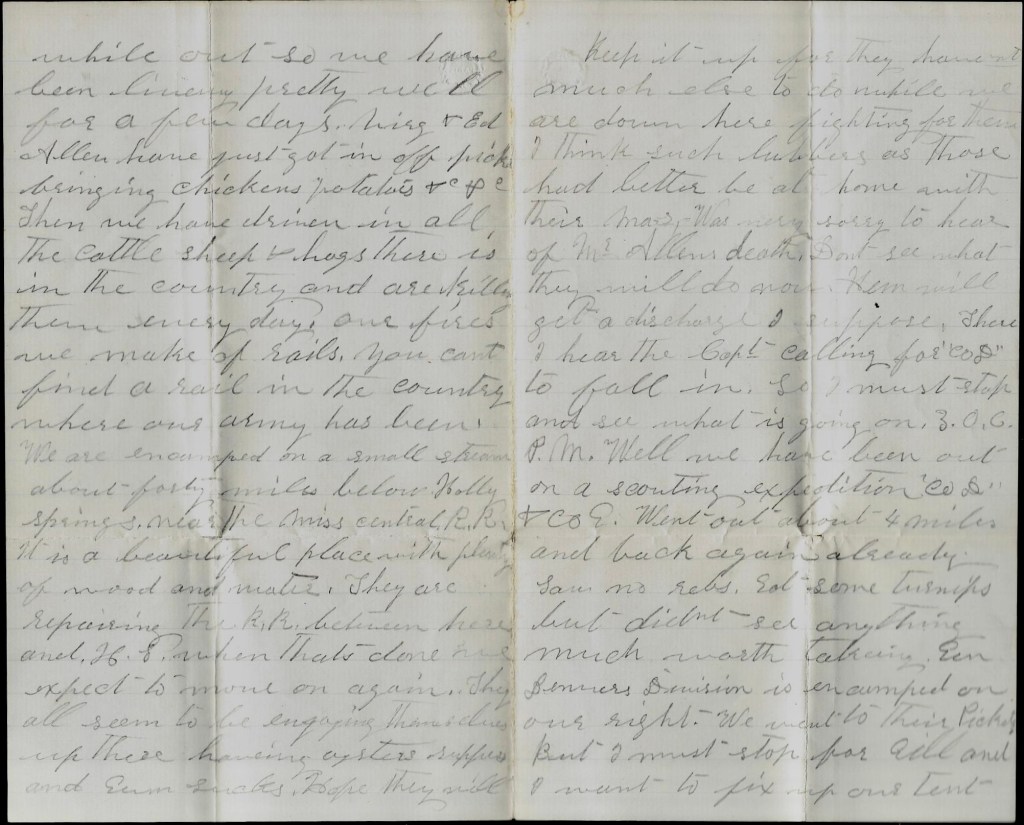
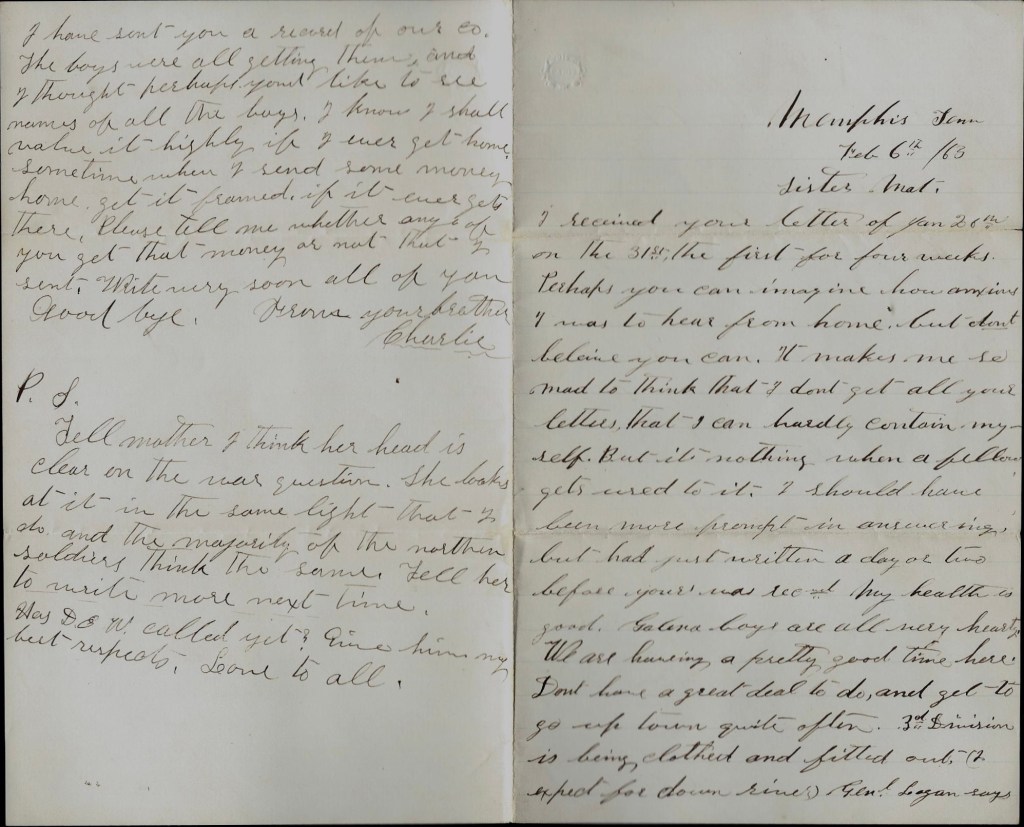

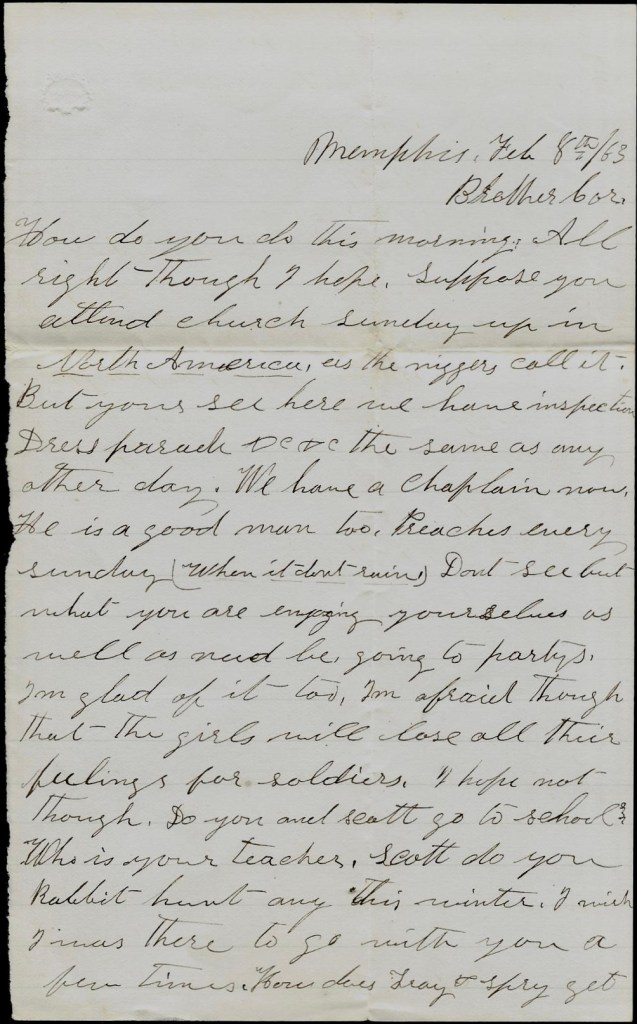


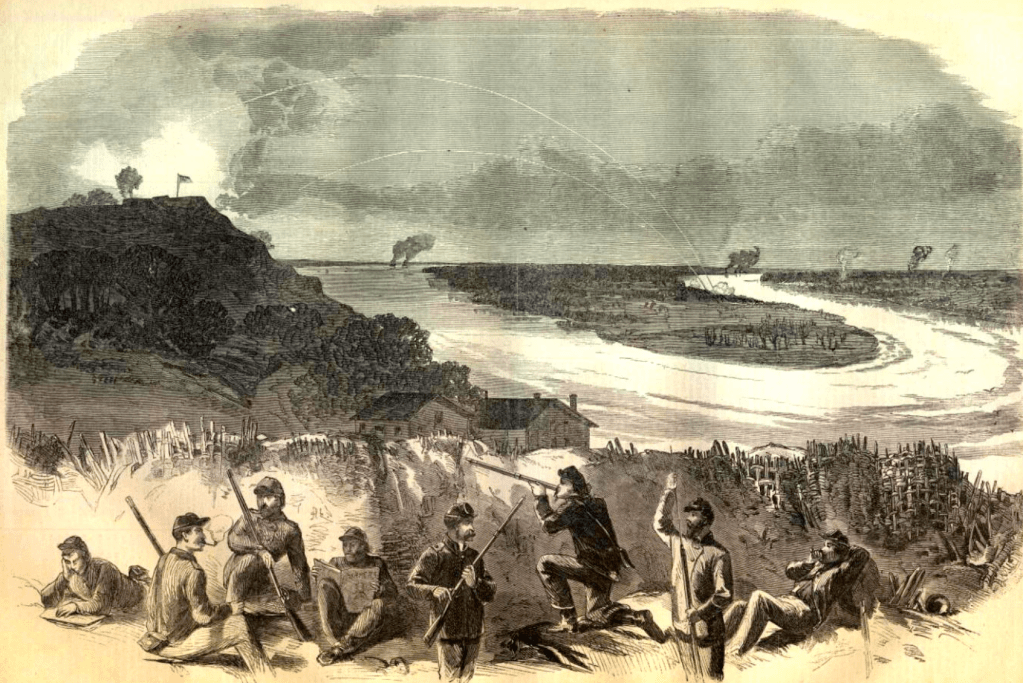
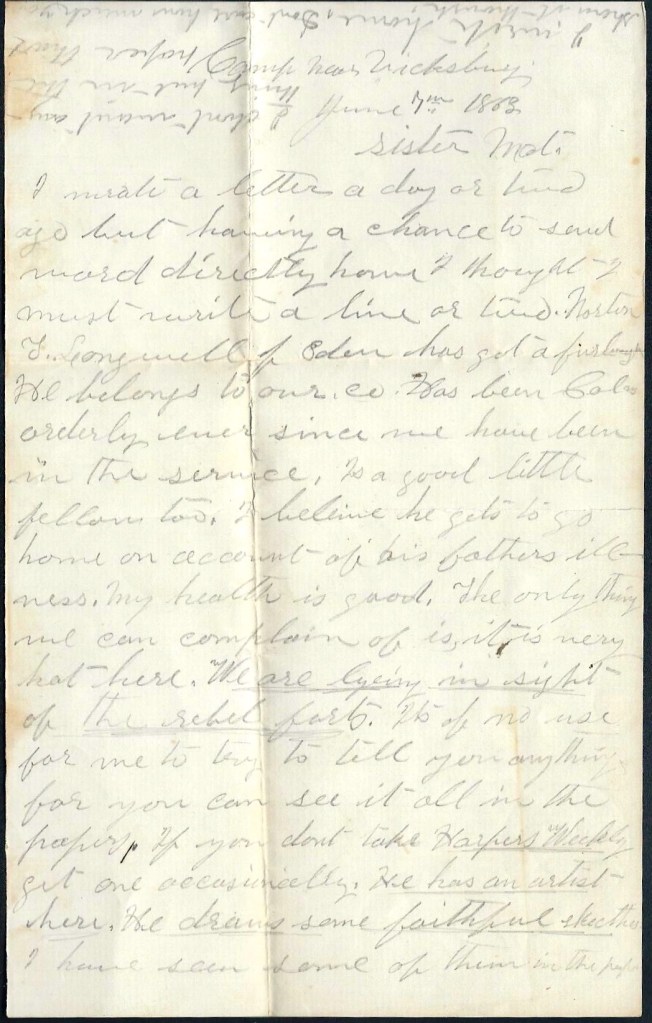




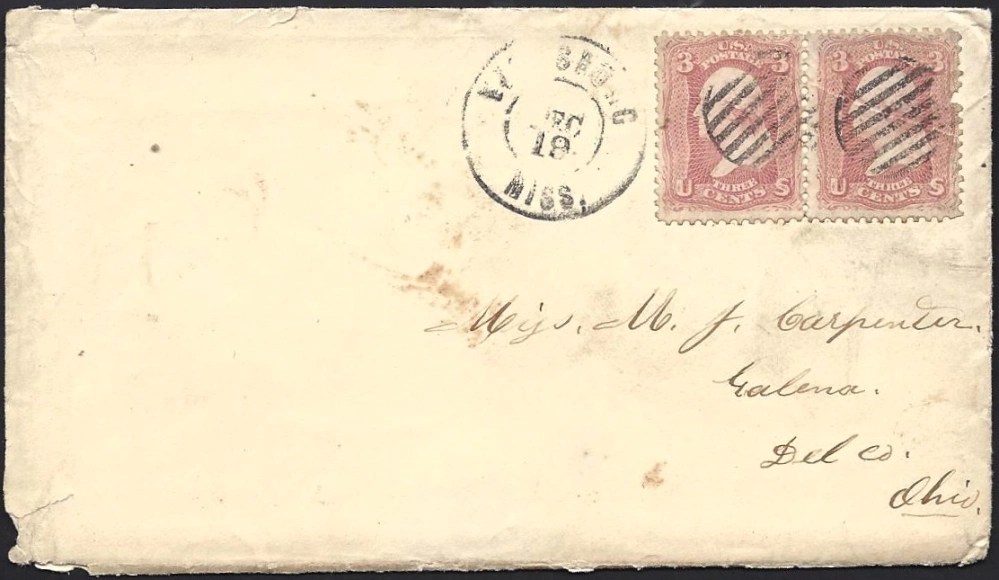
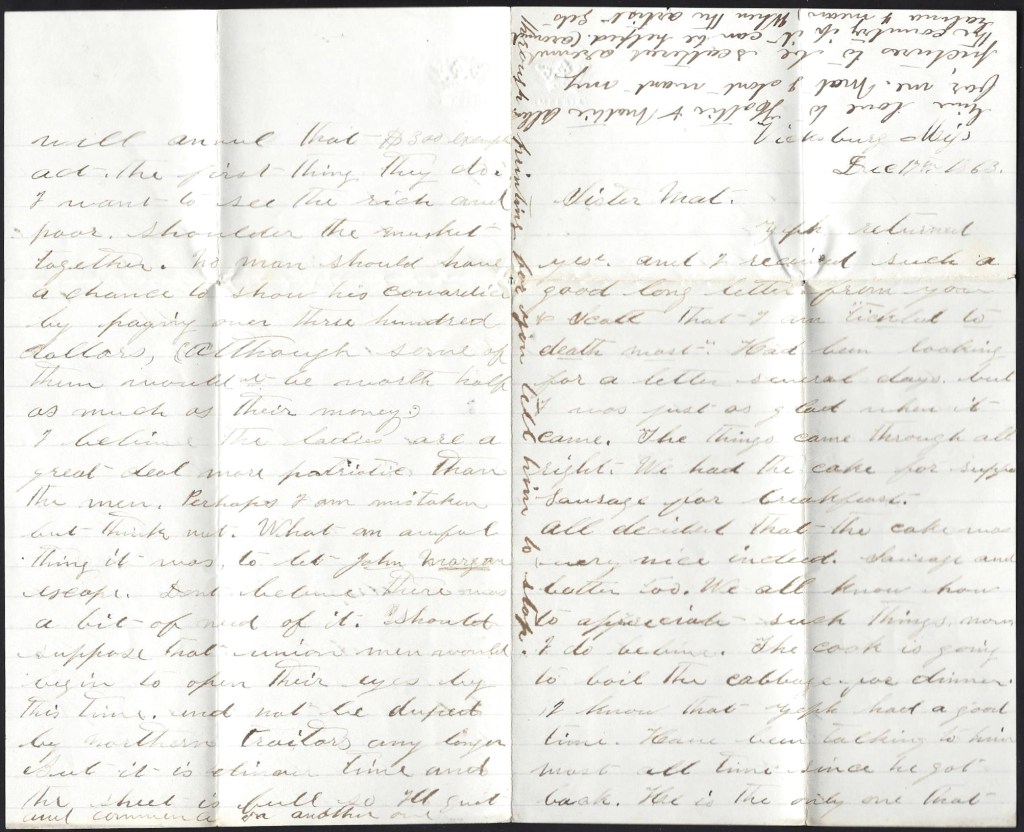
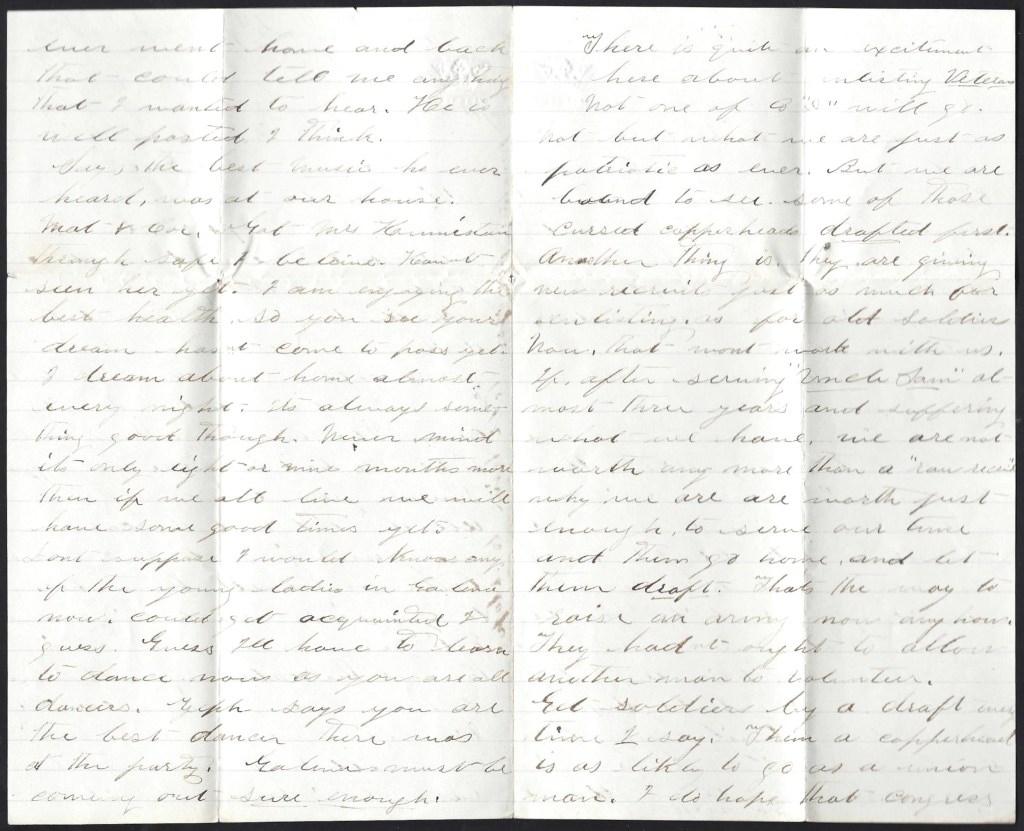
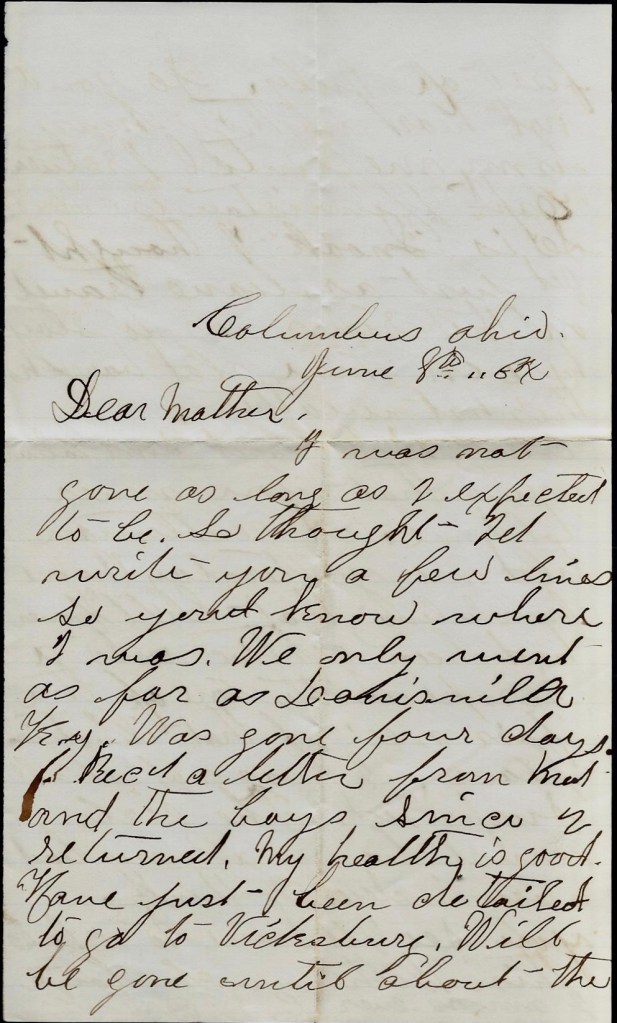


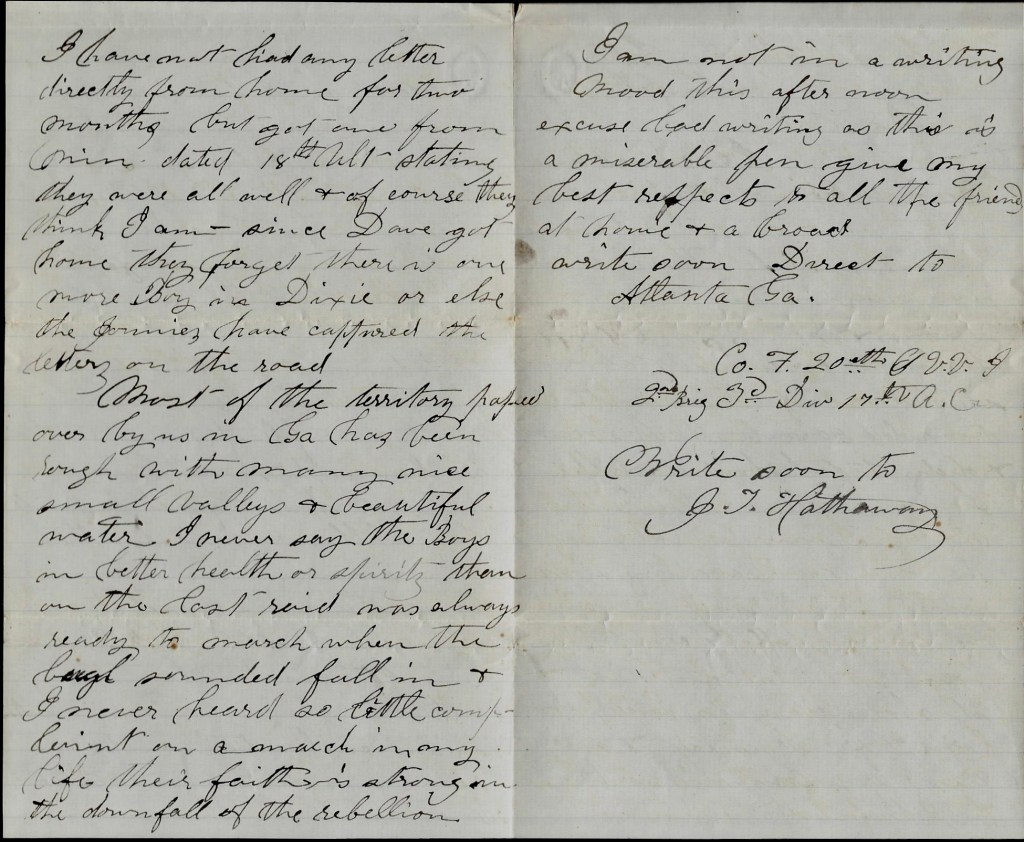
 Spared & Shared 23