Category Archives: 21st Illinois Infantry

1861: John Russell to C. Sophia Russell

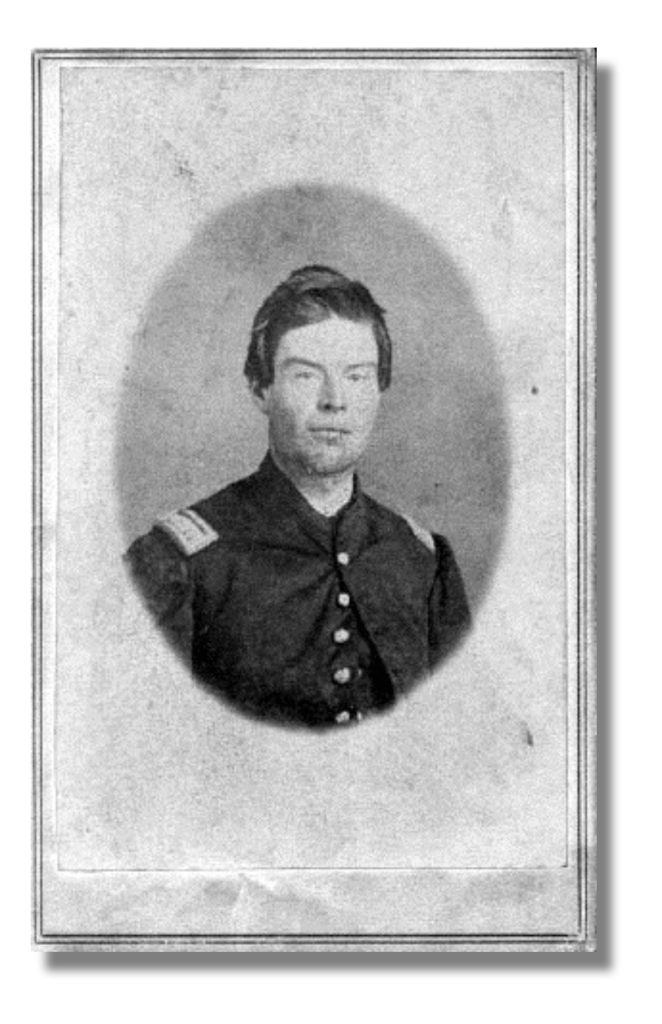
John Russell was 33 years old when he volunteered to serve in Co. G, 21st Illinois Infantry. He was the son of Alexander Russell (1794-1863) and Jane Jack (1797-1873) and was still living and working on his father’s farm in Clay county, Illinois, at the time of the 1860 US Census. Living in the household as well was his younger sister C. Sophia Russell (1840-1934), to whom he addressed his letter.
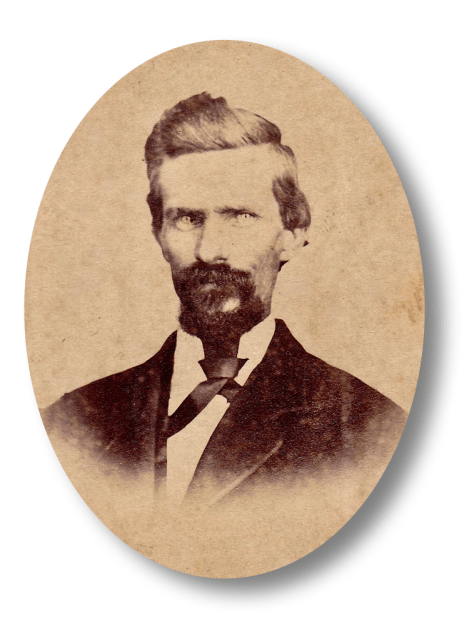
John Russell, ca. 1875

The muster rolls of the 21st Illinois inform us that John mustered into the company on 28 June 1861 and he was discharged for disability on 24 March 1864. The regiment’s first colonel was Ulysses S. Grant. It was ordered to move to Ironton, Missouri, on July 3, but instead operated on the line of the Hannibal and St. Joseph Railroad until August. Grant was promoted to brigadier general and became commander of the District of Southeast Missouri on 7 August, being replaced by regimental lieutenant colonel John W. S. Alexander. The regiment reached Ironton on 9 August 1861 and saw its first action at the Engagement at Fredericktown in late October. The first major engagement was at Stones River in December 1862 and January 1863. It was shortly after that battle that John wrote a letter to his sister Sophia in which he provided great detail of the regiment’s action. See “Getting Bitten by the Bait: The 21st Illinois at Stones River” by Dan Masters (Civil War Chronicles).

Transcription

Addressed to Miss C. S. Russell, Xenia, Illinois

Ironton, Missouri
November [1861]

Dear Sister,

I take my pen to write you a few lines to inform you of my health which is very good, and there is little else to write. I received a letter from Doc some time since and one from Ann on Saturday and was glad to hear from you all. I have had no time to write for the last two or three weeks, having been in camp but little and on duty all the time. As week ago I expected to be at home now and had my furlough made out but an order was issued forbidding the granting of any more furloughs at present and mine was not signed yet. I could not come but I hope to soon.

We are stationed here for the winter and are at work here now a putting up winter quarters. I have had charge of 20 men for the last 4 days a chopping and hauling logs and only get to write now by getting F. M. Finch to take my place this afternoon. We will get them up in 4 or 5 days more. We have had a fine fall, but it is a little cold now. We had a fine little snow on Friday last, and we are in a hurry to get to our new quarters.

I think the government will soon put forth all its energies which it has been so long gathering to put down this rebellion. We know here that when furloughs are denied, a move is on foot and this denial is now universal and we know there is a general movement of importance contemplated and I hope its success will more than compensate me for the disappointment of not getting to go home.

“I am not waging a war for emancipation but I would seize the slaves of every rebel and set them to work at wages or to fight as most convenient and at the close of the war, give them their freedom…”

John Russell, Co. G, 21st Illinois Infantry, November 1861

There was a feeling of general indignation at the removal of Frémont and still more at the order of General Halleck that all fugitive slaves in our camps or that may come to them hereafter must be driven off. But in all there is a determination to sustain the government hoping that it would be compelled to come around right in time. All that is wanting to a speedy success is a man to hold up the thing square and use the means of success that we possess. I am not waging a war for emancipation but I would seize the slaves of every rebel and set them to work at wages or to fight as most convenient and at the close of the war, give them their freedom, placing them wherever Providence opened up a place. Thus we would get rid of slavery and by having them on hand, it is likely that the best disposition would be made of them that could.

I think the war will be over by the first of May unless there are some serious blunders on our part. I think our troops will occupy Memphis and Nashville in four weeks from this time.

But I must close. I hope this may find you all well. I send enclosed to Pap 25 dollars. I still save enough to bring me home if opportunity occurs. We have a good time here—plenty to eat and plenty to wear and not much to do. Write often and I will as often as I can. Yours, &c. — John Russell

To Miss C. S. Russell

1861: Stephen Augustus Hurlbut to John Basil Turchin

David Francis Bremner (1839-1922)

Images of this letter were sent me by Chris Bremner whose ancestor was David Francis Bremner (1839-1922) , a Canadian by birth, who was living in Illinois at the time of the Civil War and enlisted in Co. E, 19th Illinois Infantry on 17 June 1861. He was commissioned a 1st Lieutenant in the company on 18 December 1862 and was promoted to Captain on 9 July 1864.

In transmitting the letter to me, Chris informed me that the letter was found among various documents that included the Descriptive Rolls for the company and other handwritten telegrams and dispatches that had been found hidden in his ancestor’s home when it was being remodeled recently. (How lucky is that?!) It is presumed that the documents were concealed prior to his ancestor’s death in 1922 and have not seen the light of day for over 100 years.

He sent copies of several letters to me but I singled this one out to showcase on Spared & Shared. It was written by Brig. General Stephen A. Hurlbut—described as a “hard-drinking Chicago lawyer”—who was a political general conspicuous for lacking both scruples and ability. When he didn’t get a civilian patronage job in the Lincoln Administration, his Galena friends, and Senator Orville Browning of Illinois, had him commissioned and posted at Quincy, Illinois. He was rather quickly dismissed as an obnoxious drunkard and relegated to positions of unimportance due to his incompetence in military matters.

He addressed his letter to John Basil Turchin, a Russian emigrant with prior military experience abroad who settled in Mattoon, Illinois, in 1858 and then landed a job as a topographical engineer with the Illinois Central Railroad. He came to this country with the surname, Turchaninov but when that proved to be too much of a mouthful for Americans to pronounce, he shortened it to Turchin.

Given his prior military training, his support of the Lincoln administration, and his abhorrence of slavery, Turchin offered his services to Gov. Yates of Illinois who immediately considered him suitable for a Colonel’s appointment to one of two regiments being formed at the time—the 19th or the 21st. At the same time that Turchin offered his services, so did Ulysses S. Grant and it is said that Yates offered the men of the 19th a choice of the two for their Colonel. They chose Turchin, and Grant was sent to command the 21st.

Turchin’s military experience proved extremely valuable in molding the civilian volunteers into a well-drilled military unit, instilling discipline, and esprit de corps. They were finally ordered from Camp Long near Chicago to Hurlbut’s command at Quincy on July 10th. On the 14th of July, they were sent across the river to relieve Grant’s men in the 21st Illinois who were guarding the Hannibal & St. Joseph Railroad. A couple of the companies were strung out on the railroad line but six companies pitched their tents in Palmyra, the county seat of Marion county, some dozen miles northwest of Hannibal. Because they were ill-supplied with both arms, equipment, and provisions, with Turchin’s approval, the men of the 19th Illinois liberally requisitioned whatever they needed from the local citizens around Palmyra, most of whom they believed to be southern sympathizers. Citizens were so incensed by this outrage that they complained to Gen. Pope and other military leaders but Gen. Fremont—commander of the entire district, ignored their moaning.

This letter informs us that Turchin and his men soon feared they might be attacked by rebel citizenry around Palmyra and urgently requested arms to meet their needs though it appears nothing could be found but 53 “musketoons” already issued to Capt. Burnap’s company of the 1st Illinois Cavalry at Quincy. (A musketoon was a short-barreled musket which was better suited for cavalry than infantry.)

For those interested in reading more about John B. Turchin and the 19th Illinois Infantry, I highly recommend James A. Treichel’s graduate thesis prepared in 1962 entitled, “Union Cossack: General John B. Turchin’s Career in the American Civil War.”

Transcription

No. 23

Headquarters Brigade
Quincy, Illinois
July 17, 1861

Col. J. B. Turchin, 19th Regiment
Dear Sir,

I have just received a letter from Asst. Adjt. General Hardin at St. Louis Arsenal that there are no Minies at that Depot & consequently he cannot fill my requisition for your command.

I have telegraphed to Mr. [Orville H.] Browning, our Senator at Washington, and to Maj. General Fremont to push on as fast as possible. I shall write to Gen. Pope today at Springfield.

Capt. Williams of your regiment came in today and stating from your authority that the people of Palmyra were moving in expectation of attack & that the officers of the regiment anticipated one. [He] requested arms for his company.

I have given him an order for all I know of 53 State musketoons now in hands of Burnap’s Troop of Cavalry.

If the facts are as stated by him—that you have reason to apprehend attack—I should have known it formally. If it be true as he stated that artillery is in possession of citizens of Palmyra, unless they are true men beyond a doubt, they should be disarmed.

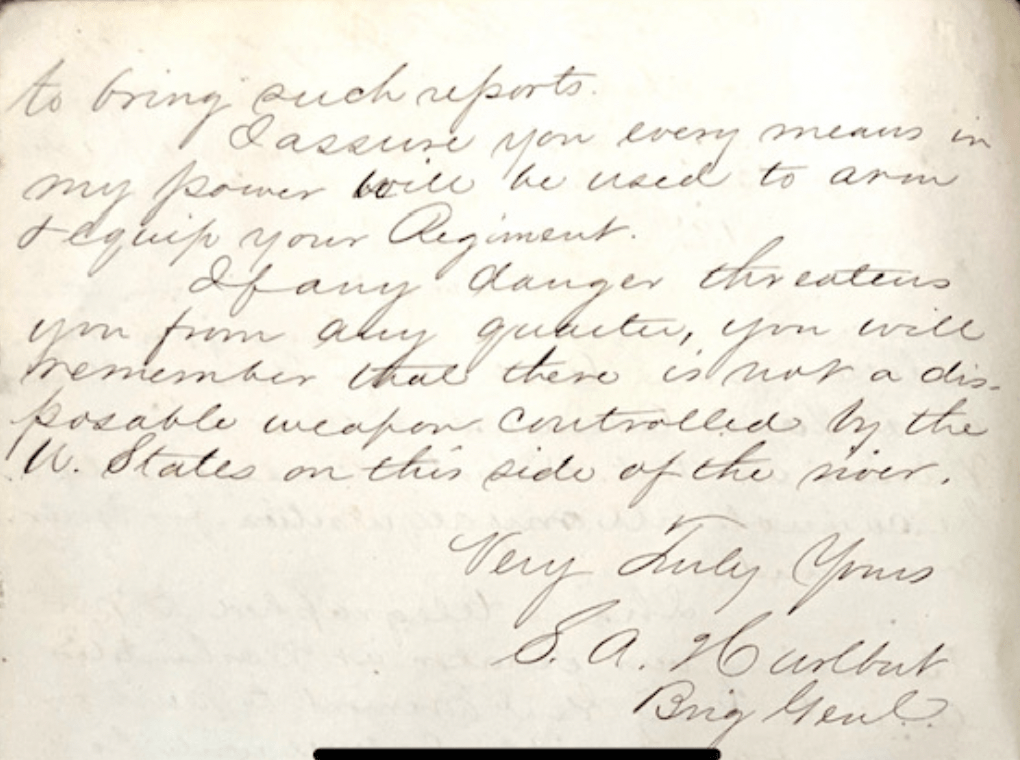
If these things are imaginations on his part, he should be advised not to bring such reports. I assure you every means in my power will be used to arm and equip your regiment. If any danger threatens you from any quarter, you will remember that there is not a disposable weapon controlled by the W. States on this side of the river.

Very truly yours, — S. A. Hurlbut, Brig. General

[Note: This letter was probably not in the handwriting of Hurlbut but prepared by an aide-de-camp. I have not checked his signature against known samples.]