Category Archives: 23rd New York Infantry

1862: Seymour Dexter to Charles Tubbs

The following letters were written by Seymour Dexter (1841-1904), the son of Daniel Dexter (1806-1891) and Angeline Briggs (1816-1891) of Independence, Allegany county, New York. Seymour received his preparatory education at Alfred Academy and graduated from Alfred University in 1864 (A.M., Doctor of Philosophy). Studied law,1864-1866. He was admitted to the bar at Elmira in 1866 and became the City Attorney in 1872. In that same year he was elected to the New York Assembly.

Carl A. Morrell’s book showcasing Dexter’s wartime diary and letters.

Seymour enlisted in May 1861 at Elmira to serve two years in Co. K, 23rd New York Infantry. He entered the war as a private, was promoted to corporal in Mach 1863 and mustered out of the regiment on 22 May 1863. There was a book published in 1996 by Carl A. Morrell which contained the Civil War writings of Seymour Dexter [See: Seymour Dexter, Union Army: Journal and Letters of Civil War] but I don’t believe that this letter was included. The introduction to that book states, “‘Freedom, the true government, has called upon her loyal sons, and as our response to this call and also to the demands of truth and humanity, seven of us determined on the 26th day of April, 1861 that we would immediately volunteer our services in the defense of the stars and stripes.’ So wrote Seymour Dexter in the opening pages of his Civil War journal. A student at the time of Fort Sumter, Dexter joined Co. K in Elmira, New York. Private Dexter, who would enjoy a distinguished career as a lawyer following the unpleasantness, gives us an unusually keen view of the war, capturing the emotions of the men in the field and the camaraderie of Company K.”

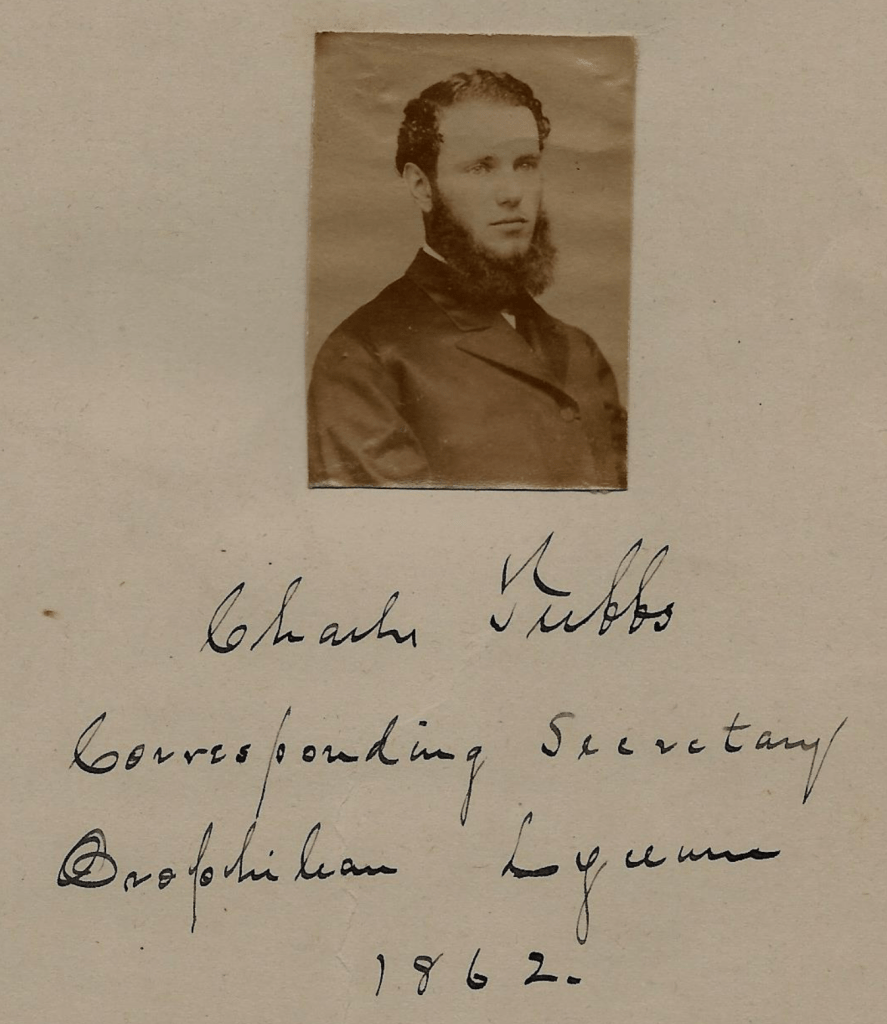
Dexter wrote the letters to Charles Tubbs, the corresponding secretary of the Orophilian Lyceum of Alfred University in Alfred Centre, New York. Founded in 1836, Alfred University was an early-day coeducational college. Tubbs later attended Union College, graduated with honors in 1864, and then attended the law school in Ann Arbor, Michigan. In researching Tubbs, I was surprised to discover a 1996 publication entitled, “Mr. Tubbs’ Civil War” by Nat Brandt. In his introduction. Brandt wrote that, “Charlie Tubbs experienced the Civil War vicariously. He never volunteered nor was drafted in the Union military forces. But many of his friends went to war, and it was through them that the day-to-day experience of the war came alive for him in the most personal way. Throughout the war, Tubbs received more than 175 letters from his friends, ordinary young men, all products of rural New York and Pennsylvania.” Curiously, of the 17 letter writers mentioned in Brandt’s publication, Seymour Dexter is not listed and his letters do not appear in the book. It may be that these letters, which were once part of a larger collection of Tubb’s collection, were separated from the rest at an early date. It may also be possible that Brandt chose not to include these letters in his book for some reason.

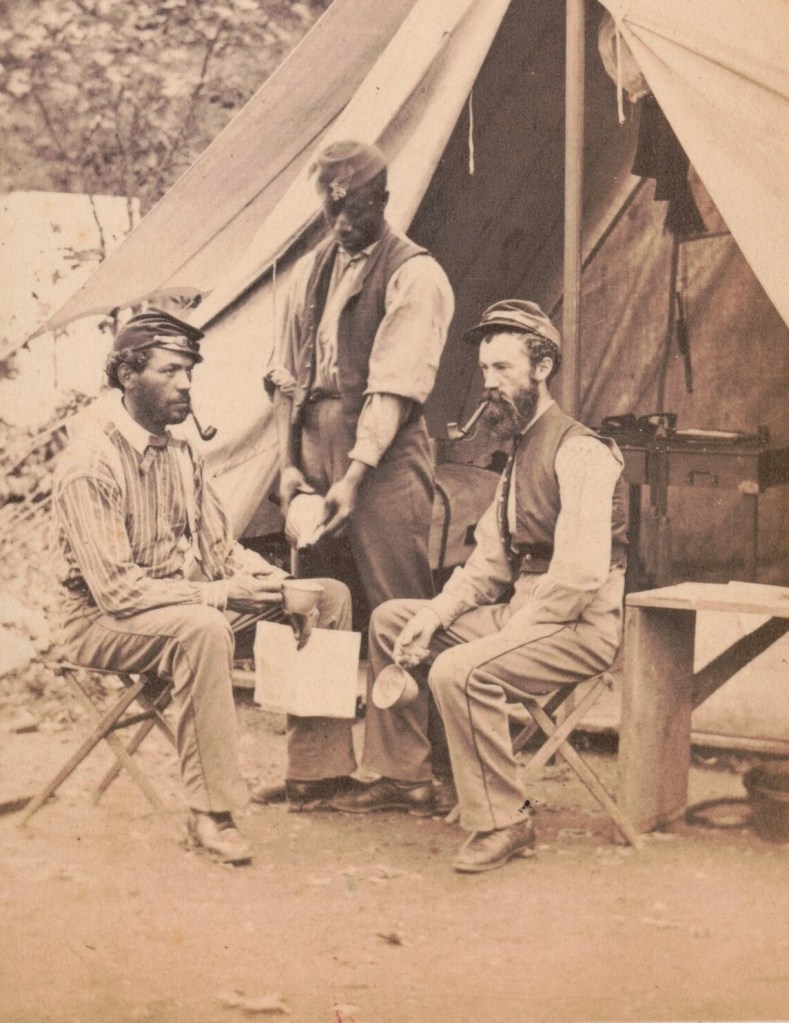
Members of the 23rd New York Volunteers. These boys are from Co. A. (National Archives)

Letter 1

Camp 23rd Regt New York Vol.
Opposite Fredericksburg, Stafford County, Va.
May 3, 1862

Brother Oro’s:

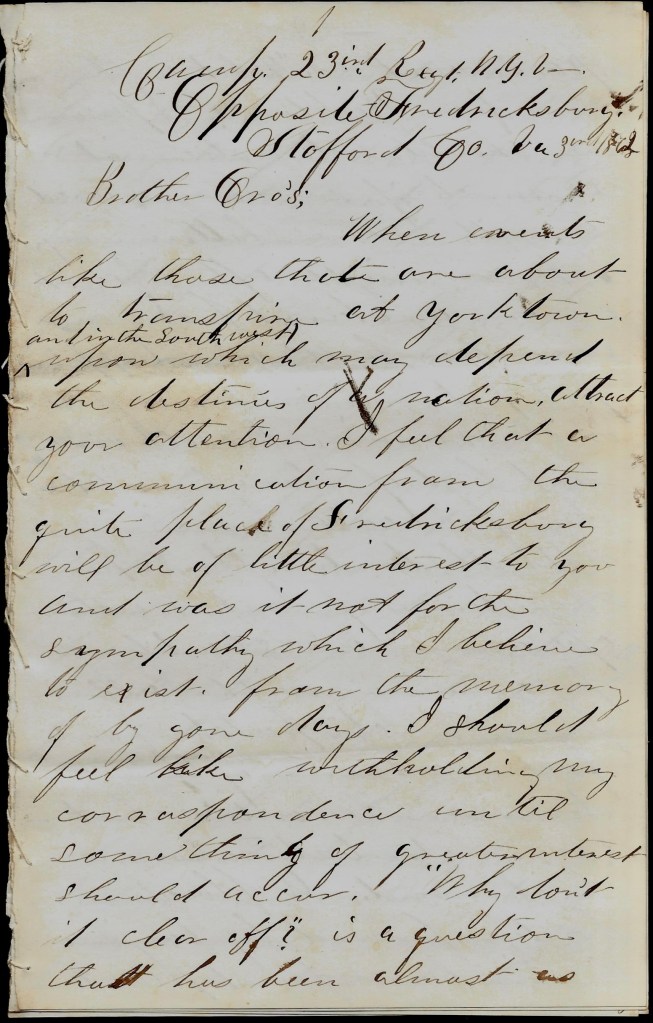
When events like those that are about to transpire at Yorktown and in the southwest upon which may depend the destinies of the nation attract your attention, I feel that the quiet place of Fredericksburg will be of little interest to you and was it not for the sympathy which I believe to exist from the memory of bygone days, I should feel like withholding my correspondence until something of greater interest should occur.

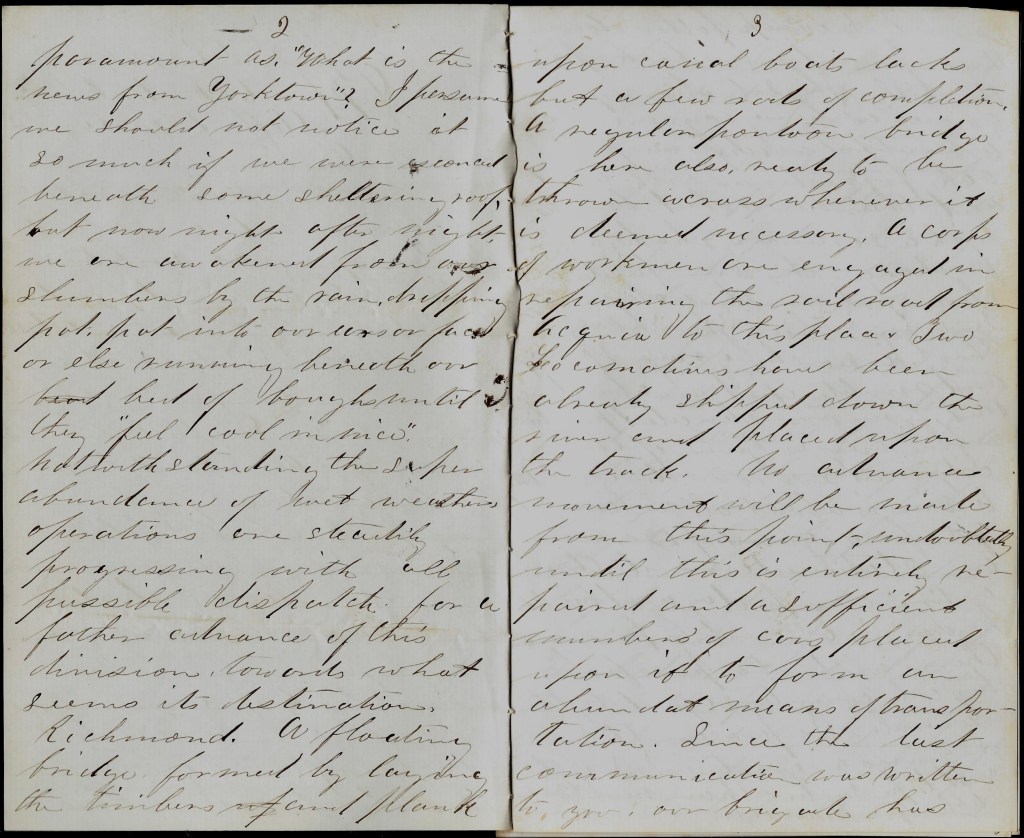
“Why don’t it clear off?” is a question that has been almost as paramount as, “What is the news from Yorktown?” I presume we should not notice it so much if we were ensconced beneath some sheltering roof but now night after night, we are awakened by the rain, dripping pot, pot into our face or else running beneath our bed of boughs until they “feel cool in vice.” Notwithstanding the super abundance of wet weather operations one steadily progressing with all possible dispatch for a further advance of this division towards what seems its destination—Richmond.

A floating bridge formed by laying the timbers and plank upon canal boats lacks but a few rods of completion. A regular pontoon bridge is here also, ready to be thrown across whenever it is deemed necessary. A corps of workmen are engaged in repairing the railroad from Aquia to this place. Two locomotives have been already shipped down the river and placed upon the track. No advance movement will be made from this point undoubtedly until this is entirely repaired and a sufficient number of cars placed upon it to form an abundant means of transportation.

Since the last communication was written to you, our brigade has moved its camp farther down the river and more back upon the hill. The situation is pleasant as well as being convenient. A beautiful wood, principally oak, furnishes us with wood, and their new, robust boughs with a screening shade when, perchance, the sun finds a clear spot in the watery reservoir through which to shoot his searching rays. Springs and rivulets exist in abundance and from our elevated position a fine view is given of the city and surrounding country. A view is about all we can get for a guard of 120 men are stationed around the entire camp, day and night. No one is allowed to pass from his colonel, countersigned by the general. To procure this requires a greater use of the “red tape system” than most are able to manage.

Our General, (M. R. Patrick) is a graduate of West Point and he seems striving to enforce all the severe discipline which is supposed to exist among regulars. Many of his orders seem onerous to a volunteer corps and to speak in soft terms, bitter are the anathemas uttered against him at times.

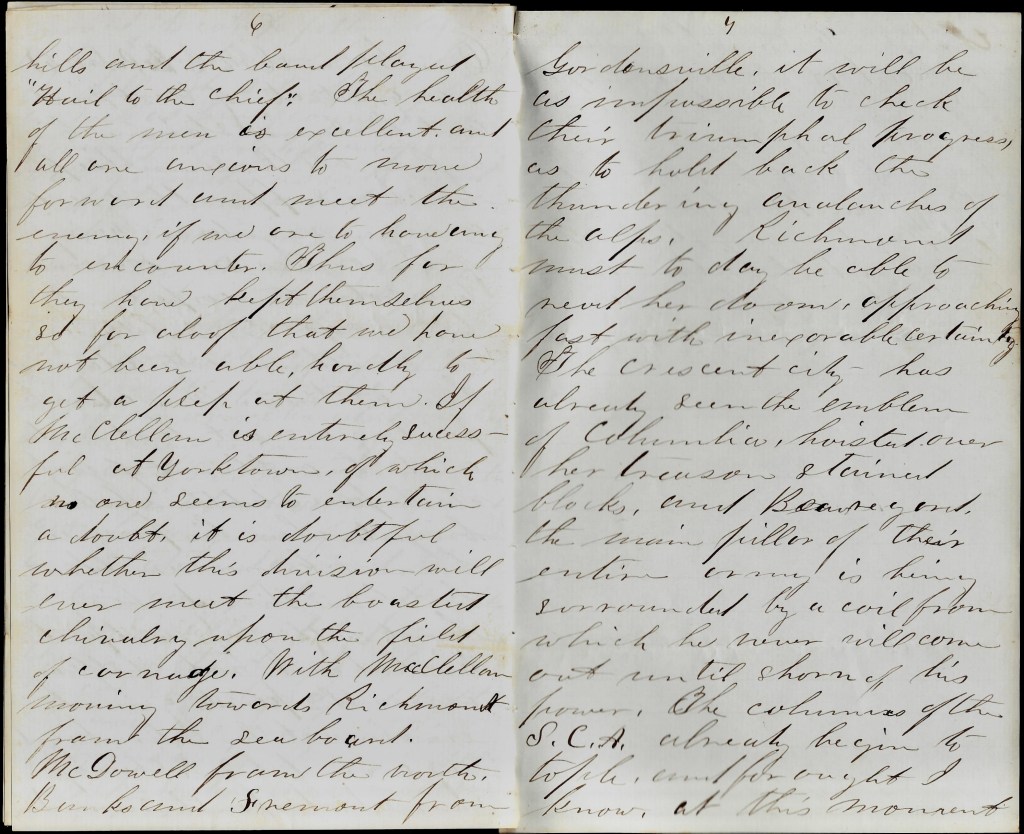
Gen. Wadsworth paid us a visit last Sunday and the outburst of joy which pervaded the whole brigade when his presence became known could not but have stirred his heart with joy and pride. He had not rode halfway across the parade ground ere almost the entire brigade was around him. Cheer upon cheer echoed upon the surrounding hills and the band played “Hail to the Chief.”

The health of the men is excellent and all are anxious to move forward and meet the enemy if we are to have any to encounter. Thus far they have kept themselves so far aloof that we have not been able hardly to get a peep at them. If McClellan is entirely successful at Yorktown, of which no one seems to entertain a doubt, it is doubtful whether this division will ever meet the boasted chivalry upon the field of carnage. With McClellan moving towards Richmond from the seacoast, McDowell from the north, Banks and Fremont from Gordonsville, it will be as impossible to check their triumphal progress as to hold back the thundering avalanches of the alps. Richmond must today be able to read her doom approaching fast with inexorable certainty.

The Crescent City has already seen the emblem of Columbia hoisted over her treason stained blocks, and Beauregard—the main pillar of their entire army—is surrounded by a coil from which he never will come out until shorn of his power. The columns of the S. C. A. already begin to topple and for ought I know, at this moment the thunder of battle may be heard at the renowned place of Yorktown and in the Southwest, the concussion of which will fell them to the ground, and over their eclipsed majesty shall be raised the standard of the free forever and age. — S. Dexter
Letter 2
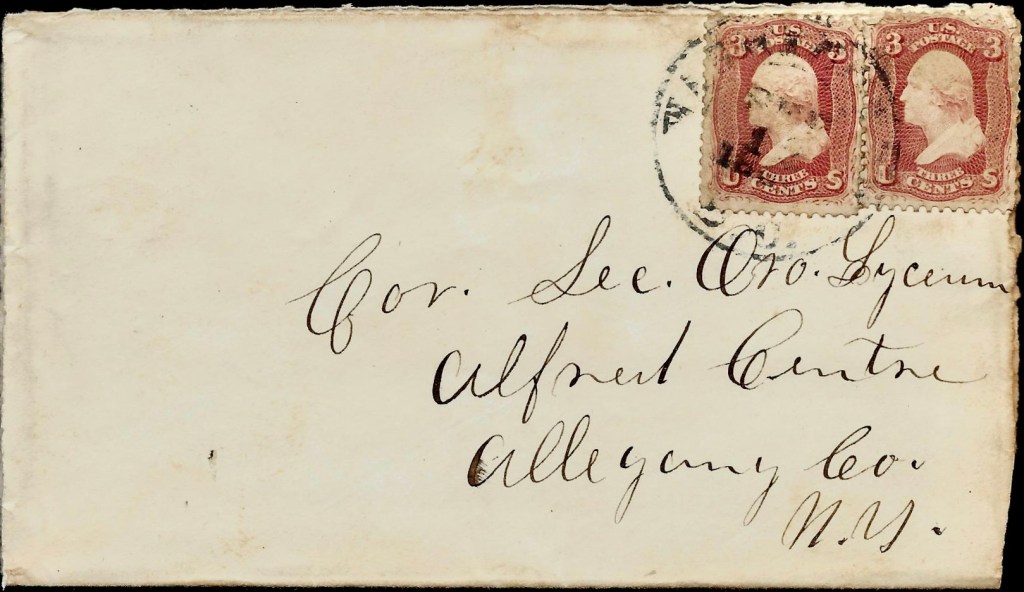
Addressed to Corresponding Secretary of Oro. Lyceum. Alfred Centre, Allegany county, N. Y.

Leesborough, Maryland
September 9th, 1862

Brother Oro’s:

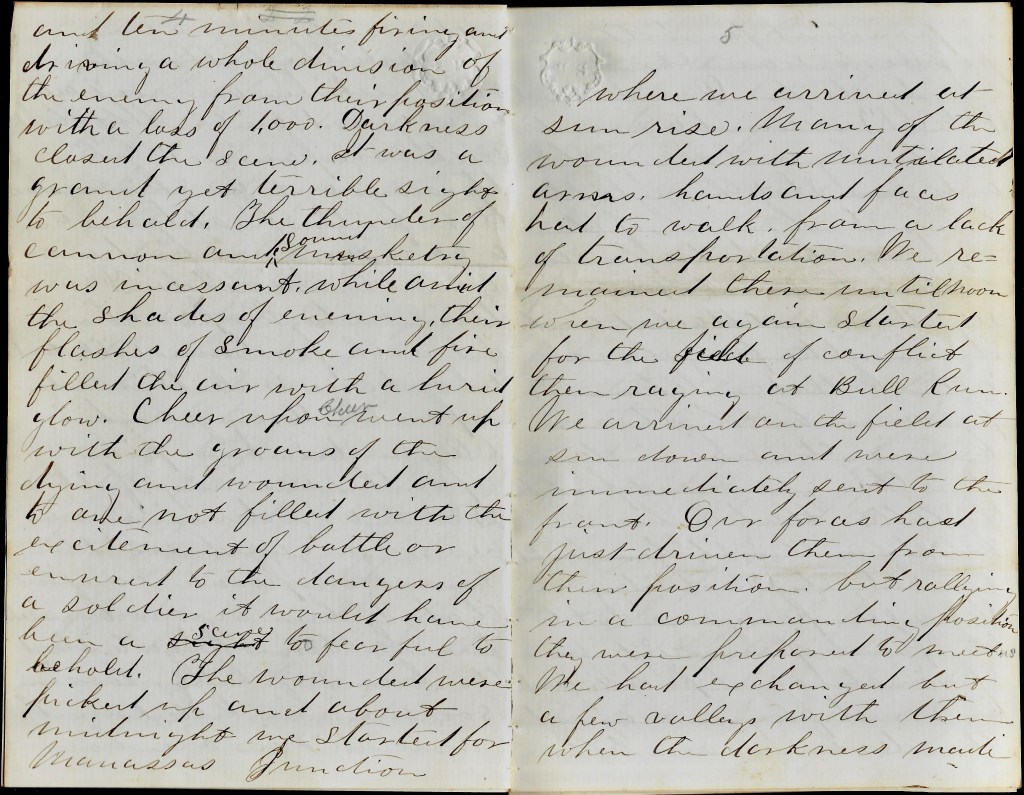
The labors and fatigues of the last three weeks have made the pen a useless article to the soldier but now some miles nearer the north star than ever before since we landed in Washington one year ago last July. A short interval has been allowed us to rest amid our dancings to “Stonewall Jackson’s” music. On the night of the 18th ult. the “Army of Virginia” with its boastful leader [Maj. Gen. John Pope] began its retreat from the Rapidan and which did not cease until a portion of it was lodged behind the lines of defense about Washington and the other portion of McClellan’s army and also that of Burnside’s. From the 22nd ult. until the 3rd inst., not a day passed but the thunder of cannon was borne to our ears and many of the conflicts were most desperate and bloody. On the 22nd ult., our Division was engaged in an artillery duel across the Rappahannock near the Station, our regiment supporting a section of one of our batteries. From there we marched to Sulphur Springs via Warrrenton where upon the 25th ult. we were again in an artillery fight with skirmishing—our regiment acting as a guard on the left flank with companies K & G thrown out as skirmishers. Here for the first time as a company we fired our guns at real rebels.

From there we took up our line of march for Gainesville and about one mile this side upon the Orange and Alexandria turnpike, upon the evening of the 27th ult., our Division was again engaged in the most desperate conflict [see Brawl at Brawner’s Farm] that I have yet witnessed. Gen. Gibbon’s Brigade stood the brunt of the battle, losing 800 men in killed and wounded in one hour and ten minutes firing and driving a whole division of the enemy from their position with a loss of 1,000. Darkness closed the scene. It was a grand yet terrible sight to behold. The thunder of the cannon and sound of musketry was incessant, while amid the shades of evening their flashes of smoke and fire filled the air with a lurid glow. Cheer upon cheer went up with the groans of the dying and wounded and to one not filled with the excitement of battle or inured to the dangers of a soldier, it would have been a scene too fearful to behold.

The wounded were picked up and about midnight we started for Manassas Junction where we arrived at sunrise. Many of the wounded with mutilated arms, hands and faces had to walk from a lack of transportation. We remained there until noon when we again started for the field of conflict then raging at Bull Run. We arrived on the field at sundown and were immediately sent to the front. Our forces had just driven them from their position but rallying in a commanding position, they were prepared to meet us. We had exchanged but a few volleys with them when the darkness made it prudent for both parties to cease the bloody strife. Our General (Patrick) received a wound in the leg and one of his aides was shot through the lungs. A brigade of the enemy charged upon the battery to which Tommy Sanders was attached and during the fray, he was either killed or taken prisoner. But by those knowing the circumstances, it is thought most probable the latter. Had he been killed we should have found his body the next day.

Our company was out to the front of our regiment as skirmishers and pickets and in our deployment amid the darkness, our left ran in between two bodies of the enemy. Two privates and one sergeant were taken prisoners while two others made their escape with an orderly sergeant of the enemy a prisoner. That day had proved a victory to our arms and all felt confident on the morrow of sending the rebel horde back to the mountains with as great speed as they had come up.

Morning showed the enemy to have fallen back and taken up a new position. Very heavy reinforcements arrived for them during the night and morning. The forenoon was spent in arranging our forces and preparing for the attack. Whoever planned was out generaled by the enemy and the sequence proved most fatal to our cause. McDowell’s Corps began the attack between one and two o’clock with cannon and skirmishing. Our Division had the right of the centre. We advanced in two lines of battle, our regiment being in the second. We had to push through a dense piece of woods beyond which lay the enemy. As soon as our front lines became visible, they opened with battery after battery and infantry, filling the woods with a perfect shower of shell, grape, canister, and musket balls. Still our lines in the centre and right pressed forward and for the moment broke the enemy’s centre but we soon found the enemy were turning the left flank and thus getting an enfilading fire upon us and cutting us off from the position held before the attack.

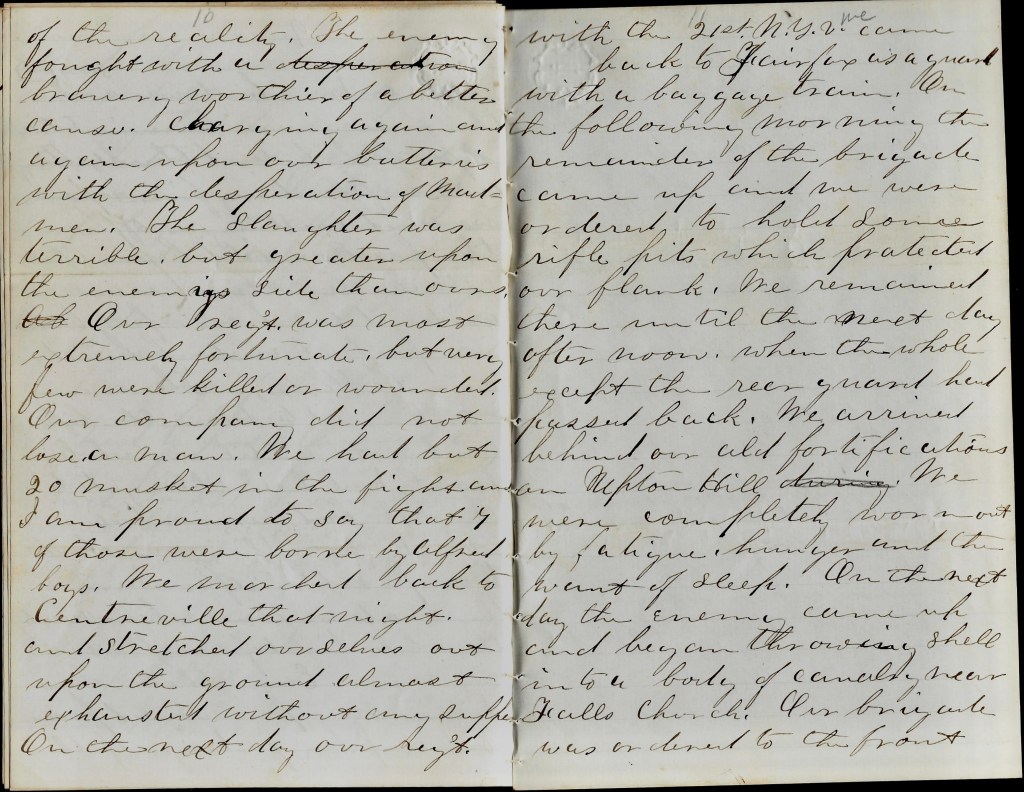
A retreat was ordered and we fell back in perfect order behind our batteries. The enemy continued to turn the left and not until our whole front had been changed to the left were our forces able to hold them in check. Our position after leaving the woods was one where nearly the whole field of conflict was in view. My pen would prove but a poor portrayer of the reality. The enemy fought with a bravery worthier of a better cause—charging again and again upon our batteries with the desperation of mad men. The slaughter was terrible but greater upon the enemy’s side than ours. Our regiment was most extremely fortunate—but very few were killed or wounded. Our company did not lose a man. We had but 20 muskets in the fight and I am proud to say that 7 of those were borne by Alfred [New York] Boys.

We marched back to Centreville that night and stretched ourselves out upon the ground almost exhausted without any supper. On the next day our regiment with the 21st New York Vols. came back to Fairfax as a guard with a baggage train. On the following morning the remainder of the brigade came up and we were ordered to hold some rifle pits which protected our flank. We remained there until the next day after noon when the whole except the rear guard had passed back. We arrived behind our old fortifications on Upton Hill. We were completely worn out by fatigue, hunger, and the want of sleep.

On the next day the enemy came up and began throwing shell into a body of cavalry near Falls Church. Our brigade was ordered to the front where it remained over night. On the night of the 6th inst. a large portion of the army came back across the Potomac and is now laying north of Washington, ready to be moved either way to confront Jackson if he shall dare to push a heavy force into Maryland or to protect Washington in the front if it shall be attacked there.

Pope—much to our satisfaction—has gone to the Northwest and McDowell, I trust, to his home. The restoration of McClellan to command has given a new confidence to the army. He is their favorite and they will fight under him as under no other man. Marching orders have just come and I must close. Receive this most hastily written correspondence from an old Oro. — S. Dexter


Letter 3

Camp 23rd New York Vol.
Near Sharpsburg, Maryland
October 14th 1862

Brothers Oro’s:

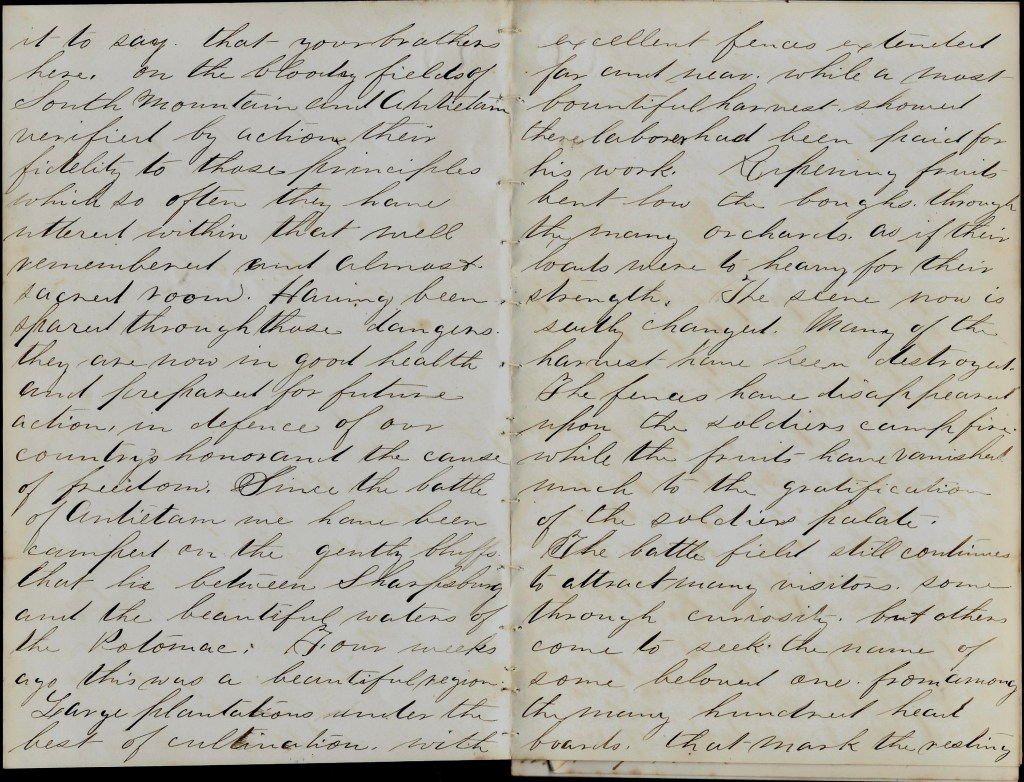
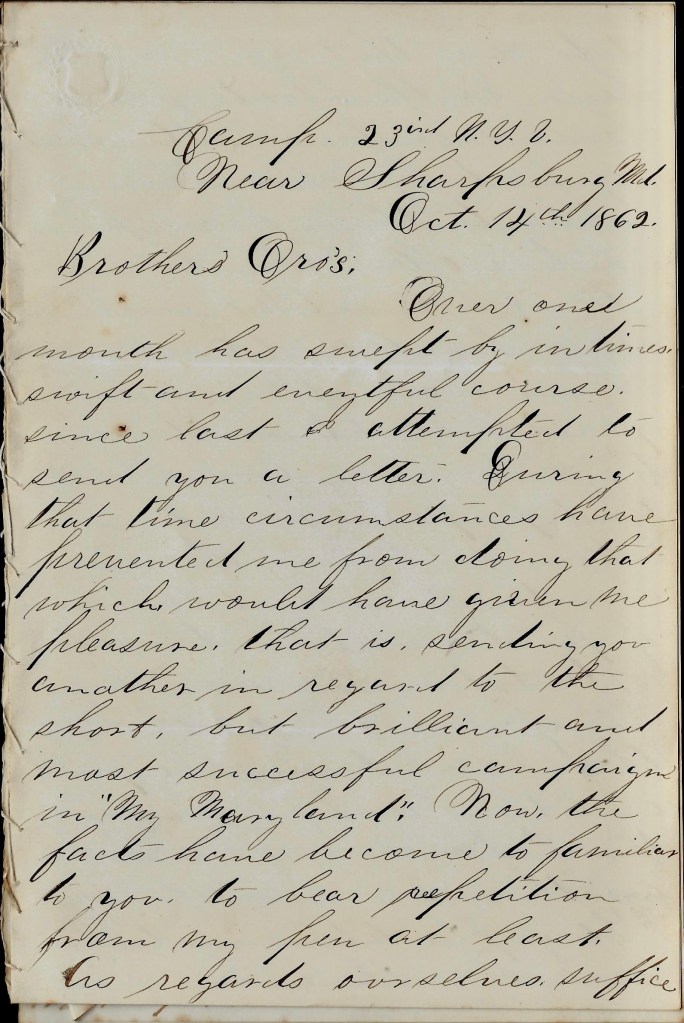
Over one month has swept by in time’s swift and eventful course since last I attempted to send you a letter. During that time, circumstances have prevented me from doing that which would have given me pleasure—that is, sending you another in regard to the short, but brilliant and most successful campaign in “My Maryland.” Now the facts have become too familiar to you to bear repetition from my pen at least. As regards ourselves, suffice it to say that your [lyceum] brothers here on the bloody fields of South Mountain and Antietam verified by action their fidelity to those principles which so often they have uttered within that well remembered and almost sacred room. Having been spared through those dangers, they are now in good health and prepared for future action in defense of our country’s honor and the cause of freedom.

Since the Battle of Antietam, we have been camped on the gentle bluffs that lie between Sharpsburg and the beautiful waters of the Potomac. Four weeks ago this was a beautiful region—large plantations under the best cultivation with excellent fences extended far and near, while a most bountiful harvest showed their laborer had been paid for his work. Ripening fruits bent low the boughs through the many orchards as if their loads were too heavy for their strength. The scene now is sadly changed. Many of the harvest have been destroyed. The fences have disappeared upon the soldier’s camp fire while the fruits have vanished much to the gratification of the soldier’s palate.

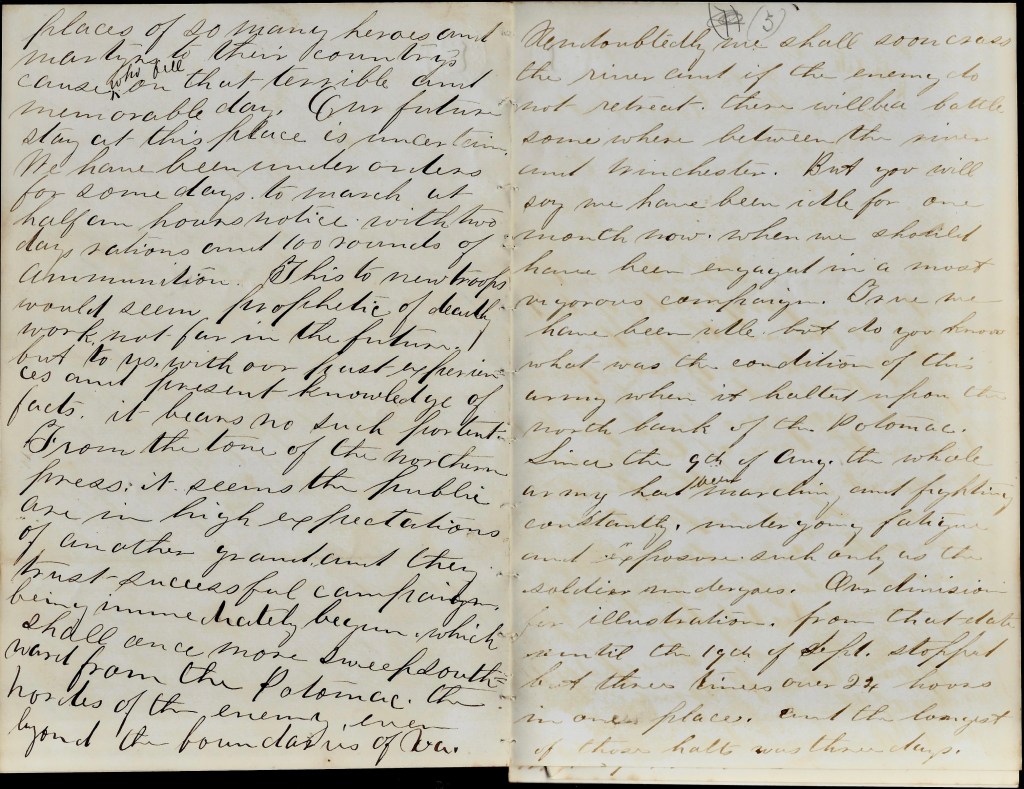
The battlefield still continues to attract many visitors—some through curiosity, but other come to seek the name of some beloved one from among the many hundred head boards that mark the resting places of so many heroes and martyrs to their country’s cause who fell on that terrible and memorable day.

Our future stay at this place is uncertain. We have been under orders for some days to march at half an hour’s notice with two days rations and 100 rounds of ammunition. This to new troops would seem prophetic of deadly work not far in the future, but to us with our past experiences, it bears no such portent.

From the tone of the Northern press, it seems the public are in high expectations of another grand and, they trust, successful campaign being immediately begun which shall once more sweep southward from the Potomac, the hordes of the enemy ever beyond the boundaries of Virginia. Undoubtedly we shall soon cross the river and if the enemy do not retreat. there will be a battle somewhere between the river and Winchester. But you will say we have been idle for one month now when we should have been engaged in a most vigorous campaign. True, we have been idle. But do you know what was the condition of this army when it halted upon the north bank of the Potomac? Since the 9th of August the whole army had been marching and fighting constantly, undergoing fatigue and exposure such only as the soldier undergoes. Our division for illustration, from that date until the 19th of September, stopped but three times over 24 hours in one place and the longest of those halts was three days. We were constantly broke of our sleep while our food was scanty and irregular. When we entered the Battle of [2nd] Bull Run, we had been 60 hours with but 4 hours sleep and starvation really staring us in the face. Pope’s official report was true in that respect.

When we halted here, brigades were but regiments, and divisions but brigades. Our brigade numbered but 825 men for duty and Hatcher’s Brigade of five regiments did not number half that amount. And so it was throughout the whole army. All were dirty and be not shocked, most were lousy. We had not even found time and opportunities to wash our clothes. This remnant of the army was completely worn out like the horse that has lumbered all winter upon scanty fare. Could civilians, unless they believe a soldier is proof against fatigue and exposure, expect that such an army which had so nobly crowned its country’s banners with victory in her darkest hour should immediately, without rest, be sent into another campaign equally laborious? And because it has been delayed thus far already? Yes! Scarcely before the lightning messenger had ceased to transmit the details concerning the victories in Maryland, the northern Republican press began to heap its abuses upon Gen. McClellan because he did not immediately, without a halt, throw his decimated and worn-out columns across the Potomac.

As those expectations have been unrealized so far, so I think they will be in the future to a certain degree. You ask why. It is simple. Because the lateness of the season will not permit it. Four weeks more and it would be inhuman to ask troops to live in shelter tents and should they attempt it, not many weeks would elapse ere over one half the army would be on the sick list or in their graves. Four weeks more and the condition of the roads in Northern Virginia will be such that artillery and baggage trains cannot be moved except upon macadamized roads and these are not in sufficient numbers. Most surely that length of time at this season when no dependence can be placed upon the weather, is not sufficient to warrant the success of a movement as extensive as such an one must necessarily be.

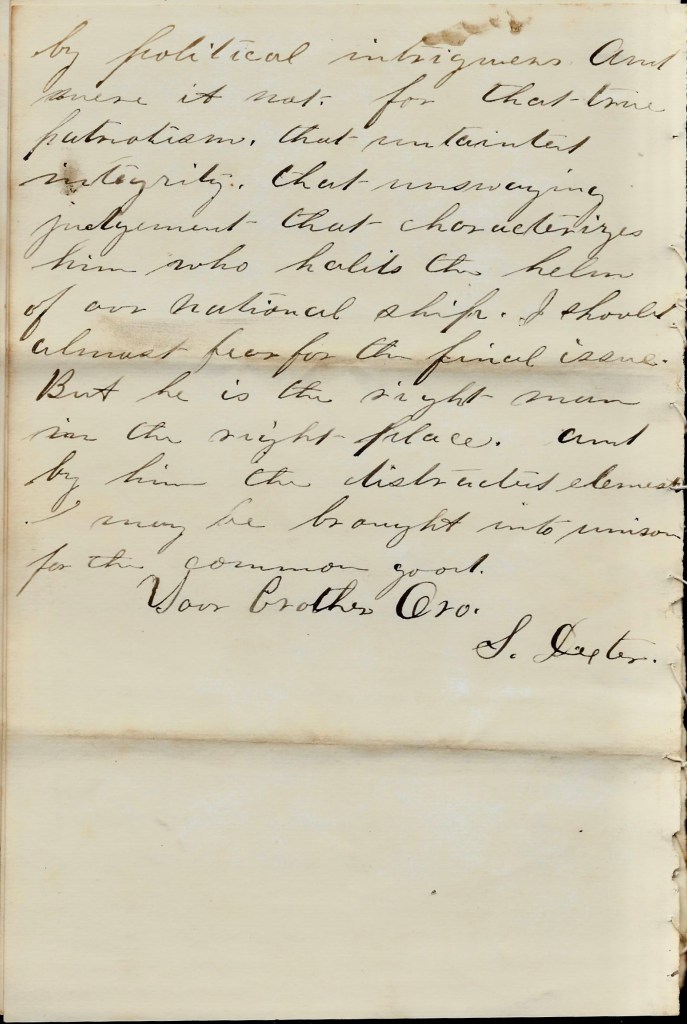
The military authorities know what an army could stand and because they ordered a halt, the radical press of the North with the N. Y. Tribune at the head, began anew to poison and distract the public mind by charging McClellan with incompetency. They belie facts and have belied every act of McClellan’s and that simply because he does not belong to their party politic. The whole race of New York editors would be but little safer in this army than in a rebel camp. It makes the heart of the true patriot in the field fighting for his country’s cause weep to see the public mind thus poisoned and distracted by political intriguers. And were it not for that true patriotism, that untainted integrity, that unswaying judgement that characterizes him who holds the helm of our national ship, I should almost fear for the final issue. But he is the right man in the right place and by him the distracted element may be brought into unison for the common good.

Your brother Oro., — S. Dexter

Letter 4

Purcellville, Va.
November 2, 1862

Brother Oro’s:

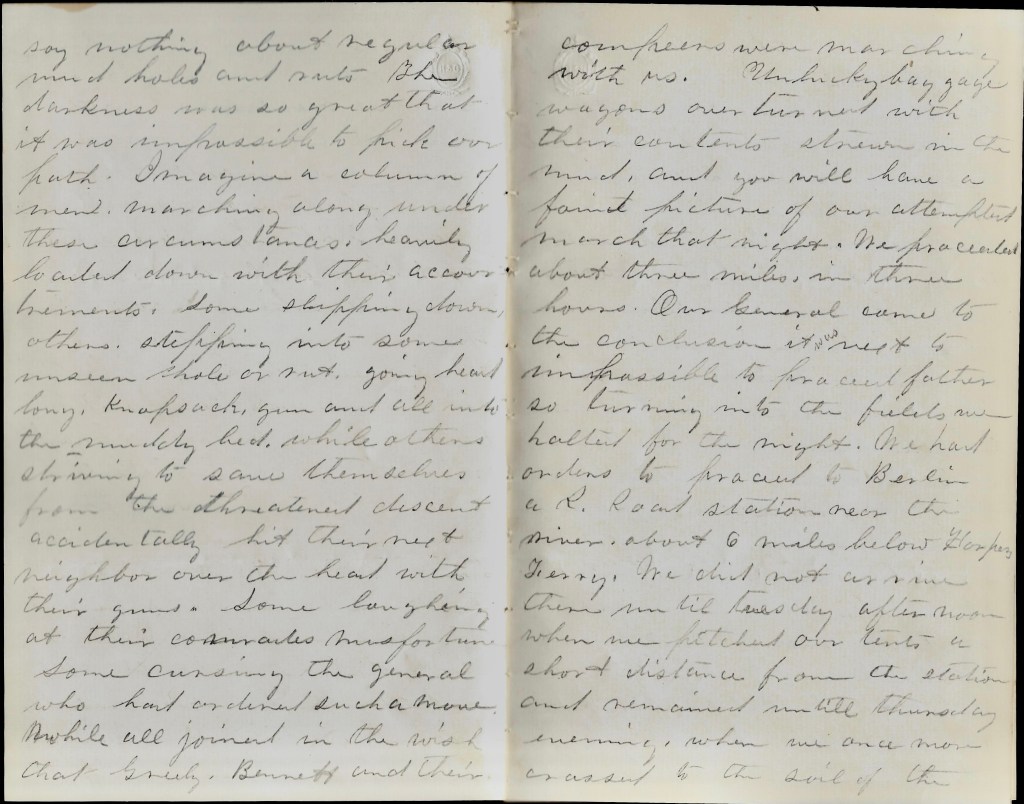
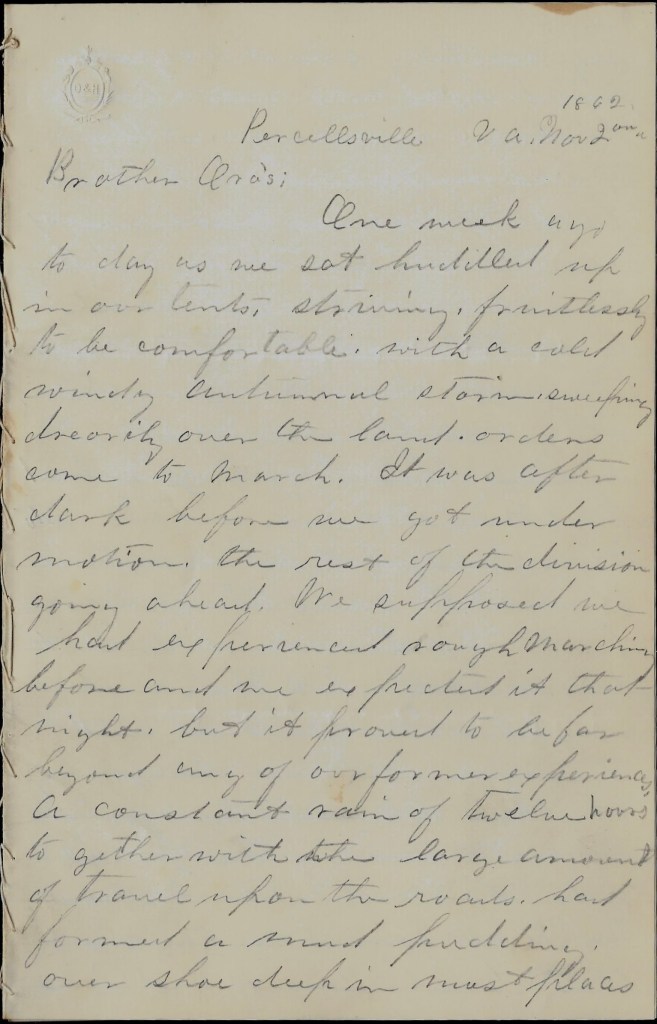
One week ago today as we sat huddled up in our tents, striving fruitlessly to be comfortable with a cold, windy, autumnal storm sweeping drearily over the land, orders came to march. It was after dark before we got under motion—the rest of the Division going ahead. We supposed we had experienced rough marching before and we expected it that night but it proved to be far beyond any of our former experiences. A constant rain of twelve hours together with the large amount of travel upon the roads had formed a mud pudding over shoe deep in most places, say nothing about the regular mud holes and ruts. The darkness was so great that it was impossible to pick our path. Imagine a column of men marching along under these circumstances, heavily loaded down with their accoutrements, some slipping down, others slipping into some unseen hole or rut, going head long, knapsacks, gun, and all into the muddy bed while others striving to save themselves from the threatened descent accidentally hit their next neighbor over the head with their guns. Some laughing at their comrades misfortune, some cursing the General who had ordered such a move, while all joined in the wish that [newspaper editors] Greeley, Bennett, and their compeers were marching with us.

Unlucky baggage wagons overturned with their contents strewn in the mud, and you will have a faint picture of our attempted march that night. We proceeded about three miles in three hours. Our General came to the conclusion it was next to impossible to proceed further so turning into the fields, we halted for the night. We had orders to proceed to Berlin—a railroad station near the river about 6 miles below Harpers Ferry. We did not arrive there until Tuesday afternoon when we pitched our tents a short distance from the station and remained until Thursday evening. When we once more crossed to the soil of the Old Dominion and proceeded about one mile beyond Lovettsville and bivouacked for the night. It was a beautiful evening and as we once more set foot upon the “sacred soil”, there was a feeling of humiliation to think that fifteen months ago we had crossed the same river for the same purpose and after thirteen months of occupation, we had been forced back by the foe whom we thought to reduce.

On the following morning we were mustered for pay and in the afternoon moved for want about one mile farther. And yesterday moved forward to this place which is a small hamlet situated on the pike leading from Leesburg to Winchester. Snicker’s Gap, the point where the pike crosses the mountains that lay between us and Winchester, is about six miles distant and is said now to be in our possession. Our advance cavalry under Gen. Pleasanton drove the enemy’s cavalry from this vicinity yesterday and took one piece of their artillery.

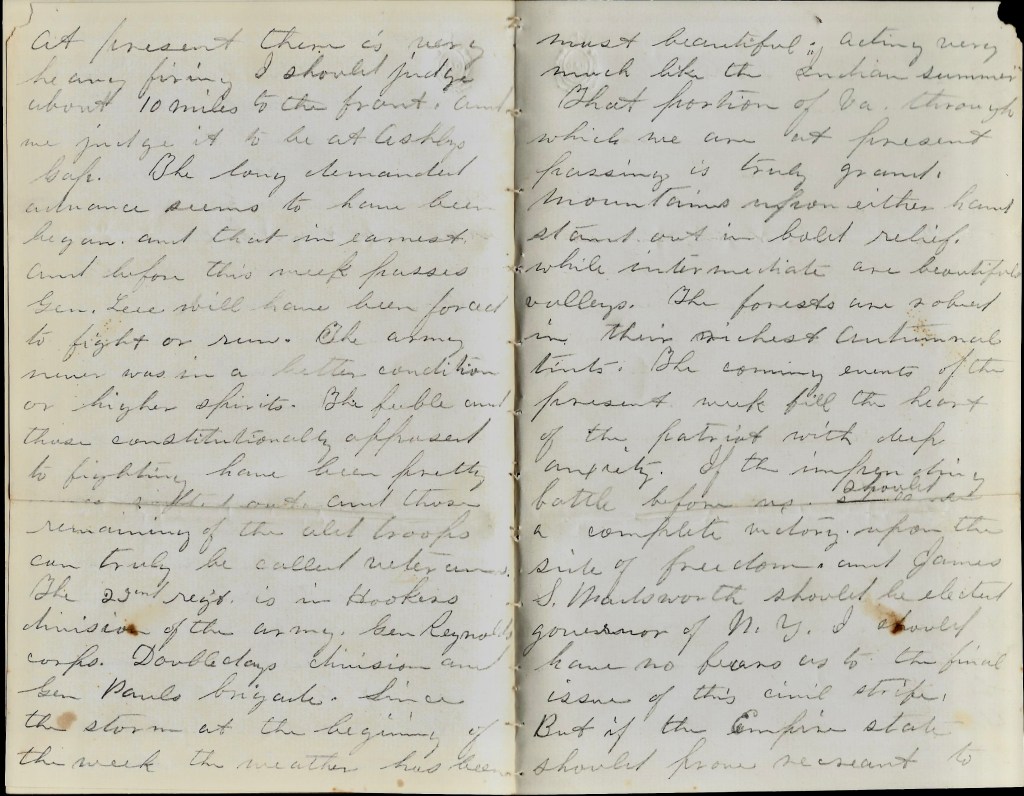
While we were coming forward, the roar of their guns gave us music to march by. Quite early this morning there was cannonading abour six miles to the front that soon ceased and very distant cannonading could be heard in the direction of Thoroughfare Gap. We suppose that to be Siegel. At present there is very heavy firing I should judge about 10 miles to the front and we judge it to be at Ashby’s Gap.

The long demanded advance seems to have been begun and that in earnest. And before this week passes, Gen. Lee will have been forced to fight or run. The army never was in a better condition or higher spirits. The feeble and those constitutionally opposed to fighting have been pretty well sifted out and those remaining of the old troops can truly be called veterans. The 23rd Regt. is in Hooker’s Division of the army. Gen. Reynolds Corps, Doubleday’s Division and Gen. Paul’s Brigade.

Since the storm at the beginning of the week, the weather has been most beautiful, acting very much like the “Indian Summer.” That portion of Virginia through which we are at present passing is truly grand. Mountains upon either hand stand out in bold relief while intermediate are beautiful valleys. The forests are robed in their richest autumnal tints. The coming events of the present week fill the heart of the patriot with deep anxiety. If the impending battle before us should be a complete victory upon the side of freedom and James S. Wadsworth should be elected Governor of New York, I should have no fears as to the final issue of this civil strife. But if the Empire State should prove recreant to the man whom she helped place in the executive chair in this his most trying hour, I shall feel like disowning her as my native state. Add to this political defeat another defeat in our army now advancing and I should despair of success. Time alone shall be the revelation of the issue which now is known only to Him “who rules the destinies of nations.”

Yours in haste, – S. Dexter

The Buffalo News, May 6, 1904

1862: Charles Anthem Chapin to Charles Tubbs

The following letters were written by Charles Anthem Chapin (1841-1900) who enlisted in May 1861 at Elmira to serve two years in Co. K, 23rd New York Infantry. He entered the war as a private, was promoted to corporal and then sergeant before mustering out of the regiment on 22 May 1863.

Charles was the son of David Jewett Chapin (1802-1876) and Alice Glazier (1799-1865). I believe that Charles was slightly wounded at the Battle of Antietam but not so badly he could not fulfill the term of his enlistment.

Brandt’s book on Charles Tubbs’ Collection of Civil War Letters

Chapin wrote the letters to Charles Tubbs, the corresponding secretary of the Orophilian Lyceum of Alfred University in Alfred Centre, New York. Founded in 1836, Alfred University was an early-day coeducational college. Tubbs later attended Union College, graduated with honors in 1864, and then attended the law school in Ann Arbor, Michigan. In researching Tubbs, I was surprised to discover a 1996 publication entitled, “Mr. Tubbs’ Civil War” by Nat Brandt. In his introduction. Brandt wrote that, “Charlie Tubbs experienced the Civil War vicariously. He never volunteered nor was drafted in the Union military forces. But many of his friends went to war, and it was through them that the day-to-day experience of the war came alive for him in the most personal way. Throughout the war, Tubbs received more than 175 letters from his friends, ordinary young men, all products of rural New York and Pennsylvania.” Curiously, of the 17 letter writers mentioned in Brandt’s publication, Charles A. Chapin is not listed and his letters do not appear in the book. It may be that these letters, which were once part of a larger collection of Tubb’s collection, were separated from the rest at an early date. It may also be possible that Brandt chose not to include these letters in his book for some reason.
Letter 1

Addressed to Corresponding Secretary Orophilian Lyceum, Alfred Centre, Allegany county, N. Y.

Camp opposite Fredericksburg, Stafford county, Va.
April 1862

Dear Oros,

On the morning of the 18th pursuant to an order that previous night at 6:30 o’clock, General Patrick’s Brigade was on the march en route for Fredericksburg. We had marched to Catlett’s Station two days before—a distance of 10 miles from Bristol on the Orange & Alexandria Railroad. We had two day’s rations in our haversacks and were told we had a hard march before us of about 32 miles which was to be accomplished in two days. Gen. Augur’s Brigade had gone the day before accompanied by a portion of Capt. Gibbon’s artillery.

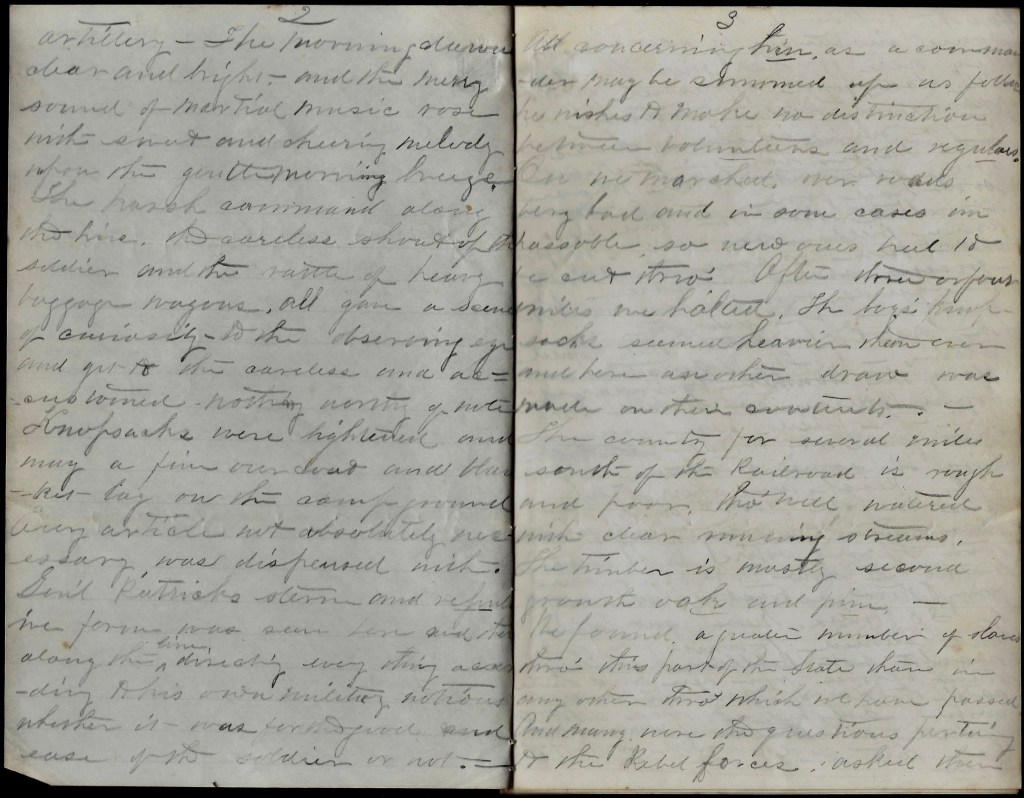
The morning dawned clear and bright and the merry sound of martial music rose with sweet and cheering melody upon the gentle morning breeze. The harsh command along the line, the careless shout of the soldier, and the rattle of heavy baggage wagons all gave a scene of curiosity to the observing eye and yet to the careless and accustomed, nothing worth of note. Knapsacks were tightened and many a fine overcoat and blanket lay on the campground. Every article not absolutely necessary was dispensed with. General Patrick’s stern and repulsive form was seen here and there along the line directing everything according to his own military notions whether it was for the good and ease of the soldier or not. All concerning him, as a commander may be summed up as follows—he wishes to make no distinction between volunteers and regulars.

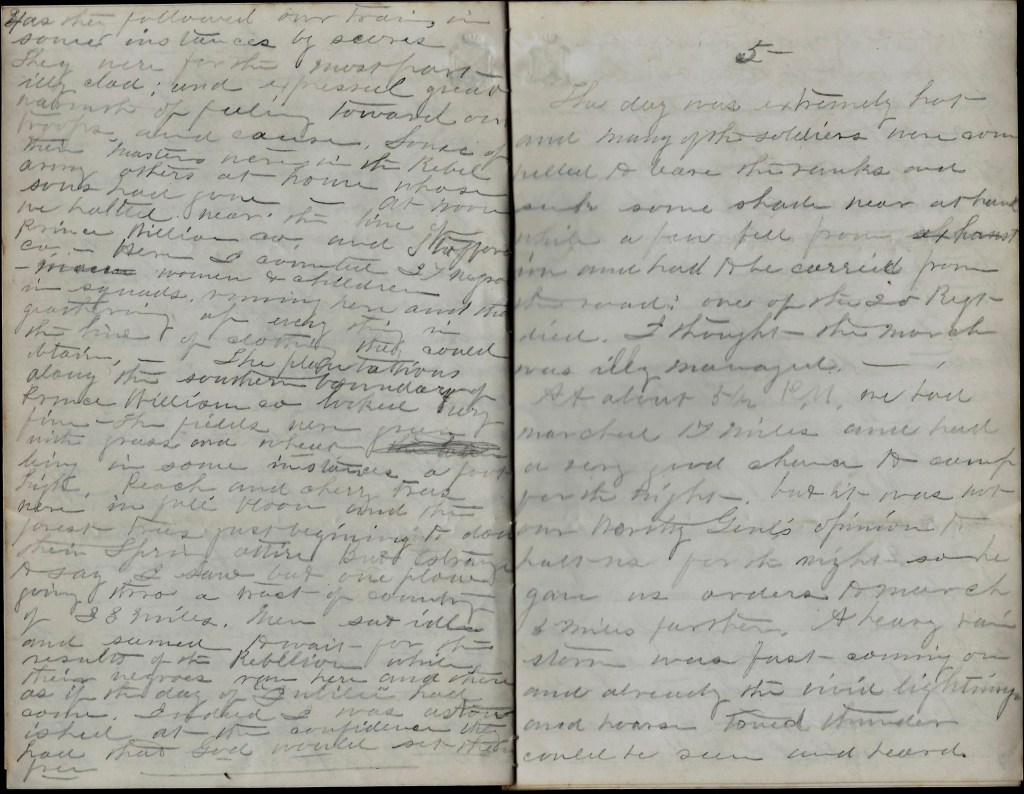
On we marched over roads very bad and in some cases impassable. After three or four miles, we halted. The boys’ knapsacks seemed heavier than ever and here another draw was made on the contents. The country for several miles south of the railroad is rough and poor though well watered with clear running streams. The timber is mostly second growth oak and pine. We found a greater number of slaves through this part of the state than in any other through which we have passed. And many were the questions pertaining to the Rebel forces asked them as they followed our train, in some instances by scores. They were, for the most part, illy clad and expressed great warmth of feeling toward our troops and cause. Some of their masters were in the Rebel army; others at home whose sons had gone.

At noon we halted near the line of Prince William county and Stafford county. Here I counted 27 negro men, women and children in squads, running here and there, gathering up everything in the line of clothing they could obtain. The plantations along the southern boundary of Prince William County looked very fine. The fields were green with grass and wheat lying in some instances a foot high. Peach and cherry trees were in full bloom and the first trees just beginning to don their spring attire. But strange to say, I saw but one plow going through a tract of country of 33 miles. Men sat idle and seemed to wait for the results of the Rebellion while their negroes ran here and there as if the day of Jubilee had come. Indeed, I was astonished at the confidence they had that God would set them free.

The day was extremely hot and many of the soldiers were compelled to leave the ranks and seek some shade near at hand while a few fell from exhaustion and had to be carried from the road. One of the 20th Regiment died. I thought the march was illy managed.

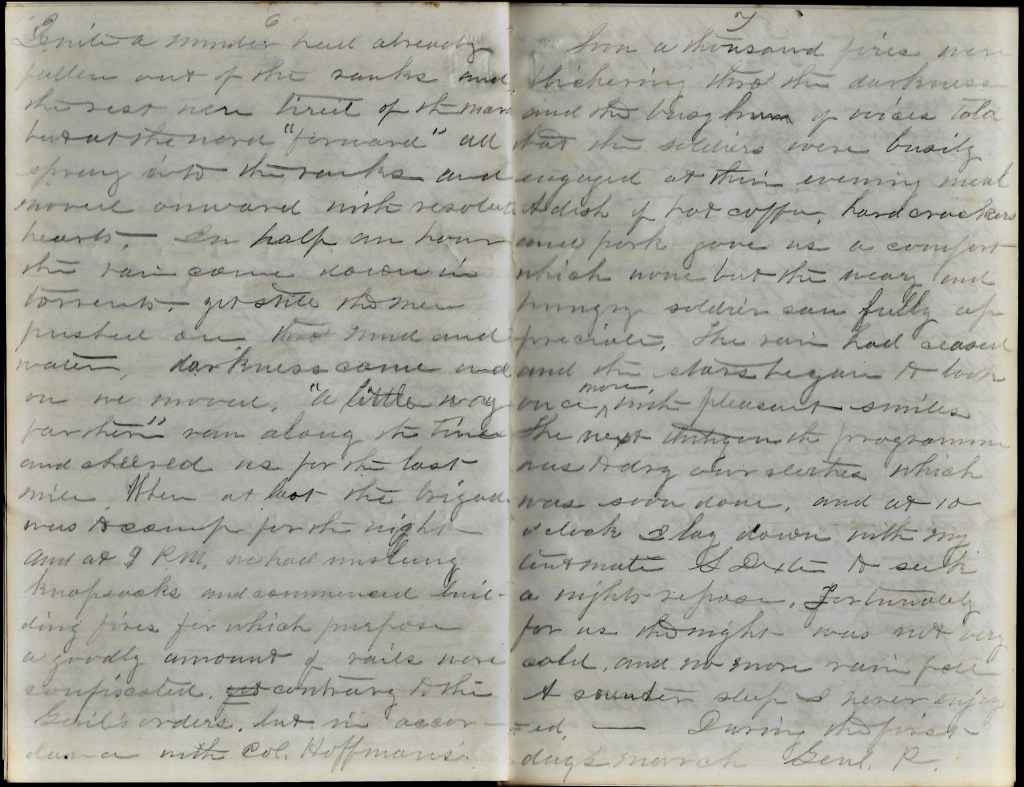
At about 5:30 p.m., we had marched 17 miles and had a very good chance to camp for the night, but it was not our worthy General’s opinion to halt us for the night so he gave us orders to march 6 miles further. A heavy rainstorm was fast coming on and already the vivid lightning and hoarse-toned thunder could be seen and heard. Quite a number had already fallen out of the ranks and the rest were tired of the march but at the word “forward” all sprung into the ranks and moved onward with resolute hearts. In half an hour, the rain came down in torrents—yet still the men pushed on through mud and water. Darkness came and on we moved. “A little way further” ran along the line and cheered us for the last mile. When at last the brigade was to camp for the night and at 9 p.m. we had unslung knapsacks and commenced building fires for which purpose a goodly amount of rails were confiscated, contrary to the General’s orders but in accordance with Col. [Henry C.] Hoffman’s.

Soon a thousand fires were flickering through the darkness and the busy hum of voices told that the soldiers were busily engaged at their evening meal. A dish of hot coffee, hard crackers, and pork, gave us a comfort which none but the weary and hungry soldier can fully appreciate. The rain had ceased and the stars began to look once more with pleasant smiles. The next thing on the program was to dry our clothes which was soon done and at 10 o’clock I lay down with my tent mate, S[eymour] Dexter, to seek a night’s repose. Fortunately for us, the night was not very cold and no more rain fell. A sounder sleep I never enjoyed.

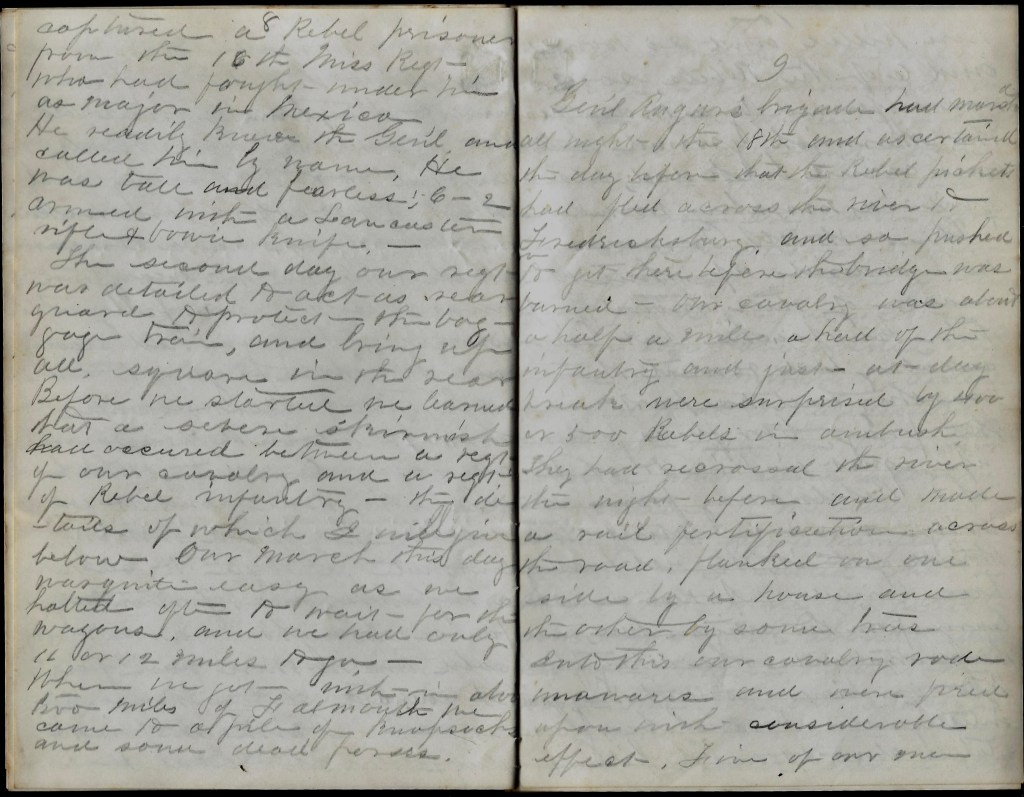
During the first day’s march, General Patrick captured a rebel prisoner from the 16th Mississippi Regiment who had fought under him as Major in Mexico. He readily knew the General and called him by name. He was tall and fearless—6′ 2″—armed with a Lancaster rifle & Bowie knife.

The second day our regiment was detailed to act as rear guard to protect the baggage train and bring up all, square in the rear. Before we started, we learned that a severe skirmish had occurred between a regiment of our cavalry and a regiment of Rebel infantry—the details of which I will give below. Our march this day was quite easy as we halted often to wait for the wagons and we had only 11 or 12 miles to go. When we got within about two miles of Falmouth, we came to a pile of knapsacks and some dead horses. General Ruger’s Brigade had marched all night the 18th and ascertained the day before that the Rebel pickets had fled across the [Rappahannock] River to Fredericksburg and so pushed to get here before the bridge was burned. Our cavalry was about a half a mile ahead of the infantry and just at daybreak were surprised by 400 or 500 Rebels in ambush. They had recrossed the river the night before and made a rail fortification across the road, flanked on one side by a house and the other by some trees. Into this our cavalry rode unawares and were fired upon with considerable effect. Some of our men were killed and 20 wounded and 6 of the Rebels—so we were informed by a man near the skirmish ground—were carried back dead. Also quite a number wounded.

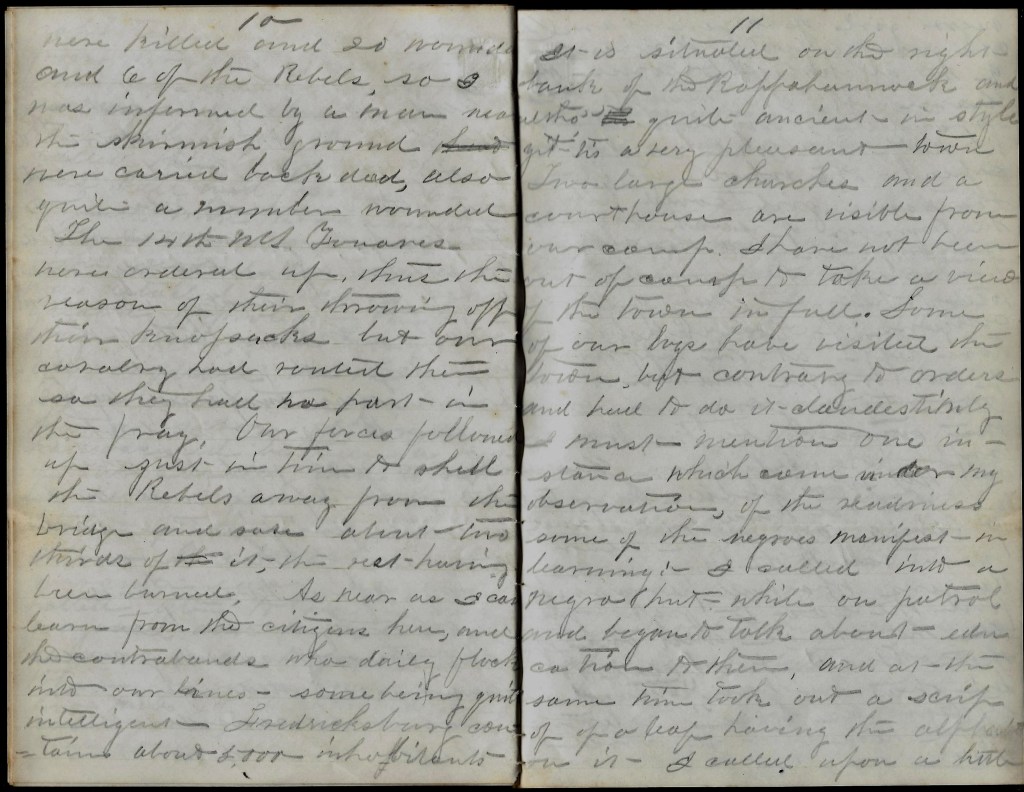
The 14th New York Zouaves were ordered up, thus the reason of their throwing off their knapsacks, but our cavalry had routed them so they had no part in the fray. Our forces followed up just in time to shell the Rebels away from the bridge and save about two-thirds of it; the rest having been burned. As near as I can learn from the citizens here, and the contrabands who daily flock into our lines—some being quite intelligent, Fredericksburg contains about 5,000 inhabitants. It is situated on the right bank of the Rappahannock and though quite ancient in style, yet tis a very pleasant town. Two large churches and a courthouse are visible from our camp. I have not been out of camp to take a view of the town in full. Some of our boys have visited the town but contrary to orders and had to do it clandestinely.

I must mention one instance which came under my observation of the readiness some of the negroes manifest n learning. I called into a negro hut while on patrol and began to talk about education to them, and at the same time took out a scrip of a leaf having the alphabet on it. I called upon a little negro girl of seven years who was perfectly ignorant of the alphabet to come and learn it. She readily responded to my request and in half an hour could repeat the whole of it. The same girl could tell the number of each regiment in our brigade and the Colonel’s name from once hearing them told her.

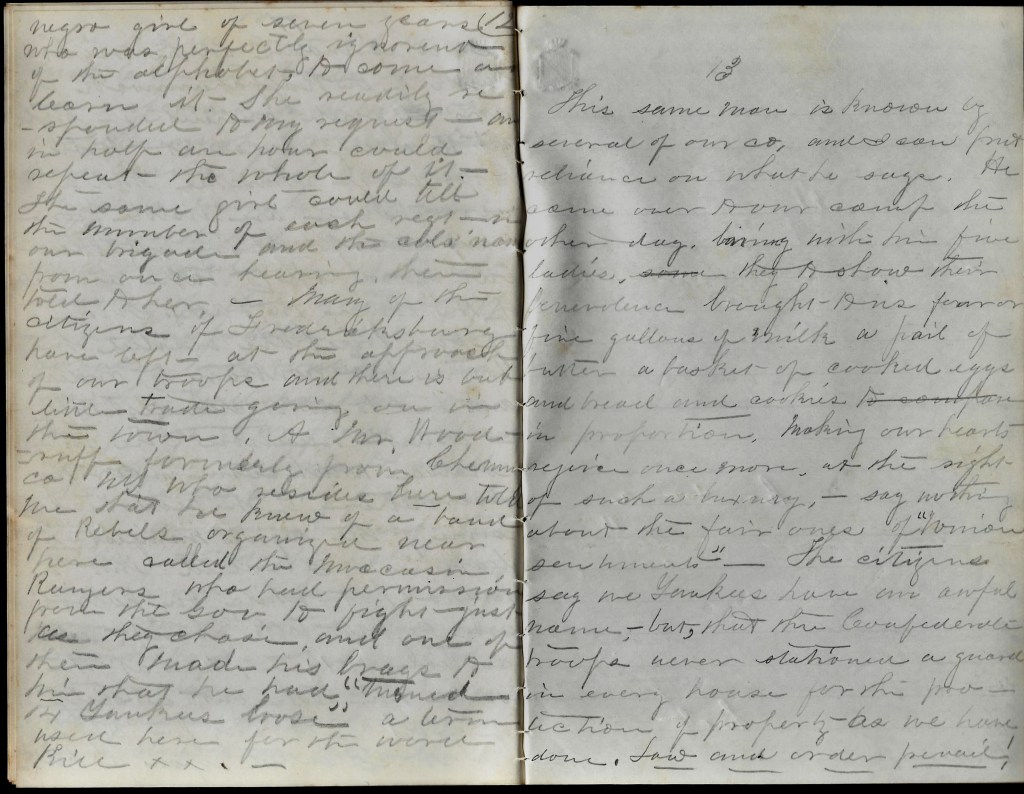
Many of the citizens of Fredericksburg have left at the approach of our troops and there is but little trade going on in the town. A Mr. Woodruff, formerly from Chemung county, New York, who resides here, told me that he knew of a band of Rebels organized near here called the Moccasin Rangers who had permission from the Governor to fight just as they chose and one of them made his brags to him that he had “turned the Yankees loose”—a term used here for the word kill. This same man [Woodruff] is known by several of our company and I can put reliance on what he says. He came over to our camp the other day bringing with him five ladies. They, to show their benevolence, brought to us four or five gallons of milk, a pail of butter, a basket of cooked eggs, and bread and cookies in proportion, making our hearts rejoice once more at the sight of such a luxury—to say nothing about the fair ones of Union sentiments.

The citizens say we Yankees have an awful name, but the Confederate troops never stationed a guard in every house for the protection of property as we have done. Law and order prevail!

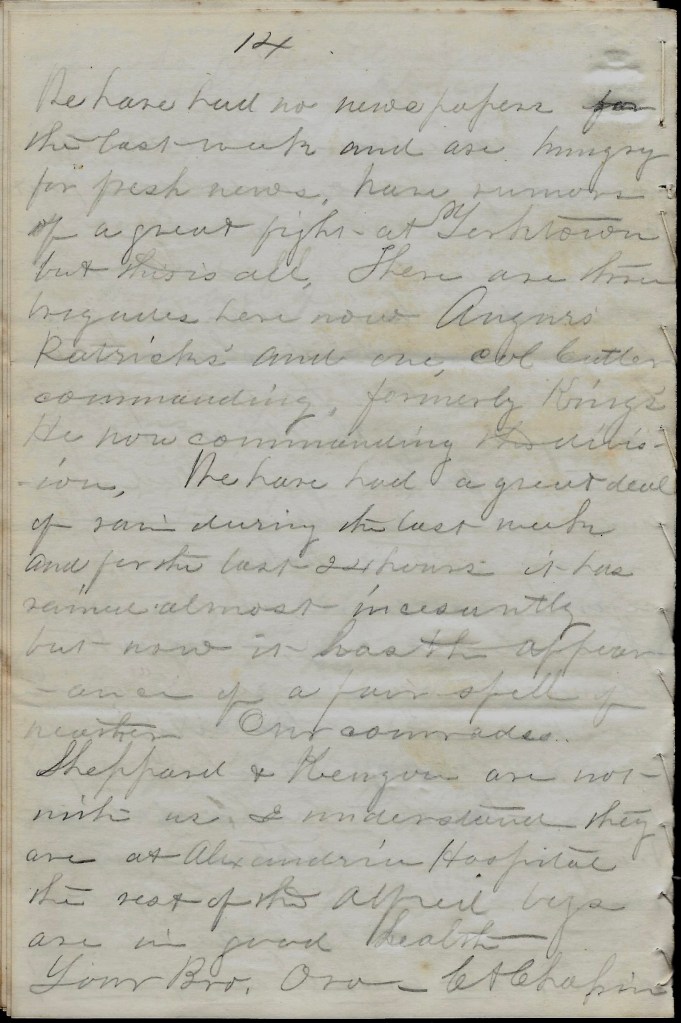
We have had no newspapers the last week and are hungry for fresh news. Have rumors of a great fight at Yorktown but this is all. There are three brigades here now—Augur’s, Patrick’s and one, Col. Cutler commanding, formerly King’s—he now commanding the Division. We have had a great deal of rain during the last week and for the last 24 hours it has rained almost incessantly. But now it has the appearance of a fair spell of weather. Our comrades [Mark] Shephard and [Lewis] Kenyon are not with us. I understand they are Alexandria Hospital. The rest of the Alfred Boys are in good health. Your brother Oro, — C. A. Chapin


Letter 2

Corresponding Secretary of the Orophilia Lyceum, Alfred Centre, Allegany county, NY

Fredericksburg, Virginia
May 11th 1862

Dear Oros,

The 23rd [New York] Regiment now holds this famous town—famous because it is as old as Philadelphia—because we lay two weeks on the opposite bank of the Rappahannock and did not enter the city while the Rebels had free access to it and removed all the stores and provisions valuable therein—and because tis the place where Washington spent his youthful days from the time he was four years old till he was thirteen. It is by nature a most beautiful place. The valley is sufficiently wide to give ample room for a large city. The chain of hills on either bank is not abrupt but gently sloping, while here and there, back from the river, tower lofty mansions with almost every feature of beauty and grandeur.

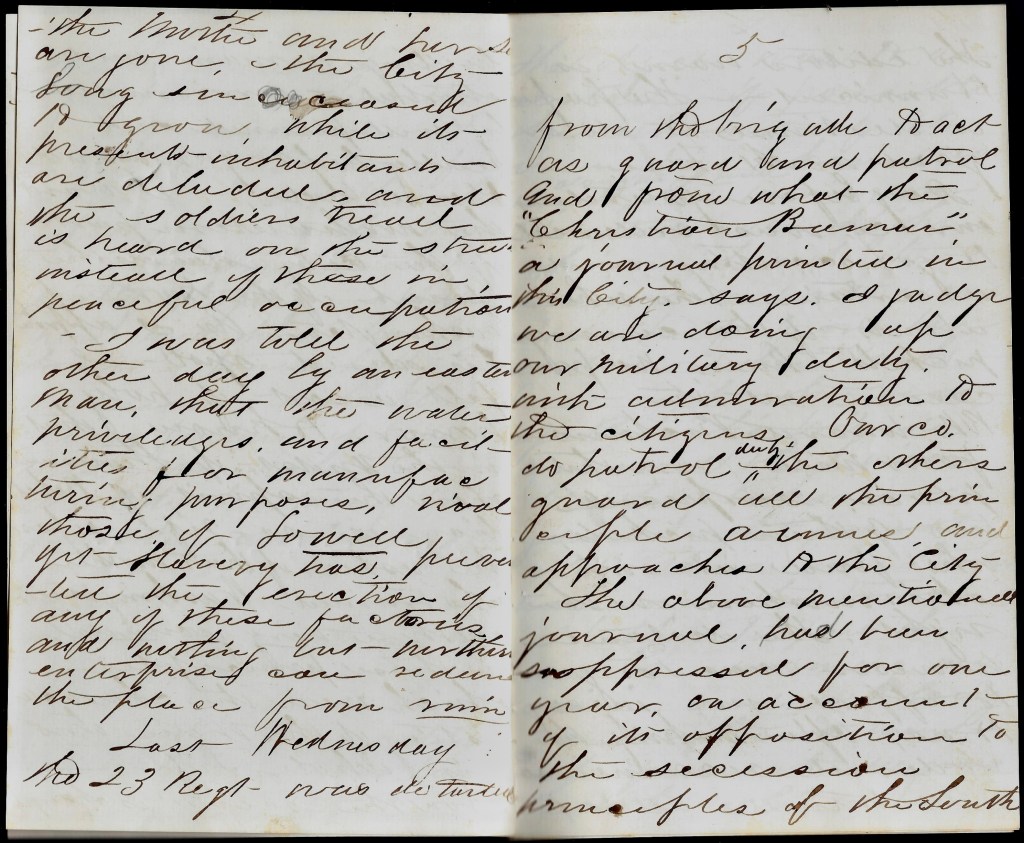
The city has many bad features and some good ones. It looks deserted and neglected, which it is, and contains many poor negro huts—a characteristic of all Southern cities—while on the other hand some beautiful dwellings remain undisturbed, surrounded by well-planned and neatly kept gardens and flower beds. Toward the northwestern part of the city stands the Tomb of the mother of Washington. As I approached this sacred spot, I felt a sort of holy horror to know that in the midst of the thousands where the spirit of rebellion is so rife, reposes the ashes of that mother who trained Washington on these very grounds in those principles which even the characteristic of the man through his whole life. Now the scene is changed—the mother and her son are gone—the city long since ceased to grow, while its present inhabitants are deluded and the soldiers tread is heard on the street instead of those in peaceful occupation.

I was told the other day by an Eastern man that the water privileges and facilities for manufacturing purposes rival those of Lowell, yet slavery has prevented the erection of any of these factories and nothing but Northern enterprise can redeem the place from ruin.

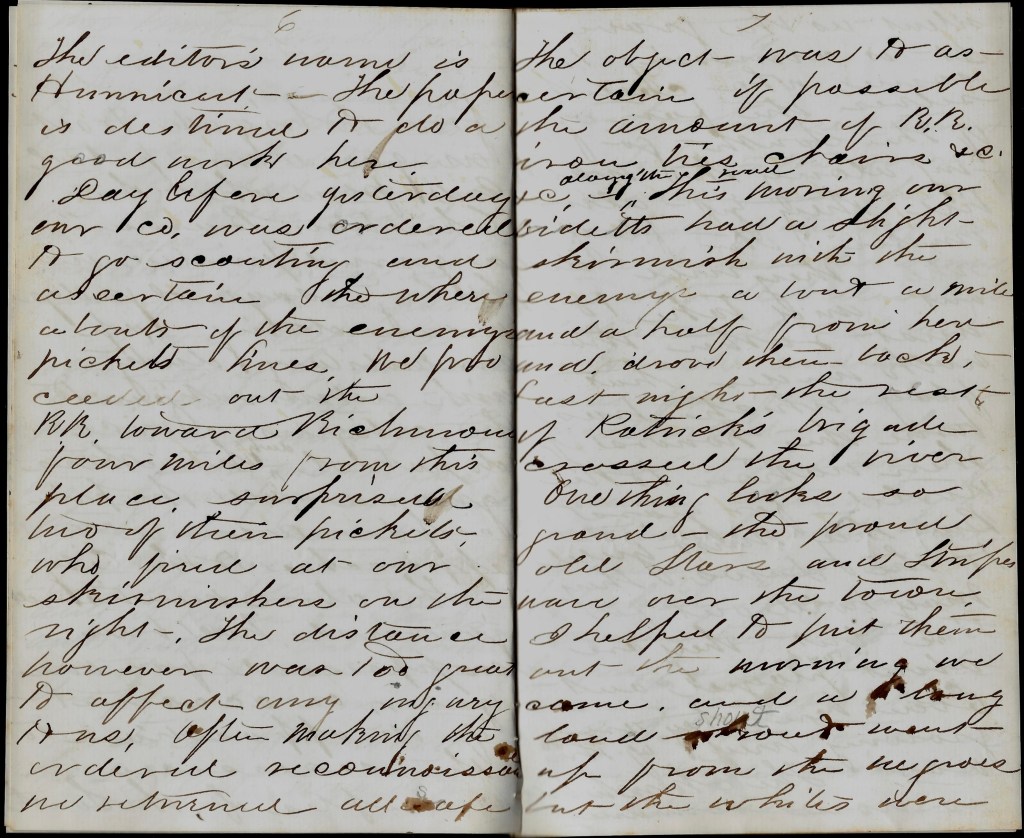
Last Wednesday the 23rd Regiment was detailed from the Brigade to act as guards and patrol and from what the “Christian Banner”—a journal printed in this city says, I judge we are doing up our military duty with admiration to the citizens. Our company do patrol duty; the others guard all the principle avenues and approaches to the city. The above mentioned journal had been suppressed for one year of account of its opposition to the secession principles of the South. The editor’s name is [James W.] Hunnicutt. The paper is destined to do a good work here.

The Christian Banner, a weekly newspaper, was edited by James W. Hunnicutt. The paper began publication in 1848 but ceased operations on May 9, 1861, in the midst of the secession crisis, with Hunnicutt bowing to public pressure over his pro-Union views. He resumed publication on May 9, 1862, after the Union army entered Fredericksburg. When the troops withdrew from the city at the end of August 1862, Hunnicutt fled the city. Newspaper Virginia Fredericksburg. Special Collections, University of Virginia, Charlottesville, Va.

Day before yesterday our company was ordered to go scouting and ascertain the whereabouts of the enemy picket lines. We proceeded out the railroad toward Richmond four miles from this place, surprised two of their pickets who fired at our skirmishers on the right. The distance, however, was too great to affect any injury to us. After making the ordered reconnoissance, we returned all safe. The object was to ascertain if possible the amount of railroad iron, ties, chains, &c. &c. along the road. This morning our videttes had a slight skirmish with the enemy about a mile and a half from here and drove them back. Last night the rest of Patrick’s Brigade crossed the river.

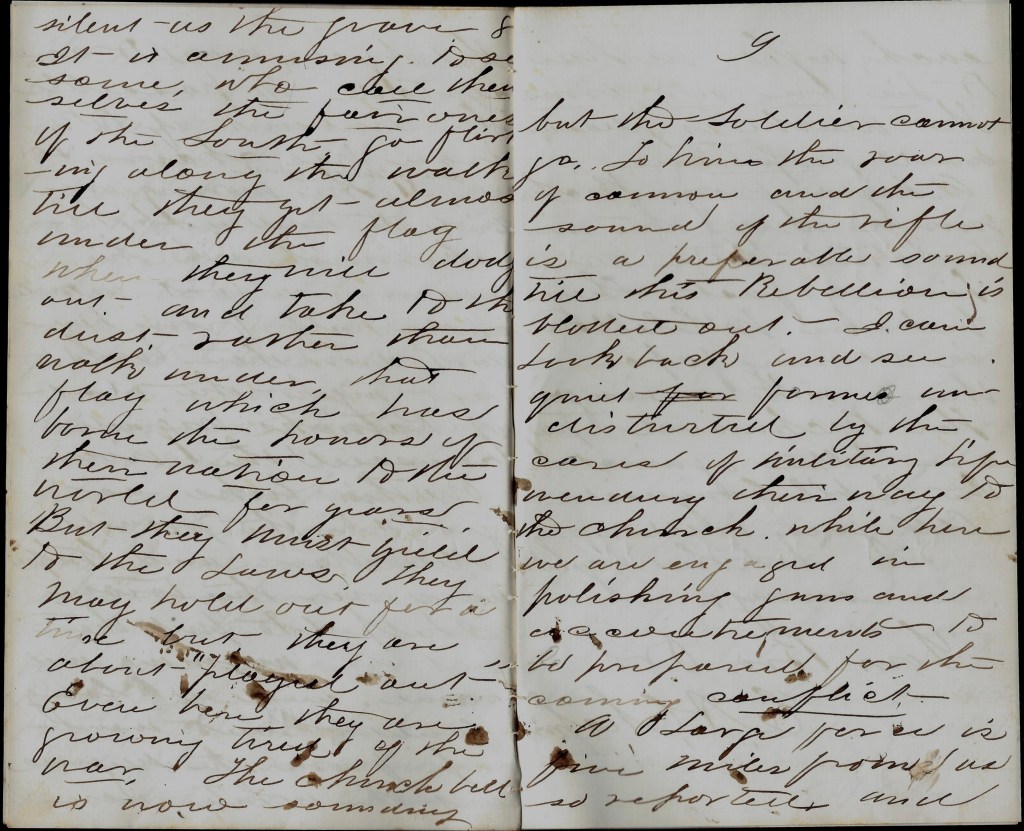
One thing looks so grand—the proud old Stars and Stripes wave over the town. I helped to put them out the morning we came and a long loud shout went up from the negroes but the whites were silent as the grave & it is amusing to see some who call themselves the fair ones of the South go flirting along the walk till they get almost under the flag when they will dodge out and take to the dust rather than walk under that flag which has borne the honors of their nation to the world for years. 1 But they must yield to the laws. They may hold out for a time but they are about “played out.” Even here they are growing tired of the war. The church bell is now sounding each night. We have to lie on our arms.

The weather is pleasant and propitious. A negro from Richmond says the inhabitants there are leaving fast. They believe McClellan is coming upon them with a vengeance. The Richmond papers are bitter against the Rebel Congress. All goes well. Let the right bear sway. Your Bro. Oro, — C. A. Chaplin

1 In the New York Herald of 2 May 1862, a war correspondent reported that the women of Fredericksburg looked “as if they could swallow the entire army of live Yankees; they are riling mad and can’t help showing their dislike and hatred to the “mudsills. Their “pouting” and effeminate scowls are amusing to our troops who nearly kill the poor “secesh creatures” with their Yankee smiles and “frolicking.” There are some good looking “Ginny g’hals” here that have already struck the fancy of some of our “Bowled solder Boys,” which, if I mistake not, will in some instances bring about a Union between secesh damsels and our boys. A good chance to get a live Yankee husband will not be allowed to slip through the fingers of these young ladies; for such an excellent bargain they will readily bring their minds to the belief that secesh is a “bad egg” and won’t do to such.”


Letter 3

Camp near Fredericksburg, Va.
May 16th 1862

Brothers of the Orophilian Society,

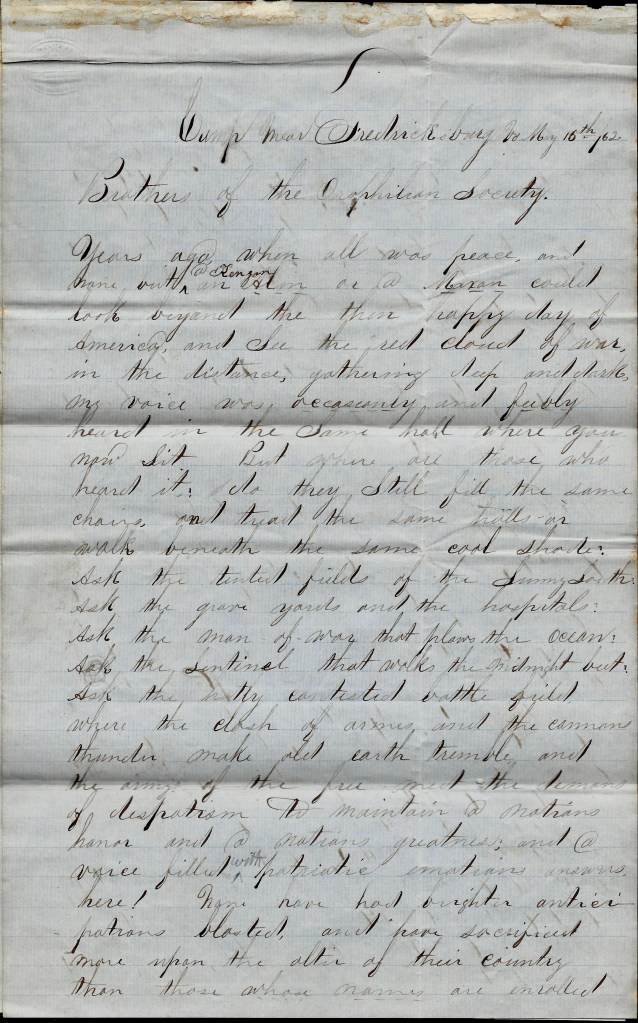
Years ago when all was peace and none [ ] could look beyond the then happy day of America and see the red cloud of war in the distance, gathering deep and dark, my voice was occasionally and feebly heard in the same hall where you now sit. But where are all those who heard it? Do they still fill the same chairs and tread the same halls or walk beneath the same cool shade? Ask the tented fields of the Sunny South. Ask the grave yards and the hospitals. As the man-of-war that plows the ocean. Ask the sentinel that walks the midnight but ask the hotly contested battle field where the clash of arms and the cannons thunder make old earth tremble and the armies of the free meet the demons of desperation to maintain a nation’s honor and a nation’s greatness and a voice filled with patriotic emotions answers, ‘Here!”

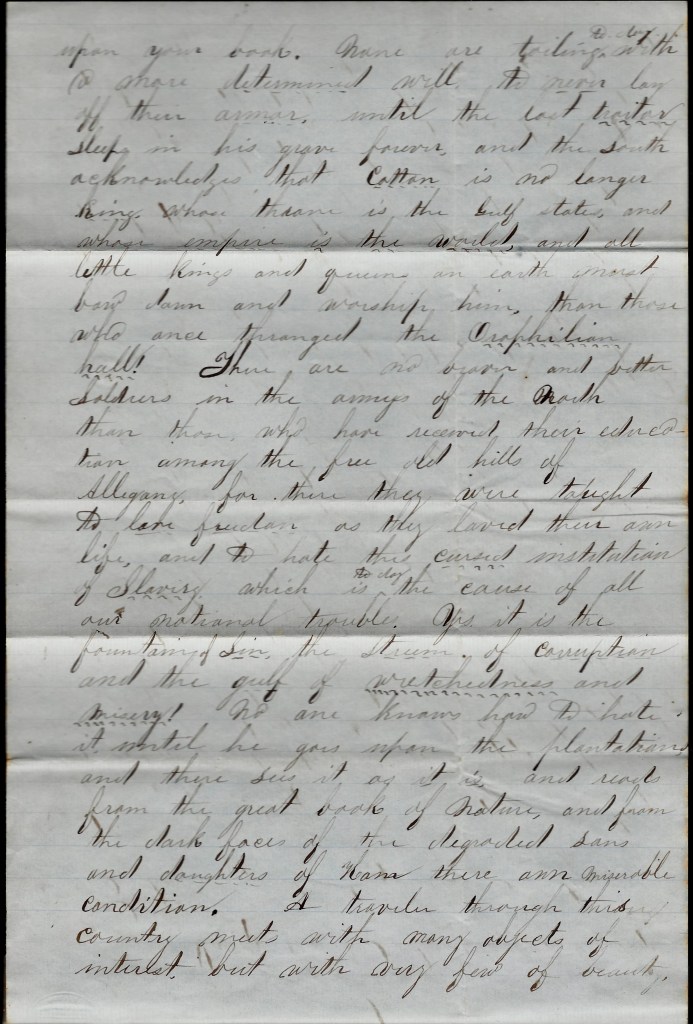
None have had brighter anticipation blasted and have sacrificed more upon the altar of their country than those whose names are enrolled upon your book. None are toiling today with a more determined will to never lay off their armor until the last traitor sleeps in his grave forever and the South acknowledges that cotton is no longer king, whose throne is the Gulf States and whose empire is the world, and all little kings and queens on earth must bow down and worship him, than those who once thronged the Orophilian Hall!

There are no braver and better soldiers in the armies of the North than those who have received their education among the free old hills of Allegany, for there they were taught to love freedom as they loved their own life and to hate the cursed institution of slavery which is today the cause of all our national trouble. Yes, it is the fountain of sin, the stream of corruption, and the gulf of wretchedness and misery! No one knows how to hate it until he goes upon the plantations and three sees it as it is and reads from the great book of nature, and from the dark faces of the degraded sons and daughters of Ham their own miserable condition. A traveler through this country meets with many aspects of interest but with very few of beauty.

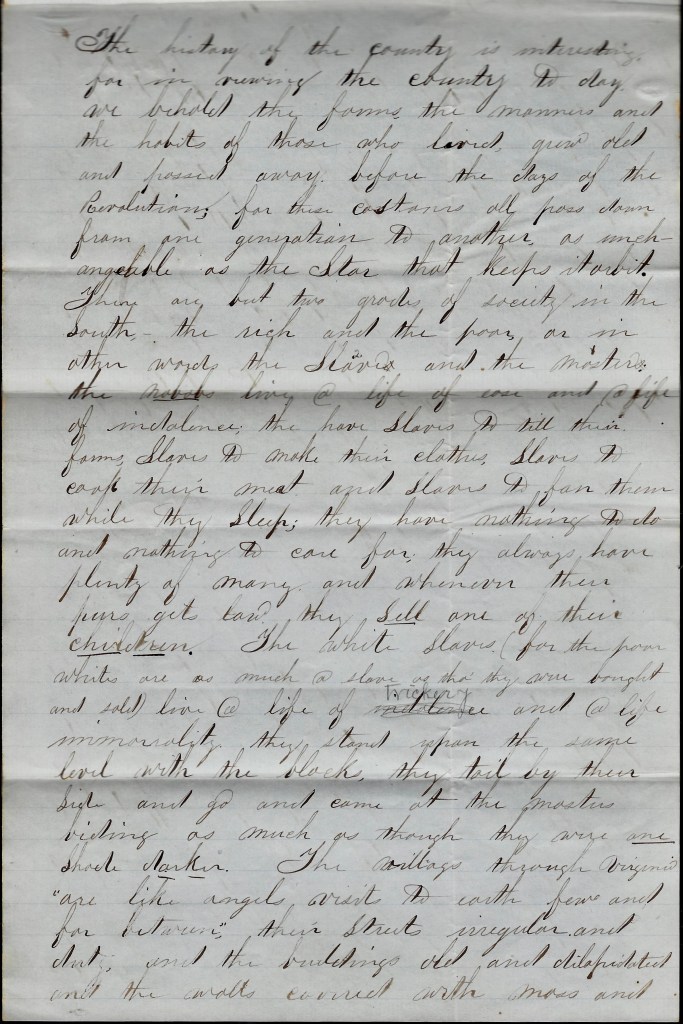
The history of the country is interesting for in viewing the country today, we behold the forms, the manners, and the habits of those who lived, grew old, and passed away before the days of the Revolution, for these customs all pass down from generation to another as unchangeable as the star that keeps it’s orbit. There are but two grades of society in the South—the rich and the poor, or in other words, the slaves and the masters. The nobobs live a life of ease and a life of indolence, They have slaves to till their farms, slaves to make their clothes, slaves to cook their meat, and slaves to fan them while they sleep. They have nothing to do adn nothing to care for. They always have plenty of money and whenever their purse gets low, they sell one of their children.

The white slaves (for the poor whites are as much a slave as though they were bought and sold) live a life of trickery and a life of immorality. They stand upon the same level with the blacks. They toil by their side and go and come at the master’s bidding as much as though they were one shade darker.

The villages through Virginia “are like angel’s visits to earth, few and far between”—their streets irregular and dusty, and the buildings old and dilapidated and the walls covered with moss and cobwebs and fast going to decay. The architecture is the same today that it was two hundred years ago, without the least improvement. The most of the buildings are of a plain style with the chimney (as the soldier says) turned out door. The son patterns after the father, the grandson after the son, and the great grandson after the grandson. The planters generally select the highest point of ground on their plantation for a building spot without any reference to the road whatever, and if there is a rocky, romantic cliff there, you will find it hid among the giant oaks and shrubbery. Around these mansions, at a distance of from ten thirty yards are generally scattered from ten to twenty little log huts about the size of a Northerner’s hog pen or corn house, in which the slaves enjoy all the luxuries of the house of bondage, which is hie-cake, hard work, and the cat of nine tails. These huts are almost invariably white-washed on the outside—this is white-washing the institution, but they may white wash from now until Gabriel bids old time to end and it will be slavery still!!

This day the Stars and Stripes—the proud emblem of the free—the flag our fathers bought with blood and death—the flag which all nations honor—the flag under which we were born, have lived, and fought and expect to die, was unfurled to the breeze in sight of the capitol of Rebeldom. Wave on, old time-honored flag! May you forever proudly float over us, our children, grandchildren, till the Angels shall stand on the land and ocean and aid the world to halt them. Goodbye. — C. C.


Letter 4

Fredericksburg, Va.
May 17th 1862

Dear Oros,

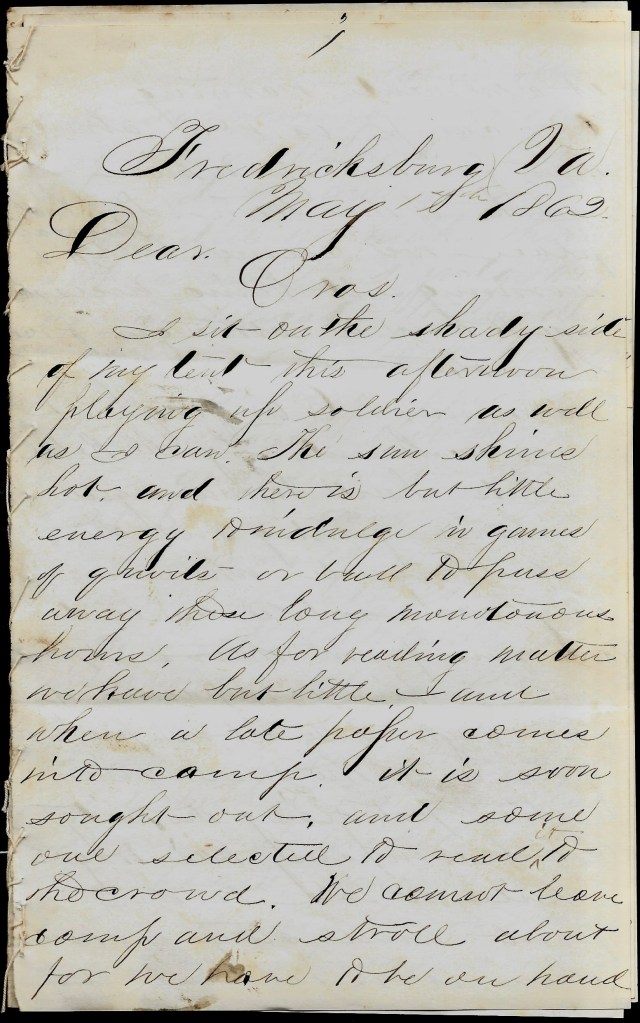
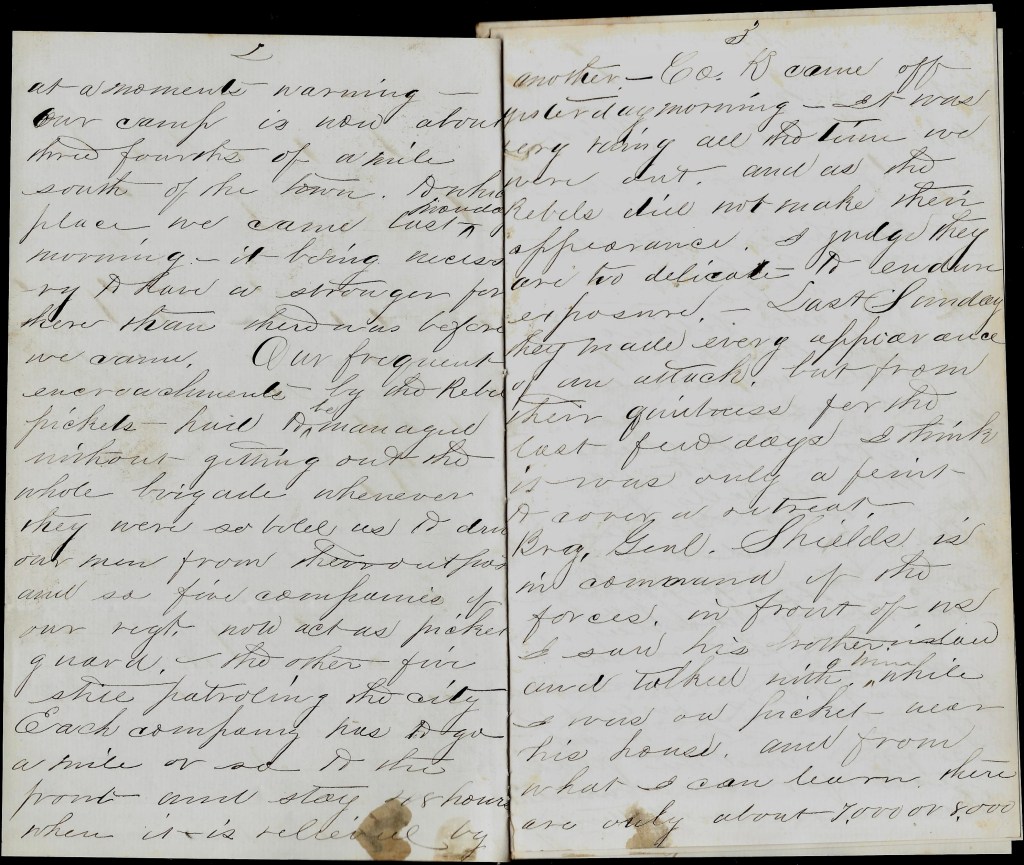
I sit on the shady side of my tent this afternoon playing up soldier as well as I can. The sun shines hot and there is but little energy to indulge in games of quoits or ball to pass away these long monotonous hours. As for reading matter, we have but little and when a late paper comes into camp, it is soon sought out and someone selected to read it to the crowd. We cannot leave camp and stroll about for we have to be on hand at a moment’s warning. Our camp is now about three-fourths of a mile south of the town to which place we came last Monday morning, it being necessary to have a stronger force here than there was before we came. Our frequent encroachments by the Rebel pickets had to be managed without getting out the whole brigade whenever they were so bold as to drive our men from their outposts and so five companies of our regiment now act as picket guard, the other five still patrolling the city. Each company has to go a mile or so to the front and stay 48 hours when it is relieved by another. Co. K came off yesterday morning. It was very rainy all the time we were out and as the Rebels did not make their appearance, I judge they are too delicate to endure exposure.

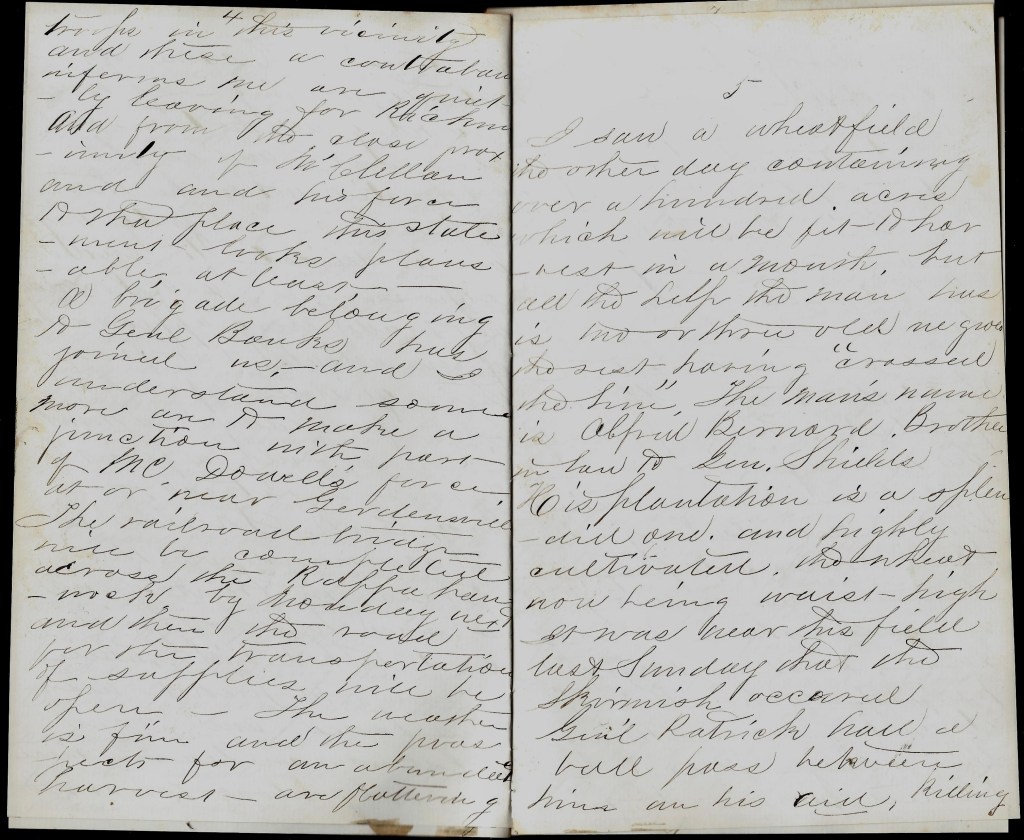
Last Sunday they made every appearance of an attack but from their quietness for the last few days, I think it was only a feint to cover a retreat. Brig. Gen. Shields is in command of the forces in front of us. I saw his brother-in-law and talked with him while I was on picket near his house and from what I can learn, there are only about 7,000 or 8,000 troops in this vicinity and these a contraband informs me are quietly leaving for Richmond. And from the close proximity of McClellan and his force to that place, this statement looks plausible at least.

A Brigade belonging to Gen. Banks has joined us and I understand some more are to make a junction with part of McDowell’s force at or near Gordonsville. The railroad bridge will be completed across the Rappahannock by Monday next and then the road for the transportation of supplies will be open. 1

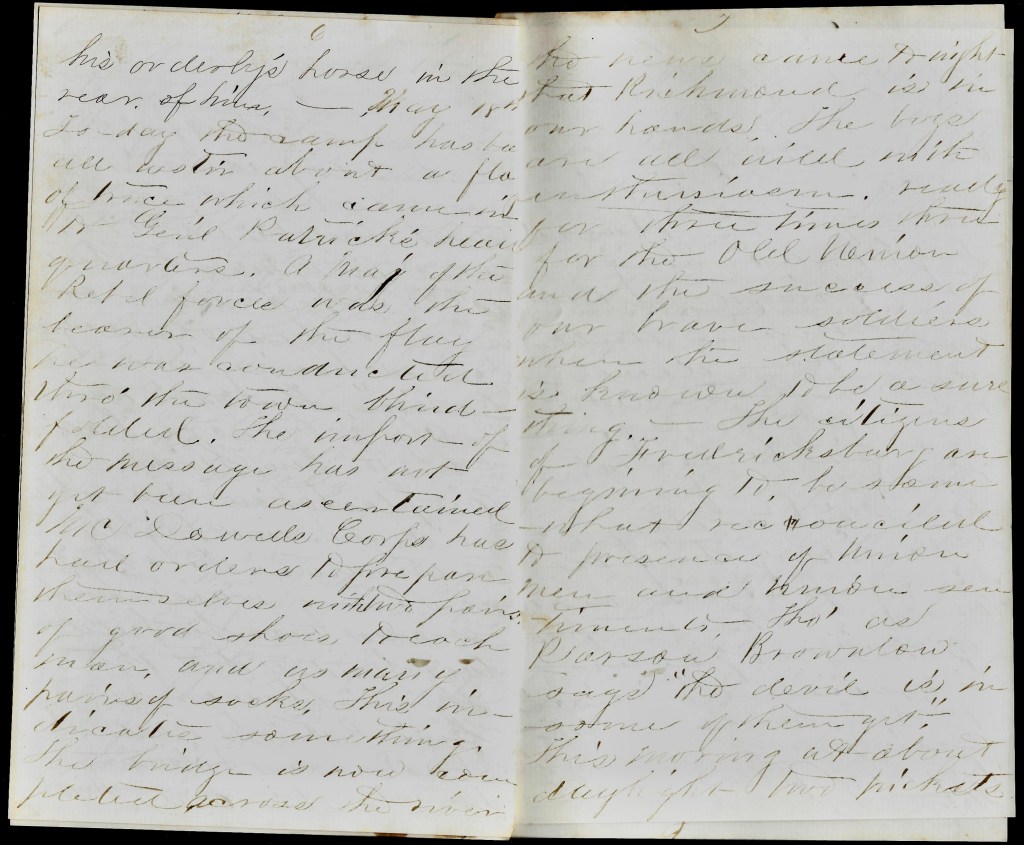
The weather is fine and the prospects for an abundant harvest are flattering. I saw a wheat field the other day containing over a hundred acres which will be fit to harvest in a month but all the help the man has is two or three old negroes, the rest having “crossed the line.” The man’s name is Alfred Bernard, brother-in-law to Gen. Shields. His plantation is a splendid one and highly cultivated. The wheat is now being waist high. It was near the field last Sunday that the skirmish occurred. Gen. Patrick had a ball pass between him and his aide, killing his orderly’s horse in the rear of him.

May 18th. Today the camp has been all astir about a flag-of-truce which came in to Gen. Patrick’s Headquarters. A Major of the Rebel force was the bearer of the flag. He was conducted through the town blind-folded. The import of the message has not yet been ascertained. McDowell’s Corps has had orders to prepare themselves with two pairs of good shoes to each man, and as many pairs of socks. This indicates something. The bridge is now completed across the river. The news came tonight that Richmond is in our hands. They boys are all wild with enthusiasm, ready for three times three for the old Union and the success of our brave soldiers when the statement is known to be a sure thing.

The citizens of Fredericksburg are beginning to be somewhat reconciled to the presence of Union men and Union sentiments, though as Parson Brownlow says, “the Devil is in some of them yet.”

This morning at about daylight two pickets of the 35th New York Vols. were taken prisoner by the Rebels. They were careless and wandered from their posts. One day last week, one of the Harris Light Cavalry surprised a Rebel horseman and shot him dead rather than let him get away. It is believed that we go from here in a day or two. Everything is being put in readiness. The troops of this corps are in excellent discipline adn health. Gen. McDowell is highly pleased with them.

The Christian Banner has again made its appearance. It is quite bitter against the Rebellion and although some of the citizens will not patronize this paper, it finds a quite lively sale among the soldiers.

The large foundry which before our appearance here was employed by the Rebels in manufacturing guns and various kinds of machinery is now worked by some of the “detested Yankees” and their workmanship makes quite a striking contrast when compared with that of the Rebels.

A man in town—I have not learned his name—last night offered a negro $200 to fire the railroad bridge just completed and gave him the necessary instruction, but thanks to the black, he had too much honesty to thus be tempted and [ ] so he reported the man who was today arrested and the negro was rewarded. But being on guard tonight, I have not time to write more. Your true Bro. Oros, — C. A. Chapin

1 Newspaper accounts dated 13 May reported that between three and four hundred soldiers under the directions of civil engineers were engaged in building a Trestle Bridge across the river immediately over the ruins of the old Railroad bridge “which the rebels, in their madness, destroyed. This bridge is seventy-five feet in height and six hundred in length. The work progresses finely and will, if nothing happens be completed by the last of this week or the first of next, this bridge connects the Acquia Creek Road with the Richmond and Fredericksburg. When completed, communications by rail from the creek to Fredericksburg will be opened them. We look for an advance of the forces now encamped upon the east side of the river. If the work of repairing railroads and building bridges belongs to this division of the army, it will be sometime before we enter Richmond as the work of destruction along the road we are informed has been quite extensive.”


Letter 5

Three miles west of Fredericksburg, Va.
May 26, 1862

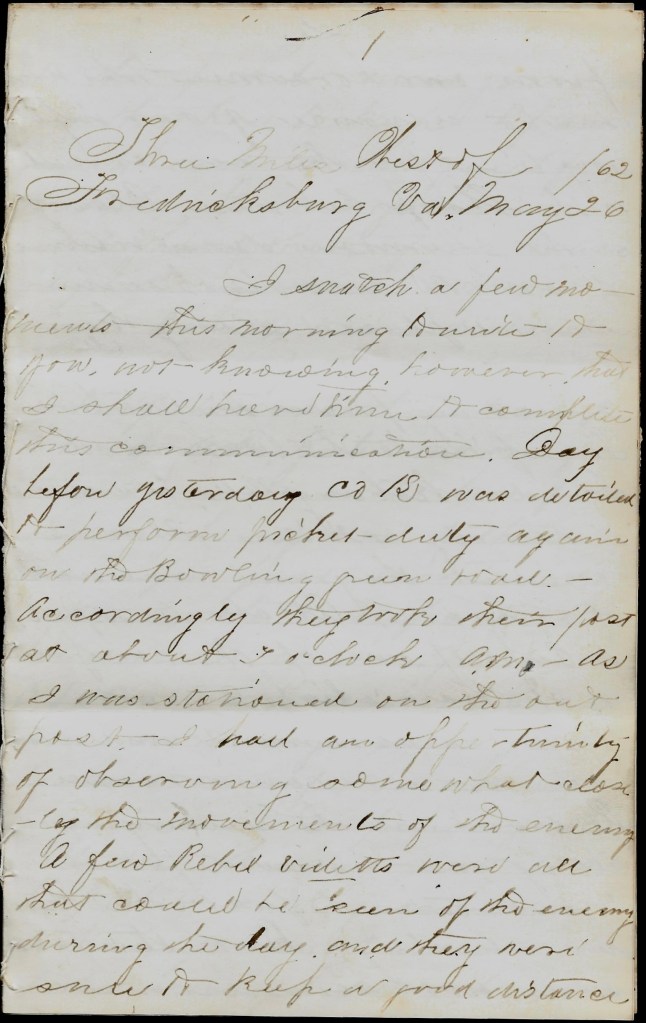
I snatch a few moments this morning to write to you, not knowing however that I shall have time to complete this communication. Day before yesterday Co. K was detailed to perform picket duty again on the Bowling Green Road. Accordingly they took their post at about 7 o’clock a.m. As I was stationed on the outpost, I had an opportunity of observing somewhat closely the movements of the enemy. A few Rebel videttes were all that could be seen of the enemy during the day and they were sure to keep a good distance from our horsemen who were in the advance of our infantry lines for they were armed with Sharps carbines.

Along in the afternoon, dense volumes of smoke were visible in several places along their line, as near as I could learn, reaching from the Richmond Turnpike to the Richmond & Fredericksburg Railroad—a distance of nearly 4 miles. It was evident they were evacuating the place. At about 4 p.m.. a captain of one of the companies of the Harris Light Cavalry took his command and started on a reconnoissance. He drove in the enemy’s cavalry and proceeded far enough to ascertain the fact that they were leaving. But this fact was not communicated to the pickets ands guards so they had to keep up another night’s earnest and faithful watch.

When night came, the lights of their fires could be plainly seen not more than three or three and a half miles distant. Col. Lord of the 35th Regiment made a trip toward their camp at 5 a.m. yesterday morning and arrived with his force in sight of one of their camps just in time to witness their departure. He deemed it expedient to follow up as his force was not large enough to make it a safe movement against a superior force.

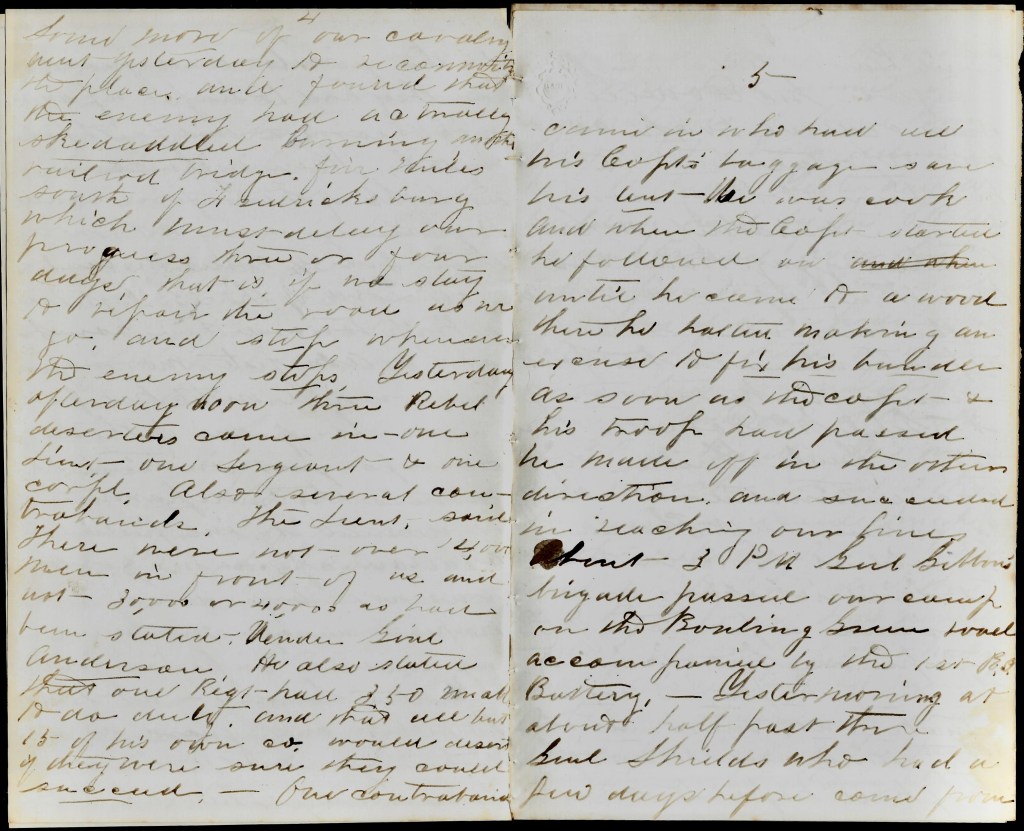
Yesterday—Sunday—at 10 a.m. the pickets and guard were taken up and orders given to be ready to march at 4. Some more of our cavalry went yesterday to reconnoiter the place and found that the enemy had actually skedaddled, burning another railroad bridge five miles south of Fredericksburg which must delay our progress three or four days—that is, if we stay to repair the road as we go, and stop whenever the enemy stops.

Yesterday afternoon three Rebel deserters came in—one Lieutenant, one Sergeant, and a Corporal. Also several contrabands. The Lieutenant said there were not over 14,000 men in front of us and not the 30,000 or 40,000 as had been stated—under General Anderson. He also stated that one regiment had 350 made to do duty and that all but 15 of his own company would desert if they were sure they could succeed. One contraband came in who had all his captain’s baggage save his tent. He was cook and when the captain started, he followed on until he came to a wood. There he hasten, making an excuse to fix his bundle. As soon as the captain and his troops had passed, he made off in the other direction and succeeded in reaching our lines.

About 3 p.m., General Gibbon’s Brigade passed our camp on the Bowling Green road accompanied by the 1st Rhode Island Battery. Yesterday morning at about half past three, Gen. Shields who had a few days before come from Gen. Banks’ column to reinforce McDowell was ordered back as it was reported that the Rebels had been working some severe mischief on Gen. Banks’ baggage train and had torn up several miles of the railroad. I have no particulars on this point—merely make mention of it. Gen. McDowell’s force before Gen. Shields left was estimated at nearly 70,000 men. Last Thursday President Lincoln was at Fredericksburg and reviewed at portion of the troops in that vicinity. The way the people’s eyes stuck out in Fredericksburg may well be imagined. They had hoped to see his head born through there as they had some of the victims of Bull Run, but that “were a delusive hope” to them. 1

“The top of cap worn by William March who was killed in civil war at Falmouth, Va., 1862 while on guard at an arsenal. The building was blown to pieces and William with it. John sent this top to mother, — E. M. M.”

Yesterday a building used by the Rebels as an arsenal near the railroad depot was blown up by means of a torpedo which was left there by them when they evacuated the town and one of Co. A, 23rd Regiment was killed. His name was [Pvt. William] March. 2 Some of the “Ladies” expressed much joy at the killing of one Yankee and up to this day the 23rd Regiment’s band has never played one of our National airs in the City. Bravo men! to be so observant of the feelings of the people of Fredericksburg!!

Five companies of this regiment are now doing guard duty in the City. The other five came to this place on the road to Gordonsville last night, three miles out of the town.

The weather is fair and pleasant yet what we are to do aside from picket and guard duty at the approaches of the city is wholly unknown to me. I do not intend to criticize the moments of this Corps but I do believe we might have given the enemy battle and routed him before he retreated to Richmond to join the force opposed to McClellan. The health of the troops here continues extremely good. — C. A. Chapin

1 For more on Lincoln’s visit to Fredericksburg, readers are referred to John Hennessy’s excellent article “Mr. Lincoln’s Fredericksburg—May 23, 1862” appearing on his blog Mysteries & Conundrums of 22 May 2022. See also, “Historic Footsteps.”

2 The death of Pvt. William March is described in the following piece entitled “Blown to Pieces” appearing on the Medical & Surgical Antiques website.


1862: Timothy M. Gillan to Sarah (Reynolds) Gillan

The following letters were written by 35 year-old Timothy M. Gillan (1827-1863), the son of Danial Gillan (b. 1805) and Sarah Reynolds (b. 1808) of Corning, Steuben county, New York. Timothy was the oldest of at least seven children born to Daniel and Sarah Gillan, a few of whom are mentioned in these letters. Sadly, Timothy’s father abandoned his family in 1858 and it fell upon the older children to provide for their mother’s support.

Timothy was one of the first to answer Lincoln’s call for volunteers to help put down the rebellion. He enlisted on 6 May 1861 at Elmira to serve as a private in Co. F, 23rd New York Infantry. By August 1861, he had been promoted to corporal. The first letter was penned from Upton’s Hill in March 1862; the second from Fredericksburg when they were part of Pope’s Army Of Virginia. Their biggest engagements were 2nd Bull Run, Antietam, Fredericksburg and Chancellorsville. Both letters were found in the Pension Files as evidence that Timothy continued to provide financial support to his mother, even while in the service. Timothy’s death is described in the file in a letter signed by William M. Dingeldry, Captain of Co. F (pictured below), who testified that on or about the 16th of May 1863, while the regiment was returning to Elmira, New York, to be discharged, and while at Washington D. C., Timothy was taken sick with Typhoid Fever” and sent to a hospital. He died on 29 May 1863.

Timothy refers to his younger brother “Frank” frequently in both letters. William Francis (“Frank”) Gillam (1845-1930) served 3 years and 8 months in Co. B, 1st New York Light Artillery.

Captain William W. Dingeldry of Co. F, 23rd New York Infantry Regiment and his servant with Sergeant Lucian W. Bingham of Co. K, 23rd New York Infantry Regiment in camp at Arlington, Virginia. From the Liljenquist Family Collection of Civil War Photographs, Prints and Photographs Division, Library of Congress

Letter 1

Upton’s Hill
March 18th 1862

Dear Mother,

I now seat myself to address a few lines to you to let you know that I am well at present & hope you are all enjoying the same valuable blessing. We left camp last Monday or a week ago last Monday at 5 o’clock in the morning for Bulls Run but did not have to go all the way as the rebels had left. We had orders to go back to Alexandria & stayed all night in a piece of woods. It was a cold rain and rained all night. We were all wet and cold but came out all well enough after all.

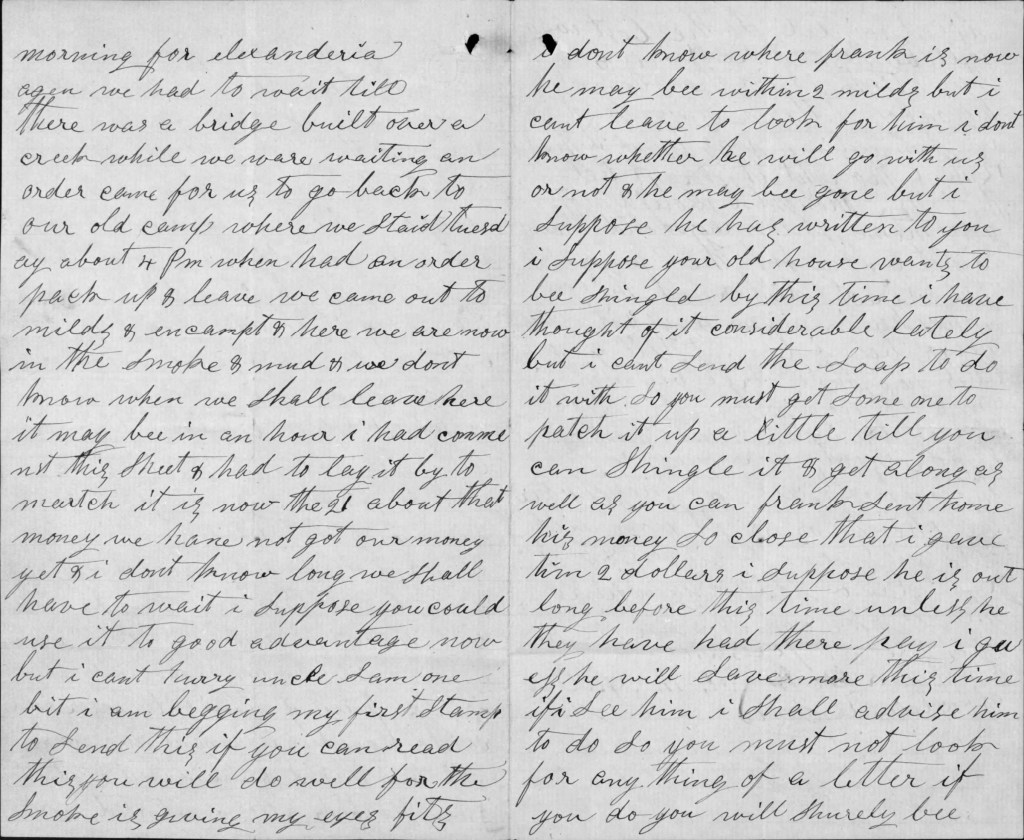
We started next morning for Alexandria again. We had to wait till there was a bridge built over a creek. While we were waiting, an order came for us to go back to our old camp where we stayed Tuesday about 4 pm when [we] had an order to pack up and leave. We came out two miles and encamped & here we are now in the smoke and mud and we don’t know when we shall leave here. It may be in an hour.

I had commenced this sheet and had to lay it by to march. It is now the 21st [of March]. About that money, we have not got our money yet and I don’t know [how] long we shall have to wait. I suppose you could use it to good advantage now but I can’t hurry Uncle Sam one bit. I am begging my first stamp to send this. If you can read this, you will do well for the smoke is giving my eyes fits.

I don’t know where Frank is now. He may be within two miles but I can’t leave to look for him. I don’t know whether he will go with us or not & he may be gone but I suppose he has written to you. I suppose your old house wants to be shingled by this time. I have thought of it considerably lately but I can’t send the soap to do. it with so you must get someone to patch it up a little till you can shingle it & get along as well as you can. Frank sent home his money so close that I gave him two dollars. I suppose he is out long before this time unless they have had their pay. I guess he will save more this time. If I see him, I shall advise him to do so you must not look for anything of a letter. If you do, you. will surely be disappointed. So the best way will be to just read htis & then stick it in the stove.

The only letter I have had in some time was John’s of the 12th. I thought it might be that you thought I would not get them. You may send them right along just the same till I direct different. This may be in a few days and it may never be—I cannot tell any better how this will be than I can tell how the wind will blow next week.

Give my respects to Mr. & Mrs. Shoemaker and all the neighbors. The check or draft you will get will come to Gibson & you can draw soap anywhere. The smoke comes again so no more at present. From your affectionate son, — T. M. Gillan


Letter 2

Camp. 23rd [New York] Regt.
Opposite Fredericksburg [Virginia]
June 27th 1862

Dear Mother,

It is with pleasure that I now seat myself to address a few lines to you to let you know that I am well. I have had a letter from Frank dated the 18th. He was well & says they have had a brush with the rebels at Fair Oaks. He says that it was pretty sharp work but the rebels used their legs as usual. I have sent his letter to Benjamin & requested him to send it to you when he has seen it

We have been back to Catlett’s Station & from there to Gainesville and we have been camping & moving camp this way till we have got back here & we have moved camp this forenoon. We are encamped in an open field about a mile and a half or two miles from the [Rappahannock] river. Our sick are in the city. James Smith was taken there last Sunday and yesterday he was well enough to come over to camp and went back again. He thought he would be able to come back to duty soon. Peter Calkins & Jackson Gorton is in the hospital also. Jackson is—to use James’ language—suffering considerable. Amos Beeman will soon come home, I suppose. At least I have heard that his papers were made out for his discharge.

We still have good news from the South. Though it has cost a great many lives, it is steadily gaining ground. I hope it may come to a close before long but it does not look as if it was going to close so that we shall be able to come home before fall, if we do then. We seem to be fixing our camp as if to stay here some time but we may leave here at any time & go to reinforce McClellan. But it seems to be the general opinion here that we may stay here some time. It is rather dull business to lay here in camp doing nothing. We shall not be worth a cent to work when our time is out if we lay round here in camp all the time. In the first place, we could not stand to do a day’s work now. And in the second place, we will [be] too shiftless.

I had like to have forgotten to mention that Jerome & John Gorton are well. I had a letter from Farmington. They were all well but Lide & she was getting better. They say they have had a letter from Jake’s folks. They were well & Jake had planted 8 acres of corn and was a going to plant half an acre of sugar cane & had a good garden. I should like to hear from all of the people in Buckwheat Square & vicinity. If we lay here in camp, I shall not be very likely to have much news for you. As it has been, I have nothing that seems new to me as we have not loaded our guns except we were on guard or went out foraging or something of that kind of duty.

Frank says that they did not have any loss of life in their Battery. There was one man shot in the neck & he was getting along first rate.

I am going to enclose fifteen dollars as before & hope you will get it as well as you did the last. This from your affectionate son, — T. M. Gillan