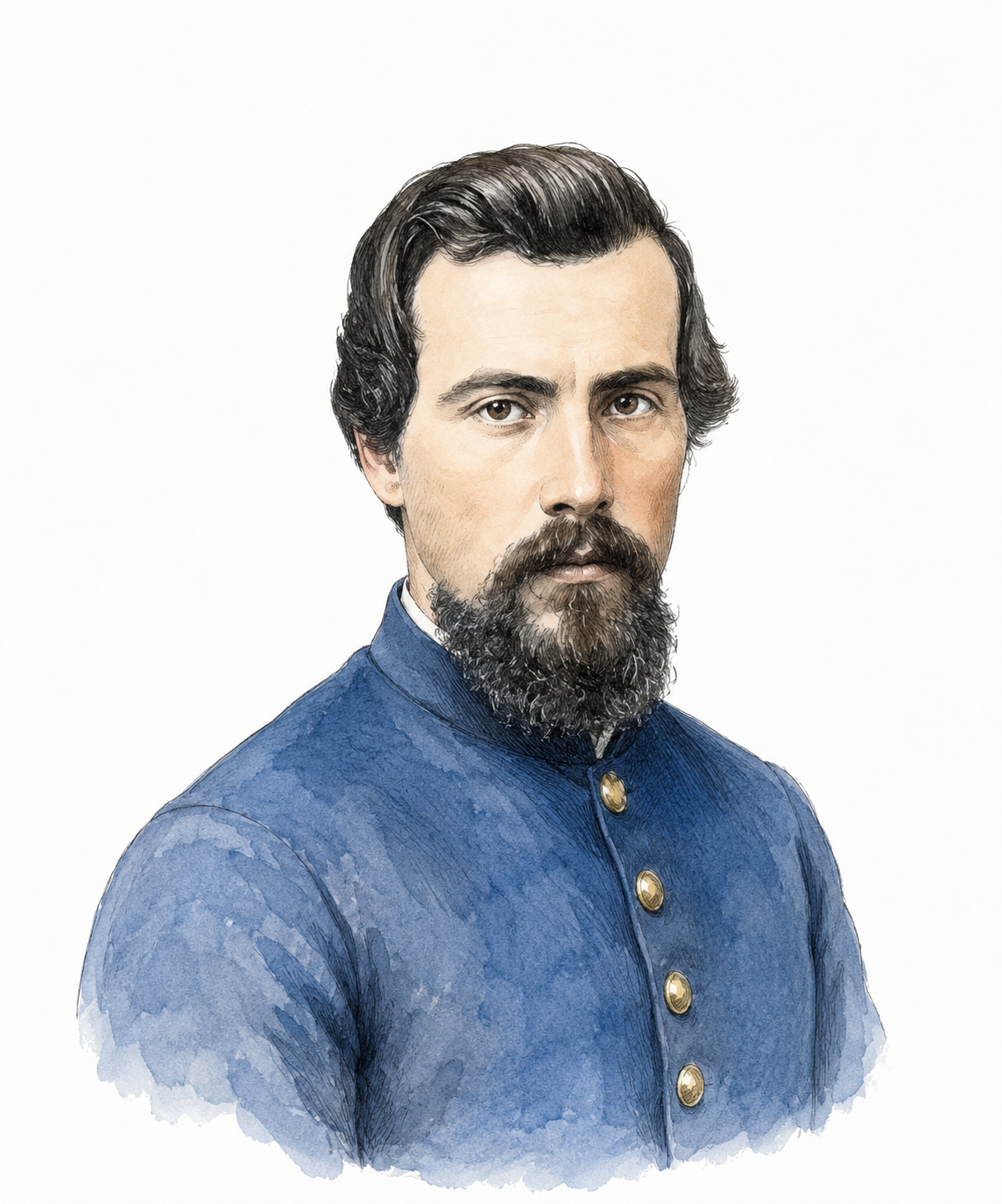
The following 31 letters were written by William Blackmar (b. 1839), the son of Joseph Blackmar (1788-1874) and Mahala Munyan (1797-1862) of Thompson, Windham county, Connecticut. William enlisted in November 1861 as a private in Co. G, 11th Connecticut Infantry. He reenlisted as a veteran on 13 December 1863 and was slightly wounded in the hand on 9 May 1864 at Swift’s Creek, Virginia, and spent the next several months at Knight General Hospital in New Haven, Connecticut, where, after recovering from his wound, he was placed on detached duty as a ward attendant and as a clerk. After the hostilities ended, he was transferred to Co. B of the 11th Veteran Reserve Corps on 17 April 1865 and did not muster out of the service until much later in the year.
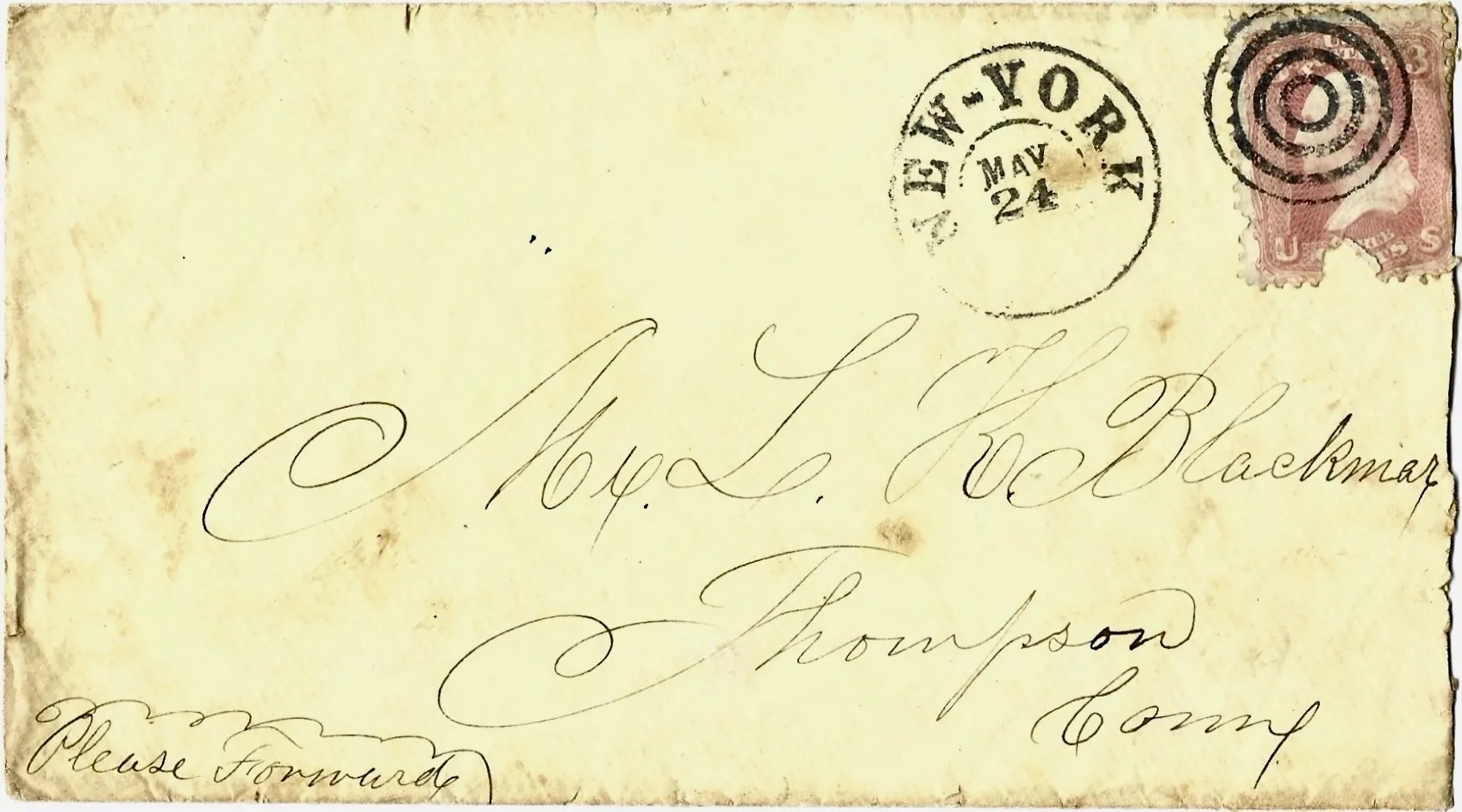
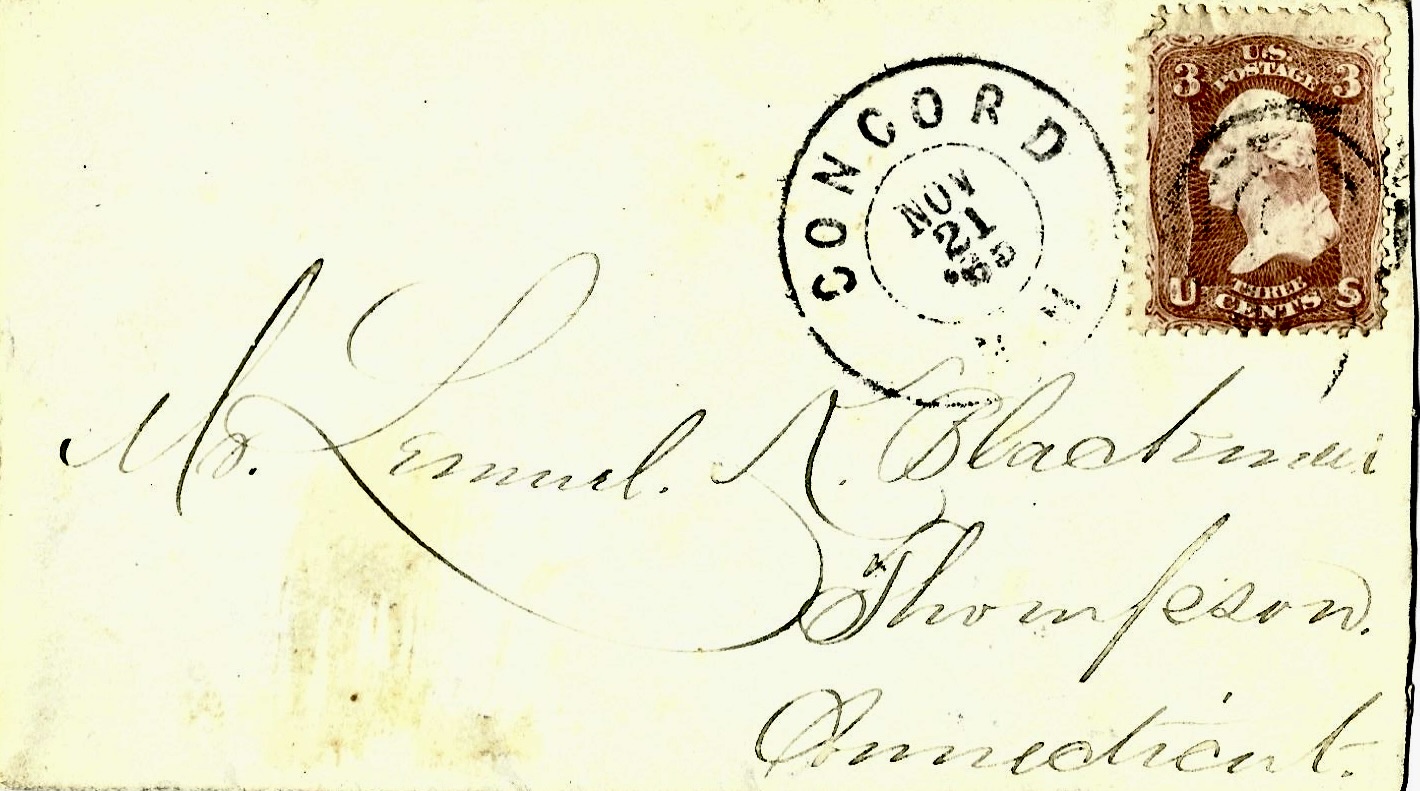
Lemuel Knapp Blackmar, born in 1819, is a son of Joseph and grandson of Jacob Blackmar. His mother was Mahala, daughter of Ebenezer Munyan. He went to Providence at the age of sixteen, where he remained eleven years. Since that time he has resided in Thompson. In 1848, he took charge of the grist and saw mill at Grosvenor Dale for sixteen years, beginning November, 1864. He was appointed postmaster at Thompson in August, 1855, and since September of that year has filled that office. He was married in 1846 to Nancy Marguerite, daughter of Edmund Cooper, of Wickford, R. I., and has three children: Martha (b. 1849), Louis (b. 1851) and Mary (b. 1860).
William’s younger brother Edmund A. Blackmar (1841-1873) also served in the Civil War. He enlisted as a private in Co. E, 13th Connecticut Infantry. He was quickly promoted to corporal. On 21 May 1863 he was taken prisoner at Washington, Louisiana, but was quickly paroled, and mustered out on 6 January 1865 after three years service. Nine of his letters can be found at—1862-64: Edmund A. Blackmar to Lemuel K. Blackmar.
There are frequent references to “Mr. Plumb” in the letters. This was Joseph C. Plumb (1822-1864), the second husband of William’s older sister, Esther (Blackmar) Sumner (1825-1862). Esther’s first husband was William Sumner (1800-1853) and she had two children with him—(1) Willard Sumner (1847-1864) who joined the 1st Connecticut Cavalry in mid-December 1863 and died at Frederick, Maryland on 8 November 1864; and (2) Caroline or “Cally” Sumner (b. 1849. Before Joseph took Esther as his wife, he had previously married, in 1846, the widow Celia Ann (Farrow) Bowen and they had at least three children. Joseph and Celia were enumerated in Thompson in the 1850 US Census where he earned his living as a “dresser tender.” By 1855, either Joseph divorced or abandoned his wife because he took the widow Esther as his second wife that year along with her two young children Willard and Callie. Following Esther’s death in late December 1862, Joseph quickly married yet another widow, Mrs. Martha J. Woodard of North Carolina on 17 September 1863 at Bower’s Hill, Virginia. Alas for Joseph, he was taken prisoner and passed away at Andersonville, Georgia, on 8 August 1864. His Find-A-Grave bio states “he was last seen alive crawling on his hands and knees, too weak to stand for a drink of water.” He is buried in Grave 5002 at Andersonville.
Letter 1
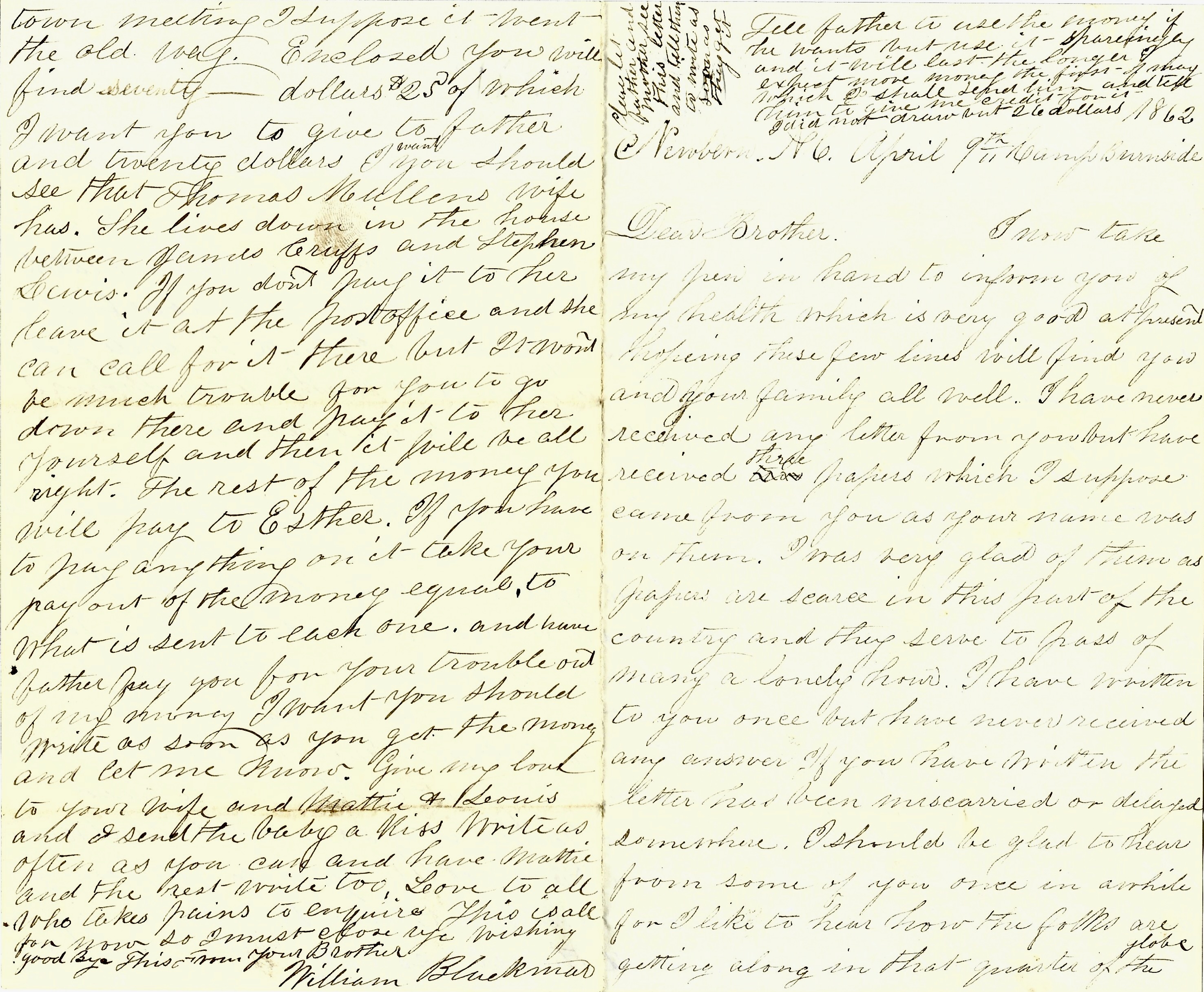
Camp Burnside
Newbern, N. C.
April 9th 1862
Dear Brother,
I now take my pen in hand to inform you of my health which is very good at present, hoping these few lines will find you and your family all well. I have never received any letter from you but have received three papers which I suppose came from you as your name was on them. I was very glad of them as papers are scarce in this part of the country and they serve to pass off many a lonely hour. I have written to you once but have never received any answer. If you have written, the letter has miscarried or delayed somewhere. I should be glad to hear from some of you once in a while for I like to hear how the folks are getting along in that quarter of the globe. Does Mrs. Morse stay with you this year?
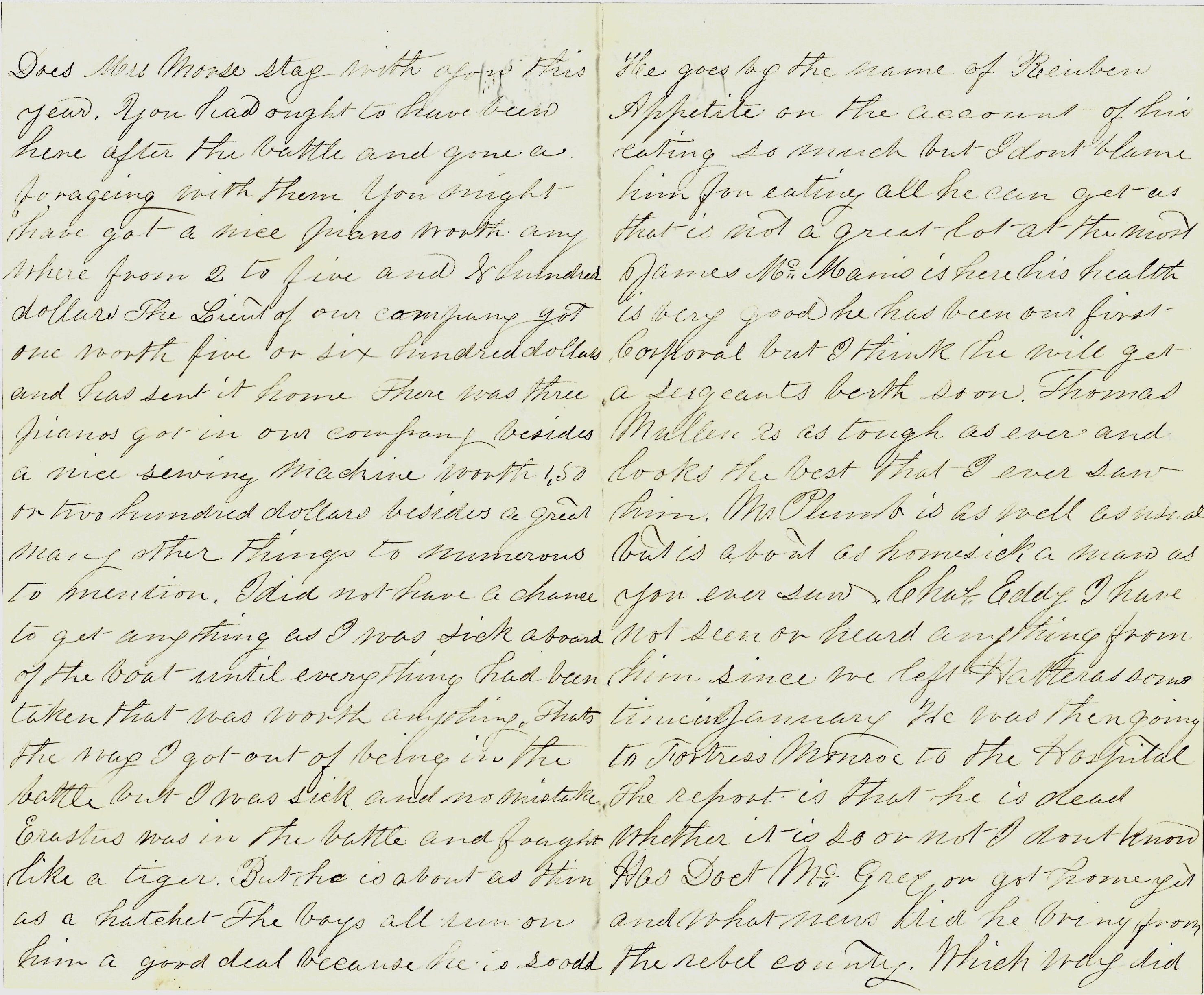
You had ought to have been here after the Battle [on Newbern] and gone a foraging with them. You might have got a nice piano worth anywhere from two to five and 8 hundred dollars. The Lieutenant of our company got one worth five or six hundred dollars and has sent it home. There was three pianos got in our company besides a nice sewing machine worth 150 or two hundred dollars, besides a great many other things too numerous to mention. I did not have a chance to get anything as I was sick aboard of the boat until everything had been taken that was worth anything. That’s the way I got out of being in the battle, but I was sick and no mistake. Erastus was in the battle and fought like a tiger. But he is about as thin as a hatchet. The Boys all run on him a good deal because he is so odd. He goes by the name of Reben Appetite on the account of his eating so much but I don’t blame him for eating all he can get as that is not a great lot at the most.
James McManus is here. His health is very good. He has been our 1st Corporal but I think he will get a Sergeant’s berth soon. Thomas Mullen is as tough as ever and looks the best that I ever saw him. Mr. Plumb is as well as usual but is about as homesick a man as you ever saw. Charles Eddy, I have not seen or heard anything from him since we left Hatteras some time in January. He was then going to Fortress Monroe to the Hospital. The report is that he is dead. Whether it is so or not, I don’t know. Has Doctor [John] McGregor got home yet? And what news did he bring from the rebel country? Which way did the town meeting [go]? I suppose it went the old way.
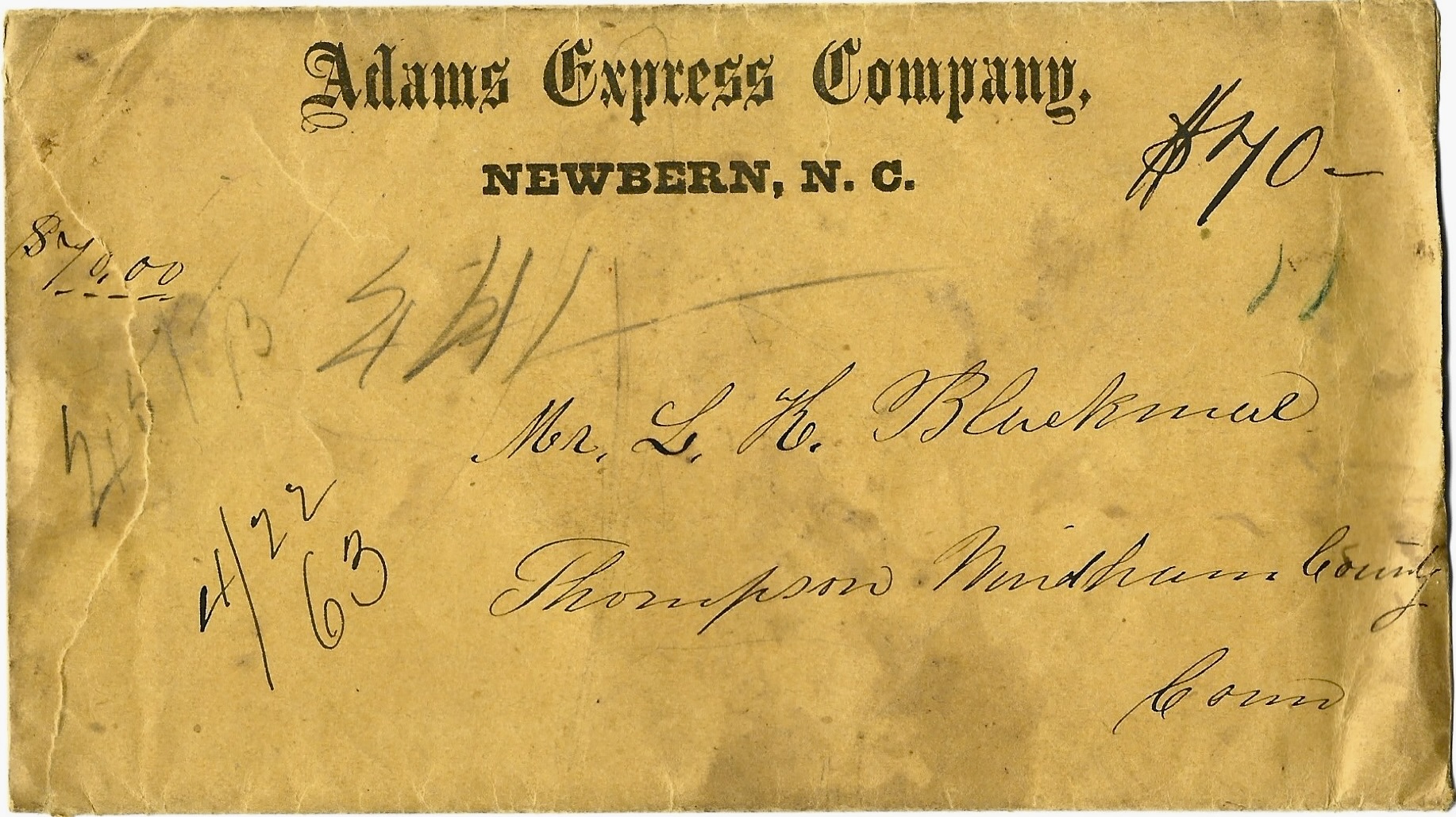
Enclosed you will find 70 dollars, $25 of which I want you to give to father and twenty dollars I want you should see that Thomas Mullens’ wife has. She lives down in the house between James Cruff’s and Stephen Lewis. If you don’t pay it to her, leave it at the post office and she can call for it there, but it won’t be much trouble for you to go down there and pay it to her yourself and then it will be all right. The rest of the money you will pay to Esther. If you have to pay anything on it, take your pay out of the money equal to what is sent to each one adn have father pay you for your trouble out of my money. I want you should write as soon as you get the money and let me know.
Give my love to your wife and Mattie and Louis and I send the baby a kiss. Write as often as you can and have Mattie and the rest write too. Love to all who takes pains to enquirer. This is all for now so I must close up wishing goodbye. This from your brother, — William Blackmar
Tell father to use the money if he wants but use it sparingly and it will last the longer. I expect more money the first of May which I shall send him and tell him to give me credit for it. I did not draw but 26 dollars.
Letter 2
Newbern, N. C.
[early May 1862]
Dear Brother,
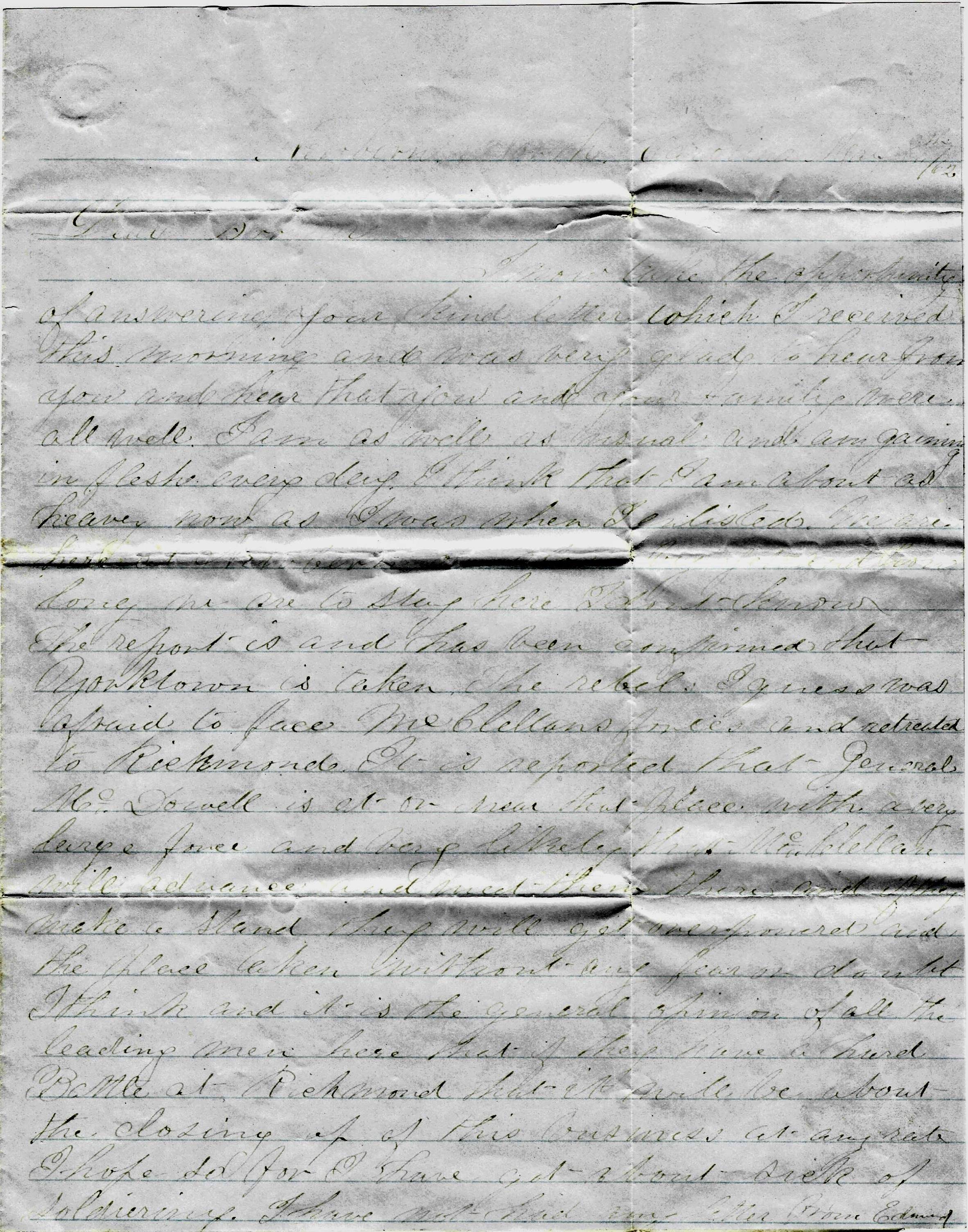
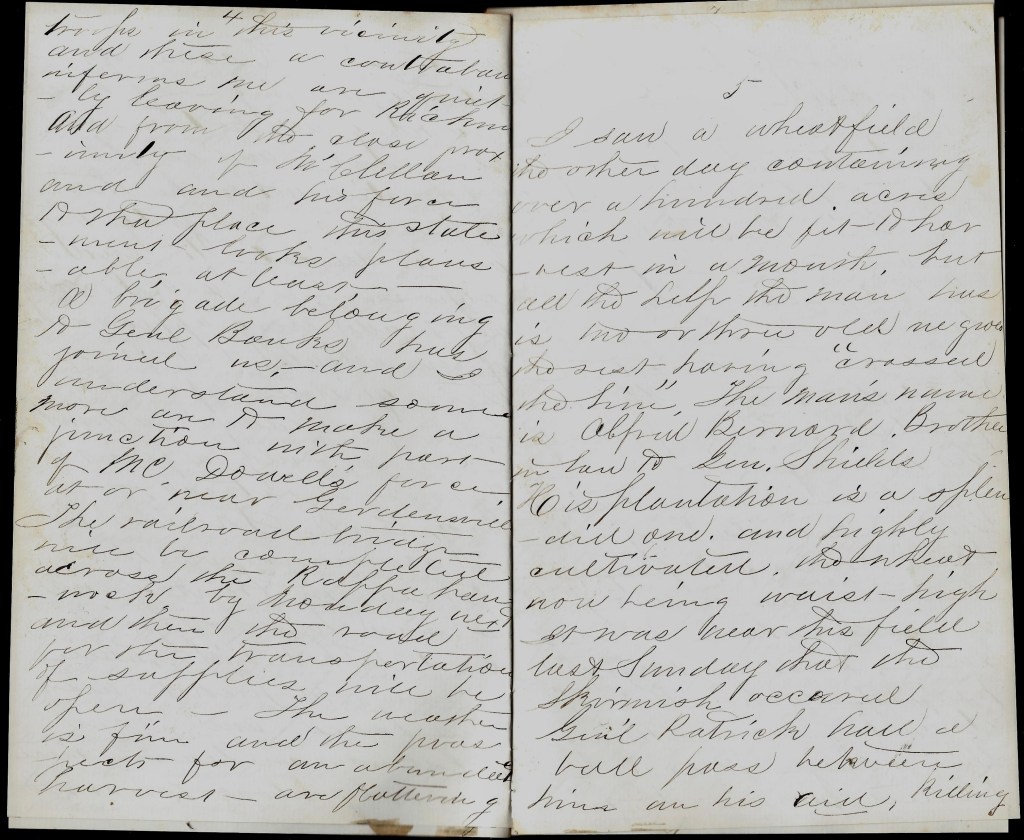
I now take the opportunity of answering your kind letter which I received this morning and was very glad to hear from you and hear that you and your family were all well. I am as well as usual and am gaining in flesh every day. I think that I am about as heavy now as I was when I enlisted. We are here [illegible] and how long we are to stay here, I don’t know. The report is and has been confirmed that Yorktown is taken. The Rebels, I guess, was afraid to face McClellan’s forces and retreated to Richmond. It is reported that General McDowell is at or near that place with a very large force and very likely that McClellan will advance and meet them and if they make a stand, they will get overpowered and the place taken without any fear or doubt, I think, and iti s the general opinion of all the leading men here that if they have a hard battle at Richmond, that it will be about the closing up of this business. At any rate, I hope so for I have got about sick of soldiering.
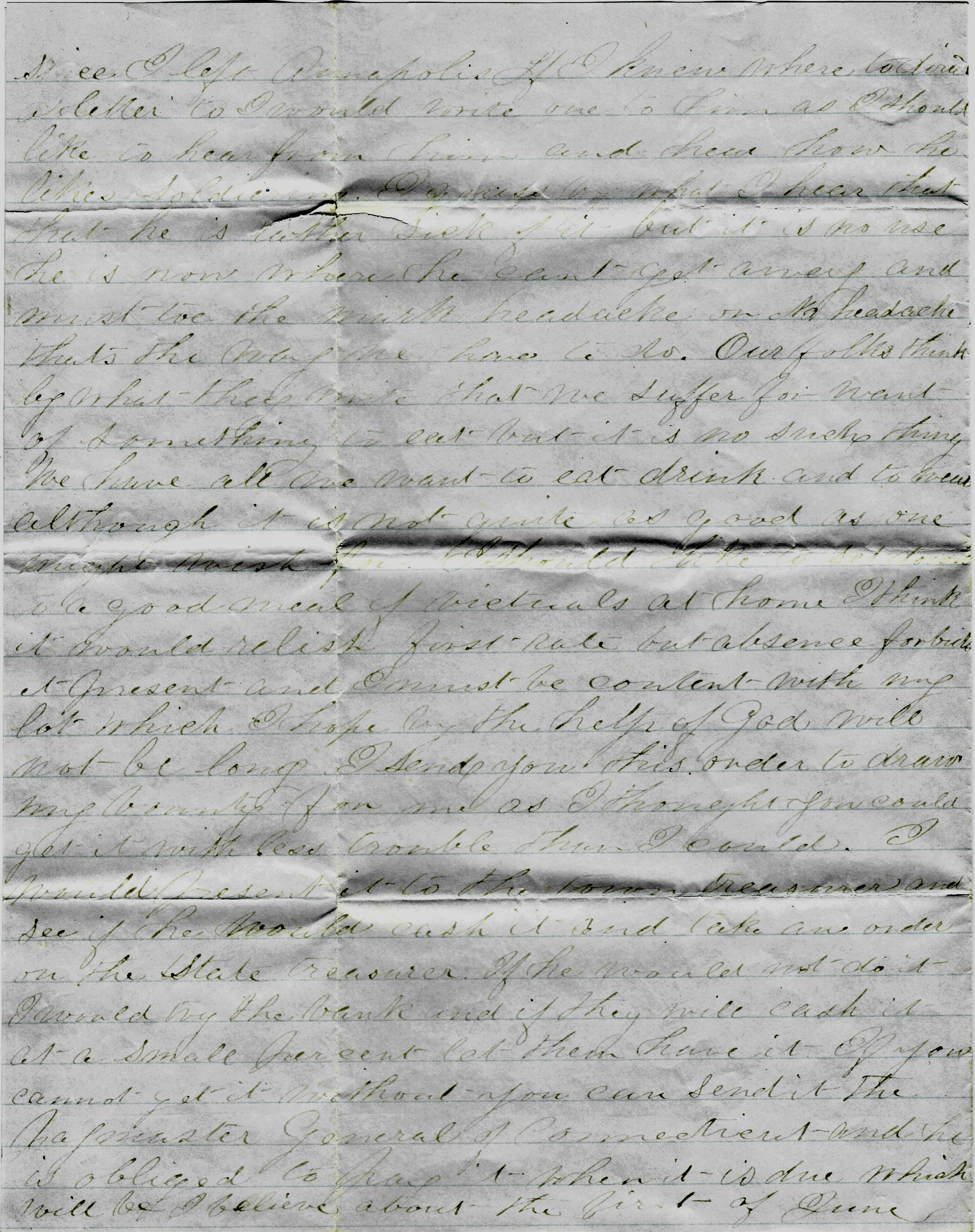
I have not had any letter from Edmund since I left Annapolis. If I knew where to direct a letter to [him], I would write one to him as I should like to hear from him and hear how he likes soldiering. I hear that he is rather sick of it but it is no use, he is now where he can’t get away and must toe the mark, headache or no headache. That’s the way we have to do. Our folks think by what they write that we suffer for want of something to eat but it is no such thing. We have all we want to eat, drink, and to wear although it is not quite as good as one might wish. But I should very much like a good meal of victuals at home. I think it would relish first rate. But absence forbids at present and I must be content with my lot which I hope by the help of God wil not be long.
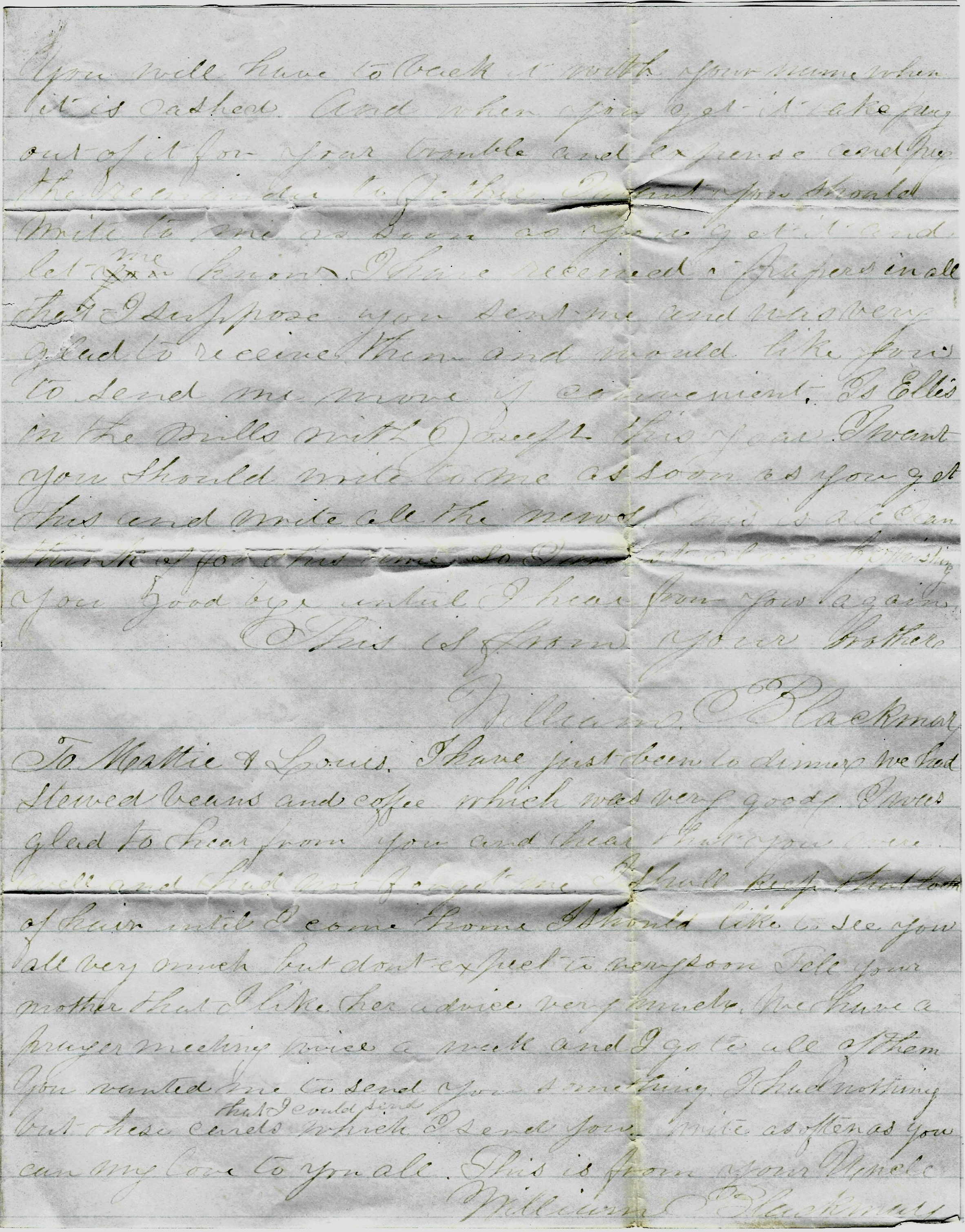
I send you this order to draw my bounty for me as I thought you could get it with less trouble than I could. I would present it to the town treasurer and see if he would cash it and take an order on the State Treasurer. If he would not do it. I would try the bank and if they will cash it at a small percent, let them have it. If you cannot get it without, you can send it to the Paymaster General of Connecticut and he is obliged to pay it when it is due which will be, I believe, about the first of June. You will have to back it with your name when it is cashed and when you get it, take pay out of it for your trouble and expense and pay the rest to the folks. You should write to me as soon as you get it and let me know.
I have received [ ] papers in all that, I suppose, you sent me, and was very glad to receive them and would like you to send me more if convenient. Is Ellis in the mills with Joseph this year? I want you should write to me as soon as you get this and write all the news. This is all I can think of for this time. Goodbye until I hear from you again. This from your brothre, — William Blackmar
To Mattie & Louis, I have just been to dinner. We had stewed beans and coffee which was very good. I was glad to hear from you and hear that you were well and had not forgot me. I shall keep that lock of hair until I come home. I should like to see you all very much but don’t expect to very soon. Tell your mother that I like her advice very much. We have a prayer meeting twice a week and I go to all of them. You wanted me to send you something. I had nothing but these cards that I could send which I send you. Write as often as you can. My love to you all. This is from your Uncle William Blackmar
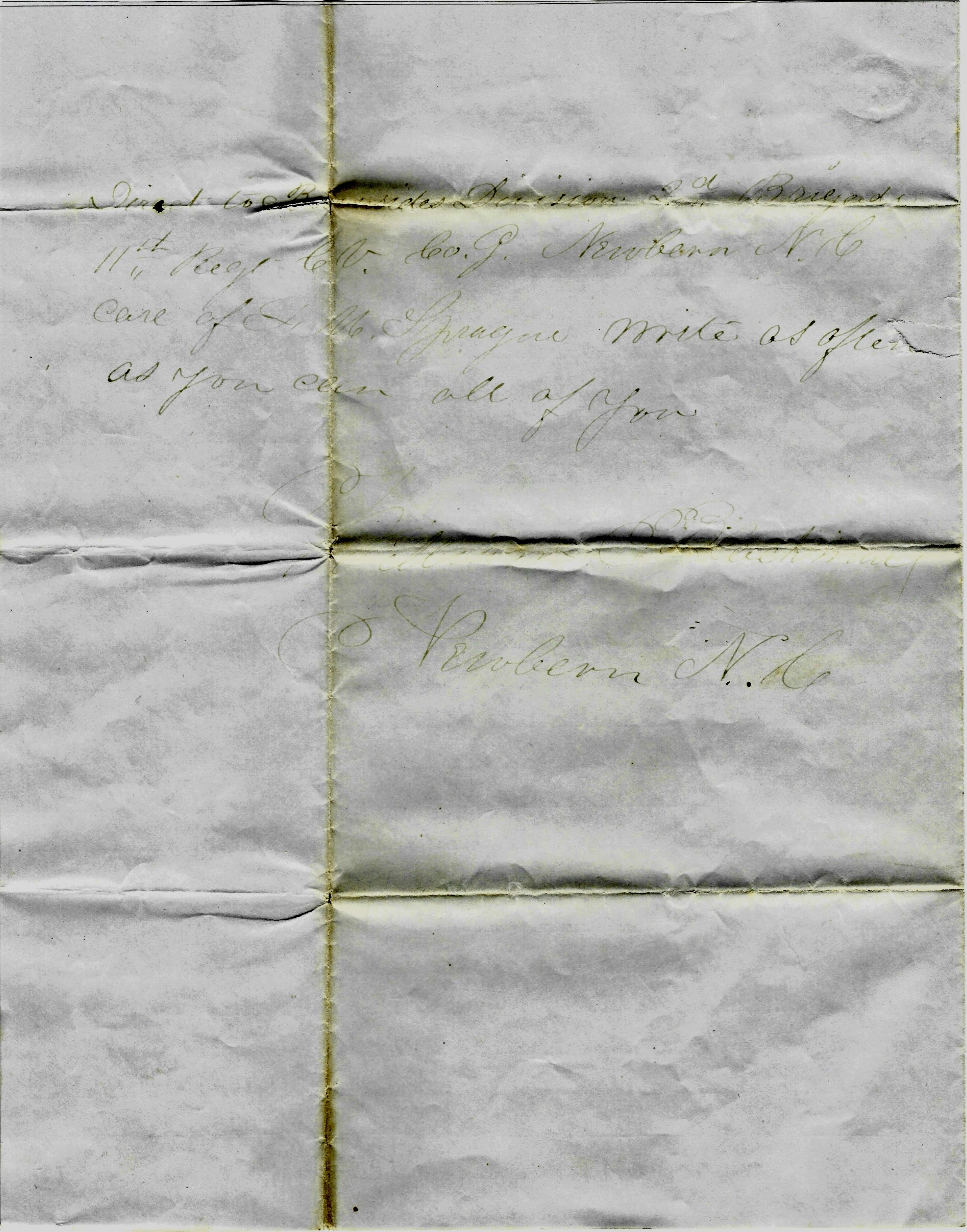
Direct to Burnside’s Division, 2nd Brigade, 11th Regt. C. V., Co. G, Newbern, N. C. Care of F. M. Sprague.
Write as often as you can, all of you.
Letter 3
Newbern, N. C.
May 12th 1862
Dear Brother,
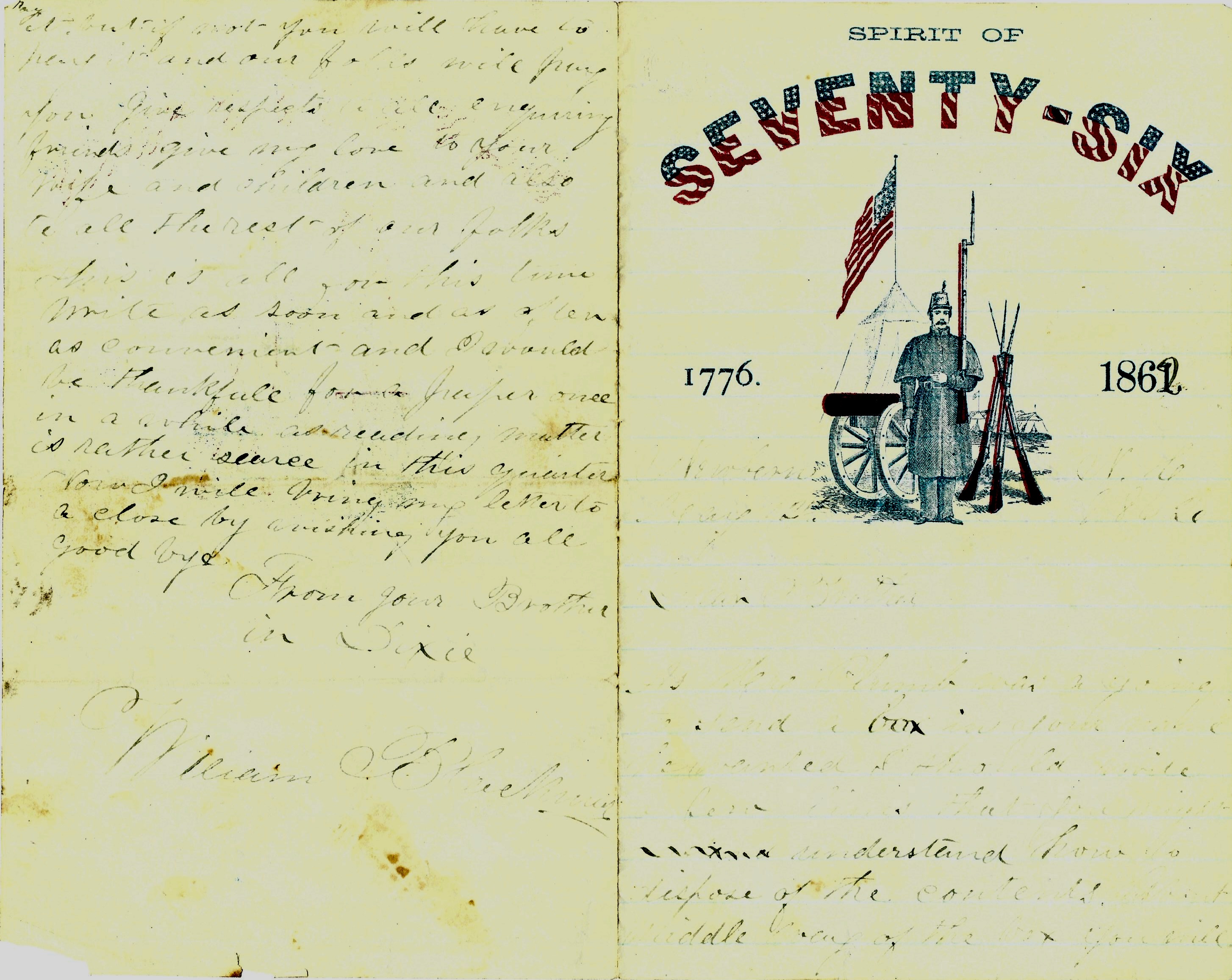
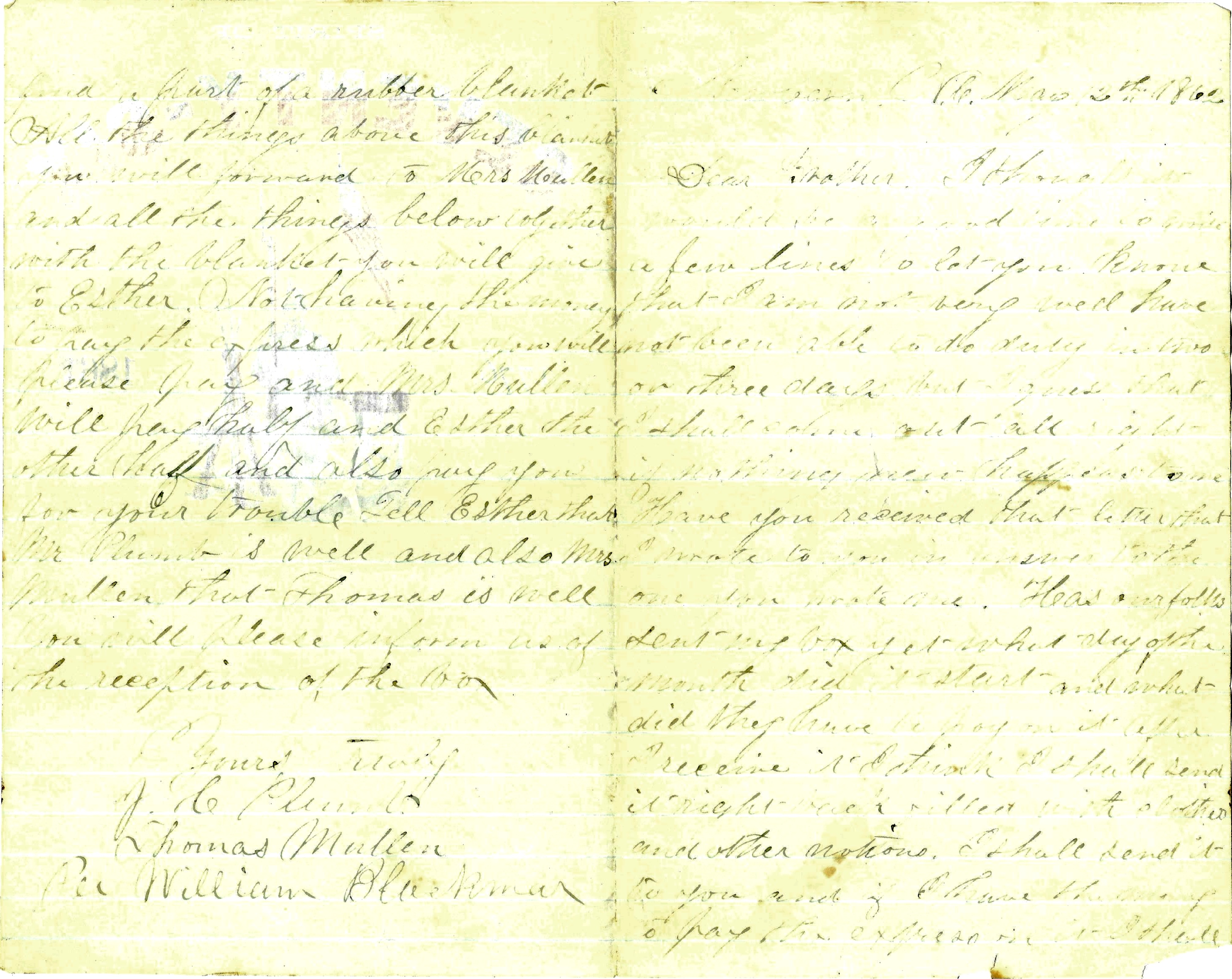
As Mr. Plumb was a going to send a box in your name, he wanted I should write a few lines that you might understand how to dispose of the contents. About middle way of the box you will find a part of a rubber blanket. All the things above this blanket you will forward to Mrs. Mullen and all the things below, together with the blanket, you will give to Esther. Not having the money to pay the Express which you will please pay and Mrs. Mullen will pay half and Esther the other half. And also pay you for your trouble. Tell Esther that Mr. Plumb is well and also Mrs. Mullen that Thomas is well. You will please inform us of the reception of the box. Yours truly, — J. C. Plumb, Thomas Mullen, per William Blackmar
Newbern, N. C.
May 12th, 1862
Dear Brother, I thought it would be a good time to write a few lines to let you know that I am not very well. Have not been able to do duty in two or three days but I guess that I shall come out all right if nothing new happens to me. Have you received that letter that I wrote to you in answer to the one you wrote me? Has our folks sent my box yet? What day of the month did it start and what did they have to pay on it? After I receive it, I think I shall send it right back filled with clothes and other notions. I shall send it to you and if I have the money to pay the Express on it, I shall pay it. But if not, you will have to pay it and our folks will pay you.
Give respects to all enquiring friends. Give my love to your wife and children and also to all the rest of our folks. This is all for this time. Write as soon and as often as convenient and I would be thankful for a paper once in a while as reading matter is rather scarce in this quarter. Now I will bring my letter to a close by wishing you all goodbye. From your brother in Dixie, — William Blackmar
Letter 4
Newbern, North Carolina
May 20th 1862
Dear Brother,
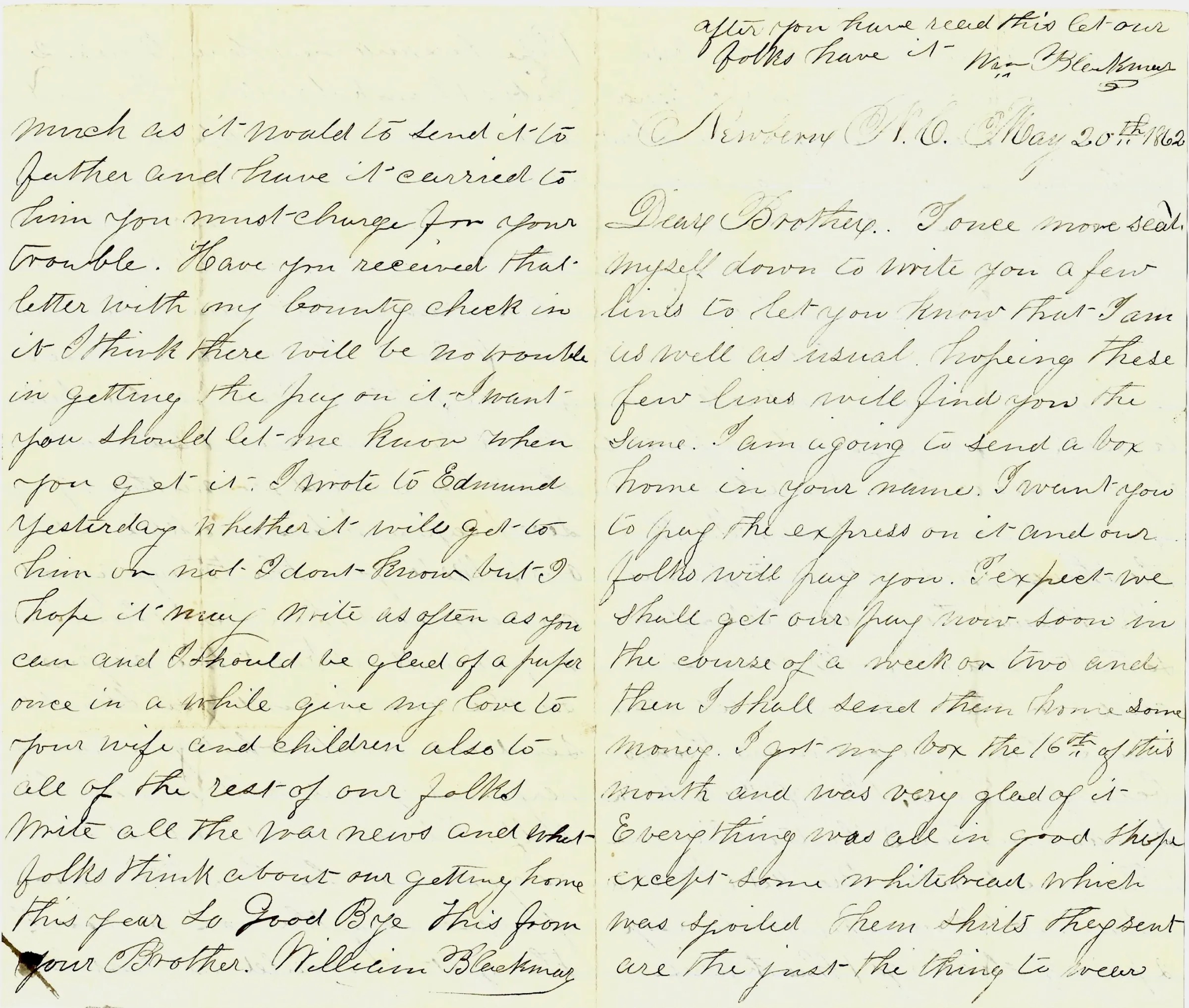
I once more seat myself down to write you a few lines to let you know that I am as well as usual hoping these few lines will find you the same. I am a going to send a box home in your name. I want you to pay the express on it and our folks will pay you. I expect we shall get our pay now soon in the course of a week or two and then I shall send them home some money. I got my box the 16th of this month and was very glad of it. Everything was all in good shape except some white bread which was spoiled. Them shirts they sent are just the thing to wear here—it is so very warm.
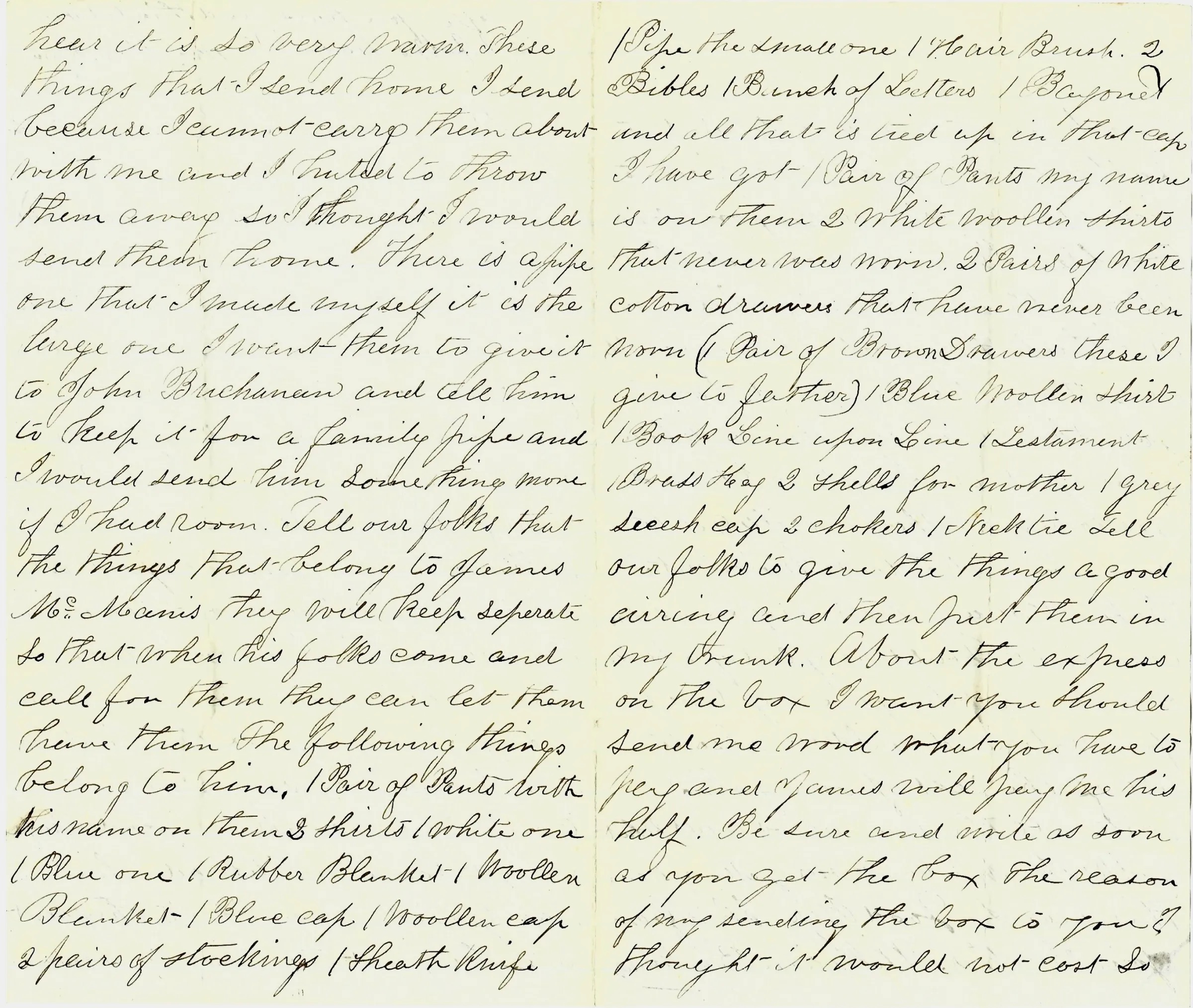
These things that I send home I send because I cannot carry them about with me and I hated to throw them away so I thought I would send them home. There is a pipe—one that I made myself. It is the large one. I want them to give it to John Buchanan and tell him to keep it for a family pipe and I would send him something more if I had room.
Tell our folks that the things that belong to James McManus they will keep separate so that when his folks come and call for them, they can let them have them. The following things belong to him. One pair of pants with his name on them, two shirts—one white and one blue. One rubber blanket, one woolen blanket, 1 blue cap, 1 woolen cap, two pair of stockings, one sheath knife, one pipe (the small one), one hair brush, two bibles, one bunch of letters, one bayonet, and all that is tied up in that cap. I have got one pair of pants (my name is on them), two white woolen shirts that never was worn, two pairs of white cotton drawers that have never been worn (one pr. of brown drawers—these I give to father), one blue woolen shirt, one book line upon line, 1 testament, brass key, two shells for mother, one grey secesh cap, three chokers, one necktie. Tell our folks to give the things a good airing and then just put them in my trunk.
About the Express on the box, I want you should send me word what you have to pay and James will pay me his half. Be sure and write as soon as you can get the box. The reason of my sending the box to you, I thought it would not cost so much as it would to send it to father and have it carried to him. You must charge for your trouble.
Have you received that letter with my bounty check in it? I think there will be no trouble in getting the pay on it. I want you should let me know when you get it. I wrote to Edmund yesterday. Whether it will get to him or not, I don’t know but I hope it may. Write as often as you can and I should be glad of a paper once in a while.
Give my love to your wife and children. Also to all of the rest of our folks. Write all the war news and what folks think about our getting home this year. So goodbye. This from your brother, — William Blackmar
After you have read this, let our folks have it. — Wm. Blackmar
Letter 5
Newbern, North Carolina
June 9th 1862
Dear Brother,
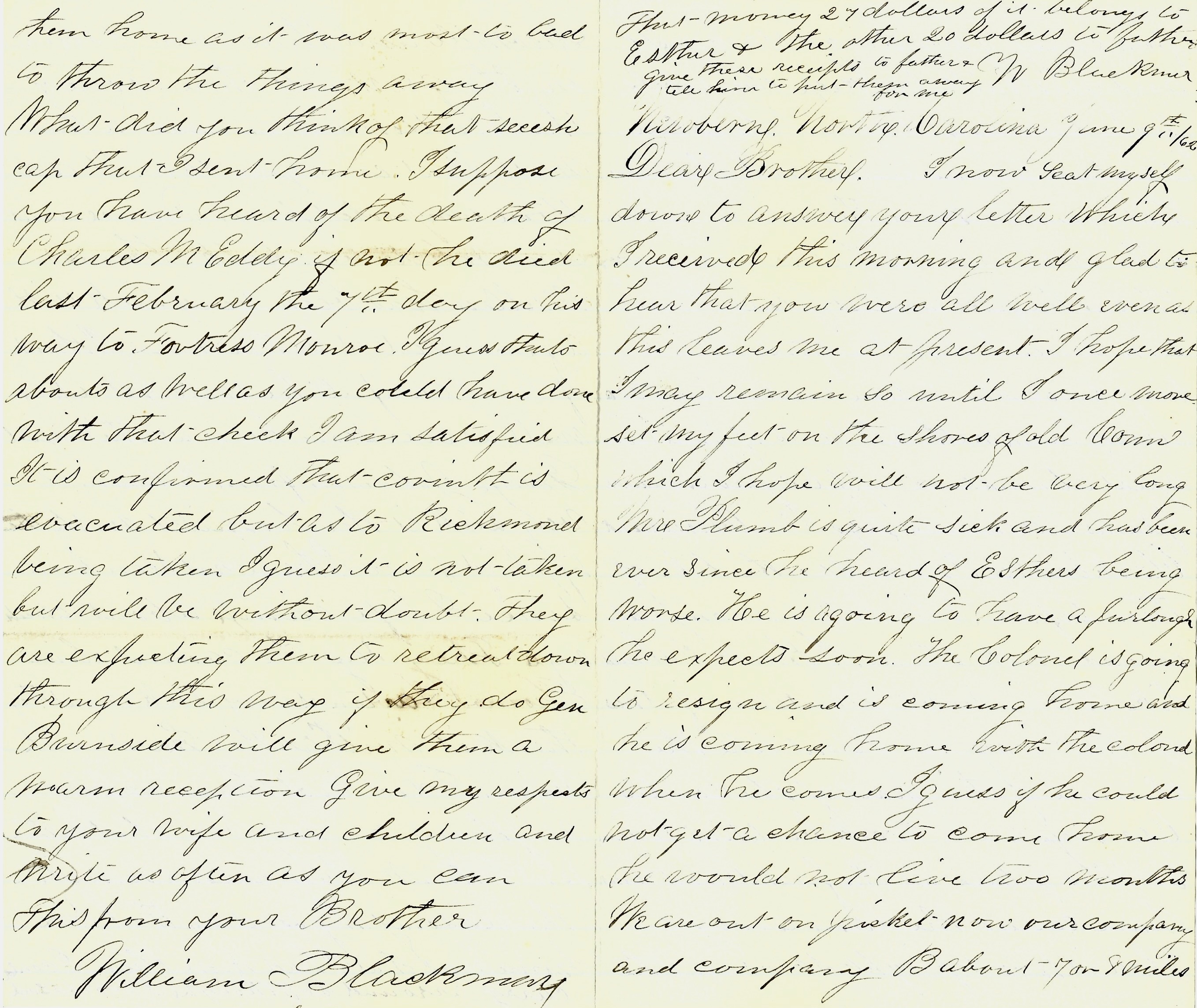
I now seat myself down to answer your letter which I received this morning and glad to hear that you were all well even as this leaves me at present. I hope that I may remain so until I once more set my feet on the shores of Old Connecticut which i hope will not be very long. Mr. Plumb is quite sick and has been ever since he heard of Esther’s being worse. He is going to have a furlough he expects soon. The Colonel is going to resign and is coming home and he is coming home with the colonel when he comes. I guess if he could not get a chance to come home, he would not live two months.
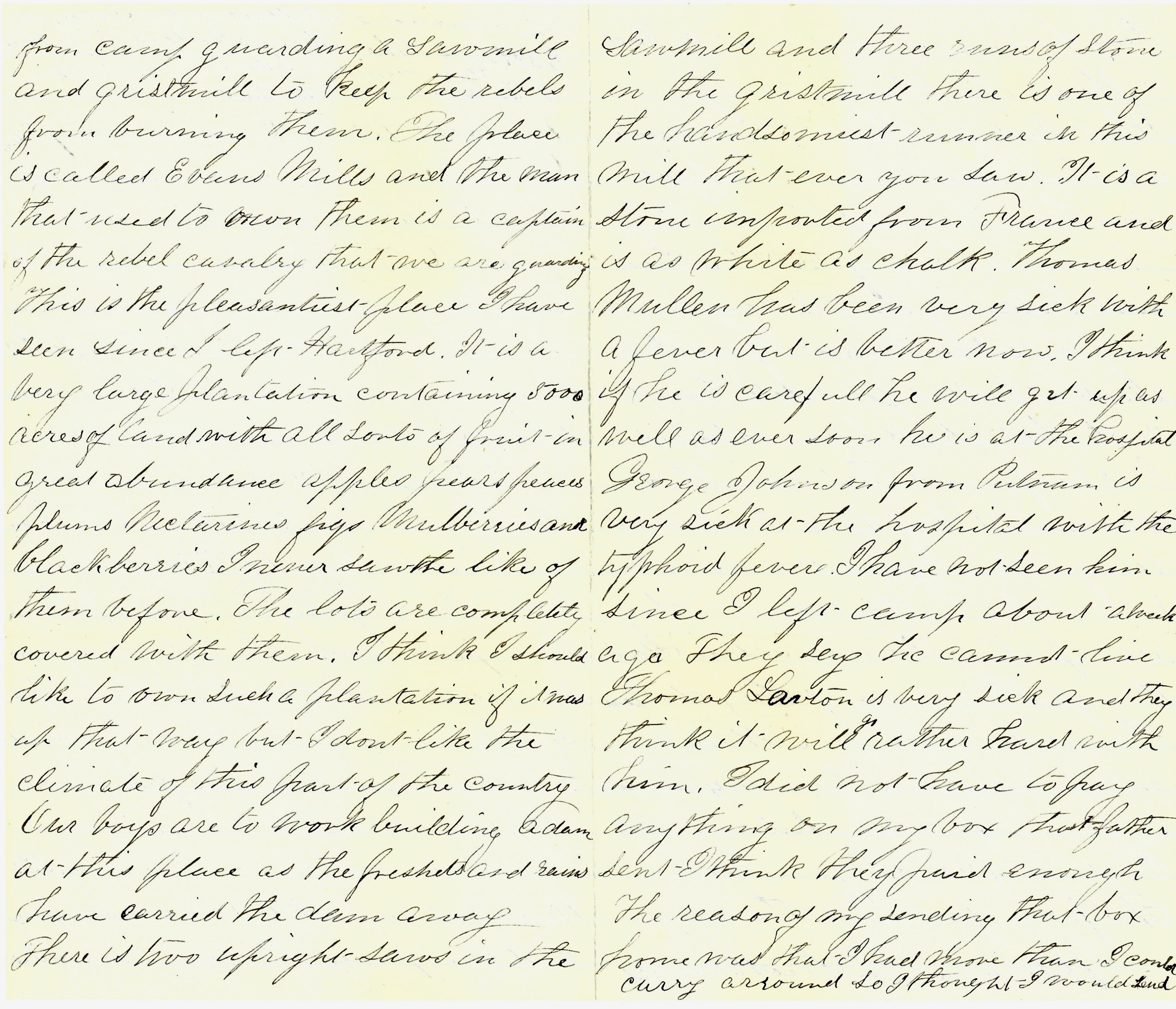
We are out on picket now—our company and Co. B—about seven or eight miles from camp guarding a sawmill and gristmill to keep the rebels from burning them. The place is called Evans Mills and the man that used to own them is a captain of the rebel cavalry that we are guarding. This is the pleasantest place I have seen since I left Hartford. It is a very large plantation containing 5,000 acres of land with all sorts of fruit in great abundance—apples, pears, peaches, plums, nectarines, figs, mulberries, and blackberries. I never saw the like of them before. The lots are completely covered with them. I think I should like to own such a plantation if it was up that way but I don’t like the climate of this part of the country.
Our Boys are to work building a dam at this place as the freshets and rains have carried the dam away. There is two upright saws in the sawmill and three runs of stone in the gristmill. There is one of the handsomest runner in this mill that ever you saw. It is a stone imported from France and is as white as chalk.
Thomas Mullen has been very sick with a fever but is better now. I think if he is careful, he will get up as well as ever soon. He is at the hospital. George Johnson from Putnam is very sick at the hospital with the typhoid fever. I have not seen him since I left camp about a week ago. They say he cannot live. Thomas Lawton is very sick and they think it will go rather hard with him.
I did not have to pay anything on my box that father sent. I think they paid enough. The reason my sending that box home was that I had more than I could carry around so I thought I would send them home and it was most too bad to throw the things away. What did you think of that secesh cap that I sent home?
I suppose you have heard of the death of Charles M. Eddy. If not, he died last February the 7th day on his way to Fortress Monroe. I guess that’s about as well as you could have done with that check. I am satisfied. It is confirmed that Corinth is evacuated but as to Richmond being taken, I guess it is not taken but will be without doubt. They are expecting them to retreat down through this way. If they do, Gen. Burnside will give them a warm reception.
Give my respects to your wife and children and write as often as you can. This from your brother, — William Blackmar
Letter 6
Fredericksburg, Virginia
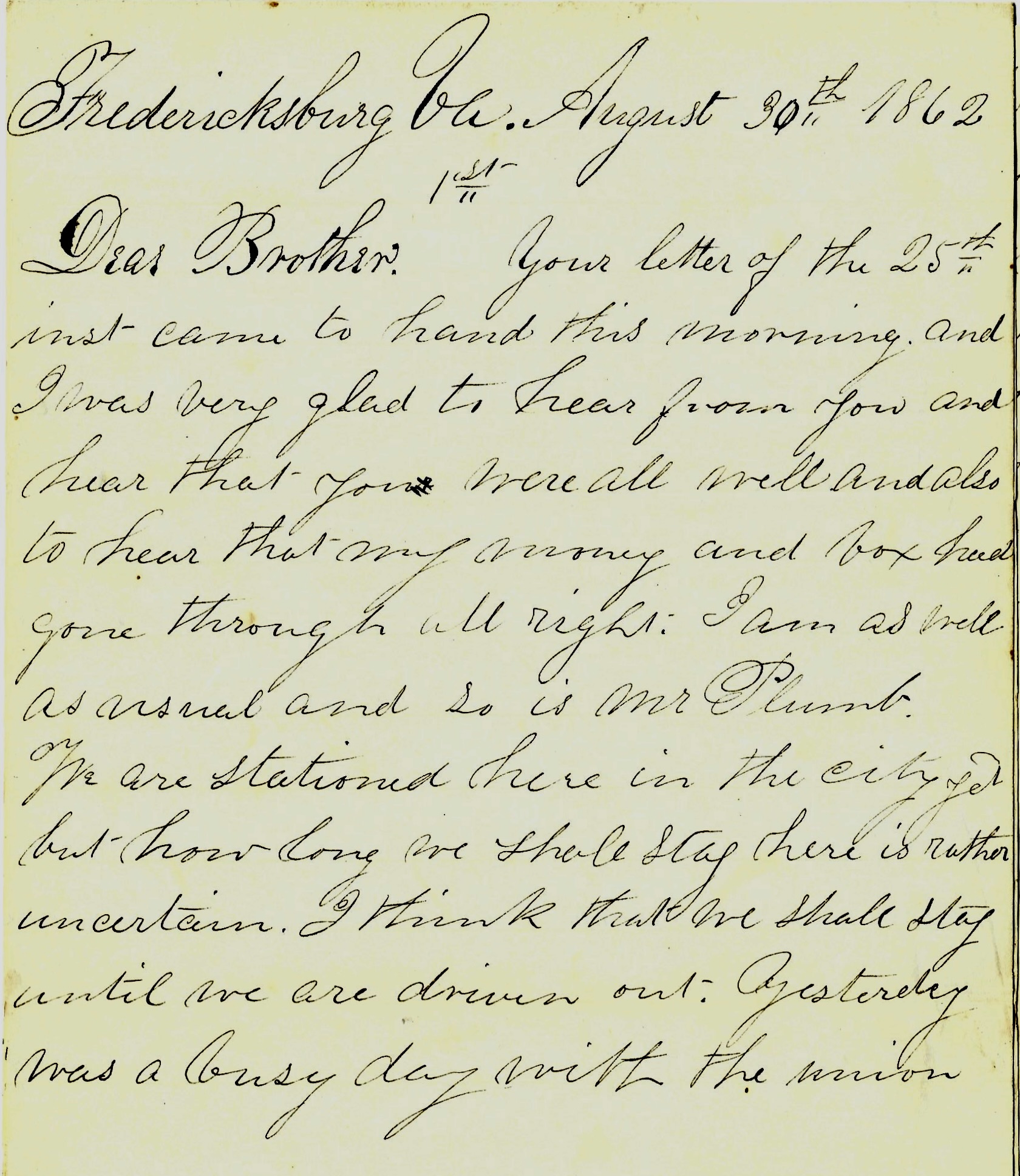
August 30th, 1862
Dear Brother,
Your letter of the 25th inst. came to hand this morning and I was very glad to hear from you and hear that you were all well and also to hear that my money and box had gone through all right. I am as well as usual and so is Mr. Plumb. We are stationed here in the city yet and how long we shall stay here is rather uncertain. I think that we shall stay until we are driven out.
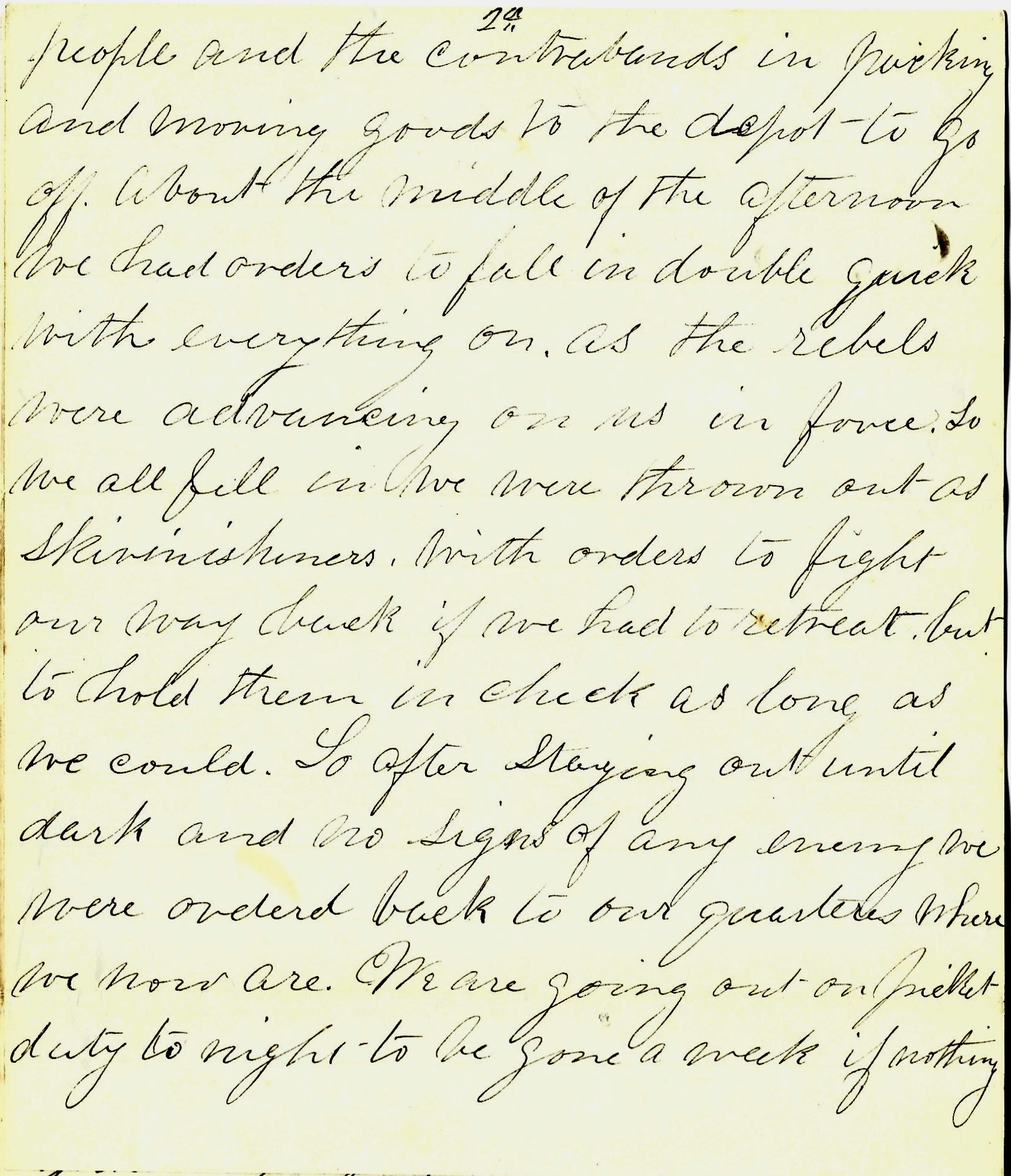
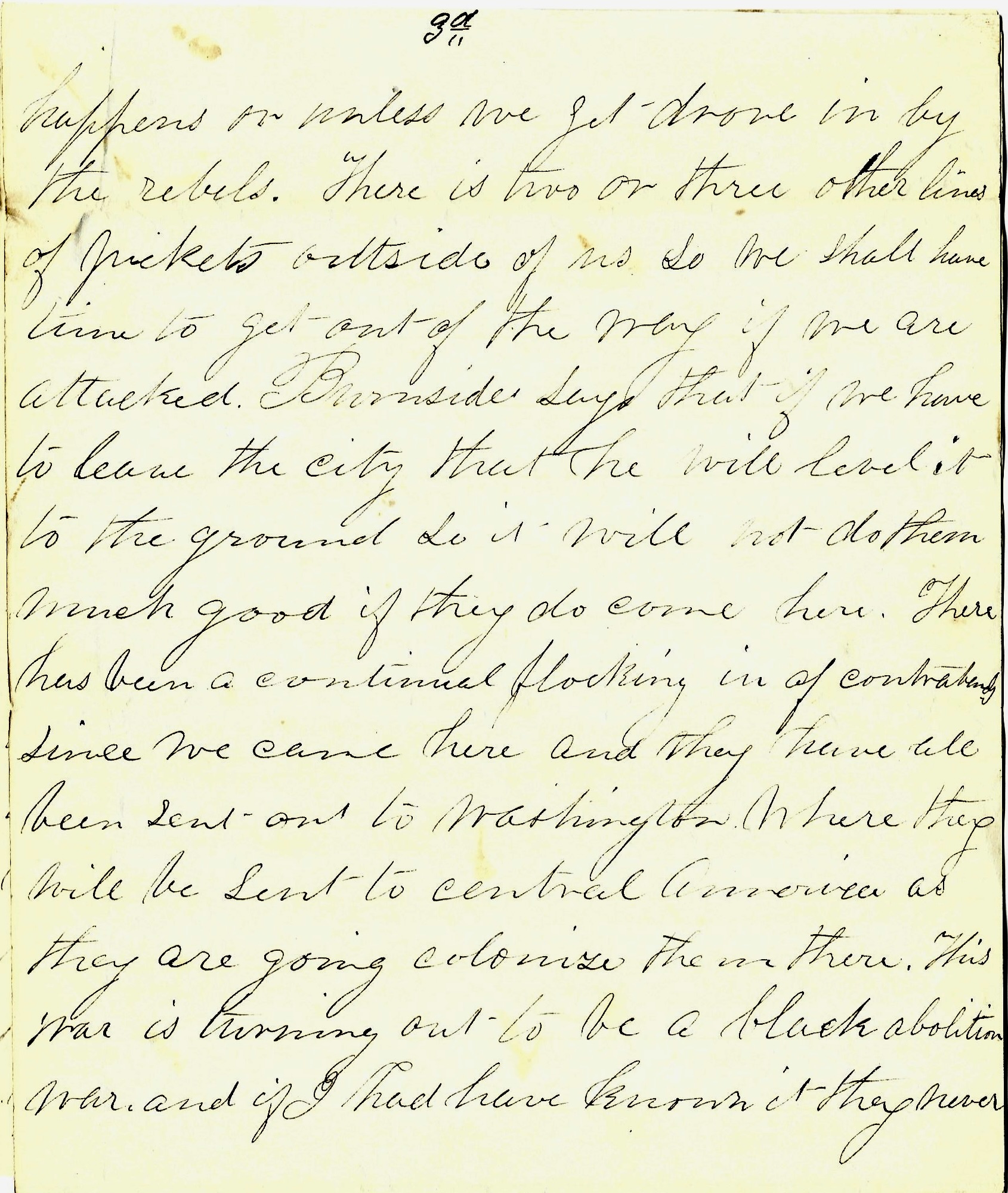
Yesterday was a busy day with the union people and the contrabands in packing and moving goods to the depot to go off. About the middle of the afternoon, we had orders to fall in double quick with everything on as the rebels were advancing on us in force. So we fell in. We were thrown out as skirmishers with orders to fight our way back if we had to retreat but to hold them in check as long as we could. So after staying out until dark and no signs of any enemy, we were ordered back to our quarters where we now are. We are going on picket duty tonight to be gone a week if nothing happens or unless we get drove in by the rebels. There is two or three other lines of pickets outside of us so we shall have time to get out of the way if we are attacked. Burnside says that if we have to leave the city, that he will level it to the ground so it will not do them much good if they do come here.
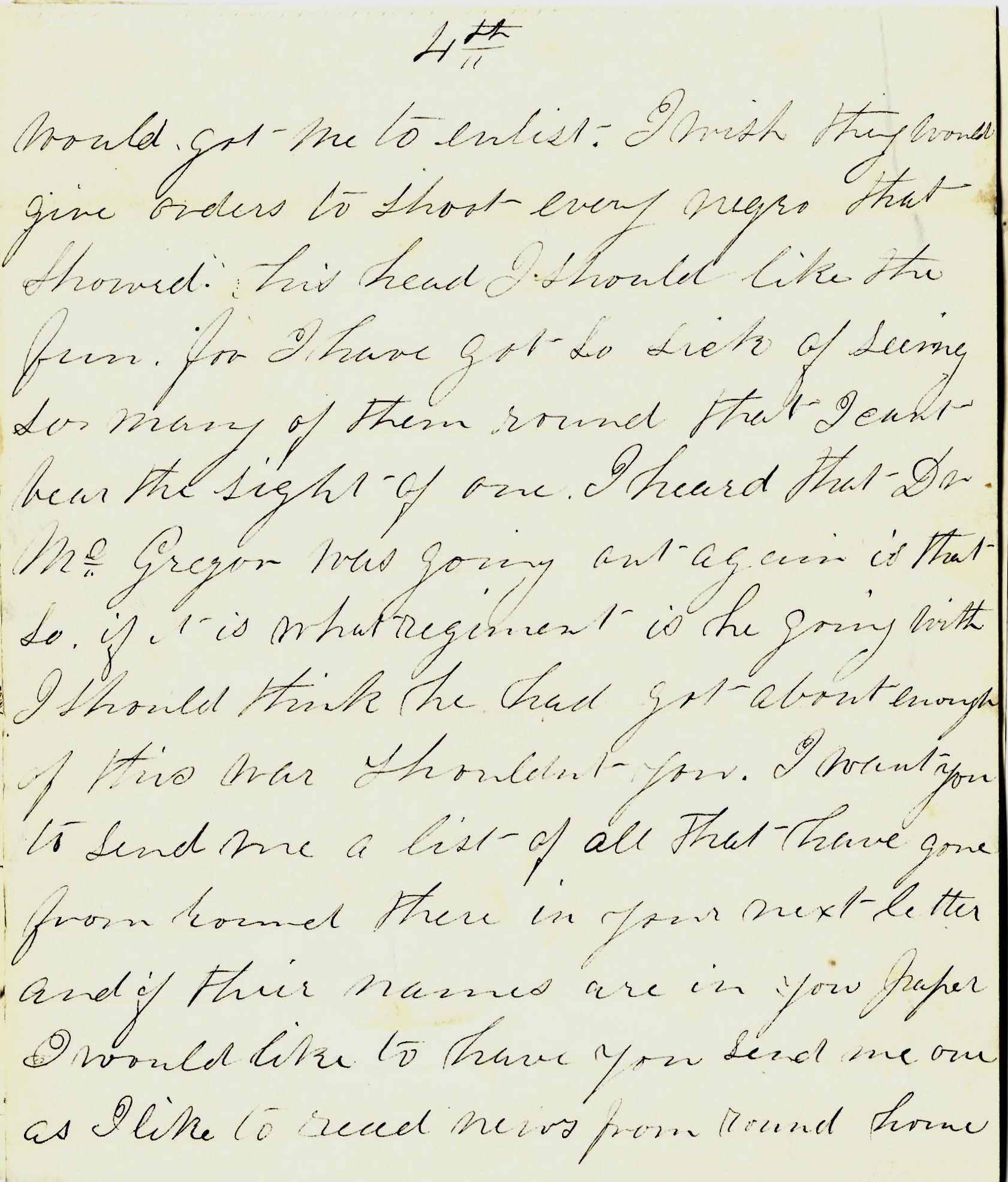
There has been a continual flocking in of contrabands since we came here and they have all been sent out to Washington where they will be sent to Central America as they are going to colonize them there. This war is turning out to be a black abolition war and if I had have known it, they never would got me to enlist. I wish they would give orders to shoot every negro that showed his head. I should like the fun for I have got so sick of seeing so many of them round that I can’t bear the sight of one.
I heard that Dr. McGregor was going out again. Is that so? If it is, what regiment is he going with? I should think he had got about enough of this war, shouldn’t you? I want you to send me a list of all that have gone from round there in your next letter and if their names are in your paper, I would like to have you send me one as I like to read news from round home.
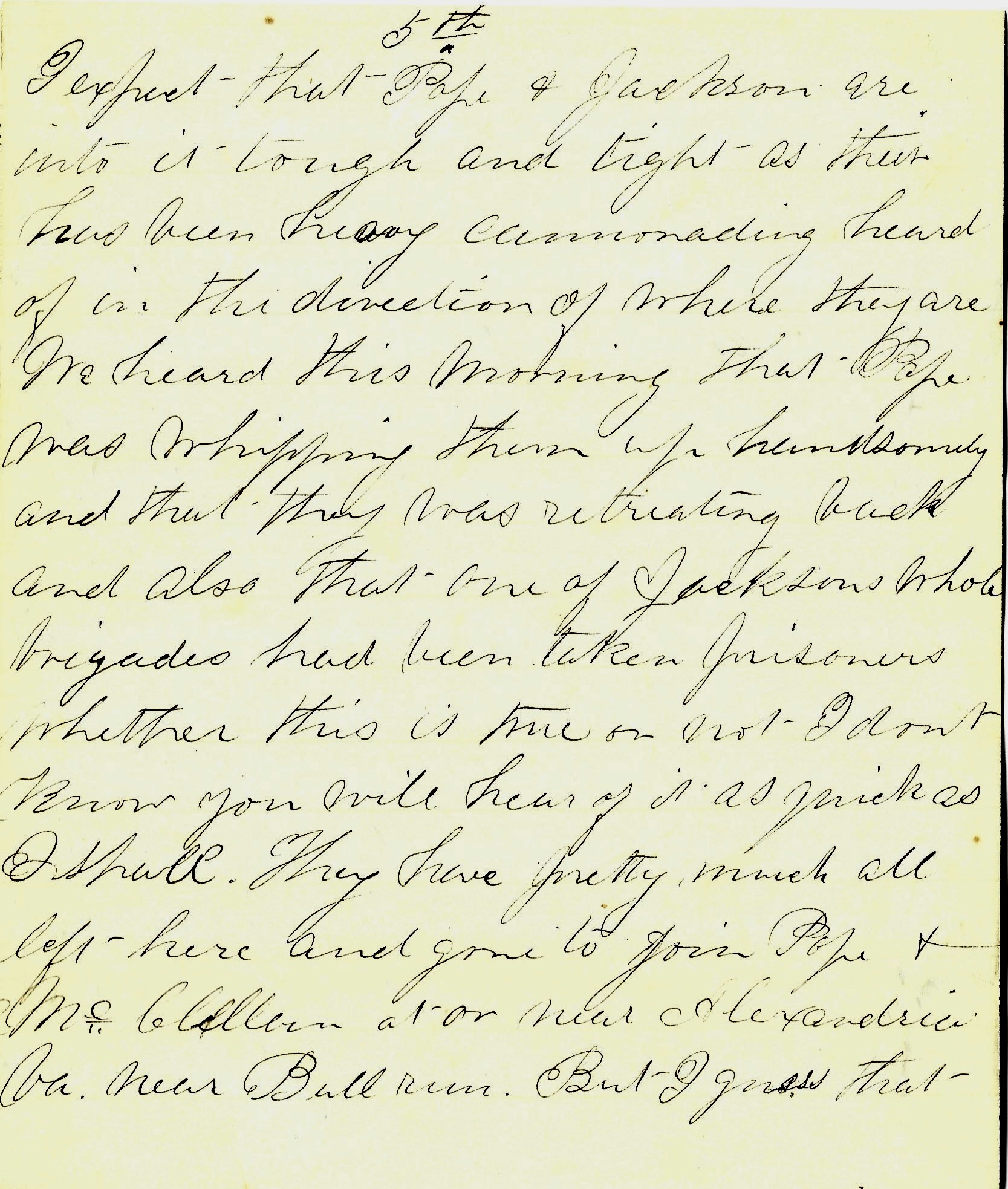
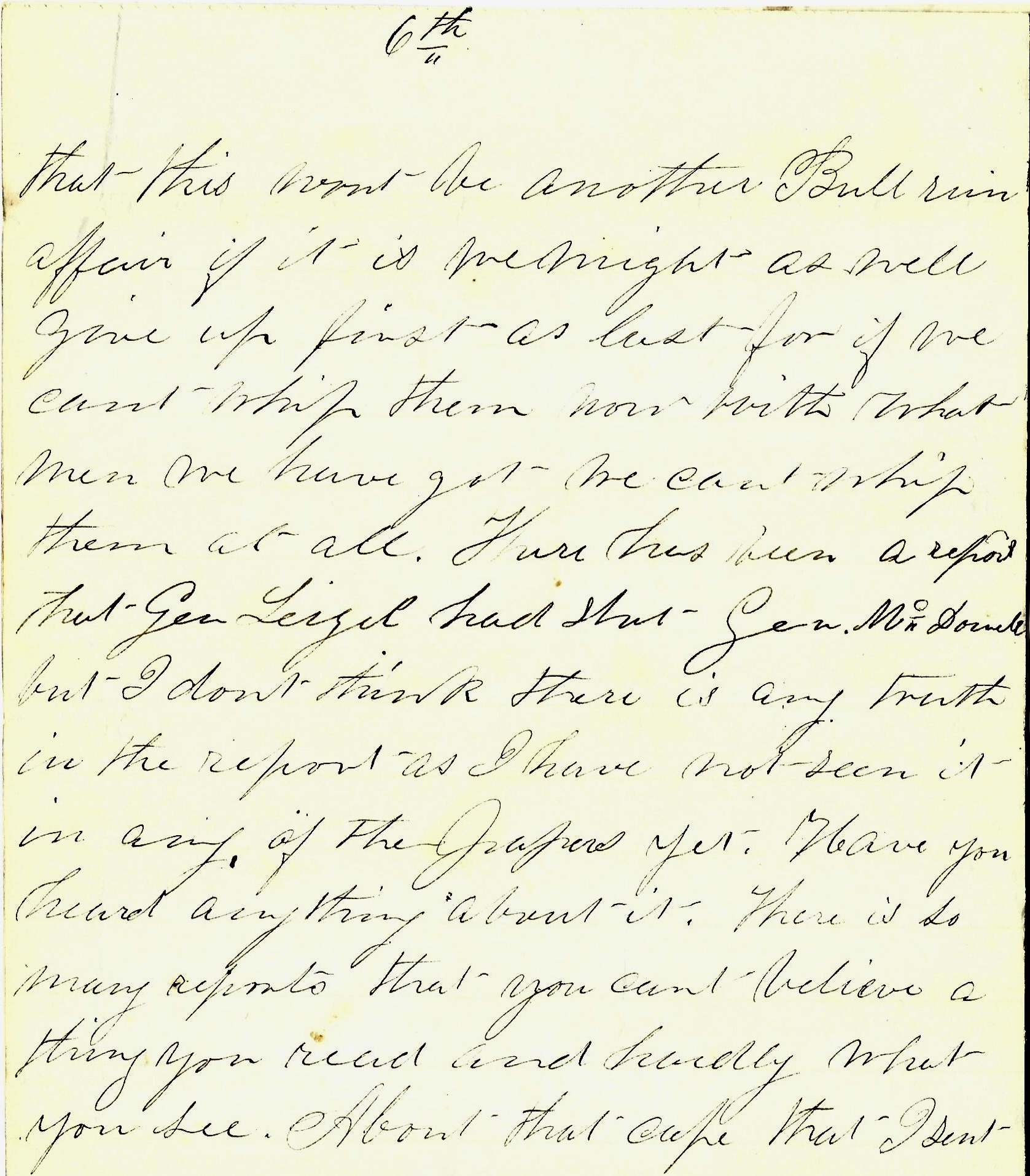
I expect that Pope & Jackson are into it tough and tight as there has been heavy cannonading heard off in the direction of where they are. We heard this morning that Pope was whipping them up handsomely and that they was retreating back and also that one of Jackson’s whole brigades had been taken prisoners. Whether this is true or not, I don’t know. You will hear of it as quick as I shall. They have pretty much all left here and gone to join Pope and McClellan at or near Alexandria, Va., near Bull Run. But I guess that this won’t be another Bull Run affair. If it is, we might as well give up first as last for if we can’t whip them now with what men we have got, we can’t whip them at all.
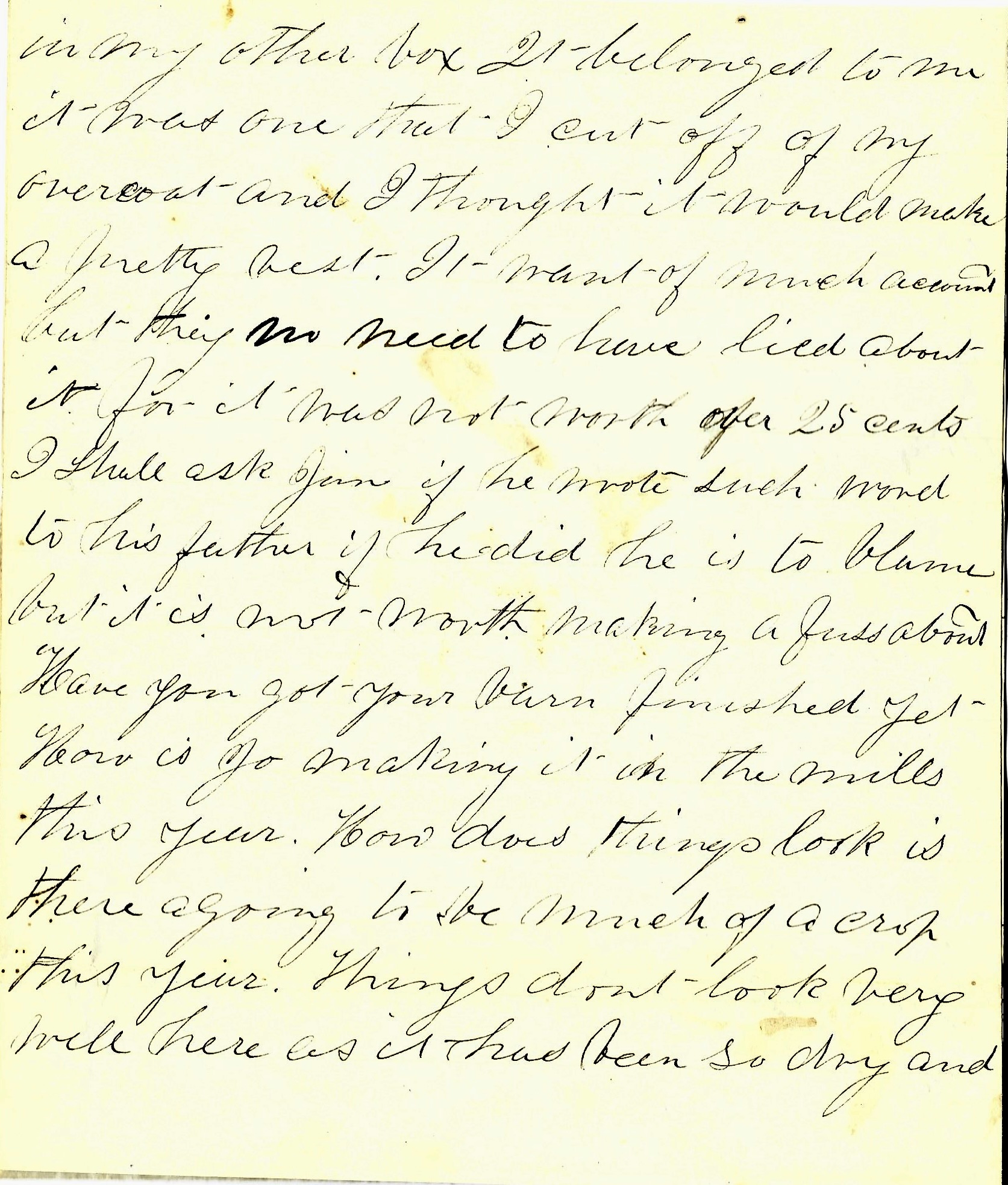
There has been a report that Gen. [Franz] Sigel had shot Gen. [Irwin] McDowell but I don’t think there is any truth in the report as I have not seen it in any of the papers yet. Have you heard anything about it? 1 There is so many reports that you can’t believe a thing you read and hardly what you see. About the cape that I sent in my other box, it belonged to me. It was one that I cut off of my overcoat and I thought it would make a pretty vest. It wasn’t of much account but there is no need to have lied about it for it was not worth over 25 cents. I shall ask Jim if he wrote such words to his father, If he did, he is to blame. But it is not worth making a fuss about.
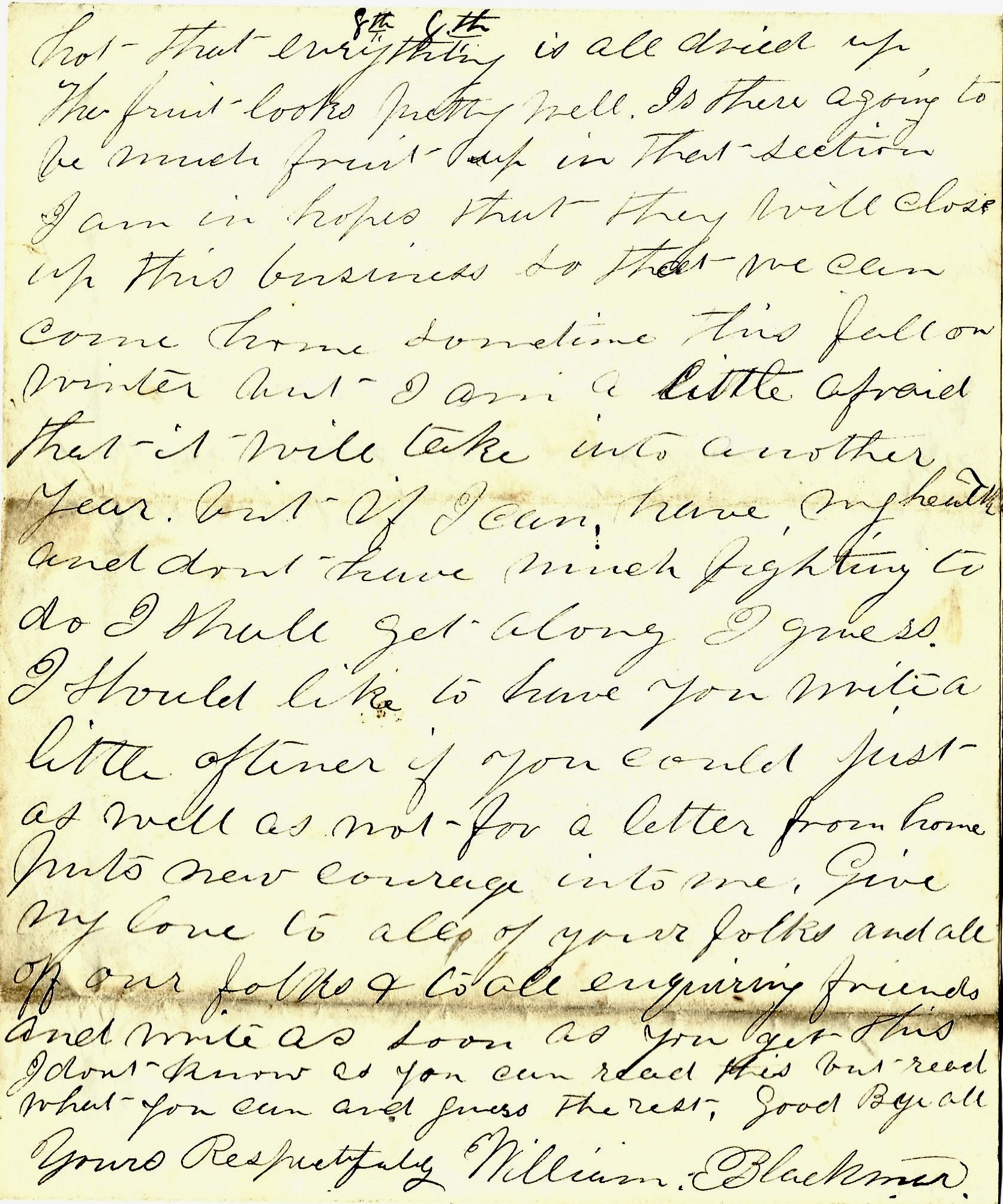
Have you got your barn finished yet? How is Jo making it in the mills this year? How does things look? Is there a going to be much of a crop this year? Things don’t look very well here as it has been so dry and hot that everything is all dried up. The fruit looks pretty well. Is there a going to be much fruit up in that section?
I am in hopes that they will close up this business so that we can come home sometime this fall or winter but I am a little afraid that it will take into another year. But if I can have my health and don’t have much fighting to do, I shall get along I guess. I should like to have you write a little oftener if you could just as well as not, for a letter from home puts new courage into me. Give my love to all of your folks and all of our folks & to all enquiring friends and write as soon as you get this. I don’t know as you can read this but read what you can and guess the rest. Goodbye all. Yours respectfully, — William Blackmar
1 McDowell and Sigel had a strong dislike for each other gained during the battle of Second Manassas fought in August of 1862.
Letter 7
Fredericksburg, Virginia
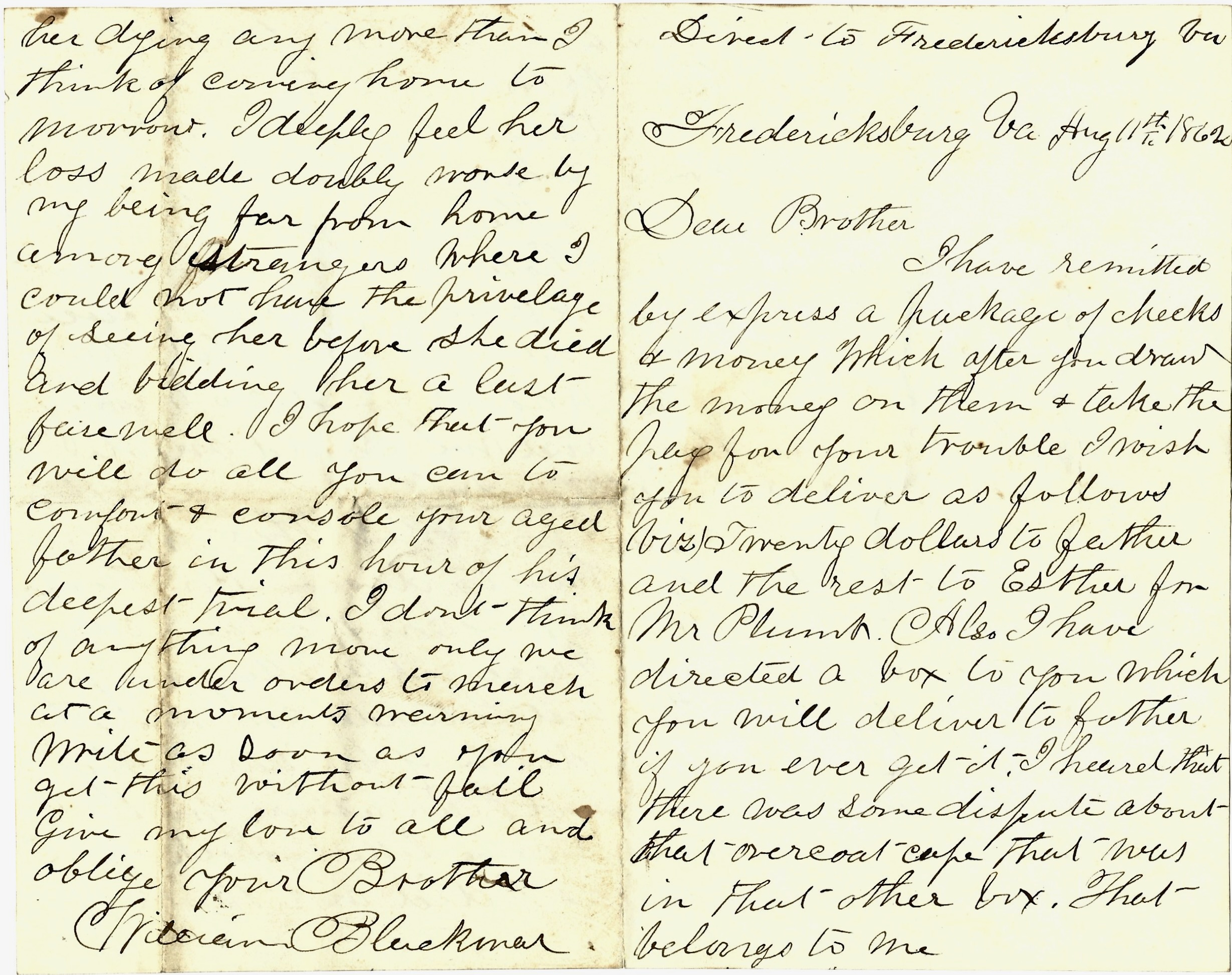
August 11th 1862
Dear Brother,
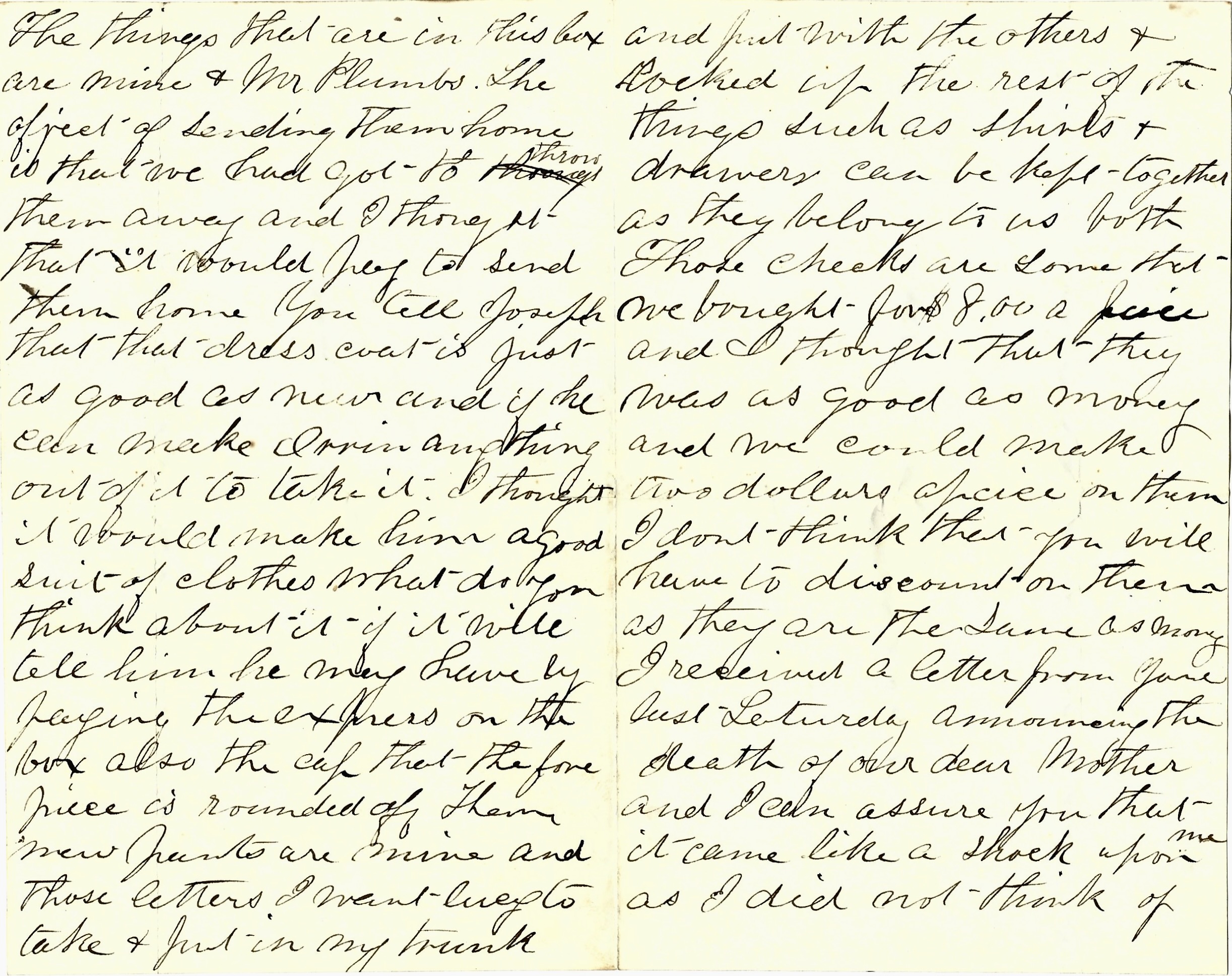
I have remitted by express a package of checks and money which after you draw the money on them & take the pay for your trouble, I wish you to deliver as follows—viz, twenty dollars to father, and the rest to Esther for Mr. Plumb. Also I have directed a box to you which you will deliver to father if you ever get it. I heard about that overcoat cape that was in that other box. That belongs to me. The things that are in this box are mine and Mr. Plumbs. The object of send them home is that we had got to throw them away and I thought that it would pay to send them home. You tell Joseph that that dress coat is just as good as new and if he can make Orrin anything out of it, to take it. I thought it would make him a good suit of clothes. What do you think about it? If it will, tell him he may have it by paying the express on the box. Also the cap that the fore piece is rounded off. Them new pants are mine and those letters I want Lucy to take and put in my trunk and put with the others and lock it up. The rest of the things such as shirts and drawers can be kept together as they belong to us both.
Those checks are some that we bought for $8 a piece and I thought that they was as good as money and we could make two dollars apiece on them as they are the same as money.
I received a letter from Jane last Saturday announcing the death of our dear mother and I can assure you that it came like a shock upon me as I did not think of her dying any more than I think of coming home tomorrow. I deeply feel her loss made doubly worse by my being far from home among strangers where I could not have the privilege of seeing her before she died and bidding her a last farewell. I hope that you will do all you can to comfort and console your aged father in this hour of his deepest trial.
I don’t think of anything more—only we are under marching orders to march at a moment’s warning. Write as soon as you get this, without fail. Give my love to all and oblige. Your brother, — William Blackmar
Letter 8
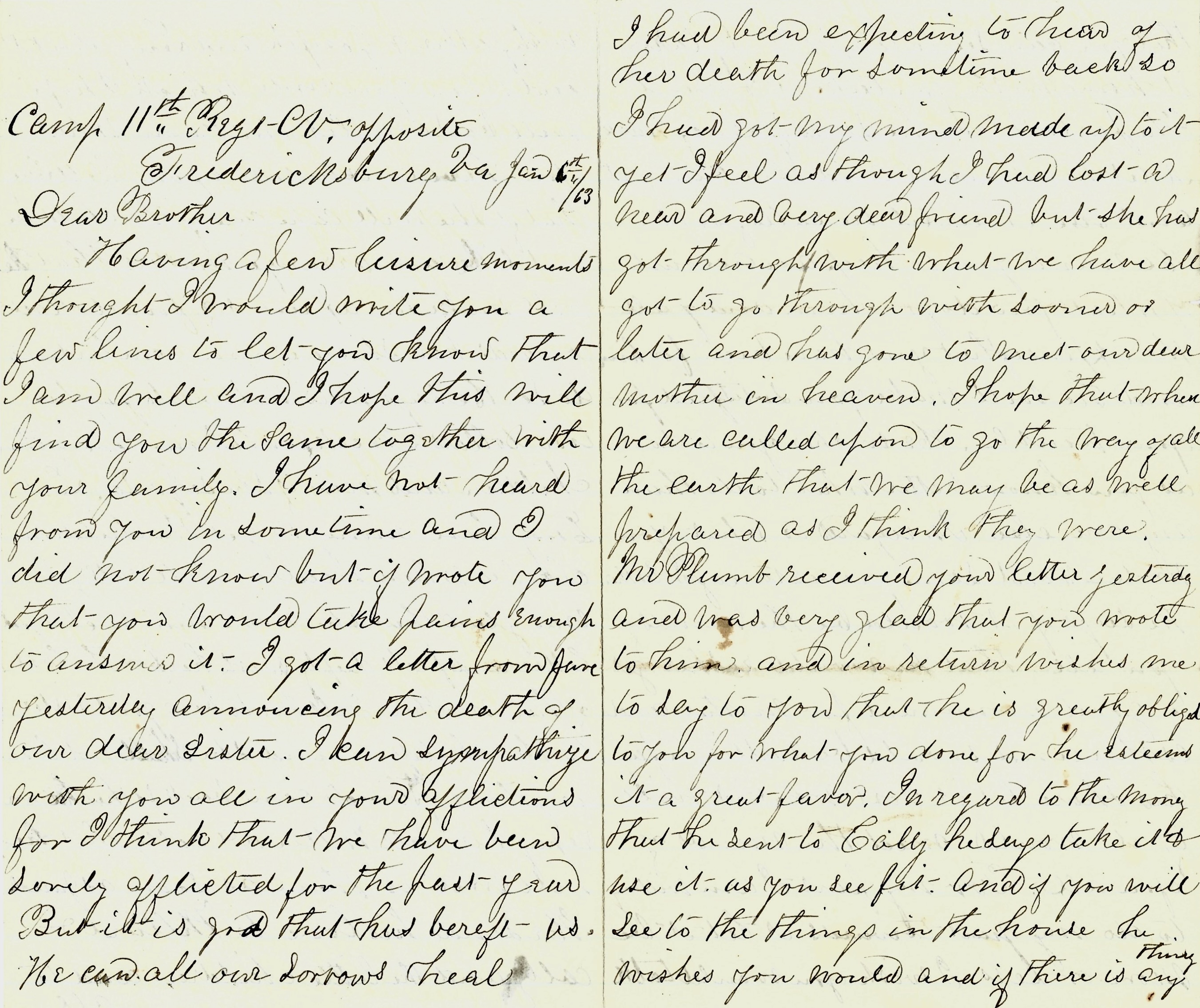
Camp 11th Regt. C. V. opposite Fredericksburg, Va.
January 6th 1863
Dear Brother,
Having a few leisure moments I thought I would write you a few lines to let you know that I am well and I hope this will find you the same together with your family. I have not heard from you in sometime and I did not know but if I wrote you, that you would take pains enough to answer it. I got a letter from Jane yesterday announcing the death of our dear sister. I can sympathize with you all in your afflictions for I think that we have been sorely afflicted for the past year. But it is God that has bereft us. He can all our sorrows heal.
I had been expecting to hear of her death for some time back so I had got my mind made up to it, yet I feel as though I had lost a near and very dear friend. But she has got through with what we have all got to go through with sooner or later and has gone to meet our dear mother in heaven. I hope that when we are called upon to go the way of all the earth that we may be as well prepared as I think they were.
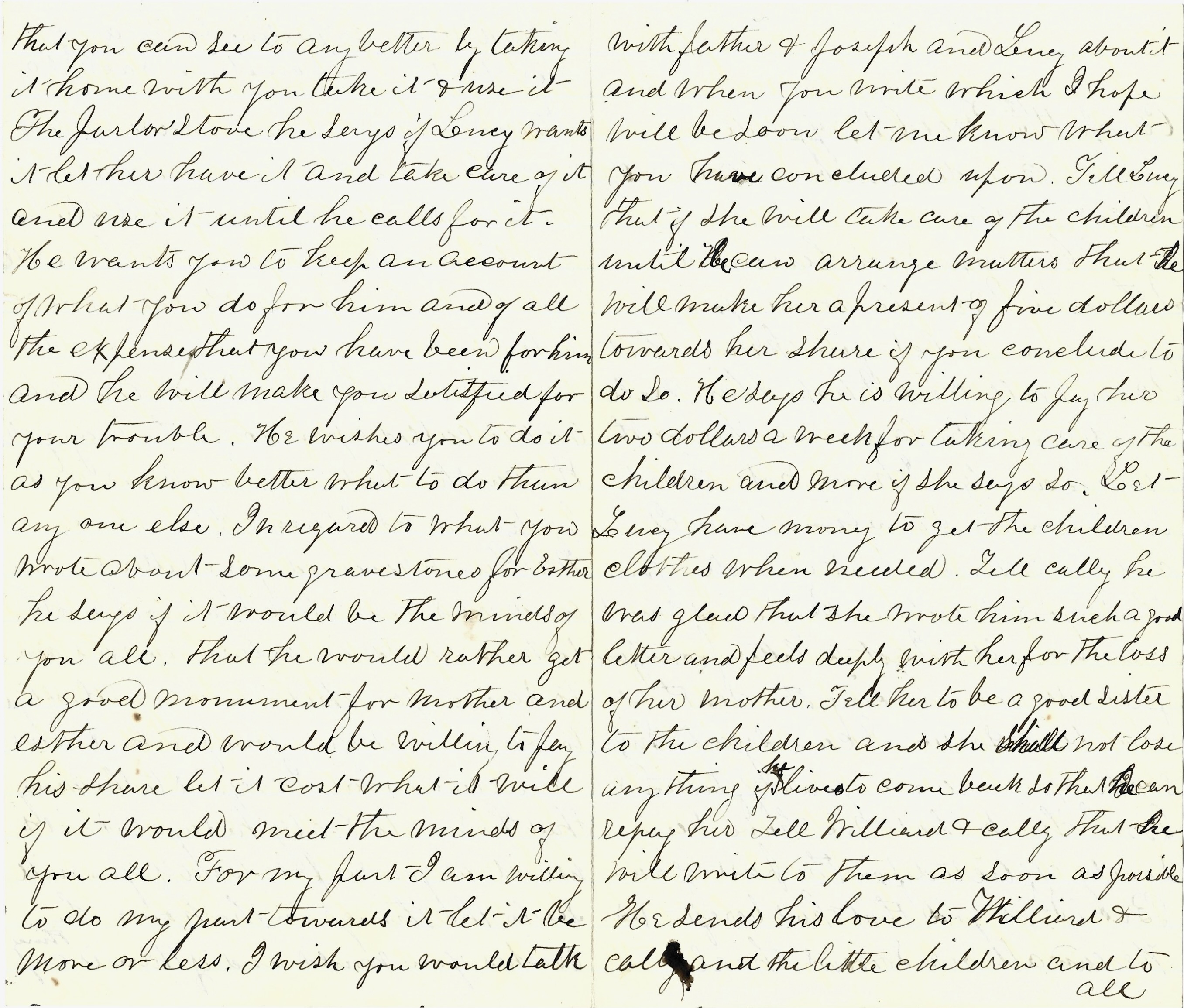
Mr. Plumb received your letter yesterday and was very glad that you wrote to him and in return wishes me to say to you for what you have done for he esteems it a great favor. In regard to the money that he sent to Cally, he says take it and use it as you see fit. And if you will see to the things in the house he wishes you would and if there is a thing that you can see to any better by taking it home with you, take it and use it. The Parlor stove, he says, if Lucy wants it, let her have it and take care of it and use it until he calls for it. He wants you to keep an account of what you do for him and of any expenses that you have been for him and he will make you satisfied for your trouble. He wishes you to do it as you know better what to do than anyone else.
In regard to what you wrote about some gravestones for Esther, he says if it would be the minds of you all, that he would rather get a good monument for mother and Esther and would be willing to pay is share, let it cost what it will if it would meet the minds of you all. For my part, I am willing to do my part towards it, let it be more or less. I wish you would talk with father and Joseph and Lucy about it and when you write, which I hope will be soon, let me know what you have concluded upon. Tell Lucy that if she will take care of the children until he can arrange matters that he will make her a present of five dollars towards her share if you conclude to do so. He says he is willing to pay her two dollars a week for taking care of the children and more if she says so. Let Lucy have money to get the children clothes when needed. Tell Cally he was glad that she wrote him such a good letter and feels deeply with her for the loss of her mother. Tell her to be a good sister to the children and she shall not lose anything if he lives to come back so that he can repay her. Tell Willard & Cally that he will write to them as soon as possible. He sends his love to Willard and Cally and the little children and to all. [no signature]
Letter 9
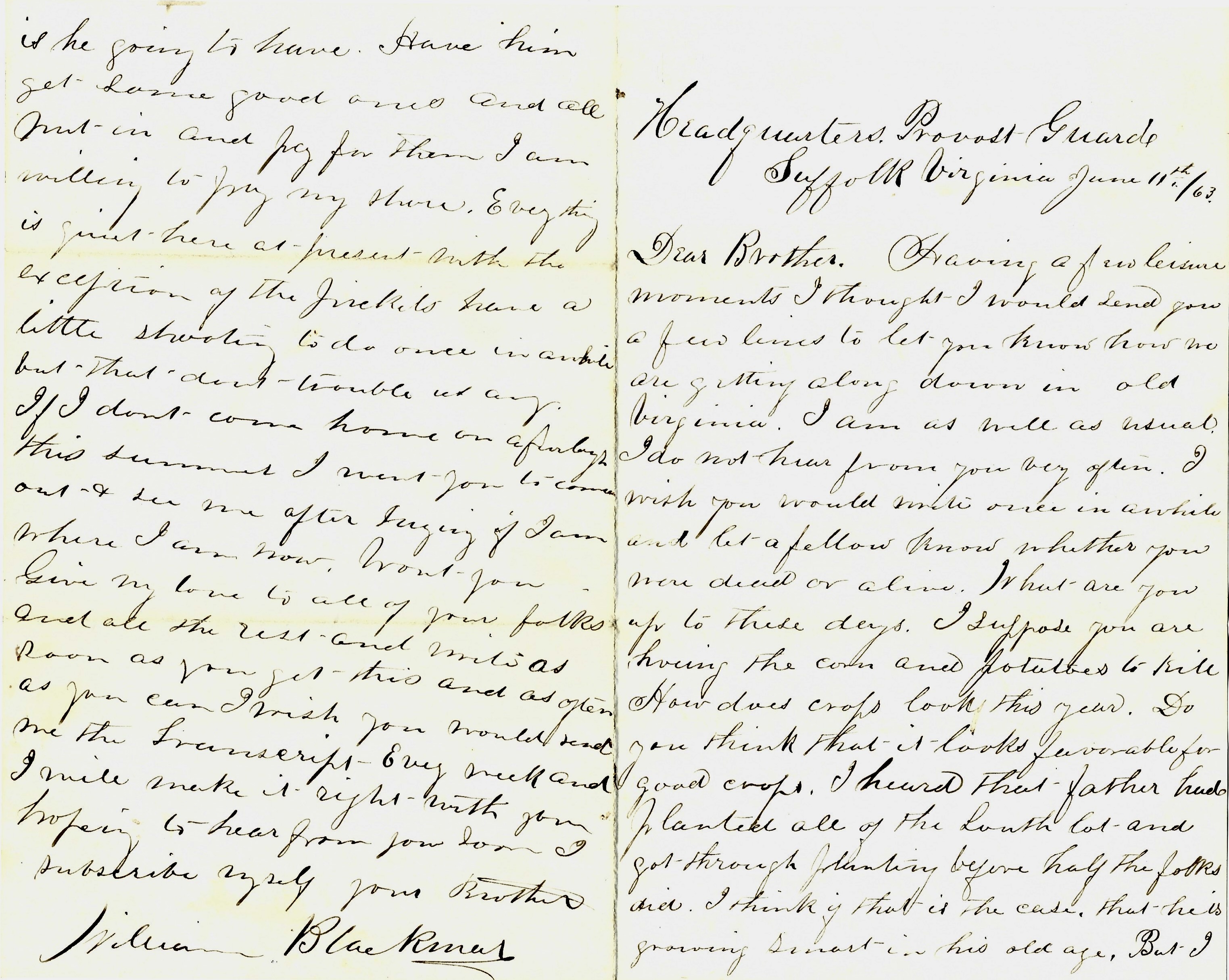
Headquarters Provost Guards
Suffolk, Virginia
June 11th 1863
Dear Brother,
Having a few leisure moments I thought I would send you a few lines to let you know how we are getting along down in Old Virginia. I am as well as usual. I do not hear from you very often. I wish you would write once in a while and let a fellow know whether you were dead or alive. What are you up to these days? I suppose you are hoeing the corn and potatoes to kill. How does the crops look this year? Do you think that it looks favorable for good crops? I heard that father had planted all of the south lot and got through planting before half the folks did. I think if that is the case, that he is growing smart in his old age. But I am afraid that he is laying out more work that he will be able to carry out. I hope, however, that he will be able to go through with what he has begun and that he may have good crops adn live to enjoy the benefit of them.
I heard from Edmund one day this week. He was well but was pretty well tired out from long marches and bivouacking on the ground. He said that they had had two battles and he was fortunate enough to keep out of both of them, he being on guard at the time. He has not seen as hard times yet as we did when we marched through Maryland and God grant that he may never see such times as we then saw. It makes our blood run cold to look back and see what we then suffered marching through the dust without (some days) anything to eat, and the rest of the time without half enough. But enough of this for now.
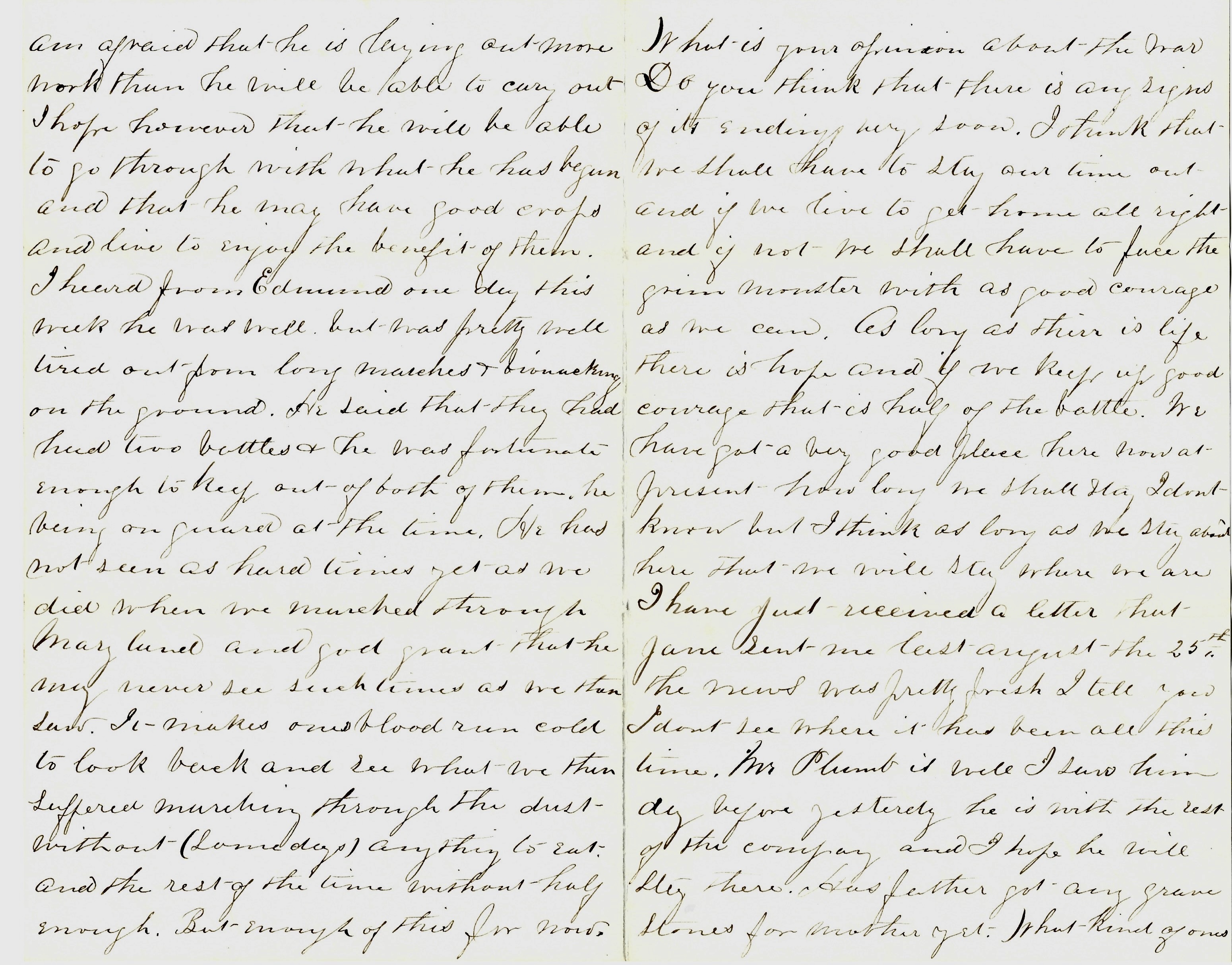
What is your opinion about the war? Do you think that there is any signs of its ending very soon? I think that we shall have to stay our time out and if we live to get home—all right, and if not, we shall have to face the grim monster with as good courage as we can. As long as there is life, there is hope and if we keep up good courage, that is half of the battle.
We have got a very good place here now at present. How long we shall stay, I don’t know but I think as long as ew stay about here that we will stay where we are. I have just received a letter that Jane sent me last August the 25th. The news was pretty fresh, I tell you. I don’t see where it has been all this time. Mr. Plumb is well. I saw him day before yesterday. He is with the rest of the company and I hope he will stay here. Has father got any gravestones for mother yet? What kind of ones if he going to have? Have him get some good ones and all put in and pay for them, I am willing to pay my share.
Everything is quiet here at present with the exception of the pickets have a little shooting to do once in a while but that don’t trouble us any. If I don’t come home on a furlough this summer, I want you to come out and see me after haying if I am where I am now. Won’t you? Give my love to all of your folks and all the rest. And write as soon as you get this and as often as you can. I wish you would send me the Transcript every week and I will make it right with you. Hoping to hear from you soon, I subscribe myself your brother, — William Blackmar
Letter 10
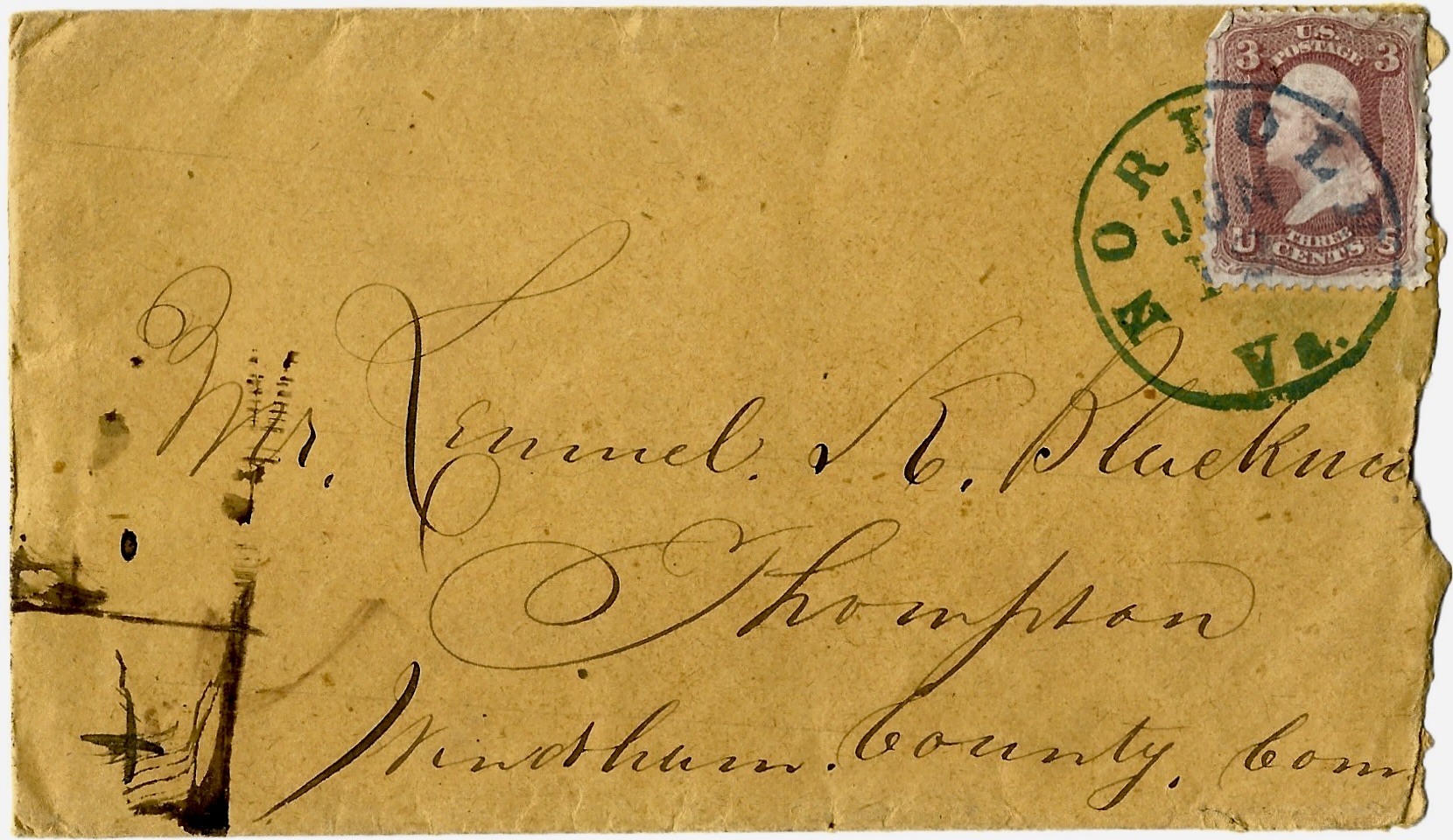
Gloucester Point, Virginia
October 14, 1863
Dear Brother,
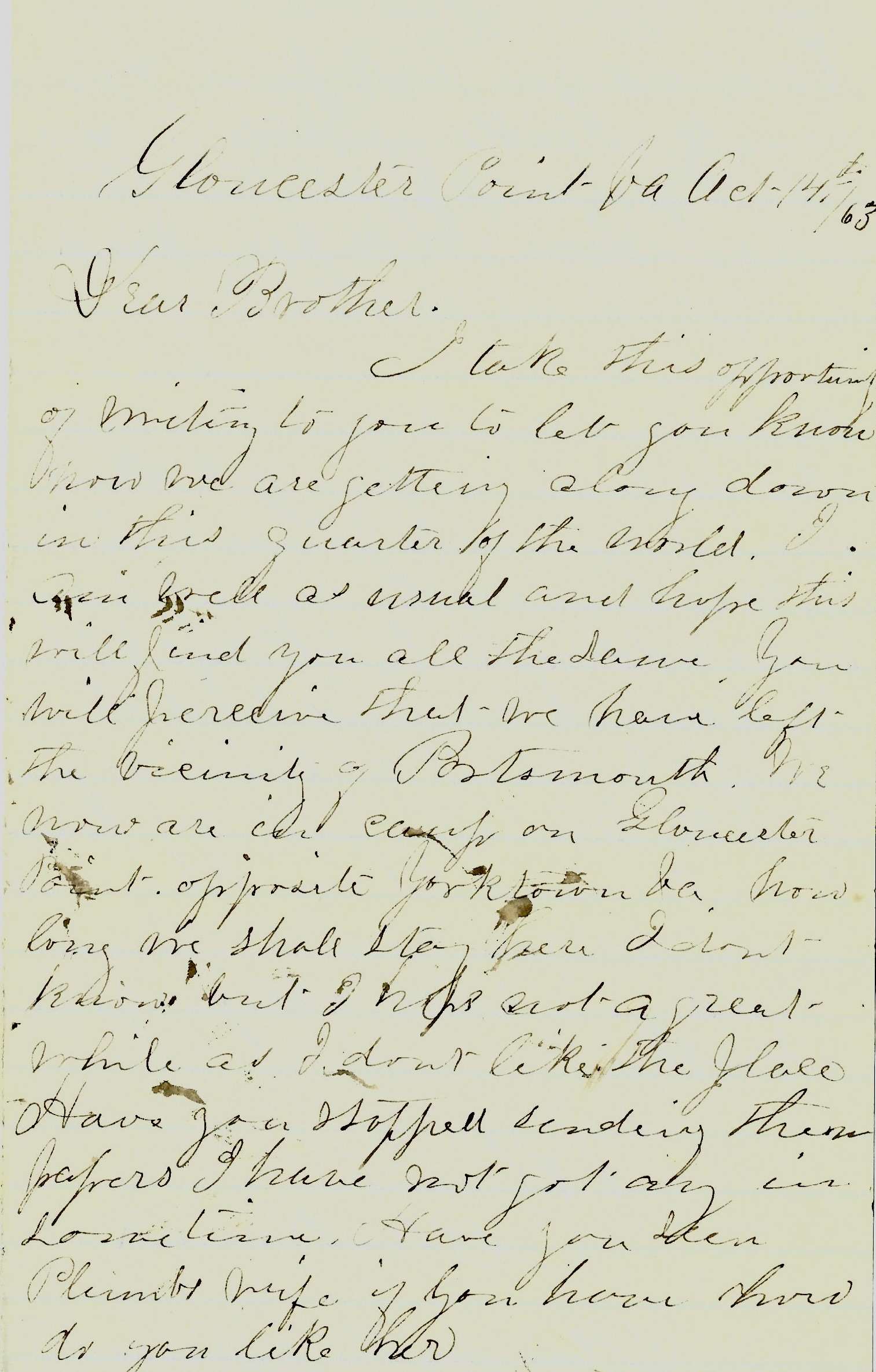
I take this opportunity of writing to you to let you know how we are getting along down in this quarter of the world. Am well as usual and hope this will find you all the same. You will perceive that we have left the vicinity of Portsmouth. We now are in camp on Gloucester Point opposite Yorktown, Va. How long we shall stay here, I don’t know but I hope not a great while as I don’t like the place.
Have you stopped sending them papers? I have not got any in a long time. Have you seen Plumb’s wife? If you have, how do you like her?
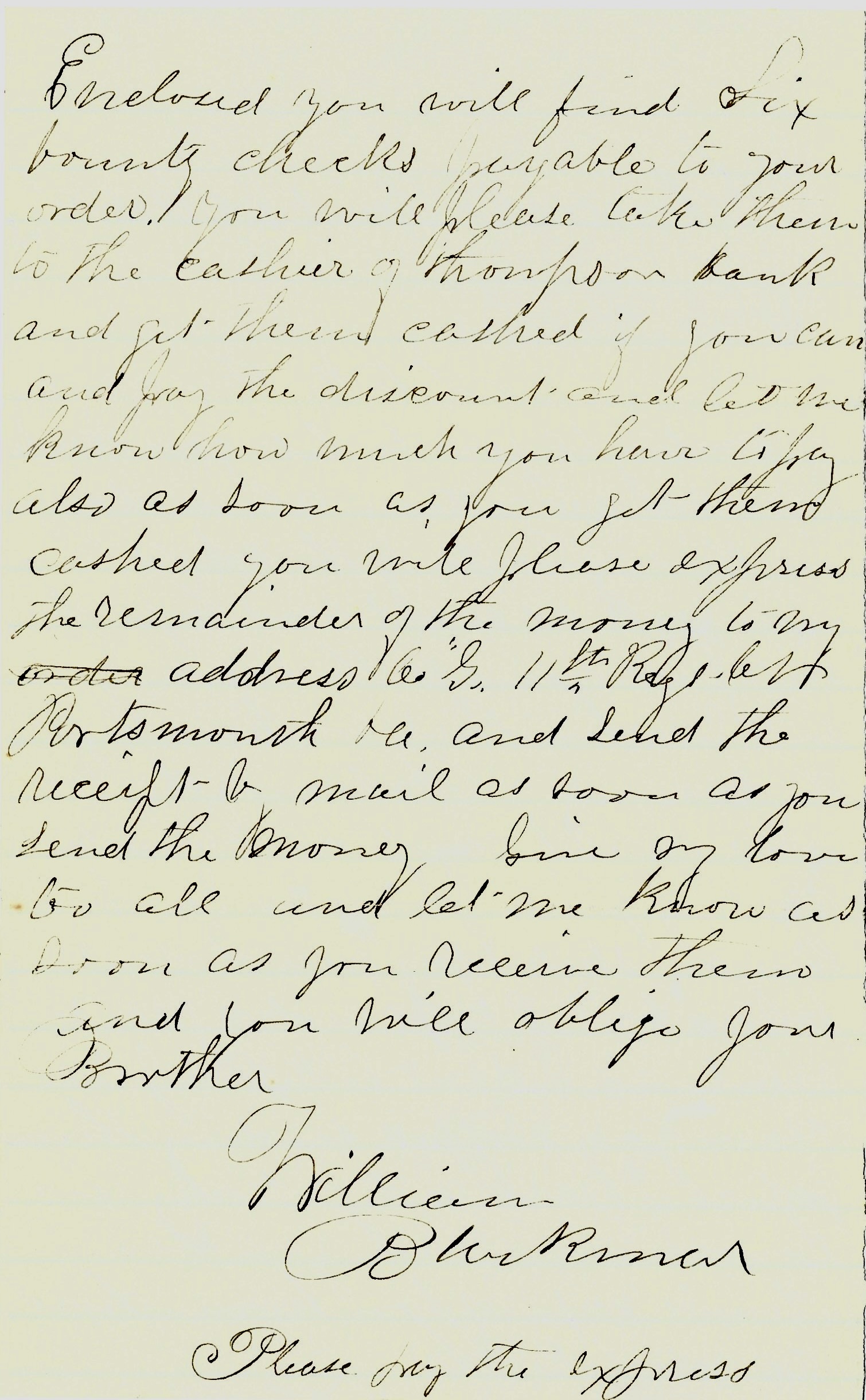
Enclosed you will find six bounty checks payable to your order. You will please take them to the cashier of Thompson Bank and get them cashed if you can adn pay the discount and let me know how much you have to pay. Also as soon as you can get them cashed, you will please express the remainder of the money to my address:
Co. G, 11th Regt. C. V., Portsmouth, Va.
and send the receipt by mail as soon as you send the money. Give my love to all and let me know as soon as you receive them and you will oblige your brother, — William Blackmar
Please pay the express.
Letter 11
Gloucester Point, Virginia
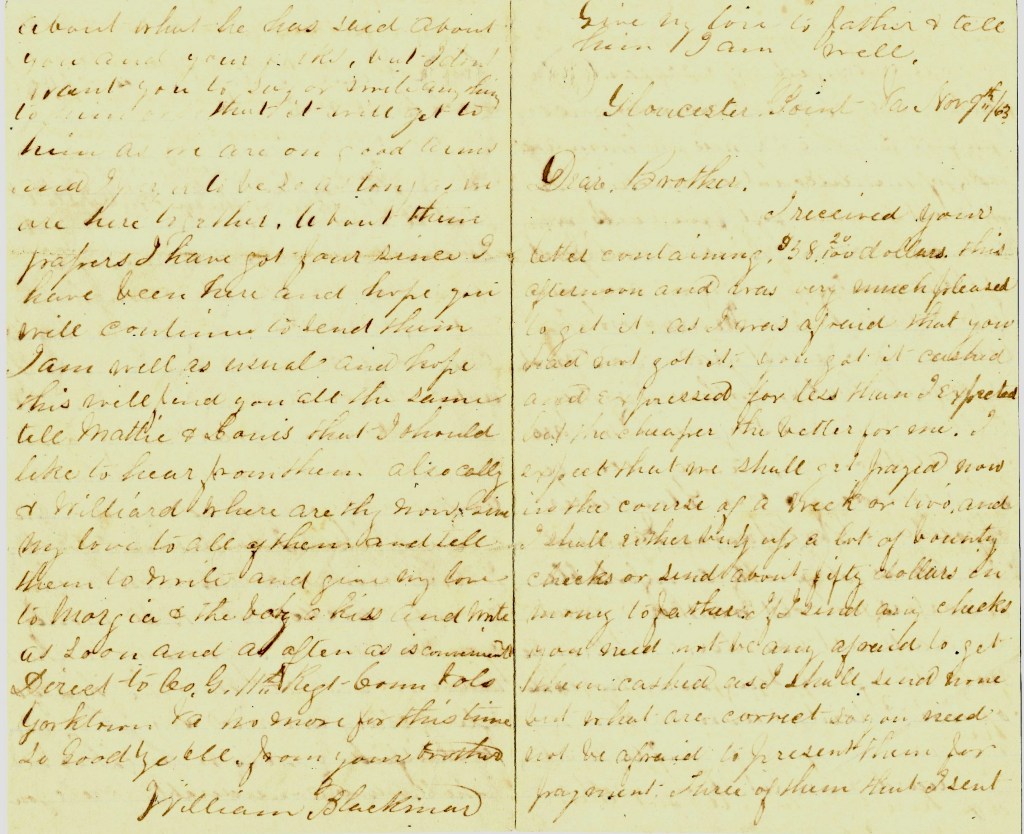
November 9th 1863
Dear Brother,
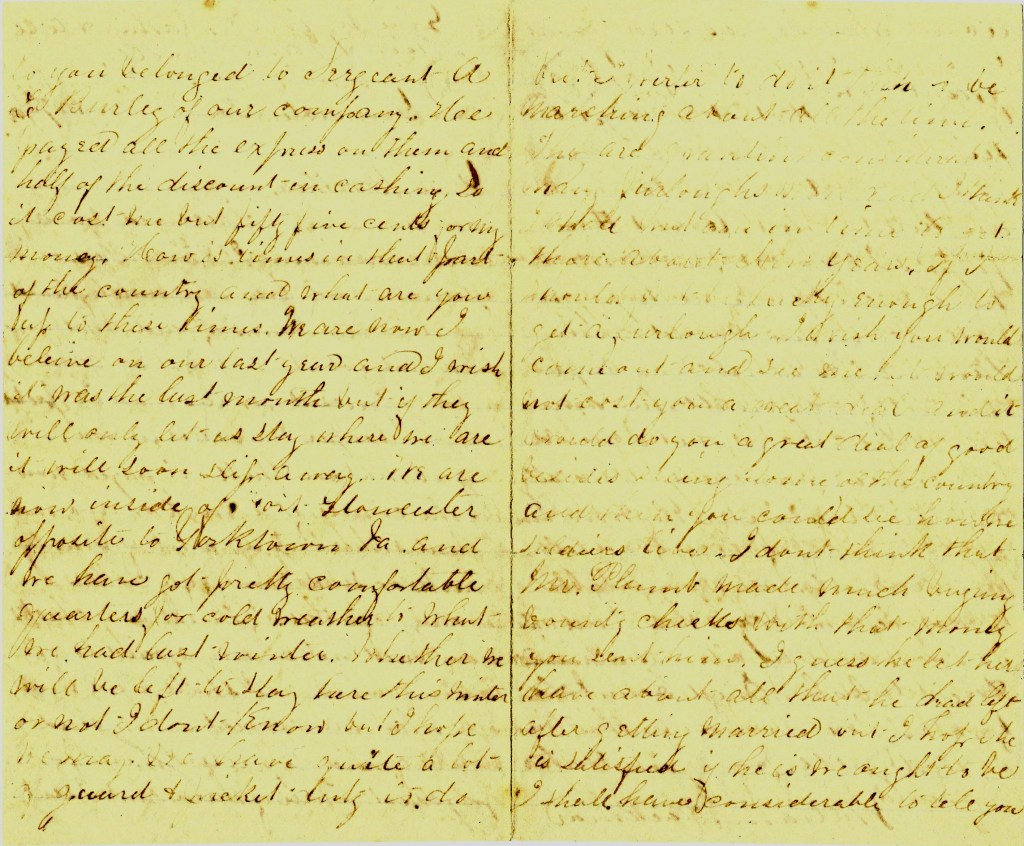
I received your letter containing $8.20 dollars this afternoon and was very much pleased to get it as I was afraid that you had not got it. You got it cashed and expressed for less than I expected but the cheaper the better for me. I expect that we shall get paid now in the course of a week or two and I shall either buy up a lot of bounty checks or send about fifty dollars in money to father. If I send my checks, you need not be any afraid to get them cashed as I shall send none but what are correct so you need not be afraid to present them for payment. Three of them that I sent you belonged to Sergeant A. Burley of our company. He paid all the express on them and half of the discount in cashing so it cost me but fifty-five cents for my money.
How is times in that part of the country and what are you up to these times? We are now, I believe, on our last year and I wish it was the last month but if they will only let us stay where we are, it will soon slip away. We are now inside of Point Gloucester opposite Yorktown, Va. and we have got pretty comfortable quarters for cold weather to what we had last winter. Whether we will be left to stay here this winter or not, I don’t know but I hope we may. We have quite a lot of guard & picket duty to do but prefer to do it rather than marching about all the time. I am hoping to get a furlough but if I cannot, i wish you would come out and see me, it would not cost you very dear and it would do you a great deal of good besides seeing some of he country and then you could see how the soldiers live.
I don’t think that Mr. Plumb made much buying bounty checks with that money you sent him. I guess he let his have about all that he had left after getting married and I hope he is satisfied, If he is, we ought to be, I shall have considerable to tell you about what he has said about you and your folks, but I don’t want you to say or write anything to him as we are on good terms and I want to be so as long as we are here together.
About them papers, I have not got yours since I have been here and hope you will continue to send them. I am well as usual and hope this will find you all the same. Tell Mattie and Louis that I should like to hear from them. Also Cally and Willard—where are they now? Give my love to all of them and tell them to write and give my love to Morgia & the boys. Direct to Co. G, 11th Regt. Conn. Vols., Yorktown, Va. No more for this time. So goodbye to all. From your brother, — William Blackmar
Letter 12
Gloucester Point, Virginia
November 13, 1863
Dear Brother,
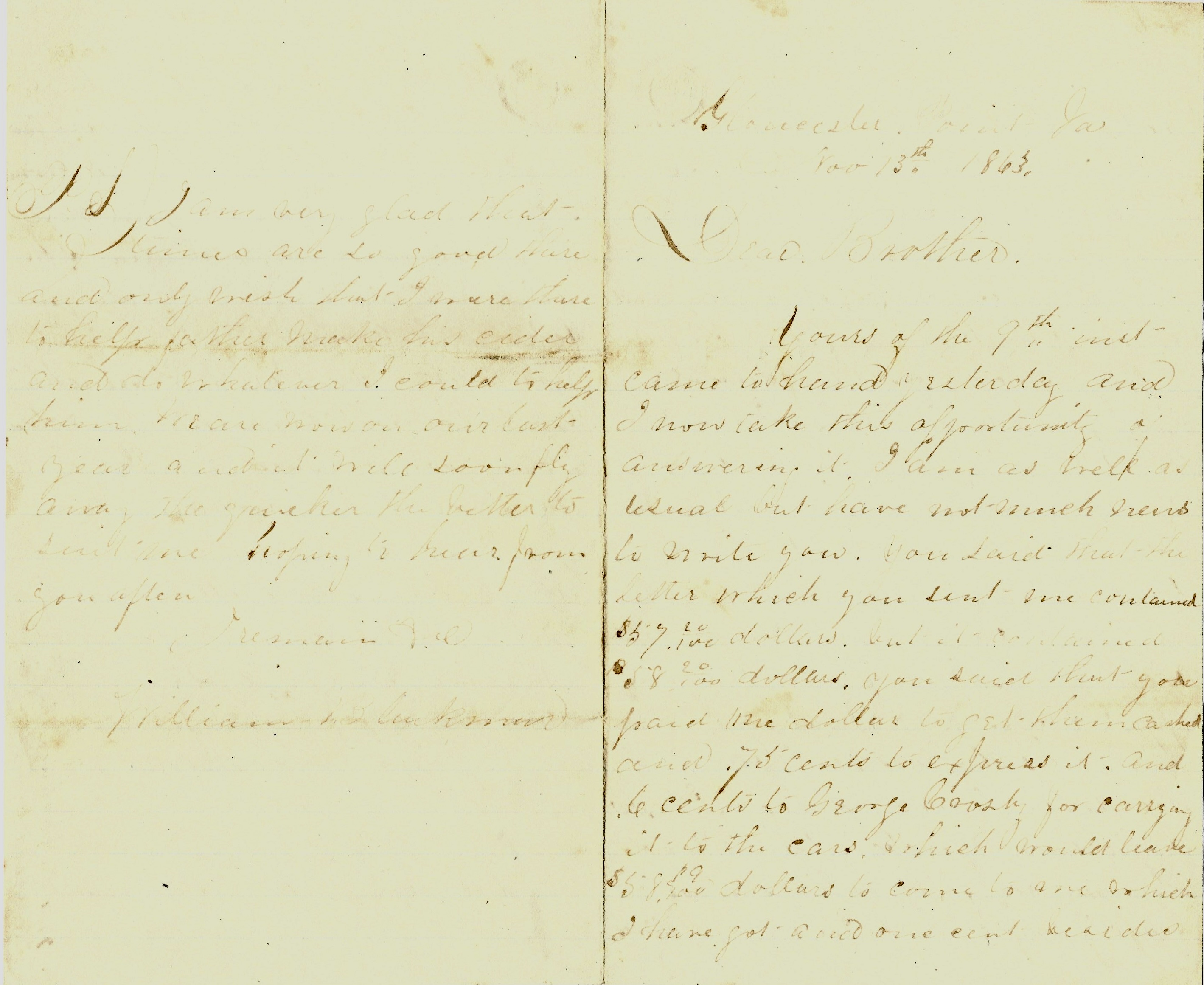
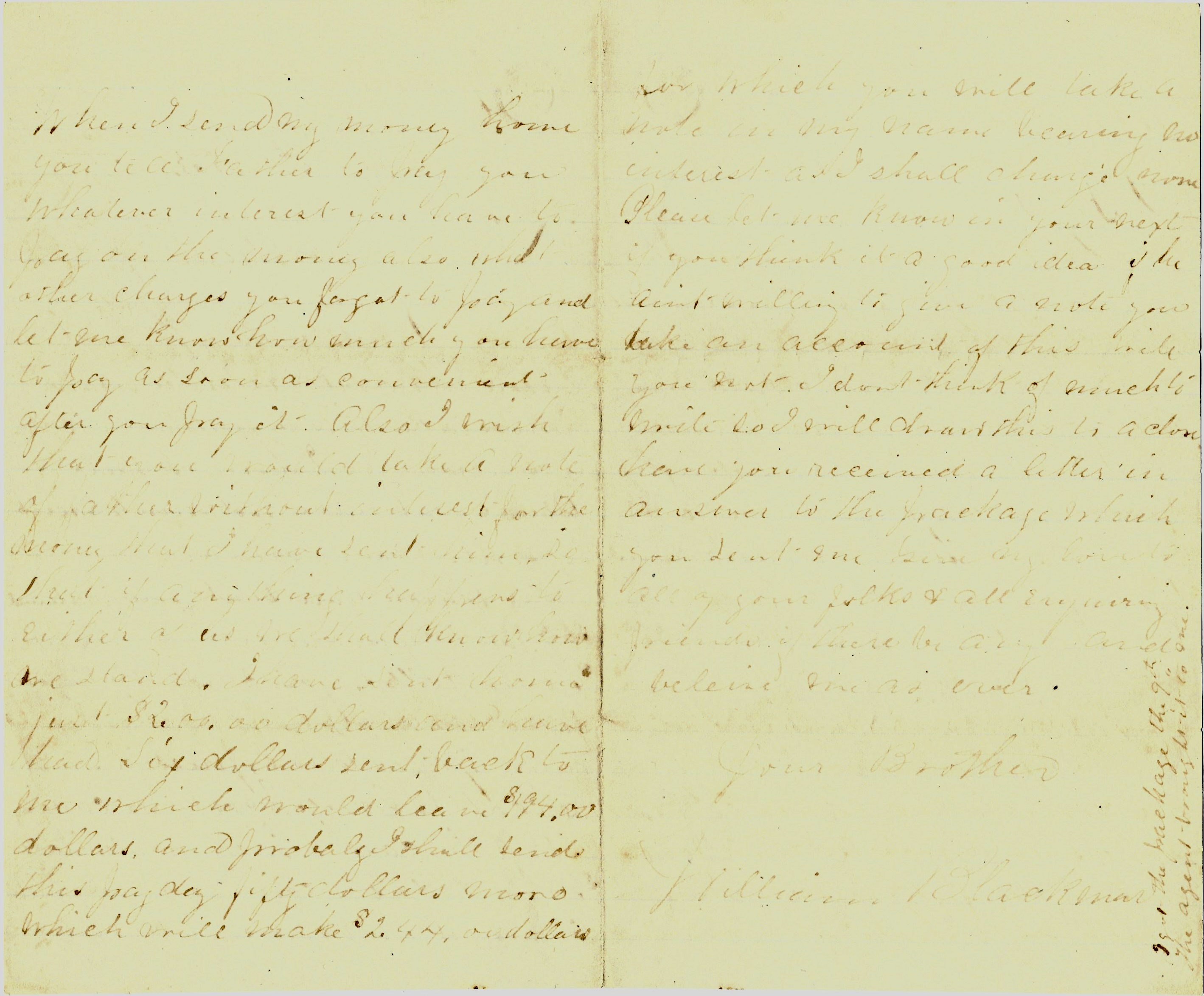
Yours of the 9th inst. came to hand yesterday and I now take this opportunity of answering it. I am as well as usual but have not much news to write you. You said that the letter which you sent me contained $57.20 but it contained $58.20. You said that you paid one dollar to get them cashed and 75 cents to express it and 6 cents to George Crosby for carrying it to the cars which would leave $58.19 to come to me which I have got and one cent besides. When I send my money home, you tell father to pay you whatever interest you have to pay on the money and and what other charges you forgot to pat and let me know how much you have to pay as soon as convenient after you pay it. Also I wish that you would take a note of father without interest for the money that I have sent him so that if anything happens to either of us we shall know how we stand. I have sent home just $200 and have had six dollars sent back to me which would be $194 and probably I shall send this payday fifty dollars more which will make $244 for which you will take note in my name bearing no interest and I shall charge none.
Please let me know in your next if you think it a good idea. If he ain’t willing to give a note, you take an account of this, will you not?
I don’t think of much to write so I will draw this to a close. Have you received a letter in answer to the package which you sent me? Give my love to your folks and all enquiring friends, if there be any. and believe me as ever your brother, — William Blackmar
P. S. I am very glad that times are so good there and only wish that I were there to help father make cider and do whatever I could to help him. We are now on our last year and it will soon fly away. The quicker the better to suit me. Hoping to hear from you often. I remain, — William Blackmar
Letter 13
Wallingford. Connecticut
February 22, 1864
Dear Brother,
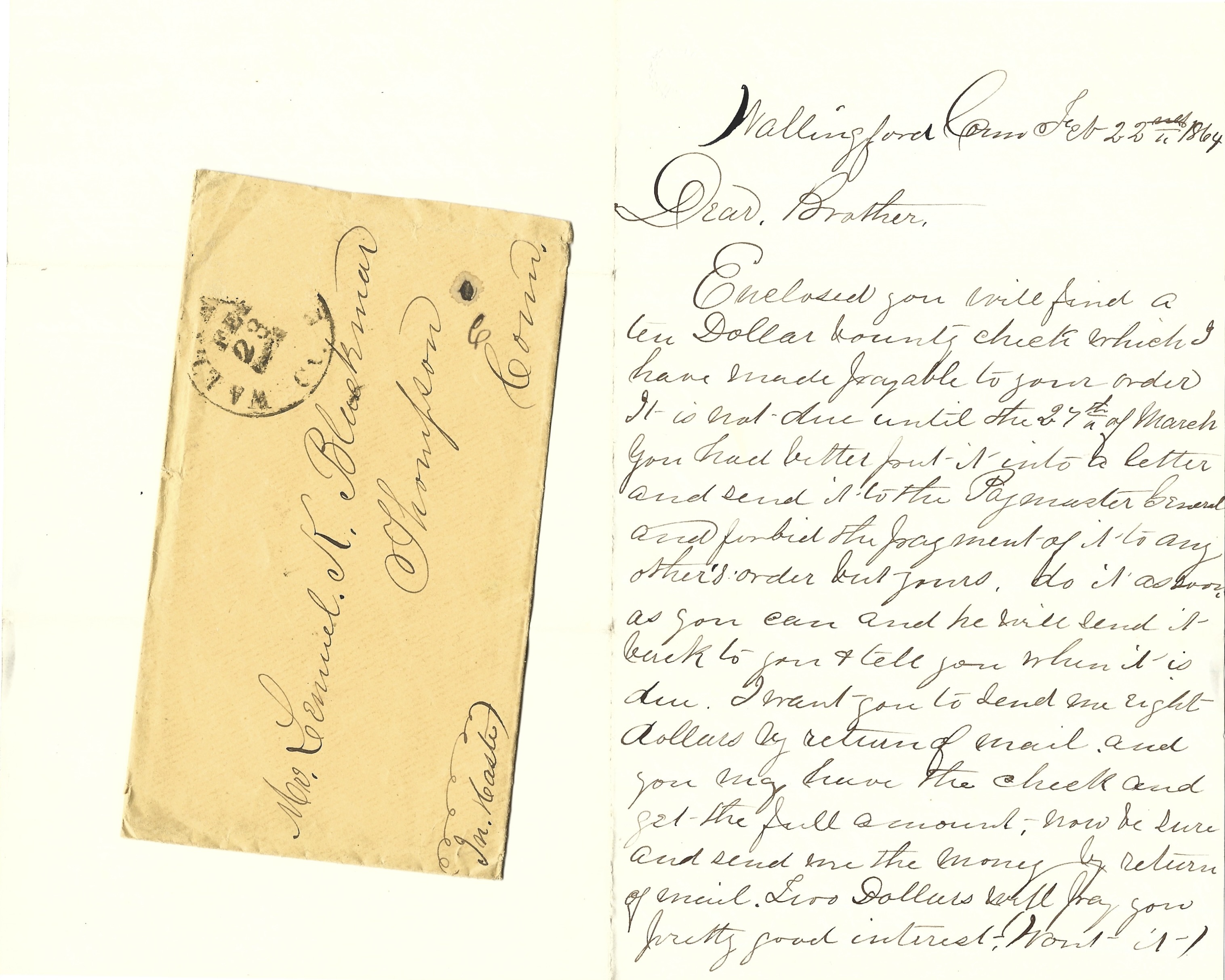
Enclosed you will find a ten dollar bounty check which i have made payable to your order. It is not due until the 27th of March. You had better put it into a letter and send it to the Postmaster General and forbid the payment of it to any other’s order but yours. Do it as soon as you can and he will send it back to you and tell you when it is due. I want you to send me eight dollars by return mail and you may have the check and the full amount. Now be sure and send me the money by return of mail. Two dollars will pay you pretty good interest (won’t it?).
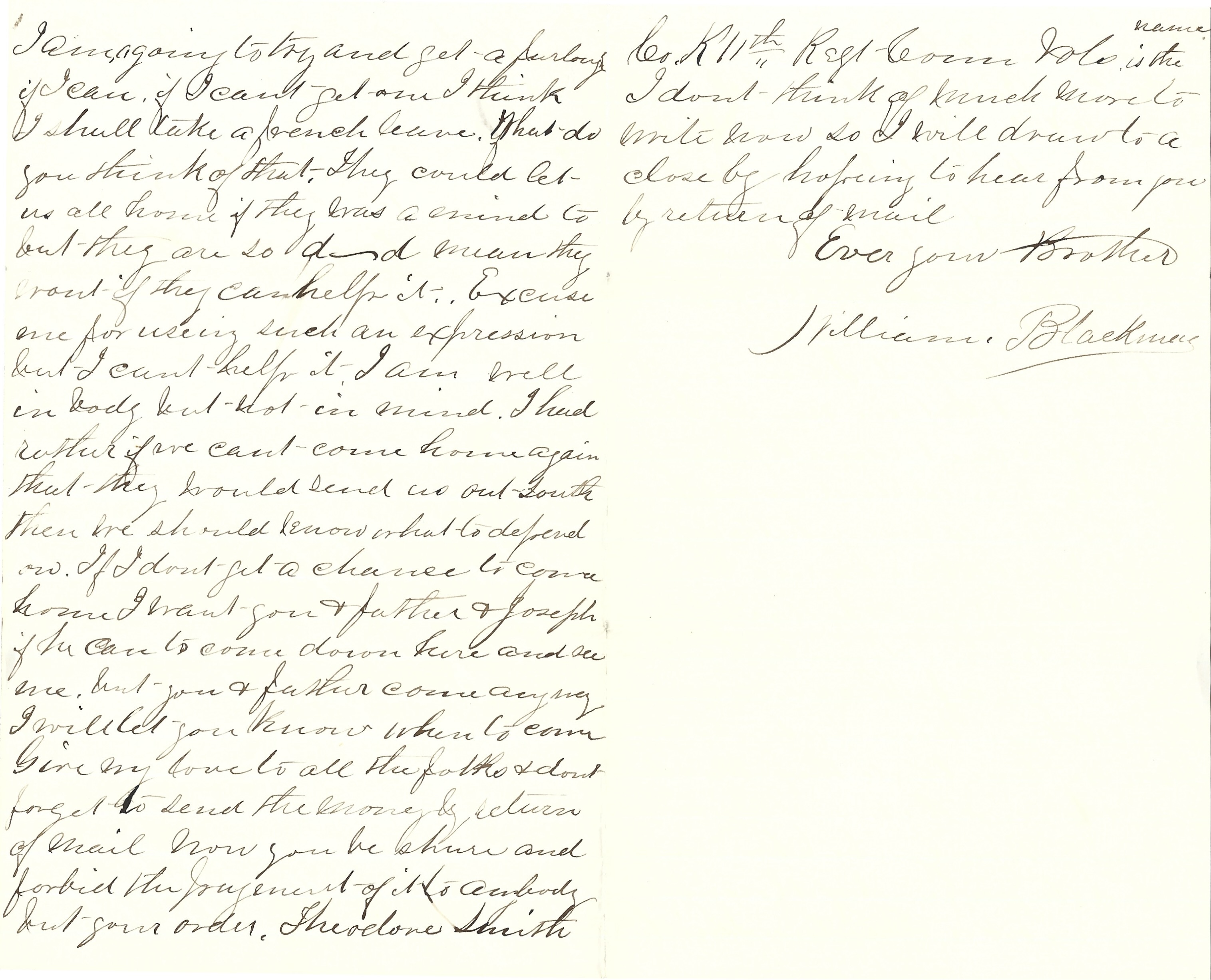
I am going to try and get a furlough if I can. If I can’t get one, I think I shall take a French leave. What do you think of that? They could let is all [go] home if they had a mind to but they are so damned mean they won’t if they can help it. Excuse me for using such an expression but I can’t help it. I am well in body but not in mind. I had rather if we can’t come home again that they would send us out South. Then we should know what to depend on. If I don’t get a chance to come home, I want you and father & Joseph if he can to come down here and see me. But you and father come anyway. I will let you know when to come.
Give my love to all the folks and don’t forget to send the money by return of mail. Now you be sure and forbid the payment of it to anybody but your order. Theodore Smith, Co. K, 11th Regt. Conn. Vols. is the name.
I don’t think of much more to write so I will draw to a close by hoping to hear from you by return of mail. Ever your brother, — William Blackmar
Letter 14
Wallingford, Connecticut
February 25, 1864
Dear Brother,
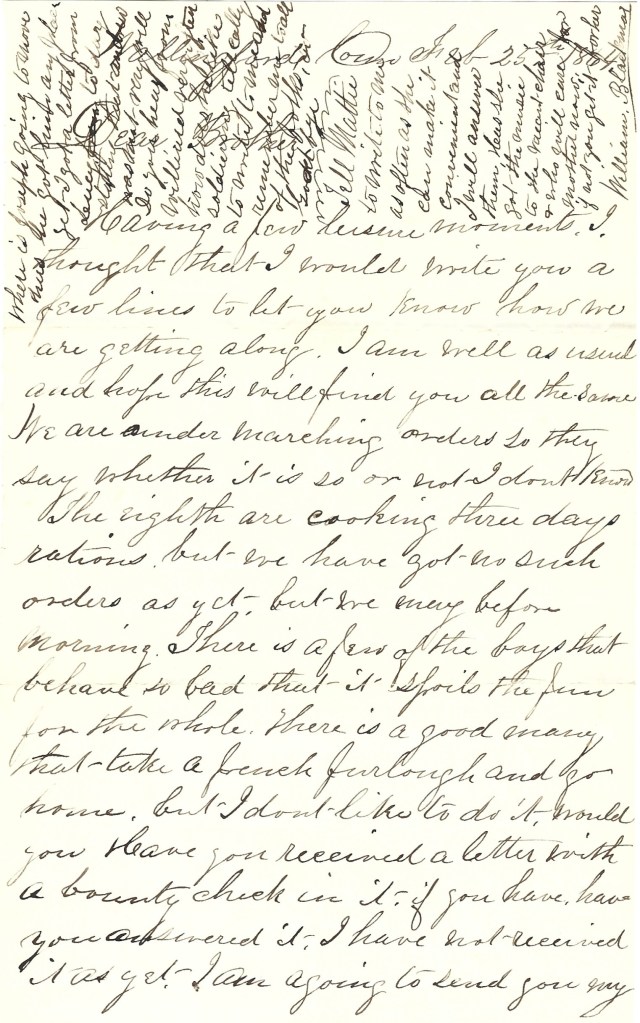
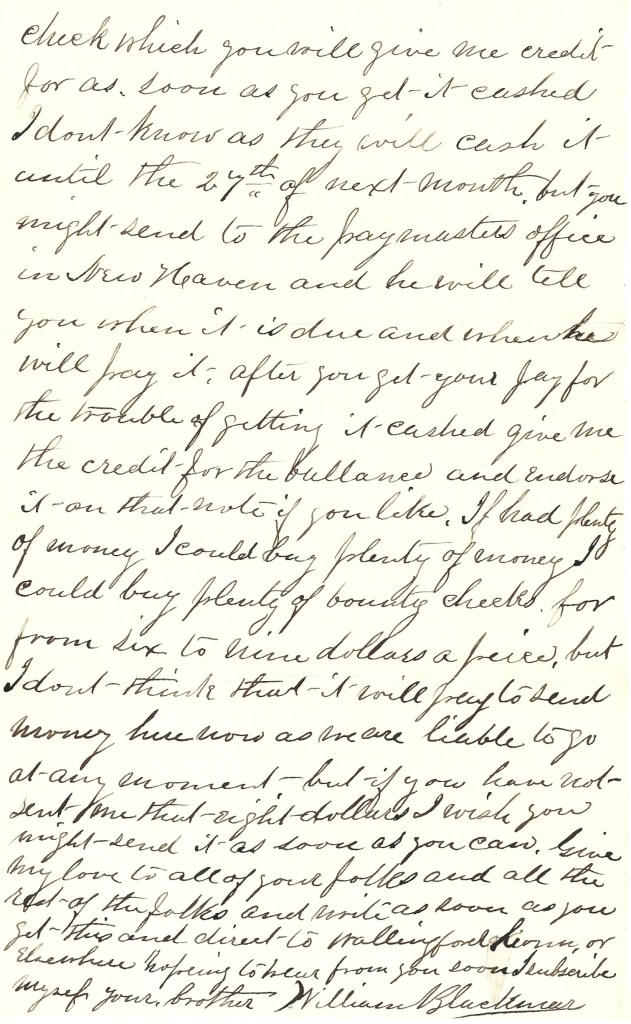
Having a few leisure moments, I thought that I would write you a few lines to let you know how we are getting along. I am well as usual and hope this will find you all the same. We are under marching orders so they say. whether it is so or not, I don’t know. The Eighth are cooking three days rations but we have got no such orders as yet, but we may before morning. There is a few of the boys that behave so bad that it spoils the fun for the whole. There is a good many that take a french furlough and go home, but I don’t like to do it, would you?
Have you received a letter with a bounty check in it? If you have, have you answered it? I have not received it as yet. I am going to send you my check which you will give me credit for as soon as you get it cashed. I don’t know as they will cash it until the 27th of next month but you might send to the paymasters office in New Haven and he will tell you when it is due and when he will pay it. After you get your pay for the trouble of getting it cashed, give me the credit for the balance and endorse it on that note if you like. If I had plenty of money, I could buy plenty of bounty checks for from six to nine dollars apiece, but I don’t think that it will pay to send money here now as we are liable to go at any moment. But if you have not sent me that eight dollars, I wish you might send it as soon as you can.
Give my love to all the rest of the folks and write as soon as you get this and direct to Wallingford, Connecticut, or elsewhere. Hoping to hear from you soon, I subscribe myself your brother, — William Blackmar
Where is Joseph going to move? Has he got him any place yet? I got a letter from Lucy today stating that Andrew was not very well. Do you hear from Willard very often? How does he like soldiering. Tell Cally to write to me and remember me to all of the folks. So goodbye.
Tell Mattie to write to me as often as she can make it convenient and I will answer them. Has she got the music to “The Vacant Chair?” and “Who will care for Mother now?” If not, you get it for her. — William Blackmar
Letter 15
Wellingford, Connecticut
February 26, 1864
Dear Brother,
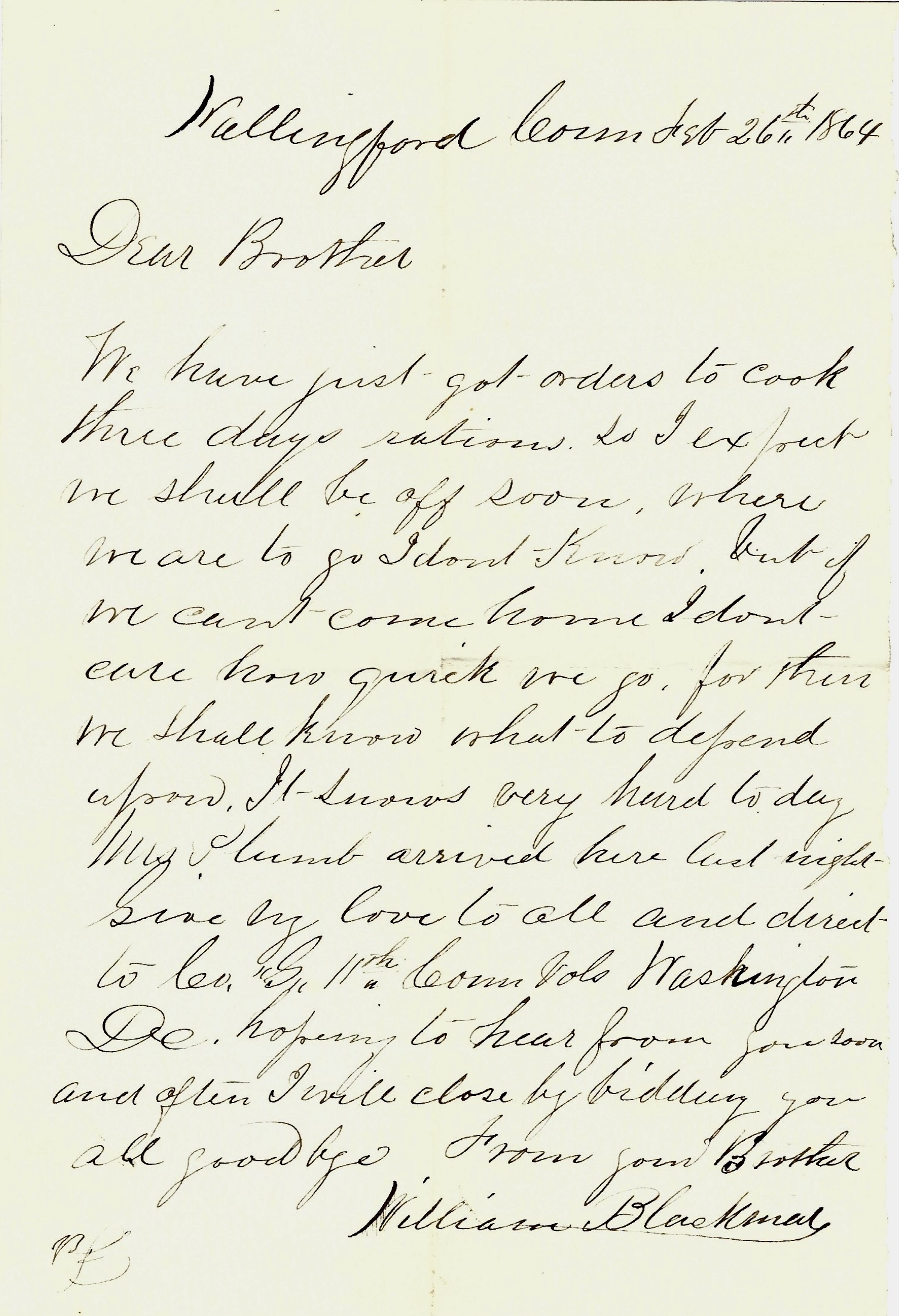
We have just got orders to cook three days rations so I expect we shall be off soon. Where we are to go, I don’t know. But if we can’t come home, I don’t care how quick we go for then we shall know what to depend upon. It snows very hard today.
Mrs. Pumb arrived here last night.
Give my love to all and direct to Co. G, 11th Conn. Vols., Washington D. C. Hoping to hear from you soon and often, I will close by bidding you all goodbye. From your brother, — William Blackmar
Letter 16
Wallingford, Connecticut
February 26th 1864
Dear Brother & Sister,
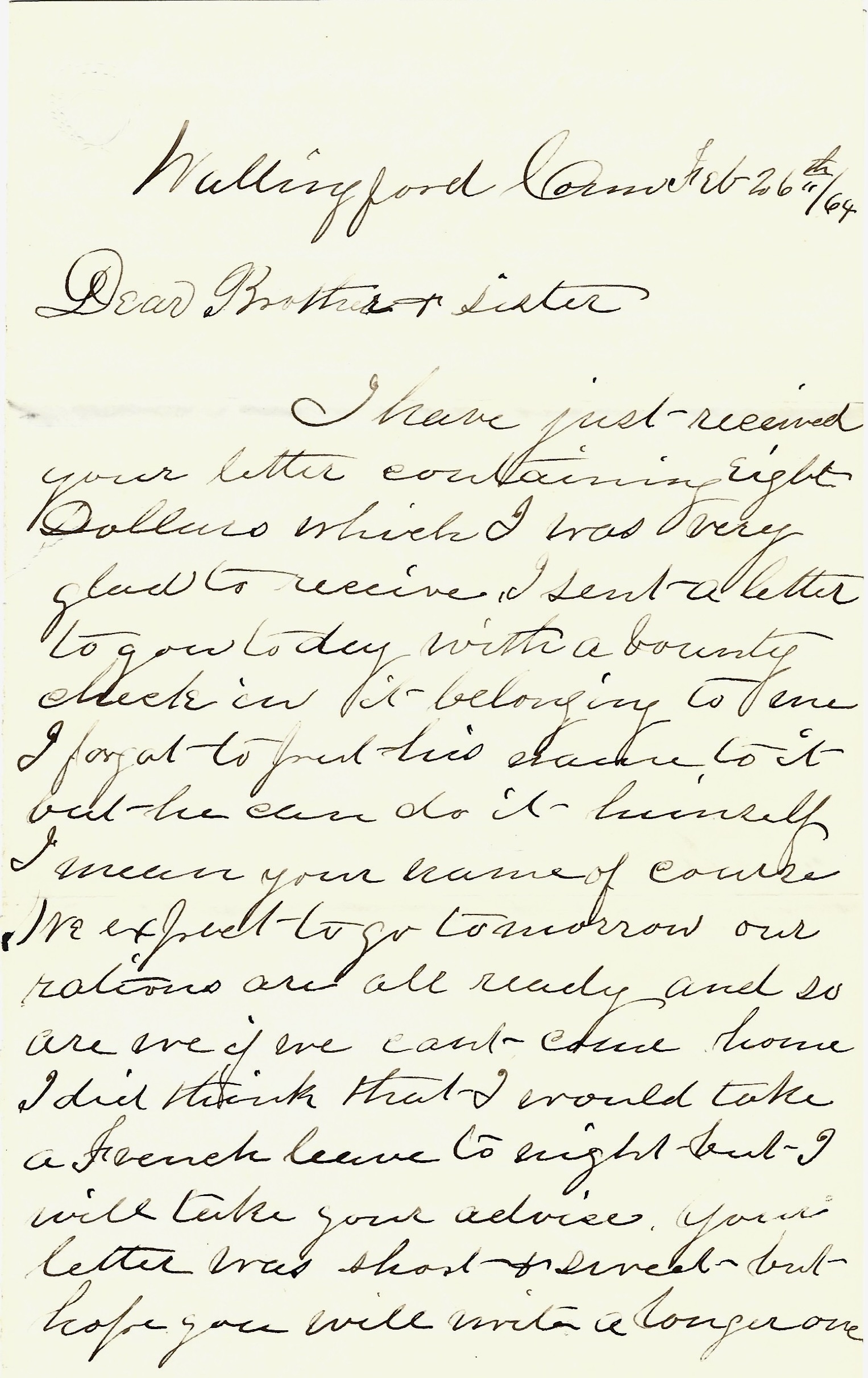
I have just received your letter containing eight dollars which I was very glad to receive. I sent a letter to you today with a bounty check in it belonging to me. I forgot to put his name to it but he can do it himself. I mean your name of course.
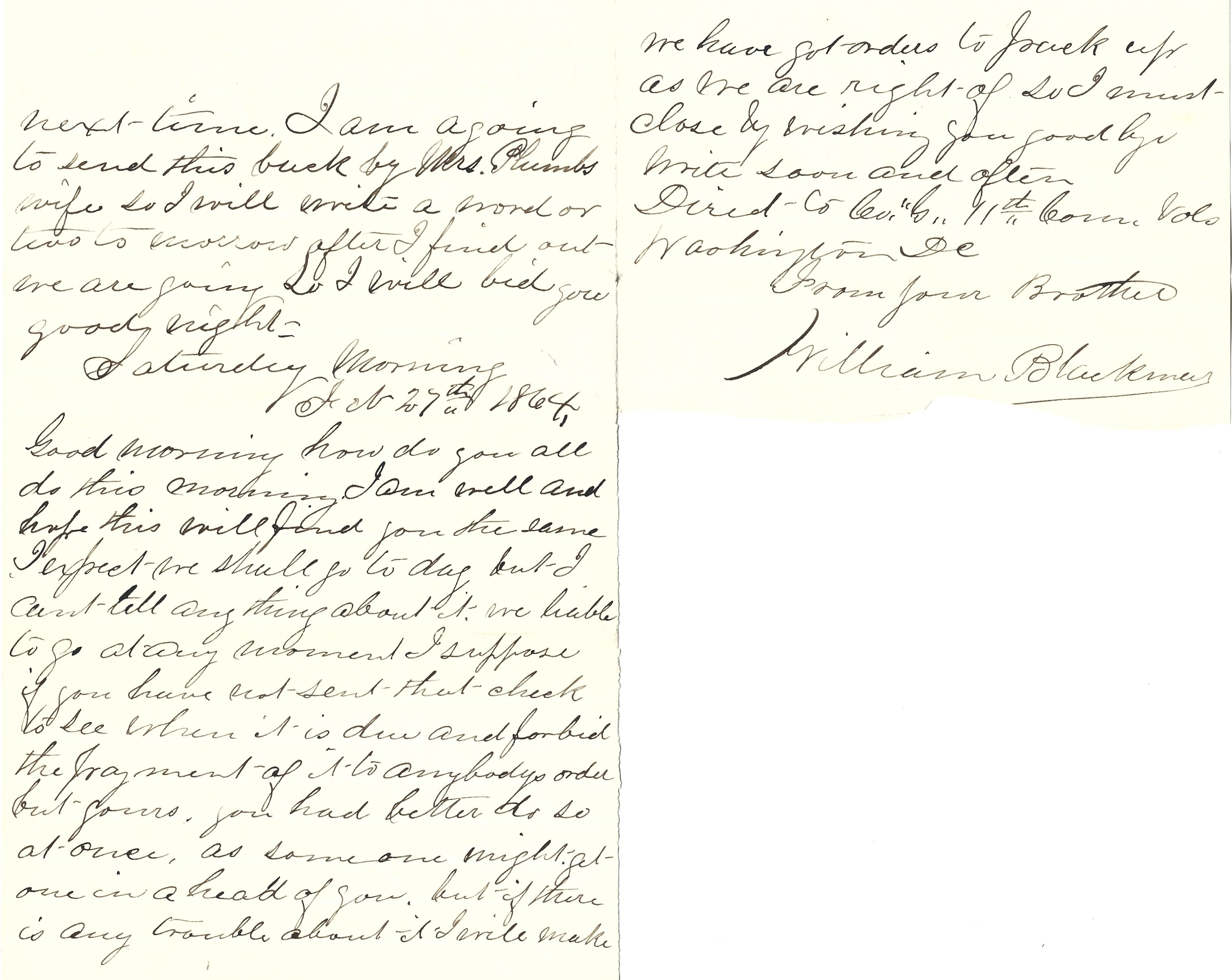
We expect to go tomorrow. Our rations are all ready and so are we if we can’t come home. I did think that I would take a French leave tonight but I will take your advice. Your letter was short & sweet but hope you will write a longer one next time. I am agoing to send this buck by Mr. Plumb’s wife so I will write a word or two tomorrow after I found out we are going. So I will bid you good night.
Saturday morning, February 27, 1864
Good morning. How do you all do this morning? I am well and hope this will find you the same. I expect we shall go today but I can’t tell anything about it. We [are] liable to go at any moment, I suppose. If you have not sent that check to see when it is due and forbid the payment of it to anybody’s order but yours, you had better do so at once as someone might get one in ahead of you. But if there is any trouble about it, I will make [it good].
We have got orders to pack up as we are right off so I must close by wishing you goodbye. Write soon and often.
Direct to Co. G, 11th Conn. Vols., Washington D. C.
From your brother, — William Blackmar
Letter 17
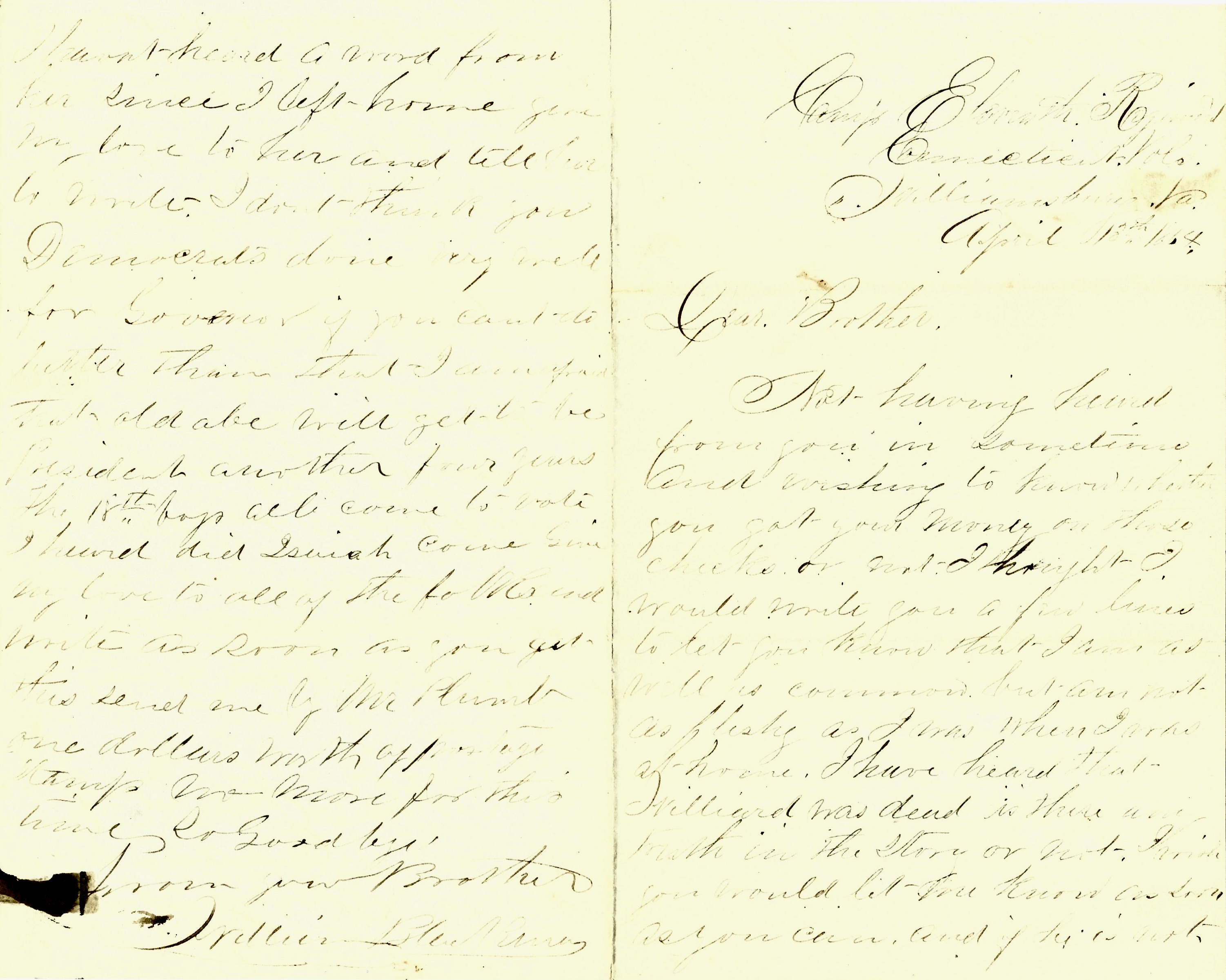
Camp Eleventh Regiment Connecticut Vols.
Williamsburg, Virginia
April 13th 1864
Dear Brother,
Not having heard from you in sometime time and wishing to know whether you got your money on those checks or not, I thought I would write you a few lines to let you know that I am as well as common but am not as fleshy as I was when I was at home. I have heard that Willard was dead. Is there any truth in the story or not? I wish you would let me know as soon as you can and if he is not dead, give me his address so I can write to him.
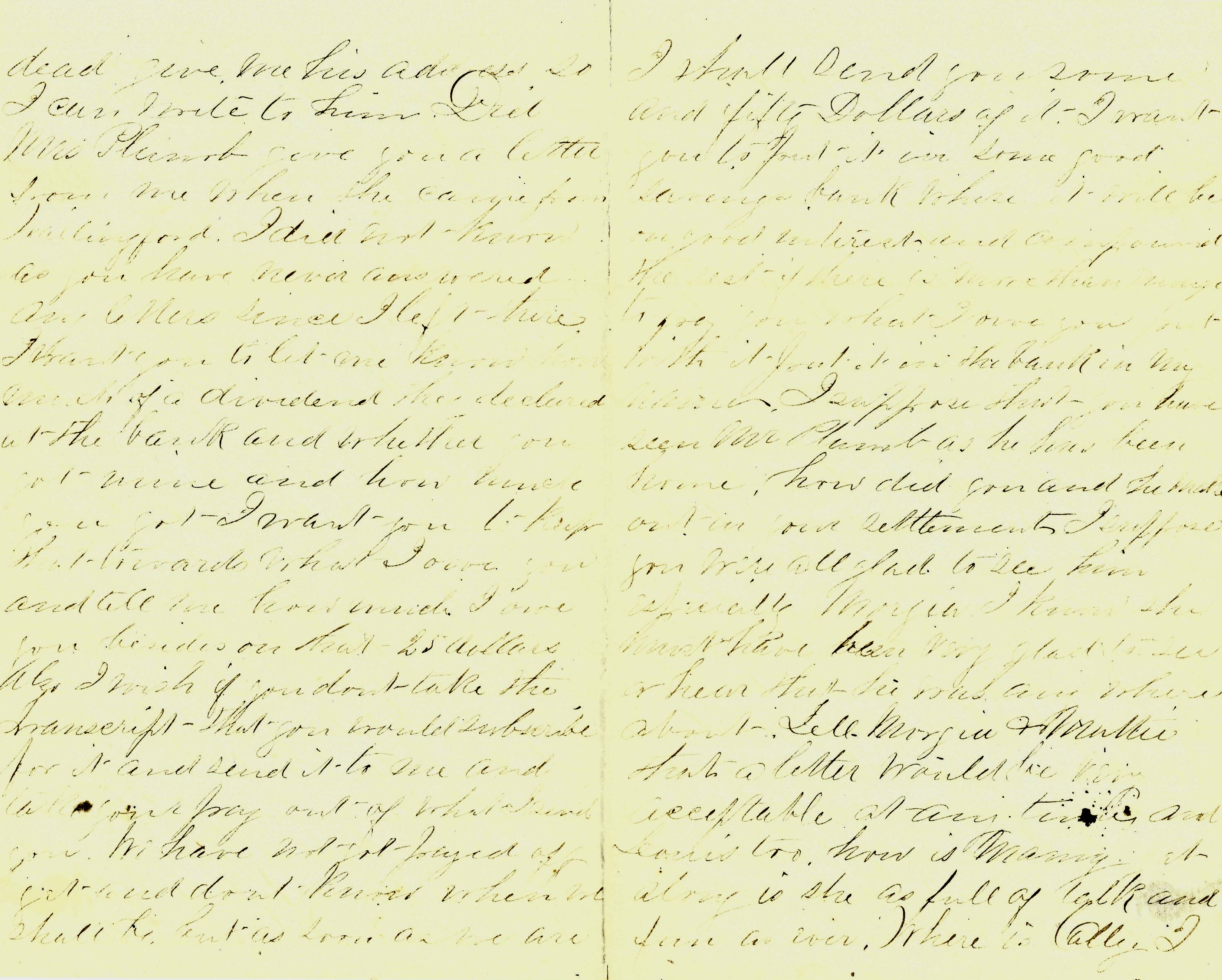
Did Mrs. Plumb give you a letter from me when she came from Wellingford? I did not know as you have never answered any letters since I left there. I want you to let me know how much of a dividend they declared at the bank and whether you got mine and how much you got. I want you to keep that towards what I owe you and tell me how much I owe you besides on that 25 dollars also, I wish if you don’t take the Transcript that you would subscribe for it and send it to me and take your pay out of what I send you. We have not got paid off yet and don’t know when we shall but as soon as we are I shall send you some and fifty dollars of it I want you to put in in some good savings bank where it will be on good interest and compound the rest if there is more than enough to pay you what I owe you. Put it in the bank with my name.
I suppose that you have seen Mr. Plumb as he has been home. How did you and he make out in your settlement? I suppose you were all glad to see him—especially Morgia. I know she must have been very glad to see and hear that he was anywhere about. Tell Morgia & Mattie that a letter wouyld be very acceptable at any time and Louis too. His is Mamy get along? Is she as full of talk and fun as ever? Where is Cally? I haven’t heard a word from her since I left home. Give my love to her and tell her to write.
I don’t think you Democrats done very well for Governor. If you can’t do better than that, I am afraid that Old Abe will get to be President another four years. The 18th [Connecticut] boys all come to vote. I heard that Isaiah came. Give my love to all of the folks and write as soon as you get this. Send me by Mr. Plumb one dollar’s worth of postage stamps. No more for this time. Goodbye. From your brother, — Willam Blackmar
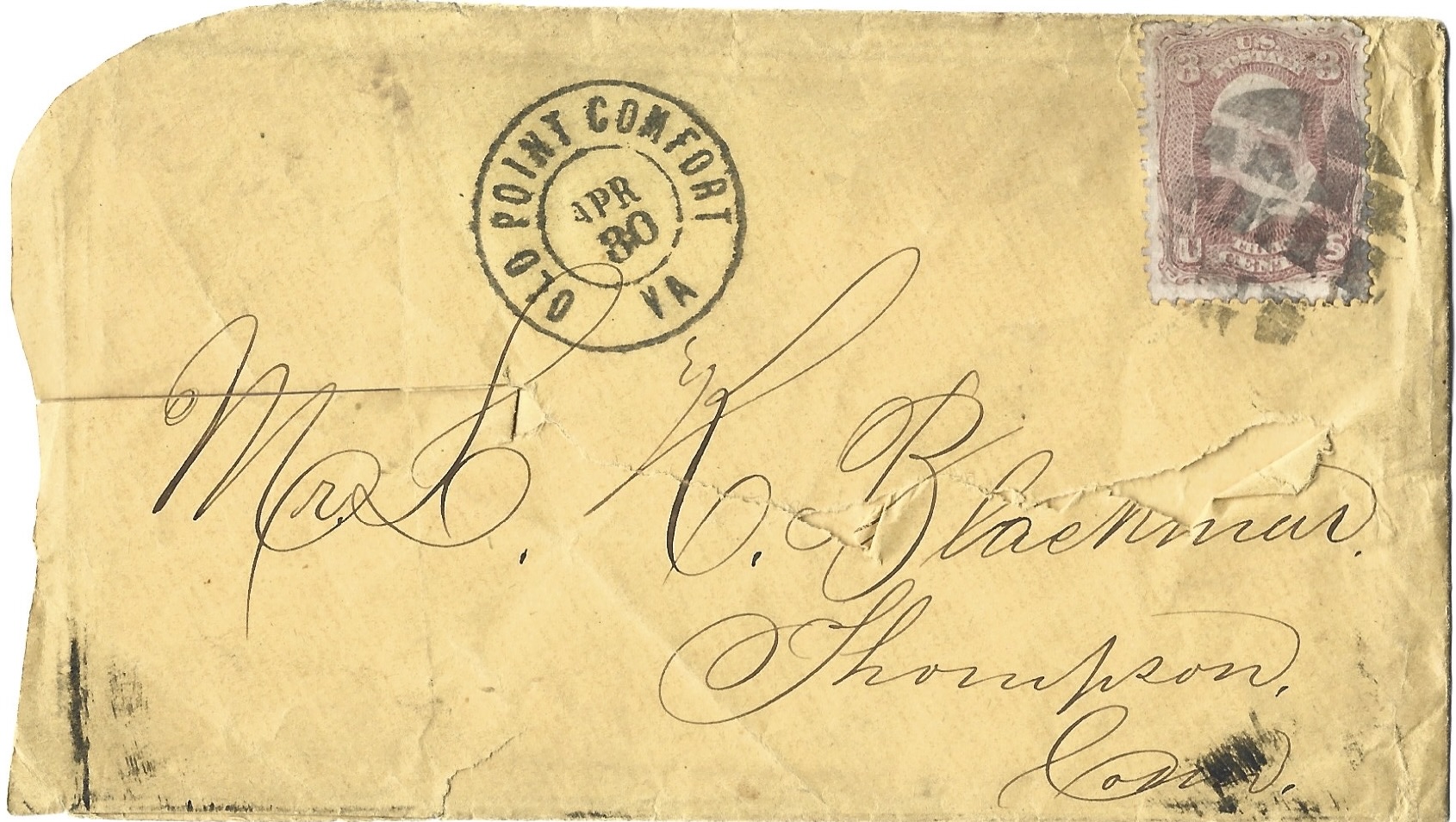
Letter 18
Camp Eleventh Conn. Vols.
Williamsburg, Va.
April 28th 1864
Dear Brother,
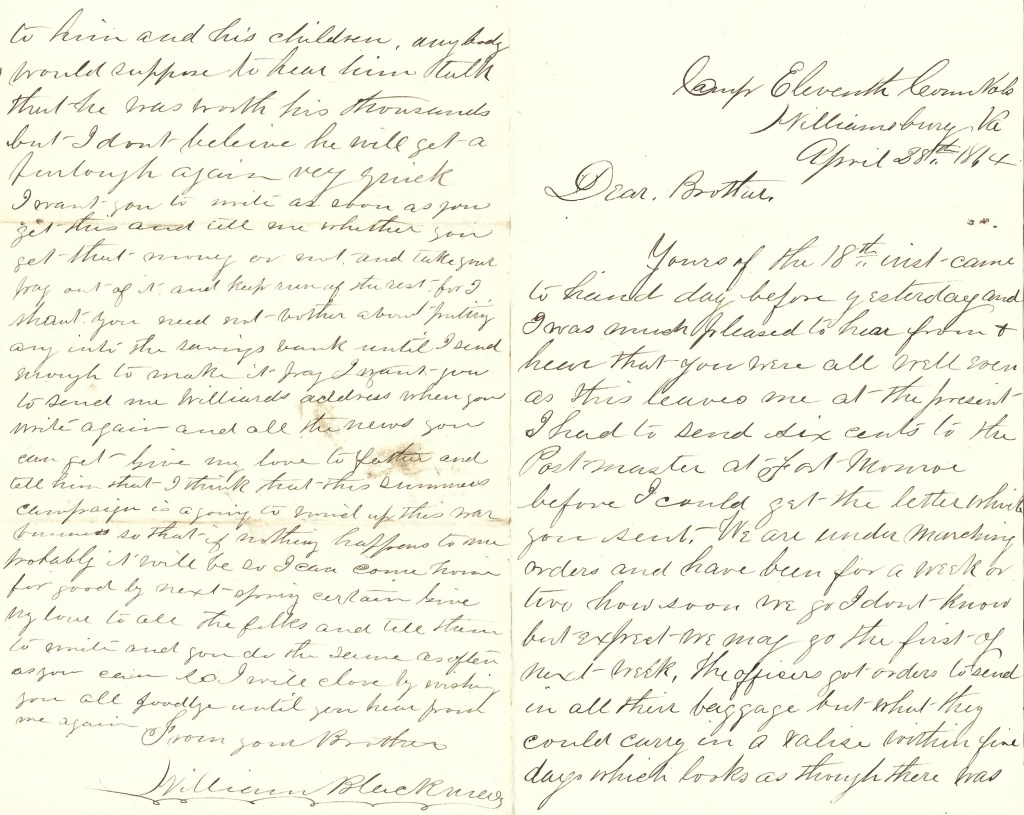
Yours of the 18th instead. came to hand day before yesterday and I was much pleased to hear from [you] and hear that you were all well even as this leave me at the present. I had to send six cents to the postmaster at Fort Monroe before I could get the letter which you sent.
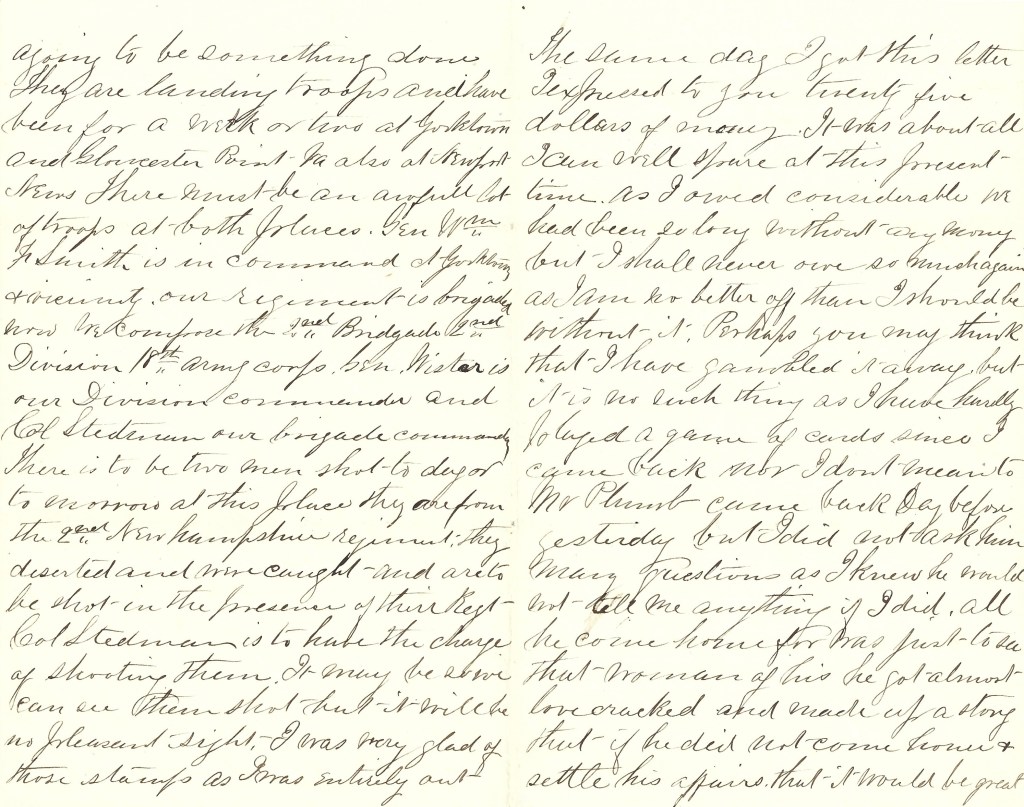
We are under marching orders and have been for a week or two. How soon we may go, I don’t know but expect we may go the first of next week. The officers got orders to send in all their baggage but what they could carry in a valise within five days which looks as though there was agoing to be something done. They are landing troops and have been for a week or two at Yorktown and Gloucester Point, Va.; also at Newport News. There must be an awful lot of troops at both places. Gen. Wm. F. Smith is in command at Yorktown & vicinity. Our regiment is brigaded now. We compose the 2nd Brigade, 2nd Division, 18th Army Corps. Gen. Wistar is our Division commander and Col. Stedman our Brigade commander.
There is to be two men shot today or tomorrow at this place. They are from the 2nd New Hampshire Regiment. They deserted and were caught and are to be shot in the presence of their regiment. Col. Stedman is to have the charge of shooting them. It may be so we can see them shot but it will be no pleasant sight.
I was very glad of those stamps as I was entirely out. The same day I got this letter, I expressed to you twenty-five dollars of money. It was about all I can well spare at this present time as I owed considerable. We had been so long without any money but I shall never owe so much again as I am no better off than I should be without it. Perhaps you may think that I have gambled it away but it is no such thing as I have hardly played a game of cards since I came back nor I don’t mean to.
Mr. Plumb came back day before yesterday but I did not ask him many questions as I knew he would not tell me anything if I did. All he came home for was just to see that woman of his. He got almost love cracked and made up a story that if he did not come home & settle his affairs that it would be great to him and his children. Anybody would suppose to hear him talk that he was worth his thousands but I don’t believe he will get a furlough again very quick.
I want you to write as soon as you get this and tell me whether you get that money or not, and take your pay out of it and keep run of the rest for I shant. You need not bother about putting any into the savings bank until I sent enough to make it pay. I want you to send me Willards address when you write again and all the news you can get. Give my love to father and tell him that I think that this summer’s campaign is a going to wind up this war business so that if nothing happens to me, probably it will be so I can come home for good by next spring certain. Give my love to all the folks and tell them to write and you do the same as often as you can. So I will close by wishing you all goodbye until you hear from me again.
From your brother, — William Blackmar
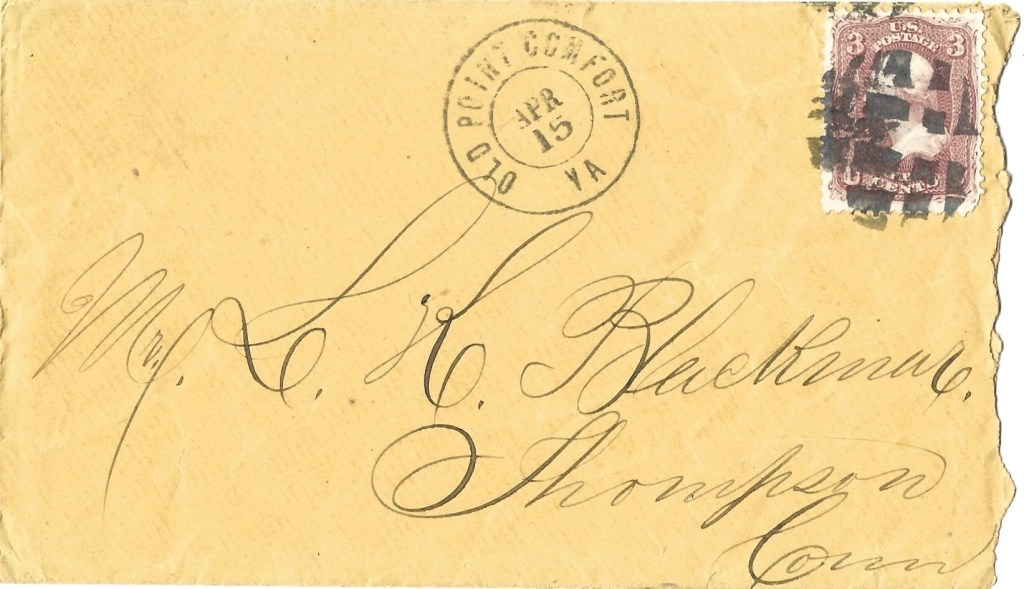
Letter 19
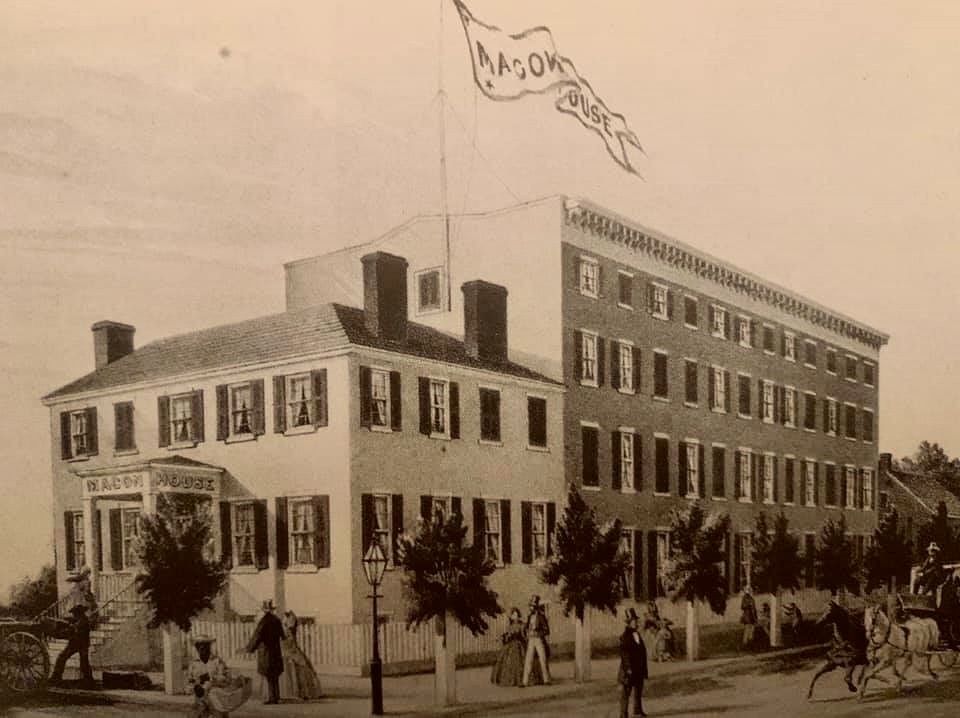
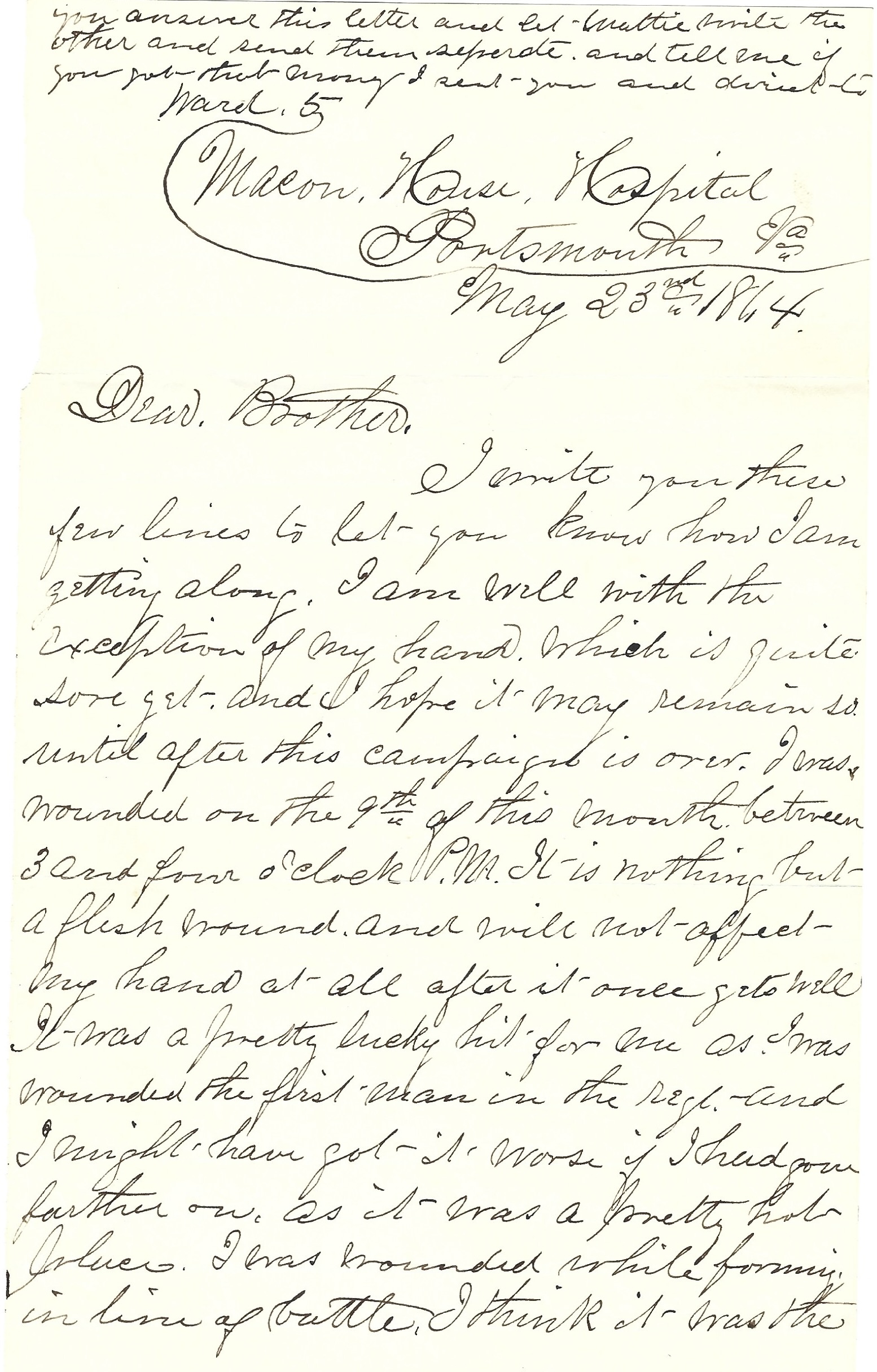
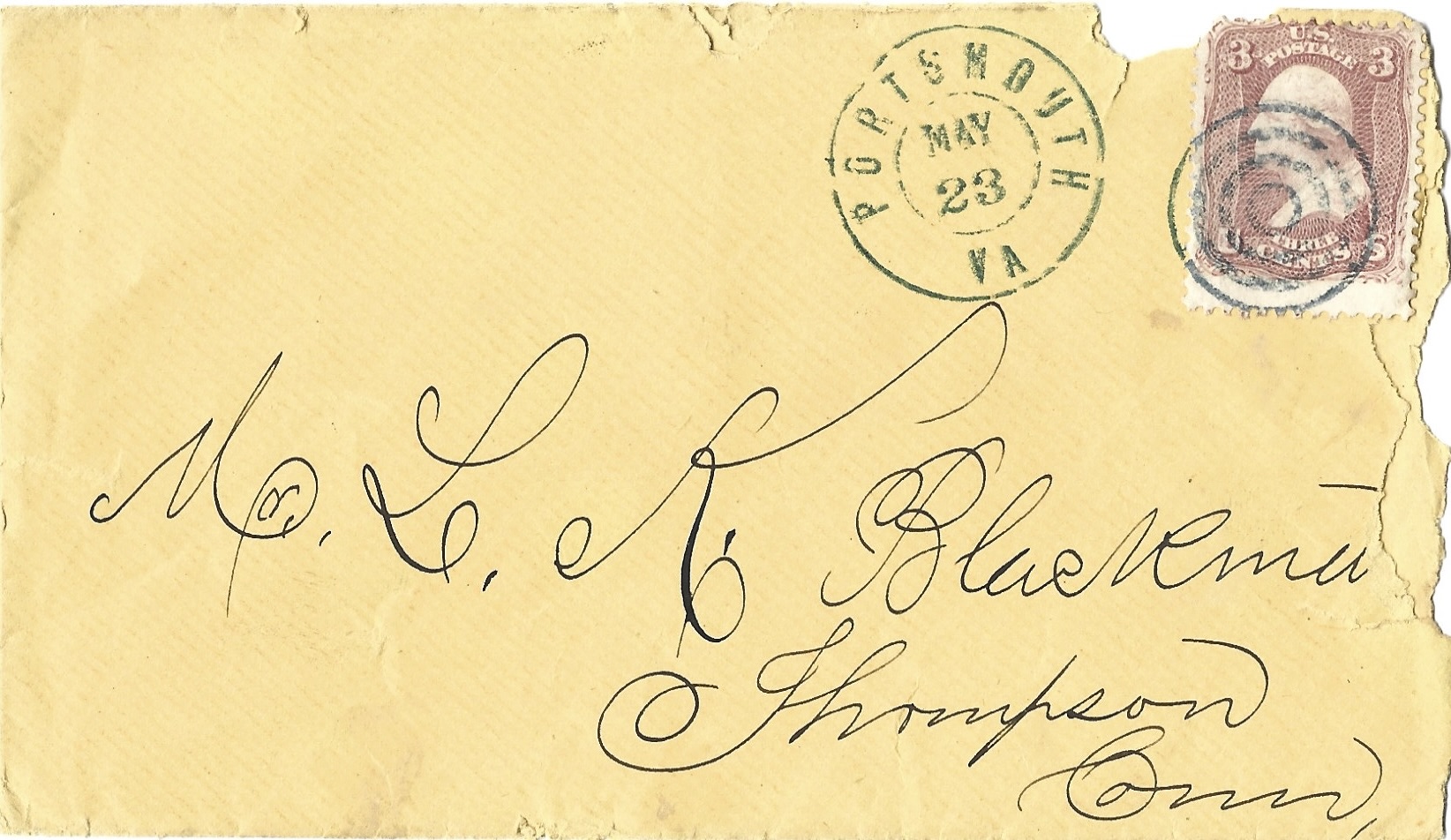
Macon House Hospital
Portsmouth, Va.
May 23, 1864
Dear Brother,
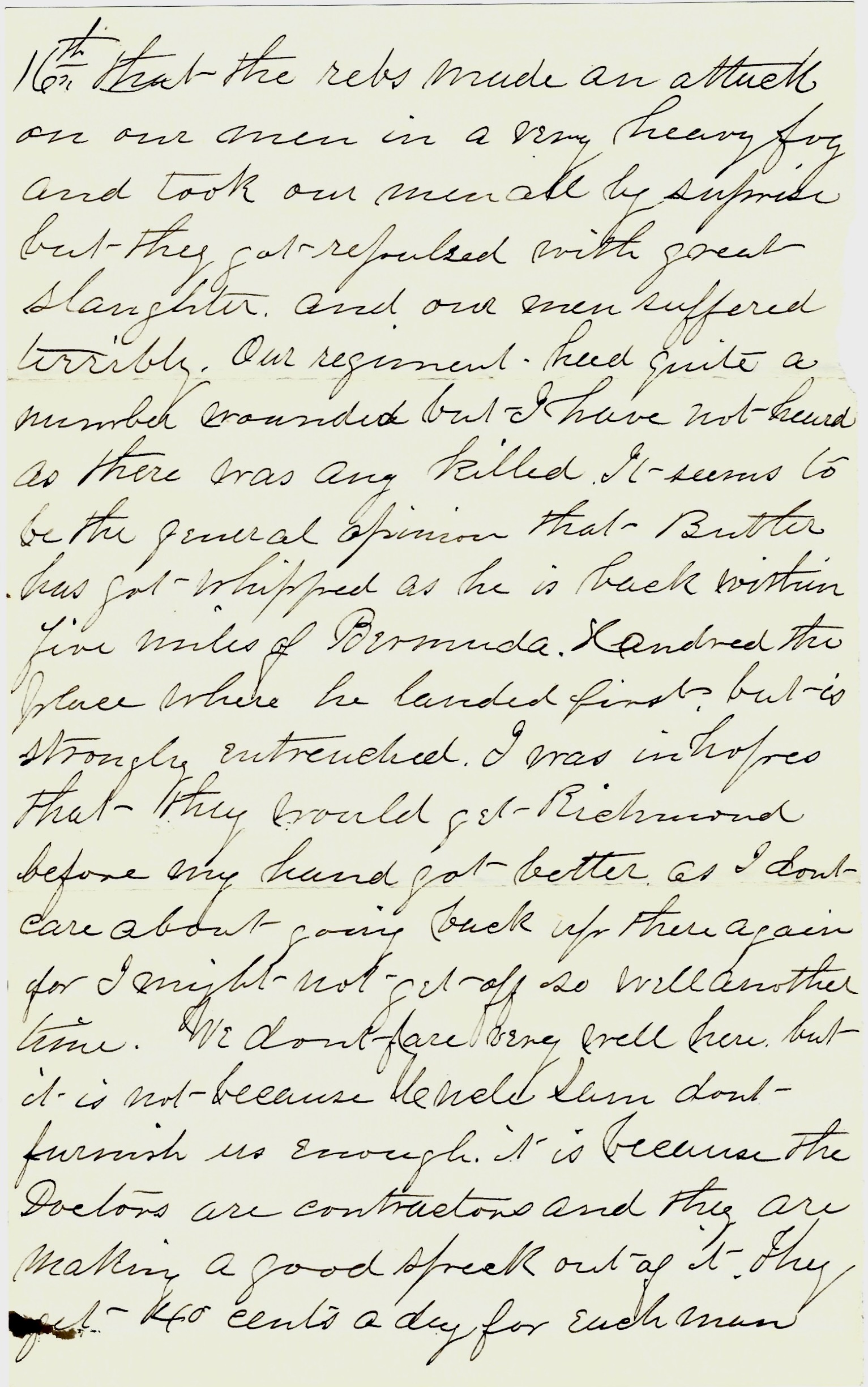
I write you these few lines to let you know how I am getting along. I am well with the exception of my hand which is quite sore yet and I hope it may so until this campaign is over. I was wounded on the 9th of this month between three and four o’clock p.m. It is nothing but a flesh wound and will not affect my hand at all after it once gets well. It was a pretty lucky hit for me as I was wounded the first man in the regiment and I might have got it worse if I had gone farther on as it was a pretty hot place. I was wounded while forming in line of battle. I think it was the 16th that the rebs made an attack on our men in a very heavy fog and took our men all by surprise. But they got repulsed with great slaughter and our men suffered terribly. Our regiment had quite a number wounded but I have not heard as there was any killed. It seems to be the general opinion that Butler has got whipped as he is back within five miles of Bermuda Hundred, the place where we landed first, but is strongly entrenched.
I was in hopes that they would get Richmond before my hand got better as I don’t care about going back up there again for I might not get off so well another time. We don’t fare very well here but it is not because Uncle Sam don’t furnish us enough. It is because the doctors are contractors and they are making a good speck [speculation] out of it. They get 40 cents a day for each man.
You answer this letter and let Mattie write the other and send them separate, and tell me if you got that money I sent you and direct to Ward 5. [no signature]
Letter 20
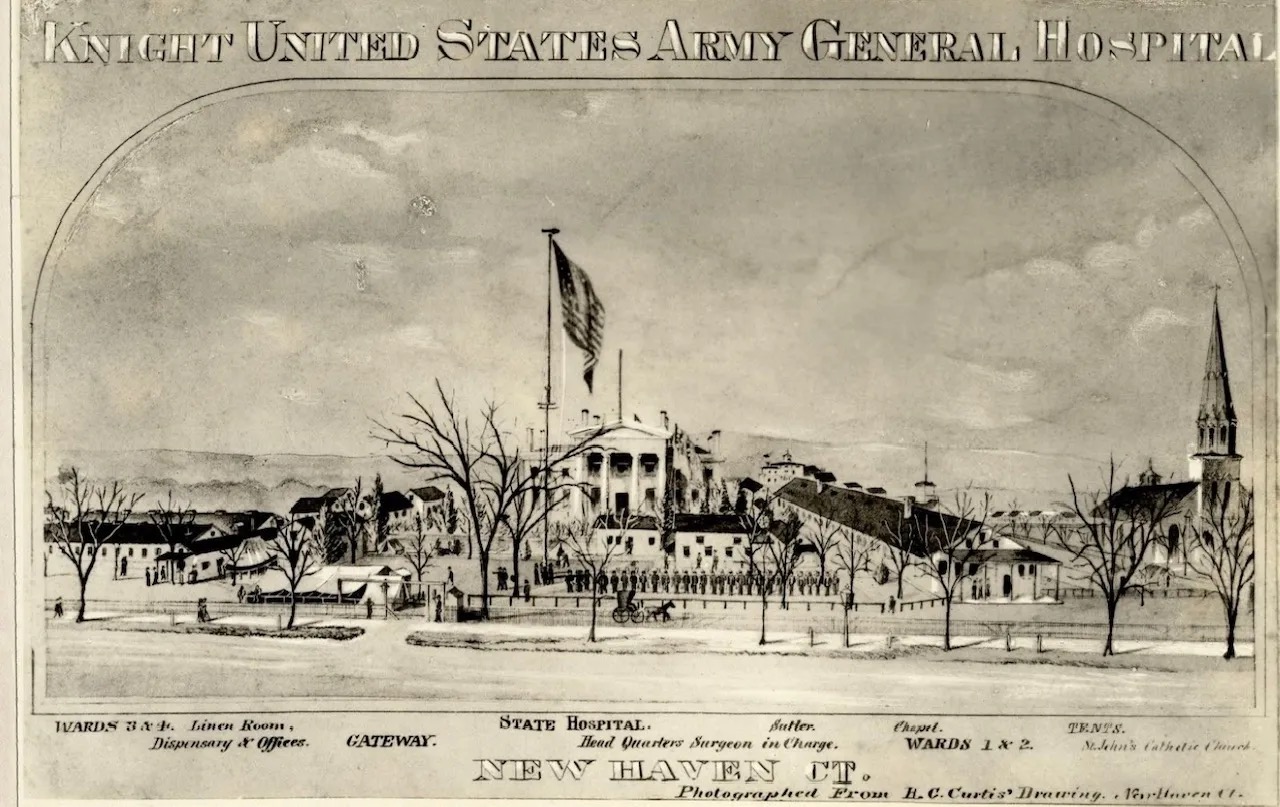
Knight General Hospital
New Haven, Connecticut
June 13, 1864
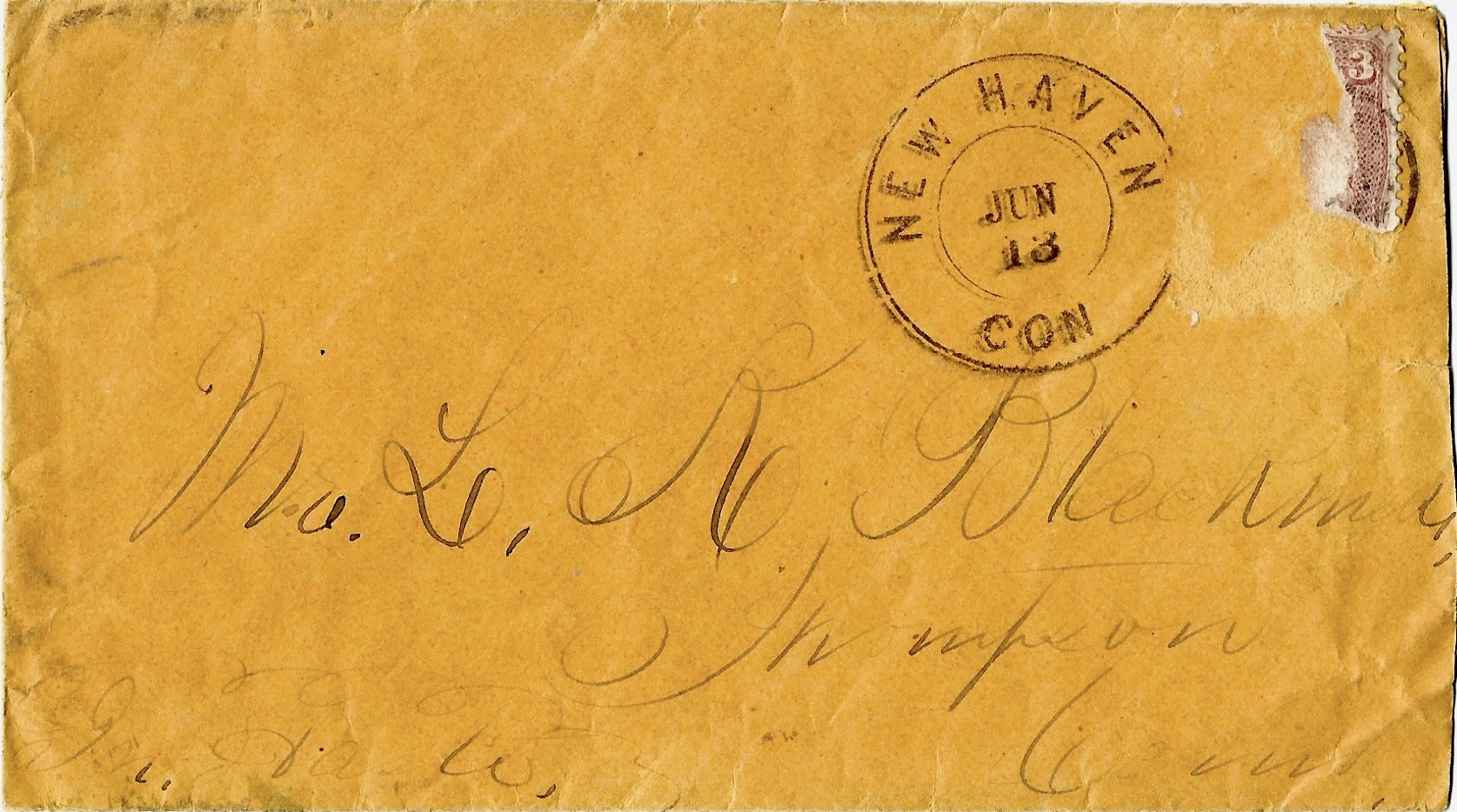
Dear Brother,
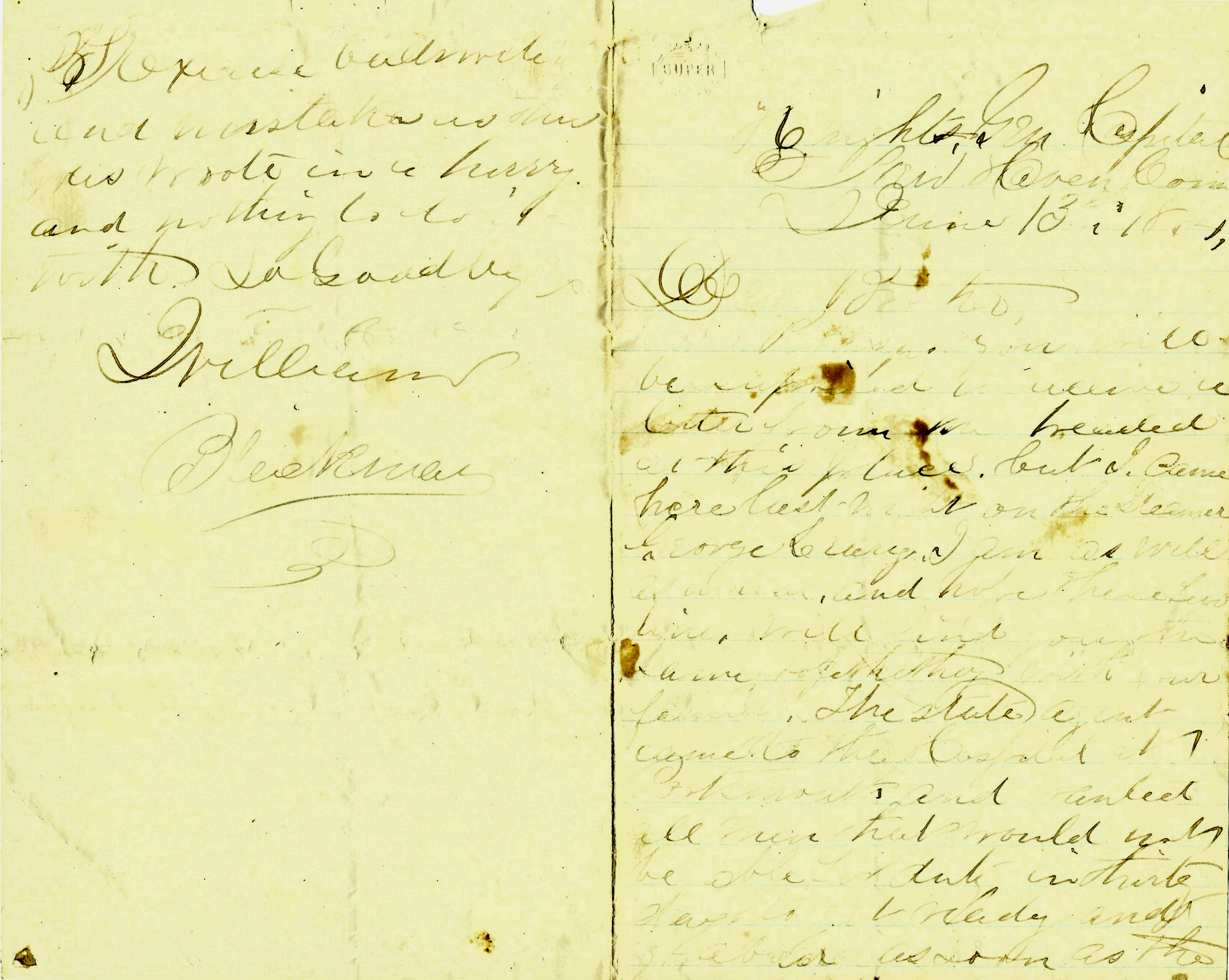
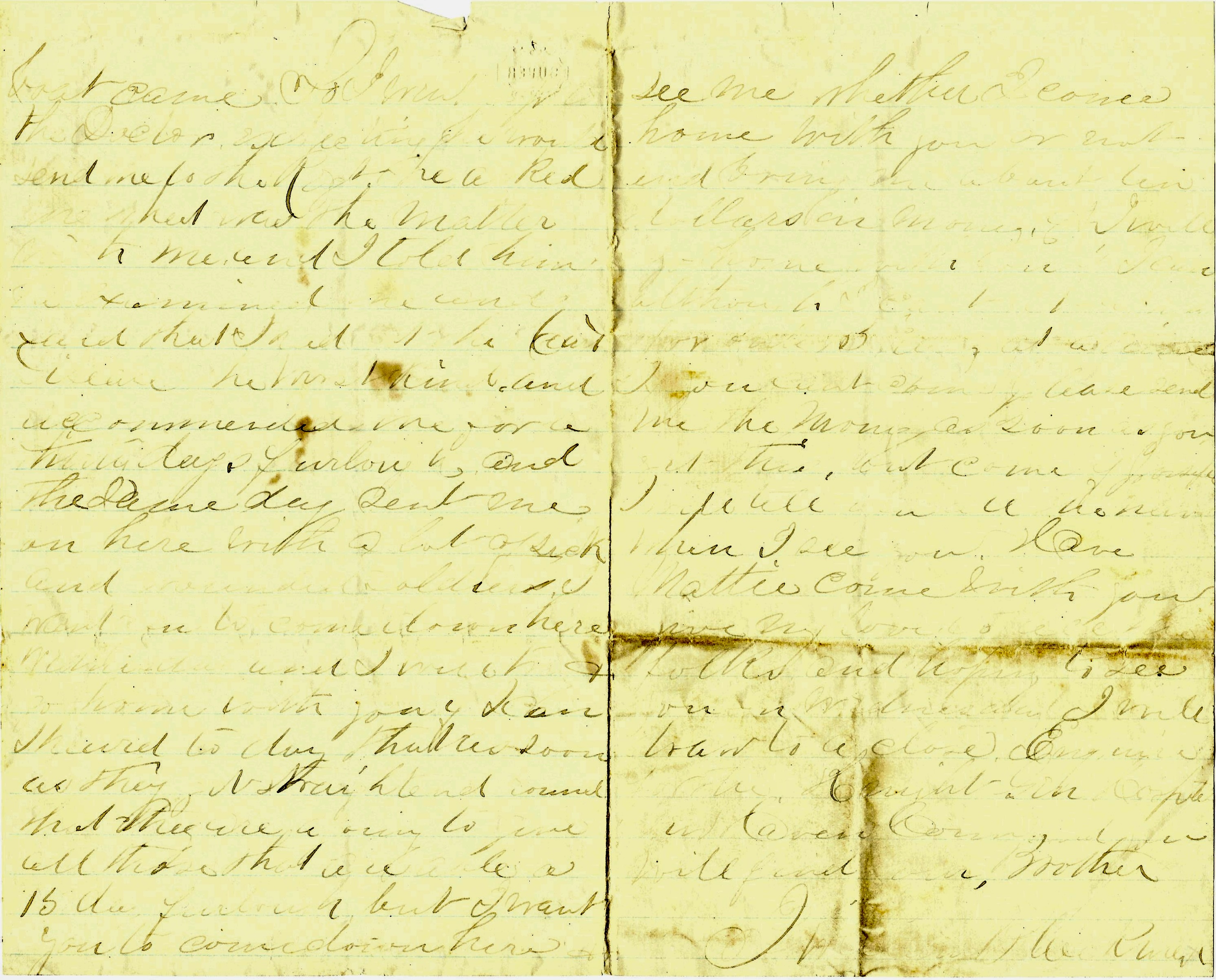
You will be surprised to see a letter from me headed at this place but I came here last night on the steamer George Clary [?]. I am as well as ever and hope these few lines will find you the same. the State Agent came to the corporal at Portsmouth and wanted all men that would not be able for duty in thirty days to get ready and [ ] as soon as the boat came. So I went to the doctor expecting he would send me to the regiment. He asked what was the matter with me and I told him. He examined me and said that I did not [ ] and recommended me for a twenty days furlough, and the same day sent me on here with a lot of sick and wounded soldiers….
I want you to come down here to see me whether I come home with you or not and bring me about ten dollars in money. I will go home with you if I can. If youy don’t come, please send me the money as soon as you get this. But come if possible. I wil tell you all when I see you. Have Mattie come with you. Give my love to all and father. Hoping to see you…I will draw to a close. Your brother, — William Blackmar
Letter 21
Knight General Hospital
New Haven, Connecticut
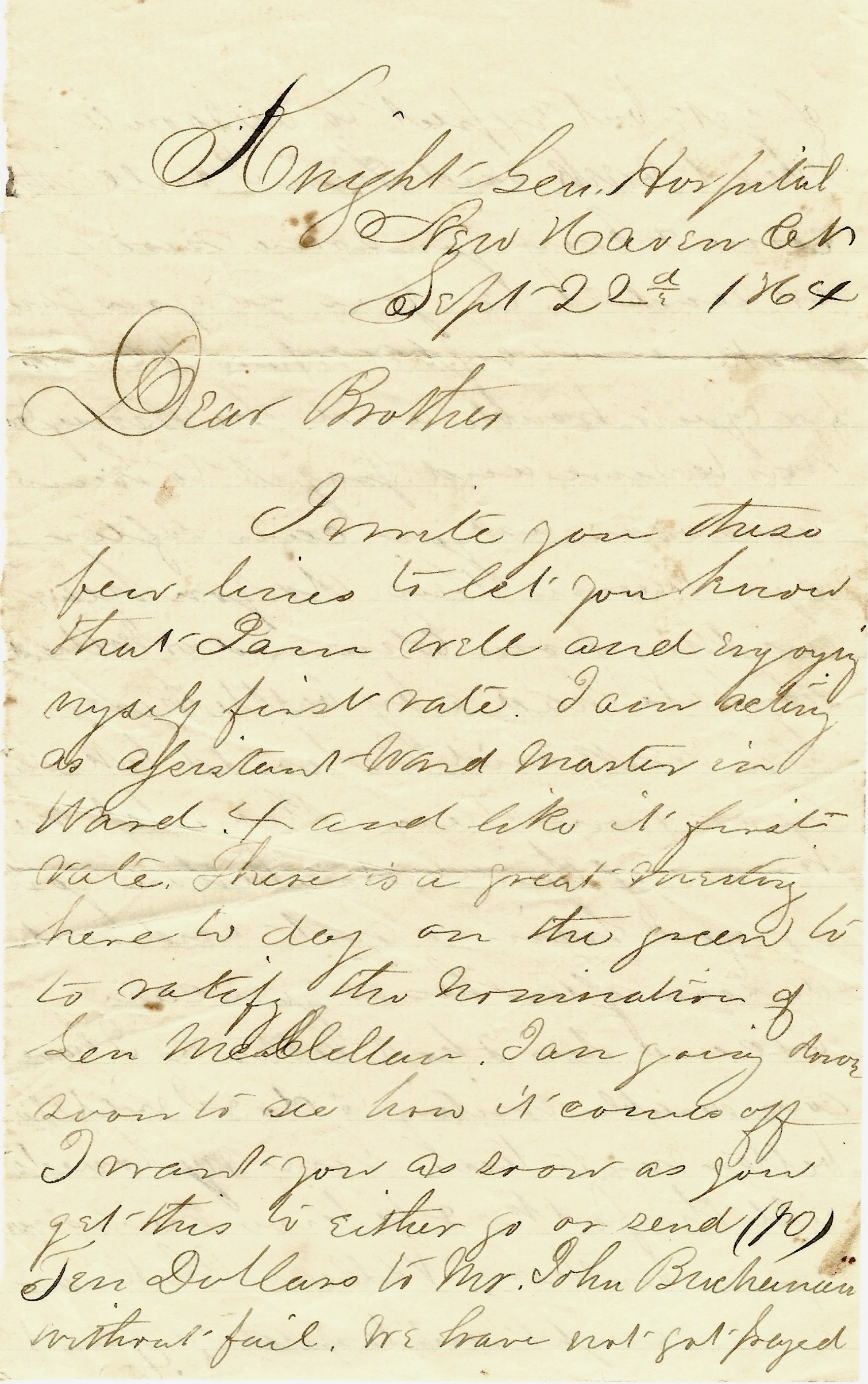
September 22, 1864
Dear Brother,
I wrote you these few lines to let you know that I am well and enjoying yself first rate. I am acting as Assistant Ward Master in Ward 4 and like it first rate. There is a great meeting here today on the green to ratify the nomination of Gen. McClellan. I am going down soon to see how it comes off. I want you as soon as you get this to either go or send ten dollars to Mr. John Buchanan without fail. We have not got paid off yet but expect to as soon as next week and then I will either come & bring you some money or send it to you so you can make it all right when it comes for your trouble and the money too. Now be sure and pay it to him as soon as you can after you receive this.
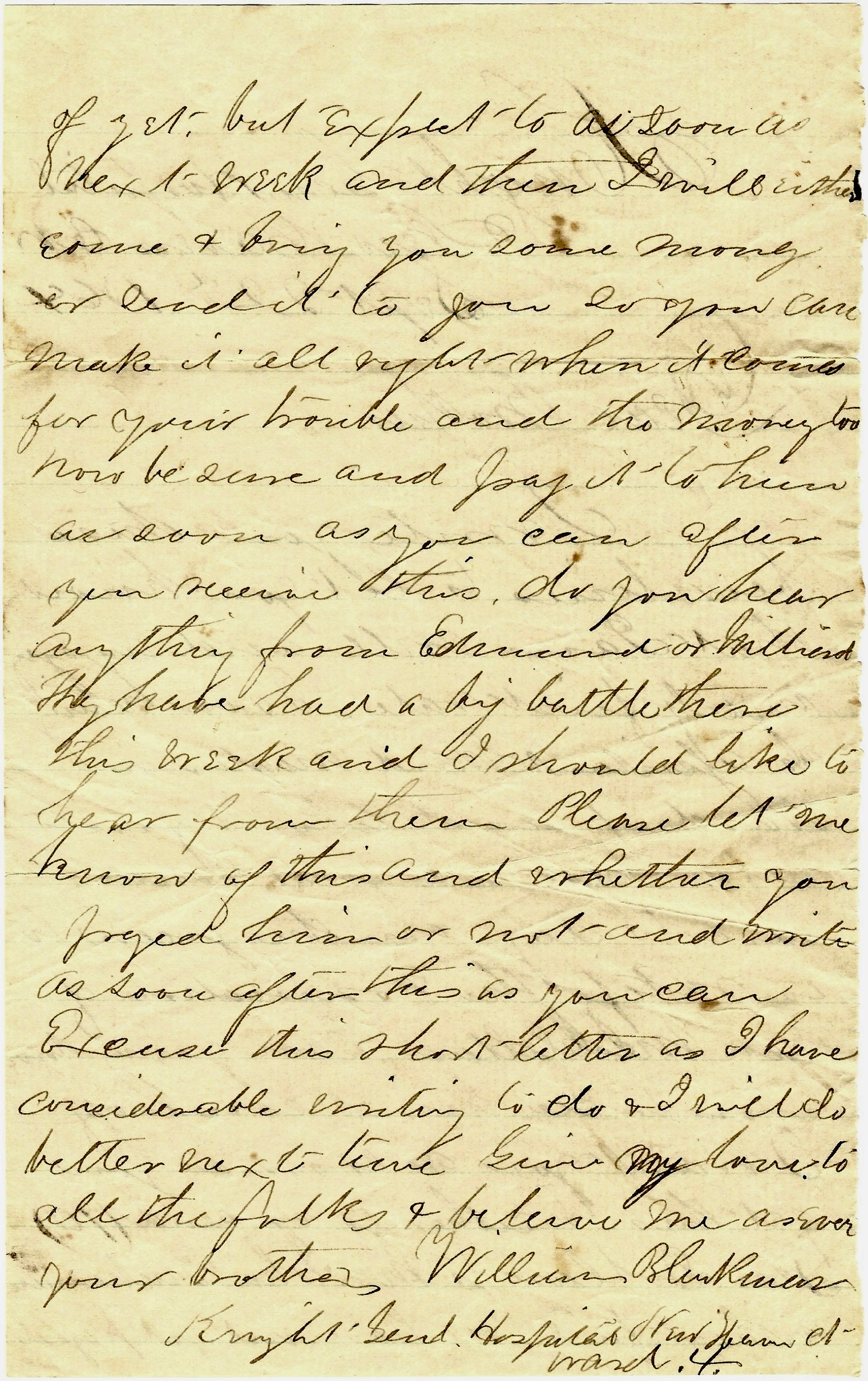
Do you hear anything from Edmund or Willard? They have had a big battle there this week and I should like to hear from them. Please let me know of this and whether you paid him or not and write as soon after this as you can. Excuse this short letter as I have considerable writing to do & I will do better next time. Give my love to all the folks and believe me as ever your brother, — William Blackmar
Knight General Hospital, New Haven, Ct. Ward 4
Letter 22
Knight General Hospital
New Haven, Connecticut
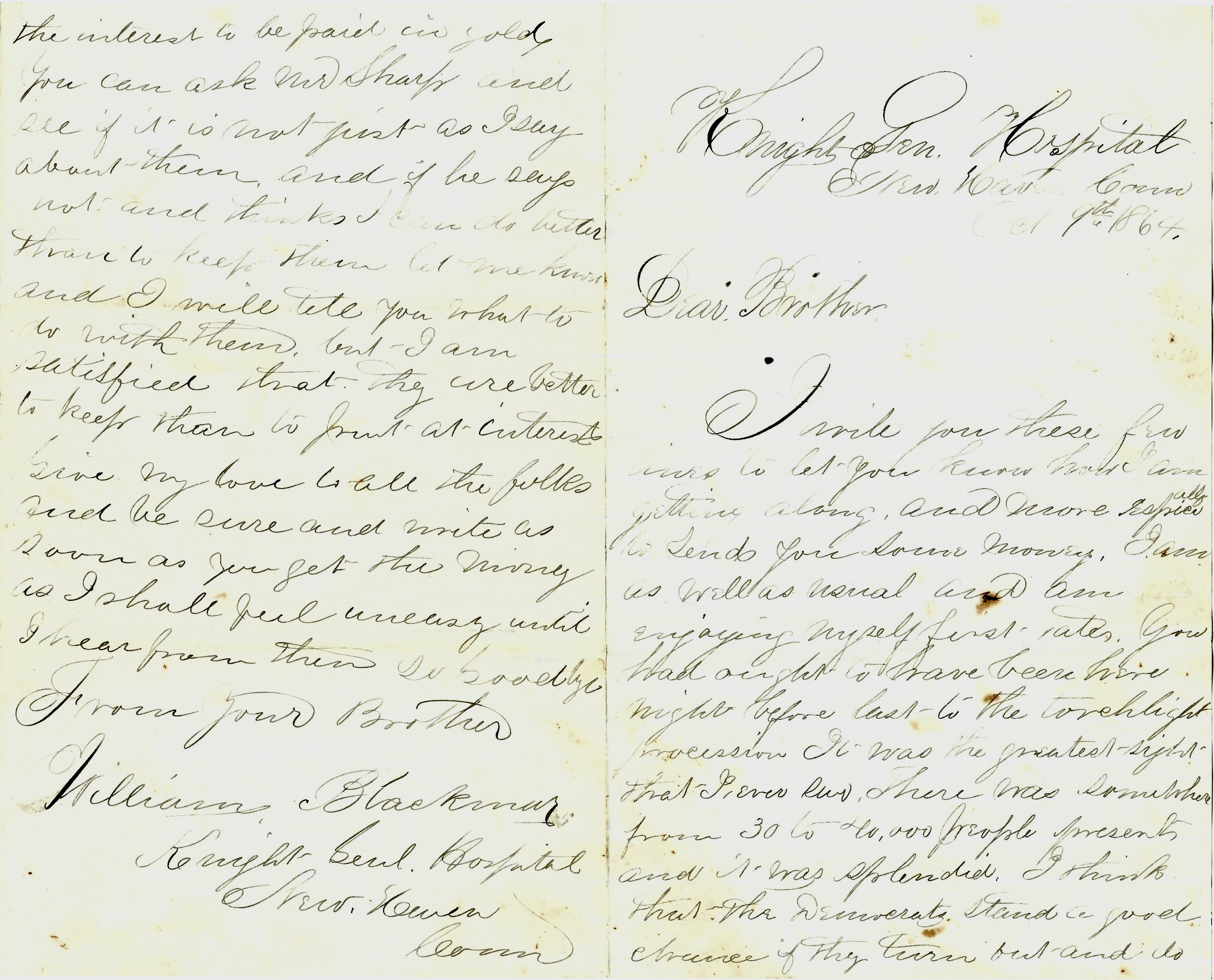
October 9th 1864
Dear Brother,
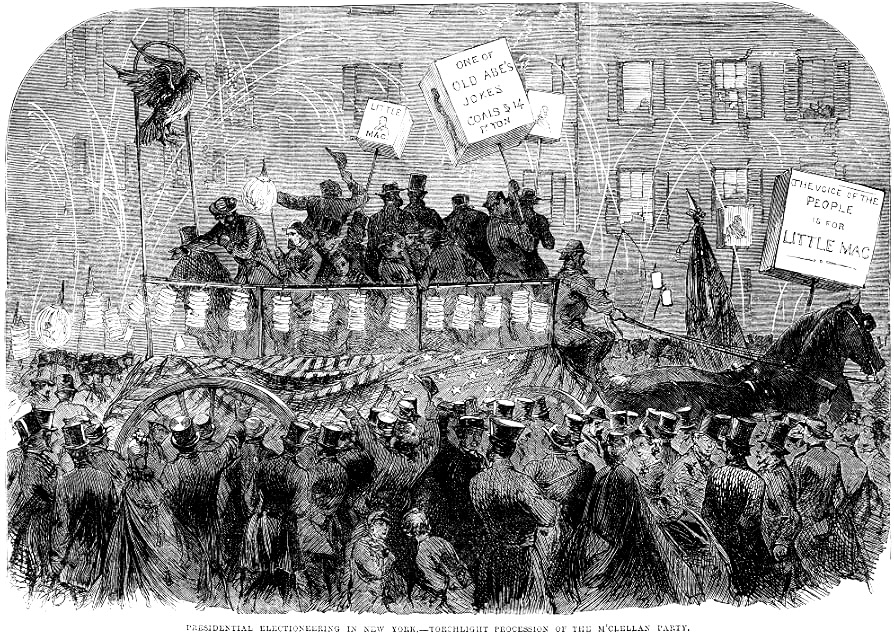
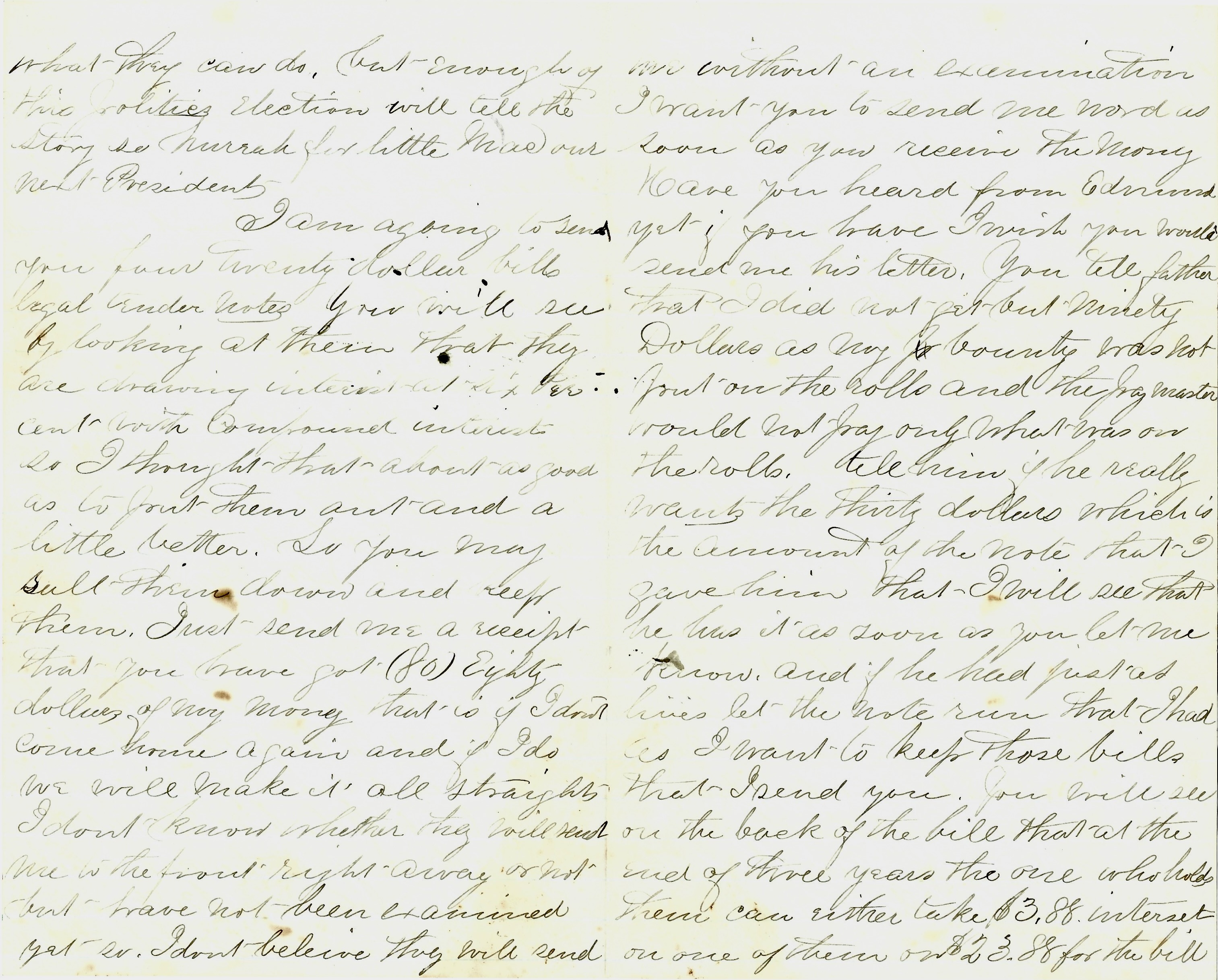
I write you these few lines to let you know how I am getting along, and more especially to send you some money. I am as well as usual adn am enjoying myself first rate. You had ought to have been here night before last to the torchlight procession. It was the greatest sight that I ever saw. There was somewhere from 30 to 40,000 people present and it was splendid. I think that the Democrats stand a good chance if they turn out and do what they can do, but enough of this politics. Election will tell the story so hurrah for Little Mac, our next President.
I am agoing to send you four twenty dollar bills legal tender notes. you will see by looking at them that they are drawing interest at six percent with compound interest so I thought that about as good as to put them out and a little better. So you may pull them down and keep them. Just send me a receipt that you have got eighy dollars of my money—that is, if I don’t come home again and if I do, we will make it all straight.
I don’t know whether they will send me to the front right away or not but I have not been examined yet so I don’t believe they will send me without an examination. I want you to send me word as soon as you receive the money.
Have you heard from Edmund yet? If you have, I wish you would send me his letter. You tell father that I did not get but ninety dollars as my bounty was not put on the rolls and the paymaster would not pay only what was on the rolls. Tell him if he really wants the thirty dollars which is the amount of the note that I gave him, that I will see that he has it as soon as you let me know, and if he had just as leave let the note run that I had as I want to keep this bills that I send you. you will see on the back of the bill that at the end of three years the one who holds them can either take $3.88 interest on one of them or $23.88 for the bill, the interest to be paid in gold. You can ask Mr. Sharp and see if it is not just as I say about them, and if he says not and thinks I could do better than to keep them, let me know, and I will tell you what to do with them. But I am satisfied that they are better to keep than to put at interest.
Give my love to all the folks and be sure and write as soon as you get the money as I shall feel uneasy until I hear from them. So goodbye. From your brother, — William Blackmar
Knight General Hospital, New Haven, Connecticut
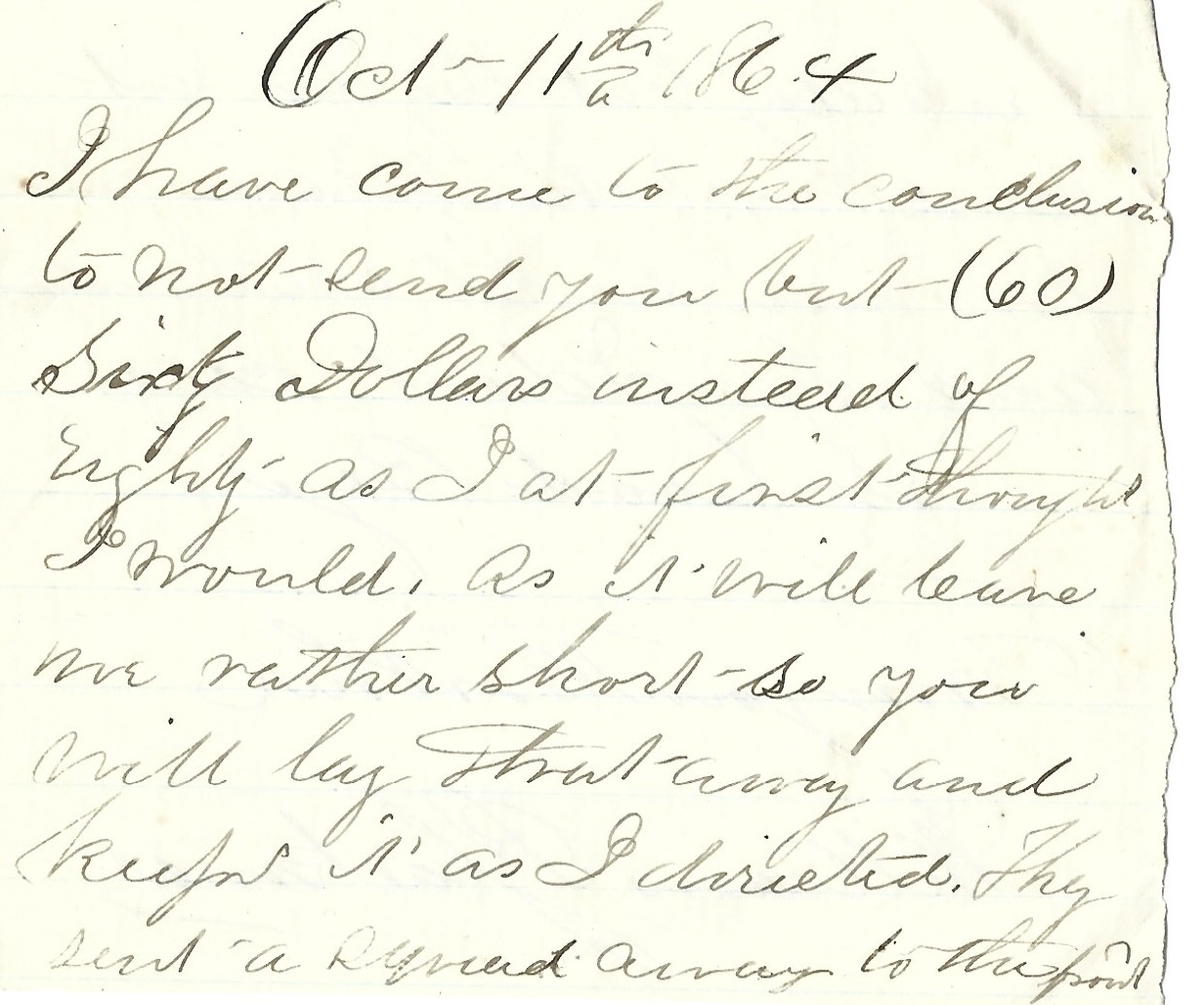
October 11th 1864
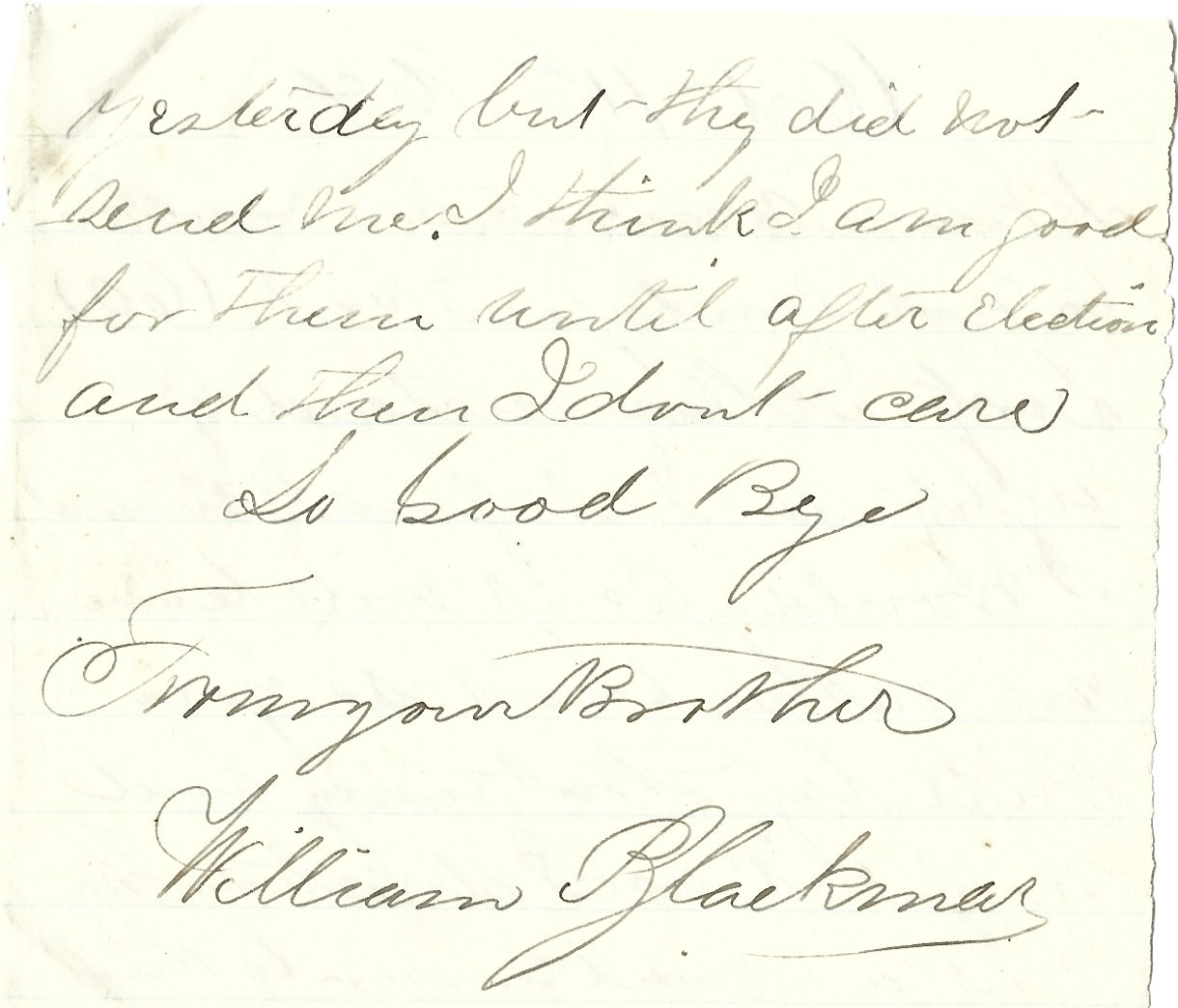
I have come to the conclusion to not send you but sixty dollars instead of eighty as I at first thought I would as it will leave me rather short so you will lay that away and keep it as I directed. They sent a squad away to the front yesterday but they did not send me. I think I am good for them until after election and then I don’t care. So goodbye.From your brother, — William Blackmar
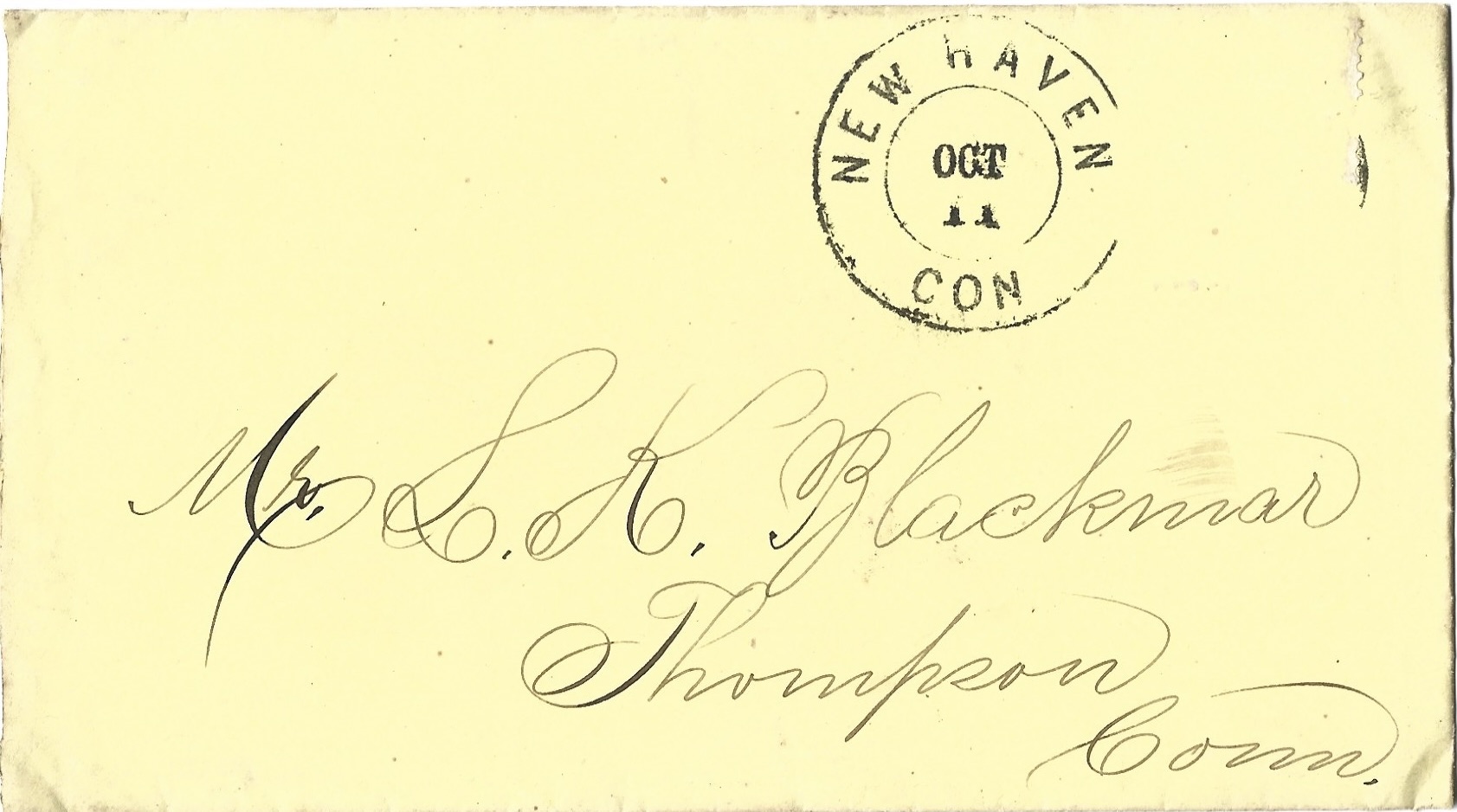
Letter 23
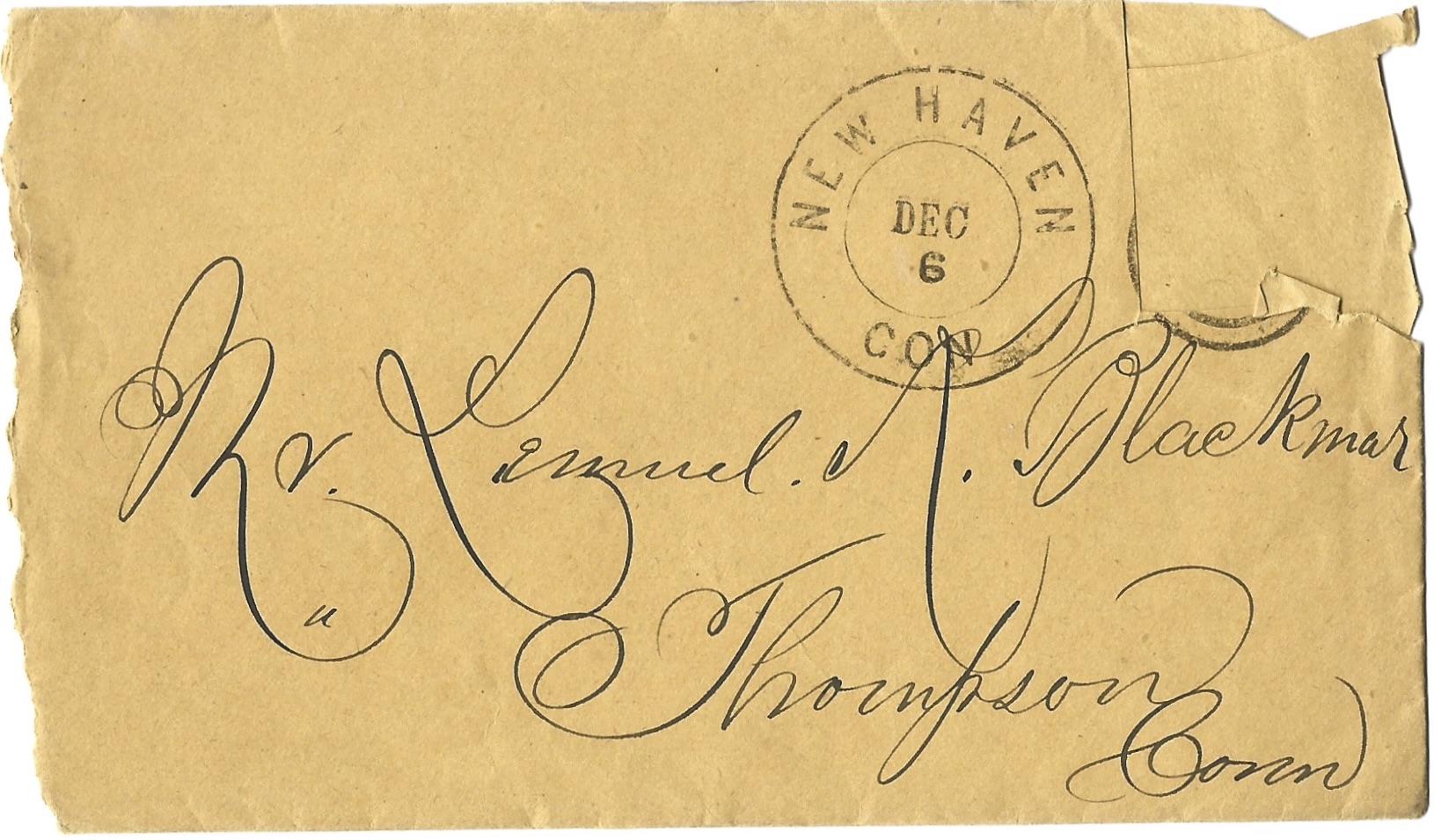
Knight General Hospital
New Haven, Connecticut
December 6, 1864
Dear Brother,
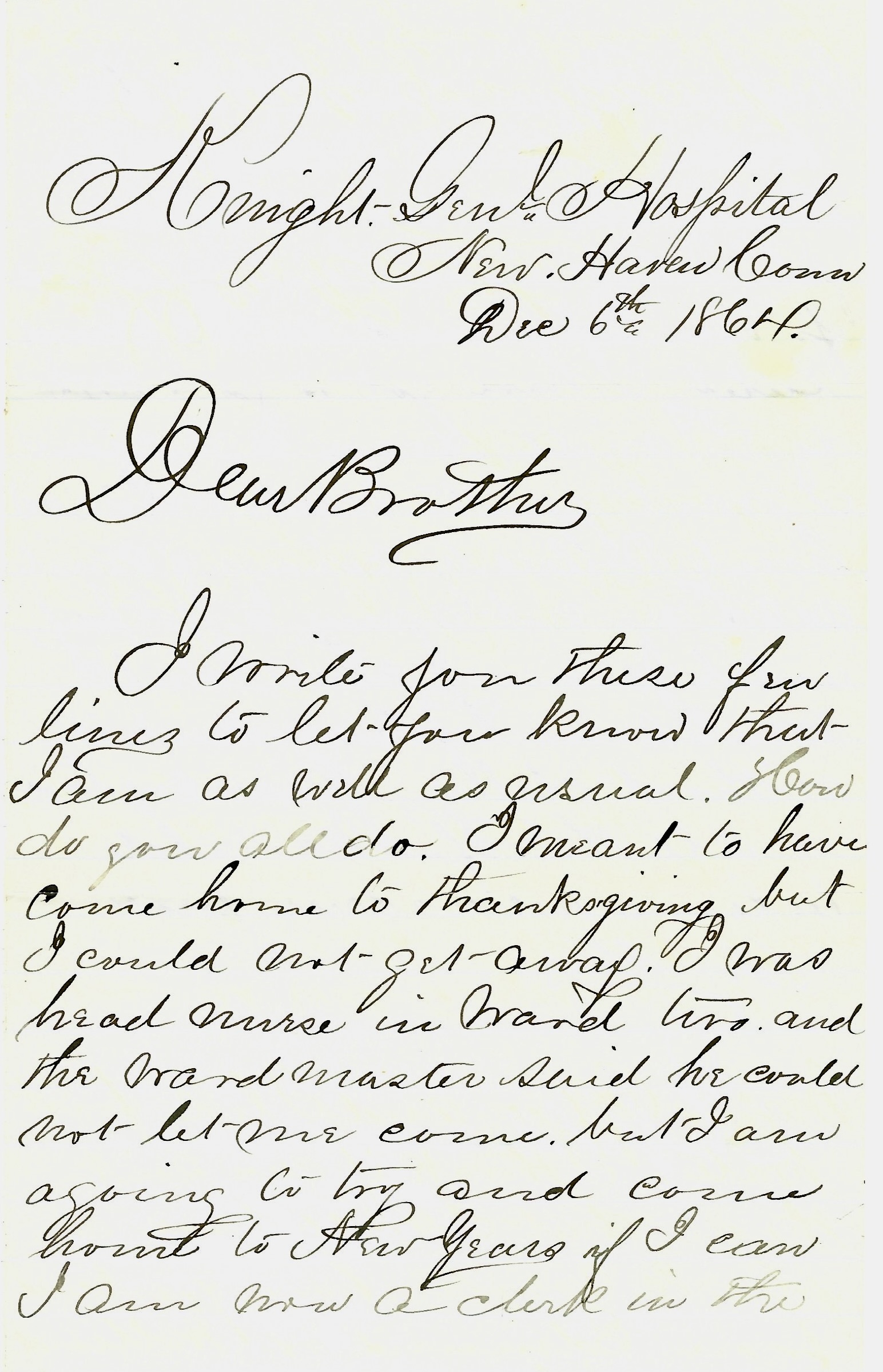
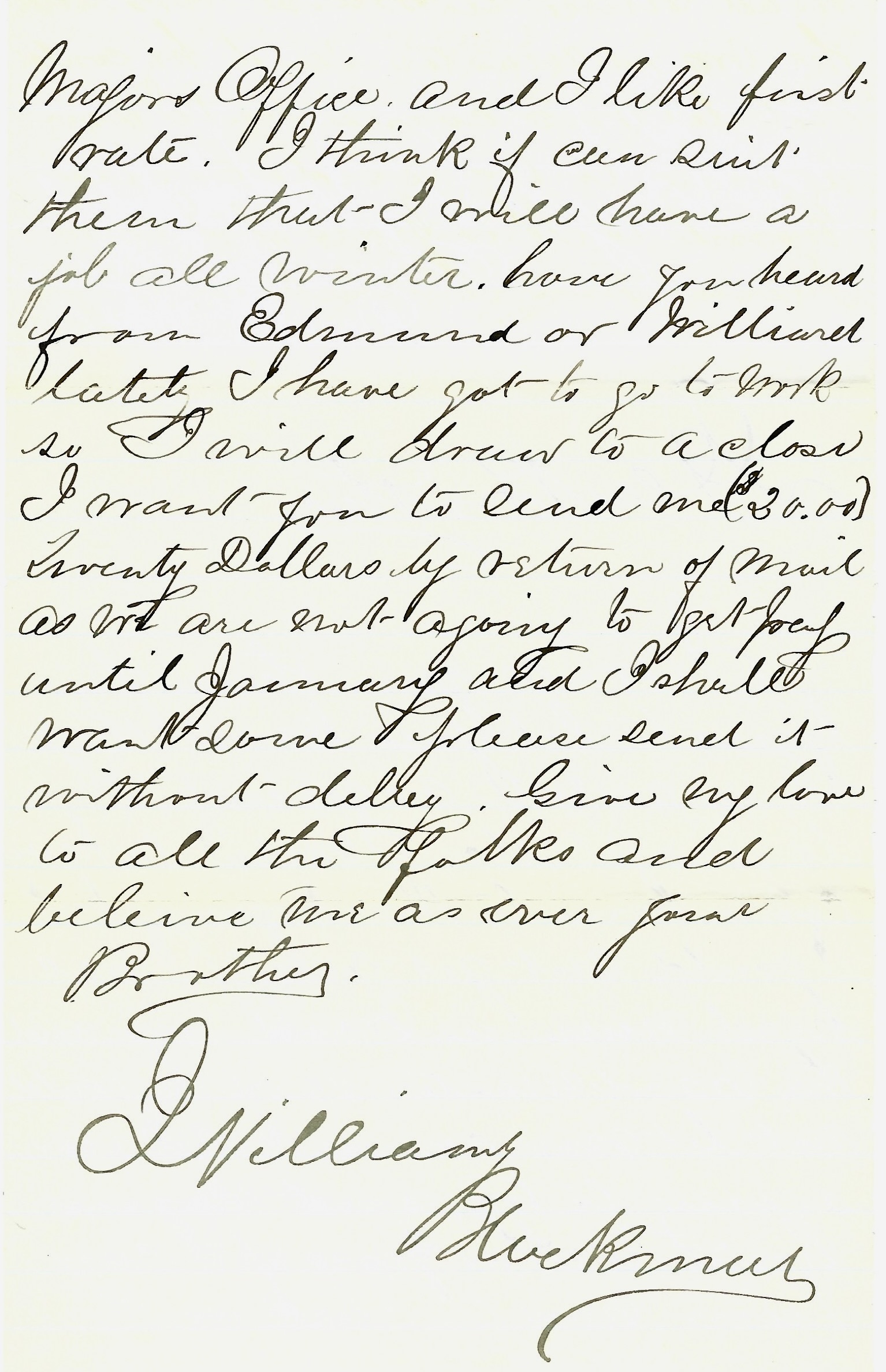
I write you these few lines to let you know that I am well as usual. How do you all do? I meant to have come home to thanksgiving but I could not get away. I was head nurse in Ward Two and the ward master said he could not let me come. But I am agoing to try and come home to New Years if I can. I am now a clerk in the Major’s office and I like it first rate. I think if I can suit them that I will have a job all winter.
Have you heard from Edmund or Willard lately? I have got to go to work so I will draw to a close. I want you to lend me $20 by return of mail as we are not agoing to get pay until January and I shall want some. Please send it without delay. Give my love to all the folks and believe me as ever your brother, — William Blackmar
Letter 24
Knight General Hospital
New Haven, Connecticut
January 1, 1864 [should be 1865]
Dear Brother,
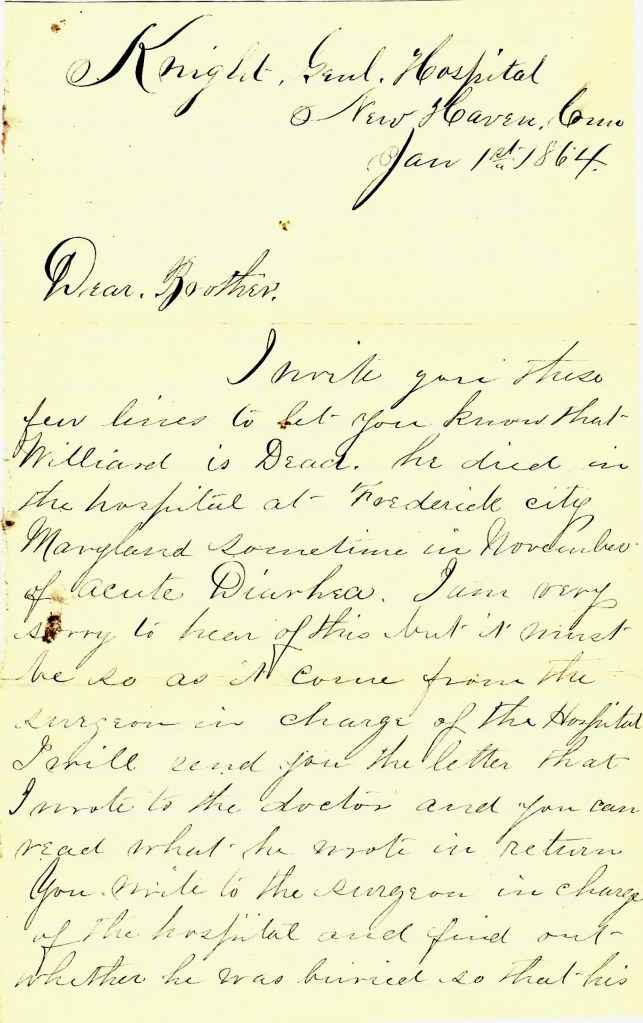
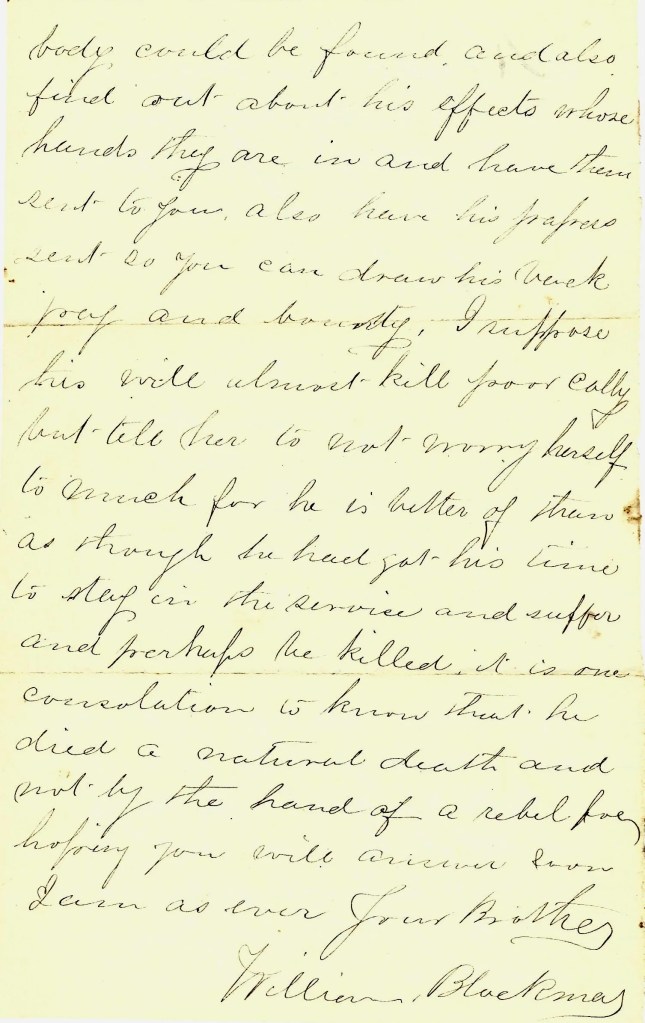
I write these few lines to let you know that Willard is dead. He died in the hospital at Frederick City, Maryland, sometime in November of acute diarrhea. I am very sorry to hear of this but it must be so as it come from the surgeon in charge of the hospital. I will send you the letter that 1 wrote to the doctor and you can read what he wrote in return. You write to the surgeon in charge of the hospital and find out whether he was buried so that his body could be found and also find out about his effects, whose hands they are in, and have them sent to you. Also have his papers sent so you can draw his back pay and bounty. I suppose this will almost kill [his sister] Cally, but tell her to not worry herself too much for he is better off than as though he had got his time to stay in the service and suffer and perhaps be killed. It is one consolation to know that he died a natural death and not by the hand of a rebel foe.
Hoping you will answer soon, I am as ever your brother, — William Blackmar
Letter 25
Knight General Hospital
New Haven, Connecticut
January 10, 1865
Dear Brother,
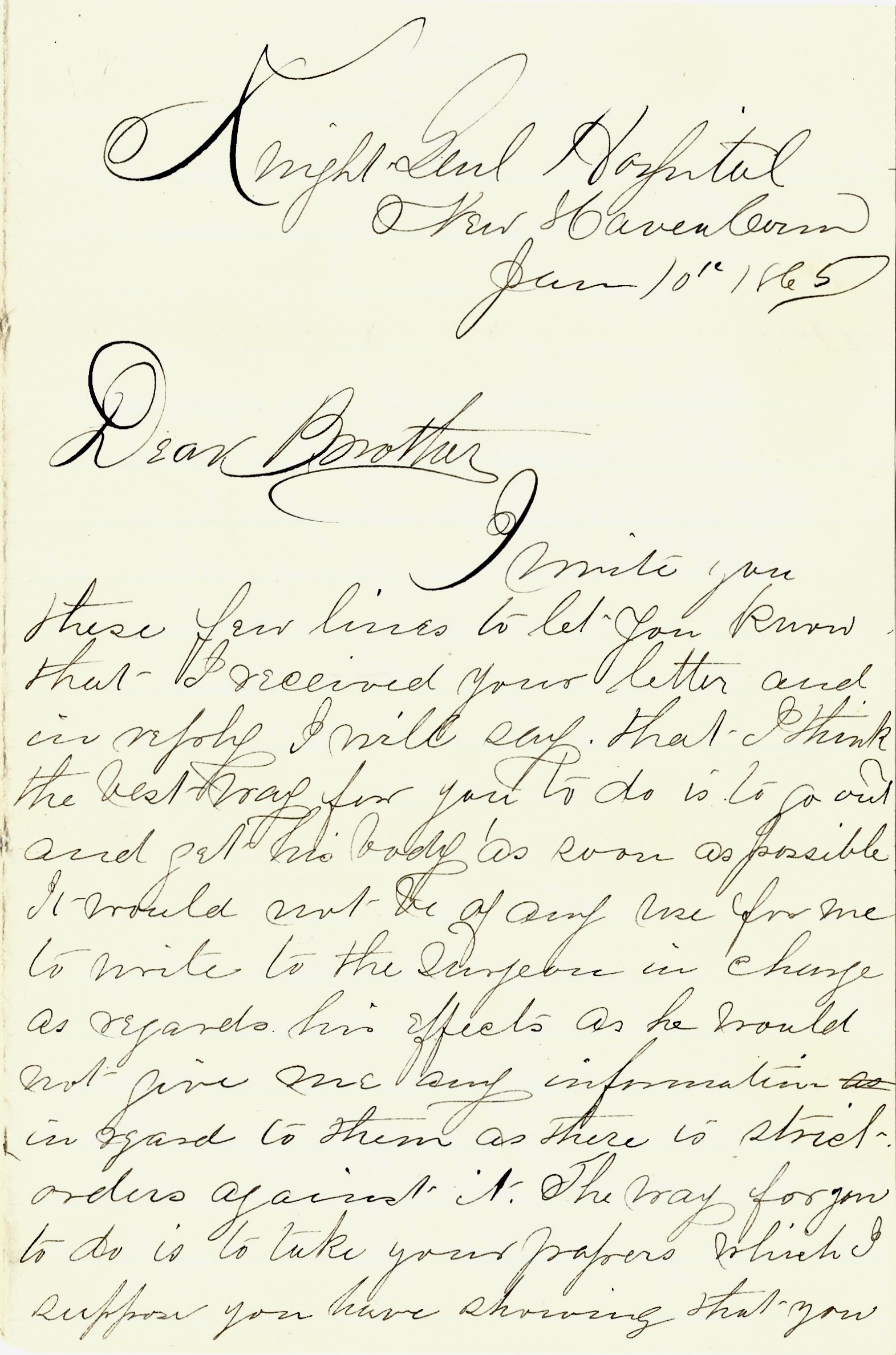
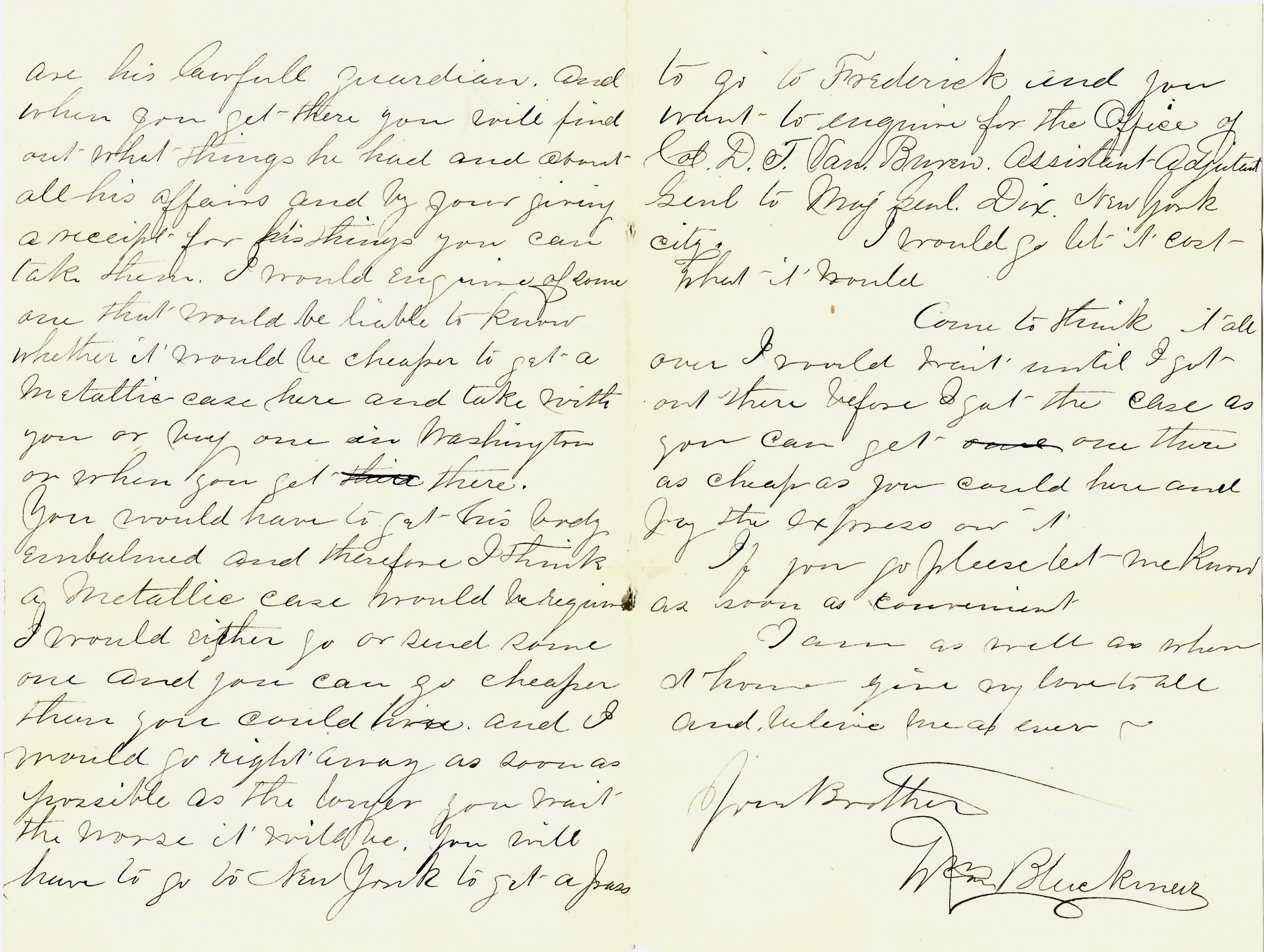
I write you these few lines to let you know that I received your letter and in reply I will say that I think the best way for you to do is to go out and get his body as soon as possible. It would not be of any use for me to write to the surgeon in charge as regards his effects as he would not give me any information in regard to them as there is strict orders against it. The way for you to do is to take your papers which I suppose you have showing that you are his lawful guardian and when you get there you will find out what things he had and about all his affairs and by your giving a receipt for his things, you can take them. I would enquirer of someone that would be liable to know whether it would be cheaper to get a metallic case here and take with you or buy one in Washington or when you get there.
You would have to get his body embalmed and therefore I think a metallic case would be required. I would either go and send someone and you can go cheaper than you could hire and I would go right away as soon as possible as the longer you wait, the worse it will be. You will have to go to New York to get a pass to go to Frederick and you want to enquirer for the Office of Col. D. J. Van Buren, Assistant Adjutant General to Maj. Gen. Dix, New York City. I would go let it cost what it would
Come think it all over, I would wait until I got out there before I got the case as you can get one there as cheap as you could here and pay the express on it. If you go, please let me know as soon as convenient.
I am as well as when at home. Give my love to all and believe me as ever your brother, — Wm. Blackmar
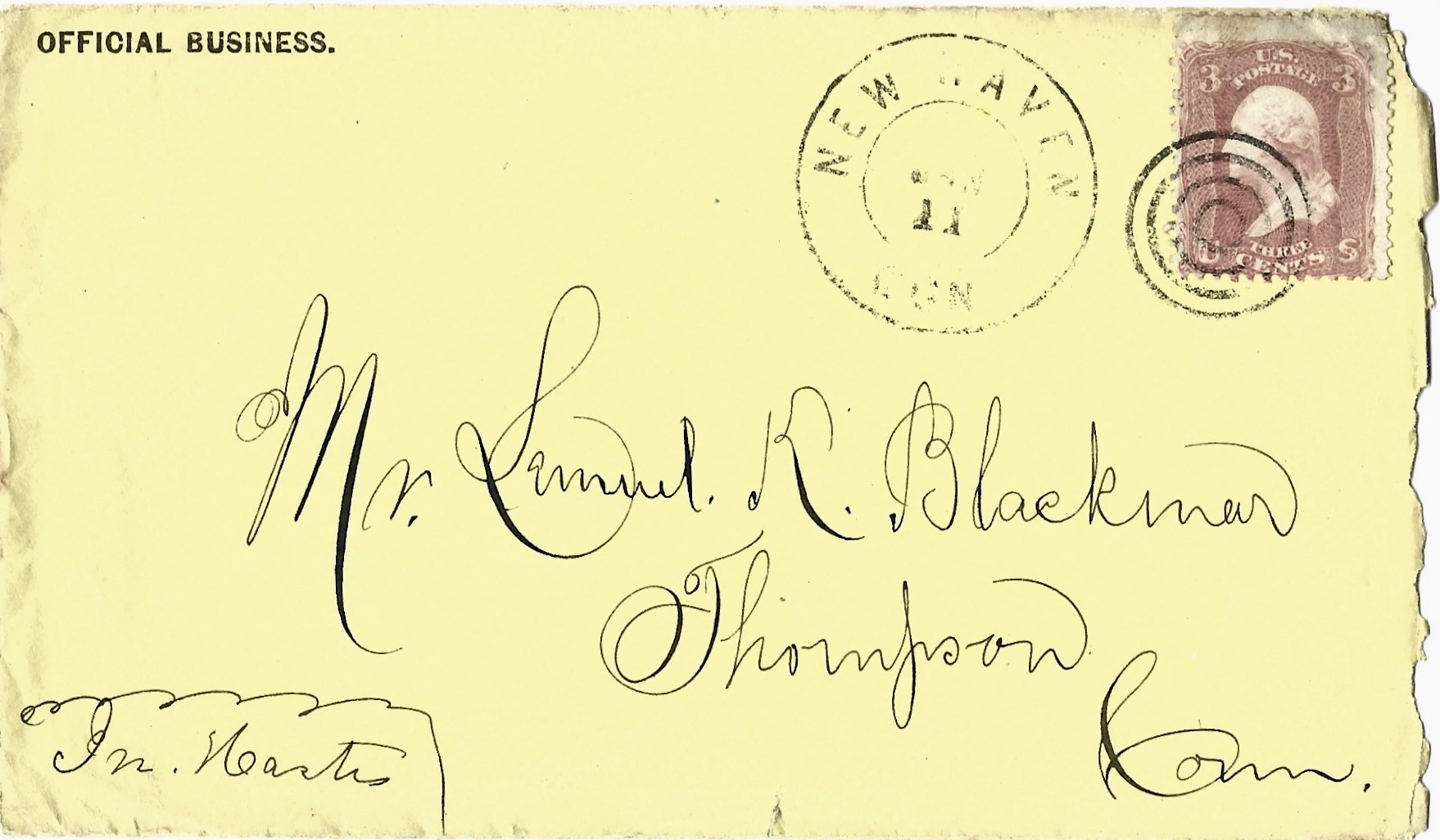
Letter 26
Knight General Hospital
New Haven, Connecticut
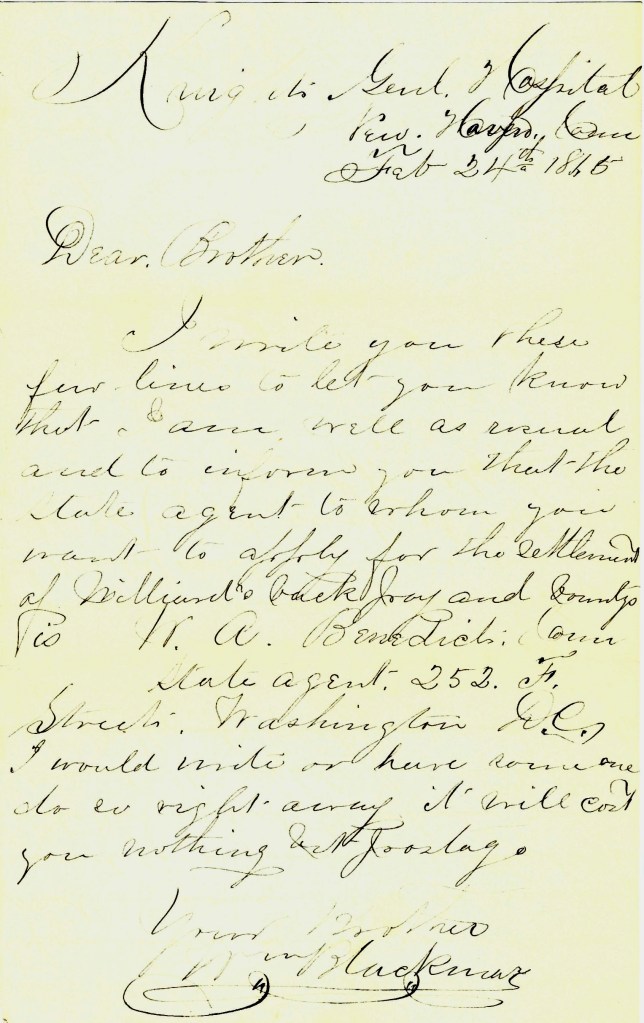
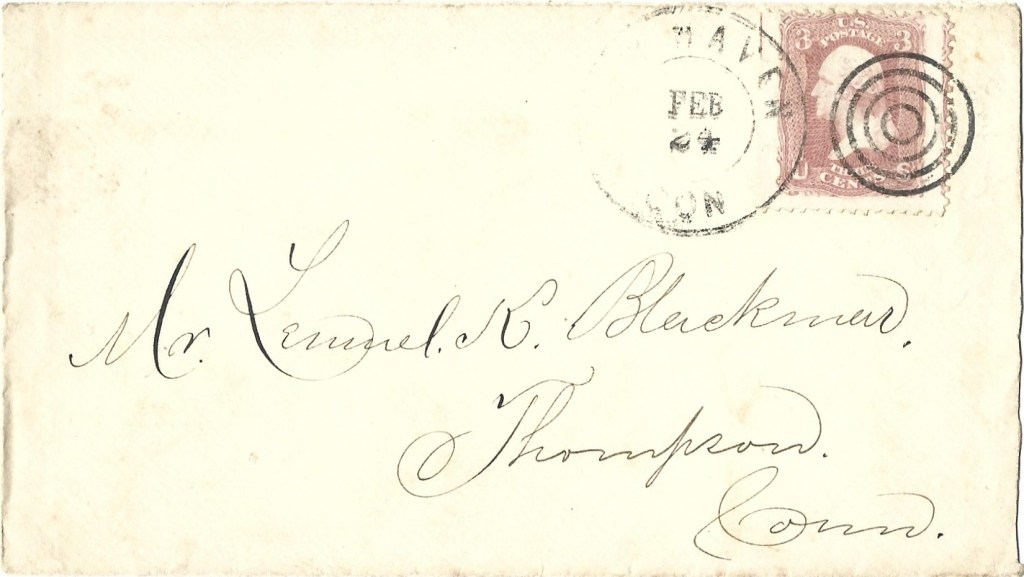
February 24th 1865
Dear Brother,
I write you these few lines to let you know that I am well as usual and to inform you that the state agent to whom you want to apply for the settlement of Willard’s back pay and bounty is W. A. Benedict, Conn. State Agent, 252 F. Street, Washington D. C.
I would write or have someone do so right away. It will cost you nothing but postage. Your brother, — Wm. Blackmar
Letter 27
Knight Gen. Hospital
New Haven, Conn.
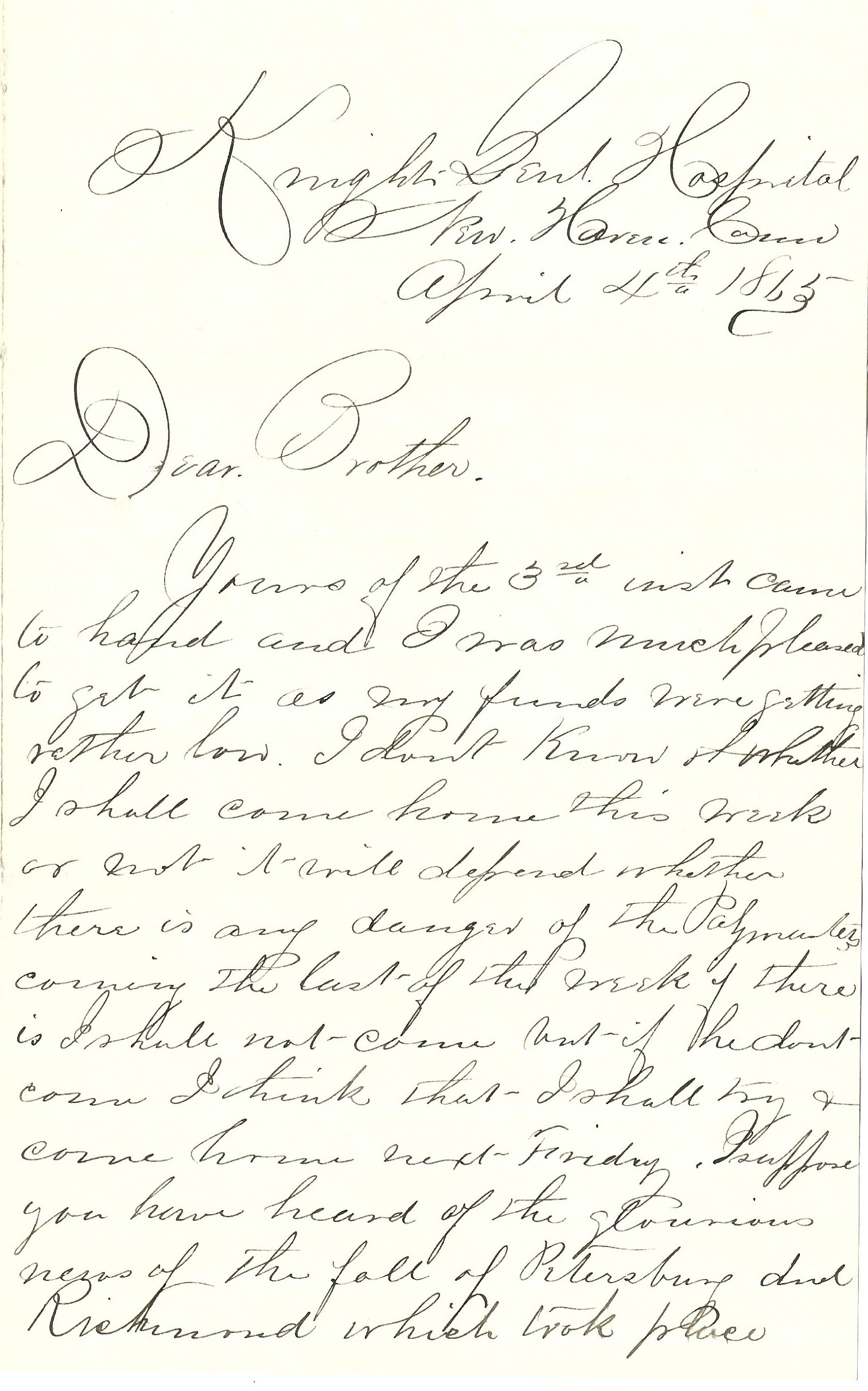
April 4th 1865
Dear Brother,
Yours of the 3rd inst. came to hand and was much pleased to get it as my funds were getting rather low. I don’t know whether I shall come home this week or not. It will depend whether there is any danger of the paymaster coming the last of the week. If there is, I shall not come but if he don’t come, I think that I shall try and come home next Friday.
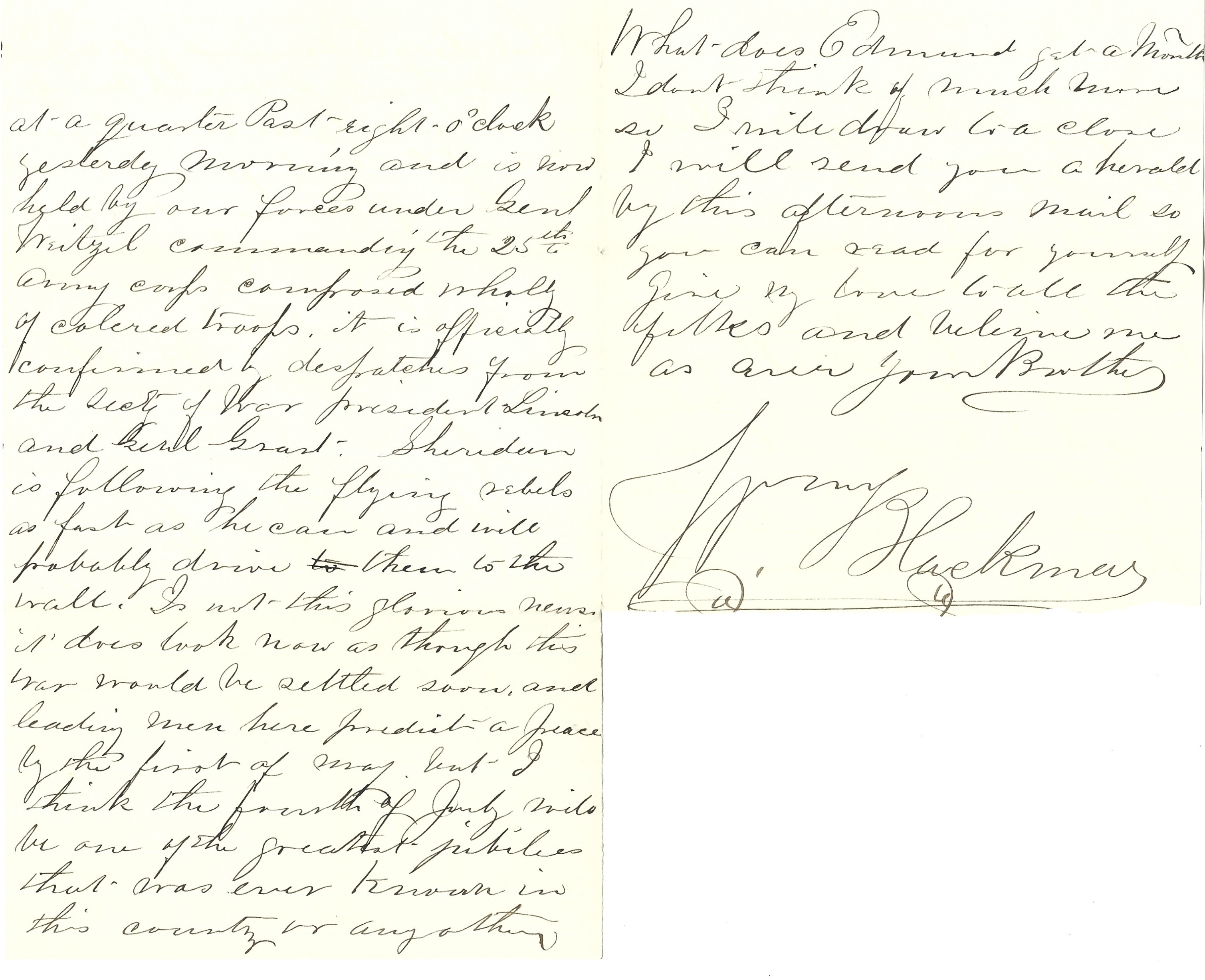
I suppose you have heard of the glorious news of the fall of Petersburg and Richmond which took place at a quarter past eight o’clock yesterday morning and is now held by our forces under Gen. Weitzel, commanding the 25th Army Corps composed wholly of colored troops. It is officially confirmed by dispatches from the Secretary of War, President Lincoln, andGeneral Grant. Sheridan is following the flying rebels as fast as he can and will probably drive them to the wall. Is not this glorious news? It does look now as though this war would be settled soon and leading men here predict a peace by the first of May. But i think the Fourth of July will be one of the greatest jubilees that was ever known in this country or any other.
What does Edmund get a month? I don’t think of much more so I will draw to a close. I will send you a Herald by this afternoon’s mail so you can read for yourself. Give my love to all the folks and believe me as ever your brother, — Wm. Blackman
Letter 28
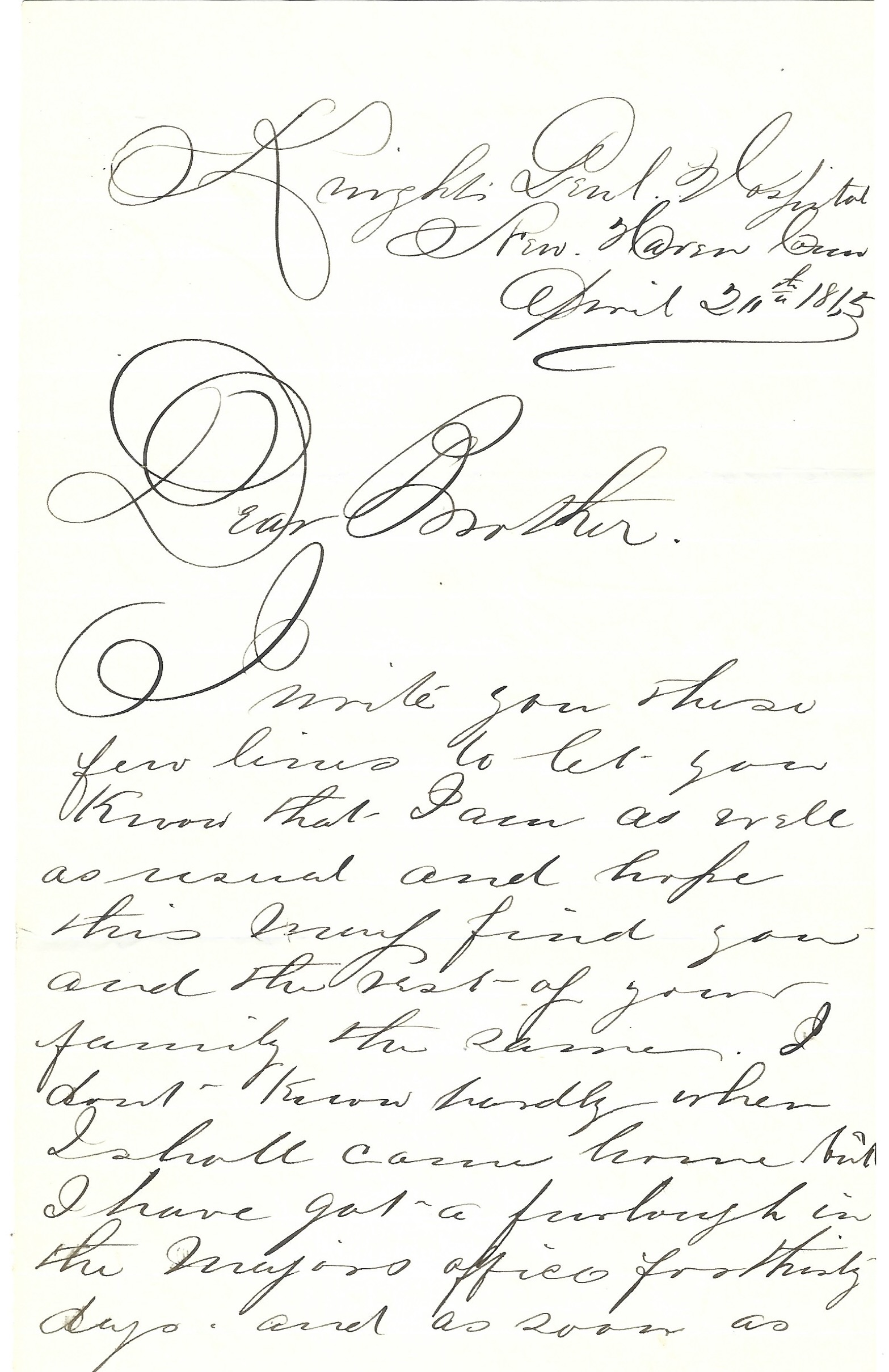
Knight Gen. Hospital
New Haven, Conn.
April 20th 1865
Dear Brother,
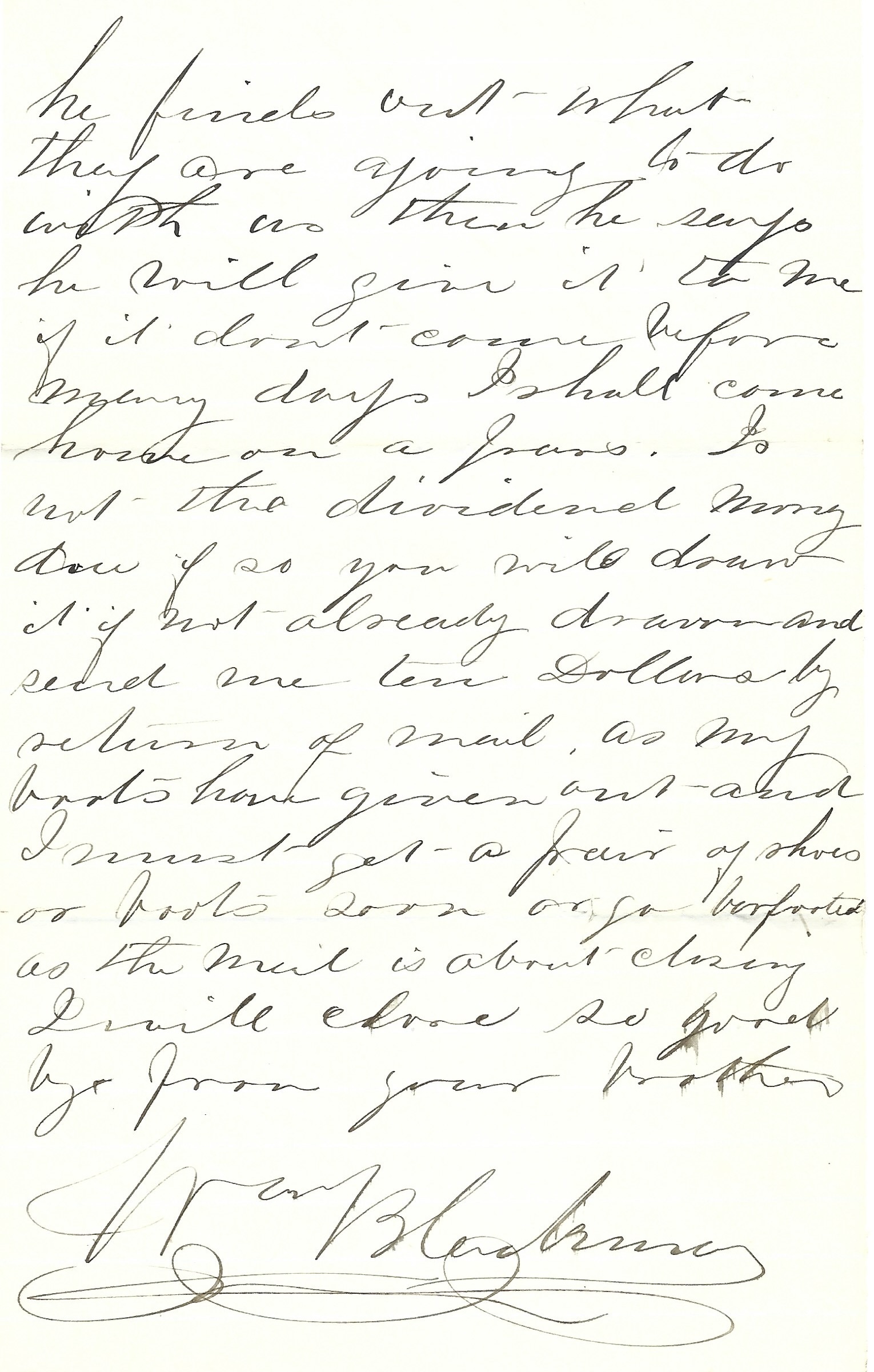
I write you these few lines to let you know that I am as well as usual and hope his may find you and the rest of your family the same. I don’t know hardly when I shall come home but I have got a furlough in the Major’s office for thirty days and as soon as he finds out what they are agoing to do with us, they he says he will give it to me. If it don’t come before many days, I shall come home on a pass.
Is not the dividend money due? If so, you will draw it if not already drawn and send me ten dollars by return of mail as my boots have given out and I must get a pair of shoes or boots soon or go barefooted.
As the mail is about closing, I will close so goodbye from your brother, — Wm. Blackmar
Letter 29
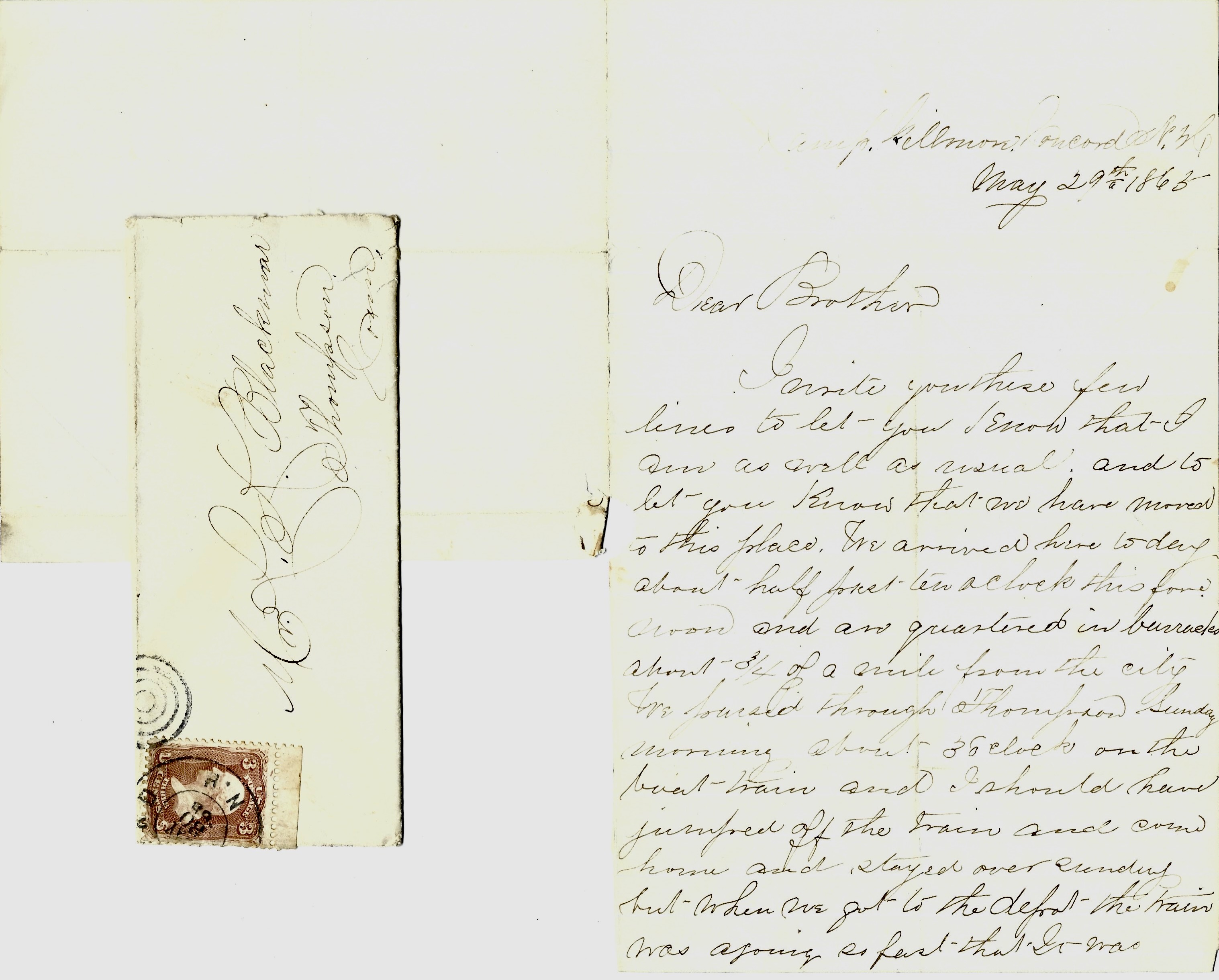
Camp Gillmore
Concord, New Hampshire
May 29th 1865
Dear Brother,
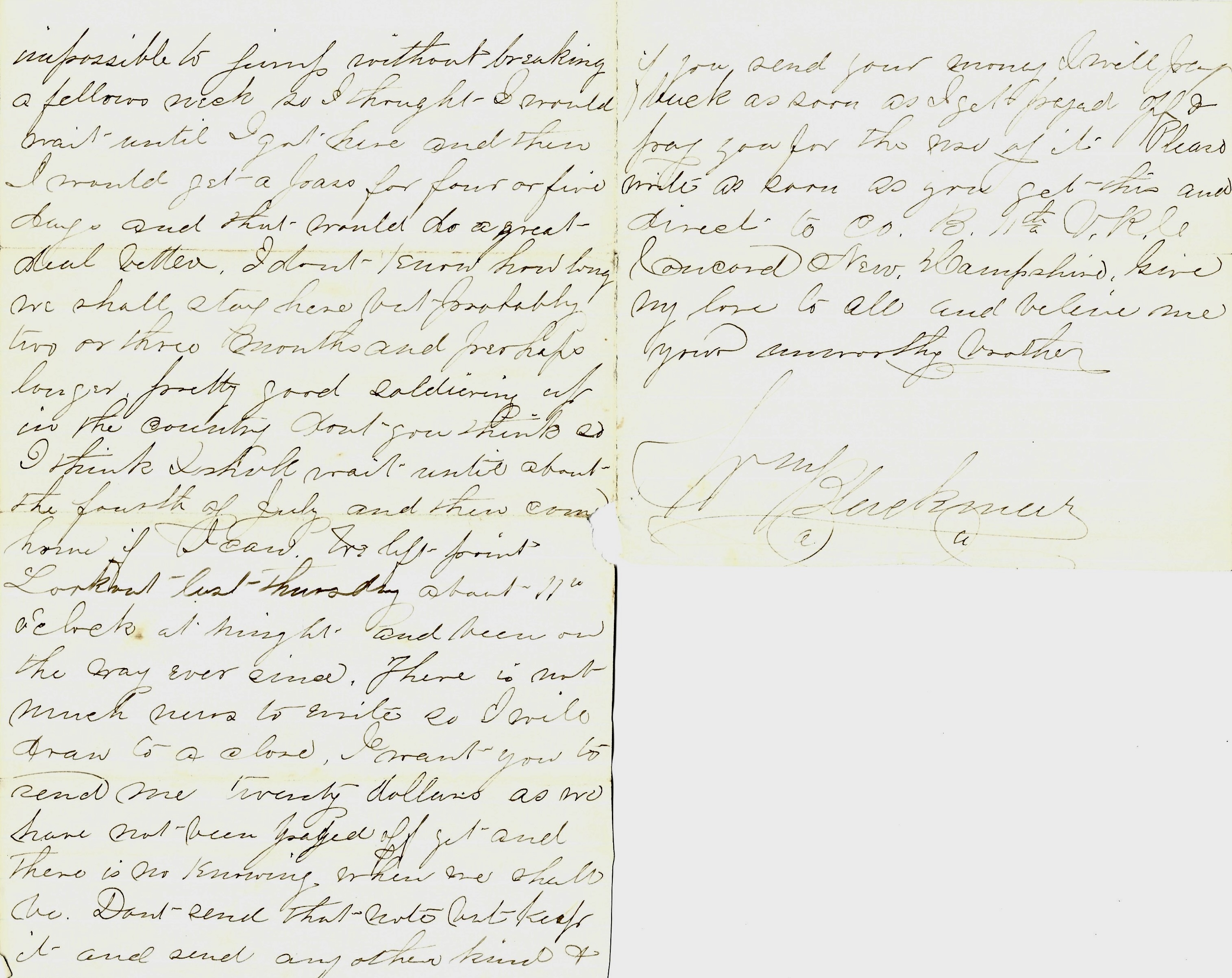
I write you these few lines to let you know that I am well as usual and to let you know that we have moved to this place. We arrived here today about half past ten o’clock this forenoon and are quartered in barracks about three quarters of a mile from the city. We passed through Thompson Sunday morning about 3 o’clock on the boat train and I should have jumped off the train and come home and stayed over Sunday but when we got to the depot the train was agoing so fast that it was impossible to jump without breaking a fellow’s neck so I thought I would wait until I got here and then I would get a pass for four or five days and that would do a great deal better.
I don’t know how long we shall stay here but probably two or three months and perhaps longer. Pretty good soldiering up in the country, don’t you think so? I think I shall wait until about the 4th of July and then come home if I can.
We left Point Lookout last Thursday about 11 o’clock at night and been on the way ever since. There is not much news to write so I will draw to a close. I want you to send me twenty dollars as we have not been paid off yet and there is no knowing when we shall be. Don’t send that note but keep it and send any other kind and if you send your money, I will pay back as soon as I get paid off & pay you for the use of it.
Please write as soon as you get this and direct to Co. B, 11th Veteran Reserve Corps, Concord, New Hampshire.
Give my love to all and believe me your unworthy brother, — Wm. Blackmar
Letter 30
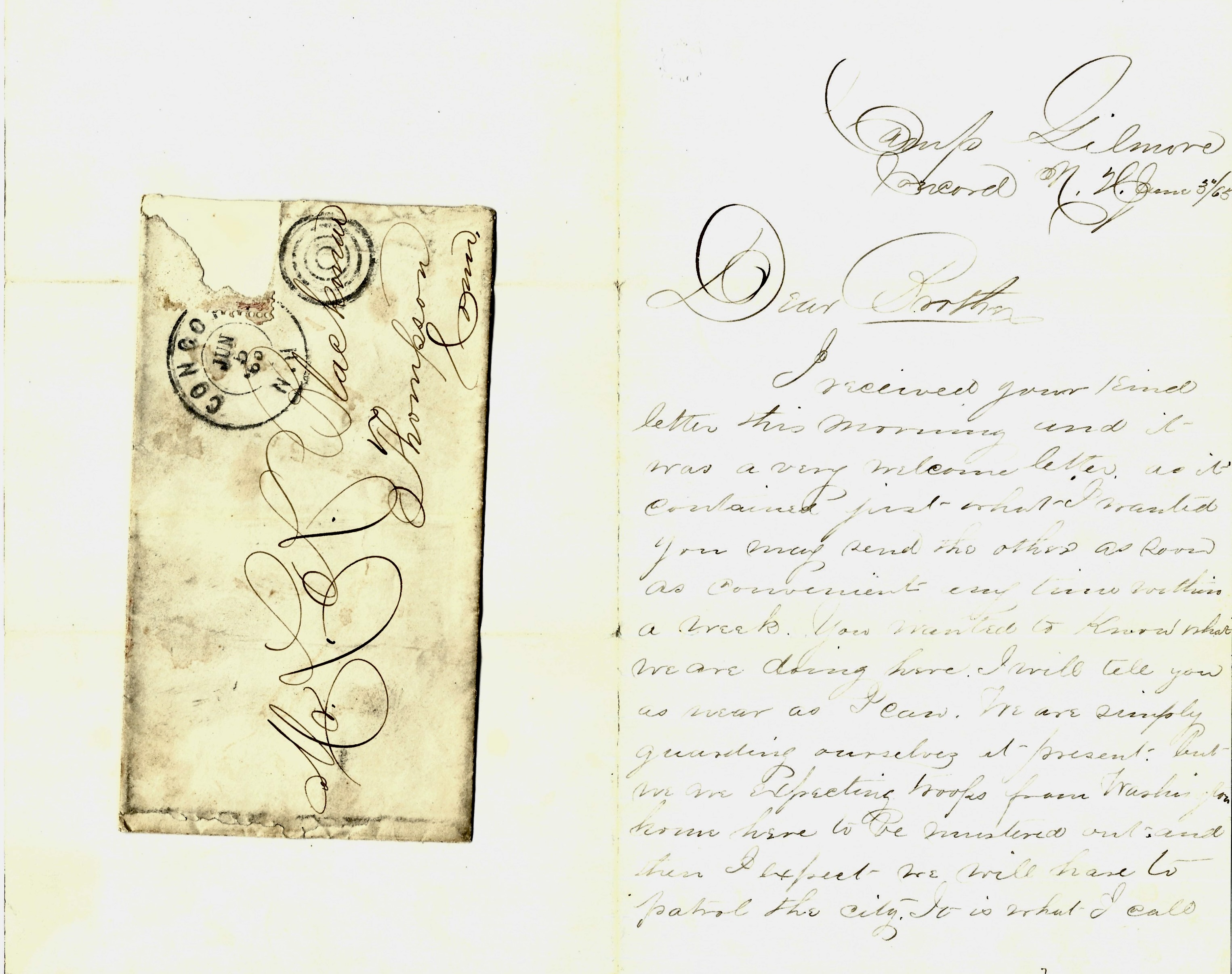
Camp Gilmore
Concord, New Hampshire
June 3rd 1865
Dear Brother,
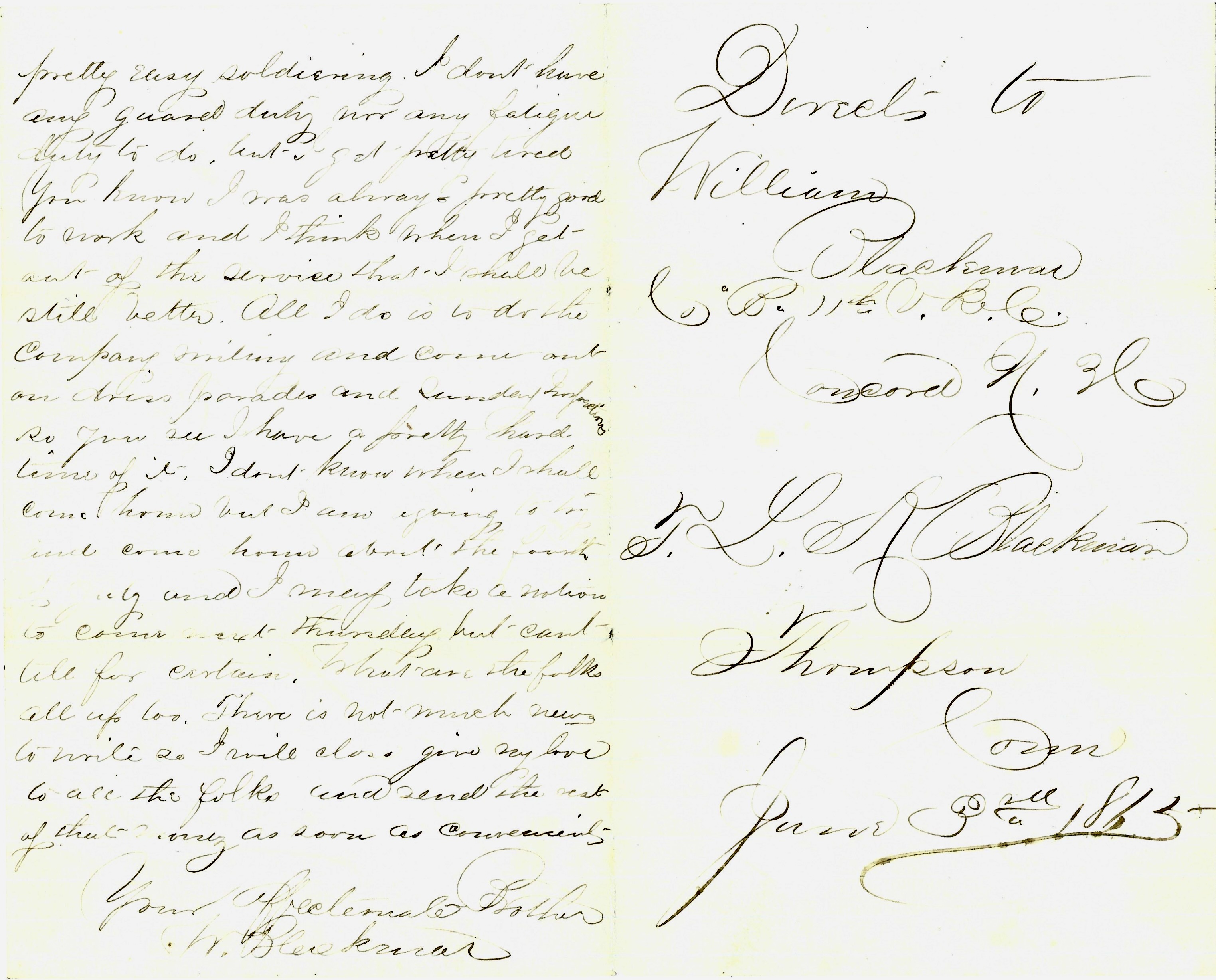
I received your kind letter this morning and it was a very welcome letter as it contained just what I wanted. you may send the other as soon as convenient any time within a week. You wanted to know what we are doing here. We are simply guarding ourselves at present but we are expecting troops from Washington home here to be mustered out and then I expect we will have to patrol the city. It is what I call pretty easy soldiering. I don’t have any guard duty nor any fatigue duty to do, but I get pretty tired. You know I was always pretty good to work and I think when I get out of the service that I shall be still better. All I do is to do the company writing and come out on dress parades and Sunday inspections. So you see I have a pretty hard time of it. I don’t know when I shall come home but I am agoing to try and come home about the 4th of July and I may take a notion to come out Thursday but I can’t tell for certain.
What are the folks all up to? There is not much news to write so I will close. Give my love to all the folks and send the rest of that money as soon as convenient.
Your affectionate brothr, — W, Blackmar
Direct to William Blackmar, Co. B, 11th V. R. C., Concord New Hampshire
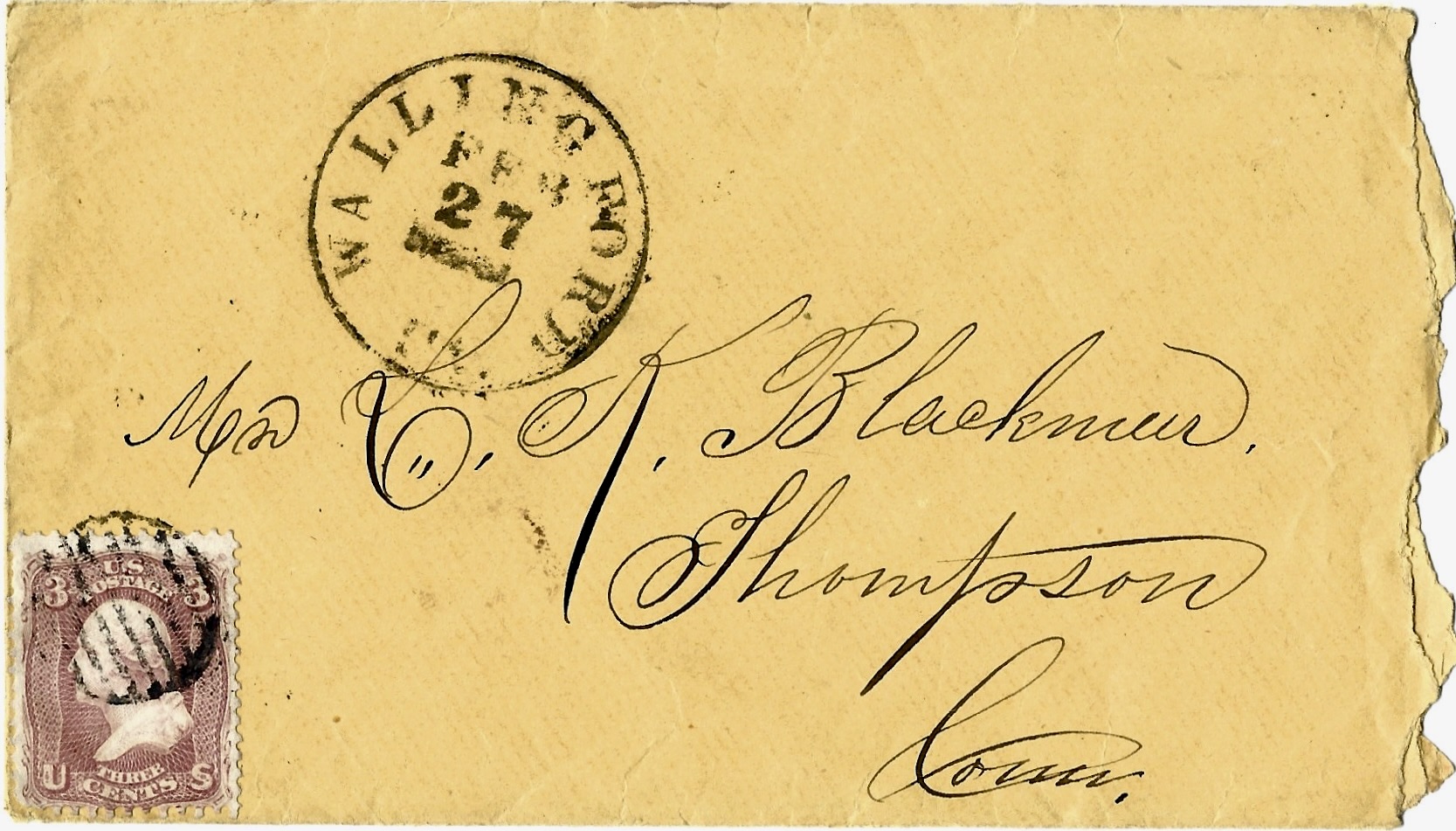
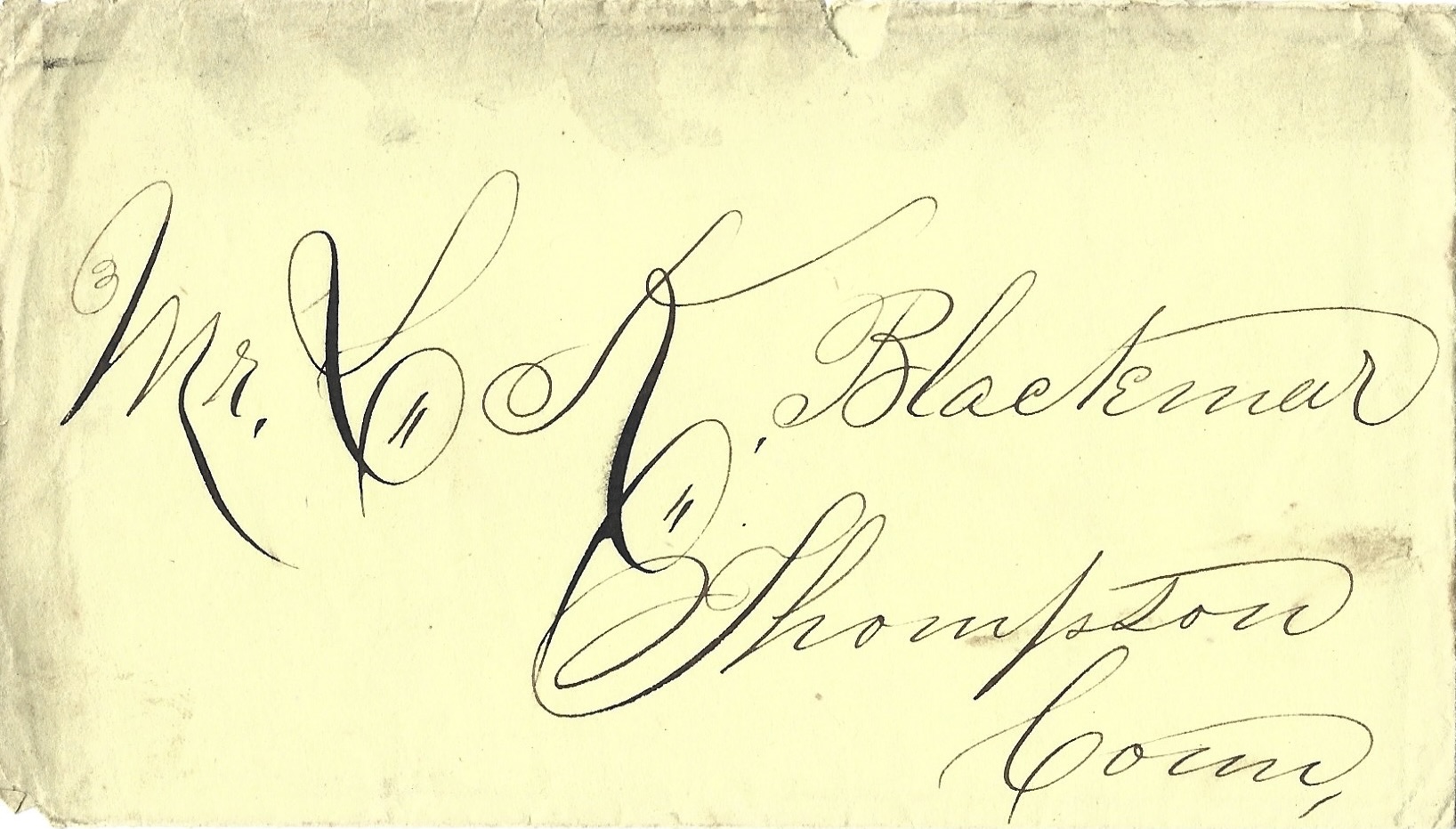
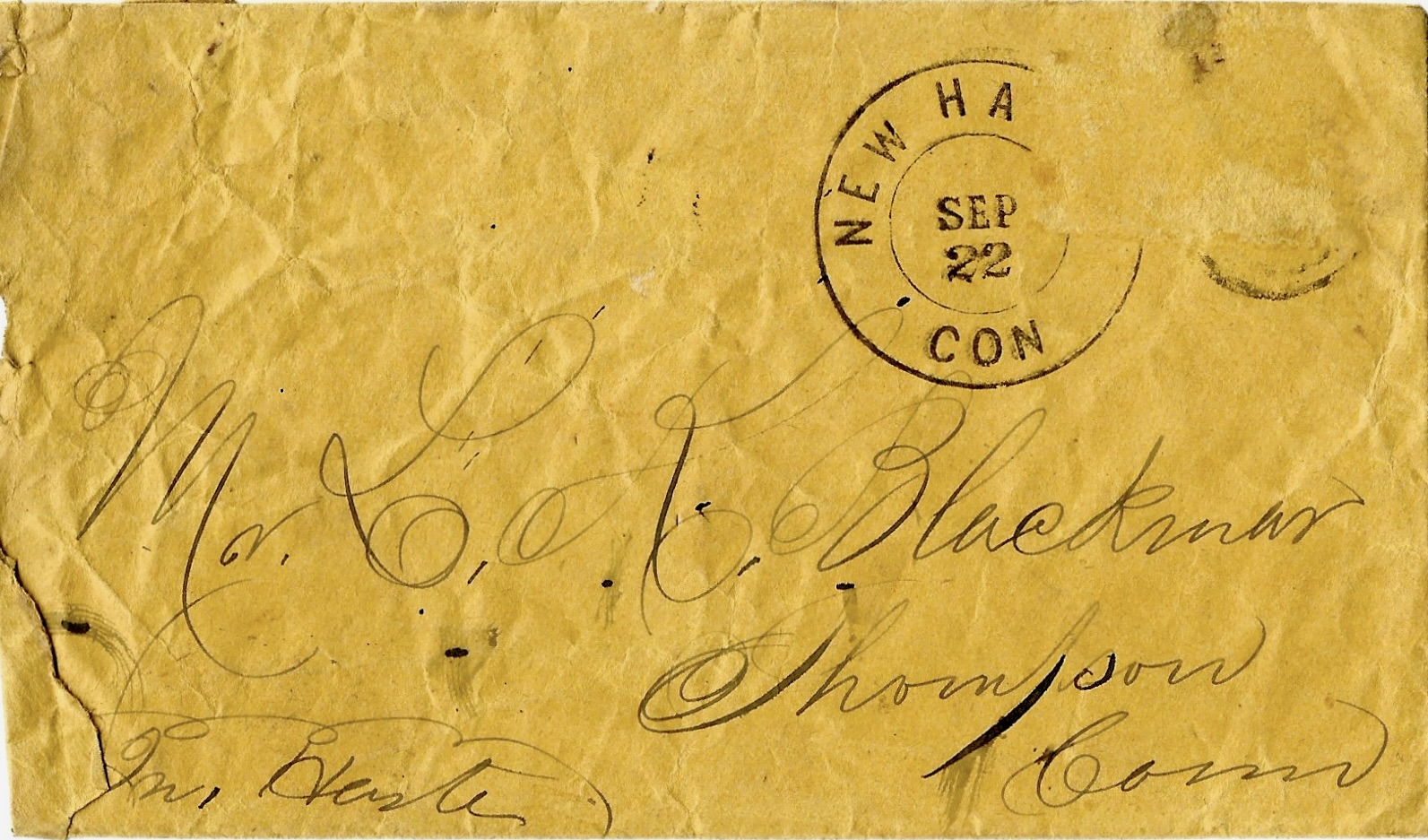
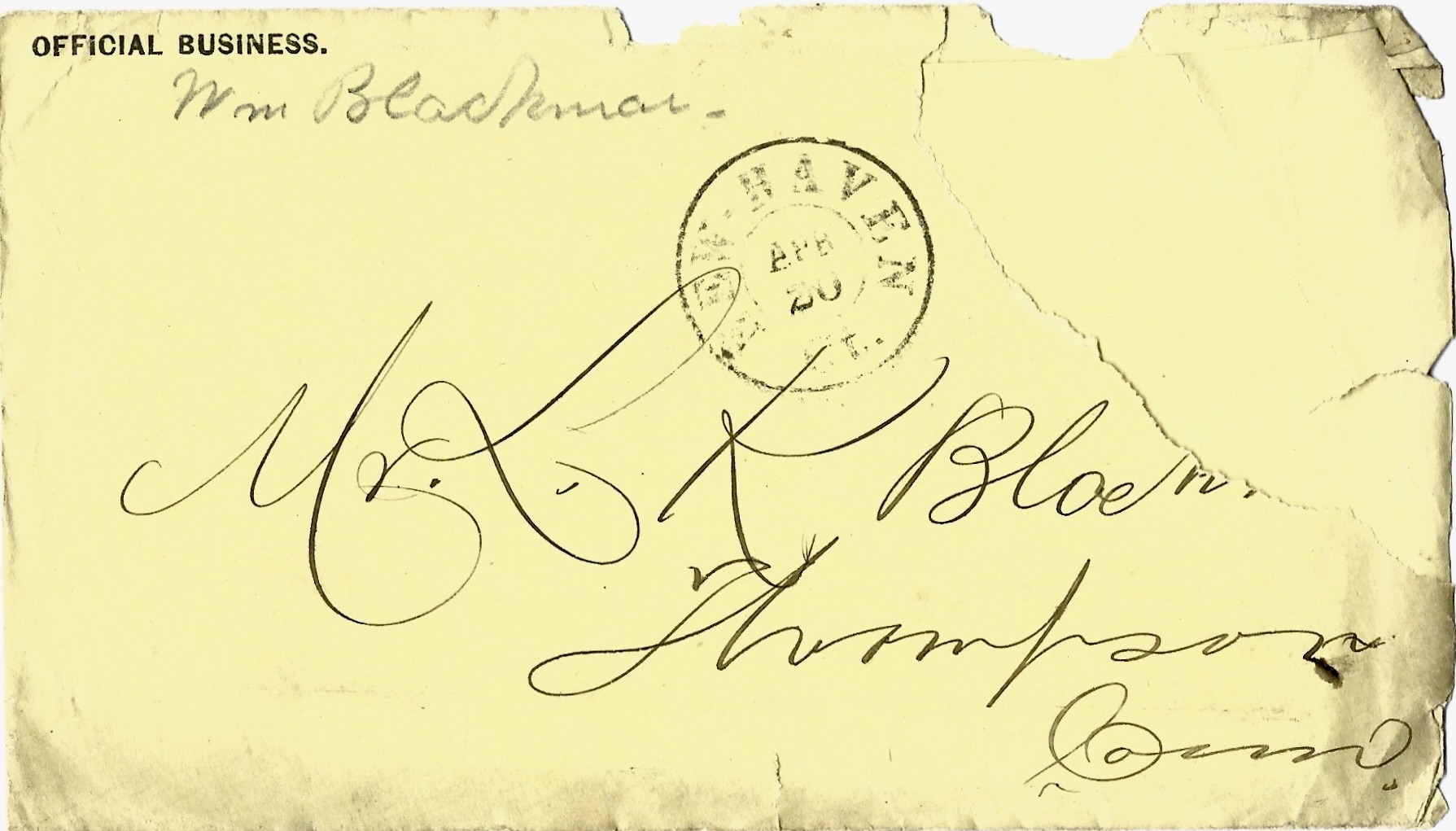
To L. K. Blackmar, Thompson, Conn., June 3rd, 1865
Letter 31
Camp Gilmore
Concord, New Hampshire
November 20, 1865
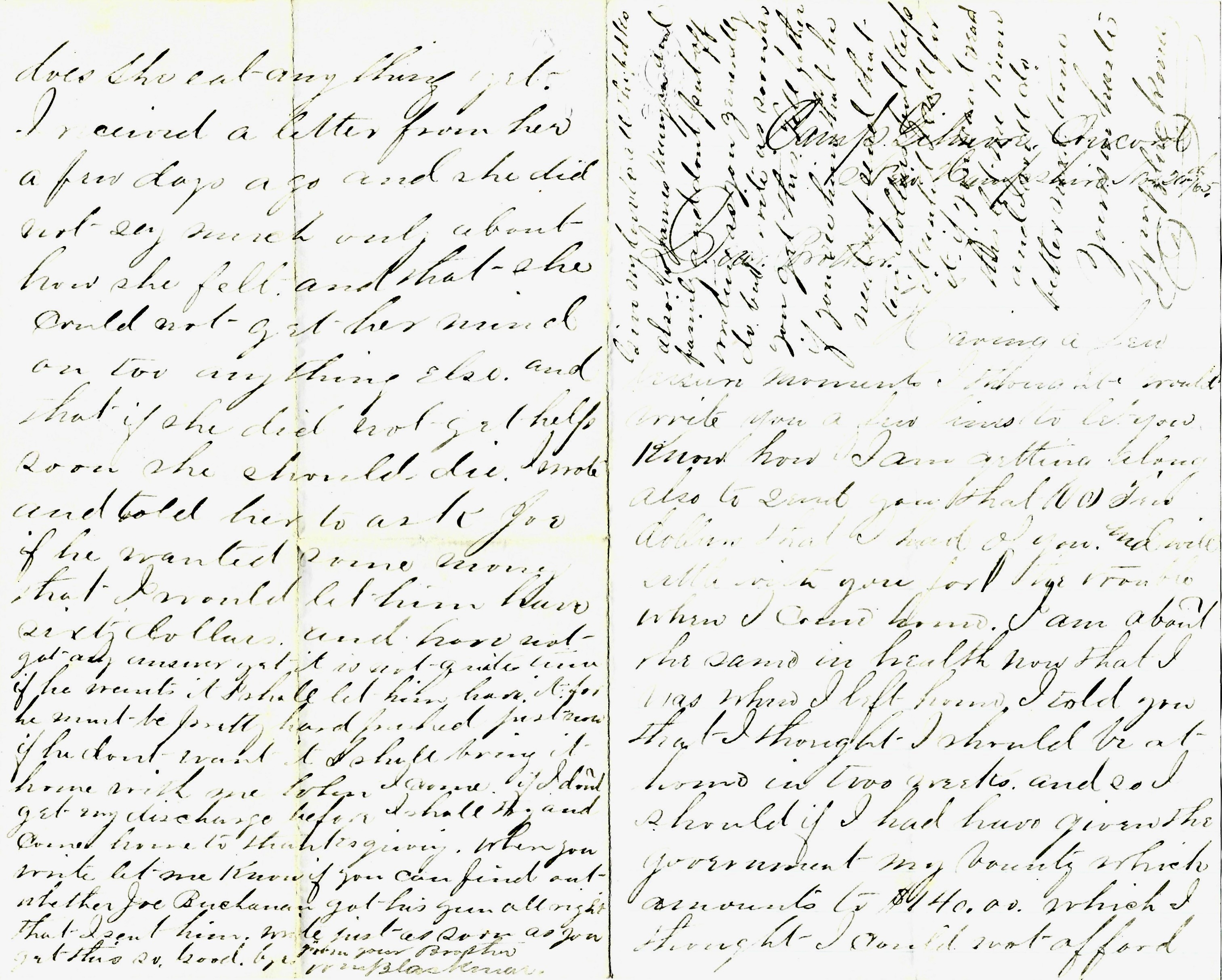
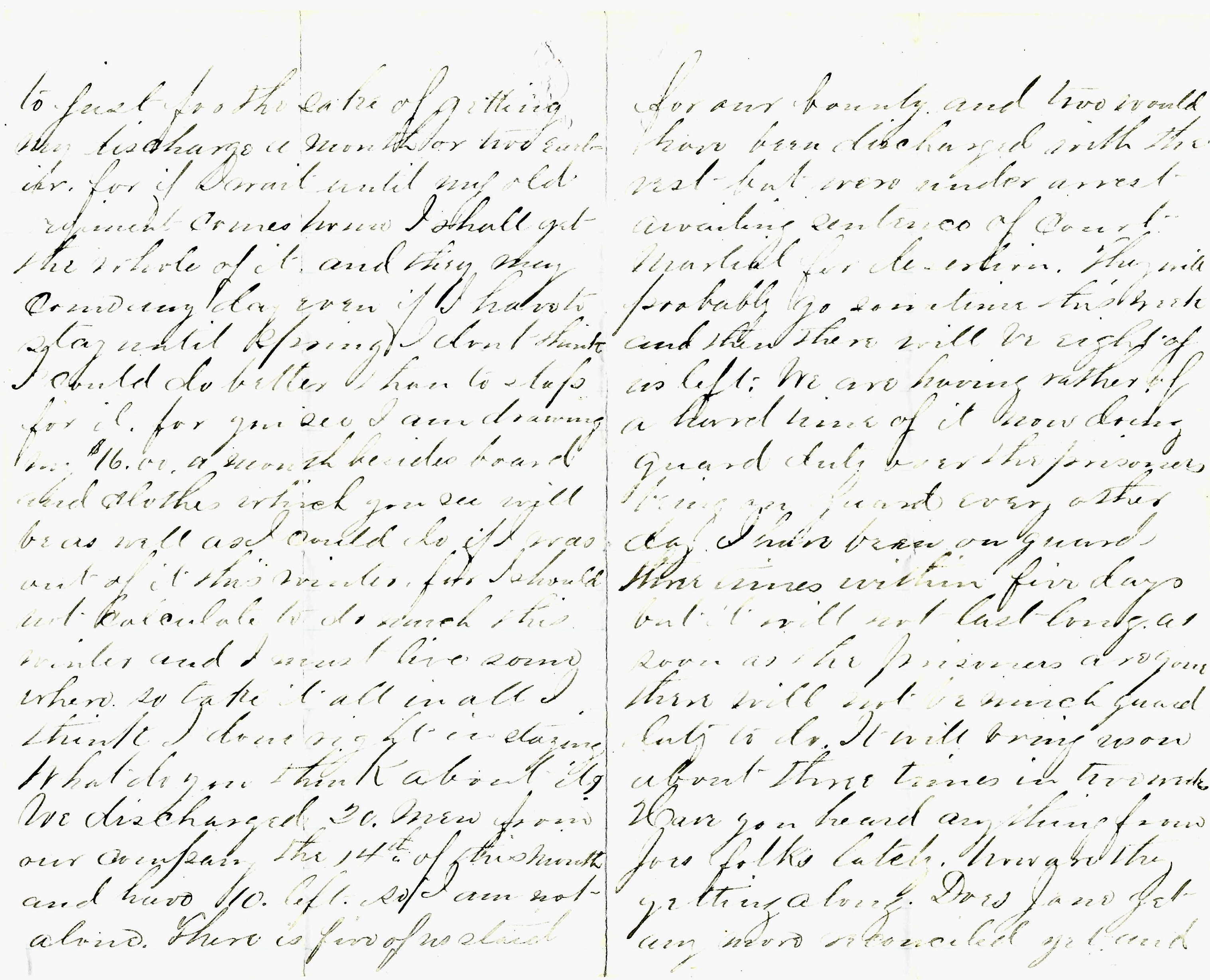
Having a few leisure moments, I thought I would write you a few lines to let you know how I am getting along. Also to send you that ten dollars that I had of you and I will settle with you for the trouble when I come home. I am aboutr the same in health now that I was when I left home. I told you that I thought I should be at home in two weeks and so I should if I had have given the government my bounty which amounts to $40 which I thought I could not afford to just for the sake of getting my discharge a month or two earlier for if I wait until my old regiment comes home, I shall get the whole of it and they may come any day even if I have to stay until spring. I don’t think I could do better that to stop for it for you see I am drawing my $16 a month besides board and clothes which you see will be as well as I could do if I was out of it this minute, for I should not calculate to do much this winter and I must live somewhere/ So take it all in all, I think I done right in staying. What do you think about it?
We discharged twenty men from our company the 14th of this month and have ten left so I am not alone. There is five of us staid by our bounty and two would have been discharged with the rest but were under arrest awaiting sentence of court martial for desertion. they will probably go somewhere this week and then there will be eight of us left. We are having rather of a hard time of it now doing guard duty over the prisoners, being on guard every other day. I have been on guard three times within five days but it will not last long. As soon as the prisoners are gone, three will not be much guard duty to do. It will bring us about three times in two weeks.
Have you heard anything from Joe’s folks lately? How are they getting along? Does Jane get any more reconciled yet? and does she eat anything yet? I received a letter from her a few days ago and she did not say much—only about how she felt and that she could not get her mind onto anthing else. And that if she did not get help soon, she should die. I wrote and told her to ask Joe if he wanted some money that I would let him have sixty dollars and have not got any answer yet. It is not quite time. If he wants it, I shall let him have it for he must be pretty hard pushed just now. If he don’t want it, I shall bring it home with me when I come. If I don’t get my discharge before, I shall try and come home to Thanksgiving. When you write, let me know if you can find out whether Joe Buchanan got his gun all right that I sent him. write just as soon as you get this. So goodbye. From your brother, — Wm. Blackmar
Give my love to all the folks. Also to James [ ] and family and don’t put ogg writing as you generally do but write as soon as you get this. Tell father if you see him that he need not send that ten dollars but keep it until I call for it. If you can’t read this, let me know and I will do better next time. Yours in haste, — Wm. Blackmar
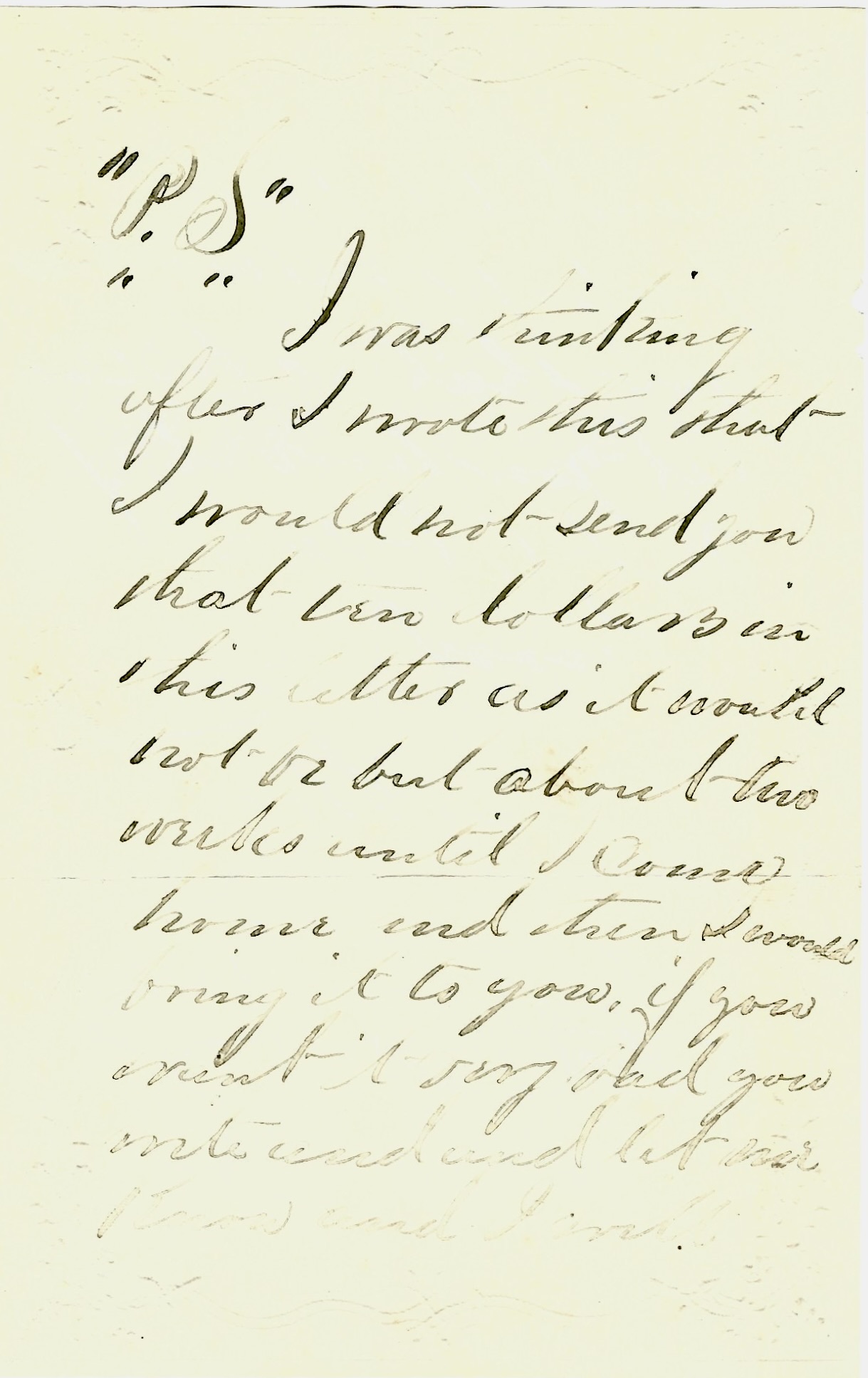
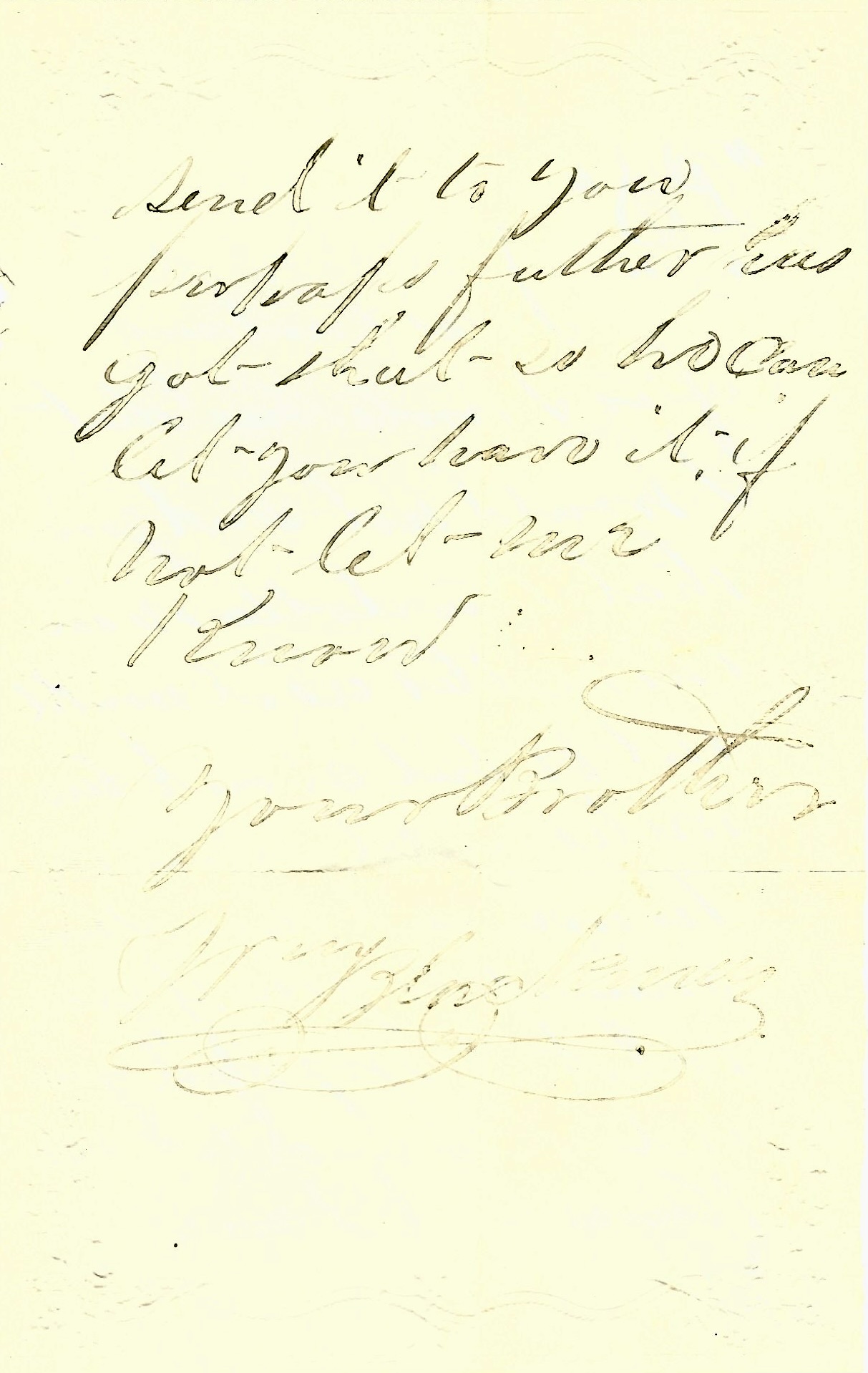
P. S. I was thinking after I wrote that I would not send you that ten dollars in this letter as it would not be but about two weeks until I come home and then I would bring it to you. If you want it very bad, you write and let me know and I will send it to you. Perhaps Father has got that so he can let you have it. If not let me know. Your brother, — Wm. Blackmar





















 Spared & Shared 23