Category Archives: 27th Georgia Infantry

1864: Unidentified “Jonnie B.” to Sister “Jocie”

This letter was probably written by a member of the 27th Georgia while in the trenches at Petersburg. Unfortunately I was not able to identity who wrote it and I’m not certain that I have actually gotten the names correctly. The author wrote the letter to his sister “Jocie” which was probably short for Josephine. She was married to someone named John and they had a young daughter named “Sadie” or Sarah. The author may have had a brother serving in the 27th as well who was assigned to duty in Savannah rather than Petersburg.

T R A N S C R I P T I O N

Petersburg, Virginia
September 27th 1864

Dear Sister Jocie,

I received your most welcome letter today and was glad to hear from you once more and to hear that Bro. Shon was at home but sorry to hear of his sickness. I was in hopes he was well when I heard he had gone back to camp [ ] but am sorry [to] hear different in your letter.

I have no news of importance to write. Everything has been very quiet here for the last day or two. Of course we have the usual cannonading and picket firing along the lines which does not do much damage to either side. Some days they take a notion and shell the city very furiously. It does not generally result in much damage in the way of life. I went over to see Frank last Sunday. They were both well. I will deliver your message to them when I see them again.

I have not heard from home since the 18th. All was well and expecting the Yankees to come at any time which I am afraid they will do some night before they know it. I am afraid I will never get to see my home again—at least until the war is ended. And you know chances are slim in war. If the Yankees were all sunk in the middle of the blue sea, it would not grieve me much.

I would like very much to see your little Sadie. You say she is so interesting. I am afraid you praise her good looks too much. You must let me judge for you. As you know, a mother always looks on her children with [ ] eyes. I am in hopes I will have a chance of coming to see you before the war ends but I think it very doubtful. Nothing would give me more pleasure but furloughs are so short that by the time I got home and tell them all howdy, I’d have to pack back to the army. I am as tired of this war as mortal ever was.

You wrote to know Willie’s address. Direct your letter in care of Capt. Dougherty, Co. E, Savannah 27th Ga. Battalion, Savannah, Ga. Willy seems to be very lonely down there but I think he is much better off there than here.

Sister, I think you are mistaken when you say you have the advantage of me for I know I love you as much as any brother ever loved a sister and think all the rest do also. I almost despaired of hearing from you or Bro. John. I wrote several letters and did not receive and answer to any of them. Excuse this short letter as my candle is waxing low which reminds me that I must bid you good night. Kiss John for me. Love to all and reserve a portion for yourself. From your brother, — Jonnie B.

1863: Freeman Walker to Fannie (Walker) Miller

The following letter was written by Freeman Walker (1825-1864) who enlisted as a private in Co. K, 27th Georgia Infantry in March 1862. After he was promoted to sergeant, he was taken a prisoner in the fighting at South Mountain on 14 September 1862 and confined at Fort Delaware until 10 November 1862 when he was exchanged at Aiken’s Landing, Virginia. After returning to the regiment he was elected 2nd Lieutenant on 16 March 1863. In March 1864 he was reported as slightly wounded by a gunshot wound to his right leg. He died on 27 June 1864.

I’m reasonably confident that Freeman Walker was John Freeman Walker (b. 1825), the son of Johnson Walker (1794-1830) and Sarah Swindall (1797-1854) of Talbot county, Georgia. He had been married to Julia Ann Dixon (1825-1852) but she died in 1852, leaving him a widower with two children.

Freeman addressed his letter to Fannie. I suspect she was his older sister, Frances (“Fannie”) Walker, born 1817, and the wife of Green J. Miller.

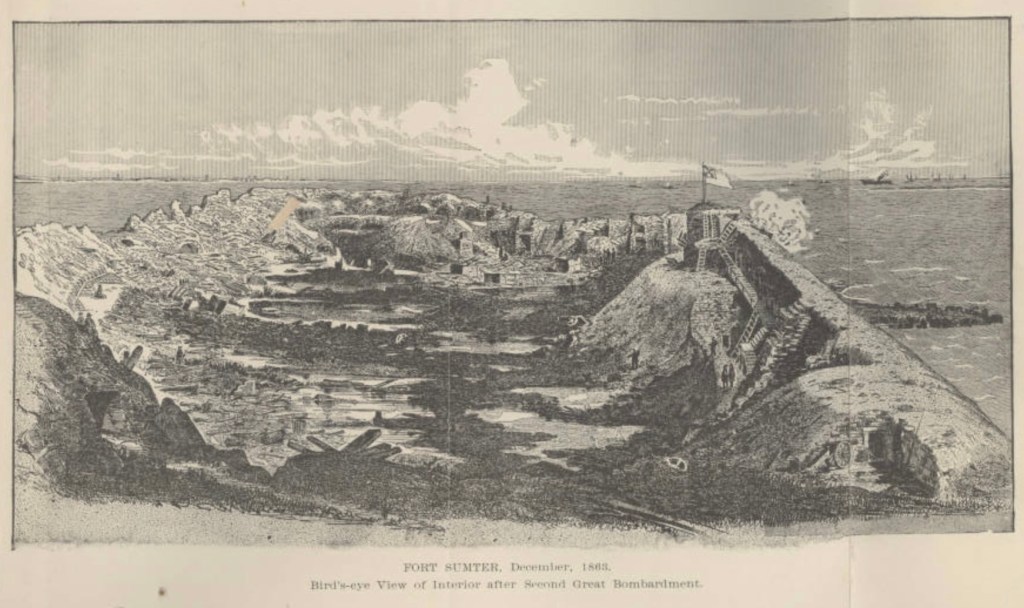
The interior of Fort Sumter during the time Freeman Walker was there, December 1863.

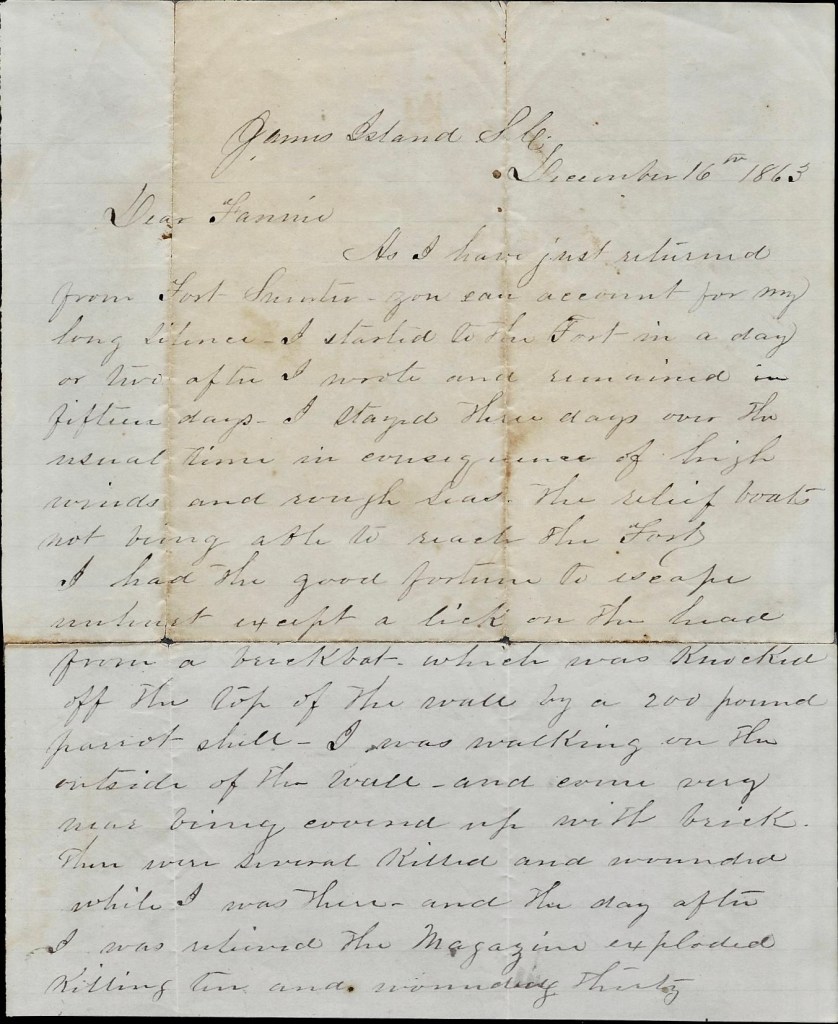
Transcription

James Island [South Carolina]
December 16th 1863

Dear Fannie,

As I have just returned from Fort Sumter you can account for my long silence. I started to the fort in a day or two after I wrote and remained fifteen days. I stayed three days over the usual time in consequence of high winds and rough seas, the relief boats not being able to reach the fort.

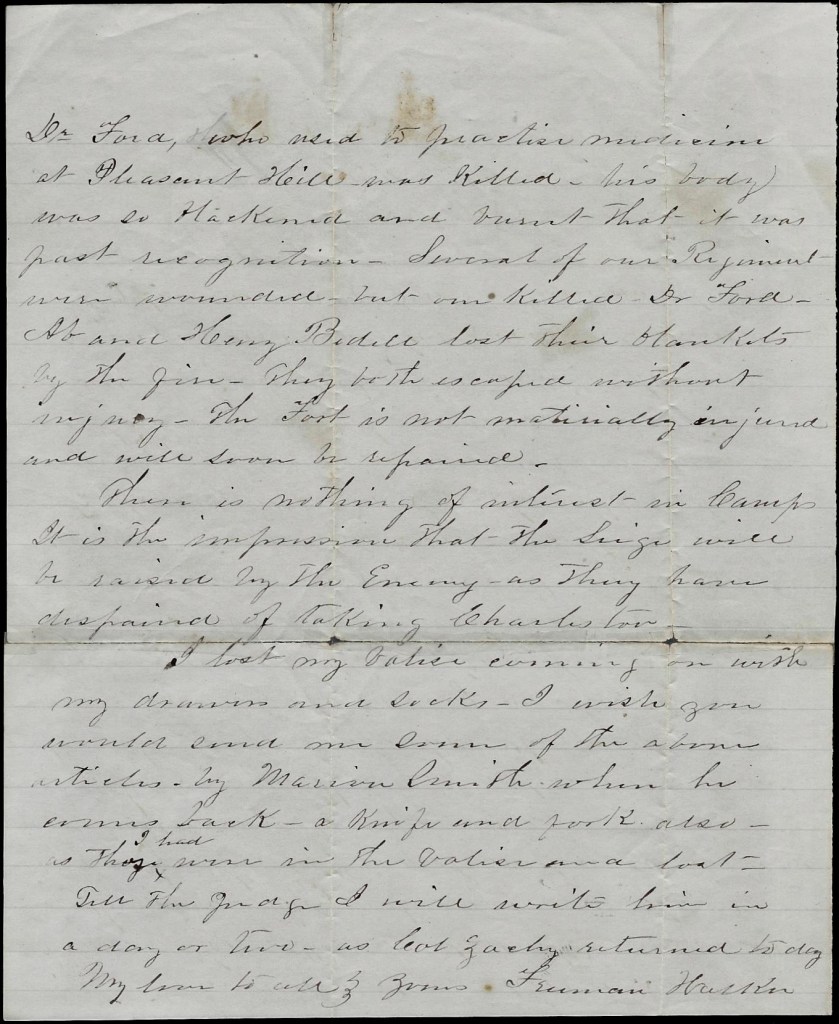
I had the good fortune to escape unhurt except a lick on the head from a brickbat which was knocked off the top of the wall by a 200 pound parrot shell. I was walking on the outside of the wall and come very near being covered up with brick. There were several killed and wounded while I was there and the day after I was relieved, the Magazine exploded killing ten and wounding thirty. Dr. [J. T.] Ford, who used to practice medicine at Pleasant Hill was killed. His body was so blackened and burnt that it was past recognition. Several of our regiment were wounded, but [only] one killed—Dr. Ford. Ab[ner] and Henry Bedell lost their blankets by the fire. They both escaped without injury. The fort is not materially injured and will soon be repaired. 1

There is nothing interest in camp. It is the impression that the siege will be raised by the enemy as they have despaired of taking Charleston.

I lost my valise coming on with my drawers and socks. I wish you would send me some of the above articles by Marion Smith when he comes back. A knife and fork also as they were in the valise and lost.

Tell the judge I will write him in a day or two as Col. Zachy returned today. My love to all. Yours, — Freeman Walker


1 In the history of the fort, it is stated that for an “unknown reason, “the small-arms magazine exploded in the officers’ quarters of a three-story building extending the entire length of the gorge on December 11, 1863, killing 11 and wounding 41 Confederates. The explosion also tilted the arch over the magazine’s entrance.” The explosion occurred at 9:30 a.m. on 11 December 1863; the cause of the explosion known only to those who perished in it. The enemy had not fired a shot for several days.