Category Archives: 27th Massachusetts Infantry

1864: Dwight H. Howland to Jennie Palmer

Dwight Howland’s headstone

This letter was written by Dwight H. Howland (1839-1866), a farmer from Gill, Massachusetts, who enlisted on 13 September 1861 as a musician, later as a private, in Co. C. 27th Massachusetts Infantry. He remained with the regiment until 133 August 1864 when he transferred to the 38th U. S. Colored Troops to serve as the Quartermaster Sergeant. Dwight was listed as “absent sick” (suffering from chronic diarrhea) for the months of January, February, and March, 1865. He seems to have been present April, May and June but was discharged from the service for disability on 8 July 1865. Though he “survived” the war, he died on 7 January 1866 in Tinmouth, Vermont, where he was buried next to his parents.

Dwight was the orphaned son of Consider Howland (1809-1856) and Lydia P. Stafford (1813-1864) of Tinmouth, Rutland county, Vermont.

[This letter is from the private collection of Greg Herr and was transcribed and published on Spared & Shared by express consent.]

Transcription

Addressed to Miss Jennie Palmer, Wallingford, Vermont

Camp of the 38th U. S. C. Troops
Deep Bottom, Va.
September 4th, 1864

Cousin Jennie,

I am at liberty today to do about as I please so will pen a few lines in answer to your welcome letter that was received yesterday. I was very glad to hear from you as I always am. I still jog along nearly the same as usual although I am at present suffering with a very hard cold, but that is of but little consequence when compared with a thousand other ills that I might have here in this low, unhealthy place. It is very sickly here now. The weather is fine but it is bad for us Northern men. The days are hot and the nights cold—so cold that 2 wool blankets are none too much to sleep under.

When I last wrote you we were in front of Petersburg. Now we are at what is called Deep Bottom, some 12 miles from our last camp. We are on the north side of James river on a high bluff about 5 miles from Bermuda 100. All of the 18th S. C. are in this vicinity but only 1 Brigade here. We have a very strong place here and one that would cost the Rebs dear should they undertake to take it from us. Three gunboats lie here near us. One of them is a torpedo boat that was taken from the Rebs some time ago.

We are doing nothing but picket duty here. Half of the regiment are on one day, the other half the next. That is far easier than the duties they had to do when in front of Petersburg. There they had to be on duty all the time and be under fire at that.

I don’t know how long we will stay here but probably not long. Then we will have to go into the trenches again. I hope Petersburg & Richmond will be taken before long if it is agoing to be such work as this. I am sick of it and will be glad when they go over the Bey [?]. We got the news last night that Atlanta was in our hands. Hope it is so but am afraid it is too good to be true.

The 27th [Massachusetts] time expires now soon. I almost wish I was one of the number that was going home. Poor fellows. They will be glad to get out of it. Suppose you expect John home this fall. Hope his health will be good so that he can enjoy himself after 3 years of hardship. I can think of nothing more to write so with much love, I will bid you goodbye for this time. Remember me to your brother and all of our friends & relatives that you chance to see.

I remain your affectionate cousin, as ever, — Dwight

Address D. H. Howland, 38th Reg. U. S. C. Troops, 2nd Brigade, 3rd Division, 18th A. C., Fort Monroe, Virginia

1865: Francis Denison Avery to David Avery

I could not find an image of Frank, but here is one of Sergt. Lyman A. Holmes who served with him in Co. C, 27th Massachusetts (Photo Sleuth)

This letter was written by Francis (“Frank”) Denison Avery (1843-1869), the eldest son of David and Prudence (Dean) Avery of East Charlemont, Franklin county, Massachusetts. Frank enlisted in September 1861 as a corporal in Co. C, 27th Massachusetts Infantry and was promoted to a sergeant in February 1863. Just after he was promoted to 1st Lieutenant of Co. C, he was wounded at Drewry’s Bluff, Virginia, on 16 May 1864 and was still at the Point Lookout Military Hospital when he wrote this letter in January 1865. He mustered out of the regiment on 8 July 1865 but died four years later from complications associated with the “rifle ball wound.”

Mentioned in the letter was Frank’s younger brother, Henry “Gardner” Avery (1845-1904) who served earlier in the war as a private in Co. B, 52nd Massachusetts.

Transcription

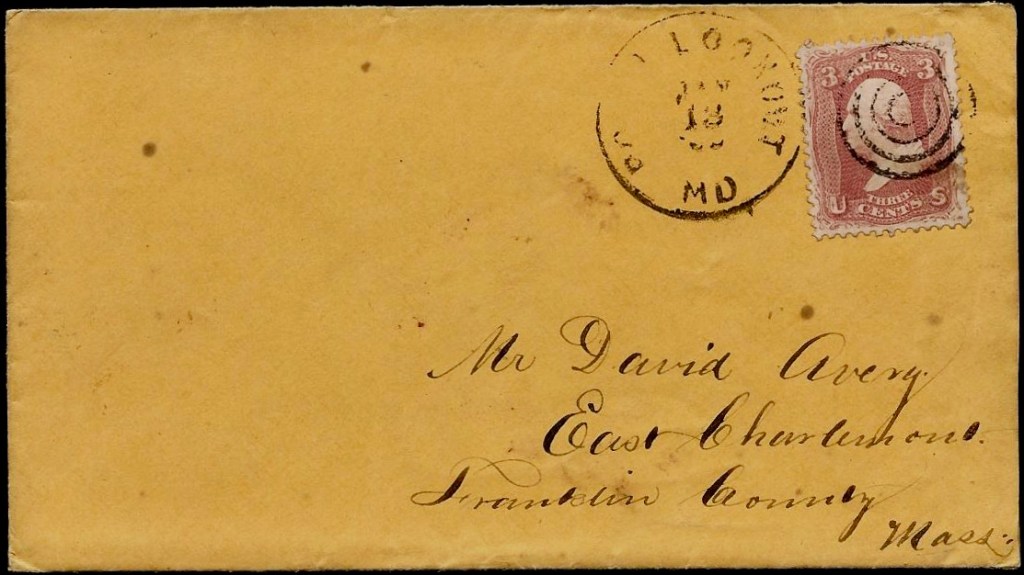
Addressed to Mr. David Avery, East Charlemont, Franklin county, Mass.

Point Lookout
January 13th 1865

My Dear Father,

As I have nothing to busy myself with today I though I would write you a few lines. I am getting along quite well now and am as well as when I left home. I guess that box is what did the good. I received a letter from Mother this morning that said that Capt. Welting was at home. I think I shall write to him if he would come this way. His influence might help me about getting transferred. If I can’t get transferred, I am a going to try and go to the regiment. Then thy may keep me as long as they want to. I don’t think I shall take my discharge now this year.

Dr. Hager has been relieved from duty on this Point and is going to Philadelphia. I don’t know the doctor’s name that takes his place.

The weather is quite warm today and it seems as though I never saw a more pleasant day. I suppose that you are having good sleighing. How I should like to be in Mass. and have a good sleigh ride. Mother spoke about Gardner’s thinking about enlisting. Isn’t he afraid of being drafted? I think he should be. I think that if I was in his place, I should go up to the frontier and perhaps get a little over the line rather than be drafted. A drafted man is of no account in the army.

Did you get out the pine lumber that you was talking of? If my back keeps getting better as fast as it has for a few days back, I shall begin to think it is going to get as well as ever sometime.

Well, I can’t think of anything more to write this time. Give my love to all enquiring friends and write as soon as convenient. From your son, — Frank

I was mustered for 10 months pay a few days ago but don’t know as I shall get it for two months. Excuse poor writing.

1863: Elbridge W. Whitney to his Family

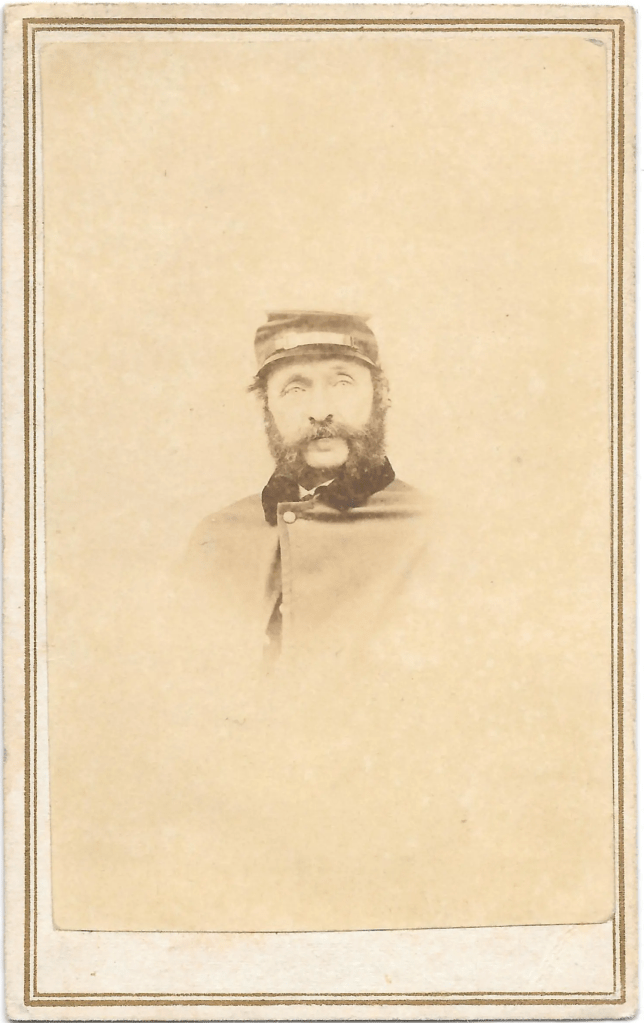
A middle-aged, unidentified Massachusetts soldier from the collection of Dave Morin.

This letter was written by 44 year-old Elbridge Whipple Whitney (1819-1882), the son of William Knowlton Whitney (1795-1868) and Deborah Woodward (18xx-1841). Elbridge was married to Sophia Ann Billings (1823-1873) and together they had two surviving daughters by the time he entered military service in the Civil War.—Frances (b. 1856) and Nellie (b. 1861).

Elbridge was working as a shoemaker in Athol, Worcester county, Massachusetts, when he was recruited in August 1862 into Co. B, 27th Massachusetts Infantry. He remained with the regiment for one year, mustering out in mid-August 1863 on a surgeon’s certificate of disability. Following the war, Elbridge returned to Athol where he resumed work in the shoemaking business.

Elbridge no doubt joined the regiment in New Bern, North Carolina, in time for the Goldsboro Expedition in December 1862 and was among the eight companies of the regiment in Washington, North Carolina, in April 1863 when they were hemmed in by Gen. Daniel H. Hill’s confederates and subjected to a siege. The following letter was written after the siege was lifted and the 27th Massachusetts had just returned to New Bern.

Siege of Washington, N. C., Map, April 1863 (LOC)

This letter is from the private collection of Jim Doncaster and is published by express consent.


Transcription

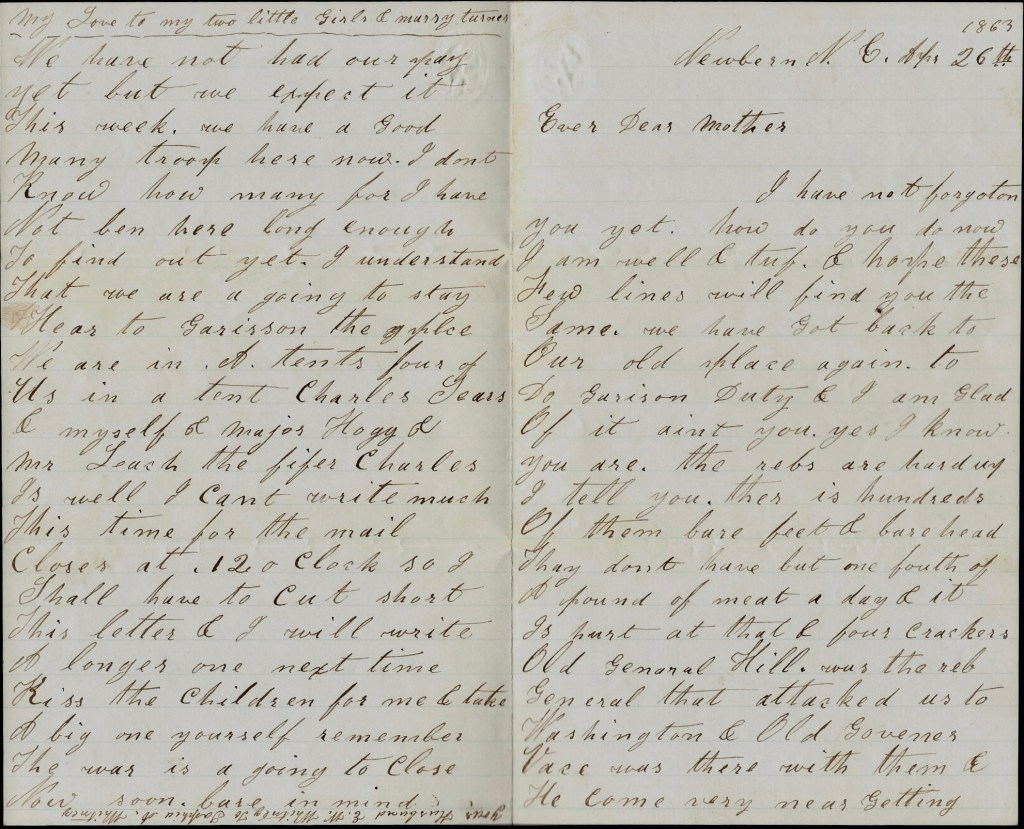
Newbern, N. C.
April 26th 1863

Ever dear wife.

It is Sunday & very pleasant. We arrived here last night. We came down by a steamer. We got about halfway & the shaft broke and we had to cast anchor & lay over about three hours until another steamer came along & then we started again and got into Newbern safely.

Dear wife, I hope these few lines will find you and the children all well. I am well & tough.

We hear that the rebs are a getting whipped & I am glad of it, ain’t you? I think you are. I think the war will be closed before long. We have not had our pay yet but we expect it this week. We have a good many troops here now. I don’ know how many for I have not been here long enough to find out yet. I understand that we are a going to stay here to garrison the place. We are in A tents—four of us in a tent. Charles Sears and myself and Major Hogg & Mr. [Addison] Leach, the fifer. Charles is well.

I can’t write much this time for the mail closes at 12 o’clock so I shall have to cut short this letter & I will write a longer one next time.

Kiss the children for me & take a big one yourself. Remember. The war is a going to close now soon. Bear in mind. My love to my two little girls and Mary Turner.

Your husband, — E. W. Whitney

To Sophia A. Whitney

Newbern, North Carolina
April 26th 1863

Ever dear Mother,

I have not forgotten you yet. How do you do now? I am well & tough & hope these few lines will find you the same. We have got back to our old place again to do garrison duty & I am glad of it, ain’t you? Yes, I know you are. The Rebs are hard up, I tell you. There is hundreds of them bare-footed and bare-headed. They don’t have but one-fourth of a pound of meat a day & it is hard at that & four crackers.

Old General [Daniel H.] Hill was the reb general that attacked us to Washington [N. C.] and Old Governor [Zebulon Baird] Vance was there with them & he came very near getting killed. We throwed a shell over there & it burst & very near killing him. I wished it had, don’t you? I know you do.

I shall have to close now for the mail closes at 12 o’clock. Write as soon as you get this. Yours with respect. Your son, — E. W. Whitney

To A R. E. Billings, Athol Depot, Worcester county, Mass.