Category Archives: Siege of Washington, N. C.

1863: Joseph Henry Capen to Samuel Billings Capen

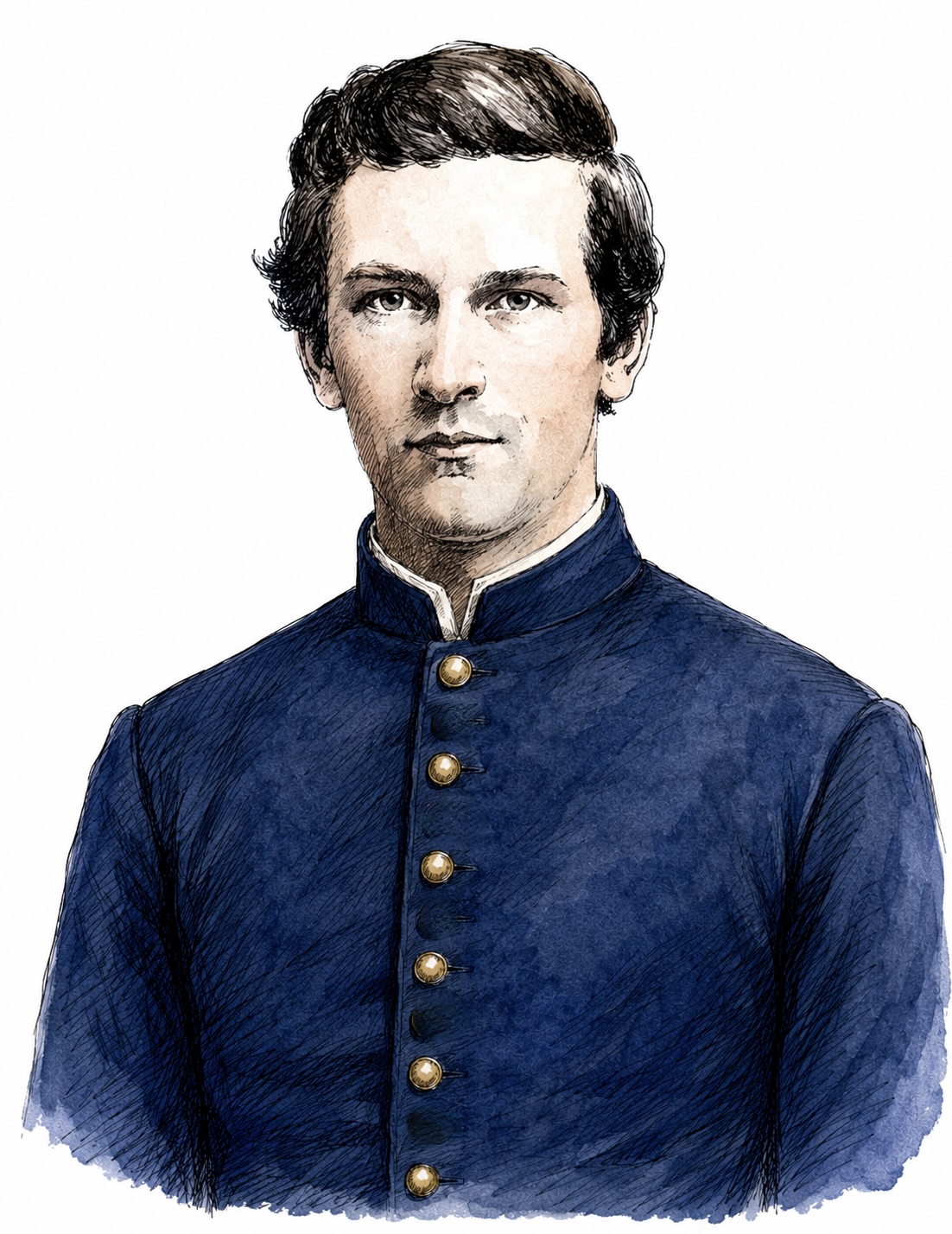
Joseph Henry Capen, 44th Mass.

This letter was written by Joseph Henry Capen (1840-1867) of Boston, Massachusetts, to his brother Samuel Billings Capen. They were the sons of Samuel Childs Capen (1812-1879) and Ann Billings (1805-1864). Joseph was working as a clerk in Boston at the time of his enlistment as a private in Co. F, 44th Massachusetts Infantry in August 1862. The 44th Massachusetts—known as the “Second New England Guards“—was a nine-month regiment recruited heavily from the Boston area.

Joseph’s letter gives us incredible detail of his activities between March 26 and April 2, 1863 during which time the Battle (or Siege) of Washington was taking place some 30+ miles distant from their camp. (see Siege of Washington, N. C.) Joseph gives us a chronology of the gunboat cannonading that could be heard from their camp at picket outpost near Batchelder’s Creek north of Newbern.
Over the years, I have transcribed a number of letters by members of the 44th Massachusetts. They include:

Henry C. Whittier, Co. A, 44th Massachusetts (1 Letter)
James Haynes Murray, Co. C, 44th Massachusetts (45 Letters)
Franklin David Child, Co. D, 44th Massachusetts (4 Letters)
William Carlton Ireland, Co. D, 44th Massachusetts (55 Letters)
Frederick A. Sayer, Co. D, 44th Massachusetts (2 Letters)
James Schouler Cumston, Co. E, 44th Massachusetts (2 Letters)
George Russell, Co. E, 44th Massachusetts (1 Letter)
Joseph Henry Capen, Co. F, 44th Massachusetts (1 Letter)
Herbert Merriam, Co. H, 44th Massachusetts (4 Letters)
Daniel C. Smith, Co. I, 44th Massachusetts (8 Letters & Diary)
Richard Harding Weld, Co. K, 44th Massachusetts (6 Letters)

T R A N S C R I P T I O N
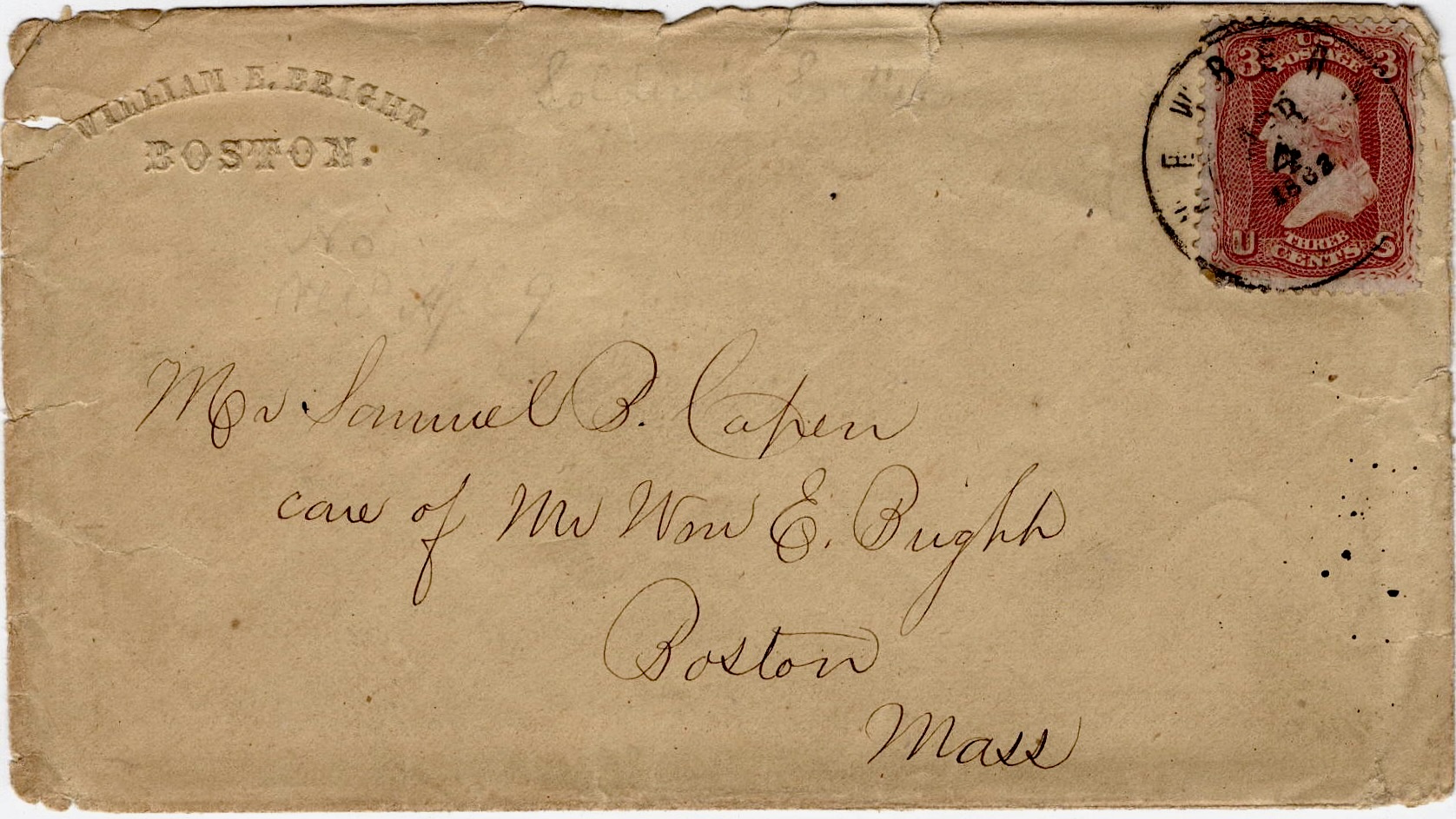
Addressed to Mr. Samuel B. Capen, care of Mr. Wm. E. Bright, Boston, Mass.

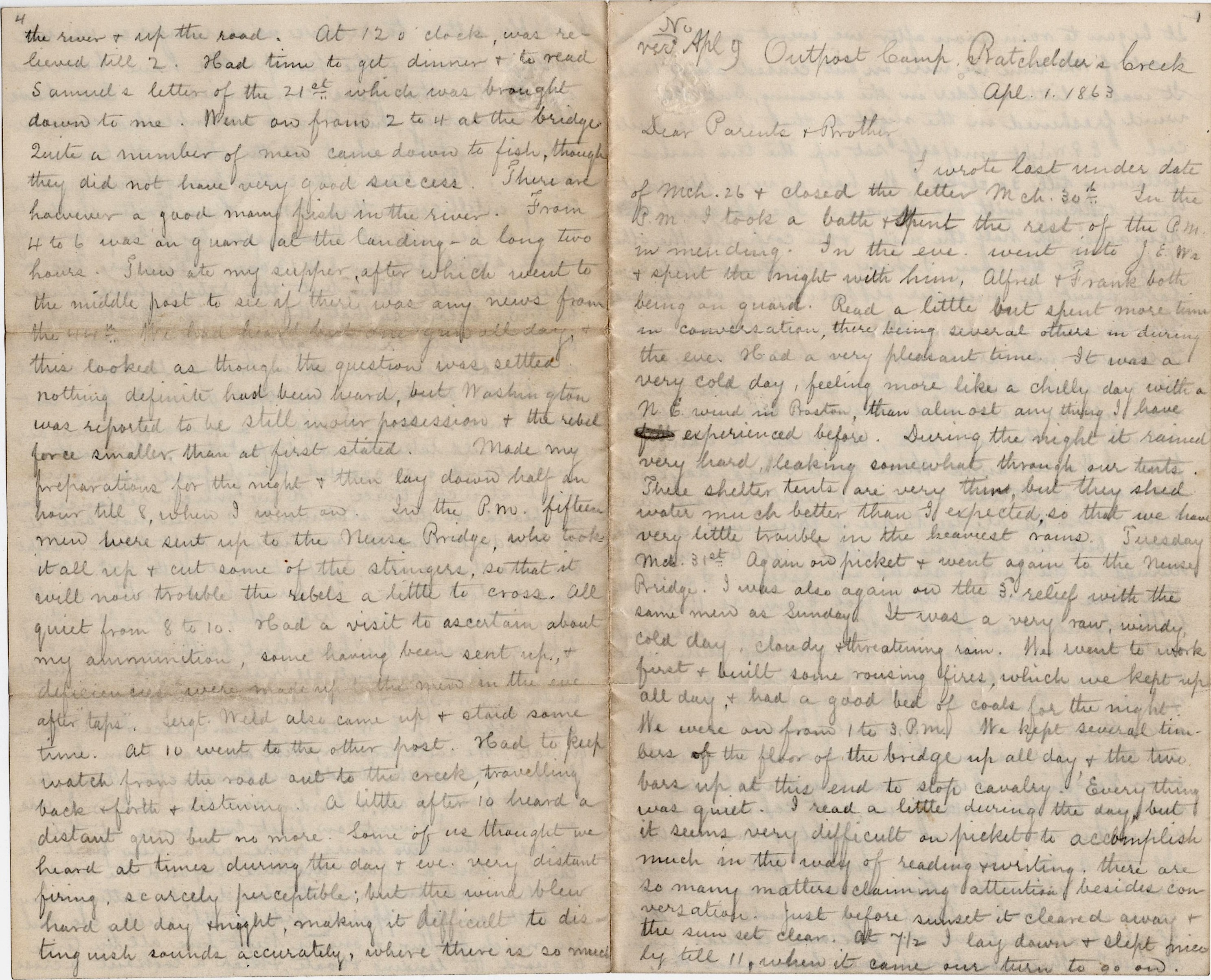
Outpost Camp Batchelder’s Creek
April 1, 1863

Dear Parents and Brother,

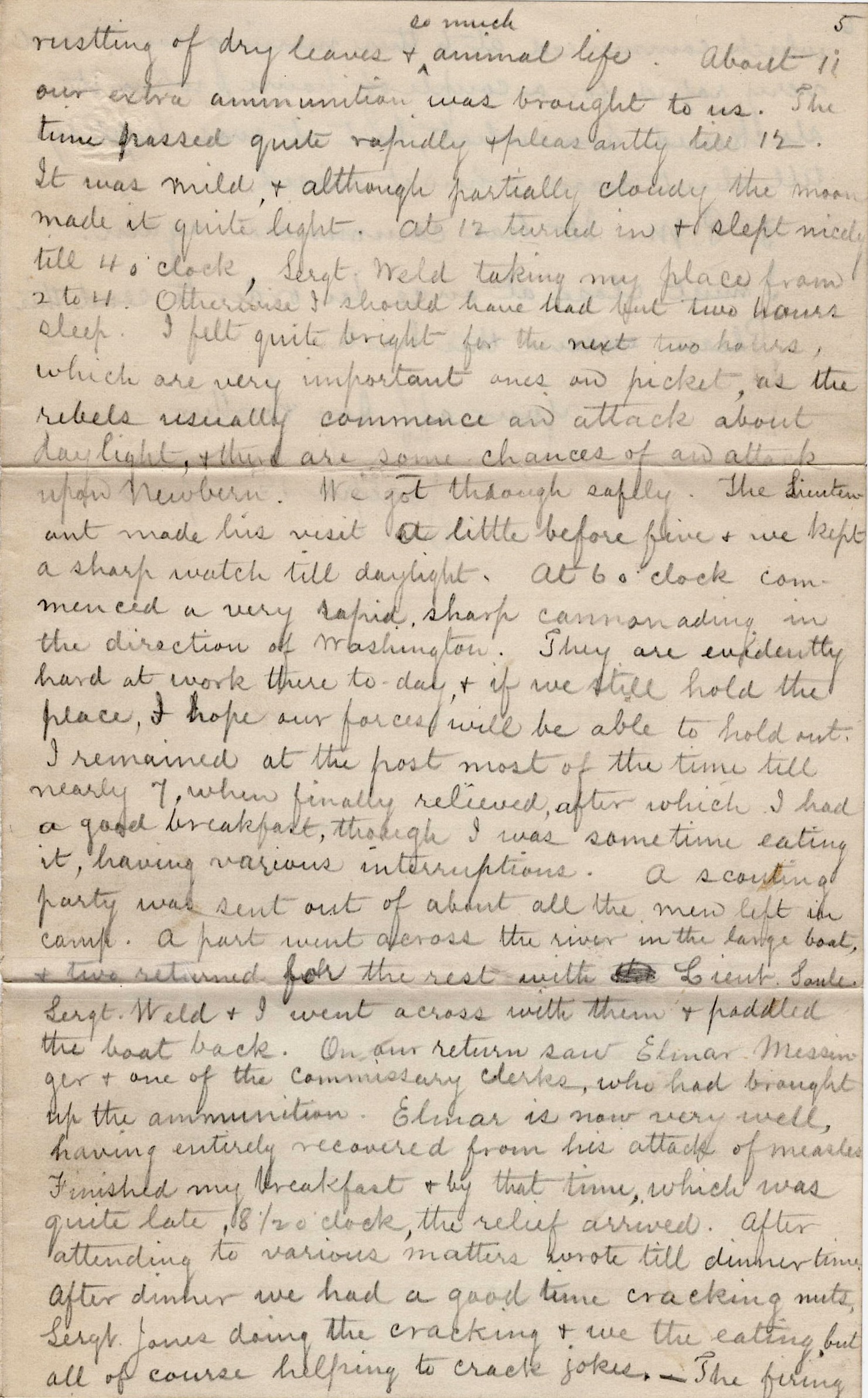
I wrote last under date of March 26 and closed the letter March 30th, In the p.m., I took a bath & spent the rest of the p.m. in mending. In the eve, went into J[ames] E. W.’s and spent the night with him, Alfred and Frank both being on guard. Read a little but spent more time in conversation, there being several others in during the evening. Had a very pleasant time. It was a very cold day, feeling more like a chilly day with a northeast wind in Boston, than almost anything I have experienced before. During the night it rained very hard, leaking somewhat through our tents. These shelter tents are very thin, but they shed water much better than I expected so that we have very little trouble in the heaviest rains.

Tuesday, March 31st. Again on picket and went again to the Neuse Bridge. I was also again on the 3rd Relief with the same men as Sunday. It was a very raw, windy, cold day, cloudy & threatening rain. We went to work first and built some rousing fires which we kept up all day and had a good bed of coals for the night. We were on from 1 to 3 p.m. We kept several timbers of the floor of the bridge up all day and the two bars up at this end to stop cavalry. Everything was quiet. I read a little during the day but it seems very difficult on picket to accomplish much in the way of reading & writing. There are so many matters claiming attention besides conversation. Just before sunset it cleared away and the sun set clear. At 7.30 I lay down and slept nicely till 11 when it came our turn to go on.

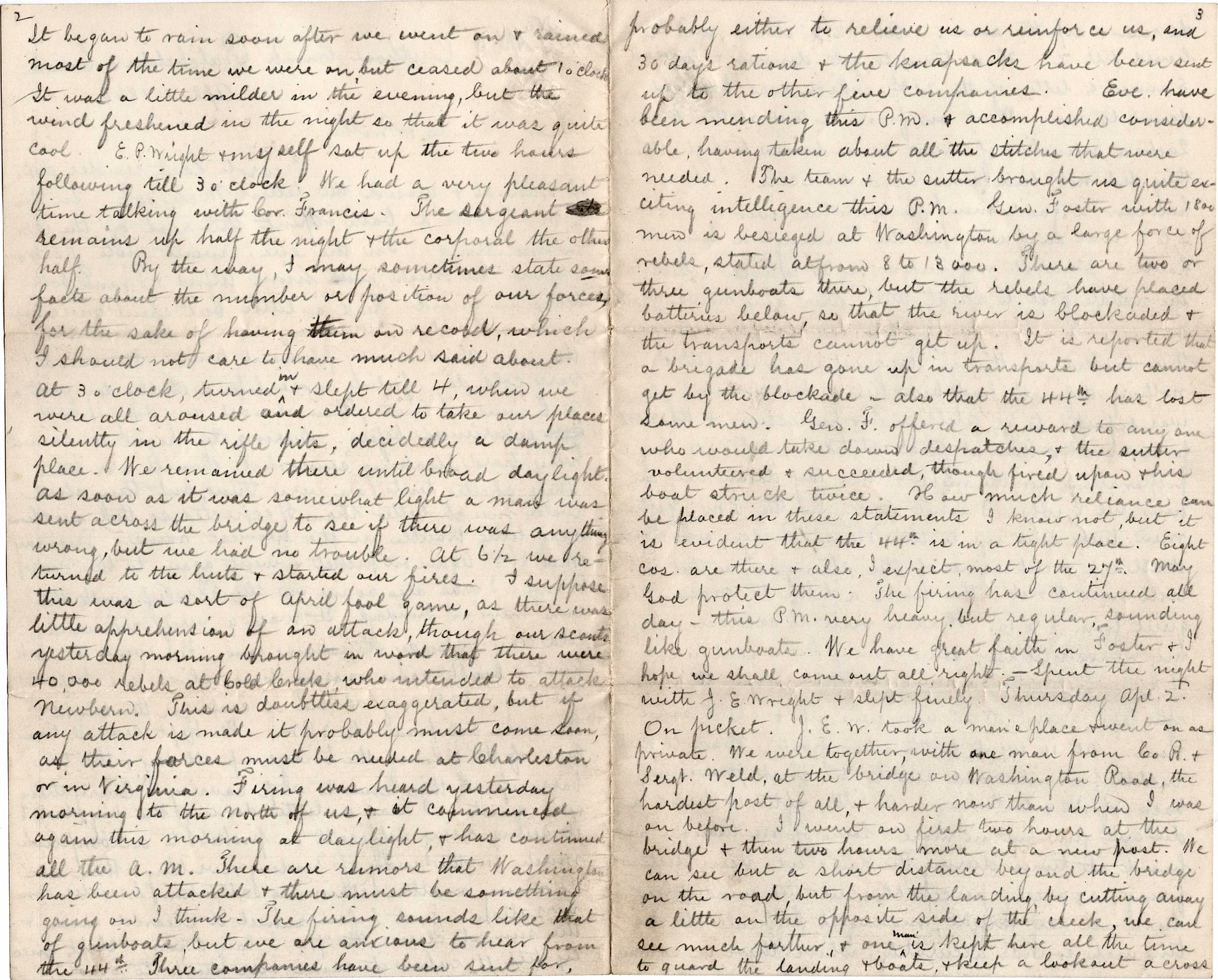
It began to rain soon after we went on & rained most of the time we were on but ceased about 1 o’clock. It was a little milder in the evening, but the wind freshened in the night so that it was quite cool. E[dward] P. Wright and myself sat up the two hours following till 3 o’clock. We had a very pleasant time talking with Corp. [Charles] Francis. The sergeant remains up half the night & the corporal the other half. By the way, I may sometimes state some facts about the number or position of our forces for the sake of having them on record, which I should not care to have much said about.

About 3 o’clock, turned in and slept till 4 when we were all aroused and ordered to take our place silently in the rifle pits, decidedly a damp place. We remained there until broad daylight. As soon as it was somewhat light, a man was sent across the bridge to see if there was anything wrong, but we had no trouble. At 6.30 we returned to the huts and started our fires. I suppose this was a sort of April fool game as there was little apprehension of an attack, though our scouts yesterday morning brought in word that there were 40,000 rebels at Cold Creek who intended to attack Newbern. This is doubtless exaggerated but if any attack is made, it probably must come soon, as their forces must be need at Charleston or in Virginia.

Firing was heard yesterday morning at daylight & has continued all the a.m. There are rumors that Washington [North Carolina] has been attacked & there must be something going on, I think. The firing sounds like that of gunboats but we are anxious to hear from the 44th. Three companies have been sent for, probably either to relieve us or reinforce us, and 30 days rations and knapsacks have been sent up by the other five companies.

Evening. Have been mending this p.m. and accomplished considerable, having taken about all the stitches that were needed. The team and sutler brought us quite exciting intelligence this p.m. Gen. Foster with 1800 men is besieged at Washington by a large force of rebels, stated at from 8 to 13,000. There are two or three gunboats there, but the rebels have placed batteries below so that the river is blockaded & the transports cannot get up. It is reported that a brigade has gone up in transports but cannot get by the blockade. Also that the 44th has lost some men. Gen. Foster offered a reward to anyone who would take down dispatches & the sutler volunteered and succeeded, though fired upon & his boat struck twice. How much reliance can be placed on these statements, I know not, but it is evident that the 44th is in a tight place. Eight companies are there & also, I expect, most of the 27th [Mass.]. May God protect them. The firing has continued all day. This p.m. very heavy, but regular, sounding like gunboats. We have great faith in Foster & I hope we shall come out all right. Spent the night with J[ames] E. Wright & slept finely.

Thursday, April 2nd. On picket. J[ames] E. W. took a man’s place & went on as a private. We were together with one man from Co. B and Sergt. [George Minot] Weld at the bridge on Washington Road, the hardest post of all, and harder now than when I was on before. I went on first two hours at the bridge and then two hours more at a new post, We can see but a short distance beyond the bridge on the road but from the landing, by cutting away a little on the opposite side of the creek, we can see much farther, and one man is kept here all the time to guard the landing & boats & keep a lookout across the river and up the road. At 12 o’clock, was relieved till 2. Had time to get dinner and to read Samuel’s letter of the 21st which was brought down to me. Went on from 2 to 4 at the bridge. Quite a number of men came down to fish, though they did not have very good success. There are, however, a good many fish in the river. From 4 to 6 was on guard at the landing—a long two hours. Then at my supper, after which went to the middle post to see if there was any news from the 44th. We had heard but one gun all day. This looked as the question was settled. Nothing definite had been heard, but Washington was reported to be still in our possession & the rebel force smaller than at first stated.

Made my preparations for the night and then lay down half an hour till 8 when I went on. In the p.m., fifteen men were sent up to the Neuse Bridge who took it all up and cut some of the stringers so that it will now trouble the rebels a little to cross. All quiet from 8 to 10. Had a visit to ascertain about my ammunition, some having been sent up. Difficulties were made up to the men in the eve after “taps.” Sergt. [George M.] Weld also came up and stayed some time. At 10, went to the other post. Had to keep watch from the road out to the creek, traveling back and forth & listening. A little after ten, heard a distant gun but no more. Some of us thought we heard at times during the day and evening very distant firing, scarcely perceptible, but the wind blew hard all day and night, making it difficult to distinguish sounds accurately where there is so much rustling of dry leaves and so much animal life. About 11 our extra ammunition was brought to us. The time passed quiet, rapidly, and pleasantly till 12. It was mild and although partially cloudy, the moon made it quite light.

At 12 o’clock, turned in and slept nicely til 4 o’clock, Sergt. [George M.] Weld taking my place from 2 to 4. Otherwise I should have had but two hours sleep. I felt quite bright for the next two hours, which are very important ones on picket, as the rebels usually commence an attack about daylight & there are some chances of an attack upon Newbern. We got through safely. The Lieutenant made his visit a little before five and we kept a sharp watch till daylight.

At 6 o’clock commenced a very rapid, sharp cannonading in the direction of Washington. They are evidently hard at work there today and if we still hold the place, I hope our forces will be able to hold out. I remained at the post most of the time till nearly 7 when finally relieved, after which I had a good breakfast, though I was some time eating it, having various interruptions. A scouting party was sent out of about all the men left in camp. A part went across the river in the large boat and two returned for the rest with Lieut. Soule. Sergt. [George M.] Weld, and I went across with them and paddled the boat back. On our return saw Elmer Messinger and one of the commissary clerks who had brought up the ammunition. Elmer is now very well, having entirely recovered from his attack of measles. Finished my breakfast & by that time, which was quite late, 8.20 o’clock, the relief arrived. After attending to various matters, wrote till dinner time. After dinner we had a good time cracking nuts. Sergt. Jones doing the cracking, and we the eating, but all of course helping to crack jokes.

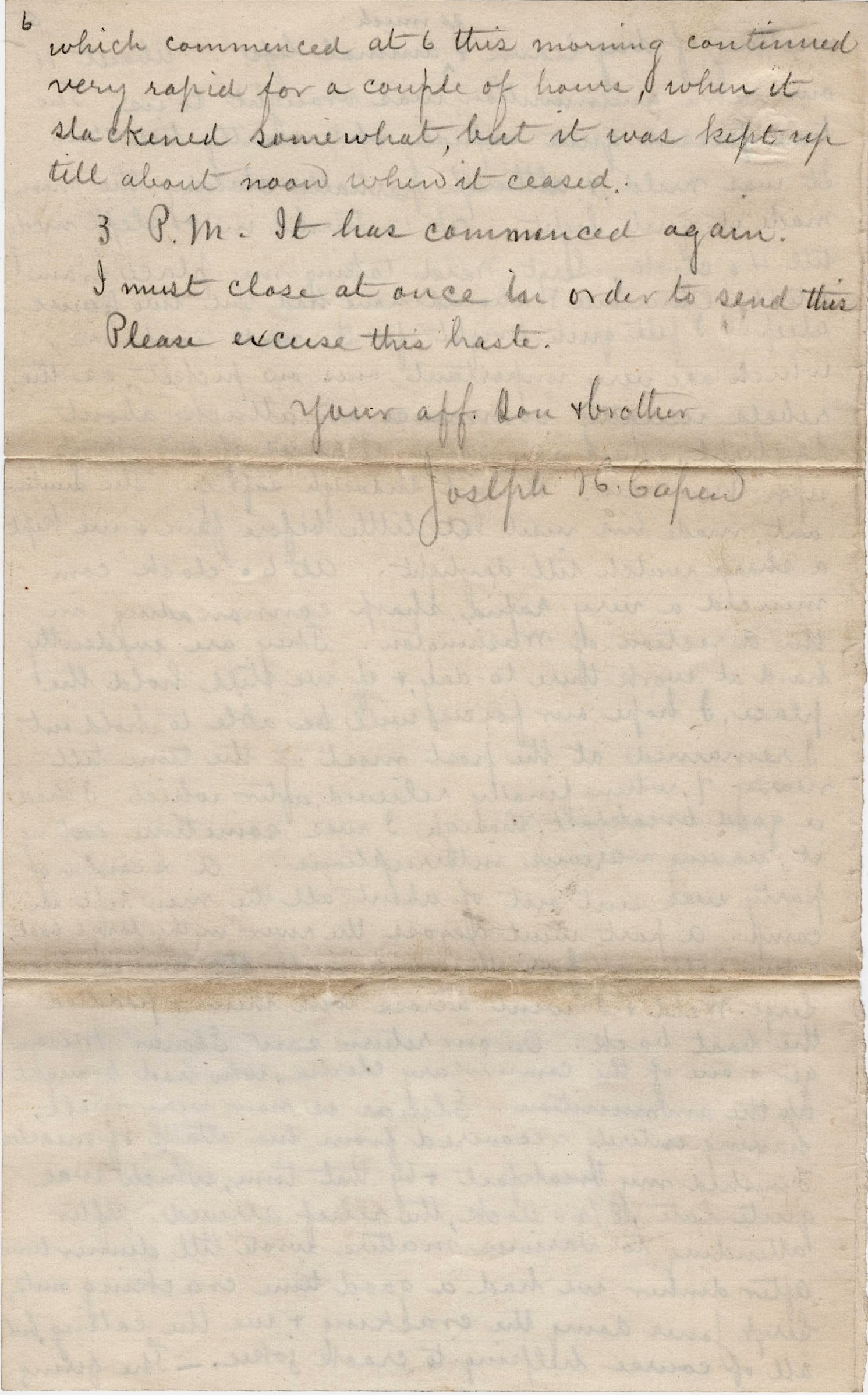
The firing which commenced at 6 this morning continued very rapid for a couple of hours, when it slackened somewhat, but it was kept up till about noon when it ceased. 3 p.m. It has commenced again. I must close at once in order to send this. Please excuse this haste. Your affectionate son & brother, — Joseph H. Capen
1862-64: Daniel Hart Eddleman to his Family

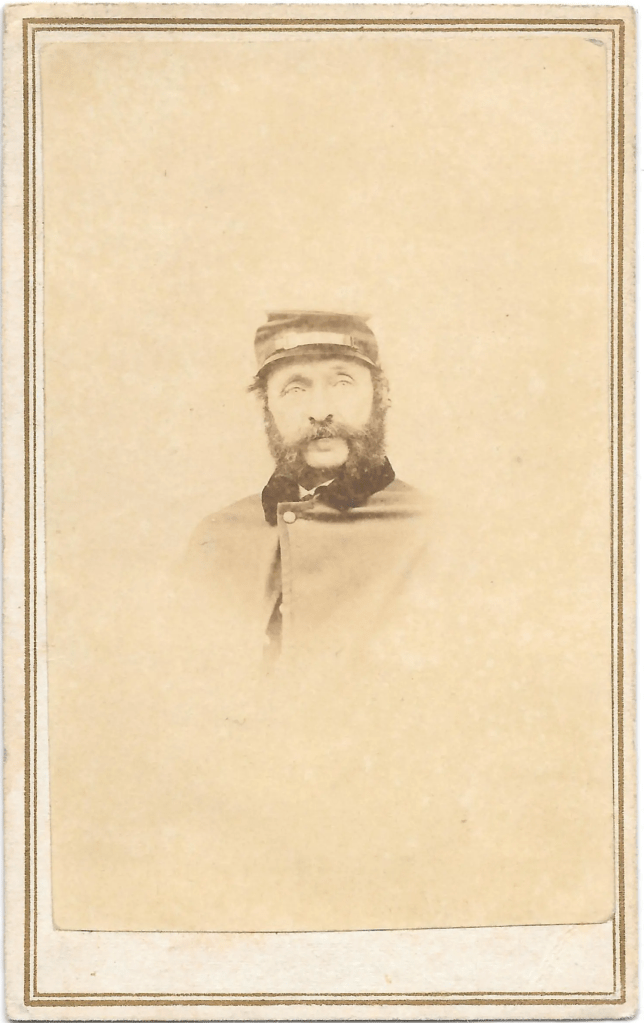
The following letters were written by Daniel Hart Eddleman (1843-1864), the son of William Eddleman (1812-1890) and Louisa Smith (1810-1889) of Germantown, Philadelphia county, Philadelphia. Daniel enlisted as a private on 6 November 1861 in Co. C, 58th Pennsylvania Volunteer Infantry.

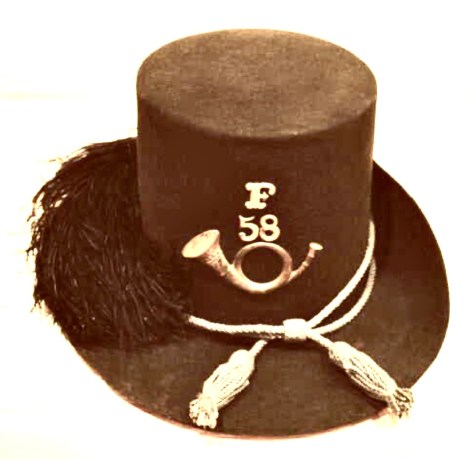
A Hardee Hat said to have been issued to a member of Co. F, 58th Pennsylvania, early in the war.

Daniel was promoted to a corporal just days before he was killed in action at the Battle of Chapin’s Farm (a.k.a. Fort Harrison, or New Market Heights) on 28 September 1864. In that action, the 58th Pennsylvania, under the command of Major Winn, led the dawn advance against Confederate Fort Harrison along with the 188th Pennsylvania. The regiments had to cross 1200 yards of open, ascending ground. In he History of the Pennsylvania Volunteers, Samuel Bates wrote that, “the two regiments moved forward at a regular pace, until within five hundred yards, when, in the face of a storm of shot and shell that swept their ranks, they rushed forward as one man until they reached the little ridge in front of the fort. Here, all, with one accord, dropped upon the ground, under partial shelter; but only for an instant; for at this moment General Ord came dashing up, and, inspired by the presence and daring of their chief, the men sprang forward with wild shouts, passed the abatis and the ditch, and scaling the parapet, drove the enemy in rout and confusion from the fort. The colors of the Fifty-eighth, which had three times fallen in the desperate onset, were planted upon the parapet by Captain Cecil Clay, who, with Adjutant Johnson, was among the first to enter the fort. As Captain Clay, who had just taken the flag from the hands of the fallen corporal, attempted to raise it upon the fort, he received two gun-shot wounds in the right arm. The flag itself was completely riddled, and the staff twice shot off. The victory was complete, and fort, heavy guns, small arms, battle-flags, and prisoners, graced the triumph of the victors.” The regiment lost six officers and 128 enlisted men of the nine officers and 228 men who began the charge.

Daniel’s older brother, Horatio Smith Eddleman (1839-1910) also served in the same company and was wounded at Chapin’s Farm but survived the battle and mustered out of the regiment as a sergeant in June 1865. Horatio was married to Sarah A. Jones (1843-1913) before entering the service.

For other letters by members of the 58th Pennsylvania, previously transcribed and published by Spared & Shared, see:

George W. Glidewell, Co. B, 58th Pennsylvania (2 Letters)
Frank W. Davis, Co. E, 58th Pennsylvania (3 Letters)
Cornelius Robbins, Co. E, 58th Pennsylvania (1 Letter)
Theodore F. Ostrander, Co. F, 58th Pennsylvania (4 Letters)
William W. Wells, Co. F, 58th Pennsylvania (1 Letter)
Adam Richter, Co. G, 58th Pennsylvania (1 Letter)
George Richter, Co. G, 58th Pennsylvania (1 Letter)
William Almon Wilmarth, Co. H, 58th Pennsylvania (1 Letter)

Confederate Fort Harrison following its capture on 28 September 1864.

Letter 1

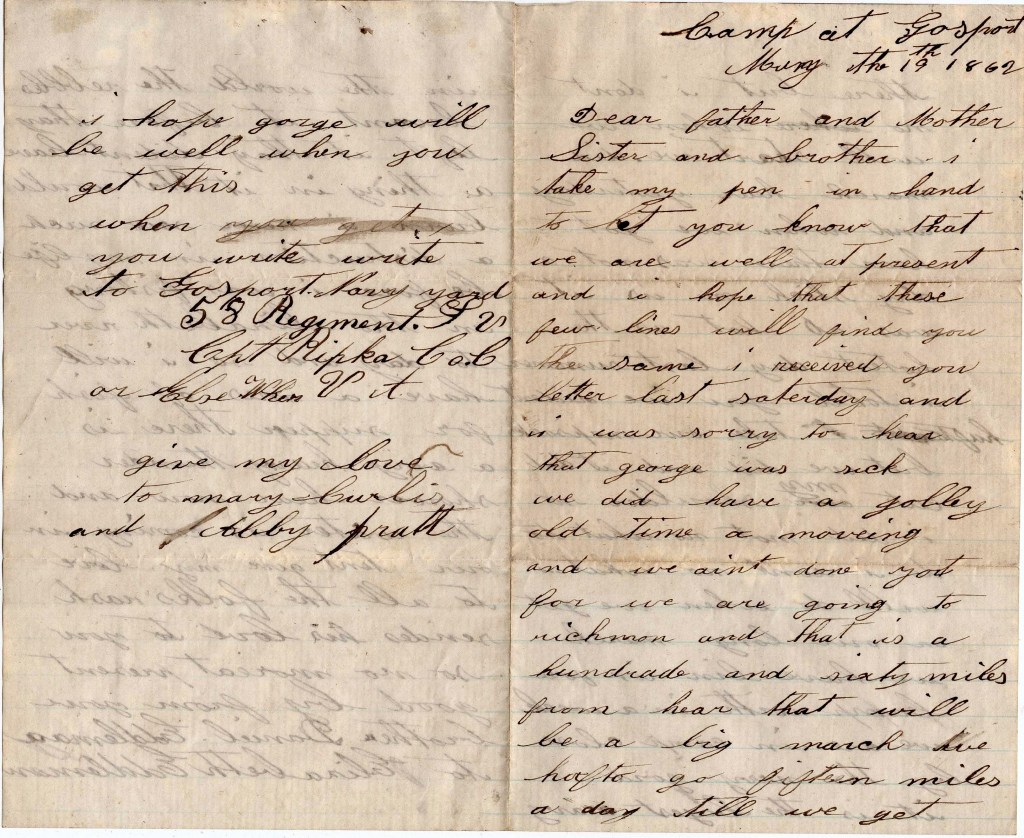
Camp at Gosport [Navy Yard]
May 19, 1862

Dear Father and Mother, sister and brother,

I take my pen in hand to let you know that we are well at present and I hope that these few lines will find you the same. I received your letter last Saturday and I was sorry to hear that George was sick.

We did have a jolly old time a moving and we ain’t done yet for we are going to Richmond adn that is a hundred and sixty miles from here. That will be a big march. We have to go fifteen miles a day till we get there but I don’t know when we will start. We did march here yesterday and when we got here, there was not a dry stitch on us. It was as hot as the hottest day last summer. I told you we didn’t have to take our knapsacks but we did and it did cut my shoulder so I did not know what to do. I don’t know what I will do when we get our long march.

Capt. Alfred Ripka, Co. C, 58th Penn. Volunteer. Infantry (Diane Solsiete Collection)

We have been in four camps within a week. We are in camp close by the Navy Yard. It is the biggest navy [yard] in the world. The rebels burnt it before they left it. They didn’t leave a thing in it that would burn. I never saw such a destruction in my life before.

I was fishing in ythe Elizabeth River today and so I will have a mess of fish for supper. There is a very heavy thunder shower here now and the water is coming in our tent.

Give my love to all the folks. Rash [Horatio] sends his love to you. So no more at present. Goodbye from your brother, Daniel Eddleman

To Elizabeth Eddleman

I hope George will be well when you get this. When you write, write to Gosport Navy Yard, 58th Regiment P. V., Capt. [Alfred] Ripka, Co. C, or elsewhere. Give my love to Mary Curlis and Abby Pratt.


Letter 2

Camp near the [Gosport] Navy Yard
May 30, 1862

Dear father and mother, sister and brother,

I take my pen in hand to let you know that we are well at present and I hope that these few lines will find you the same. I received your letter last Wednesday and was glad to hear that George was a getting better.

We have had another move but not far. We are about a mile from the [Gosport] Navy Yard. The Colonel says we will lay here a good while. We are a mounting cannons. All along where we are there is a big breastwork throwed up and the cannons is on it. The whole Division is along it. If the rebels does retreat from Richmond, we do expect them to come back here. They told the citizens when they went away they would be back in a short time but I think they will have fun before they get here.

Washington is in danger again. They have sent all the home guards there and five or six regiments of volunteers from New York.

I got a letter from John last week and they said they was all well.

We are in camp in a a eight-acre corn field. The corn is six inches high. The man that owns it would not take the Oath of Allegiance and so they have destroyed it for him. He come through here yesterday and he looked as sour as the sour end of a sweet pickle.

I have just signed the pay roll to get paid. We will get paid tomorrow if nothing happens.

I went to the Episcopal Church last Sunday and he had a very nice sermon but he did not pray for the President of the United States.

It does rain most every other day here and when it don’t rain, it is so warm that we sweat and get as wet as when it rains.

They are making a law to send all of the married men home and keep the single ones for five years.

It is getting so warm that I must fetch my letter to a close so give my love to Sally and Agnes and Deal and Mary and to all of the rest of the folks, and keep a good share of it yourself. So goodbye from your brother, — Daniel Eddleman

to his sister, Elizabeth Eddleman

Write to Mr. Daniel Eddleman, Gosport Navy Yard, 58th Regiment P. V., Capt. Ripka, Co. C, Vol. Infantry, or elsewhere.

Tell Mary Curlis I will answer her letter as soon as I get it. Send some post stamps. I do owe six now.


Letter 3

Washington, North Carolina
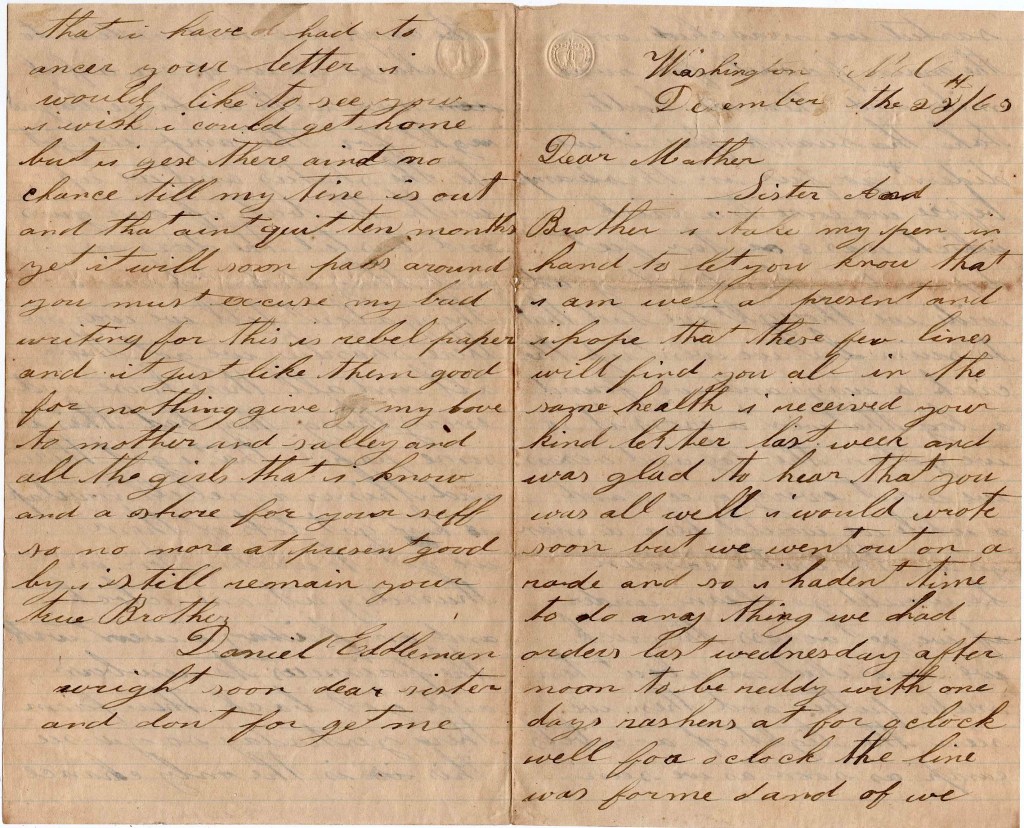
December 22, 1863

Dear Mother, Sister and Brother,

I take my pen in hand to let you know that I am well at present and I hope that these few lines will find you all in the same health. I received your kind letter last week and was glad to hear that you was all well. I would wrote soon[er] but we went out on a raid and so I hadn’t time to do anything.

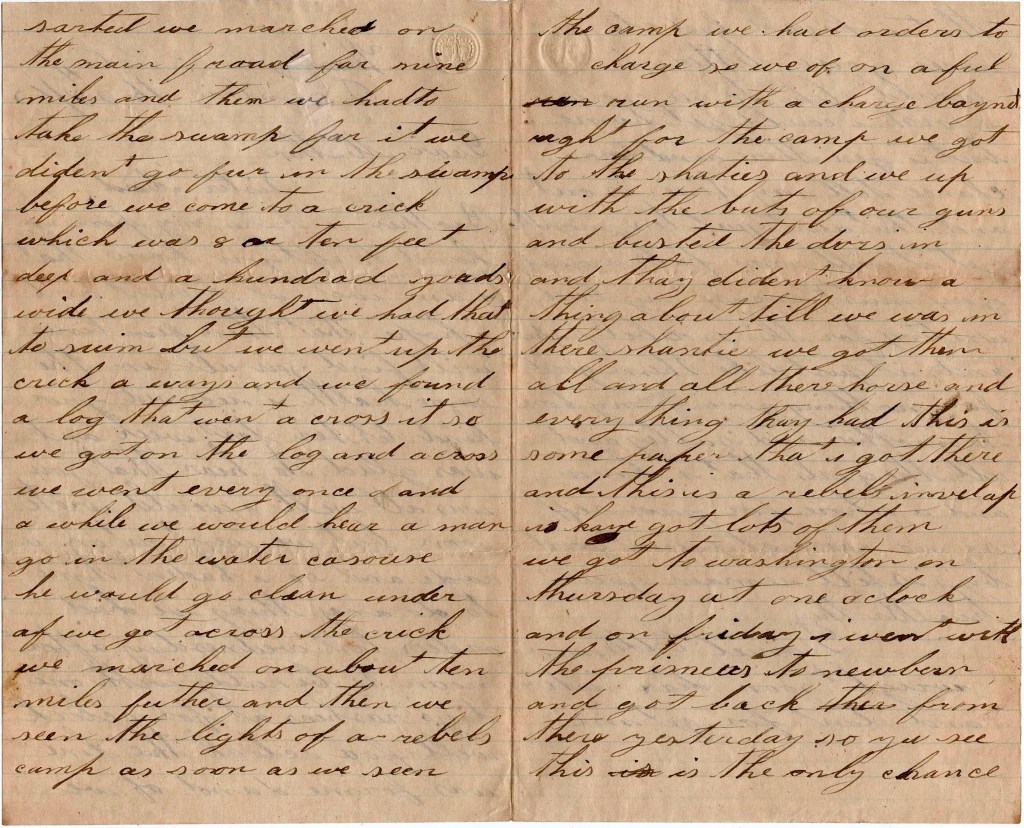
We had orders last Wednesday afternoon to be ready with one days rations at four o’clock. Well [at] four o’clock the line was formed and off we started. We marched on the main road for nine miles and then we had to take the swamp. We didn’t go far in the swamp before we come to a crick which was 8 or ten feet deep and a hundred yards wide. We thought we had that to swim but we went up the crick a ways and we found a log that went across it so we got on the log and across we went. Every once and awhile we would hear a man go in the water course. He would go clean under.

After we got across the crick, we marched on about ten miles further and then we seen the lights of a rebel’s camp. As soon as we seen the camp, we had orders to charge so we [went] off on a full run with a charge bayonet right for the camp. We got to the shanties and we up with the butts of our guns and busted the doors in, and they didn’t know a thing about [it] till we was in their shanties. We got them all and all their horses and everything they had. This is some paper that I got there and this is a rebel’s envelope. I have got lots of them.

We got [back] to Washington on Thursday at one o’clock and on Friday I went with the prisoners to Newbern and got back from there yesterday, so you see this is the only chance that I have had to answer your letter.

I would like to see you. I wish I could get home but I guess there ain’t no chance till my time is out and that ain’t quite ten months yet. It will soon pass around. You must excuse my bad writing for this is rebel paper and it’s just like them—good for nothing. Give my love to mother and Sally and all the girls that I know, and [keep] a share for yourself. So no more at present. Goodbye. I still remain your true brother, — Daniel Eddleman

Write soon, dear sister, and don’t forget me.


Letter 4

Camp Front of Petersburg
May 8, 1864

Dear Mother, Sister and Brother,

I take my pen in hand to let you know that I am well at present and I hope that these few lines will find you in good health and spirits.

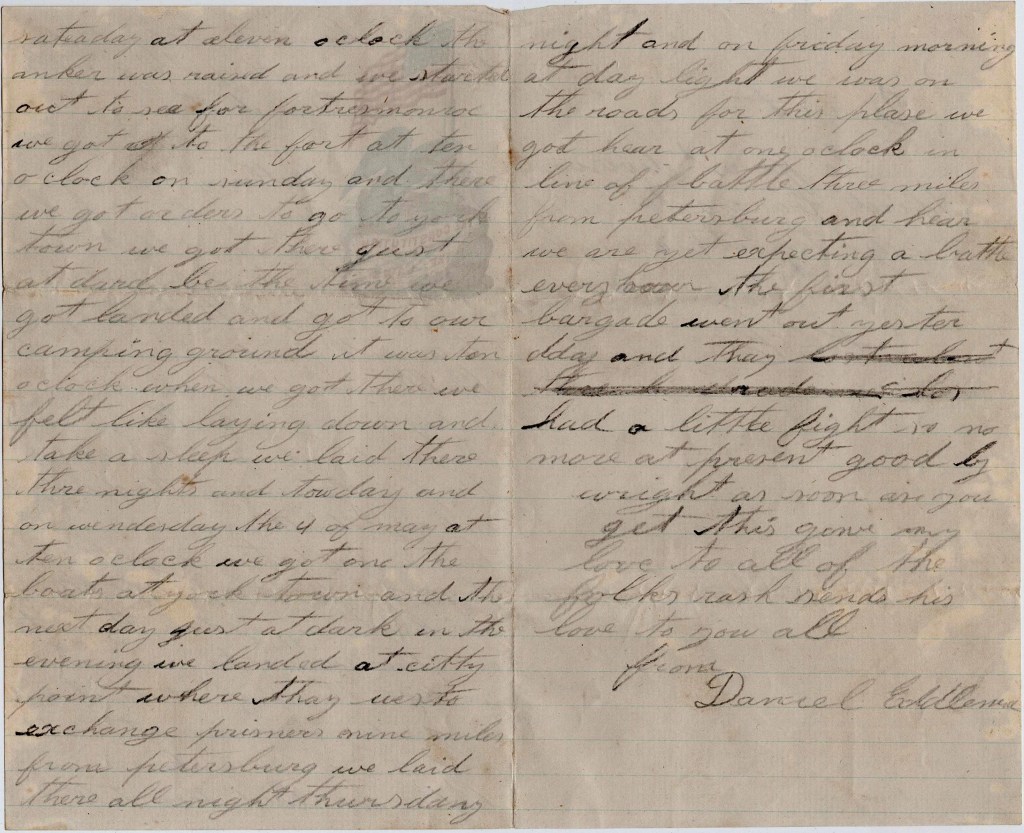
We are in a big army now. There is sixty thousand men in it. We are in the First Division, Third Brigade, and Eighteenth Army Coreps. We had a hard time a getting here. We did evacuate Little Washington. We got on the boat on Thursday afternoon the 28th and we left the wharf at dark, and on Friday morning at ten o’clock, we was anchored in Hatteras. We laid there till Saturday. At eleven o’clock the anchor was raised and we started out to sea for Fortress Monroe. We got to the fort at ten o’clock on Sunday and there we got orders to go to Yorktown. We got there just at dark. By the time we got landed and got to our camping ground, it was ten o’clock. When we got there, we felt like laying down and take a sleep.

We laid there three nights and two days, and on Wednesday the 4th of May at ten o’clock, we got on the boats at Yorktown and the next day, just at dark in the evening, we landed at City Point where they was to exchange prisoners nine miles from Petersburg. We laid there all night Thursday night and on Friday morning at day light, we was on the road for this place. We got here at one o’clock in line of battle, three miles from Petersburg, and here we are yet, expecting a battle every hour. The First Brigade went out yesterday and they had a little fight.

So no more at present. Goodbye. Write as soon as you get this. Give my love to all of the folks. Rash [Horatio] sends his love to you all. From, — Daniel Eddleman

Direct to First Division, Third Brigade, and Eighteenth Army Corp, 58th Regiment, Pennsylvania Volunteers, Co. C.

1863: Joshua Piles to Margaret Piles

This letter was written by Joshua Piles (1823-1898) who served in Co. A, 168th Pennsylvania Infantry. The men recruited into this regiment rendezvoused at Camp Howe near Pittsburgh during the latter part of October 1862 where they were organized and mustered into service as a 9-months regiment. Muster rolls indicate that Joshua entered on 16 October 1862 with other members of his company under the command of Capt. Hiram H. Cree. He mustered out on 25 July 1863.

After service around Suffolk, Virginia, the regiment was sent to New Bern, North Carolina, in December 1862 where they remained until June 1863. During this time, they participated on the expedition to Little Washington to provide relief to the beleaguered Union force under siege there. This letter was penned in Little Washington while encamped there in May 1863.

Prior to his enlistment, Joshua and his wife Margaret Henderson (1830-1913) and their two children lived in Perry, Greene county, Pennsylvania, where Joshua worked as a semi-literate laborer/farmer. He was still residing there at the time of the 1890 Veterans Schedules, suffering from a disease of the kidneys and bladder.

Transcription

Washington, North Carolina
May 8th 1863

Dear Wife,

I take this pleasure to write you a few lines to let you know that today find us all well and hearty and sincerely hoping that these few lines may find you all embracing the same blessing. Also to inform you that I received yours which was written April the twentieth and was very glad to hear from you all so to hear that you was all well and a getting along as well as what you are.

We have left New Bern. We left on the twentieth of the month or about that time. for the present time we are at Washington, North Carolina. It is the head of tide water navigation about the mouth of the Tar River about one hundred miles from New Bern but the way of water and about forty by land north. This is a very nice place here. We are the best situated here that we have been since we left home. We are encamped on a high piece of ground. Also we have got more tents and there ain’t so many in a tent which makes it more comfortable. There is only three and four in a tent.

We are a faring sumptuous for grub, the plunkiest that we ever had since we left Camp Howe. We don’t get much soft bread. The flour is here for us but we ain’t got our bakery fixed yet. We will get it done in a few days. We get plenty of coffee and bread, meat, beans, and rice, and sugar and plenty to wear—more than we want—and have plenty of money and no fast friends and White women plenty. This war is a perfect feast. Uncle Sam is able to feed and clothe us and we won’t grunt at it, and able to furnish enough good Union men to whip the South and be enough left to come home and hang all the Copperheads that is back there, if they don’t all go blind in dogs days and bite theirselves. They are so poisoned that their bites will be certain death. Their days will soon be done for they are a living on cornmeal which is ground cob and all together this is a true bill for we have been out on picket where they was and where they done their business. It just looked like hog dung—just about as course. And the cavalry took four of them. They had nothing in their haversacks—only meal cob and all.

We have to do picket duty one fourth of the time. We go three miles from cap and stay three days and nights.

For the want of paper, I must close. Write soon and give us the news.

— Joshua Piles to Margaret Piles

Michael write.

1863: Elbridge W. Whitney to his Family

A middle-aged, unidentified Massachusetts soldier from the collection of Dave Morin.

This letter was written by 44 year-old Elbridge Whipple Whitney (1819-1882), the son of William Knowlton Whitney (1795-1868) and Deborah Woodward (18xx-1841). Elbridge was married to Sophia Ann Billings (1823-1873) and together they had two surviving daughters by the time he entered military service in the Civil War.—Frances (b. 1856) and Nellie (b. 1861).

Elbridge was working as a shoemaker in Athol, Worcester county, Massachusetts, when he was recruited in August 1862 into Co. B, 27th Massachusetts Infantry. He remained with the regiment for one year, mustering out in mid-August 1863 on a surgeon’s certificate of disability. Following the war, Elbridge returned to Athol where he resumed work in the shoemaking business.

Elbridge no doubt joined the regiment in New Bern, North Carolina, in time for the Goldsboro Expedition in December 1862 and was among the eight companies of the regiment in Washington, North Carolina, in April 1863 when they were hemmed in by Gen. Daniel H. Hill’s confederates and subjected to a siege. The following letter was written after the siege was lifted and the 27th Massachusetts had just returned to New Bern.

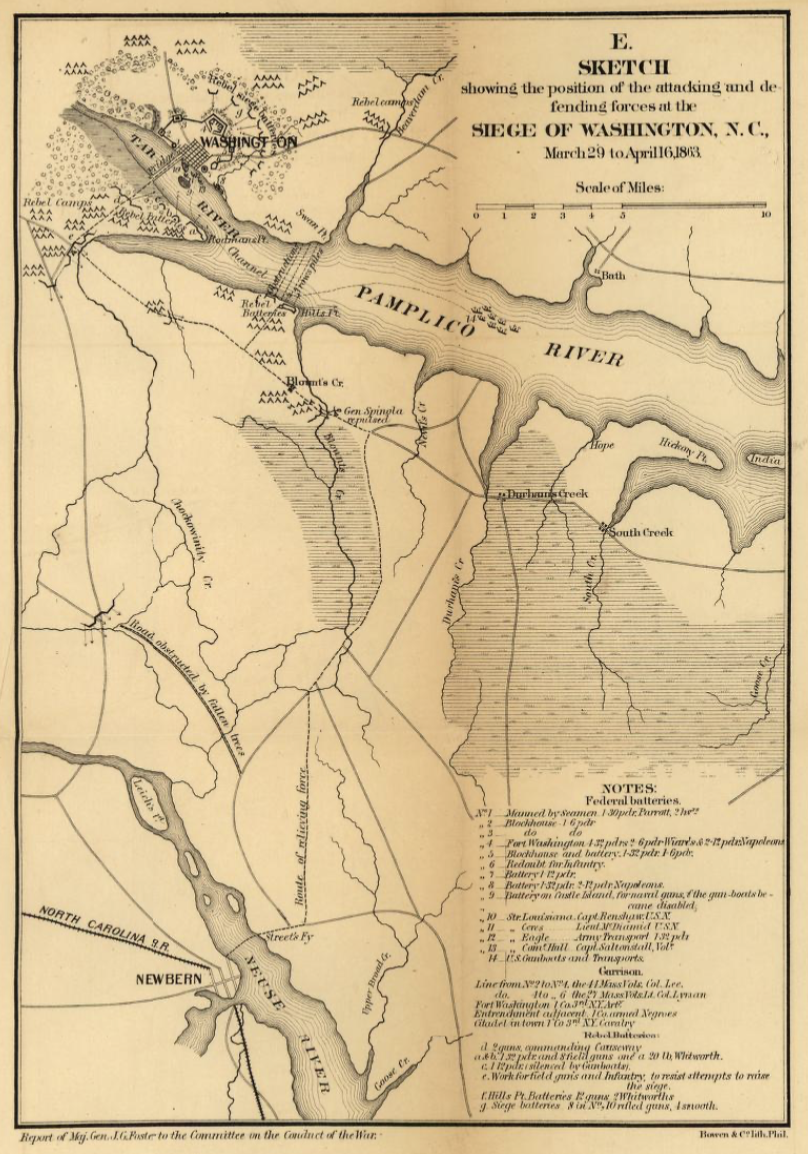
Siege of Washington, N. C., Map, April 1863 (LOC)

This letter is from the private collection of Jim Doncaster and is published by express consent.


Transcription

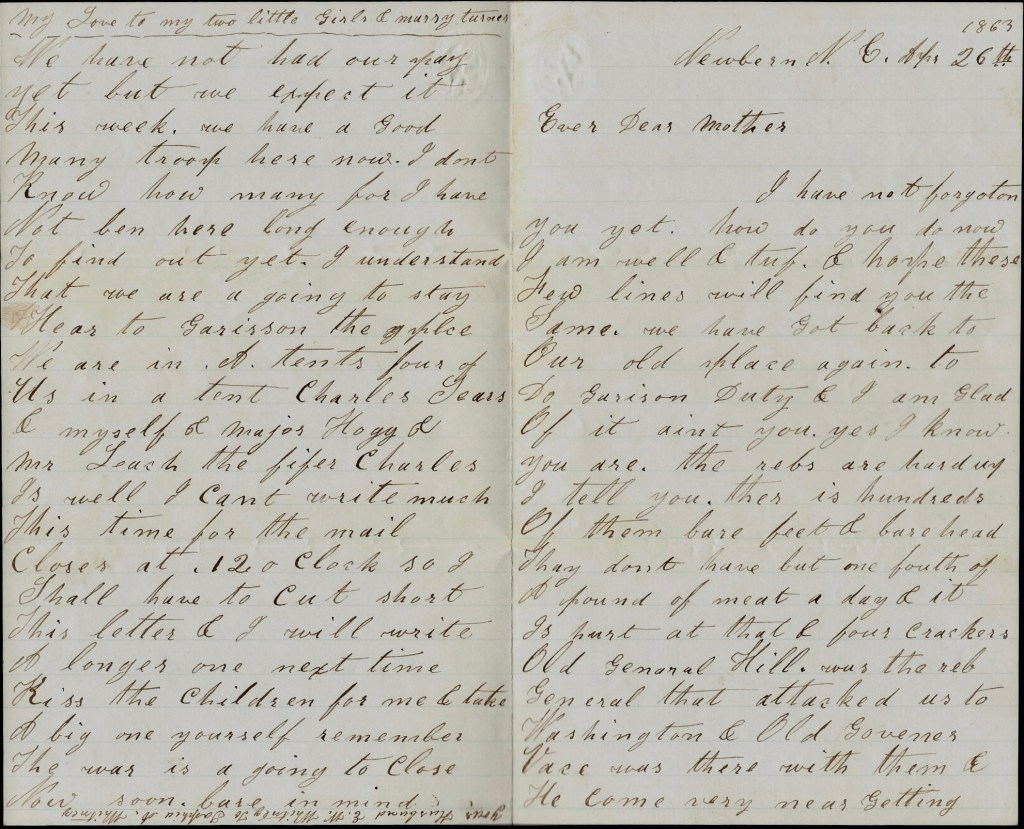
Newbern, N. C.
April 26th 1863

Ever dear wife.

It is Sunday & very pleasant. We arrived here last night. We came down by a steamer. We got about halfway & the shaft broke and we had to cast anchor & lay over about three hours until another steamer came along & then we started again and got into Newbern safely.

Dear wife, I hope these few lines will find you and the children all well. I am well & tough.

We hear that the rebs are a getting whipped & I am glad of it, ain’t you? I think you are. I think the war will be closed before long. We have not had our pay yet but we expect it this week. We have a good many troops here now. I don’ know how many for I have not been here long enough to find out yet. I understand that we are a going to stay here to garrison the place. We are in A tents—four of us in a tent. Charles Sears and myself and Major Hogg & Mr. [Addison] Leach, the fifer. Charles is well.

I can’t write much this time for the mail closes at 12 o’clock so I shall have to cut short this letter & I will write a longer one next time.

Kiss the children for me & take a big one yourself. Remember. The war is a going to close now soon. Bear in mind. My love to my two little girls and Mary Turner.

Your husband, — E. W. Whitney

To Sophia A. Whitney

Newbern, North Carolina
April 26th 1863

Ever dear Mother,

I have not forgotten you yet. How do you do now? I am well & tough & hope these few lines will find you the same. We have got back to our old place again to do garrison duty & I am glad of it, ain’t you? Yes, I know you are. The Rebs are hard up, I tell you. There is hundreds of them bare-footed and bare-headed. They don’t have but one-fourth of a pound of meat a day & it is hard at that & four crackers.

Old General [Daniel H.] Hill was the reb general that attacked us to Washington [N. C.] and Old Governor [Zebulon Baird] Vance was there with them & he came very near getting killed. We throwed a shell over there & it burst & very near killing him. I wished it had, don’t you? I know you do.

I shall have to close now for the mail closes at 12 o’clock. Write as soon as you get this. Yours with respect. Your son, — E. W. Whitney

To A R. E. Billings, Athol Depot, Worcester county, Mass.