This degraded yet largely legible letter was written by William Young Farthing (1812-1862) of Watauga, North Carolina, to his wife, Annie Watkins Farthing (1814-1882). William was the son of John Young Farthing (1784-1868) and Lucy Goss (1781-1827).
William volunteered his services as Captain of Co. E, 37th North Carolina Infantry in November 1861. He was taken prisoner at Hanover Court House, Virginia, on 27 May 1862 and confined in various places until sent to Johnson’s Island near Sandusky, Ohio. Due to poor health, he was finally exchanged in November 1862 but died of disease soon after returning home.
[Camp Magn]um 37th Regiment N. C. Troops [January 5]th 1862
[Dear Annie, I] embrace the present opportunity [to write a] few lines to inform you that [I am enjoying] a reasonable portion of health [and am] sincerely hoping these few lines [may find] you and family enjoying the [same. The] health of those of my company [that have] been sick is improving. Some [already] have commenced their duties. We have gotten [very well] fixed here, and like our [camp much] better than we expected. But [recent] indications are we shall not remain [long,] the Col.[Charles C. Lee] having orders to be [ready] to march at a few hours [notice. To] what point we have to march [is] not ascertained. Even the Col. [doesn’t] know.
I suppose somewhere on [the way] we are to receive our wages, some [think next] week. We have already made out [pay rolls]. I cannot say now when I can [come] to see you all—whether before [our] service is out or not, though if [opportun]ity offers, I shall be certain to [come]. I am very anxious to see my family [and friends] in Watauga. I have not seen any of our connection in this county [with the] exception of William Halliburton [who came] to see us.
January the 8th 1862. [Since] the above I learn our destination is in this state. We are now packing [up]. I suppose it is expected that New B[erne] will be attacked by a great fleet that [has] fitted out. I would write more but [have] not time. I hope you will continue [to write] to me. So no more at present. I [remain] your affectionate husband until [death]. — William Y. Farthing
The following letter was written by Felix J. Williams (1844-1863), the second son of eight children born to Henry John and Mary (Weaver) Williams of Elk Creek, Alleghany County, North Carolina. Felix enlisted in Co. K, 37th North Carolina Infantry on 15 August 1862. He joined his regiment near Martinsburg in the Army of Northern Virginia on 26 September. This letter, from a private collection, was written shortly after his arrival.
A tintype of an unidentified soldier wearing the 1861 North Carolina pattern sack coat. (Chase Rhodes collection)
Twenty letters authored by Felix, acquired in 1995, are preserved within the North Carolina Digital Collections. These correspondences were predominantly directed to his entire family, although select letters were intended specifically for his mother or father. For a duration of two months, Williams endured the rigors of camp life and arduous marches. In late October, he and his regiment were assigned the task of dismantling the Baltimore and Ohio Railroad between Hedgesville and North Mountain Depot in West Virginia, and on December 13, 1862, Williams encountered the harsh realities of warfare at Fredericksburg.
After the battle, the regiment took up winter quarters in Camp Gregg at Moss Neck, positioned on the Rappahannock River approximately eight miles downstream from Fredericksburg. Here, Williams and the regiment endured the harsh conditions until the commencement of the 1863 campaign at the close of April. On 1 May 1863, the regiment advanced towards Chancellorsville. On May 3, during a fierce engagement, Jackson’s corps, commanded by Gen. Stuart, repelled Hooper and the federal forces, resulting in severe casualties for the 37th Regiment—19 officers were wounded and 1 was killed; among the ranks, 175 men were wounded and 35 were killed—-including 19 year-old Felix J. Williams.
“Though not from a wealthy family, Williams had come from a prosperous and self sufficient one. He and his father had raised grains and hay on the family farm of 100 acres of cleared land and 250 acres of woodland. The farm had also produced wool, butter, honey, nuts, and fruits for the family. The young soldier’s letters hearken back to apples, dried peaches, chinkapins, eggs, and other good things at home when he writes from his comfortable but hungry winter quarters at Camp Gregg. He reports the visit of his father and grandfather with boxes of food just at the time that soldiers convicted of desertion are being shot in the camp (letters of Feb. 23 and 28, 1863). A subsequent letter (March 8) mentions two desertions from the regiment and assures his family that he’d never desert—“I will come out of this war like a man or I will die in it.” Other letters refer to the issue of Austrian rifles to replace his company’s old muskets (Feb. 18, 1863), contain reflections on his captain as a company commander (Mar. 19, 1863), and speak of sickness and religion in the camp (Apr. 18, 1863). A final letter written to Mr. and Mrs. Williams on September 4, 1863, by a cousin, H. B. Williams of the 48th Regt. (Va. Vols.), speaks at greater length on the subject of religion in the camp, and condoles with the parents on the death of their son.” [Source: N. C. Digital Collections]
T R A N S C R I P T I O N
The stationery used by Felix displays a lithograph of the Washington Monument in Baltimore, Maryland. It’s unusual to find Confederate letters written on stationery customarily used by Union soldiers. This stationery may have been taken from a Union soldier’s knapsack at Harpers ferry or elsewhere by a comrade in the 37th North Carolina.
Near Bunker Hill, Va. October 5th 1862
Dear Father, Mother, Brothers & Sisters,
I seat myself this beautiful Sabbath morning to write you a few lines to let you know that I am well—with the exception of a bad cold—truly hoping that these few lines may safely reach your hands & find you all well & doing well. I have nothing strange to write to you at this time. There has not been any fighting here lately.
I can inform you that we are here in a bull pen and no chance to get out. We have plenty to eat here—such as it is, but we would not if all of our company was well. We draw one pint of flour & one and a half pounds of beef per day is what we get to eat & no more & we can’t get out to get nothing else. There is some things brought in here for sale but they are so high we cannot buy them. Apples sells at from 50 to 75 cents per dozen. Onions at from 10 to 20 cents apiece. So I will quit writing for the present & go to meeting & will write more this evening.
I have been to preaching and heard the best sermon preached that I ever heard in life. I can inform you that I have wrote four or five letters & have not heard from you since I left home. I sent two letters to you by Capt. Wilson and some powder and my neck handkerchief. I want you to write to me whether you got them or not. I hear that William D. Jones is in about 30 miles of here in a private house sick but not dangerous from what I can hear. Daniel Douglass is here & well. He got to the regiment day before yesterday.
I can tell you that we boys have a hard time here but this war is no longer a mystery to me. We was all at home living in ease & we would sit down to a table & eat hearty of everything that was good & not think from where it came. And to see the wickedness thats a going on here—it’s a wonder to me that we are not consumed like Sodom and Gomorrah.
I wrote to you to try & hire a substitute but you need not for Col. [William Morgan] Barber has refused to take any more substitutes. I want you to write to me as often as you can. I will not pay the postage of my letters for if they don’t go, they will be that much saved. I have 11 dollars in money yet and we will draw in a few days. So I must close. Direct your letters to Winchester, Va. So farewell. — F. J. Williams to H. J. Williams & Family
Father, I want you to come and see me as soon as you can.
The following letter was penned by Paul Farthing (1821-1865), the son of Rev. William Watkins Farthing (1782-1827) and Polly Halliburton (1784-1844) hailing from Watauga County, North Carolina. At the age of 40, Paul was a farmer who enlisted in the 37th North Carolina Infantry on September 18, 1861. Just two months later, he received a commission as 1st Lieutenant of Company E—known as the “Watauga Minute Men”—under the command of his relative, Captain William Young Farthing. He was discharged on April 16, 1862, approximately a month after this letter was composed. Subsequently, he served as a sergeant in Company A of the 11th North Carolina Home Guard, ultimately being captured in North Carolina in mid-February 1865. As a prisoner of war, he was transported west to Chattanooga, then north to Louisville, and finally further north to Camp Chase, where he met his death in April 1865.
Lawrence O’Bryan Branch
Due to the absence of the captain, 1st Lieutenant Paul Farthing assumed command of Company E during the Battle of New Bern, which occurred on 14 March 1862. In his correspondence, Farthing recounts the events of the battle, revealing that Brigadier General Lawrence O’Bryan Branch sought to reinforce a weakened segment of the Confederate line by deploying part of the 37th North Carolina. Farthing’s reflections on the discussions and his profound hesitation to comply with Branch’s directive to essentially sacrifice this small contingent of three companies (approximately 100 men) in order to stem the Confederate retreat illuminate his internal conflict and apprehensions. Paul’s protest, and Branch’s reply, “if we had the hearts of men, show it,” left little doubt about the tense crisis of the moment. Branch was killed by a sharpshooter later in the year at Sharpsburg.
Transcription
Kinston, [North Carolina] March the 18th 1862
W. Y. Farthing. Dear Captain,
I have written two letters to you since we have been at this place. Now [I] write to you on a different subject. We have nothing but what we have on. I think you had better get blankets there and bring them with you. If you can procure one blanket for each man, it will be sufficient. We are suffering. here with cold. We have good tents with floors in them, but to lay in tents of a cold, frosty night without anything to cover with—we suffer with cold.
I will now try [to] give you [a] description of the battle. On Wednesday evening, the 12th instant, we were called out on dress parade by the Brigade Col. [Charles Cochrane] Lee [who] read a dispatch stating that the enemy was [present] in the [Neuse] River, and we would have to fight. We were ordered to prepare rations for one day. The drum beat at three on the morning of the 13th. We went into line. Col. Lee ordered us to be ready to march in fifteen minutes. We marched to the breastworks by daylight. The enemy [gunboats] began to shell us about 4 in the evening, and continued until dark. During the shelling, one fell about 25 steps over our breastworks, and W. H. Hilliard ran up and crowed over it. It rained all night. We lay in tents made of pine brush.
About 10 minutes of eight on the 14th, the enemy began to fire on our breastworks with their artillery. Ours replied. Soon the right wing of our army was engaged and it included Capt. [Charles N.] Hickerson’s command [Co. F] of the 37th. The battle raged about two hours when Col. Lee came galloping by and ordered all the left wing of his regiment to flank by the right and go to the railroad. We struck [on] the double quick and soon came to Grimes’ [Latham’s Battery] Artillery. I inquired for Col. [Reuben P.] Campbell [7th N.C. Inf., k.i.a. Gaines’ Mill 6-27-1862].
I should have stated that [Lt.] Col. [William M.] Barbour ordered us to report to Col. Campbell. They told us to go on—he was ahead (the balls were flying as thick as hailstones—our boys were glanced by several of them, but nobody was hurt). We went on and Col. Campbell’s adjutant came running [up] and said Col. Campbell was behind [us]—we had passed him. We faced about and marched off in the new direction when we received an order to go on to the railroad. We faced about and marched to that place. There we met [Brigadier] General [Lawrence O’Bryan] Branch. He ordered us to face about and meet our forces who were retreating before the enemy. He said that we had men enough to fight a good battle of ourselves (we had the commands of Captains [Jackson Lafayette] Bost [Co. D], [James M.] Potts [Co. F], and your own; not more than 100 men in all).
I protested against going back [but] his orders were to go, saying if we had the hearts of men, [then] show it. We faced about. The order was given to march. They went—but slow. We had not gone far before we saw Col. Barber. He told us to make our escape for we were defeated. We made our escape to the [railroad] cars, and all of your company got in but myself and [Pvt. William] Strickland. We made our way to New Berne, [and] from there we walked 9 miles and got on the [cars] and came here. — P. Farthing
The following letters were written by David “Rankin” Alexander (1834-1864), the son of James Wilson Alexander (1796-1857) and Jane Johnston (1796-1862). Rankin was married to Sarah J. Dewese.
David enlisted at the age of 27 on 16 September 1861 as a private in Co. C, 37th North Carolina Infantry until he was wounded at the 2nd Battle of Manassas on 29 August 1863 and spent the next several months recuperating at home. “The 37th NC Regiment was one of the regiments that kept pace with the ‘Foot Cavalry,’ covering more than fifty miles in two days, its fare being principally green corn gathered by the wayside. At Manassas Junction it was one of the regiments that charged Brig. Gen. George W. Taylor’s New Jersey Brigade across Bull Run Creek on August 27th, completely annihilating it. Moving back to the Junction it feasted sumptuously for several hours upon the captured stores, then took its position with Maj. Gen. Jackson’s forces behind the unfinished railroad cut to await the coming of Maj. Gen. Pope’s army. On August 28th it made its appearance and formed in three lines of battle—came on like the waves of the ocean; several well directed volleys hurled them back, but quickly reforming, they came again and again until night put an end to the terrible slaughter. This was kept up upon on August 29th and 30th; the 37th NC Regiment manfully held its position, although at times it would scarcely have a round of ammunition left to the man. Maj. Gen. A.P. Hill (VA) and Brig. Gen. Lawrence O. Branch (NC) could often be seen dismounted urging their men to hold their ground at the point of the bayonet. The loss of the 37th NC Regiment in the three (3) days’ fighting was 13 killed and 67 wounded.”
After Rankin returned to the regiment he was promoted in rank to sergeant but was killed in action on 3 May 1864 in the Wilderness.
Letter 1
[On the completion of its organization it was moved to New Bern, NC, where it received its baptism of fire on March 14, 1862, in battle at that place. Lt. Col. William M. Barbour commanded it, Col. Charles C. Lee being assigned to the command of the left wing of Brig. Gen. Lawrence O. Branch’s (NC) army. Although fighting under great disadvantage, the regiment behaved with great credit to itself and showed plainly of what material it was composed, reinforcing most beautifully Col. Reuben P. Campbell, of the 7th NC Regiment, whose lines were first broken. It is well to state in the beginning that the greater part of the regiment was composed of hardy mountaineers, as fine a looking body of men as ever marched to the tap of a drum. Outnumbered at every point, the small army of Brig. Gen. Branch was compelled to fall back to Kinston and after a short rest the 37th NC Regiment was taken to Falling Creek.]
Patriotic Stationery on David’s letter of 21 February 1862
Camp Lee New Bern, North Carolina February 21st 1862
Dear Mother,
I take my pen in hand to let you know that I am well at present and hope these few lines will find you all enjoying the same blessing from the hand of Almighty God.
I have nothing of importance to write to you more than you all know. You have heard the news of the reverses our soldiers have had in the last few weeks but I hope and trust to God that it will not be so very long.
We have not seen anything of any of beings they call Yankees yet and I hope they will never come up here to attack us at this place. They talk like the Yankees would be here in a few days after we come here but I have seen nothing of them yet nor do I know whether they are any nearer to us than they were when we came down to this place.
I have written home several times and have got no answer yet. I have looked for a letter for three weeks and have looked in vain but still I have not lost all hopes of getting letters from home. I do not know whether Sarah gets my letters or not and if she writes to me, I never get them. I have thought that you might have wrote to me before this time but still I know you have a hard chance to get much time to write or do anything else while you have so much to do at home so I thought I would drop you a few lines this time and let Sarah wait until next week.
I cannot write to you all as often as I would like to do and some that asked me to write to them that I do not expect to get time to write to. Tell Margaret I think it is as little as she could do to sit down some night and drop me a few lines. I have not wrote to her I know but I do not [want] you all to wait on me for I tell you, I cannot write to every one.
Tell Calvin and Martha I have looked for a letter from them ever since I heard they were married but have looked in vain. Tell Branch Warsham and his duck to write to me and let me know how they like a married life. I want all my friends and neighbors to write to me and not look for me to write to them.
I also want to know hoe my boy is getting along and also Sarah, how she is getting along. I must close by saying to you to write by return mail. I will look for an answer from you and also from the above named persons. I remain your affectionate son, — D. R. Alexander
Letter 2
[After the Battle of Fredericksburg, the 37th North Carolina went into winter quarters at Moss Neck, about eight miles farther down the river, where it remained and did picket duty, with the other four (4) regiments of the brigade, for the remainder of the winter. David was not with his regiment, however. He was at home in Mecklenburg county, ]
[Home] February 2, 1863
Dear Brother,
With pleasure I seat myself to write you a few lines to let you know that I am still a home but expect to start to my company Thursday without I get further orders. I have been at home for four months. My arm is not sound well yet. It is still running a little yet but I have a pretty good use of it. But it is nothing like it was before I got shot by the infernal Yankees. I feel like I could shoot at them again for it makes me mad to think about them. They are so barbarous and have no respect for our southern ladies. They treat them worse than the beasts of field. I think the Almighty, maker of us all, will do what is right in His own eyes and I think he will give us success in our arms and help us to gain our independence and make us a happy people. I hope and trust that the time is not far hence when there will be an honorable peace made between the two contending parties and we will all get home to our families and fathers and mothers and brothers and sisters to live as we have done in times gone by.
I will try and write to you after I go back. Your brother, most affectionately, — David Alexander
[In a different hand]
Dear Brother, I take my pen in hand this evening to write you a few lines to let you know that we are all well at this time and hope you are enjoying the same blessing. I have nothing particular to tell you except that Henry Warsham has the small pox and nearly all the neighborhood have had a chance of them but have not taken them yet and I hope will not. Your folks are all well. May was here last night and said they had got a letter from you by Mr. Sheppard stating that you were well. George wrote to you and Calvin sometime ago and have not received an answer yet so I thought I would write again. I think I shall get one tomorrow. If I do not, I will not know what to think about it.
Well, George, all the men in this county are out hunting conscripts and deserters. They have struck up camp in Ferret Town and stay there day and night. Yet they are spending their time for nothing. I have not time to write any more at this time. Rankin expects to start back Thursday and I want to go to Pa’s tonight and it is time I was starting. So nothing more at present but remain your sister affectionately, — Sarah [Dewese] Alexander.
Write soon as you can. I want to hear from you.
Letter 3
[Home] February 3rd 1863
Dear Brother,
I will write you a few lines this morning again. We are all well and hope these few lines will find you well. I want you and Calvin to write to me after I get back to my company and I want you to write me all the news you can. I have got Mary Tye to stay with Sarah and she says for us to tell you howdy for her. We were all at father’s last night and have just got here through a snow nearly a knee deep this morning. It is beautiful overhead but is bad on the ground for poor soldiers in the army.
I think this will be a great day for those men to gather up the conscripts in Ferret town. Hope they will get the loot one of them. If they don’t, they may look out for to be disturbed some way or another. Wm. Stinson had all his bridles taken one night last week.
Nothing more at present but remain your brother affectionately, — D. R. Alexander
Letter 4
Camp Gregg, Virginia March 10th 1863
Dear Sister,
I take my pen in hand to write you a few lines in answer to the one I received from you Sabbath day and was glad to hear of you all being well. I got a letter from Calvin and George yesterday. They were both well when they wrote. I was glad to hear from them and more so to learn them both well. I looked for a letter from Gus last week but did not get any but I heard from them in your letter which amounted to the same thing as if I had got one from them but at the same time I would like to have read one from them. I have no reason to complain at all. I have nothing of interest to write to you at this time.
I am still excused from any heavy duty. I cannot use a gun yet. My arm has been worse the last three or four days but I hope it will get well some day. I think it was going on drill that made it worse, getting it mashed about by the other soldiers running against it.
I hear no war news at this time. There is talk of peace sometimes and the next thing you will hear of there is going to be a fight of the biggest kind but I see no prospect of a fight myself and I hope and trust there will be no fight here or anywhere else this year. I think if they will stop all hostilities for awhile, I think that peace will be made without any more fighting and I pray God now soon He may grant us an honorable peace and that He will send the enemy home and let us go to our homes where we can live with our families and friends and connections near and dear to each other. And my dear father and mother, it would do me much good to read a letter from you. It does me so much good to get a letter from any of you.
I suppose you have seen Thomas C. Sloan before this time for he got a furlough and started home last Thursday. I am glad that he got a chance of going home to see you all once more. And father, I want you to attend to the return of my property if I don’t get a chance to do it myself. I have nothing but my land and negro to make a return of. My buggy is not worth returning. I want you to write to me.
This leaves me well except a bad cold and I hope they will find you all enjoying good health. Nothing more at this time except it is snowing now and looks like it might continue all day. I remain your brother affectionately, — D. R. Alexander
to M. C. Dewese
Letter 5
[Home] April 13th 1863
Dear Brother,
I seat myself this morning to write you a few lines to let you know that we are all well except bad colds and that is bad enough when it takes a deep hold on a person. I have had the worst one this winter I have had for many a year. I am at home at this time and am getting along very slow. My arm hurts me when I use it very much and if I was to handle a gun, it would almost kill me. Bu I hope it will get well someday. I have a furlough from the 2nd of April to the 12th day of May and I have the privilege of getting it prolonged if my arm is not fit for use or if my health becomes impaired any way that I will not be able for duty. I got my furlough without asking for it. The doctor examined my arm and he told me that he was going to try and send me home which he succeeded in doing.
I tell you Mat Alexander is doing [ ]. She is going to work too hard this summer. I understood that some of her close kindred said they were afraid that she would hurt herself working. Well I reckon you know something about her work—how she kills herself and hands at hard work. I tell you, May is some in cane thicket the way she is getting rich is sight to everybody and that you know is she spends her money and can’t see where it goes to, I always try to get value received for my money but she does not care so she is giving it for some fool thing or other. I am sorry to think she is going to kill herself working. Why if she does that, Milas will die [illegible] without asking any questions.
We have had one week of pretty weather and I have nearly all my corn planted and Mc is planting. He is working my land and his together and works his hands and my boy together. I hope we will have pretty weather. It will be so much better on the farms and also on the poor soldiers who are defending their country’s cause. I hope the time is not far distant when we will get to hear from each other without the trouble of writing,
Your people are all well at this time and I hope should these few lines reach you, they may find you enjoying good health. May the good Lord [ ] rest upon you and all the poor soldiers who are now in the field of service. Give my respects to all the company or such of them as inquire after my welfare.
Nothing more at this time but hope to remain your brother most affectionately, — D. R. Alexander
To G. B. Dewese
Letter 6
Camp near Liberty Mills, Virginia October 6, 1863
Dear father and family,
I received your kind letter on yesterday and was glad to hear that you were all well and I hope these few lines will still find you all enjoying the same blessing. I am very glad that you have undertaken to get a [ ] a settlement of my estate and I hope everything will work [illegible]. I don’t think there will be any trouble in the settlement at all. I would be glad if I could get home to attend to it myself but things are so ordered that I can’t at this time. I hope this war will soon come to a close and then I can get home to see to my own affairs. I have hoped that way so long that it looks like I might lose hope but still I live in hope if I die in despair—I want peace, but I want it honorably or not at all. It would do us no good unless we do get it in this way. I pray the time is not far distant when we will have peace and then what a time of rejoicing there will be in this Confederacy between man and wife, parents, children, friends, and our connections near and dear to us.
I have no news of interest to write at this time, only our army is in good health and fine spirits at this time. Our regiment never has been in better health and condition since I can mind than it is at the present time.
Nothing more. Write soon. Your son, — D. R. Alexander
Dear sister Margaret, I write you a few lines. You’re excused for not writing soon a letter. I hope you will do so no more. I want you all to write as often as you can. Tell mother for her to write and tell Charley to write to me. I would like the best in the world to see you all. I have nothing to write at this time. I am well. T. C. Sloan sends you his respects. He is well and hearty and is the same Tom yet. I see no alteration on him at all. I have wrote to your father about all I can think of at this time…Keep in fine spirits and do not despair…I close and hope to remain your brother most affectionately, — D. R. Alexander
Letter 7
Camp near Liberty Mills, Virginia December 19th 1863
Dear Mother,
I take my pen in hand to write you a few lines to let you know that I am well at this time hoping should these few lines will find you all well and in good health. I have not much of interest to write at this time except we have cold wet weather out here and a heap of it and we have to go on picket every two days and we have guard duty to do every day and it makes no difference how bad the weather is—we have to stand guard.
I want more provision from home if I can get it and I want you and my neighbors to send me something every chance you have and I don’t want you to think that I am begging but anything from [home] takes so well. Give my love to all the children and tell Margaret that I think she might have written to me before this time but I will excuse her as she has so many young men to write to that she can’t have time to write to me very well. That is alright. I think among you I ought to get one letter every month. I have looked for a letter from some of you but have not got any from you for some time. I want you all to write to me and give me all the news in the neighborhood.
I would have liked to been at home to seen Calvin and George but I could not be there and here both, but I hope the time is not far distant when we will all get home to enjoy ourselves once more in this world. And if we should never meet on this earth anymore, my prayer is that we all may meet in heaven where peace will forever dwell in our hearts and men will learn war no more. Tell Martha Ann that I have not forgotten her yet. Tell her that I have so many to write to that I can’t write to all of my friends as often as I would like to do.
I would like to see you all and talk with you all. Tell the little boys all for me to be good boys and pray for me while I am out here fighting for them and pray not only for me, but for all of the poor soldiers. Tell them that I think of them every day. I have nothing more at this time but I hope to remain your son-in-law most affectionately, — D. R. Alexander
T. C. [Sloan] is well and hearty at this time. He says he has not forgotten you yet.
Letter 8
Camp near Liberty Mills April 6th 1864
Dear Sister,
I take my pen in hand to write you a few lines to let you know that I am well at this time, hoping for you the same good blessing from the hands of Him that giveth and never tires when we receive His gifts in the right kind of a manner.
I have nothing of interest to write at this time. The health of our company is very good at this time. All the men that are present are able for duty and that is something very rare in the army. We have 49 men present and all able for to do their duty. I hate that I have neglected writing to you for so long but I hope you will pardon me. I think you are a reasonable being and will not think hard of me in my neglects. I was sorry to hear of John being so sick but was glad to hear of him being able to ride to my house. I hope he is well by this time and all the rest for you have had a serious bout of sickness this winter. I believe all have been sick from the oldest to the youngest.
I am not in the habit of writing tales on my fellow soldiers but I think I must relate one this time on my friend Robert Deaton. 1 As you know, I am a great friend of his. He tried to play off with pains in his legs and loin joints but they would not swell for him and the doctor could not see anything wrong with him and they preferred charges against him ad had him courtmartialed for trying to play off and his sentence is to dig stumps three hours every day for a month. He wants to put in another summer campaign at the hospital. He likes that place better than to be with the company and do his duty like a soldier. In short, he is no account nor never will be.
Tell all the family that I am well and want all that can write to write to me and give me all the news. Give my respects to all who may ask after me. I am in hopes this war will come to a close someday. If it don’t, it will be the first one. But I hope it will be soon. I see in the papers taken from a Northern paper that we can hold Richmond while we have fifty thousand men to fight. But still their great Gen. Grant says he intends to take it and end the war. But that will not make the rebels, as they call us, stop. No indeed. I fear they will have a hard fight and lose a great many men before they get that place they call the rebel capitol. They are as tired of the war as we are, but they don’t want to give up yet. I want to have peace and if they will let me alone, I will assure them I will let them alone. But they must not tramp [on] my toes if they don’t want hurt.
Tell Pa and Mother to write to me and write yourself. T. C. Sloan sends you his respects but he’s lost all hopes of getting home this spring. Give me all the news from Old Mecklenburg. Nothing more at this time as my letter is very uninteresting anyway. I remain your brother-in-law, — D. R. Alexander
1 James Robert Deaton (1840-19xx) was 20 years old when he enlisted on 16 September 1861 as a private in Co. C, 37th North Carolina Infantry. It appears he was captured and took the Oath of Allegiance in Washington D. C. in September 1862 but was exchanged and returned to his regiment. He was absent without leave for a while but returned in February 1863. He deserted to the enemy on 30 November 1864 and went to Bartholomew county, Maryland, to wait out the war.
The following letters were written by Calvin T. Dewese (1837-1916), the eldest son of John Allison Dewese (1811-1870) and Mary Ann Sloan (1819-1911) of Mecklenburg, North Carolina. Calvin enlisted on 8 July 1862 in Co. K, 56th North Carolina Infantry. He was with his regiment for most of the war, except for an illness in the fall of 1862. He was taken prisoner at Fort Stedman on 25 March 1865 and confined at Point Lookout, Maryland, until taking the Oath of Allegiance on 4 June 1865.
Calvin was married to Martha Ann Barnett (1840-1906) early in 1862. Together the couple had at least twelve children born between 1862 and 1889. After the war, Calvin returned to farming on Long Creek in Mecklenburg county.
I could not find an image of Calvin but here is one of Neill Beard who served in Co. B, 56th North Carolina Infantry.
Letter 1
Camp Badger Wilmington, North Carolina September 30, 1862
Dear father,
I received your letter last Friday that you wrote the 21st inst. and I was sorry to hear little Johnny was sick. I am very unwell at this time. I was excused from duty yesterday and today I am able to go about yet. I do hope that I will not get past going for I tell you, it is a hard place for sick to get along. It is hard enough for well people to get along let alone the sick. I do hope when these few lines come to hand they may find you all enjoying good health.
I suppose you will hear before you get this letter about the frolic we had with the Yankee bomb shells. We were out on drill when they commenced. They whizzed by us pretty strong for a while. I don’t think there was a shell came closer than a hundred yards. I tell you, they can boom us out of here whenever they get ready but I tell you they don’t want it for it is my belief that they keep up a regular trade at Wilmington as they did before the war commenced. There is a vessel comes in every few weeks. They call it the English steamer but it is nothing but a Yankee vessel. If you will go to Wilmington, you will find it too for every store is full of anything you call for. It is there new and fresh. They have fooled about until they have got the yellow fever in Wilmington about right. If it gets in the army, it will soon put an end to their fighting.
We have a great deal of sickness in camp at this time. It don’t matter what ales a man, he has to take the same medicine & it will be before long they will have nothing to give at all. The medicine they have got now is that old that it is of no account. When a man gets sick here, he just has to wear it off.
I must come to a close as I don’t feel able to write. Tell all the friends and neighbors howdy for me & tell them to write to me & let me know what they are all about. And tell Mother I think she might write to me some time. Tell Sarah & Mag to write to me soon. I would like to get a letter from home every day for I don’t expect to get home until the war is over—if I live—for they will keep a man here when he is of no service to them at all & so I have give up to stay & put up with it the best I can.
So nothing more at present but hope to remain your affectionate son until death. Yours truly, — Calvin T. Dewese
to John A. Dewese
Letter 2
Camp Clingman Goldsboro, North Carolina October 26, 1862
Miss Margaret C. Dewese,
Dear sister, I received a few lines from you that you sent in George’s letter and I was glad to hear from you one time more. I thought I would write you a few lines to let you know that I am well at this time. It is the first time you have ever wrote me a letter with anything yet. It appeared to me like you have forgot me or don’t care, I don’t know which, but I hope you will be better for the time to come. You must consider my condition & sympathize with me in my trouble. You have more chance to write than I have.
There was three of your troublesome conscripts got here at last. They fetched all our things safe. We got a fine mess—all our mess got something…it made a fine pile.
This is a very wet day. We are all huddled up in our tents [paper missing]…I am glad our boys came for this is my week to cook and it saved me doing so for two or three days.
Dear sister, I long for the time to come when we shall have war no more and [we can] return home once more to see our friends and connections. I am truly tired of seeing the way people has to be punished. They can’t get to go home. If a man does happen to get home & stays one minute over his time, he has to carry a log for a week. A private can’t do anything but take care for the officers. They can go home when they please & stay as long as they please. They have got about a dozen of men carrying logs now. There is a time coming, I hope, when we will get out of this place of bondage, when we can be free & do as we please as well as them.
I have not much to write so [I will] come to a close at this time by requesting you to write as soon and as often as you can. Nothing more at present but hope to remain your affectionate brother until death. — Calvin T. Dewese
Letter 3
Rocky Mount Edgecombe county, North Carolina January 7th 1863
Mrs. Mary A. Dewese,
Dear Mother, I now embrace this opportunity of writing you a few lines to let you know that I am well at this tie & hoping when these few lines reach you, the may find you enjoying the same blessing. The company is generally well. B. A. Wartham is gone to the hospital at Petersburg. We left him there as we come from Franklin and I have not heard from him since.
We are expecting an attack here or at Goldsboro. We were the first here. We have been reinforced with three other regiments since we came & expecting more yet. Several regiments has passed by here going to Goldsboro—infantry, artillery, and cavalry. One regiment of cavalry come today. I expect we will have a big fight or a big run, one or the two.
The Yanks is reinforcing at Kinston every day by the thousands. They are determined to take Weldon and Goldsboro. By doing that, they will cut off communication from Richmond. Then they will stick it to us about right. But I hope they may not get there ends accomplished. I long to see the war come to a close some way soon so that I may get home once more and enjoy the blessings of a family fireside. You don’t know how bad I want to see you all. It is awful to think how we have to be parted but I still live in hopes that the scale will turn some day. I shall be satisfied if I only can get home safe and sound so I can enjoy myself when I get there.
Nothing [more] at present. Write soon adn let me know how you are getting along. Give love to all the children. Yours truly, — Calvin T. Dewese
Letter 4
Rocky Mount Edgecombe county, North Carolina January 27th 1863
Mr. John A. Dewese,
Dear father, I take this opportunity of informing you that I am not very well at this time. I have been very unwell ever since the regiment left here. It will be two weeks day after tomorrow since it left here. I heard from them once since they left. They were at L___ville then and I have not heard from them since. I cannot tell where they are now or what they are doing. I suppose they have not got in any fight yet or I would have heard of it before this time. They have had a hard time of it. It has been raining nearly every day since they left here and been very cold too.
I took sick this day was two weeks ago and I was left behind and I am here yet. I been pretty bad off with headache and fever but I am a great deal better now, I have not heard from George. I don’t know whether he is well or not. I told [him] when he left to write to me and let me know how he was getting [on] but he never has done it yet. I can’t tell what is wrong. I expect they will come back before long.
They are looking for another big fight at Fredericksburg. The Yankees is advancing there strongly. I expect they [will] fool about till [they] get us in a fight yet. Paul [Fletcher] Faison wants to get into a fight more than a bull dog. He is our Colonel, if you did not know him by the name of Paul. I can tell [you] he is a particular sad case if you did not know it.
I sent a box of clothing to Charlotte by Express in [care] of John R. Alexander. I wrote him a letter and told him to take it up to his house and let you know so you could get it. Me and George, James Hill, M. D. Alexander, J. C. Bell, Allison Christenbury all has our clothes in it. I suppose it [will] go safe. If it don’t, I will get pay for it. I have got a receipt for it on the railroad company. Nothing more at present. Write soon and let me know how you all are getting along.
Yours truly, — Calvin T. Dewese
To John A. Dewese
Letter 5
Topsail Sound, New Hanover county, North Carolina March 8th 1863
Mr. John A. Dewese,
Dear father I now take the opportunity of writing you a few lines to let you know that I am well at this time & hoping when these few lines comes to hand, they may find you enjoying the same blessings of God. I have not received a letter from you for some time. I have wrote two or three letters to you & the rest of the family & have got no answer as yet. I don’t know what is the matter with the mail that I do not get any letters from none of you. I have not got a letter from none of you in six weeks except from Martha.
There is a large trade going on in Wilmington. I left Rocky Mount 24th of last month & landed in Wilmington 27th & stayed there until the 28th. There was eight steamers there said to be from England. The brought in a large supply of goods of various kinds—a lot of cotton, bacon, calico and many other things to tedious to mention. I know not where they came from but I have my own opinion about where they came from. I think they came from Yankeedom. They have been coming in there ever since the war commenced carrying off cotton by the wholesale. There is no danger of the Yankees taking Wilmington while they keep up trade with them.
Wilmington is made up with nothing but Jews and they keep as fresh stores I ever they did & [ ] while the poor [soldier] gets but $11 a month and living on half rations at that. And they say they are going to reduce our rations to quarter rations. If they do that, I guess, if they do, our [ ] will feel very lank. They say the provisions aren’t too good. If that be the case, I think the war will have to stop before long.
I must close. Nothing [more] at present but remain your affectionate son until death, — Calvin T. Dewese
To John A. Dewese
[in a different hand]
March the 9th, 1863
Dear Father, as Calvin was writing I thought I would write you a few lines as I have a little time this morning. I am well at this time and doing the best I can though it is a poor do. I have become so that I don’t care where I am so I get plenty to eat. I expect when the war ends that we will be used to it, that we can’t come home and we will have to join the regular army to get to stay away from home but they had better not end the war if they don’t want me to go home.
We get six biscuits a day. If we continue to get that much, we won’t starve. Besides that we get a small ration of bacon. We are faring better than we have done for some time though times are hard. I try to do the best I can and always try to look on the bright side of things. We have saw no hard times yet compared with the times that some have had since the war commenced.
I have no particulars to write at this time so I will have to close for this time. Direct to Wilmington, N. C., 56th Regt. N. C. T., Co. K, Gen. Ransom’s Brigade. Write soon. Nothing more.
— G. B. Dewese
Letter 6
Kinston, North Carolina April 17th [1863]
Dear Brother,
It is with pleasure that I seat myself this morning to drop you a few lines to let you know that I am well at this time & I hope when those few lines comes to hand they will find you enjoying the same blessing of good [health].
I have nothing of importance to write [paper torn]…for you that came here yesterday & I thought I would write a few lines & send it to you. We have been under marching orders since yesterday morning but we have not gone yet & I suppose we will not go at this time.
The enemy were advancing but they have gone back. I suppose we will await further orders. The 49th Regiment has gone over the river. William Black has come to the company. He brought me a letter from home. They are all well. I have nothing more to write this time. I want you to write. Get someone to write for you if you are not able & let me know how you are getting along. I hope how soon you may get well and return to the company.
Yours truly, — Calvin T. Dewese
Letter 7
Camp of the 56th N. C. Regiment Troops Ivor Station near Black Water [River] Southhampton county, N. C. June 19th 1863
Mr. D[avid] R[ankin] Alexander, 1
Dear brother [in-law], I take the opportunity of dropping you a few [lines] to inform [you] that I am well & as hearty as I ever was & I trust these lines may find you enjoying the same great blessing of God. I suppose you think that I have forgot to write to you but you need not think hard of me for not writing to you for I have not had time to write. We have been over about [ ] for the last month. I couldn’t get time to do anything.
I have seen some pretty rough times since I left home but nothing to compare with what you have seen though I thought once that I was obliged to be killed or wounded, one or the other. I went across the enemy’s fire [with]in fifty yards of them while they poured one volley after another. The balls flew thick all around me in every direction. I walked a while & run some & crawled som. Any way I would go, it seemed like they would hit me anyhow. But thanks be to Almighty [God], I come through safe & I hope & trust that I may never get into another such a scrape again. If I have to fight, I want them to stay in my front & then I can shoot at them all day if there ain’t but one place to watch. But I can tell you when they get to shooting at my face, and the other end too, both at the same time, I want to get away from there in quick time if there is any chance at all. 2
All is quiet on Black Water. Our brigade is strung along Black Water about 20 miles. we send scouts over the river between here and Suffolk. They gather a few once in a while, killing some & capturing some. There is nothing but scouts a pillaging the country and destroying everything they can. There is not a chicken to be found between here and Suffolk. Our boys that has been out say that the woods is lined with chicken feathers. The reports of today say that they are fighting at Petersburg. I don’t know whether it is true or not. I suppose that the Yanks are determined at two points—that is Fredericksburg and Vicksburg. They was still fighting at Vicksburg the last account I listened to hear of them. They are reinforcing heavily at each point and if they should get Vicksburg, it will sever us [and] I think the war would soon close some way or other.
Well, Rankin, your brother Milas is gone home. Him [and] Henry Starns started last Monday. I suppose they are home by this time. You will be apt to see him before we come back. You must let me know if you think he has changed any since you saw him. I suppose if nothing happens, I will get home in 4 or 6 weeks. There is 7 married men to go yet that came out with the company. I would be glad to get home while you are at home but I will have to go whenever I get the chance. I do wish the thing was settled so we all could go home to stay with our friends where our affection lies is my prayer.
Write soon. Give my love to sister & all my friends. I remain yours truly, — Calvin T. Dewese
To D. Rankin Alexander
1 David Rankin Alexander (1834-1864) was married to Sarah J. Dewese, Calvin’s sister. David served in Co. C, 37th North Carolina Infantry, until he was wounded in 1861 and was reported at home recuperating in the last four months of the year. After he was returned to the regiment he rose in rank to sergeant but was killed in action on 3 May 1864.
2 The fighting Calvin describes in this paragraph refers to the Second Battle of Gum Swamp near Kinston, North Carolina. It was during Maj. Gen. Daniel Hill’s campaign to recapture New Bern in the spring of 1863. It began in late March 1863 when Brig. Gen. Ransom’s brigade was ordered to Kinston to guard the town, and they arrived on April 2nd. The 24th NC Regiment was sent to guard the railroad bridge at Weldon. The 56th NC Regiment was sent to several locations in the vicinity of Trenton, Moseley Creek on the Neuse Road, and to Gum Swamp, where they had a sharp skirmish on April 28th, which was First Gum Swamp. On May 22nd, the 25th NC Regiment and the 56th NC Regiment were surprised and virtually surrounded by five Union regiments at Gum Swamp (Jones County); they were forced to fight their way out or flee into the swamp. More than 160 men of the 56th NC Regiment were captured. It was not a proud moment for the regiment.
Letter 8
[Note: The following letter is actually written to Calvin from his sister Sarah J. (Dewese) Alexander, the wife of David Rankin Alexander of the 37th North Carolina Infantry.]
[Mecklinberg county, North Carolina] August 28, 1863
Dear Brother,
I take my pen in hand this morning to write you a few lines to let you know that we are all well at this time and hope should these few lines reach you, they may find you enjoying the same blessing from Almighty God. I have nothing of importance to write to you. I received your letter last Tuesday and was glad to hear that you were well but sorry to hear that furloughs are stopped again. We have all been looking for you every day for some time but look in vain. I hope that you will get home before long now as you are the next to come. Live in hopes and never despair. I long to see the day when you will get home and the sound of war will cease, never to be heard any more.
Rankin is lying sick in the hospital in Lynchburg. It is nearly two weeks since I heard from him. I cannot tell you how he is now. He is thought to be better the last account. I long to hear from him. If he is sick much longer, I think I will try to go or get someone to go after him. It is hard for us to be separated from our friends in health and it is worse in sickness, but it is the Almighty will and we will have to submit to it. He knows what is best and if we look to Him and put our trust in Him, he will be with us in every time of trouble.
Father’s folks are all well. Martha A. was here a few minutes yesterday evening. She and Lizzy are well. The weather is very dry now but I think we will have rain before long. Our crop is looking very well and if you were here today, I could give you a mess of sweet potatoes but any day you come will do as well. I want you to write to me soon and often as you can and give me all the news. Nothing more but hope to remain your affectionate sister, — Sarah J. Alexander
to Calvin T. Dewese
Letter 9
Wilkes county, North Carolina October 6, 1863
Mr. John A. Dewese,
Dear father, I take the opportunity of informing you that I am well at this time and I hope these lines may find you enjoying the same blessing. I have scarcely had time to write to you since I came back to the company. I have been scouting nearly all the time over the mountains & lying around houses to catch the men when they would go in to draw rations and have caught a great many and killed and crippled some and a great many are coming in and giving up. But still there is a great many out yet and it is likely they will be out for a long time to come yet with a considerable change. It is pretty hard marching over the hills and rocks but I believe I would rather stay here as in the army. We get more to eat than we would if we were there.
We are 12 miles above Wilksboro at Covenant Church [with]in about 7 miles from the Blue Ridge. We caught a man today with a woman’s dress on. That’s the way they undertake to conceal themselves from being caught.
I must close. It is getting dark. Nothing more at present but hope to remain your affectionate son till death, — C. T. Dewese
To John A. Dewese
Letter 10
Covenant Church Wilkes county, North Carolina October 8th 1863
Dear Mother,
I will write a few lines to let you know that I am well & still in the land of the living. And I hope these lines may find you well.
I had a hard time to get to my company. I thought once that I would never get to the company or see any of my friends anymore. When the deserters caught me, I did not know but what they would kill me but they kept me there under guard & turned me over. It was two weeks from [when] I left home till I got to the company. We have pretty hard duty to do here but not much fighting to do. We get plenty to eat such as chickens, cabbage, beans, and honey & hardly ever pay anything for it. The people are very angry at us but it can’t be helped. We have to have something to eat & we can’t work for nothing & board ourselves. And if they don’t want us to eat up what they have, they will have to give up and let leave the country. If we have to stay here all winter, there will not be any left for the women and children to eat. I don’t see what they mean. Some of them say they will starve to death before they will ever come in and go to the army.
Nothing more at present but hope to remain yours affectionately, — Calvin T. Dewese
To Mary A. Dewese
Letter 11
[Note: In the following letter, Calvin is referring to Maj. Gen. George A. Picket’s attacked on New Bern at Batchelder’s Creek on February 1, 1864.]
Camp near Weldon, North Carolina February 12, 1864
Dear father,
It [is] with pleasure that I seat myself to write you a few lines to inform you that I am only tolerable well at this time. I was plagued with a severe diarrhea and sick stomach yesterday but I am better today except a bad cold & caufg but I hope it will wear off in a day or two. George received a letter from you today of the 9th inst. stating you were all getting better. I hope when this reaches you, it may find you well.
We have had pretty rough times since we left High Point. There was 10 days after we left there we were marching or riding on the cars where we could not sleep. We never got to sleep one whole night at a time on the whole route & some nights we did not get to sleep any at all lying in line of battle all the time when we were not advancing. I tell you, I thought it was [ ] times with [ ] the morning of the 1st inst. when the muskets began to rattle and the cannon roar. I was [chased?] for two days that bad I scarcely knew which end I was standing on but it so happened that we escaped unhurt. I am as nigh Newbern as I want to be unless it gets in better fix for visiting than it is at this time.
I have nothing of interest to write for the present. There is different reports in camp about the changes of the times but I look at them as I always have done to be lies & it is no use to waste time & paper with them. All I can say is of no use for me to trouble myself about anything. I have to stay in the war till it’s over if I live & will have to make myself easy. Your affectionate son till death, — C. T. Dewese
Letter 12
Camp near Weldon, N. C. March 18th 1864
Mr. C. F. Dewese,
Dear brother, it is with much pleasure that I seat myself this evening to write you a few lines to let you know that I am well at this time & I hope when these lines reach you, they may find you enjoying the same blessing. I think the time long to get a letter from you as you have nothing else to do. I think you might drop me a few lines [once in] awhile if only to let me know what you think of yourself in this time of war and trouble. I hear that you are having many diverse engagements and gaining many glorious victories without the loss of a man. I am glad to hear that you came out victorious. I will advise to stand your ground as long as you can for it is much better there [at home] than here.
I suppose you will have to come to the war before long or go somewhere else but if you can get into any work that will keep you out of this horrible place, I want you to do it—any place but to be in the ranks of an army. I would rather work for nothing and board myself if I could get to stay anywhere near home than to be here. I would like to see you and be with you and would be very glad of your company at any time, but I never want to see you in bondage as i am at this time. Two of us are enough and two too many to be starved, frozen or melted to death just as they please to have it fighting for that—that we have not got. And if we fight five years, we will never get. I think you will get clear if you will fool them a little while longer for I think it will surely wind up this spring or summer. I am in hopes it will anyhow, so we can all get home to live in peace once more.
I must close for this time. Write soon. Nothing more but remain your affectionate brother. — C. T. Dewese
Letter 13
Camp near Weldon, North Carolina March 28th 1864
Dear father,
It is with pleasure that I seat myself to inform you that I am well at this time & I hope these lines may find you well. I received your kind letter last Saturday night through the care of G. B_____ and also a fine box of provisions which was very acceptable in this unholy place of suffering & want. Our bread baskets were so empty that we have very well finished it already. I am thankful that I have friends somewhere [even] if they are a great distance from me that I can get a good bite from them once in a while [even] if it ain’t often. It makes me feel like I could live when I do get it. What we get is so rough that a person can almost share it. Digesting it makes such a fuss. If they [ ] on such as they have been doing lately on as rough diet, I think we will have to get new digesting machines or fetch the old one or we will see holes in a few weak ones. Our meat is very good but the quantity is not sufficient to satisfy the appetite that I have at this time. We are drawing the [ ] meat. I suppose they have no other to give us. The government meat, I think, is done and therefore the people at home have to board the army at their expense and it looks like the Confederacy might get rich when they so many hands working for nothing and boarding themselves.
I have nothing of interest to write. The army are quiet on both sides as far as I can learn but I dread the opening of the spring campaign. I fear there will be a good deal of fighting to do shortly but I hope this war may be settled without much more fighting although I don’t see any prospect of its stopping soon.
I will close for the present. Give mu love to the family and tell them to write. Nothing more but remain your affectionate son, — C. T. Dewese
to J. A. Dewese
Letter 14
Camp near Weldon Railroad April 3rd 1864
Miss Margaret C. Dewese,
Dear sister, with much pleasure I seat myself to drop you a few lines to let you know that I am well & hoping when these lines reach you they may find you well. The health of the company in general is good except one case of small pox. John Sloan was sent to the hospital yesterday. He was broke out pretty bad with them. He caught them from the Yankees while guarding them in South Carolina. I look for more of them to have them for they said there was plenty in every crowd that they had taken off. If they all take them, we will have a [ ] time among us but I hope they will not get spread any farther. We have bought enough times here without having the small pox to make it worse. I have had no chance to catch them as I have not been near John since he came back.
Well, Mag, our way of living seems to change fast. We still get our meal with the brand in it but our meal is very good. But the quantity is not sufficient to satisfy the appetite. We can get nothing to buy here at all. The country is gleaned for 10 miles around our camp of everything but that we would desire to eat if there was any to get. It would take a one horse wagon to haul out enough money to get one chicken. So we might as well be without it as to drive it for all the good it was. Sometimes I wish there was no money so these high headed fools couldn’t get their fists stuffed…then I think this cruel war would stop.
Brother George is guarding the bridge at Weldon. He will be there for several days. He has had a rough time since he went there. It has been rainy nearly every day for a weak & snowing together. It rained & snowed yesterday all day. The weather has moderated today a little but is still cloudy & very cool for the 3rd of April. It is cold enough to snow yet. I hope if another winter sets in that we may all be out of this cruel place of bondage & trouble & wickedness & be where we can converse with our friends & enjoy the blessings of peace as we once did. But Oh! when will that time come—we cannot tell. It may come soon and it may never come. But we can look forward for a better day…I can’t see no sign of peace now more than I did 12 months ago. The soldiers are in good spirits owing to the resumption of furloughs. There was several sent in today for the regiment. The men are flying around rapidly getting ready to go. I wish it was my time to go. I would fly around too.
— C. T. Dewese
Letter 15
Gaston, North Carolina May 4th 1864
Dear Father,
With pleasure I seat myself to write you a few lines to let you know that I am well at this time & I hope these may find you enjoying the same blessing. The health of the company is very good what is here. I have no news of our brigade more than you have heard. There is various reports about their movements. It is reported that Washington surrendered without the fire of a gun. The latest news we have, our troops are advancing on New Bern twelve thousand strong. They moved within four miles of the place Tuesday last. I suppose they are fighting by this time. I am glad that I am out of it although it may not be so long but I want to putt off as long as I can. Our boys have saw a hard time since we left them but they came out well to what I expected to hear.
James Sasseman passed here a few days ago going to Raleigh hospital wounded in the right arm. He went through all the fight safe and was wounded accidentally the day after the fight. There was only one man wounded in our company. That was John Strider from Randolph. He was wounded in the leg between the foot and knee. It was so badly mangled it had to be amputated.
I don’t care how long they keep us here while they are doing so much fighting. I suppose there will be no more furloughs signed until they get settled again. I hear no word on any prisoners coming in & I can’t say how long we will stay here. We may be ordered away in a few days & we may stay a good while. I don’t care how long we stay if it is till the war is over. We are on the bank of the Roanoke river where we can get as many fish as we want. If I had the salt to save them, I could send you a mess every day but I have not the salt to spare & I reckon you will have to do without the fish.
I suppose you are done planting. Come over tomorrow & spend the day with us & we will have a big mess. Bring mama and the children along too & we’ll all feast together. I must stop my foolishness & all so close my letter for I have got clear out of anything to write. Give my love to all the family and all of you write to me. Don’t wait for me to write for my chance is very slim to write to all my friends. It is two weeks today since I left home & not one letter have I got yet. I begin to feel like I was lost when I can’t hear from home. Nothing more but remain your affectionate son, C. T. Dewese
To F. A. Dewese
Direct to Weldon, North Carolina
Letter 16
Gaston, North Carolina May 14th 1864
Dear Sister,
I will write you a few lines to let you know where I am. I got here yesterday evening about sundown. They are looking for the Yankees here today. The pickets is firing at the Yankees now and everything that is here is fixing to run. There is about 300 soldiers here at this place. The Yankees could easily take this place if they would but I hope they won’t come yet a while. Part of my company is here and the balance of it is in Virginia. they have been fighting and they have drove the Yankees back and they have [been] reinforced and [are] coming again. I expect they will be here today. If they come today, they will take this place.
We had a big mess of fish for breakfast. We got them four apiece. I want to stay here. We could get plenty of fish to eat but if the Yankees gets near, we won’t get so many fish to eat. I hope they won’t get us.
I have nothing to write for I ain’t very full of news at this time. You must excuse this bad writing for it is the best I can do for these idle fellers, they are tearing about so they won’t let me sit still. You may tell William Cashion’s folks that W. T. C. was at Petersburg fighting the Yankees. They drove them back with heavy loss.
I will close by requesting you to write soon and give me the news. Nothing more at present but remain your affectionate brother till death. — C. F. Dewese
to M. C. Dewese
Letter 17
Camp of the 56th Regt Near Weldon, N. Carolina August 10, 1864
Miss Margaret C. Dewese,
Dear sister, it is with pleasure that I seat myself to drop you a few lines to let you know that I am well & I hope these lines may find you enjoying the same blessing. I thought I would of got to go home before I would write again but they have stopped the furloughs & I don’t know when I will get home but I am in hopes that it won’t be long till they will take pity on me and let [me] go. There is no use in the way they are doing—giving furloughs one day and stopping the next. I don’t know how long they will be stopped. I don’t know what they mean. We are lying about doing nothing—only drilling a little. No Yankees anywhere near and I don’t see what they are keeping us from going home for. If they were looking for a fight shortly, I would not think strange of it. They have guards around us every day like we were Yankees. You need not look for me home till you see me coming for I will not know when I am going till I get my furlough in my pocket & get on the cars & then if they get me off, they will have to be smarter than they are.
George is well & improving every day & following his old trade. Him and Andrew Barnette and Dicxk Hough is writing every day—writing their fool letters, first one and then another. They appear to enjoy themselves better than anyone in camp. They are now writing a letter to someone but they take care to not put their names to it.
Well it looks like I had not much to write when I am writing about their little tricks & so too for my mind is so bothered when I sit down to write I can’t do it. No tongue can express or pen describe the way I feel sometimes when I get to studying about the war I have to live. I do hope the time is speedily coming when I shall be released from this awful place of trouble & vexation. I will close for the present. Write soon and often for that is all the pleasure I have is reading letters from home.
Yours till death, — Calvin T. Dewese
Letter 18
Petersburg, Virginia October 21st 1864
Dear Father,
With pleasure I seat myself to drop you a few lines to let you know that I am well & hope these few lines may find you enjoying the same blessing.
I have been at the field hospital most of the time since I came back building chimneys to the hospital tents for the sick. I have not been in the ditches but four nights since I came back. I have not done anything since Tuesday. The doctors took a notion to move the hospital across the river about two miles from this place but they have not moved yet & it is uncertain when they will for they are scared half to death half their time so that they don’t know what to be at for fear the Yankees gets them. They are three miles in the rear now and when they move, they will be five miles away and when a man gets wounded, it will be a half a day before they get anything done for him.
All is quiet on the lines at this time and has been for some time except picket firing & they keep up the usual old sound with their bombs day and night. There is not much shelling on the part of the line that our brigade is on now. Our men and the Yankees get up on the works and talk to each other whenever they feel like a chat. I heard a heavy cannonading late yesterday evening in the direction of Richmond but I have not heard the result. It may of been an artillery duel & no fighting going on. They are looking for a heavy fight before many days. They think the election will bring on a big fight. I hope there is nothing of it. If there does be, I hope to miss it and be spared to meet you all once more.
Give my love to all. I remain your affectionate son, — C. T. Dewese
Letter 19
Petersburg, Virginia November 26th, 1864
Dear Sister,
I received yours of the 11th a few days ago. I was glad to hear you were well. I am enjoying tolerable health at this time. I am some better than I was a few days ago. I had a very bad cold & a misery in my breast & side. I have got better of that but I have a severe sore on the back of my neck which pains me very much. I have been at the field hospital since the 12th. The doctor has been burning my neck for the last three days with some hot stuff till it was black as a coal. It hurt me last night so I could not sleep but it feels a little better this morning. I think it will get better now in a few days.
We have had pretty rough times for the last week. It has been raining for nearly a week & that [so] cold that we could scarcely stand it for we had not much shelter or much wood to make fire with. Our wood is issued to us & that a very small ration at that. I am sitting over a little handful of wood now—not enough of fire to singe a chicken—and smoking my eyes out so I can scarcely write. Our wood has to be hauled six miles & if we have to stay here all winter, it will be to haul farther than that & I expect the longer we stay, the scarcer it will get. It is not like what we have been used to every winter since we have been out. We always could camp in the woods & build a large fire & be comfortable. It takes a lot of wood for so many men when they have to stay out & take the weather as it comes. There is 13 wagons hauling for our brigade. We get tolerable good rations if they would only give a little more. We get cured meat, and flour, bacon and beef, rice, coffee and sugar. I cannot see where all the provision comes from that it takes to feed the army. I thought it [would] of give out long ago but it looks like it was as plenty yet as ever it was. We get some bacon sometimes looks like it might be 6 years old.
As you are now acquainted with the market at Petersburg, I will give you a list of the prices of a few articles. Apples are fifty dollars per bushel, potatoes, d[itt]o., chickens half grown twelve dollars a head, meal one dollar a pound, flour two dollars a pound, pork $5 a pound, beef $4, eggs $10 per dozen, butter 12 a lb., molasses $32 per gallon, coffee $10 a lb., grown peas $70 dollars a bushel. It takes about 20 dollars to get what a man can eat. It takes as much as one can carry to get a day’s rations & I don’t see any prospect of it being any better soon.
They are conscripting the negroes to drive the wagons and sending the white men to the ditches. I look for the negroes to be put in the ranks with us before the war is over yet if it don’t stop soon. If they do, I shall begin to think about leaving the pen and let them go all out with their negro war. I can’t stand him, he smells too bad.
It is quiet at this time and has been since I came back. They still keep up the usual shelling and sharp shooting. Both armies appear to be lying perfectly quiet. I suppose the fighting is stopped for this winter but it will begin again in the spring as bad as ever of they don’t make peace. I do hope they will come to some kind of a compromise before that time & let us go home if we should be spared to live that long. I hope to be spared to see the end of it and get home to enjoy the blessings of a peaceful fireside.
I will close by requesting you to write soon and often. Give my love to all the family. I remain your loving brother, — C. T. Dewese
The following letters were written by John Walter Dewese (1844-1876), the son of William Alfred Dewese (1821-1873) and Martha Black McAulay (1824-1900) of Mecklenburg county, North Carolina.
The first two letters were written in 1864 while John was working as a civilian at the Mecklenburg Salt Company whose works were located at Mt. Pleasant near Charleston, South Carolina. The operation was managed by Professor Washington Caruthers Kerr, a native of Guilford county, N. C., a chemistry professor at Davidson College, who took a leave of absence to attend to the works—salt being a crucial resource of the Confederacy. He managed the works until April 1864 and then we learn that it was taken over by a Capt. Loftin.
John enlisted at the age of 20 as a private in Co. C, 37th North Carolina Infantry on 11 January 1865 and was present for duty with his company until he was taken prisoner on 4 April 1865 at Petersburg. He was released one week later. At the time of his release at Point Lookout, Maryland, he was described as standing 6’1″ tall, with “light yellow” hair and hazel eyes.
Note: Some time ago I transcribed a letter by another worker at the Mecklenburg Salt Works near Charleston, South Carolina, at about the same time as John W. Dewese. They were, in fact, first cousins. See 1864: Ephraim Alexander McAulay published on S&S 14.
Letter 1
December 1863 Map of Charleston Harbor showing Mt. Pleasant at top center.
Mecklenburg Salt Works near Charleston, S. C. [Mt. Pleasant, South Carolina] March 20, 1864
Dear Cousin,
I now seat myself to answer your very kind letter which I received about an hour ago. I was glad to hear from you once more. I have no news of importance to write at this time. I am well and doing as well as you might expect and hope when these few lines reaches you, [they] may find you enjoying the same great blessing from God.
There is no news here of any consequence. No fighting going on at present. There was a man killed himself on yesterday. He was a soldier. Some of our hands were down at the boat landing last night and saw him put on the bat taking him over to Charleston. What made him do it, I know not.
Well, Mag, I don’t want you and James to get married without letting me know it as I want to be one in the midst. I think James needs me to take him down a link or two. I can’t tell you what to do with him. You will have to do the best you can with him till the boys gets home. So I will quit my nonsense and draw this short and uninteresting letter to a close as I know you will think it is no letter at all.
If you see Miss Hetty Tye, give her my best respects. Tell her I am all right. Excuse this short letter for this time. [I’ll] try to do better next [time]. Write soon. Remaining yours truly, — J. M. Dewese
to M. C. Dewese at home.
Letter 2
Mecklenburg Salt Works near Charleston, S. C. [Mt. Pleasant, South Carolina] April 1st 1864
Dear Cousin [George B. Dewese],
I now seat myself to drop you a few lines in answer to your kind letter which I received on the 28th of March. I was glad to hear from you one more time. I am well at this time and hope when these few lines reaches you, may find you enjoying the same great blessing from God.
Well, George, I have no news of importance to write at this time but I will give you what I have. I am boiling salt at this time. I work 12 hours and rest 12, I like the business very well. The Works does not belong to Mr. Kerr now. He has sold them to a man by the name of Loftin. He is captain of a company which camped near here. He is a very fine man. He had 25 men when we were detailed [at] Richmond but we have come down to 12 only now.
A man that does not want to work need not be at the Salt Works. I had a great notion when at home last to go to the army or Mr. Kerr had sold the works to other men but no one would persuade me to go.
I received a letter from home last night which stated that they had took Ben Dewese & Bob Montieth and put them in jail t keep them there till Silas & Jonathan comes up, let it be long or short.
I do wish this cruel war would end so we all could get home to enjoy peace and harmony as we once have done. But I see no sign of the end yet—no more than I did a year ago. They have been more calm here at Charleston for the last month than they have been since the 9th of last July. Sometimes they let off steam from Morris Island like they were going to tear things all to smash, but they don’t get much done. A month back they did shell the city continually but they have most quit that now. I was in the city too when they were showering the bombs in there which made me feel sorter stricked.
We can see the flag on Morris Island from here. The soldiers say there is nothing to hinder them from taking Sullivan’s Island if they would just try. There’s not more than 1500 men on the island. I look for them to make a big break some of these days.
Write to me, George, when you think you will get home. I want to try and go there myself. The girls have all forsaken me. As it is getting late, I will close. Give J. H. Johnson my best respects. Tell him I am all right. Excuse bad writing and spelling & short letter. Try and do better next time. So goodbye. — J. W. Dewese
to G. B. Dewese
Write soon.
Letter 3
John’s letter informs us that deserting was becoming a nightly occurrence in front of Petersburg in 1865. Desertion among Tar Heel soldiers during the war was slightly over 23%.
Camp near Petersburg, Va. February 21, 1865
Miss M. C. Dewese,
Dear cousin, I now seat myself to write you a few lines in answer to your kind letter which I received on yesterday. I was glad to hear from you one more time in the troublesome time. This leaves me well. I hope it may find you all well.
I will now give you some items of the war. There is great confusion in this Army of Virginia at the present time. There is some goes to the Yankees every night. A good many has gone out of the regiment. There was four went away last night out of Co. E of this regiment. And night before last in the 33rd Regiment there was one whole company went off to the Yankees.
I was on picket last night. I had nothing to eat from yesterday morning till this morning but a little piece of cold cornbread. I stand picket [with]in about 200 yards of where [your] poor [brother] George was killed. I think of him every time I go to that place. The Yankees run their trains right along in sight of us [on the Weldon Railroad]. We can just see them flying. So I will stop that subject.
Uncle D[aniel] N[eal] McAulay [of our company] is not expected to live over this night. He has not been well since he had the measles. They have lost all hopes of him ever being up again. That is the way a many a poor fellow goes in this cruel war. I hope it will not be my misfortune but I am as liable as anyone.
You told me to your respects to all the pretty boys. J[ohn] D. Barnett told me to ask you if you called him one of them. If you did, let me know in the next letter. John D. is a first rate fellow. I hear that J. S. Barnett is at Sasseman’s every two weeks. I suppose all is right on that line.
Well cousin, I will draw to a close for this time. I want you to write and give me all the news. Give my respects to Miss H[arriet] C[ornelia] Tye and all enquiring friends. Tell Aunt Mary Loudy for me. Tell her I hope to get home to another quilting. So I will quit. Goodbye for this time. I hope to hear from you soon. Not only that, I hope to see you soon, But if I never see you again, I hope to meet you in heaven. Remains your affectionate cousin till death. — John W. Dewese



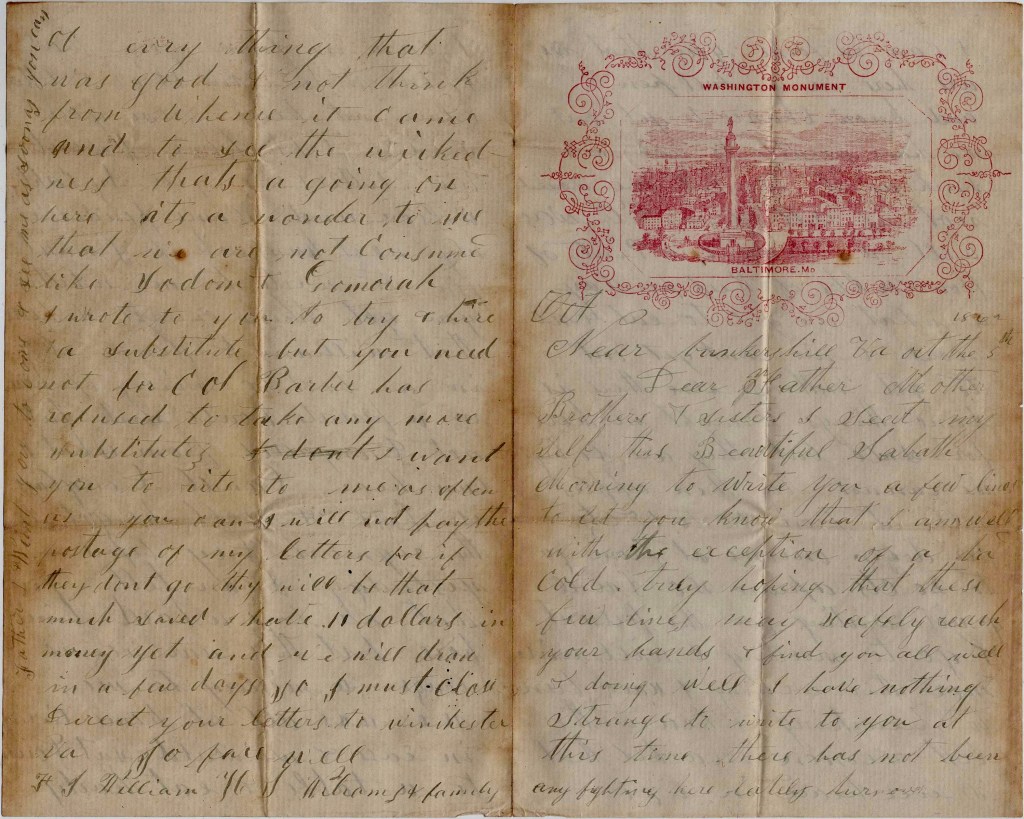

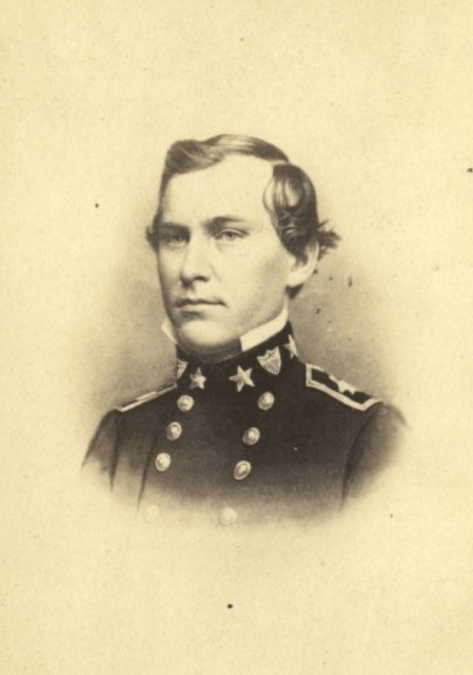

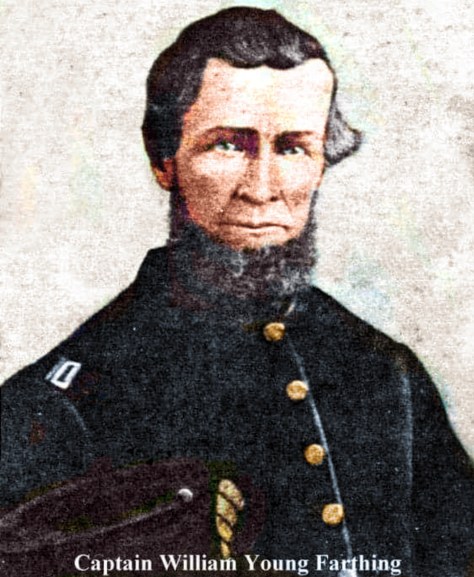
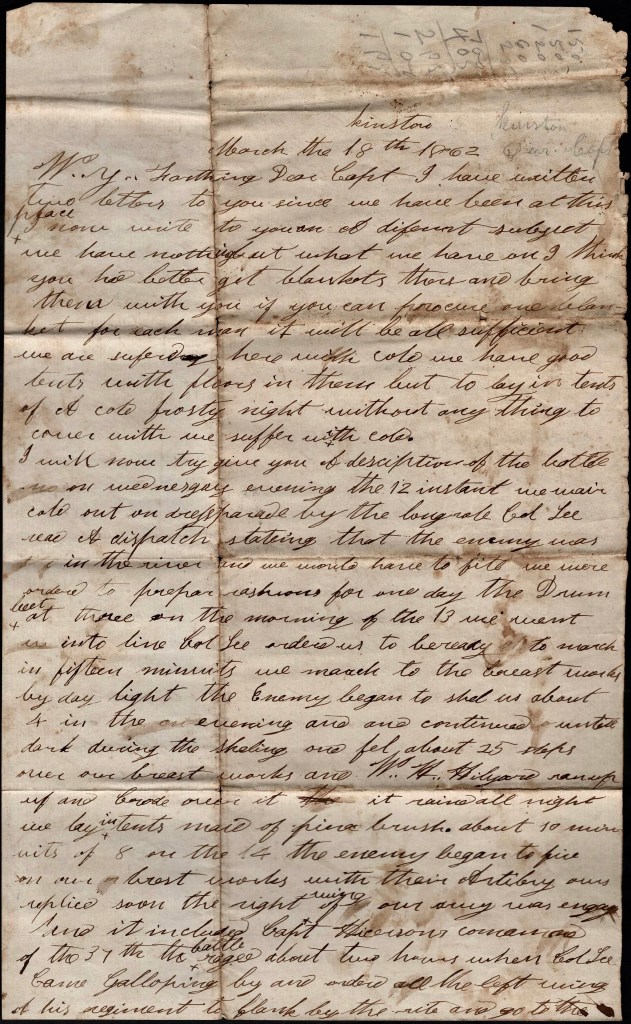

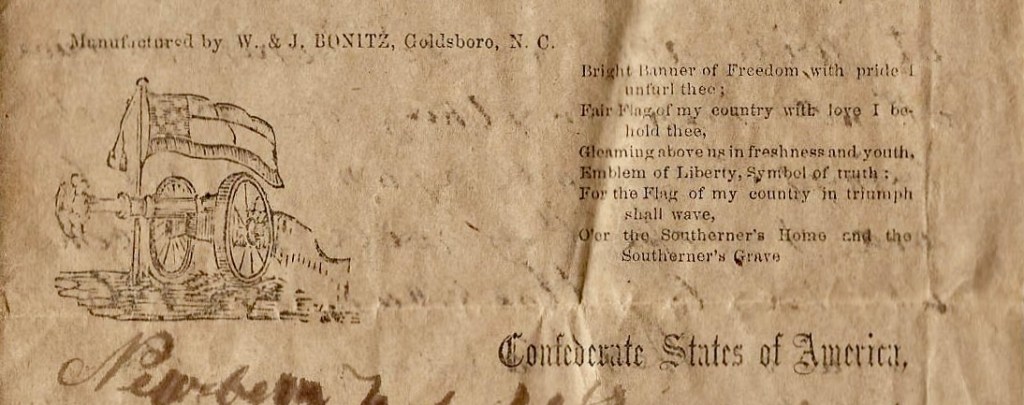


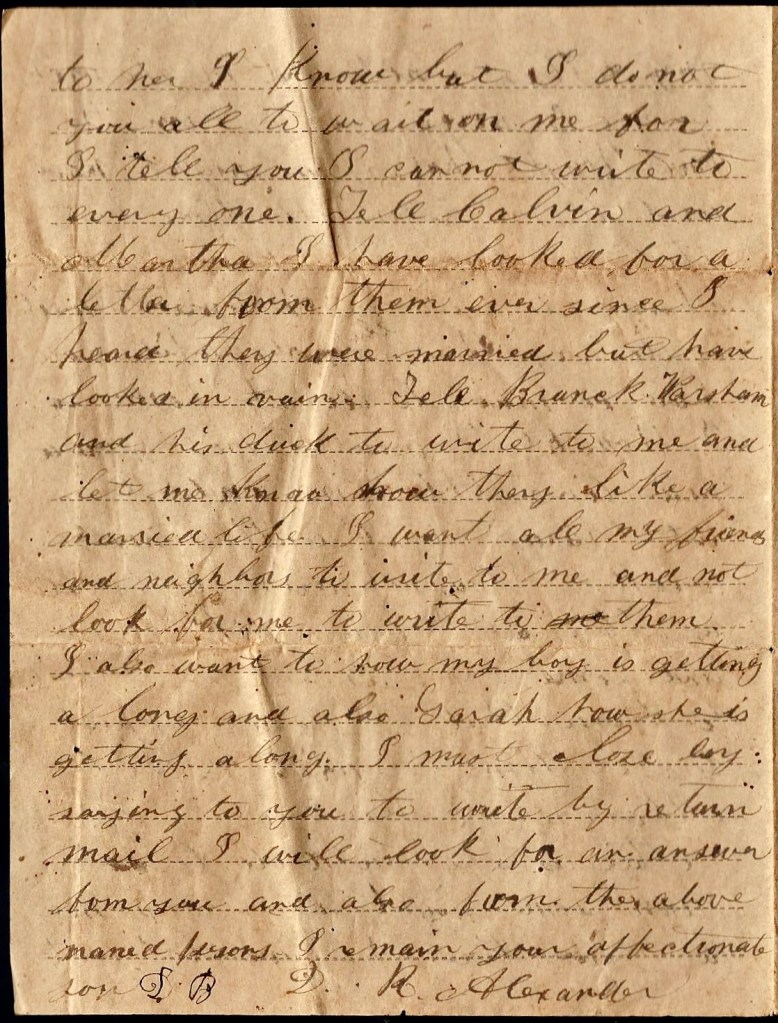

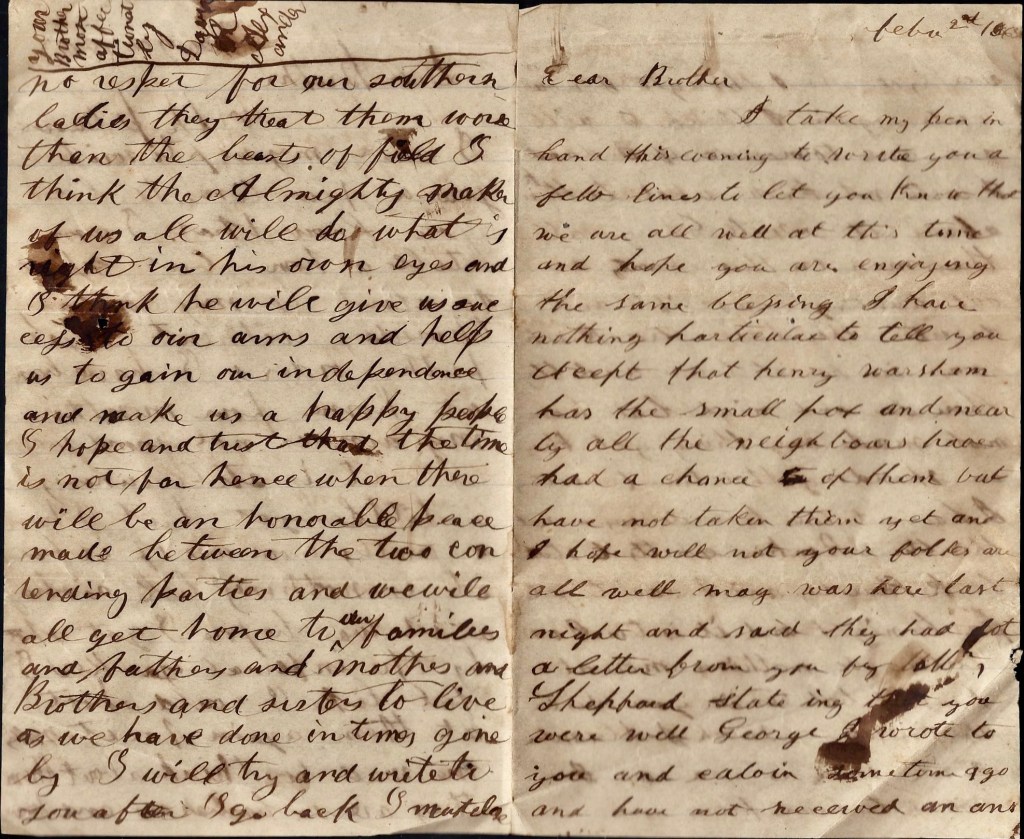


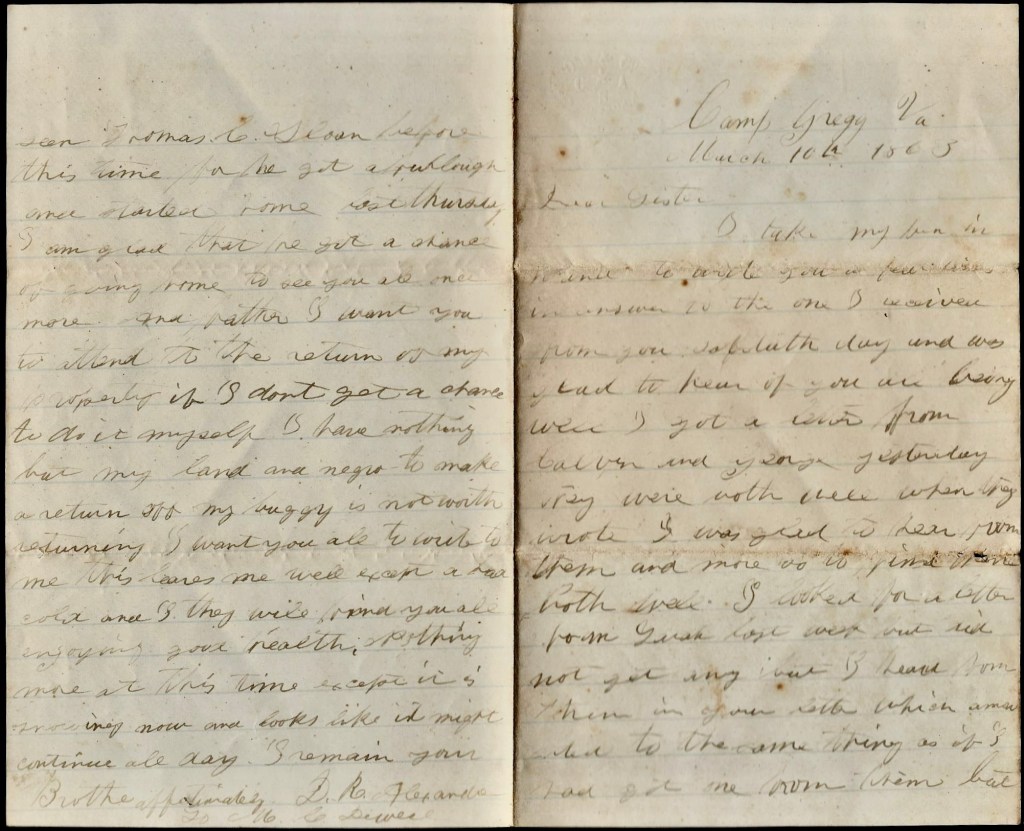
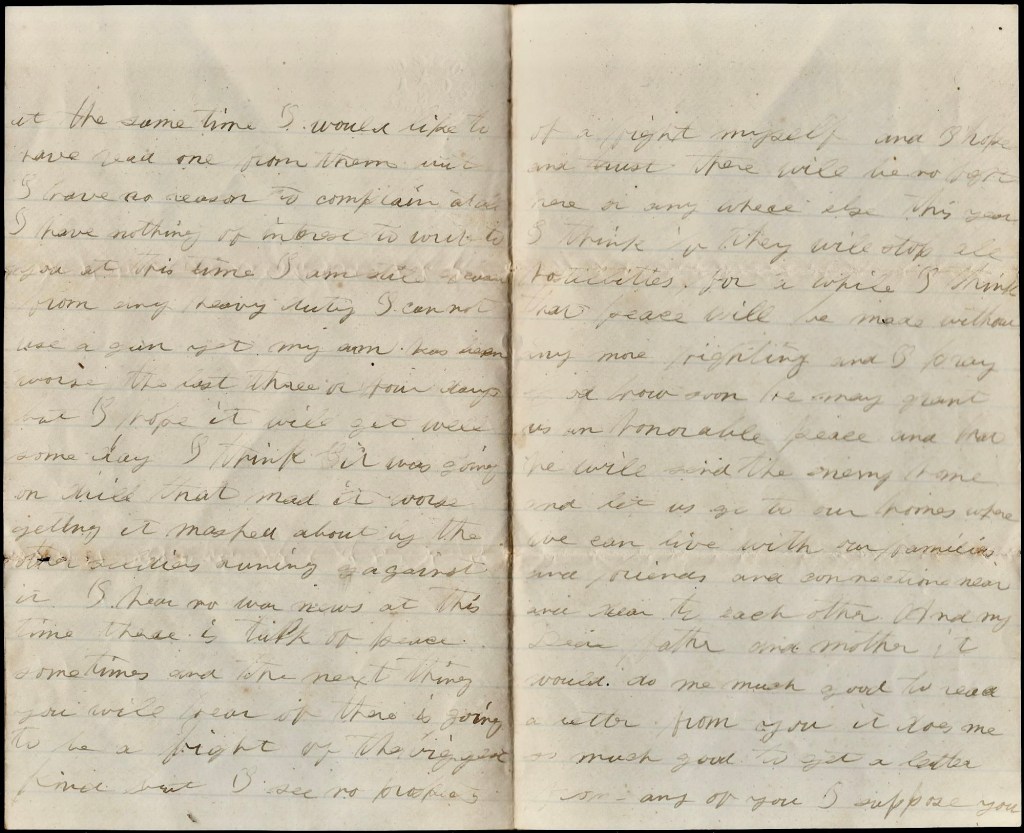

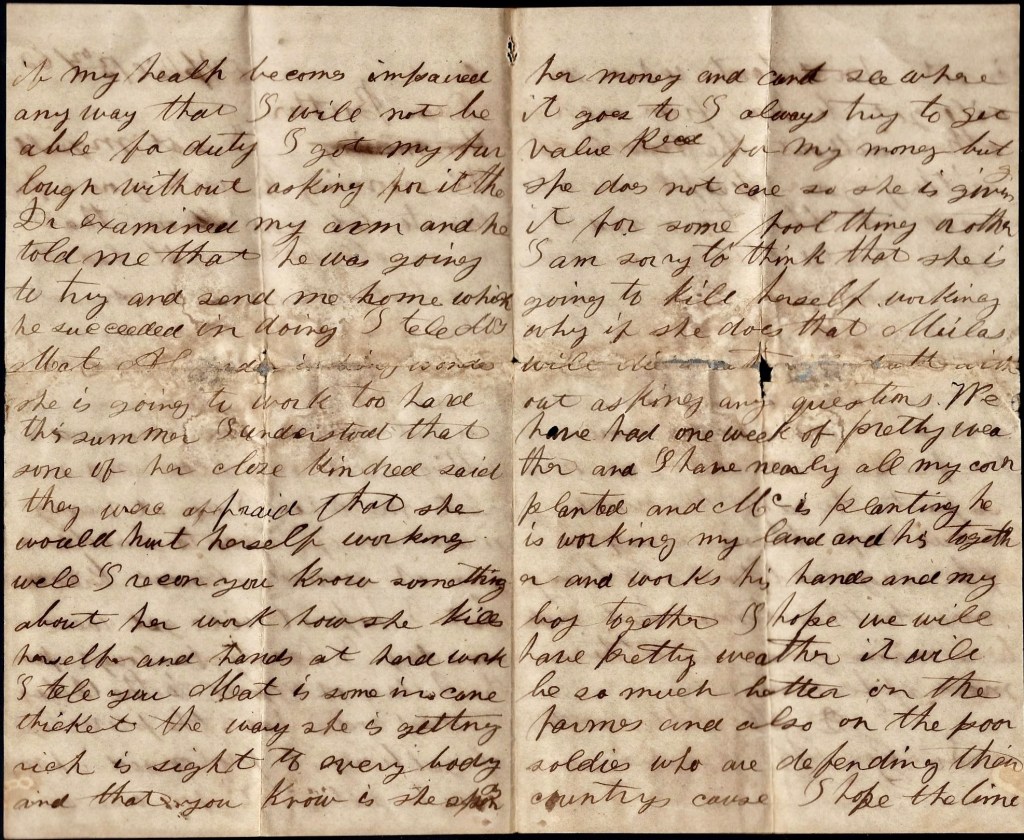
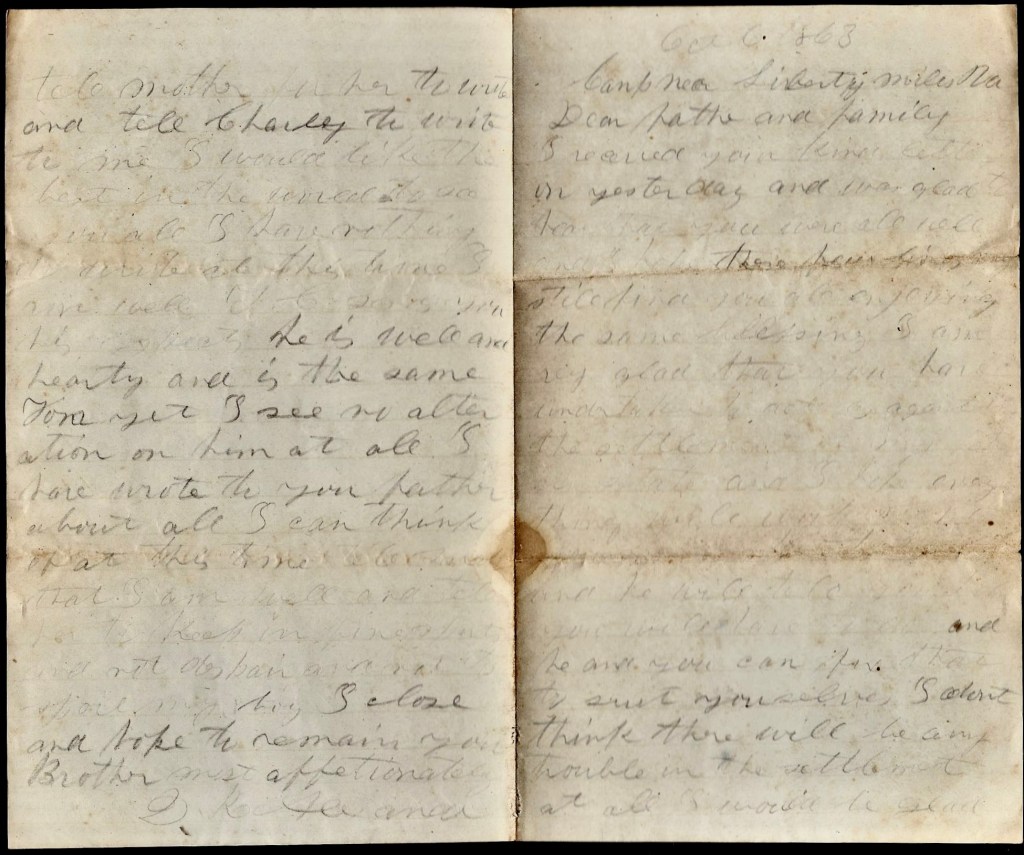


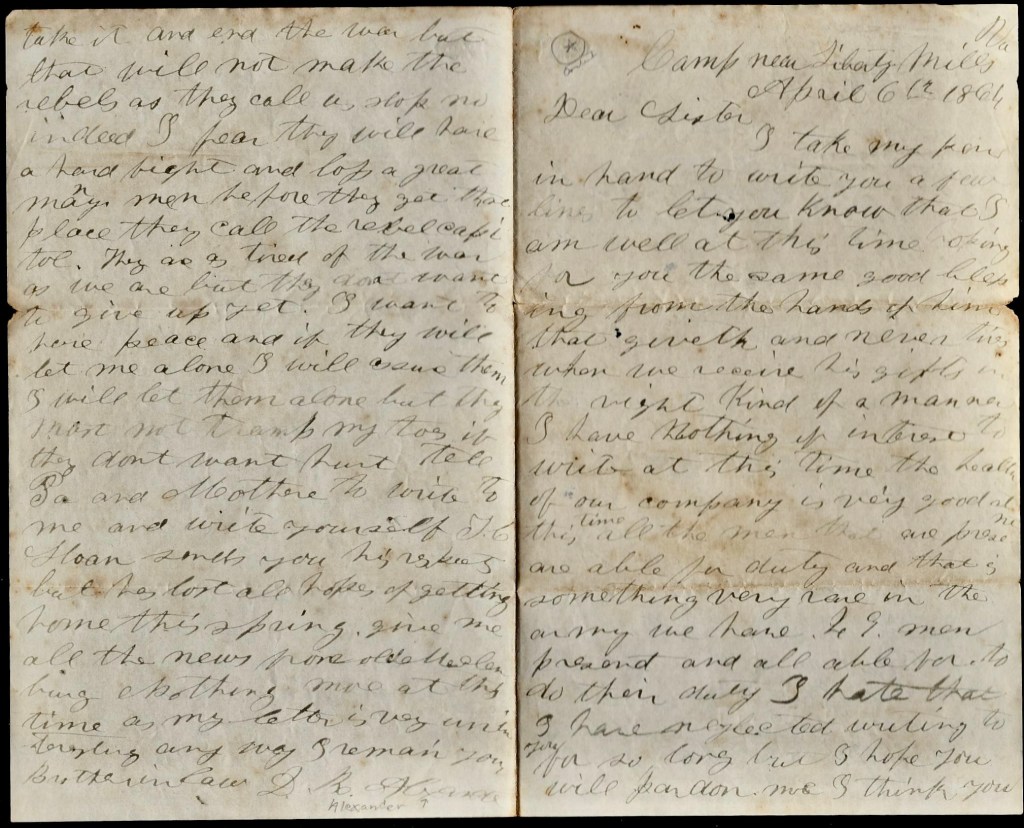

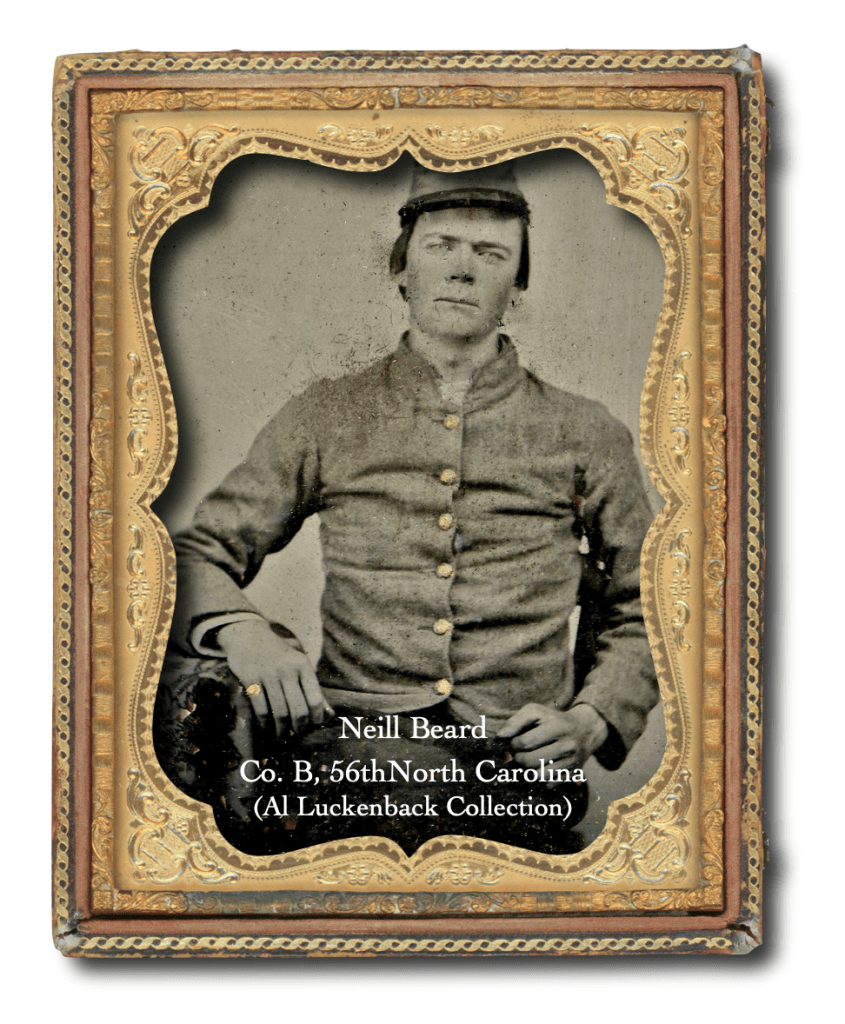


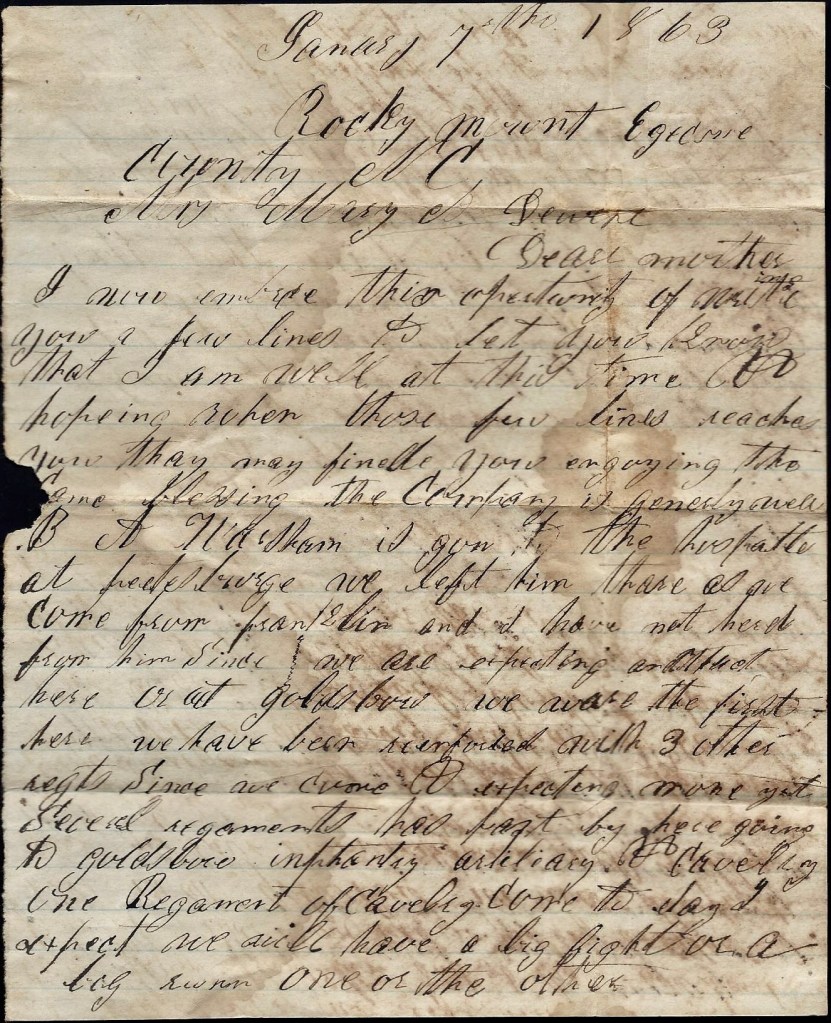

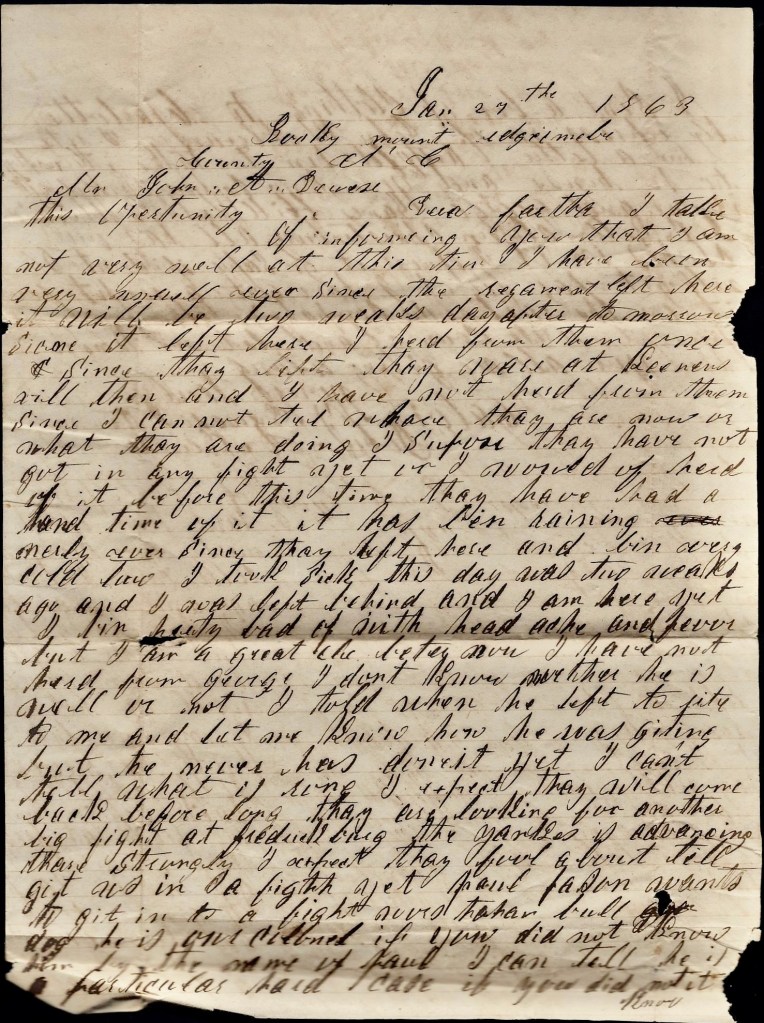
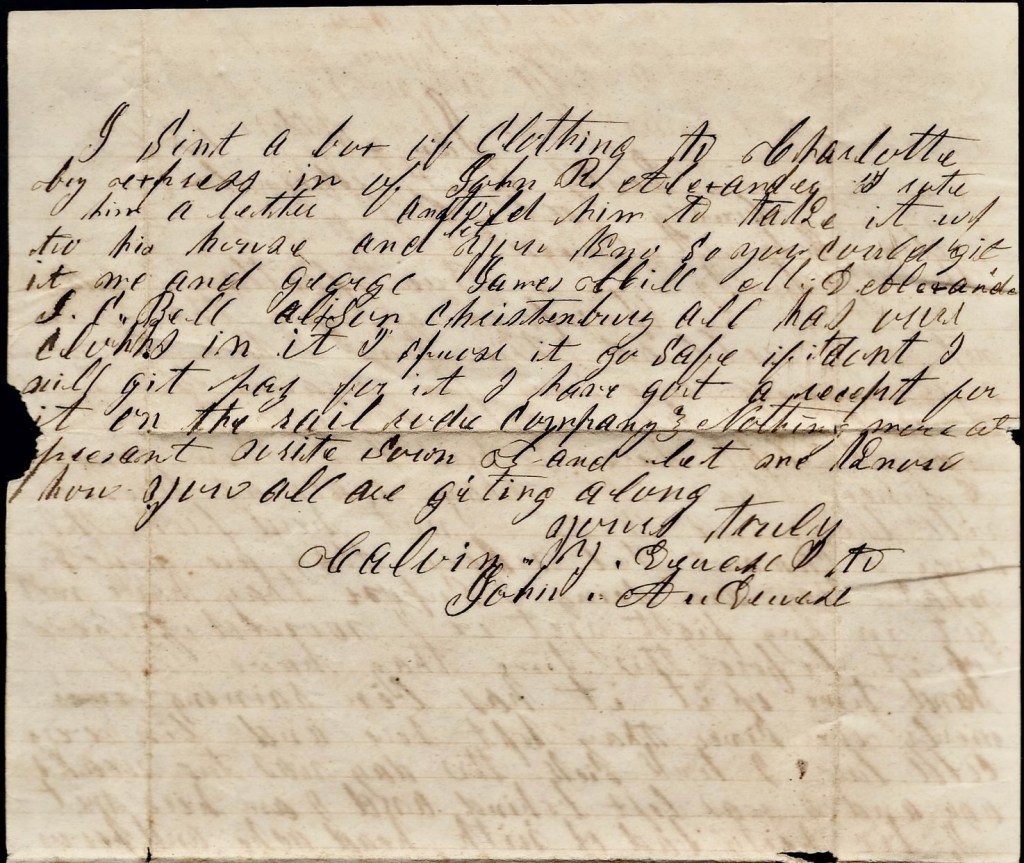
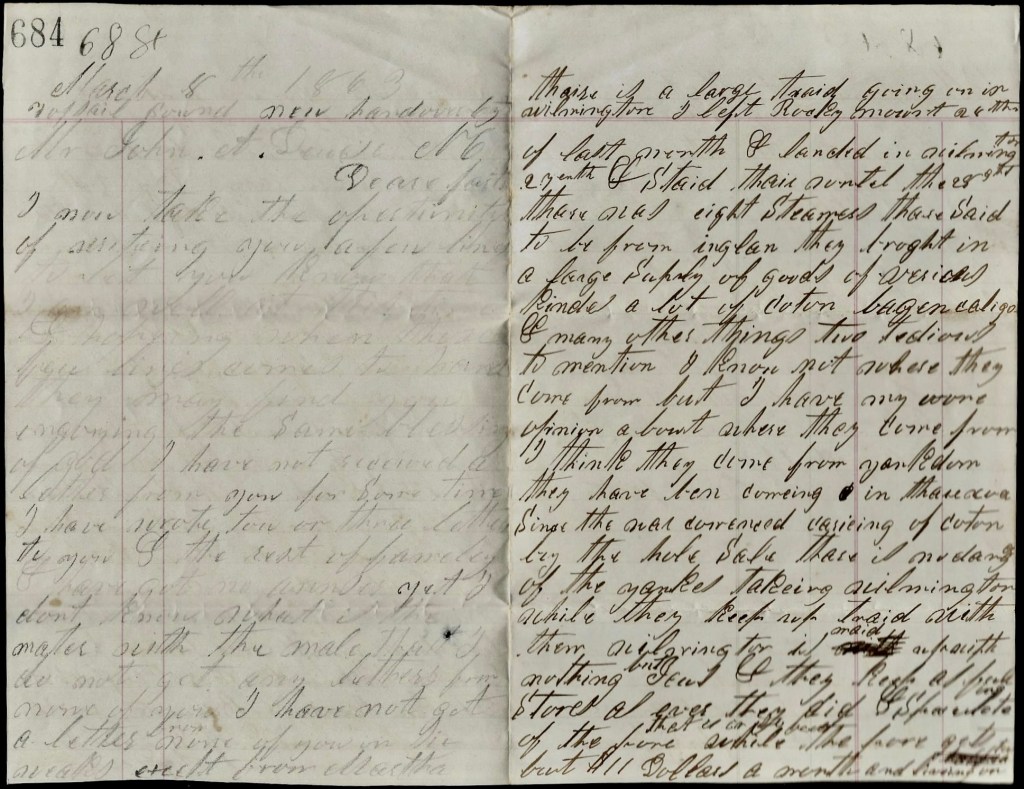

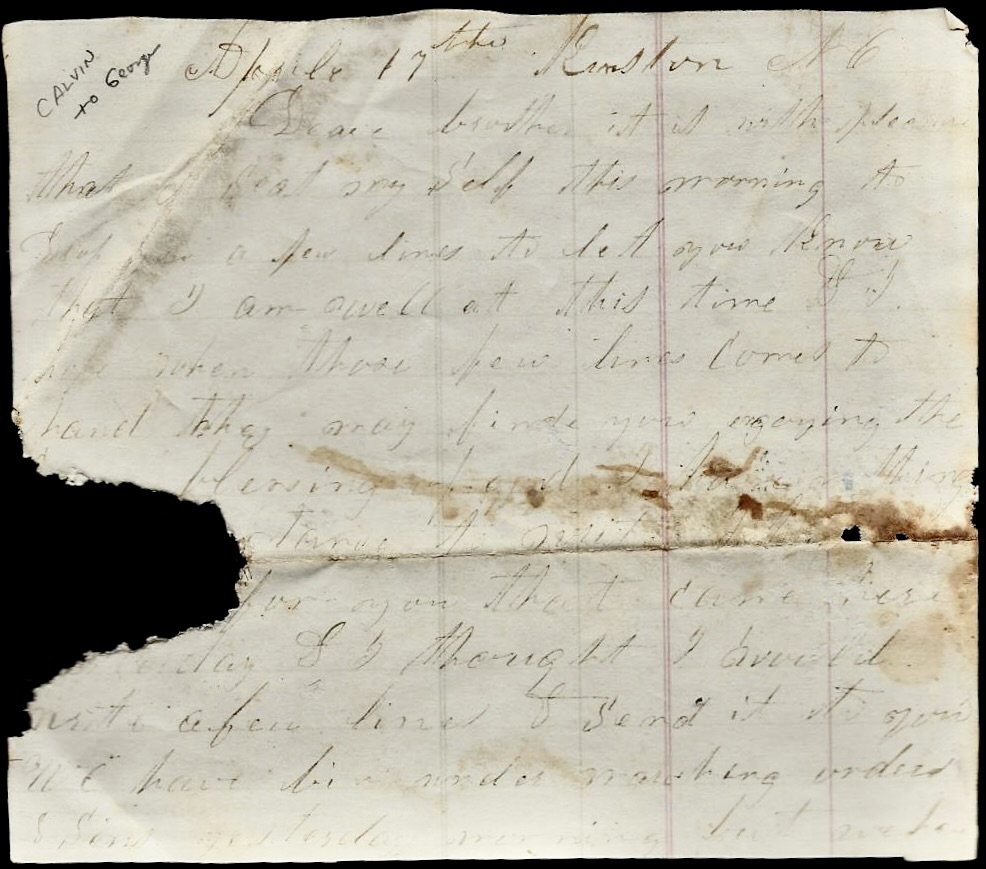


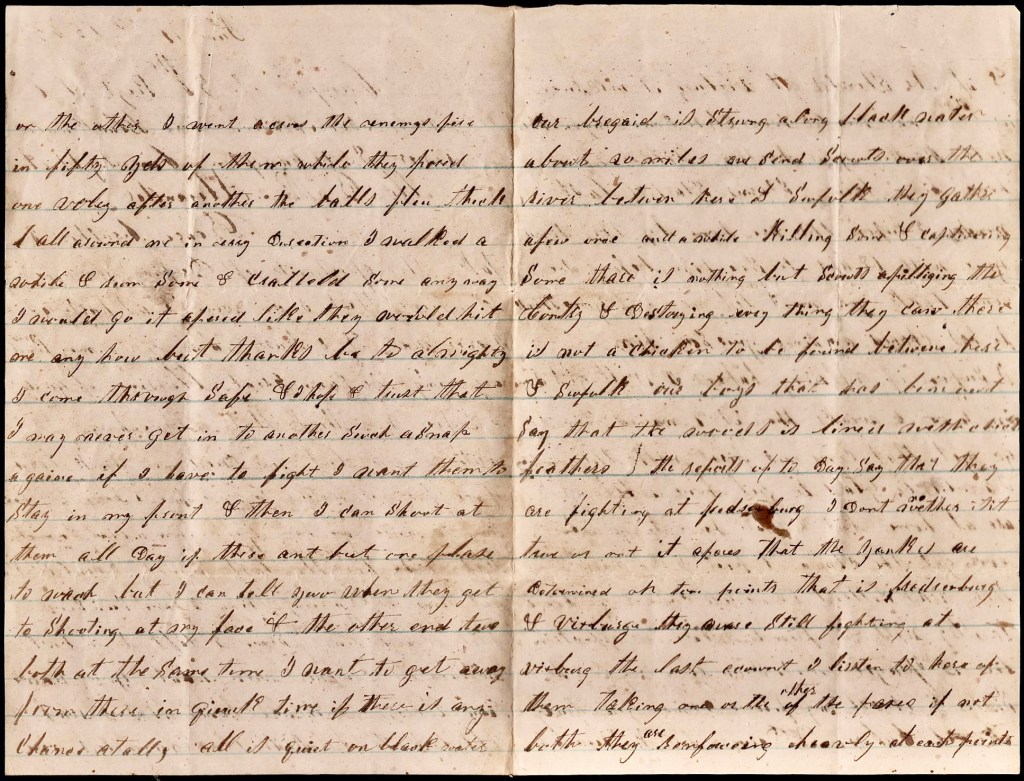
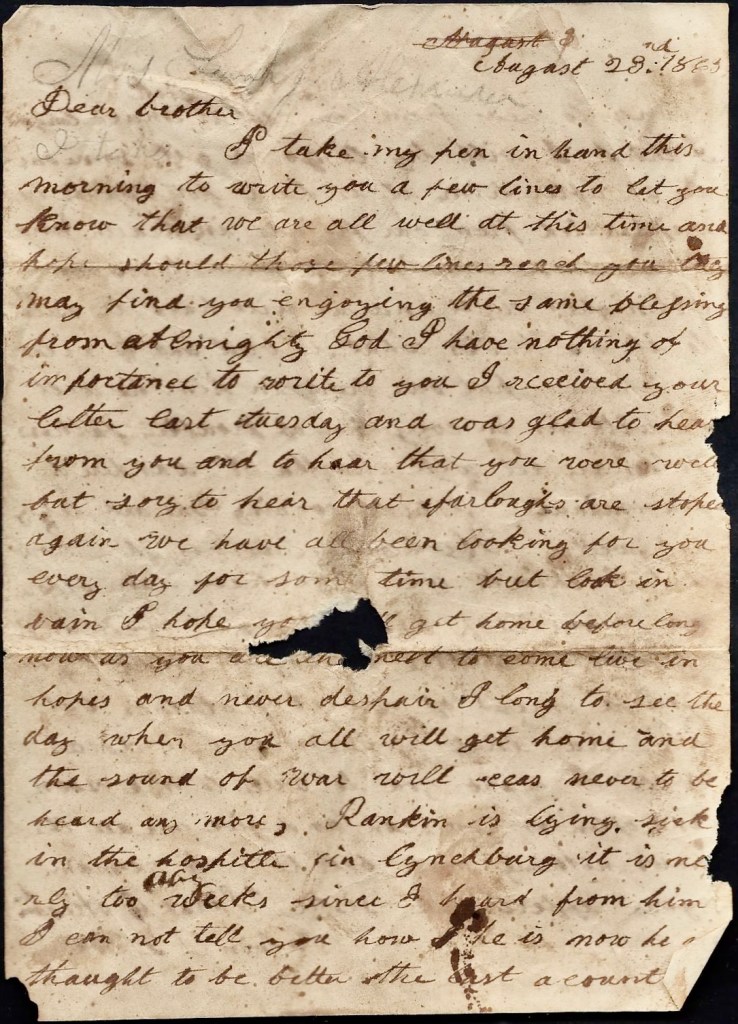

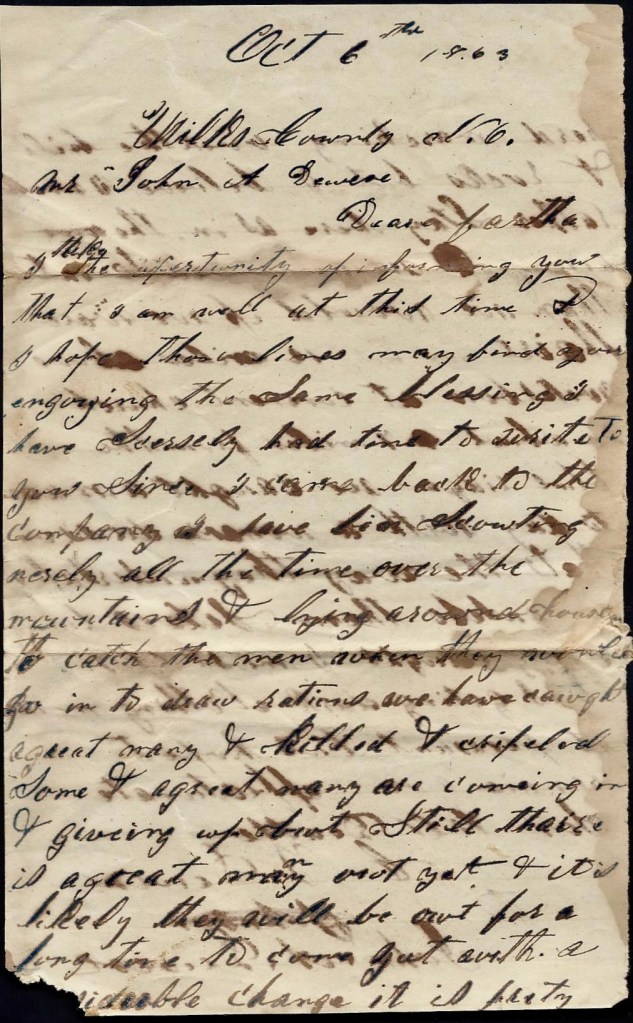
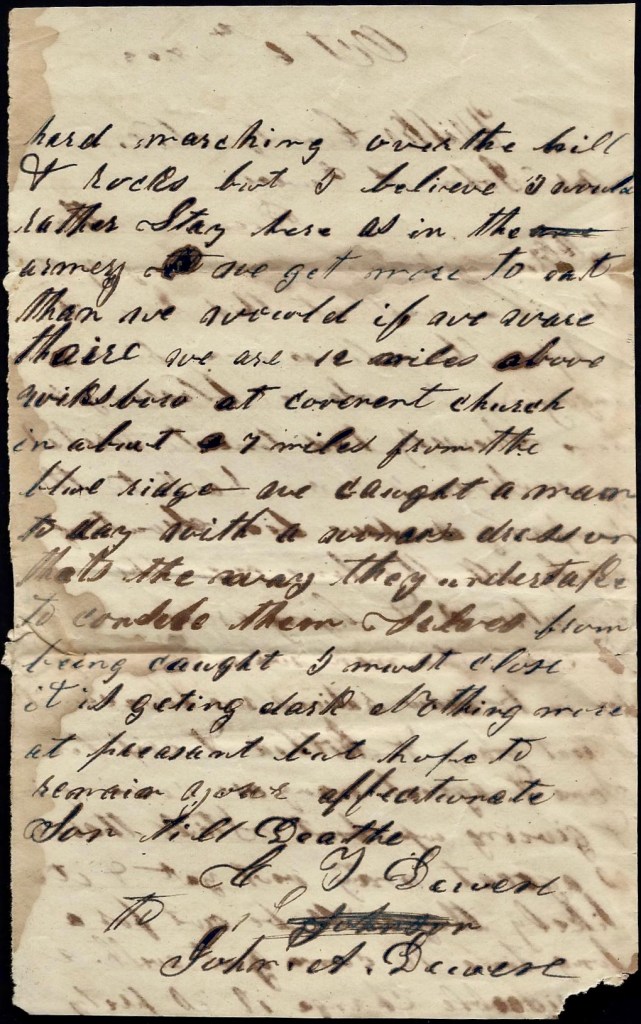


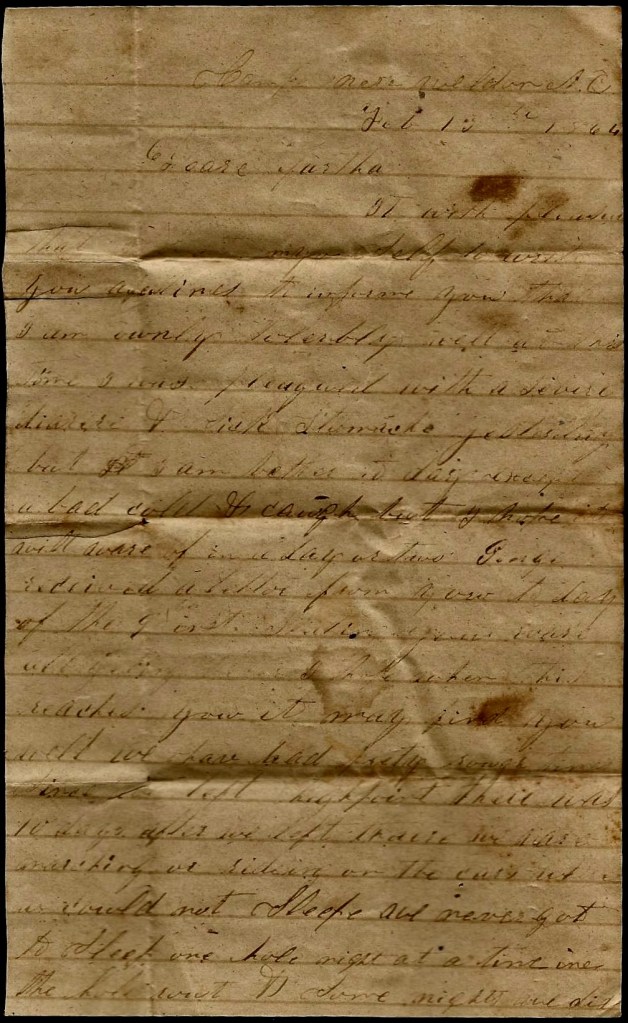

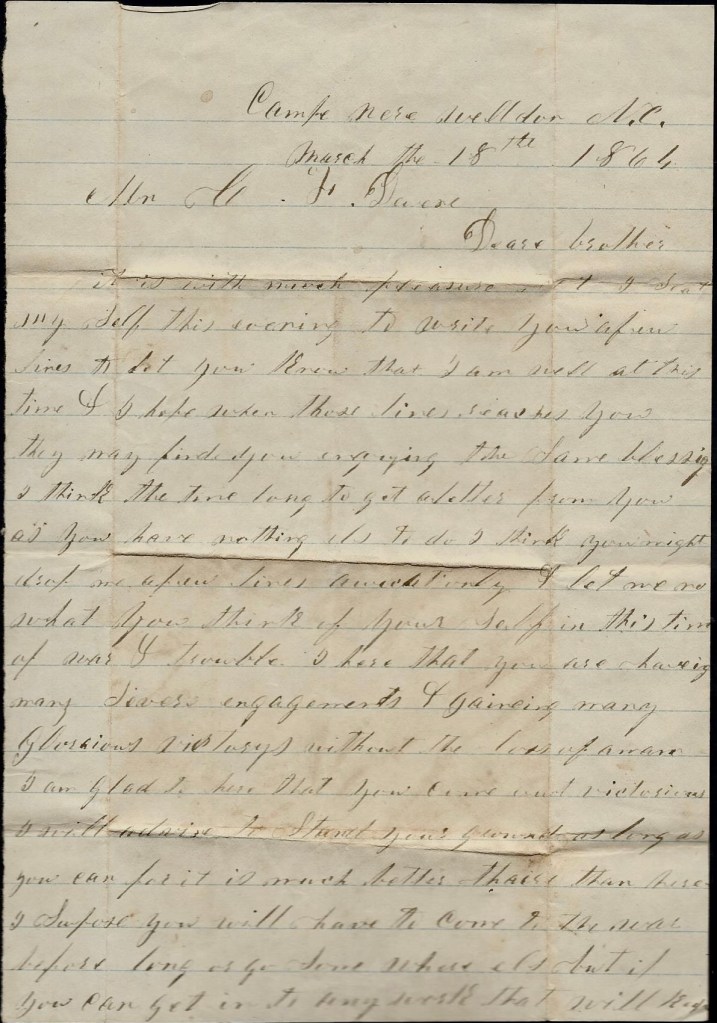


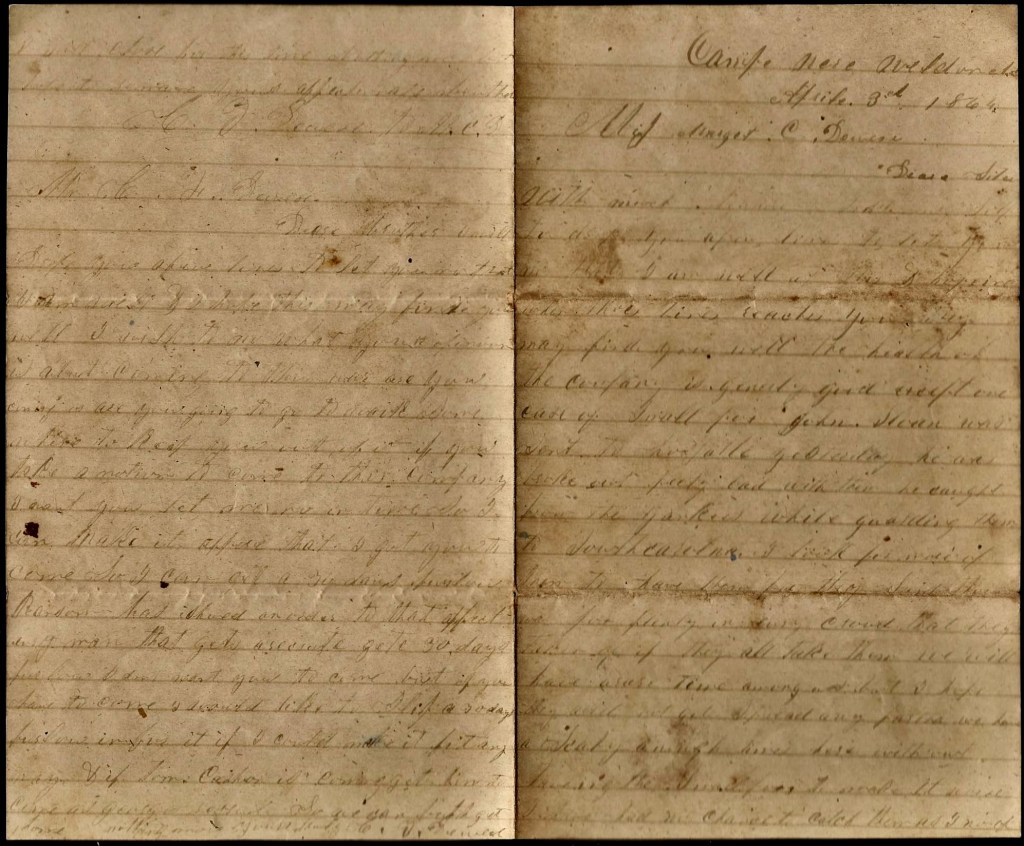
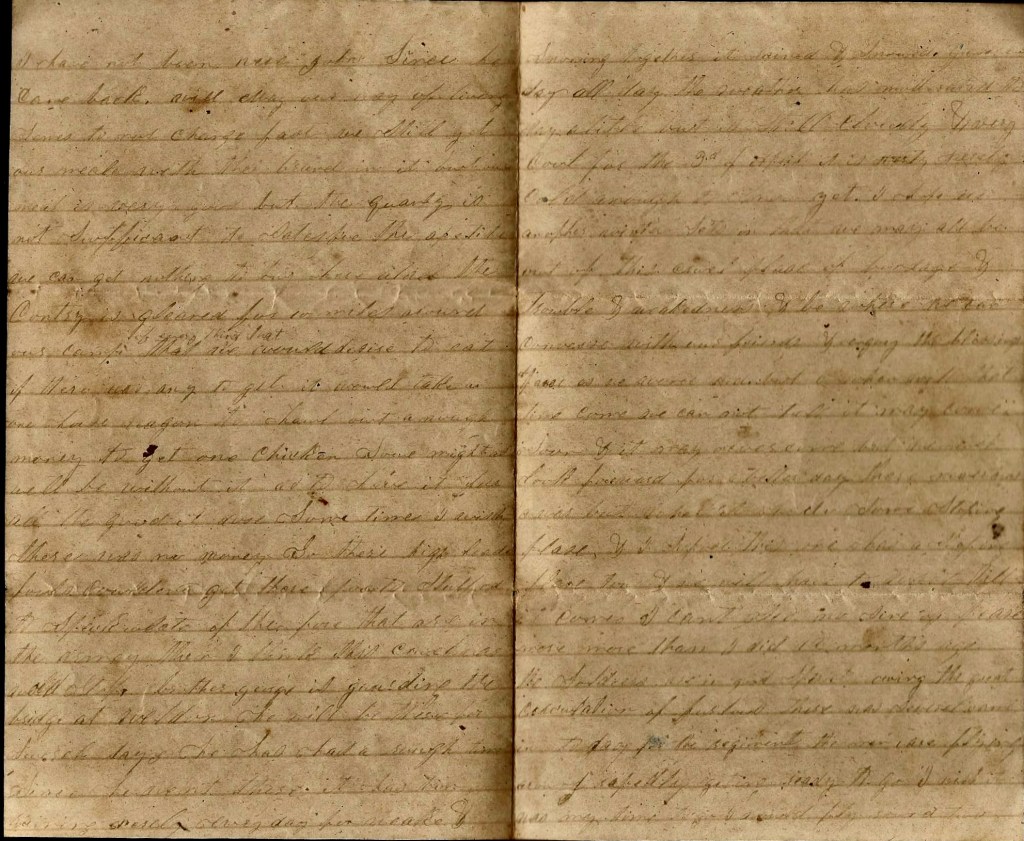

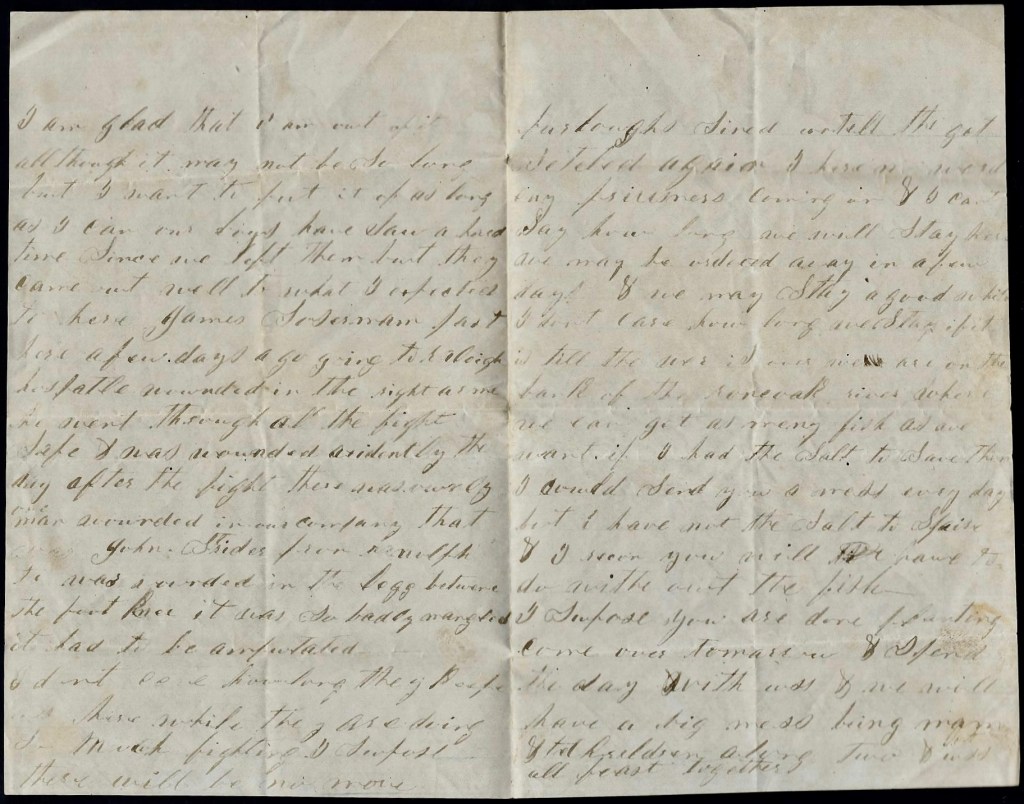
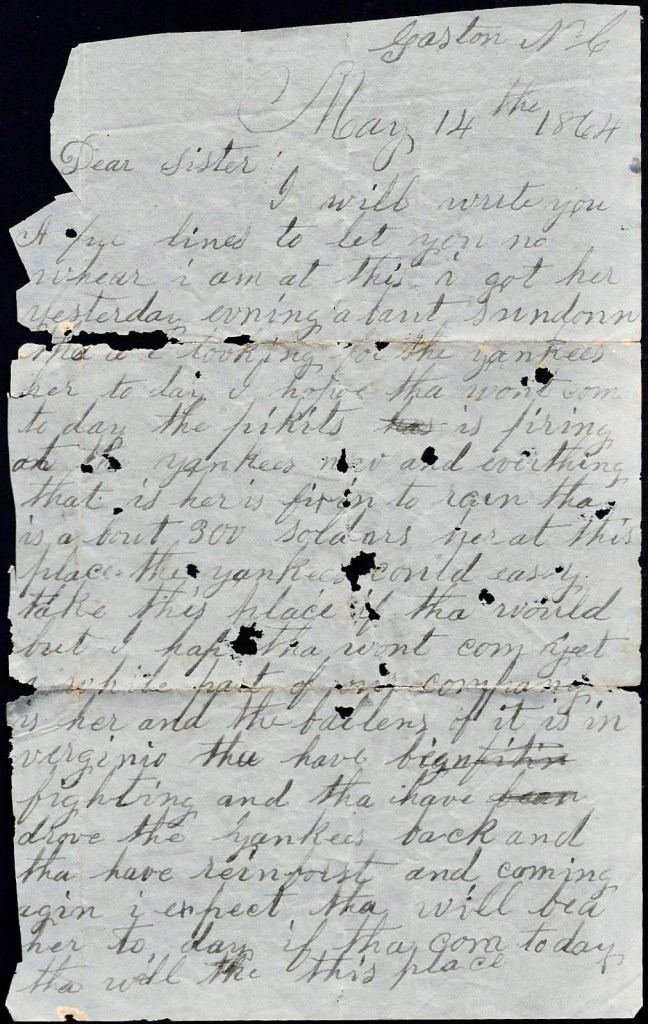


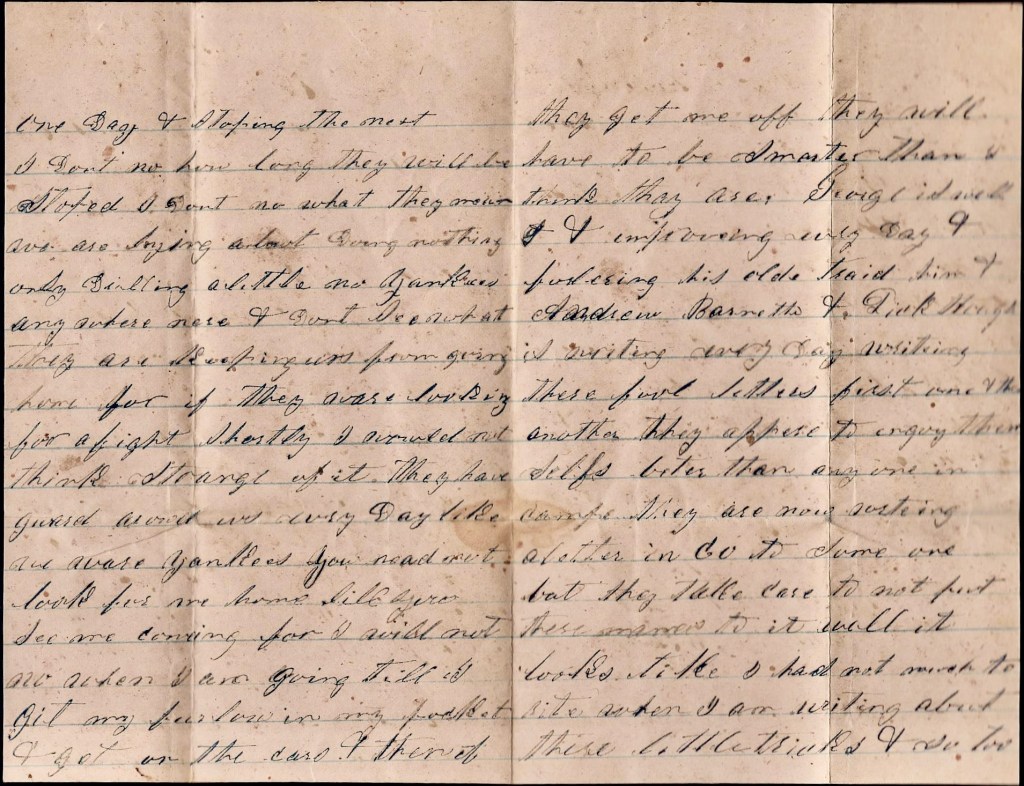

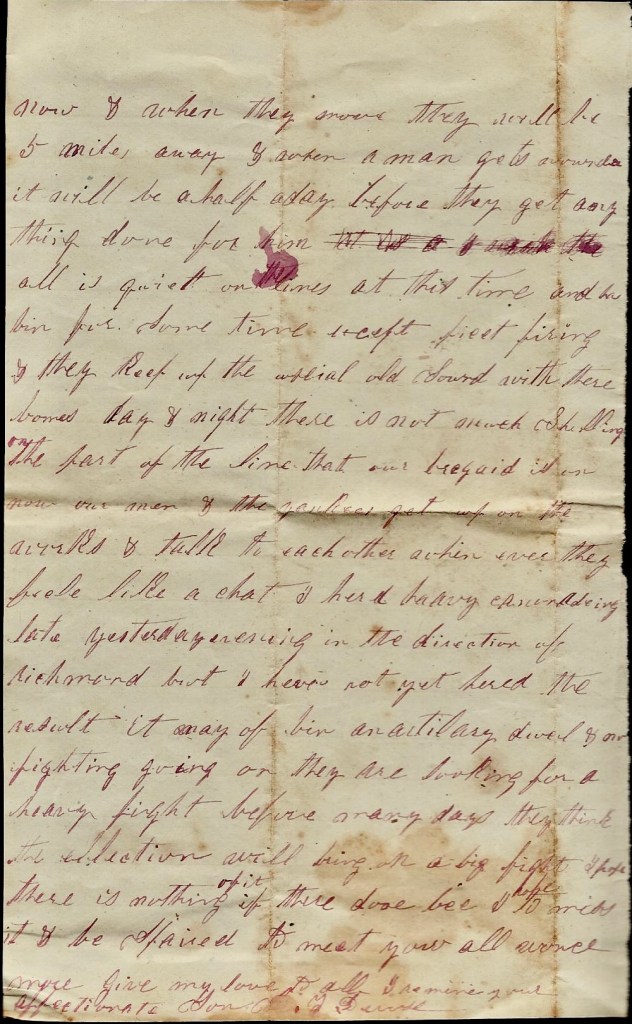


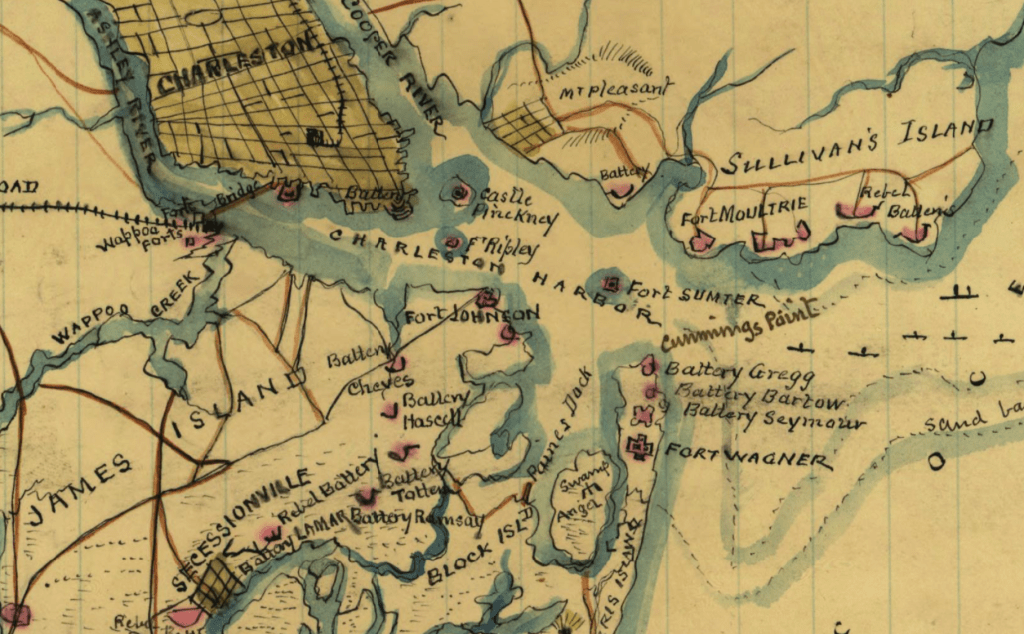
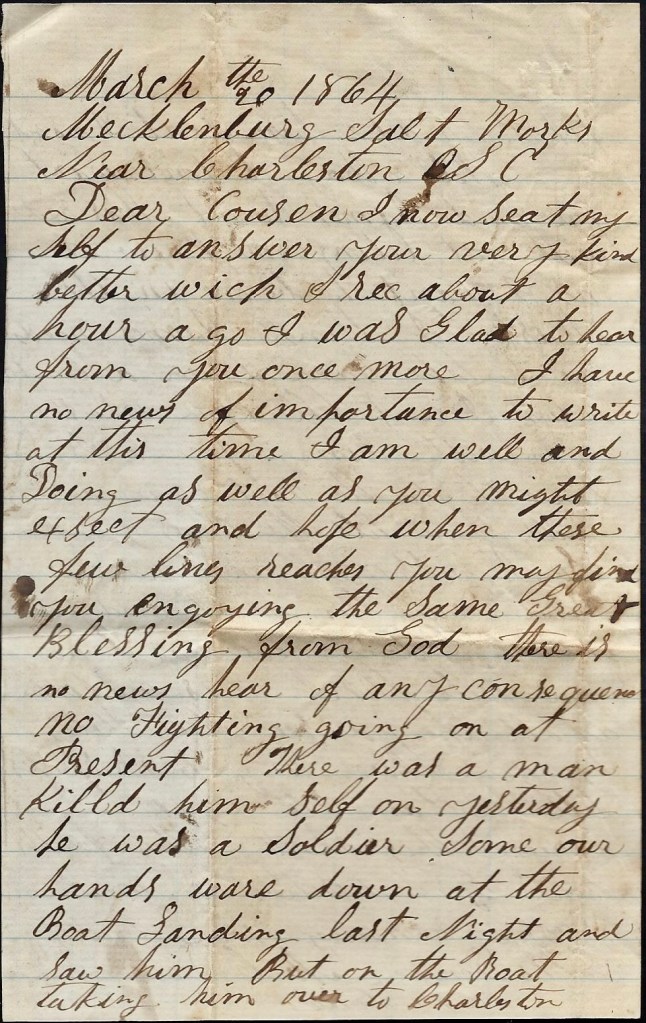


 Spared & Shared 23