Category Archives: 39th Massachusetts Infantry

1865: John Francis Locke to Mary Moore (Adams) Locke

The following letter was written by John Francis Locke (1844-1924), the son of brick mason Jonathan Frost Locke (1806-Aft1880) and Mary Moore Adams (1812-1887) of North Somerville, Massachusetts.

When he was 18 years old, John enlisted as a private in Co. E, 39th Massachusetts Infantry. He was among the 2500 Union soldiers taken prisoner on 19 August 1864 in the Battle of Globe Tavern (2nd Weldon Railroad). Being a clerk with excellent handwriting, John probably enjoyed better than average privileges than some of his fellow prisoners and we learn from this letter datelined from Richmond on 1 April 1865 that his Confederate captives had placed him on “parole of honor” meaning he was trusted not to aid the enemy until formally exchanged. The very next day after writing his letter, Richmond was evacuated and we don’t know what happened to John between that date and his record of exchange two weeks later. The “boats” that John refers to were POW Exchange boats that carried prisoners from Richmond down the James river to City Point where they were loaded onto transports and taken to Camp Parole, Annapolis, Maryland.

[Note: This letter is from the private collection of Greg Herr and was transcribed and published on Spared & Shared by express consent.]

Transcription

Addressed to Mrs. Mary M. Locke, North Somerville, Massachusetts

Richmond, Virginia
April 1st 1865

Dear Mother mine,

You must have been looking for your son John, after receiving that letter by Sergt. Wood, yet here I am still in the Confederate lines. We have been looking for instructions from Washington for some time past, but as yet they have not come. Meantime I have got about tired of waiting and think if asking Capt. Stewart to let me go on the next boat as I think I have done my duty thus far by him and my government, and, it is now time for someone else to take a hand and relieve me.

It has been a very pleasant stay for me. Capt. Stewart have been very kind indeed to me. I am acting as his clerk & cook. None of us have any money so we are obliged to do our own cooking which you may well know is not much of a burden to me. I get nice potato yeast and make quite light & nice bread. I have all I wish in the eating line. Being on parole of honor, I of course have more liberty than the rest of the prisoners, I have found some good friends among the sesesh. Capt. John M. West 1 of the Exchange Bureau, C. S. A.—a New Hampshire man by birth—has been very kind to me. Then there is a young Louisianan, messenger to Major [Thomas P.] Turner, Commandant of the Richmond Prison, with whom I am pretty intimate. 2 I have been presented with some sheet music—Southern though—by a young lady I have never seen, a niece of Capt. West’s. There is a nephew about Allie’s age also that is with me a great deal. Tell Allie that he has given me something to carry to him from Richmond.

Mother, I am actually fat. I may be exaggerating it & won’t say how much but my weight is less than two hundred. I have almost got a double chin. Mother dear, do you realize that you have no boys now—that they have all reached manhood. Those little babies that you used to rock to sleep and tended, nursed, cared & prayed for have all entered upon their duties of life. O Mother, may they be true to their early teachings and grow up in the way thou hast taught them.

Mother, this boy will never be free from his love for his mother. He will always come when he is in trouble & affliction and lay his head in his mother’s lap and pour out his joy or sorrow, sure of your sympathy. Seems to me these beautiful words; My mother dear, my mother sweet, my gentle, gentle mother never were so dear to me. Also that beautiful hymn you learnt us. Father! what ‘ere of earthly bliss thy sovereign will denies, how often have they been on my life. But for those beautiful songs of Christian faith and my memories of my younger days, it seems I could not have stood what I have. I have been so confident all along that things would turn out right and I should be permitted to see you again that it seems as if it was an answer for my faith.

Ask Mary & Willie if they remember Capt. Swords. 3 He was home winter before last and danced with Mary at Belmont. He was also at home last winter and brought me news from Uncle George’s family. He is now on Maj. Gen. [Orlando B.] Willcox’s staff, well acquainted with the Bowman’s. He was captured at Petersburg when they attacked the 9th Corps [see Battle of Fort Stedman] this day week. He promised to take a letter for as he is going on the first boat, being a friend of Col. [William H.] Hatch—a commissioner of exchange, CSA. Hoping that I may greet you with a kiss instead of a letter, I close. From your dutiful son, — John F. Locke.

Love to Father, sisters & brother. Also Allie and all good friends, — John


1 Probably the John M. West (b. 1828 in New Hampshire) who was working as a bookseller in Richmond as early as 1850.

2 Major Thomas P. Turner, commandant of Libby Prison and Belle Isle late in the Civil War, fled from Richmond on April 3rd on the day Union forces entered the city. His escape to Cuba was told in a letter which can be found in the following: Major Turner’s Escape.

3 Capt. Henry Leonard Swords (1843-1929), of the 59th Massachusetts Infantry. He was taken prisoner at Fort Stedman on 25 March 1865.

1864: Judson Wayland Oliver to Edwin M. Stanton

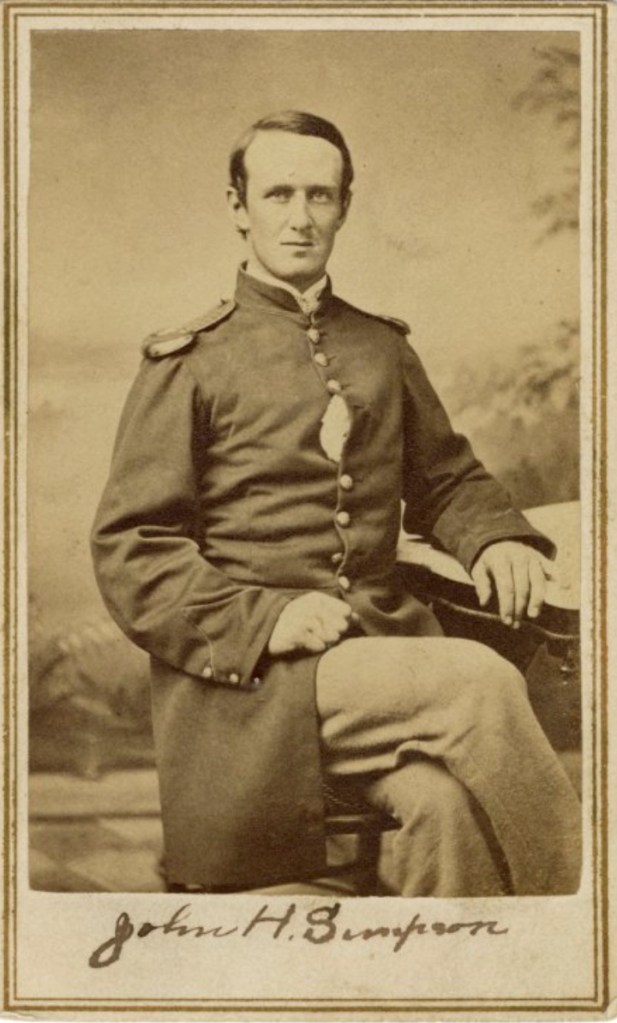
I could not find an image of Jud dating to the time he was in the Civil War but here is one of John H. Simpson of Co. C, 39th Massachusetts Infantry (Photo Sleuth)

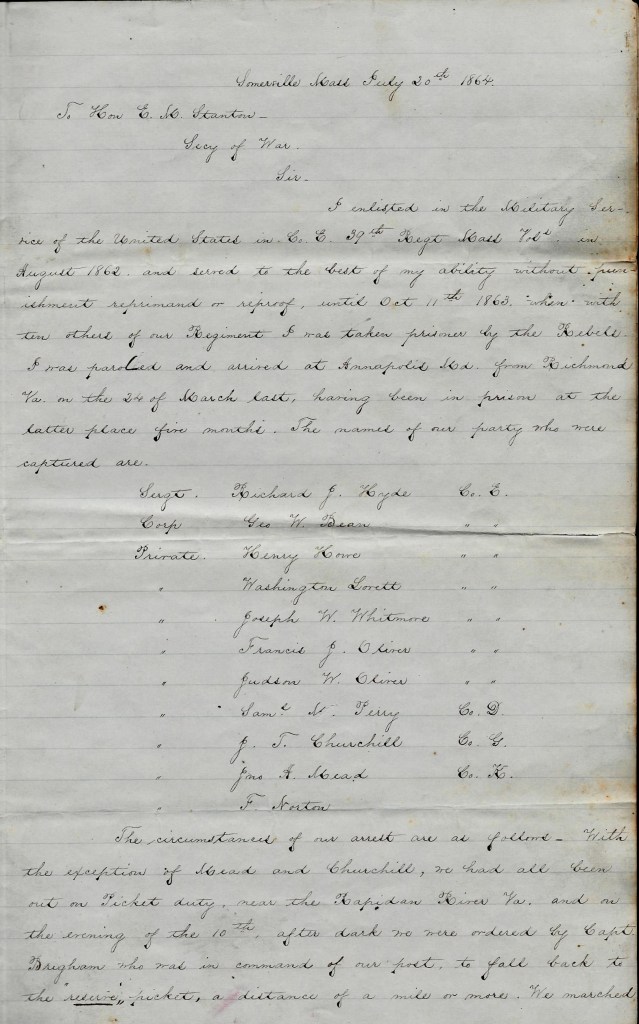
The following letter, addressed to Secretary of War, Edwin M. Stanton, was penned by Judson (“Jud”) Wayland Oliver (1832-1908) of Co. E, 39th Massachusetts Infantry. As he states in his letter, he was taken a prisoner of war near the Rapidan River on 10 October 1863 and held in prison on Belle Island in Richmond through the winter of 1863/64 until exchanged after five months. After more time regaining his health in Union hospitals, he was returned to his regiment where he remained until taken prisoner again in February 1865 at Hatcher’s Run. He was exchanged not long after and mustered out in June 1865.

Judson was the son of William Oliver, Jr. (1795-1880) and Lydia Neagles (1810-1890) of Somerville, Middlesex county, Massachusetts. He was married in 1853 to Sarah Fessenden Hobart (1836-1878) and was the father of two children born before the Civil War began; three more after the close of the war.

Prior to Jud’s capture in October 1863, the 39th Massachusetts had spent the entire previous year performing guard duty in the defenses of Washington D. C., on the upper Potomac River, and near Harper’s Ferry. They were advanced to the Rapidan river and posted there in August and September 1863, but were pulled back to join other commands for the Bristoe Campaign. It was during this retreat from the Rapidan that Jud and the others in his squad were captured by rebel cavalry.

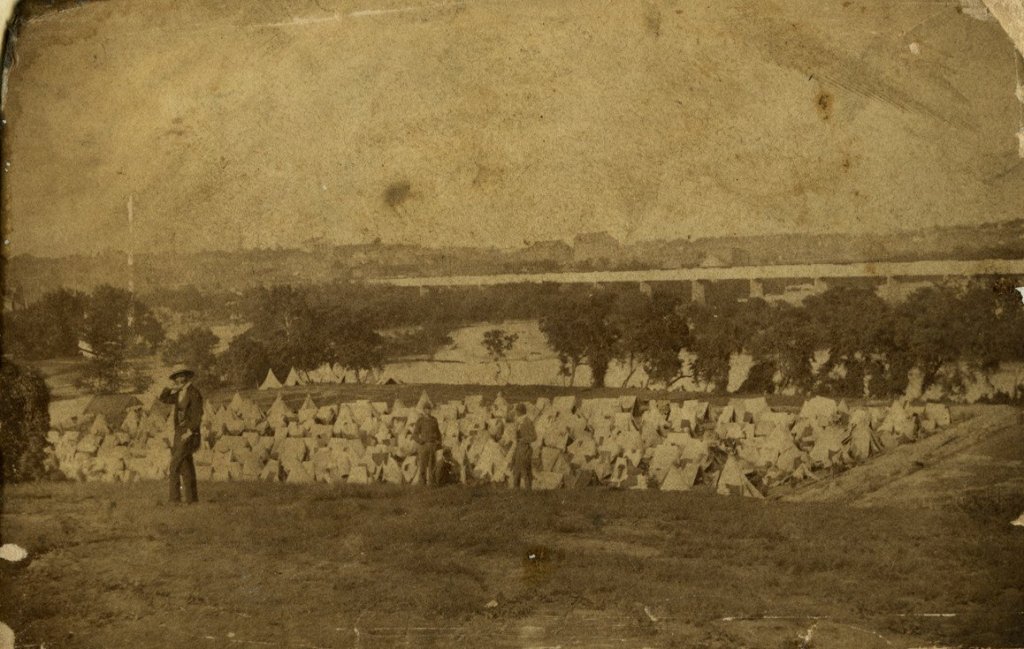
A rare Confederate photograph taken in the field shows tents where Union prisoners of war were housed on Belle Isle, an open-air prison located on an island in the James River across from Richmond. The photographer, Charles R. Rees, took the image from a high point on the island; in the distance, at center left, is the Capitol.

Transcription

Somerville, Massachusetts
July 20th 1864

To Hon. E. M. Stanton, Secretary of War
Sir,

I enlisted in the military service of the United States in Co. E, 39th Regt. Massachusetts Volunteers in August 1862 and served to the best of my ability without punishment, reprimand, or reproof until October 11th 1863 when with ten others of our regiment I was taken prisoner by the rebels. I was paroled and arrived at Annapolis, Maryland, from Richmond, Va., on the 24th of March last, having been in prison at the latter place five months. The names of our party who were captured are:

Sergt. Richard J. Hyde, Co. E
Corp. George W. Bean, Co. E
Private Henry Howe, Co. E
Private Washington Lorett, Co. E
Private Joseph W. Whitmore, Co. E
Private Francis J. Oliver, Co. E
Private Judson W. Oliver, Co. E
Private Samuel M. Perry, Co. D
Private J. T. Churchill, Co. G
Private Jno. A. Mead, Co. K
Private F. Norton

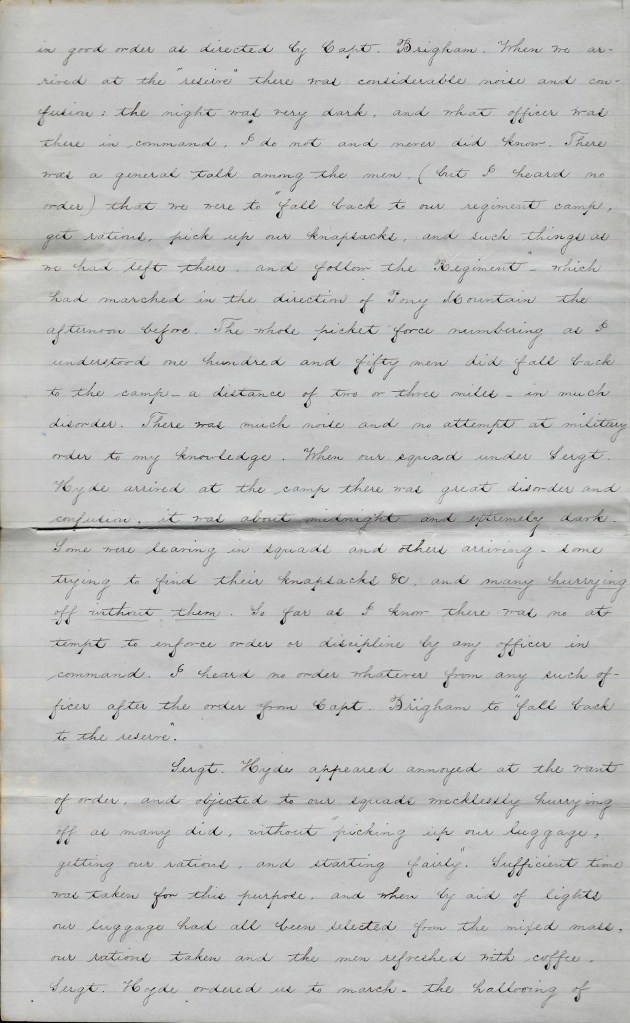
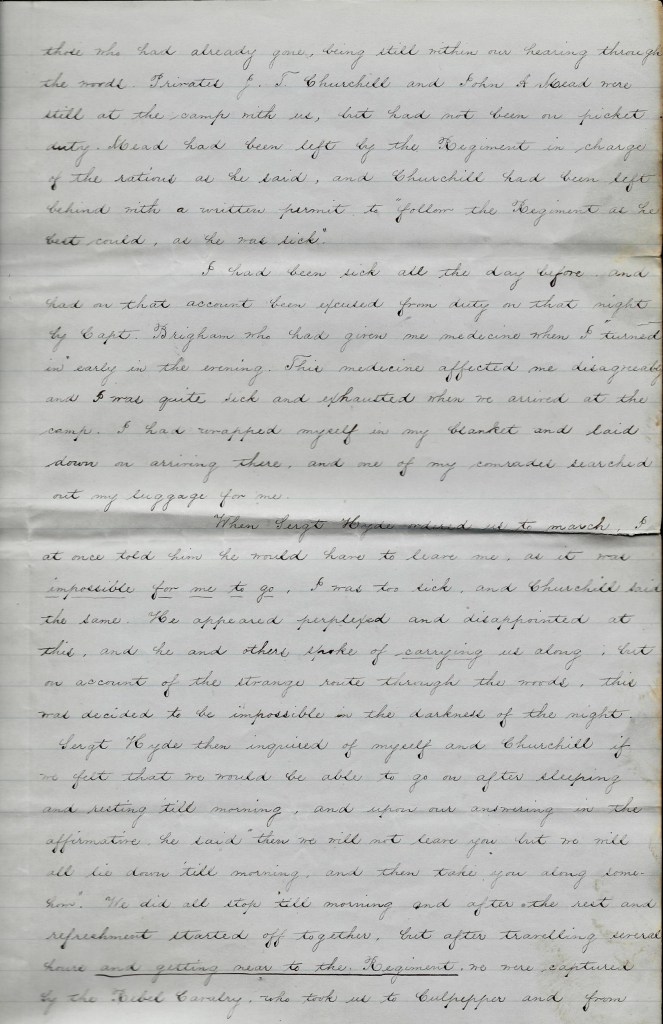
The circumstances of our arrest are as follows. With the exception of Mead and Churchill, we had all been out on picket duty near the Rapidan River, Va., and on the evening of the 10th, after dark, we were ordered by Capt. Brigham who was in command of our post, to fall back to the reserve picket, a distance of a mile or more. We marched in good order as directed by Capt. Brigham. When we arrived at the “reserve,” there was considerable noise and confusion. The night was very dark and what officer was there in command, I do not and never did know. There was a general talk among the men (but I heard no order) that we were to “fall back to our regiment camp, get rations, pick up our knapsacks, and such things as we had left there, and follow the regiment which had marched in the direction of Pony Mountain the afternoon before. The whole picket force numbering as I understood one hundred and fifty men did fall back to the camp—a distance of two or three miles—in much disorder. There was much noise and no attempt at military order to my knowledge.

When our squad under Sergt. Hyde arrived at the camp, there was great disorder and confusion. It was about midnight and extremely dark. Some were leaving in squads and others arriving, some trying to find their knapsacks, &c., and many hurrying off without them. So far as I know, there was no attempt to enforce order or discipline by any officer in command. I heard no order whatever from any such officer after the order from Capt. Brigham to “fall back to the reserve.”

Sergt. Hyde appeared annoyed at the want of order and objected to our squad’s recklessly hurrying off as many did, without “picking up our luggage, getting our rations, and starting fairly.” Sufficient time was taken for this purpose and when by aid of lights our luggage had all been selected from the mixed mass, our rations taken, and the men refreshed with coffee, Sergt. Hyde ordered us to march, the hallooing of those who had already gone, being still within our hearing through the woods. Privates J. T. Churchill and John A. Mead were still at the camp with us, but had not been on picket duty. Mead had been left by the regiment in charge of the rations as he said, and Church had been left behind with a written permit to “follow the regiment as best he could, as he was sick.”

I had been sick all the day before and had on that account been excused from duty on that night by Capt. Brigham who had given me medicine when I turned in early in the evening. This medicine affected me disagreeably and I was quite sick and exhausted when we arrived at the camp. I had wrapped myself in my blanket and laid down on arriving there and one of my comrades searched out my luggage for me.

When Sergt. Hyde ordered us to march, I at once told him he would have to leave me as it was impossible for me to go. I was too sick and Church said the same. He appeared perplexed and disappointed at this, and he and others spoke of carrying us along, but on account of the strange route through the woods, this was decided to be impossible in the darkness of the night. Sergt. Hyde then inquired of myself and Churchill if we felt that we would be able to go on after sleeping and resting till morning, and upon our answering in the affirmative, he said, “then we will not leave you but we will all lie down till morning, and then take you along somehow.” We did all stop till morning ad after the rest and refreshment, started off together. But after traveling several hours and getting near to the regiment, we were captured by the rebel cavalry who took us to Culpeper and from there to Richmond.

While we were at Culpeper, Private Charles A. Spaulding of Co. G of our regiment was brought there a prisoner and was taken to Richmond with us, but where or under what circumstances he was taken, I do not know. He was not on picket duty to my knowledge and he was not of our party till he was brought into Culpeper the day after we were captured.

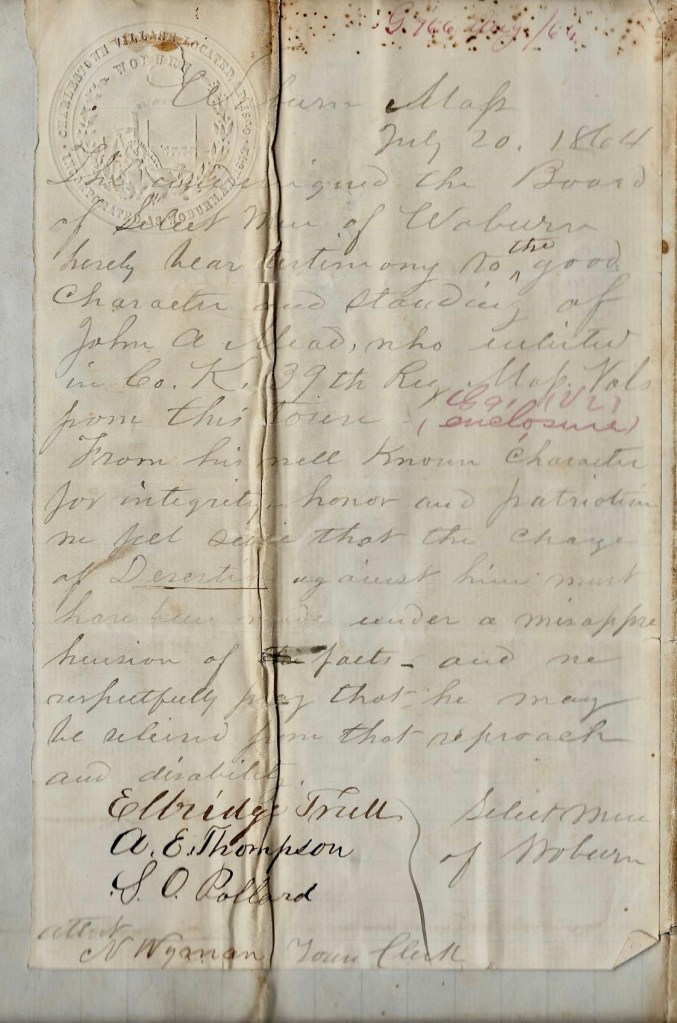
Our privations and sufferings in Richmond (from which Private Henry Howe died in December) were probably as extreme as those of an of our Union prisoners. I was sick and considered beyond the hope of recovery for some weeks in February and early in March and on getting out of the hospital but a short time before being paroled, I learned that the rest of my comrades of the 39th Regiment except Mead—who was also paroled—had been sent to Columbus, Georgia. Since I was paroled, I have been in the hospital at Annapolis and Annapolis Junction, Maryland, and Mason Hospital [in] Boston, and a furlough and “Pass” till the present time. Myself and unfortunate comrades are branded on the return rolls or “reports” of the regiment as “Deserters” and this as I am informed for the reason that we did not leave the regimental camp and follow the regiment more promptly.

I have nothing to add to what I have already said in regard to those circumstances and the want of military order and command except to declare that insubordination or wrong doing was wholly and entirely foreign from the intent and purpose of anyone of us. From what we heard of the requirement of the picket force (in absence of any actual order), we were fully impressed with the belief that to collect and carry along our knapsacks and spare luggage was but to do our duty and that to recklessly hurry off without taking this property was to violate our duty. This was Sergt. Hyde’s honest feeling in the matter and he so avowed in presence of some who left their knapsacks behind, and I most solemnly declare that I believe he would have started with his squad and followed the regiment that night, after having collected the luggage as before described, but for the impossibility of taking Churchill and myself along with them. I feel that my sickness and that of Churchill was really the cause and the only cause of the others remaining till morning, and that while it was the feeling of humanity which induced Sergt. Hyde to remain, neither that nor any other impulse or motive would have induced him to violate any known military order.

Our hardships, privations, and sickness in Belle Isle prison, grievous as they were, were mild compared with the sufferings of myself and comrades in the feeling that we are branded as the worst of criminals and our dependent families thereby deprived of all legal aid and support. I refer with confidence to my company officers, and to the entire regiment for the previous good conduct of our squad and our standing as dutiful, trustworthy soldiers, and I respectfully pray that we may be relieved from this reproach and disability, and restored to our former standing and position in the regiment, so far as this charge is concerned.

—Judon W. Oliver

In the presence of Charles S. Lincoln [Justice of the Peace, Somerville, Mass.]

1864: George R. Harlow to Julia E. Harlow

I could not find an image of George but here is one of Ira H. Felch who also served in the 39th Massachusetts Infantry (Excelsior Brigade Store)

This letter was written by George R. Harlow (1838-1908) who enlisted as a private in Co. E, 39th Massachusetts on 12 August 1862. In this letter, datelined from the regiment’s encampment near Cedar Mountain in January 1864, George imagined that the fighting might soon be over. Little could he have realized the fight left in the Confederate army. Just after his promotion to corporal, he was wounded slightly in the fighting at Laurel Hill, Virginia, at the beginning of Grant’s Overland Campaign and then again quite severely on 18 August 1864 in the fight for control of the Weldon Railroad near Petersburg. Following the amputation of his right arm, George was sent to a hospital in Washington D. C. where he was mustered out of the regiment for disability on 17 March 1865.

George was the son of Eldad Hitchcock Harlow (1803-1883) and Almira Clark (1807-1890) of Westminster, Vermont. He wrote the letter to his sister, Julia Elizabeth Harlow (1840-1869), who married Edward R. Taplin (1843-1872) in 1867. George died in Chattanooga, Tennessee.

To read other letters by member of the 39th Massachusetts I have transcribed and posted on Spared & Shared, see:

Julius Marshall Swain, Co. B, 39th Massachusetts (3 Letters)
Joseph John Cooper, Co. F, 39th Massachusetts (1 Letter)
Benjamin Curtis Lincoln, Co. G, 39th Massachusetts (20 Letters)

Transcription

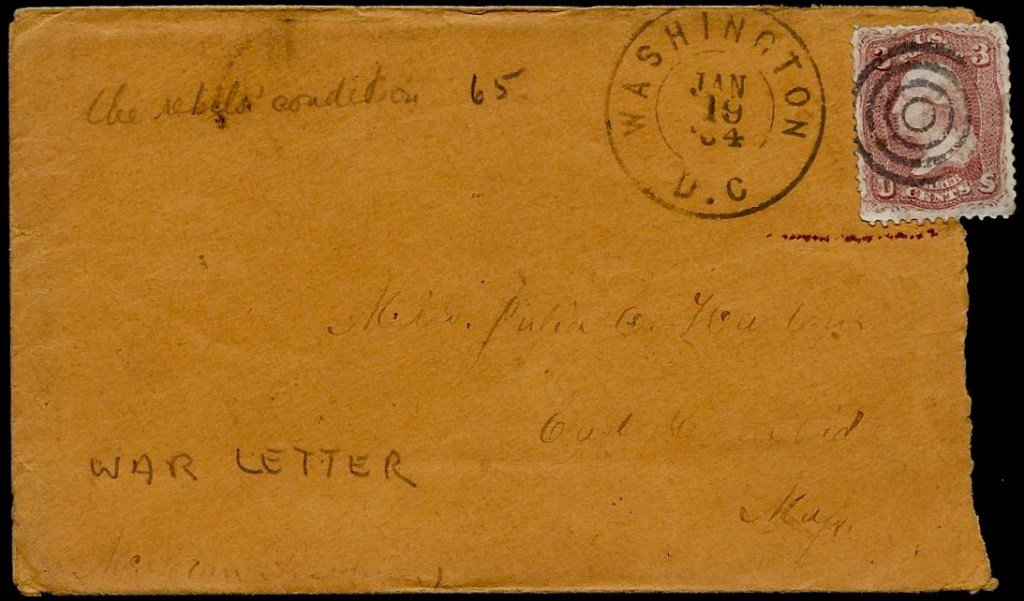
Addressed to Miss Julia E. Harlow. East _____, Mass.
Postmarked January 19, 1864

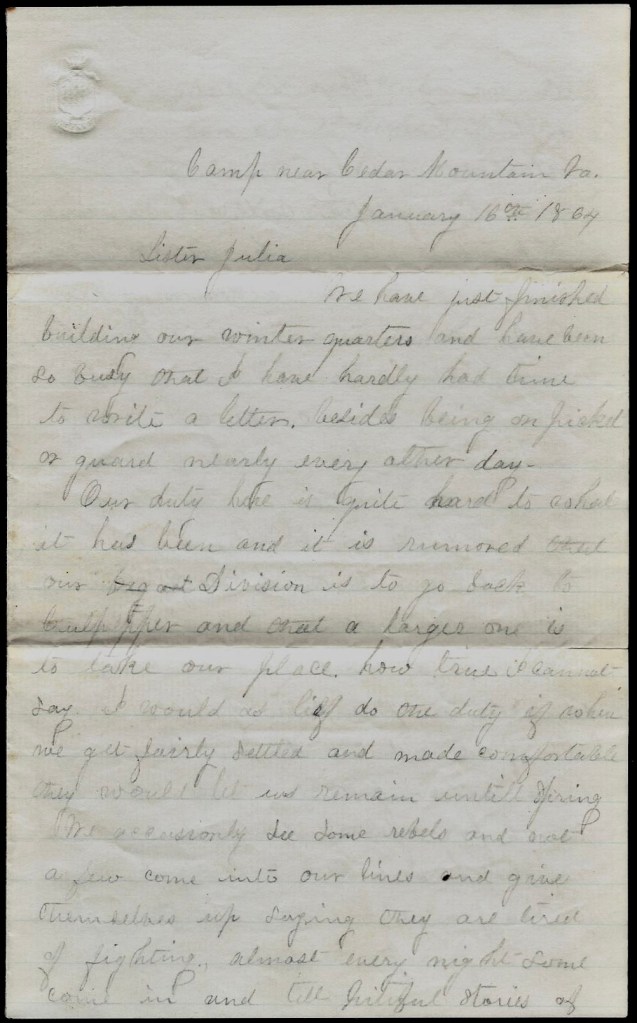
Camp near Cedar Mountain, Va.
January 16, 1864

Sister Julia,

We have just finished building our winter quarters and have been so busy that I have hardly had time to write a letter besides being on picket or guard nearly every other day. Our duty here is quite hard to what it has been and it is rumored that our Division is to go back to Culpeper and that a larger one is to take our place. How true, I cannot say. I would as leave do the duty [here] if when we get settled and made comfortable, they would let us remain until spring.

We occasionally see some rebels and not a few come into our lines and give themselves up saying they are tired of fighting. Almost every night some come in and tell pitiful stories of their army. They all seem to tell one story and they are not half fed or clothed. Some of those that come in are barefooted without overcoats or blankets to make themselves comfortable. The other night a captain come in and said his whole company wanted to come in and would as fast as they could get away. Surely if such is the state of their army as represented by them, may we not look for brighter days to come? They all seem to think the fighting is over or will be before spring.

We have a most beautiful camp situated in fine view of Cedar Mountain battlefield and the distant Blue Ridge, have very comfortable houses large enough for eight persons only. We have had a little snow but is nearly all disappeared and now are having fine weather for a few days.

Dr. Tyler did not write anything particular about Kirk stopping there this winter. He thought as a general rule outdoor life was the best for persons afflicted as he was. Henry wrote me that Charles had hired the house where Frank Clark lived and was to take Mr. Ranney’s farm to carry on this summer.

Will you please copy those lines in that book of poetry I let you have. The title, I believe, is “Thoughts at the Lord’s Table” and send me when you have an opportunity. If not all of them, a part.

Have you had your winter’s sleigh ride yet? We have had a little snow but has all disappeared and is quite muddy in the middle of the day. Last night I was on duty and do not feel much like writing but must write Henry a few lines.

From your affectionate brother, — G. R. Harlow