Category Archives: 43rd New York Infantry

1864: William H. Kirwin to a Friend

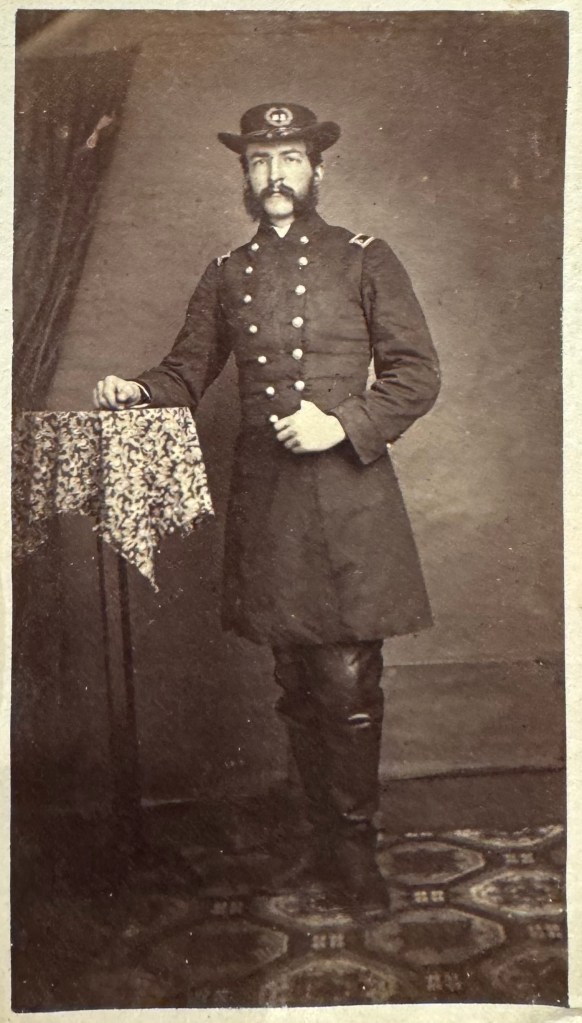
The following letter was written by William H. Kirwin (1839-1917) who enlisted at Troy, New York as private, Co. E , 43rd New York Infantry on 30 December 1863; appointed musician and returned to ranks sometime after February 1865; mustered out with company, June 27, 1865, at Washington, D. C. While he was in the service, he was described as 5′ 8″ inches tall, with gray eyes and brown hair.

William was the son of William and Esther (Rasper) Kirwin. He was educated In the public schools of Troy and his first business in which he was engaged was that of groceryman. At one time he was one of the best known horsemen in this section and for the last seventeen years had been Superintendent of the Lansingburgh Waterworks. 

T R A N S C R I P T I O N
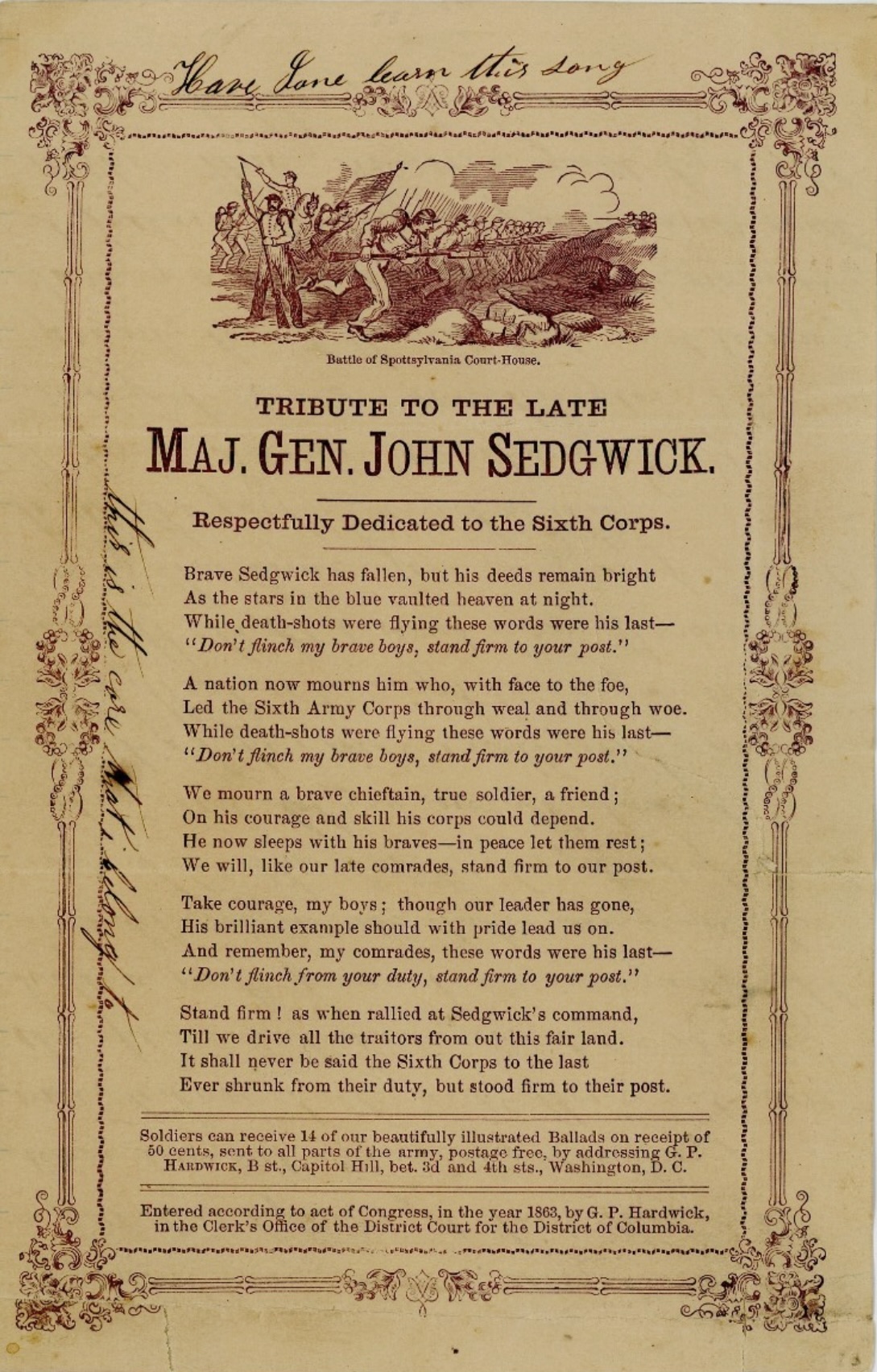
William’s letter was written on stationery with a “Tribute to the Late Maj. Gen. John Sedgwick” printed on it.

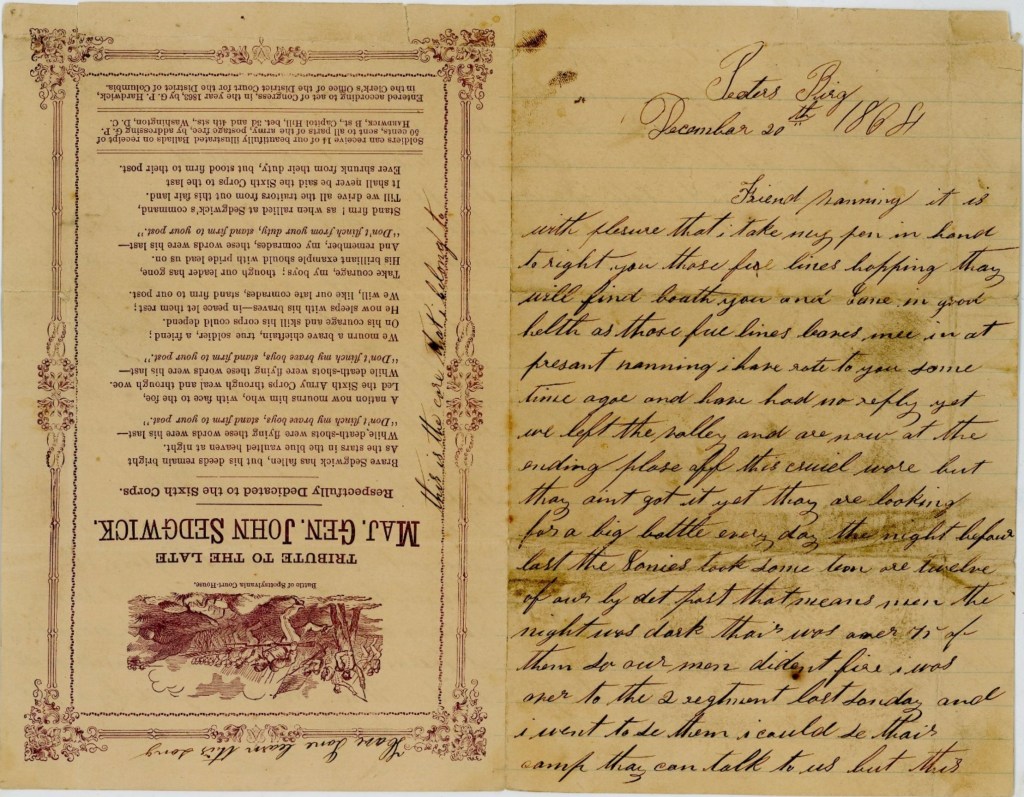
Petersburg
December 20, 1864

Friend Nanning,

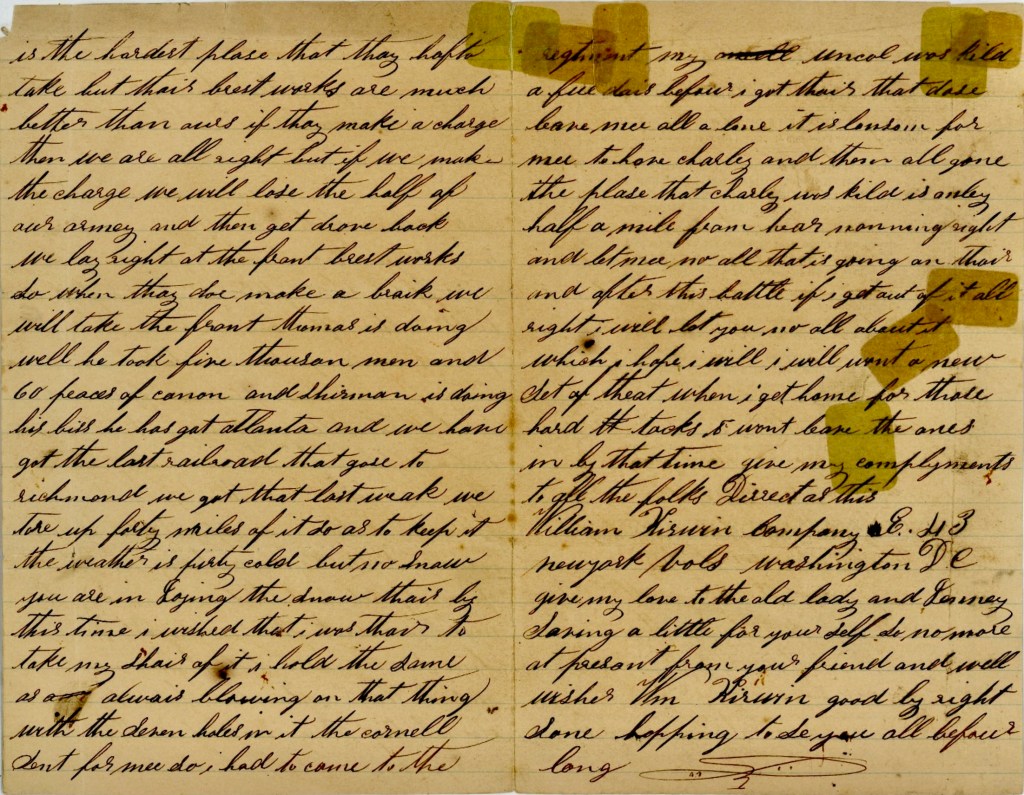
It is with pleasure that I take my pen in hand to write you these few lines hoping they will find both you and Jane in good health as these few lines leaves me in at present. Nanning, I have wrote to you some time ago and have had no reply yet.

We left the Valley and are nowat the ending place of this cruel war but they ain’t got it yet. They are looking for a big battle every day. The night before last the Johnnies took some ten or twelve of our outpost—that means men. The night was dark. There was over 75 of them so our men didn’t fire. I was over to the 2nd Regiment last Sunday and I went to see them. I could see their camp. They can talk to us but this is the hardest place that they have to take but their breastworks are much better than ours. If they make a charge, then we are all right. But if we make the charge, we will lose the half of our army and then get drove back. We lay right at the front breastworks so when they do make a break, we will take the front.

Thomas is doing well. He took five thousand men and 60 pieces of cannon and Sherman is doing his biss [business]. He has got Atlanta and we have got the last railroad that goes to Richmond. We got that lastweek. We tore up forty miles of it so as to keep it.

The weather is pretty cold but no snow. You are enjoying the snow there by this time. I wished that I was there to take my share of it.

I hold the same as always, blowing on that thing with the siren holes in it [bugle]. The Colonel sent for me so I had to come to the regiment. My uncle was killed a few days before I got there. That does leave me all alone. It is lonesome for me to have Charley and them all gone. The place that Charley was killed is only half a mile from here.

Nanning, write and let me know all that is going on there and after this battle, if I get out of it all right, I will let you know all about it which I hope I will. I will want a new set of teeth when I get home for those hard tacks won’t cave the ones in by that time. Give my compliments to all the folks.

Direct as this: William Kirwin, Company E, 43rd New York Vols., Washington D. C.

Give my love to the old lady and Jenny, saving a little for yourself. So no more at present. From your friend and well wisher, — Wm. Kirwin

Goodby. Write soon. Hoping to see you all before long.
Lt. John M. Cavanaugh’s battles did not end in 1865

The following was written by Dr. William John Cavanaugh (1874-1949), the son of John M. Cavanaugh (1840-1895) and Anna Fryer (1843-1907). William’s father, John, was a veteran of the Civil War, having enlisted in September 1861 as a private in Co. F, 43rd New York Volunteers. John was promoted to 1st Sergeant of Co, B in July 1862 and commissioned a 1st Lieutenant on 2 June 1863. He was with his regiment until he was severely wounded in the fighting at the Wilderness on 4 May 1864 and underwent a leg amputation to save his life.

What is most revealing in William’s letter is the considerable pain and suffering that his father endured for thirty years after the Civil War ended. The amputation of his leg certainly saved his life but it condemned him to a life that scarred him deeply—physically, socially, and emotionally.

Lt. John M. Cavanaugh; the cdv at left was taken in Albany while he was home on furlough before the start of the Spring Campaign in 1864. The cdv at right was taken in Albany a year or two later. (Kevin Canberg Collection)

After his discharge, John married the younger sister of another officer in the 43rd NYVI named John Fryer; Fryer and Cavanaugh were friends who worked together on the railroad prior to the Civil War. Fryer himself was killed shortly before Cavanaugh was seriously wounded. They are all buried together in the same grave at a cemetery in the Albany area.

It isn’t clear who the document was addressed to. It was part of a massive grouping Kevin Canberg acquired several years ago related to Fryer, Cavanaugh, and the 43rd New York. The statement that he was “temperate” with no bad habits” suggests to me that it was intended for a Widow’s Pension application but I could not find one in the National Archives.

Transcription

Meigs Case, the surgeon who performed the amputation of Cavanaugh’s leg.

The amputation of the leg was not the cause of death. The result of the amputation on the nervous system after a few years of dragging an artificial leg about, the shock of the severed nerves and arteries, seem to be [the cause]. For several years the abrasions of the skin and flesh with resulting boils and ulcers: Then paroxysms of stinging pain where the scars of the stitches were would throw the man in a fever and would last from one to five minutes, with about the same time of relief. During the time these pains lasted he could not sleep only when after a while he became exhausted he would drop asleep a minute sometimes. The doctors said they could give something to deaden the pain but under the conditions, were afraid it would form a habit and could not cure.

In ’86, he had a serious abscess on the stump which extended almost into his bowels. Was confined to his bed for six weeks suffering terribly. He became greatly emaciated and for the greater portion of his time his life was despaired of. But his good constitution brought him through. After this sickness he never regained his former health. His nerves were very bad and he was excitable. His heart troubled him. He did not get out very much and his stump troubled him more than ever. The kidney trouble was quite advanced when it was first diagnosed and his face bloated some. It was said by the doctors that the kidney disease was brought on by the state of his system and the nervous condition he was in from the access which was the result of the amputation of leg. He was temperate, with no bad habits.