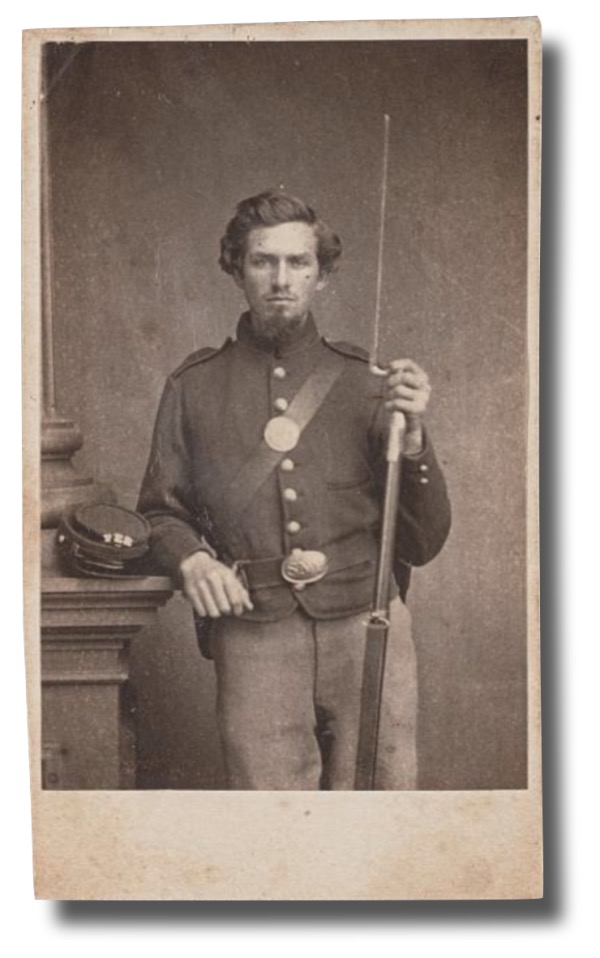
An unidentified member of the 44th New York Infantry (“Peoples Ellsworth Regiment), LOC
The following letter was written by William Eckerson, Jr. (1835-1864), the son of William Eckerson (1803-Aft1860) and Jeanette Miller (1818-1891) of Seward, Schoharie county, New York.
William enlisted as a private in Co. I, 44th New York Infantry in October 1861. During the 2nd Battle of Bull Run, William was taken prisoner on 30 August 1862. The date of his exchange is not given but later, during Grant’s Overland Campaign in 1864, after fighting at Cold Harbor, William was posted on picket on the night of 3 June and was killed instantly by a sniper’s bullet about 9 o’clock. He was buried on the battlefield by his comrades.
To read other letters I’ve transcribed by members of 44th New York Infantry and published on Spared & Shared, see:
Addressed to Miss Catharine Shaffer, Gardnersville, Schoharie county, New York
44th New York Volunteers Camp before Yorktown, Va. April 26th 1862
Dear Cousin,
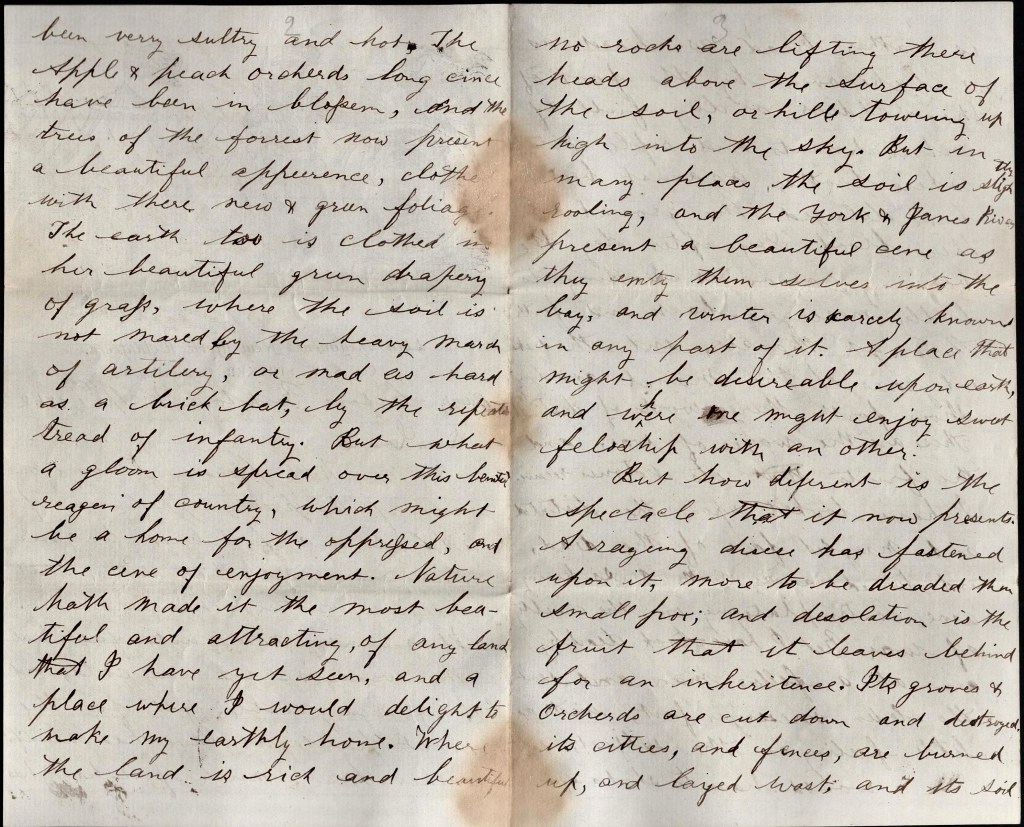
With pleasure I avail myself of the present opportunity of addressing a few lines to you, this being the third letter that I have written this morning. It is raining now quite fast and the wind is east and cold and very disagreeable. Yet for the most part, we have had beautiful weather here, much of which has been very sultry and hot. The apple and peach orchards long since have been in blossom and the trees of the forrest now present a beautiful appearance, clothed with their new and green foliage. The earth too is clothed in her beautiful green drapery of grass where the soil is not marred by the heavy march of artillery or made as hard as a brick bat by the repeated tread of infantry. But what a gloom is spread over this beautiful region of country which might be a home for the oppressed and the scene of enjoyment. Nature hath made it the most beautiful and attracting of any land that I have yet seen, and a place where I would delight to make my earthly home where the land is rich and beautiful. No rocks are lifting their heads above the surface of the soil or hill towering up high into the sky, but in many places the soil is slightly rolling and the York and James rivers present a beautiful scene as they empty themselves into the bays and winter is scarcely known in any part of iy—a place that might be desirable upon earth and where one might enjoy sweet fellowship with another.
But how different is the spectacle that it now presents. A raging disease has fastened upon it, more to be dreaded than small pox; and desolation is the fruit that it leaves behind for an inheritance. Its groves and orchards are cut down and destroyed, it cities and fences are burned up and laid waste; and its soil is either tread as hard as a bake oven by the foot of the soldier or dug full of entrenchments and rifle pits, where brother against brother have deluged the ground with their blood. Day after day the booming cannon is sending its deadly messengers back and forth through the air, and the shrieks and groans of the maimed and dying show forth their work of destruction. These are the wages of war, and the fruits that its victories receive.
I have looked upon the distorted and mangled face of the dead and turned away with a sickening awe, contemplating on the cruelty of war. Yet I have took deadly aim at a fellow man and sent the leaden messenger forth with as little feeling on the subject as one would have to shoot a squirrel. I have stood before the rattle of an enemy’s musketry and faced the mouth of the blazing cannon, when the bombs have burst and the pieces flew all around me, and the bullets whizzed past my head like hail, yet I felt nearly as secure from their harms as you do perhaps in your own peaceful dwellings. Yet when I have been alone and though on these things, I have wondered how it could be that one should be so fearless in the face of danger, and composed as it were right in the arms of the Angel of Death. Yet when I remember that God takes care of his creatures and that those that put trust in Him shall not be confounded, then I see how it is that a man can be fearless in the midst of danger, when the shafts of death are thrown around him.
I learned a few days ago that Emory A. Shaffer was dead! You can imagine the shock when the words fell on my ear. Thinks I, how can that be? Emra dead?! When we left Albany, none bid more fair to go through the war than he & I trusted that we should share the perils of war together, and one at least be left to tell the story over when the war should come to a close. Yet he has gone and that by the hand of disease, before he had a chance to fight his country’s battles, and I am left to go without him. He was a soldier beloved and respected as a man, and we trust that he has found a home in heaven—that land of peace where the weary are at rest. So dry your tears and live to meet him & dear old Aunt Rebecca in that better and heavenly land. We too must pass the chilling river, and perhaps it will be my lot very soon. Yet I shall rejoice in the hope of the glory of God. Be of good cheer for heavenly mansions await those that love our Lord, and He will comfort those that put their trust in Him. Were it not for this consolation, my life would be a dreary one, exposed daily to the shafts of the enemy.
I have seen many rough and tedious marches since we left Halls Hill and traveled many a day like this in the rain and mud. I have traveled over the fields of Centerville & Bulls Run, saw the smoke of Manassas as the rebels retreated from it and many other things which it would take me too long to narrate at this time, or merely hint at, for it would fill many sheets of paper. But I must skip over a long train of events till I come to the siege of Yorktown and then bring my letter to a close as I have already written more than I intended to when I commenced my first sheet. Yet I must write about a few things that happened though I shall have o commence on another sheet to get it all on.
While walking about the forts at Centerville, I saw a big log in one of the holes pointing to the place in which we came in, and made to represent a large cannon at a distance. Supposing perhaps that our artillery would fire at it and so waste their shots for naught before finding out the mistake. But it so happened that they marched right up into Centerville without firing a gun, and took some secesh prisoners who were unable to escape. They left us good quarters to go into which they in their haste to evacuate did not have time to destroy. The most sickening scene that I saw there was human skulls laying ever since the Bulls Run battle.
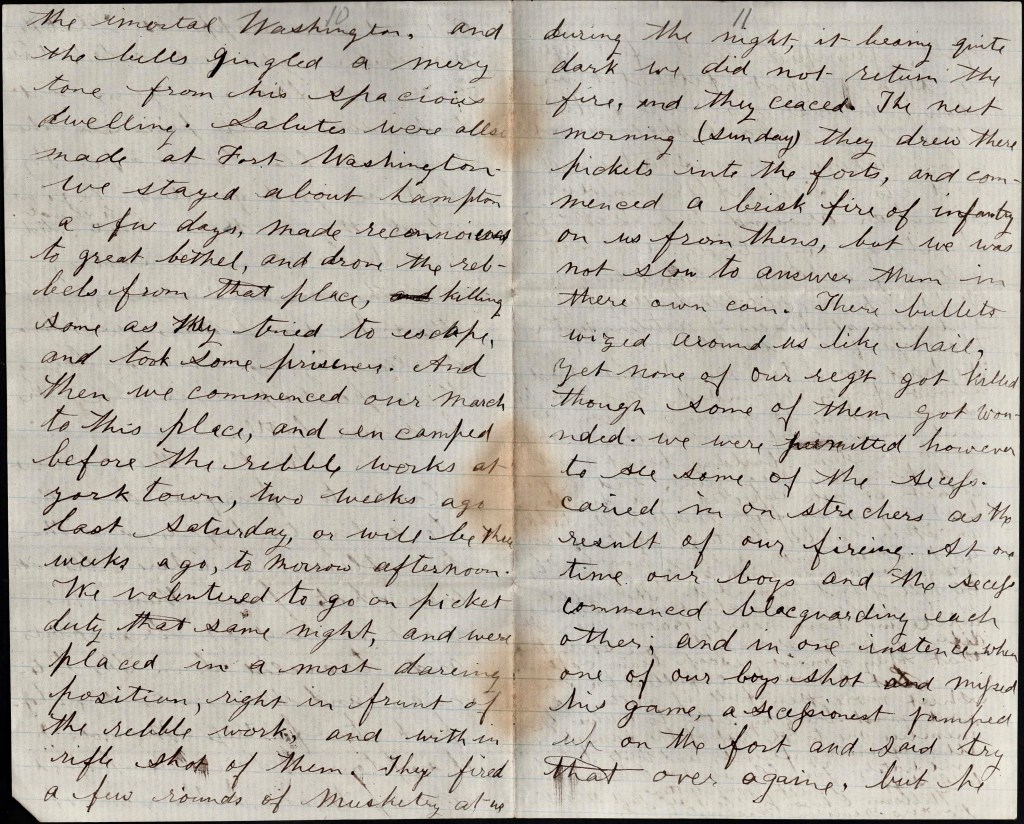
We then went back to Fairfax and then to Arlington Heights and then to Alexandria where Ellsworth was shot. From there we went on board of transports and traveled down the Potomac and then into the Chesapeake to Fortress Monroe & Hampton. When we passed Mount Vernon, I thought of the immortal Washington and the bells jingled a merry tone from his spacious dwelling. Salutes were also made at Fort Washington. We stayed about Hampton a few days, made reconnoissance’s to Great Bethel, and drove the rebels from that place, killing some as they tried to escape, and took some prisoners. And then we commenced our march to this place and encamped before the rebel works at Yorktown.
Two weeks ago last Saturday, or will be three weeks ago tomorrow afternoon, we volunteered to go on picket duty that same night and were placed in a most daring position, right in front of the rebel works and within rifle shot of them. They fired a few rounds of musketry at us during the night. It being quite dark, we did not return the fire and they ceased. The next morning (Sunday) they drew their pickets into the forts and commenced a brisk fire of infantry on us from them but we was not slow to answer them in their own coin. Their bullets whizzed around us like hail, yet none of our regiment got killed though some of them got wounded. We were permitted, however, to see some of the secesh carried in on stretchers as the result of the firing. At one time our boys and the secesh commenced blackguarding each other and in one instance when one of our boys shot and missed his game, a secessionist jumped up on the fort and said try that over again, but he fell, jumped and fell again. A second shot fetched him down to rise no more.
During this day, a bomb shell burst close where I was stationed and its missiles flew in every direction around me without hurting anybody. On Saturday all day a heavy cannonading was kept up, one rebel battery captured and several pieces of artillery with the loss of considerable many men. We had some ten men killed and about forty wounded. More or less skirmishing is going on every day and more or less men killed while we have been building breastworks and planting siege guns. And a grand attack is now expected in a few days. Last night the 5th Massachusetts Regt. took another rebel battery, captured some 40 prisoners with a large number of stands of arms, with a loss of about 50 killed and wounded. The rebels at this place are about 100,000 strong while we have nearly 180,000 men at different points around htem so we think they cannot escape being captured.
But I now have filled another sheet more than full and must bring my letter to a close. Remember me to the rest of the family & all enquiring friends and write to me immediately. Your cousin, –Wm. Eckerson, Jr. to C. Sheffer.
Direct your letters to William Eckerson, Jr., Co. I, 44th Regt. N. Y. V., Porter’s Division, Washington D. C.
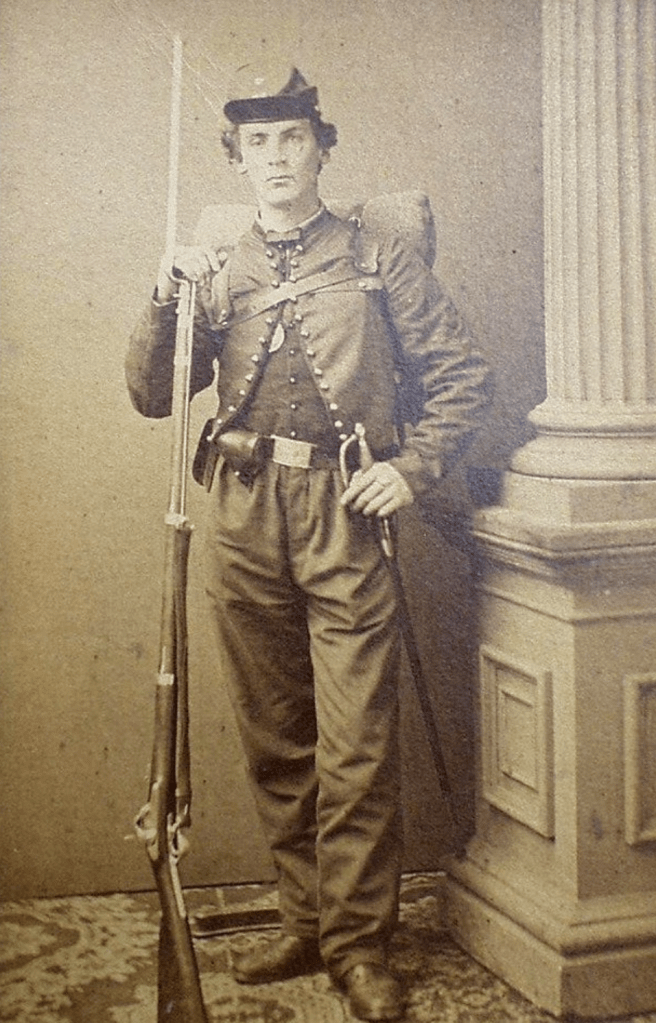
I could not find an image of Julian but here is an unidentified member of Co. K, 44th New York Infantry who looks to be about Julian’s age. The “P. E.} on his hat stands for “People’s Ellsworth Zouaves” which is how they were originally designated. (Dan Binder Collection)
The following letter was written by Pvt. Julian Knowlton (1834-1881) of Co. A, 44th New York Infantry. The 44th was organized at Albany, New York, and was transported to Washington D. C. in late October 1861 where they were attached to Butterfield’s Brigade, Fitz-John Porter’s Division of the Army of the Potomac. They did not see their first action until the siege of Yorktown in April 1862. Julian was captured in action during the Battle of Gaines’ Mills but soon paroled. He then was wounded in the Battle of Gettysburg on the second day of fighting, having participated in turning back Longstreet’s assault on the Union left. A member of Co. A later wrote of that day: “Our regiment lost very heavy; 111 out of 300. Our company lost more than any other company in the regiment, 22 out of 40, had 5 killed. Each company cared for their wounded. [Julian] Knowlton, from Forestville, was badly wounded in the knee. I helped carry him off from the field. The last I heard from him, he was doing well. Both of my tent mates were wounded.—After we had carried our wounded of from the field, we then buried our dead. Three boys from our company together with myself, carried four of our dead comrades back. It seemed hard, I tell you. They had stood right beside us, in the ranks all through everything until now.” Though Julian survived the war, his right leg continued to cause him pain, and it was finally amputated in 1880. He died the following year in Elliott, Ford county, Illinois.
The letter was datelined from Camp Butterfield on Christmas day, 1861—just five days after the Battle of Dranesville—a skirmish really—in which both sides suffered relatively low casualties. The Union infantry regiments engaged in the fight included the 9th, 12th and 13th Pennsylvania Reserves (the latter being designated the 42nd Pennsylvania, the 1st Pennsylvania Rifles, or more popularly referred to as “Kane’s Bucktails”). Julian’s younger brother, Byron (“By”) D. Knowlton (1842-1923) was a member of Co. D in the Bucktails but we learn from Julian’s letter that By was not in the battle. Rather, he was on guard duty at their camp on the day of the battle.13th Pennsylvania Reserves, Officially designated the 42nd Pennsylvania Volunteer Infantry, the unit was also known as the 13th Pennsylvania Reserves, the 1st Pennsylvania Rifles, and the Kane Rifles.
Julian and Byron were the sons of William and Mary Ann (Whipple) Knowlton of Forestville, Chautauqua county, New York. Though unnamed, Julian no doubt wrote the letter to his brother Jerome (b. 1836).
Transcription
Camp Butterfield [December] 25, 1861
Dear Brother,
It is with pleasure I resume my pen to inform you that I received your letter and was very glad to hear from you and to hear that you were well. I was glad to hear that you received the money that I sent you. I began to think that you had not received it. I am as well as usual and I hope that these few lines will find you enjoying the same blessing.
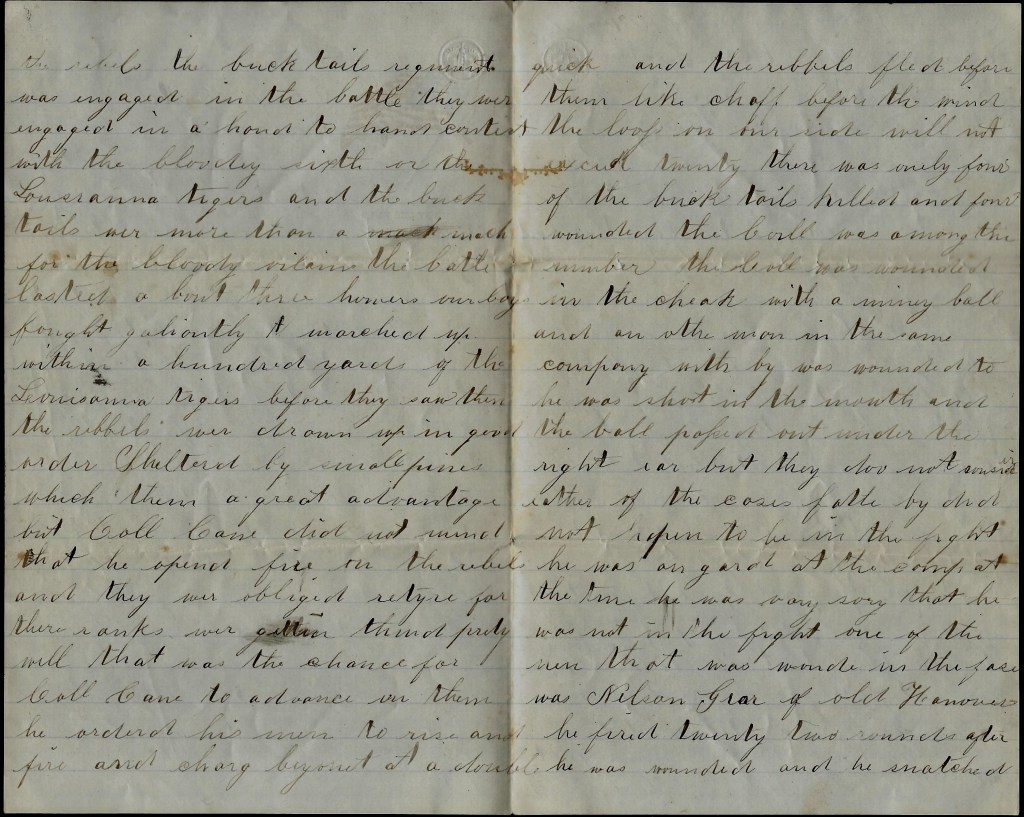
We still remain in our old camp but I do not think that we shall not remain here long for the rebels are getting rather bold of late. They have made several charges on our pickets and our men had quite a battle. There was three regiments of our men engaged with four or five regiments of the rebels. The Bucktails regiment was engaged in the battle. They were engaged in a hand-to-hand contest with the Bloody Sixth or the Louisiana Tigers and the Bucktails were more than a match for the bloody villains.
The battle lasted about three hours. Our boys fought gallantly. It marched up within a hundred yards of the Louisiana Tigers before they saw them. The rebels were drawn up in good order sheltered by small pines which [give] them a great advantage but Col. [Theodore L.] Kane did not mind that. He opened fire on the rebels and they were obliged to retire for their ranks were gettin’ thinned pretty well. That was the chance for Col. Kane to advance on them. He ordered his men to rise and fire and charge bayonet at a double quick and the rebels fled before them like chaff before the wind.
The loss on our side will not exceed twenty. There was only four of the Bucktails killed and four wounded. The Colonel was among the number. The Colonel was wounded in the cheek with a minié ball and one other man in the same company with By [Byron] was wounded too. He was shot in the mouth and the ball passed out under the right ear but they do not consider either of the cases fatal. By did not happen to be in the fight. He was on guard at the camp at the time. He was very sorry that he was not in the fight. One of the men that was wounded in the face was Nelson Geer 1 of old Hanover. He fired twenty-two rounds after he was wounded and he snatched a sword from the sheath of a dead rebel and fetched it off as a trophy. The boys brought of numerous things such as revolvers and watches and rifles, &c.
I was over to see By yesterday. The boys were in fine spirits. They have got themselves a very comfortable encampment. I saw Nelt Geer. He looked rather hard. His face was very badly swollen but he does not mind that.
I have nothing of importance to communicate but what I have already written so I will speak of our business. I shall send you twenty or twenty-three dollars the first of next month and I want you to settle my account at the farmers and if there is anything left, I want you to pay Pierce that five dollars that you got him for me. I am owing W. M. Gardner a little but I cannot pay him now as I see. Give my respects to all enquiring friends. Give my respects to Mr. Pierce and tell him that I am much obliged to him. In haste, — J. Knowlton
About the things of mine that you spoke of, you can keep until I give you different orders. I think that they [ ] as well as they are.
Julian’s letter asserts that the Bucktails faced the Louisiana Tigers at Dranesville but he was mistaken. The Confederate forces consisted of Kentucky, Virginia, Alabama, and South Carolina troops under the command of General Stuart.
1 Nelson Theodore Geer (1842-1895) of Warren county, served as a private in Co. D (the “Raftsman Guard”), 42nd Pennsylvania Rifles. He enlisted in May 1861 and was discharged for wounds in March 1863.He was first wounded in the Battle of Dranesville on 20 December 1861 and wounded a second time at the Battle of Antietam on 17 September 1862.
The following letter was written by Louis George Ferrand (1840-1921), the son of Jean Pierre (John Peter) Ferrand (1777-1869) and Anne Catherine Marconer (1797-1837) of Cheektowaga, Erie county, New York.
I could not find an image of Louis as young man but here is one of Willie Rexford who enlisted in Co. D, 44th New York Infantry (Richard Ether Collection)
Prior to his enlistment in Co. A, 44th New York Infantry (“Ellsworth Avengers”), Louis had completed his three-year apprenticeship to learn the trade of a blacksmith. He enlisted with the regiment in August 1861 and was with the regiment until they arrived in Yorktown, Virginia, where he contracted typhoid fever. He was eventually transported to the U. S. General Hospital at Annapolis, where he regained his health sufficient to work as a hospital nurse, and then returned to his regiment in time for the Battle of Gettysburg. It was at Gettysburg where he took buckshot to his cheek, this time sending him to the hospital in Philadelphia. He recuperated enough to rejoin the regiment near Petersburg. At the battle at the Weldon Railroad, he was once more wounded, in his left hand and left knee. His fighting came to a halt once and for all. He was sent to Slough Barracks Hospital in Alexandria, Virginia. He was mustered out of the regiment with an honorable discharge in October 1864. Due to the wounds to his hands and knees he would remain a cripple for the rest of his life.
Louis wrote this letter to his older brother, Charles F. Ferrand (1836-1921) who served in the US Navy.
Your letter of August 4th was duly received. I was glad to hear from you again and that you was well. I am well at present and hope that these few lines will find you enjoying the same health and having a good time at home. I wish that I was there so as to see you and more. It brings tears in my eyes to think of you and of some of the rest of the boys from Cheektowaga, some of which are soldiers now, and the way that we are situated now and shall probably never see each other again in this world. But in God, let us trust, and He will be our friend, that we may meet in realms above.
I have received your letter at 2 o’clock and it is now half past 2 and I must mail it at 3 in order to have it go this afternoon.
I was sorry to hear about the two that you mentioned about getting ready to go to Canada rather than to support their country. Men of that disposition have no business in a free country. If they are not willing to fight for freedom, I think that they had better go to Canada and remain there. But poor Fred. I am very sorry for him. That is too bad that that report was not true.
I hope that these few lines will find you well. I’m still at work at the hospital. I have no more time to spare. Now dear brother, wherever you go, do not forget me. I send my love and best respects to you wishing you good luck wherever you go.
From your affectionate brother, — Lewis Ferrand
Should I die on the battlefield or in the hospital, for the sake of human friends C. F. F. [ ] my remains may be found.
I could not find an image of Louis as as young man but here is one of Willie Rexford who enlisted in Co. D, 44th New York Infantry (Richard Ether Collection)
This letter was written by Pvt. Louis (or Lewis) Georges Ferrand (1840-1921) of Co. A, 44th New York Infantry (“Ellsworth Avengers”). Prior to his enlistment, Louis had completed his three-year apprenticeship to learn the trade of a blacksmith. He enlisted with the regiment in August 1861 and was with the regiment until they arrived in Yorktown, Virginia, where he contracted typhoid fever. He was eventually transported to the U. S. General Hospital at Annapolis, where he regained his health sufficient to work as a hospital nurse, and then returned to his regiment in time for the Battle of Gettysburg. It was at Gettysburg where he took buckshot to his cheek, this time sending him to the hospital in Philadelphia. He recuperated enough to rejoin the regiment near Petersburg. At the battle at the Weldon Railroad, he was once more wounded, in his left hand and left knee. His fighting came to a halt once and for all. He was sent to Slough Barracks Hospital in Alexandria, Virginia. He was mustered out of the regiment with an honorable discharge in October 1864. Due to the wounds to his hands and knees he would remain a cripple for the rest of his life.
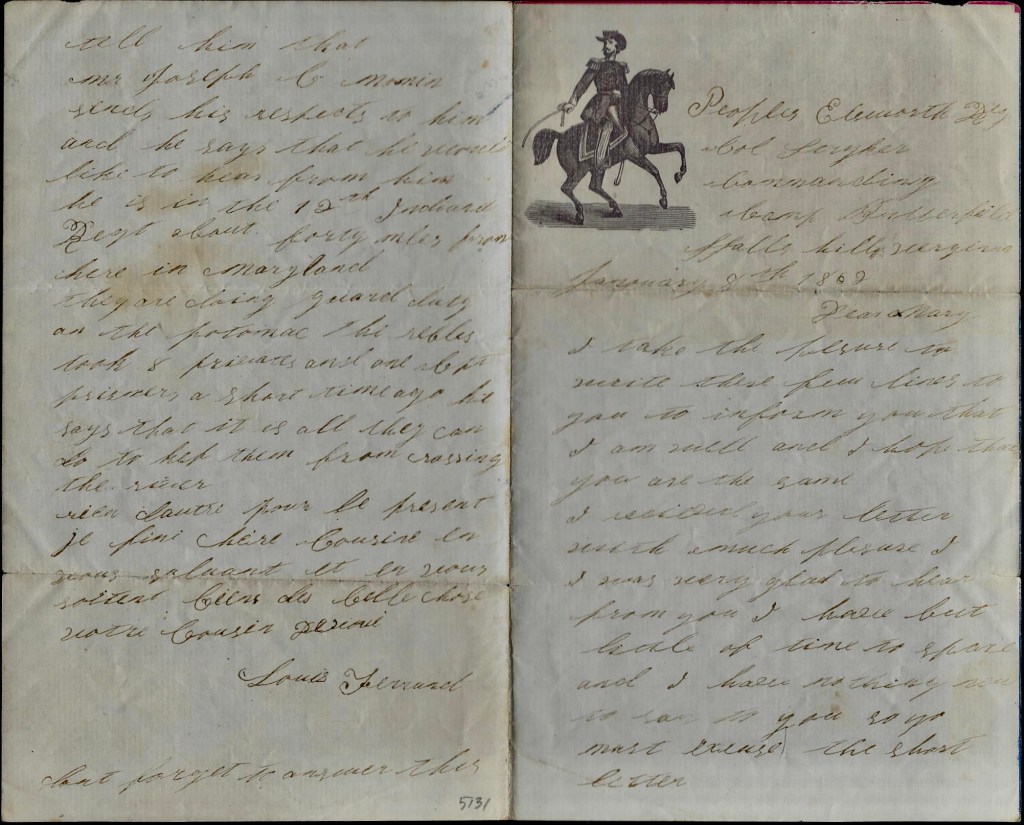
This letter was written from the regiment’s winter encampment at Hall’s Hill, Virginia, on 8 January 1862.
People’s Ellsworth Regiment Col. [Stephen S.] Stryker Commanding Camp Butterfield Hall’s Hill, Virginia January 8, 1862
Dear Mary,
I take the pleasure to write these few lines to you to inform you that I am well and hope that you are the same.
I received your letter with much pleasure. I was very glad to hear from you. I have but little of time to spare and I have nothing now to say to you so you must excuse the short letter. I have had a Merry Christmas and Happy New Years. I hope that you enjoyed yourself as well as I did. I had a very nice time. I was sorry to hear that you was unwell. I hope that you will be well again when these few lines reach you.
We have not had any snow yet. The [ ] here is very fine.
That man that slept on his post is a nephew to the one that I learned my trade with.
We are under marching orders now but I don’t know whether we are going or not but I am in hopes that we will move soon. I have seen two men that was taken prisoners at Bull Run and they got away and got back safe. They told me that the rebels was not any nearer starving than we was. They said that flour was only 17 per barrel and everything accordingly.
Captain [Edward P.] Chapin is promoted Major and [George M.] Love is now our captain. Major McKown has resigned.
There is an artillery regiment just formed here and I shall probably get transferred to it if I can get a chance to work at my trade. U have not heard from my brother in some time. Tell him that Mr. Joseph C. Monin [of Floyd county, Indiana] sends his respects to him and he says that he would like to hear from him. He is in the 12th Indiana Regiment [Co. A.] about forty miles from here in Maryland. They are doing guard duty on the Potomac. The rebels took 8 privates and one captain prisoners a short time ago. He says that it is all they can do to keep them from crossing the river.
These letters were written by Samuel Richard Green (1826-1865) who enlisted as a private in Co. A, 14th New York Infantry in mid-August 1862, was transferred to Co. I, 44th New York Infantry on 24 June 1863, was promoted to corporal on 28 April 1864 and transferred to Co. A on 23 September 1864. He was transferred to Co. H, 146th New York Infantry on 11 October 1864 and died on 11 May 1865 at Lincoln Hospital in Washington D. C. from wounds received on 31 March 1865 at White Oak Road, Virginia [another source says that his wounds were received in the attack on Fort Stedman].
Prior to his enlistment, Samuel was employed as a mechanic in Utica, New York, where he was born. He was described as standing 5 feet 9 inches tall, with blue eyes, brown hair, and a light complexion. He was married in 1853 to Phoebe Melvina Rockwell (1832-1906) and the couple had two children—Mary Ella (b. 1856) and Lewis Henry (b. 1860).
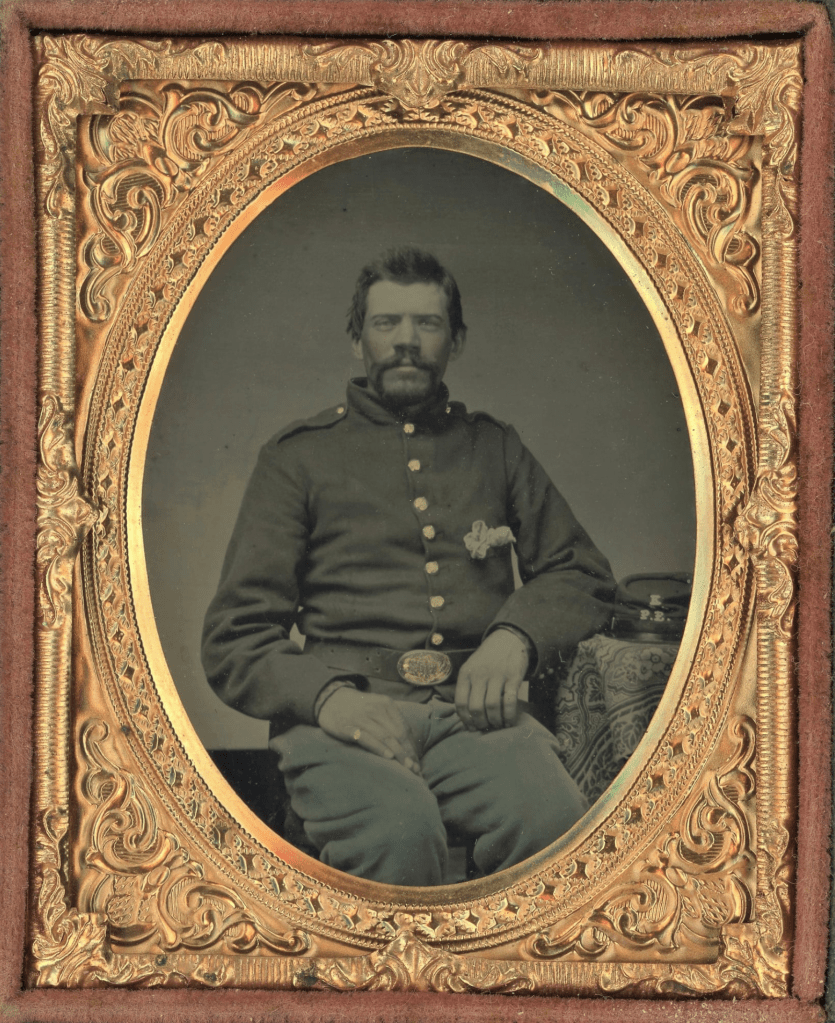
This cabinet card was made in Utica during the post-war period but it was passed down by the family with the following letters so I’m inclined to believe it was accurately identified as Samuel Richard Green. The A. R. G. at the bottom of the reverse side was Alfred Reynolds Green (1901-1980), Samuel’s grandson. Most likely the image was created from a photograph taken of Samuel circa 1860 when he was about 35 years old.
Letter 1
[While serving in the 14th New York Infantry]
Frederick City, Maryland September 17, [1862]
Dear wife,
I take the present opportunity to write you and let you know how I am. I have been on the march for six days and I can stand it first rate. Yesterday we expected to get to where the fighting was [at Sharpsburg, Maryland] today some time but we were detached from the brigade and send back about 20 miles with a lot of prisoners and we don’t know what the next job will be or how long we shall remain here. I am well & have been since I left home. I find lots of friends here for soldiers all help each other. I am in Co. A and that is the best company in the regiment. I can’t give you any news for you will get it before we do by the paper.
I wish you would write me as soon as you get this. You will get Mr. Laurence to direct it for you and there won’t be trouble about my getting it. Tell him I am in Co. A & he will know how to direct it to get to me. We get the mail 3 or 4 times a week. If he is not in the office, leave it with the clerk & he will see that it is sent. If you how he directs it you will know how to do it yourself. Send me a paper once or twice a week. They will all be directed alike. It don’t make any difference where the regiment is.
Give my respects to all. Kiss Ella and Louie for me & tell Ella she must be a good girl. Mind what you tell her. Take good care of the children & don’t work too hard yourself for I shall send you money as soon as I get paid. I don’t know when that will be but it will come in a month or two.
The 4th Oneida Regiment have just passed by here since we have been encamped so they will get into a fight before we will at any rate—if we should go back towards where the fighting it. It is a getting dark and I must close. This comes from your ever loving husband, — Samuel
Letter 2
[While serving in the 14th New York Infantry just prior to being transferred to the 44th New York Infantry.]
Camp in Virginia or some other place June 2, 1863
Dear wife,
Your letter of the 26th it at hand. I am glad to hear from you. I am as much disappointed by not being sent home with the 14th [New York Infantry] as you are. I have done my duty to the government up to the 17th of May which is the time I volunteered for faithfully and what I do hereafter won’t do them any good. I will assure you I shall not give the rebels a chance to hurt me hereafter. They have been trying to form the 12th, 13th, 14th and 17th into a battalion ever since the 14th left but they can’t make it go. All they have got of us yet is a demoralized mob. They boys are determined they shant make anything of them and they can’t. We are a perfect nuisance in the army and mean to be until they send us home. 1
We are in the First Division, First Brigade Fifth Army Corps. This division is guarding the fords on the Rappannock river between Falmouth and the Orange & Alexandria Railroad. We are in the reserve about 4 miles from the river and about 20 miles above Falmouth. We are known through the division as the demoralized battalion & don’t mean to be anything else. We beat the officers that have charge of us at every point. If they tie up any of the boys for punishment, the rest go and cut them loose or make the officers release them to keep from having a mutiny in camp & if they court martial them, they can’t make it stick & we have the best of them & we are having lots of fun.
We are encamped in a very fine place and we have lots of fresh meat and chickens to eat. We get them around the country. We don’t care who they belong to. We take them whenever we find them.
I have been to see if I could get a furlough to come home but they ain’t giving any in the brigade at present. They may be giving them again in a few days. I shall get one as soon as I can.
I got a letter from father a few days ago. He says you shall not suffer for anything unless you conceal your wants from him. The pay master is paying off the army now but I know as our papers are in shape so as to get our pay this time or not. If we don’t, we will get 4 months the next time so it won’t make any difference if you have got enough to last you. If father has not gone away when this reaches you, tell him I will write to him as soon as I find out what they are going to do with us.
1 The 14th New York Infantry was unusual in that it was composed of both two-year enlistees and three-year enlistees. Apparently many of the three-year enlistees had no idea that they had another year of service left when the time came for the two-year men to go home, which caused those with time left to serve to revolt and become demoralized.
Letter 3
[While serving in the 44th New York Infantry. As the 44th N. Y. marched toward Gettysburg, they found themselves brigaded with the 20th Maine, the 16th Michigan, and the 83rd Pennsylvania under the command of Col. Strong Vincent. This brigade would win distinction for their heroic defense of Little Round Top on Day 2 of the battle.]
Aldie, Virginia June 25, 1863
My Dear Wife,
I received yours of the 26th of May. I have not heard from you since we have been shifting around from place to place. Since I wrote you last, which was soon after I received yours, but we have got in a regiment now where we shall stay. We are in the 44th New York Volunteer [Infantry] commonly known as the Ellsworth Avengers. They were got up from every town in the state or were meant to represent every town when they came out and they are a picked lot of men. I am as well satisfied here as I should be in any regiment without it was the old 14th but I don’t feel very well reconciled to stay here a great while for I consider my time out. But still I prefer to have an honorable discharge if I can get it in any kind of season. If I find I cannot, I think I shall leave without it.
I wrote to Father & directed it to Cleveland. I have had 2 or 3 packages of papers from him since I wrote to him. They were mailed at Gloversville. I don’t know whether he is there yet or whether he has gone back. We have not had any mail here in 10 or 12 days & we don’t know what is a going on anywhere but here.
We are on a turnpike that runs from Alexandria threw Ashby’s Gap & I don’t know how much farther. We were to Ashby’s Gap last Sunday. We had quite a lively time with the rebs. The fighting was mostly done with the cavalry so we did not participate much in it except to drive them away from two or three stone walls where the cavalry could not get at them & then we would start them out & so we drove them to Ashby’s Gap.
I wish you would write soon for I am anxious to hear from you. I expect that Merrill will come here in a day or two & then we can get the papers so as to know what is going on in other places besides this.
I shall write to father again soon and let him know where I am. Direct yours to the 44th Regiment, First Division, 3rd Brigade, 5th Army Corps. Give my respects to all & let me know how you get along & how Ella & Lewis are & if Ella goes to school. I would give anything to be at home to see you and them and I trust I shall be this fall or the fore part of the winter at the farthest. But until such time as I come, I remain your most affectionate and ever loving husband, — Samuel
Malvina
Letter 4
[While serving in the 44th New York Infantry.]
Camp near Rappahannock Station, Virginia September 11, 1863
My Dear Wife,
I received yours the 6th yesterday. I was glad to hear from you. I received your letter with the comb and have wrote two letters to you since the one I sent to Utica in care of Mr. Lawrence and after that I received one from father informing me that you was at Cleveland and since them I have wrote you another which I think you must of got before this time but for fear you have not got the last one, I will repeat some that I wrote last.
I sent $20 to Mr. Lawrence as soon as I was paid. I had to send it by mail and I thought it best to send half of it at once. After that I got father’s letter and he said you wanted me to send one half of what I could spare Mr. Lawrence and the balance to you. I got a letter from Mr. Lawrence saying that he had got the money and that you had gone to Cleveland and he had placed it to my credit. I then sent $20 more to Mr. Lawrence and requested him to send that to you and let the first stand as it was. Since then I have had another letter from him in which he said he had received it and would forward it to you as I desired. I think he will send it by Express or send you a check. I don’t know which. The reason I sent it to Mr. Lawrence was that I has to send it by mail and I thought it was the safest way.
I have not got much time to write today for I am going on picket this afternoon and shall be gone three days. we do picket duty three days out of nine all the time now and we had rather be out on picket than to be in camp. I am glad to hear that you like it where you be and that you are having a good time and I should like to be there with you. And I think this war won’t last much longer and you need not be uneasy about my staying three years.
I wrote a long letter to you and directed it to Cleveland to you about the first of this month. I wish you would write and let me know if you got it and if you have got $20 sent from Mr. Lawrence as soon as you get this. Give my respects to all of my friends and take good care of the children. — Samuel
Letter 5
[While serving in the 44th New York Infantry.]
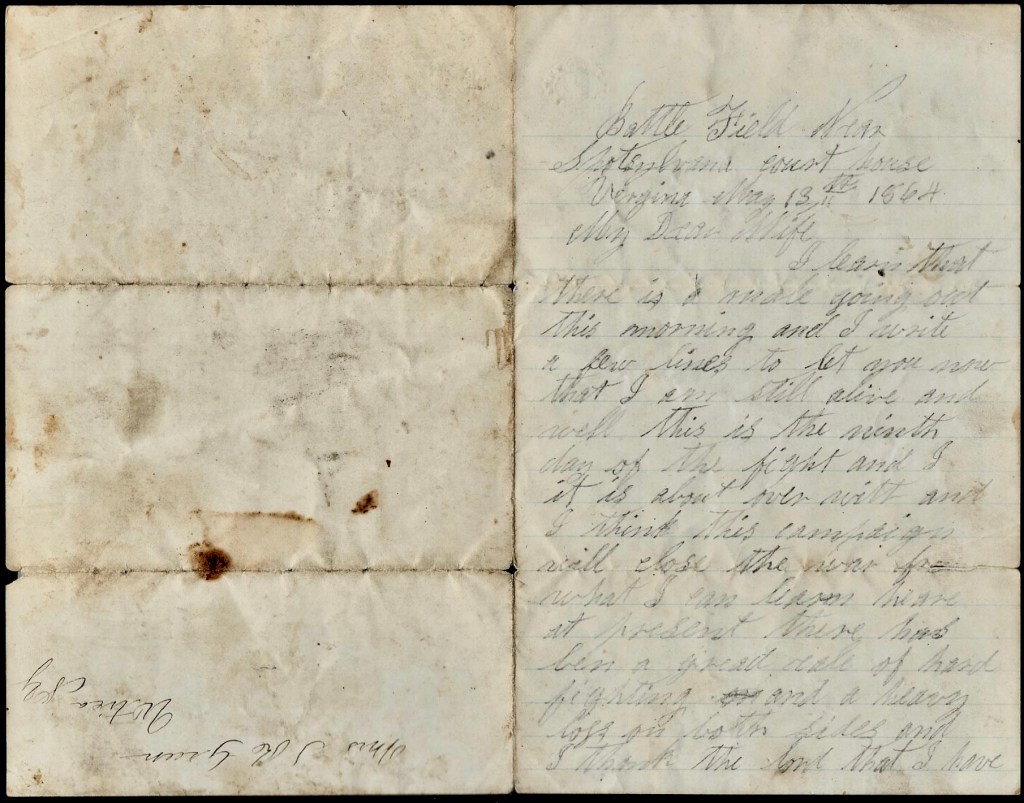
Battlefield near Spotsylvania Court House, Virginia May 13th 1864
My Dear Wife,
I learn that there is a mail going out this morning and I write a few lines to let you know that I am still alive and well. This is the ninth day of the fight and I [think] it is about over with and I think this campaign will close the war from what I can learn here at present.
There has been a great deal of hard fighting and a heavy loss on both sides and I thank the Lord that I have escaped so far for I have been where it was raging the hardest and we have lost over half of the regiment. Things are pretty quiet this morning but yesterday was a hard day. I have not slept over four hours in three days and nights and I am in no condition to write and if you can make out to read this, I shall be glad. As soon as we are a little settled and I think I can write so that you can read it, I will write to you again but don’t get uneasy if it is a number of days first for if we don’t have any fighting, we will have to march.
I wish you would write to father and let him know that I am alright for it ay be some time before I can. Kiss the children for me and write as soon as you get this so that I may know whether you get it.
From your affectionate and ever loving husband, — Samuel
Letter 6
[While serving in the 44th New York Infantry.]
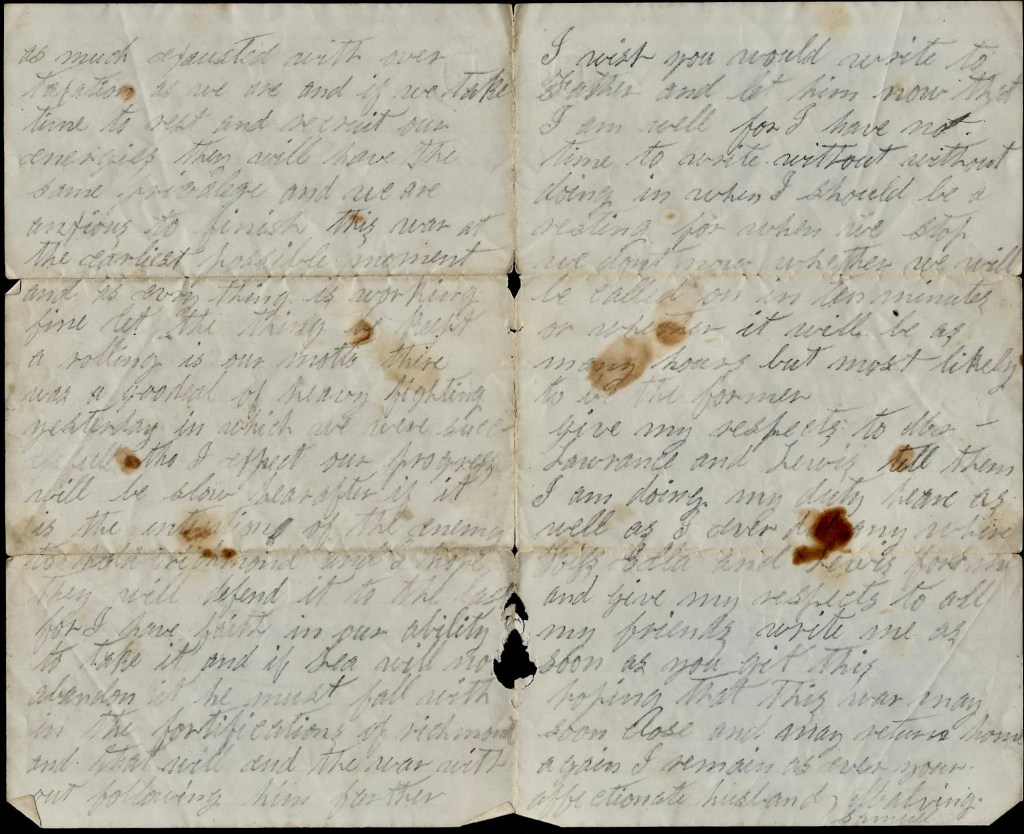
44th [New York] Regiment 9 miles from Richmond June 1, 1864
My dear wife,
I received yours of the 18th and was glad to hear that you was well and had bettered your condition by moving. I have attempted to write before but had orders to fall in before I had time to more than head a letter and had to abandon it and probably shall not finish this today for things are rolling—speaking in a soldier’s phrase.
I am well and stand it as well as any I see around me, and, notwithstanding, we have had about as much as men can be expected to endure. They go about what they are called on to do cheerfully for we know that the enemy must be too much exhausted with over taxation as we are and if we take time to rest and recruit our energies, they will have the same privilege and we are anxious to finish this war at the earliest possible moment. And as everything is working fine, let the thing be kept a rolling in our motto.
There was a good deal of heavy fighting yesterday in which we were successful though I expect our progress will be slow hereafter. If it is the intention of the enemy to hold Richmond, and I hope they will defend it to the last, for I have faith in our ability to take it. And if Lee will not abandon it, he must fall within the fortifications of Richmond and that will end the war without following him farther.
I wish you would write to father and let him know that I am well for I have ot time to write without doing it when I should be resting, for when we stop, we don’t know whether we will be called on in ten minutes or whether it will be as many hours, but most likely to be the former.
Give my respects to Mr. Lawrence and Lewis. Tell them I am doing my duty here as well as I ever do anywhere. Kiss Ella and Lewis for me and give my respects to all my friends. Write me as soon as you get this. Hoping that this war may soon close and may return home again, I remain as ever your affectionate husband, — Samuel
Letter 7
[While serving in the 44th New York Infantry.]
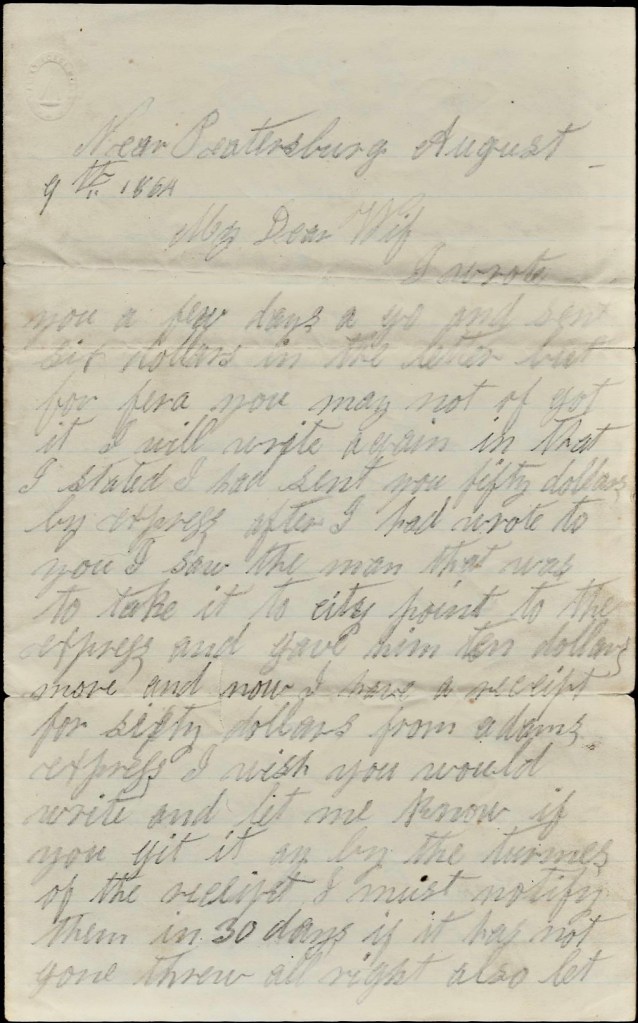
Near Petersburg [Virginia] August 9th 1864
My dear wife,
I wrote you a few days ago and sent six dollars in the letter but for fear you may not of got it, I will write again. In that [letter] I stated I had sent you fifty dollars by Express. After I wrote to you I saw the man that was to take it to City Point to the Express [Office] and gave him ten dollars more and now I have a receipt for sixty dollars from Adams Express. I wish you would write and let me know if you get it and by the terms of the receipt I must notify them in 30 days if it has not gone through all right. Also let me know if you got my letter containing six dollars.
I am well as usual. We are as comfortable as we can make ourselves. The weather is very warm but we have good shades up so we don’t suffer from the heat of the sun but the flies—there is no end to. They plague a man’s life almost out of him. It is almost impossible to read or write duringthe day. We are behind our breastworks about as far from the Johnnies as it is from Broadway to Genessee Street along Pearl Street. There is no firing here in our works except by the artillery. They have a turn at it several times during the day without much damage to either party, I presume—certainly without much to us—but there is a plenty of firing alog the 9th Corps all the time, night and day. 1
We sit on our breastworks and watch the mortar shells going back and forth in the evening. There is deserters from the rebel lines coming into ours every night. Those that come in last night report the capture of Mobile by our fleet which probably is true. They would have the news before we would.
Give my respects to all. Kiss Ella and Lewis for me, hoping that this will find you and them well, I remain your most affectionate husband, — Samuel
1 Burnside’s 9th Corps had a large number of USCT (Black soldiers) in it and the Rebels purposely singled out that sector of the line to fire their artillery shells for that reason.
Letter 8
[While serving in the 44th New York Infantry.]
Camp of 44th [New York] on the Weldon Railroad, Virginia September 25th 1864
My dear wife,
I received yours of the 11th and was glad to hear from you and that you and the children were well. Tell Ella I thank her for her song and other mementoes the children have sent me as a token that I am not forgotten at home and I trust the time with soon come when I can come and hear her sing it.
The 44th’s time was out yesterday and all the old members that came out with it that had not reenlisted started for home yesterday but there was 180 recruited ready to take their place so the regiment is larger now than it was before and we are expecting 200 more every day. We have not had any fighting on our part of the line in a long time and it is not likely we shall before we move from here.
I will send you a check for twenty-five dollars. I got 2 months pay yesterday which pays me to the first of September. I think it is safer to send a check than to send the money. If it was lost, I think it would not be of any use to anyone else but you and I could get another one. I think you can draw the money at any bank by signing your name to it but any business man will tell you better about it than I can for I am not sure. But you will have to go to a National Bank. I will keep the number of the draft and if you do not get it, let me know and I will get another. Also let me know if you have any trouble to get it cashed and then I will know when I send again.
I don’t know as I have anything more of importance to write at present. Give my respects to all my friends. Kiss Ellie and Lewis for me. My health is good as usual, hoping you and the children are enjoying the same blessing. I am your affectionate husband, — Samuel
P. S. Mr. John Harvey, one of my old soldier friends, promised to call and see you. He started for home yesterday. Write as soon as you get this for I want to know about the check as soon as possible.
Letter 9
[While serving in the 146th New York Infantry.]
Camp of the 146th N. Y. S. V. near Weldon Railroad, Virginia October 25th 1864
My dear wife,
I received yours of October 2nd and read it with pleasure. I am well as usual. You will see by this that we have been transferred to the 146th. I belong to Co. H. I think I shall remain here the rest of my time as it is out before the regiments is so there will be no occasion for another transfer.
We are having pleasant weather but it is cool nights. We were in two fights the 30th of September before we were consolidated with the 146th but after the 44th had gone home. We were called at that time the 44th Battalion and maintained the good reputation of the Old 44th but the officers wanted to go home and they managed to get us transferred and they have gone. Let them go, I don’t know as it will make much difference to us though the most of the men are very much dissatisfied.
I don’t know as I have anything more of importance to write. I will send a dollar to you. [Give] 25 cents to each of the children, and the rest to you. I get the papers from Gloversville. Kiss the children for me and give my respects to all my acquaintances hoping that this will find you all in the enjoyment of good health and that I may hear from you soon.I remain your most affectionate husband, — Samuel
P. S. Give my respects especially to Mr. Lawrence and son if you see them and as for going out West as father desired you to, you must set your own pleasure as you can judge better where you can enjoy yourself the best—better than I can. But I think I shall go there when I come home. When you write to father, tell him I am well and where I am and give him my respects. — S. R. G.
Letter 10
[While serving in the 146th New York Infantry.]
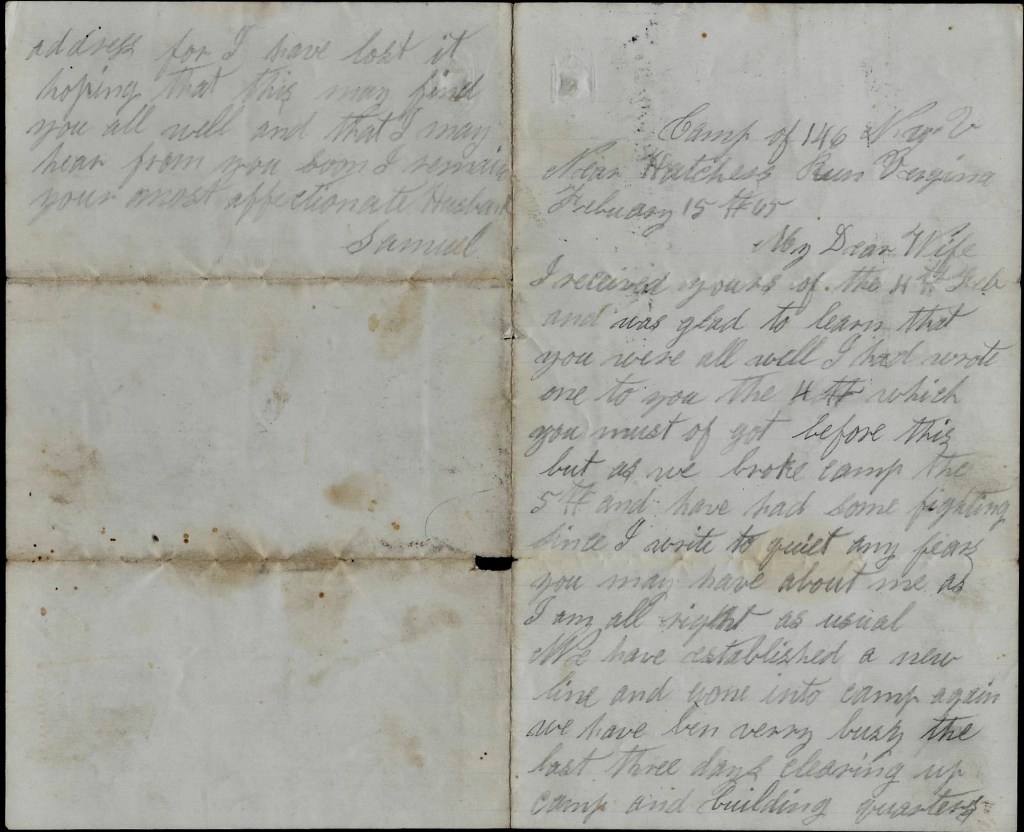
Camp of 146 N. Y. V. near Hatcher’s Run, Virginia February 15, 1865
My dear wife,
I received yours of the 4th February and was glad to learn that you were all well. I had wrote one to you the 4th which you must of got before this but as we broke camp the 5th and have had some fighting since, I write to quiet any fears you may have about me as I am all right as usual.
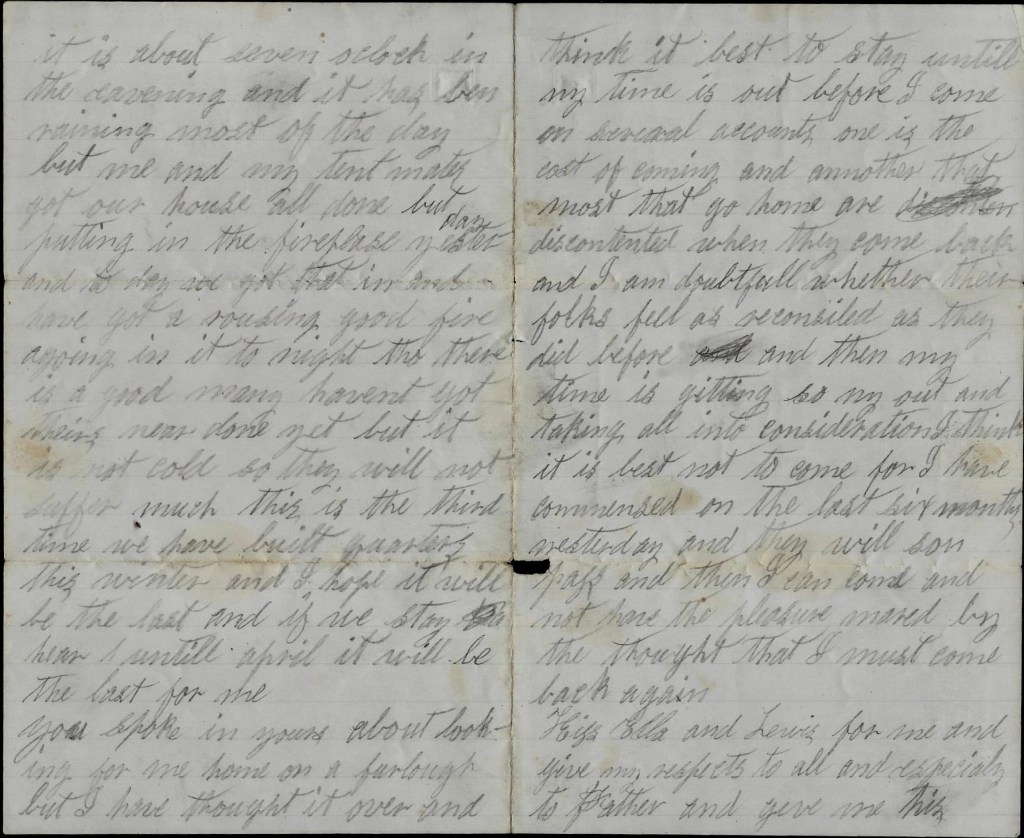
We have established a new line and gone into camp again. We have been very busy the last three days clearing up camp and building quarters. It is about seven o’clock in the evening and it has been raining most of the day but me and my tent mates got our house all done but putting in the fireplace. Yesterday and today we got that in and have got a rousing good fire agoing in it tonight though there is a good many haven’t got theirs near done yet but it is not cold so they will not suffer much. This is the third time we have built quarters this winter and I hope it will be the last. And if we stay here until April, it will be the last for me.
You spoke in yours about looking for me home on a furlough but I have thought it over and think it best to stay until my time is out before I come on several accounts. One is the cost of coming and another [is] that most that go home are discontented when they come back and I am doubtful whether their folks feel as reconciled as they did before, and then my time is getting so nye out, and taking all into consideration, I think it is best not to come for I have commenced on the last six months yesterday and they will soon pass and then I can come and not have the pleasure marred by the thought that I must come back again.
Kiss Ella and Lewis for me and give my respects to all and especially to father and give me his address for I have lost it. Hoping this may find you all well and that I may hear from you soon, I remain your most affectionate husband, — Samuel
Letter 11
[While serving in the 146th New York Infantry.]
Camp of the 146th N. Y. S. V. near Hatcher’s Run, Virginia March 10, 1865
My dear wife,
I received yours of February 19th. I had wrote to you just previous and think you must of got it about the same time I got yours so I have not been in a hurry about writing since as there has nothing of consequence transpired. I had a letter from father dated February 13th which I have answered. I have also had a letter from Gloversville saying they expect father to make them a visit this month. I would like very much to be at home when he comes down but I shall have to let it go this time. But the time is not far distant when I can come home and not have the pleasure marred by knowledge that I must leave to come back again in a few days.
I sent $25 to you by Mr. Roberts which I think you must of got before this time. I think we will get paid again this month. If so I will send you more. I don’t know what to advise you about your furniture if you should go West this spring. I know it will be a good deal of trouble for you to get them put up in any shape to move and if you don’t go to keeping house before I come home, it will be a trouble to get them stored. I think you and father will know what is best better than I do—that is, if you should go before I come home.
It is very rainy at present—so much so that it is impossible for the army to move. But the weather is warm when the sun comes out. It is like what you have up there in May.
I am in the Second Division. It is commanded by General [Romeyn B.] Ayres and in the First Brigade commanded by General [Frederick] Winthrop, 5th Corps by General Warren. I should not be surprised if our corps left this army soon perhaps to go south with Sherman. I hope we will. There is indication that we will ship for somewhere for we have turned over 90 wagons to the 6th Corps. Still we may not go. It will depend on circumstances but we are ready for almost anything.
I am well as usual. Give my respects to all. Kiss Ella and Lewis for me, hoping that this will find you all in the enjoyment of good health and that I may hear from you again soon. I remain your most affectionate and ever loving husband, — Samuel
P. S. If Mr. Roberts calls to see you after you get this, I wish you would send my old felt hat by him if you have got it yet. — S. R. G.
Letter 12
[While serving in the 146th New York Infantry.]
Lincoln Hospital [Washington D. C.] April 19th 1865
My dear wife,
I received yours of the 12th [and] also of the 14th containing father’s. I don’t think it advisable for him to go to the expense of coming from Wellesville to Washington to get me home for I shall undoubtedly get a furlough and come home sometime in May—perhaps the forepart of May.
You spoke of having sent me a hat and letter by Mr. Case. He had not got to the regiment when I left it. I am sorry you bought a new hat to send to me. I told him to say to you if you had the drab hat that I wore to the shop you might send it to me but I didn’t want you to buy one to send.
I am getting along well. I am able to walk around and for all the trouble there would be about traveling might come home now but they don’t like to let patients leave the hospital until their wounds have got so that there is no danger of their getting worse by being neglected.
I have been transferred to Ward No. 4 and shall likely remain here so you will direct the same as before, only Ward 4 instead of 17. Give my respects to to all. Kiss the children for me. I remain as ever your affectionate husband, — Samuel
The receipt for embalming services by Dr. Thomas Holmes—the “father of American embalming.” Wikipedia claims that Holmes charged $100 per body to embalm Union soldiers and that he embalmed over $4,000 of them during the Civil War. This receipt, however, suggests a much more reasonable price of $22 which included the box Samuel’s body was sent home to Utica in. Holmes embalmed the body of Abraham Lincoln in 1865 less than a month before he embalmed Samuel’s body.
Samuel and Melvina lie buried side by side in Forest Hill Cemetery in Utica, Oneida county, NY
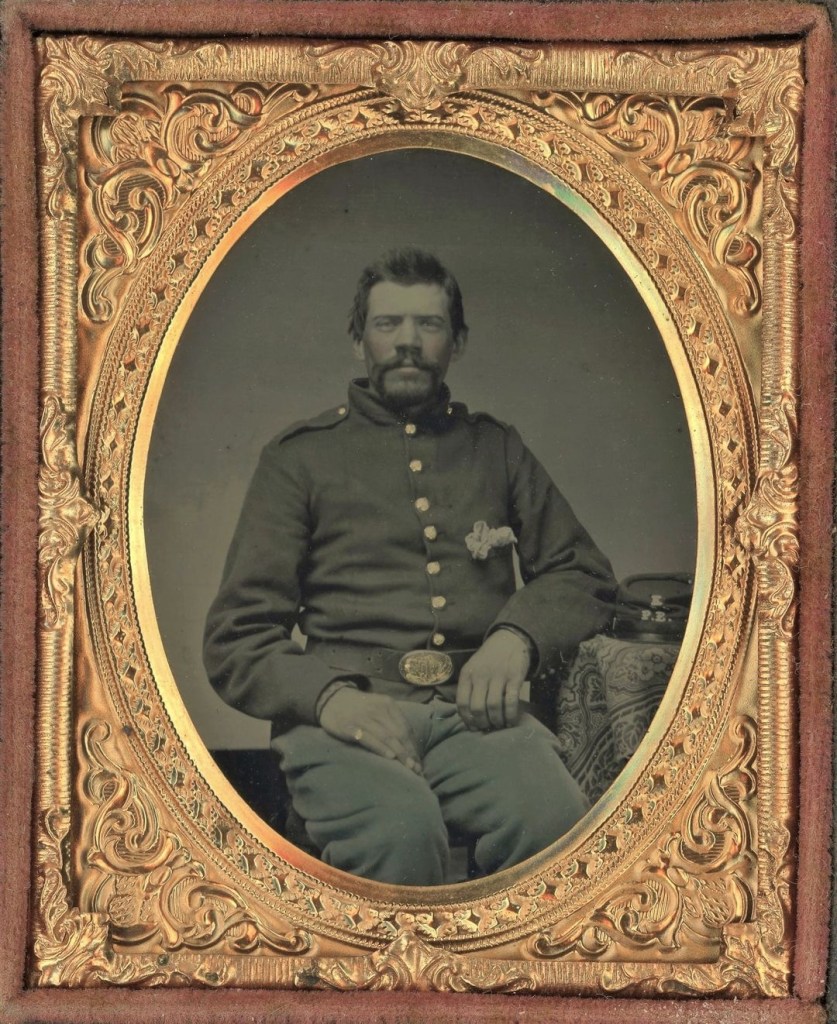
I could not find an image of George but here is an unidentified member from the same unit—Co. K, 44th New York (“People’s Ellsworth Zouaves”). He wears a large 1839-Pattern SNY waist belt plate. (Dan Binder Collection)
This letter was written by George W. Arnold who enlisted at the age of 22 as a private on 8 August 1861 in Co. K, 44th New York Infantry. He was promoted to wagoner shortly after his enlistment and remained with the regiment until 11 October 1864 when he was discharged after three years service. At the time of his enlistment, George was described as standing 5′ 11″ tall, with blue eyes and brown hair. He was a painter when he enlisted.
George was the son of Benjamin Franklin Arnold (1806-1874) and Emma J. Slocum (1807-1908) of Pawling, Dutchess county, New York. After the war, George married Charlotte B. Hubbell (1840-1896).
Headquarters 44th Regiment N. Y. S. V. Virginia March 31, 1862
Friend Jed Dear Sir,
I received yours of the 27th. I was quite pleased to hear from you as you will readily see. I agree with you at once relative to Mc[Clellan] as a general in the field. I received yours this morning. I have entirely forgotten when I last wrote you but I am thinking that I wrote you when at Alexandria bu I will give you a little detail of our march. We with the whole Army of the Potomac left Hall’s Hill March 10th, went to Fairfax, from thence to Centreville, stayed there the night of the 10th. The rebels left 12 hours before our arrival. The had noble works there but no guns mounted.
The 11th we returned to Fairfax where we stayed several days, then went to Alexandria where we stayed several days and embarked on board of boats the 21st. Arrived at Fortress Monroe the 24th all safe and sound. We sailed within 50 feet of the “Monitor.” I had a fair view of her. She looks like a large iron platform with a hogs head at one end. That is the most I or any man can say relative to her. Even when he goes aboard of her. I could see the marks on her quite plainly where the Merrimack hit the cheese box. It looked like the marks on an old piece of iron after being hit with a hammer merely started to rust a little.
“I could see the marks on her quite plainly where the Merrimack hit the cheese box.”
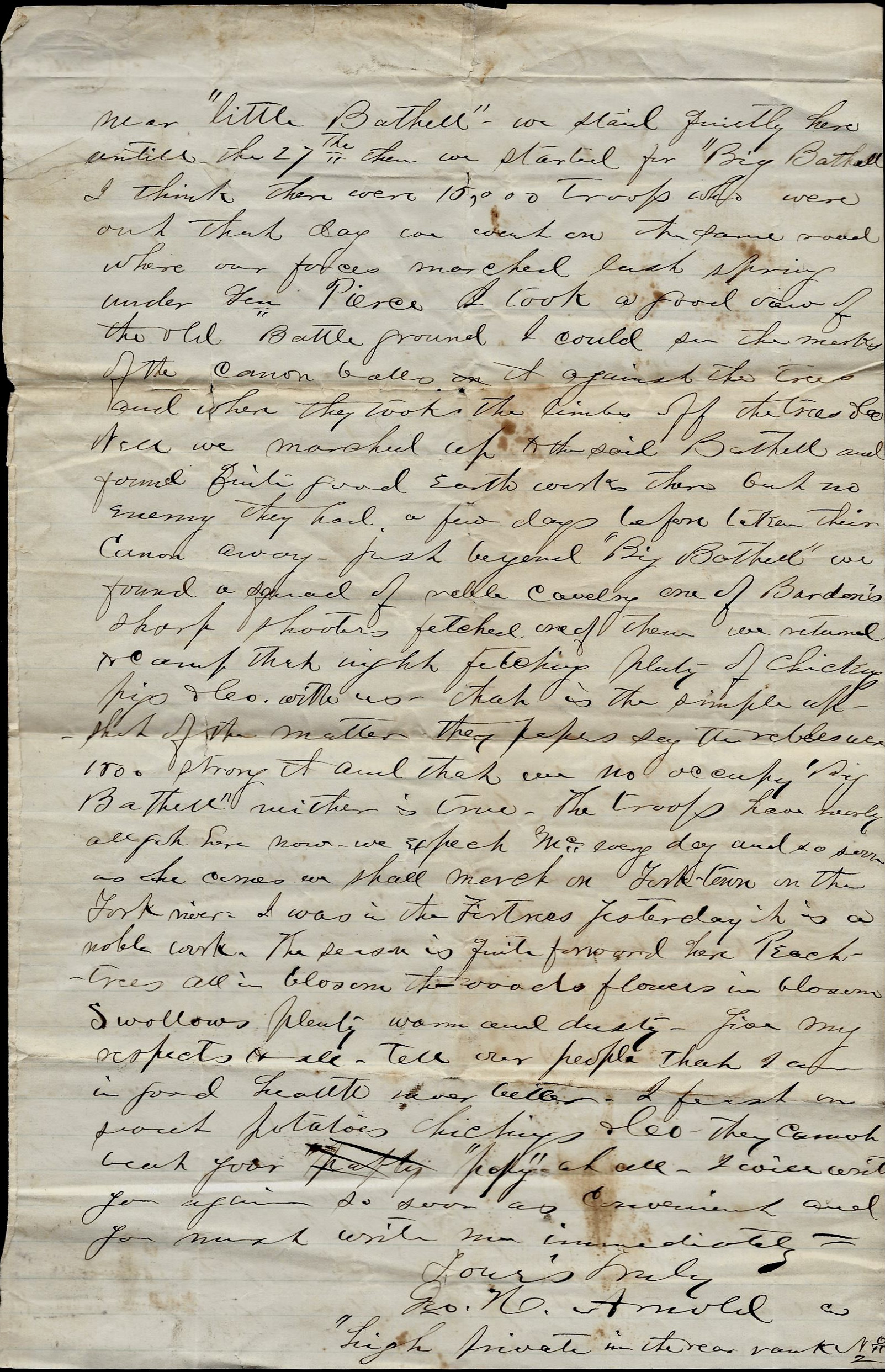
Well the night of the 24th we encamped near Hampton—or where Hampton was. This was quite a pretty little place, originally claimed 25,000 inhabitance. The 26th we came up near “Little Bethel.” We stated quietly here until the 27th. Then we started for “Big Bethel.” I think there were 15,000 troops were out that day. We went on the same road where our forces marched last spring under Gen. [Ebenezer] Pierce. I took a good view of the old battle ground. I could see the marks of the cannon balls against the trees and where they took the limbs off the trees &c.
Well we marched up to the said Bethel and found quite good earthworks there but no enemy. They had a few days before taken their cannon away. Just beyond “Big Bethel” we found a squad of rebel cavalry. One of Berdens’s Sharpshooters fetched one of them. We returned to camp that night fetching plenty of chicken, pigs, &c. with us. That is the simple [ ] of the matter. The papers say the rebels were 1500 strong and that we did not occupy Big Bethel. Neither is true. The troops have nearly all got here now. We expect Mc[Clellan] every day and so soon as he comes, we shall march on Yorktown on the York River. I was in the Fortress yesterday. It is a noble work. The season is quite forward. The peach trees are all in blossom. The woods, flowers in blossom, swallows plenty, warm and dusty.
Give my respects to all. Tell our people that I am in good health. Never better. I feast on sweet potatoes, chickens &c. They cannot beat your pappy at all. I will write you again so soon as convenient and you must write me immediately.
Yours truly, — Geo. W. Arnold, high private in the rear rank.



















 Spared & Shared 23