The following letter was written by James C. Magee who, at the age of 23, enlisted on 16 July 1861 to serve three years in Co. D, 47th Ohio Volunteer Infantry (OVI). He was appointed a corporal on 1 September 1863 and made sergeant on 4 August 1864. In July 1865 he was promoted to Hospital Steward.
James was the son of Robert Magee (1808-1885) and Catharine Campbell (1806-1853) of Somers, Preble county, Ohio. After the war, James married Caroline Brown (1841-1924) and moved to Andrew County, Missouri, where he farmed and raised his family. Later in life he moved to Scott City, Kansas.
Transcription
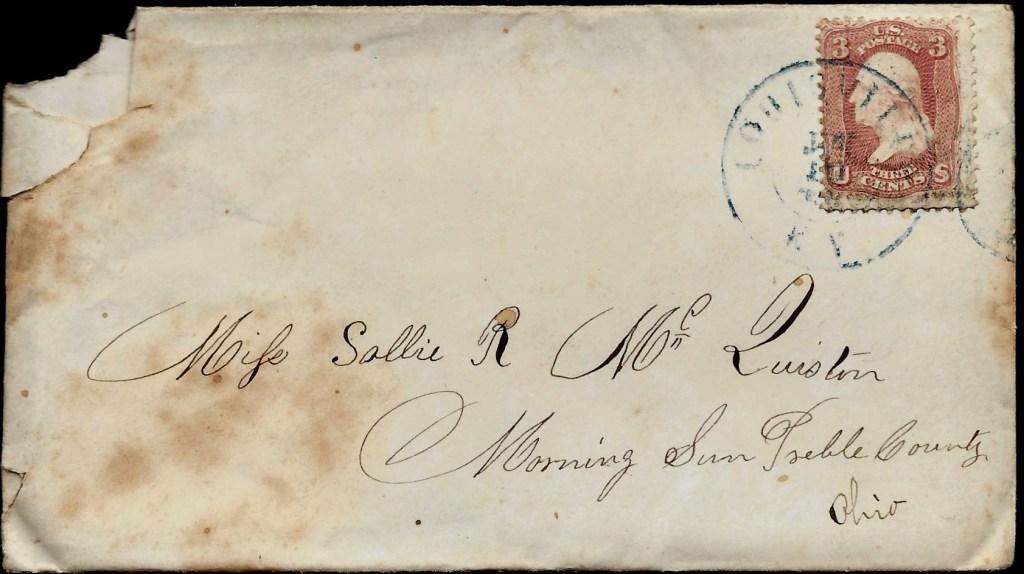
Addressed to Miss Sallie R. McQuiston, Morning Sun, Preble county, Ohio
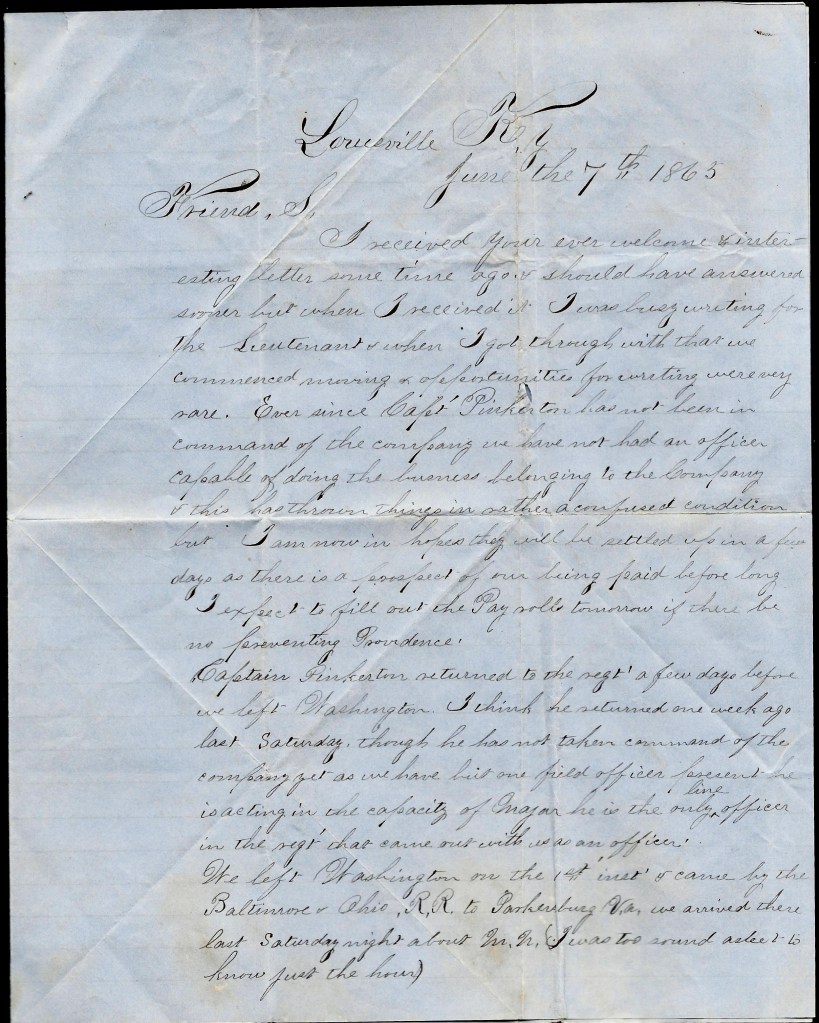
Louisville, Kentucky June 7th 1865
Friend Sallie,
I received your ever welcome & interesting letter some time ago & should have answered sooner but when I received it, I was busy writing for the Lieutenant & when I got through with that we commenced moving & opportunities for writing were very rare. Ever since Capt. [Joseph L.] Pinkerton has not been in command of the company, we have not had an officer capable of doing the business belonging to the company & this has thrown things in rather confused condition. But I am now in hopes they will be settled up in a few days as there is a prospect of our being paid before long. I expect to fill out the Payrolls tomorrow if there be no preventing Providence.
Captain Pinkerton returned to the regiment a few days before we left Washington. I think he returned one week ago last Saturday, though he has not taken command of the company yet as we have but one field officer present. He is acting in the capacity of Major. He is the only line officer in the regiment that came out with us as an officer.
We left Washington on the 1st inst. and came by the Baltimore & Ohio Railroad to Parkersburg, Va. We arrived there last Saturday night about midnight (I was too sound asleep to know just the hour). We embarked on the Steamer Express on Sabbath morning at 9 a.m. bound for Louisville. We had quite a fine trip. Stopped at Cincinnati on Monday evening between sunset and dark & the Colonel gave us liberty to run around through the city until eight o’clock Tuesday morning when we were to report back to the boat. As a general thing, the boys were punctual, but as you know there are more or less of the black sheep in every flock. There is one of the numbers of Co. D that I presume you will see or at least hear of before this reaches you.
We arrived at the City of Louisville about 9 o’clock last night & marched some two or three miles south of east from the town. We have a very nicely situated camp. There is more or less talk every day as to where we are going & what we are going for. Some think we will be mustered out while the greater portion think we will be sent to Texas & I don’t profess to know anything about it & I believe I know nearly as much about it as any of them. That is as much to say, there is none of the, knows anything about it. Be these things as they may, I think I have fulfilled my contract. I agreed to serve three years if the war lasted so long & if it didn’t, I was to quit sooner. So if they want to go to Texas or to Mexico to fight Maximilian, they may go but I think I’ll go to Preble county, Ohio. That is hte feeling at present. I think four years of actual service is enough at one time, don’t you?
Well Sallie, you rather set me to thinking pretty seriously over my being elected. I must confess the subject is too serious for joking, yet I fear there is too much truth in the statement. You asked me to excuse all mistakes & whatever I was not pleased with. I had no occasion for either mistakes I did not find & I had no occasion for any displeasure. You seem to think that my market is made & I hear hints to the same effect from some others though that’s what I am utterly unable to see. Why you don’t suppose she would stoop so low as even dream of such a worm as I.
The weather is quite warm and sultry & makes me so lazy I can hardly see. The boys are all in their usual health, I believe, except W[illiam] T. Ramsey. He came near getting his left leg broke. Just as we were leaving Cincinnati, he got it caught between the fenders of the boat we were on & another one though I think he will be able to go about in a few days.
I suppose there is quite a number of young ladies wondering what they’ll do when their soldier comes home but there are some of hem won’t be left in doubt long. How I wish I could be some young lady’s soldier! Wouldn’t I cut a swell though?
You seem to think it a pity that Old Jeff disgraced skirts. So do I, but he has disgraced the masculine gender so much worse that I would like to be classed with the feminine if I could. I guess I have written about all the nonsense I can think of & perhaps more than you will care to read so for fear of wearying your patience, I will close hoping to hear from you in due time.
The following letters were written byJoseph Steele Ramsey (1838-1913) who, at age 22, enlisted on 16 July 1861 to serve three years in Co. D, 47th Ohio Volunteer Infantry (OVI). He reenlisted as a veteran in the regiment and mustered out on 11 August 1865. Serving in the same company with Joseph was his younger brother John Knox Ramsey (1841-1863) who died of illness at Paducah on 10 November 1863.
Joseph was the son of Thomas Lackey Ramsey (1812-1881) and Jane Steele (1808-1851). He wrote two of the following letters to his older sister, Rebecca Jane Ramsey (1836-1891) and one to Sarah (“Sallie”) Rachel McQuiston (1843-1926) with whom he would marry on Christmas Day 1866. Sallie was the daughter of David McQuiston and Margaret Hamilton of Preble county, Ohio.
Letter 1
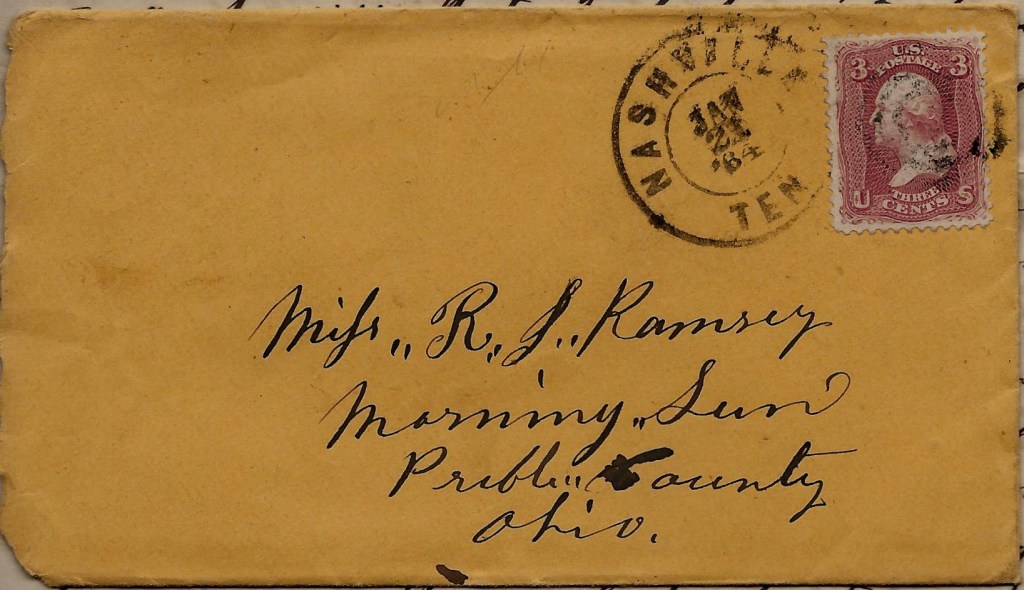
Addressed to Miss R. J. Ramsey, Morning Sun, Preble county, Ohio
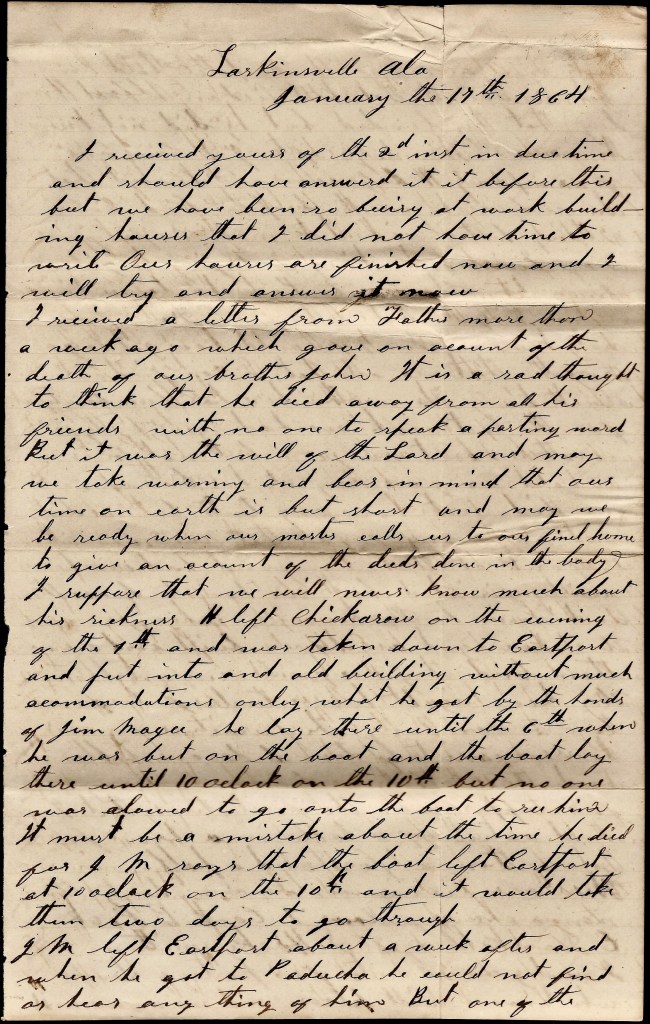
Larkinspur, Alabama January 17th, 1864
I received yours of the 2nd inst. in due time and should have answered it before this but we have been so busy at work building houses that I did not have time to write, Our houses are finished now and I will try and answer it now.
I received a letter from Father more than a week ago which gave an account of the death of our brother John. It is a sad thought to think that he died away from all his friends with no one to speak a parting word. But it was the will of the Lord and may we take warning and bear in mind that our time on earth is but short and may we be ready when our Master calls us to our final home to give an account of the deeds done in the body. I suppose we will never know much about his sickness. He left Chickasaw on the evening of the 4th and was taken down to Eastport and put into an old building without much accommodations—only what he got by the hands of [Sgt.] Jim Magee. He lay there until the 6th when he was put on the boat and the boat lay there until 10 o’clock on the 10th but no one was allowed to go onto the boat to see him. It must be a mistake about the time he died for J. M. says that the boat left Eastport at 10 o’clock on the 10th and it would take them two days to go through.
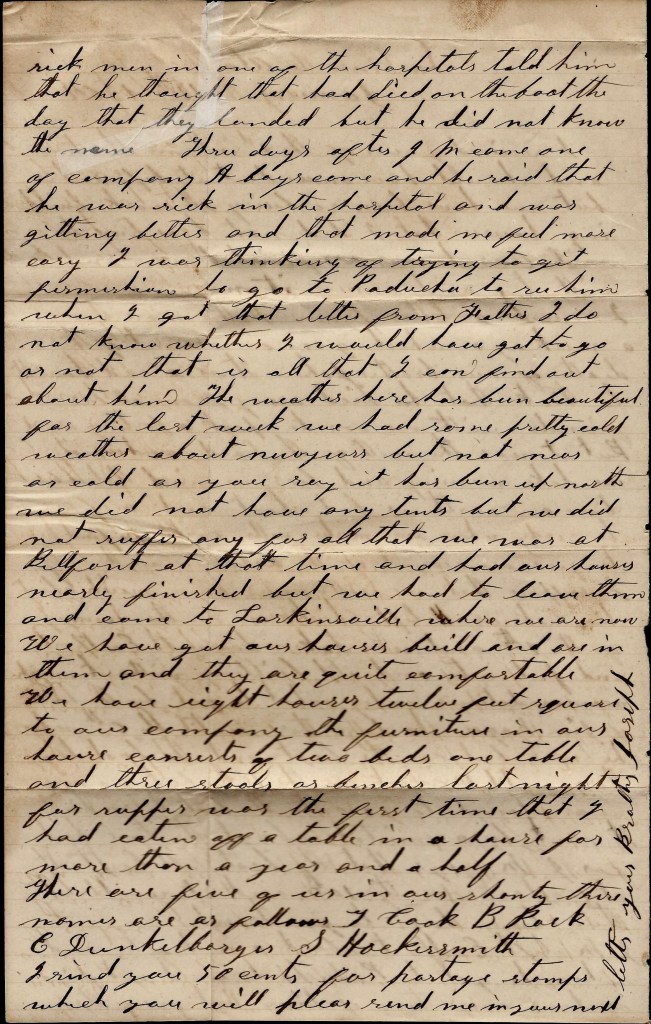
J. M. left Eastport about a week after and when he got to Paducah, he could not find or hear anything of him. But one of the sick men in one of the hospitals told him that he thought that [John] had died on the boat the day they landed but he did not know the name. Three days after J. M came, one of Company A boys come and he said that he was sick in the hospital and was getting better and that made me feel more easy. I was thinking of trying to get permission to go to Paducah to see him when I got that letter from Father. I do not know whether I would have got to go or not. That is all that I can find out about him.
The weather here has been beautiful for the last week. We had some pretty cold weather about New Years but not near as cold as you say it has been up north. We did not have any tents but we did not suffer any for all that. We was at Bellfont at that time and had our houses nearly finished but we had to leave them and come to Larkinsville where we are now.
We have got our houses built and are in them and they are quite comfortable. We have eight houses twelve feet square to our company. The furniture in our house consists of two beds, one table, and three stools or benches. Last night for supper was the first tie that I had eaten off a table in a house for more than a year and a half.
There are five of us in our shanty. Their names are as follows: J[ohn] Cook, [Andrew] B. Rock, E[lias] Dunkelberger, S[amuel] Hockersmith. I send you 50 cents for postage stamps which you will please send me in your next letter.
From your brother, — Joseph
Letter 2
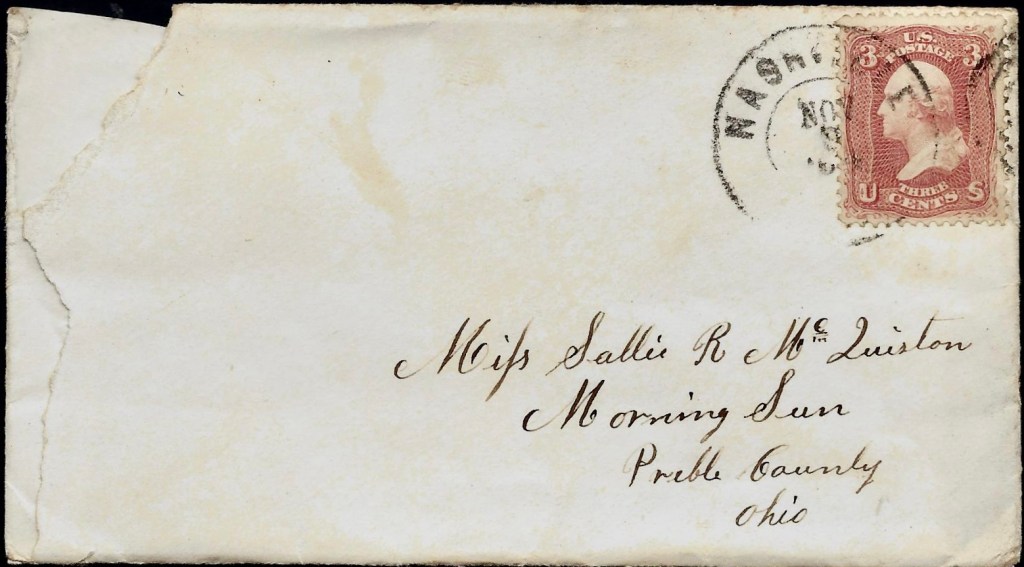
Addressed to Miss Sallie R. McQuiston, Morning Sun, Preble county, Ohio
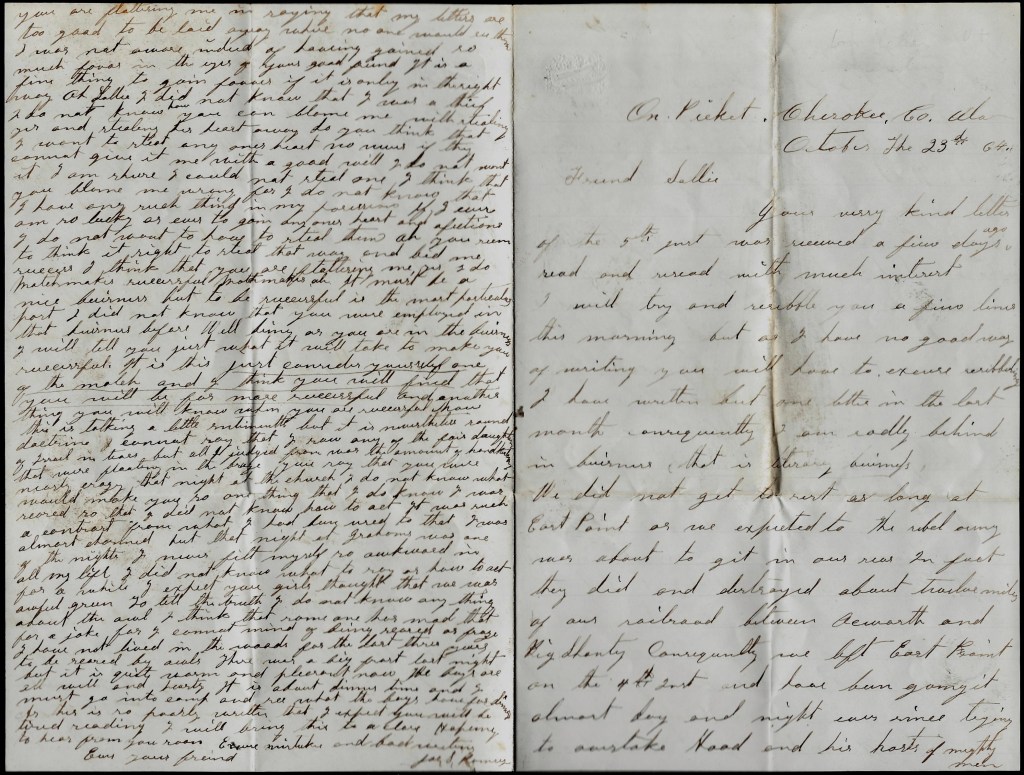
On picket, Cherokee County, Alabama October 23rd 1864
Friend Sallie,
Your very kind letter of the 5th just was received a few days ago, read and reread with much interest. I will try and scribble you a few lines this morning but as I have no good way of writing, you will have to excuse scribbling. I have written but one letter in the last month, consequently I am sadly behind in business—that is, literary business.
We did not get to rest as long at Eastport as we expected to. The rebel army was about to get in our rear. In fact, they did, and destroyed about twelve miles of our railroad between Ackworth and Big Shanty. Consequently we left Eastport on the 4th last and have been going it almost day and night ever since, trying to overtake Hood and his hoards of mighty men but we have not found many of them yet. We had a little skirmish with their rear guard at Snake Creek Gap but it did not amount to anything worth speaking about. We have been roaming all over the State of Georgia and are now in Cherokee county, six miles west of Gaylesville. We arrived here day before yesterday. How long we will remain here, I cannot say. Neither do I know where we will go to.
While you have been having so much wet weather up North, we have been having nice dry weather—beautiful weather for marching—rather cool at night, but we make up for that by burning fence rails which are very plenty in this part of the country. We are having a gay time on this march, plenty of everything good to eat, but the citizens have to suffer for it. But you know that we cannot go hungry where there is so many hogs and potatoes. For my breakfast this morning, I had sweet potatoes, beef, slapjacks, and coffee—not as good as we have sometimes. We often have chicken, molasses, and various other things that the country affords. It looks hard to take things away from the people that way but it is the only way that we have to live as Uncle Sam does not give us full rations but slows us to gather it from the country.
Capt. [Joseph L.] Pinkerton started home yesterday but did not get farther than Dawson Headquarters before he was ordered back. He will go home as soon as there is an officer appointed in his place. He is a good officer—I think a little the best one that our company has ever had. He is well liked by all the boys and will be missed very much in the regiment.
I do not think that there is anything wrong is showing good, well written letters to ones best friends but my letters are so very poor that I am almost ashamed to let anyone see them. As you have told the whole truth, I do not think that you have done anything to be forgiven for but I had rather beg pardon myself. You’re wrong in thinking that i thought you were that kind as to be showing my letters to everyone. I think you are flattering me in saying that my letters are too good to be laid away where no one would see them. I was not aware indeed of having gained so much favor in the eyes of your good friend, It is a fine thing to gain favor if it is only in the right way. Oh Sallie, I did not know that I was a thief. I do not know how you can blame me with stealing her heart away. Do you think that I want to steal anyone’s heart. No, never. If they cannot give it me with a good will, I do not want it. I am sure I could not steal one. I think that you blame me wrong for I do not know that I have any such thing in my possession. If I ever am so lucky as ever to gain anyone’s heart and affections, I do not want to have to steal them….
There was a big frost last night but it is quite warm and pleasant now. The boys are all well and hearty. It is almost dinner time and I must go into camp and see what the boys have for dinner. As this is so poorly written that I expect you will be tired reading, I will bring this to a close hoping to hear from you soon. Excuse mistakes and bad writing. Every your friend, — Jos. S. Ramsey
Letter 3
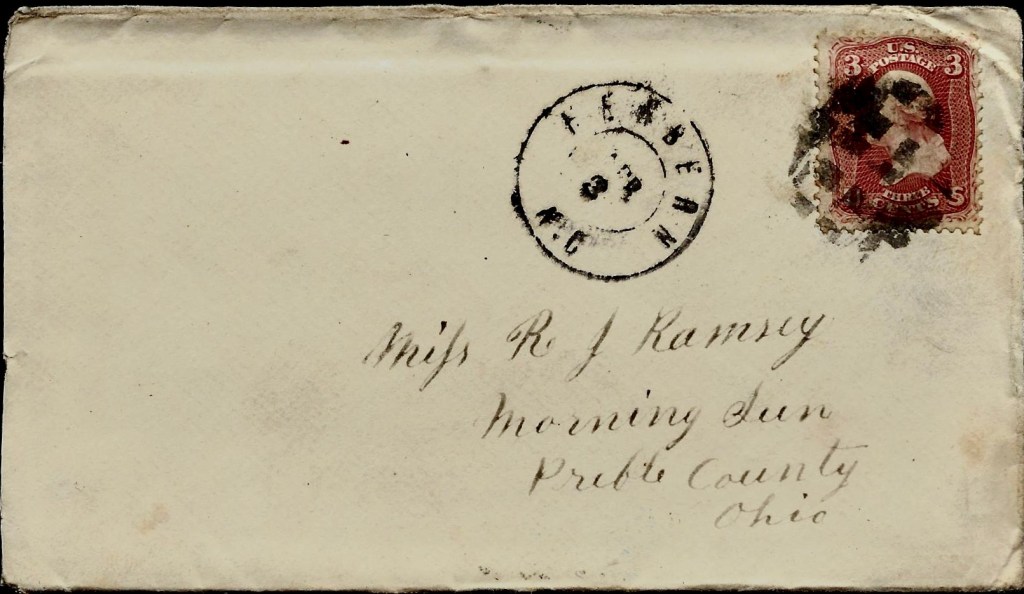
Addressed to Miss J. R. Ramsey, Morning Sun, Preble county, Ohio
Camp Near Goldsboro, North Carolina March 1st, 1865
Dear Sister,
As it seems your tirn for a note and I have received three from you since I come here, I will try and scratch you a few lines that you may know what we are doing and how we are getting along. It will not be necessary for me to go back and give a history of our late trip through South and North Carolina as I wrote to brother Sam the other day and told him about all that I knowed about it. I have kept a kind of a diary that I intend to send home that will give you some idea of the route that we went, how we fared, and what we were doing each day. I sent the first two weeks of it in Sam’s letter and I will send two more in this and so on until I have it all sent. I have kept it from the first of the year and I want you to take it all and put it together so that it will not get tossed.
We are encamped two miles east of Goldsboro. It is a very nice place to camp. We have got out little tents fixed up and things arranged so that we can live very well. The only objection that I have to this camp is the soil is very sandy and the high winds that we have here is continually blowing sand into everything—into our eyes, into our victuals, and everything else. But we have got so used to having sand in our victuals that we do not mind it much. Don’t you think that we ought to be getting gritty? They say sand makes things gritty. If that be so, we will be sure.
The weather is very warm and pleasant. We had some rain yesterday but today is clear, warm and windy—sand flying as usual. the peach trees have been out in full bloom for two weeks. The prospects for a large peach [harvest] is good. I think if we stay down here until they are ripe, I will have some of them. Apple trees are very scarce here. It is only once in a while that we see one and very shabby at that. We have plenty to eat at this place and had on the whole trip excepting three days that we subsisted mostly on parched corn. That was the time that Johnston thought to stop us near Bentonville, 20 miles from this place. The cars commenced running to this place the same night that we did and trains are arriving now almost hourly ladened with rations and clothing. We have not got our clothing yet and are in a very bad need of it. I tell you that we are a ragged looking set of boys. Would not look well promenading around in [ ] in our present state of existence as we were doing this time one year ago.
Our clothes are at the Division coming and we will get them as soon as they can distribute them out which will be tonight or in the morning. Col. Parry has been promoted to rank as Brevet Brigadier General. I suppose he will leave us in a few days and then Captain Pinkerton will have command of the regiment as soon as he comes back, We are looking for him every day. Lt. [James H.] Bullock is commanding our company. He was only promoted about two months ago from sergeant. We have not had anything to do since we came here except one day we went out with the wagon train a foraging. I think that we will have to drill before long.
There is a great talk about peace in camp today. Rumor says that Gen. Lee has gone to Washington to make peace and that Jeff Davis has run off out of the country. I hope it is so but can’t believe it. I look for peace before long but I think that there will be some fighting yet before this affair is ended yet. It is also said that Grant has taken Richmond with the loss of 20,000 men and taken 40,000 prisoners. That we do not believe although it may be so, We hear so much now days that we do not believe anything until we know it to be so.
From the letters that I have received from the North, I think that you must have had a gay time sleigh riding this winter. I would like to have been there to have enjoyed some of it but duty must go before pleasure in these war times. I have not saw a speck of snow this winter. The hardest freeze that we had did not make ice more than an inch thick. I like the climate of this country very well but the land is too poor to suit me. I do not like black-eyed peas well enough and that is about the only thing that will make more than half a crop in this country.
I received that housewife [sewing kit] that you sent me day before yesterday. I am very well pleased with it and think it a very nice one and for it you have my many thanks well wishes…
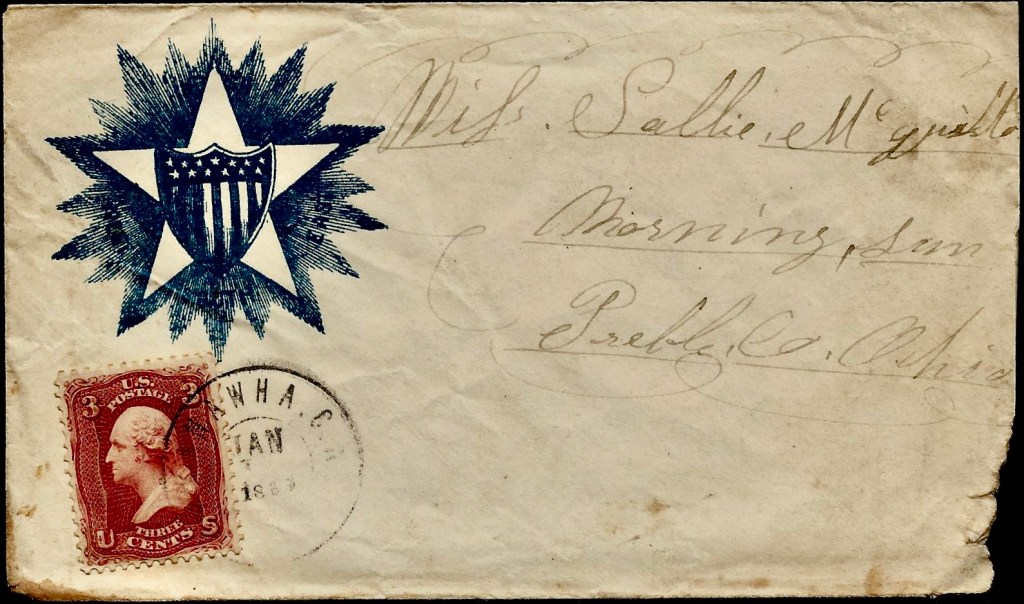
The following letter was written by a Union soldier named “John” who undoubtedly served in Co. D, 47th Ohio Volunteer Infantry and was most likely a resident of Morning Sun (or vicinity) in Preble county, Ohio. Unfortunately there are too many soldiers with that name to say with certainly who wrote it though it’s clear that he was barely literate.
John wrote the letter to his “friend” Sally McQuiston who lived in Morning Sun, Ohio.
Transcription
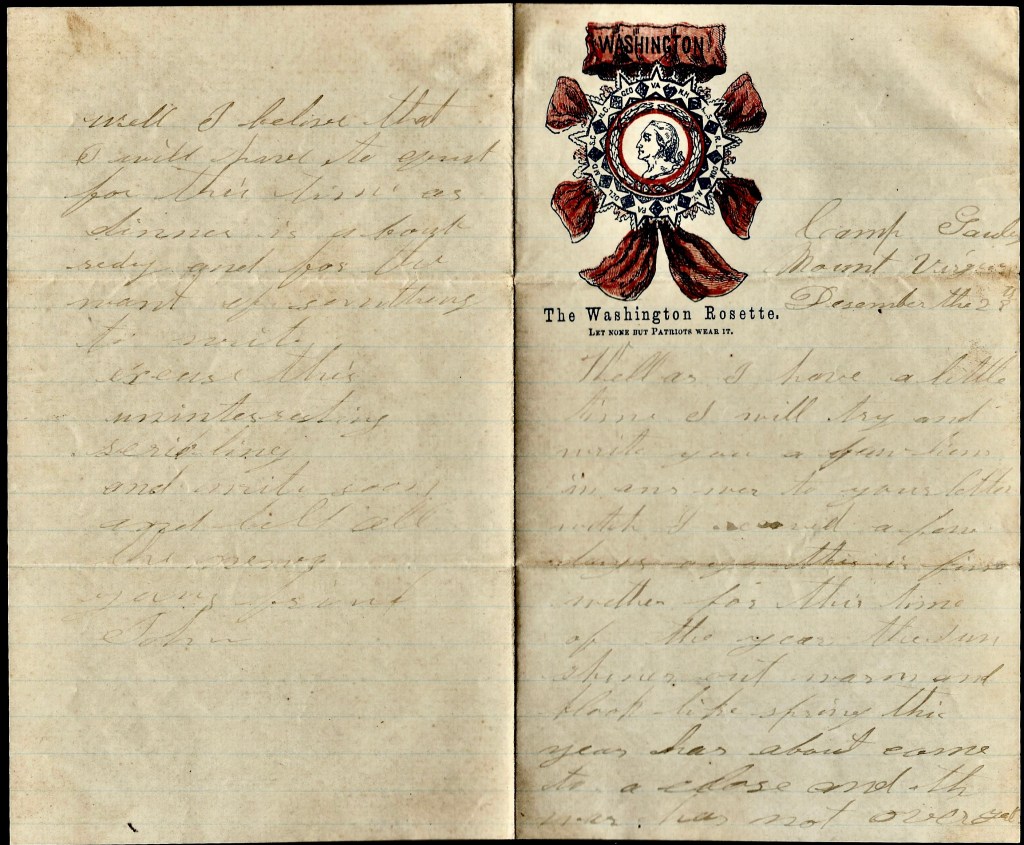
Camp Gauly Mount., Virginia December 28 [1862]
Well, as I have a little time I will try and write you a few lines in answer to your letter which I received a few days ago, This is fine weather for this time of the year. The sun shines out warm and looks like spring this year has about come to a close and the war has not over yet.
I suppose that you have good times on Christmas and New Years. Well, I will tell you how that we spent Christmas. There was some Gray Backs came into camp and said that there were some secesh that had come home on furlough and our company went out to see if they could find them. We went out past Hawk’s Nest and Lover’s Leap and Mountain Cave, and came back without finding any of them and that was our Christmas.
Furloughs have been granted at last and there is seven gone home of this company. I[sreal] Brown is one of the number and I suppose that he will have a good time when he gets home.
I want you to tell me what kind of a time he has. Will Magaw 1 has had a hard time of it since he went to the war and the poor fellow’s troubles are at an end at last.
Well, I believe that I will have to quit for this time as dinner is about ready and for the want of something to write. Excuse this uninteresting scribbling and write soon and tell all the news. Your friend, — John
1 William G. Magaw (1836-1862) was from Preble county, Ohio, the son of William and Rachel (Paxton) Magaw. He served in Co. A, 30th Illinois Volunteers. He died on 19 December 1862. He had a couple of brothers who served in Co. D, 47th OVI..
These letters were written by Philander (“Phil”) Boyd McQuiston (1830-1915), the son of William M. McQuiston (1797-1878) and Nancy Boyd (1803-1886) of Preble county, Ohio.
Philander served in Co. D, 47th Ohio Volunteer Infantry (OVI), from 16 July 1861 until 20 August 1864. After the war he returned to Preble county where he resumed farming and never married.
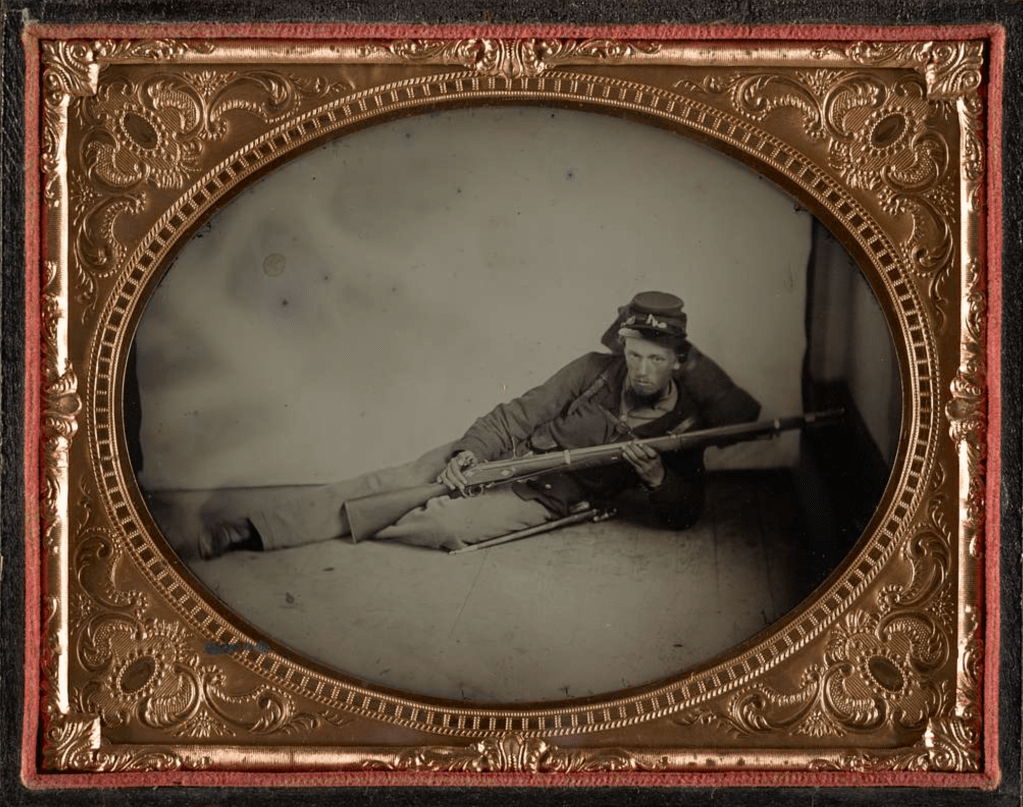
I could not find an image of Phil but here is one of Pvt. Robert M. Burnard of Co. A, 47th OVI
Letter 1
Addressed to Miss Sallie A. McQuiston, Morning Sun, Preble county, Ohio
Camp Gauley Mount. December 23, 1862
Cousin Sallie,
I now take my pencil in hand to write you a few lines to let you know that I am well at present, hoping these few lines will find you enjoying the same blessing and also to let you know that I have been sick for nearly two weeks. This will account for your letter remaining so long unanswered.
I am very punctual in answering letters; generally answer the same or the next day. But owing to the inferior state of my health for some time past, I am somewhat behind at present. I suppose [Samuel L.] Hockersmith (or Punchy as he is called here) answered yours some time ago.
We have travelled over the greater part of the sacred soil contained in the Kanawha Valley since we wrote to you. We were then at the head of the Kanawha. Soon after we moved to camp Piatt more than half way down. it to go into winter quarters as we supposed. We commenced fixing up immediately after. After remaining there about 24 hours, we crossed the river to go into winter quarters again, We were very sure of staying there and commenced making extensive preparations. we stayed there nearly a week and then got orders to move back to Gauly Mount where we are now and I think will remain until we go away unless something happens that we don’t know of now.
It is a great place for pies in the neighborhood of Camp Piatt. I made several trips unto the country after them, I suppose you have often heard of the kind the boys got here last winter. These were just the reverse. The greatest objection was they were made according to the strictest rules of economy. One afternoon two of us were coming into camp each with an armful. We met Gen. [Jacob Dolson] Cox and staff. He touched his hat very gracefully to us and looked as though he thought provisions were scarce in camp. Since then I have been thinking some of an appointment as Commissary General of this Department for if he judged from the load which I was carrying he would certainly think that I was abundantly qualified for this office.
Our mess has been putting up a kitchen today. It is a log tenement of quite an ancient style of architecture but I expect we think as much of it as any person ever did of a fine house.
Gen. [George] Crook is expected here this week to inspect the regiment and if it is well enough drilled, furloughs are to be given.
One of the boxes sent in Pierson’s care arrived yesterday. None that were sent by the “Aid Society” have arrived yet. He left more than a week ago to hunt for them and has not been heard from since. Give my best wishes to all the friends—girls in particular. Write soon. Goodbye. Your cousin, — Mc
P. S. Mr. A[ugustus S. Troth 1 is well.
1 Augustus S. Troth served initially in Co. D, 47th Ohio Infantry. He was transferred to the US Signal Corps on 7 September 1863.
An elevated view of Tompkin’s Farm (Camp Gauley Mount.) in West Virginia used as a military camp during the American Civil War; tents are visible spread out over fields on either side of a central roadway; farmhouse and other buildings also visible on the property; 1862. (The Huntington Library)
Letter 2
Camp Sherman August 7th 1863
Cousin Sallie,
It is a long time since I heard from you—nearly six months now I believe, and as I feel like conversing with some of my old friends this afternoon, I will scribble a few lines to you expecting to receive better than I send. But firstly I believe I ought to scold some for your not writing to me while I was sick and not able to write. But I guess I will let it pass this time hoping that if I am so unfortunate as to get sick again, you will perform your duty in respect to writing more faithfully.
Well, I suppose you have heard how we took Vicksburg and ran Johnston out of Jackson and cleared the country generally of rebels. As I was not with the regiment while these deeds were being performed, I will not go into detail concerning them but will confine myself to personal matters.
When the regiment started for the rear of Vicksburg, those of us that were not able to go were left in what was called a convalescent camp. Previous to this, I thought a convalescent camp was one in which sick persons received good medical treatment, suitable food, and in short, were treated as sick should be. But I soon found as I had often heard that this was all a mistake for more than a week after we were sent there, no doctor could be found anywhere in camp. One of our company, Joseph [H.] Arthurs died, I believe, just for the want of medical treatment. After a while an excuse of a doctor came, but I would be slow in saying that he did any good.
We were in this camp when the rebs came so near capturing us at the time they attacked our troops at Milliken’s Bend. I expect there was as much excitement and fun in our camp then as there was in Morning Sun and vicinity when Morgan passed through Ohio. It had been reported for several days that we would be attacked and the maimed and all that were able to hold a gun were frequently called into line. This had ben repeated so often that we had no faith in the reports. But one morning about ten o’clock, a force numbering about 1500 made their appearance about two miles from and in plain view of the camp. Then there was hurrying to and fro—And gathering knapsacks—And trembling in their shoes—Those who but an hour before—Had put their dinner on. But they didn’t come any nearer and after cooking their dinner and supper and resting until eleven o’clock at night, they quietly took their departure.
During the excitement, your humble servant according to orders took refuge behind the levee, but not liking the position, returned to camp where I had things all my own way until the next morning when my companions in arms being convinced that there was no danger, one by one came slowly dropping in.
Soon after this we were sent up the Yazoo to the landing at the mouth of Chickasaw Bayou. The Yazoo is a beautiful river and judging from its appearance, I think no one would give it the name that it bears. There is splendid scenery along its banks. The trees grow close to the water’s edge and the branches hang out over the water. It is such a stream as artists usually have in their pictures. But it is the greatest place for mosquitoes ever was. I won’t undertake to say anything about them for I couldn’t do them justice.
Soon after the surrender of Vicksburg, we were ordered there and of all the miserable places I ever saw, that is the miserablest I took the ague the day we went and had it more or less all the time we stayed. There was fifteen of our squad [and] everyone had it. The city is so miserably filthy. I think it is the principal cause of its unhealthiness. This camp reminds me more of Ohio that any place I have seen in the South yet. The timber is nearly the same as that of Preble county.
Col’s [Augustus C.] Parry, [John] Wallace, Capt. [Joseph E.] Pinkerton and four or five other captains and lieutenants started home on furlough today. Col. Wallace is to report at Camp Dennison to bring out some drafted men. I suppose I am staying in Col. Wallace’s tent while he is gone. I have everything my own way. All of Co. D are well They stood the march to Jackson remarkably well. [Samuel L.] Hockersmith is fattening up again. He was not very well during the siege.
Mr. [Augustus] Troth is in the signal corps now. They are quartered in Vicksburg now. I don’t want to make you uneasy but if he can stay there without getting sick, he will do more than anyone I know of yet. But my sheet is nearly full so that I have scarcely room to say that hoping to hear from you soon, I remain as ever your cousin, Mc
I could not find an image of George but here is Pvt. Robert M. Burnard of Co. A, 47th Ohio Infantry (Tom Liljenquist Collection)
These letters were written by George Washington Sheldon (1845-1864), the son of Benjamin Sheldon (1811-1872) and Louisa Gustin (1824-1927). In the 1860 US Census, 15 year-old George was enumerated with the rest of the family on his parents farm in Perry township, Brown county, Ohio. However, letters mailed home to his parents during the Civil War were addressed to Blanchester in Clinton county. According to muster records, George enlisted at the age of 17 in Co. F, 47th Ohio Volunteer Infantry (OVI) on 7 August 1861. It’s possible he may have only been 16 and lied about his age. Sometime after his enlistment he seems to have been transferred to Co. E.
One of the letters published here was datelined from the camp of the 47th OVI in the rear of Vicksburg on 24 May 1863. After spending the early months of 1863 in a futile attempt to dig a canal that would allow Union gunboats to bypass the Confederate stronghold out of reach of the enemy’s cannons, the regiment participated in Grant’s advance upon Vicksburg’s rear. By May 18, the regiment had arrived at Walnut Hills, Mississippi, on Vicksburg’s outskirts. On May 19 and 22, 1863, the 47th attacked the Confederate position on Cemetery Hill. The regiment seized this position on May 22, 1863 and occupied the Cemetery Hill Fort for the duration of the Siege of Vicksburg.
Another letter published here was datelined from line of battle before Atlanta on 23 July 1864. The first part of the letter was written by George just prior to Lt. General John B. Hood’s attack on Maj. General William T. Sherman’s troops in what would be the Battle of Atlanta. The second part of the letter was penned by William (“Bill”) H. Orr, George’s bunk mate, who informed George’s parents that George had been taken prisoner in the battle. We learn from prison records that George was taken to Andersonville where he died of diarrhea on 10 September 1864 and was buried in Grave 8319.
Letter 1
Camp opposite Vicksburg State of Louisiana February 13, 1863
Dear Parents,
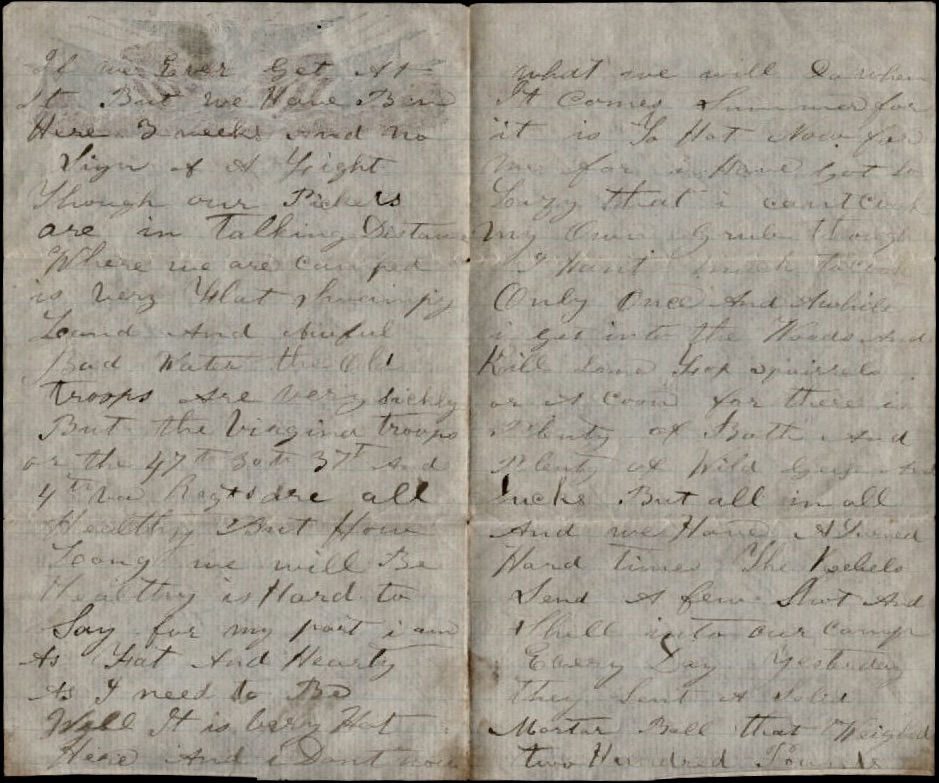
I take my pen in hand to let you know I am well and hope you are all the same. Well, I will tell you that I han’t got a letter from home since I left and I want you to write.
We are laying here within two miles of the Rebel Army but we don’t know when we will go into battle. We have about 90 thousand fighting men and it will be a hard and bloody battle if we ever get at it. But we have been here 3 weeks and no sign of a fight, though our pickets are in talking distance.
Where we are camped is very flat, swampy land and awful bad water. The old troops are very sickly. But the Virginia troops or the 47th, 30th, 37th, and 4th Vol. Regiments are all healthy. But how long we will be healthy is hard to say. For my part, I am as fat and hearty as I need to be. Well, it is very hot here and I don’t know what we will do when it comes summer for it is too hot now for me for I have got so lazy that I can’t cook my own grub though I han’t much to cook. Only once and a while I get into the woods and kill some fox squirrels or a coon for there is plenty of both and plenty of wild geese and ducks. But all in all we have a durned hard time.
The Rebels send a few shot and shell into our camp every day. Yesterday they sent a solid mortar ball that weighed two hundred pounds and you may believe it or not, but I saw it. It went into the ground eleven feet. It is the largest that has been shot at us yet. It was fired from a mortar.
Well, we expect our money every day. There is 6 months pay coming to us now. When I get mine, I will send it home. All the boys are well but [Jared] Nelson Overy. He is sick but is getting better. I think there has been over 2 thousand died since we came here but not a man from the 47th. [Letter is unsigned or the remainder of it is missing]
Letter 2
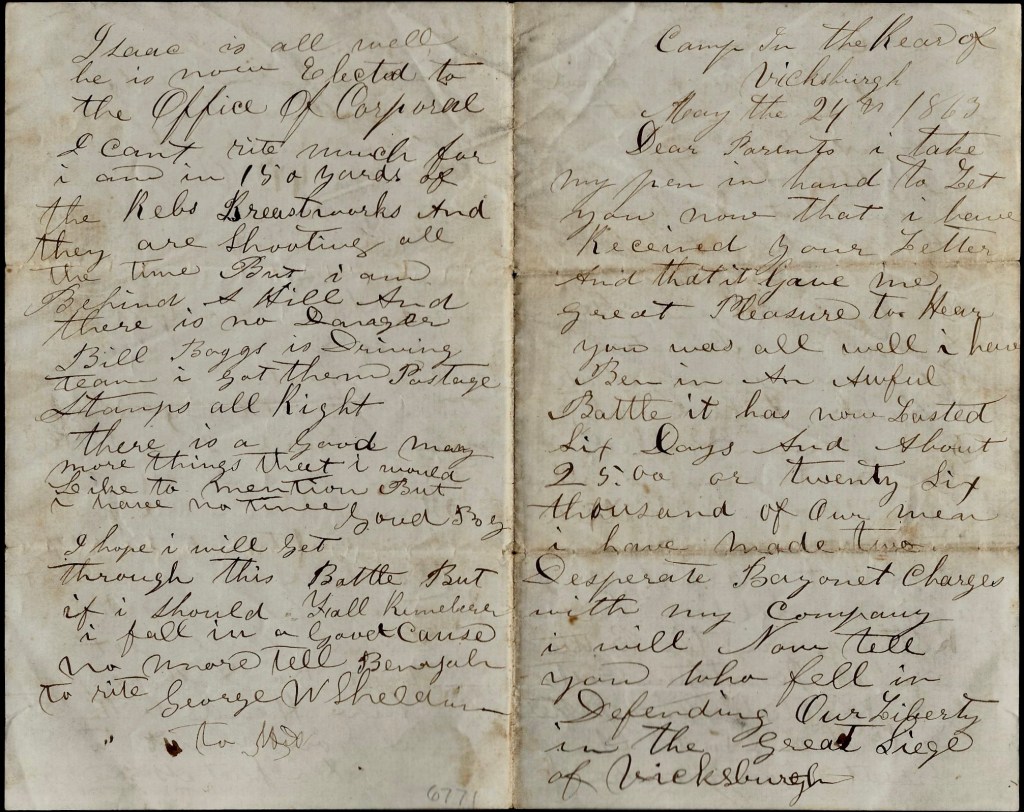
Camp in the rear of Vicksburg May 24th 1863
Dear Parents,
I take my pen in hand to let you know that I have received your letter and that it gave me great pleasure to hear you was all well.
I have been in an awful battle. It has now lasted six days and [involved] about 25 or twenty-six thousand of our men. I have made two desperate bayonet charges with my company. I will now tell you who fell in defending our liberty in the great siege of Vicksburg.
In Company E—that is my company and as brave a set of men as ever went out to battle for their country: Lieutenant [John W.] Duchemin, Orderly Sergeant Peter Hallsted, Sergeant Adrian A. Shields, Privates Francis [M.] Glancy, Mahlon T. Hall killed. Only one man killed. The rest are wounded. One man is killed, I suppose, who we cannot find. Many a poor soldier lies rotting on the battlefield. Jonathan Casto is killed. Jim Jester is killed and a great many more whose names I do not know, and God only knows how many more will fall.
The Old 47th Ohio done as good work as any soldier ever done in this or any other war. We have abandoned the idea of ever taking the city by storm so we are now fortifying and we have laid siege to the town and expect to starve them out. We have captured 13 or 14 thousand prisoners but they have a very large force yet.
That 50 dollars—you hire hands with it if you want to. Do just as you please with it. Isaac is all well. He is now elected to the office of Corporal. I can’t write much for I am in 150 yards of the Rebs’ breastworks and they are shooting all the time. But I am behind a hill and there is no danger. Bill Boggs is driving team. I got them postage stamps all right.
There is a good many more things that I would like to mention but I have no time. Goodbye. I hope I will get through this battle but if I should fall, remember I fall in a good cause. No more. Tell Benejah to write.
— George W. Sheldon
Letter 3
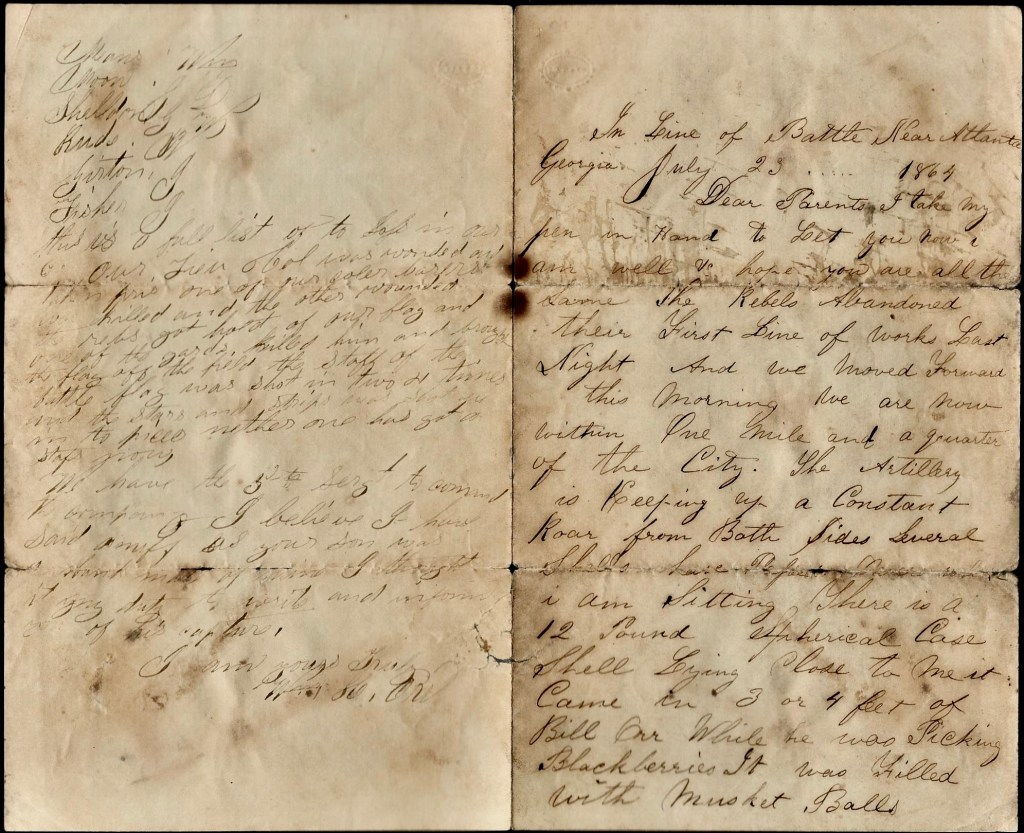
In line of Battle near Atlanta, Georgia July 23, 1864
Dear Parents,
I take my pen in hand to let you know I am well & hope you are all the same.
The Rebels abandoned their first line of works last night and we moved forward this morning. We are now within one mile and a quarter of the City. The artillery is keeping up a constant roar from both sides. Several shells have [ ] near where I am sitting. There is a 12 pound spherical case shell lying close to me. It came [with]in 3 or 4 feet of Bill Orr while he was picking blackberries. It was filled with musket balls.
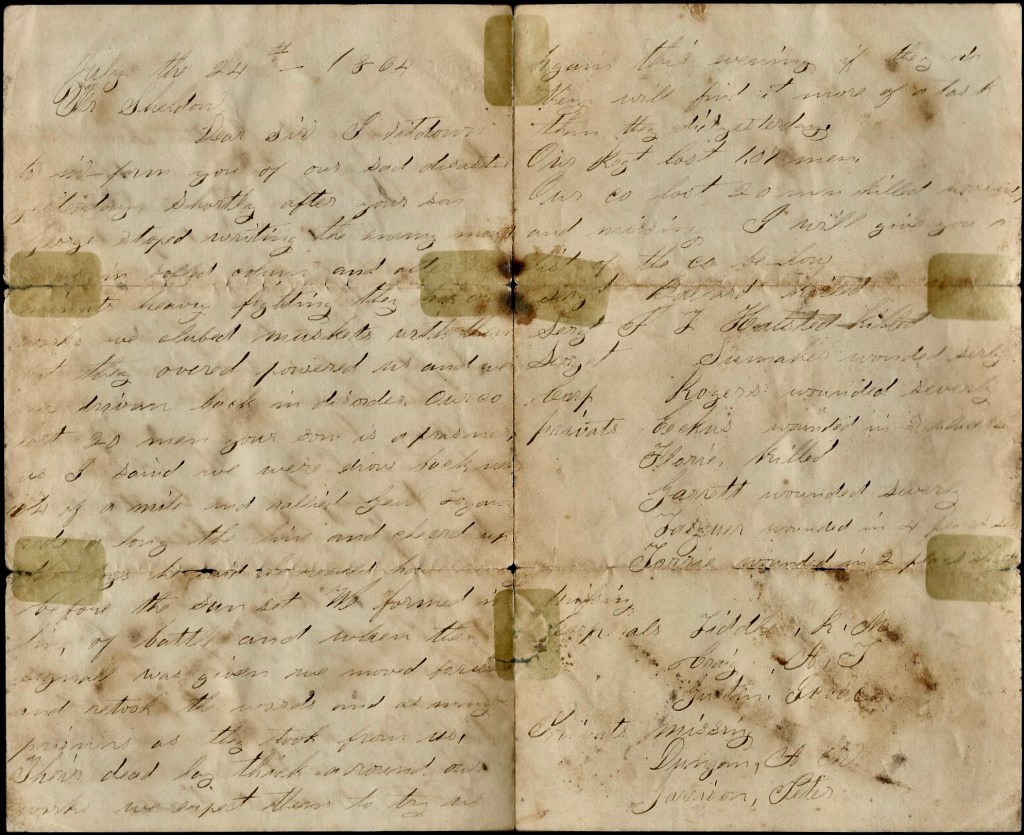
July 24, 1864—Mr. Sheldon. Dear sir, I sit down to inform you of our sad disaster yesterday. Shortly after your son George stopped writing, the enemy moved on us in solid column and after twenty minutes heavy fighting, they took our works. We clubbed muskets with them but they over powered us and we were driven back in disorder. 1 Our company lost 20 men. Your son is a prisoner.
“General Logan road along the line and cheered up the boys. He said he would have a rally before the sun set.”
William H. Orr, Co. E, 47th Ohio Infantry, 23 July 1864
As I said, we were driven back nearly one and three-quarters of a mile and rallied. General Logan road along the line and cheered up the boys. He said he would have a rally before the sun set. We formed in line of battle and when the signal was given, we moved forward and retook the works and as many prisoners as they took from us. Their dead lay thick around our works. We expect them to try us again this evening. If they do, they will find it more of a task than they did yesterday.
After Maj. General James B. McPherson was killed during the pitched fighting of 22 July 1864, Maj. General John A. “Black Jack” Logan took command and rallied the troops by riding along the line, hat in hand, and organized a successful counterattack in the Battle of Atlanta.
Our regiment lost 107 men. Our company lost 20 men killed, wounded, and missing. I will give you a list of the company below.
Sergt. [Galen B.] Ballard killed Sergt. P[eter] L. Hallsted killed Sergt. [Jesse] Shumaker wounded severely Corp. [Thomas J.] Rogers wounded severely Private [John N.] Eckes wounded in 3 places Private [Jacob B.] Flory killed Private [William] Garrett wounded severely Private [George W.] Lazure wounded in 4 places severely Private [John K. R.] Torrie wounded in two places severely Missing Corporal Liddel, R[obert] M. Corporal Craig, A[braham] T. Corporal Justin, Isaac Private Dungan, A[ndrew] W. Private Garrison, Peter Private Means, Wm. Private Moon, Private Sheldon, George W. Private Rude, [Nicodemus] Private Girton [George W.] Private Fisher, J[oshua W.]
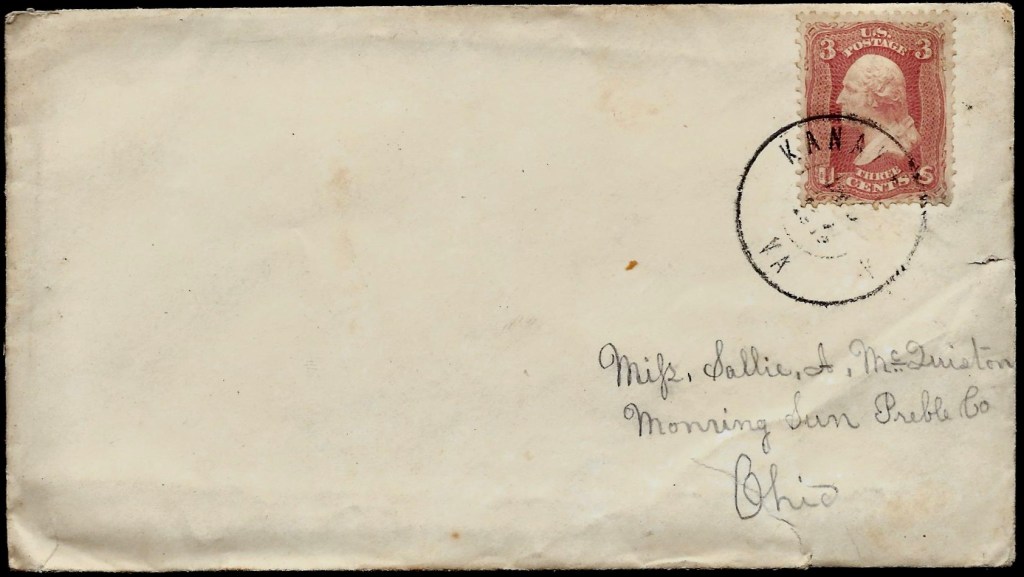
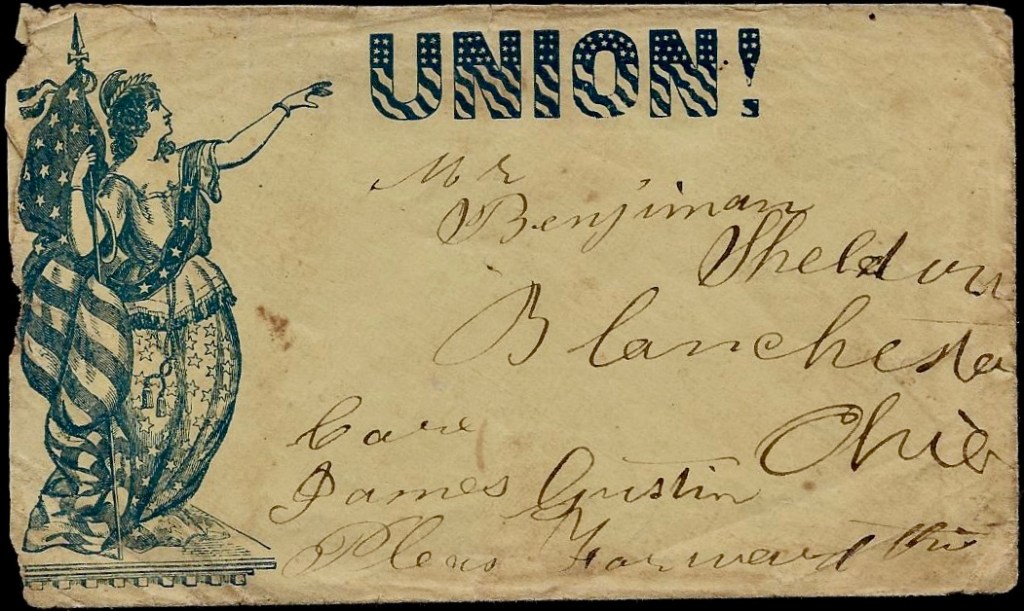
A few of the envelopes George used to send letters home to Ohio
That is a full list of to-date in our company. Our Lieut-Col. [John Wallace] was wounded and taken prisoner. One of our color bearers was killed and the other wounded. The Rebs got hold of our flag and one of the guards killed him and brought the flag off the field. The staff of the battle flag was shot in two 4 times and the stars and stripes was shot in two pieces. Neither one has got a staff now. 2
We have the 5th Sergeant to command the company. I believe I have said enough as your son was a bunk mate of mine, I thought it my duty to write and inform you of his capture.
I am your truly, — Wm. H. Orr
1 “At the works a fierce struggle and hand-to-hand conflict occurred over our colors, in which the enemy were punished most severely. In this struggle Corporal McCarthey, of the color guard, was captured; Corpl. Abraham T. Craig, of the color guard, wounded and captured, and Henry Beckman, color–sergeant, wounded. Lieut. Col. John Wallace, commanding the regiment, and Capt. H. D. Pugh were captured while bravely laboring to form a new line.” [After action report by Thomas T. Taylor, Maj., Commanding.]
2 “After proceeding a short distance, one small company and men from various regiments joined my line, swelling the number to about 250, with whom, wholly unsupported, I charged, and succeeded in approaching within a few feet of the works, when, such was the storm of fire which swept over this gallant band, that both flag-staffs were shot off and the regimental standard torn from the staff by the fragment of a shell. One of the color bearers, Corpl. Joseph Ludborough, was killed, Corporal Roemhild, of the color guard, wounded.” [After action report by Thomas T. Taylor, Maj., Commanding.]
















 Spared & Shared 23