Category Archives: 58th Pennsylvania Infantry

1862-64: Daniel Hart Eddleman to his Family

The following letters were written by Daniel Hart Eddleman (1843-1864), the son of William Eddleman (1812-1890) and Louisa Smith (1810-1889) of Germantown, Philadelphia county, Philadelphia. Daniel enlisted as a private on 6 November 1861 in Co. C, 58th Pennsylvania Volunteer Infantry.
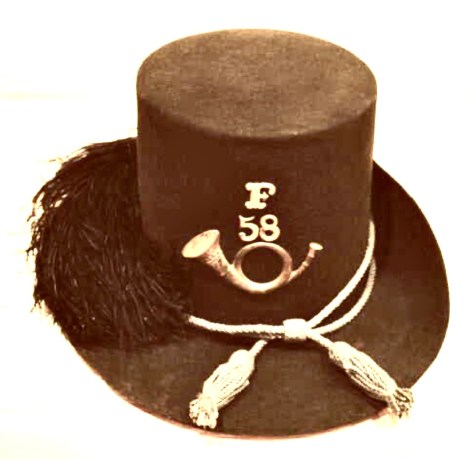
A Hardee Hat said to have been issued to a member of Co. F, 58th Pennsylvania, early in the war.

Daniel was promoted to a corporal just days before he was killed in action at the Battle of Chapin’s Farm (a.k.a. Fort Harrison, or New Market Heights) on 28 September 1864. In that action, the 58th Pennsylvania, under the command of Major Winn, led the dawn advance against Confederate Fort Harrison along with the 188th Pennsylvania. The regiments had to cross 1200 yards of open, ascending ground. In he History of the Pennsylvania Volunteers, Samuel Bates wrote that, “the two regiments moved forward at a regular pace, until within five hundred yards, when, in the face of a storm of shot and shell that swept their ranks, they rushed forward as one man until they reached the little ridge in front of the fort. Here, all, with one accord, dropped upon the ground, under partial shelter; but only for an instant; for at this moment General Ord came dashing up, and, inspired by the presence and daring of their chief, the men sprang forward with wild shouts, passed the abatis and the ditch, and scaling the parapet, drove the enemy in rout and confusion from the fort. The colors of the Fifty-eighth, which had three times fallen in the desperate onset, were planted upon the parapet by Captain Cecil Clay, who, with Adjutant Johnson, was among the first to enter the fort. As Captain Clay, who had just taken the flag from the hands of the fallen corporal, attempted to raise it upon the fort, he received two gun-shot wounds in the right arm. The flag itself was completely riddled, and the staff twice shot off. The victory was complete, and fort, heavy guns, small arms, battle-flags, and prisoners, graced the triumph of the victors.” The regiment lost six officers and 128 enlisted men of the nine officers and 228 men who began the charge.

Daniel’s older brother, Horatio Smith Eddleman (1839-1910) also served in the same company and was wounded at Chapin’s Farm but survived the battle and mustered out of the regiment as a sergeant in June 1865. Horatio was married to Sarah A. Jones (1843-1913) before entering the service.

For other letters by members of the 58th Pennsylvania, previously transcribed and published by Spared & Shared, see:

George W. Glidewell, Co. B, 58th Pennsylvania (2 Letters)
Frank W. Davis, Co. E, 58th Pennsylvania (3 Letters)
Cornelius Robbins, Co. E, 58th Pennsylvania (1 Letter)
Theodore F. Ostrander, Co. F, 58th Pennsylvania (4 Letters)
William W. Wells, Co. F, 58th Pennsylvania (1 Letter)
Adam Richter, Co. G, 58th Pennsylvania (1 Letter)
George Richter, Co. G, 58th Pennsylvania (1 Letter)
William Almon Wilmarth, Co. H, 58th Pennsylvania (1 Letter)

Confederate Fort Harrison following its capture on 28 September 1864.

Letter 1

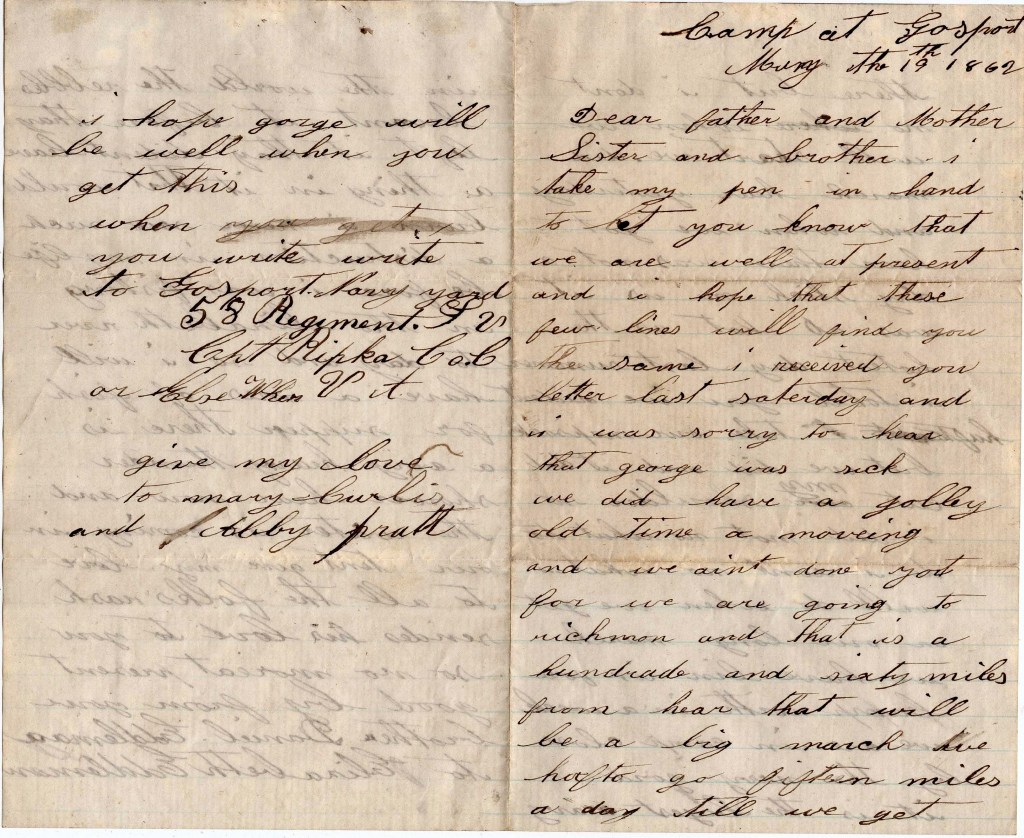
Camp at Gosport [Navy Yard]
May 19, 1862

Dear Father and Mother, sister and brother,

I take my pen in hand to let you know that we are well at present and I hope that these few lines will find you the same. I received your letter last Saturday and I was sorry to hear that George was sick.

We did have a jolly old time a moving and we ain’t done yet for we are going to Richmond adn that is a hundred and sixty miles from here. That will be a big march. We have to go fifteen miles a day till we get there but I don’t know when we will start. We did march here yesterday and when we got here, there was not a dry stitch on us. It was as hot as the hottest day last summer. I told you we didn’t have to take our knapsacks but we did and it did cut my shoulder so I did not know what to do. I don’t know what I will do when we get our long march.

Capt. Alfred Ripka, Co. C, 58th Penn. Volunteer. Infantry (Diane Solsiete Collection)

We have been in four camps within a week. We are in camp close by the Navy Yard. It is the biggest navy [yard] in the world. The rebels burnt it before they left it. They didn’t leave a thing in it that would burn. I never saw such a destruction in my life before.

I was fishing in ythe Elizabeth River today and so I will have a mess of fish for supper. There is a very heavy thunder shower here now and the water is coming in our tent.

Give my love to all the folks. Rash [Horatio] sends his love to you. So no more at present. Goodbye from your brother, Daniel Eddleman

To Elizabeth Eddleman

I hope George will be well when you get this. When you write, write to Gosport Navy Yard, 58th Regiment P. V., Capt. [Alfred] Ripka, Co. C, or elsewhere. Give my love to Mary Curlis and Abby Pratt.

Letter 2

Camp near the [Gosport] Navy Yard
May 30, 1862

Dear father and mother, sister and brother,

I take my pen in hand to let you know that we are well at present and I hope that these few lines will find you the same. I received your letter last Wednesday and was glad to hear that George was a getting better.

We have had another move but not far. We are about a mile from the [Gosport] Navy Yard. The Colonel says we will lay here a good while. We are a mounting cannons. All along where we are there is a big breastwork throwed up and the cannons is on it. The whole Division is along it. If the rebels does retreat from Richmond, we do expect them to come back here. They told the citizens when they went away they would be back in a short time but I think they will have fun before they get here.

Washington is in danger again. They have sent all the home guards there and five or six regiments of volunteers from New York.

I got a letter from John last week and they said they was all well.

We are in camp in a a eight-acre corn field. The corn is six inches high. The man that owns it would not take the Oath of Allegiance and so they have destroyed it for him. He come through here yesterday and he looked as sour as the sour end of a sweet pickle.

I have just signed the pay roll to get paid. We will get paid tomorrow if nothing happens.

I went to the Episcopal Church last Sunday and he had a very nice sermon but he did not pray for the President of the United States.

It does rain most every other day here and when it don’t rain, it is so warm that we sweat and get as wet as when it rains.

They are making a law to send all of the married men home and keep the single ones for five years.

It is getting so warm that I must fetch my letter to a close so give my love to Sally and Agnes and Deal and Mary and to all of the rest of the folks, and keep a good share of it yourself. So goodbye from your brother, — Daniel Eddleman

to his sister, Elizabeth Eddleman

Write to Mr. Daniel Eddleman, Gosport Navy Yard, 58th Regiment P. V., Capt. Ripka, Co. C, Vol. Infantry, or elsewhere.

Tell Mary Curlis I will answer her letter as soon as I get it. Send some post stamps. I do owe six now.


Letter 3

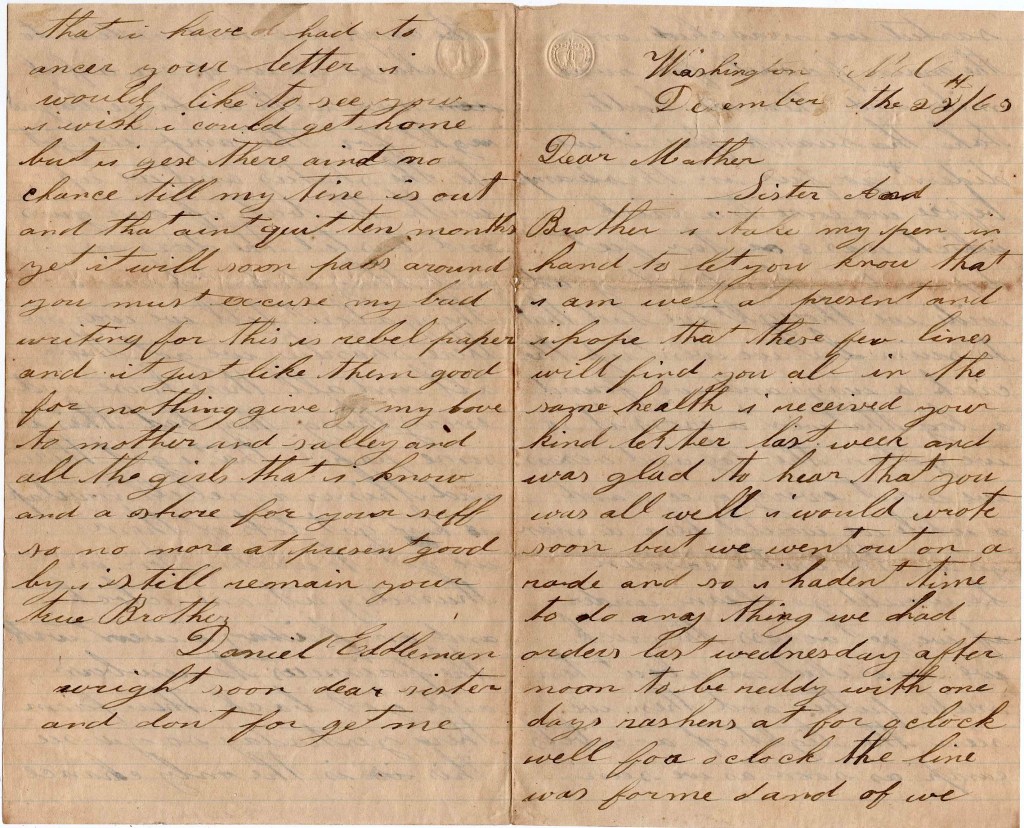
Washington, North Carolina
December 22, 1863

Dear Mother, Sister and Brother,

I take my pen in hand to let you know that I am well at present and I hope that these few lines will find you all in the same health. I received your kind letter last week and was glad to hear that you was all well. I would wrote soon[er] but we went out on a raid and so I hadn’t time to do anything.

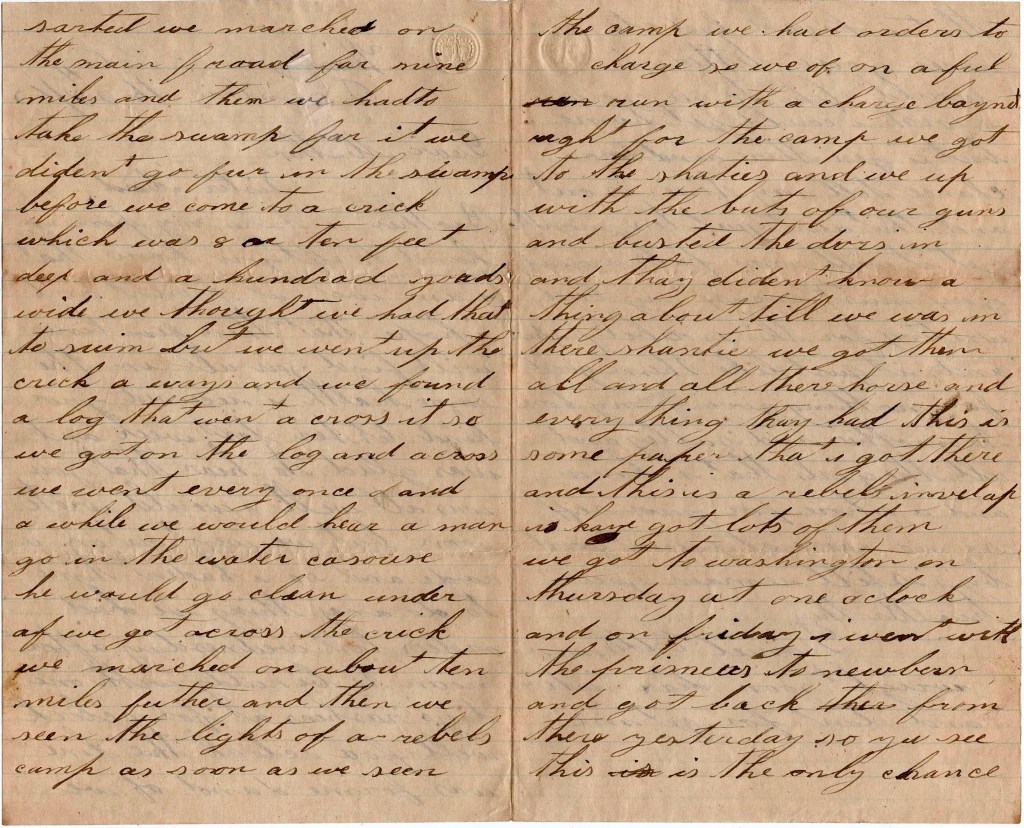
We had orders last Wednesday afternoon to be ready with one days rations at four o’clock. Well [at] four o’clock the line was formed and off we started. We marched on the main road for nine miles and then we had to take the swamp. We didn’t go far in the swamp before we come to a crick which was 8 or ten feet deep and a hundred yards wide. We thought we had that to swim but we went up the crick a ways and we found a log that went across it so we got on the log and across we went. Every once and awhile we would hear a man go in the water course. He would go clean under.

After we got across the crick, we marched on about ten miles further and then we seen the lights of a rebel’s camp. As soon as we seen the camp, we had orders to charge so we [went] off on a full run with a charge bayonet right for the camp. We got to the shanties and we up with the butts of our guns and busted the doors in, and they didn’t know a thing about [it] till we was in their shanties. We got them all and all their horses and everything they had. This is some paper that I got there and this is a rebel’s envelope. I have got lots of them.

We got [back] to Washington on Thursday at one o’clock and on Friday I went with the prisoners to Newbern and got back from there yesterday, so you see this is the only chance that I have had to answer your letter.

I would like to see you. I wish I could get home but I guess there ain’t no chance till my time is out and that ain’t quite ten months yet. It will soon pass around. You must excuse my bad writing for this is rebel paper and it’s just like them—good for nothing. Give my love to mother and Sally and all the girls that I know, and [keep] a share for yourself. So no more at present. Goodbye. I still remain your true brother, — Daniel Eddleman

Write soon, dear sister, and don’t forget me.

Letter 4

Camp Front of Petersburg
May 8, 1864

Dear Mother, Sister and Brother,

I take my pen in hand to let you know that I am well at present and I hope that these few lines will find you in good health and spirits.

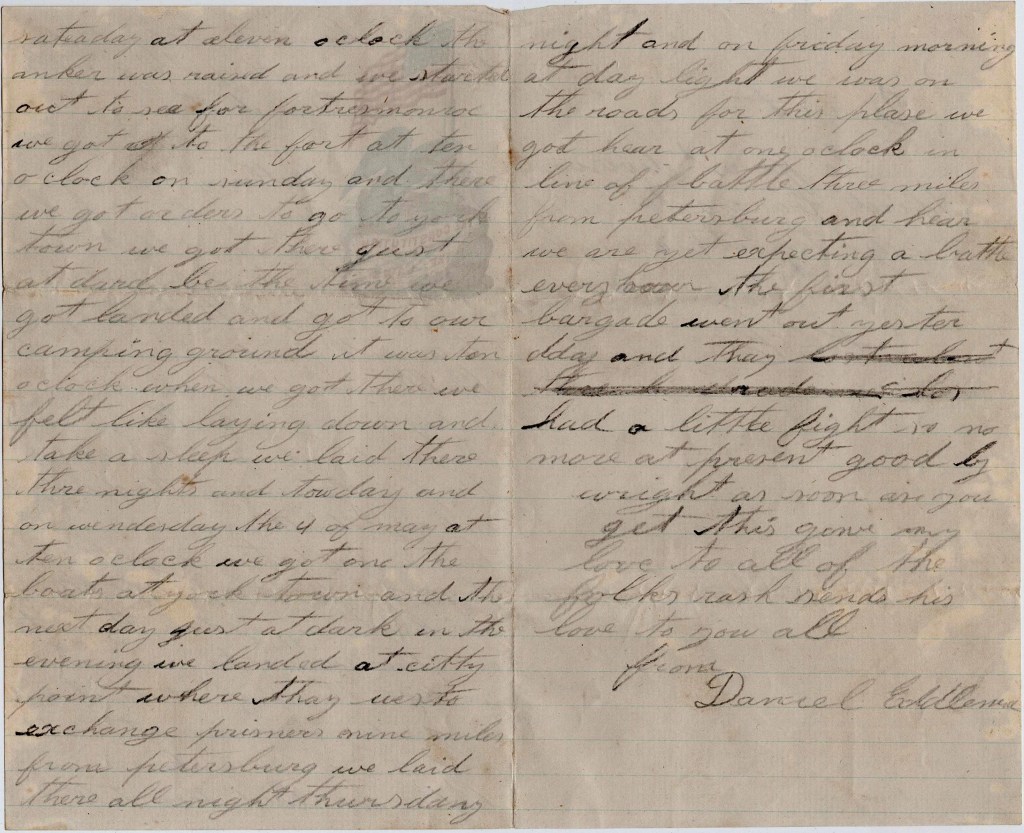
We are in a big army now. There is sixty thousand men in it. We are in the First Division, Third Brigade, and Eighteenth Army Coreps. We had a hard time a getting here. We did evacuate Little Washington. We got on the boat on Thursday afternoon the 28th and we left the wharf at dark, and on Friday morning at ten o’clock, we was anchored in Hatteras. We laid there till Saturday. At eleven o’clock the anchor was raised and we started out to sea for Fortress Monroe. We got to the fort at ten o’clock on Sunday and there we got orders to go to Yorktown. We got there just at dark. By the time we got landed and got to our camping ground, it was ten o’clock. When we got there, we felt like laying down and take a sleep.

We laid there three nights and two days, and on Wednesday the 4th of May at ten o’clock, we got on the boats at Yorktown and the next day, just at dark in the evening, we landed at City Point where they was to exchange prisoners nine miles from Petersburg. We laid there all night Thursday night and on Friday morning at day light, we was on the road for this place. We got here at one o’clock in line of battle, three miles from Petersburg, and here we are yet, expecting a battle every hour. The First Brigade went out yesterday and they had a little fight.

So no more at present. Goodbye. Write as soon as you get this. Give my love to all of the folks. Rash [Horatio] sends his love to you all. From, — Daniel Eddleman

Direct to First Division, Third Brigade, and Eighteenth Army Corp, 58th Regiment, Pennsylvania Volunteers, Co. C.

1862: William Almon Wilmarth to his Adopted Family

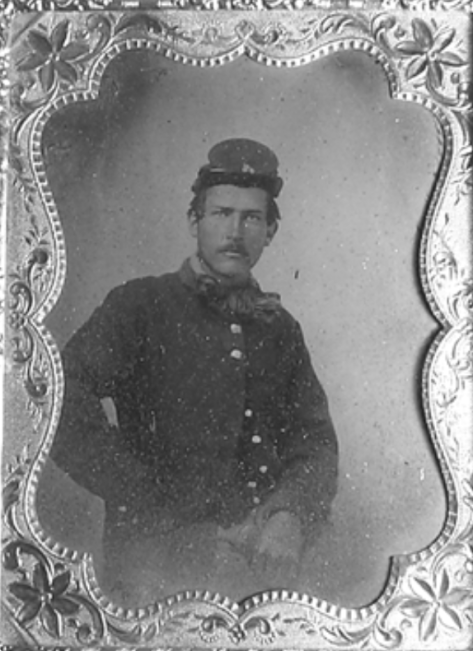
I could not find an image of William but here is one of Joseph H. Snyder who served in Co. I, 58th Pennsylvania Infantry (Photo Sleuth)

This letter was written by William Almon Wilmarth (1838-1914) of Co. H, 58th Pennsylvania Infantry. William enlisted in December 1861 and mustered out of the service in December 1864. An obituary informs us that during “the winter of 1863 at Little Washington, N.C., he was detailed as guard on a government transport about three months and in the spring of 1863 he was attached to Co. M, 4th US Art., about two months. On June 4, 1864, at Cold Water, Va., he received a gunshot wound in right leg and was in a hospital at Point Lookout, Md., about four weeks with fever and ague. He took part in the battles of Norfolk, Gum Swamp, Sandy Ridge, Drewry’s Bluff, Cold Harbor and Fort Harrison, Va.”

William was the son of Nelson Wilmarth (1812-1847) and Matilda Morris (1816-1838) of McKean county, Pennsylvania. When William’s mother died in childbirth, William was raised by William Lamphier and Calista Hazen.

T R A N S C R I P T I O N

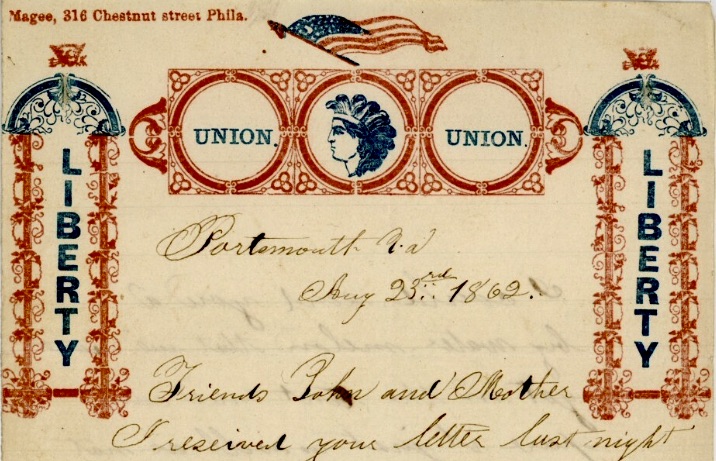
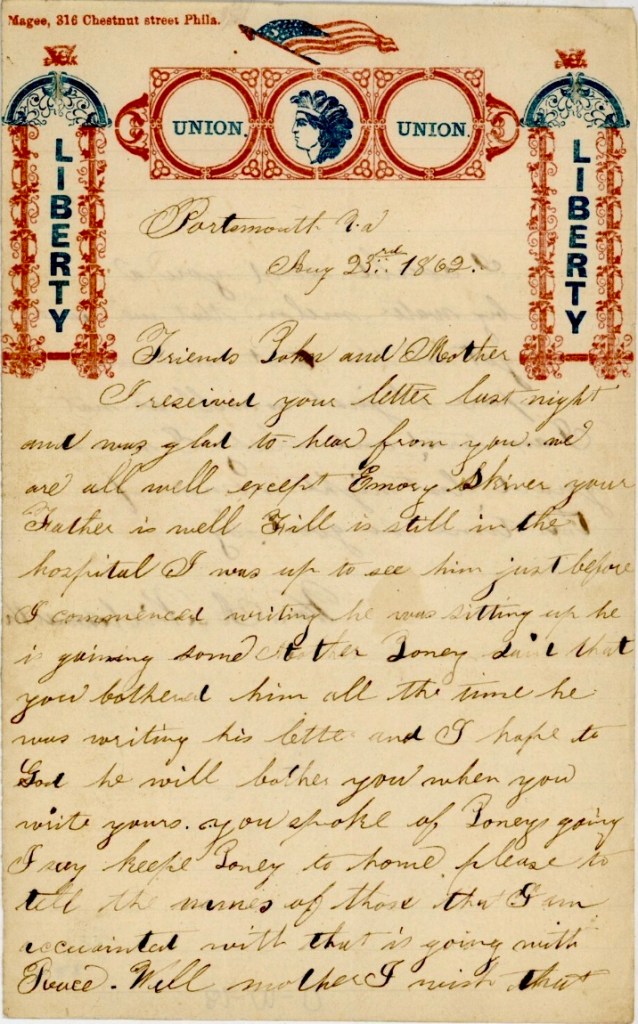
Patriotic Letterhead on William’s stationery.

Portsmouth, Va.
August 25th 1862

Friends John and Mother,

I received your letter last night and was glad to hear from you. We are all well except Emory Skiver. Your father is well. Fill is still in the hospital. I was up to see him just before I commenced writing. He was sitting up. He is gaining some. Mother, Toney said that you bothered him all the time he was writing his letter and I hope to God he will bother you when you write yours. You spoke of Toney’s going. I say keep Toney to home. Please to tell the names of those that I am acquainted with that is going with Pence.

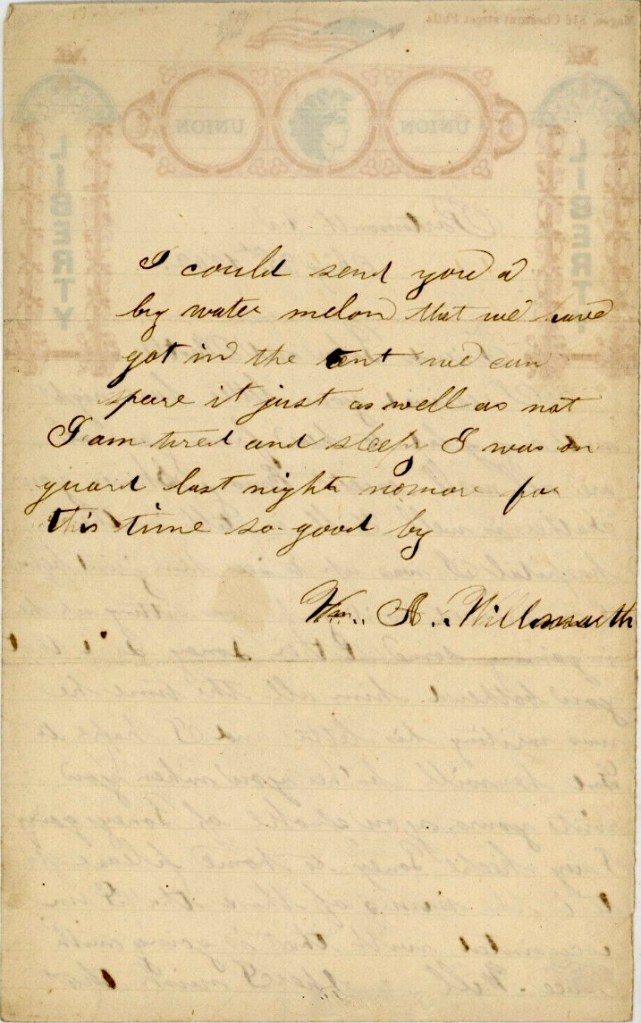
Well, Mother, I wish that I cuold send you a big water melon tat we have got in the tent. We can spare it just as well as not. I am tired and sleepy. I was on guard last night. No more for this time. So goodbye. — Wm. A. Willmarth

1862: Cornelius Robbins to his Family

The following letter was written by 52 year-old Cornelius Robbins (1810-1895) of Kingston, Luzerne county, Pennsylvania. Cornelus claimed he was only 40 years old when he enlisted in late November 1861 to serve in Co. E (later transferred to Co. I) of the 58th Pennsylvania Infantry. He mustered out of the service after three years on 7 December 1864, though he suffered from yellow fever during part of that time.

Cornelius was married to Hannah Wiggins (1808-1873) in 1830 and the couple lived in Owego, New York, for a time before taking up residence in Kingston. They had at least five children before 1850—three of who were still living at home with him at the time of the 1860 US Census. One of his sons, John Robbins (1833-1864), died while serving in Co. I, 143rd Pennsylvania Infantry.

The 58th Pennsylvania saw duty at Camp Hamilton, Va., until May 10, 1862. They then occupied Norfolk and Portsmouth from early May till October 11, 1862. They were then ordered to Suffolk, Va.and were on duty there until January, 1863.

Cornelius Robbins in his GAR cap and coat. Luzerne county, Pennsylvania.

Transcription

Camp near Norfolk, Virginia
July 9, 1862

My dear family and friends,

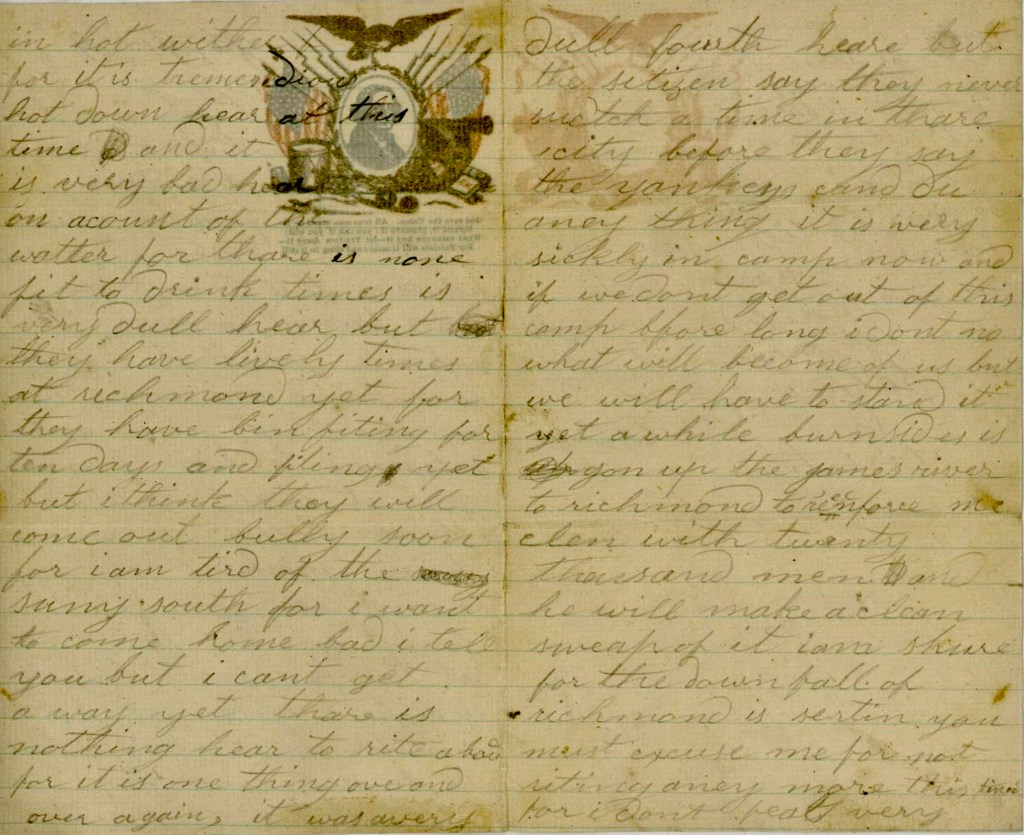
It is with pleasure that I embrace this present moment to inform you that I received your kind and welcome letter in the 8th inst. with great pleasure to hear from you. It does me great pleasure to read yours from home—especially when I can’t see you for it found me in poor health at the present. But I hope I will get better soon for it is a hard place to be sick down here in hot weather for it is tremendous hot down here at this time and it is very bad here on account of the water for there is none fit to drink.

Times is very dull here but they have lively times at Richmond yet for they have been fighting for ten days and fighting yet, But I think they will come out bully soon for I am tired of the Sunny South for I want to come home bad, I tell you. But I can’t get away yet. There is nothing here to write about for it is one thing over and over again. It was a very dull 4th [of July] here but the citizens say they never [had] such a time in their city before. They say the Yankees can’t do anything.

It is very sickly in camp now and if we don’t get out of this camp before long, I don’t know what will become of us. But we will have to stand it yet awhile. Burnsides is gone up the James river to Richmond to reinforce McClellan with twenty thousand men and he will make a clean sweep of it, I am sure, for the downfall of Richmond is certain.

You must excuse me for not writing any more this time for I don’t feel very smart. Write as soon as you get this, if not before. But write soon. Write often, and write immediately. So goodbye till you hear from me again and be good children till you see your husband and father, — C. Robbins

Cornelius Robbins

1864-65: Frank W. Davis to Friend Sylvester

These letters were written by Frank W. Davis (1844-1920) who enlisted as a private in November 1861 to serve in Co. E, 58th Pennsylvania and worked his way up to corporal, to sergeant, to 1st sergeant, and finally to 1st Lieutenant by late December 1864. He mustered out with the company as a veteran in mid-June 1865.

Frank was an 18 year-old carpenter from Bradford, McKean county, Pennsylvania, when he enlisted. He was described as 5′ 4.5″ with brown hair and grey eyes by the enlistment officer. His parents were Reuben Davis (b. 1814) and Sarah C. Moore (b. 1820).

One of Frank’s letter is critical of Gen. Benjamin Butler who was finally dismissed by General Grant for failing to capture Fort Fisher and withdrawing his troops without authorization in December 1864.

Letter 1

Headquarters Co. E, 58th P. V.
December 13th 1864

Friend Sylvester,

Yours of the 6th inst. was received tonight and I was much pleased to hear from you and get the news from Bradford for you are about the only one that writes the daily occurrences around Bradford.

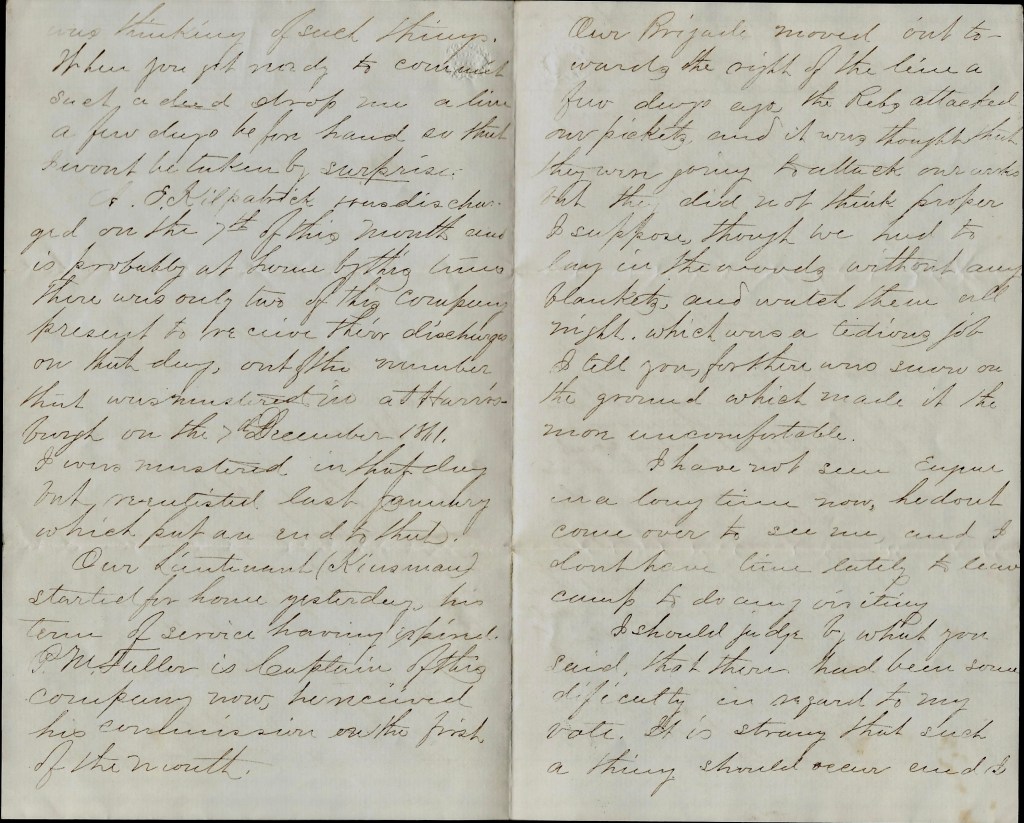
It seems that there has been a wedding at Bradford lately. I have heard that once or twice before and then heard again that it was not so. However, I think that there must be something in it. I shall expect to hear of your splicing yourself to some fair schoolmate of ours before a great while, for it is getting about time that you was thinking of such things. When you get ready to commit such a deed, drop me a line a few days before hand so that I won’t be taken by surprise.

A. E. Kilpatrick was discharged on the 7th of this month and is probably at home by this time. There was only two of this company present to receive their discharges on that day out of the number that was mustered in at Harrisburg on the 7th December 1861. I was mustered in that day but reenlisted last January which put an end to that. Our Lieutenant (Kinsman) started for home yesterday, his term of service having expired. P. M. Fuller is Captain of this company now. He received his commission on the first of the month.

Our Brigade moved out towards the right of the line a few days ago. The Rebs attacked our pickets and it was thought that they were going to attack our works but they did not think proper, I suppose, though we had to lay in the woods without any blankets and watch them all night which was a tedious job, I tell you, for there was snow on the ground which made it the more uncomfortable.

I have not seen Eugene [Holmes] in a long time now. He don’t come over to see me and I don’t have time lately to leave camp to do any visiting.

I should judge by what you said that there had been some difficulty in regard to my vote. It is strange that such a thing should occur and I did not hear of it before. Wish that you would give me the particulars of the case when you write again for there must be some fraud connected with it either here or at Bradford. Very singular circumstance, I should say. Should like to hear who presented the vote, and whether it was thought by anyone that I was concerned in any fraud or trying to vote illegally. Don’t be afraid of hurting my feelings in explaining the matter for I am anxious to know what it means. I have no doubt but what there was thousands of illegal votes cast at the last election, but I had no hand in them, I consider this holding election in the army a humbug, for the reason that it gives persons that are disposed to commit fraud too much chance, and there is a great many such persons no matter what their politics is. The idea of being victorious at election will prompt most anything.

Hoping that I may hear from you soon, I close with my best regards to all friends and acquaintances, and a large amount for yourself. Very truly yours, — F. W. Davis, Orderly Sergeant, Co. E


Letter 2

[Note: This letter is from the private collection of Greg Herr and was transcribed and published by express consent.]

Chapin’s Farm, Virginia
January 9th 1865

Friend Sylvester,

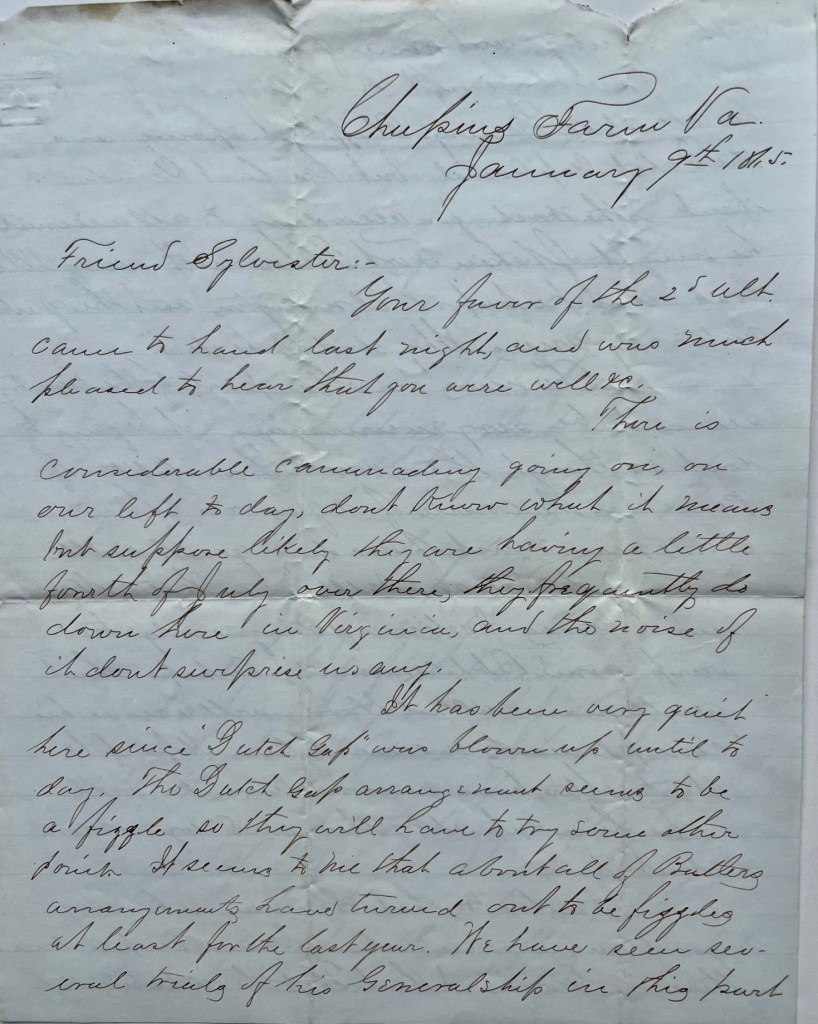
Your favor of the 2nd ult. came to hand last night and was much pleased to hear that you were well, &c.

There is considerable cannonading going on, on our left today. Don’t know what it means but suppose likely they are having a little Fourth of July over there. They frequently do down here in Virginia and the noise of it don’t surprise us any.

Benjamin Butler faced “several trials of his generalship” in 1864 and was dismissed by Grant on 8 January 1865.

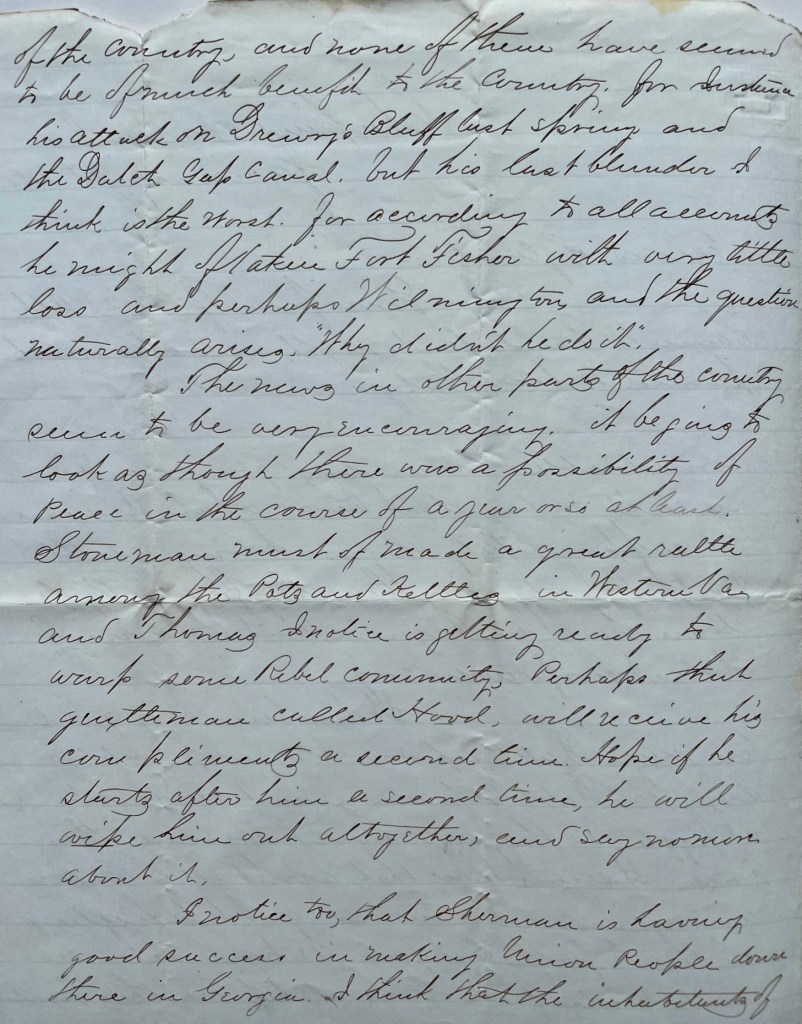
It has been very quiet here since “Dutch Gap” was blown up until today. The Dutch Gap arrangement seems to be a fizzle so they will have to try some other point. It seems to me that about all of Butler’s arrangements have turned out to be fizzles—at least for the last year. We have seen several trials of his Generalship in this part of the country and none of them have seemed to be of much benefit to the country. For instance, his attack in Drewry’s Bluff last spring and the Dutch Gap Canal, but his last blunder I think is the worst, for according to all accounts, he might of taken Fort Fisher with very little loss and perhaps Wilmington and the question naturally arises, “Why didn’t he do it?”

The news in other parts of the country seems to be very encouraging. It begins to look as though there was a possibility of peace in the course of a year or so at least. Stoneman must of made a great rattle among the pots and kettles in Western Virginia and Thomas I notice is getting ready to [ ] some Rebel community. Perhaps that gentleman called Hood will receive his compliments a second time. Hope if he starts after him a second time, he will wipe him out altogether and say no more about it.

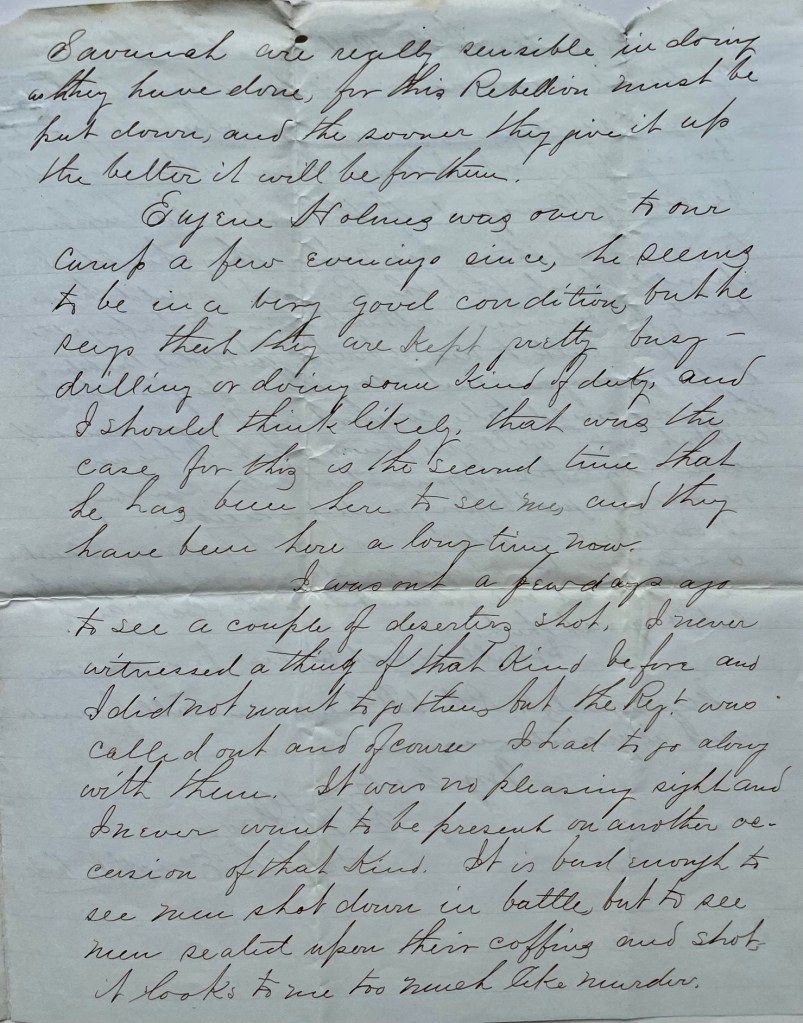
I notce too that Sherman is having good success in making Union people down there in Georgia. I think that the inhabitants of Savannah are really sensible in doing as they have done for this Rebellion must be put down, and te sooner they give it up the better it will be for them.

Eugene Holmes was over to our camp a few evenings since. He seems to be in a very good condition but he says that they are kept pretty busy—drilling or doing some kind of duty, and I should think likely that was the case for his is the second time that he has been here to see me, and they have been here a long time now.

I was out a few days ago to see a couple of deserters shot. I never witnessed a thing of that kind before and I did not want to go then but the regiment was called out and of course I had to go along with them. It was no pleasing sight and I never want to be present on another occasion of that kind. It is bad enough to see men shot down in battle but to see men seated upon their coffins and shot. It looks to me too much like murder.

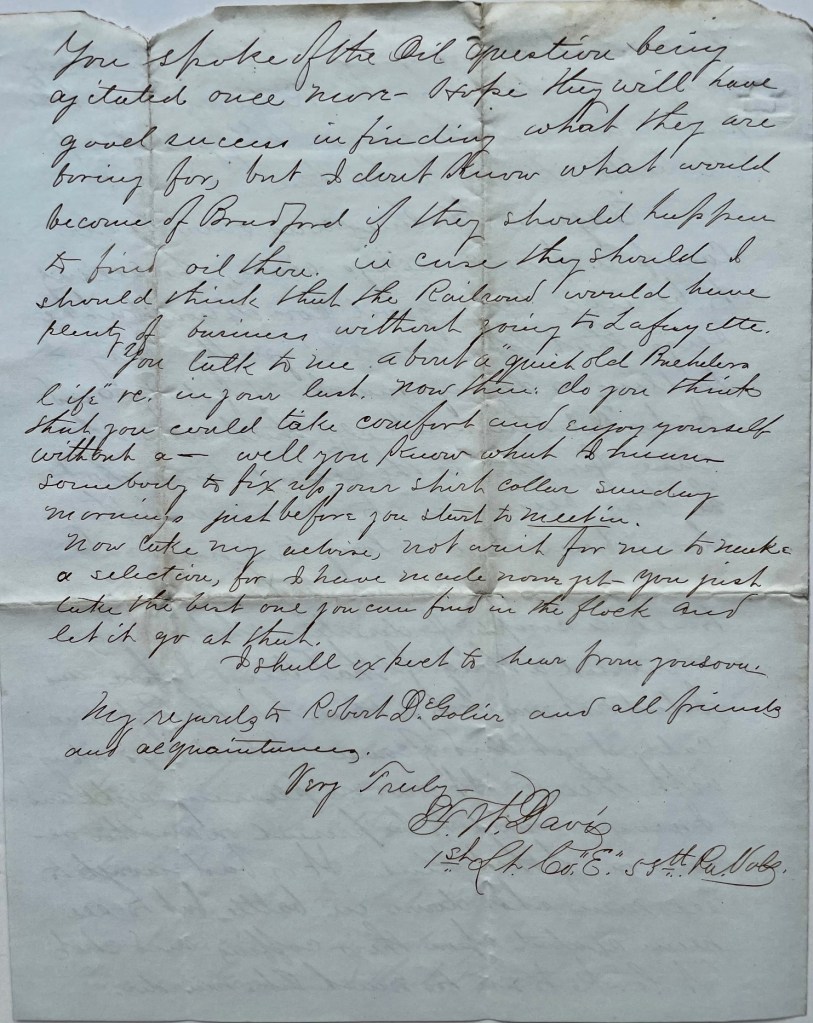
You spoke of the Oil Question being agitated once more. Hope they will have good success in finding what they are boring for, but I don’t know what would become of Bradford if they should happen to find oil there. In case they should, I should think that the railroad would have plenty of business without going to Lafayette.

You talk to me about a “quiet old bachelor’s life” &c. in your last. Now then, do you think that you could take comfort and enjoy yourself without a —- well, you know what I mean. Somebody to fix up your shirt collar Sunday mornings just before you start to meetin’.

Now take my advice, do not wait for me to make a selection for I have made none yet. You just take the nest one you can find in the flock and let it go at that. I sall expect to hear from you soon.

My regards to Robert D. Golier and all friends and acquaintances. Very truly, — F. W. Davis, 1st Lt., Co. E, 58th Pa. Vols.


Letter 3

Camp 58th Pennsylvania Vols.
February 14th 1865

Friend Sylvester,

Your letter of the 4th inst. was received day before yesterday just before going on picket. Was much pleased to hear of your good health, &c. Hope you are having pleasant times on Tuna [?] now; plenty of good sleighing there no doubt, and plenty of girls to ride with you, so I don’t know of any good reason why you should not enjoy yourself largely. There is no snow on the ground here but it is quite cold and frosty, and very uncomfortable on picket. Have to keep kicking around on picket to keep our blood in circulation.

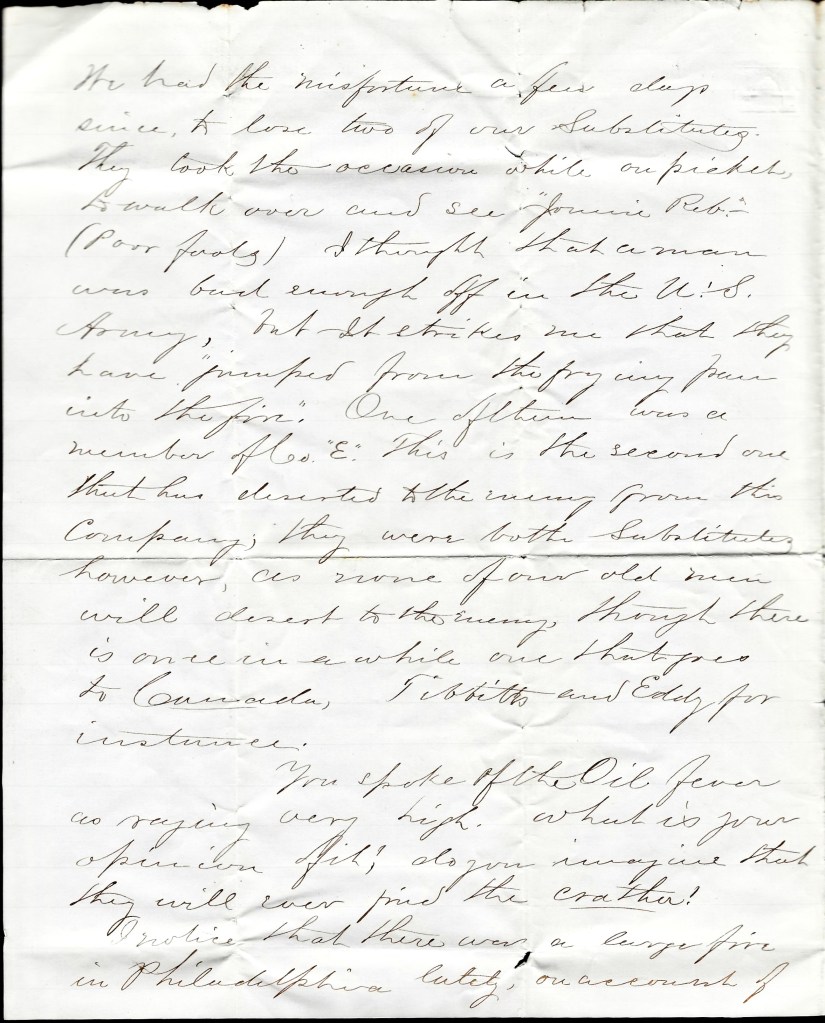
We had the misfortune a few days since to lose two of our substitutes. They took the occasion while on picket to walk over and see “Johnny Reb” (poor fools). I thought that a man was bad enough off in the U. S. ARmy but it strikes me that they have “jumped from the frying pan into the fire.” One of them was a member of Co. E. This is the second one that has deserted to the enemy from this company; they were both substitutes however, as none of our old men will desert to the enemy though there is once in a while one that goes to Canada. Tibbits and Eddy for instance.

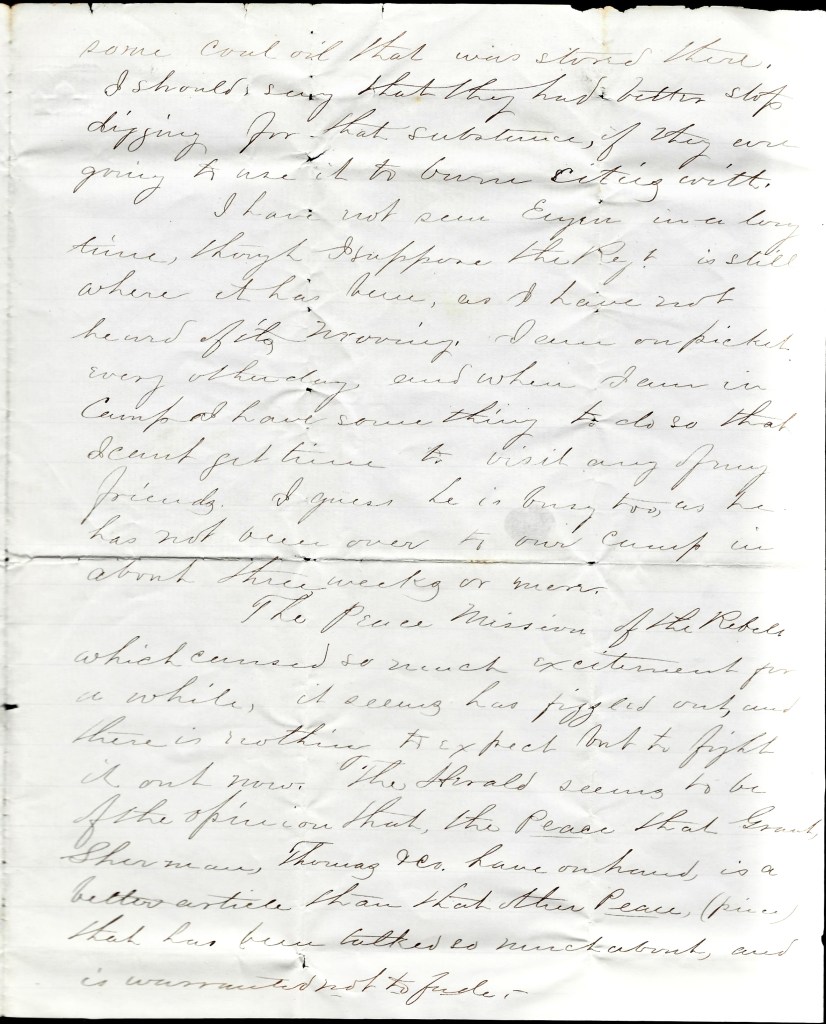
You spoke of the Oil fever as raging very high. What is your opinion of it? Do you imagine that they will ever find the crather! I notice that there was a large fire in Philadelphia lately on account of some coal oil that was stored there. I should say that they had better stop digging for that substance if they were going to use it to burn cities with.

I have not see Eugene [Holmes] in a long time though I suppose the regiment is still where it has been as I have not heard of its moving. I am on picket every other day and when I am in camp, I have something to do so that I can’t get time to visit any of my friends. I guess he is busy too as he has not been over to our camp in about three weeks or more.

The Peace Commission of the Rebels which caused so much excitement for a while it seems has fizzled out, and there is nothing to expect but to fight it out now. The Herald seems to be of the opinion that the peace that Grant, Sherman, Thomas, & co. have on hand is a better article than that other peace (piece) that has been talked so much about and is warranted not to fade.

You mentioned in your last that you had heard that I was a prisoner, etc. They have had me dead once or twice on Tuna [?] but this is the first time that I have heard of their having me a prisoner. Wonder what they will have next. You wished to know the whole truth and nothing but the truth, and the truth is, I never was a prisoner, not “if the court knows herself ad she thinks she does.”

My regards to all friends and acquaintances in Bradford. With many good wishes for your health and happiness, I remain yours truly, — F. W. Davis