This beautifully written letter was penned by Cardella E. Brown (1841-1896) who was a clerk at the Connecticut Mutual Insurance Company in Hartford, Connecticut in 1860. His parents were divorced and he lived with his mother in Hartford while his father lived in New York City with his second wife and Cardella’s brother Gerald and sister Lulette, while Brown’s other brother Henry was employed as a printer in Boston.
In September, 1861, Brown was mustered in as a Corporal in Co. B of the 6th Connecticut Regiment. He served three years and muster rolls record that he was discharged in September 1864 as a Sergeant. It’s presumed that Cardella elected to stay with the army following his discharge to serve as a civilian in the commissary. Suffering from depression, Cardella shot himself in 1896 at the age of fifty-five, leaving a widow and three sons—one of whom was named Cardella Drake Brown (the “Drake,” no doubt, from his “Uncle Drake” who is mentioned in this letter.)
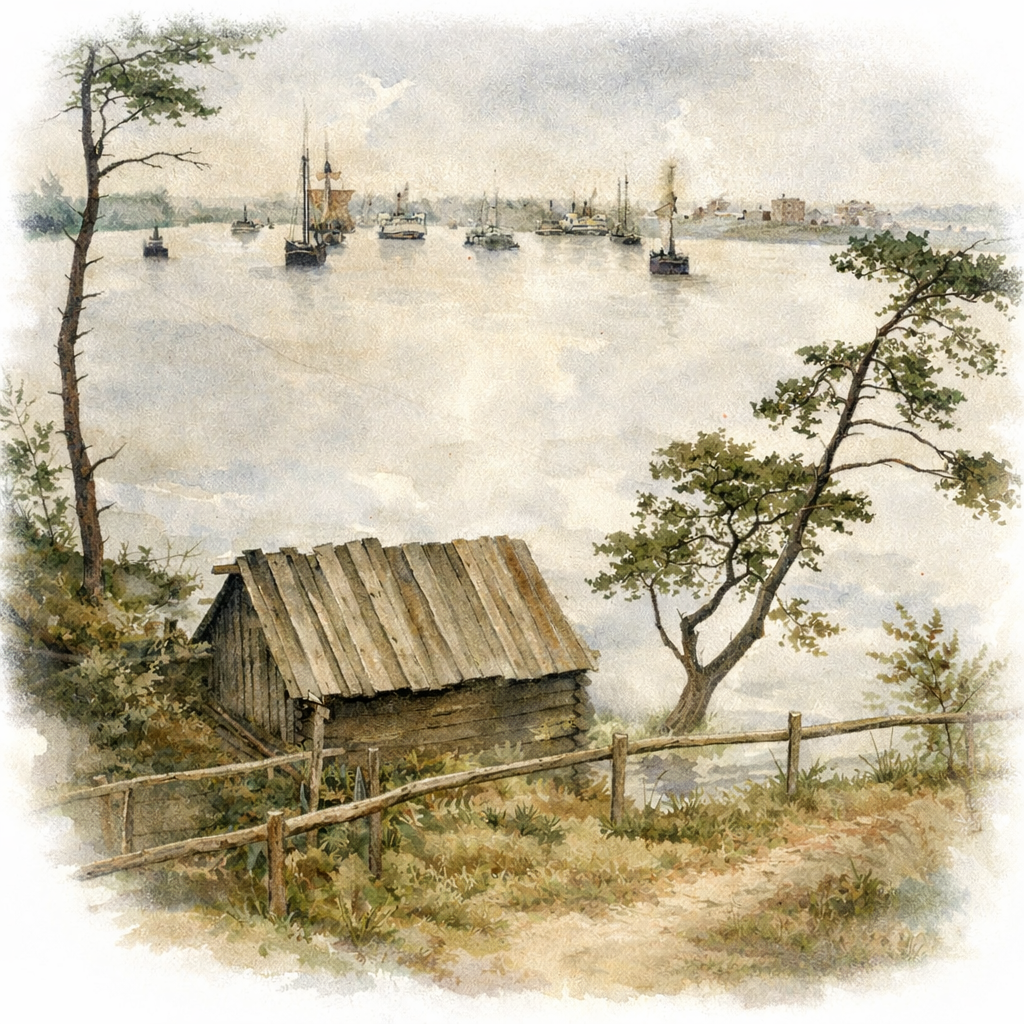
James’ Landing, Virginia in 1864
The Huntington library holds three volumes belonging to Cardella E. Brown. The first is a letterpress copybook containing approximately 100 outgoing personal letters Brown wrote from 1859 to 1861 while he was living in Hartford, Connecticut and working as a clerk at Connecticut Mutual Insurance Company. The letters are addressed to Brown’s parents, siblings, a cousin, and other family members and friends. The detailed and candid letters are written in a conversational tone devoid of usual epistolary formalities. The letters comment on a wide range of topics, including Brown’s personal life and sexuality, goings on in Hartford, and state and national politics of the 1860 election year. He talks in detail about Stephen A. Douglass, the anticipated secession of South Carolina, the Buchanan administration, and the hanging of John Brown. [Archived @ The Huntington]
T R A N S C R I P T I O N
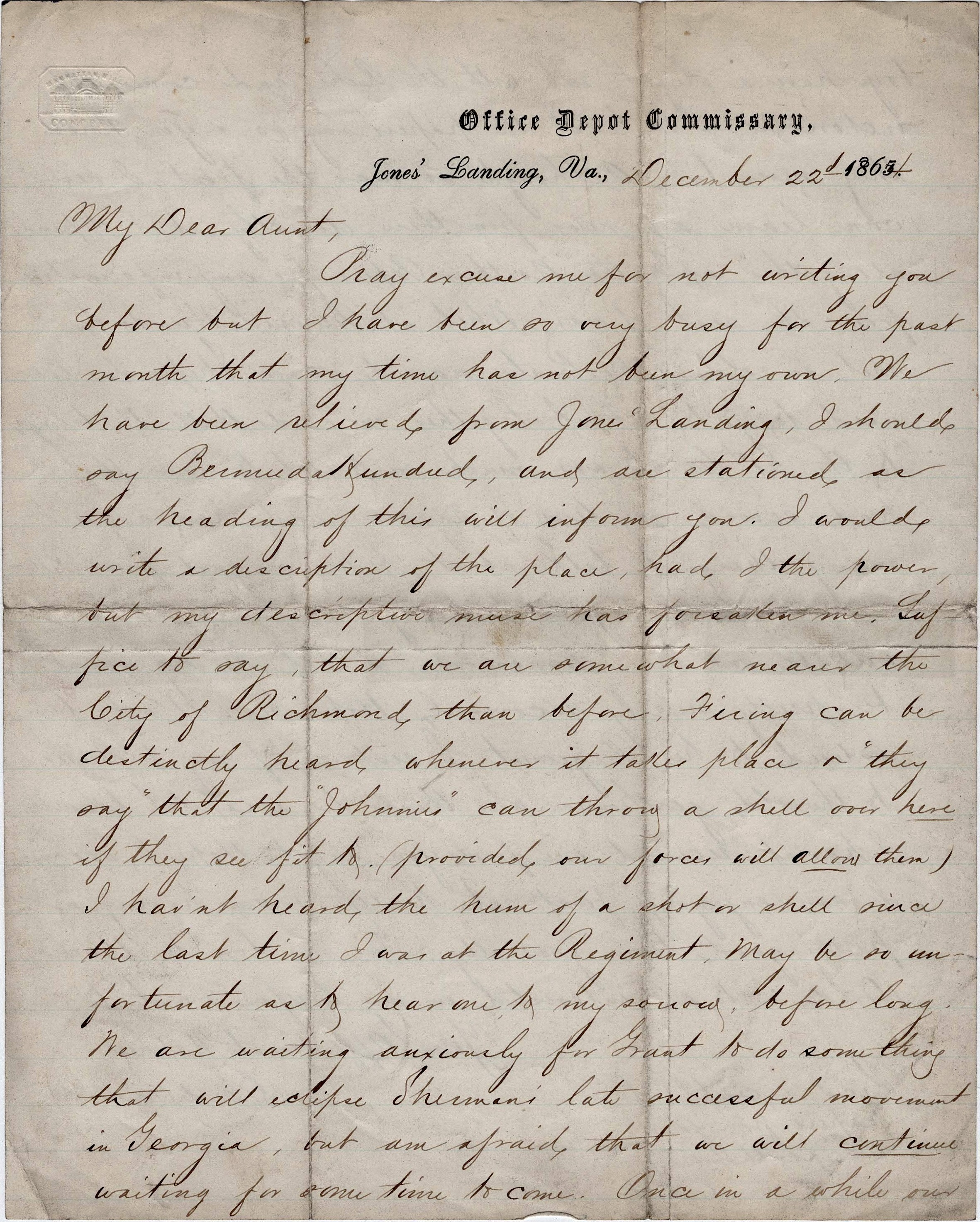
Office Depot Commissary Jones’ Landing, Va. December 22d 1864
My dear Aunt,
Pray excuse me for not writing you before but I have been so very busy for the last month that my time has not been my own. We have been relieved from Jones’ Landing—I should say Bermuda Hundred—and are stationed as the heading of this will inform you. I would write a desription of the place had I the power but my descriptive muse has forsaken me. Suffice to say that we are somewhat nearer the City of Richmond than before. Firing can be distinctly heard whenever it takes place & “they say” that the “Johnnies” can throw a shell over here if they see fit to (provided our forces will allow them). I haven’t heard the hum of a shot or shell since the last time I was at the Regiment. May be so unfortunate as to hear one to my sorrow before long.
We are waiting anxiously for Grant to do something that will eclipse Sherman’s late successful movement in Georgia, but I am afraid that we will continue waiting for some time to come. Once in a while our boys have a slight rub with the Rebs and come off victorious—at least the papers say so, & you know they never lie. Although so near the front, I never can learn any news from there directly, but depend altogether upon the Northern papers for any information from the “seat of war.”
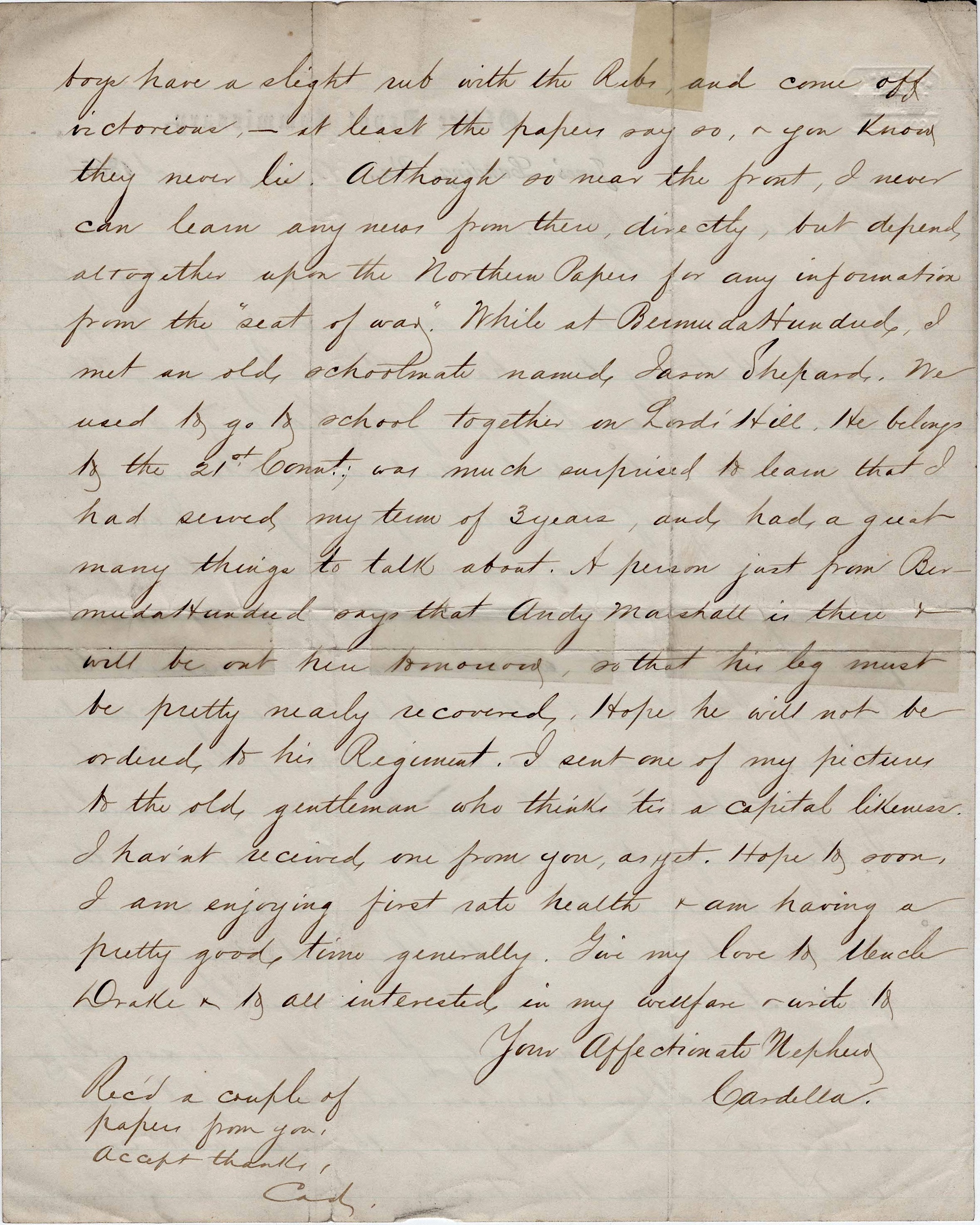
While at Bermuda Hundred, I met an old schoolmate named Jason Shepard. We used to go to school together on Lord’s Hill [in Hartford]. He belongs to the 21st Connecticut. Was much surprised to learn that I had served my term of three years and had a great many things to talk about. 1
A person just from Bermuda Hundred says that Andy Marshall is there & will be out here tomorrow, so that his leg must be pretty nearly recovered. Hope he will not be ordered to his Regiment. 2
I sent one of my pictures to the old gentleman who thinks tis a capital likeness. I haven’t received one from you as yet. Hope to soon. I am enjoying first rate health & am having a pretty good time generally. Give my love to Uncle Drake & to all interested in my welfare or write to your affectionate nephew, – Cardella
Received a couple of papers from you. Accept thanks, — Card.
1 Jason J. Shepard (1841-1916) served in Co. A of the 21st Connecticut Infantry from 5 September 1862 until 22 November 1863 when he was transferred to the US Signal Corps. He was discharged from th service in June 1865.He was born in western Massachusetts but in 1860 was residing in Hartford, Connecticut. After the war he married and settled in Hartford until late in life when he moved to California.
2 Andrew Marshall was the 2nd Lieutenant of Co. B, 6th Connecticut Infantry.
The following letter was written by Albert Clark Cooke (1840-1862), the son of Joseph Clark Cooke (1813-1882) and Amey Wade (1815-1873) of Putnam, Windham county, Connecticut. Albert was born in Rhode Island but moved with his family to Bureau county, Illinois, (where they were enumerated in 1850) before moving to Putnam, Connecticut.
Albert enlisted in Co. A, 6th Connecticut Infantry. He died at Beaufort, South Carolina, on Christmas day, 1862. His cause of death is rather unspecific. The surgeon recorded that he was “admitted with debility.” He was 22.
The 6th Connecticut Infantry was stationed in Beaufort, South Carolina, from September 1862 to March 1863 under the command of Colonel John Lyman Chatfield.
Letter 1
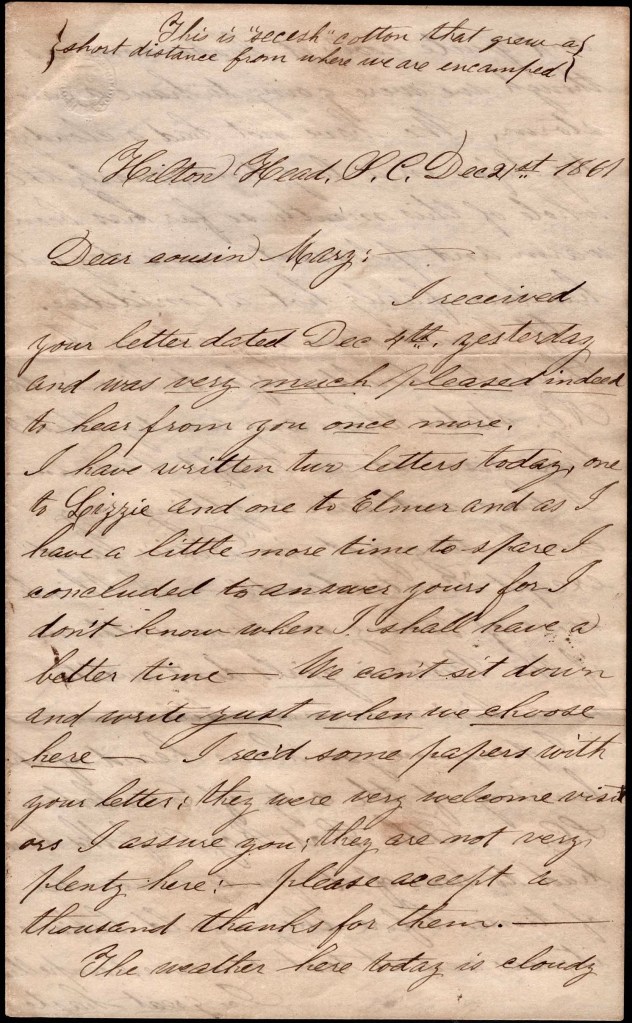
Hilton Head, South Carolina December 21st 1861
Dear cousin Mary,
I received your letter dated December 4th yesterday and was very much pleased indeed to hear from you once more. I have written two letters today, one to Lizzie and one to Elmer and as I have a little more time to spare, I concluded to answer yours for I don’t know when I shall have a better time. We can’t sit down and write just when we choose here. I received some papers with your letter; they were very welcome visitors, I assure you. They are not very plenty here. Please accept a thousand thanks for them.
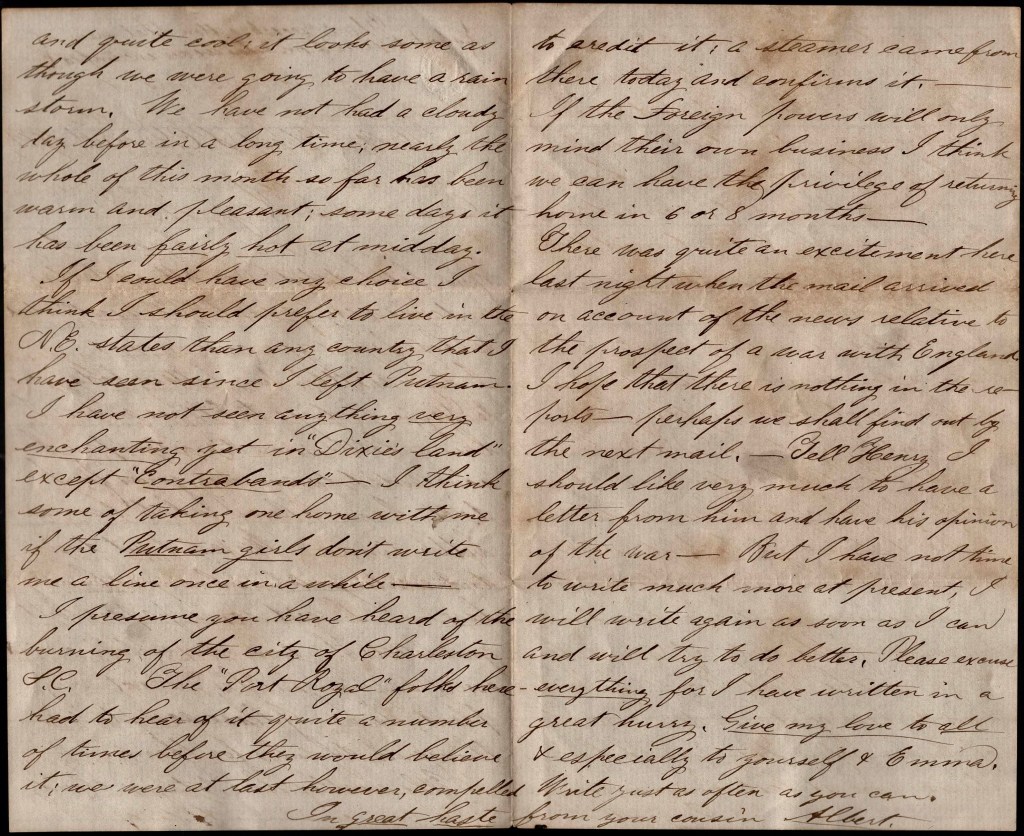
The weather here today is cloudy and quite cool. It looks some as though we were going to have a rain storm. We have not had a cloudy day before in a long time. Nearly the whole month so far has been warm and pleasant. Some days it has been fairly hot at midday.
If I could have my choice I think I should prefer to live in the New England states than any country that I have seen since I left Putnam. I have not seen anything very enchanting yet in “Dixie’s Land” except “contrabands.” I think some of taking one home with me if the Putnam girls don’t write me a line once in a while.
I presume you have heard of the burning of the City of Charleston, S. C. The “Port Royal” folks here had to hear of it quite a number of times before they would believe it. We were at last, however, compelled to credit it. A steamer came from there today and confirms it. If the foreign powers will only mind their own business, I think we can have the privilege of returning home in 6 or 8 months.
There was quite an excitement here last night when the mail arrived on account of the news relative to the prospect of a war with England, I hope that there is nothing in the reports. Perhaps we shall find out by the next mail.
Tell Henry I should like very much to have a letter from him and have his opinion of the war. But I have not time to write much more at present. I will write again as soon as I can and will try to do better. Please excuse everything for I have written in a great hurry. Give my love to all & especially to yourself & Emma. Write just as often as you can. In haste. From your cousin, — Albert
This is “secesh” cotton that grew a short distance from where we are encamped.
Letter 2
Beaufort, South Carolina September 30th 1862
Dear cousin Mary,
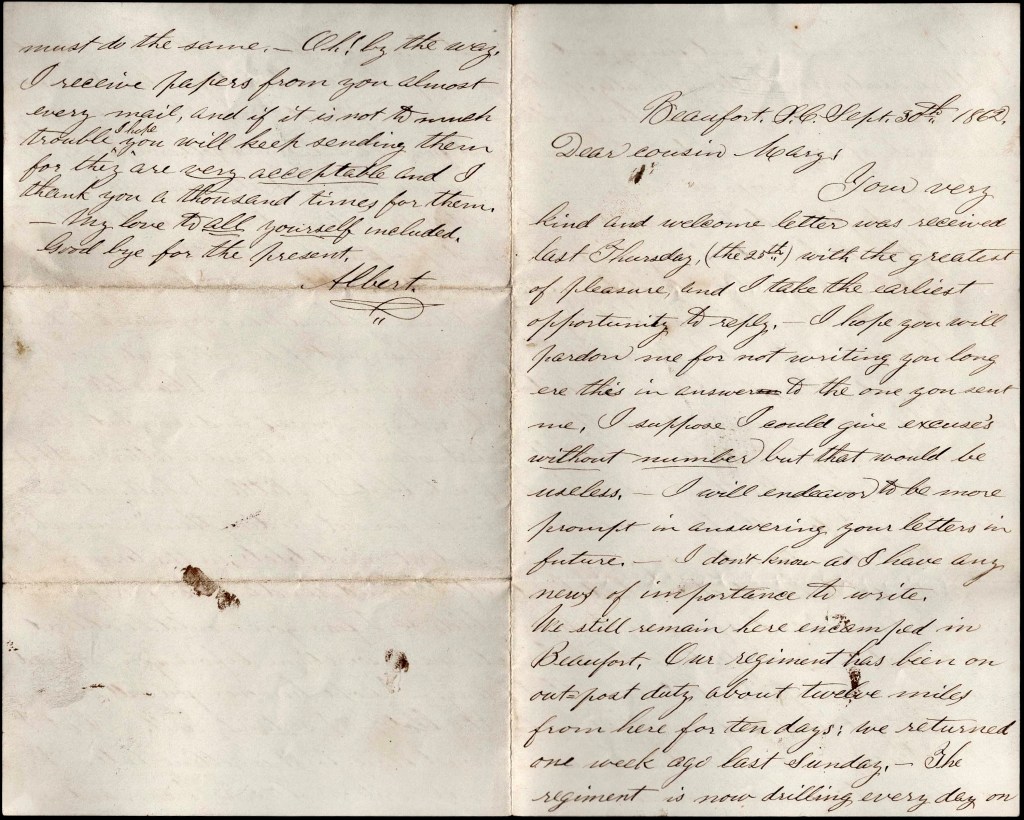
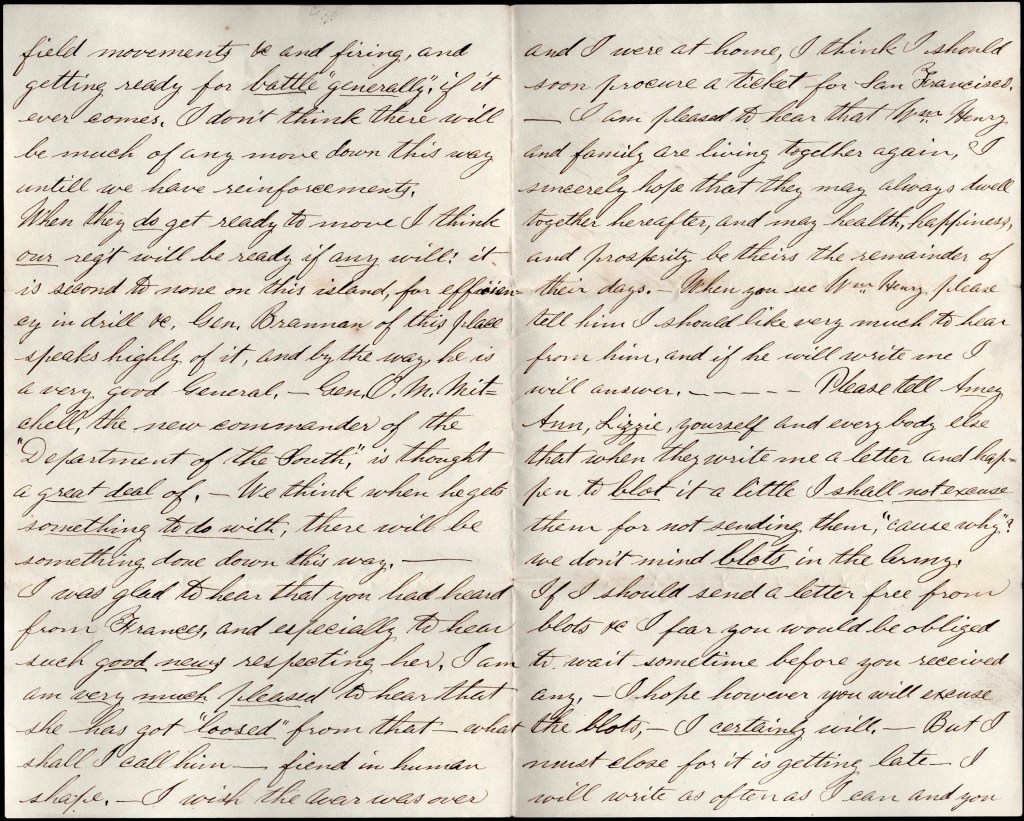
Your very kind, welcome letter was received last Thursday (the 25th) with the greatest of pleasure, and I take the earliest opportunity to reply. I hope you will pardon me for not writing you long ere this in answer to the one you sent me. I suppose I could give excuses without number but that would be useless. I will endeavor to be more prompt inn answering your letters in future. I don’t know as I have any news of importance to write. We still remain here encamped in Beaufort. Our regiment has been on outpost duty about twelve miles from here for ten days. We returned one week ago last Sunday. The regiment is drilling every day on field movements &c. and firing and getting ready for battle “generally”—if it ever comes. I don’t think there will be much of any move down this way until we have reinforcements. When they do get ready to move, I think our regiment will be ready if any will. It is second to none on this island for efficiency in drill, &c. Gen. Brannan of this place speaks highly of it, and by the way, he is a very good general. Gen. O. M. Mitchell, the new commander of the “Department of the South,” is thought a great deal of. We think when he gets something to do with, there will be something done down this way.
I am glad to hear that you had heard from Frances and especially to hear such good news respecting her. I am very much pleased to hear that she has got “loosed” from that—what shall I call him—-friend in human shape. I wish the war was over and I was at home. I think I should soon procure a ticket for San Francisco. I am pleased to hear that Wm. Henry and family are living together again. I sincerely hope that they may always dwell together hereafter, and may health, happiness, and prosperity be theirs the remainder of their days. When you see Wm. Henry, please tell him I should like very much to hear from him, and if he will write me, I will answer.
Please tell Amey, Ann, Lizzie, yourself and everybody else that when they write me a letter and happen to blot it a little, I shall not excuse them for not sending them. “Cause why?” We don’t mind blots in the army. If I should send a letter free from blots &c., I fear you would be obliged to wait some time before you received any. I hope, however, you will excuse the blots. I certainly will. But I must close for it is getting late. I will write as often as I can and you must do the same. Oh! by the way, I receive papers from you almost every mail and if it is not too much trouble, I hope you will keep sending them for they are very acceptable and I thank you a thousand times for them. My love to all—yourself included. Goodbye for the present. — Albert
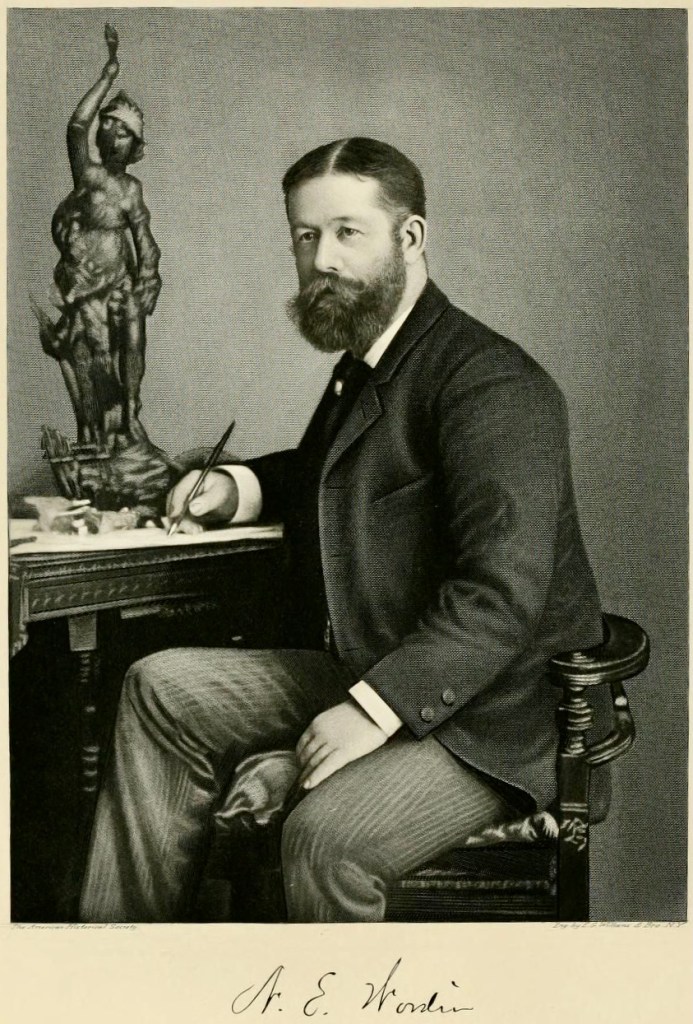
The following letter was written by Nathaniel Eugene (“Gene”) Wordin (1844-1915), the son of Nathaniel Sherwood Wordin (1813-1889) and Francis Augusta Leavenworth (182-1892) of Bridgeport, Connecticut. He wrote the letter to his older sister, Helen (“Nellie”) Caroline Wordin (b. 1842).
Gene enlisted on 28 August 1862 as a private in Co. I, 6th Connecticut Infantry. He was promoted to a corporal on 27 April 1864 and mustered out of the regiment on 3 June 1865. After the war he married Eliza Woodruff Barnes (1841-1921) and earned a medical degree from the Jefferson Medical College of Thomas Jefferson University in Philadelphia in 1875. He practiced allopathic medicine in Bridgeport, Ct.
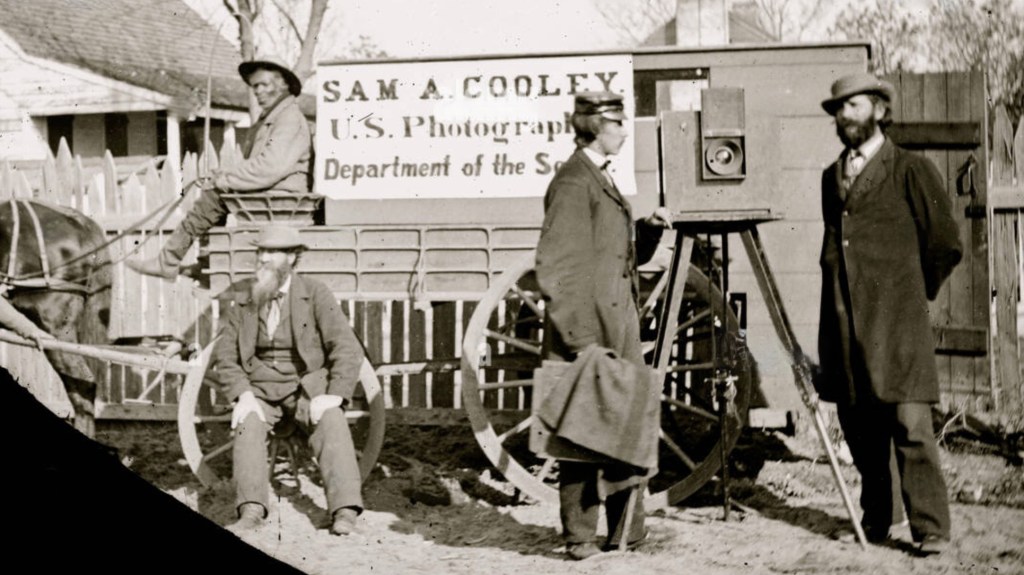
In this lengthy letter to his older sister, Gene responds to numerous questions directed to him from prior correspondence with her and then brings her up-to-date with news of military affairs at Hilton Head in March 1864, including a long description of Gen. Truman Seymour, for whom he briefly worked as a clerk on the island. He also mentions the presence of Sam Cooley, the renowned photographer in the Department of the South who was setting up a studio on Hilton Head at the time.
Addressed to Miss Nellie C. Wordin, Care of N. S. Wardin, Esq., Bridgeport, Conn.
Hilton Head, South Carolina March 23rd 1864
Dear Sister,
It is just one week today since I received a large mail from home, a part of which—and no small part either—was a letter from yourself dated March 1864. With what pleasure it was received and read, you will never know. The most remarkable thing about it was its length, which for you was certainly very long, and as it was dated on no particular day but only the month, I could only infer thay you had been a month in writing it. Am I right in this? or will it do for me to draw my own inferences? As I said before, what the letter contained did not surprise me half as much as the length.
At the time of receiving it, I was very busy indeed on government work as you have since been informed, by two small notes from me and could not conveniently find time to make a suitable reply. As the time of writing my last note, I contemplated soon getting through with my reports and getting over my hurry and promised you an answer or a letter. I don’t know which. Well, I finished the last of my long reports last Friday and sent them to Washington on the Arago the same day. I have since written up my diary to the date for I keep every page in it filled, have had a little rest, and this is the beginning of the promised note. I am almost sorry now that I made such a promise for when you get to the end, if ever you do, I am afraid you will think it nought but nonsense. However, having made the promise, I shall keep it.
I have said that I received a large mail from home one week ago today. Besides your letter, I also received a long one from father which pleased me much—especially as it was the first one he had written since my unceremonious departure from home. He gave me a summary of news and some instructions which I needed and by which I shall profit. He seems to have a natural gift at writing—not only of letters but sentiment, both poetry and prose. I think it was too bad that he has not cultivated it and written more. I think this the more as I see more of his writings, many of which are to be found in the house.
He speaks of having made you a handsome present of furs. You told me about a part of it but not all. You were very fortunate in receiving such a splendid present, and of course you will wear them upon every possible occasion as they will be very warm and comfortable this cold winter. Besides that, if you do not make good use of a present, the giver naturally thinks that it is not appreciated. The mystery of the 10 dollar check is at length satisfactorily explained both by yourself and father. I was almost certain that it had been received but wanted to be positive. I made more trouble over it than the whole thing was worth. I have $50 more to send and will forward it at the earliest convenience; perhaps will enclose a few greenbacks with this before I get through, but everything is as yet uncertain.
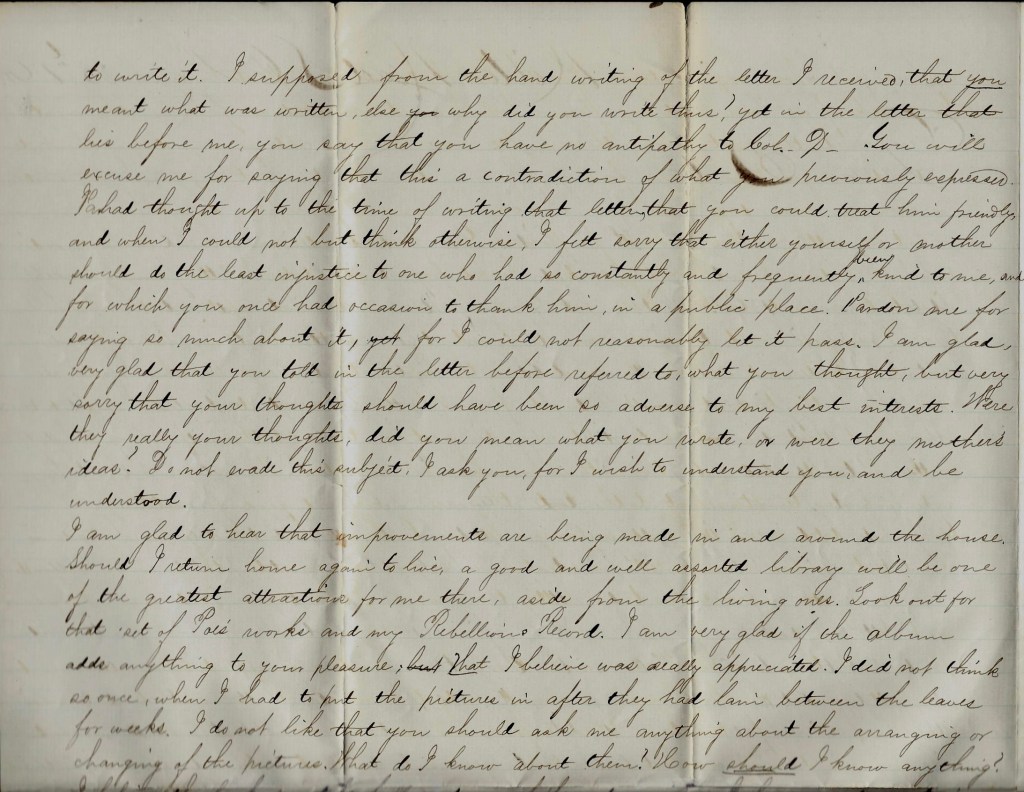
Now I want to say something in regard to that little affair that you claim “roiled” me so much a few weeks since. I wish to simply say that I was not in the least “roiled.” My feelings were rather sorrow and grief than “roile”; the contents of the letter had been contemplated and studied on for several days and I went alone by myself to write it. I supposed from the hand writing of the letter I received, that you meant what was written, else why did you write this? Yet in the letter that lies before me, you say that you have no antipathy to Col. D. You will excuse me for saying that this is a contradiction of what you previously expressed. I had thought up to the time of writing that letter that you could treat him friendly and when I could not but think otherwise, I felt sorry that either yourself or mother should do the least injustice to him who had so constantly and frequently been kind to me, and for which you once had occasion to thank him in a public place. Pardon me for saying so much about it, for I could not reasonably let it pass. I am glad, very glad, that you told in the letter before referred to what you thought, but very sorry that your thoughts should have been so adverse to my best interests. Were they really your thoughts? Did you mean what you wrote? Or were they mother’s ideas? Do not evade this subject. I ask you, for I wish to understand you and be understood.
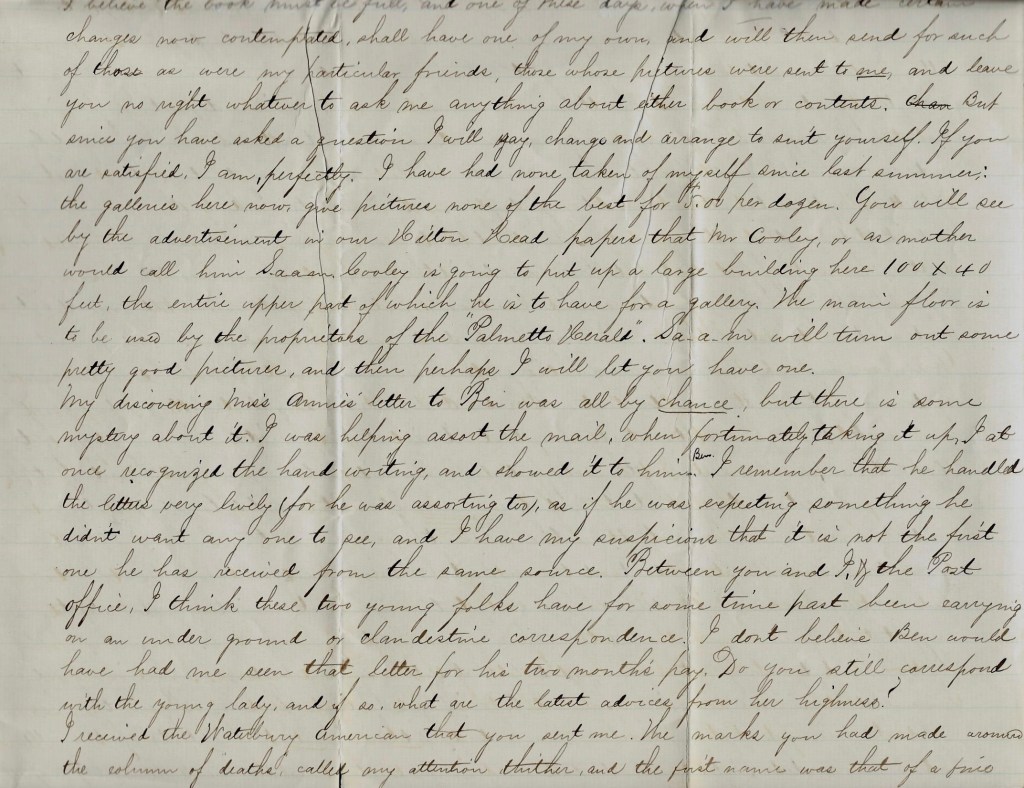
I am glad to hear that improvements are being made in and around the house. Should I return home again to live, a good and well assorted library will be one of the greatest attractions for me there, aside from the living ones. Look out for that set of Poe’s works and my Rebellion Record. I am very glad if the album adds anything to your pleasure. That, I believe, was really appreciated. I did not think so once, when I had to put the pictures in after they had lain between the leaves for weeks. I do not like that you should ask me anything about the arranging of changing of the pictures. What do I know about them? How should I know anything? I believe the book must be full and one of these days when I have made certain changes now contemplated, shall have one of my own and will then send for such of those as were my particular friends, those whose pictures were sent to me and leave you no right whatever to ask me anything about either book or contents. But since you have asked a question, I will say, change and arrange to suit yourself. If you are satisfied, I am perfectly. I have had none taken of myself since last summer. The galleries here now give pictures none of the best for $5 per dozen.
You will see by the advertisement in our Hilton Head papers that Mr. Cooley, or as Mother would call him, Sa-a-m Cooley, is going to put up a large building here 100 x 40 feet, the entire upper part of which he is to have for a gallery. The main floor is to be used by the proprietors of the “Pametto Herald.” Sa-a-m will turn out some pretty good pictures and then perhaps I will let you have one.
Sam A. Cooley and his traveling studio wagon
My discovering Miss Annie’s letter to Ben was all by chance, but there is some mystery about it. I was helping assort the mail when fortunately raking it up, I at once recognized the hand writing and showed it to him (Ben). I remember that he handled the letter very lively (for he was assorting too), as if he was expecting something he didn’t want anyone to see, and I have my suspicions that it is not the first one has received from the same source. Between you and I and the post office, I think these two young folks have for some time past been carrying on an underground or clandestine correspondence. I don’t believe Ben would have had me seen that letter for his two month’s pay. Do you still correspond with the young lady, and if so, what are the latest advices from the highness?
I received the Waterbury American that you sent me. The marks you had made around the column of deaths called my attention thither, and the first name was that of a fine young girl whose acquaintance I made last winter while in Waterbury.
You ask if we had any flowers here. I must say that as far as the weather is concerned, the past two or three nights have been as cold as any during the winter and cold enough, I imagine, for any of you in Connecticut. But supposing the weather as warm as some says have been, as warm as some of your fine days there, is no rumor, but very little on this island for flowers. You have no idea how much business and traveling is done here. Why the sand is kicked from one end to the other, from creek and river to ocean and back. There are, however, a few untouched spots on the island and there I suppose wild flowers can be found. I have neither time nor horses to ride around outside and see South Carolina in the spring time. Large bunches of oranges, fresh from the trees, are brought from Florida by every steamer, and sold at the wharf, but they can be handled only with great care to prevent them from falling off or else I would send you two or three for curiosities. The oranges are very large and look very tempting, but to the taste they are sour and good for nothing.
Your note dated March 14th and enclosing a letter of Cook’s was received today. I am glad to know that he has commenced his vacation in so good a way and with such a long letter. I guess he improves his time better than when I was home. Tell him I will write to him soon.
It will be three weeks Friday since the [smallpox] vaccine virus was applied to my arm and it is now getting well. The huge scab is almost ready to come off. It has caused me some trouble, of course. For two days I had a fever and my arm pained me so that I could scarcely use it. This was so much the worse as it came at a time when I was most busy, and could not stop work. However, I am all right now, and glad that it has been done, and is all over. The scab, I think, I shall give to one of the surgeons as it is quite valuable down here.
Cook writes me that Mr. Day is to have his exhibition in Franklin Hall, which is rather a stretch for him. I suppose, though, that he has something very fine this time. He has given some very fine exhibitions. I may well say the best of any school in the city—those that displayed most talent and originality, and in now making them public, he is but doing what he ought to have done three years ago. I suppose he is tempted to do this from the fact that the High School do not exhibit themselves this season. I wish him the best of success and have no doubt but that he will have it, and have a fine display of talent. Be pleased to send me a bill of fare.
You have enclosed the sample of ladies cloth which you ought to have done two months ago when you first mentioned it. After what I wrote in my last letter, I supposed you would purchase the article in question ready made, but since you prefer to make them up yourself, I too wish you to be busy, doing some good. There is not much preference in cloth as all of it shrinks. I hesitate in choosing between the samples sent as the heaviest is the poorest color for such use as I give it. One of my mess mates has some made of the same kind and color as the dark and as they look well, I will choose that too. His shrunk, however, and I would suggest that you shrink the cloth before making it up. Do not be sparing of cloth, for it is wanting most in length, both of the skirt and sleeves. I want a collar on them so that I can wear a coat without a white collar—that is, if you can make one that will fit. Put a pocket on each side, outside instead of in, of the same material as the whole, and I guess you will need no further instructions. Send then by mail and I will get them the quickest.
I believe now that I have answered all questions and touched about all the points mentioned in your two letters, and will now say something for myself, as perhaps I can interest you a little with what is transpiring in this Department. The general news you get in the papers that I weekly send you and which I suppose you receive, although you say nothing in regard to them. I am situated the same as when I wrote you last, and enjoy myself very well, stopping with the company, although the conversation is not of a style that I altogether prefer. I have not received any of my extra duty money yet as the quartermaster is out of funds. Twenty-five dollars per month and “found” is not doing very badly pecuniarily and scarcely a day passes in which I do not learn something new. I believe that I am in about as good a school as I ever went to, and shall try to learn my lesson well.
Alfred Bishop Beers (1845-1920) of Co. I, 6th Connecticut, was promoted to Captain of Co. B in March 1865.
Corporal [Alfred Bishop] Beers went home about one week ago as a veteran volunteer—three years more in the army. He makes quite a stay this time, having a furlough of thirty days in the State. The Orderly Sergeant of our company, John Waters, has also re-enlisted and gone home. It is said by the boys in the company (and I think with some shadow of truth too) that he has received a commission as 2nd Lieutenant in Co. B. Now don’t run after the corporal, but if you should chance to meet him on the street, please ask him to tell the fact to Sergeant Waters as a kindness to him, that he may be prepared to put on the traps when he gets back. I did not ask either of them to call at the house. You will easily guess from a former letter why not.
We all wonder at the long stay our chaplain is making and want to see him back once more. The 6th Regiment think a wondrous deal of their chaplain [illegible] is well. Edy Lyon is still on the Cosmopolitan.
I forgot to say, while speaking about carte-de-visits, I wish I could in some way get Father’s, but he has had none taken. If you or any one else can persuade him to visit an artist, I wish you would send me a picture. Fan’s, I must have too.
I do not know what conclusion you came to in regard to the flute. If you send it, send also that green music book containing the “Lancer’s,” “Miserere,” &c. Send the book anyway. As I said before, I have $50 to send home and for want of other means, shall send the greenbacks. Twenty dollars you will find enclosed, as I do not wish to trust so much as $50 at once. Will send more in my letter to Father and at different times. Please be so kind as to acknowledge receipt. You will appropriate a part of the expenses you or anyone else have been at for me and pay for the shorts which you are about to make up.
Gen. Truman Seymour—a “man of moderate size and height, rather thin in the face which is somewhat wrinkled, and betokens that the owner has seen much care. A bright discerning eye, a rather lofty and manly bearing—his harir is mixed with gray.”
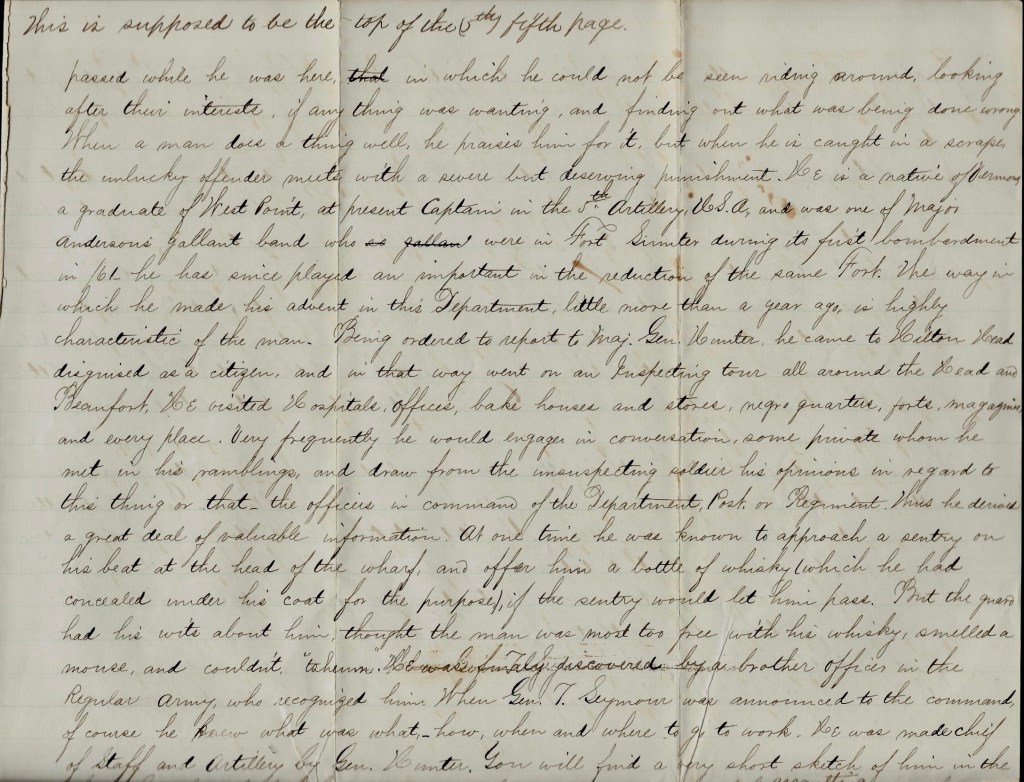
I see by the northern papers that the affair at “Olustee” Florida is creating considerable talk, and that many different reports are given, laying the blame of it upon innocent persons’ heads. I have seen also many sketches and remarks upon Gen. [Truman] Seymour; the commander of the Union forces in Florida. Perhaps you will be somewhat interested in him, as being one under whom I served, though, but for a short time. He had command here for several months while the expedition was being organized. I send his photograph but to tell the truth, it really does him not justice. Mounted, he is a fine looking officer, and a splendid rider. He is a man of moderate size and height, rather thin in the face, which is somewhat wrinkled, and betokens that the owner has seen much care. A bright, discerning eye, a rather lofty and manly bearing—his hair is mixed with gray. He is attentive to the wants of his men and scarcely a day passed while he was here in which he could not be seen riding around, looking after their interest, if anything was wanting, and finding out what was being done wrong.
When a man does a thing well, he praises him for it, but when he is caught in a scrape, the unlucky offender meets with a severe but deserving punishment. He is a native of Vermont, a graduate of West Poit, at present Captain in the 5th Artillery, USA, and was one of Major Anderson’s gallant band who were in Fort Sumter during its first bombardment in ’61. He has since played an important [part] in the reduction of the same fort. The way in which he made his advent in this Department, little more than a year ago, is highly characteristic of the man. Being ordered to report to Maj. Gen. Hunter, he came to Hilton Head disguised as a citizen, and in that way went on an inspecting tour all around the Head and Beaufort. He visited hospitals, offices, bake houses and stores, negro quarters, forts, magazines, and every place. Very frequently he would engage in conversation [with] some private whom he met in his ramblings, and draw from the unsuspecting soldier his opinions in regard to this thing or that, the officers in command of the Department, post or regiment. Thus he derived a great deal of valuable information. At one time he was known to approach a sentry on his beat at the head of the wharf and offer him a bottle of whiskey (which he had concealed under his coat for the purpose), if the sentry would let him pass. But the guard had his wits about him, thought the man was most too free with his whiskey, smelled a mouse, and couldn’t [ ]. He was finally discovered by a brother officer in the Regular Army who recognized him. When Gen. T[ruman] Seymour was announced to the command, of course he knew what was what—how, when and where to go to work.
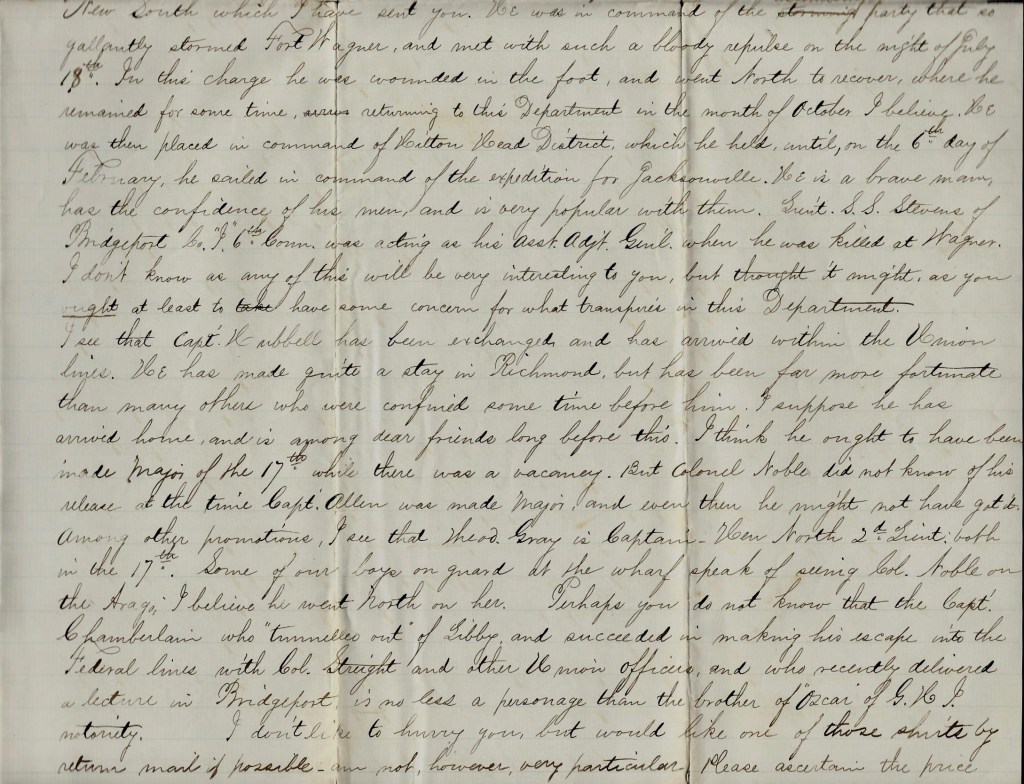
He was made Chief of Staff and Artillery by Gen. Hunter. You will find a very short sketch of him in the New South which I have sent you. He was in command of the part that so gallantly stormed Fort Wagner, and met with such a bloody repulse on the night of July 18th. In this charge he was wounded in the foot and went North to recover, where he remained for some time, returning to this Department in the month of October, I believe. He was then placed in command of Hilton Head District which he held until the 6th day of Februry, he sailed in command of the expedition for Jacksonville. He is a brave man, has the confidence of his men, and is very popular with them. Lieut. S[tephen] S. Stevens of Bridgeport, Co. I, 6th Connecticut was acting as his Asst. Adjt. General when he was killed at Wagner. I don’t know as any of this will be very interesting to you, but thought it might, as you ought at least to have some concern for what transpires in this Department.
I see that Capt. [William Lewis] Hubbell 1 has been exchanged and has arrived within the Union lines. He has made quite a stay in Richmond, but has been far more fortunate than many others who were confined some time before him. I suppose he has arrived home and is among dear friends long before this. I think he ought to have been Major of the 17th while there was a vacancy. But Colonel [William H.] Noble did not know of his release at the time Capt. [Henry] Allen was made Major and even then he might not have got it. Among the promotions I see that Theod. Gray is Captain. Hen. North 2nd Lieutenant; both in the 17th.
Some of our boys on guard at the wharf speak of seeing Col. Noble on the Arago. I believe he went North on her. Perhaps you do not know that the Capt. [Henry B.] Chamberlain [97th NY] who “tunneled out” of Libby and succeeded in making his escape into the Federal lines with Col. [Abel Delos] Streight and other 16 Union officers and who recently delivered a lecture in Bridgeport is no less a personage than the brother of Oscar of G. H. I. notoriety.
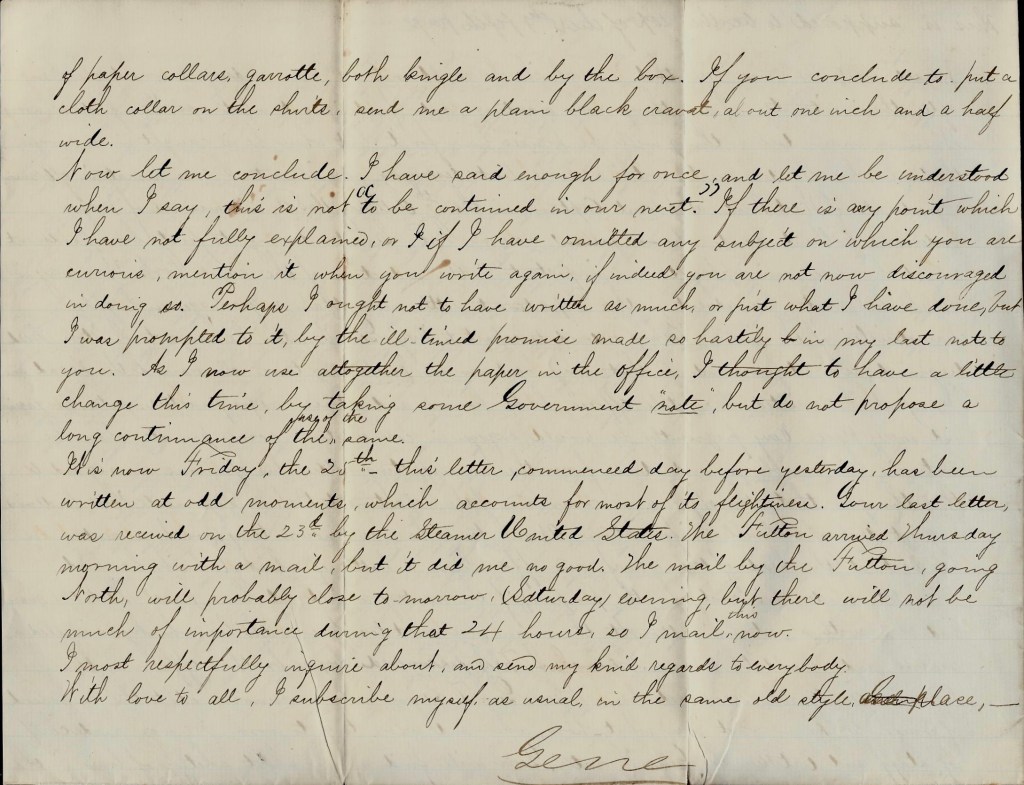
I don’t like to hurry you but would like one of those shirts by return mail if possible. Am not, however, very particular. Please ascertain the price of paper collars, garrotte, both single and by the box. If you conclude to put a cloth collar on the shirts, send me a plain black cravat about one inch and a half wide.
Now let me conclude. I have said enough for once. And let me be understood when I saw, this is not “to be continued in our next.” If there is any point which I have not fully explained, or if I have omitted any subject on which you are curious, mention it when you write again, if indeed you are not now discouraged in doing so. Perhaps I ought not to have written as much, or just what I have done, but I was prompted to it by the ill-timed promise made so hastily in my last note to you. As I now use altogether the paper in the office, I thought to have a little change this time by taking some government “note”, but do not propose a long continuance of the use of the same.
It is now Friday, the 25th. This letter commenced the day before yesterday, has been written at odd moments, which accounts for most of its flightiness. Your last letter was received on the 23rd by the steamer United States. The Fulton arrived Thursday morning with a mail, but it did me no good. The mail by the Fulton, going North, will probably close tomorrow.
I most respectfully inquire about, and send my kind regards to everybody. With love to all, I subscribe myself as usual in the same old style and place, — Gene
1 William Lewis Hubbell of Bridgeport, Connecticut, served in the 17th Connecticut Infantry. He was taken prisoner at Gettysburg while serving on the staff of Brig-General Francis Barlow. He was held prisoner at Libby Prison in Richmond until 7 March 1864 when he was exchanged.






 Spared & Shared 23