Category Archives: Beaufort, South Carolina

1864: Washington Vosburgh to his Friend Ella

The following letters were written by George Washington (“Wash”) Vosburgh who was 24 years old when he enlisted as a corporal in August 1862 at Canajoharie, New York, to serve three years in Co. K, 115th New York Infantry. He was promoted quartermaster-sergeant on January 1, 1864 and mustered out of the service on 24 June 1865 at Albany. His muster records state that Wash was a farmer by occupation and stood 5’5″ tall with dark hair, black eyes.

Wash and his comrades of the 115th New York had the misfortune of being among a handful of regiments that were at Harpers Ferry in September 1862 when Stonewall Jackson’s men descended on the town and were surrendered by poor leadership. They were scorned and mocked by the public as “Harper’s Ferry Cowards” even though they were poorly drilled and had barely been issued weapons. With few exceptions, most of the captured men were paroled and sent to Camp Douglas in Chicago to await their exchange. When they were returned to duty, they were sent to South Carolina to join the Department of the South but did not see any real action until 1864.

See also Wash Vosburgh papers, 1862-1866. Letters to his friend Ella describing his military experience, including service in coastal South Carolina and Florida and in the battle of Cold Harbor and siege of Petersburg. The collection also includes several letters written (1865-1866) from the oil fields of Titusville, Pa., where Vosburgh was a merchant. 1 linear ft. Located at Bentley Historical Library, University of Michigan.

Letter 1

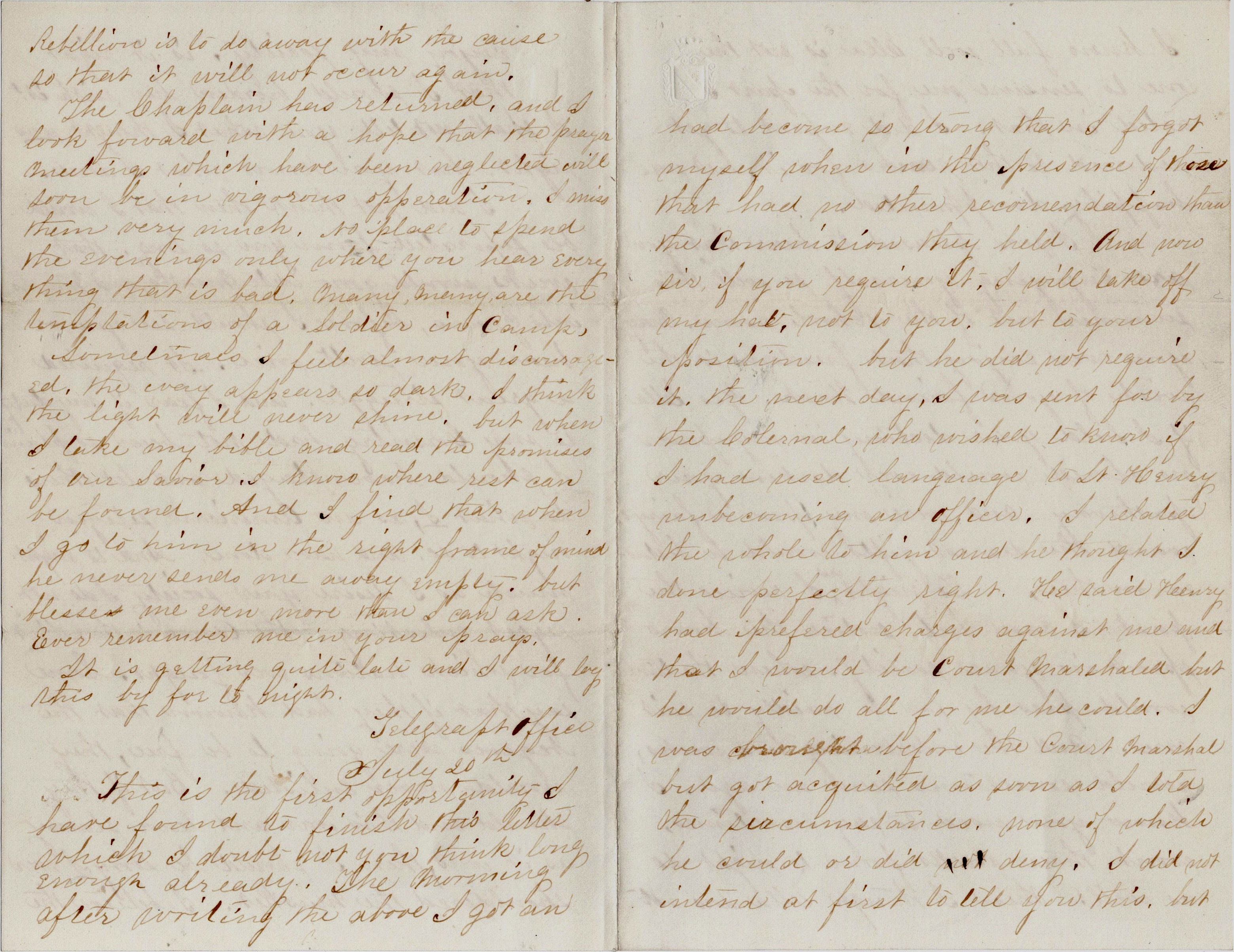
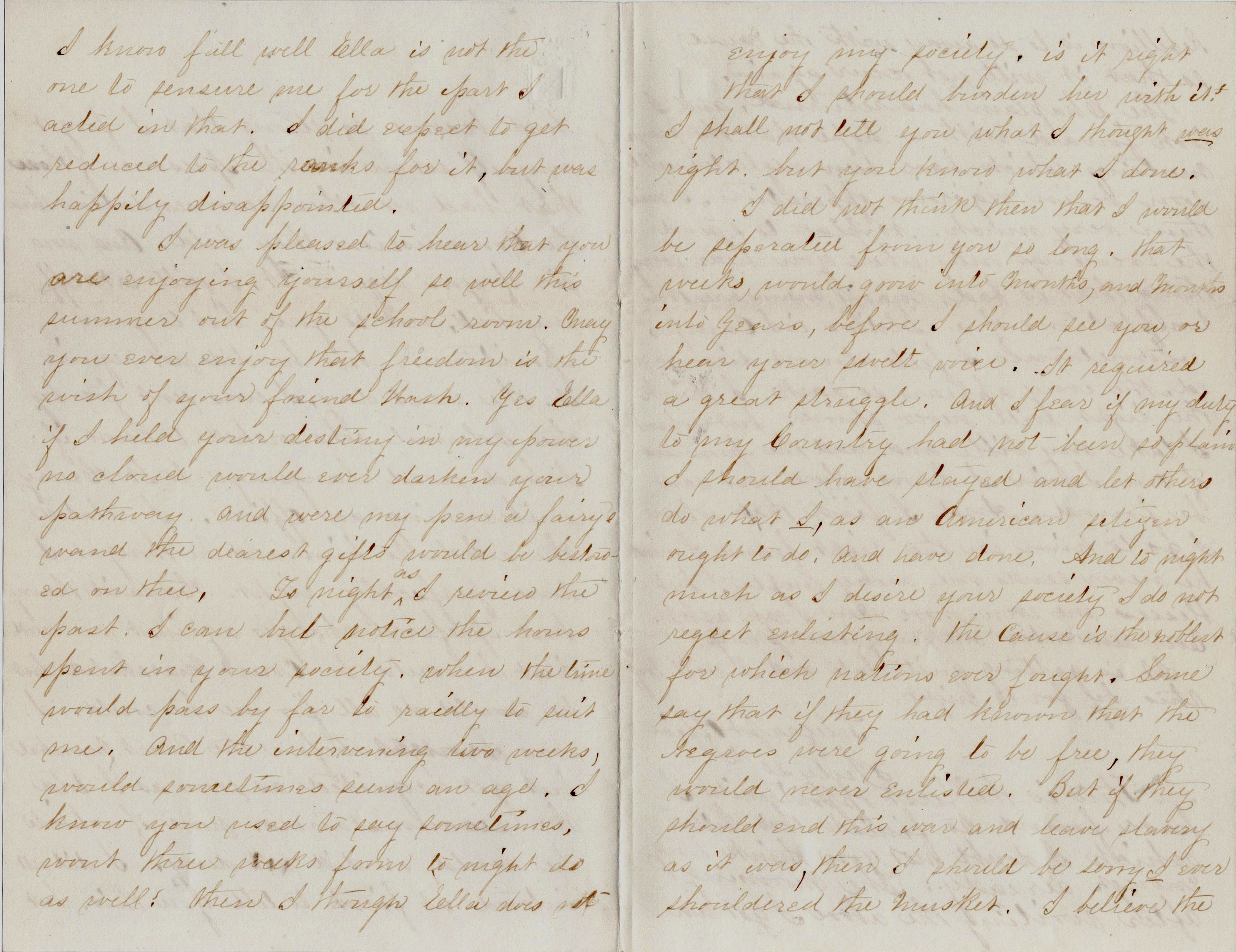
[Partial letter, July 1864] ….had become so strong that I forgot myself when in the presence of those that had no other recommendations than the commission they held. And now, sir, if you require it, I will take off my hat, not to you, but to your position. But he did not require it. The next day I was sent for by the Colonel who wished to know if I had used language to Lt. Henry unbecoming an officer. I related the whole to him and he thought I done perfectly right. He said Henry had preferred charges against me and that I would be court-martialed but he would do all for me he could. I was brought before the court-martial but got acquitted as soon as I told the circumstances, none of which he could or did deny. I did not intend at first to tell you this but I know full well Ella is not the one to censor me for the part I acted in that. I did expect to get reduced to the ranks for it, but was happily disappointed.

I was pleased to hear that you are enjoying yourself so well this summer out of the school room. May you ever enjoy that freedom is the wish of your friend Wash. Yes, Ella, if I held your destiny in my power, no cloud would ever darken your pathway. And were my pen a fairy’s wand, the dearest gifts would be bestowed on thee.

Tonight as I review the past, I can but notice the hours spent in your society when the time would pass by far too rapidly to suit me. And the intervening two weeks would sometimes seem an age. I know you used to say sometimes, “Won’t three weeks from tonight do as well?” Then I thought Ella does not enjoy my society. It is right that I should burden her with it? I shall not tell you what I thought was right, but you know what I done. I did not think then that I would be separated from you so long—that weeks would grow into months, and moths into years before I should see you or hear your sweet voice. It required a great struggle. And I fear if my duty to my Country had not been so plain, I should have stayed and let others do what I, as an American citizen, ought to do, and have done.

And tonight, much as I desire your society, I do not regret enlisting. The cause is the noblest for which nations are fought. Some say that if they had known that the Negroes were going to be free, they would never enlisted. But if they should end this war and leave slavery as it was, then I should be sorry I ever shouldered the musket. I believe the Rebellion is to do away with the cause so that it will not occur again.

The chaplain has returned and I look forward with a hope that the prayer meetings which have been neglected will soon be in vigorous operation. I miss them very much. No place to spend the evenings only where you hear everything that is bad. Many, many are the temptations of a soldier in camp. Sometimes I feel almost discouraged—the way appears so dark. I think the light will never shine. But when I take my bible and read the promises of our Savior, I know where rest can be found. And I find that when I go to Him in the right frame of mind, He never send me away empty, but blesses me even more than I can ask. Ever remember me in your prayers. It is getting quite late and I will lay this by for tonight.

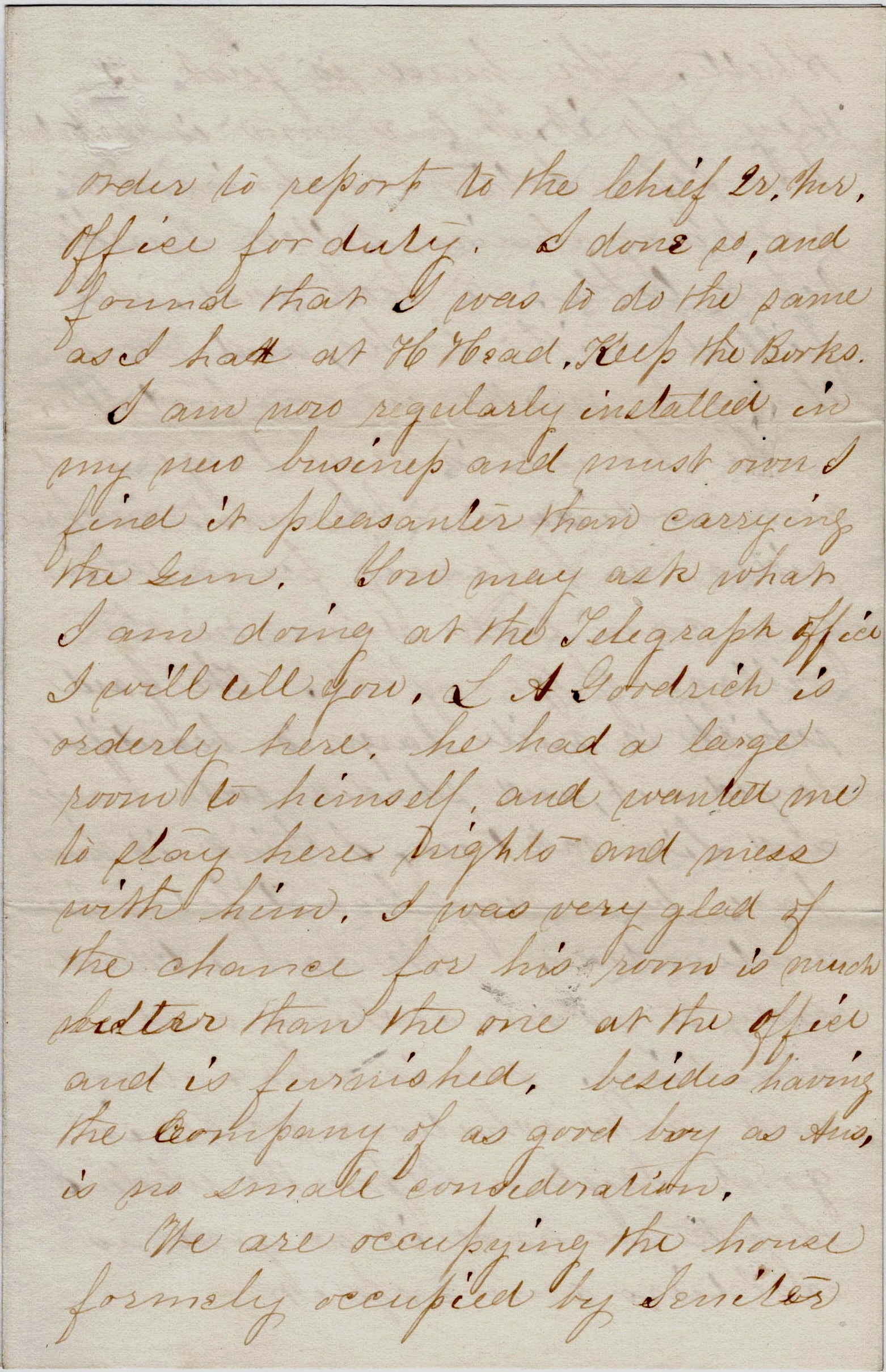
Telegraph office. July 20th. This is the first opportunity I have found to finish this letter which I doubt not you think long enough already. The morning after writing the above, I got an order to report to the Chief Quartermaster’s Office for duty. I done so and found that I was to do the same as I had at Hilton Head—keep the books.

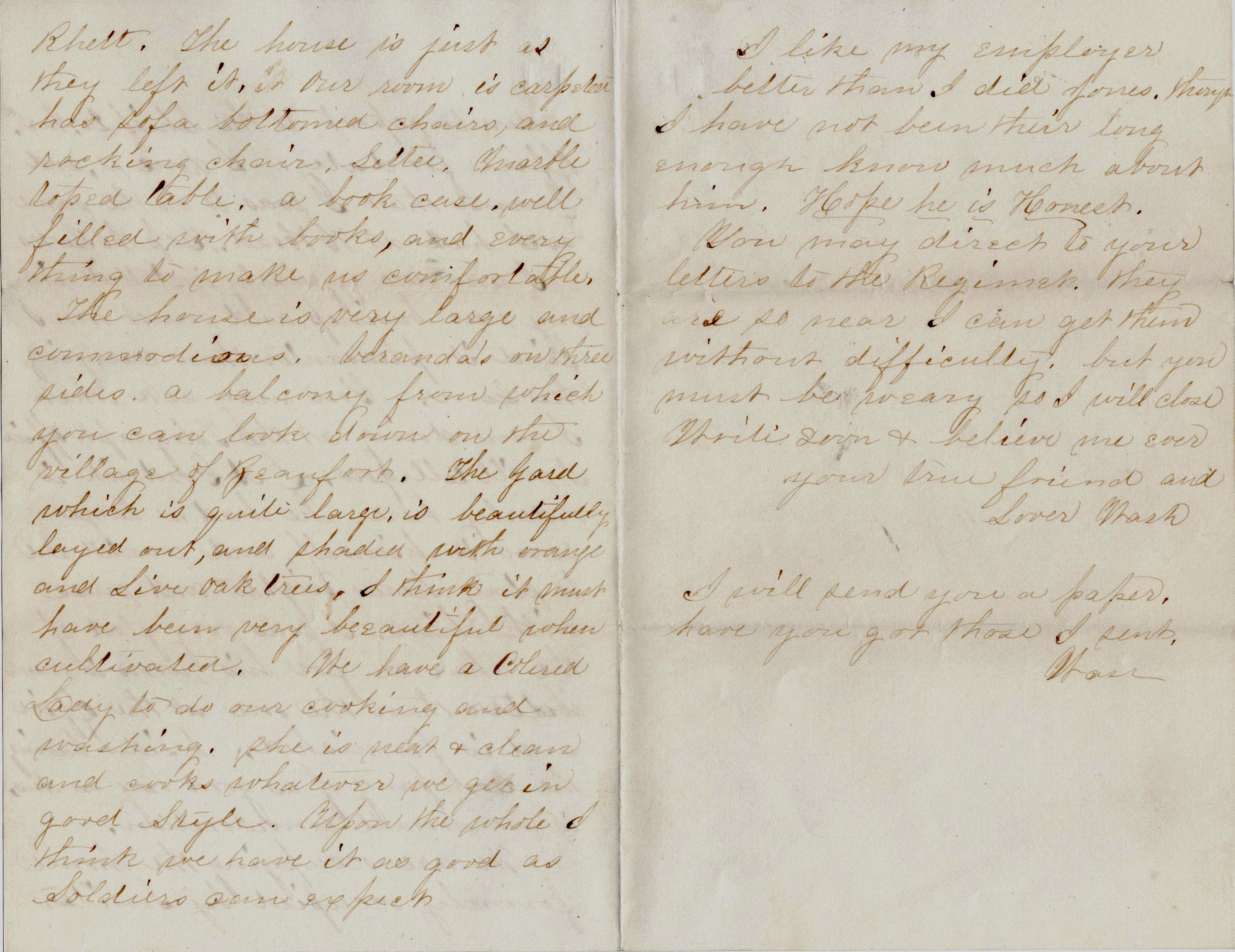
I am now regularly installed in my new business and must own I find it pleasanter than carrying the gun. You may ask what I am doing at the Telegraph Office. I will tell you. L[ewis] A. Goodrich is orderly here. He had a large room to himself and wanted me to stay here nights and mess with him. I was very glad of the chance for his room is much better than the one at the office and is furnished. Besides, having the company of as good boy as Aus is no small consideration. We are occupying the house formerly occupied by Senator [Edmund] Rhett. The house is just as they left it. Our room is carpeted, has sofa bottomed chairs, and rocking chairs, settee, marble topped table, a book case well filled with books, and everything to make us comfortable. The house is very large and commodious. Veranda’s on three sides, a balcony from which you can look down on the village of Beaufort. The yard which is quite large is beautifully laid out and shaded with orange and live oak trees. I think it must have been very beautiful when cultivated. We have a colored lady to do our cooking and washing. She is neat & clean and cooks whatever we get in good style. Upon the whole, I think we have it as good as soldier’s can expect.

I like my employer better than I did Jones though I have not been there long enough to know much about him. Hope he is honest.

You may direct your letters to the regiment. They are so near I can get them without difficulty but you must be weary so I will close. Write soon & believe me ever your true friend and lover, — Wash

I will send you a paper. Have you got those I sent? — Wash
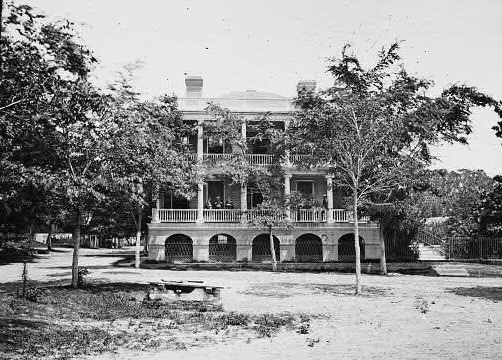
The Rhett House in Beaufort, South Carolina. It was in the basement of this home where several South Carolina leaders vowed to secede from the Union if Lincoln was elected President of the United States.

Letter 2

Beaufort, South Carolina
August 11, 1863

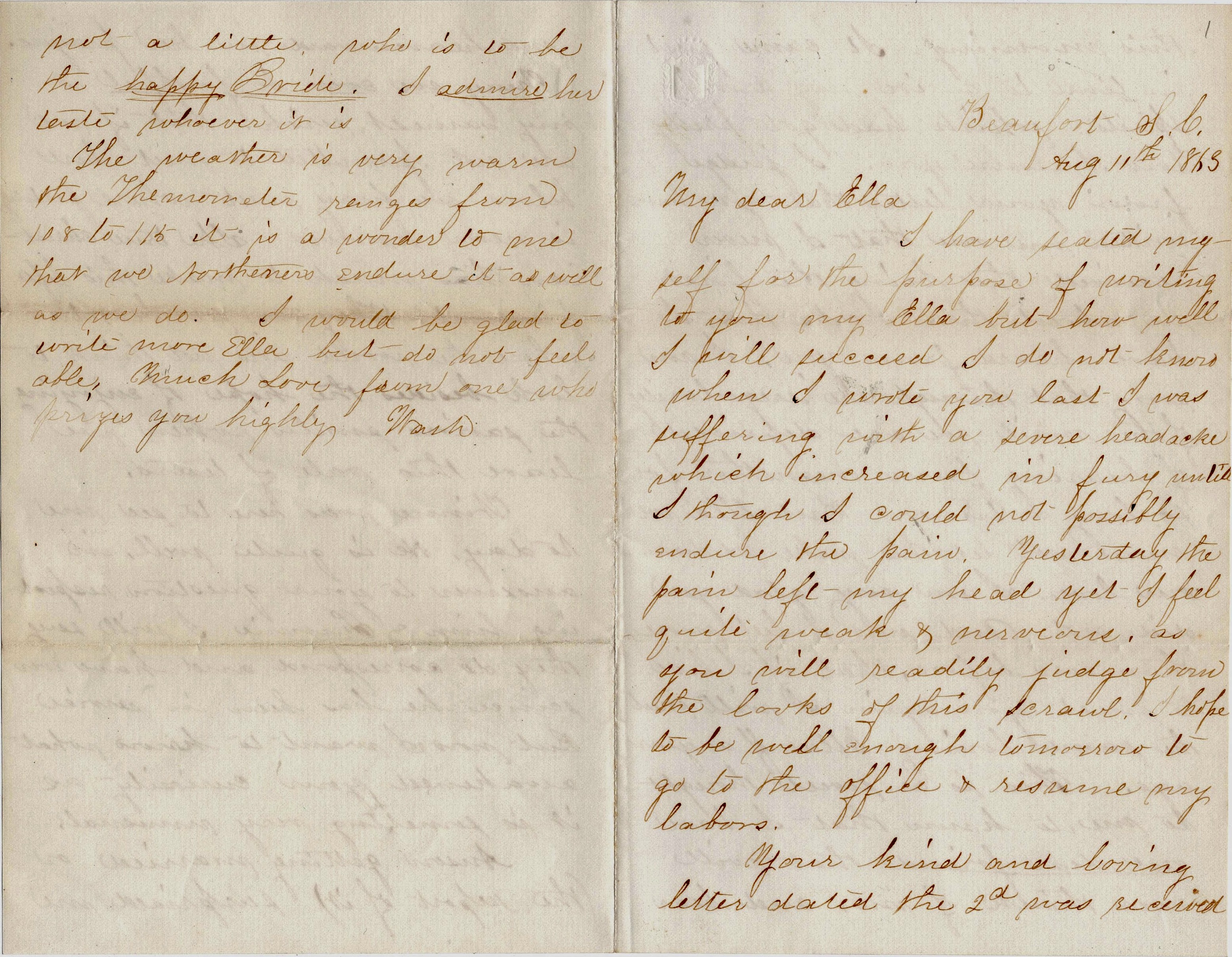
My dear Ella,

I have seated myself for the purpose of writing to you my Ella but how well I will succeed I do not know. When I wrote you last, I was suffering with a severe headache which increased in fury until I thought I could not possibly endure the pain. Yesterday the pain left my head yet I feel quite weak & nervous as you will readily judge from the looks of this scrawl. I hope to be well enough tomorrow to go to the office & resume my labors.

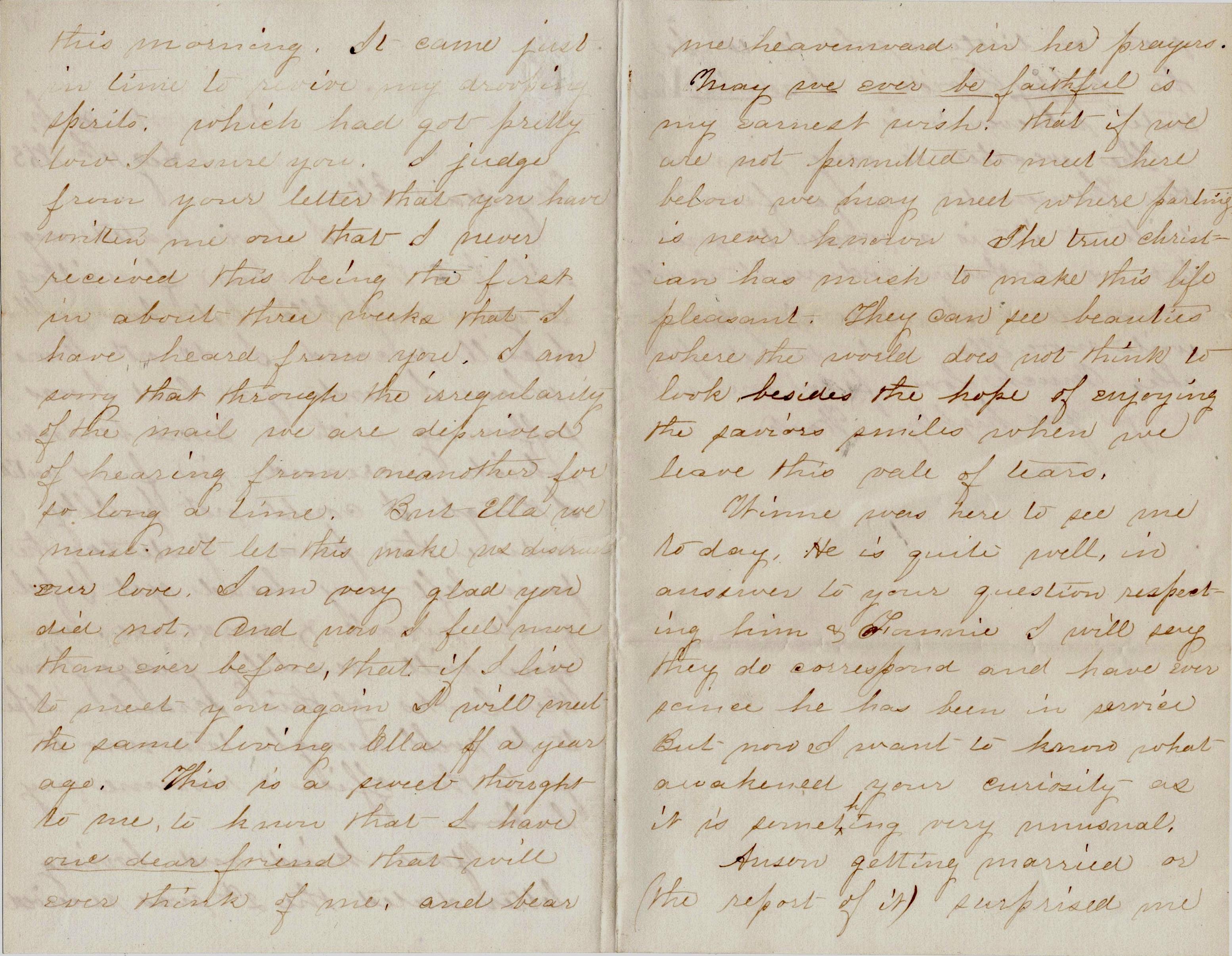
Your kind and loving letter dated the 2nd was received this morning. It came just in time to revive my drooping spirits which had got pretty low, I assure you. I judge from your letter that you have written me one that I never received, this being the first in about three weeks that I have heard from you. I am sorry that through the irregularity of the mail we are deprived of hearing from one another for so long a time. But Ella, we must not let this make is distrust our love. I am very glad you did not. And now I feel more than ever before that if I live to meet you again, I will meet the same, loving Ella of a year ago. This is the sweet thought to me—to know that I have one dear friend that will ever think of me and bear me heavenward in her prayers. May we ever be faithful is my warmest wish. that if we are not permitted to meet here below, we may meet where parting is never known. The true Christian has much to make this life pleasant. They can see beauties where the world does not think to look, besides the hope of enjoying the Savior’s smiles when we leave this vale of tears.

Winne was here to see me today. He is quite well, in answer to your question respecting him, & Fannie, I will say they do correspond and have ever since he has been in service. But now I want to know what awakened your curiosity as it is something very unusual. Anson getting married (or the report of it) surprised me not a little. Who is to be the happy bride? I admire her taste, whoever it is.

The weather is very warm. The thermometer ranges from 108 to 115. It is a wonder to me that we Northerners endure it as well as we do, I would be glad to write more, Ella, but do not feel able. Much love from one who prizes you highly, — Wash
Letter 3

Beaufort, South Carolina
September 6th 1863

My own dear Ella,

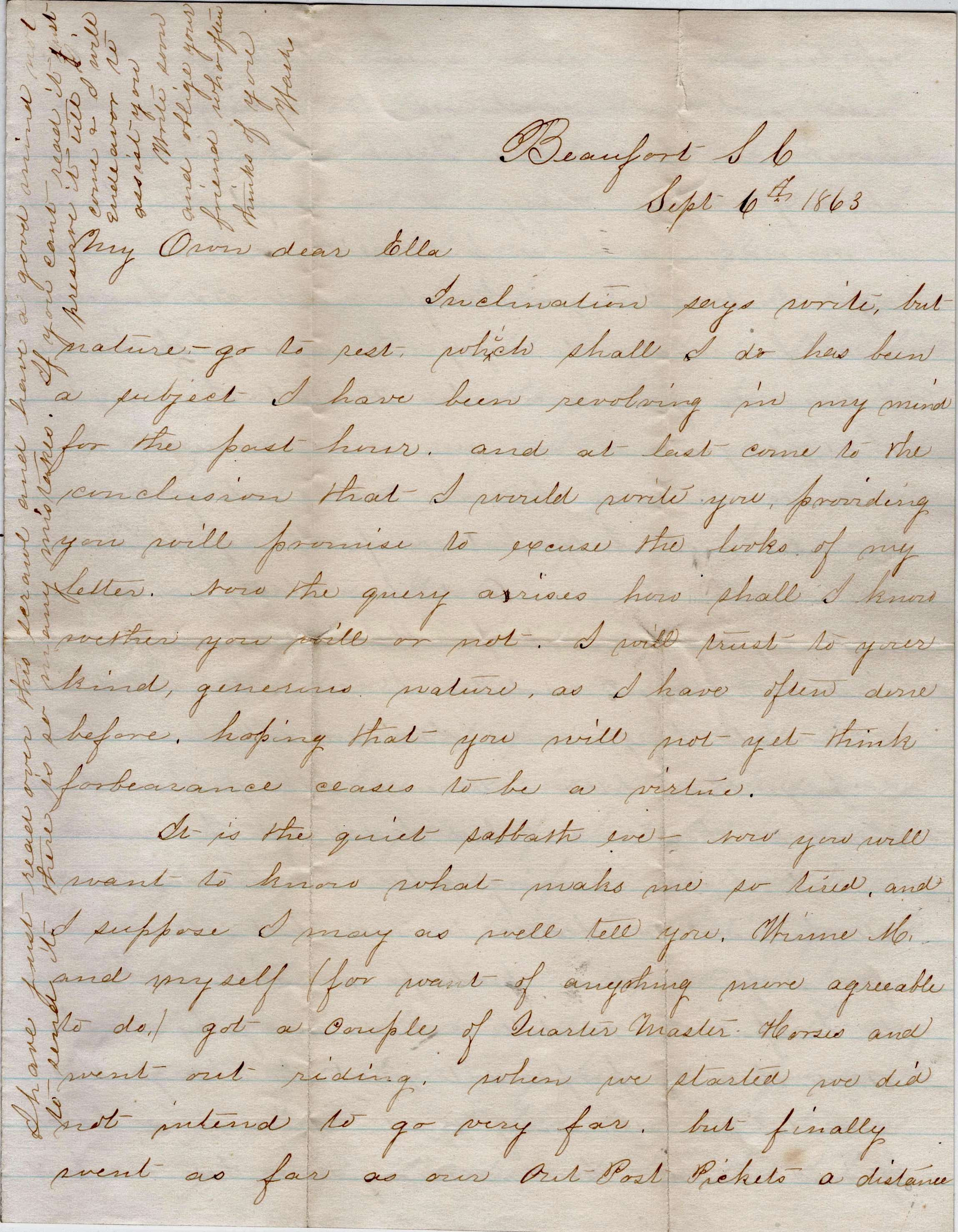
Inclination says write, but nature go to rest. Which shall I do has been a subject I have been revolving in my mind for the past hour and at last come to the conclusion that I would write you providing you will promise to excuse the looks of my letter. Now the query arises, how shall I know whether you will or not. I will trust to your kind, generous nature as I have often done before, hoping that you wil not yet think forbearance ceases to be a virtue.

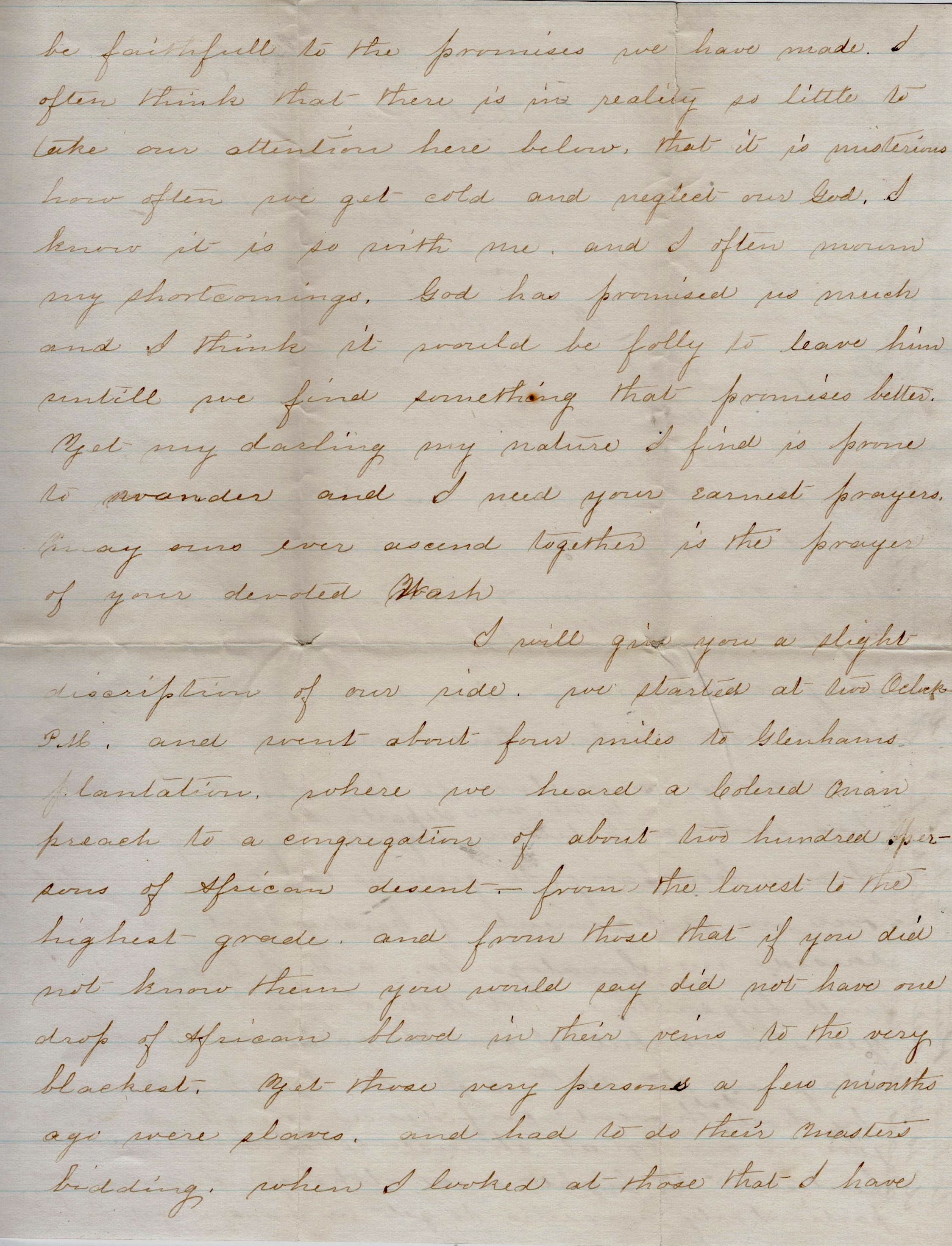
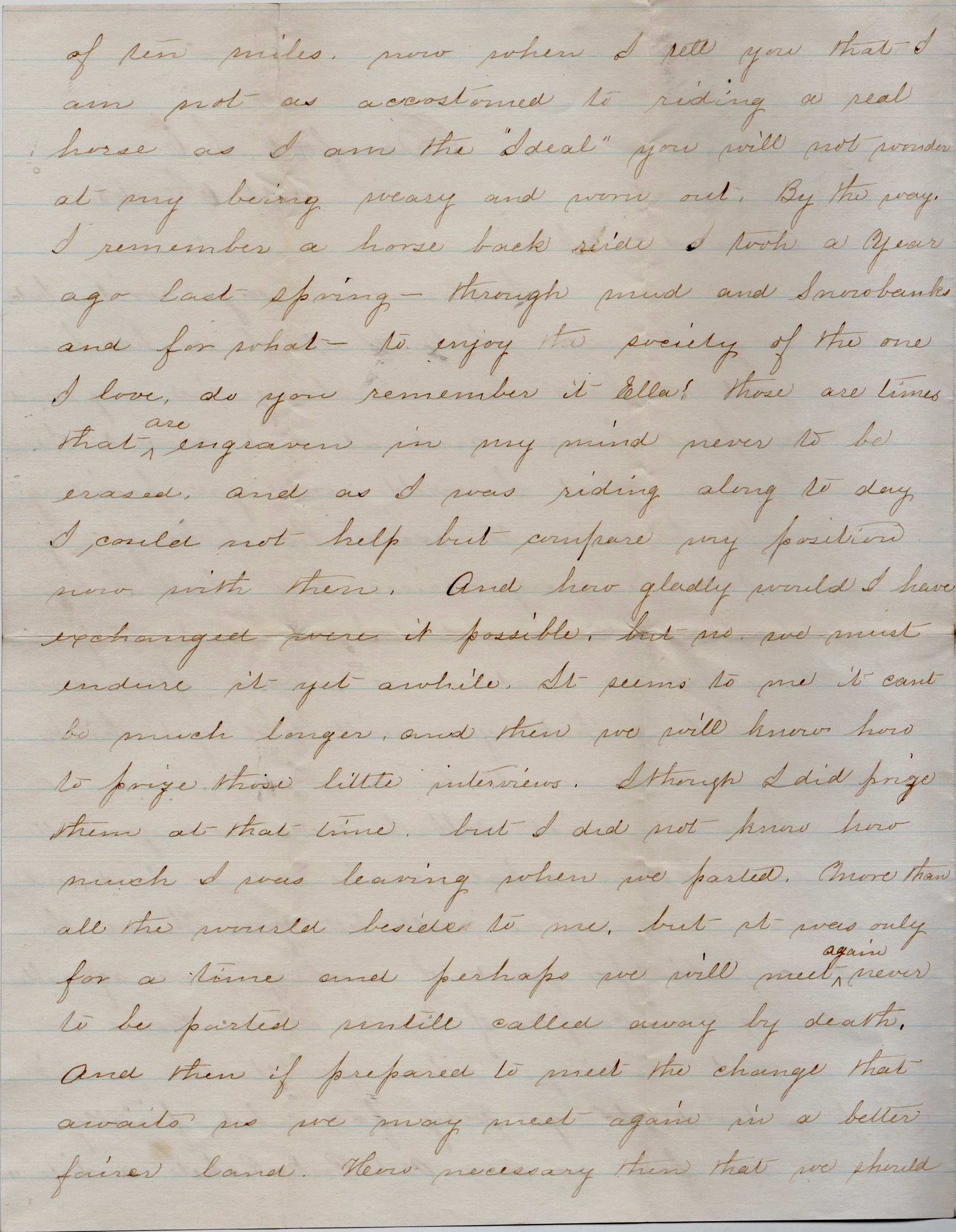
It is the quiet Sabbath eve. Now you will want to know what makes me so tired and I suppose I may as well tell you. Winne M. and myself (for want of anything more agreeable to do) got a couple of quartermaster horses and went out riding. When we started, we did not intend to go very far, but finally went as far as our outpost pickets—a distance of ten miles. Now when I tell you that I am not as accustomed to riding a real horse as I am the “Ideal” you will not wonder at my being weary and worn out. By the way, I remember a horse back ride I took a year ago last spring—through mud and snowbanks and for what—to enjoy the society of the one I love. Do you remember it, Ella? Those are times that are engraved in my mind never to be erased. And as I was riding along today I could not help but compare my position now with then. And how gladly would I have exchanged were it possible. But no, we must endure it yet awhile. It seems to me it can’t be much longer, and then we will know how to prize those little interviews. Although I did prize them at the time, but I did not know how much I was leaving when we parted—more than all the world besides to me. But it was only for a time and perhaps we will meet again, never to be parted until called away by death. And then, if prepared to meet the change that awaits us, we may meet again in a better, fairer land. How necessary then that we should be faithful to the promises we have made. I often think that there is in reality so little to take our attention here below—that it is mysterious how often we get cold and neglect our God. I know it is so with me, and I often mourn my shortcomings. God has promised us much and I think it would be folly to leave Him until we find something that promises better. Yet my darling my nature I find is prone to wander and I need your earnest prayers. May ours ever ascend together is the prayer of your devoted Wash.

I will give you a slight description of our ride. We started at two o’clock p.m. and went about four miles to Glenhams Plantation where we heard a Colored man preach to a congregation of about two hundred persons of African descent, from the lowest to the highest grade, and from those that if you did not know them you would say did not have one drop of African blood in their veins to the very blackest. Yet those very persons a few months ago were slaves and had to do their masters bidding. When I looked at those that I have seen were whiter than their masters, I wondered how it could be that we have men in this enlightened age that want to preserve that accursed institution. Surely they have not one spark of humanity about them or it could not be so.

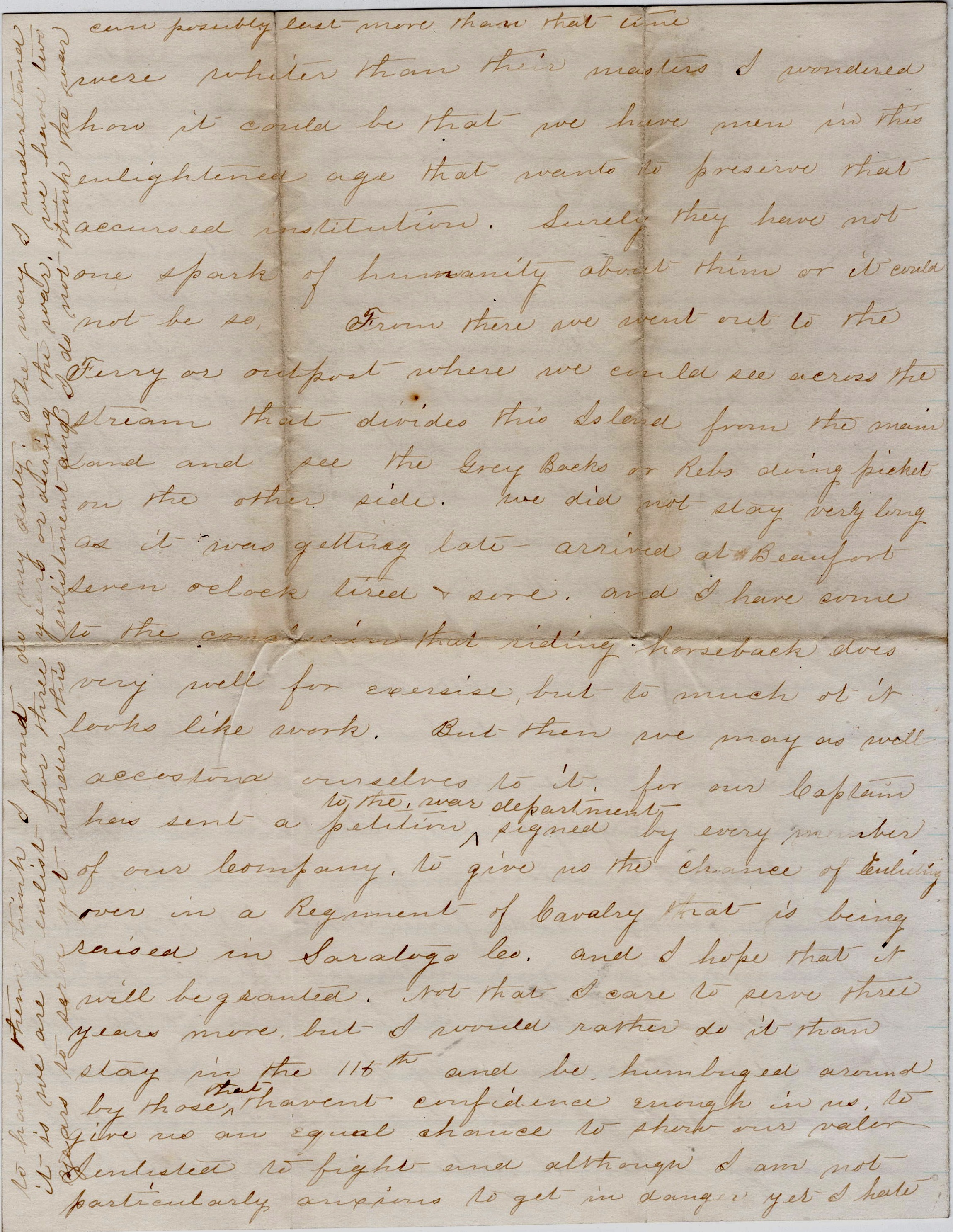
From there we went out to the Ferry or outpost where we could see across the stream that divides this island from the mainland and see the Grey Backs or Rebs doing picket on the other side. We did not stay very long as it was getting late. Arrived at Beaufort at seven o’clock tired & sore and I have come to the conclusion that rifing horseback does very well for exercise but too much of it looks like work. But then we may as well accustom ourselves to it for our Captain has sent a petition to the War Department signed by every member of our company to give us the chance of enlisting over in a regiment of cavalry that is being raised in Saratoga county and I hope that it will be granted. Not that I care to serve three years more but I would rather do it than stay in the 115th [New York] and be humbugged around by those that haven’t confidence enough in us to give us and equal chance to show our valor. I enlisted to fight and although I am not particularly anxious to get in danger, yet I hate to have them think I won’t do my duty. The way i understand it is we are to enlist for three years or during the wart. We have two years to serve yet under the enlistment and I do not think the war can possibly last more than that time.

I have just read over this scrawl and have a good mind not to send it—there is so many mistakes. If you can’t read it, just preserve it till I come & I will endeavor to assist you. Write soon and oblige your friend who often thinks of you. — Wash
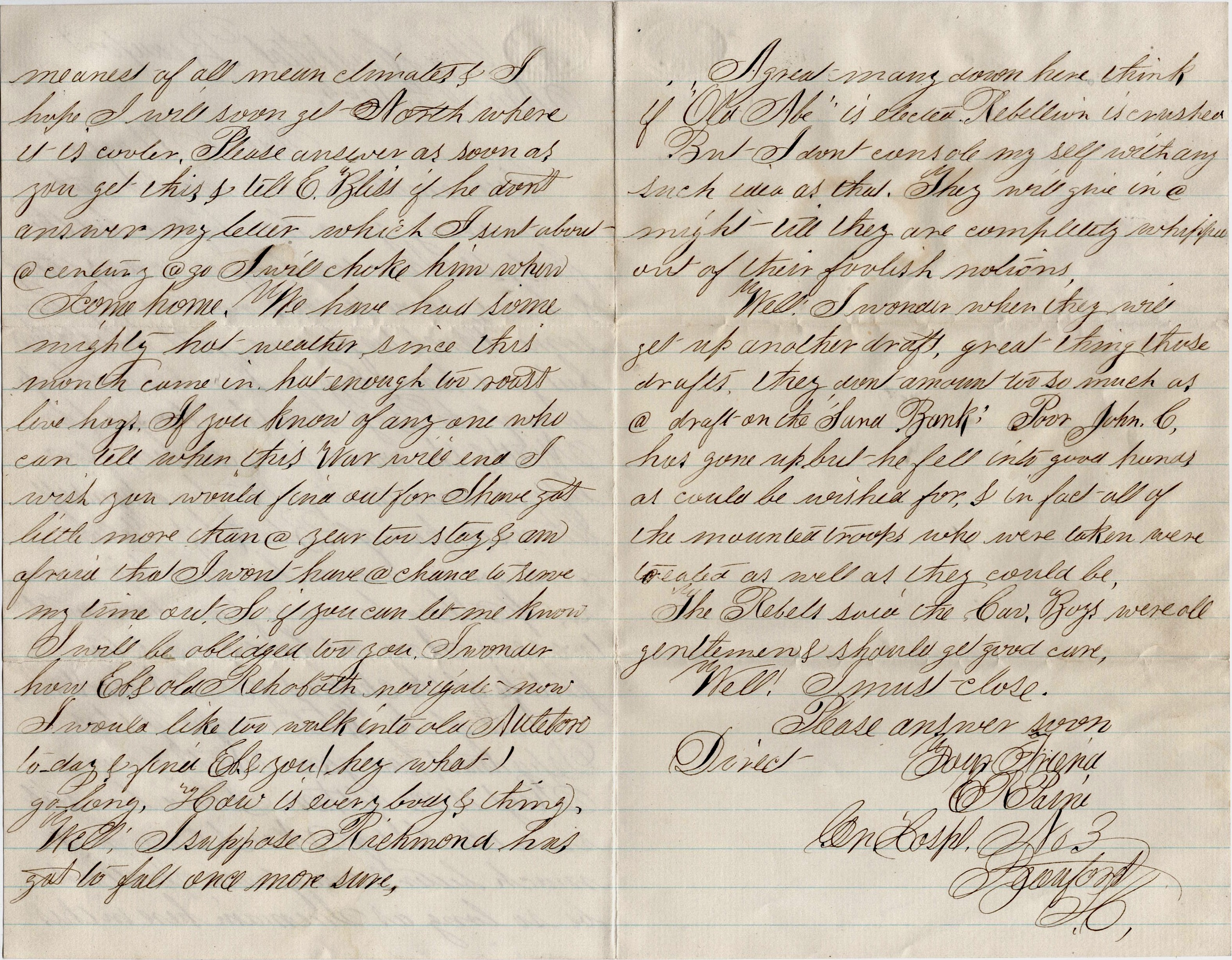
1864: Edwin R. Paine to Oscar S. Thayer

This letter was written by Edwin R. Paine (1840-1880), the son of Lewis Whipple and Jane (Nelson) Paine of Bristol county, Massachusetts. He first enlisted in the 1st Rhode Island Detached Militia in May 1861 for 90 days but the following year, in September, 1862, he enlisted in Co. H, 40th Massachusetts Infantry. Co. H was raised primarily in Essex county with several men from towns like Attleboro. He was discharged for disability on 15 July 1864 at Boston, giving Attleboro, Massachusetts as his residence. In October 1861, he was married to Margaret N. Shields (1841-1899) and had a son named Nelson born in 1862. He’s buried in Pawtucket, Providence county, Rhode Island.

The 40th Massachusetts left the state on 8 September 1862 and was comparatively inactive for some time and remained on picket and guard duty in and around Washington until the spring of 1863. On 15 April 1863, it moved to Suffolk, Va., then under siege, where it was engaged in two reconnaissances on April 24 and May 3. It then moved to West Point, Va., Yorktown, Williamsburg, White House landing in succession, and was engaged with the enemy at Baltimore cross-roads, on July 2. It then passed through Washington on the 11th, and went to Frederick, Md., where it joined the Army of the Potomac in the pursuit of Lee’s army after the battle of Gettysburg. On Aug. 6, it was ordered to Folly island, Charleston harbor, and occupied the trenches in front of Fort Wagner until the surrender of that stronghold. On account of its high repute for excellence in drill and discipline, it was equipped as mounted infantry at Hilton Head in Jan., 1864, and moved on Feb. 4, to Jacksonville, Fla., where it formed part of the Light brigade composed of the 40th, the independent battalion Mass. cavalry and Battery B, 1st U. S. Artillery, Col. Henry acting brigadier. It was engaged at Barber’s ford and Olustee, losing in the latter engagements 5 killed, 23 wounded and 4 missing.

T R A N S C R I P T I O N

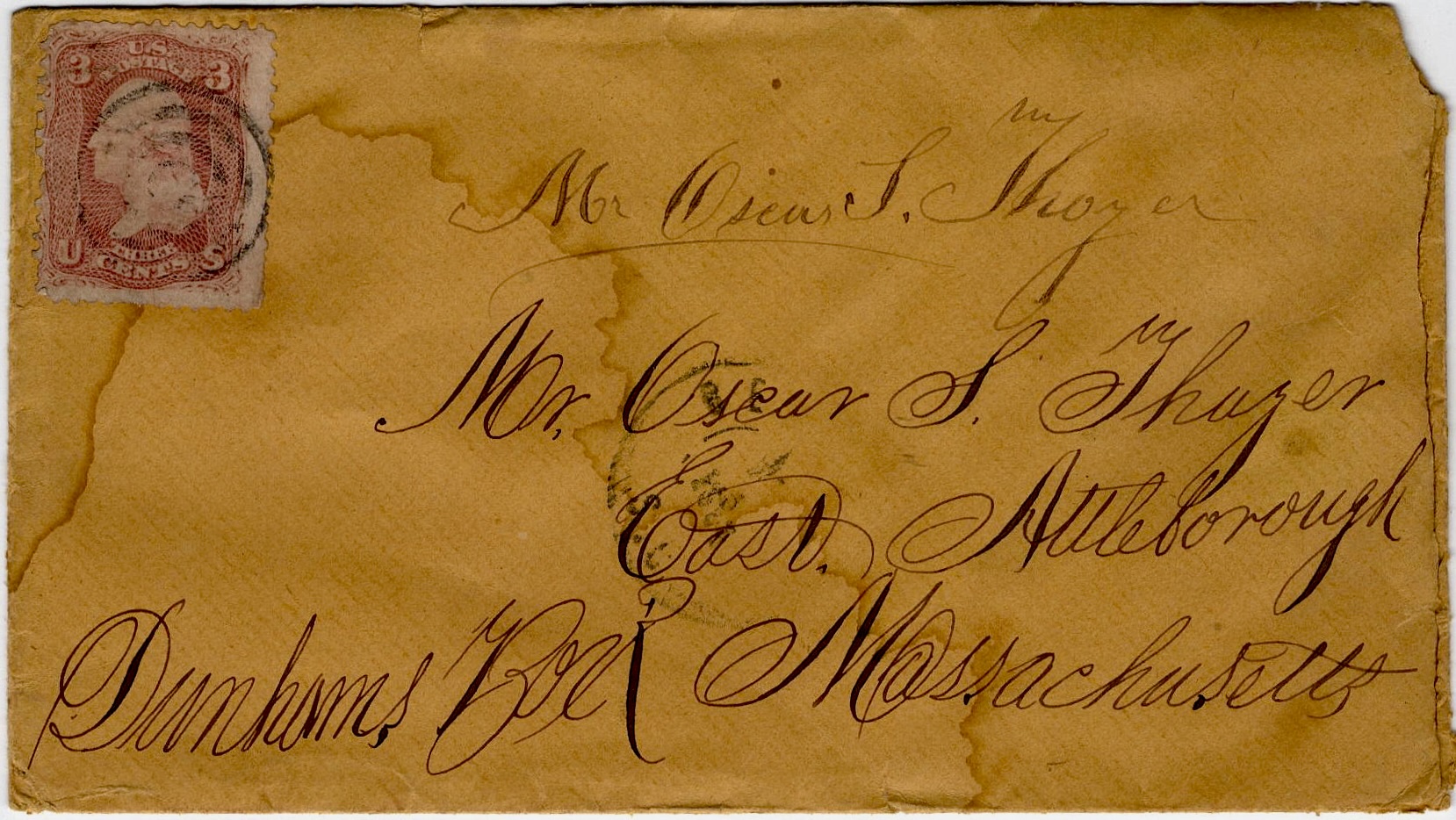
Directed to Mr. Oscar S. Thayer, Wast Attleborough, Massachusetts; Dunham’s Box

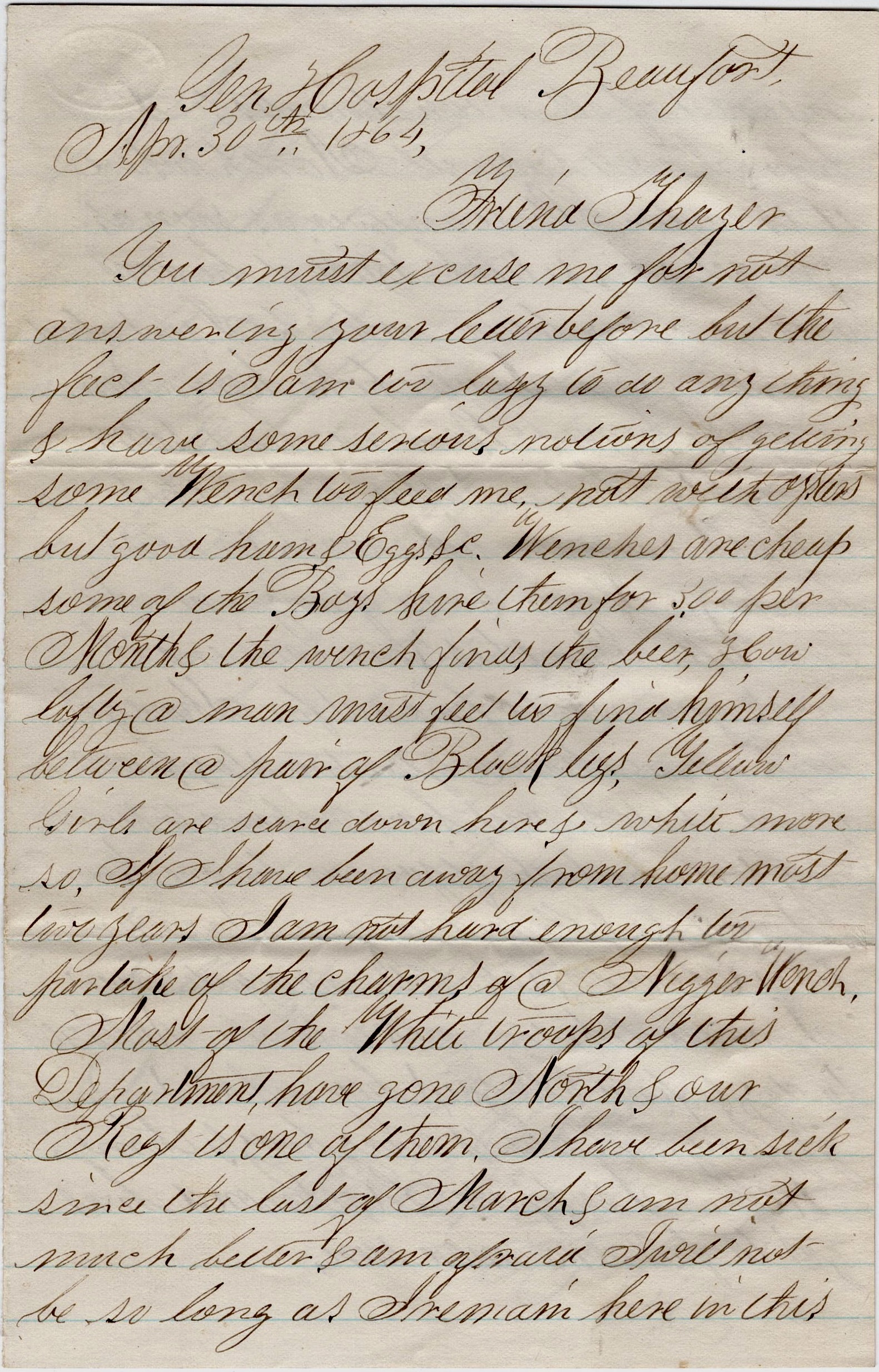
General Hospital, Beaufort
April 30th 1864

Friend Thayer,

You must excuse me for not answering your letter before but the fact is I am too lazy to do anything. I have some serious notions of getting some wench to feed me–not with oysters, but good ham & eggs, &c. Wenches are cheap. Some of the boys hire them for $3 per month & the wench finds the beer. How lofty a man must feel to find himself between a pair of Black legs. Yellow girls are scarce down here & White more so. If I had been away from home most two years, I am not hard enough to partake of the charms of a Nigger Wench. Most of the White troops of this department have gone North & our regiment is one of them. I have been sick since the last of March & am not much better & am afraid I will not be so long as I remain here in this meanest of all climates & I hope I will soon get North where it is cooler.

Please answer as soon as you get this & tell E. Bliss if he don’t answer my letter which I sent about a century ago, I will choke him when I come home.

We have had some mighty hot weather since this month came in—hot enough to roast live hogs. If you know of anyone who can tell when this war will end, I wish you would find out for I have got little more than a year to stay & am afraid that I won’t have a chance to serve my time out. So if you can let me know, I will be obliged to you. I wonder how Eb’s old Rehoboth navigates now? I would like to walk into Old Attleboro today to find Eb & you (hey what) go long. How is everybody & things?

Well, I suppose Richmond has got to fall once more, sure. A great many down here think if “Old Abe” is elected, [the] Rebellion is crushed. But I don’t console myself with any such idea as that. They will [not] give in a might till they are completely whipped out of their foolish notions.

Well, I wonder when they will get up another draft? Great thing those drafts. They don’t amount to so much as a draft on the “Sand Bank.” Poor John C. has gone up but he fell into [as] good hands as could be wished for, & in fact, all of the mounted troops who were taken were treated as well as they could be.

The Rebels saw the cavalry boys were all gentlemen & should get good care. Well, I must close. Please answer soon. Your friend, R. Paine

General Hospital No. 3, Beaufort, S. C.

1862: Greenwood Norris to G. J. Wing

The following letter was written by 18 year-old Greenwood Norris (1844-1862), the son of Greenwood B. Norris (1825-1844) and Harriet N. Hall (1820-1861) of Wayne, Kennebec county, Maine. After his father’s death, his mother remarried to William Wing, Jr. (1805-1888).

As his letterhead informs us, Greenwood Norris was a member of Co. C, 8th Maine Infantry. And while he writes on 8 July 1862 “I am well” and that Beaufort, South Carolina “is the healthiest island round here,” he died just three days later on 11 July 1863, according to Beaufort National Cemetery records. Another source claims he did not die until July 30th which seems more likely.

Beaufort, South Carolina in 1862. It shows the front & rear of several buildings lining Bay Street from what today is Henry C. Chambers Waterfront Park. Sam A. Cooley, Photographer.

T R A N S C R I P T I O N

8th Maine Regiment, Co. C
Beaufort, South Carolina
July 8, 1862

Dear Friend,

I received your letter the 7th [and] was glad to hear from you. I am well and hope you [are] the same. We moved from Hilton Head the 3rd and went up to Beaufort. We stopped in a meeting house two nights and over the 4th, we did not have a very good time. It was not a day of independence because we had to stay in the house and the niggers went where they pleased.

This is quite a large place. There is two meeting houses—one a Methodist and a Baptist. We are right side of the mainland. The rebels shell our pickets every day. One of our boys were shot and two taken prisoners.

I am glad that so many of the young folks are getting married. I suppose that the next thing that I hear, you will be married. I think that some of them had better wait a little longer before striking out. I think I should.

We have green corn and squash. I have not much news because we have just got settled here. I guess that it will puzzle the devil to read this letter.

I should like to have been at Wayne the 4th [of July]. I think I should [have] had a better time. I am afraid we shall have to stay longer than it is expected. This is the healthiest island round here.

I am afraid that Gen. McClellan’s army will fail to do as much as expected. We are quite discouraged down here. There is plenty of darky girls out here but I have not see a white girl yet. So goodbye. Yours truly, — Greenwood Norris

to G. J. Wing

1863: Ephraim L. German to his Family

I could not find a war-time photograph of Ephraim but here is one of Jacob Dibert who also served as a private in the same company.

These letters were written by Pvt. Ephraim L. German (1836-1901) who enlisted in Co. K, 55th Pennsylvania Infantry on 3 October 1863. Ephraim was the son of Jacob and Harriet (Lace) German of Robersonia, Berks county, Pennsylvania. He was married to Isabella (“Belle”) Gruber (1843-1914) and had a daughter named Mary H. German (1862-1933) when he left to join the service.

Aside from witnessing the 1863 bombardment of Fort Sumter in Charleston Harbor, the letters don’t reveal much about the war or the movements and duties of the regiment. They give us some indication, however, of the kinds of home troubles that plagued soldiers who were often distracted from their duty.

Letter 1

Port Royal Island, South Carolina
2 November 1863

Dear Father, Mother & Wife and all,

I write a few lines to let you know that we are not in Virginia as was the talk. We left Reading for Philadelphia and from Philadelphia to Port Royal in South Carolina. Beaufort is a very nice town on the island. Dear father, we were on board of a ship for ten days and nothing to eat, I was near starved. I was sick all the time and am not well yet.

We have been at Fort Sumter. I have been in the shelling of Fort Sumter and have been at Charleston. At Sumter there was a terrible cannonading. I never thought of seeing Sumter shelled. We are at Beaufort, Port Royal, South Carolina and we hear heavy cannonading at Charleston or Sumter yet. The time after we left Sumter, the ironclads renewed the fight.

Dear father, you know I am here to fight the battle of our Heavenly Father. Dear father, I beg for you to take my wife Isabella home. Take her and see that she will be cared for and I will send money home as soon as we get our pay. And if you take her home, then get her everything she has need of. And when the money comes home, you take that money and pay off what it costs. Take care of Mary. Father, take my wife home and then I am satisfied and then I can fight the battles of Liberty with pleasure. Father, do that for me and then I am all right as soon as I hear of the change. Send me an answer as soon as you have my wife at home. And then as soon as I get that money or as soon as we get our pay, I will send the money home.

You will please get her what she must have and it will be all right. Father, please do take my wife and child home. You know your son is fighting for our country. I am doing something for you, dear father, and now do something for me for God’s sake. I do not know when I will come home so take care of my family. If God saves me, I send money so that she can live and be supported. Nothing more at present. From your affectionate son, — Ephraim L. German

Directions. Send your letter to Company K, 44th Regiment P. V., Beaufort, Port Royal, South Carolina

If you want to send an answer, go to Samuel Kieser with the directions.


Letter 2

[Editor’s note: The following letter was found on Ancestry.com and explains a little better why Ephraim was so insistent that his wife Belle live with his parents rather than hers.]

Beaufort [South Carolina]
December 27, 1863

Dear Parents,

I take my pen in hand to inform you that I am well at present time, hoping you to be in the same state of health. I don’t know what is the reason you don’t write me more letters. I have sent letters home and have not been answered. I would like it very much if you would answer every letter I sent home. Belle ought to sent me some letters.

Father has had no time sometimes to write when I was at home. Belle can go to her brother Harrison. He can write a letter for her. But if the weather is too bad, she shall stay at home. I don’t care for letters if she is with you. You can write me about her. Let me know whether she lives with you or not. It troubles me about it for we have hard times and then [to] have things in the head about home not being settled. I want you to let me know whether she lives with you or not. If she is not with you, I will be God damned if I will not bring this thing to a close. If she stays with her parents, I will not send her a darn cent of money and will not stay with her. If she is not with you, I will be damned if I come home. I will not do a thing for her. I will leave her and take Mary from her.

Her parents are the very devil. They done everything against me they could do. Now I want her to be with you. If she will stay at home with her parents, I will stay from her to when I come home again. Let me know whether she is with you or not. We will have payday in two weeks, or so they say. You shall let me know whether she is with you or not and not say she is if she is not. If she is not, I will not send her money. If she wants to be my wife, she must obey my orders. I will send her the money if she is with you. Your affectionate son, — Ephraim L. German

Dear wife,

I would like to see you with my parents for I know that my father will get you things and then you can stay with him till I come home. You know that I will never make up with your parents and if you will stay at [their] home, we will be separated. Take care of Mary. If you will do what I tell you, you shall have the money. From your affectionate husband, – Ephraim L. German

1861-62: Albert Clark Cooke to Cousin Mary

The following letter was written by Albert Clark Cooke (1840-1862), the son of Joseph Clark Cooke (1813-1882) and Amey Wade (1815-1873) of Putnam, Windham county, Connecticut. Albert was born in Rhode Island but moved with his family to Bureau county, Illinois, (where they were enumerated in 1850) before moving to Putnam, Connecticut.

Albert enlisted in Co. A, 6th Connecticut Infantry. He died at Beaufort, South Carolina, on Christmas day, 1862. His cause of death is rather unspecific. The surgeon recorded that he was “admitted with debility.” He was 22.

The 6th Connecticut Infantry was stationed in Beaufort, South Carolina, from September 1862 to March 1863 under the command of Colonel John Lyman Chatfield.


Letter 1

Hilton Head, South Carolina
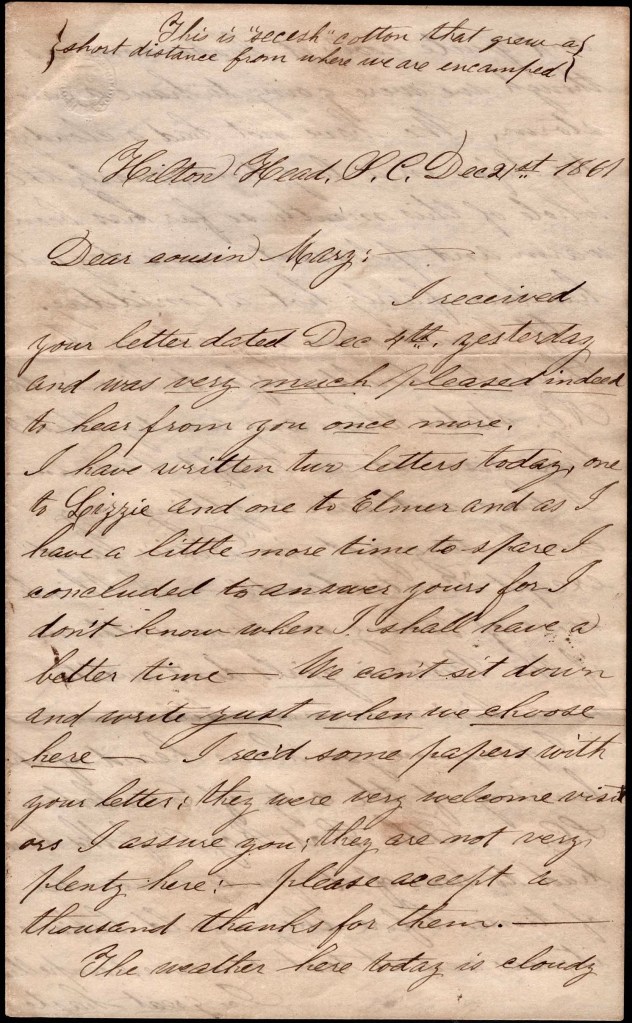
December 21st 1861

Dear cousin Mary,

I received your letter dated December 4th yesterday and was very much pleased indeed to hear from you once more. I have written two letters today, one to Lizzie and one to Elmer and as I have a little more time to spare, I concluded to answer yours for I don’t know when I shall have a better time. We can’t sit down and write just when we choose here. I received some papers with your letter; they were very welcome visitors, I assure you. They are not very plenty here. Please accept a thousand thanks for them.

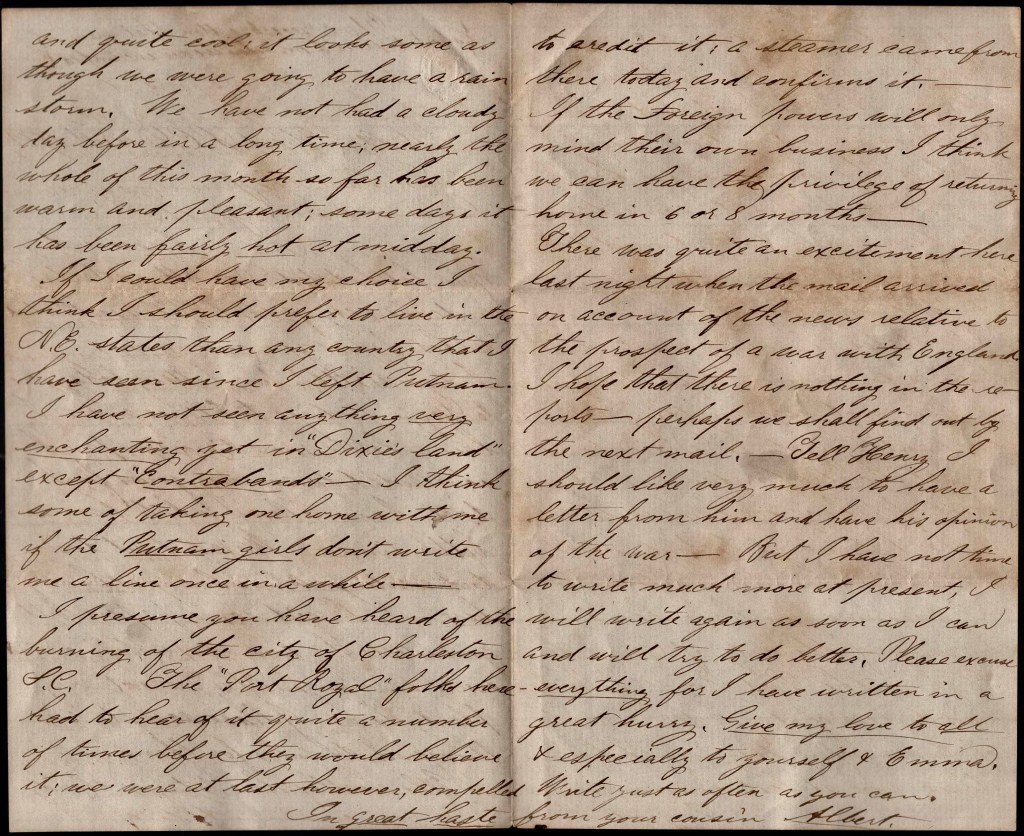
The weather here today is cloudy and quite cool. It looks some as though we were going to have a rain storm. We have not had a cloudy day before in a long time. Nearly the whole month so far has been warm and pleasant. Some days it has been fairly hot at midday.

If I could have my choice I think I should prefer to live in the New England states than any country that I have seen since I left Putnam. I have not seen anything very enchanting yet in “Dixie’s Land” except “contrabands.” I think some of taking one home with me if the Putnam girls don’t write me a line once in a while.

I presume you have heard of the burning of the City of Charleston, S. C. The “Port Royal” folks here had to hear of it quite a number of times before they would believe it. We were at last, however, compelled to credit it. A steamer came from there today and confirms it. If the foreign powers will only mind their own business, I think we can have the privilege of returning home in 6 or 8 months.

There was quite an excitement here last night when the mail arrived on account of the news relative to the prospect of a war with England, I hope that there is nothing in the reports. Perhaps we shall find out by the next mail.

Tell Henry I should like very much to have a letter from him and have his opinion of the war. But I have not time to write much more at present. I will write again as soon as I can and will try to do better. Please excuse everything for I have written in a great hurry. Give my love to all & especially to yourself & Emma. Write just as often as you can. In haste. From your cousin, — Albert

This is “secesh” cotton that grew a short distance from where we are encamped.


Letter 2

Beaufort, South Carolina
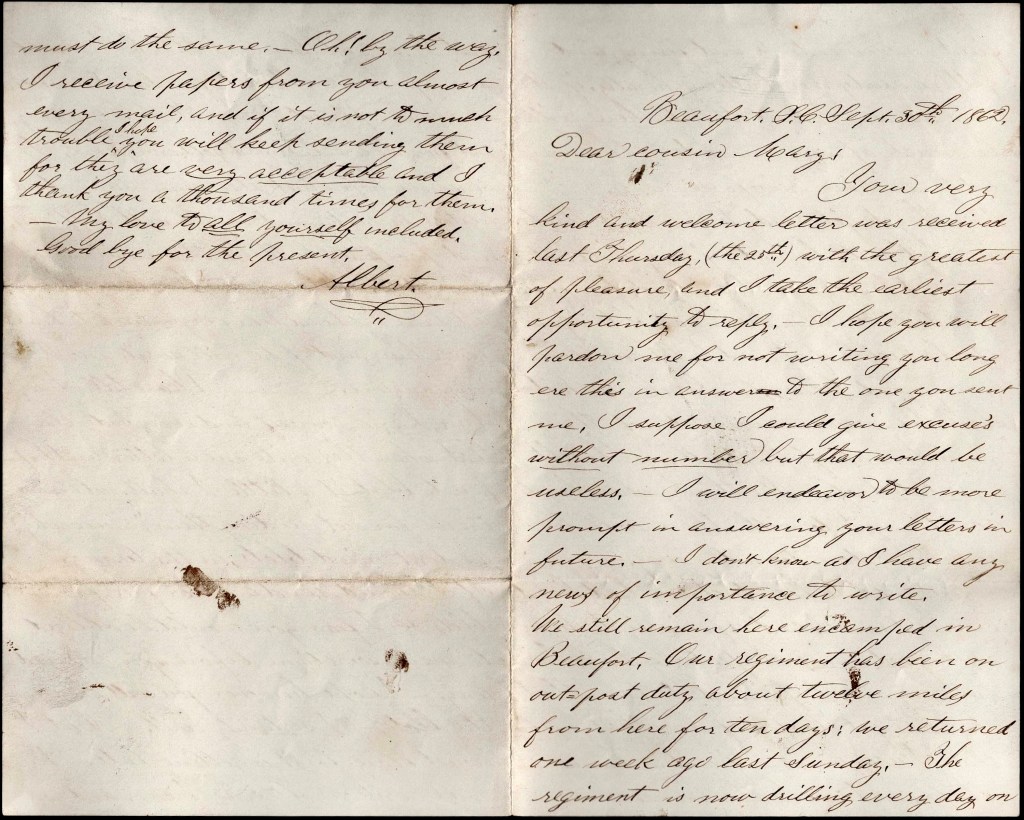
September 30th 1862

Dear cousin Mary,

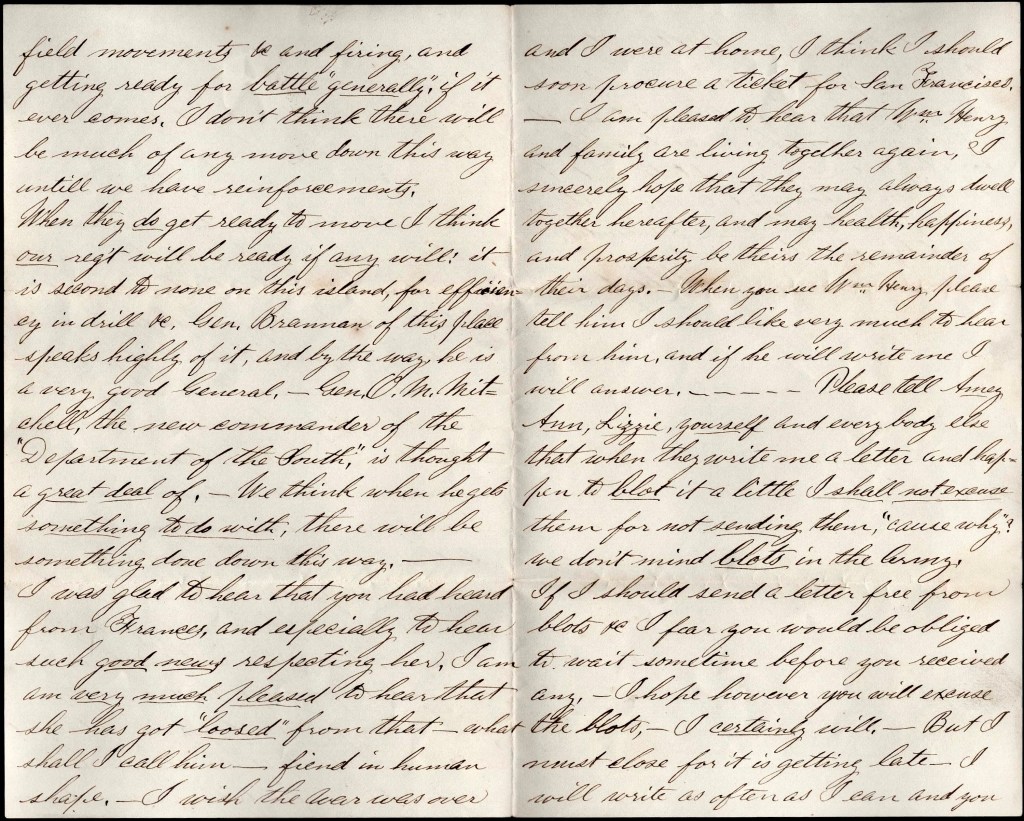
Your very kind, welcome letter was received last Thursday (the 25th) with the greatest of pleasure, and I take the earliest opportunity to reply. I hope you will pardon me for not writing you long ere this in answer to the one you sent me. I suppose I could give excuses without number but that would be useless. I will endeavor to be more prompt inn answering your letters in future. I don’t know as I have any news of importance to write. We still remain here encamped in Beaufort. Our regiment has been on outpost duty about twelve miles from here for ten days. We returned one week ago last Sunday. The regiment is drilling every day on field movements &c. and firing and getting ready for battle “generally”—if it ever comes. I don’t think there will be much of any move down this way until we have reinforcements. When they do get ready to move, I think our regiment will be ready if any will. It is second to none on this island for efficiency in drill, &c. Gen. Brannan of this place speaks highly of it, and by the way, he is a very good general. Gen. O. M. Mitchell, the new commander of the “Department of the South,” is thought a great deal of. We think when he gets something to do with, there will be something done down this way.

I am glad to hear that you had heard from Frances and especially to hear such good news respecting her. I am very much pleased to hear that she has got “loosed” from that—what shall I call him—-friend in human shape. I wish the war was over and I was at home. I think I should soon procure a ticket for San Francisco. I am pleased to hear that Wm. Henry and family are living together again. I sincerely hope that they may always dwell together hereafter, and may health, happiness, and prosperity be theirs the remainder of their days. When you see Wm. Henry, please tell him I should like very much to hear from him, and if he will write me, I will answer.

Please tell Amey, Ann, Lizzie, yourself and everybody else that when they write me a letter and happen to blot it a little, I shall not excuse them for not sending them. “Cause why?” We don’t mind blots in the army. If I should send a letter free from blots &c., I fear you would be obliged to wait some time before you received any. I hope, however, you will excuse the blots. I certainly will. But I must close for it is getting late. I will write as often as I can and you must do the same. Oh! by the way, I receive papers from you almost every mail and if it is not too much trouble, I hope you will keep sending them for they are very acceptable and I thank you a thousand times for them. My love to all—yourself included. Goodbye for the present. — Albert

1865: William Edgar Oakey to Peter Davis Oakey

The following letters were written by William Edgar Oakey (b. 1844) who enlisted at 18 years of age in August 1862 to serve as a private in Co. A, 127th New York Infantry. He mustered out with the company at Charleston, South Carolina, on 30 June 1865.

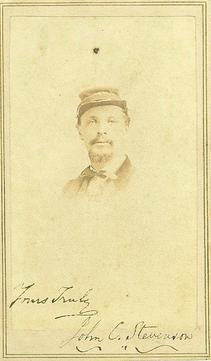
I could not find an image of William but here is a CDV of John C. Stevenson who mustered in and out of the same company with William. (Ancestry.com)

William was the son of Rev. Peter Davis Oakey (1816-1895)—a Presbyterian Clergyman—and Nancy Simpson (1818-1879) of Jamaica, Queens county, New York. (Note: the name is spelled Oakley at times.)

To read other letters by member if the 127th New York Infantry that I have transcribed and published on Spared & Shared, see:

Henry Blain Graham, Co. C, 127th New York (1 Letter)
John Allen, Co. E, 127th New York (1 Letter)
Lord Wellington Gillett, Co. H, 127th New York (1 Letter)
Jonathan Allen Bennett, Co. K, 127th New York (33 Letters)
Josiah Parsons Miller, Co. K, 127th New York (3 Letters)
William B. Miller, Co. K, 127th New York (4 Letters)

Letter 1

Beaufort, South Carolina
February 11, 1865

Dear Father,

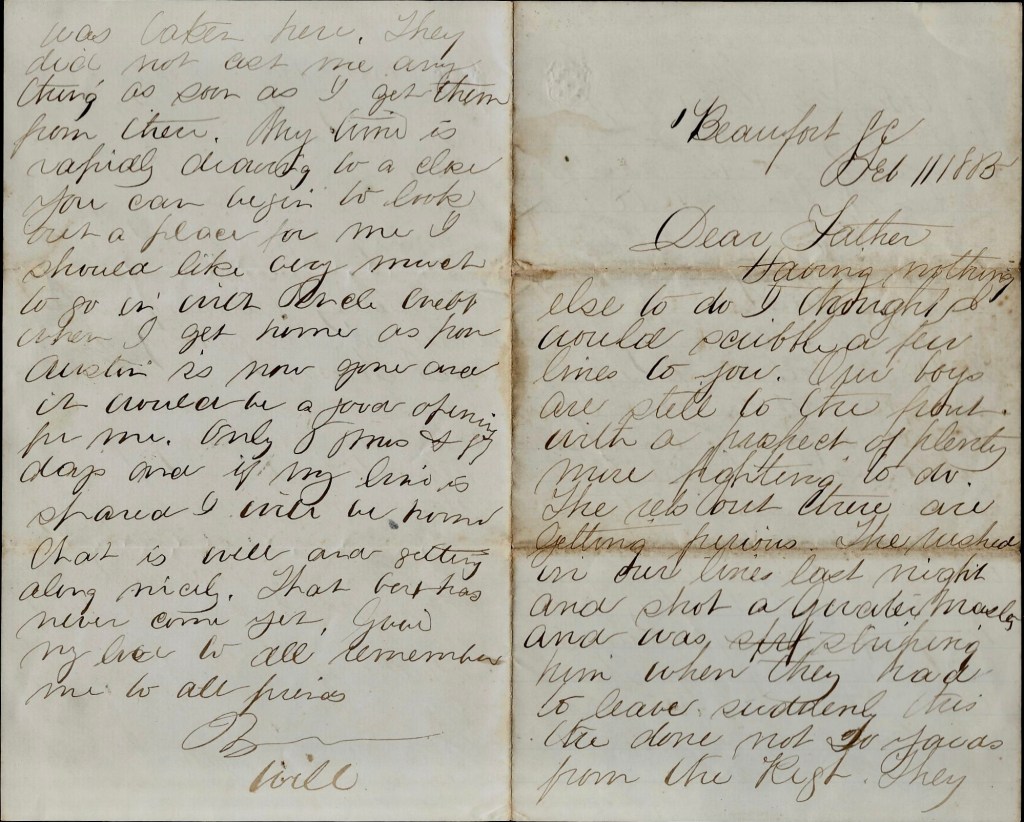
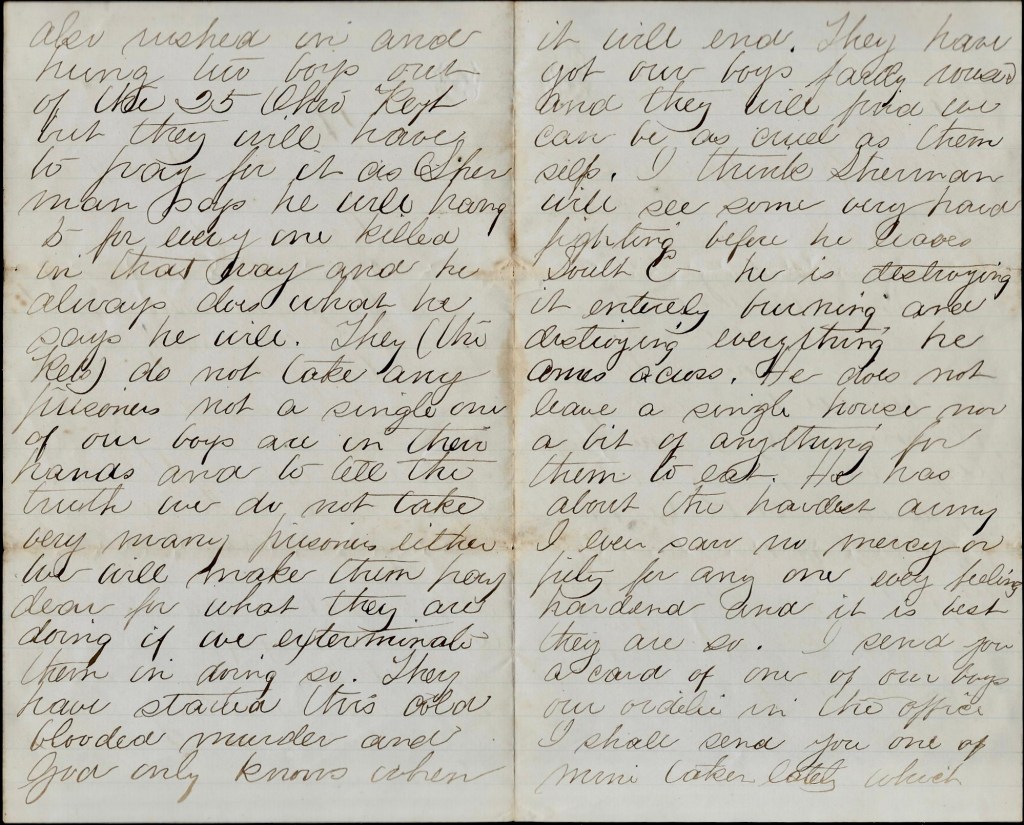
Having nothing else to do I thought I would scribble a few lines to you. Our boys are still to the front with a prospect of plenty more fighting to do. The rebs out there are are getting furious. They rushed in our lines last night and shot a quarter master and was stripping him when they had to leave suddenly. This they done not 20 yards from the regiment. They also rushed in and hung two boys out of the 25th Ohio Regiment but they will have to pay for it as Sherman says he will hang 5 for every one killed in that way and he always does what he says he will. They (the Rebs) do not take any prisoners. Not a single one of our boys are in their hands and to tell the truth, we do not take very many prisoners either. We will make them pay dear for what they are doing if we exterminate them in doing so. They have started this cold-blooded murder and God only knows when it will end. They have got our boys fairly roused and they will find we can be as cruel as themselves.

I think Sherman will see some very hard fighting before he leaves South Carolina. He is destroying it entirely—burning and destroying everything he comes across. He does not leave a single house nor a bit of anything for them to eat. He has about the hardest army I ever saw—no mercy or pity for anyone—every feeling hardened—and it is best they are so.

I send you a card of one of our boys—our Orderly in the office. I shall send you one of mine taken lately which was taken here—they did not cost me anything—as soon as I get them from there. My time is rapidly drawing to a close. You can begin to look out a place for me. I should like very much to go in with Uncle Crebb when I get home as poor Austin is now gone and it would be a good opening for me. Only 6 months and 17 days and if my life is spared, will be home. Chas. is well and getting along nicely. That box has never come yet. Good [bye]. My love to all. Remember me to all friends. — Will


Letter 2

Beaufort, South Carolina
February 18, 1865

Dear Father,

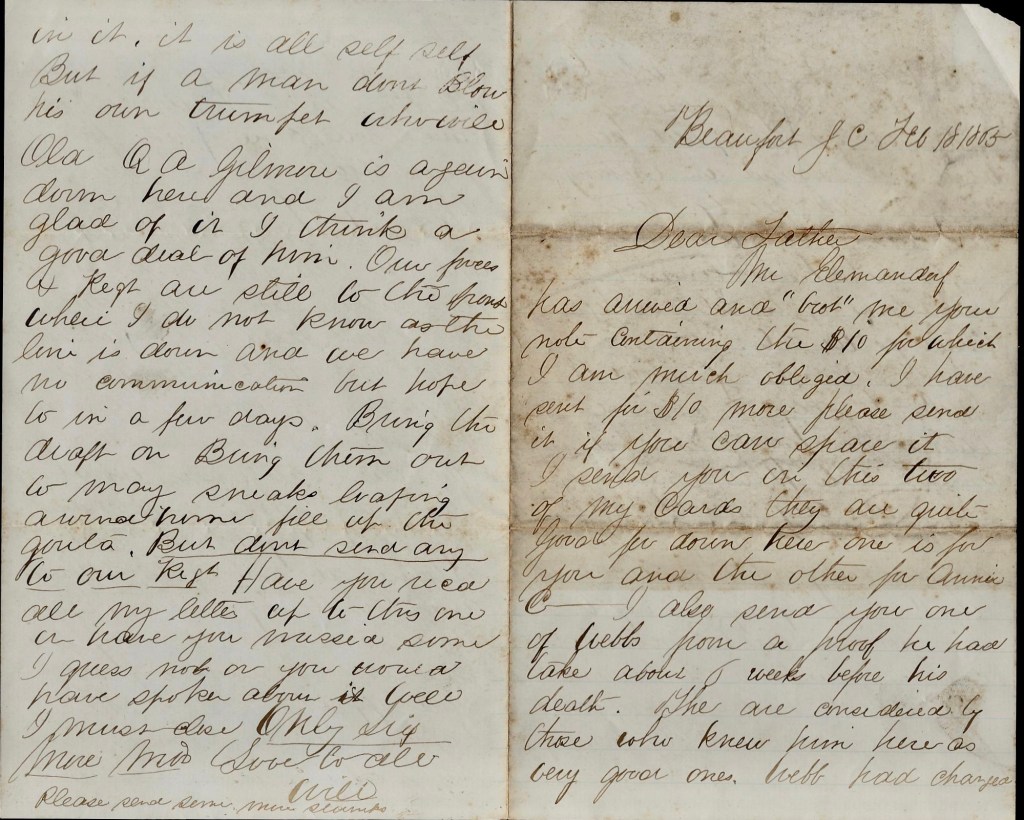
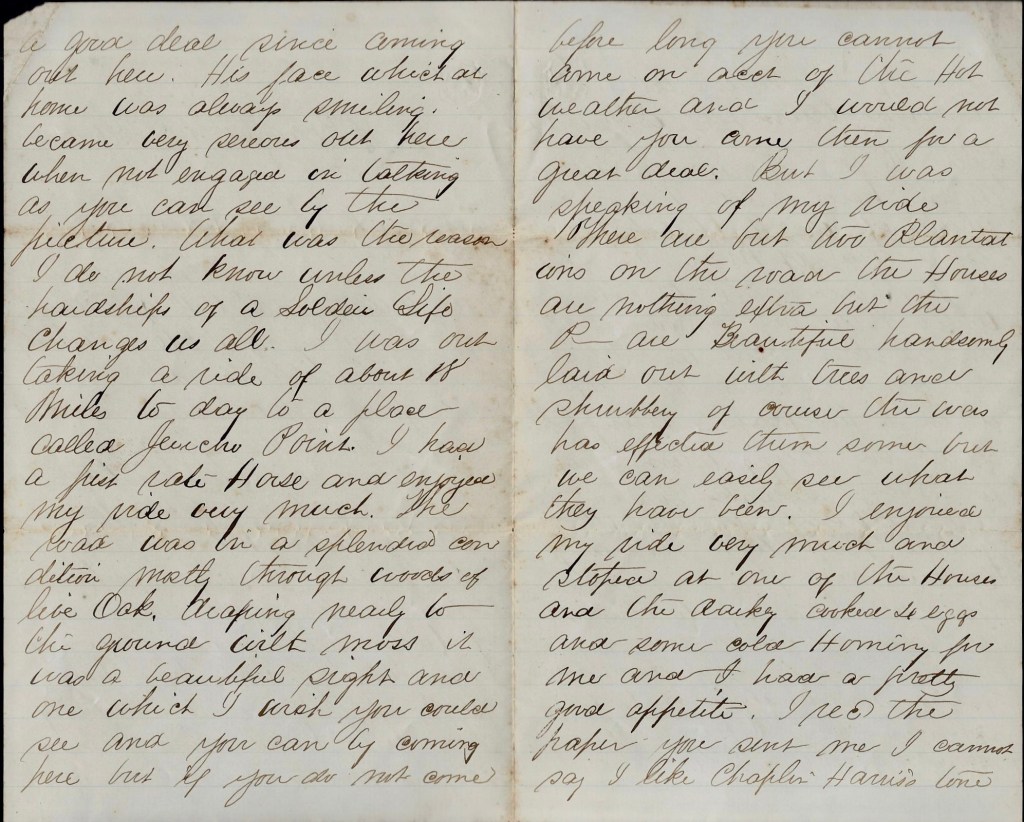
Mr. Elemanderf has arrived and brought me your note containing the $10 for which I am much obliged. I have sent for $10 more. Please send it if you can spare it. I send you in this two of my cards. They are quite good for down here. One is for you and the other for Annie C____. I also send you one of Webb’s from a proof he had taken about 6 weeks before his death. They are considered by those who knew him here as very good ones. Webb had changed a good deal since coming out here. His face which at home was always smiling became very serious out here when not engaged in talking as you can see by the picture. What was the reason, I do not know unless the hardships of a soldier’s life changes us all.

I was out taking a ride of about 18 miles today to a place called Jericho Point. I had a first rate horse and enjoyed my ride very much. The road was in a splendid condition mostly through woods of live oak, dropping nearly to the ground with moss. It was a beautiful sight and one which I wish you could see and you can by coming here but if you do not come before long, you cannot come on account of the hot weather and I would not have you come then for a great deal. But I was speaking of my ride.

There are but two plantations on the road. The houses are nothing extra but the plantations are beautiful—handsomely laid out with trees and shrubbery. Of course the war has affected them some but we can easily see what they have been. I enjoyed my ride very much and stopped at one of the houses and the darkey cooked 4 eggs and some cold hominy for me and I had a pretty good appetite.

I received the paper you sent me. I cannot say I like Chaplain Harris’s tone in it. It is all self self. But if a man don’t blow his own trumpet, who will ? Old [Quincy Adams] Gilmore is again down here and I am glad of it. I think a good deal of him. Our forces & regiment are still to the front. Where? I do not know as the [telegraph] line is down and we have no communication but hope to in a few days. Bring the draft on. Bring them out. Too many sneaks loafing around home. Fill up the quota. But don’t send any to our regiment.

Have you received all my letters up to this one or have you missed some? I guess not or you would have spoken about it. Well, I must close. Only six more months. Love to all. — Will

Please send some more stamps.


Letter 3

Beaufort, South Carolina
April 24, 1865

Dear Father,

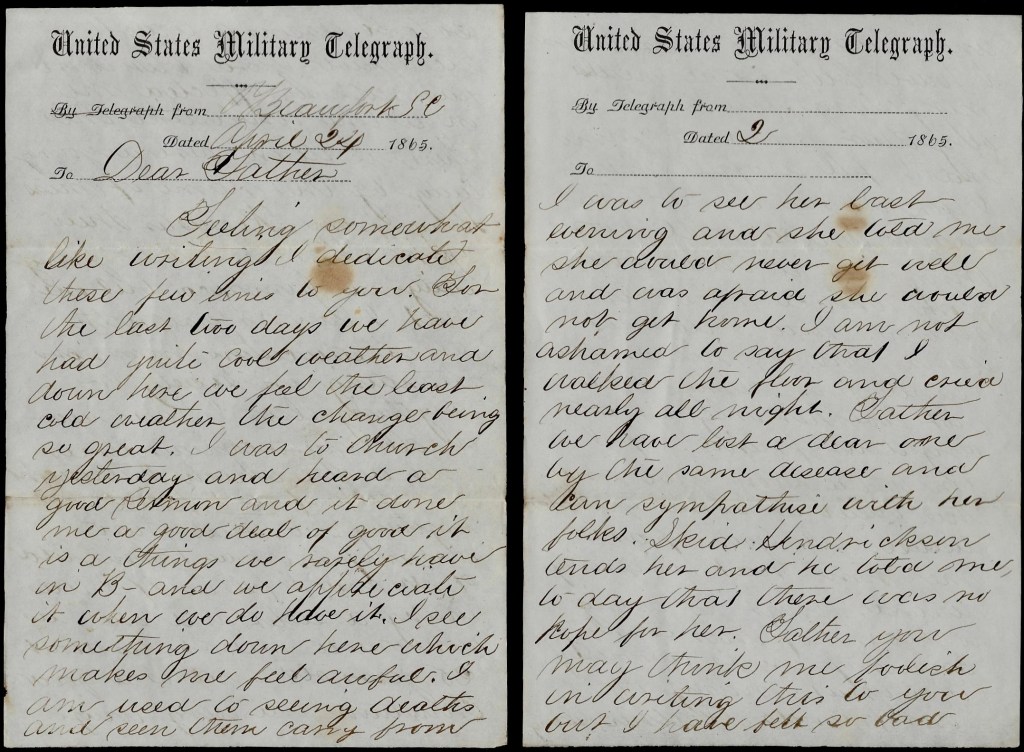
Feeling somewhat like writing, I dedicate these few lines to you. For the last two days we have had quite cool weather and down here we feel the least cold weather—the change being so great. I was to church yesterday and heard a good sermon and it done me a good deal of good. It is a thing we rarely have in Beaufort and we appreciate it when we do have it.

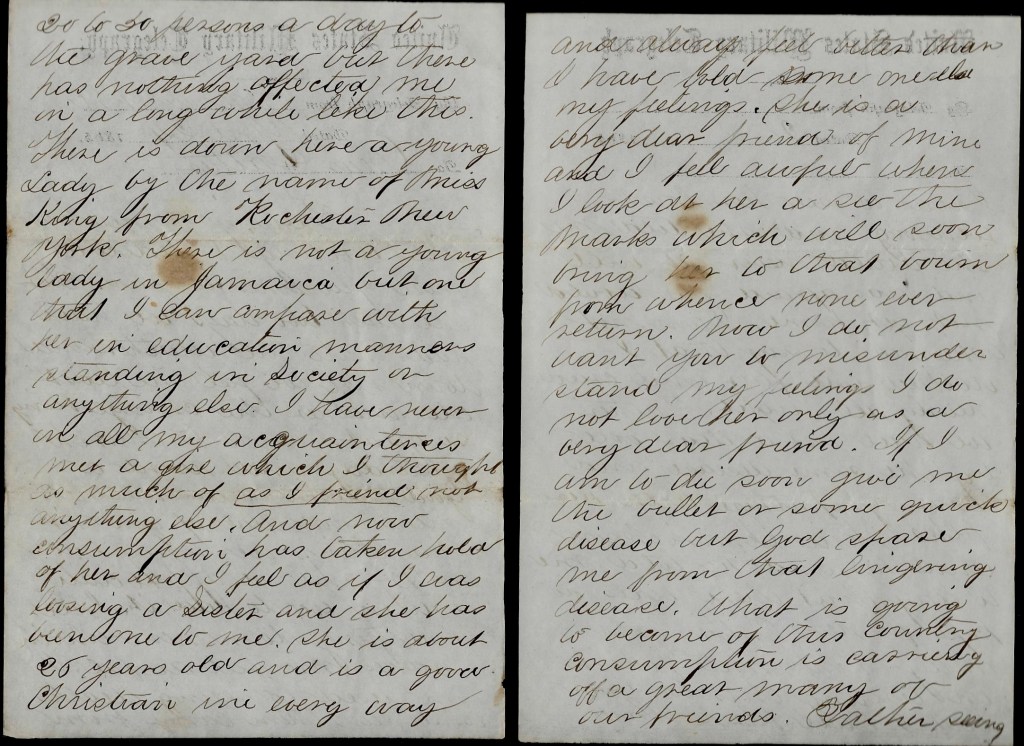
I see something down here which makes me feel awful. I am used to seeing deaths and seen them carry from 20 to 30 persons a day to the grave yard, but there has nothing affected me in a long while like this. There is down here a young lady by the name of Miss King from Rochester, New York. There is not a young lady in Jamaica [Long Island] but one that I saw compare with her in education, manners, standing in society, or anything else. I have never in all my acquaintances met a girl which I though so much of as a friend nor anything else. And now, consumption has taken hold of her and I feel as if I was losing a sister and she has been one to me. She is about 25 years old and is a good Christian in every way and always feel better than I have told someone else my feelings. She is a very dear friend of mine and I feel awful when I look at her and see the marks which will soon bring her to that [ ] from whence none ever return. Now I do not want you to misunderstand my feelings. I do not love her only as a very dear friend. If I am to die soon, give me the bullet or some quick disease but God spare me from that lingering disease. What is going to become of this country? Consumption is carrying off a great many of our friends. I was to see her last evening and she told me she would never get well and was afraid she could not get home. I am not ashamed to say that I walked the floor and cried nearly all night. Father, we have lost a dear one by the same disease and can sympathize with her folks. Skid Hendrickson tends her and he told me today that there was no hope for her. Father, you may think me foolish in writing this to you but I have felt so bad.

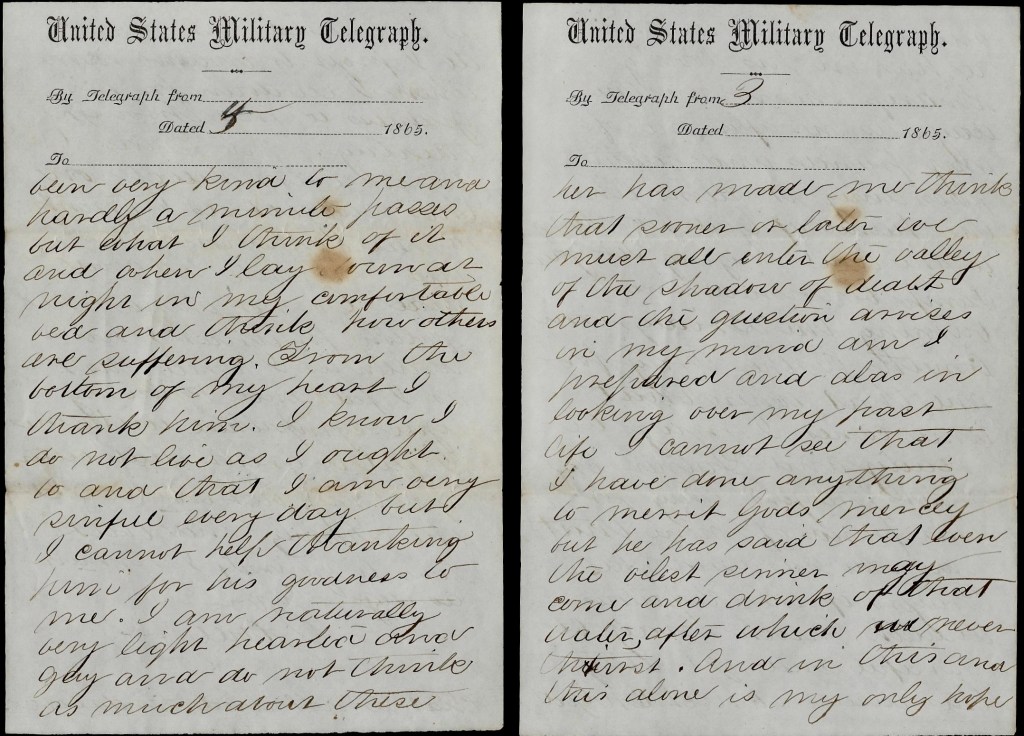
Father, seeing her has made me think that sooner or later we must all enter the valley of the shadow of death and the question arises in my mind, am I prepared? And alas, in looking over my past life, I cannot see that I have done anything to merit God’s mercy. But He has said that even the vilest sinner may come and drink of that water after which we never thirst. And in this and this alone, my only hope and thanks be to Him. He has in his loving kindness shown me the way. As one after one of my friends and relatives pass away, it seems like the hand of God pointing to me and saying, “Let your lamp be trimmed and burning—the Bride groom cometh.” Father, pray for me that when that times comes, I may be ready and Father, in your prayers, pray for this friend of mine that God who has said the prayers of the righteous [ ] much may be merciful and yet stay this distance which Oh God, as I should but never do, I forget to thank Him when I lie down for his goodness to me through the ay. You know I do not talk much on this subject as I think too much show has but I think a good deal. Do not think me foolish for what I have written as I write just as I feel and knowing you sympathize with me, I feel a great deal better. Give my best love to all the family and with love to yourself, I remain as ever, your Will

Chas. is well and sends love.