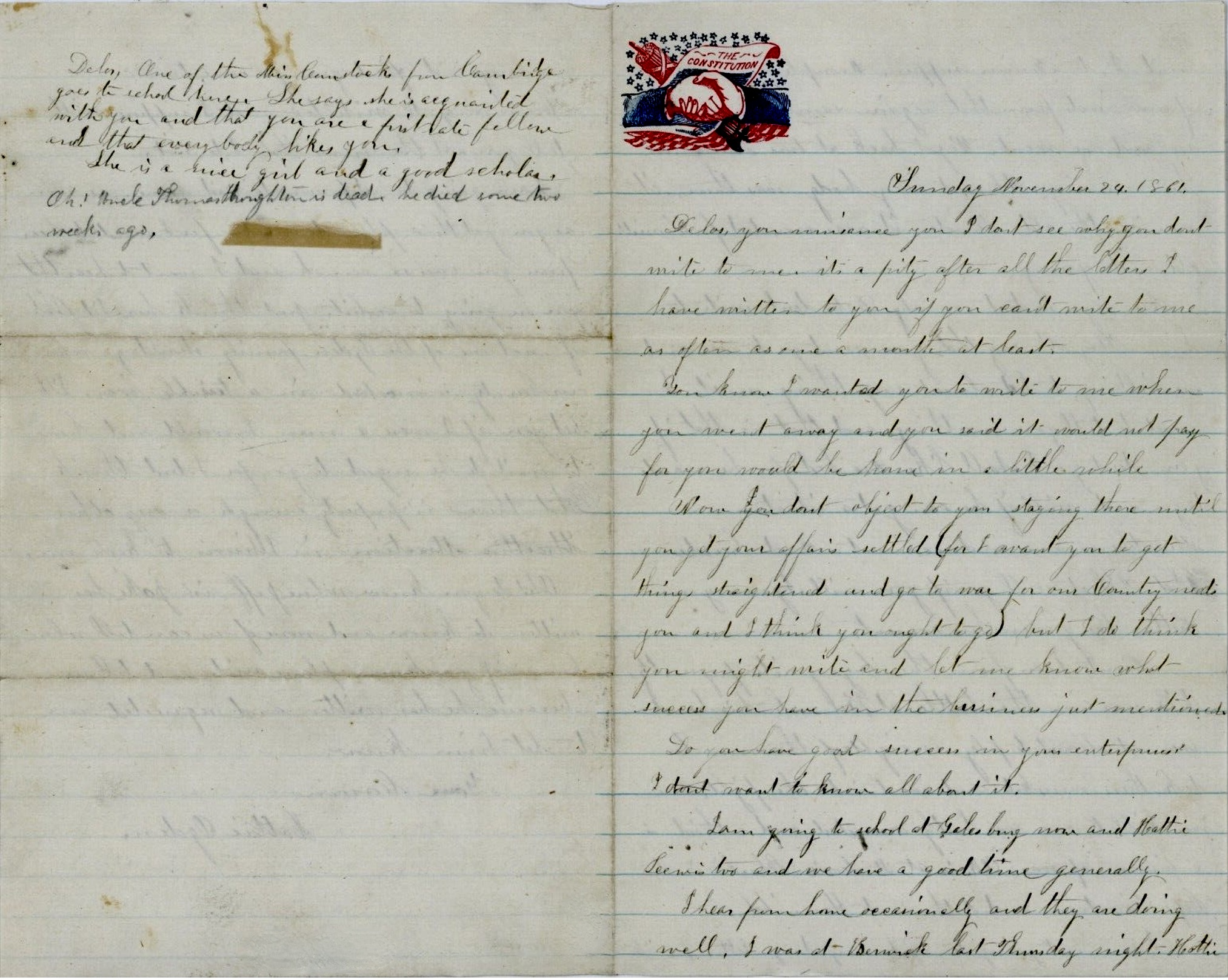
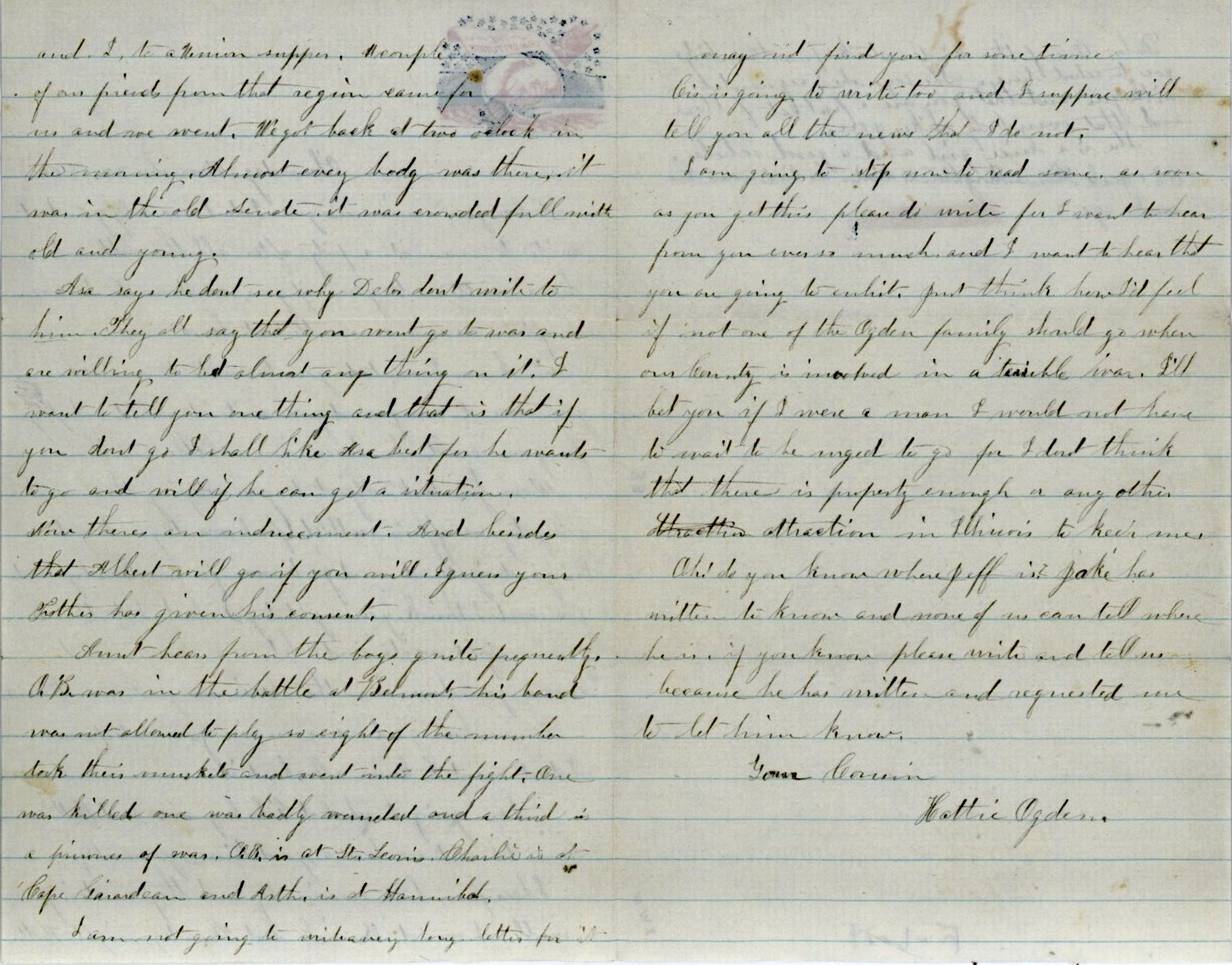
This letter was written by Harriet (“Hattie”) F. Ogden 1844-1922), the daughter of Rufus Ogden (1818-1896) and Narcissa C. Wilber (1820-1893) of Monmouth, Warren county, Illinois. She wrote the letter to her 1st cousin, Franklin Delos Ogden (1833-1912), the oldest son of Franklin Ogden (1808-1900) and Jane Briggs (1814-1848) of Berwick, Warren county, Illinois. Delos attended Knox College in Illinois in 1853. He was married in 1866 to Hattie A. Lewis (mentioned in this letter).
Though Hattie attempted to shame Delos into enlisting, there is no record that he ever served in the Union army during the Civil War. In the 1863 Draft Registration records, he was enumerated in Lenox, Warren county, Illinois. working as a farmer.
Daguerreotype of the children of Franklin and Jane (Briggs) Ogden, made slightly before the deaths of Allen, Eliza Jane and James in an 1850’s diphtheria epidemic. Only Delos and Albert survived.
Transcription
Sunday, November 24, 1861
Delos, you nuisance you! I don’t see why you don’t write to me. It’s a pity after all the letters I have written to you if you can’t write to me as often as once a month at least.
You know I wanted you to write to me when you went away and you said it would not pay for you would be home in a little while. Now I don’t object to your staying there until you get your affairs settled (for I want you to get things straightened and go to war for our country next you and I think you ought to go) but I do think you might and let me know what success you. have in the business just mentioned, Do you have good success in your enterprise? I want to know all about it.
I am going to school at Galesburg now and Hattie Lewis too and we have a good time generally.
I hear from home occasionally and they are doing well. I was at Berwick last Thursday night. Hattie and I [went] to a Union supper. A couple of friends from that region came for us and we went. We got back at two o’clock in the morning. Almost everybody was there. It was in the old Senate. It was crowded full with old and young.
Asa [Abraham Matteson] says he don’t see why Delos don’t write to him. They all say that you won’t go to war and are willing to bet almost anything on it. I want to tell you one thing and that is that if you don’t go, I shall like Asa best for he wants to go and will if he can get a situation. Now there’s an inducement. And besides that Albert will go if you will. I guess your Father has given his consent.
Aunt [Ann Ogden Matteson of Galesburg] hears from the boys quite frequently. O. B. [Orville Briggs Matteson] was in the battle at Belmont [on 7 November 1861]. His band was not allowed to play so eight of the number took their muskets and went into the fight. One [John Werst] was killed. One was badly wounded and a third [William W. Sapp] is a prisoner of war. O. B. is at St. Louis. 1Charlie [Frank Mattison] is at Cape Girardeau, and Arthur [Elon Matteson] is at Hannibal.
I am not going to write a very long letter for it may not find you for some time. Sis [Lida Ogden] is going to write too and I suppose will tell you all the news that I do not. I am going to stop now to read some. As soon as you get this, please do write for I want to hear from you ever so much and I want to hear that you are going to enlist. Just think how I’d feel if not one of the Ogden family should go when our country is involved in a terrible war. I’ll bet you if I were a man, I would not have to wait to be urged to go for I don’t think that there is property enough or any other attraction in Illinois to keep me.
Oh! do you know where Jeff is? Jake has written to know and none of us can tell where he is. If you know, please write and tell me because he has written and requested me to let him know. Yours cousin, — Hattie Ogden
1 O. B. Matteson was the appointed band leader of the 7th Iowa Infantry. He was discharged 13 January 1862.
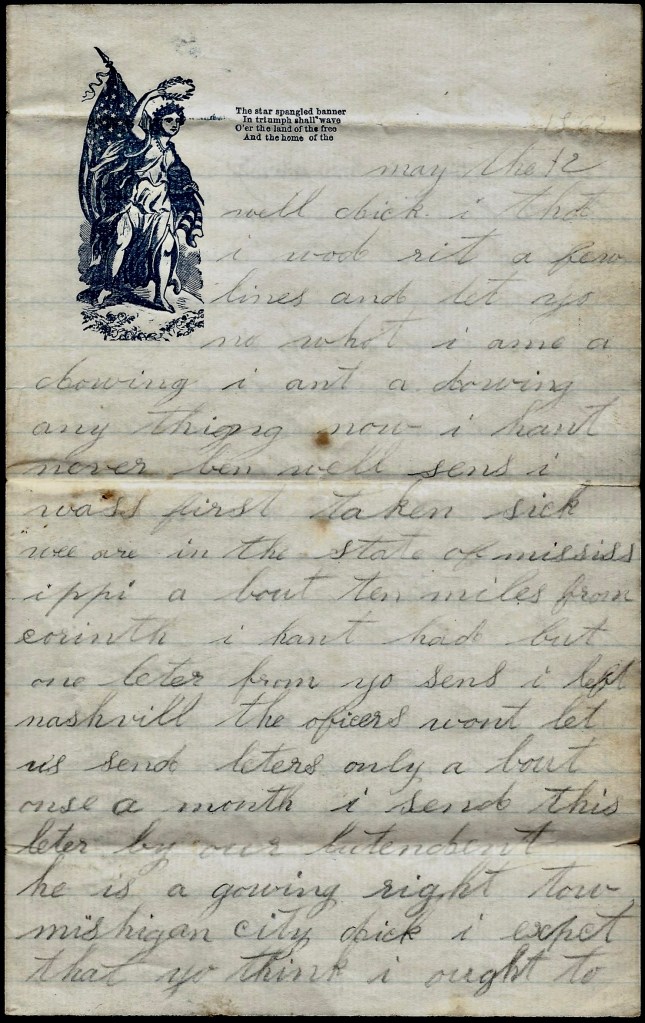
These letters were written by James H. Smith who served in the 4th Indiana Battery during the Civil War. The battery was organized at Indianapolis, Indiana and mustered in for a three-year enlistment on September 30, 1861. It was mustered in under the command of Captain Asahel Kidder Bush. They were ordered to Louisville, Kentucky, October 4. Then assigned duty at New Haven and Munfordville, Kentucky, until February 1862. For a story of the 4th Indiana Battery’s fight along the Wilkinson Pike in the Battle of Stone’s River, see Dan Master’s Civil War Chronicles of 12 March 2024. Capt. Bush’s battery consisted of two six pounders, two 12 pounders, and two James rifled guns.
Letter 1
[Camp George Wood, Kentucky] December the 27, 1861
Well, Dick, I sit down to let you know that I am well and doing well. We are now at Camp George Wood right where they had their fight last week. Me and George was down and saw the place where our men was buried. There was ten of our men killed and about 75 of the rebels killed.
I don’t know how long we will stay here. It is good weather here. There ain’t any snow here. I would like to know what in hell is the reason that you don’t write to me. I hain’t had a letter for a month. I have wrote two letters to Wat, three to you. Now I want you to write and let me know all the news and what you are all a doing and where you went Christmas and I want Wat to write to me. I want you to tell Pa to take my things and do anything that he is a mind to with them.
Now you can write or not just as you are a mind to [but] I shan’t write any more till you do. — J. Smith to Willard Smith
Direct your letter in the care of Captain A. K. Bush, Michigan City Artillery, Camp George Wood
Letter 2
[Ten miles from Corinth, Mississippi] May the 12, 1862
Well Dick, I thought I would write a few lines and let you know what I am a doing. I ain’t a doing anything now. I hain’t never been well since I was first taken sick. We are in the State of Mississippi about ten miles from Corinth.
I hain’t had but one letter from you since I left Nashville. The officers won’t let us send letters only about once a month. I send this letter by one of our lieutenants. He is a going right to Michigan City.
Dick, I expect that you think I ought to send some money home to help pay my debts and I would if I was well. I was left once and didn’t have a cent and I know how it goes. I went two days and nights without a mouthful to eat.
I want you to write and let me know just how you are a getting along and tell what to write and write all the news. Henry Hall and Sam Folsom are are here in the 7th Iowa Regiment. I don’t believe that they will be any fight here at all. George is well and tough. I am a getting better. I will be fit for duty in a week or two. Write and tell me whether cane has took that note or not and whether you can get along without my sending any money. I can’t think of anything more to write—only that I would be glad to see you all. Goodbye, — J. Smith
To Willard Smith.
Dick, I send a five cent rebel bill in this letter to John. Direct your letters to Pittsburg Landing, A. K. Bush’s Battery in the care of Col. Barnett, commanding Artillery Reserve.
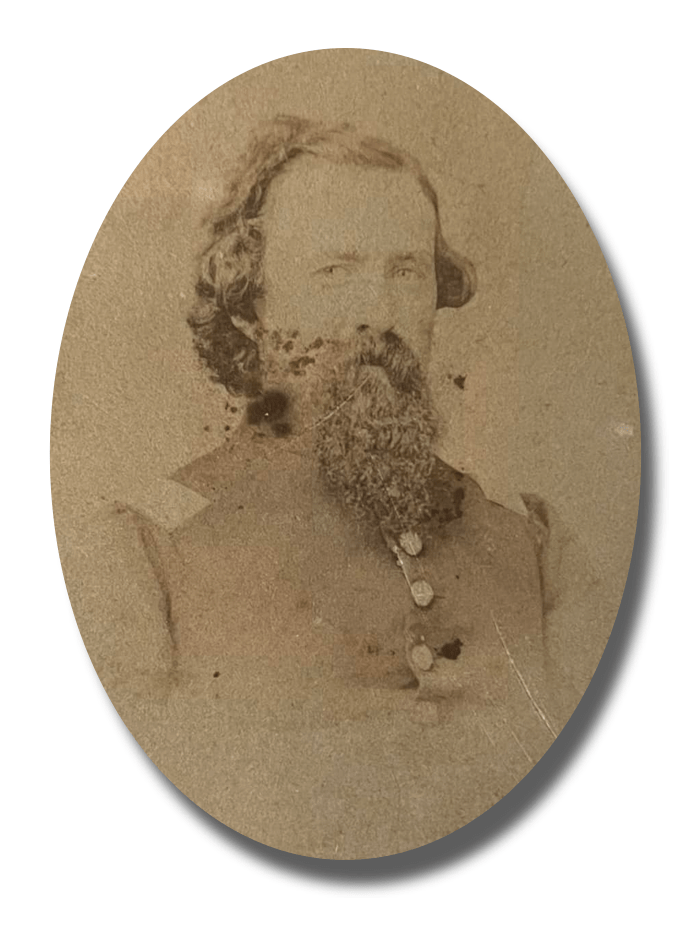
I could not find an image of Rob but here is a cdv of Christian Hedges who served as the captain of Rob’s company.(Iowa Civil War Images)
These letters were written by Robert (“Rob”) M. Kepner (1838-1929), the son of Samuel Kepner (1811-1862) and Elizabeth Haslet (1815-1845) of Marengo, Iowa. Rob was “a young Iowa farm boy when he enlisted in Co. G of the 7th Iowa Infantry. On October 4th [1862], the second day of the Battle of Corinth, the regiment was fighting near Battery Powell. With the regiments on either side of them retreating, the 7th held their ground until ordered to fall back and the brigade reformed around them. Sometime during the desperate fighting Robert was shot in the face. Robert kept up an active correspondence with his younger sister but he always avoided the gory details that might frighten her. When he mentioned his wound he as often as not made light of it. He broke the news by telling her, “I have got a slight introduction to something less than a pound of Sesech lead in the face. I was struck by a miney (sic) ball in the left cheek just above the mouth—the ball striking the bone and glancing, lodged in the back part of the cheek, making rather an ugly, though not very painful wound. I am doing finely, and you need not feel the least uneasiness about me.”
There were several hospitals in Corinth, as well as the larger hotels and warehouses, which had been pressed into service to treat the wounded. Oddly, because his wound was not serious, Robert was sent to Pittsburg Landing and then put on a steamboat headed north. The boat docked at Mound City, Illinois and the wounded were off-loaded into the massive Mound City Naval Hospital. “There is about 1500 hundred sick and wounded in this one building here. I shall be perfectly sound in a week or two. I don’t think I shall be badly disfigured by the scratch, there will be a small scar, but as I had not a great deal of good looks to spare, I cannot say as this has helped my looks in the least.”
On November 10th, Robert, no worse for his ordeal, wrote to his sister again to assure her he was again “doing finely” and had returned to his regiment at Corinth.” [Source: Shiloh National Military Park]
Rob wrote some of his letters to his sister, Ellen Elizabeth Kepner (1842-1923) who would later (1866) marry James Henry Mead of Marengo, Iowa. Mead served in Co. E, 24th Iowa Infantry during the Civil War. It should be noted that Rob had a brother named Daniel S. Kepner (1840-1862) who was killed in action at Antietam while serving in Co. A, 14th Indiana Infantry. It should also be noted that though all the records I have found on Rob show his name to be Robert, for some reason he signed his named “Robbin” on this letter.
[Note: These letters are from the private collection of Greg Herr and were offered for transcription and publication on Spared & Shared by express consent.]
Letter 1
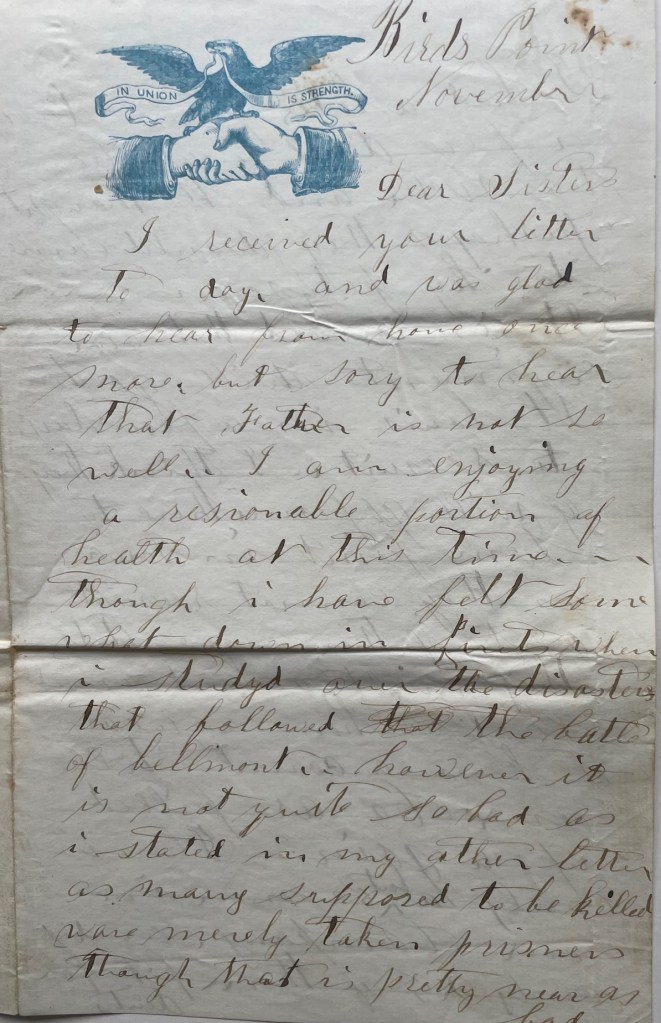
Bird’s Point [Missouri] [Mid] November [1861]
Dear Sister,
I received your letter today and was glad to hear from home once more but sorry to hear that Father is not so well. I am enjoying a reasonable portion of health at this time though I have felt somewhat down in spirits when I studied over the disaster that followed the Battle of Belmont. 1 However, it is not quite so bad as I stated in my other letter as many supposed to be killed were merely taken prisoners though that is pretty near as bad.
I had a letter from [brother] Dan [14th Indiana] a few days ago. He was well and he thought perhaps they would come to Kentucky pretty soon. It is rumored that our regiment will go to St. Louis in a few days to recruit. I think they will go from there to some point in Iowa as they cannot recruit out of there own state, they might about as well send us home as we are of no account till our companies are filled up again. There is only about 50 men in our company and only 25 of them fit for duty.
I wrote a letter about three weeks ago and sent some $15 dollars in scrip to Father but I have had no account of it yet. I begin to feel a little uneasy lest it has been miscarried or been detained in some other way. I want you to write whether you have got it or not that I may feel satisfied on the point.
It seems to be a noted fact that out of 12 of our boys who went to the hospital, but one or two have come away. John Zahast is still there and is not any better. He would not stand the trip were he to start home.
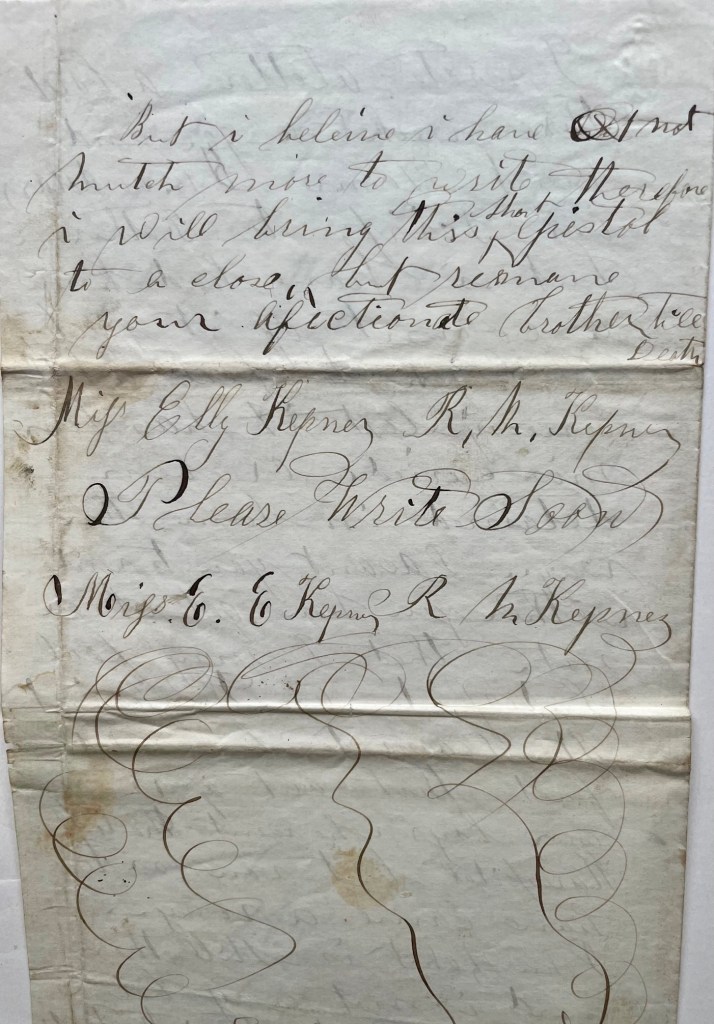
But I believe I have not much more to write. Therefore, I will bring this short epistle to a close but remain your affectionate brother till death. — R. M. Kepner to Miss E. E. Kepner
1 “The battle of Belmont was a bloody day for the Seventh. The regiment went into the fight with eight companies, number 410 men, Two companies-K and G-being detached as a fleet guard, were not in the fight. The regiment lost, in killed, wounded, and missing, 237 men. It was on this field that the gallant and lamented Wentz fell, with many other brave officers, viz: G. W. S. Dodge, 2d Lieut. Co. B; Benjamin Ream, 2d Lieut. Co. C; Charles Gardner, 2d Lieut. Co. I. Col. Lauman and Major Rice were both severely wounded, as were also Capt. Gardner, Co. B; Capt. Harper, Co. D; Capt. Parrott, Co. E; and Capt. Kitteridge, Co. F. It was in this fight that Iowa officers and soldiers proved to the world that they were made of the right kind of material, and added to the luster of our young and gallant State. On the evening of the 7th of Nov., 1861, the shattered remnant of the Seventh Iowa arrived at Bird’s Point, remained a few days, and were then ordered to Benton Barracks, St. Louis, Mo., to rest and recruit. This terminated the first battle of the Seventh Iowa.”
Letter 2
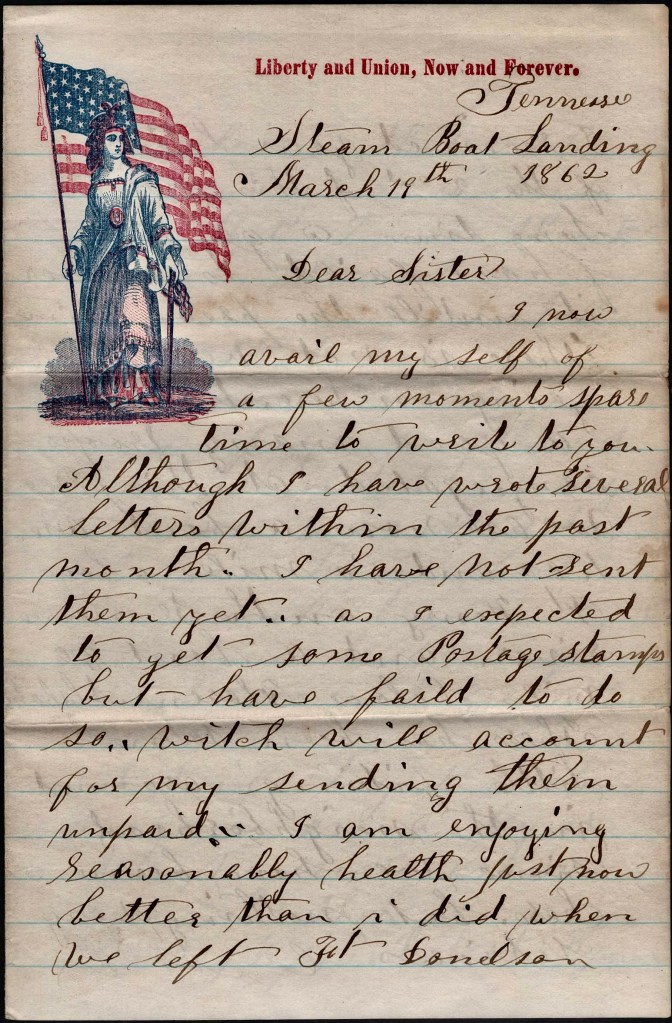
Steamboat Landing, Tennessee March 19th 1862
Dear Sister,
I now avail myself of a few moments spare time to write to you. Although I have wrote several letters within the past month, I have not sent them yet as I expected to get some postage stamps but have failed to do so which will account for my send them unpaid.
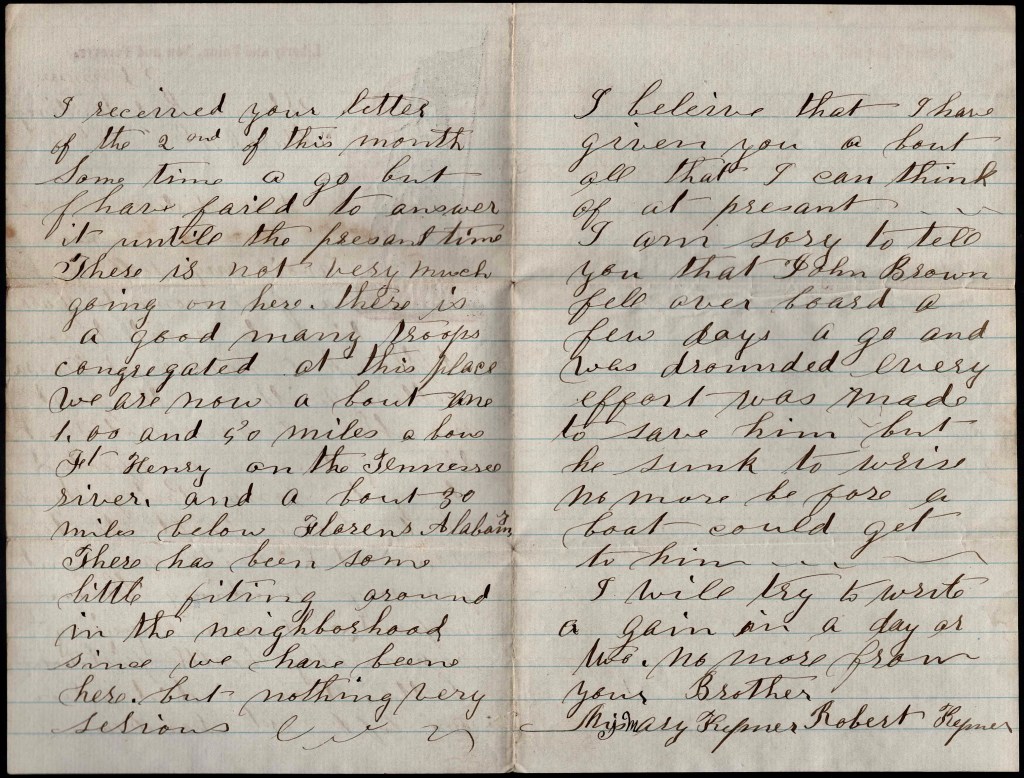
I am enjoying reasonably [good] health just now—better than I did when we left Fort Donelson. I received your letter of the 2nd of this month some time ago but I have failed to answer it until the present time. There is not very much going on here. There is a good many troops congregated at this place. We are now about one hundred and fifty miles above Fort Henry on the Tennessee river and about 30 miles below Florence, Alabama.
There has been some fighting around in the neighborhood since we have been here but nothing very serious. I believe that I have given you about all that I can think of at present. I am sorry to tell you that John Brown fell overboard a few days ago and was drowned. Every effort was made to save him but he sunk to rise no more before a boat could get to him.
I will try to write again in a day or two. No more from your brother, — Robert Kepner
To Miss Mary Kepner
Letter 3
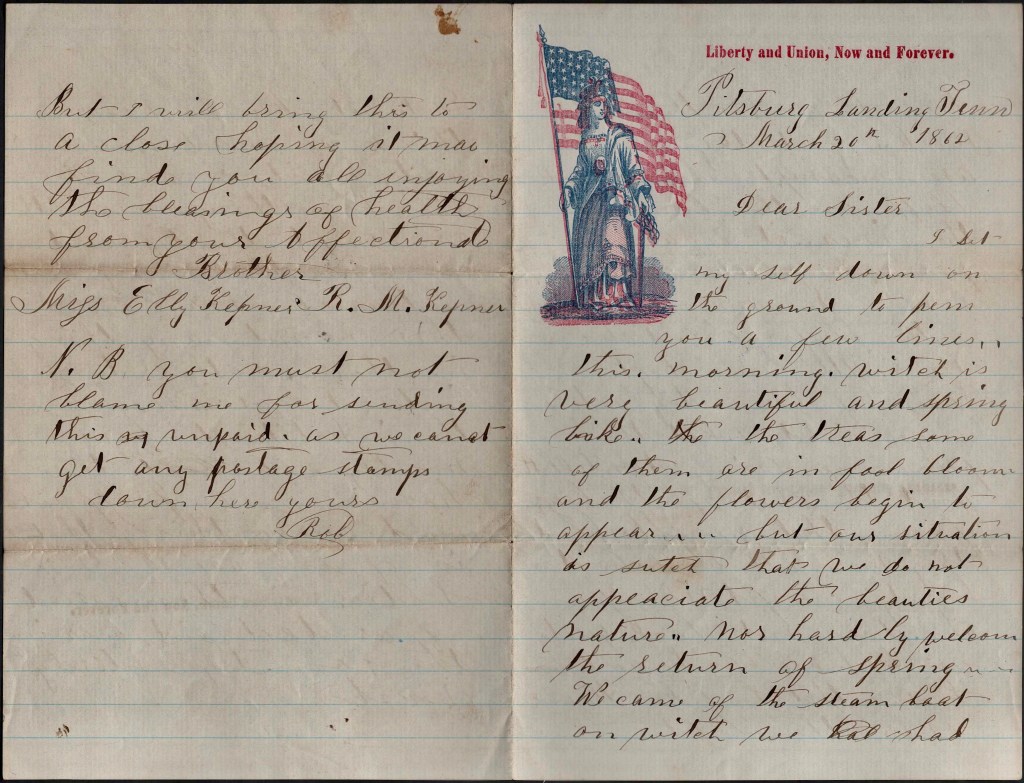
Pittsburg Landing, Tennessee March 20th 1862
Dear Sister,
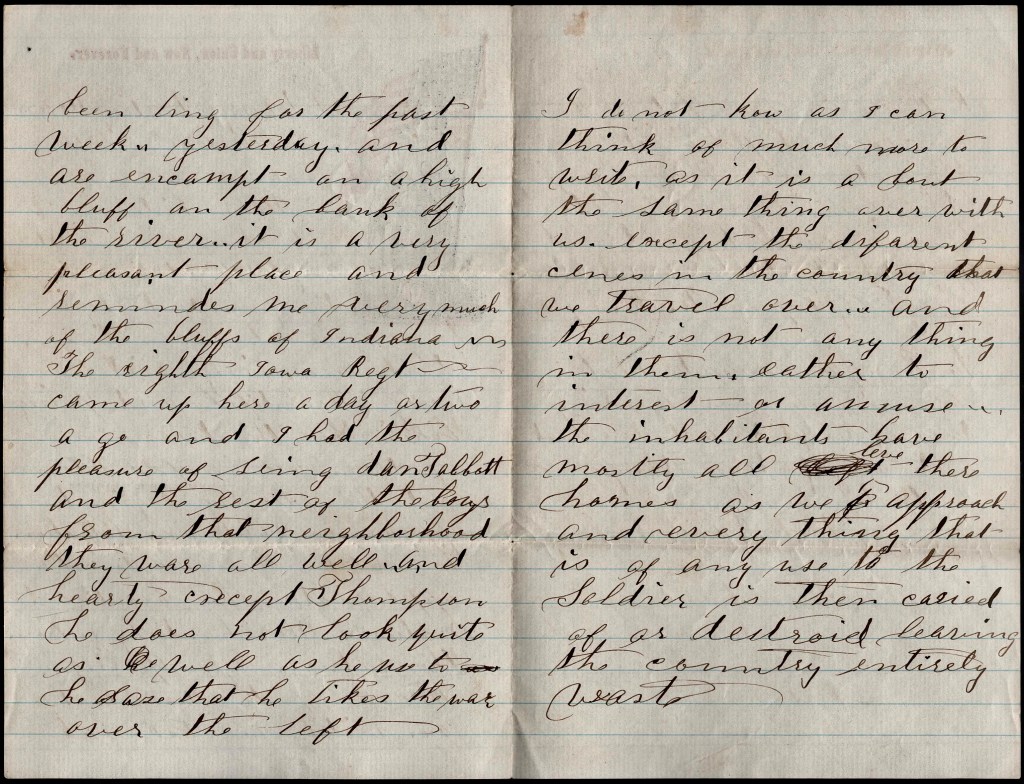
I sit myself down on the ground to pen you a few lines this morning which is very beautiful and spring-like. The trees—some of them—are in full bloom and the flowers begin to appear. But our situation is such that we do not appreciate the beauties of nature nor hardly welcome the return of spring. We came off the steamboat on which we had been living for the past week yesterday and are encamped on a high bluff on the bank of the river. It is a very pleasant place and reminds me very much of the bluffs of Indiana.
The 8th Iowa Regt. came up here a day or two ago and I had the pleasure of seeing Dan Talbott and the rest of the boys from that neighborhood. They were all well and hearty except Thompson. He does not look quite as well as he use to. He says that he likes the war over the left.
I do not know as I can think of much more to write as it is about the same thing over with us except the different scenes in the country that we travel over, and there is not anything in them either to interest or amuse. The inhabitants mostly all leave their homes as we approach and every thing that is of any use to the soldier is then carried off or destroyed leaving the country entirely waste.
But I will bring this to a close hoping it may find you all enjoying the blessing of health. From your affectionate brother, — R. M. Kepner
to Miss Elly Kepner
N. B. You must not blame me for sending this unpaid as we cannot get any postage stamps down here. Yours, — Rob
Letter 4
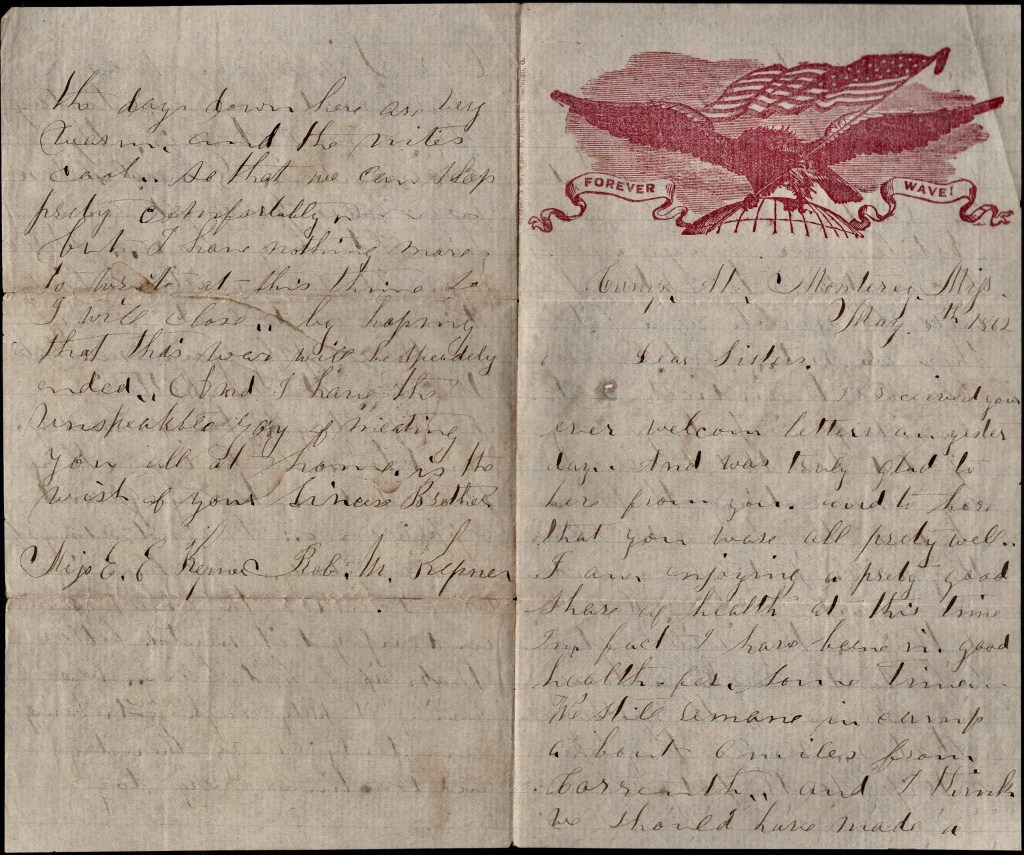
Camp at Monterey, Mississippi May 8, 1862
Dear sister,
I received your ever welcome letters on yesterday and was truly glad to hear from you and to hear that you was all pretty well. I am enjoying a pretty good share of health at this time. In fact, I have been in good health for some time.
We still remain in camp about 6 miles from Corinth and I think we should have made a move on that place before now had it not been for the recent heavy rain which have made the roads impossible for artillery or wagons. 1 I cannot say as to whether there will be much of a fight there or not but rumor seems. to indicate not as it is pretty generally reported here that the secesh are evacuating the place. But if they have not, I think they will pretty soon under an escort of Gen. Halleck’s. I think they will get liberty to make a tower in some of the northern states unless they take a trip south pretty soon.
Our Division was reviewed on yesterday by Gen. [Thomas A.] Davies. The commander, General Halleck was also present on his old bay horse. I tell you, it was quite a lively time and beat any 4th of July you ever saw. There was twelve Battalions of infantry and four of cavalry and to a looker on, they presented a truly grand appearance. I was not [there] myself as I was on duty but then I was where I could see the whole performance and enjoyed it much—better than if I had been in.
We are having it pretty rough now being on duty every other day and sometimes every day. The days down here are very warm and the nights cool so that we can sleep pretty comfortably. But I have nothing more to write this time so I will close by hoping that this war will be speedily ended and I have the unspeakable joy of meeting you all at home is the wish of your sincere brother, — Rob M. Kepner
to Miss E. E. Kepner
1 “On May 4 and 5 torrential rains pelted the area, turning the roads into ribbons of mud. A number of bridges were swept away by normally placid streams turned into raging. torrents.” Source: Siege and Battle of Corinth.
Letter 5
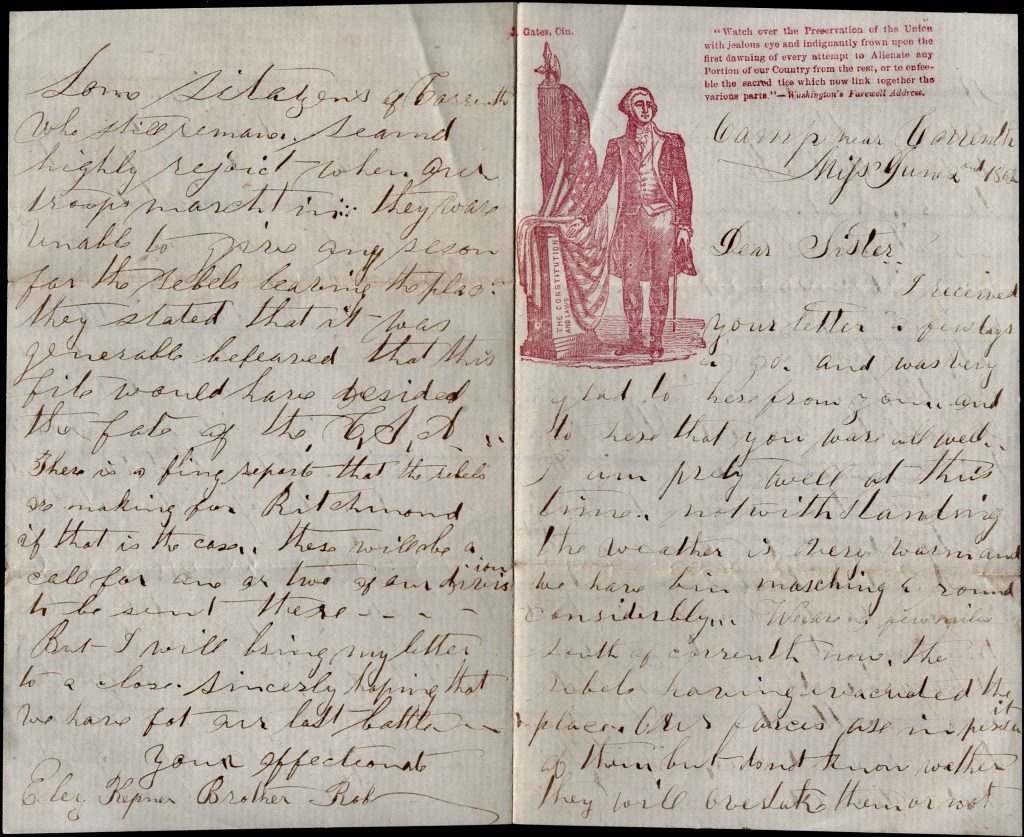
Camp near Corinth, Mississippi June 2, 1862
Dear Sister,
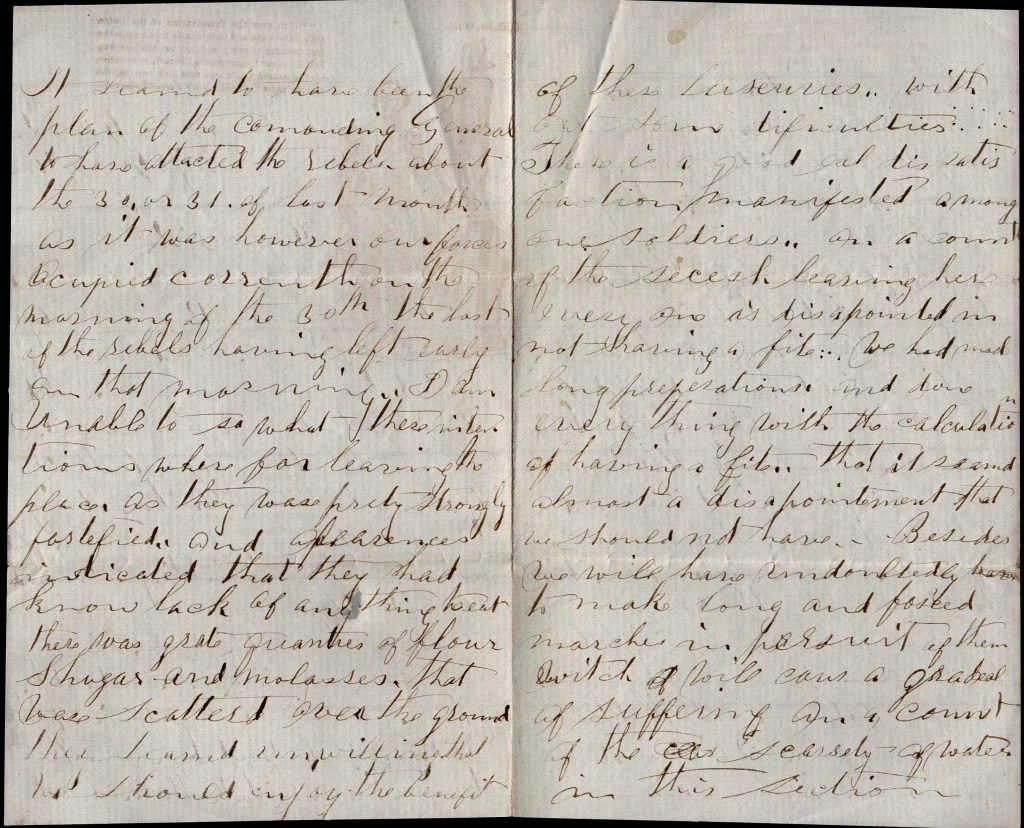
I received your letter a few days ago and was very glad to hear that you were all well. I am pretty well at this time notwithstanding the weather is very warm and we have been marching around considerably. We are a few miles south of Corinth now, the rebels having evacuated the place. Our forces are in pursuit of them but do not know whether they will overtake them or not. It seemed to have been the plan of the Commanding General to have attacked the rebels about the 30th or 31st of last month. As it was, however, our forces occupied Corinth on the morning of the 30th, the last of the rebels having left early on that morning. I am unable to say what their intentions were for leaving the place as they were pretty strongly fortified and appearances indicated that they had no lack of anything to eat. There was great quantities of flour, sugar, and molasses that was scattered over the ground. They seemed unwilling that we should enjoy the benefit of these luxuries without some difficulties.
There is a great deal dissatisfaction manifested among our soldiers on account of the secesh leaving here. Everyone is disappointed in not having a fight. We had made long preparations and done everything with the calculation of having a fight that it seemed almost a disappointment that we should not have. Besides, we will undoubtedly have to make long and forced marches in pursuit of them which will cause a great deal of suffering and cannot find scarcely any water in this section. Some citizens of Corinth who still remain seemed highly rejoiced when our troops marched in. They were unable to give up any reason for the rebels leaving the place. they stated that it was generally befeared that this fight would have decided the fate of the C. S. A. There is a flying report that the rebels are making for Richmond. If that is the case, there will be a call for one or two of our divisions to be sent there.
But I will bring my letter to a close sincerely hoping that we have fought our last battle. Your affectionate brother, — Rob
Letter 6
Camp in the field near Corinth, Miss. Sunday, June 8th 1862
Dear Sister,
As I thought you would be anxious to hear from me as often as possible, I have taken the present Sunday morning for doing so. I have nothing strange or important to write as the war seems pretty near dried up in this section. We are near a small town by the name of Booneville about 30 miles from Corinth. We have to move our camp about every day and progress a little farther into the South. Everything is so quiet here that you would hardly suppose that a rebel army had so recently been routed and scattered over the country.
The weather is pretty warm though we have had no real hot weather as yet. Health is pretty good among the soldiers at this time.
I should like very much to be at home a few days about this time but I expect it will be some time before I am granted that privilege. There is several of the boys of our company who were sick in the hospital have been sent to Keokuk. I almost wished I had been one of them. I think if I should get that near home, I would make an effort to get the rest of the way. I may get home pretty soon and again, it may be some time but I hope the time will be short until I can again greet all the friends at home. It is just harvest here and when I see the yellow grain shocked in the field, it makes me think of the god spread plains of Iowa. I would willingly change my musket for to follow the reaping machine though I never used to like the business.
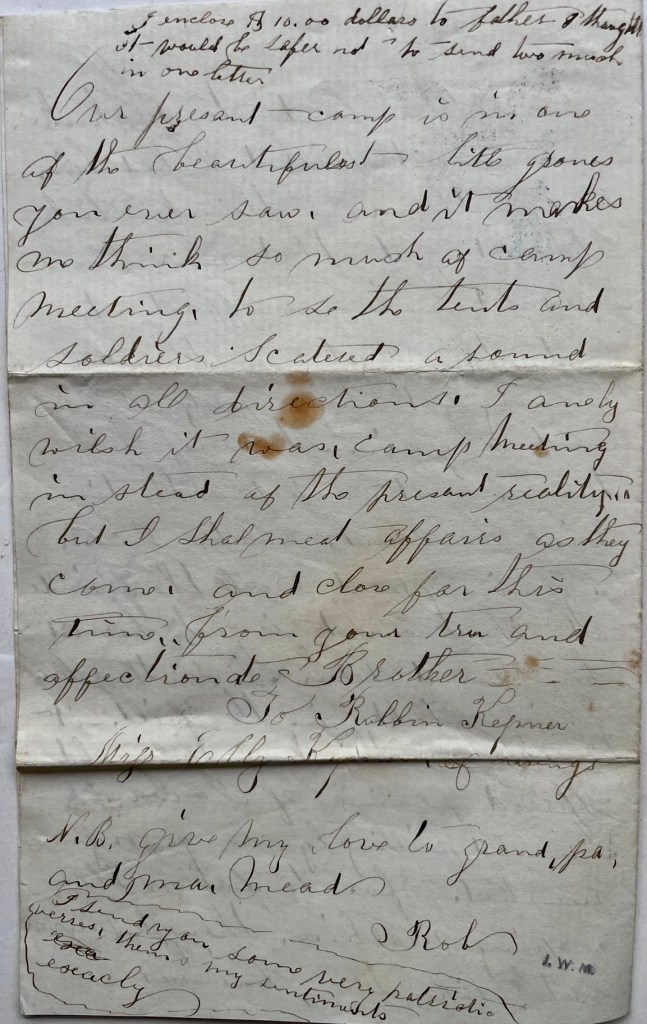
Our present camp is in one of the beautifulest little groves you ever saw and it makes me think so much of a [Methodist] camp meeting to see the tents and soldiers scattered around in all directions. I only wish it was camp meeting instead of the present reality but I shall meet affairs as they come and close for this time. From your true and affectionate brother, — Robbin Kepner
to Miss Elly Kepner
N. B. Give my love to grandpa and ma Mead. — Rob
I send you some very patriotic verses. Them’s my sentiments exactly.
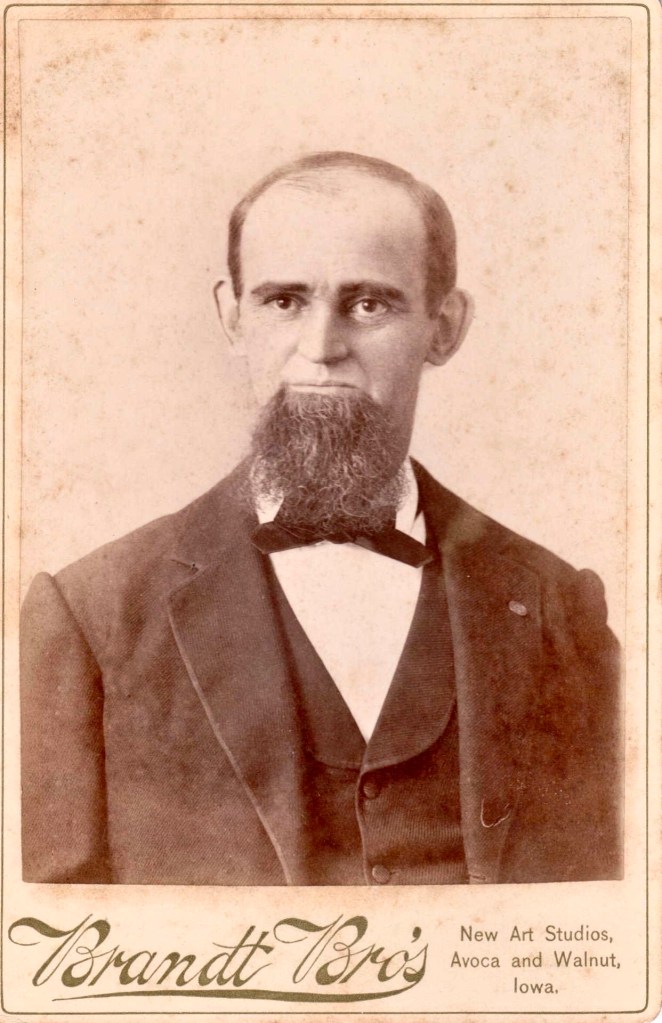
A post war cabinet card of Lawrence B. Worth (Ancestry.com)
The following letter was written by Lawrence B. Worth (1834-1891), the son of Alexander Worth (1803-1875) and Adeline B. Vermilya (1811-1842) of Mooresville, Morgan county, Indiana. In 1854, Alexander Worth—an early day merchant in Mooresville, moved with his second wife and family to Indianapolis where he became Secretary of the Indianapolis, Cincinnati, and Lafayette Railroad. At the time or shortly after his father moved to Indianapolis, 21 year-old Lawrence struck out on his own and settled in Indianola, Warren county, Iowa. The 1860 Census enumerates him employed as a carpenter in Oskaloosa, Mahaska county, Iowa, with a wife of two years, Zerilda (Kinsey) Worth (1841-1893) and a one year-old son Frederick (1859-1935).
At the age of 26, Lawrence volunteered in July 1861 and was mustered into Co. C, 7th Iowa Infantry as a private. He was promoted to a corporal in January 1862, and mustered out of the regiment as a sergeant in July 1865 after four years service.
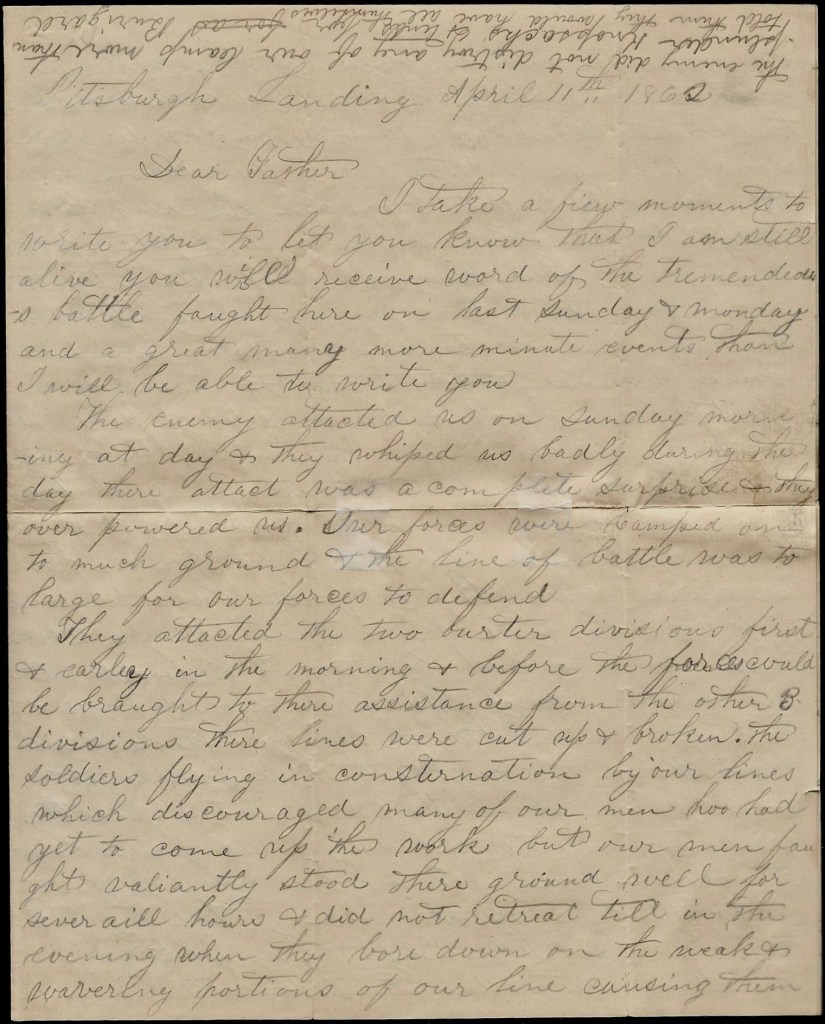
In his letter of 11 April 1862, Lawrence gives a detailed account of the 7th Iowa’s experience at the Battle of Shiloh from the time their encampment was overrun on Sunday morning until their retreat over a mile to the very heart of the Hornet’s Nest where they fought valiantly until after dark when the position could no longer be held. Although Gen. Grant had previously praised the 7th Iowa for its gallant service at Belmont and Donelson, Lawrence was less than impressed with Grant’s leadership. “General Grant should be courtmartialed for allowing himself to be surprised. He was notified time after time that the enemy were near his lines in strong force & intended to attack him. He hooted at the idea of them attacking him & for two days suffered things to go on in this way & his army to be surprised. I have always disliked the man & worse now than ever. He is not fit for a military man,” he wrote his father.
Transcription
Addressed to Mr. A. Worth, Indianapolis, Indiana
Pittsburg Landing April 11th 1862
Dear Father,
I take a few moments to write you to let you know that I am still alive. You will receive word of the tremendous battle fought here on last Sunday & Monday and a great many more minute events than I will be able to write you.
The enemy attacked us on Sunday morning at day [break] & they whipped us badly during the day. Their attack was a complete surprise & they over powered us. Our forces were camped on too much ground & the line of battle was too large for our forces to defend. They attacked the two outer divisions first & early in the morning & before the forces could be brought to their assistance from the other 3 divisions, their lines were cut up & broken—the soldiers flying in consternation by our lines which discouraged many of our men who had yet to come up the work. But our men fought valiantly—stood their ground well for several hours & did not retreat till in the evening when they bore down on the weak & wavering portions of our line, causing them to fall back. And then began a flanking movement on the part of the enemy. We were ordered to retreat which was done in good order for some distance, but the enemy bore down on them so strong that soon all became confusion, & then became a general stampede equal to Bull Run, I suppose.
We retreated back, formed a line running along up & down the river near the landing & out for some distance. There was a howitzer (64 pounder), three or four 24-pound siege pieces placed on the hill near the landing [and] with these & one of the gun boats, they rained such torrents of shot & shell into the enemy that they dare not advance. This was kept [up] for one hour or more when Buell’s forces began to come up over the hill from the landing just in time to save us. Had it not been for the reinforcements of Buell, we would have [been] entirely annihilated, killed, or taken prisoners.
During the night the reinforcements were disposed of in the best manner possible for action in the morning. Our guns kept throwing shell all night every half hour into the lines of the enemy till they had to fall back during the night over a mile. How they did it, I do not know, but some that were taken prisoners & wounded say that every shell was thrown during the night [landed] immediately into their lines.
On Monday morning at daylight, the fight commenced again. This day the battle turned the other way. The enemy were routed entirely & driven back. All the guns they took from us were retaken & a number of theirs were also taken. The loss on both sides was great. They took a great many prisoners the first day & we took some of them prisoners the second day. How many, I do not know. I suppose they took 2,000 of our men on Sunday. On Monday we took, I think, near 1,000 of them prisoners.
The enemy is about seven miles from our lines & the supposition is they intend attacking us again soon. Johnston & Bragg were killed & Beauregard is wounded in the arm. The enemy lost some of their best officers & they had the flower of their army here—most of the Manassas troops.
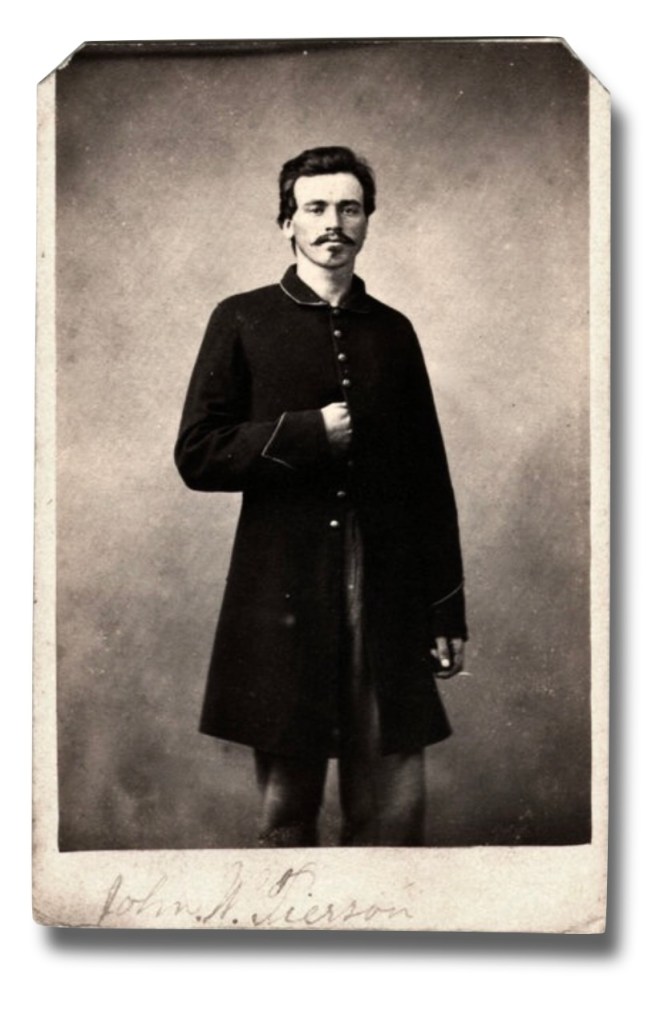
John Wesley Pierson, 7th Iowa Infantry, ca. 1862; Worth described him as a “man of iron will and determination.”
Two of our Belmont prisoners came to us yesterday—one of our company by the name of John W. Pierson. He is a man of iron will & determination. He escaped from them [for] the second time. He left them the first time at Memphis [but] was retaken at Jackson [and] was on the way to Tuscaloosa, Alabama. When they arrived at Corinth Monday evening in company with other prisoners, they had him in a house where they were to remain for the night. He slipped upstairs unnoticed by the guard, made a rope of carpet, fastening it to a bed rail which reached from one house to the other. Letting themselves down (he & his comrade) made their escape through the guard lines, passed on their way the retreating portion of the secesh army, shunned their camp & came into our lines safe. 1
General Grant should be courtmartialed for allowing himself to be surprised. He was notified time after time that the enemy were near his lines in strong force & intended to attack him. He hooted at the idea of them attacking him & for two days suffered things to go on in this way & his army to be surprised. I have always disliked the man & worse now than ever. He is not fit for a military man.
The 7th Iowa Regiment lost 10 Killed & 12 wounded, the 8th, 12th, and 14 Regiments of Iowa Volunteers were taken prisoners. They were cut off, surrounded, saw there was no chance of escape, laid down their arms & surrendered. I was in the fight, tried to do my duty, did not run like some others, but rallied on our colors with others, obeying the commands of my superior officers. Laid in line Sunday night in a drenching rain & am yet alive & safe for which I thank God for I am nearly sick from the exposure of 3 days but feel better this morning.
I remain as ever, your son, — L. B. Worth
The enemy did not destroy any of our camp more than plunder knapsacks & tents for Beauregard told them they would have all themselves.
1 An excellent article by Ron Coddington entitled, “The Great Escape” chronicles the saga of Pierson’s capture at the Battle of Belmont and weeks of captivity until he made good his escape.













 Spared & Shared 23