The following letter was written by Joseph Emmons Blanding (1841-1862), the son of Asa Blanding (1797-1861) and Caroline Mann (1807-1847) of Attleboro, Bristol county, Massachusetts. A carpenter by trade before the war, Joseph enlisted on 15 June 1861 to serve in Co. I, 7th Massachusetts Infantry. He was wounded on 1 July 1862 in the Battle of Malvern Hill and died two months later on 11 September 1862 [one report says from wounds, one from dysentery].
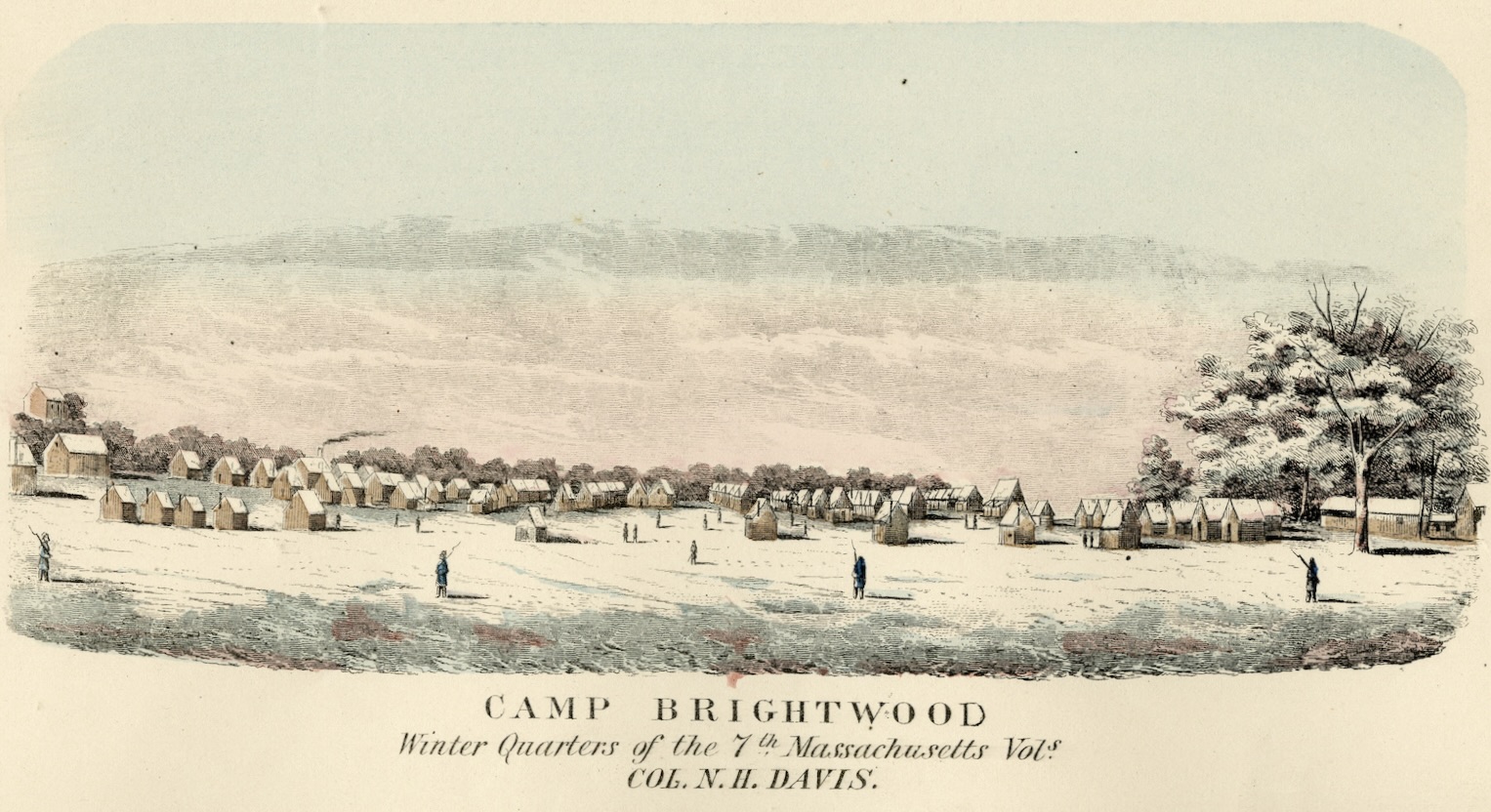
Joseph wrote the letter from the regiment’s winter quarters at Camp Brightwood outside Washington D. C.
The log house winter quarters of the 7th Massachusetts Infantry at Camp Brightwood in January 1862.[University of Delaware Digital Collections]
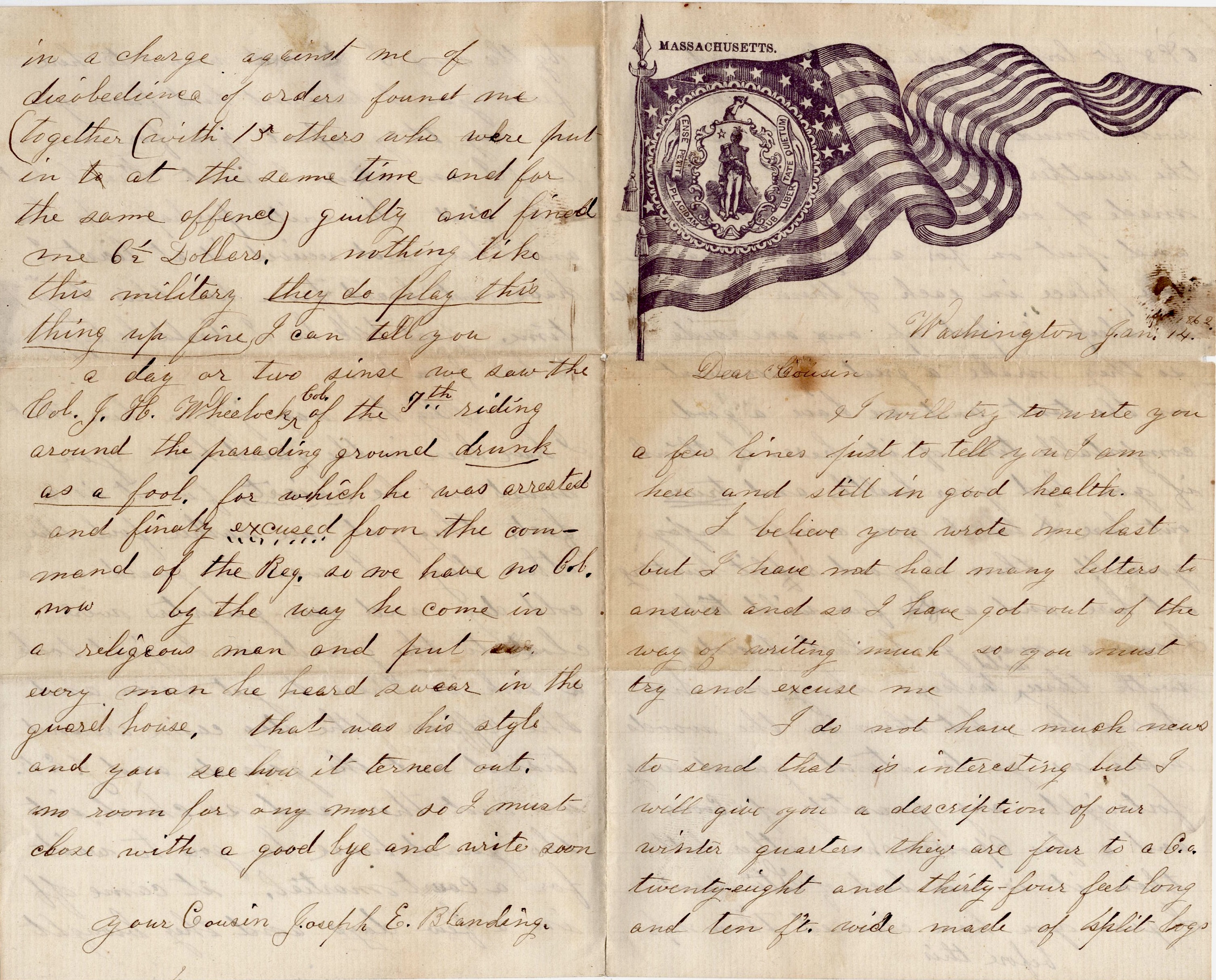
T R A N S C R I P T I O N
[Camp Brightwood] Washington [D. C.] January 14, 1862
Dear Cousin,
I will try to write you a few lines just to tell you I am here and still in good health. I believe you wrote me last but I have not had many letters to answer and so I have got out of the way of writing much so you must try and excuse me.
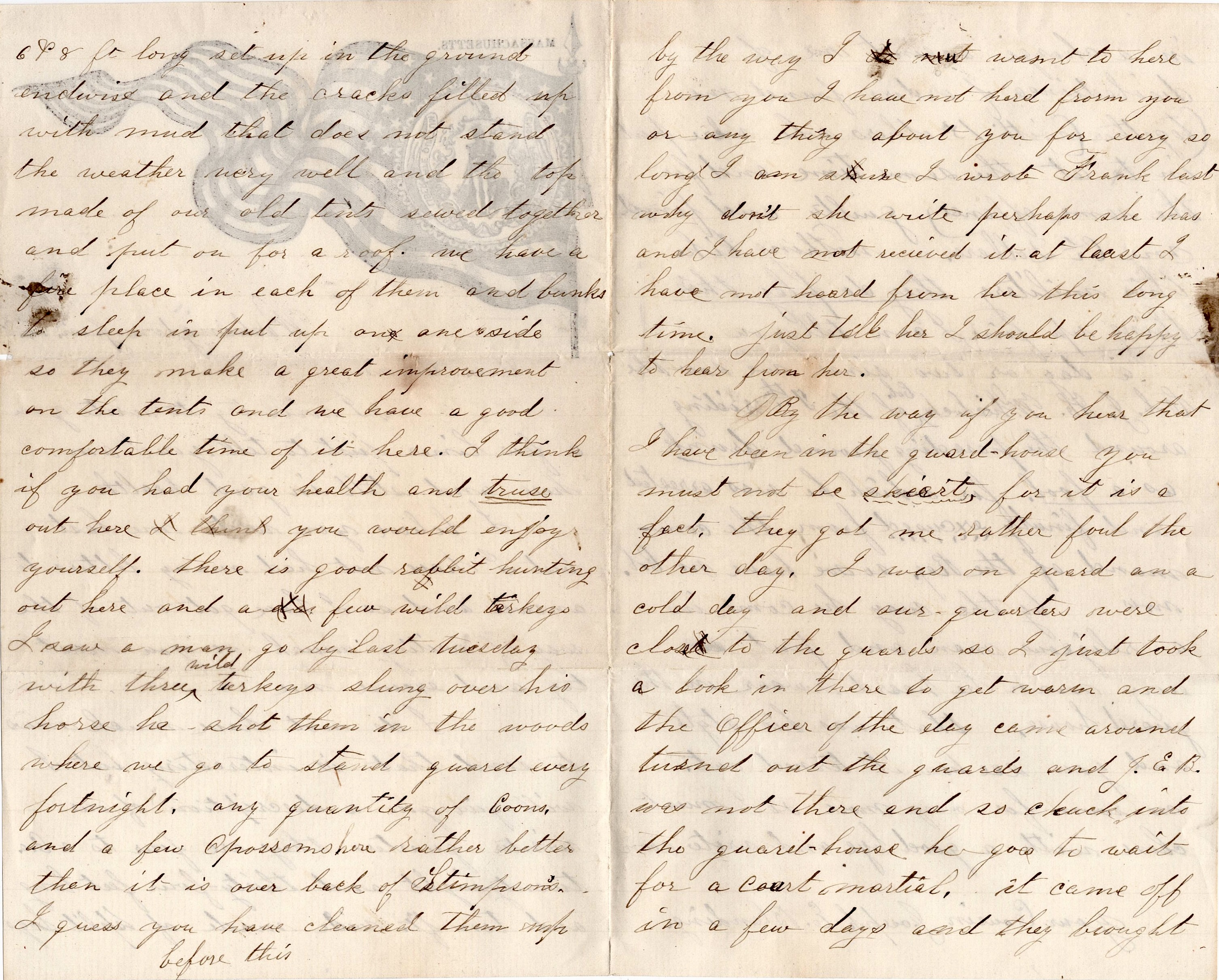
I do not have much news to send that is interesting but I will give you a description of our winter quarters. They are four to a company, 28 and 34 feet long, and ten feet wide made of split logs 6 and 8 feet long set up in the ground endwise and the cracks filled up with mud that does not stand the weather very well and the top is made of our old tents sewed together and put on for a roof. We have a fire place in each of them and bunks to sleep in put up on one side so they make a great improvement on the tents and we have a good, comfortable time of it here.
I think if you had your health and truse [?] out here, you would enjoy yourself. There is good rabbit hunting out here and a few wild turkeys. I saw a man go by last Tuesday with three wild turkeys slung over his horse. He hot them in the woods where we go to stand guard every fortnight. Any quantity of coons and a few opossums here—rather better than it is over back of Stimpson’s. I guess you have cleaned them up before this.
By the way, I want to hear from you. I ave not heard from you or anything about you for ever so long. I am sure I wrote Frank last. Why don’t she write. Perhaps she has and I have not received it—at least I have not heard from her this longtime. Just tell her I should be happy to hear from her.
By the way, if you hear that I have been in the guard house, you must not be skeert, for it is a fact. They got me rather foul the other day. I was on guard on a cold day and our quarters were close to the guards so I just took a look in there to get war, and the Officer of the Day came around, turned out the guards, and J. E. B. was not there and so—chuck into the guard house he goes to wait for a court martial. It came off in a few days and they brought in a charge against me of disobedience of orders, found me (together with 13 others who were put in at the same time and for the same offense) guilty and fined me 6.50 dollars. Nothing like this miliary. they do play this thing up fine, I can tell you.
A day or two since we saw the Col. J[oseph] H[enry] Wheelock, colonel of the 7th, riding around the parade ground drunk as a fool for which he was arrested and finally excused from the command of the regiment so we have no colonel now. By the way, he come in a religious man and put every man he heard swear in the guard house. That was his style and you see how it turned out. 1
No room for any more so I must close with a good bye and write soon.
Your cousin, — Joseph E. Blanding
1 Colonel Joseph Henry Wheelock resigned, citing that his health was “too feeble to endure the hardships of camp life in this latitude and at his season of the year.” Wheelock would die in Washington in May. [Source: The civil War in the East]
This letter was written by Pvt. John M. Ford (1843-1908) of Co. E, 7th Massachusetts Infantry. John gave his residence as Marshfield and his occupation as farmer when he enlisted as a recruit on 11 February 1862. He was wounded on 3 May 1863 during the Battle of Chancellorsville but recovered and presumably was with his regiment at the Battle of Gettysburg which was fought just one month previous to this letter.
I could not find an image of John, but here is one of James Lycett of the 7th Massachusetts Infantry. James was wounded at the Battle of Fredericksburg (Al Niemiec Collection)
In June 1864, as the term of the initial enlistees of the 7th Massachusetts soldiers had expired, he was transferred to Co. A, 37th Massachusetts Infantry where he finished his term of service, mustering out in February 1865.
John was the son of William Ford (1799-1861) and Clarissa Packard (1813-1907) of Marshfield, Plymouth county, Massachusetts. John survived the war and married Sarah Dingley Sherman (b. 1844) in November 1869. He wrote the letter to his older brother, William Henry Ford (1841-1907) who gave his occupation as “Housewright” in the 1860 US Census. William was working at the time in Fairmount, Massachusetts.
I have not found the details of John’s death on 16 May 1908 but his death certificate suggests that he was accidentally killed near the Allston Station, B&A Railroad tracks. A physician recorded that he had a compound fracture of the skull and other injuries (no autopsy performed). The railroad was identified as a contributing cause. I suspect that he may have committed suicide as no report of accidental death appeared in the papers and in his hometown paper, his obituary simply reported his “sudden death.”
To read other letters by members of the 7th Massachusetts Infantry I’ve transcribed and posted on Spared & Shared, see: Thomas Denton Johns, F&S, 7th Massachusetts (1 Letter) Oziel Ames Ramsdell, Co. K, 7th Massachusetts (7 Letters) Rufus Robbins, Co. K, 7th Massachusetts (2 Letters)
[Transcribed by Jeannette Ann Vannan; edited & researched by Griff.]
Transcription
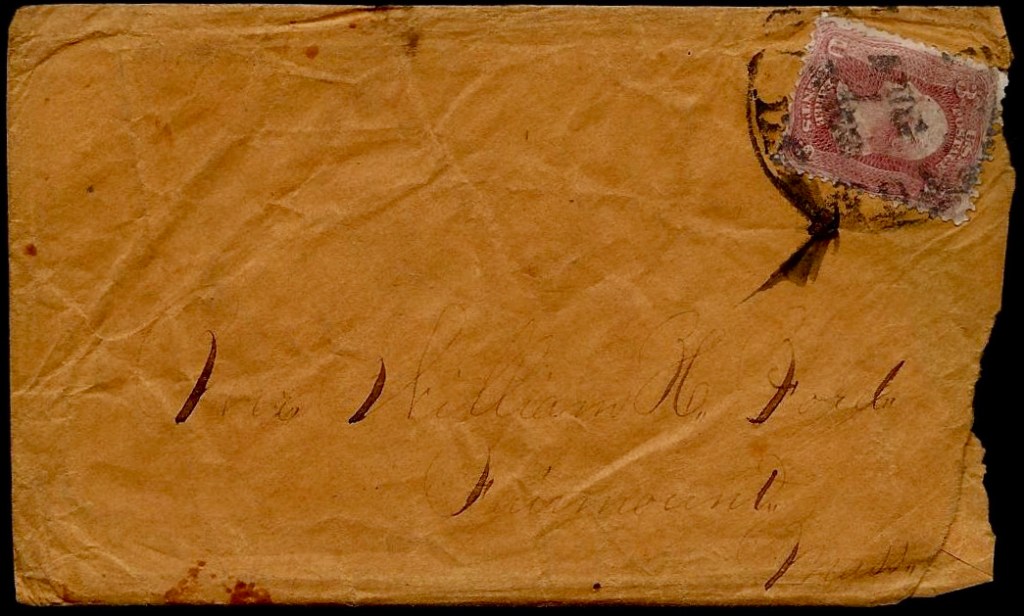
Addressed to Mr. William H. Ford, Fairmount, Massachusetts
Camp Warrenton August 3, 1863
Brother W. H.,
Taking it for granted that ‘ere this you have received the letters which I wrote you while laying on the banks of the Potomac, I will now proceed to answer your kind letter which was received in due season, giving me a list of the drafted in Marshfield. I had a day or two before seen a list of the drafted. It was taken from a paper and sent out in a letter.
I had no sooner finished that letter than we had orders to fall in. We did and marched along in rear of the teams. We marched about 9 hours and got into camp about 9 o’clock in the evening. We had some pretty tough marching in getting where we now lay. In two days we made 60 miles—pretty tall marching that. We have now been laying in this camp 8 days. The first four my time was wholly taken up in hunting sheep and hogs on the mountain.
The third day, myself with 4 others went out (with guns & ammunition) for a grand excursion. On reaching the mountain, we deployed out as skirmishers. On reaching the summit of the mountain, I emerged into a densely wooded part of the mountain [and] had not proceeded far before to my utter astonishment, what should greet my ear but the whickering of horses. As you may suppose I made immediate tracks for the horses. On arriving on the spot, I ascertained that there were 6 horses part with bridles and part with halters. I immediately commenced inspecting the animals and used the best of my judgement in picking out the best one. My choice was a beautiful iron-grey horse of certainly not more that five years of age. I led him from his concealment, and getting into the lane, I hopped upon his back and to my great surprise he struck off into a rapid pace. I soon found the others and we succeeded in securing 5 sheep. I informed the gang of the concealed horses, and we concluded to go back and select the best ones out and take them to camp. We took 3 more of them, slung our mutton to them and started for camp.
On passing a negro house we were saluted by a wench, “Where de get them horses? On de mountain?” We informed them that we did. “Them am secesh horses. There be gariless in de mountain.” I asked her if she ever saw the horses before. She informed me that she had. Well I guess she had the right of it, for we were about 5 miles out from camp and some of our fellows have been fired on out there. Capt. Young on Col. [Henry L.] Eustis’s staff (the colonel commanding our brigade), was fired on. He being a brave and desperate fellow (and as fine a little fellow as ever stood) came into camp, got a squad, and went out (armed squad) but no guerrillas were to be found.
Well on getting into camp I sold my horse (worth $150) for $3. This I did to prevent him from being taken away from me and then I should have derived no advantage from him. He was the prettiest riding horse I ever saw and a handsome one too. If I had him at home, I would have sold him for any price. I should have liked to come across Crossley with his spirited nag. I should not be much afraid of his getting the best of me. These posers will go terribly as Chas. Eustis would say.
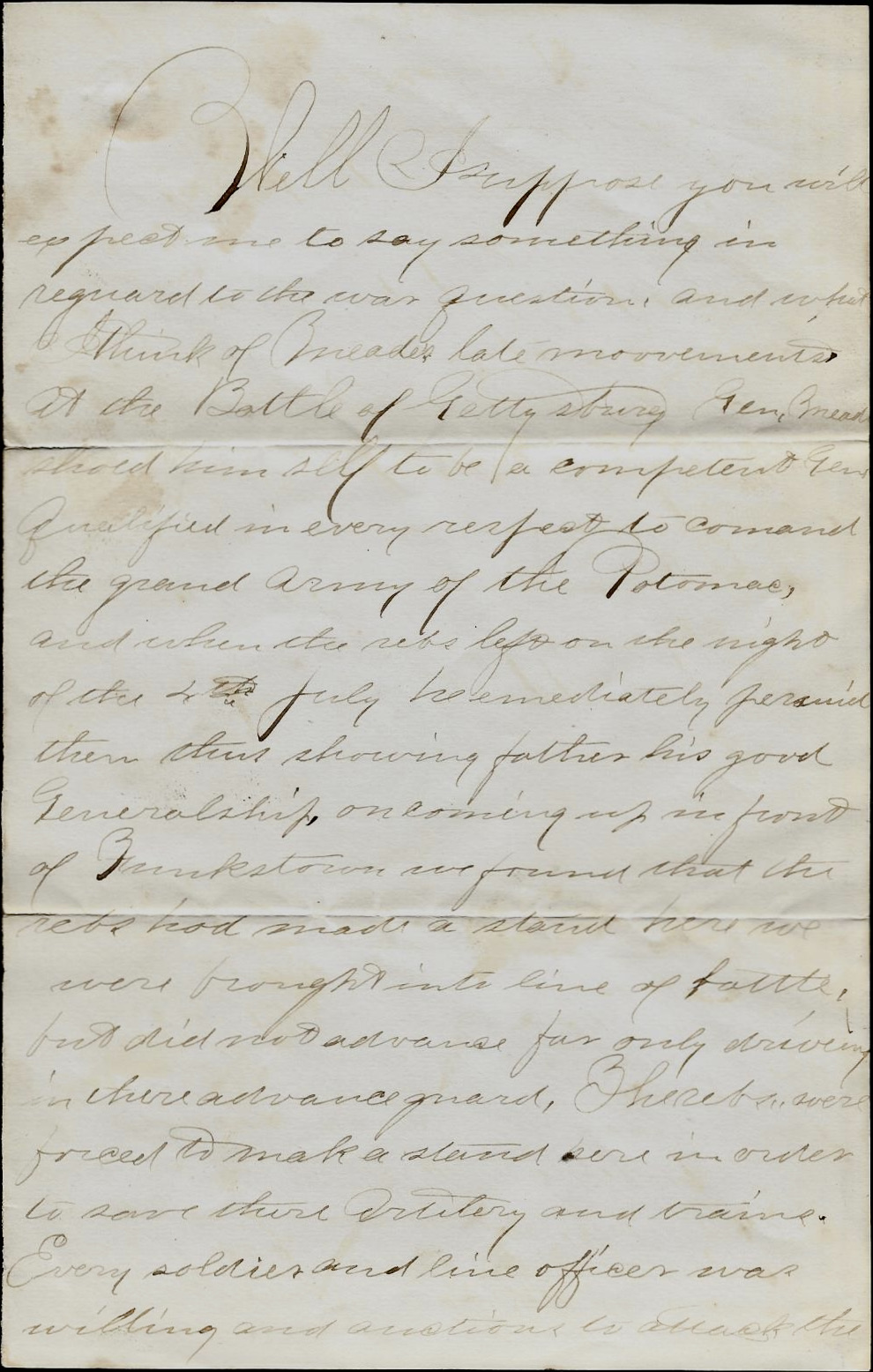
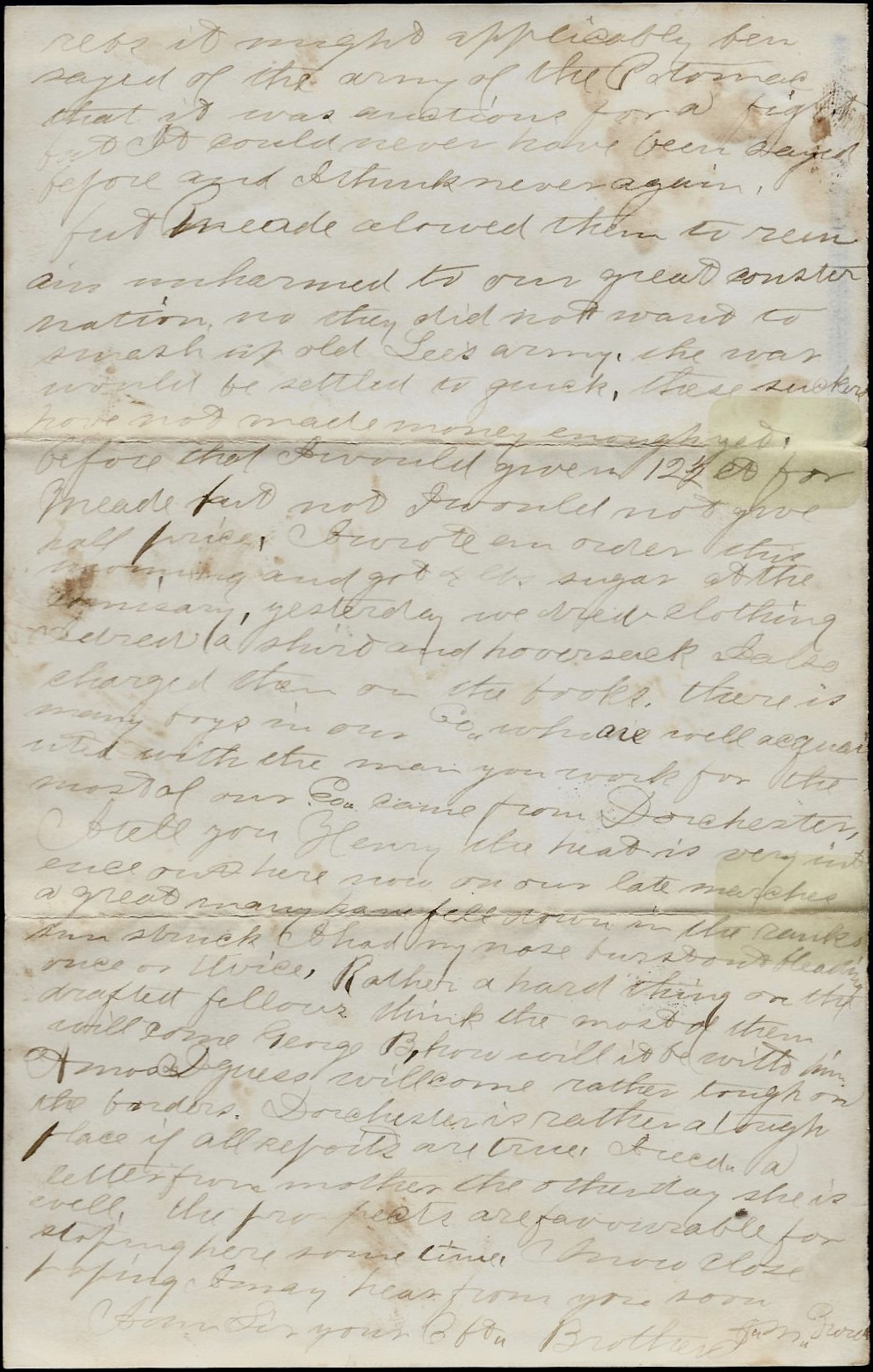
Well, I suppose you will expect me to say something in regard to the war question and what I think of Meade’s late movements at the Battle of Gettysburg. Gen. Meade showed himself to be a competent general—qualified in every respect to command the Grand Army of the Potomac. And when the Rebs left on the night of the 4th of July, he immediately pursued them, thus showing further his good generalship. On coming up in front of Funkstown, we found that the Rebs had made a stand here. We were brought into line of battle but did not advance far—only driving in their advance guard. The Rebs were forced to make a stand here in order to save their artillery and trains. Every soldier and line office was willing and anxious to attack the Rebs. It might applicably been said of the Army of the Potomac that it was anxious for a fight but it could never have been said before and I think never again.
But Meade allowed them to run on unharmed to our great consternation. No, they did not want to smash up Old Lee’s army. The war would be settled too quick. These suckers have not made money enough yet. Before that I would given 12 ½ cents for Meade, but now I would not give half price.
I wrote an order this morning and got 4 lbs. sugar at the commissary. Yesterday we drew clothing. I drew a shirt and haversack. I also charged them on the books. There is many boys in our company who are well acquainted with the man you work for. The most of our company came from Dorchester. I tell you Henry, the heat is very intense out here now. On our late marches, a great many have fell down in the ranks sun struck. I had my nose burst out bleeding once or twice.
Rather a hard thing on the drafted fellows. Think the most of them will come? George B.—how will it be with him? Amos I guess will come. Rather tough on the boarders. Dorchester is rather a tough place if all reports are true. I received a letter from mother the other day. She is well. The prospects are favorable for the stopping here some time. I now close hoping I may hear from you soon. I am sir, your affectionate brother, — J. M. Ford