
Category Archives: 8th Iowa Infantry

1863-65: Harmon J. Trask to Calista Sophia Trask

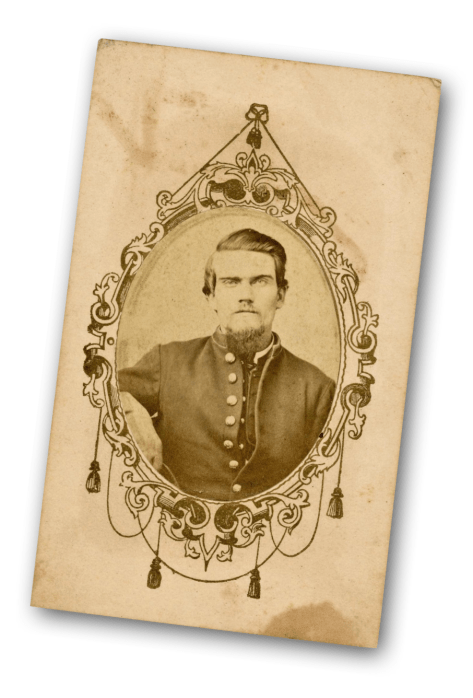
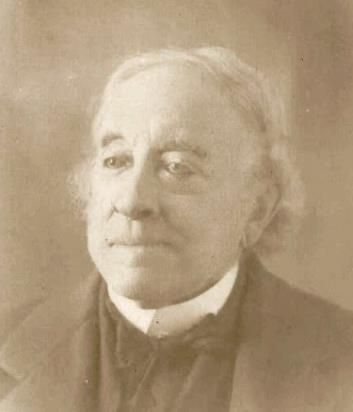
A post war image of Harmon J. Trask, veteran of Co. K, 8th Iowa Infantry

These letters were written by Harmon J. Trask (1843-1912), the son of Israel Trask (1804-1844) and Sophia Mallory (1818-1854). Israel and Sophia emigrated from Ohio to Fulton County, Illinois, from which place they removed to Jefferson township, Louisa County, Iowa, in 1837. Harmon’s three siblings were Emily Bly Trask (b. 1836), Cornelia Evangeline Trask (1840-1915), and Calista Sophia Trask (1844-1912). Emily married George W. Hook in 1854. Cornelia married Roseberry M. Wilson in 1862. Calista married William H. Prouty in 1867.

Harmon was also born at Wapello. He married Elizabeth Weber on November 2, 1878, in Newton, Kansas. They purchased land in Macon Township, and also in Newton Township. Prior to this, Harmon served five years in Co. K, 8th Iowa Infantry. He was a survivor of the Lewisville, Alabama Confederate Prison, where he was taken after his capture at the Battle of Shiloh. They had one daughter, Elsa, and a son who died as an infant. Elsa was graduated from Bethel Academy, later marrying V. E. Duncanson. They had one son, Lowell, and they lived in San Bernardino, California.

Letter 1

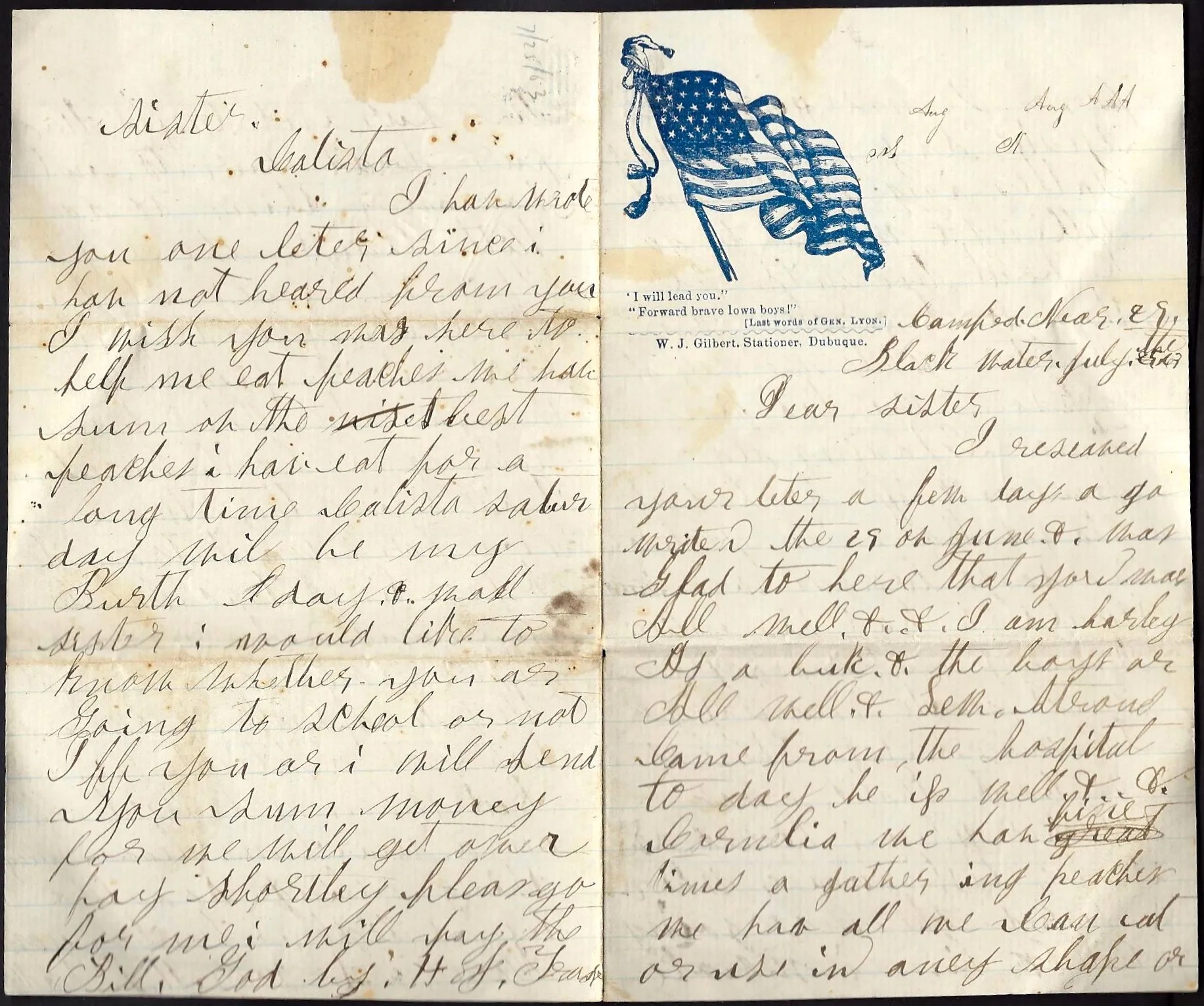
Camp Near Black Water [Mississippi]
July 25, 1863

Dear Sister,

I received your letter a few days ago written the 29th of June & was glad to hear that you were all well &c. &c. I am hardy as a buck & Seth Strand [Stevans?] came from the hospital today. He is well &c. &c.

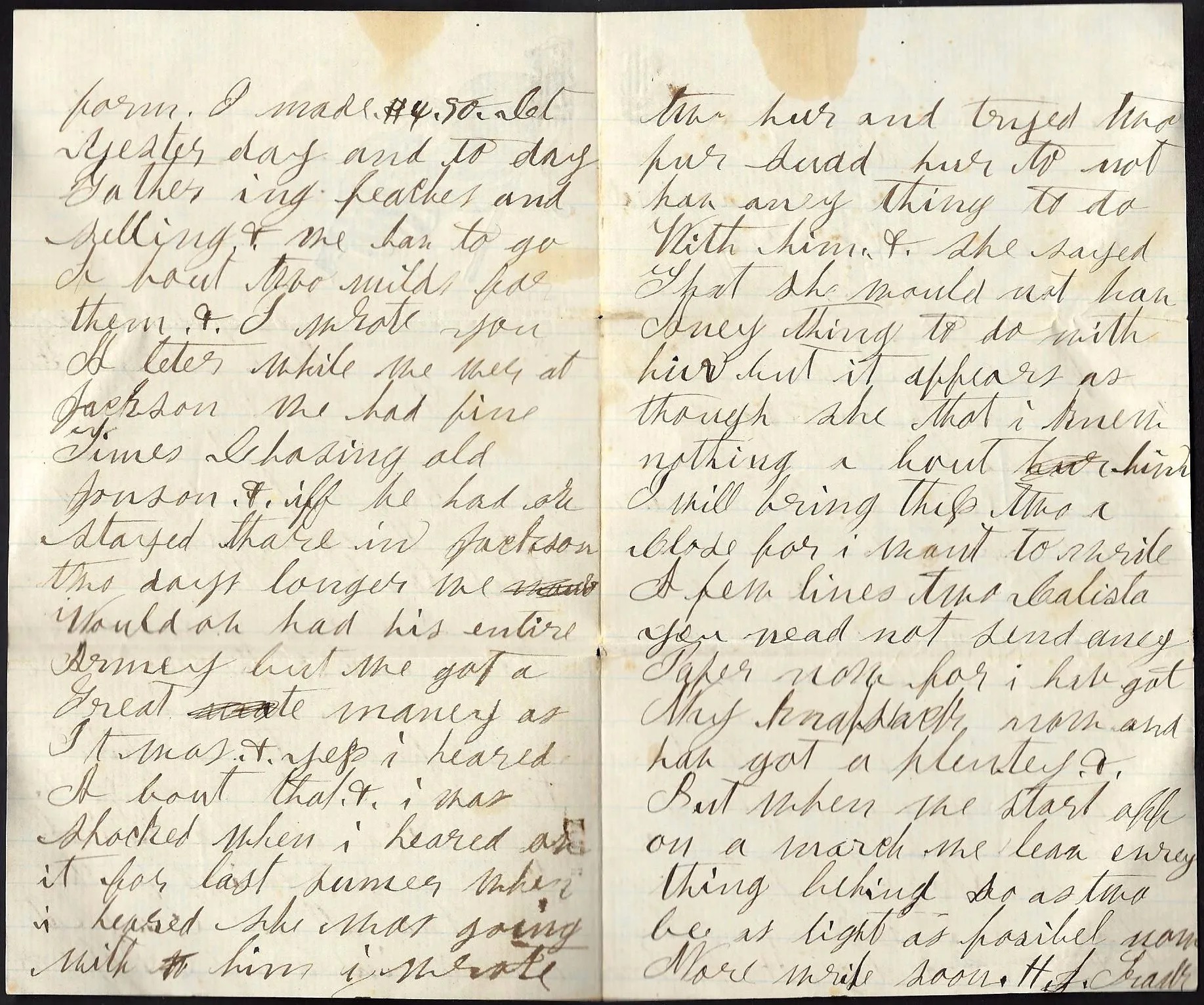
Cornelia, we have fine times a gathering peaches. We have all we can eat or use in any shape or form. I made $4.50 yesterday and today gathering peaches and selling & we have to go about two miles for them.

I wrote you a letter while we were at Jackson [Mississippi]. We had fine times chasing old [Joseph E.] Johnston & if he had of stayed there in Jackson two days longer, we would of had his entire army but we got a great many as it was.

And yes, I heard about that & I was shocked when I heard of it for last summer when I heard she was going with him, I wrote to her and tried to persuade her to not have anything to do with him & she said that she would not have anything to do with her but it appears as thought thought I knew nothing about him.

I will bring this to a close for I want to write a few lines to Calista. You need not send any paper now for I have got my knapsack now and have got a plenty.

But when we start off on a march, we leave everything behind so as to be as light as possible. No more. Write soon. — H. J. Trask

Sister Calista,

I have wrote you one letter since I have not heard from you. I wish you was here to help me eat peaches. We have some of the best peaches I have eaten for a long time. Calista, Saturday will be my birthday & shall sister: would like to know whether you are going to school or not. If you are, I will send you some money for we will get our pay shortly. Please go for me. I will pay the bill.

Goodbye. — H. J. Trask

Letter 2

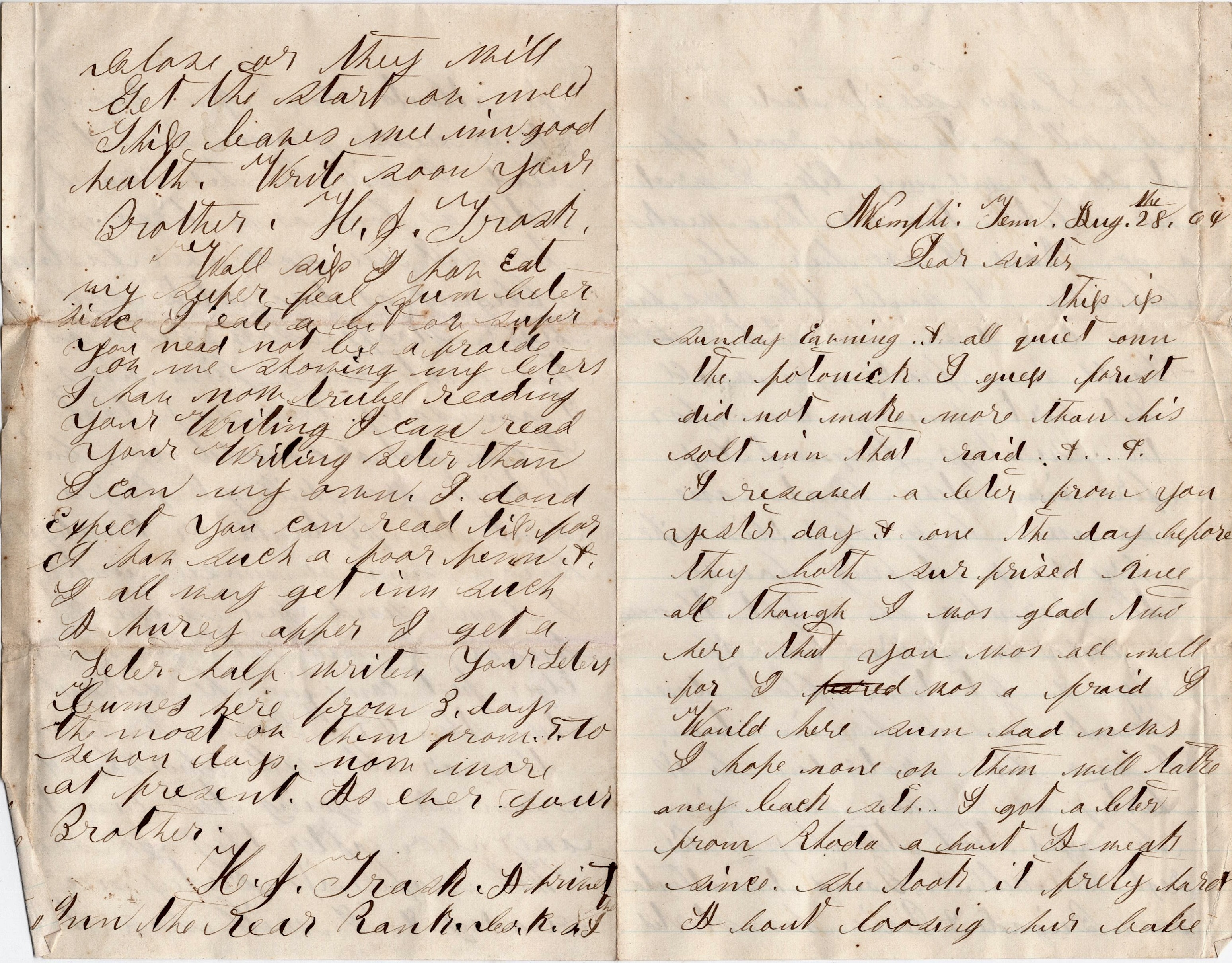
Memphis, Tennessee
August 28th 1864

Dear Sister,

This is Sunday evening and “all quiet on the Potomac,” I guess, for it did not make more than his salt in that raid [on Washington D. C.].

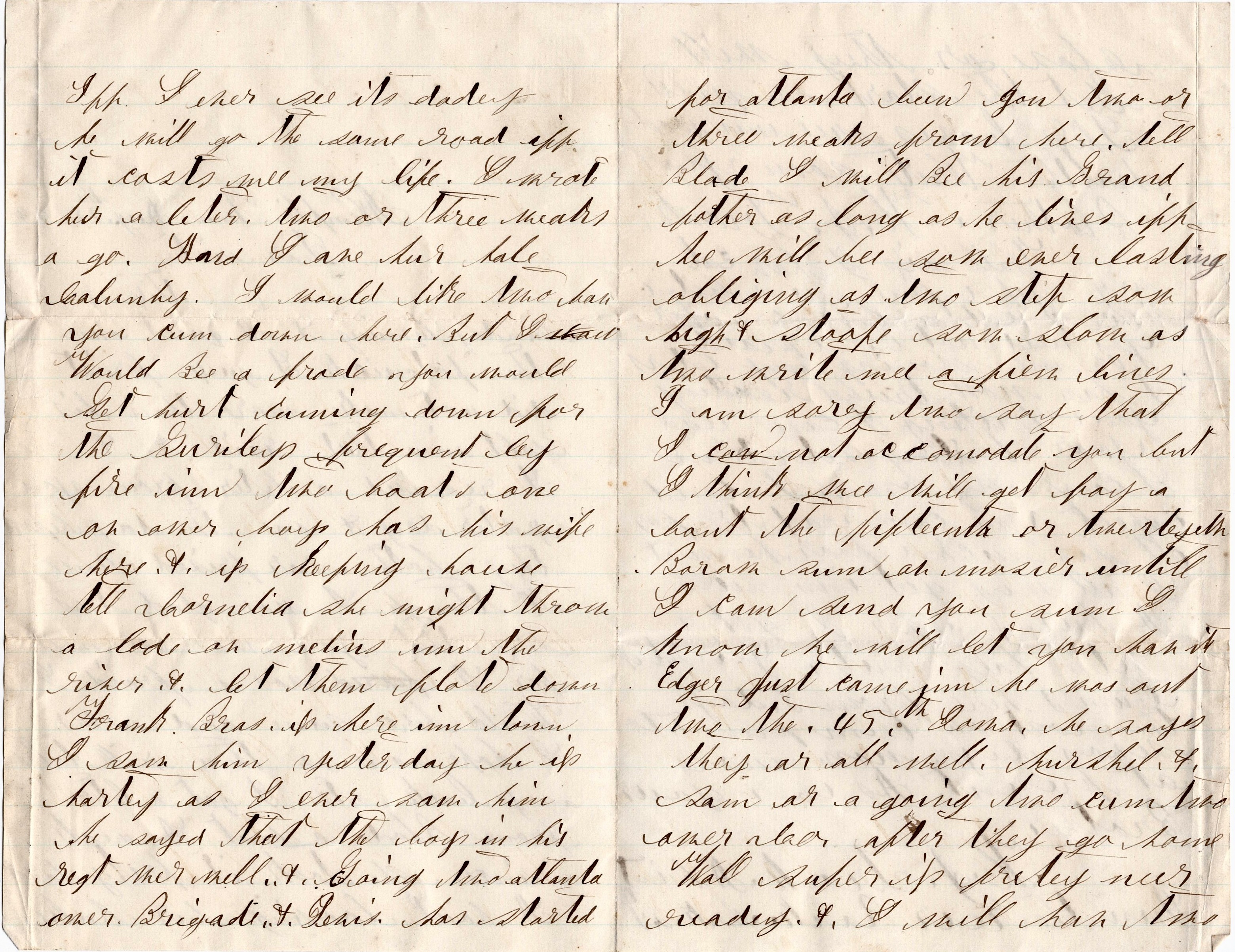
I received a letter from you yesterday & one the day before. They both surprised me although I was glad to hear that you was all well for I was afraid I would hear some had sickness. I hope none of them will take any back set. I got a letter from Rhoda about a week since. She took it pretty hard about leaving her babe. If I ever see its daddy, he will go the same road if it costs me my life. I wrote her a letter two or three weeks ago. Hard I are her Hale Columbia. [?]

I would like to have you come down here but I would be afraid you would get hurt coming down for the guerrillas frequently fire into the boats. One of our boys has is wife here & is keeping house. Tell Cornelia she might throw a load of melons in the river and let them float down.

Frank Bros is here in town. I saw him yesterday. He is hearty as I ever saw him. He said that the boys in his regiment were well & going to Atlanta. Our Brigade and Devision has started for Atlanta. Been gone two or three weeks from here. Tell Blade I will be his grandfather as long as he lives if he will be so ever lasting obliging as to step so high and stoop so low as to write me a few lines.

I am sorry to say that I cannot accommodate you but I think we will get pay about the 15th or 20th. Borrow some of Mosier until I can send you some. I know he will let you have it. Edgar just came in. He was out to the 45th Iowa. He says they are all well. Marshall and Sam are a going to come to [ ] after they go home.

Well, supper is pretty near ready and I will have to close or they will get the start on me. This leaves me in good health. Write soon. Your brother, — J. J. Trask

Well, Sis, I have eaten my supper and feel some better since I ate a bit of supper. You need not be afraid for me showing my lettrs. I have no trouble reading your writing. I can read your writing better than I can my own. I don’t expect you can read it for I have such a poor pen and I always get in such a hurry after I get a letter half written. Your letters comes here from three days, the most of them from 5 to 7 days. No more at present. As ever, your brother, — H. J. Trask

A private in the rear ranks, Co. K, 8th Iowa

Letter 3

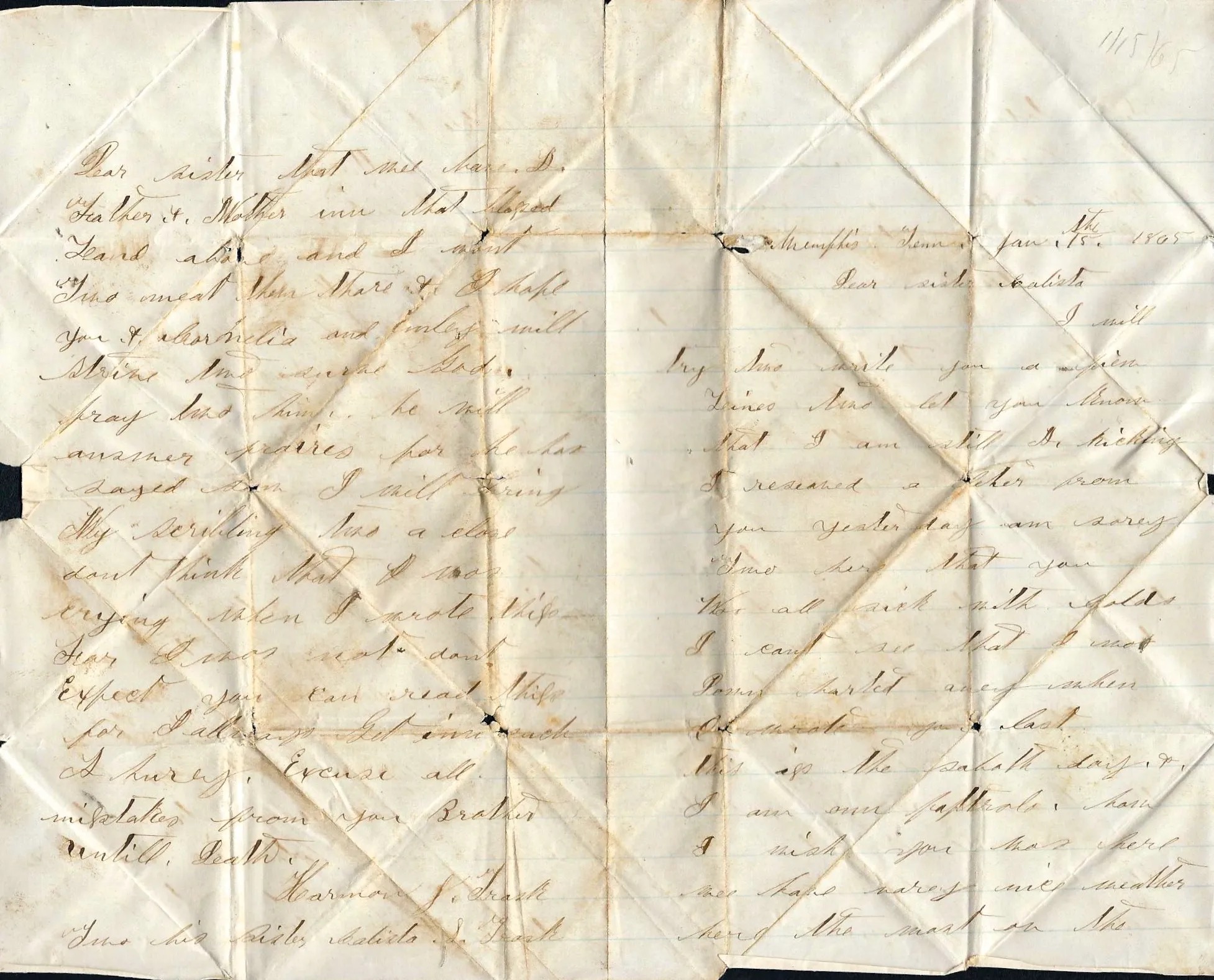
Memphis [Tennessee]
January 15, 1865

Dear sister Calista,

I will try to write you a few lines to let you know that I am still a kicking. I received a letter from you yesterday. Am sorry to hear that you was all sick with colds. I can’t see that I was down-hearted any when I wrote you last.

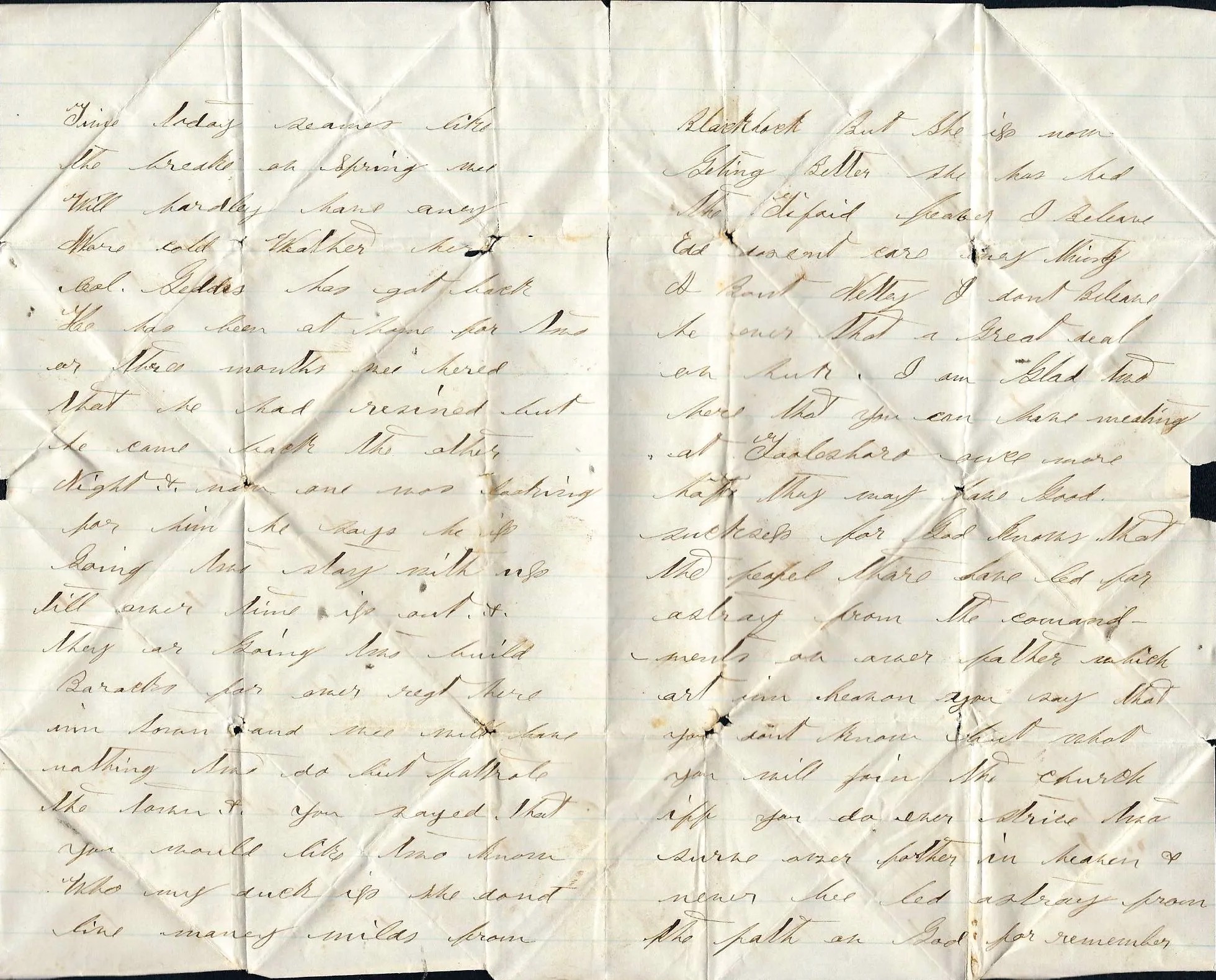
This is the Sabbath day & I am on patrol. How I wish you was here. We have very nice weather here the most of the time. Today seems like the break on Spring. We will hardly have anymore cold weather here.

Col. [James L.] Geddes has got back. He has been at home for two or three months. We heard that he had resigned but he came back the other night & everyone was looking for him. He says he is going to stay with us till our time is out & they are going to build barracks for our regiment here in town and we will having nothing to do but patrol the town &c.

You said you would like to know who my duck is. She don’t live many miles from Blackhawk but she is now getting better. She has had the typhoid fever. I believe doesn’t care. They think about Netty. I don’t believe he ever thought a great deal of her.

I am glad to hear that you can have meeting at Tooleshard ___ more. Hope they may have good success for God knows that the people there have led far astray from the commandments and our father which art in heaven. You say that you don’t know but what you will join the church. If you do ever strive to serve our father in heaven & never be led astray from the path of God for remember, dear sister, that we had a father & mother in that blessed land above and I want to meet them there & I hope you & Cornelia and Emily will strive to serve God. Pray to him. He will answer prayers for he has said so.

I will bring my scribbling to a close. Don’t think that I was crying when I wrote this for I was not. Don’t expect you can read this for I always get in such a hurry. Excuse all mistakes from your brother until death.

Harmon J. Trask

to his sister Calista S. Trask

1861: Daniel Cox to Ellen Elizabeth Kepner

I could not find an image of Daniel but here is Andrew D. Johnson who enlisted in Co. C, 8th Iowa Infantry. (Mike Huston Collection)

This letter was written by Daniel Cox (1840-1862) of Marengo, Iowa, who enlisted when he was 21 years old in Co. G, 8th Iowa Infantry. He died of disease at Sedalia, Missouri, on 19 February 1862—just a few weeks after he wrote this letter.

Daniel was the son of William Cox (1812-1896) and Margaret Elizabeth Wannamougher (1814-Abt1853) who married 18 September 1838. William later married Martha Jane Athey Rockwell (1831-1861) in 1854 and she became Daniel’s step-mother.

The 8th Iowa Infantry was attached to the Department of Missouri until March 1862 and they spent most of the winter at Sedalia, occasionally participating on minor expeditions to chase small squads of guerrillas.

Daniel wrote the letter to Ellen Elizabeth (“Nellie”) Kepner, the daughter of Samuel Kepner and Elizabeth Haslet of Marengo, Iowa. She married Hames Henry Mead in July 1866. Her brother, Daniel S. Kepner was killed in the Battle of Antietam. Another brother, Robert Kepner (mentioned in the letter), served in the 7th Iowa Infantry.


Transcription

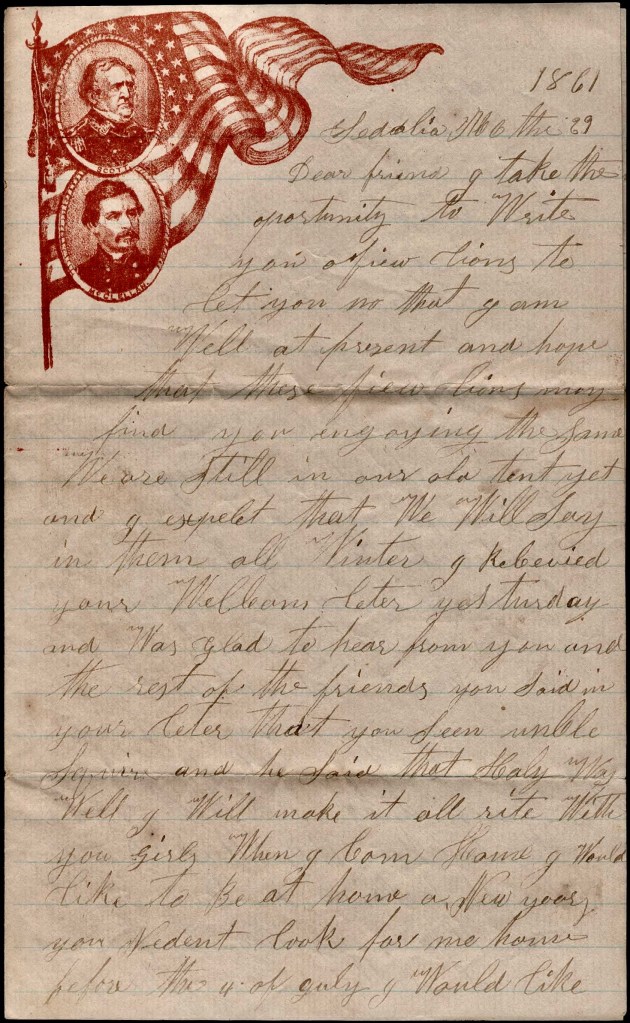
Patriotic stationery featuring Scott & McClellan busts on American Flag

Sedalia, Missouri
November 29, 1861

Dear friend,

I take the opportunity to write you a few lines to let you know that I am well at present and hope that these few lines may find you enjoying the same. We are still in our old tent yet and I expect that we will stay in them all winter. I received your welcome letter yesterday and was glad to hear from you and the rest of the friends. You said in your letter that you seen Uncle Squire and he said that Holy [ ]. Well, I will make it all right with you girls when I come home.

I would like to be at home a New Years, [but] you needn’t look for me now before the 4th of July. I would like to be there to take a sleigh ride with some of you. We have some snow here but not enough to sleigh ride. But it is pretty cold here sometimes. It is very pleasant today.

We have taken about 1500 secesh since we have been here. The pickets brought in four secesh yesterday. There was 300 of our men 1300 of the secesh. Ellen, I never was caught in a scrape before that I could not get out of before this [but] I can’t get out of this. If I get home again, you better believe that I will stay there. They say that we will go to Kentucky this week but I don’t believe a word of it.

Ellen, we are a going to have a general settlement the first of next month. We have about three months pay behind. We will get between 35 and 40 dollars and then you may look for that likeness.

I got a letter from Robert. He was not very well. He said he had the mumps. There is right smart of sickness here. I believe that I have nothing more of importance to write. So no more at present but remain yours truly, — Daniel Cox

to E. E. Kepner

1864: Simeon Oscar Johnson to Helen Elizabeth (Johnson) Bailey

I could not find an image of Simeon but here is Sgt. Thomas H. Morris of Co. H, 8th Iowa Infantry. Thomas died of wounds he received at Jackson, Mississippi in July 1863. (John Wernick Collection)

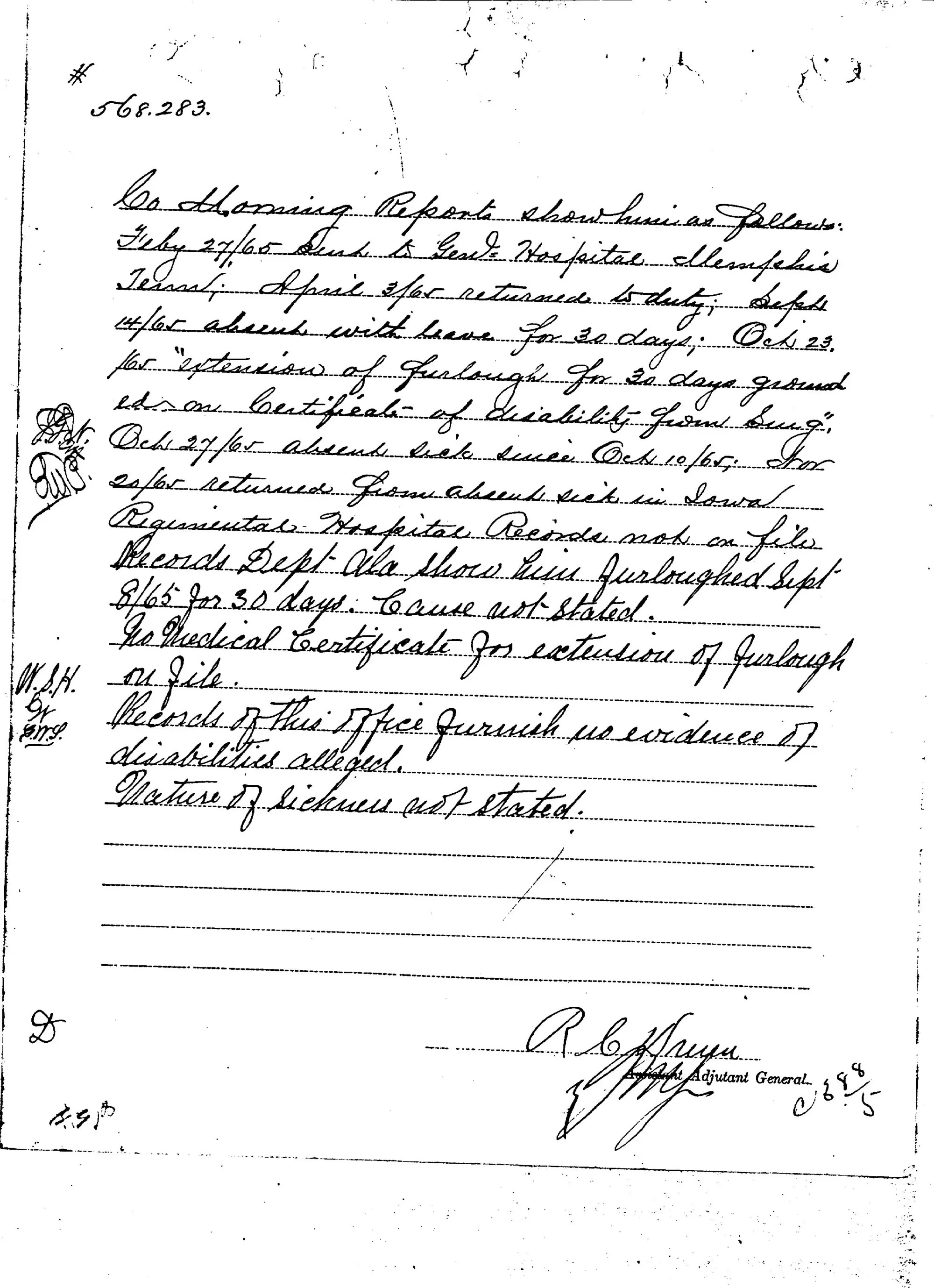
This letter was written by Simeon Oscar Johnson (1838-1912), the orphaned son of Simeon Johnson (1786-1849) and Rachel Cruzen (1804-1845). He wrote the letter to his younger sister, Helen Elizabeth Johnson (1841-1923) and her husband, Abraham Bailey (1828-1910) of Oskaloosa, Mahaska county, Iowa.

During the Civil War, Simeon volunteered to serve in Co. H, 8th Iowa Infantry. He mustered into the regiment on 12 September 1861 and mustered out three years later on 28 September 1864 at Davenport, Iowa.

The 8th Iowa Infantry left the state for St. Louis in September 1861 and was attached to Department of Missouri until March, 1862. The regiment was assigned to the 3rd Brigade, 2nd Division, Army of Tennessee for one month and then transferred to the 1st Brigade, 2nd Division, until July, 1862. Following the fighting in SE Tennessee and NE Mississippi, the regiment was assigned to the District of Corinth, Dept. of the Tennessee, 1st Brigade, XIII Army Corps. Following the exchange of Shiloh prisoners (most of the regiment was captured at Shiloh), the regiment returned to Davenport for reorganization December 20, 1862-January 4, 1863. They were assigned to the District of St. Louis, Dept. of the Missouri, January-April, 1863. The Iowans returned to the Army of the Tennessee in the 3rd Brigade, 3rd Division, XV Army Corps, until December, 1863. They transferred to the 3rd Brigade, 1st Division, XVI Army Corps, until June, 1864, following which they moved to the District of Memphis, District of West Tennessee, until February, 1865. 

Transcription

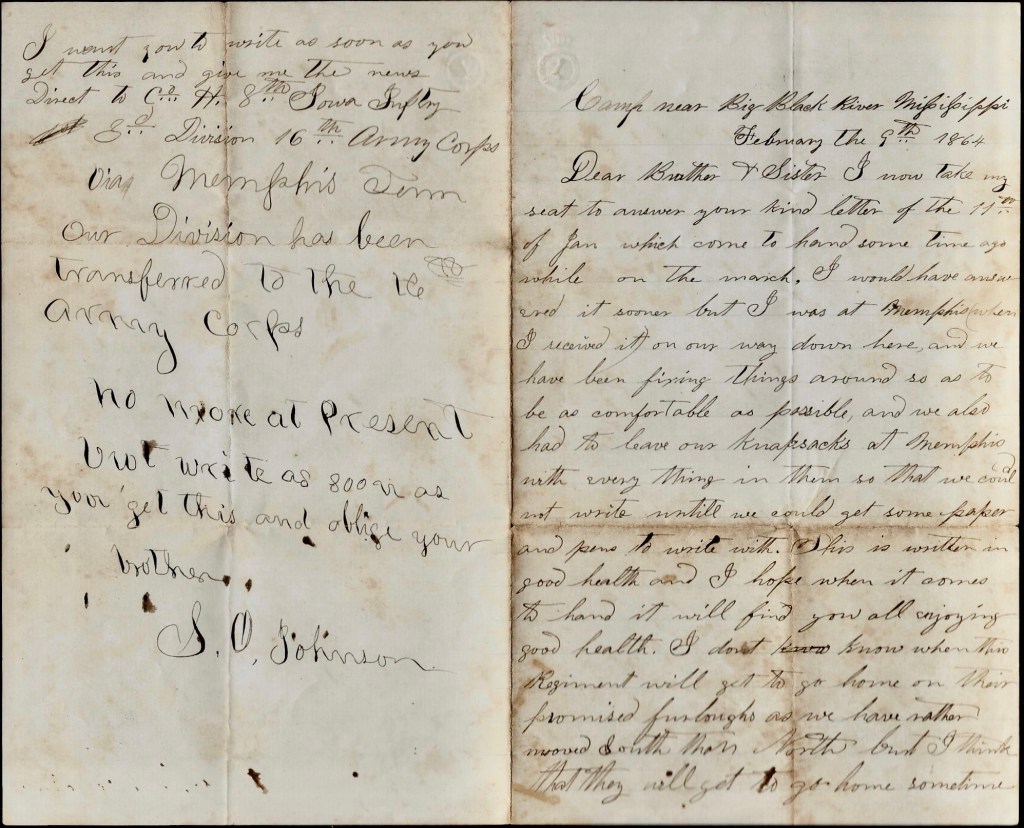
Camp near Big Black River, Mississippi
February 9th 1864

Dear Brother & Sister,

I now take my seat to answer your kind letter of the 11th of January which come to hand some time ago while on the march. I would have answered it sooner but I was at Memphis (when I received it) on our way down here, and we have been fixing things around so as to be as comfortable as possible, and we also had to leave our knapsacks at Memphis with everything in them so that we could not write until we could get some paper and pens to write with.

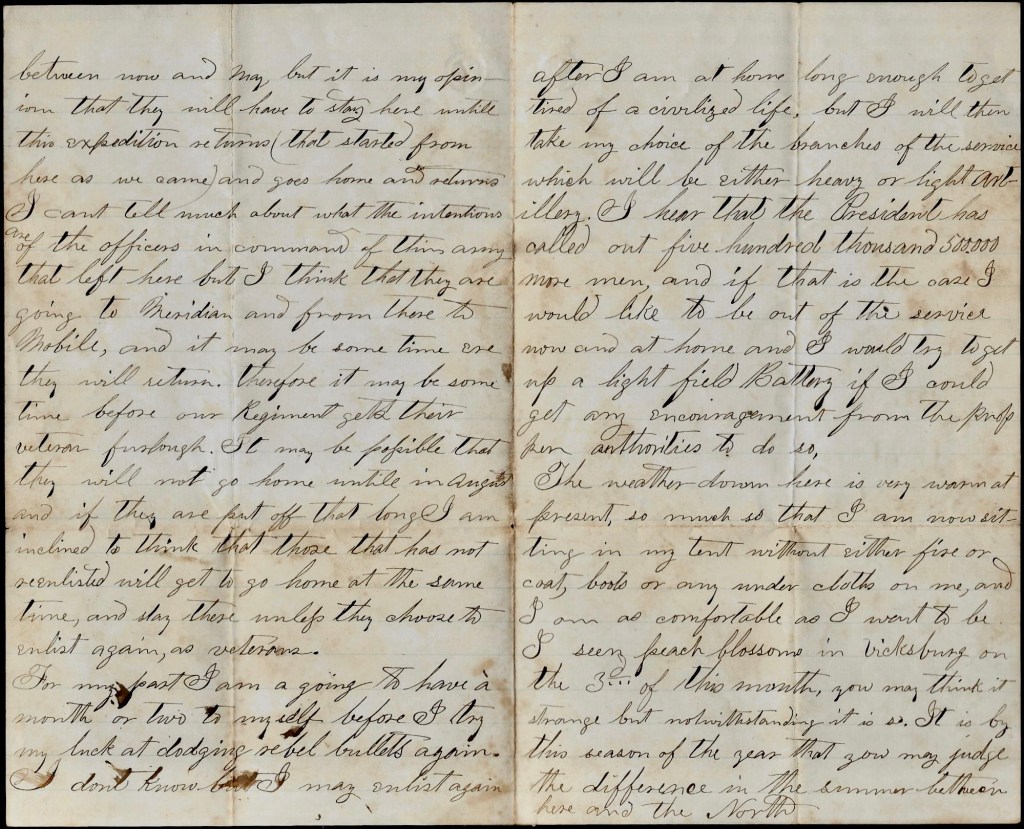
This is written in good health and I hope when it comes to hand, it will find you all enjoying good health. I don’t know when this regiment will get to go home on their promised furloughs as we have rather moved south than north, but I think that they will get to go home sometime between now and May. But it is my opinion that they will have to stay here until this expedition returns (that started from here as we came) and goes home and returns. I can’t tell much about what the intentions are of the officers in command of this army that left here but I think that they are going to Meridian and from there to Mobile, and it may be some time ere they will return. Therefore it may be some time before our regiment gets their veteran furlough. It may be possible that they will not go home until in August and if they are put off that long, I am inclined to think that those that has not reenlisted will get to go home at the same time and stay there unless they choose to enlist again as veterans.

For my part, I am a going to have a month or two to myself before I try my luck at dodging rebel bullets again. I don’t know but I may enlist again after I am at home long enough to get tired of a civilized life, but I will then take my choice of the branches of the service which will be either heavy or light artillery.

I hear that the President has called out five hundred thousand 500,000 more men and if that is the case, I would like to be out of the service now and at home and I would try to get up a light field battery if I could get any encouragement from the proper authorities to do so.

The weather down here is very warm at present, so much so that I am now sitting in my tent without either fire or coat, boots or any under clothes in me, and I am as comfortable as I want to be. I seen peach blossoms in Vicksburg on the 3rd of this month. You may think it strange but notwithstanding, it is so. It is by this season of the year that you may judge the difference in the summer between here and the North.

I want you to write as soon as get this and give me the news. Direct to Co. H, 8th Iowa Infantry, 3rd Division, 16th Army Corps, via Memphis, Tennessee. Our Division has been transferred to the 16th Army Corps. No more at present but write as soon as you get this and oblige your brother, — S. O. Johnson

1862: David Knowles to General Baker

Rev. David Knowles

This letter was written by Rev. David Knowles (1811-1899) of Columbus City, Iowa, in June 1862. In his letter, David requests the assistance of “Gen. Baker” in securing a discharge for his son serving in Co. C, 8th Iowa Infantry. His son was David A. Knowles (1843-1863) enlisted on 10 August 1861. He died at Jefferson Barracks in St. Louis on 6 August 1863.

I believe the General Baker that David addressed his letter to was Nathaniel Bradley Baker who Governor Kirkwood appointed as adjutant-general of Iowa to coordinate Iowa’s response to the Civil War.

[Note: This letter is from the private collection of Jim Petersen and is published on Spared & Shared by express consent.]

Transcription

Columbus City, Iowa
June 10, 1862

To Gen. Baker
Respected Sir,

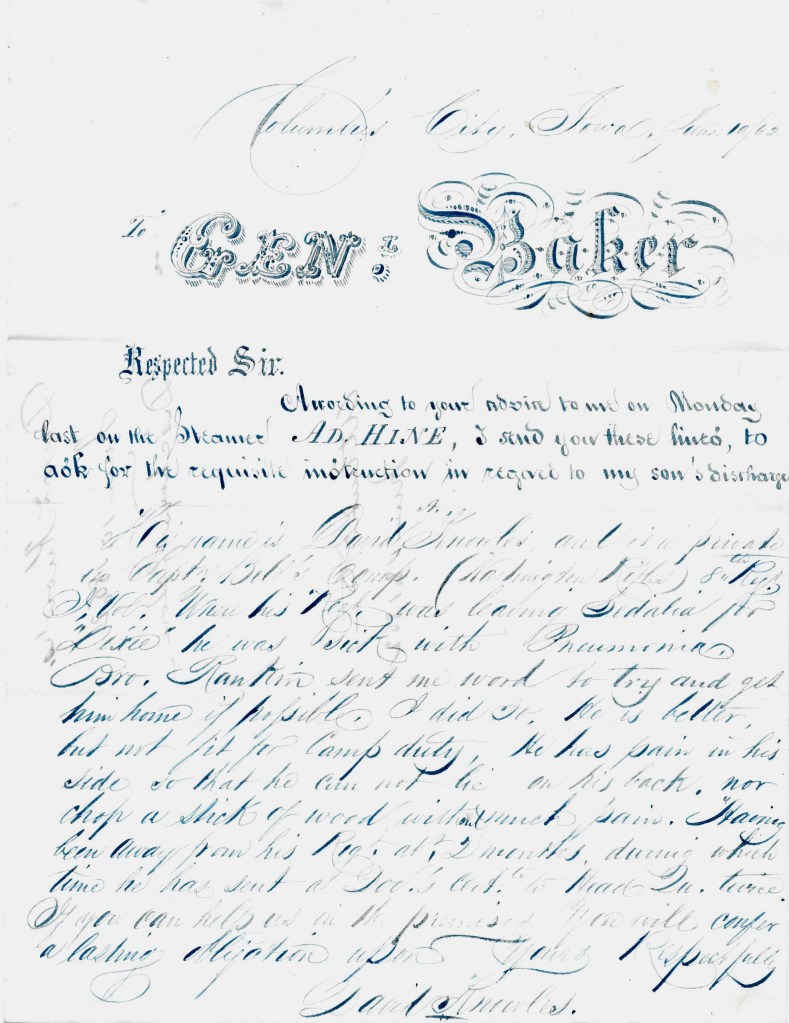
According to your advice to me on Monday last on the steamer Admiral Hine, I send you these lines to ask for the requisite instruction in regard to my son’s discharge.

His name is David A. Knowles and is a private in Capt. Bell’s Company (Washington Rifles) 8th Regt. Iowa Colunteers. When his regiment was leaving Sedalia for “Dixie,” he was sick with pneumonia. Bro. Rankin sent me word to try and get him home if possible. I did do. He is better but not fit for camp duty. He has pain in his side so that he can not be on his back nor chop a stick of wood without much pain. Having been away from his regiment at 2 months, during which time he has sent a Doctor’s Certificate to Headquarters twice, if you can help us in the premises, you will confer a lasting obligation upon yours respectfully. — David Knowles