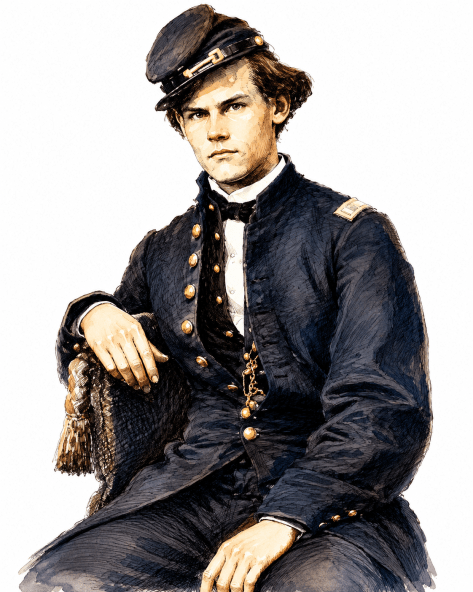
he only signed the letter “Hamp” but I feel confident that this letter was written by Jeremiah Hampton Squires (1842-Aft1918) while serving in Co. A, 95th Ohio Volunteer Infantry (OVI). A biographical sketch was found on-line which informs us that Hamp was born “at Southampton, on Long Island, New York, September 11, 1842, and is the only survivor of the four children of Jeremiah and Phebe (Jagger) Squires, who were farming people. Mr. Squires resided on the home farm on Long Island until reaching the age of seventeen years, and during this time acquired his education by attending the public schools and Southampton Academy. In the spring of 1860 he went to Columbus, Ohio, and, with the exception of the time he was a soldier in the Civil war, remained in the employ of one man at carpentering, as an apprentice, journeyman, foreman and partner, for nearly twenty years. Mr. Squires enlisted July 22, 1862, as a private in Company A, Ninety-fifth Regiment, Ohio Volunteer Infantry, and within two weeks of the time he was enlisted was engaged in his first battle, at Richmond, Kentucky. In this engagement twenty-seven men of his company were killed or wounded, and here he received his first and only wound during the war which consisted of a bullet in the left hand. He, with 600 others of his regiment, was here captured and paroled for ninety days.
He was then declared exchanged and rejoined his regiment, going into active service at Milliken’s Bend, in April, 1863, and being subsequently set to work digging a canal north of Vicksburg. Next he went to Grand Gulf, later to Jackson, and then to Vicksburg, where for six weeks he participated in the siege of that city, which finally fell into the hands of the North. His regiment then took part in the chase of Johnston’s army, which it met in the battle of Jackson, where it was ordered to uncover a masked battery. In so doing, Mr. Squires, then a sergeant, saw two officers of the enemy beating a retreat, followed them, and, on discovering them in a tent, covered them with his gun and took them as prisoners to the Union lines single-handed. While on the way from Vicksburg to Jackson, he was ordered to select four men and make a reconnoissance in the neighborhood of Black River, where the enemy were supposed to be occupying a fort on the river bank. Here they were surprised by about twenty-five of the enemy who were in the fort and were fired upon. The handful of Union men responded with a charge on the twenty-five Confederates, who retreated and crossed the river in boats, leaving the unguarded fort to be captured by a force of about one-fourth their own strength, one of the plucky Northerns having been dispatched to the Union commander with information regarding conditions. Later in the day, the commander of the Federal troops relieved the four men and they went on to Jackson as previously related. After Jackson the regiment went back to within about six miles of Vicksburg, where the men went into camp. Mr. Squires was then assigned to the duty of going to Columbus, Ohio, to secure drafted men to fill up the depleted ranks of the regiment, but, as there were none there, he was ordered to recruit.
He was relieved in the early spring and rejoined his regiment at Memphis, Tennessee, June 1, 1864, and was then in the expedition sent out to check the advance of the Confederate leader, General Forrest. At Brice’s Cross Roads, Mississippi, the Union forces, numbering about 6,000 were defeated by the Southerners, who numbered some 10,000, and 136 men of Mr. Squires’ regiment were captured by the enemy, he being among the number. He was started to Andersonville Prison and for several days the only food obtained by the prisoners consisted of corn which they picked up from around the places where the animals had been fed. Finally, they reached the line of the railroad and were packed into box cars and sent to Andersonville stockade, where they arrived June 19, 1864.
Mr. Squires experienced all the hardships, sufferings and tortures which incarceration in that awful prison meant, and from the weight of 175 pounds when he went in wasted away to eighty pounds, his weight when finally released. On November 24, 1864, with 10,000 other prisoners he was paroled and returned to Camp Chase, Ohio, to endeavor to regain his shattered energies. While at Andersonville, he had in some miraculous manner succeeded in secreting 60 cents from the search of his guards, and with this he bought writing paper and stamps and sent a letter to his sister, who was then living at Columbus, Ohio. Six months after the letter has been written it was handed to him at Columbus. In the spring of 1865 Mr. Squires rejoined his regiment at Mobile, Alabama, but the war being virtually over, he was stationed at Enterprise, Mississippi, doing guard duty for the rest of his service. He was finally ordered North and discharged at Louisville, Kentucky, August 18, 1865, at which time he held the rank of orderly sergeant.
At Columbus, Ohio, July 27, 1867, the brave young soldier was married to Virginia Elizabeth Schimp. He continued to be engaged at carpentering and contracting in Ohio until 1879, when he came to Kansas and purchased 240 acres of raw land in Pottawatomie County, six miles northwest of Waumega. In the fall of that year his family joined him and he continued to be engaged in farming for six years, since which time he has resided at Topeka.”
Hamp wrote this letter to his brother-in-law, Jetur White (1829-1898) of Southampton, Suffolk county, New York. Jetur was married to Mary Sophronia Squires (1830-1911) about 1860.
T R A N S C R I P T I O N
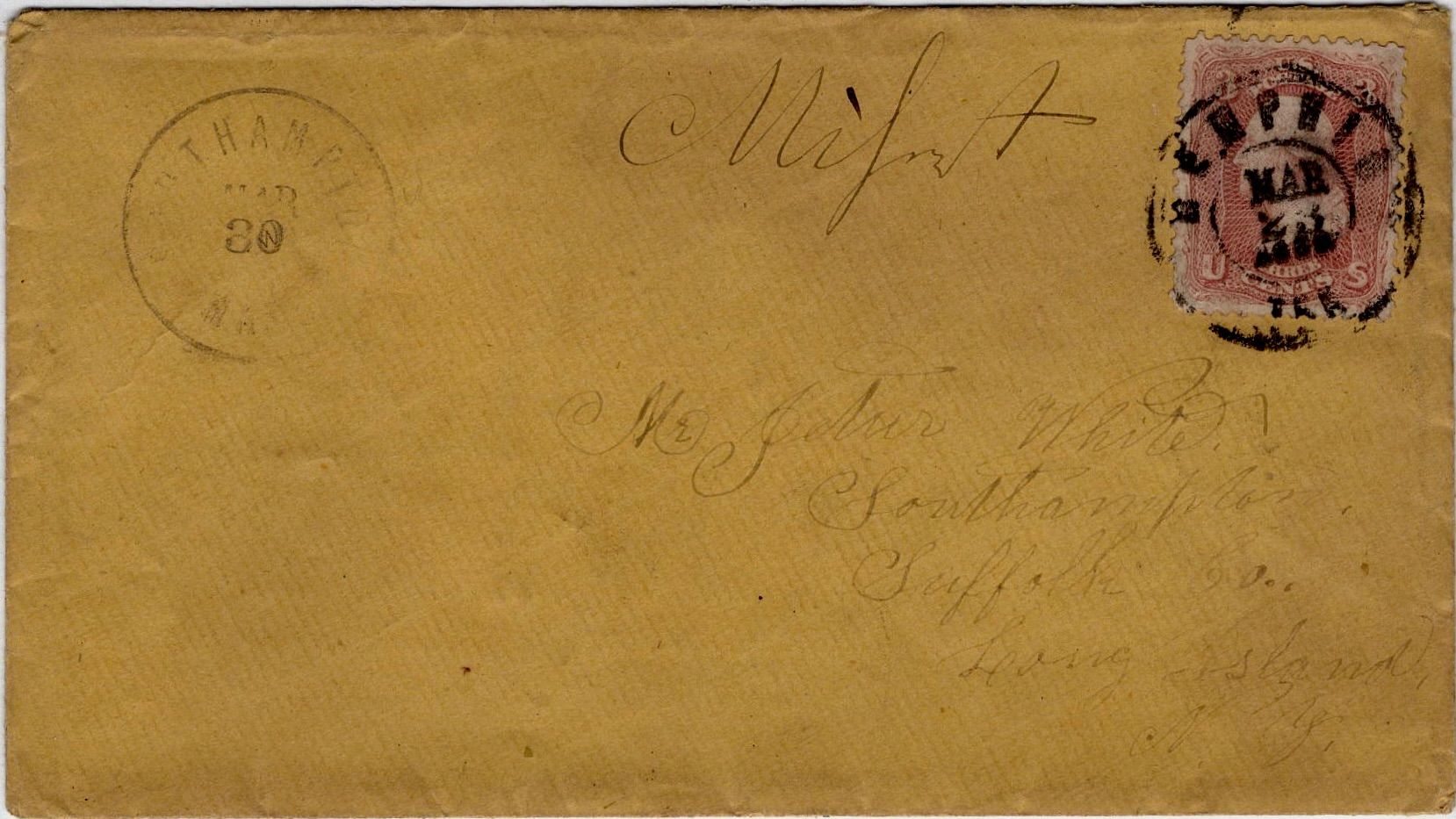
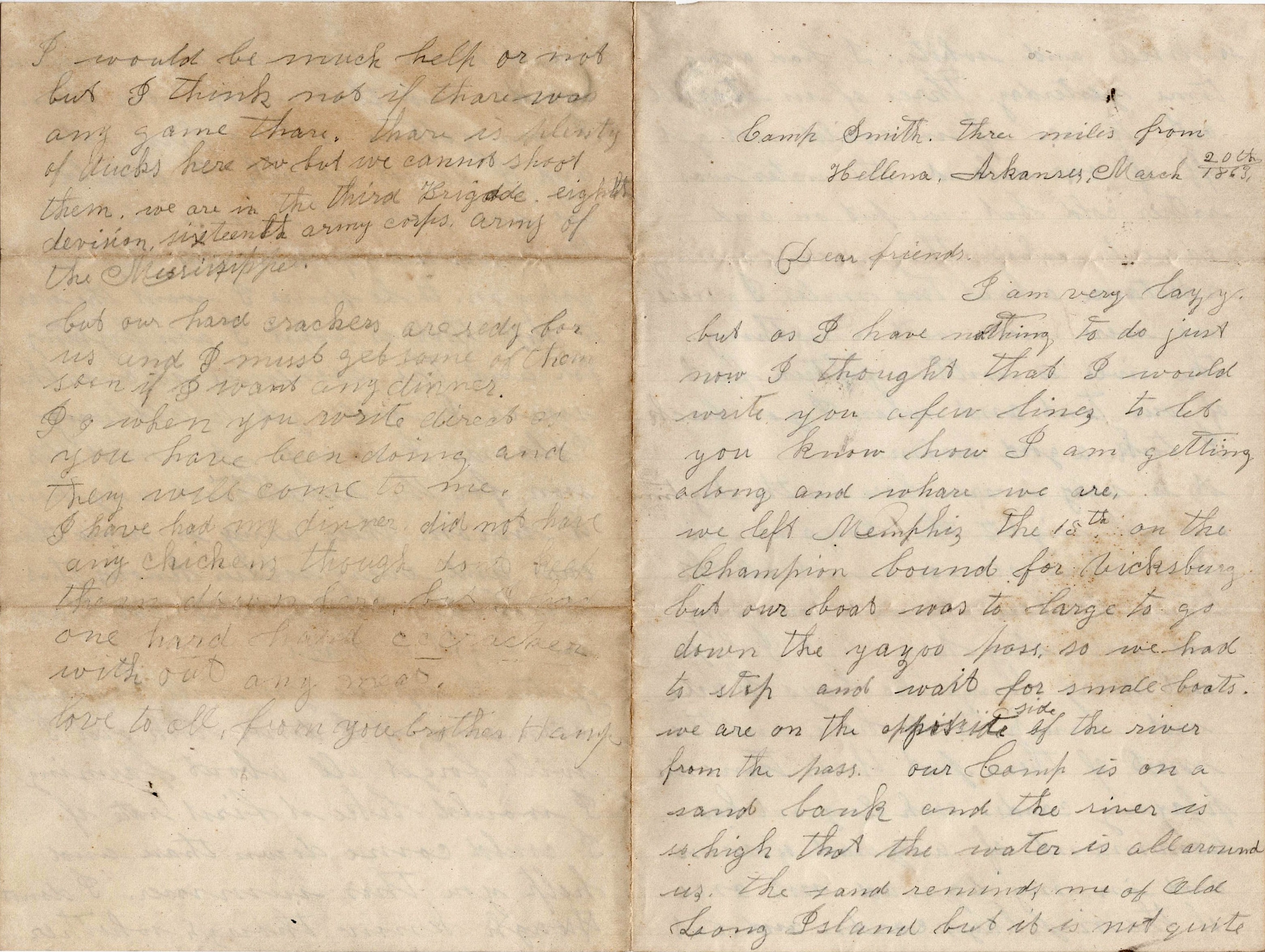
Camp Smith, three miles from Helena, Arkansas
March 20th 1863
Dear friends,
I am very lazy but as I have nothing to do just now, I thought that I would write you a few lines to let you know how I am getting along and where we are. We left Memphis the 15th on the Champion bound for Vicksburg but our boat was too large to go down the Yazoo Pass so we had to stop and wait for small boats. We are on the opposite side of the river from the pass. Our camp is on a sand bank and the river is so high that the water is all around us. The sand reminds me of Old Long Island but it is not quite so nice and white.
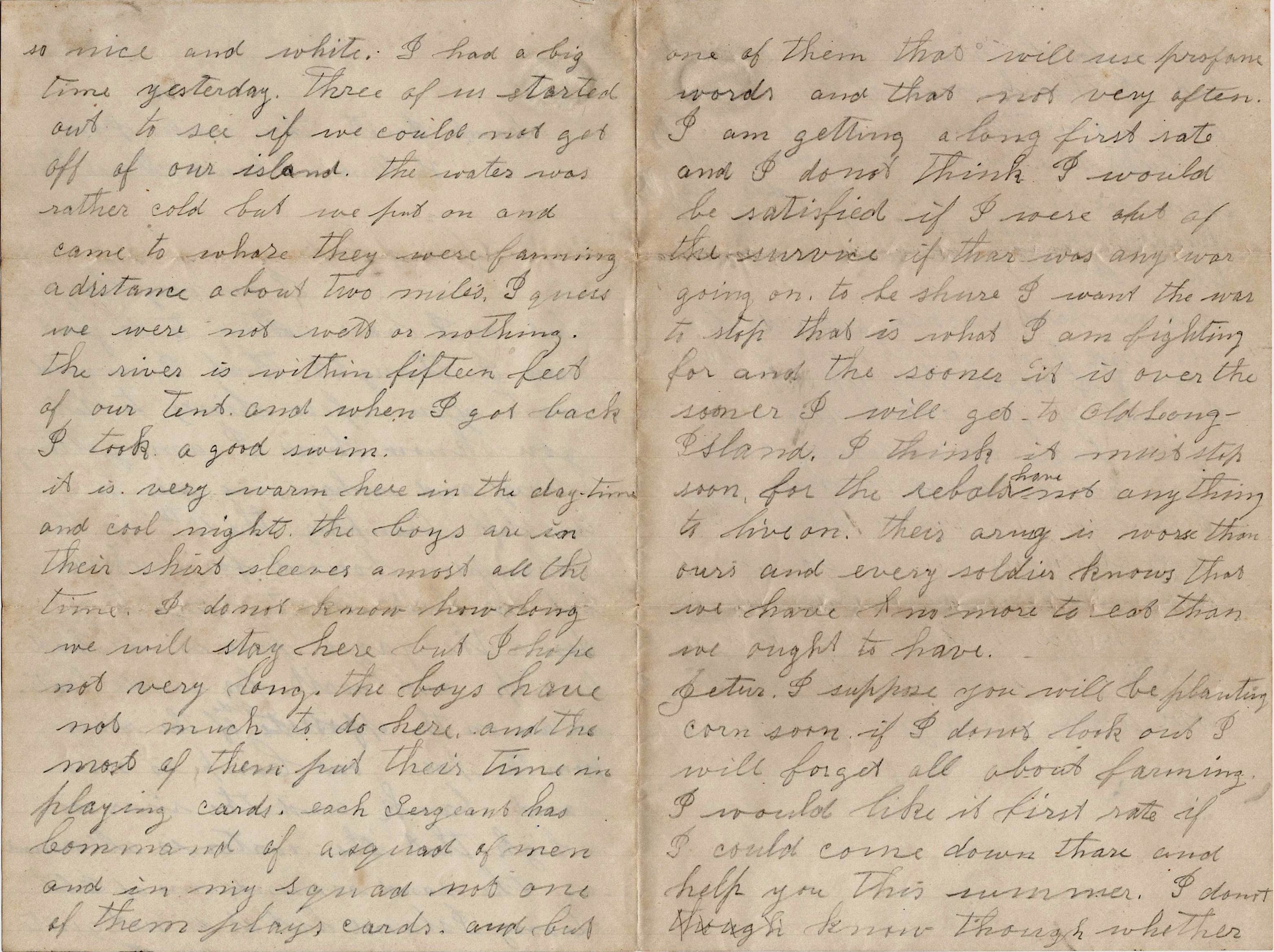
I had a big time yesterday. Three of us started out to see if we could not get off of our island. The water was rather cold but we put on and came to where they were farming—a distance [of] about two miles. I guess we were not wet or nothing. The river is within fifteen feet of our tent and when I got back, I took a good swim.
It is very warm here in the day time and cool nights. The boys are in their shirt sleeves a most all the time. I don’t know how long we will stay here but I hope not very long. The boys have not much to do here and the most of them put their time in playing cards. Each sergeant has command of a squad of men and in my squad not one of them plays cards and but one of them that will use profane words and that not very often. I am getting along first rate and I don’t think I would be satisfied if I were out of the service if there was any war going on. To be sure, I want the war to stop—that is what I am fighting for. And the sooner it is over, the sooner I will get to Old Long Island. I think it must stop soon for the rebels have not anything to live on. Their army is worse than ours and every soldier knows that we have more to eat than we ought to have.
Jetur, I suppose you will be planting corn soon. If I do not look out, I will forget all about farming. I would like it first rate if I could come down there and help you this summer. I don’t know though whether I would be must help or not but I think not if there was any game there. There is plenty of ducks here but we cannot shoot them. We are in the 3rd Brigade, 8th Division, 16th Army Corps, Army of the Mississippi.
But our hard crackers are ready for us and I must get some of them soon if I want any dinner. When you write, direct as you have been doing and they will come to me. I have had my dinner. Did not have any chickens though. Don’t [ ] them drawn here but I had one hard cracker without any meat. Love to all. From your brother, — Hamp