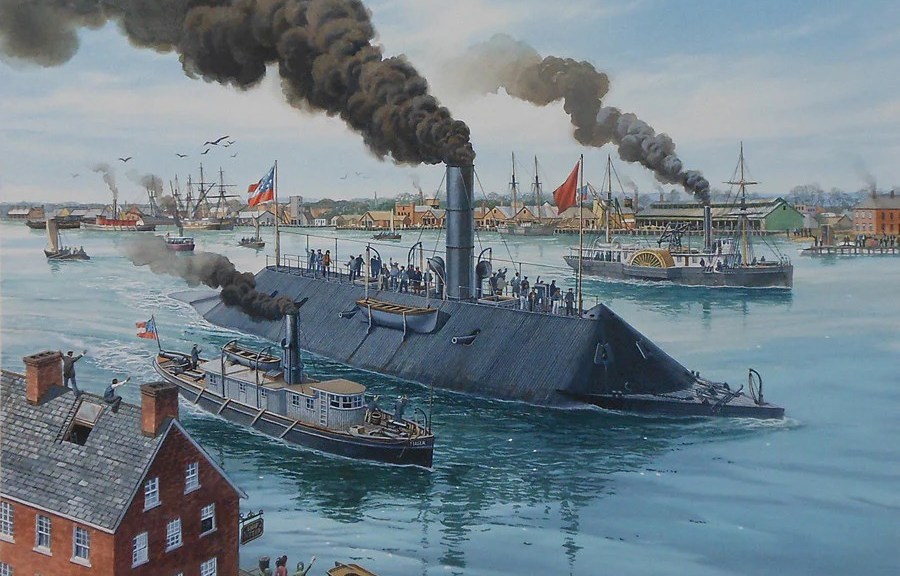
This letter was written by 25 year-old William Hunting Rogers of Lyons, Wayne county, New York. “Hunt” went into the 98th New York Volunteers (the “Malone & Lyons Regiment”) as a private and worked his way up to Lieut. Colonel. He was a quartermaster earlier in the war. The letter speaks frequently about watching the Merrimac [CSS Virginia] and its crew patrolling on the James River.
Hunt wrote the letter on 10 April 1862, a month after the Monitor and Merrimack dueled at Hampton Roads, and approximately ten days after the regiment arrived on the Peninsula as part of the 3d brigade; 3d division, 4th corps. In the weeks ahead they would participate in the siege of Yorktown and the battles of Williamsburg and Savage Station, but were not closely engaged until the battle of Fair Oaks, where the loss of the regiment was 71 killed, wounded or missing.
Hunt attended the Fort Plain Seminary in Lyons in 1854. He was married to Adele Isabella Mirick (1840-1898) in 1886.
Note: This letter is from the collection of Stephen Sklenar and was offered for transcription and publication on Spared & Shared by express consent.
T R A N S C R I P T I O N
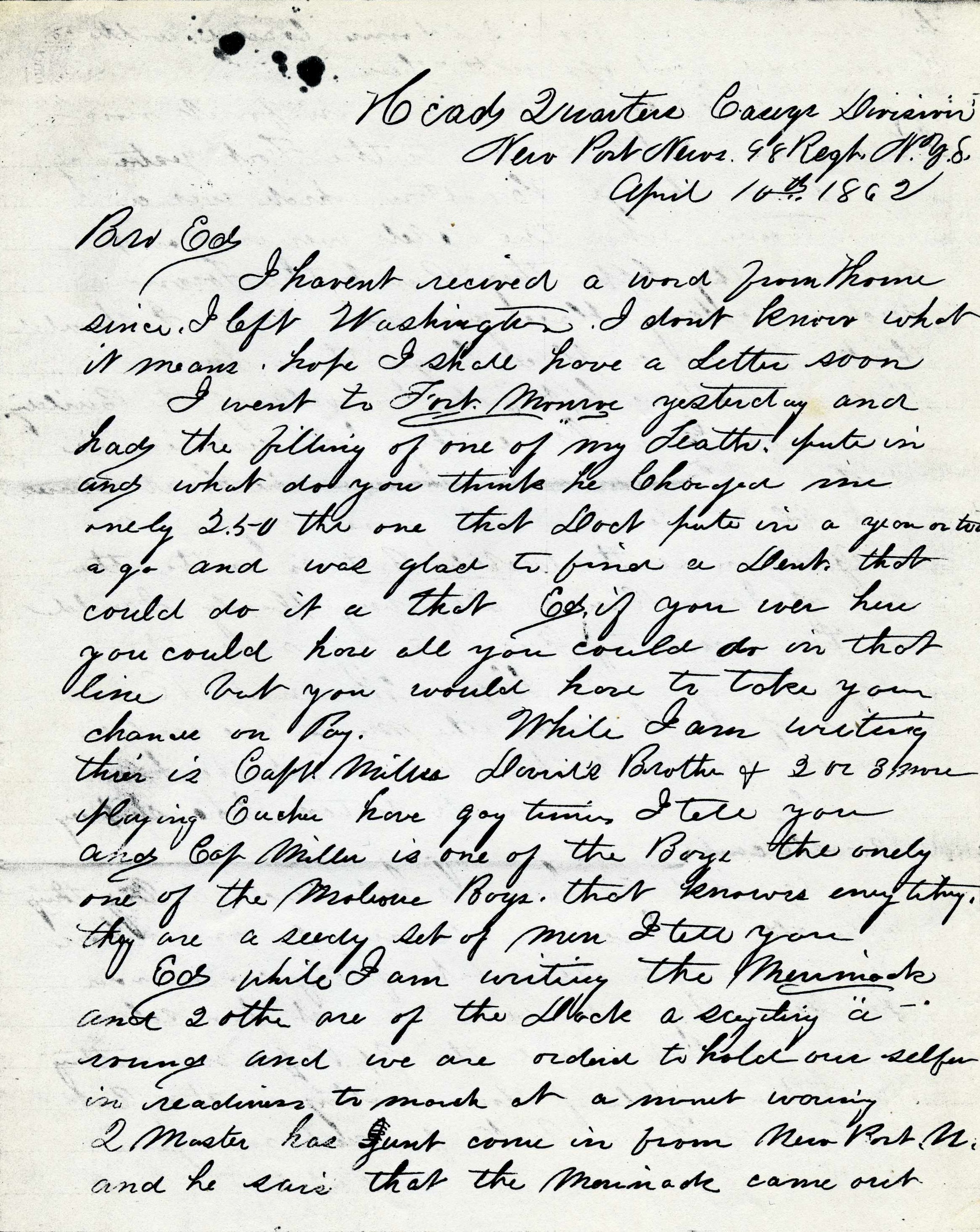
Headquarters Casey’s Division
Newport News [Va.]
98 Regt. N. Y. S.
April 10th 1862
Bro. Ed,
I haven’t received a word from home since I left Washington. I don’t know what it means. Hope I shall have a letter soon.
I went to Fort Monroe yesterday and had the filling of one of my teeth put in and what do you think he charged me—only $2.50. [It’s] the [same] one that Doct. put in a year or two ago and was glad to find a dentist that could do it at that. Ed, if you were here you could have all you could do in that line, but you would have to take your chance on pay.
While I am writing, there is Capt. [Orlando F.] Miller, Daniel’s brother, & two or three more playing Eucher. Have gay times, I tell you, and Capt. Miller is one of the Boys—the only one of the Malone Boys that knows anything. They are a seedy set of men, I tell you.
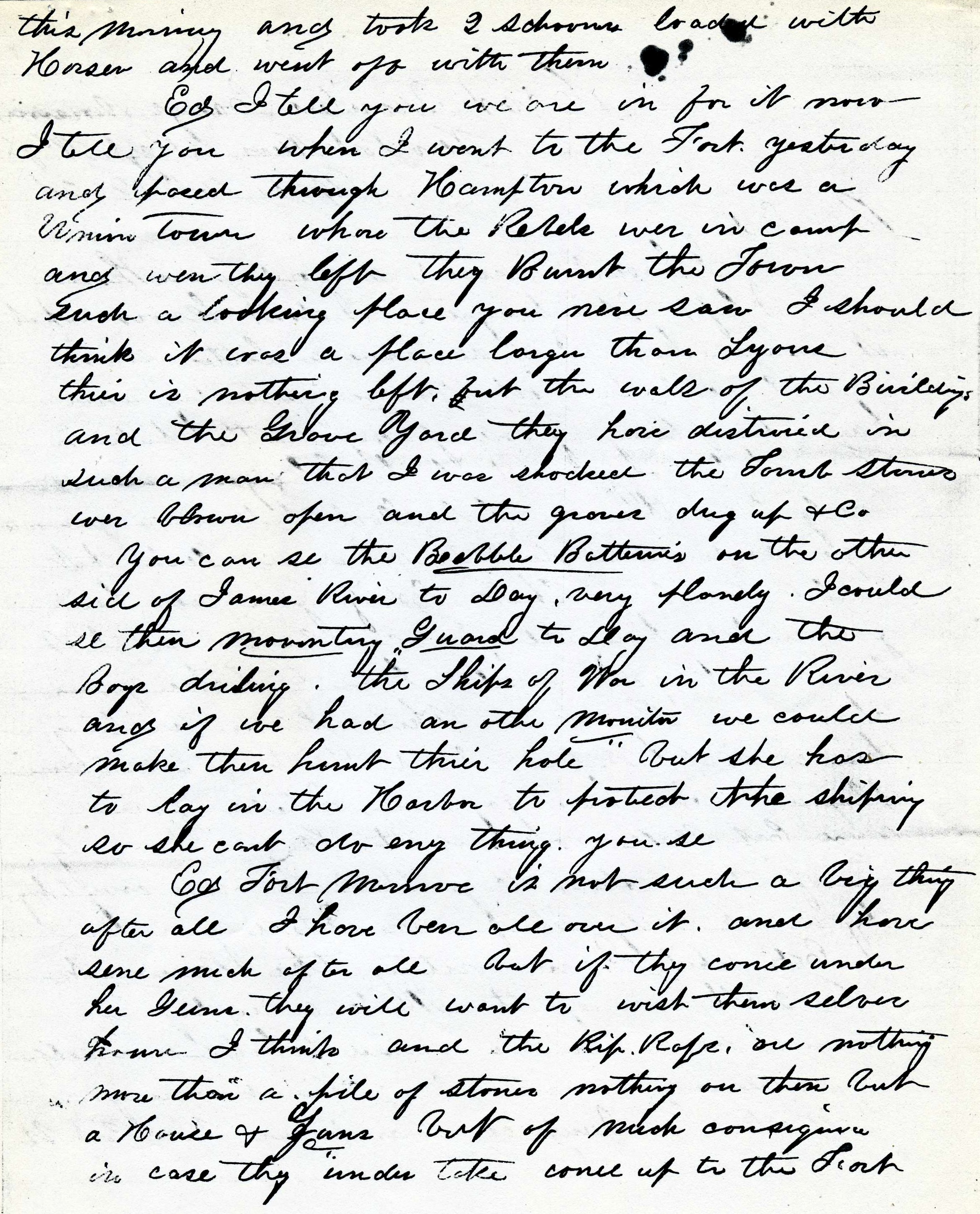
Ed, while I am writing, the Merrimack and two others are off the dock a scouting around and we are ordered to hold ourselves in readiness to march at a moment’s warning. The Quartermaster has just come in from Newport News and he says that the Merrimack came out this morning and took two schooners loaded with horses and went off with them.
Ed, I tell you, we are in for it now. I tell you, when I went to the Fort yesterday and passed through Hampton—which was a Union town when the Rebels were in camp—and when they left, they burnt the town. Such a [sorry] looking place you never saw. I should think it was a place larger than Lyons. There is nothing left but the walls of the buildings and the graveyard they have destroyed in such a manner that I was shocked, The tombstones were blown open and the graves dug up, &c.
You can see the Rebel batteries on the other side of the James River today very plainly. I could see them mounting guard today and the boys drilling, the ships of war in the river, and if we had another Monitor we could make them hunt their hole. But she has to lay in the harbor to protect the shipping so she can’t so anything you see.
Ed, Fort Monroe is not such a big thing after all. I have been all over it and have seen much after all, but if they come under her guns, they will want to wish themselves home, I think. And the Rip Raps are nothing more than a pile of stones—nothing on them but a house & guns, but of much consequence in case they undertake to come up to the fort.
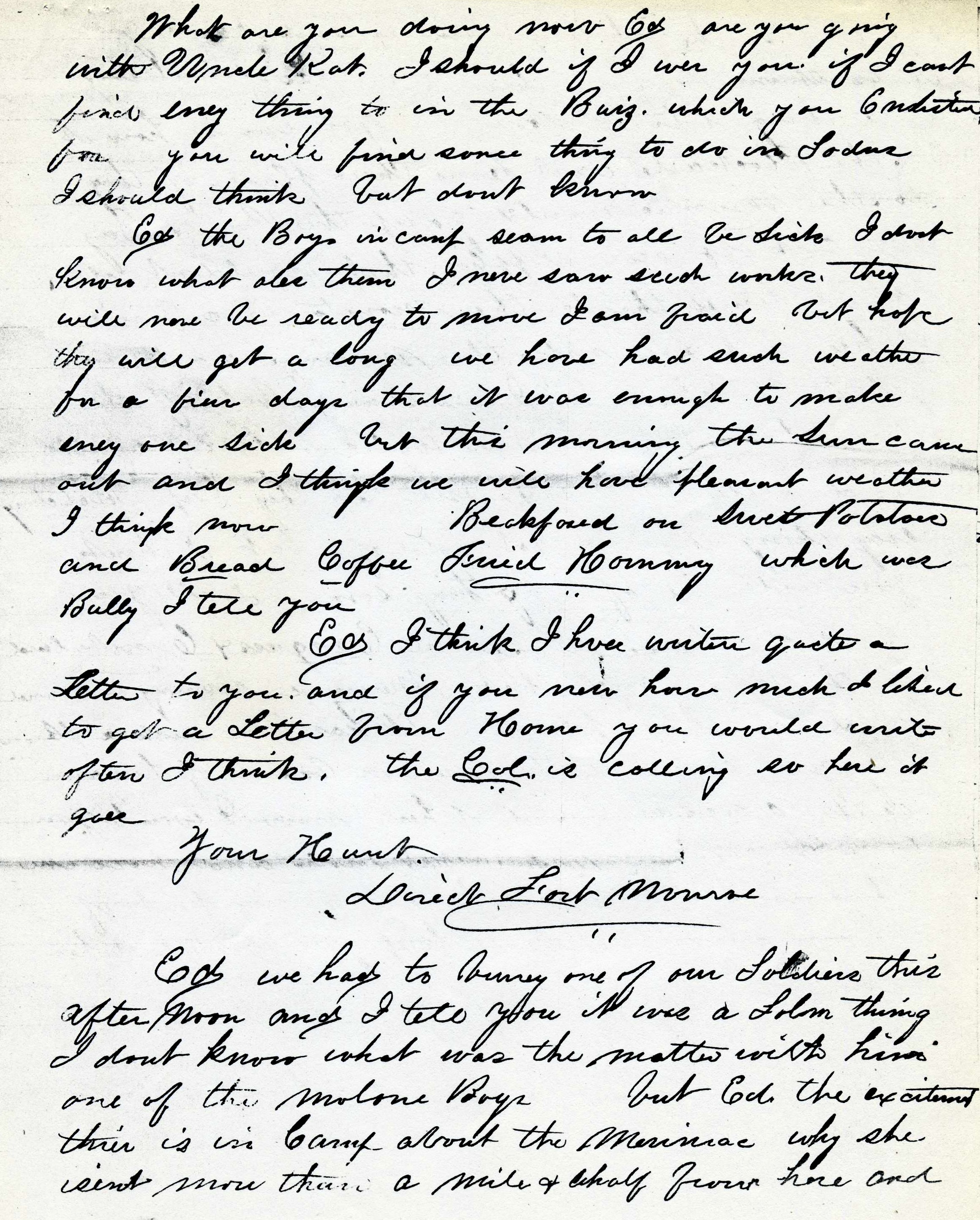
What are you doing now, Ed? Are you going with Uncle Kat. I should if I were you. If I can’t find anything to [do] in the business which you [ ], you will find something to do in Sodus, I should think but don’t know.
Ed, the Boys in camp seem to all be sick. I don’t know what ails them. I never saw such works. They will none be ready to move, I am afraid, but hope they will get along. We have had such weather for a few days that it was enough to make anyone sick. But this morning the sun came out and I think we will have pleasant weather now. Breakfast on sweet potatoes and bread, coffee, fried hominy which was bully, I tell you.
Ed, I think I have written quite a letter to you and if you knew how much I liked to get a letter from home, you would write often I think. The Colonel is calling so here it goes. Your Hunt. Direct Fort Monroe
Ed, we had to bury one of our soldiers this afternoon and I tell you, it was a solemn thing. I don’t know what was the matter with him. [He was] one of the Malone Boys. 1
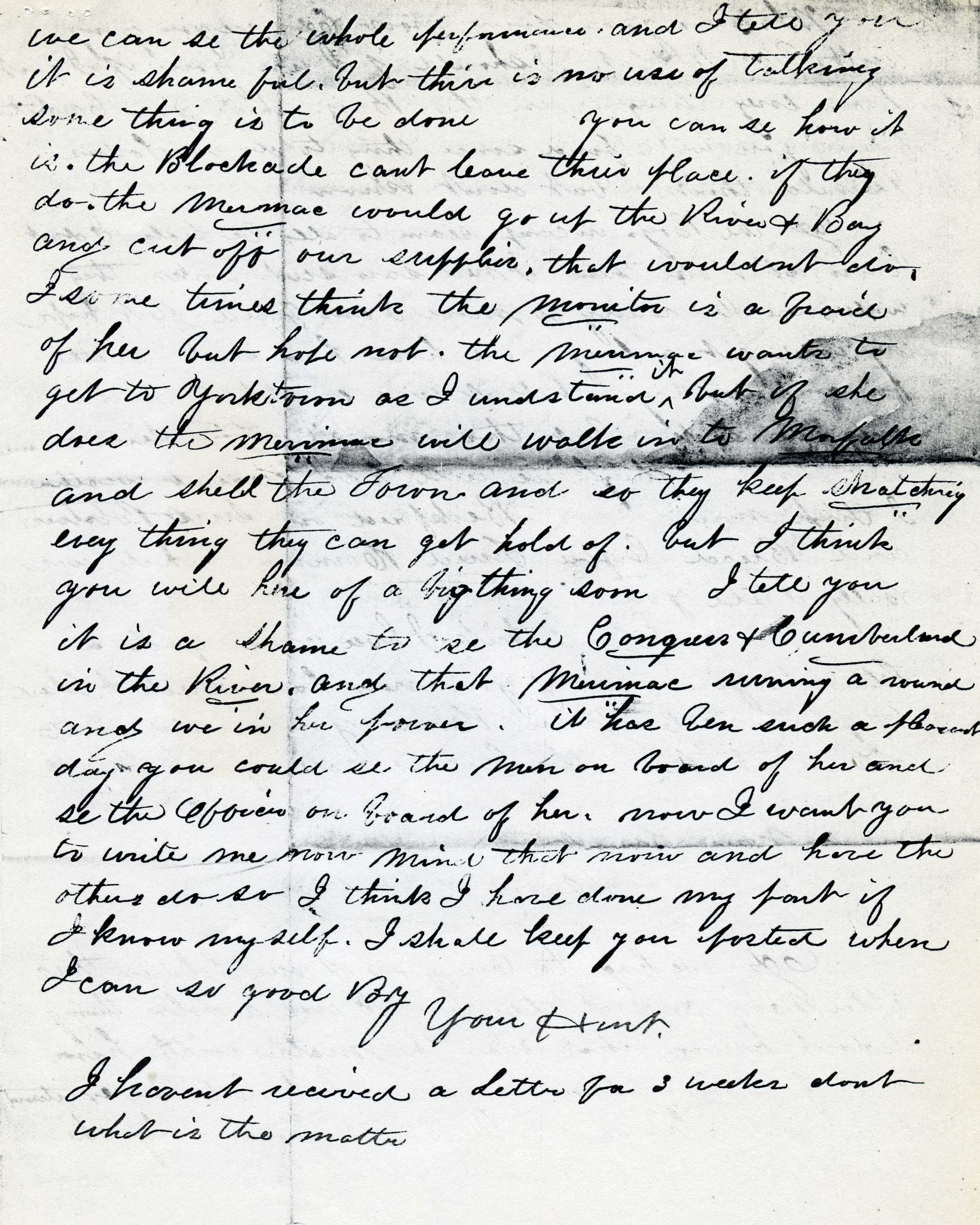
But Ed, the excitement there is in camp about the Merrimack. Why she isn’t more than a mile and a half from here and we can see the whole performance and I tell you, it is shameful. But there is no use of talking. Something is to be done. You can see how it is. The blockade can’t leave this place. If they do, the Merrimack would go up the river and bay and cut off our supplies. That wouldn’t do. I sometimes think the Monitor is afraid of her, but hope not. The Merrimack [Monitor] wants to get to Yorktown as I understand it, but if she does, the Merrimack will walk into Norfolk and shell the town and so they keep matching everything they can get hold of. But I think you will hear of a big thing soon. I tell you, it is a shame to see the [wrecks of the] Congress & Cumberland in the river and that Merrimack running around and we in her power. It has been such a pleasant day. You could see the men on board of her and see the officers on board of her.
Now I want you to write me now. Mind that now and have the others do so [too]. I think I have done my part if I know myself. I shall keep you posted when I can so goodbye. — Your Hunt.
I haven’t received a letter for three weeks. Don’t [know] what is the matter.
1 Possibly John Bassett of Malone who was a private in Co. C although muster records have his death as April 16th 1862 at Newport News, Va.