

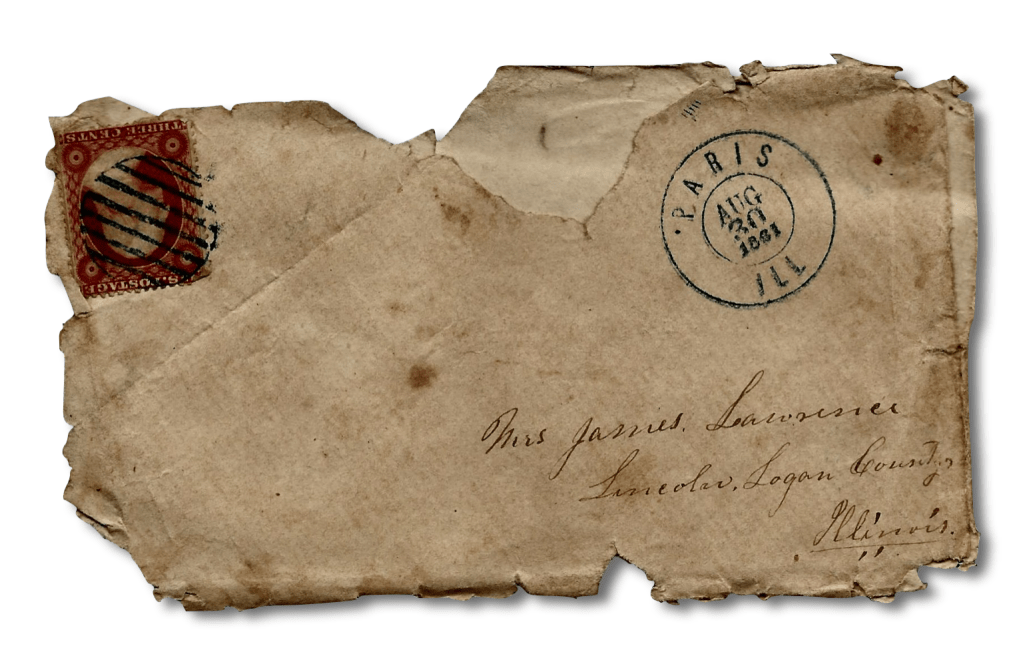
This letter was written by a woman who lived in or near Paris, Edgar county, Illinois, in August 1861. It is either unsigned or, more likely, a second sheet is missing which would provide us with her identity. She wrote the letter to Kittie (Griffith) Lawrence (1830-1915) whom she refers to as her sister. Since Kittie did not have a sister, my hunch is that it was written by Kittie’s sister-in-law, Rachel Finley (Bartlett) Griffith (1829-1870), the wife of Orville E. Griffith (1829-1875) of Edgar county, Illinois.
Kittie’s full name was actually Ann Katherine (Griffith) Lawrence. She was married to James Lawrence of Lincoln, Logan county, Illinois. The couple were married in Edgar county in 1849 and had relocated to Topeka, Shawnee county, Kansas by 1860, but then returned to Illinois during the Civil War. Kittie and Rachel’s husband, Orville, were the two oldest children of Joseph Robinson Griffith (1806-1849) and Caroline Guthrie (1806-1850), both deceased ten years prior to the Civil War.
Transcription
At school
August 28, 1861
My dear sister Kittie,
Although some time has elapsed since your kind favor came to hand, and you perhaps may think it has been forgotten or neglected (which I could not wonder if you did) yet it has not been. But if you will credit me, I could not collect money enough to buy paper, stamps and envelopes, and so this morning I went to the dry goods store and got paper and envelopes obviously credit and there is not a stamp or three cent piece in the house to send this when it is finished.
We do not know what the world is coming to unless it is coming to an end. It is needless to say anything about excitement for doubtless you know enough about it. But I doubt very much if we have not (at least) five rebels where you have one. The Union men think that at the recent Secesh rally there were no less than three hundred of them in Paris, and now would you believe it, they are allowed to make public speeches much to the annoyance of the Union ladies. I never saw our community of women so much out of patience with their men as they were for allowing Andy Hunter 1 and that thing—(I don’t know what to call him anything mean enough but Amos Green 2) to make speeches on the occasion. If the ladies had been in power, they would have been deprived of the privilege of belching there—allow me to say—devilish lies. I did not say that to swear but it is all the word that would suit at all.
It is astonishing to see what a state of feeling exists among a religious people—especially the women. They are perfectly wild. Our most quiet and pious people, it takes but a word to rouse them to fighting humor, and it is not to be wondered at when those we love most dearly are unduly torn from us, forced to undergo and endure all the hardships, trials, and privations of the soldier’s life and then be shot down like dogs in an unjust war. Is it any wonder I say that people allow themselves to be carried away with excitement. And then to think that we have to put up with their insults right here in the North where men ought to, and do know better, but who just yield to the promptings of the few selfish office seekers which infest every community.
Kittie, it would startle you (but you may have been startled in the same way) to hear some of our cool, quiet, pious men talk and make threats. The poor fool dregs of the democratic party (I mean this modern democratic party) have appointed an extra session of Court just to get Big Creek annexed to this precinct or township or some political division (I am not as well posted in these things as I ought to be. If you don’t know, James will.) The object is, however, to get that one united to this so it will at the elections go democratic, or secesh rather. Court is in session now and I just tremble until it is through. The excitement concerning it has partially abated.
Edgar [County] has sent four or five companies of infantry and a cavalry company starts tomorrow Friday week. I believe I told you our preacher was captain of the first company. [James F.] Jaquess has gone as chaplain of a cavalry company. 3 Phil Minear 4, Crene, [Edward] Rutledge, 5 and I can’t tell how many of our “big” preachers have gone as captains or chaplains. Excuse this pen. It writes when it pleases only. [unsigned or last of letter is missing]
1 Andrew (“Andy”) Jackson Hunter (1831-1913) moved to Paris, Illinois with his parents in 1832 from Greencastle, Indiana. He eventually became a lawyer and practiced in Paris until 1864 when he was elected to the Illinois Senate as a Democrat.
2 Amos Green was a notorious Peace Democrat (Copperhead) in Edgar county who broadly influenced public opinion a the editor of the Times—the Democratic organ in the county. Michael Kleen published an article called “A Confrontation in Paris” that tells the tale of how and en effort to shut down a newspaper in Edgar countym Illinois, led to one of the Civil War’s most violent home front riots. Green saw the Civil War as unjust and Lincoln as a despot who had to be stopped. He wrote vicious denunciations of the administration in local newspapers. He was arrested for sedition in 1862. After his release in August 1862, he became the grand commander of the secret Order of American Knights in Illinois, which fought restrictions on civil liberties. It was also called the Knights of the Golden Circle and later the Sons of Liberty. Green was funded by the Confederate government to arrange riots at the Democratic National Convention in 1864. Although the riots never materialized, he continued giving antigovernment speeches until he was again arrested in November 1864. After this arrest, he agreed to testify for the government about the activities of the Knights; his testimony implicated others but ignored his own deep involvement in antigovernment plots. In 1864, a clash between Copperheads and Union Soldiers in Charleston, Illinois resulted in nine dead and twelve wounded in what is now called the “Charleston Riot.”
3 James F. Jaquess volunteered as chaplain of the 6th Illinois Cavalry. He later became Colonel of the 73rd Illinois Infantry.
4 Philip N. Minear (b. 1836), a clergyman in Paris, Edgar county, Illinois, volunteered as the chaplain of the 25th Illinois Infantry but resigned on 11 July 1862.
5 Edward Rutledge volunteered as chaplain for the 61st Illinois Infantry. He mustered out in September 1862.


 Spared & Shared 23