The following letter was written by 40 year-old Henry Frost Waring (1796-1874), the son of Thaddeaus Waring (1746-1826) and Deborah Frost (1753-1844). Henry was married in 1818 to Sarah W. Osborn and a second time in 1844 to Amelia Frances Weed. He worked as a merchant in New York City early in his career. By the time of the 1860 US Census, he was working as an “agent” of some kind in Green Bay, Wisconsin.
Henry wrote this letter to his niece, Deborah Frost Chadeayne (1805-1870), the daughter of Mary Waring (1782-1855) and Daniel Chadeayne (1773-1834) of Orange county, New York. Deborah was married on 19 August 1836 to Henry Peter Husted (b. 1804) in New York City.
In this April 1836 letter, written from the City Hotel in Savannah, Georgia, where he had resided for six months engaged in his naval stores business, Henry wrote his niece a few lines about the City of Savannah—the streets, the inhabitants, the climate, and (curiously) of visiting the Jewish graveyard.
A room inside the old City Hotel which was constructed in 1821 in Savannah. The building is occupied today by the Moon River Brewing Company, located as 21 West Bay Street. The original structure had “33 rooms, exclusive of the bar.” It was renovated in December 1832 and the only other hotel in the city in the mid-1830s was the Mansion House.
Transcription
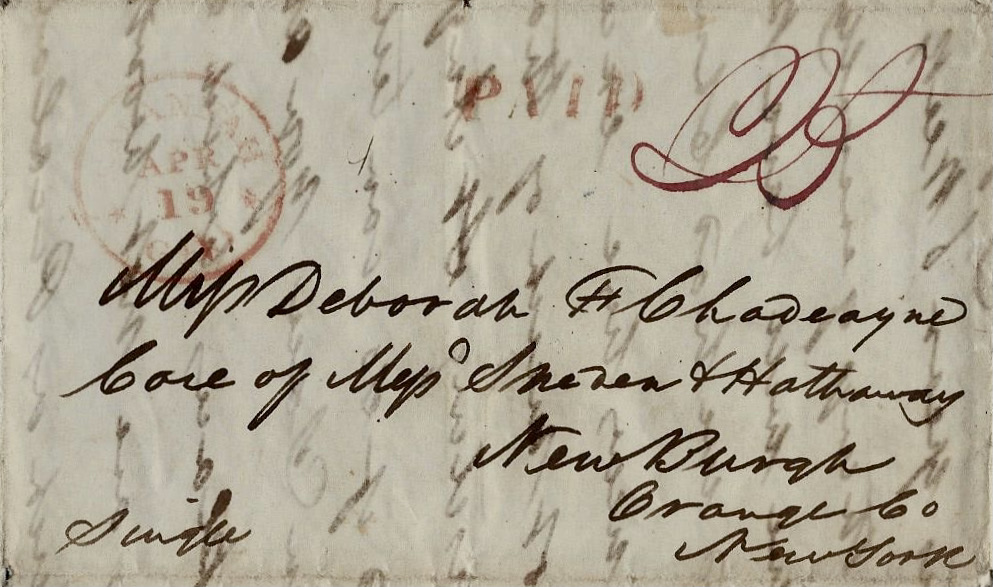
Addressed to Miss Deborah F. Chadeayne, Care of Messrs. Sneden & Hathaway. Newburgh, Orange county, New York
Savannah, [Georgia] April 17, 1836
My dear girl,
Hards work and sickness has prevented my writing to many of my friends and you have been of the number, but it has not prevented my thinking of you often and being anxious for your health and happiness. I have been here six months and cannot say I dislike the place—indeed, all places would be alike to me situated as I have been for I have no time to fo about to see anyone and it would be the same if all the world lived here. With the exception of one house where I spent some fifteen minutes of a Sunday, I have been in no dwelling except the City Hotel since I have been here.
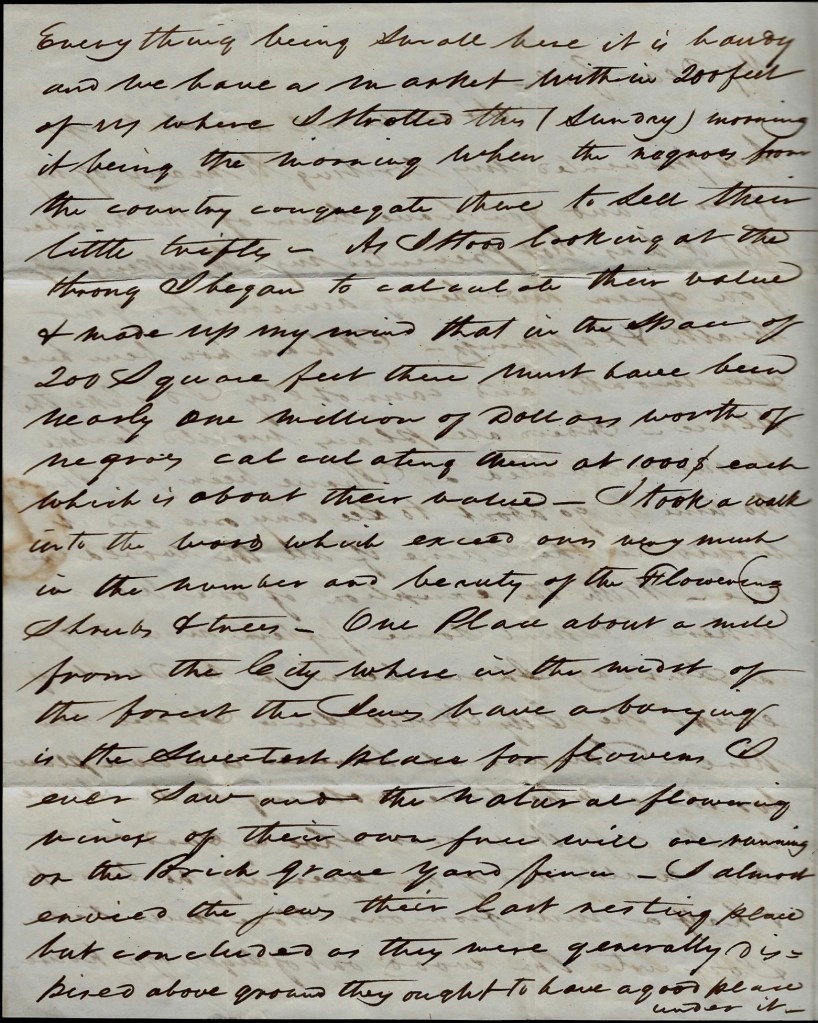
Savannah, however, is a dull place for those who have nothing to do. If one walks out it is over shoe in sand and no side walks and of an evening no lamp & half a mile from our store will take you into the wood out of sight of a house. Everything being small here, it is handy and we have a market within 200 feet of us where I strolled this (Sunday) morning, it being the morning when the negroes from the country congregate there to sell their little trifles.
As I stood looking at the throng, I began to calculate their value & made up my mind that in the space of 200 square feet, there must have been nearly one million of dollars worth of negroes calculating them at $1000 each which is about their value.
I took a walk into the wood which exceed ours very much in the number and beauty of the flouring shrubs and trees. One place about a mile from the City where in the midst of the forest the Jews have a burying is the sweetest place for flowers I ever saw and the natural flowering vines of their own free will are running on the brick grave yard fence. I almost envied the Jews their last resting place but concluded as they were generally despised above ground, they ought to have a good place under it. 1
“I almost envied the Jews their last resting place but concluded as they were generally despised above ground, they ought to have a good place under it.”
— Henry Frost Waring, 17 April 1836
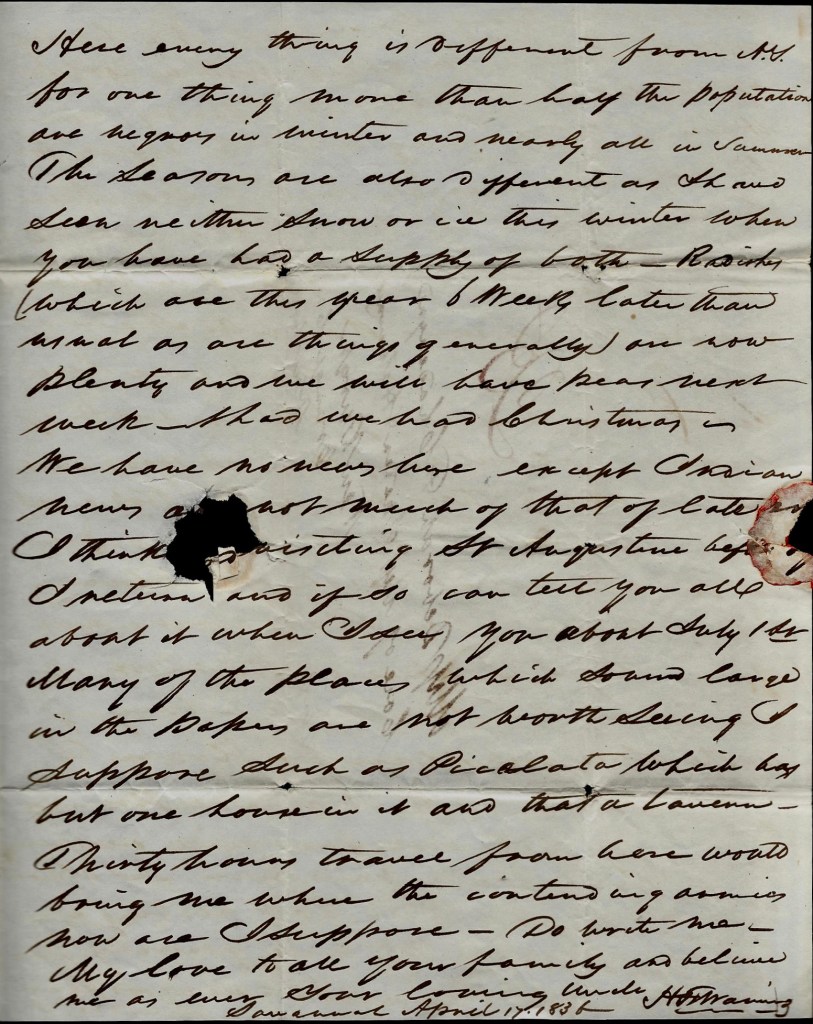
Here everything is different from New York. For one thing, more than half the population are negroes in winter and nearly all in summer. The seasons are also different as I have seen neither snow or ice this winter when you have had a supply of both. Radishes (which are this year 6 weeks later than usual as are things generally) are now plenty and we will have peas next week.
We have no news here except Indian news 2 and not much of that of late and I think of visiting St. Augustine before I return and if so, can tell you all about it when I see you about July 1st. Many of the places which sound large in the papers are not worth seeing, I suppose, such as Picolata [Florida] which has but one house in it and that a tavern. Thirty hours travel from here would bring me where the contending armies now are, I suppose. Do write me. My love to all your family and believe me as ever your loving uncle, — H. F. Waring
Savannah, April 17, 1836
1 “Established by Mordecai Sheftall on August 2, 1773 from lands granted him in 1762 by King George III as a parcel of land that “shall be, and forever remain, to and for the use and purpose of a Place of Burial for all persons whatever professing the Jewish Religion.”
2 Henry is referring to the Second Seminole War (1835-1842) provoked by President Jackson signing the Indian Removal Act. The Seminole Indians refused to leave Florida and throughout 1836, led by Osceola, the Seminoles attacked plantations, outposts, and supply lines, and they stymied several efforts by the United States to subdue them.
This letter was written by 48 year-old John Atherton III (1769-1824), the son of John Atherton II (1747-1825) and Mary Adams (1751-1843)—the 2nd cousin of President John Adams— of Stoughton, Norfolk county, Massachusetts. John Atherton III was married to Sally Bird (1778-1818) and the couple had at least eight children, two of which are mentioned in this letter as having accompanies John to Savannah, Georgia. They include his sons John Atherton IV (1799-1826) and Lemuel Bird Atherton (1804-1860).
John’s letter briefly describes Savannah, Georgia, in 1817 and speaks of the enormous cotton trade already dominating the city business. We gather from John’s letter that he has relocated to Savannah on account of his health, looking for a warmer climate. He also speaks of the militia being called out to fight Indians—probably a reference to the Seminole Wars.
Transcription
Addressed to Mr. John Atherton, Stoughton, Massachusetts
Savannah [Georgia] December 29th 1817
Honored Father,
I take this opportunity to inform you that we are well & hope you and yours are so. I left home the first of November—the wind being southerly. Did not start from Newport till the 21st & got to this place on the 1st of December about 2 o’clock in the morning. I hired a room and chamber & moved into it the 3rd of December. I have hired a stall in the market & buy hogs that are brought to market dressed and cut them up & sell & what is unsold at 9 o’clock, I bring home & salt & then go to making cigars. I have five boarders at $4 per week. Lemuel cooks while John and I go to market. Then John cooks & Lemuel & I makes cigars. So we go on.
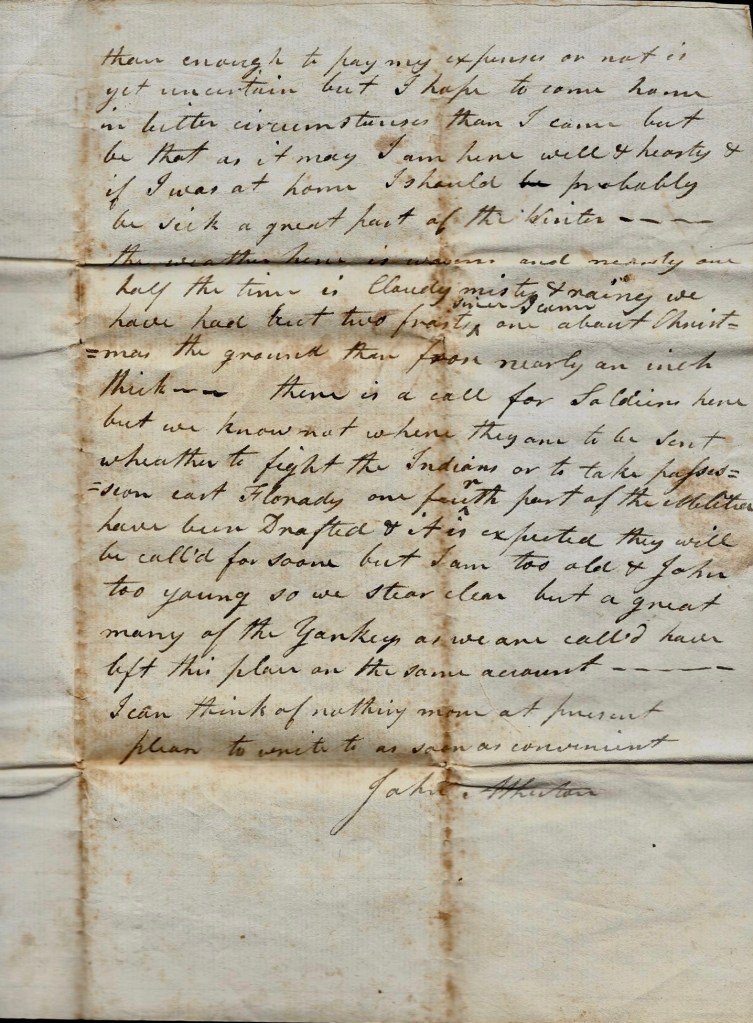
Savannah is a small place and the buildings in general are very poor. You house & Mr. Osgood’s, were they here, would be quite elegant. But there is a great deal of business done here. You have no idea of the quantity of cotton brought here for sale. I believe I have seen bags enough to cover your farm. The whole business of the State centers here. Consequently labor and provision is very high. Whether I shall earn more than enough to pay my expenses or not is yet uncertain but I hope to come home in better circumstances than I came. But be that as it may, I am here well & hearty & if I was at home, I should probably be sick a great part of the winter.
The weather here is warm and nearly one half of the time is cloudy, misty and rainy. We have had but two frosts since I came—one about Christmas. The ground then was froze nearly an inch thick.
There is a call for soldiers here but we know not where they are to be sent—whether to fight the Indians or to take possession of East Florida. One fourth part of the militia have been drafted and it is expected they will be called for soon but I am too old and John too young so we steer clear. But a great many of the Yankees—as we are called—have left this place on the same account. I can think of nothing more at present, Please to write as soon as convenient. — John Atherton
This letter was written by H. N. Clark of House Creek, Irwin county, Georgia. I cannot confirm his identity though he may be Horatio N. Clark (b. @ 1815) of Troy, Rensselaer county, New York, who was in Georgia prior to the Mexican War and enlisted as an artificer at the Augusta Arsenal. Another person—perhaps the same individual—with those same initials and a native of New York, is enumerated in the 1850 US Census at Notasassa, Hillsborough, Florida.
Clark wrote the letter to William Whitford Reynolds (1816-1876), son of Parley and Esther Reynolds. William was about the same age as Clark. He was born in Petersburg, Rensselaer county, New York, on Sept. 25, 1816. William received a common school education, and at the age of fifteen had completed his studies. About this time he settled on a farm with his parents, following the occupation of a farmer and receiving his property from his father. He married Mary, daughter of Braddock Peckham, of Grafton, by whom four children were born, of whom one only, Charles W., is living. Mrs. Mary Reynolds was born in Grafton.
Both Clark and William Reynolds were staunch supporters of the Democratic party.
Polk & Dallas Campaign Banner 1844
Transcription
Irwin county [Georgia] Tuesday morning, October 29th 1844
Dear Sir,
Yours of September 20th came duly at hand stating your health was not very good at present. I am very sorry to hear that you have not got rid of that sore throat yet. If you will make a cup of strong sage tea and put eight or ten drops of egg fortes to it and gargle it for three times a day, you will soon get rid of it. My health is very bad at present.
Judge Lott Warren of Georgia warned fellow members of Congress in 1841, “…no power, earthly, can can control them [Georgians] in their resistance to the death of any interference with their property rights.”
I attended court in the city of Hawkinsville [Pulaski county, Ga.] last week and as court adjourned, I proposed that we have a meeting for political discussion. Accordingly a meeting was appointed on Saturday. N. V. Johnston being present [and] he being a Democratic Candidate for elector, he was first called for I never heard a more powerful speaker than he was. He was then replied to by Judge [Lott] Warren, ex member of Congress, for two hours. We then adjourned for dinner. After dinner, my having called for the meeting, I was called on and spoke for three hours and a half. My lungs having failed me, I was obliged to sit down for I commenced bleeding at the lungs. A doctor being present, it was soon stopped. I was replied to by William H[arris] Crawford who had been beaten for Congress by Seaborn Jones, a thorough Democrat. It has been said by many who are good speakers that my speech was the most powerful speech ever delivered in Georgia and N. V. Johnston has requested me to write the speech. I shall comply with his request.
I have made 78 speeches since I started on the campaign and never exerted myself as I did on the last occasion. I promised Johnston to meet him in the city of Savannah next Saturday to speak at a meeting held by the Whigs. I am sorry that my lungs cannot hold out till the Presidential Election to speak daily.
“The Whigs may talk and sing over their Clay and Frelinghuysen. Harry may go home to Ashland and stay there and his Frelinghuysen may sing psalms and shed his tears in sympathizing over the unfortunate Indians that were in Georgia while he preaches and prays to his Abolition brothers for the slaves of the South. Georgia knows them both too well.”
— H. N. Clark, 29 October 1844
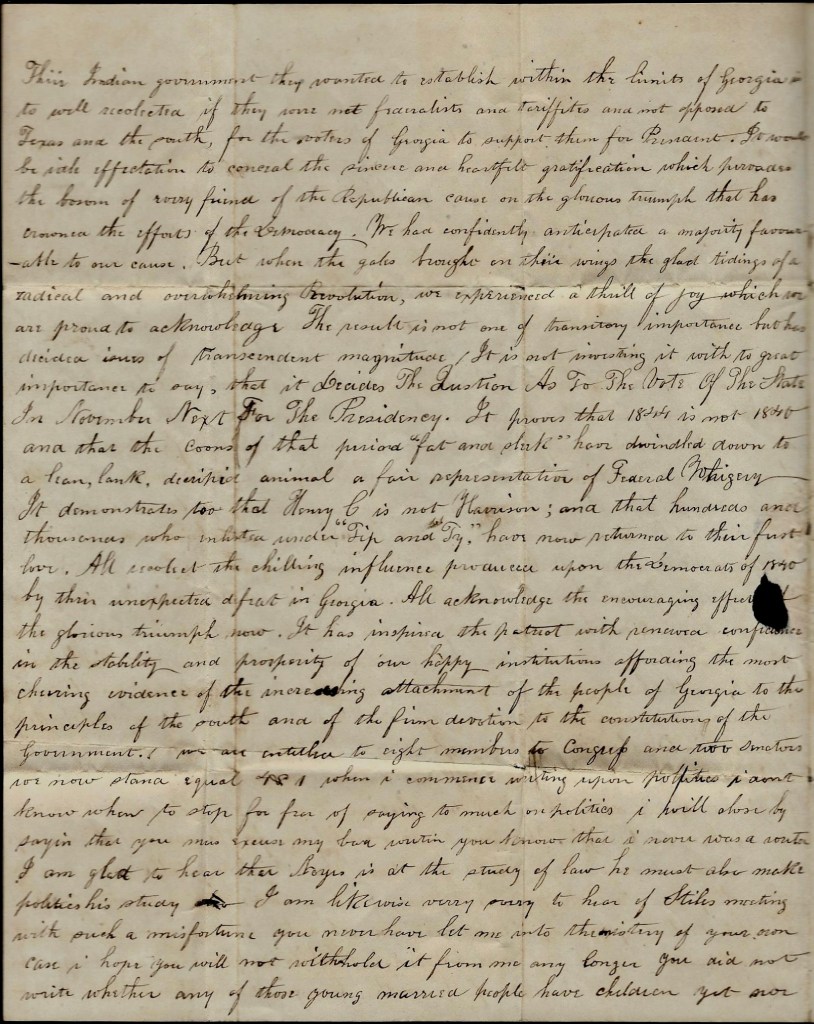
Since our October election, it seems that Federalism has no resting place in Georgia. The triumph is overwhelming for the cause of Democracy. Georgia is safe-sure for Polk and Dallas. The Whigs may talk and sing over their Clay and Frelinghuysen. Harry may go home to Ashland and stay there and his Frelinghuysen may sing psalms and shed his tears in sympathizing over the unfortunate Indians that were in Georgia while he preaches and prays to his Abolition brothers for the slaves of the South. Georgia knows them both too well. This Indian government they wanted to establish within the limits of Georgia is too well recollected if they were not Federalists and tariffites and not opposed to Texas and the South, for the voters of Georgia to support them for President. It would be with affectation to conceal the sincere and heartfelt gratification which pervades the bosom of every friend of the Republican cause on the glorious triumph that has crowned the efforts of the Democracy.
We had confidently anticipated a majority favorable to our cause. But when the gales brought on their wings the glad tidings of a radical and overwhelming Revolution, we experienced a thrill of joy which we are proud to acknowledge. The result is one of transitory importance but has decided issues of transcendent magnitude. It is not investing it with too great importance to say that it decides the question as to the vote of the state in November next for the Presidency. It proves that 1844 is not 1840, and that the coons [Whigs] of that period “fat and sleek” have dwindled down to a lean, lank, decrepit animal—a fair representation of Federal Whiggery. It demonstrates too that Henry Clay is not Harrison, and that hundreds and thousands who enlisted under “Tip and Ty” have now returned to their first love.
All recollect the chilling influence pronounced upon the Democrats of 1840 by their unexpected defeat in Georgia. All acknowledge the encouraging effect of the glorious triumph now. It has inspired the patriot with renewed confidence in the stability and prosperity of our happy institutions affording the most cheering evidence of the increasing attachment of the people of Georgia to the principles of the South and of the firm devotion to the constitution of the government. We are entitled to eight members to Congress and two Senators. We now stand equal 4 & 1.
When I commence writing upon politics, I don’t know when to stop. For fear of saying too much on politics, I will close by saying that you must excuse my bad writing. You know that I never was a writer.
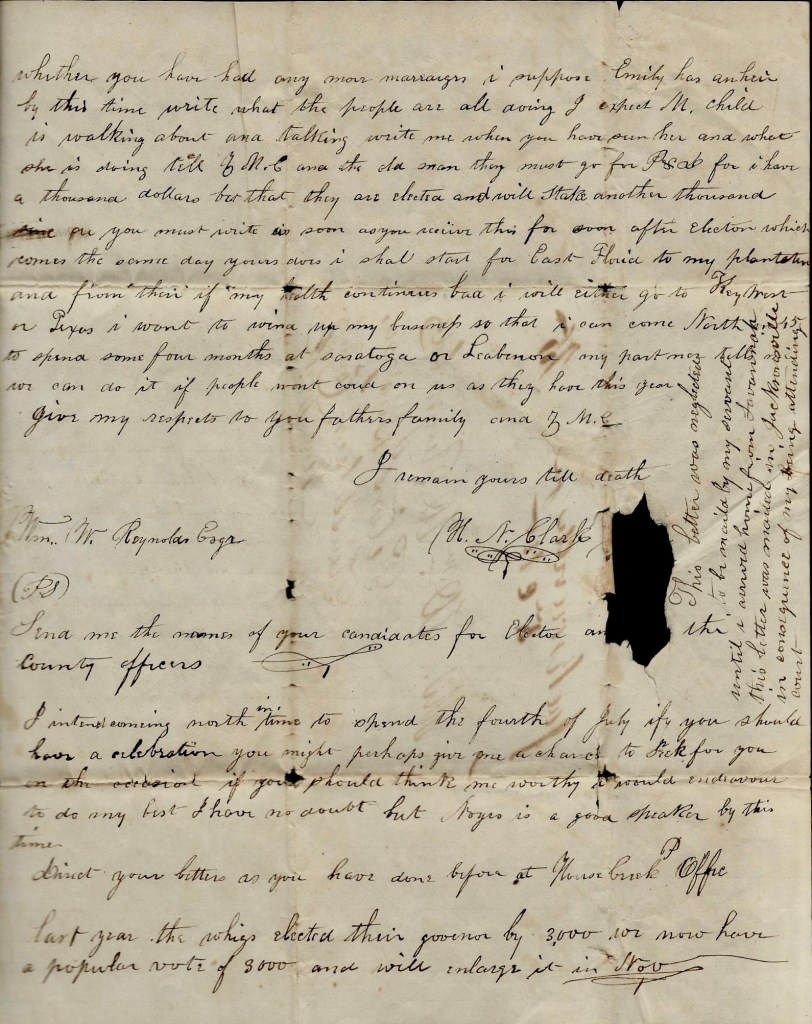
I am glad to hear that Noyes is at the study of law. He must also make politics his study. I am likewise very sorry to hear of Stiles meeting with such a misfortune. You never have let me into the mystery of your own case. I hope you will not withhold it from me any longer. You did not write whether any of those young married people have children yet nor whether you have had anymore marriages. I suppose Emily has an heir by this time. Write what the people are all doing. I expect M. child is walking about and talking. Write me when you have seen her and what she is doing. Tell M. C. and the old man they must go for [ ] for I have a thousand dollars but that they are elected and will stake another thousand.
You must write as soon as you receive this for soon after election which comes the same day yours does, I shall start for East Florida to my plantation and from there if my health continues bad, I will either go to Key West or Texas. I want to wind up my business so that I can come North to spend some four months at Saratoga or Lebanon [Springs]. My partner tells me we can do it is people won’t [ ] on us as they have this year.
Give my respects to your father’s family and Z. M. C. I remain yours till death, — H. N. Clark
Send me the names of your candidates for electors and of the county officers.
I intend coming North in time to spend the Fourth of July if you should have a celebration. You might perhaps give me a chance to speak for you on the occasion if you should think me worthy. I would endeavor to do my best. I have no doubt but Noyes is a good speaker by this time. Direct your letters as you have done before at House Creek Post Office.
Last year the Whigs elected their Governor by 3,000. We now have a popular vote of 3,000 and will enlarge it in November.
This letter was neglected to be mailed by my servant until I arrived home from Savannah. This letter was mailed in Jacksonville in consequence of my being attending court.
The signature on this letter appears to read “Major N. N. Clark” but I have not been able to identify him definitely. There was a Brevet Major N. N. Clark (sometimes written in N. S. Clark in military records) that led the expedition of the U. S. Army’s 2nd Infantry into Maine during the First Aroostook War and who oversaw the construction of the Hancock Barracks on our northern border. This same individual claimed to be residing in Shelburne, Chittenden county, Vermont, in October 1829 when he requested a 1 year furlough from the military to visit southern France for the purpose of regaining his health. I can’t be certain if he is the same Nelson N. Clark who was a 2nd Lt., 4th Infantry in 1829. I feel there must be a connection, however, as he signed the letter “Major” in this letter even though it appears he was not longer in the military but was employed as a lawyer working out of Macon, Georgia—prominent enough in the community to have been asked to give a speech at the Washington’s Birthday Ball in Macon in 1846. He may have been employed as a lawyer for a cotton factor. He clearly had ties to the North though he was no abolitionist.
In his letter, Clark shares with his friend the content of the extemporaneous speech he gave at the Washington Birthday Ball, extolling the many virtues of George Washington, including having “habituated the people to our peculiar institutions” prior to his leaving office. He then speaks of the potential impeding conflicts with England over the Oregon Territory and with Mexico, particularly with the latter whom he says the U. S. will have to “teach a lesson” and take the war deep into their interior and claim as much land as is needed to pay for the expense of the war.
Clark wrote the letter to William Whitford Reynolds (1816-1876) of Petersburgh, Rensselaer county, New York
Transcription
Macon [Georgia] March 2nd 1846
Dear Sir,
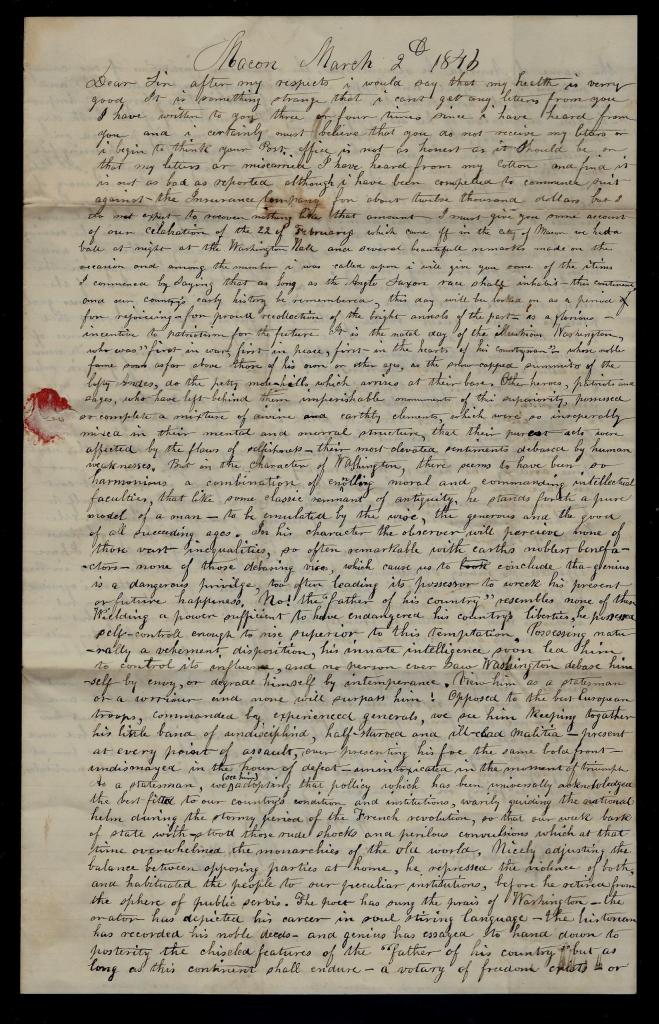
After my respects, I would say that my health is very good. It is something strange that I can’t get any letters from you. I have written to you three or four times since I have heard from you and I certainly must believe that you do not receive my letters or I begin to think your Post Office is not as honest as it should be or that my letters are miscarried. I have heard from my cotton and find it is not as bad as reported although I have been compelled to commence suit against the Insurance Company for about twelve thousand dollars but I do not expect to recover nothing like that amount.
I must give you some account of our celebration of the 22nd of February [Washington’s Birthday] which came off in the City of Macon. We had a ball at night at the Washington Hall 1 and several beautiful remarks made on the occasion and among the number I was called upon. I will give you some of the items.
I commenced by saying that as long as the Anglo-Saxon race shall inhabit the continent and our early country’s history be remembered, this day will be looked on as a period for rejoicing—for proud recollection of the bright annals of the past—as a glorious incentive to patriotism for the future. It is the natal day of the illustrious Washington who was “first in war, first in peace, first in the hearts of his countrymen”—whose noble fame soars as far above those of his own or other ages as the snow-capped summits of the loft Andes to the petty molehills which arises at their base. Other heroes, patriots and sages, who have left behind them imperishable monuments of this superiority, possessed so complete a mixture of divine and earthly elements, which were so inseparably mixed in their mental and moral structure, that their purest acts were affected by the flaws of their selfishness—their most elevated sentiments debased by human weaknesses.
But in the character of Washington there seems to have been so harmonious a combination of ennobling moral and commanding intellectual faculties, that like some classic remnant of antiquity, he stands forth a pure model of a man, to be emulated by the wise, the generous, and the good of all succeeding ages. In his character, the observer will perceive none of those vast inequalities so often remarkable with earth’s noblest benefactors, none of those debasing vices, which cause us to conclude that genius is a dangerous privilege, too often leading its possessor to reek his present or future happiness. No! the “father of his country” resembles none of these. Wielding a power sufficient to have endangered his country’s liberties, he possessed self-control enough to rise superior to the temptation. Possessing naturally a vehement disposition, his innate intelligence soon led him to control its influence and no person ever saw Washington debase himself by envy, or degrade himself by intemperance. View him as a statesman or a warrior and none will surpass him!
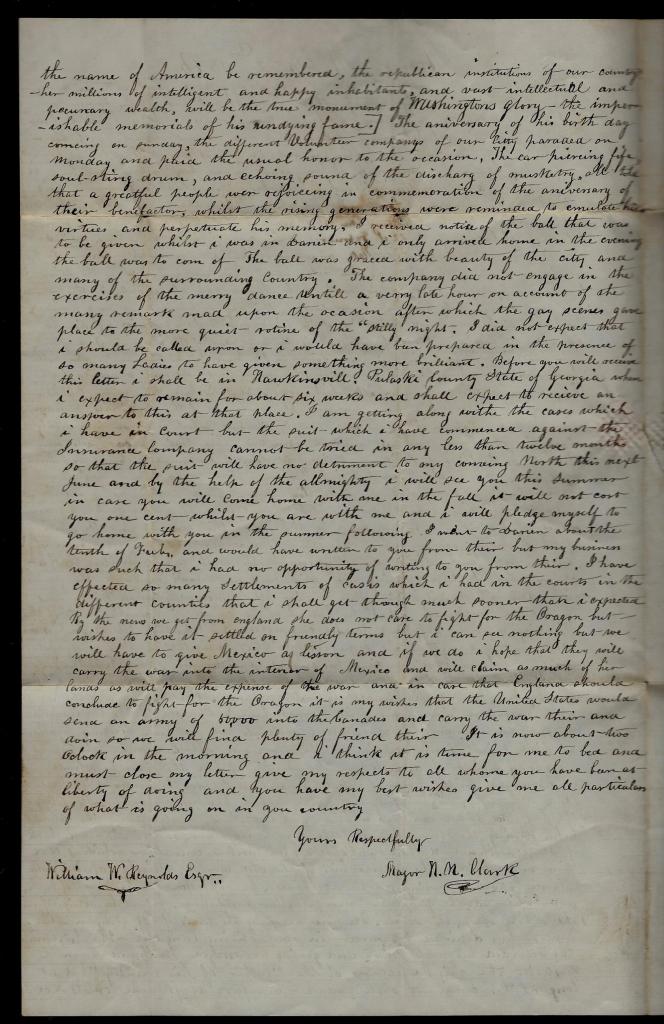
Opposed to the best European troops commanded by experienced generals, we see him keeping together is little band of undisciplined, half-starved and ill-clad militia, present at every point of assault, ever presenting his foe the same bold front, undismayed in the hour of defeat, unintoxicated in the moment of triumph. As a statesman, we see him adopting that policy which has been universally acknowledged the best fitted to our country’s condition and institutions, warily guiding the national helm during the stormy period of the French Revolution, so that our weak bark of state withstood the monarchies of the Old World. Nicely adjusting the balance between opposing parties at home, he repressed the violence of both and habituated the people to our peculiar institutions, 2 before he retired from the sphere of public service. The poet has sung the praises of Washington—the orator has depicted his career in soul stirring language—the historian has recorded his noble deed—and genius has essayed to hand down to posterity the chiseled features of the “father of his country,” but as long as this continent shall endure, a votary of freedom exists, or the name of America be remembered, the republican institutions of our country, her millions of intelligent and happy inhabitants, and vast intellectual and pecuniary wealth, will be the true monument of Washington’s glory—the imperishable memorials of his undying fame.
The anniversary of his birthday coming on Sunday, the different volunteer companies of our city paraded on Monday and paid the usual honor to the occasion. The ear piercing-fife, soul-stirring drum, and echoing sound of the discharge of musketry. all told that a grateful people were rejoicing in commemoration of the anniversary of their benefactor, whilst the rising generations were reminded to emulate his virtues and perpetuate his memory.
I received the notice of the ball that was to be given whilst I was in Darien and I only arrived home in the evening the ball was to come off. The ball was graced with beauty of the city and many of the surrounding country. The company did not engage in the exercises of the merry dance until a very late hour on account of the many remarks made upon the occasion, after which the gay scenes gave place to the more quiet routine of the “stilly night.” I did not expect that I should be called upon or I would have been prepared in the presence of so many Ladies to have given something more brilliant.
Before you shall receive this letter, I shall be in Hawkinsville, Pulaski county, State of Georgia, where I expect to remain for about six weeks and shall expect to receive an answer to this at that place. I am getting along with the cases which I have in court but the suit which I have commenced agains the insurance company cannot be tried in any less than twelve months so that the suit will have no detriment to my coming North this next June and by the help of the Almighty, I will see you this summer. In case you will come home with me in the fall, it will not cost you one cent whilst you are with me and I will pledge myself to go home with you in the summer following. I went to Darien about the tenth of February and would have written to you from there but my business was such that I had no opportunity of writing to you from there. I have effected so many settlements of cases which I had in the courts in the different counties that I shall get through much sooner than I expected.
By the news we get from England, she does not care to fight for the Oregon [territory] but wishes to have it settled on friendly terms, but I can see nothing but we will have to give Mexico a lesson and if we do, I hope that they will carry the war into the interior of Mexico and will claim as much of her lands as will pay the expense of the war. And in case that England should conclude to fight for the Oregon [territory], it is my wish that the United States would send an army of 50,000 into the Canades and carry the war there and doing so, we will find plenty of friends there.
It is now about two o’clock in the morning and I think it is time for me to bed and must close my letter. Give my respects to all whom you have been at liberty of doing and you have my best wishes. Give me all particulars of what is going on in your country.
Yours respectfully, — Major N. N. Clark
[to] William W. Reynolds, Esqr.
1 Washington Hall was completed in February 1827 and was located on the south corner of Mulberry and Second Streets. It was destroyed by a fire in September 1855 with several other structures on Mulberry Street.
2 “Peculiar institution” was a euphemistic term that white southerners used for slavery. John C. Calhoun defended the “peculiar labor” of the South in 1828 and the “peculiar domestick institution: in 1830. Ther term came into general use in the 1830s when the abolitionist William Lloyd Garrison began to attack slavery. [Enclopedia.com]
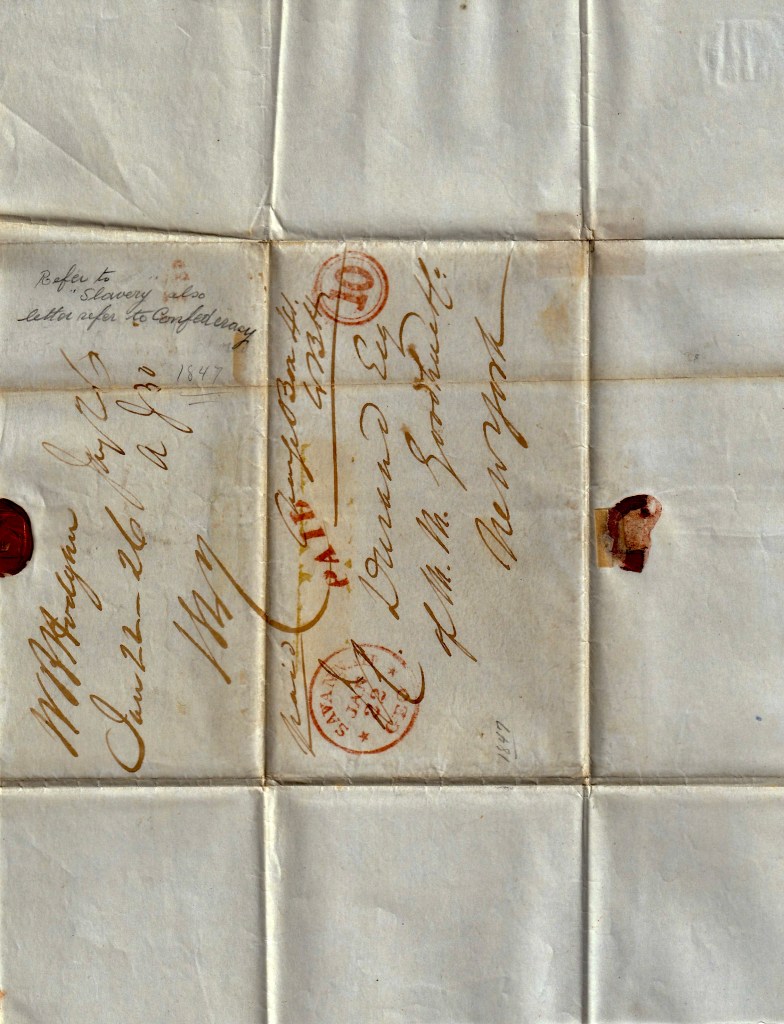
In this 1847 letter to his agent in NYC, Mr. Durand, William Brown Hodgson (1801-1871), an African ethnologist, who had several years previously married Georgia Telfair, the youngest daughter of Georgia Governor Edward Telfair, flaunts his new wealth and states his disapproval of abolitionist legislation being entertained in Congress: “We are ready for a Southern Confederacy rather than submit to have our property stigmatized.” In doing so, he presages the beginning of the Civil War, not to take place for another 14 years.
William Brown Hodgson
Hodgson, who did not himself come from a wealthy family, displayed an early academic interest in Africa and traveled extensively there in the 1820’s when Secretary of State Henry Clay secured him an assignment to the Barbary States of northern Africa. He published multiple scholarly works, particularly on the history and ethnology of black muslim Africans, as well as developing an interest, mainly after moving to the South with his new bride, Margaret Telfair, in the early 1840’s, where he became quickly involved in the family’s financial dealings (as evidenced by the present letter). Hodgson based much of his ethnological and linguistic scholarship on his contacts with the enslaved people of the Telfair plantations. He found a great deal of ethnic diversity within this population and could distinguish among the Mandingo, Ebo, Gullah, Fula (according to Hodgson, a powerful, warlike nation), and people from Guinea. Through his knowledge of African languages, he was able to converse with the Africans in their native tongues.
Despite his interest, Hodgson was very much a racist, believing the negro to be inferior and unworthy of freedom.
[Note: This letter is from the personal archives of Richard Weiner and is published on Spared & Shared by express consent.]
Transcription
Savannah, [Georgia] January 22, 1847
My dear Mr. Durand,
This morning I have your esteemed letter & enclosures of the 14th inst. It is the first mail that we have had for 6 days. Between Charleston & Wilmington the boats are hors de combat, unseaworthy, &c., &c.
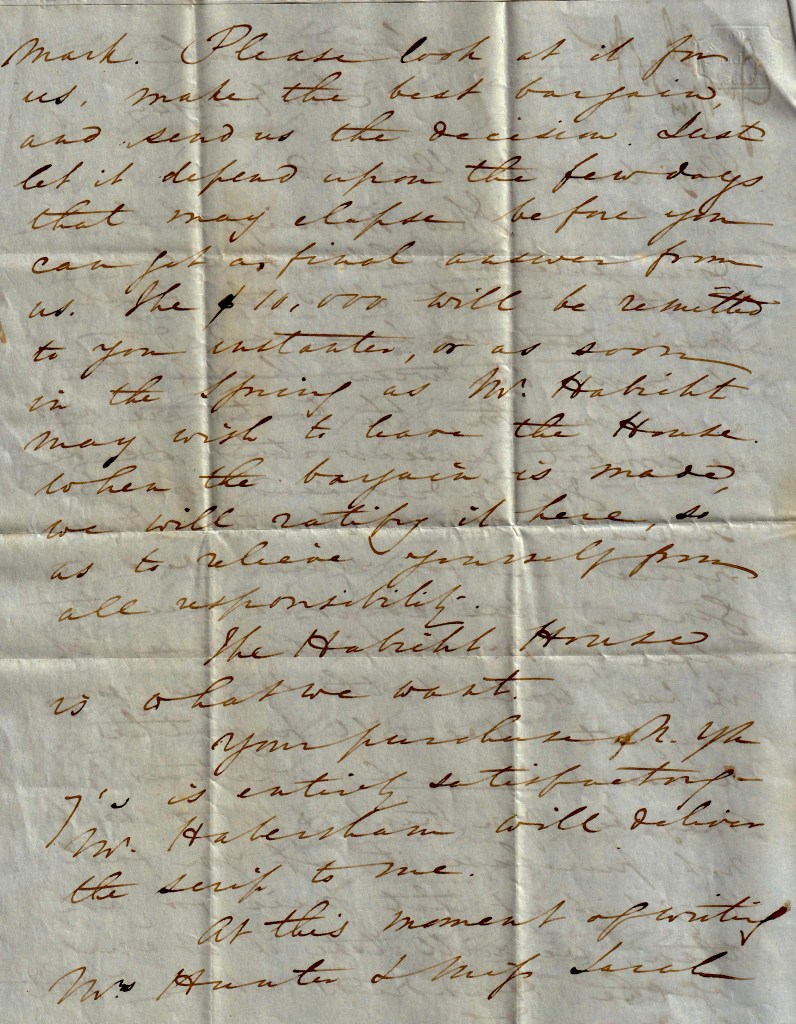
The ladies send you a thousand thanks for the House notices, and for your orders to Genoa. We adopt at once the offer of Mr. Habricht’s house, if it has water, bathes, &c., as you suggest. We will pay the amount in cash, whatever it may be. You think $10,000 will not purchase it. If you fail to get it at that price, for cash, then, we will take it at any of the hundreds above that mark. Please look at it for us—make the best bargain—and send us the decision. Just let it depend upon the few days that may elapse before you can get a final answer from us. The $10,000 will be remitted to you instanter, or as soon in the Spring as Mr. Habricht may wish to leave the house when the bargain is made. We will ratify it here so as to relieve yourself from all responsibility. The Habricht House is what we want.
Your purchase of N. York T’s is entirely satisfactory. Mr. Habersham will deliver the scrip to me.
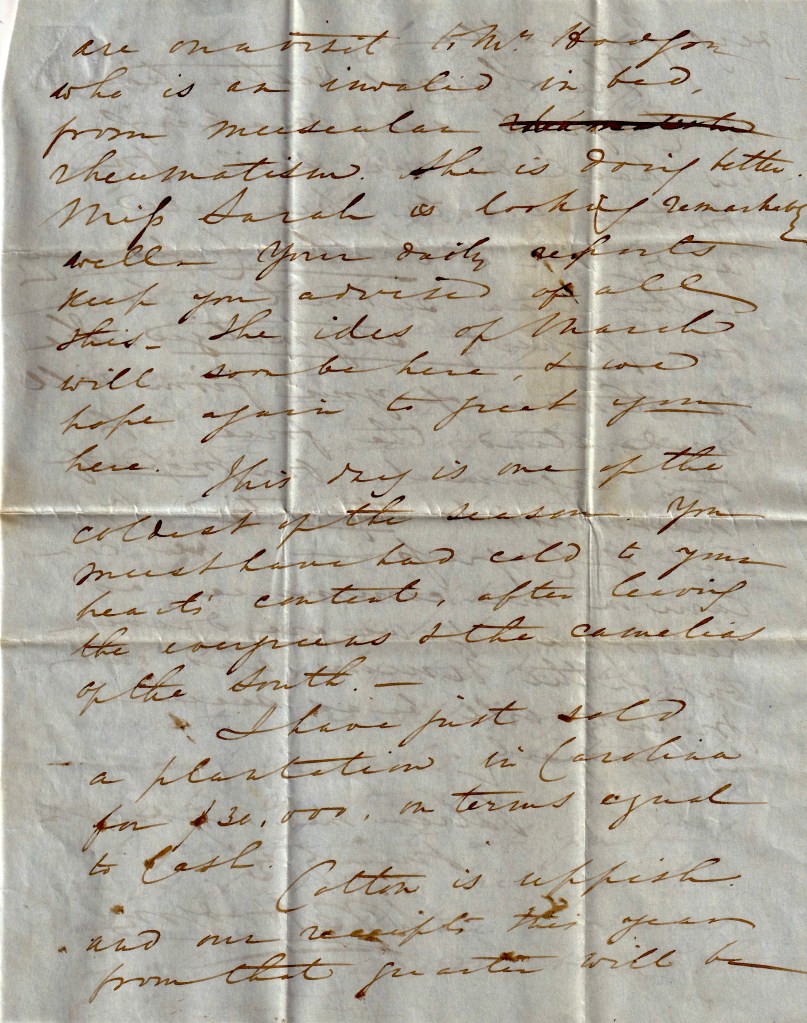
At this moment of writing, Mrs. Hunter & Miss Sarah are on a visit to Mrs. Hodgson who is an invalid in bed from muscular rheumatism. She is doing better. Miss Sarah is looking remarkably well. Your daily reports keep you advised of all this. The ides of March will soon be here & we hope again to greet you here.
This day is one of the coldest of the season. You must have had cold to your heart’s content, after leaving the evergreens and the camellias of the South. I have just sold a plantation in Carolina for $30,000, on terms equal to cash. Cotton is uppish and our receipts this year from that quarter will be very favorable.
The Slavery restrictions in Congress are making us haul in our sails for future events. We are ready for a Southern Confederacy rather than submit to have our property stigmatized. The gentlemen of your firm will understand the force of this argument. Our property must not be stigmatized by act of Congress. We can carry on our commerce as heretofore, if we are driven out of the Union, and our property will be as secure as formerly.
Believe me, my dear sir, sincerely, — W. B. Hodgson














 Spared & Shared 23