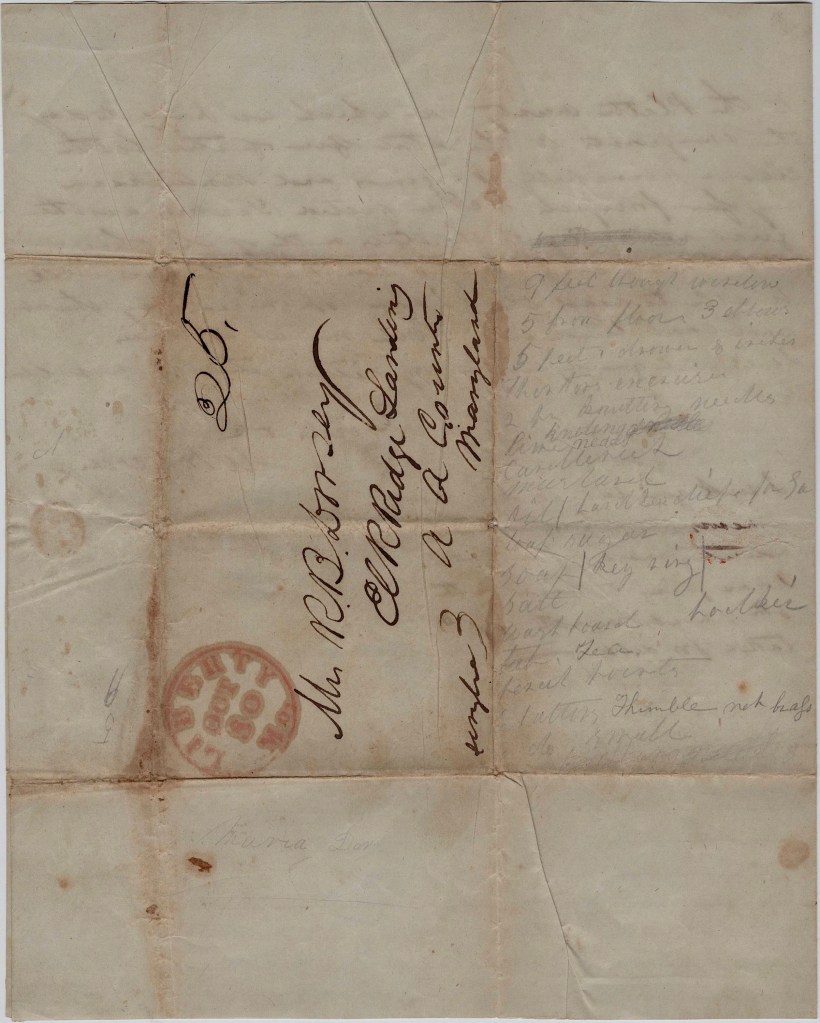
This letter was written by William H. Dorsey (1819-1854), the oldest son of Richard Brooke Dorsey (1791-1869) and Anna Elizabeth Dorsey (1800-1884) of Elk Ridge Landing, Anne Arundel county, Maryland. By 1850, Richard and Anna had relocated to Baltimore where Richard was a merchant. William was yet unmarried and living with his parents in Baltimore at that time. It is presumed that William was named after his paternal grandfather, William Hammond Dorsey. The Dorsey family were slaveholders in the 1850s and the content of the following letter gives us some notion as to their opinion of Yankees and societal preferences.
I could not find a biographical sketch for William H. Dorsey but one ancestral record indicates that he was married on 21 December 1848 to Arabella Arthur (1828-1866) of Clay county, Missouri and that he died in New York City in August 1854. Arabella was the daughter of Michael Arthur (1800-1884) and Amanda Melvina Martin (1804-1889) who came to Clay county, Missouri, from Barren county, Kentucky in the late 1820s. Arabella’s father operated the first hemp factory in Clay county and he became a very wealthy businessman and real estate developer in Liberty. He operated a general store on the southwest corner of Water St. and Kansas St., and also was the proprietor of the Arthur House Hotel. Arabella died in Liberty, Missouri, in 1866 after a protracted illness of Consumption (tuberculosis). This record is probably accurate because there is nothing more in the family’s ancestral records despite a lot of detail regarding William’s siblings, one of whom—Richard Brooks Dorsey, Jr.—served in Co. H, 1st Maryland (Confederate) Infantry during the Civil War.
The post script of this letter suggests that William was engaged in some mercantile venture in St. Louis.
T R A N S C R I P T I O N
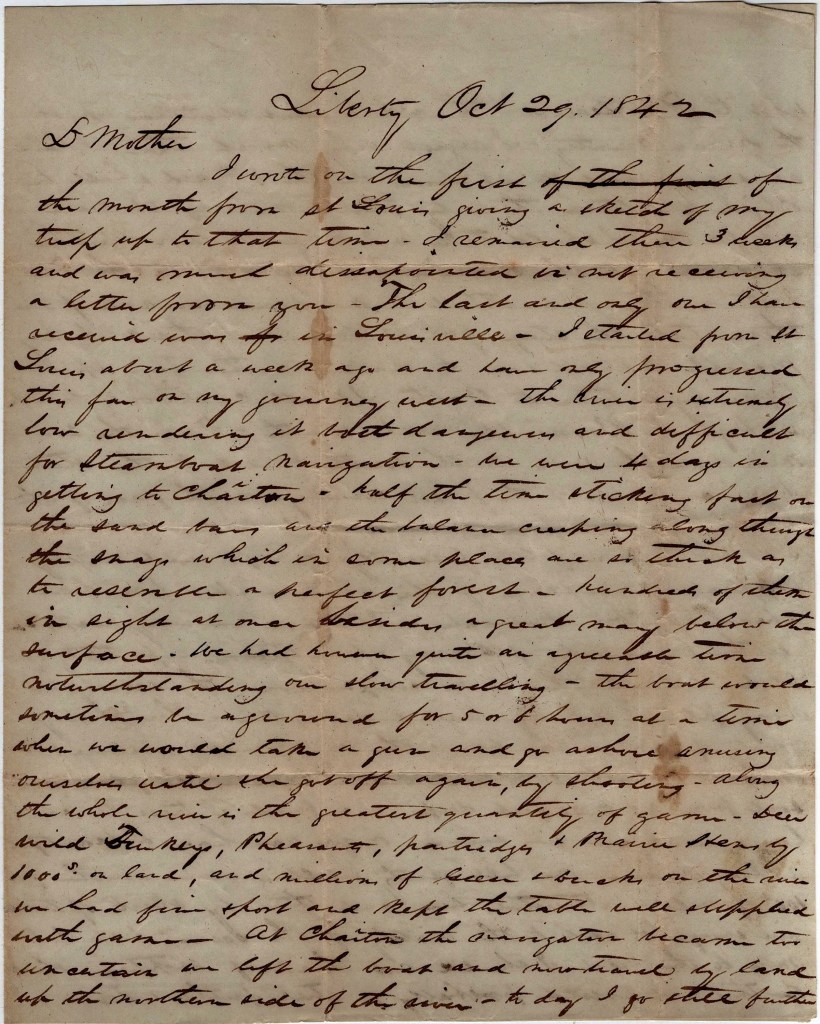
Liberty [Missouri] October 29, 1842
Dear Mother,
I wrote on the first of the month from St. Louis giving a sketch of my trip up to that time. I remained there 3 weeks and was most disappointed in not receiving a letter from you. The last and only one I have received was in Louisville.
I started from St. Louis about a week ago and have only progressed this far on my journey west. The [Missouri] river is extremely low rendering it both dangerous and difficult for steamboat navigation. We were 4 days in getting to Chariton, half the time sticking fast on the sand bars and the balance creeping along through the snags which in some places are so thick as to resemble a perfect forest—hundreds of them in sight at once besides a great many below the surface. We had, however, quite an agreeable time notwithstanding our slow traveling. The boat would sometimes be aground for 5 or 6 hours at a time when we would take a gun and go ashore amusing ourselves—until she got off again—by shooting. Along the whole river is the greatest quantity of game, deer, wild turkeys, pheasants, partridges, & prairie hens by thousands on land, and millions of greenbacks on the river. We had fine sport and kept the table well supplied with game.
At Chariton the navigation became too uncertain [so] we left the boat and now travel by land up the northern side of the river, Today I go still farther west to Fort Leavenworth and a short distance up in the Indian country. I regret very much that I have an engagement in St. Louis on the 8th and shall be obliged to return by that time. If it were not for this, I should take a 2 or 3 weeks trip up the Missouri into the Indian country. From the Fort I return through Westport to Independence and from there take the stop for St. Louis. I think it is very probable I shall have to make another trip up here before my return to Baltimore. I shall certainly be up as high as Booneville next month.
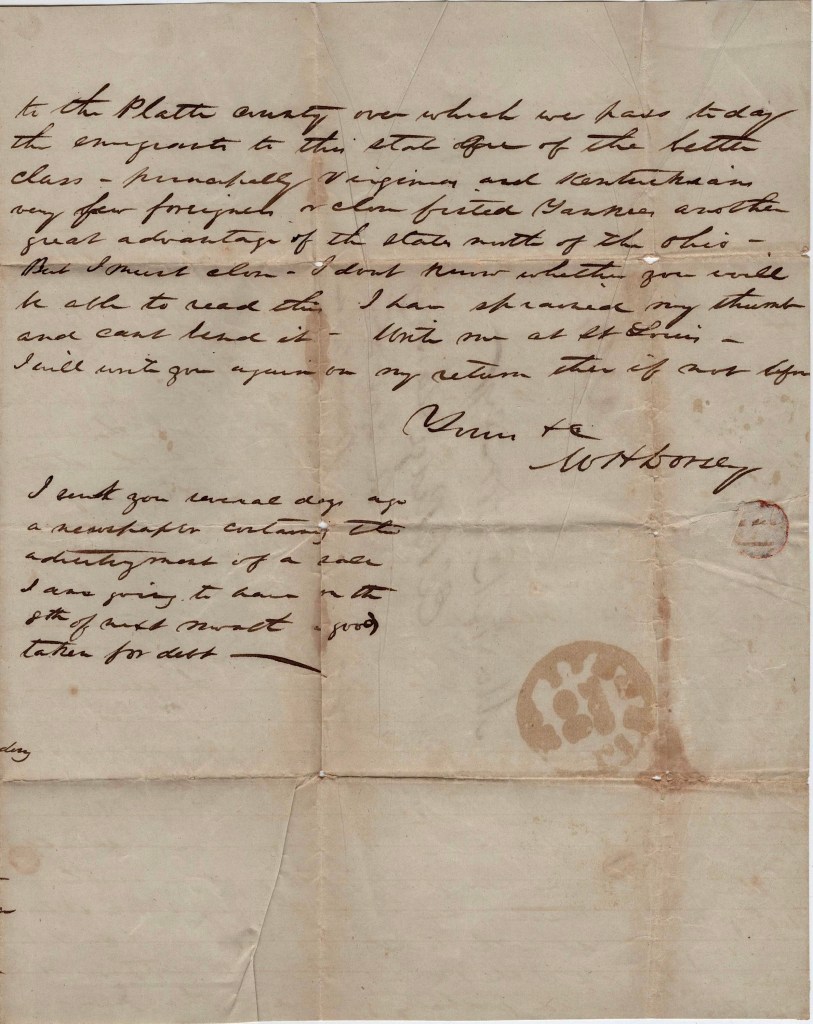
From the 200 miles down the river north, south and west to the state boundaries is one of the finest country on the face of the earth. You can form no idea of it unless you could see it. Eastern folks generally have formed a very improper conception of this state. It is far, far ahead of Ohio, Indiana, or Illinois in every respect either for beauty of scenery, fine streams, fertility of soil or society there is no comparison. The scenery in many places is lovely beyond description. There is every variety of it. You can have either a boundless prairie extending 40 or 50 [miles] without a tier and as level as the floor with soil from 25 to 30 feet deep, or a forest of trees twice as large as any you ever saw, or you can have a beautiful rolling prairie, one hill swelling above another for hundreds of miles, intersected here and there by skirts of timber just enough to add to the variety of the scene. Were I to move to the West, I should not think of stopping short of this and would probably go still further west to the Platte county over which we pass today.
The emigrants to this state are of the better class—principally Virginia and Kentuckians. Very few foreigners or close-fisted Yankees—another great advantage of the states south of the Ohio. But I must close. I don’t know whether you will be able to read this. I have sprained my thumb and can’t bend it. Write me at St. Louis. I will write you again on my return then if not before. Yours &c. — W. H. Dorsey
I sent you several days ago a newspaper containing the advertisement of a sale I was going to have on the 8th of next month. Goods taken for debt.
The following letter was written by James Stevenson Sterrett (1821-1908), the son of Robert Trimble Sterrett (1791-1868) and Mary Woods Stewart (1791-1865). In the 1860 US Census, James was enumerated in the household of Bill & Mary Ann (Sterrett) Truesdale [Truesdail] of Elkhorn, Warren county, Missouri. Bill Truesdail was a notorious character who took advantage of his position in the Union army during the Civil War to rob and harass citizens in Mississippi and Tennessee (see newspaper obituary below entitled, “Death of a Notorious Detective“).
Bill Truesdail of Warren county, Missouri. “Gone down to the grave covered with obloquy and shame.”
Sterrett’s letter mentions the three or four fires in Texas towns that were alleged to have been set by Northerners in July 1860. Newspapers referred to them as “Abolition emissaries,” sent to the northern frontier of Texas to encourage negroes to run away from their masters and molest slaveholders. “If the Northerners are determined to cut our throats, or not to let us live in peace, the sooner they elect ‘Old Abe’ the better, for we shall look on such an event as an open declaration of war, ” wrote a San Antonio correspondent.
Transcription
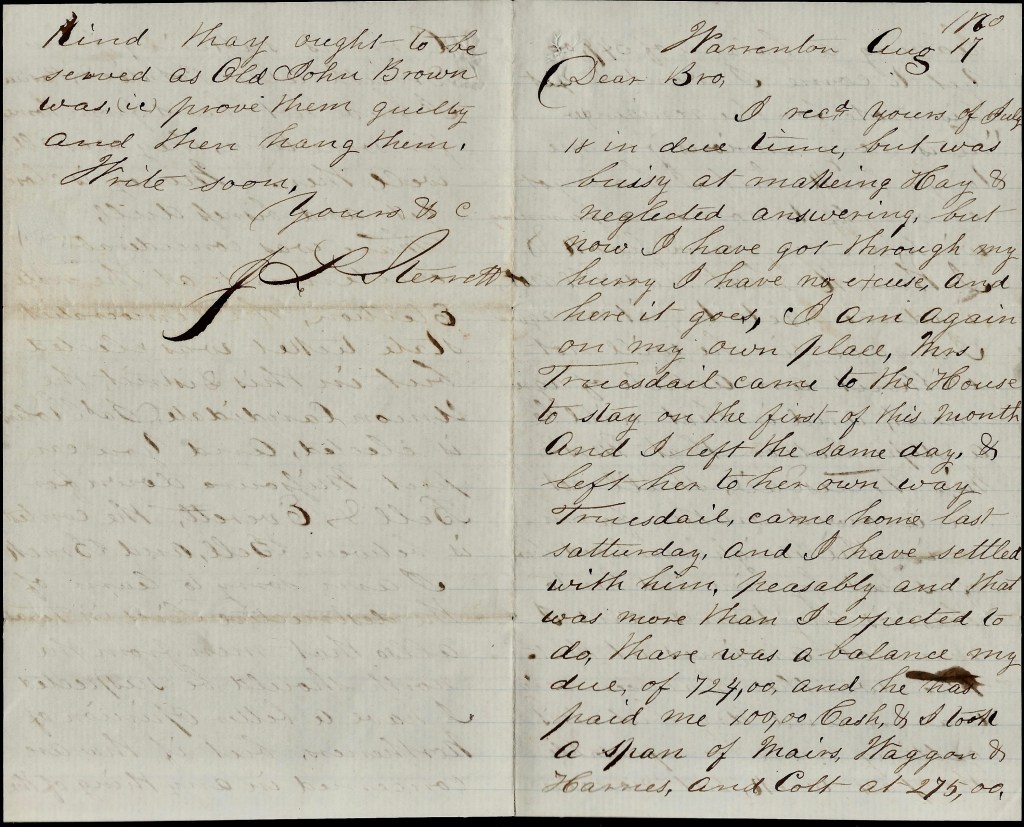
Warrenton [Warren county, Missouri] August 17, 1860
Dear Brother,
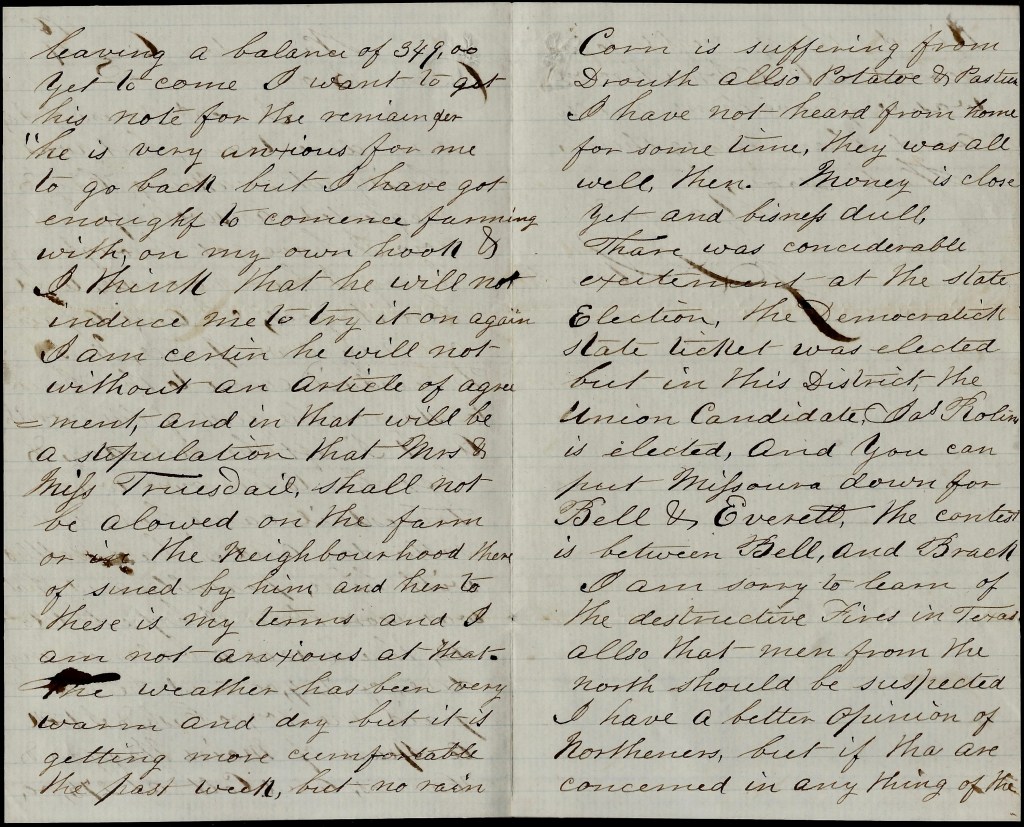
I received yours of July 18 in due time, but was busy at making hay & neglected answering, but now I have got through my hurry, I have no excuse and here it goes. I am again on my own place. Mrs. Truesdail came to the house to stay on the first of this month and I left the same day & left her to her own way. Truesdail came home last Saturday and I have settled with him peaceably and that was more than I expected to do. There was a balance my due of 724 and he has paid me 100 cash & I took a span of mares, wagon, and harness and colt at 275, leaving a balance of 349 yet to come. I want to get his note for the remainder. He is very anxious for me to go back but I have got enough to commence farming with on my own hook & I think that he will not induce me to try it on again. I am certain he will not without an article of agreement, and in that will be a stipulation that Mrs. & Miss Truesdail shall not be allowed on the farm or in the neighborhood thereof signed by him and here too. These is my terms and I am not anxious at that.
The weather has been very warm and dry but it is getting more comfortable the past week but no rain. Corn is suffering from drouth. Also potato & pasture. I have not heard from home for some time. They was all well then. Money is close yet and business dull.
There was considerable excitement at the State Election. The Democratic State ticket was elected but in this district the Union Candidate, James [S.] Rollins is elected and you can put Missouri down for Bell & Everett. The contest is between [John] Bell and Brack [John C. Breckinridge]. 1
I am very sorry to learn of the destructive fires in Texas. Also that men from the North should be suspected. I have a better opinion of Northerners but if they are concerned in anything of the kind, they ought to be served as Old John Brown was (i.e.) prove them guilty and then hang them.
Write soon. Yours, &c. — J. S. Sterrett
1 In the 1860 Presidential Election, the Democratic candidate Stephen A. Douglas actually carried Missouri by a very narrow margin, winning 35.52% of the vote and the Constitutional Union candidate John Bell winning 35.26%. Breckinridge was a distant 3rd at 18.94% and Lincoln only 10.28%.
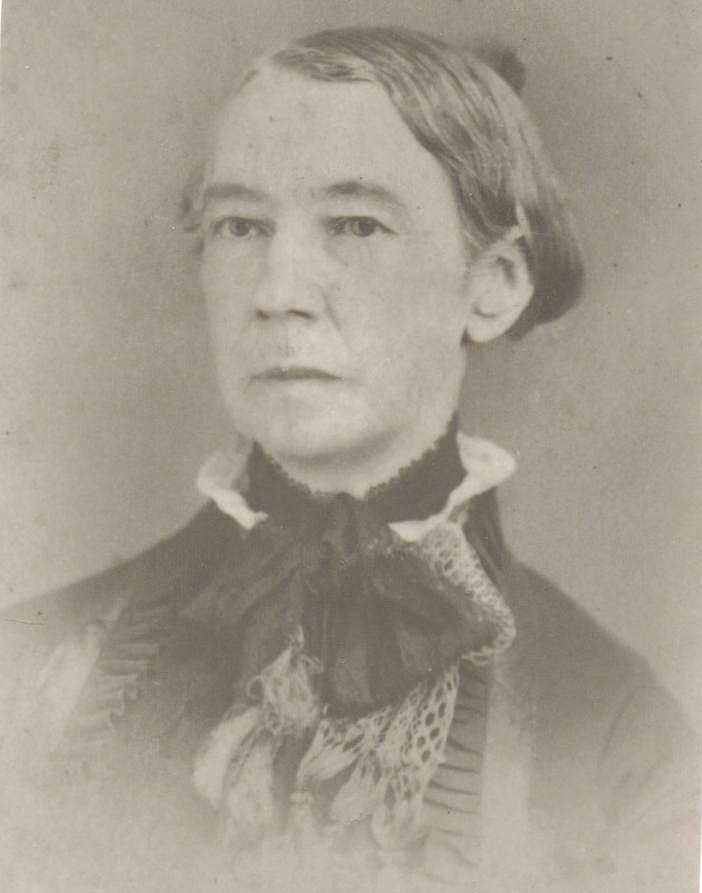
This letter was written by 35 year-old Mary Mitchell (Gatlin) Knox (1811-1890), the wife of Dr. Franklin Knox (1810-1895) of St. Louis, Missouri. Mary and Franklin had several children, all born in St. Louis: Sarah (“Sallie”) Knox (1838-1926), Emma Knox (1840-1840); Eliza Knox (1842-1842), Annie Knox (1845-1853), Franklin Knox, Jr. (1848-1848), and Richard Gatlin Knox (1851-1914).
Mary grew up in Kinston, Lenoir county, North Carolina, the daughter of John Gatlin and Susannah Caswell. She married Franklin Knox there in May 1837. In her letter, Mary mentions her brother, Richard Caswell Gatlin (1809-1896) who graduated from West Point in 1832 and served as an infantry officer in the War with Mexico (was wounded at the Battle of Monterey) and later on frontier duty in Indian Territory. In 1861, Richard resigned his commission and was appointed Colonel in the CSA. He was then promoted to Brigadier General in August 1861 and was assigned command of the Department of North Carolina and the coast defenses of the State.
Before the 1860 US Census, the Knox family had relocated to Crescent City, Del Norte, California, where Franklin worked as a physician.
Mary wrote the letter to Mary Strachan (Barret) Reavis (1812-1870), the wife of Judge Turner Reavis (1812-1872) of Gainesville, Sumter county, Alabama.
Transcription
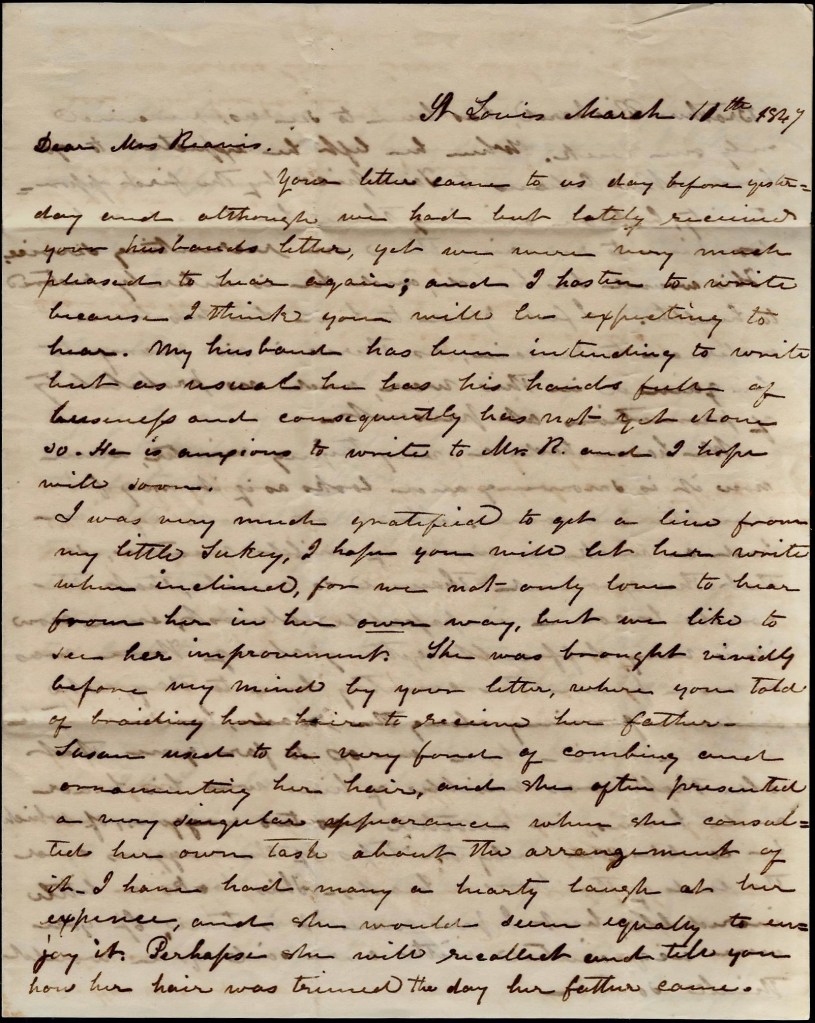
St. Louis [Missouri] March 10th 1847
Dear Mrs. Reavis,
Your letter came to us day before yesterday and although we had but lately received your husband’s letter, yet we were very much pleased to hear again; and I hasten to write because I think you will be expecting to hear. My husband has been intending to write but as usual he has his hands full of business and consequently has not yet done so. He is anxious to write to Mr. Reavis and I hope will soon.
I was very much gratified to get a line from my little Sukey. I hope you will let her write when inclined for we not only love to hear from her in her own way, but we like to see her improvement. She was brought vividly before my mind by your letter, where you told of braiding her hair to receive her father. Susan used to be very fond of combing and ornamenting her hair, and she often presented a very singular appearance when she consulted her own task about the arrangement of it. I have had many a hearty laugh at her expense, and she would seem equally to enjoy it. Perhaps she will recollect and tell you how her hair was trimmed the day her father came.
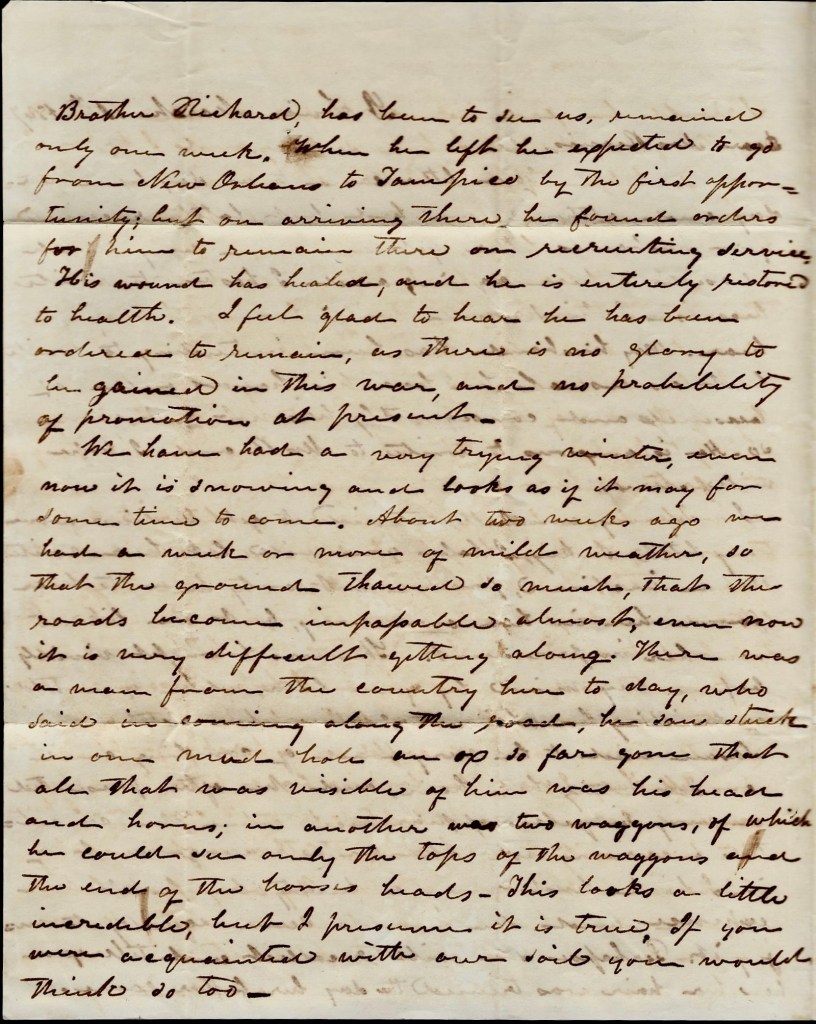
Brother Richard has been to see us, remained only one week. When he left he expected to go from New Orleans to Tampico by the first opportunity; but on arriving there he found orders for him to remain there on recruiting service. His wound has healed and he is entirely restored to health. I feel glad to hear he has been ordered to remain as there is no glory to be gained in this war and no probability of promotion at present
We have had a very trying winter. Even now it is snowing and looks as if it may for some time to come. About two weeks ago we had a week or more of mild weather, so that the ground thawed so much that the roads became impassable almost. Even now it is very difficult getting along. There was a man from the country here today who said in coming along the road, he saw stuck in one mud hole an ox so far gone that all that was visible of him was his head and horns; in another was two wagons and the end of the horses heads. This looks a little incredible but I presume it is true. If you were acquainted with our soil, you would think so too.
I should be glad indeed to spend next winter with you, should I live so long, and I hope it may so happen that I shall spend a few weeks with you. Mr. Reavis incited me to come this spring and was kind enough to offer to meet me at Orleans, but it will not be convenient for me to leave home this summer. Should we all live until another summer, I shall feel as if I ought to go away and try if the air of another climate will do anything to keep my little Annie from sharing the fate of her other sisters of the same age.
Tell Susan I shall commence a letter to her tomorrow, it being her birthday, and send it sometime this month. Sarah is anxious to write and began a letter some days ago, but she thought it was written too bad to send. She has written very little and does not write so well as Susan. I hope Susan will write like her father. Her mother’s hand writing was no better than mine. We could never boast of good penmanship. Tell Lucy I shall be looking for a letter from her soon and I should be delighted soon to see her. I have quite a curiosity to see her—her father so often spoke of her while he was with us.
My very best love to your dear husband and receive the same from your affectionate friend. — M. M. Knox
How John, the fruit stand man, might have looked in 1858. (W. Griffing Collection)
With a lot more time it might be possible to identify the author of this letter but for the time being he will remain simply “John.” The letter contains a great description of Saint Louis, Missouri, in the spring of 1858. From the letter we learn that John is contemplating opening a fruit stand in the city. The content also informs us that he was from Baltimore and that his mother still lived there.
From a description of the Mercantile Library Hall and its curiosities, to the “floating palaces” on the Mississippi, the interior and services at St. Patrick’s church, to the death of Thomas Hart Benton, John’s 8-page letter is bursting with “newsy” details.
Transcription
St. Louis, [Missouri] April 11th 1858
My Dear Mother,
I received your letter on Friday, April 9th. The letter you speak of, my dear Mother, I never received, or I should have answered immediately. I had become extremely anxious as to the reason of your not writing and on yesterday week sat down & wrote you a letter telling you I had not received one from you for at least five or six weeks. My letters here have been so far irregular & hereafter when I do receive a letter from you at the regular time, if I am in the city, I will write, taking it for granted you have written & the letter miscarried.
I think it very likely I will soon leave off my wandering life and settle down in St. Louis for a time at least. If I can get what little money together I have, I will open a small retail fruit store, which business from what I have seen I am satisfied will pay, so that I can make not only a good living, but save something over besides to carry home & settle me in a small business near you & Belle and all those I love.
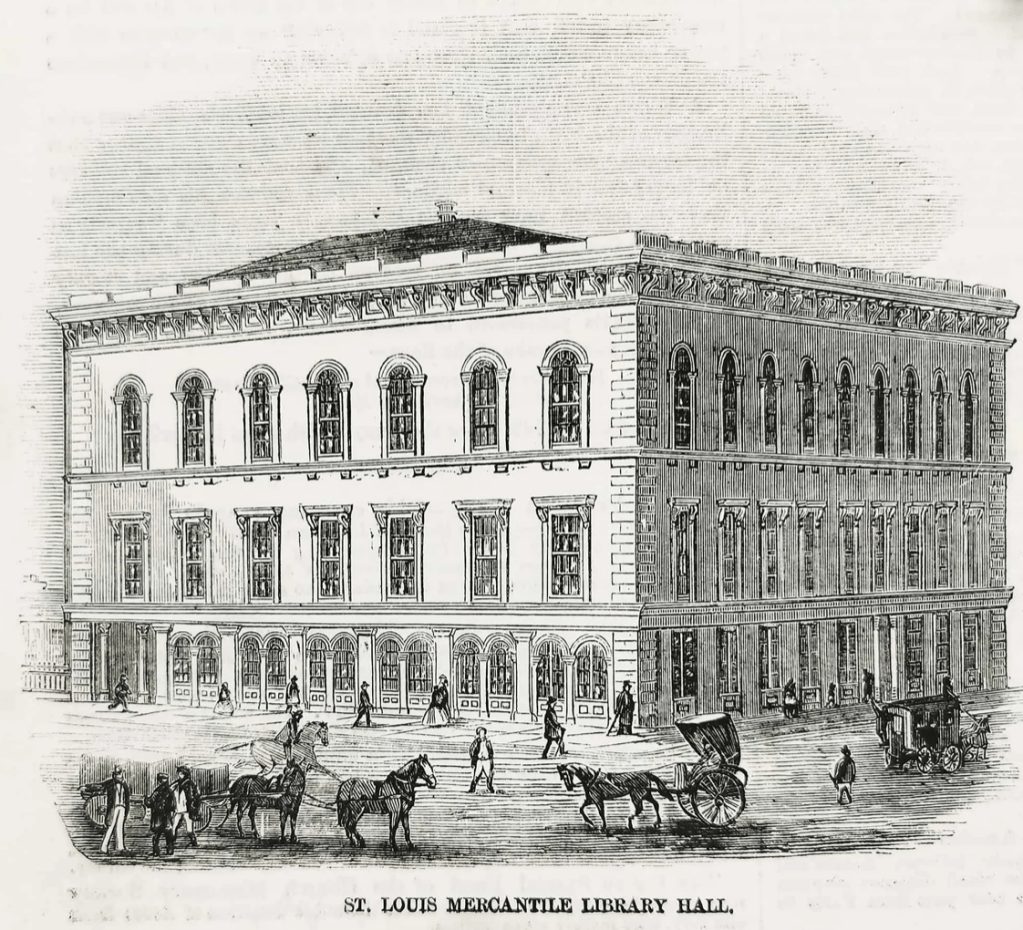
St. Louis Mercantile Library Hall, ca, 1858
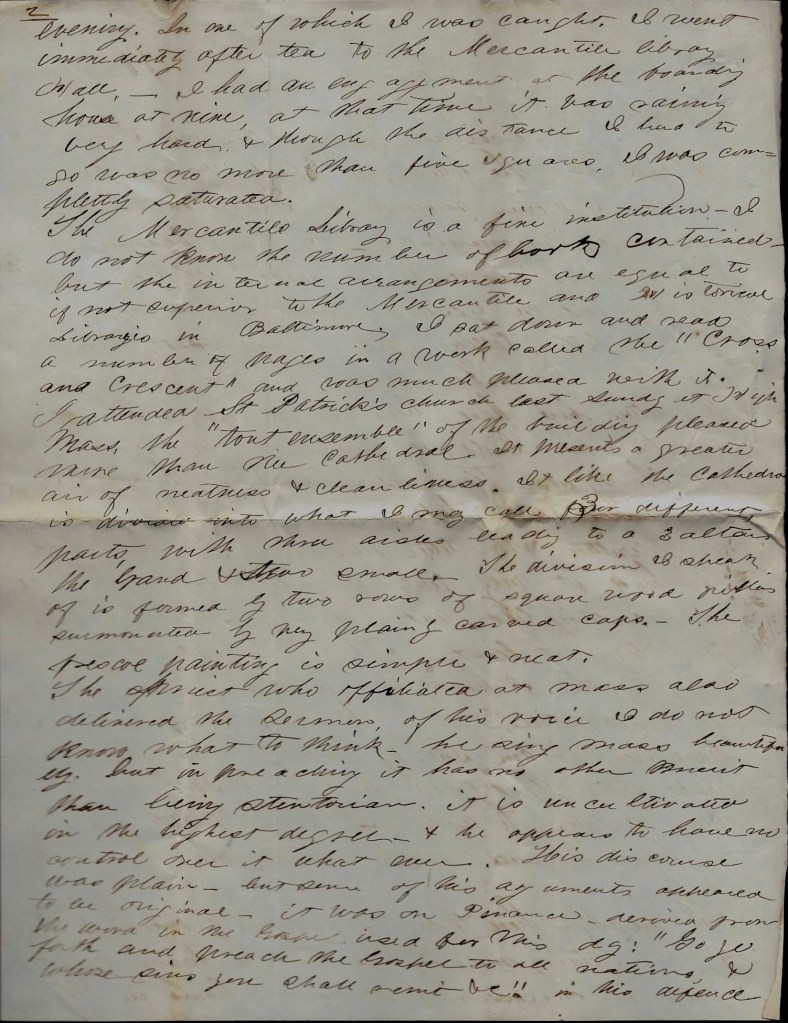
The weather here today is extremely warm and sultry. On Saturday morning we had a heavy gust, and gusts in succession for at least three hours in the evening, in one of which I was caught. I went immediately after tea to the Mercantile Library Hall. 1 I had an engagement at the boarding house at nine. At that time it was raining very hard & though the distance I had to go was no more than five squares, I was completely saturated.
The Mercantile Library is a fine institution. I do not know the number of books contained, but the internal arrangements are equal to, if not superior to, the Mercantile and Historical Libraries in Baltimore. I sat down and read a number of pages in a work called the “Cross and Crescent” and was much pleased with it.
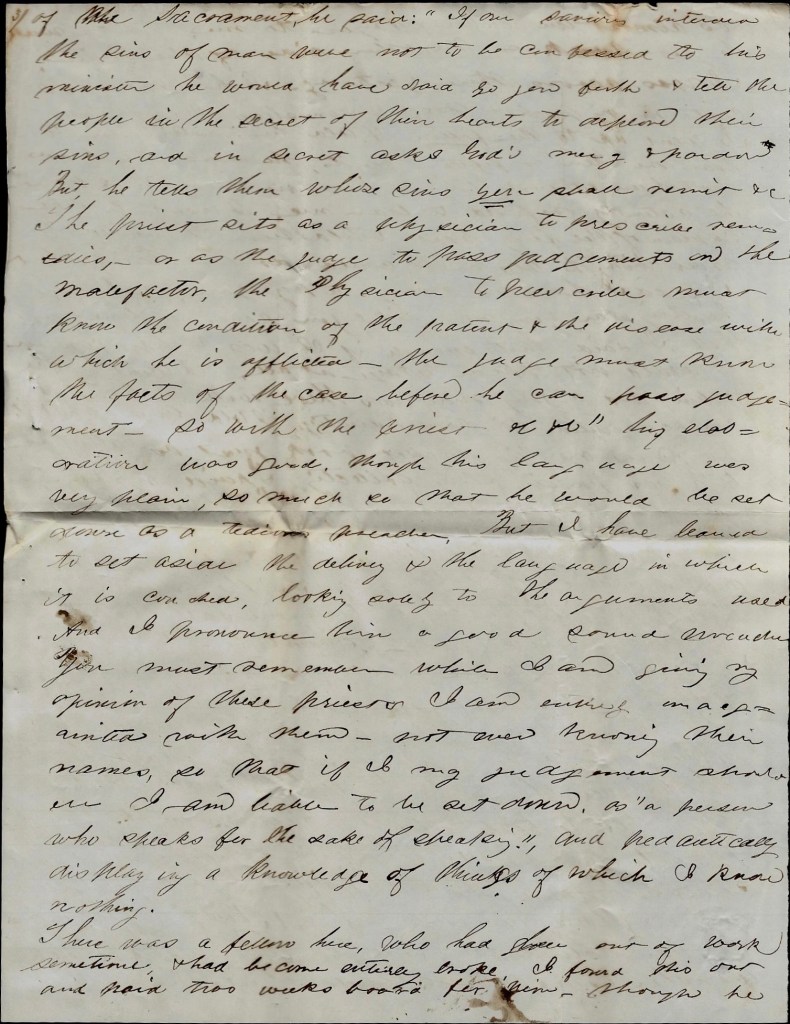
I attended St. Patrick’s church last Sunday at High Mass. The “tout ensemble” of the building pleased more than the Cathedral. It presents a greater air of neatness & cleanliness. It, like the Cathedral, is divided into what I may call 3 different parts, with three aisles leading to three altars—the grand & two small. The division I speak of is formed by two rows of square wood pillars surmounted by very plainly carved caps. The fresco painting is simple & neat. The priest who officiated at mass also delivered the sermon. Of his voice, I do not know what to think. He sings mass beautifully, but in preaching it has no other merit than being stentorian; it is uncultivated in the highest degree & he appears to have no control over it whatever. His discourse was plain, but some of his arguments appeared to be original. It was on penance—derived from the word in the gospel used for [ ]: “Go ye forth and preach the gospel to all nations &whose sins you shall remit, &c.” In his defense of the sacrament, he said, “If our Saior intended the sins of man were not to be confessed to his minuster, he would have said, go you forth & tell the people in the secret of their hearts to deplore their sins, and in secret ask Go’s mercy & pardon.” But he tells them whose sins you shall remit, &c. The priest sits as a physician to prescribe remedies, or as the judge to pass judgments on the malefactor. The physician, to prescribe. must know the condition of the patient & the disease with which he is afflicted. The judge must know the facts of the case before he can pass judgment. So with the priest, &c. His elocution was good, though his language was very plain, so much so that he would be set down as a tedious preacher. But I have learned to set aside the delivery & the language in which it is couched, looking solely to the arguments used, and I pronounce him a good, sound preacher. You must remember while I am giving my opinion of these priests, I am entirely unacquainted with them—not ever knowing their names, so that if I my judgment should err, I am liable to be set down as “a person who speaks for the sake of speaking,” & pedantically displaying a knowledge of things of which I know nothing.
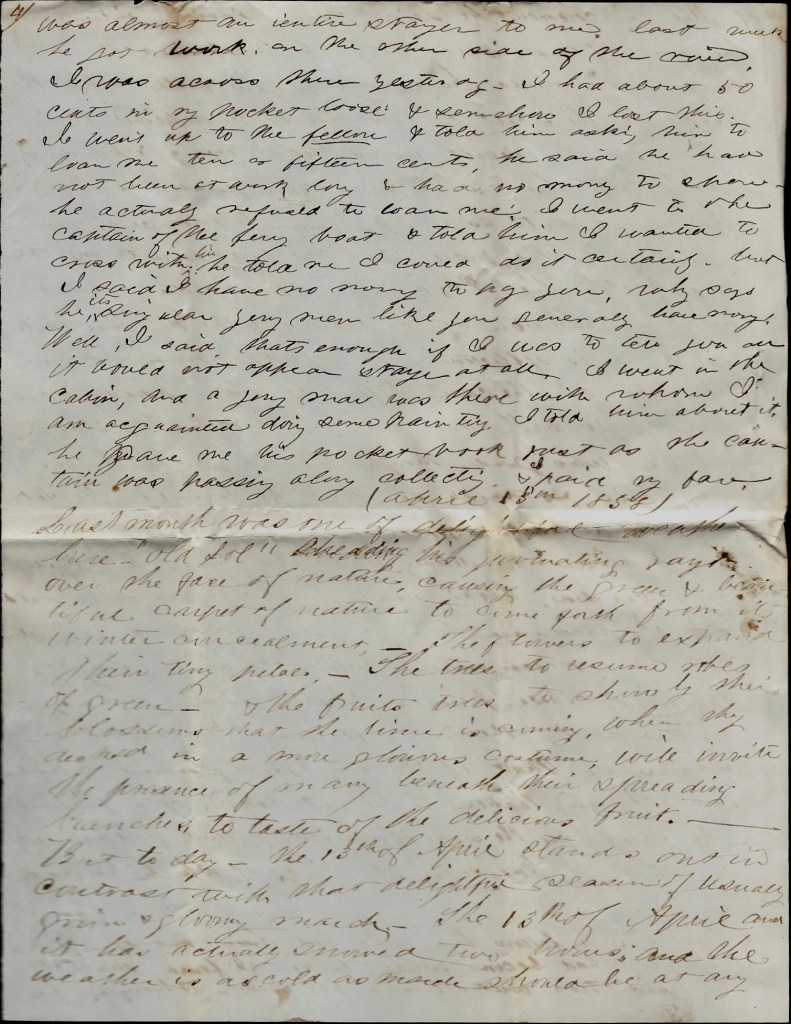
There was a fellow here who had been out of work some time & had become entirely broke. I found this out and paid two weeks board for him though he was almost an entire stranger to me. Last week he got work on the other side of the river. I was across there yesterday. I had about 50 cents in my pocket loose & somehow I lost this. I went up to the fellow & told him, asking him to loan me ten or fifteen cents. He said he had not been at work long & had no money to spare. He actually refused to loan me. I went to the captain of the ferry boat & told him I wanted to cross with him. He told me I could do it certainly, but I said I have no money to pay you. “Why,” says he, “it’s singular. Young men like you generally have nary.”
“Well,” I said, “that’s enough. If I was to tell you all, it would not appear strange at all.” I went in the Cabin and a young man was there with whom I am acquainted doing some painting. I told him about it. He gave me his pocket book just as the captain was passing along collecting & paid my fare.
April 13th, 1858
Last month was one of delightful weather here. “Old Sol” shedding his penetrating rays over the face of nature causing the green and beautiful carpet of nature to come forth from its winter concealment; the flowers to expand their tiny petals; the trees to resume robes of green; and the fruit trees to show by their blossoms that the time is coming when they decked in a more glorious costume, will invite the presence of many beneath their spreading branches to taste of the delicious fruit.
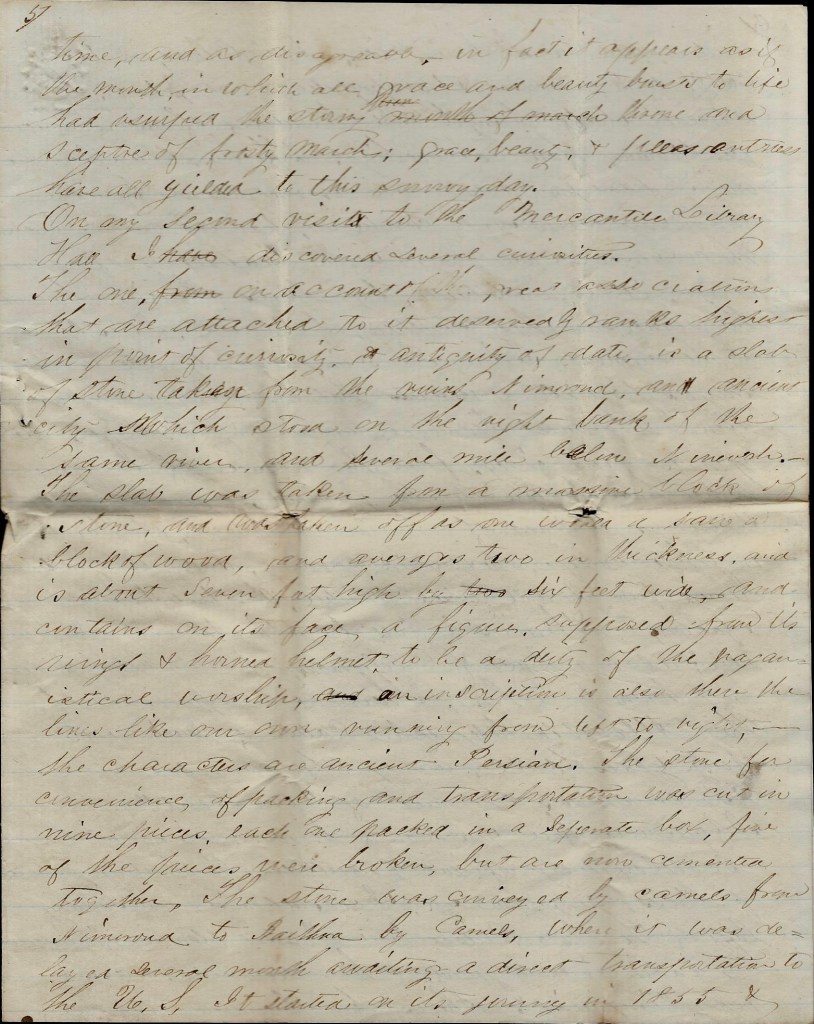
But today, the 13th of April, stands in contrast with that delightful season of usually grim & gloomy March. The 13th of April and it has actually snowed two times and the weather is as cold as March should be at any time, and as disagreeable. In fact, it appears as if the month in which all grace and beauty bursts to life had usurped the stormy throne and scepter of frosty March; grace, beauty, and pleasantness have all yields to this snowy day.
On my second visit to the Mercantile Library Hall, I discovered several curiosities. The one, on account of the great associations that are attached to it, deservedly ranks highest in point of curiosity & antiquity of date, is a slab of stone taken from the ruins of Nimrud—an ancient city which stood on the right bank of the same river and several miles below Nineveh. The slab was taken from a massive block of stone and was taken off as one would saw a block of wood, and averages two in thickness and is about seven feet high by six feet wide and contains on its face a figure, supposed from its wings & horned helmet to be a deity of the paganistical worshippers. An inscription is also there, the lines like our own, running from left to right. The characters are ancient Persian. The stone, for convenience of packing and transportation, was cut in nine pieces, each one packed in a separate box. Four of the pieces were broken, but are now cemented together. The stone was conveyed by camels from Nimrud to B_____a by camels, where it delayed several months awaiting a direct transportation to the U. S. It started on its journey in 1855 & arrived in St. Louis, via New Orleans, in 1857. Cost of wor, in ruins, & transportation, cost $150. The stone of itself, through the kindness of an American gentleman there, cost nothing.
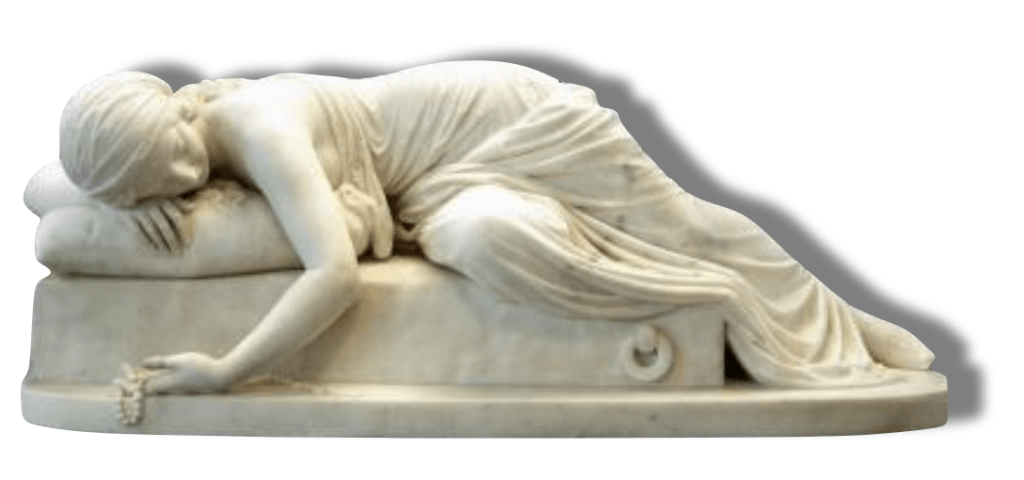
The next, unlike the one I have just mentioned, is not food for the devouring curiosity of virtuous, but one on which the connoisseur can gaze with sentiments of admiration. It is a statuette by Miss Harriet [Goodhue] Hosmer, the American lady sculpture of Verona. It is taken at the moment when Paris, impelled by the soothsayer’s prediction that he should in Greece find the most beautiful woman of the ages, departs from Troy; from the violence of her grief, she has fallen to the ground.
Harriet Hosmer’s sculpture of Beatrice Cenci (1857)
There is a of bust of Dr. [Joseph Nash] McDowell of this city in whose college she [Hosmer] studied anatomy and in gratitude hewed from the dull marble this bust of her benefactor. There is a full length statue of Daniel Webster. Also a bust of Christopher Columbus. The two latter I do not know by whom. There is a specimen of the Atlantic telegraph cable, banks notes forty years old, &c., among the number one for the enormous amount of “one cent.”
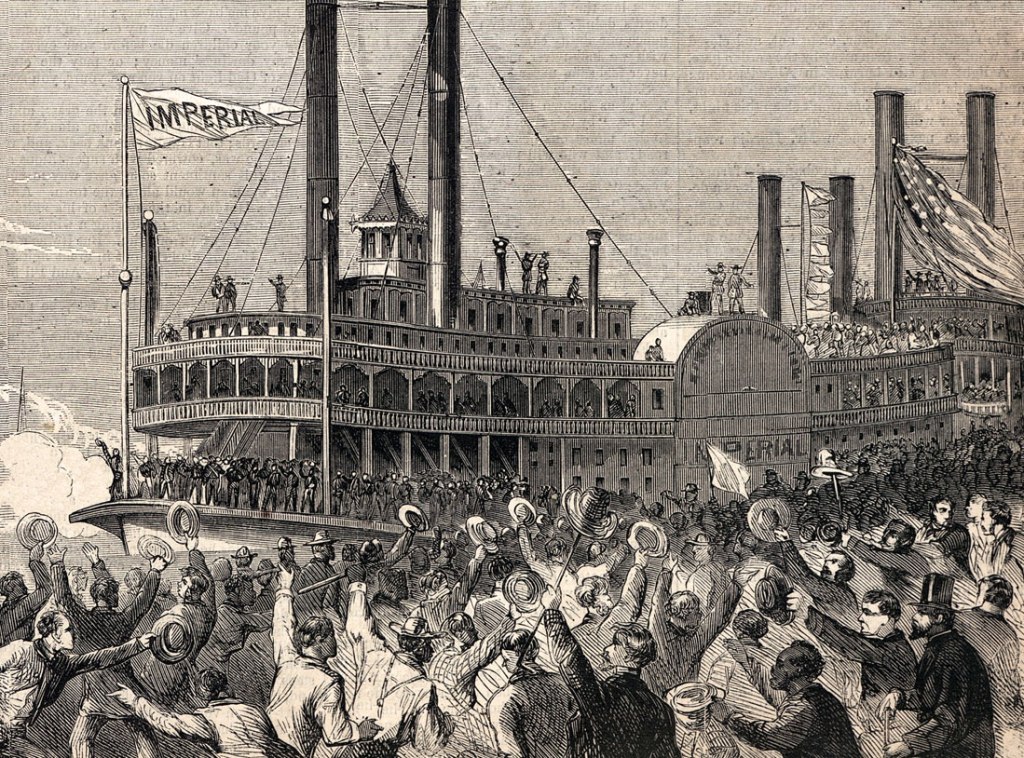
If you were here, you would be astonished at the scale of magnificent grandeur the floating palaces of Mississippi are gotten up. I was aboard on Sunday last of the New Railroad line Packet steamer “Imperial.” Her cabin is really grand & her decorations are really “imperial.” She is three hundred feet long.
I see by the papers the death of Col. Thomas Hart Benton. The mighty contemporaries of Clay & Calhoun are rapidly bidding adieu to earth. The citizens of St. Louis irrespective of party proclivities have joined and passed a suitable resolution regretting the death of an illustrious person; he has bequested by will to be buried beside his deceased wife in Bellefontaine Cemetery. The cortege that will follow his remains to the grave through the streets of the city will be immense. In my letter following the event, I will give you a description of the most striking features. He will rest within 6 miles from the place where he sent two men to their last account & to an eternity.
I have removed to my old quarters on the corner of Broadway and Mulberry. I did not like the other place. It was very disagreeable.
Business is very dull here. I hope it will soon brisk up. I understand through a letter from W. P. Cam___ that Joe I. Wynn has returned to Baltimore. I have not seen him since I was out. He was in Bunker Hill, Illinois.
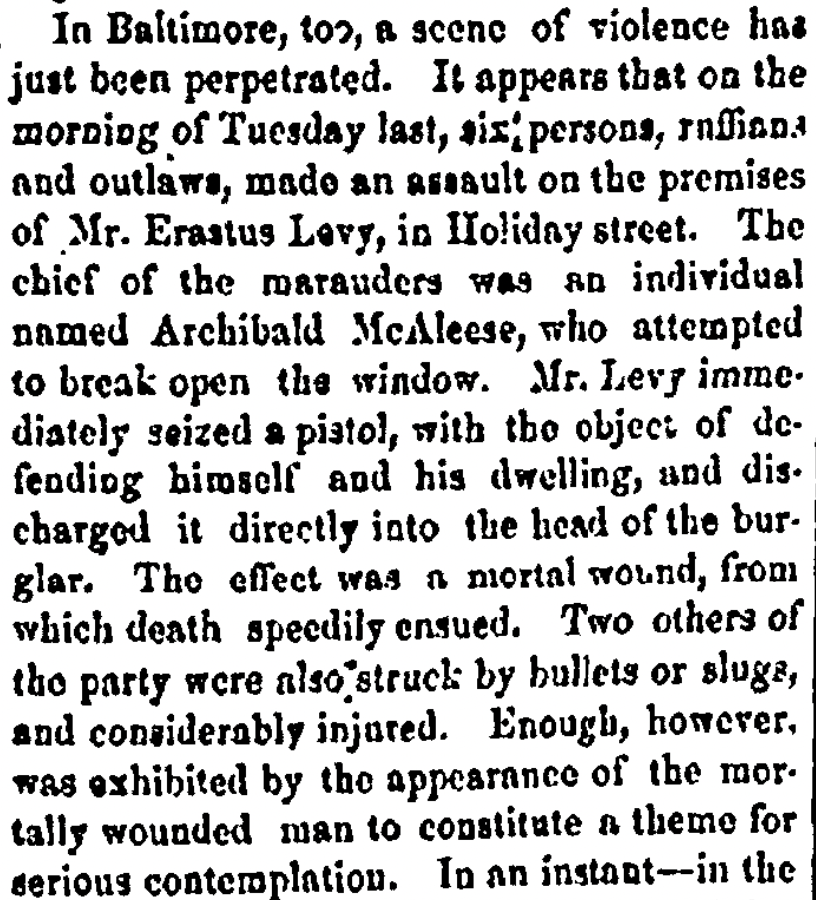
Philadelphia Inquirer, 9 April 1858. Archibald McAleese shot by storekeeper Erastus Levy, the keeper of a drinking shop on Holiday Street in Baltimore.
We have eggs for breakfast every morning. I was surprised at this, but on inquiry I found they were selling 3 dozen for 2 bits (quite cheap). In all the boarding houses I have been in in St. Louis, I find they have invariably molasses on the table at each meal, & persons eat it on all things most—even mince pies—and I do not know but what some of them will before long commence using it on sugar.
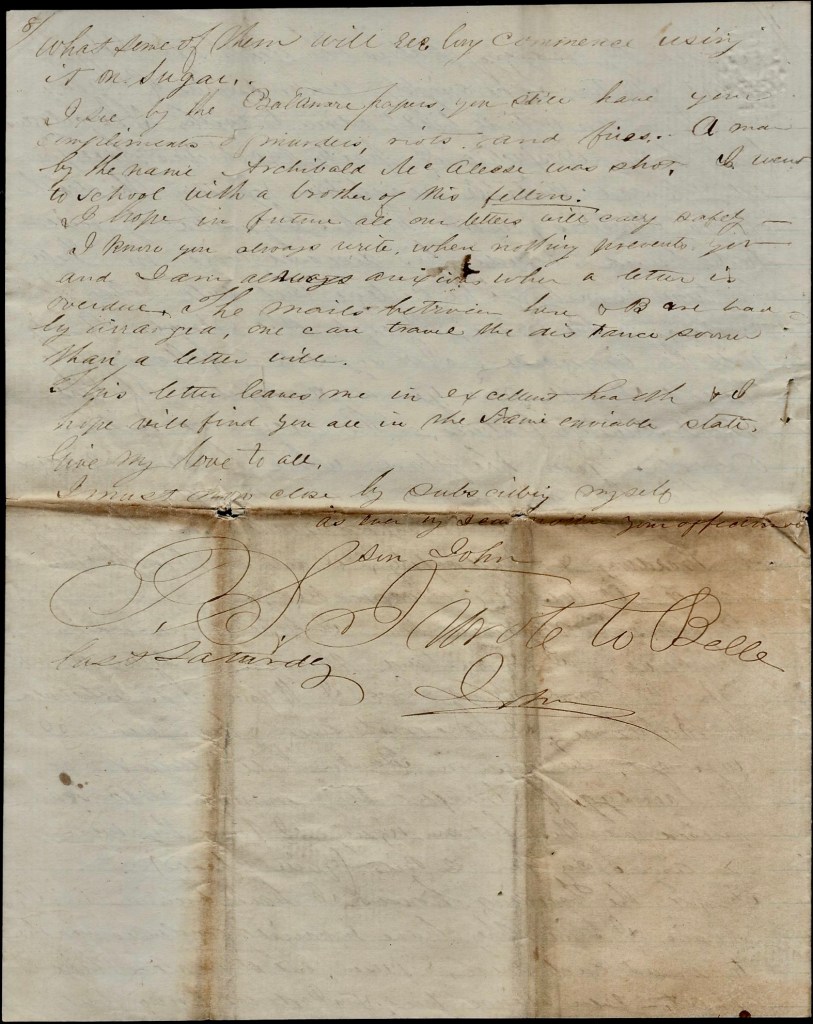
I see by the Baltimore papers you still have your compliments of murders, riots, and fuss. A man by the name Archibald McAlesse was shot. I went to school with a brother of his felon.
I hope in future all our letters will carry safely. I know you always write when nothing prevents, yet I am always anxious when a letter is overdue. The mails between here and Baltimore are badly arranged. One can travel the distance sooner than a letter will.
This letter leaves me in excellent health & I hope will find you all in the same enviable state. Give my love to all. I must now close by subscribing myself as ever, my dear Mother, your affectionate son, — John
P. S. I wrote to Belle last Saturday.
1 In December 1845 a group of civic leaders and philanthropists joined to establish a membership library with the intent of creating a place “where young men could pass their evenings agreeably and profitably, and thus be protected from the temptations to folly that ever beset unguarded youth in large towns. The library officially opened on April 19, 1846, and became chartered by the State of Missouri that year. At the time, public libraries were not a standard institution. The St. Louis Mercantile Library, with a reading room, meeting rooms, book stacks, and the largest auditorium in the city, became a primary hub of cultural and intellectual interchange in the city in the years preceding commonplace public and academic libraries.[Wikipedia]
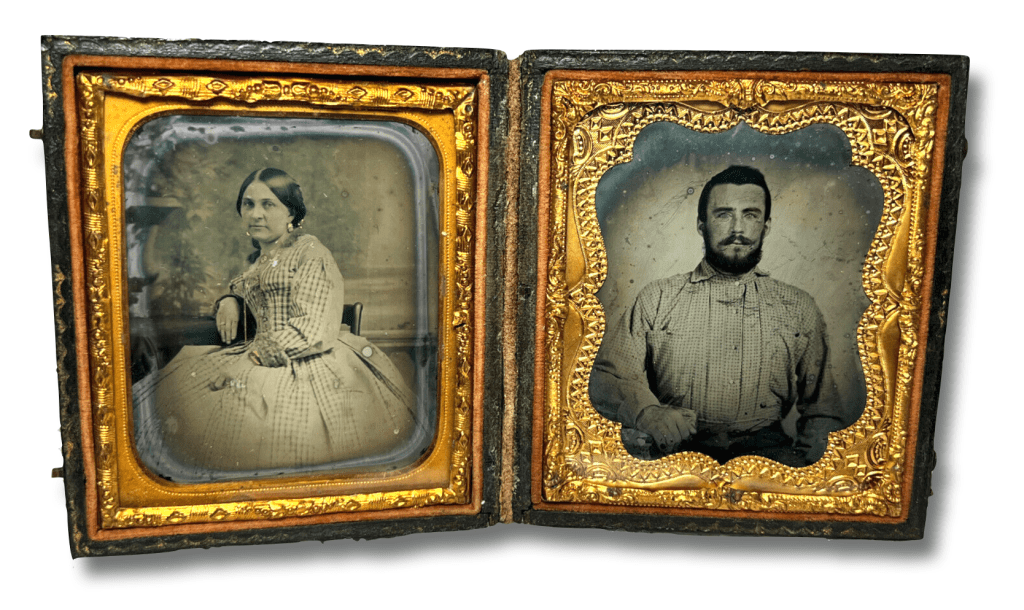
The following letter was written by 26 year-old Susan “Sue” (Slater) Wertz (1835-1918), the orphaned daughter of William and Elizabeth Slater. She was married to Christian Stoner Wertz (1834-1915) in January 1857 in Wayne county, Ohio, where the couple were enumerated in the 1860 US Census with their two little boys, Harry (b. December 1857) and John (b. October 1859).
Sue’s husband, Christian, had an older brother named Henry M. Wertz (1833-1880) who was married to Sophia S. Fluke (1841-1922). Henry’s wife is the “Sophie” mentioned in the letter. The two couples evidently relocated from Ohio to Missouri together in the fall of 1860. Henry and Sophie’s oldest child was also named “Harry” (b. 1856) which adds to the confusion on names. Christian’s parents were John H. Wertz (1794-1856) and Priscilla Hemperly (1808-1872). The “grandma” mentioned frequently in the letter was 52 year-old Priscilla, a widow living in Dalton, Wayne county, Ohio, in 1861.
Sue has addressed her letter to an unnamed sister whom I believe to have been either her sister-in-law, Martha M. Wertz (1844-1861)—who died in August 1861—or Martha’s younger sister, Sarah Florence Wertz (1845-1923).
We learn from the letter that Christian and his brother Henry soon discovered their political views made them unwelcome neighbors in Missouri on the eve of the Civil War. Henry moved his family on to Fairfield township, Jefferson county, Iowa, where he lived out his days. Christian, however, returned to his boyhood home in Sugar Creek township, Wayne county, Ohio, where he took care of his mother and raised a large family.
I have not learned when the Wertz families left Macon City but it was not long before Federal authorities established a presence in the town due to its strategically located railroad facilities. A military prison was established there early in the war and a garrison posted that remained throughout the war. The 1st Iowa Infantry was one of the first regiments to occupy the town.
How Sue and Christian Wertz might have looked in 1861
Transcription
Macon City, Missouri January 20, 1861
Dearest Sister,
I received your thrice welcome letter a short time since and was much pleased to hear from you and to learn that you was all well and in the midst of enjoyment this cold weather!
Sister, do not think it is wilful neglect or want of thought which has caused my seeming inattention toward you since my stay in Missouri. I trust a reasonable apology will be sufficient atonement for the delay.
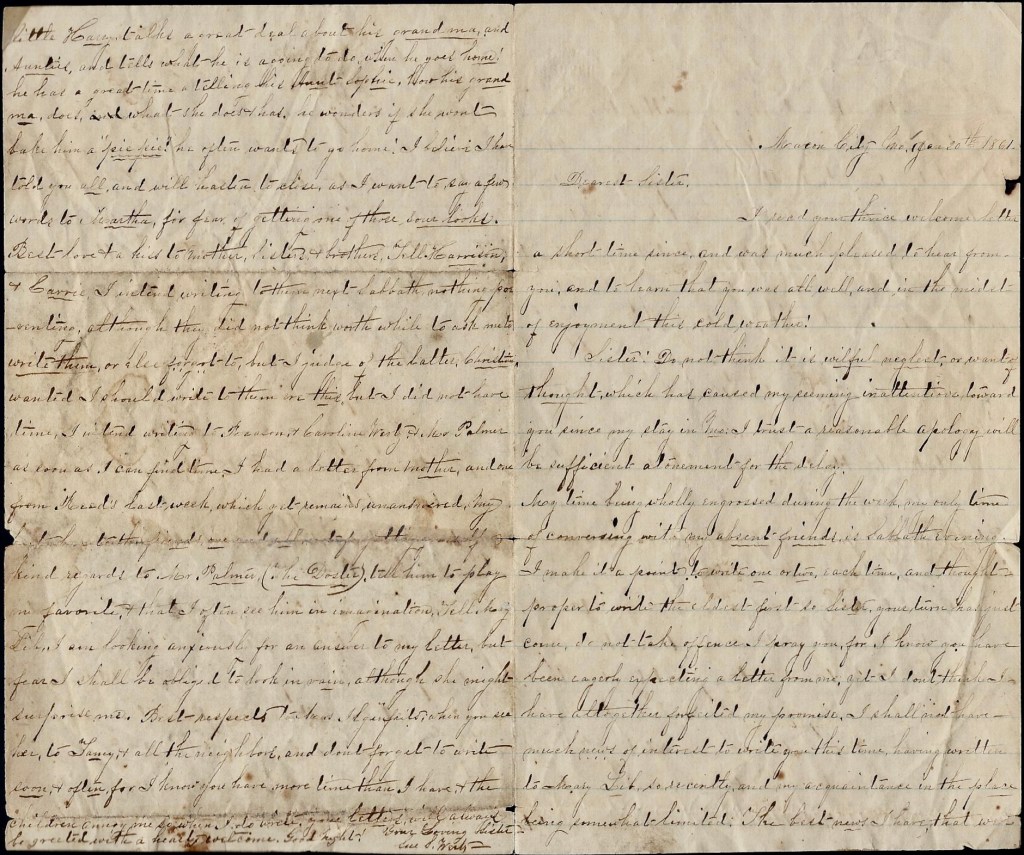
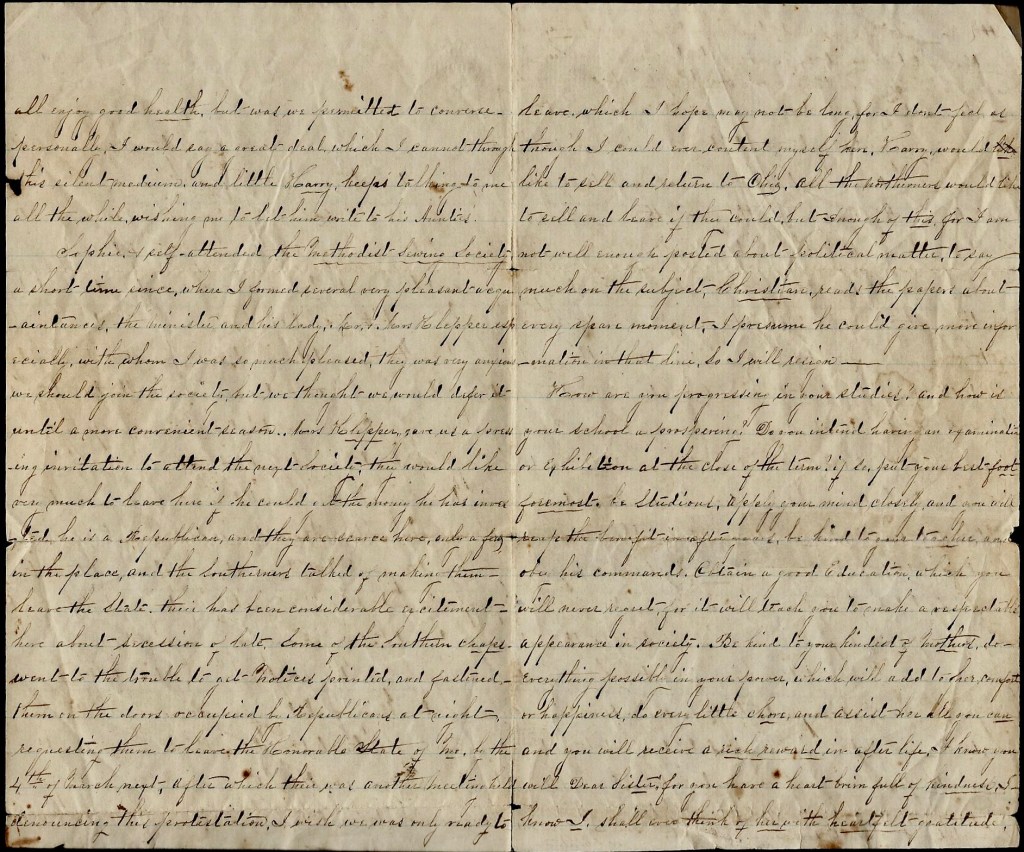
My time being wholly engrossed during the week, my only time of conversing with my absent friends is Sabbath evening. I make it a point to write one or two each time, and thought proper to write the eldest first so sister, your turn has just come. Do not take offense, I pray you, for I know you have been eagerly expecting a letter from me, yet I don’t think I have altogether forfeited my promise. I shall not have much news of interest to write you this time, having written to Mary Lib 1 so recently, and my acquaintances in the place being somewhat limited. The best news I have [is] that we all enjoy good health, but was we permitted to converse personally, I would say a great deal which I cannot through this silent medium. And little Harry keeps talking to me all the while, wishing me to let him write to his Aunties.
Sophie & self attended the Methodist Sewing Society a short time since where I formed several very pleasant acquaintances. The [Methodist] minister and his lady—Mr. [Michael T.] and Mrs. [Prudence J.] Klepper especially—with whom I was so much pleased. 2 They was very anxious we should join the society but we thought we would defer it until a more convenient season. Mrs. Klepper gave us a pressing invitation to attend the next Society. They would like very much to leave here if he could get the money he has invested. He is a Republican and they are very scarce here—only a few in the place—and the Southerners talked of making them leave the State.
There has been considerable excitement here about secession of late. Some of the Southern chaps went to the trouble to get notices printed and fastened them on the doors occupied by Republicans at night, requesting them to leave the Honorable State of Missouri by the 4th of March next, after which there was another meeting held denouncing this protestation. I wish we was only ready to leave which I hope may not be long for I don’t feel as though I could ever content myself here. Harry would like to sell and return to Ohio. All the Northerners would like to sell and leave if they could but enough of this for I am not well enough posted about political matters to say much on the subject. Christian reads the papers about every spare moment. I presume he could give more information in that line, so I will resign.
How are you progressing in your studies? and how is your school a prospering? Do you intend having an examination or exhibition at the close of the term? If so, put you best foot foremost. Be studious, apply your mind closely, and you will reap the benefit in after years. Be kind to your teacher and obey his commands. Obtain a good education which you will never regret for it will teach you to make a respectable appearance in society. Be kind to your kindred of Mothers. Do everything possibly in your power which will add to her comfort and you will receive a rich reward in after life. I know you will, dear sister, you you have a heart brim full of kindness. I know I shall ever think of her with heartfelt gratitude.
Little Harry talks a great deal about his grandma and Aunties and tells what he is a going to do when he goes home! He has a great time a telling his Aunt Sophie how his grandma does what she does & has. He wonders if she won’t bake him a “pie-pie.” He often wants to go home. I don’t believe I have told you all and will hasten to close as I want to say a few words to Martha for fear of getting one of those sour looks. Best love & a kiss to mother, sister and brother. Tell Harrison & Carrie I intend writing to them next Sabbath, nothing preventing, although they did not think worthwhile to ask me to write them or else forgot to, but I judge of the latter.
Christian wanted I should write to them in this but I do not have time. I intend writing to [ son] and Caroline Wertz & Mr. Palmer as soon as I can find them. I had a letter from mother and one from Reed’s last week which yet remains unanswered. My [illegible due to crease on page] kind regards to Mr. Palmer (The Docter). Tell him to play my favorite & that I often see him in imagination. Tell May Lib I am looking anxiously for an answer to my letter but fear I shall be obliged to look in vain, although she might surprise me. Best respects to Mrs. Ilginfails when you see her, to Fanny, and all the neighbors, and don’t forget to write soon & often, for I know you have more time than I have & the children annoy me so when I do write. Your letters will always be greeted with a hearty welcome. Good night. Your loving sister, — Sue S. Wertz
1 Mary Elizabeth Wertz (1837-1912) married Dr. James Madison Palmer (1839-1904).
2 The Methodist minister was undoubtedly Rev. Michael Tivis Klepper (1822-1885)—a native of East Tennessee—and his wife, Prudence Jane Roll (1831-1912) who shows up in the Missouri Methodist Records as early as 1851 where he was appointed in 1852 to the Wyandotte and Delaware Indian Mission in Kansas Territory. From 1856-59, the Kleppersresided in Greencastle, Indiana, while Michael attended Asbury University. They then returned to Missouri and in the fall of 1860 was appointed to Macon City. The Kleppers left Missouri to go to Montebello, Hancock county, Illinois during the Civil War. The Kleppers returned to Missouri after the war and Michael served sporadically in the Missouri Conference until 1882 when he was superannuated. They are buried in Cameron, Clinton county, Missouri.
This lengthy letter was written by Bela Metcalf Hughes (1817-1902), the son of Andrew S. Hughes and Rhoda Dent of Carlisle, Kentucky. Bela came to Liberty, Missouri, with his parents in 1829. While attending Augusta College in Kentucky in the late 1830s, Bela dropped his studies for a short time to participate in the Black Hawk War with the Missouri Volunteers. After graduation in 1838, he returned to Missouri and was elected as Platte county’s representative to the Missouri House of Representatives in 1844. He later resigned his seat to to take the office as Receiver of Public Monies at the US Land Office in Plattsburg. “After resigning as Receiver at Plattsburg in 1849, Hughes moved to St. Joseph, Missouri to practice law there. In St. Joseph, he formed the law firm Woodson & Hughes together with Silas Woodson, a fellow Kentucky-born lawyer involved in the local Democratic party, who was later in 1872 elected to serve as 21st Governor of Missouri.
Hughes and Woodson were alleged to be involved in electoral irregularities in the Kansas Territory at the beginning of the violent civil confrontations called Bleeding Kansas. In May 1854, the Kansas-Nebraska Act had organized the Kansas and Nebraska Territories in the lands west of the Mississippi River. Congressional proponents of the act had assumed that Kansas would permit slavery while Nebraska would prohibit it and therefore preserve the balance between slave and free states. Immediately, immigrants supporting both sides of the slavery question arrived in the Kansas Territory to establish residency and gain the right to vote. In November 1854, thousands of armed pro-slavery men known as “Border Ruffians,” mostly from Missouri, poured into the Kansas Territory and swayed the vote in the election for a non-voting delegate to Congress in favor of pro-slavery Democratic candidate John Wilkins Whitfield.
On March 30, 1855, the Kansas Territory held the election for its first territorial legislature. Crucially, this legislature would decide whether the territory would allow slavery. Just as had happened in the election of November 1854, “Border Ruffians” from Missouri again streamed into the territory to vote, and pro-slavery delegates were elected to 37 of the 39 seats. Bela Hughes and Silas Woodson were both mentioned in multiple testimonies in front of the congressional committee investigating the elections as well-known public figures from Missouri who were present at the election at Burr Oak precinct in 14th district of the Kansas Territorial legislature. Hughes or Woodson were not witnessed actually participating in the illegitimate voting on that day. Hughes personal stance on slavery is unclear [and he does not show his hand in this letter either]. Silas Woodson, on the other hand, was actually well known as an abolitionist. At the 1849 Kentucky Constitutional Convention, Woodson was the only member to introduce language for the gradual emancipation of the state’s slaves. During the Civil War, both Hughes and Woodson were Unionists.
On April 26, 1861, Bela Hughes was chosen as president and general counsel of the Central Overland California and Pikes Peak Express Company. He was at the time still a resident of St. Joseph, which was the eastern terminus of the company’s Pony Express stagecoach line. In the years prior, the company had successfully operated the Pony Express as the fastest way to transmit information from east to west before the advent of the first transcontinental telegraph in October 1861.
Hughes wrote this letter to his friend, Capt. James William Denver (1817-1892) who moved to Platte City, Missouri in 1845 after completing law school in Cincinnati and beginning a practice in Xenia, Ohio. In 1847 he recruited a company for the 12th US Volunteer Infantry and served under General Winfield Scott in the War with Mexico. We learn from this letter that Denver returned to Platte City after the war where he apparently tried his hand as a newspaper editor which did not appeal to him. Shortly after receiving this letter, he relocated to California where he found employment as a trader. While there he killed newspaper editor Edward Gilbert in a duel in August 1852 and then was elected to the California State Senate. In 1854, he was elected as a US Representative from California. In 1857, President Buchanan appointed Denver as the Territorial Governor of Kansas Territory.” [Wikipedia]
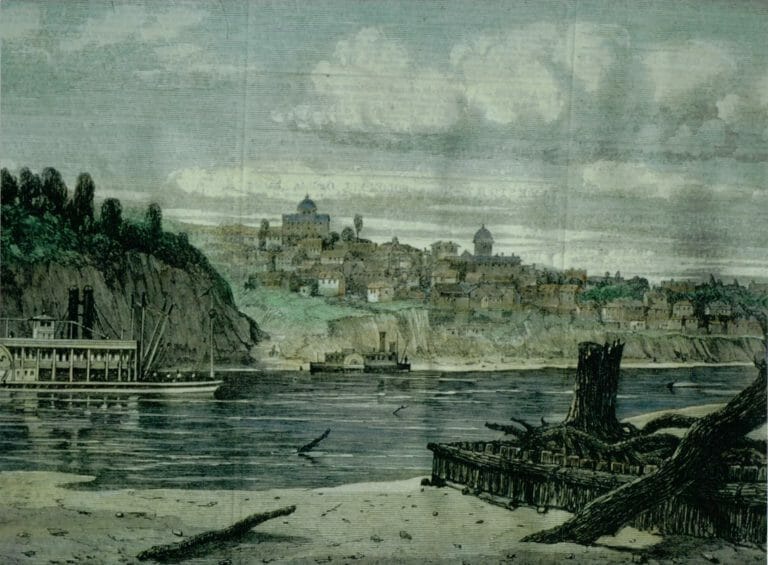
St. Joseph, Missouri
Transcription
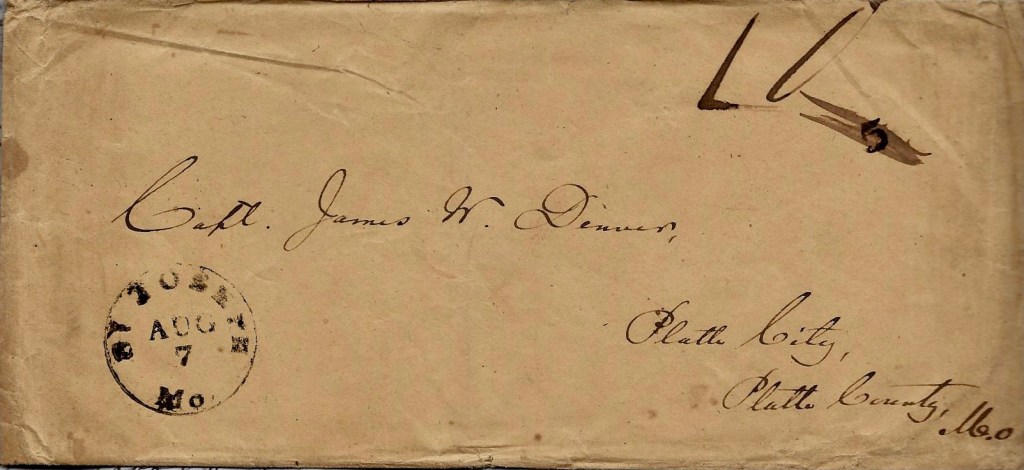
Addressed to Capt. James W. Denver, Platte City, Platte county, MO.
St. Joseph, [Missouri] 3rd August 1849
Dear Capt.,
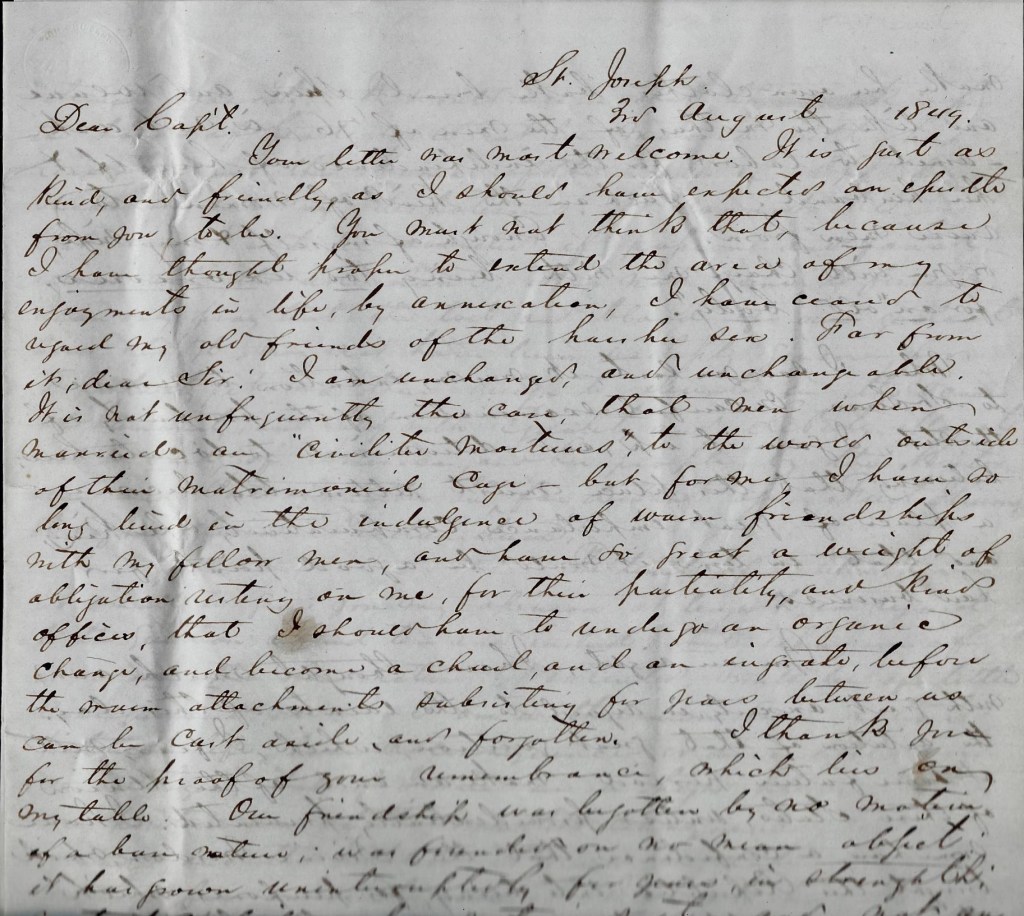
Your letter was most welcome. It is just as kind and friendly as I should have expected an epistle from you to be. You must not think that because I have thought proper to extend the area of my enjoyments in life by annexation I have ceased to regard my old friends of the harsher sex. Far from it, dear Sir! I am unchanged and unchangeable. It is not infrequently the case that men when married are “civilized mortems” to the world outside of their matrimonial cage, but for me, I have so long lived in the indulgence of warm friendships with me fellow men and have so great a weight of obligation resting on me for their partiality and kind offices, that I should have to undergo an organic change and become a ch___, and an ingrate, before the warm attachments subsisting of years between us can be cast aside and forgotten.
I thank you for the proof of your remembrance which lies on my table. Our friendship was begotten by no motive of a base nature; was founded on no mean object. It has grown uninterruptedly for years in strength. Mutual confidence has restrained it, and not any slight circumstance shall ever shake it.
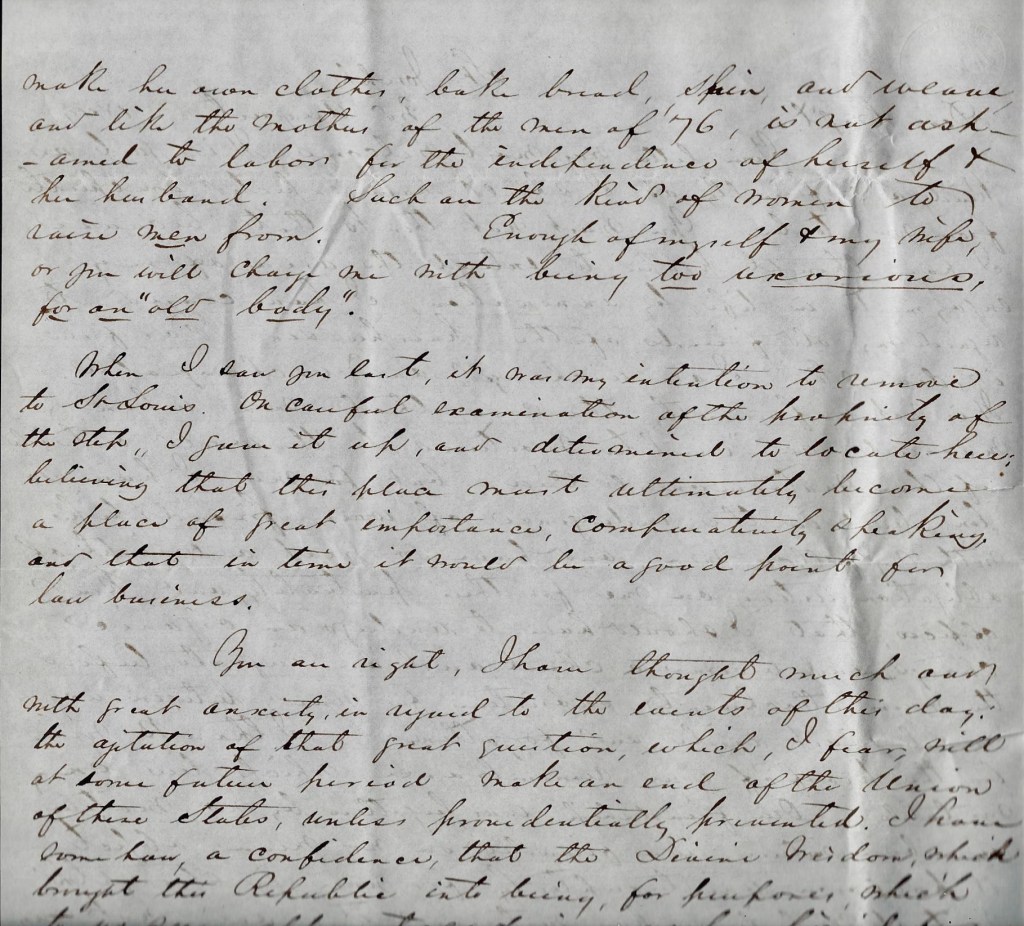
With regard to the change in my domestic affairs, I am wholly persuaded it was the wisest step of my late years. I needed a wife—not a sickly sentiment and ninny without health, sense, or capacity for the duties of wife. I have one, selected by my cool judgement and endorsed or course by my heart’s fullest approval. I have one who can make her own clothes, bake bread, spin and weave, and like the mother of the men of ’76, it not ashamed to labor for the independence of herself & her husband. Such are the kind of women to raise men from. Enough of myself and my wife, or you will charge me with being too uxorious for an “old body.”
When I saw you last, it was my intention to remove to St. Louis. On careful examination of the propriety of the step, I gave it up and determined to locate here believing that this place must ultimately become a place of great importance, comparatively speaking, and that in time it would be a good point for law business.
You are right, I have thought much and with great anxiety in regard to the events of this day: the agitation of that great question, which, I fear will at some future period make an end of the Union of these States, unless providentially prevented. I have somehow a confidence that the Divine Wisdom which brought the Republic into being for purposes which to us seem apparent; as glorious, as beneficial for man—that that Divine Wisdom which has guided us to such greatness, such true greatness, in the happy condition of so many millions of mankind under a mild and efficient system of social union, that it will protect the ship of our State through years of tempest and fury, as dark and threatening as the gloomiest hours of the Revolution, and guide it into an harbor of eternal security. It would seem that the work of the hands of God could not be moored with his consent and this home of the exiles of oppression made the worst of despotisms. It cannot be!
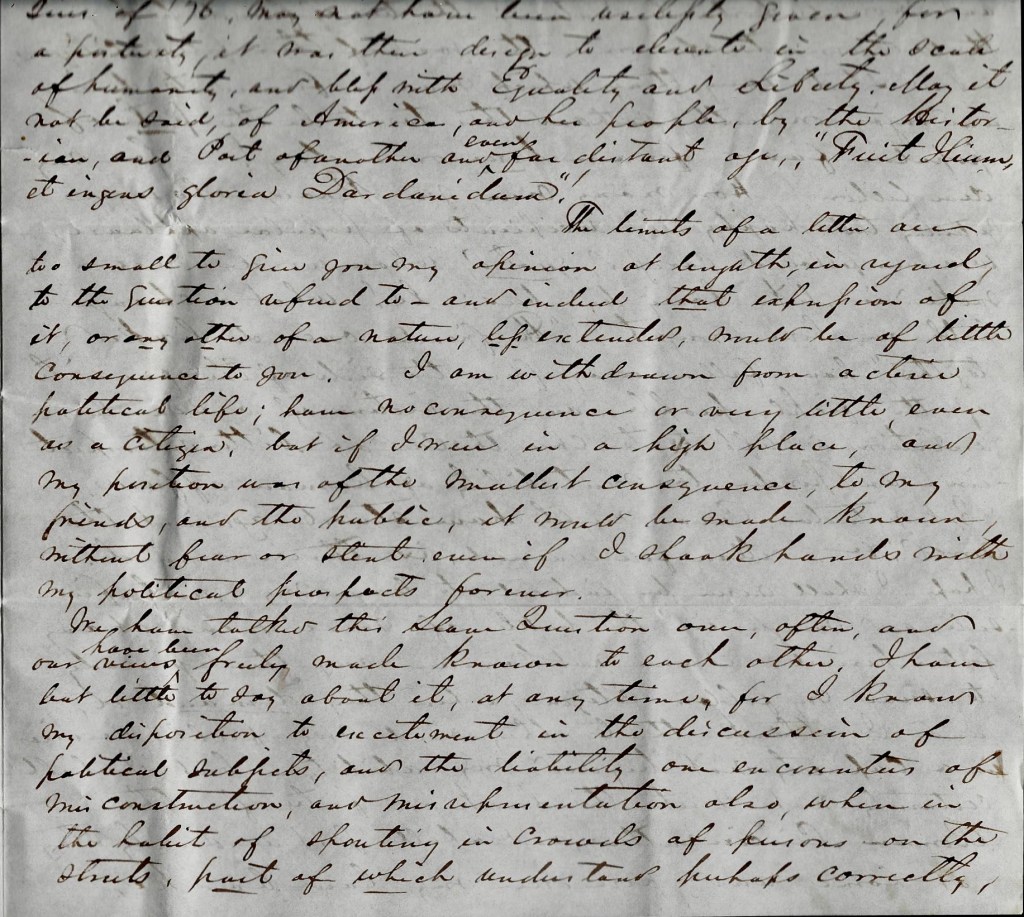
“I have thought much and with great anxiety in regard to the events of this day: the agitation of that great question, which, I fear will at some future period make an end of the Union of these States, unless providentially prevented…I can only pray that the toil and blood of our gallant lives of ’76 may not have been uselessly given for a posterity it was their design to elevate in the scale of humanity and bless with equality and liberty.”
— Bela M. Hughes, 3 August 1849
But how it is to be avoided, if passion and fanaticism rule the ascendant, it is not mine to foresee. I can only pray that the toil and blood of our gallant lives of ’76 may not have been uselessly given for a posterity it was their design to elevate in the scale of humanity and bless with equality and liberty. May it not be said of America and her people by the historian and post of another and even far distant age, “Fuit Hium et ingens gloria Dardainidusa!” [This was the great glory of Dardsnidusa!]
The limits of a letter are too small to give you my opinion at length in regard to the question referred to, and indeed that expression of it, or any other of a nature less extended, would be of little consequence to you. I am withdrawn from a active political life; have no consequence or very little even as a citizen, but if I were in a high place, and my position was of the smallest consequence to my friends and the public, it would be made known without fear or stint even if I shook hands with my political prospects forever.
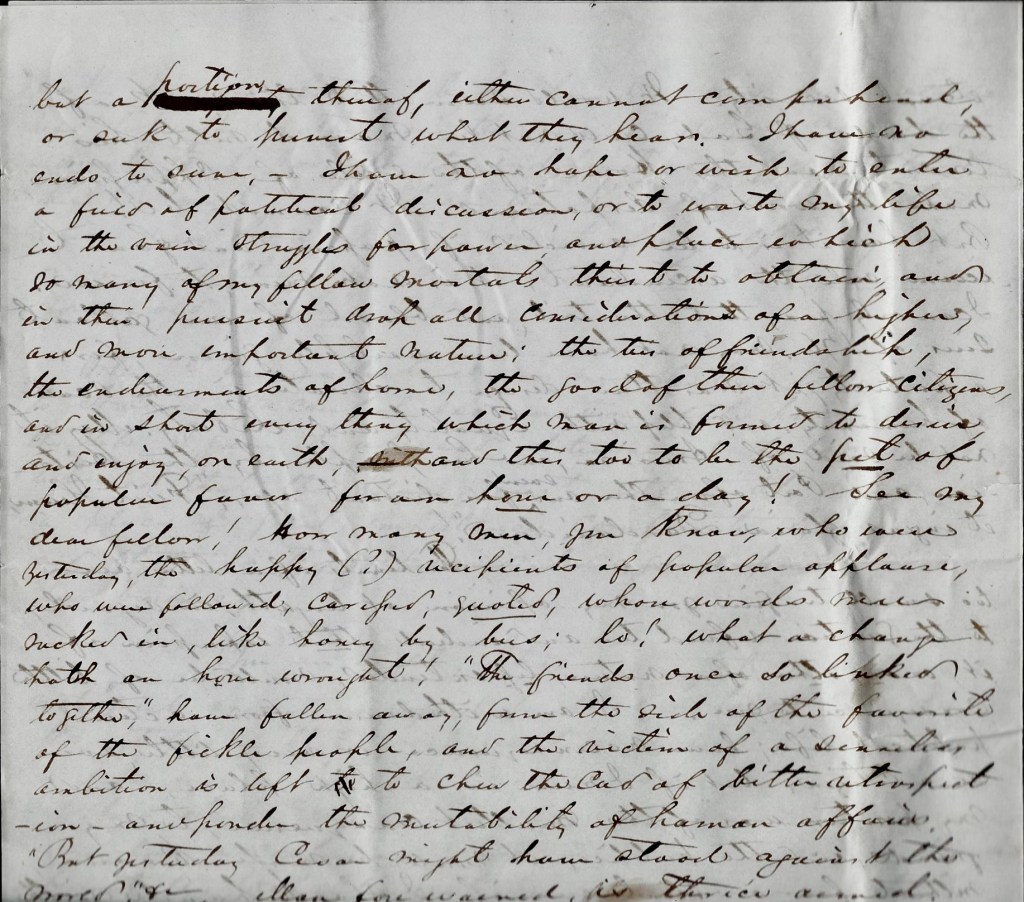
We have talked this Slave Question over often and our views have been freely made known to each other. I have but little to say about it at any time for I know my disposition to excitement in the discussion of political subjects and the liability one encounters of misconstruction and misrepresentation also, when in the habit of shouting in crowds of persons on the streets, part of which understand perhaps correctly but a portion thereof, either cannot comprehend or seek to prevent what they hear. I have no ends to cure. I have no hope or wish to enter a field of political discussion, or to waste my life in the vain struggles for power and place which so many of my fellow mortals thirst to obtain and in the pursuit drop all considerations of a higher and more important nature: the ties of friendship, the endearments of home, the good of their fellow citizens, and in sort, everything which man is formed to desire and enjoy on earth, and this too to be the pet of popular favor for an hour or a day!
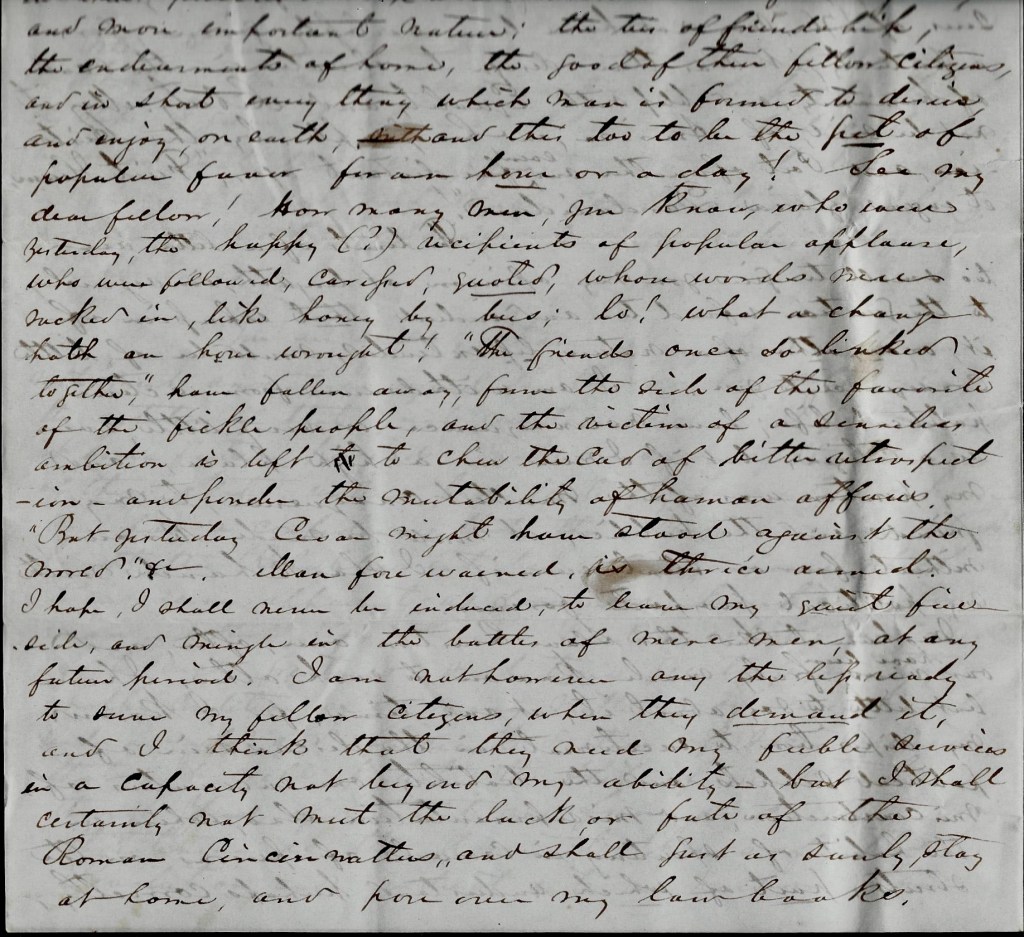
See my dear fellow! How many men you know who were yesterday the happy (?) recipients of popular applause who were followed, caressed, quoted. whose words were sucked in like honey by bus. Lo! what a change hath an hour wrought! “The friends once so linked together,” have fallen away, from the side of the favorite of the fickle people. and the victim of a senseless ambition is left to cheer the cad of bitter retrospection and ponder the mutability of human affairs. “But yesterday Cesar might have stood against the world,” &c. Man fore warned is thrice armed. I hope I shall never be induced to leave my great fireside and mingle in the battles of mere men at any future period. I am not however any the less ready to serve my fellow citizens when they demand it and I think that they need my feeble services in a capacity not beyond my ability, but I shall certainly not meet the luck or fate of this Roman Cincinnatus and shall just as surely stay at home and pour over my law books.
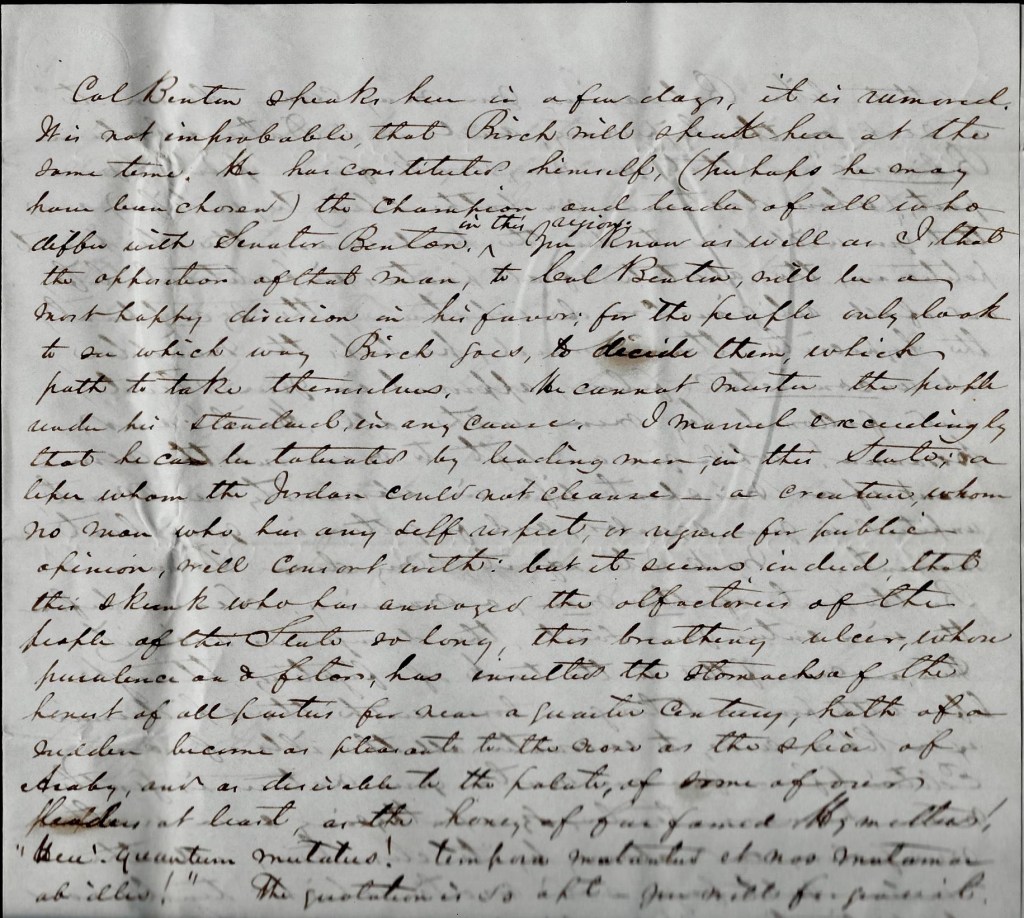
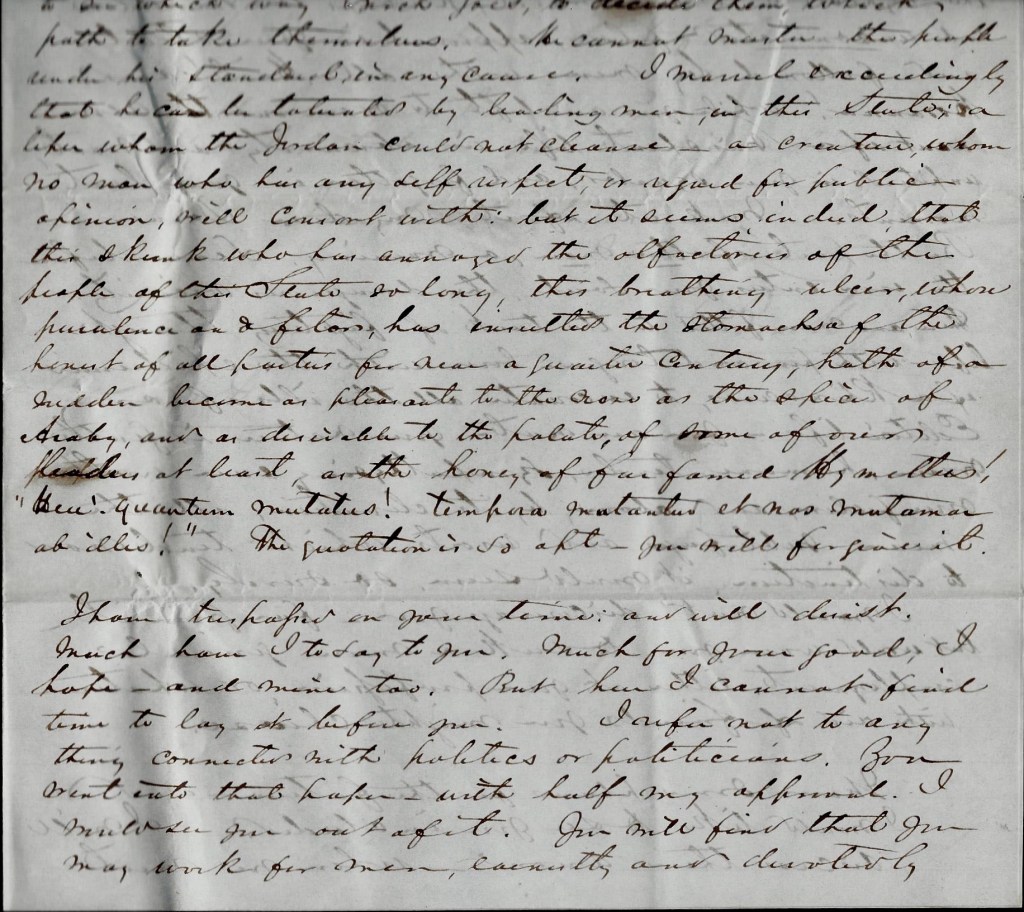
Col. Benton speaks here in a few days, it is rumored. It is not improbable that Birch will speak here at the same time. He has constituted himself (perhaps he may have been chosen) the champion and leader of all who differ with Senator Benton in this region. You know as well as I that the opposition of that man, to Col. Benton, will be a most happy division in his favor; for the people only look to see which way Birch goes to decide them, which path to take themselves. He cannot muster the people under his standard in any cause. I marvel exceedingly that he can be tolerated by leading men in this State; a leper whom the Jordon could not cleanse—a creature whom no man who has any self respect or regard for public opinion will consort with. But it seems indeed that this skunk who has annoyed the olfactories of the people of this State so long, this breathing ulcer whose purulence has insulted the stomachs of the honest of all parties for near a quarter century, hath of a sudden become as pleasant to the nose as the spice of Araby, and as desirable to the palate of our [ ] at least, as the honey of far famed Hymethos…
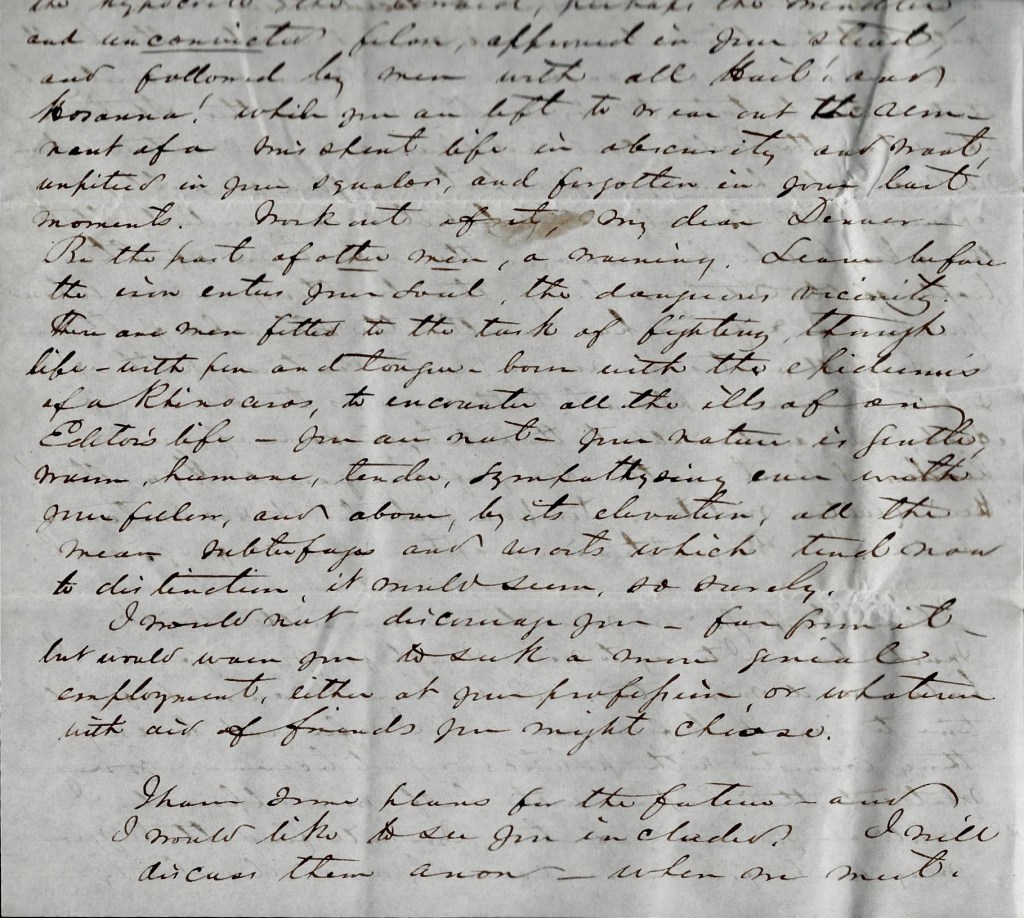
I have trespassed on your time and will desist. Much have I to say to you. Much for your good, I hope, and mine too. But here I cannot find time to lay it before you. I refer not to anything connected with politics or politicians, You went into that paper with half my approval. I would see you out of it….Work out of it, my dear Denver. Be the part of other men, a warning. Leave before the iron enters your soul, the dangerous vicinity. There are men fitted to the task of fighting through life with pen and tongue, born with the epidermis of a rhinoceros, to encounter all the ills of an Editor’s life. You are not. Your nature is gentle, warm, and humane, tender, sympathizing…I would not discourage you—far from it—but would warn you to seek a more genial employment either at your profession or whatever with aid of friends you might choose.
I have some plans for the future and I would like to see you included. I will discuss them anon when we meet. I have resolved to make a competence if my health is spared me, and place myself above the frowns of men or fear of power. If my Creator is kind to me, I shall do it and endeavor to deserve it. The first case of us all should be to make ourselves independent. Think of it.
Send my paper here. Don’t fail. Shall I see you here ever? I shall hope to be in your town in a few weeks. I am, dear Capt., as ever yours sincerely, — B. M. Hughes
This letter was written in 1849 from Independence, Jackson county, Missouri, by Benjamin Franklin Wallace (1817-1877). Benjamin was the son of Thomas Wallace (1777-1858) and Mary J. Percy (1785-1874) who came from Virginia to Missouri in 1833 by way of interim residency in Kentucky. Benjamin married Virginia Johnston Willock (1824-1908) at Independence on 1 August 1847 and their first child, mentioned in this letter, was Mary Albina Wallace (1848-1854) who was born on 2 May 1848. Their second child, David Willock Wallace was born on 15 June 1860. [I should mention here that when David W. Wallace grew up, he married Madge Gates in 1883 and their first child was Elizabeth Virginia (“Bess”) Wallace—the future wife of Harry S. Truman—Bess Truman!]
In the 1850 Slave Schedules, Benjamin was enumerated among the slaveholders. He owned three slaves—a female aged 22 and two young children, ages 5 and 2. In the 1860 US Census, Benjamin was identified as a “Bank Clerk” in Independence. In 1869, Benjamin served as the Mayor of Independence. By 1870, he was employed as a dry goods merchant.
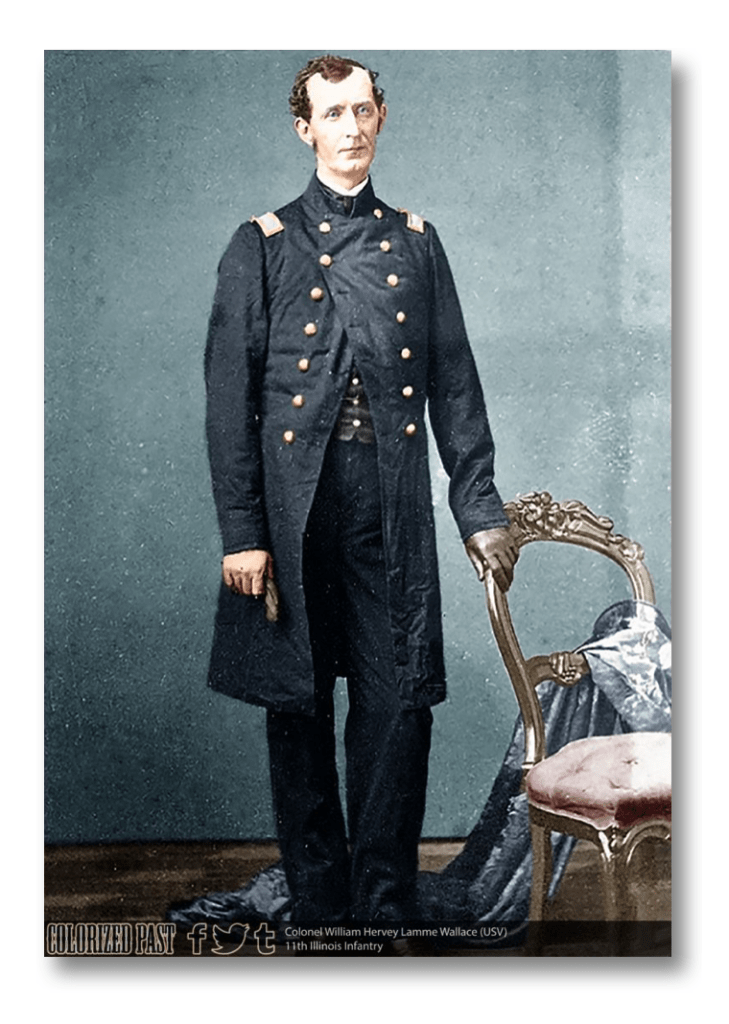
Col. William H. L. Wallace, 11th Illinois Infantry
Benjamin wrote the letter to William Hervey Lamme Wallace (1821-1862) of Ottawa, LaSalle county, Illinois. William’s obituary on Find-A-Grave informs us that prior to the Civil War, he served as the District Attorney for LaSalle County. When he entered the service, in 1861, he was commissioned the Colonel of the 11th Illinois Infantry. For his gallantry at the February 1862 Battle of Fort Donelson, he was promoted to Brigadier General and placed in command of the Army of Tennessee’s 2nd Division. Though he was a new division commander, yet he managed to withstand six hours of assaults by the Confederates, directly next to the famous Hornet’s Nest, or Sunken Road. When his division was finally surrounded, he ordered a withdrawal and many escaped, but he was wounded in the head by a shell fragment and only later found barely alive on the battlefield by his troops. He died three days later in his wife’s arms in a hospital near Savannah, Tennessee. [See “The Death of General W. H. L. Wallace at the Battle of Shiloh,” Iron Brigader.]
William’s younger brother, Martin Reuben Merritt Wallace (1829-1902) was also a Brigadier General during the Civil War, having begun as Colonel of the 4th Illinois Cavalry.
Trails leaving Independence, Missouri in 1849, Charles Goslin
Transcription
City of Independence, Missouri August 9th 1849
W. H. L. Wallace Dear Cousin,
Altho I may have written last, still I do not intend you shall forget me. I trouble you with another letter by way of reminding you that your unknown cousin has not forgotten you.
I have nothing of any great interest to write about, but feel quite grateful that I am alive and still able to correspond with my old friends & relatives whilst death has been abroad & taken many—very many—of my acquaintances. Still myself & mine still live altho death has spread quite a gloom over our beautiful city. Myself & family have remained well. None of your relatives here have been sick with the scourge (the cholera). Altho our next door neighbors have been taken of [it] in a few hours, we have been preserved. Our beautiful city has suffered to a greater degree than even the ill-fated St. Louis according to the amount of population. At present, we have but little I have heard of but one case in the last four days which occurred today and proved fatal in about eight hours (t’was that of a child).
We have had one continual excitement the present year. First the California emigrants & secondly the cholera. These were quite different. The first was pleasant & the last terrifying. A vast number of gold seekers have passed through our place during the last spring & present summer & among the number who have passed recently was some of our old friends from Illinois—Thomas Bassney & others. Bassney told me he knew you well & said you was to have been one of their party 1 but from some cause or other, you had not come on. I told him I suspected Old Zack [Zachery Taylor] had given you an office for I see he appointed W. H. Wallace to be “Register of Lands from Illinois” and suspected it was you (if you have gone to Iway [Iowa], you may never get this). I have but one fault to find to Old Zack’s Administration—I.E., he don’t turn out Locofoco’s fast enough [from such appointed offices] & fill the same with decent Whigs.
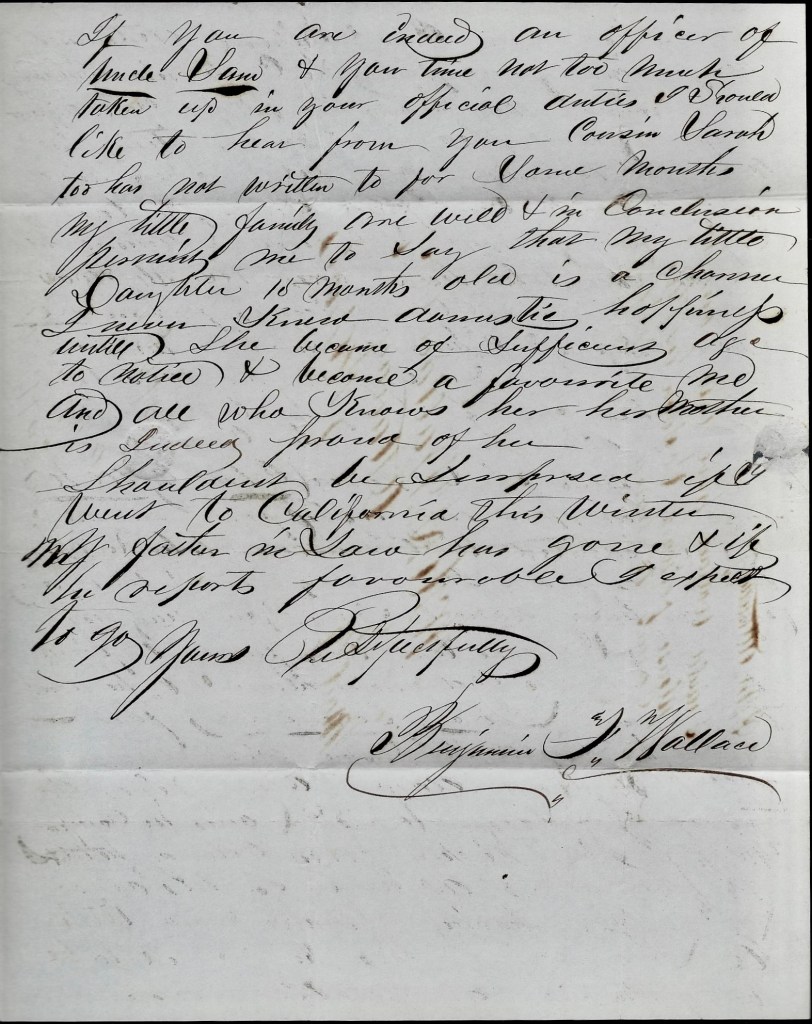
I went down our river the first of June to St. Louis in company with Mr. Fisher from Ottoway [Ottawa]. He told me you was as one of his own sons, you having studied law with a son of his [see George Smith Fisher (1823-1895)]. He seemed to be very much of a gentleman. If you are indeed an officer of Uncle Sam & your time not too much taken up in your official duties, I should like to hear from you. Cousin Sarah too has not written to [us] for several months. My little family are well & in conclusion, permit me to say that my little daughter 15 months old is a charmer. I never knew domestic happiness until she became of sufficient age to notice & become a favorite [to] me and all who knows her. Her mother is indeed proud of her.
Shouldn’t be surprised if I went to California this winter. My father-in-law has gone & if he reports favorable, I expect to go. Yours respectfully, — Benjamin F. Wallace
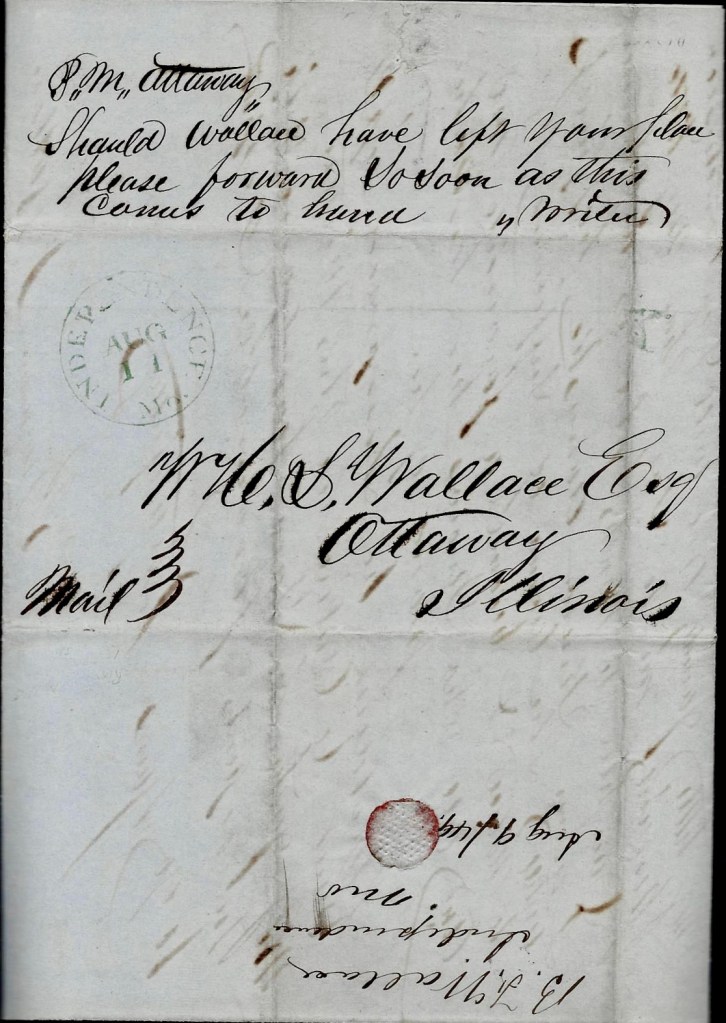
Postmaster Ottoway: Should Wallace have left your place, please forward so soon as this comes to hand.
1 This “California Party” was probably the “Dayton Party” formed at Dayton (near Ottawa) under the command of Captain Jesse Greene. Their rendezvous was to be at St. Joseph on the Missouri in April 1849. One of the party, a store clerk in Ottawa named Alonzo Delano (1806-1874) and his record of the journey can be found at “Life on the plains and among the diggings.”See also “Dayton and the Greens.”
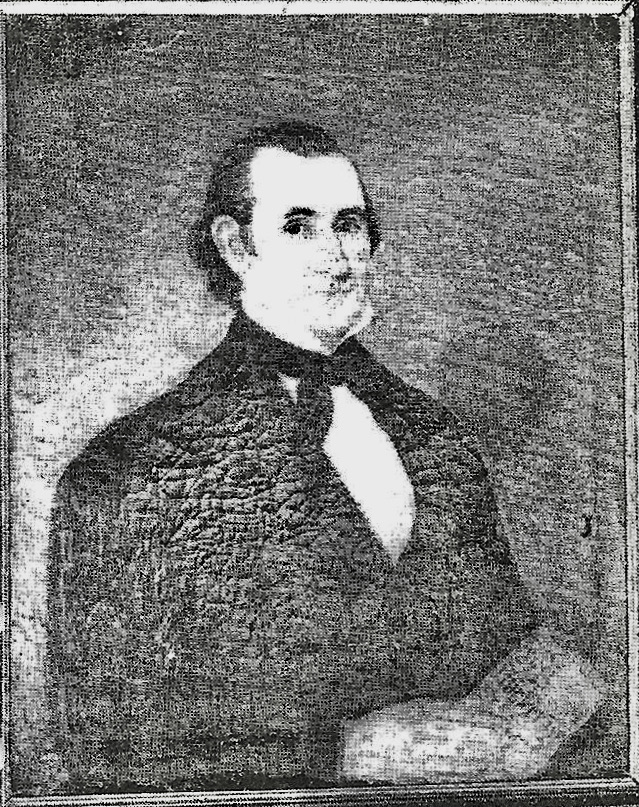
Portrait of Howard Everett from a 1977 Liberty, MO. Newspaper
This Runaway Slave Notice was penned by 64 year-old Howard W. Everett (1793-1877), a native of Halifax county, Virginia, moved to Kentucky when he was young and then relocated again to Clay county, Missouri, in 1818 with his wife of three years, Sarah Ann Waltrip. In addition to being a farmer, Howard was ordained a Cambellite Preacher and started numerous churches in Northern Missouri.
It does not appear that Howard was always a slave holder. In the 1830 US Census, he held no slaves. In the 1860 US Census, he held only two middle-aged slaves. Howard wrote this notice from Richland which is now Missouri City—a consolidation of three villages, St. Bernard, Richfield, and Atchison. From 1850 to 1861, Richfield was probably the largest hemp market above Lexington.
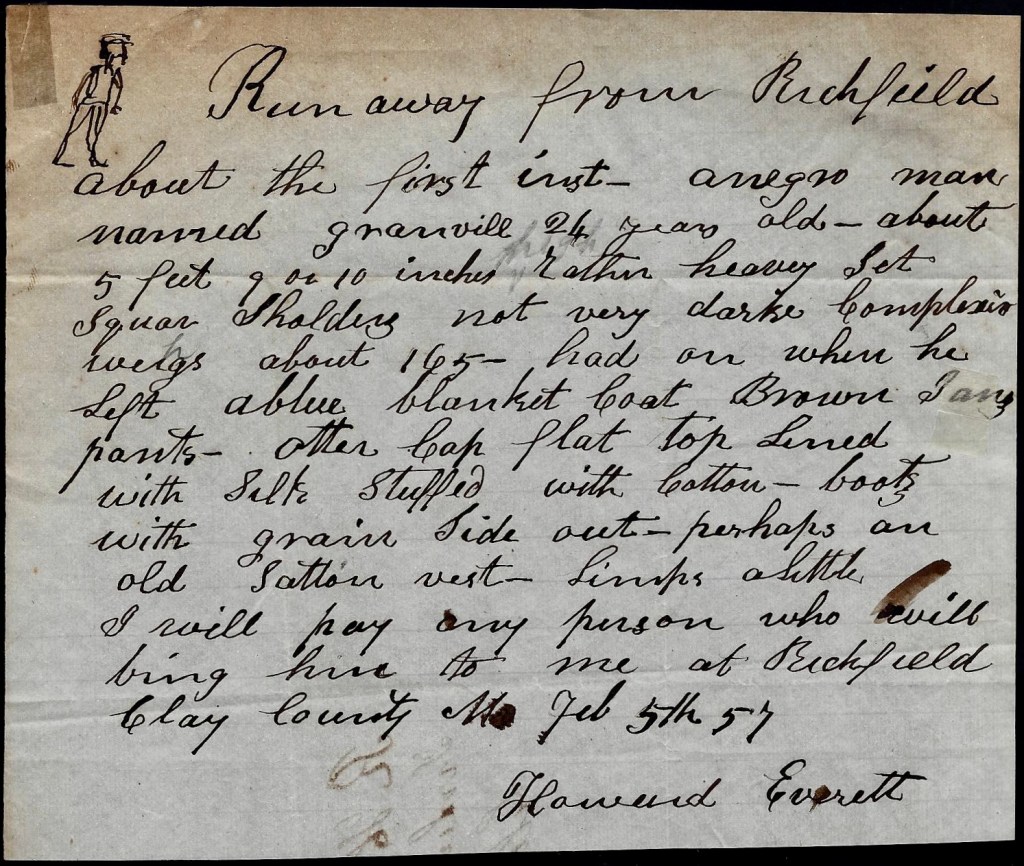
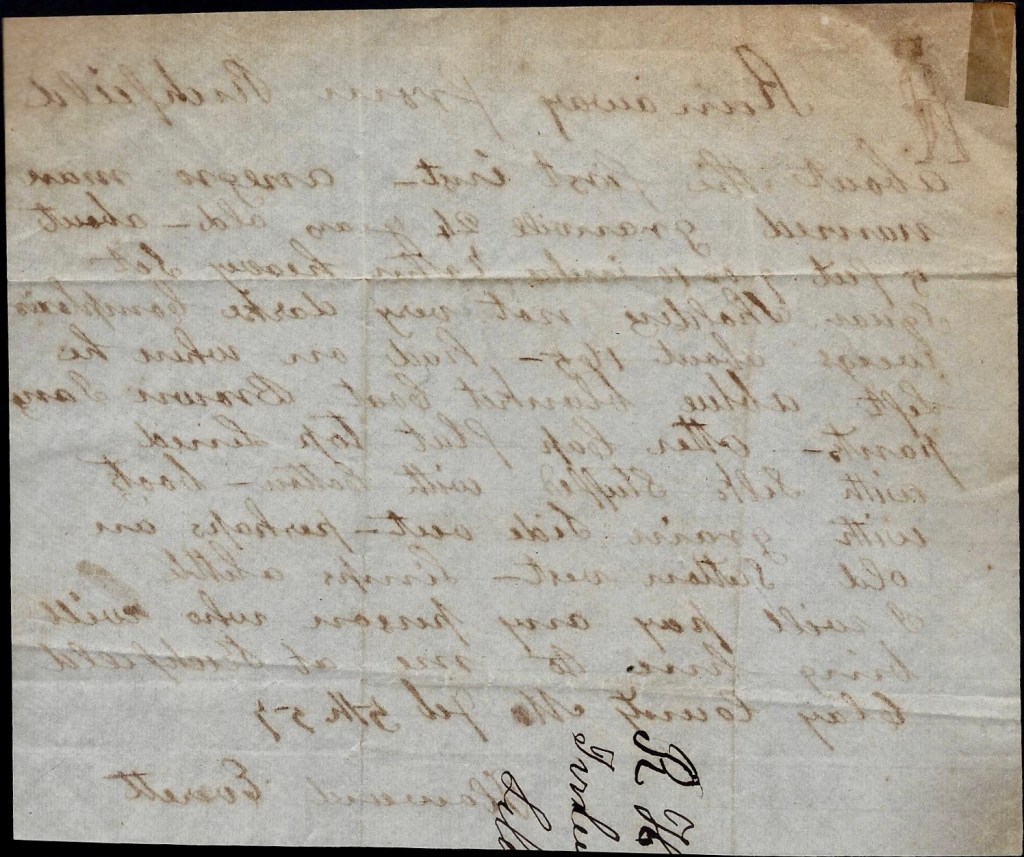
Most likely this notice was a draft handed to the publisher of a local newspaper.
Transcription
Runaway from Richfield
About the first inst., a negro man named Granville, 24 years old, about 5 feet 9 or 10 inches high, rather heavy set, square shoulders, not very dark complexion, weighs about 165, had on when he left a blue blanket coat, brown [ ] pants, otter cap flat top lined with silk stuffed with cotton, boots with grain side out, perhaps an old cotton vest. Limps a little. I will pay any person who will bring him to me at Richfield, Clay county, Mo. February 5th 1857
This letter was written by Calvin Waldo Marsh (1825-1873), the son of Henry Marsh (1797-1852) and Sarah Whitney (1796-1883) of Berkshire county, Massachusetts. Calvin’s father, Henry, died of cholera at LaSalle, Illinois in 1852 when he was 55 years old. By that time, Calvin had already graduated from Williams College (1844) and was working as a commission merchant in St. Louis, Missouri.
Calvin write the letter to his sister Clarissa (“Clara”) Dwight Marsh (1834-1899) who was attending the Cooper Female Seminary in Dayton, Ohio, at the time of this 1850 letter.
One large paragraph of the letter is devoted to a discussion of journals kept by Calvin’s older brother, Rev. Dwight Whitney Marsh (1823-1896), an 1842 graduate of Williams College and the Andover Theological Seminary who traveled as a missionary to Turkey in 1849. As mentioned is young “Charlie,” (Charles Francis Marsh) the thirteen year-old brother of Calvin’s.
Transcription
Addressed to Miss Clara D. Marsh, Cooper Female Seminary, Dayton, Ohio
Saint Louis, [Missouri] June 1, 1850
My Dear Sister,
Although I am not indebted to you by way of correspondence, still as I have leisure this morning, I thought t’would be pleasant to spend it in holding a little chat with you. I presume ‘ere this you are having there as here delightful warm weather. For four or five days it has been charming here & except last Monday, none too warm for comfort.
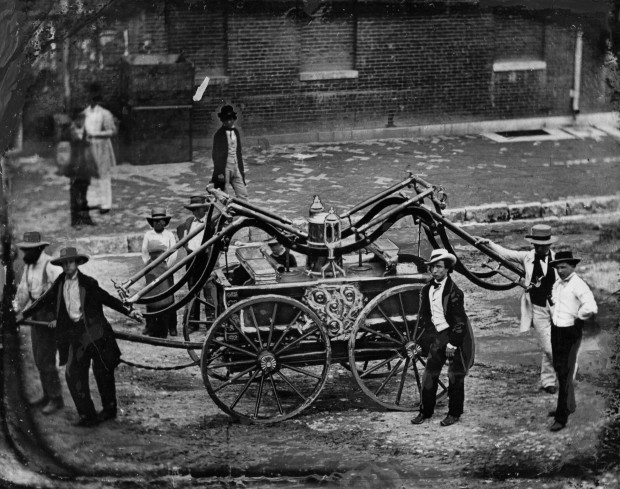
An early Saint Louis fire pump apparatus
On Monday the firemen had their annual “Parade” and of course Charlie was half crazy to see it all. T’was a beautiful sight and the bright colored uniforms of the men and the highly polished engines gaily trimmed with flowers and the streets in front of the different engine houses filled with flags suspended by ropes from one side to the other, the beautiful horses drawing the “machines” & the inspiriting music of six or eight different bands all tended to excite & please the multitude of citizens of all ages which thronged the sidewalks, church steps, balconies & windows of each street they passed. 1
The Butchers, each mounted & in a beautiful white shirt with blue scarfs paraded with the firemen. They were quite half an hour passing where I stood. They marched from eleven till three or four, &c., then dined at different hotels. T’was the warmest day of the season—the thermometer standing at 90 degrees in the shade.
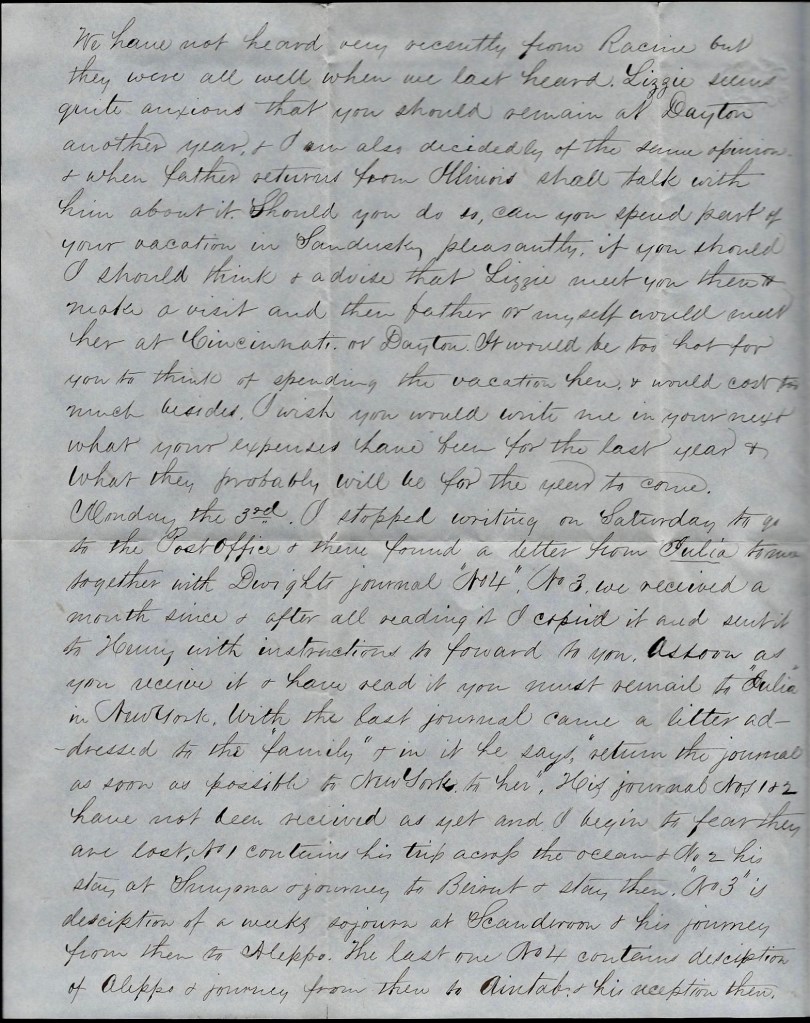
I have had one or two letters from Sandusky from Jim Peck and John Massey. Kate spends the summer in Rochester & also her father & mother. We have not heard very recently from Racine but they were all well when we last heard. Lizzie seems quite anxious that you should remain at Dayton another year & I am also decidedly of the same opinion & when father returns from Illinois, shall talk with him about it. Should you do so, can you spend part of your vacation in Sandusky, pleasantly. If you should, I should think & advise that Lizzie meet you there & make a visit and then father or myself would meet here at Cincinnati or Dayton. It would be too hot for you to think of spending the vacation here & would cost too much besides.
I wish you would write me in your next what your expenses have been for the last year & what they probably will be for the year to come.
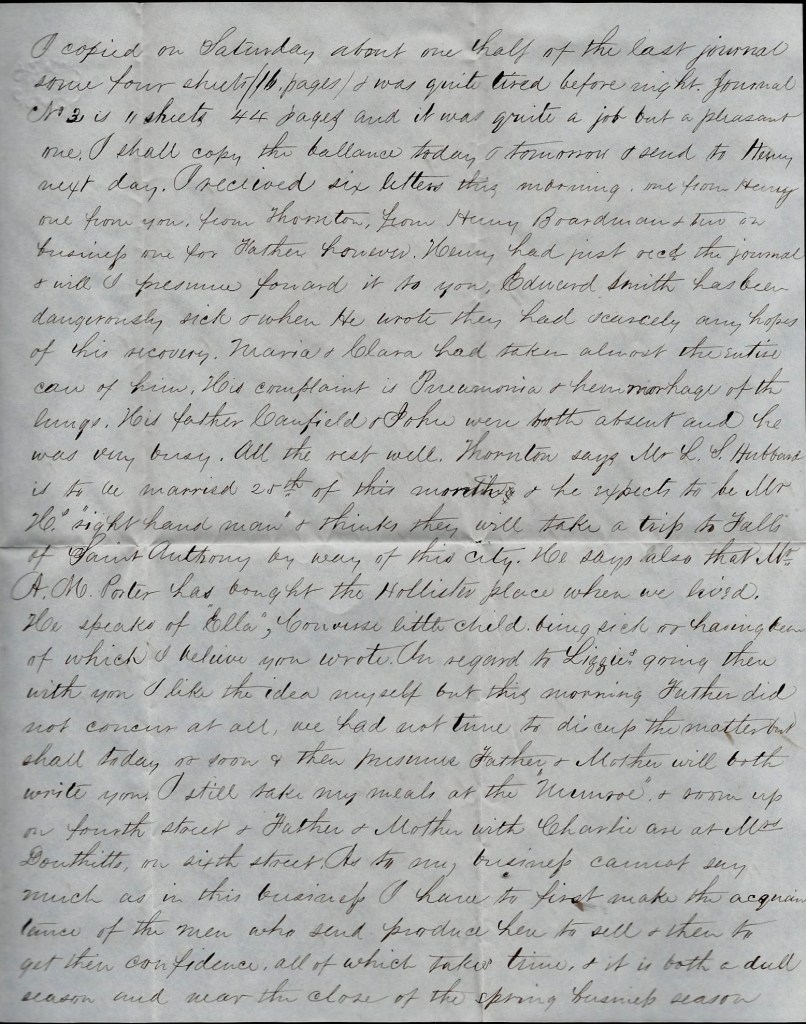
Monday, the 3rd. I stopped writing on Saturday to go to the post office & there found a letter from Julia to me together with Dwight’s journal “No. 4.” No. 3 we received a month since & after all reading it, I copied it and sent it to Henry with instructions to forward to you. As soon as you receive it & have read it, you must remail to “Julia” in New York. With the last journal came a letter addressed to the “family” & in it he says, “return the journal as soon as possible to New York to her.” His journal Nos. 1 & 2 have not been received as yet and I begin to fear they are lost. No. 1 contains his trip across the ocean & No. 2 his stay at Smyrna & journey to Beirut & stay there. “No. 3” is description of a week’s sojourn at Scanderoon & his journey from there to Aleppo. The last one, No. 4. contains description of Aleppo & journey from there to Aintab. & his reception there. I copied on Saturday about one half of the last journal, some four sheets (16 pages) and was quite tired before night. Journal No. 3 is 11 sheets—44 days—and it was quite a job but a pleasant one. I shall copy the balance today & tomorrow and send to Henry next day.
I received six letters this morning, one from Henry, one from you, from Thornton, from Henry Boardman, and two on business—one for Father however. Henry has just received the journal and will I presume forward it to you. Edward Smith has been dangerously sick & when he wrote, they had scarcely any hopes of his recovery. Maria & Clara had taken almost the entire care of him. His complaint is pneumonia & hemorrhage of the lungs. His father Canfield & John were both absent and he was very busy. All the rest well.
Thornton says Mr. L. S. Hubbard is to be married 25th of this month & he expects to be Mr. Hubbard’s right hand man & thinks they will take a trip to Falls of Saint Anthony by way of this city. He says also that Mr. A. M. Porter has bought the Hollister place where we lived. He speaks of “Ella,” Converse little child being sick or having been of which I believe you wrote. In regard to “Lizzie’s” going there with you, I like the idea myself but this morning Father did not concur at all. We had not time to discuss the matter but shall today or soon & then pressure Father & Mother will both write you. I still take my meals at the “Munroe” and room up on Fourth Street & Father & Mother with Charlie are at Mrs. Douthitt’s on Sixth Street. As to my business, cannot say much as in this business I have to first make the acquaintance of the men who send produce here to sell and then to get their confidence, all of which takes time, & it is both a dull season and near the close of the spring business season.
I see cousin Robert every day or two although I have not seen a great deal of him as he is pretty closely confined by his banking duties. Mother has written to Aunt Clara once or twice & I think I will soon. I am pretty confident I sent the paper you speak of & cannot now get another. I send you now the Republican with two quite pretty stories & a very interesting letter from France by their correspondent in Paris who is a lady & the suggestions in regard to dress I think exceedingly good. I like Mrs. Peters much. Of Belle I cannot judge but she appears well for what I have seen of her.
Charlie is happy as a cricket & is perfectly well. He goes to Mr. Wyman’s school & finds his way about the city without much trouble. I sent him from my office up home alone the other day, seven blocks off.
The painting of Adam & Eve by [Claude Marie] Dubufes has been on exhibition here for four weeks & leaves today for Louisville. Strawberries are getting quite plenty & will soon be cheap and abundant.
I went to ride with Mother a week ago down towards “Vide Pochí” pronounced Veed Poshe & called first at a Mr. Williams whose acquaintance I had made & who very politely took me out to tea with him one evening sometime ago & although his wife (a lady of twenty-two or three & very agreeable( was not at hot house, her house keeper showed us over the garden and gave us flowers and took us up on the back piazza where there is a most beautiful view down the river twenty-five miles & the river appearing to come out of the ground at the foot of the long descent from the house.
We called at Mr. Thomas Allen’s as came along back and there had a pleasant chat with Mrs. A., a romp with “Lillie” & “Russell,” and were refreshed with some nice cake. Lilla showed me her chickens & ducks & young Guinea hens, her flower bed in the garden, & found me one or two ripe strawberries, then into the house & up in the library to see her young canaries two weeks old, five of them in one next—little beauties. Russell showed “his” birds, four little young “catbirds” in a nest built in a evergreen bush not so high as my head near the gate & about ten rods from the house. Is Miss Claflin still your roommate & how does the Misses Osborn? Remember me to them should they enquire. With much love from Father & Mother, & from your own brother, — C. W. Marsh
Hubbard marries a Miss Livingston of Gainsville who spent part of last winter in Sandusky. I knew her very intelligent and quite handsome. A good match.
Father returned from Illinois Saturday night & will write you before he leaves again, I think. Write when you have leisure. I shall not be able to write you as often as I do after the [ ] commences. — Waldo
1 The city of Saint Louis had 12 volunteer fire companies by the 1850s.
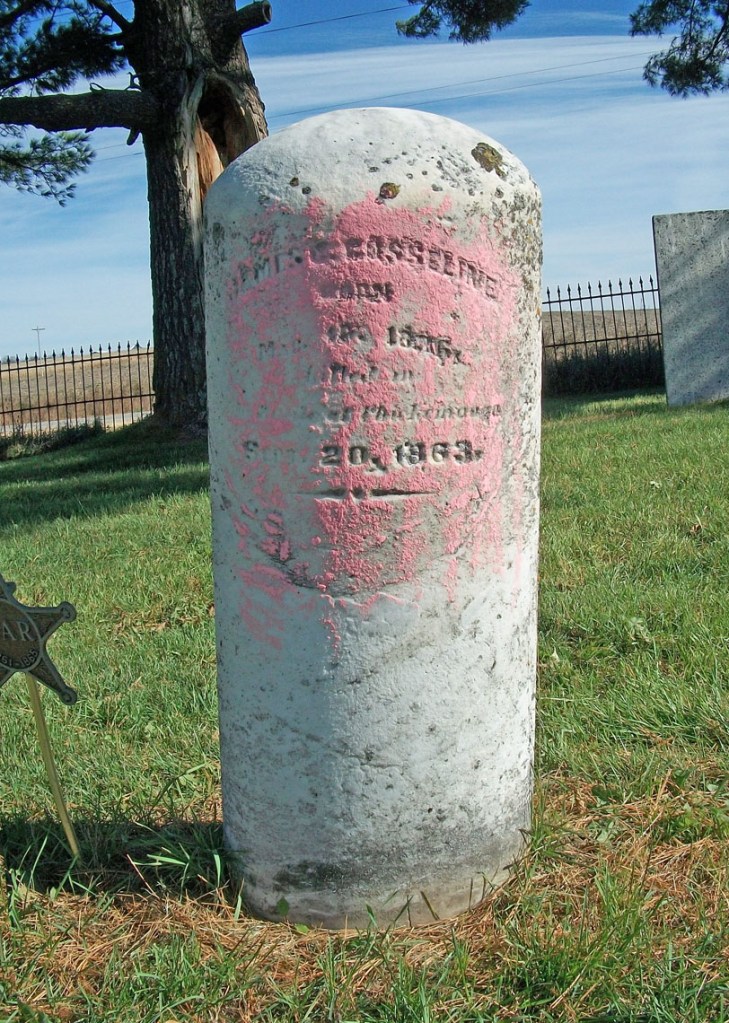
James’ headstone in Scotch Grove Cemetery, Jones county, Iowa
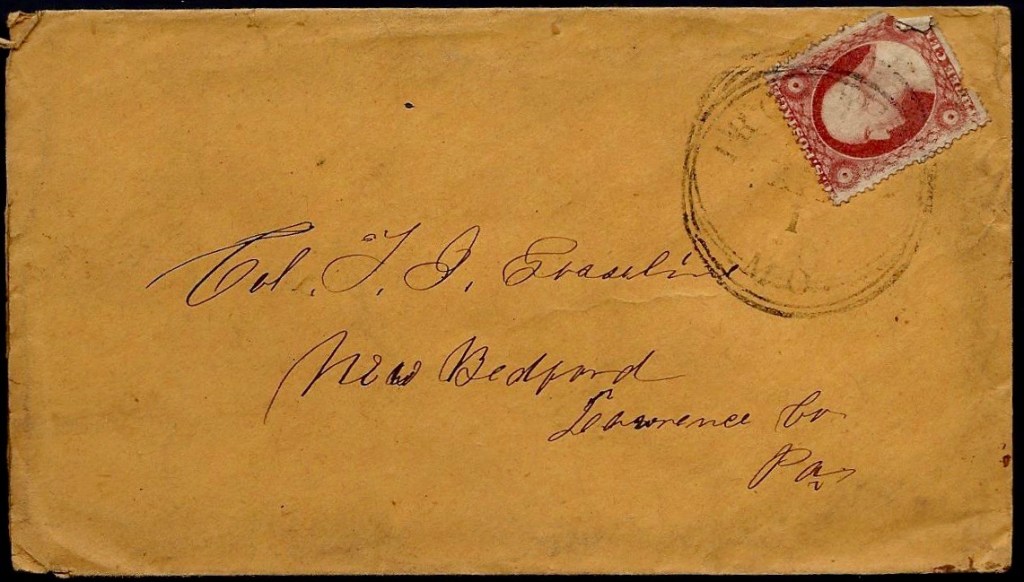
This letter was written by James C. Gosseline (1836-1863), the son of millwright Thurston J. Gosseline (1796-1878) and Mary (“Polly”) A. Cole (1807-1893) of New Bedford, Lawrence county, Pennsylvania. James mentions both of his younger sisters in the letter—Florence (“Flory”), born 1852; and May, born 1855.
Two months after he wrote the following letter, James enlisted at Caseyville, Illinois, as a private in Co. E, 22nd Illinois Infantry. At the time of his enlistment, he was described as standing 5′ 11″ tall, with light colored hair and blue eyes. He gave Pocahontas, Illinois, as his residence and his occupation as “painter.” Sadly, James did not survive the war. He was killed in action at the Battle of Chickamauga in Georgia on 19 September 1863. I don’t know if James’ body was sent home or not but there is a marker for him in the Scotch Grove Cemetery in Jones county, Iowa, next to his parents’ graves. Most likely he is not actually buried there as they did not move to Iowa until the 1870s.
This letter is remarkable for capturing the anxiety and chaos within the State of Missouri in the weeks leading up to the firing on Fort Sumter. In his letter, James informs his father, “all I can say now is that my life, and the life of every Republican, is in danger every moment. They (the disunionists) threaten to drive us out of the country….I have not went to bed a night for a long time without a Colt’s revolver under my head and in the daytime I am armed to the teeth and so are all of our party.”
[Note: This letter is from the personal collection of Richard Weiner and is published on Spared & Shared by express consent.]
Transcription
Addressed to Col. T. J. Gosseline, New Bedford, Lawrence county, Pennsylvania
Ironton, Missouri April 14th 1861
Dear Father,
I have waited a long time to get something of importance to write but about all I can say now is that my life, and the life of every Republican, is in danger every moment. They (the disunionists) threaten to drive us out of the country. But rest assured that if any such diabolical attempt should be made, I will stand alongside of those that oppose them, ready to fight and die in the cause of. freedom, and I will not give one inch though I die by it.
I have not went to bed a night for a long time without a Colt’s revolver under my head and in the daytime I am armed to the teeth and so are all of our party. This evening I got word that at Pilot Knob 1 mile above here where there are a great many Republicans, that they were all engaged making cartridges and running balls ready for firm resistance.
The news of the bombardment of Fort Sumter has just reached here and caused some excitement. We shall have fun here soon—especially if they try to drive any Republicans out. If they do, it will cost a great deal of blood for we intend to fight to the last.
You need not write to me here for I do not know how how long I shall stay in this state for I want to go to some free state where I can join the Federal army. I am bound to fight for my country if the war continues. Give my love to all friends, — J. C. Gosseline
To Flory and May—dear sisters. I should be glad to hear from you but I cannot now. But when I leave here, you can write to me. I should be glad to see you dear girls. But now I have little hope that I ever shall—although I may see you soon. Everything is so uncertain with me now but you will hear from me again if nothing happens soon. So farewell. — J. C. G.
Dear mother—it is late in the night and I am very much fatigued and sleepy so please excuse my brief scratch. All of importance is addressed to father. All I can say is that I have done very little work for six months and am consequently pretty hard up. But it is a long road that has no turn. When I get into the army, I hope to make some money. Still hoping and praying for your comfort and happiness, I bid you farewell. Affectionately, — James
























 Spared & Shared 23