Category Archives: Antebellum Virginia

1842: Edward H. Johnston to Henry A. Clark

How Edward might have looked (Graham Pilecki Collection)

The following letter was composed by Edward H. Johnston, an alumnus of Hamilton College from the class of 1837. Beyond this information, little else can be verified regarding his subsequent endeavors, although it can be reasonably inferred that he pursued a career in education in Virginia, a region characterized by a scarcity of public schools that necessitated the employment of private tutors. Such tutors were primarily recruited from the North and often resided with affluent families aiming to equip their sons for higher education. Furthermore, it is likely that he hailed from the vicinity of Sidney, New York, where his mother was still residing as of 1842.

Johnston wrote the letter to his good friend Henry A. Clark (1818-1906), the son of Henry and Catherine (Brown) Clark of Sidney, Delaware county, New York. Henry attended Cazenovia Seminary in the 1830s and graduated from Hamilton College (Clinton, N. Y.) in 1838. He studied law in Buffalo and was admitted to the bar in 1841. By 1842, when this letter was written, he was living in Bainbridge, New York, working as a lawyer. He was a member of the New York State Senate in 1862-63. In 1865 he married Ellen A. Curtiss.

Edward’s letter succinctly addresses the opportunities for teaching in Virginia and recounts his recent visits to Washington City and New York City, where he reunited with former acquaintances. Among them was Horace Dresser, a graduate of Union College and one of the pioneering lawyers who offered his expertise in defending and aiding fugitive slaves. The residents of the Susquehanna River valley, where Edward was raised, alongside the students at his college, exhibited strong anti-slavery sentiments; however, it appears that his time spent in Virginia, witnessing the realities of slavery firsthand, has tempered Edward’s perspectives on the institution, which he articulated in his correspondence.

Hamilton College in the 1830s.

Transcription

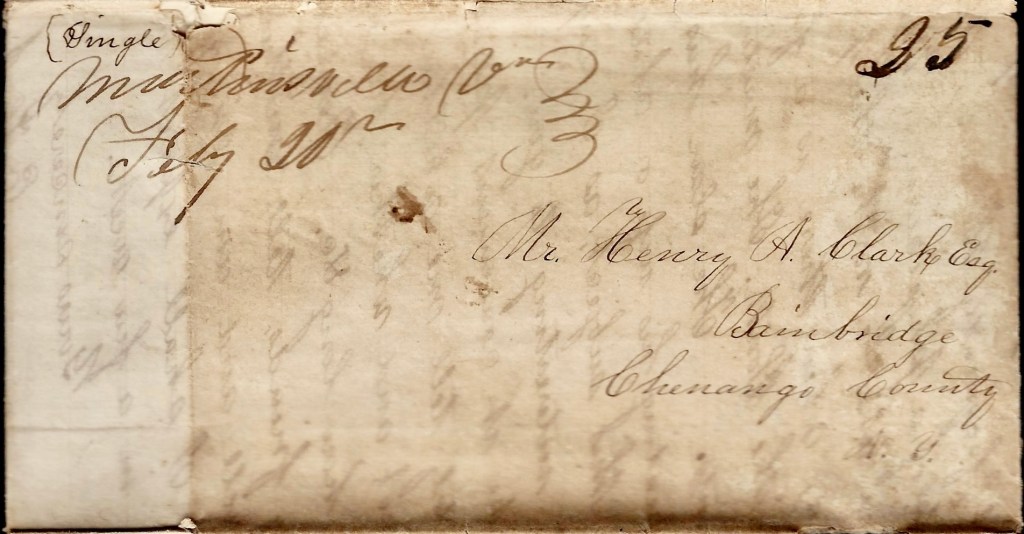
Addressed to Mr. Henry A. Clark, Esq., Bainbridge, Chenango county, New York

Martinsville [Henry County, Virginia]
February 20th 1842

Dear friend,

I promised to write to Benjamin but I think that I shall not comply with the promise since it is somewhat doubtful whether my letter would find him at Sidney or not, if he is yet at Sidney. I can through you inform him respecting those things concerning which he wished to obtain information.

Respecting schools I wish that you would tell Benjamin that I should not think that it was advisable for him to come as far South as this unless he designs to teach longer than one year. If he wishes to teach two or three years, he would run no risk for I am very sure that he would in a very short time succeed in obtaining a school. A teacher is now wanted at Halifax Court House sixty-nine miles from this place. Salary $500 and only 13 students.

I had a very quick trip from Sidney down. I left Sidney Plains on the evening of the 1st of January and arrived at Martinsville on the evening of the 16th January. I spent one day at Kingston, Ulster County and one day at Philadelphia, thus I was only seven days coming a distance of 814 miles.

John B. Fry is at Washington City getting a salary of $1000 per year for officiating as a clerk in the general Land Office. I have received a letter from John since I returned and have answered him. John is doing well—remarkable well considering the advantages which he has enjoyed.

There has been much sickness in Martinsville since I returned. Two-thirds of the citizens of the place have been attacked with a fever which is peculiar to this country at this season of the year. There have been but few deaths yet. A young lady of the same family where I board has recently died. Both black and white are sick and the well being less in number than the sick are scarcely able to take care of them. Fine times for the doctors. They are making their fifty dollars per day.

I have sent two of my students to college—one to Washington College of this state, and the other to the University of North Carolina at Chapel Hill. The one whom I have sent to Chapel Hill possesses superior talents. He intends to study law. Remember me to your landlord’s sister and to Miss Davidson, Miss Patience Newell and Miss Adaline Bigelow. I have understood that I said something when at Esqr. Sayre’s which displeased Miss Adaline. Tell her that I now ask her pardon. My respect to Esqr. Sayre and his wife and children—especially to Horace. Remember me to Joseph Bush, Junior and to Mr. Rockwell, his tutor.

The weather has been very pleasant during the month past, during the most of the time it has been uncommonly warm, which, I presume has been the cause of the sickness which is now prevailing.

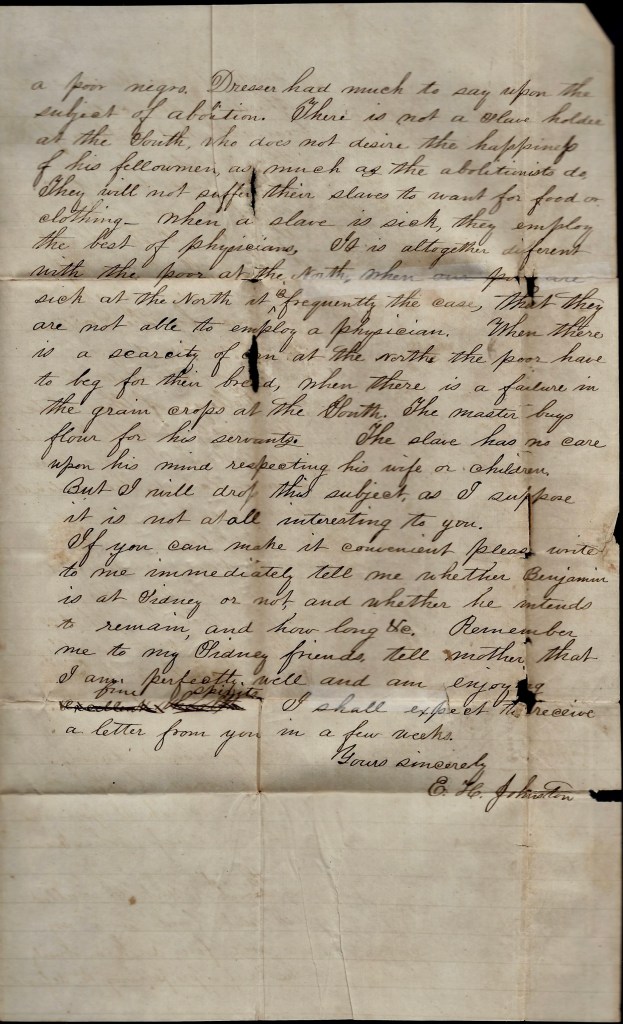
Returning through New York, I called at Gilbert’s office but did not find him in. I called at Dresser’s office [89 Nassau Street] and found him busily engaged in making out his Brief—preparing to defend a poor negro. Dresser had much to say upon the subject of abolition. 1

There is not a slave holder at the South who does not desire the happiness of his fellow men as much as the abolitionists do. They will not suffer their slaves to want for food or clothing. When a slave is sick, they employ the best of physicians. It is altogether different with the poor at the North. When our poor are sick at the North, it is frequently the case that they are not able to employ a physician. When there is a scarcity of corn at the North, the poor have to beg for their bread. When there is a failure in the grain crops at the South, the master brings flour for his servants. The slave has no care upon his mind respecting his wife or children. But I will drop this subject as I suppose it is not at all interesting to you.

If you can make it convenient, please write to me immediately. Tell me whether Benjamin is at Sydney or not, and whether he intends to remain, and how long, &c. Remember me to my Sidney friends. Tell mother that I am perfectly well and an enjoying fine spirits. I shall expect to receive a letter from you in a few weeks. Yours sincerely, — E. H. Johnston

1 Horace Dresser (1803-1877), the Vigilance Committee’s leading attorney, argued most of the cases before Riker. A graduate of Union College [in 1828], Dresser later became famous as the author of works on legal and historical subjects. When he died, in 1877, the New York Timesrecalled that “at a time when it was exceedingly unpopular,” Dresser had been “the very first lawyer to plead the cause of the slave in the New York courts.” In the 1830s, Dresser was indeed “called upon in all slave cases,” as the Colored American put it. His “services are abundant,” it added, “but [his] remuneration is comparatively nothing at all.”

Against formidable odds, Dresser occasionally won legal victories. Sometimes he was able to obtain writs of habeas corpus to bring to court and liberate individuals held in captivity by kidnappers. Regarding fugitive slaves, however, there was little Dresser or his associate Robert Sedgwick could do, given the attitude of local officials and the duty to return fugitives that was required by the Constitution as well as by both federal and state law. In one instance, Dresser learned that an alleged runaway was about to be taken before the recorder. He rushed to the office only to see Riker rule in favor of the claimant and remark, “I am glad the man has got his nigger again.” [Source: “Gateway to Freedom; the origins of the Underground Railroad” by Eric Foner, Harper’s Magazine, 2024]

1839: George Minor Watson to Thomas W. Hunt

The following letter was written by George Minor Watson (1812-1860), the son of David Watson (1773-1830) and Sarah Minor (1781-1849) of Sunning Hill, Louisa county, Virginia. George wrote this letter in 1839 while visiting family and friends in Richmond, Virginia. He appears to have taken up residence in Arkansas sometime prior to this date; he was enumerated in the 1840 US Census at El Dorado, Union county, Arkansas, the owner of as many as 11 slaves. He was still there at the time of the 1850 Census but had relocated to Ward 4 of Washington D. C. by the time of the 1860 census—an inmate of the government hospital for the Insane.

George wrote the letter to Thomas W. Hunt (1820-1862) of Memphis, Shelby county, Tennessee, who married Judith Parsons Mosby (1819-1896) in May 1841. Thomas was the first president of the Memphis Chamber of Commerce, organized in April 1860. He was a partner in the firm, Harris, Hunt & Co. in Memphis.

Richmond, Virginia, in the 1830s

Transcription

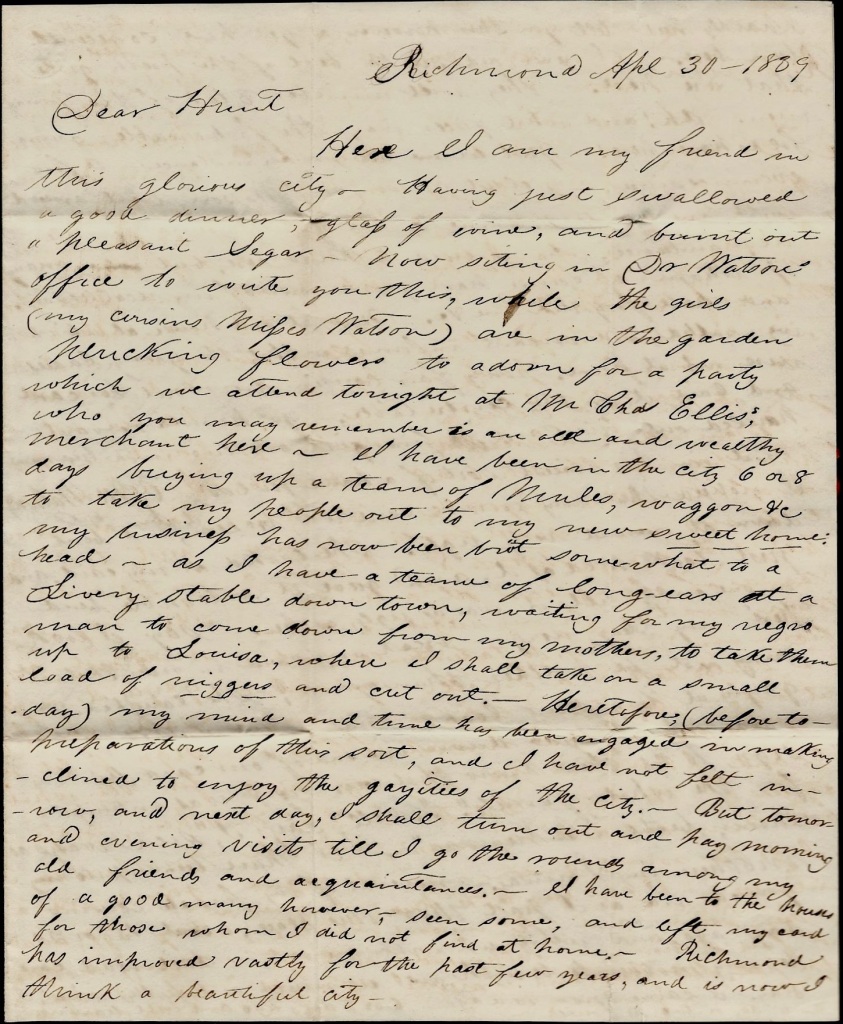
Richmond [Virginia]
April 30, 1839

Dear Hunt,

Here I am my friend in this glorious city. Having just swallowed a good dinner, glass of wine, and burnt out a pleasant segar, [I am] now sitting in Dr. Watson’s office to write you this, while the girls (my cousin’s misses Watson) are in the garden plucking flowers to adorn for party which we attend tonight at Mr. Charles Ellis‘s who you may remember is an old and wealthy merchant here. I have been in the city six or eight days buying up a team of mules, wagon, &c. to take my people out to my new sweet home. My business has now been brought somewhat to a head. As I have a team of long-ears at a livery stable down town waiting for my negro man to come down from my mother’s to take them up to Louisa where I shall take on a small load of niggers and cut out.

Heretofore (before today), my mind and time has been engaged in making preparations of this sort and I have not felt inclined to enjoy the gaieties of the city. But tomorrow and next day, I shall turn out and pay morning and evening visits till I go the rounds among my old friends and acquaintances. I have been to the houses of a good many however, seen some, and left my card for those whom I did not find at home.

Richmond has improved vastly for the past few years and is now, I think, a beautiful city. I hardly need tell you of this, however, as you have so recently been here. I never did see the beat of the pretty girls that are here. They will number three to one of the young men. Oh! and what queer ways the fashionable young folks have here! Just let me tell you an instance. A few evenings since, my eldest cousin (Miss Watson) went around with me to introduce me to all of my young female acquaintances who I used to know here, but many of whom of course have grown out of my recollection and had forgotten me, &c. Now at one house at which we called, the servant informed us that the young ladies were not at home. My fair cousin drew out her card and laid it on the centre table. Your humble servant hauled out his card (a fine gilt one too with his name on it in his nicest wort of hand just so, G. M. Watson [signature]). I noticed that my cousin’s card was broken and bent down at one [and] and very ugly. She looked at my card and just took hold of it and gave it a terrible bend on one end till it was as ugly as hers, and says I, “Look here, my dear, do not break my card in order that it may not be prettier than yours.” She laughed very gaily at my sour looks as as we walked off said, “Oh, I bent down one end of your card as a sign to let them know that our visit was intended for the whole family.” “Well,” says I, “sick ways as them beats Arkansas,”

I have been up to my mother’s in Louisa. Several of my female cousins joined me as I passed through this place about 15 or 20 days ago, and went up with me on the railroad cars to my mother’s to be with me as much as possible whilst I stay. I came down here again 6 or 8 days ago and will leave now in a day or two for Louisa. I find boys turned to men and girls to women since I was here a few years ago. Oh, it almost makes me sad to see the changes which have been wrought.

I am often persuaded to abandon my intention of going to the far Southwest and to settle here again among my relations who love me so affectionately. But I can’t go it, Hunt! Arkansas, Arkansas is my home, and it seems to me almost a dream that I am now here. I have seen Mr. Hiram Bragg but have not visited his family yet. Shall do so before I leave. Say so to Sam Mosby. I say Hunt, what you think I did last might? But I won’t tell you. And what you reckon I did today? Well today I paid $20 for a diamond ring and gave it to a gal. “Oh unusual liberality,” you will exclaim. However, I did not give it to one to whom I would like to be married, but to one for whom I cherish a brotherly affection.

I will look in on Mr. Stephen Thompson tomorrow and give your respects. I wrote to Albert last week. I suppose he showed you my letter. And now I must go over to the Female Academy and visit a little girl I’ve got there. Hunt, I can hardly get away from this town. Everything looks so beautiful here now—tis the spring season. I hope to be along through Memphis about 10th or 18th June but don’t know for certain. My best respects to the Missy [Judith] Mosby and ask Sam to stir up those natives that are owing me. Tell Jerry to “go it.”

I hope to get something out of Poindexter’s P. O. from some of you when I return to Louisa. — G. M. Watson

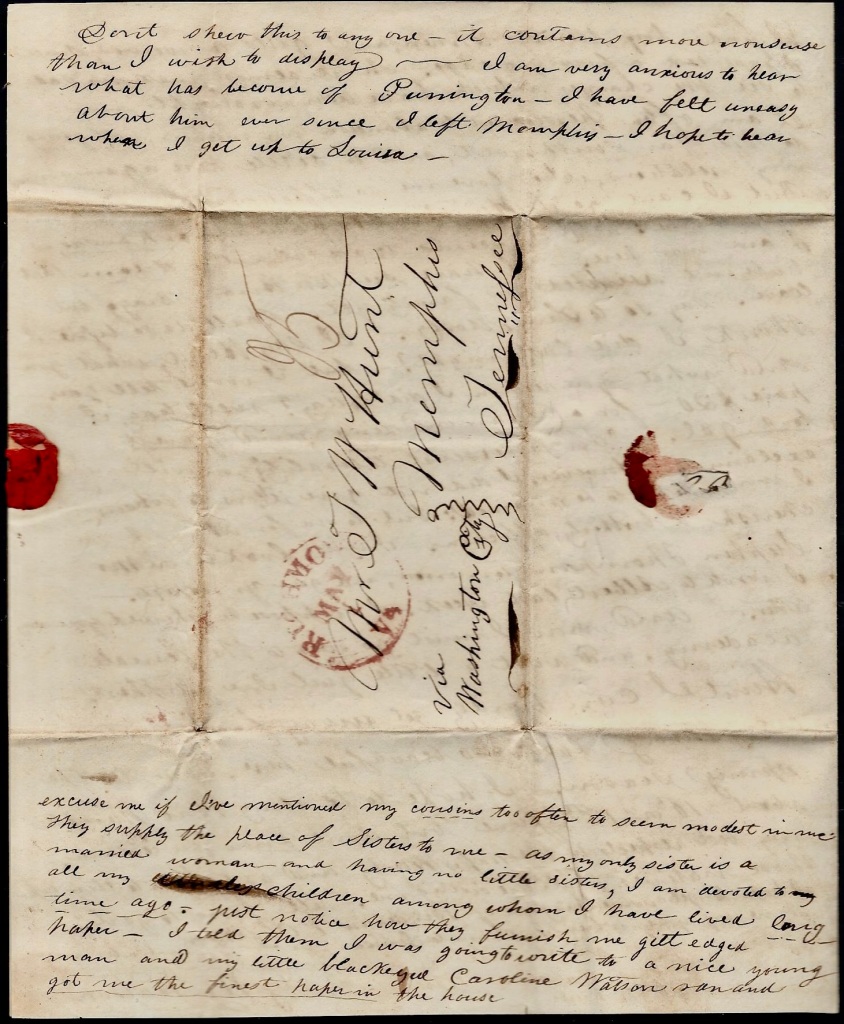
Don’t show this to anyone. It contains more nonsense than I wish to display. I am very anxious to hear what has become of Punington. I have felt uneasy about him ever since I left Memphis. I hope to hear when I get up to Louisa. Excuse me if I’ve mentioned my cousins too often to seem modest in me. They supply the place of sisters to me as my only sister is a married woman and having no little sisters, I am devoted to all my [ ] children, among whom I have lived long time ago. Just notice how they furnish me gilt edged paper. I told them I was going to write to a nice young man and my little black-eyed Caroline Watson ran and got me the finest paper in the house.

1841: Benjamin Morris Gauldin to Josiah Hendrick

The following letter was written by Benjamin Morris Gauldin (1808-Aft1860), the son of Josiah Gauldin (1770-18330 and Serriah Seay (1776-1820) of Gravel Hill, Buckingham county, Virginia. Benjamin was married to Franccs C. Snoddy (b. 1813) in 1836. Benjamin wrote the letter to his nephew, Josiah Hendrick (b. 1821)—the son of Matthew Hendrick and Frances Gauldin—who was a Missouri resident in 1841.

In 1860, Benjamin was enumerated in Jefferson, Saline county, Missouri, as the owner of seven slaves ranging in age from 1 to 27.

Benjamin datelined his letter from the Buckingham Female Collegiate Institute in January 1841. We learn from the letter that he was living at the Institute and in partnership with Samuel Benjamin Rush Loving (1813-1896) in some sort of merchandizing.

Benjamin’s letter speaks of the inheritance of slaves as part of an estate and also of the hiring out of slaves to others when not needed for the owner’s own labor.

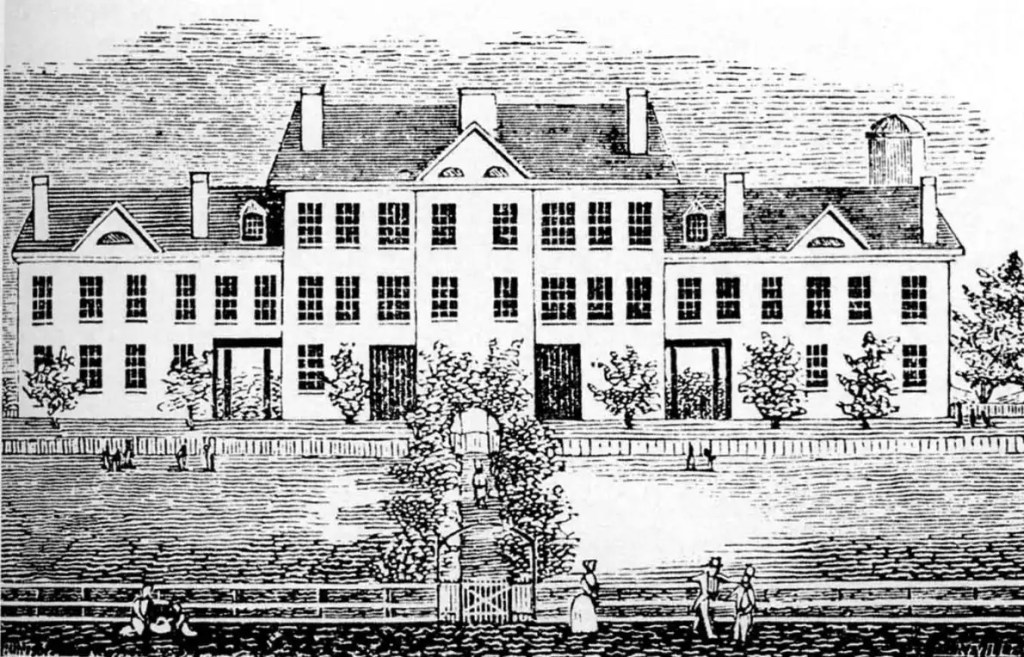
The Virginia General Assembly officially incorporated the Buckingham Female Collegiate Institute on January 13, 1837, making it the acknowledged first chartered college for women in Virginia.

Transcription

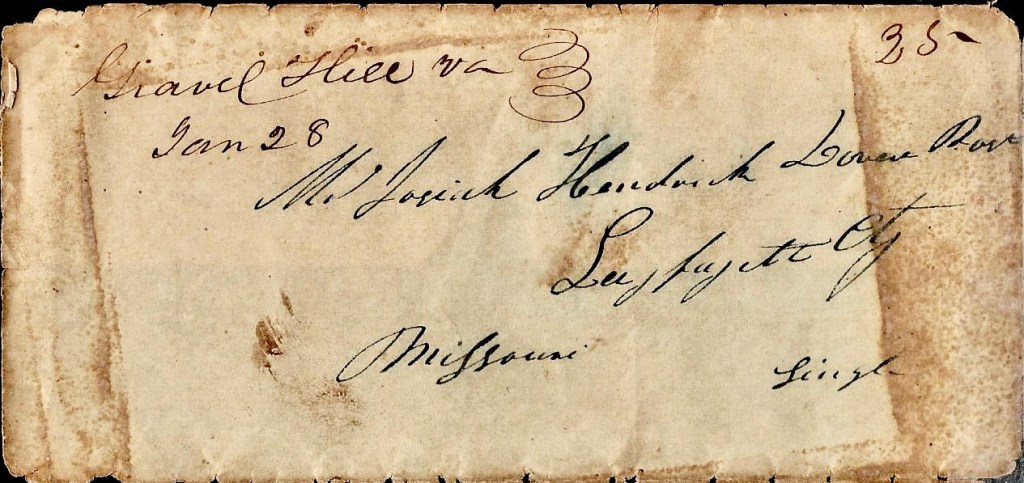
Addressed to Mr. Josiah Hendrick, Lafayette county, Missouri

Female Collegiate Institute, Buckingham, Gravel Hill [Virginia]

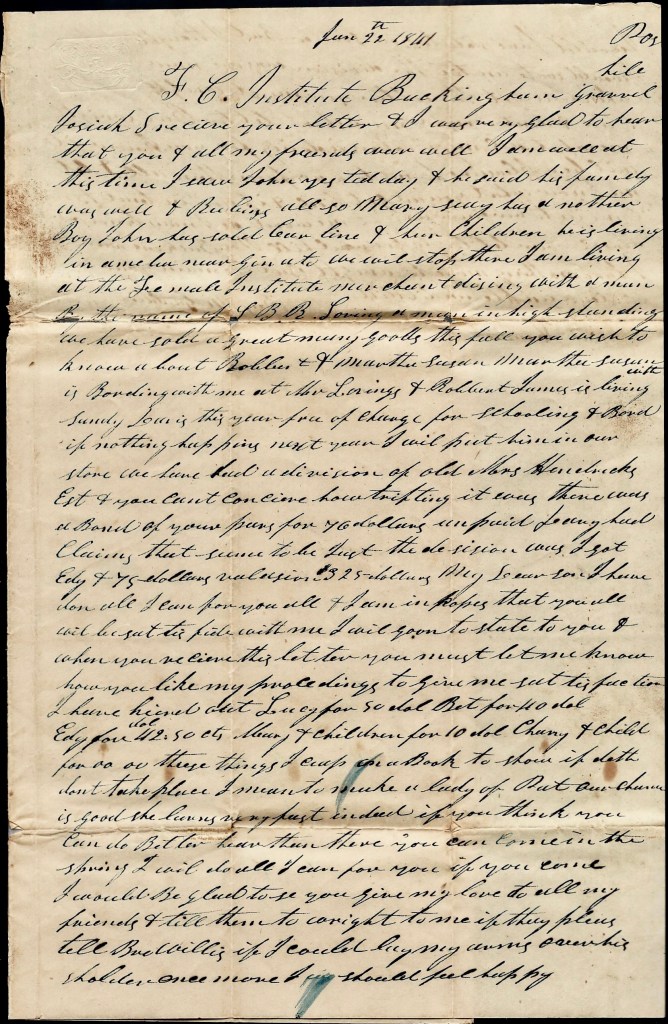
Josiah, I received your letter & was very glad to hear that you & all my friends were well. I am well at this time. I saw John yesterday & he said his family was well & R___ings also. Mary Sedy has another boy. John has sold Caroline & her children. He is living in Amelia near Gin at the wil stop there. I am living at the Female Institute, merchandizing with a man by the name of S.B.R. Loving—a man in high standing. We have sold a great many goods this fall.

You wish to know about Robert & Martha Susan. Martha Susan is boarding with me at Mr. Loving’s & Robert James is living with Lundy Davis this year, free of charge for schooling & board. If nothing happens next year, I will put him in our store. We have had a division of old Mrs. Hendrick’s Est[ate] & you can’t conceive how trifling it was. There was a Bond of your Pa’s for 76 dollars unpaid & any bad claims that seem to be just. The decision was I got Edy & 75 dollars, valuation $325 dollars.

My Dear son, I have done all I can for you all & I am in hopes that you all will be satisfied with me. I will go on to state to you & when you receive this letter you must let me know how you like my proceedings to give me satisfaction. I have hired out Lucy for 50 dollars, Bet for 40 dollars, Edy for 42 dollars [and] 50 cents. Mary & children for 10 dollars. Chany & child for 00.00. These things I keep in a book to show. If death don’t take place, I mean to make a lady of Pat. Our chance is good. She learns very fast indeed. If you think you can do better here than there, you can come in the spring. I will do all I can for you if you come. I would be glad to see you. Give my love to all my friends & tell them to write to me, if they please. Tell Brother Willis if I could lay my arms around his shoulder once more, I should feel happy.

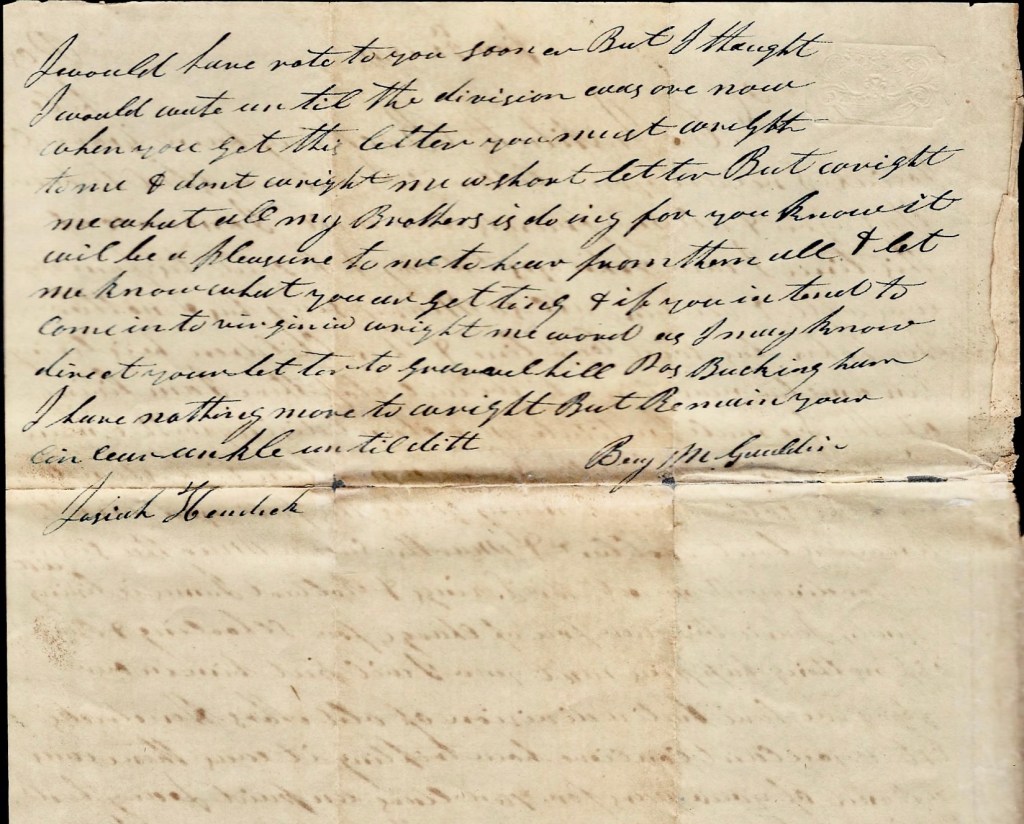
I would have wrote to you sooner but I thought I would wait until the division was over. Now when you get this letter, you must write to me & don’t write me short letter but write me what all my brothers is doing for you know it will be a pleasure to me to hear from them all & let me know what you are getting & if you intend to come into Virginia. Write me words as I may know. Direct your letter to Gravel Hill P.O., Buckingham. I have nothing more to write but remain your sincere Uncle until death, — Benj. M. Gouldin

[to] Josiah Hendrick

1860: William T. Early to Septimus D. Cabaniss

The following interesting letter was written by William T. Early (1817-1874), the son of Joab B. Early (1792-1845) and Betsy Thompson (1792-18xx) of Fredericksburg Parish, Virginia. William was a well-educated lawyer, politician, and owner of the Pen Park plantation of 410 acres near Charlottesville on the Rivanna river. The slave schedules of 1860 inform us that he was the owner of 36 slaves. At the time this letter was written in November 1860, he was serving as the mayor of Charlottesville.

From William’s letter, we learn that he considered the results of the 1860 Presidential election ruinous, believing that it would only lead to secession and the destruction of the Union. William’s political leanings were with the Whigs until the Republican Party emerged, strengthened by the anti-slavery extremists of the party. Though he hated to see the Union dissolved, he makes it clear in the letter that “my destiny is with the South, come what may.” Indeed, he remained in Virginia during the Civil War and in the summer of 1864 served as the captain of Co. A, 1st Battalion Virginia Reserves in the trenches near Chaffin’s Farm near Richmond. The Daily Progress July 11902 issue listed Capt. W. T. Early among the Confederate Soldiers interred in Maplewood Cemetery.

Apparently William did his best to bind up the wounds of the Nation after the war. In a post-war article he was quoted as saying, “The sentiment of the people throughout this region is one of entire submission to the result of the contest. Slavery is universally regarded as extinct, and there is a general and absolute acquiescence in its fate. Indeed, may people rather rejoice at this result, as it cuts the Gordian knot of a vexed question, which morally, socially, and politically, like Banquo’s ghost, appeared before us everywhere, and frightened us from our propriety, and which swallowed up every other question, as Aaron’s rod swallowed up all other rods. Of course, at first, there will be much disorganization of labor, but not so much as anticipated, and the result will be that the negro will make a very good laborer, and will take his proper place in the social scale, or he will go elsewhere, which is probably his fate. There is no spirit of further resistance…disunionists are now perfectly satisfied with the experiment made.” [27 September 1865, The New Hampshire Patriot & Gazette.]

William wrote the letter to Septimus (“Sep”) Douglass Cabaniss (1815-1889), the son of Charles Cabaniss (1773-1825) and his wife Lucy Ingram (1775-1827), who moved from Lunenberg County, VA to Madison County, AL in 1810. In his early years, Septimus was educated at Green Academy in Huntsville, AL. He attended the University of Virginia between 1832-1835, and returned to Huntsville to read law with a local attorney. He passed the Alabama Bar in 1838 and practiced law, primarily dealing with estates, in Huntsville until his death. Septimus served the Confederacy as a member of the Alabama State Legislature from 1861-63 and a Colonel in the Confederate Intelligence Division during the Civil War.

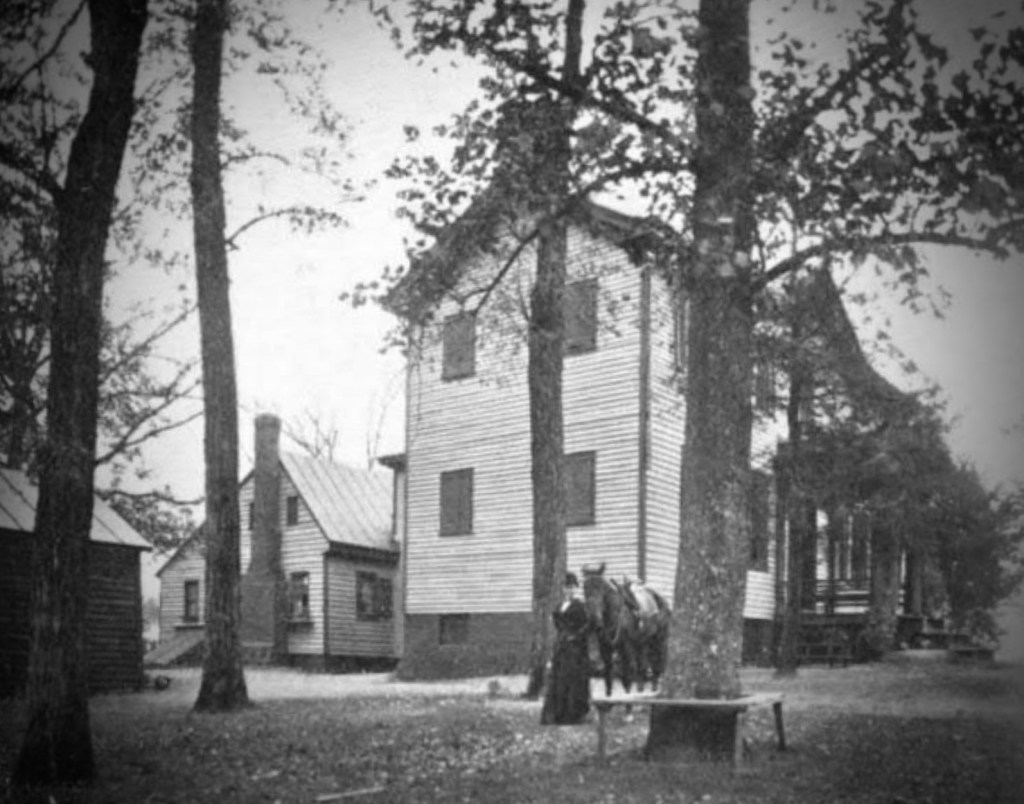
Pen Park Plantation House at it appeared in the late 19th Century. The older part of the house is the smaller structure behind the newer addition.

Transcription

Pen Park near Charlottesville
November 10th 1860

S. D. Cabaniss, Esqr.

My dear friend—I have delayed answering your very highly esteemed favor of the 18th ultimo in the hope of being able to attend your sale in Jackson county. But the result of the Presidential election has made it impossible. The effect of that disastrous event is to chain everybody here to the soil for the present as fast as Prometheus was chained to the rock. In the course of a few months, I hope to change my location for Huntsville, or its vicinity. So far as I can see now, I can’t discern any probable satisfactory solution of our present troubles without many throes and convulsions.

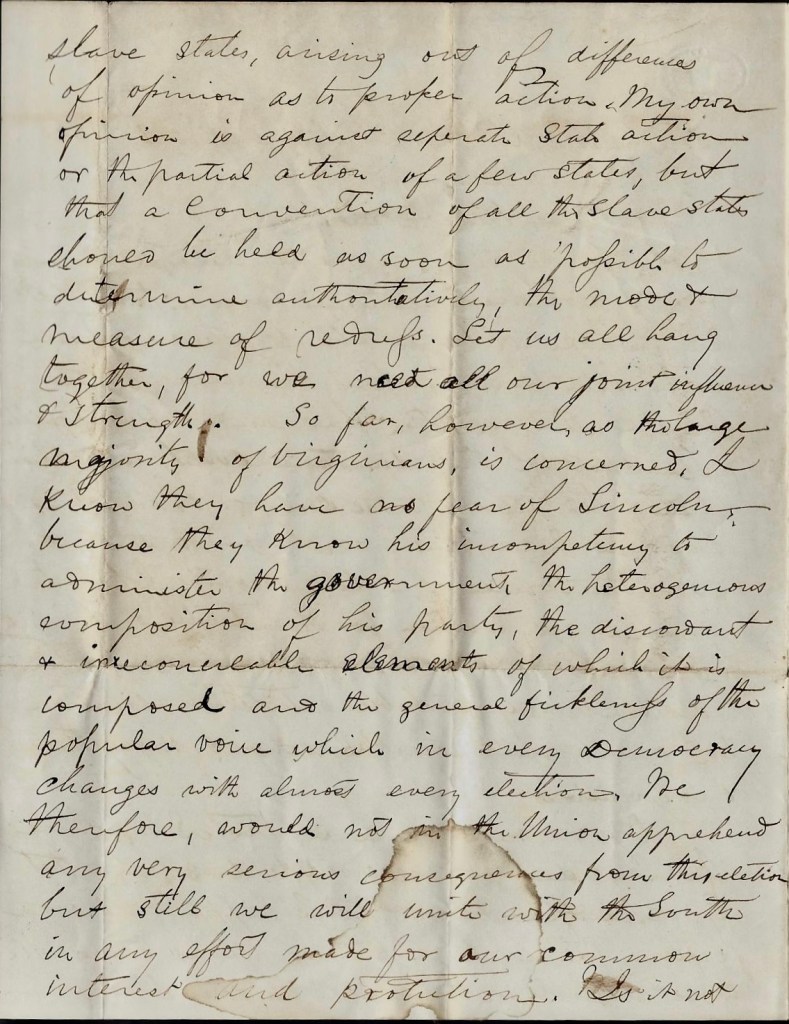
Our news here is that South Carolina has seceded—or resolved to do so—and that Georgia, Alabama, & Mississippi will soon follow. In such a state of affairs, there will be great trouble in this and the other border slave states arising out of differences of opinion as to proper action. My own opinion is against State action or the partial action of a few states, but that a Convention of all the slaves states should be held as soon as possible to determine authoritatively the mode and measure of redress. Let us all hang together, for we need all our joint influence and strength.

So far, however, as the large majority of Virginians is concerned, I know they have no fear of Lincoln because they know his incompetency to administer the government, the heterogenous composition of his party, the discordant & irreconcilable elements of which it is composed, and the general fickleness of the popular voice which in every Democracy changes with almost every election. We, therefore, would not in the Union apprehend any very serious consequences from this election, but still we will unite with the South in any effort made for our common interest and protection. Is it not therefore all important that our counsels should be joint and our action the same?

I fear that there are extremists at the South who will precipitate action and thus introduce the seeds of division at the South, whereas there should be unanimity from the Pennsylvania border to Mexico on that part of every state; and there will be, if a southern Convention is held, and firm, and at the same time, judicious measures adopted.

Before this reaches you, however, the die may be definitively cast and states committed to instant or unqualified secession. In that event, though I can see nothing but ruin ahead, my destiny is with the South come what may. With a melancholy but firm & undaunted spirit, I will take up arms against the sea of troubles trusting that Providence will vouchsafe us a happy issue out of all our afflictions. Such will be the sentiment of Eastern Virginians but I fear that west of the Blue Ridge we should have trouble for there the slaves are few and far between.

I regret much my inability to attend the sale, and indeed suppose it will be impossible to effect one in the present condition of the public mind, but hope in the course of a month or two to get some funds that will enable me to visit Alabama and invest at least enough to buy a home in or near Huntsville.

The public sentiment here is extremely feverish and excited and I would like to know your opinion of the action of Alabama. Hoping to hear from you at an early day. I am truly your friend, — W. T. Early

1848: Philip Schmucker to John Elder

How Philip might have looked

The following letter was written by 35 year-old Philip Schmucker (1811-1885), the son of Rev. Johann Nicholas Schmucker (1779-1855) and Catharine Heller (1780-1846) of Shenandoah county, Va. Philip datelined his letter on 7 August 1846 from his residence in Fishersville, nestled between Waynesboro and Staunton in Augusta county, Virginia, where he dealt in real estate and served as post master of the local office. In the 1860 US Census, Philip was listed as a slave holder in Augusta county, owning five slaves ranging in age from 42 to 5.

Philip’s letter refers to the return of local soldiers from the War with Mexico. He also speaks of the Whigs nominating Zachary Taylor as their nominee in the upcoming Presidential election. It was a desperate move by the Whigs to select Taylor who did not share all of their political views but it enabled them to win the White House.

Philip wrote the letter to his friend John Elder (1785-1851), who was born in Harrisburg, Pa., the son of a Presbyterian minister of the same name. He early became involved with the planning and construction of houses, public buildings, and bridges. He worked on the Juniata division of the Pennsylvania Canal. After a brief period in Florence, Alabama, he moved to Indianapolis in the early 1830s. He married Margaret Ritchey of Harrisburg. Her mother, Margaret Ritchey, later lived with the Elders and moved West with them.

In the period 1833-1836, Elder was proprietor of the Union Inn in Indianapolis. He designed several important public buildings, including the headquarters and Indianapolis branch of the State Bank; the Palmer House in Indianapolis; Henry Ward Beecher’s Home; Indiana School for the Blind; the courthouses at Lebanon, Columbus, Connersville, and Rushville; and the First Presbyterian Church (second building, 1843) on Monument Circle in Indianapolis. He was also interested in the construction of the Madison and Indianapolis Railroad, and built a lock on the Wabash Canal at Covington. Never a good financial manager, he got into difficulties on the building of the Rushville courthouse. In an effort to recoup his fortunes, he went to California in 1850, but fell sick and died there.

Transcription

Addressed to Mr. John Elder, Indianapolis, Indiana

Fishersville, Augusta county, Virginia
August 7th 1848

Dear Friend Elder,

It is some time since I heard from you and I must make some apology for not writing to you sooner, hoping that you will not think hard of my neglect. It was not for any reasons that I had not done so but mere neglect from time to time.

We are well and are doing well and hope that these lines will find you and your kind old mother-in-law and all the family enjoying the blessings. We would like to see you all very much but we must be satisfied by waiting as we are so great a distance apart—trusting to the ruler of all things.

Our soldiers returned last week, There was a great parade made and on next Friday there will be a public dinner given in Staunton. This is a strong Whig country and there is a good deal said about politics but it is here like in other places, the Whigs only take Taylor for his availability. They think better him than none. But they cannot come it in this state by a long ways. There will be a Whig meeting in this place this day.

The crops are better in this Valley than they ever were. There is more wheat made in this valley this year than there has been in any two years heretofore. Corn crops never were better.

We have a Presbyterian Church in a mile of this place where there is preaching every Sabbath, The most of our people belong to that church in the neighborhood but if I were to judge, I would say there was more pride here than religion. Each one tried to out dress the other and so it goes. I hear in that case our young western states exceeds this country. There is more religion in the western states than in here where they should set an example for the young western states but I can assure you it is to the reverse. I have heard more swearing here since I am here than I have heard in all the time I lived in the West. And drinking liquor is nothing thought of by professors for they indulge in the same.

Money is very plenty in this country. Everybody aspires to have some black and white. I have taken in nine hundred in about 10 months and will bring it to one thousand till the year is out. I have bought some property in this place and have built the finest stable in the Valley of Virginia, so I’m told. Twenty horses and mules now riding to my house. My house can be seen 8 miles [away]. There is not a handsomer place in the Valley. I intend to move to it in about a month and a half. The stage contractors talk of making my house a stopping place. If they do that, I won’t do better for there is an immense travel in the stages in the spring season. From two to a dozen pass here every day. Two mules a day the year round—Sunday not excepted.

My daughter does not live at home. She is 12 miles from here going to school and bids fair to make a very intelligent girl. She is boarding at a Mr. Brown’s house—the pastor of the Stone Church (an Old [School] Presbyterian known here by that name) in Misses Brown’s care who superintends the school. She comes home to see us sometimes. The people are generally well with the exception of the measles. They have proved very fatal here this summer. A good many people have died with them and they are still raging. I think they are more than the common measles.

As it regards the wife you was speaking about, you will have to make your bargain. I will bind myself to show you plenty but you must make your own bargains. I take your [Indiana] State Sentinel, but could not see your marriage recorded in it and take it for granted you are still without a better half. So come in and try for yourself. Nothing more but our respects to you all. — P. Schumucker

Write to me soon.

Go it cup and butter, Taylor and his second best Abolitionist can’t come it.

1850: Hugh Mortimer Nelson to Richard Henry Dickinson

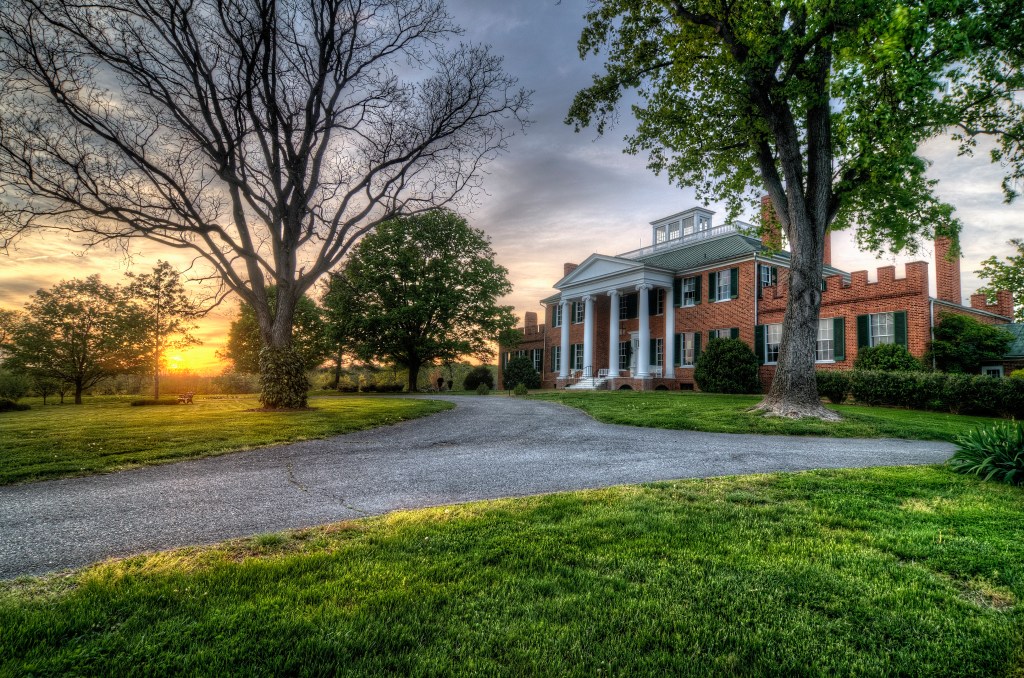
Hugh Mortimer Nelson’s Long Branch House in Clarke county, Va.

The following letter was penned in Clarke county, Virginia, by Hugh Mortimer Nelson (1811-1862). An on-line biographical sketch produced by his Long Branch estate informs us that:

Hugh Mortimer Nelson, born in Hanover County, Virginia, on October 20, 1811, was a well-educated and scholarly teacher, an enterprising and progressive farmer, and a cavalry officer for the Confederacy. Hugh was the fourteenth of fifteen children to Francis Nelson and Lucy Page, and grandson of politician John Page and Declaration of Independence signer, Thomas Nelson Jr.

During his childhood, Hugh Nelson received an early education at home from an elder brother.  At the age of fourteen he was sent to a classical school four miles from his home, and at sixteen he entered the Academy at Winchester. Moving on to the University of Virginia in 1830, Hugh graduated with a Master of Arts, one of the University’s first graduates to earn the degree. It is said that while at UVa, “when worn down by work, he would get a fellow student to pump water on his head, to arouse him for renewed efforts.” After graduation, Hugh became a teacher in Charles City County – the university’s first graduate to enter the profession in Virginia.

In 1836, while on a visit to a Virginia spring, Hugh met 20-year-old Anna Maria Adelaide Holker. The two were married that November, honeymooned in Europe, and finally settled in Baltimore where Hugh, after more study, was admitted to the bar. However, before establishing himself in the legal profession, the Nelsons returned to Virginia, a decision which Hugh felt was the great mistake of his life. In a speech at the Virginia Secession Convention in 1861, it seems evident that his reason for returning to Virginia was homesickness.

Back in Virginia, Hugh Nelson bought Long Branch from his uncle Philip Nelson for $32,000.  They moved in with Adelaide’s mother, Nancy D. Holker, and their 3-year-old daughter “Nannie.”  (A son, Hugh Nelson Jr was born a few years later). It was at this time the couple renovated Long Branch. One of these changes included putting a distinct Greek Revival stamp on the manor. They built the grand circular staircase in the entry hall and the rooftop belvedere, as well as enclosed the loggia and most likely added both porticos and the Gothic battlements to the house.


The house was not the only part of the plantation that changed once Nelson bought the land.  New technologies and techniques in farming started to influence the landowners in Virginia who looked to increase their already rich fields. Hugh rarely returned home from state agricultural fairs, and spent his leisure hours reading both modern and ancient literature. Unfortunately, due to an accident on the farm around 1848, Nelson was advised to go to Europe for surgical treatment. There he witnessed street fighting and protests against the Second French Republic.

In 1861, when the question of Secession was forced upon Virginia, a Convention was called to decide the answer. Nelson remained firm for the Union, and was elected by a large majority to represent Clarke County. Hugh wrote several letters home while the Convention was in session, in which he gives interesting insight into the tensions in the room. After an ordinance of Secession was passed, he wrote, “When I think of the past, and look forward to the future, it almost unnerves me.”After raising a company of cavalry in Clarke, he served under J.E.B. Stuart before being reassigned as the aide-de-camp, with the rank of Major of Cavalry, for General Richard S. Ewell, one of Stonewall Jackson’s division commanders. In May of 1862, under General Ewell, Hugh Nelson joined Jackson’s Valley Campaign.

Hugh was one of 6,402 Confederate soldiers wounded during the Battle of at Gaines Mill on June 27. Given a leave of absence, he went to the house of his cousin, Mr. Keating Nelson, in Abermarle County where he succumbed to typhoid fever, and passed away on August 6, 1862.  He is buried in the Old Chapel Cemetery in Millwood, VA. Hugh had been the first layman to serve at Christ Church in Millwood. Upon his death, the Vestry wrote that they feel “…each one of them has lost a warm and valued friend; the community a public-spirited citizen; the country a devoted patriot, and the Church one of its most useful members.”

An ever devoted Virginian, Hugh said on March 26, 1861, in a speech to the Chairman of the Virginia Secession Convention, “…of all the stars upon our national flag, the star of Virginia ‘is the bright particular star’ which fills my vision…All my ancestors, for near two hundred years, have lived and died in Virginia…Stern necessity, sir, once compelled me to leave her border—I felt like an exile from my native land —I thought of her by day, I dreamed of her by night.  When laid upon the bed of sickness, in the delirium of fever, I was singing ‘carry me back to Old Virginia.’  I never breathed freely till I got back within her bounds.  …the potent associations of my childhood bind me to her—all the joys and all the griefs of my manhood have daguerreotyped her on my heart—and I can say, as Mary of England said of Calais, when I am dead, take out my heart and you will find Virginia engraved upon it.  May she be my home through life, and when I am dead, may my ashes repose within her soil.”


Hugh’s death left his wife Adelaide in charge of Long Branch’s affairs, marking a change in the history of the plantation.  Not only was the area devastated by war, but Long Branch also suffered from the financial hardships of the now deceased Hugh Nelson.  Thus, the future of Long Branch fell into the hands of the unprepared, but forever resilient, Adelaide.


A video of the Historic Long Branch House and Farm is posted on YouTube at: https://www.youtube.com/watch?v=L8e3WKXke78&t=95s

In the 1850 Slave Schedules, Hugh M. Nelson is reported to have owned 19 slaves ranging in age from 1 to 60. his brother, Philip Nelson owned as many as 35 slaves.

This letter informs us that, on occasion, the Nelson brothers used the slave auction house of R. H. Dickinson & Bro. of Richmond, Virginia, to buy and sell slaves. Their usual business entailed the purchase of slaves in Virginia and Maryland for resale in bigger, Deep South markets. Richard Henry Dickinson went in the slave-trading business about 1844. By the late 1840’s, he (with his brothers) was selling as many as 2,000 slaves annually. The biographical sketch of Dickinson and his company can be found at Encyclopedia Virginia.

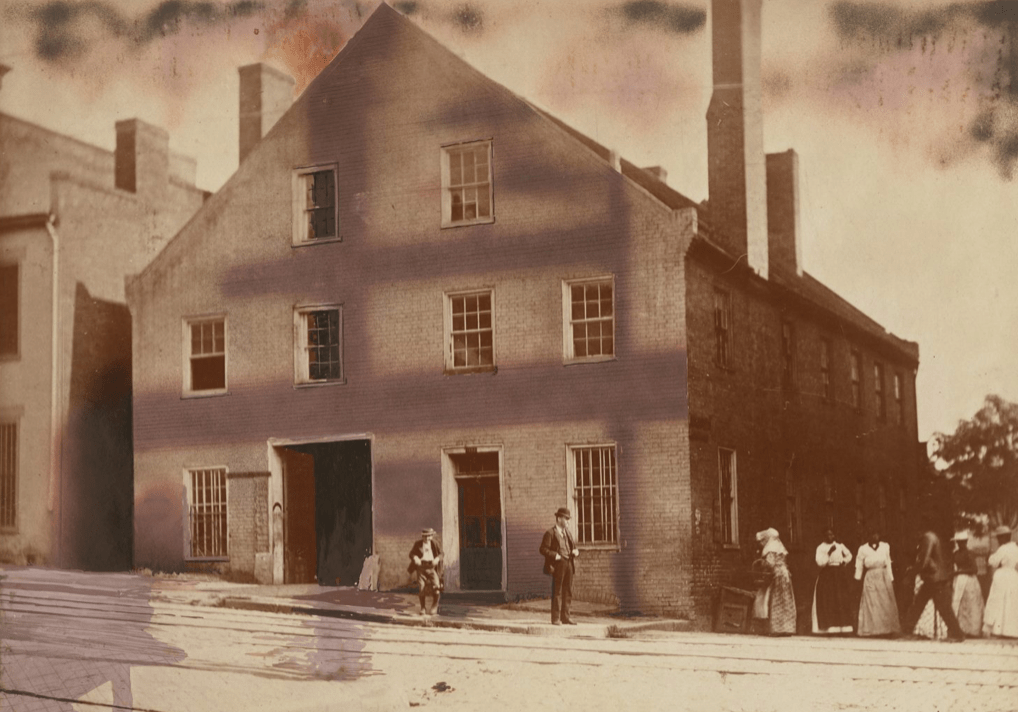
This building at the corner of Franklin and Wall Streets in Richmond was used by slave traders, including R. H. Dickinson, to sell slaves. It was originally used as a tobacco warehouse.

Transcription

Near Millwood, Clark County, Va. 1
March 23rd 1850

R. H. Dickinson
Richmond Va.

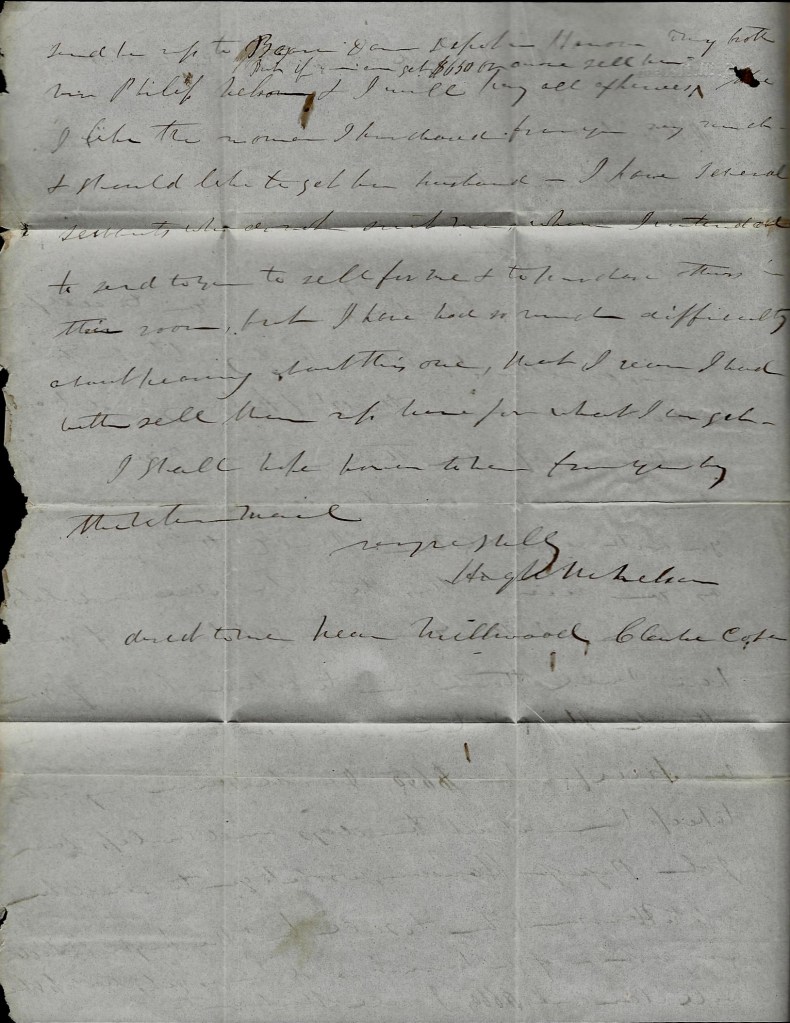
Dear Sir, I sent a Negro woman to you to sell for me—or rather I’d gotten me a boy at the junction to do so—ever since the 17th of Feb. and have written no less than three times to you about her, and have as yet received no answer from you with regard to her. I will thank you as soon as you receive this to write to me and let me hear whether you even got her. If you have, I will thank you to let me know if you think she will sell for about what I gave for her. My price for her $650.

I wrote you in my letters to keep her about ten days and unless Mr. John Pass of Hanover wrote to you to send her up to Hanover to him, to sell her to the highest bidder for cash. If you haven’t sold her as yet, unless she will clear me $650, I will thank you to send her up to Beaver Dam Depot, Hanover. My brother, Mr. Philip Nelson, and I will pay all expenses.

I like the woman I purchased from you very much and should like to get her husband. I have several servants which do not suit me whom I intended to send to you to sell for me & to purchase others in their stead but I have had so much difficulty about hearing about this one that I reckon I had better sell them up here for what I can get. I shall hope however to hear from you by the return mail.

Respectfully, — Hugh M. Nelson

Direct to me near Millwood, Clark county, Va.

1 Millwood grew up around Burwell’s Mill, built in 1760 by Daniel Morgan. In October 1862, Gen. Stonewall Jackson established his headquarters at Carter Hall.

1855: Samuel Vance Fulkerson to Catherine Elizabeth Fulkerson

This interesting letter was written by Samuel (“Sam”) Vance Fulkerson (1822-1862), the son of Abram Fulkerson, Sr. (1789-1859) and Margaret Laughlin Vance (1794-1864) of Abingdon, Washington county, Virginia. He wrote the December 1855 letter to his 23 year-old sister, Catherine (“Kate”) Elizabeth Fulkerson (1832-1903) teaching a select school in Tazewell. Claiborne county, Tennessee.

Samuel was born on his father’s farm in the southern part of Washington County, Virginia, but he was principally raised in Grainger county, Tennessee. He enlisted as a private in Colonel McClelland’s regiment during the Mexican war, and served throughout the war. He studied law and began a law practice in Estillville (Gate City) and Jonesville in the southwestern Virginia counties of Scott and Lee. In 1846, Samuel was elected to the Constitutional Convention of 1850, and then elected judge in 1856. He served as judge until the spring of 1861, when he was elected and commissioned colonel of the 37th Virginia Regiment of Infantry, and commanded that regiment until June 27, 1862, when he was mortally wounded while leading the 3rd Brigade in a charge against a strong Northern position on the Chickahominy. He died the following day, and was interred in the Sinking Spring Cemetery, Abingdon, Virginia. Of his death, Stonewall Jackson wrote, “Col. S. V. Fulkerson was an officer of distinguished worth. I deeply felt his death. He rendered valuable service to his country, and had he lived, would probably have been recommended by me before this time for a brigadier generalcy. So far as my knowledge extends, he enjoyed the confidence of his regiment and all who knew him. I am, Sir, your obdt. servt, T. J. Jackson”

This letter was written in 1855 after Samuel returned to his native Washington county with a view of making it his permanent home. He purchased a handsome property near Abingdon, known as “Retirement,” which is located at what is now known as the Muster Grounds. In the letter, Sam mentions visiting his younger brother, Abram (“Abe”) Fulkerson, Jr. (1834-1902) while he was attending the Virginia Military Institute at Lexington in 1857, where he was a student of Prof. Thomas Jonathan (“Stonewall”) Jackson. According to his records at VMI, he had a reputation for being a prankster and wore an “outlandish collar” on his cadet uniform: the collar being the only part of the uniform not covered under regulations. After graduation, he taught school in Palmyra, Virginia, and Rogersville, Tennessee, until the beginning of the American Civil War when he entered Confederate military service in June 1861 as a Captain of Co. K, 19th Tennessee Infantry Regiment at Knoxville. His was the first company of volunteers organized in East Tennessee. He was elected as Major of the 19th Tennessee Infantry Regiment. He was wounded in the thigh and his horse was shot from under him at the Battle of Shiloh and was reassigned in the resulting reorganization to the 63rd Tennessee Infantry after recovering from his injury. He was elected as Lieutenant Colonel of the 63rd, and was later promoted to full colonel by President Jefferson Davis on February 12, 1864.

I have previously transcribed two letters from the Fulkerson family of Abington, Virginia. The first was an 1852 letter by Kate Fulkerson to her younger brother Abram and the second an 1860 letter from John Fulkerson Tyler to Samuel Vance Fulkerson, who was later to distinguish himself as the commander of the 37th Virginia. Many of Samuel Vance Fulkerson’s letters can be found at the Fulkerson Family Papers in at the Virginia Military Institute.

Aside from family chit-chat and a description of Richmond Society, there isn’t anything particularly newsworthy in this letter although I found the holiday tradition of passing a jug of whiskey between the school master and his or her students which Samuel called a “time-honored treat” somewhat fascinating. Whether this tradition was unique to Tennessee or more widely “honored” is not stated in the letter and I suspect it was not the kind of thing normally documented in writing.

[Note: This letter is from the personal collection of Richard Weiner and is published on Spared & Shared by express consent.]

Transcription

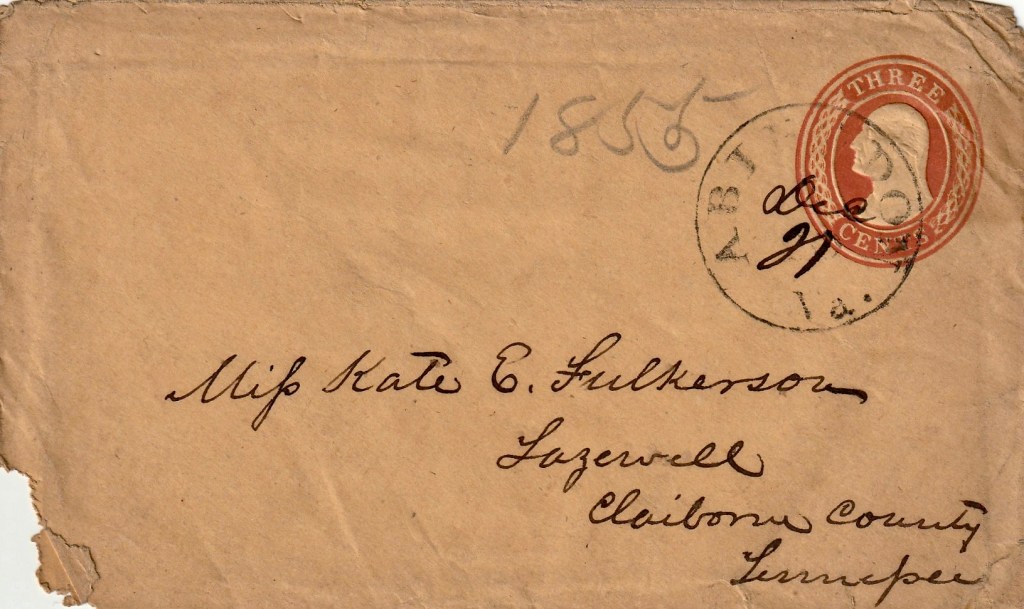
Addressed to Miss Kate E. Fulkerson, Tazewell, Claiborne county, Tennessee

Abington, Virginia
18 December 1855

Dear Kate,

I wrote to you since you have to me, but as I am not particular about these little matters of etiquette, I will just write again though I now so seldom write more friendly letters that I am almost out of practice in that line.

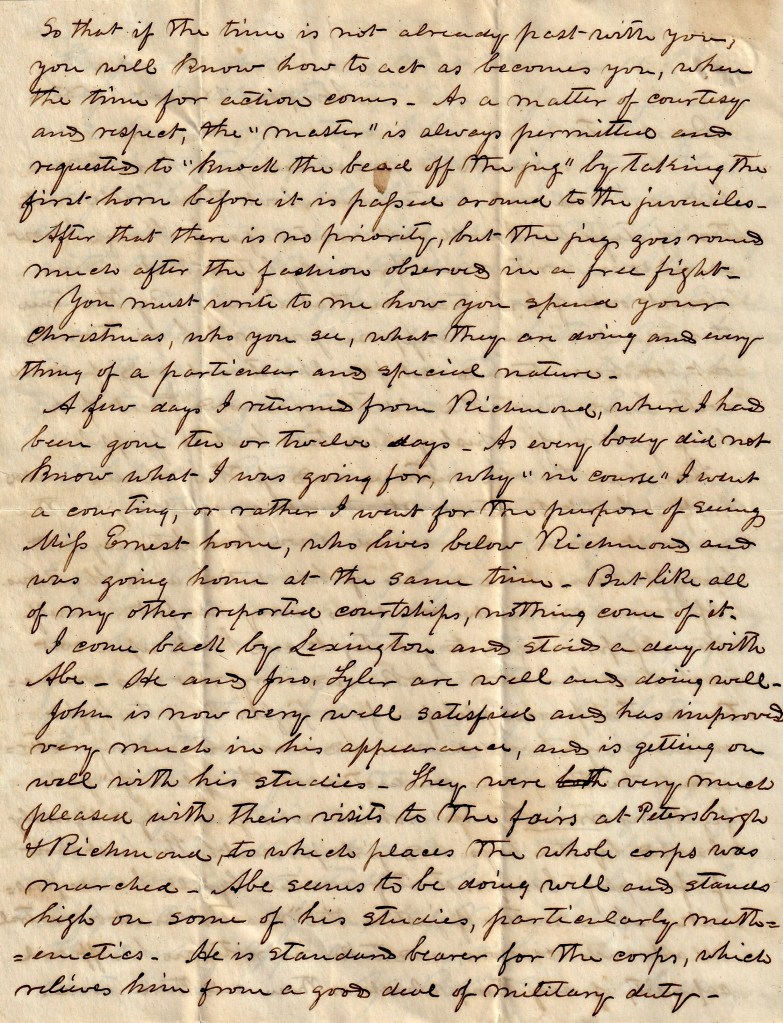
By the time this reaches you, I suppose you will have turned out, or been turned out for Christmas, and of course will have given the old time-honored treat of a half gallon of whiskey and two bushels of apples. This was the old custom, and if the “master” would not submit to stand the treat, a ducking in the nearest pond, soon cooled down is obstinacy and brought him to a sense of his duties and obligations. Of course on such occasions, everyone felt himself or herself privileged to get tight and kick up a row on his or her own hook, and every row was conducted on the principle of a free fight. Of if the fight was a single handed one and was particularly interesting, the thing was conducted on the plan of “fair fight; no man touch” which was generally religiously observed by the boys and girls present; the least show of “foul play” being instantly resented by all hands present. As a matter of justice, the “master” must be neutral on all such occasions, and take no note in his official capacity of anything which is then and there done. So if the time is not already past with you, you will know how to act as becomes you when the time for action comes. As a matter of courtesy and respect, the “master” is always permitted and requested to “knock the bead 1 off the jug” by taking the first horn before it is passed around to the juveniles. After that there is no priority, but the jug goes round much after the fashion observed in a free fight.

You must write to me how you spend your Christmas, who you see, what they are doing and everything of a particular and special nature.

A few days [ago] I returned from Richmond where I had been gone ten or twelve days. As everybody did not know what I was going for, why “in course” I went a courting, or rather I went for the purpose of seeing Miss Ernest home, who lives below Richmond and was going home at the same time. But like all of my other reported courtships, nothing come of it.

I come back by Lexington and staid a day with Abe [at the Virginia Military Institute]. He and Jno. [Fulkerson] Tyler are well and doing well. John is now very well satisfied and has improved very much in his appearance, and is getting on well with his studies. They were very much pleased with their visits to the fairs at Petersburg & Richmond to which places the whole corps was marched. Abe seems to be doing well and stands high on some of his studies, particularly mathematics. He is standard bearer for the corps which relieves him from a good deal of military duty.

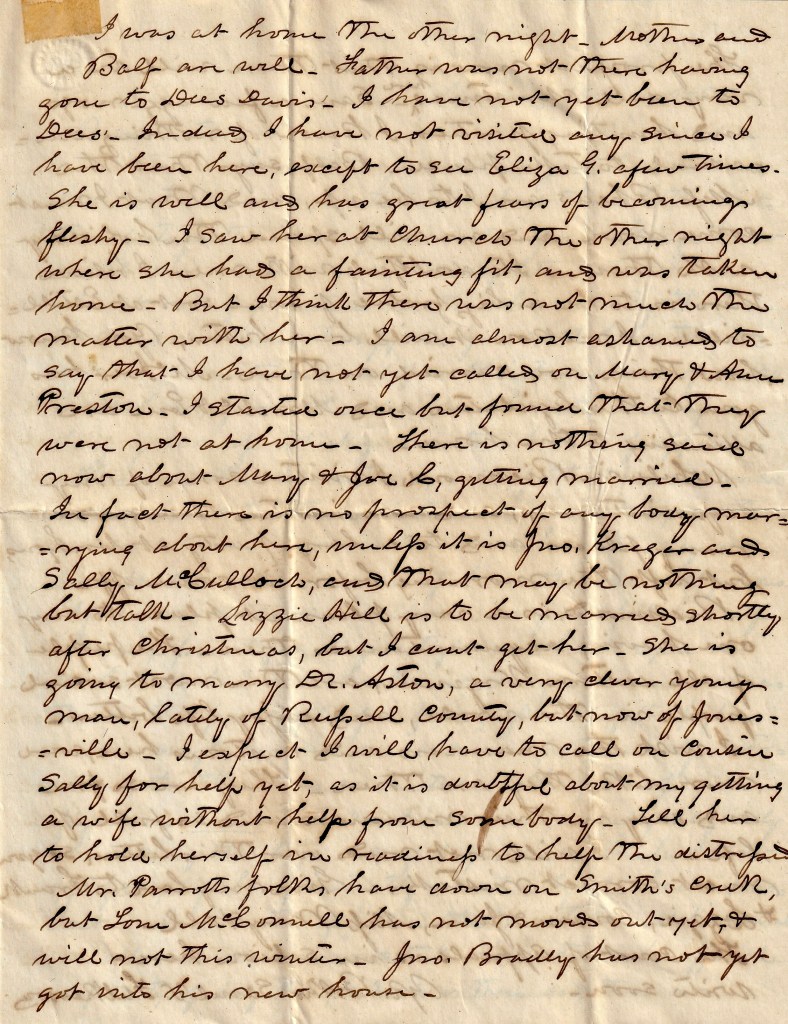
I was at home the other. Mother and Balf are well. Father was not there, having gone to Dees Davis. I have not yet been to Dee’s. Indeed, I have not visited any since I have been here, except to see Eliza G. a few times. She is well and has great fears of becoming fleshy. I saw her at church the other night where she had a fainting fit, and was taken home. But I think there was not much the matter with her. I am almost ashamed to say that I have not yet called on Mary & Ann Preston. I started once but found that they were not at home. There is nothing said now about Mary & Joe C. getting married. In fact there is no prospect of anybody marrying about here unless it is Jno. Kreger and Sally McCulloch, and that may be nothing but talk. [Elizabeth] “Lizzie” [B.] Hill is to be married shortly after Christmas but I can’t get her. She is going to marry Dr. [Charles Clement Johnson] Aston [1832-1905]—a very clever young man lately of Russell county but now of Jonesville. I expect I will have to call on Cousin Sally for help yet as it is doubtful about my getting a wife without help from somebody. Tell her to hold herself in readiness to help the distressed.

Mr. Parrott’s folks have [come] down on Smith’s Creek but Tom McConnell has not moved out yet & will not this winter. Jno. Bradley has not yet got into his new home.

The prospect now is that there will be a very dull Christmas here. Save a few egg-nog and hunting parties, I know of nothing unusual to take place. Balf says that the Miss Rhea’s are to be up and that I must come down and we will spend the holiday with them. It’s doubtful with me. I believe there is to be a big frolic of some sort at Estillville. I reckon it will be a buster. You know how things are carried on there. McIver has gone to the legislature and Mrs. McIver & Em are attending to the house.

While in Richmond I visited some of my acquaintances and was invited to a good many places and to a large party at Mr. Lyons, but left the morning before it come off. Richmond is a very pleasant place to anyone having acquaintances there. The people of all eastern Virginia are the most social people in the world, and enjoy life better. I wish the manners and customs here were more like they are there. They are so free and easy in their manners and so full of life.

I will not read over this letter so you must correct mistakes. Give my love to Frank & Lizzie, cousin & Jane, Miss Mary & all.

The Court of Appeals is in session here. Write soon.

Your brother, — Samuel V. Fulkerson

1 If you shake a bottle of whiskey, the bubbles that form on top, known as the “bead,” are an indication of the amount of alcohol in the whiskey. It was a common practice to shake a bottle of whiskey to detect whether one was being sold cheap whiskey—in mass production before and during the Civil War. The consumption of whiskey was far more prevalent among the youth of the 19th Century than most people probably realize. Lincoln once said that “intoxicating drinks were commonly the first draught of the infant and the last draught of the dying man.”