I could not find an image of Isaac but here is a self portrait of Sgt. John T. Becker who also served in the 105th Illinois Infantry (Co. G).
The following letters were written by Isaac D. Kelley (1834-1871), the son of David Kelley (1806-1876) and Susanna Dixon Jones (1799-1884) of DuPage county, Illinois—formerly of Rutland, Vermont.
Isaac was listed as a 28 year-old single farmer of Naperville, DuPage Co., Illinois when he was mustered in as a Sergeant at Dixon, Illinois, in Co. B, 105th Illinois Infantry. He was described as being 6 feet tall with blue eyes, dark hair and a dark complexion. He mustered out as a sergeant at Washington DC on June 7, 1865. His name does not appear on the veterans monument in the cemetery though it does appear in numerous old lists of Civil War veterans buried in Rutland cemeteries. Isaac was married on 17 April 1864 while still in the service (he mentions getting a leave to go home in late March 1864 to get married). He married Zina Whitney in DuPage Co., Illinois. Isaac survived the war but died tragically in 1871 while on his way to Rutland to buy a train ticket for his mother. On that day, he was robbed and murdered at the old Billings covered bridge. He was 37 years old.
Both of these letters were written to his younger brother, Thomas Benton Kelley (1838-1915) who served in the 8th Illinois Cavalry.
Letter 1
Headquarters 1st Brigade, 3rd Division, 20th Army Corps Near Marietta, Georgia July the 10th 1864
Dear Brother Benton,
Absent but not forgotten, I take my pen in hand to let you know that I am still alive and right well. Hope these few lines will find you the same. Dear brother, I hope that you have not forgotten your brother. It seems a long time since I have had any letters from you and it is too.
I left Nashville for home the last of March [and] have not had any letters since. I should of wrote to you before now but I had not got your address. But I have just got a letter from mother and she sent it to me. Dear Brother, I hardly know what to write as I have no news but will try and make up something. We have come to a halt. Have been here three days. Hope that we will stay some time cause the men and horses are all beat and we are within about 10 miles of Atlanta. When we get that, I think we will have a rest—at least I hope so.
We have had a busy, hard campaign. We have been through some of the worst places that you ever saw. I am sure that if they cannot hold the places that they have passed through, they cannot hold any at all. The Reb prisoners that we take all say if we get Richmond & Atlanta, they will not fight anymore. I hope that is so, but the thing is awfully mixed. A man cannot tell. I shall think they are going to [ ] when they lay down their arms.
The Boys are all well. I have just had a letter from home. All well. Bent, when is your time out? Pleas let me know in your next letter. How I wish that my time was out when yours is, but I can wish and that is all the good it will do me. But I must close. Remember me to all that I know. yours in haste, — I. D. Kelley
Letter 2
Camp near Atlanta, Georgia August 4th 1864
Dear Brother,
It is with pleasure that I take my pen in hand to let you know that I am well. Hope that these few lines will find you the same.
Dear brother, I received a letter from you some days ago but have failed to answer it until now for I have been very busy since the 14th of July. Have been on the move almost every day. We have had some awful hard fighting since the 10th of last month and the 20th Corps has had its share of it to do and a little more. Dear brother, it is awful to see how our boys slayed the Rebs the 20th and 22nd and 29th of July. The Rebs just lay in heaps. They came against the 20th Corps 4 and 5 lines deep and ours only one but our boys drove them back six times in succession. They just lay in heaps. We had 150 of their wounded in our hospital. Those that were slightly wounded got away but you better believe that many of them that we got had holes enough to last them a spell. Many of them died while we lay there and many more will.
Hooker has left us and I am afraid that we will miss him. The boys did not want him to leave. He had the confidence of the boys and they had that of him. But it may be that it is all for the best. I hope so, at least. But enough of this.
We are within 1.5 [miles] of Atlanta. General Sherman could take the place [in] 24 hours if he saw fit but he would have to lose a good many men. They Rebs have a good many men. The Rebs have got awful strong works in our front. The best that you ever saw, I guess, but they have got to get out of Atlanta sooner or later. It may take some time but it will be done.
But I must hasten to close. Your time is almost out. Wish that mine was as near. I hope that you will get out all right. Please to remember me to sister Mary and all of the rest of the friends. Goodbye. Write soon and all the news. Yours in haste, — I. D. Kelley
The following letters were written by Richard (“Dick”) M. McClure (1816-1895), an Irish emigrant who served during the American Civil War as Captain of Co. A, 63rd Illinois Infantry, mustering in on 10 April 1862. Dick’s first wife was Mary Jane (1820-1875) and together they had at least six children by 1860 ranging in age from one to thirteen. The family was enumerated in Christy, Lawrence county, Illinois at that time. Dick married a second time in 1878 to Julia Ann Rousch. He died in 1895 and was buried in Sumner Cemetery, Lawrence county, Illinois.
Capt. Dick McClure of Co. A, 63rd Illinois Infantry
On the 1st of January, 1864, the 63rd Infantry re-enlisted in the veteran service, and on the 10th of April arrived at Centralia, Illinois, where it received veteran furlough. On the 21st of May it reported at Huntsville, Alabama, and on the 23d was ordered to Triune. On the 30th of June it arrived at Kingston, Georgia, where it was stationed to guard the line of railroad. It continued here until November 11th, when it was ordered to join General Sherman at Atlanta. On the 15th it left Atlanta on the march to the seashore. After the capture of Savannah, it participated in the Carolina campaign, and was in all its battles and skirmishes. At Columbia, South Carolina, it lost one officer and five men by the explosion of an arsenal. On the 24th of May, 1865, it took part in the grand review at Washington, and on the 3d of June started for Louisville. Here it was mustered out of the service on the 13th of July, and on the 16th arrived at Camp Butler, where it was paid off and discharged. During its term of service the 63d traveled 6,453 miles, of which 2,250 miles was on foot.
[Note: These letters were sent to me by Sarah Prather who found them among her great-grandmother’s belongings. She sent them to me for transcription and publication on Spared & Shared by express consent.]
Letter 1
Memphis, [Tennessee] March 1st 1863
Dear Mary Jane,
Oh how bad I want to see you so. I received a letter from you and Beck which I was glad to get as it has been so long since I have had one before. I felt very anxious to hear from Jim as Mrs. Robinson said that he was worse but I am glad to hear that he is some better and I trust that as soon as the weather gets a little warmer and he can take a little out doors excursion, that it will help him more than anything else. I feel sorrow for my poor boy and I trust that the Lord will soon restore him to his for mer health and usefulness. I don’t see how you can get along without him.
A few days ago we got two months pay. I sent you two hundred dollars by express. I suppose you have got it before this. Squire Robinson starts for home this evening. If I had known that he was going so soon, I would have sent the money with him and thereby have saved you $1.50 express charges. Yesterday, we were mustered for pay again. There is yet four months pay due us and there is a rumor that we will be paid soon again. This, however, may be doubtful. But it is said that it is the intention of the government to pay the troops regularly every two months after this.
Dear wife, I should have no objections to soldiering if I only could have an opportunity of seeing you and the young ones occasionally, but I cannot do it.
The last few days the weather has been beautiful. Since it quit raining, it has turned warm and the grass is growing fast and everything indicates that spring is at hand. I wish it may be the same in Illinois as I know you must be tired of rain and mud by this time. This is the pleasantest place that we have camped at since we left Bird’s Point and if we can serve our country as well here as elsewhere, there would be few of us in favor of moving. But we do not know what a day may bring forth. We may be ordered to move when we least expect it. Under the present state of affairs, there is nothing certain. There is no news of importance from Vicksburg. Grant is still concentrating his forces at that place, but it may be months before he makes an attack.
I don’t know how to advise you about the farm. There is so little dependence to be put in renters that it hardly ever pays to have horses abused by them for the little they raise. If you could rent as much of the lower 8- to some person or persons as you could, letting them find everything and give you the one third; and if you could hire a hand and have that field that was in corn last season—I mean the field south of the barn—and as much more as would be convenient close to the house, I think this would be the best policy.
Dear Ma, I write one or two letters to you every week and if I thought it would be any gratification to you, I would write every day. I want Beck to write whether I do or not and if she does write a better hand than that last page, she had better take lessons of Ma’s. Yours, — Dick
Letter 2
Memphis, Tennessee March 29th 1863
Mary,
Yesterday I received two letters from you—one dated March [ ], the other the 25th, They were gladly received as all other communications from the same source. We have abundant cause to be thankful to our Heavenly Father for his unceasing mercies towards us in thus preserving out health and lives whilst so many of our fellow beings are passing into the invisible world.
Whilst we have cause to rejoice in God’s dealings towards us as a family, others have their trials and afflictions to contend with. Eugene Dobbins died at the General Hospital in Memphis on the 27th inst. His disease, I believe, was typhoid fever. He was one of our best soldiers and was universally liked by both officers and men. He was always cheerful and ready at all times to discharge a soldier’s duty. But he is gone and our company will miss him. Dear Ma, I want you to communicate this afflicting news to his poor Mother. In his sickness, he frequently talked about her. To her he was a good son.
Another of my boys started for home yesterday but I doubt if he gets there alive. He has been sick for a long time. His Mother, Mrs. Stratt’s, came down two months ago and has nursed him ever since but he still continues to get worse, and I could not get him discharged until the doctors seen that there was no chance of his recovery. It is almost an impossibility to get a man discharged at present.
Col. [John] Glaze has just received news of a very destroying character. His Father is crazy and I think it affects him more than if he had heard of his death. He cried like a child whilst reading me the letter. I could not help but respect his tears for they were the out gushings of an affectionate heart. That heart that I well know would never quail before an enemy, is now rung with affliction for a suffering parents. I believe I informed you that he had been appointed Chaplain of our Regiment. It seems that he met with a great deal of opposition from th members of his circuit and it seems that his mind has been exercised to such an extent that it finally gave way. It is strange that a man of his ability should be the subject of such a calamity. But mysterious are the ways of Providence and we poor shortsighted cannot fathom its depths. The Colonel will try and get home if possible. He can do more to quiet his mind than anyone else. I do hope that he may get off.
Dear Ma, there is no news of any importance. Everything is quiet at present but in other places there are great preparations going on for a desperate struggle. It is thought that there will soon be another fight between Rosecrans and the enemy in East Tennessee and Grant is working away with dogged perseverance to reduce Vicksburg. Destitution is felt to an alarming extent through many parts of the South which is thought will have a great tendency to bring the war to a close. I wish something may soon bring it to an honorable close. Yours Old Man, — Dick McClure
Letter 3
Triana, Alabama May 30, 1864
Dear Albe [?],
Yours of the 20th came to hand. I was glad to hear that you and your charge were all well. This is the only letter that I have received from you since I left home. You should have received three letters from me before this. I wrote from Centralia, from Cairo, and from Huntsville. We remained but one day and night in Huntsville until we were ordered to this place. Triana is 18 miles southwest of Huntsville on the bank of the Tennessee river. It is a poor, dilapidated place. Everything is gone to rack and [ruin] and the few inhabitants that are left are the emblems of poverty and hard times.
Four days ago I commenced this letter and now, I suppose, it is time I should finish it. I was sent to Huntsville on business pertaining to the regiment and among other things to ascertain when we should be paid. I accomplished all satisfactorily. The Pay Master came out yesterday and paid off the regiment, but the worst of it was the officers received only half pay for the term of their leave of absence. Consequently I cannot send my Old Woman as much as I would like. The amount I took from home with me is all gone already. The rest of the officers were all fixed up so fine that I looked like an odd sheep among them so I bought me an officer’s blouse, a pair of pants, and a little trunk or valise. That and paying from 75 cents to $1 per meal for what I eat from [the time] I left you until we came to this place slipped away with my pile.
I sent this morning to the Express office $154 and fifty belonging to Jimeney Purley. You may use all of it as we can replace Jimeney’s when needed. There is four dollars in fifty cent pieces. Give each of the young ones a fifty cent note to buy candy or any other notion. Pap would like to give the candy but they must wait.
I have little or no news to write. We get less [news] here than you do at home. When we do happen to get a paper, it is generally a week old. But as far as we can hear, everything looks prosperous on our side. The last we heard from Grant he was within fifteen miles of Richmond. And Sherman well down towards Atlanta. If both those places are taken, I think the Confederacy is gone up, but there will be many a brave life sacrificed yet before that is accomplished. Lee will make a desperate and determined effort before he gives up Virginia and Richmond. The Rebels themselves freely acknowledge that if they lose Virginia, they lose all.
This month is going to be one of vital interest to our country. Indeed, it may tell of the future destiny of this great nation for weal or woe. But we have all confidence in our armies and generals. But there is a higher power than that of man rules the destiny of nations and we have faith to believe that our cause is just. We have no idea how long we may remain in this place. We may stay here all summer or we may start before a week. If Sherman should need reinforcements, our division may be ordered to the front and our place supplied by the hundred day men. But don’t think that they will be sent so far south.
Our duty is not very heavy but nevertheless important. There is quite a rebel force on the opposite side of the river from here. We see their pickets every day and were the river not so wide, we would have a daily skirmish. But the stream is three-quarters of a mile wide and that keeps the belligerents at a respectful distance from each other for the present. Their object in crossing would not be so much to fight us as to tear up and destroy the railroads and as these roads are of vital importance to the whole army in Sherman’s command, they require to be guarded with unceasing vigilance.
Let me know in your next how much corn you have planted and how that clover looks and all them other items that you can think of. Direct as formerly to Huntsville. Yours as ever, — Dick
Sgt. James L. Sutton, Co. G, 150th New York Vols. (Paul Rusinoff Collection)
The following letters were written by James L. Sutton (1825-1895) who enlisted on 12 September 1862 when he was 37 years old at Poughkeepsie to serve as a sergeant in Co. G, 150th New York Volunteers. He was promoted to 1st Sergeant on 10 November 1864 and mustered out with his company on 8 June 1865.
The 150th New York participated in Sherman’s Atlanta campaign about the beginning of May and took an important and honorable part in many of the great battles of that memorable campaign, including Resaca, Cassville, Dallas, Kennesaw mountain, Peachtree creek and the siege of Atlanta. The casualties of the regiment aggregated 100 killed and wounded during the 4 months’ fighting from Tunnel Hill to Atlanta. On Nov. 15, 1864, the regiment started on the march to the sea with Sherman, and in December was actively engaged in the siege of Savannah, losing 20 killed, wounded and missing. The following year it embarked on the campaign through the Carolinas, being sharply engaged at the battle of Averasboro and losing a few men at Bentonville. On the close of this campaign it marched on to Washington, where it took part in the grand review, and was mustered out there on June 8, 1865.
These four letters take us from the trenches before Atlanta, to the occupancy of Atlanta, the occupancy of Savannah, to the surrender of Johnston’s army and President Lincoln’s assassination. They are from the private collection of Paul Russinoff and were made available for transcription and publication on Spared & Shared by express consent.
In the trench near Atlanta Thursday, July 28th, 1864
Dear Sister and Brother,
Yours of the 12th was received the 21st. I was very happy to hear from you. It seemed a very long time since your last. Dear sister, it is pleasant to know, situated as we are in the army, that kind friends at home feel an interest in us, and often think about and pray for our safety.
We have had a very long and tedious campaign. We have been moving about since April 25th—over three months. We are dirty and weary, but there is rest ahead. We are within 2 miles of Atlanta and some of our lines nearer than that. We are drawing the lines tighter every day. If they leave the city, I think we shall remain there some time for rest.
We have had some hard fighting since I last wrote you, and very many have fallen. Our Corps and Division have lost quite heavy. Yet in the kind Providence of God! I am still preserved and in good health. We are but a short distance from a Rebel fort. They have a very good range of our works. They shell us quite often, doing a good deal of damage, killing some and wounding others. We have batteries just above us which replies to theirs, and sometimes we have quite an artillery fight—all shot and shell going over our heads, making us keep our heads low, as some of them burst very near us, the pieces flying all around us. Add to this, the Reb sharp shooters just in good shooting distance keep firing at us day and night, much to our annoyance. The skirmishers of both armies are in sight of where we lie. There was two dwellings and barn a short distance from us. The Johnnies were in there shooting at us. We could not get them away. Our batteries tried to fire the buildings with shell. They would pass through them making boards and shingles fly, but could not fire them.
Yesterday Morning the 13th [New] Jersey went up there, driving the skirmishers back and firing the buildings. It was a grand sight as we could see the whole of it where we lie. They brought in some 30 prisoners. One little fellow came along with a great, long-legged Johnnie by the neck, pushing him along. The 13th lost 2 killed and about 7 wounded. They accomplished a great deal as they found out the position of the Rebs. Just now a ball passed just over our heads, making us dodge down and lie low. I will be glad when we get out of this. We have been under fire most of the time now for about two weeks.
I received a letter from Charlie a few days ago. They were well. You think us better off than the Army of the Potomac. In many respects we are, and in some we are not. We have considerable rain and as a general thing, plenty of water. Yet it is more difficult to get food and clothing. As for vegetables, we get no sight at them, and if a man is wounded here, he cannot get the care he can in Virginia as it is so far from the hospital. Then if one is killed, he has to be buried as we cannot get him away.
We have two batteries here in our breastworks. The Rebs are throwing up works in sight of us. Our battery just opened and knocked it—as the printer would say—into pie. You talk about flies. If you could see what we have here, you would think we had just a few. Please write often. I will let you know when we get into Atlanta. My love to all. Yours affectionately, — James L. Sutton
Letter 2
Atlanta [Georgia] September 29th 1864
Dear Brother & Sister,
Yours of August 21st was duly received. I was very happy to hear from you and to know you were well. Of course you know all about our entrance into the city where we still remain and I hope at least we shall be able to remain here all winter as we are very pleasantly situated. There is considerable sickness in our regiment. Quite a good deal of chills and fever. Last week two of our regiment died and on Wednesday of this week one of our company we buried. Our numbers has diminished a great deal. There were some 40 recruits came to our regiment last week and there are some 200 more on the way. We shall be quite a regiment yet.
We fare better as regards provisions while we are in camp. We get some soft bread. Also occasionally onions which we prize very highly. We can get fruit of no kind here. How we would like some nice fruits such as apples and peaches. But it is some comfort in the thought that [we] give up all these enjoyments for the good of our country. Then again it almost makes the soldier sick and disheartened when he hears of the doings of the men [in the] North—if we can call them men. Those who would gladly today give the South all they ask for and throw us back where we started from. Such men ought to be banished from the country as not fit to live in it. Our country has cost too much. There has been too many lives sacrificed to give up now as we are near the end as I believe we are. Rather than give up with the object not accomplished, I would rather stay for three years longer. But I trust the time is not far distant when this cruel war will be ended—when peace and prosperity shall again dwell in all our land and when we shall be a free and happy people—a people who shall acknowledge there is a God that rules this universe.
There are a few furloughs granted—5 per 100 men—but most that have applied have been disapproved for some cause, I know not why. It is so very far, costs so much time 20 days, and my friends so scattered it would hardly be beneficial for me to come home at present as my stay would be short I could hardly have time to say how do you do and goodbye. I suppose your church is getting along finely, nearly completed. I hope to worship with you there yet. It ay not be so yet I will try so to live that we shall meet in the great assemblage of the just, where war and discord are never known.
Thomas George Courtland is here in the Commissary Department. He often enquires about Fanny. Remember me to all. Affectionately yours, — James L. Sutton
Letter 3
Savannah, Georgia January 13th 1865
Dear Brother & Sister,
I have been waiting since lying here to receive a mail from some of my friends but as yet have waited in vain. I received yours while lying in front of Savannah and also a pair of woolen gloves for which I thank you. They came in good time as the day after was quite cold. We were then on A____ Island.
I suppose you saw the letter I sent to Hannah Bush so I will commence where I left off there. Part of our Brigade went over on the South Carolina shore and drove the rebs back from the river. We be in reserve on the island. One man in 3d Wisconsin Regiment [was] killed. This was on the 19th of December. On the morning of the 20th, our regiment crossed on South Carolina soil. Today a man in Co. H [was] killed on the skirmish line. Also one in Co. C had a leg amputated by a shell. He died in a few hours. We went on the skirmish line the night of the 20th.
21st—This morning our troops entered the city. We can see plenty of Johnnies where we are. We are to leave here and go back into Georgia. We started this afternoon. The regiments were to cross the river but the boats could not cross as the wind blew very hard and when we fell back, the Rebs following us, we had quite a warm time. Col. Ketcham was wounded in the groin. He is doing well.
We made out to get over on the island. The wind blew nearly all the water out of the river so we had to wade part of the way, our boats getting aground and the weather being quite cold. We arrived 1 mile from the city where we encamped, built shanties, laid out streets, stayed about 1 week, moved camp near the city, built new shanties. Our men are now working in forts in the city. We had a review in the city before Gen. Sherman. We are expecting to move at any time but where, we do not know. I expect we shall have another campaign—perhaps to Charleston. Then on to Richmond.
Our time is growing short as we are but nine months men now. Some of our men talk of reenlisting in the Navy as they offer 1400 dollars bounty and 60 days furlough home at the commencement of the year, then 30 days each year. They have to enlist for five years. I think I will wait until I have been free for a time at least before I enlist. I think I have done pretty well to give three years service.
I hear Col. John H. Ketcham is Brigadier General. He is worthy of the place. I hope he will remain with our brigade. I have been all through the city. It is quite a large city. Some very nice buildings. I tried all over to get a few notions such as a handkerchief and a few other things but there is nothing we can get. The rebels must have taken everything with them.
My health remains very good for which I am truly thankful. I should like very much to come and see you all but must wait patiently till the time arrives. Please write soon. Remember me to all enquiring friends. I remain as ever yours, — James L. Sutton
P. S. I send you a couple of papers that are printed in this city. They are selling for ten cents here in camp. We have another just started called The Herald.
Letter 4
Raleigh, [North Carolina] April 20th, 1865
Dear Brother & Sister,
Your last was received March 30th. I was very happy to know you were all well. I should have written sooner but as we were to move very soon, I thought best to wait until we reached our destination.
We started April the10th from Goldsboro (in the afternoon). We had some skirmishing with Johnnies, two killed [and] a few wounded. We reached Smithfield on the night of the 11th. Here we heard of the surrender of Lee’s army. It was a time of rejoicing with the boys. Shout after shout went up. Caps, shirts, coats, sticks, and anything in reach were seen flying in air. But this did not stop our march. We started at 6 a.m., marching 13 miles. Here we stopped at 5 p.m. Orders to get supper, then resume the march. But while we were strengthening the inner man and resting the outer, fortune smiled on the weary and the order was revoked so we camped for the night. Starting at 6 a.m. intending to be the first troops in the city, but the 14th Corps started at about 1 in the morning so they cut us off, reaching the city about 1 hour in advance. They had no opposition as Kilpatrick was in advance. The officials coming out of the city and surrendering it so that nothing was destroyed.
We arrived at Raleigh at noon, the 13th of April. We are camped about 1 mile from the city.
Gen. Johns[t]on wished to surrender his army to Gen. Sherman but Sherman wanted something more. He wished to make a clean sweep of it at one blow so it took a number of days to accomplish it but it came at last and the whole Confederacy has gone up. But while we are rejoicing in the success of our army, we are called to mourn the death of our President—the great head of the Nation has fallen. But woe to the men at whose hands he has been assassinated. Better for them if they had never been born. What will not these rebels stoop to? Thank God their time is out—their race is run. But what ruin and desolation has followed in their footsteps. May God forgive them freely as the President & Generals have, as unworthy as they are to live.
We are in good health and in good spirits, hoping in a few weeks to arrive safe at home when once there to live a different life than the soldier can live. Until that time, I must bid you goodbye, hoping soon to see you all. Remember me to all the friends. Yours, &c. — James L. Sutton
These letters were written by Frank Ashley (1834-1926) of Co. H, 64th Ohio Volunteer Infantry (OVI). Frank enlisted on 4 November 1861 to serve three years. He was appointed corporal on 1 May 1864 and mustered out with the company on 3 December 1865 in Victoria, Texas. Frank wrote the letters to his future wife, Celesta Ewing (1845-1868) at Plymouth, Richland county, Ohio. His parents were Jonah Ashley (1797-1862) and Sarah Hawks (1799-1875).
These letter were among the 125 letters written by Ashley sold by Heritage Auctions some time ago. I transcribed one other letter of Frank’s from a separate private collection back in 2018 that described the losses experienced by the regiment and, in particular, of his company at the Battle of Rocky Face Ridge where the 64th OVI participated in a charge on the enemy’s breastworks that was over in minutes and “gained nothing.” See—1864: Frank Ashley to Celesta (Ewing) Ashley on Spared & Shared 7.
Letter 1
Mrs. C. A. Ashley, Shelby P. O., Richland county, Ohio (Envelope bears a New Orleans, La., December 1865 postmark so is not accurately paired with this letter)
Camp near Savannah, Tennessee Co. H, 64th OVI April 14, 1862
Dear Love,
It is with much pleasure that I address you these few lines. May you the same.
We have left our former camp at Nashville. Have been on the road for 16 days. Some days we only move 100 rods. The roads are awful and full of teams. There are four divisions here. There is between 7 and 8 hundred teams so you can give some kind of a guess what kind of a road we have here as it rained for a week. But we have got within half mile of the river but cannot tell when we can get on the boat.
The battle [at Pittsburg Landing] went off the fore part of last week. The rebels were drove bad with a heavy loss and out troops have them surrounded now, I believe. Our boys did not get close enough to kill any of them but close enough to hear the cannon balls whistle over their heads.
I have not heard from you for three or four weeks. Our mail has come now but it is with the regiment and account of not having time, I have not written. But you must excuse me for this time and will do better in time to come. We are in hopes that this battle will be the last. The whole force of the South is here. They fought well but they have to give up now. The particulars I will not give you at present but probably you have the news now. I have not been on the battlefield yet but our boys have been there for most a week.
I am driving the Hospital team now and therefore am not with the rest of them. But though far away, I do not forget my love. I often think of her and times past and to come. But I began to think that you would think I had if I did not write soon. I had two letters wrote to send with William Hoos but was on picket guard when he left and did not have a chance to send them by mail as the regiment was ready to start when we came in so you see I did not send them and have not had a chance since. I have it in knapsack at present.
I had to stop writing to move our wagons to a different place. We were in a young orchard and the old chap complained of us and we had to move but now we are all right again and part of the boys that are with me are in bad [shape] so you see I will have full [sweep?] and probably you will think so too when you see this letter. But you know who wrote it and you know what kind of a chap I am. But I tell you [the] truth, I may be reclaimed yet if I fall into the right kind of hands. But you know I always was a bad boy from my youth up. But that will do.
Tell Sarah that I made that choice for her. I shall have to describe him. In the first place, he has a nice little nose—about something like a hawk’s nose, turns down a little, and big pair of bussers [?] and pretty eyes and curly hair, and very small around the waist. Only 4 feet and about 5 feet high. He is a handsome little fellow and I think if she could see him, she would have nothing to say to that other chap. You must excuse this foolishness and burn this letter or not let any see it for I know would not care what I wrote but that is just as I feel and you cannot blame me for it. But this is about full and here is some more. But as I said before, you must excuse this. You would repent. You would relent. You would consent, to marry me…
Letter 2
Camp near Pittsburg Landing Co. H, 64th OVI April 17th 1862
Dear love,
It is with pleasure that I embrace the present opportunity of writing to you but would do me more good to talk to you where I get sight of yourrosy lips and cheeks. It would be a great pleasure to me and to you also, I guess, but as we we have not that chance, I will take this way of talking to you. It does me some good but which I was down to your camp to get some sugar to eat and a wet kiss from you.
I am well at present and the rest are also in our company. I saw Hart Wood today. He is in camp near us. He is in tyhe 57th [Ohio] Regiment. He is well and some 8 or 10 more Auburn boys in the same company. Their regiment was in the fight here last week but the boys come out right and are well satisfied. The 15th [Ohio] Regiment was in the fight also—the one that Trago is in. Their camp is three-quarters of a mile from us. So you see we are all together. But I did not expect to find Hart Wood here. I was astonished when I heard he was here.
We are camped on the battleground. There is camps for miles each way from us. But we expect to move off the battle ground in a day or two for it is a disagreeable place to stay on account of dead horses and so on. This was the heaviest battle that has been yet. More men engaged in it and more killed and wounded. But probably this will be the last. I hope so. I hope that this can be settled without another fight. But if not, we are ready to fight it out. We have men enough for it, I think. We have more than the opposing party have. But may God speed the day when this thing will be settled and all return home to their families and homes once more. And to their sweethearts, for I have one that I think a good deal of, you well know, and one that I can place confidence in adn love dearly.
I got a letter from you today dated March 28th and was glad to hear from you. I also wrote last week to you but that makes no difference. And there is one more in here which I wrote at Nashville and did not get a chance to send it. I will send it also with the rest, or this one. But I must close soon.
I cannot tell you all the mischief that we done while on the road as I was with the teams and did not get to the regiment for a week. We had plenty of fresh meat while on the road. There was a large train of teams. We had to go 5 miles for feed and had to pack it on mules and horses which was nice work for us and I mind one day that we got a bag full of ducks which was very good for sick. But that did not satisfy some of them for they were wishing that [they could] see there old duck at home. But I would be satisfied if I could see my young duck. Probably you never saw here but I think you have. But must close with excusing myself for something I wrote in that other letter. No more at present. From one that loves you dearly. Yours with love. Your lover. Give my love to all. So goodbye. — F
Direct to Nashville, Tenn. Co. H, 64th OVI Care Capt. C. R. Lord
Letter 3
Camp near Mooresville, Alabama July 3rd 1862 Co. H, 64th Regt. OV, 20th Brigade and 6th Division [Army of the Ohio]
Dear Love,
I find a little more time to write to you. We have moved 8 miles east of Decatur in a very nice place. This probably where we will [have] our 4th [of July]—a little different from last year, but hoping you will enjoy yourself contrary to expectation which I made when I left home. But it is different from expectation of all of us. But we are good for it any they take us. the 64th is all right yet. But it is hopeful that this war will soon be over and we can return home to our homes and to our loved ones whom we love dearly. But God only knows when that will be, but hope it will be soon.
But I am looking for us to be stationed at some place. If so, we cannot leave till we are relieved by regular troops along the railroad running from Memphis to Chattanooga. We are going to Chattanooga but the citizens say will [never] get there for this war will be ended before we reach that point. That is near Virginia and North Carolina line. If this war does not close for some time, we will be in Virginia—at least I think so. But I may [ ] wrong, but time will tell all these things.
But to my health, it is better than when I last wrote to you. That [was] five or six days ago. But I am gaining slowly. I have been out twice since I got better after forage. I have to see to getting that but have not tended to it for some time on the account of being [sick]. I was comfortable sick for three days and on the move too. I had some kind of a fever but now I am better.
James is well. He was on picket at Mooresville. They said that the town was full of girls but all secesh. But they would not marry till we stopped fighting. Then I think we can make union, but I would rather have one that’s already Union—the one that lives in Ohio near Old George Bloom’s across the woods. Dear, I remain the same to you as ever and remember [me] as your lover.
Love to all from the one that loves you, — F. Ashley to C. A. E.
Letter 4
Camp near Mooresville, Alabama Sunday, July 13, 1862 Co. H, 64th Regt. OVI, direct to Huntsville, Alabama
Dear Lest,
It is with pleasure that I address you these few lines. I am enjoying good health at present—better than usual—better than [when] I last wrote. We are still at Mooresville or near there. Do not know how long we will stay here. The batteries are leaving now. Do not know where they are going to. Our regiment is at Decatur guarding the town. I do not know how long they will stay there. It is 6 miles from our camp. They are running ferry boat across the Tennessee river. Mitchell’s men have left there.
The boys are all well. James is well and in fine spirits. I received your letter mailed the 16th and have answered it but that makes no difference. I will answer it again. I am always glad to hear from those that I love. I got one from Leanora also and have answered it but have not sent it yet. Will send them all at once.
Love, I cannot write a large letter this time and therefore you must excuse me but I remain the same to you as ever—your lover and friend—one that is true to you. I heard some things by way of a friend of mine how things are going about home, but Love, never mind what folks say about you or me. Tell them to mind their own business and let others alone. Love, I have not forgot you nor the pleasant times we spent together nor never will.
It is hard to tell when we will come home. It is highly probable that we will serve our time out as near—it is most one year now, but it is hopeful that this war will soon be over and the weary and lonely soldier can return to his peaceful home and friends—and enemies. If they were here, I would not mind them but they are there and I am here but who cares for them for I know that you are true to your promise and I know that you love me, I have no fears on that score. But Love, if my life is spared, I shall be with you some day. God knows all things but death is in the land and I do not know but that we are just as safe here as at home. I do not know as there is more deaths than at home according to the number of men. There is ten to one here to what there is at home. But enough of that for this time.
Love, it will be owing to how they get along in Virginia when we get home. The 21st Brigade left today or this afternoon. General Wood went to Hunstville. His headquarters will be there. I do not know when we will move but are looking for orders every day. But I must close. You must excuse this poor writing for my book is my desk when laid on my knee is complete but I have to write in a hurry and make mistakes. I have not had time to write Sarah but give her my best respects and your Father & Mother also.
I still remain you affectionate friend and lover, from one that loves you. Remaining yours as ever, — F. Ashley
To C. A. Ewing
Note: These letter were among the 125 letters written by Ashley sold by Heritage Auctions some time ago. I transcribed one other letter of Frank’s from a separate private collection back in 2018 that described the losses experienced by the regiment and, in particular, of his company at the Battle of Rocky Face Ridge where the 64th OVI participated in a charge on the enemy’s breastworks that was over in minutes and “gained nothing.” See—1864: Frank Ashley to Celesta (Ewing) Ashley on Spared & Shared 7.
Letter 5
In front of Atlanta, Georgia Camp of the 64th Ohio Volunteers August 21, 1864
Dear and affectionate wife,
I have the privilege of answering your letter of the 12th of August. It was read with pleasure. It came on the first train through. It found me well and enjoying very good times but not as good as if I were at home.
Well, Let, we have very quiet times with the occasional firing of canons of which the Rebs take a part but of no damage to us. On the morning of the 19th we were aroused by the firing of our cannons which lasted for about one hour but of what effect, am not able to say. The morning before, the Rebs done the same trick on the 17th Corps. It made warm times for them but they did not get the start of the 4th and 20th Corps for once at least.
The Rebs made a charge on the 16th Corps on the 18th and one of the 20th but were repulsed with heavy loss. At one time the Rebs drove one division from the works but Gen. Howard rallied them and charged back and gained the works back and held them. But I have not heard the strate [?] of the battle so I cannot give you the particulars of it. We have all kinds of reports here. One is from a reb prisoner. He says that they were called up into line and told that this war would end in 30 days and that Hood says that he a going to make his word good. Says that he is not a going to leave Atlanta but he will soon have to do something soon.
It is reported that Kill Patrick [Kilpatrick] has cut both roads but I remember that I wrote this in the former letter which will accompany this as I wrote previous so as to send it at the forst opportunity.
We have very pleasant weather here with frequent showers of rain. The health is good in general. James is well but we miss Marion very much.
Well, I suppose that these Hundred Day [men] will soon return home, probably never more to take part in this struggle. Hope we will not need them more but tey have been of service to us here in keeping the rear all right.
Well, Let, so you think by you marrying me was a benefit to the Army. I suppose Silas though that would relieve his mind by going to Dixie it might his, but not so with me for I am sure I could stay North very contentedly. I noticed in your last letter that Mary McGinnis was married on the 4th of August. I wish her all the joy possible.
Well, I must close as it is raining and it is bed time. Excuse mistakes as I wrote in a hurry and bothered a little by the boys running in their short tails and know I am very timid. Write soon. Gove my love to all. I remain your very faithful husband, — Frank
Letter 6
Camp in the Woods, South of Eastpoint, Ga. Monday, August 29, 1864
Dear Let,
Having a little time this afternoon, I thought I would write a few lines to you. I received a letter from you on the 24th but did not have an opportunity of answering it as we left our main line of works and moved to the right and have been moving for the last four days. The whole army has moved left, two Corps to guard our rear, and at present the remainder of the army are 15 miles south of Atlanta. I do not think that there ever was such a move known since Noah’s Ark was built. I do not know what the Johnny boys think of the move but no doubt they are going south as fast as their legs can move them. We have not met with any serious opposition as yet but don’t know when we may encounter them. But if they want to fight, they will make the attack.
Our Division made good works this forenoon and are in them but do not know how long we will stay here. Our line runs across the railroad running to Montgomery, Alabama. Do not know how much further it extends.
Well, dear wife, I will close for this time for we cannot send the mail out. I look for a mail soon—probably tonight. Then I will write more particulars about the move and the termination. We are laying in front of the rebs at present. Well, dear Let, goodbye. Love to all. Write soon. — Frank
Camp of the 64th OVI near Lovejoy Station, Ga. September 3, 1864
Dear Let,
Having an opportunity of corresponding with you, I gladly improve the opportunity of doing so. It has been some time since I could send letters back but at present our rear is cleared of Rebs and Atlanta is in our possession. It was occupied by the Feds on the 2nd of this month by the 20th Corps. The remainder of the army is here about 30 miles south of Atlanta. Sherman proved to be too much for Hood. We had their army cut in two and suppose it is yet. There has been three or four battles fought in the last three days in which the rebs were badly whipped. When the last of Hood’s army left Atlanta, they destroyed 80 carloads of artillery, ammunition, and all their magazines. It has been one of the grandest movements of the war. We had no communication after the first two days of starting. The taking of Atlanta was an easy job when Old Billy got started.
Well, Let, this leaves me well and as usual in good spirits. A few more such defeats will bring the rebs to their feelings. I should think that they would know it by this time.
Dear Let, I suppose you will be looking and wondering why Frank does not write. Well, I will tell you. It was because I could not send it to you and when we left, it was rather sudden. So you must excuse me for the present. You may rest assured you were not forgotten by me. I do not think you do. I am not afraid of that part. Well, I must hasten. Excuse poor writing for I am laboring under many difficulties. James is very well. Two of James Gruesbeck’s boys died about the 21st of August. Walter was wounded which was the cause of his death.
The following 62 letters and an 1865 diary were written by Robert John Marsden (1843–1915) while serving as a private in Co. E, 127th Illinois Infantry. Robert was born in Yorkshire, England, and came to this country as a small boy with his parents, Roger and Elizabeth (Metcalf) Mardsen, and his paternal grandfather in 1845. The Marsden family first settled in Chicago but to escape a cholera epidemic, later relocated to St. Charles in the Fox river in Kane county, Illinois. Robert’s father was a shoemaker by trade, active in his work until his death in 1864.
A Reunion Ribbon of the 127th Illinois
In mid-August 1862, Robert enlisted and was sent as a raw recruit to a camp of instruction in Chicago where the regiment organized, equipped, and drilled until being ordered to Memphis and placed under General Stewart’s command—a man they grew to despise. Their first action, though limited, was at Chickasaw Bayou in late December 1862, and their first casualty was a victim of friendly fire. Subsequently, they were assigned to fatigue duty throughout the remainder of the winter, participating in the digging of Grant’s canal, building forts, and constructing dams.
The regiment fancied itself as a key player in Grant’s campaign to outmaneuver Vicksburg, but fate seemingly conspired to relegate them to the sidelines. Instead of facing the heat of battle, they found themselves as mere targets for enemy shells, safely tucked behind the front lines. Following the siege, the regiment idled away at Walnut Hills and Camp Sherman for what felt like an eternity before being dispatched to Chattanooga. Their timing, as luck would have it, was impeccable as they arrived just in time to spectate from a distance, the capture of Missionary Ridge and Lookout Mountain.
By the time of the Sherman’s Atlanta Campaign, the regiment had gained a reputation as the best drilled regiment in Gen. Black Jack Logan’s command. Yet, uncertainty lingered about their performance when facing the whizzing bullets, shot, and shell of the enemy in battle. It was on the field of Resaca that they not only convinced their commander, but also themselves, that they were capable of fighting. With hardly any time to write to their loved ones at home of their survival, they were marched on to Adairsville, Big Shanty, Ezra Chapel, Kennesaw Mountain, and other points. Finally, in the Battle of Atlanta, Johnston’s army (now under Hood’s command) was forced out of Atlanta.
At or about the time of the fall of Atlanta, Robert received word from home that his father had died. Though devastated, he could not leave the ranks at this juncture of the fighting and it was late September 1864 before he could go home on a 30-day furlough. By the time he returned, the regiment had moved on with Sherman’s army in the March to the Sea, and Robert with a handful of others from his company and regiment remained in Bridgeport, Alabama, guarding the regiment’s baggage, sent back from Atlanta—too cumbersome to take on the march through Georgia. Eventually Robert joined his regiment in New Berne, North Carolina, and then marched with Sherman through the Carolina’s and on to Washington D. C. where he was mustered out of service.
[Note: These letters are from the private collection of Don Andrew and were made available for transcription and publication on Spared & Shared by express consent.]
Robert Marsden and his family, circa 1890
Letter 1
Camp Van Arman August 28th, 1862
Dear brother,
I am pretty well today but not very strong. I was sick abed last week at Blake’s from Tuesday night til last Monday. I did not leave my room from Wednesday til Sunday. I had the Bilious Fever & Bloody Dysentery which the doctor said was brought on by drinking too much water when in a sweat. The doctor charged $2.88 for visits and medicine. Emma wrote a letter to Father last Thursday and I expected that Mother would be in Sunday but she did not come. I think that you did not get the letter. I came down to camp last Tuesday to get a furlough but could not. I will get one this week if I can, but as I am on guard today I cannot get one today.
I feel a good deal better today than I have since we came into camp. Eugene Fowler & I are going to send a letter by George Tyler.
I will come home as soon as I can get a furlough. We have got our uniform—all but caps. Give my love to Father, Mother and brothers & sister. Good by for this time. Write and send by some of the boys for our regiment is not numbered yet, and I would not get it.
From your brother, — Robert Marsden
Letter 2
Camp Van Arman September 4th 1862
Dear Father,
As I now have a chance to send a few lines to you by Mr. Weed who staid in camp last night and is going home this morning. I am well at present, and like camp life very well. I expect that we shall leave Chicago in a week or two. The boys cannot get any more furloughs at present for we have to be mustered in as a regiment in a few days and all of the company will have to be here when they muster us in. All of the boys that have got them [furloughs] are sent after and will have to come whether their time is up or not. They have sent three of our company after them and to bring them by force if they will not come by any other means.
Maybe I will get a furlough this week or next, but we are under Col. Tucker and he won’t let us have any now. But when we are mustered as a regiment, he will not be our boss. I want a few needles and some buttons & thread & a needle book which Mother can make me if she has time, for when I come, I do not know how long I can stay. I have drawn my County order of $60 and when I come home, I will give it to you, and get my town order if I had time when I come out. I would have a pair of boots made to wear with good thick soles and a half sole on top of that for all the boys in our company must have them in the same style and I would pay you for them. I do not want them very heavy, nor very light.
I must now begin to close as they are now beginning to fall in for drill. So good by for the present, give my love to all Brothers & Sister & Mother.
From your son, — Robert
P. S. Direct my letters to R. Marsden 127th Regt. Illinois Vol., Col. John Van Arman, in care of Captain Gillette, Chicago
Letter 3
Camp Van Arman October 15th 1862
Dear Father,
As I now have a chance to send a few lines to you by Dan Tyler, I have not much to tell you but that now that was [ ] in regard to our having [ ] orders… Col. is going to Washington to see about having the regiment go [ ] and getting breach loading rifles and if he does we will not have any marching to do.
We are all well at present in this company and I hope you are the same. Dan is in… Come to a close. I still remain your obedient son, — Robert
Letter 4
Camp Van Arman October 22nd, 1862
Dear father,
As I now have a chance to send a letter to you by Mr. Swarthout. We will get our pay tomorrow for they are paying the other companies off today and only for the neglect of our captain leaving the muster roll at St. Charles, and he had to send [our] lieutenant after it this noon. You can send anything you want by Mr. Beach. This week some of the other boys have sent for butter, so you need not send any for me this time.
This is all for this time, I expect to have a letter tonight from you. Goodbye for this time. From your son, — Robert
P. S. You can leave the things at H. O. Hyde’s.
Letter 5
Memphis [Tennessee] November 17th, 1862
Dear father,
As it is raining and I have nothing to do, I think that I will write a few lines to you and let you know that I am well and in the enemy’s country and we do just about as we want to. There is no guard around camp and the boys take their guns and go and get chickens, sheep, hogs, beef, & honey. They have gone out this morning after something but I don’t know what it is. We also are going to have 5 Negroes to carry our water and cook for us and when we start to travel again, we are going to have some mules confiscated to carry our baggage.
Every house we go to and ask for anything, they tell us that the woman is a poor widow, and some of them say that their husbands were in the Union Army. When we stopped one night coming down the river, and before we started in the morning, we had 16 hives of honey, 200 chickens, 5 hogs & one beef critter. And the woman that lived in the nearest house said that 300 Rebel cavalry ate dinner there the day before.
Robinson Barr Murphy also served in the 127th Illinois Infantry. He was later awarded the Medal of Honor in the Battle of Atlanta (Julian Burley Collection)
In coming down the river, I saw Island No. 10 and a great many other islands but they did not look much different from any other part of the country—only that the trees were riddled with shot and shell. I wrote a letter, and when we got to Columbus, Kentucky, I met Ed Scott and got him to put it in the Post Office for me. He came onto the boat and staid awhile and saw the boys. I saw Ayei Sargent there too. He is well and says he has not been sick since he has been soldiering. The boys in our company are all well except Norris Parks & Michael Kelly. There are a few who don’t feel very well but they are running around pretty much all the time.
Everything is very high here and they have a Provost Guard down town so that the boys dare not go down town without a pass. I have not got any ink so I must write with a lead pencil until I can get some ink. There is one boy in the tent that has got a little ink and we use it to back letters with.
You must direct my letters to Co. E, 127 Regt. Illinois Vol, via Cairo, and then it will follow the regiment for there is a grand distribution office there, and they keep track of the regiments in the West. We don’t know how long we shall stay here. This is enough for now for it has stopped raining, and I am going after a Pig. From your son, Robert
Robert Marsden, Company E, 127 Regt. Ills Vol., Via Cairo
Letter 6
Chilohomony Camp near the Rebels December 1st, 1862
Dear father,
As we are in camp for a short time for some reason that I don’t know and there is a chance to send a letter home, I think that I will write. We have been traveling ever since last Wednesday and have come upon the enemy. Our cavalry drove the Rebel pickets out of the town named Chilohomony and they have got a strong fort about 9 miles from here and we have got to drive them out this week. Day before yesterday our troops drove the Rebels out of Holly Springs and have been skirmishing with them every day since. And yesterday we thought we should before night be in a fight, for we could hear the cannons firing very plain, but they say that they were fighting in the other Division.
Last night we got into camp about 8 o’clock and got our tents struck when it commenced to rain and blow like a hurricane, and we had all we could do to keep our tent from blowing away. It started some of the stakes, and we held onto the bottom and the center pole. We are in Mississippi, but I don’t know what county. It is pretty warm weather here. There has not been any frost of any account but I suppose that it is pretty good sleighing or skating on Fox River. But sleighing or skating, I had rather be there than here when we have to make the long marches, for the first afternoon they shoved us some 15 miles and that made our feet sore. And some of the boys that paid $6 for a pair of boots traded them for a pair of shoes. But it is muddy today and I am glad I did not do the same. I only took the socks out, and that made them big enough to go easy and then I got along very well.
I don’t know where we are going to but think we are going to Vicksburg and fight them there after we get done with them here. And from Vicksburg down the river till the thing is settled which all the old soldiers think will be done in a short time. We have got quite a piece of Uncle Sam’s family here, for it covers some 4 miles in a square and numbers about 60 or 70 thousand men.
There is no news of any account here at present, but a lot of camp rumors that don’t amount to anything so that I think I will close my letter telling you to direct it as before, via Cairo, 127 Regiment, Co. E. But I have not had a letter yet from home yet. So goodbye from your son, — Robert
P. S. Charles Bowman wants you to give these few lines to his wife, which are in this envelope. — RM
Letter 7
Near Tallahatchie River Camp Stewart December 6th, 1862
Dear brother,
As there is a chance to send mail tomorrow, I think that I will write a few lines and send them to you. It has been very muddy here for some time but it is drying up some now. But we can get around in the mud without getting more than ankle deep & leaving the flatboats in the clay. If you want to get a pretty good idea of the country around here you must for the muddy part get into Benthe’s brickyard where he mixes the mud, and for the woods go up by Blanchard’s, shut your eyes and try to see the Redfield Church. Put the two together and you have something of an idea of what kind of a country we are traveling through—only it will lack the raining & drizzling. It snowed here yesterday morning a little but melted before it got to the ground hardly.
Last Tuesday we started at 3 o’clock in the morning and travelled all day to catch Price and we thought we should, but when we got to Wyatt, they had been driven out by our advance artillery. But we were near enough to hear them. They are retreating all the time and we can’t get them to stand and fight. I think that it will not be long before the war will be settled. Our Col. yesterday offered to bet 500 dollars that the war would be over in 30 days and the General Smith would not bet against him.
I want you to send me a newspaper pretty soon. We are near the River Tallahatchie and when we got to Wyatt, the Rebels had destroyed the ferry and we had to build a bridge and ten of our company were detailed to cut logs that night from 7 til 9 o’clock. So I claim a share in the great Tallahatchie Poltroon Bridge, for I was one of the ten detailed.
I have not had any letter from home yet. I don’t know what the matter can be, but there has not been but one mail since we left Memphis. But we will have one in a few days. You must direct to Co. E, 127th Regt Illinois Vol., Stewart’s Brigade, Sherman’s Division, via Cairo. That is all for this time. Write soon.
From your brother, — Robert
Letter 8
Camp at Memphis December 16, 1863
Dear Brother,
I just received your and father’s & James’ letters this morning, dated the 9th inst. You mentioned the contents of the parcel you intended to send me but did not come. You say that the [Fox] river is frozen and it is good skating and I wish that I was there to share the sport of skating on it, but as I am not, you will have to do it for me. There is a good deal of difference in the weather here and what it is up there. It is pretty cold nights here but nice and warm as spring in the day time. It freezes very little here and is thawed out now.
Frank Richmond is going to send his trunk home and I shall send my overcoat, two shirts, one pair stockings, one towel, one woolen shirt and a good big sweetbriar root to make me a pipe of it when I get out. And I want you to let it dry until I come—unless it happens that you hear that I am shot. Then you can make you one of it. I dug the root in Mississippi about 5 miles from Tallahatchie and it makes nice pipes. You must not dry it in the sun or it will crack, nor under the stove, but put it in some place where it is not very warm and it will dry nicely. I have got a good pipe, but it is a smaller one than I can make out of that one, and it is red and grows darker every time it is used—and harder.
I guess I must close these few lines to you and write a few to James, so good by for tonight. Write soon, from your brother, — Robert
December 18, 1862
Dear brother James,
I got your letter this morning and as quick as I saw it, I knew where it come from and was glad to have a letter from you. You say that Thomas broke his skates and gave them to you if you would get them fixed. I think he was very kind, but not so much so as he would have been to mend them for you or get a new pair for you. But he has not got the money to spend in that manner I think. Never mind, I will get you a new pair when I get home—if I am spared.
Tell father to send me a few postage stamps if he can when he writes again for I have not got but a few left. And tell Thomas that he must pay Richmond something for things in the trunk, for they will have to pay the freight on the things, and he may have the coat. I have not sent them yet but they will have to send them pretty soon. I can’t think of any more at present so I must close. Sending my love to you all so good night from your brother, — Robert Marsden
P. S. Tell Thomas to direct to Co E, 127th Regt Ills Vols, Memphis, Tennessee
— R Marsden
Letter 9
On Picket in the State of Arkansas December 21st, 1862
Dear parents,
I received your letter of the 13th last night, just after we had got on board the steamer Spread Eagle, and was glad to hear from you. I am well and so are most of the boys in our company. All of the sick were left in Memphis. There was Charles Ferson sick with the measles, Thomas Ryan with the diphtheria, Munson Michael with a fever, Wash Hamon—he is lame, and Norris Parks has got a running sore in his left groin, & Harley Beach from Lodi—he has the consumption and will get his discharge. So will Nelson Hammon. He is from Dixon or somewhere near there. There are others left that I think are well enough to go with the regiment, but from some reason or other they were left. James Blumley, George Aldrich, V.O. Gilbert, Charley Bowman, Frank Kirk, Frank Hobert, Michael Rolf, J. Evison, James Earnshaw, & Michael Kelly is in the hospital in St. Louis. Evison and Rolf are pretty sick, I think. Ed Benedict is not well enough to go so we left him.
We started down the river last night and run til about 11 o’clock this forenoon when we landed at Helena where we stopped a short time. And I want you to tell Mrs. Thompson—for I think it will do her good to hear—that we went on shore and there we found Dodson’s Cavalry on board a steamboat and going to join our expedition. Charles Thompson, Wheeler, Guthrie, Hale, & myself went on their boat and found Ben Wells. Then we found James Hale & Fayette Thompson. He is well at present, but has been very sick for six weeks I think he said, but won’t be sure. He looks just as usual when at home but he ain’t so much bigger than me as he used to be when he left home. He came on board our boat and staid til we started.
We also came across the old 13th Regiment boys from St. Charles and it seemed almost like being home, for there was Ray Knight, George Conklin, Pat Ponsonby, George Young, Ed Durant. Frank Whipple is at St. Louis sick so the boys told us. John Eddy was on the boat with us also. He seems to be well as the rest of us.
You would like to know where we are going, but we don’t know that ourselves, but presume to help take Vicksburg. But may land 50 miles or so before we get there, and come up in the rear and cut off their retreat. I expect there will be hard fighting but hope for the best. Before you get this we may be before Vicksburg or in it. Unless they retreat, they will be all bagged for there is over 150 steamers headed with soldiers and there is also Mortar Gunboats in this expedition which will feed them shot & shell for a short time at least.
This is pretty near all I will write for this time for it is getting dark and I must get supper and put out the fire before it gets dark enough to draw the attention of the enemy as they happen to be in the vicinity. Write all the news that there may be, and send a paper occasionally & a few stamps. We sent Frank’s trunk and paid the expressage; it went by Adams Express Co. and Frank sent the key by Pat Casilow. The trunk may not go any farther than Chicago though it may go through to St. Charles.
This is all for the present. You must write soon. Probably you have heard that I had sore eyes. I had but they are getting better so that I can see very well. This is all for this time, from your son, — Robert.
P. S. Direct to Memphis
Letter 10
On the Steamer Spread Eagle January 2nd 1863
Dear parents,
As I have got another chance to write a few lines to you, I think I will do so. I think it is likely that you would like to know what we have been doing since I wrote you last.
We have been fighting. We came up the Yazoo River last Friday and in the afternoon we went on shore, marched a few miles, and camped for the night. Next day at noon, we entered the field but did not fight any until the next morning, but were started three times in the night by the Rebs trying to drive in our pickets. Sunday morning our regiment took the front and fought them all day and until Monday morning, when I left the company for I was sick all day before & could hardly get around.
Our regiment only lost 1 man killed and he was shot by his comrades. He stood up in front of the rank when they fired, and they hit him in the back of the head and it went clear through and out of his forehead & blowed his brains out. It killed him instantly. There was several others wounded in the regiment but lucky to say our boys did not get scratched. But some very narrow escapes were received. A spent ball or piece of shell hit Tangerman on the calf of the leg but did not only make a blue spot. And Luther Swarthout had a rifle ball go through his canteen and cut his bayonet sheath most off. The shell and balls whistled around our heads pretty lively but done very little damage. One burst and hit our Adjutant on the sword & tore his coat, besides knocking him down & laming him pretty bad for a day or two. It burst behind our company. There would have been more killed but the way we fought them was to lay down on our belly and load, raise up one rank at a time and fire. Then drop & load again. 1
Last night the regiment was marched back to the boat, and the whole army are coming back up the river, for it is impossible to take Vicksburg from the point we were at, for the bluffs are 300 feet high & steep & covered with the enemy’s batteries & siege guns. Besides, there is a large bayou and the water is raising & the place is all muddy & I think they are going to take us where they can feed us cheaper and wait til the water gets up to its height. Then it will be 10 feet deep on the ground we stood on.
I have not had any mail since I left Memphis but I think we will get some in a day or two. I am pretty well now and think I shall be pretty smart in a day or two. I had a little of the ague but feel pretty well now. I want you when you write to send me a few stamps & I want you to write soon and tell me how you spent Christmas & New Years. I hope you had a good time & that I may help you spend the next one. It is pretty warm down here. For this part of the year, it is the warmest I ever saw it.
There is no news of any account here so I must close for this time. So goodbye from your son, — Robert
P. S. I don’t know whether you know where this fight was. I can tell you it [was] in the vicinity of Vicksburg. — Robert
I said I would send Jane a ring some time, I put it in this, and she must have Thomas polish it.
1 James R. Maxwell who also served in the 127th Illinois Infantry didn’t much enjoy his first experience under enemy fire either. On 5 January 1863, he wrote his sister, “Our regiment was in a fight. We had two wounded in our company. There was one killed and 8 wounded in our regiment. It is not very pleasant to hear the bullets whistling within an inch of your head. It makes a fellow think of home, you had better believe. I hope I will never see another battle for I want the war to end as quick as possible. I don’t care how they end it—only so it ends.” [See—1863: James R. Maxwell to his Sisters on Spared & Shared 22]
Letter 11
Camp opposite Vicksburg February 6th, 1863
Dear parents,
I received your letter of the 25th yesterday and am happy to hear that you are all enjoying good health. I am well at present, with the exception of a diarrhea that most all of the boys have got more or less. Jessie Curran arrived here day before yesterday and brought parcels for a great many of the boys but there was none for me and I was somewhat disappointed, thinking you were going to send me something. But I don’t think that you will have any chance to send anything now for there is nobody to send [it] by until we get to some post. Then I might get them by Express but I don’t know when we will get to one.
Thomas wants to know what is the matter with Brainard Wheeler. He has had a little fever of some kind but it was not much. He is going around camp today and will be all right in a day or two. There is some talk in camp that we are going up the White River and attack St. Charles in Arkansas, but we don’t know whether we shall or not. The river is raising fast and the canal is full to over flowing, and we have to work on the levee to keep from being washed out. I think the river will run through the canal principally by next spring.
I had a letter from Blakes and they told me that Jane was in Chicago to work for Mrs. Rogers & that Mrs. Blake, Fred & Lucy had been sick but they were all pretty smart but Lucy & the clerk. They send me papers once in a while. You mentioned in your last that you would send me one but you did not expect I would get it. I get one from you once in a while. Anyway, send them—I will get them some time and they come useful to do up tea, sugar & coffee to carry out on picket. I have received two letters from you with stamps, 8 in each, and they come handy for I was most out when I got the first, but I did not have time to let you know before I received the second lot. You seem to be afraid that you will write too much and have to leave space for Thomas. I had rather you would write all you can & then let Thomas write a sheet full or as near as he can, for a good long letter helps to cheer the heart of one so far away from home. I think that we shall have pay before long and I hope that we will, for my money has run out.
The health of the army is a good deal better than it was when we left the boats, but it is pretty bad. There is not more than 20 men in our company fit for duty but we have more on detached service than any other company in the regiment.
I would like to have you send me a few envelopes if you can when you write again. I have got paper enough for some time yet for I bought some before I left Memphis.
There is not much news here worth mentioning—only that on the 2nd of February one of our Rams ran down past Vicksburg and they could not help themselves though. They tried their big licks in the city since then. They say she came back from below and had 30 Rebel officers which she captured below and destroyed a lot of transports. But how true it is I do not know. As my paper is most used up. I must come to a close. Wishing you to write soon, give my love to all. So good by for this time. From your son, — Robert
Letter 12
Young’s Point opposite Vicksburg March 3rd 1863
Dear parents,
I received your letter of the 15th ultimo on the 22d and was glad to hear that you are well as common. I have not had time to write to you before today, for we have to do considerable duty—going on picket every five days and on the canal the rest of the time, and work pretty hard. But the thing is pretty near done—that is, the part that can be done with the spade, and the rest will be done with the dredge which has commenced at the head of the canal.
During the naval siege of Vicksburg, Brig. Gen. Thomas Williams put his men to work with pick and shovel to excavate a canal across the base of De Soto Point, opposite Vicksburg, in a failed effort to bypass Confederate batteries.
I am in good health at present & hope I shall remain so, for it is better to have good health & lots of duty than sick and in the hospital where I have never been & hope I never shall be. John Green is in the hospital & we don’t think that he will live for he is swelled up from the effects of his phisic and cannot open his eyes. His neck is swelled to twice its natural size and he can hardly breathe.
I had a letter from Blake’s on the 1st of this month saying they are all well but Lucy, who is pretty sick with the inflammatory rheumatism & scrofula. She has not been out of bed—only as they carried her in a sheet from one to the other. I have had a letter from Charles Blake. He is at Memphis but is coming down here pretty soon & I think I shall get a chance to see him.
We are going to get our pay this week for they have commenced at Headquarters paying off the First Division & ours is the Second Division so we will come next. But we don’t know how much we will get—probably not more than two months pay & as there is no way to get it sent home, we will have to do the best we can. I shall get some dried fruit to eat with my hard tack. Things are pretty dear here—dried peaches 30 cents, dried apples 25 cents. Butter strong enough to carry double 50 cents a pound & other things in proportion. Sometimes we are short in rations & Tangerman is Commissary Sergeant. He draws the rations for our company but is careful in dealing them out so that No. 1 don’t lose anything. I get papers from Blake’s folks pretty often, but very seldom from you.
You say that you have not had any letter from me for some time. I am not to blame for that, for I have written several. There must be some fault in the mail. Wheeler is getting better but is pretty weak yet. Mike Murphy has got the jaundice pretty bad but can go around. Felix McFarlin is complaining of the rheumatism in his shoulder, Johnny Hand is tough as a bear. George Tyler is pretty feeble but he was on duty yesterday. But if he gets exercise, I think he will get around pretty smart in a day or two.
When you write again, I wish you would send me Mr. Simms’ directions, if you know them, for I think that I promised to write to him. I notice that he has moved onto the west side, so Jane says in her letter. There is nothing new going on in camp so I must come to a close. You need not send me any money but collect it as fast as the County Order comes due & if you want to you can pay your taxes with it. Give my love to uncles, aunts, cousins, grandfather, brother, sister and all. So goodbye for this time. From your son, — Robert Marsden, Co E, 127th Regiment Illinois
Via Cairo. Forward to regiment are the directions.
P. S. I wish you would send me a few postage stamps for I have none. — RM
Letter 13
Young’s Point, Louisiana March 11th, 1863
Dear parents,
I received a letter from you day before yesterday and another yesterday in the Box which has been so long looked for and it was welcome, I can assure you. But some of the things were a little spoiled. My sad cakes were moldy and one of the pastries so that I had to throw it away. But my cake and cookies were all right and they are first rate. The butter is better than that which we pay 50 cents here. Give my thanks to Mrs. Millington for the dried beef and book which she sent me. The book got soiled a little by the breakage of bottles of wine that were in the box, but not very bad. The beef is first rate and will go good. When you get a chance to send me anything else, I want you to send me a pair of boots. Have them sewed and not made so heavy as the last pair that I got. I burnt those that I have trying to warm my feet and a coal flew out of the fire and I did not notice it til it had burnt a hole in the center. The soles are worn off at the toe and the heels are worn over sideways.
They say we are going to get four months pay Monday. Then I will send you $40 or so, and you can take your pay out of that.
“I think we will be in Vicksburg before long for Grant says that it is not going to be taken by powder & ball, but with spade & shovel.”
Robert Marsden, Co. E, 127th Illinois Infantry, 11 March 1863
I am well and in good spirits and to tell the truth, think we will be in Vicksburg before long for Grant says that it is not going to be taken by powder & ball, but with spade & shovel. We have got to go to work on the new canal tomorrow, but the object of the canal I cannot see. The deserters from Vicksburg say that they are ready to give up anytime, but the leaders [will] hang out til the last. They have nothing to eat there and are most starved out—nothing but corn bread & fresh pork and not half enough of that. One day last week, five regiments laid down their arms and would not take them again until there was a lot surrounded and was going to force them to do it, when they took them, & had a fight & killed 200 or 300—so the deserters say, & we heard the firing ourselves. This occurred in the city last Saturday. They can’t last much longer.
Charles Thompson & William got here last Tuesday & they look much better for their visit. Wallace has not come and they say that he said he won’t come alive. Most of the boys wish him back, seeing Charles has come back. I look so much tougher now than when I left home that I think that I will send you my likeness when we get pay for I weigh more than I ever did and am taller. I weighed about four weeks ago, 133 pounds. This is all for this time, write soon. From your son, — R. Marsden
P. S. Send me also some dried fruit. — R. M.
Letter 14
Young’s Point, Louisiana April 16th, 1863
Dear father,
I think that I will write you a few lines this afternoon to let you know that I am well and that we received our pay on Monday. I sent $40 to you by Adams Express.There is one dollar to be given to James & Jane; the rest you can have. I will send you the receipt in this letter. Also my likeness.
There is firing down towards Vicksburg this afternoon and I think the attack has commenced on the city. I learn from our officers that our Division are ordered not to leave the Point until the city is taken. We are now in [Frank] Blair’s Division & Kilby Smith’s Brigade for [David] Stuart is not in the field now & I hope he never will be again, for he is a mean man. You must know that we are not camped so far down on the Point now as we were by 2 miles or so, for the water has drove us to higher ground. So we are some 7 miles from Vicksburg now.
The boys are all pretty well that are with the company. Charles Beach and Hay Guthrie are on the Hospital Boat and we have not seen them for about a week, but one of the Nurses came & he said they were getting better. Charles was so that he could walk around the boat. But one of our boys named Judson Thompson is dead. He has not lived in St. Charles long so there are not many who know him there. His father lives in N. Y. The Captain has written to him and sent him his papers. Charles Thompson is with the company. He says Wallace swore he would not come back alive and I presume he has been arrested before this time. William Thompson has gone to join his company up on Deer Creek. John Belyea got a letter stating that John Elliott had got home.
There is nothing going on here in camp—only lots of money. They paid the boys off in small bills this time. I got mine, $52 in one dollar bills. It made quite a pile. They paid us up to the first of March & the first of May we will get two months more pay, so they say, & that we will get our pay regular every two months after this. I hope so. Then we can send home a little every now and then & all that I send home I want you to make use of for your cure, and do not be afraid. If you can get any Dr. in Chicago to cure you, get him, and use all that I have sent home for that purpose if you choose for I can’t use it now and there is time to earn more before I will get out of the army. I think you had better go into Chicago & consult some of the doctors and see what they can do for you.
There is nothing new going on at present and as it is getting dark, I had better come to a close. I want you to write often for I have not the chances to write that you have, for I have not time to write a letter without stopping to drill or get meals. Hoping you will write soon, I still remain your obedient son, — Robert
Letter 15
Richmond, Louisiana May 7th, 1863
Dear parents,
I received your letter of the 26th day before yesterday & was glad to hear that you are gaining. I also had one from Thomas the same day. He says he is well and likes his place very well. He also says Jane is work[ing] for Mrs. Ryan, but does not say whether she likes it or not. I think she will not at first for it will be too much confinement, for I think from what I have seen of the woman she will be a rather strict Mistress. I am well and have been so for a month and hope to be so still. The rest of the boys in the company are all well but Charles Beach. He has been pretty sick and is yet staying at Milliken’s Bend in the Hospital. But some of the boys have been there & they say he is getting better & can go around the boat and on shore pretty well. When I was at the Bend, I saw Charles Blake & staid all night with him.
I was left behind the regiment when there to guard Commissary Stores & Charles heard the regiment was there. He started out to catch them before they got too far off for he thought we were coming out here. He caught them about 9 miles from the landing and the boys told him that I was on guard & when he got to camp, I was there to see him. We had a pretty good time for the business we are in.
We are having a pretty good time here for our Colonel is the Commander of this Post & Gillette is Provost Marshall. So Richmond is in command of the company & before long he will be the Captain, for when the Major has his trial, l think Mr. Gillette will get busted, and a good many other captains in this regiment [too] for they have defrauded the government. [The] captains to the amount of that 40 cents a day for boarding ourselves after enlistment & that amounted to between $200 to $300 which he never paid us but handed in his bill at Chicago & put the money into his pocket.
We are building a dam here across Roundy Bayou & think that will raise Bushey Bayou so that boats can come to this point from the fleet that run the blockade. As it is now, they have to carry the provisions down in wagons. We are also building a fort & entrenchments to defend this place in case of an attack. There was 440 Rebs here yesterday that were taken at Grand Gulf & the report is that 1400 more are on their road through here. They are going to send them up the river. Our army is making good headway towards Vicksburg & things look favorable to us. Richmond is not a large place but rather pretty just now for things are green and fruit pretty well advanced in growth. If we stay here 6 weeks in this country on the plantations, we will have peaches plenty. We have already had strawberries and a kind of blackberry that grows on the ground called dew berries.
Well, as I have to get my dinner, I had better close. So when you write, please send me a few more postage stamps & write soon. From your son, — Robert Marsden
Letter 16
Richmond, Louisiana May 7th, 1863
Dear Brother & Sister,
I received Thomas’s letter of the 27th on the 5th of this month. The Orderly kindly fetched it to me while we were on picket. We came here on Monday last & went on picket at night and staid until 5 o’clock when we were relieved by one company of the 57th Indiana. Next day we were detailed to work on the dam across Roundy Bayou & we have to work now everyday, either on the dam or on the fort, for they are making one for the defense of this place.
Things are nearly as forward here now as they are in Illinois in the month of July. I have had strawberries & dewberries—as they are called. They are like blackberries, only they grow on small bushes on the ground. Peaches and plums are plenty here & they will be ripe in about six weeks & if we stay here, we will get all we will want.
There has been considerable fighting below here, and yesterday they had 440 Rebs that we captured at Grand Gulf. They have gone to Milliken’s Bend & from there they will go up the river. The report is that 1,400 more are coming through here in a few days. Richmond is not a very large place, but it’s rather picturesque. The folks have got a good many nice flower gardens here and they are all blossomed long ago. When I was at the Bend I saw Charle. Blake & staid with him all night. We had a good time. Charles Finale is there and well.
I am well & hope you are the same. Give my respects to Mr. Simms’ folks and Jane. Write soon. Let Jane know that you have got a letter from me, and you can let her read it. The latest report says that our forces are within 12 miles of Vicksburg & fighting pretty lively, driving the Rebels before them. This is all for this time so goodbye from your brother, — Robert Marsden
Co. E, 127th Regt Illinois Vols. Memphis, Tenn. in the field
P. S. Write soon. — RM
Letter 17
Young’s Point, Louisiana May 30th, 1863
Dear Brother James,
I received your letter the other day & was very much surprised to have one from you of your own writing & directing. It was all very well done except you used words instead of figures in directing the envelope. I am very much obliged to you for your likeness & I think it looks very natural & that you look healthy & roguish as ever. I am well & hope you are the same. Tell mother that when any of you write again, she must write a few lines or get you to, for all of the rest of you have written to me except her & grandfather. I want them both to write to me. Give my respects to cousin Jonothan & all the rest of our cousins, uncles & aunts in St. Charles and DuPage, to Frederick, & Fersons, Freemans, Millingtons, & Lewises. Tell John Lewis that I received those few lines that he sent to me by Hank Elliott, but as I have not yet time to write now he must excuse me this time. Tell Allen Freeman that he must write & and so must Monk Wheeler.
[Marsden draws a character face smiling]
I am now at Young’s Point but have got to go to the company today. We are part of us down here doing guard duty but we have got to go & join the company & help do the duty there. Our regiment is now out of the brigade & are doing guard duty. Gillette is Provost Marshall & the company is Provost Guard, I think.
Goldsberry was out foraging the other day with several others & the Captain & he shot a secesh in the leg & took him prisoner & got his revolver & belt. Felix McFarlin was with him & he got a nice bracelet. Captain got two horses & several other things. This is all for this time so goodbye. Write soon & give my love to all of our folks, grandfather, father, mother, sisters, brother, & all of Millingtons’ folks.
I remain as ever, your brother, — Robert Marsden
Letter 18
Chickasaw Bayou Yazoo Landing June 17th/ 63
Dear Mother,
I have just received a letter from you & father containing your likeness & am glad to hear that you are as well as common & hope to hear from you again soon & to hear that father has received some benefit from Dr. Fitch. I think your likenesses look very natural—all but the jewelry, and that I know father was not in the habit of wearing, though I thought you might have bought you a broach. You said that you did not think that I would be able to read your letter, but I will risk but what I can read most anything you choose to write. At least I will try pretty hard.
You say that someone told you that I had enlisted for the war, but you need not alarm yourself about that for I wish to get home in 3 years at least, & I hope sooner. But if we don’t have to go East to Richmond after we take Vicksburg, I think we will all manage to get furloughs—at least Grant has promised us that privilege and it is reported that our regiment is going North with prisoners & I hope that may prove true. There is a good many prisoners here now & there are fresh ones coming from Vicksburg every night & they have the same story—that they could not get enough to eat & they came over to get rid of starving to death. But they most all take the Oath of Allegiance so that does not give quite so good a chance to go up the river as it would if they wanted to be taken north & kept until exchanged. But their taking the oath weakens the Confederacy more than keeping them prisoner & exchanging to fight again, though it delays the time when we go up the river if it may be our luck.
I have not enlisted for the war, but the oath we were sworn in under was “…to serve 3 years unless sooner discharged…” and when I have served that time, I shall think I can resign & let some others try their hands. I would like to see all the Copperheads here to try their hand with a knapsack & musket, 60 rounds of cartridge on their belt & two or three hard tack and one piece of sow belly to march all day & sleep at night in the rain without any tents. I think that the Copperheads will fare hard when the soldiers get home.
I had a letter from Emma the other day. She says that her folks are all well & that she & her Mother were down town & went to see Jane, but she had gone home. I see Charley Blake every few days & he is well & every time they come after feed, he comes & takes dinner with me. Charles Thompson, Branard, Wheeler & I tent together & we have things very comfortable. We do not want for anything that the Sutlers have, for we can go & tease them for they sell us beer. Then when we get it we go & report to Gillette that he sells beer, and then he orders Richmond to take a guard & go and confiscate his whole stock. We take such things as we want. We are death on sutlers, for when we buy of them, we have to pay big prices, so [wel take the advantage if we can.
I must close this & write to father. You must write soon for I have waited a long time for this letter. So goodbye for this time. From your son, — Robert
Letter 19
Post of Chickasaw June 17th, 1863
Dear Father,
I received your letter of the 7th this noon which contained your likenesses & a small letter from mother & as I have written one to her, there will not be much of one for you, though I will try to make it as interesting as possible. I am well at present & hope these few lines will find you enjoying the same blessings. You say you have started in the shoemaking again, on the west side of the river. I hope you will do well but I had rather you had gone to Clever-ville. But you know whether it was best to go or not & leave business in an unsettled shape. You can use my money to do whatever you wish, but let the doctor do his best to cure you as far as my money will go & as we are going to be paid off pretty soon again. I will send you some more. I think we will only get two months pay this time unless they wait until the first of July & if they do, we will probably get four months. The paymasters are here & some say they have commenced to pay our brigade. But as the regiment is not with it, they may put it off until next month. If we don’t get but two months pay, I shall not send much home for I owe the boys some $4 & I shall keep a few myself.
Intense hand-to-hand combat between Rebels and Negro Regiment at Milliken’s Bend
You probably have heard of the fight at Milliken’s Bend where the Rebs attacked our Negro Regiment & got badly whipped. They came upon them very suddenly & the Negroes had only one chance to fire before the Rebs were up to the Levee & the Negroes on the other. They had hardly time to fix bayonets before they were ordered to charge & they did it bravely. Neither side giving quarter, the Rebs cut the throats of two or three Negroes before the eyes of the rest. Then they put in their best. One Negro is said to have killed two Rebs with his bayonet before they could help themselves. They would shoot them and if they tried to get away, then he would bayonet them & then put his foot on him till he pulled out his bayonet & reverse his gun, knock out his brains. They fought savage and could not be stopped until they had put the whole to flight. I guess the Rebs think that Negroes can fight when put to it. We asked one of the Negroes if they took any prisoners & his reply was that they “took them dead” & that was all the way they took them.
I have just received a paper of the 6th from you I think by the Directions. This is all the news I can think of at present that may interest you & as my paper is most gone I must close. So write soon. I remain as ever your obedient son, — Robert
Letter 20
Post of Chickasaw June 21, 1863
Dear father,
As we have just received two month’s pay. I think I must write you a few lines & let you know that I send you $15 by Express. It is with the rest of the boys’ money, & will be sent to VanPatten & he will give each person what is sent to them.
I cannot write you much this time for I am not well. I have got the ague pretty bad. I have had it four days now pretty hard. I have a hard fever every night most.
Our regiment is ordered to the brigade & our company has gone too—that is, all that are able to go. Tangerman, John Hand, Mike Ronan, Fletch Hall, Lute Swarthouse, Brian Wheeler & myself have all got the ague & were left behind to go into the hospital where we will go this afternoon—all that are able to walk. Tomorrow I expect to have another shake & I don’t like them very well, but I hope I will get over this before long.
The report here this morning is that General Logan has got into the Reb’s breastworks & is able to cut them right & left as soon as he sees fit. I think by the looks of things, Vicksburg will be in our possession in a few days.
Captain still holds his position as Provost Marshall. As there is nothing else of any account in the news line, so I must come to a close. You need not be alarmed about my illness for I think it is not dangerous. If you get the money, write and let me know. Also tell Thomas to write. This is all for this time, so goodbye. Give my love respects to Grandfather & Mother, Sister & Brothers. Write soon. From your son, — Robert
Letter 21
Walnut Hills July 10th, 1863
Dear Mother,
I received your letter bearing date of June 28th & am glad to hear that you are all well. I have been sick with the ague but it is leaving me now & I will be all right in a few days more. There is nothing new going on here now, for you have heard by the papers ‘ere this of the capture of Vicksburg which took place on the 4th of July early in the morning. I have not been in the city yet but as soon as I get strong enough to stand to walk around town, I mean to get a pass & go to see what sort of a place it is. The boys say that it is a poor place. Every[thing] is gone but a drug store & there is not much of anything in that.
Captain Gillette is Provost Marshall in Vicksburg & he has got J. G. Nind & George Dunham for clerks. What there was of our regiment that was able to march started for Black River on the morning of the fifth & the rest staid behind. But the report is that our Army Corps is ordered back to take command of Vicksburg & I hope it is true. The Paymaster says that he has received orders to not pay the other two months pay until the division gets back & that will be soon.
As I have got to write a few lines to grandfather, I must close. So goodbye for this time. From your son, — Robert Marsden
Letter 22
Walnut Hills July 10th 1863
Dear Brother Thomas,
I received your letter last night & am glad to hear that your health is good & you like your place & I am not much sorry that you have got a boil or two for you will know how to appreciate the time when you used to bother me when I had the cussed things. But I hope that you may not have so large a dose of them as I had some years ago. If you are bothered with the boils, I have not been altogether without some sickness myself for I have had the fever & ague so that I have not been able to do any duty for more than two weeks—ever since the 18th of June when I had my first fever, & now l do not have either fever or shakes for some time. But the fever is in my bones yet & they are sore & I am weak yet. But if I have good luck, I shall gain my strength before long. It is very warm down here & I do not stir around in the middle of the day any more than I can help for it is too hot.
You do not say whether Mr Simms have moved or not, nor you do not tell what kind of work you are at nor what wages he pays you. In your next you must mention those few things & tell what kind of times there are in Chicago & how often you see Albert Freeman, & whether he received a letter from me. And tell him to hurry up & answer it.
I have not seen Charley Blake for some time now but I will the first chance I get. Our regiment has gone to Black River but the report is that our division is coming back & then we will [get] two more months pay & then I can send some more money to father for he needs it. I told him to use what he wants of that that is at home & I would send him as much more as I could for I think that I owe him all that is in my power to help him for he is not a healthy man & has the family to support.
Thomas I suppose you know that Vicksburg has surrendered & that it happened on the 4th & that will make it all the more of a day of celebration to us that have lain around here so long & were relieved on that day. I have not been into the city yet but intend to go as quick as I am able & can get a pass.
I do not want you to be so long before you write an answer to this letter as you were in answering the other for you don’t know how I like to get a letter. I guess this will do for this time so goodbye and write soon. Give my respects to Mr. & Mrs. Simms and the children and Blakes’ folks when you see them. I still remain your affectionate brother, — Robert Marsden
P. S. Direct to Vicksburg via Cairo.
Letter 23
Walnut Hills July 10th 1863
Dear Father,
I received the letters from mother, yourself, & grandfather last night & am glad to hear that you are all enjoying good health as common. I also received a letter from Thomas last night. He says he has been troubled with boils on his neck & back. He used to make fun of me when I had them & now his turn has come. I hope he may enjoy all the comfort that are possible while he is in that fix, which I know are few. He says that he is intending to make a visit home on or about the 4th & that Mrs. Simms is going to accompany him & probably Freddy Blake. I had a letter from Blakes a few days ago & they were all well & wishing that I were there to pick strawberries again, where I picked them last summer. But they will have to get along without me this summer.
Before this, I presume you have got the letter that I wrote on the 21st of June & also the $15 that was sent in care of J. S. Van Patten. In that letter I told you that I had the fever & ague but it has most left me. It still hangs in my bones & I am pretty weak but I shall gain my strength pretty soon if I have good luck & I hope I shall.
There is nothing new here that has transpired that is very good news except what you have heard by the papers. Except that last night at about 10 o’clock we lost one of our comrades & a very good one he was. It was George Tyler. The doctor said that chronic diarrhea & a gathering in the head was what killed him. He was in the hospital when he died, but had not been there only 3 nights & 2 days. He was taken in on the afternoon of the 7th & died on the night of the 9th at 10 o’clock. His cousin, William Joy, was setting up with him at the time & he says he died very easy & without a struggle or a groan. He has lingered along for a long time looking very poorly & he has finally left us. I expect it will strike hard on his poor mother & father. William wishes you to tell Ira Tyler if you see him in case the letter that he writes does not get through.
It is pretty warm here now & even hot in the middle of the day so that we do not go out, only when necessary. We are camped on a hill & in the shade as much possible. We get pretty good water here from the springs that are among the hills. Father, when you want to use money, take mine as far as it will go, for they will pay us $26.00 again pretty soon after our division comes back. I am not out of money yet & I will send home some when we get pay again.
As my paper is most full, I must come to a close. So goodbye and write soon & direct to Vicksburg via Cairo, for if they go by St. Louis, it takes longer. I still remain your affectionate son, — Robert Marsden
Letter 24
Walnut Hills July 11th, 1863
Dear parents,
As one of our company, Elias Smethers, is coming home on furlough that was promised him when he went on the Forlorn Hope of the 22nd of May, I think I will write a short letter & let him take it up. Andrew Goldsbery is going also & when they come back, you can send me some few things which they say they will fetch for any of the boys. But I am getting a pass to go to Vicksburg today & I am going to apply for a furlough & they say that one out of every five is entitled to one, & if I can, I will be one of the first that gets one. Captain, the boys say, gave J. M. Metcalf one & done all he can to get it signed & I think he will start up the river today. I am gaining strength pretty fast & I hope soon to be as well as ever & I also hope that I shall succeed in getting a furlough. It will not be longer than twenty or thirty days for that is the longest they give & I will do well to get one at all.
There is nothing new going on so I can’t write a long letter & as he is waiting to pack up, I must bring my letter to a close. Hoping this will find you all right & enjoying good health. I must close. Give my respects to Millington’s folks & Uncles & Aunts, cousins & all enquiring friends. So goodbye from your affectionate son, — Robert Marsden
Letter 25
Walnut Hills July 15th, 1863
Dear parents,
As I have nothing else to do, I think that I might as well write you a few lines & send them up by Tangerman for I understand that he is going home today & when he comes after his knapsack, I will try to get him to take this letter if it is not too much trouble. He went down town the other day to try & get a furlough but I understand that he did not quite succeed. But as Captain is going up, he is going to pass him up as his servant. Some say that Cap is going to take a horse home with him that he has sponged out of the government & I believe that he got it in that way if he has got it at all, for at Memphis he disposed of a mule that one of the boys lent him on the Tallahatchie march & never paid him anything for it. As the mule was one that the boy captured, he could not collect anything so I suppose Cap took advantage of him & sold the mule for $40 or $60 & pocketed the money. But when the straps come off & all are on equal [terms], there will be a settling for the mule & other little tricks.
I have not been down town yet for I am too weak to walk down & I can’t catch a mule for others get them before I can get a chance. They say that Grant will not sign any more furloughs for our regiment until some of the boys get back that have gone home on furloughs which will be next month.
There is considerable rumor here about our division going up to St. Louis, Missouri, & Paducah, Kentucky, but I don’t know how true it may be. But I hope it may be true & that we may go before long, and we can get furloughs from there. I think transportation will not be so much. When any of those boys return to the regiment. I wish if you can, that you would send me a little parcel of things that we can’t get down here & a little currant wine & dried fruits. I guess some of them will bring them for they said they would.
I hear the officers say that in less than 60 days we will begin to hear the talk of peace but that may be too good for these times, though the thing will be done sometime, & if in 60 days, it will be as well as if they waited longer.
‘Ere this you have heard of the capture of Port Hudson & 5,000 prisoners. You must excuse my poor writing for my pen is mighty poor, and bound to go through the paper. And as my sheet is most full. I must bring my letter to a close. Hoping to hear from you soon, I remain your affectionate son, — Robert Marsden
P. S. Give my respects to uncles and aunts & grandfather and cousins and all enquiring friends, — R. M.
Letter 26
Camp Sherman, Mississippi August 11th 1863
Dear Mother,
I received your letter of the 30th yesterday & also the box you sent me by Elias Smethers. I am glad you are all as well as usual, except father, but I hope he is better before this reaches you. All the things you sent me had spoiled but the dried fruit, jelly, and onions. The wine you spoke of must all have been put in one bottle for when I opened the box there was but one bottle in it & no room for anything more in the box. The cork had got out of the bottle that was there & the wine mixed all over everything. One pair of my stockings were laying beside the bottle & they were full of wine & moldy. They and the cakes were heated & so moldy that I had to throw every sad cake, cookie, pastry & everything that was cooked away. The jelly had commenced to work but as it was not moldy. I can make it go pretty good if I use it in a few days. The dried fruit is good enough as far as I have seen.
The butter can had no sealing wax or rosin on the iron side of the cover & the rag had rotted off around the edge, so the butter had got against the iron & makes it smell very rusty & I think it will have to be thrown away, but after I have had it buried in the ground & get it cold and hard I will scrape the top off & see how it looks. But if it has been melted all the way down, the box being turned over in all shapes the butter is likely rusted through.
When you get another chance to send me anything, don’t send me any cookies, cakes or anything cooked, & if you want to send me some wine the best way will be to get a small can like that you sent my butter in only smaller & put wine enough in to fill it up so that it wont joggle & then screw on the cover & put sealing wax or rosin on the bottom of the cover so the wine wont rust the iron & after you have got the cover on, mind that it don’t shake so that the inspectors would think there was wine in it for they don’t let wine or anything of the kind come down the river. And whoever you send it by, you need not let know but that it is butter or preserves & then they would be likely to tell him anything about wine. Wine must be sealed up or a stout string tied over the cork if they carry it around in this hot weather & jolt it around, for it will work & throw the cork out as mine did I expect. You need not send any butter for we can get pretty good butter here for 50 cents a lb. But you may send all the onions you want to. Send them instead of cake & pie & you may send 2 or three apples if they are ripe, for they were all picked here before they got ripe. Send me some pickled onions if you can but don’t load any one [box] with so much as you did Smethers. In my last I spoke about Jell cake. Don’t send any cakes. Send a few pickled onions instead. Cakes spoil.
I will send you a skim of green silk that came from Jackson. I have had it some time but never could think to send it before. I am getting along pretty well now only I have got the piles pretty bad & doctor say he can do nothing—only let them go off themselves. They are mighty sore things, I tell you, for they give me considerable pain. Tell Jane I can’t write to her this time for I am tired, but I got her letter & think her likeness looks very much like her & that her last letter was more interesting than any other because it mentioned the whereabouts of my former school mates & there are a great many that I did not know where they were.
My paper is pretty near full so I must close. Wishing you to write soon I remain your affectionate son, — Robert Marsden
P. S. The cheese grandmother sent was spoilt. It was a watery cheese & it got so strong that I could not eat it. — R. M.
Letter 28
Camp Sherman, Mississippi August 18, 1863
Dear Brother Thomas,
I received your letter a few days ago in which was your likeness & I am very much obliged to you for it & think it [looks] much as you used to in the face—only you are fatter & I hope you will remain in good health & have plenty of work. I hope you won’t enlist for if you do, you can’t stand it & they would never discharge you, but would tinker with medicine until they had got you killed, and then that would be the last of it. I don’t think I shall get a furlough very soon. I am getting better now for a day or two & if I keep on, I shall feel pretty well in a few days.
You were going to work for Blake, but Mr Simms wants you, so father says. I think you had better stay with him than go to work for Blake’s if Simms’s work is not too hard for at Blake’s the work is considerable harder than you can do, if it is the same as it was when I was there, for there was considerable lifting & you are not strong enough to handle a barrel of flour at the houses of the customers & some of his strongest customers live a good ways off & you have to take the flour upstairs & they buy by the barrel.
If you can have a steady job at Simms’s & the work doesn’t strain you much & is not too heavy, you had better stay with him. He will give you all the help he can & a more important job after a while. Take things cool & don’t give up one place too soon. When you get pretty good food & your work ain’t too hard & your wages reasonable, better be satisfied. Blake’s is a good place but the work is too hard for you, I think.
Well, there is nothing more I can think of to write to you. There is nothing going on here so l must bring my letter to a close. So goodbye for this time. Write soon. From your brother, — Robert Marsden
Letter 29
Camp Sherman, Mississippi September 2nd, 1863
Dear father,
I now, as I have nothing else to do at present, think that I will write a few lines to you & let you know that I am pretty well at present & hope these few lines will find you all enjoying as good if not better health than myself.
There is nothing of interest going on here at present—only that we expect pay every day, though the Major says that we will get it tomorrow & if we do, I am going to Vicksburg the next day if I can get a chance. I have been there once & had a look at part of the town, but there is nothing going on there—only government business, with the exception of a hotel & a few daguerrean galleries & bake shops. The place has been damaged greatly by our gunboats & shells while we were at Young’s Point. In one place, one, whole block of nice brick 4-story buildings has been burnt & the walls knocked down. On the 24th of August, I was in there with Charles Thompson & we only had a few hours to stop for we came in with the team after a load of goods, & as we had an early start & no breakfast, we were very hungry & so we went to the Washington Hotel and got our dinner. I think it was the best meal that I have eaten since I left Chicago. It is a very nice hotel & from the appearance of the dining room & furniture I think it used to be a first class house.
After I had got dinner, I tried to get some tea & potatoes but they were not in the commissary so I had to let them go. And as Charley had got loaded, we started for the Provost Marshall’s office to get a pass & see Captain Gillette. We went into his office and waited about ½ hour, then he came in and shook hands & was very sociable, treated the cigars & told us there was liquor if we wanted it, but we would not take the liquor. He wanted to know if I had not been pretty sick, for he said I looked very bad & he thought I ought to go home on a furlough. I told him that there could only one go from the company in 30 days. Then he said if I did not get well in a few days, to come down & he would try & get me a furlough. So I am going to go down & see if he thinks I have got better. He may give me one but I hardly expect he can for he may think I am nearly well enough for duty. But from his talk he may do all he can for me thinking that it will help get the company home on furlough quicker & of course if he gets one of the boys home, it only makes the rest have a better chance. I can only hope for the best until I find out for a certainly.
Having not heard from you in so long a time, I think you are probably either all sick or don’t want to write. I have not heard from home since Mother & Jane wrote & their letter was the 30th of July. I have heard from Thomas since then, though only once. I wrote to Jonathan Nash last July but have received no answer & think probably he never got the letter or I should have received one before this. I may get a letter the next mail from you for I think there is one on the road, but do not know & if I do I will write immediately. But you need not expect me home for the Captain may have changed his mind though I will try & get him to help me all I can.
There is nothing more to write—only to tell you that we have had a few cool days & at night & morning it was what you might call cold but it is quite warm today. This is all for the present so give my love to Mother, Grandfather, James & Jane. I remain as ever your obedient son, — Robert Marsden
Letter 30
Camp Sherman, Mississippi September 16th, 1863
Dear Mother,
I received your letter of August 29th day before yesterday & am glad to hear that you are all well as usual. I am now well & hope these few lines will find you all the same. I have got over the piles for the present but don’t know how long it may be before they may return, for they say that I can’t tell but what they may trouble me every month for a week or so, but I hope not. My left hand is somewhat broke out with small watery sores & I don’t know but what it may be salt rheum[atisim], & it may be, for you & Jane used to have it & they tell me that it always stays in the blood.
You say that you sent me two bottles of wine in that box that Smethers brought me, but when I opened it, there was but one empty bottle & that was a pint bottle & if there was another one put in, the box had been opened before I got it. When I got it, Smethers said it had, for there was marks on the box where it had been pried open by a bayonet. When he got to the depot, he had to leave the box at a commissary until he could find the regiment and went & got the box for me next day. When he brought it to me, he said he thought it had been opened & when I opened it, I thought they had seen a moldy set of stuff. If they did open it & had nailed it up again & it was so full that I could find no place where they had taken it from.
My butter was not as bad as I at first thought, for after taking off the top, I could use it well enough. All the trouble with that was the cloth rotted off & let the resin drop into the butter & mix up with it. But all the cakes & pastries were spoiled & my dried cherries & currants after a short time got full of worms & I had to throw them away. I think they were not dry enough & having the wine spilled on them spoiled them. When you send me anything by the boys, don’t try to send cake or pie or cookies for they will spoil & when you send wine, if you can, get a can made the shape of a horse shoe & a little neck on. Then you can fill it & take it to the tin shop & they would solder the top on for you for nothing. Then there would be no danger of the cork coming off, or the canteen breaking & there would none dare, or at least wish, to hand me the canteen after opening it.
Well, mother it is getting near supper time & I want to write a few lines to Tom. I must close. Tell Mrs Thompson that Charles is hearty as a buck & drives one of the regimental teams. He is now at Vicksburg & will come back tonight. All of the company are well but William Dickenson, Issac Swarthout, & today Frank Richmond has got some fever but will get over it in two or three days I hope. There is nothing new to tell—only that Little Rock is captured & the Rebels put to flight. That is their last hold in that State. Give my respects to Father, Grandfather & all of the Millington folks. Accept this & my love from your affectionate son, — Robert Marsden
Letter 31
Camp Sherman September 16th, 1863
Dear Brother,
I received your short letter that you sent with Mothers & am glad to hear that you are well & helping Father all you can & that you like the business. I think that if you learn the trade, it wont come amiss for it ain’t a very bad one & looks likely to be a good one in after years. At least it is better than soldiering I think, and I have tried one & seen the other tried. I received your likeness & wrote you another letter but I think you had left Simms’s before it got there. You say that Mr Simms wants me to write to him. I have not written yet but I will in a short time. I had a letter from Emma Blake a few days ago and she said they were all well but her father had got a sore leg & could not do much in the store & that the doctor thought he would have a stiff knee.
Tell Albert Freeman to write—that I have written him three letters & have received none from him, or Allen. Also tell John Ferson to write. Thomas, it is now dark & I must close, hoping to hear from you soon. Tell me about Butler & who the school marm was for curiosity. Accept this & my best love. From your affectionate brother, — Robert
Letter 32
Camp at Memphis, Tennessee October 7th, 1863
Dear parents,
I received the box you sent by Lieut. & a letter by mail yesterday. The box got here Sunday & I was glad to get it & the letter also, for I had not heard from you in three weeks. And when we came away, we met the mail going down to Vicksburg & I presume there is some for me & as quick as it gets there, it will be sent back. I have not heard from Emma Blake in some two weeks & not since Charley died. I did not know of his death until I received my box. I presume there was a letter for me in the mail that has gone down the river but I will soon get it if there was.
The things in my box were all in good order & the cakes were not spoiled in the least. The box had to be laid on its side in order to pack in the Mess chest & the juice had all run out of the jell, but it is not spoiled yet & I am eating up & giving away the stuff as fast as possible for we have got to go to Corinth—so the report is, and I think it is true. They say the troops that were there have gone to Rosecrans’s army & we have got to go & garrison that place. We left Black River Bridge one week ago last Sunday. That was the Sunday before Lieut. Metcalf & John DeWolf started to come down. I have just received a letter from Albert Freeman this morning & shall write him one today.
“The 8th Missouri…are in our division and are the regiment most feared by the citizens [of Memphis] for they are made up of river hands and roughs of the river towns in Illinois & Missouri.”
Robert Marsden, Co. E, 127th Illinois Infantry, 7 October 1863
If we were only going to stop here for the winter, I think we could have good times, but the citizens don’t want us to for our division—when we were here last fall—cut up so that they don’t like us. When we left in the fall, we used to have fires in town every night & once in a while killed some citizens. They would get into some alley & when any soldiers came along, they used to shoot at them with revolvers & often killing or wounding them. Then they would get a larger crowd & chase them, firing at them, and very often doing harm to greater or less extent, and they think we will pursue the same course this winter if we stay here. I think very likely we would for in the south part of town, they had a fire on Sunday night and they say the 8th Missouri set it. They are in our division and are the regiment most feared by the citizens for they are made up of river hands and roughs of the river towns in Illinois & Missouri.
I am well at present & hope these few lines will find you the same. There is nothing new going on here—only the report that there was a fight at Natchez yesterday but we did not hear how it turned out & it is probably false. As my sheet is most full, I must close as I am going to write Thomas a few lines. So goodbye from your affectionate son, — Robert Marsden
Letter 33
Camp at Memphis, Tennessee October 7th 1863
Dear Brother,
I received your letter of September 28th also one from mother at the same time, besides one in the box that Lieut. brought. I have answered them both with one & the reason that I do not address it directly to mother is that I wish father to write a little once in a while for it is some time since he wrote one. He seems to have got that little chore shoved onto mother, Jane & yourself, for since she commenced writing, he has done but very little & I wish him to do more of the writing than he has lately for it don’t hurt anything to have a letter contain a small sentence from all in the family, for I like to hear from all of you. And though I may not answer you all directly in my letters, it will in some part answer them. You can accept them as family letters & as l should be apt to direct to father, you would have as much right to answer the letter as anyone. I should also like to hear from grandfather once in a while & Johnathan Nash, or any of David’s folks, for you seldom mention them in your letters. I am well & hope you are the same. I do not expect to get a furlough unless they renew the order & we go into winter quarters at some point or other.
I had several times gone to Vicksburg & tried to find Charley Blake but could not find the battery & did not know that he had been sick so I did not know of his death until I received a letter from mother in the box. I have not received a letter from Emma. As you thought it is very likely that his death greatly discouraged them & they cannot hardly bear to talk about it or even write for they have had their share of grief this year & it would have nearly broken their hearts when they got the news. It was a hard stroke when they lost Lucy & they had hardly got over that stroke when they get another equally severe. I can but pity them, for the bitter cup of sorrow must have been their portion. I think very likely it will make Mrs Blake very sick, she will grieve so much at her loss. ‘Tis hard to suffer so.
There is nothing much going on here—only the moving of troops. It is considerably colder & they have frost here often. I must close for I have got to go on guard for a little while. So goodbye from your brother, — Robert
P. S. Direct to Memphis, Tennessee. Follow the regiment, putting on 2nd Brigade, 2nd Division. — R. M.
Letter 34
Camp at Bridgeport, Alabama November 18th 1863
Dear parents,
As I have a few moments to spare, I think I will write you a few lines to let you know that I am well at present & hope these few lines will find you the same. We have been on the move ever since we left La Grange so that I have not had time to write to you until now. We are stopping here today to give all a chance to wash, but we start again in the morning at 7 o’clock for Chattanooga, I suppose. We have been pretty busy marching now for over one month & that is the reason you have not heard from me before.
I sent you $15 with Frank Richmond when he expressed his home & l presume you got it from them before this time. I did not write for I did not have time. I received those things sent by Eugene McWayne & also a letter by Samual Durant. I also received one from Emma Blake, Susannah & Johnathan Nash. I am glad you sent me those postage stamps for I had only one left when I got them.
I thought that we were marching very hard when we went from Memphis to Tallahatchie one year ago, but since we started on this march, we have marched as much as 20 miles in one day & that among the mountains. It is pretty hard & I cannot help thinking how hard it would be for Thomas or you if you had it to do. But I hope that Tom will never be foolish enough to enlist for he never can stand it. I think I am as able as any of our family to stand hardship & privation & it goes hard with me when we are about short of rations & have so much marching to do—[and] then to have to cook our pork at night sometimes. But most of the time on this march we had none—only some fresh meat & that is not very good to travel on. When I was at home, I could hardly eat cooked bacon & now if I can get it raw, but sweet, it tastes good. I ought not to find fault for the Rebs hain’t as well situated as we are & I think that their situation will be worse than it is when the 15th Army Corps gets before them & it is on it’s way now. And to tell you the truth, I think there is a big muss ahead—and not far off either—so you may expect to hear from this quarter soon.
On this march until yesterday, we have had five Rebs that we captured on the road & they say if Bragg gets whipped around Chattanooga & driven back, the Confederacy is played out for they cannot get supplies from Tennessee & that is their only source of dependance. When we captured those prisoners, we got a lot of hogs that they were taking to Bragg’s army, but Bragg lost them & the men too. We ate the pork next day. The prisoners went north on the cars & they said that they should stay as long as possible. Two of them are deserters from the 3rd Tennessee Regiment, C.S.A. One was in Camp Douglas when we camped in Chicago & he says he is going to his home near Memphis after he takes the Oath of Allegiance.
I cannot write each letter separate as I should wish for I have not time, so all must write again & accept this as their own letter. Both Thomas, Jane, Mother, Grandfather & yourself. As I have other letters to write, I must close for this time. So goodbye. Write soon. From your son, — Robert Marsden
P. S. Direct to 127 Regiment, 2nd Div., 15th Army Corps, and I will get it via Cairo. — R.M.
Letter 35
Camp near Chattanooga [Tennessee] December 3rd 1863
Dear Brother,
I now sit down to write you a few lines to let you know that I am well at present & hope that these few lines will find you the same. You have heard of the fight here before now & probably are anxious to hear whether any of our regiment were killed or wounded. We were not engaged in the fight. Our regiment were on guard on the division train & had not got here until the fight had commenced, and as there was no regiment to relieve us, we staid with it and stood guard. I was up on one of the mountains and could see the fight on Lookout Mountain & Missionary Ridge. Both places are now in the possession of our forces as well as all the country around here for a considerable distance.
We send out foraging parties every three or four days to get corn & then those that go have a chance to get pork, beef, chickens, geese, ducks turkeys, sheep, honey, molasses, potatoes & everything else that we can find, we take if we want.
Our army has been very successful here. They have captured up to the present time 30,000 prisoners and 60 pieces of artillery. Our loss in killed and wounded 2,800. The Rebs loss is considerable larger. I seen about 3 acres of them cusses planted in one patch at Chattanooga and the negroes were busy planting more. And from the looks [of things], they are going to have another patch about as big as the first. Besides those there is lots of them on the fields that never will get buried. The Rebs are coming in everyday & giving themselves up. There will be about 10,000 Tennesseans desert from Bragg’s army, so some of the prisoners say, for their time is out and they want to go home. They say that [the] Confederacy is bound to fail, so they don’t want to fight any more for it. The report is that we have captured Bragg’s son who was in command of a Battery, & the Battery, men and all. And there was a report that we had also captured Old Breckinridge’s son.
The Rebs say that Old Bragg swore he would whip the 15th Army Corps, or use up every man he had, but he did not succeed in whipping the 15th. The thing sort of reversed & he got whipped pretty bad & they ain’t willing to stop at giving him a whipping, but they are following him up & they will run him out of the country. It is the biggest whipping Bragg ever got & I hope it is the last that they will want in this war. I rather think they have got a belly full this time. Hooker’s men think that the 15th Army Corps are great fighting men. They laughed at Sherman when they first see him, but now they have changed their mind. The Rebs say that the 15th Army Corps is all that whipped them.
There is nothing new going on here at present so l must close hoping to hear from you soon. Again, I bid you goodbye. From your brother, — Robert Marsden
P. S. When you write, let me know if you got that $15 I sent by Richmond. — R. Marsden
Letter 36
Camp near Chattanooga Sunday noon, December 6th 1863
Dear Father,
As I have a few spare moments, I think that I might as well write you a few lines & let you know that I am well & hope these few lines will find you the same. I received a letter from you yesterday [and] also one from Mother, James and Jane. I am glad that your side is getting better & I hope that it may become as well as ever.
You say that you have not heard from me for seven weeks. I do not know how that happens for I have not allowed more than 4 weeks to pass without writing that I remember of & that was when we are on the march & I was out of material for there were no sutlers along so I could not get any paper & envelopes. But I have some now. I received a letter from Thomas on the 1st & wrote him on the 2nd which you will have received before now.
I received that letter by S. W. D. also those articles by E. A. McWayne for which I am very much obliged to yourself & mother also some postage stamps in the letter. I suppose you know that S. W. Durant is our Regimental Quartermaster & Eugene McWayne, I presume will be our Q. M. Sergt before long. Ozias J. Lent is our Regt. Commissary Sergt. so you will see that our former members of the company have the bossing of the grub, & if partiality is shown when we are on short rations, you can probably judge where it would be likely to fall. But there is not much shown, so they do the thing about as fair as possible.
You no doubt have heard considerable of the late battles in this vicinity. They were truly great gains in favor of the Federal Government. Though our loss is considerable, it is not near as many as the Rebs. I was over in the town of Chattanooga the other day & see full three acres of graves containing Rebs killed some time ago, & the negroes were at work burying more that were killed in the last battles & I think they will have the biggest part of five acres full this time, besides many on the side of some of the mountains four miles from town where they were killed and will not get buried. 1 One man said that he counted 25 in one place & in the woods there is many that will never get buried. The estimate of our loss in killed, wounded & prisoners is 2,500 & we have captured 62 pieces of artillery & 30,000 prisoners, 160 of whom were officers ranking from Lieut. to Colonel. Some say that Bragg’s & Breckenridge’s sons were among the prisoners, but this may not be true.
I saw the charge on Lookout Mountain & it was a splendid thing to some, but to me it was shocking for well I know that some poor fellows lost their lives & some their limbs. I could see the fire of both lines, the line of the Rebs gave way & our men climb up the side & went around the point & out of sight.
As I want to write a few lines to mother, I will close until morning. I presume you remember that tomorrow is my 20th Birthday & I hope to spend the next one at home. This is all for the present, so goodbye from your affectionate son, — Robert Marsden
1 Marsden may be describing what is called the Confederate Cemetery at Chattanooga. Most of the soldiers interred there died in Confederate hospitals from wounds received at Murfreesboro or from sickness and wounds incurred in campaigns from January 1st to 7 September 1863 when the Confederates evacuated Chattanooga.
Letter 37
Camp near Chattanooga [Tennessee] December 7th 1863
Dear Mother,
I received your letter with one from Jane, James, & father the other day. I wrote a letter for father last evening & will send this with it. You know this is my 20th birthday, the second one spent in the United States Service, & there is one more coming, & after that has passed I shall not have but 7 months more to serve. And if the rest of the time passes as quick as the first 17 months, it will not seem very long. The time passed is very short to look on but the future seems longer to look at. But after it has gone, it will look just as short if not shorter.
You want to know if I have forgotten home & parents. I can assure you that I have forgotten neither. But the reason I have not written oftener is that we have been on the march & could not have time to write, for they marched [us] most all night as well as day sometimes, getting up at 1 o’clock & getting our breakfast of ½ rations, then start on the march at 2 o’clock & go without resting until 11 o’clock except for 15 or 20 minutes in a couple of hours. You say that you don’t see why I can’t come home as well as the rest of the boys, for the most of them are & have been at home. I don’t know that I shall ever get a furlough but if I should have the luck to get one, you need not fear, but I will take it for I think that I should like to spend a few days at home when I get the chance—though if it were this winter, I think it would seem very cold. The weather here among the mountains is very cold—or at least it seems so to us—for we have been where it is so much warmer that this seems quite cold. There has no order for furloughs been issued since last August so I don’t think there will be any given until they issue an order to that effect & I have no idea when that will be.
I am well & hope this may find you all the same. As I want to write James & Jane a few lines before I send this to you, I must close. Give my respects to uncles & aunts & cousins, so good by for the present. From your son, — Robert Marsden
Letter 38
Bridgeport Alabama December 23rd, 1863
Dear Brother James,
I WISH YOU A HAPPY NEW YEAR ALL.
I think I will try to write you a few lines in answer to the long letter I got from you. Jim, I guess there is soldiers enough in St. Charles so I need not come home. And as you say Pussy Clark is arresting all the soldiers that he thinks are deserters, he might arrest me & I would not like that so I must stay. I think but maybe the thing will change before long & if I can I will come home & stay two or three weeks. You seem to have considerable trouble with your skates, but I hope St. Nicholas will bring you a new pair and that there may be plenty of good skating & sleighing.
I hope your ear has got well & Jane is better & father’s side also. When you write again, tell me how Susannah, Dick, & Davey is getting along.
There is nothing going on here so I must close pretty soon for I am getting cold. Give my respects to Millingtons, John Lewis, Kirk Ferson, Hale, Born Marvin & the Freemans & Charley Wheeler. Tell Albert & Allen they must write to me. This is all for the present. Give my love to father, mother & grandfather. So goodbye from your brother, — Robert Marsden
Letter 39
Bridgeport Alabama December 23rd, 1863
Dear Brother,
I received your letter—also one from Johnathan day before yesterday & I received one from Jane, James & yourself about one week ago, but as we were not in camp, I delayed writing until now. Yesterday I had another touch of the ague, but I feel better today, I hope I shall not have much of it this winter. We are going to go into winter quarters before long. We have stopped here to get clothing & some pay. Then we will start for the place where we will quarter. I don’t know exactly where, but it will be somewhere in the vicinity of Huntsville. We will get pay about tomorrow & will start soon after. I had a letter from Emma Blake at the same time I got your & James’s. She says that Capt. Bulton brought Charley’s body home & they had it buried beside Lucy’s. 1
If we get into winter quarters there will probably be some chance to get a furlough & I may get one. The order was read to the regiment this morning that when we get into quarters, officers might apply for leave of absence & if the officers can be spared, I think likely the privates can.
Tom, if you want to make that overcoat of mine warm you can get some rabbit or other kind of fur & put [it] on the collar. That is the way the [Army of the] Potomac fellows do down here & they look nice & warm. If I get a furlough, I shall get a cavalry overcoat—-they are nicer for a person to wear that has not got to do any marching—& let you have it, and I will take my old Infantry overcoat when I come back. But it is no use surmising for there is lots of others that want furloughs & I will have to stand my chance. So if I am lucky I may get one.
Frank Albert is now with the company. He came here on the 21st of December. They do not punish him I think for Richmond has not had any orders to that effect, so I think he will be all right. He played a mighty sharp game, for he took his descriptive roll with him, so while he had that, they cannot arrest him as a deserter. He says he gave himself up & the provost marshal had him as provo guard—that or something similar is the way it has been or he would have been under close confinement, & when returned to company, the officer in command would have been instructed to have him court martialed.
I am sorry to hear that father has had another bad time with his side. I hope that it may soon get well again but I rather doubt. There is nothing going on here of interest so I must close as I have got to write to Jane & James. Hoping to hear from you again soon, I remain your affectionate brother, — Robert
P. S. Thomas, you may make me one pair of pegged boots, not very heavy & send the first chance you get for mine are worn out, also some Postage stamps.
1 Charles (“Charley”) B. Blake was only 15 years old when he enlisted as a private in March 1862 to serve in Battlery L of the 2nd Illinois Light Artillery. He stood only 5′ 3″ tall, had blue eyes and dark hair. He died of disease at Vicksburg, Mississippi. His sister, Emma L. Blake (1845-1914) was a frequent correspondent with Robert. Another sistr, Lucy S. Blake (1853-1863) was only ten years old when she died.
Letter 40
Larkinsville, [Jackson county] Alabama January 17th, 1864
Dear Brother,
As I am in camp with the regiment tonight & have received some letters from home & one from Savannah, John Lewis & Emmy & Freddy. I will try to write you a few lines & let you know that I am well, hoping these few lines will find you the same. I came from Roseberry Creek today for the mail but as I cannot get back tonight before dark, I conclude to stay until tomorrow. I wrote a letter to Jane on the 14th but dated it the 15th through mistake. I mailed it at Scottsboro on the 15th. I bought me a pair of boots there & paid $12. They are very good looking boots, made of grained leather, & come up to my knees. My shoes gave out & I had to buy me something to wear & as I was away from my division, I could not get any government boots & shoes & necessity compelled me to buy anything I could get. They will probably last me some time so you need not send me mine until you hear from me stating that I need them. I sent father $10 in the letter I sent Jane.
I also mentioned being staying at the house of a Union citizen [named Claibourne Wiley Carr] near where our pontoon boats are laying. I spend most of my time there and they seem to think considerable of me and another young man belonging to Co. K. We both stay there most of our time. Miss Margrette E. Carr—daughter of the man with whom we stay—made me a present of a pair of socks [and] also a pair of gloves. There is four daughters living with the old man. One is married to a man belonging in the 1st Alabama Cavalry, USA. The next oldest, M. E. Carr, is about 19 or 20—a very smart young lady, more so than any other I have seen in my travels. The next youngest is 15 & the youngest 11. She is my pet, same as [sister] Lucy used to be, but she is more bashful than Lucy was. But she so much resembles Lucy about the eyes & hair that I cannot help thinking of her when I see her. Her name is Laura Carr.
The regiment have got comfortable quarters but there is no furloughs given and as long as there is none given, I wish to stay where I am at Carrs’.
As I have got to write to Emma, Fred, Suzannah, John Lewis & Albert Freeman & there is no news here at present, I must close for this time. Tell Jane she must explain what kind of a machine that Christmas present is. Tell me also what father’s is. Give my love to all of our folks & all inquiring friends. Hoping to hear from you again soon, I remain your brother, — Robert
Letter 41
Larkinsville, Alabama February 14th, 1864
Dear Father,
As I have a few spare moments, I think I might as well write you a few lines & let you know that I am still well & having pretty good times considering the place I am in. My health is very good & I hope this little letter will find you in better health than the last I received left you in, for I think it was not very good at that time. We received two months pay day before yesterday & I send you $10 with Eugene McWayne which you will get at Squire McWayne’s house or office. I would send you more but I think it will be some time before we will get pay again so I retain $16 to defray the expense of sending you my likeness which I will send after we have some fine weather, but today it is raining a little & will be muddy for some time. I did not pay the charges on the money for we did not know what it would be. You can probably pay that, for it will not be much, probably not more than 25 cents.
We were ordered to be ready to go foraging this morning, but as there were men enough in the other regiments, we were sent back to camp. Our company will be on picket next Tuesday. That is about all the duty we have to do now days. It is so light duty that we hardly notice it—only when the weather is bad. We go on picket once in 10 days. It is surprising how our army is strengthening itself. The Rebs are deserting fast & coming to our lines & lots of the citizens are enlisting as state troops for 12 months & they will soon be strong enough to rid their state of the Rebs themselves.
I hear that our Army Corps is to take the rear & let those troops take the front that have been garrisoning Memphis, Nashville, Louisville, Cairo, Springfield & all the cities where troops have been stationed. And if that report proves true, we will be likely to have easier times the next 18 months. I presume you know that it is just 18 months today since we were organized as a company & 18 more to spend in the service. Then our time will be out. There is nothing new here to tell you—only there is at present a rumor that the train is captured that was sent out by some Rebs. But it is not true, I think, for they would send for our regiment to scout if that was the case. But as we have no orders to leave yet, I guess it is only a rumor.
I must close for this time. Give my love to mother, grandfather, sister, brothers & cousins, uncles & aunts. So goodbye from your affectionate son, — Robert Marsden
Letter 42
Larkinsville, Alabama February 28th, 1864
Dear Brother [Thomas],
I just received your letter yesterday bearing date of the 15th & think I will write you a few lines tonight. I am well & hope these few lines will find you the same. I have been [looking] some time for a letter from home & had almost made up my mind that the mail had been robbed but I see that it is all right yet. I want you to send me those boots by Express & as Charley Thompson wishes some few articles sent to him, I have spoke to him & he says that he & I may as well have them sent together. Mother can see Charley’s wife & they can send what they want to, but not send so much that it will weigh more than 40 or 30 lbs. Charley said he would write to his wife & let her know that we wanted some things sent & we could have them come together. Let the expressage be paid at your end of the route. I want you to send some dried fruit, but do not send any pies, cakes or anything ready cooked.
Feby 29th 1864
I had to quit writing last night for my candle went out so I could not finish until this morning. It is raining a little this morning & we are going to muster for pay today. I was out on a scout with the regiment Saturday after some guerrillas but they gave us the slip & we did not get them, so it was only a tramp for nothing. Yesterday afternoon, I & Charley Thompson took a ride down into the country & took dinner at Carrs’ and got a canteen full of milk & returned to camp. Next time I go I shall go earlier & take my gun & get some pork off some of the secesh. You may think that I would make a chicken-hearted butcher for I used to hate to kill chickens at home. But I have got over that now for I can kill anything that is fit to eat. I have had considerable experience in the butcher line since I came into the service. With one to help me, I only ask for 15 or 20 minutes to kill, dress & cut up a hog, sheep or calf. We don’t scald hogs, we just jerk the pelt off like we do sheep or calves. I don’t think I will have to get Juckett to butcher when I come home unless I get out of practice.
Well Tom, I must close so that I can get this in before mail leaves. I got the 16 postage stamps but as I had to borrow some before I got them, & have to pay back I have not got a great many left. Give my respects to father mother & all the rest. So goodbye from your brother, Robert Marsden
P. S. Direct the box when you send to Larkinsville, Alabama, via Nashville. Send by Adams Express Co. to Charley or me, no difference which. — Robert Marsden
Letter 43
Larkinsville, Alabama March 22nd 1864
Dear Brother,
I received yours of the 14th [and] also one from James & Jane and am glad to hear that you are well and that father is somewhat better. I am well and hope these few lines will find you the same. The weather has took quite a change in the last 24 hours. Last night it commenced snowing and has not quit yet and it is almost 6 or 8 inches deep. It is the most that has ever fell in this country. The citizens told me when the snow was not deep enough to make snowballs that it was the most hey had ever seen and now it is so that Charley Thompson and Dennis Doyle has made them a sort of sleigh & have been taking a sleigh ride. But so many of the boys piled on that they broke one of the runners and Doyle & Charley are fixing it and then we will try it again.
Charles Beach & John Hand have come to the company. They came yesterday noon. Bill Dickinson has not got here yet. You say that you are making me a new pair of boots. When you get them done, send them by Adams Express and let Charley’s wife know as she can send a few things to him is she wishes. But you need not let her pay any of the express for I use Charley’s mules when I want them & that is considerable of a favor. You must pay the express at your end of the route.
Charley was right in saying that we had marching orders for we had, but they were to go to the Landing. But as our regiment were trying to see if we could not drill the best of any in the division, our General countermanded the order so you can be safe in sending to me for from the prospects, we will be here for the greater part of the coming summer—so our Colonel days. We may have to go on some few day scouts but that won’t make any difference. You can send for they will follow the regiment. Direct to me at Larkinsville, Alabama, putting on the Co, Regt, and Division before the place. Then it will come all right.
You want to send me some dried fruit and some paper and envelopes & such other things as you may see fit for the weather is so cool that things will not be apt to spoil. You can send me some butter too if you please. I can get eggs enough at Mr. Carr’s where I used to stay. I trade them rice for them & we sell our coffee at the rate of 60 cents per pound.
I received a letter from Susannah yesterday and intend to answer it tonight. I wrote to Lizzie one day last week. I had a letter from Emma day before yesterday. She says her father is getting better. Peaches and plums had blossomed here before this storm but this will kill them. I received your postage stamps in a letter yesterday & some a week or so ago. I don’t know whether I told you before or not. I had a good game of snowball this morning with Richmond, Col. [Frank] Curtiss & lots of the other boys & officers of the regiment that chose to participate. We are all boys together—officers and all—when we get at some play. But on drill, each one knows his place & we are the best drilled in the 2nd Division, so the General says. This is enough for this time so goodbye. Send my things soon and write. Gove my love to all, — Robert Marsden
Letter 44
Larkinsville, Alabama April 4th, 1864
Dear Father,
I received your welcome letter yesterday & am glad to hear that you are better in health & I hope you will recover of your lameness, but I am very sorry that mother is so sick. But I hope she will have recovered ‘ere this reaches you. I am well at present but do not feel so light of spirit as l should if I did not know that you are in such a poor situation at home. But if there is any of my money left that I have sent home, I hope you will want for nothing while it lasts, for it is yours & welcome & we will get pay again in a few days. I expect & I shall send some more unless I hear that you are better.
You say that mother expresses a wish to see me often but that is of no avail for I cannot get one now until the spring campaign is over and probably not then. But I hope I shall. There has no furloughs given in our regiment since we came here, except to some that were sick & the surgeon said would not get well unless they were sent north. But there was one captain allowed to go a few days ago who had received a telegraph dispatch that his wife was dead & the General gave him permission to be absent for 20 days to see to his family. You say that you wish me to take good care of the likeness I have of mother. I do but it is somewhat bent & if you wish I will send it home for there you can take better care of it than I can here & if you think you would like it I will send it to you.
I had a letter from Lizzie Metcalf a few days ago & she said that her mother was sick but she did not say what her father was doing. But I think he is still keeping shoe shop in the old stand. You say Charley’s wife said that he wrote for her not to send. That was so, for after I wrote he wrote to her & between the time I wrote & he we had orders to march that was the reason he told her not to send but the order was countermanded. I had nothing to pay on the box & it came through in 8 days, that is quicker than the mail comes. My boots fit me very well. I wear them with an insole, but when we come to march I shall not wear the insole for my feet will sweat too much.
You say you hope this war will close this spring. So do I, and I think it will for the right sort of a man has the boss of the thing. I expect that we will be on the move before three weeks more and I am pretty certain that it will be the last campaign in this war. Our regiment is the best drilled in the division, so our general says. We were on review yesterday. They are fixing for forward & rapid movements in the army. There is nothing for news so I must bid you goodbye. As l write in a hurry, you must excuse poor writing & mistakes. Hoping to hear from you again soon, I remain your obedient son, — Robert Marsden
P. S. Give my love to mother, brother, sister, grandfather, & all the rest of our friends. — RM
Letter 45
Larkinsville, Alabama April 10th, 1864
Dear Mother,
As you would no doubt like to hear from me, I will write you a few lines tonight. I am sorry to hear that you are so unwell but I hope you will soon recover & that this war will be settled & then I can come home. But l cannot come at present for they have no chance to get furloughs at present. But if we stay here this summer there may be some chance & the Colonel told me that he rather thinks we will stay here most of this summer. But you must not think hard of any of my company officers or regimental officers for they would give me all the help in their power but they are entirely under the command of higher officers. But mother, do not be discouraged for there is a time coming when I can come home & I only hope that by the speedy prosecution of the war the time may be shortened. Then I may be of some help to you & father for you need all the help that your children can give you. Mother, if you have made use of what little money I sent home I hope you will not hesitate to do so in any way that you see fit and I will send you more when I get paid off.
I am well and hope these few lines will find [you] in considerable better health than you were when James wrote. This is all for this time hoping to hear from you again soon. I remain your affectionate son, — Robert Marsden
Letter 46
Larkinsville, Alabama April 10th, 1864
Dear Brother James,
I received your letter of the 3rd today—also your likeness. There was also a few lines from father & Jane & tonight, as l have nothing much to do, I think that I will try to write you a few lines. I am well & hope that these few lines will find you the same. I am sorry to hear that mother is not any better but l hope that she will be better ‘ere this reaches you. You say that your school has let out for vacation. I hope you will have a good time & will help father & mother all that you can for you know that they are both sick & need all the help that you & Jane & Thomas can give them. I am not where I can be of much help, but you, Thomas, & Jane can & ought to do all that you can.
You can do all the chores out doors & about the stable. Jane can do the housework, & Thomas can be of help to father in the shop. But father says Jane does not act very well & that mother can hardly get her to do the work & that of course frets mother & makes her worse than if she should do the work without being forced to. Jim you must know that if you had all of the work to do that there is at home, you would not begin to have as hard times as if you were soldiering.
You say that you want me to send my likeness to you. I have not got any at present but after payday I intend to have some taken & then I will send you one. I hope you will have good times catching fish but that you won’t spend too much time fishing & neglect your work at home. I guess you had better send me a good lot of paper by mail about the same size of this & it won’t cost much & then I can sell what I don’t want for it is hard work to get good paper here & we have to pay dear for it. You need not send but one bunch of envelopes & what paper I don’t want I will sell. There is nothing new going on here except that we were on Grand Review today & are going again tomorrow. It is pretty tiresome work for we have to march so long with our guns in one position that it tires our arms.
Well, there is nothing worth writing about at present. I must close & write mother a few lines. So hoping to hear from you again, I remain your affectionate brother. — Robert Marsden
Letter 47
Larkinsville, Alabama April 28th 1864
Dear Brother,
I received your letter tonight in which was a few lines from Tom & Father. I am glad to hear that you are well—also that mother is improving & that father is some better. I hope that Freddy Blake, Thomas, & yourself will have a good time hunting & fishing for Freddy has never been out there before, though he often expressed his wish that he could go out with me when I was clerking for his father & now that he has got out there I hope he will [be] enjoying himself.
I am well as usual & I hope that I may remain so this summer for I had my share of sickness last year I think. I received a letter from Emma [Blake] a few days ago & she stated that Freddy had gone to St. Charles & that he was to stay until he got homesick & if he is as long getting so as Emma was, you may have some pretty good times before he leaves. Jim, I think your letter got here last night but as I was down in the country I did not get it until I came back to camp. I went down last Tuesday & intended to come back Wednesday, but as the horse thieves had stolen Mr. Carr’s son-in-law’s horse, he & I took our guns & two horses & went out to try & find the horse & thieves if we could. But we were more successful than we expected for we got the horse some six miles from home, but we did not get the thieves. They were probably across the Tennessee River when we got the horse. We thought that the horse had got away from the thieves when they had tried to make her swim, for Edd Samply—that is the owners name—says she is very hard to make swim, and that in trying to swim her across she probably got away from them. He was very thankful to get the horse for she was a very nice one & he uses her in the company he belongs to—the 1st Alabama [Union] Cavalry.
Jim, we are under marching orders & expect to leave in a day or two & I think likely before you get this that we will be on the march. But I don’t know where we are going nor it don’t make much difference with me, for I have made up my mind to make myself at home wherever I may be. But if we move, it will not make any difference in the direction of my letters. I received the package of paper & envelopes you sent me last Monday & what I let the boys have I sell at the rate of 30 cents for quire. I don’t want to make much out of the boys—only what will pay expenses.
Well, as I have got to write two or three more letters tonight, I must close. I am going to be on guard tomorrow. Give my love to father, mother, sister, grandfather & all. So hoping to hear from you again soon, I remain your affectionate brother, — R. Marsden
P. S. I don’t think we will get pay before we leave here, for there is no signs of the pay master yet. — R. Marsden
Letter 48
Camp near Chattanooga, Tennessee May 6th, 1864
Dear parents,
As we are on the march & have been ever since the first of the month. I have not been able to write before, but as we are camped here until 1 o’clock, I take this opportunity of writing you a few lines & letting you know that I am well & so are all the rest of our boys. There has not one of them fell out yet on account of fatigue or sickness. It is the first time we have ever been on the march that some of the boys have not given out. We don’t know exactly where our place of destination is but at present we are bound for Rossville some 20 miles from here. I don’t know what there is for news for we have all sorts of reports. Last night the report was that General Thomas had driven Johnston out of Dalton, but as Johnston was about to flank him, he retreated & this morning the report is that Johnston is retreating from Dalton towards Atlanta with all speed.
Our colonel told me last night that our corps, with part of the 16th & 17th, form the right wing of the army. I don’t know how long it will be before we are in an engagement but as the troops are moving forward, there may be some fighting before long. There is a great many troops about this country & unless the Rebs have good entrenchments & have taken advantage of the mountains, they will have to do bigger fighting than they have done in this country or they will have to run, for there is a big fight or a footrace ahead for there is a good many troops here & they feel fresh & will do some pretty good fighting before they will give up whipped. I think that this is our last campaign unless they have one this fall for I don’t think they can have one next spring that we will participate in.
Now that we are on the march, you need not expect to hear from me quite so often but you must not neglect to write often. Jim Doyle was here a few minutes ago. He says Capt. Gillette is along here with the troops—also Logan. There is 22 men in our company at present & all well so if anyone makes inquiry their friends in the company, you can tell them they are all right. I must close for this time, so hoping to hear from you again soon, I remain your affectionate son, — Robert
P. S. I don’t know when this will get mailed. Direct as usual.
Letter 49
Acworth, Georgia May 7th 1864
Dear Father,
I received your kind letter of the 28th of May [April] last night. Also one from Jane of the 18th and am glad to hear that you are all well as can be expected. I am well at present and so are all of the rest of the boys in our company.
We are again in pursuit of Johnston’s army for they were again routed from Dallas on the morning of the 5th & we started in pursuit of them & marched about 10 miles, then we camped for the night. We started again yesterday & after marching about 7 miles, we reached the town of Acworth where we now are. We camped here about 2 o’clock & this morning we drew 3 days rations or what will have to last 3 days, though according to the regulations it is only about ¼ rations. We get ¾ of a pound of bread, ½ Ib of sow belly, & their Ibs are mighty small ones. We get plenty of coffee & but ½ rations of sugar. We get plenty of salt & we get two days ration of fresh beet & 1 lb. of sow belly to last 3 days. Our quartermaster, Sam Durant, is a very irregular person in regards to issuing the rations. Sometimes he will issue us three days rations & when that is ½ gone, he will issue 3 more. Then, you see, we will have 4 ½ days rations in our haversacks which is not so easy carried & when we have so much to carry, we eat more in order to lighten our load. Then maybe Sam wont issue us any rations again until those we have are gone & 1 ½ days rations due on the next three days ration. He seems to care only for himself & his pocket. One thing is certain that if he goes home when the time is out with the company, he will have a sour time for more than one has something of a grudge against him & some I think would almost risk life itself to give him six months sickness, if not make him a cripple for life. For myself I should not cry to see his throat cut. Nothing I believe makes a soldier hate a person worse than to see him cheat them out of their grub & not have the power of helping themselves. Our quartermaster goes armed & I think is afraid that the boys will give him trouble some day.
I have heard some of the officers say that he expected to get a thrashing as soon as the regiment was out of the service & I hope he will for I cant have any pity for him. He is a worse man for a quartermaster than D. T. Hail, our first, and he was bad enough. There was one good trait about Hail [and] that was he would get all he could for the regiment without regard to who would have to account for them. But Sam won’t get anything more than he is obliged to & the colonel has to give him quite a blowing up every little while in order to get him to get what is actually necessary. And as for his helping the boys by carrying their knapsack when they are tired out with marching, he never does it—only when he cant help himself. The colonel frequently orders some of the boys that lay behind when tired out to put their knapsacks on the wagon. Sam tries to make them carry them, but the colonel outranks him as luck will have it & that is lucky for the regiment. There is not one man in the regiment but would rather be wounded himself than have our colonel wounded so that he would not be able to hold command of the regiment. I never saw a man that was so much thought of by a lot of men as our colonel is. He is quite popular among the Generals—Logan, Giles Smith & Morgan L. Smith. Logan is commander of our Corps, Giles A. Smith of our Brigade & Morgan L. Smith is our Division Commander.
I am very well satisfied with the officers that are now in command over us, only McPherson—I don’t like him. He won’t allow us to forage in the country but the niggers—they have all the chance there is for that because they don’t march in the ranks & no officers are responsible for them. But no nigger can pass a regiment with forage without having it taken away from him unless he keeps on the opposite side of the fence & then his head is in danger of bunting some flying stone that the boys send after him & frequently they hit him.
Tell Thomas that he never was sorry for anything he ever done in comparison to what he will be if he enlists in the 100-day service for they will no doubt be in as bad a place—as if they were in the 3 years & in the field, for if there is any bands of guerrillas in the country [and] they will of course attack the stations that are garrisoned by the new troops. And as far as I can learn, the officers they have got are of just the right kind to desert them in their time of need. They only enlisted for the honors of a commission & the pay. They can rest assured that their 100 days will last 100 days from their time they are organized as a regiment & they can hold them 60 days after the expiration of their time, and if necessary, 90 days. And you can bet they will hold them as long as they can according to military law & that is considerable & all in their power too.
This morning the colonel has been up to see the general about rations & has just returned & the general told him to draw the remainder of our rations so as to make them full & has ordered Sam to go & draw them. Sam has gone to try & get them & he hangs his tail like a whipped dog. We are likely to remain in camp here for all day today & some say for maybe three days in order to get our washing done. Billy Sherman is here in town—or was last night, but nobody knows where he is today for he travels like lightning when he wants to.
A Rebel lieutenant that was captured at Dallas, on being asked why they did not make a stand, said that they never could stand Billy Sherman for all he had to say is, “Attention World, by Nation Right Wheel,” & they say if they can, the Rebs start before he gives the command, “March!” You see there is some novelty even on the battlefield. We were in line of battle 11 days & our regiment was in the front, but our loss was very small. We would no doubt have been longer in the front if the Rebs had not left. Their next hold is at Atlanta 28 miles from here.
Give my best respects to Mr Dean Ferson’s folks & to Uncle David’s & Richard’s. I am sorry to hear that Thos. McGuire was taken prisoner. I don’t see how they got him unless he was on picket & the man on post was negligent in regard to his duty—unless he was wounded, for I know that if I am with my regiment, the Rebs can’t get me unless I am wounded. For a picket is supposed to be on the watch so as not allow the enemy to take him by surprise & if they are coming, it is his duty to fire & give the alarm & fall back slowly to his command, but not unless the Rebs follow & the regiment never fires from the line until the skirmishers or pickets are driven in. If the soldier does his duty the enemy can never surprise him & of course never take any prisoners unless they get the whole Regt that are engaged. But I am sorry to say that it is reported that one Illinois regiment had a large majority of Copperheads & they were willingly taken prisoner. That regiment is the 109th. Their colonel, as I understand, sold all but three companies & the reason they were not sold was that they were too loyal & fought their way after their colonel ordered the surrender & they made their escape. This that I have referred to took place at Holly Springs, Tennessee. I am not confident that the above is true, but a portion of it is at least, I think, for the Rebs frequently tell us while on picket of our Loyal 109th.
There is nothing of news to tell you at present so hoping to hear from you again soon, I remain your affectionate son, — Robert Marston
P. S. Mr Blomely wishes me to tell you that he would like to have his brother fix the fence if he has time, & if he wants to live in it he can & if he wants to lathe & plaster it he will help him. Jim Blomely says there is lathe in the house. Jim wants him to write to him & you can give him the directions.
There is nothing of interest to tell you at present so I must close. Tell Thomas not to enlist, for he can’t stand the service. The weather is very warm here but Providence has favored us by sending us rain so that it is not dusty. New potatoes are fit to eat at present here & when we get a chance we come down on them with our bayonets & root up the ground like hogs. There is quite a show for peaches & apples in this part of the country. This is the best country we have ever seen in the South. It is truly the garden of the so-called Southern Confederacy. The grain is almost ripe & yesterday I saw several of the soldiers into it with the cradles, cutting it for their horses. We now begin to come to houses that the folks are living in. Previous to this, they were very scarce, having gone with the army further south. But these seem to think that the Rebs are whipped & might as well stay at home as go farther south & have no home to come back to. When they stay at home, their house is guarded from plunderers. Goodbye. Yours, — Robert M.
Letter 50
Near Kingston, Georgia May 22nd, 1864
Dear Parents,
I received your kind letter of the 8th yesterday & am happy to hear that you are all in tolerable good health as this leaves me. It is pretty warm here & it will be pretty warm work when we come to travel & that will be pretty soon for we have laid still here this makes the 3rd day. We have been doing our washing & getting a little rest which we were greatly in need of, for we have done considerable marching since we left Larkinsville.
We have had quite a sharp little fight last week at Resaca. Our regiment was in the charge after laying in reserve for two days. Then at 5 o’clock they sent our brigade in to charge the Rebs outer works. General Logan was up on the hill where they could see us & it is reported that when we first went down the hill, he thought our regiment were “scared” but when we got across the creek & he see us form as cool as though on parade, he thought quite different. After we formed and capped our pieces, we advanced at quick time to the works & drove Johnny Rebs to his inner works, with the exception of about 20 which our regiment captured. There was a captain & two sergeants among them.
We had hardly got our position when the Rebs made a grand charge on us. They came out with seven stands of colors opposite our regiment & the 57th Ohio, and they bore down on the 57th heavier than they did on us, for it was smoother ground on their front than on ours. We had a crossfire on the Rebs & done good execution for they left a great many dead & wounded on the field after they evacuated. Those we took prisoners in town say that Johnston estimated his loss that night in killed & wounded at 2,000.
We were expecting that Johnny Rebs was going to charge on us on Sunday for we could see them massing their forces. The prisoners said that Johnston tried to get his men to make a second charge on us but they refused, for they had found out that we were old troops & that he had fooled them on Saturday evening by saying that we were 100-day men but we—they soon found out—we’re the 15th Army Corps. Johnston told them they were surrounded & could only get out by breaking our lines but that was not sufficient to make them charge.
They evacuated on Sunday night after burning the R.R. bridge, but we have got the bridge fixed now so that trains are running to Kingston with supplies & we have established a military post here & some say that there are some of the 100-day troops doing garrison duty at that place. We are camped 2 miles from Kingston but I have not felt desirious of going there yet. I presume we will start tomorrow on the march—some say for Montgomery, Alabama—that is the capital of the state & is in the center of the state & about as far south as Vicksburg Miss.
There is nothing new to write so I will close for the present. Give my love to all of the folk. Hoping to hear from you again soon, I remain your affectionate son, — Robert
P. S. Tell Tom not to enlist & send me some postage stamps.
Letter 51
In the field Camp near the Chattahoochee July 12th 1864
Dear Brother Thomas,
As I have nothing else to do this afternoon & am in a shady place, I think that I will write you a few lines & let you know that I am well as usual & hope these few lines may find you & father & the rest of the family the same. I wrote him a letter a few days ago in answer to one received from him in which I received the photograph of mother & himself.
At the time I wrote we were in camp about 12 miles from here & expecting to be brought to the front which we soon were, but did not have to do anything but fortify ourselves. At night, General Sherman sent the order around that General Scofield had crossed the river & was making his way to Atlanta & we knew that Johnston would have to make his retreat before Scofield cut him off, or he would be taken prisoner unless he could cut his way out. And where our division was stationed, we knew it was a weak position & if they were desperate, they might possibly get out. But when we had got them done we lay down expecting that in the morning they would either have crossed the river in our front, or we would have to fight them nights for they would make night assaults as they have done heretofore.
We are camped here at present & there is some prospect of staying for some time & it is reported here this morning that Atlanta is captured & I do not altogether discredit the report for yesterday we heard from headquarters that our forces were within 4 miles of Atlanta. If it is not taken yet, it will be soon & I do not think this campaign will soon be over & if we stay here long, I shall think our Army Corp has not got to take part in it again—so I hope at least.
The weather is very hot today & yesterday when we came here it was so hot that the men, over half of them, straggled on the road to rest until they got cooler. Thomas, I will send this letter without any postage stamp for I have only one or two & I will probably want to use them before I can receive any more from you. So when you write I would like to have you send some. There is some talk of pay soon but we will not get more than 2 months pay.
We have just received another recruit from the hospital at Memphis, it is Charley Kolson. There is nothing of interest going on here at present, so I will close for this time. Hoping to hear from you again soon, I remain your affectionate brother, — Robert Marsden
P. S. Give my love to Father, Mother, Grandfather, James, Jane & all the boys at school. — R.M.
Letter 52
On the Battlefield July 24th 1864
Dear Father & Mother,
As there is a chance to send mail this afternoon, I think I will write you a few lines & let you know that I am still well and all right. On the 22nd we had a heavy fight here & on our left the Rebs undertook to flank us & they succeeded in getting in rear of the 17th Army Corps and they had a severe battle and both sides lost heavily. But the Rebs got whipped & we now hold an advanced position in sight of Atlanta, on the railroad between Decatur & Atlanta, within 1 ½ miles of Atlanta.
Our regiment, the 116th Illinois & the 6th Missouri were the support for our brigade when the attack commenced on the left flank of the lines, and as the Rebs had been fighting the 4th Division of our Army Corps, we were ordered to relieve him—or rather one brigade of his division. We had not been there long before we were ordered back to our place & stacked arms. Then we fell in and started on double quick to the 16th Army Corps to support them and just as we got there & stacked arms the second time, we were ordered to hurry back & support our own brigade for the Rebs were advancing on them. When we got here to our part of the line, we found the Rebs had driven our whole line back to the other works & had captured six guns of Battery A and four of Battery H.
When we got to the place & found the Rebs in the works we left, we threw [off our] knapsacks and started on a run with as loud a yell as we could raise with what wind we had left, and made an attempt to retake the works but could not at first. As we fell back and reformed, our column then came again and drove what we did not kill away. But you can bet there was slippery places on the ground made so by the life blood of brave boys and Secesh.
Our regiment lost two killed, seven wounded, & six missing that in all probability were taken prisoner. One of the wounded has since died. Our company lost one man wounded—Jules Green, and one killed—Ozrol B. Pratt. Jule is only slightly wounded in the throat & arm above the elbow. Pratt was shot through the head & was killed so quick [he] did not know he was hurt.
I must close for mail is going off immediately. I am well & hope you are the same. Give my love to brothers and sister, and all friends. This is all for the present. Atlanta is nearly surrounded.
[later letter on same page]
We retook our works and six of the cannon, four of H’s and 2 of A’s. We also got two stands of Reb colors and 8,000 prisoners, or about that number. Our pioneers have worked one day burying dead Rebs & have another’s day work on hand. This is all for the present. Your affectionate son, — Robert Marsden
General McPherson is killed & several generals wounded. The man is a prisoner that shot McPherson & took his sword & hat for trophies.
P. S. Frank Richmond sighted the cannon at the Rebs and fired after we recaptured them, & fired four shots with the help of Major Taylor of the 57th Ohio Vols. General Logan is commanding the Dept., and General M. L. Smith—formerly our Division General—is commanding the 15th Army Corp. General Giles Smith, our Brigade Commander, is now in command of one division of the 17th Army Corps.
Lt. Colonel Martin of the 111th Illinois is commanding the brigade, and General Lightburn is commanding the division.
Letter 52
In the field near Atlanta, Georgia August 5th, 1864
Dear Brother,
I received yours of the 20th on the 28th bearing the sad news that father was no more. It is sad news indeed, but it cannot be helped. You want me to come home, but I do not know whether I can come or not. I showed your letter to Richmond & he says he will do all he can for me. He went and spoke to the colonel and he said the same. Richmond also spoke to Captain Gillette & he said if we could get it to Army Corps Headquarters, he could get it through the rest of the way. But times are so busy at present that I cannot tell when I shall know for certain whether I can come or not. If I cannot come until this campaign is over, I can come when we get settled. I think when I get a chance to speak to Gillett, I shall see if I can get him to try & get me a furlough without having it go through the whole course of generals. But the colonel says that under the circumstances, he thinks that I can get one when there is a little less activity going on among the generals. Anyway, I shall try to get Gillett to forward it all in power.
Thomas, I think I would carry on the shop yet for some time—at least until you hear from me again & get a decisive answer whether I am going to come or not. I do not know how you can better yourself. Be cautious how you proceed in business. Do not contract bigger debts than you can pay. Accept all the help Uncle Richard offers that you cannot do yourself, but do not infringe on his generosity. Write at least once a week so I may know how you are getting along. I received also a letter from Jane dated the 24th I am tolerable well at present but rather dispirited at the news from home. Try to bear up under your grief as I shall do & tell mother to keep good courage for at farthest, I have but another year and then my time is out.
I shall not Veteran under the circumstances that our family are placed at present. I think you are able to help them considerable now & do all you can for them. You will probably see by the papers that we were engaged in a very hard fight on the 28th of July. I received your letter of the 20th while there. Also one from Emma & a paper. I am very thankful to her for her kindness in sending me papers which she does very regular.
On the 3rd of this month our regiment made an assault on the Rebs pickets & in the engagement, Elias Smethers lost his right leg below the knee. Our regiment lost one killed and 5 wounded that day. I wrote you the 23rd of July of Pratt’s death & Gran being wounded. There is nothing of news to tell you at present. I will write again soon. Give my love to all & write as soon as you can. Goodbye from your brother, Robert Marsden
P. S. Do not keep father unburied too long waiting for me for it is not certain that I can come for some time yet. So do not keep him on my account for it is not likely I can get to look at his remains. — Robert Marsden
Letter 53
Convalescent Camp Chattanooga, [Tennessee] Nov 19th 1864
Dear Brother & all,
As I have nothing else to do, I think I will write you a few lines for they will no doubt be acceptable. I started from Chicago on Monday morning at 6 o’clock & went direct to Indianapolis. There we changed cars for Louisville. As soon as we got to Louisville, we went to the Soldiers Home but they would not let us stay there unless we had our transportation [orders], so we went to the office to get it & they sent us to a place called Barracks No. 1, & when we got in there, we could not get out until we started for Nashville. It was a nasty, filthy place and there was only one room & no bunks to sleep on except the floor—and that was dirty. They put as many in that room as could decently stand.
Zollicoffer House in Nashville, circa 1864
Haines & Renick, two of Co. C that started from Chicago with me, started from Louisville the day before I did for the clerk had not put my name on the same roll & I got separated. They got to Nashville & wrote a letter to Captain Warner & he took them out & I think they are still at Nashville. They keep everyone under guard from Louisville to Chattanooga. They put all of us into the Zollicoffer [Maxwell House Hotel] when we got to Nashville & that is as bad a place as the Rebel Libby Prison for if you stick your head out of the window, the guard shoots at you & you cannot get them to do anything for you. They will not even let you go after water, so I got away from there as soon as possible & came here.
We are camped a little way from the town on a hill. It is very muddy and raining still. I have found three of the boys belonging to our regiment in the camp & I hear that there is several others a little ways from here in charge of Captain Little of Co. H. There will be two more of our regiment here in the morning, I think. When they put me under guard at Louisville, it was the first time since I have been in the service & it did not suit me very well.
You need not write yet for a while for I don’t think I can get mail until things are fixed different which will be soon. I cannot get to the regiment for some time yet & I don’t know how I shall get along with these boots & things unless I sell them & send the money to the folks that sent them, for all of the boys that I have got anything for are with the regiment. If anyone asks how I am, tell them I am well & will write when I get so that I can get mail from home. So l will write again when things are fixed better & you need not write til you hear from me again.
Col. Curtiss is reinstated as was reported in town. He is at Nashville at present but will be here before long I presume. I saw two of our regiment in town that are taking care of the regiment’s extra baggage & they said that they had orders to go to Bridgeport, Alabama with the things. I saw Orlo Whipple here today & he is trying to get home. He has been to work for U.S. Govt & the time has expired for which he hired out so he intends to go home.
I am well and hope these few lines will find all of you the same. There is nothing new to write about only it rains most of the time in this place. It is getting dark so I must close. Give my love to all the folks & inquiring friends. From your brother, — Robert Marsden
Convalescent Camp Chattanooga Tenn Nov 20th, 1864
Mail does not leave til 9 a.m. and as I did not close the envelope, I will write a few words more. This morning is chilly & raining. The clouds are so low that we cannot see Lookout Mountain. The sun has not made its appearance since I have been here so I do not know which way is east. We are between Missionary Ridge & Lookout Mountain. Missionary Ridge is about 1 mile from here; Lookout about 3 miles in the opposite direction nearly. That rough form is something nearly the position we are in from the places.
While I was in the Zollicoffer [in Nashville], I saw Fred Knight on the street. He did not say whether he was going home or not, but I think he is waiting for pay & his receipt from Washington. It is raining still and looking cloudy enough to rain all day. Well, I will close so goodbye from, — R. Marsden
P. S. If Pat Connor has not started tell him his regiment is not here now & likely he cannot get to it for several months & he is just as well off there as here & I wish now that l had staid 1 or 2 months more. — R.M.
Letter 54
Bridgeport, Alabama November 24, 1864
Dear mother, brothers & sister,
I have a few spare moments this p.m. and think I will write you a few lines & let you know that I am well & having as good times as can be expected. I wrote Thomas a letter from the Convalescent Camp at Chattanooga & l expect he will get it before he gets this. The Convalescent Camp was a very dirty place & I did not like it & made up my mind that I should leave the first chance I got, for we had to go a great ways for water & when we got it, it was from a slough which ran from around the burying ground. And as for wood, we did not have half enough to do our cooking & we had nothing to lay on except the wet ground & it was as muddy inside of our tents as it was outside. And there was only three or four of our regiment in the camp. Then there was details made every few hours to go off somewhere & they had to carry everything they had with them & sometimes were gone for a week. Then there was a scarcity of grub which did not suit me, so you can see why I did not like the Convalescent Camp.
The day after I wrote Thomas that letter, Denny Doyle and Ed Parmer came up to camp & told me that they were staying with the regimental baggage and that it was on a steamboat & would start for Bridgeport in the morning & they wanted me to come with them & I assure you it did not take me long to decide whether I would go or not. So I packed my blankets on my knapsack & Denny took my satchel & we started for the boat & in the morning it started for this place & arrived here about 11 o’clock in the forenoon. Then Denny & I went down town & got back to the boat just in time for dinner after which we went to work to unload the boats & at night we put up a tent & took Richmond’s & Capt. Parmer’s trunks into it to keep them from being broken. We could not get the boat unloaded that afternoon so we finished the job in the morning. We were busy yesterday & this forenoon storing the baggage of our division in one of the government storehouses. We have not got them all stored away yet & will not work this p.m. on account of this day being set for Thanksgiving. We will finish the job tomorrow.
There is no prospect in seeing the regiment in three or four months & maybe not for six. We are here in charge of the department extra stores & camp equipage. There is a captain in command of the whole of us & he has just picked out our camping ground where we will move to & fix up camp. Denny & I mess together and are chums for we are all there is from our company & there is only two others here from our regiment. There is about 75 here from the Army Corps & we will [be] quite a company when we get camped in good shape which I hope will be soon.
You can write to me as soon as you choose & the sooner the better. You need not put the company or regiment on or any of the military fixings. Just address Robert Marsden, Bridgeport, Alabama, care of U. S. Christian Commission, via Nashville, Tenn. Tell Mrs. Doyle that Denny is here and well, & that he will be likely to get mail if sent in the same manner that I want mine sent. I have put all the stuff into Richmond’s trunk that I brought for the boys, except the can of butter for Bill Joy & the trunk is full as we can pack it. So I think likely if we don’t get to know something from the regiment before a great while, that when mine is done I shall save it from spoiling & pay him for it. For if I try to keep it maybe some of the fellows around will lift it, & I would be so much out.
I hear that the regiment have been paid off since Denny left them & I would like to know if Richmond sent mine home. If he drew it, he would send it home for I told him to. Thomas, I want you when you get my money to find out where Mr. Wheeler got the pen & holder he sent to Brainerd, for I want one just like it. I know they cost considerable but they are worth the money for a person takes care of them & nobody will ask to borrow one, for they know that two persons never ought to use the same pen. And when anyone uses steel pens they are apt to bend & lose. I do not want you to buy it yet for first I want to see if my mail comes through regular. Write as soon as you can after you receive this & then I will probably get it in four or five days from the time you write, & likely ten or twelve from the time I mail this. In the first you write I want Jane to tell me whether Emma’s directions are changed by the new arrangement of the post office matters in Chicago, I forgot to ask her before I left.
The weather is very pleasant here in the middle of the day, but the nights & mornings are very cold. We have had some snow & lots of rainy cold weather. In fact every day since I left Chicago has been very disagreeable except the last two & now we will likely have quite nice weather for two or three weeks—at least I hope so. I am not quite out of money yet, I have got about $1 but you need not send any until I write for some. First I want to know how well the mail comes, then you can send it by mail. There is nothing of interest going on here so I cannot write a great deal this time. I will have to write less at a time & write oftener that all the way I can see of satisfying you in the way of news.
While I think of it, you may wonder where I got this large paper. Well I will tell you. A fellow belonging to the 48th Illinois gave it to me. He got it in Atlanta. It is a blank roll, or was made for that purpose some time or other, & likely for the Rebs but I don’t think the Rebs will use all of it judging from the lot he gave me which was about 100 sheets. They are larger than this, I had to cut this smaller to get it into shape to write on & as I had room to spread it out I thought I would write on it & save my small paper for some time when I could not use this.
Sherman plunders and burns Atlanta in November 1864
I have not heard anything about General Sherman nor his operations so l have no idea where the regiment is. They started from Atlanta on the 15th of this month & before he started, he executed his order that was issued before I went home on furlough. That was that all citizens must move either North or South or abide the consequences. And the consequences were that before he started, he issued orders to pull down all the principal buildings & take all the machinery on the cars to Chattanooga. Also to destroy all of the furniture of the citizens & break open all boxes & destroy everything, which was done so properly as could be expected. And that was well, for some done it for the purpose of plunder. They played on the nice pianos with sledgehammers without regard to the marring of the varnish & keys. There was quite a number of people that had an idea that Sherman was joking when he ordered them to move North or South, but to those that remained it was a severe joke and I presume when he issues another order, whether it may seem like a joke or not, if it concerns them in any way, they will be lucky to comply with it and in the right time. I guess they will think Sherman means what he says. The report that Atlanta was burnt is not entirely without foundation, for the part that was likely to be of use to the enemy was burnt or torn to pieces by the troops & parts of machinery was being brought into Chattanooga on every train from that direction when I was there. But I presume they were brought from Dalton & other places along the road. The R.R. is destroyed between Atlanta & Dalton & likely will be between Dalton & Chattanooga before long.
I saw Orlo Whipple in Chattanooga & he was waiting to settle with the government & then he was going to start for home. Denny says that Ed Doyle was going to do the same. You can tell Mrs. Doyle that James was still at Army Corps Headquarters when Denny last saw him. I cannot draw any clothing at present & as the weather is cold I will have to keep this overcoat & if I could draw a new one, I do not think that I could send it home from here for our colonel is not here to give me a permit which they require from all persons sending express packages from the South so that they know there is nothing contraband sent North. I intend to go to Larkinsville if I can after we get settled which will be soon I hope. I have not seen our colonel yet but I have seen some of the boys that have seen him & they say he is going to take command of the regiment as soon as he can get to it.
Well, it is getting towards night & I have written all the news that I can think of, so I must bring this to a close. Give my love to all of the folks & tell them I will write to them soon. Write me all the news when you write. Tell Lizzy I will write her in a couple days, also to the rest of those that I promised. Thomas had better let Mr Wheeler pick out the pen when he gets it if he will oblige me that much, but don’t send it until I write for it & you know whether I get mail direct.
Give my love to grandfather & all of Uncle’s folks. This will do for the present, so goodbye from your affectionate son, — Robert Marsden
Letter 55
Long Island Block House No. 37 Bridgeport Alabama January 7th, 1865
Dear brothers & sister,
I received a letter from Jane yesterday bearing date of December 18th & last Monday I received one of the 28th. I am glad you are all well as usual, but Jane says grandfather is quite unwell. But I hope he is better than he was at the time she wrote. I am well & hope these few lines will find you the same & mother.
There is some talk about our going to our command at Savannah by way of New York. I think likely we will go in a week or two as far as Nashville or Louisville. It will be a cold trip & I had rather defer the matter until next spring. The weather is quite cold here today & I am on guard. It rained most all day yesterday & made it very muddy, but it is so cold the mud is stiff. I wrote a letter to Albert last night also to cousin Lizzie.
The railroad bridge over Tennessee RIver at Bridgeport. Long Island was the name of the island over which the railroad bridge passed midstream.
We are at present stationed (11 of us belonging to our division) on this island to guard the railroad bridge. We come on duty once in five days. I am on guard as I before mentioned. We get mail every day & the latest date from home came through in four days. I expect another letter in a day or two from home in which probably I may get some money. I am most out of cash, for I only have 35 cents left. When I came to Chattanooga, I had $2. You must not think that amount was all I have spent, for when the railroad was cut, we were short of rations & in order to have more than one meal per day, we had to buy of the citizens. I by good luck procured a revolver & sold it for $18 & our mess of 4 had good living as long as it lasted & the money I now have is probably part of the proceeds of the above-mentioned piece of ordinance.
I am as well as I can hope to be & have pretty good times & some rations, but we do not get quite as much [hard] tack as we can eat by trying & we don’t get any pork yet but will in a few years if not sooner. I wrote Jane a letter, I think, & told her what kind of a Christmas dinner we had. It was beef & beans. The sun has just made its appearance and gives some prospect of a finer day. Denny is with Col. Curtiss but I have not heard of him since he left. I forwarded his letter to the colonel for him as he wished me to.
There is nothing of interest going on here so I must close. When you receive this, write immediately & some stamps will be acceptable. Write all the news & what you hear from the regiment. I hope Jules will get his dues this time. I wonder if Chubby has received a letter from me & Maria. Give my love to all. Hoping to hear from all of you again soon, I remain your bro & son, — Robert
P. S. When you receive a letter from Cousin Thomas Metcalf, I would like to see it & know his opinion of the war, plus the opinion of the rest of the relatives. — R. M.
Letter 56
Portland, Kentucky On board the Steamer Saint Patrick
Dear Brother,
As I have nothing else to do, I think you will be anxious to hear from me. I think I will write you a few lines and let you know that I am still well & I hope these few lines will find you & the rest of our folks the same.
Denny and the colonel & four others & myself belonging to our regiment are here on this boat together. We have come on this boat from Nashville & were intending to go to Pittsburgh, Pennsylvania, on this boat, but the river has fallen so much that this boat cannot get over the falls. We cannot tell how long it will be before we get to our regiment, but it is likely we will be 3 or 4 weeks before we get to them.
I received the letter from you containing $3 & it was very acceptable. I received the letter one week ago today in the morning & we left at noon for Nashville. We got there at daybreak on Monday, remained at Nashville until Wednesday, when we got on board the boats & started for Louisville. We have come as far as this place & I think we will change boats tomorrow & go on for Pittsburgh, Pa.
I do not know whether I can get any pay soon or not. There has been some talk about all of us getting two months pay, but I spoke to the colonel & he says there is no way of getting any until we get to our regiment. There is some snow here and likely to have more for it is getting colder.
I do not think I can get any mail until I get to my regiment so I think it is useless to write to me, but I will write once in a while when I get a chance. Give my love to all, hoping I may be able to receive mail from you. I remain as ever, your affectionate brother, — Robert Marsden
P. S. Denny is well & all of the rest of our boys. Tell Dennis’s folks you heard from me & that Denny is well. — R. Marsden
Letter 57
Headquarters 2nd Battalion Provisional Div. Army of Tenn. New Berne, N. C. February 16th, 1865
Dear Brother,
As it is some time since I have written to you, I think that I will send you a few lines. I am well as usual & we are in camp for the present but do not know how long it will be before we are again to move. We are putting up quarters to move into & from the preparations that are going on, one would suppose that we were going to remain for the summer. I am having good times as can be expected in the army. I am in the detachment commanded by Col. Curtiss of our regiment & he has not assigned me to any duty except when we were on the march. I had charge of the Headquarters baggage & that was but little to do. I am now in the commissary & you may be sure I don’t intend to starve & there is no need of anyone doing so for we have plenty of rations in this country.
The troops of this part of the army are quite different from those in the West. They are more strict in regard to style & the officers stick on more airs “than would pack hell three miles.” They think we are a rough set of outlaws because we do not salute every officer we meet on the street, & they seem to look down on our officers because they will participate in any game that the men play.
One of the 15th Connecticut told me that he nor any enlisted man ranking lower than sergeant had spoken to their captain for 6 weeks, except on drill. He also said that their officers used little rattan canes while on drill & if the men make many mistakes, they use the cane on their ears & for second offense they shake, then kick their asses [crossed out in pencil] & send them back to the ranks. I would like to see an officer of ours strike or kick a man for making mistakes. I think Mr. Officer would get something like a whipping.
Well, as our cook has got supper ready, I will eat & finish. I wish you to write immediately upon receipt of this letter & direct to me at New Berne N. C., care of U.S. Christian Commission & if I am here, I shall receive it, & if we move from here, it will be forwarded to me. I wish you would also tell Mary Marshall to answer my letter & give her my address.
Thomas, we came from Annapolis, Maryland, to Beaufort, N. C. on board the Steamer Aeriel & it was a very stormy trip & nearly everyone was seasick. I was [too] the 2nd & 3rd days & did not feel quite well on the 4th. We were 4 days on ship board. The waves swept the decks a few times but did not do any harm—only to wet some of the boys that were heaving up Jonah & a good many were paying their passage in the same way. I heaved up everything, tugged hard at my boots & stockings, but did not get them up for all efforts were fruitless.
There is a report here, and it is pretty generally believed, that one ship has gone down that had several hundred on board. There is no listings of her yet & she has been [gone] from port ever since the 7th of February—the day after we started from Annapolis. We were in Baltimore, Maryland, and staid two or three days and while there, I went up on top of the Washington Monument & before I came away from there, I managed to “cramp” a piece of the old Flag of 1819 that was wrapped about the full-sized statue of Washington. It is part of the red stripe but it is quite faded. I wish you to keep it as a trophy for everyone cannot get a piece of one of the old Revolutionary flags. I also visited the Battle Monument of the city of Baltimore. It is a very fine structure but not as large as Washington’s which towers high above the city & is made so that persons can go up the inside by means of a pair of steps to its top & can get a good view of the city & the Chesapeake Bay. Baltimore is not as large nor as handsome a city as Chicago. Its streets run very crooked, or rather they make the city into triangle blocks, and ¾ of the women were dressed in mourning or I took that to be the case for they were all dressed in black. But that may be fashion in the city.
Thomas, we got quite a treat in coming from Madison, Indiana, to Annapolis by railroad for we passed through some of the principal cities of the states though we did not go through Philadelphia. We passed within a few miles of the place but not through as we had thoughts we would when we left Pittsburgh. We went from Madison, Indiana, to North Vernon, Indiana, & from there to Cincinnati where they had supper ready for the troops though it was 11 o’clock p.m. But the reason it was ready was that [Colonel] Curtiss was there & tended to things. We went to Camp Dennison from Cincinnati & staid 3 days. Then we started for Pittsburgh, Pa., where the ladies of the city had a good supper ready for us in the city hall—that was about 12 o’clock at night. We changed cars at about 4 o’clock & started for what we supposed would be Philadelphia but we turned from the road & went to Baltimore. We passed through Columbus, Ohio, & they had hot coffee ready for us & sent to the train in barrels. We went from Baltimore to Annapolis where we took steamer for Beaufort. Then we took cars for New Berne, about 37 miles from Beaufort, where we now are in camp. It is a regular Negro camp or town for they do all the trading here.
Denny Doyle is with the colonel yet & they are here. Colonel is in command of about 400 men at present. He had 900 a few weeks ago but they were most all conscripts & substitutes. But since we got here they have been taken away & organized into separate commands & are doing post duty in town. Denny is well & has been except when we were all alike on shipboard. I have nothing of interest to write at present so I will close for this time.
Tell Albert & all of my correspondents to forward all the letters they choose & give them my directions. Give my love to all. From your brother, — Robert Marsden
New Berne N.C., Care of U.S. Christian Commission
Letter 58
Camp Chattanooga near New Bern, N. C. March 3rd 1865
Dear Mother,
I take this opportunity of writing you a few lines once more. I am well as usual but I have not received any mail since I left Bridgeport. I presume there is some on the road for me but unless it is here by morning, I shall not get it for some time for we received orders this morning to march but we have not gone yet. I think we will start early in the morning so I write these few lines to let you know that we are again to change our camp & I hope we may join our regiments. We do not know where we are going, but all of us most have an idea that is either a feint to make the enemy concentrate their forces to oppose us & thereby give General Sherman more chances, or to guard railroad towards the interior & repair the same, until Sherman comes near enough for us to join him.
There is a report here from a Rebel source that Sherman has been repulsed, but we do not know how much truth there is in such reports. I am getting anxious to hear from you & hope I may get a letter in a day or so.
You need not write again until you hear from me & I know whether I am with my regiment. Denny Doyle is well as ever. He is with Col. Curtis who is commanding a brigade at present. It is reported that our battalion & Curtiss’s command is to be consolidated. Then Curtiss will be the commanding officer & I will have an easy time, though I am having an easy one now. I have nothing to do, only once in a while I have to help the quartermaster to issue clothing & such articles as he had to draw for the battalion.
It has been quite rainy here lately & it will be pretty hard marching though there will not be any mud for the land here is all sandy. There is nothing of interest going on here at present & as I have told all I think will interest you I will close. Give my respects to Lizzie & all of their folks. Give my best wishes to all of my friends. Hoping I may soon be able to resume correspondence with you, I remain as ever your affectionate son, — Robert Marsden
P. S. If the weather gets warm & we have far to walk, I think probable I may have to dispose of my overcoat. I cannot Express it home & we have no teams, but l intend to get a horse if possible before we go far. William Riggs is with our command—tell his folks. I see him every day or so. The first I saw of him was one day when we were issuing rations to the men & l saw him with the boys. — R. Marsden
Letter 59
Goldsboro, N.C. March 30th, 1865
Dear Brother,
I seat myself this p.m. to write you a few lines & let you know that I still am well as ever. We are in camp here for some time but for how long a time, l nor none here can tell, but all of us hope it may be our last camp in the service and that when we again leave this camp, it may be for home. I have received several letters from home & others at Saint Charles but they are all old ones, mostly from Bridgeport, Alabama, where they were directed. I expect some from New Berne in a few days for I have written to the U. S.Christian Commission to forward whatever they may have for me. In one letter you wanted to know if you had better send me that gold pen. Well, if you have got it, you may send it to me at the company & regiment for I shall not leave it again until we go home & that is only a little over 4 months now.
I was on picket yesterday & last night. It rained some & has been raining this morning & I think will not be likely to be very fair today, though since the wind has changed, there may be a clear spell toward night. There has been quite a change in the members of our company since I have come back. Our 1st Sergeant James G. Nind is commissioned as Adjutant of 127th Illinois and ranks as 1st Lieutenant. Our 3rd Sergeant Ira Fletcher Hall is commanding as 1st Lieutenant of Co E, 127h Illinois but as yet there has not been any vacancies filled lower. Metcalf was the ranking sergeant, but he is skipped for not being present & if present, he is not competent to hold any office higher & hardly competent for the one he holds.
All of the boys in the company are well & there is now 17 present & 2 commissioned officers. The regiment is very small & I don’t think can stack more than 70 guns, but there is a great many who have not got any guns, but I think they will soon find guns for us. I have not got any gun. I have got a horse but I don’t think I shall keep him long for feed is getting scarce & I shall not need him much if we are in camp long. But he would be handy on the march for carrying my knapsack & the cooking tools of the company. There is a great deal in the papers about peace but I don’t know how they will make out. I hope it may be made before long.
Thomas, if that railroad is going to run through Saint Charles, I want you to let me know & what firms are putting it through. I hear also that the Old Air Line is going to be put through. If so, I want you to tell me how sure the prospects are of having it completed. I wish also you would ask grandfather how much he will sell me his lot for that joins ours, for if the railroad runs, I will buy it if he does not ask too much.
You must excuse this for a letter for this time & answer what questions I have asked. Give my love to all the family & uncle Richard. Hoping to hear from you soon, I remain your affectionate brother, –Robert Marsden, Co. E, 127 Illinois Vols., 2nd Division, 15th Army Corps.
Letter 60
Raleigh N.C. April 25 1865
Dear Brother,
As I have got a few spare moments this p.m, I think I will write you a few lines. As Johnston has not yet surrendered, some of the troops have gone out. I expect “to know the reason why” & we have got orders to be ready to move tomorrow morning & I think it is to follow him. Johnston, I understand, was on the point of surrendering the army when the Confederate Congress ordered him not to do so unless we would also receive the surrender of the civil authorities also. But unless we would, he was not to do it and as Andy Johnson, President of U. S., would not receive the civil authorities, we are going to attend to business in a war-like way once more. The president intends punishing the Confederate civil authorities for seceding & that is proper, for if we receive the surrender of civil authority, that would let Jeff & all his cabinet off without punishment.
Generals Grant, Sherman, Logan & several others reviewed us today. It has got rumored around camp that Sherman is going to resign on account of the President not [allowing] him to receive Johnston’s surrender on his own propositions. But there is only few here & I think none that think Sherman will resign until the war is over. If we have to go after Johnston, it will not be fighting, but I presume there will be some “tall” marching & it may be for some distance but as we have got some 25,000 cavalry to chase him & they will go ahead of him and destroy bridges & everything, so that he cannot get [far] along. Most of the boys seem to think we will not move, for when Johnston finds we are coming, he will immediately come to time for we have armies to move on three sides of him & he cannot fight us with the least hopes of success. And his men have been continually deserting since he has been laying in camp & they will keep doing so.
The troops here will fight furiously to avenge the death of Abraham Lincoln. Some have proposed coloring all our battle flags black & fighting under them but that will never be done. But when we get a chance to use our arms & ammunition, it will be busy times if the enemy will stand. But Johnston never would stand long when in Georgia last summer & I presume he is about the same at present. If Sherman remains in command (& I have no doubt but he will) he will operate on his flanks & that makes the enemy dust every time & as we have eight men to their one, I have no doubt but it will be a short fight, if any, or a good footrace until Johnston finds himself cut off or surrounded & that will be soon.
I think unless things are finished in a few days, we will have a chance to finish our time of enlistment or very near. Tell any of the boys’ folks that belong to the company that we are again under marching orders, but if we do not move, I will write again in a day or two. I expect a letter from some of you in a day or less likely when the mail comes tonight, or in the morning. I am well & so are all of the boys. The weather is fine. I forgot to mention before that spring had got pretty well advanced. The peaches are about the size of hickory nuts.
There is nothing of interest to write. We have just got a new recruit in our company but he is an entire stranger to all of us except one Swede boy—Charles Kolson. It is Kolson’s brother-in-law. His name I have not learned yet. Hoping soon to hear from you, I bid you good evening. From your brother, — Robert
P. S. Give my love to all & tell Albert to write. — Robert Marsden
P. S. April 27th 1863. As I had this written, ready to send in case we started on the 26th, but as we did not move I thought we would get some news of importance & you will see it in the other sheet. We have been expecting it & knew if Johnston did not come to time before we started for him, he would when we did start, or soon after, for it seems he was nearly surrounded & had no chance to get out without a whipping or rather a useless slaughter of his men. It is reported that when he informed Wade Hampton that he was going to surrender to Sherman, that Wade called him a cowardly son of a bitch, whereupon Johnston pulled his revolver & shot him in the neck. 1 We did not know whether it killed him or not but we hope so. Mail leaves soon & I will close. Yours, etc. — Robert Marsden
1 I could not find any truth in this story. However, it was general intelligence that Hampton was reluctant to surrender and nearly got into a personal fight with U.S. Brig. Gen. Judson Kilpatrick (often called “Kill-Cavalry”) at the Bennett Farm.
Letter 61
Raleigh, North Carolina April 27th 1865
Dear Brother,
I seat myself once more to pen you a few lines as I have nothing else to do for three hours after which I must go on guard. Thomas, we have the finest kind of weather & the best kind of news & I will tell it to you. Joseph Johnston, commanding Confederate forces, has made an Unconditional Surrender of his troops! There is no doubt of his having surrendered, but I think there are some conditions in reference to personal property & side arms of officers. We had official notice of his surrender this morning. It is reported that Johnston, in a dispute, shot Wade Hampton, the commander of his cavalry, but we have no notice worth relying on. It is what in camp phrase called grape vine intelligence.
I am well at present & all of our company are the same. We have received one recruit in our company. His name is Hendrickson—a Swede formerly from Geneva.
There is grapevine to the effect that we move tomorrow or day after but it is not credited. By the way, I must explain the meaning of grapevine. It is camp rumors or rather some person having expressed their opinion. It is soon spread through the camp & if anything in it is encouraging or discouraging, it is generally enlarged & spread & takes the name of having come by grapevine.
The prospects are favorable for soon leaving for they have already commenced disbanding (or rather turning over) the trains. They issued each man enough cartridges this morning to make up 40 rounds, for the ordinance officer is turning over the rest & the train & if I mistake not, that bespeaks of cessation of hostilities & a move homeward which I hope will take place soon.
The weather is quite warm here except mornings and evenings. I expect vegetation is somewhat farther advanced here than it is with you. The woods are dressed in their full suit of darkest green, for the timber is mostly pine in this country & it has a very dark dress. The peaches are about the size of hickory nuts. There is very little cultivation going on for the troops have previously taken all of the horses & mules. The citizens are in camp constantly trying to get mules to put in a crop with. But as a general thing, their “wants are all they get.” The people are very quiet in these parts & in the city. They edit two daily papers—the “Progress” of which I sent you a copy, & the “Standard.” The latter is about the same size but I think the Progress the better of the two. I will send you the first one that contains any news worth knowing & you must preserve them.
Raleigh is quite a nice city but I have not been down into the place since we passed through on the 14th but we are only a short distance out of town.
The dome of the State house is in sight from the front of our shebang where I am now writing. The city is under military rule & is cleaned every Saturday—the citizens cleaning their premises & piling the refuse in front, or rear, on the street & the government teams carry it out of town. They are not allowed to leave any meat, bones or anything filthy in or about their premises. That is to promote the health of the place, which is always considered a healthy city, according to the report of citizens.
Well as mail leaves soon I must close. Give my love to all. Hoping I may meet you sooner than you expect & that I may get a letter in this evening’s mail, I am as ever your affectionate brother, — Robert Marsden
Co. E, 127th Illinois
Letter 62
Petersburg, Virginia May 8th, 1865
Dear Brother,
As I have a few spare moments & can send mail, I will write you a few lines. I am well as usual and have had pretty good times though we have had some huge marching within the last seven days. We started from Raleigh on the 29th of April at noon & marched 13 miles, camping at 5 o’clock p.m. But on Sunday the 30th, we lay in camp and mustered as it was muster day. We resumed the march on Monday. During the march, we passed through several towns where the people were glad to see us. All crossroads were crowded with persons—mostly females who had small bouquets to give the men.
Only two places were worth mention in particular. The first of the two was Warrenton—a very nice town of about 3000 inhabitants. It was a neat place, each resident having a nice flower garden in front & all of the girls had their fix-ups on and were anxious for papers & generally got one from the ranks. The other place is Dinwiddie Court House, about 14 miles from Petersburg, and where our Eastern troops had some heavy skirmishing some long time ago—about the time that Weldon R.R. was cut. When we came there, we found only 2 or 3 houses inhabited & the remainder were in a wrecked condition. The Court House was propped up on one side by three large pieces of timber toward one end and four on the other. The town consisted of about twelve houses & barns.
We have marched as high as 30 miles in one day, but as a general thing 21 or 22 would be the average. We camped Saturday within 6 miles of this place & intended to lay in camp until Monday, but at 7 o’clock, Gen. Blair with the 17th Army Corps came up & we were bound he should lead us to town so we pulled out & came to the edge of town & camped. I went down town to see what kind of place it is & I think it is quite a city. The N. E. part has been damaged by Yankee shell & shot. Yesterday one of the 2nd N. Y. Heavy Arty was carelessly picking a stone with a 20-pound percussion shell when it exploded, carrying away his arms, one side, & cutting his throat. It killed him instantly & also wounded a Negro.
I think it is a pretty specimen of Potomacers who have served two years & nearly three. There is only 1 Brigade here of Potomac [soldiers] & yesterday they said we had not seen any such fighting as was done here & that we had been capturing evacuated towns which we allowed them to spout on for a few minutes. Then we told them that we never would let Rebs lay behind works such as we had come through & that we never had constructed a main line three miles from the enemy’s & where our skirmishers were over a mile apart, that we did not pretend to make [rifle] pits. But what dried them up quickest was to tell them we never have lain around a city four years & let Niggers take it at last. There is some tall blackguarding done you bet. Goldsberry & I were down town this forenoon & staid until 1 o’clock. We had a dinner of ham & eggs & finished with strawberries & cream. I think that is ahead of your time.
We march tomorrow morning for Richmond, thence to Alexandria, then on to Washington in time to have Grand Review on the 20th. Washington is 115 miles from here & it will take us about 7 or 8 days to get there & make short days marches, but we can if necessary make it in 5 1/2 days. Then we would be there on the 13th. I think we may possibly get to Chicago by the middle of June. [Captain James] Richmond has not returned yet but we expect him at Richmond Va. or Washington. The weather is very warm. Nothing of interest is going on so I will close. Give my love to all. Good by for the present. From your brother, — Robert Marsden
The following diary was kept during April and May 1865 by Robert Marsden.
ROBERT MARSDEN 1865 DIARY
Robert Marsden’s 1865 Diary
1865 Saturday April 1
This morning is fine, but we lay about late, & when we get up breakfast is ready. After eating breakfast, all of our company are on fatigue to clean up camp which lasts until noon then I write to John Lewis. There is a report that we are to move before the 10th of April but I don’t know what any of it be true or not.
1865 Sunday April 2
This forenoon we have orders to fix for inspection & review. We start on Review this P.M. one of the 48th Illinois was shaved & drummed out of the service for abuse of a woman near Savannah. Everything was satisfactory and the men looked first rate. The weather is fine & warm, I think Inspection & Reviews will come often now for a while.
1865 Monday April 3rd
This morning is fine & we have orders to drill from 8 to 10 a.m. & from 3 to 5 p.m. We did not drill any this forenoon & Goldsberry & I went down town. This p.m. soon after we got back from town we have to go out on Brig’d Drill & then wind up with Battl’n drill which lasted until 5 o’clock. Tonight it is sprinkling some & likely will rain before morning.
1865 April Tuesday 4th
This morning everything is quiet, we have drill this forenoon under Col. Curtiss. It was principally the bayonet exercise. This p.m. it is very warm & we have battle drill temporarily consolidated with the 116th. Curtiss as drillmaster. We drill from 3 until 5. Nothing of interest has occurred today.
1865 Wednesday April 5th
This morning is quite warm. We have Company Drill under [Capt.] Richmond, which lasted about ½ hour. The weather is warm & it looks some like rain. Richmond has received his Leave of Absence & I sent my memorandum home by him also a few lines to Mother. John Wheeler & John Hammon of the 105th were here today on a visit & remained to dinner.
1865 Thursday April 6
This morning is fine as ever & no rain. We go out on drill from ½ past 8 until 10 a.m. & a circular was read to us stating that Richmond was in our possession, that Lee had evacuated & fallen back towards Danville. We credit the report some. This p.m. we had a printed circular stating that our forces also captured 25,000 prisoners & 500 cannons. I think it is somewhat exaggerated.
1865 Friday April 7
This morning is fair but I think we will have rain before long. We have company drill this. This p.m. we go out for Brig’d drill & drill a few minutes & have an order from Sherman read stating the particulars of the capture of Richmond, that Grant took from 12,000 to 15,000 prisoners and several 100 cannon. We afterward changed the drill to Div, from Brig’d before Hazen. It lasted until 5 o’clock. It is reported that 6,000 Reb cavalry came in today and gave themselves and arms up as Prisoners. It is generally credited. Sent Field Order No.3 to Corp J. W. Beach.
1865 Saturday April 8
This morning is fair but it rained some last night just enough to lay the dust. We have company drill this morning & division drill this p.m. It was very tiresome traveling around, as old Hazen keeps us going. He seems to have no humanity, but I think it is mostly whiskey that wills us where he officiates. We have orders, so it is reported to move Monday but I presume it will be Tuesday before we go.
1865 Sunday April 9
Today I am going down town. The general is inspecting the train & I think we will move tomorrow. We have no drill today & this morning we have company inspection & they promise me with a gun cart[ridge] box, c[artridge] belt, breast strap, wrench, wiper & tampion. Tonight we have orders to move at 7 o’clock tomorrow morning. Tonight I wrote a letter to mother but no mail has gone out. I cannot send until tomorrow.
1865 Monday April 10
This morning we are up at 5 o’clock & got breakfast, pack up. We start from camp about ½ past 7 o’clock. Our regiment is detailed to act as train guard for today. It is a drizzly day & quite disagreeable. We march pretty well until dark when we come to a large swamp & the teams are sticking every few steps. We work with them until nearly 2 o’clock & then orders come for us to come to the Brig’d & the teams to unhitch & feed. It rained most all day at intervals of about 1 or 1 1/2 hours.
1865 Thursday April 11
This morning we get to the camp of our Brig’d about 2 o’clock & get up a shebang. We lay down and went to sleep & slept until daylight. Then we got up & got breakfast, ready for a move. We came about 15 miles in all yesterday & last night. We travel most all day & after dark we came through Lowell—a small factory town & camped about 2 miles from it. Mike & I are on Picket. This weather is warm but it showered some.
1865 Wednesday April 12
This morning we are ordered to start at 8 a.m. The troops are moving out early but we have not got started yet & it is 11 o’clock. We have got report that a dispatch was received from Grant that Lee has surrendered his forces to him. We have not got much confidence in the report but hope it is so. We start soon after 11 & march fast, it is very warm & we march about 15 miles & camp just after sundown or rather about 7 o’clock.
1865 Thursday April 13
This morning is cloudy & looks very much like rain. We are called up early & I think we will move early. We have just had the orders read & officially confirmed that Lee has surrendered his entire army & arms to U.S. Grant & they were all paroled. It seems to convey the opinion that we are going to make connecting with Grant & then going home. We start today at about — & march until sundown & camp 7 miles from Raleigh. Wooden of Co. B came to the regiment and says that our troops drove the enemy out of town about noon, so it is now in our hands.
Sample of Robert’s Handwriting from his 1865 Diary
1865 Friday April 14
This morning we are up early & have orders to start in ¾ of an hour. We start about 7 o’clock and cross the river. Then we rest a few minutes near the mile post 5 miles from Raleigh. We march through Raleigh at ½ past 1 o’clock & are reviewed by Sherman & several other Generals. We do not stop in town but march without resting about 5 miles from town & then camp. It is ¼ after 4 o’clock. We are to remain here for the night & the boys are destroying the dam in order to get some whiskey that is sunk in the pond.
1865 Saturday April 15
This morning is dark and raining, we do not know but we may move today & as it is very disagreeable we would prefer laying in camp. This evening we have the report that Johnston is about to surrender & some say that he has. It is somewhat credited though may prove false. Some say Logan & other Genl’s have gone out to make arrangements to receive the surrender & that 3 days rations for 30,000 men has been taken out to the Rebs.
1865 Sunday Apr 16
This morning is fine & things seem quiet. The excitement of Johnston’s surrender has mostly died away & I presume there has not been anything of the kind done. We remain in camp all day, but tonight there is a report that we move in the morning. But as no orders have been received at Hd Qtrs I presume it may be false. I do not feel very well today but I do not think it is any thing of a serious nature.
1865 Monday April 17
Today is fine & warm, I do not feel very well though not bad enough to call myself sick. I am detailed for Picket this p.m. We have got two hours to write a few lines in & then the mail leaves.
We are to have a mail tomorrow so they say. The trains have got to running from Goldsboro to this place. We are going to move camp in a short time. We have received the dispatch that Lincoln has been assassinated & Secretary Steward & son wounded.
1865 Tuesday April 18
This morning is fine & Mike & I go to breakfast early. This noon we move camp but the pickets are ordered to report to Brig’d Hd. Qtrs. We are camped a short distance north of Raleigh. We are to remain on picket all night again & be relieved in the morning. We get a small mail this evening, I receive a letter from Albert. Brainerd Wheeler brought it out to me just at dusk.
1865 Wednesday April 19
This morning is cloudy for it rained very hard last night. We got into camp for breakfast about 6 o’clock. We have got some papers & they are deeply tomed in mourning for the death of President Lincoln, which when we first heard, we hoped might prove untrue. The sun has come out, clear & hot. We go about 1 mile and back [with] some boards to make our shanty with. There is a heavy guard around camp & we smell the rat. There is something big in the wind, for there is strict orders against foraging & guards to take all mules & horses. They also send guards out into the country for protection of citizens. Peace is near.
1865 Thursday April 20
This morning is cloudy & cool. This morning’s paper contains good news & what accounts for heavy guards in camp. Sherman, Johnston & other high officials have declared Peace between the Potomac & Rio Grande Rivers, & that Jeff Davis & family were captured near Charlotte. This evening we have dress parade & I am detailed for picket tomorrow. There is a small mail came tonight but none for our company.
1865 Friday April 21
This morning is somewhat cloudy but it will clear up today I think. Four of our company are on duty today. We have guard mount at 8 o’clock. Then we go on post, it is in the woods & cool & shady. There is nothing of importance going on that we have heard of. I sent Thomas a paper this morning—the Raleigh Progress. Tonight is cloudy and rains some it has showered some this p.m.
1865 Saturday Apr 22
Today we have orders for 5 roll calls per day & inspection & 1 hrs drill in the forenoon, Battalion Drill & inspection in the afternoon. Beach and Goldsberry are on guard. Nothing new going on. I got a pair of drawers. It has turned cooler this evening & will be cold. I receive two letters this p.m.—one from Ella & the other from Jane.
1865 Sunday April 23
This morning is cold but it will be warm enough when the sun comes out. I write a letter to Jane, also one to Ella. We get a small mail today but nothing for me. There is nothing going on of interest. As it is Sunday, the regular drill & inspection is not gone through.
1865 Monday April 24
This morning we have received orders that we are to have division review, which comes off this evening at 5 o’clock. There is grapevine to the effect that the 20th Army Corps moves at 6 o’clock tomorrow morning, and also the 17th Army Corps. Some suppose they move on Johnston but none of us are certain. Grant is also reported in the city. The finest of weather is now existing here, though mornings are cool.
1865 Tuesday April 25
This morning we are to have inspection. We have inspection about 10 o’clock. About noon we are ordered to fall in to be reviewed by someone. After several times falling in line, we are inspected by Lt. Gen’l Grant, Maj Gen’l Sherman, Logan, Hazen, Howard & several others too numerous to mention. We have received orders to be ready to move tomorrow morning but it is generally thought that we will not move.
1865 Wednesday Apr 26
This morning is cool as usual. [Robert wrote the following but crossed it out: “The 20th A.C. moved on towards Johnston this morning, also the 17th A.C.”] There is a small mail, but none for me. We have received Chicago papers of the 15th. This evening I am detailed for chain guard tomorrow. The weather is fine as usual & all are well.
1865 Thursday Apr 27
I am on guard duty from 8 o’clock until the same hour tomorrow. We have received the notice of Johnston’s surrender to Sherman. We expect to move in a few days for Washington or some other place where we are to be mustered out, so we have an idea. Tonight the troops are very wild, firing guns & making all sorts of noise. They kept it up until after 10 o’clock p.m. There has been several rockets fired tonight from Hd. Qtrs. of A. C.
1865 Friday April 28
This morning we are relieved at 9 o’clock. George Darrow is here to visit for a few minutes. He states that they have orders to furlough 5 per cent of their department & he expects to go home for one. We move in the morning, I think, though we have not got the order for more than to be ready to move. I received two letters from Jane bearing dates of 13 & 16 of April.
1865 Saturday Apr 29
This morning we are up early & pack up after breakfast & are ordered to be ready to move at 8 o’clock. We have a wagon for the purpose of carrying the cooking utensils & blankets so our load is light. We start at ½ after 10 o’clock & march pretty fast but rest every 5 miles & get into camp about ½ after 3 after marching 12 or 13 miles. Only one man of our regiment was compelled to get into the – Ambulance & he was sick to start out with. Some think we will not march Sundays.
1865 Sunday April 30
This morning is fine as ever. It rained some last night. We do not march today as it is Sunday & muster day also. We are strictly ordered to keep in the ranks & not to destroy fences or any property. Hazen makes those who he catches walk the Bull Ring for leaving the ranks. This noon is very warm. It is reported that three men died of sun stroke during yesterday’s march. I saw several lying along the road. Hazen had several men marching around the Bull Ring [an oval track] for three hours [punishment] after we got into camp.
1865 Monday May 1
This morning we are awakened by revelry at ½ after 3 & are ordered to be ready to move at 5 so we get breakfast early. It has sprinkled some & looks some like rain. We are to march slow & camp early. We march about 20 miles today, pass through a small town of about 200 inhabitants called Rollesville. From about 11 o’clock it was very warm. We camp near the Tar River & the town of Louisburg [Franklin County, N.C.]. We expect to resume the march tomorrow morning. We camped about 3 o’clock p.m.
1865 Tuesday May 2
This morning we start about ½ after 8 & march through the town of Louisburg. It is a nice place of about 1,000 inhabitants. The day is quite cool & nice marching. We march pretty fast & make about 19 or 20 miles & camp at ½ after 5 o’clock in an open field. Some of the boys had to get into the Ambulance, I am very tired & sore tonight. Beech is on chain guard tonight & I expect to be on tomorrow. We are near Shady Grove & are bound for Richmond.
1865 Wednesday May 3
This morning is fine & we are up early ready to start, some of the troops have started & it is not quite 6 o’clock. The road is lined on both sides at a crossing by the ladies & citizens & often a Confederate soldier. They are very glad to see us & make small bouquets and throw into the ranks. We pass through Warrenton—a nice town of about 3,000 & a very rich place. There were some Reb officers & men in town. Six miles from Warrenton we passed Macon Station, 66 miles from Richmond. We marched 25 or 26 miles & camp about 6 o’clock on the Roanoke River.
1865 Thursday May 4
We do not start as early this morning as usual, though we were ready at 7. We have not started yet & it is 12 o’clock. We start some after 12 & march until 1 o’clock when we crossed into Va. from N.C. & rested a few minutes. Many of the Reb soldiers are at home & seem quite glad to see us & ask eagerly for papers & those who have them give. We travel until 9 o’clock & camp near Meherrin River after marching 17 or 18 miles. We crossed the Roanoke soon after starting.
1865 Friday May 5
This morning we start out early & march across the Meherrin River and march through the town of Lawrenceville, 7 miles from the river. We camp at 6 o’clock tonight after marching 29 or 30 miles.
1865 Saturday May 6
This morning we start at 6 o’clock. The day is very sultry but we make 19 miles & camp at 3 o’clock within 6 miles of Petersburg.
Beech, Goldsberg, Wheeler & I go to a mill pond & have a good bath. We passed through Dinwiddie C.H. today.
1865 Sunday May 7
This morning we do not start so early but at 7 o’clock Blair with the 17th A.C. came up and we pulled out for town before him. We came to the edge of town & camped. I went down town with John Hand. Petersburg is quite a large city and is garrisoned by one brigade of the 25th Army Corps.
1865 Monday May 8
This morning we have got orders to remain all day so most of us go down town. Goldsberg & I were down & got our dinner of ham & eggs. We also had strawberries and cream. The 17th Army Corps have started today for Richmond. We have orders to march tomorrow morning. We are going to have some rain I think from the appearance of the clouds.
[End of Diary]
Military Quota by sub districts in Kane county, Illinois
More Reunion Ribbons commemorating the Service of the 127th Illinois Infantry (1891, 1892, and 1896)
The following diary (or series of small diaries) were kept by Joseph Lawrence Murray (1840-1927) during his service in the Civil War. Joseph was the son of Henry Murray and Rebecca Lininger of Cairo, Louisa county, Iowa. In the 1860 US Census, 19 year-old Joseph was enumerated as the oldest child in his parent’s household. His younger siblings were 17 year-old Henry, 14 year-old Eliza, 8 year-old John P., and 4 year-old Rebecca.
According to military records, Joseph enlisted on 21 January 1862 and was mustered three days later as a private into Co. E, 16th Iowa Infantry under the able command of Colonel Alexander Chambers (1832-1888)—an 1853 graduate of West Point who had previously fought in the Third Seminole War and was still in the Regular Army when the Civil War began. As we learn from Joseph’s diary, the regiment was formed quickly and hustled into the field of action before it had time to be properly equipped and drilled, receiving cartridges for their muskets for the first time only as they disembarked from the boat at Pittsburg Landing. Only ten days before being sent onto the battlefield at Shiloh, Joseph confessed to his diary that “most all the guys I’ve talked to don’t even know how to load their guns, including myself.”
“This is a test of your courage and discipline!” shouted Colonel Chambers to his men as he led them onto the battlefield; it certainly wasn’t a test of their drilling for they had had none. “This was hard to believe for us guys who had just a few days before now were all home in Iowa, ” wrote Joseph as he witnessed wounded and panic-stricken soldiers stream past their column heading to the rear.
Following the Battle of Shiloh—the 16th Iowa Regiment now part of “Crocker’s Iowa Brigade”—Joseph’s diary takes us on the march to Corinth where, during a brief but desperate fight with the rebels, Joseph shares his experience in killing a Rebel with his bayonet. “The look that was in his eyes I will never forget,” wrote Joseph. “His blood hit me right in the face. As I pushed my tip further in the chest, he never made a sound. He just stared—eyes wide open as his life was leaving him.”
General Sterling Price’s Buffalo Mittens taken as a relic of war by Joseph L. Murray, 16th Iowa Vols.
Following the siege of Corinth, Joseph describes the march to Bolivar, the Battle of Iuka, the 2nd Battle of Corinth, and the pursuit of Price and Van Dorn’s army immediately after. From his diary we learn that the 16th Iowa came so near capturing Gen. Sterling Price that he only escaped with his life, leaving all his headquarter’s baggage in a camp to become the treasured souvenirs of Joseph and his comrades. For his war relic, Joseph came home with the buffalo mittens of Gen. Price while several of his comrades cut up the General’s buffalo blanket. A description of these relics are included near the end of Joseph’s second diary.
Joseph’s diary then describes the Vicksburg Campaign, including the mine explosion in late June 1863 when the men of the 16th Iowa “were ordered to push forward” and “surged straight ahead at the Rebels only to be met by counter attack by the enemy. At that moment it was hand-to-hand combat for what seemed to be hours and hours,” wrote Joseph. “At least five men fell at my hands and those Rebels came out of everywhere although a lot of them were killed. So were many of us.”
In the third diary, Joseph describes the entire Atlanta Campaign which came to it successful conclusion before he and the other veterans of the 16th Iowa could finally get a furlough. The fourth diary describes the march to Savannah and the Carolina Campaign.
Joseph’s diaries may be one of the best descriptions of the 16th Iowa Infantry’s record of service as I have not found any published works devoted exclusively to that unit although there are some written on “The Iowa Brigade.” Joseph was a zealot, both in terms of his faith as well as his patriotism. Anyone publishing Joseph’s war experience and searching for an appropriate title could do no better than “God bless the Union!” which he frequently used to sign off his day’s journal entries. Joseph entered the war as a green recruit, unfamiliar with the use of firearms, but eager to do his part to save the Union, including shrugging off some battle wounds and enduring the hardships and rigors of three years of war, compiling a war record to be proud of.
[Editor’s note: Joseph’s diaries are from the Sic Parvis Magna, Gratias Lesu Collection and remain in private hands. They were graciously made available expressly for transcription and publication on Spared & Shared. ]
Transcription
Diary 1
Joseph’s first diary spans the period from 20 March 1862 to 9 April 1862
20 March 1862—at 8 o’clock we are headed down to the levee. I’m told we have to wait until the quartermaster with his detail got the commissariat loaded, putting it upon our steamer and the two little barges, one on either side. It’s noon and all is ready and we marched on board, some going upon the steamer and soe upon the barges. Finally it’s 2 p.m. and we’re leaving Davenport for St. Louis. Citizens turn out in large numbers. My Ma gave me this book to write in whenever I get a chance so I’ll try to keep when I can.
21 March 1862—I had a pretty stiff introduction to my first night on a steamboat. My bunkmate, William Webster Butler, and I lay down on the deck with our heads to the smoke stack instead of our feet in order to avoud lying with our heads down hill. At 8 a.m. we landed at Montrose where two companies were transferred from our boat to another boat in order to lighten our boat for the purpose of passing through the rapids just above Keokuk in safety. About noon we are going on shore so we can cook some provisions. It’s dusk and we just returned to the boats. We are being transferred to another boat which lay at Keokuk. At night, while our steamboat proceeded down the river, we the 16th Iowa Infantry and the German Iowa Regiment have been consolidated so our regiment is called the Sixteenth Iowa Infantry, I was told. From St. Louis we will be marching to Benton Barracks. I try to write in my book as best I can because we have not yet hit any problem yet.
22 March 1862—We just left Keokuk. It’s daylight and I don’t know how long we will be on the steamer this time. Well, I’ll write some more a little later. They are saying we are going to tie up for the night. They are saying we could encounter a “secesh” battery on the banks. The weather is delightful and riding on the waters can be very enjoyable during such a time.
23 March 1862—We started down the river again at daylight and reached St. Louis at 3 p.m. We landed and marched to Benton Barracks where we were to be at home. Just as we left the boat, it commenced to rain a downpour. We marched the whole way in the rain which soaked our clothes heavily. When we got to the Barracks we built fires to dry our clothes before retiring for the night.
Benton Barracks in St. Louis, Missouri
24 March 1862—This morning we finished drying our clothes after which we cleaned up. There are several thousand troops—infantry, cavalry, and artillery here in camp. These barracks are ordinary frame structures and built around the drill grounds. Today we received our arms with no ammunition, and field equipment. I’m already missing home.
26 March 1862—New troops are arriving all the time and there are something like forty thousand men in the Barracks at present. This camp has the appearance of being nearer the seat of war. It is a novel experience for us country boys to see so many men all armed for war, some on guard duty, others leaving for the front, while still others are arriving. The commissary work of the camp is thorough and organized. Each company has a detail of cooks which serves a week at a time and then is relieved by another shift. The cooks go to the quartermaster and get the rations for five days at a time. The food is being cooked in kettles hung in a row in the rear of the Barracks and is served on long stationary stables, each accommodating a full company.
27 March 1862—We cleaned up today preparing for our first inspection and review at Benton Barracks. One of the guys, George Bedford, 1 said we should be doing drills soon. Funny thing is most all the guys I’ve talked to don’t even know how to load their guns including myself. We had our first inspection today and General Review at five o’clock. We were on dress parade but we haven’t done any drilling yet.
1Bedford, George. Age 21. Residence Deep Creek, nativity Canada West. Enlisted Jan. 13, 1862. Mustered Jan. 28, 1862. Killed in action Sept. 19, 1862, Iuka, Miss.
28 March 1862—Nothing of importance today. Camp life is a big change from life at home. In the army every man simply obeys orders. He knows his place and keeps it. Our officers are normally kind to us—especially if you are trying to do your duty. It’s my turn to go on camp guard for the first time. It takes at least five hundred men to go around the camp and I [am] glad to do it because sleep don’t come easy now-a-days. Me and two brothers—and yes, they are real brothers (one is Joseph L. Wood and the other is John H. Wood 2)—are on guard duty with me. They told me their family has been in every war America has seen.
2Wood, John W. [Alternate name John H. Wood] Age 20. Residence Mill Rock, nativity Missouri. Enlisted Jan. 3, 1862. Mustered Jan. 28, 1862. Died May 12, 1862, Camp near Shiloh, Tenn.
29 March 1862—I hear that over on the west side of camp that a soldier was engaging in cleaning his rifle today when by some movement it was accidentally discharged and hit and killed another soldier on the other side of the ground. I say prayers for his family. This is not the first time since we have been here either.
30 March 1862—No news of importance. There are troops from all over the western states here in camp and working together in harmony. Very warm and pleasant. There are soldiers drilling almost all the time. We get the St. Louis paper in camp every morning and keep posted on the movements of all parts of the army in the field. I don’t get a lot of time to write so I am trying to write down what I can in the time I have.
A CDV of Alexander Chambers from later in the war when he was a General.
31 March 1862—Our commander is Colonel [Alexander] Chambers. I hear he was the captain of the Eighteenth Regiment Infantry of the regular Army and had been acting as Mustering Officer for Iowa troops since the commencement of the war. And I can see he has lots of military training and experience in the war. We still have not done any drilling yet. The food is OK—plenty of bacon and potatoes to eat. The Colonel says we will be moving out soon. That’s good because me and the guys are getting anxious and are ready to fight. Well, time to get some sleep. I’ll write tomorrow if God wills.
1 April 1862—Reveille sounded this morning at 2 o’clock. We jumped out of our bunks, packed our knapsacks, and got started for the steamboat. Colonel Chambers and our regiment have been ordered to proceed to Pittsburg Landing, Tennessee. Upon arriving, we will be assisting Gen. Grant. So this is it, I[‘m] heading to the war to serve my country. Before leaving, me and the guys prayed together that we make it back home to our family. Well, I have to stop now. Time to leave.
2 April 1862—Today the sun shines. I won’t be able to write as much as before. It is important for me to pay attention to our commanding officers because the further we get away from Benton, the more the intensity builds up. Our company still has not received any ammunition yet. My old friend David Hiller 3 from Louisa county and I was talking about home. As we were talking, we heard firing sounds come from the banks to the right side. I started to laugh thinking that I have not reached the war yet and am already hearing the enemy. Then I said, got to keep our eye open.
3Hiler, David. (Veteran.) Age 21. Residence Louisa, County, nativity Ohio. Enlisted Dec. 23, 1861. Mustered Jan. 28, 1862. Re-enlisted and re-mustered Feb. 28, 1864. Promoted Second Corporal May 1, 1864. Wounded in right side July 4, 1864, Kenesaw Mountain, Ga. Promoted Fourth Sergeant. Mustered out July 19, 1865, Louisville, Ky.
5 April 1862—I haven’t been able to write much. The closer we get to Pittsburg Landing, the more I can hear the fighting in different areas. We should be in the field by tomorrow morning. I know I won’t be sleeping much tonight. I don’t think any of the guys will be tonight. Time to get some supper and a nap before it gets late. I don’t want to hit the battle tired.
6 April 1862—It is sunrise and we cannot only hear the cannons, you can feel every time they fire, or it might be the gunfire from the gunboat. All I can think is God be with us all. One of the guys—Lorenzo Chrisman 4—is telling me that there’s no time for writing in my book. Colonel Chambers said we are going straight to the hunt as soon as we touch the ground. We will receive ammunition when we reach land but we will fight. God bless the Union.
4Chrisman, Lorenzo D. Age 28. Residence Polk County, nativity Illinois. Enlisted in Co. D on Jan. 5, 1864. Mustered Jan. 5, 1864. Wounded in left side and arm severely July 21, 1864, Nickajack Creek, Ga. Discharged for disability June 1, 1865, Keokuk, Iowa.
9 April 1862—On April 6th we arrived at Pittsburg Landing as planned. The fight at Shiloh had already begun and the roar and rumbles of the conflict at the front line was heard as we were leaving the boat. They were handing out ammunition as we were getting off the boat so we were loading our guns for the first time that morning. There were wounded men and panic stricken soldiers began to arrive from the front line with talk of disaster to our Union troops indicating that the Rebels were superior in numbers and were victorious on every part of the field. This was hard to believe for us guys who had just a few days before now were all home in Iowa. Our commander yelled that this is the test of our courage and discipline, that is even before we are ordered forward to meet the enemy. The order come and our regiment marched bravely and proud to the front under the leadership of our gallant Colonel Chambers to aid the troops who were being advanced on by the enemy.
We strongly stood our ground in the conflict from 8:30 to 10:30 a.m.—the time it took to reach the battlefield. We come across more men returning but let me say this, of the men from the state of Iowa, not one of us ran from battle, While we were crossing an open field where the rebels were positioned, some of our men were wounded. Our regiment was lined on the right of this field in the back of a fence. Colonel Chambers orders us to lie down. After the greater part of the enemy’s fire passed harmlessly over us, there were several men wounded including my first bunkmate, William Butler, was wounded severely, not even a bull dog into battle from our position. [?] Colonel Chambers ordered us forward to the edge of timber to close range of the enemy. Many of our regiment were wounded including Colonel Chambers at that time by cannon and muskets.
For nearly an hour our regiment held its ground against a much larger force of the enemy supported by artillery when it was ordered to [retreat] before the destructive force or be captured. A retreat had been ordered [and] while retreating our regiment got mixed up with other regiments because of Col. Chambers injury. I think he got shot in the side or somewhere like that but I can tell he was in plenty pain. I seen Gen. Sherman and his troops pass by and Gen. Grant walking with a crutch. 5
5 In Grant’s Personal Memoirs he mentions having wounded his ankle in a fall on his horse just prior to the Battle of Shiloh and stating that “for two or three days after I was unable to walk except with crutches.”
Col. told us that we are going to be now raised by the gallant Lieut. Col. A[ddison] H. Sanders who posted us in the rear of the Battery during the remainder of the fight and those who had been mixed up forming line was back to their own regiments. I could hear pitiful cries of wounded and dying men on the field and it could be heard throughout the night. A thunderstorm passed through the area and rhythmic shelling from our gunboats made the night miserable and [ ]. The next day we held the same position in rear of the battery during the fight. It rained all night.
The battle was renewed this morning at 6 o’clock. Yesterday all our horses in the field and [ ] were killed or wounded. [That was the same] as the enemy. The enemy picked off our most prominent officers in this charge. Company E had it greatest loss of the day. Also wounded the first day was Pvt. John L. Wood, the brother of Joseph H. Wood whom I held ground with. I seen a ball strike a man and take his head right off his body. There is dead men everywhere and the Rebels were still fighting desperately while falling back all the while with a great slaughter of men. The dead lay so close that one could walk on dead bodies for some distance without touching the ground. There were thousands dead on the battlefield, and hundreds of dead horses not counting the men severely wounded, not yet dead, but surely are dying. What an awful sight for anyone to witness—the dead lying as far as I can see in the field.
We were told to bury our dead by their companies and all the same company in the same grave. We were ordered to bury the rebels side by side in a large grave and all horse carcasses were to be burned. Sadly to say at this time we still are not assigned to any brigade. I’ll write again when I get a chance. This battle has lasted a long time, We are being ordered to Corinth from here. While Gen. Grant’s army advance, we were finally organized as a brigade. It consisted of the Thirteenth Iowa, Eleventh, Fifteenth, and Sixteenth [Iowa] and Colonel Crocker is our commander and they now give us the name of “Crocker’s Iowa Brigade.” I’ve now got the hang of all things and it has been much easier to load my musket. The only thing I have to get use to is the smell of the dead. It is a smell that I wish not to have to smell ever again. I could not write everything that I wish to but I will try to do the best I can as long as I get some time to do so.
A German soldier gave me this bible to read. He was severely wounded and died of his wound. His name is Adolph Knocke 6 from Davenport, Company A, Fourteenth Infantry. He was disabled from his wounds. I will try…[illegible]
6Knocke, Adolph. Age 44. Residence Davenport, nativity Germany. Enlisted Oct. 23, 1861. Mustered Jan. 14, 1862. Discharged for disability July 31, 1862, Corinth, Miss. See Co. A, Fourteenth Infantry.
Diary 2
Joseph’s second diary spans the period from 20 May 1862 to 7 October 1862
20 May 1862—Not much going on. Things are a little quiet today. I’m not hearing cannons so much. They’re not so brisk at this movement but as for the skirmishers, they fire all along the line.
21 May 1862—The rebels tried to drive our line back and surely they failed at it. Today there was very heavy cannon[ading] and skirmishing going on. I am told that Gen. Pope and his men are under attack. Gotta go.
28th May 1862—It’s been very hard fighting. We got cannons on the left and firing on the right. Some of our lines have been driven back but we rallied and we regained our ground. At this time we have taken some prisoners and there were many killed on both sides.
31st May 1862—There’s not that much fighting except for the Rebels that are still firing. We got more prisoners but on the 29th there was heavy cannon fire on the left side and the pickets were dealing with heavy fighting. Gen. Pope has cut the railroad. The Second Iowa Cavalry I’m told burned a car of trains and had taken stands of arms and all [on] the 30th. They told us that Corinth had been evacuated during the night and while the Rebels were leaving, the Rebels burned the depot and several houses and a lot of other property and blew up their powder magazine. They even burned a lot of their own supplies at they could not retreat with. At daylight our forces entered Corinth still in pursuit of the Rebels. Like I said, today is Saturday and we’re dealing with the last of these running Rebels fleeing from Corinth.
Marcellus M. Crocker led the Iowa Brigade following the Battle of Shiloh
1 June 1862—Corinth at this time is deserted. It gives the look of dilapidation, so much has been destroyed of it. It looked to be a fine place at one time in the past. It had a couple of railroads that ran through its town. You can tell the importance of education by the schools they had there. It seems to be a very rich and well [ ] formerly [ ] as I said. As of April we are now a full brigade consisting of us, the Sixteenth, the Eleventh and the Thirteenth and Fifteenth Regiments of Iowa Infantry. And Col. M[arcellus] M. Crocker of the Thirteenth Iowa is now our gallant commander. 7
At Shiloh we lost from our regiment at least 15 men, not counting officers. At least a hundred of our regiment was wounded and there were some missing also, During our siege of Corinth our regiment with full brigade participated in the evacuation of Corinth to loosen the Rebels stronghold. At that time, Gen. Grant had ordered an assault upon the fortifications. The full evacuation took place last night. Our regiment now are in camp near Corinth. We will remain here until we are given orders to move.
4 June 1862—I’m told that some of the troops are returning to Pittsburg Landing. Part of them will be assisting the army in eastern Tennessee and the other will be going with other forces down the good old Mississippi.
5 June 1862—Were given orders and one day ration. I hear Gen. Buell and the Army of Ohio are planning to move into central Tennessee. The sun is beaming down on the head of us soldiers.
6 June 1862—We just were told to strike our tents at 7 a.m. and prepare to march. We marched back through Corinth and back into camp about one mile from town and we were told that we would be going out on picket the next day. Was on picket all day long. We were relieved in the evening. We were about two miles out in very high timbers. it was by a main road that led into town, There’s not much water and the taste is bad too. We had to go far just to get drinking water and water to wash our clothes.
9 June 1862—Today we are building fortifications on a massive and large scale. I know that Corinth is an important point for either side in this war. It is a key area for the control of Mississippi and Alabama. There are lots of men left from the Army of the Tennessee. Those under the command of Col. [Gen.] Halleck were sent to other commands to be of reinforcement. I wrote my father and mother and sent some greenbacks inside of it. We built our wedge tents up from the ground and built bunks for our beds. No lying on the ground today. Will be resting in a bunk. I noticed how a lot of the fields in Corinth were completely destroyed during our siege of Corinth.
13 June 1862—Once again coming off picket we were relieved by the Eleventh Iowa. I do not have much idle time here to be writing besides keeping camp and cleaning our own clothes and picket duty, fatigue duty on these fortifications. The six Division was ordered to go and cut trees around the fortifications around the camp. Were told that they cut trees. The Colonel told us the reason we cut trees so that they fall to the front forward so that they would fall outwards towards an approaching enemy. The branches of the trees are cut to a real sharp point. They call this an abatis. In such a short time I have seen so much. In such a little time I have witnessed death in many forms. Seeing dead bodies ain’t that bad now. I figure as long as I’m seeing them, I’m still here. Thank God.
18 June 1862—Under the circumstances I am doing well here today. Those who were wounded in the Battle at Shiloh and those who were given a pass home because of sickness they had encountered, were now returning to their commands. We have no Sunday service but the guys make sure to have prayer meeting when we get a chance to.
23rd of June—Nothing of importance at all. Picket duty and drilling during the day. Wash my clothes and get ready for supper. As I look across the grounds, I see some of the men giving their clothes to the Colored women to wash for them. Not I. I will gladly do mine myself.
28th June 1862—Plenty rain this morning. It smells so good and fresh. We spent all day cleaning up and polishing our belt, shoes, cartridge boxes, and muskets. We are always ready to move in a moment’s notice.
4th July 1862—The weather is pretty warm today. It makes me think of back home with the folks. This is some of our first 4th of July in the army. Parts of today is sad. The guys of the battery of our brigade took guns outside camp and fired a salute in a celebration of this day. It’s getting close to supper time OK. As I think back to the Battle of Shiloh, there lay at least 20 thousand men lay dead or wounded on the battlefield. I remember looking around and there was legs and arms and even heads just sitting there. Shiloh was a horrible scene. Now being under the command of M. M. Crocker. Shiloh was my first taste of endurance. It was what prepared me for what I am dealing with at this present moment. I remember the march toward Corinth. It was only 22 miles but it took weeks to get there. The weather could not have been worse at that time. Maj. Gen. Henry Halleck. We had to cut our way through thick forest and the terrain was rugged as it could have been. A lot of the soldiers are getting sick from this southern weather. Some die from their sickness losing the battle.
When we were about ten miles out from Corinth, I remember the Rebels began their attacks on us. Colonel Halleck ordered us to dig trenches as the enemy tried to advance. Our trenches were made to conform with the nature of the ground following the crest of the ridges. They consist of a single ditch and a parapet only designed to cover us against those projectiles coming from the enemy. Corinth was another test of our endurance, digging trenches and fighting at the same time. On the 25th of May, the fight got very intense. We got information from a Rebel soldier that an attack was being ordered by Beauregard but we were too strong at the time, out-numbering them by at least two to one. As the rebels advanced towards us, we were ordered to advance. It was a small but deadly fight. I remember I and a Rebel running at one another with our musket in hand. He lunged but was too late and too slow because I hit him in the chest. The look that was in his eyes I will never forget. His blood hit me right in the face. As I pushed my tip further in the chest, he never made a sound. He just stared—eyes wide open as his life was leaving him.
After our deadly battle in Shiloh, the rebels retreated to the city of Corinth and because of their wounds, all the houses and buildings had become hospitals. Because of the rebels’ overwhelming numbers of their casualties, more than ever the Rebels thought they could hold the city od Corinth. At the time, all that was on my mind was Beauregard, the commanding officer of the Rebels. We knew that by taking control of Corinth we would be getting control of the Mississippi Valley. We knew they were weak from the Battle of Shiloh. Under the command of Colonel Halleck, this was the largest amount of soldiers I had ever seen at this time. Despite our size, Col. Halleck had us digging trenches every night and day, staying to be prepared for any sneak attack. As I looked at those Rebel eyes of death through my Union eyes. God bless the Union.
We were planning a large siege of the City of Corinth. We got word that a lot of the Rebel soldiers had been falling sick and Colonel Halleck said it was time to put Beauregard on the wing. In some of the positions of the Rebels, we found Quaker guns which were logs painted black to give the appearance that they were real guns. That was dumb but clever for a try. The Rebels were jumping trains with their sick and wounded heading southward, hoping to find safety from us Union men. When the trains would return, we would hear loud cheers coming from the Rebels but we had Rebels sneaking to our side and telling us that there is no hope of reinforcements coming, or at least not enough to help. The Rebel soldiers that come to us with information said that Beauregard had ordered the enemy to begin evacuating the city of Corinth and those that tried to stand while leaving were wither killed or taken prisoners so the cheering of the Rebels was a hoax planned and acted out by Beauregard and their officers. When we finally marched into the city of Corinth, we found it to be deserted. So Beauregard and his army had escaped. We did not pursue the running Rebels. Colonel Halleck said we needed to take hold of the city of Corinth. Colonel Halleck was promoted and Grant was now the commanding officer. Gen. William S. Rosecrans felt it better that we should build better fortifications to defend against any surprise attack on the city Corinth.
Colonel Halleck ordered a series of batteries to be built. I heard Gen. Rosecrans say that he believed an inner line of batteries would be better protection for the railroad so we began building forts. One morning we were working and came upon Rebels. A skirmish took place and the enemy retreated. Periodically we had skirmishes with the Rebels with the Union coming out on top. God bless the Union. Right now our troops are spread throughout this area. While the biggest part of the army was under the command of Col. Halleck, we the Sixteenth march to the orders of Col. Crocker and Maj. Belknap and the Fifteenth Iowa were inside the works to guard.
28 July 1862—Colonel Crocker gave the orders to prepare to march. We are heading to Bolivar to stop the advance of the enemy. He has heard that the enemy is planning an attack. The guide that was leading us took us down the wrong path which caused us to be at the point we started at, almost. I heard the guide was tied and taken to Corinth. The roads here are very dusty. because we were marching on high grounds, water was not very easy to come by and when we did get some, the taste was not much to talk about at all. We marched for fifteen miles and bivouacked for the night. the weather is hot but with all that we carry, it seems much hotter. The roads are so dusty and with all us men marching on it, the dust clouds are easily kicked up. A soldier named Orlando Stout also of Company E fell behind out of ranks and has been taken prisoner by the enemy. it is important that we stay close to one another when marching.
30 July 1862—We camped in a plantation said to be owned by a general of the Rebel army so it was ours now. We killed all cattle that we wanted and took plenty of honey—all that we can carry with us. We marched on fifteen miles again, We started at eight in the morning marching. We arrived at Bolivar at noon. We camped 2 miles east of town on the banks of the Hatchie river. We camped within a nice area of timber. The shade felt so good but the weather being so hot, it was hard to carry knapsacks and accoutrements and keep up with the company but I did. I had to. The officers are expecting us to be attacked at this place and have put three or four hundred negroes to work throwing up breastworks.
1 August 1862—Everyone is at work cleaning up the camp. We keep a very clean camping ground and it sits right on the bank of the river. Our whole entire Crocker Brigade is at this camp and is in the command of the gallant General Crocker. The colonel has been feeling sick lately. His health has ben not doing well. We continue to change our command but we still carry the title of Crocker’s Iowa Brigade. When we headed back towards Corinth, there were lines the whole way so we would not to stop and engage constantly. Some of the men would call them skirmishes but I say they were battles. There’s nothing small about the amount of men who died during that time. As we got closer to Iuka, the Rebels had the fords all around. We fought and would move the lines back some two or three miles each time and the more we came close to Iuka, the more the Rebels made themselves visible. They claimed this to be one of their stronghold positions.
15th September 1862—At this time our regiment is back under the command of Colonel Chambers. We are about 2 miles outside of Iuka on road named Burnsville. The information that has been given to us is that Gen. Price has a strong presence of troops in and around the city. As we continue to fight, this was slowing down our movement and time of arrival to support the other troops waiting to be reinforced. The Rebels were strong in force so we were waiting for a plan to be ordered of how to take the Rebels.
17 September 1862—Before reaching Iuka as we advance today towards the city, we were ordered to the left to reinforce Colonel [John B.] Sanborn and Colonel [Jeremiah C.] Sullivan who were being hit heavily by the enemy. By the position you could tell that they had set up prior to us arriving. When we reached the front line we immediately went into hand-to-hand combat. The Rebels were charging forward. General Grant and Commander Ord was supposed to be coming to reinforce our lines against Price and his Rebels but they haven’t shown yet. Last I heard they were fifteen miles out.
As we rushed forward against the Rebels, while the balls and rifle shell pass over head, we—the 16th—fought blow for blow with the enemy, never backing down unless we are ordered to go backwards. Nothing but top honors go to Gen. Rosecrans for his gallant leadership. I just killed two Rebels. The first I shot through his chest. The second [was in] hand-to-hand combat. When my blade went into his chest, he was yelling and the first thought that came to mind was do they have schools here in the South because even in death, they seem to have no education. With blood spewing out his mouth, he was yelling something that surely did not sound like English.
Our line is between the two—Sanborn’s Brigade on my left and [Charles S.] Hamilton’s Division on the right at this time. We are the only regiment from Crocker’s Brigade on the front line. There were five batteries moving ahead, even then, we had less than the Rebels. We were able to hold them off from advancing while in line of battle. We drove the Rebel pickets in. The Eleventh Iowa was on a high piece of ground and waiting for their orders to advance [when] a line of Rebels came forward and fired a few shots from a battery of four-pounders. But then our battery of heavy guns lying in front of us opened up on theirs and stopped all that. They were running for cover. When the Rebels first began their attack, I was taking me a small nap. Two balls went straight over me, striking one of the men behind me. Gen. Rosecrans said the Rebels are moving back—that’s good. It’s evening now and we got word that the enemy are retreating.
We fought hard, being out numbered three to one. We were successful. A lot of Union boys died here last evening. Reinforcements never come. We—the Sixteenth Iowa of Crocker’s Brigade—were detached from our brigade and sent forward. We were the only regiment from our brigade engaged in the fight [and on the ] front line till the end. Our losses at this time I am writing is fourteen from my regiment. During the night all was quiet as the brigade fell back to the last line of the fortification which extended almost around the town had been built in the last few days and here we lay in the line of battle all night. The Rebels commenced to throw shells into town. The Rebels threw some ten or twelve shells before our battery could get the range of them but when they did, they opened on them some sixty-four pounders and soon put the Rebel’s battery out of commission. [ ] charged to the left with my regiment which was advancing to support a battery.
About 10 o’clock the Rebels made a charge to our right and tried to break our lines at that point but failed. This was being done by the [3rd] Texas Cavalry 8 dismounted. They came clear over the hill, driving some of our artillery away from their guns but they were soon over powered. Some were killed, some we took prisoner. Their colonel ran forward and tried to plant their flag where we were and I immediately killed him. Many rebels were dead in front of me laying three or four deep and their blood ran in streams down the trenches. The Rebels finally withdrew about 4 o’clock leaving heir dead and wounded. Our regiment moved to the left in support of a battery and engaged for the rest of the day. As of now we only had one killed but 17 wounded. The Eleventh [Iowa] had 3 killed and the Thirteenth [Iowa] had one killed. We are moving forward. I’ll write again if the Lord allows. God bless the Union and our beloved army.
8 On 19 September 1862, the regiment suffered its worst losses of the war in the Battle of Iuka, with 22 killed, 74 wounded, and 48 captured. During the battle, the 3rd Texas Cavalry was assigned to Hebert’s brigade in Lewis Henry Little’s division. A few weeks earlier, the 3rd Texas Cavalry sent their horses to graze so they fought the battle on foot. Hebert ordered the regiment to form a skirmish line and advance into a ravine in front of the Union positions. As Colonel Hinchie P. Mabry led the 3rd Texas Cavalry forward, Union riflemen and artillery opened fire at a range of 150 yd (137 m). Sergeant W. P. Helm watched as a round shot beheaded his company commander, while canister shot chopped a lieutenant and a private in half. Soon Hebert’s brigade attempted to seize the 11th Ohio Battery, which became the focus of the fighting. Part of the 3rd Texas Cavalry helped the 1st Texas Legion rout the 48th Indiana Infantry Regiment and reach the top of the ridge. Sam Barron saw four men killed near him while Sergeant Helm claimed that 27 of 42 men from his company were casualties. The 3rd Texas Cavalry lost some men to friendly fire when the 1st Texas Legion mistakenly shot at them. After a terrific struggle, the 3rd Texas Cavalry and other units captured the Ohio battery. Barron remarked of the Federal gunners, “the brave defenders standing nobly to their posts until they were nearly all shot down.” Colonel Mabry was wounded in the ankle. [Wikipedia]
21 September 1862—We have got rest in a camp that the Rebels vacated. Their tents are badly torn but there are wooden bunks that are in pretty good shape for sleeping. Our wounded are being cared for and we just buried our dead. A detachment of our army are still in pursuit of the Rebels and we’re now being ordered to engage in that pursuit. Iuka will be fully evacuated by evening. We have been ordered to return to Corinth, the Rebel forces were being rapidly concentrated for an attack, and it was evident that another battle is going to soon occur at or near Corinth. We also knew that the enemy would make a desperate struggle to regain possession of Corinth so all our Union forces were ordered to concentrate for its defense. Our once so gallant commander Colonel Chambers was wounded in the Iuka Battle, I think in the neck and side. I pray for him. He was a great man to serve under.
Pvt. Andrew Shiner Drake served with Joseph in Co. E, 16th Iowa Infantry. Drake, born in New Jersey, enlisted on 29 October 1861 in Muscatine, Iowa. He died on 22 September 1862 in Jackson, Tennessee due to the effects of chronic diarrhea. He is buried in Corinth, Mississippi. [Stan Hutson Collection]
3 October 1862—We formed a line on the left side of Cane Creek. To our left was a battery in front of our line and to the left of them was two lines held by Kissat [?] Road lead by [John] McArthur as word went through the ranks that Price and Van Dorn had combined their forces to strengthen their attack on Corinth. As the Rebels were watching from a distance, they began to move forward. Shells were passing overhead. The battery to my left began to respond. As we were ordered to march forward, there were outer line rifle pits covering the right side of the city but there were none on the left where we fought. We had three batteries—one in front and two behind. We kept marching at their line and they had three sharpshooters that were picking some of the men off. Once Colonel Crocker got a handle on where the sharpshooter was, they were handled and we continued to keep charge at the enemy.
This bloody fight [lasted] the whole day and evening until the enemy fell back in their lines, not yet or fully retreating to their lines behind them. They would come right back even with their losses. In the process, as they kept pushing forward, the battery to our left front [decided] to abandon the battery and get behind our lines. Surrendering men were killed and many more would have been wounded but we bravely stood our ground until the enemy began the retreat back behind their lines. This lasted all the way into the evening. We can still see them from a distance. We held our position and settled for the evening keeping watch on the enemy.
Peter Kiene served with Joseph in Co. E, 16th Iowa Infantry. He was wounded and taken prisoner in the 2nd Battle of Corinth on 3 October 1862 [Mark Warren Collection]
4 October 1862—Sunrise, the battle was back at full force again and it was real hard fighting, mainly off to the right side of us and we soon fell back to the first line of breastworks. We were flanked and had to pull back to the second line of breastworks, regrouped and at Colonel Crocker’s orders, began to to push forward. We could hear gun fire in the city. Then we received word that the Rebels had gotten between two lines and entered the city. We held them off until reinforcements came and then we went forward—deadly forward. Later in the day we gained control of the battle and were told that Van Dorn and Price were calling for the Rebels to retreat as we were the pursuing side now. We were very tired and worn. About evening there was some very heavy cannonading. As we were very worn out and fatigued, but every man was willing to go on if it meant the capture of General Price.
5 October 1862—As we passed the hospital of the Confederates on the Corinth [Road], formed a line of battle. We could hear some very heavy cannonading out on Hatchie River in our front. Gen. Hurlburt had cut off the retreat of the rebels at the bridge crossing the river but still after a hard fight, they still got away and continued their retreat to the south on the east side of the river. We resumed our pursuit of them until night fall. The Second Iowa Cavalry was ordered back to Corinth while we will be in high pursuit of Price.
6 October 1862—We started this morning at daylight and crowded the Rebels very hard all day, capturing their trailers and some of their artillery, ammunition, arms, and caisson. I never saw such an attack in all my life. It was like a stampede. We had the Rebels on the run and their Gen. Price right there with them. I just wanted to capture Price and punish him for all the people of the good state of Iowa whose family was taken because of this rebellion. As we continued the attack, they continued to run south. They were driving their wagons and artillery through the timber and over fallen trees two and three at a time, wiggling through the standing timber as best they could with every Rebel for himself. Some of their men—the artillery men—their cannons off the running gear, and was throwing them into gullies and covered them with leaves. Everything imaginable was thrown along the road by these running Rebels—tents, bake ovens, corn meal, fresh beef, and a great many other things, They even burned up some of their supplies to keep it from ever falling into our hands.
General Price had set a camp that he used as his headquarters. [When he became] aware that we were on the attack to get him, he ran and left everything behind. We captured some of General Price’s headquarters supplies. Among it was a buffalo robe and a pair of gloves made of buffalo fur which I took as a souvenir. These were the personal effects of Gen. Price, commander of the Confederate army, running for his life, leaving all his possessions. Well, still I want to capture him or Van Dorn—any of them I’m glad to have. I also cut some patches of all of Price’s uniform. The rest of the guys cut up the buffalo robe into pieces and all took a part as souvenirs also and we didn’t stop marching forward until 1 a.m.
Joseph’s “souvenir” or war relic—“a pair of gloves (mittens) of buffalo fur…that were the personal effects of Gen. [Sterling} Price, commander of the Confederate Army.”
7 October 1862—We were all very tired yet still willing and anxious to go on if only we could capture Price or even a part of his officers. Leaving our bivouac at eight o’clock this morning we gain started after Price. We soon come upon the rebels and shelled their rear guard almost all day. We took a great many of the prisoners. It is reported that they are breaking up battlefield. I seen at least eighteen of their dead. From the looks of them, they died from their wounds. They were lying side by side and almost black in the face which I was told had something to do with drinking a mixture of water, vinegar, and gun powder. We had barrels of vinegar, one for each regiment, so stationed as to permit us to come and help ourselves to it. Our quartermaster in hastily removed the commissary’s supply back to the inner lines during the battles somehow left these barrels for use.
Well as for now I am running out of paper in this book so until I get another one and if God allows me to continue to live through these battles and then survive the war. They say before its over we will take Louisiana and Georgia and all these other southern states if God wills. If I do not survive this War of Rebellion or any battle herein, this is to show that I loved the United States and fought for its unity, willing to die for this cause. So far I have marched under some of the most honorable command and officers in this war.
Diary 3
Joseph’s third diary spans the period from 22 April 1863 through the Atlanta Campaign. A corner of the diary pages has been chewed by rodents.
22 April 1863—We got orders to move again and our tents and it commenced raining. We marched to the boat through mud at least a mile as we got on the boat with our equipment and took time to get sleep. We [ ] at Milliken Bend about five miles from Duckport Landing about nine. We got off the boat and marched. Pitched our tents and set up camp. We will be here until the end of the week. Then we were told to turn over our tents and prepare to march. We marched about ten miles and then camped out over night. We are headed across land to get to the better area of Vicksburg.
27th April 1863—It’s raining pretty hard but we have been ordered to march. Its been about ten miles. We are somewhere by Richmond, Louisiana. We found a cotton house and stayed there over night.
28th April 1863—We are ordered to march again this morning. We marched about three miles again. This time there was this large plantation that we camped out in over night. I think it belonged to Senator Holmes. I am told that we may be here a few days.
30th April 1863—We have been ordered to march to Bruinsburg [Mississippi] and assist Gen. Grant’s army on their campaign to Vicksburg. As we reached Grand Gulf, we engaged the enemy near Port Gibson. This was around the first of May and successfully moved the Rebels.
3rd May 1863—We engage once again with the Rebels time time at Mile [?] Creek. We defeated them both times. They sustained heavy losses. Gen. Grant then ordered us to move out with rapid movement and march to the north in order to seperate garrison of Vicksburg from the covering army of Johnston. This movement was followed by a battle at Raymond on May 12th. It was successful. The enemy stood many losses once again.
14th May 1863—We engage once again with the enemy lines out at Jackson and was successful, not having much of a loss but the enemy was defeated again.
16th May 1863—We continued to advance forward. As we march we came across the Rebels line at Chapel Hill and engaged once again and they retreated back as continued to advance.
17th May 1863—These Rebel lines just keep on passing up. As we approach Big Black River, they fired shells on us but were not successful. We found our line and engaged and successfully defeated them, taking prisoners and killing those that not got away with the Rebels having lost more than we had. The march was successful. I am told we are moving toward Vicksburg next. We have been on the front line separated from our brigade fighting along with or behind Gen. Grant’s army. Cannon [balls] continue to fly overhead. A few struck our lines and men were killed.
18th May 1863—Today I was on picket. My regiment was out on scout up the Big Black River to cut a raft. We are now under the command of Colonel [William] Hall of the Eleventh Iowa. Our first Colonel Chambers was still out on account of his wounds received at Iuka and we also were under the command of [Lt.] Colonel [Addison] Sanders for some time even though he was wounded in Corinth, he continued to lead until he was removed to get his health in place again. After Sanders was relieved, [Lt.] Colonel [William] Purcell took command. At this time there was at least 20 of our regiment there in place at Vicksburg waiting for the order to come through. We have lost a lot of men at this time. I never knew when we were sailing here on the boat that we would head into the Rebel hands like this. We march over two hundred miles in a fortnight and have fought six hard battles in as many days and we felt we were ready to take Vicksburg by storm. The attempt to take the city and let free the water of the Mississippi have already cost us at least ten thousand men killed or wounded and now we stand here ready to be sacrificed for the Union and I can hear some of Grant’s soldiers saying that we should attack the enemy lines at once. We have formed a semi-circle around Vicksburg rebels and fortifications. Sherman’s army held the right and McClernand on our left side while McPherson’s guys held up the center. Our set position was not yet complete because there was a gap on the left side for a few days but later we got that closed. Our lines were nearly eight miles long and confronting us are fortifications that have been pronounced by Sherman to be stronger than the words of Sevestopol because the soldiers defending them were veteran and they were on their own soil.
They were telling us the Rebels under the order of General Johnston were trying to build up their position along Black River to attack Gen. Grant’s army in the rear because the enemy believed that Grant was at a loss from where he was positioned. The Rebels had at least nine major fortifications that anchored their lines, each covered the roads and railroads that constituted our best avenue of approach. Rifle pits connecting the major works made the Rebel lines more or less continuous. They had set Vicksburg up like an entrenched camp more than a fortified place. And using much of its strength to the difficult ground obstructed by fallen trees in its front which rendered rapidity of movement and ensemble coordination in an assault impossible. Terrain obstacles and their fire worked in concert to stop our attacks. Enemy fire and artillery raked our lines and flanked as they plunged into the ravine where they had wire that would entangle us, and they had these pits that were covered with grass that also broke up our rushing forward. General Smith’s Brigade did make it to the top of the hill dodging artillery shells the rebels rolled down on them from some Redon. At nightfall we fell back to our lines. By then our flagstaff was in three pieces and the flag itself had as many as fifty holes in it. As we come back behind our lines, we had to leave lots of dead soldiers behind that were killed. There has been thousands of men killed. I thought that the first battle was the worse that I had been in but this has been the most deadly battle thus far.
26th May 1863—I only have a few minutes to write. This has been a horrible fight. The Rebels have his city locked from all angles. I expect that they would have planned this raid like all the others. There is not a regiment or brigade that has not stood many losses during this fight. Johnston and his Rebels have held their ground. Every time we charge, a lot of men die. Knowing that is the chances of war, a lot of our leading officers have been killed or wounded but us men of the Iowa [Brigade] continue to march forward and we will see the end of the war to the end as God stands witness to these words I speak. We are close to getting control of this battle. The fortifications and batteries are a strong part of the problem. Well I got to get back into the thick of it now.
5th July 1863—Gen. Grant ordered all supplies cut off from the town Whites. We are being told that Grant was putting together a siege plan, not by advancing by force. Commander Hall ordered us to dig trenches around the town in a zig zag fashion that brought us closer to the enemy lines which I thought was very tactical thinking. He had us dig underneath the Rebels and plant barrels of black powder under the Rebel’s works and at his order they blew them and at the same time we were ordered to push forward so we surged straight ahead at the Rebels only to be met by counter attack by the enemy. At that moment it was hand-to-hand combat for what seemed to be hours and hours. At least five men fell at my hands and those Rebels came out of everywhere although a lot of them were killed. So were many of us. Also it took hours of killing before we were ordered to fall back behind our lines, leaving all of our dead and wounded on the battlefield facing the lines of the enemy. We blew our black powder mines a second time but this time we did not advance as we waited in line for orders. Cannon shells were being fired daily by our artillery that was positioned around the town and the heavy fire from our fleets but on the river their food supply had been cut off. I was told that horses, dogs, cats, and even rats had become a source of diet and food supply for the Rebel soldiers and civilans alike in the town.
Finally on the 3rd of July, Pemberton, the General of the Rebels, came out to discuss a safe surrender to Gen. Grant. Although it was said that he was named the “Unconditional,” yet this “surrender” our honorable commander Grant agreed to parole Gen. Pemberton’s men. The next morning the 4th of July, the Rebel soldiers began piling out and stacking their guns. The civilians of Vicksburg did not get to celebrate the 4th of July but the Union did for claiming the siege of Vicksburg after just one part of this battle. At least nine thousand men lay dead and that was just in the beginning of battle. We really lost more soldiers to sickness than to battle.
6th July 1863—We have advanced to Jackson, Mississippi. We got a short rest from the field. We are ordered to guard the ammunition and subsistence train. it was a short rest from battle but it did not last too long. We still had some skirmishes while guarding the train. I have to stop now.
22 September 1863—Grant has now been promoted to Lt. General of the full Union army. He is now general-in-chief and General Sherman has replaced Grant as the commander of Military Division of the Mississippi. Our General Hall told me that Sherman said that President Lincoln said that Richmond, Virginia, and Atlanta, Georgia, were important territory for the Union to gain control of so that was the word around camp for some time. One thing was for sure, that we were going to join with Sherman as we were also under General McPherson, Army of the Tennessee.
14th October 1863—We have been on the move constantly back and forth fighting along the way non stop. We are in Canton. The Rebels are here so the fighting continues. Got to go. I’m on guard duty.
7 December 1863—Rainy day in camp. Will be moving out to start on march to the Meridian. The Rebels seem to be just about everywhere.
10 December 1863—Still raining and we are still skirmishing throughout the day. They continue the worse back though they try to stand.
11 December 1863—Nothing special today except on guard.
March 1864—Most of the Iowa Infantry Volunteers have been allowed to go on furlough but the majority of us, the 16th Iowa Crocker Brigade are kept in battle on the front lines and serving in what ever way we are needed.
10th April 1864—Now in Clifton, Tennessee marching to connect up with Sherman’s army and march towards Atlanta and head towards Ackworth. I heard Grant and Gen. Meade went after Lee’s army in Virginia and we, the 16th Iowa, are now with Sherman’s army marching toward Atlanta.
23rd June 1864—The rest of the infantry is back from furlough. The Iowa infantry are back strong again and ready to fight. We have marched with Sherman’s army for two months now, fighting all the way and we are almost there. I shot two more raccoons and cut their tails to take home to my mother. She can put them on a hat or something. Now after 70 miles of marching and hard fighting all the way, maneuvering in and out of battle, our path to Atlanta became blocked by imposing Rebel fortifications on Kenesaw Mountain near Marietta, Georgia. It took at least one day to get past these country rebels and move them back so we could execute our plan of attack.
26th June 1864—We fought hard and managed to make the rebels wilt from the path that they were blocking us. Got to go. On the 24th June we were told to prepare for an all out assault on the enemy the morning of the 27th June at 8:30 a.m.
27th June 1864—It’s a warm morning and death is in the air. We have been ordered to prepare for the attack. Will write later.
7 July 1864—General Sherman ordered an all out frontal assault on the 27th of June. We, the 16th Iowa, advanced against the enemy on the north side of Kenesaw Mountain. McPherson of the Tennessee Army, while his Corps under General Logan assaulted Pigeon Hill on the southwest corner, while at the same time Gen. Thomas made a strong attack on Cheatam Hill at the center of enemy lines. See now [that] Atlanta is critical to capture because it held four important railroad lines that supplied the Rebel army and was known for its military manufacture arsenal in its own right. Atlanta held the nickname the “Gate City of the South” and it wore that name well. If we could capture it, it would open then deep south to the Union. General Grant’s orders to Sherman was to move against Johnston’s army, to attack and break it up, get into the center of the interior of the enemy’s country as far as we can, and inflict major damage as we can against the enemy. Destroy their war resources.
Back on the 27th June, the day we started our assault at Kenesaw Mountain, our artillery opened a ferocious bombardment with over 200 guns on the enemy’s works, and the enemy responded to the call unkindly. Kenesaw smoked from all the fire blazing across it like a volcano. We began to move forward soon after, itching to fight with the enemy. At 8:30 a.m. our forst three brigades began to move and attack. General Smith’s Division and Gen. Logan’s Corp and us and the Army of the Tennessee fighting against [William W.] Loring’s Corp on the southern end of their line. Our lines are now in close contact and it’s heavy fighting going on at every side with heavy artillery. As fast as we gain position, the enemy has another line all ready for us.
I see that Kenesaw is the key to the Georgia country. We weakened the enemy lines by hitting them on the northern outskirts of Marietta and the northeastern end of Kenesaw Mountain with our infantry and cavalry and made a firing assault on their southwestern end of Little Kenesaw Mountain while the Thomas army was attacking the Rebel fortifications in the center of their lines. The Rebels reset their lines from Kenesaw Mountain to Little Kenesaw Mountain. General Hood attempted an attack but failed south of Little Kenesaw. General Hall stalls our infantry about fifteen miles north of Atlanta because the roads were a mess and our railroad supply lines would be dominated by Johnston’s position on the top of Kenesaw Mountain. This whole Georgia country is a vast fort. They had at least fifty miles of connected trenches with abatis and furnished battery. We continue to gain ground fighting; these southern boys will fight.
10th July 1864—On the 8th we struck up battle ferociously again. McPherson out maneuvered Gen. Johnston by advancing t his right and crossing over the Chattahoochee near the mouth of Sope Creek which was the last area holding us from entering Atlanta. Well, the Rebels color officer was killed and in their retreating, they were running backwards and did not get their flag which was so full of holes that the Rebels, I guess, felt it not worth getting killed over. Guys from the Brigade tearing it into pieces to remember the taking of Kenesaw Mountain of Georgia. I got a small piece of it. As we continued to march forward, we wanted Atlanta and we wanted it now. But afraid for the danger of Atlanta, the rebel army began to withdraw their army and then we were told that their leader Jefferson [Davis] relieved Johnston on the morning of the 17th of July 1864 and replaced him with General Hood. The 18th is the first day in the month it seems that there is not a sound of heavy battle.
24th July 1864—Hood has tried twice to attack—once at Peachtree Creek on the 20th, and Atlanta and Decatur on the 22nd. But once again failed. Each try is closer to its capture completely.
30th July—general Hood tried again on the [ ] at a place called Exra Church and he suffered enormous casualties without any tactical advantage. In August we took hold of Atlanta and thank God I was approved for a thirty day furlough. Remember most of our Brigade went on furlough back in April but the 16th Iowa was at the front line and was needed until the end of the Atlanta Campaign.
26th of August—I’m great today. I am on my way home. Can’t wait to see my father and mother, brother and sister.
Well, just got home today. The whole family was here to greet me. What a blessing to be back around family and friends. Well. I think I’ll be leaving this book home. It won’t go back into service with me.
Atlanta Campaign. I will never forget the first battle of that campaign. It was a place called Rocky Face Ridge that the enemy Johnston made a stand with his Rebels. I remember we were ordered to hit his left flank near the town of Resaca where Johnston also had a supply line on the Atlanta Railroad. But we were stopped in our tracks by a small rebel force entrenched on the outskirts of Resaca and so we pulled back to Snake Creek. We were told that Sherman was coming our way towards Resaca because Johnston had took up position there. I remember that full scale fighting erupted in Resaca on the 14th-15th of May and we flanked Johnston by crossing the Oostanaula river and Johnston withdrew and then there there also skirmishing erupted at [ ] back in [ ] and more fighting back on Johnston’s Cassville line in May also. I’m just remembering to write what I could not because I was always in the field front line. I remember Rebel Generals Hood and Polk had orders [from] Johnston to withdraw his army from Cassville and the line across the Etowah River and Johnston’s army had set their lines at Altoona Pass south of Cartersville. Sherman and his army turned Johnston’s left and he abandoned his railroad supply line and he then advanced to Dallas. I’ll never forget Johnston and his army was forced to meet us in the open for a fight not forgotten. We fought at a place called New Hope Church and Pickett’s Mills and Dallas also.
Back in June I experienced my first hard rain in Georgia so we turned back to the railroad to get our supplies and Johnston had a new supply line. it was called the Hatchie Mountain line northwest of Marietta. There was also Lost Mountain, Pine Mountain, and Brush Mountain. After 11 days of heavy rain we were ready to move out again. I remember we spotted a group of enemy officers up on Pine Mountain and General Sherman ordered one of his artillery to open fire and so-called “Fighting Bishop” (Gen. Polk) was of that group of officers killed and they withdrew quickly from Pine Mountain. We fought a very strategic but hard fight against the enemy and as I said before, I watched the enemy color officer get shelled and got me a souvenir. Well I’m home now. I just wanted to [ ] to because I could not [ ] the way. I’ll start a new book when I return in September.
Diary 4
Joseph’s 4th diary…
Well on my way back from furlough. It was great being back home with my family spending time with my father and mother, and brothers. There was a lot of people that came to see us off. It was sad but [ ]. I was glad and ready to go back into the war. I seen a few wives of men I knew who had been killed or died from disease and it was also a sad moment seeing them too knowing that me and their husband had left there together and only I returned. But I told them everything I could about their husband and that he died honorably and how great a person they were during this war.
5 October 1864—I arrived in Atlanta about 9:00 evening. Last night I stayed all night with a soldier and his family in one of his vacant rooms. I had breakfast there the next morning with them. Then I grabbed my knapsack and all and headed for the headquarters of the 17th Army Corps. From there I went to the headquarters of the Iowa Brigade and about midday joined my company and I was glad to see the boys again. I had received lots of mail while I was in route. Atlanta is quite a city. The building structures are very nice.
6 October 1864—The camp of the 17th Army Corps is about two miles outside of the city. We have a very nice camp here. The boys built good bunks out of old lumber in their wedge tents. Our tent had been stored in Huntsville, Alabama, and after the fall of Atlanta had been sent forward. Gen. Sherman’s entire army is in camp here and strongly fortified just south of Atlanta. The army is to be paid out at camp. The muster roll have to be paid by the pay master.
7 October 1864—I noticed that Atlanta was very empty. Then one of the guys told me that General Sherman had ordered a evacuation of all citizens due to a lack of food supply coming into the city because there was only one railroad coming in from the North to Atlanta and the Rebels were almost every day destroying some portion of it. One of the boys told me that General Sherman had notified Hood to come with wagons to a station south of Atlanta and take care of the citizens. While I was on furlough, they say many southerners took the Oath [of Allegiance]. Some said that they would rather die first so some did and others were taken prisoner.
8 October 1864—We just got word that there is a strong rebel force in Fairburn, Georgia. We marched about 6 miles and went into bivouac for the evening. We received a message from D. Cole of the 24th Iowa saying his regiment is now in Shenandoah, Virginia. We march about six miles before [we] came upon the rebels rear guard. There was some skirmishing with them. I caught a light wound in my hand but not bad enough to slow me down. I fatally wounded the rebel that did this to me. The nurse wrap[ped] me and I continued with my company.
9 October 1864—We are ordered to head towards Big Shanty, arriving here this afternoon. We camped. The 15th and the 17th Army Corps are sent here to put the railroad track in repair. The Rebels tore up about nine miles of tracks, burned the ties, and twisted the rails. The engineer has to get out new ties and large details of our men have to cut down lumber and hew the ties and it is reported that the Rebels are headed north.
10 October 1864—A large detail from our regiment was put to work on the railroad, Me and two other of the boys took french leave this morning and went to the top of Kenesaw Mountain. It is a grand view from atop the mountain, but we paid for this sight-seeing. When we returned, we found that our command had left. They were ordered to move quickly to Altoona, Georgia, so we had to move fast to catch up with them. Our bunk mates were carrying our knapsacks, haversacks, canteens, and rifles. They were as thankful as we were that we caught up with them for it was a heavy walk on them.
11 October 1864—The weather has been cool most of the week. Our entire Corps started early today going as ordered to Kingston. We marched through to Cartersville where we went into camp for the night. We got word that there was some very hard fighting yesterday in Altoona, Georgia, and there was heavy loss of life on both sides, but Hood did give up the mission of trying to capture the place. We hear that Hood is now moving towards Rome, Georgia.
12 October 1864—We were ordered to move out early this morning. We got within 7 miles of Rome, Georgia, by midnight and we camped for the night. We had to move very slow on account of the teams giving out. Our horses and mules are getting very thin. This is because of the scarcity of forage and then the roads are very rough which made it hard on them. Hood’s forces are said to be about thirty thousand men of all arms and we are in fine shape. We received a large mail at Kingston. I received a letter from my father and mother.
13 October 1864—We left our teams behind at Kingston and they did not catch up with us until this morning. We stayed in camp all day. About sundown we received orders to start for Adairsville, some fifteen miles from Rome. We left our teams and all artillery behind and marched through a byroad, reached Adairsville late midnight. I rested and then was placed on guard duty for the remainder of the evening.
14 October 1864—At Adairsville. We took a train composed of box carss to Resaca. We arrived about 5 in the morning. We at once was ordered to form a line of battle and we laid in line all day and the remainder of our corps soon came and later the 14th ARmy Corps arrived to assist us. The 1st Division of our Corps was sent out after the Rebels. We found them out about 4 miles out on the railroad by Resaca and Dalton, where General [John M.] Corse had flagged Gen. Sherman for reinforcements as Hood was trying to capture the place. We had about one million rations at Altoona. Sherman flagged back, hold the fort, I am coming. General Corse sent back saying that we would hold the fort to the death if need be/ The Rebels already destroyed about fifteen miles of track. We engaged in a skirmish there in which the Rebels captured all of the 17th Iowa as prisoners except a few of us but they were at once paroled. It was said that the commander of the post at Dalton surrendered the place without firing a single shot. It’s being said that the Rebels ae heading for the mountains and if they make it there before our army it will be hard to trap them because they are in their own country and of course amongst their many friends and families.
15 October 1864—We are now after the Rebels at the south entrance of Snake Creek Gap. Here we formed a line of battle and the skirmishing began. A small force of the Rebels were behind some old works that we had built last spring while advancing on Resaca. Finally we made a charge upon them and routed them. We lost at least fifty killed or wounded. The enemy then fell back through the pass, blockading it for at least nine miles by throwing trees across the roads and we did not succeed in getting through the pass until late evening. The 15th ARmy Corps was in our rear.
16 October 1864—We left camp early this morning and went about eight miles. We passed through Goose Neck Gap. It was about forty miles long and quite narrow. The Rebels did not take time to block this gap. As we advanced we come upon the Rebels and engaged in a skirmish. The Rebels are still falling back to the north. We are now in a mountain type country and thinly settled because it is so rough and rocky. The trees are of Chestnut and all varieties of Oak.
17 October 1864—We lay camped all day. At dusk we marched about four miles and again went into camp. The weather has been very pleasant for the last few days. The muster rolls of our non-Veterans of our regiment were made out today. They received their discharge papers because their three year sacrifice will be up tomorrow. There are twelve from our company, two of them I had become close friends with—Samuel Metcalf and Albert B. Stiles [both in Co. E, 11th Iowa Infantry]
18th October 1864—We started early this morning and got to Lafayette at about nine o’clock. We were there for about two hours before picking up and marching. We are heading to Summerville, Georgia. Went into camp about four miles from town. The Rebs are still moving north through Blue Mountains. I have two days rations left in my haversack this morning. When we received orders from the quartermaster it would have to run us for four days and we could not draw any until that time and there was no news from the eastern army and God bless the Union.
19 October 1864—We entered Summerville about ten o’clock and was there [until] about noon. Well, I have to go. We are being ordered to move out once again. Rebels have been spotted.
20 October 1864—We started early this morning and marched at least fifteen miles. We camped for the night near Cave Springs. Large foraging parties were sent out which brought in great quantities of provision and feeds, this area having not been run over by our armies. Cave Springs is this little village sixteen miles south of Rome, Georgia. The citizens all left their homes when hearing our armies were approaching. It was put on picket duty and as of now, all is pretty quiet.
2nd November 1864—-We started early this morning. After marching some time we camped near Van Wert, Georgia. It was raining all day. The roads became so slippery that it made for hard marching. Some men were giving out and had to be hauled for portion of the trip. The men were beginning to grow weary as we continue to march. Still raining and getting fatigued. We finally camp in Dallas, Georgia. Time to get some rest. Will write again soon.
4 November 1864—Left Dallas this morning, marched ten miles and then camped near Lost Mountain. I went out with a foraging party from our regiment. We got five heads of cattle and seven nice hogs and some cane molasses and corn meal. We also searched for cabbage but the negroes had no idea what we were talking about. I could hear them telling one of our guys that they never heard of such a thing before in their life. We found very few town folks at the homes. The ones that were there were poor families. Their men were away with the Rebel army do it has been quiet.
6 November 1864—Our Division has moved closer to town and camped there. We received orders to remain a few days, to draw clothing, and receive our pay. This was great news. We took vacant houses and proceeded to build bunks and ranches with the lumber covering them with our rubber ponchos. We, the 16th Iowa, went out with the regimental team for foraging. About nine, trains come in over the railroad from the North loaded with provisions for the army stationed at differrent points along the line and at Atlanta guys are pretty happy in town. I write soon.
7 November 1864—It is quiet and cool and cloudy. The guys from the 11th Iowa have received six months pay this day besides another installment of the bounty. We are preparing to evacuate Atlanta. The general quartermaster is loading every train going north with the surplus commissariat and all extra army baggage. It is reported that our army is going to fall back as far as Chattanooga and we are ordered to destroy the railroad as we go. There is talk that the Army of the Tennessee is going on a long expedition further south.
12 November 1864—Our corps marched out on the railroad between Marietta and Big Shanty and tore it up, burning all the ties and bending the iron. The iron rails were thrown into the fires and then twisted up. The last train went north about noon and more mail will be sent out from this part of the army for forty days. They tell us the telegraph lines between Atlanta and the North were cut soon after the last train left. The railroad from Dalton south wherever Sherman’s army goes is to be destroyed and all stations and public buildings burned.
13 November 1864—We started early morning heading towards Atlanta. After about twenty miles, went into camp for the night. The 20th ARmy Corps is stationed at the railroad bridge crossing the Chattahoochie River. We will soon destroy that bridge also and the track clear to Atlanta. The front of us is very quiet. We were ordered to burn everything in our camp yesterday that we did not need and it seems that everything in sight is being burned and every man seems to think he has a free hand to touch the match. This nice little town called Marietta will doubtless be burned before the last of Sherman’s army leaves this place.
14 November 1864—We marched five miles, then camped a mile south of Atlanta. We destroyed the railroad tracks in Atlanta and burn all the public buildings. There is a fine large station here and a nice engine house but we burned both. Most citizens are gone from Atlanta. The 14th, 15th, 17th, and 20th Army Corps in camp in the vicinity of Atlanta. They are concentrating here for the purpose of making a grand raid down south. We are ordered to take 40 days rations with us consisting of hard tack, coffee, sugar, salt, pepper, candles and soap, but we are told to forage for meat as we march the country.
15 November 1864—We are heading for the southern coast somewhere and I don’t care so long as we are being led by General Sherman. The Army of the Tennessee has the right side and the Army of the Cumberland is moving towards Milledgeville, Georgia. We have about sixty thousand men of all arms and we are in very fine spirits and eager in this campaign. We went into camp for the night about 12 miles from Atlanta and there is nothing to forage in this country at this time. All is quiet. No rebels yet in sight.
16 November 1864—Reveille sounded this morning early. We had to march over twenty-five miles. We went into camp tired and worn. We were all day on a byroad on the inside of the Right Wing and although this country is heavily timbered, yet we are blessed with a good road. We seen some fine plantations. The 14th and 20th Corps were the Left Wing. The 15th and 17th were right and both of them being covered by our cavalry. There was some skirmishing up front center but we pushed them back and the rebels began to retreat.
17 November 1864—We broke camp early morn, marched eighteen miles and then camped for the night. The 13th and us, the 16th [Iowa] had train guard. We had guard of the rear and the 13th had the front of the brigade. We marched through some really nice country today. It is good country for foraging. There was plenty of fresh pork and all the sweet potatoes we could grab. The weather is nice and we have not seen the rebels today yet.
19 November 1864—There was rain last evening so the roads are slippery today and this is hilly country [which] makes for difficult marching. We went about fifty miles and camped. Our Division was in the rear of the 17th Corps. The infantry marching at one side of the road so that the artillery and wagon trains could move together and all go into camp early and at the same time. The citizens after hearing that we were getting close, left their homes and headed for Macon. We passed through Hillsboro and the town was deserted as we burned many of the houses as we passed. I could hear the sounds of cannon off to my right towards Macon.
20 November 1864—It is still raining and the roads are full of mud. It makes it very hard for the artillery to keep up with the infantry. There are some nice, clean plantations along the way which have had good crops this season and we find plenty of sweet potatoes and fresh pork. We are on short rations now and therefore have to forage a great deal. We also found enough forage for our horses and mules so as for now everyone is getting their share of fillings.
21 November 1864—It has rained all day and the mud is causing problems for the artillery. Our regiment has been put on train guard. We corral the wagons about four miles in the rear where the 1st Division of the 17th Corps went into camp. The weather has turned cold. We left the camp early this morning with our wagon train and caught up with our division at Gordon where they were camped last night. Gordon is 15 miles from Milledgeville and is the junction of the railroad running from here to Savannah, General Sherman with the Left Wing of our army passed through here ahead of us, remaining in this town three or four days. We left Gordon about non and marched ten miles on a byroad off the right of our corps and camped near Irwinton, the county seat of Wilkinson county which was a nice little town but like every other place we pass through, it is deserted—the citizens running away at our approaching and they would leave everything with their negroes and all is quiet in the front.
24 November 1864—I lay in camp all day. I took a shot in my right shoulder back in Atlanta near Kenesaw Mountain. They took me to a field hospital, cleaned it, wrapped it, and sent me back into camp and I have been on the front lineever since but now it is beginning to turn green and black all around the wound. But I pray to God that I can hold off until the end. It has not slowed me down yet so I will fight until the end—God bless the Union.
25 November 1864—The rebels are still in front of us and could hear cannonading off to the left of me. We, the 14th and 17th [Army Corps] are on the move destroying property. The 17th Army Corps has burned all the railroad property from Gordon all the way down to the Oconee river. The 1st Brigade from our division has burned two railroads for some miles in this area. We were skirmishing in the front of us and to the right of our lines. I’ll write again later.
26 November 1864—Our brigade marched out early this morning to relieve the 1st Brigade at the railroad bridge across the Oconee river and the rebels being just beyond this point. We burned the bridge and after waiting there some time got orders to march back to Toomsboro. We reached there about seven o’clock in the evening. Went into camp. The 15th came in on the same road in order to cross the river by our pontoon bridge which the engineer’s started to build late in the evening after we had driven the rebels from the river and we took some prisoners.
27 November 1864—The 15th [Army] Corps had an engagement with the rebels near Macon and after the fight, the Rebels fell back and began to scatter, leaving their dead and wounded on the field. Their loss was about one thousand and while we lost about five hundred, they say the force was mainly state militia that out from town to oppose our approaching army. It is reported that the rebels are concentrating about fifty miles in front of us and are strongly fortified on the Ogeechee river. We only have two-thirds rations at this time but we have plenty to eat.
28 November 1864—We marched eight miles this morning and then camped for the rest of the day. As my shoulder is beginning to look bad from the wound, one of the officers says it is looking as if it is getting infected. The 15th Corps is on the right of us about two miles and the 14th and the 20th with Kilpatrick’s Cavalry are off to our left out towards Augusta, Georgia. I noticed that they have nice farms in this area.
29 November 1864—Almost every day since leaving Atlanta, a large number of negro women, children, and old men come. Some of them had walked miles to see our army come marching by. The soldier in the ranks would engage them in conversation and the odd remarks the negroes would make were often quite amusing. They were asked many questions. One, as a joke [and] a favorite with the boys, was to ask the mulatto woman to marry them. The answers would invariably be in the affirmative. These answers would cause changes and break the monotony of our long weary march.
30 November 1864—Our general direction is southeast and the west side of Savannah and Macon railroad. We went ten more miles and went into camp on the banks of the Ogeechee river. The roads were bad. It was like one continuous swamp. We came across a small farm occupied by a poor woman and some children, all the men and larger boys beig off with the Rebel army and the rebels have been keeping close on our rear. It has been reported that General Wheeler and his cavalry are in the rear. The boys all declare that it is the best place for him to be justas long as he doesn’t get too close. Since leaving Atlanta, we have been marching both day and night. We have been fighting the Rebels here and there and we have destroyed one thousand miles of railroad and burned millions of dollars of property, camping in the swamps of Georgia.
1 December 1864—Fog is heavy this morning. Our division cross the Ogeechee river this morning. The other two divisions of the Corps crossing last night. We cross near Benton station on the Savannah Railroad. Our brigade destroyed the railroad today all the way from Benton station north to Sebastopol on the road running to Augusta. Our entire Corps destroy fifteen miles of railroad.
2 December 1864—Well, I’m now in the field hospital near [illegible] is beginning to get worse and I was told to have my wound taken care of. When I reach Atlanta I will be transported to Marietta, Georgia, then to Nashville, to Chicago, and then Davenport, Iowa to Camp McClellan for surgery. I am being entirely disabled from field service at this time. My father and mother know I’m on my way back.
10 December 1864—Hospital. The doctor came in and asked to see my tongue. I stuck it out a distance at him. He looked at it and then nodded his head at me and began writing on his board. A half hour later the pill man came in ad gave me two pills and some wine to drink them down with after. I put my cap on and took a walk down to the commissary an order of apples for ten cents, some small, some large, and they were very ripe but they were very good.
11 December 1864—Today I put in for a furlough. I also have to go to Doctor Banpsted for a examination. I have to go see the doctor. I’ll write later. Well, just got back from my exam and Doctor Bampsted said that I have a general disability and he wrote in his recommendations that he would recommend a furlough if I was better the next few days. So more pills and more wine. My mother and brother came to see me today, That’s always a blessing.
12 December 1864—Again handed Maj. Stotton the request concerning the furlough. He and six others looked at me and said they would have me up and looking good in a few weeks if I would just give it time. That means I’ll be back with my company soon & I hope not in the field or on the front line but I would be willing if they would let me.
13 December 1864—I got my pill and went down t see the 11th Cavalry boys before they left for Memphis. I found them all in good spirits. I spent the day with them. I overdid myself and open up my wounds again. Had to have the Doctor reseal my wounds. I really enjoyed myself with those guys. I hate to see them leave but glad to see them go. My condition for some reason had gotten worse. I think my wound got infected again.
14 December 1864—Am not feeling very well today for some reason. Took my pills and had some wine. I can’t complain. I am alive and I saw my family. I will beat this sickness. I did not come this far through the wart to give in to this now.
15 December 1864—Stayed in the hospital today. In addition to getting my pills, I got an extra bottle of porter wine. I wrote a letter, or rather sent one, and went and visited with some of the boys to get in info. on the upkeep of the war. Some of them are being mustered out tomorrow. I am always glad to see them. They keep me strong and pressing forward.
16 December 1864—Took a bath early today before dinner and came down with a cold. It must be because of my wound infection because I would never get sick like this before in my life, One of the boys come in today from my company and told me the rebels are on the run but not before killing and wounding many of our guys. Well, I pray that this war will be over soon. I want to finish my full term. I was told I will be able to.
17 December 1864—Had inspection today. I also had a severe headache and a bad case of the chills along with vomiting.
21 December 1864—More pills and wine. The same continues and I got a pass into town. Quite cold out there. Got back and stayed in the hospital all day.
25 December 1864—My Christmas was in the hospital this year. My dinner was chicken soup at one. After that I got to go down town and return and was to the convalescent dinner at 3:30 .m. It was composed of roast pork, beef and ham, and pie, cakes, pudding and other good things so I spent Christmas and at six o’clock p.m. I had a dish of custard.
26 December 1864—Stay at the hospital all day. Then went downstair in company with M. C. McHue and had a short snack and enjoyed that day and returned.
27 December 1864—Went down town, took supper with Captain Wells and enjoyed the conversation. My writing ain’t as easy as before. My shoulder causes my whole side to hurt, even when I use my hand for writing.
1 January 1865—Got up at seven o’clock a.m. and made my bed, combed my head, and washed my face. Ate breakfast and finished reading my book from last night. Then the doctor came around and wanted to know how I felt today. I told him I feel like drinking a bottle of porter wine so he sent me whiskey and I burnt it up and then went down and then went down to the commissary and took up dinner with the boys and it was a good dinner and in the evening I went back up and wrote my brother a letter. The Colored population was celebrating the 2nd Anniversary of their freedom. It was Black. I should be heading back into the war soon. I keep you posted as best you can. This is a new year. God bless the Union and God bless America.
4 February 1865—We remain in the line of battle all night, not being allowed to build any fires. This morning we moved out about two miles. The rebels moved out during the night. We remained here fortifying the vicinity during the night. Our teams and batteries came across the bridge the following morning. General Mower’s Division lost several men here at the bridge yesterday morning morning at the bridge at the same time we were crossing below. Today the rebels are quiet.
5 February 1865—The atmosphere is clear and it is getting quite warm. We remained in our rifle pits all day but had to put our shelter tents for we actually had to suffer from the heat. All is quiet so far in the front for now and we had company inspection this morning. We are looking to take the Carolinas. Our Division, after successfully crossing the river, affected a lodgment on the main Charleston road just before the arrival of eight regiments which was sent to make god the enemy position.
6 February 1865—The weather has changed again and it has been cold and drizzly all day. We left the trenches at seven o’clock this morning and went ten miles which seemed like we were marching all day and this country area is very swampy. We had a great deal of corduroy to build and the rebels blocked our way by burning a bridge over a deep channel in the swamp. There was skirmishing in the front of us. We were ordered to leave all our surplus bacon in the company parade ground.
7 February 1865—We had another day of cold, drizzly rain. We left our bivouac at seven o’clock. We marched until about fourteen miles and stopped for the night. With every mile the road got better as we gained the higher ground and the forage got better and better. Just after we stacked arms and camping in for the night, our regiment was ordered to fall in again. We went out on the Augusta and Charleston railroad to burn the bridge over the Edisto river but the rebel pickets, on hearing our approach, but it was too dark to see anything, all hasten across the bridge and set fire to it themselves, and this saved us the trouble and we went back, reaching our camp about midnight after going about ten miles.
8 February 1865—We started out on the railroad at seven this morning and destroyed about ten miles of tracks. We then went back to camp for the rest of the night and all day and all is quiet at the moment in the front.
9 February 1865—We remained in camp until early afternoon. Then we went forward again about ten miles and set up camp on the east side bank of the Edisto river. The 1st Division waded the river to drive the enemy back so that the Engineers with our Corps could lay the pontoons for the Corps to cross the fifteenth. Me and the boys were thinking about all the fried bacon we left behind for the negroes and poor people in the vicinity and all other supplies for they had nothing before we left. The Corps cross the river about a mile above and a great deal of property is being destroyed by our army on this raid. The familiar clouds of smoke are becoming more numerous every day. Wheeler out to our left. We can count from ten to twenty of the red clouds, like in heaven every night.
10 February 1865—We stayed in camp all day. We sent large foraging parties out and they brought in lots of forage, both pork and potatoes, also food for the animals. The farms are kept up by the negro women and old men, those who could, both white and black being in the army. Mail was pretty much large today. It was the first received this month, I received two letters and two packages. Things have been quiet for some time.
11 February 1865—Today has been pretty good weather. We started out at 8 o’clock this morn and we went about 12 miles and we began skirmishing in the front and our forces moved the enemy from its strong position. So far my wounds have been healing pretty good and have not been slowing my movement at all.
12 February 1865—Our Division was ordered to relieve the 3rd Division on the skirmish line this morning. They were ordered down the river about a mile, laid the pontoon, then crossed over the river. We started skirmishing early that morning and this has been going on all day along the line for a distance of at least fifteen miles. We were throwing shells over the river into Orangeburg. They, the rebels, retreated about one o’clock. We cross the bridge about two hours later and took control of this town. Orangeburg sits on the north bank of the Edisto River and there is a railroad running from CHarleston to Columbia. This town has been deserted for some time except for the rebels that were stationed here to fight. Once removed, it is now fully deserted. One of the negroes told me before the war began there was population of three thousand. We were ordered to destroy the railroad here and then camped for the night. It is starting to get quite [cold] here in the evening.
13 February 1865—Our Corps move out about seven this morning and as we moved, we destroyed at least 25 miles of the railroad, then marched fifteen more miles. We were on the state road from Charleston to Columbia, then went into camp. This was the better road that we had been on so far and the field doctors are keeping my wounds well maintained. When the Confederates had good position, the could not make a stand and hold them for they could delay us for a time at the main crossing of the river and there was always some part of our army reaching the same area at the river by a byroad which after arriving here would go forward at the rebel lines and sometimes at the rear would move them out of the defenses, and moved their lines back out of our movements. This town was blazing with fire when we approached the town and we were told that the fire was set by the Jews in revenge for the rebels setting fire to their cotton—about fifty bales—when they were leaving this place so we help them to extinguish it.
14 February 1865—Our commander wanted to see how fast we could march because we march out fifteen miles in three hours. That was pretty fast under the condition. We went twelve more miles and then went into camp for the evening. The rebels are still retreating ahead of us so all is quiet at this moment.
15 February 1865—It has rained all day and this morning is very cold. By eight o’clock we were back on the move. Went about ten miles while pushing the rebels back. With the 15th Corps to the right of us was driving them back behind the fortification on the south bank of the Congaree River, Then we had the regular artillery fight until late evening. We were in the thick smoke of the burning pine. This has been the conditions for the last few days now. We become so blacken some times from the smoke that we would resemble negroes.
16 February 1865—It has started early this morning, cannonading had begun in front of us followed by some all out skirmishes and we routed the rebels from the works and driven them across the Congeree river. The 15th Corps then marched along the south bank of the river above the city of Columbia to the forks where the Saluda on the Broad rivers form the Congaree, and crossed the Saluda on the pontoon. While our regiment is behind on train guard and did not come into action. We were moving forward and with our Corps went into camp for the night on the south bank of Congaree just opposite of Columbia, the State Capitol, and all is pretty quiet at this time. My wounds have been holding up.
17 February 1865—The 17th Army Corps remained all day on the south bank of the Congaree river near the Salida Cotton Mills while the 15 Corps early this morning cross the river. I think about the campaign across Georgia. Our orders were of tight marching and before this raid through the Carolina country. We have received more orders to be stripped of all unnecessary articles. General Sherman himself only had a fly tent for the evenings. Because of my wounds now, I really hate carrying heavy knapsacks. I made a frame out of cracker boxes eight inches square by four inches deep and put it in my knapsack. Then I rolled up my fly tent which was four by seven feet and around it a poncho which is rubber put in on my knapsack and was ready for the march. Before I was wounded, I could easily march forty miles a day and could do it without becoming fatigued and also carrying my rifle and cartridge box, five days rations and canteen filled with water. When we entered Columbia we found that the rebels had already left it. In the meantime the 13th Iowa Regiment being on the skirmish line in front of the city cross the river in skiffs and after a little skirmishing, succeeded in placing our flag on their State House before any of the 14th Corps even got into town. So we were actually the first to enter the town of Columbia. The corps crossed the river late in the afternoon and went into camp a short distance from us.
18 February 1865—Columbia was almost completely destroyed by fire past evening and only a few building are left untouched and there are many people without places to live this morning. Columbia was a very well kept city at one time. It was sitting on the Congaree at the front of its navigation. Three railroads passed through this town. They had a new State House going up which I believe to be the State Capitol of the Southern Confederacy. Last night we passed the shed where the fine marble columns were being stored.
19 February 1865—This morning I led the boys in prayer before moving out to march out on the railroad this morning to destroy at least seven miles of tracks and then we are to return to camp. We left our knapsacks. I could hear the sound of loud and large explosions blown in Columbia and it is reported that our army has blown up that new state house. God bless the Union.
20 February 1865—We went on marching northward today about fifteen [miles]. We destroyed at least six miles of railroad. All the railroads within 2 miles of Columbia have been destroyed. Every tie has been burned and every rail has been twisted like a corkscrew. I was just told by one of the guys and they were saying that yesterday a terrible accident took place in Columbia while a detail from the 15th Army Corps were casting fixed ammunition into the river, one of the men dropped a shell on the bank of the river which exploded and set off other ammunition which ignited into a pretty large blast killing many men and wounding at least 20 to 25 others. They said when General Sherman got wind of what had happened, he responded by saying that one of his soldiers is worth more than all that ammunition or even the City of Columbia. God bless the Union.
The sound of explosion in Columbia which we heard yesterday was due to the destruction of our men of the fix ammunition found there. General Sherman saved the beautiful state building though it bore some of the earmarks of our shots and shells. The burning of Columbia resulted from the Confederates setting fire to the bales of cotton in the streets. Then at night some of our Union soldiers, drinking poor graded wines and whisky, burning with revenge, set fire to some vacant houses. The 17th Army Corps camped here last night and this morning moving north along the railroad. A lot of the town has been burned. When we left the railroad, we headed towards the east, going into camp by the Nolene river. There are many refugees here in Winnsboro, These are well-to-do citizens that have come from all parts of the South. They came from Vicksburg and Atlanta and other places which are too many to name. They came to this state, this small town [and] thought they were safe from the coming of the Yankees. They were wrong.
21 February 1865—We left camp about noon and went into camp and went forward about ten more miles. Our 1st Brigade took the railroad and they destroyed it as they went along. Things have been pretty quiet for now and we have camp for the rest of the evening.
22 February 1865—We moved out at six o’clock this morning and marched about 20 miles and we, our Brigade, tore up about five miles of railroad while moving through.
23rd February 1865—Broke camp at seven o’clock this morning and went fifteen miles going into camp at Liberty Hill at noon. We cross the Wateree river at Perry’s Ferry on a pontoon bridge that the 15th Corps had laid and crossed just ahead of us. Our Division led the advance in the 17th Corps, the other division going into camp in the rear of us for the evening. All is well and quiet at this time.
A sample of Joseph’s handwriting. All four diaries were recorded in pencil but remain in mostly legible condition despite the condition of the diaries themselves.
24 February 1865—Up early at seven in the morning. Our division again leading the advance. We went twenty-five miles and it was all the way in a fearful rain and I mean hard rain too accompanied massively by heavy wind and the roads are getting very rough. Some of our foragers have been badly butchered by the enemy calvary over the last few days. With such atrocities that I have witnessed with mine own eyes, make the battlefield seem like kids playing grounds. One terrible thing I witnessed was one of our couriers was hanged on the road in plain sight with a note attached to his body saying “death to all foragers.” It shows how much we were truly hated in this South. And at another place I seen three of our men shot dead with the same note attached to their bodies also. But the most ridiculous thing I seen was yesterday in the direction of Chesterfield. We found 21 of our infantry lying dead in a ravine with their throats cut. There was no note or reason left for such a wicked act.
25 February 1865—It has rained all day and night. We marched 15 miles through mud. My regiment is on train guard today. We had to wade through Little Lynches Creek. It had flooded [and] it was at least waist deep. The 20th Army Corps crossed before us and lifted the dam before we come across it. The supply train had a hard time crossing. The water entered the wagon boxes and wet all our hard breads. We lost lots of cattle in the flood also. These hills are freightful and very muddy. God be with us.
12 March 1865—The 15th Army Corps came in today. The engineers laid the pontoons across the river. Fayetteville is just across the river on the east bank of the river and the head of navigation ninety miles from Wilmington on the coast. A boat come up this morning from Wilmington. We did not burn much of the town—only the public buildings were burned.
13 March 1865—The 17th Army Corps crossed the river this morning and marched a mile where we halted till late this afternoon when we moved forward a few miles and then camped for the night. A few boats come up from Wilmington today. They will be loaded with refugees and contraband confiscated by Sherman’s army the last few days.
16 March 1865—We had a thunder storm about two o’clock p.m. and then it rained all day. We went twelve miles in heavy mud. Once again our division was taking the lead front line which is an honor. We crossed the south river after dark on the stringers of the bridge. The rebels have burned a part of this bridge, Our engineers have to lay the pontoon for our artillery to be able to cross. This country is very poor and forage is very scarce. All is quiet.
18 March 1865—Yesterday was pretty rough. We moved out pretty early today, the 3rd Division being in the advance. We had to cross a wide swamp which was knee deep. Our crossing was very slow because we had to lay a large amount of corduroy so the artillery and trains could pass over the deep holes. A lot of us are almost barefooted and our clothing is nearly worn out. This morning our men drew some shoes sent from home Washington. God bless this.
19 March 1865—We are now marching through fine country. The roads were good and there were no swamps to cross. There were good crops here last season. The can tell that there’s plenty of forage so we filled our knapsacks. I could hear some heavy loud cannonading off to the left of us in the front line of the 20th Corps but all is still here for my division.
20 March 1865—Reveille sounded at one a.m. this morning. With the 15th Army Corps moving in front, we took up the line of march and moved about 15 miles where we found the rebels sitting fortified on the west side of the Neuse river near Bentonville. We drove them back inside their works, then formed a line of battle, moving closer to their works as we could and built a line of rifle pits. The rebels are said to be about thirty thousand men under the order of General Johnston and General Schofield is coming this way from the coast.
21 March 1865—We advance our battle line a half a mile, driving in the rebel skirmishers and we lost a lot of men in killed and wounded. All our artillery had to go into action and the roar of the cannons was fearful but the rebels made no reply. Their count in killed and wounded was also large. There was hard skirmishing on both sides. The 5th and 24th under the command of General Ord joined us today, thus reinforcing our army. Now the Union is in fine spirits.
23 March 1865—An order from General Sherman was read this morning stating that the campaign was over and that we had actually won the war. This battle proved to be our last and we then began to call it the Battle of Bentonville. Johnston was to surrender at Raleigh, North Carolina. Now we could prepare to take a short rest. We left the rifle pits at seven o’clock and camped within a few miles of Goldsboro. Our army is concentrating there and we are to get supplies, rest up, and prepare for another campaign.
24 March 1865—We left camp at seven this morning and marched to Neuse river and cross near Goldsboro on a pontoon bridge. As we went through town, we were reviewed by General Sherman, passing him by platoon form while marching to martial music. We looked pretty hard after such a long raid. We were ragged and almost barefooted but we felt repaid for we had accomplished the task which we had set out to do when we left Savannah.
26 March 1865—The 11th Iowa was sent out with a foraging train to get corn and fodder for the mules and horses of our brigade. They went 13 miles to get the feed. I being on camp duty did not go. A train of cars came in from New Bern loaded with supplies for the army and the quartermaster received clothing for our regiment.
27 March 1865—We cleaned up our camp today and are building ranches with expectation of staying here awhile. We have a nice camp ground with plenty of fresh water at our hands. Large foraging parties are being sent out for corn and fodder. All is quiet in the front. Nothing of importance being said. God bless the Union. I’ll write again soon.
28 March 1865—It is very rainy today. We are now in spring quarters. Some of the guys in the regiment get teams from the quartermaster and go out to vacant houses and barns and get lumber to build ranches. Jed Moore and William Green brought in a load of lumber today and this afternoon built a small house for us and I drew a pair of pants and blouse, a pair of drawers, and a pair of socks. Our regiment out on dress parade has the appearance of a new regiment. God bless the Union.
31 March 1865—Cloudy and windy today. We are ordered to have company drill four hours a day and dress parade at five o’clock in the evening, and this is all the duty we have to perform. We don’t even have camp guard or provost duty. There is no picket duty either. the 20th Army Corps is out in front of us. We are drawing full rations now and have plenty of clothing. This is fine soldiering from just back awhile ago wading through swamps and muddy lands. God bless the Union.
6 April 1865—The weather is good. Our company had two hour drills today. Our brigade was inspected by General Smith today and a statement was read to us today by the Assistant Adjutant General of our brigade stating our losses in Richmond and also that of the enemy. Our loss was seven thousand dead and two thousand taken prisoner while the enemy was forty thousand dead and wounded and prisoners.
9 April 1865—Our division was inspected by General Smith. Two regiments did not pass and were sent back to the ranches to get themselves up to Union army standards, then come back at four o’clock for inspection again. We, the 16th [Iowa], were complimented for our neat and uniformed appearance. We were ordered to come to General Smith’s Headquarters for Dress Parade at five o’clock this day. The two failing regiments were ordered to come also to see our regiment go through the manual of arms and our dress parade.
10 April 1865—Rain all day. Our entire army moved forward today. Some moved early. We left about 10 o’clock this morning. While we were waiting, some of the boys from the 24th Iowa Regiment that arrived at Goldsboro came over to our ranches for a visit from Homer Curtis of Company G, 24th Iowa. The 15th and the 17th Army Corps formed the Right Wing; the 23rd Corp in command of Gen. Schofield, the Center. 14th and 20th Corps form the Left Wing. Some cannons blast off to the left.
12 April 1865—We marched at eight o’clock this morning about five miles, all the way through a swamp area and then news came that General Lee had surrendered his army to General Grant. It was glorious news to hear. The next morning we started for Raleigh, One of the two regiments sent in front of us was ordered to halt while we were ordered into the front of them. As we passed by them, they could not find words strong enough to express their contempt for our regiment. As we were marching past the whole regiment, [we] began to sing aloud John Brown’s Body lies a Moulderin’ in the Grave as We go Marchin’ On. God bless the Union.
14 April 1865—We marched twenty-one miles, crossed the Neuse river at noon ands passed through Raleigh about dusk, going into camp about four miles west of town and not a building was burned. Our regiment had the advance while the 11th and 13th [Iowa] had train guard.
15 April 1865—We marched only five miles and went into camp again and news just came from the front that Johnston had stopped fighting for the purpose of surrendering his army to General Sherman. It rained hard all day but we don’t mind that because of the great news. We had just received the surrender of Johnston. God bless the Union. All is well with the soldier.
16 April 1865—The weather is warm and pleasant. We remained in camp all day and all is quiet in the front and both armies a resting under the flag of the truce. Neither army is allowed to change position while the agreement is enforced. God bless the Union this war is almost over, All is well.
17 April 1865—Just received horrible news that our President Abe Lincoln has been killed, assassinated at Washington in a theater and also Secretary Seward and his son and when the news came of the death of our President the safety guards were placed at houses to protect the families from violence. When the [news was] received, General Sherman at once commanded an answer from General Johnston by tomorrow in regard to the surrender. There was a soldier from another company that was put under arrest for saying that the President should have been shot three years ago. He was only with the company a short time. He enlisted for a big sum of money. I’m on picket this morning. All through the war the President was spoken of as Abe. Rest in peace to our great President.
18 April 1865—General Sherman went out to the front on the cars and the two generals agreed to the terms of the surrender of Johnston’s army. Both armies are to go into camp and to remain until the terms of surrender have been approved by the War Department at Washington. We are ordered to go into camp in the vicinity of Raleigh and the rebels in the vicinity of Chapel Hill. We come in from picket this morning after 2 p.m. All is well in the front.
24 April 1865—We march to Raleigh this afternoon and was reviewed by Lieutenant General Grant and Major General Sherman. The review stand was in front of the Governor’s Mansion. The army was glad to see their old commander once again. We received orders to move out in the morning since the terms of the surrender was not yet approved by the War Department at Washington but we are hoping that Johnston surrenders without anymore fighting and all is well here now.
25 April 1865—We broke camp at seven this morning and started to move forward with our division taking up the rear. We marched six miles and went into camp for the night. All is quiet in the front. Deserters from Johnston’s army are still coming in from the front. They declare that they do not wish to fight any more because they know that their cause is lost. They also express the belief that Johnston will surrender without any more fighting anymore. All is well.
26 April 1865—We remain in camp all day. Lieutenant General Grant and Major General Sherman went to the front early this morning and the report just come in to us that Johnston has surrendered his entire army to Sherman. There is great rejoicing in our camp at this time. Johnston is to retain one-seventh of his small arms until his men start for their homes. It is time for celebrating because the war is over—yes, it has ended. God bless.
2 May 1865—By one p.m. we were at home again and enjoying ourselves. We are now waiting for orders to start for our homes and we are wondering which way we will go. Some say that we will go back to the coast and take a ship for New Orleans but I’ll leave that to General Sherman. He has never yet made a mistake leading us so far through this war for the Union has accomplished what was set out and ordered by our leader and commanders in and through the war. God bless.
28 May 1865 [date wrong]—We received orders to start for Washington this morning. We are all in great spirits today. I will surely be home soon with my family once again, not having to return again. God bless the Union and all the commanding officers who have given their life for this cause of unity here in America. The negroes are also yelling and celebrating this great time of freedom, stepping to music as we left our camp singing and shouting. Long live the Union of America.
3 June 1865 [date wrong] —We marched twenty miles today. The crops and country look fine. There are a great amount of rebel soldiers here who have returned from the armies of Johnston and Lee. Our army for the first time is passing through this country without destroying this place. That is a sign this war has ended. The 15th Infantry is in advance of us and we at this time are bring up the rear. This country is looking good. The sun is out, bright and shining.
6 May 1865—We cross the state line into Old Virginia this morning at one o’clock. We crossed the Meherrin river and after marching 26 miles for the day, went into camp and there is fine roads out here. We just got news that the men who shot the President and Sward and his son have just been caught. One of the men is a man named Booth—not caught alive. They have been killed by officers of the Union army. All is well now here. The following officers were in command of the different departments. Major Gen. O. O. Howard was in command of the Army of the Tennesee. General John H. Logan commanding the 15th [Army] Corps.
Joseph L. Murray, 1865, Iowa Regiment
Very rare “Reward of Merit” certificates awarded to Joseph most likely for school work in the 1850s.
This letter was written by Samuel Welch (1837-1918), the son of Robert Walsh and Elizabeth Maxwell of Uhrichsville, Tuscarawas county, Ohio. Samuel enlisted on 3 October 1861 as a private in Co. E, 51st Ohio Volunteer Infantry (OVI), was promoted to corporal in April 1862, and mustered out of the regiment on 17 October 1864. Samuel’s younger brother, Josiah Welch (1841-1877), also served in the Civil War as a 2nd Lieutenant in Co. E, 161st OHVI, mustering out on 2 September 1864.
Much of Samuel’s brother described the ill-fated attempt by General Stoneman to liberate the Union prisoners at Andersonville prison in Americus, Georgia. The plan was proposed by Stoneman to Sherman who finally consented because he thought “the execution was within the bounds of probable success.” In responding to Stoneman, Sherman was quoted as saying, “if you can bring back to the army any or all of those prisoners of war, it will be an achievement that will entitle you, and your command, to the love and admiration of the whole country.” For a good article describing the expedition, see “Sherman Inability to Liberate the South’s Most Notorious Prison” by Jerry Staub.
Transcription
Camp of the 51st Ohio Near Atlanta, Georgia Wednesday morning, August 17th 1864
Dear Brother,
We are still camped where we were when I wrote last. There has been no move made for several days. Nothing going on except skirmish firing and cannonading along the lines and we have got so used to that that we seldom take any notice of it.
Stoneman’s Expedition to the rear of Atlanta was a failure and Wheeler is now trying his hand on our rear. They captured a thousand head of cattle near Marietta a few days ago and the report come in last night that they were in the vicinity of Dalton & Tunnel Hill, I don’t think they can do much damage as there are but two bridges between here and Dalton and it seems as though they have passed both of them.
Stoneman’s Expedition was a complete failure. His main object was to liberate our prisoners at Andersonville & Americus and a good many of his men left here with two sets of arms and accoutrements—one for their own use and one for the prisoners. The plan was a very good one but instead of putting arms into the hands of the prisoners, they got their arms taken from them and were taken prisoners themselves. However, only a small portion of the command was taken and Stoneman with them and the general opinion among speculating men now is that it was a good thing that Stoneman was taken. But this is always the case when a general fails. No one ever heard tell of any good that he had ever done before. But if reports are true, he certainly got justice. It is said that he suffered his men to scatter in all directions, to forage and pillage, and while his men were out every fellow for himself, he was attacked.
It is hard to tell what the program is for taking Atlanta. The rebels are fortified along the Macon Railroad for several miles so that our lines will have to be very long to reach it. Our right wing is within shelling distance of the railroad and the cars have not come in for ten or twelve days. Our spies say that the women and children are all removed from the city and that every man that stays there carries a musket. The dwelling houses are all empty and the lost valuable furniture removed. There are some reports in circulation since yesterday evening that our corps is to be taken to the extreme right but they are only reports and it is hard to tell whether there is any truth in them or not. There is no doubt that a corps is needed on the right if Sherman expects to cut the Macon road, but if our corps is withdrawn from its position, our railroad will be exposed to raids as there will be but few troops left on the east side of the road.
I have not received a letter from Josiah for nearly two weeks. I suppose he will be at home in a few days if he gets his discharge when his time is up. An order came to the Colonel yesterday that all officers that had received promotions during their service and were re-mustered in were to serve three years from the date of their re-muster or promotion. This order will keep up the organization of the 51st Ohio Vet. Volunteers Infantry but it is very much to the dissatisfaction of the officers that expected to go home this fall. They swear that it is a conscript order, &c. &c. but I think a few days will reconcile them. The veterans had begin to complain that the officers were all going to leave and that they would be consolidated and transferred &c., &c., &c. and the order just suits the enlisted men. For my part, I have nothing to say, only that there were but few of the officers but what influenced the veteran cause last winter and it is nothing more than right that they should stay with them during their second term.
[Sister] Martha’s letter of the 4th came to hand since I wrote last. I don’t wish you to quit writing for fear that the letter will not get here before I start home. If I keep my health, I will be with the regiment & company six or eight weeks yet and you can make your calculations accordingly. It takes a letter about a week to come from home to this place.
This letter was written by Isaac Zeigler (1834-1864), the orphaned son of John Adam Zeigler (17xx-1854) and Elizabeth Mary Dennis (1790-1848) of East Palestine, Columbiana county, Ohio. Isaac mentions in his letter an older brother, John Zeigler (1830-1915) who served in Co. H, 19th Ohio Volunteer Infantry (OVI). Isaac wrote the letter to his older sister, Elizabeth (Zeigler) Crum who was married in 1855 to Peter Crum (1833-1863). Elizabeth’s husband died of disease earlier in the war, in June 1863, while serving as a substitute in Co. D, 19th OVI.
Isaac enlisted on 11 August 1862 as a sergeant in Co. C, 104th OVI when he was 23 years old. The 104th OVI came to be called “the Barking Dog Regiment” during the Civil War and even had a mascot, a dog named “Harvey.” Harvey was wounded in the fighting near Kennesaw Mountain in the Atlanta Campaign but recovered in time to rejoin the regiment in Tennessee at Franklin and Nashville. Isaac was serving as the Orderly Sergeant of his company when he was cut down along with 60 of his comrades in the Battle of Franklin on 30 November 1864 while manning the Federal breastworks thrown up between the Carter’s cotton gin and the Columbia Pike late in the afternoon.
Transcription
Addressed to Elizabeth Crum, East Palestine, Columbiana county, Ohio
Camp near Decatur, Georgia September 11th 1864
Dear Sister,
Your kind and ever welcome letter came to hand sometime ago and I was glad to hear from you but I hadn’t time to write to you before this for we was on a raid when I got your letter and hadn’t time to write to you till now. But I han’t got much time to write at this present time for we have went into a regular camp and we have got a great deal to fix up at this present time.
We drove the Rebels 30 miles below Atlanta, Georgia, and then our army withdrew back to this place and to Atlanta to rest this army after so hard a campaign. We will rest 30 days before we go on a new campaign and get us clothed and equipped and let us rest for awhile for we needed it very much.
I han’t seen Brother John for some time but I heard from him the other day. He was in the hospital but is able to go about and was getting well fast. His time will soon [be] out and then he will come home.
Well, sister, I want you to make them shorts right away and send them to me, and also them socks. I want them before we start on another campaign. I want good shirts and stockings. I want nice flannel and nice [ ] in them and nice buttons on them and make them large for the shirts that we get in the army is too small. And I want you to sew my name on them for sometimes the paper on package gets torn off and they are lost. Send them by mail as soon as you can for I want them before we go on another campaign.
You can go to Clark Chamberlin 1 and get 20 dollars from him but I want you to keep account of all the money you get from him and don’t forget it. Send me with them shirts some black satin thread and a good lead pencil. Well, Sister, I must come to a close for this present time.
My love to you and family and to all the rest of the friends. I han’t got many friends or I would get more letters from them. But if I live to get out of this army, I will be as independent as they are, I guess. Some of them think themselves too good to write to me.
No more at present. But write as soon as this comes to hand without fail. In haste, — Isaac Zeigler
1William “Clark” Chamberlin (1837-1918) was a general store merchant, banker, and assistant postmaster in East Palestine.
Roswell A. Pool, photographed by J. Coss, Springfield, OH (courtesy of Isabella O’Madden)
The following letters were written by Roswell Asbury Pool (1843-1873), the son of Robert A. Pool (1817-1853) and Mary M. Martin (1820-1884). He had two siblings, Hetty Ann Pool (1840-1915) and Sarah Sabina Pool (1845-1922). All three children were born in Iowa. After Roswell’s father died in 1853, his mother married George Edward Albin (1790-1872) and gave birth to several half siblings, including several children of George’s by former marriages with the surname Albin. They all lived in the same household in Mad River, Clark county, Ohio, at the time of the 1860 US Census.
According to military records, Roswell enlisted as a private in Co. A, 94th Ohio Volunteer Infantry (OVI) on 11 August 1862 when he was 18 years of age. He remained in the regiment until mustering out at Washington D. C. on 5 June 1865. Though he survived the war, he did not live long. He died in 1873 and never married.
Roswell wrote the letters to his older sister, Hetty Ann (Pool) Long, the wife of John Edwin Long (1838-1913). The couple were married on 14 January 1864 in Clark county, Ohio. They settled in Corry, Erie county, Pennsylvania where John worked as a carpenter.
Letter 1
Addressed to John Long, Corry, Erie county, Pennsylvania
Camp at Tyner’s Station, 1 Tennessee March 10th, 1864
Dear Sister,
I take my pen in hand to inform you that I am well at present and that I received your kind letter of the 4th of March and I was very glad to hear that you were all well. We have a very pleasant camp now and fine weather. I am sitting in a room at the residence of a Mr. Robinson writing this. He is a very wealthy planter. He owns over five thousand acres of land and I carry the keys to his house in my pocket (pretty cool, isn’t it sister).
Well, sister, Captain [Amaziah] Winger just came in the room where I am writing and informed me that I am detailed a mounted orderly at Brigade Headquarters on Gen. [William] Carlin’s escort so you see I will have an easy time. I will have a nice horse to ride, a nigger to do my cooking & washing, & my knapsack will be hauled when we march. I say Bully for Ross.
Well, sister, I would like to know where you are going to live & what your husband Mr. Long’s trade is.
Well, sister, I have just been over to see Gen. [William] Carlin about being detailed as mounted orderly and I can’t tell whether I will be detailed or not. I was sorry to hear of the death of Daniel Hertzler. He & I used to be great cronies. Well, our time is going down hill. Tomorrow I will be in nineteen months. You said you would like to have one of my pictures. Well you can have one of those I sent home since I have been in the service.
You ought to see the young ladies here. They all chew tobacco and their teeth are as black as can be—even little children not more than 4 years old chew & smoke like old topers.
Well, I must close for this time for it is getting late & it looks like rain. From your affectionate brother, — Roswell A. Pool, Co. A, 94th O. V. I.
1st Brigade, 1st Division, 14th Army Corp
to his sister H. A. Long—how odd it sounds. My best wishes to all.
1 Tyner’s Station is about eight miles east of Chattanooga on the East Tennessee & Georgia Railroad.
Letter 2
In bivouac 9 miles from Atlanta, Georgia July 6th, 1864
Dear Brother and Sister,
I take the present opportunity of penning you a few lines to inform you that I am still in the land of the living and am well. I received your letter of the 27th of June on the 4th of July which was the best treat I had for my 4th as we were fortifying on that day. I was very glad to hear from you and to hear that you were well. I was a little surprised to hear of Sarah getting married. I thought she had intended to wait until the Blue-Coats came home. I should have liked to have been at home to attend both weddings but I was afraid Uncle Sam would not give me a furlough so I did not ask him for one.
We have very warm weather down here in the Bogus Confederacy. At present, we are in sight of the great city of Atlanta and we have fought Joe Johnston’s army three hard battles and about a dozen skirmishes on this campaign and whipped him every time. He has now made a stand at this place but it was [only] because he had to. He is hurrying his baggage across the Chattahoochee River as fast as he can. We captured about half of his train yesterday, and we have taken a great many prisoners. Deserters are coming in everyday by the dozen and they tell the old tale—that the Rebels won’t fight. They are discouraged.
We marched through Marietta on the 3rd. It has been a very pretty place before the war broke out but it is mostly destroyed now. Today is the fifty-ninth day of the campaign, and there has not been a single day in that time but what I have heard cannonading more or less and I think it has been a great deal more some days for one day I was on the skirmish line and there was two of our batteries and two of the Reb’s opened out on each other and fired right over our heads. And it kept a Yankee my size pretty busy dodging the limbs and tree tops that were cut off by the shot and shell. But I escaped with “nary a scratch.”
Hoping this will find you in good health, I shall close for the present. From your affectionate brother, — Roswell A. Pool.
These Civil War letters were written by Francis Henry West (1825-1896), an American businessman, politician, and Wisconsin pioneer. He was a member of the Wisconsin Legislature for three years, and served as a Union Army officer during the American Civil War, earning an honorary brevet to brigadier general.
Francis Henry West, US Biographical Dictionary & Portrait Gallery
West was born in Charlestown, New Hampshire. He moved to the Wisconsin Territory in 1845, eventually settling in Monroe, in Green County, in 1846. In Green County, he worked in the lumber industry. In 1853, he was elected as a Democrat to represent Green County in the Wisconsin State Senate for the 1854 and 1855 sessions. In 1855, he was the Republican nominee for Bank Comptroller, but was not successful. In 1859 and 1860, he accompanied parties of migrants from New York to California.
West joined the Army on August 28, 1862, and was commissioned a lieutenant colonel with the 31st Wisconsin Volunteer Infantry Regiment, which was still being organized in Wisconsin. The 31st Wisconsin was created from two volunteer battalions from Crawford County and Racine. The 31st mustered into service in October 1862 and left Wisconsin in March 1863, traveling to Kentucky via Cairo, Illinois, where they were attached to the XVI Army Corps. They spent the summer of 1863 on patrols and picket duty in southern Illinois, western Kentucky, protecting supply routes along the Mississippi River.
In September 1863, they were ordered to Nashville. Here, their colonel, Isaac E. Messmore, resigned, and, on October 8, Lt. Colonel West was promoted to colonel of the regiment. Through the winter of 1863–64, the regiment was stationed at Murfreesboro, Tennessee, and continued to serve as protection for logistics and supplies. In April 1864, the 31st was attached to the XX Corps and split into detachments to protect a long stretch of railroad lines in Tennessee. In June, the regiment was ordered to consolidate and return to Nashville.
On July 5, the 31st Wisconsin was ordered by General William Tecumseh Sherman to proceed to the front of the ongoing Atlanta campaign. The 31st traveled by train to Marietta, Georgia, and reached its position on the line July 21. The regiment worked on constructing siege fortifications around Atlanta and came under frequent enemy fire due to their proximity to the enemy lines. They did not take part in the actual battle, but were one of the first units to enter the city. The regiment was assigned to provide security in the city and protect foraging operations in the surrounding area.
On November 15, 1864, the XX Corps broke camp and marched out of the city to begin their part in Sherman’s March to the Sea. They advanced without encountering any resistance until ten miles outside Savannah where, on December 9, they encountered two small enemy fortifications. The 31st Wisconsin, along with the 61st Ohio, were ordered to flank the position through a thick swamp. They passed the swamp and charged the enemy, taking the position with light casualties. For their action, they received the compliments of General Sherman. The regiment joined the siege of Savannah, and after capturing the city were assigned quarters there.
On January 18, 1865, the 31st Wisconsin departed Savannah and marched for Purrysburg, South Carolina, at the start of the Carolinas campaign. The regiment proceeded through South Carolina, burning enemy facilities, tearing up railroad tracks, and pushing the enemy’s rear guard toward North Carolina. On March 1, the 31st advanced toward Chesterfield, South Carolina, near the border with North Carolina. They forced a small confederate force to flee north, then stopped in the village. On March 16, the 31st took position on the front line for Averasborough, where they were shelled and took casualties. Three days later, they were in the advance on approach to Bentonville, along with two other regiments, where they encountered significant Confederate opposition and found their flanks exposed. They fell back and formed a defensive position with elements of the XIV and XX Corps. The Confederates attacked their position five times and were repelled in fierce fighting. This was the worst fighting that they saw during the war, and suffered ten killed and forty-two wounded.
On March 24, they reached Goldsboro, North Carolina, where they stopped to rest and re-equip. While the 31st was camped at Goldsboro, Ulysses S. Grant accepted the surrender of Robert E. Lee at Appomatox. On April 10, the 31st marched out to continue their advance toward Raleigh, pursuing Joseph E. Johnston and the remnants of the Army of the South. But before they reached Raleigh, they received word that Johnston had surrendered to Sherman and the war was effectively over.
The 31st was ordered back to Washington, where they participated in the Grand Review of the Armies in May, and West mustered out on June 20, 1865.[2] While in Washington, U.S. President Andrew Johnson nominated Colonel West for an honorary brevet to brigadier general of volunteers for gallant service in the field, effective back to March 19, 1865, the day of their combat at Bentonville. The United States Senate confirmed the brevet on March 12, 1866.
After the war, General West moved to Milwaukee County and entered a partnership—Fowler & West—with James S. Fowler in the grain commission business. He served for six years on the board of directors of the Milwaukee Chamber of Commerce, including two years as president.
In 1873, he was elected on the Reform ticket to represent Northern Milwaukee County in the Wisconsin State Assembly for the 1874 session. The Reform Party was a short-lived coalition of Democrats, reformers, Liberal Republicans, and Grangers. Their signature accomplishment was the 1874 “Potter Law,” 1874 Wisconsin Act 273—named for Republican state senator Robert L. D. Potter—which established a new state Railroad Commission to aggressively regulate railroad and freight fees. In the Assembly, Colonel West served on the Committee on Railroads and the Committee on State Affairs. General West did not seek re-election in 1874.
During Grover Cleveland’s first presidential term, West was appointed United States Marshal for the Milwaukee district. After completing this final public service, Colonel West retired to Alabama, where two of his sons lived.
While on a trip to New York, in 1896, West slipped while attempting to step off of a street car and was severely injured. He was confined to his bed for several days before he was healthy enough to return to Alabama. He died a few weeks later, on March 6, 1896, at Bessemer, Alabama.
Francis H. West and his wife, Emma M. Rittenhouse, had several children. They included, Louise Ellen (1850-1878), Caroline (“Carrie”) (1852-1934), Edith (1854-1940), Susan (1859-1910), Grace (1866-1938), Benjamin F. (1868-1957), and Josephine (1872-1876). [Wikipedia]
To read other letters and diaries that I have transcribed by members of the 31st Wisconsin Infantry, see: John Sine, Co. F, 31st Wisconsin (3 Diaries) John A. McClure, Co. K, 31st Wisconsin (Diary & Letters)
Letter 1
Racine [Wisconsin] February 27, 1863
My dear wife,
We leave for Cairo Sunday morning at eleven o’clock. I am sorry I did not know it when I left home so as to have bid you all a final farewell. I wish my dear wife you would kiss each one of the children and say goodbye to them for me. I find on paying all my bill and subscriptions that I have left barely $5 to start on a campaign with. I do not know what I shall do for money unless you send me some. I suppose I can borrow some for awhile. You must be more particular in directing your letters hereafter. At present, direct your letters to Cairo. Put on 31st Regt. Wisconsin Cols. I have not time to write more today. We shall [go] by way of Freeport.
My sweet little wife, you must find time to write very often to your loving husband. — F. H. West
Letter 2
Columbus, Kentucky March 4th 1863
Dear Wife,
We left Racine Sunday morning and arrived Cairo on Tuesday morning all right except the loss of one man’s leg who was run over by the cars. His name is [Joshua] Davis and he belongs to Capt. [Robert B.] Stephenson’s Co. Davis on Dr. Roster’s farm. His leg was amputated and he was left at Centralia. On arriving at Cairo, I was ordered to this place where we arrived last night on the steamer Minnehaha.
We camped on the bluffs without tents or camp equipage. Had a rough time as it snowed. Today I am establishing my camp permanently. The Colonel left us for Freeport since which I have run the machine. The Colonel will join us in a few days.
General [Alexander] Asboth is in command here. Today we celebrate the anniversary of the taking of this stronghold from the rebels. I have no idea how long we shall remain here. I am kept on the jump all the time. My health is first rate.
Write often, dear wife, — F. H. West
Letter 3
View of Fort Halleck on the bluff above Columbus, Kentucky
Fort Halleck Columbus, Kentucky March 8, 1863
My Dear Wife,
I have not hear from you since I left home. We have drawn our tents and are regularly encamped inside the fort which is simply about forty acres enclosed by a deep ditch and breastwork of earth on which are mounted many big guns. We are on a very high bluff on the bank of the river. There are three regiments inside the fort and two regiments and a squadron of cavalry and a battery encamped on the outside. The fort is in command of Col. Messmore which leaves me in command of the regiment. A part of the regiment has gone as an escort to Paducah and a part under Capt. [Robert B.] Stephenson to Memphis. The people are nearly [all] secesh. I took a scout yesterday back a few miles into the country to see how matters looked. The inhabitants are very sullen and ugly. The mud in the streets of Columbus is from six to sixteen feet deep. Foot soldiers sometimes get mired and have to be pulled out with ropes. I never had any idea what mud was before. It rains most of the time. Quite a number of our men are getting sick. I hope, my dear wife, you will not be so slack in writing hereafter.
Affectionately yours, — F. H. West
Letter 4
Columbus, Kentucky March 14, 1863
My Dear Wife,
I have just received your kind, affectionate letter of the 5th & 7th. I was beginning to feel very much troubled because I did not hear from you and was just sitting in my tent thinking about it when in passed the post master with your letter. I am sorry you did not send Willie’s letter. Have them all write as you propose. Hope you and little George will not hurt your eyes looking at each other. You never need to wait about sending your letters because you do not know where we are. Send them to the last place where you have heard of us and if we have left, the letters will follow us.
The weather is now very pleasant and the mud drying up very rapidly and we are getting along very pleasantly. Nearly all the forces except our regiment left here yesterday for Ft. Donaldson expecting to participate in a fight with Van Dorn. We wanted to go but were not allowed to. We are liable to have work to do at anytime and feel ready for it.
J. W. Stewart writes me that he has bought Thomas Millman’s place and wants to pay up the mortgage. Says you say there is $20 due on it. I think there is about $50 interest and all due. You had better get Mr. Bloom or someone to figure the interest all up just according to the endorsements and no other way and whatever it is, have it paid. He wants me to send a receipt against the mortgage as I can not discharge it from record. The fact is the mortgage was never put on record and only has to be surrendered up on payment in full. But you need not let them know that as they might not be as likely to pay. So I will enclose a receipt for you to draw the money on and when you get it, you can give up the mort. If they do not like to pay on the receipt, you can let them know that the mortgage is not recorded and it is probable they will pay on that.
I have borrowed thirty dollars of George and spent every cent of it so that I have not a cent of money on hand. Everything costs an enormous price in this country and a little money does not go far. I wish you would send me immediately a fifty dollar draft payable in Chicago or New York to my order.
I want you to keep me well posted up on your money matters and get that note taken up at the Bank as soon as possible. You will have to go personally to see about it and make no delays in any business transactions. You also want to see Mr. Rood frequently and keep posted up as to how he gets along collecting. Mr. Carpenter left notes with different parties in the mines to collect and send the money to the Bank. See if they are sending in any money and be careful not to make any mistake in settling up those mixed up note lists. Keep an exact memorandum of all the money you receive on those lists, who you received it of and when. You had better refer to this letter after so as to not to forget about it.
Have you received a discharge from Madison for the school fund mortgage?
I wish you would get your photograph well taken and send me a copy. And I am sure if you knew how much pleasure the sight of even a piece of paper from you gave me, you would write every day. Give my love to all the children. With fervent devotion, I remain yours, — F. H. West
Letter 5
Columbus, Kentucky March 17, 1863
My dear wife,
I received yours of the 9th last night. Was very glad to hear that you were well. We are getting along very quietly down here at present. The weather is very fine—only a little to hot for comfort. You may look out for some big news from down the river before many days. I do not believe we shall be allowed to “hand in.” This is probably the most healthy place on the river and on that account I would like to remain here. I hope you will have the shade trees fixed up in good shape this spring and also the vines and shrubbery. You had better have some maples set in place of those elms that are dead or else get some smaller open land elms. I do not see how you will get along without Mike.
Em, I wish you would write to Mother occasionally. I do not need anything to make me comfortable at present except the $50 draft I wrote you about & hope the children will write that promised letter.
I hope my dear wife you will not continue to feel so disconsolate. I am sure I never felt less like being killed in my life. You may depend upon it, I shall come out all right. — F. H. West
Letter 6
Columbus, Kentucky March 23rd 1863
My Dear Wife,
I have not heard from you since I received Loutie’s letter saying you were sick and of course I am very anxious about you. I hope I shall receive a letter tonight announcing your perfect recovery. I hope Lutie will write very often. She writes a very good letter.
I have no news to tell you. Everything is very quiet here. Col. Messmore has gone to Memphis on some business. I have been in command of the regiment since we left Freeport, Illinois. I am troubled very much with hoarseness and am sometimes afraid my voice will fail me entirely.
We are having a little rain today but the weather is really very fine, the wild plums being in full bloom. We have considerable sickness in camp. One man of Co. A died this morning. I think my own health is rather better than usual with the exception of over strained lungs.
Have you rented those two little bits of land yet? I suppose Mary Ann is with you yet/ I hope she will stay. Write all about all the folks and what they are doing. Affectionately yours, — F. H. West
Letter 7
Columbus, Kentucky April 3rd 1863
My dear daughter Carrie,
I have just received your welcome letter of March 29th. I am glad to hear that you are taking music lessons and hope you will try and improve all you possibly can. I also expect you will learn to do all kinds of work so as to be of great help to your kind mother who has so much to do to take care of you.
You must be very patient and kind to that little boy that has so many teeth and take good care of him. I am glad you are going to have a nice garden. It makes one’s home so pleasant to have nice flowers and shrubbery. You will have to be very industrious and keep the weeds down. Do not let Dick (the rabbit) get away. I suppose you had a great time on April Fool Days. Did you get fooled any?
We have had nothing but bad winds and dust for a number of days which makes it very disagreeable in our little cloth houses. How would you like to see our hill city made up of little white cloth houses? That is the way we live here. You must be very kind and pleasant to your brothers and sisters and write again soon to your affectionate, — Father
Letter 8
Columbus, Kentucky March [April] 5th 1863
My dear wife,
I have just received yours of April 1st. You seem to be getting along first rate for which I am very glad. We have had a little excitement in the way of a small scare, but it has about all blown over. Night before last it was reported that a large force were attacking Hickman twenty miles from here. I was ordered to have my men ready with ammunition and rations to start on a moment’s notice for the scene of action. I got them ready and have held them so since, but have had no orders to leave. I think it all a false alarm.
We occasionally lose a man by sickness. We buried one today but generally the health is good. I understand that the remainder of the 22nd have been captured. Have you learned what became of Capt. [James] Bintliff? 1
I am very unpleasantly situated in this regiment owing the peculiarities of our Colonel [Isaac E. Messmore] but I have stood it so far and am in hopes I can continue to stand it. He has the ambition of a Napoleon with ten times the jealousy that Old Dr. Fisher ever had, together with the most sordid avarice. He is perfectly unscrupulous as to means used to further his interests and entirely devoid of all feeling as to the rights or feelings of others. You can judge by this that I have a hard row to hoe. This, however, is all private matter but I cannot help, my dear one, of apprising you of all my troubles.
I have got my quarters fixed up very comfortably and they would be very pleasant were it not for the wind and dust which is very annoying. Quite a number of our men are engaged at all times as escorts to boats going up and down the river and as provost patrol and picket guards in different places.
Give my love to all the children. Affectionately yours, — F. H. West
1 The 22nd Wisconsin saw action at Thompson’s Station March 4–5, 1863 where nearly 200 of the regiment were captured by Bragg’s Cavalry forces under Van Dorn, nearly 18,000 strong. The regiment was then ordered to Brentwood Station on March 8. They saw action at Little Harpeth, Brentwood, on March 25 where the remainder of the regiment were surrounded and surrendered to Nathan Bedford Forrest. They were exchanged May 5, 1863.
Letter 9
Columbus, Kentucky April 9th 1863
My dear wife,
It is five or six days since I have had a letter from you. I am sorry you are getting negligent about writing. I learn that the scarlet fever is prevailing at Monroe. I hope our family will escape. Mrs. Messmore & Mrs. Mason came down yesterday and have gone to keeping house in a fine large house that is in the fort. If it was not for leaving so many children at home, you could come down here and stay as well as not. It is not over two days travel from Monroe and a very accessible place. Everything is very quiet in this part of the country at present and we are having a very dull time.
We were paid off yesterday up to the first of March. Enclosed I send you Paymaster’s draft for $300 payable to the order of Ludlow Bingham & Co. Take it down to them and have them give you credit for it. You can certainly take up that note now. It being a government draft, it does not need to have any stamp on it. We are having plenty of wind and dust as usual. I am getting so black and dirty you would not know me from an Indian.
Affectionately yours, — F. H. West
Letter 10
Fort Halleck Columbus, Kentucky April 18th 1863
My dear little daughter Edith,
I was very much pleased last night to receive a letter from you. Your describing Freddie as such a funny little boy makes me feel homesick. I would give a good deal to see the saucy little fellow “toddling” around.
I am delighted to hear that Willie is such a nice, industrious boy. He shall have a nice gentle little saddle pony as soon as he gets large enough to take care of him. What does George fin to busy himself about? I suppose he and “Little Dame Crump” keep very busy about something. I hope you make yourself as agreeable and useful as possible as I have no doubt you do. Are you and Mrs. Mosher as good friends as ever?
The weather is very nice and warm here. The trees and shrubs are in full foliage and there are many and beautiful flowers. I think you would like to live here very much. We have chased all the rebels away from here so we do not have any fighting to do at present. We have about two hundred of them that we have captured from time to time shut up in our prison here and a sorry looking set of fellows they are.
Your affectionate father.
Letter 11
Columbus, Kentucky April 27 [25], 1863
My dear wife,
Why in the [ ] don’t I hear from you. I am getting alarmed, fearing some of you are sick. I also would like to hear of the safe arrival of the money sent you. I am as well as usual but unable to endure much hardship. I hope you are well and are having things fixed up nicely about the house. Have a martin box put up on the barn. I had one put up on a pole by my tent and it was immediately occupied by birds, the singing of which I find very pleasant, tending to turn one’s thoughts from the stern realities of war to bright visions of peace.
George started for home last Saturday. I wish you would get some nice check[ed] gingham and make me a couple of good, full-sized shirts without collars, but buttons for paper collars and send them by him on the first opportunity you have. I do not know as he will go to Monroe or if he does perhaps you cannot get them in time to send by him, but there will be some chance to send before long. I hope you will dry and can a good lot of fruits this summer so that if I remain in the Army you can send me a box of good things once in awhile. It is very difficult to get anything here. Besides, any such thing sent by you would seem much better.
Sunday morning, 26th
I have just received yours of the 21st and feel much relieved. I was getting very uneasy knowing that there was much sickness at Monroe. Do not fail to have the Monroe Sentinel sent to me regularly.
I judge by your letter that you received the $300 although you do not say so as you should have done if you received it. I wish you would send your letters to the office as soon as written. I see that many of them are not mailed for two or three days after they are written.
My proposition to the Dutchman is simply this—he can have the 30 acres by paying $300 down in money and $100 a year for three years with seven percent interest, interest payable annually. The last $300 to be secured by mortgage on the land.
I spent a very pleasant day in the country yesterday. The ten captains of the regiment, Mr. Bartlett and myself, took some saddle horses and ambulances and went out to Clinton, the county seat of Hickman County where the 21st Missouri Regiment are stationed and spent the day getting a good dinner at a Secesh hotel, the landlord of which had an arm shot off while in the rebel army at the Battle of Shiloh. The country about Clinton is beautiful but the inhabitants are the most wretched, shiftless, worthless looking set of white beings I ever saw. They do not seem to be one degree above the idiotic, ragged negroes who are loafing around in perfect swarms doing nothing. A large share of the farms are remaining uncultivated and everything going to destruction. — Frank
Letter 12
Columbus, Kentucky May 7, 1863
My Dear Wife,
I received yours of 3rd inst. today and was rejoiced to hear from you again. I have never failed to answer your letters on the day that I received them. If you would do the same, we should each get two letters a week. If you would keep a memorandum making a note of everything that happens that you think at the time that you would like to write to me about, and then when you write, look it over and see that you put in all the items, I presume it would keep you from forgetting many things of interest. Your last letter was certainly the onl intimation that I ever had that you received the money sent except that you had paid the note at bank by which I could draw only an inference.
George got back all right a couple of days ago and I was rejoiced to receive my old sweet heart again that I had carried across the plains so carefully. It is quite a comfort although a very poor substitute for the original.
Frank Millman has gone home on a furlough until the 1st of June. You can send those shirts down by him if you do not get a chance before. Get Mike to see him about it. Tell Mike that I expect he will keep everything about right around the house. I hope you will get some of the improved kind of raspberries and strawberries this spring.
Our armies are doing some glorious fighting now. It makes me chafe like a caged hyena to be tied up here and not allowed to take a hand in [it]. I am still of my old opinion that the rebellion will be broken by the first of June.
We have had very cold, rainy weather for a few days back. Have you written to Mother yet? And what are Joe and Ellen about? And how is George Campbell suited with his new place?
We have just heard the terrible news of hooker’s defeat, contrary to our expectations. I can hardly keep from crying. I had such great faith in his success. What in God’s name are we coming to? I am too much depressed to write more. Do write often to your affectionate husband, — F. H. West
Letter 13
Columbus, Kentucky May 13, 1863
My Dear Wife,
I have not written you for some time for the simple fact that I do not have a thing new to write about. The conflicting war news has kept us somewhat excited lately. Yesterday nearly everybody got drunk on the strength of Richmond’s being taken and so it goes. I am on detached service at present, being detailed on a general court martial in session in this place. It will probably occupy us for some time, during which time I have nothing to do with the regiment.
I am moving my quarters today into a couple of quite comfortable log houses. If it were not for the fleas, mosquitoes, heat, dust, and various other annoyances, I should be in favor of your coming down here. As it is, you are certainly much better off at home although it would be a great comfort to me to have you here. There are seven or eight of the officers’ wives here but it is rater a sorry place for them to stay. I received a letter from Fred today. He talks of coming down here soon.
I received a letter two or three days since. Will answer it soon. I hope little Freddy has got well by this time. Give my love to all the children and tell the boys I will write them a letter some day. — Frank
Letter 14
Columbus, Kentucky May 18, 1863
My Dear Wife,
As I was eating breakfast this morning thinking what a pleasant house I had, I made up my mind that I must send for you. Just then an orderly came in with your very kind letter of the 10th in which you say you wish to come. You must stay here at least three or four weeks. If Mary will keep house for you, everything will go on just as well as though you were at home. The only trouble will be that you will get sick and tired of staying in this God-forsaken place before you have been here three days and I shall not enjoy your visit so much as I otherwise should knowing how sick you are. Some of the ladies here ride on horse back and some take rides out into the country in ambulances (a kind of stage) and I suppose manage to kill time some way.
Mrs. Capt. Burdick with two little children stops next door to me. The log huts are all close together and there is not a spear of grass to be seen from one of them. I have one large square room for office and sleeping room, and a room across the street for a dining room with a cook and wash room attached. Here my ostler and his wife—a very nice young woman from Darlington—stop, she doing the cooking and washing.
I do not want you to bring any of the children with you. You cannot bring any more than baggage enough for yourself and I want you relieved from all care of children once just to see how it will seem. And I want you to be able to pay proper attention to your own personal appearance which you will not have time to do if you have to rig out children. Besides, we cannot afford the expense of bringing any of the children. The fare down and back for yourself will be about forty dollars.
If you will get Fred to take you to Freeport, you could there take the cars through for Cairo without change of cars or stops. and I would meet you there when we could have a pleasant boat ride down here. Perhaps Fred is coming down and you can coe with him. I must now all about when and how you are going to start and which way you are going so as to make calculations accordingly and you must be sure and be up to time.
I think you had better come soon before the weather gets very warm. I suppose Freddie is old enough to get his own living now. You can start just as quick as you are a mind to—only write at least four days beforehand all about your starting. I hope you will come immediately while there are so many other ladies here. Stop in Cairo at the St. Charles Hotel (don’t forget this).
With unbounded affection, I remain as ever your devoted husband, — F. H. West
Letter 15
Columbus, Kentucky Sunday, May 24, 1863
Dear Wife,
I have just received your very cool reply to my letter of invitation to you to come down here and am very much disheartened that you are not coming immediately to see me. You say you do not know as you have given me any encouragement that you would come. I will give an exact quotation from your letter which I certainly took as encouragement, “If you cannot come home, I must come and see you.” It is quite certain that I shall not be able to go home until after the war. We have not got long to live anyway and we might as well enjoy ourselves as much as possible while we do live. And I know of nothing that would afford me so much pleasure as a visit from the person that I love more than all the world. Besides, I had taken a great deal of pains and got everything fixed up as nice as possible to make your visit pleasant. And I am so disappointed that you are not coming.
I am going to send George to Cairo tomorrow thinking that possibly on the receipt of my other letter, you may have changed your mind and started. As for the mumps, they never hurt children. You might as well wait because one of them had caught a louse.
We have news that Vicksburg is captured with forty thousand prisoners but dare not believe it at all yet. If it should prove true, which God grant, it will pretty much end the rebellion.
All the ladies of the camp with their husbands have gone out to the woods today to have a picnic. I presume they will have a fine time. I am having a very lonesome day of it all alone. I wish you could have been here to have gone also.
Mrs. Capt. Rogers is going to start down on Monday the first day of June. She will take the cars at Warner so as to leave Freeport on the evening train Monday. Perhaps you can come then. If so, write instantly. Capt. Rogers would have her go by Monroe if there was any such arrangement.
I had supposed that this was quite a healthy place but it is not. It has the reputation of being one of the most sickly places in the South. We have over a hundred sick all the time. I am some afraid to have you come down on that account. It is also the reason I am anxious to see you come early in the season. I wish you would be more particular in dating your letters and not put on simply “April” or “May” as I always want to know what day they are written.
Your affectionate husband, — F. H. West
Letter 16
Columbus, Kentucky Thursday, June 18, 1863
My Dear Wife,
I was very glad to receive as I did last night your line announcing your safe arrival home and that you found everything all right at home. You left just in the right time. There has been constant alarms that have kept the women frightened ever since. They did not leave any of them until this morning wen they all left under positive orders to do so except Mrs. Stephenson, Mrs. Colwel and Mrs. Dr. Thomas. The Colonel did not go to Washington, the General refusing to let him go at present. Teams are at work night and day hauling up large quantities of provisions and storing them in the old log houses so as to place the fort in condition to stand a siege and every preparation being made about the town for a vigorous defense. Every negro or white man about the town that could carry a gun has been armed and organized into companies. We have received reinforcements from other places.
The rebel generals Forrest and Cheatham are supposed to be advancing on us with a large force. I think they will have a merry time of it before they take us. I have no idea myself that they will try it at present but the general thinks they are sure to. Day before yesterday we sent out 20 of our regiment in cars to make a reconnaissance. When they had proceeded some distance, the train was fired upon by a large force when the engineer immediately took the back track. Not one of our men was hit. They returned the fire and saw some of the rebels fall. Yesterday we sent Companies B & E (Stephenson’s and Mason’s) but they saw no enemy. The cavalry that were sent out while you were here have been repulsed on the Tennessee river with what loss we have not learned. It seems a little more like war here than it did, though not enough to suit most of us yet.
Write often to your affectionate husband, — F. H. West
Letter 17
Columbus, Kentucky Saturday, June 27, 1863
My Dear Wife,
I have just received yours of the 21st inst., the anniversary of all my past happiness and future joys. I am glad your visit to me is pleasantly remembered. I was fearful it would be otherwise. I was quite unwell for about a week since you were here but am feeling better now than I have done for a long time. Major Olmstead of the 27th Wisconsin is lying very sick in Col. Messmore’s quarters. I think he will die. We sent for his wife today.
It has rained nearly all the time for a week. I wish you had some of it in Wisconsin. Everything is very quiet here just now. We sent another expedition out to look for rebels day before yesterday but they all “skedaddled” on the approach of our boys. They ascertained that our boys of the first expedition in returning their fire killed a captain and one man of the rebel party.
I would like to have seen Edith representing an angel. I think she would come about as near a perfect representation as anything they could be got up on earth. I wonder you did not have “little George” representing a cupid. What part did Lou & Carried take?
You do not say a word about the collecting business. How is Mr. Carpenter getting along with it? You must look out for it sharply all the time. Also look after that Roberts and C__ Murphy notes and save every cent you get so that I can have money enough to start business with in Chicago when I get out of the army, if I want to, and I believe I will if we can sell out in Monroe.
We are going to have a great celebration here on the Fourth [of July]. I hope we can celebrate the fall of Vicksburg at the same time. I am glad the rebels are changing around a little in Pennsylvania. I am in hopes they will stir some of the Copperheads of the North up to a lively sense of their duty.
Did the trees live that Mike set out this spring? I have got my gray horse yet. I wish I could send him home for carriage horse for you. I am under the impression that we shall not remain in this but a very short time longer. We are all very anxious to get away. As ever, — Frank
Letter 18
Columbus, Kentucky Sunday, June 28, 1863
Dear Wife,
I have just received yours in pencil of last Monday, I am surprised at the perfect fright you seem to be in. Everything is perfectly quiet here now. The Rebels never will occupy this place by force of arms again. As for general apprehension, I see no cause for it at all. In less than three months I believe we shall have driven out or captured every thing in the shape of a large force west of Georgia and the Alleghany Mountains and if the people of the middle and eastern states cannot take care of what is east of these, they are to be pitied. I am far from being discouraged at present.
As for our own regiment being mustered out, that is all a humbug. It is well understood here that it is the best drilled and best disciplined regiment in this district. Things are just as pleasant as every about headquarters. I have been compelled to put Lt. Lewis under arrest for disorderly conduct towards myself. It is generally believed in the regiment that he was instigated by the Colonel.
We are expecting to be sent down the river somewhere tomorrow but have got no orders yet. I shall not send this until I ascertain whether it is so or not. I hope you will continue to be scared if that will make you write very often.
Monday. I have just received yours of last Tuesday. You speak of our own dear little pet boys. Tell them their father expects them to be nice good boys. We have not got any marching orders yet although boats are still held here to take us off if necessary. We are expecting to go down to New Madrid to repel Price who is reported advancing on that place. It is probably all a scare. I still think we shall leave here for some place soon. I am sure I don’t care how quick. I hope you will not worry yourself on my account, my dear kind wife, for I am sure I shall come out all right.
Do the girls improve any in playing on the piano? I am going to write to Lou to see if you continue to wear your curls. If you do not, I shall make a fuss. With the most abiding affection, I remain devotedly yours, — F. H. West
We continue to have heavy showers and it is getting very muddy. I have got no money and unless I can sell y grey horse in a day or two, must send for some. Have you got any on hand?
Monday night. Everything all quiet. No prospect of getting away immediately. No letter from you tonight.
Letter 19
Columbus, Kentucky July 4th 1863 (morning)
My dear wife,
I have just received yours of last Sunday and have got most of it ciphered out. I do not mean the figures but the writing. If you do not take more pains in writing, you will have to send an interpreter along with them for there is no one in this country that can read them. Now don’t be vexed and say you won’t write anymore but take a little more pains and not leave out so many words.
The expedition that left from the 4th Mo. Cavalry when you were here has been “gobbled up” together with the Lt. Col. commanding. They were defeated on the “Big Obion” with a loss of one hundred and fifty in killed, wounded, and missing.
Everything is very quiet here. We have an immense program for a celebration today. Do not know how it will come out yet. The weather for several days past has been terrible hot. It almost kills me. I will not write any more until after the celebration.
3 o’clock p.m. Have just come back, hot and wearied nearly to death from the celebration which was a grand fizzle. We were marched way down the river for two miles where the grounds had been fitted up and where the loyal citizens of Kentucky were to give us a big dinner and barbeque. After some speaking and singing, we found there was not a mouthful to eat or drink on the ground. Neither was there a Kentuckian present except a few negroes whereupon we suspected there might be an attempt made to take the fort during our absence. The celebration was adjourned after some very denunciating remarks by Col. Messmore on the conduct of the Kentucks and we hurried back home. Several men fell down sun struck and all were much worried. 1
I understood your financial statement very well. You do not say anything about how much money you have on hand or whether you have any or how Mr. Carpenter is getting along collecting. If you have any money, you must send me fifty dollars (a draft) as I cannot sell my horse and it may be some time before we are paid.
I have scolded you so much in this letter that I dare not scold you anymore and I do not believe you need it either. I hope you will keep an exact account of all your receipts and expenditures from the first of July on, starting the account with the amount of money you had on hand in that day.
Do continue to write very often to your fault-finding but very loving and devoted husband. — F. H. West
1 In the diary of Corp. John Sine of Co. F, 31st Wisconsin, his entry for the 4th of July stated: “Attended celebration at Columbus, Kentucky, today. Speech by Col Messmore did not amount to much. Got back to camp a little after noon. Very hot today.”
Letter 20
Columbus, Kentucky July 5, 1863
Dear Wife,
Owing to a change in post quartermasters, I have been called upon to pay for the horse that I bought immediately. You must send me a hundred as soon as possible (a New York draft). We have not been paid off yet. I have about one thousand dollars due me from the government and individuals in the regiment which I am in hopes to get soon. It is so much hotter than it has ever been before. I am sorry I have ever said anything about warm weather. It is terrible now.
No letter from you yet. Make some arrangement for the money at the bank if you have not got it. In haste, — Frank
Letter 21
Columbus, Kentucky Sunday, July 5th 1863
My Dear Em,
Although I mailed a letter to you this morning written yesterday, I cannot resist the desire to write you a line today, I am so lonely since you left and think of you so much as the only real true sympathetic friend I have on earth, It does seem too bad that we cannot remain together. The time seemed so short when you were here and so long since you left.
My situation continues to get more unpleasant (if possible) than ever. Unfortunately there seems to be entirely too few officers in the army that seem to have any appreciation for honor, honesty, or even decency. Still I have no thoughts of anything but “standing my hand” until the end. Everything seems to be on the move now and there certainly can be no complaints of inactivity on the part of the army at present and it seems as though the present crisis must result favorably for us. I hope, my dear pet companion, you will write me very kind and very frequent letters I hope.
Give my love to our dear little children and learn them to think a great deal of their papa. Mrs. Thomas, Colwel, and Stephenson still remain in camp. Affectionately yours, — Frank
Letter 22
Columbus, Kentucky Thursday, July 9, 1863
Dear Wife,
I wrote you a line yesterday that we were celebrating the taking of Vicksburg. Last night it run into a regular row. The soldiers were turned loose into the town and they compelled every one in town to illuminate every pane of glass in their buildings. Those of those of the Secesh that objected, immediately had their buildings riddled. After they had riddled a few whiskey shops and consumed the contents, they became perfectly wild and we had a deuce of a time to get the men back to camp without their destroying the whole town. The whole thing was perfectly disgraceful but the fault was in the general in giving orders to let all the men into the town. Two hundred rebels could have taken the place at any time during the evening.
The men were bound to make up for the nice dinner that they did not get on the fourth. The weather continues excessively hot and many of the men are sick. We have about two hundred unfit for duty at present.
I want you to see Norman Churchill and see if he has or can do anything with that sawmill. I wrote him long ago about it but have never heard from him.
Friday, 10th. We fired a salute today n honor of the taking of Richmond. I hope it will not prove to have been premature but we have celebrated the taking of that place so many times, one cannot help being suspicious. We are having so much glorious new now-a-days one can hardly appreciate it. I think it is time some of our historians commenced writing, “the last days of the rebellion.”
The general sent up to the Fort this morning to have every man “fall in” instantly. I was sick in bed but jumped out and had the long roll sounded and the men in fighting shape in short order. I was really in hopes we were going to have a “little brush” at last but was disappointed. The enemy not showing themselves, the 32nd Iowa were sent out to look for them and have not returned yet. We understand the Rebs have gobbled up two more companies of the 4th Missouri Cavalry. I wish they would let me after them with the 31st. I feel first rate since there was a prospect of a fight. It did me more good than a dose of medicine. I don’t think, however, that there is the slightest probability that they will attack this place. I have not heard from you since yours of July 1st. Why don’t you write?
2 o’clock Saturday morning. As I have to be up all night in command of the firt, I want to kill a little time in writing to you. I have just received yours of the 4th. Our whole force is standing to arms through the night expecting an attack. I do not think there is any danger of our being attacked here immediately, however. The general continues to send small squads out scouting who are not strong enough to sustain themselves and of course are captured.
The 32nd Iowa sent out today arrived too late to assist the two cavalry companies spoken of before. The Rebels killed or captured every man of them and had just left when our force got there as they were all mounted and 2,000 strong. Our force did not pursue them. This was at Union City out on the railroad 20 miles from here…
Letter 23
Columbus, Kentucky Sunday eve., July 12, 1863
Dear Em,
I did not think I would write to you again so soon but I could not get through the day without writing a few lines. We have had a great change in the weather today. It is as cold as Greenland. I think this is a terrible sickly hole. We have about two hundred sick and only one surgeon, Dr. Thomas. Dr. Galen has gone home sick. Dr. Mason left about the time you did and has not returned. The most interesting thing we have had today was a big “nigger” meeting on the bank of the river under our quarters. Nine of the black damsels were baptized in the river. They out did any Methodist meeting you ever saw in the way of shouting, clapping of hands, &c.
I received a short letter from Mother today. She sent her love to you.
We have five regiments of infantry here at present and a little cavalry and artillery, besides part of a negro regiment. Everything is all quiet. I believe the general intends fitting out an expedition for the interior in a day or two. I hope he will send me out.
Wednesday, July 15th. We have not been “gobbled” yet expect by fleas, and they have done about annihilated me. To every one that was here when you were here, there is now a hundred. Our men are pretty worn out by being called out nights. The old general is very excitable and scary and everytime he hears of a rebel within twenty miles has us out under arms. Col. Messmore is still worse. Between them they have tried to keep up a perfect scare for a week past. They have had very poor success however so far as most of us are concerned. We are always ready, however, to turn out at a second’s warning.
Col. Messmore started for Washington this morning and I have assumed command of the fort. The garrison consists of two full and three parts of regiments. In case of attack—of which I have no hopes—I shall have a fine chance to try myself.
Evening. I have just received yours of the 9th. I am so sorry little Susie has lost her curls. The Adjutant is all right and my right hand man in “running the machine.” Mrs. Holland is here yet but unwell and has to keep a Negress to do her work. Dr. Mason and his wife returned this evening. I have to be up nearly all night every night. It is now midnight and I am just sending out extra guards on the picket line. Have no fears of an attack, however. What glorious news we are getting from every direction. I am afraid you will think I am a prophet. With much affection for you to express. I am, — Frank
Letter 24
Columbus, Kentucky Sunday, July 19, 1863
Dear Wife,
I received yours of the 12th last night. I forgot to acknowledge the receipt of the handkerchief sent in a newspaper. I suppose the reason I forgot it was that the handkerchief was so small. Since you left, I have roomed alone, the adjutant stopping with the Major. The Major has gone out to Union City today with four companies to see what he can find. THere are just reels enough a raiding around here to keep the general scared to death without being enough so that we can corner them and get up any fight. They are well mounted and in this timbered country it is impossible for infantry to catch them. They simply prowl around and “gobble” any small squad they can find away from the main force.
The weather is quite hot again but the sun does not affect me much as I have got so thin that it shines right through me without making any shadow. I do not know whether I shall be able to get a leave of absence i September or not. Field officers for duty are so very scarce here now, it will be difficult for me to get away.
I hope you will not get slack in money matters again. We must save some to commence business with when the war is over. If we do not get paid by the first of August, you will have to send me some money, but do not send only until I send for it.
Evening. The regiment has got back. No enemy found. Everything dull, hot and tedious. Affectionately yours, — Frank
Do write. Tell about the children and everything else.
Letter 25
Columbus, Kentucky September 8, 1863
My dear wife,
Yours of last Wednesday has been received. I am very glad that you can find time to write i the middle of the week. You say you were at a party “last night.” Why did you not tell me where it was and who was there and what was said and how the ladies were dressed and all about it? I am sure you might have written a very entertaining letter in that subject along.
The Fort headquarters are turned into a hospital. Dr. [Darius] Mason being sick in one room, the adjutant [James F. Suddith] in another, and the Major—who is very dangerously sick—in another. We telegraphed yesterday for his wife to come immediately. I went to bed day before yesterday not expecting to get up again for a month but it worked off in a fit of sick headache and I am all right again. The weather is as hot as it has been any time this summer.
Wednesday morning. The Major [William J. Gibson] has been given up by the surgeons. I fear he will die before his wife gets here. Still he may recover. The adjutant and Dr. Mason were sent to the Post Hospital this morning. Captains [Edward K.] Buttrick and [Edwin A.] Bottum and Lieuts. [George R.] Peck and Stevens were there before. I think none of them are dangerously sick. I have demanded a court of inquiry to investigate the conduct of the officers in relation to certain charges that have long been made by the enlisted men of the regiment. I have done this in order that the innocent, which includes a very large share of the officers, might be cleared of the stigma, as well as that the guilty—if there are any—might be exposed and punished. There is a terrible squirming among the very small Messmore clique.
It is thought that the Major has Yellow Fever. If so, we may expect a terrible scourging here before we get through with it.
Wednesday evening.
Another victim to this cursed rebellion. The Major is dead. He died at seven o’clock this evening. His wife has not arrived yet. He was a noble hearted man, greatly loved by the regiment who are now mourning. It is dark times for the 31st. I remain, my dear wife, as ever, — Frank
Letter 26
Columbus, Kentucky Wednesday evening September 16, 1863
My Dear Wife,
I received a letter from Lou two days ago. It is time I had one from you. The Col. returned last night and the ball will commence now. He is very affable to everyone. He is evidently trying to accomplish by “soft persuasions” what he finds he cannot do by force. The sick are all getting along very well except the adjutant who is quite sick yet.
I suppose you will hear of the burning of the steamer Hope before you receive this. She burnt just up around the bend above here and she sunk when of course the fire was quenched. She was loaded with government horses and stores. I have spent the day on the wreck as one of a board of survey to ascertain the amount of government property destroyed. All below the deck being about one half the cargo is ruined. All above was saved. I think the guerrillas have organized a plan of trying to burn all boats on the river.
Friday morning. The Colonel had a love feast last night inviting in all the officers except myself. He spent half of the night talking to them in a very fine manner persuading them to bury the hatchet and be friends and making all kinds of promises as to how good he would be, winding up with an oyster supper. He completely swallowed more than half of them (I mean the officers—not the officers). He said yesterday he was going to have me arrrested but has not done it yet. I am liable to get a leave of absence any time after the middle of next week although I do not much expect it, and if the Colonel can manage to trump up any charge as an excuse for having me arrested (which is doubtful), I cannot come home if I get one. However, you need not be surprised to see me at home any time after a week.
Affectionately yours, — F. H. West
Letter 27
Columbus, Kentucky Sunday, September 20, 1863
My Dear Wife,
I received yours of last Sunday on Friday morning immediately after having mailed a letter to you. It was all a humbug about there being any yellow fever in camp. It was only some virulent cases of jaundice. The health of the regiment continues about the same. Why did you not tell me something about what George did about the fanning mill business when he was out?
The prospect of my coming home has pretty much faded out. There is little doubt but what we shall be ordered to the front in a very short time but where to, I have no positive knowledge as yet. As I am the only field officer for duty, of course I would not leave if I could. I wish you were down here now to make me a visit while it is possible to do so but I think it is too late now. Still we may not get off for some time and I may possibly get a chance to go home.
In regard to that land, I do not think I would care to sell less than twenty acres together, however if I go home, I will see how it lies and if it takes all that the timber is cut off of I will let it go. Or you can ascertain and write about it. I am afraid that fifteen acres would not come down low enough to take all that is cleared. Give my respects to Mr. Rutledge when you see him. Also to Mr. Bloom and family. I suppose Allen has moved away.
The Messmore imbroglio has assumed a new feature today. Two days ago I preferred a series of very grave charges against him which entirely overwhelmed him. He has got down on all fours and crawled after me ever since. Today he plead ill health and physical inability to stand a trial and asked me to withdraw the charges and give him a chance to resign which he promised to do immediately and I have done so, but have no confidence in his word that he will do so if he can find any dodge to get out as I shall look after him very closely. 1
Write very often, my loved one, to your own, — Frank
1 In the diary of Corp. John Sine of Co. F, 31st Wisconsin, his entry for Sunday, September 20, 1863 read: “Col. I. E. Messmore made short speech today on dress parade. Said he was going to resign.“
Letter 28
Nashville, Tennessee October 2nd 1863
My Dear Wife,
I received yours of the 24th of September today and am very sorry I was not there to help you about taking care of those grapes, but I expect we will get plenty of another kind of grape soon.
We are still lying here waiting for transportation to Chattanooga but the railroad is entirely occupied in transporting a portion of the Army of the Potomac and we shall have to wait until they are all through before we can go on. General Joe Hooker is here today. He came by this evening as I was holding dress parade and stopped and complimented the regiment very highly and I had a very pleasant chat with him.
We have just got through with a two days rain and as we have no tents, our men have had a very rough time of it lying on the open common. Col. Messmore tendered his immediate and unconditional resignation today and I presume it will be accepted. Seven of our ten captains are sick so that we have but three for duty. I visited the State prison today and also the military prisons where the prisoners of war are kept. They are a hard looking set of customers. A great many of the finest private houses in the City are converted into hospitals. We have about six thousand wounded in the last battle. I went through the hospital today that had two thousand in it who were shot in every conceivable shape and place.
I am stopping at a private house close by camp. The owner is a good Union man and says he does not want to see the war end until slavery is wiped out. He has seen enough of it. There are many getting of the same opinion in this vicinity although many of the prominent men of Nashville are still in the Rebel army and man splendid mansions were entirely abandoned when the Union troops took possession of the city and are now used for government purposes. The government offices are all furnished with the most magnificent furniture I ever saw which had been deserted by Rebels. Everything about the City has the appearance of a great wealth and splendor. I visited the resident of Mrs. Polk today. It is a very fine place.
Excuse this scrawl, my precious little darling wife, and write often to the most homesick husband on earth. — Frank
The Colonel’s resignation has been accepted and he is discharged from the service—thank God.
Col. Messore has not been in direct command of the regiment a day since we left the state. Still he has had enough to do with it to make him generally despised. To call him a dishonest, crave, cowardly poltroon would be a very weak expression for describing him. Saturday morning. The old Third Wisconsin passed through here last night.
Letter 29
Headquarters 31st [Wisconsin] Regiment Lavergne, Tennessee Saturday, October 10, 1863
My dear wife,
I had a letter from you last Sunday which is the only one I have received since leaving Columbus. On Sunday night we received orders to make a forced march to this place which was menaced by ten thousand Rebels under Wheeler. I started with the regiment and a section of artillery (the first real marching we have ever done) shortly after midnight and arrived here the next forenoon when we took up fighting position and have remained here ever since without any brush as yet. The Rebs came within two miles of us and then turned off, I suppose concluding that it would cost more to gobble us than we were worth. We have a strong little fort and there were about six hundred troops here before we came that we were sent to reinforce. The Rebs are bushing around in this vicinity quite lively. We are just half way between Nashville and Murfreesboro in the railroad in a most God-forsaken place. There used to be a little town here but it was burned slick and clean long ago.
I am afraid my health is going to fail me. I have been very miserable since I have been here, being unable to sit up but a small part of the time. I am feeling much better today and hope I shall get along all right again. Our regiment is being paid off today. I enclose you a draft for $400 which you must take to the bank and lay up for a wet day.
Give my love to all the children and do write often. You don’t know what a comfort it is here in the army to get letters from loves ones at home. — Frank
I have no time to write anymore now. Acknowledge receipt of draft immediately.
Letter 30
Nashville, [Tennessee] Friday, October 23, [1863]
My Dear Wife,
I came here last night partly on business and partly to recuperate thinking a few days in town at a good hotel might do me good—especially as I have come to my appetite again. And although I have to pay four dollars per day and have not much but corn meal to eat, still I think I can keep about even with the landlord.
I suppose you have heard of the death of Captain Mason. He died here in the hospital last Saturday night. We did not hear of it at the regiment until Monday when we were perfectly thunderstruck as we had no idea that he was dangerously sick. His body has been embalmed and sent home.
I received orders last night to start tomorrow morning for Chattanooga with my regiment. This morning they are countermanded and I am ordered to report for temporary duty at Murfreesboro where we shall march tomorrow. I shall have to go back to Lavergne tonight. I guess I am getting strong enough to stand it. The 22nd [Wisconsin] is still at Murfreesboro so I shall find friends there. It is not likely we shall remain there long.
I received a letter from you yesterday that was dated back in September. It had been sent to the 21st Regiment and returned. I also received yours stating that you were going to Woodman. I hope you have had a pleasant time. When George was down at Columbus last, I sent him $120 expecting to collect it back out of his sutler accounts on pay day. I only succeeded in getting about 50 of it so far and I don’t believe there can ever be enough collected to pay it all. If anything happens to me before I get it collected, you must make him pay it to you. If we are paid again soon, it may all be collected.
It is raining hard as usual. We are getting some of the delights of soldiering now. Give my love to all the children and accept a great amount for yourself, my own precious darling. From your most devoted husband, — F. H. West
Letter 31
Murfreesboro [Tennessee] Sunday eve, October 25, 1863
My Dear Wife,
We marched into this place today. Had a very pleasant march, the weather being fine. It being my birthday, I though I must write you a line. I have not seen you lately to ask you how old I am, but I believe I am thirty-eight (quite an old man). Saw Bentliff this eve and some of his men. They are looking finely—much better than my men. Have not seen John Demiston yet.
We are camped in a beautiful place on the bank of Stone River opposite the town. I have taken possession of a beautiful octagon mansion that has been deserted by some rebel who has gone in search of his rights for my headquarters. It is very much like our house—only much larger and very magnificently finished. There is no certainty of our remaining here twenty-four hours. It is a nice place to be allowed to stay in longer. Still we may remain here some time. I am feeling first rate now.
The rebels are raiding around here so that we have to be on the alert all the time and frequently have to turn out in line of battle at night. But no fight yet.
The adjutant is still at home sick, as are quite a number of other officers, and we have still nearly two hundred men back in hospitals.
My all. on earth, do write often. — F. H. West
Letter 32
Murfreesboro [Tennessee] Sunday, November 8, 1863
My Dear Em,
I received your long letter of last Sunday yesterday. You need not worry about my health as long as I have such fine quarters as I have here but I don’t know how it will be when I have to lay out in the mud and rain again. I find I cannot stand exposure as I used to. If you could come down here and bring some of the children, you would not know but what you were at home. The house is so very like our own. I only occupy the two front rooms and use the balance for hospital purposes.
Yesterday I spent the day with Capt. Woodman of Monroe and Capt. Bintliff exploring the battleground. We found a citizen who showed us where Capt. [Oscar] Pinney [of the 5th Wisconsin Light Artillery] fell. 1 Three of his battery horses lay there yet with their harness still on. [Charles] Adair was buried on the spot. The country seems to be covered with graves for miles. The Rebs did not half bury their dead and in some places their legs and arms are sticking out. I found very many things of great interest and spent the day very pleasantly. While we were out, some Rebs came in between us and our picket lines and captured a six mule team that was out for a load of wood, but fortunately they did not see us. If they had, our chances would have been good for being “gobbled” as they greatly outnumbered us. Still I think we should have given them a good fight.
The other day, some of our men who were out on picket duty on the battlefield kicked an old shell into the fire and sat their coffee pot on it to boil when it exploded and slightly wounded two of them. There were six around the fire and the only mystery is that it did not kill the whole of them.
In regard to Wm. Bloom, Lt. Treat is very anxious to get him back to his company. I received a letter from the Major at Madison today saying he could not well spared him and I shall leave him there at present.
The weather is still quite warm here and if you were here, you could gratify your passion for roses of which there seems to be an endless variety in those gardens not yet destroyed, and many are now in full bloom.
The business part of your letter is not very explicit. Why did you not find out all about what Mr. Carpenter was doing with those mills in hand, and also with the wagon, &c. Fred has never written me anything about the mill business and I expect you to see to it immediately and let me know just what has been done. You must not leave anything unattended to for a moment thinking that I shall come home for there is not more than one chance in twenty that I shall go.
Have you got any wood cut in the woods ready to haul this winter? I am sorry the girls are not getting along better with their music. You must see to them. If you have a chance to send Lou to Charleston, do it. You must “buckle on your armor,” my dear wife and as Father used to say, “Stand heavy” and keep the machine a running all right until I get home again and when that will be, the Lord only knows.
As ever devoted yours, — Frank
1 On December 31, 1862, Captain Oscar Pinney was severely wounded at Stone’s River, Tennessee and died on February 17, 1863 and buried at the Greenwood Cemetery in Monroe, Green County, Wisconsin.
Letter 33
Murfreesboro [Tennessee] Friday, November 20, 1863
My Dear Wife,
I have just received your long and very satisfactory letter of last Sunday. In reply to what is to be done with the money in Bank, I would say nothing at present—only to let it alone and add as much to it as possible. I think we will find chances enough to use it by and by. If I could get everything we have got into money, I believe I would go to banking. You say Mr. Carpenter has collected $1,115. Do you mean that he has that much for my share or that much in all? I am glad he has set Pinney at work. I hope they will rush things to a focus. What is being done with the mills that were on hand? Do not fail to acknowledge the receipt of the draft sent you yesterday. You did not acknowledge the receipt of the last one at al except by an incidental remark in a letter from Woodman.
I am glad your own farming has turned out so well. You must look after all little matters as sharp as a weasel. I believe you are improving in that respect and will make quite a financier yet. What has become of Mike? You do not mention him anymore. You must get someone to see that there is no wood stolen from the land west of town. Thomas Millman used to see to it but I believe you said he went to California last spring. I suppose you can get Jimmy Conner or Con Murphey to get your wood and look after the land as they both live right there.
Will Willie have a chance to go to school at Woodman? If I should come home, I could not stand it without seeing him. I am afraid he will get the diphtheria or some other fatal disease by staying up in that sickly place. You do not say anything about Mary Ann or the other girls. Are they staying with you or where are they? How I would like to hear “little agreeable” (Susie) tell some of her funny stories. I suppose Little George continues to be his “Mother’s Delight” yet. Has Freddy got any better health than he had? I expect every day to hear that some of them are burned up by their clothes taking fire. I hope you are very careful about it.
I have received a commission as Colonel but it is of no use as a regiment that has not got as many as 842 men is not entitled to a higher officer than Lt. Col. unless they have him on hand. Consequently I cannot get mustered in as Colonel. We are about fifty men short of the requisite number.
Sunday 22nd. I have delayed sending this until today thinking there might be something new to add, but there is not. I have not made up my mind yet whether to try hard for a leave of absence or not. What do you think about it?
Affectionately yours, — F. H. West
Letter 34
Murfreesboro [Tennessee] Sunday, December 6th 1863
My Dear Wife,
have just received your long and well written letter of the 1st together with monthly account of expenses. I am not going to scold any more about expenses as I know you get along the best you possibly can. You must get Fred to go down to Clarno and pay your taxes. You had better get him to pay all of your taxes as soon as the rolls are made out. If they are paid before Christmas, you can save 3 percent. The rolls will probably be made out a few days before that time so that there will be time to pay before the 25th. I saw Bryant yesterday on his way to Monroe. He promised to call on you.
Everything continues very pleasant here. The weather is perfectly lovely and we have the gratification of seeing thousands of Butternuts passed to the rear as prisoners. They have been badly thrashed in the late fights. Our sick are gradually recovering and rejoining the regiment. I suppose you gave orders to have the bank pay John Holland’s father the $40 as I directed.
We are now commanded by General Van Cleave who is under General Rousseau at Nashville, whose immediate commander is General Thomas who is under General Grant who is the Chief of all this country. I expect to send a recruiting party home soon when I am in hopes to fill up the regiment so that I can avail myself of the Colonel’s commission.
— Frank
Letter 35
Murfreesboro [Tennessee] December 9th 1863
My Dear Em,
Your very long letter of last Friday (four lines) has just been received. Even one line letting me know that you are well is a great satisfaction. I have pretty much given up all idea of going home soon. When you wrote me that you had over three thousand dollars in bank, I concluded that with what I sent after that and with what you must have collected afterwards, that it must amount to over four thousand and I had a good many castles conjured up as to what great things I was going to do with that next spring. But since learning the true state of the case, I have subsided—in fact, collapsed, and shall probably keep along as I am for some time to come.
It is excessively [dull] here—no excitement at all. It seems as though it was always going to be our luck to be kept in the rear. But I suppose it is of no use to try to make you. feel bad on that account.
I would like so much to be at home even for two weeks (which is a long a time as I could get anyway) but I know I should feel so much the worse to leave again, the constant dread of which would nearly spoil the visit. It is nearly a year since I have [seen] the children which is longer than I ever was absent before. They must have grown almost out of my knowledge—especially little Fred (I think you said you had such a little boy).
Do you know whether Father has given his Western land to George? I understand he has bought a nice farm adjoining the village of Darlington by which I suppose he must have had some help from home. And by your writing that Fred was out there surveying, I concluded that he was disposing of the land.
The weather continues warm and pleasant with occasional rains. The birds are still singing as pleasantly as they do in our country in the spring. I am afraid I shall never want to winter in a frozen country again.
You ought to require Lou to write me long letters if for nothing else than to improve herself in composition. When I come home, I shall bring a saddle horse for the girls to ride. I suppose Willie is about large enough to take care of one now. Very affectionately your devoted husband, — Frank
Letter 36
Murfreesboro [Tennessee] Wednesday, December 16th [1863]
My Dear Wife,
I received your very short but kind letter of the 10th this morning. You once wrote that you thought I had forgotten I had any children. I think that you must now have forgotten that I have any or you would occasionally mention them in writing to me. You ought in every letter to tell me of some smart thing that little Fred has done or that “Little Dame Crump” has said. And what that “wonderful” little boy is up to. And how honest Billy gets along. I suppose the young ladies are growing more agreeable, accomplished, and useful every day.
As to going home, if I go at all, it will be in January. I made an application a few days ago for leave o take effect the 1st of January but as I did not take the pains to get the General here to make a favorable endorsement on it, it will not be very likely to be granted. It takes three or four weeks to hear from any such application even if you ever hear from it, which is quite doubtful. If it was not for leaving the children to freeze to death at home, I would rather you would come down here and then we could have a longer visit. Although I am dying to see you, I do not much like the idea of hurrying up there to freeze a few days and have to hurry back again. Ten days would be as long as I could stay anyway and that would not give me time to do any business or make much of a visit.
I suppose you recollect of hearing Mrs. Holland say a great deal about John Parker. He died last night. His wife is here.
The Adjutant, Major, and myself mess and room together and get along as pleasantly as it is possible to under the circumstances but it is becoming terribly dull and monotonous and we are anxious for some move or change. I have to write short, uninteresting letters from the fact that I have nothing to write about unless I continue to tell over and over how much I love my dear little wife at home, and this is all that makes me write at all.
— Frank
P. S. The weather continues quite warm. I think this is about the right climate to live in. And immediately about here is much the finest country I have ever seen in the South.
I suppose you think you saw a great many “niggers” at Columbus but there are a million here for every one there. The whole place is fairly swarming with them. And the sentinels have positive orders not to let another one inside the lines as it is impossible to keep so many here. Besides, hundreds of them have the small pox and it is a great wonder that we do not all get it.
Letter 37
[Murfreesboro, Tennessee] Sunday, December 20th 1863
My dear wife,
am again under the necessity of writing without having any letter to answer. I believe you like to hear from me often [even] if you don’t think enough of me to write very often. I suppose I ought to consider, however, that you do not have as much leisure time as I do. Since I commenced making an effort to get home, I cannot think of anything else but you and I already count the hours up to the time I shall be likely to go—if I go at all. I feel quite sure I shall be there sometime between the 7th and the 10th of January. I suppose you will get this about Christmas so I will wish you a very Merry Christmas. Tell the children in their great joy on that day not to forget their Father. I wish I could be there to help you fill their stockings on Christmas Eve.
We are losing more men by death lately than we have ever lost before in the same length of time. Four died last week. It seems to be the winding up of the old cases of last summer which are terminating one way or the other. Yesterday Richard Manley—who was in apparent good health—fell dead in the street, cause unknown. He will be buried today. Send word to his mother.
Hoping to see you soon, I remain your devoted, — Frank
Letter 38
Murfreesboro [Tennessee] Wednesday, December 23d 1863
My Dear Em,
After having mailed my letter last Sunday, I received a letter from you. I now feel quite sure that I shall start home sometime between this and the 5th of January, but cannot tell anything about the exact time and shall be unable to give you any definite notice of my coming as I shall start immediately or receiving the order and I am liable to receive that any day after next Saturday although I do not much expect to receive it before the first of January. So you need not be disappointed to see me any night after you receive this. And you must not be much disappointed if you do not see me at all. But I am expediting an order sending Captain Burns, myself, and six men to Wisconsin to take charge of drafted men in which case the first thing we do will be to go home.
I expect another order to send an officer and ten non-commissioned officers home as a recruiting party but do not know when. It may be tomorrow or it may be any other day within the next three weeks. I shall send Lieut. Treat. Hogans will also be of the party. I hope you anticipate having a good time when I come home as I know I do and I trust our anticipations may be fully realized. I shall not write again unless I find I cannot go.
Thursday. From information just received, I think I shall be able to start home next Tuesday or Wednesday. This will bring me home on Friday or Saturday as it takes four days from here. I ought to have had a letter from you this morning but did not. If I could only be at home tomorrow, what a Merry Christmas we would have. The birds are singing beautifully this morning so you may judge what the weather is.
Letter 39
[Murfreesboro, Tennessee] Tuesday, December 28, 1863
My Dear Wife,
The whole program “is busted.” I got all ready to start home tomorrow. An order has just arrived saying I must not go as I was the commanding officer of the regiment. I am terribly disappointed. I have been counting the minutes for ten days past when I should be able to see you. I send this by Hogans who will tell you all the news. Write immediately. The Lord only knows when we shall met again.
— Frank
I have sent to Washington for a leave of absence which there is about one chance in a thousand may be granted.
Letter 40
Murfreesboro [Tennessee] January 1st, 1864
My dear Daughter,
I received a letter from you some time since but did not answer it as I expected to go home but have been woefully disappointed. This however does not prevent my wishing you a very Happy New Year which I have no doubt you will have. As for myself, I do not expect much joy for a year to come, or at least, until the war is over. You must tell me all about your New Years and Christmas presents and what you all did for amusement. I have no doubt you have had very “high times” and I expect you have nearly set your mother crazy. I expected to have gone to the next military post today to a New Year’s party that I was invited to, but it is so awful cold I did not go. The weather has been warm and springlike until last evening when it grew very cold so fast. Several soldiers from an Indiana Regiment froze to death before morning. It seems as though I had never seen a colder day in Wisconsin than we are having here today. Our soldiers who are out on picket duty suffer very much. I am afraid some of them will freeze to death tonight.
I see by the Monroe Sentinel that you have had a school exhibition in our district. I suppose you were on hand as usual to take a distinguished part. How does your mother manage to get along with little George now-a-days? It used to be as much as she could do to “stand it” with him. How I would like to spend an evening lounging on the sofa listening to your playing and singing and have all the other children playing around. Of course I should want to have your mother around not very far off. Hoping that you are very kind and affectionate to your brothers and sisters as well as to your very kind mother.
I am your affectionate father, — F. H. West
Letter 41
Murfreesboro, Tennessee Wednesday, January 6, 1864
My Dear Wife,
I am very anxious to hear from you but do not expect to before Sunday. I am most afraid some of you have frozen to death as I see by the papers that you have had most extreme cold weather since New Years. It still continues quite cold here. Everything is so very dull here. It is enough to kill a person to stay here. I am in very much the same state of mind now that a certain young man was who was in the pinery some fifteen years ago and who came all the way down to Monroe over horrid bad roads to see a certain young lady that had nearly set him crazy. I feel as though I would travel to the ends of the earth to see that same lady now.
I have just sent another application to Washington for a leave of absence. It will take about twenty days to get an answer. I have but very little idea that it will be granted and shall try hard and not make any calculations on going but you need not be so very disappointed if you should see me the last of the month or the first of February. And you certainly need not be disappointed if you do not see me at all.
I have got the promise of being sent to the front in the Spring if there is any chance for a good, active campaign. I shall not think of leaving the army until it is over. I think I will not send this or write more until I hear from you.
Thursday. It’s cold and snowing today. It is too cold to snow hard. I am afraid you will be buried up in snow. Capt. Burns and Vliet with six sergeants started home today as a detail to bring down drafted men. As there are no drafted men to bring, it only amounts to a leave of absence to go home and have all expenses paid. This was the detail I expected to go on but had to send the papers back and have them made over again with someone else’s name on. It renewed my homesickness to see them starting off. I feel as though I must see you before we start out for the Spring Campaign. There is a bare possibility that my leave of absence may be granted by General Thomas at Chattanooga and not be sent to Washington in which case I might be at home by the 16th or 20th but as I said before, I do not expect to go at all and I only write about it so that in case I should happen to go, you would not think I intended to surprise you and you need not delay writing to me a day at any time on account of supposing I may come home.
Friday. Not getting any letter from you today, I have concluded to send this without waiting any longer. I suppose the trains have stopped running on account of the snow. I hope you have got someone to get wood and keep up fires on. I am sure you will freeze to death in that cold house.
The castle we stop in here is the coldest place I ever was in. There is a large old-fashioned fireplace in every room in the house, in each of which we keep the biggest fire that it is possible to but the rooms are so large and airy that it is impossible to keep warm. We have the whole house to ourselves now. The Adjutant has gone to Nashville to attend a great military ball that was to come off there last night. I don’t think they were able to get any of the Tennessee belles to attend.
I shall expect some very long letters from you soon. Of course you will send your regular monthly statement of accounts the first letter. Also statement about taxes. It is as cold as ever today but there is not snow enough for sleighing. Every third day I have to visit the pickets in a line seven miles long. It is not very pleasant this cold weather.
Devotedly yours, — F. H. West
Letter 42
Louisville, Kentucky Thursday, February 4, 1864
My Dear Wife,
I arrived here yesterday afternoon all right and put up at the “Gault House” here. I found Maj. Generals Grant, Rosecrans, Hunter, Crittenden, McCook, Stoneman, Commodore Porter and a host of lesser note were stopping so I concluded to stay over a day and draw my pay and see the sights generally. Different bands were serenading about the house nearly all night on account of some of the distinguished guests.
I have drawn my pay to the first of February (3 months) and sent it all in a draft to the Bank of Monroe. It amounted, after deducting for my absence, to $448.31. There is no snow this side of Chicago. Here the mud is knee deep. I shall go to Nashville tomorrow and to Murfreesboro Saturday when I hope to find everything all right. I am sure I shall feel very much better for my visit but it would have been much more satisfactory if I could have stayed a week longer. I would have some photographs taken today but as I have no straps on my coat, I shall let it go.
Hoping to hear very often from my precious wife, I remain as devoted as ever, — Frank
Encourage land sales as much as possible whenever you have a chance. I am going to be very economical myself now to make up for past expenses.
Letter 43
Murfreesboro [Tennessee] Tuesday, February 9, 1864
My Dear Wife,
I went from Louisville to Nashville on Friday where I remained until Saturday evening when I rejoined the regiment here. I found everything all right except that the regiment is very scattered on detached service of one kind or another. We have only had the one case of small pox—Lt. Fayette—and he has got well. I have been very busy since I got back in getting matters straightened up.
We have all got mustered in our new grades of office so we are all right on that score. The weather is very fine. People are making gardens. There has been no frost since I left. It was to bad that I could not have remained at home a few days longer at least. I was so frustrated that I ever realized that I had got home until the evening before I started back. If I could have remained after that, I should have enjoyed it very much. It seems as though I had hardly set eyes on any of you. And then to think, we never visited one of our friends except at Fred’s. It is a great pity you could not come down here and enjoy this beautiful weather. There are a number of officers wives here now. they appear to have fine times riding round on horseback. If we remain here, you must come down in the spring before the weather gets very warm. The trouble will be, however, that by the time you get your garden made, it will be hot enough to roast eggs here.
Tell Lou to write to me soon. I anticipate so much pleasure with her and I hardly saw her. And then I feel so bad to think that I did not “pet” my dear precious little wife more when at home, but next time I go home it will be for a visit and not on business. Do try and write often to, — Frank
If you come down here, you must bring George as he is so small, he will not cost anything.
Letter 44
Murfreesboro, [Tennessee] Monday, February 15, 1864
My Dear Wife,
I have just received your long interesting letter of the 7th with vignette of my precious wife enclosed. You have no idea what a fascinating charm the word “wife” has for me. I never see it in print without emotion which causes me to pause and take a second long look at the precious word. I think the vignette a very beautiful likeness but you will excuse me for not returning the photograph for I am in love with that also. I like it on account showing the form.
Everything is quiet here with no prospect of our leaving. There is no case of small pox in the regiment and never has been but one. The officers had a big supper on the occasion of my assuming the “eagles.” Everything went off very pleasantly. Dr. Thomas has just sent for his wife to come down. I think you can come down if we remain here.
I return the deed direct to Judge Dinwiddie. Mark on the real estate book the twenty acres sold, it being “20 acres next the South 10 acres on the South end of the West half of the NE Quarter of Section 25, T1, R7.” Nothing has been done yet in regard to chaplain for the regiment as seven of our captains are absent on duty at present. Elder Morris had made an application. I think I shall tender it too Mr. Fairbanks, however, you need not say anything about it. Keep my memory fresh in the minds of the children.
Our photograph man has moved away so that I do not expect to have a chance to have my likeness taken. I have not heard from the money I sent to the bank yet. — Frank
Letter 45
Murfreesboro [Tennessee] Tuesday evening, February 23, 1864
My Dear Wife,
I have not written for eight or nine days because I was expecting every day to hear from you. I have had but one letter since I left home and that was dated the 7th. Neither have I heard anything from the money that I sent to the Bank from Louisville on the 4th. I am afraid it is lost.
As there seems to be a prospect for our remaining here through the summer, I have a great mind to go into the cotton speculation. Immense fortunes were made last year in raising cotton on abandoned lands. The cost of raising a hundred acres is from four to five thousand dollars, and an average crop at present prices brings fifteen or sixteen thousand. Of course there is some risk to run from guerrillas and rebel raids, but I do not think the risk very great here. We are about making up a company of four persons with a cash capital of twenty thousand dollars ready only with which we expect to raise six hundred acres of cotton (paying a little of the expense of raising out of the crop). If everything is favorable and crops good, we expect to make sixty thousand dollars. Mr. Colwell is one of the firm and is to do all the business. The rest of the firm are all army officers and of course cannot give the matter any personal attention, and only put in their money and let Mr. Colwell do the work under a salary. We have not fully. determined on the matter yet but expect to decide one way or the other within the next three days as we have to commence operations immediately if we do anything at all. If I go in, I shall have to sell the bonds and scrape up everything to make up my five thousand and get it down here at once, as most of the expense has to be incurred at the outset in buying teams, took, provisions, &c.
The weather has been very fine the past week and I have taken long rides nearly every day out into the country and visited the planters and taken items generally on matters and things. If I remain here you must come down as early as you can prepared for a long visit when we will have a glorious time riding around the country. I have got the nicest saddle horse for a lady to ride you ever saw and John is already fixing him up for you to ride. I tell him that you never ride on horse back but he insists that you will if you come down. So you must bring a riding dress and hat. I can get a side saddle here.
The 22nd [Wisconsin] Regiment is to leave here in two or three days when we shall have to leave our fine quarters here and move up into the fortifications where they now are and live in tents, but if you come down we will go in town and board at some private house. How soon do you think you could leave home and for how long a time? I should not consent to your coming to stay less than six weeks. I don’t know how in the world you could ever get here without someone to come with. I should expect to go as far as Louisville after you, but I don’t know how you would get that far. It takes two days now to get from Louisville here. It is two days and one night’s travel from Monroe to Louisville. Perhaps there will be someone coming down that you can come with.
Wednesday eve. No letter from you yet but I expect one in the morning as I am told a large mail came in tonight. We made arrangements for our cotton speculation today and commence work with fifty niggers tomorrow morning. So you must make calculations on sending me all the money that we can possibly raise. I will write to the Bank folks about it in a few days. You need not mention anything about it in Monroe (I mean the cotton speculation). I wish you would see Mr. Carpenter and ask him to get in all he possibly can as I want to use it all at once in some speculation down here. You need not know what it is. I hope you will sell some more of that land. Write me what you get on the division of you land. The 22nd [Wisconsin] Regt. left here today.
Thursday morning February 25. Yours & Louis’s letter of the 14th I have just received. It seems to take about ten days for a letter to get down here lately.
I will answer Luty’s letter soon. We shall not move into the fortress at present—perhaps not at all.
I cannot get over mourning over my not being able to make more of a visit while at home. I want to see you all worse than ever now. The next time I go home I hope I shall have a chance to visit all my old friends. Don’t fail to tell me all about what you think about coming down and when. Now is the time you ought to be here—it is so very pleasant. But you don’t see how you could leave very early in the spring unless you got Mary Ann to see to everything for you. — Frank
Letter 46
Murfreesboro [Tennessee] February 29, 1864
My Dear Daughter,
You all seem very slack about writing since I was at home. I have not received any letter since yours of the 14th. I was very glad to hear that Mr. Emerson had got home in such good shape. He had been gone nearly five years. I would rather die at once than to know that I should have to remain away from home so long a time.
There is a general movement of troops in every direction and great activity prevails in all quarters. My regiment is not ordered to move yet but the regiment is being got together—those companies that were stationed at other places being ordered to report to me. We may be sent off to some other place any day. I have been making great calculations for your Mother’s making me a visit but from the enclosed notice which I clipped from the Louisville Journal today, I am afraid she will not be able to get down here. Still, if we remain here, I think I can get her a pass.
The weather has been very unpleasant for a few days. High winds and a great amount of dust until today it has rained all day. I presume we shall have much unpleasant weather now for some time. I am afraid to have you go to Charlestown for fear I shall not see you again for a long time. I want you to ride I horse back every chance you can get so as to learn to ride as I am making calculations on having fine times riding with you when I get home.
I am very anxious to get a letter from your Mother, hoping she will express a desire to come down here immediately. She might come with Capt. Treat when he returned but she must not start without first having a pass from here and I do not want to send one until I know when she wants to come. We have just sent five hundred dollars to Boston to buy a set of silver instruments for the band. When they arrive, we expect to have some very fine music. I [wish] you could be here to take a ride with me out to the plantation and see all the “little & big” niggers at work preparing the “cotton land.” Give my respects to Mr. Emerson. I don’t know of anyone that I would rather see than him.
Your affectionate, — Father
Tuesday morning. I have just received your Mother’s and the girl’ letters of a week ago last Sunday. Will answer them soon.
Letter 47
Murfreesboro [Tennessee] Wednesday, March 2d 1864
How terribly slow the mails are lately. Your letters are forever coming. I have received but two from home since I left. I am sure you must have written several. Going home has spoiled me entirely. I feel as though I could not live away from you and if you don’t come down very soon and stay with me, I am sure I shall die with a broken heart.
You must not write anything but the most affectionate letters. A cold, formal kind of letter reminds me too much of the first letter that I ever received from a certain young lady long ago.
My regiment has been divided up again today which does not look much like ever getting away from here. Two companies have been put into the forts to man the big guns as heavy artillery and one company—Co. B—is placed on horseback as mounted infantry. They are to scour the country for guerrillas. Lt. Col. Rogers was thrown from his horse this morning and had his face pretty badly jammed up but is not seriously injured.
I have written to the Bank to send me all the money on hand and also to sell 800 hundred of the bonds and send the money. I shall also have to sell the other bonds after awhile in order to carry on the cotton “crop.” I am bound to “make a horn or spoil a spoon.” 1
Friday. I have waited a couple of days in hopes to hear from you and see what you thought about coming down soon—say the first of April with Capt. Treat and Mrs. Stephenson. If I knew that you would want to come, then I would send you a pass. I suppose, however, the Captain could get you a pass on arrival at Louisville. However, you must not come at all unless you think you can leave for a long time as well as not and come put up with very rough camp fare. I presume it would be much more agreeable for you to stay at home. Perhaps you will think you can not leave so early in the spring. You must use your judgement about these matters. Of course it would be a great delight to me to have my precious little wife with me but it would be so disagreeable for you to live here it might seem like selfishness on my part to ask you to come.
The weather is windy and unpleasant lately. I see you are not inclined to write but once a week lately so I shall adopt the same rule, much against my inclination however. — Frank
1 Frank has stated the idiom incorrectly. It should be “to make a spoon or spoil a horn” which is to achieve or accomplish something, even if it ruins something as a result. This of course is an allusion to the former use of cattle horns for making cutlery.
Letter 48
Murfreesboro [Tennessee] Monday, March 7, 1864
My Dear Em,
I received from Mr. Hogans a precious little note from my precious little wife although written long ago (February 22nd). I was delighted with it because it expressed the deep affection that my darling wife has for her husband.
About one hundred of our new recruits have arrived here at last, as has also Dr. Ball. The Dr. is going to send for his wife soon. I am surprised that you do not say more about coming down. I suppose you could get Mary Ann and Harriet to move up and keep house for you. It is a big undertaking for you to leave home as you are situated and must do as you think best about it, but it seems to me that as we have but so short a time to be together on this earth at the most, that we ought not to be separated a moment that could be avoided. As for the expense, I do not care to save a few dollars at the expense of happiness which ought to be one great object in this life.
The weather for some time back has been wet and unfavorable for farming operations and we have got very little done on our plantation as yet.
Tuesday morning. I have just received yours of the 29th and March 1st. Why don’t you direct to Murfreesboro and not too Nashville? Where time is given on land, I would prefer to give a contract (or bond for a deed as it is called) to giving a deed and taking a mortgage. On mortgages there is no escaping being taxed “out of existence.” I am tired of paying all the taxes in the country which is one reason I am so anxious to sell the land but in this case it cannot be changed now. I also dislike having the payments run so long (four years). Two or three years at the outside is long enough. I want it so it can be closed up some time. As to who does my writing when I am at home, you might have told Mr. Shobor that I did it myself. He can get anyone he chooses to do it making the parties purchasing pay all expenses, which arrangement I made with him when I was home. Recollect that the interest on all dies must be paid annually and always be stated in the notes or contract.
If Mr Foster wants fifteen acres, tell him or Mr. Shobor (or both) to fill up a couple of contracts as he wants it and send them down for my signature. One year is as long time as he will want for payment I suppose. It is long enough for a little amount like that.
I wish you would ask Fred to try and sell those two forty-acre lots in Section 29 in Monroe. He can sell them to some Irishman by trying price $6.25 per acre. John Drumney wants to buy some land. See if you can sell it to him. It is very cheap. I am also anxious to sell any that I have in Section 32 (Monroe) for 12.50 per acre. Sell the large piece at Hurlbut’s for $250 and the small one for $150 if you have a chance. I guess you will think you have got business advice enough for once.
Our Spring Campaigns do not open very favorably so far but I am greatly in hopes we shall come out all right yet. I wish you would not be so saving of paper when you write and do find time, my dear wife, to write very, very often to your devoted husband, — Frank
When I get a letter from you, I count the hours that it will probably be before I get another one. [Rest of the letter is missing]
Letter 49
Murfreesboro [Tennessee] Friday evening, March 11th [1864]
My Dear Wife,
My heart leapt with joy this morning when the post master handed me one of your familiar envelopes but I was sorely disappointed on opening it to find nothing but a horrid congressional speech. Do not squander any more stationery in sending me such things for I never shall look at them. If you had sent me a piece of blank paper with nothing but you own name on it, it would have been much more satisfactory. If you don’t write oftener, I am going to stop writing entirely and see if I cannot for get you entirely.
Mrs. Dr. Thomas arrived tonight. I have not seen her yet. I am very anxious to hear that you want to come down immediately although I don’t know where you would stay if you did as we commenced moving into the Fortress today and shall all move tomorrow when I shall have to move into my small tent or put up some kind of a little shanty to live in. However, I suppose you would be willing to stay in a tent a few days for the sake of being with your husband. The weather is very pleasant again now and Mr. Coldwell is getting along finely with his plowing.
Saturday morning. I have just seen Mrs. Thomas and she has given me a glowing description (which she is capable of doing) of her visit to you. I hope you [enjoyed it] as well as you could. I am delighted to learn from her that you are anxious to come down. I shan’t have a moment’s happiness until you do. Let someone else see to the garden or let it go entirely (I expect you must think I am getting reckless which is a fact). She tells me that Freddy has had a terrible fall and broken his nose. If you can get Mary Ann to keep house for you, you will be all right. You must have the Bank save you enough money for expenses. I want you to bring me a pair of No, 8 slippers, half dozen pair white cotton socks, 2 handkerchiefs, and a fine comb. Bring a plenty of traps for yourself. You must not try to come alone. I think Capt. Treat will come about the 1st or 10th of April. How good it would have been if you could have come with Mrs. Thomas. She said she would write you today and tell you what to bring. I suppose you will bring George with you and possibly Willie but I am afraid it will make too much trouble and too much plunder to bring more than one. You can do as you like, however.
We have got neither spoons, knives, dishes, bedding or anything else here and consequently not very well provided for keeping many boarders. We can hardly get enough to eat here now o keep soul and body together. Don’t you bring any boy down here without having him fixed up in good shape so that I will not be ashamed of him. It is probable that I will send you a pass in a few days. If you come with [paper torn]
…Don’t lumber up your trunk with anything to eat except what you want for lunch on the road. I wish you had my carpet sack but you can get one. Perhaps you can make arrangements with Mrs. Dr. Ball to come together. Your horse is getting so wild and [ ] that I don’t think you can ride him. I shall expect you to stay a long, long time. I am glad to learn that Mr. [James] Bintliff is made Colonel of the 38th [Wisconsin] Regiment.
Give my love to the young ladies. Miss Louise does not write us often as she promised to. Mrs. Thomas was greatly pleased with the “little dame.” Don’t ever have the boys hair cut short again. I think I have made suggestions enough for once. So hoping my dear little wife will write every day or two that I will know what her arrangements are. I remain her devoted, — Frank
Bring me a long, long-sleeved, lose linen cambric coat or something as near the description as you can get.
Letter 50
Murfreesboro [Tennessee] Sunday, March 20, 1864
My Dear Wife,
I have an opportunity through the kindness of Capt. Vliet who starts for Madiso today to send you a line which he will mail at Janesville. He will also endeavor while at Nashville to get your pass extended until the 10th of April in which case he will send it to you with this ( sent you a pass yesterday go to March 30th). The Captain has some expectations of returning to the regiment immediately in which case he says he will go out to Monroe and escort you down if you have not [already] got an arrangement to come with Capt. Treat. So I think your chance to come with one of them is good. You must be ready to start on a moment’s notice. If my friend Capt. Vliet comes out to Monroe, you will entertain him the nest you can at our house. He will consult with Capt. Treat at Madison and make arrangements for you to come with one of them. Can’t you get Elizabeth to take care of some of the children while you are gone? I have got everything nicely fixed for you and expect you to bring both boys and stay three months and let everything else go.
Dr. Abbott came last night. I was down at the cars quite certain that you would come with him. You can “farm out” most of the children so as to nearly break up housekeeping for the summer. I received yours of the 12th this morning. Nearly all the officers are trying to get their families down here.
Dart around lively and be on hand ready to start. Charley is still in hospital quite sick with neuralgia. — Frank
If you are not here by the first of April, I shall be badly April fooled.
Letter 51
Nashville [Tennessee] Friday evening, June 10th [1864]
Dear Wife,
The regiment came in in fine style yesterday about two o’clock and went into camp in their “pup” tents since which it has rained nearly all the time and this afternoon it has fairly poured down, nearly drowning the boys. I have pitched my tent and moved in. We have got fairly established on provost duty. Company B take charge of the military prison. We will all have to work constantly. Mrs. Thomas has not got a house yet. She has got house “on the brain” and does not talk of anything else. I have got perfectly sick of hearing of it. She and Mrs. Stephenson are thinking they will have to go home.
I wish you had stayed a day longer. We had a grand celebration, illumination, &c. at the Saint Cloud last night in honor of the nominations. Gov. [Andrew] Johnson made a speech. Mr. Leeber and Elder Miner came down here today on a Sanitary [Commission] expedition with stores for the soldiers that went from Bruc___. General Wonder left for home this morning. If you had waited a day, you would have had company, but I think you will get along all right.
Tell Billy his gun came through all right. I am going to send it to him if I have a chance. I expect the boys will both want to come back bad enough. Give my love to the girls and tell me all about how you found Little Fred and the Little Dame. I am horrid lonesome since you left.
Affectionately yours, — Frank
If it does not stop raining soon it will ruin the cotton. Mrs. White charged me sixteen dollars for what we stayed there. Pretty steep.
Letter 52
Nashville [Tennessee] Saturday, June 18, 1864
My Dear Wife,
I have just received yours of Monday announcing your safe arrival home which was a great relief to me. I wish you could send us some of your cool weather for it is hot enough here to kill a person. The men are still laying out with their “pup tents” and many are getting sick. We shall have barracks built in a few days out beyond the prison where there is a fine spring and plenty of shade. There is to be a large [prisoner] exchange camp built there which it is intended at present to place under my command. We shall be fitted out with new guns and equipments and dressed up in fine style for fancy duty—a kind of duty by the way that does not suit my taste at all. I had much rather be out in the field. The Lt. Col. & Adjutant have consolidated their mess with mine with Kate and Jane for cooks (Kate is a first rate cook) and we are living first rate. I wish you had stayed here and had Joe and Ellen made us their visit here. I would like so much to see them but you will certainly be much more comfortable at home this hot weather.
Mr. Caldwell was up yesterday. Says we have got the best cotton there is in Tennessee. The price of everything has gone up so lately that the expenses are enormous and is going to take everything I can rake and scrape to get through with my share. But if it should come out all right, it will bring a “pile.” I enclose a slip from the paper to show you the unpleasant job we had to do yesterday.
I am sorry little Fred did not care to see “his Ma” after she had worried so much about leaving “the poor little fellow.” Why did not Lutie come home with Aunt Nell? What do they say about her? Love to all the children.
Affectionately yours, — Frank
Mrs. Thomas says she has something funny to write you.
Letter 53
Nashville, [Tennessee] Friday, July 1st 1864
My Dear Wife,
I have just received yours of last Sunday and Monday. I am glad you are homesick and want to come back here again. I think I will get a furlough for John in September so that you can come back with him.
Our big camp arrangement has “busted” are are going to move back near the prison again tomorrow. It is so very hot I am unable to stir at all. It seems as though I Neve could live through three months of such weather. I have heard nothing from Mr. Shobus but am in hopes to as the cotton expenses are so enormous I must have more money. I shall send today to have the other bonds sold. The cotton is growing splendidly, It is knee high and will be in blossom by the middle of the month. We have great difficulty in procuring food for the Negroes at any price.
Capt. [John B.] Vliet [of Co. I] 1 was captured by the Rebs on the 18th of last month since which he has not been heard of. He was near Acworth, Ga., in charge of beef cattle at the time of his capture. Capt. [Edwin A.] Bottums’ [Co. K] resignation was accepted yesterday.
I shall answer every letter that you write instantly so you can have me write as often as you please. I have not heard from Lou since you left. As Willie is the only one that thinks enough of his Pa to send him any word, I send my love especially to him and generally to all the rest. as ever, — Frank
Dr. [James M.] Ball is very uneasy about his family. He has not heard from them since the evening they arrived at Judd.
You have no replaced that photograph you were so kind as to give to Mrs. Murray yet.
1 At the start of the American Civil War, John Black Vliet enlisted as a volunteer and was commissioned captain for Company I of the 31st Wisconsin Infantry Volunteers. He served throughout the war, including briefly visiting Fort Leavenworth, and was taken prisoner of war in 1864. He later escaped, was wounded, and was in early 1865 commissioned as lieutenant colonel of the 50th Wisconsin Infantry Volunteers. After mustering out in August, Vliet started for Lawrence, Kansas. Once there he presented himself to General James Lane and was quickly engaged as chief engineer of the Leavenworth, Lawrence, and Fort Gibson Railroad, later renamed the Leavenworth, Lawrence, and Galveston. By 1870 Vliet was engaged in surveying for the Paola and Fall River Railroad and thereafter he returned to Wisconsin.
Letter 54
Nashville [Tennessee] Thursday, July 7th 1864
My Dear Em,
I thought I would not write until I got a letter from you but I have got tired of waiting and cannot resist the desire to write any longer. I have not a thing in the world to do and it is so very lonesome out here that I can hardly live. I spend most of my time reading.
The weather is so very warm it is almost impossible to stir. I have not seen Mrs. Thomas since she went to the hospital. Mrs. Stephenson is here in a little tent. The Major is trying every way in the world to get her to go home but it is of no use. She is more amiable and agreeable than ever. I suppose you will have learned by the time this reaches you that Dr. [James M.] Ball has resigned and gone home. He started yesterday morning. He has been running down ever since his wife left. I meant to have sent you. a paper containing an account of the celebration here on the 4th but they were all gone before I could get one. All the troops here turned out in procession. The 31st had the post of honor in the advance and your humble servant being the Senior Officer present took command of the whole.
We wee invited out by the mayor and council of the city who represent that the citizens were all a going to turn out and have a big time. But “nary” citizen showed his rebel head. They were all denned up as still as mice. A paymaster is here to pay off the regiment.
There is a constant stream of wounded and used up men and officers coming back from the front. I am satisfied from what I can learn from them that Sherman’s losses are more than double what they have been reported and that his army is vanishing like dew (this kind of news however is contraband). I have no doubt, however, but that he will succeed in taking Atlanta. The campaign is frightful both here and on the Potomac.
We have a couple of guerrillas to hand tomorrow. It is very unpleasant business. I would much rather kill them in a fight in the woods.
I shall go down to Murfreesboro next week to see how the cotton gets along. The weather seems very favorable for it. We have plenty of fruit now—ripe apples, blackberries, &c., as well as all kinds of vegetables, so we are in no danger of starving here. Gold is getting so very high, or rather paper is getting so very low, that I do not feel as anxious to sell land as I did. I do not want to sell unless I get a big price unless it is some poor price.
Give my best regards to George & Susan as often as you write them. What discoveries did George make in Kansas? How do you feel about coming down here again in the fall? If you come down, perhaps I will go home with you by the way of New Hampshire and get Louise.
Friday 8th. I expected a letter today but I did not get it. Capt. Treat hung the two men this morning according to agreement. Killing men seems to be a very trifling matter now-a-days. Tell Willie to write me a letter. Give my love to all the children and see if you cannot find time to write oftener to your, — Frank
Letter 55
Nashville, [Tennessee] Monday, July 10, 1864
My Dear Wife,
I have not heard from you for ten days and am getting very much alarmed thinking you or some of the children must be very sick. We are relieved from duty here and ordered to the extreme front, We go by cars on Wednesday. We are assigned to the 1st Brigade, 3rd Division, 20th Corps, Army of the Cumberland—all of which description you must put on the address of your letters in future. The last report I had from our brigade they were seven miles from Atlanta where we are ordered to join them.
Mr. Caldwell writes me that he will have to commence picking cotton in six or seven weeks. My cream horse burst a blood vessel in his head yesterday and has bled until he cannot stand up. He will die of course. I got disgusted with the little black and traded him off for a poor grey a few days ago so I am now about out of a horse.
Tuesday morning. No letter from home yet. Mrs. Stephenson started home this morning. We leave tomorrow. — Frank
Letter 56
Nashville, [Tennessee] July 13, 1864
My Dear Wife,
I received yours of the 6th this morning. I had become very much alarmed not having heard from you for twelve days. I am almost sorry you were not sick as then I could have excused your not writing for so long. I believe I would rather know that my dear little wife was sick than that she would neglect her husband.
If any man wants that Audrick lot for four hundred dollars inn paper money or one hundred and fifty in gold, let them have it. I do not care about selling any land at present prices and take pay in money that is not worth more than ten cents per bushel although I have every confidence that the money will be good eventually.
Dr. Peter Arndt, Surgeon of the 31st Wisconsin
We are held here a few days for the purpose of running prisoners through to Nashville, large numbers of which are being sent up by Sherman. Nearly all the boys are on the road to Louisville now. As soon as the present rush is over we shall start for the front—probably on Sunday. Mrs. Thomas will go to Darlington. Jane is going to live with Mrs. Caldwell at Murfreesboro. If anything happens to me at the front, you must get Fred or George Campbell to take that cotton contract and come down and see the cotton speculation out for you. It now promises fair to pay from forty to fifty thousand dollars for my share. Mr. Caldwell is here today and says it is all in full bloom. I have paid in $2800 so far and expect to pay in a thousand more as soon as I hear from the bank. That will take us through until we begin to pick cotton and have some ready for market.
I wish Deacon Clinton would pay you that $115 so you could have it to live on. Whenever you get that short, you must call on Fred for what he owes. I send enclosed Dr. [Peter] Arndt’s photograph.
Friday noon. We go at six this evening. I heard from our brigade last night. It was within three miles of Atlanta. I was in hopes to get a letter this morning but did not. William Brown & G___ are here. Goodbye for the present. — Frank
Letter 57
Camp near Atlanta [Georgia] July 21, 1864
My Dear Wife,
We arrived here yesterday and found a terrific fight going on. We did not get into position in time to do anything. Neither party gained any advantage. Our brigade suffered very much losing about 500. We are busy today helping to bury the dead. We are now in the front line.
We had a bad mash-up on the cars near Kingston day before yesterday in which twelve of my men were wounded and one killed. Two or three others must be dead by this time. Lt. [Byron] Hewett & [Lt. Samuel J.] Hooker [of Co. H] are among the injured.
I received your letter of the 11th this morning. I am sorry you made little George feel bad. Give him my special love. Also give my love to all the other children. I have no time to write now. We shall have a good deal of rough work before we get into Atlanta.
— Frank
Letter 58
Camp in front of last ditch in front of Atlanta Saturday, July 23, 1864
My Dear Em,
I have just received your very kind note of the 15th. You must not think of coming down here under any circumstances. It would be utterly impossible to get further than Chattanooga and we are nearly one hundred and fifty miles from there. We advanced to this place yesterday, driving the enemy before us. I formed the regiment on a ridge in front of the enemy works (which are immensely strong) under a most infernal screaming of shell and set them to digging themselves into the ground. In a few moments, they were all burrowed in ditches with a los of but three me—one killed & two wounded. These were shot by sharp shooters from the top of a house in the suburbs of the city. Lt. [Alexander F.] Cook [of Co. K] was one of the wounded. The other regiments in my vicinity suffered as little comparatively.
My men behave splendidly. On our extreme left east of Atlanta we suffered a repulse yesterday in which Gen. McPherson was killed, I fear we are going to have a tough time before we get the place. The roar of artillery and the rattle of musketry has not ceased for a moment, day or night, since we joined the army. As I write, the shot are constantly whistling over our heads without doing any damage. We are having it pretty rough but I never felt better in my life. Give my love to all the children and recollect that you are as ever all and everything to me. — Frank
No one at the North has the slightest idea of the immense difficulties we have encountered in conquering this country, or of the hardships our army has endured and is [still] enduring in this campaign.
Letter 59
Camp near Atlanta [Georgia] Sunday, July 24th 1864
About the time I finished my letter yesterday the Rebs set up a big yell and made a dash on our lines directly I front of our brigade. They were handsomely repulsed with very little loss on our side. My loss was two killed and three wounded—all from Co. E. 1 Since then there has been nothing done except to keep up a constant artillery duel and sharp shooters at work whenever a man shows his head.
Today the Rebs have kept a better playing directly on my headquarters without any effect so far except wounding one Co. C man and killing four horses, all close to my tent. We find it necessary to stick very close to the rifle pits. Company B had a little fun today at the expense of their dinner. Just as the company cooks brought up their dinners and set it down outside the pits, a solid shot struck the kettles and knocked them all too flinders. The boys had a good laugh over it thinking it quite a joke.
We have had to leave all of our baggage behind and our accommodations for living are very limited. Still we shall get along some way.
Monday morning. Everything is perfectly quiet here this morning. I would not wonder if we had to lay here for a month yet. We certainly can not take their works by a direct assault and I don’t think we shall ever try it. We had a good display of fine works last night. At precisely ten o’clock every gun on our line opened on the rebel works simultaneously and kept up the fire for an hour. The night was beautiful and nothing could exceed the grandeur of the fiery shell as they screamed through the air on their way to Atlanta.
Write very often, my dear wife, — Frank
Give my love to all the children. I may not write again for some time.
1 The two killed in action go 23 July 1864 from Co. E were Sgt. Charles H. G. Bailey and Pvt. David A. Coble.
Letter 60
Camp near Atlanta Tuesday morning, July 26, 1864
My Dear Wife,
Since closing my last letter yesterday morning we have lost but one man—Sergt. [Michael] Van Norman of Co. E, severely wounded by a sharp shooter. Shot through the shoulder. [Lt.] Col. [George D.] Rogers’ nigger Joe got a shot in the mouth knocking his front teeth out and injuring his beauty very much. Capt. [Thomas Eugene] Orton of Darlington (a brother of Harlow Orton of Madison) and one of the 3rd [Wisconsin] Regiment was killed yesterday by a shell and two lieutenants wounded at the same time. I had just been over to the 3rd making a call and had not left the group of officers more than three minutes when the shell burst in their midst.
Everything is comparatively quiet just at present. The weather has been quite cool ever since we came down and the nights are nearly cold making it very uncomfortable with our very scant amount of blankets, many of the men not having any, having thrown them away on the hot march down here.
The Rebs make a dash somewhere on our lines every night but without much effect so far. We have just got orders to be ready to move but don’t know which way yet.
Wednesday morning. We moved half a mile to the left and took a new position last night square in front of the north side of the city. Today a grand move is to be made to try and envelope the whole city. Since yesterday morning nothing but skirmishing, sharpshooting, and shelling has taken place and everything has been comparatively quite. I have had three more men wounded—all from Co. I. I had a message direct from Atlanta yesterday in the shape of a small shell that tore a big hole in the top of my tent. As it is raining this morning, it makes my house rather leaky.
We had a big mail last night and I got several letters but none from home. I believe I shan’t write any more soon unless you write oftener to — Frank
Letter 61
Union earthworks before Atlanta
[Before Atlanta] Thursday morning, July 29, 1864
My Dear Wife,
Since writing you last we have not changed our position and have lost only one man wounded although we have been shelled continually day and night. I make the men keep close under their works which we have now got made very strong and although the “johnnies” make the earth fairly quake from their forts along immediately in front of us, they do us but little damage. The mens’ “pup tents” which are pitched immediately back of the ditch were terribly riddled yesterday. The extreme right of our Army made an advance around towards the south side of the city yesterday and had a severe fight, repulsing the enemy in three successive assaults [see Battle of Ezra Church]. I suppose by the time you get this, you will have seen Gen. Thomas’s order giving an account of the battles of the 20th and 22nd, showing how badly the enemy were worsted on those days. They seem bound to hold this place at all hazards and as their works are immense and we have not got men enough to surround them, I don’t know how we shall get them out but this I do know, they have got to be got out some way. Our shells have set the city on fire several times.
I gave you the wrong description of the brigade and division that are in. It is the 3rd Brigade of the 1st Division of the 20th Corps. Perhaps this is the reason I do not get letters from you.
Give my love to the children and let me hear from you often. This is the eighth say we have been under constant fire. I begin to feel as though it was time we had a rest. Jo Hooker left us yesterday. Our Corps is now commanded by Gen. Williams.
Affectionately yours, — Frank
Letter 62
Camp 31st Wisconsin near Atlanta Saturday morning, July 30th 1864
My Dear Wife,
We had a very quiet day yesterday. Very little done except to throw shells into the City. The Rebs kept very still and hardly fired a gun except their sharpshooters who never cease. This morning our skirmishers had a splendid little brush along the whole line of our division, capturing quite a number of prisoners. The 31st [Wisconsin] did beautifully. A squad of them made a dash on the rebel rifle pits and captured and brought in twenty-three prisoners including an officer. I lost but one wounded.
The weather is getting very hot again. We are terribly annoyed by insects. The common housefly swarm about the army in legions [and] a very small insect called a chigger pretty nearly eats us all up alive.
We don’t get a mouthful of anything to eat except hardtack and pork. I am afraid I shall get so poor the surgeons will be unable to tell when a bullet hits me. I have not had a letter from you for over a week. It seems really cruel in you not to write oftener.
5 p.m. I was interrupted this morning by a heavy skirmish in front which with shelling has been kept up all day. We have forced our skirmish lime up to within 150 steps of the rebel forts. Since morning I have had two killed and three wounded. I have just received yours of the 22nd with vignette. I see some ludicrous accounts in the papers of the capture of Atlanta, the character of the country, &c. You need not place any reliance on the newspaper reports that you get from this army. Although we have not yet taken Atlanta, we have thrashed them severely everywhere. Not less than twenty thousand rebels have been put out of the field since we crossed the Chattahoochee.
Sunday morning. Very quiet and so not a person can scarcely catch breath. Do you hear from Lutie yet? Continue to write very often. — Frank
Letter 63
Near Atlanta Monday morning, August 1, 1864
My Dear Wife,
I write a few lines every morning and send every other day which is as often as the mail goes. We had a very quiet and very rainy Sunday. It came near drowning the boys in the ditches yesterday afternoon. We had a little skirmishing in front in which I had one man severely and one slightly wounded. We are laying quiet here now awaiting events and movements from other portions of the arm that are figuring on either flank. Our line of battle is about twelve miles long and I think we lack at least four miles of surrounding the town. Some moves are now being made that you will hear about soon that will astonish the natives some “I reckon.”
The [bank] sent me a thousand dollars from the bank sometime since which was all we had there after selling the bonds, except about eighty-five dollars which was left for your expenses. I shall have to have more money the last of September but don’t know where it is to come from. You had better write to the Clinton’s and tell them you are out of money on account of the cotton speculation and see if they will not pay that amount due. Gather up every little sum that you can from any source.
Tuesday morning. It rained heavily yesterday and it is cold this morning. Nothing going on but the usual cannonading and skirmishing. I had one man killed and two wounded yesterday. This continual picking off of men without any general engagement is very annoying. Men and officers are getting sick by hundreds. The whole army looks worn out. Dr. Thomas has gone to the rear sick which leaves us with but one surgeon when we need at least three.
We get a mail every day now and everybody gets letters but me. I am in hopes to get at least one soon. Give my love to the children. Your affectionate, — Frank
Don’t write such doleful letters. I am not dead yet although I must say that the chance for going anyway is very fair.
Letter 64
Near Atlanta Wednesday, August 3rd 1864
I received yours of the 25th last night and was very much surprised to learn of Dr. Young’s arrival. Would give anything to see him. If you see him or Mrs. Young again, please give them my very best respects and tell them I hope to see them soon. Do not forget to alter the address of your letters from 1st Brigade, 3rd Division to 3rd Brigade, 1st Division, and also to put on 31st Regt. Wisconsin Vol. as there is a 31st Regt. from every state.
You speak of meeting me at Murfreesboro. I could get a leave to go to Monroe [Wisconsin] as easily as to Murfreesboro which is between two and three hundred miles from here but a not likely to get one for either place soon. A great many of my officers and men are laying around sick owing to exposure and lack of proper diet. We cannot get even a particle of vinegar, pepper, or anything else but wormy hardtack and salt pork.
Everything is perfectly quiet in front of us today—hardly a shot fired. From the heavy cannonading far to our right we think heavy fighting is going on there. When we first came here we were on the right of the army. The different corps have been gradually moving from the last and passing in our rear and forming on the right until we are now nearly on the left and the army in place of being on the northeast side of Atlanta are now in the north and west sides and running down south parallel with the Macon road which we are bound to have soon.
Thursday morning. All quiet. One man wounded on skirmish line last night. — Frank
Letter 65
Near Atlanta Friday, August 5, 1864
My Dear Wife,
Everything quiet as usual. Had a day of big expectations yesterday without any results. The whole line was ordered into fighting trim and notice given that at 4 p.m. the right would make a desperate assault to capture the Macon road and perhaps the city, but for some reason the ball did not come off. But I suppose it will ere long. I had one man in Co. A very badly shot in the face yesterday. David Watts’s son of the 22nd [Wisconsin] Regiment (cousin of Capt. Ball’s) was killed yesterday.
I see the papers pronounced this a level, clear country. The fact is it is a very broken, hilly, miserable country, being a succession of sharp hills crowned with scrub, pitch pines and other brush. I have not seen a place inn Georgia fit for a white man to live in. And a more infernal country to fight over could not be imagined. There is one good thing about it, however; the men have plenty of dense shade, otherwise they would be unable to stand the heat. I would not give one good white man for all of Georgia that we have captured so far, for for all the balance of the State unless it is much better.
We are already suffering for a change of diet. I would give anything for even a drink of buttermilk (which I always did abhor). I am getting so poor that were it not for my clothes, I should be invisible to the naked eye.
Saturday evening. We got a big mail this evening and also last evening but nothing for me and I am both provided and disgusted. There is no particular change in affairs yet. We had one more man wounded. It is raining now and bids fair to be a cold rainy night.
Sunday. It is a very pleasant day and very quiet. Hostilities have ceased apparently by mutual consent. There has been three hard fights around on the railroad on our right and nearly opposite us within the last two days in which from the meagre reports that reach us I fear we get the worst end of the bargain. Evening. The mail is in and nothing for me which makes me too blue to write any.
Monday morning. Everybody about headquarters of the regiment even to the last orderly [is] sick. Nothing doing. — Frank
I wish you would jot down the incidents of the day together with your thoughts each evening and mail me every other day.
Letter 66
Near Atlanta Tuesday Evening, August 9th 1864
My Dear Em,
After looking anxiously for a letter ten days and until I was almost sick abed with the blues on account of not receiving any, I had the joyous good fortune to receive two this evening—yours of August 1st and 2nd. If you knew what an immense satisfaction it gave me to hear from my precious wife, I am sure you would write every day while I am in this God abandoned place.
There has been several pretty sharp battles on the right without much success. I think, however, we are bound to smoke them out ‘ere long. The first ladies I have seen since leaving Chattanooga I saw yesterday standing on the rebel parapets and defiantly waving a rebel flag. We fired a blank cartridge on two of them by way of compliment but this only made them wave the more. We then sent a shell near them when they skedaddled.
The Ponder house near Atlanta was used as cover by Confederate sharpshooters until Union artillery targeted.
Today we have sent about five thousand solid shot and shell into the rebel works and into the City, with what effect the rebels know better than we do. They have not replied to our artillery at all today from which it is conjectured that they are moving their artillery. Their sharpshooters, however, have kept busy. One man in our Co. E had his nose shot off by one of them today (rather a close call).
It rains a great deal lately. I suppose it is occasioned by the great amount of cannonading. My quarters are a few steps in rear of a heavy battery that keeps “booming” away night and day. I have already got so used to it that their firing doe not disturb my sleep at night in the least.
I have not heard from Mr. Caldwell since leaving Murfreesboro on the way here. There is a poor prospect of my going after Lutie unless she should stay until winter or late in the fall when it is probable I might. We have not tasted soft bread or vegetables since leaving Chattanooga. I don’t know how much longer I can stand this kind of diet in this climate with poor water. I am feeling pretty well used up now as are a great many others.
Give my love to each one of my precious little boys and darling little girls and try and appreciate, my own dear loved one, what a great consolation it must be to me to hear from you continually.
As I write, the Rebs commenced throwing us over a few shells just to let us know that they are there yet and not all dead.
Wednesday evening. It has been showery today as usual. We could hear a good deal of fighting around on the opposite side of Atlanta on the railroad last night and this morning. It is reported that we have whipped the Rebs and got possession of the railroad. If this is so they will have to skedaddle soon.
James Van Wagenen of Monroe (Co. B) lost a foot today by an accidental shot. [Regimental record states, “Wounded 11 Aug 1864, Atlanta; left foot amputated. Discharged May 30 1865]
I have just received a letter from Mr. Caldwell. The cotton is doing finely. He will commence picking in two weeks. He has got a gin, the bailing, and rope and everything on hand ready for operations. The expenses continue very heavy. I am just going on duty for the next 24 hours as General Division Office of the Day. During the time I have charge of the skirmish line in front of the brigades (a division). Also general supervision of all matters in the division.
[in pencil]. Thursday morning. Dark, rainy and quiet. Tell me everything that is going on at Monroe and at home and do not write such little pitiful letters.
Letter 67
Near Atlanta Friday, August 12, 1864
My Dear Em,
It is a fine warm day with a showery appearance. Nothing doing in our immediate front but a gradual noise on other parts of the line. I am quite rheumatic today from the exposure on the skirmish line yesterday in the rain. Lt. [Gilbert N.] Rogers (the [Lt.] Col’s brother), died last night of typhoid fever. I am afraid [Orville] Strong, the Sergt. Major, will go the same way. Lt. [James R.] Raynor is also quite sick. The other officers that were sick are recovering rapidly.
As I expect a letter from you this evening, I will not write anymore now.
Saturday morning. No letter yet. It is very pleasant, very quiet & very dull this morning. We seem to be making very little headway towards capturing the city. Do not try to send any box of traps for it is not likely I shall ever get it if you do. I hope you will put up a good lot of canned fruits and make a good deal of domestic wines so we will have plenty to eat and drink when I come home this winter. I shall want to make up for lost time. Does Freddy learn to talk any?
Sunday morning. No letter yet. I fear you do not direct your letters with enough care. We receive a number every day that are for the 31st Illinois and 31st Iowa &c. From the appearance it is going to be very hot today. We have escaped excessive heat so far very fortunately owing to there being so much rain. There was not much cannonading last night owing to which I could not sleep as well as usual. We have got so used to it that it is like a baby that is accustomed to being rocked in its cradle and wakes up as soon as the rocking ceases.
Love to all the children. Devotedly yours, — F. H. West
Letter 68
Near Atlanta Tuesday, August 16, 1864
My Dear Wife,
I am going to continue writing to you if I do not get any letters from you for I am certain it cannot be your fault. If you write any letters, I have no idea what becomes of them unless they are sent to Col. West of the 21st Wisconsin. He is now at home in Wisconsin and they may be sent to his regiment and then emailed to him in Wisconsin. This is not very probable, however.
It is getting terrible dull here. On other parts of the line they are maneuvering and skirmishing to get a nearer and better position but we crowded close up to the Rebs works in the first place and have not stirred for a long time. The pickets of our brigade have made a truce with the Johnnies and they do not shoot at each other anymore but occasionally cross over and have a chat or trade a little in tobacco. This is just as well as keeping up a constant firing, which is very annoying and never attended with any “beneficial results” to either party. This skulking around in the brush trying to shoot a man in an unguarded moment is most too much like murder.
The general impression now seems to be that we shall not be able to figure the Rebs out of Atlanta but that we shall eventually have to storm them out. Our line of battle is twelve miles long reaching from northeast of the City around to the west and south and extending six or eight miles along parallel with the Macon railroad. But we are everywhere confronted by the Rebs with heavy works between us and the City. Although it would be attended with great loss, but if successful, we should be able to nearly annihilate the Rebs.
The weather continues showery.
You never write a word about Monroe folks or Monroe gossip, or the gander on the smart or cunning things that the children do, or any of those little things that I like to hear about.
We captured seven hundred Rebs on the right day before yesterday. We are catching little squads nearly every day. I learn this morning that Wheeler has cut our communications near Dalton. If that is so, it may be some time before this reaches you. Yours as devoted as ever, — Frank
Letter 69
Near Atlanta Thursday, August 18, 1864
My Dear Wife,
I have not written for two or three days on account of our communications being cut by the Rebs and I know nothing about how soon I shall be able to send this. I feel much better on account of not getting any letters from home now that it is impossible to get than I did before the road was cut and had reason to expect them. I presume I shall get a fine lot all together one of these days. It would be much pleasanter to receive them regularly and in due time.
The weather is nearly pleasant—only a little warm. We have had very quiet times for a few days and expected our Corps to march this morning to try our fortunes in some new locality. Our artillery commenced moving out at four o’clock this morning. The Rebs soon discovering what was going on commenced shelling us with all their artillery so furiously that we had to get into “position” again as quick as possible and put ourselves on the defensive. Consequently our contemplated move is postponed for the present. Fortunately the 31st [Wisconsin] sustained no damage this morning if we except a dozen or two of “pup tents” torn up by shells (they being empty, the boys having taken to the ditch). I was on the picket line at the time as General Division Officer of the Day and had the fun of hearing the shot whistle as they flew over from both ways, not knowing which to fear most—friend or foe.
My health is much better now than it was ten days ago. Everyone, however, seems to feel week and miserable in this debilitating climate.
I have never had any letter from Lutie yet. She ought to be ashamed of herself for not writing.
I hear that the guerrillas are committing some depredations about Murfreesboro. I am afraid they will drive Caldwell out before he gets his cotton picked. I should not be surprised if Wheeler got up there again with his force. If he does, we are “gone up sure.” I wonder if I could get George Campbell to come down and spend two or three months in attending to my cotton interest, shipping it to New York, selling it, &c. I do not like to trust so large an interest in a stranger’s hands. If the campaign remains active so that I cannot get a chance to attend to it myself, I must have someone to see to my interest after the picking season is fairly at hand which will not be much before the first of October although we will have to commence picking the early bowls very soon and continue picking a little all the time. From some blunders that have already occurred, I am getting afraid to trust the closing up of the matter to Mr. Caldwell. I don’t know of anyone that I could get to attend to the business (that I would consider fit) unless per chance I could get Mr. Campbell. Of course I should expect to have to pay anyone pretty liberally for such a job. Perhaps. Dr. Arndt will be able to get out of the army and see to it. He will if he can.
Friday morning [19 August 1864]. Everything has settled down into perfect quiet again. This monotony is becoming very irksome. We had a little episode this morning, however, by way of variety. At four o’clock this morning every piece of artillery on our lines opened at the same moment and threw 25 shells each. It must have made a perfect pandemonium in Atlanta. The flash and roar of the bursting shells over the city was perfectly sublime and what made it the more pleasant for us was the Rebels never replied with a single shot.
[In pencil] Saturday evening. We are out of ink. The mail has just got through and everyone is rejoicing. I received four from you of the 6th, 9th, 12th, and Mother’s with your note without any date. Also a bag of currants and a can of jelly. The deeds I have not received. You need not take the trouble to send me any packages as I am not in want of anything more than letters. I had rather have one of your kind, loving notes than forty cans of eatables. I never had a better appetite than at present and eat my hard tack like a veteran.
You speak of sending a short. I have not received it. Do not need it. Could not carry it if I had it. Am not allowed anything but a carpet sack. What land were the deeds for? Please write more at length and explicitly.
This is a cold, dull, rainy day. We expect to move from here very soon. Movements are being [made] constantly on the right with considerable fighting in most of which we are decidedly successful. We are daily losing, scattering men all along the line by stray shot and shell which in the aggregate amount to thousands since we have been here. There is a constant wearing away of the army in this manner that you get no account of up North as they are not killed in big battles.
I am surprised at your confidential note. The reputation of one of the parties has always been very hard. — Frank
I hope you will continue to remain at home and attend to your own affairs as you always done so that not a breath of this horrid scandalous times may pass near you.
Letter 70
Near Atlanta Monday, August 21, 1864
My Dear Emma,
No mail yesterday. The road reported cut again, however the large lot of letters that I got on Saturday made me feel so well that I can stand it a few days again without any mail. The weather still continues cool and showery. It is so cold sometimes as to be nearly uncomfortable. I am thankful we do not have the hot weather that we had reason to expect. you know it is almost impossible for me to exist when it is very warm. As it is, I am feeling first rate. The greatest hardship is our having to lay here inactive so long. I feel sometimes as though I had rather charge the Rebel works alone than lay here any longer but to get into those [works] immediately in front we would have to have ladders at least forty feet long.
Those currants are splendid. They were so damp that the sack and handkerchief that you put in was colored a bright scarlet and I guess some letters that were in the mail must have got stained some. I don’t know whether it will wash out of the handkerchief or not. Have not opened the jelly yet. We have nine in our mess now—cooks andall—so that any small not of edibles does not last long. We are getting plenty of everything now but vegetables so that we live pretty fair.
A portion of the army has truck off south on a raid for the purpose of conquering the Macon road at some point which I have no doubt they will accomplish.
I wrote Mother a long letter yesterday. Does Luty ever write to you or is she so much engaged in “bossing” her theatricals that she cannot get time. I expect she will be a very important personage when she gets back. I had a letter from George dated. the 8th. He said Charlotte was going East in a week. Did not say how long she was going to stay. If she is coming back soon, it will be a good chance for Leuty to come.
I cannot help thinking of that horrid scandal. I think it is about time you quit patronizing that fancy church. There is no religion enough in the whole church to have one Guinea Nigger. I should rather a hundred times have my head blowed off with a shell than to be in WOC place though I knew there was nothing more than talk. I hear the. mail has just come in. I will wait for the news before writing more.
Evening. I have just received yours of the 15th. Why don’t you write longer letters telling me what everybody is doing and saying? How many shade trees are alive? How the grapes are doing? What our young soldiers are about and how our young ladies put in their time? What you have for dinner, &c.?
I have just learned that we have captured both the railroads south of the east port junction and that the rebels are now taking up the rails from Atlanta to East Point and taking them over to Augusta road to repair that road which they now have possession of, we having abandoned it to make the big flank one around to the right. If we could only have a couple of hundred thousand more troops at once, we could annihilate their whole concern in a very short time and end the war in less than three months. We have got force enough now to occupy the attention of every man they can raise and if we only had two hundred thousand more we could go to Mobile, Charleston, and in the rear of Richmond—in fact, cut the Confederacy all to pieces without opposition. But I fear we will not raise that many out of the whole call for five hundred thousand more as every person North seems to be contriving every plan on earth to avoid going and to diminish their quota by furnishing niggers, cripples, or anything on God’s earth that will count without regard to the service they can perform. The only quick, sure, and cheap way to end the war now is to furnish a big and effective army for a short time where it must terminate in such a way as never to be revived again. If the dallying peace influence is allowed to prevail, it may be years before the war will end, and then only in dissolution in which case each party will have to keep a large standing army costing as much each year as it would to squelch the whole thing now if the means could be vigorously and properly applied. I would be glad to be one of a sufficient number to pay two thousand dollars each to hire two hundred thousand extra men for six months and am sure we would end the infernal war by so doing. As ever, — Frank
Letter 71
Camp near Chattahoochee Sunday morning, August 28th 1864
My Dear Wife,
I have not written for several days for the reason that I have not had time. Last Thursday night we (20th Corps) quietly pulled up stakes and fell back here to the railroad crossing to hold our communications while the balance of the army took twenty days rations, cut loose from the base, and started off south on a rampage since which we have not heard from them. We arrived here just at daylight in fine shape, the enemy following us up at a very respectable distance. They attacked [William T.] Ward’s [3rd] Division of our Corps yesterday and got handsomely repulsed.
I am stationed out by myself together with Briggs [Bridge’s?] Chicago Battery to guard a very important pass. It is considered a very important, critical and dangerous position. We have been at work night and day since arriving and have built a thousand yards of as strong works as those around Fort Halleck [at Columbus, Ky.]. The weather is perfectly delightful. The health of the regiment has improved very much and the men are in fine spirits.
We took position on the finest cotton plantation I have seen in Georgia, or anywhere else in fact. The mansion stood on an eminence where it was necessary to place the battery, which with all the out buildings, including eight nice large frame houses for negro quarters, I was compelled to destroy—a thing I disliked to do but military necessity overrides everything else. This place like all others had been entirely abandoned by the owner.
I have received one letter from you since arriving here. Also a box of pepper for which I am much obliged although I never use the article and the army is now furnished an abundance of it.
I had one of the worst spells of sick headache last week that I ever had, but got over it just in time to make the move for which I was very thankful. [Lt,] Col. Rogers is quite sick this morning. I am afraid he is going to have a fever.
Mr. Caldwell writes me that I shall have to furnish a thousand dollars more the first of October. You must see Fred and have him pay what he borrowed and scrape in every dollar that you can from any source and have it in the bank subject to my order. I enclose two deeds which Mr. Shoban sent for me to sign. I did not quite like the terms that he made with the parties and have written him stating my terms which if the parties agree to, you are to sign and deliver to deeds, either to Mr. Shobar or the parties as he directs. If they do not comply, the deeds are to be destroyed. I require that for the twenty acres all cash down shall be paid. For the 35 acres that half or more if possible shall be paid down with balance in one year, or possibly a little to remain for two years unpaid as Mr. Shobar can agree with the party. Mr. Shobar will see you about it. I would not sell even in this way did I not want more money immediately to run the cotton business.
The weather has been so cool I am afraid that the cotton is not ripening very fast. We are in such a wild tumult, I find it very difficult to write. All are at work making every kind of defense. The enemy reconnoitered our position last evening but apparently not liking the looks of things, have retired for the present at least.
Give my love to the children. Hoping to hear from you every day, I remain, my dear wife, as ever your very devoted husband, — Frank
Letter 72
Chattahoochee Monday, August 29, 1864
Dear Em,
I received yours of the 17th & 20th this morning. I received the Ladies Book some days since. Was very glad to get it. I wish you would subscribe for three or four of the best magazines for your own benefit and as fast as you and the girls get through reading them, send them to me.
It looks now as if we might settle down here on the defensive and remain for some time. Everything depends, however, on Sherman’s success south of here. We have not heard from the main army since it cut loose from us. General Slocum commands the 20th Corps now. We are still hard at work on defenses. When we get through, if the enemy let us alone, I expect we shall settle down and die with ennui again. I like active operations much the best. As long as there is any excitement spiced with a little danger, I feel first rate.
The weather continues lovely. Today I have some of my men cutting down a splendid orchard of peach, fig, and many other choice kinds of fruit trees that obstruct our line of fire. We can see a few Johnnies reconnoitering in front, but they have not annoyed us any as yet.
I want you to see if you cannot get that money from the Clinton’s immediately. I must have more money soon. It costs us now fifty cents per lb. for bacon and other things in proportion on the cotton farm. As soon as this campaign is over, I shall try to get up to Murfreesboro. The next two weeks must determine past all doubt whether Sherman is to be eminently successful on the campaign or a whole be a failure.
I hope you will make a good lot of wine and put up a lot of fruit and if you have any grapes, pack away a lot in kiln-dried sawdust and I will help you eat them next winter. I am in hopes to spend the winter with you at home. It is astonishing how cold the nights are here. There has not been a night for a long time that person could keep warm with less than two blankets.
Wednesday morning. I received Lutie’s letter with the few postage stamps (about one fourth as many as I have already borrowed of the boys) yesterday. I wish you would send at least fifty stamps more immediately. Lou seems to be perfectly carried away with her theatricals.
All of our labor here is lost. I have just got orders to fall back a quarter of a mile to a new and stronger position and make new works. I wanted to take that position in the first place and urged it strongly but the generals could not see the advantages of it then but now they see it. And all the consolation I get for the extra work is a remark from General Williams that I had a “better eye for a military position that all of them.”
Affectionately yours, — F. H. West
Letter 73
Chattahoochee River Saturday morning, September 3rd 1864
Dear Em,
Everybody is excited by the good events transpiring. Day before yesterday a great battle was fought south of Atlanta in which the Rebels were badly whipped and their losses very heavy. Our loss five thousand. This compelled them to evacuate Atlanta which they did night before last, first blowing up their magazines and ammunition trains. This they commenced doing about one o’clock in the morning. It is said they burnt ninety carloads of shells and cartridges, the continual explosions of which led us here to suppose that a terrible fight was going on. Two divisions of our Corps went in and occupied the City at eleven a.m. yesterday. We are expecting to follow today.
Sherman and Hood are supposed to be running a race for Macon. If the northern people would only stand up to the work two or three months longer and furnish one half the number of men called for, we could occupy every inch of the whole Southern Confederacy in the time. From this point of view where we can see how nearly subdued the Rebels are, it seems perfectly awful to see the northern people holding submission conventions and talking about peace on any terms. I think Sherman’s great success must take the wind out of the sails of the Chicago Convention somewhat.
We had a very heavy shower last night. It is clearing off fine this morning. I received a letter from you yesterday dated the 10th of last month. Yours of the 20th received some days since is the latest I have received from you. Do not delay a day in hurrying up all collections and money matters. I must have a thousand dollars by the first of October. If we get the two months now due I can make up half of it here but we do not expect to be paid again for a long time as all the balance of the army here is eight months behind on pay and we have been paid up to the last two months. I have not heard from Caldwell lately.
The health of the regiment has improved lately. [Lt.] Col. Rogers is so as to be around camp a little. We sent some men and a team back to Marietta a few days since and made out to secure a small variety of vegetables together with a few peaches since which we have lived like princes.
Give my love to all the children accepting a large share for yourself, my precious little darling wife. — Frank
Letter 74
Atlanta Sunday, September 4, 1864
Dear Em,
We marched in here this morning in fine style and spirits. Everyone seemed to feel the highest exultation in marching into a place that had been the object of all their ambition for so long. It is a fine, large city situated on high rolling hills and although there are but few costly buildings, there is such a profusion of beautiful shrubbery that it gives it a very beautiful appearance.
The entire business portion of the City is deserted and everything moved away. There is not a business place of any description “in running order.” In the suburbs, about one half of the houses seem to be occupied—mostly by women and children with some few darkies. I should [think] that about one fourth of the regular inhabitants were remaining.
There is scarcely a house in the City that has not been torn, more or less, by our shells. Still most of them can be easily repaired. Some few were burned. The inhabitants had places fixed like root houses in their yards where they crept in and remained whenever we were shelling the City.
It rained very hard yesterday and last night and we had a muddy tramp of it today. The Rebs built immense fortifications all around the city for us to occupy. We are now stationed on the northeast side of the City in a very pleasant place with plenty of very good houses for all the officers and shanties for all the men. I am afraid we are fixed most too comfortable to be allowed to remain long. We have got no mail for several days. It is reported that the bridge is burned at Stevenson.
It is reported here that our forces are already in Macon and that Sherman has taken a large number of prisoners. The rebellion is pretty well thrashed out in this vicinity. We have just received a big mail but nothing for me. I have got a nice little brick cottage with green blinds for my quarters. It is torn to pieces some by a shell but still very comfortable. If you were only here now, we would keep house in fine style. We are the most pleasantly situated now that we have ever been since being in the service but may have to “pull out” and leave everything before night.
Affectionately yours, — Frank
Monday. The taking of Macon was a hoax of course. Our army is thirty miles south of this.
Letter 75
Atlanta Tuesday, September 6, 1864
It being as usual a cool, rainy afternoon, I had just laid down in my parlor for a quiet afternoon nap when I was greatly rejoiced by the Orderly’s bring me your letter of the 24th ult. with stamps enclosed. The letter must have had a weary journey being two weeks on the way.
We continue to have drenching showers every afternoon which keeps the air pure and cool. We have had neither heat, dust, or much mud since being on the campaign. The soil is a hard clay that washes off smooth ad clear in a hard rain without making any mud except in low places where cut up by very heavy teams. It is a dreadful lonesome place. I know of nothing so lonesome as a deserted city. Of course the troops are all stationed around the outside in the fortifications.
I have not heard from Mr. Caldwell for three weeks. Rumors say that Wheeler has captured Murfreesboro. If so, goodbye cotton speculation and visions of competency.
We are at work as usual fixing up our new quarters just as though we expected to remain here always. [Lt.] Col. Rogers is still sick. Lt. Lewis has sent in his resignation on account of ill health. The balance of the officers are very well.
Wednesday morning. General Sherman has just issued an order declaring the campaign closed and stating that the armies will remain in or near Atlanta for at least a month for receiving pay, clothing, and to reorganize for a new fall and winter campaign. Since the excitement is all over and we have settled down into quiet, I have become very lonesome and blue. If you could only be here to spend this month with me, how happy I should be. I mean to try hard for a leave of absence but do not expect to get it. If I do, I shall have to spend most of the time at Murfreesboro looking after my interest there. I am feeling a great deal of anxiety and apprehension about it now.
We get no papers or news from the North now. That makes it much more dreary here than it would be otherwise. Give my love to the children. — Frank
Before leaving Nashville, I got another half dozen of those photographs taken which I will send you if you want them to exchange for others to fill your album.
Letter 76
Atlanta Sunday eve, September 11, 1864
My Dear Em,
We received the first mail today that we have had for about two weeks. I expected several letters from you but received only one—that of August 28th. You speak of sending three deeds. I have received none except two from r. Shobar some time since which are the ones you have reference to perhaps.
We have had a very busy day today. There is a great activity in the army in making every preparation for a fall campaign. We had just got our camp fixed up splendidly. Every man had a nice little shanty and I had spent the whole forenoon in making a minute inspection to see what each man wanted to fit him for the campaign when I received orders to march in fifteen minutes to go into camp in a new position about a half mile distant. Promptly to the time, the men were in line and marched out and abandoned the camp they had worked so hard to build without a murmur. They are all at work again fixing up and will soon have things comfortable. As good luck would have it, there is a magnificent house in rear of the camp which I am using for headquarters. There is a fine carriage and harness in the carriage house so we have nothing to do but hitch up and ride when we want to—that is, we would have provided we had any horses. But the railroad has been cut so long the army is out of forage and we have not got a mouthful to feed our horses on and they can barely browse around enough to keep the breath of life in them if they are not worked any.
I suppose you have seen that Gen. Sherman has taken entire possession of the city for the use of the army and ordered all other persons to leave immediately.
I hear that Rebs have been carrying on with a high hand about Murfreesboro and as I cannot hear a word from Mr. Caldwell, I expect that he is “gobbled.” I have made an urgent appeal for a leave of absence and may possibly get it very soon. In fact, I may get to Monroe before this does. Should I get it (and I expect to), if the Rebs permit, I shall go first to Murfreesboro and see how matters are there and perhaps stop there two or three days to get things in shape id there is any shape to them and then go on to Monroe to stay a few days. I wish I knew for a certainty about it so as to have you meet me in Chicago. If the cotton business is still all right, I may may go to New York. — Frank
You need not be surprised to see me any day after receiving this.
Letter 77
Nashville, [Tennessee] Thursday, October 13, 1864
My Dear Wife,
As usual I missed connections and had to lay over a day at Indianapolis and did not arrive here until last night. We passed the 43rd at Louisville but did not see any of them. They are expected here today. This city is full of officers waiting to get back to the front but it is not probable there will be any trains through for several days. I wish I had stayed at home a week longer which I might just as well have done.
I was going to Murfreesboro today but saw a man from there who said Mr. Caldwell was coming here tonight so I shall wait until tomorrow when I shall go down and stay until the road is opened. I find he has got a little cotton in store here and considerable more which he is expecting to get through today which if he succeeds in doing, will make enough to cover all outlay. He is still picking with a prospect of getting considerable more so matters are not so bad after all. As soon as I find out more fully the condition of affairs, I will write you again. He lost two loads of cotton within seven miles of here very foolishly and simply by not obeying my instructions which makes it very provoking. The crowd here is intolerable.
Direct to Atlanta when you write. Affectionately yours, — F. H. West
Letter 78
Murfreesboro Saturday eve, October 15, 1864
My Dear Wife,
I came down here yesterday. When I shall be able to go on [to Atlanta] is more than I can tell, I am very anxious to get back to the regiment again.
I find matters pretty badly mixed up here. Mrs. Caldwell has been sick with typhoid fever ever since I left here. She is now beginning to recover. The Negroes have all been stampeded again and hid in the woods nearly all the time I was gone but Forrest’s men have not been on the place at all and everything is comparatively quiet here now although one man was shot today on the road between here and Nashville. And three were killed within a mile of here a few days since.
The niggers are all back at work again now. We have got cotton enough inside the fortifications here together with what we have in Nashville to cover all of our outlay and if it will stop raining and the Rebs leave us alone, we will soon have considerable more. The weather is very unfavorable and heavy rains have destroyed much cotton that should have been picked before. However, if everything works well hereafter (which is much more than we can expect), we shall do very well after all the pullbacks we have had.
I suppose Lutie is at home by this time. Write me all about the wonderful things she has to tell. Very affectionately, your humble servant, — Frank West
Give my love to all the children.
Letter 79
Murfreesboro [Tennessee] Friday October 31, 1864
My Dear Wife,
I am still waiting on the blockade, but am very anxious to get through and shall start out in a day or two and try it. My regiment is still in Atlanta and I am told that the whole 20th Corps are building winter quarters there. Ain’t we whipping them beautifully everywhere? Everything looks very flattering for a speedy termination of the war at this time. I just had a letter from Jo Briggs dated the 9th. He said Lutie was to start home the next day so I suppose she is up home now. How I wish I could see her. I am very anxious to get through so that I can get letters from home.
Mrs. Caldewell is getting some better but is still quite low. Caldwell has got about twenty thousand lbs. of cotton baled up fitted up here and if the guerrillas let him alone and he can get the niggers to pick it out of the grass, he may get nearly as much more. Then if he can get it through to Louisville, we shall make quite a good thing of it after all the fuss. We cannot get a pound of it shipped now because the government agent who grants shipping permits has been captured and taken off by the Rebels. So we shall have to run the risk of keeping it here until a new agent is appointed. I am making arrangements to continue the cotton business another year.
Excuse haste and give my love to all the children. As ever, — Frank
Letter 80
Atlanta [Georgia] Sunday, October 30, 1864
My Dear Wife,
I left Murfreesboro on Sunday and arrived here on Friday after a very hard trip. I might just as well have remained at home fifteen days longer and then have reached here just as soon. I found two letters from you—one of October 14th saying Lou had got. home and that George was sick and one of the 16th saying he had got well again. As I read the last letter first I did not have much chance to feel bad over the first one.
The first trains came all the way through from Chattanooga yesterday. I had to march from Dalton to Resaca 16 miles one day and carry my own baggage so you can judge what would have become of Mrs. Shular’s packages had I attempted to bring them. As I had to camp in an old shed after getting through without supper. I could have found use for the edibles had I been able to get them along that far. On arriving here I found the whole brigade had gone out on a five days foraging expedition some thirty miles east of here. They came in last night with eight hundred loads of corn, some beef, sweet potatoes, several barrels of sorghum molasses, some milk cows, and divers other traps. So you see we are not going to starve right away. This is the third trip of the kind they have made all equally successful.
I find the health and spirits of the men first rate. There is not a sick officer in the regiment.
We are now ordered to send all surplus baggage, sick men &c. to the rear and prepare for an immediate campaign in the very lightest marching order possible. We shall undoubtedly make a break for some place very soon—perhaps not until after election however. Where we are to go is yet a mystery.
I left everything going on very well at Murfreesboro. I have now paid in exactly six thousand dollars to that concern; the others not so much yet. In regard to that five acres of land, I would rather have the money all paid down and not have any bother with papers. I did not bring any blanks of any kind so you will have to send me a deed to sign or blank contracts, whichever way you fix it up. Do you get any offers for your timberland yet? Tell Lou to write immediately. Give my love to all the children and continue to write very often to your worshipping subscriber, — Frank
My own impression is that we shall go to Macon and that we shall not leave until after election. And also that it will be a very rough campaign.
Letter 81
Atlanta, Georgia Thursday, November 3, 1864
My Dear Wife,
I have just received yours of the last Thursday. I am very glad to hear that you have no more diphtheria in the family. All personal baggage of the officers of the Corps except a change of underclothing together with all books, papers, &c. have been sent back to Nashville (I am going to try and stick to my trunk) preparatory to the approaching campaign or raid. Our brigade was t have started this morning on a reconnaissance to feel for and ascertain the whereabouts of the enemy, but owing to a terrible storm that has been raging for two days, we did not go. I cannot tell now how soon we may start out for good. We shall probably cut loose from all supplies and depend upon the country for subsistence. We shall undoubtedly see rough times and probably bring up on salt water somewhere. If we don’t it the spot we intend to, we may by the resistance of the Rebs reach Charleston.
The worst feature in the whole thing will be the impossibility of hearing from home. The Lord only knows when I shall hear from you again after we start. Continue to write regularly whether you hear from me or not. Perhaps I shall get them sometime. I presume I shall have a chance to write again before leaving. I do not believe now that we shall leave until after election as all the paymasters have just got here to pay off the troops. I was careless enough not to get any rubber clothing when at home and it is impossible to get any here and almost impossible to live at this rainy season without.
You will have to fix up some kind of a verbal contract with Mr. Niles about that land until there is a chance to fix it up permanently. He must pay the taxes this fall. Dr. Arndt expected to have ben mustered out and have gone to Murfreesboro to look after the cotton but he was a little too late in sending in his papers and will have to go along with us. The arrangements made with Mr. Caldwell while I was in Murfreesboro was that the cotton was to be sent to J. G. Briggs at New York, he to dispose of it and hold 2/5 of the money subject to ny order, 2/5 to Caldwell’s order, and 1/5 to Dr. Arndt’s order. No one to have power to draw out any more than his own interest. I have paid in my full share of the stock six thousand dollars. When I left Mr. Caldwell had paid in about forty-three hundred leaving him still about seventeen hundred to pay. Dr. Arndt has paid in twenty-four hundred leaving him six hundred still to pay. This together with what is due from Caldwell it is expected will be paid in making sufficient to finish picking the crop and send it to Louisville and pay the government taxes which are six cents per pound. If [ ] ($15000.) is paid in, it may lack in the neighborhood of a thousand dollars of setting our cotton down free of all charges in Louisville. The company had ten or a dozen horses on hand, one cotton gin, some plows, hoes, harness, &c. on hand. If this property is sold and the avails used in addition, it will make ample means for everything (provided the other parties pay up). There will also be three or four thousand bushels of cotton seed that ought to be worth a thousand dollars.
I am sorry that I shall not be able to help settle the matter up as Mr. Caldwell makes a great many blunders in his accounts, being a very poor accountant. I will send you a copy of his balance sheet to October 22nd, the time I left here, together with as plain a statement as possible of his maters stand so that you will be able to get home one to settle with him if necessary. Give my love to all the children and remember how devoted I remain. Your affectionate husband, — Frank
See Solomon Roth and have him keep my suit of clothes until I know where to have them sent. I wish I had not ordered them as it is quite likely I shall never want them or if I do, not be able to get them. You might as well pay for them at once. I received the Fitzgerald letter.
Letter 82
Atlanta, Georgia Sunday, November 6th 1864
My Dear Wife,
Corp. Asa Bailey served in Co. G, 31st Wisconsin. He received a pension for his service for a wound described in his pension file as a ruptured left groin, caused “by throwing a cannonball over his head…for exercise and [to] pass time.” (Melissa Hacker Winn Collection)
My present writing is rather unexpected to me especially from this place. At 2 o’clock p.m. yesterday we received orders to match in twenty minutes (the first intimation we had had that we were to leave very soon). The bugle sounded the march at the same time and we started leaving. Nearly everything for want of time to pack up marched out towards Macon three or four miles and camped for the night, not expecting to see Atlanta again for at least six months if at all. This morning the Rebs drove in our pickets and at the same time made such a demonstration on Atlanta which was left with a very small force for defense that we were ordered back on much less notice than we left on, and have now gone into camp exactly in out old position where we may remain a week before starting out again. Of course we were gone long enough to lose everything we left behind on leaving. I hope the next time we shall have a little more notice for preparation. I have not heard from you for some days.
The weather is very rough and cold, as much so as it usually is in Wisconsin at this season of the year. We all expect a very rough time.
Monday morning. Have just received notice to be ready to march at all times on fifteen minutes notice. So not believe we shall start until after election tomorrow. I do not expect to write again before leaving so goodbye. Give my love to all the children reserving an overwhelming amount for yourself.



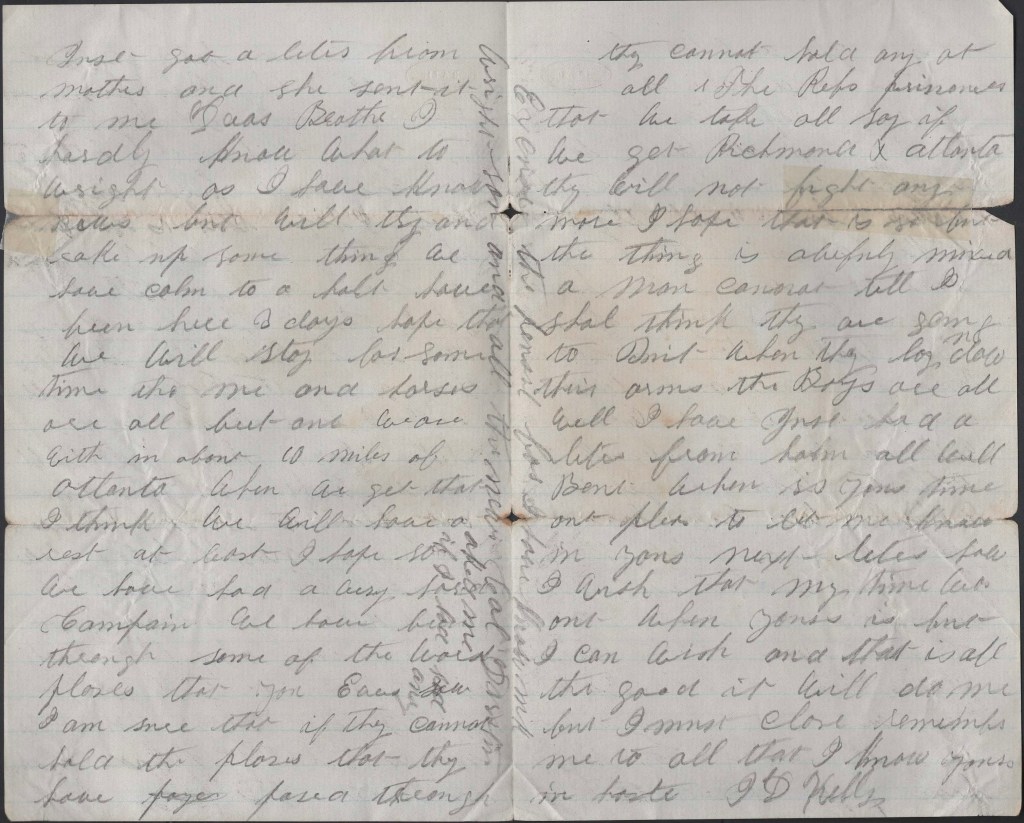


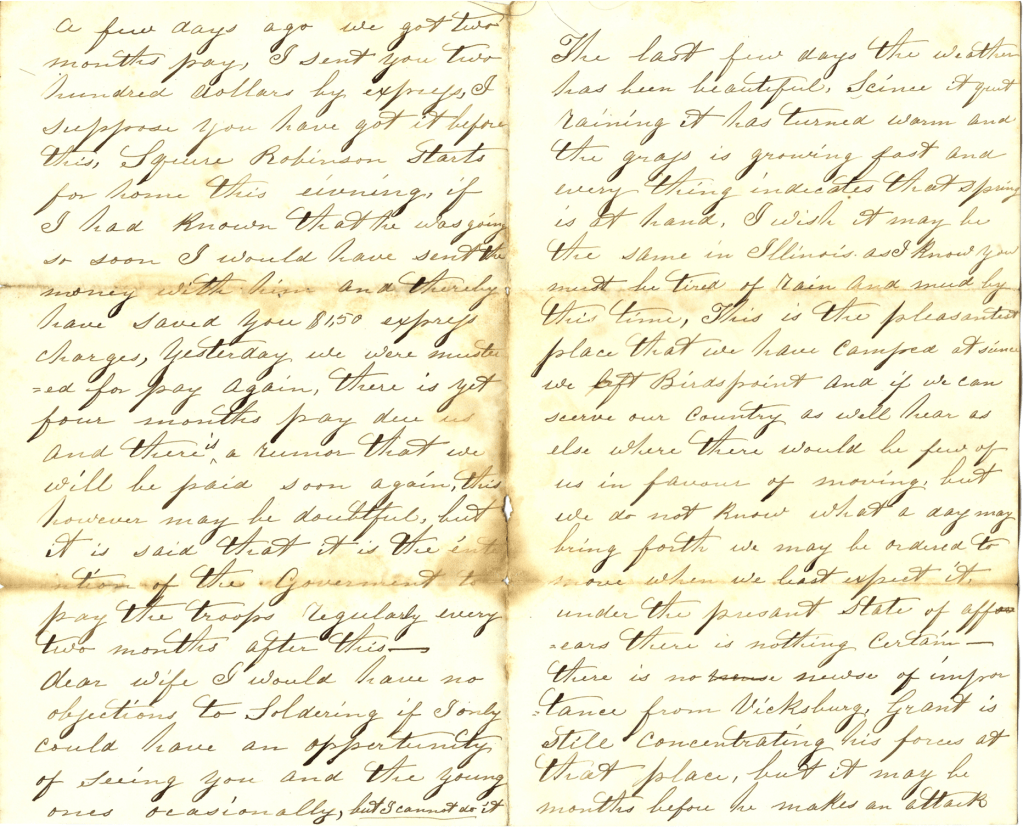

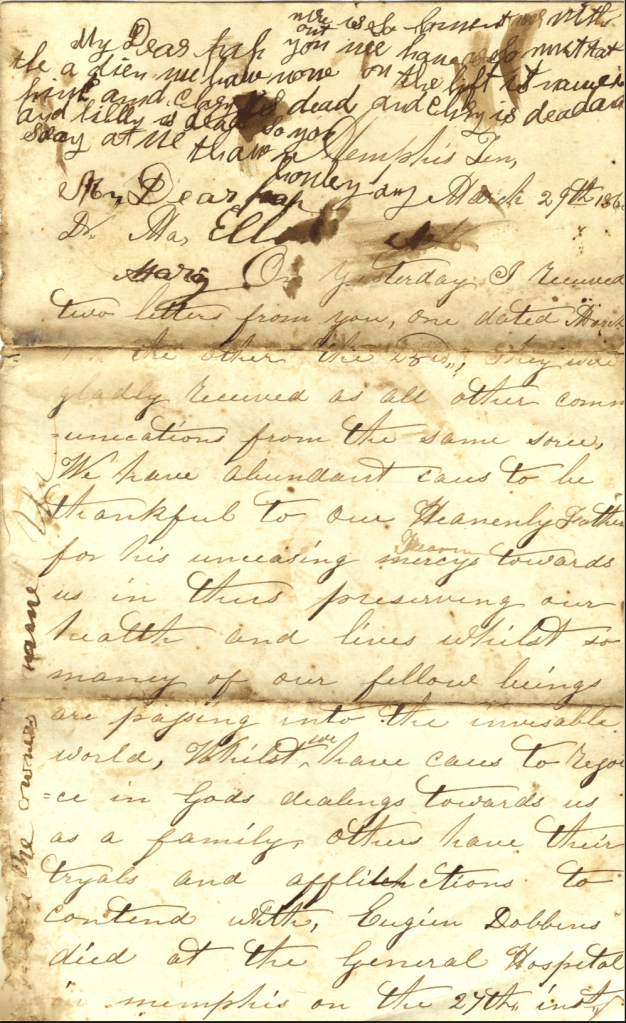

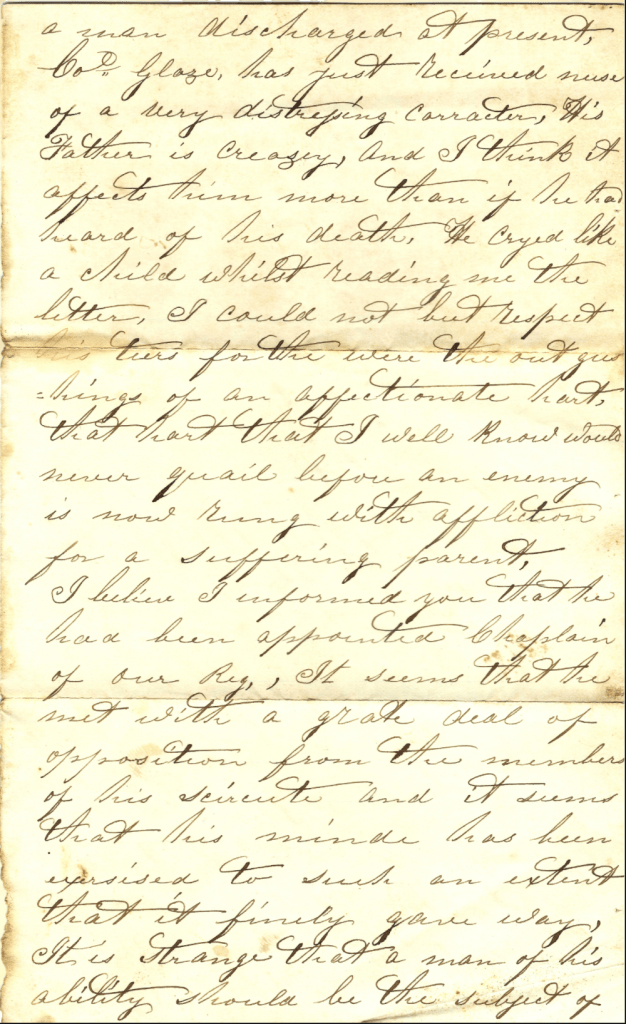

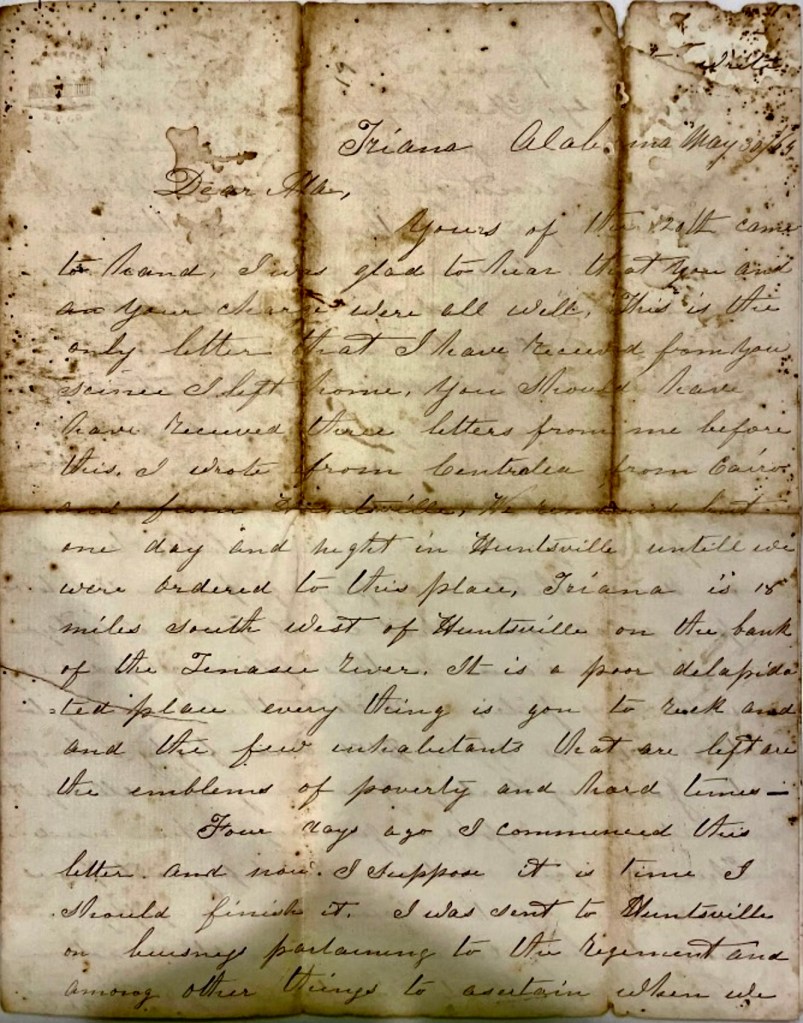


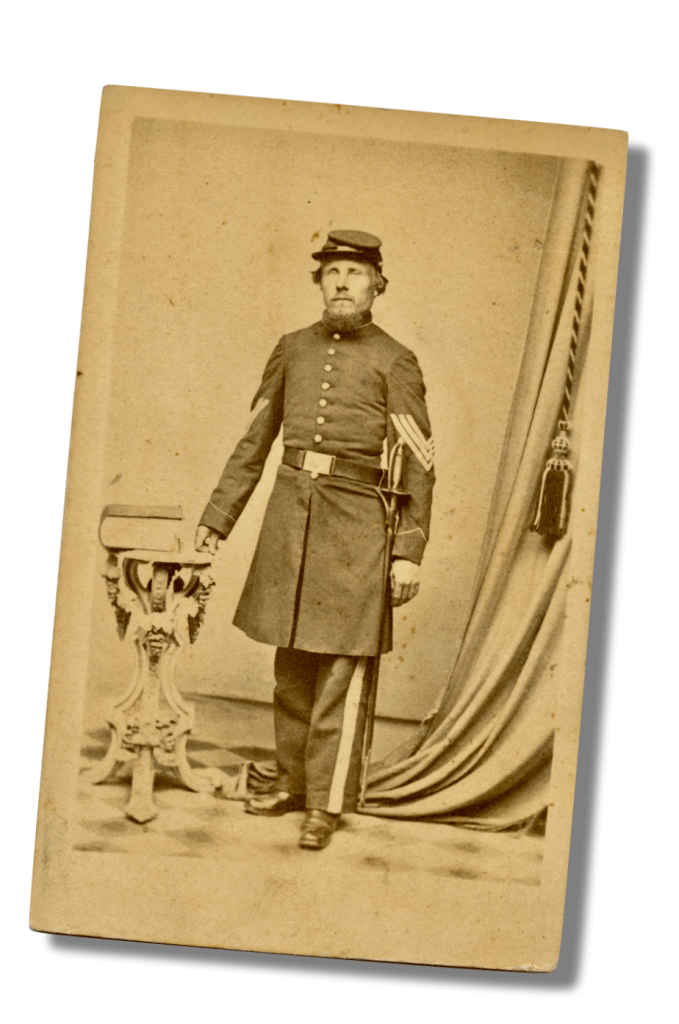


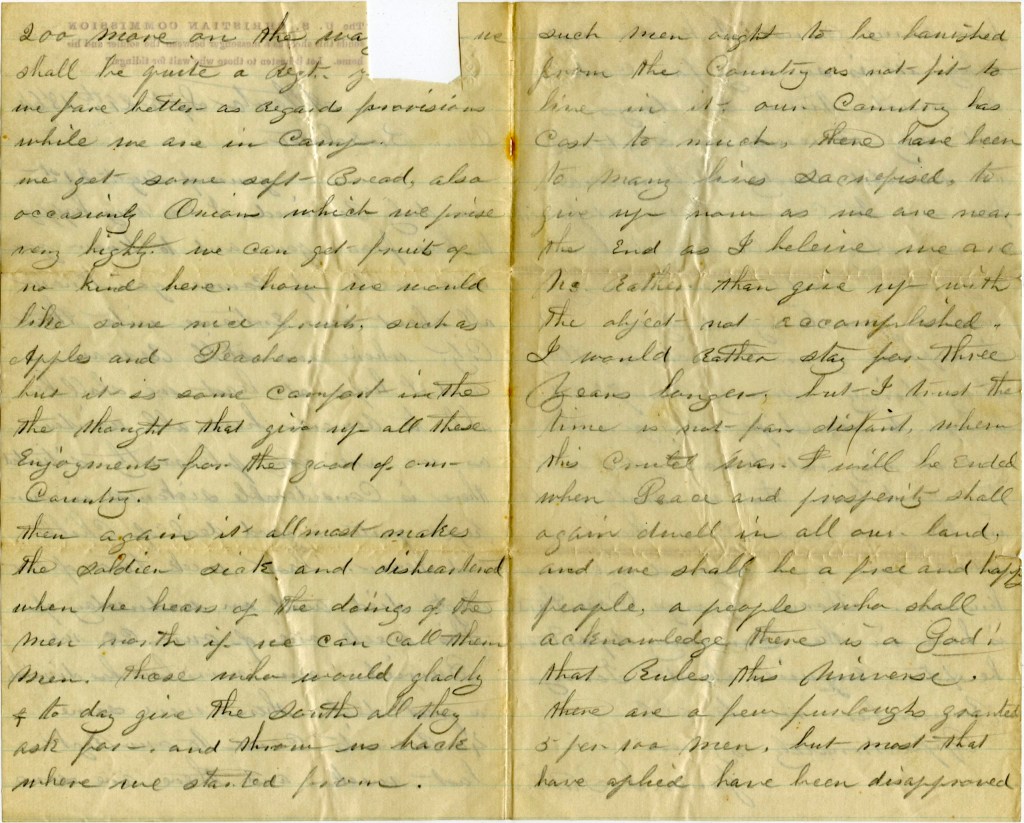

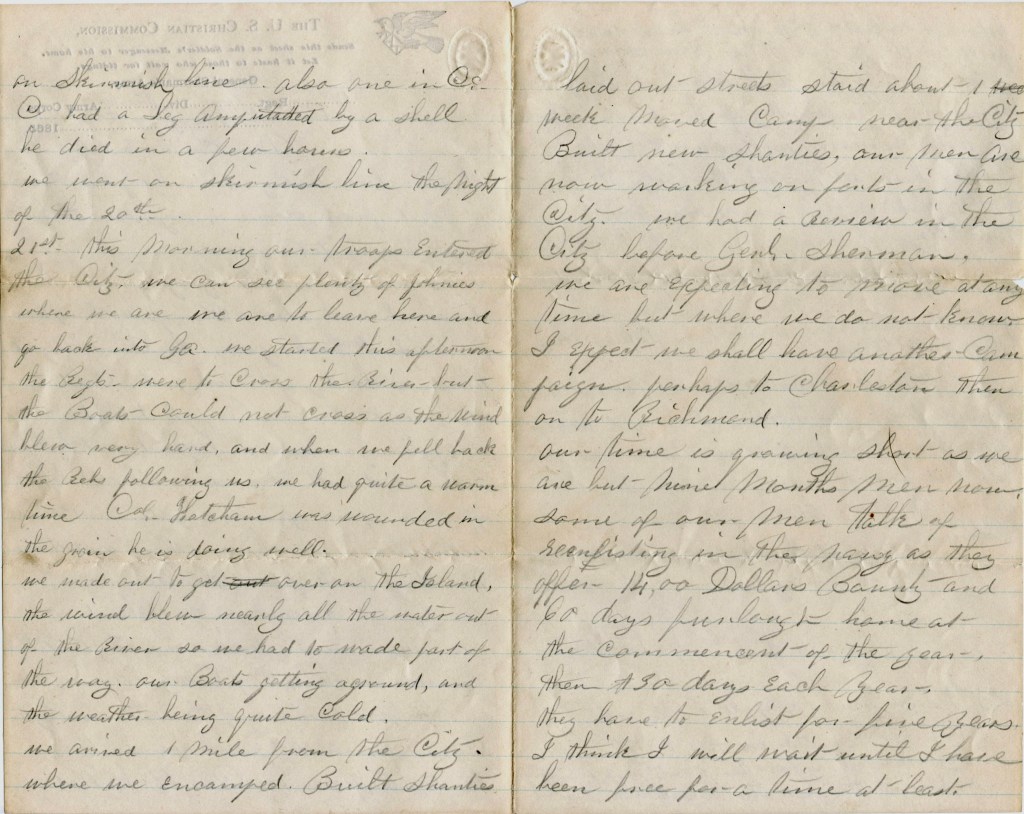
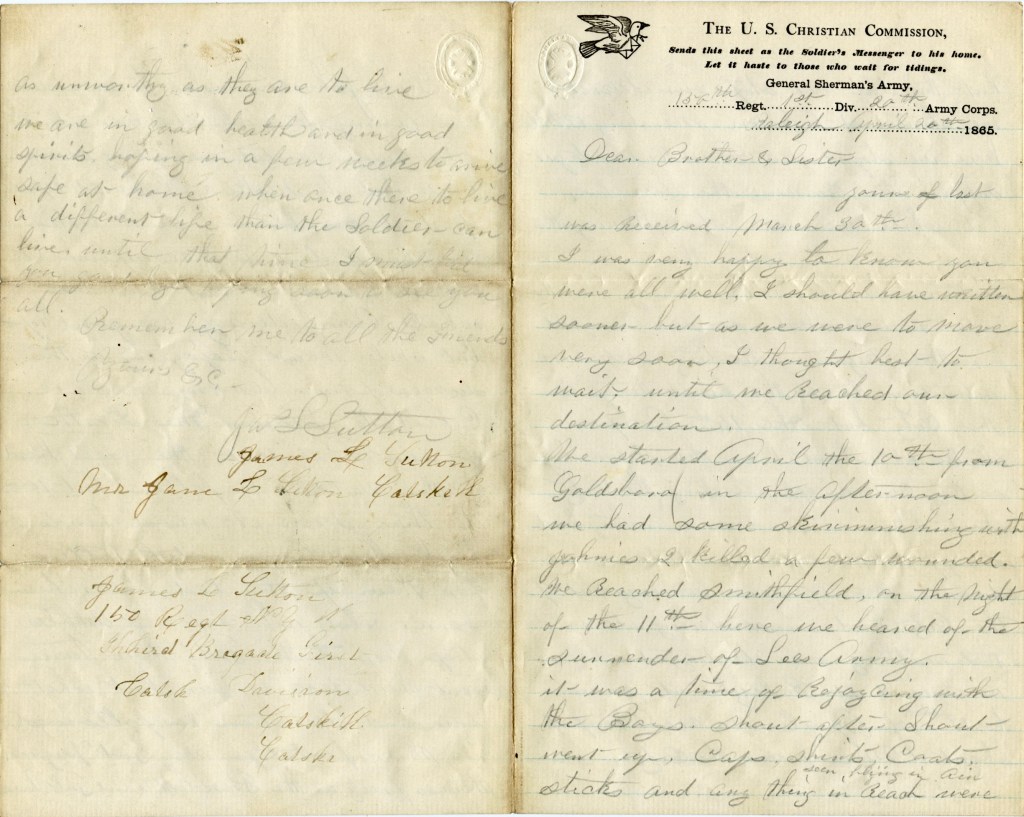
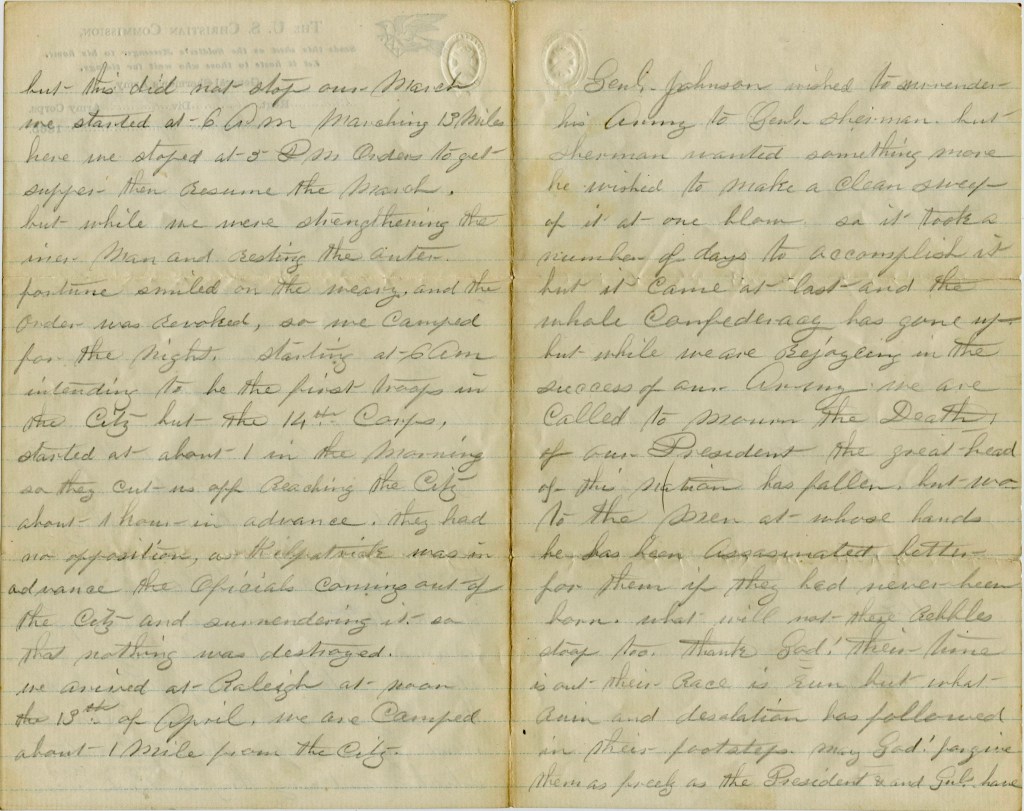

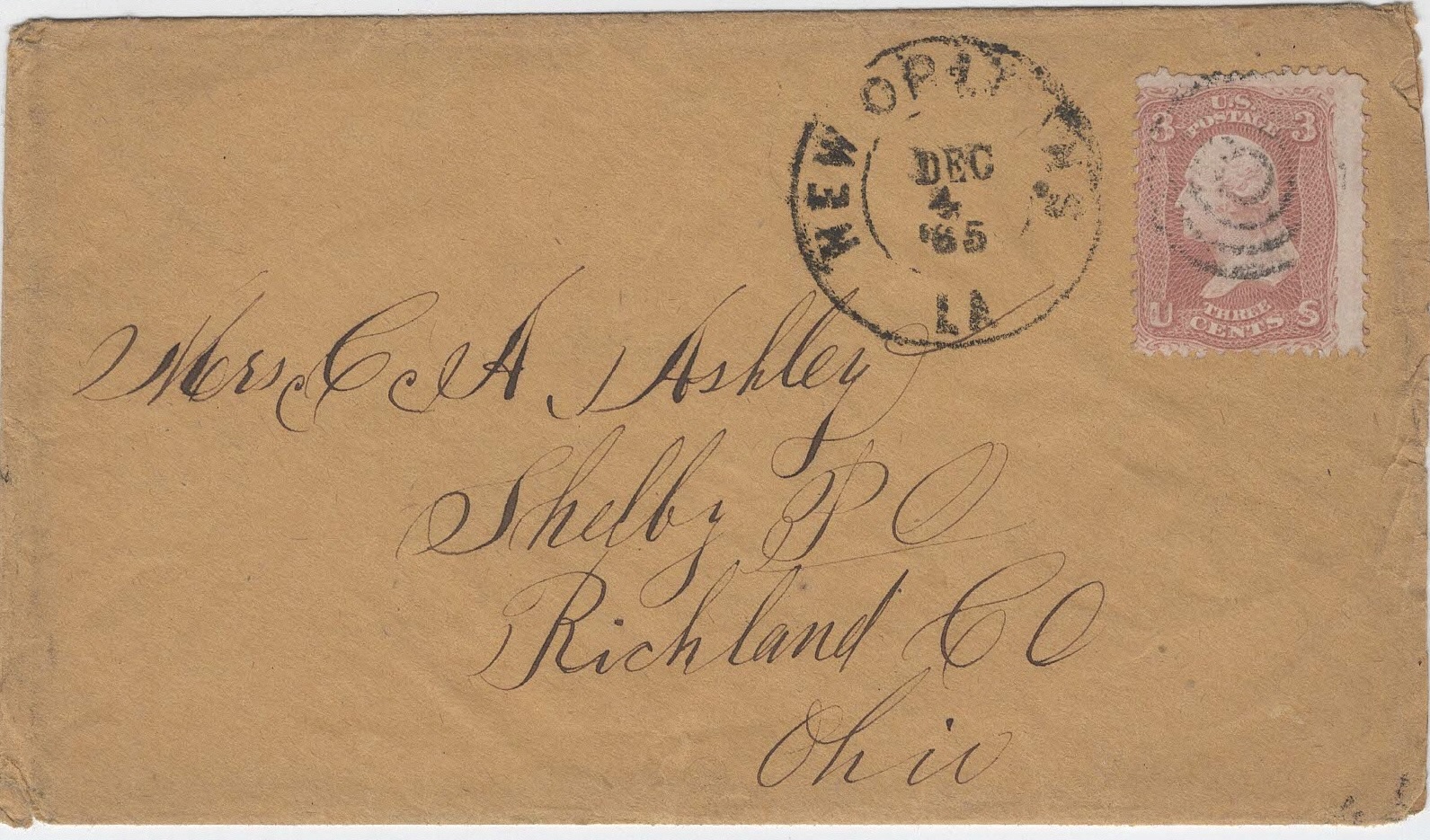
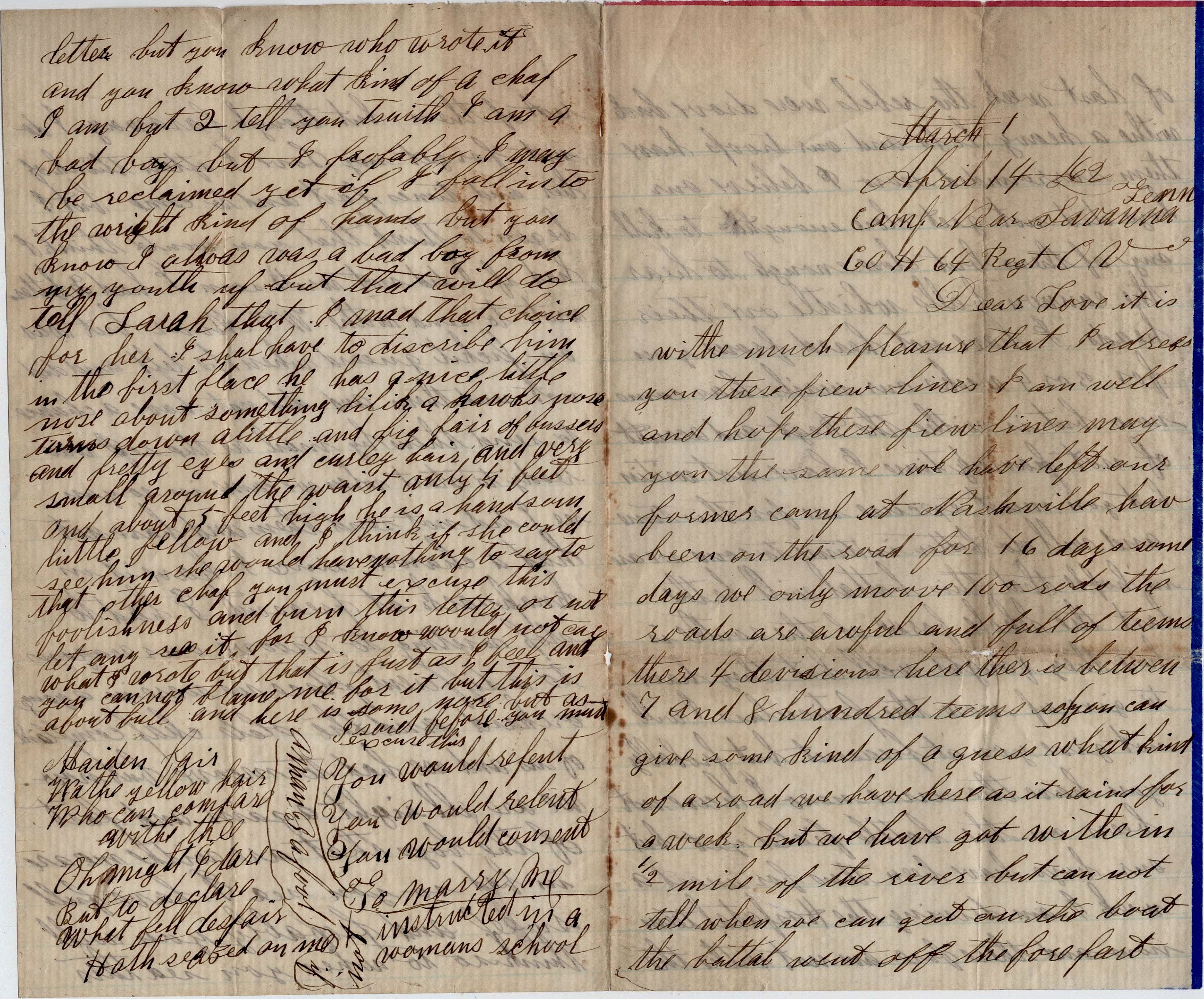
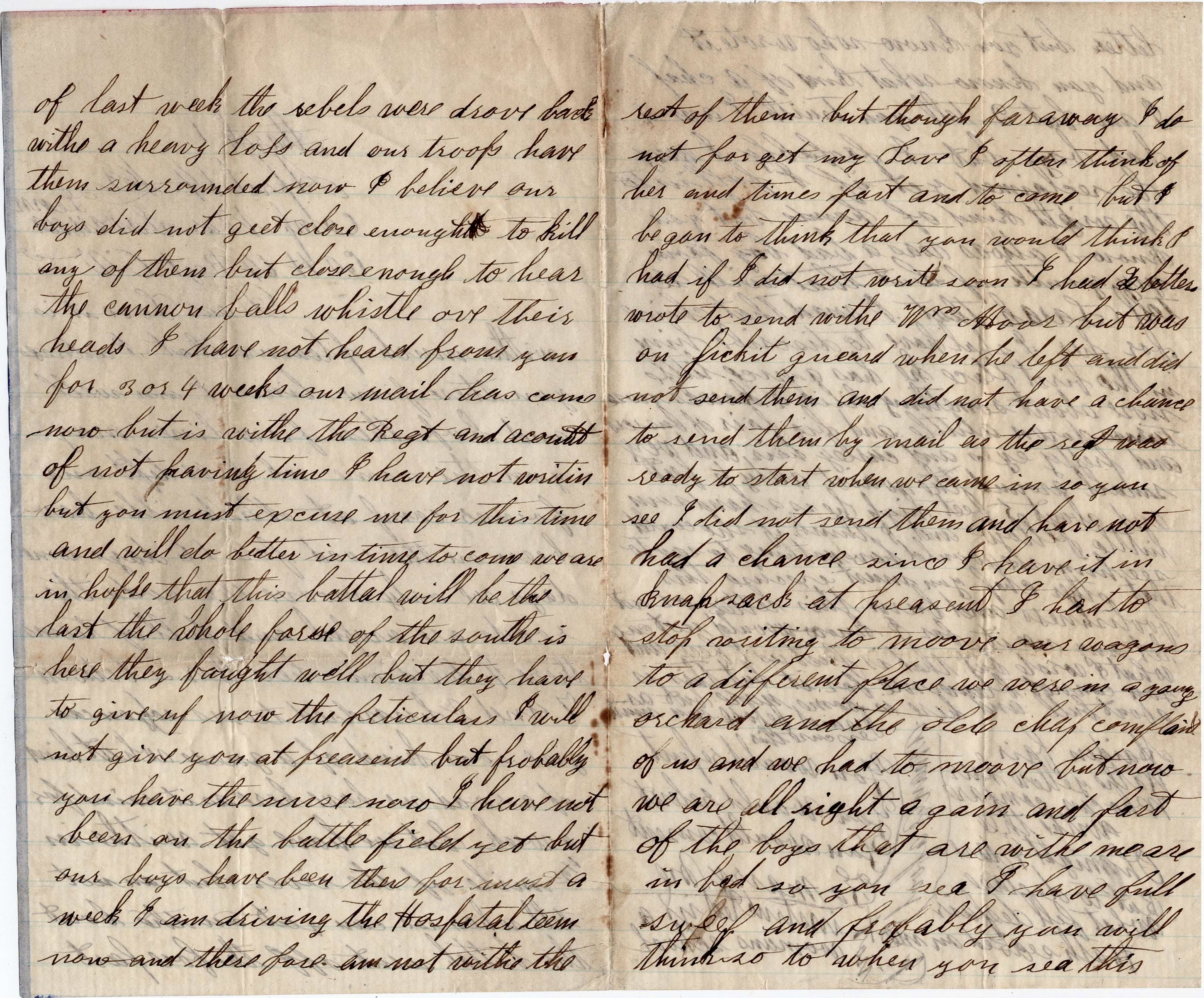
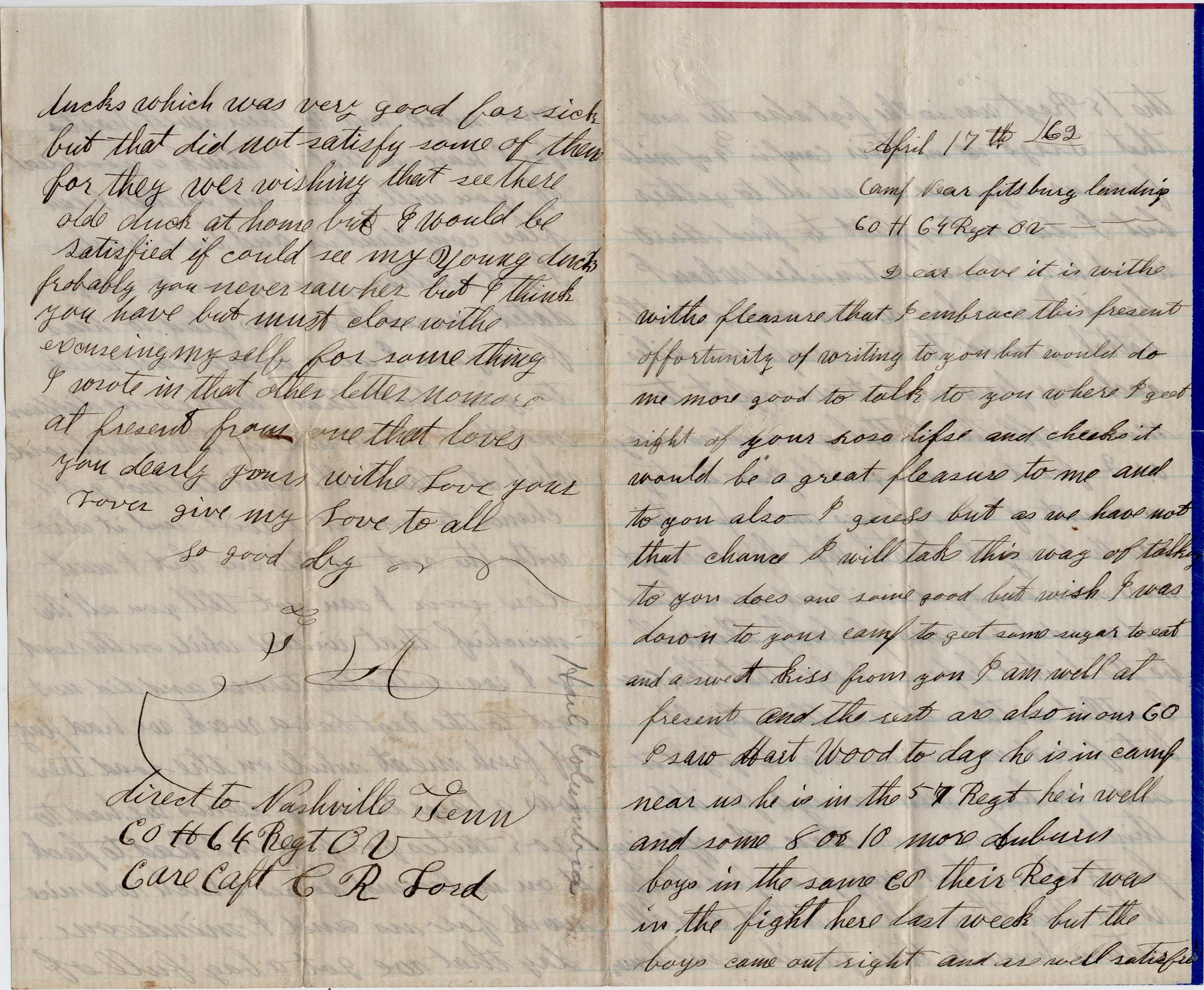
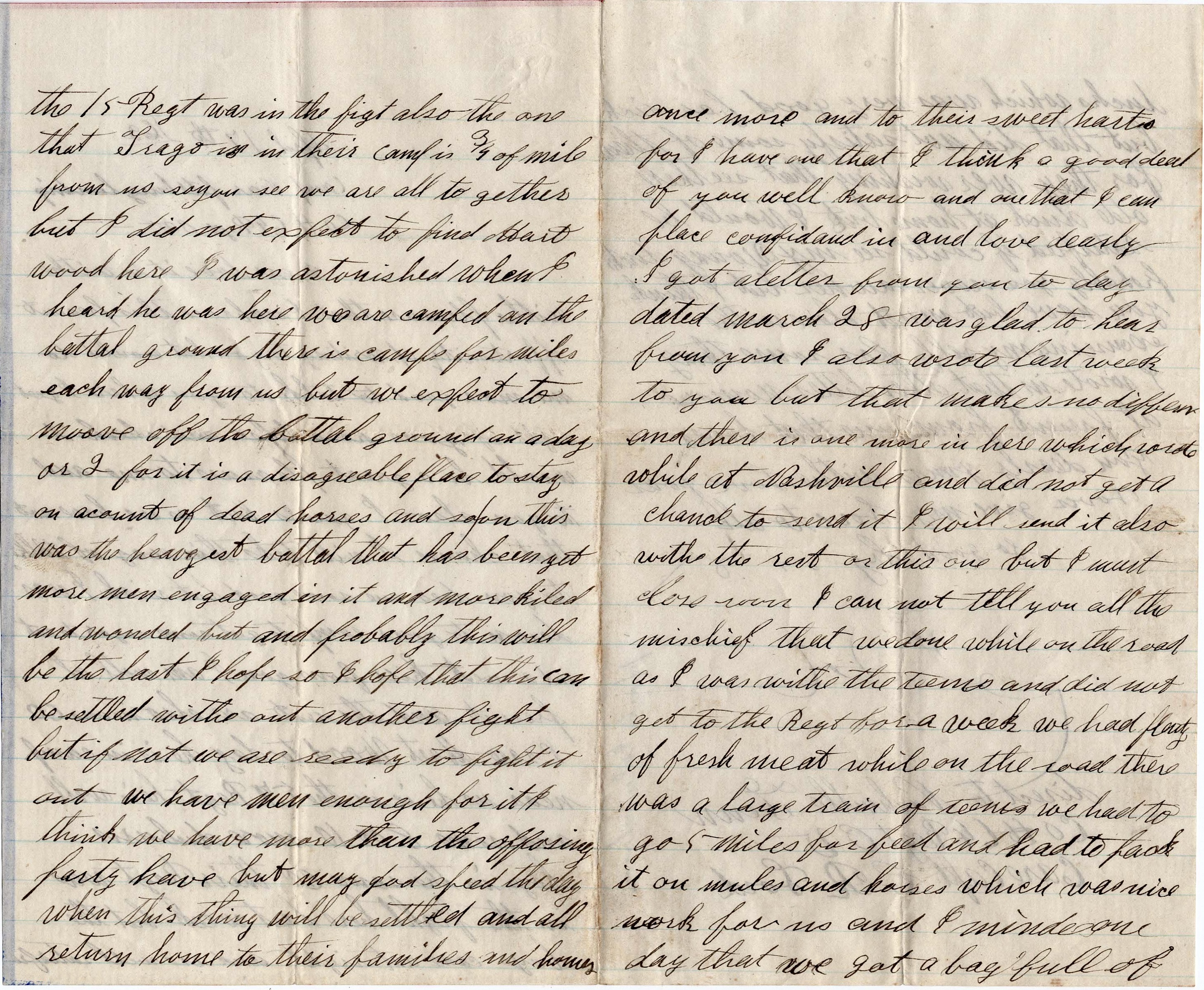
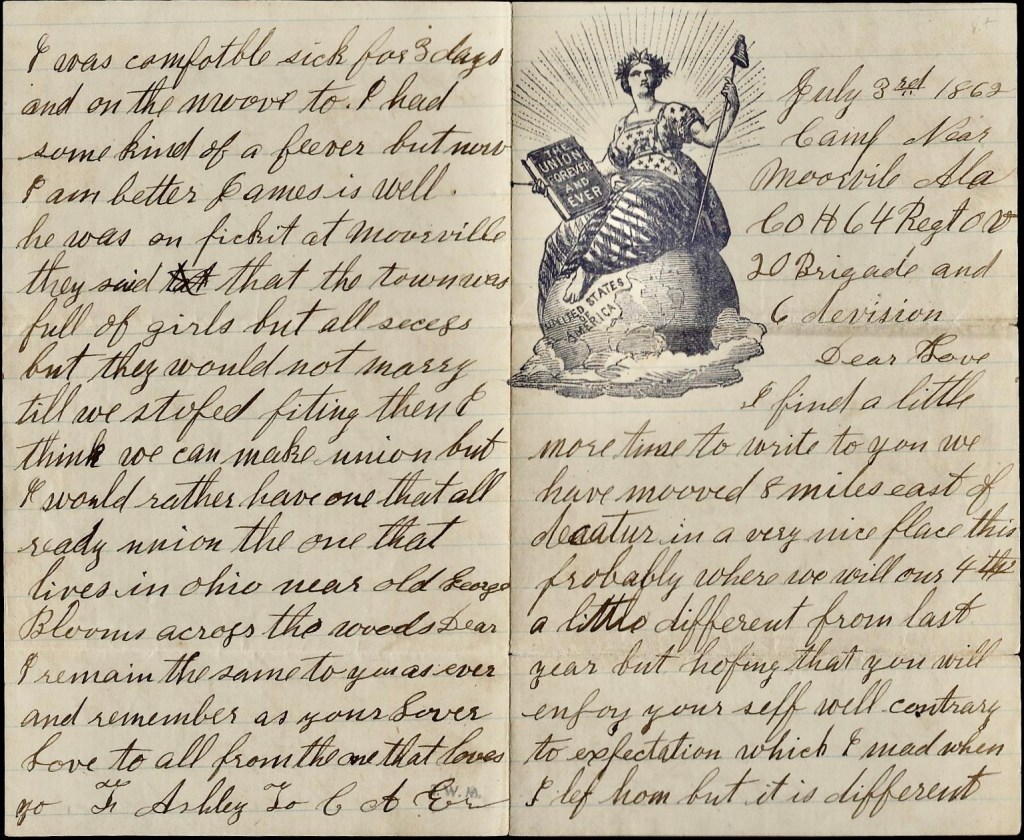


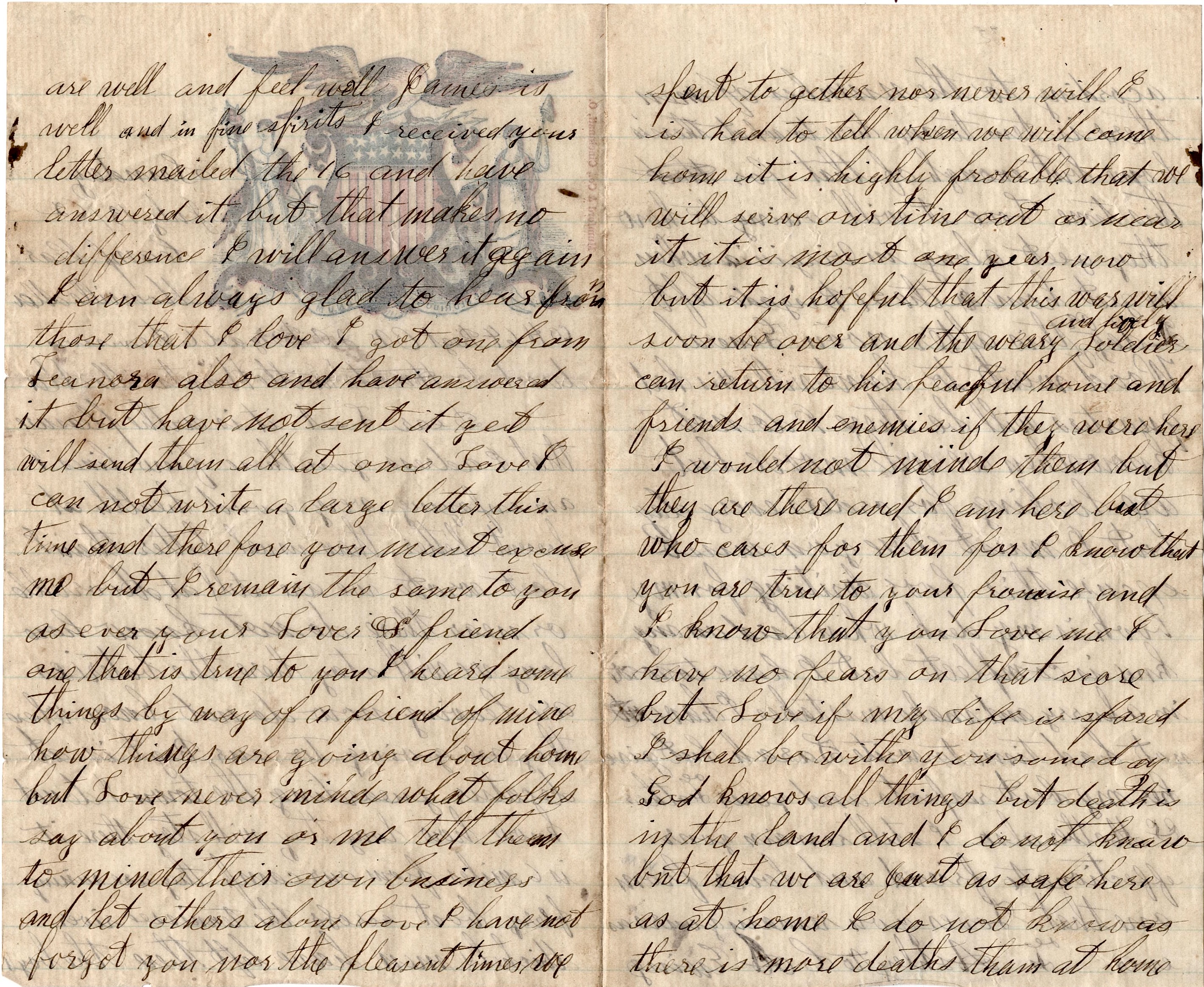
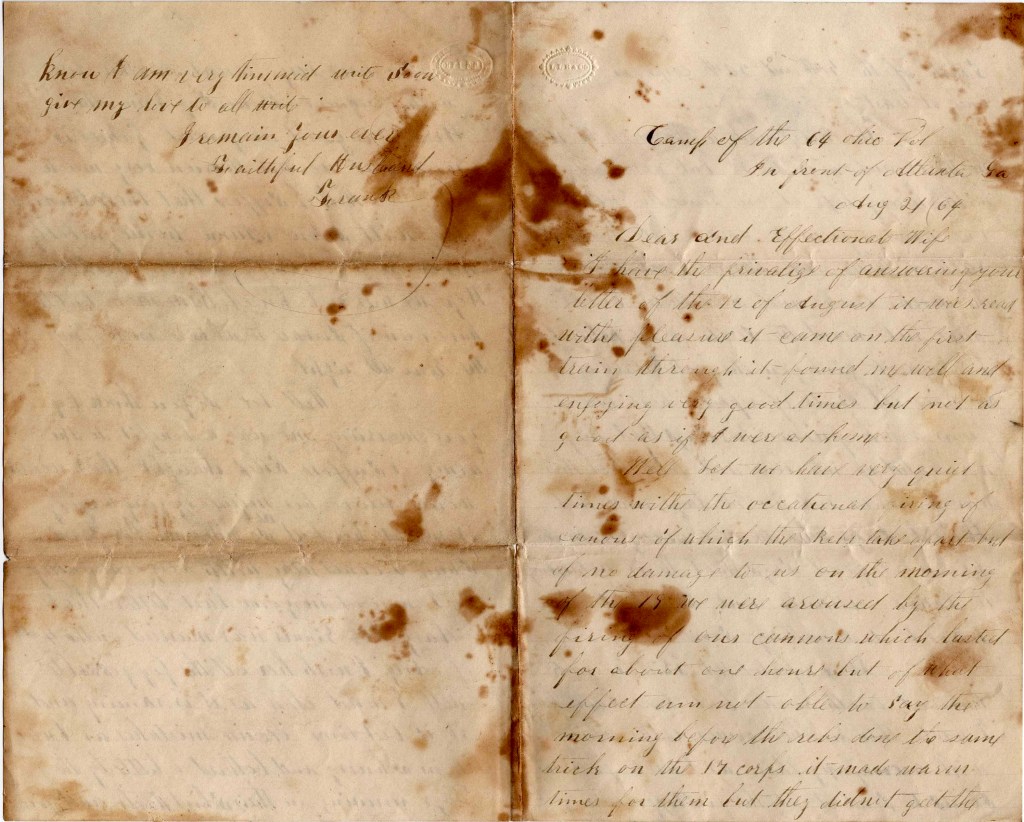
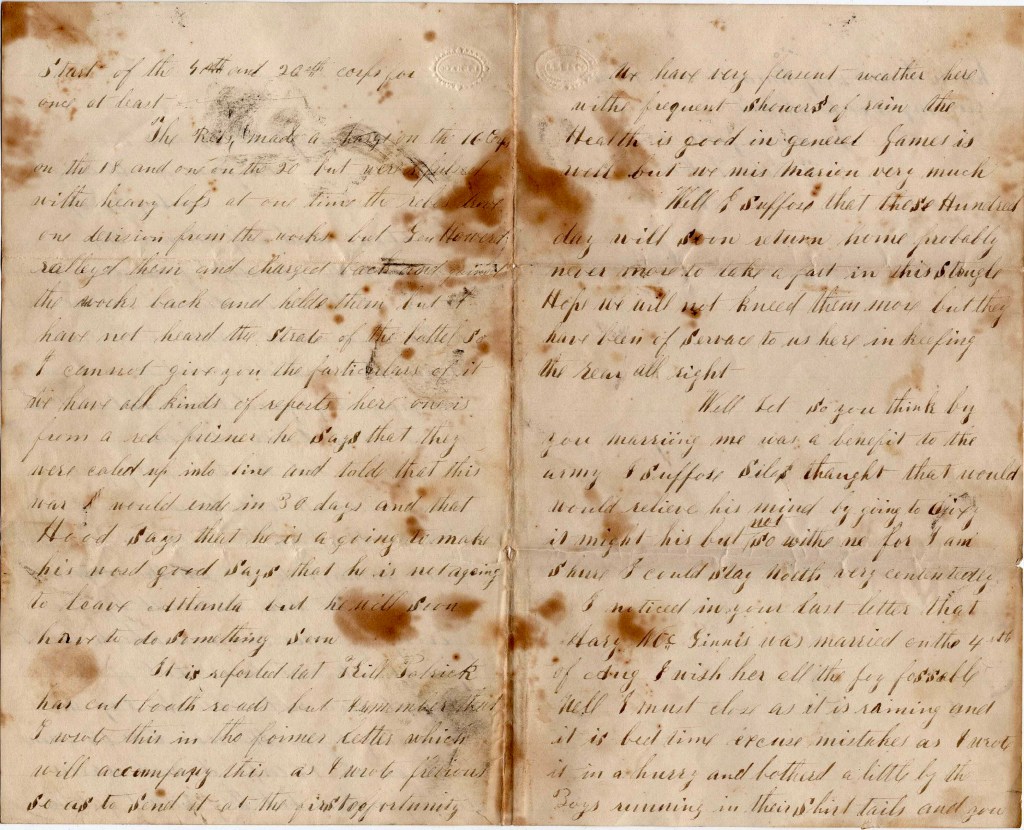
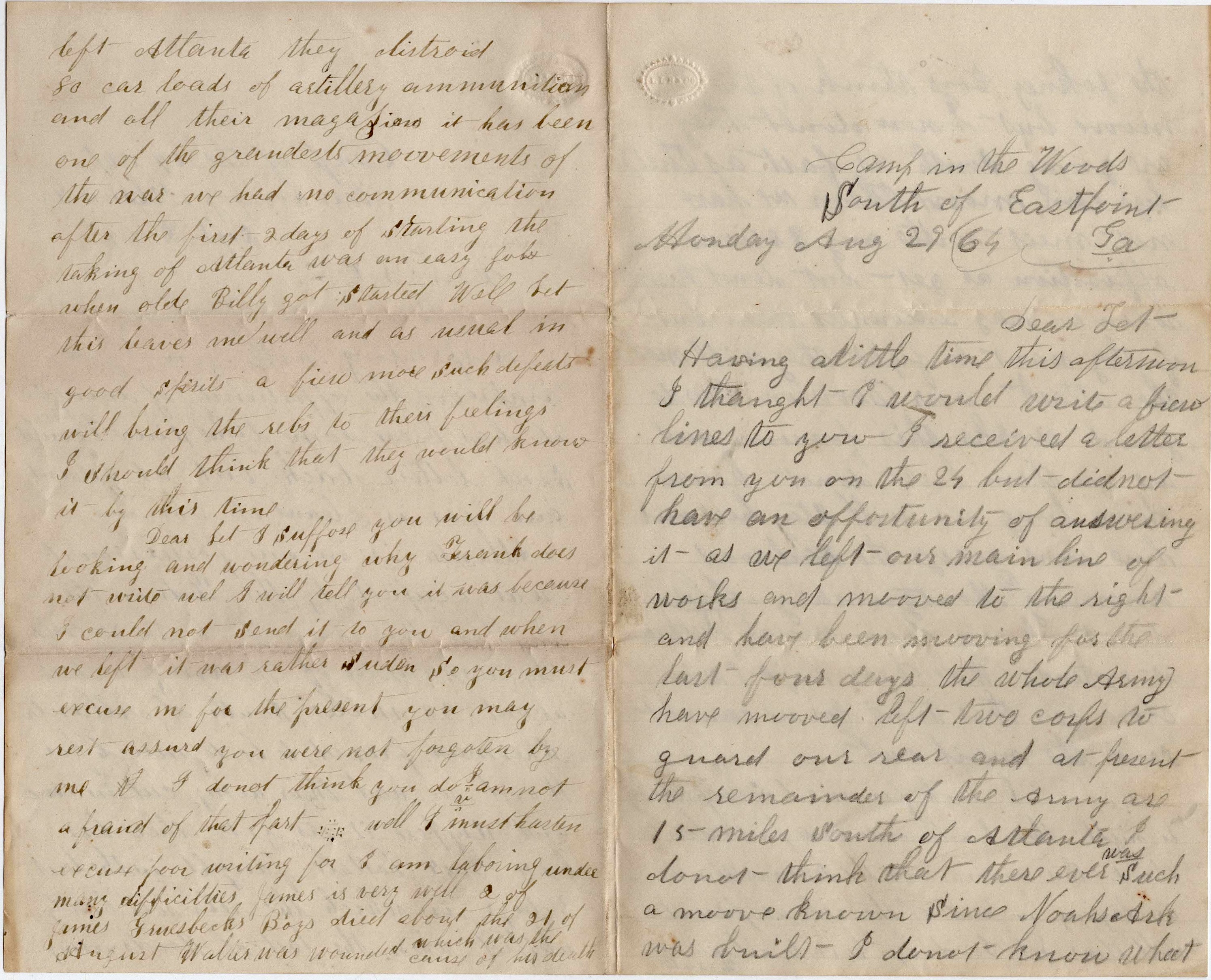
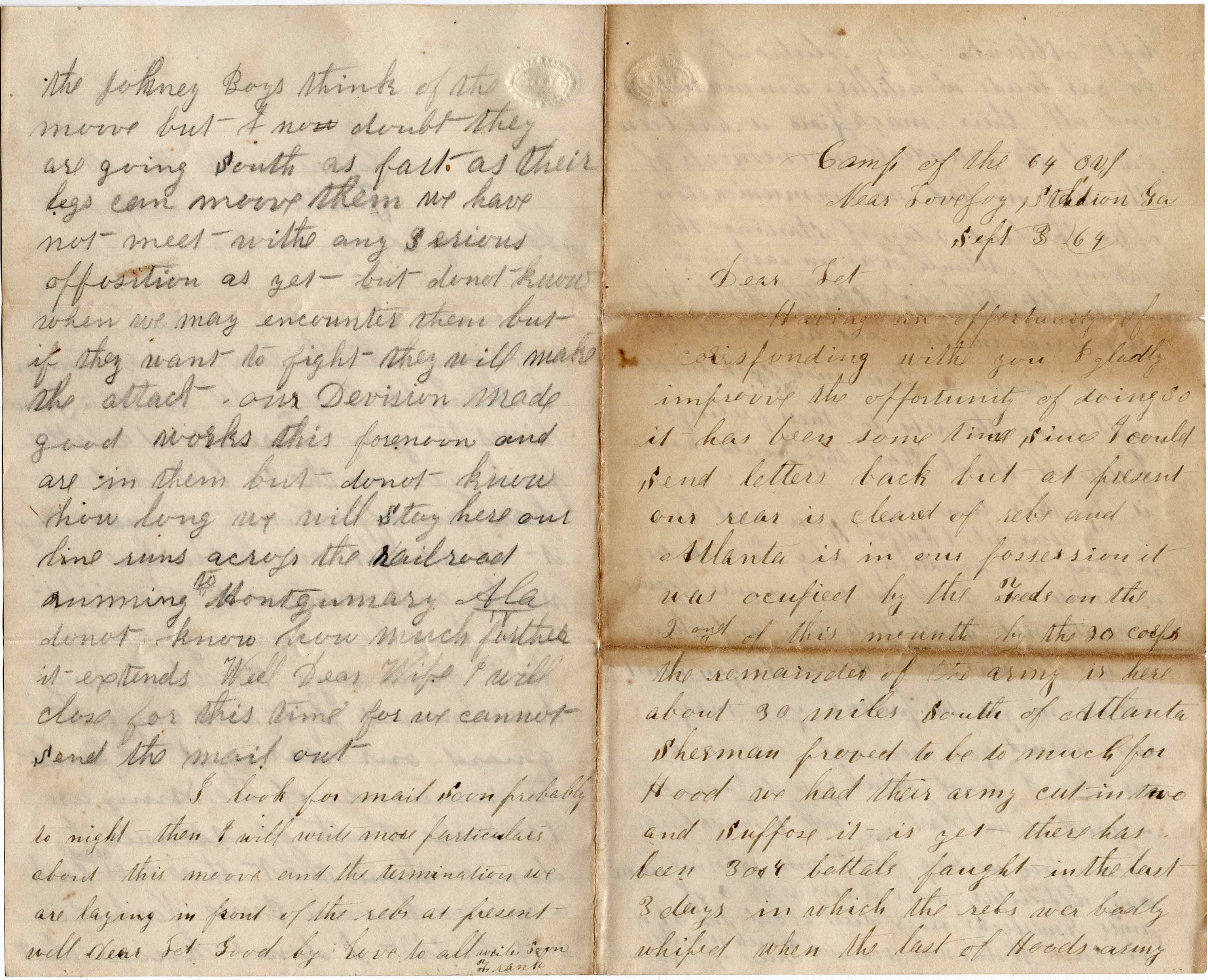


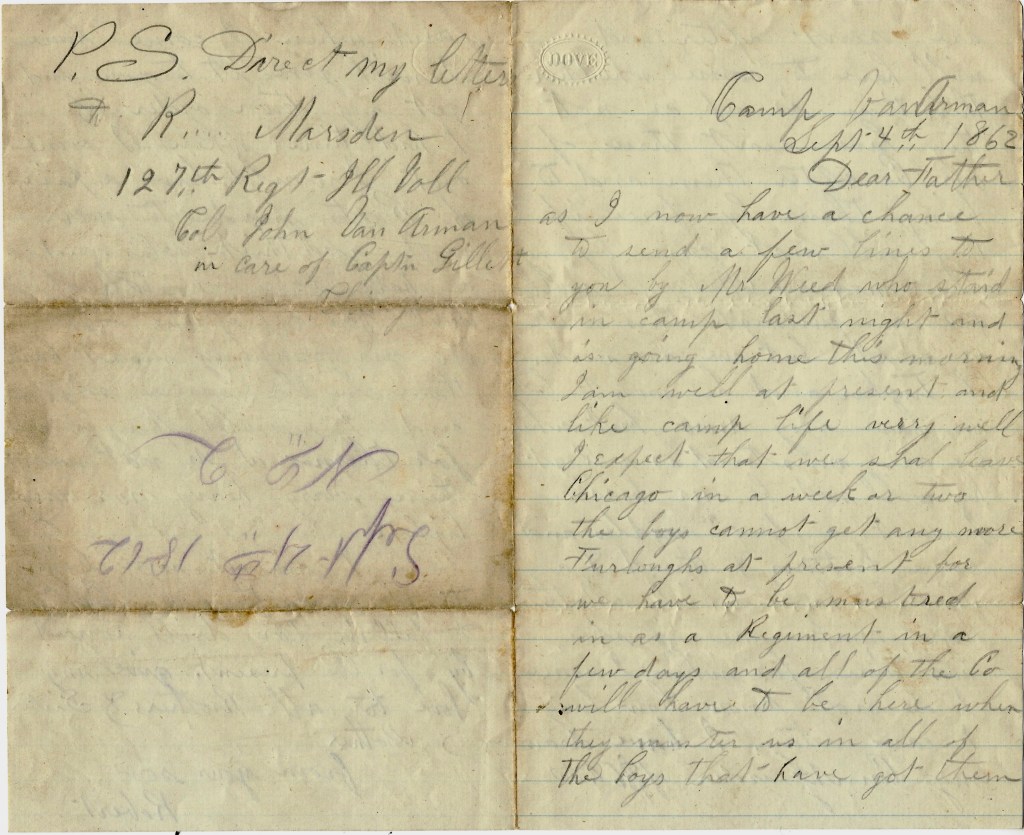
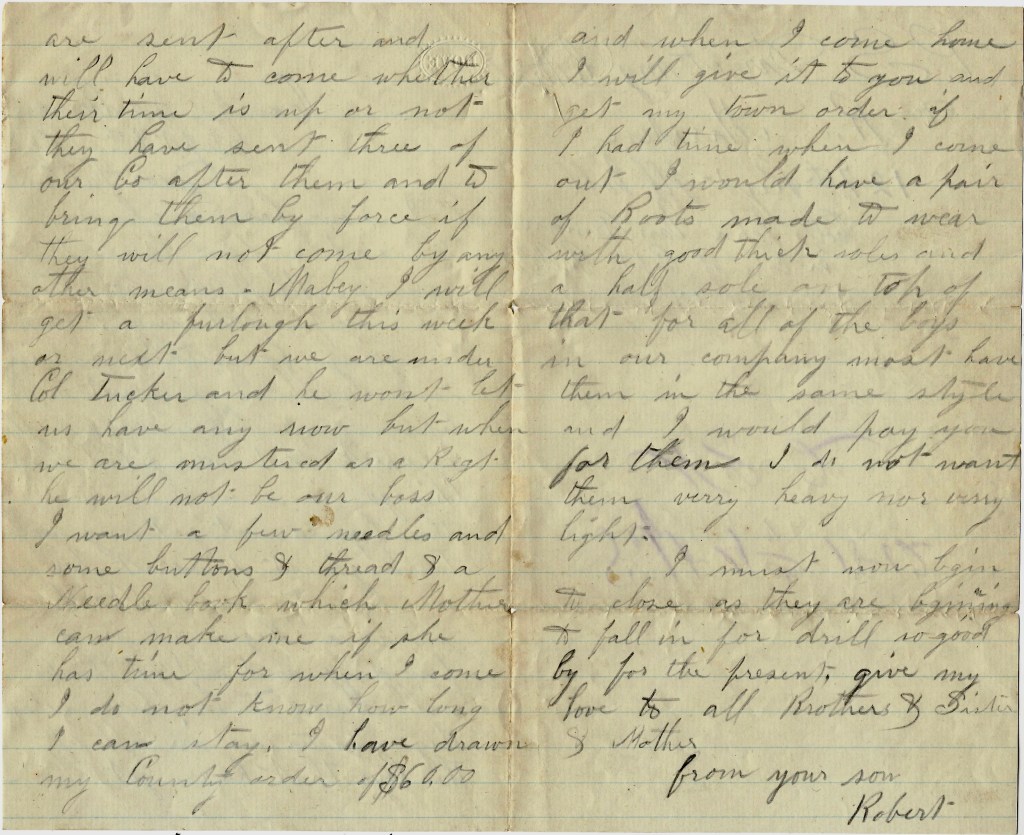


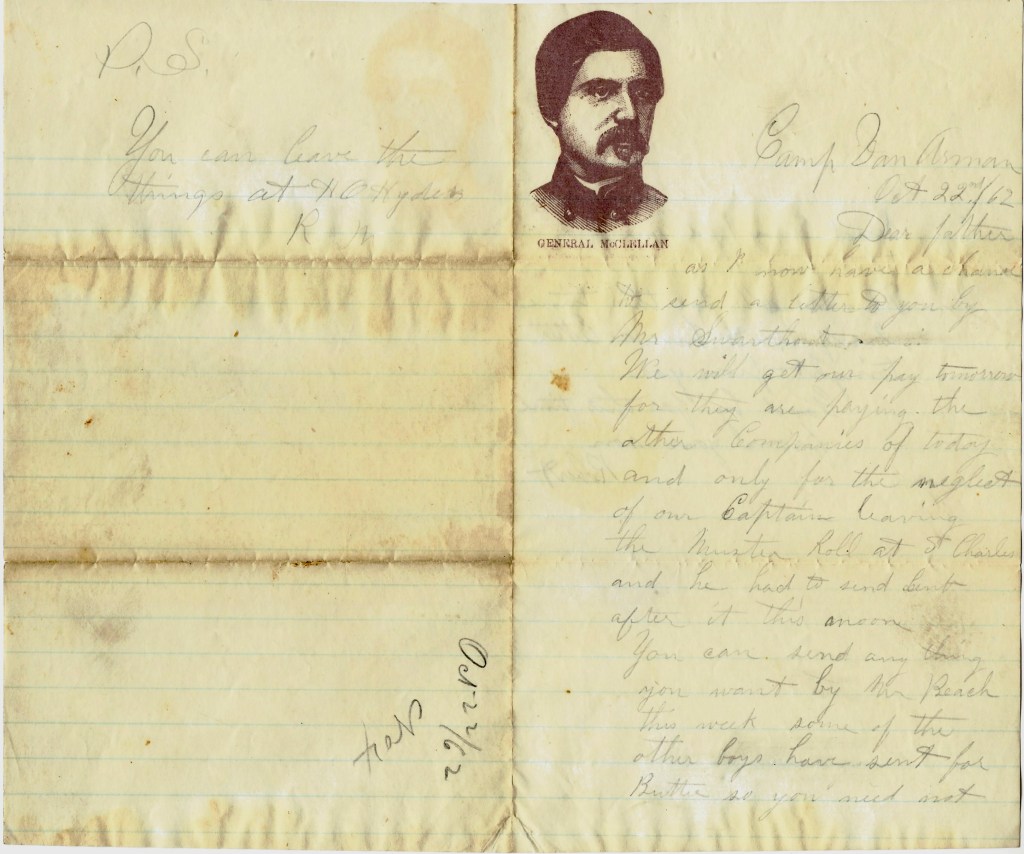


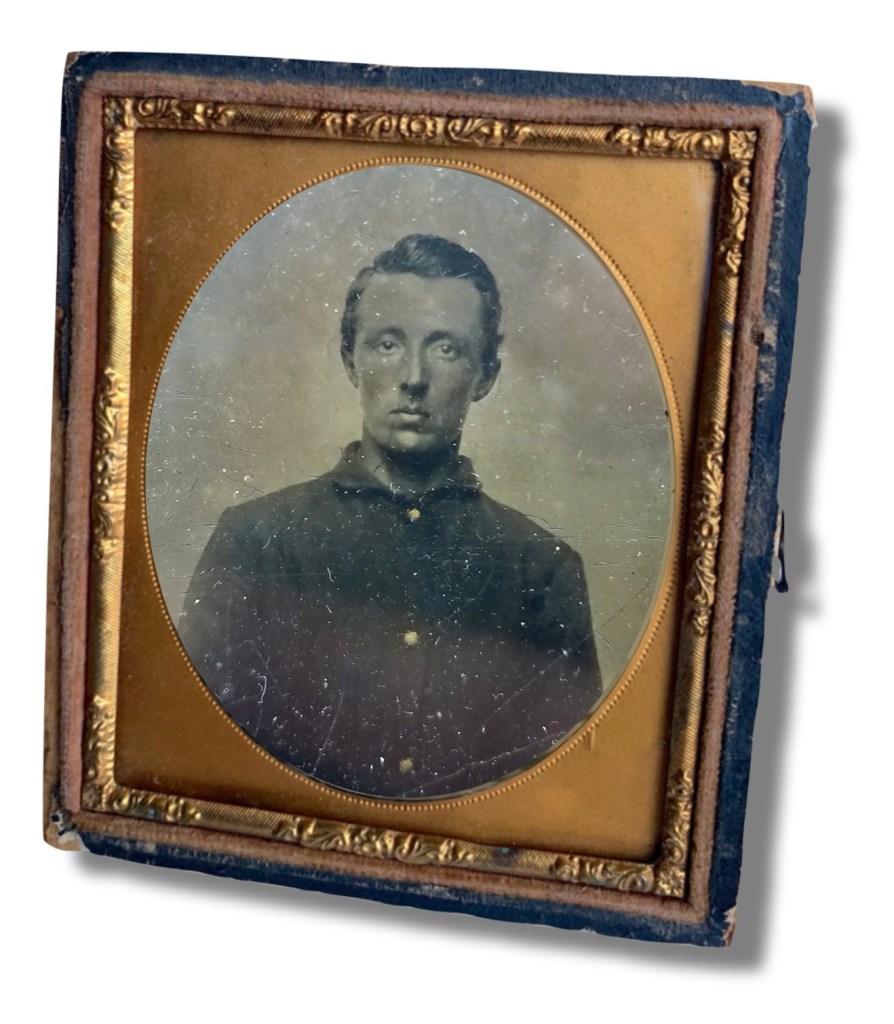
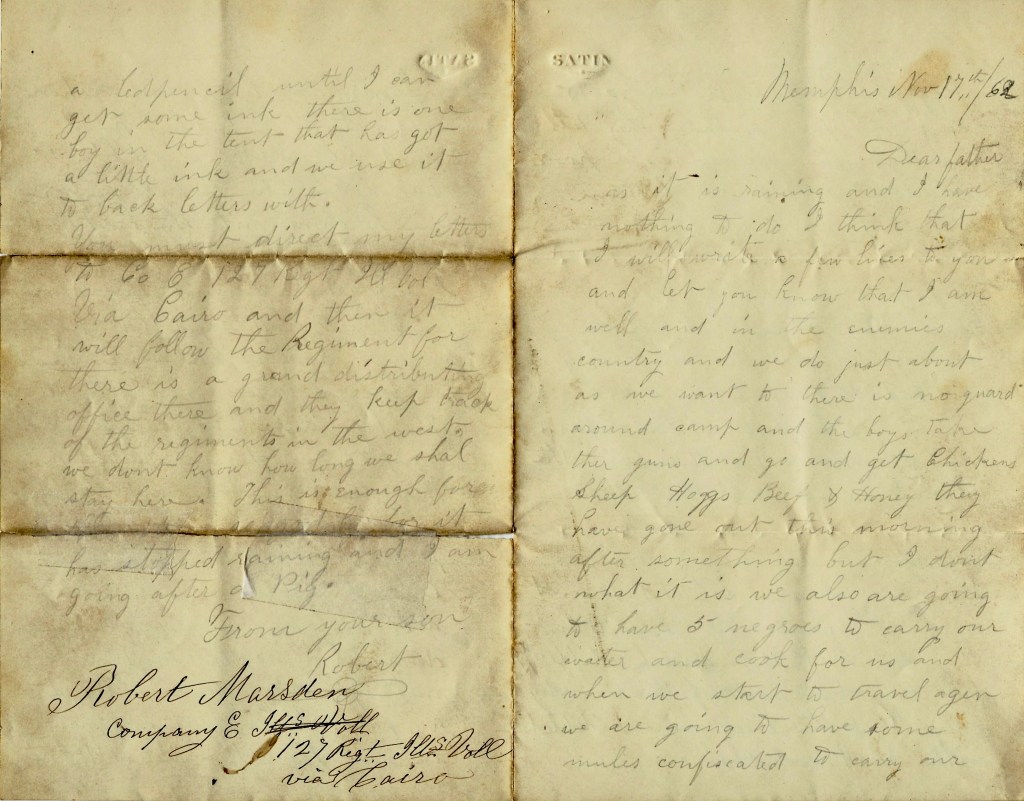

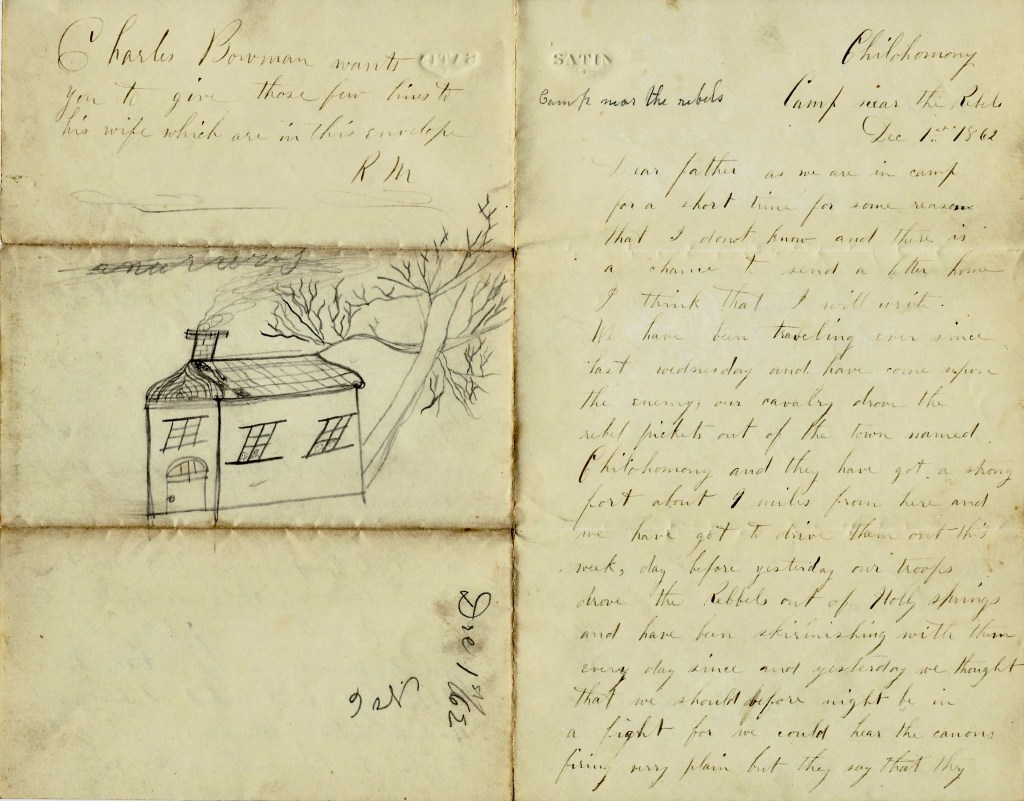
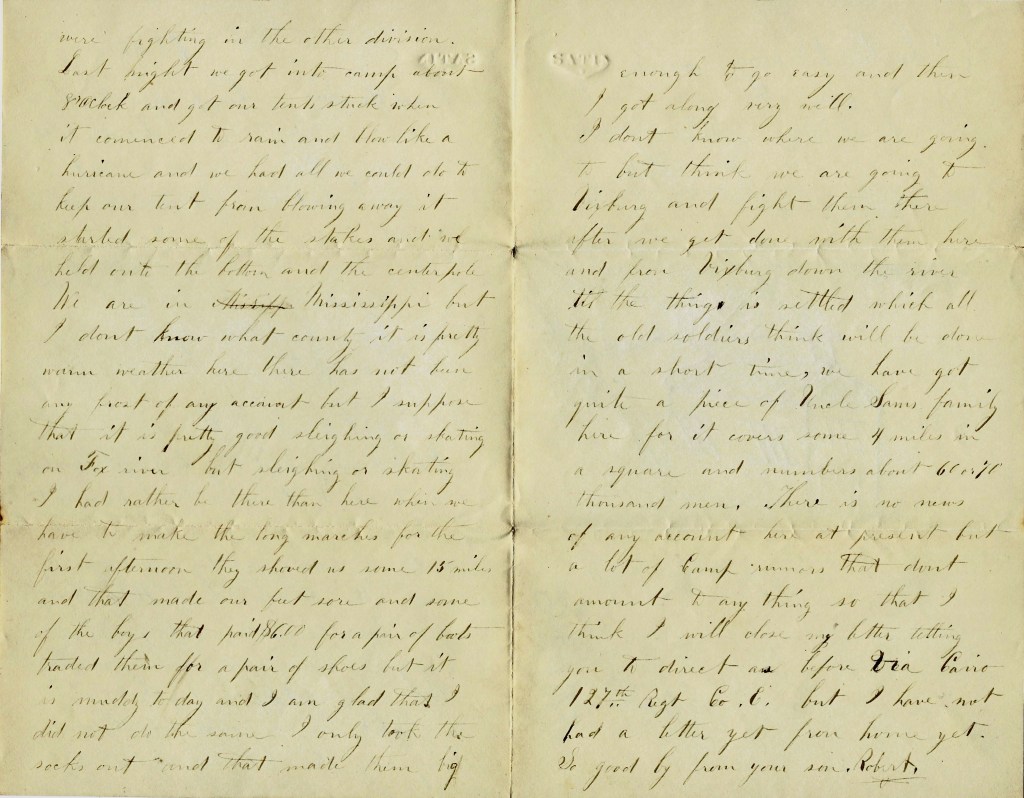


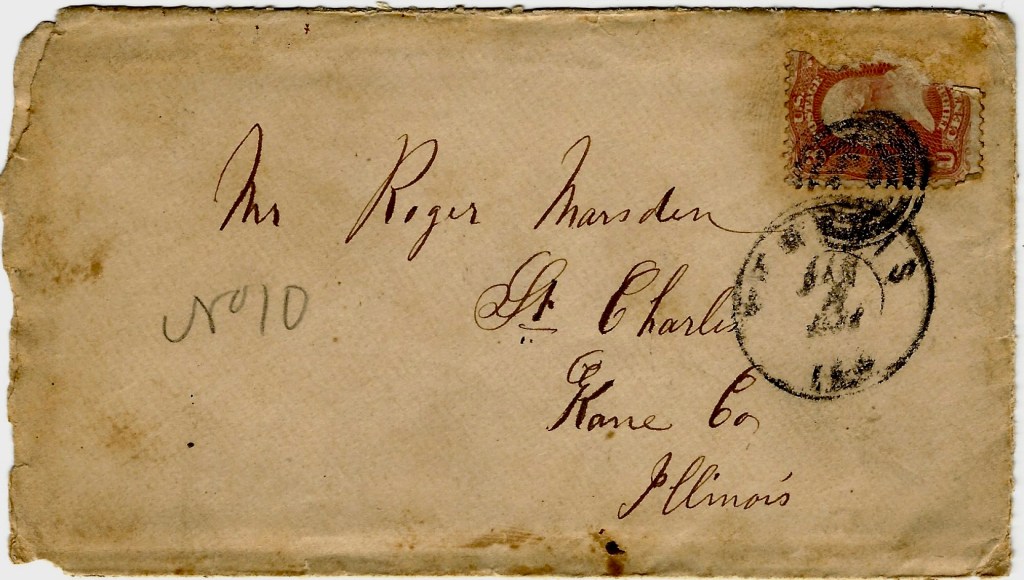
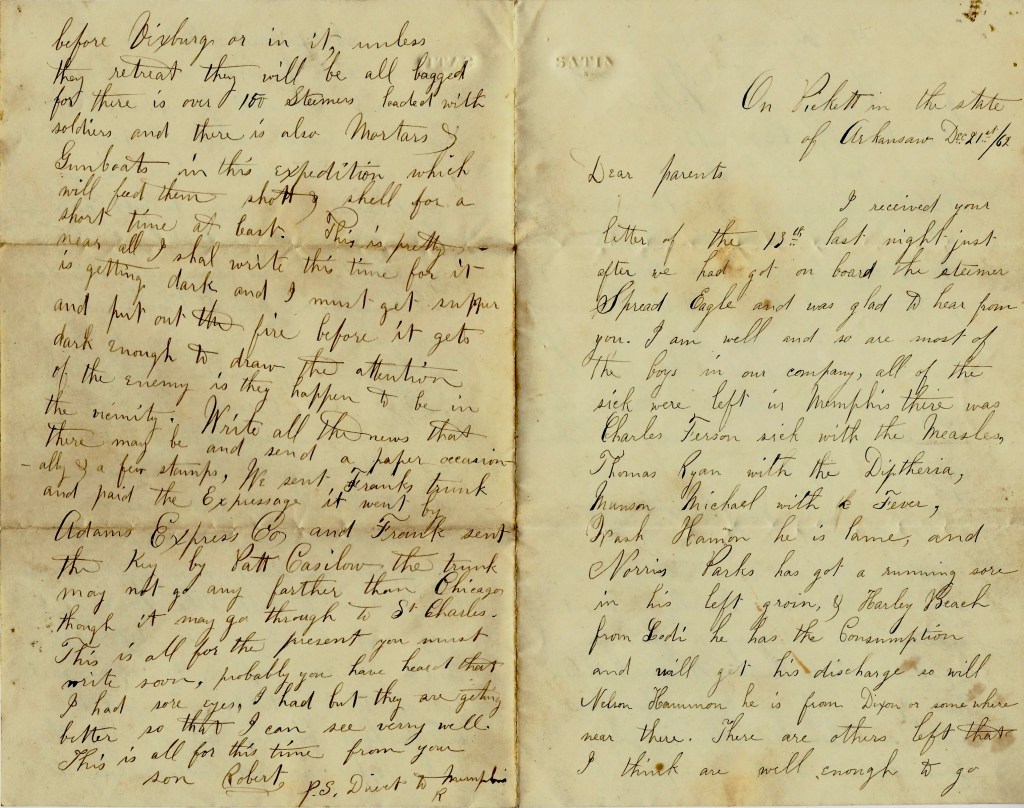
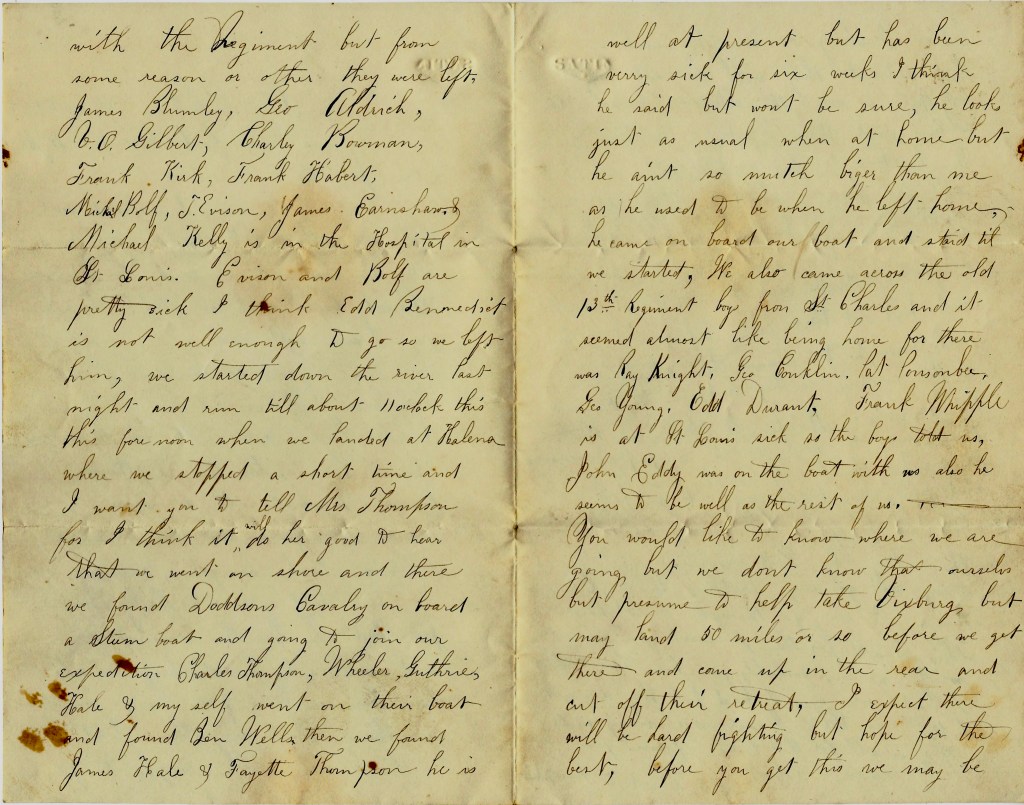
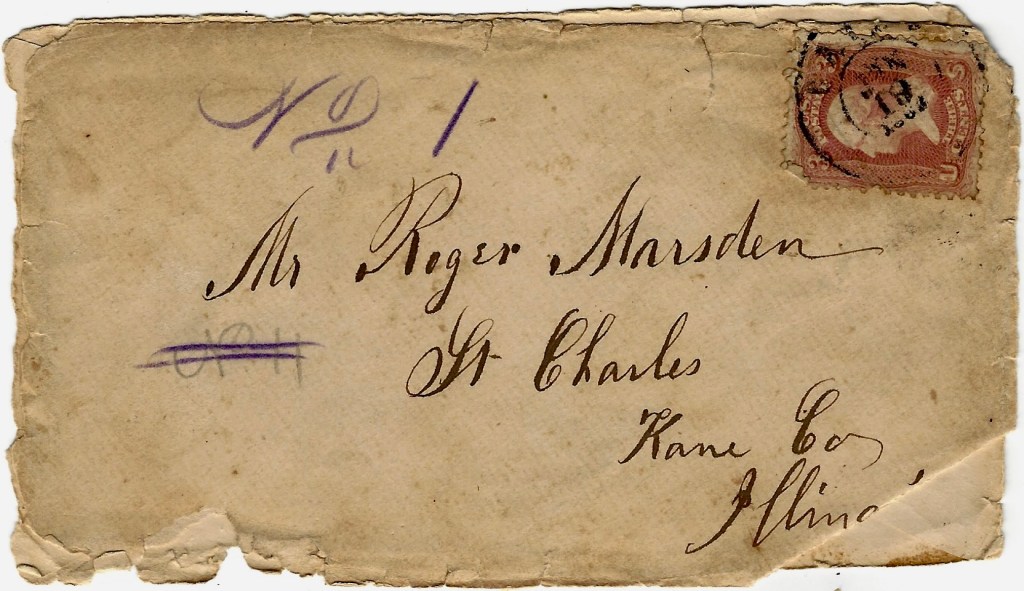


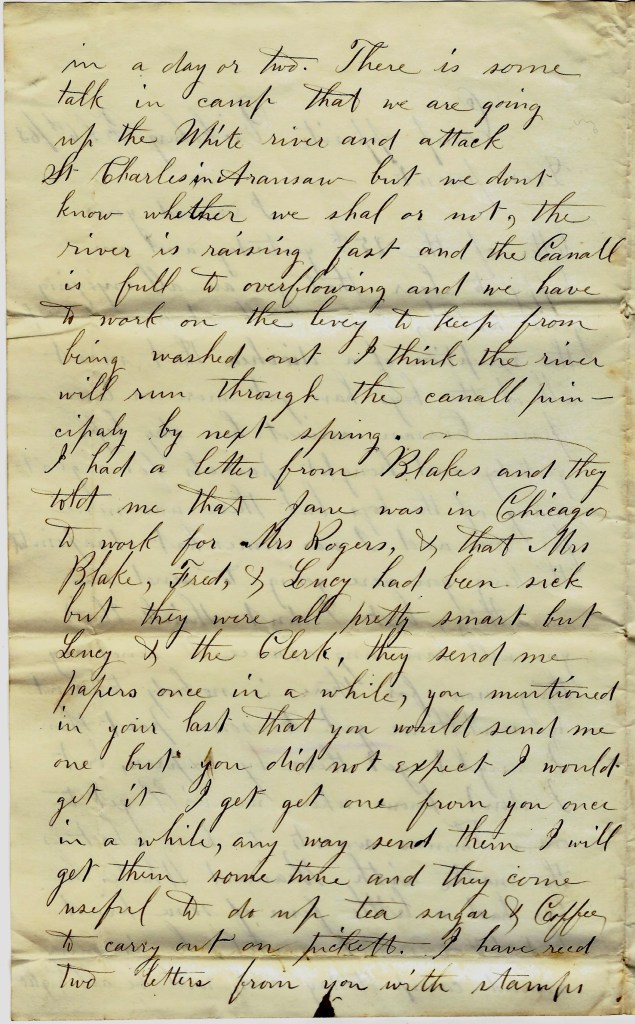


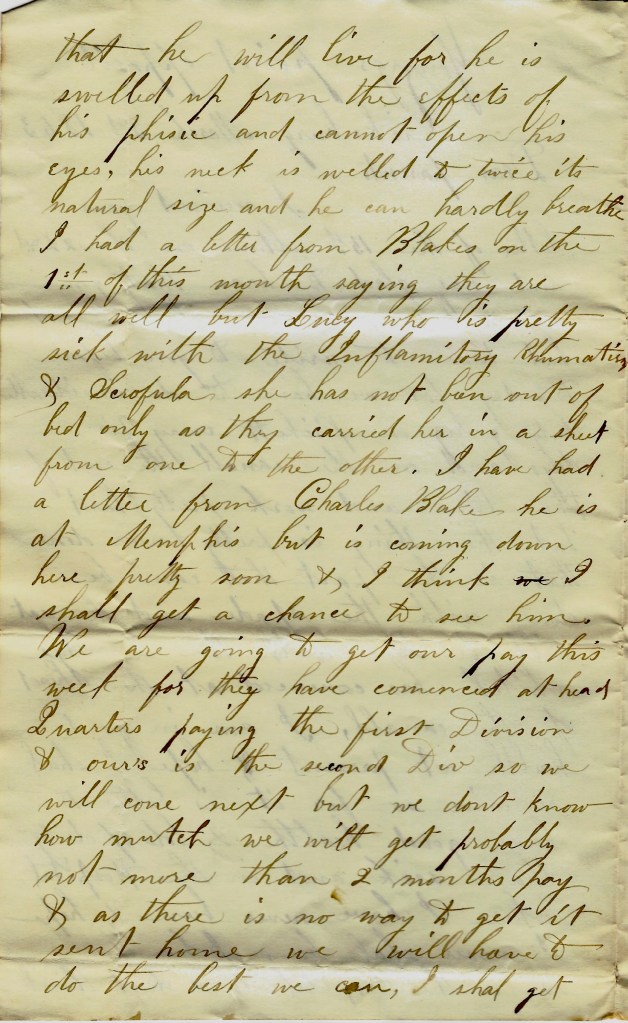
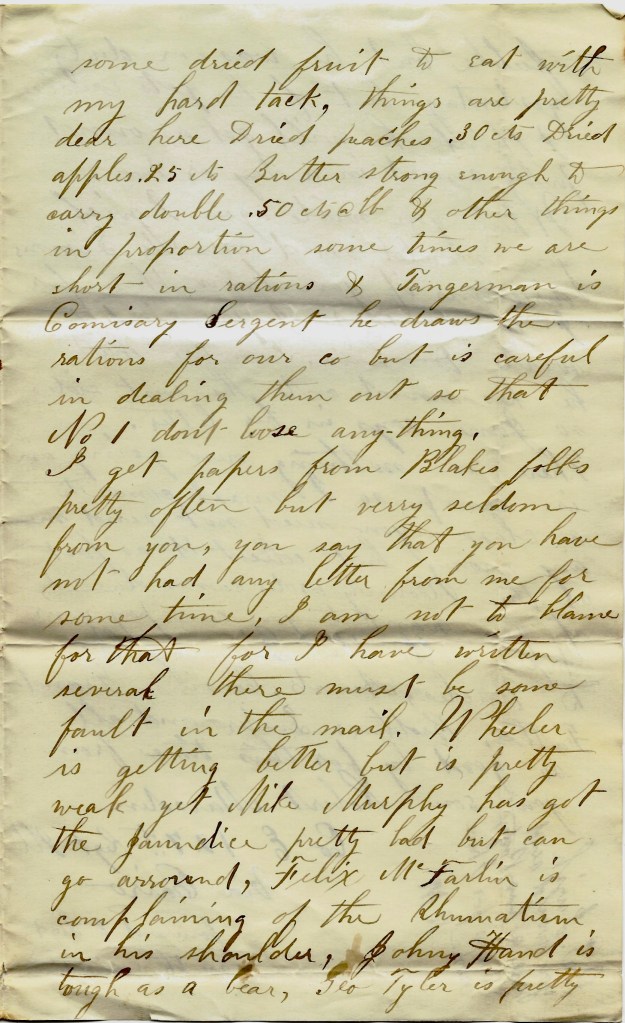



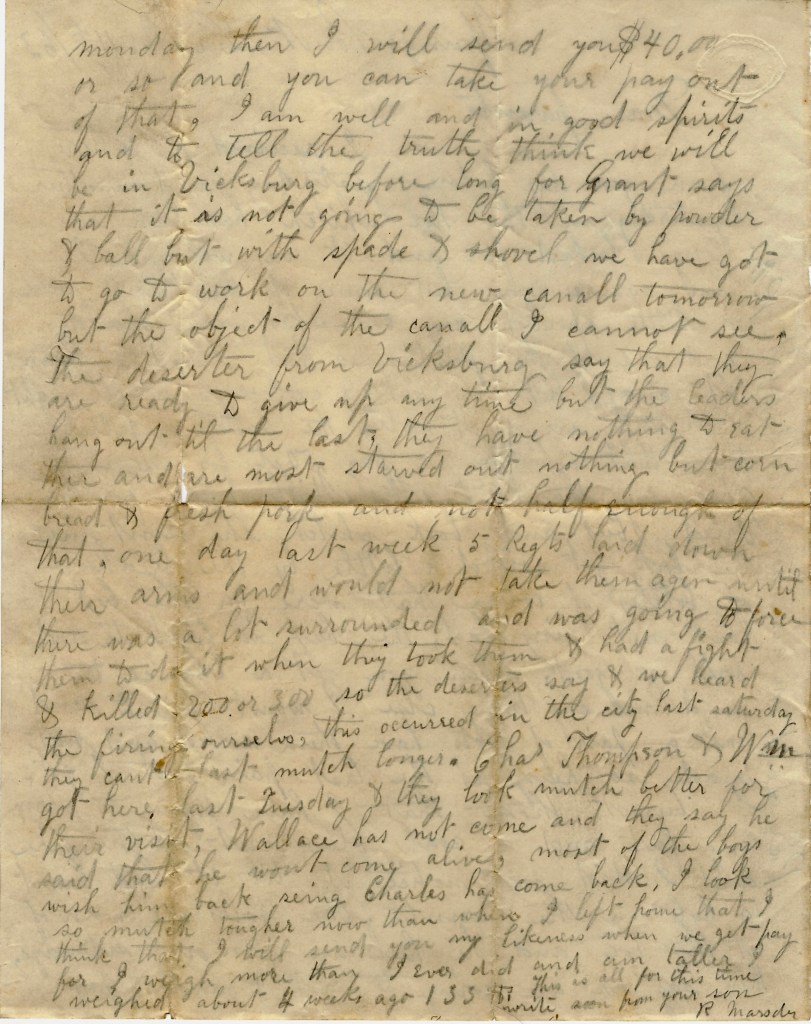
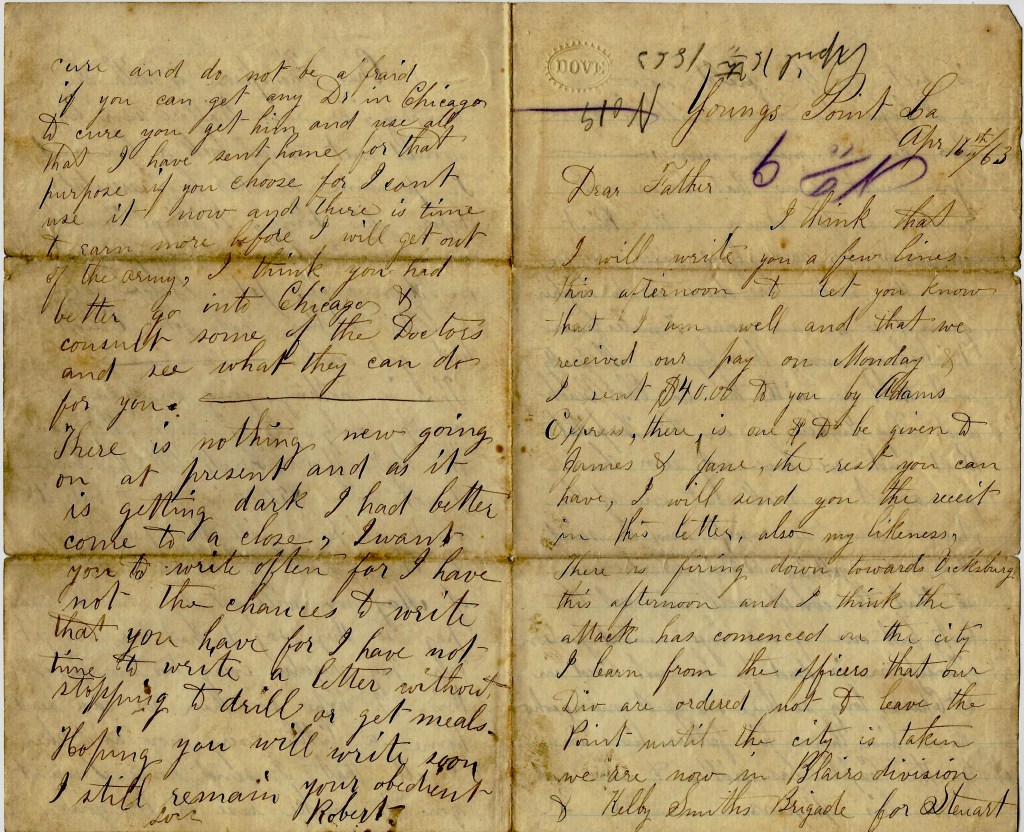


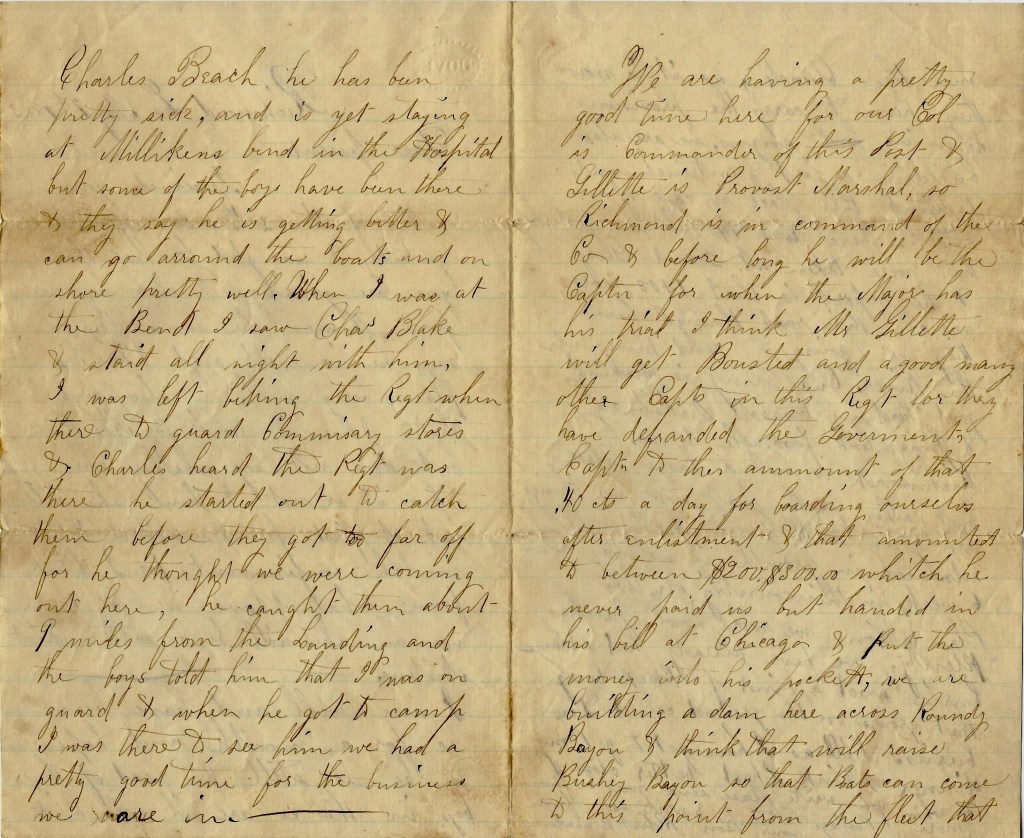


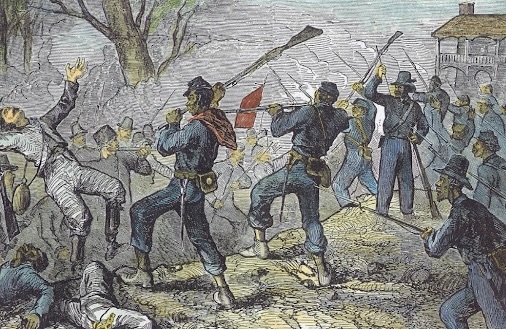


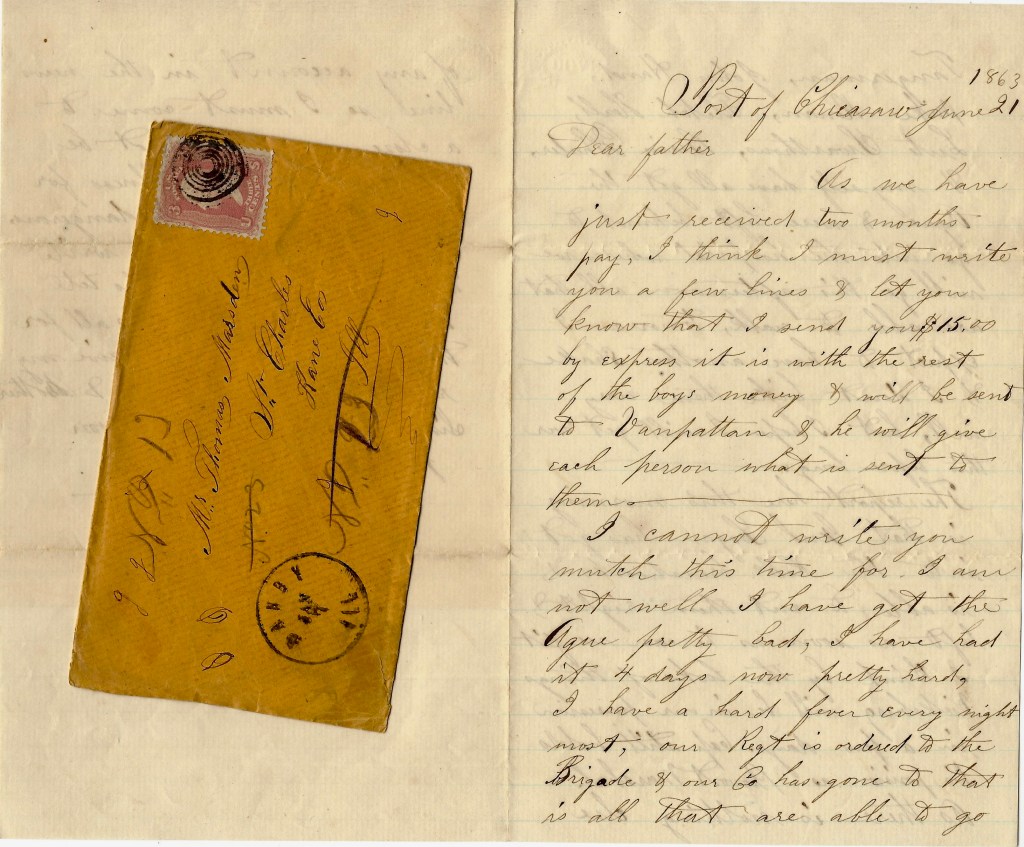


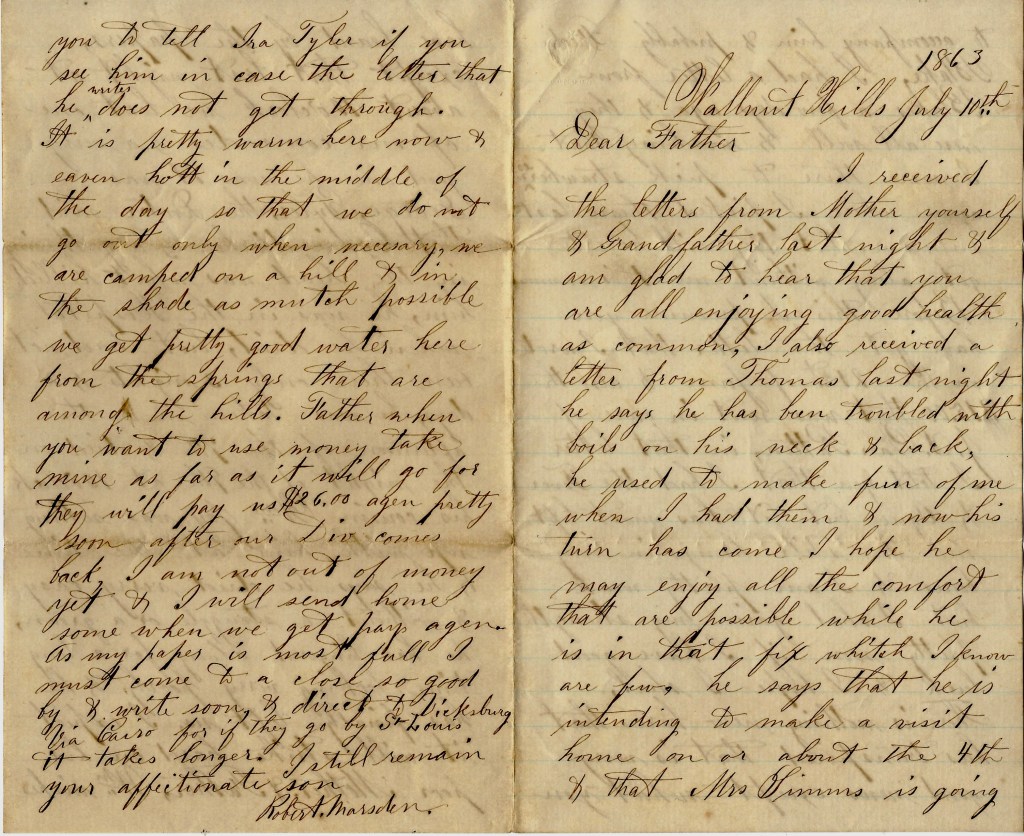


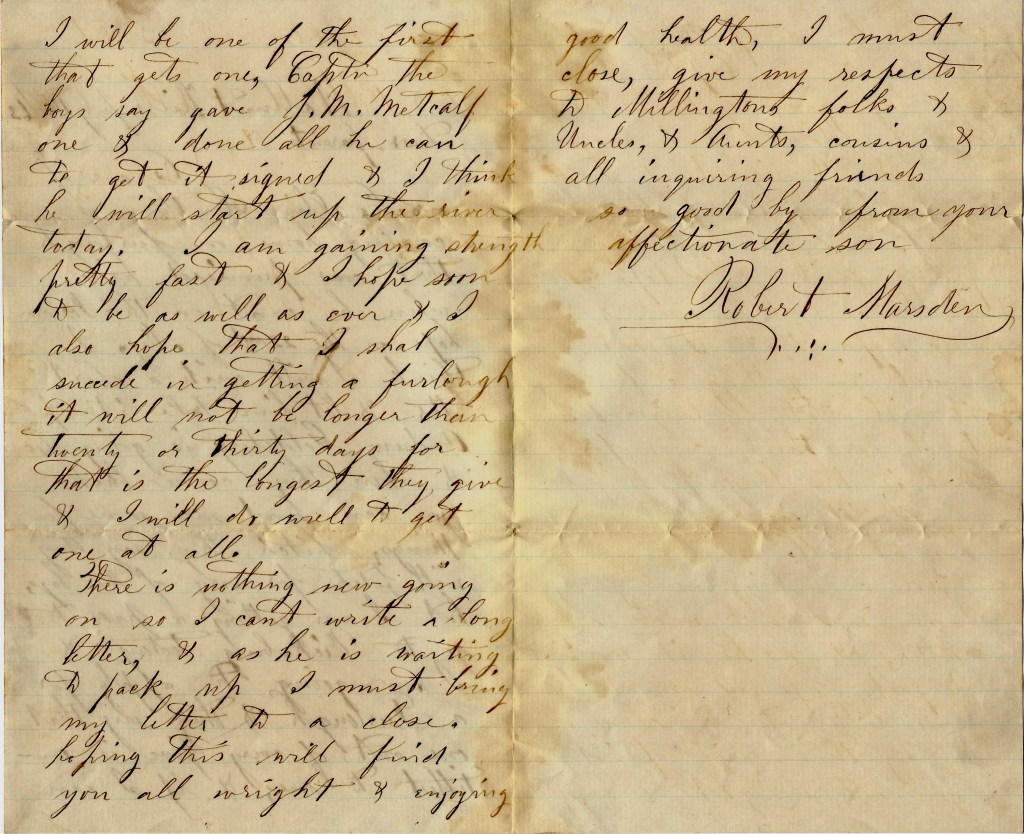
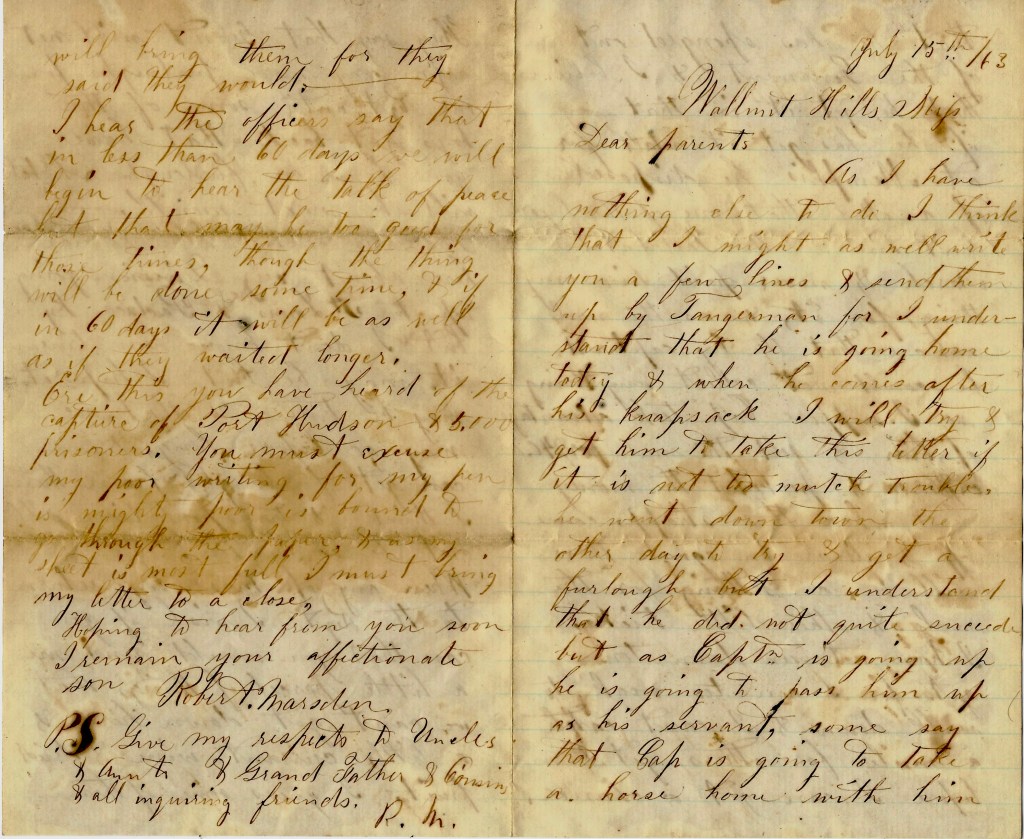
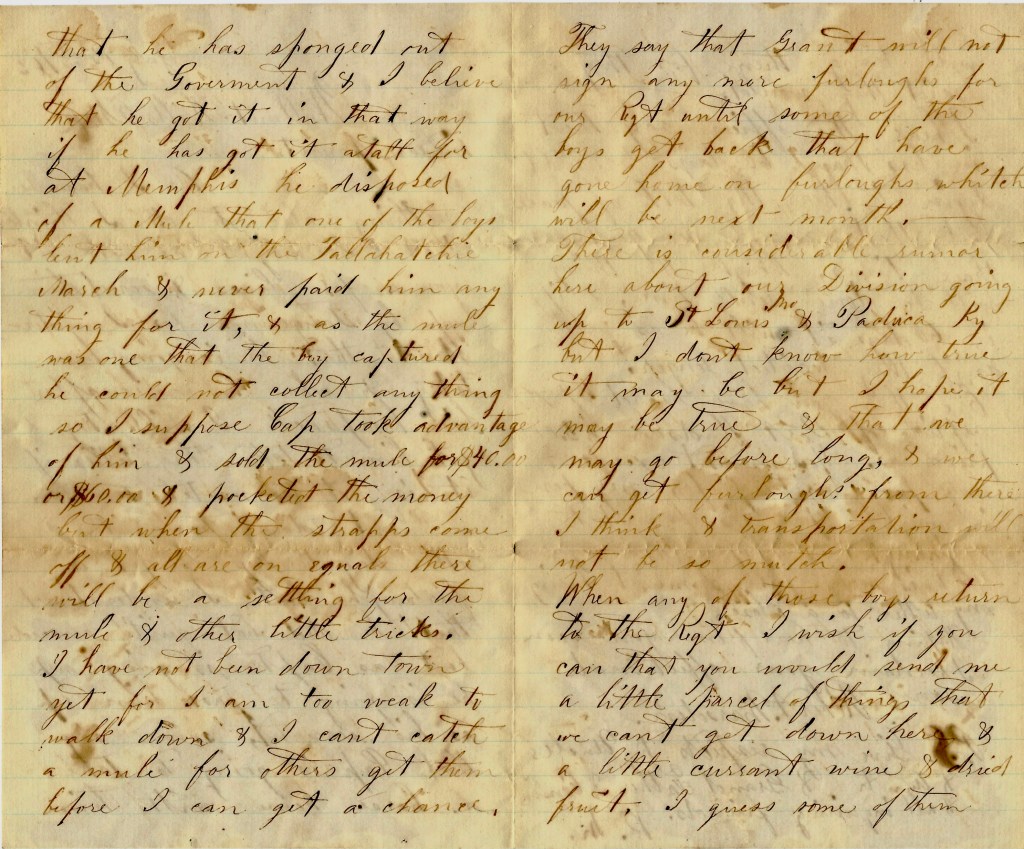
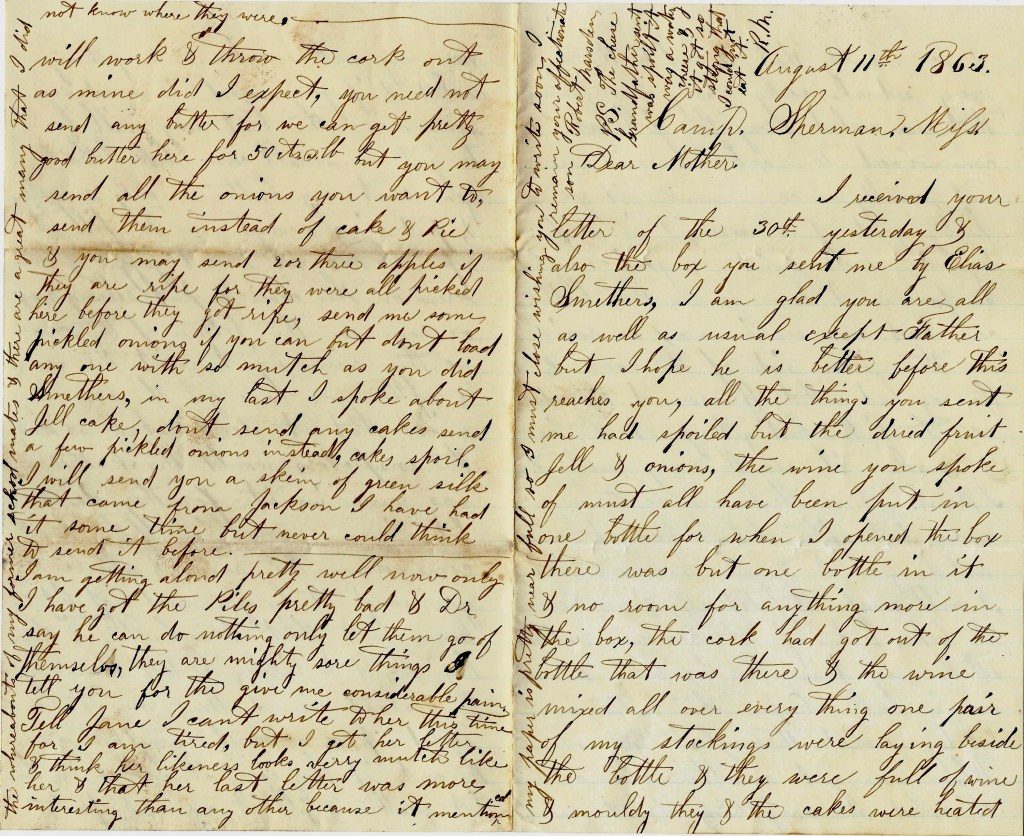

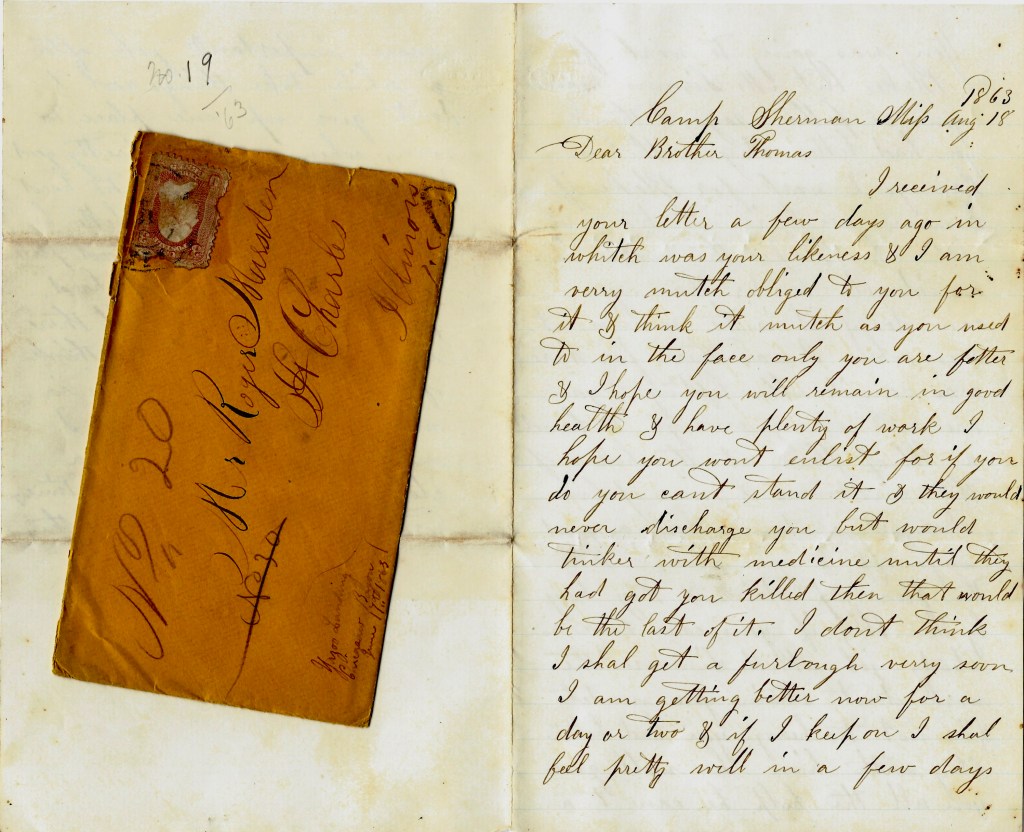


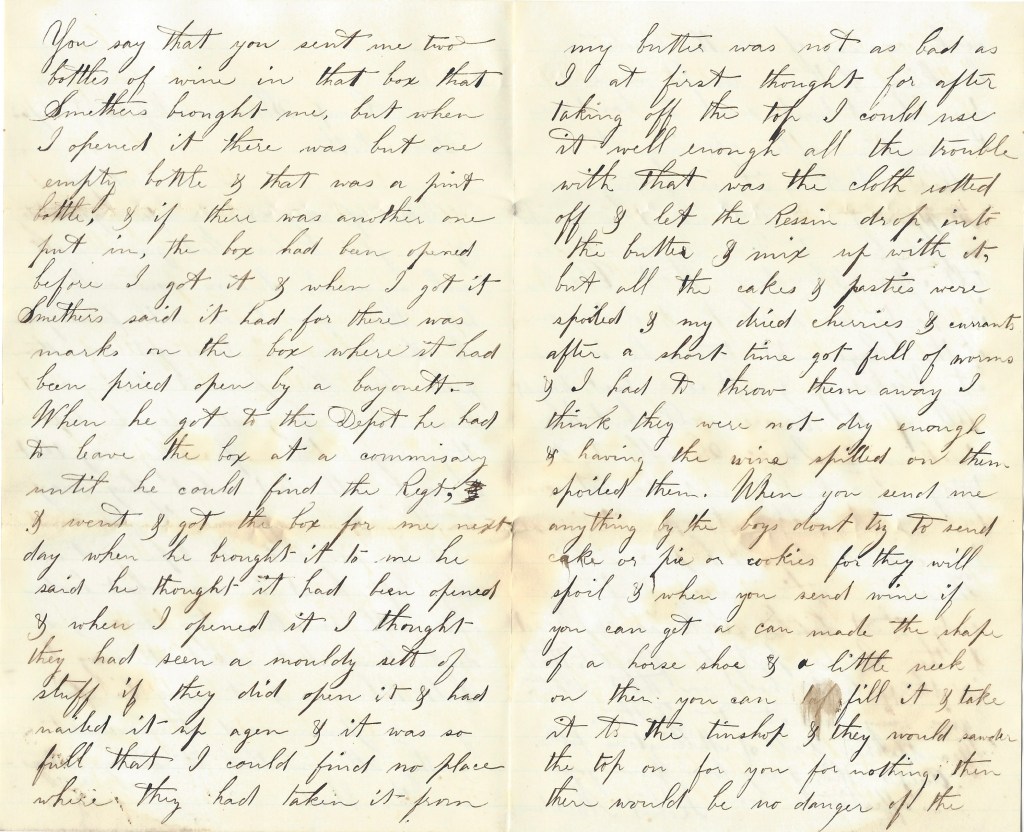


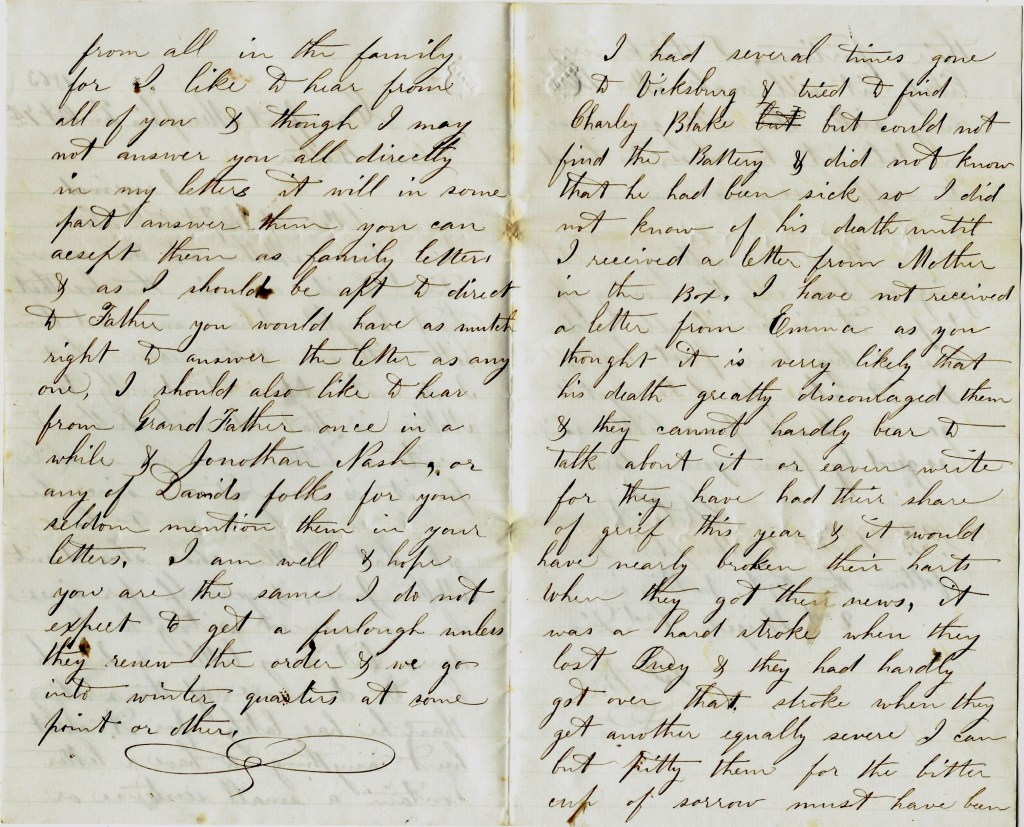


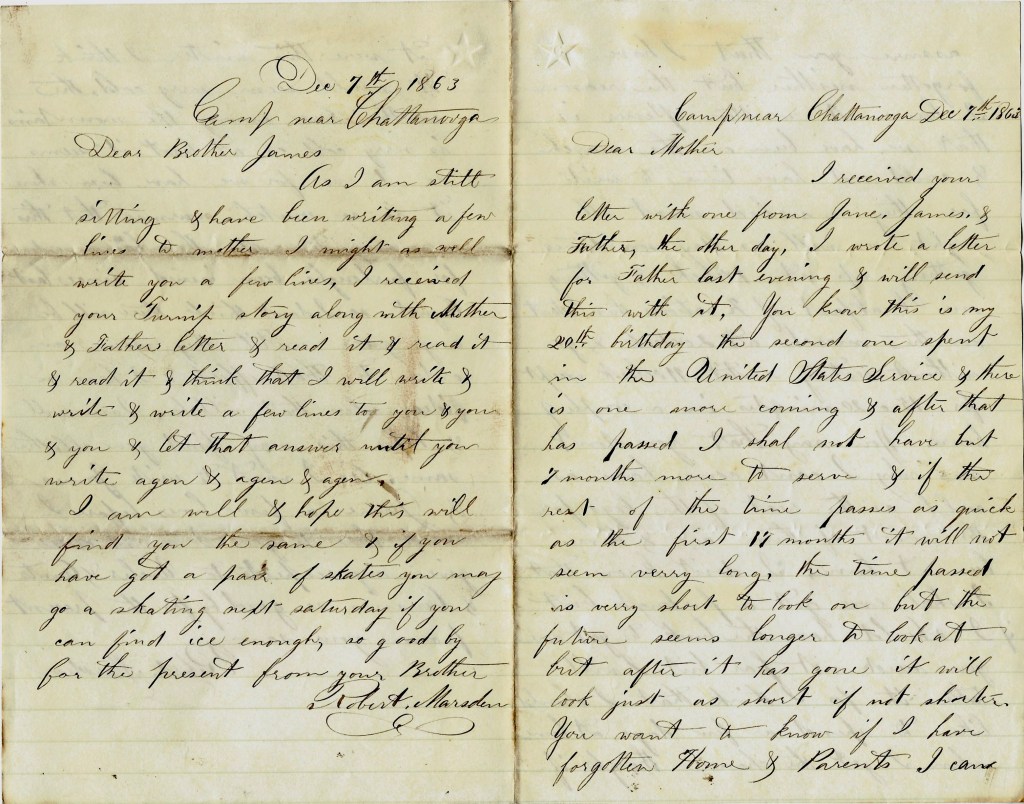
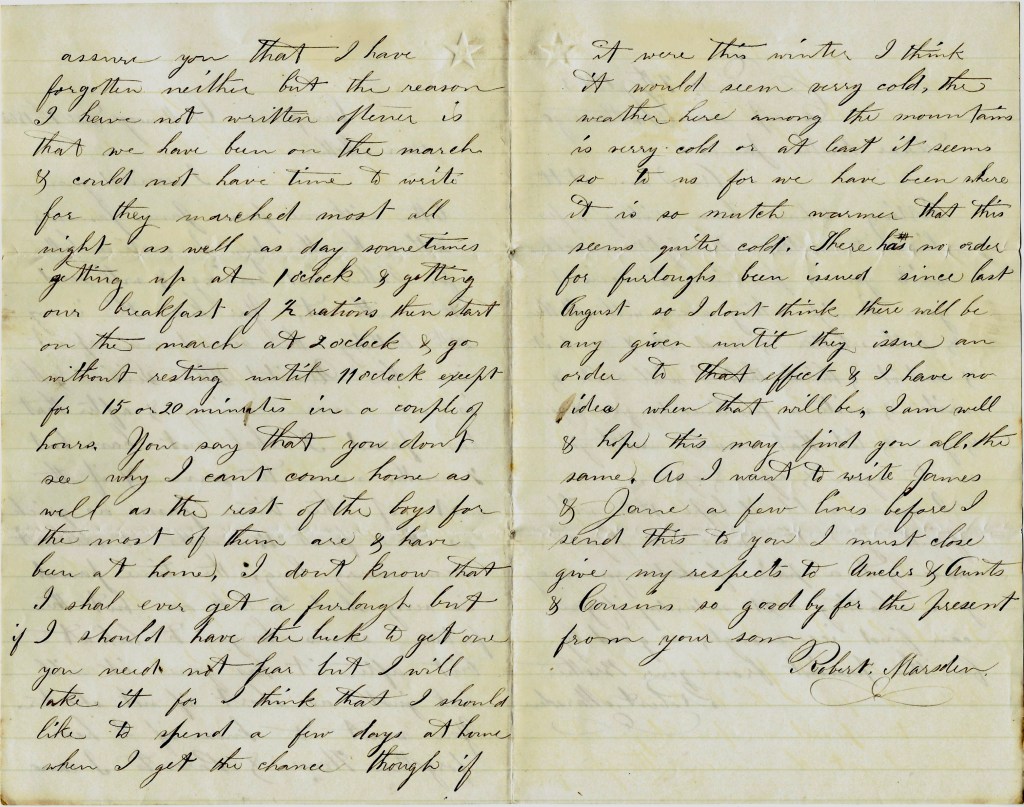

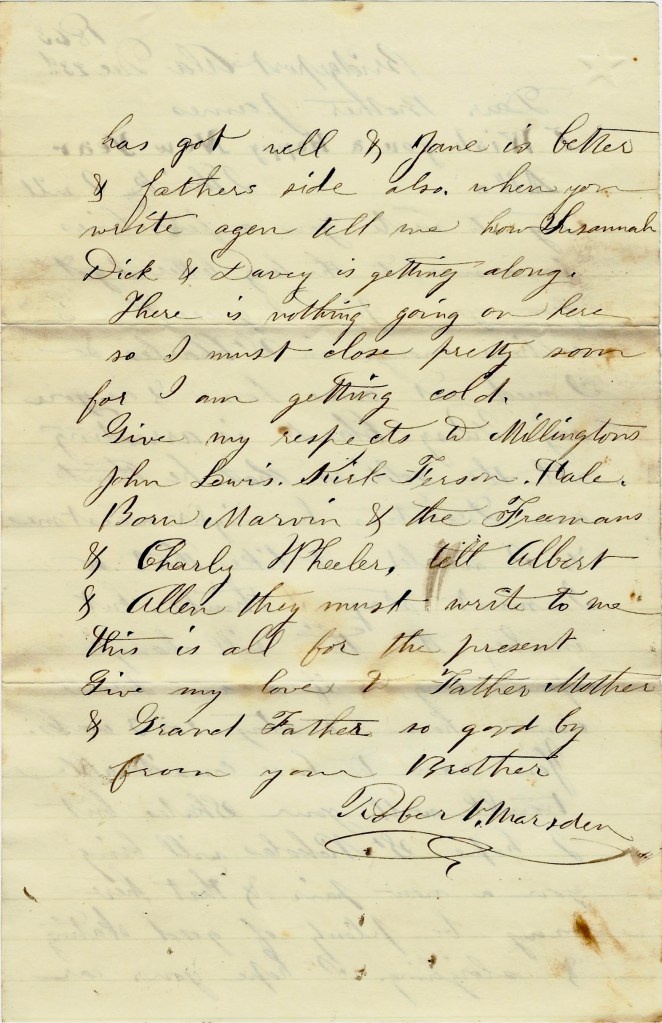

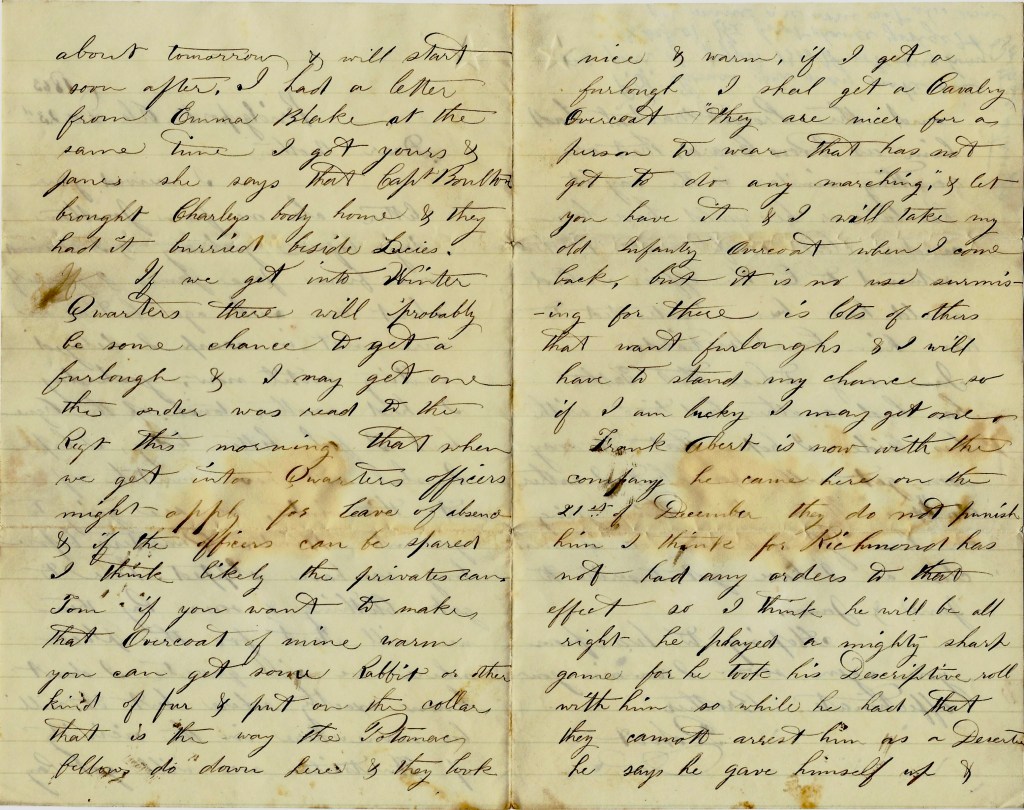


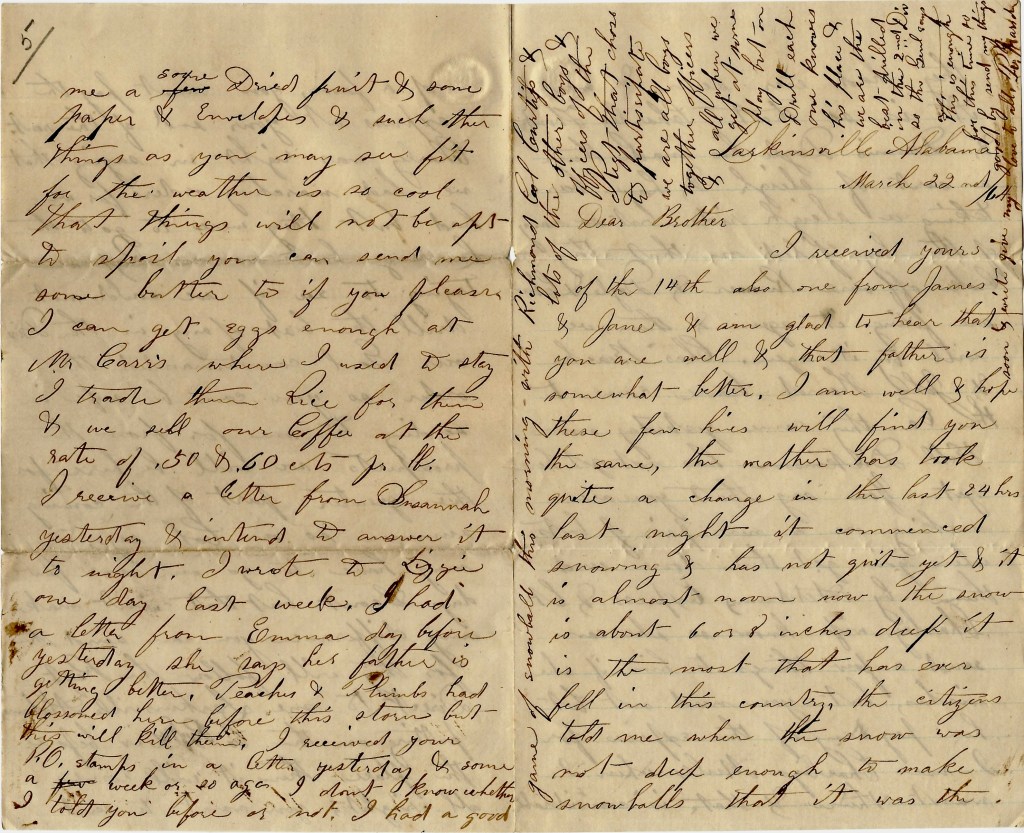
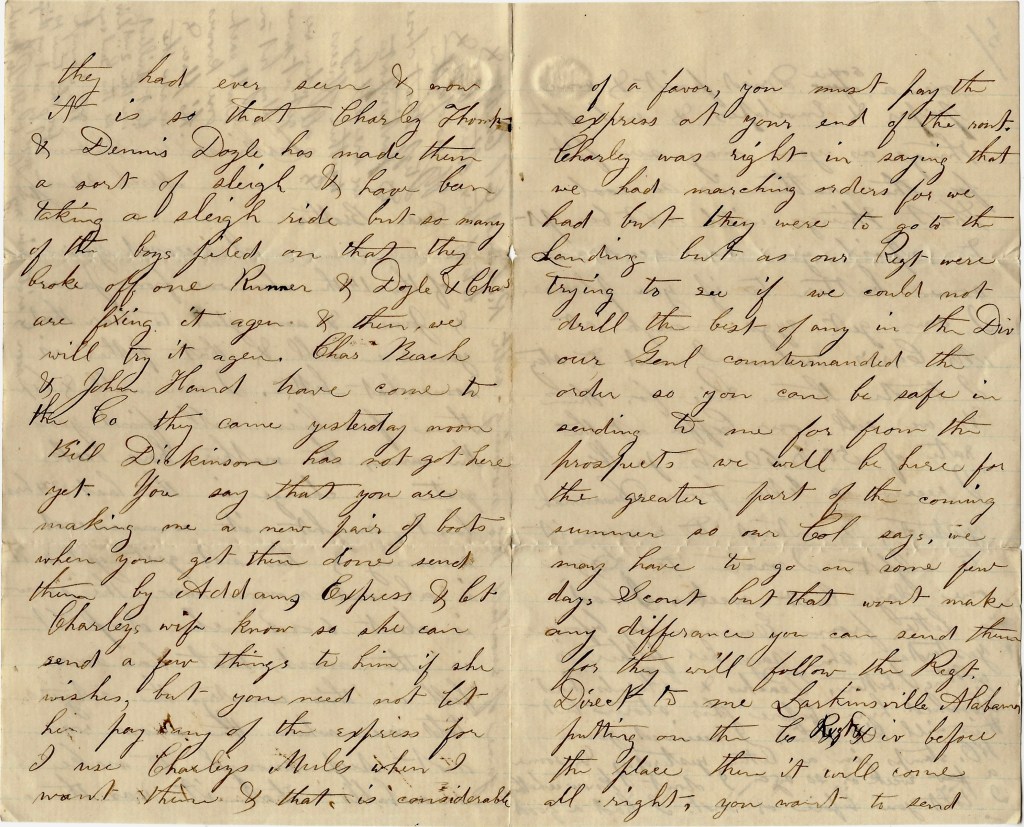
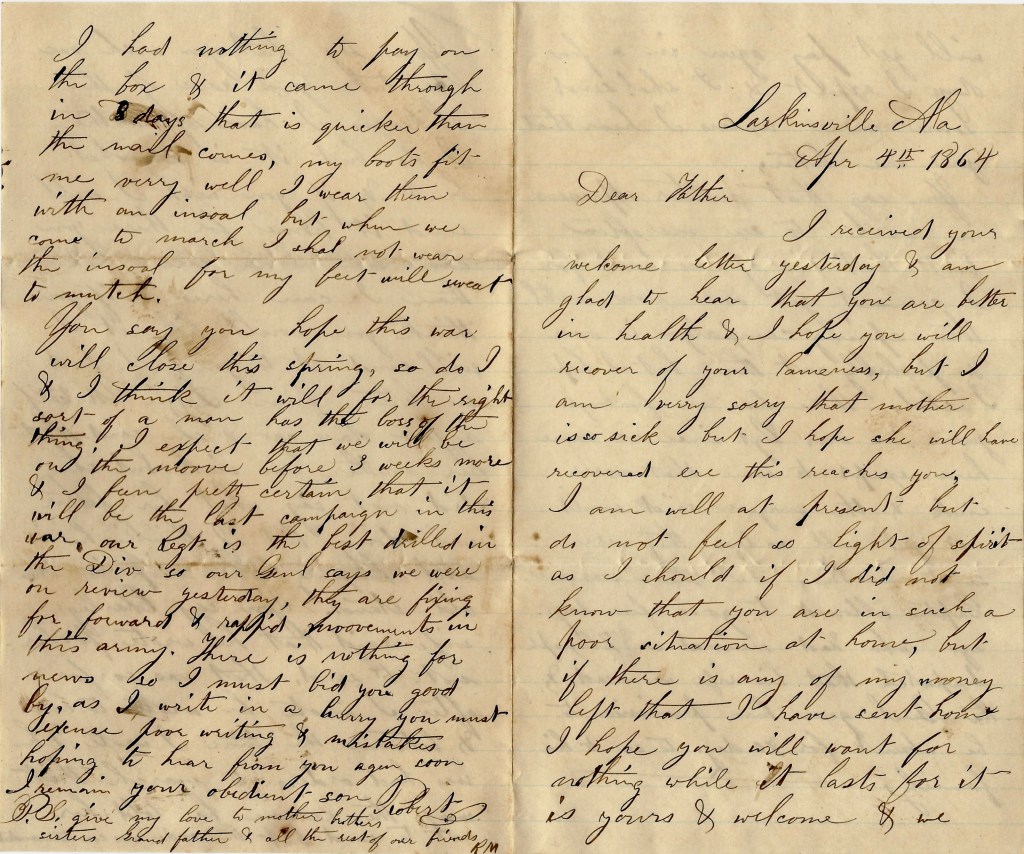
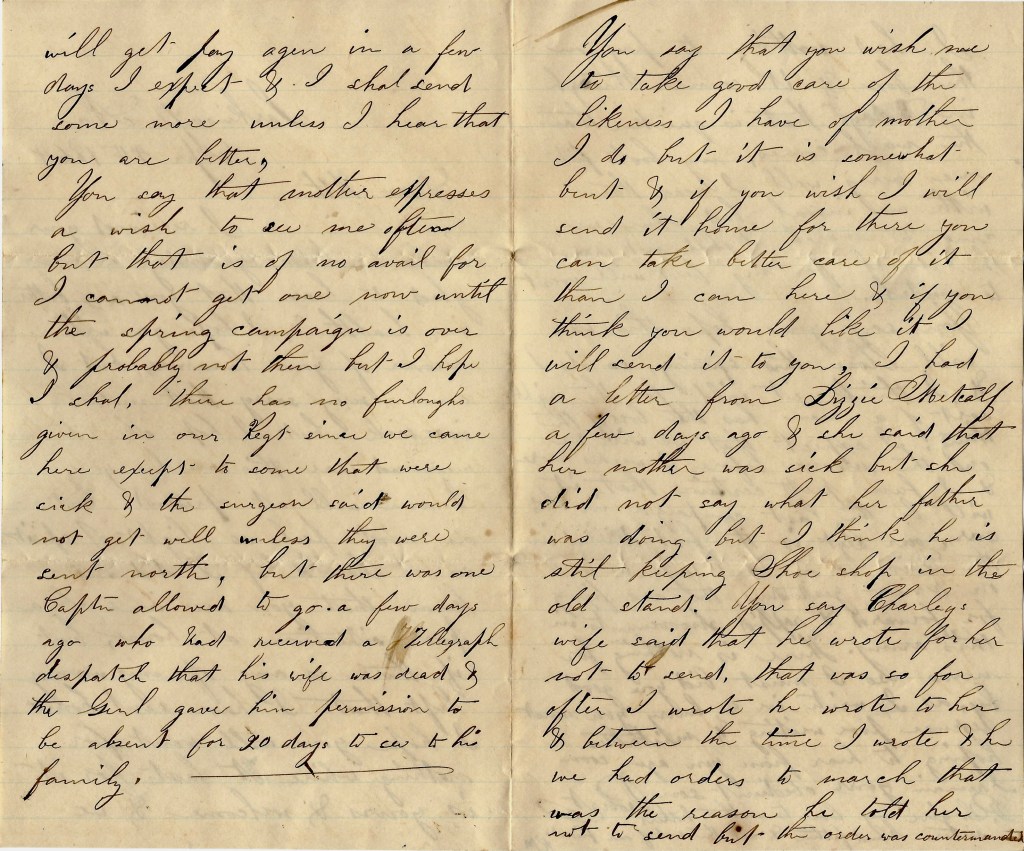
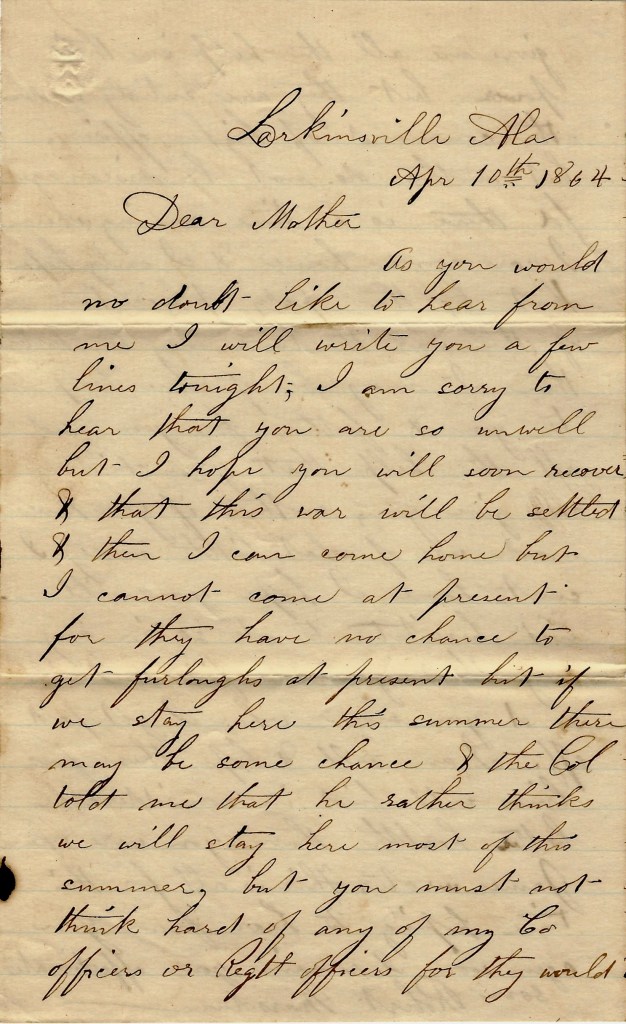


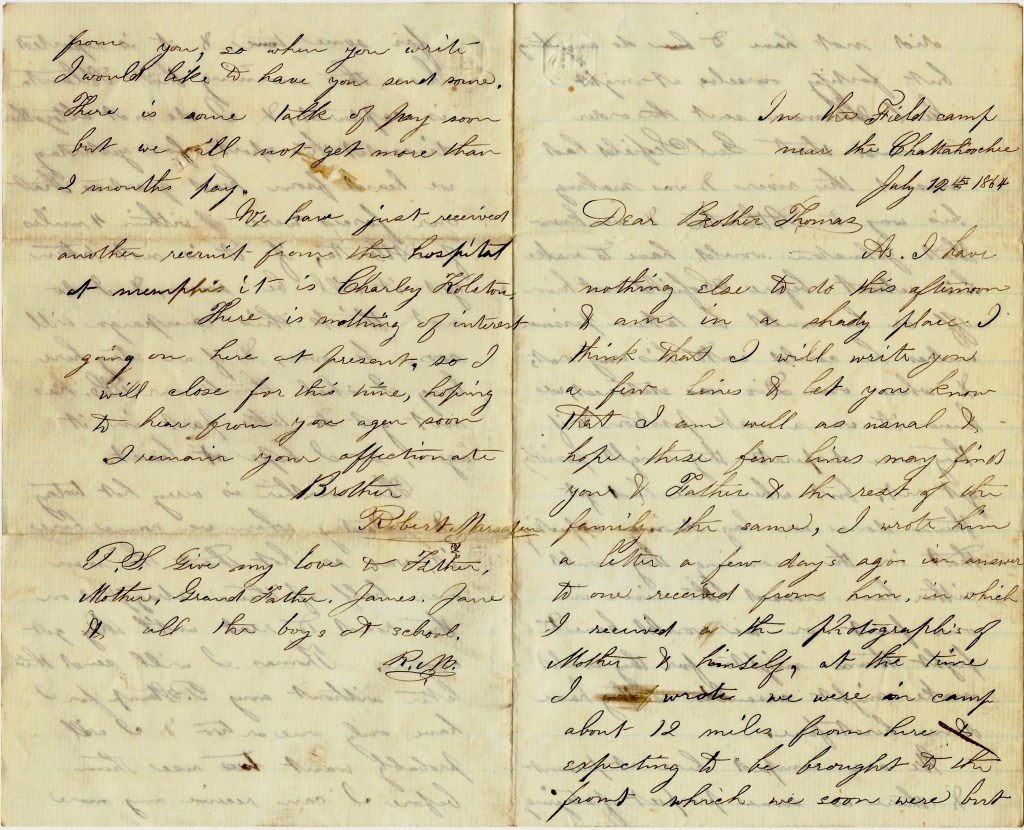


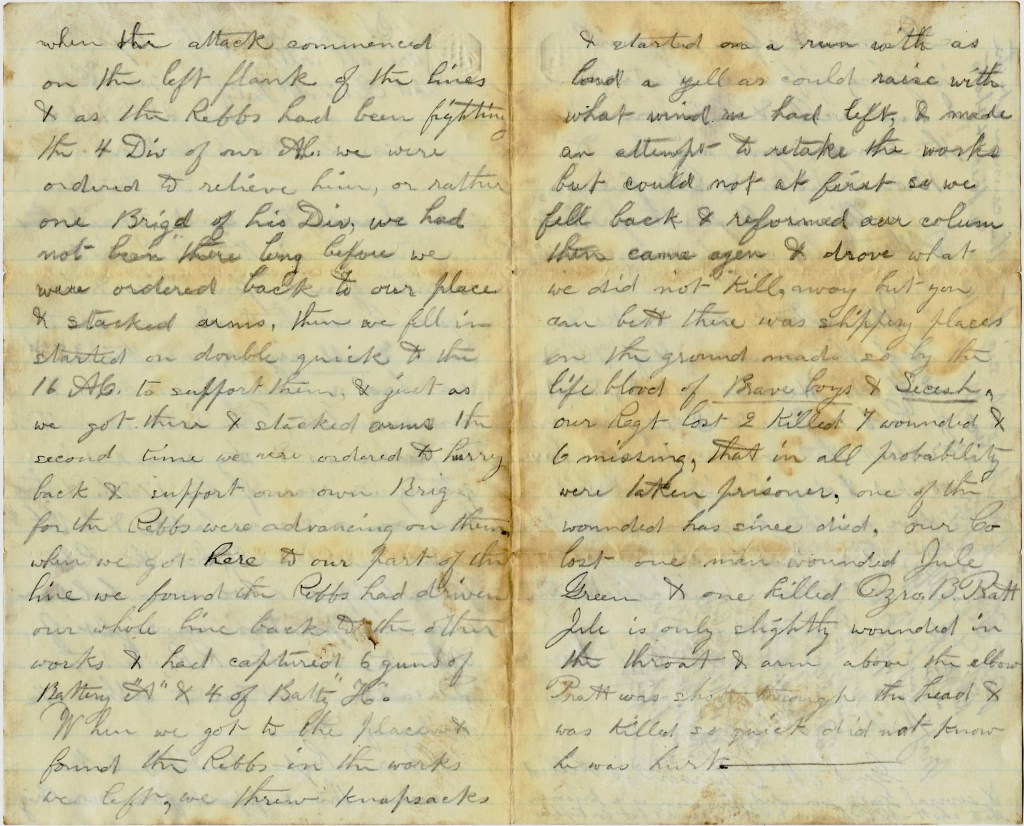


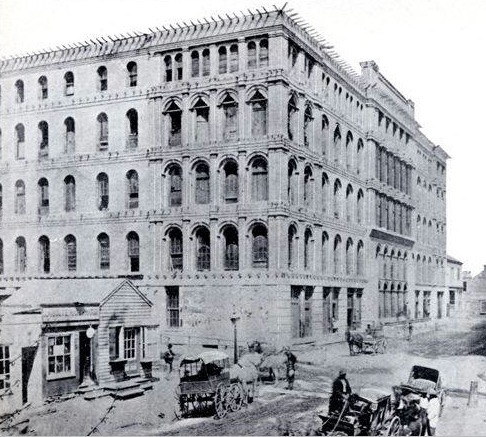

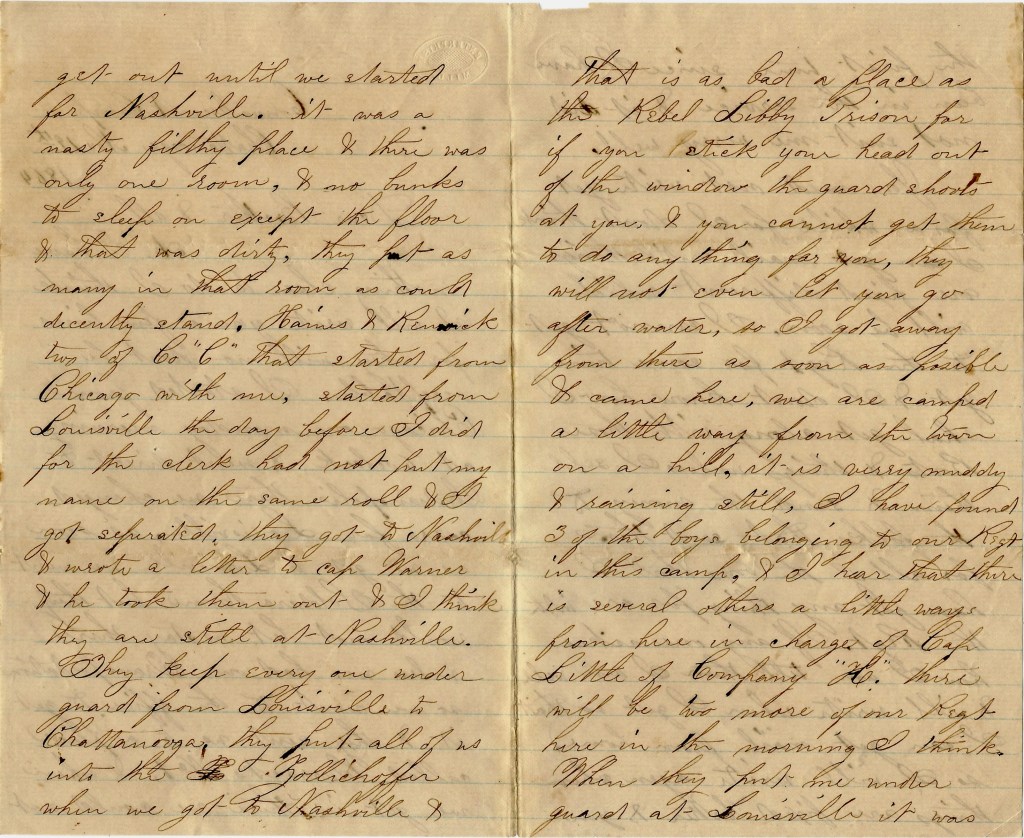
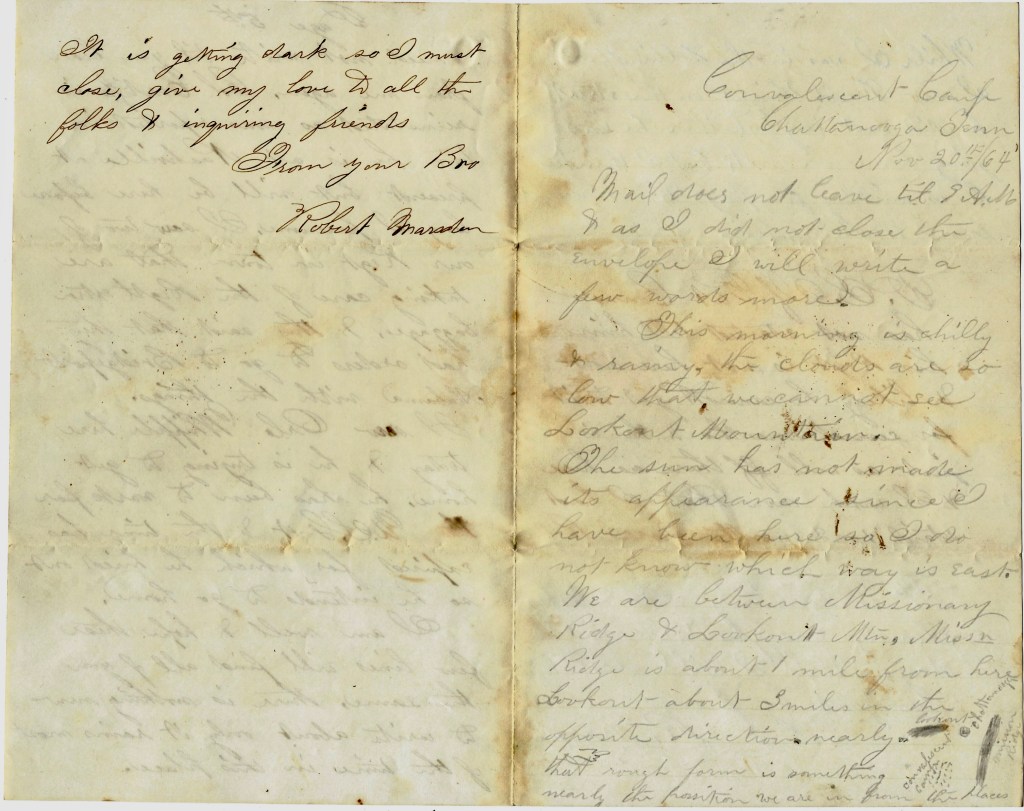


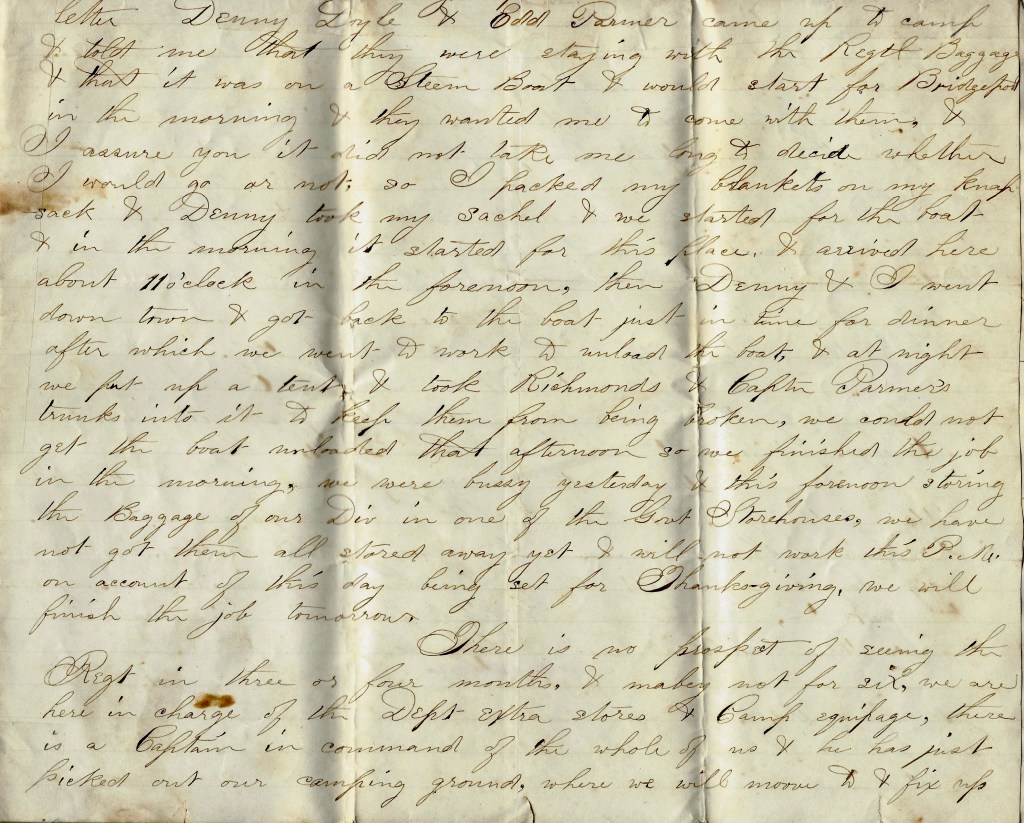



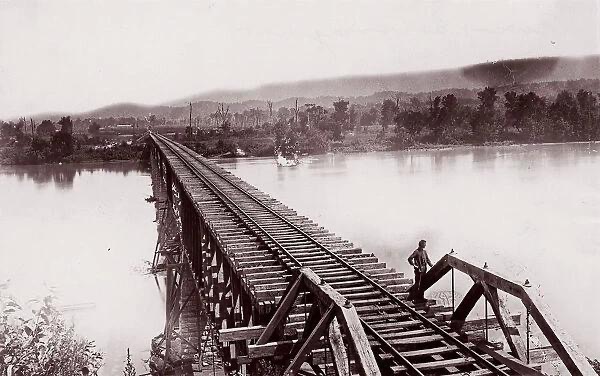
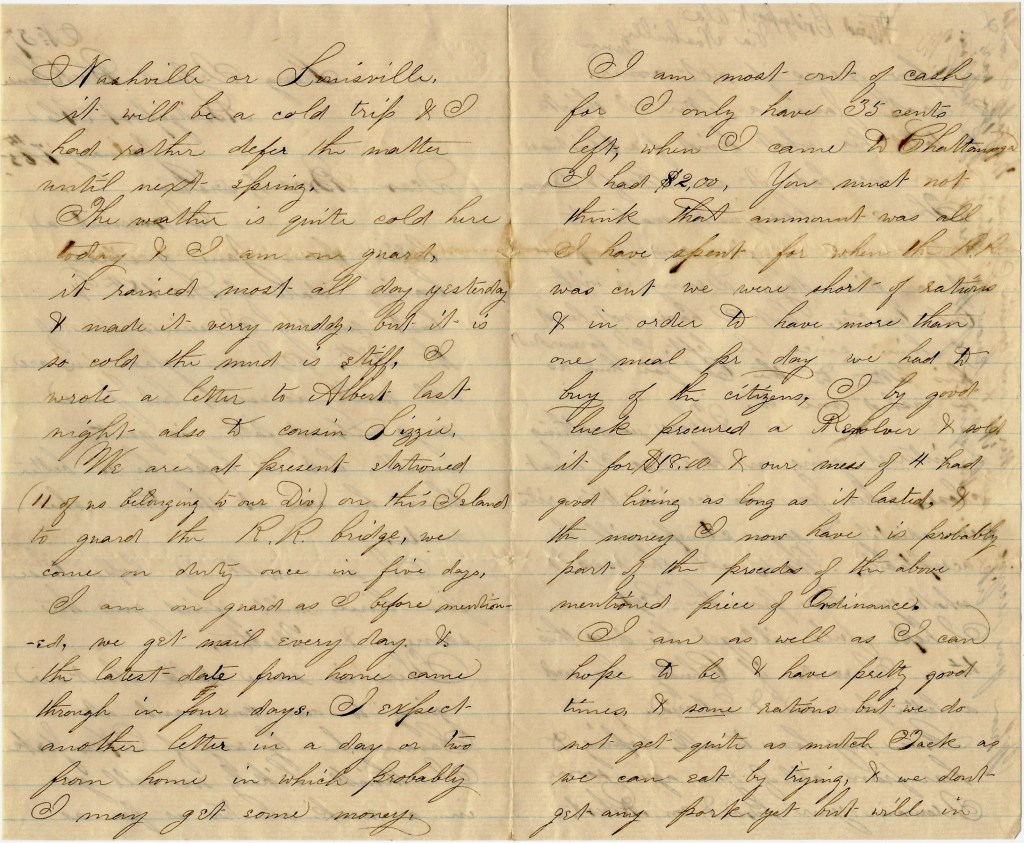


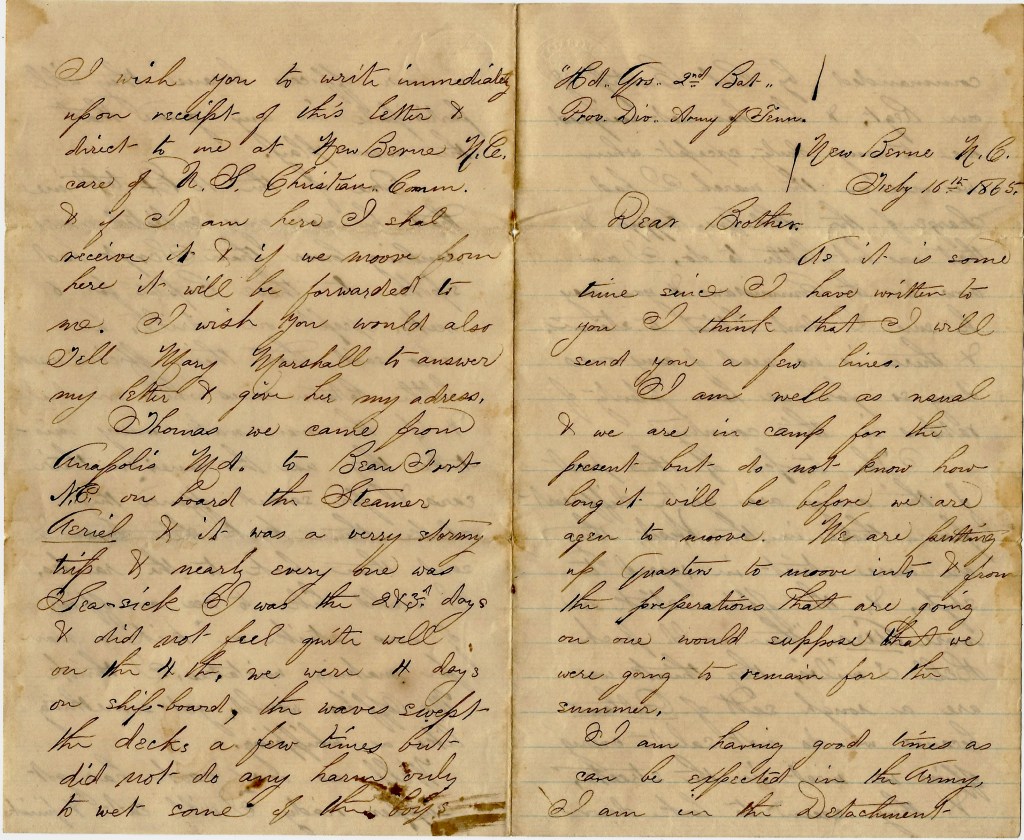

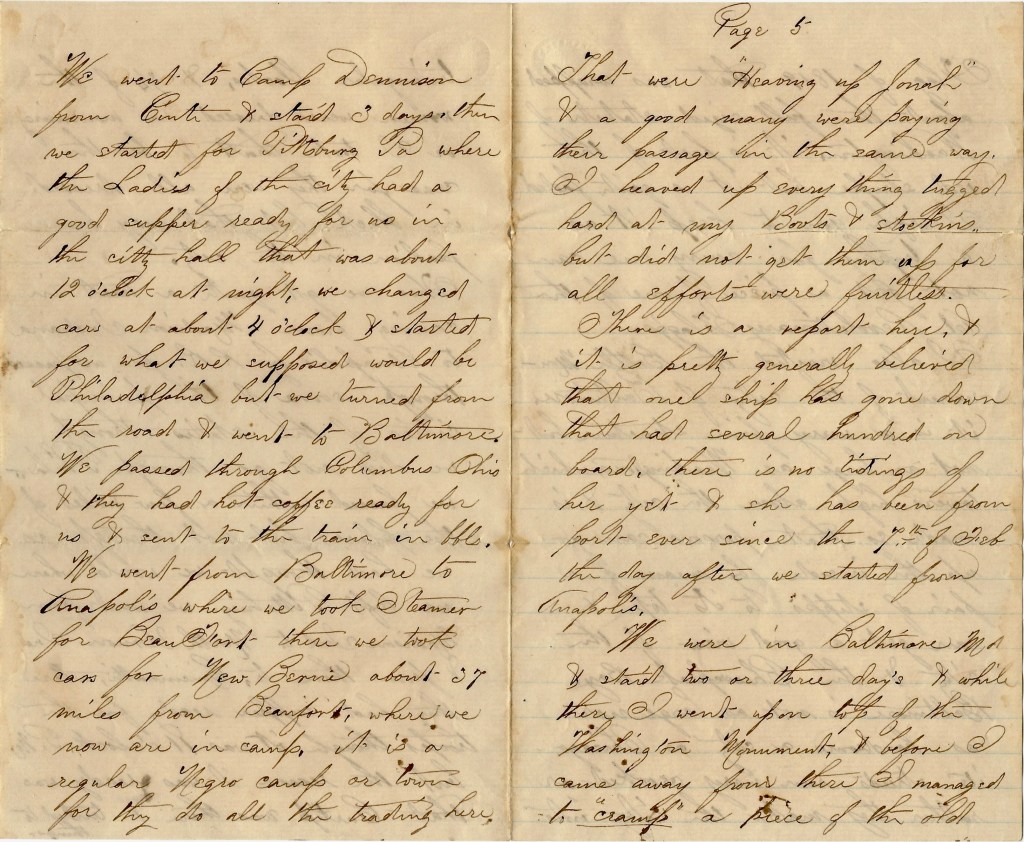


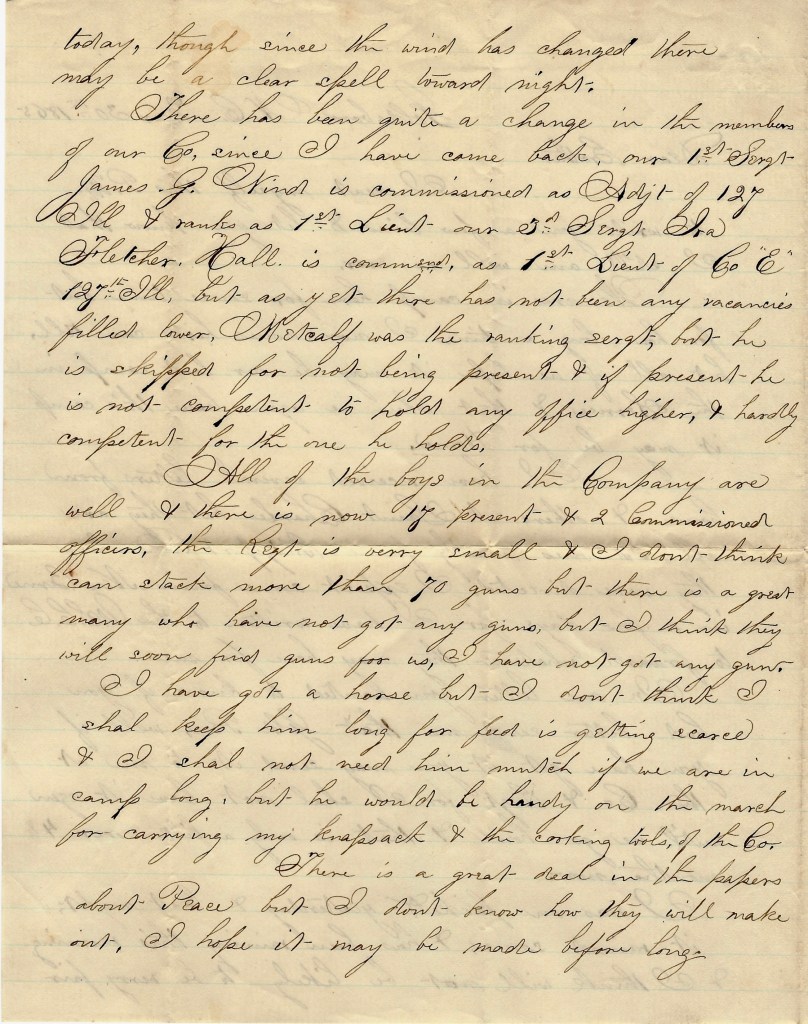
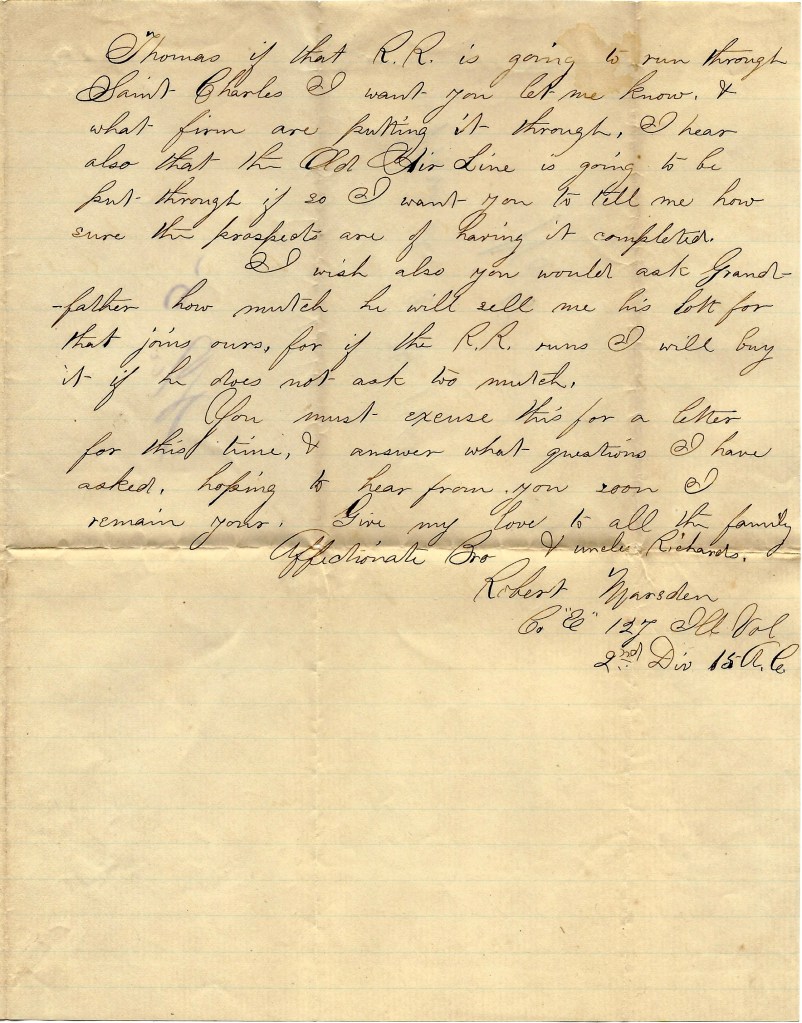


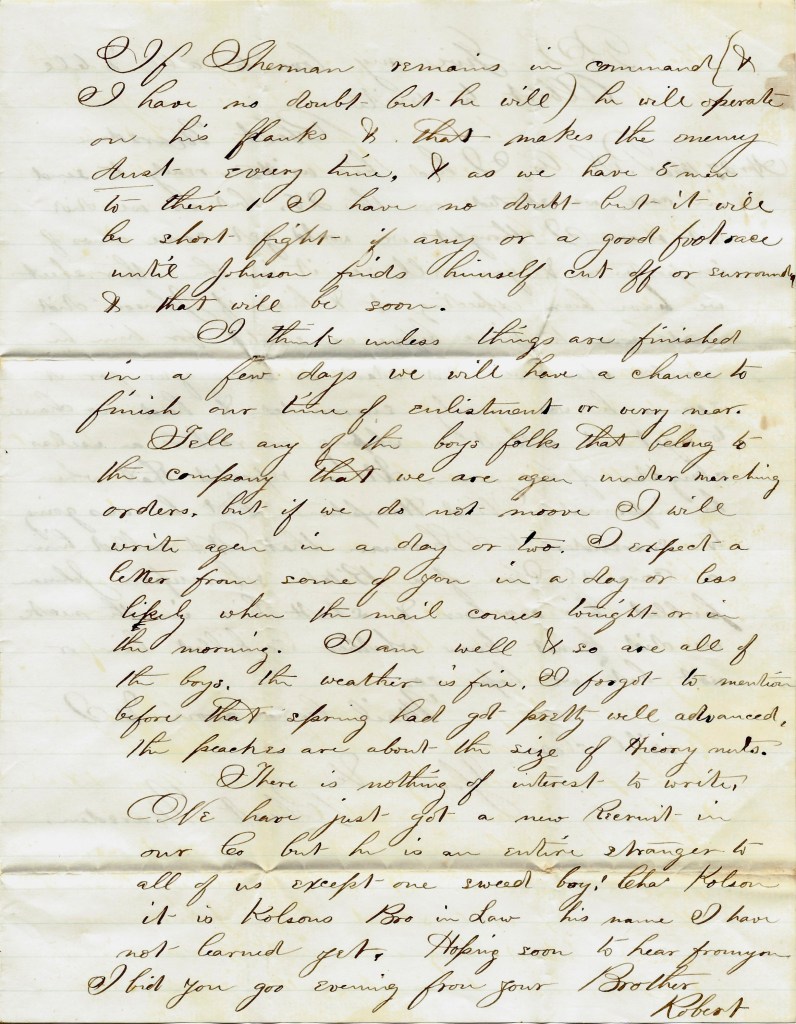
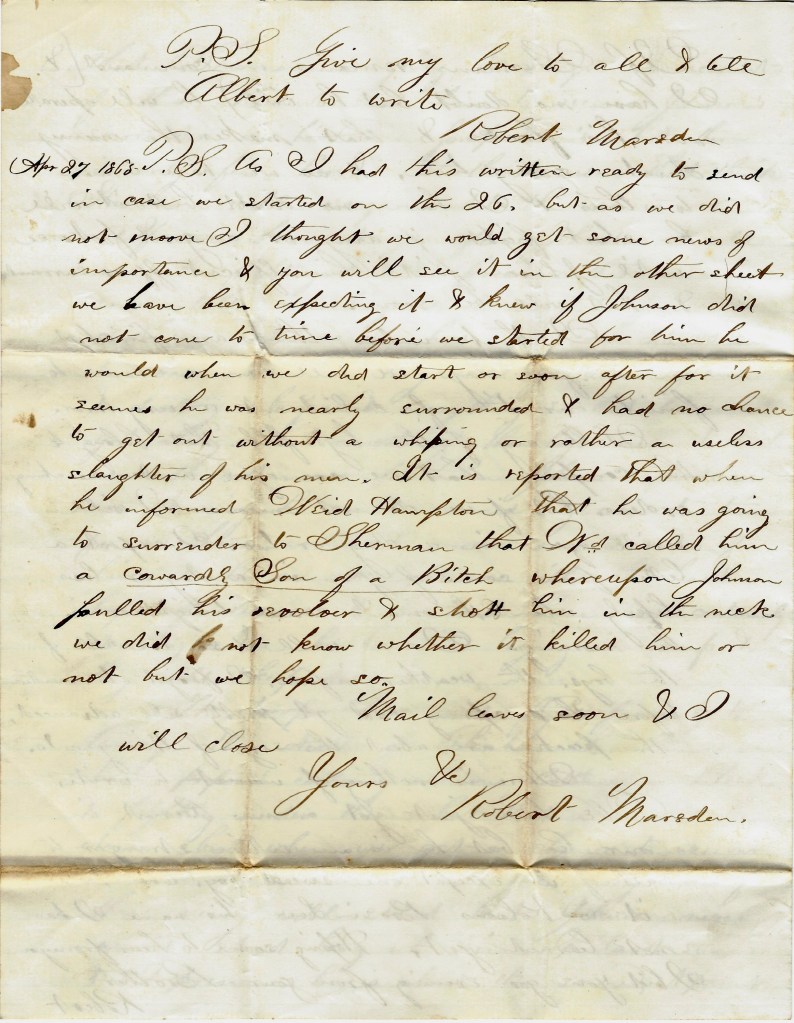


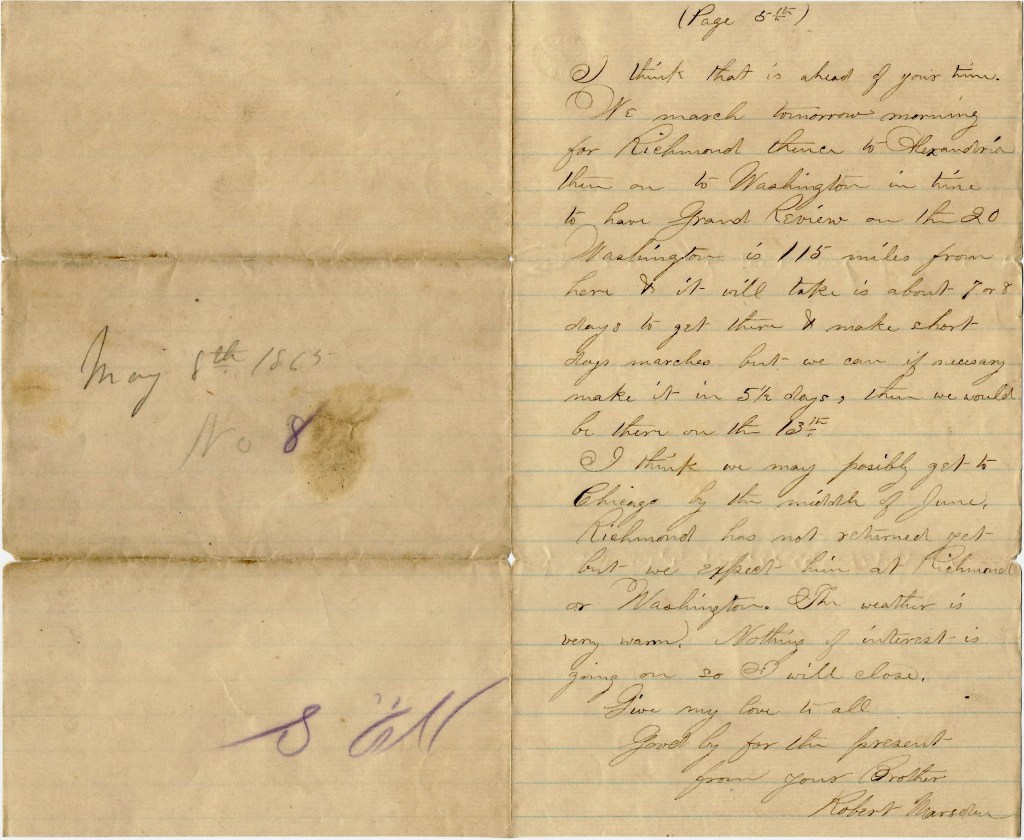

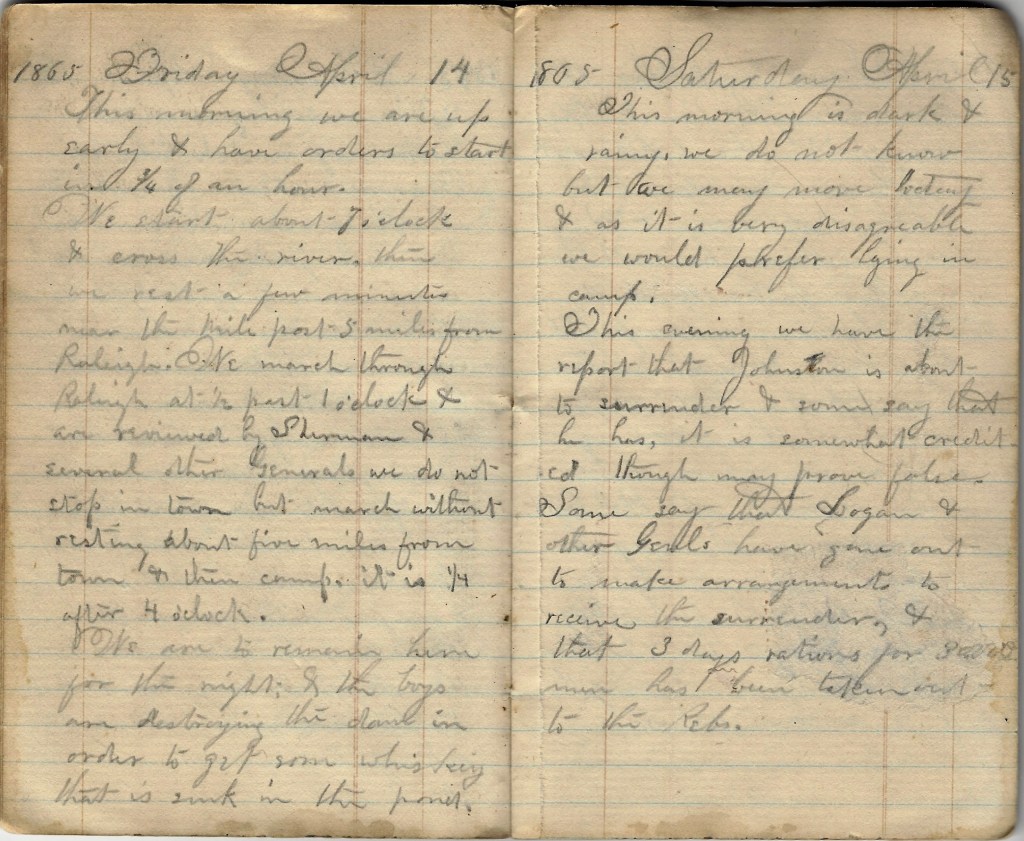


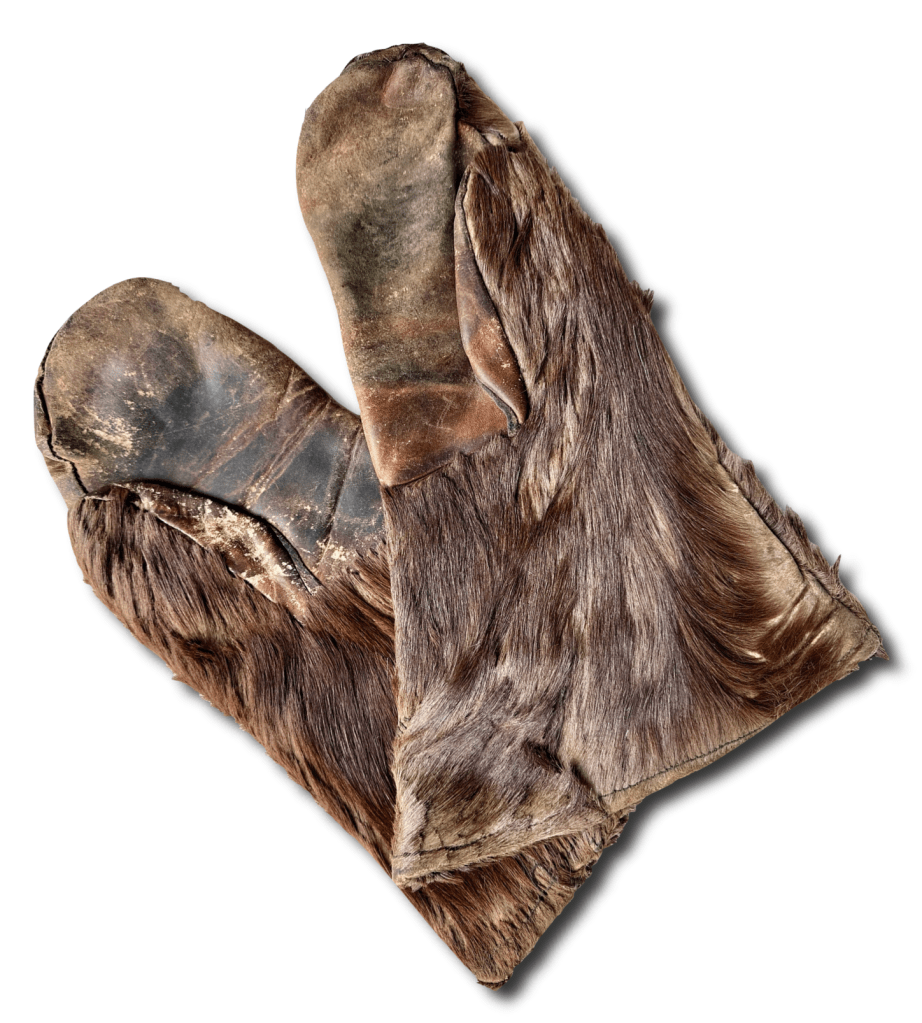

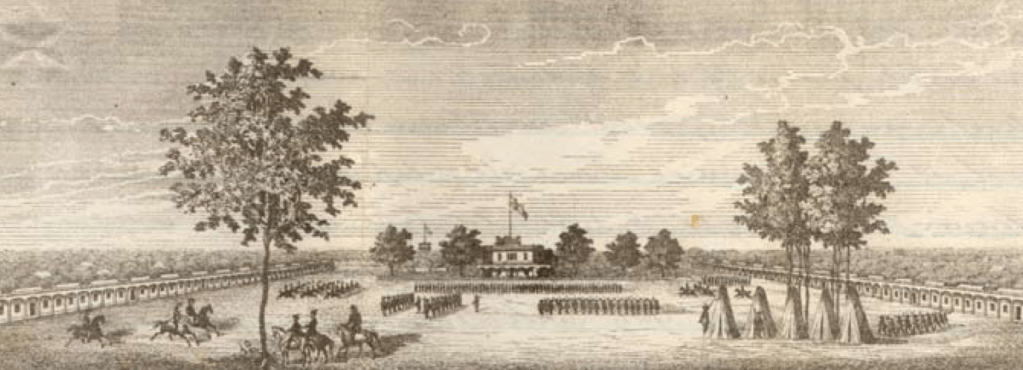
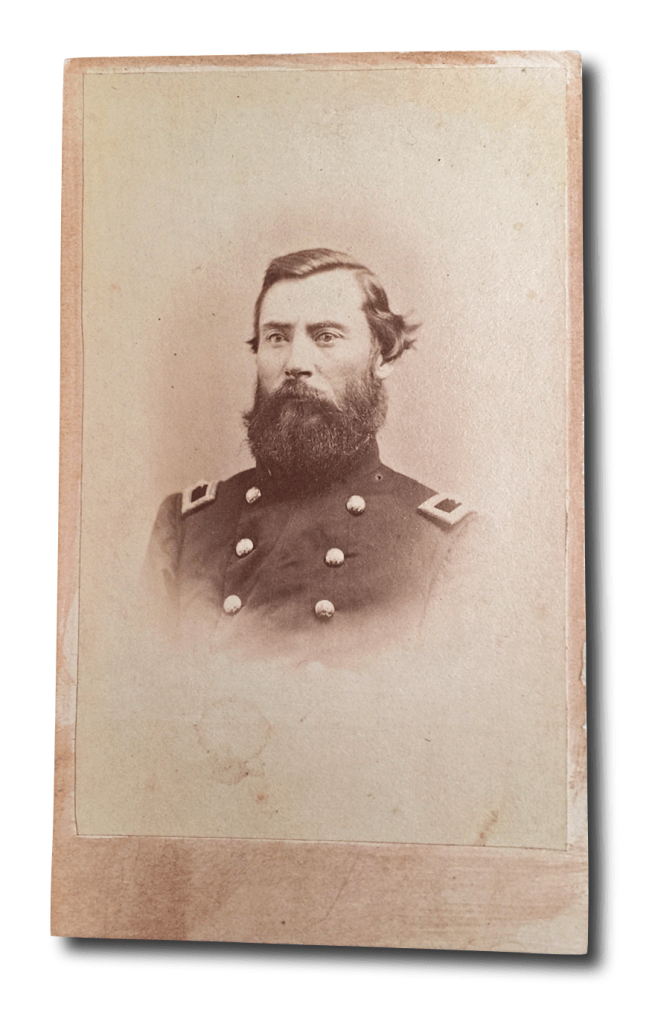

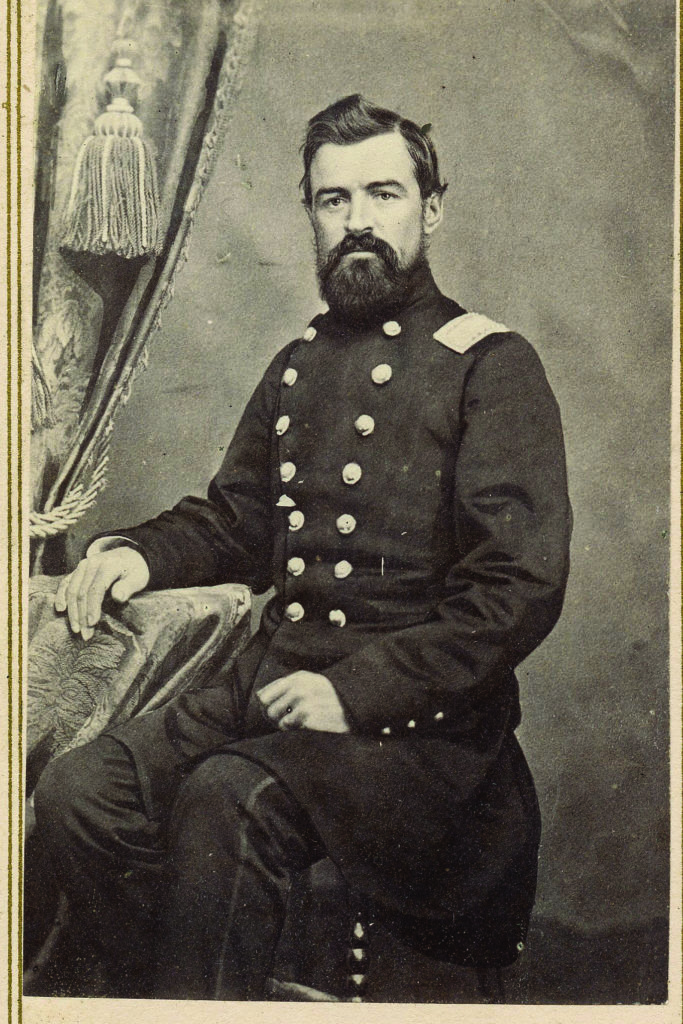
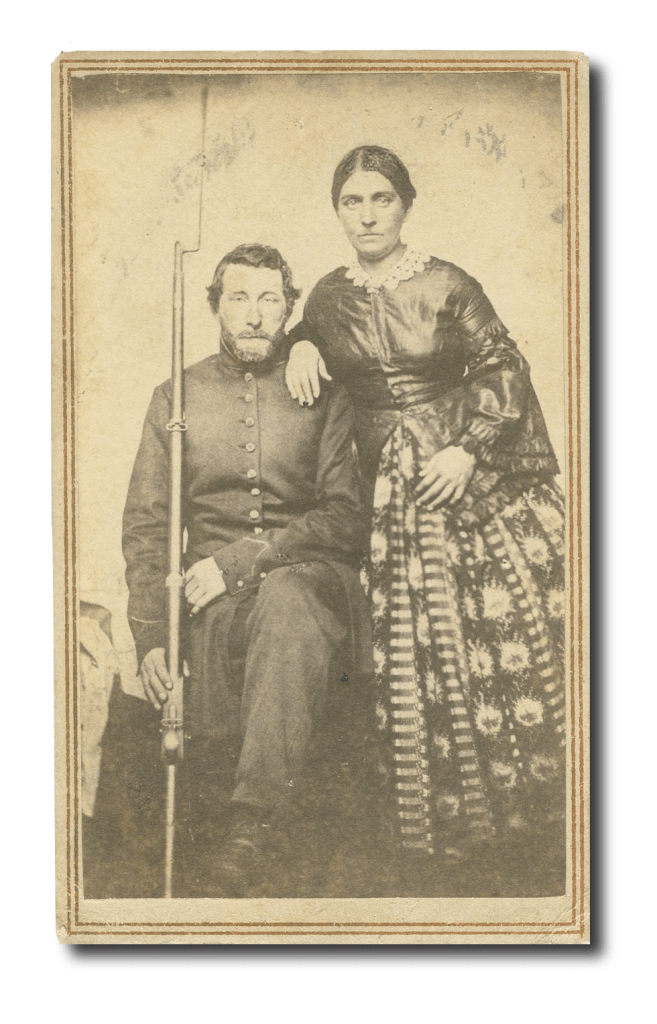


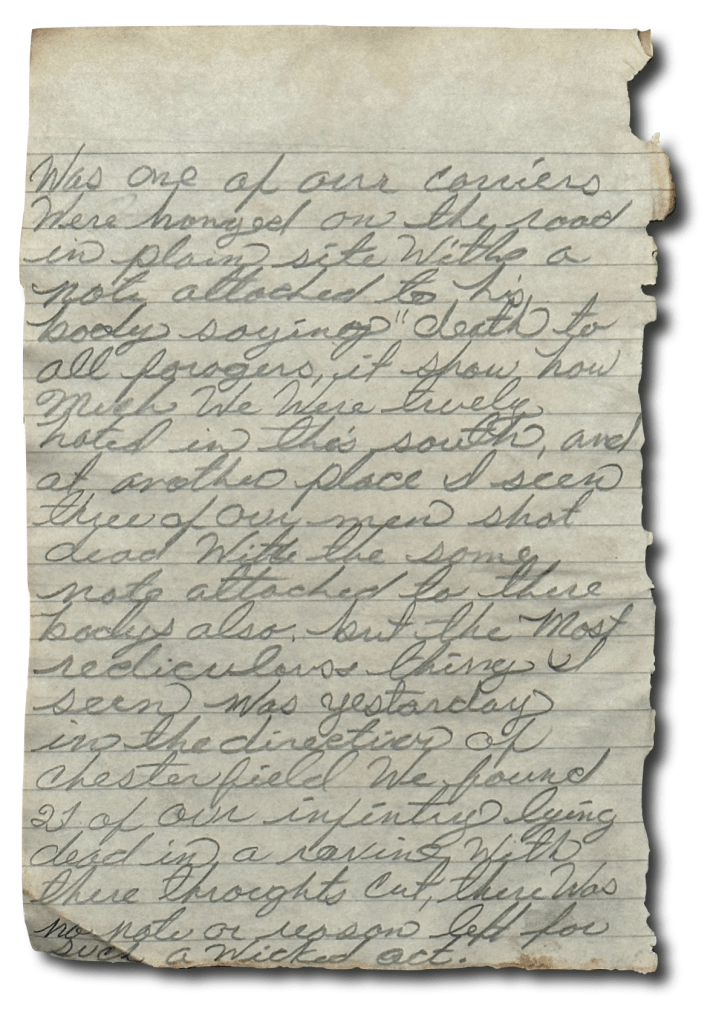


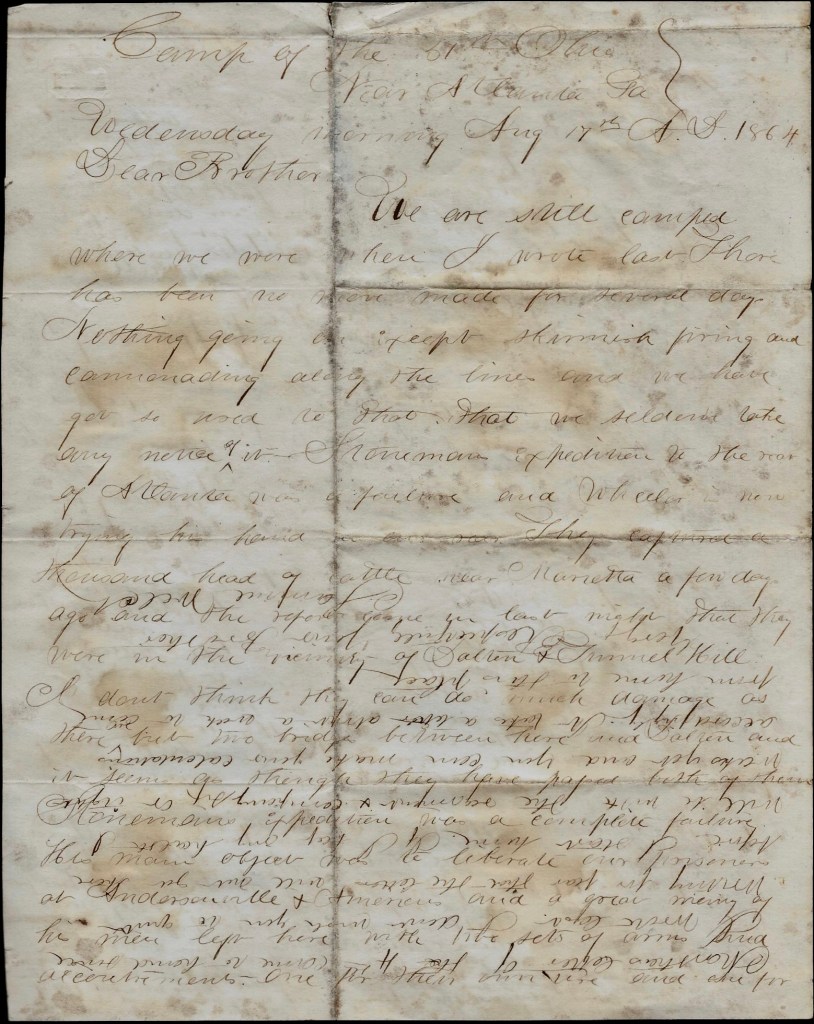


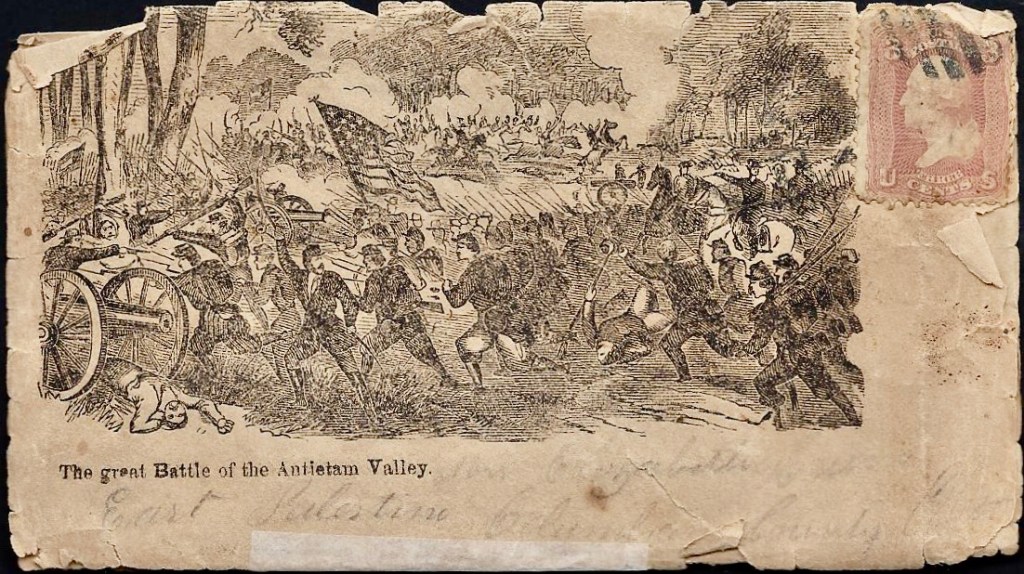

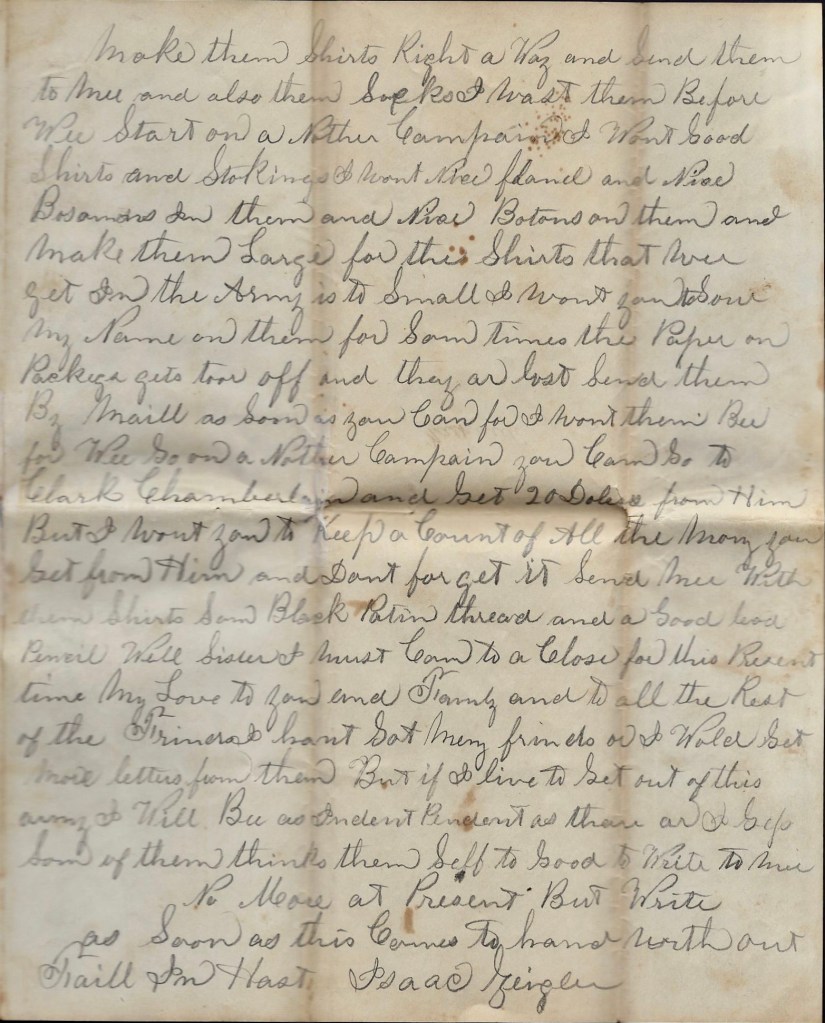
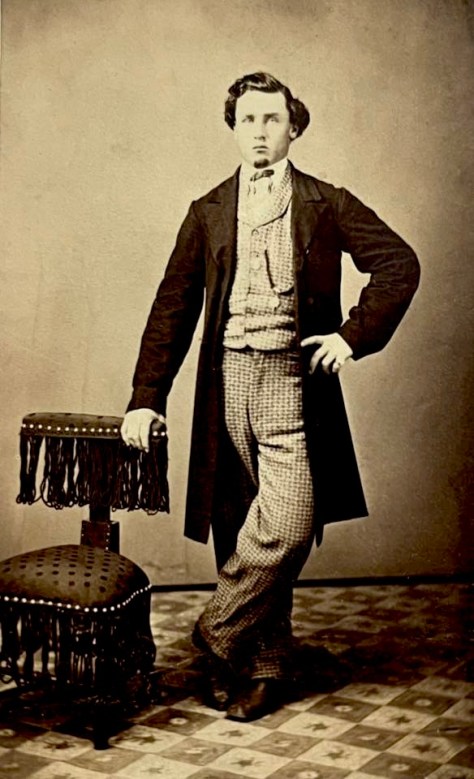


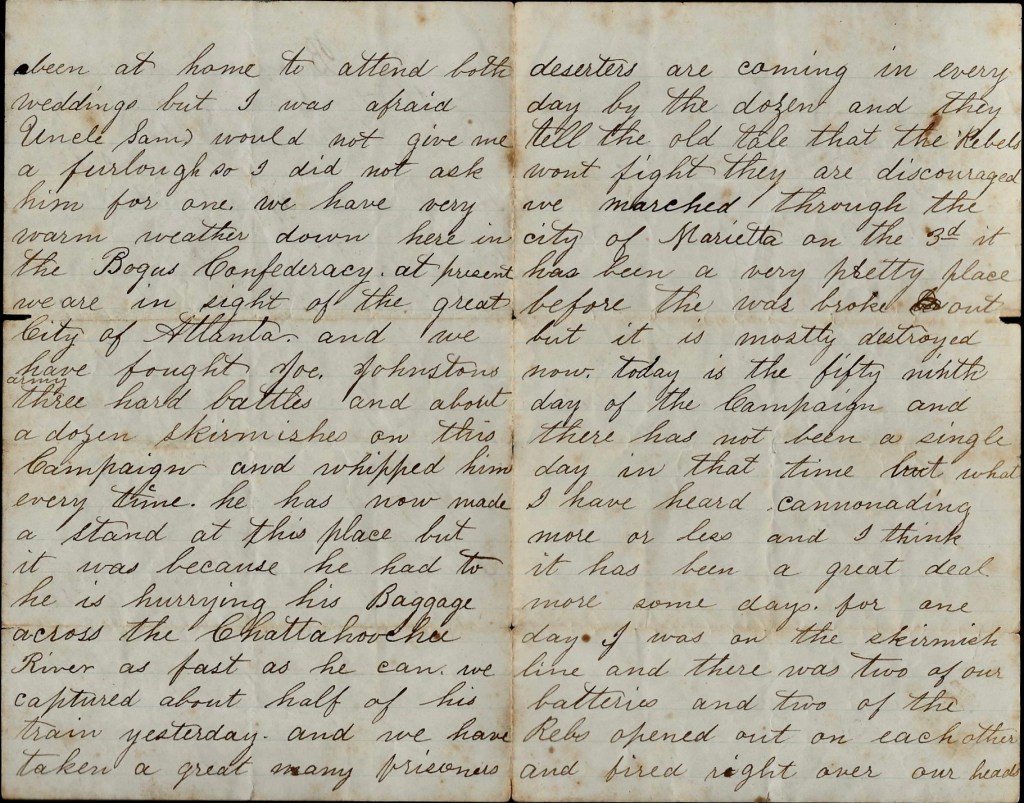
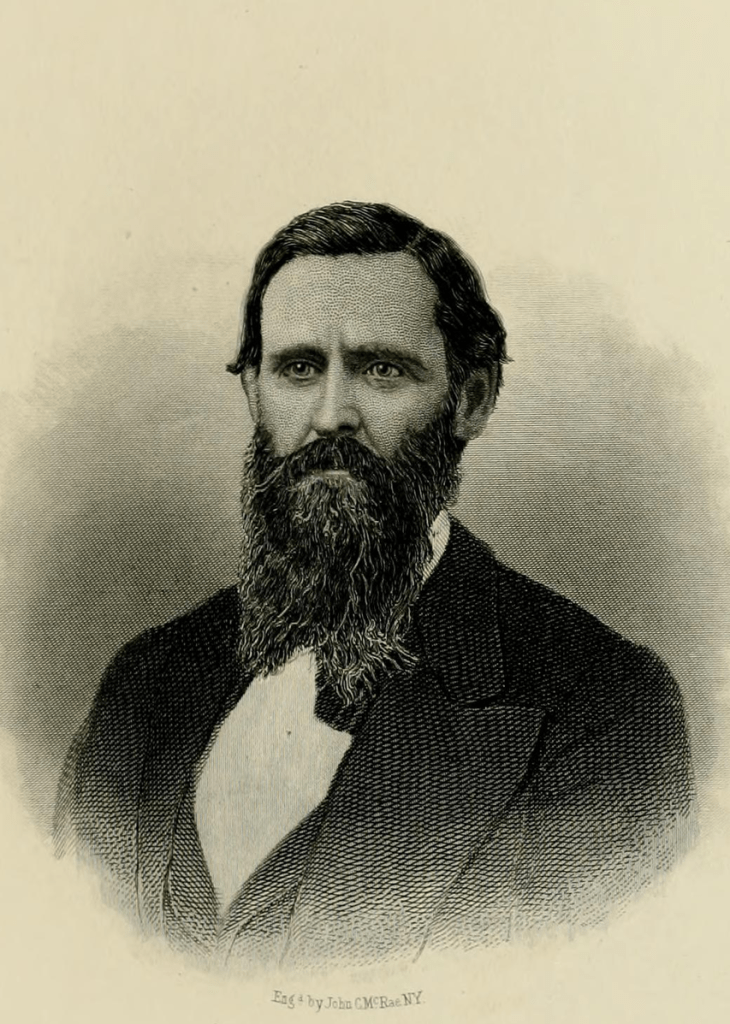
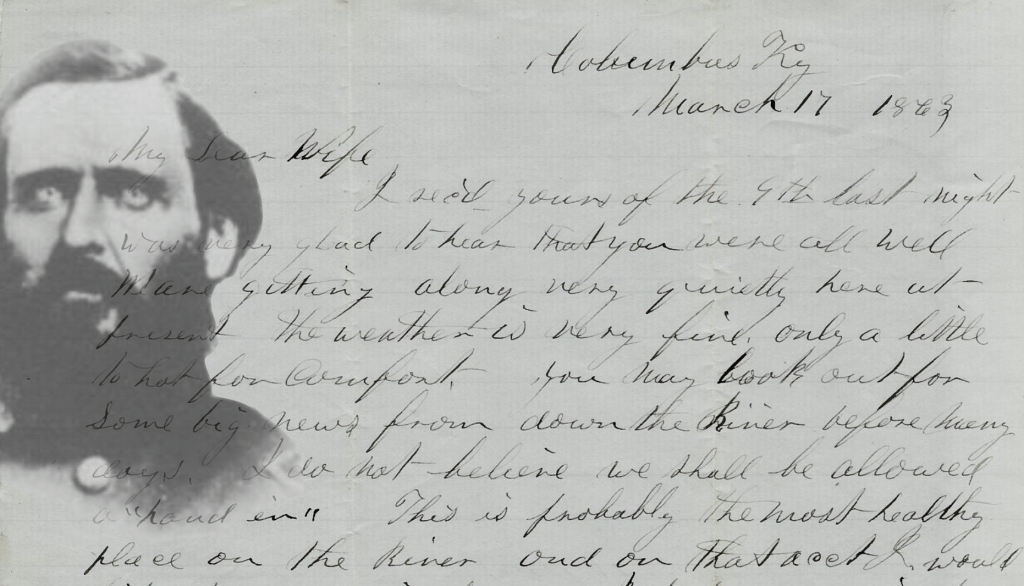



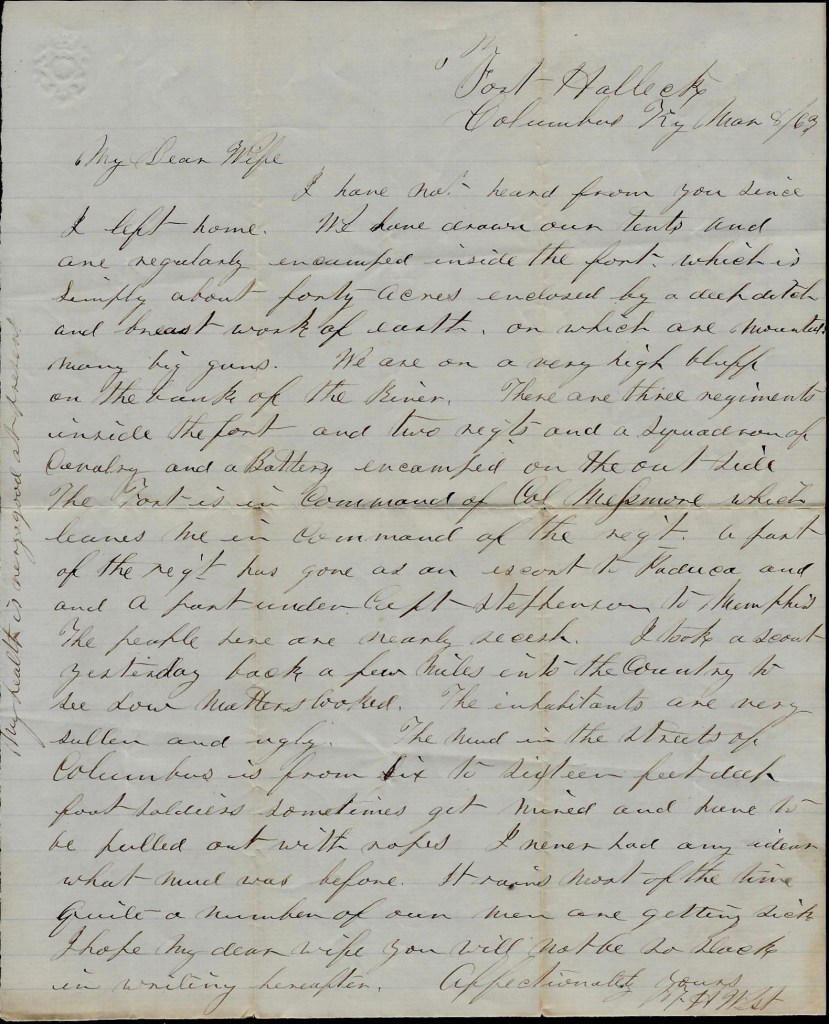












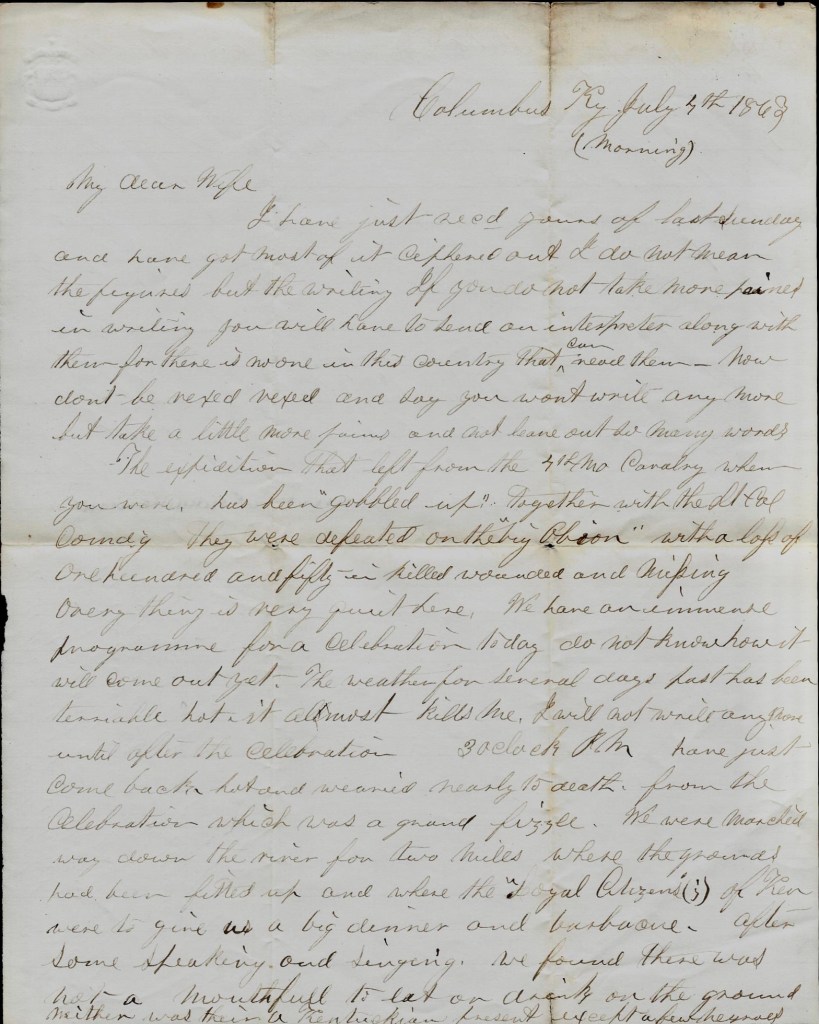
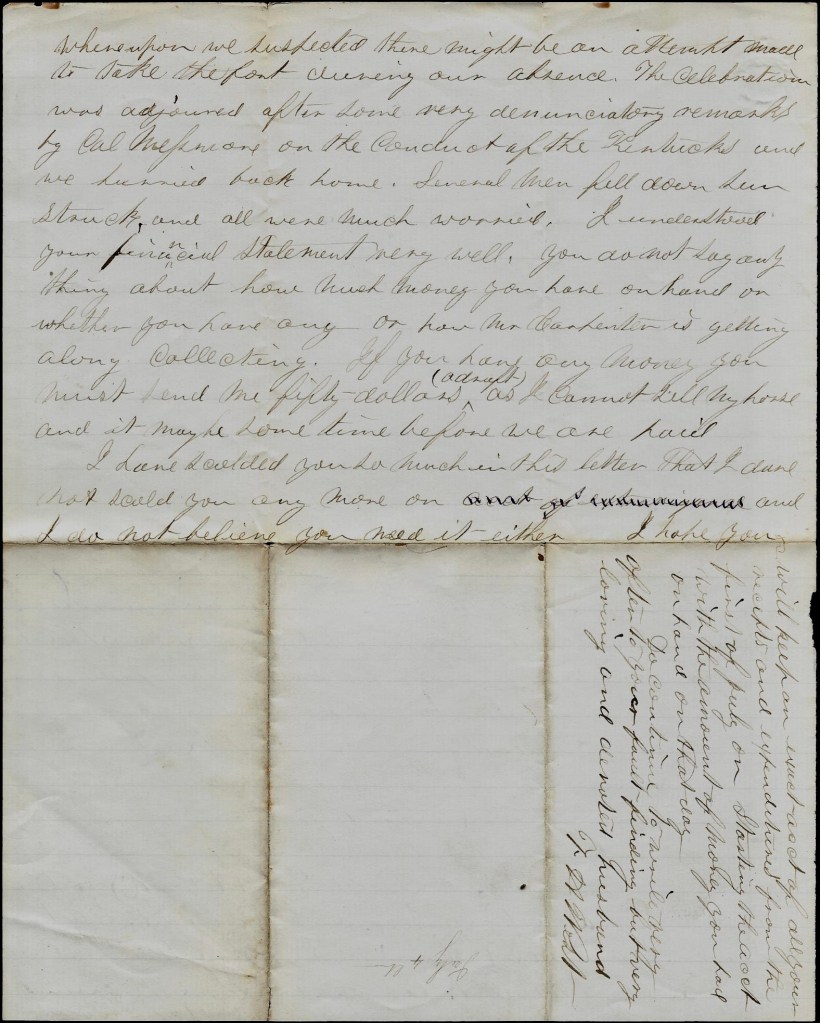


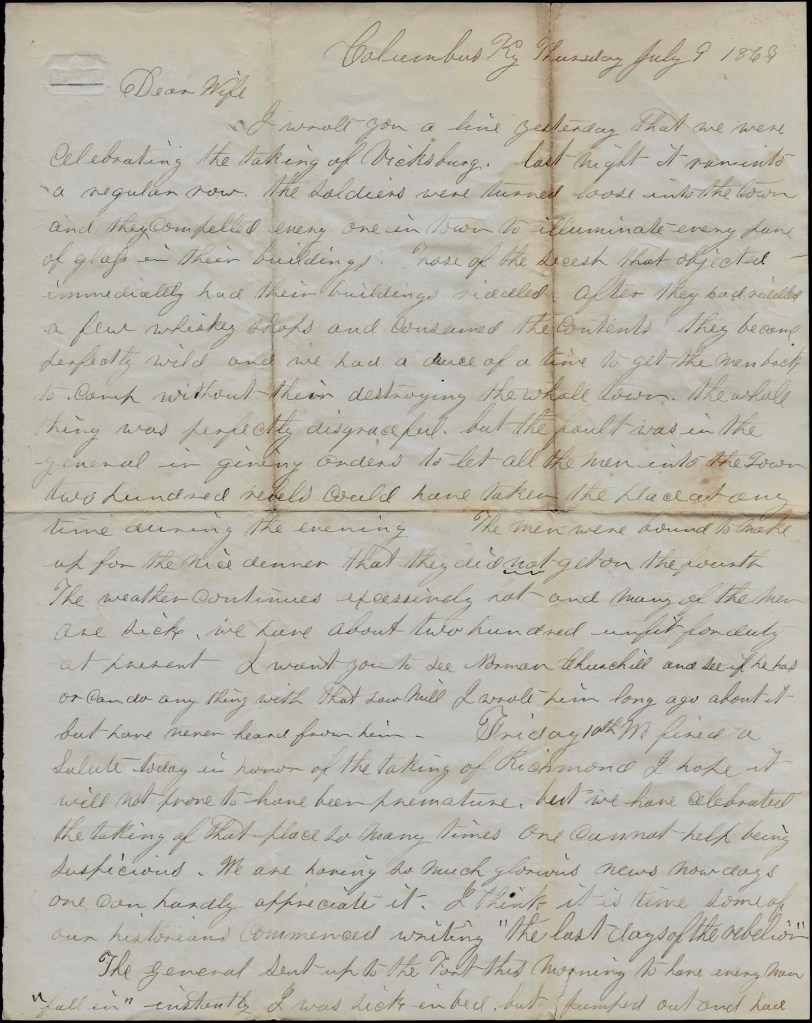


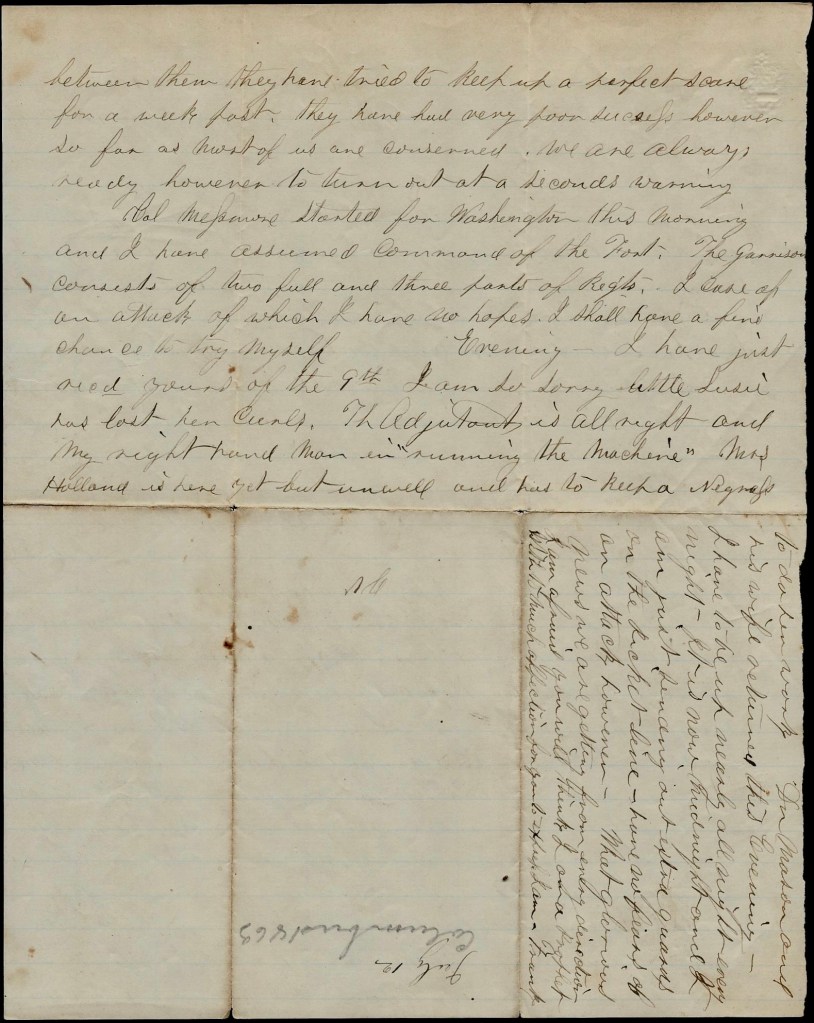


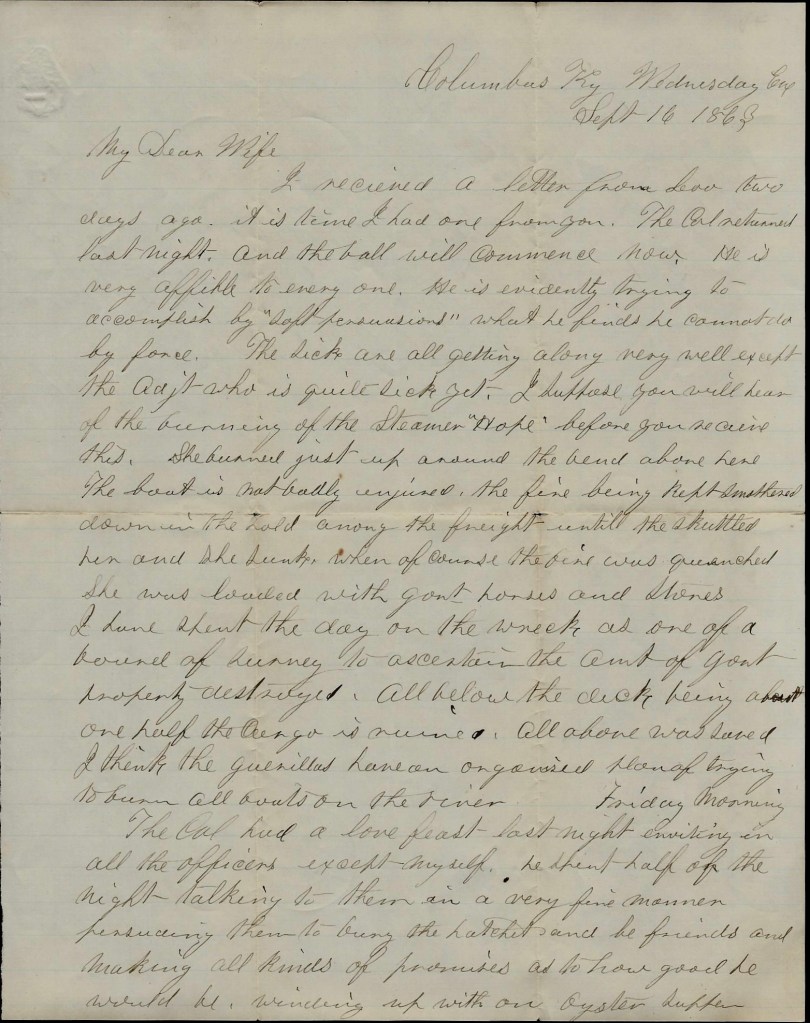


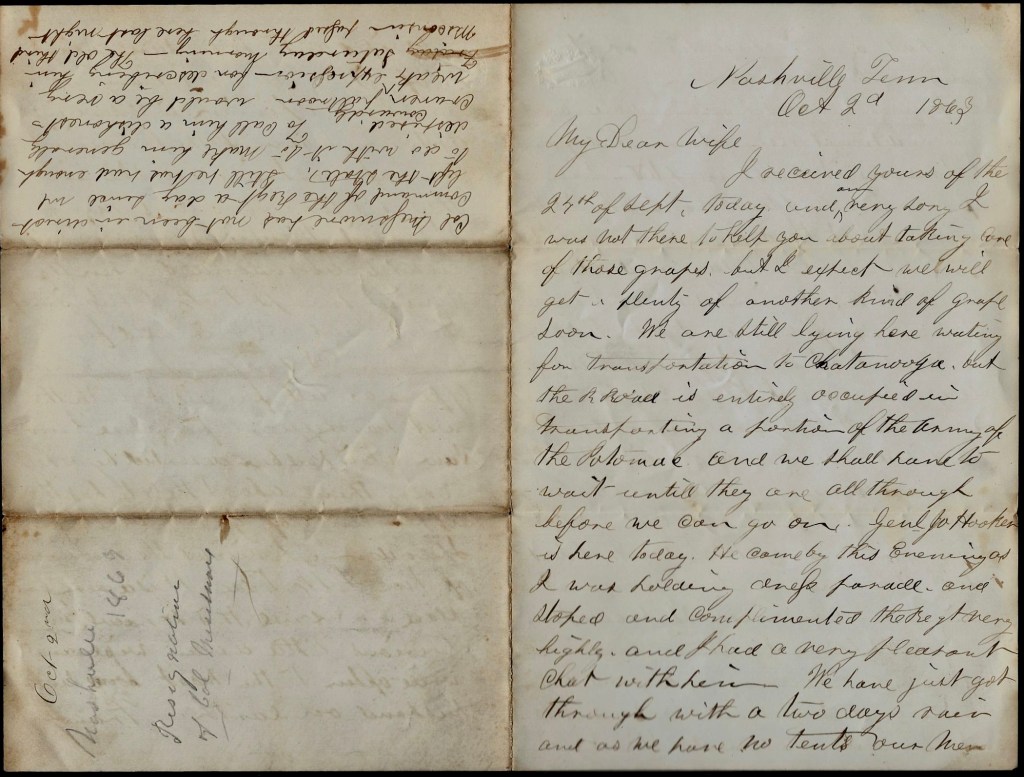
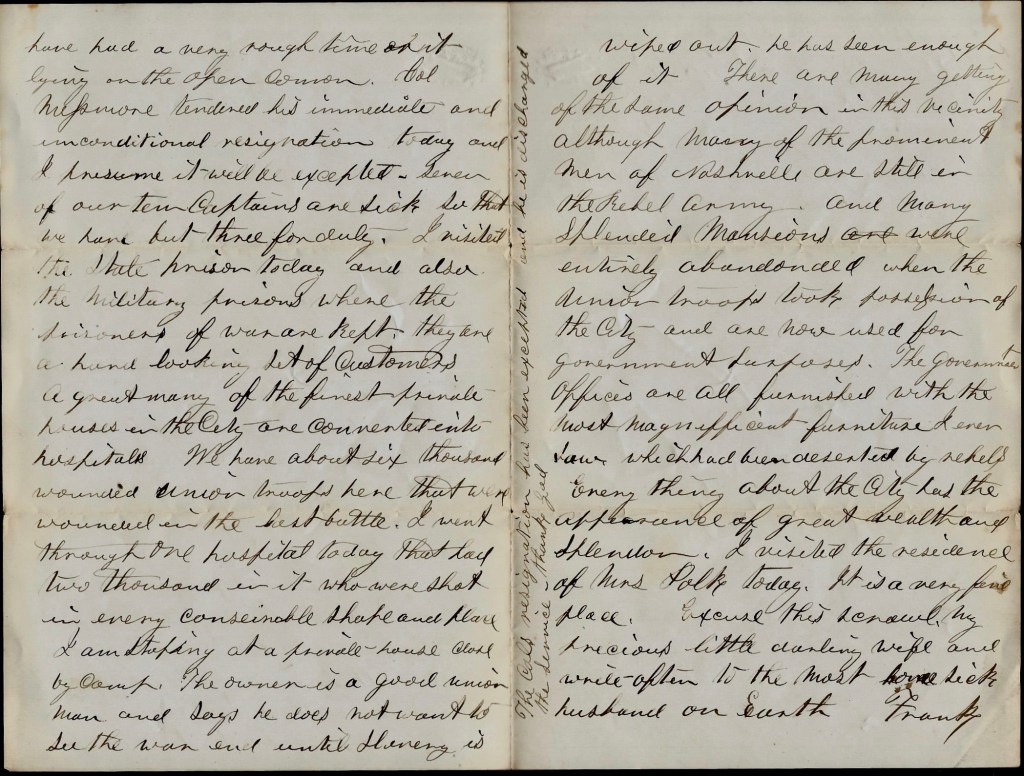

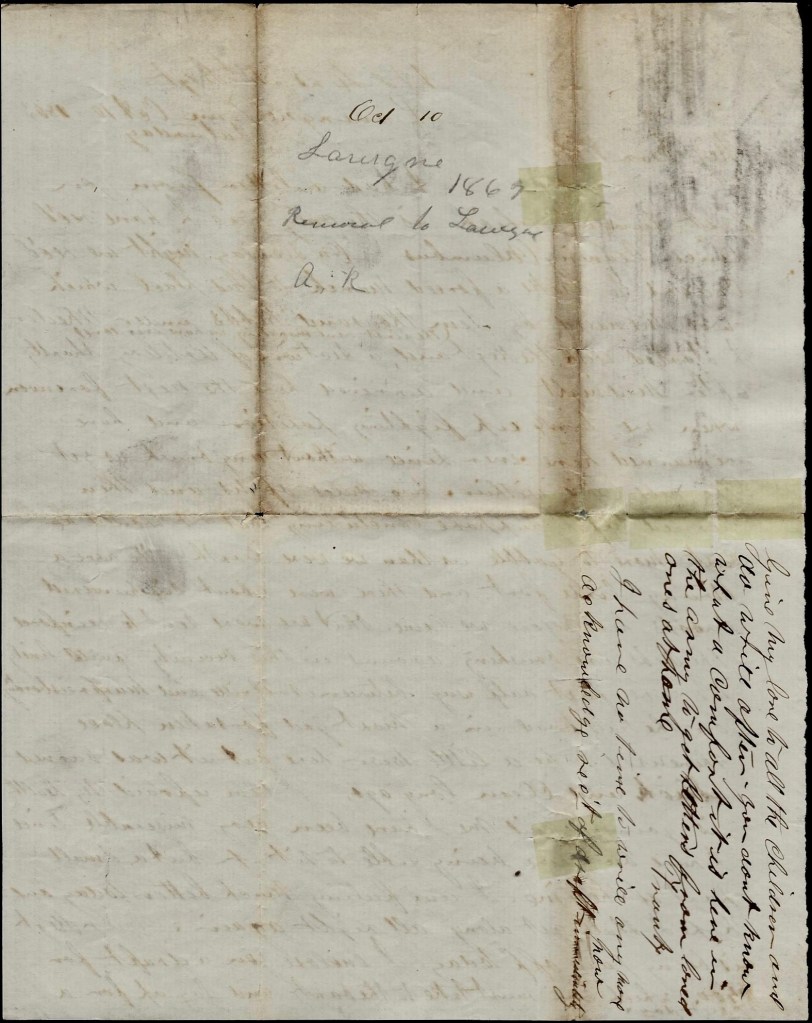


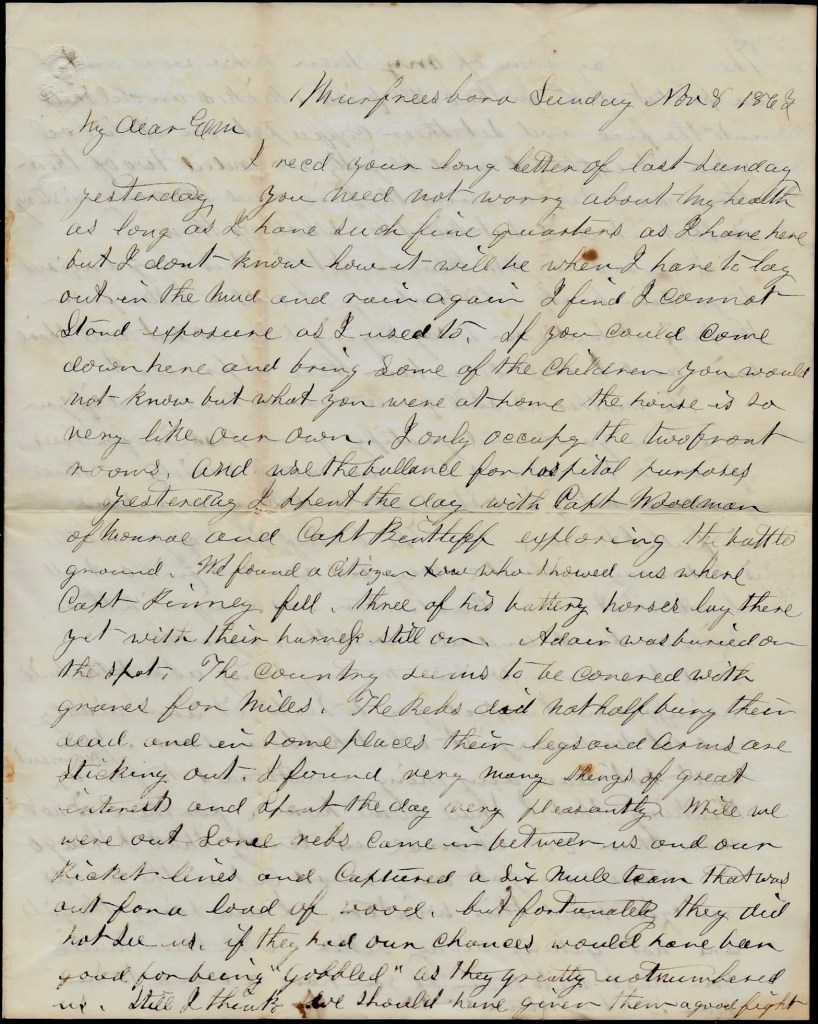
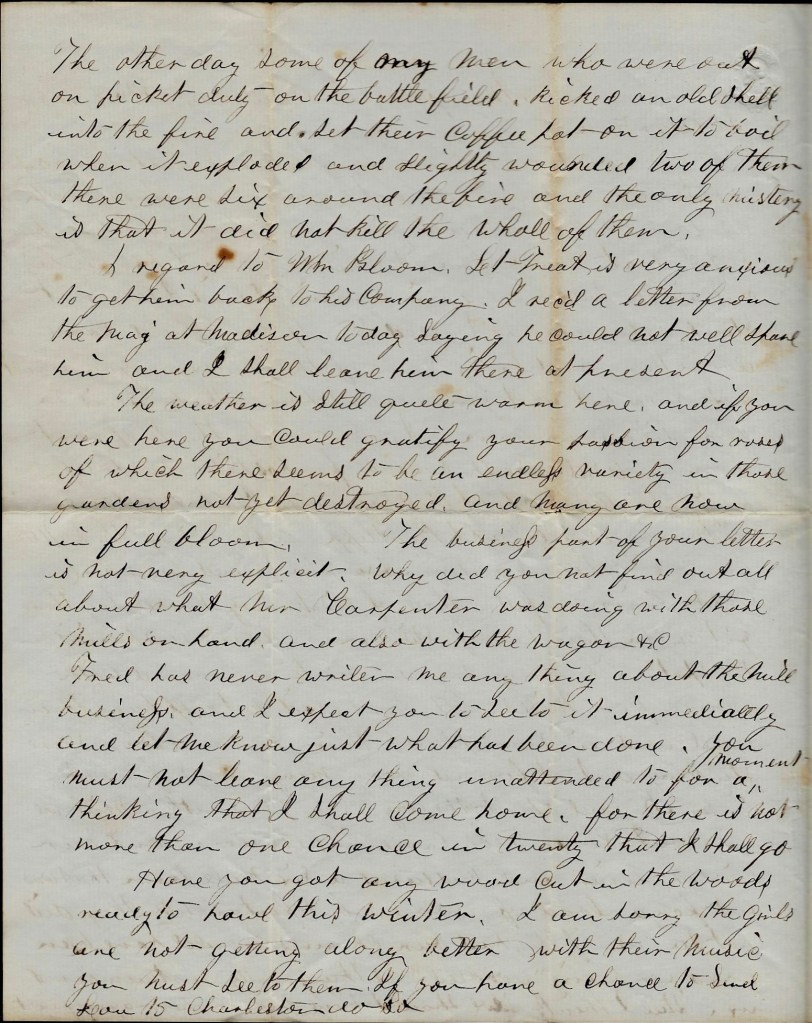


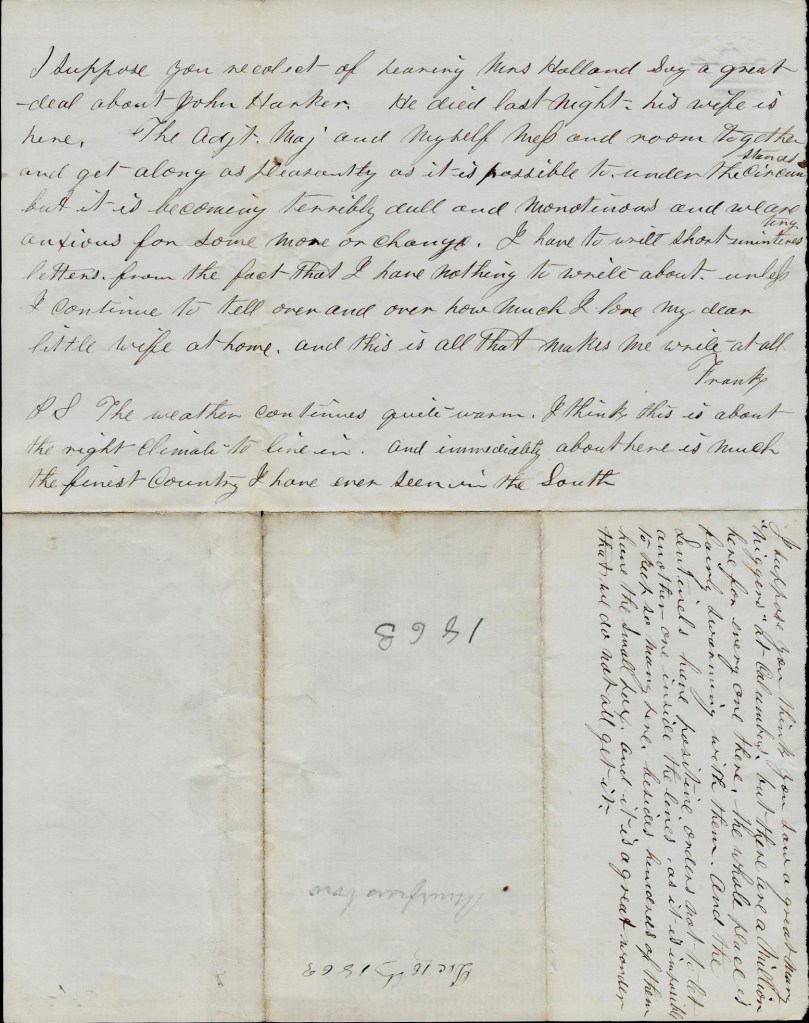

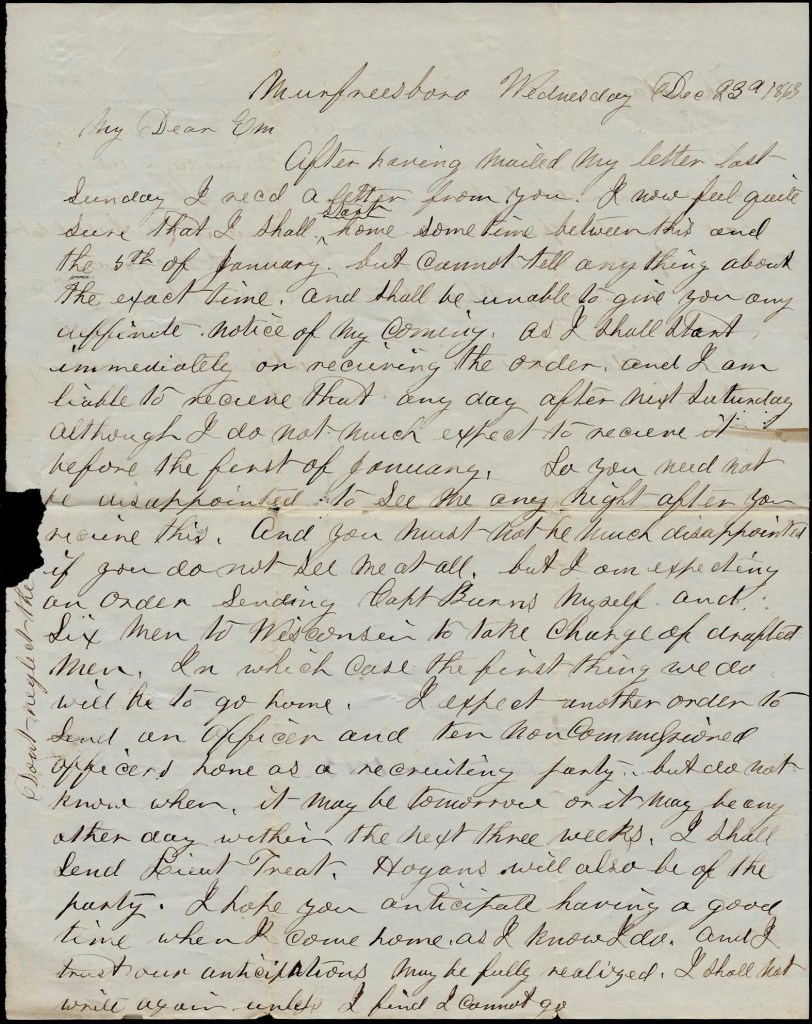






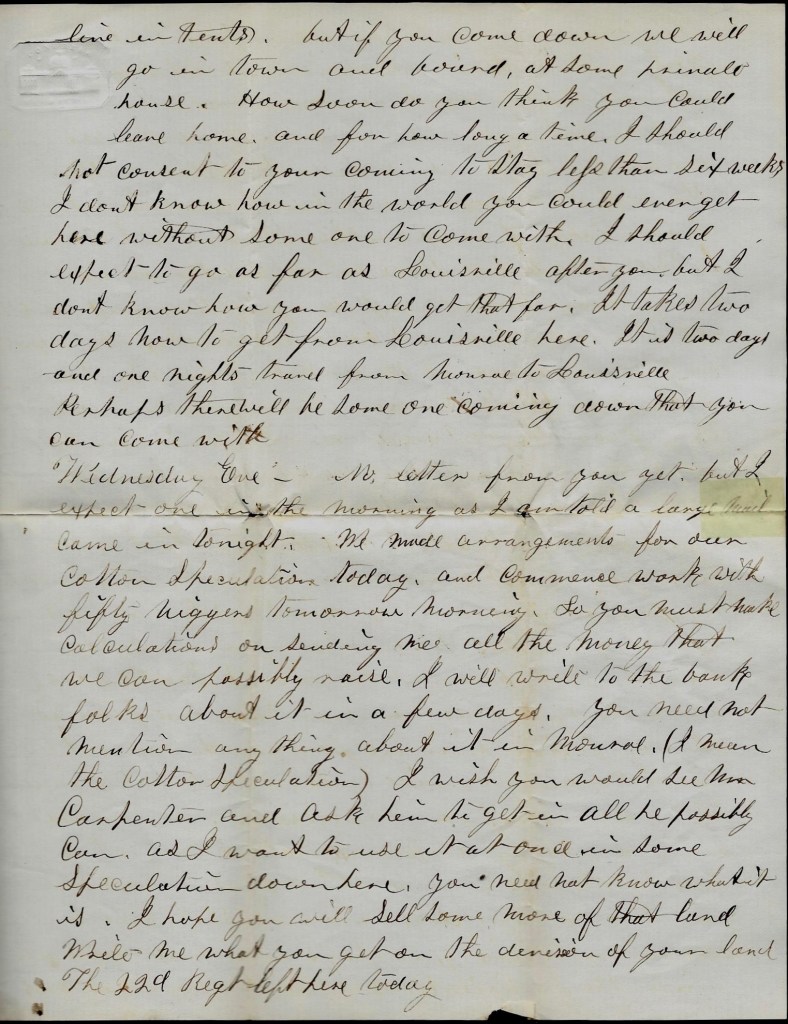

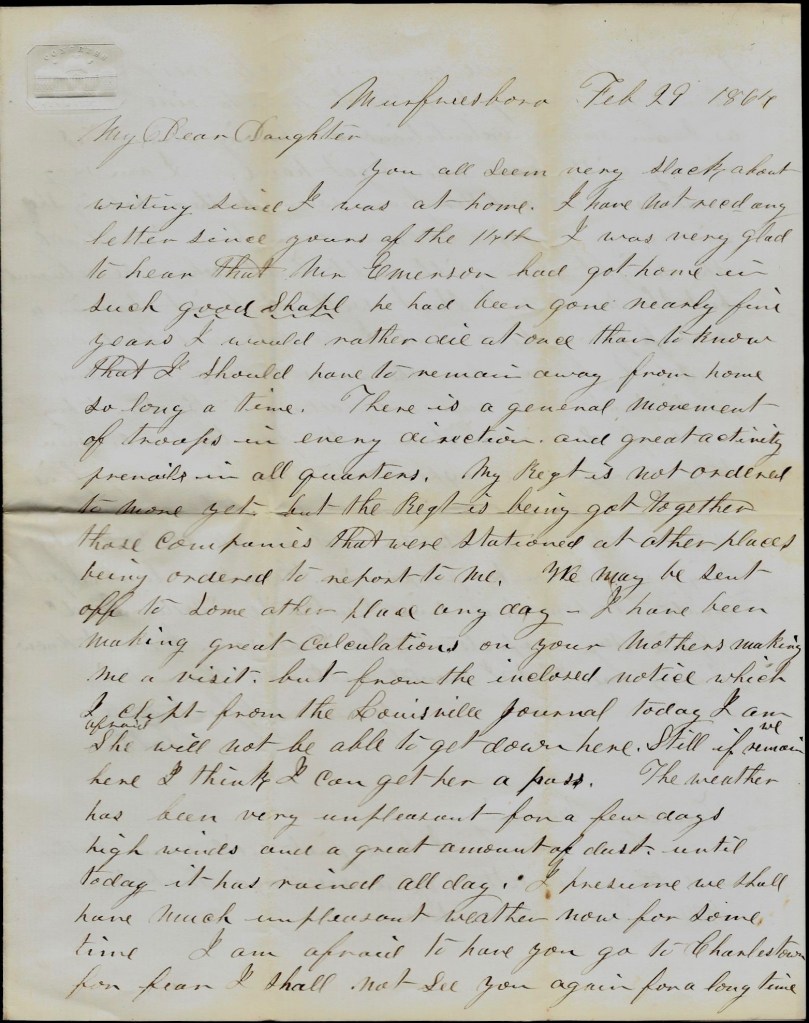
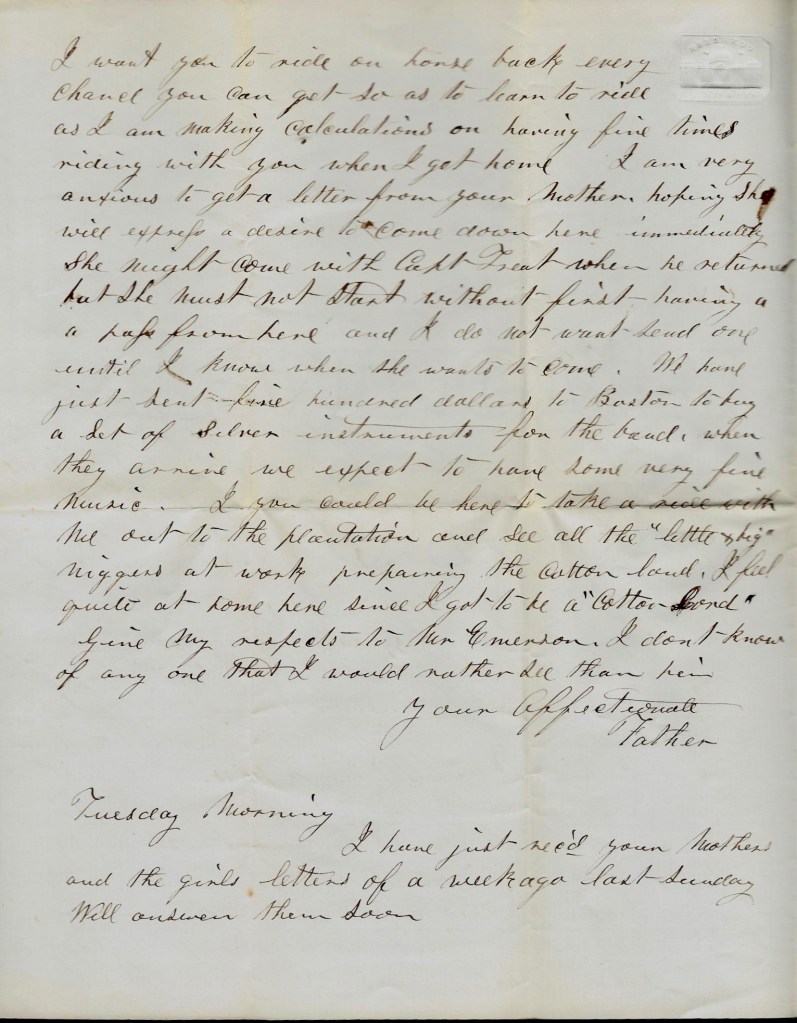

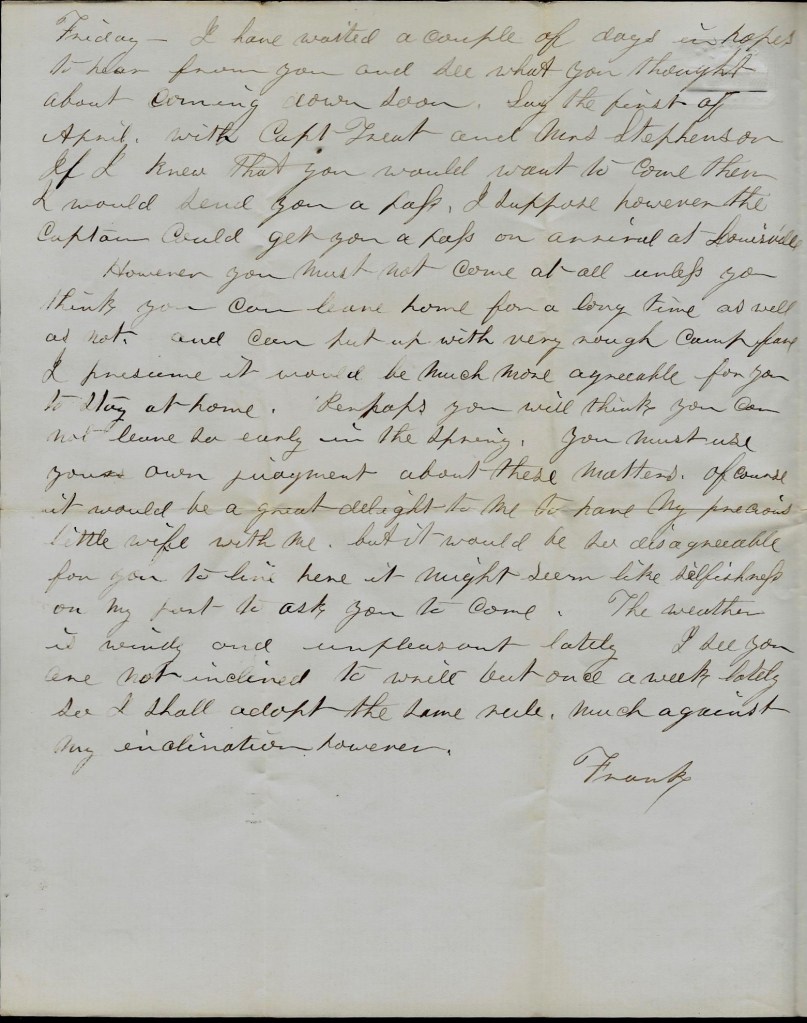


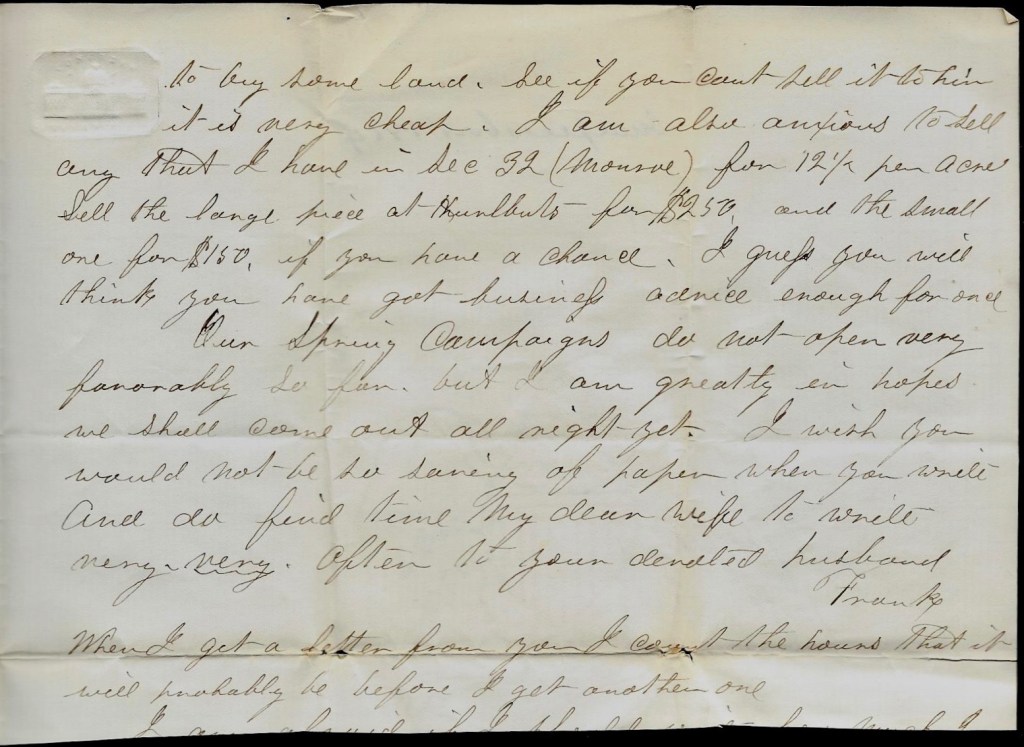


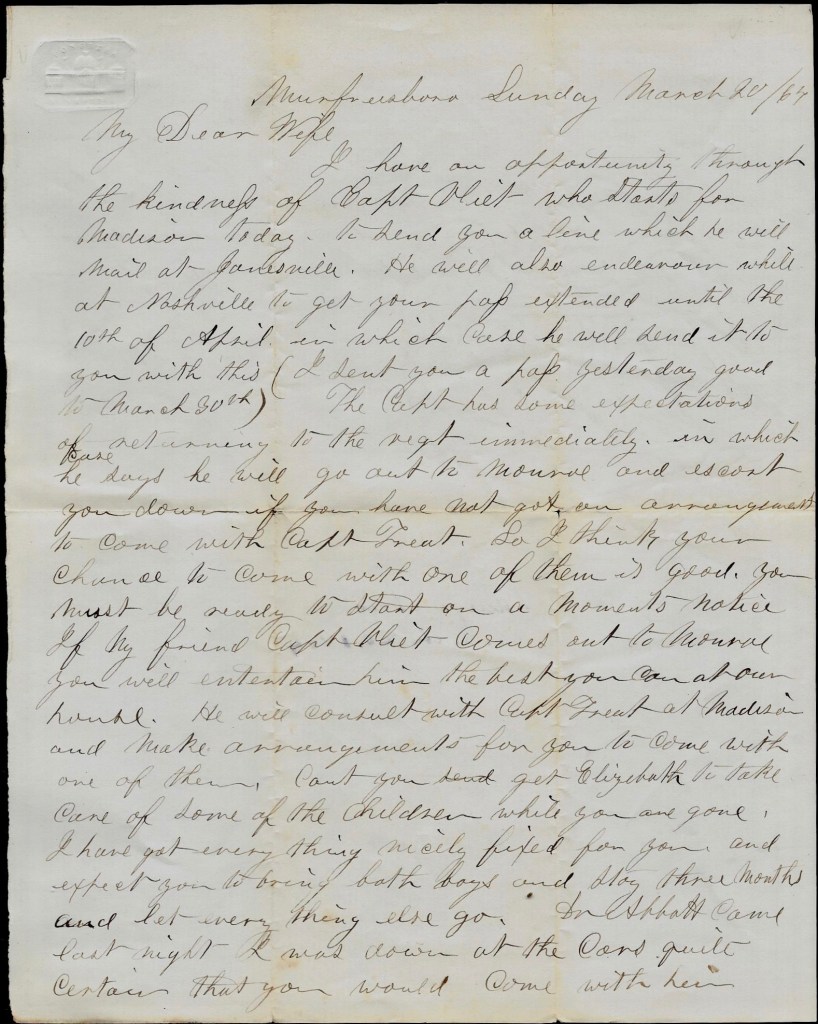

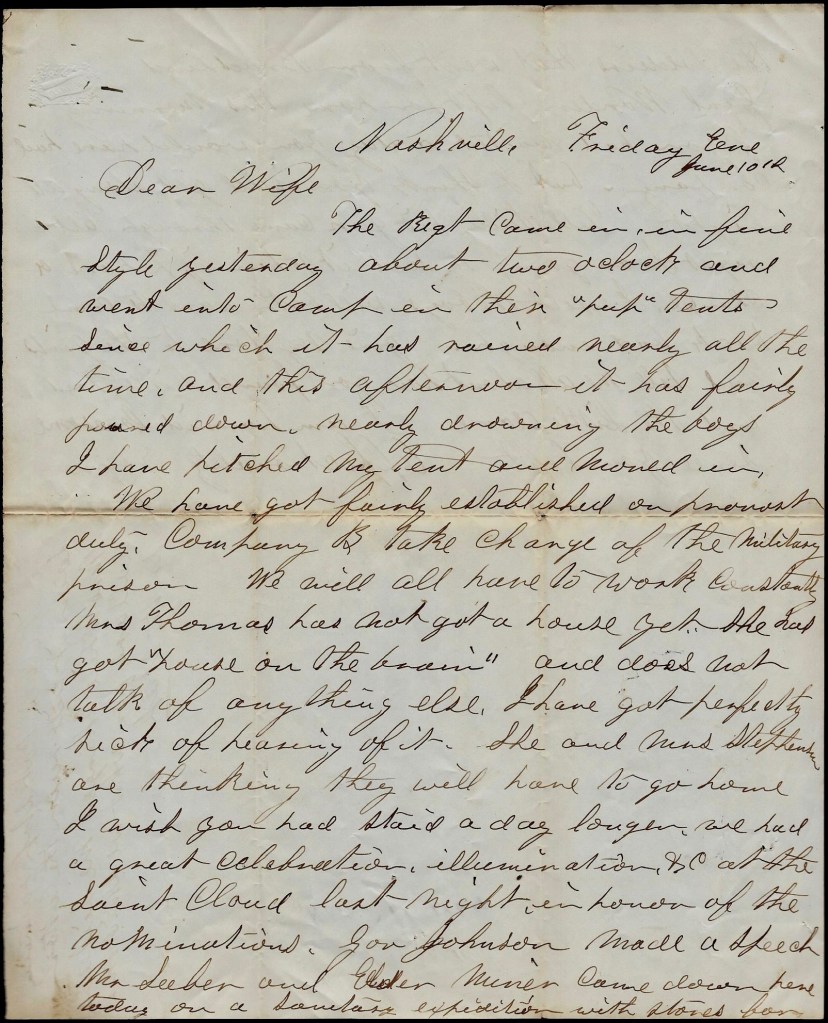
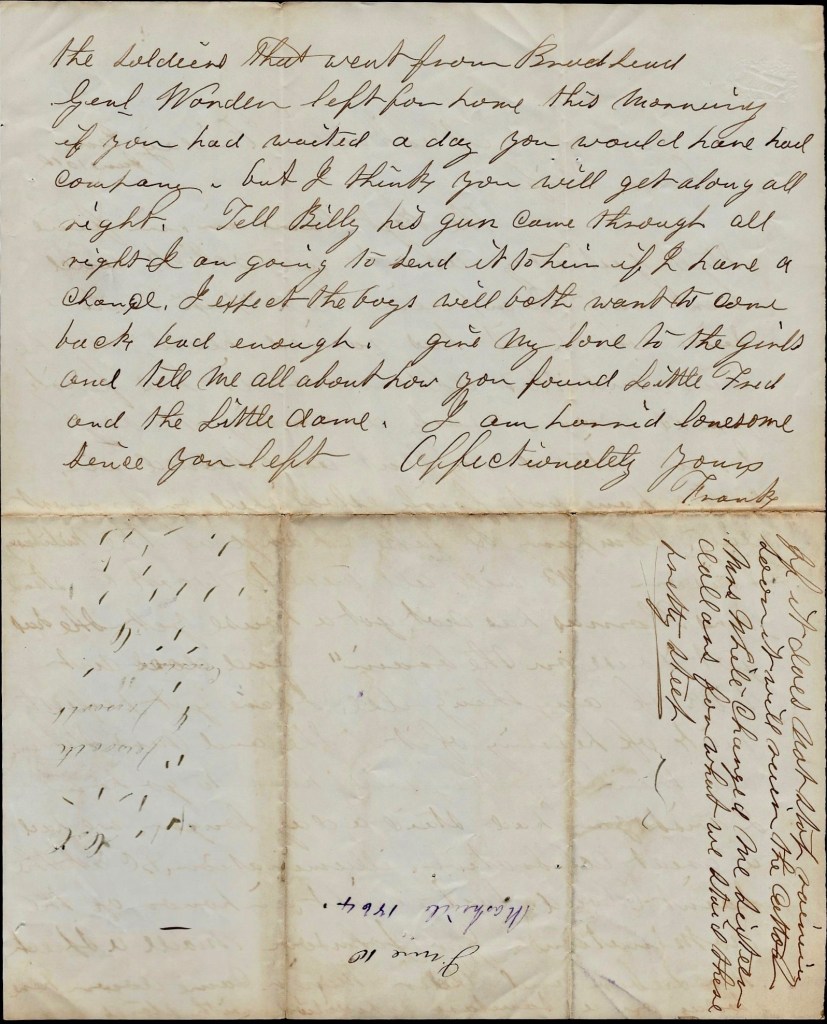
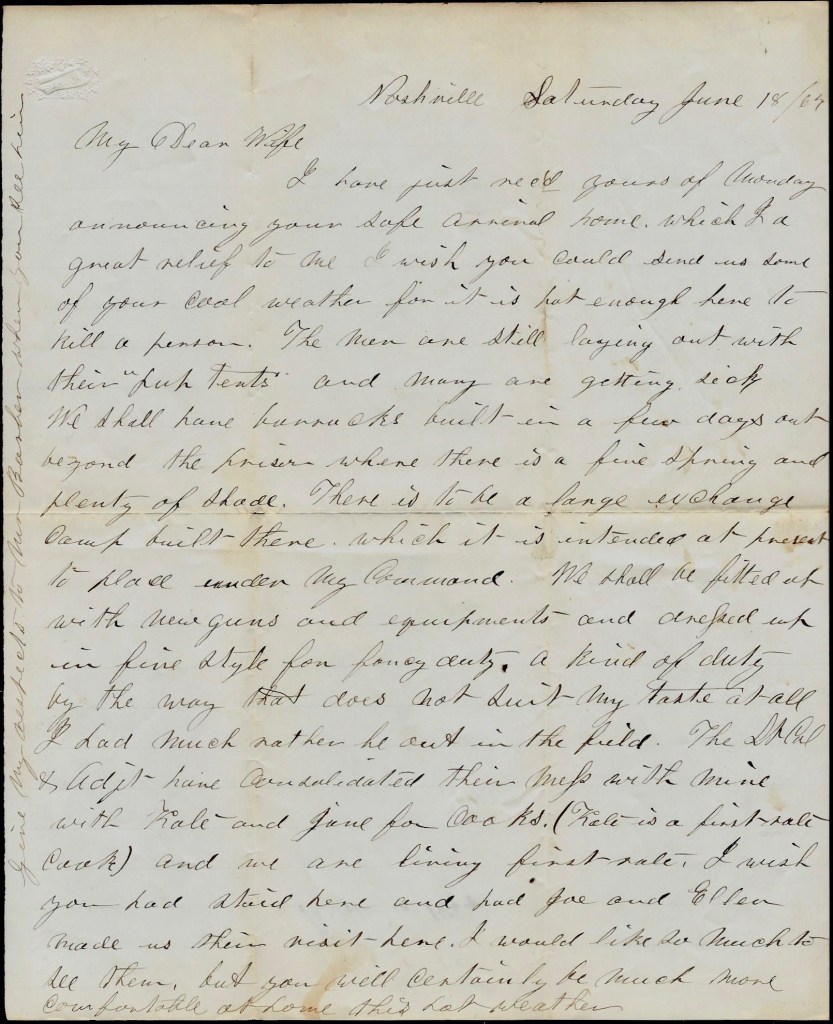


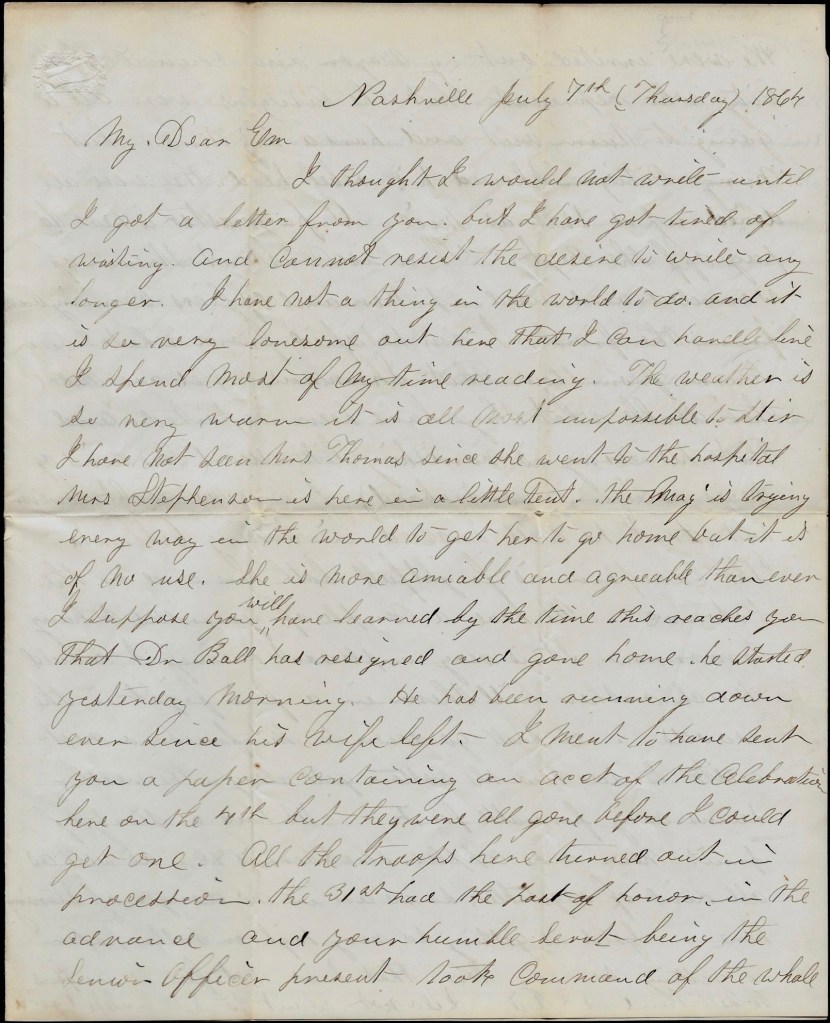
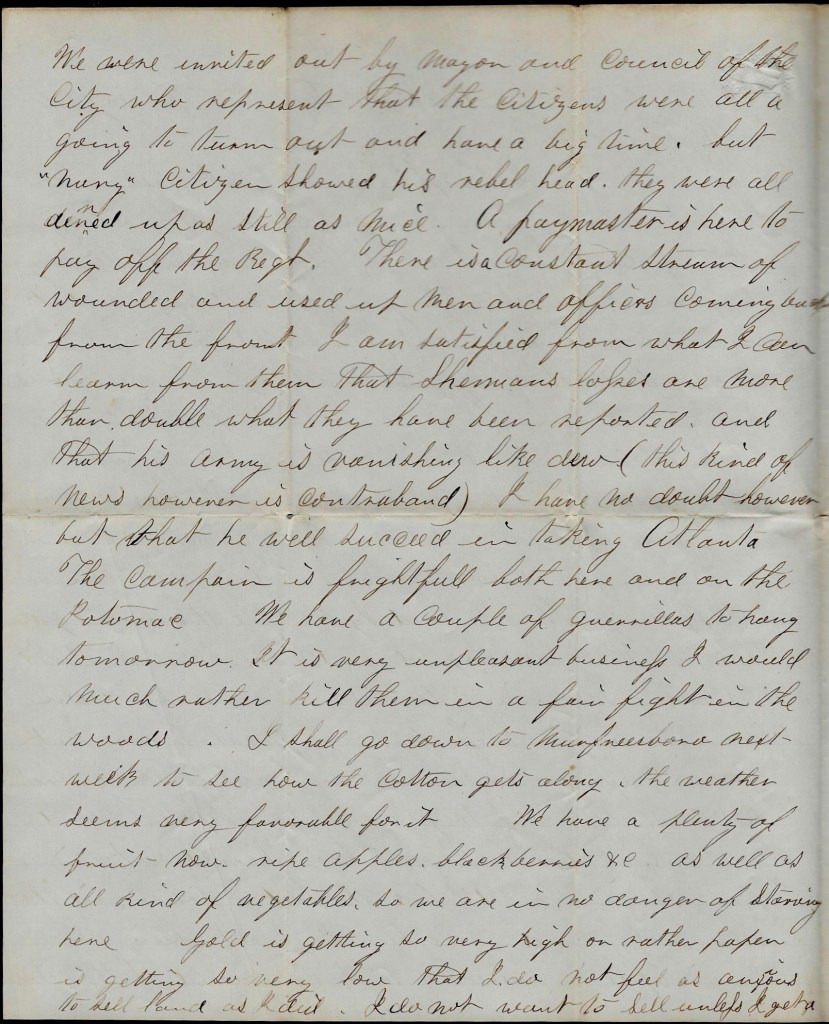
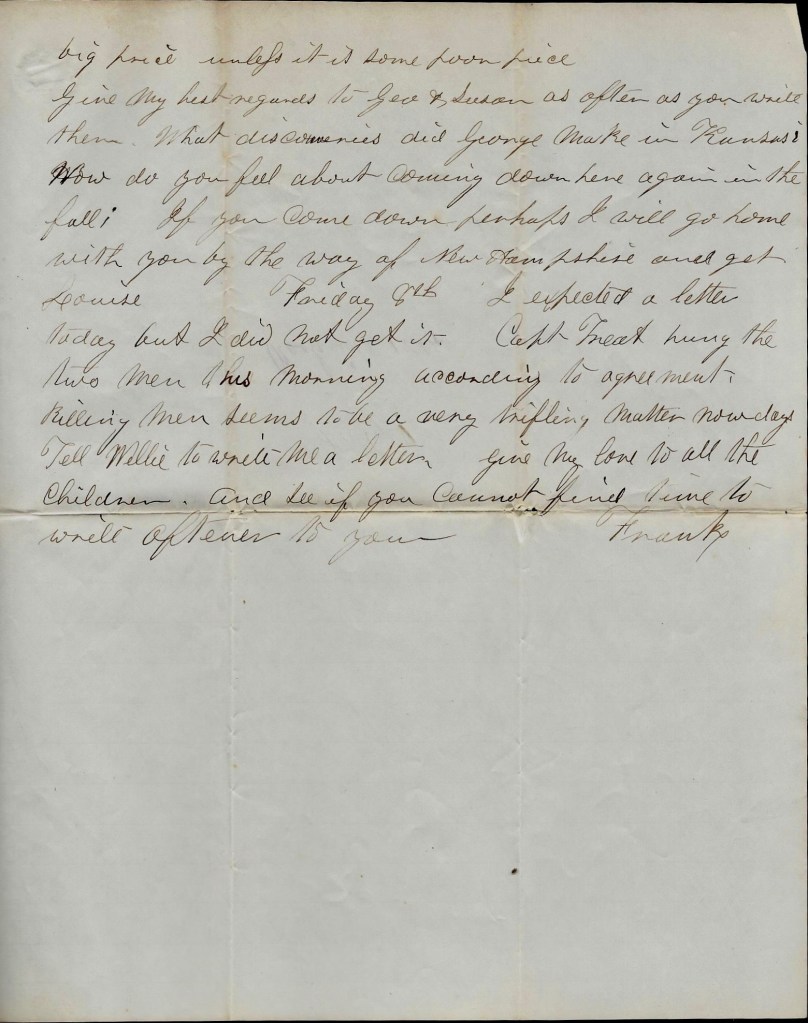

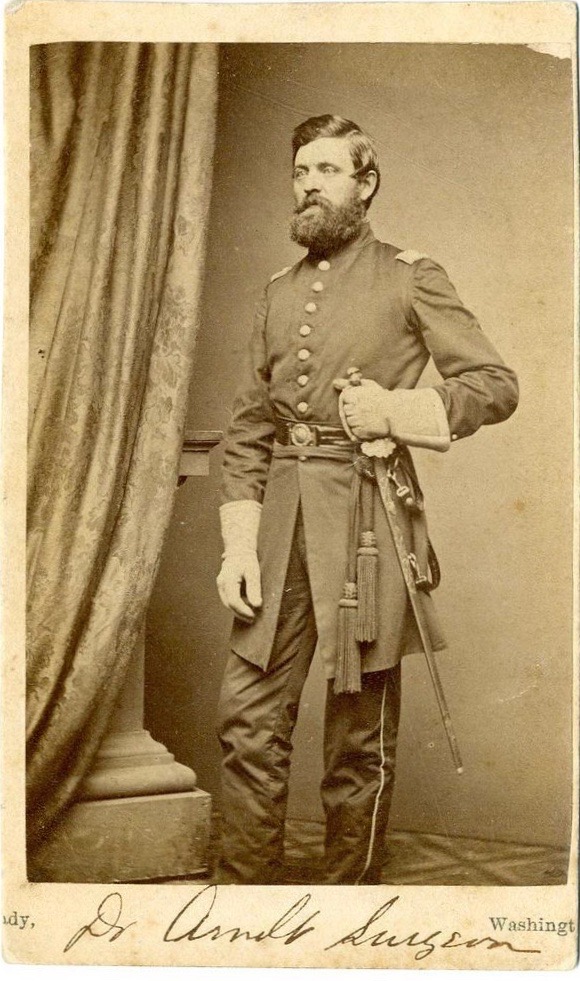
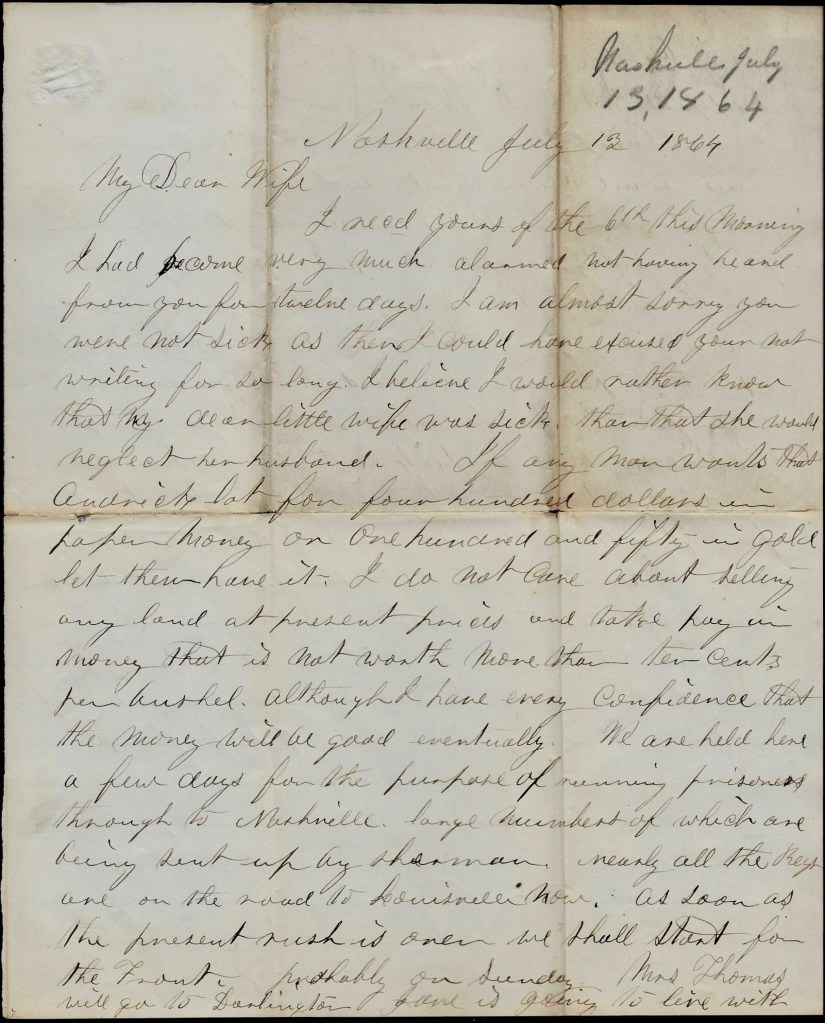
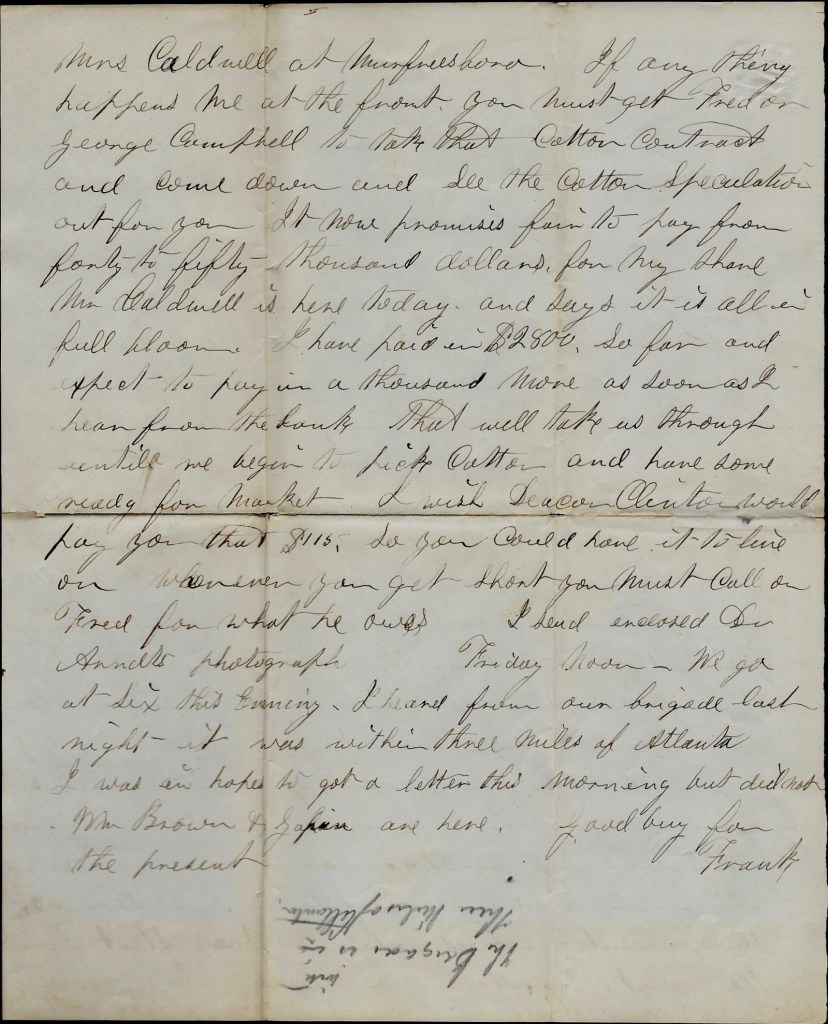


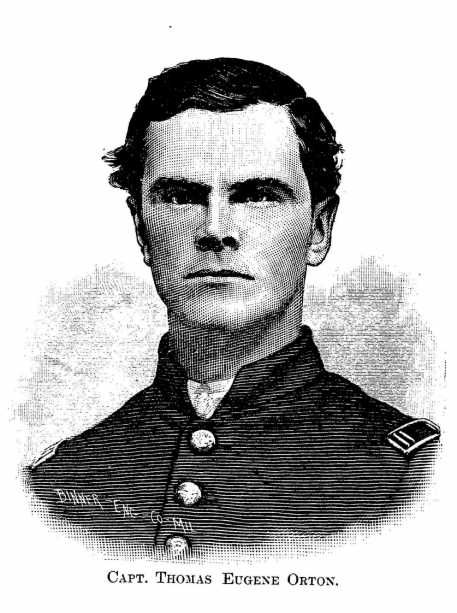
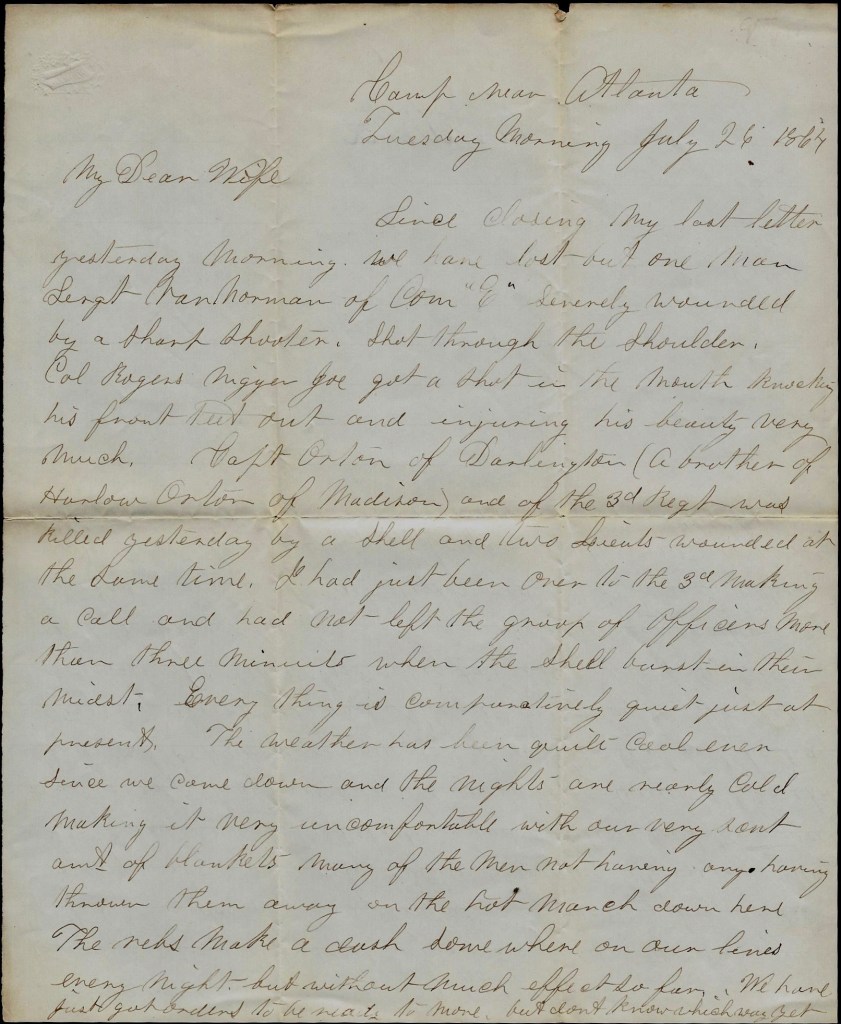

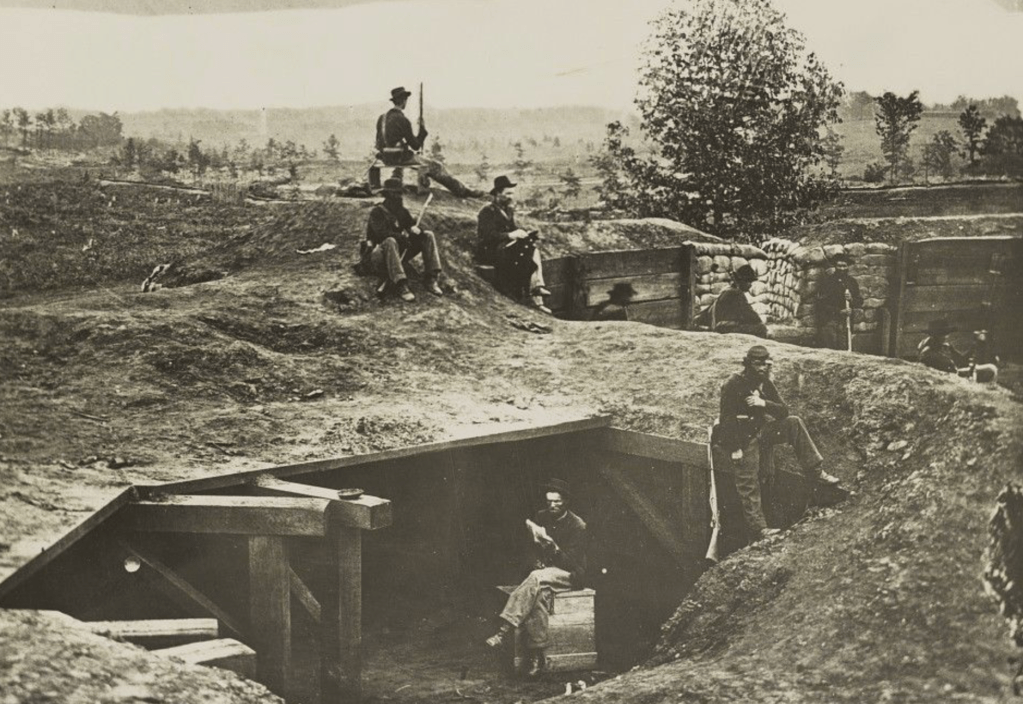

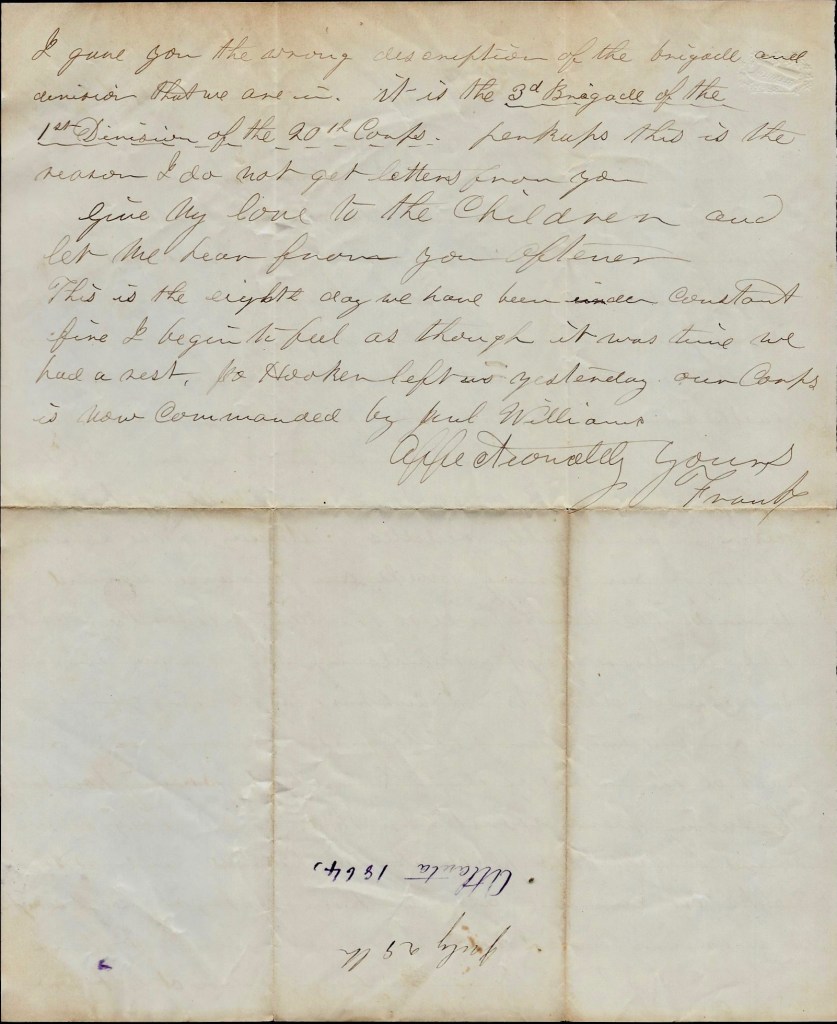
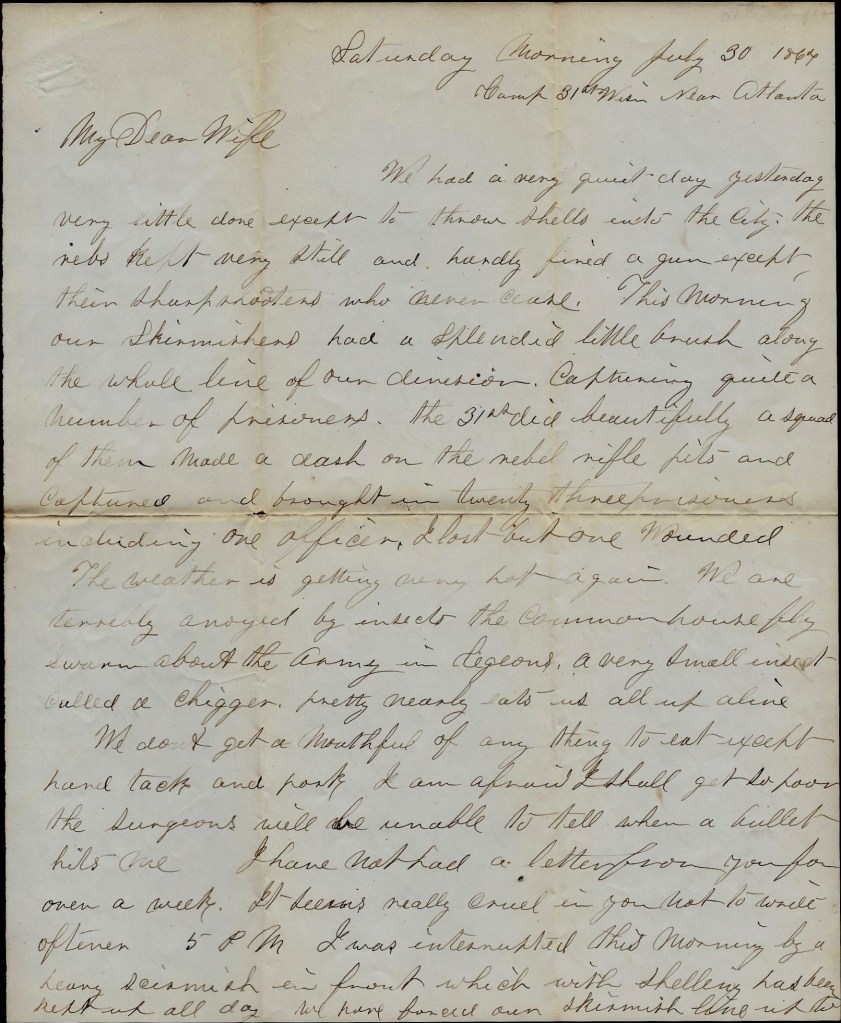
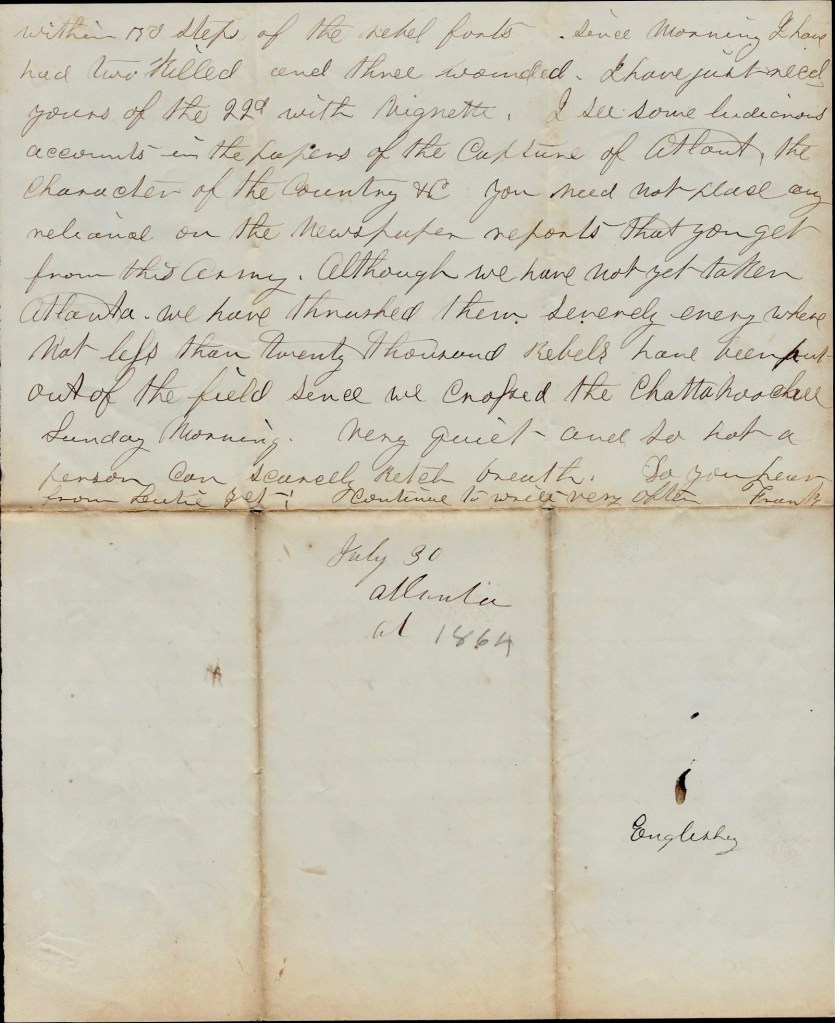
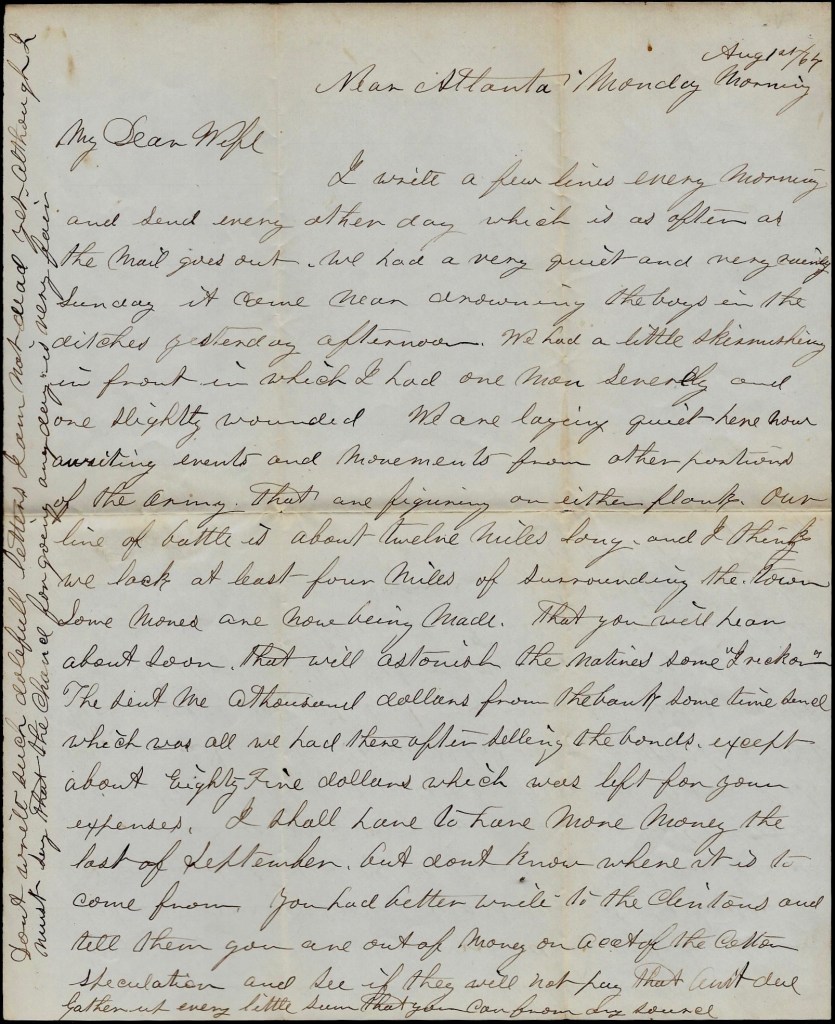

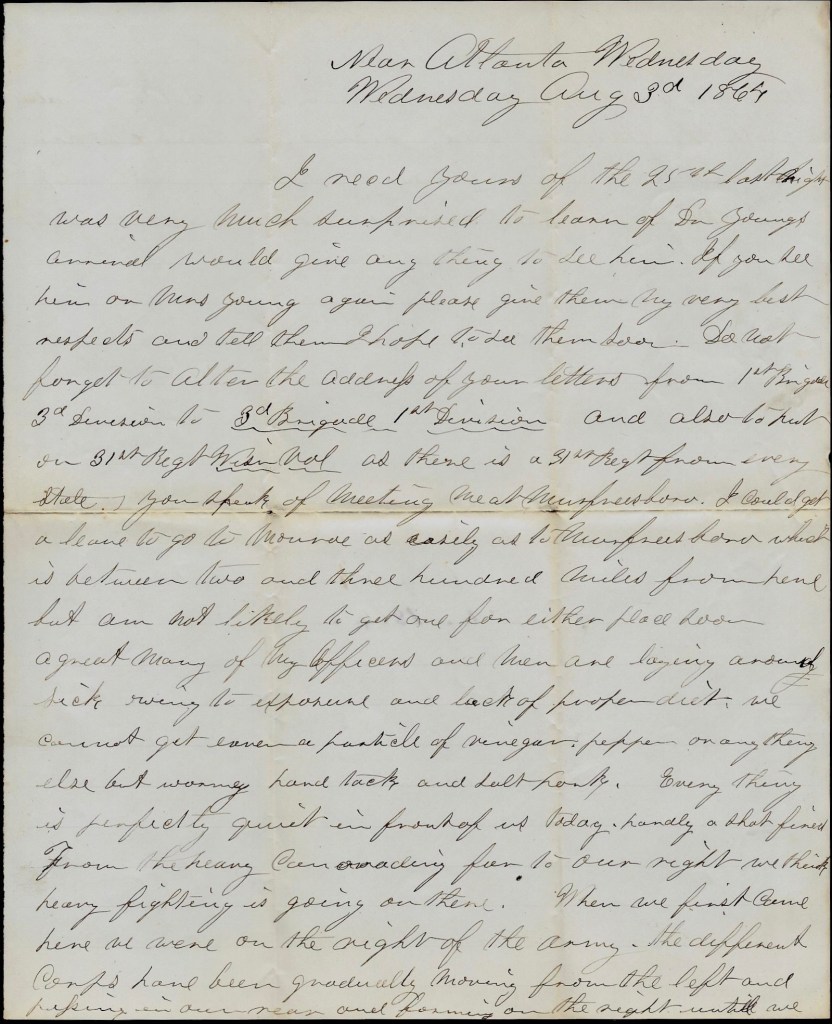


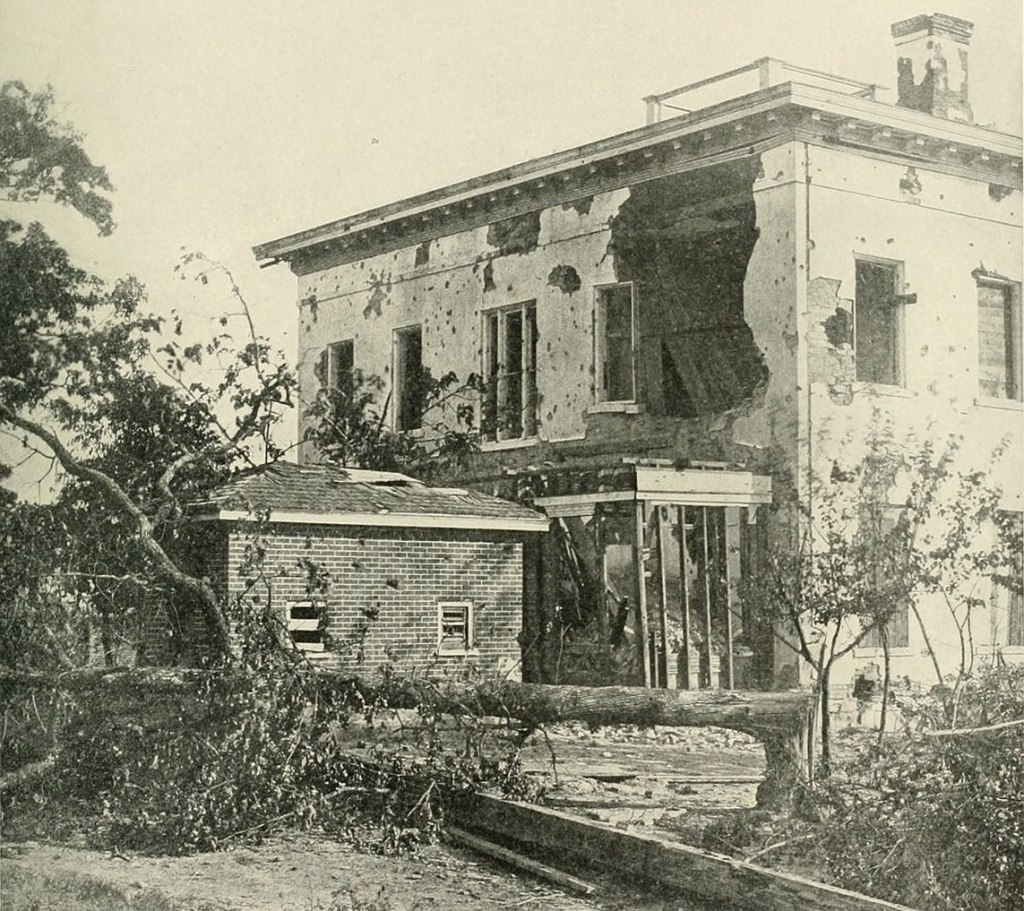
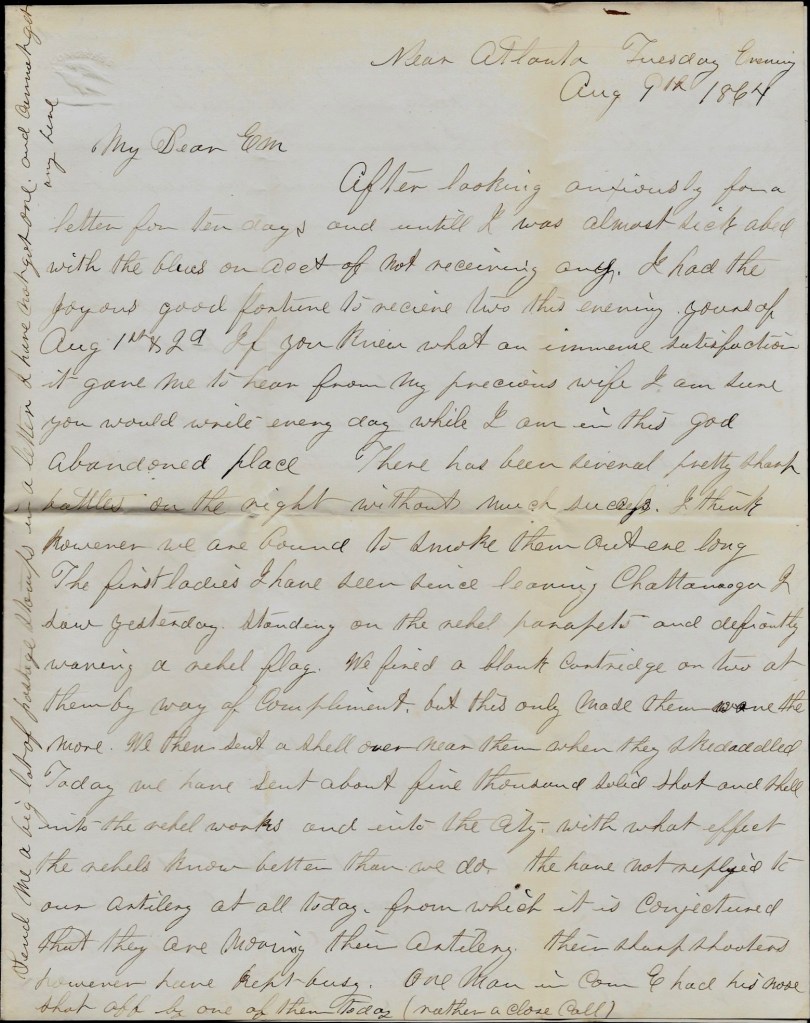

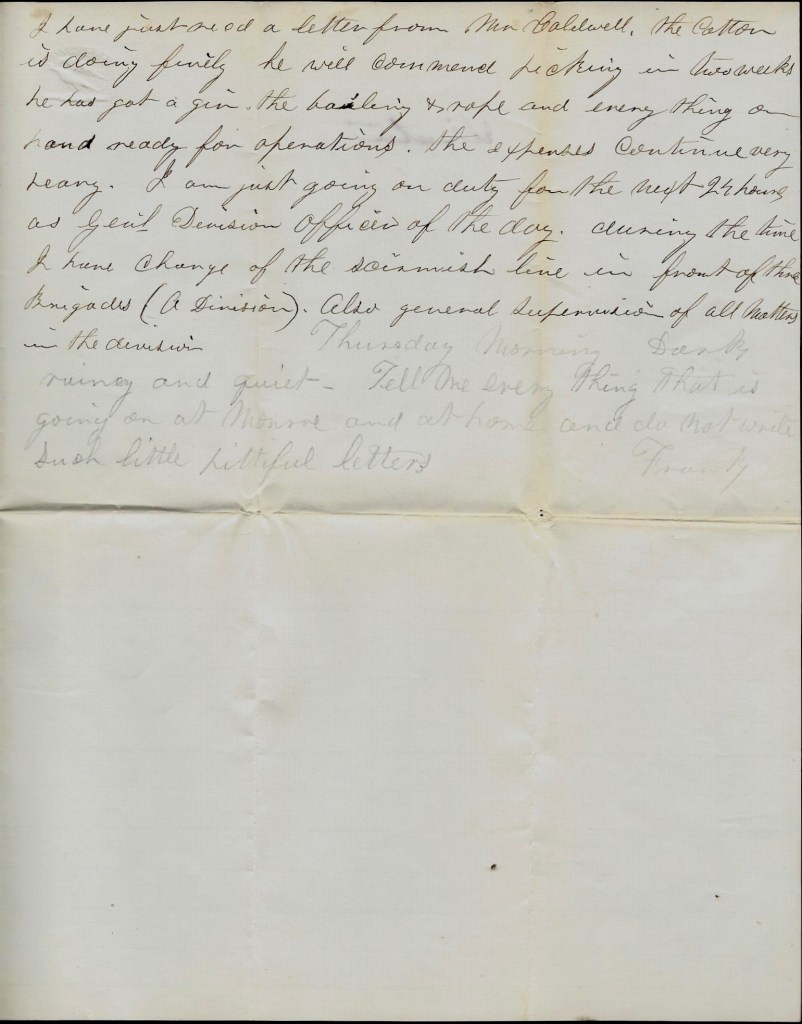
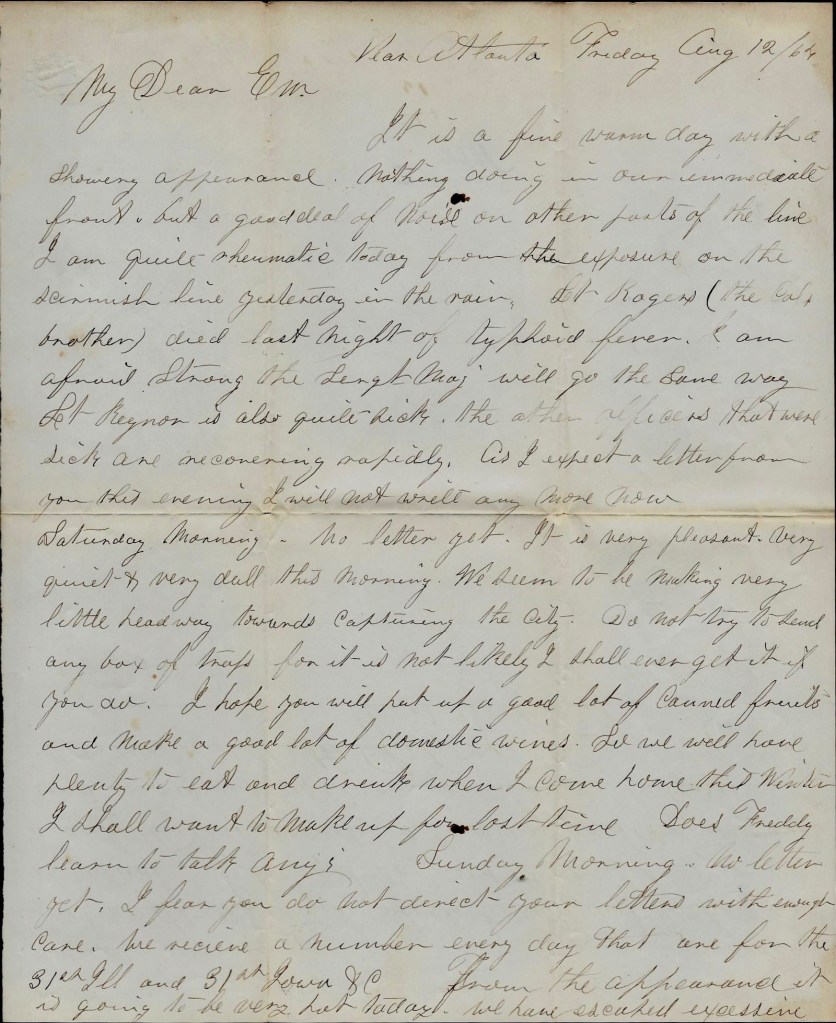






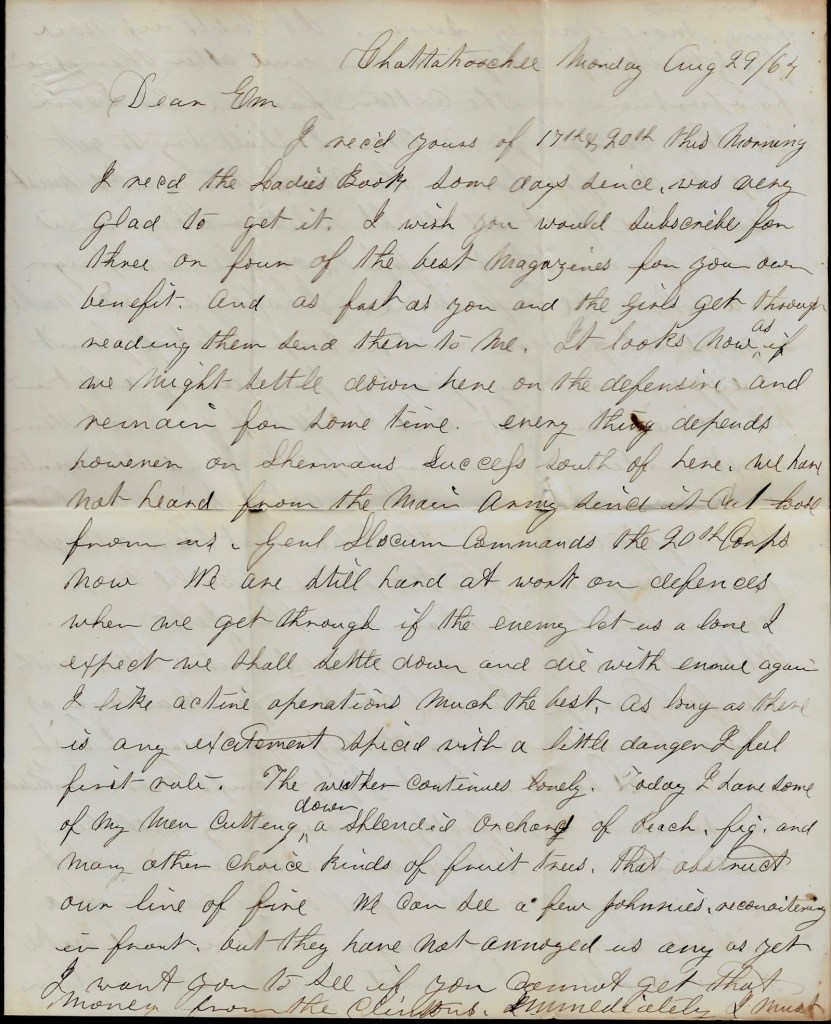
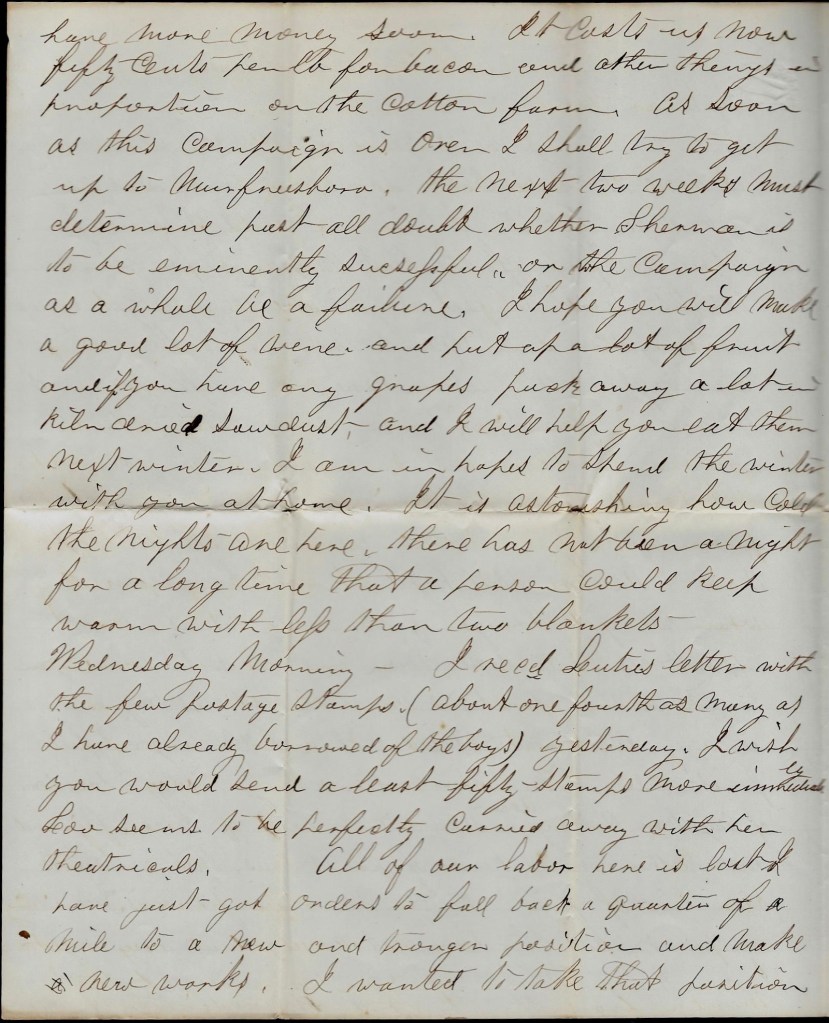

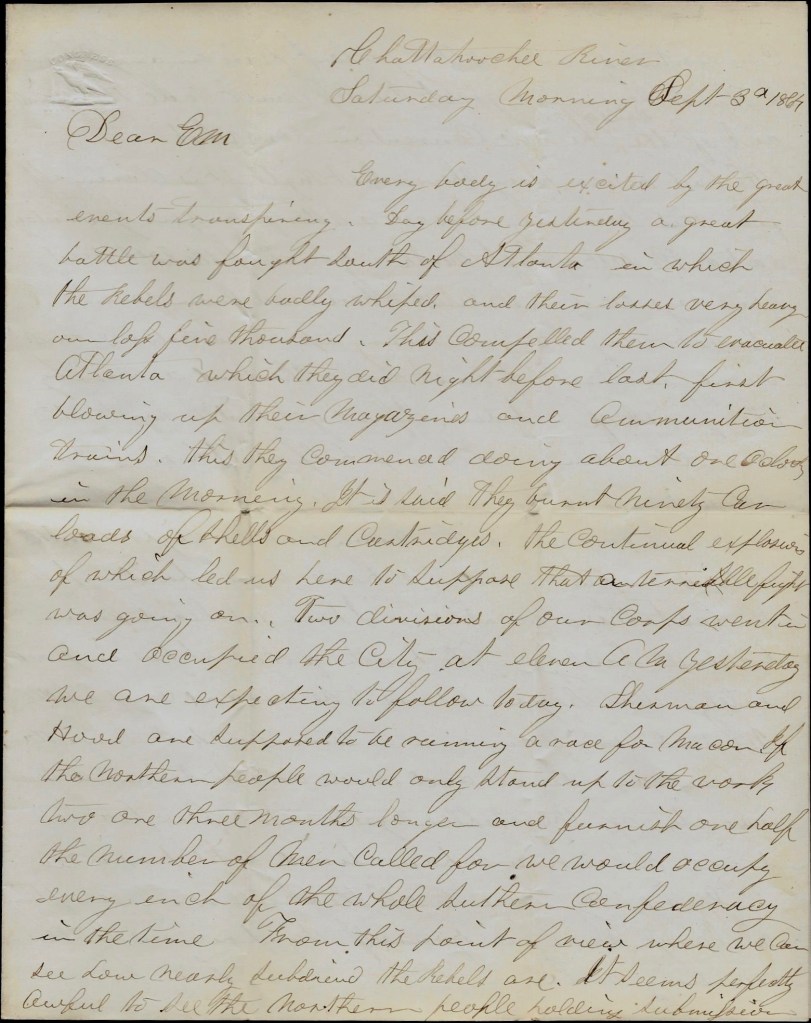
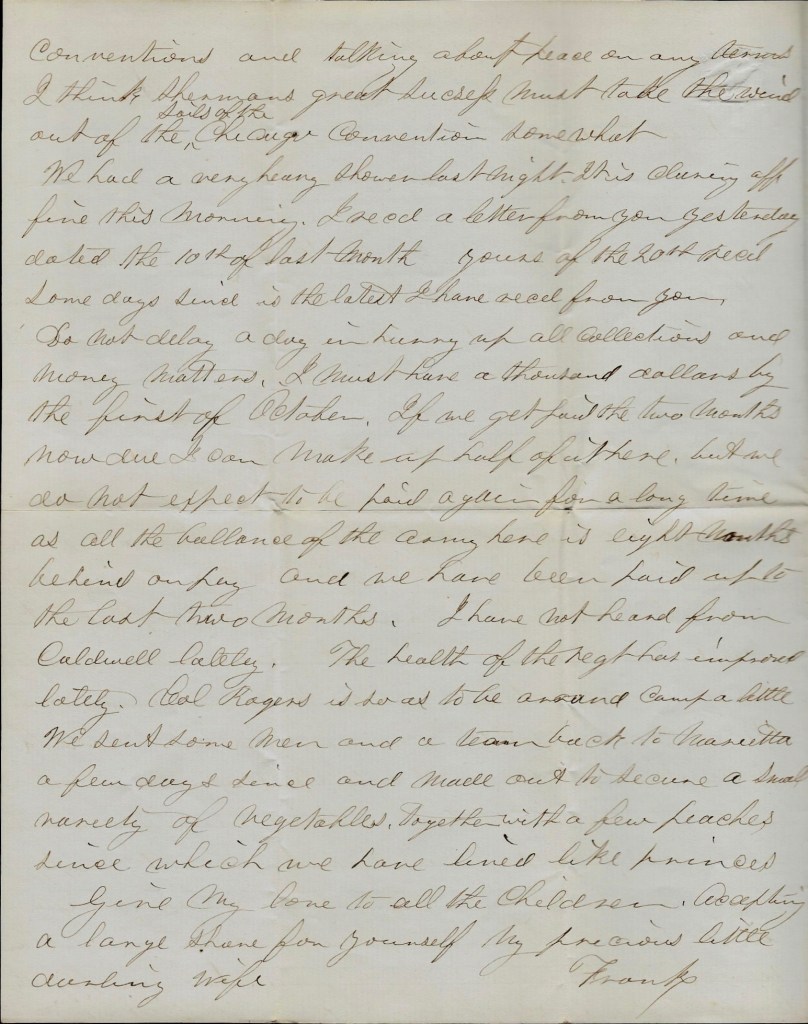




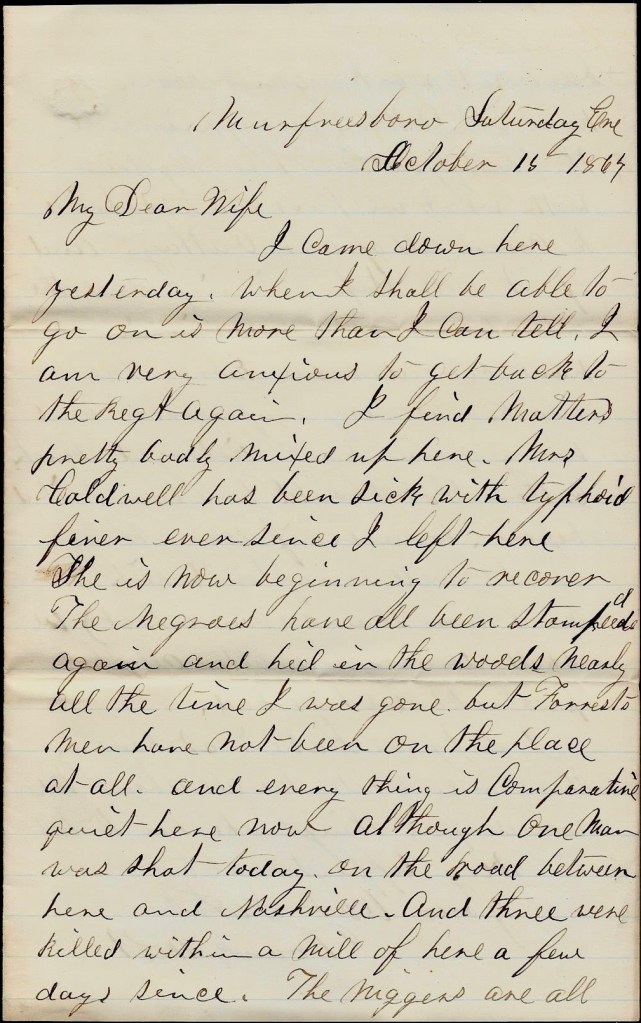

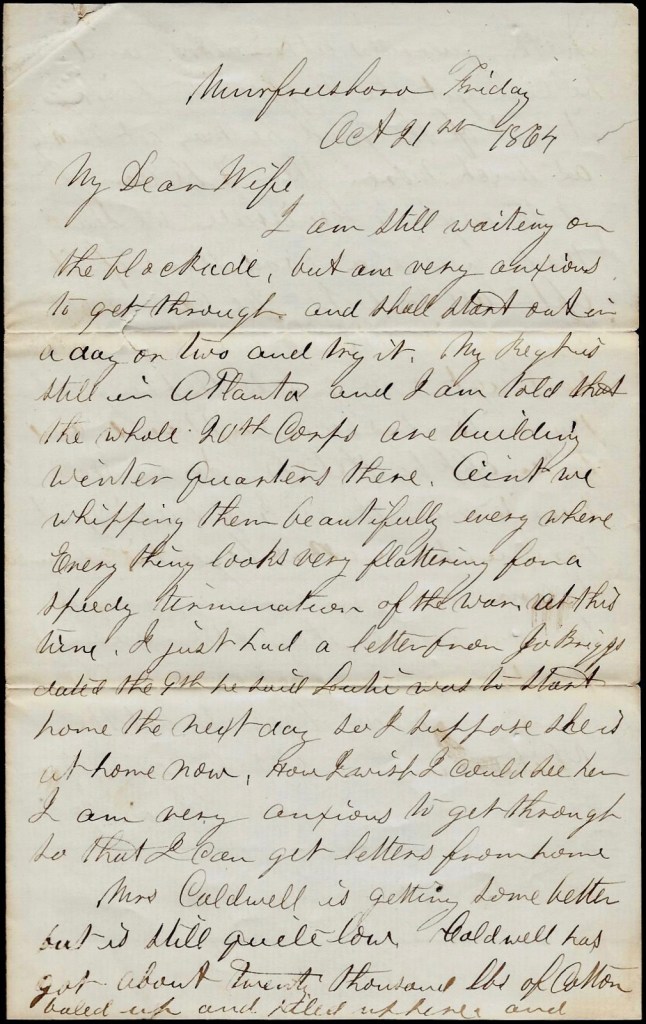
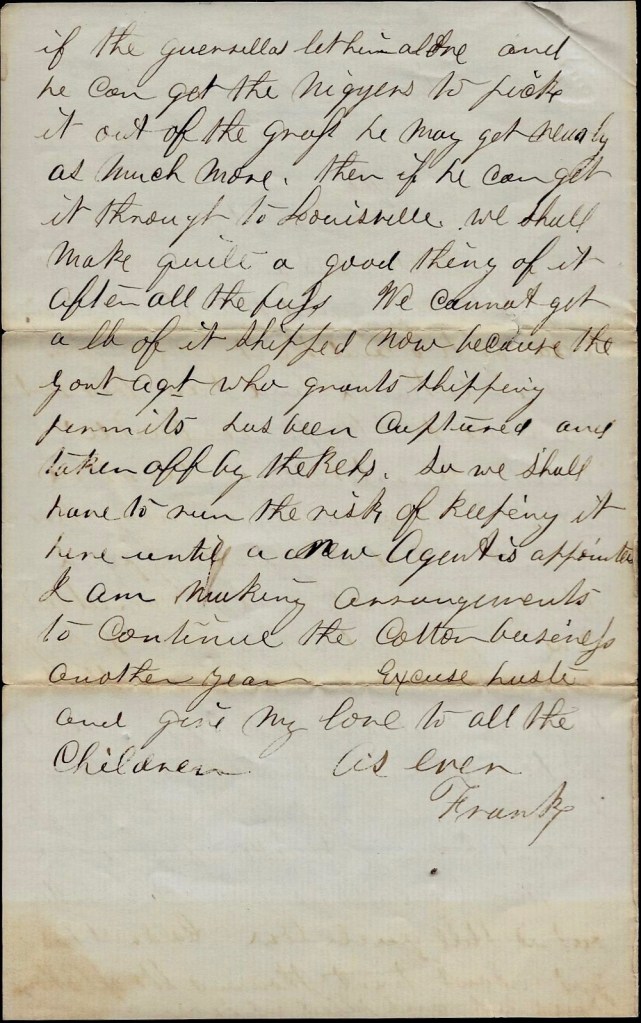
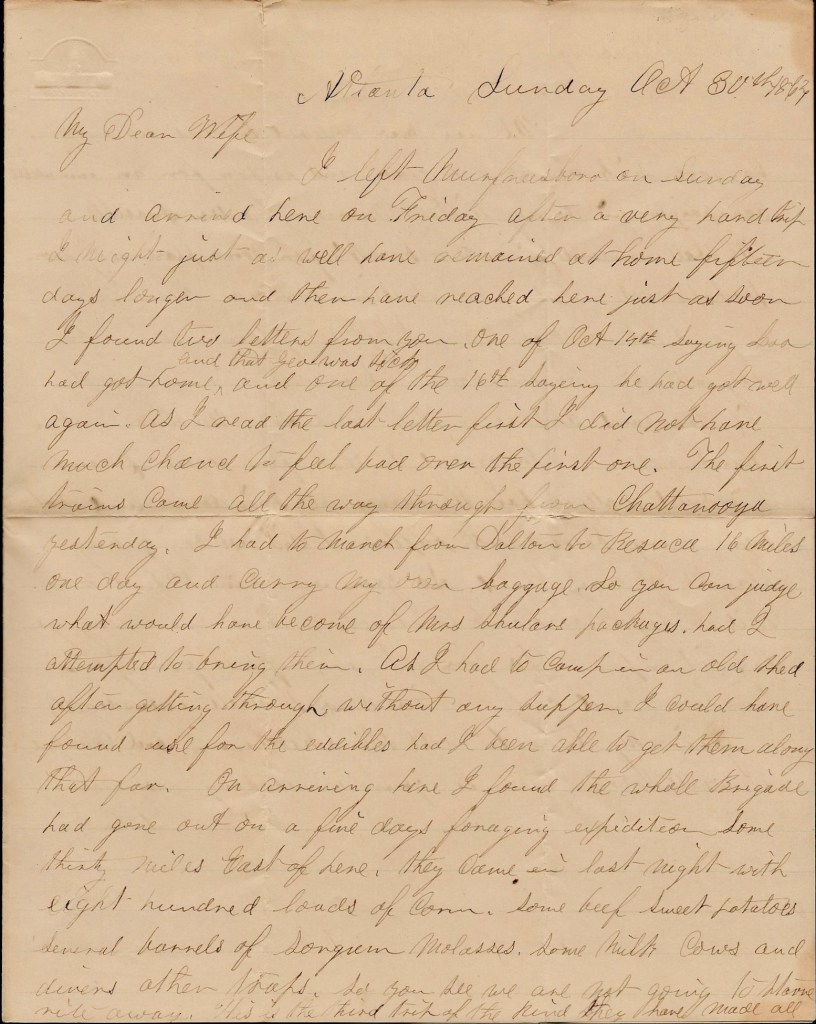


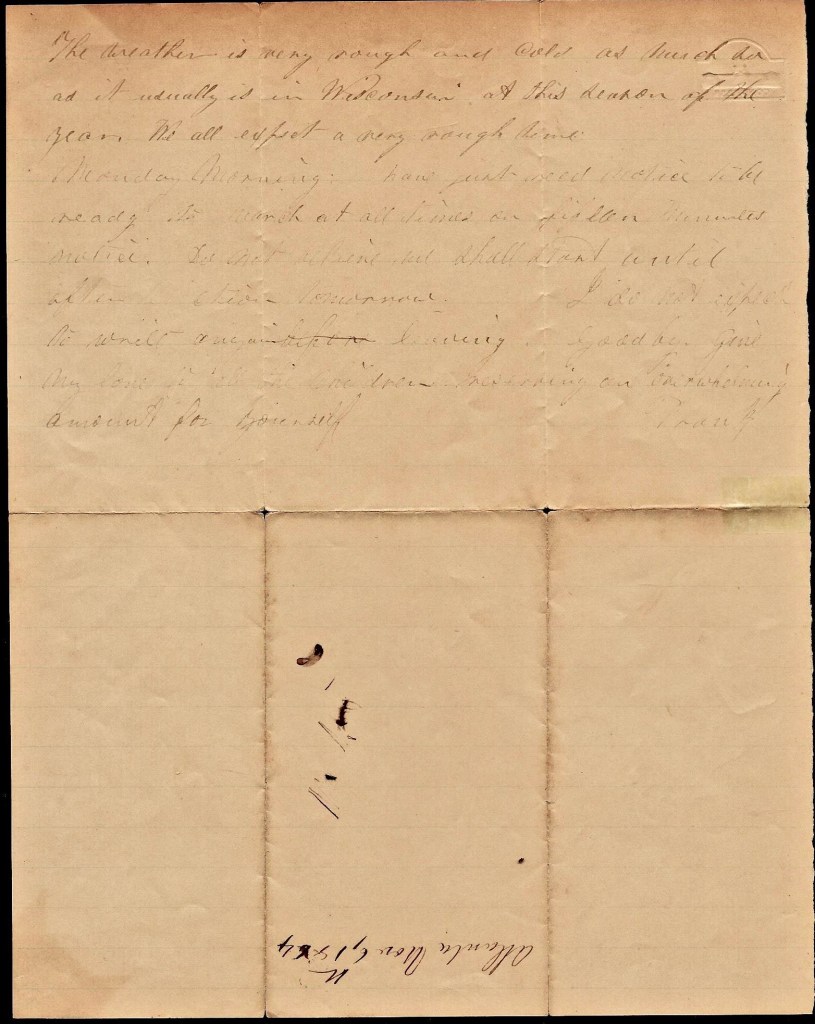
 Spared & Shared 23