Category Archives: Battle of Bull Run

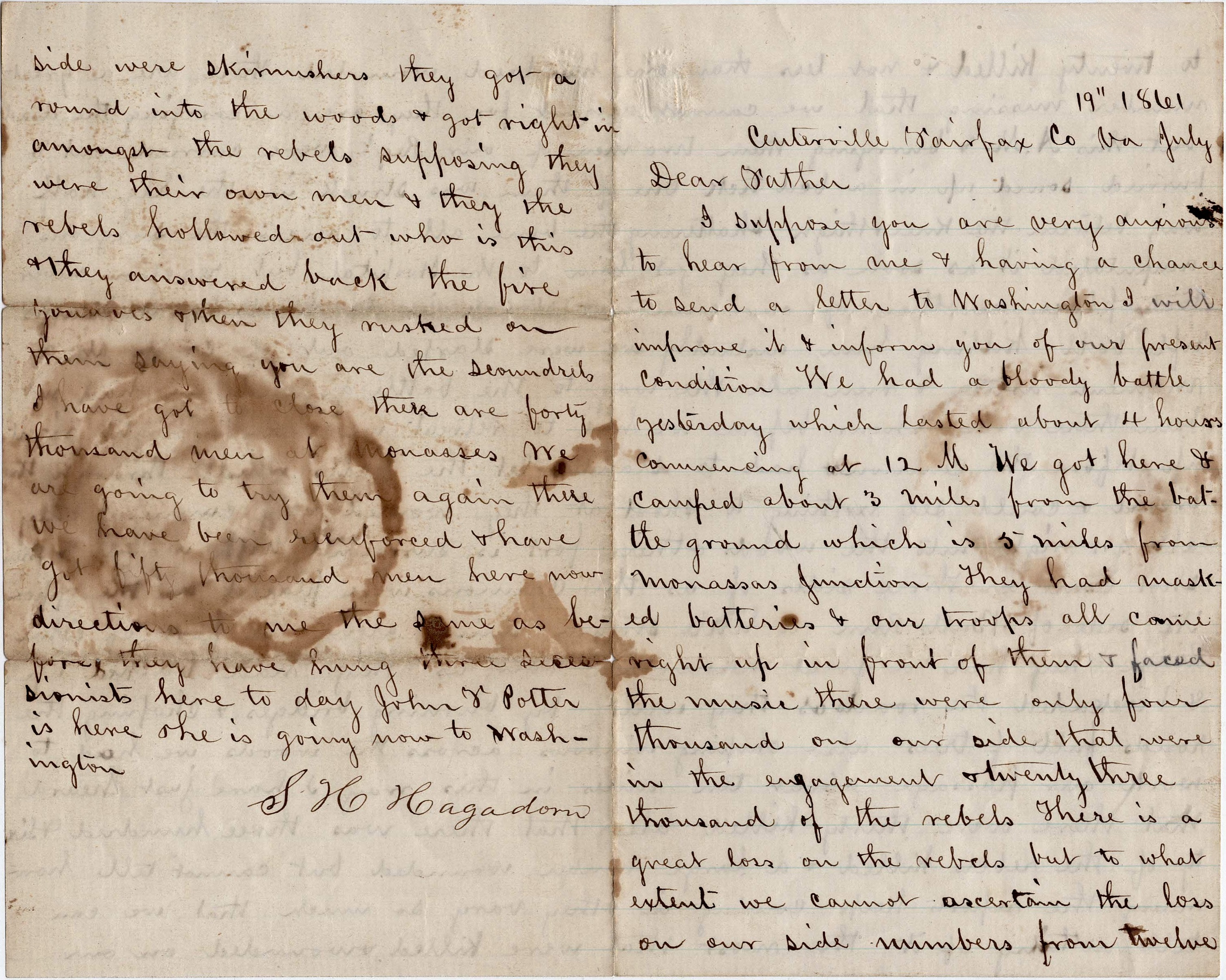
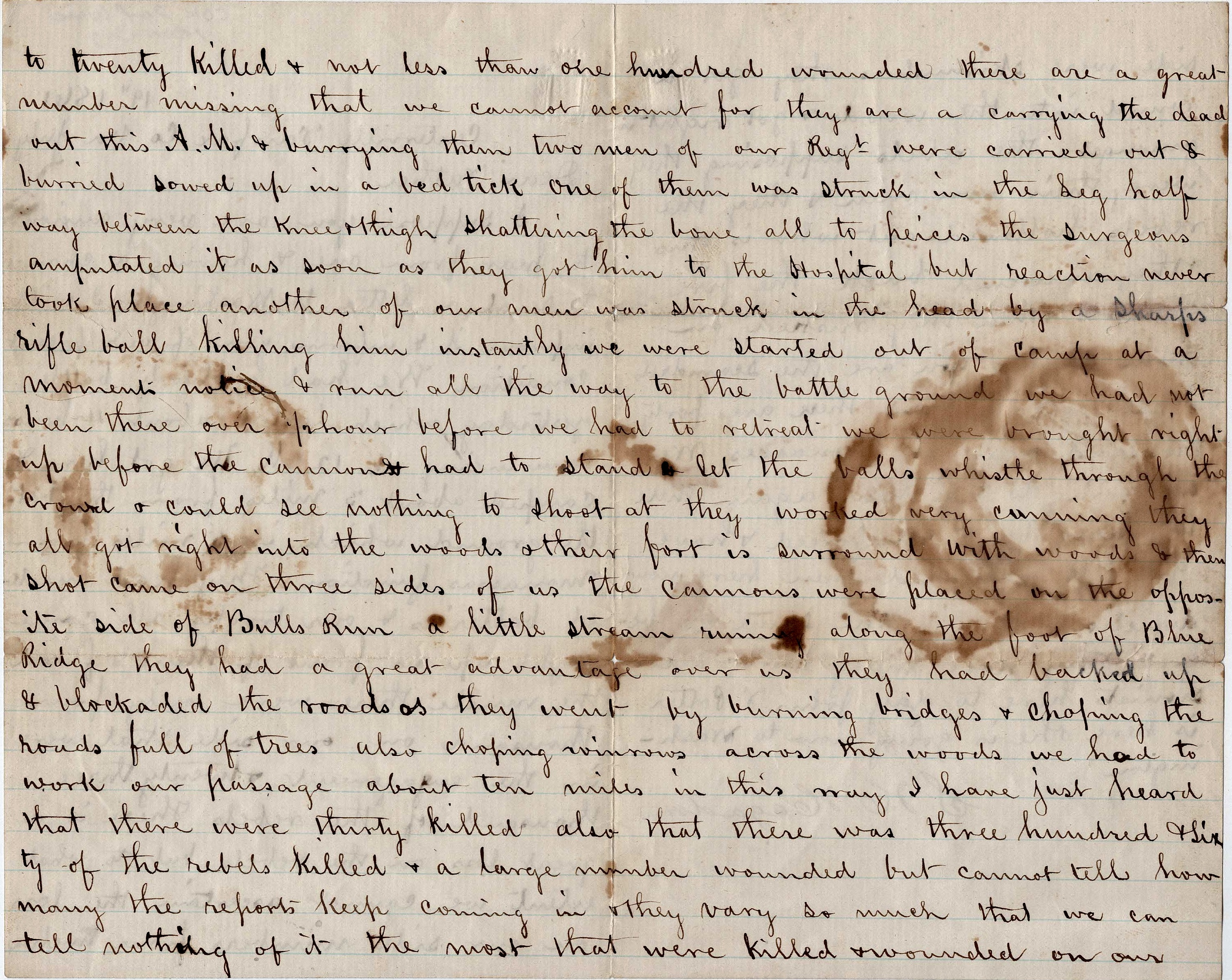
1861: George W. Ball to his Mother

The following letter was written by 18 year-old George W. Ball (1843-1923) of Ottawa county, Michigan, while serving in Co. B, 3rd Michigan Infantry. George enlisted on 13 May 1861 at Grand Rapids and was discharged from the regiment in June 1863.

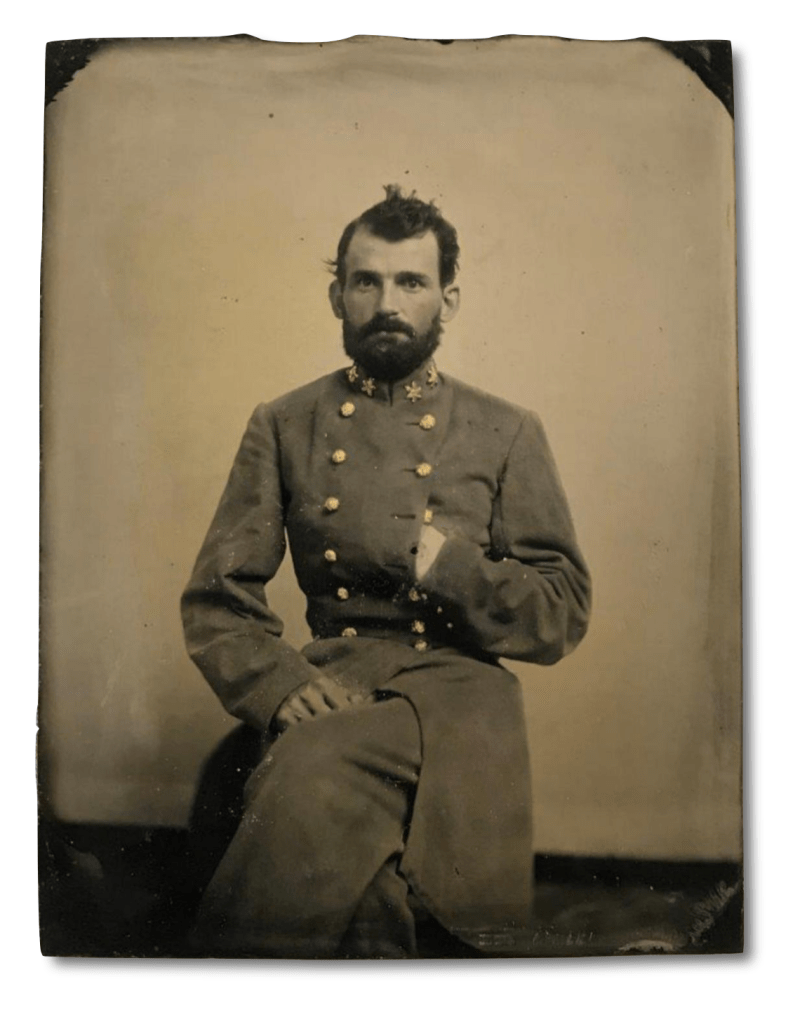
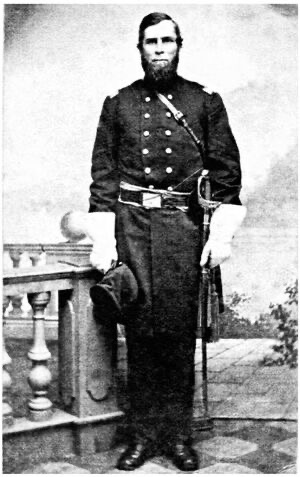
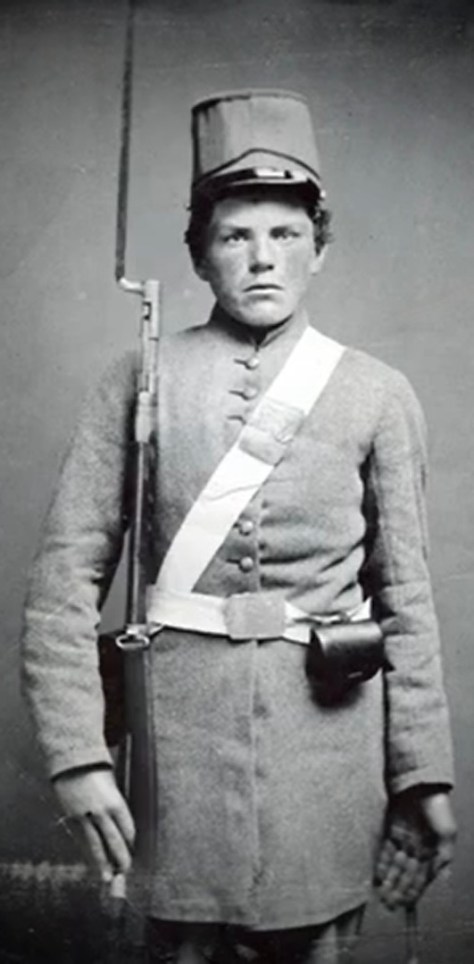
I could not find an image of George but here is one of Edward C. Brown of Co. E, 3rd Michigan Infantry

George’s letter offers a detailed first-hand account of the First Battle of Bull Run, during which the 3rd Michigan was engaged when the conflict erupted at Blackburn’s Ford on July 18, 1861. This event unfolded near the center of the Confederate line, held by General James Longstreet’s Virginians, along the brush-lined banks of Bull Run. The approach down the wooded slope to the Ford, executed by Richardson’s Brigade, was initiated by the gray-clad 1st Massachusetts, which valiantly contested the Confederates for the first hour. Eventually, the other three regiments—the 2nd and 3rd Michigan and the 12th New York—were called into action, with the 3rd Michigan positioned on the extreme right of the line, while Ayres’ artillery from the ridge adjacent to the farm path that led to the ford engaged the enemy. Remarkably, the 3rd Michigan found themselves relatively secure during the engagement, to the point where some members were reported to be picking berries until they became aware that their brigade was in full retreat. Understandably, George’s letter to his mother portrays the role of the 3rd Michigan in a slightly different light.

The 3rd Michigan Infantry were initially issued gray uniforms but by the Battle of Bull Run, the consensus of opinion is that they wore a mix of uniforms colors, including blue or black trousers, and both blue and gray coats.

A great reference book by my friend, John Hennessy—“The First Battle of Manassas, An End to Innocence, July 18-21, 1861,” 1989.

T R A N S C R I P T I O N

Washington
August 2, 1861

Dear Mother,

I now sit down to write you a few lines to let you know how I was getting along. I am well off at present and I hope these few lines will find you the same.

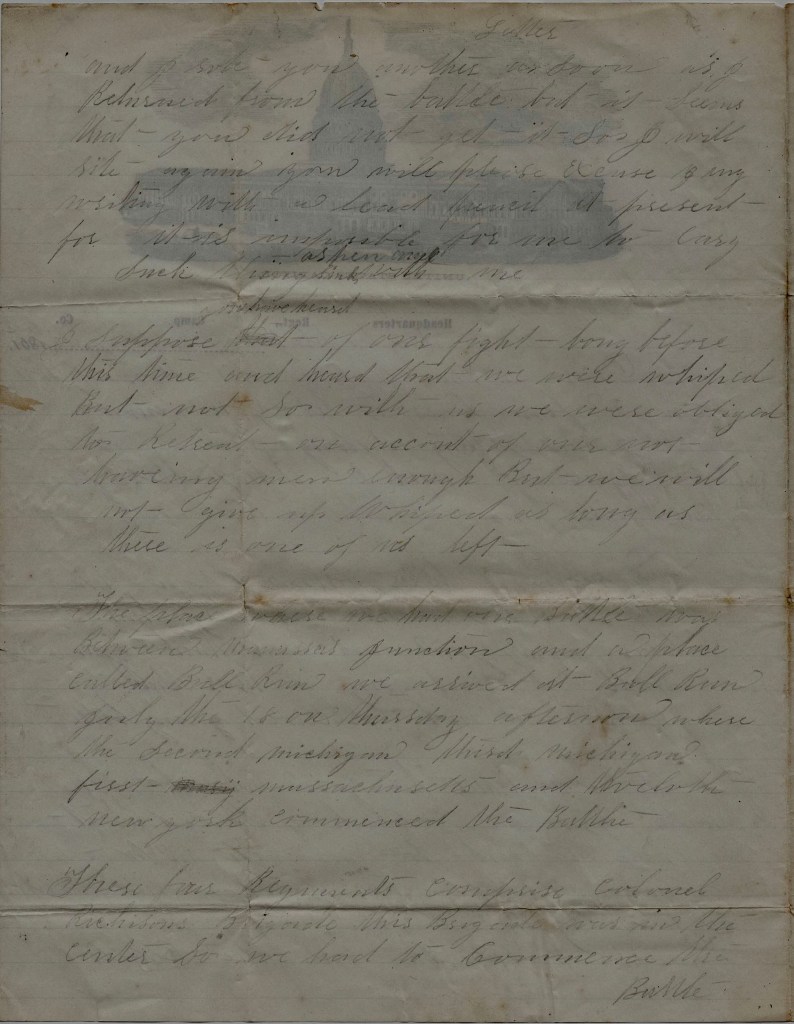
I received a letter from you dated July the 29th and was very glad to hear from you and hear that you were well but was sorry to hear that you had not received my letter. I wrote one letter to you about one month ago in which I stated that we were about to march into Virginia. We left our camp and went into Virginia about 25 or 30 miles where we had a battle with the Rebels. And I wrote you another letter as soon as I returned from the battle but it seems that you did not get it so I will write again. You will please excuse my writing with a lead pencil at present for it is impossible for me to carry such things as pen and ink with me.

I suppose you have heard of our fight long before this time and heard that we were whipped but not so with us. We were obliged to retreat on account of our not having men enough but we will not give up whipped as long as there is one of us left.

The place where we had our battle was between Manassas Junction and a place called Bull Run. We arrived at Bull Run July the 18th on Thursday afternoon where the 2nd Michigan, 3rd Michigan, 1st Massachusetts, and 12th New York commenced the battle. The four regiments comprise Colonel [Israel B.] Richardson’s Brigade. This brigade was in the center so we had to commence the battle.

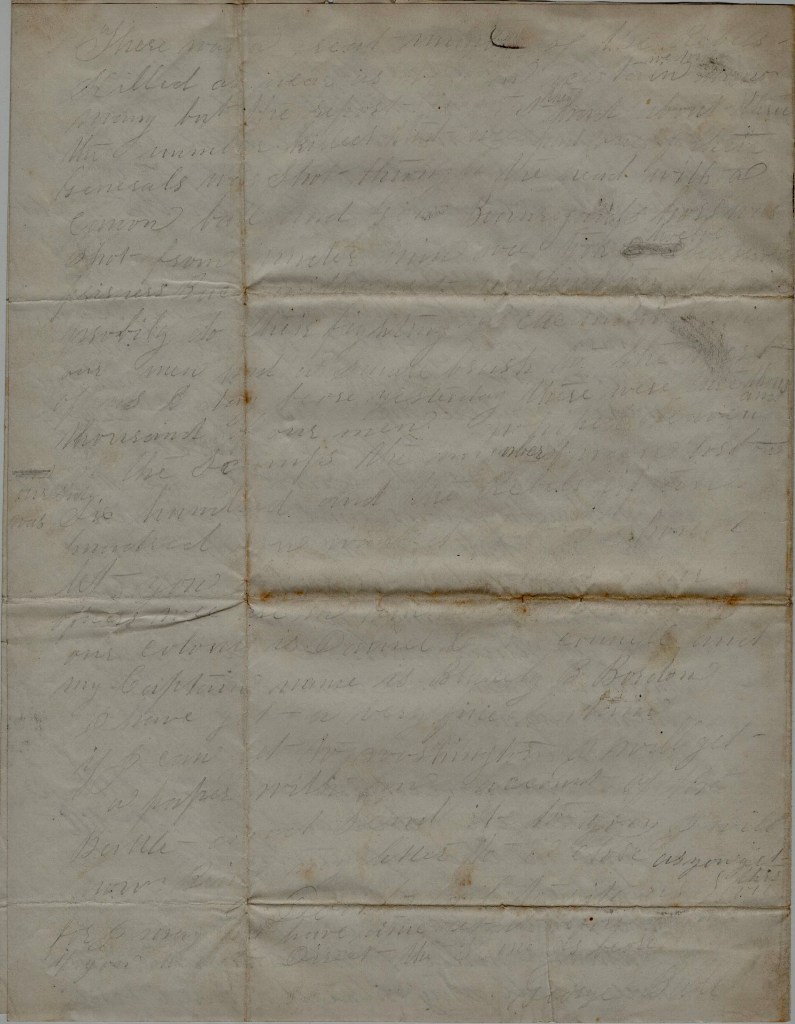
The battle commenced a short time after noon and lasted till about seven when we commenced our retreat and went back as far as Centerville where we camped for the night and the next morning before daylight, our 3 o’clock, our picket guard was fired upon and drove in to the camp and we were waked up and got ready for a march and as soon as we could, we were divided into three divisions and went back within half a mile of the rebels and waited for our right and left divisions to come up but they did not get their position till Sunday morning when we commenced at them again.

We commenced fire upon them at 7 o’clock and fought till four in the afternoon. But they had too many men for us and we were obliged to retreat back within two miles of Washington where we shall stay till we get a large force. There was a great many of the Rebels killed as near us. We can’t ascertain how many but the report that they lost about three times the number killed that we had. One of their Generals was shot through the head with a cannon ball and Gen. Beauregard’s horse was shot from under him. We took twelve Secesh prisoners back with us to Washington…

Our men had a small brush to the west of us day before yesterday. There were three thousand of our men whipped cavalry of the Scamps. The number of men lost on our side was six hundred and the Rebels fifteen hundred…Our colonel is Daniel McConnell and my captain’s name is Blakely B. Borden. I have got a very fine position. If I can get to Washington, I will get a paper with an account of the battle and I will send it to you.

I will now bring my letter to a close. As soon as you get this, don’t fail to write me for I may not have time… Direct the same as before, — George Ball

1861: Rutherford Drummond Richardson to Sybil (Burton) Richardson

I could not find an image of Drummond but here is one of Humphrey Blaisdell who served in Co. G, 2nd Maine Infantry. He was wounded at Bull Run and taken prisoner; exchanged about mid-August. Note that he is wearing the “cadet grey” cap, frock coat and pants. (Ron Field Collection)

The following letter was written by Pvt. Rutherford “Drummond” Richardson (1843-1862) of Co. B (“the Castine Light Infantry”), 2nd Maine Infantry. He enlisted on 28 May 1861 and served his company faithfully until he was cut down in the fighting at Malvern Hill on 1 July 1862 and died of his wounds at the regimental hospital on 7 July 1862. Drummond was the son of James Richardson (1808-1889) and Sybil H. Burton (1813-1910) of Eddington, Penobscot county, Maine.

This letter was penned in mid-August, 1861, approximately a month after the Battle of Bull Run in which the regiment was heavily engaged. Those interested in a detailed account of the battle itself might enjoy reading a letter by Pvt. Robert Alonzo Friend to his brother Will, dated 1 August 1861. He served with Drummond in Co. B. It can be found transcribed on my friend Harry Smeltzer’s “Bull Runnings” website.
T R A N S C R I P T I O N

[Camp on Arlington Heights, Virginia]
[Mid-August 1861]

Dear Mother,

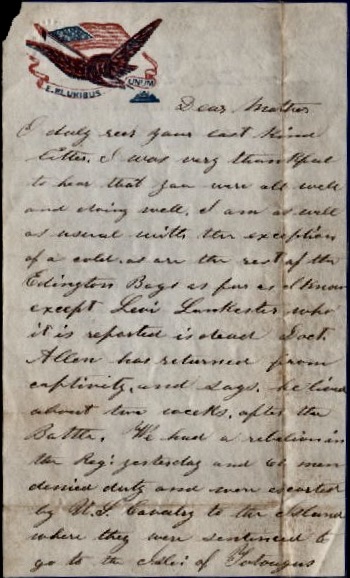
I duly rec’d your last kind letter. I was very thankful to hear that you were all well and doing well. I am as well as usual with the exception of a cold, as are the rest of the Eddington Boys as far as I know except Levi Lancaster who it is reported is dead. Doctor [W. H.] Allen has returned from captivity and says he lived about two weeks after the battle. 1
We had a rebellion in the regiment yesterday and 66 men denied duty and were escorted by U.S. Cavalry to the Island where they were sentenced to go to the Isle of Tortugas, Gulf of Mexico, there to perform hard labor till the term of their enlistment, or till they will take arms in defense of the country. And their pay is stopped from this time hence forth. 2

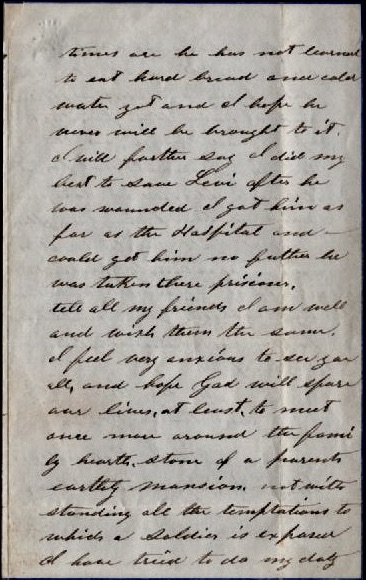
I have some faint hopes of seeing you all in the course of a month though it is very uncertain. Col. [Charles Davis] Jameson has resigned and Lt. Col. [Charles W.] Roberts is in command at present. I can think of nothing that will interest you further more than you can see in the papers. Please tell Martha I send my best respects to herself and family. Tell George he may thank his stars he is so well off. He don’t know what hard times are. He has not learned to eat hard bread and cold water yet and I hope he never will be brought to it.

I will further say I did my best to save Levi after he was wounded. I got him as far as the Hospital and could get him no further. He was taken there prisoner. Tell all my friends I am well and wish them the same. I feel very anxious to see you all and hope God will spared our lives, at least, to meet once more around the family hearth stone of a parent’s earthly mansion, not withstanding all the temptations to which a soldier is exposed. I have tried to do my duty. Keep soberness and truth on my side, and the good will of my commanding officers and I have thus far kept up a good name in the regiment.

You must not forget to write often as it does me good to hear from you often and I will write as often as an opportunity presents itself. I must now close by wishing you well and happy and subscribing myself your most obedient and loving son, — R. D. Richardson

To Mr. & Mrs. J. Richardson


1 Genealogical records suggest that Levi E. Lancaster (1832-1861) of Co. C, 2nd Maine Infantry, was killed in action on the battlefield at First Bull Run, but this letter informs us that Drummond was able to assist Levi to a field hospital that was later overtaken by Confederates and surgeons and wounded soldiers alike were taken prisoners. Dr. W. H. Allen of the 2nd Maine Infantry was also captured and reported that Levi lived two weeks before he died. Levi was married in 1856 to Hannah Ellen Shepherd (1833-1908) and the couple ha one daughter, Annie (b. 1857).

2 Some of the men became discontented three months after leaving the state from seeing three months’ men from other states returning home. Sixty-six claimed their time had expired, became insubordinate, and were sentenced to Tortugas; but this sentence was later commuted to a transfer to the 2nd N. Y., where they served about a year and then returned and served faithfully with the regiment for the remainder of the term.

1861: Homer Sargent Bean to his Parents

The following letter was written by Homer Sargent Bean (1833-1862) of Co. B, 3rd Maine Infantry, who gives an account of the Battle of Bull Run which took place on Sunday, 21 July 1861. The 3rd Maine Infantry was attached to Howard’s Brigade, Heintzelman’s Division of McDowell’s Army of Northeastern Virginia. Though the regiment entered into the battle, they suffered few battle casualties. The official records—2 killed, 4 wounded, 25 captured, 2 deserted, for a total of 33.

I could not find an image of Homer but here is one of Herman S. Webber of Co. B, 3rd Maine Infantry (1861)

Composed primarily of Kennebec lumbermen, the 3rd Maine was mustered in at Augusta for a three-year term of service on June 4, 1861, departing for the front lines the following day. It has been posited that “perhaps no regiment from the state saw more fighting or rendered more distinguished service.” From the First Battle of Bull Run to the Battle of Cold Harbor, the regiment participated in numerous significant battles and military movements. During the first Bull Run, the 3rd was under the command of Colonel Oliver O. Howard (1830–1909), who rapidly ascended to the rank of Major General and emerged as a prominent national figure. At the Battle of Fair Oaks, the 3rd sustained losses of nearly a third of its forces, and Howard suffered the loss of his right arm.

Homer was the son of Jeremiah Robinson Bean (1806-1880) and Sarah Cammett (1801-1857) of Augusta, Kennebec county, Maine. He did not survive the war. He died of disease on 22 November 1862 and was buried in the US Soldiers’ and Airmens’ Home National Cemetery, Site D 4441.

The 3rd Maine Encampment at Clermont, Fairfax county, Va.

Transcription

Clermont, Fairfax county, Virginia 1
August 4th 1861

Dear Father and Mother,

It is with pleasure that I seat myself to converse with you a few moments by the silent movings of the pen to inform you of my health which is good—only I had the toothache the other day and I went to the doctor and had it pulled out and my jaw has ached ever since. But it is easy today.

George is well and sends his love to you. Frank is well and sends his love to you.

I suppose you have heard about the battle we had with the rebels. It was two weeks ago today. We had a hard time of it. We were called into ranks at half past one o’clock a.m. and at an hour later, we started. But on account of being the last brigade, we had in the commencement a very slow march and laid exposed to the burning rays of the sun without the least shade for several hours.

Finally we had orders to advance and were drove with such haste that a good many had to give out and fall back, and we were almost beat out by running until we reached the battlefield. What was the worst of it was the scarcity of water. We were real glad to find mud puddles which at home we would not offer to our horses or cattle and quenched our thirst with them for the heat was awful and not the slightest breeze stirring. The consequence was that we were defeated and returned in somewhat confusion until we reached our camp we left in the morning. We halted here for a few hours and then retreated from there in good order back to Alexandria where we stopped about a day and a half and then went out again to the place where our tents was pitched and [have] remained here ever since.

We suffered a good deal in them two days and a good many of us have not got over it yet but we have now time enough to rest and think we shall get over it soon. Our duty now is nothing more than common camp duty such as standing guard and drilling and we are favored as much as possible, but the weather is very not here and that causes us considerable sweating.

Give my love to all inquiring friends. I cannot think of any more to write now. Write as soon as you get this. Write all of the news. Now I must close by bidding you goodbye till I hear from you.

— H. S. Bean

Write how Piggy gets along and tell Cluckey to lay a lot of eggs for I want some when I get home. — H. S. Bean

1 The 3rd Maine Infantry’s encampment was at F. Forrest’s plantation, Clermont, a quarter of a mile south of Bush Hill, Scott’s farm, Fairfax county, Virginia.

1861: Unidentified 2nd Michigan Infantry Soldier to a Friend

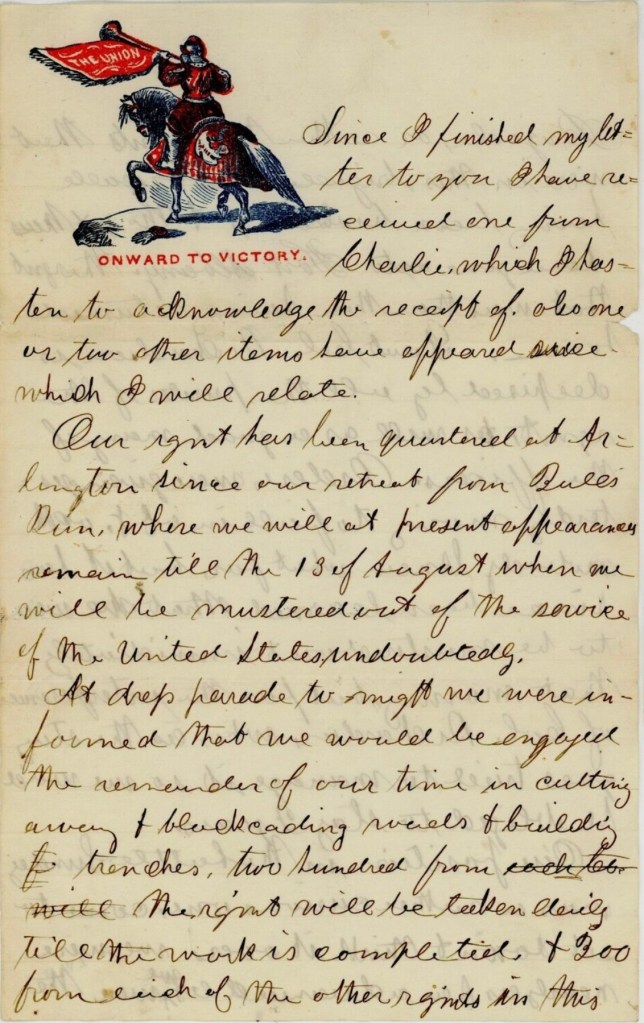
The following partial letter seems to have been valued more for the patriotic image on the stationery than the content of the letter as only one sheet remains of what must have originally been a two or three sheet letter. The content reveals that the author was a three-month volunteer in the 2nd Michigan Infantry. It came coupled with an envelope with a New York address and a Feb 1862 postal marking which was clearly not linked to the letter. There are too few clues in the sheet that remains thought it’s interesting to read that the author claimed “all the privates of the regiment as well as a good many of the officers” despised “Fighting Dick” Israel Bush Richardson, colonel of the 2nd Michigan and brigade commander during the Battle of First Bull Run. I suspect this was a result of the soldier believing that Richardson had attempted to convert the “three-months” volunteers into two-year volunteers without their approval, as alleged.

The unfinished sentence at the end of the letter leaves us wondering what the author was about to tell us about the Battle of Bull Run but we’ll never know.

Transcription

[Arlington, Virginia]
[late July 1861]

Since I finished my letter to you I have received one from Charlie which I hasten to acknowledge the receipt of. Also one or two other items have appeared since which I will relate.

Our regiment has been quartered at Arlington since our retreat from Bull’s Run where we will at present appearances remain till the 13th of August when we will be mustered out of the service of the United States undoubtedly.

As dress parade tonight we were informed that we would be engaged the remainder of our time in cutting away & blockading roads and building trenches. Two hundred from the regiment will be taken daily till the work is completed & 300 from each of the other regiments in this brigade—or rather the regiments that were in this brigade, this brigade having been broken up & the 1st Massachusetts have gone to Fort Albany, the regiment that were there then having returned home. 1

Lieut. Col. Richardson is despised by all the privates of the regiment as well as a good many of the officers. Orders were given yesterday morning to fall in at 8 o’clock. Nobody knew what for but it has since been learned that we were to be mustered out immediately that morning but for the interference of Col. Richardson, who, as the story goes, tried to manage it so we would be obliged to stay two years. 2

Our position in the battle Sunday was a rather curious one, come to sit down & think it over. We were near as far advanced as were the…[remainder of letter missing]


1 Having participated in Richardson’s Brigade, Tyler’s Division, McDowell’s Army of Northeast Virginia, in the Battle of Bull Run, the 1st Massachusetts Infantry was ordered to garrison Fort Albany (200 yards south of the tollgate on the Columbia Pike) until 15 August 1861.

2 I was unable to find any corroborating evidence as to this accusation that Col. Richardson was despised by his men or fellow officers—at least not for his leadership in the field of battle. Richardson’s performance on Sunday, July 21st, at Bull Run was hindered by the interference of a drunken Col. Dixon S. Miles who outranked him and ordered Richardson’s brigade without passing orders through Richardson. If fact, according to Pvt. Lyman Stowe of Co. F, 2nd Michigan, Col. Miles even had Richardson arrested during the battle and took away his sword when Richardson attempted to take back command of his brigade. [Bull Runnings]

1861: Gerard Lindsley McEntee to Mary Swan (McEntee) Vaux

Gerard’s sister, Mary Swan (McEntee) Vaux

The following letter was written by Gerard Lindsley McEntee (1847-1913), the son of James Smith McEntee (1800-1887) and Sarah Jane Goetchius (1805-1883) of Kingston, Ulster county, New York. Gerard had several notable siblings—Jervis McEntee (1828-1891), a Hudson River School Landscape Artist; Mary Swan McEntee (1830-1892), the wife of Calvert Vaux, Landscape architect of NYC who worked with Frederick Law Olmstead in the design of NYC’s Central Park; Lt. Maurice Wurts McEntee (1836-1883), 20th NY State Militia, and later Acting Master in US Navy.

When he was only 13 years old, Gerard signed on as a drummer boy in Co. F of the 20th New York State Militia for three months. This was the same unit that his brother Maurice was in. This unit served from 23 April 1861 to 2 August 1861. Gerard’s letter was written just 10 days after the Battle of Bull Run—referred to as the “sad news” within the letter.

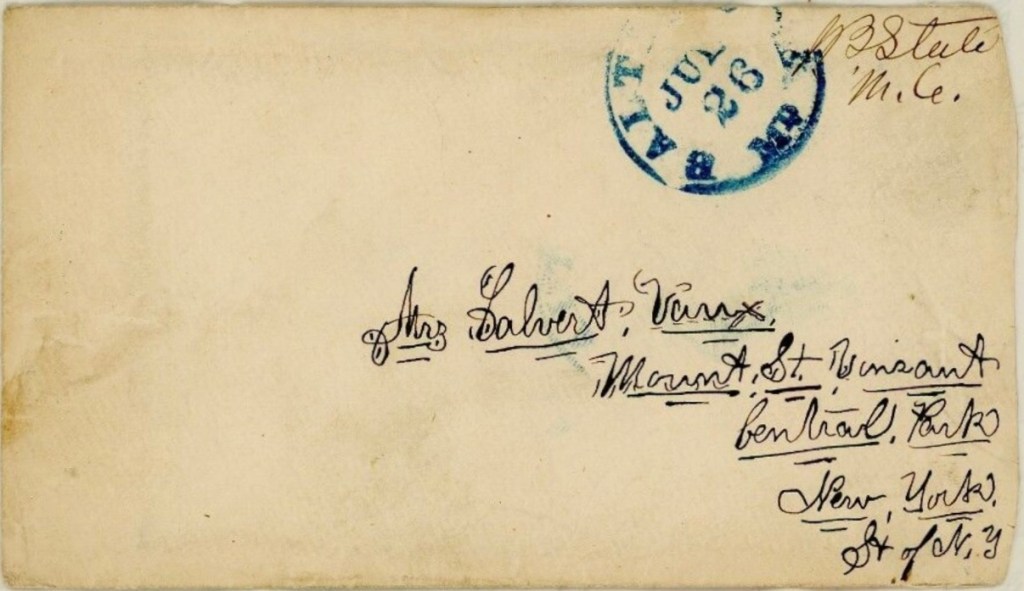
Addressed to Mrs. Calvery Vaux, Mount St. Vincent, Central Park, New York, State of NY

Transcription

Camp Banks
Baltimore, [Maryland]
July 31st [1861]

Dear Sister Mary,

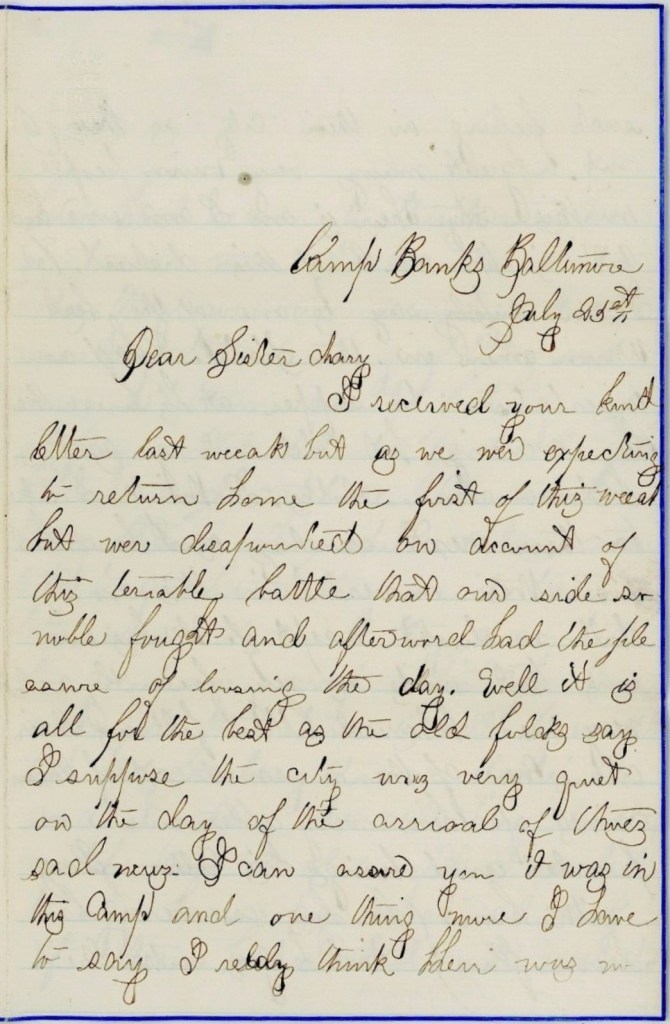
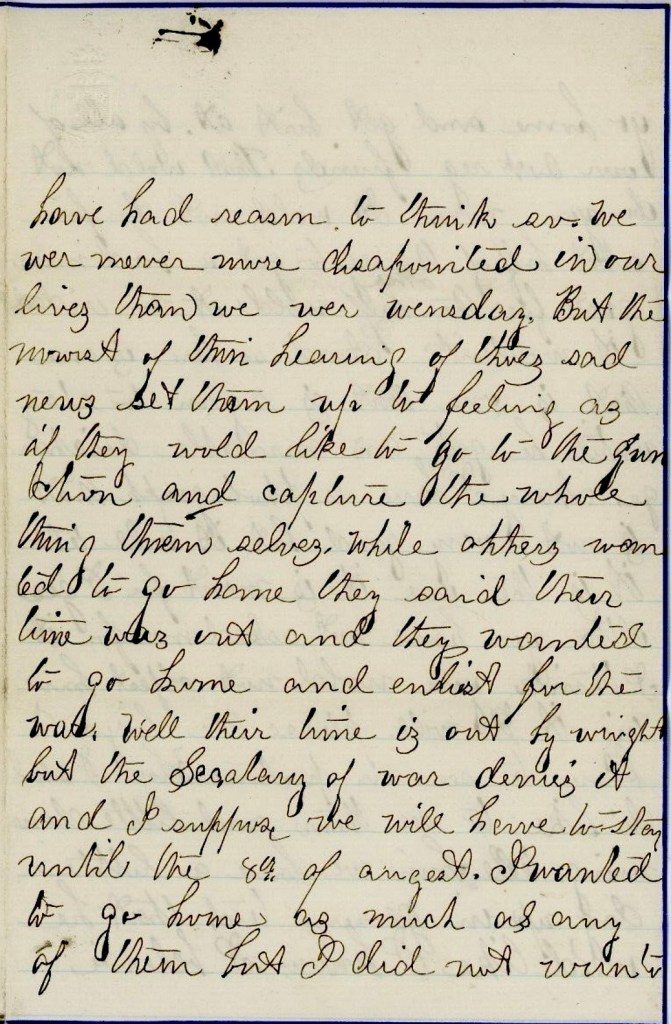
I received your kind letter last week but as we were expecting to return home the first of this week, but were disappointed on account of this terrible battle that our side so noble fought and afterward had the pleasure of losing the day. Well, it is all for the best as the old folks say, I suppose. The city was very quiet on the day of the arrival of the sad news, I can assure you. I was in the camp and one thing more I have to say, I really think there was no [page missing]….have had reason to think so. We were never more disappointed in our lives than we were Wednesday. But the worst of them, hearing of this sad news, set them up to feeling as if they would like to go to the [Manassas] Junction and capture the whole thing themselves while others wanted to go home. They said their time was out and they wanted to go home and enlist for the war. Well their time is out by right but the Secretary of War denies it and I suppose ew will have to stay until the 8th of August.

Gerard Lindsley McEntee

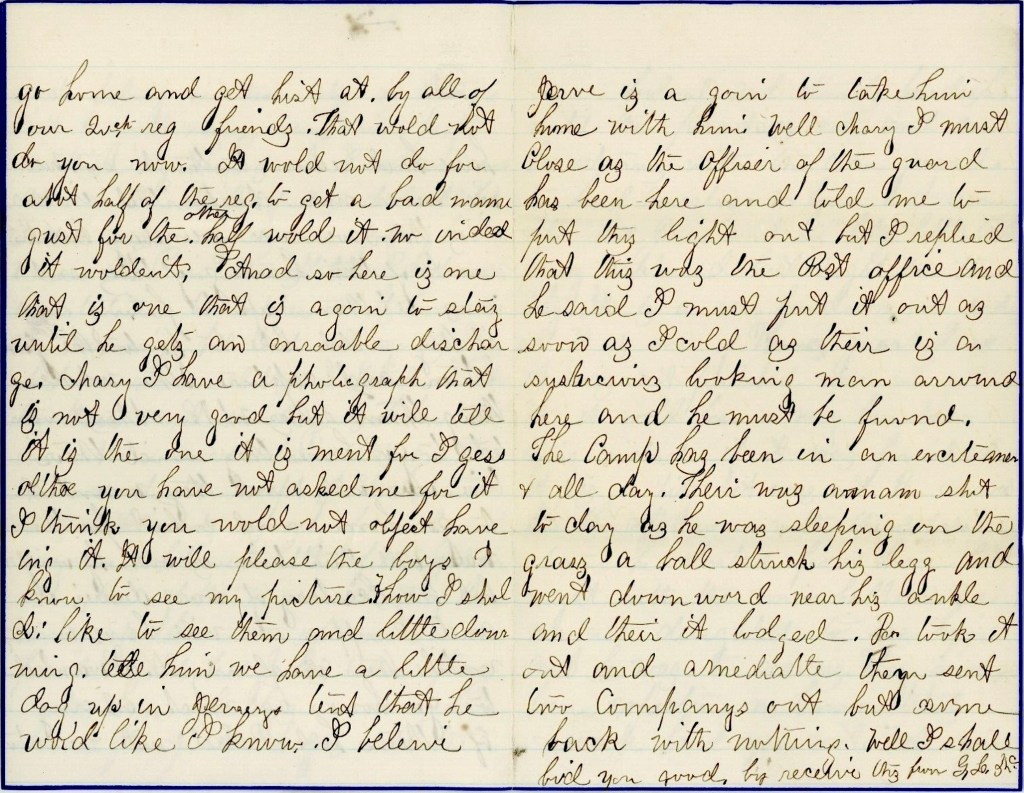
I wanted to go home as much as any of them but I did not want to go home and get hissed at by all of our 20th Regiment friends. That would not do, you know. It would not do for about half of the regiment to get a bad name just for the other half, would it? No indeed it wouldn’t. And so here is one that is a goin’ to stay until he gets an honorable discharge.

Mary, I have a photograph that is not very good but it will tell. It is the one it is meant for I guess. Although you have not asked me for it, I think you would not object having it. It will please the boys, I know, to see my picture. How I should like to see them and little Downing. 1 Tell him we have a little dog up in Jervy’s tent that he would like, I know. I believe Jerve is a going to take him home with him.

Well Mary, I must close as the officer of the guard has been here and told me to put this light out but I replied that this was the Post Office and he said I must put it out as soon as I could as there is a suspicious looking man around here and he must be found.

The camp has been in an excitement all day. There was a man shot today as he was sleeping on the grass. A ball struck his leg and went downward near his ankle and there it lodged. Dr. took it out and immediately they sent two companies out but came back with nothing. Well I shall bid you goodbye. This from G. L. Mc.

1 Downing Vaux was born in 1857. Downing’s brother Calvin was a couple years older.

1861-63: Wharton Jackson Green to his Cousin

Col. Wharton Jackson Green, dated 1861. “Wharton J. Green originally organized the 2nd North Carolina Battalion at Richmond, Virginia. Green had received authority to raise a regiment for Brigadier General Henry A. Wise’s Legion, to be known as Colonel Green’s Independent Regiment.” The battalion’s original commander, Wharton J. Green, was born in St. Marks, Florida, on February 28, 1831. Private tutors instructed him before he attended Georgetown College, Lovejoy’s Academy (in Raleigh, North Carolina), and West Point. He studied law at the University of Virginia and Cumberland University (in Lebanon, Tennessee) before being admitted to the bar and commencing practice in Washington, D.C. He began agricultural pursuits in 1859 in Warren County, North Carolina. He had served as a private in the 12th North Carolina until he was approached by Brigadier General Henry A. Wise to raise an independent regiment. He was appointed a lieutenant colonel on December 24, 1861, but was not reelected at the reorganization of the battalion at Drewry’s Bluff. After January 1, 1863, he served as a volunteer aide-de-camp on the staff of General Daniel.” (Invaluable Auctions)

The following letters were written by Wharton Jackson Green (1831-1910), the son of General Thomas Jefferson Green and Sarah Angeline Wharton. In 1846, Wharton entered Georgetown College as a boarding student. From 1847 to 1848 he attended the classical and English academy in Raleigh, N.C., and in 1849, Stephen M. Weld’s select preparatory school near Boston, Mass. Green’s appointment to the U.S. Military Academy at West Point was approved simultaneously with the admission of California as a state (September 1850), at which time his father’s address was given as Sacramento. After three years at West Point, where the alumni records list him as Jackson Wharton Green, he studied law at the University of Virginia (where he was a member of the Jefferson Literary Society) and at the newly established Cumberland University at Lebanon, Tenn. On admission to the bar in 1854, he began practicing in Washington, D.C.; he was admitted to practice in the United States Supreme Court, and became a junior partner with the law firm of Robert J. Walker (former secretary of the Treasury) and Louis Janin.

After Green’s marriage—at Montmorenci, Warren County, on 4 May 1858—to Esther Sergeant Ellery, the only child of his stepmother, he and his bride spent over a year traveling in Europe and Africa. Upon their return, they went to their country place in Jamaica Plain near Boston where their oldest child, Sarah Wharton, was born on 19 July 1859. When they settled at Esmeralda, their North Carolina home, with their one-month-old baby, Green engaged in agricultural pursuits and bred racehorses.

At the outbreak of the war, Green enlisted in the Warren Guards, Company F, Twelfth Regiment, North Carolina Troops, C.S.A. (Second Regiment, North Carolina Volunteers), which was one of the first three companies to report to the camp of organization in Raleigh. In two months he was appointed colonel in General Henry A. Wise’s legion and raised and equipped a regiment. On 8 Feb. 1862, he was captured on Roanoke Island and paroled at Elizabeth City the same day. He later served as a volunteer aide on the staff of General Junius Daniels and as lieutenant colonel of the Second Battalion of North Carolina Infantry. Green was wounded at Washington, N. C., and again at Gettysburg where he was captured and detained at Johnson’s Island, Ohio, until within a week of the surrender.

Letter 1

Richmond, Virginia
July 29, 1861

My Dear Ada,

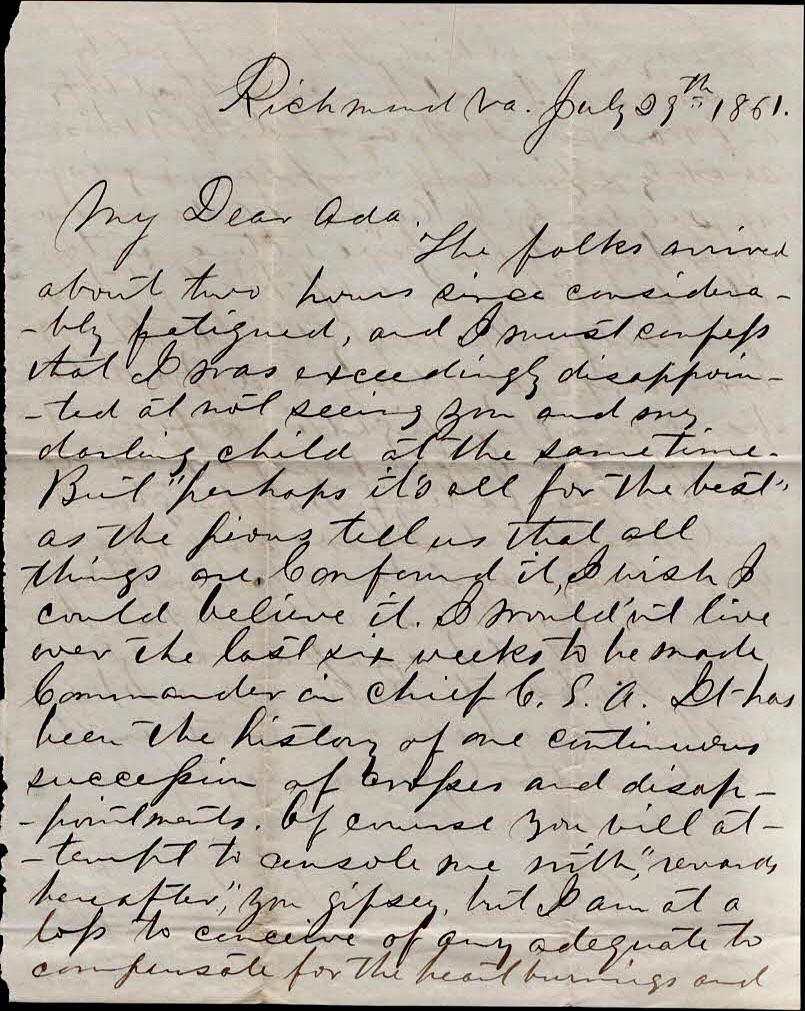
The folks arrived about two hours since considerably fatigued and I must confess that I was exceedingly disappointed at not seeing you and my darling child at the same time. But “perhaps it’s all for the best” as the pious tell us that all things are. Confound it, I wish I could believe it. I wouldn’t live over the last six weeks to be made Commander in Chief, C. S. A. It has been the history of one continuous succession of crosses and disappointments. Of course you will attempt to console me with “rewards hereafter,” you gypsey, but I am at a loss to conceive of any adequate to compensate for the heart burnings and annoyances which I have had to endure. I trust, however, that they are now about at an end. But this sickly spirit of complaining is unsoldierly. Believe me, Ada, no one ever heard me give utterance to it except yourself. Keep it to yourself.

I really think the war virtually at an end. We will have another fight in a few days at Arlington House which decides the fate of Washington and Maryland. If we win, the war closes and can you doubt success! I feel miserable when I reflect that Manassas was won and I absent. Believe me, I had rather have been a private in the ranks on that glorious day than a Colonel and not have been there. But I never had any luck as you know. A thousand kisses to my angel. Take care of her and yourself is the injunction of your kinsman truly, — Wharton J. Green


Letter 2

Richmond, Virginia
December 5th 1861

Dear Ada,

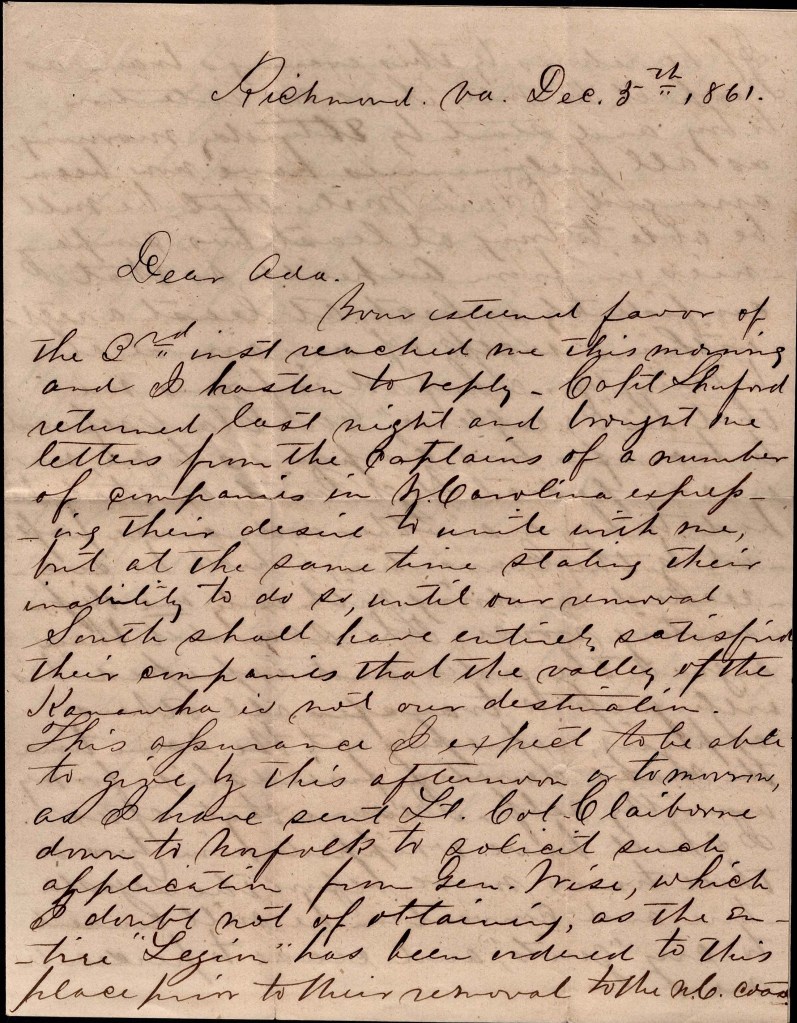
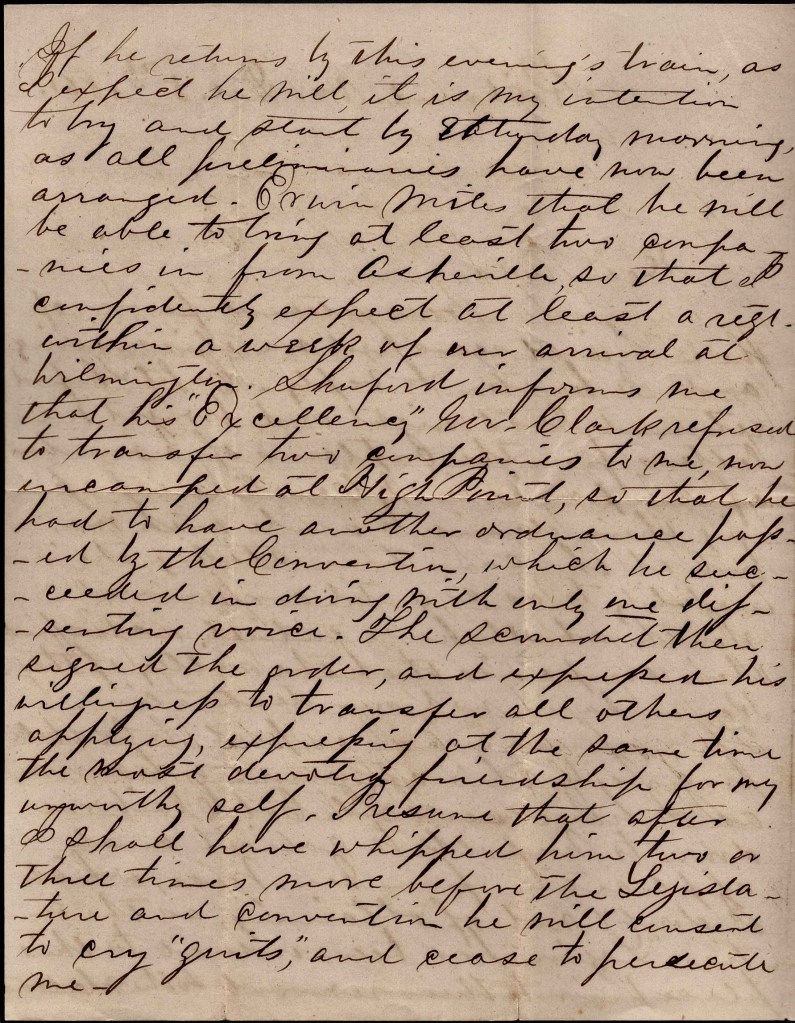
Your esteemed favor of the 3rd inst. reached me this morning and I hasten to reply. Capt. [Andrew H.] Shuford returned last night and brought me letters from the captains of a number of companies in North Carolina expressing their desire to unite with me, but at the same time stating their inability to do so until our removal South shall have entirely satisfied their companies that the valley of the Kanawha is not our destination. This assurance I expect to be able to give by this afternoon or tomorrow as I have sent Lt. Col. Claiborne down to Norfolk to solicit such application from Gen. Wise, which I doubt not of obtaining as the entire “Legion” has been ordered to this place prior to their removal to the N. C. coast. If he returns by this evening’s train, as I expect he will, it is my intention to try and start by Saturday morning, as all preliminaries have now been arranged.

Erwin writes that he will be able to bring at least two companies in from Asheville so that I confidently expect at least a regiment within a week of our arrival at Wilmington. Shuford informs me that his “Excellency” Gov. [Henry Toole] Clark refused to transfer two companies to me now encamped at High Point so that he had to have another ordnance passed by the Convention which he succeeded in doing with only one dissenting voice. The scoundrel then signed the order and expressed his willingness to transfer all others applying, expressing at the same time the most devoted friendship for my unworthy self. Presume that after I shall have whipped him two or three times more before the Legislature and Convention he will consent to cry “quits” and cease to persecute me.

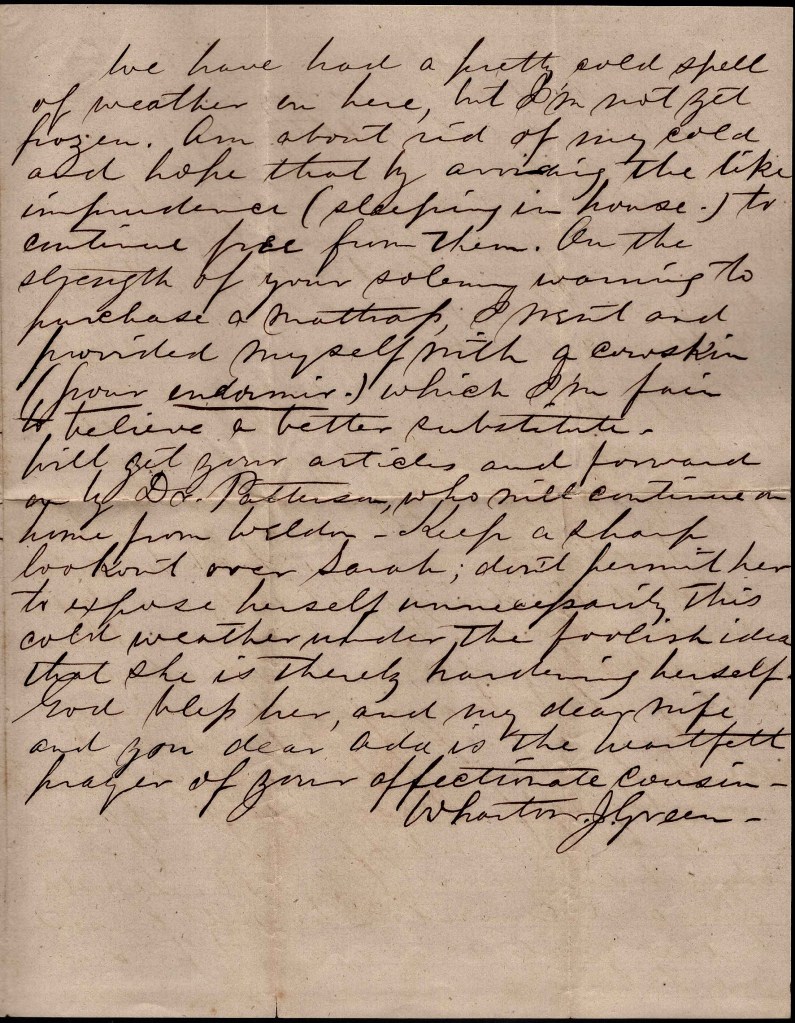
We have had a pretty cold spell of weather in here but I’m not yet frozen. Am about rid of my cold and hope that by avoiding the like impudence (sleeping in house) to continue free from them. On the strength of your solemn warning to purchase a mattress, I went and provided myself with a cowskin (pour m’endormir 1) which I’m fair to believe a better substitute.

Will get your articles and forward on to Dr. Patterson who will continue on home from Weldon. Keep a sharp lookout over Sarah; don’t permit her to expose herself unnecessarily this cold weather under the foolish idea that she is thereby hardening herself. God bless her and my dear wife and you, dear Ada, is the heartfelt prayer of your affectionate cousin, — Wharton J. Green

1 French to English translation, “to go to sleep.”


Letter 3

Johnson’s Island, Ohio
February 2, 1863

My dear Addie,

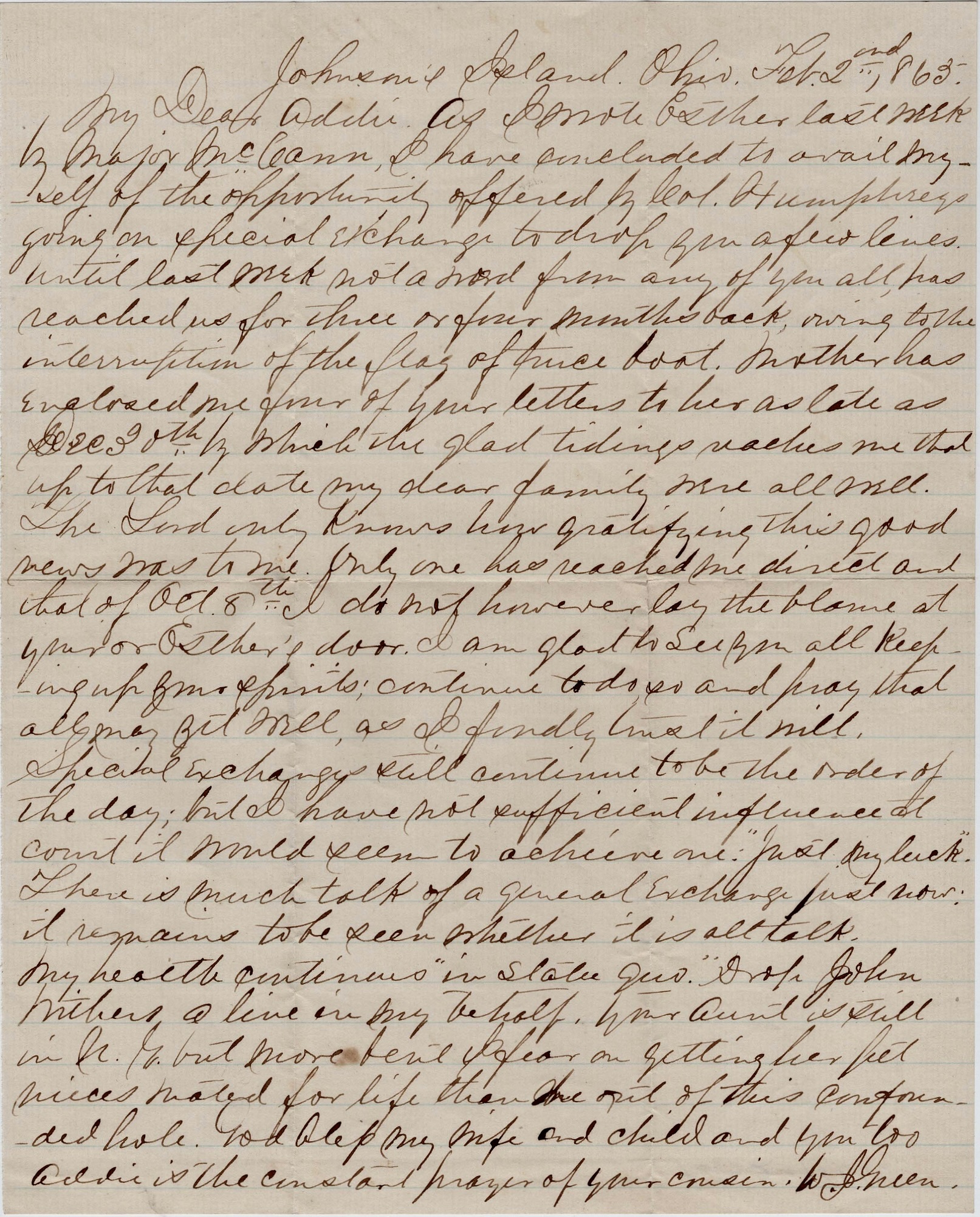
As I wrote Esther last week by Major McCann, I have concluded to avail myself of the opportunity offered by Col. Humphreys going on special exchange to drop you a few lines. Until last week, not a word from any of you all has reached us for three or four months back owing to the interruption of the flag of truce boat. Mother has enclosed me four of your letters to her as late as December 30th by which the glad tidings reaches me that up to that date my dear family were all well. The Lord only knows how gratifying this good news was to me. Only one has reached me direct and that of October 8th. I do not, however, lay the blame at your or Esther’s door. I am glad to see you all keeping up your spirits; continue to do so and pray that all may get well as I fondly trust it will.

Special exchanges still continue to be the order of the day; but I have not sufficient influence at court it would seem to achieve one. “Just my luck.” There is much talk of a general exchange just now; it remains to be seen whether it is all talk. My health continues “in status quo.” Drop John Withers a line in my behalf. Your Aunt is still in N. Y. but more bent, I fear, on getting her pet nieces mated for life than me out of this confounded hole. God bless my wife and child and you too, Addie, is the constant prayer of your cousin. — W. J. Green

1861: Andrew Nickerson to Emma Wade

I could not find an image of Andrew but here is a cdv of Frederick L. Barker, Co. K, 3rd Michigan Infantry (LOC)

Though he only signed his name “Andrew,” I feel confident this letter was written by Andrew Nickerson (1834-1864), the son of Elihu Nickerson and Mary Winegarden. The family from Cattaraugus County, New York to Lake County, Indiana, about 1840 where they remained until sometime around 1848 when the family moved to Michigan. “By 1850 Elisha was running a hotel in Prairieville, Barry County, where Andrew attended school with seven of his younger siblings, including his brother Edwin who would also join the Third Michigan. By 1860 Elisha or Elihu had moved the family to a farm in Leighton, Allegan County where Andrew worked as a farm laborer (along with his younger brother Edwin) and was living with his family. He was 27 years old and probably still living in Allegan County when he enlisted as 4th Sergeant in Co. E on May 13, 1861; his younger brother Edwin would join Co. E the following year.

It is quite possible that Andrew enlisted in the Hastings Rifle Company in April of 1861. That company was disbanded shortly after it arrived in Grand Rapids to join the Third Michigan infantry then forming at Cantonment Anderson south of city and its members distributed to other companies of the Regiment. Andrew was promoted to 1st Sergeant on July 19 or July 23, 1861, at Hunter’s Farm, Virginia. He was subsequently promoted to 2nd Lieutenant and transferred to Co. H on August 12, 1862, at Harrison’s Landing, Va., replacing Lieutenant Thomas Waters. 

In October Andrew was transferred to Co. K and promoted to 1st Lieutenant on October 20, replacing Lt. Fred Stowe. He was home in Michigan during the winter of 1863, and rejoined the regiment in early March of that year. He was charged with neglect of duty, in that he reportedly forged discharge papers for a private, but nothing came of this apparently and he was never court-martialed. Andrew was then appointed acting Regimental Quartermaster from July 13, 1863, through September, and in December he was on detached service in Michigan, probably recruiting for the Regiment. Although he was still reported detached in Grand Rapids in January of 1864 (since December 28, 1863), he was promoted to Captain on January 18, 1864, and commissioned to date November 1, 1863. He eventually returned to the Regiment before the spring campaign of 1864, and was killed in action on May 6, 1864, at the Wilderness, Virginia.

According to Dan Crotty of Co. F, Nickerson was killed on May 7. Some years after the war Crotty wrote that during the engagement at the Wilderness, “The fearful butchery commences on the morning of the 7th, and charge after charge is made on both sides,” and at one point the Regiment had driven the rebels back inside their works. “They reform and drive us back. We take shelter in some temporary works thrown up by themselves, and here hold them in check for awhile. But they come down on us with superior numbers. We keep them on the other side for awhile, and a hand to hand fight takes place. Here is where Captain Nickerson, of Co. K, was killed by a bayonet thrust.” Andrew was buried in Fredericksburg National Cemetery: grave 3550 (old 191).

[Note: The following letter is from the private collection of Greg Herr and was offered for transcription and publication on Spared & Shared.]

Transcription

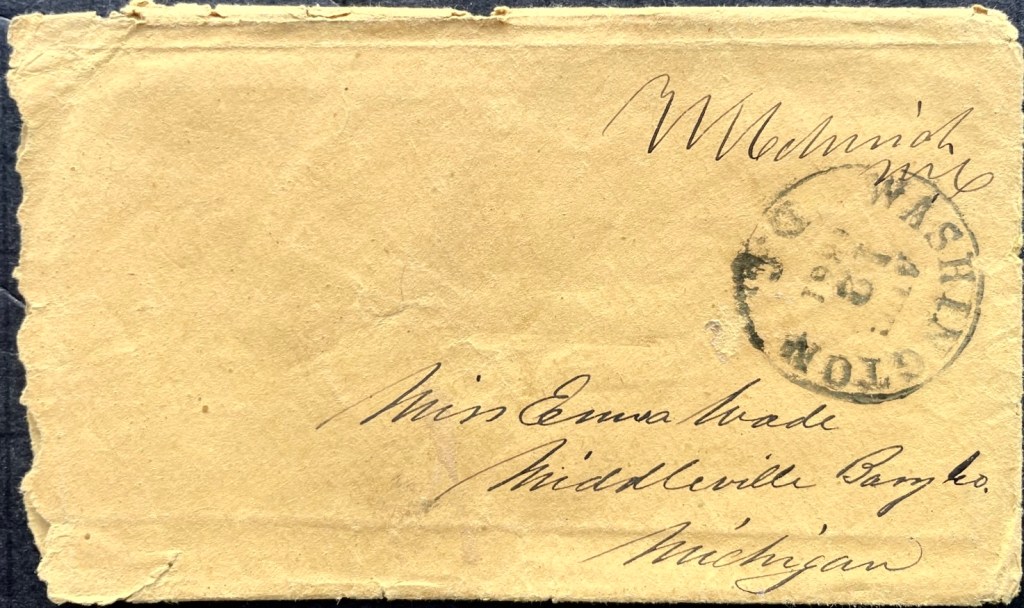
Addressed to Miss Emma Wade, Middleville, Barry county, Michigan

Washington D. C.
August 10th 1861

Friend Emma,

Today I received your kind letter and perused it with great pleasure. You seem to have a wrong impression in regard to the battles up at Bull Run. We were in the battle on Thursday [at Backburn’s Ford]. There was not so much close fighting as on Sunday but the cannon balls and shells fell all around us and there we stood without any chance to shoot back. To be sure, our cannon kept firing all the time and did great execution among the rebels.

The next day, and the next, and the next we laid on the field of battle and on Sunday when the fight was raging upon our right, we were on the field in reach of the enemy’s cannon and sometimes some of their musket balls would come whizzing over our heads. It was more good luck than anything else that saved us from half being killed, or being half killed I should say.

Then you think that Ell Felton and Jim Drew are about to make their beds together. Well “long may they wave.” Ell is a very pretty girl and makes a very good appearance. As for Jim, I do not know much about him, not being much acquainted with him.

Then you don’t think much of the courage of Barrell family, eh? I thought you used to think considerable of one of the boys, didn’t you? But I suppose you don’t like the way he runs over west do you. I don’t believe I should like it either.

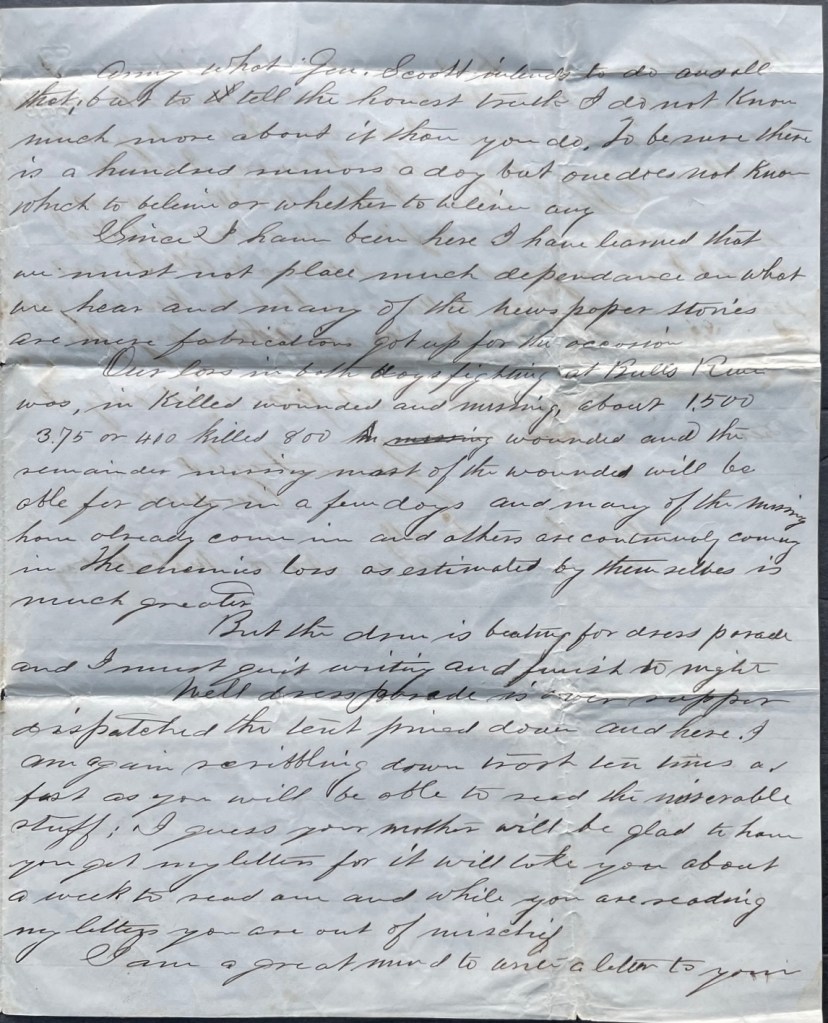
Now I know you want me to write a long letter and tell you all about the movements of the army, what Gen. Scott intends to do, and all that, but to tell the honest truth, I do not know much more about it than you do. To be sure, there is a hundred rumors a day but one does not know which to believe or whether to believe any.

Since I have been here, I have learned that one must not place much dependence on what we hear and many of the newspaper stories are mere fabricationsm got up for the occasion.

Our loss in both days fighting at Bulls Run was, in killed, wounded and missing, about 1,500; 375 or 400 killed, 800 wounded, and the remainder missing. Most of the wounded will be able for duty in a few days and many of the missing have already come in and others are continually coming in. The enemy’s loss as estimated by themselves is much greater.

But the drum is beating for dress parade and I must quit writing and finish tonight.

Well, dress parade is over, supper dispatched, the tent pinned down, and here I am again scribbling down traash ten times as fast as you will be able to read the miserable stuff. I guess your mother will be glad to have you get my letter for it will take you about a week to read one and while you are reading my letters you are out of mischief.

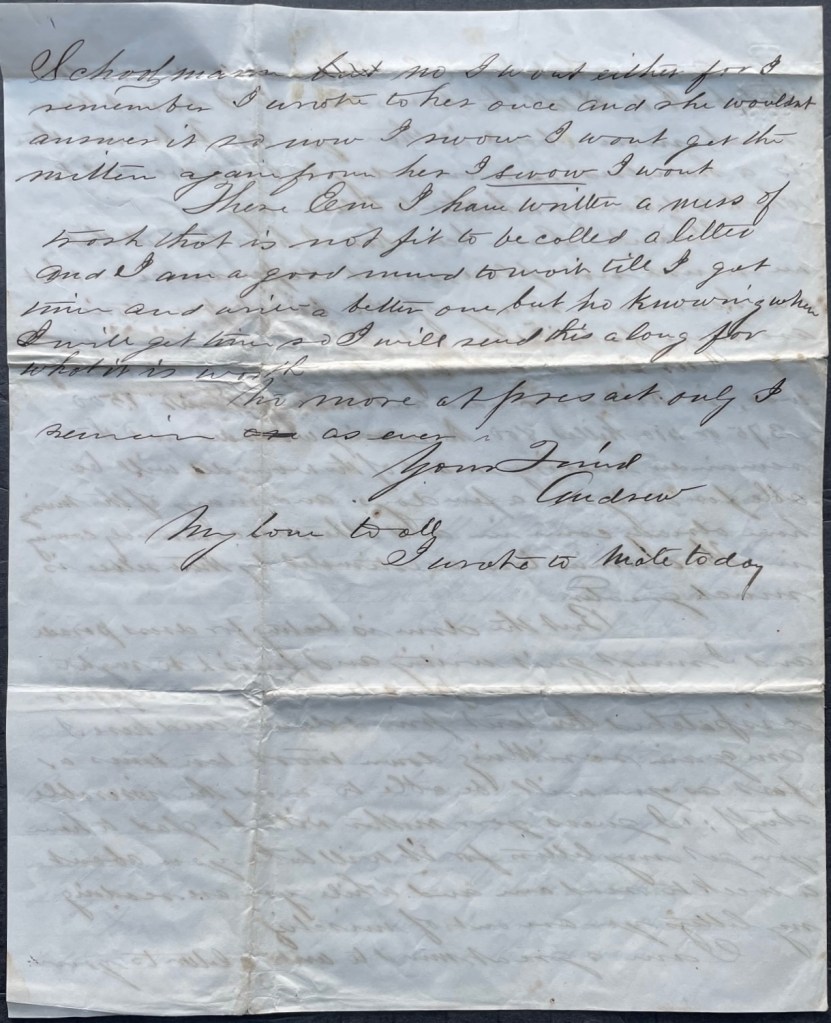
I am a good mind to write a letter to your school marm. No, I won’t either for I remember I wrote to her once and she wouldn’t answer it so now I swear I won’t get the mitten again from her, I swear I won’t.

There Em, I have written a mess of trash that is not fit to be called a letter and I am a good mind to wait till I get time and write a better one but not knowing when I will get time so I will send this along for what it is worth. No more at present, only I remain as ever your friend, — Andrew

My love to all. I wrote to Mate today.

1861: John Fales to Adelaide Fales

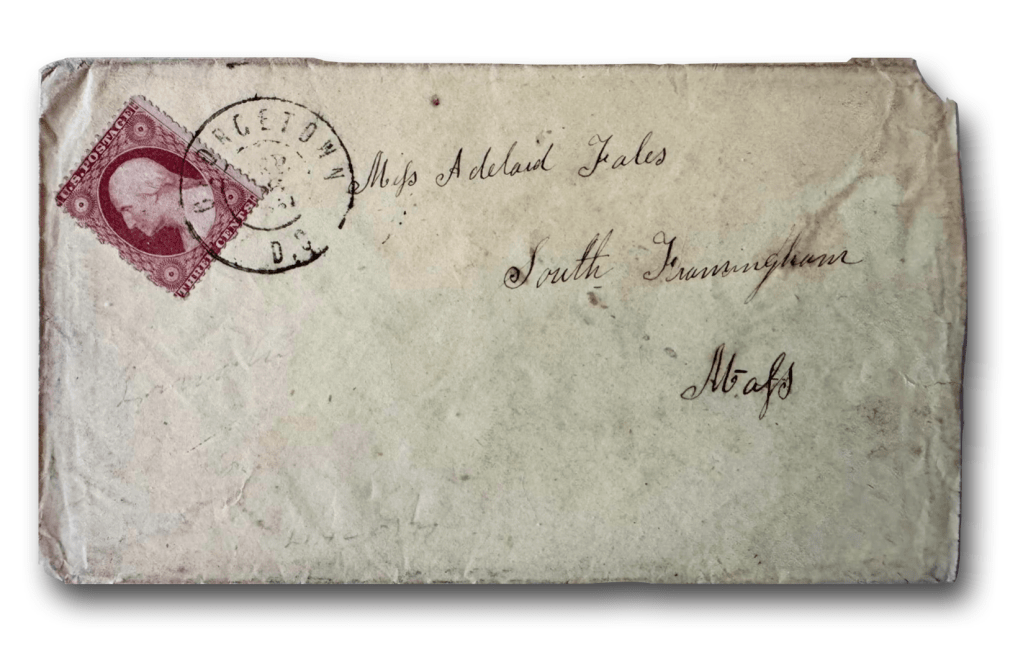
This incredible letter was written by John Fales (1841-1918), the son of John Smith Fales (1800-1861) and Charlotte Leland (1807-1850) of Sherburn, Middlesex county, Massachusetts—both parents dead by the time this letter was written in September 1861. He wrote the letter to his older sister, Charlotte Adelaide Fales (1832-1908), mentioning too a younger brother, Charles Leland Fales (1843-1902) who was serving in Co. B, 16th Massachusetts Infantry. From enlistment records we know that John stood 5′ 9″ tall, had brown hair, light eyes, and a fair complexion.

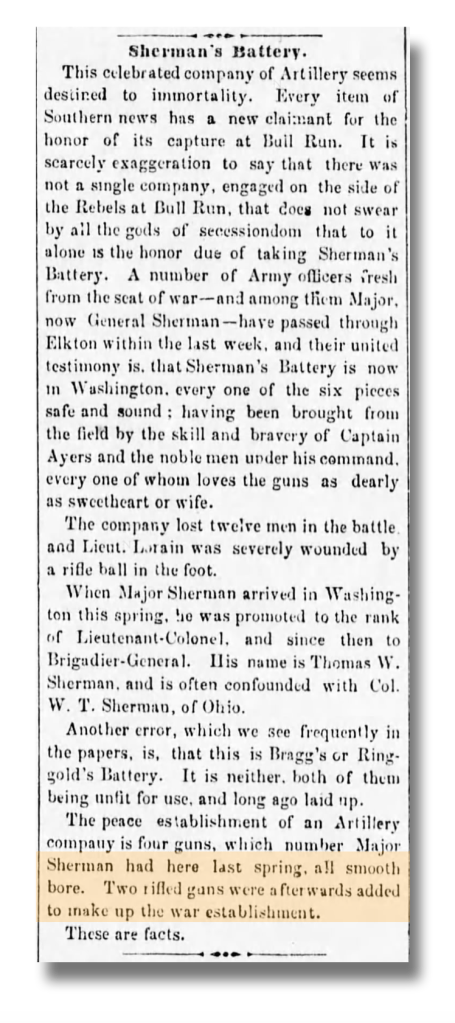
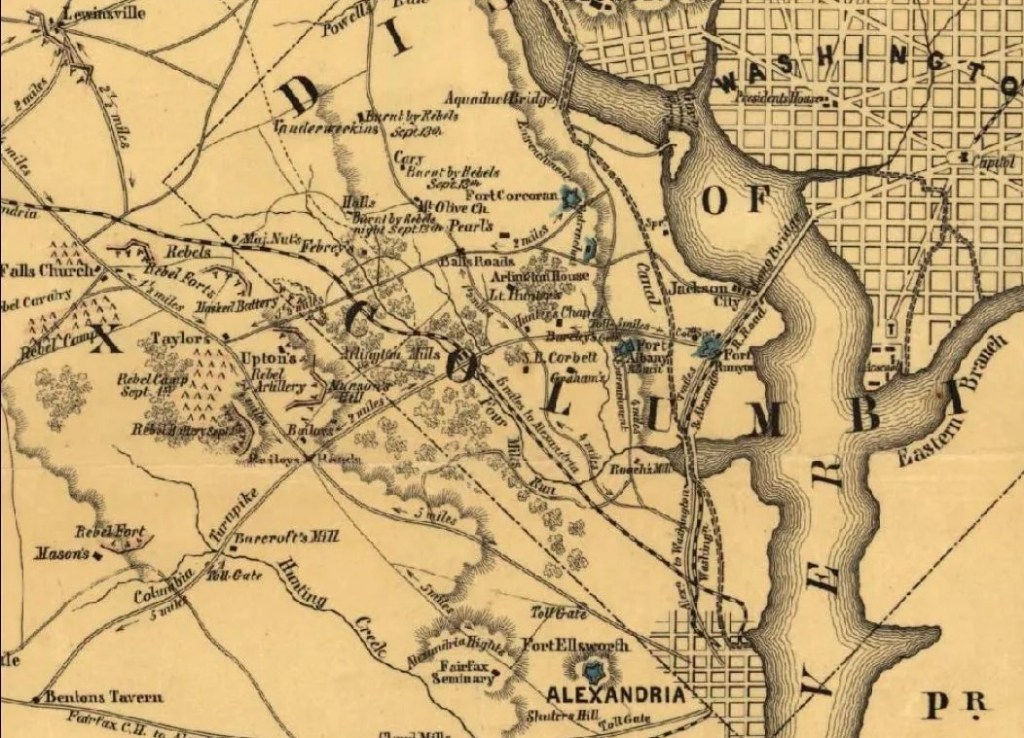
John wrote the letter while serving in the 3rd Light Artillery, Battery E, of the US Artillery (Regular Army)—commonly referred to as “Sherman’s Battery.” His enlistment was recorded as 17 April 1861 and his battery was mobilized and placed in a defensive position near Arlington Heights in late May. At least two of the guns were stationed at Pearl’s farm “north of the wagon road, half a mile east of Ball’s Crossroads” by early July. They were attached to William T. Sherman’s Brigade 1 of McDowell’s Army at the time of the Battle of Bull Run—their participation described by Captain Romeyn B. Ayres, who commanded the Battery at Bill Run, in the following after action report:

LIGHT COMPANY E, THIRD ARTILLERY,

Camp Corcoran, Virginia, July 25, 1861.

SIR: I have the honor to report the part taken in the battle of the 21st instant by this battery.

The battery advanced in the morning with the brigade to which it was attached—Col. W. T. Sherman’s—on the center route upon the front of the enemy’s position. The battery operated from this position at times upon the enemy’s batteries and troops as occasion offered. About noon I started with the brigade, as ordered, to cross the open ground, the run, and to rise the bluff, with a portion of the battery, one section being detached at this time, operating upon a battery to the left. On arriving at the run it at once was apparent that it was impossible to rise the bluff opposite with the pieces. I sent an officer immediately to report the fact to Colonel Sherman and ask instructions. I received for reply that I should use my discretion.

I immediately returned to the central position. I remained at this point, operating upon the enemy’s guns and infantry, till ordered by General Tyler to cover the retreat of the division with the battery. A body of cavalry at this time drew up to charge the battery. The whole battery poured canister into and demolished them. The battery moved slowly to the rear to Centreville.

I will add, that the coolness and gallantry of First Lieut. Dunbar R. Ransom on all occasions, and particularly when under fire of three pieces, with his section at short range, when the battery was about to be charged by a large body of cavalry, and also when crossing a broken bridge in a rough gully, and fired upon in rear by the enemy’s infantry, were conspicuous. The good conduct of First Lieut. George W. Dresser, Fourth Artillery, was marked, especially when threatened by cavalry, and at the ravine referred to above. Second Lieut. H. E. Noyes, cavalry, was energetic in the performance of his duties.

I lost four horses killed on 18th; two horses wounded on 18th; seven horses on 21st; three caissons, the forge, and a six-mule team and wagon (excepting one mule), on the 21st. I sent all these caissons, &c., ahead when preparing for the retreat, to get them out of the way. The fleeing volunteers cut the traces and took the horses of the caissons.

Very respectfully, your obedient servant, — R. B. AYRES, Captain, Fifth Artillery, Commanding Company E.

Battery E, 3rd US Artillery (“Sherman’s Battery”) as it appeared on its return from the Battle of Bull Run (New York Historical Society Museum)

John datelined his letter from “Arlington Heights” on 5 September 1861. He indicates that the battery was near Fort Corcoran. More precisely the battery was positioned a quarter of a mile soutwest of W. Ross’ farm Rossyln.

Before the Civil War ended, John would enlist twice more in his country’s service. After his three years in Battery E, US Artillery, he reenlisted in Co. E, 60th Massachusetts Infantry on 16 July 1864 and served until 30 November 1864. Following that he reenlisted again in the 3rd Massachusetts Artillery and served until 1868. His military records indicate he was wounded once—at the Battle of Olustee (Florida) on 20 February 1864. In his later years, John worked in Boston as a locomotive fireman—a job that no doubt gave him the cataracts that plagued him in his later years, not to mention his loss of hearing.

[Note: This letter is from the personal collection of Megan Lynn and was transcribed and researched by Griff for publication on Spared & Shared with Megan’s consent.]

Transcription

Addressed to Adelaide Fales, South Framingham, Massachusetts

Arlington Heights
[Thursday] September 5th 1861

Dear Sister,

As I have a little time today, I thought I would write & let you know that I am safe & well. We are here in the same place but we have just got orders to get ready to move. I do not know where we are going but I expect we are going to advance on to Fairfax.

Mr. Lincoln reviewed us last Monday 2 & after the review he came to our camp & examined our rifle cannons. 3 He thanked us very kindly for our gallant conduct at the battle of Bulls Run & when he went away he went up to where our cook was getting dinner & took a brand of fire & lit his cigar & sit down and had a long talk with our captain. 4 He is a very pleasant talking man. Anyone would not think he was President of the United States if they did not know who he was.

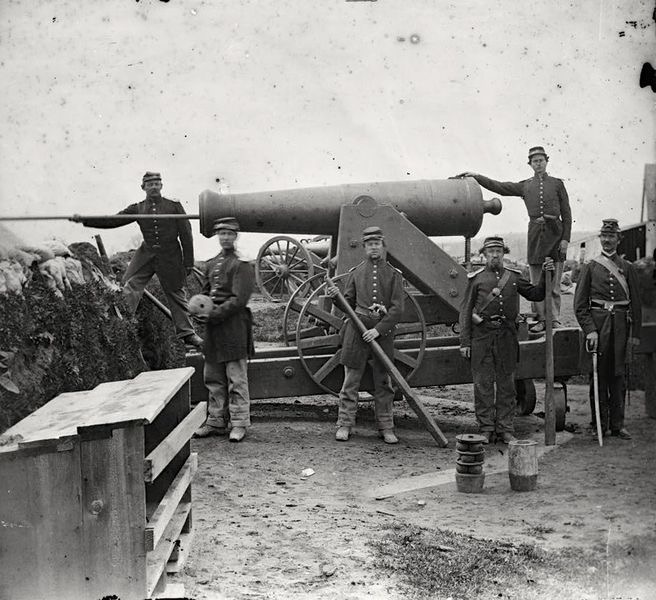
One of the 24-pounder guns in Fort Corcoran (LOC)

The 18th Massachusetts Regiment came over here from the city. 5 The Massachusetts soldiers are the best looking soldiers here. All the regiments here are at work every day. They are throwing up breastworks here in all direction & mounting heavy guns. Fort Corcoran has 8 guns which carry a 68 lb. ball & four 24-pounders. This fort commands the road from Georgetown to Fairfax & the Potomac. You can see all over the city of Washington. Our battery is about a quarter of a mile from this fort. It is large enough to hold 1500 men. I have got a picture of this fort but it does not look exactly as it does now.

I have not heard from [brother] Charlie yet. I do not know whether his regiment is in the city or not. We have got a large balloon here in our camp. He went up yesterday to take a look at the rebels. He could look right down onto them & see what they were doing. After he had been up a little while, the rebels fired a cannon ball at him but they could not reach him. He had ropes fixed to a large tree so that he would not blow away. 6

I have not anymore to write now. Remember me to all the folks. I am your affectionate brother, — John Fales


Footnotes

The Cecil Whig, 17 August 1861

1 The celebrated Battery E of the 3rd US Regulars was led during the War with Mexico by Thomas West Sherman and it was often referred to as “Sherman’s Battery,” even when it was lead, as it was at Bull Run, by Capt. Romeyn B. Ayres. Adding greater confusion, the Battery was assigned to the command of Col. William Tecumseh Sherman just prior to the Battle of Bull Run. Ayres was at Old Point, Virginia, until 7 July 1861 when he was ordered to Washington to take command of “Sherman’s Battery.” His was the only artillery unit to save all of his guns from the battlefield and even brought off two others. Ayres was transferred to Philadelphia to recruit for the 5th US Artillery shortly afterward. [Daily National Democrat, 20 September 1861]

2 “Last Monday” would have been 2 September 1861. According to the Lincoln Log, Lincoln and Secretary Seward reviewed the 2nd & 5th Wisconsin Infantry Regiments of Gen. Rufus King’s Brigade [NY Times, 3 September 1861].

3 Sherman’s Battery went into the fight at Blackburn’s Ford and Bull Run with four smoothbore cannon—two 6-pounders and two 12-pounder field howitzers, as well as two 10-pounder Parrott rifles as a reserve. The Parrott rifle was still somewhat of a novelty in 1861. It was developed in 1860 and were easily recognized by the wrought-iron reinforcing band wrapped around the breech. They were simple for the gun crews to operate and could be mass produced inexpensively.

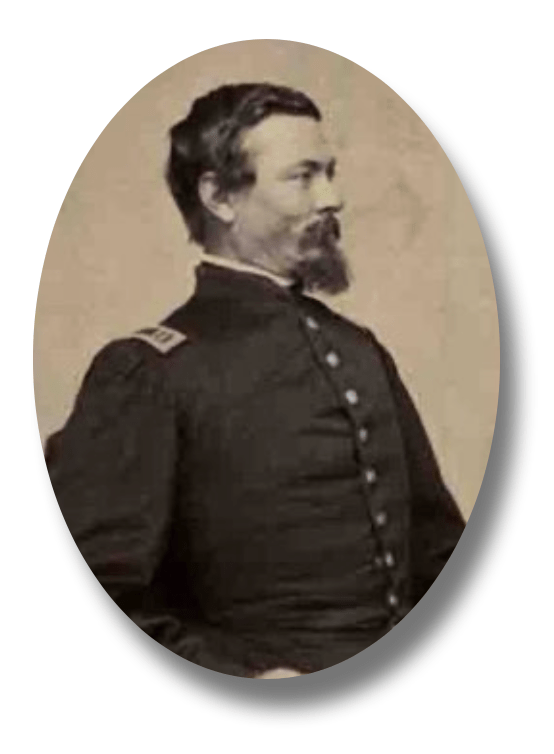
Capt. John H. Hamilton (1823-1900)

4 Though it was Capt. Romeyn B. Ayres of the 5th US Artillery who temporarily commanded the battery at Bull Run, by early August 1861 the battery was commanded by Capt. John H. Hamilton, West Point Class of 1847. Hamilton had received his promotion to captain in late April but he was in San Francisco at the time and he did not arrive in Washington D. C. until after the Battle of Bull Run. In short, it would have been Capt. Hamilton who enjoyed a cigar with President Lincoln, not Capt. Ayres.

5 The 18th Massachusetts was mustered into federal service on 27 August 1861 with eight companies. They were ordered on the 3rd of September to cross the Potomac and report to Gen. Fitz John Porter. They set up their camp near Fort Corcoran on ground previously occupied by the69th New York. Later in September they were moved to Hall’s Hill, then the outpost of the Union army.

6 Thaddeus Lowe’s newly created Balloon Corps was quite active prior to and after the Battle of Bull Run. On the day of the battle the balloon was accidentally ripped on the way to the battlefield so they were foiled in their ascension that day, but three days later, Lowe made an ascent at Fort Corcoran to look for an indications of a march on Washington by the Rebel army. Later that same day, he ascended again to check the Confederate bivouacs at Manassas and Centreville. To gain higher altitude for a better view, Lowe asked for the tethering cables to be released and the balloon drifted toward Alexandria where he was actually fired upon by Union troops thinking the Rebels were attacking by air. A number of ascents were made near Arlington Heights during August 1861 to keep an eye on the Rebel army’s movements. It was on August 29th at Ball’s Crossroads when Lowe’s balloon “Union” was fired on by a Rebel cannon commanded by Lt. Thomas Rosser of the New Orleans Washington Artillery from their position on Munson Hill. Though Fales could not have known it at the time, the Confederates attempted to send up its own “spy balloon” at Munson’s Hill on September 4th but the bag ripped before it could get off the ground. On September 5th, the date of Fale’s letter, it was reported that Union generals Irvin McDowell and Fitz-John Porter went up in Lowe’s balloon, and McClellan did likewise on September 7th. [See Arlington and Fairfax Counties: Land of Many Reconnaissance Firsts, by Dino A. Brugioni, published in Northern Virginia Heritage]

A map of the area and localities mentioned in the letter and footnotes.

1861: Richard Erskine Holcomb to Harriet Jencks (Thompson) Holcomb

The following letter was written by Richard Erskine Holcomb, Sr. (1824-1863), the son of Thomas Holcomb (1779-1865) and Clarinda Pettibone (1781-1855) of Granby, Hartford county, Connecticut.

Richard Erskine Holcomb

Richard was an explorer of South America who learned to speak both French and Spanish and wrote articles about South America which were published in Harper’s Magazine. He also helped build several railroads in the south, including the Panama Railroad. Early in the Civil War he enlisted with the 3rd Connecticut Volunteers, in which he was a 1st Lieutenant. He was promoted rapidly to Major in the 13th Connecticut Volunteers, then to Colonel, and served for six months as brevet Brigadier General in White’s Regiment of 1st U.S. Louisiana Volunteers while commanding the 13th Connecticut Volunteers in policing New Orleans. He sailed up the Mississippi with General Farragut. While acting as Brigadier General in the siege of Port Hudson, Louisiana, he led his troops of the 1st Louisiana Volunteers in a charge against the enemy on 27 May 1863 in which he was severely wounded. He died 14 Jun 1863.  His last words: “Charge forward, double quick.”

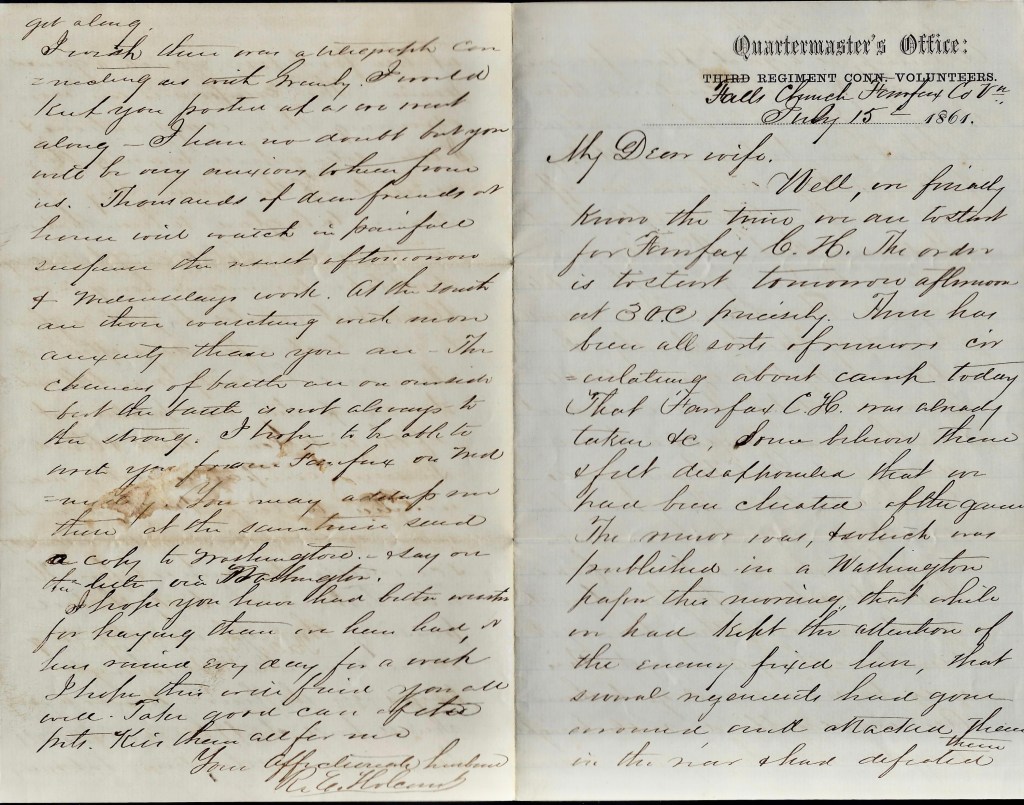
Richard’s letter was penned on 15 July 1861, just days before the Battle of Bull Run. It contains a variety of rumors and prognostications of how the long-awaited battle would turn out that are amusing to read today in light of what actually happened in the battle.

Transcription

Envelope free franked by C. H. Van Wyck, New York Congressman

Falls Church, Fairfax Co., Va.
July 15, 1861

My Dear wife,

Well, we finally know the time we are to start for Fairfax Court House. The order is to start tomorrow afternoon at 3 o’clock precisely. There has been all sorts of rumors circulating about camp today that Fairfax Court House was already taken, &c. Some believe them & felt disappointed that we had been cheated of the game. The rumor was, & which was published in a Washington paper this morning, that while we had kept the attention of the enemy fixed here, that several regiments had gone around and attacked them in the rear & had defeated them. A camp is a great place for rumors, but we understand these things better now than we did so that we believe everything false until we have an official conformation of its truth.

It seems that McClellan in western Virginia has given the rebels a good thrashing. There is another awaiting them shortly. The rebels are put to great straits. Governor Letcher has called out ten thousand militia to rendezvous at Genl. Beauregard’s headquarters. They have been drafting all the men in our neighborhood outside of our lines, to repair forthwith with such arms as they have got & such as they can get. This will be no advantage to them. An undisciplined rabble brought together in a hurry will run at the first fire, & create a general panic.

The companies are now drawing three days rations & I am siting here hearing the comments of the men. They all seem to be glad to hear that we are to move. Soldiers get uneasy—don’t like to remain long in one place—but would be just as glad to move back a few day after. There will be sixty men left with the camp. They are picked out of the sick, lame, halt & blind. In some companies, not a man wanted to stay.

We had another man shot yesterday, accidentally & carelessly—the same as before. He was shot in the belly, the ball passing through in a slanting direction & the doctor thought logged in the liver. It was a very small ball, but is in a very precarious situation, but may get along.

I wish there was a telegraph connecting us with Greeley. It would keep you posted up as we went along. I have no doubt but you will be very anxious to hear from us. Thousands of dear friends at home will watch in painful suspense the result of tomorrow and Wednesday’s work. At the south are those watching with more anxiety than you are. The chances of battle are on our side but the battle is not always to the strong. I hope to be able to write you from Fairfax on Wednesday. You may address me there at the same time. Send a copy to Washington & say on the letter “via Washington.”

I hope this will find you all well. Take good care of the pets. Kiss them all for me. Your affectionate husband, — R. E. Holcomb

1861: James McFadden Gaston to Susannah G. (Brumby) Gaston

A post war image of Dr. James McFadden Gaston

This incredible letter was written by Dr. James McFadden Gaston (1824-1903), the son of John Brown Gaston (1791-1864) and Mary Buford McFadden (1805-1886) of Chester county, South Carolina. Gaston graduated from the University of South Carolina in 1843 and then attended medical lectures at the University of Pennsylvania in Philadelphia. He then earned his Medical Degree from the Medical College at Charleston in 1846. He practiced medicine with his father in Chester District for a time and then moved to Columbia in 1852 where, and at which time he also married Susannah Greening Brumby.

When civil war broke out in 1861, Gaston initially entered the service of his state as a private in the Columbia Grays but he was soon elevated to Assistant Surgeon and served in that capacity at Morris Island and Fort Sumter. In July 1861, he was promoted again to Surgeon and Medical Director of Gen. D. R. Jones’ 3rd Brigade. He wrote the following letter from Manassas Junction on the day after the Battle of Bull Run.

Gaston organized medical services while serving as Chief Surgeon of South Carolina Forces and later as Divisional Surgeon General of the South Carolina Volunteers during campaigns in Virginia and Pennsylvania, which included the battles of Manassas and Gettysburg. Immediately after the conclusion of the Civil War, Gaston left the United States and settled his family in Brazil where he practiced medicine in the city of Campinas. After almost two decades, Gaston returned with some of his family to Atlanta, Ga., where he successfully re-entered American medical life, teaching at the Southern Medical College, publishing articles, and carrying out research. He died in 1903.

Gaston’s papers are not posted on-line but are housed at the University of North Carolina Library.

Transcription

Manassa Junction [Virginia]
July 22, 1861

My dearly loved wife,

To say that I am safe and well, is no common place intelligence after the terrible reports of yesterday. The great battle has been fought and won by us here, and though our forces suffered to a large extent, the destruction which was dealt out to the enemy’s columns, and the entire routing of their troops, with the capture of men and munitions of warm is far beyond what the most sanguine could have anticipated. The Hampton Legion has just arrived the night previous and were among the first to be engaged with the enemy, without being supported in the encounter until they had sustained very serious losses; but it gives me pride to say that the honor of South Carolina was nobly vindicated by their unflinching firmness.

Lt. Col. Benjamin J. Johnson of Hampton’s Legion, killed at Bull Run, 21 July 1861 (The Horse Soldier)

The Lieut. Col. B[enjamin] J[enkins] Johnson was killed early in the action, and Col. Hampton received a shot in the face which unhorsed him, but not proving serious. He returned to the command of his men and led them throughout the engagement. A Mr. Haynesworth 1 from Sumter had his ankle shattered by a cannon ball and I removed his leg at the temporary hospital on the field.

Our gallant 2nd Regt. South Carolina Volunteers were located some distance from the scene of the battle and did not reach the ground until others had been exhausted in the attempt to repel the foe, when our boys were brought fresh into the field, and made a charge upon the enemy lines of the army (which proved to be their [ ] for the last) which turned the day in our favor, and ended in a complete rout of their forces, with ours in close pursuit of them over the hills and hollows of the surrounding country. My friend, Capt. John [S.] Richardson, 2 was slightly wounded, and a number of other men seriously, while but few deaths resulted from this bold move of Kershaw’s regiment.

I think Mrs. Glover 3 may not be afraid that no harm has befallen her son, who I saw on the day previous and found in good health and good spirits, It is very remarkable that with a superior force, the enemy should have been beaten back without causing more loss to our side than has occurred, but one thing is very notable—that the proportion of officers killed and wounded is much greater on our side than on theirs, and indeed they kept themselves out of the way of danger much more than our officers who went in person with their commands upon the field. General Beauregard went out in the very thickest of the fight and urged the troops forward, telling them he intended to share their perils, and fall or conquer with them. President Davis also came upon the field while the enemy were still making resistance, but the tide had turned very decidedly in our favor previous to his arrival.

Sherman’s Light Artillery Battery, illustration from Harper’s Weekly.

The famous Sherman’s Battery was captured entire from the enemy, all the horses having been killed and in all we have taken about thirty-five pieces of cannon, with perhaps two thousand stand of superior arms, with ambulances, camp equipage, and stores amounting it is thought to maybe half a million dollars worth. The number of prisoners taken is near five hundred while their dead will perhaps reach that number and the wounded cannot as yet be calculated with any certainty, but it is shocking to see them huddled together at the four (4) different hospitals over which we have placed their own surgeons who were taken prisoners, and thus relieved us of much trouble, yet many of their wounded are still being brought in to the junction from the field of battle which is near stone bridge, about five miles distant from here.

I think our dead on the field will not extend one hundred for the entire force of the Confederate Army, but we have a number seriously wounded who must die and thus increase our list considering yet the increase of deaths on the enemy’s side will be much greater than ours from the fact that their wounded have not received and cannot receive the same care and attention that our are getting. Many of our wounded are not confined at all; but we have a severe ordeal in dressing the wounds and performing the operations that were requisite—amputating legs, arms, fingers, tying arteries, cutting out balls, putting on splints, and applying bandages have been my constant employment since yesterday morning, and after working the entire night and two days, you may well suppose I am willing to rest long enough to write you this history of the events.

I had to trephine a Lieut. [William Lambert] Depass of [Co. E,] 2nd Regt. S. C. Vols. last night in the cars, after the wounded were put aboard to be carried to Culpeper Court House and relieved the oppression on the brain by the operation, but I fear he will not live. 4

My experience here has been vastly useful to me and must prove advantageous if I am spared to return to my appropriate duties as a physician. Neither the regiment in which my brothers are, nor that in which Alec 5 is, have reached this place though I learn that the former is in Richmond. Among the captured [items] I have a watch and a fine case of surgical instruments in my possession, but they will be reported to headquarters and perhaps turned over, a fine horse and saddle are also subject to my order for the present, and if Gillespie should…[page not posted]

But to return to the war, it was thought Saturday that the enemy would make the attack on that day and every arrangement was made to meet them, but failing to come against us, it was determined by Gen. Beauregard to move upon them yesterday morning by three columns and orders were issued accordingly to put the troops in motion early. But before it was commenced, he learned that the enemy had taken the initiative and he prepared to put our force in a condition to resist the attack which was made on the extreme left of our line of defense, extending along Bull Run for six or eight miles. This made it necessary to march troops up from the other points to the left wing and yet not to remove all from any of the points lest the enemy should throw in a column at an unguarded passage. Our reinforcements were therefore slow in coming into action from the distant points and did not represent our full strength, but the very fact of our body of men following another at considerable intervals into the field had no doubt a better effect than to have there the whole army before the enemy at one time as they could not tell when we would ever exhaust our supply of men and as we knew they outnumbered us greatly it was proper to keep them from knowing our strength it possible. Thank God the victory is ours and I trust this may end the war as the army have retired into their former lines with the conviction that we did intend to yield.

Your kind husband, — J. M. F. Gaston

1 2nd Lieut. John R. Haynsworth of Sumter, South Carolina, served in Co. C of the Manning Guards in Hampton’s Legion. We learn from this letter that his shattered ankle necessitated amputation but he did not survive. He died on 21 August 1861 at Warrenton, Virginia, one month after the battle.

2 Capt. John S. Richardson commanded the Sumter Volunteers, Co. D, 2nd South Carolina Infantry. One source says he was slightly wounded in the leg at the Battle of Manassas; another source says slightly in the arm.

3 Possibly referring to J. B. Glover who was a private in Capt. George B. Cuthbert’s Company—Co. I, 2nd South Carolina Infantry. J. B. enlisted at Charleston on 22 May 1861.

4 William Lambert Depass (1836-1881) survived the Civil War and died of heart disease in 1881. William was from Kershaw, South Carolina, and served as a 2nd Lieutenant in Co. E, 2nd S. C. Infantry (2nd Palmetto Regiment).

5 “Alec” refers to Gaston’s brother-in-law, Dr. Alexander Brevard Brumby (1831-1879).