The following letter was written by H. Alvin Hitchcock (1841-1864, the youngest son of Otis Hitchcock (1795-1873) and Sarah Delano (1796-1877) of Randolph, Cattaraugus county, New York.
I could not find an image of Alvin but here is one of Eason W. Bull who served in Co. D, 154th New York Infantry
Alvin was 21 years old when he enlisted in August 1862 as a private in Co. A, 154th New York Infantry. When he enlisted, he was described as a brown-haired, blue-eyed, single farmer. The 154th New York was recruited in the counties of Chautauqua and Cattaraugus, organized at Jamestown, mustered into the U. S. service on Sept. 24-26, 1862 and left the state shortly afterward. They were assigned to the 1st brigade, 2nd (Steinwehr’s) division, Howard’s 11th corps, which was stationed during the fall of 1862 in Northern Virginia in the vicinity of Centerville. The regiment went into winter quarters with the corps at Stafford, Va., and suffered severely in the disaster which befell the corps at the Battle of Chancellorsville, losing 32 killed, 81 wounded and 115 captured and missing.
In his letter, Alvin gives a detailed eyewitness account of the Battle of Chancellorsville, from the time that his company helped the 15th New York Engineers lay the canvass pontoon bridge over the Rappahannock river at Kelly’s Ford, until his capture on the day after Stonewall Jackson’s flank attack that rolled up the 11th Corps. From his letter we learn that he was wounded while standing with others of the 154th New York on the “Buschbeck line” which held back Jackson’s men for over an hour while the high command attempted to stem the chaos of the fleeing soldiers.
For an excellent article describing the events Alvin witnessed and wrote about in his letter, readers are referred to Baptism of Fire: The 154th New York in the Chancellorsville Campaign by Mark H. Dunkelman published on American Battlefield Trust on 1 August 2022. I should also note that Dunkleman devoted an entire chapter to Alvin Hitchcock’s sad story in his book, War’s Relentless Hand: Twelve Tales of Civil War Soldiers (LSU Press, 2006)….After Alvin was exchanged and rejoined the 154th New York, he began to show signs of insanity. He was sent to the Government Hospital for the Insane at Washington, and from there–after a brief visit home–to the New York State Lunatic Asylum in Utica, where he died on July 13, 1864, of “Exhaustion–acute Mania.
Transcription
Addressed to Mr. Otis Hitchcock, Randolph, Cattaraugus county, New York (notice that envelope is mismatched with letter; envelope is postmarked Nashville, TN, and dates to April 1864.
Camp Convalescent Near Alexandria, Virginia [Approx. May 20, 1863]
Dear Parents and friends,
It is with pleasure that I take my pen in hand once more to inform you of my welfare & whereabouts. I am a paroled prisoner of war and I am as well as usual, hoping these few lines will find you all well and enjoying yourselves.
I will try and give you a kind of a description of our spring campaign. We left our winter camp about the middle of April and went to a place called Kelly’s Ford. We lay there in camp about two weeks when we got orders to make an advance on the enemy. Our regiment was ordered out just at night of the 28th of April to go and help lay the pontoon bridge. Our company and one other company were detailed to help the [15th New York] Engineers lay down the bridge & the rest of the regiment crossed over to guard us while we were at work. It was the Rappahannock river that I am speaking of now.
We got the bridge done about 11 o’clock at night and our regiment come back and we went back to camp and stayed till morning. Then we got orders to have three days rations in our haversacks and five more in our knapsacks, making in all eight days rations. And we had to have 60 rounds of cartridges, 40 in our boxes and 20 in our knapsacks. So you see that we were pretty well loaded down with hardtack and lead.
Well we marched down and crossed the river and lay there that day till the next morning. Then we got orders to strike tents and march. Our brigade was guard of the baggage train so you see we had to be in the rear. We marched till noon when we came to the Rapidan river. We crossed on a narrow footbridge but the train had to ford it and it being a very rapid stream, it took till about 4 o’clock p.m. before we got ready to start again. Then we started and marched clear through to where we had the battle before we camped. We marched about 25 miles that [day] by marching till 11 o’clock at night and you better believe that I was a tired boy that night if I ever was.
Well we stayed there till about 3 o’clock the next day. Then we got orders to form in line of battle. We could hear the enemy firing. They were fighting then only about two miles from us. We were marched 20 rods out across the road to another field, then our company and another company had to go and guard the pioneers while they were throwing up breastworks. We had to lay on our arms that night. The rebs were shelling the woods just about 150 rods to our right. We could see and hear the shells burst just as plain as day but the next day was when we had our fun.
[It was] just about 5 o’clock p.m. that Old Stonewall Jackson come in on our rear and you had better believe that we had a rather warm time of it for a little while. I think we were managed rather bad on the start. We were formed in by divisions, closed en masse, and marched in front of our breastworks & ordered to lay down. We lay there about five minutes when we were ordered to fall back to the breastworks. We fell back there & waited till they come up in sight & then we blazed away at them, but they [had] so many more in number than we did that they rushed right up and flanked us both right and left, and we got the order to retreat, and then was when I got hit but it did not lame me much till the next day. So I got off the field and went about a mile and lay down and slept good till the next morning when the rebs made another attack on our men & I happened to be lying right where they come in, so I was right between the two fires. But I was behind an old log from the rebs fire. The balls struck the log pretty freely but I was alright. But it was not long before they had me prisoner. I shall have to close. Write soon. — H. A. H
[to] Otis and Sarah [Hitchcock]
A map of the “Buschbeck line” established by the Federals near Dowdall’s Tavern on the Orange Turnpike where the 154th New York “blazed away” at the rebels.
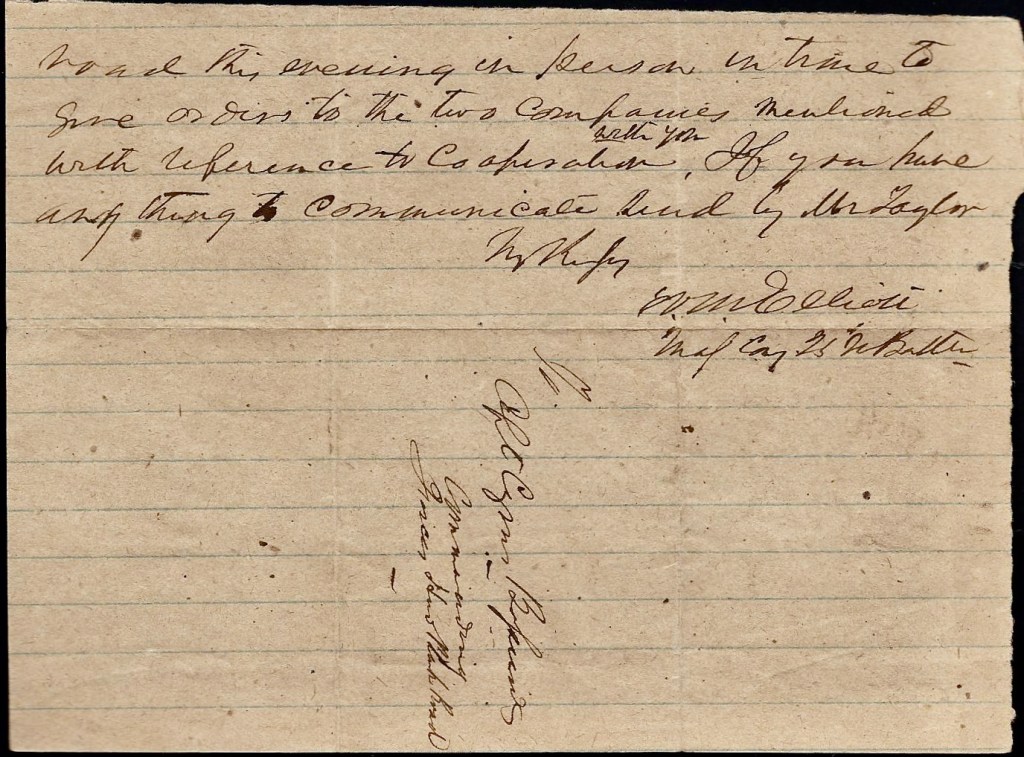
The following note was written by Maj. Wyatt Moseley Elliott (1823-1897), an 1842 graduate of the Virginia Military Institute, who commanded the 25th Virginia Battalion, otherwise known as the “Richmond City Battalion.” This battalion was organized on 15 August 1862 for service in and around Richmond by the authority of the Confederate Secretary of War, George W. Randolph. Their anticipated term of service was six months but as the war dragged on, their term was extended and they were still on duty in May 1864 when the Richmond Daily Dispatch wrote of them: “The 25th Virginia battalion, better known as the City Battalion, Col. Wyatt M. Elliott, who, since their organization, have been on duty in this city, yesterday morning moved to Chaffin’s Bluff, their place in this city being supplied by the 28th Va. battalion, Hunton’s brigade. As the City battalion passed down Main street the troops presented a really splendid appearance, and were loudly cheered by the citizens. The men are delighted with the change. The constant guard duty they had to perform here was excessively wearisome.”
Wyatt wrote the letter to Capt. Cyrus Bossieux (1835-1906) of Richmond who commanded Co. F of the battalion. He first entered the war as an enlisted man in Co. A, 1st Virginia Infantry. He also served as Capt. of Co. H in the 3rd Virginia Artillery. Reference is also made to Co.’s A & C which were commanded by Capt. John H. Greaner and Capt. W. W. Harrison, respectively.
The significance of this note is that it was written during the Battle of Chancellorsville just as the tide was turning against Hooker’s Army of the Potomac who were being pressed by McLaws and Early to push Sedgwick’s men back across the Rappahannock. Major Elliott’s placement of troops north of Richmond on the Hanover Plank Road was precautionary, not knowing the direction Sedgwick’s army intended to take after crossing the Rappahannock and overrunning the Confederate defenses at Fredericksburg the previous day.
Transcription
Richmond [Virginia] May 4th 1863 1 1/4 o’clock p.m.
Capt. C. Bossieux,
Sir, I send this note by the hand of Mr. W. O. Taylor. I have received no message from you. You will retain the position you now hold. I have ordered two companies placed at my disposal in aid of your force on the plank road to take position at the point at which you yesterday left companies A & C whose duty will be to dispute the passage of the plank road and also to be summoned to your aid in case of necessity. I will be out on the road this evening in person in time to give orders to the two companies mentioned with reference to cooperation with you. If you have anything to communicate, send by Mr. Taylor in reply.
— W. M. Elliott, Maj. Commanding 25th Va. Battalion
To Capt. Cyrus Bossieux, Commanding forces [on the] Hanover Plank Road
The following letters were written by a soldier named “George” who I’m confident served in the 146th New York Infantry (a.k.a. “Garrard’s Tigers”) but have yet to identify him definitely. The second letter seems to have been written to a brother named Leander which should provide a lead to anyone who wants to pursue the author’s identity.
The 146th New York was only organized in October 1862 so they had little time to be outfitted and drilled before entering into the fight at Fredericksburg—the subject of the first letter. They were led by Col. Kenner Garrard, a seasoned career officer, who may have saved many of his mens lives if George’s account of the battle can be believed. According to George, when Col. Garrard saw the placement of the battery and rifle pits he was ordered to take at Fredericksburg, he approached Gen. Hooker, who commanded the Grand Central Division and said, “I am ready to go into that hell of fire but I do not want to take my men there.” After studying the situation, apparently Hooker agreed and called off the attack. As a result, the casualties of the regiment at Fredericksburg were extremely light—only a soldier in Co. D having his leg broken by a cannon ball.
The second letter describes the regiment’s participation in the Battle of Chancellorsville where they fought hard the first day and a second time a couple days later, suffering some 50 casualties (killed, wounded and missing).
It was at the Rappahannock, that the 146th took on a new appearance. Instead of the standard blue issue uniform, the 146th chose to wear the flashy Zouave style of uniform. The uniforms were extremely colorful and the regiment became the new centerpiece of the V Corps. The change in uniforms were made for two reasons. Many of the original members of the regiment were killed, died of disease or sent home on sick leave. To fill the void, the 5th New York Volunteers, a zouave unit, were merged with the 146th. I believe that the 5th New York transfers made an impression on the men of the 146th and the uniform was changed to the Zouave style. They were wearing this Zouave uniform at Gettysburg where they fought valiantly at Little Round Top.
The modified Zouave uniform worn by the 146th New York Infantry at Gettysburg and in the Wilderness.
Letter 1
December 27 [1862]
We went over to Fredericksburg the day I began this letter. Staid there two days. saw balls and shells, some of which came among us but we did not take an active part in the fight though one of our men near me had his leg broke by a cannon ball. We lay with our guns loaded and half cocked with fixed bayonets and 60 rounds of ammunition & the 2nd day we were ordered to storm some batteries half a mile from us at 3 o’clock.
At 2.30, Gen. Hooker came over the river and our Colonel told him to look at the batteries and rifle pits. He did so and shook his head and the Colonel told him, “I am ready to go into that hell of fire but I do not want to take my men there.” Hooker reported to Burnside and Burnside and Sigel went up in their balloon. When they come down, the whole army was ordered to wait till dark and then retreat, which we did. 1
That five day battle, all of which we saw, resulted in our defeat and never was an army whipped worse or with more disgrace. The only wonder was that the Rebels did not discover us while we lay in the city and just annihilate the whole army as they could have rained shot and shell into us as they pleased for their batteries were in the form of a crescent on a hill or slope and rose in tiers, one above another. I would write more but must close. — George
1 George’s account of the Battle of Fredericksburg reads very much like the following letter written by “J. C.” who also served in the 146th New York Infantry that was posted on NYS Military Museum site.
Camp near Falmouth, Va. December 21, 1862
Dear ____: Since my last letter to you, the 146th Regiment has seen the elephant, and we have come to the conclusion that it is a very “big thing.”
On the morning of the 11th we broke camp, long before daylight, and marched to the tune of the bombardment of Fredericksburg. About 10 o’clock in the morning we came to a halt about a mile to the right of the city. Owing to the mist and smoke that hung over the valley until noon, we could not see the city nor the enemy’s works. In the afternoon, as the fog and smoke cleared away, we had a fine view of the scene. An extensive valley lay spread out before us, with the city in the centre and a range of hills in the rear lined with fortifications, forming a dangerous background to our advancing troops, who had entered the city and were driving the enemy before them. About sundown, a battery of rifled cannon on our right opened on the enemy. I could not but admire the magnificent spectacle, as all along our own lines the firing was kept up with spirit, and as spiritedly answered by the enemy. As darkness came on, the firing ceased, but the sky was lit up with the lurid glare of burning buildings, which had been set on fire by our shells in different parts of the city.
During Friday, there was not much firing on either side; but on Saturday the battle raged with great fury all day, with but little interruption. During Saturday we had moved a mile nearer and directly in front of the city; and just after the sun went down, we crossed the bridge and entered the city, which henceforth will be famed in history. What a scene presented itself to the gaze! Ruin, ruin, on every hand.—Fronting the river, hardly a house remained untouched. As we hurried along the streets on a “double quick,” to the roar and rattle of musketry, we all expected to have a share in the fight that night; but darkness closed over the scene, and for a while the firing ceased, and we were drawn up in line on the outskirts of the city, about half a mile from, the enemy’s line of works. We had just ensconced ourselves for the night on whatever we could find in the shape of fence boards, when the rattle of musketry again broke loose, and the balls came flying thick and fast over our heads, and we found that the best thing we could do for the time was to hug mother earth. In about twenty minutes it ceased, and then our ears were saluted by the shrieks and groans of the wounded, which was kept up through the night.
Before daylight, Sunday morning, our officers, knowing that we would be completely at the mercy of the enemy where we were, removed us to the first street back of us, where we remained a couple of hours or more. As the mist cleared away, the rebels got our range, and sent a couple of shells plunging right into our midst, breaking the leg of one of Co. D’s boys, and doing some other damage, after which we were filed around in among the gardens and houses, a little further back.
In this location, on Sunday and Monday, our boys had a jolly time of it, living high on corn beef, molasses, potatoes, pancakes, preserves and pickles, and other articles, besides rumaging [sic] around for whatever took their fancy.
On Monday it was evident to us that something was in the wind. Occasionally a shell would come thundering into the city among the troops. We expected every hour to go to the front; but at length orders came for a detachment from our regiment to work on entrenchments, and we kept at it almost up to the time we left the city. The latter part of the night a strong wind came up and a heavy rain set in, and just at day break the whole army, our brigade bringing up the rear, crossed the Rubicon, and felt ourselves comparatively safe as we saw the timbers of the pontoon bridge taken up behind us. This ended the grand farce of the taking of Fredericksburg, which had amounted to a brilliant flash in the pan. Our loss, as you have learned, has been very heavy, and nothing accomplished. It could not be otherwise. The feeble resistance offered by the enemy to our taking the city, was intended to draw us on, and even while we lay in the city, had they been disposed to do so, they could have slaughtered us by thousands, and we could not have helped ourselves; we were completely at their mercy. Nothing but the regard they had for their property saved us.
I should say that the retreat from the city was made in perfect order; no confusion, no disorder, and certainly, to us, soldiers, it seemed the most sensible part of the whole job. There could not have been, at this season of the year, more favorable weather for a grand undertaking, and it is too bad, after such an enormous waste of life, that we should be farther than ever from the accomplishment of the end had in view.
You folks up North may think the war is to be closed by fighting; but there are few in this army who think so; and there is hardly one among the common soldiers who would not gladly return to their homes to-morrow, no matter how the country goes. J. C.
Letter 2
Near Potomac Creek, Virginia May 13, 1863
Dear Friends,
I take the pen to write you again. I am quite well but a good many of the boys are coming down with fevers caused by being “slammed through” for the last week or two.
Our last expedition was a forced march. We crossed the Rappahannock far enough up to make it easy laying the bridge. There was three or four streams. Two we had to wade through. The Rapidan was so deep that we had to carry our clothes across on our shoulders. We crossed it at about 10 o’clock of the 3rd night.
Gen. Lee expected us to come by way of the U. S. Ford but we were in their rear before they knew it and there must have been a big blunder somewhere or we would have ruined their army. We were formed in six lines of battle in front and Lee and Jackson tried all day Sunday to break through but could not as our guns would shell them at long range and double charge with grape and canister shot for short for some time and paid them well for Fredericksburg.
We were entrenched with all timber cut in front of us and left so that there was only narrow places for anyone to come up and them places were guarded with our guns while the infantry could bring two crossfires to bear on them in some places. Quite a large number of our guns were placed in the rear of our line and could throw shot over us and do a good business.
Our regiment lost in all about 40 men. We were engaged twice. When out on our skirmishing [line], I am very certain that I made one good shot. I knew I must do it and I did.
I do not know as this army will be in condition to advance again in a long time as a great many are two-years and nine-months men whose time expire this month and next. Several regiments have gone home since we came back. Humphreys Division are nearly all going home. We are waiting for our clothes with the greatest patience. We lost about all we had and it will cost from 15 to $30 apiece to make us good. There is some talk of our being paid again as the Legislature of New York made quite a fuss because they let us go so long before. If we get anything, it will be for two months. I do not know as there is anything more to write unless that it is very warm & the trees are all leafed out.
In the speech of the Hon. S. W. Fowler, I took it that he must have been in New Orleans with Gen. Butler. Do you know whether he was or not? Willie is well. I have not had my letters since we came back. Leander, take money of mine if it is so you can and pay for the State Republican and Rural. Always take a paper. No more at present. From your brother, — George
You did right about the box. I have not got it yet.
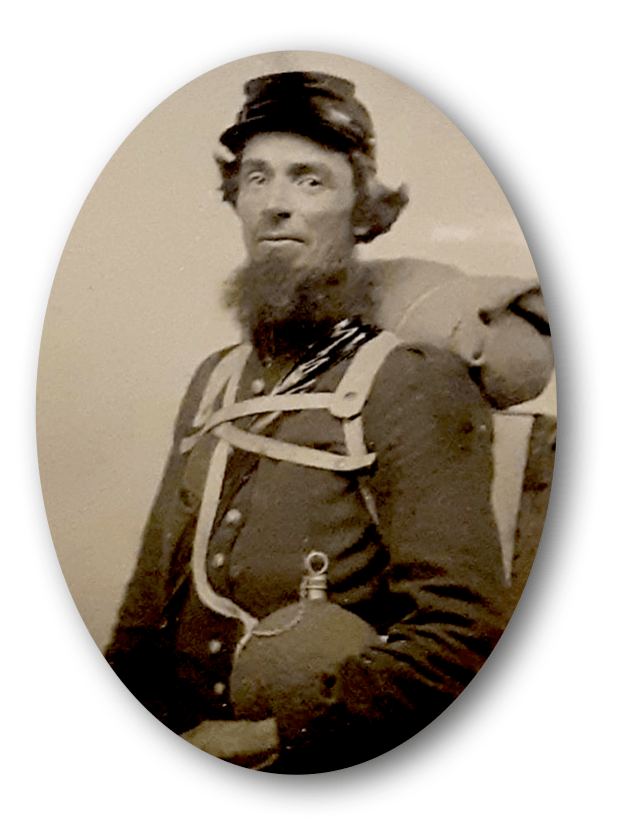
I could not find an image of Philip but here is John Murphy who served in Co. A of the 34th New York Infantry. He enlisted at the age of 54. (Jim Jezorski Collection)
The following letters were written by Philip J. Crewell (1840-1917) who enlisted for two year’s service on 1 May 1861 and entered Co. F, 34th New York Infantry as a corporal. The 34th New York Infantry, a two years regiment, were known as “The Herkimer Regiment,” and they served in the 2nd Corps, Army of the Potomac. They saw action at Yorktown; at Fair Oaks, where they lost 97 men, killed, wounded and missing; they lost heavily in the 7 Days Battles; at Antietam, they lost 154 men, killed, wounded, and missing; and they also fought at Fredericksburg and Chancellorsville. Philip was discharged on 30 June 1863.
On May 1, 1863, the day prior to the Battle of Chancellorsville, six companies of the regiment mutinied and refused to fight on the grounds that their two year enlistment terms had expired, although in fact this was still almost two months away. Brig. Gen John Gibbon, who commanded the division that the 34th New York was in, brought up the 18th Massachusetts and gave them orders to shoot the men of the 34th New York if they wouldn’t fight. The regiment reformed and served dutifully during the Second Battle of Fredericksburg two days later. On June 30, the 34th New York mustered out and the two year men went home, the remaining companies, who had signed up for three years of service, being transferred to the 82nd New York Infantry.
Philip’s first letter also contains an account of a mutiny that occurred in the ranks of the 34th New York Infantry—this one taking place a year earlier. Philip’s version of events appear markedly different than the official newspaper accounts which don’t quite tell the whole story. Philip’s second letter describes in great detail the Battle of Antietam and his third letter was written approximately three weeks before the Battle of Chancellorsville.
Philip was the son of John Crewell and Alida Luke of German Flatts, Herkimer county, New York.
Letter 1
Camp West Point, or 3 miles up the Pamunky River from West Point to Richmond May 12th 1862
J. J. Crewell,
Brother, I now sit down to answer your letter of the 6th. I was very glad to receive a letter from you and to hear from you all, Now as to the boys and myself, I have not been well for about 10 days but I can say that I am well today. My ailment was the measles working in my head. I had caught a very bad cold and it all seemed to work in my head till it broke and then I am all right in a day or two. The rest of the boys are in good health, hoping these few lines will find you all the same.
Now as to the warfare, there hasn’t any happened of late that I shall speak of more than we still mean to invade on after the rebels and get them out of existence as soon as possible. The show is now that they mean to make a stand 3 miles this side of Richmond but that will be of not much account for we have fources coming from three different ways on them and I don’t think that there will be much fighting for us to do. Our division is the third reserve adn the battle must be a hard one when we have to come in.
We move on towards Richmond today. There’s 60,000 ahead of us within but short distance of the rebels. The fight will soon open there. This thing has got to come to a close in short.
Hartford Daily Courant, 11 June 1862
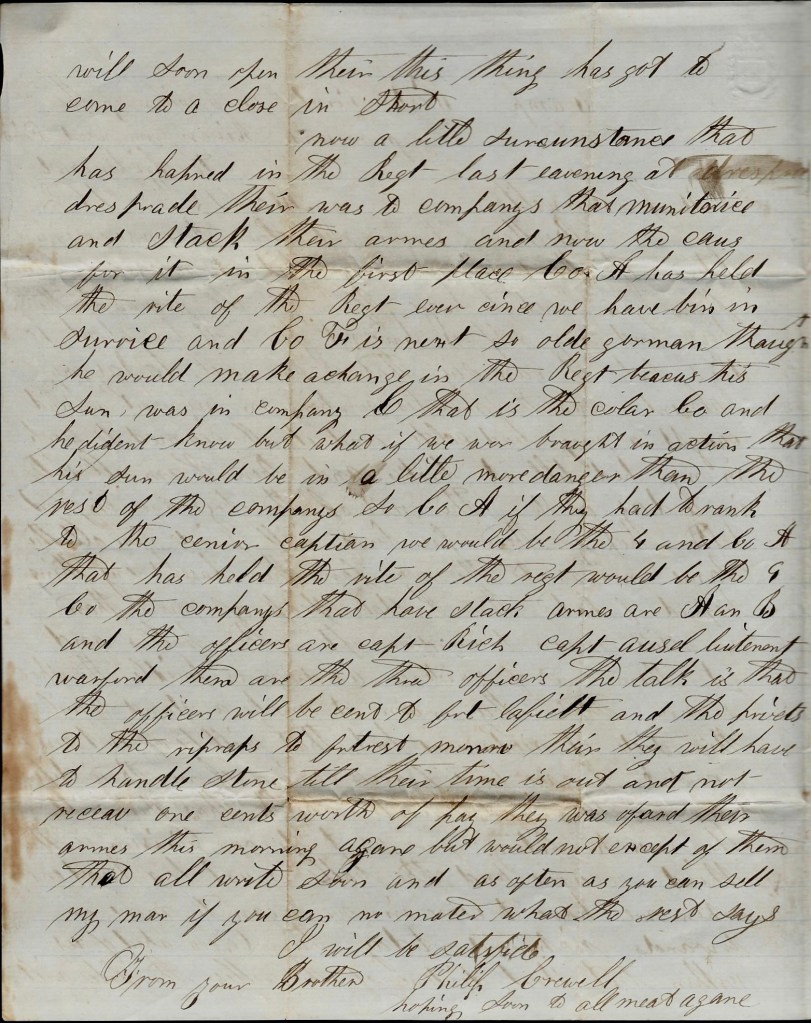
Now a little circumstance that has happened in the regiment. Last evening at dress parade, there was two companies that mutinied and stacked their arms. And now [I will tell you] the cause for it. In the first place, Co. A has held the right of the regiment ever since we have been in the service and Co. F is next. So Old Gorman 1 thought he would make a change in the regiment because his son [Richard L. Gorman 2] was in Co. C—that is the color company and he didn’t know but what if we were brought into action that his son would be in a little more danger than the rest of the companies. So Co. A if they had to rank to the senior captain, we would be the 4th and Co. A that was held to the right of the regiment would be the 9th comany. The companies that have stacked arms are A and B and the officers are Capt. [Davis J.] Rich [of Co. D], Capt. [William L.] Oswald [of Co. A], Lieutenant [Benjamin H.] Warford. These are the three officers. The talk is that the officers will be sent to Fort Lafayette and the privates to the rip raps to Fortress Monroe. There they will have to handle stone till their time is out and not receive one cents worth of pay. They was offered their arms this morning again but would not accept of them.
That is all. Write soon and as often as you can. Sell my [ ] if you can no matter what the rest says. I will be satisfied. From your brother, — Philip Crewell
Hoping soon to all meet again.
1 Willis Arnold Gorman (1814-1876) served as a Major in Gen. Lane’s regiment of Indiana Volunteers in the Mexican War where he was severely wounded at the Battle of Buena Vista. He was appointed governor of the territory of Minnesota in 1853 and later served in the Minnesota legislature. In the Civil War he began his service as the Colonel of the 1st Minnesota but was promoted to Brigadier-General of volunteers in September 1861 and commanded a Division that included the 34th New York during the Peninsula Campaign. According to Philip’s letter, the mutiny in the 34th originated from Gen. Gorman’s desire to have his son’s company’s letter designation changed which upset the seniority hierarchy of the officers in the regiment.
2 Richard L. Gorman was 26 years old when he enlisted on 27 April 1861 at St. Paul, Minn., to serve as a private in the 1st Minnesota Infantry. On 1 January 1862 he received a commission as 1st Lieutenant of Co. C, 34th New York Infantry. Richard was promoted to Captain of Co. A on 24 June 1862. He resigned his commission on 2 March 1863.
Clipping from the Cincinnati Daily Commercial. Monday, 2 June 1862
Letter 2
[Note: The following letter is from the private collection of Keith Fleckner and was offered for transcription and publication on Spared & Shared by express consent.]
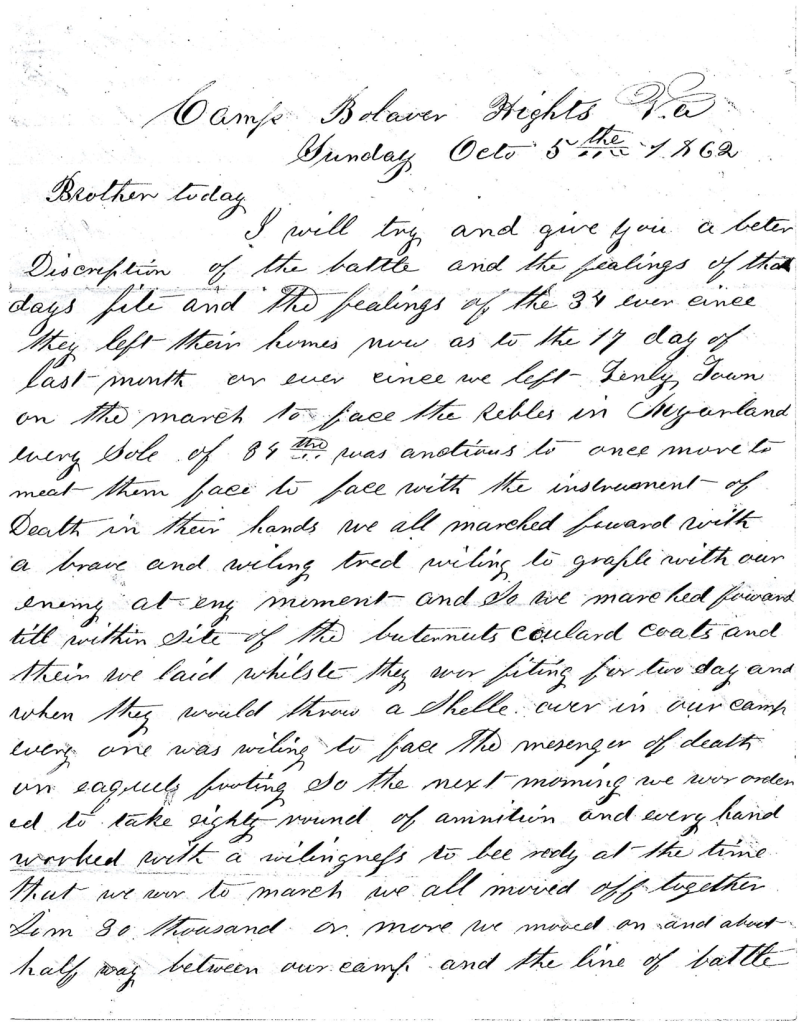
Camp Bolivar Heights, Virginia Sunday, October 5th 1862
Brother,
Today I will try and give you a better description of the Battle [of Antietam] and the feelings of that day’s fight and the feelings of the 34th [New York Infantry] ever since they left their homes. Now as to the 17th day of last month, or ever since we left Tenleytown on the march to face the Rebels in Maryland, every soul of the 34th was anxious to once move to meet them face to face with the instrument of death in their hand. We all marched forward with a brave and willing tread, willing to grapple with our enemy at any moment. And so we marched forward till within sight of the butternut’s colored coats and there we laid whilst they were fighting for two days, and when they would throw a shell over in our camp, everyone was willing to face the messenger of death on equal footing.
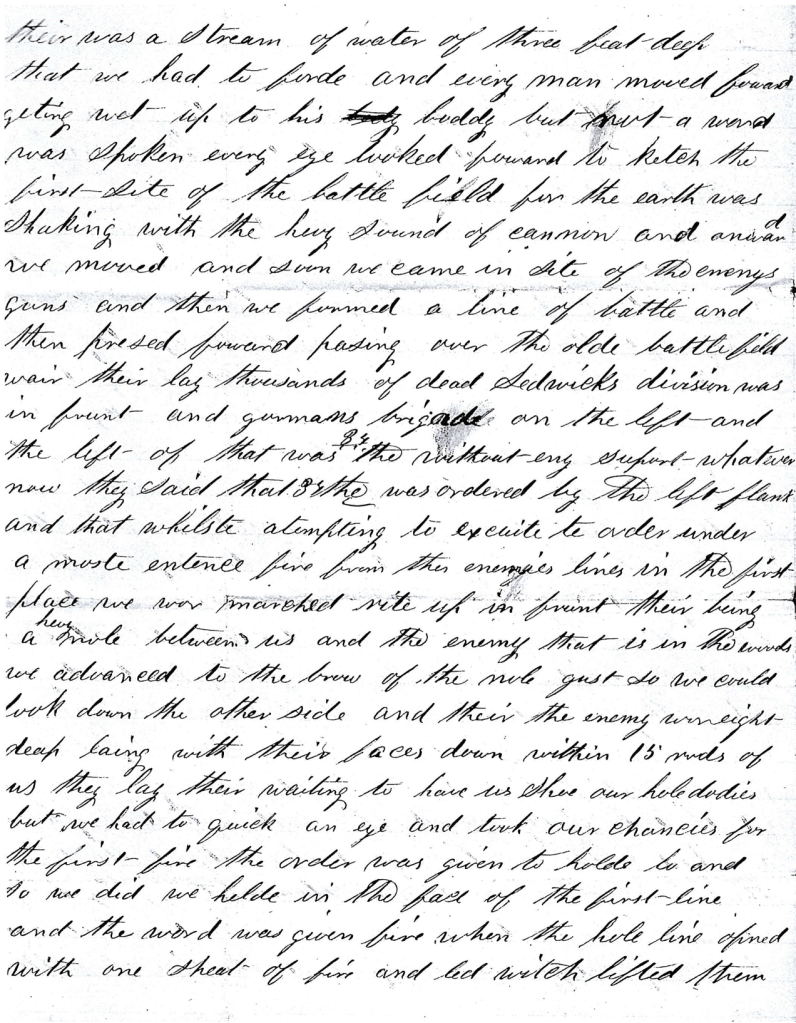
So the next morning we were ordered to take eighty rounds of ammunition and every hand worked with a willingness to be ready at the time that we were to march. We all moved off together—some 30 thousand or more. We moved on, and about halfway between our camp and the line of battle, there was a stream of water of three feet deep that we had to ford, and every man moved forward getting wet up to his body, but not a word was spoken. Every eye looked forward to catch the first sight of the battlefield, for the earth was shaking with the heavy sound of cannon. Onward we moved and soon we came in sight of the enemy’s guns, and then we formed a line of battle and then pressed forward, passing over the battlefield where there lay thousands of dead.
Sedgwick’s Division was in front and Gorman’s Brigade on the left, and the left of that was the 34th—without any support whatever. Now they said that 34th was ordered by the left flank and that whilst attempting to execute the order under a most intense fire from their enemy’s lines. In the first place, we were marched right up in front, there being a heavy knoll between us and the enemy that is in the woods. We advanced to the brow of the knoll just so we could look down the other side, and there the enemy were, eight deep, laying with their faces down, within 15 rods [80 yards] of us. They lay there waiting to have us show our whole bodies, but we had too quick an eye and took our chances for the first fire. The order was given to hold low and so we did. We held in the face of the first line and the word was given, “fire!” when the whole line opened with one sheet of fire and lead which lifted them from the dirt, but to fall again, for our aim was sure. Them that was left run out of the woods, or attempted to, but a good many bit the dust.
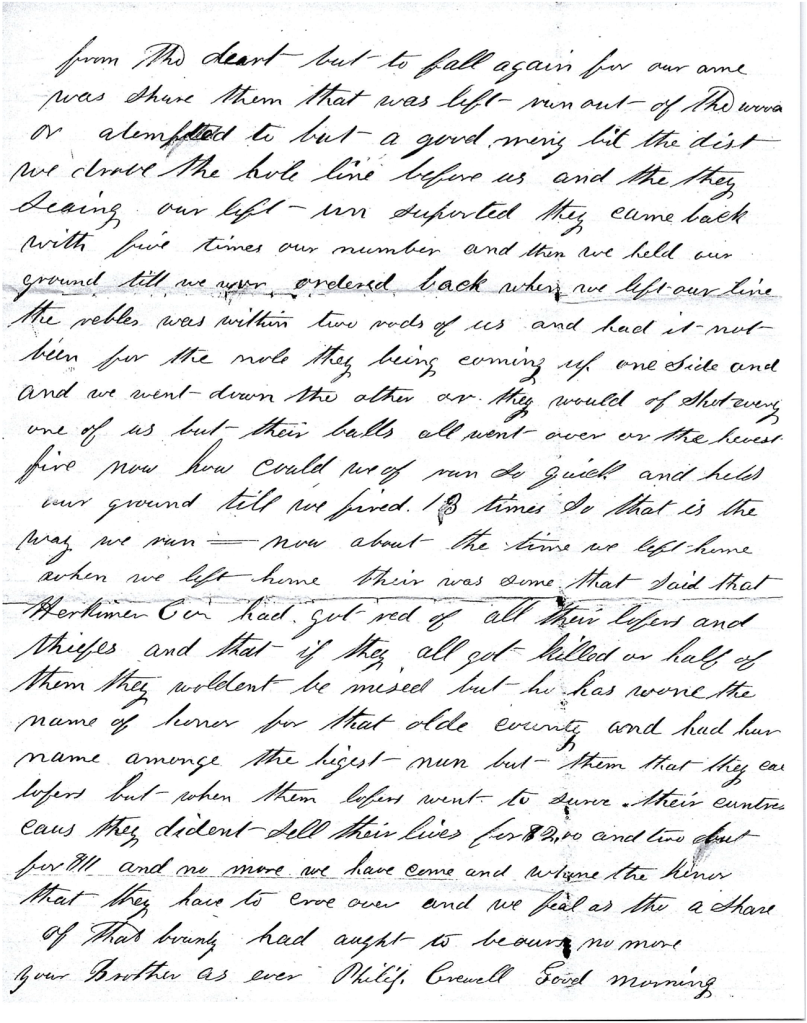
We drove the whole line before us and they, seeing our left unsupported, they came back with five times our number, and then we held our ground till we were ordered back. When we left our lines, the rebels was within two rods of us, and had it not been for the knoll, they being coming up one side and we went down the other, or they would have shot every one of us. But their balls all went over [our heads], or the heaviest fire. Now, how could we have run so quick and held our ground till we fired 13 times, so that is the way we run.
Now, about the time we left home. When we left home there was some that said that Herkimer Country had got rid of all their loafers and thieves and that if they all got killed, or half of them, they wouldn’t be missed. But who has won the name of honor for that old county, and had her name among the highest? None but them that they call loafers. But when them loafers went to serve their country’s cause, they didn’t sell their lives for $2.00 and two but for $11 and no more. We have come and won the honor that they have to crow over, and we feel as though a share of that bounty had out to be ours. No more.
Your Brother, as ever — Philip Crewell
Good morning
Letter 3
Camp Falmouth, Va. Thursday, April 10, 1863
Father & Mother, sisters and brothers,
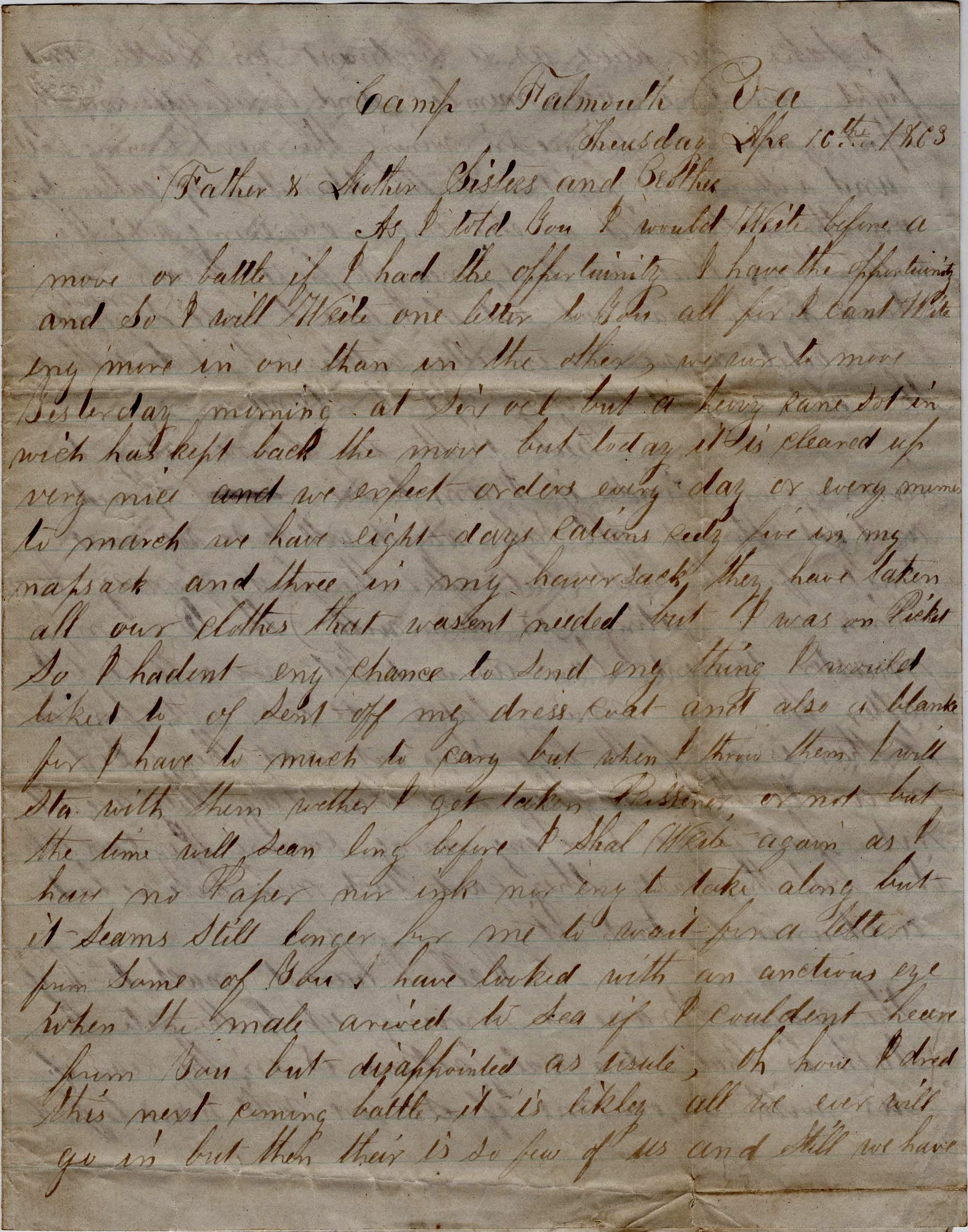
As I told you I would write before a move or battle if I had the opportunity and so I will write one letter to you all for I can’t write any more in one than in the others. We were to move yesterday morning at six o’clock but a heavy rain set in which has kept back the move. But today it is cleared up very nice. We expect orders every day or every moment to march. We have eight days rations ready. give in my knapsack and three in my haversack. They have taken all our clothes that wasn’t needed but I was on picket so I hadn’t any chance to send anything. I would liked to of sent off my dress coat and also a blanket for I have too much to carry but when I throw them I will stay with them whether I get taken prisoner or not.
But the time will seem long before I shall write again as I have no paper nor ink nor any to take along. But it seems still longer for me to wait for a letter from some of you. I have looked with an anxious eye when the mail arrived to see if I couldn’t hear from you but [I was] disappointed as usual.
Oh how I dread this next coming battle. It is likely all we ever will go in but then there is so few of us and still we have to take our place as a regiment in battle and fight five times our number, and by all appearance, they put great confidence in winning the next coming battle and without we fight with the determination of either dying on the battlefield or else conquer our enemy, why they will think that we don’t mean to fight because our time is so near out. But if I have to fight so much greater the odds as we have in other battles, why I don’t think the Old 34th will be very apt to stand.
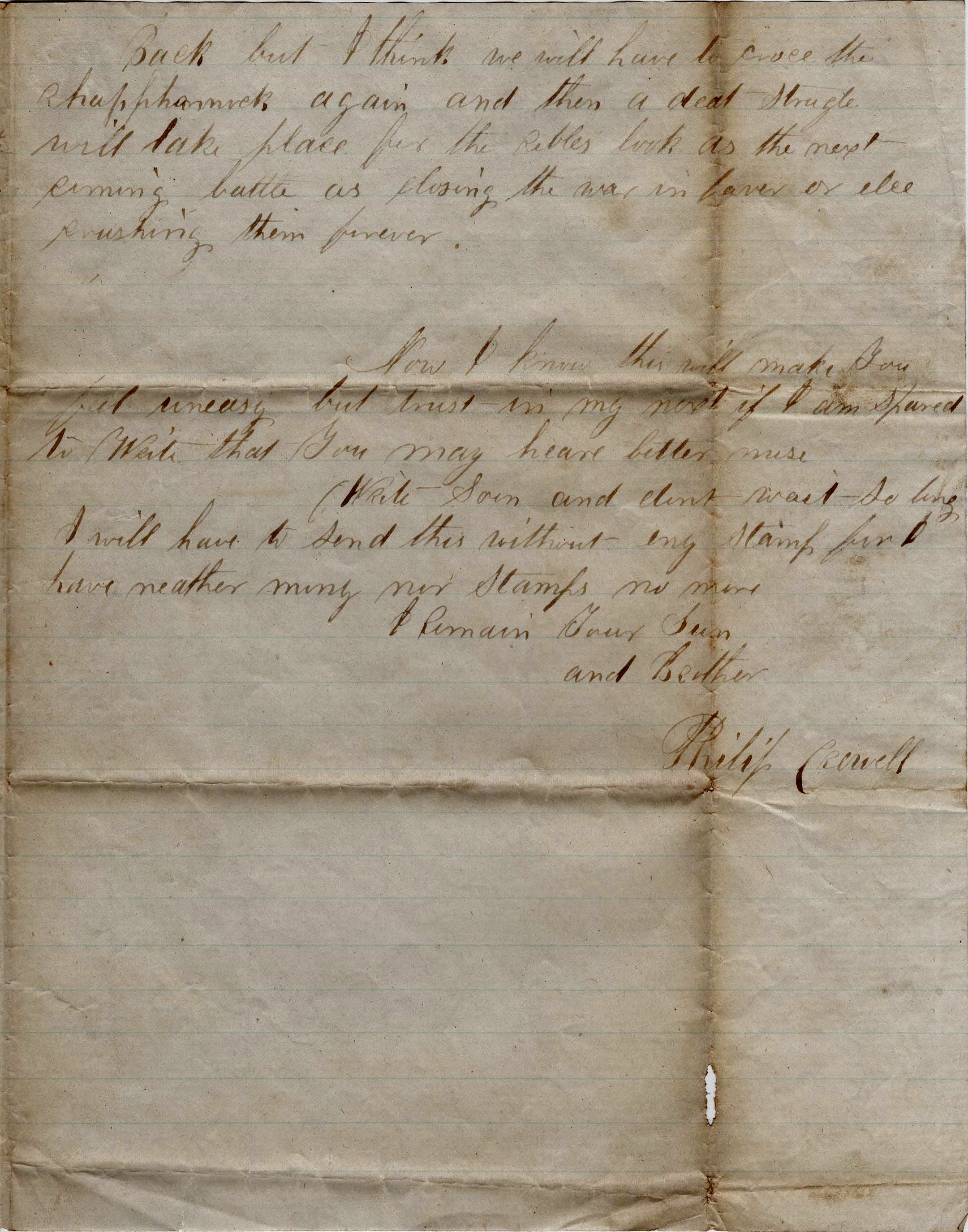
But, [what] is the use of me writing to have your minds if I am to be spared and get through all safe. Why it will be so we must trust for the best. But after the firsts of May. I think my fighting is done with. The damn pay master hasn’t been around yet nor will he till after the next battle is over with for fear if there is any of the Boys skins out and they court martial them if they have their pay, they are all right. But if we have any money coming, they can take it. But the bounty they can’t touch nor have we had a chance to touch it.
Well, I haven’t much to write. The wagon train is moving up to the right. The talk is that Stonewall Jackson is in the rear of us with 50,000 men. If so, we will have to fall back. But I think we will have to cross the Rappahannock again and then a death struggle will take place for the Rebels look at the next battle as closing the war in [their] favor or else [our] crushing them forever.
Now I know this will make you feel uneasy but trust in my next if I am spared to write that you may hear better news. Write soon and don’t wait so long. I will have to send this without my stamp for I have neither money nor stamps. No more. I remain your son and brother, — Philip Crewell
This letter is written by Andrew Durfee (1840-1865), the son of Stephen Durfee (1812-1886) and Sarah Marshall (1816-18xx) of Fall River, Newport county, Rhode Island.
Andrew mustered into Co. D, 1st Rhode Island Cavalry as a private in mid-December 1861. He was captured at Middleburg, Virginia. where the regiment was badly routed on 18 June 1863, and paroled on 23 July 1863 at City Point, Virginia. He was captured again at Sulfur Springs, Virginia, on 14 October 1863. He spent the next 18 months at Libby and Andersonville, being paroled 27 February 1865 at N. E. Ferry, North Carolina, only to die of pneumonia in the General Hospital in Wilmington, North Carolina within a month.
I could not find an image of Andrew but here is Lyman Aylesworth of the 1st Rhode Island Cavalry. Lyman barely escaped capture at the Battle of Middleburg (VA) on June 17/18, 1863 when most of his comrades were taken prisoner. His family donated his uniform, sword, enlistment papers and other various accoutrements to the Varnum museum in the 1920s. His shell jacket has been recently conserved. — at Varnum Memorial Armory Museum.
Transcription
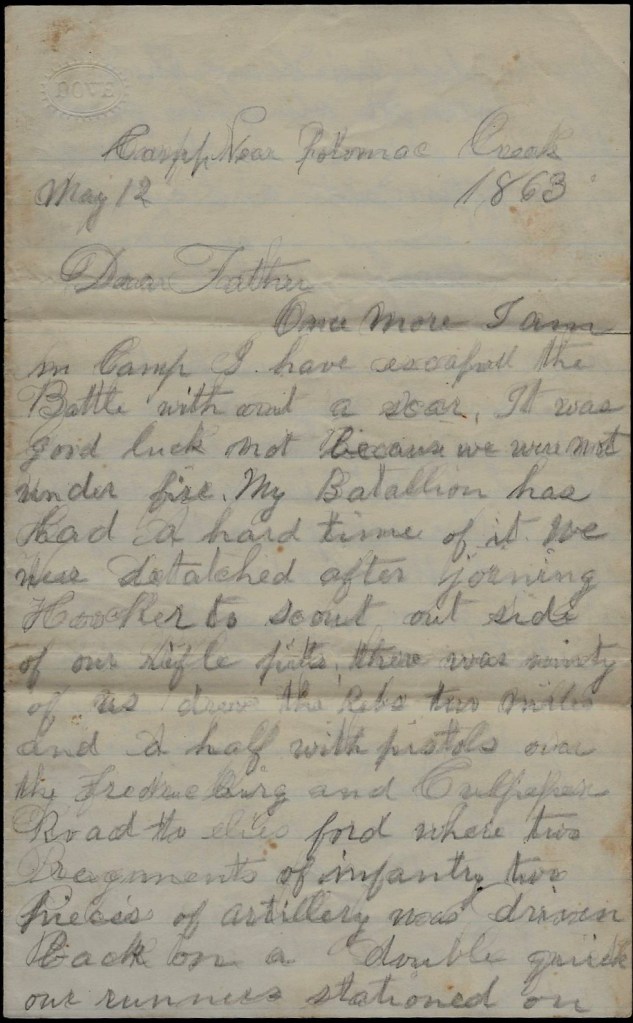
Camp near Potomac Creek May 12, 1863
Dear Father,
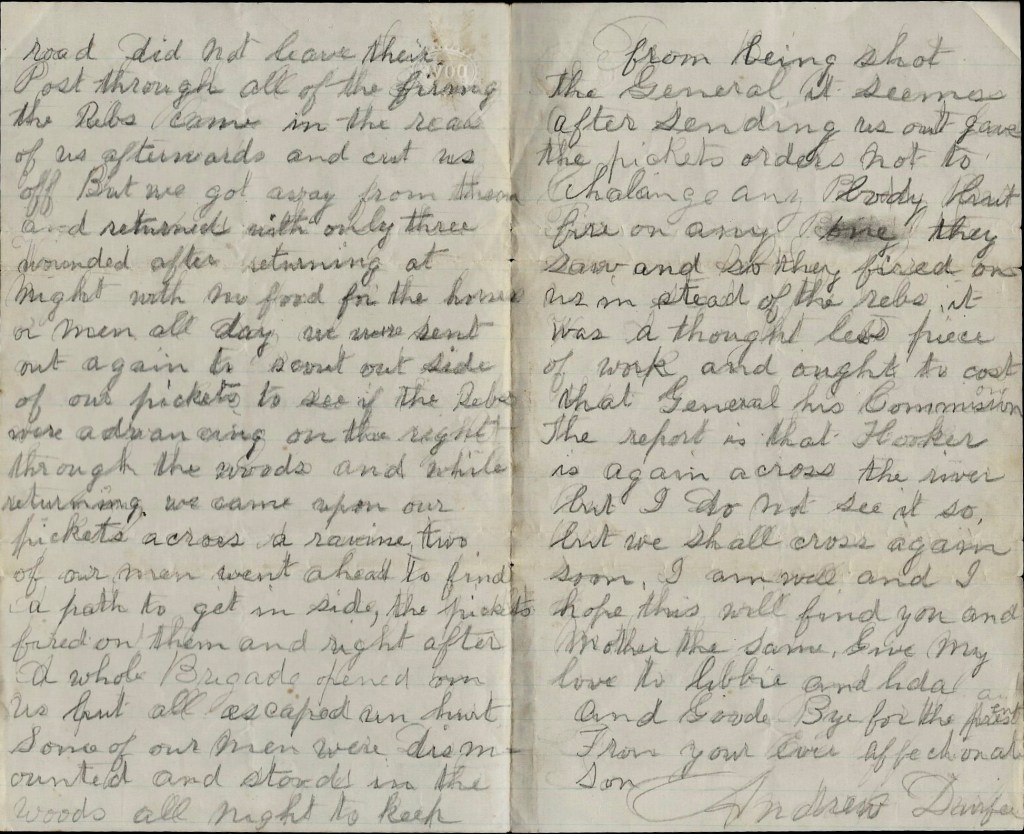
Once more I am in camp. I have escaped the battle without a scar. It was good luck [and] not because we were not under fire. My battalion has had a hard time of it. We were detached after joining Hooker to scout outside of our rifle pits. There was ninety of us drove the Rebs two miles and a half with pistols over the Fredericksburg and Culpeper Road to Ely’s Ford where two regiments of infantry [and] two pieces of artillery was driven back on a double quick. Our runners stationed on the road did not leave their post through all of the firing. The Rebs came in the rear of us afterwards and cut us off but we got away from them and returned with only three wounded.
After returning at night with no food for the horses or men all day, we were sent out again to scout outside of our pickets to see if the Rebs were advancing on the right through the woods and while returning, we came upon our pickets across a ravine. Two of our men went ahead to find a path to get inside the [picket line when] the pickets fired on them and right after, a whole brigade opened on us but [we] all escaped unhurt. Some of our men were dismounted and stood in the woods all night to keep from being shot. The General, it seems, after sending us out, gave the pickets orders not to challenge anybody but fire on anyone they saw—and so they fired on us instead of the Rebs. It was a thoughtless piece of work and ought to cost that general his commission.
The report is that Hooker is again across the river but I do not see it so. But we shall cross again soon. I am well and I hope this will find you and Mother the same. Give my love to Libbie and Lida and goodbye for the present. From your ever affectionate son, — Andrew Durfee
I could not find a wartime image of Wilber but here is an image of Sgt. Edgar A. Merchant of Co. E, 44th New York Infantry. Edgar was killed at the Battle of Gettysburg (Photo Sleuth)
The following letters were written by Wilber H. Merrill (1840-1925), the son of Leonard J. Merrill (1816-1899) and Eliza J. Judd (1815-1887) of Cattaraugus county, New York. Wilber enlisted on 15 September 1861 at the age of 21 to serve in Co. H, 44th New York Infantry (People’s Ellsworth Regiment). He was quickly promoted to corporal and again to Sergeant in mid-December 1862, just after the Battle of Fredericksburg. He survived his term of service and mustered out with his company on 11 October 1864 at Albany, New York.
“The 44th New York was an extremely battle-hardened unit, whose effort had been depended upon in many prior battles, and which would play a significant role two months after Chancellorsville at Gettysburg where it was heavily involved in the defense of Little Round Top. As noted in the letter, the 44th was supposed to be in the forefront of the battle at Chancellorsville, but the Confederate disruption of the Union plans led to their sustaining only modest losses. It turns out that their most significant action at Chancellorsville took place around the time this letter was written, when, as noted above, they were called upon to protect the retreat of the defeated Union troops. Hooker’s 130,000 troops faced Lee’s 60,000 at Chancellorsville, with the battle leaving a total of nearly 30,000 killed, wounded, or missing. The burning alive of Union wounded by the Confederates, described emotionally in this letter, has in fact been corroborated by historians.”
Wilber’s letter praises Hooker for his planning and execution of the campaign against Lee’s army but expresses a personal belief that “some of the generals got a little scared about the rear” and also shares a rumor that President Lincoln may have actually precipitated the retreat due to his concerns that the Nation’s Capitol might be vulnerable should his army be annihilated. I have not found any evidence that this was the case. Hooker kept his battle plan for the Chancellorsville fight closely guarded from even his Corps Commanders. Lincoln knew only vaguely what Hooker had in mind and wrote to him, “While I am anxious, please do not suppose that I am inpatient, or waste a moment’s thought on me, to your own hindrance, or discomfort.” [Lincoln to Hooker, 28 April 1863, in Basler et al., eds., Collected Works, 6:189-190.] The consensus of opinion among scholars today is that Fighting Joe Hooker lost Chancellorsville simply because he lost confidence in himself.
To read letters written by other members of the 44th New York Infantry that I have transcribed and published on Spared & Shared, see the following list. The letters by Anthony Graves are particularly detailed and interesting. His letter of 7 May 1863 gives an account of the Battle of Chancellorsville that is also excellent.
[Note: The following letter was found for sale on The Excelsior Brigade and was presumably transcribed by them so I cannot verify the accuracy of the transcription.]
Camp near Fredericksburg, VA November 25, 1862
Dear Parents,
I once more take a few spare moments to converse with you. I feel it a great privilege to take my pen to write to you. Although I cannot sit myself by you and converse with you but pen, ink and paper is next [best].
Well, we have been on the march nearly every day for the last month although we have not had any very hard marches. Imagine yourself packing up at three o’clock in the morning. Remember you are to take your whole kit of things—bed and bedding, crockery and eatables enough to last you three days—and then sit around in the cold November winds until perhaps 12 o’clock before you get started. And then you will have a little insight into a soldier’s chance of having his patience tried. Well here we are down near Fredericksburg where we were soon after we left Harrison’s Landing. The rebels occupy the town in force.
The report is that Burnside has given them fourteen hours to remove the women and children. They say that they are busy at it now. I don’t believe that they will stand and fight here but they may. I don’t pretend to know. Only sunrise will tell.
I received your letter of the 3rd. It found me well as usual. I had just written to you one before I received it and that is the reason that I have not written before. I am feeling tolerably well now and hope this may find you all the same. Mother, you wanted to know when I heard from Jane Austin. Well, I can tell you when I had the last letter from her. It was last spring. Just after we left Hall Hill. So you see I have not heard from her very lately.
I am glad to hear that Adelbert is a going to board at Normend this winter and go to school for I think that will be an easy plan for him. It seems that your family is going to be rather small this winter but it will make it all the easier for you too. Tell the boys for me that they must learn fast and improve their time for they don’t know the worth of a good education until they leave home and take up business for themselves. I have never seen or noticed the worth of a good education than I have here since I have been in the army.
Mother, the next time you see Mrs. Austin, please thank her for me and give her my best regards. And tell her that tea made me a quart of good tea and you better believe that it tasted good. I wrote in my other letter that you need not send me any money but we have not gotten any pay yet. I don’t know as they ever intend to pay us again. I tell you, we are seeing pretty hard times for tobacco. And I wish you would send me a dollar or two in your next. There is not much danger but that I would get it all right. Direct your letters as usual. It is always the same. They first come to Washington and then to the regular wherever it may be.
I have just gotten a letter from Dayton and I tell you, it done me lots of good. E. A. Nash has just received his commission papers as Captain of Co. D and so we have lost one of our best officers. He is one of the best officers in our regiment and I am glad to see him promoted for he deserves it. We are now under command of Lieutenant Colonel Conner. He has lately been promoted and I tell you, it makes a perfect fool of him. We don’t like him a bit. He is so awful strict. I wish that Colonel Rice would come back. He is just a whole solid man and we all like him first rate. I must close for this time. Please give my love to all of the friends and accept them yourself. Write soon. Yours truly, — Wilber H. Merrill
Letter 2
Camp near Falmouth [Virginia] December 25th 1862
Respected & much loved Aunt,
I wish you happy Christmas. I thought that you would like to hear from me after the battle so here goes. I have passed through another awful shower of lead & iron & escaped unharmed while many of my comrades have been mangled & torn in pieces by my side. This makes the 6th battle that I have been in & I think that I have great reason to be thankful that I have thus far escaped unharmed.
The 154th Regiment lays about three miles from here. Last Sunday Alva was over here to see me. I tell you, I was glad to see him & to see him looking so tough. He stayed all day & we had a first rate visit. He seems to like soldiering first rate. Yesterday morning as I was standing by the cook fire, someone came up behind me and slapped his paws on my neck with the power of an elephant. On looking around, who should I see but Uncle Barzilla. Maybe you think that I wasn’t some tickled & he seemed to be in the same fix. I believe that I never was as glad to see anyone as to see him. He stayed most all day with me & I tell you, we kept up a pretty brisk chatting. He looks as tough as I ever saw him. He looks a little black & smoky but that is not unusual for a soldier. He is just as full of his times as ever and says he like soldiering first rate.
They have not been in any battle yet & I hope they will not be obliged to for it is anything but a pleasant place to be on a battlefield & see the mangled forms and hear the dying and wounded. To hear them calling for water or to be carried off from the battlefield—it is enough to melt the hardest of hearts. We lay on the battlefield amongst the dead and wounded 36 hours & I tell you, we had to hug the ground pretty tight to keep our skulls whole.
Well, Aunt, today is Christmas & I presume you will have some nice fixing up. Now what do you suppose I am going to have for a Christmas supper? I am a going to have some fried beef & some potatoes, and some apple sauce and hard bread, and I think we shall enjoy that full as well as some would the best of suppers for it is something unusual with us. We can’t afford to live as high as that every day. I wish that it was so that I could call in and have a chat with you & help you eat a pan of green apples or take a piece of pie & cheese, but that is impossible now.
I don’t know but you will have to find you another man for I don’t know but what Uncle B. will fall in love with some of these quadroons down here. I can’t see what possessed him to come off down here and leave everything comfortable at home. He had just got things all fixed up comfortable.
In the last fight we lost about 50 killed and wounded. Our Lieutenant Colonel [Freeman Conner] had his right arm broken and out of the Dayton boys was John Mayer shot through the leg. The rest of the boys are usually well excepting [Charles] Hart Blair. He is not very well.
I wish you could peep into our little tent. We are fixed up pretty comfortable. We have got a little fireplace fixed in one side of our tent which makes us quite comfortable. I suppose you would take us to be as sorrowful a lot of fellows as there is on the face of the earth, but instead of that we enjoy ourselves first rate—only when we get sick and then things look and go pretty blue. Health is a great blessing to soldiers. And finely to anyone, if you think this worth answering, please write soon. Please give my love & best wishes to all & save a large share for yourself. I remain as ever, your most affectionate nephew, — Wilber H. Merrill
Address: W. H. Merrill, Co. H, 44th Regt. N. Y. S. V., Washington D. C.
Letter 3
Camp near Falmouth, Va. January 12th 1863
Dear Aunt,
Your letter of the first came to hand last evening & most gladly did I receive it & was glad to hear that you were all usually well. My health never was better than at the present & I am enjoying myself as well as could be expected under present circumstances. We are fixed up very comfortable now & would be very glad if they would let us stop here all winter. But we don’t expect any such good luck.
The weather here is very pleasant now. We have not had but very little rain this winter & but little snow. But there has been some pretty cold nights which pinches the soldiers up some. I have not been over to see Uncle B[arzilla] since I wrote. Alva was here New Year’s afternoon. We had just got into camp from a three days reconnaissance. We were tired and hungry and did not have much chance to visit. I think I shall go over and see them before many days.
Now, Aunt, I am going to tell you just what I think of this war. I think if the War Department would let the generals in the field have their way a little more and not do all the bossing themselves, I think the war would progress a great deal faster. Washington shelters some of our worst enemies. I think to burn Washington & hang some of the leaders would be a blessing to our country. I don’t think that all of our officers are true blue but I do think that we have some that would like to finish up the muss. I think the war might of been settled before this time had we had the right men in the War Department and also had true generals to lead us on to victory. Tis not the soldiers fault. They fight brave enough & are faithful enough. But I will tell you one thing, there is some that are getting their nest feathered pretty well & they don’t care how long the war lasts nor how many homes are caused desolate by its power. What care they for the sufferings & privations of the poor soldier as long as they get good salaries & good quarters furnished them.
I think as I always did about McClellan. He is the man who had ought to command the army and that is what every soldier will tell you here. They all have confidence in him and when he leads them into battle, they know that he is not leading them into a trap where slaughter is needless & where there is some chance for their lives. Look at Burnside’s Great Battle of Fredericksburg. What did it all amount to? I will tell you—the slaughter of 8 to 10 thousand men while their loss must of been light. He must of been very near sighted or else his judgment must of been very poor. Burnside is a good man in his place, but not to command as large an army.
The President’s [Emancipation] Proclamation I don’t think amounts to any certain sum for how is he a going [to] set the slaves free before he has them in his hands? Then the first place, he has got to catch them before he can free them. I say if we are fighting to free the slaves—as it seems that we are, [then] take them as fast as we can get them and arm them and let them help free themselves. Their blood is no better to be spilt than mine. I think things look rather dark now but I hope it will look brighter soon. I allow myself to think so at any rate. I can’t tell how soon we may be called on to fight another battle for you know that a soldier don’t know one day what will happen another. I don’t think there will be another fight right here but can’t tell.
I found John Mayer about 9 o’clock at night & helped carry him off from the field. He was shot through the leg just below the knee. They thought they could save his leg. [Israel] Luce and [Sylvanus] Markham have not been with us since we left Harrison’s Landing. Markham has been in Philadelphia since. I learn that he is a going to get his discharge. Luce is at Alexandria in the Convalescent Camp. Wall Johnson returned the 2nd of this month. The Dayton boys are scattering here now. Please [accept] my love & best wishes. Remember me to the children & friends. I remain as ever your affectionate nephew, — Wilber H. Merrill
Letter 4
[Note: The following letter is from the personal collection of Richard Weiner who provided the following description and authorized me to transcribe it and publish it on Spared & Shared.]
Headquarters 44th Regt. New York State Volunteers Camp near Falmouth [Virginia] May 6th, 1863
Remembered Parents,
You will see by the heading of this that we are back in our old quarters. We have met with another defeat. I received a letter from sister Jane & Mariett last evening & was very glad to hear that they were enjoying themselves as well as they appear to write. But I can’t say that I feel quite as well as common but I think I shall soon feel better. You need not worry any about me.
Well now I must tell you something about the battle. The fighting continued 3 or 4 days. Saturday and Sunday were the two hottest days of the fight. It raged very hard & the 11th Corps broke and caused pretty sad havoc. They did not fight worth a snap. The 154th [New York] Regiment are in that Corps. They lost about half of their regiment. Them that have seen them tell me that [Harvey] Inman, [William] Blair, [Horace N.] Darbee—Strickland Blair’s son-in-law, Barzilla, 1 Alva, and a good many more that I don’t think of now, they are missing—perhaps taken prisoners. I hope nothing worse. You need say anything about it for they may turn up yet. Perhaps they have got around to their regiment by this time.
Tuesday night, May 5th, the whole army recrossed the [Rappahannock] river, not because we were whipped there but because Sedgwick, commanding the 6th Army Corps, he crossed down below Fredericksburg & took the heights and then left one Brigade there to hold them and started up the river where we were fighting. The rebs turned his flanks and obliged him to retreat across the river so you see the rebs had possession of the heights. They say that orders came from Abe not to fight & endanger the capitol. If that is so, I would not care a bit if the capitol was burnt to the ground.
There was a great stand on both sides. I think it was a great deal heavier on the rebs than ours. We must of taken all of 5,000 prisoners. How many they took of us, I don’t know. The two-years men and nine-months men are leaving as fast as they can carry them away on cars. We think here that the army were not whipped but that some of the generals got a little scared about the rear. I never saw the army so eager for a fight as they were when they had thrown up breastworks. There were lots of them that wanted them to attack us but now things look rather dubious. I begin to think now if they put in a general smart enough to whip the rebs, they will do something to foil his plans. I never saw plans laid out better and carried out better than Hooker’s were as far as I know anything about it.
“Sunday, when the battle was raging the hottest, the rebs set the woods afire I suppose thinking that they could drive us out in that way. But think of the poor wounded lying there without the least chance of help. Can such men have any souls in them?”
Sgt. Wilber H. Merrill, Co. H, 44th New York Infantry, 6 May 1863
Sunday, when the battle was raging the hottest, the rebs set the woods afire I suppose thinking that they could drive us out in that way. But think of the poor wounded lying there without the least chance of help. Can such men have any souls in them? I don’t believe they have and they also fired a large brick building 2 and burnt some of our wounded there. Oh war—cruel war—when will it cease—inhuman worse than the savages dare be.
We were very lucky in this fight. We were put every time where they thought the rebs would come but were not engaged at all. Our pickets fired some, had one killed & five wounded in our regiment. There was not one touched in Co. H.
I sent my likeness a few days before we marched. I would like to know if you had received it & I also sent Heman $40. Please let me know if he has got that—that is, if you should happen to know. Tell Uncle Hiram that I don’t know any such man. Wall & Hart have gone over to the 154th Regiment. Probably I shall know more about them when they get back. If you can’t read this, I shant wonder any. If you can’t, send it back and maybe my nerves will be a little steadier then & I will try it over again. Tell the girls that I will write them a good long letter when I get a little leisure time. Please write soon. Write all the news. My love and best wishes to all & may God see fit to soon close this terrible, terrible rebellion. It almost makes my blood curdle to think of the battlefield.
Good afternoon. From your ever affectionate son, — Wilber H. Merrill
An artist’s rendering of the Chancellor House prior to the Battle of Chancellorsville
1 The roster of the 154th New York Infantry includes Barzilla Merrill who enlisted at the age of 44 as a private, and his son Alva Cole Merrill who enlisted as a private at the age of 18. Both served in Co. K together. According to a newspaper article, Barzilla was shot twice and died lated in the day on 2 May 1863. His son Alva was killed the following day. The Dayton Historical Society has a copy of the original letter written by Asst. Surgeon C. C. Rugg to Mrs. Merrill dated 30 May 1863 informing her of the death of both her husband and son.
Wilber Merrill as an old man
2 The Chancellor House was burned during the Battle of Chancellorsville. About mid-morning on May 3, General Joseph Hooker was standing on the porch of the Chancellor House when an incoming projectile struck a pillar which broke and knocked the general out. At the climax of the battle on May 3, Federal soldiers tried to crowd into the basement, where the Chancellor women were hiding, to escape the fighting. Lt. Col. Joseph Dickinson of Hooker’s staff routed them out and, later, conveyed the women to safety when the house caught fire. A letter written by an unidentified oficer in Hancock’s Division to the New York Times and published on 11 May 1863 mentions the Chancellor House as follows: “A large red brick house stood in the front and on the crossroads where our line of battle was formed which was used as the headquarters of Gen. Hooker, but afterward as a hospital. This they shelled and unfortunately set it on fire, causing a fearful scene. However, we succeeded in renoving our own men, The wounded rebels made piteous cries for help, but we were obliged to take care of our own men first.“
Letter 5
Headquarters 44th Regt. N. Y. S. V. Camp near Falmouth, Va. May 14th 1863
Remembered Aunt,
Thinking perhaps that you would like to hear from me & perhaps you have not heard from the 154th Regiment, I thought I would give you what little information I can about Uncle B[arzilla] & A’lva]. Giles Johnson was over here today & he says that they lost over half of their regiment. He said there was only 17 left in Co. K. All of the Dayton boys are missing but George Newcomb, George Hubbard, and Fred Wiegand—a Dutchman from the swamp. Giles says that some of the boys saw Uncle Barzilla fall and thought that he was killed. He saw Alva after they had fell back into the woods and he was all right then. He thinks he must of been taken prisoner. I hope nothing worse has befallen him & I hope that Uncle Barzilla may [be] nothing more than wounded. And I trust it may be so yet.
How many homes this war has caused to be homes of mourning—homes that were once happy are now homes of sorrow. They were in a pretty warm place. They were flanked & the troops ahead of them made it a great deal worse for them. It came near being the ruin of the whole army but the 9th Army Corps were sent in and stopped the bloody rebs. This was Saturday night that they broke through. So Sunday morning we were sent out near where the 11th Army Corps broke and we held the lines till the army recrossed the river. Our brigade were not engaged at all. We lost some 9 wounded in our regiment by shell and stray bullets that came whistling over our heads. We were gone from our camp about 10 days. We started with 8 days rations & 63 rounds of cartridges & I tell you, that made a pretty hard load for us to march under.
I presume that up north that you think that we have met with an awful defeat but we don’t feel so here. We think that the rebs have paid pretty dearly for their victory. We were not compelled to fall back up where we were fighting, but George Sedgwick who took the heights & also Fredericksburg was compelled to fall back across the river & I suppose that Hooker thought it best to recross for fear of his communications being cut off. I think the army has full confidence in Hooker as they ever had & that is considerable. I think things look full as favorable for closing the war as they ever have.
I wish that President Lincoln would draft 200 thousand & full up the old regiments to their full standard & just crowd this thing right ahead. If I have got to fight, I wish I could do it everyday till I get through. The ambulances went out across the river day before yesterday and I hope and trust that they may get some tidings of those that are missing. I can’t help but think of the folks at home that have friends missing. My heart aches for them but there is one thing to comfort them & that is to sustain a government that our forefathers fought to hold and sustain.
Hoping this may find you all enjoying good health, I will close by asking you to write soon. Please accept my love and best wishes. Also the rest of the friends. I remain as ever your affectionate nephew, — Wilber H. Merrill
The following letter was written by Capt. Frank Tileston Barker (1838-1890), the son of Tileston Adam Barker (1807-1879) and Semira Albee (1810-1891) of Westmoreland, Cheshire county, New Hampshire. Frank’s father, Tileston, served as Captain of the Westmoreland Light Infantry or “Old West Light” between 1847-1857. In the Civil War, Tileston was commissioned Captain of Co. A, 2nd NH Volunteers and fought in the Battle of Bull Run. Later he accepted a promotion to serve as the Lt. Colonel of 14th New Hampshire Regiment. After the war he served as NH state senator 1871-1873.
Frank Barker also served in the 14th New Hampshire, enlisting on 31 August 1862 as a private and receiving his commission as captain of Co. A on 9 October 1862. He survived the war, mustering out on 27 April 1864.
During the time that Frank was in the regiment, they were assigned duty as guards on the Upper Potomac, in the Defenses of Washington D. C, and at Camp Parapet near New Orleans. The regiment took part in a couple dozen engagements before the war ended but not until late July 1864 at Deep Bottom, Virginia.
Frank wrote the letter to Warren Snow Barrows (1824-1888) of Hinsdale, Cheshire county, New Hampshire. Warren was an active member of the Democratic Party in Hinsdale and served as chairman of the Board of Selectmen for many years. One of his last duties in the town was as depot master. See also—1863: Andrew Russell Barrows to Warren Snow Barrows.
Addressed to Warren S. Barrows, Esq., Hinsdale, New Hampshire
“Camp Adirondack” Washington D. C. May 6th 1863
Friend Barrows,
For many a day I have been thinking about writing you, and have at last attempted the undertaking. I suppose you have kept posted in regard to the movements of the 14th, being so many of the boys in the regiment [are] from Hinsdale. Poolesville [MD] was our residence during the past winter. From there five companies were ordered down the Potomac eight or ten miles but did not remain long before we was ordered to Washington where we now remain, doing nothing but acting as an escort to dead generals. How long we shall remain here is very uncertain.
“I suppose the North is all wrought up with excitement from the Army of the Potomac. Well they might be for a battle more “terrific” than ever was fought before on this side the Atlantic is going on near Fredericksburg and I hope the result will be such as to cause every loyal men to thank God for a stunning victory. A right damn thrashing of the Rebels by Hooker would be the grandest thing that could happen to this Nation and I pray that such may be the case.”
—Capt. Frank T. Barker, 14th New Hampshire, 6 May 1863
Judging from the thundering Hooker is making down the Rappahannock, I should presume our stay here would be short and sweet. I suppose the North is all wrought up with excitement from the Army of the Potomac. Well they might be for a battle more “terrific” than ever was fought before on this side the Atlantic is going on near Fredericksburg and I hope the result will be such as to cause every loyal men to thank God for a stunning victory. A right damn thrashing of the Rebels by Hooker would be the grandest thing that could happen to this Nation and I pray that such may be the case.
That there is not so many rebels in arms as there was a few days ago I know because they are coming in here as prisoners every day conducted by as many federal “bayonets” as is necessary to make them march through the “Yankee Capitol.” They do not look much as our soldiers so and one reason is because they have no uniform, They look more like “beggars” than soldiers, but there is no use of saying that they can’t fight.
How is public opinion up North? same as usual, I suppose—are death on the war and go in for settling this thing on “paper?” Better use the paper for wadding than to sit down and rough out a compromise on it. The time has not yet come and never will in my opinion when this government should kneel down and ask or even accept a “compromise” from such an enemy as oppose us—certainly not until every man is made a cripple and nothing is left to make him a staff. I have reason to believe that you sustain this war. I am glad it is so. It is sad that there is so many at the North that prefer power and party to country, government, and law. I can look over the errors of my rulers for I believe they are honest. I have no fear of the future of this country. It’s greatness and its glory will be ten fold more than it has ever been, “When war shall be no more.”
My health is good—much better than when I was on the Ashnelet. Father is quite well though damp weather gives him a touch of the rheumatism. I should be pleased to hear from you when convenient. Please accept for yourself and family my best wishes and believe me your friend, — Frank T. Barker
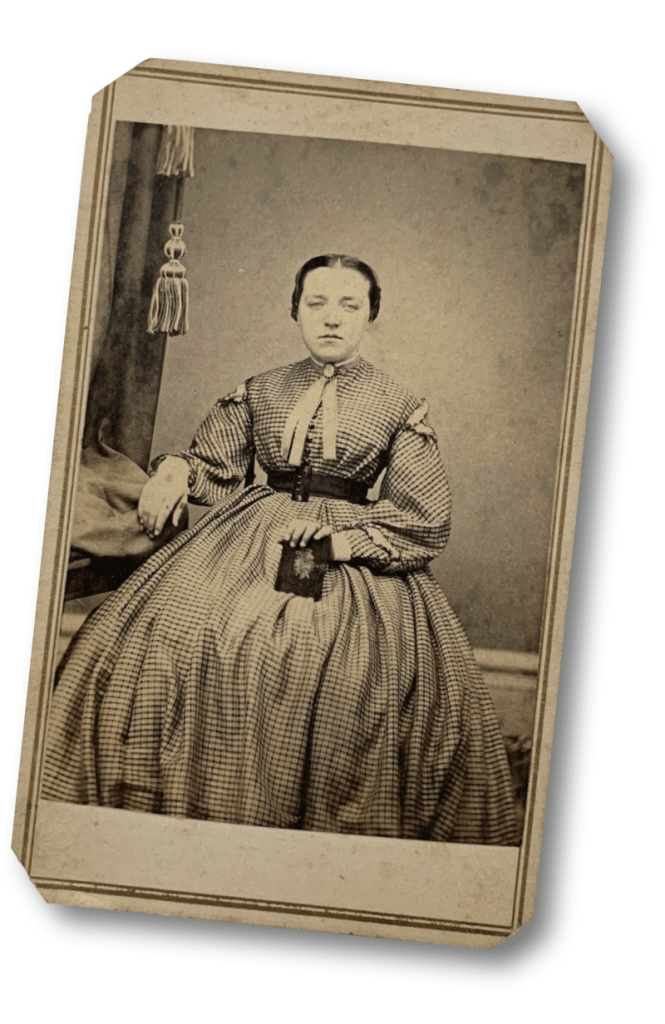
The following letter was penned by 19 year-old Martha Rebecca (Payne) Russell (1844-1924), the daughter of Harmon Payne (1819-1900) and Sarah Esther Hotchkiss (1820-1907) of New Haven county, Connecticut. One source gives the date of Martha’s marriage to Charles E. Russell (1840-1920) as 1 September 1862 though it appears the couple were living together prior to the June 1860 US Census in Hartford with a 6-month old daughter named Mary. Charles was employed as a “carriage trimmer.” During the war, when her husband was in the service, we learn from the letter that Martha earned a living hiring herself out as a housekeeper.
Martha’s husband volunteered in Co. A, 20th Connecticut with several other young men from Prospect. The company was raised in July 1862, and placed under the command of Colonel Samuel Ross, a former Regular Army officer. With him becoming brigade commander soon afterwards; for most of the war the regiment was commanded by its Lieutenant Colonel, William Wooster. Wooster was a businessman in civilian life and more popular than the stern disciplinarian Ross. The regiment became part of the 1st Division XII Corps and had its baptism of fire at the Battle of Chancellorsville. On May 2, 1863, at Chancellorsville, the unit suffered heavy casualties as they and other units of the XII Corps bore the brunt of Confederate General Stonewall Jackson’s surprise assault.
Martha’s letter to her cousin Augusta Baldwin (1846-1866) in Naugatuck was written in the days following the battle of Chancellorsville when she had yet to hear of his safety. A final page added to the letter shares the latest news received from the front.
Transcription
Addressed to Miss Augusta L. Baldwin, Naugatuck, Ct. Care of Monroe Terrell
[Prospect, Connecticut] Monday eve, May 11 [1863]
I am at last seated to answer your long-neglected letter. I thought of it everyday but when I first received it I was cleaning house and now, Oh! me the fighting seems to me I shall go crazy for the 20th Regiment was in the battle. I have seen only the death of two from that company but quite a number from other companies. I have not known nor done anything for the last week. I cannot work. It makes me just about sick. I forget what I am doing half of the time. Made up my beds yesterday morning without putting on any sheets and that is just about the way I work. I pity anyone that has got any friends in this war. It seems awful to me to have so many lives lost. I can tell you I am not much of a Republican. Be you?
Augusta, I cannot write so I will bring my letter to a close hoping to hear from you soon. You must excuse me for not writing more. If you knew how I felt, you would not blame me for writing such a short letter.
Yours in haste, — Martha
I could not find an image of Charlie but here is Pvt. Henry Cornwall of the 20th Connecticut Vols.
Augusta, I will try and write a little more as I have a few moments. In what regiment is Ellen’s husband in—with the nine-month’s men, is he not? And your brother L[ouis], where is he? and is he well? I suppose if my folks could hear Charlie was dead, they would rejoice with exceeding great joy as the first words mother said to me after we were married was, “I hope he will die or never come back.” Was not that a comfort to me? Think I cannot bear to think of the thing but still I am afraid what news I shall have. It is two weeks since I have heard from him—two weeks this morning since they marched. Now do write to me soon for I am very lonesome and sad. Such times I never see in my life as the last week has been. I wish I could see you. Give my love to all inquiring friends if I may chance to have any in that vicinity and reserve a share for yourself. Excuse writing and mistakes. Write soon, sooner, soonest. From your cousin, — Martha R. Russell
I advise you not to go to Waterbury to doing housework to be made nigger of for the big bugs. I have had enough of it. Don’t say anything to anyone what I wrote about my folks for they would hear of it and only make matters worse. Bad enough at the best, I think.
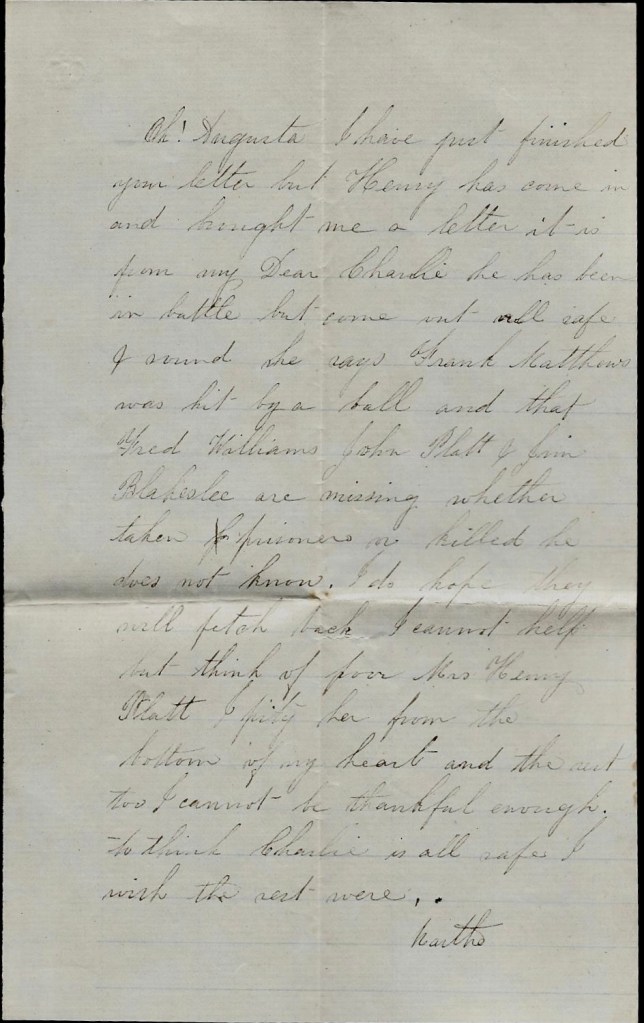
Oh! Augusta, I have just finished [writing] your letter but Henry has come in and brought me a letter. It is from my dear Charlie. He has been in battle but come out all safe & sound. He says Frank Matthews 1 was hit by a ball and that Fred Williams, 2 John Platt, 3 & Jim Blakeslee 4 are missing. Whether taken prisoners or killed, he does not know. I do hope they will fetch back. I cannot help but think of poor Mrs. Henry Platt. I pity her from the bottom of my heart and the rest too. I cannot be thankful enough to think Charlie is all safe. I wish the rest were. — Martha
1 Sergeant John “Frank” Matthews of Prospect, CT, was wounded on 3 May 1863 and was discharged for disability on 15 May 1864.
2 Frederick H. William of Prospect, CT, died on 27 May 1863 of wounds received at the Battle of Chancellorsville.
3 John H. Platt of Prospect, CT, survived Chancellorsville but was wounded later in the war on 19 March 1865 and discharged for disability on 22 June 1865.
4 James (“Jim”) Blakeslee of Prospect, CT, was transferred to the Invalid Corps and died in a hospital on 30 April 1864.
This letter was written by Francis (“Frank”) J. Deemer (1838-1915) who enlisted In August 1862 at Scranton, PA to serve nine months in Co. K, 132nd Pennsylvania Infantry. Frank was promoted to Sergt. Major on 24 January 1863. He survived his tour of duty with the 132nd PA and went on to serve as 1st Lt. in Co. G, 187th Pennsylvania.
This letter was written just days before the Battle of Chancellorsville in which Deemer’s regiment was held in reserve for the first two days but was active at the front on May 3 and 4, losing about 50 men killed and wounded. On May 14, the regiment’s term expired and they were mustered out.
In his letter, Frank mentions receiving badges from his sister. These were probably home-made Corps Badges as were introduced by Gen. Joe Hooker, commander of the Army of the Potomac. The 132nd Pennsylvania was in the 3rd Brigade of the 3rd Division of the 2d Corps. Their badge would have been a blue trefoil.
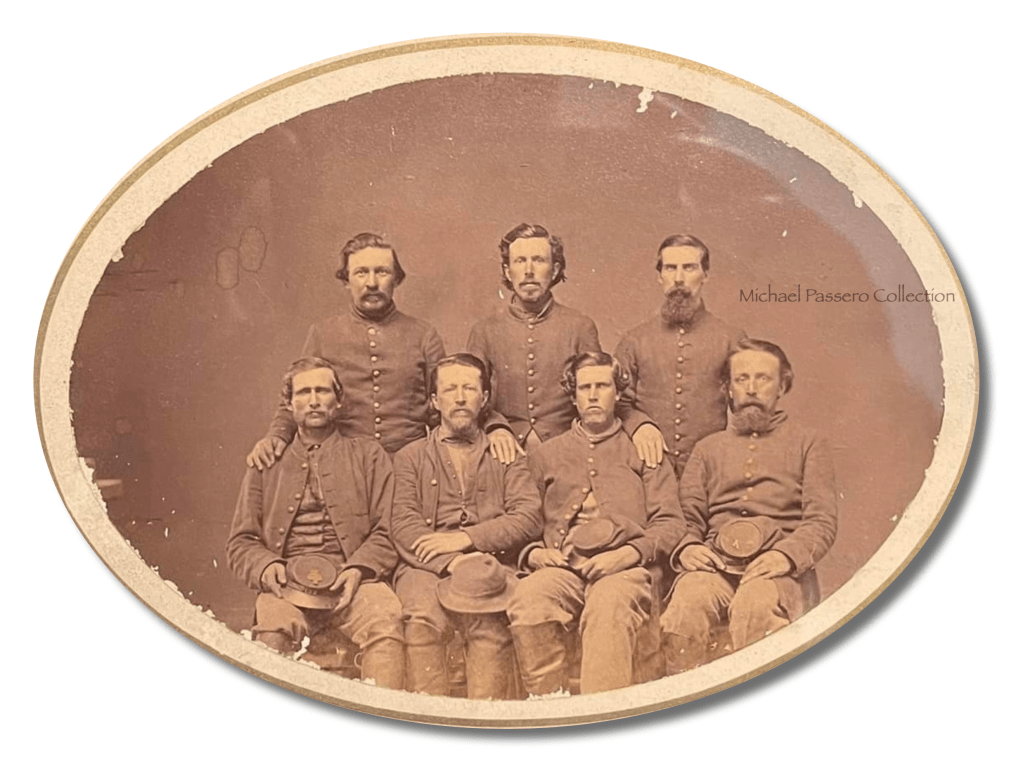
A large albumen print of seven veterans of the 132nd Pennsylvania, taken between 17 & 24 May 1863 in Harrisburg while they waited to be mustered out of the service. The soldier at bottom left has 132 affixed to the chinstrap of his forge cap as well as a first issue Second Corps badge on top. The soldier at bottom right has a Co. K letter on the top of his forge cap. Presumably all seven soldiers were members of Co. K (Scranton Guards) who were recruited in the Borough of Scranton in the late summer of 1862. The 132nd Pennsylvania was a nine-month regiment that saw heavy combat in three major engagements as part of the Second Corps: Antietam, Fredericksburg, and Chancellorsville. Michael Passero Collection.
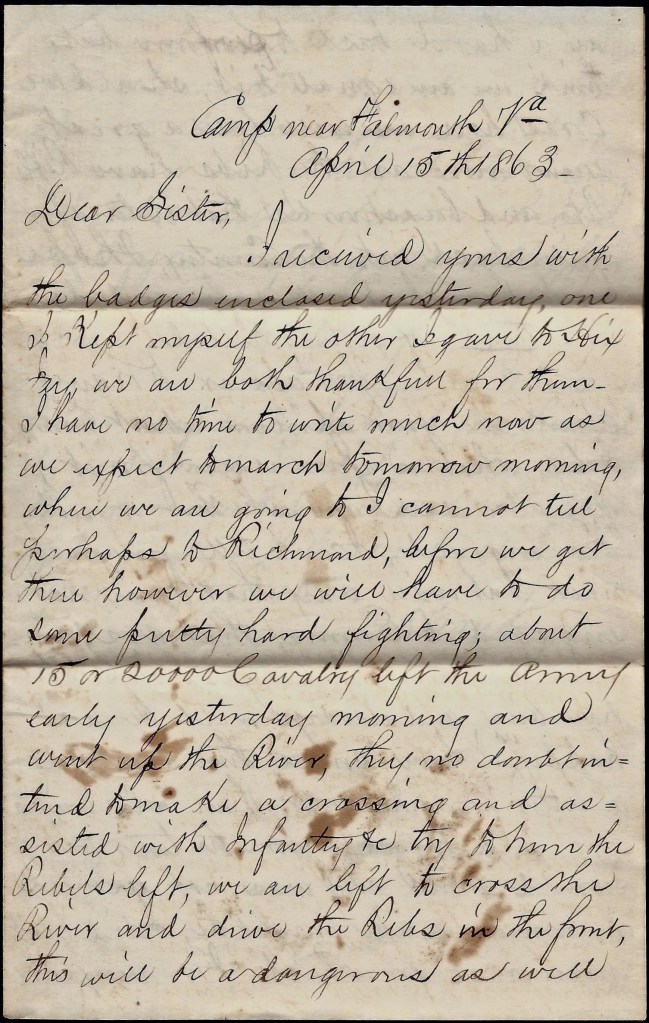
Transcription
Camp near Falmouth, Virginia April 15th 1863
Dear Sister,
I received yours with the badges enclosed yesterday. One I kept for myself; the other I gave to Hix Jay. We are both thankful for them.
I have no time to write much now as we expect to march tomorrow morning, Where we are going to I cannot tell—perhaps to Richmond. Before we get there, however, we will have to do some pretty hard fighting. About 15 or 20,000 cavalry left the army early yesterday morning and went up the river. They no doubt intend to make a crossing and assisted with the infantry &c. try to turn the Rebels left. We are left to cross the river and drive the Rebs in front.
“Should we cross here, we will lose a great many men as the Rebs have rifle pits and breastworks that extend for miles back into the country. I hope o get through it all safe and do not think of getting killed.”
—Frank Deemer, Co. K, 132nd Pennsylvania, 15 April 1863
This will be a dangerous as well as a hard task to perform but I think we are equal to it. Should we cross here, we will lose a great many men as the Rebs have rifle pits and breastworks that extend for miles back into the country. I hope to get through it all safe and do not think of getting killed.
You appear to have changed your opinion about Emma Goby. What is your reason for it? You also ask me whether or not I’m engaged. I can’t tell you just now but will say that I am not engaged to Emma. That was canceled some time ago. I hope she has been and always will be as happy as I have since then. I received a letter from her more that six weeks ago and to judge from the tenor of it, I would think she was not as well in mind as she might be. I did not answer it for which I’m very sorry. If you see her, tell her that I’ve had scarcely any time to write and that she must excuse me for neglecting to answer her letter. She has an old silver dollar of mine which I wish you would get and keep for me. I gave to her almost five years ago to keep for me.
I answered John’s letter last week but not Mother’s and do not think I will have time previous to our move but will write the first opportunity.
With love to all, I remain your affectionate brother, — Frank
William Henry Holmes, 6th Vermont Infantry (Ed Italo Collection)
This letter was written by William Henry Holmes (1844-1912), the son of Lewis Holmes (1817-1901) and Lucinda Clark Pope (1814-1897) of Caledonia county, Vermont.
William enlisted in August 1862 and was mustered into Co. E, 6th Vermont Infantry where he served until 2 January 1864. Ten years after the war ended, William married Frances Melanie Goddard and the couple made their home in DuPage county, Illinois, where William made his living as a clergyman.
After the Battle of Fredericksburg, the 6th Vermont went into winter quarters at White Oak Church, where it remained until camp was broken for the Chancellorsville movement in the spring of 1863. In the Chancellorsville campaign of 1863, the regiment did gallant service at Marye’s Heights, and especially at Bank’s Ford, where, in a gallant charge, it drove back the enemy and captured 250 prisoners—a charge that William mentions in the following letter. Curiously, from William’s fresh perspective, he characterized the Battle of Chancellorsville as “the greatest victory that the Army of the Potomac ever won” and though the passage of time has characterized the battle as a defeat, it may have indeed been one of the best fought battles by the Army of the Potomac up until that date.
Transcription
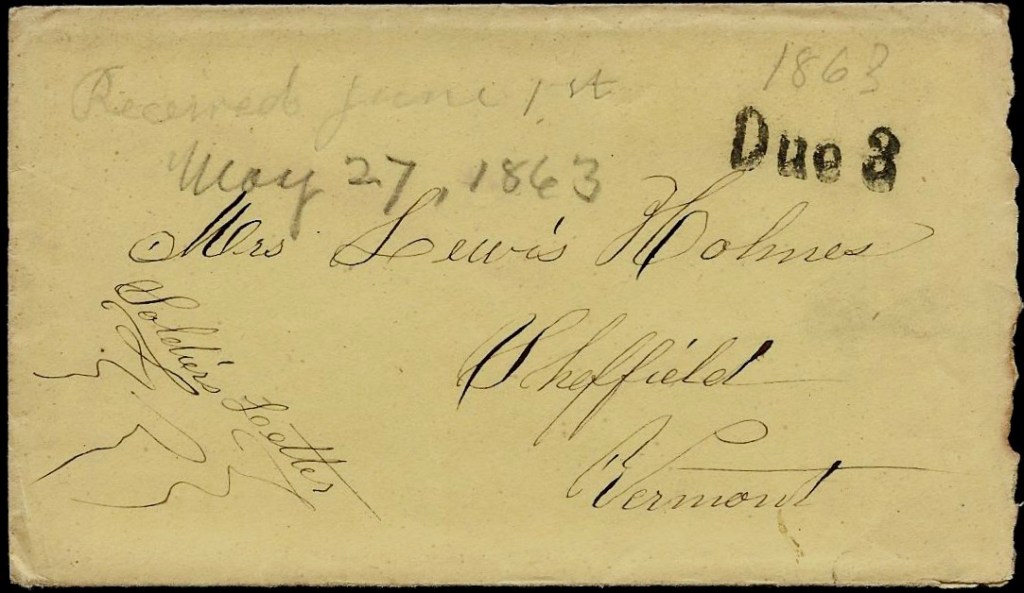
Addressed to Mrs. Lewis Holmes, Sheffield, Vermont
Camp near White Oak Church, Virginia Wednesday, May 27th 1863
Dear Mother,
I received yours of the 17th in good time and with it the stamps and envelopes which I was very much in need of. My box has not come yet. What the reason is, I do not know. Other boys are getting boxes every now and then of maple sugars sent since mine was.
We have to drill two hours per day now—one in the morning & one at night. We drill the skirmish & bayonet drill. There is now present for duty in this company 16 privates, two sergeants, 5 corporals—one of which is corporal of pioneers, and another is a tailor. So you see that we have not got a very heavy company just now.
Oh, our captain Thomas Clark is in North Carolina in the Signal Corps so the command comes on Lieut. [William Joseph] Sperry—a fine little fellow who looks as though he was about 17 years old.
Julia wrote that Mrs. Lougee thought that George [Lougee] was a nine-month’s man. George says that she knows that he is in for three years and that his folks would not try to make her think that [he] was a nine-month’s man.
I see that you think we got whipped over there [at Chancellorsville]. Not so. [It] is the greatest victory that the Army of the Potomac ever won and as to all of the troops not being engaged, it is not so. They were all in & seen hard fighting but the 1st Corps that passed us Saturday to help Hooker but was too late. If they had crossed here with the 6th Corps, we should not be this side of the river & don’t you see that by engaging them here and drawing their force from the south that they have gained a victory there & in my opinion the Rebs never was so hard up as today.
But don’t think the Rebs starved yet for they have enough to eat and as good as we get. I should like to [hear] a man say that he wished the Capitol burned to the ground. Why do not the folks at the North take care of such traitors? Tell Frank to write all about the bees.
I did not mean that I came any nearer to being taken prisoner than any of the rest. It was the Vermont Brigade that saved the Corps. If the Rebs had been successful in that charge, they [would] have gone to the river and taken the whole of us.
Father spoke of my clothes. I have my 2nd pair of pants, have worn out one blouse. The rest of my clothes are good. All the fault there ever was in my boots was that they was too narrow for marching. If I was on a summer campaign, I should throw them away and wear shoes. We are all well. (Tophan is well). Goodbye, — Wm. H. Holmes


















 Spared & Shared 23