
Category Archives: Camp Convalescent

1863: Samuel Beach to his Sister

This letter was written by Samuel Beach (1827-1892) of Co. B, 27th Connecticut Infantry—a nine-months regiment. He was mustered in as a corporal on 3 October 1862 and mustered out on 27 July 1863.

According to the Samuel Beach Papers at the Robert S. Cox Special Collections (UMass Amherst Libraries), Samuel Beach was born in Branford on 27 July 1827, the son of Samuel Beach (17xx-1828) and Mary Barker (18xx-1881). In March 1851, he married the elder daughter of Increase Cooke (1807-1847) and Harriet Delia Griffing (1812-1849).

“On August 31, 1862, Samuel Beach was drafted into the 27th Connecticut Infantry, a nine-month’s regiment noted as much for the hardships of its service as its brief duration. Part of the First Division, Second Corps of the Army of the Potomac, the regiment was thrown into the toughest part of three of the most momentous battles of the eastern theater. At Fredericksburg in December 1862, the 27th sustained 110 casualties during the failed assault on Stonewall Jackson’s forces on Marye’s Heights. After a harsh winter spent in the mud along the Rappahannock gave way to spring, the 27th was swept by illness. Beach was among several who required hospital care to recuperate, and he was thus not present at the Battle of Chancellorsville, when eight of the regiment’s ten companies were taken prisoner. Two months later he was in a convalescent camp when the regiment’s remaining companies, much reduced, sustained fifty percent casualties the Battle of Gettysburg, fighting in the Wheat Field.

Samuel Beach’s Civil War letters [at UMass, Amherst] cover the bulk of his nine-month’s service, from the early days serving in the defenses around Washington, D.C., through the turbulence of Fredericksburg and Chancellorsville. Addressed to his wife Harriett, the letters are exceptionally literate and richly descriptive, with two excellent letters detailing his experiences at Fredericksburg, and several on the long winter that followed and the infamous Mud March. After the war, probably in the early 1880s, Beach wrote out a stunning 17 page account of his memories of Fredericksburg, using free pages in the center of an ledger containing accounts of labor of his fruit farm (box 2:4). The exceptional detail and energy of the account suggests he may have been working from a diary or contemporary notes that have not survived.”
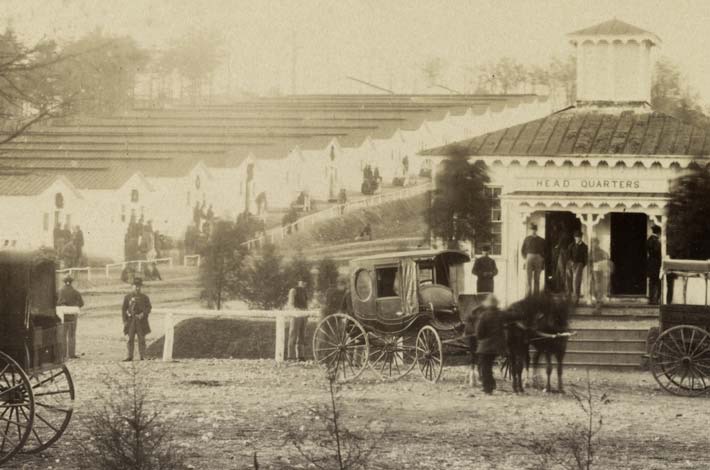
Camp Convalescent near Alexandria, Virginia

T R A N S C R I P T I O N

Camp Convalescent, Alexandria, Virginia

Saturday afternoon, July 18th 1863

Dear Sister,

Your letter dated July 17th and mailed the 15th [reversed dates], I received this noon. I did not much expect another though I knew there was time enough for a letter or two. Sloat, captain of Co. A, has arrived in camp today. I understand Lays [?], the colonel, is in Washington yet. If that is the case, we probably shall not get home before the last of the week. Most of us are out of all manner of patience with the colonel for not making more efforts to get us home under the circumstances. Still he may be doing more than we think for, I think I might have got a furlough and gone home a few days sooner by the assistance of Elton. But I would have had to have paid half of my traveling fee, and the time was so short I did not think best, our time was so near out.

I don’t think I could have got a discharge which would have given me my pay and transportation home. It would have taken till our time was out probably to have worked it through. In short, I don’t think my discharge would be granted when the time was so near out. I should have been of little use at home.

Am improving pretty fast now here & I rather prefer coming home with the regiment, all things considered now. If I were in a hospital, I might be transferred to New Haven perhaps, but this is a Convalescent Camp, not a hospital. Though there are a great many in the hospitals not half as bad as a great many here, they are classified differently and have to be governed accordingly.

We get the news every day, soon after published. I have had none (papers) from home a long time. You said nothing about the raspberries. Are you picking any now? I hope there will be a few left when I get home. My love to Ma, Mother, and all the rest. Hoping to be home soon, I remain your affectionate brother, — S. Beach
1863: H. Alvin Hitchock to Otis Hitchcock

The following letter was written by H. Alvin Hitchcock (1841-1864, the youngest son of Otis Hitchcock (1795-1873) and Sarah Delano (1796-1877) of Randolph, Cattaraugus county, New York.

I could not find an image of Alvin but here is one of Eason W. Bull who served in Co. D, 154th New York Infantry

Alvin was 21 years old when he enlisted in August 1862 as a private in Co. A, 154th New York Infantry. When he enlisted, he was described as a brown-haired, blue-eyed, single farmer. The 154th New York was recruited in the counties of Chautauqua and Cattaraugus, organized at Jamestown, mustered into the U. S. service on Sept. 24-26, 1862 and left the state shortly afterward. They were assigned to the 1st brigade, 2nd (Steinwehr’s) division, Howard’s 11th corps, which was stationed during the fall of 1862 in Northern Virginia in the vicinity of Centerville. The regiment went into winter quarters with the corps at Stafford, Va., and suffered severely in the disaster which befell the corps at the Battle of Chancellorsville, losing 32 killed, 81 wounded and 115 captured and missing. 

In his letter, Alvin gives a detailed eyewitness account of the Battle of Chancellorsville, from the time that his company helped the 15th New York Engineers lay the canvass pontoon bridge over the Rappahannock river at Kelly’s Ford, until his capture on the day after Stonewall Jackson’s flank attack that rolled up the 11th Corps. From his letter we learn that he was wounded while standing with others of the 154th New York on the “Buschbeck line” which held back Jackson’s men for over an hour while the high command attempted to stem the chaos of the fleeing soldiers.

For an excellent article describing the events Alvin witnessed and wrote about in his letter, readers are referred to Baptism of Fire: The 154th New York in the Chancellorsville Campaign by Mark H. Dunkelman published on American Battlefield Trust on 1 August 2022. I should also note that Dunkleman devoted an entire chapter to Alvin Hitchcock’s sad story in his book, War’s Relentless Hand: Twelve Tales of Civil War Soldiers (LSU Press, 2006)….After Alvin was exchanged and rejoined the 154th New York, he began to show signs of insanity. He was sent to the Government Hospital for the Insane at Washington, and from there–after a brief visit home–to the New York State Lunatic Asylum in Utica, where he died on July 13, 1864, of “Exhaustion–acute Mania.

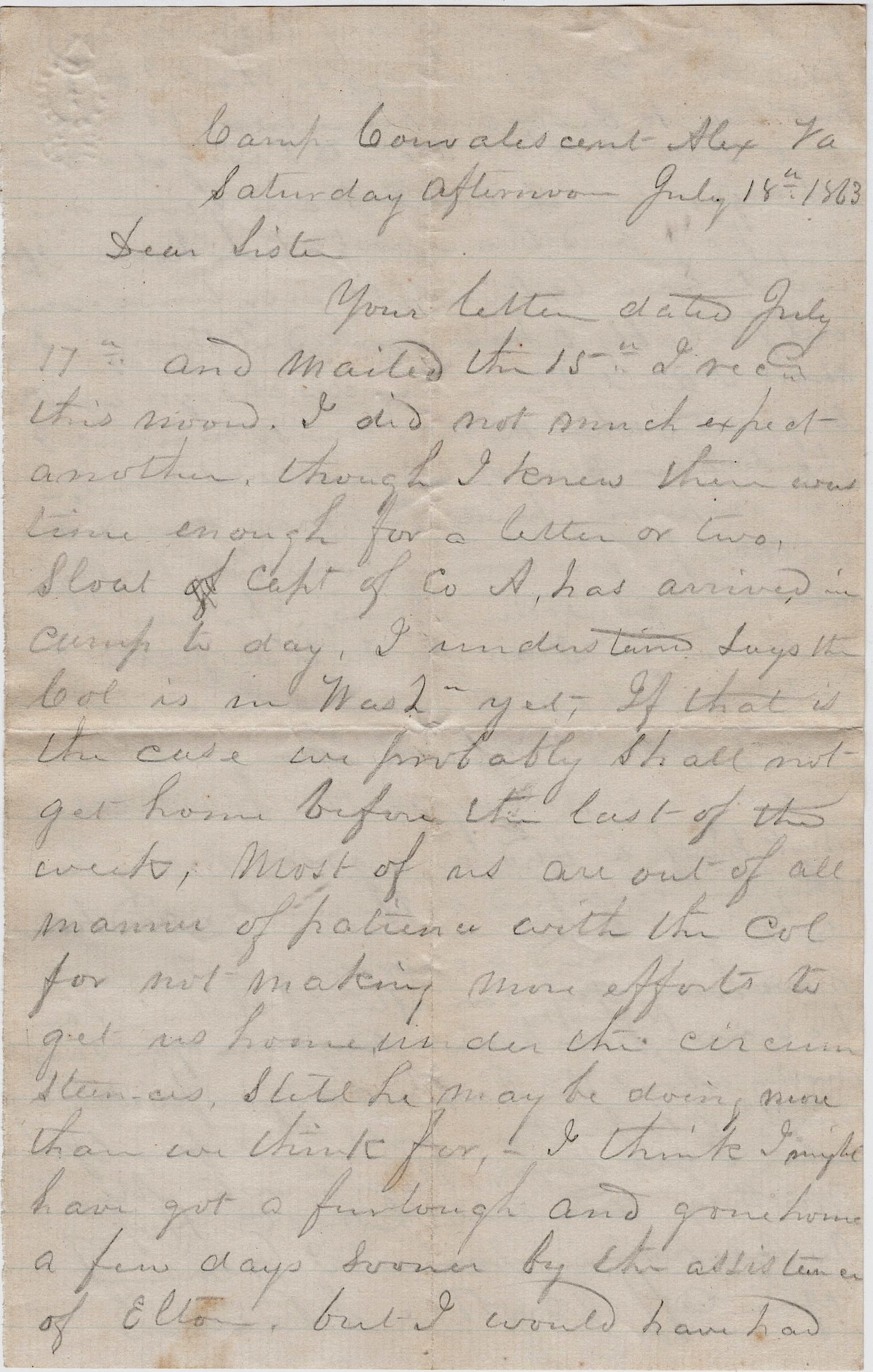
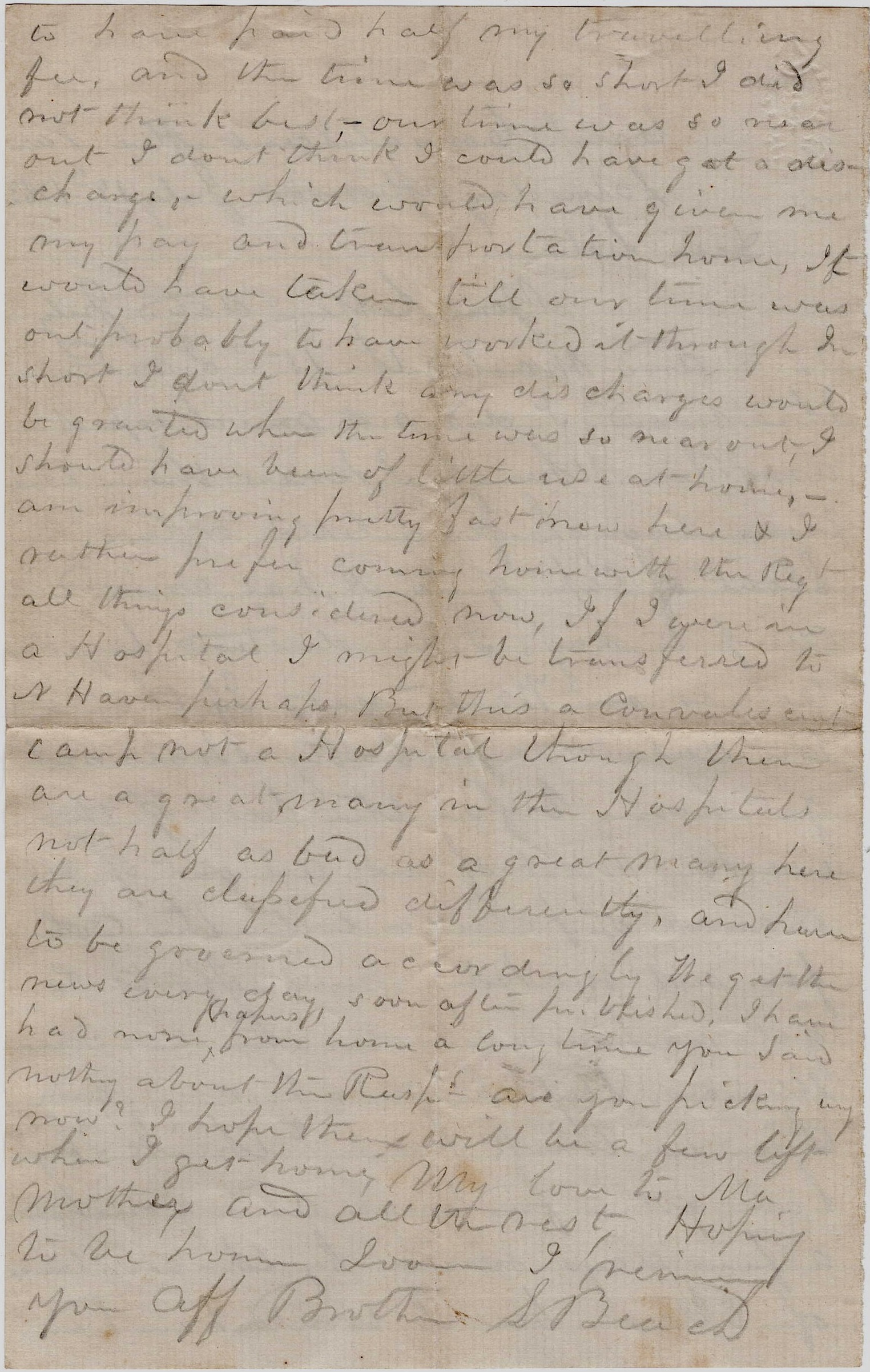
Transcription

Addressed to Mr. Otis Hitchcock, Randolph, Cattaraugus county, New York (notice that envelope is mismatched with letter; envelope is postmarked Nashville, TN, and dates to April 1864.

Camp Convalescent
Near Alexandria, Virginia
[Approx. May 20, 1863]

Dear Parents and friends,

It is with pleasure that I take my pen in hand once more to inform you of my welfare & whereabouts. I am a paroled prisoner of war and I am as well as usual, hoping these few lines will find you all well and enjoying yourselves.

I will try and give you a kind of a description of our spring campaign. We left our winter camp about the middle of April and went to a place called Kelly’s Ford. We lay there in camp about two weeks when we got orders to make an advance on the enemy. Our regiment was ordered out just at night of the 28th of April to go and help lay the pontoon bridge. Our company and one other company were detailed to help the [15th New York] Engineers lay down the bridge & the rest of the regiment crossed over to guard us while we were at work. It was the Rappahannock river that I am speaking of now.

We got the bridge done about 11 o’clock at night and our regiment come back and we went back to camp and stayed till morning. Then we got orders to have three days rations in our haversacks and five more in our knapsacks, making in all eight days rations. And we had to have 60 rounds of cartridges, 40 in our boxes and 20 in our knapsacks. So you see that we were pretty well loaded down with hardtack and lead.

Well we marched down and crossed the river and lay there that day till the next morning. Then we got orders to strike tents and march. Our brigade was guard of the baggage train so you see we had to be in the rear. We marched till noon when we came to the Rapidan river. We crossed on a narrow footbridge but the train had to ford it and it being a very rapid stream, it took till about 4 o’clock p.m. before we got ready to start again. Then we started and marched clear through to where we had the battle before we camped. We marched about 25 miles that [day] by marching till 11 o’clock at night and you better believe that I was a tired boy that night if I ever was.

Well we stayed there till about 3 o’clock the next day. Then we got orders to form in line of battle. We could hear the enemy firing. They were fighting then only about two miles from us. We were marched 20 rods out across the road to another field, then our company and another company had to go and guard the pioneers while they were throwing up breastworks. We had to lay on our arms that night. The rebs were shelling the woods just about 150 rods to our right. We could see and hear the shells burst just as plain as day but the next day was when we had our fun.

[It was] just about 5 o’clock p.m. that Old Stonewall Jackson come in on our rear and you had better believe that we had a rather warm time of it for a little while. I think we were managed rather bad on the start. We were formed in by divisions, closed en masse, and marched in front of our breastworks & ordered to lay down. We lay there about five minutes when we were ordered to fall back to the breastworks. We fell back there & waited till they come up in sight & then we blazed away at them, but they [had] so many more in number than we did that they rushed right up and flanked us both right and left, and we got the order to retreat, and then was when I got hit but it did not lame me much till the next day. So I got off the field and went about a mile and lay down and slept good till the next morning when the rebs made another attack on our men & I happened to be lying right where they come in, so I was right between the two fires. But I was behind an old log from the rebs fire. The balls struck the log pretty freely but I was alright. But it was not long before they had me prisoner. I shall have to close. Write soon. — H. A. H

[to] Otis and Sarah [Hitchcock]

A map of the “Buschbeck line” established by the Federals near Dowdall’s Tavern on the Orange Turnpike where the 154th New York “blazed away” at the rebels.