The following letters were written by Algernon D. Hazard who served as a corporal in Company F of the 112th New York Infantry Regiment during the Civil War. He enlisted on August 30, 1862, for a three-year term. The 112th New York, known as the “Chautauqua Regiment,” was organized in Jamestown, NY, and fought in Virginia and South Carolina.
Algernon was the son of Caleb Hazard (1808-1895) and Mary (Hannah) Newberry (1819-1885) of Ellery, Chautauqua county, New York. Only five of Algernon’s letters are presented here. There are three other letters, two by Capt Joseph S. Mathews, and one by Chaplain William Lyman Hyde, both of the 112th New York Regiment.
We learn from the regimental history that Algernon was “seriously wounded” in the fighting at Cold Harbor on June 1, 1864. A diary that I transcribed in 2024 by James Stafford of Co. C, 112th, included the following entry for that day: “Wednesday, June 1, 1864—We marched nearly all day and were tired out but were ordered right into the fight and we charged with knapsacks on. Many of our noble boys fell dead and dying…” The letter by Capt. Mathews, however, remembers the date of Algernon’s wounding as June 2nd. Stafford’s diary reveals that there was heavy fighting on that day as well: “Thursday, June 2, 1864. This morning we were ordered out to the front and many were killed and wounded…”
At a field hospital near the front, Algernon’s right leg was amputated—his wound being just above the right knee. A few days later he was transported several miles to the 18th Corps hospital at White House Landing where he died shortly after his arrival. Perhaps the jostling of the ambulance wagon resulted in uncontrolled bleeding around the sutures.
Letter 1
Camp on Folly Island near Charleston, [S.C.] August 21st 1863
Respected Father,
Again I seat myself to let you know that I am well with the exception of a bile [boil] on my left ankle which is very painful. I have been excused from duty 4 days on the account of it. The weather here is quite warm (you would call it hot) but not much warmer than it was at Portsmouth. We had a little rain here twice.
There is firing on Morris Island nearly all the time. I hear that they have breached [Fort] Sumter and from what I know have no reasons to doubt it but as I said in my last letter, I ain’t allowed to write any news anything of what is going on.
Our duty here is pretty hard and there is a good many sick. There is over 100 a taking medicine of what is here—nearly one-fifth. There is nothing new here to write. I have received one letter from you since I have been here which I acknowledged in my other letter. It bore the daye of July 27th.
I have already wrote five letters which I have not heard from. One at Bower’s Hill, two at Portsmouth (one containing the check), and two since I have been here. I don’t know as there is anything more. Yours truly, — A. D. Hazard
Letter 2
Camp on Folly Island November 2nd 1863
Respected Father,
Again I seat myself to let you know that I am well. I saw Kingsley a few minutes ago. He is well and fat as a hog. There has been heavy firing for three or four days in the direction of [Fort] Sumter and it is rumored that they haveat last demolished it. With the exception of the firing on Sumter, everything runs smoothly. The company has to go on picket once in ten days and when they are in camp, they drill from 2 to 4 hours each day.
The weather is comfortably warm—not hot enough to be disagreeable—and is so we can sleep comfortably nights. Our regiment is rather sickly as usual and always will be till we have a different man for a head doctor. We have lost 26 by sickness and one killed since we have been here in this department.
The sutler sells things very high here. Apples 10 dollars a barrel—good and bad altogether by whole sale. Potatoes are $5 a barrel. Sweet potatoes $7 a barrel. Mackerel 40 cents a pound, 75 cents a quart for preserved blackberries. Everything else in proportion and some things a little more so. I still continue to help cook. How long I shall, I don’t know.
Mr. P. S. Kimball has got home. He will probably show his patriotism at election tomorrow. No more at present. Yours truly, — A. D. Hazard
Letter 3
Big Bay Island February 1st 1864
Respected Father,
I now seat myself to answer your welcome letter of January 8th which just came to this island by a dispatch boat. It had been miscarried some way because the one of the 15th I received day before yesterday.
This island is 6 miles long and we have the best water here that we have had since we have been in the service. I don’t expect to write any news for I have just mailed a letter. If I was there, they wouldn’t need to offer me 350 dollars town bounty only once unless I thought I could get more by waiting a little longer. I think the fighting part of this war is over mostly and unless I do happen to stop a reb ball, I can live as well in the army as anywhere.
I don’t think of anything else. Yours truly, — A. D. Hazard
Letter 4
Folly Island February 24th 1864
Respected Father,
I now seat myself to answer your letter of the 1st of this month which I received today. We are back to Folly waiting transportation to Florida. The regiment left here for Jacksonville yesterday and we shall go there as soon as there is a boat goes that way. I am well and tough as I ever was in my life. I don’t want you nor mother to trouble any about me because it won’t do me any good and will damage your health. I am able to paddle my own canoe as long as I am well. What I meant by saying to pardon that I shouldn’t have been here is that I should have been in some other regiment.
The shells which I spoke of is some that I picked up on Big Bay Island and if they come through, I want you to pay the Express on them and take them and take care of them till I come home—if ever I do. If I don’t, do with them as you like. I have seen Kingsley and got my things all right.
The shirts that I sent for you need not send unless you have started them. If you have started them, you can’t do any other way—only let htem come. They will find me some time sooner or later. As for sending money home this summer, I don’t think I shall send much if I am where I can buy my things to eat. I have wrote to the Paymaster General asking him to cancel my allotment and send me my pay all in money. He will do it without any doubt. Kingsley said you had some talk of buying a piece of land. If you do, I will help you to $75 a year till it is paid for.
(There is some talk of our regiment reenlisting when they have been in two years. What shall I do about it? I shall do just as you say. Still, I have a mind of my own. I think the best thing I can do is to enlist. Don’t let mother [ ] you read this.)
After you get this, you needn’t look for anything more from me till it comes. Direct as before. Yours truly, — A. D. Hazard
Our being mustered at Big Bay was of no use. Consequently I shan’t get any pay till there is six months due me.
Letter 5
Jacksonville, Florida April 1st, 1864
Respected Father,
I now seat myself to write a few lines. I am well and healthy as I ever was in my life. I have delayed writing for some days thinking I should get a letter from you but I have received none later than February 24th.
The weather is just comfortably warm with considerable rain and wind. The wind blows the sand so here some of the time so that it is more disagreeable than the snow is when the wind blows in the northern states. It is so sometimes that you can’t walk facing the wind.
Kingsley [John A. Kinsman?] has come to the regiment again. He looks healthy as I ever saw him. He got here night before last.
This morning about 4 A.M. the transport called the Maple Leaf was destroyed by a torpedo a few miles above here. The Maple Leaf arrived here night before last [31 March 1864] from Folly Island bringing on here the convalescent soldiers of our brigade and the whole of the camp and garrison equipage belonging to the brigade. She ran up to the dock and unloaded what soldiers was on her and then was ordered up the river with some more troops before she had time to unload the rest of the stuff, so we sent a guard of 10 men with her to take care of our part of the stuff. She made the trip [to Palatka] which she was ordered to and was coming back [when] the torpedo blowed her all to pieces back to the engine house. She sunk in three minutes. There was three negroes and two firemen drowned. The rest of the crew was saved but our tents, kettles, officer’s clothing, company books, regimental books, and so on are in about 18 feet of water. The officer’s clothing that is lost is undoubtedly worth 1,500 dollars.
Wreck of the Transport Steamers “Maple Leaf” and “Gen’l Hunter” on St. Johns River, Florida — Sunk by torpedoes
No more at present. From your son, — A. D. Hazard
Direct [to] Co. F, 112th New York Volunteers, Jacksonville, Florida
Please send me some stamps.
Letter 6
Addressed to Mr. Caleb Hazard, Sinclairsville P. O., Chautauqua county, New York
An AI sketch of Capt. Joseph S. Mathews (1832-1872) made from a grainy photograph on Ancestry.com
In the Field June 6, 1864
Caleb Hazard, Esq.
Dear sir, I regret to inform you that your son, Corporal A. D. Hazard of my company, was quite seriously wounded during a charge made by our regiment on the 2nd inst. and has suffered amputation of his right leg just above the knee.
Have just come from his side & a glad to inform you that he is in good spirits & more comfortable than could reasonably be expected. He will probably be sent home as soon as he is strong enough to travel. Very respectfully your obedient servant, — J[oseph] S. Mathews, Capt. Commanding 112th New York, 2nd Brigade, 3rd Division, 18th Army Corps
Letter 7
An AI sketch of Capt. Joseph S. Mathews (1832-1872) made from a grainy photograph on Ancestry.com
In the Field June 22, 1864
Caleb Hazard,
Dear sir, your letter of 16th inst. is just read and I hasten to reply. Having been in command of the regiment most of the time since June 1st and either fighting or marching constantly, I was unable to pay that attention to Corporal Hazard that I should under any other circumstances.
At the time I wrote you, I had just left him & found him so cheerful and feeling so well. I had no doubts in my own mind of his final recovery. The surgeon-in-charge of the hospital with whom I consulted was of the same opinion. Soon after my visit, all who could stand it to ride to White House were ordered away to make room for others of our poor boys constantly coming in and it seems the corporal’s ambition was greater than his strength for he died soon after reaching White House.
I am informed on good authority that his grave is plainly marked so there will be no difficulty in finding it at any future time. His effects were placed in a box & sent to you by Express. I presume, however, that many of them had been thrown away by him as men will not carry in their knapsacks on a long march only what is absolutely necessary. I hardly know what words of sympathy to offer you in this terrible bereavement for if Algernon was as good a son as he was reliable, true & faithful soldier, your loss is indeed very great.
I have watched his military career in the company closely & have always found him ever ready, of good habits, and attention to every duty. I never had to enquirer if any duty assigned to Corp. Hazard had been performed for I always knew it was done to the very letter. He stood high in my own estimation & was a favorite with his company and was first among the corporals that I should have promoted for he was in every way worthy of it. We shall miss him very much.
He fell but a few feet from me & I know he was doing his duty like a man.
Any assistance I can render you in procuring his remains will be gladly rendered as I cannot bear the thought of any of my brave boys sleeping in this accursed rebel soil if time or money will obtain their removal. Enclosed please find receipt of Express company. Also $3.25. With a heart full of sympathy, I remain very truly yours, — J[oseph] S. Mathews
Capt. Co. F, 112th NY Vols., 1st Brigade, 2nd Division, 10th Army Corps, Bermuda Hundred, Va.
Letter 8
Camp 112th New York Vols. Near Hatcher’s Run, Virginia August 20, 1864
Caleb Hazard, Esq.,
This letter was written by William Lyman Hyde, doubtless one of many that the chaplain of the 112th NY Infantry wrote to the families of wounded or killed members of the regiment.A book of the chaplains war time correspondence entitled, “Armed Only With Faith” edited by Donald Rutherford was published in 2015.Hyde also authored the regimental history.
Dear sir, yours of July 10th only reached me last week which is the reason you have not heard from me earlier. The money and account book and old papers were all that your son had with him. His knapsack was lost on the field of battle. The express receipt was for the little package which you received. It was put into the express by the chaplain at the hospital & the express company gave him the receipt. He gave me the money and the receipt which I in turn gave Capt. Mathews who sent them to you.
Your son was sent to the hospital at White House about a week after he was wounded—five days perhaps. His leg had been amputated and it was thought he was doing well. I told you in my last that I was not at White House when he died, but there was one of our men there—a Robert Jones of Co. H—who saw him as soon as he got there & was with him when he died. He called the Chaplain, Rev. Mr. Jones, chaplain of the I. H. Vols., to see him. The chaplain is now where I cannot reach him but will send your letter to him as soon as I can find out where he is.
The Co. H man says your son was very low when he got to White House. It is a hard, long ride from Cold Harbor there—the distance at least 14 miles and over a horrid rough road. He could not speak much above a whisper, and conversed but little, even with the chaplain. He told him he wanted him to send home his money & pocket book and gave him your name. Jones does not recollect that he said anything more. He was very weak and about an hour after getting to the hospital, he died.
He was buried by the regular attendants at the hospital and the place of his grave is marked. A plain board has his name, Company & Regiment on it at the head of his grave. You cannot get to this place of burial in October unless our troops occupy White House Landing again. But if our forces were there, it would be very easy to find his grave. It is by the side of many others buried from the 18th Army Corps Hospital. (We were in the 18th Corps then though we belong to the 10th.)
If the changes of war should next fall or winter take us to that locality, I could go with you to the very spot where his remains lie. I feel very sad when I think of Algernon and many others of our noblest, truest, young men who now sleep the sleep of Death. May God care for you in your sorrow and give you back your boy in Heaven. Very truly yours, — [William] L[yman] Hyde, Chaplain 112th N. Y.
This letter was only signed “Father” but the content reveals that he was most likely a member of Co. H, 1st Vermont Heavy Artillery. This company was at Fort Slocum till March, 1864, then at Fort Bunker Hill till May, 1864 when they were ordered to the Virginia battlefront to be used as infantrymen in Grant’s Overland Campaign. The regiment joined the 6th Army Corps at Spottsylvania Court House on 15 May 1864—little more than a week after Grant launched his campaign.
In his letter, he refers to Uncles Levi & Lyman who appear to be serving with him. Likewise he refers to an Aunt Minerva. Since the letter was written to his children, Ada and Walton, these aunts and uncles were most likely the author’s siblings or in-laws. The letter was written on stationery printed with the words to the tune by Alice Hawthorne entitled, “Yes, I would the war were over.” It is annotated in the margin, “Ambrotype for Grandmother, Photograph for Aunt Emeline. — Father.” These are articles that were presumably sent to Aunt Minerva in the box he mentions in the letter.
By posting this information on Spared & Shared Facebook, an astute subscriber named Amanda Champagne McCarty was able to locate a Vermont family that satisfied all of these relationships and I feel certain that the letter can now be attributed to Benjamin F. Strong (1825-1864) of Woodstock who was a 36 year-old mechanic when he entered the service in August 1862 with Levi F. Barnaby (1826-1873) and Lyman Aldrich. Levi was married to Minerva Strong (1836-1912), Benjamin’s sister. Lyman was married to Ellen Blaisdell, sister of Benjamin’s 1st wife Elvira Blaisdell (1833-1860). Benjamin’s and Elvira’s children were Ada Strong (1851-1919) and Frank Walton Strong (1855-1942). After Elvira died in February 1860, Benjamin took Esther D. deCamp (1840-1862) as his second wife and they had a child named Fanny but both mother and daughter died while Benjamin was in the service.
What is most chilling about this discovery, however, is that Benjamin was killed by an enemy sharpshooter on 9 June 1864—just two days after having written to his children: “I am not alarmed about being shot for I believe I shan’t die until my time comes, let me be where I will….I expect there will be a terrible fight here pretty soon, but let it come. I am ready for it. I believe I shall live to go home when my time is out. But if I don’t, it will make but a little difference to me. If I don’t, be good children & believe I died in a good cause.” No wonder the letter was cherished and the words on the song sheet all the more poignant:
Dead upon the field of battle, Husbands, sons and brothers lie: Friends are waiting—wives and mothers, Looking for them, bye and bye. Far away from home for ever, Many a noble boy lies slain; Look not for thy child fond mother, Thou shalt see him not again. Chorus—Yes, I would the war were over.
T R A N S C R I P T I O N
Camp in the field near Cold Harbor, Virginia June 7th 1864
My dear children
As I have a little spare time this morning, I will write a few lines to let you know that I am yet alive & what is more, am well. Uncles Levi & Lyman are well. Uncle Lyman had a letter from home this morn. I received a letter from you a few days ago but I have not had time to write before. There has not been a very good chance to send letters out since we have been here, but now we have a chance to send every morning.
We left [Fort] Bunker Hill on the 12th day of May & since that time we have done some pretty tall marching & have been in two pretty tight places—once near Spottsylvania Court House and once here on our present campground which took place on the 1st day of June just at night. We had marched all day and came up with the main part of the Corps just in time to form and make a charge on the rebs. A part of our regiment, Cos. F, L. K, & H [the 1st Battalion], advanced to the very front to within a hundred yards of the rebel entrenchments & they poured the grape and canister into us like hail. But we were behind a small rise of ground & by laying flat down, we most of us escaped being killed or wounded. There were about 84 lost in our four companies—one man killed and 10 wounded in Co. H. One corporal lost a leg and one sergeant an arm. All have been sent to the General Hospital in Washington. In this last affray, our loss was pretty severe. They think more so than the rebs but we hold our position & are getting very well entrenched.
We have a large amount of artillery & the most of the fighting has been done by it. When the rebs commence firing on us, they send a few shells into their camp & they soon dry up. There is not many hours but what there are bullets passing each way. Some take effect and some do not. Occasionally there is a man killed or wounded. I like this kind of life much better than I thought I should but I would rather be in Vermont. I am not alarmed about being shot for I believe I shan’t die until my time comes, let me be where I will. I don’t feel a bit nervous when advancing on the rebs & the first time we were under fire & lay on the ground with shot and shell flying through the air, I went to sleep as I was very tired as we had marched all night.
I expect there will be a terrible fight here pretty soon, but let it come. I am ready for it. I believe I shall live to go home when my time is out. But if I don’t, it will make but a little difference to me. If I don’t, be good children & believe I died in a good cause. There is a box of things at Aunt Minerva’s for you. Take care of the things that they may some time do you some good.
I must close. Write often. Direct as usual. Give my love to all the folks and take a good share to yourselves. Don’t worry about me but be good children & so life if we meet not again on earth, we may meet in Heaven where there is no war.
The following letters were written by Thomas C. Edwards (b. 1835) who served in Co. B, 8th New York Heavy Artillery. The regiment was organized at Lockport, New York as the 129th New York Volunteer Infantry and mustered on August 22, 1862, for three years service under the command of Colonel Peter Augustus Porter. Because heavy artillery regiments were needed for the defenses of Baltimore, the regiment was converted from infantry on October 3, 1862, and became the 8th New York Heavy Artillery on December 19, 1862. Companies L and M joined the regiment at Baltimore in February 1864.
Thomas C. Edwards—Age, 25 years. Enlisted, July 29, 1862, at Lockport; mustered in as corporal, Co. B, 129th Infantry, July 29, 1862 (which became the Eighth Heavy Artillery, December 19, 1862), to serve three years; promoted sergeant, April 25, 1863; quartermaster-sergeant, February 1, 1865; mustered out with company, June 5, 1865, at Munsons Hill, Va., as Thomas C. Edwards.
Letter 1
[This letter contains a description of the fighting at Harris Farm in the Battle of Spotsylvania Court House. The 8th New York Heavy Artillery was one of five Heavy Artillery regiments serving as infantrymen in the fight. Others included the 1st Maine HA, the 1st Mass. HA, the 2nd & 7th New York HA regiments.]
Addressed to Amanda J. Edwards, Lockport, New York
Army of Potomac Friday noon. May 20th 1864
Dear Sister,
The 8th had our first severe fight yesterday & last night. I am still safe, thanks to that kind Providence who has ever kept me. We fought Ewell’s Corps from 5 p.m. till nearly midnight & whipped him severely. The field was covered with dead rebs this morning. They had retreated during the night & this morning we came back to our old camp. Our loss was severe but the 8th did not suffer much—9 killed and 35 wounded. Only one slightly wounded in Co. B but the bullets whizzed by us good. Co. D suffered the most, Daniel Haller 1 was slightly wounded. Capt. Holmes 2 & company are all safe. The 1st Maine and 1st Massachusetts Heavy Artillery suffered the most. The 2nd, 7th, and 8th Heavy Artillery were also in the fight. Most of the firing was done with musketry & it was a severe musketry fight. No doubt you will read of it. We were under Gen. [Robert O.] Tyler. All the boys did nobly & we were highly complimented this morning by Gen. Tyler & Gen. Meade.
We had to double quick three miles to the battlefield. I lost my knapsack and almost everything I had—portfolio, paper, clothes, and all. I can’t write more now. I had a letter written to Libbie but lost it. Tell her this is for her too. I will write to her soon if I can. I can’t write often. Goodbye, — Thomas
1 Daniel D. Haller—Age, 23 years. Enlisted, August 12, 1862, at Lockport; mustered in as private, Go. D, One Hundred and Twenty-ninth Infantry, August 11, 1862 (which became the Eighth Artillery, December 19, 1862), to serve three years; wounded at Cold Harbor, Va., June 3, 1861; discharged to date, August 12, 1861.
2 Joseph W. Holmes—Age, 41 years. Enrolled, August 12, 1862, at Lockport; mustered in as captain, Co. E, One Hundred and Twenty-ninth Infantry, August 12, 1862 (which became the Eighth Artillery, December 19, 1862), to serve three years; mustered in as major, October 21, 1864; lieutenant-colonel, February 4,1865; mustered out with regiment, June 5, 1865, at Munsons Hill, Va.; commissioned captain, September 10,1862, with rank from August 12,1862, original; major, September 16,1864, with rank from June 19,1864, vice E. L. Blake, died of wounds received in action; lieutenant-colonel, January 30, 1865, with rank from January 14, 1865, vice J . B. Baker, promoted.
Letter 2
Camp in the field Near Mechanicsville, Va. June 1st 1864
Dearest sister & home friends,
Wouldn’t you like to have a chat with me this pleasant June morning? How pleasant it would be, wouldn’t it, if I could see you for a little time? No doubt you have all been very anxious about me of late and have wondered why I have not written more frequent. I have written as often as I could. Have written to you twice and once to Libbie. Don’t know whether you have yet received any of them nor when you will, but hope you will have heard from me ‘ere this. I am feeling very well this morning for we have had quite a rest for two days past which has done us all good for we were nearly worn out with hard marching, hard work, sleepless nights, &c. &c. We have had a hard time of it since we came out here but the boys seem to bear it all very cheerfully.
It is wonderful to see how much we can endure, but we are on the way to Richmond & are hoping victory will crown our efforts by & by & we will endure almost anything that Richmond may fall and we may see this wicked rebellion put down. We have been in line of battle almost every day for two weeks, have been under fire nearly half of the time, have laid on our arms and tried to sleep I should say nearly every night, while we were not marching or throwing up breastworks. But we stand it well. Have lost but few men as yet and certainly as a regiment have been highly favored. We have seen war through its terrible realities. We have seen its horrors which never can be described, and we have also seen some of its grandure which like the other cannot be described. And when once seen, can never be forgotten.
Now we are resting behind our breastworks waiting for further orders and a few of us are improving the time in writing. Our line of battle is in front of us & some distance beyond that is another line of skirmishers which keep up a little music with their muskets and a little to our left, the 19th Battery not long ago sent their morning compliments over to the rebs (Johnny’s—we call them) in the shape of a few shells. But the Johnny’s seem to be quite still all along our front & only once in a while do we hear the peculiar singing of a bullet as it strays over our way. It is so pleasant and so quiet we almost wonder if there really is war all over this fair land of ours. And then we wonder if the rebs won’t soon give up and conclude it is best after all to stay in the Old Union. Then we wonder what the late war news is, what our forces have been & are now doing, whether the rebels are really as discouraged & nearly whipped as we hear. All are camp rumors. The fact is we know nothing of what is being done more than what we as a Division or Corps have done ourselves. Queer, isn’t it?
Well we haven’t seen any newspaper since we left Baltimore and we have no other means of knowing what is being done by the army. We do know we have made a great flank movement and the rebel army has thus far been well out-generaled. The 2nd Corps are now not far from Mechanicsville, we hear between there and Hanover Court House. We hear we are 10 or 11 miles from Richmond. We know we are in a beautiful country & are now in one of the most beautiful cornfields I ever saw. How is it? Has Father planted his corn yet? Tell him before me is nearly 100 acres of corn now nearly a foot in height, good color, and I never saw a more even field in my life. It is splendid. We have seen a great deal of corn growing as we came along & most all of it looked well. But we think it will never do the rebs much good.
But I am going to tell you what more we hear. We hear the 6th Corps is on our right and were yesterday within six miles of Richmond & that Burnside is on our left & yesterday captured Fair Oaks and still holds it. And then we hear Lee is really dead. The rebels are suing for peace, any part of which we hardly know whether to believe or not. But we have great confidence in Grant and do think some part of the army is nearer Richmond that we and we (our army) shall capture it by and by.
I saw Uncle Lemuel day before yesterday. He was well. Took a letter I had just finished to mail for me. That one was to Libbie. Those to her will have to do for you & yours for her & all our folks & the friends. It will be impossible for me to write much at present and it is almost impossible to get those we do write mailed. We have received no mail, only a little. Some of our boys brought us one week from the day we left Baltimore. I received four letters then—one from Libbie, one from you written the same day we left Baltimore. & one from Lucy and one from Monroe. These I will answer when I can. Lucy will feel disappointed that I have left Baltimore but we couldn’t remain there & be here helping to take Richmond too. We don’t live here as we did in Baltimore, are dirty, ragged. and often some of us hungry. But all are cheerful and happy as larks.
The weather has been very dry & as we march and dig, our clothes get filled with dust. Sometimes we have an opportunity to wash and slick up but it doesn’t do much good for it may not be an hour before we are ordered on another march or to digging or sometimes to lie down flat on our faces in three inches of dust & perhaps have to remain there for hours, sometimes all night, and we have had the bullets kick the dust about us good sometimes. What think you? Is there much use of our trying to keep clean while on this campaign? You will not wonder this paper gets mussed and dirty, will you? This paper is some I picked up the other day. You know I lost all my things at the time of our first fight—all except my Bible and my Journal. Those I hope never to lose. I have kept a little memoranda of our every day move and some day will try and write you a little history of our “On to Richmond.”
Perhaps you’d like to know how we live just now. We don’t have cake & pies, bread and butter, & milk, though we often dream of them and think we are living sumptuously. Sometimes we have a little meat and sometimes we don’t. Sometimes we don’t have ant time to make coffee but our most sumptuous fare is hard tack and coffee, with a little meat perhaps once a day. Our breakfast is three hard tack with a cup of coffee. If you ask how we make our coffee, each has his little cup. We fill it half full of water, put in a spoonful of coffee and a litle sugar, sit it on the fire, and when it boils, take it off and fill it up with water to cool and settle it. If we have a little meat, fry it in the end of a stick over the fire and our good meal is ready. Thus we cook our dinner & supper.
But I must close for just now we have received orders to prepare to march. Hoping you are all well and with much love to you all, I remain ever your loving brother, — Thomas
P. S. Fred Button is well. Also Eugene Fuller and nearly all of Co. B. Very much love to Libbie & yourself.
Saturday, June 4th 1864
Dearest sister, yesterday was a terrible day to us. Our regiment was ordered to charge on some strong rebel works and were all cut to pieces. The boys did nobly but the work was too hard for them. Our loss is severe. Oh it is too bad, too bad. Co. B. lost two-thirds of our men. We charged a half mile clear up to the rebel works & we cannot yet get the bodies of some who fell there. Col. Porter is dead and still lies on the field. Col. Bates is safe. Maj. Willet is severely wounded. Capt. Baker is safe. Also Sergt. [Romeo G.] Burns, myself, Corp. Harmon, Fred Button, and some others. Eugene Fuller is wounded in the leg but is doing well. Charley G. also. Lieut. [James] Low is wounded in the leg—not severe. Lieut. Nichols slight in the arm. Lieut. Brown is dead. Poor fellow. Pitcher severely wounded. I cannot yet give you all the casualties. No doubt you will see a list soon. May God bless the mourning ones at home & save the 8th from another so terrible of a slaughter. Oh what a sad, sad day this is to us. Oh when will this terrible war end. May it be soon. Much love, — Thomas
Letter 3
[This letter contains a description of the 3 June 1864 early morning assault by the 8th New York Heavy artillery on Colquitt’s Georgians at Cold Harbor. For a great summary of that action, see Dan Masters’ “Struck down at Cold Harbor: In action with the 8th New York Heavy Artillery” posted on 11 April 2022.]
Cold Harbor June 6th 1764
Dearest Sister and loved ones at home,
Again I have the pleasure of penning you a few lines. It is a pleasure for I know you are all anxious, very anxious, to hear from me and I am happy to say I am still safe & well though I have passed through many dangers. God has been with me & has thus far kept me safe from harm for which I am thankful & I will continue to strive to trust in Him to watch over and keep me until this cruel war shall have ended & return me safe to all the loved ones. But oh! how my heart aches when I think of the many of our number who have so lately fallen. It is too sad to think of. Oh how must their friends feel. Let them all remember that we mourn with them for while they have lost a loved one—a son, or father, or brother—we feel that we have lost dear friends & companions we loved as brothers.
No doubt you will hear of all the losses in our regiment ere this reaches you. It was terrible but not so severe as we at first supposed. It seems Co. B suffered worse than any other company. We were on the right where they got a cross fire on us & their grape & canister mowed us down terribly. I wrote you the next day after the charge & told you somewhat of our loss. I hope you received the letter. Since then a few whom we thought dead have since been brought in and we hear there are still some live ones left there but we cannot help them. Isn’t it dreadful? They are hardly a half mile from us but are lying near the rebel breastworks & when we attempt to go out there, they shoot our boys down. We have worked every way to get off our boys & in spite of their fire & though several have been wounded in the attempt, we have crept up to them and saved some of them during the night. We have wished we could get all but it has been impossible to do so. We heard there was to be a flag of truce sent in this afternoon to give us an opportunity to bring in our dead & wounded but the skirmishers keep up such a firing all the time I fear such an opportunity will not be given us.
Wayside Marker on Cold Harbor Battlefield Walking Tour
Our Colonel’s [Peter A. Porter] body was brought in Saturday night, he having laid on the ground two days and one night. And we hear his body has now gone home. All our wounded have been sent on to Washington or Baltimore & no doubt many of them will soon go home on furloughs. Some of our wounded have since died. I cannot tell you how many of our boys are missing. Quite a number are. We think most of them dead now but some may be taken prisoners & some may still be saved of our company. Among the missing are still Sergt. [Job] Cornell [and] Sergt. [Nathan] Peterson. We think them dead. Also Corps. [John] Root, Taylor, and [William H.] Saddleson. Then there are many other boys—25 or more in all, 25 killed and as many wounded. We went into the fight with 120 and came out with but 38 safe. Some of the other companies suffered little more than half as bad. Others scarce any. Lieut. [John H.] Nichols was slightly wounded in the arm but is still with us, being our only officer now. Captain [J. B. Baker] is acting Major.
The charge was made at five in the morning…It was a rash move and amounted to nothing but slaughter. We hope no more such charges will ever be ordered.”
—Thomas Edward, 8th New York Heavy Artillery
The charge was made at five in the morning, was led by Brig. Gen. [Robert O.] Tyler who lost a leg we hear. 1 It was a rash move and amounted to nothing but slaughter. We hope no more such charges will ever be ordered. The whole brigade started in line of battle at a double quick, had to go almost a half mile, were not fired upon much until they were more than half way when a most terrible fire of artillery and musketry was opened upon them. But the boys halted not. On they went, some of them clear up to the rebel works, & then the few who were left turned and came back to our old present line and listened to the stories of each of his narrow escape. Then we helped off the wounded. I worked all the afternoon & that night & all the next forenoon. Seems to me I never worked harder. I was just drawing rations for the company and was not with them in the charge so have nothing to say of my bravery. I do not know how long we are to remain here. They are firing at our works all day so we lay close behind our works. It is not very pleasant for us.
Yesterday afternoon we heard heavy firing on our left & hear the 5th Corps crossed the Chickahominy. Today we hear firing on our right where is the 6th Corps. The 151st are in that corps and are not far from us now. Just now Watson McHall came to see me. Is well. Says Uncle is well.
We are holding our ground and occasionally drive the rebels back a little. Soon the siege will commence here, I think. A great many guns are being planted near us & soon there will be the most terrible shelling we ever heard. We hear Gaines Hill is two miles from us and we hope the rebels will soon be driven back beyond that. They now have a good position but we trust Grant will soon have their stronghold and ere long Richmond will be ours.
May God bless our efforts that we may soon see an end to war. Love to all. Pray for your loving brother, — Thomas
1 Gen. Robert Ogden Tyler took a bullet in the ankle which ended his military career in the field. He received the brevet rank of Major General of volunteers for “great gallantry at the Battle of Cold Harbor.” He died at the age of 42 in 1874.
Letter 4
Cold Harbor [Virginia] June 10th 1864
Dearest sister,
Once more I have a little time for writing & will spend it with you & the loved ones at home for I’m sure I cannot do better. I cannot write many letters and those few must be to those I hold most dear—my sisters, parents, brothers, and that dear one who is more than a sister to me. Though this is directed to you, tell Libbie it is her letter too and I will try and write the next one to her. I have received quite a number of letters of late and am sorry I cannot answer them all now but I cannot while we remain here. So all must be content to hear from me by you. When we get where I can procure plenty of writing material & have plenty of time, then I will write them all. I suppose I won’t receive many letters for at time. At least I can expect them, but I wish all would write though I cannot just now. They would if they knew how much good their letters do us. We can’t tell how glad we are to receive letters & papers too. I am ever so thankful for the papers you sent me. I received only two the other day—the Rural and another Rochester paper. No doubt the others will come soon. You are very kind to think to send me the American. I shall be very glad to see that. It will seem like seeing an old friend….Now we will receive our mail more regular, i suppose two or three times a week which will seem good to us. We hope our friends will write as often as they can and we will try and make it up some time—perhaps when we get to Richmond. But we don’t know when that will be. We hope the time is not very far distant.
There has been but little done near us for a week past and we don’t know what any part of the army is doing, but we hope something. We expect Grant is busy somewhere. We believe he is not idle. We are just holding our ground here—that seems to be all. There are rumors of wonders being done such as the late capture of Fort Darling and our forces being within four miles of Richmond—that we are to move by the left flank again and make the James river our base of supplies instead of White House Landing, &c. &c. which we think may be but we hear so many reports we don’t believe any of them at first. We have moved a little to the left since I last wrote to you and are now in the second line of works from the enemy on a little hill in a beautiful pine forest. It is pleasant, but we have to keep close during the daytime for the sharpshooters are most of the time at work and we occasionally lose a man. Most every day some of our regiment are killed or wounded & men from other regiments are killed or wounded & men from other regiments near us. Our company have lost none since the charge made just one week ago this morning. Some days all is quiet still and it seems so strange to hear no boom of cannon or crack of musketry.
Last Tuesday afternoon [June 7th] the rebels hoisted a flag of truce just in front of us & the firing all ceased. Our men went out and picked up and buried the dead and the rebels buried them. It seemed so strange to see men who but a few minutes before had been doing their best to destroy each other now conversing with and shaking hands even & exchanging newspapers with each other. It seemed so strange to us. The 7th Michigan & a New Jersey regiment were on our right & a little in advance of us & [Sgt.] Romeo [Burns] and I went out to their line that we might better see what was being done. We were not allowed to go over the line but there was a line of skirmishers & sharpshooters in front & the rebs talked with them. One fine looking reb stood up on their works and held up a newspaper. Soon came one of our men holding up one. They both advanced, shook each other by the hand, exchanged papers, and returned again. Perhaps I could tell more which will entreat you.
The flag of truce was to last but a short time. Then we expected the leaden misiles that had been daily picking off our men would again be flying and our men would again be popping at the rebs. Soon we heard the boom of the signal gun, telling us to look out for bullets. But the bullets didn’t come. All still remained quiet. there was no firing that night and the next morning all was still. As we saw the rebs standing on their works and many of our men so cool and unconcerned, we wondered why. It was soon learned that the pickets and sharpshooters had agreed not to fire upon each other. The rebs were tired of it as well as our men & said they would not fire if our men would not. Our men did not choose to fire so we had peace nearly all day. Again some of our men advanced, shook hands with and conversed with the rebs. One in the 64th New York recognized his brother (a rebel) and shook hands with him. How can brother fight against brother thus?
Day before yesterday, firing ceased on our left & our men and the rebels came out to the same spring of water. All was quiet for a time the next morning but soon a reb hallowed to our boys to keep their heads down now for they had orders to open fire soon. All the men were behind the works and the rifles were cracking away. Some of the rebels are heartless wretches, we know, but they are not all so. Some of them are men with noble hearts & would that this terrible war were at an end, but their homes are in the South and of course their sympathies are there. I cannot look upon the men of the rebel army as I used to. The war would not last very long were it not for the rebel leaders. The men would soon throw down their arms if they could.
Well, how do you all do at home this pleasant morning? Has the rain ceased & the ground dried so your folks can go on with their spring work. Things must be very backward there. The weather has been delightful most of the time since we came to the Army of the Potomac. Today the air is cool and the sky is as clear as in some pleasant spring day. We have had some very hot days though, but most of us have stood it well. My health is still excellent and i cannot be too thankful for that great blessing. May that kind Providence continue to watch over and keep your absent brother, and when this cruel war is over, return me safely to you all. Oh that it might soon end that not many more precious lives shall be sacrificed. It is so terrible to think of mens being so destroyed and so many rushed into eternity unprepared. May our kind Heavenly Father hear the prayers of a mourning nation & with His own power put down this wicked rebellion. We hope it cannot—we pray that it may not last much longer.
I suppose you have heard of that fatal charge our regiment made one week ago ere this. Have you seen a list of the killed, wounded, and missing of the regiment & of Co. B? Oh! how terrible must be the feelings of our friends at home now. Never before we think did any regiment lose so man at once and so soon cause so much mourning at home. Has the Lockport paper had much to say about it yet? I should like to see some of them. Do you remember reading of three brothers who had lately enlisted & the poetry written about them? Their names were Coe. Two of them [Nelson & Bedford] were wounded & one [Elwood] was killed. The one killed was married. Now I hear the loss of our own regiment in killed, wounded, and missing is 655, twenty-five of them commissioned officers. I can not tell how many ewre killed nor how many are missing. Our whole regiment is now here, or all but a few men, but all were not here the morning of the charge. Capt. Holmes was in the fight & came out safe. Ham[ilton] Ingalls was wounded in the hand, I hear, I do not know how bad. Fred Button tells me George Pool was killed. Daniel Haller was wounded again. I think not badly. Albert was wounded too, I hear. I hope not badly. Was shot through the leg, i heard. Do you see Ann of late?
One of the wounded boys from the Bloody 8th, shot in the left leg at Cold Harboron 3 June 1864.
Now we find the loss in our company is 78; 13 killed and 15 missing. All the missing must be dead now we think. There were about 20 but a few have since been heard of, are in the hospital wounded. If the rebels would have ceased firing sooner than Tuesday, we might have found the bodies of all the boys, we think, but when we were permitted to go out, most all the bodies had been picked up and buried by the rebs and some of our men. Those we know are dead are: Lieut. Brown, Sergt. Peterson, Corp. John Root, M. G. Stiles, B[enjamin] J. Rose, E[lwood] Coe, [Gus L.] Maynard, G[eorge] W. Johnson, William Watson, E[mory] Wilcox, T[heodore] Myer, and J[ohn] Howell.
The missing [are] Sergt. [Job] Cornell, Corp. Taylor, Corp. [William H.] Saddleson, F. E. Morrison, George Day, W. E. Elton, J. Starrow, C. Minwald, W[illiam] Ireland, W[illiam] Hall, A Sapworth, J[ohn] Walden, J[ames] Brewer, J[ohn] Bowman, and J[acob] Senn. There were 50 wounded. I cannot give you all their names, It seems now as though the best of our little company were gone. Many of the wounded will soon be able to come back again but some will never be with us more.
Charles Gifford received a bad wound in his arm and it will be a long time before he will be able to do duty. Corp. [Robert] Furman had a leg amputated. Also John Walker and M[artin] L. Swift. Mr. Nichols’ people knew J. Walker. Tell them J[ohn] Vedder was taken sick and was left at a hospital some distance back. I have not heard from him since. Hope he is not very sick. It is noon now and I must get my dinner. If I have time this afternoon, I will try and write some from my journal.
Afternoon. I have just finished reading two more letters just received—one from Libbie and one from you. You can tell perhaps how glad I was to hear from you both for I know you are glad to receive my letters now. Yours was written on the Monday of the 30th. You said you had not received any letter from me of late. You have since, have you not? I wrote the day after the battle & have written almost every week, sometimes twice a week to you or Libbie. I hope you will receive all my letters. You had lately heard of our first battle of the 19th and how well the 8th did but the thought of killed & wounded in our regiment made you sad. You have heard of another loss since then, haven’t you? Oh that the lost were no greater than the first, there wouldn’t be so terrible wailing in our home land as there now is. In spite of us, as we few in number gather round our little company circle and talk & think of our dead comrades who are with us no more, who have fallen in the struggle for Richmond.
In a previous letter you spoke of receiving the memorial I sent and how well you liked it. I am so glad those pictures are on it too. I have no other of Lieut. Brown and money would not buy that one now. Be very choise of that memorial. I know you will. Has Libbie seen it? And how does she like it?
I was somewhat surprised to hear of Delavan’s being married. I hope he has done well.
But you would like to hear all about our marches, &c. &c. I will write you something of what we have seen and passed through and will try and make it go interesting as I can though I did not have room to write much each day in my journal.
Sunday, May 15th. Left our little home at Fort No. 5 early this morning. After bidding a few friends there goodbye and promising to call and see them if we ever came to Baltimore & had our opportunity of doing so, and started for Washington Depot. Found we had some warm friends at No. 5 who were true friends to the Union soldiers. Stayed at the depot until afternoon, then with most of the regiment, took the cars for Washington. The rain has been falling in torrents most of the afternoon.
Monday, 16th—Stayed in Washington last night and this morning took the steamer George Washington and came down the river to Belle Plain and went into camp back on a hill a mile or so. The ride down the river was pleasant. The day has been warm and showers. Saw Charles Gregory this evening. He is quite well.
Tuesday, 17th—All are feeling well this morning. I drew five days rations for the company & about nine we started on a march for Fredericksburg. Are brigaded under Gen. Tyler with several heavy artillery regiments making a very large brigade. Did not stop at Fredericksburg as we had expected to but after eating our supper and resting a little, we came on, marched until two the next morning when we arrived at the front with the Army of the Potomac. All were very tired having marched nearly 30 miles.
Wednesday 18th—Did not sleep much last night. We were so tired. Were called up early this morning and brought in line of battle. Hear some firing about two miles in advance of us. After a little time we were ordered to the right two or three miles. Were marched up near the firing under a hill where we were halted. Saw a few wounded going to the rear as a few shell went whizzing over our heads. We began to realize for the first time we were near the field of battle and bloodshed. Did not remain there long when we were ordered to the left four or five miles and pitched our tents for the night in a pleasant woods.
Thursday 19th—Stayed here last night. Saw the 6th Corps pass us on their way to the left. The 151st [New York] were with them & we saw many with whom we were acquainted. Uncle came to see me last evening. Was well. Saw Gardiner Corlls [?] this morning. All was quiet most of the day. Just before night, heavy firing commenced on our right and soon we received orders to advance on the enemy.
Friday, 20th—Advanced at a double quick about two miles last evening when we came upon the enemy, had a hard fight with them until late at night when they were driven from the field. Learned part of Ewell’s Corps first attacked the 1st Maine [H.A.] who were guarding one of our wagon trains. They were driven back for a time but soon the 1st Mass. [H.A.], the 8th & 7th New York [H.A.] came to their support when the enemy began to fall back and were finally severely whipped. We lay on our arms all night and this morning came back to our old camping ground. Found the loss in our regiment was 7 or 8 killed and about 30 wounded. But one in our company slightly.
Saturday, 21st—Left our camp at 11 last night, marched to the left in a southerly direction. Marched all night and most of the day today. Are with Gen. Hancock’s Corps & a portion of another is with us. We hear more than 40,000 in all. Can see as far as we can see each way. Never saw so great an army before. Passed through some beautiful country. Passed through Bowling Green in the p.m.—a pleasant little village.
Sunday, 22nd—Stopped last night one mile south of Millford and a small river, having marched 25 or more miles. At ten in the evening, our regiment were called up and marched about two miles to some breastworks. Co. B was then sent out on picket. Did not sleep much and we feel very much worn out today. Were relieved a little before noon and marched back to our camp. Were soon sent a mile or two from here to some new unfinished breastworks where we worked hard all the p.m. expecting Lee on his retreat will soon attack us. A few of our boys came in from Baltimore and brought us some of our mail which we were very glad to receive. The boys are all in good spirits but feel very tired and lame.
Monday, 23rd—All was quiet during the night and early this morning. We started on our march again, marched nearly all day and were near the North Anna river & Hanover Junction when we met the rebels and our advance commenced fighting. The artillery and musketry firing is now severe. Also hear heavy firing on our extreme right.
Tuesday, 24th—About nine last evening we were called to the front but the fighting for the night soon ceased. The rebels had been driven across the North Anna. The rebs commenced shelling us this morning and we retreated to the woods. Has been nearby firing all day. Hear [that] our forces have been crossing the river since early this morning and are driving back the enemy. Just before night we were ordered across. The rebels threw shell into us just before we crossed the bridge & killed Sergt. Thomas of Co. I almost instantly. We did not go far. Has been hard fighting a little in the advance all the evening. We hear Burnsides Corp is now with us.
Wednesday, 25th—Was more quiet this morning & has been quite still all day though we had expected hard fighting. A heavy rain storm came up just before night. Did not last long. After dark we were ordered back across the river to the right a mile or more and worked all night building breastworks.
Thursday, 26th—All is quiet this morning. Is raining hard again. We are just in the edge of the wood about a half mile from the river. Can distinctly see the rebel works on the other side. The rain ceased before noon and the afternoon has been pleasant. Heavy firing in front of us commenced just at dark and we were called out but it did not last long and we did not take part in it. Lay all night on our arms on the bank of the river near the bridge.
Friday, 27th—Found our forces were recrossing and going to the left. All night long they passed us & just at day break we brought up the rear. Hear most of the Army of the Potomac is ahead of us. All day long we marched and until late at night when we halted & rested two or three hours.
Saturday, 28th—In the morning, marched again until late in tyhe morning when we halted for a little more rest and for breakfast, but many of us were too tired to eat any. Do not know where we are. Soon started again in a southerly direction, marched nearly all day. Just before night crossed the Pamunkey river and went into camp not far from it in a large wheat field. Hear we are not far from Hanover Court House. Hear no news and know nothing—only what little we have seen.
Sunday, 29th—Rested well last night & rested most of the forenoon. About noon went about two miles toward the southwest & went to building breastworks again. Are resting here this evening. I have not felt very well most of the day. Uncle Lemuel came to see me. Says their regiment is near us.
Monday, 30th—Feel much better this morning. Hear we are about 17 miles from White House Landing which is now to be our base of supplies. We are about the same distance from Richmond also. After breakfast left our camp and went about three or four miles toward Richmond and have heard firing in front of us all day.
Tuesday, 31st—Am feeling quite well this morning. We were called up early and again set to building breastworks. Fighting commenced in advance of us soon after daylight. About ten we left our line of works and advanced a half mile or more to another line. The fighting has been severe all day. Our forces are driving the enemy. Have driven them two or three miles.
Wednesday, June 1st—The day has been beautiful but very warm. All was very quiet until afternoon when the rebels commenced advancing on our forces and heavy firing again commenced. A little before night we were marched two miles to the right and massed in the woods near the rebels.
Thursday, 2nd—Left the woods just after dark and came back to our old camp we had just left. After resting a little, started on another southern march. All night long we trudged away and this morning rested a little while near Prospect Hill, then advanced two or more miles to the front and relieved the 1st Vermont who drove the rebels back to this place last night. The rebels are in sight and have fired at our breastworks all day. There is heavy firing all around us. Hear we are now near Cold Harbor and about two miles from Gaines Hill.
Friday, 3rd—A little before 5 this morning a general advance was ordered. Our regiment jumped over our breastworks and advanced in line of battle at double quick. They went almost to the rebel works when they were so cut down they had to retreat. Our regiment is most all cut to pieces. Our loss is terrible. it has been a terrible day to us—one we shall never forget. You know most of what has transpired since then. I have written this very fine & in a hurry. Hope you can read all. Tell all the friends I shall be very glad to hear from them often. Love to all. Very much to you and Libbie. — Thomas
Letter 5
Near Petersburg June 23d 1864 (Thursday P.M.)
Dearest Sister,
No doubt you would be glad of a good long letter from me this time but I have not time to write much now and had I, my heart is too sad to write much just now. You will read of all our late moves and perhaps of all our casualties ‘ere this reaches you, but I will try and tell you a little about the battle our regiment were in yesterday.
Another flank movement has been made which brought us below and southwest of Petersburg—2½ or 3 miles from it—and today we learn the move drew the rebs away from the east side of it, so that our forces left there advanced and captured the place yesterday. But to our regiment and brigade. As usual we lay all day yesterday near the front under the rebel fire and just before sunset were ordered to charge, and charge they did, but again they were met by a terrible fire and were mowed down. Our noble Lieut. Colonel fell this time, pierced through the body with a rebel bullet, and I fear must die. We had hoped he would be spared to us, but alas, how vain our hopes. Why was he not spared to us. Ah why?
Captain Baker (acting major) must now be the leader of our shattered little band unless some of our majors—Willet or Spaulding—are soon able to be with us. We don’t know the loss of the regiment but it was large in proportion to the number left. Those of us who are still safe are all worn out with long marches and hard work.
I received your letter day before yesterday and the line yesterday with papers and envelopes. Many thanks. I have written to you often though paper was sometimes hard to get. Hope my letters have been received ‘ere this. I wrote the day after the charge at Cold Harbor and have written just after nearly or all our engagements. I wrote you with ink, one very long, two-sheeted letter. Have you received that? I hope so. I have read several papers from you of late, also one American of the 4th, an Advocate and two Lockport papers—one of the 15th, all of which were read over and over with great interest. For a few days past we have had an opportunity of purchasing papers. This morning I had the Herald of the 20th which gave us a better idea of things than we had before and I conclude we are seeing the darkest side only—that the Army is doing more than we are aware of, and our confidence is still great in Grant’s ability to succeed; certainly he is driving things at a crushing rate. By the way, I have had the pleasure of seeing him several times.
But you wished to know more of my duties and how I stand the fatigues. We commissaries have found it a hard task to try to do all the duties of the soldier and attend to drawing and distributing rations to each of our companies. Sometimes while others were resting, we have had to go miles to the rear with a squad & of men, and hunt up the supply wagons, draw and carry our rations to the regiment, and distribute to the hungry tired boys. It was too hard and we could not stand all the work, so our officers told us to turn in our guns and equipment and keep with the regiment while on the march, and just attend to the rations. Of late we do not carry a gun, so I have not been with the regiment while they made those charges.
I was with them yesterday while they lay in the woods and the shells fell all around us, but when they advanced, I did not, but soon went up and helped back some of the wounded. Was not very well and was too tired to come clear back to the hospital (2 miles) so Lyman Pyle, who was wounded in the foot, and I came as far as we could and lay down until this morning. Started on after making us a little coffee, and this forenoon I tried to wait on our wounded boys. Peter Marcig is badly wounded through the body. William Matson hip broken; John Nagle, shot through the back; William Green, arm badly shattered, are the worst cases and only two were killed. There were hundreds of other poor mangled fellows who were suffering for the want of care, though all were doing all we could. We worked all the forenoon with them, and when I became too tired to stand it longer, I came back a little way to the edge of the woods and have tried to get a little rest. I feel a little better now. Will try and go to the regiment in the morning.
Our wounded are being moved away now to the river. Now I have written you quite a letter. Goodbye. Much love to Libbie, you, and all. — Thomas
Letter 6
Near Petersburg July 1, 1864
Dearest Sister,
What a pleasant July morning this is. Is it so pleasant at home? The sun which is now a little above the horizon is shining brightly but it is not too warm for the air is cool [illegible] but what is most pleasant [illegible]. We are in the woods in as pleasant a camp as I ever saw. The ground has been fixed off very nicely and they are making [illegible].
Let me see, we were on picket when I last wrote, were we not? Well we moved from there the next day to this place which is about four miles from [ ]. We are now nearly south of Petersburg four or five miles. We are still having a rest for we are not on the front line of works. We are behind a very strong line of breastworks but there are other lines in advance of us. We hear pretty heavy firing on our right this morning not far from Petersburg, I think it must be. Things have seemed very quiet for a few days past. We have not heard of much being done at least.
The [New York] Herald says there is still fighting going on. We should know nothing of this were it not for the papers. We have them every morning now. We hear some of our Cavalry have had a hard time of late & yesterday we heard the 6th Corp—which we relieved here—were sent to their relief, & though they were a little late, they were in time to do the rebels much damage . I see in the fight it is reported we lost more prisoners than we were at first aware of. The writer says nearly three thousand. He may be right, but we think not. I do not think we lost over a thousand prisoners there if we did that number.
The 1st & 3rd Brigades of our Division were sent out a little in advance of us to support the 19th Battery which had been ordered clear to the front. It seems the forces on the left of the 1st Brigade did not advance to connect with it, so the rebels had a good opportunity to march a heavy force in the rear of the brigades & the Battery & ere our men were aware, many of them were surrounded by the rebs. A portion of the 1st Brigade made good their escape also most of the 3rd but the Battery could not be got away The boys did not even have time to spike their guns. They said the rebs came swarming around them like bees. It is a wonder so many got away as there were but the boys said they run & told the rebs they couldn’t see Libby Prison just yet.
But then was where the tug of war came for us. All that advanced line had given away & the rebs were coming in upon us. They must be stopped or our old line would be broken & thrown back. The 2nd & 4th Brigades were ordered up, clear up to where the first line was. Our boys leaped over their works & on they went, through a shower of shot & shell which felt thick & fast around them & though many of the boys fell to the ground [illegible]. That was a hard time for the boys but they did nobly. The Lt. Colonel [ ] you remember [ ] great man…
Can you read this? One of our boys made the ink and it’s a little too thin & pale. With a great deal of love to you all, I remain your brother, — Thomas
Letter 7
In our old camp near Petersburg, Va. Wednesday morning, July 6th 1864
Dearest Sister,
Again I have the opportunity of writing to you and as I wrote you before, I am still dafe & well, for which great blessings I am very thankful. We still remain near our place of rest from which I last wrote to you in the woods, behind a line of breastworks [in] the reserve line, some two miles from the enemy, and we think about four miles south of Petersburg. You don’t know how much good this rest has done us but could you have seen our lank, weary, jaded-looking faces, and tottering step ten days ago, and see us now, you would see the great changes. We were a wary worn lot of boys, I assure you, But now we feel quite as well as ever, with but few exceptions. The great fatigue seems to have been too much for two or three of our company. Two of them new recruits are sick with some fever we think and we fear they will not be with us long. Two or three others are complaining a little. Our rations are very good of late and we think the situation a very healthy one so if we are careful, we think the health of the regiment may be good, even if we should remain here some days or even weeks as is talked of now. But of course we don’t know how long we shall remain here. No doubt our stay will depend upon circumstances. If Gen. Grant thinks we are in the right place and sees fit to let us stay for a time, no doubt we shall stay. We don’t think the rebels will drive us out very soon.
Perhaps you would like to know what the government furnishes us to eat now. We have had some vegetables of late and they have done us much good. We draw soft bread two or three times a week, then we have beside hard tack, coffe and sugar, good salt pork and plenty of good fresh beef, beans, some potatoes, some sour kraut—or pickled cabbage, some pickles and vinegar, and yesterday we drew string beans and new cabbage. We also have salt and pepper. Then of late sutlers are near us so we can buy good canned fruit, bread, butter ($75 per lb.), cakes and cheese, lemons, &c. &c. so we have managed to live pretty well for ten days past. For something extra for the 4th [of July], the Sanitary Commission gave our regiment several boxes of canned tomatoes, splendid lemons, & tobacco which was quite a treat for us. But we did not all relish the latter. I cooked my tomatoes in my little coffee cup and had a good slice of toast bread to eat with them the way I like them, you know, and I thought I never had a better breakfast. We are not deprived of all luxuries by any means though we are in the Great Army of the Potomac.
How we cook? Each man has his little cup and does his own cooking, or two or three in a tent cook together. Some of us have plates to fry our meat and potatoes, hard tack and vegetables in & some boil all their little cup and fry their meat on the end of a sharp stick held over the hot coals. You would laugh to see the boys huddling around a little fire just after roll call in the morning, cooking their morning meal & you would be surprised to see how good of a breakfast some of them will get up, all with a little tin cup & a little tin plate. Then we sit down on the ground & eat with a spoon or our finger except a few lucky ones who like myself have a pocket knife, fork & spoon combined such as Harvey saw when with us. I have that worth a great deal to me since we came out. Any money would hardly tempt me to part with it.
How we live? Each of us has a shelter tent and a piece of canopy about four feet square & most of us have besides a rubber or oil cloth blanket or woolen one. While we were on those marches, we rolled ourselves up in them as best we could & slept in the ground anywhere whenever we could get a chance. In camp we have them pitched in rows, like those you have seen at Lockport, only thy are not half so large. We take two and button the ends together and by placing the middle over a little pole held about four feet from the ground by two crotches. then we fasten the other end of each tent to the ground with little stakes. Our little pitches roofed house is complete. This is for two—sometimes four of us go into one. Then we have a tent to fasten up each end of our little house. But we wanted the ends of our tents open in the summer time. Here we have made ours a little extra. It is pitched under a large old pine tree which makes a shade for most of the day. The trees are very scattering just here. We have lengthened the stakes of our about two feet which sets it up well & gives us more room and more air. We have a nice floor & bed of pine boughs and on one side is a little shelf upon one end of which I am writing, The other holds our haversacks & furniture (four little cup & one plate). Stephen Aldrich’s, Gilbert Fellows’, Lyman Pyle’s and my own. One end of our tent is covered with bushes and though the day is very hot, it is quite comfortable.
Do you enjoy yourselves? We do, I assure you. A soldier’s life is not all a sad one. But I must change the subject or you will tire of this and my letter will be too long. The weather still continues warm and very dry. We did have a little rain the morning of the fourth, but it hardly cooled the air any. The clouds soon all cleared away and the sun came out just as red and smoky & warm as ever. Charles Gregory was here to see me this morning. Is well and seems to enjoy himself well. they have new guns now. Their battery is only a few rods from us. Zeb [Zebulon Stow Parsons, 151st NY Infantry] was here to see me yesterday & I had a real good visit with him. He is very healthy. Says their boys are well. Uncle is well. He says there never was a better Chaplin. In speaking of Grant, he thinks there never was another such general. He has all confidence in him as have most of us. Stephen has just returned from the front where he with a few of them have been on picket 24 hours. Says all very quiet there southwest of us. Forty rebs came into our lines yesterday and gave themselves up. Said they were almost starving—that all their provisions had to come from Richmond in wagons. They could not stand it so long. So much for the Johnny’s story. The rest we leave with our noble U. S. Grant.
Just now we hear Ewell has gone with a heavy force up the valley and already has captured Martinsburg. Also we hear a part of the 6th Corps have started that way. If all prove true, we will look for great news from near Washington soon.
I have received three or four papers from you since I last wrote and two letters—one written the 27th and one the 30th. Also two letters from Libbie and one from John. I am very glad to hear all are still well. You are trying to enjoy yourselves. You think you may not have received all my letters. I am not sure but think I dis write between the 10th and 18th. Did you receive a long two-sheeted letter I wrote you? It was written very fine, two lines in one. I think was written about the 12th or 15th.
So our people are busy haying, or have been? You have been out helping them. Wonder if I could do as much as you if I were there? By the way, do you help as much as Emma did us one summer? Excuse me if I do stop and laugh a little while. I can’t help it. Is the hay crop going to be good? I had not expected you were going to frame that memorial. Did you attend the Union [Meeting] at its close? Was all pleasant? Did John come and did he bring those two fine young ladies? Who were they? So you have an Aide Society organized? I hope it may succeed. You don’t know how much good these societies—the Sanitary and Christian Commission—are doing. I hope the people will not be discouraged in well doing. They are saving the lives of thousands of our sick and wounded soldiers. How did that picnic pass off? Did you all enjoy it? We had expected a noisy cracking time but the artillery didn’t continue firing as we heard they were going to and altogether the day was rather quiet and passed pleasantly. Sunday was a quiet, pleasant day. In that afternoon our chaplain preached an excellent sermon from 2nd Corinthians, 4th Chapter, 17th and 18th verses. Oh it was so good. I wish you could have heard it.. But goodbye, your brother, Thomas
Letter 8
Below Petersburg July 10th 1864 Sabbath Evening
Dearest sister and loved ones around home,
Another Sabbath day has almost passed but ‘ere it has entirely left us I wish to write you a few lines. It has been clear and warm—very warm—most of the day, has passed quietly & pleasantly, though I have heard no preaching today as our Chaplain has gone home on a short furlough. I think he will be back this week. We miss him much. I spent most of the forenoon reading as I had lots of papers to read (thanks to kind friends). Beside your letter of the 5th received last evening, I received 3 papers from you & one from Libbie & then I bought the Washington Chronicle of the 8th last evening so you see I have not lacked for reading today. But we moved after dinner and I haven’t had much time to myelf this afternoon.
We (our Brigade) moved to the left about a mile and a half and are now in the open field & in the thick dust. It is terrible. You have no idea what a place the army make where they have been in camp a week or two—especially in dry weather. It is all kept neat & clean, but so many traveling over the ground have made the dust almost over shoe & the little wind that has been stirring this afternoon has made it fly like feathers. The sun has set now & with it the wind has gone down. It does really seem pleasant. There are heavy dark clouds in the west & we hope we may have rain soon. We will if all [ ] don’t fail.
My health is still excellent. I have thus far stood all the warm weather remarkably. Fred [Buttons] is well. Was just sitting by me but has now gone to stand guard by the breastworks four or five rods distant. Most of the boys are feeling quite well now.
Are you all well at home this afternoon? Is it pleasant and quiet there? Have you heard from me yet? I mean have you received any more of my letters? You say you had not received any in a long time & were very anxious about me as Uncle Samuel had written to Uncle Seneca as he did. If you have received my letters, all is explained ‘ere this. I was a little unwell the 21st, 22nd, 23rd, and the 22nd went back to the hospital partly to doctor myself and get rested and partly to help take care of our poor wounded boys. I wrote you a letter there the 23rd. That evening I was much better & joined our regiment. Uncle came up to the regiment and not finding me there, left for the hospital just soon enough to miss me, and not finding me there was told I had gone to City Point & wrote so to Uncle Seneca. Am sorry you did not receive my letter in time to save you so much anxiety. I was not sick there—only a little worn out. I saw Uncle the next day & when he told me he had looked for me & wrote home what he heard of me, I wrote you another letter the 25th, I think. I have written to you or Libbie almost every other day since…
Camp near Petersburg Monday, July 11th
Dear Sister, I wrote you a letter yesterday and expected to have mailed it ‘ere this…I was busy all the forenoon fixing bushes over our tent and drawing rations for the men, and expected to have a rest this afternoon but before we had finished our [ ], orders came for us to strike tents and fall in. We were soon in line in front of our breastworks & expected to move off somewhere but the order to move didn’t come so after standing there in the sun for more than an hour, we were told to break ranks and seek the shade of our bushes. It is almost sunset now and we have not received any other orders yet. I have just finished my supper of coffee & two slices of soft bread & sugar with a little raw pork which has refreshed me much & now though I may hear the words, “Fall in” any minute, I will try to write a little to you. I do not know where we are to go. Some say City Point. Maybe so and maybe not. We shan’t know till we get there. We don’t trouble ourselves about that. We have learned to fall in when we are told to & go where ever we are ordered, not knowing nor caring where that may be, and when we stop, there is home just as much as the one we left a few hours before….
We don’t hear much news today. Don’t know but Lee has sent so much of his force away north. Grant is going to take advantage of his absence or the absence of so many of his troops. We are willing to trust all with him.
July 13th. That letter has not been mailed yet so I will send a little more…All of us are well. We did not move day before yesterday as I had thought we would. We hade worked most of the night destroying our breastworks and just at daylight yesterday morning we marched away. Went to the right about a mile and a half where we halted and soon [ ] marched came part way back and [illegible]…did not remain there very long. Next went toward the rear and left. Marched about most all day and at night found ourselves within a few rods of where we started in te morning & we had picket duty for the night. Are on picket still. Our lines here have been withdrawn near [ ]. We are the outside line now on the front line facing the west. Most all the breastworks [illegible].
We saw thousands of troops marching all day yesterday. Some to the right and some to the left….
As ever, your loving brother, — Thomas
Letter 9
In Front of Petersburg July 20, 1864 Wednesday Eve
Dearest Sister,
[illegible] in the pine woods where we were when I last wrote you/ Time is passing pleasantly and as nothing of importance has transpired since then, I have no news to write you. Yet, we had a good rain yesterday—the first we have had in a while [illegible]…
The 2nd Corps is all going to Maryland to take the place of the 8th Corps, that we are going to [ ] the defenses of Baltimore very soon and many other such things which we don’t see just yet and can’t believe in till we get nearer Baltimore than we now are. We may possible get back there this fall some time but I think not very soon. We read that the rebel invaders have all been driven from Maryland soil and have made good their escape with most of their plunder and we gear the 151st [New York] lost very heavily in the battle near Washington. Captain [Joseph W.] Holmes says Zeb was killed there. 1 We hope it is not so. It does not seem to [illegible]
Great news comes from Sherman’s army. The papers say he has crossed the river near Atlanta and is in a fair way to soon have possession of it (Atlanta) and rumor says he has captured six or eight thousand prisoners there. Pretty good, isn’t it? If it were only true. But enough of this.
Did I tell you I read [illegible]…I felt not a little flattered when I read what our Chaplain 2 told you. It was certainly very kind in him to tell you so many good things about me. Well, well, I’m glad you went to hear him and it did you so much good to shake hands with him and to have a little talk with him. I knew you would enjoy [ ] if you could only hear him. Am so glad Libbie heard him. She said she liked him ever so much. He is a noble, good man. We have missed him and shall be glad when he is with is once more. Beside your letter and [illegible]…from Mary R., a very good [ ] was from Rowland Harmon from a New York Hospital in which he says his wound is doing well and he is able to get about on crutches a little though he cannot [ ] his leg any yet. He expects a furlough very soon & was going home. How glad his friends will be…. We shall be glad to see Lieut. Low with us again. We expect him here next week. Stephen left those shears in Baltimore with many other things we left there. I left a little chest full of things, coat, pants, and other smaller articles.
Are there many steamboats going on the canal this summer? …
I bid you goodbye, — Thomas
1 Sgt. Zebulon (“Zeb”) Stow Parsons (1834-1864) served in Co. B, 151st New York Infantry. He was killed on 9 July 1864 in the Battle of Monocacy, Maryland. He was the son of Aaron Parsons (1797-18660 and Emily S. Stow (1800-1878).
2 Gilbert De La Matyr served as the Chaplain most of the war. He graduated from a theological course in 1854 and became an itinerant elder. From 1879-1881, he served as a US Representative from Indiana in the US Congress.
Letter 10
In Front of Petersburg July 24th 1864 Sunday, 2 o’clock
Dearest Sister,
You have received other letters from me have you not since you wrote last—the 17th? I presume so for I have written a good many of late. I hope you are all still well and are enjoying a quiet Sabbath day. My health is very good and I am enjoying the day very well but it is not exactly a quiet day with us. Often we hear the roaring cannon and the whizzing shell, but the firing is not heavy and as we are a little farther from Petersburg than we were. It does seem real quiet, and were it not for the noise of scores of axes that axes we hear around us falling down the old forest trees, it might seem very much like the Sabbath.
We are not in the pine woods where I once was and where I wrote the letter of which you spoke. We have moved many times since then. We are now not very far from where I last wrote you, where we came yesterday. It is a pleasant place—is also in a pine woods, but the trees are fast disappearing for they are cutting most all of them down. Those who once lived here could hardly find their homes now—all is so changed. Their homes have been town down or burned , fences destroyed, orchards (some of them splendid ones) cut down and forests disappear like the morning dew. Once beautiful fields are piled in heaps, roads dug up or filled with trees, all to help carry on this great war to a successful termination. I have seen hundreds of acres of beautiful pine timber cut down and destroyed. Two days ago we came here near this place and all was a dense woods around us. But the old army has been at work and now the woods is far in our rear.
We haven’t had a great deal of rest for two days for when we were not moving, the boys have been chopping and building breast works night and day. We hope to have more rest soon for we are tired of this work. Breastworks are being built all along the rear of our army & all is being well-fortified, to be prepared for any flank movement should the rebels try to make one & attack us from this way I suppose. We don’t expect they will ever do such a thing, but Grant no doubt intends to go sure and always be on the safe side.
Received your letter with one from Della & one from Libbie night before last, and last night one came from Lucy. Was as usual very glad to receive them & hear from the friends. Also read the three papers you send me at the same time your letter came. Also the Intelligencer of the 20th from B.
You have seen Uncle’s letter have you not, and the list of killed, wounded & missing of this regiment. That was a sad record, wasn’t it? We heard the 6th Corps had returned to City Point but don’t know. How sad that Zeb [Zebulon Stow Parsons, Co. B, 151st NY Infantry] should be killed there. I shall never forget that visit he made me the day before they left here. I enjoyed his visit so much and little did I think when he gave me his hand and bid me goodbye I should never see him again on earth. I hope we may all meet him in heaven. I remember we spoke of our Corps. and Corps commander (Hancock) and he did not like him much. Thought he was not careful & prudent, and said he, “Thomas, you are in the wrong corps, the unlucky one, you should be in the 6th Corps.” I almost thought so then but since have thought, all corps are suffering about alike, and if Gen. Wright is a good general, Hancock is quite his equal. And we are doubtless just as safe and can do just as much good in the one we are in as any other.
Did you also see a letter written by one of the I9th Battery? He is a good writer and we were very much pleased with the story. I think he was a little [illegible].. Harper Weekly the I4th N. Y. [Heavy] Artillery so majestically crossing the James under a galling fire. It was the bridge over the North Anna they were represented to be crossing and we were not a little pleased with that picture for we were witnessing that majestic movement. They were represented to be bravely marching across at a double quick and the shell were flying all around them. We had just crossed the bridge and we did run, I assure you, for the rebels shelled us terribly and brought down some of our regiment. One shell passed through the ranks of Co. I and struck one of their Sergeants beyond tearing him frightfully and killing him almost instantly, some others were hurt.
Grants’ Great Campaign-the New York 14th Heavy Artillery crossing Chesterfield Bridge, on the North Anna, under a heavy artillery fire.
We went on and had gone nearly a half mile when we saw the 14th coming down the hill toward the bridge. The rebel batteries opened on them. They came on until the advance were on the bridge when the shell whizzed so thick & fast, they turned and ran back up the hill and away on to the right like a flock of frightened sheep. The rebs shelled them harder when they turned to go back which added to their majestic movement and we laughed in spite of ourselves. We don’t brag, but we didn’t run back though they did shell us, and perhaps it was our regiment the artist saw instead of the 14th. But no matter. If so, the 14th got the credit of it, just as the 5th N.Y. used to receive credit for all we ever did of any note while were in Baltimore, even if anything was said (in the papers) of our bands playing at any place or meeting, it was the splendid brass band of the 5th N.Y. Arty that discoursed so sweet music & added greatly to the interest of the occasion.
There was another letter in the Intelligencer. Captain Maginnis’. Do you remember he said at the battle of Cold Harbor [illegible]…the 1st Battalion broke & returned to their old breastworks, but the 2nd held their ground until night. What bravery! They did hold to the ground—pretty close too, and remained there because they couldn’t get away! That was the reason they held their ground—they fell flat on their faces in a little ravine that just covered them from that shower of bullets which flew over them most all day.
The weather has been a little cooler for two or three days past. The nights have been almost uncomfortable. Looks very much like rain this afternoon.
I hear our chaplain has returned but have not see him yet, Hope I may soon. Perhaps he would have preached to us but most of the men have to work & cannot come together. Should like to have heard Br. Buck’s address that Sabbath of which you spoke. The collection was certainly a good one and speaks well for the people of Pendleton….
We hear the best of war news… Thomas
Letter 11
Near Petersburg, [Virginia] July 31, 1864 Sunday morning
Dear Sister,
No doubt you will think me a long time writing but it could not very well be helped. I wrote to Libbie some time ago & to Elvira the middle of the week & have not mailed the letter yet as I had no opportunity to do so & had I had time to write to you, you could not have heard from me sooner than today.
We have had another hard march & pretty tough time of it though we did not fight nor have we lost many men, if any—only a few who dragged. Some have not come up yet. We are back to our old camp again where we started from last Tuesday and most of us feel old and tired this morning and hope we may now have a little more rest. I am well—only tired & sore—but I have stood it remarkably. I wrote to Elvira Friday and told her what we had done up to that time.
That evening we recrossed the river and returned to Petersburg about three miles from where we now are. It was a hard march we had, all that long weary night, and when the division halted just at day light near Petersburg, our regiment didn’t have one third their men present. Company B only had five & one officer, Lieut. [Romeo G.] Burns. Other companies did not do much better in proportion to their number. Most of the men came up the next morning. The men would have done better had they had one more days rest before they came back, but then they had not half recovered from the long weary all night march up there. It is cooler marching in the night & there is not so much dust, but it is hard work to go stumbling through the woods & fields in the dark night and some of the time feel so sleepy we can not keep our eyes open, and oftten find ourselves on the ground, or coming up to a dead halt against some old pine tree. You see I with others fell out for I did not mean to kill myself. I stopped only about a mile back, had two hours good sleep, and came up to the regiment after sunrise.
We lay in an awful hot sun during the day yesterday & last night returned to this place, had two or three hours good sleep this morning and now feel pretty well. We had expected to go into a fight yesterday & were ready to move any minute but were not called upon. It was a hard day for many of our troops—the 9th and 18th Corps—for they were fighting nearly all day. Some of the time the firing was terrible and made me think of old Cold Harbor.
Early in the morning the artillery firing commenced & for two hours there was a terrible fuss & hum & roar like a score of thunder storms. Then there was an advance of our lines which we hear was pretty successful, though I supposed our loss was very heavy as well as the rebs. We hear 3 lines of the rebel works were taken, a good many prisoners, one fort, and some pieces of artillery. The fort had been undermined and was blown up killing several hundred men. Is still held by our forces but the rebs charged so furiously on our men they retook two lines of the works they had lost. Our forces still hold one line, we hear. The negroes lost very heavily but they say the rebs were well paid also. They were piled up in heaps where they charged our forces. We were where we could hear all the firing & see the smoke of battle but the trees & little hills hid the scene from our view. We could distinctly se Petersburg & could occasionally see where a shell would strike & soon a great cloud of black, thick smoke would rise from the ruined building. Petersburg must have been a beautiful city surrounded as it is by little hills & once beautiful—yes, grand—old shade trees. But it isn’t beautiful Petersburg now. The hills are dug & torn & piled up or down. Many of the shade trees are gone and the city itself is almost a mass of ruins. Soon I think it will be in our hands or there will be nothing left of it. We learned day before yesterday they commenced shelling it. Nothing is being done today, we think, as all is quiet and it seems good to have the Sabbath so respected. I believe our Nation will never lose anything by remembering the Sabbath day.
Now we hear the reason we went to the James river is a heavy force of rebels were coming down the other side of the river and a brigade of the 9th Corps was sent to hold the place and hold them back. The rebs [ ], so our Corps being at the rear & being the [ ] of the army were sent up. As soon as the 10th could be relieved from the front here, they went up & took the place of the 2nd and 19th Corps. Then we had a forced march back. We hear the rebels there did not attack our forces last night but did the next day and got well thrashed. Before we left, our forces had made a long line of masked breastworks and the rebels came in strong force onto that not knowing they were so near a trap when our boys (the 10th Corps) gave them a warm reception. We hear this but don’t know how true it is.
We see Sherman has been having terrible fighting of late but holds a portion of Atlanta now. We hope he may be entirely successful.
I received another letter from Libbie this morning making two [ ] I have to answer. Did she go over to our house last Friday as she thought of doing? I received your letter of the 20th and 25th the day before we left here and the one sent with Harvey’s the 29th. Am glad to hear from you all so often. Hope you are all still well. How does Eugene get along? Is he still gaining, and Albert? Do you hear from Charles Gifford? I heard he had died in the hospital but can’t believe it. I wrote to him to Wilson a long time agi but have received no answer. Wish his folks would write me something of him if they know how he is. Is Gardiner still gaining? He will not be able to come back to the army very soon, will he? I see Frank King occasionally who is in the same battery. He is well. So is John…
Oh dear, how warm it is—[so warm that I] could not write and I can hardly keep my eyes open. The days are very warm of late—terrible almost. But the nights are cold. I hope it is not so warm at home. If it is, you won’t go to meeting I guess….
We were a little surprised to hear that John Vedder was a prisoner. We were glad to hear that three others who were missing are still living. They are also in the Libby Prison—Sergeant Peterson, Wm. Ireland, and Washington Elton. We hope the others will yet be heard from.
I want to write to Libbie this afternoon so will have to close. I see heavy, dark clouds [ ] hear the roar of distant thunder. Hope we may have rain soon & cool the air a little. Love to all the friends. Much love to you all. I am as ever yours lovingly, — Thomas
Letter 12
Near Petersburg August 5th 1864 Friday afternoon
Dear Sister,
How do you tame this warm weather. Is it as warm there as it is here? If so I don’t believe you are doing much of anything. We don’t try to do much here. Have not had to shave for two or three days and about all we do is to sit in the shade and read or sleep. Some of the boys have considerable to do for we have a few on camp guard and there are fatigue parties who are clearing away the logs and bushes around us. Already our woods look almost like a garden. I wish you could see it. I have often thought what a splendid place it would be for picnics or a camp meeting.
I drew rations again this forenoon and this afternoon have been washing and since have been trying to rest a little. I think there is not much being done around Petersburg this week. We do not hear much firing. Some of the boys from the front whom we occasionally see tell of a little digging still going on and a prospect of some more blowing up of forts soon. They say too the rebels are under mining some of our forts. If so, the fun may be on the other side soon but we haven’t many fears.
The army feel our late failures and are sadly disappointed. I fear unless Gen. Grant does a big thing soon, he will lose the friendship and confidence of the Potomac Army boys and Abraham too. Already we hear many saying they will never vote for Old Abe. He will not be our next President, &c. &c. I don’t know what the result will be but I fear things will not go well the coming fall. There has been a wonderful change in the mind of the army within two weeks past. But we will continue to hope all will be well in the end.
I have not received many letters of late. Your last, the 27th, was received last Monday. Also one from Libbie. I hope I may receive a letter this evening from each of you. I shall feel disappointed if I do not. I do not often have to go so long without one of your good letters, not while we are in camp I mean. Have you seen her of late? Are crops growing forward? How is the garden looking? How is father’s corn. Will that be much of a crop? Sugar is very high here. We buy it at the sales wagons—the wagons that keep supplies for the officers go at government prices…Seems to me things are going up in the North. It must be very hard for poor people to live, isn’t it? How does Mr. Hanlin get along? I suppose he still remembers me. How is that little bunny of his?
I suppose Clark is just the same ambitious boy he always was. I hope he will not work too hard this fall threshing. I should think he would get tired of the machine. Are Uncle Reuben’s boys at home this summer? How do they get along? I was just surprised to hear Sarah had a daughter. How do they all do now? Stephen is waiting for this to mail it so I must hasten. I will try & write again soon. With love to you all. Ever your loving brother, — Thomas
Letter 13
Near Petersburg August 17th [1864] Thursday 5 p.m.
Dearest Sister,
I have just mailed a letter to Libbie and will now try and finish the one I commenced to you yesterday—that is, I will try and write what I did not have time to put in my yesterday letter. I don’t feel quite as much like writing this afternoon as I did yesterday and can’t think of all then wanted to write. But I will do the best I can. I am well but don’t feel in a real writing mood. I guess you know we sometimes feel more like writing than we do at other times.
The day has been much cooler than yesterday was. We have enjoyed a cool southwest breeze all day which has been very refreshing to us. Some of our sick are feeling better. We hear this afternoon that Lieut. [Romeo] Burns is better and will soon be with us which we are very glad to hear. Lieut. [James] Low—Captain, I should say—has not arrived yet. We expect him the last of the week or the first of next. We heard Gov. Seymour was going to send us a Captain and we did not like it very much. Are glad it is not so though. All the boys liked Lieut. Low so well and would not have been satisfied with anyone else for Captain. We shall be very glad to see him.
I heard today that our chaplain is intending to go home soon as his wife is sick, He has been back to the hospital taking care of the sick and I have not seen him for some time past.
Nothing very unusual is transpiring with us of late more than the regiment have to drill three or four hours a day, We hear good news from Sherman still. Also from Maryland—that the raiders are being driven back while glorious news comes to us from Mobile. We hope the stars and stripes float over that place ‘ere this. Surely we should not be discouraged. Grant will make all right here by and by. But you know sometimes we can’t help feeling a little low-spirited and discouraged. I was feeling a little so I guess when I wrote you a letter a few days ago.
I received three letters last evening—one from John, one from Elvira, and one from R. C. Harmon. 1 He is at home but not gaining very fast. I fear—no, I am mistaken about the time of receiving his letter. I received that the night before. It was Alice Parker’s letter I received last evening and it was a good, long cheerful one too, I assure you. Alice sometimes writes me excellent letters. The other letters I received were [ ] good. [illegible]
The dishes are all washed up and put away so we will resume our visit. Do you ask what we had for supper? Boiled rice and sugar, coffee and hard tack. For dinner we had boiled mashed potatoes and onions with friend meat pork and flour gravy made by putting flour and water into the spider after the meat was fried and cooking it. Then with our hard tack and cabbage and onions sliced in vinegar for our desert. We made out a very good dinner. We think we are learning to cook some—at least we can get up a pretty good meal when we are hungry especially. But this won’t be very interesting to you.
You must have had a pleasant and interesting time at the meeting at Lockport. I would like to hear Br. Hunt speak or preach again. Should think he would request the man for the place he now has.
How I should liked to have gone up to the orchard with Elvira when she went after apples. I get so apple hungry sometimes. Do you remember how well we used to like apples? I have that same appetite for them still, I believe. I have seen a few poor ones of late at the sutler’s—little fellows for five cents apiece. Tempting ain’t it? Perhaps it is best I do not have money here. Are the early apples good now? You will have to eat my share, I guess Are the cherries all gone? Did father’s trees bear many this year? You had a fine time while at Buffalo, I guess? How did mother enjoy being alone while you were away? In a previous letter I asked you [illegible]…
That church must be very nice now. I hope the people will like to turn out to hear the preaching more than they used to. I would like to see how nice it is. I suppose I would hardly know the place. I should have enjoyed being with you at Buffalo to have attended the Association and heard those addresses that were so interesting to you, to have seen Lieut. Low and gone to those places of interest with you and him, and then to have gone with you to Emma’s. Also to Mr. Chamberlain’s. Do you think Emma would like to see me? I would like to receive a letter from Eugene. He must be [ ] now. Then to have attended church with you that day of fasting and prayer. It was something like a Sunday here but we had no preaching. It seems to hear no preaching for so long a time. Of late we have no meetings of any kind.
So you saw some of our boys in the hospital? I remember some of those you named. Our regiment is very small now. A great many are leaving us who are sick with fever or diarrhea. We have only about forty in our company now and more than half of them are unwell. Little more than four hundred men in our regiment.
The pay rolls have just come and we must go and sign them. Will receive our pay tomorrow, I think. The boys are feeling very well…It is nearly four months since we have received any pay. Here comes the mail too and three items for me. Excuse me a little while, won’t you. while I read them. One is from Charley Gifford whom although [ ]. He is in a hospital in Philadelphia and not able to get home yet, but thinks [illegible]. Hope he will recover but I fear it will be a long time first. Another letter is from you and one from Libbie. Your last letter I wil try and answer next time. Am glad you have heard from me again. Libbie had not received a letter from me in a long time and was feeling very sad….Am sorry she worried so…
Goodnight. Accept a kiss from — Thomas
1 Rollin C. Harmon—Age, 27 years. Enlisted, July 29, 1862, at Lockport; mustered in as private, Co. B, 129 Infantry, July 29,1862 (which became the Eighth Heavy Artillery, December 19, 1862), to serve three years; promoted corporal, April 25, 1863; wounded, June 18, 1864, before Peters-burg, Va.; mustered out with company, June 5, 1865, at Munsons Hill, Va., as Harman, Rollins C. and Rouland C.
Letter 14
[Describes activities at Strawberry Plains, Deep Bottom]
Near the James [River] August 18th 1864 Thursday evening
Dearest Sister,
It is almost night now. Still I think I will have time to write you a short letter before dark. With us it has been a day of quiet and we have enjoyed the good showers that have fallen during the day very much, but it has not been quiet all around us. Most all the day we have heard the boom of the heavy cannon in the direction of Petersburg, and all night long there was a continuous roar of artillery in that direction. We do not know the result.
Not long since, a terrible musketry fire opened on our right and for a few minutes the noise was almost deafening. Then there was a lull and soon a little farther to the right, it commenced again, and then farther on still and now away in the distance I hear another roar—all said to be an advance of the 10th Corps. Now the artillery opens and the rebels reply sharply. Some of the shells fly almost over our heads making the air sing and whiz. There goes another bang, bang, bang—a perfect roar of musketry. And just now I hear that fearful scream that denotes a charge—a fearful one. A battle is near us. May God give us the victory. As yet there is not firing in front of our brigade but it is coming nearer and nearer. I am just back of our regiment who are on the front line where they have been most of the time since we came up here. I cannot write more now. Will try and finish this in the morning.
Friday morning. All is quiet this morning so I think I can finish my letter undisturbed. That was a terrible struggle the 10th Corps had with the enemy last night though it did not last very long. I think I never heard sharper firing. Have not learned the result but hear the rebels made a charge. Hardly think they accomplished anything. The firing was along the live for two miles in length, I should think, and though at one time it came very near us, none of our brigade were engaged and I believe none were harmed during the night.
We moved to the left a mile or more and spent the remainder of the night building breastworks. Now the boys are resting behind them. We see the works of the enemy and the Johnnies very distinctly on the hill about a half mile from us. The pickets are not firing by mutual agreement. Some have no fears of standing and walking about if we like. A good deal of the time since we landed on the banks of the river our regiment have been on picket or on the skirmish line. And we have lost quite a number more of our men. Last Tuesday was the most severe day we have seen here. I started for the regiment that morning as I had been back by the river since we landed and just before I came up to the regiment, I heard they were on skirmish line and soon our Sergt. [W. H.] Crawley was brought back on a stretcher badly wounded in the neck and shoulder. I went to him and as he wished me to go back to the hospital with him, I did so and remained with him most of the afternoon. His wound, though a bad one, was not considered dangerous. The ball went sideways through the front part of his neck and marked the top of his right shoulder a little. The doctor said it was a narrow escape for him. Crawley could whisper a little and told me he was on the skirmish line, that they were just advancing and he had just brought up his gun to fire when the ball struck him and passed on, hitting the Orderly of Co. H just above the eye and came out near the opposite ear, wounding the poor fellow so severely he only lived a few hours. I saw hi at the hospital before he died. He suffered dreadfully.
I came to the regiment that night and the next day heard Crawley had gone to City Point Hospital that morning. Was feeling pretty well. We hope he will recover but it will be a long time first no doubt. None others of our company were injured. Since then we have been behind works except some who were from day to day detailed for picket. Major Baker is still in command of the regiment and is getting along well. We do not hear from the sick of late but hear they are doing well. They have excellent care. Most of the boys here are well but very tired. I still stand it pretty well. The weather is cooler of late. This is a cloudy day and the coolest we have had in a long time. Looks like rain now and does already rain a little.
The morning paper speaks of a renewal of the fight at Petersburg. We heard heavy firing last night and most all day yesterday and night before last. Most all night long there was a perfect roar of artillery in the direction of the doomed city. I never before heard so heavy a roar of artillery. We hear our forces have taken most of the [ ] in front of it we have been so long striving for. Perhaps by this time the rebs conclude Grant is not quite ready to remove his army to Washington.
I was very glad to receive another letter from you this morning. I came very near losing it, however, as it was not properly directed. Instead of Q. M. Sergeant, Co. B, it was thus, Co. M Sergt, Co. B, so went to Co. M. But they recognized the name and I received the letter after a time. I have three of your letters to answer now. And I see by the first I have not written to you since the 11th or 12th. A long time, isn’t it?
….two or three times I have been attacked with that disease [diarrhea], but I have succeeded in soon checking it once with strawberry leaves. Now I carry with me a bottle of Jamaica Ginger which I have an excellent medicine.
Am glad Emily made you a good visit. Capt. [Joseph W.] Holmes is quite well—as well as any of the men at least. And would you believe it, has proved himself one of our bravest officers. Just now orders came for me to draw two days rations…
Accept love from, — Thomas
Letter 15
Near the Weldon Railroad South of Petersburg August 23rd 1864
Dearest Sister,
Do you remember where I was one year ago today? Of course you do, and how happy you were to see the soldier boy. I remember the time well and have almost wished I were with you again just for a little time. But that pleasure cannot be granted us now so I must try to be patient one year longer. Then if we are spared I trust we shall meet again. See, one year today the 23rd was Sunday. I went with you to church. Then in the afternoon we went over to see Libbie and remember just how glad she was to see me, and how happy I was then too, but I imagine now our happiness would be much greater could I see her again.
Last evening I thought of the time I lived at home and how differently I was situated from then. I was not sick as then, it is true, but I was not very pleasantly situated. It rained terrible just before night and continued late in the night. I had my tent up to keep the rain off me but the water had become so deep on the ground one could hardly find a dry spot. About the time of evening I walked into the house and surprised mother, I was scrambling and contriving some means to keep above water. I thought there was quite a contrast—quite a difference in my situation. But the rain ceased, the water dried away, and I succeeded in getting some sleep which was quite refreshing. But I thought when I awoke this morning the little piece of hard tack box which I tried to lie on during the night must feel pretty sore for my hip felt as though they had hurt it considerably. Perhaps it is better now.
We are now camped in a large field where we have been since Sunday and have enjoyed the rest very much. Saturday night we left the James [river] and that was a long weary march we had down to this place, but we stood it pretty well and have felt very well since. The day has been cool and beautiful. Cash was here to see me this morning but made a very short stay. Sent twenty dollars ($20) by him to father. He will give it to him when he goes home. Said he did not know how long he would stay about here. He might [stay] two or three weeks. Mr. Nye, Frank’s father, also came here to see Frank this morning and thinks of remaining with the regiment a few days. Frank was very glad to see him. Has not been very well for a few weeks past and his father’s presence will no doubt do him good. He has seemed very lonely and low-spirited since his brother was killed and our long marches have been very hard for him too.
Away Down South Wednesday afternoon.
I had to stop my letter very short yesterday afternoon as we had orders to fall in in a hurry. We moved a little to the rear and struck the Jerusalem Plank Road, then followed it down and as we were marched so fast, we began to think another flank movement or raid was at hand. We were hurried on until nine o’clock when we halted for the night. At three this morning we were called up and soon started on in a westerly direction. About eight we halted behind breastworks where we now are and they tell us we will have a little rest here. We hope so for we need it much. We are close by the railroad and a portion of our brigade—the 164th New York—have been working on it all day tearing it up. 1 They tell us we are at Reams Station, fourteen miles from Petersburg on the weldon Railroad and we are to hold it for a time. the breastworks here are very strong and a good defense. Have been built lately. They [rebs] commenced them, they say, but our people drove them away and finished them.
We are now in a pleasant place. The day is cool and beautiful. The country here is very level and not as pleasant as some we have passed through, but green corn is plenty around us, just large enough to boil and roast and we all had a good dinner of it. Orrin boiled some for our dinner and it was excellent. Have you had any boiled corn yet? We have had a few ripe apples too, natural fruit, but they taste good. Of course I am careful not to eat much. I think a little will do us all good.
Your letter of the 17th I received Monday the 22nd. Also another good long letter from Libbie. I have since received a letter from John too in which he tells me of his good visit home, the visit at the Falls, &c. &c. That must have been very pleasant. It seems most too bad you did not go. He seemed disappointed because you did not. I hope Elvira will like the school at Lima and learn a great deal. I should think you would miss her very much.
I did not lose any of my pictures with my knapsack. I had the photographs in my journal in my blouse—the Ambrotype in my vest pocket. I could not leave that nor any of my pictures in my knapsack. i have managed to keep them al very nice—especially the Ambrotype…
It is supper time now so I must lay this by and go to eating. Wouldn’t you like to eat with me. I am going to have coffee and boiled rice and sugar. You would rather I would take tea with you, wouldn’t you? Of course But goodbye. Accept love, — Thomas
1 In August 1864, the 8th New York Heavy Artillery was brigaded with the 155th, 164th, 170th, and 182nd New York Infantry regiments under the command of Col. Mathew Murphy, in John Gibbon’s 2nd Division of Hancock’s 2nd Corps.
Letter 16
Army of the Potomac In front of Petersburg, Va. September 1st 1864
Dearest Sister,
For the first in a long time I have a little leisure and now that I have had a good nap, I will spend a few minutes writing to you and the loved at home. Are you all well as usual and does time pass pleasantly? I stand it pretty well but have had to work rather harder of late than is for my comfort at least as there is no other sergeant or corporal to do anything. Lieut. Low and I have been busy making out Pay Rolls but as that is about done now, I hope we will soon have easier times. Two more of our men have been taken sick and sent to hospital and now I have only seven well men left. When I go out to call the roll and see the little remnant of Co. B, I need not tell you I feel sad and lonely. Sometimes I almost wonder that I am still left. Truly our Heavenly Father is very merciful to me in thus sparing me while so many have gone. I know He hears the prayer of those at home who are praying for me. Oh how much I need your prayers that I may have grace and strength sufficient for me in this time of trial and sadness. May my trust ever be strong in Hi,.
Lieut. [Eli Sterling] Nichols is feeling a little better than he was. Is now acting adjutant for the regiment. Major Baker is quite unwell and Captain [Joseph W.] Holmes is now in command of the regiment. He seems to stand it pretty well.
The twelve missing boys of our last fight (Reams Station) we hear nothing from. I wrote to Mrs. Button this afternoon. What sad news this will be to her. We hope Fred is still living but don’t know what is his fate. 1 Lieut. Nichols was the last who came off the ground and he says none of the missing were hurt he feels sure, but were taken prisoners. He was with them until all were surrounded and the rebs were all among them. He could put his hand on some of them. He wonders how he ever got away.
We moved again the other day and are now in front of Petersburg near the rebs where the 5th Corp were a eek or two ago. Most of the time it has been quiet in front of us and the Johnnies stand on their works and talk to our boys, exchange tobacco for coffee, &c. &c. But a mile to our right, they (10th Corps) bang away most all the time. This forenoon they had a real artillery duel and they say (as usual) the Johnnies got the worst of it. The weather is pleasant and quite cool.
Received a good though short letter from cousin J. B. Foote the other day. All were quite well, he said. Your letter and one from Libbie came yesterday. Was glad to hear from you again.
Friday afternoon. I had to leave this yesterday and help Lieut. and will now go at it again. It is nearly time for the mail to go out and I will try and get this finished so it may go this evening and soon reach you or I fear you will be worrying about me again. Am feeling quite well. I have been very busy until just now ever since light this morning helping make out the pay rolls, writing, &c. and attending to drawing rations. That is not very hard work now, however, as we don’t have many men to draw for. Was made very glad again this morning by receiving three letters….
Are you having pleasant weather now? It is delightful here but we find the nights pretty cool—real chilly some of them are. Am glad you received as good and patriotic a lettter from Uncle Samuel. You say I did not write of his coming to see me. I thought I did. I was a long time ago, just after their terrible fight near Washington. He only stopped a few minutes with me. Said he would see me again in a day or two as the Corps were at City Point then and were coming back to their old position here, but I guess they did not come as he had expected for I have not seen him since nor have I seen any of the 6th Corps. here.
Am glad father sold some of his sheep…
I will write again as soon as I can. With much love to all, I remain your loving brother, — T. C. Edwards
1Frederick (“Fred”) Button was taken prisoner at Reams Station on 25 August 1864. He died on 9 October 1864 of disease onboard the flag-of-truce on its way from the Richmond to Annapolis.
Letter 17
Army of the Potomac In front of Petersburg September 4th 1864
Dear Sister,
Joel B. Baker, 8th New York Heavy Artillery, wearing Captain’s uniform.
Major [Joel B.] Baker having received a few days leave of absence on account of his health is to start for home tonight and as he kindly offers to take whatever I wish to send home, I gladly improve the opportunity to send you a few lines. I don’t know that I have anything to send you. I might have had some letters had I preserved them but I could not carry all I had received so I had to destroy them which I very much disliked to do but I could not well send them to you. I am feeling quite well today. Have not quite as much to do now as we have our pay and muster rolls made out and off our hands. Lieut. Low is well and is all the time busy. Has been very kind to me and tries to make all as easy and pleasant for me as he can which, all my officers have also tried to do. Major is just as kind and noble as ever. I hope he may recover his health so as to be able to soon return to us.
The weather is still cool and quite pleasant. Times passes very pleasantly though I should get very lonely at times had I not a good deal to do. All is quiet most of the time. Occasionally the Johnnies amuse themselves by annoying us with a few of their shells—just enough to let us know they are still alive and usually they find out some of our artillery boys are still alive too. Some of the rebels shell have come pretty close to us but as yet none of us have been hurt.
I received a letter from Sergt. [William H.] Crawley this morning. He is not doing very well I fear. Says the gangrene has got into his wound in his throat and the day before he wrote the doctor tried to burn it out. I hope he may not have a very bad time with it but it is a bad place for such a wound.
No doubt you will see the Major soon and hear from me, and all about what we have seen and passed through of late. I hope the Major may have pleasant time home as no doubt he will. How glad his friends will be to see him. When I think of it, I think too of my own home & how happy you would all be to see me, and I almost wish I could see you all just for a little while even, but when such longings for home come over me, I try to check my feelings and look forward to the time when I can return to stay with you.
My three years will soon have expired. Then, if spared, I hope to see you all. My trust is still in that kind Providence who has kept me safely thus far and will I trust go with me through all danger and spare me to return to you. Sometimes I have thought it was providential that I have been partially kept from some of our most severe battles. Isn’t it almost strange that not one of our company is left who has been in all our engagements. Lieut. [Eli Sterling] Nichols is the only officer and he was not in the first one at Spottsylvania. Our Major has been Providentially preserved through all our most severe battles but he has not been in the dangers the company has seen while on picket and the skirmish line. Out last battle [2nd Reams Station] too all our remaining boys. I have thought of this often of late. (The few who survived our last battle have not been in all other engagements.)
I have changed my mind a little and thinking might be a pleasure for you to make me a couple, or you would do so, I will send you some money to purchase the cloth and let you make them and send them to me. I will send five dollars with this letter and if that is not sufficient, let me know, and I will send you the balance some time. Make them about as you made those for me last fall, only not quite so high in the neck and not so wide collars. Collars quite narrow, just as well if there are no collars on them—nothing but a binding so I can wear a boughten collar when I like. Then if mother would like to send me a pair of sicks—thick ones—they would be very acceptable. Also a little woolen yard to darn them with. And a housewife too would be very acceptable as I have none and have to depend upon the boys for thread and needles when I wish to sew. A few small one that I can easily carry in my blouse pocket if I wish to, with a few needles and a small piece of bees wax, also a small pair of scissors and a few quill toothpicks, and other little things that you think I would like and have forgotten to mention—but only a few, as I cannot carry a great amount with me. Perhaps Libbie would like to make the housewife for me. You might if you wish just let her know that I would like such an article. But I must hasten for the Major is abot going and I wish to send this by him.
Give him the articles in a small bundle just before he returns and he will bring them to me. Of course you will want to go and see him. Love to all. Yours affectionately, — Thomas
Letter 18
Army of the Potomac Before Petersburg, Va. September 12, 1864
Dearest Sister,
The wind is blowing almost a gale this afternoon—so hard I can hardly keep my paper from blowing away. Still I will try and write you a few lines. How is it at home? Are you having winter? We have had some very cool weather of late and some of the nights are so cold we can hardly keep from suffering. It is nearly clear now and were I at home, I should think by appearances it would freeze ice at leasty a quarter of an inch in thickness. I fear there will be early frost throughout the North, But such cool weather will be more healthy for the soldiers no doubt so we will not complain. Already we seem to have new life.
We are still resting where we were when I last wrote you. Have drills every day and this evening had dress parade. It passed off very well but did not seem much like some of our old parades. Our band is not with us nor have they been for a long time past. For a time they were the brigade band but so many of them were taken sick they gave up their music for the present and the remaining ones went back to the hospital to help take care of the sick. Our whole Division is in camp near us and all last evening a splendid band played for us. the evening was pleasant and we enjoyed the music much. It was splendid. I wish you could have heard it too. There is something so cheering in a brass band in the field. It does one good to hear them occasionally, but we have sometimes been very tired of them.
Yesterday seemed a little like Sunday but I should hardly have known it had it not been for my journal. The sutlers were ordered to close their tents, however, and respect the Sabbath. A few who refused to do so we saw marching to Divsion Headquarters under guard, so you see what becomes of those who wil not obey orders. The day passed quite pleasantly. What spare time I had I spent in reading. Had just read some papers from you, one of which George sent you. I noticed the marked pieces and liked the paper. That Gen. Garfield I have seen adn heard him speak in Baltimore. He is a noble fellow. Gen. Sheridan I have also seen. Friday night I received a letter from you. Expect another tonight. Last evening received one from Libbie and one from John, but none from Elvira yet. Has she forgotten me? I hope I shall receive a letter from her soon.
Just now I heard from one of our boys who was taken prisoner at Reams Station. Capt. Low received a notice from Annapolis stating that H. J. Elton was there, had just been paroled. Some from other companies were there also but no more from our company. Homer must have been wounded. I wish we could hear from the others. We will write to Homer & see if he can tell us about any of them. None from our regiment went back to help bury the dead. We do not know that all the missing are still alive, but Lieut. [Eli S.] Nichols was among the last who got away, and as there a was not much firing just there after that, he feels sure the boys were not hurt. But it seems Homer must have been wounded and I fear some of the others were wounded or killed. One of our regiment tells me he saw several start to run away, but were shot down. But we will hope for the best.
I have written to Mrs. Button and told all I could about Fred. I was with the regiment and him until just before the last rebel charge. The company were then in the trench behind the breastworks and I sat on the ground with Lieut. Nichols, a few feet back of them. The bullets were whizzing all about us, occasionally hitting someone, but none of our company, and the shot & shell cut the trees and tore up the ground about us. One musket ball struck the ground very near me. I picked it up and found it to be a brass ball about an inch in length. Am sorry I did not preserve it but I did not think it worthwhile then, and tossed it to Fred. He thought it a queer thing to fire from a gun & concluded lead must be scarce. Then [he] asked me why I remained there as I had no gun. Said if he were in my place, he would go back farther from danger—that I was exposing myself needlessly. The shell soon began to fly thicker & I went back a little way—twenty rods perhaps, and stopped behind the ice house just back of the 1st Division where they soon broke and ran by me like wild sheep. You can guess what I did. That was the last time I saw Fred & the last conversation I had with him. Little did we think then our lines would so soon be broken & we would have so terrible a time.
Some of our boys who saw more of the battle than I did tell it a little different from what I wrote you. They say the 1st Division—or a portion of it—broke and run before the rebels got near their works. I have since read several accounts of the battle but many of them are far from being correct. The best I have seen is in the Weekly Herald dated Sept. 3rd. There is an excellent sketch of our lines too. Procure the paper & read it if you have not. Thursday morning we moved from the extreme right, the end of the works, to where you see the 2nd Division are in the picture. We were near the center of the 2nd Brigade, but after the fight had fairly commenced the two regiments on our right went to our left which left us next to the enemy & they came upon our right first.
Do you know if William Ingalls has heard anything of Hamilton? I fear he was wounded. Captain Holmes thinks he is dead. I hope not. Some of their boys (Co. E) say they saw him lying in the trench, and thought he was badly wounded & could not get away. Some others say they think he is all right. I fear we will never hear from some of them. They will be missing as is Charlie Robinson, and their friends will never know their fate. How terrible the thought. May our Father in Heaven be very near to those mourning ones.
I heard Charles Gregory was also a prisoner but have had no opportunity to see any of the battery boys since to learn the particulars. I will do so as soon as I can. Am glad to hear you had another pleasant visit with Libbie. Think could I have been with you, our happiness would have been greater. Was somewhat surprised to hear John Benjamin had enlisted. Am glad to hear it. Will Ann or George ever write to me again? Frank Nye is still safe but has not been very well for some time past. Remember me kindly to all the friends and accept very much love from, — Thomas
Letter 19
Army of the Potomac Before Petersburg, Va. September 17th 1864
Dearest Sister,
I have been working on reports most all the forenoon and as I now have a little time to myself, will visit with you. If it were only a real visit, it would be so pleasant—much more pleasant than for me to sit here and write. Still I am very glad of this privilege and the privilege of often hearing from you, a long time it seems to me. I hope I may receive a letter soon. Have not received any from Elvira yet. I fear she has written and the letter has been lost.
The weather is beautiful and time passes very pleasantly. Lyman Fuller came to see me day before yesterday afternoon when he started for City Point. He seems to like living at Baltimore very well.
We still remain where I last wrote you though we had expected to leave ‘ere this. Yesterday morning we unexpectedly had orders to pack up and heard the rebs were making a raid in our rear between us and City Point, but so many troops were seen on their way to the scene of action we were not called away so last night pitched our tents again & again feel at home. This morning we hear all the men and cattle the rebels captured yesterday are retaken & 900 of them are captured. If so, our boys have done pretty well we think & the rebs will not wish to try raiding in this direction again soon.
Of late news from the North seems very encouraging inspiring the army with new courage and hope, and many of us hope we may soon see an end to the rebellion. If the people continue true to the interests of our country and send Gen. Grant a good supply of reinforcements soon, and rally to the support of Abraham, we may well hope our General will end the rebellion in 50 days. Everything looks encouraging now and we hope for the best.
Is the draft to come off in Niagara county next Monday? or have the people done so well there will be no draft? I see it is to be enforced immediately.
I received two papers from you last evening and one from the office of the Intelligencer (the 14th). Was not a little surprised to see the notice of the marriage of <r. Leman Stedman to Miss Nellie Phelp. But when I thought this is “Leap Year” all was accounted for. Seems to me a great many of the elder ladies (Misses) of Niagara county are taking advantage of this year. Well, perhaps it is good that we do occasionally have leap years. If things go on so charmingly, the remainder of the year, there won’t be man old maids left, will there? Nor old bashful bachelors either.
Have our people finished sowing their wheat? How much do they put in this fall? Are they getting along well with the fall work? Is Tommy still helping them? I suppose he would be very much pleased to see me and others would too, wouldn’t they? I’m sure I would like to see you all.
Jane must have given her scholars very nice presents. Did not want them to forget her pretty face, I suppose. Isn’t it too bad that I could not have been there and got a picture too? Maybe she wouldn’t be as willing now to give me her picture though as she once was.
Do you know if Mrs. Button has yet heard anything of Fred? I have heard nothing from the missing boys of late. Have you seen Major Baker yet? Is his health improving? Are you wearied with my many questions? Well, I don’t know that I have more to ask you this time so accept much love from your loving brother, — T. C. Edwards
Letter 20
Army of the Potomac Before Petersburg, Va. September 20th 1864
Dearest Sister,
I am “monarch of all I survey” this afternoon, that is all our boys are away on fatigue. Went early this morning & as this is the day to draw rations, I stayed to attend to them. My work is over now so I will spend a part of the afternoon writing to you. How pleasant if I could be with you this afternoon so we could have a real visit. Or if you could be with me just a little while, wouldn’t we visit, though, and let writing go. But perhaps it is best we do not always have all our wishes and everything just as we like. Had I my wishes I would be very likely to give you a call soon, wouldn’t you be glad to see me? I know you would, but don’t think me homesick by what I write. I am not in the least. But I came so near to having a furlough of a few days or weeks that it has made me think more of home and seeing you and the friends than I did before I heard of it. But you do not understand what I mean so I will explain.
Early this morning, Captain came in and told me six men were to go from this regiment home recruiting in a day or two, and had there been any other sergeant here, or anyone in the company to take my place, I could have gone. But as it was, he could not possibly spare me, so sent Adolphus Stein. “Dolph” (as we call him) was wounded slightly at Cold Harbor and has just resturned from a fifty days furlough home, has been promoted to corporal since he came back. If he goes, no doubt he will have a fine time. You see I came near being the lucky one, but “a miss is as good as a mile” is the old saying which seems to be true in this case. It would have been so pleasant if I could go home this fall & see you all. But I try to think “all is for the best.” Perhaps it will be best for me not to go home before my time is out. That is only eleven months more, you know. If I am spared, then I can return to you. I trust that kind Providence who has watched over & kept e thus far will continue to go with me and keep me from sickness and harm in the future as He has preserved me in time past. How thankful I am for His great mercies & blessings. We will continue to trust all with Him and strive to do His will in all things and love him more and more.
I was glad to receive another letter from you Saturday last and though it was a little late, I thought its length made up for the waiting so you need not call yourself naughty for not writing sooner. Am glad my letters and the money I sent reached you safely and in good time. I had expected the cloth and other things for me would cost much more than I sent you. I will send you some more money after pay day. Can you wait until then? I haven’t a great deal of money by me now. How much more than the cost of the shirts shall I send you? You paid out more money than just the cost of the cloth, did you not?
You were fortunate to see the Major in Lockport. Have you made him the visit yet? Is his health still improving? I hope he will soon be well. We have Major Holmes with us now and would you believe it, he is very popular with us. He is still in command of the regiment. Is quite well. I think [he] makes a good regimental commander.
Of late the weather is warm & very pleasant but the boys have a great deal of fatigue duty to do which keeps them from getting much rest. Now they are working on the railroad near us, digging through a hill or lowering it so as to level the new track and at the same time throwing up an embankment of earth so as to hide the cares from rebel view & their shell. They have thrown a few shell through some of the cars already.
Evening. I could not finish this in the afternoon and now that roll call is over, I will talk with you a little before retiring. Have you heard the good news that Sheridan is whipping the rebel army at Winchester, has had a great fight with them, captured about three thousand and killed and wounded as many more who are in our hands. Our forces have driven the enemy clear through Winchester and are still following & fighting their retreating columns. Such is the official news we had read to us on dress parade this evening. While we rejoice at this glorious news, we hope for still greater, and that success may be given to our forces everywhere so we may speedily see an end to this wicked rebellion.
How encouraging everything is looking of late and how our successes and the McClellan platform, and lastly the nomination of Seymour have changed the minds of our soldiers. A few weeks ago, Abraham had few friends. All were going to vote for “Little Mac.” Now we can hardly find one who dare say he will vote for him. Everyone seems to think the reelection of Lincoln will nearly put an end to the rebellion—that if he is reelected, war will not last much longer. God grant it may be so.
I have just been reading the great speech of Mr. Colfax in the “Weekly Washington Chronicle.” It is truly a great speech. Have you seen it? I will send you the paper. Also the daily which I received this morning. I like the Chronicle very much. Have received the papers containing the verses of which you spoke and will send them with this. They are good, very.
You speak of Uncle Seneca’s going on his journey soon. Where did he think of going? And did you induce Father and Mother to go East? I hope so. The journey would do them so much good.
This morning Capt. of Co. K received a letter from one of his boys now in Annapolis who was taken prisoner with others at Reams Stations and went to Belle Island with them. Says there were over two hundred of our regiment there—none of them hurt. All the missing of Co. K (16) were there safe. Said nothing about any of our boys, but we hope all of them are safe. I believe I answered in a previous letter your questions in regard to Captain Low. He received his commission since he came back. Am glad you had a good visit with Hattie. No doubt some of those apples such as you sent Elvira would taste good to me but I am not entirely deprived of them here. I occasionally buy one. Only five cents apiece & small at that. About the pumpkin pie, I guess I would have liked a piece, but I can do without that luxury a while longer.
Now we live on soft bread and butter and pancakes. Good, I tell you. Make the cakes of flour & meal, mixed up with water. Don’t you think they are light & good? They are good. Nye is not very well yet but a little better. Wish you could see the shells just now flying through the air on our right, some distance away, they are having a sharp cannonading just now from both sides I guess. The sight from here is beautiful. But it is late & I must seek rest, so good night. Accept much love, — Thomas
Letter 21
Before Petersburg, Va. Fort Morton September 25th 1864
Dearest sister,
I was very glad to receive another good letter from you last Thursday and I too felt to rejoice at the good news it brought me—namely, that our dear sister was trying to love and serve Jesus. Oh how I left to rejoice at this good news. Now we are all striving to love and serve our dear Savior, and will hope to rejoice together in His love here and all meet in our happy home above hereafter. We will continue to pray for our dear sister that she may continue to persevere on in the good way. May she ever feel to put er whole trust in Jesus. I have not received a letter from her yet. John wrote me—received the same day as yours—the same good news your letter contained.
I thought to write to you yesterday but could not find time. Now you see we are in a different place. Last night we moved. Our corps relieved the 10th Corps and we are now at the front again. Our regiment are in a pleasant fort named “Fort Morton” so you see we are in garrison again. Thus far we like it very much. Our forces have one line of works in front of us so we are not very close to the enemy—are hardly half a mile from the rebel fort that was blown in July. Have been busy most of the day fixing up our houses which are bomb proof—gofer holes we call them. Are large rooms built in the side of the bank. One side is open. Are very dry and comfortable quarters for us. All has been very quiet during the day.
Yesterday morning at eight o’clock a salute was fired from all the guns along our line, which gave us music enough for a half hour or so. Was for another great victory in the Valley we learned. Isn’t the news cheering? Gen. Sheridan’s new style of “getting up Early” will put an end to raiding in the Valley, won’t it? Our army were never in better spirits than now we think. All seem so hopeful of a speedy end to the war.
Yesterday was warm and it rained very hard just before night, but today has been very pleasant though cool. It has hardly seemed like Sabbath to us.
The boys have got supper ready for me now, so I will leave you a little while. I have finished my hard tack and coffee and will return to my letter. It is evening now—quite pleasant Sabbath evening, so pleasant I almost wish I were with you to enjoy it. Where are you this evening? at home writing to me? Are all well at the old home? Father, Mother, brother & sister? Have you been to church today and has the day passed pleasantly with you? Have you seen Mrs. Button today and has she heard anything more of him? I have not sent the money for her yet. (The twenty dollars Fred handed me.) I hardly like to send it by letter. Have waited for some better opportunity. I am quite anxious to hear the result of the draft in our town. Hope Harvey was not drafted. If so, he best try and go into a battery of light artillery—that is much the best and most pleasant branch of service. But can he have any choice if drafted? I wish to write to Libbie now so I must close this letter. Accept very much love from your loving brother, — Thomas
Letter 22
Army of the Potomac Before Petersburg, Va. Sunday, October 2nd 1864
Dearest Sister,
I have been quite busy all day and though I am feeling a little tired & sleepy having had but little rest for two nights past, still I must take a little time to write to you and answer one received the 30th & one the 29th. First don’t look too sharp at this paper for you may see it is a little soiled but never mind, it is the best I can do this time and I trust the contents (I have forgotten how to spell) will be just as acceptable. We are trying to get a little rest this afternoon and recover from the severe wetting and chill we received yesterday and last night for we left our little fort early yesterday morning and though we did not go far, were out in the heavy cold rain most all day yesterday & last night, and were a little wet this morning. But the day has been quite warm & pleasant and now we are feeling much better, but most of the company have to go on picket tonight which will be hard for them.
We have had exciting times of late and as most of the boys have been kept up for several nights past, they are already feeling, worn, and weary. But all are trying to be cheerful and help put down this great and wicked rebellion. This is the third day we have heard heavy firing and hard fighting around Petersburg but as yet we have escaped, most of it being farther down to our left. Day before yesterday we heard heavy firing nearly west of the city and yesterday a little to the left of it, and near there today. We do’t know the result, but rumor says our forces are doing well. We hear they have reached the other railroad. All this time too we have heard the distant roar of the heavy artillery on our right that tells us our forces are doing something near Richmond as well as we here—so we cheerfully work away hoping for great results soon.
The night before we left the fort we had a little scare near us. The rebels charged our lines with quite a force, but our pickets were wide awake and the rebs failed even to drive them in. There was sharp exciting work on both sides. For a half hour or so, the air was alive with shell, & the roar of musketry was terrible. After the rebels returned to their works, our boys shouted for them to come on again. They were ready for them. But doubtless they (the rebs) couldn’t see it—at least they kept very close during the remainder of the night. We hear their loss was nearly a thousand killed and wounded. As our boys were behind works, of course ours was slight.
We are now only about a mile to the left of Fort Morton and not far above the old plank road.
Elvira’s long looked-for letter came to hand day before yesterday. A real good cheering one. She is enjoying her school and the good meetings very much. Hoe the good news rejoiced my heart. May she ever love and serve our dear Savior. Libbie’s good long letter received last evening informed me of her good health and pleasant visit with you. How she wanted to visit you the past week but could not. Have father & mother returned from their visit? Father must write me all about it. Did you attend the fair? How did that pass off? Am glad Harvey was not drafted but was Tristran Corliss? I see a name in the list of drafted that might pass for his name. Have you seen the Major again? We received the official notice of the death of Lyman Pyle & Charles S. Wright this morning. How sad! Crawley is at home on furlough. Says he is nearly well & will be with us soon. We shall be very glad to see him. No word from Homer Elton yet. But here comes an order for me to draw two days rations so goodbye. With love to all and a sweet kiss for you. I ever remain your loving brother, — Thomas
Letter 23
Army of the Potomac Before Petersburg, Va. October 8, 1864
Dear Sister,
Were you here to put some pockets in my new blouse fr me you might look for a long letter, but as I must sew them in myself, I shall not have much time for writing. I would have answered your letter sooner but have been too busy of late. We have moved so often we have been busy much of the time building our houses and packing up again. Lt. Pitcher came two days ago and has helped us some but he is on picket today. Is looking quite well but his arm is still weak. Of late we are having a great deal of picket duty to do but the boys like it well. Say they sometimes have lots of fun with the Johnnies.
Our Corps are now holding all the line along here, we think. Often the Johnnies attack our pickets and make quite a muss but as yet they have accomplished nothing—only given us lots of fun and a splendid view of fireworks. All day yesterday we heard terrible banging in the direction of Fort Darling and hear all sorts of rumors about it. Hope our forces have done well. Some say our gunboats are above the fort. One of the rebel pickets said to one of our boys yesterday evening, “Don’t you’s know, Yanks, we licked you’s up there this morning? Of course he was told that we didn’t “see it in that light.”
I have two of your letters to answer this time, one received the 5th and one the 8th this morning. You forgot to seal this one. I guess it came through. It had not been sealed at all. Both of them found me in the enjoyment of good health and haing had a little more rest of late. I am not as much wearied as I was three or four days ago. At times we are very tired moving about so often and fixing up so much, being broke of our rest, &c. &c. for all our moves (nearly) are made during the night. But this is far preferable to fighting the way we used to. Other corps seem to be doing most of the hard fighting now.
What a fine time you must have had visiting with the cousin and friends. I know I should have enjoyed being with you so much but never mind, I enjoy reading your letters of your good visits. And when this cruel war is over, if I am spared to return to you, I hope we may have some of those good visits over again. I would very much like to visit Aunt Sarah and many aunts, uncles, and cousins—especially the cousin who lately made you a visit. I should very much like to see her. By your description of her, she must be a fine girl and fine looking too. Is she not? But looks are not very much after all. “Handsome is that handsome does,” is an old & true saying. Guess she is brought up to work. Perhaps all the boys have gone to the war. Has she any brothers? Don’t you think I am quite inquisitive? Have fallen in love with her, do you say? Ha ha. What would Libbie say if she knew this? I don’t think she would worry much though, do you?…
Our chaplain has not come yet. John King just came here to see me. He is well now. You remember he was wounded at Reams Station. Is real cold today. I can’t write more this time. Love to all & a kiss from, — Thomas
Letter 24
Before Petersburg, Va. October 12, 1864
Dearest Sister,
I have been writing to Eugene Fuller & Charles Gifford this afternoon and will now try and spend what time I can before mail time writing to you. I am still well and time passes pleasantly. Are having fine weather. It has been very cool but is much warmer now. Looks much like Indian Summer today. All goes about as usual with us. Sometimes the Johnnies get a little uneasy & try our lines but thus far they have found plenty of en with powder & lead behind our works to receive them. Last night they kicked up quite a muss so we had to turn out just as we had got to sleeping so nicely. But the pickets didn’t need any of our help so after we had commented on the whang, crack, bang, and roar, and admired the splendid fireworks for a little time, we returned to our tents and soon all the roar was drowned in sleep, and we slept as sweetly and as soundly, I doubt not, as we would had there not been ten thousand Johnnies whanging away at our great piles of dirt that make the sides of “our houses at the front.” I guess though our pickets fired about as fast as they did and most of the roar of artillery was from our side. This accounts for our admiration of the fireworks. We would see one, two, six, sometimes ten great balls of fire sailing through the air at once, some of them racing it for the Johnnies forts. Like the boy and the frogs, it was fun for us but death of the Johnnies. Sometimes though it is visa versa. At Reams Station, for instance, such a getting out of the wilderness as that was I never did see.
Do you know if Mrs. Button has heard from Fred yet? I received the good news this morning in a letter from Washington that he and five others had just been paroled. What rejoicing news this will be for Mrs. Button and how rejoiced all the friends of the boys will be. I heard no particulars. Hope to hear more soon. Hope some of them will write us a letter. This was just a few words some one of them got the Commission to write…
Am sorry to hear any of our relatives are in favor of McClellan. Our only hope of peace & prosperity is in the reelection of Lincoln who I trust will be our next President. But the people at home ust be up & doing. We fight the enemies in the field; they must attend to those at home.
Has Major made you the visit yet? I hope you had a pleasant time. Last night we heard more cheering news from Sheridan that he had again routed Early’s army, taken 9 pieces of artillery and a supply train with several hundred prisoners. We hear Butler is doing well. Hear some firing there today. It was the 1st Division of our Corps that went on an excursion down to the weldon Railroad of which you spoke.
Did Tristram succeed in procuring a substitute? The papers came all safely. Would you like to ready Charley Gifford’s letter? I will send it with this. You can put it with my other letters. With much love to you all, I remain yours, — Thomas
October 14, 1864, Friday afternoon.
Dear sister, what will you think for being so negligent? I wrote you a letter day before yesterday but did not have time to mail it so put it in my portfolio and forgot all about it until this afternoon, and now you are cheated of a letter or have been, but lucky it is that I did not seal it, and now I will write a little more &send with it
I am still well and time is passing as pleasantly as usual. The weather is very pleasant but cool—very cool nights we are having now. We hear you have had snow. We had a little rain a few days ago but no snow yet.
Have been at work fixing up our house so we can keep a little more comfortable. We have a gay little house now—Orrin, Adolphus, and I—made mostly of logs and covered over with dirt, with a nice little fireplace and everything to make us comfortable. We shall enjoy it if we can stay here a week longer.
Richard Crowley came here yesterday & since then we have been voting. I voted yesterday—that is, I put my vote into an envelope, the way we vote, and sent it to Fathre. He will take it to the polls election day and my vote will count there just the same as though I were at home. It was sent to Pendleton. Richard wished it addressed thus.
Richard says he will remain about here a week or more. Thinks he would not like soldiering much. He is not accustomed to a soldier’s life. It is a hard life for one who is not used to it, but we are so accustomed to it we do enjoy ourselves even here.
I recieved a letter from Edson Gregory yesterday. A real good one. And this morning received two—one from Rowland Harmon and one from Libbie. Rowland says he is gaining slowly but still has to go with a crutch. Said he saw you & Harvey a few days ago. All of which you wrote me. Libbie’s letter was just as good as ever. I could not wish for better letters than she writes me. Had you heard Kate has another son? Kate must feel very rich. But I am at the bottom of the page & must close. Hope to hear from you tomorrow. Accept love, — Thomas
Letter 25
Before Petersburg, Virginia October 19th 1864
Dear Sister,
Another day has passed away and this pleasant evening finds us still in our old camp, me in my little house with Orrin & Adlophus, before our cozy little fireplace which is as comfortable & pleasant as can be. The guns stil keep popping away in front of us and things go just about as usual. Occasionally we get waked up with the big guns and sometimes the Johnnie’s shells come pretty close to us, but they most always cease firing when our batteries open upon them. The day has been beautiful and this is a lovely evening though the air is cool these nights of late. We have had splendid Indian Summer weather for a week past, and we have enjoyed it too. Though I have been quite busy all day, I am not very tired. A feeling very well tonight. Do not have to work as hard since Lieut. Pitcher came back and find I do not feel as tired when it comes night as I used to. The boys tell me I am growing fat and I conclude I am when I look in the glass, for we do have a little glass in our little parlor—an old fashioned Virginia glass with a very long frame one of the boys found before we came here.
Perhaps you would like to know just how I am looking now. Well, we don’t have any artists here so I can’t send you my picture, but Richard was here today and when he gets home he can tell you how he found me & all of us here at the “front.” Richard laighed as I shook hands with him his old-fashioned good-natured laugh and said so home like, “How do you do, Thomas. A real soldier, are you? You are looking pretty well, &c. &c.” I tell you, it did me good to shake hands with him but I was going to say you have his opinion of my looks at present, pretty & well—very good recommends. But you know how I look now. Ha! Ha! Richard started for home this afternoon. I have seen him two or three times, but have hardly had any time for a visit. I intended to send some money by him but when he told me he would not be home before November and had so many places to go before returning to Lockport, I concluded not to send it and will wait for another opportunity. Richard has had a good opportunity to see how we live & how things look & how all is going on in front of Petersburg. He will have a great many things to tell you, no doubt, when you see him.
I was very glad to receive your letter with Harvey’s & Lucy’s yesterday morning. This morning I received one from John from Buffalo. Your letter with Father’s came in due time & I answered his the same day, I think it was. You will see that we had received official notice of Fred’s death. We have heard nothing since. Mrs. Button heard that [her son] Fred was paroled. What terrible news to hear of his death now. Oh, isn’t it sad. I fear the boys must have suffered severely while prisoners. Oh, we hope & pray this terrible war will not last very much longer. It does not seem as though it would. Every day brings to us good cheer from both North & South. We think the army were never in better spirits nor more hopeful of a speedy end to war & bloodshed. Did you read in last week’s Intelligencer written by a Lieutenant of the 15th New York Cavalry? [And by] Lieut. Maxwell? Such letters are needed now, at home and in the army too, for a few (would that the number were less) are so blind & ignorant of their own great interests as to vote for McClellan. Isn’t it strange?
Have you received a paper I sent you a few days ago? It contained an official report from General Sherman which I thought worth preserving and in it you will find some cotton just as we picked it. You have seen cotton bulbs before though have you not?
You fear I will ned my clothes before Major comes back. I am in no hurry for them. Have enough to make me comfortable for the present. A month from now would do just as well if the weather is not very severe. Did the Major finally make you a visit or were you entirely disappointed? If so, it is most too bad. I will send you two dollars in this toward paying for the shirts & will send some more after another pay day.
Am sorry you have not a change in a minister but they have a good one at Royalton. You must try and go there occasionally. Am glad Clark takes so great an interest in the welfare of the church. He would be missed now, wouldn’t he? Your great Mass Meeting is to take place tomorrow, I believe. Hope it will be a pleasant day. It would be pleasant if I could be there. I would like to see it and especially as so many ladies are to be present. We see one here about once a month & hardly that. Would you wonder if we became a little wild separated so long from their society, or deprived of it, I should say. But who is to represent some of our rebellious sister states? Some sad one for Virginia, I should judge. Have you seen Uncle Samuel? Tell Harvey I will try & answer his letter soon. Am glad Lucy can visit you often. Love to her & to all the friends. Your loving brother, — Thomas
Letter 26
[Note: This letter describes the Battle of Boydton Plank Road (or 1st Hatcher’s Run)—an attempt to seize the Boydton & Petersburg Plank Road and cut off the South Side Railroad near Petersburg. The fighting occurred on 27 October 1864 and was considered a Confederate victory. Union casualties were twice as many as Confederate casualties.]
Before Petersburg, Va. Saturday Morning, Oct. 29, 64
Dearest Sister,
‘Ere this reaches you, you will have heard of another sudden dash of the 2nd Corps into the enemy’s country & their hard fighting. We had a hard time fighting nearly all the day, day before yesterday, but wonderful to tell, we escaped with scarce any loss. Are back a little to the right of our old camp this morning feeling pretty well though very tired & lame. Many of us had narrow escapes, but He who hath kept us from other dangers was with us & preserved us from harm. We feel thankful that we are still safe & well.
Soon after I last wrote you, we left our pleasant camp and Monday night worked on a new fort a little to the left. Tuesday moved back about two miles near breast works in the rear of our line. Wednesday afternoon our Division with the 3rd started on a march with six days rations, moved to the left five or six miles and near the 9th Corp. Then left our line of works & started as we suppose[d] for the Lynchburg Railroad, halted for a little rest about midnight, soon moved on. Just after light, [we] came upon the enemy & our Division were sent on as skirmishers continued to drive them back until about 8 or 9 A. M. when we came to their first line of breastworks on the bank of a little creek. Here the enemy made their first stand.
Our skirmish line lost a few men and one officer—[Frank J. Spalter, Lt.-]Col. of the 4th Ohio—who was killed almost instantly by a sharpshooter. I had often seen him while on our marches & thought him a noble little officer. Soon we charged & took the works with several prisoners. Our boys had to charge through the creek waist deep & up a a high steep bank. They rushed on nobly, continued to drive the enemy back through the thick woods & brush—a real wilderness, until nearly 2 P.M. I should think, when we found them in strong force & behind works. Here the fighting commenced in good earnest.
Our brigade charged & took their first line of works, drove them over a hill, a cleared field, and into the thick woods, capturing several prisoners. Several times they charged on our boys & tried to retake the ground but could not & lost heavily each time. Fought hard all the afternoon, took about a thousand prisoners, but they were so heavily reenforced they had us nearly surrounded at dark, & during the night we evacuated the place & returned to the rear of the 9th Corps. Do not know where we were nor the object of the movement, nor whether all was accomplished that was expected to be. But we know our boys did nobly & received considerable praise from our Commanding General.
Gen. Winfield S. Hancock—“as usual was in the thickest of the fight [and] brought us off safely”
Thought at one time it was [going to be] another Reams Station affair, but though we were nearly surrounded, our lines were not broken as then, and in spite of our fears of all being captured, Hancock—who as usual was in the thickest of the fight—brought us off safely. We do not know our whole loss there, but it was not heavy. Our regiment lost 5 killed, 25 wounded, and a few are missing. Co. B had 3 slightly wounded.
We arrived near here a little before night & last night marched to this place, a little to the right of our old camp, and near the front line, and are to go into camp here. Had two or three hours refreshing sleep early this morning, it being the first opportunity we had had for sleep since Tuesday night. You may know we do not feel very keen today after two days and most of three nights hard marching & one day hard fighting. We feel the need of rest now. Guess we enjoyed our coffee too this morning as most of us had no opportunity to make any or cook anything since Wednesday morning. Seems to me hard tack & raw fat pork never tasted sweeter. I’m sure I never ate it with a better relish. How do you think you would like that fare for a week? and could you go a whole day & longer without water as some of us did? We often wonder we can endure so much. One doesn’t know how much they can endure, but we are thankful that we have come through this safely and are back where we feel at home again. Would you believe we have learned to love our old place here before Petersburg, and that is does seem almost like a home to us?
Engraving captioned “The Army of the Potomac Battle of Hatcher’s Creek, Va., October 27th, 1864–The Second Corps, under Major General Hancock, flanking the Confederate Works at Armstrong’s Mill.” From Frank Leslie’s Scenes and Portraits of the Civil War (1894)
Well, how do you al do at home this pleasant morning? Are you having pleasant weather now? Yesterday was quite pleasant but night before last was very cold & rainy. We were so wet & chilled our bones really ached. But we don’t often have so hard times as that.
I was glad to receive another good letter from you last evening. Also a good long one from Libbie. What a time you must have had as the Mass Meeting. I am sure I should have enjoyed being there. Did Mr. Goodridge’s people attend? A, sorry to hear Father is so unewll. How is he now? Is his sickness more than a hard cold? I hope he will not be sick long.
Am glad all difficulties in our district are settled. Hope there will never be any great trouble. It is so unpleasant. Will Harvey engage the school for the coming winter? How is Tristram’s health now? Am glad you had a pleasant visit at Royalton & the pleasure of having. Br. Burlingham preach. Merritt has concluded to make farming his business for life, hasn’t he? He has a good farm to start with. Do you know how much he is in debt for it? It is too bad that Uncle Seneca thinks of leaving Royalton. He never out to leave the old homestead. I fear he will never return to that place again and live there. I t will hardly seem like Royalton anymore, will it? But we have some friends left there still whom we can visit, and of course we shall want to visit the old homestead & Oliver too but it won’t be Uncle Seneca’s, will it?
‘Ere this you have doubtless received my letter stating the death of Fred Button. Libbie wrote me that Mrs. Button was almost distracted. Poor woman. How soon was her joy turned to sadness. Since I wrote you, we have another letter from S. Dean. He says all who were paroled were sick with Chronic Diarrhea. That he was at Annapolis getting better. That Fred & Augustus Beach died while coming down the James [river]. How many, many homes this cruel war is desolating. O, we hope & pray it may not last much longer. With much love to you all, I remain your loving brother, — Thomas
Letter 27
Before Petersburg, Va. November 3, 1864
Dearest Sister,
I have just finished drawing rations for the company and will now try and write to you. What sort of weather are you having at home now? It is very disagreeable here. Commenced raining yesterday morning and has been raining ever since. A real cold northeast storm snowed some yesterday. It is very muddy and unpleasant where we now are in camp and so cold we hardly like to stir at all. We hope we will have sunshine soon for it seems very dull when we have so cold rains. Most of the boys are on picket now and say they have a much better place to stay than we have here.
Col. James M. Willett
Yesterday there was considerable cannonading along our front lines, but today all has been very quiet. Col. Willett still commands our brigade but we hear another Colonel is to take command of it tomorrow and he will return to the regiment. Things seem to go better with us since he came back—not that he is a better commander than Capt. (now Major) Holmes, but the rank is more respected. We find it makes quite a difference whether a regt is commanded by a captain or a colonel. Col. Willett is a noble man and officer. Maj. Holmes is very popular too with the regiment.
Our regiment did so well the other day we hear we are to have our colors again. You will see the orders which were read to us the other evening on parade, in the papers soon no doubt. Our Brigade & Brigade commander and Division commander are highly spoken of. I see today’s paper speaks of the 5th Corp doing all that was done there. I suppose they did save us from being captured as they came up when we were nearly or quite surrounded, but we were not aware that they took any part in the fight. I saw Gen. Hancock, Meade & Grant that day. They were there and saw how things were going. Hancock was with us all the time and in the thickest of the fight. I saw Gen. Warren the next morning. Had never seen him before. He is very young looking but has a noble, interesting look.
I might tell you a great many things of that fight and what I saw there had I time, but cannot write them. Must let them got until I can see you which I hope to another fall if spared. Some of the sights I saw were too sad to write—to think of even. What terrible work the rebel shell made with some of our men. A member of the Co. “D” was all blown to pieces. The Orderly of Col. “L” was shot through the breast from side to side with a shell or shot which made a six inch hole through his body, cutting him almost in two. Of course he was instantly killed. I saw many others terribly mangled, but why should I sadden my letter with this which is too dreadful to write. You no doubt have heard of the death of Lieut. Rector of Co. “F.” He was wounded through the body and died in Division Hospital the next day. His body has been sent home.
I received your letter last Monday. Also one from Libbie. Does Mrs. Button hear anything more in regard to Fred’s death? I wrote a letter yesterday and told them what I could of Fred. What a sad house that must be. Libbie told me of the terrible grief of Mrs. Button. May she strive to look to Jesus for comfort and consolation now. I sent the money in the letter [to Father] and hope it may reach him safely and I hope too the letter may reach him before election. Still, I don’t know as I wrote anything that would change his vote. I did the best I could but feared to write much. I would have written sooner had I not been so busy working on our pay rolls, but I finished them yesterday and now feel as though I had a good job off my hands. Captain had me do most of the writing on them and they have occupied all my spare time for more than a week.
If I could only see and talk with Mr. Gaul, I think I might perhaps influence him some and maybe save his vote. Many of us might have had an opportunity to go home could we not vote in the field. Many from other states have lately gone, some whole brigades. There has been so much forgery and fraud of late forging votes. I fear our state will be lost. Had you heard about it? Men have been sending on forged votes by the thousand, so the Washington Chronicle says. Isn’t that too bad? I fear the soldiers’ privilege of voting in the field will be worse than no votes. But we will soon know how the state goes. We hope for the best.
I received a letter from Elvira yesterday—an excellent one. She seems very busy and very happy. Spoke of seeing Uncle Lemuel at the Conference, and was so glad to see him. Expected to see the home friends in two weeks. I should enjoy being with you then too. Is Uncle Lemuel still at home? Am glad you conclude to let the Major bring my things for I am in no hurry for them. I am not suffering for the want of them yet.
I have received a paper speaking of the great Mass Meeting. You had a great time.
How is Father’s health now? I hope he will soon be well. Are all the rest of you still well? Harvey has to work pretty hard, don’t he? Are those potatoes dug yet. and how are they? Tell Harvey if he wants help to just bring the field down here and we will soon dig and pick up his potatoes for him, and we could very soon cook and eat them too. We are great at cooking potatoes. Guess we could husk corn too if it was here. But goodbye. Love to you and all, — Thomas
Letter 28
Before Petersburg, Va. Monday afternoon, November 7, 1864
Dear Sister,
We have moved again since I last wrote to you a little nearer the front lines that we were. Still we are some distance from the rebels but the Captain just tells me we are to move again tonight to the front line so we will soon be nearer the music than we have been. There is but very little more danger there than here and we are not half as liable to be moved about so we prefer being there and having a little home for a week or so at a time, to being so far to the rear and remaining but one or two nights in a place. Though it doesn’t take us long to pack up and get ready for a move, it isn’t real pleasant some of these cold nights so we think.
It is much warmer today than it has been for several days past. Has been smoky & rainy most all day. A very mild “September like” rain. Has been more quiet today than yesterday. Night before last the rebs captured a part of our picket line down to our left near Fort Morton. They very soon waked up our artillery & musketry, which played so lively a time the Johnnies soon had to skedaddle losing part of their prisoners & many of their own men were killed and captured—so many killed they have had a “flag of truce” out today to bury their dead, so we conclude they didn’t make a great deal by the move. They did make a stir among though, calling us up just after we had retired for the night (“turned in” I should say) and we went nearer the music were we could hear it more distinctly and help play some too if necessary but though the music was kept up most of the night and most of the day yesterday, our regiment did not take part in the play—only a few who were out on picket.
I am not feeling quite as well today as usual. Have had a severe headache most of the day, Think perhaps I have taken a little cold. Hope I will soon feel better again.
Received your letter this morning. Was glad to hear Father was better. Hope he will soon be well I have two of your letters to answer this time for another of yours came day before yesterday.
Ere this no doubt you have received my letters dating of our move & the fight on the 27th and know that I am still safe. I received those papers yesterday, read the speech of which you wrote. Also Edward Everett’s Address. The speech sounded just like “Sum er”—tomorrow decides his fate. I hope the fraud has not been carried to such an extent that he will be reelected. Hardly think it can possibly be so. Edward Everett’s address I liked much.
I saw a piece in the “Northern Christian Advocate” the other day that I thought so good. I cut it out and will send it to you. Perhaps you have not seen it & would like to read it. I wish everybody might read & remember it. Another letter from Libbie this morning. Am glad her health is so good. She is attending the Institute now she tells me and likes it much.
What can be the reason you do not hear from George & Ann? It can’t be they have gone to Michigan, can it? Remember me kindly to them when you see them & tell them not to quite forget the soldier boy. Of course I should be glad to hear from them when they have plenty of time to write.
Have you visited Mrs. Button’s yet? and how is she now? Has he (Mr. Gaul) received my letter & the money I sent to her? You speak in your last of Frank Boyd. That is sad but we had expected he would have been discharged or receive some hard sentence long before. For a long time his conduct has been such we could not respect him. Major [Joseph W.] Holmes had tried all he could to save him. The Major is still safe and well except a hurt he received the other night while visiting the picket, fell in a hole and hurt his knee and is still a little lame.
So you think you can tell a McClellan man by seeing him? Well, I think your ideas of them are pretty good. It is not very hard to tell them usually. It will be easier still to tell them tomorrow evening, will it not? But I cannot write more now for I must get ready to move. Will add more in the morning if I can. Good night. Lovingly, your brother, — Thomas
Tuesday afternoon. We moved last evening as we had expected to and are now on the front line. Can keep behind the works in safety if we are very careful and keep our heads low. One of our Lieutenants (Lt. Claff of Co. M) was badly wounded while on picket this morning. We fear he cannot live. He was a very fine, young officer and will be missed much by the regiment.
Today is warm and cloudy. Was a little rainy last night. I am feeling must better than yesterday. Quite well today. Orrin Babcock has just started for home—Michigan, on a twenty day furlough. Never had had one and as a few furloughs were being granted, he applied for one a few days ago and it came around much sooner than he had expected. He will have a fine time. This will be a great day in York State. We are very hopeful of the results that not only our own state, but the whole of the Northern States will show to the world that they are for truth and justice. With love to all, I remain as ever, — Thomas
Letter 29
Before Petersburg, Va. Friday evening, November 11, 1864
Dear Sister,
How do you all do this lovely evening? for it is a splendid moonlight evening here. I am still well though I feel pretty tired tonight for I have been busy most all day. Have been acting regimental commissary today and find the new business rather tiresome. Our regimental commissary has gone home on furlough and this morning I was appointed to act during his absence. I like the business very well but that added to my other duties will keep me very busy. Maybe you will not receive quite as long letters for a time but you will not be disappointed, will you? I will try and make up for short letters when I have time. I wish I could have a good chat with you this evening. Your advice might be a benefit to me, still I don’t know as it would change my mind. Maybe you would tell me I have not done right. At least you would say I am not very aspiring and perhaps not very patriotic.
This afternoon Captain Low came to me and told me if I would accept of one, he would give me a commission. I told him I was satisfied where I was and would rather he would give it to someone else so I suppose someone else will have the promotion. Now what think you? did I do wrong to refuse it? I had several reasons for refusing. I am now excused from all picket and guard duty and can usually have rest nights which if I were deprived of as some are I fear I should lose my health. I do not have to go into battle and am not so exposed to danger now as I would then be and I do not like to take the responsibility of the company. To be sure my wages would be increased, but I could not save much more than I now do and I think I am serving my country in my present position just as well as if I had a commission. The rank is something but the associations would not be better for me I think, if as good. Officers are expected to spend a great deal of money and thus will form habits which may be an injury to them through life. I might resist all these temptations perhaps, but I think it is better and safer not to be thrown in the way of them. You see I am satisfied where I am. Will try and do my duty in my present position and perhaps can do quite as much good. I was offered a promotion once before, some time ago, but refused it. Now what think you? Would you have advised me differently?
I received a letter from you this morning which was perused as usual with great interest and pleasure. A letter from loved ones at home; do you know how we prize one? Oh what would we do without them. They are the links that bind us to that home and often I think keep the absent soldier from straying from the path of right and truth. How cheering to know “They think of me at home.” Oh how strong we feel when we know the loved ones at home are praying for us. Yes, we feel stronger to battle on, trusting all with Jesus who has promised to “be with us always.” I also received a letter from Libbie and one from John. Am glad Father’s health is improving. Hope he will soon be well.
Of late the weather is more mild and has been very pleasant. The picket firing is still kept up and now and then the artillery opens, throwing shell and shot so ew have to keep low heads. The rebels shelled us considerably this afternoon and one of our regiment, Co. L, had his leg nearly torn off with a shell. It has since been amputated—poor fellow.
I was out on the picket line yesterday morning about a half mile to the right of us, on the bank of the Appomattox and had a good view of the City we have so lone been striving to gain possession of. There is was not more than a half mile distant, in plain view, and still we dare not, could not, take possession of it. But we hope it will not be long ere our own stars & stripes will wave over it.
Election day has passed and resulted favorably to our cause, we hear. We do not yet know the exact figures but hear Lincoln has received a grand majority. I suppose we will soon know how it (election) went in all the states and in our own county and town. I hope Pendleton did well. I just received three papers from you—two Lockport and one Buffalo, but have not yet had time to read them. I read in the Herald & Washington paper all about that fraud.
I suppose Elvira is at home now. Is she well? Does she think of going back to school again? Was very much surprised to hear Alvin Foote was married. Who did he marry? Anyone I know? I suppose I will soon see by the papers though.
Samuel Dean lived near Warren’s Corner but I hardly think is at home. I think he is still at Annapolis. We hear nothing from them of late.
I am not particular about your sending me every Baltimore paper for we have the Washington paper nearly every day. Now I think I have written you quite a letter and as it is quite late, I must bid you good night. With love to you all and a kiss for you. I am your loving brother, — Thomas
Letter 30
Before Petersburg, Va. Monday p.m., November 14, 1864
Dearest Sister,
Another good letter was received from you last evening. Also a short one from Libbie * one from Stephen Addrich who is now at home on furlough from hospital where he has been some time sick. Are you having sunshine and more pleasant weather of late? This is a beautiful day and yesterday was very pleasant also, but cold as winter almost, and we suffer some with the cold of late for wood near us is growing scarce where we now are. We have hard work to find enough to do our cooking with.
If our battle lines remain here all winter, I don’t know what we will do for wood. Most all the beautiful shade trees with which the country did abound have already disappeared but perhaps our army will not have to remain here very long. We hope a portion of it at least may winter in Petersburg & Richmond.
All goes with us about as usual. The pickets still keep up the firing and occasionally the roar of the artillery makes everything jar. Gen. Egan who commanded our Division in our last battle, now commanding the 1st Brigade of it, was wounded while visiting the pickets last night and Col. Willett is now to take his place—only for the present, I suppose. Major Baker now commands our regiment as he returned night before last. He is looking quite well. Says he is very well. We were very glad to see him. I have been so busy I have not had time to talk with him much yet. Hear that he saw Samuel Dean while on his return, that Samuel has succeeded in getting a furlough & has gone home. Major says he is a sad sight to look at. Is only just alive and says that only Samuel, Fred & young Beach were paroled (besides Elton). All the others were set south and Fred & Beach died on their way to Annapolis. Samuel lives as I before wrote you near Warren’s Corners. I hope Mrs. Button will soon be able to see him & hear more of Fred. No doubt he knows all about Fred’s sickness & death. Can you go down & see him? He will be glad to see you. Has heard me speak of you often. Tell him I wrote to him some time ago at Annapolis. Perhaps he did not receive the letter. Tell him to write to me. Who sent the things to Mrs. Button & who wrote to her—was it Samuel?
Major brought my things all safe, I guess, though they were all undone and I fear some things from the housewife might have been lost. In it was five needles, wax, thread and yarn, a small very nice comb, the tooth picks, some tape, the scissors, and some very nice soap. I guess nothing was lost. All is just as nice as I could wish but who am I to thank for it? Libbie or yourself? There was nothing to tell me who is the donor of so nice a gift. I will thank you for it now at least & if Libbie did make it, why some time I will thank her of course and when I can do more than to thank you, I will. (Some buttons I found also). But those shirts are splendid, so I say, and so all who have seen them say, and think I have a very kind sister. I tell them there never was a better (now don’t box my ears, ha, ha.) I have one of the shorts on. How they are just the fit and just what I wanted. The socks are very nice too. Also the towel. A great many thanks for them all and as many and as good and long letters as I can write to boot, besides. Major had a load of.
Letter 31
Before Petersburg Thursday morning, November 24, 1864
Dearest Sister,
What are you all doing at home this Thanksgiving morning? Having a fine time no doubt. Are you to have a thanksgiving dinner and do you expect company, or has someone invited you to take dinner with them? We are to have a dinner too, they say of turkey, which the State is sending to her soldiers. No doubt the boys will enjoy it. All of us are feeling quite well this morning though some of the boys have severe colds which they have taken during the severe storms we have had of late. We have had a terrible rain but it cleared away day before yesterday and since then has been oh so cold. Some of the boys have nearly froze but the air is much warmer today and it is going to be a beautiful clear day. Froze very hard last night so the ice on the ponds near us was almost an inch in thickness. Pretty odd for this place, isn’t it? But I suppose you have seen much colder weather ere this. Have you had much snow yet? and any sleigh rides? We have had but little snow here.
Our boys are still doing picket duty. Last night one Johnnie came into the lines where one of our boys were. A great many are deserting of late. Some come into our lines ever night. Night before last, they say two companies came in. I do not wonder they feel as though their cause was hopeless. Wish all might lay down their arms. We do not hear much news of late. They say Sherman is going to do something great soon. We don’t know what it is. I think our army here were just on the eve of some great move when this late storm commenced. Now it will be delayed some time.
Did I tell you that Romeo Burnes returned last Sunday? He is quite well now. Lieut. Clapp who was wounded the other day while on picket line is now dead. And day before yesterday one of Co. C boys was shot dead while on picket. But little firing has been done of late along our lines and it seems almost strange to have quiet so long. Has Elvira written to me yet? I looked for a letter this morning but none came. I hope I will receive a letter from her tomorrow. I don’t receive many letters of late. I hardly know why unless it is because I have not written many of late. I don’t have much time for writing. Have to draw rations for the regiment every day now which takes about half my time.
Received a short letter of the 17th yesterday morning; also one from Libbie. She has the Mapleton school, she tells me. I hope she will not have to work so hard this winter. How is Father> Id his health still improving? Has Elvira become tired of talking to you, telling you of her school and so many things which you would like to hear about? I wish I might listen to her conversation a while too. But she will have to talk on paper to me. Hope she will find time to write me a long letter. I haven’t heard from John is some time. I am looking for a letter from him. Has he been home of late?
You say Clark would like to borrow some money of me. I would like to accommodate him, but cannot send any money home just now as I have lent most of what I had to the boys here until pay day. I don’t know when we will be paid again. I fear not until after New Years. Much love to you and all, — Thomas
Letter 32
Near Petersburg, Virginia December 3rd 1864
Dearest sister,
Don’t you think you have been neglected this time. Well, I am sorry. I hope you do not think I am sick. I am still enjoying excellent health for which great blessing I am so thankful. The reason I have not written is we have been on the move again and I have been too busy to write. Have been almost a week trying to write a letter to Libbie. Of course that must be finished before commencing this as it was commenced first. I sat up and finished it last night by candle light so now comes your turn for a letter.
It is Saturday afternoon. Though the third day of winter, it is as beautiful a day as I ever saw in Indian Summer time. We have had splendid weather ever since that cold storm for which many of us suffered so much. Last Tuesday I think it was we left the front line and moved around to the left two or three miles beyond the Weldon Railroad and are now building winter quarters in what a few days ago was a beautiful pine woods—now one vast field of stump and log cabins—a young city it seems, inhabited by a very industrious people one would think by the sound of the hundreds of axes we hear from morn till night. The 9th Corps relieved us and we take their places. Our Division having been on the front line so long are to remain back and rest awhile, I guess. Are building log houses and preparing streets and everything necessary for a very nice winter camp. Are soe distance from the front line. Hear no picket firing and the little artillery firing we have heard since we came here was toward Petersburg nearly east of us, so we are on the other side of the city now. Are on a little rise of ground surrounded by a beautiful level country. The new railroad is only a few rods from us and often we hear the puff of the steam horse, reminding us of peace and prosperity, rather than the terrible war that is raging in our land.
I have been relieved of my command as Commissary Taylor has returned and so many of our boys have returned I shall not have to work as I used to . I believe I told you Romeo had returned. Since then Lieut. Crawley came and Orderly Sergeant E. C. Fuller and Corporal Babcock who was home on furlough and Corporal Ward and two others came last night—Ezra Cole & Bradford Coe. So we now have forty with the company.
You would like to know how our Thanksgiving passed, would you not? Much as other days—only our chaplain gave us a very short good discourse in the morning. Saturday we had our dinner and had we received what was each one’s share of the things sent, we would have enjoyed it but as it was divided, we only just got a taste of the things. Each had three apples, but except those, a large teacup would have held all. Each had turkey, chicken, pie, cake, cheese, pickles, and all. The friends at home did nobly. All thanks to them for thus remembering us but the things came through the hands of so many quartermasters, clerks, and commissaries, when they reached us, we had to take up with the crumbs and broken pieces and but very little of those. There were bushels of cake, splendid pounds of butter, and other things came to the Brigade which the men never tasted and though they told us all was for the men, none for the officers, some of the Brigade officers had more than they could eat in a whole week, so we hear. So much for our great Thanksgiving dinner. We hope when the friends at home wish to give the soldiers another dinner, they will send the things direct to a company or regiment. Then the soldiers will have their share of the things sent.
I have three of your letters to answer now—one received the 25th, one the 28th, and the last last evening containing cousin’s letter & picture. All was read with interest and pleasure—and the picture. I was very glad you sent it to me. I like her looks much and should say she is a noble girl. The letter is good too and your sending them to me has given me quite an introduction to the new cousin. It almost seems as though I had seen her now. I would like to make her a visit some time. Hope we both may. Wouldn’t it be pleasant if you and I could sometime make her a visit? Don’t you think she looks in the picture a little like Uncle Daniel—her forehead—and when I first saw it, I thought her face looked a little like Hattie Green, especially the mouth and lip. Good disposition, I guess, isn’t she? and full of life and fun too. Wonder if she didn’t ever do such a thing as to tie up poor grandfather’s coat sleeve? Ha! Ha!
I will return to the picture & letter soon. A letter from John and one from Elvira lately. Elvira has gone back to school again I suppose. You ask of Lieut. Low of Ransom’s Battery. They have received a great many recruits so their Battery is more than full & Captain told me this morning Thomas has made application to bring 150 of his men to our regiment and he (captain) thinks he will soon. I do not see the Atlantic. I shall be very glad to help pay for that present after pay day. That is a nice birthday present. Do you know today is Libbie’s birthday? I have thought of it all day…Now, goodbye again. With love & a kiss from, — Thomas
Letter 33
Camp in the Field near Petersburg, Va. December 9th 1864
Dearest sister and loved ones at home,
I feel that I have been almost negligent again in not writing to you ere this for almost a week has passed since I last wrote, but we have been marching & working & have been so busy it seemed as though I could hardly find time to write. I think I told you we were to build winter quarters. Well, we commenced them and were getting along finely with out litle 8 by 10 log cabins when orders came for us to draw extra rations which we knew meant prepare for a march. Then our work stopped for we did not like to work for nothing. Day before yesterday early in the morning the whole of the 5th Corps left their nice winter quarters and started on a raid, our 3rd Division going with them.
We left our camp supposing we were to go with them, but halted not very far distant and took their places. Soon moved again and are now near some new forts on the left flank, are acting as a support. Are now but a little way from our old camp (our commenced huts, I mean) but do not know as we will ever go back to them. And now we think all our work building them was only to blind the rebels and make then think we had given up the campaign for this fall while the real object was to get the troops massed here for this great raid. Now we hear the 2nd Division were left here to hold the line while the others are gone so at present we may not have to move very far. We do not know where the forces have gone but Gen. Warren and his forty or fifty thousand men will soon be heard from no doubt for they will strike a terrible blow somewhere that will shake the trembling confederacy. God grant that this move may be crowned wit success.
As yet we hear but little from them. Some say they were to move on the Danville Railroad while others think they have gone south and have already cut all communication in their rear. Perhaps you will have learned by the papers all about the movement ere this reaches you. This evening the 1st & 3rd Divisions of the 6th Corps passed us going farther to the left. We expect to hear great news soon—news that will come with a crash on the whole South and tell the world that General Grant is in earnest in putting down rebellion. We hope & pray this great move may not only end this terrible campaign but end this cruel war also. Oh may our Heavenly Father give us a great victory this time also, that peace and prosperity may speedily be restored to our bleeding, suffering country.
Did I tell you the 6th Corps were with us again? They came a few days ago and day before yesterday Uncle Lemuel came to see me. He is looking very rugged and healthy. Said he was very glad to see me looking so well. Thought I stood being “in the field” well. My health is still excellent, was never better, I think, for which I am very thankful. I have just about enough to do of late to keep me hale & hearty but I am not quite as fleshy as I was two winters ago.
Lyman Harwood came to the company yesterday morning. Also one of our boys who was wounded at Hatcher’s Run. Both are quite well now. Lyman was wounded at Cold Harbor in the leg and has had rather a hard summer, he says.
Now let me warm my fingers a little by our good fire and then I will try and tell you what the weather has been since I last wrote. Come into our little hut, will you if you can creep under our little tented roof and you may see how we are living this terrible winter night. None but Hopkins Rose is with me just now and he keeps up the fire while I write. It is a new hut, but partly finished you see, so low we cannot straighten up under our tent cover, but we can sit on our little bunk and write very comfortably on the Quartermaster Sergeant’s nice new table made of hard tack boxes.
December 6th 1864 Our fire place you see is not a fire place yet—only a little hole cut through the side of the building for a fireplace but by putting a few short logs in a little half circle outside to the height of two or three feeet, we make it draw very well. the building has not been plastered yet so today to keep the wind out I stuffed al the cracks between the logs with moss as well as I could. Do you hear the wind whistle outside and shiver and call it cold here? We call it real comfortable tonight. Last night we slept in the open air and as it was so cold it froze the ground and very thick ice, you may guess we thought it decidedly cold. We didn’t freeze, however, though we feared we should. But we almost feared we would shake our teeth out before morning and it took all the forenoon to get our bones thawed so we felt like ourselves.
It is wonderful how much a soldier can stand. We feel now as though the cold had never hurt us any—only our fingers are numb from holding the pens. But I fear many of the boys won’t sleep much tonight as they have not as good a place as I. We very much feel the need of winter quarters now. For some time the weather has been warm and as beautiful as summer until day before yesterday it commenced raining and rained considerably during the day and night. Cleared away the next forenoon and began to grow cold. Froze very hard last night and has been growing cold today. Has been a cold north wind and has hardly thawed any during the day. Is colder and more frosty tonight and has been snowing a little cold bits of snow or hail. I hope the weather will soon moderate for it is very hard for the soldier to be thus exposed to its inclemency.
I was very glad to receive another letter from you last Tuesday. Have looked for a long time for one from Libbie but do not receive any. Suppose she is very busy with her school duties. I think I have received all your letters. I wrote of cousin’s letter and picture. She is a noble, dignified looking girl. I like to look at the picture. Will send it to you in my next letter. The snow is falling so it is spoiling my writing so I will put iy by & finish in the morning. Good night and pleasant dreams, — Thomas
Saturday morning. How do you all do this morning? I am feeling very well though fear I took a little cold during the night. Have a slight headache this morning. It stormed hard most of the night—cold snow & hail at first, then the air became warmer and it almost turned to rain. This morning the snow and ice is nearly two inches deep and everything is covered with a crust of ice. Will soon thaw no doubt & be very sloppy. Looks more like fair weather this morning and I think will soon be very pleasant again.
Heard some cannonading away in the distance in a southwesterly direction early this morning, but do not hear any news. Will soon no doubt. No more letters from any one of late. I surely thought I would have one or two this morning. Hope I won’t be disappointed of a letter tomorrow.
Have you most of that sewing done now? Don’t you wish I were there to help you? You don’t know how much I have improved in that art. I can manage to do my own sewing pretty well at least. The other day I went to work at my old vest—the one I bought at home, and by fixing it over have made almost a new one of it and a better one than it was at first. Most of it is new…
Charles Gifford is not with us yet & I fear will not be able to come back this winter. Frank Nye is still at the hospital. I heard he had a firlough home. Do not know how he is getting along. Has Harvey taken that school? You will miss him this winter, won’t you? I should think Father could hardly spare him. Hope he will have a good school in a good neighborhood. He had a hard time when he taught before. Wouldn’t it be pleasant if I could visit you this winter. I am going to try but you need not say anything about it for I may not get one and if I do, I would like to surprise some of you. Ha! Ha! a great surprise to you now, wouldn’t it be? I though I wouldn’t write to anyone anything about it, but you see I couldn’t keep it entirely to myself. I must tell someone.
Captain told me if they continued to grant furloughs, I could have one in a month or two. Now I must hasten this to the office. With love to you all. Ever, — Thomas
Letter 34
In my little house Tuesday afternoon, December 13th 1864
Dear Sister,
It is very quiet here just now for I am all alone, Hopkins having gone to the company with their bread and pork and all the others being on picket. I have finished my forenoon’s work and will now try and write to you. No letter from you of late and none from Libbie. None from anybody for me. What can the matter be? Am I forgotten or are the friends all sick that they do not write? I hope neither but it is so long since I have received any letters, it seems strange. Sometimes I fear Libbie is sick, but I try to think not, and that I will soon hear from her again, that she is still well & enjoying herself. It is nearly two weeks now since I have received a letter from her. A very long time it seems, & it is a ewek since I have received a letter from you or anyone except Lucie Foote. She continues to write. I owe no one but her a letter now and I shall try and answer her soon. Then my debts will all be paid. But somebody will be owing me a good many letters, I fear, unless they go to writing soon for I shall continue to write as usual if I can.
How is Eliza now? and how do you all do? I hope all are well. I am & am still growing fat they say. Am regimental commissary again as Sergt. Taylor is appointed Brigade Commissary. I like the place very well. The work is not severe. Do not know how long I may continue to act but probably while Taylor is Brigade Commissary which may be as long at least as we remain in the field. I will not be with the company all the time as I will have to remain near the Quartermaster’s. It does not seem quite as pleasant for me to be away from the boys but I will not have to move to often from place to place and will not have so many hardships to endure. Hopkins Rose is to take my place for the present. Most of the boys are well and endure the cold very well but it is hard for them to be without shelter so much of the time. The weather is still cold & frosty, the ground frozen hard, and the snow & ice has not all thawed away. The boys are needing gloves or mittens very much as many are without. Some time ago I heard all of us were to draw mittens but they have not come & I hear nothing of them of late.
The great raiding party have returned having accomplished all they intended they say, which was to tear up & destroy fifteen or twenty miles of the Weldon Railroad down almost to North Carolina, and an immense amount of property. Did not see many rebels and lost but few men—mostly stragglers. Another move is on foot, I think. Troops are going to the left and only a few minutes ago I heard our regiment & brigade had marching orders. Some say the whole 2nd Corps is to move.
Just now I stepped to the door and saw a long line of men coming which they told me is a portion of our Division. Wouldn’t you like to see them just now as far as I can see up the road and away down the road going past it is filled with troops, more than a mile in length they extend, and this is only a portion of the 2nd Division. But what would you think to see the whole army in motion when it would take nearly a day to pass by a place. That is a sight. But the greatest sight—the grandest I have yet seen—was the cavalry that went with us to Deep Bottom last summer. 20 or 30 thousand, they say, under command of Gen. Sheridan. They commenced crossing the pontoon bridge early in the morning just as we came up and were until the middle of the afternoon galloping across. I never saw more splendid horses than some of those were. Hour after hour I watched them as they galloped on up the hill toward the enemy seeming eager for the fight. 20,000 noble steeds dashing on and on. What a sight!
Pontoon Bridge at Deep Bottom, July 1864
But I must close. I will send the letter & picture of cousins with this. I hope we may make her a visit some time. I’m sure we would enjoy it. Am very glad you sent the letter & picture for me to see. Saw our chaplain this morning. He is well. Wished to be remembered to my sisters. Now shall I hear from you soon? Hoping to and that all are well. I am with much love ever your loving brother, — T. C. Edwards
Letter 35
Near Petersburg, Va. Friday eve. December 16, 1864
Dearest Sister,
After a pause of three days I again find myself seated for a chat with you and the home loved ones. Are you all well this evening?…I am here far, far from home & loved ones, trying to serve my country, and though I long so much to be with you again, I do not regret that I am here, that I am a soldier. I am trying to do my duty and am contented and happy. Yes, I am happy, and why shouldn’t I be? God is good to me, has done so much for me, has watched over me and kept me from harm thus far. Is still giving me health and strength and so many numberless blessings, and has given me so many friends to love me…
Of late it is delightful here, like Indian Summer again, and is as warm this evening. We scarcely need a fire to keep ourselves comfortable. I am still in the little house Herbert and I went into the other day. Am some distance from the regiment now as they have moved again but we expect to move near them tomorrow. You see I remain near the commissary tent now and do not have to move every time the regiment does. But I like to be near them where I can see the boys often. Have I told you who Herbert is? Then I will do so. He is brother to one whose place I have taken, and is detailed to help with the Commissary Department now. He helps me and we are keeping house together. He used to live near Medina, I think. Is quite young but a very steady boy and excellent company. Is a great reader withal, and all the evening he has been reading the papers. I received the [Christian] Advocate & Intelligencer. Seems to like them much. He has several papers & magazines set him so I will have more good reading now. He often has the Atlantic Monthly among others, and now has the Novermber number, but I have been so busy this far I have only had time to look it through. After we get moved & settled if we do not have to move again soon, I hope to have more time for reading & writing. Now I have no company duties to do.
Have no great news to write for I haven’t had time to read any of late, have hardly seen the inside of the newspapers for a week. Most of the boys are well. Are building winter quarters again. Lieut. Crowley who was sick is again well & with the company. Majors Baker and Holmes are looking very rugged and healthy. Captain is well & as good and cheerful as ever. Last evening he invited me in to eat cake and chestnuts with him—some he had just received from home. Said if I had been there to dinner, I should have had some of his mince pie & splendid turkey. Loroy Pike who has been home on furlough brought back a trunk full of things for him (captain) and some others. Leroy lives at Pekin. Had a splendid time while home, he said. Of course who would not…
I must bid you goodbye until another time. With much love & a good night kiss. I am as ever your loving brother, — Thomas
Letter 36
In my little Cabin Near Petersburg, Va. Wednesday, December 21, 1864
Dearest Sister,
It has bee nraining hard this morning and has been so wet I did not venture out until nearly noon when I went to the company to get my mail. We have not moved to the regiment yet you see. I have just returned and am going to write a few letters this afternoon as we have nothing more to do today. Herbert sits near the fire reading as usual and as he thinks of going to the regiment this afternoon, he will take my letters to the office. I sat up quite late last night writing as I had several letters to write and we intended to move our house today, but when I awoke this morning and heard the rain pouring on our little tented roof, I concluded we could not very well move so went to sleep again and it was quite late when we did get up. Then our fireplace was so wet and some of the mud had caved in so we had a time getting the fire started and would you believe it, was noon before we got our breakfast. Lazy boys, do I hear you say? Yes, I suppose so, but who has a better right to be? And whose business is it if we have nothing to do & can afford it.
The rain has ceased now and our little fire is burning brightly seeming so warm and pleasant, we almost forget the many who are wet and cold with no comfortable fire to warm and cheer them. We even forget that we have sometimes been out in just such storms and have suffered with the wet & cold but little care we for the past if we can only be comfortable now. The air is now growing a little cooler and it is looking more like fair weather. Still it is not as cool as yesterday. That was a real cold day. But the weather moderated during the night. I found most of the boys feeling quite well this morning for they have nice, comfortable houses now.
Eugene had one letter for me, one from Mr. Gregory and a good long one it was too. Mr. Gregory writes very patriotic and seems very hopeful of a speedy overthrow of rebellion and an end to war and slavery. Said they could hear nothing of Charles. I fear Charles has been sent south. Hope he may be spared to return to his home and friends. But how very much the boys have to suffer. It is terrible to think prisoners should be treated so. The South will be well paid for such cruelty. How can they even hope for any success? I had expected another letter or two but suppose I will hear from you and Libbie again by tomorrow. Are you all well? Have you heard from Harvey and Elvira of late? Did I tell you I had received a letter from her since she returned to her school? She was quite well and the school seemed as pleasant, or more pleasant, than ever. The teachers were so good and the scholars so kind. All seemed so glad to see her again. Am glad she finds it so pleasant.
Lieut. Nichols started for home on furlough Monday evening last. He will have a pleasant time during the Holidays. I intended to give you a little surprise there too but it is all up with me now. I had made out a furlough and Captain and Major had signed it and sent it to Brigade Headquarters for approval when an order came round stopping all our furloughs. And now I may not get one this winter. Had such an order not been published, I think I should have been at home next week. But perhaps all is for the best. I try to think so. If I can get a furlough after New Years, perhaps you will have just as much time to visit with me and I can visit with you all just as well. But I had thought next week would be so good a time for Libbie to have a little vacation and Elvira & Harvey and John could be at home better than any other time. Perhaps though another time would do just as well, though it might not be as pleasant as good a time for Libbie to close school as next week would be. If she teaches next week, she can have a weeks vacation another time if I do get a furlough before Spring. I wrote her last night that I had thought of coming home but could not now…
We still have to do picket duty a portion of the regiment at a time—three or four from each company each day—so the duty is not severe. All is quiet along our lines of late. We hear of no great movement. Sunday morning we heard heavy cannonading in the direction of Petersburg and heard it was a salute fired for the capture of Savannah, but cannot learn yet that that has been captured. Hope it has. All the news we do hear seems to be so good and encouraging. I hope our forces may still continue successful and the rebellion can’t last very much longer. Do you have any more sleigh rides? Have you seen Libbie of late? The sleigh ride with you all a week ago would have been pleasant. What has become of Lucy? No letter from her in a long, long time, nor Dellie either. Tell them to write. Remember me kindly to all the friends. Ever your loving brother, — T. C. Edwards
Letter 37
Near Petersburg, Va. Sabbath eve, December 25, 1864
Dearest Sister,
Are you all at home this evening and how do you all do? How is Elvira now? I hope better. It is too bad that she had to leave her school but I think it will be best for her to remain at home and rest a while. I hope Uncle John’s medicine will soon sure her. How have you spent Christmas day? Suppose you have been to church and heard a good sermon. And maybe this evening you are thinking of the absent one, wondering how and where he is, and how he enjoyed Christmas. If you could only take a peep into my little log cabin, you might see how I am and how I look and I would tell you where I am and how I have enjoyed the day. Well just imagine yourself here, can’t you for a few minutes. You may take a seat by my side near our little fireplace where you will be warm & comfortable even though the air without is damp & chilly. You want to see me first, do you? Well I guess I look about as usual—not as I did when you last saw me but rugged and healthy and as I have not shaved this winter, my face does not look just as it did at home.
I am feeling pretty well, better than I did this morning for I have been working so hard for a couple of days past I almost made myself sick. Herbert and I have been putting up a house near the regiment. It is not finished yet, but we have made it quite comfortable so we are living in it. A few hours tomorrow will finish the plastering and fix us a bunk. Then we will call it done. And if we remain here a few weeks, we will enjoy our labors. It seems so pleasant to be with the regiment again. All are so comfortably situated now we hope we will not have to move again while the severe cold weather lasts.
You can hear the boys outside talking and just now the drums are rattling all along the whole line of our Division for we are all near here. It is time for roll call. Don’t you think they make music enough? It is a noisy place in such a camp in winter but I enjoy it. I have spent the day reading and resting. It has been a day of real rest to me. Received two papers from you this morning and a letter from Libbie. She is still enjoying herself much. Am sorry she cannot get my letters oftener. Received a letter from you yesterday.
The regiment have been busy all day. Had inspection this morning and after dinner, review before General Meade, the whole Brigade together, and a great dress parade this evening. They have four hours drill each day so do not have much time for play. Of late we are having pleasant but cool weather.
How good the news still from our armies south and west. Sherman will soon have Savannah if he has not taken it already and Hoods army is nearly destroyed. Wonder what the rebels will try to do next. If our armies can continue successful a little longer, we will have peace—a peace that will be permanent, we trust, with slavery rooted out of our land, and the rebellious brought back under the protection of the old flag. There will be no more cause for another rebellion and war and bloodshed.
Are you having sleighing now? Perhaps you have had a good Christmas ride today. I have not had anything more than a good beef soup for dinner which was excellent and a good rest that has done me a great deal of good—and a good Christmas letter from Libbie which was the best of all. Yesterday I received with your letter a good one from Lucy. She writes me excellent letters. I will try and answer it soon. You have received some from me since you last wrote have you not? I usually write often but have not written to you since the 21st, I think. Received one of your letters the 22nd so have two to answer. Are you still so busy with your work? Clark is very kind to take you to the lectures. Did you hear the great lecturer? And was it interesting? Of course it was. Wish I could be there to hear [John Bartholomew] Gough’s [Temperance] lecture but I don’t know as I shall be at home this winter.
Am glad that Mr. Button’s body was found & sent home. It will be a great comfort to his friends to have him buried where they can often visit his grave. How is Mrs. Button now?
I fear Emily will not see Major Holmes [this] New Years if even this winter. He is quite well.
Am sorry Newton Baker brings such evil reports. True, some officers are poor, are overbearing, and abuse their men, but they are exceptions. Usually good soldiers have no reason to complain of their officers. I notice here the poorest soldiers are the most bitter complainers. Will this do for this time? I wish to write another letter tonight so goodbye with love and a kiss from your loving brother, — Thomas
A Merry Christmas to you all!
Letter 38
Headquarters 8th N. Y. Artillery Near Petersburg, Va. Wednesday Eve., December 28th 1864
Dear Sister,
Our mail did not arrive last evening as usual—not until this afternoon and it brought me quite a present too. Those nice mittens you worked hard to finish, beside a letter form you written the 22nd, two papers, and a letter from John. The mittens are very nice and ever so acceptable. I thought you would send me some but I had not looked for them so soon. Now I hope I will not suffer with the cold as I did last week, handling barrels & boxes, nearly froze my hands. But just now we have no need of mittens for a few days. It has been most as warm as summer. Is raining hard tonight so may soon be cold again. How is that snow storm of which you spoke progressing now? Met with a sudden reverse, hasn’t it? It must have been a severe one. How strange it seems to hear of such severe cold storms which we here are having such warm pleasant weather. But if I mistake not, we had some cold days about the time you wrote. Those mittens I may call my Christmas present, may I not? A great many thanks for them. I may have the handling of the boxes if they come to us New Years and I will be on the look out for the things you sent. Hope I may find some of those apples and those cakes. Are the friends to send a box, or boxes from Lockport? We hear the other counties are doing quite a good deal to give our regiment a great New Years dinner and today I hear Mrs. Porter (Col’s wife) has donated twelve nice turkeys for our dinner. If so, she is very kind. Many thanks to all who are thus kindly remembering us.
Am glad to hear Elvira is better. Is she still improving? Hope under your good care she will soon be well. Did Libbie come to see you Friday? She wrote me she intended to go there. I wrote her that I could not come home now. She will feel disappointed, won’t she? It may yet be so I can be home in March, but I would not wish to tell her so for fear she might again be disappointed. I don’t now as I can get a furlough this winter. They are now offering furloughs to the best & neatest man soldier in each brigade of the 2nd Division and for two weeks past there has been quite a strife among some in the different regiments. At inspection last Sunday one of Co. A of our regiment (Thomas Leonard, another brother of Michael’s) had the best looking gun & equipments and was pronounced the neatest looking and best soldier in our regiment so was sent ot brigade headquarters and was there pronounced the best in the brigade and upon being inspected by the Division Inspector was the best in the Division which pleased us not a little as our regiment had been pronounced the poorest in the brigade and not been used fairly we think ever since August last, though we do not like to complain. But we think with fairness shown, we are quite equal if not a little ahead of any in the Division as this inspection has shown. Maybe we are a little conceited but we always thought we were as good as any & now it does us good to come out a little ahead. One other in the Division was as soldierly & neat as Leonard they said but Leonard had on government clothes throughout & he did not so Leonard was pronounced best.
Today they had inspection again in the regiment & brigade and the Col. commanding—Murphy of the 69th New York—said a corporal from Co. K of our regiment had his gun & equipments in the best order of any in the brigade but the straps to his knapsack were not buckled just as he thought they should be so he gave one of the 69th the preference.
Well, what think you of Sherman’s great victory in the capture of Savannah? Pretty good, isn’t it? It seems as though he was sweeping everything before him. And Hood’s wonderful army that was going to do so much out West is nearly destroyed. Everything seems encouraging for the Union cause.
We hope to see peace ere long. I have not seen Uncle as of late. Watson McHall was here to see me a few days ago. Had just returned to the regiment, he said, but as he was mustered out of the service was intending to go home soon. As their regiment has been reduced to a battalion, their Colonel, several of their officers and sergeants could not hold their positions so were mustered out of service. I heard they could not have a chaplain but I believe Uncle is going to remain with them…
We use about two hundred pounds of salt pork a day. About the same quantity of fresh beef. Besides 75 pounds of good brown sugar, 40 of coffee and wagon loads of salt-bread, hard tack, beans, potatoes, onions, &c. &c. so you see it costs Uncle Sam something to keep his boys. We ought to be good hadn’t we? Sometimes we think some of the men in his employ try to keep back a little of that bountiful supply though. Then some of us look pretty hungry and scowl and growl a little but we don’t lay up anything against Uncle Sam. We love him just as well & try to work for im just as faithfully as ever. With a wish you all a happy new year, I will close. A good night kiss from, — Thomas
An unidentified private in the 112th New York Infantry
This diary was kept by James Stafford (1841-1864), the son of Orrin Stafford (1812-1879) and Lydia Slawson (1814-1891) of Hanover, Chautauqua county, New York. James enlisted on 10 September 1862 as a private in Co. C, 112th New York Infantry and was with his regiment until he was wounded in the fight at Darbytown Road on 27 October 1864 and died on 25 November 1864 at the Hospital in Hampton, Virginia, near Fortress Monroe.
This regiment, known as the Chautauqua regiment, was raised in Chautauqua county—the 32nd senatorial district. The companies rendezvoused at Jamestown, and were mustered into the U. S. service on Sept. 11, 1862, for three years. Col. Drake at the time of his appointment was a captain in the 49th N. Y. infantry, and was a graduate of Rochester university. He had left the pastorate of a Baptist church in West-field, N. Y., to respond to the first call for troops. The regiment left the state Sept. 12, embarking for Fortress Monroe, whence it proceeded to Suffolk, Va. It was engaged at Franklin, Zuni, and Deserted House, having 1 killed, and 1 wounded in the last named action. It shared with credit in the siege of Suffolk in the spring of 1863, where much sickness prevailed and it lost severely by disease. In June, 1863, with Foster’s brigade, 7th corps, it participated in the campaign up the Peninsula,—a campaign, trying by reason of the heat and the rapid forced marches.
The regiment was ordered to Folly island, N. C, in Aug., 1863; shared in the operations about Charleston harbor, including the siege of Fort Wagner and the bombardments of Fort Sumter. In the latter part of Feb., 1864, it sailed for Florida, encamping at Jacksonville until April 21, when it embarked with its division for Yorktown, Va. Here it was placed in Gen. Butler’s Army of the James, and assigned to Drake’s (2nd) brigade, Ames’ (3d) division, 10th corps, with which it took part in the campaign in May against Richmond, via the James river. On May 6, it disembarked at Bermuda Hundred and was engaged during the month at Port Walthall Junction, and Chester Station, Swift creek, Proctor’s creek, Drewry’s bluff, and Bermuda Hundred, losing 35 in killed, wounded and missing, the gallant and popular Lieut.-Col. Carpenter being mortally wounded in the engagement at Drewry’s bluff on May 16. In the first assault at Cold Harbor it suffered severely, losing 28 killed, 140 wounded and 12 missing. It suffered some loss during the first assaults on Petersburg, and at the mine explosion. At the battle of Fort Harrison it lost 6 killed, 38 wounded and 16 missing, and at the Darbytown road, 7 killed, 28 wounded. In Dec., 1864 it sailed with Ames’ division to Fort Fisher, N. C., where in the final assault on the works it lost II killed and 36 wounded, Col. Smith being killed while bravely leading the regiment. Its subsequent active service was at the Cape Fear intrenchments, Fort Anderson, Wilmington, and the final campaign of the Carolinas, in which it was engaged at Cox’s bridge, Faisson’s and Bennett’s house. It was mustered out under Col. Ludwick, June 13, 1865, at Raleigh, N. C.
James Stafford’s 1864 Diary
[Note: This diary is from the personal collection of Greg Herr and was transcribed and published on Spared & Shared by express consent.]
Transcription
Wednesday, May 25, 1864—Company C was sent out on picket and we remained there two nights and one day. We fired some shots the first night.
Thursday, May 26, 1864—Co. C was all day in the rifle pits. Could not hardly look up without being shot by the sharp shooters. It rained some during the day. Charlie was taken sick in the evening and went to camp.
Friday, May 27, 1864—We returned to camp from picket and got ready for to march. We went about 10 [miles?] and stopped for some breakfast. We started again and went about 4 miles.
Saturday, May 28, 1864—We marched to the landing and got on board of the boat and stayed all night in the James River. We did not have a very pleasant time and the boys found some fault.
Sunday, May 29, 1864—We started quite early for Yorktown and arrived there about 5 p.m. I did not sleep. Received orders to go to [White House Landing?].
Monday, May 30, 1864—Arrived at the White House at 5 p.m. and landed and got some [ ] and made coffee and fixed our tents for the night. it is quite a pleasant place and plenty of good water.
Tuesday, May 31, 1864—At the White House Landing this morning. We drew rations about 3 p.m. and about 4 we were on the march. We marched until about 3 a.m. the next morning. Pretty hard march.
Wednesday, June 1, 1864—We marched nearly all day and were tired out but we were ordered right into the fight [at Cold Harbor] and we charged with knapsacks on. Many of our noble [boys] fell dead and dying. Capt. Allen was killed, David S. Crowell killed, Corp. [James M.] Potter wounded and died. Col. J[eremiah] C. Drake.
Thursday, June 2, 1864—This morning we were ordered out to the front and many were killed and wounded. I was quite unwell but had to lay in the sun and the bullets came all around me but I got along and lie tonight on the ground in the rain. I have got three rails for my bed.
Friday, June 3, 1864—This morning we were ordered behind the breastwork. We remained there about one hour and then marched around. We are now resting a little. There has been some hard fighting today and in the evening the rebels charged on our works and were repulsed twice. Our regiment worked part of the night throwing up breast works. We made some good ones.
Saturday, June 4, 1864—It is quiet this morning. Not a great deal of fighting. Some picket firing and some wounded have been brought in. In the evening there was considerable firing and one of Co. H was wounded but not very bad. We were all ready for an attack but they did not come.
Sunday, June 5, 1864—Quiet early this morning. We were ordered to march and started. We went about 100 rods & stopped. We had to go on fatigue & work all night. We were sleepy enough the next morning.
Monday, June 6, 1864—We came off from fatigue this morning and went to sleep and at night we were ordered out on picket. There was not much firing in the evening.
Tuesday, June 7, 1864—There has been a great deal picket firing today and the rebels have been shelling us this afternoon. I received two letters from home. One man was hit with a shell. Broke both legs, smashed bones. I think he will not live. He began to cry, “My wife and my children.” Poor fellow.
Wednesday, June 8, 1864—We lay here in camp. Did not have duty to perform. At night we had roll call and lay down by our guns & went to sleep. I did not feel very well from a cold I had.
Thursday, June 9, 1864—We had inspection at 8 o’clock this morning and expected to march but did not. We remained in camp all day. At night we were ordered to get ready for picket but we got on the reserve and it was a pretty good place.
Friday, June 10, 1864—We were in the rifle pits all day but it was a good place to stay and at night we were relieved and came to camp and had a very good rest. The pickets did not fire much either night.
Saturday, June 11, 1864—This morning they inspected our guns and cartridges and we did expect some to march but did not. We remained in camp all day. I saw some of the 49th boys. The rebels threw some shells but did not harm.
Sunday, June 12, 1864—We had inspection again this morning and we are to start at 10:30 o’clock a.m. to march. The rebs are shelling us here. We will be glad to get away from here but we may find as bad a place. I cannot tell where we will go.
Monday, June 13, 1864—We are on board of the transport going up the James River, I think, to Bermuda Hundred or near there. I got off from the boat to get some cheese and the boat left me and I came on another boat. I was not far from my brother but cannot get to see him.
Tuesday, June 14, 1864—We got to Bermuda Hundred about 9 a.m. and I went ashore and got something to eat. I was not very well that day. We marched from the landing and stopped for the night but did not sleep.
Wednesday, June 15, 1864—We marched here to the front this morning. We are near to the City of Petersburg. We can see it from here. I think we [ ] lying in the woods, We don’t know what they will do with us.
Thursday, June 16, 1864—We advanced on the rebels and drove them, taking three forts & one or two lines of breast works. We have a splendid view of the City. At night we were ordered to the front and we thought we would have to charge but did not.
Friday, June 17, 1864—We lay upon the hill until nearly night when we were ordered to get ready to march and we started and marched most all night. Got here this morning. We are going to Butler’s front.
Saturday, June 18, 1864—We got to this camp last night. We may remain here two or three days. The 13th Indiana will go home tomorrow, their time being out. They feel pretty god to think that they will be done with war for a short time at least.
Sunday, June 19, 1864—This morning the 13th [Indiana] started for home and before they went, we listened to a few remarks from Chaplain Hyde on the death of our Colonel J. C. Drake and then we were ordered to march and we cheered the boys as they passed our camp.
“Yesterday we moved from the rear to this place. Just before we started a part of the 13th Indiana Regiment ¹ whose time is now expired were formed in line with their officers and marched past the other regiments of the brigade and received three cheers from their comrades in arms. Our regiment has been brigaded with them ever since we were at Suffolk and had formed quite an attachment for them. It is pleasing to know that although the duties of the army are now great, yet the government can afford to discharge men when their term of service expires & it is to be hoped that when about a year and three months hence our regiment will have served out its three years, there will be less need of such mighty hosts marshaled in battle array as there is now.” — Samuel Bush, Co. K, 112th New York, 20 June 1864.
Monday, June 20, 1864—We are now encamped near where we were before. We will not stay here long for we have got a very place. The water is good.
Tuesday, June 21, 1864—We are here yet in camp. The days seem pretty long for I have been sick for two or three days. I have wished many times I was where I could get something that I could eat & drink at night. We had to march over to the left of where we first camped.
Wednesday, June 22, 1864—We came to this camp last night. Our company was sent out on picket. There is no picket firing now all along the line and we can see & talk with the rebels and when they want to open their artillery, they will tell our men to get down for they are going to shoot.
Thursday, June 23, 1864—This is a very beautiful morning. I am sentinel on a cartridge box in a bomb proof and there are more flies here than there are rebs in the southern army. Our regiment has orders to march right away. I cannot keep up.
Friday, June 24, 1864—This morning I am about 1 mile from where we were last night. We don’t know where the regiment went to, We can go no further. We have just heard that our regiment had taken some prisoners. I think they said two hundred.
Saturday, June 25, 1864—We stayed in the grove until nearly night and then went back to the camp that we had left. We stayed all night and then moved up where Capt. [Ephraim A.] Ludwick [of Co. K] was.
Sunday, June 26, 1864—This morning we are to move up to where Capt. Ludwick is. This is a beautiful Sabbath day. I wish I could be at home to attend church. It would be a great privilege.
Monday, June 27, 1864—We came up where the Captain was last night. It is quite pleasant here. We are ordered out on picket. I am feeling some better. We have drawn four days rations today. We must get ready for picket.
Tuesday, June 28, 1864—We are out on picket. It is all still out here. No firing night or day and the boys exchanged hard bread for corn cake. I must get ready for we are to march to the regiment. We got started about three o’clock p.m.
Wednesday, June 29, 1864—We got here about dark and our regiment was in the trenches, and we were ordered back a short way and stayed all night and all day. At night we went at the front and then we were relieved and came to the right. The shells are plenty.
Thursday, June 30, 1864—We remained in the trenches till nearly night when we were ordered to leave our knapsacks and get ready to move at a moments notice. We thought that we had got to charge but we did not. We had shovels and picks and we will act as reserve while another Brigade made the charge.
Friday, July 1, 1864—We came again to the front. Co. C & H were ordered out on picket and i and some others had to go out as videttes between our pickets & the rebels while our men threw up earthworks. We were not fired on.
Saturday, July 2, 1864—We were relieved from picket and remained in the trenches all day. Our cook was shot in the arm at noon while bringing coffee.
Sunday, July 3, 1864—We remained in the trenches all day [illegible] killed and one was wounded in the leg—flesh wound. We was relieved. We went to the creek and washed our clothes.
Monday, July 4, 1864—We did expect to hear more noise on the Fourth [of July] but it was quiet. Still more than on some other day before. We had a privilege of washing our shorts and socks.
Tuesday, July 5, 1864—We remained on the reserve all day. At night we went into the trenches and we sent out some pickets. I did not have to go out this time. There was no picket firing during the night.
Wednesday, July 6, 1864—We are still in the trenches. Have not had any wounded but one of Co. A [Lauren Arnold] was killed by a sharp shooter shot in the heart and died in a few minutes. We were relieved at night and came to the rear.
Thursday, July 7, 1864—We were at the rear all day. We expected to go into the trenches but will not have to go. The shells came and did some harm. One man was badly shot. He lost one leg and may not live.
Friday, July 8, 1864—We are still back here but will have to take the trenches tonight. I have not been well today, About 5 p.m. the rebels made a scare and we were called out. We then came to the front.
Saturday, July 9, 1864—We are in the front works this morning. Our company was out on picket but I did not go. Was not well. The [rebs] have thrown some shells but have not hurt any of our men. The sharp shooters improve the time and they shoot close.
Sunday, July 10, 1864—We are still in the trenches. Our company have been relieved from picket. This is a bad place to lay all day in the pit. Not much air. I hope that we may be relieved tonight and i think that we will.
Monday, July 11, 1864—We were relieved last night and came to the rear short distance. We can now get some rest. We are glad that we did not have a man hurt. Other regiments lose some every day but we are quite fortunate.
Tuesday, July 12, 1864—We lay here today back from the front a short distance. We will have to go to the front tonight and remain there 48 hours. I dread going since I don’t feel very well but all must go and there is no other way.
Wednesday, July 13, 1864—We came to the front last night. We are to move out today from the shell drop where we are now. We went back about 100 rods. We are to go into the pits tonight. The rebels don’t fore so much at night.
Thursday, July 14, 1864—We remained in the trenches all day and at night we were relieved and came back about 50 rods from the front. The shells come over our heads but none of our regiment was hurt.
Friday, July 15, 1864—Today we are in the second pit. We have not had any mail for two days. We go further to the rear tonight. We hope to leave this place soon. We are tired of these pits.
Saturday, July 16, 1864—Lay all day in this second line of works but came to the front last night. We will be relieved tomorrow night.
Sunday, July 17, 1864—We came to the front here last night. The rebels have fired but very little today and it has been very quiet along the lines. We will have to stay until tomorrow. Then we will be relieved.
Monday, July 18, 1864—We were out to the front all day but at night we were relieved and came down to the creek a short distance where we can stay 48 hours and then we will have to go to the front again.
Tuesday, July 19, 1864—We are having some rain today. It has rained quite hard most all day. I have got pretty wet and wish it would stop for a while. this will be a bad night for me to sleep with my clothes wet.
Wednesday, July 20, 1864—This has been a good day and now the sun is shining bright and we will not have to take the front tonight and stay 48 hours.
Thursday, July 21, 1864—We are at the front today. Came in here last night. There is not much firing today and it is quite cool after the rain. Our men have to keep awake half of the company half of the night, and they often do.
Friday, July 22, 1864—Still at the front. I received two letters from home. Tea and $2 in money. I was glad to get the same and can now get some things that will do me good.
Saturday, July 23, 1864—We were relieved from the front last night and came to the rear, We expect to go to the front Sabbath evening again to stay 48 hours more.
Sunday, July 24, 1864—We were ordered up on the hill from where we were and will fix our camp. We will not have to go to the front as soon as we expected and I am glad of it.
Monday, July 25, 1864—We put up our tents last night and it rained quite hard. The shelter tents did not keep us dry. We got some wet and quite cold before morning.
Tuesday, July 26, 1864—Today we had inspection. We go to the front tonight and stay there 48 hours and then we come off and stay four days. Some better than it was.
Wednesday, July 27, 1864—We went to the front after supper. We got shelled pretty hard the first night but no one hurt while in the pits. One hit while coming to the front.
Thursday, July 28, 1864—We are still in the pits. We will be relieved this night and hope to have a good rest. We are to have four days off after this fun.
Friday, July 29, 1864—We came from the front last night and now we can rest some time. The order has come for to be ready to move wen wanted and we have got to go.
Saturday, July 30, 1864—We marched last night to the left of our lines. The object is the fight after the fort is blown up—the one that undermined. I have just felt the ground tremble and I saw the dirt fill the air.
Sunday, July 31, 1864—We marched back from the left near where we was and went to the front Saturday night.
Monday, August 1, 1864—This morning we cleared off the ground for our tents, put them up. We may stay here a few days. & we don’t know how long.
Tuesday, August 2, 1864—We moved our tents back a little from where they were and cleared off our main ground where we were and we are glad to get back where we are now.
Wednesday, August 3, 1864—Today I am on picket. Can see the Johnnys quite plain and could count the buttons on their coats of those who have yet got them, but some have neither coat or buttons.
Thursday, August 4, 1864—This morning I am in camp. Came off from picket last night, Had a good time while out. No shooting on either side, night or day.
Friday, August 5, 1864—Today I am on fatigue burning logs and brush. We think that it is hot enough to work in the sun without working in the fire. I have got to go on picket tonight.
Saturday, August 6, 1864—I am on picket. Did not sleep much last night and am some sleepy now but cannot sleep in the day time worth one cent.
Sunday, August 7, 1864—We had inspection this morning and after that we had services. Chaplain [William L.] Hyde preached to us a short sermon.
Monday, August 8, 1864—Today I am in camp and am busy doing something all of the time. We are cleaning our camp and it is a great deal of work.
Tuesday, August 9, 1864—I am still in camp but will go on picket tonight. I have to go every time they are called from the company, but picket is not so bad here as at Petersburg.
Wednesday, August 10, 1864—Today I am on picket. We are [ ].
Thursday, August 11, 1864—Today I am on guard. We have camp guard yet nut not as many as we used to have. Ten on a relief now.
Friday, August 12, 1864—I came off from guard this morning and have been walking around all day and I am tired enough. I did not get much sleep.
Saturday, August 13, 1864—We have marching orders. We are to be ready with three days rations. We don’t know where we will go.
Sunday, August 14, 1864—We are on picket on the extreme left. The rebels are quite tame. We get water from the same spring and they exchange papers with our boys. We expect to be relieved tonight.
Monday, August 15, 1864—We are at the breastworks this morning. We came here last night at 12 o’clock after troop went away from here before we came. We were near where we were encamped when we first came to this place.
Tuesday. August 16, 1864—Today we on picket. We came out last night. I am near where I was the night of the 25th and 26th [May] when we left this place for Cold Harbor.
Wednesday, August 17, 1864—We are in from picket & will go out again soon for there are not many men left here and one Brigade will have to do the most of the duty.
Thursday, August 18, 1864—We are out on picket again today right in front. We will remain here 24 hours and then will be relieved by our men & detail from the regiment.
Friday, August 19, 1864—We will go to camp tonight. It was raining and we was wet, blankets [illegible].
Saturday, August 20, 1864—We had inspection this morning in the rain. We will be mustered for six months pay the last of this month and then I hope we will get our pay we want very much.
Sunday, August 21, 1864—I was on guard in the day time but was relieved to go make charge on the rebels works. We went but did not charge and the boys felt pretty well about it. We did not want to charge.
Monday, August 22, 1864—I was on guard and because we did not stand last night, I shall not have to go out on picket in two days.
Tuesday, August 23, 1864—I had to stand on post [ ] and then I was relieved for to get my breakfast and was dismissed when the new guard came.
Wednesday, August 24, 1864—I came out on duty today…I am so tired as though I had a worked. We have to get up at 3 o’clock in the morning and go one mile to the breastworks.
Thursday, August 25, 1864—This morning our picket was attacked, Some of them captured. Lieut. [George F.] Mount [of Co. K] was mortally wounded and died. I am for picket tonight.
Friday, August 26, 1864—We came from picket at dusk. We had a very good time out on picket. The rebs exchanged papers with our men and all passed off still and pleasantly.
Saturday, August 27, 1864—We started for Petersburg and got near there about noon and stopped and got some dinner and stayed until sunset. We are to go on the right. We had 4 men taken by the rebels on the 25th. 15 of our regiment.
Sunday, August 28, 1864—We are in the trenches today. We came here last evening. We have a better place than when we were here before. I hope that we may remain here for some time.
Monday, August 29, 1864—We are still in the pits. We will stay three days and then go to the rear and rest a little.
Tuesday, August 30, 1864—We will be relieved tonight. We have witnessed some hard shelling this evening. The relief has not come. I hope they won’t keep us waiting much longer than usual.
Wednesday, August 31, 1864—We are at the rear today and will be mustered for 6 months pay. I hope that we may get it soon for we are out of money.
Thursday, September 1, 1864—The first time is passing fast away and soon winter will be with us. I hope that it won’t be as cold as sometimes is. We will have more cold weather than last winter, I think.
[next entry]
Wednesday, September 28, 1864—We arrived at Deep Bottom before daylight and marched to the front. The first charge was made by the Colored men. They lost heavy. We then went on and our regiment went into two charges and lost some men.
[next entry]
Monday, October 17, 1864—This forenoon we had to drill. We drill this afternoon. I will write home and send some money ($25.00).
[next entry]
Friday, October 21, 1864—I am out on picket and hope to be relieved soon. Last night was a cold night. We had no fire. We received some good news by telegraph of Sherman’s success.
[next entry]
Waud’s sketch of the fighting on Darbytown Road 27 October 1864 where Stafford informs us he was wounded “before I had fired once.”
Thursday, October 27, 1864—We were ordered into a charge about five o’clock and I was wounded before I had fired once. I walked about one mile and got to the ambulance and lay on the ground all night.
Friday, October 28, 1864—My wound was not dressed until about three o’clock and soon after I was moved to another ward and stayed there all night and then come to the Base Hospital.
Saturday, October 29, 1864—I have had a very good place here. I shall go to Fortress Monroe today.
[No more entries]
[Editor’s Note: The following was written in the “Memoranda” Section in the bank of the diary.]
Col. J[eremiah] C. Drake was mortally wounded [at Cold Harbor]. I helped to carry him from the battlefield. Sergeant [Loren] White, Co. K, was killed and many of that company and many of each company of our regiment. Charles O. Warner [of] Co. C [was] wounded in the leg—flesh wound. Almon Sloan [of Co. C was] wounded mouth and arm. Newell B. Richardson [had] one finger shot off. Lewis Scofield was wounded in the leg [and later died]. Warren Kingsland [of Co. c] was wounded in the breast bad. John G. Paschke [of Co. C was] wounded in the arm. Corporals [Simeon L.] Allen and [Pattie?] killed. David S. Crowell [of Co. C was] killed. Joseph Barna [was] missing. O[liver] C. Myers [of Co. C was] missing. Frederick D. Phillips Missing.
These letters were written by Samuel Richard Green (1826-1865) who enlisted as a private in Co. A, 14th New York Infantry in mid-August 1862, was transferred to Co. I, 44th New York Infantry on 24 June 1863, was promoted to corporal on 28 April 1864 and transferred to Co. A on 23 September 1864. He was transferred to Co. H, 146th New York Infantry on 11 October 1864 and died on 11 May 1865 at Lincoln Hospital in Washington D. C. from wounds received on 31 March 1865 at White Oak Road, Virginia [another source says that his wounds were received in the attack on Fort Stedman].
Prior to his enlistment, Samuel was employed as a mechanic in Utica, New York, where he was born. He was described as standing 5 feet 9 inches tall, with blue eyes, brown hair, and a light complexion. He was married in 1853 to Phoebe Melvina Rockwell (1832-1906) and the couple had two children—Mary Ella (b. 1856) and Lewis Henry (b. 1860).
This cabinet card was made in Utica during the post-war period but it was passed down by the family with the following letters so I’m inclined to believe it was accurately identified as Samuel Richard Green. The A. R. G. at the bottom of the reverse side was Alfred Reynolds Green (1901-1980), Samuel’s grandson. Most likely the image was created from a photograph taken of Samuel circa 1860 when he was about 35 years old.
Letter 1
[While serving in the 14th New York Infantry]
Frederick City, Maryland September 17, [1862]
Dear wife,
I take the present opportunity to write you and let you know how I am. I have been on the march for six days and I can stand it first rate. Yesterday we expected to get to where the fighting was [at Sharpsburg, Maryland] today some time but we were detached from the brigade and send back about 20 miles with a lot of prisoners and we don’t know what the next job will be or how long we shall remain here. I am well & have been since I left home. I find lots of friends here for soldiers all help each other. I am in Co. A and that is the best company in the regiment. I can’t give you any news for you will get it before we do by the paper.
I wish you would write me as soon as you get this. You will get Mr. Laurence to direct it for you and there won’t be trouble about my getting it. Tell him I am in Co. A & he will know how to direct it to get to me. We get the mail 3 or 4 times a week. If he is not in the office, leave it with the clerk & he will see that it is sent. If you how he directs it you will know how to do it yourself. Send me a paper once or twice a week. They will all be directed alike. It don’t make any difference where the regiment is.
Give my respects to all. Kiss Ella and Louie for me & tell Ella she must be a good girl. Mind what you tell her. Take good care of the children & don’t work too hard yourself for I shall send you money as soon as I get paid. I don’t know when that will be but it will come in a month or two.
The 4th Oneida Regiment have just passed by here since we have been encamped so they will get into a fight before we will at any rate—if we should go back towards where the fighting it. It is a getting dark and I must close. This comes from your ever loving husband, — Samuel
Letter 2
[While serving in the 14th New York Infantry just prior to being transferred to the 44th New York Infantry.]
Camp in Virginia or some other place June 2, 1863
Dear wife,
Your letter of the 26th it at hand. I am glad to hear from you. I am as much disappointed by not being sent home with the 14th [New York Infantry] as you are. I have done my duty to the government up to the 17th of May which is the time I volunteered for faithfully and what I do hereafter won’t do them any good. I will assure you I shall not give the rebels a chance to hurt me hereafter. They have been trying to form the 12th, 13th, 14th and 17th into a battalion ever since the 14th left but they can’t make it go. All they have got of us yet is a demoralized mob. They boys are determined they shant make anything of them and they can’t. We are a perfect nuisance in the army and mean to be until they send us home. 1
We are in the First Division, First Brigade Fifth Army Corps. This division is guarding the fords on the Rappannock river between Falmouth and the Orange & Alexandria Railroad. We are in the reserve about 4 miles from the river and about 20 miles above Falmouth. We are known through the division as the demoralized battalion & don’t mean to be anything else. We beat the officers that have charge of us at every point. If they tie up any of the boys for punishment, the rest go and cut them loose or make the officers release them to keep from having a mutiny in camp & if they court martial them, they can’t make it stick & we have the best of them & we are having lots of fun.
We are encamped in a very fine place and we have lots of fresh meat and chickens to eat. We get them around the country. We don’t care who they belong to. We take them whenever we find them.
I have been to see if I could get a furlough to come home but they ain’t giving any in the brigade at present. They may be giving them again in a few days. I shall get one as soon as I can.
I got a letter from father a few days ago. He says you shall not suffer for anything unless you conceal your wants from him. The pay master is paying off the army now but I know as our papers are in shape so as to get our pay this time or not. If we don’t, we will get 4 months the next time so it won’t make any difference if you have got enough to last you. If father has not gone away when this reaches you, tell him I will write to him as soon as I find out what they are going to do with us.
1 The 14th New York Infantry was unusual in that it was composed of both two-year enlistees and three-year enlistees. Apparently many of the three-year enlistees had no idea that they had another year of service left when the time came for the two-year men to go home, which caused those with time left to serve to revolt and become demoralized.
Letter 3
[While serving in the 44th New York Infantry. As the 44th N. Y. marched toward Gettysburg, they found themselves brigaded with the 20th Maine, the 16th Michigan, and the 83rd Pennsylvania under the command of Col. Strong Vincent. This brigade would win distinction for their heroic defense of Little Round Top on Day 2 of the battle.]
Aldie, Virginia June 25, 1863
My Dear Wife,
I received yours of the 26th of May. I have not heard from you since we have been shifting around from place to place. Since I wrote you last, which was soon after I received yours, but we have got in a regiment now where we shall stay. We are in the 44th New York Volunteer [Infantry] commonly known as the Ellsworth Avengers. They were got up from every town in the state or were meant to represent every town when they came out and they are a picked lot of men. I am as well satisfied here as I should be in any regiment without it was the old 14th but I don’t feel very well reconciled to stay here a great while for I consider my time out. But still I prefer to have an honorable discharge if I can get it in any kind of season. If I find I cannot, I think I shall leave without it.
I wrote to Father & directed it to Cleveland. I have had 2 or 3 packages of papers from him since I wrote to him. They were mailed at Gloversville. I don’t know whether he is there yet or whether he has gone back. We have not had any mail here in 10 or 12 days & we don’t know what is a going on anywhere but here.
We are on a turnpike that runs from Alexandria threw Ashby’s Gap & I don’t know how much farther. We were to Ashby’s Gap last Sunday. We had quite a lively time with the rebs. The fighting was mostly done with the cavalry so we did not participate much in it except to drive them away from two or three stone walls where the cavalry could not get at them & then we would start them out & so we drove them to Ashby’s Gap.
I wish you would write soon for I am anxious to hear from you. I expect that Merrill will come here in a day or two & then we can get the papers so as to know what is going on in other places besides this.
I shall write to father again soon and let him know where I am. Direct yours to the 44th Regiment, First Division, 3rd Brigade, 5th Army Corps. Give my respects to all & let me know how you get along & how Ella & Lewis are & if Ella goes to school. I would give anything to be at home to see you and them and I trust I shall be this fall or the fore part of the winter at the farthest. But until such time as I come, I remain your most affectionate and ever loving husband, — Samuel
Malvina
Letter 4
[While serving in the 44th New York Infantry.]
Camp near Rappahannock Station, Virginia September 11, 1863
My Dear Wife,
I received yours the 6th yesterday. I was glad to hear from you. I received your letter with the comb and have wrote two letters to you since the one I sent to Utica in care of Mr. Lawrence and after that I received one from father informing me that you was at Cleveland and since them I have wrote you another which I think you must of got before this time but for fear you have not got the last one, I will repeat some that I wrote last.
I sent $20 to Mr. Lawrence as soon as I was paid. I had to send it by mail and I thought it best to send half of it at once. After that I got father’s letter and he said you wanted me to send one half of what I could spare Mr. Lawrence and the balance to you. I got a letter from Mr. Lawrence saying that he had got the money and that you had gone to Cleveland and he had placed it to my credit. I then sent $20 more to Mr. Lawrence and requested him to send that to you and let the first stand as it was. Since then I have had another letter from him in which he said he had received it and would forward it to you as I desired. I think he will send it by Express or send you a check. I don’t know which. The reason I sent it to Mr. Lawrence was that I has to send it by mail and I thought it was the safest way.
I have not got much time to write today for I am going on picket this afternoon and shall be gone three days. we do picket duty three days out of nine all the time now and we had rather be out on picket than to be in camp. I am glad to hear that you like it where you be and that you are having a good time and I should like to be there with you. And I think this war won’t last much longer and you need not be uneasy about my staying three years.
I wrote a long letter to you and directed it to Cleveland to you about the first of this month. I wish you would write and let me know if you got it and if you have got $20 sent from Mr. Lawrence as soon as you get this. Give my respects to all of my friends and take good care of the children. — Samuel
Letter 5
[While serving in the 44th New York Infantry.]
Battlefield near Spotsylvania Court House, Virginia May 13th 1864
My Dear Wife,
I learn that there is a mail going out this morning and I write a few lines to let you know that I am still alive and well. This is the ninth day of the fight and I [think] it is about over with and I think this campaign will close the war from what I can learn here at present.
There has been a great deal of hard fighting and a heavy loss on both sides and I thank the Lord that I have escaped so far for I have been where it was raging the hardest and we have lost over half of the regiment. Things are pretty quiet this morning but yesterday was a hard day. I have not slept over four hours in three days and nights and I am in no condition to write and if you can make out to read this, I shall be glad. As soon as we are a little settled and I think I can write so that you can read it, I will write to you again but don’t get uneasy if it is a number of days first for if we don’t have any fighting, we will have to march.
I wish you would write to father and let him know that I am alright for it ay be some time before I can. Kiss the children for me and write as soon as you get this so that I may know whether you get it.
From your affectionate and ever loving husband, — Samuel
Letter 6
[While serving in the 44th New York Infantry.]
44th [New York] Regiment 9 miles from Richmond June 1, 1864
My dear wife,
I received yours of the 18th and was glad to hear that you was well and had bettered your condition by moving. I have attempted to write before but had orders to fall in before I had time to more than head a letter and had to abandon it and probably shall not finish this today for things are rolling—speaking in a soldier’s phrase.
I am well and stand it as well as any I see around me, and, notwithstanding, we have had about as much as men can be expected to endure. They go about what they are called on to do cheerfully for we know that the enemy must be too much exhausted with over taxation as we are and if we take time to rest and recruit our energies, they will have the same privilege and we are anxious to finish this war at the earliest possible moment. And as everything is working fine, let the thing be kept a rolling in our motto.
There was a good deal of heavy fighting yesterday in which we were successful though I expect our progress will be slow hereafter. If it is the intention of the enemy to hold Richmond, and I hope they will defend it to the last, for I have faith in our ability to take it. And if Lee will not abandon it, he must fall within the fortifications of Richmond and that will end the war without following him farther.
I wish you would write to father and let him know that I am well for I have ot time to write without doing it when I should be resting, for when we stop, we don’t know whether we will be called on in ten minutes or whether it will be as many hours, but most likely to be the former.
Give my respects to Mr. Lawrence and Lewis. Tell them I am doing my duty here as well as I ever do anywhere. Kiss Ella and Lewis for me and give my respects to all my friends. Write me as soon as you get this. Hoping that this war may soon close and may return home again, I remain as ever your affectionate husband, — Samuel
Letter 7
[While serving in the 44th New York Infantry.]
Near Petersburg [Virginia] August 9th 1864
My dear wife,
I wrote you a few days ago and sent six dollars in the letter but for fear you may not of got it, I will write again. In that [letter] I stated I had sent you fifty dollars by Express. After I wrote to you I saw the man that was to take it to City Point to the Express [Office] and gave him ten dollars more and now I have a receipt for sixty dollars from Adams Express. I wish you would write and let me know if you get it and by the terms of the receipt I must notify them in 30 days if it has not gone through all right. Also let me know if you got my letter containing six dollars.
I am well as usual. We are as comfortable as we can make ourselves. The weather is very warm but we have good shades up so we don’t suffer from the heat of the sun but the flies—there is no end to. They plague a man’s life almost out of him. It is almost impossible to read or write duringthe day. We are behind our breastworks about as far from the Johnnies as it is from Broadway to Genessee Street along Pearl Street. There is no firing here in our works except by the artillery. They have a turn at it several times during the day without much damage to either party, I presume—certainly without much to us—but there is a plenty of firing alog the 9th Corps all the time, night and day. 1
We sit on our breastworks and watch the mortar shells going back and forth in the evening. There is deserters from the rebel lines coming into ours every night. Those that come in last night report the capture of Mobile by our fleet which probably is true. They would have the news before we would.
Give my respects to all. Kiss Ella and Lewis for me, hoping that this will find you and them well, I remain your most affectionate husband, — Samuel
1 Burnside’s 9th Corps had a large number of USCT (Black soldiers) in it and the Rebels purposely singled out that sector of the line to fire their artillery shells for that reason.
Letter 8
[While serving in the 44th New York Infantry.]
Camp of 44th [New York] on the Weldon Railroad, Virginia September 25th 1864
My dear wife,
I received yours of the 11th and was glad to hear from you and that you and the children were well. Tell Ella I thank her for her song and other mementoes the children have sent me as a token that I am not forgotten at home and I trust the time with soon come when I can come and hear her sing it.
The 44th’s time was out yesterday and all the old members that came out with it that had not reenlisted started for home yesterday but there was 180 recruited ready to take their place so the regiment is larger now than it was before and we are expecting 200 more every day. We have not had any fighting on our part of the line in a long time and it is not likely we shall before we move from here.
I will send you a check for twenty-five dollars. I got 2 months pay yesterday which pays me to the first of September. I think it is safer to send a check than to send the money. If it was lost, I think it would not be of any use to anyone else but you and I could get another one. I think you can draw the money at any bank by signing your name to it but any business man will tell you better about it than I can for I am not sure. But you will have to go to a National Bank. I will keep the number of the draft and if you do not get it, let me know and I will get another. Also let me know if you have any trouble to get it cashed and then I will know when I send again.
I don’t know as I have anything more of importance to write at present. Give my respects to all my friends. Kiss Ellie and Lewis for me. My health is good as usual, hoping you and the children are enjoying the same blessing. I am your affectionate husband, — Samuel
P. S. Mr. John Harvey, one of my old soldier friends, promised to call and see you. He started for home yesterday. Write as soon as you get this for I want to know about the check as soon as possible.
Letter 9
[While serving in the 146th New York Infantry.]
Camp of the 146th N. Y. S. V. near Weldon Railroad, Virginia October 25th 1864
My dear wife,
I received yours of October 2nd and read it with pleasure. I am well as usual. You will see by this that we have been transferred to the 146th. I belong to Co. H. I think I shall remain here the rest of my time as it is out before the regiments is so there will be no occasion for another transfer.
We are having pleasant weather but it is cool nights. We were in two fights the 30th of September before we were consolidated with the 146th but after the 44th had gone home. We were called at that time the 44th Battalion and maintained the good reputation of the Old 44th but the officers wanted to go home and they managed to get us transferred and they have gone. Let them go, I don’t know as it will make much difference to us though the most of the men are very much dissatisfied.
I don’t know as I have anything more of importance to write. I will send a dollar to you. [Give] 25 cents to each of the children, and the rest to you. I get the papers from Gloversville. Kiss the children for me and give my respects to all my acquaintances hoping that this will find you all in the enjoyment of good health and that I may hear from you soon.I remain your most affectionate husband, — Samuel
P. S. Give my respects especially to Mr. Lawrence and son if you see them and as for going out West as father desired you to, you must set your own pleasure as you can judge better where you can enjoy yourself the best—better than I can. But I think I shall go there when I come home. When you write to father, tell him I am well and where I am and give him my respects. — S. R. G.
Letter 10
[While serving in the 146th New York Infantry.]
Camp of 146 N. Y. V. near Hatcher’s Run, Virginia February 15, 1865
My dear wife,
I received yours of the 4th February and was glad to learn that you were all well. I had wrote one to you the 4th which you must of got before this but as we broke camp the 5th and have had some fighting since, I write to quiet any fears you may have about me as I am all right as usual.
We have established a new line and gone into camp again. We have been very busy the last three days clearing up camp and building quarters. It is about seven o’clock in the evening and it has been raining most of the day but me and my tent mates got our house all done but putting in the fireplace. Yesterday and today we got that in and have got a rousing good fire agoing in it tonight though there is a good many haven’t got theirs near done yet but it is not cold so they will not suffer much. This is the third time we have built quarters this winter and I hope it will be the last. And if we stay here until April, it will be the last for me.
You spoke in yours about looking for me home on a furlough but I have thought it over and think it best to stay until my time is out before I come on several accounts. One is the cost of coming and another [is] that most that go home are discontented when they come back and I am doubtful whether their folks feel as reconciled as they did before, and then my time is getting so nye out, and taking all into consideration, I think it is best not to come for I have commenced on the last six months yesterday and they will soon pass and then I can come and not have the pleasure marred by the thought that I must come back again.
Kiss Ella and Lewis for me and give my respects to all and especially to father and give me his address for I have lost it. Hoping this may find you all well and that I may hear from you soon, I remain your most affectionate husband, — Samuel
Letter 11
[While serving in the 146th New York Infantry.]
Camp of the 146th N. Y. S. V. near Hatcher’s Run, Virginia March 10, 1865
My dear wife,
I received yours of February 19th. I had wrote to you just previous and think you must of got it about the same time I got yours so I have not been in a hurry about writing since as there has nothing of consequence transpired. I had a letter from father dated February 13th which I have answered. I have also had a letter from Gloversville saying they expect father to make them a visit this month. I would like very much to be at home when he comes down but I shall have to let it go this time. But the time is not far distant when I can come home and not have the pleasure marred by knowledge that I must leave to come back again in a few days.
I sent $25 to you by Mr. Roberts which I think you must of got before this time. I think we will get paid again this month. If so I will send you more. I don’t know what to advise you about your furniture if you should go West this spring. I know it will be a good deal of trouble for you to get them put up in any shape to move and if you don’t go to keeping house before I come home, it will be a trouble to get them stored. I think you and father will know what is best better than I do—that is, if you should go before I come home.
It is very rainy at present—so much so that it is impossible for the army to move. But the weather is warm when the sun comes out. It is like what you have up there in May.
I am in the Second Division. It is commanded by General [Romeyn B.] Ayres and in the First Brigade commanded by General [Frederick] Winthrop, 5th Corps by General Warren. I should not be surprised if our corps left this army soon perhaps to go south with Sherman. I hope we will. There is indication that we will ship for somewhere for we have turned over 90 wagons to the 6th Corps. Still we may not go. It will depend on circumstances but we are ready for almost anything.
I am well as usual. Give my respects to all. Kiss Ella and Lewis for me, hoping that this will find you all in the enjoyment of good health and that I may hear from you again soon. I remain your most affectionate and ever loving husband, — Samuel
P. S. If Mr. Roberts calls to see you after you get this, I wish you would send my old felt hat by him if you have got it yet. — S. R. G.
Letter 12
[While serving in the 146th New York Infantry.]
Lincoln Hospital [Washington D. C.] April 19th 1865
My dear wife,
I received yours of the 12th [and] also of the 14th containing father’s. I don’t think it advisable for him to go to the expense of coming from Wellesville to Washington to get me home for I shall undoubtedly get a furlough and come home sometime in May—perhaps the forepart of May.
You spoke of having sent me a hat and letter by Mr. Case. He had not got to the regiment when I left it. I am sorry you bought a new hat to send to me. I told him to say to you if you had the drab hat that I wore to the shop you might send it to me but I didn’t want you to buy one to send.
I am getting along well. I am able to walk around and for all the trouble there would be about traveling might come home now but they don’t like to let patients leave the hospital until their wounds have got so that there is no danger of their getting worse by being neglected.
I have been transferred to Ward No. 4 and shall likely remain here so you will direct the same as before, only Ward 4 instead of 17. Give my respects to to all. Kiss the children for me. I remain as ever your affectionate husband, — Samuel
The receipt for embalming services by Dr. Thomas Holmes—the “father of American embalming.” Wikipedia claims that Holmes charged $100 per body to embalm Union soldiers and that he embalmed over $4,000 of them during the Civil War. This receipt, however, suggests a much more reasonable price of $22 which included the box Samuel’s body was sent home to Utica in. Holmes embalmed the body of Abraham Lincoln in 1865 less than a month before he embalmed Samuel’s body.
Samuel and Melvina lie buried side by side in Forest Hill Cemetery in Utica, Oneida county, NY
Private Heyward Glover Emmell of Co. K, 7th Regiment New Jersey Volunteers (Madison Historical Society, Morristown, N. J.)
These Civil War letters were written by Heyward Glover Emmell (1841-1917) who served in Co. K., 7th New Jersey Infantry. Heyward’s given name is spelled variously in military and civil records but I have used the name that appears on the family headstone in Morristown, New Jersey, and the way it is spelled in the 1909 Morristown City Directory where Heyward was enumerated among the city’s booksellers & stationers. Heyward was the son of Silas Brookfield Emmell (1800-1883)—a Morristown merchant—and Elmina Campbell (1808-1869).
In 2011, Jim Malcolm discovered Emmell’s Journal in the archives of the Madison (Morris County, New Jersey) Historical Society and published it under the title, “The Civil War Journal of Private Heyward Emmell, Ambulance & Infantry Corps, A Very Disagreeable War.” In the preface of the book, Malcolm remarks that the journal contained daily entries of surprisingly good penmanship with few words that were not readable. Not so with Heyward’s letters and as a consequence, though I have not personally examined the original journal, my hunch is that it was a post-war production written partially from memory and based principally on either letters sent home or pocket notes kept by Emmell in the field. I don’t say this to diminish the value of Malcolm’s book—only to reconcile the differences between the neatness of the journal and the sloppiness of Emmell’s handwritten and penciled letters. Besides, Emmell states in the letter sent home to his parents following the Battle of Williamsburg that he lost his knapsack containing everything he carried with him except for what was in his pockets. Surely if he had been keeping a journal from the date of his enlistment up to that point of time, he would have mentioned such a loss.
There are fifteen letters in this collection, most of them brief and what I would call, “Thank God I’m still alive!” letters that were written after each of the major engagements of the 7th New Jersey.
A book review published on-line by William R. Feeney makes the following observations about Emmell:
Jim Malcolm’s Book, published in 2011 & avaiiable on Amazon
Emmell’s service is distinctive not only because he fought in almost every major battle of the war but also because of his transfer to the Union army’s Ambulance Corps in September 1863. Having served as a stretcher-bearer for fourteen months, Private Emmell provides historians with a unique view of the difficulties in dealing with wounded soldiers. The information in Emmell’s journal is most helpful to the academic when viewed in its entirety rather than in smaller segments. The pages are littered with interesting anecdotes that raise numerous questions from the reader but are rarely insightful in themselves. However, when these stories are woven together, they compose a rich tapestry of material for the historian to analyze. At first glance, for instance, Emmell’s writing appears to comment on race as if he were a third-party reporter. Interactions with “contraband” or “darkys” occur around him, but he never directly takes part. However, Emmell’s feelings on race are evident when snippets of information are strung together. His terse observations on the rebel “darky sharpshooter,” the use of a large black bear to “chase down and squeeze” contraband because the bear was “down on darkys,” and the nightly minstrel shows in camp reveal Emmell’s prevailing views of African Americans, despite his reticence in giving a personal opinion (19, 27, 106).
Emmell’s insight into camp life is equally rich when contextualized broadly. His remarks on arsenic cake, soldier suicide, wedding ceremonies, barrel punishments, burning “sculls” to brew coffee, masquerade balls where men dressed as women, and even one instance of two Union soldiers dressed as rebels who snuck into Petersburg during the siege to attend a dance tell us much about how soldiers coped with the stress and boredom of camp (3, 42, 55, 88, 109, 106, 119). When viewed as a whole, Emmell’s diary is useful for a wide range of Civil War topics, such as race, fraternization, camp life, battles, military organization, medical services, and injury.
The Civil War Journal of Private Heyward Emmell, Ambulance and Infantry Corps: A Very Disagreeable War. Ed. Jim Malcolm. Madison: Fairleigh Dickenson University Press, 2011. ISBN 978-1-61147-040-6, 150 pp., cloth, $75.00.
The national flag of the 7th New Jersey bears the battle honors the regiment won during three years of hard campaigning with the Army of the Potomac. (New Jersey State Museum)
Letter 1
Camp near Williamsburg, Virginia Wednesday, May 7th 1862
My dear Mother,
I expect Mother has read in the Times by this time that the Jersey Brigade were badly cut up, as is the whole of Hooker’s Division. The Jersey Brigade was on the advance after a long march [when] near this place we found ourself near the enemy. We unslung knapsacks and went in action right away and fight five hours. We drove them back twice and then stood our ground when our ammunition give out & they came up and with the Stars & Stripes & said, “Don’t fire on your friends!” and at the same time asking what regiment we were. When told the 7th New Jersey, they said they were [a] Pennsylvania regiment & then fired volley after volley in our ranks so that we had to fall back.
Captain [James M.] Brown 1 & his company was the last to leave. I don’t believe the captain would [have] left until taken prisoner but got shot through the jaw and was carried a ways as we left. It seemed [as] if I was running through a shower of bullets but I was never touched by one. How thankful I do feel.
When we retreated, Sickles Brigade arrived and they and the New Hampshire & Massachusetts & the rest of our division fought until cut to pieces when just then arrived another division which fought & then arrived another division. At 7 o’clock it ceased.
The rebels left. Our troops went in pursuit of them. They were strongly fortified and they had the woods all fixed to suit so as to annoy us. Big trees laid crossways.
The Jersey Boys fought ten times their number after [a] long & tiresome march. The dead in our regiment is about 40, 100 wounded, and about that number missing. Our company [had] 8 or 9 wounded in the fighting & Joe Watkins 2 & Calvin Nix’s 3 [wounds] are the only dangerous ones. Our boys brought Joe off the field yesterday. The rebels took his revolver, watch, and money and called him a damn Yankee. Two other rebels came up to him and fixed a blanket under his head & gave him a drink. After that two others took hold of him & were carrying him across to their lines & were frightened & dropped him & run. None of our company were shot dead and these are the only dangerous ones. The rest are mostly flesh wounds. Three or 4 got balls through coats, hat or haversack without hurting them.
Lieut. Colonel [Ezra A. Carman] shot through the wrist, sword in hand. Major [Francis] Price is in command now. Most all the line officers wounded. Lieut. [Joseph H.] Johnson killed of Company H—he was pierced after dead. Lieut. [Thomas C.] Thompson of Co. A was taken prisoner. All of the division the same way.
I lost my knapsack of course. The rebels got them all & all my things but one handkerchief. Testament and my dear Mother’s picture & a comb & pocket knife. Merritt [Bruen], 4 I just telling that I was writing home, he is well. Of course he did not have to be in the battle. Bob Lambert is not hurt. I believe he was in it but not hurt. I have a blanket I picked up. I do not feel bad losing my knapsack but am thankful not my life. I am well [and] in good spirits. I have to write on anything I can get. I picked this paper dropped by some Con[federate] soldier likely.
I forgot to say that it rained all Monday while we were fighting & we laid flat and fired a good deal of the time. It is horrible to tell of the sights of things around here. 1,000 of dead bodies of ours and the enemy dead around. A good many have been buried. It was horrible to go past a surgeon’s place & see the piles of arms &c. and to see men with legs taken off by shells &c.
I must close. Love to all. Your affectionate son, — Heyward
1 Capt. James M. Brown survived and was later promoted to Major of the 15th New Jersey.
2 Corp. Joseph S. Watkins died at Chesapeake US Army General Hospital at Fortress Monroe, on 31 May 1862 of wounds received in the Battle of Williamsburg.
3 Calvin Nix survived his wounds and lived until 1928.
4 Sgt. Merritt Bruen later served as regimental quartermaster.
Letter 2
Near Williamsburg [Virginia] May 8, 1862
Dear Father,
I wrote a few lines to Mother yesterday. I thought that as I could get chance to write a few lines today and make sure of one of them reaching Morristown. It was last Sunday morning that we were ordered to go & work in number 1 mortar battery but we had just got there & what was to be seen but the Stars & Stripes floating over Yorktown. The rebels had evacuated from out of their stronghold. If they had only stayed until 2 o’clock Monday morning, McClellan would have commenced the battle. Our course we got orders to go back to our camp but soon got orders to march towards Williamsburg. We marched through Yorktown but had to move very slow for they had torpedoes fixed all over the road with wires. When anyone would step on a wire, it would explode [and] kill everyone near it. As there had been 100 hundred killed by them before, our division was very careful not to step on them. I saw a number of them.
About dark we reached the halfway house & so tired & thirsty we could hardly move. We unslung knapsack, got our canteens filled & slung knapsacks and marched until 11 o’clock at night when we rested until daylight and woke up and found it raining very hard. We started again mud knee deep passing muskets, wagons, &c. left by the enemy. About 8 o’clock, we arrived to where our artillery and the 2nd N. H. & 1st Mass. were engaged. We unslung our knapsacks and marched in line of battle, throwing 4 companies out as skirmishers.
Pretty soon, bang, bang, went the rebel’s sharpshooter rifles when Lieut. Colonel [Ezra A.] Carman give the order to drop & lay down. Then was when I first begin to see the horrors of war. Down fell one after another of the skirmishers of Company A who were a few yards before us. It was too hot. Our skirmishers had to come in. The whole regiment laid flat, firing when they could see anything, but the enemy were all hid behind the brush. Pretty soon the firing became general—we driving them back twice.
Well, it went on so until near 1 o’clock when they came out in sight with Stars & Stripes & saying they were our boys. [But] when they got near us, fell on their knees & fired, cutting our brigade badly, when we were driven back. Capt. [James M.] Brown was the last to leave & I do not believe he would have left until taken prisoner if not had got shot through the jaw. Joe Watkins is pretty bad. [Calvin] Nix & [John] Slingerland is pretty bad. I hope all will get well. We had 7 or 8 wounded was all in our company. In the regiment about 30 killed, and 80 wounded. I do not know how many missing. There must be about 2,000 killed & wounded in the whole fight, I should think.
The boys go to see Joe [Watkins] often & say he is better. He is in a house near here. It was the awfullest sight could be thought of to see the dying and wounded. Some in their struggles had handfuls of dirt in their hands, some were found ramming the balls in their guns. I could get lots of things but I could not take care of them such as secesh rifles & canteens. Some of our boys got the rebels’ pocketbooks but I could not do that. It was bad enough for me to see the dead let alone take the things out of their pants. I see a lot of rebel postage stamps. They were just like ours except Jeff Davis’s picture instead of Washington’s. They were not like those I saw at home.
Fort Magruder is about 200 yards from me, It was a strong, fortified place here & so was Yorktown forts upon forts. Some of our boys have been up to Williamsburg. It is a town like Morristown. The boys have boughten [ ] & went in a eating house & got dinner. Williamsburg is a mile and a half from here. I wrote again this morning so as to make sure of getting one letter home & let the home folks all know that I was well. I lost my knapsack and all my things. My paper envelopes & everything. I found what I am now writing on. I had my letters, testament, Mother’s picture, my knife, pocket book, and in my pocket is all I have left.
Lieut. [Thomas C.] Thompson was left at Williamsburg by the rebels wounded. They could not carry him in their hurry. We are still encamped on the battlefield. I do not think we will be put in action right away for most all the officers are wounded in the division. Heaps of love to Mother, sister & heaps to Father. Your affectionate son, — Heyward
Letter 3
The 7th New Jersey Monument near the Trostle Farm Barnsouth of Gettysburg
[Note: The writing on this letter is so faint that it is barely legible.]
Battlefield near Gettysburg, Penn. July 4th 1863
My Dear Father,
Having passed through another battle of which I have a great deal to be thankful I was not killed. The loss is awful in our [ ] company [ ] Capt. [William R.] Hillyer [ ] Lieut. John’s wounded but Lieut. Millen dangerous and of the boys killed and wounded I cannot say—only that we had about 16 in our company. Tom Campbell is at our Corps Hospital wounded. He sent for some of to come and see him. Merritt is going. I could not go or I would. Merritt had seen [ ] First Lieutenant of the Macon Co. & he says Blankie is out west—a signal officer—so Cl___ is not hurt….
Merritt will see Louis. Capt. Logan is killed. The rebels have fallen back a little. Gen. Meade is ….
I must close….I will write first opportunity again…I close, your affectionate son, — Heyward
An 1863 cdv of Heyward Emmell from the family photo album (Charles Joyce Collection)
Letter 4
On the Field May 7th 1864
Dear Father,
I write you a few lines to let you all at home know that I have come out safe so far, hoping everything will turn up right. We have had hard fighting now for 3 days. No more boys injured in our company. I have been helping get off our wounded.
Please give bushels of love to Mother & Sisters & I close & remain your ever affectionate son, — Heyward
Merritt wishes to be remembered to all at home
Letter 5
In the field May 15th 1864
Dear Mother,
I have written once & Merritt [Bruen] wrote once for me to let all at home know that I am not hurt & well, but I do not know as they have reached home. Neither do I know that this will, but there are doctors going to Fredericksburg with wounded every few days and I shall try to send this by of them.
We have been fighting since May 5th. The loss of life has been dreadful. It is estimated killed & wounded at 50,000 in the Army of the Potomac. Our Corps (the 2nd) made a charge a few days ago [and] took 8,000 prisoners and a great many cannon. The battlefield where the charge was made is just heaped with the dead of both parties. The dead bodies are just riddled like a paper box with shots. We stretcher carriers are busy all the time & I cannot write as I would if I were in the regiment.
Yesterday where our Corps were was quite still and we had to get those wounded rebs out that there was some possibility of living. We put them under shelter from the heavy showers [that] have fallen every hour or two for the past 5 days. This morning we left them & changed our front. The rebs followed us up pretty sharp & for a little while we thought we would likely go to Richmond as the roads were blockaded but after a little we got the wagons a moving & am now safe again behind our troops.
I have never witnessed such a scene in my life as in this battle [see The Battle of Spotsylvania Court House]. Gen. Sedgwick, 6th Corps, was killed. 1 There are some killed in Co. K but none from Morristown. Tell Carrie the Major [Frederick Cooper] of the 7th got wounded in two places. I helped carry him off.
I must now close for we are going to leave. Another shower will get this wet. Please do not worry. I am not exposed—nothing to what I would be in the regiment. I feel thankful that I got out safe so far & hope for the best & send bushels of love to Mother, Father, and Sisters. I close & remain your ever affectionate son, — Heyward
I head this “in the field” for I know not nor can I find out any name for this place. We moved from the extreme right of our line last night where our division was forming a strong picket line, to here which is on our left—that is the Johnnie’s right. I see some of the boys writing home so I thought I would do so to let all at home know that I am well.
Everything is very quiet today along the line. Merritt is well. Em’s just returned from Fredericksburg where he took a train loaded with wounded.
This battle is being very skillfully carried on. Gen. Lee & Gen. Grant are just like two persons playing chess & are a good match for each other. I hope & think we will be victorious in the end. I hope Gen. Butler will be able to take Richmond while Grant holds all Lee’s forces here and fights him. I hope for the best & will [ ] to close this short letter hoping it will get home and also the two I sent before & also one Merritt sent. The last letter I had from home was dated the 3rd of May.
Please accept overflowing measure of love from Heyward and give the same to Father, Sister Kate, & Carrie, and I close & remain your ever affectionate son, — Heyward G. Emmell
Letter 7
Camp 5 miles South of Pamunky [River] May 29th 1864
Dear Mother,
It has been most two weeks since I have had a chance to write home & now I have not much prospects of this getting off as there is no communication. This will let Mother know I am well. Needn’t be worried if I do not write in some time for I hardly have time to eat & lose my sleep most every night.
I now close. Accept bushels of love from your ever affectionate son, Heyward, and give the same to Father, Kate & Carrie.
I close.
P. S. I have had the ginger some time which Dempsey brought. It is very nice. Merritt is well.
Letter 8
Cold Harbor June 2, 1864
Dear Sister,
I seat myself on my rubber blanket, my only protection from the storm cold, &c. as it is all I carry except my haversack of hardtack which is not always got rations in it, I am sorry to say.
We are now again on the Peninsula about 11 or 12 miles of the long-looked for Rebel capitol. Part of Gen. Butler’s force are here. As I write this, I can hear the skirmishing & cannonading which has not been still for a month nearly now. We have just been in 3 hours from a tiresome march of 14 or 15 [miles] from the extreme right to the very left. I have had my coffee and feel a little refreshed & as it was most two weeks until I wrote on the 29th & I am afraid that letter did not reach home, do Iborrowed paper and made up my mind to write again & send it by the next chance to let all at home know that I am well.
We stretcher carriers are to the front and my knapsack is with the wagon so I had to borrow paper of course. I have a quantity in the knapsack in the ambulance.
No Morristown boys in Co. K killed. In the 15th Regt., Sergeant Vanhouten was killed and in the 8th Regt. Sergeant Evans—a son of a man that used to plow Auntie’s garden when I was very small.
Gen. Grant works on Gen. McClellan’s plan—fortifies every inch as he takes it. The base of supplies I believe is now the White House [Landing]. I received a letter of May 20th. Please give our dear mother bushels of love from Heyward and give the same to Father and Carrie & accept the same for yourself. Please excuse my dirty paper. It dropped in the creek & my hands being dirty helped to soil it.
I now close and remain your affectionate brother, — Heyward G. Emmell
Letter 9
Near Cold Harbor, Virginia June 10th 1864
Dear Mother,
I have received a letter from home every few days & hope mine go too through. We lay where we did when I wrote on the 7th. Our brigade is just in front of a mill pond with a fine breastwork in front. The John[nie]s shell us a little every day but do not do much injury. Our pickets are out front. The breastworks a couple hundred yards & in front of them lay the South Carolina sharpshooters who go to the same stream for water to fill their canteens & talk together, trade, &c.
One of our boys in the brigade got a Richmond paper of the same day as it was printed. They do not fore a shot at each other in our front until one or the other side advances, but one didn’t keep his word and killed an orderly to the Colonel of the 11th [New] Jersey tonight.
They is talk of us changing base to the James River & that we will move tonight so if we do, I will not have chance to write in a week or more likely. I received a letter from Father tonight. I would have written Father this but I had bit one envelope with me that is on my person & that was directed to Mother. It is my turn to write Father but I thought it made no difference as long as I write where it was directed.
Please excuse all mistakes & heaps of love to all at home including a large share to my dear Mother & I close & remain your affectionate son, — Heyward
Letter 10
Near Petersburg, Virginia June 20th 1864
Dear Father,
Michael Mullery (1842-1864) was originally in Co. K until promoted to Captain of Co. I. He was killed at Petersburg on 16 June 1864.
I will take a few moments to write Father and let all at home know that I am alive. It has been a very hot place since we come here across the James River. The men have been killed by hundreds. In our Co. K, there is 3 killed and about 10 wounded. [Jabez] Beers is killed. Allen [H.] Pierson mortally wounded. Capt. [Michael] Mullery [of Co. I] killed. [Francis E.] Kane is wounded, [Corp. Andrew C.] Halsey has his arm broke with a ball & will have to be amputated. I have no chance to hear about the boys after they go to the hospital so there is no use of wring me to find out for there is no time to do so now.
The first letter for Beers we received & he told me they thought him dead. The next one come I sent to Jim [ ] Beers being dead. I hear. I did not see him. There is no use in having letters directed in my care for they come no better.
[Hugh] Roden is well & says it is very queer that his Father gets no letter from him.
I must now close. Please give bushels of love to my dear Mother & Sisters. I fel very thankful that I have got through safely so far. Merritt is well. I must close & remain your affectionate son, — Heyward
Letter 11
Before Petersburg, Va. July 29, 1864
My Dear Mother,
I received sister Carrie’s letter of the 22nd a few days ago with much pleasure & was very glad to hear that all at home were well.
On the 26th, about 5 o’clock, our Corps started on a tramp, We marched all night and went over 20 miles. I was the nearest played out that I ever have been I think. The route we took was to Point of Rocks where we crossed the Appomattox and then after marching about ten miles further we reached the James River & crossed it the same way on pontoons. Here we found our monitors and gunboats and with the aid of them, we drove the John[nie]’s back who had been firing in transports that bring our provisions to us and captured 4 guns of them.
We crossed the James at Turkey Bend which is a few miles I believe from Malvern Hill. Last night after dark ew started for Petersburg & we are now [ ] along with the 18th Corps after a hard march all night.
I received the handkerchief the afternoon we left for the march & also the stamps, They must have been delayed somewhere.
Mother, I must now [ ] sleepy. Please excuse the shortness. I feel thankful that I have been preserved so far & hope for the best. Please give bushels of love to Father, Sisters Kate & Carrie, & accept overflowing [ ] for my dear Mother & I close & remain your affectionate son, — Heyward
Letter 12
Before Petersburg August 1st 1864
Dear Kate,
Your kind epistle arrived safely this morning & a package of papers. The letter was dated the 25th & I was very glad to hear that all at home were well. I saw Mr. Mills—the one we boys use to call Monkey Mills that use to be in Mr. Johnson’s store and was in our church choir. He is well. He wished to be remembered to Father…I received the handkerchiefs & stamps a few days ago.
About 5 p.m. July 26th we started on a march & marched to the Appomattox River and crossed it on pontoons at Point of Rocks & then marched to Turkey Bend—or some call it Deep Bottom—on the James River & crossed it also. Here we found the gunboats & all the monitors and a small force of the 19th Corps. on bank and it was now morning and we had marched about 22 miles, having marched all night long. Our force consisted of the 2nd Corps under Gen. Hancock and Sheridan’s Cavalry. Our line was formed & a charge was made into the Rebel works (he meantime our monitors hurled in shells from the river) and we captured four Parrott cannon. There was then a new line formed & there was nothing but sharpshooters firing. We lay all the next day also until night when we started back & marched until morning, reaching the right of Petersburg where our division halted until dark when it relieved the 18th Army Corps which were in rifle pits for 24 hours. It was a warm place. If you stuck your cap—whiz–whiz—would come over a ball at what they would think was your head.
The day we was there, all the batteries opened & it was a splendid sight to see from a good place and shells of ours explode in & around Petersburg. Most of our shells were thrown at Fort [ ]. A few struck in the city & it soon became full of smoke so that you could hardly see the spires of the churches. A few of the houses burnt up.
At the same time, in front of Burnside’s Corps, the niggers made a charge & were successful first but afterward were driven back & a great many of them were captured which the rebels are making build up the forts which we blew up or if they refuse, kill them. That is the report here. They use mortar for dropping shell in the trenches here now which are not very pleasant. They sound just like a locomotive coming & in the night you can see them come.
I wrote Mother on the 29th. Please give bushels of love to Mother & Father & Sisters Carrie & accept the same yourself from Heyward.
I must now go for my 4 months pay as the regiment is getting paid which I will enclose in this.
P. S. The chaplain has no checks but will have them in 3 days. I give him 50 dollars and will send the check next letter for 50. I received 58 today.
Letter 13
Near Deep Bottom on James August 17th 1864
My Dear Mother,
I will try and find a way to send this if possible. On the 12th we left Petersburg & marched to City Point & imboarded the sick of the 24th Corps. The troops marched there too but the ambulances went back after unloading to Point of Ricks & crossed the Appomattox River & parked 2 miles from here on the other side of the James. We stretcher carriers were ordered to leave the ambulances & go back to City Point which made it a tiresome march for us. We got on transports & sailed to Deep Bottom, just across the river from where we left the ambulance train.
There has been some hard fighting. Our regiment has not been engaged. I helped get some of the 8th New Jersey Volunteers out yesterday who were wounded. Gen. Birney with the 10th Corps & [ ] of our corps are on the [ ] & it is reported are near Malvern Hill. They brought a rebel General dead in yesterday. His name was Chamberlin [John Randolph Chambliss, Jr.], I believe, a cavalry general. 1
Our gunboats help very much where we are.
It has been some time since I have got a letter from home. The last was dated July 29th. I send bushels of love to Father & Sisters Kate & Carrie & overflowing measures to my dear Mother & hope for the best. And I will now close & remain your ever affectionate, — Heyward
P. S. I put in this one of my friend’s photographs for sister to keep for me. I sent a check on July [ ] for $50.
1 “Promoted to brigadier general, [John R.] Chambliss continued in command of the brigade, through the cavalry fighting from the Rapidan River to the James, gaining fresh laurels in the defeat of the Federals at Stony Creek. Finally, in a cavalry battle on the Charles City Road, on the north side of the James River, Chambliss was killed while leading his men. His body was buried with honor by the Federals, and soon afterward, On Wednesday the 17th of August 1864, a detachment of confederate soldiers came across the union lines under a flag of truce to retrieve Chambliss’s body. Thereafter, he was exhumed and delivered to his friends. It was buried in the family graveyard in Emporia, Virginia. Robert E. Lee wrote that “the loss sustained by the cavalry in the fall of General Chambliss will be felt throughout the army, in which, by his courage, energy and skill, he had won for himself an honorable name.” [Wikipedia]
Letter 14
In the entrenchments before Petersburg, Va. August 21, 1864
Dear Carrie,
Sister Kate’s letter of August 15th arrived on the 18th & I was very glad to hear from home once more & that the directions was right, for I will now receive them regularly. We left Deep Bottom—that is, the 3rd Division—on the night of the 18th and marched all night through the rain and got to Petersburg by noon the next day where our division relieved a division of niggers belonging to the 9th Corps in the entrenchments. Every morning about 3 o’clock the rebel batteries opened on us and we lay low in deep holes which we dig with piles of large logs front of us to screen ourselves from the flying missiles. We will be relieved from this position tomorrow. It is very filthy here. The ground is all littered with old meat &c.
I wrote at Deep Bottom to Mother. We went in a flag-of-truce when we were there with the rebel general Chamberlin’s [Chambliss’s] body & at the same time some of the stretcher carriers went in between the lines after some of the 8th New Jersey dead. They were mortified & it was very disagreeable even to have them carried near you. It was very disagreeable on board the transports. We expected to go to Washington but I was glad to get off so soon for we had hardly room to stand.
At dusk the whole 2nd Corps moved down the James river, bands a playing, to White House Point & laid at anchor & at 10 o’clock a tug boat come up with orders for the fleet to move to Deep Bottom. The going on transports & going down the river was of course just a blind for we could have marched it in half of the time it took to embark. I will not undertake to tell what we accomplished while there for you can read it in the papers before this, & all that I know would just be what took place just around our brigade.
The 5th Corps took 1100 prisoners yesterday and a train belonging to the Johnnies. I can now hear very heavy fighting on the left of us. We have had rain every day for the past 5 or 6 days.
I must now close. Please give bushels of love to my dear Mother & Father, Sister Kate, & accept heaps for yourself & I close & remain your ever affectionate brother, — Heyward G. Emmell
Letter 15
Before Petersburg, Virginia September 11th 1864
Dear Father,
I received sister Kate’s note of the 5th this morning with great pleasure but am sorry to hear that Carrie has so bad a cold. The 5th, 6th, and 8th Regiments have gone home. Next goes the 7th [New Jersey] who are to go between this and October 1st. The clerks are busy making out muster rolls.
We stretcher bearers have something to do again as we advanced a part of the line of pickets who were too close to our fort & it has occasioned picket firing again. Just think a few days ago their pickets & ours would play cards together & some of theirs & our officers were drinking & playing together & now shooting [at] each other—but so it is. We use to get Richmond papers every morning.
Stephen Bruen is now Quartermaster and Tim Burroughs is Quartermaster Sergeant. Merritt’s [Merritt Bruen] death was very sudden. He had a great many friends in the army.
I must now bringhis to a close but not before giving heaps of love to my dear Father, Mother, and Sisters & please remember me to the Aunties & I close & remain your ever affectionate son, — Heyward G. Emmell
The following photographs are in an album recently purchased by a friend of mine at the Gettysburg Show (June 2022). It is clear the album once belonged to Heyward G. Emmell.
Silas Brookfield EmmellSilas Brookfield EmmellSilsa Brookfield EmmellCatharine (“Kate”) C. EmmellCatharine (“Kate”) C. EmmellGeorge A. EmmellCaroline (“Carrie”) EmmellElmina (Campbell) EmmellElmina (Campbell) Emmell
I could not find an mage of George, but here’s one of Corp. Charles H. Dunning who also served in the 126th New York. Dunning was wounded in action at Gettysburg on July 2. (Charles Joyce Collection)
This letter was written by George Storrs Youngs (1843-1822), the son of James and Effie (Garner) Youngs at Waterloo, Seneca County, New York. George was one of four children; his siblings being Harriet (b. 1840), Louisa (b. 1842) and Thomas (b. 1847). George enlisted for three years at Waterloo on 15 August 1862, mustering into Co. G, 126th New York Infantry on 22 August of that same year. At the time of his enlistment, he was a 19-year-old carpenter living at home.
George was taken prisoner when the commander of Harper’s Ferry surrendered the 12,000+ troops stationed there to Stonewall Jackson’s army on September 15, 1862 during Lee’s norther invasion of Maryland. Members of the regiment were paroled and sent to Camp Douglas in Chicago where they remained until late November when they were declared exchanged.
Once returned to service, the regiment put the shame of the Harper’s Ferry surrender and subsequent imprisonment behind them at Gettysburg where they fought with distinction in Hancock’s 2nd Corps, suffering 231 casualties on the 2nd and 3rd day of the fighting. After the Bristoe Campaign and the Mine Run Campaign, the 126th New York wintered near Brandy Station. In March, 1864, of the remaining 300 men in the regiment, 100 were detailed as Headquarters and provost guard. By the time of the Battle of Cold Harbor in June 1864, George was datelining his letters, “Headquarters 2nd Corps” which informs us that he was among these 100 men.
In the following letter, begun on 2 June and ending on 6 June, George captured each day’s events as he traveled with the Headquarters of Gen. Hancock’s 2nd Corps during the Battle of Cold Harbor. During this time, the remainder of the 126th New York Infantry—some 200 men—were consolidated under the command of Brig Gen. Francis C. Barlow in three brigades (the 126th being in the 3rd Brigade).
The Second Corps Headquarters Flag carried by Major-General Hancock in 1864
This letter is from the personal collection of Richard Weiner and is published on Spared & Shared by express consent. To read 29 others letters by George Storrs Youngs published by Spared & Shared in December 2016, see: Jeff’s Prayers are as Effective as Abe’s.
Transcription
Addressed to Miss Louisa Youngs, Waterloo, Seneca county, New York
Headquarters 2nd Corps Near Cold Harbor, Virginia Thursday, June 2nd 1864
The rear of the Corps passed us (with the exception of the pickets who were left behind as rear guard) about one o’clock, and we immediately fell in and marched about a mile through the sand at almost double quick. The dust was so thick that it was difficult breathing. At that distance from our starting point, we found the troops massed and resting and we lay down and I, at least, slept till we moved on again at daybreak.
Near Salem Church or Haw’s Shop, I saw the first negro soldiers I have ever seen. They belonged to Burnside’s Corps and were on picket. About seven o’clock we came up with the ammunition supply and ambulance trains which were parked in a clearing at the side of the road. Here we halted again waiting for the trains to move out, and it being a very favorable opportunity, we made coffee. I boiled mine within two yards of two dead men for whom the Pioneers were then digging a grave. I presume they died in the ambulances but they may have been brought in from the front which is not far distant as we are moving in a parallel line with our line of battle and skirmishing is going on all along the line so far.
We rested here about an hour and a half. Have had some very hard marching. The roads are very dusty and the weather is hot. Considerable straggling. Arrived at Corps Headquarters about three o’clock p.m. very much fatigued. 1 Soon after our arrival here we learned that the 148th [Pennsylvania Infantry] was lying within a mile and a half of us on our right. Our Corps is now on the extreme left and is rapidly getting into position. About six o’clock, it having been decided to establish Headquarters here, we moved into the woods and pitched our tents. I started to find the 148th as soon as we got our tent up. Got about a quarter of a mile from camp and was caught in a heavy rainstorm and took refuge in a dry goods box near 6th Corps Headquarters. Here I saw a lieutenant who informed me that he belonged to the same brigade as the 148th and that they then lay in reserve but were likely to move very soon, and as heavy skirmishing was then going on in their front, I concluded it was best to return to camp before I got wet as the sky looked threatening.
Before I got to camp a very heavy fight began on the right. We could distinctly hear the yells of our men above the roar of the musketry and cannon. I understand that it is the 5th Corps which is engaged. The 6th made a charge here last night. No great advantage was gained by it as I am told by one who was engaged in it. But of course a private cannot tell what advantage really is gained by anymore. The fighting on the right continued with unabated fury until after dark. The probability is that a great battle will be fought here tomorrow. As near as I can learn, we are about ten miles from Richmond.
Headquarters, 2nd Corps, near Cold Harbor, Va. June 3rd 1864
We were roused by the sergeant of the guard as usual at three o’clock a.m. but very few got up and breakfasted as they preferred sleeping to eating after our march of yesterday. I forgot to say yesterday that I should judge the distance we marched to be about fifteen miles—some say it is twenty. We were effectually roused, however, at daybreak by a very brisk cannonade and by Major [James M.] Bull calling for the guard. We fell in with nothing but guns and accoutrements and started for the front where a desperate fight was in progress. We went up a road directly behind a battery of ours and of which the Rebs had a perfect range. The shells whistled round us so close for awhile that I though some of us must be hit. From some misunderstanding of orders, we were advanced up this road until we found ourselves in advance of the Division Provo.
We then turned round and marched back a little way and turned to the left down a road running parallel with the line of battle. Went down this road a few rods when about half of us were deployed along the road and the rest took the shelter of some earthworks and sent out patrols. I understand that our Corps made a charge this morning with the intention of taking the Rebels by surprise but they were found ready to receive us and we only succeeded in driving in their skirmishers, capturing a part of them, and taking possession of their rifle pits.
A very heavy musketry fire was kept up for an hour and a half or two hours. It then died away in a measure and was only severe at intervals from that time till noon. The shelling, however, was almost incessant all through the forenoon and they flew over our heads with their diabolical “which one”—“which one”—-“which one” in a very uncomfortable manner. A drizzling rain which continued nearly all day added nothing to the comfort of the wounded though preferable to a hot day.
During the forenoon, Gen. Grant and staff passed us and rode out to the extreme front but he soon returned and one of the orderlies following him told me that the Johnnies got sight of him and sent a perfect shower of minie bullets after him. From the way they were singing over the road when he went back, I judged they did get sight of him. He rode along very slowly, smoking as usual.
About noon we were brought in behind the works with the rest of the Guard. With the exception of going out on a patrol occasionally, we remained there till nearly dark. We then returned to camp. We had almost an hour of uninterrupted quiet this afternoon but the sharpshooters and cannoneers cannot keep quiet long at a time. We had just got supper ready and had sat down to eat it when the rebels made an attack on our Corps but were repulsed. We of course had to dig out again and went back to the place we left an hour before. The shells did look beautiful with their trail of fire and still more so when they burst but they are a kind of fireworks not generally approved of. We did not remain here long but moved up to the right behind the battery where we first went his morning. Here we stacked arms and remained half an hour when the firing nearly ceased, and about 30 prisoners being brought in, we took charge of them and moved back to camp. Went on guard soon after we got back on Post No. 2 before Headquarters. 2
Saturday, June 4th, 1864
Skirmishing and artillery firing have been kept up all day along the entire line. It has rained nearly all day. The men are busily engaged in building forts and earthworks and everything indicates that a regular siege will be laid to their works as we are now so close to their base that flanking is almost if not entirely out of the question. It is—and in fact has been for some time past—reported that General Grant has ordered that no more assaults be made. This however is not generally credited by the men.
Was relieved from guard at six o’clock p.m. The mail came in this evening and I was very much pleased to receive a letter from you and also the Tribune and writing paper for which you will please believe me to [be] very grateful.
Soon after dark the skirmishers and two or three batteries on our left had a pretty lively time which last[ed] about half an hour. Gradually all sunk away into quiet except an occasional shot from some sharpshooter and we lay down to sleep. It was just a month ago this morning that we left camp and what a month it has been. There has been but very few days in which some portion of the Army of the Potomac has not been engaged in battle and still it goes on day after day with no prospect of a very speedy termination.
Sunday, June 5th 1864
Up at four o’clock and breakfasted. The Rebels kept up a desultory fire from their batteries all through the day. Our forces do not seem to be anxious to fight much today and only reply to them at long intervals. The skirmishers of course on both sides keep up an almost incessant whacking. Our own and the enemy’s lines are so near each other at some points that it is almost certain death for a man to raise his head above the rifle pits. Cavalrymen who have come from White House Landing today say that there is an almost incredible number of stragglers from the 18th Corps. Abe Schott 3 of the 148th [New York Infantry] is wounded and at the Corps (18th) hospital. I hear that B[enjamin] Hood 4 and W[illiam] Edwards 5 are also wounded. You probably have heard or read of it ere now.
I was sent up to Birney’s Headquarters this afternoon with about fifty stragglers. A flag-of-truce was sent out this p.m. on our left in charge of a colonel from Army Headquarters and Major [William G.] Mitchell of Gen. Hancock’s staff. There are large numbers of dead and wounded lying between the lines which it is impossible for either side to get at, and I presume that the flag is sent with the object of procuring a cessation of hostilities long enough to bury the dead and remove the wounded who have lain there since Friday. I am inclined to think that either the flag was not seen or if the object was what I supposed it to be, the armistice could not be agreed on as the firing has not slackened in the least.
About half past eight p.m. when the firing had nearly ceased and we had begun to think of going to bed, a heavy musketry fire suddenly commenced on the left and was soon accompanied by the artillery. We fell in again and started out in the dark. The shells and bullets whistled very close to us but fortunately no one in the guard was injured. We drew up in the road where we did the night before last and stacked arms. The firing was kept up half an hour and after waiting half an hour longer to see if any prisoners were brought in, we returned to camp without any.
I am very sorry to say that Capt. McCune [of Gen. Hancock’s staff] 6 lost a leg by a shell while standing in front of Headquarters and but a few feet from Gen. Hancock’s tent. He was just preparing to mount his horse to accompany us. He was a good fellow and well liked by the whole guard. When we came here Friday, Capt. [Edward C.] Cauvet said he hoped they would not pitch Headquarters there as it was a low, disagreeable place. Capt. McCune said he hoped they would not either for if they did, when the Johnnies opened their batteries, it would be so hot there that it would make some of us sick. It was thought by some that an attack had been made with the intention of breaking our line at that point, and the heavy firing—both musketry and artillery—would seem to justify that supposition. It is said, however, that no attack was made on either side and the firing was all caused by the relieving of the videttes. Some noise was made and the boys—thinking the Rebs were advancing—rose up in the breastworks and commenced firing. They (the Rebs) of course returned the compliment and the artillery followed suit.
There is something terrible about this fighting in the night. It is bad enough in the daytime but it seems a great deal worse at night. After we returned to camp, I made another cup of coffee, drank it, and lay down to sleep.
Monday, June 6th 1864
Up at four o’clock and got breakfast. Considerable artillery firing as well as skirmishing all day. One shell struck a few rods from Headquarters killing two men and a horse. The men were engaged in eating their suppers. A shell thrown by the Rebels was brought into Headquarters today and on being opened was found to contain one hundred and fifty-one (151) small balls. I think it is contrary to the usages of war to use such missiles but am not certain. Major Mitchell went out with a flag-of-truce again this afternoon. It was carried by an orderly mounted on a white horse. 7 I am informed by a Rebel belonging to the 13th North Carolina who was taken prisoner today that the Rebs received heavy reinforcements from their western army last night. He says they are bringing up siege guns from Richmond and making every preparation for the siege. He says they have got every man from North Carolina but they would not have got him if they had not burned the woods and sifted the ashes. He thought he was securely hidden in the woods but they found him out. Some of these fellow language is very amusing. For instance, their videttes will call out to ours and ask, “Why do you’ns fire at we’n when we’n don’t fire at you’ns?”
Lively skirmishing and cannonading on the right about nine o’clock. It only lasted a very few moments. Fine warm weather.
1 George’s comment regarding the state of exhaustion of members of the 2nd Corp is consistent with other reports. In fact, Meade had ordered an early morning attack for June 2 but Smith refused and when Hancock’s men finally got into position on the extreme left, they were tired from their long march and it was decided to wait until June 3rd to launch the attack.
2 According to the American Battlefield Trust [ABT] website, the 2nd, 6th, and 18th Corps “launched the main attack [on June 3rd] through the darkness and fog. As the attack began, the soldiers became caught in the swamps, ravines, and heavy vegetation, losing contact with each other. Angles in the Confederate works allowed Lee’s men to easily enfilade the Federal ranks as they advanced. An estimated 7,000 men were killed or wounded within the first thirty minutes of the assault and the massacre continued through the morning. In Hancock’s sector, elements of the II Corps managed to seize a portion of the Rebel works only to be bombarded by Confederate artillery that turned the trenches a deathtrap. Smith’s corps was unfavorably funneled into two ravines and subsequently mowed down when they reached the Confederate’s position. Pinned down by the tremendous volume of Confederate fire, the remaining Federals dug trenches of their own, sometimes including bodies of dead comrades as part of their improvised earthworks. At 12:30 pm, after riding the beleaguered Union lines himself, Grant suspended his attack at the advice of the corps commanders.”
3 Abram M. Sholt [or Schott] was 18 years old when he enlisted in Co. H, 148th New York Infantry on 27 August 1862 at Waterloo. He was wounded in action on 3 June 1864 at Cold Harbor. Later, he was captured in action at Fair Oaks, Virginia, on 27 October 1864 and paroled in March 1865.
4 Benjamin F. Hood enlisted at the age of 26 at Benton on 28 August 1862 to serve in Co. I, 148th New York Infantry. He was wounded in action on 15 May 1864 “at Drewry’s Bluff, Virginia.” He died of his wounds on 8 June 1864 at Point Lookout, Maryland.
Grave Marker of McCune at Greewood Cemetery in Brooklyn.
5 William Edwards enlisted at the age of 24 at Waterloo on 27 August 1862 to serve in Co. H, 148th New York Infantry. He was wounded in action on 9 May 1864 “near Petersburg ” and again on 15 August 1864. He died of his wounds on 16 August 1864 near Petersburg.
6 “Capt. Alexander M. McCune [spelled McEwen in newspapers] (1832-1864) of the Fifth Excelsior (74th NY) Regiment served on Gen. Hancock’s staff as Assistant Provost Marshal of the 2nd Corps. He was struck on the leg by a solid shot while standing in front of his tent at headquarters. His leg was amputated below the knee and he was reported to be still be alive. on 8 June 1864 though newspapers reported there were “no hopes are entertained of his recovery.” [NYT]He died of his wounds on 20 June 1864 at Armory Square Hospital in Washington D. C.McCune’s body was laid to rest in a public vault for many months until his widowed mother was able to obtain a pension for her son’s service, enabling her to have his body taken to Brooklyn for burial.
7 “From June 4 to June 12, the days were filled with minor attacks, artillery duels, and sniping. On June 7, Lee and Grant agreed to a two-hour truce to allow the Federals a chance to retrieve their wounded. However, by then few of the wounded were found alive as thousands had died under the summer sun during those five days.” [ABT]

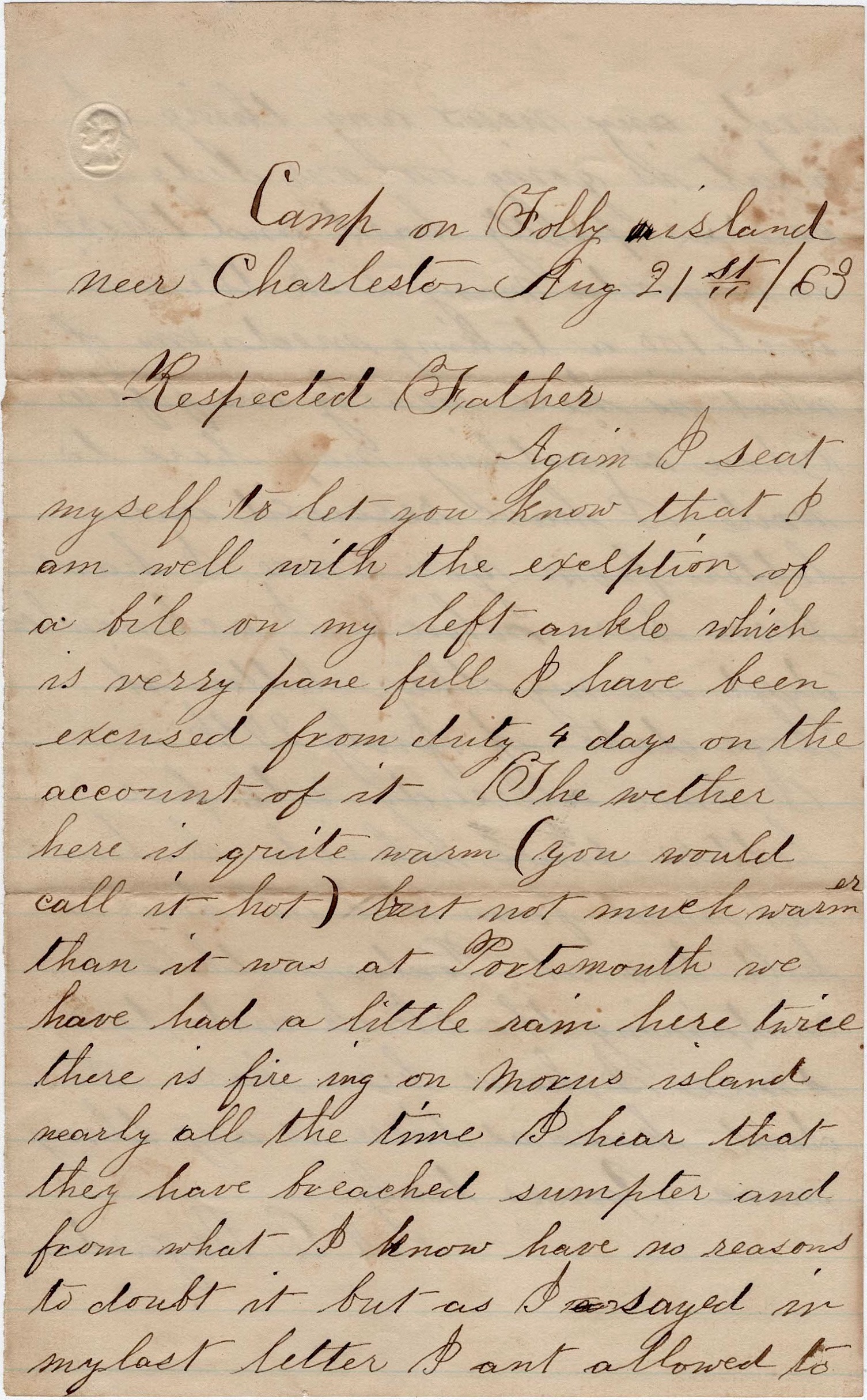
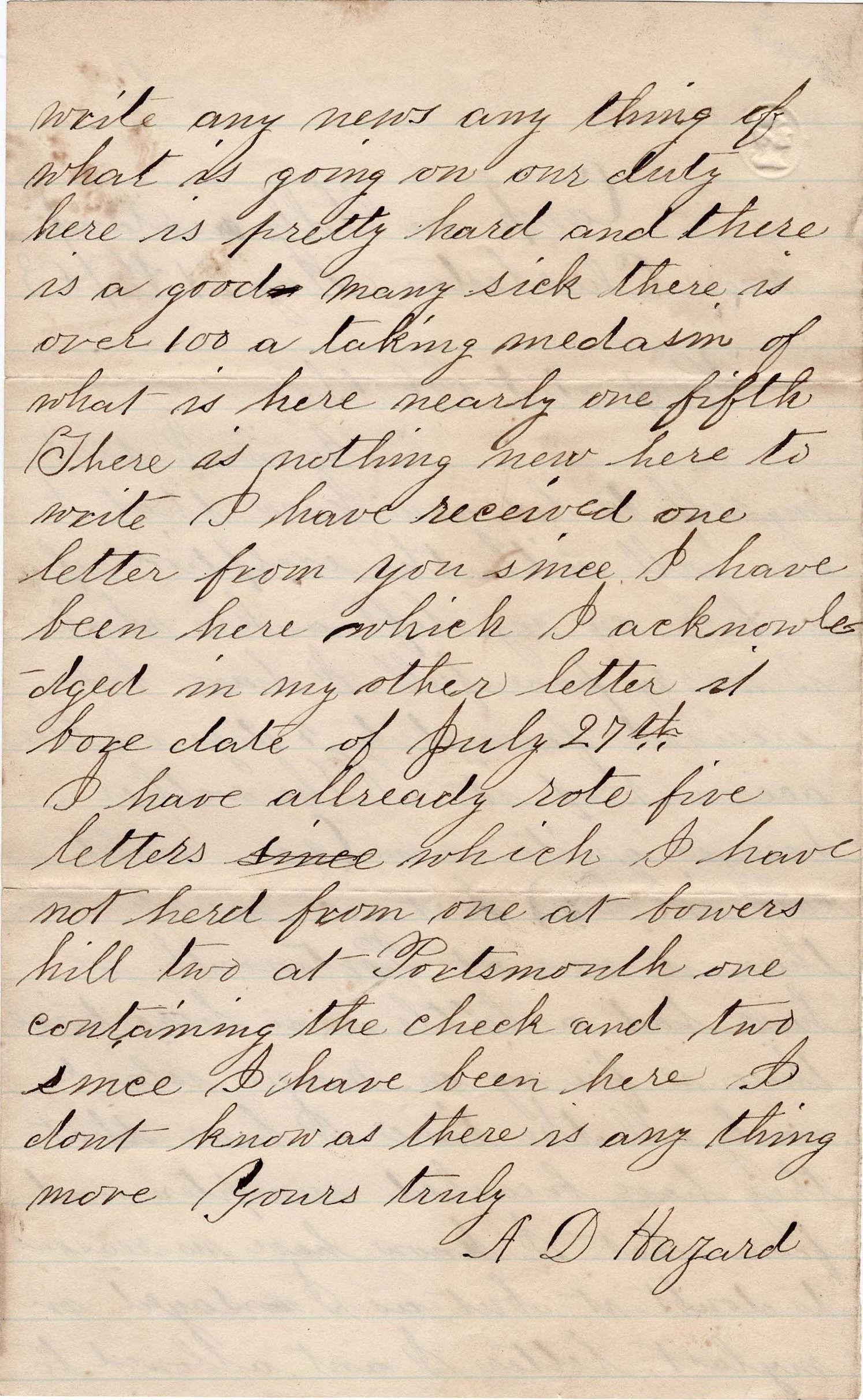
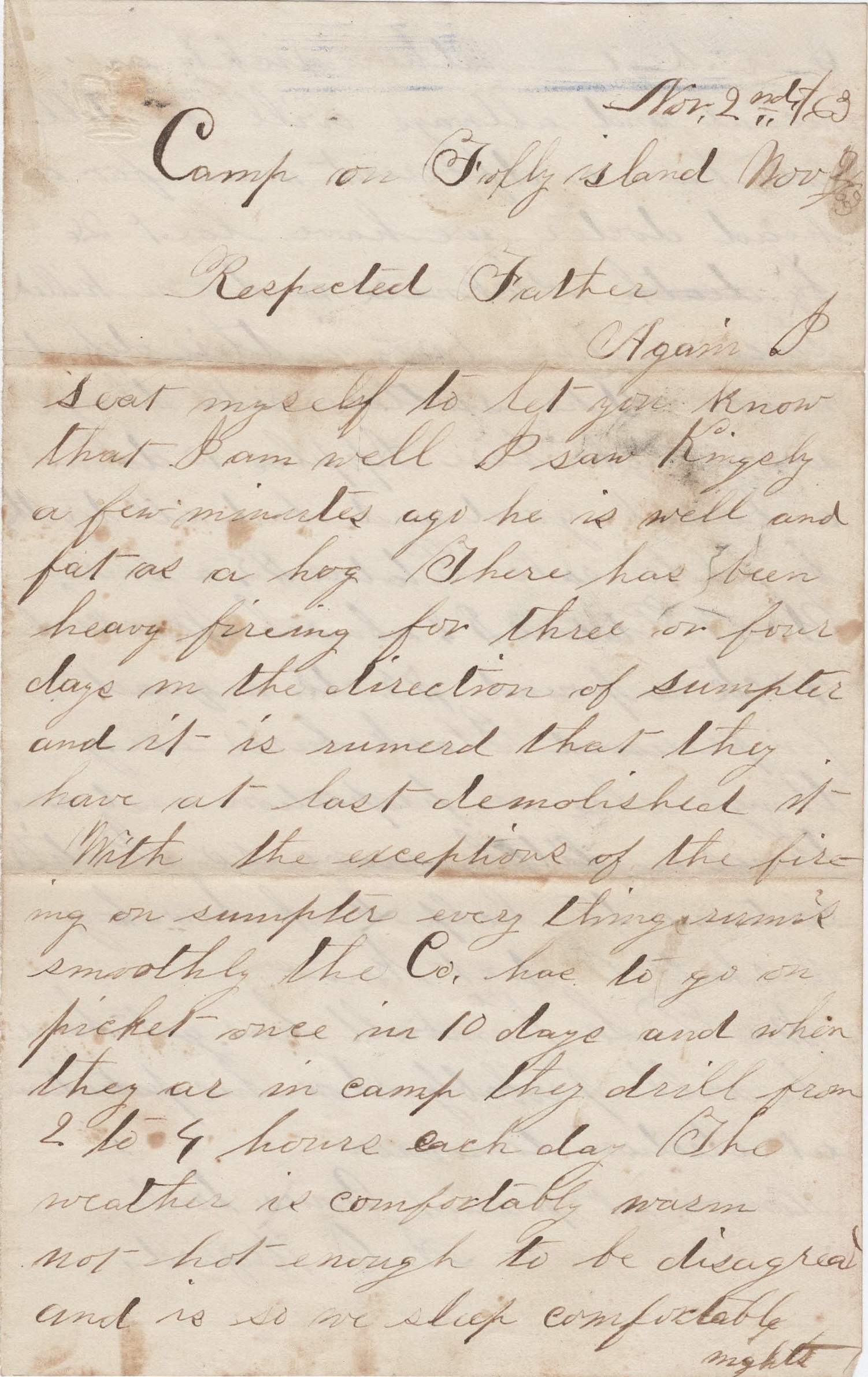
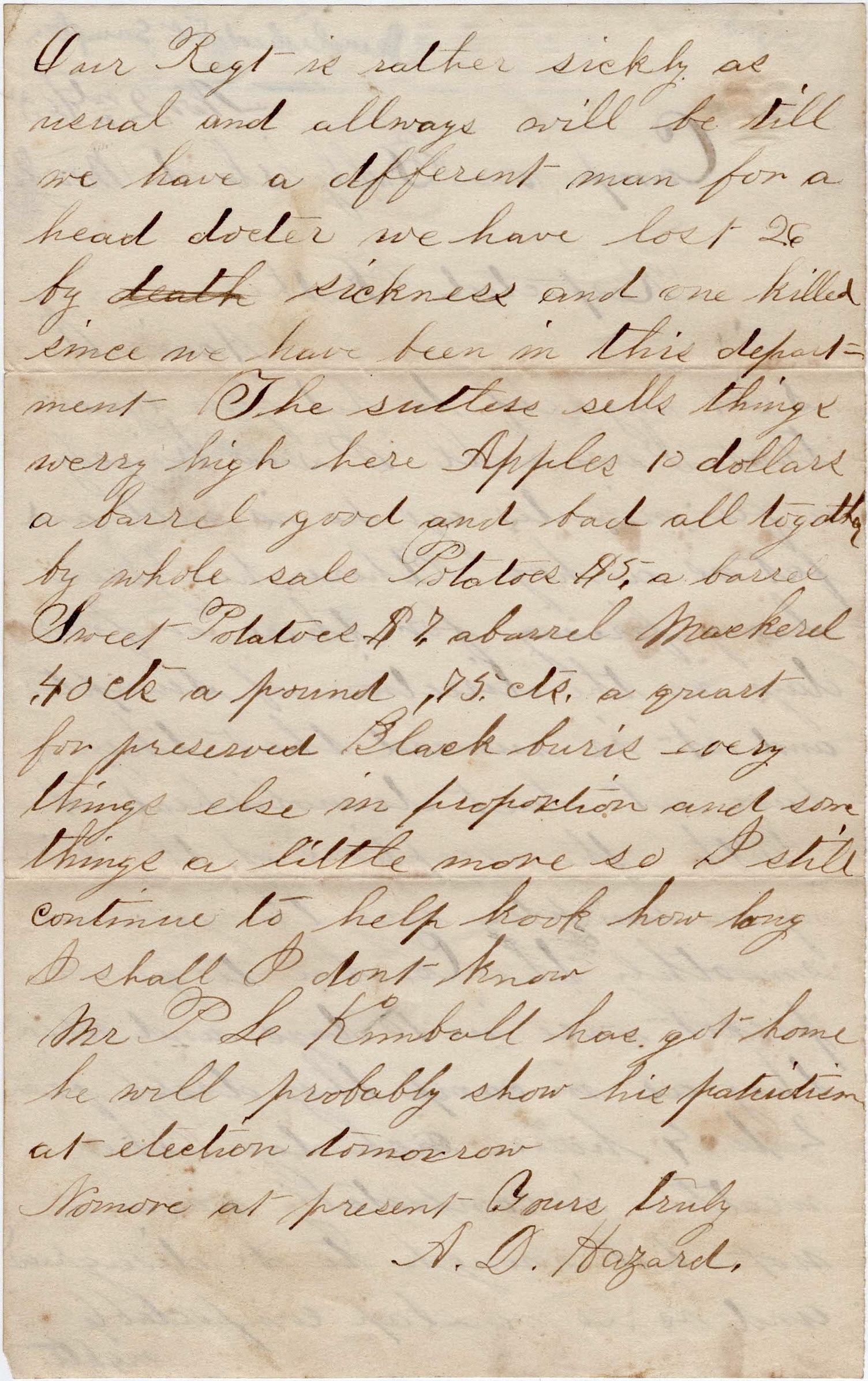
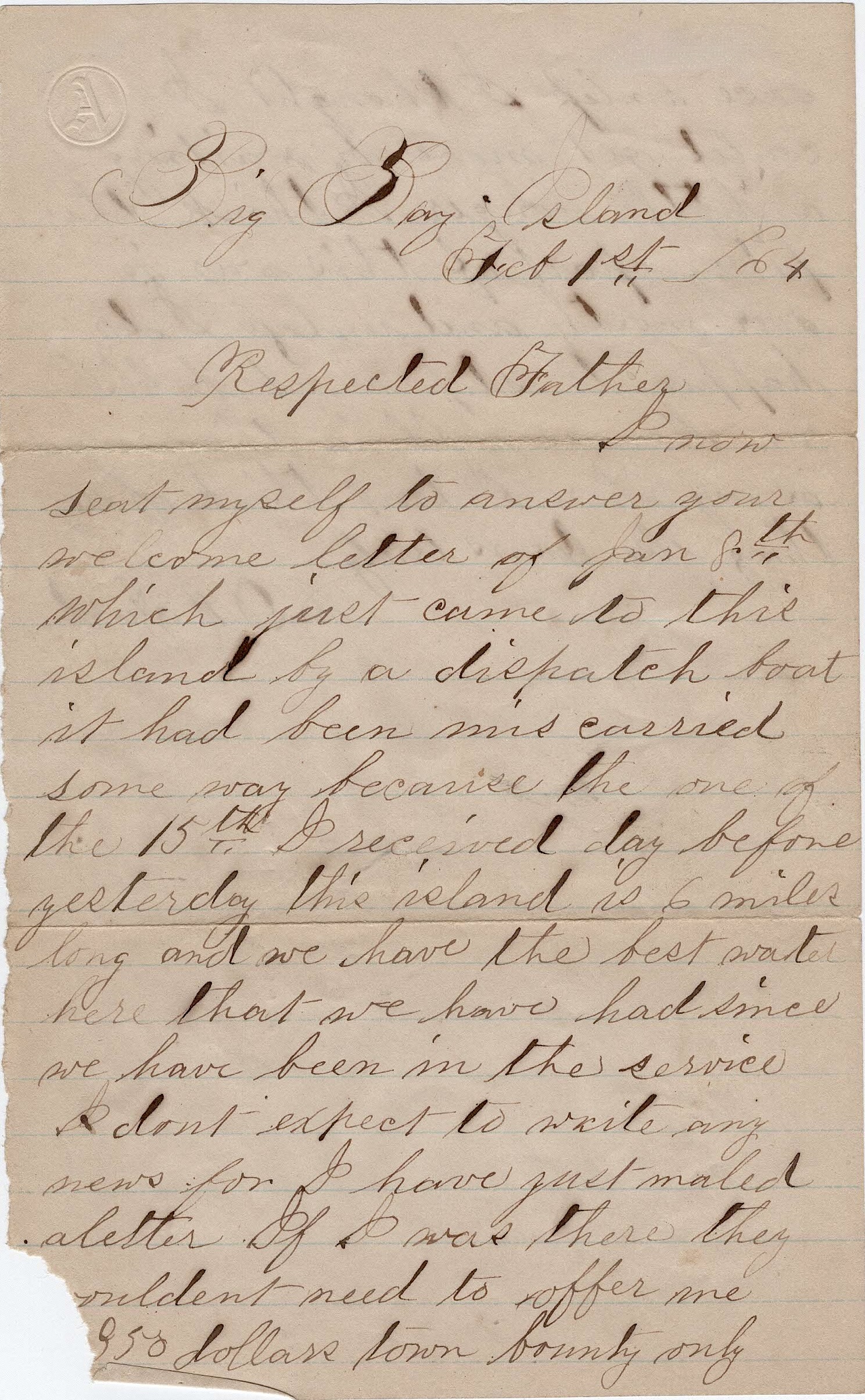
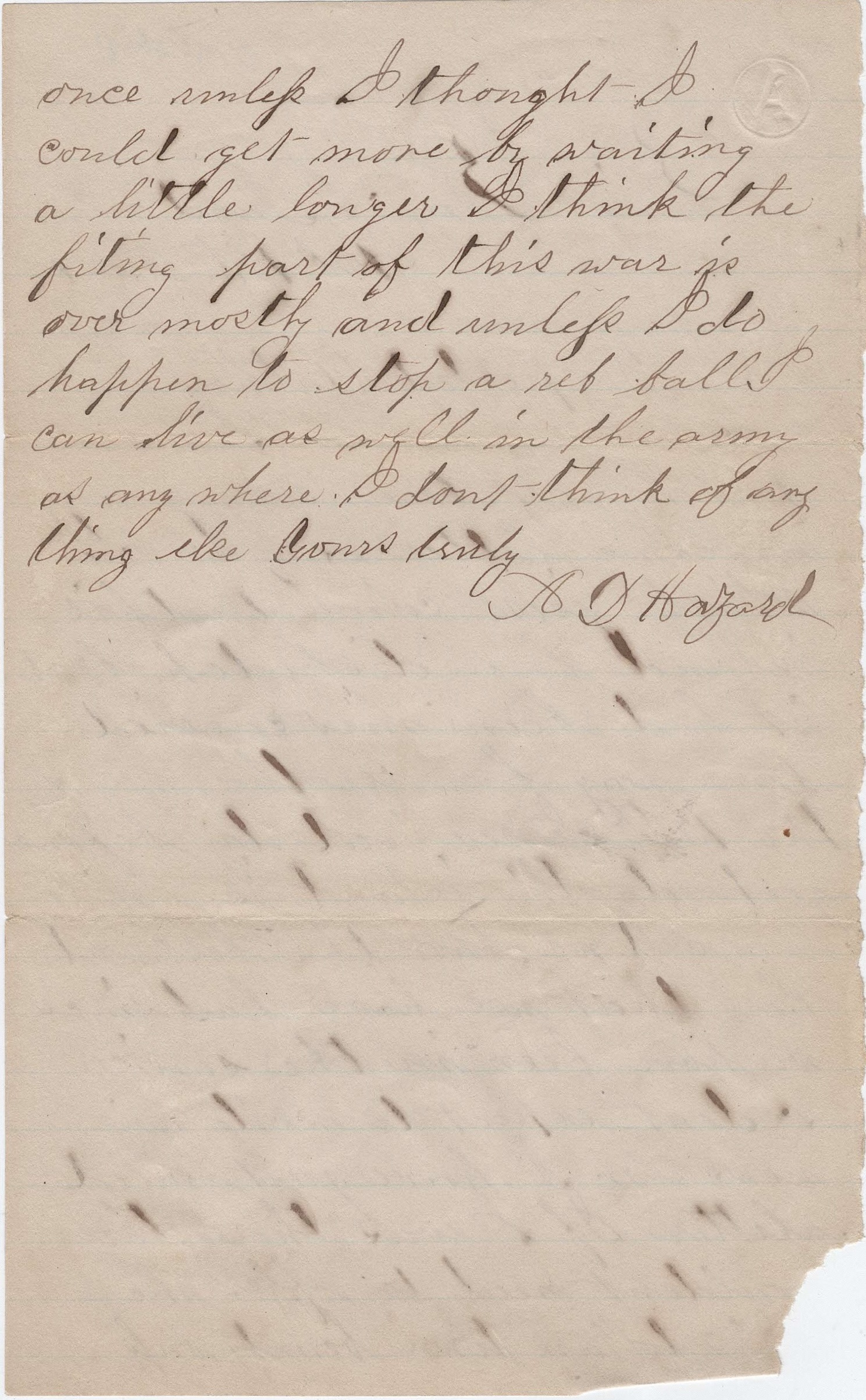
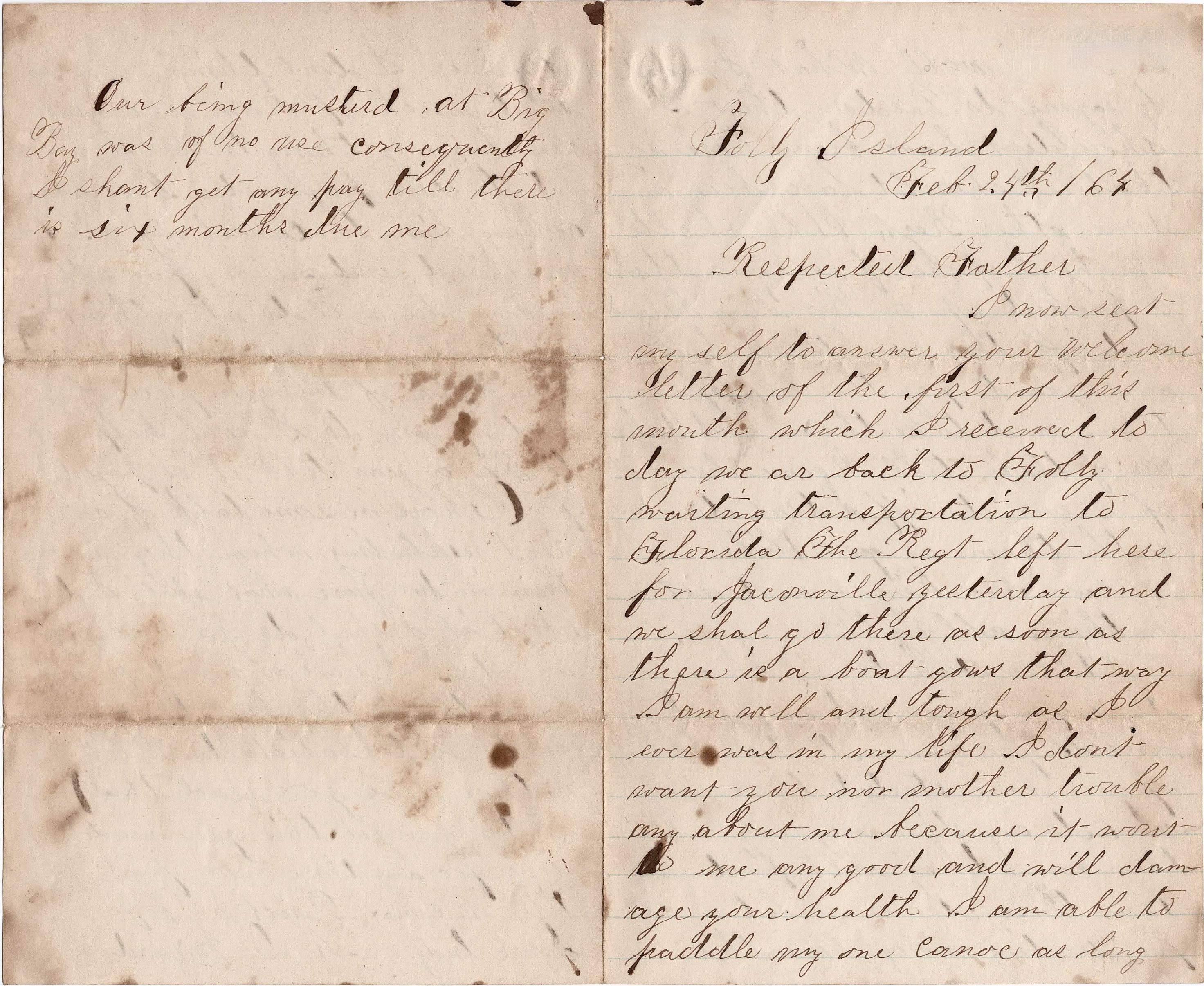
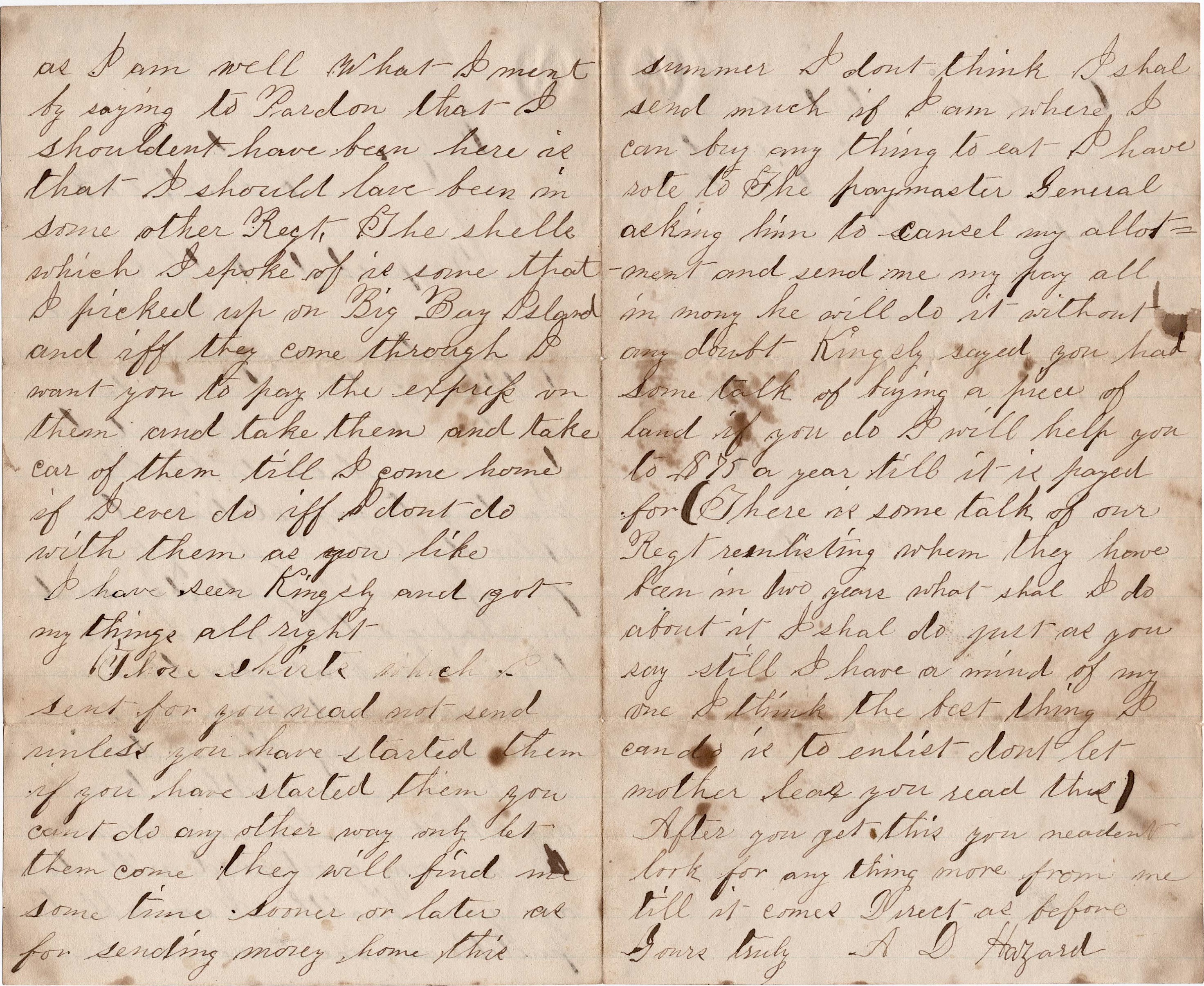
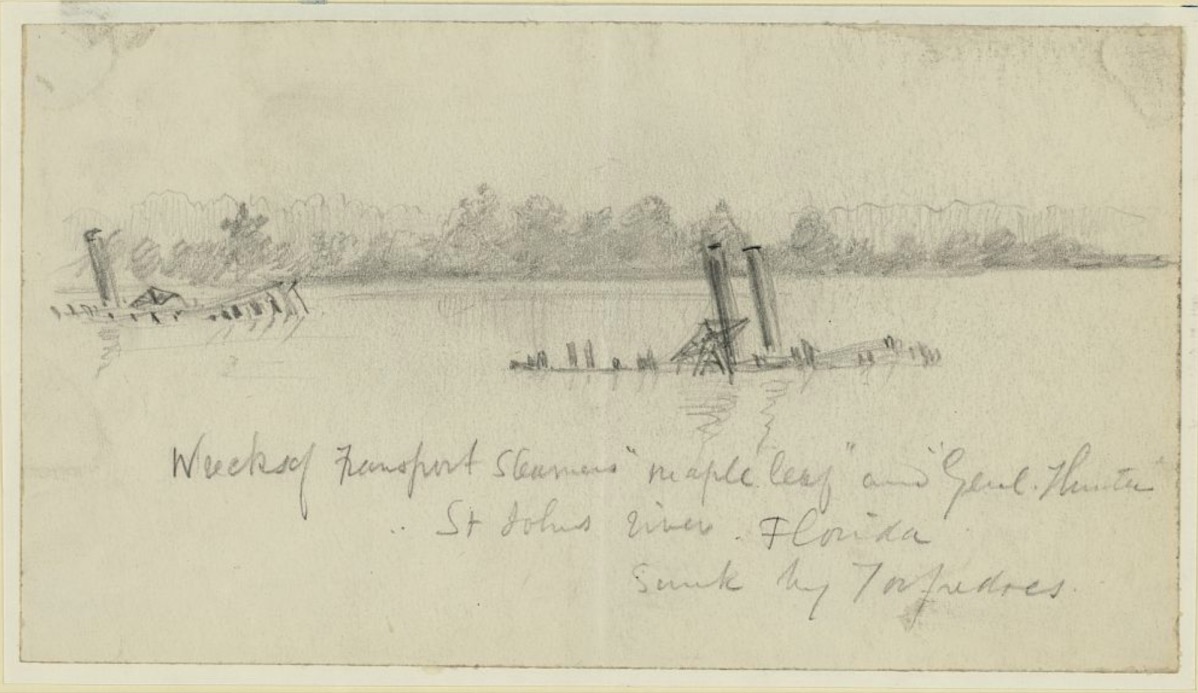
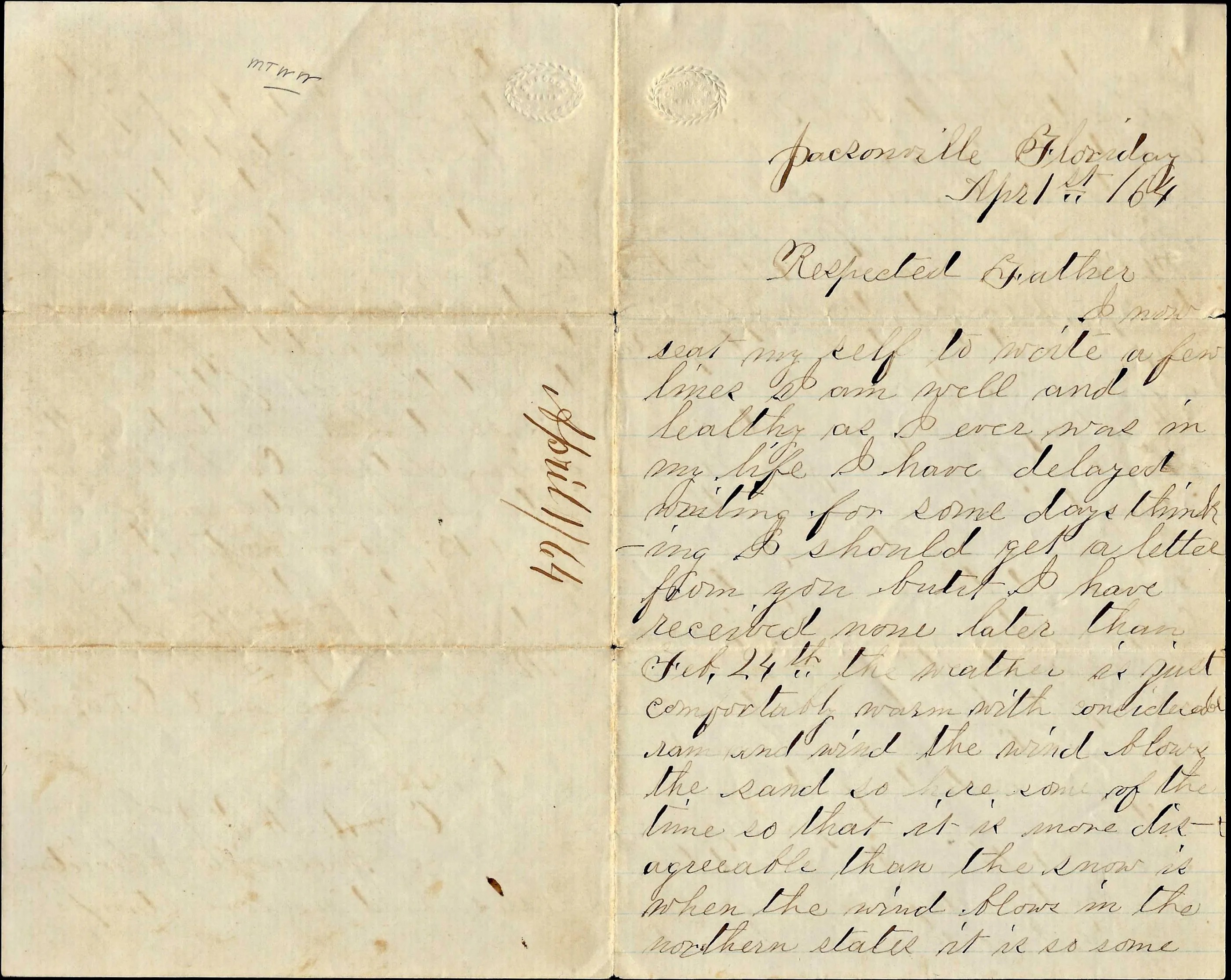
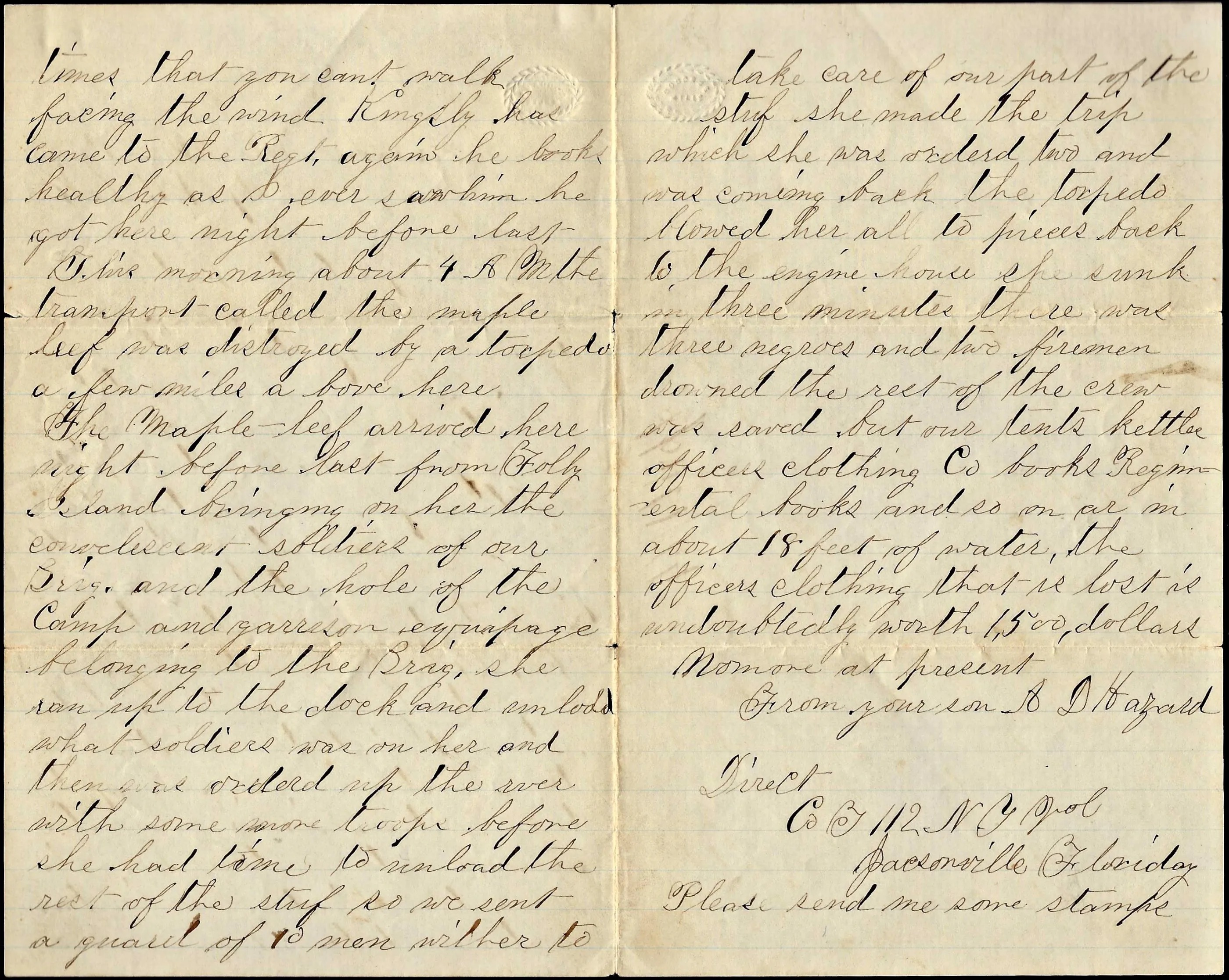
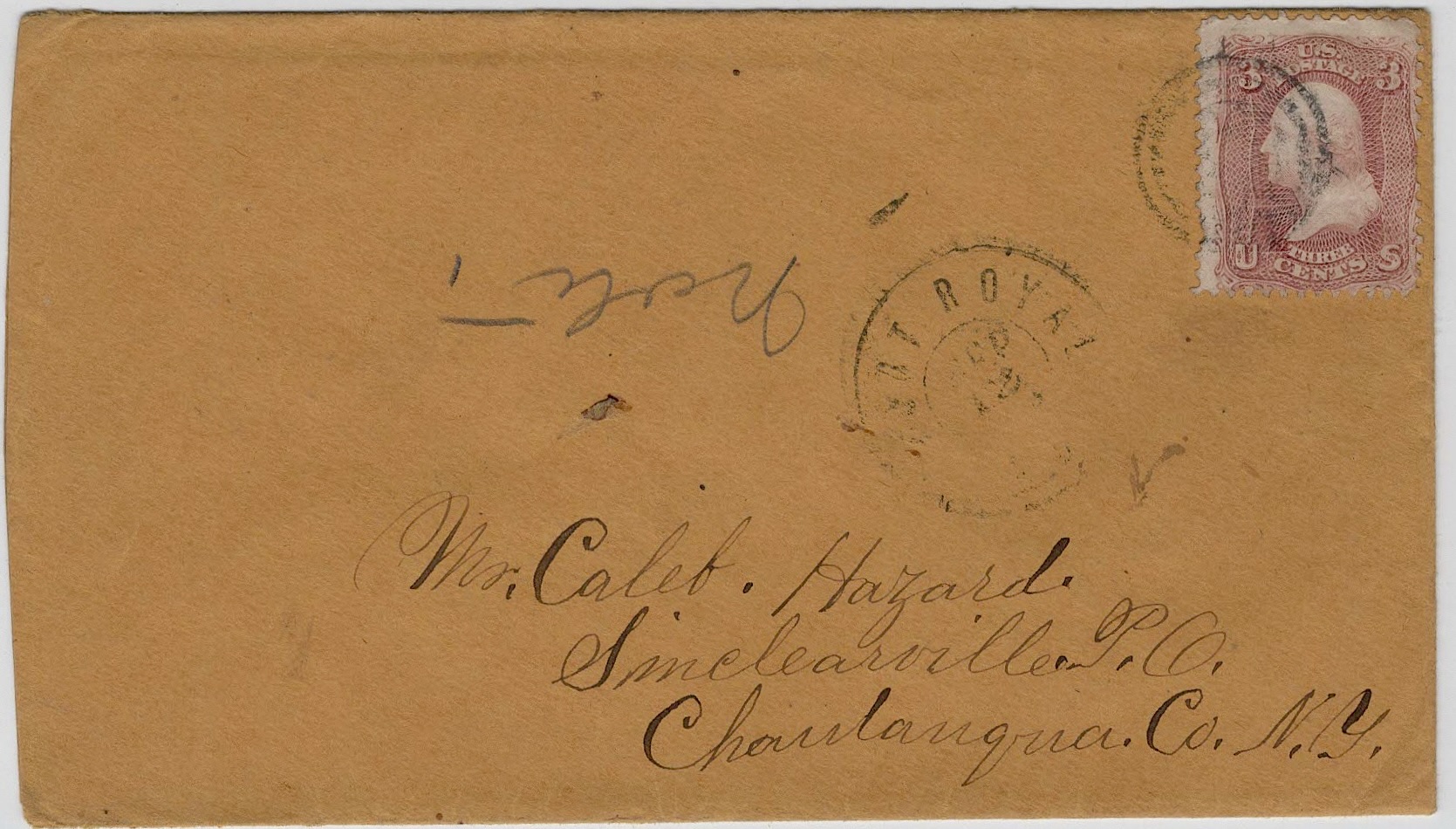
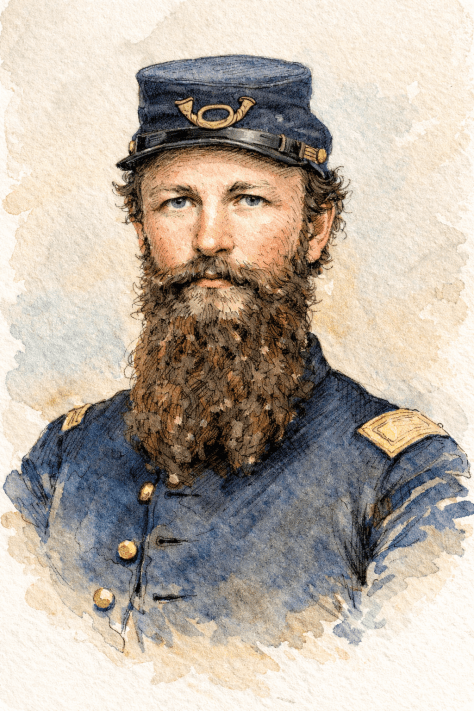
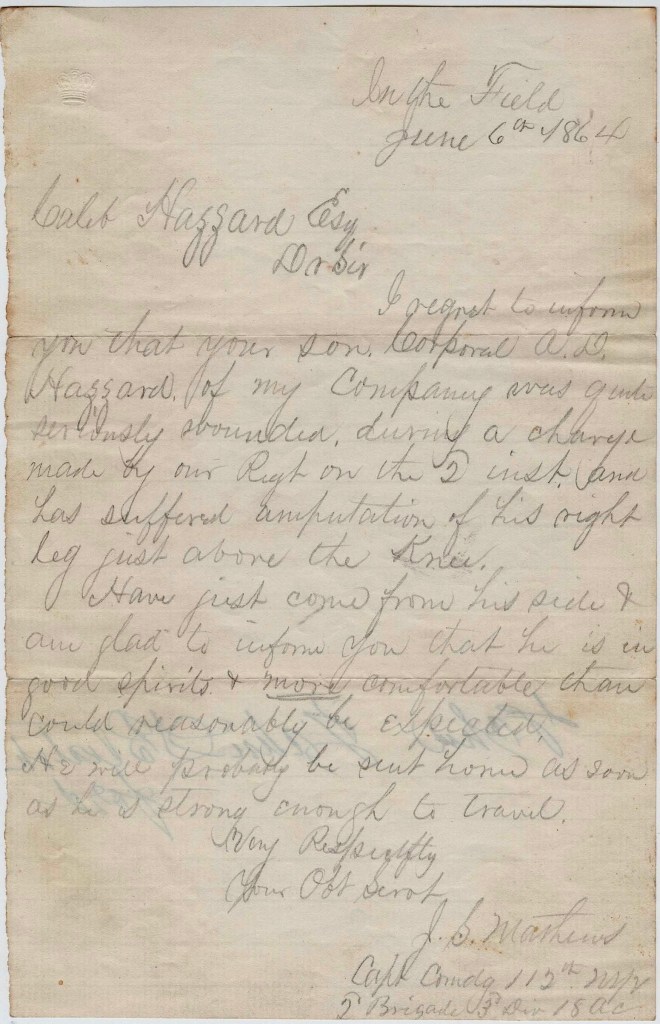
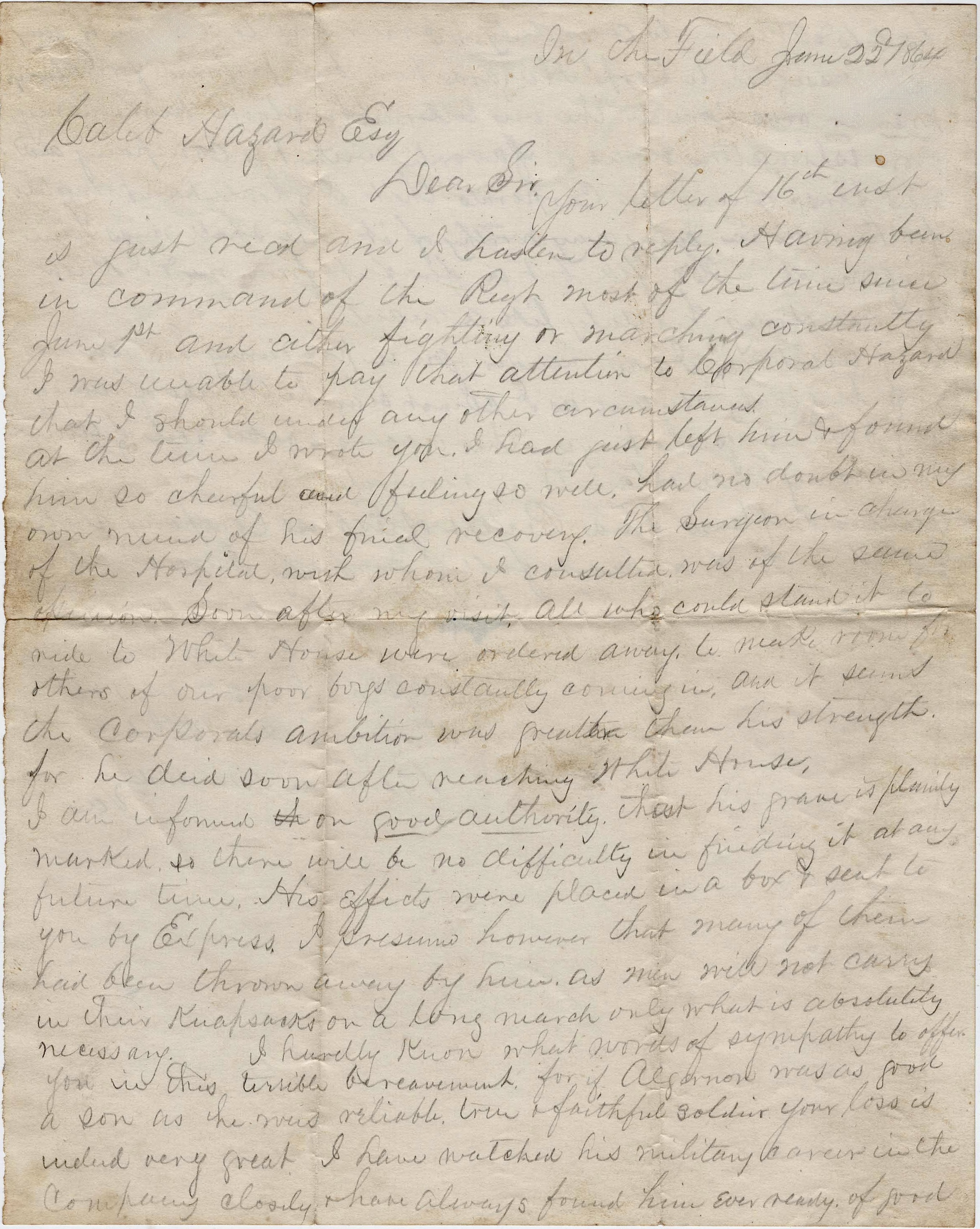
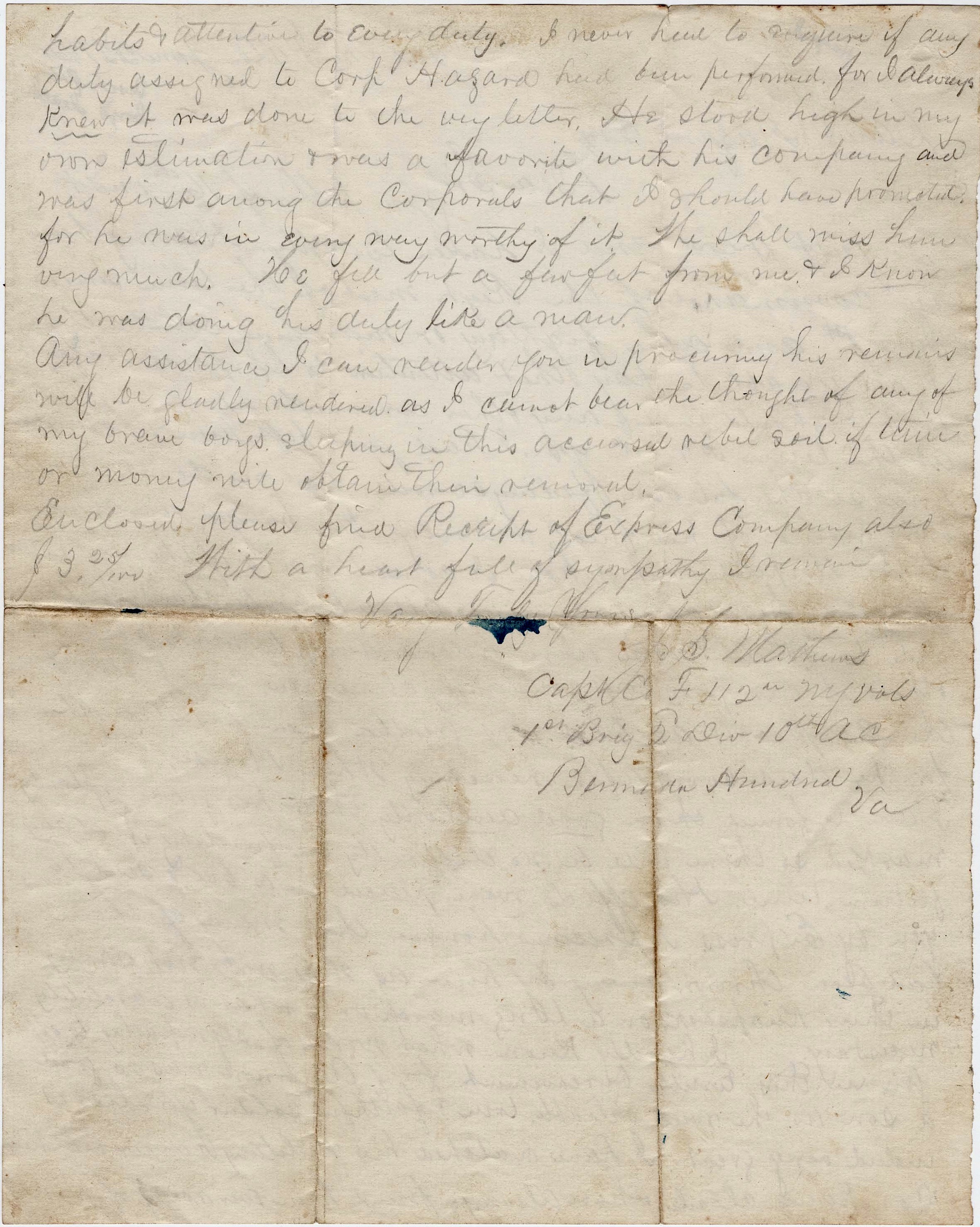
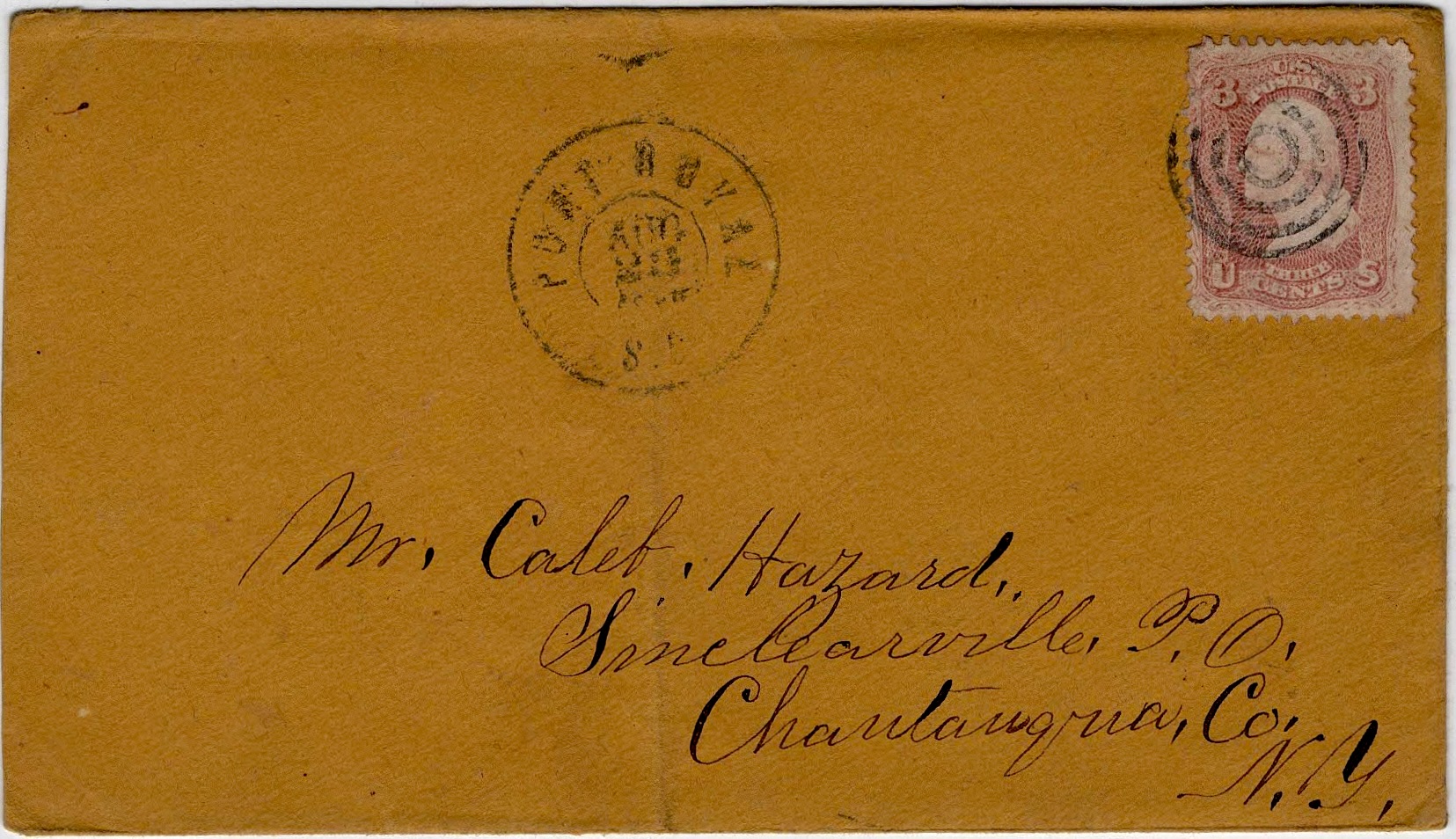
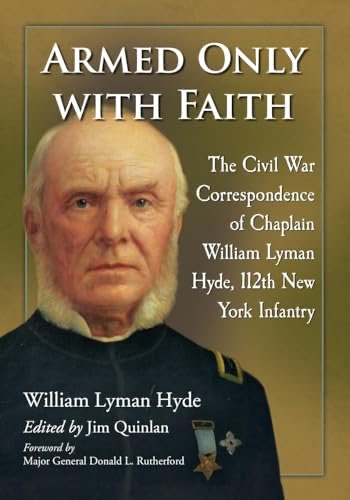
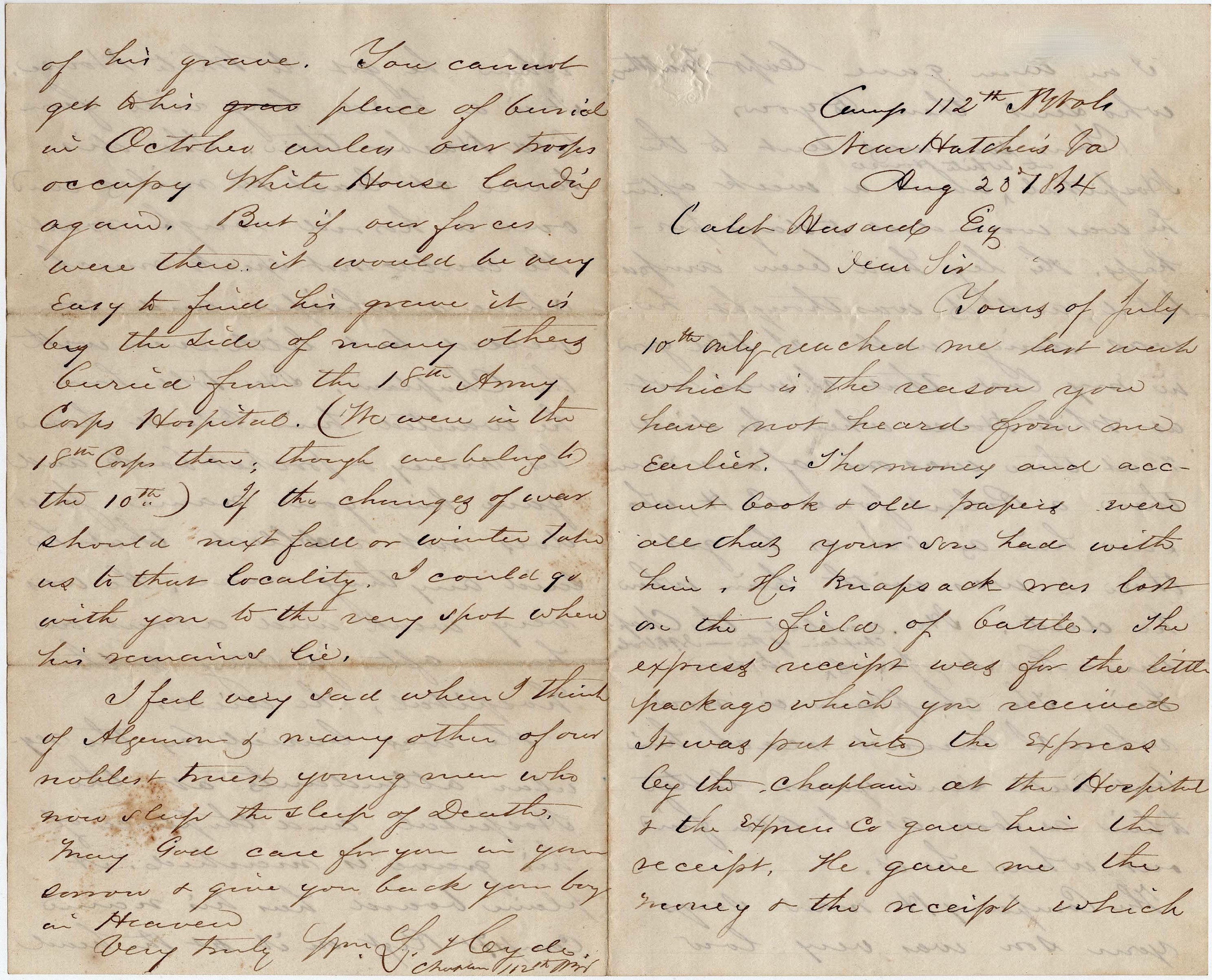
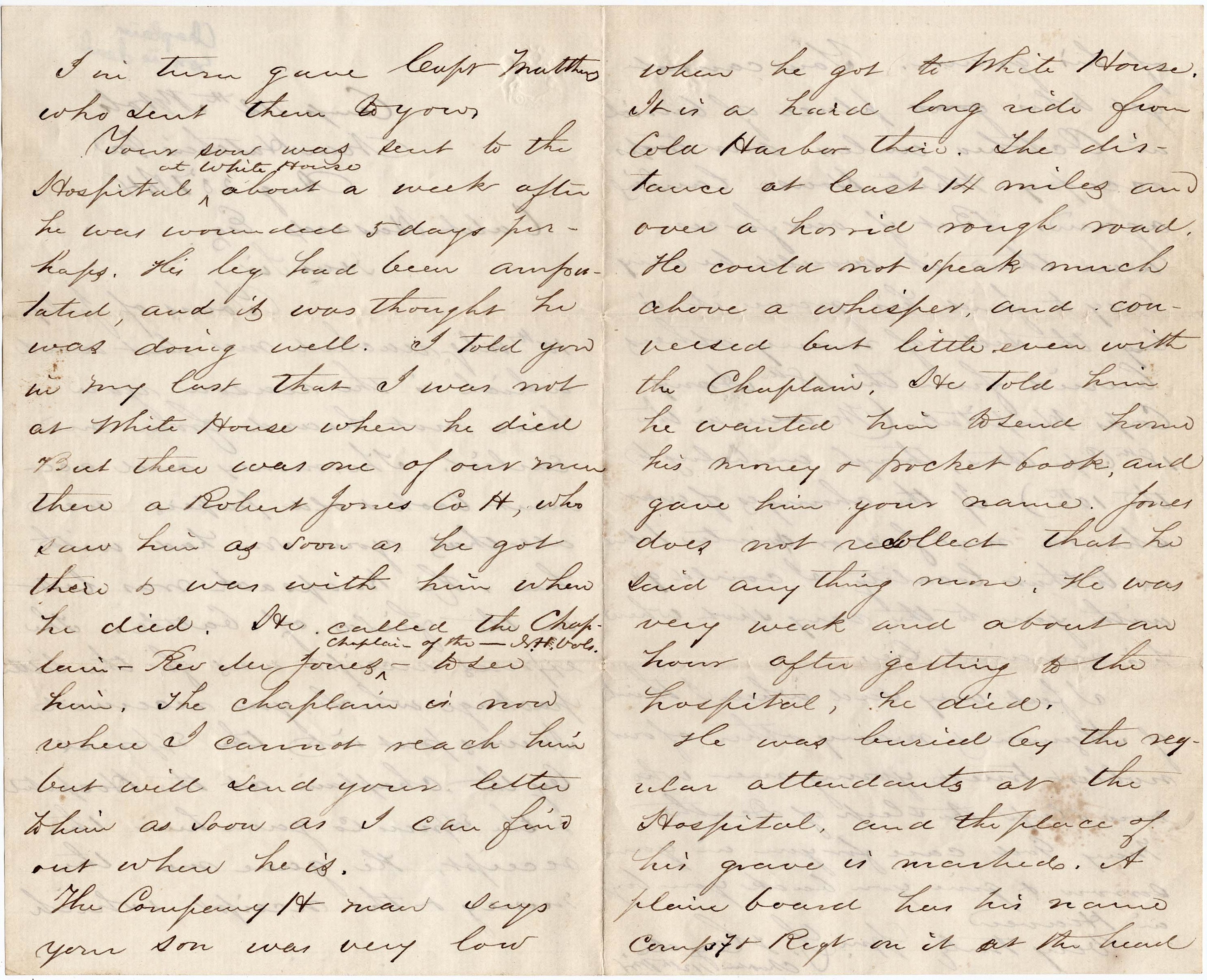

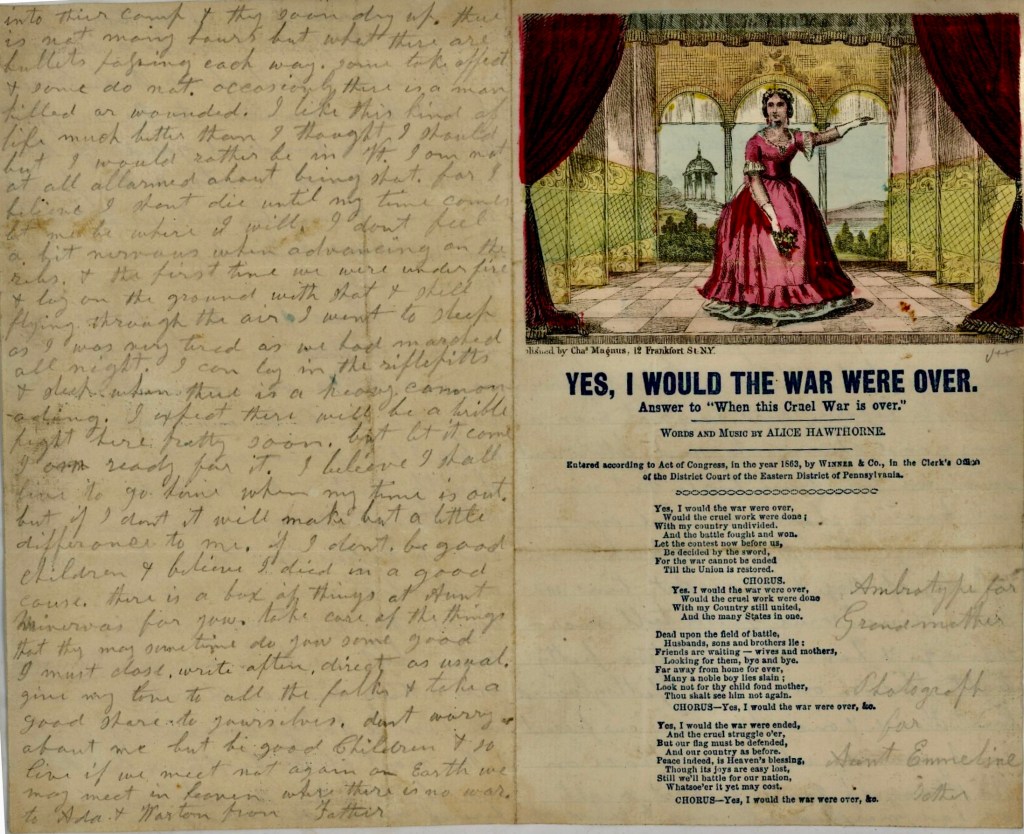

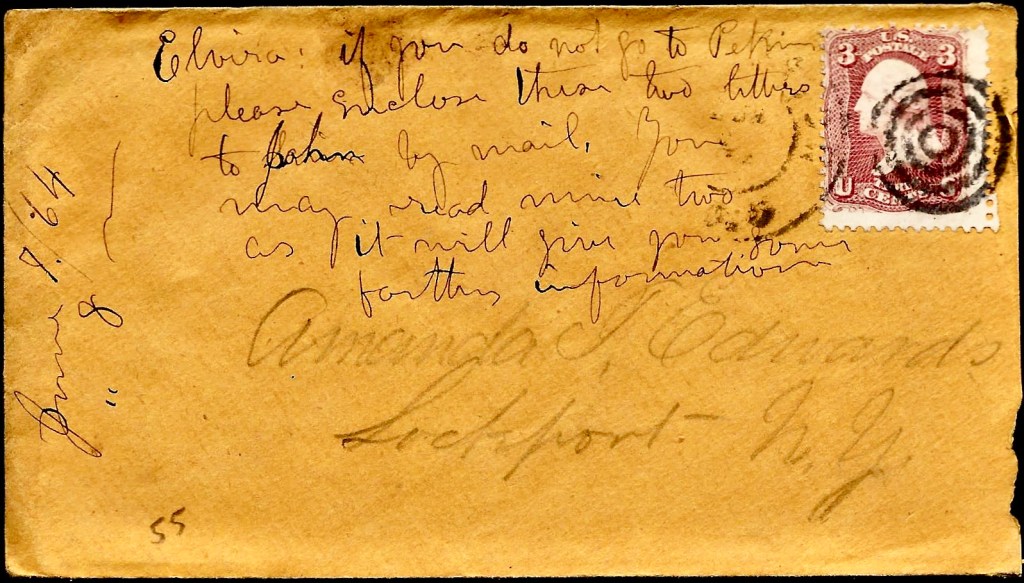
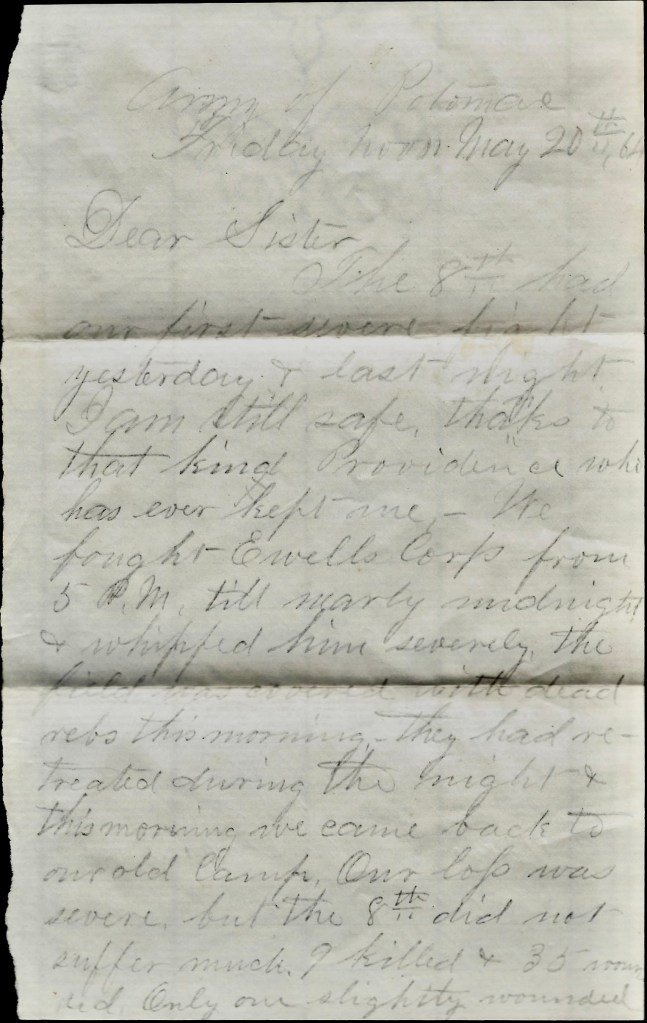
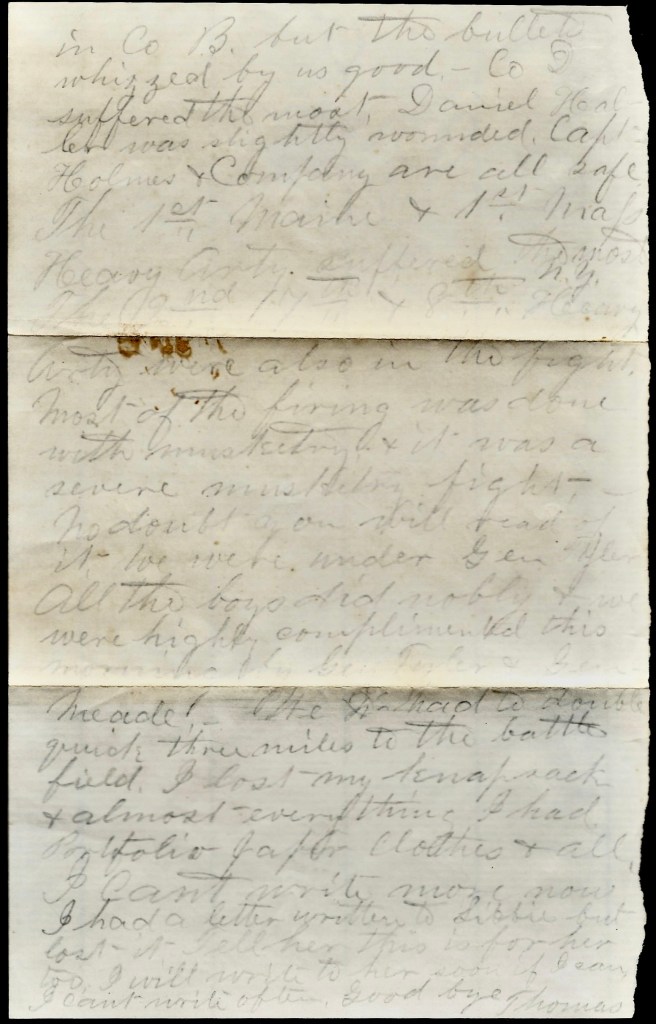


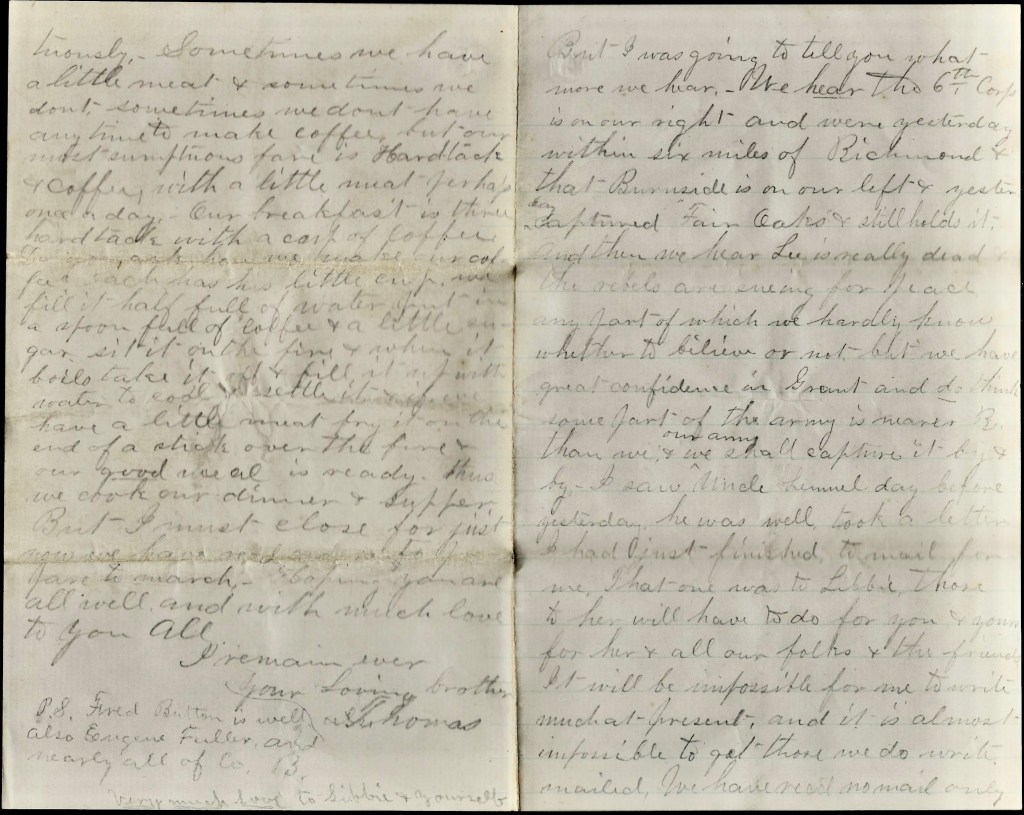


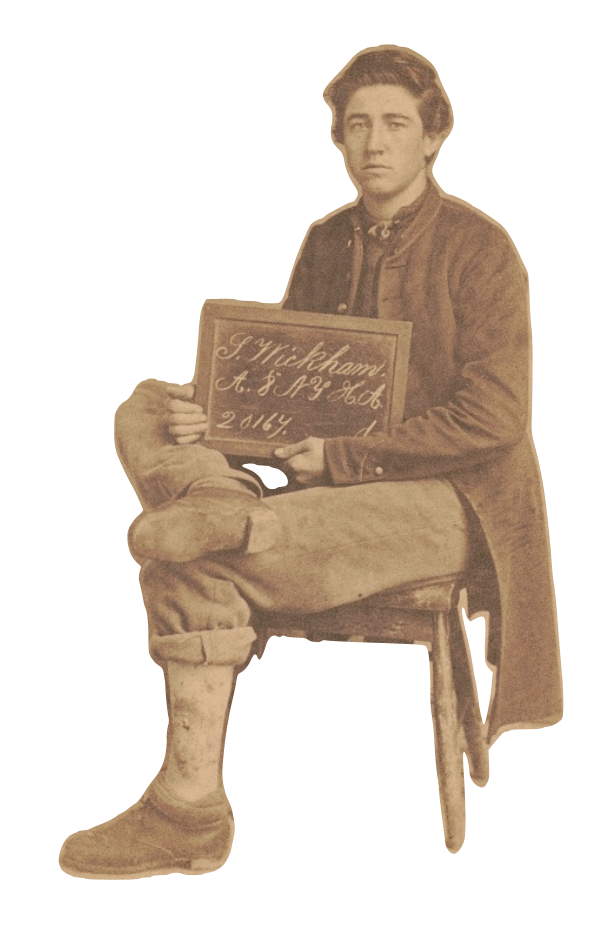


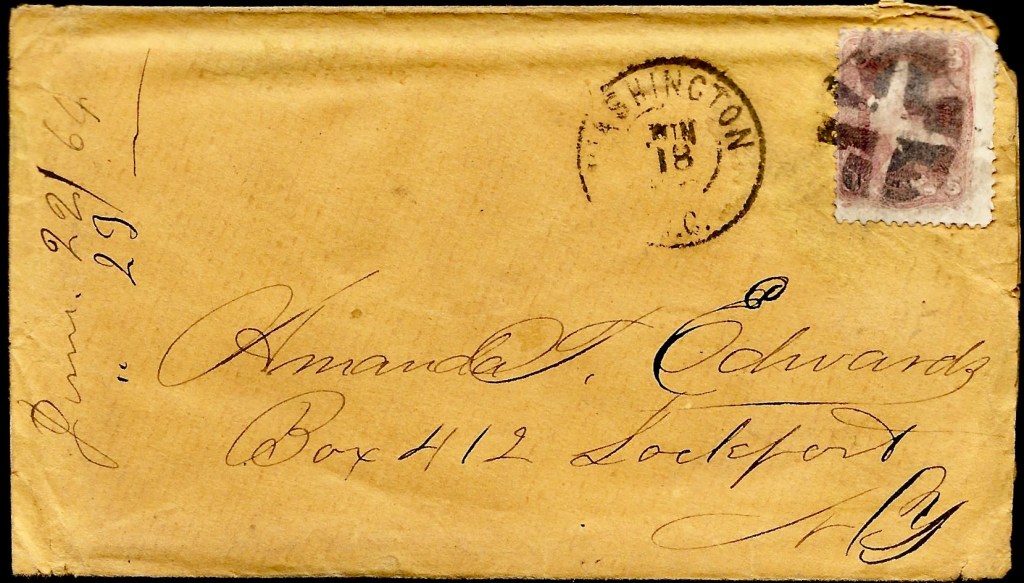
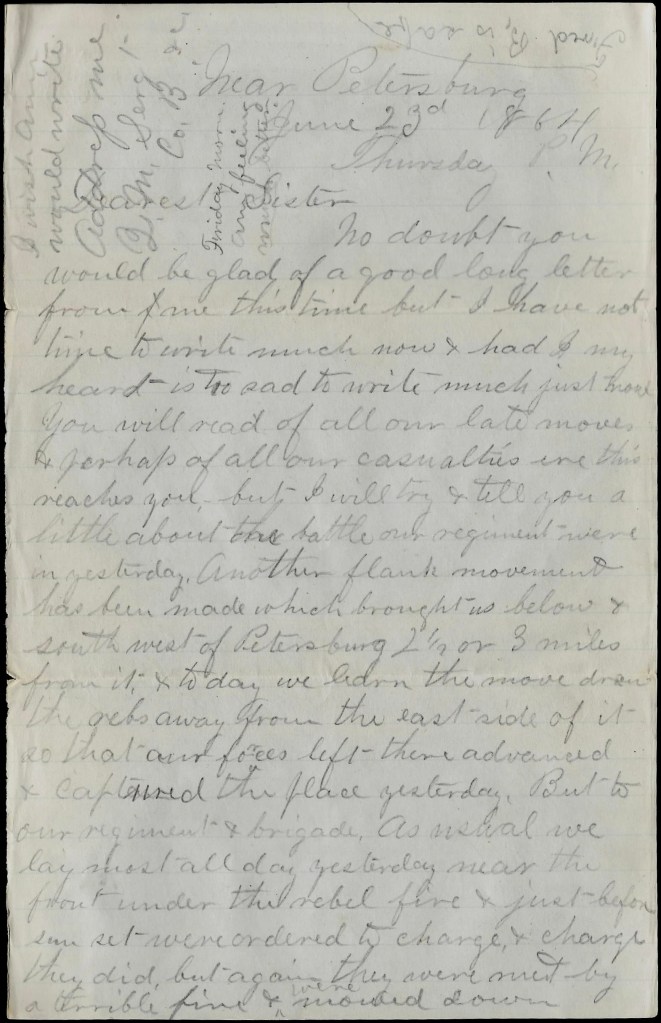
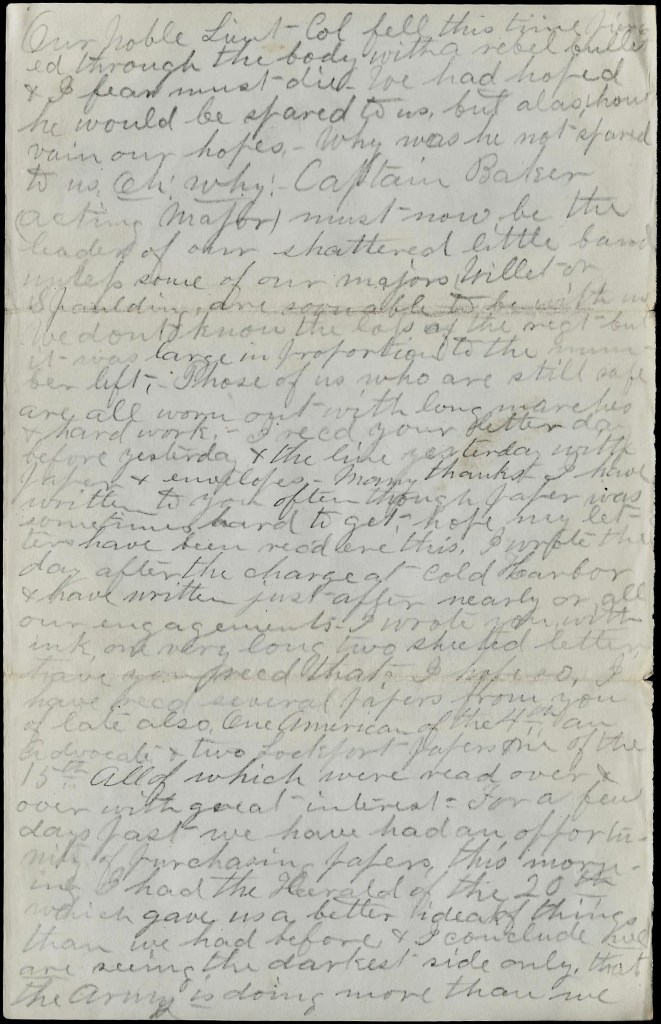

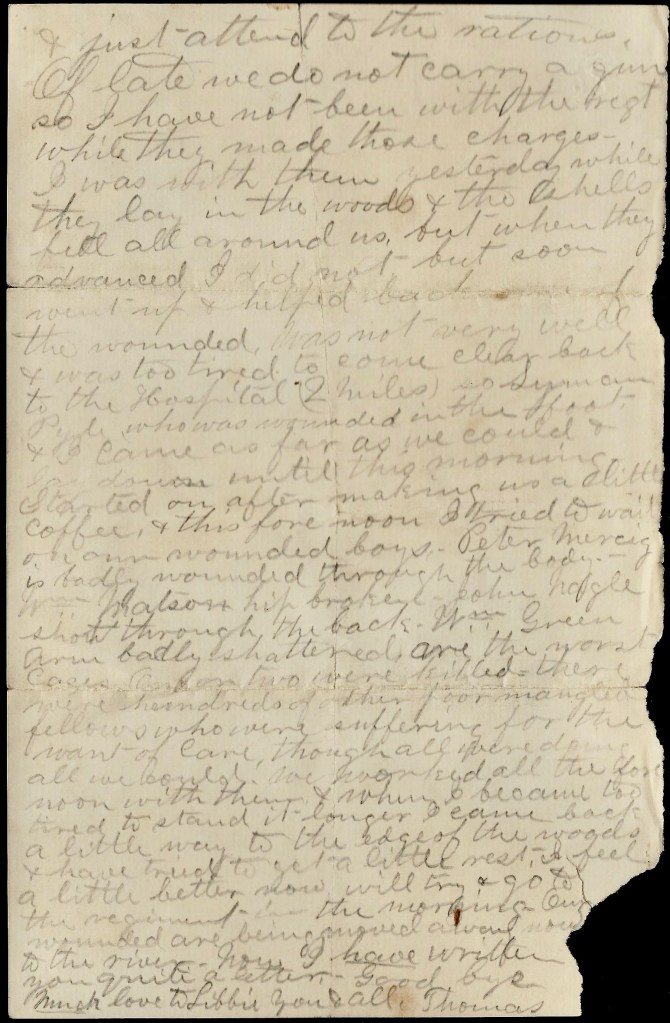






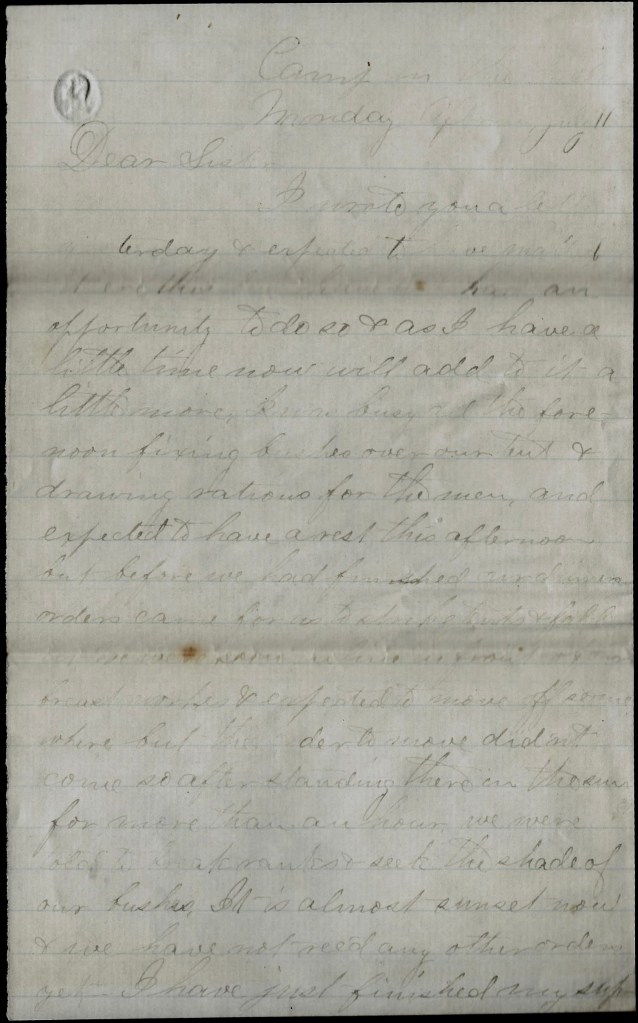
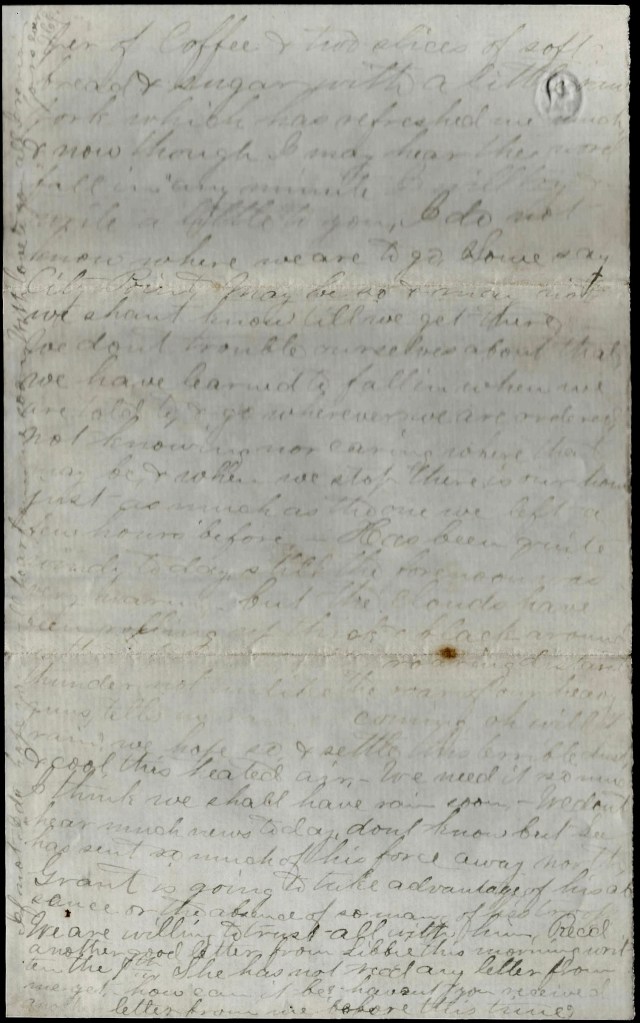

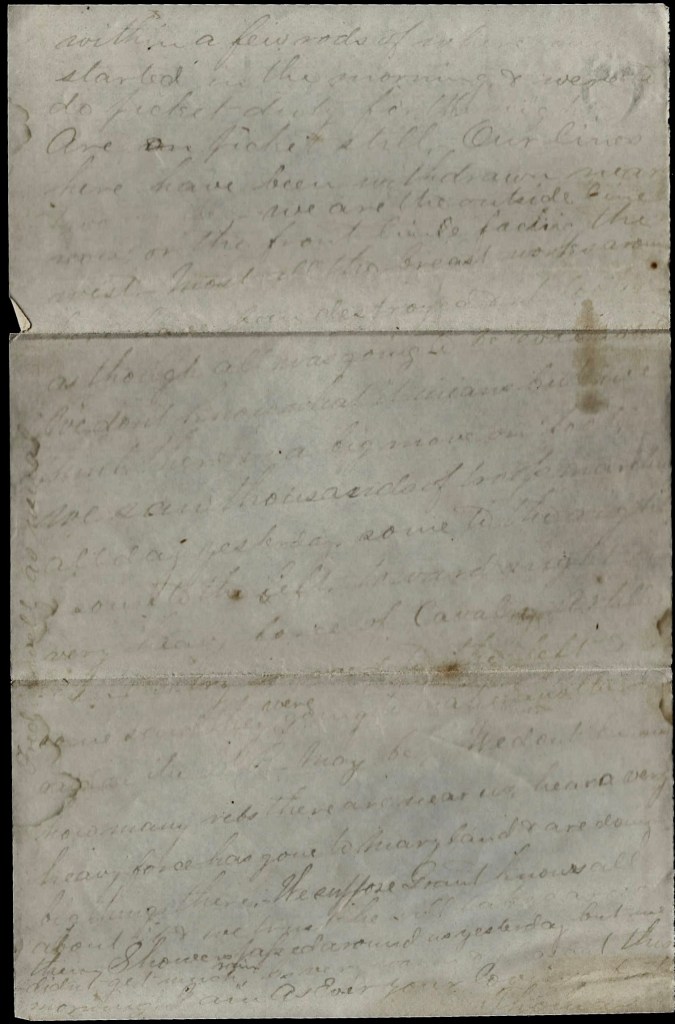
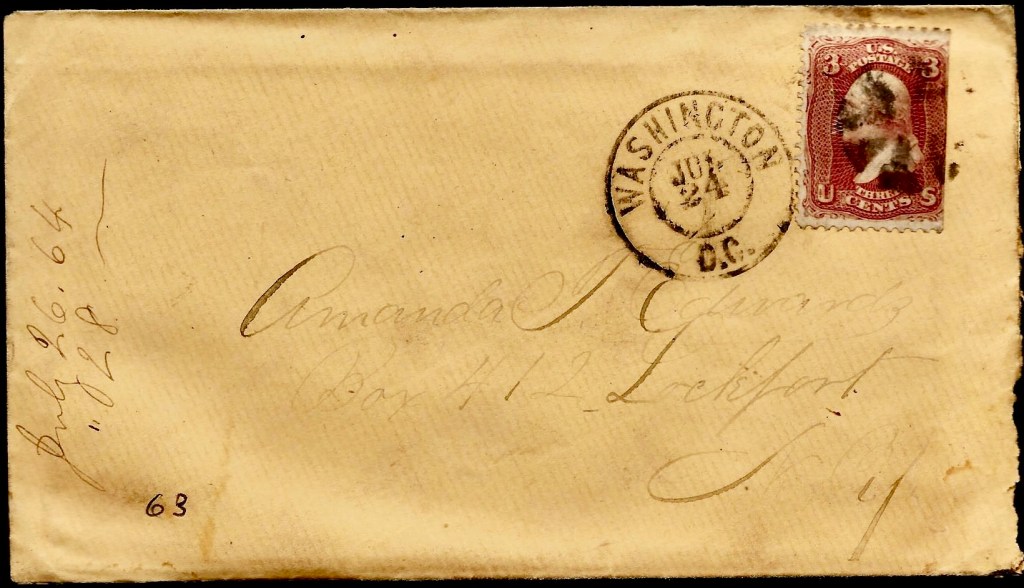









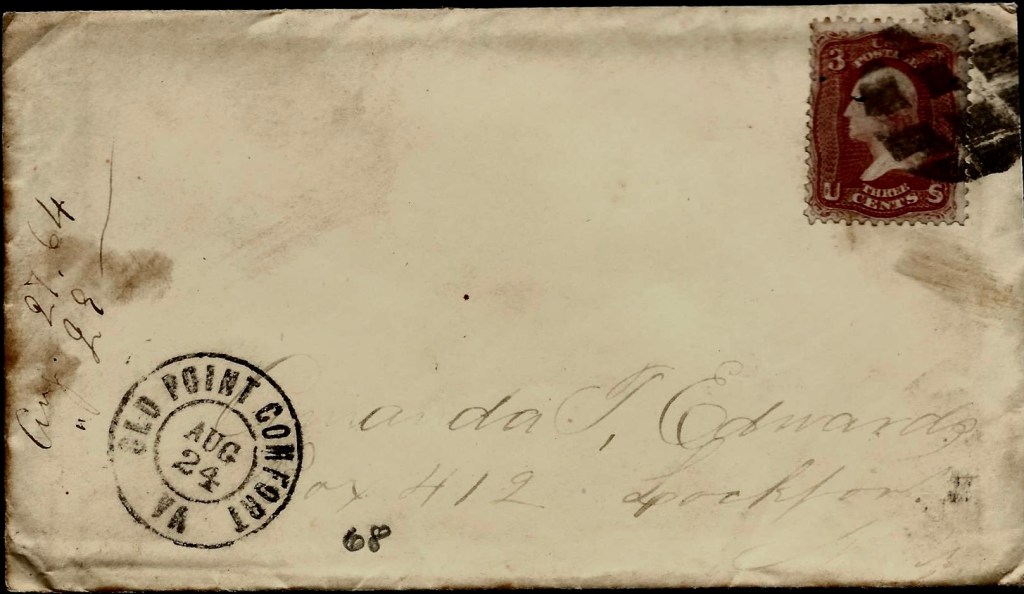
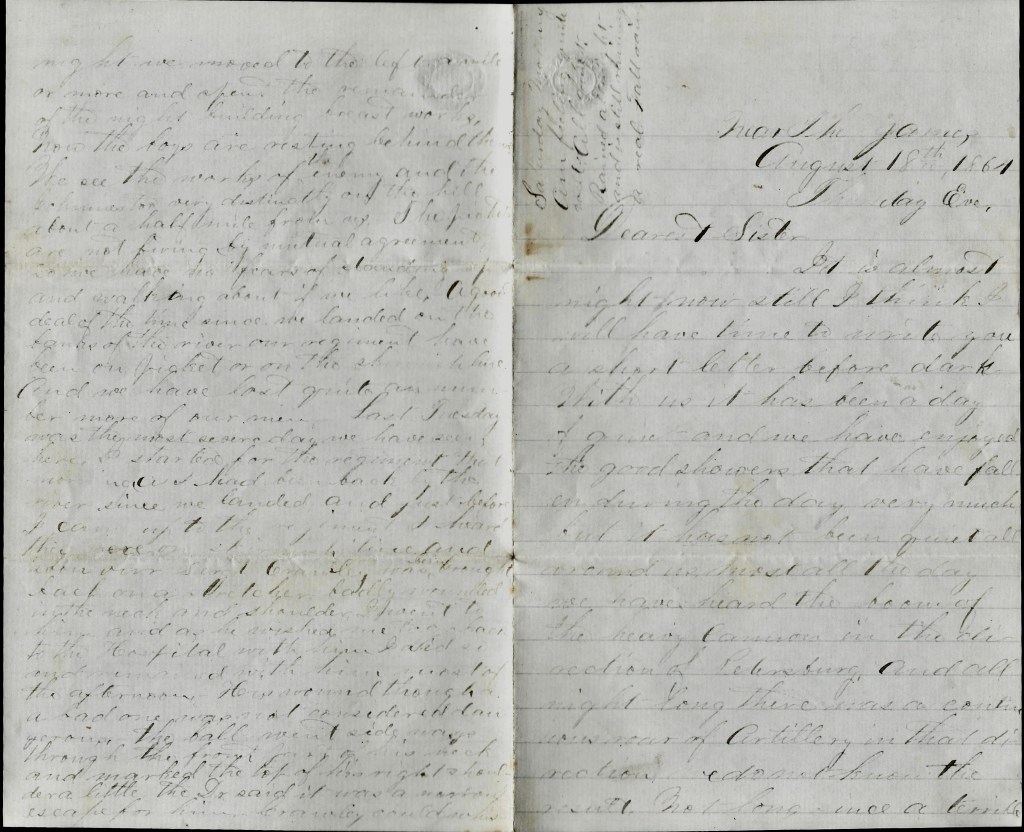
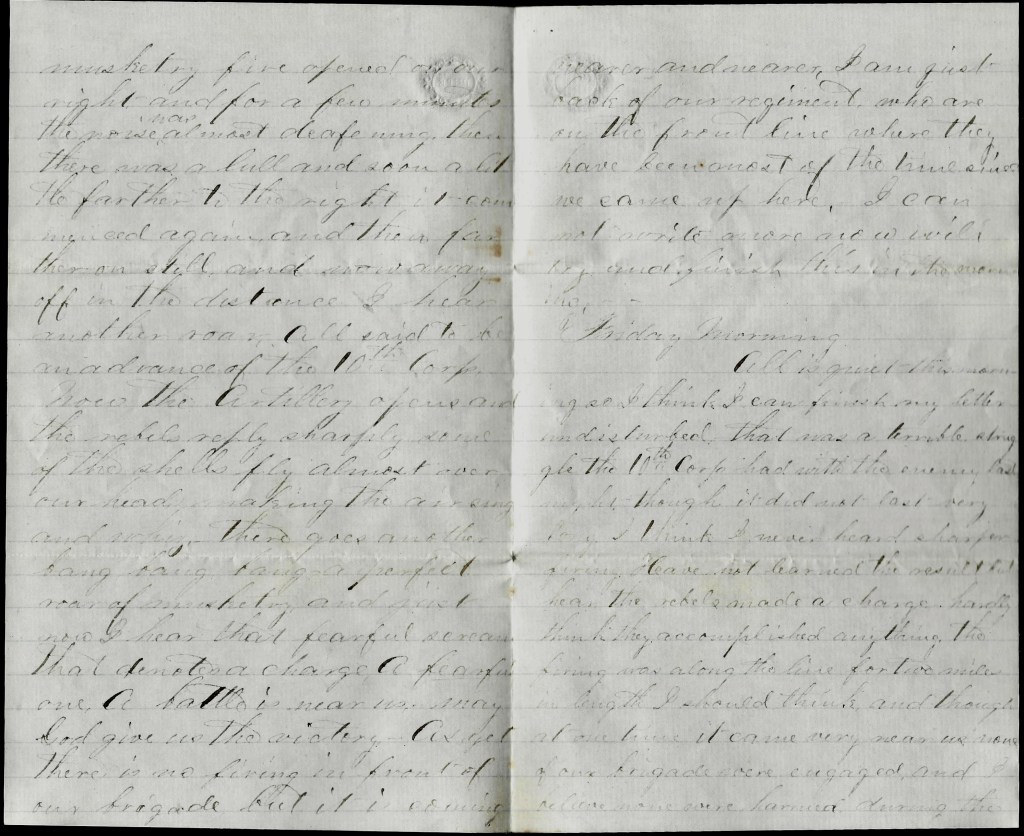

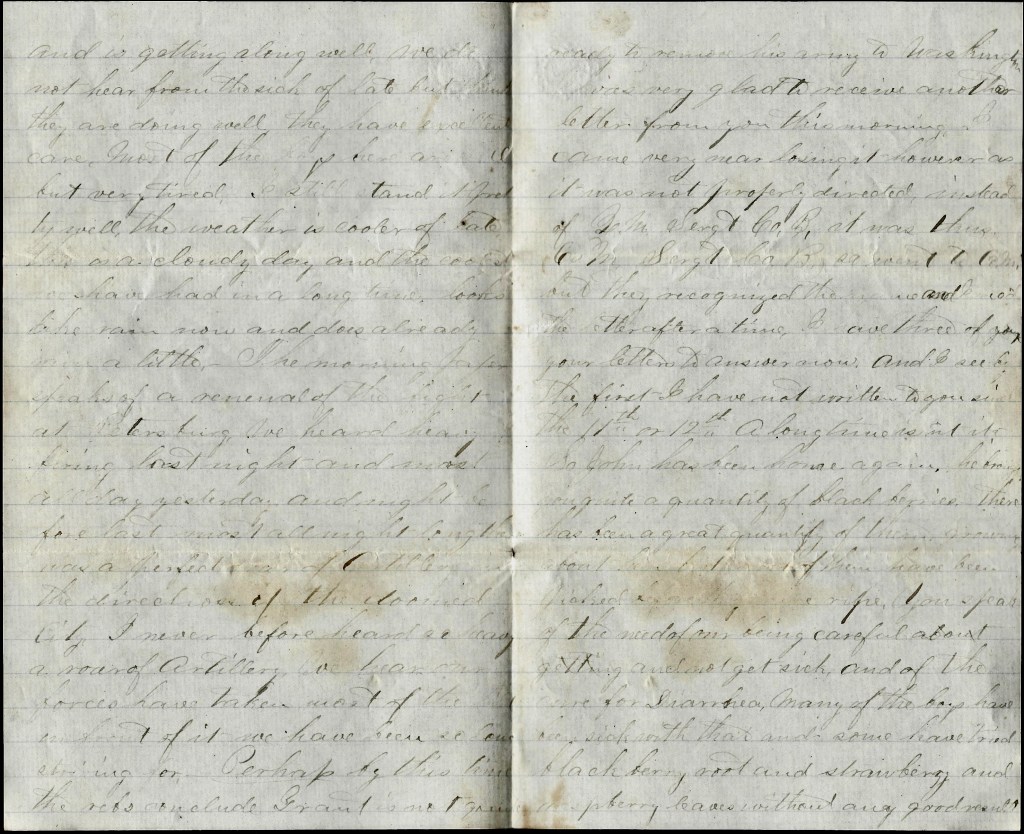


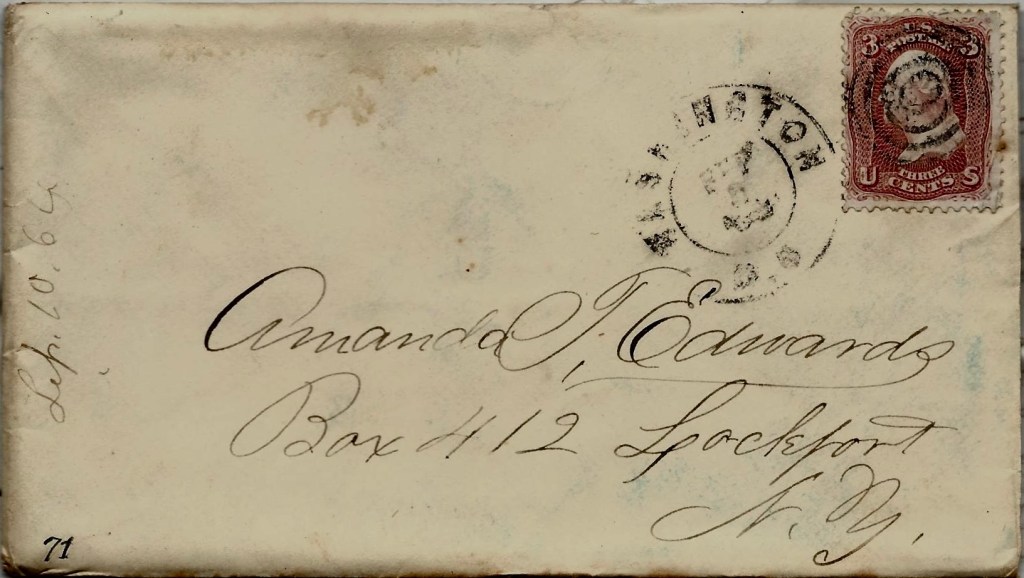

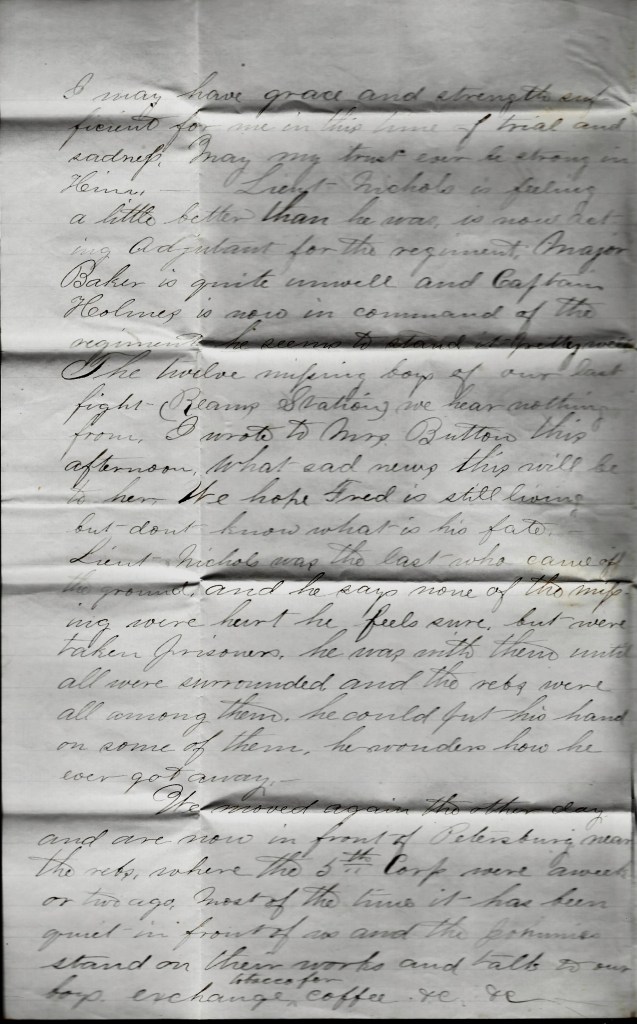

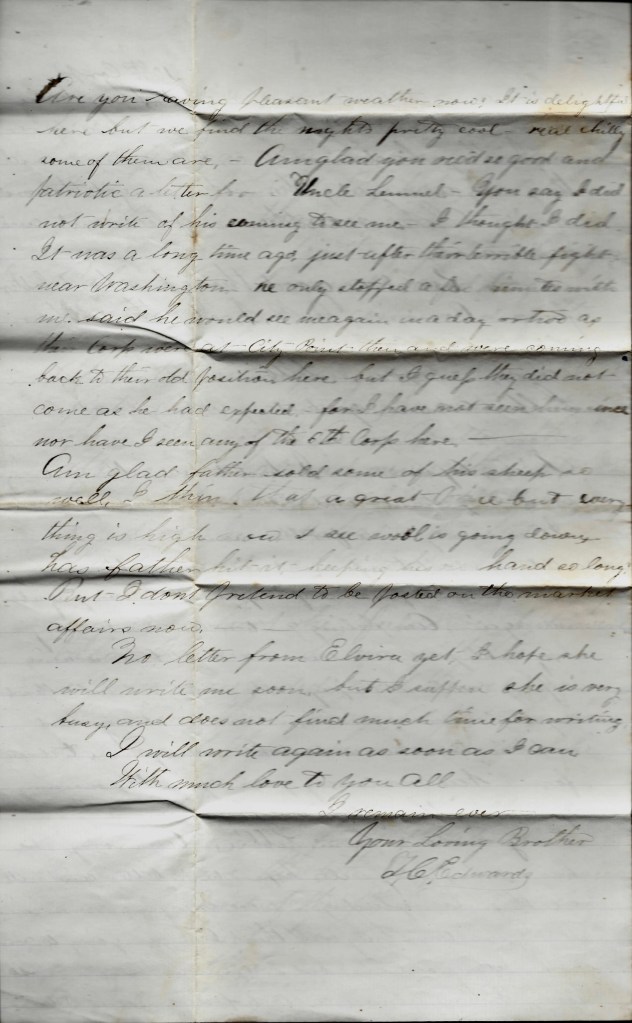

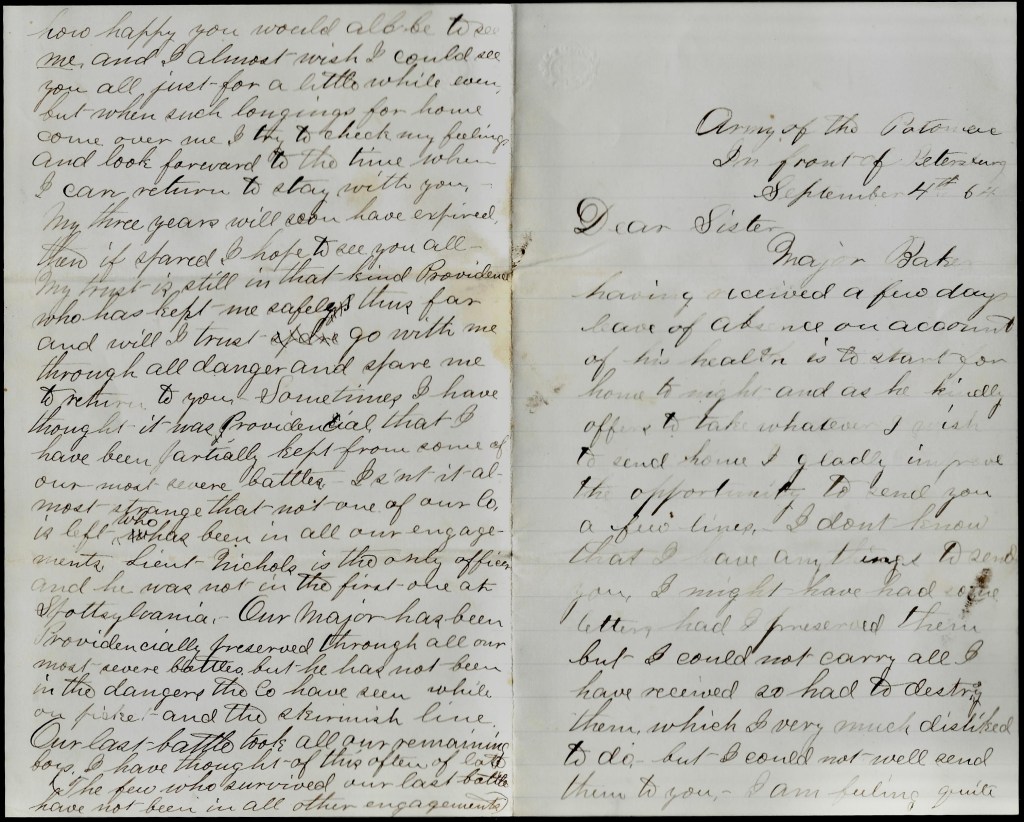


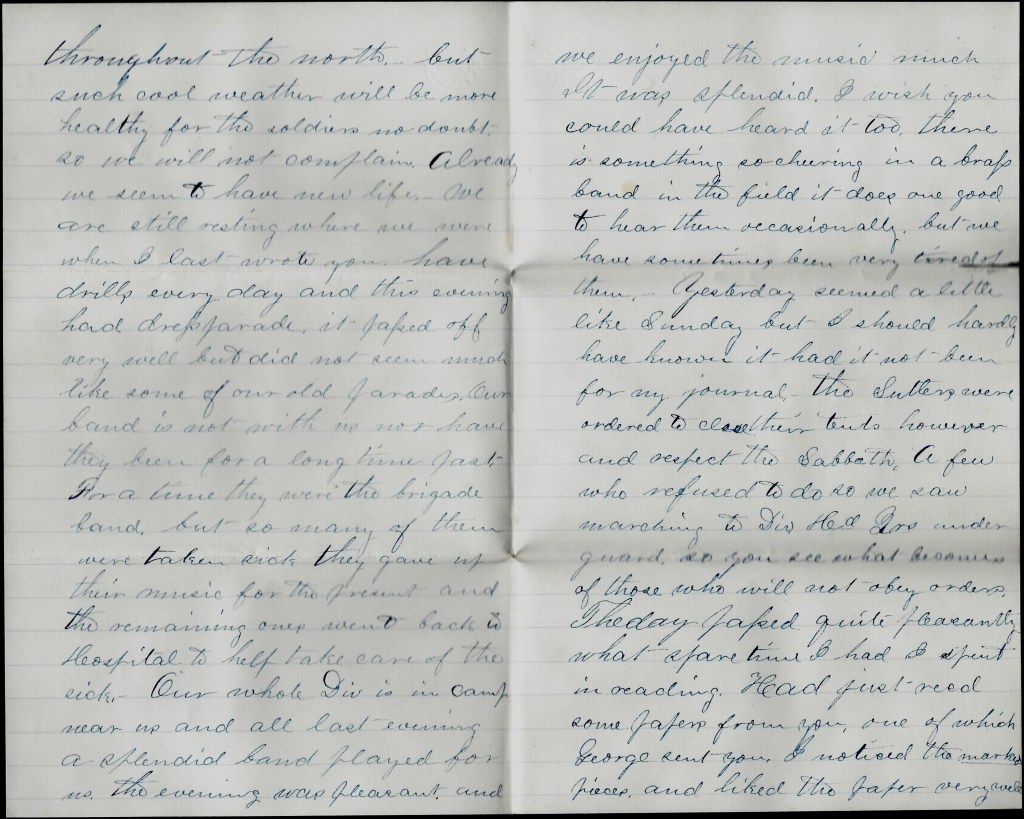


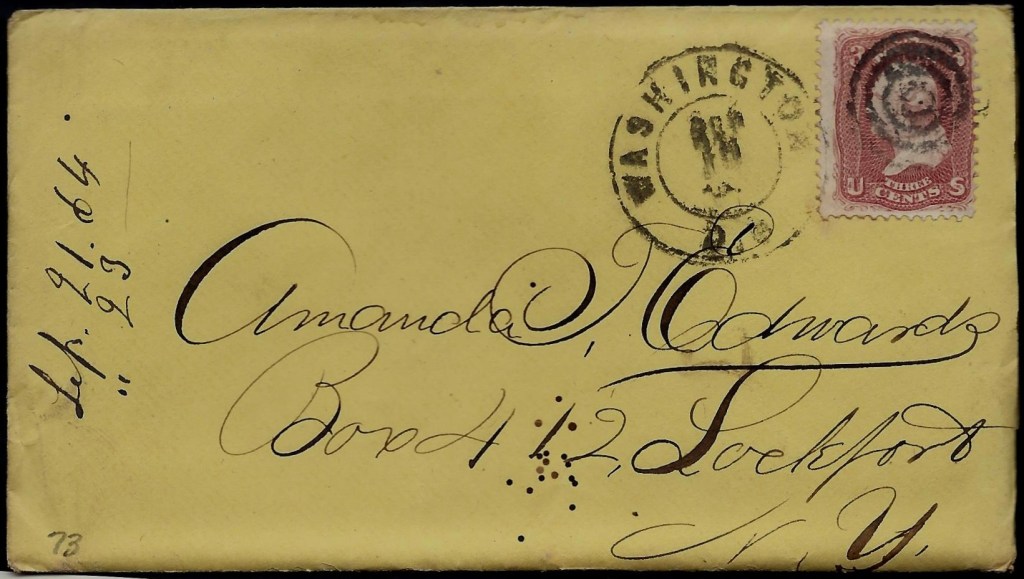

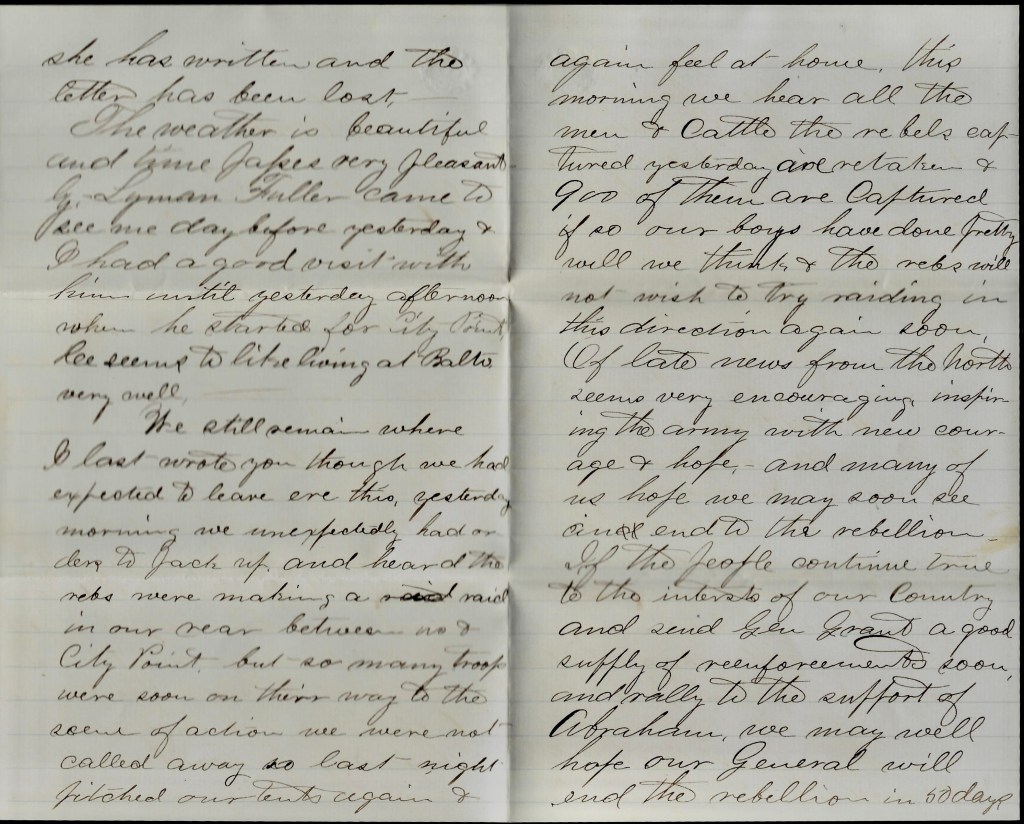


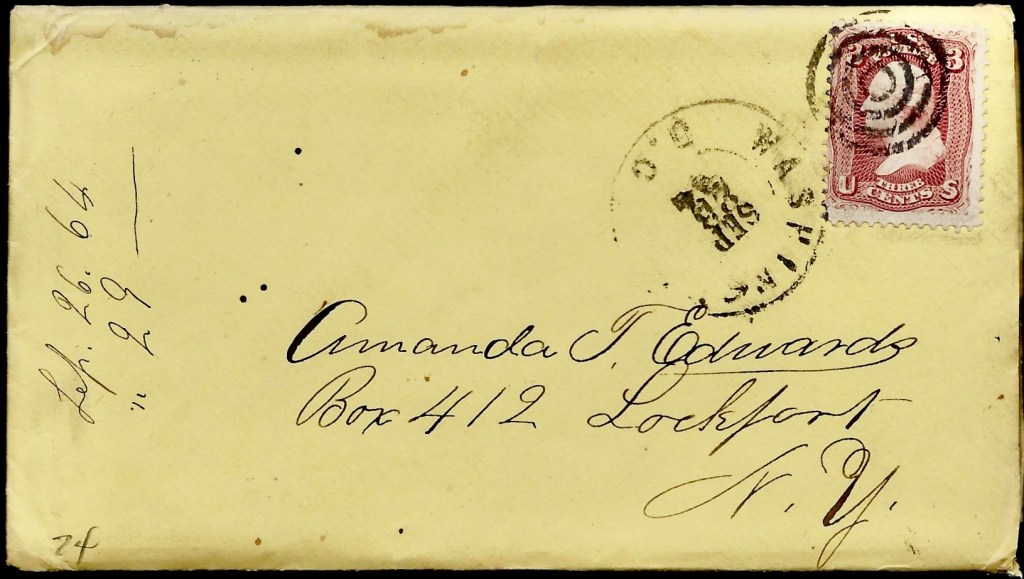

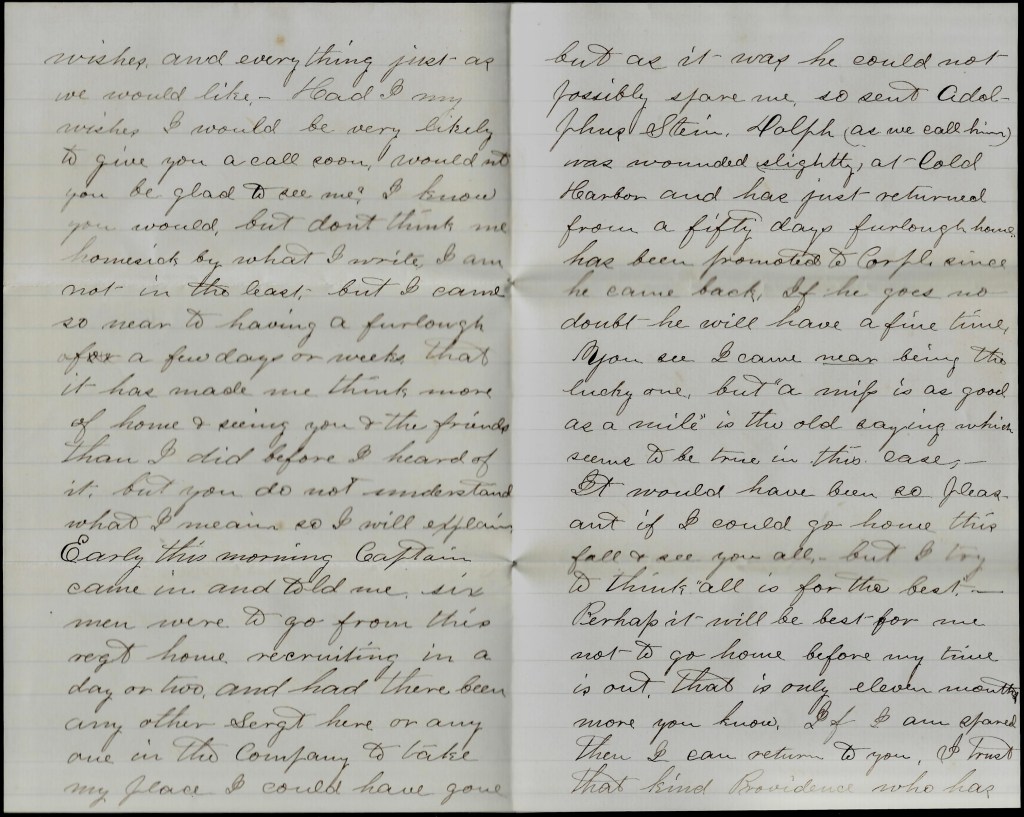
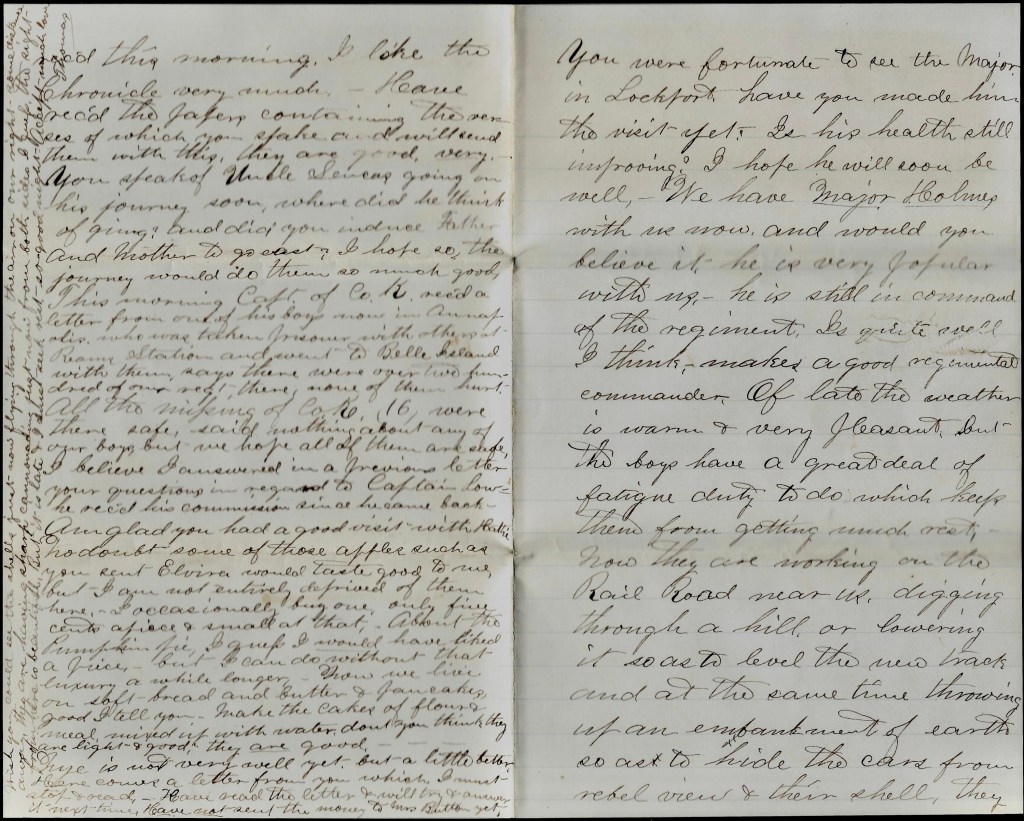
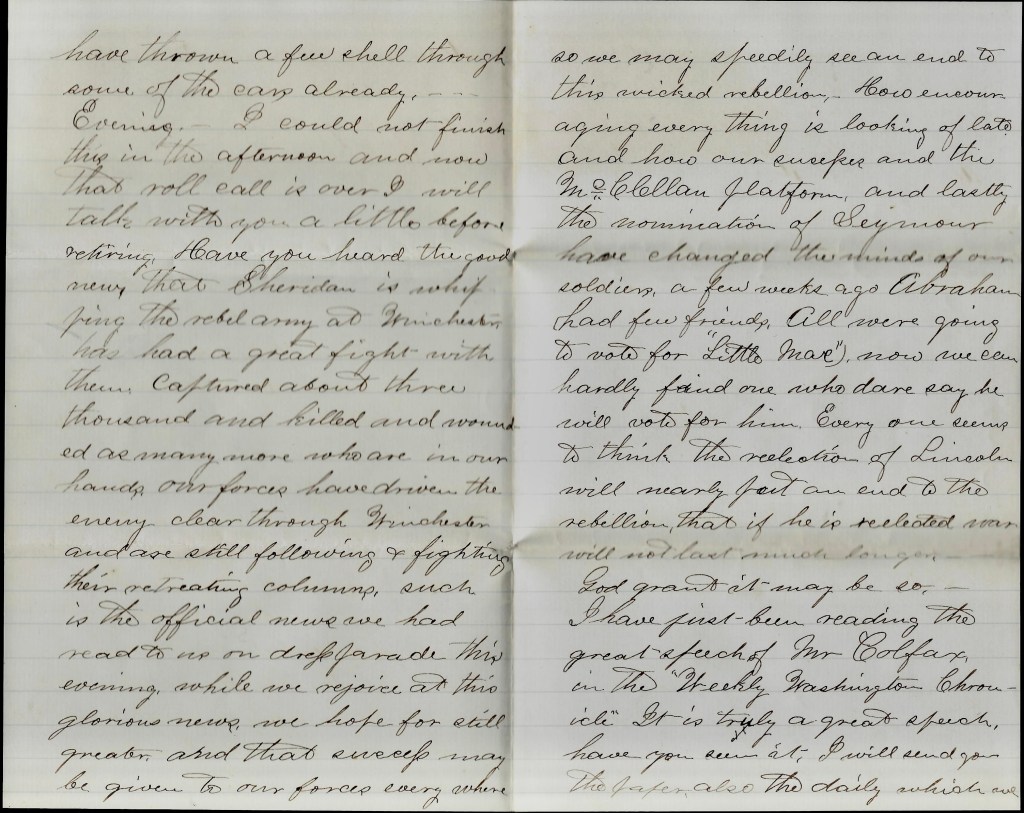

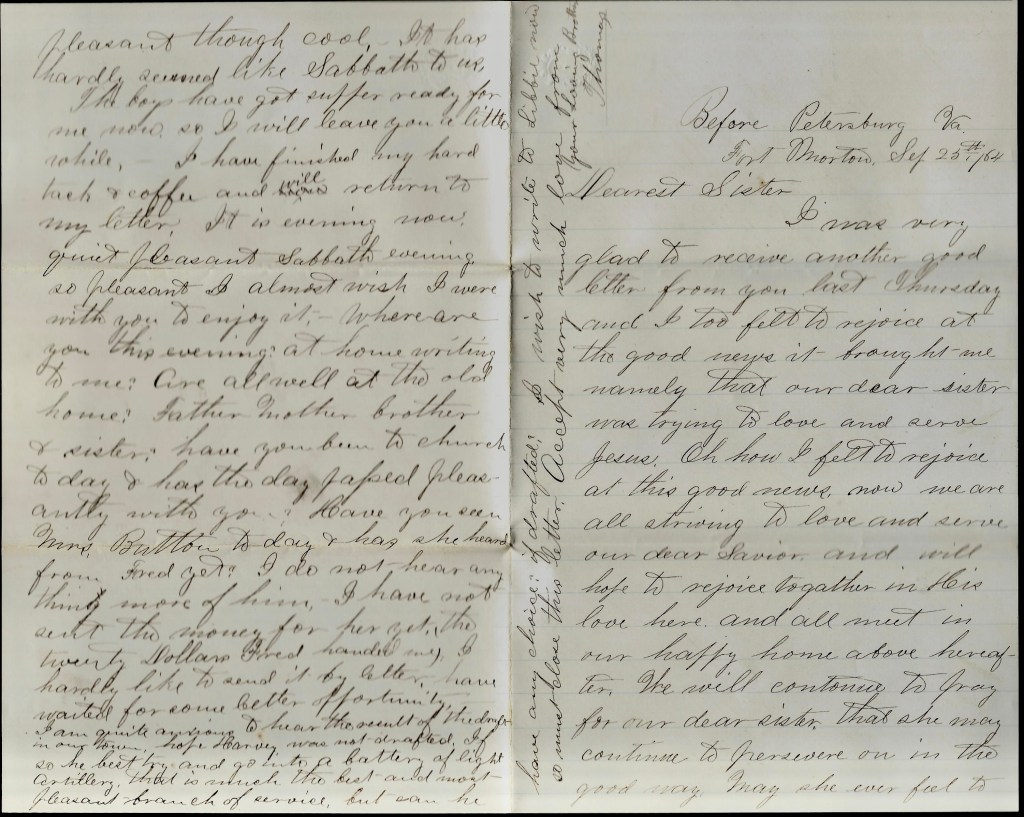


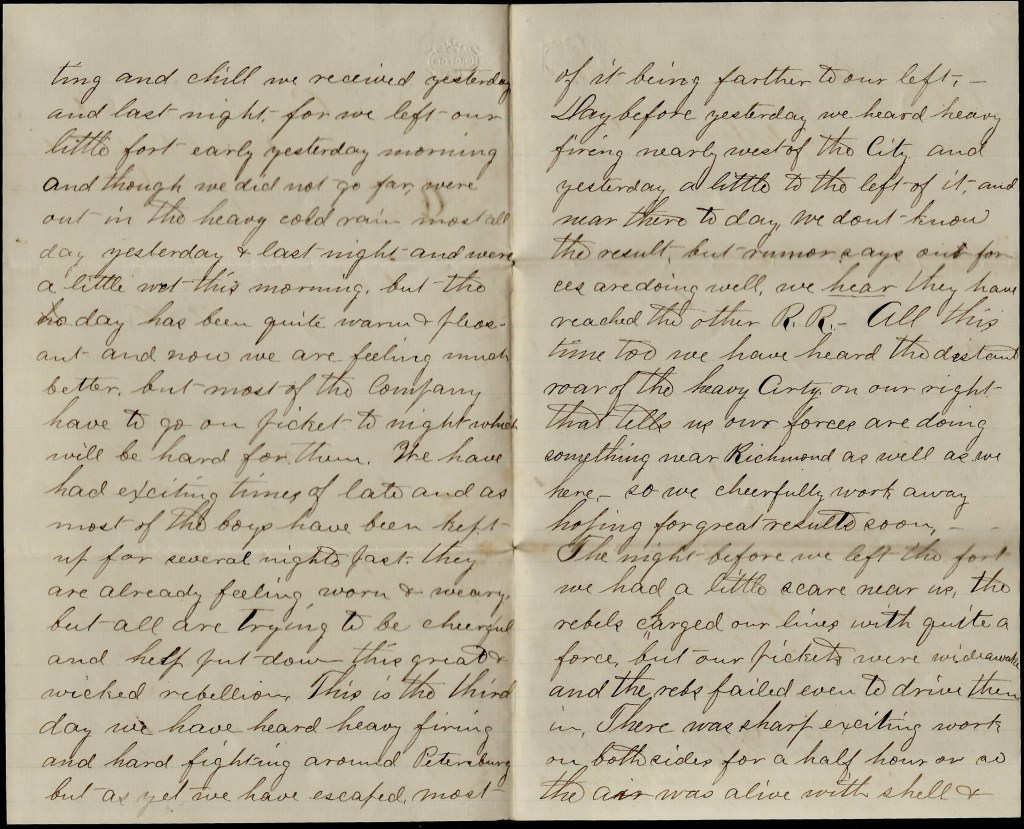


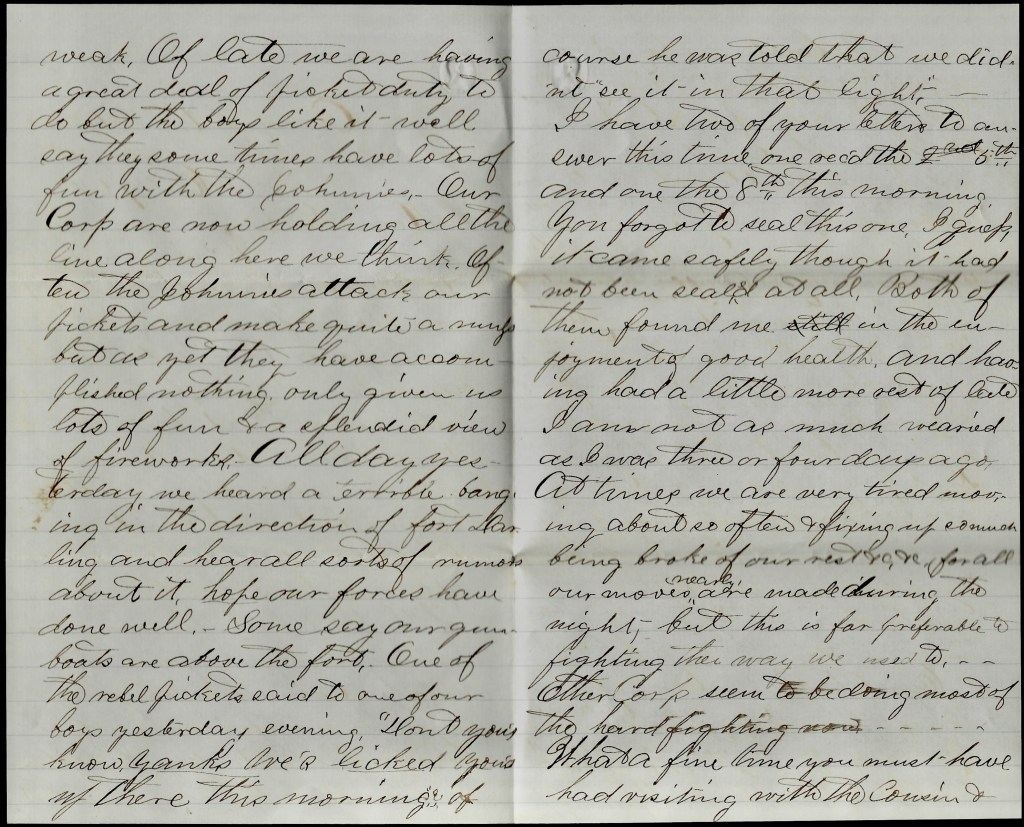


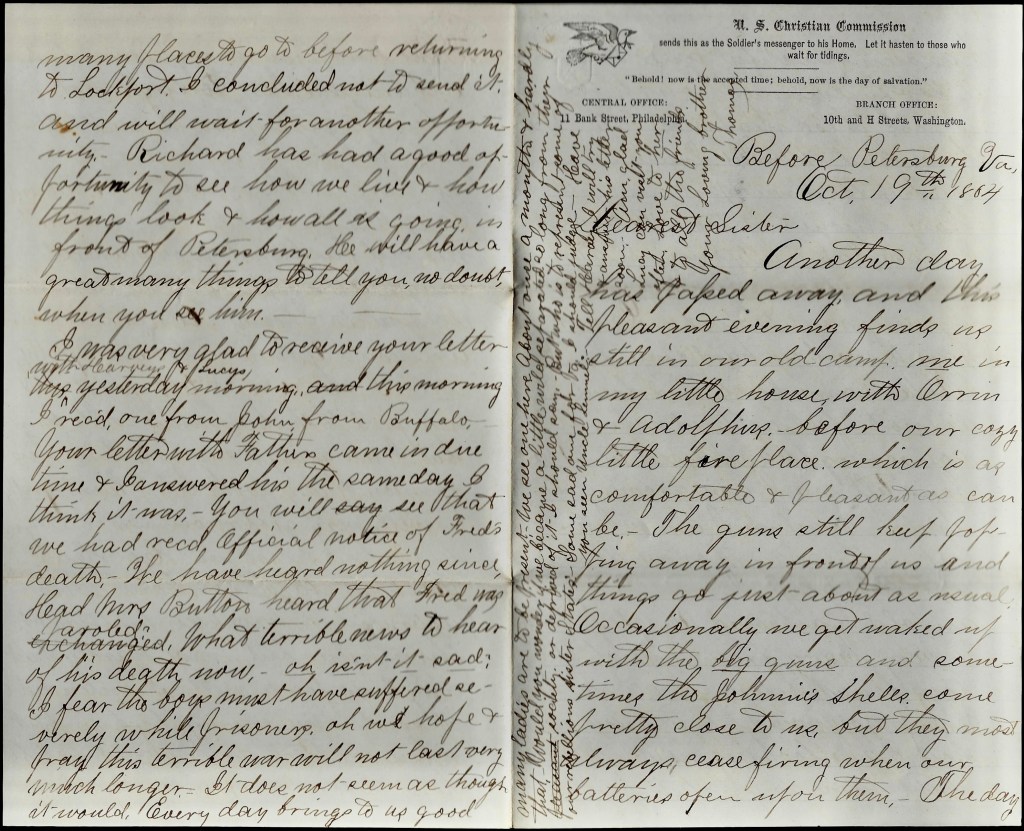


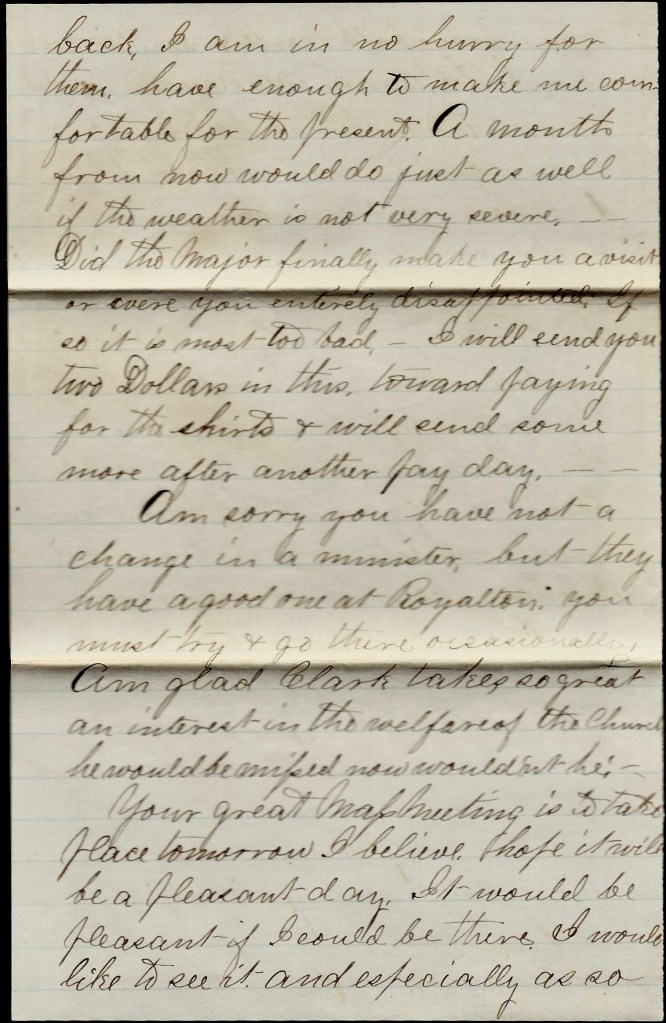
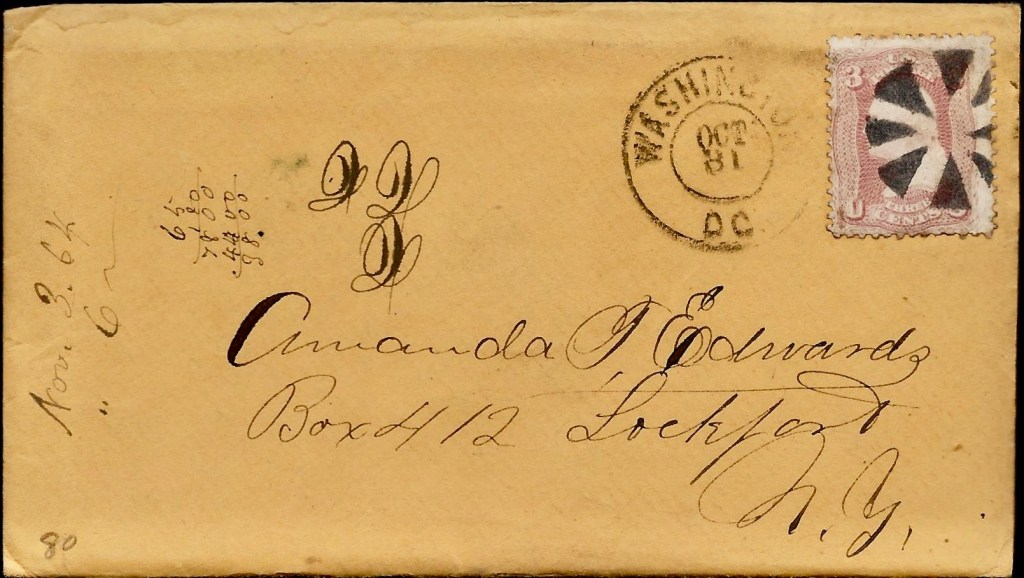

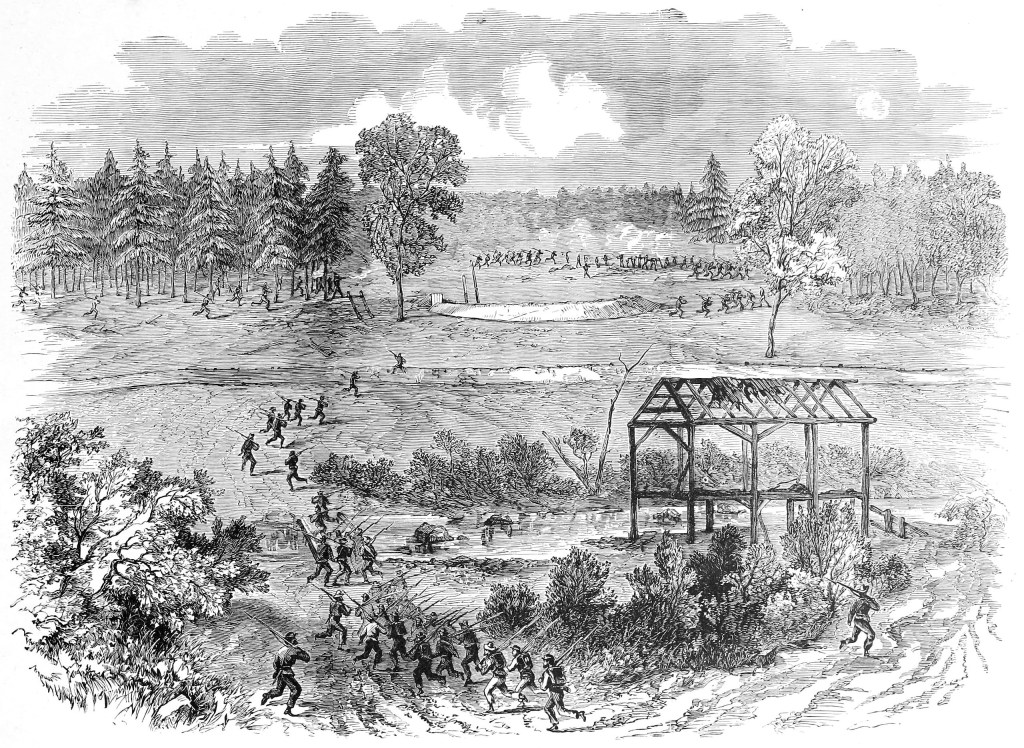

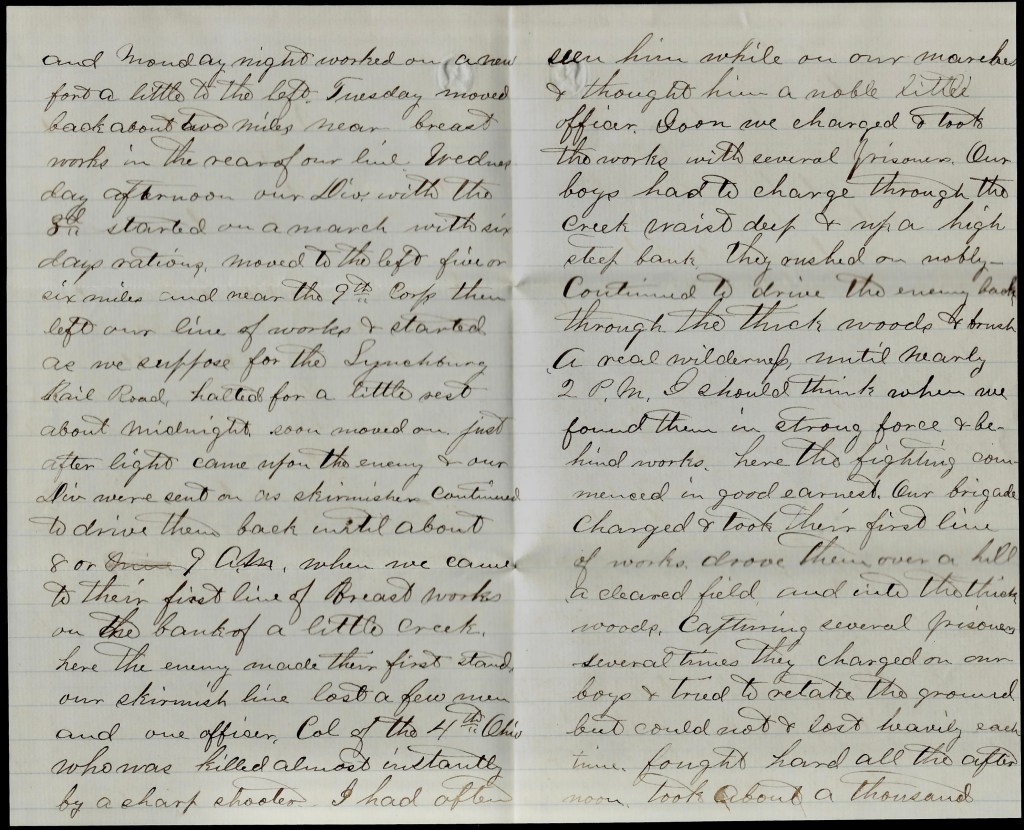

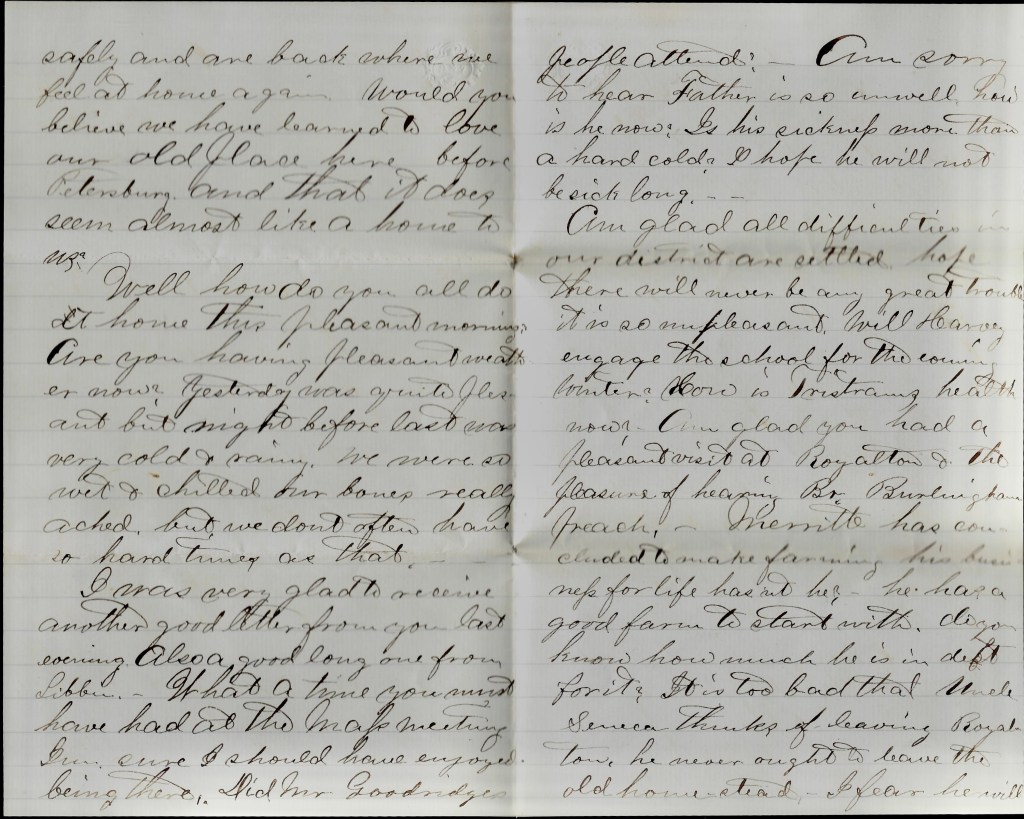
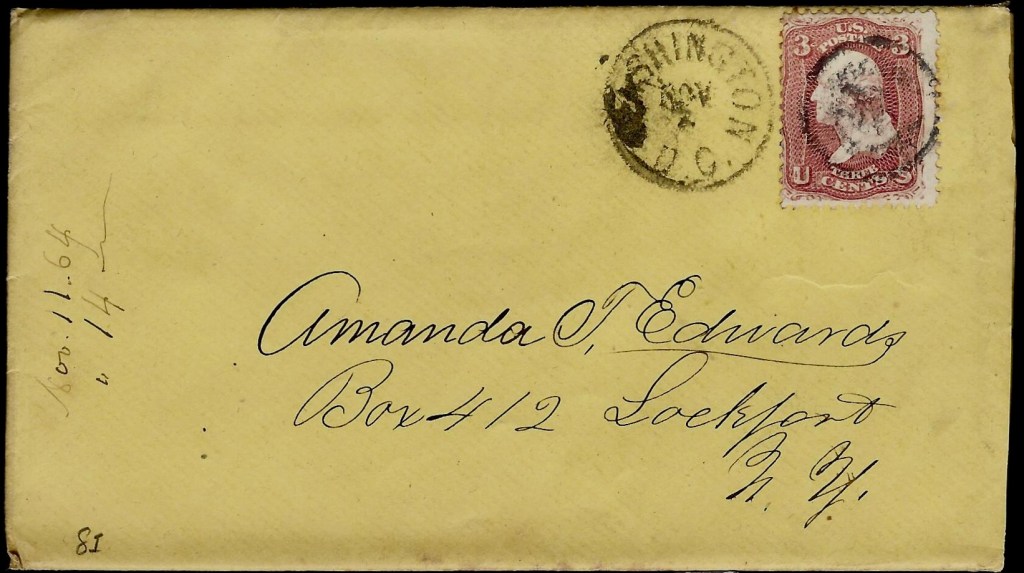
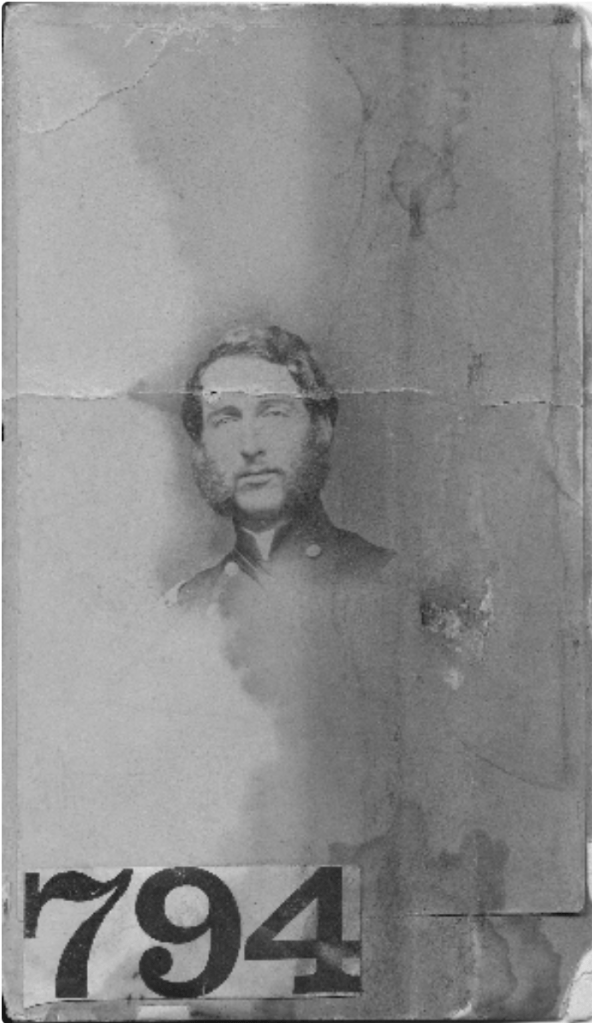


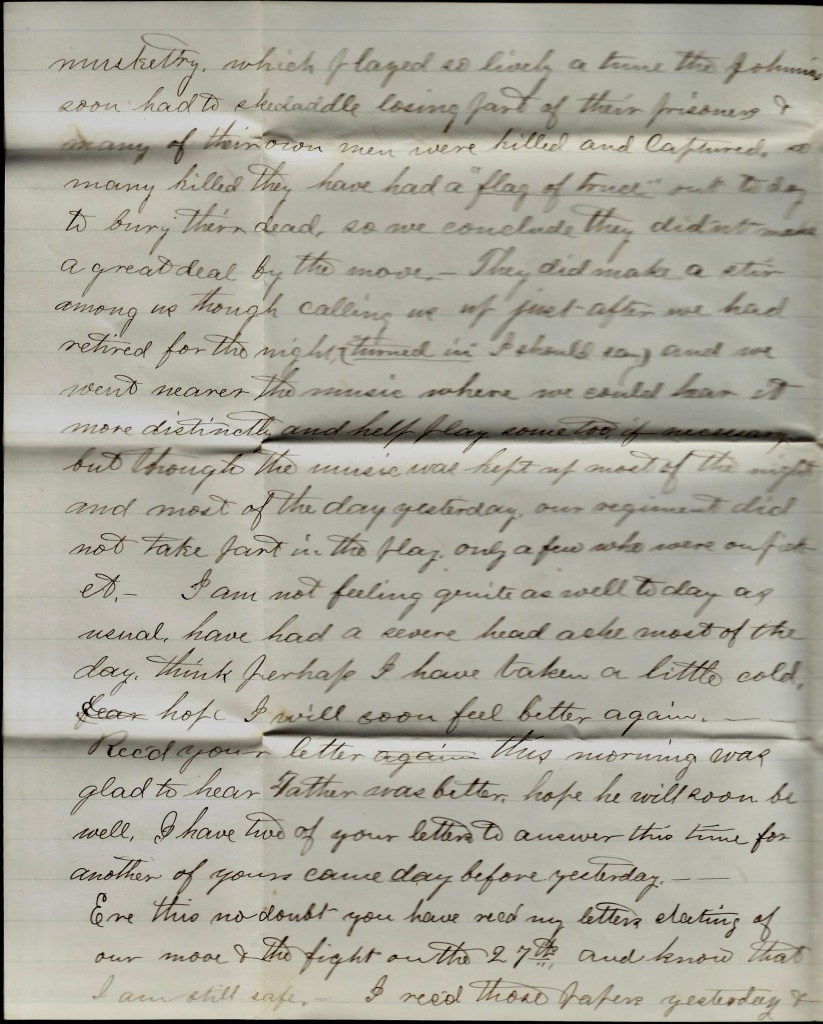




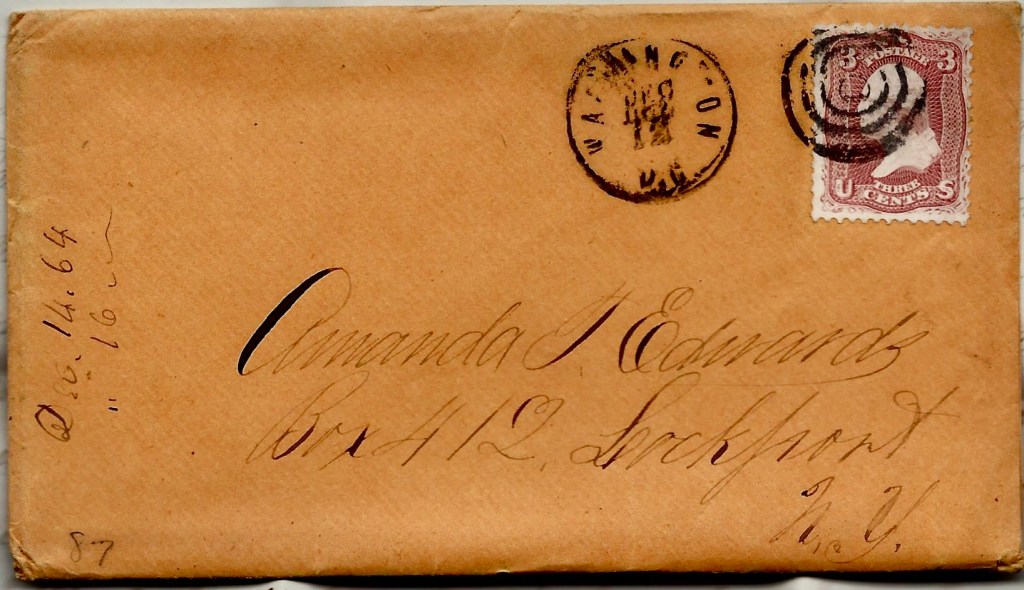

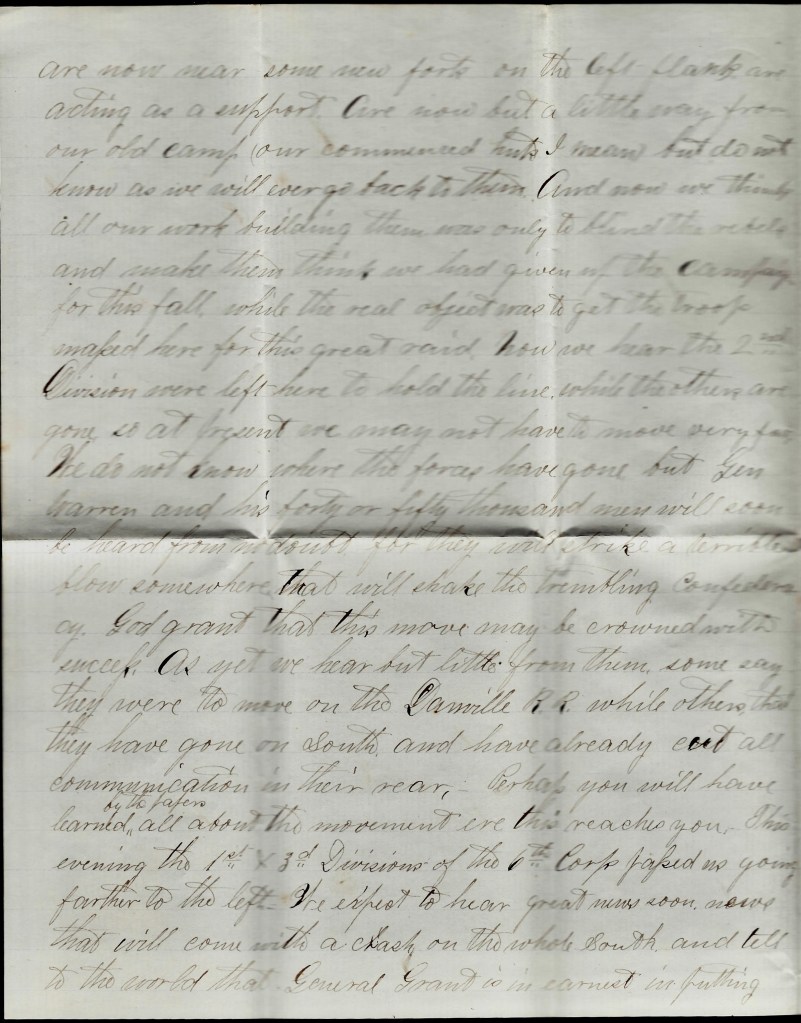

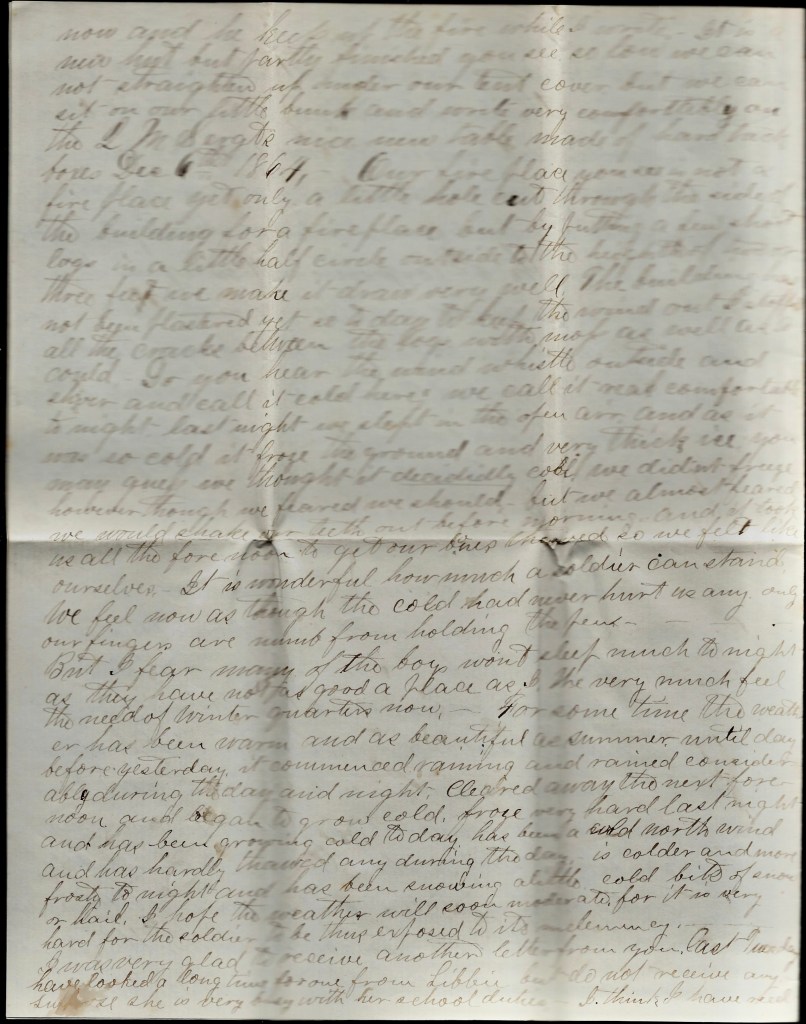


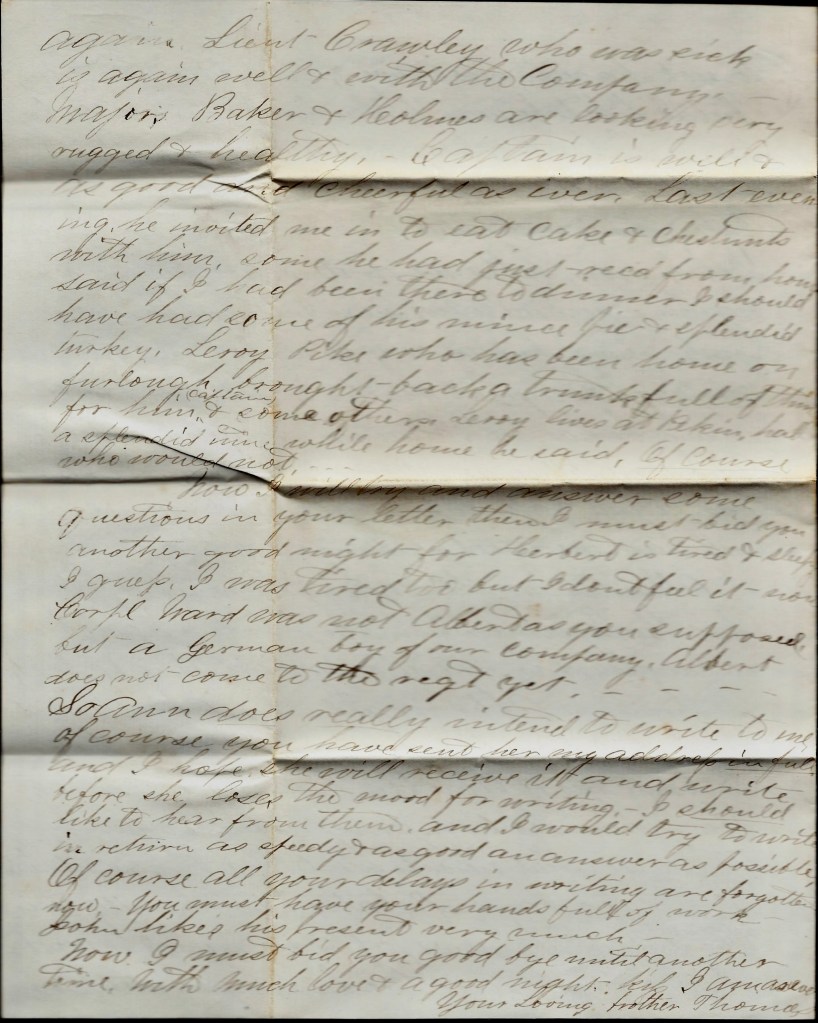









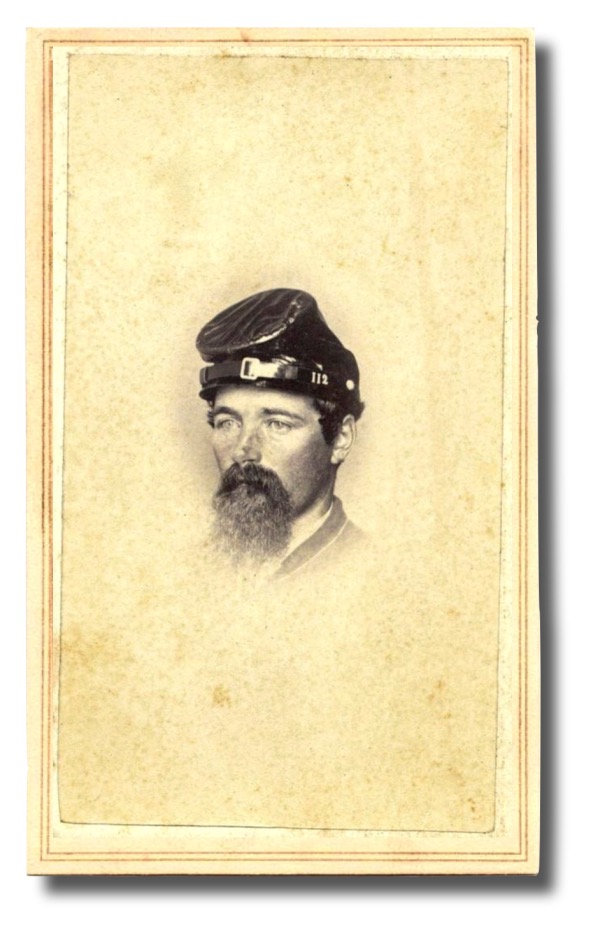

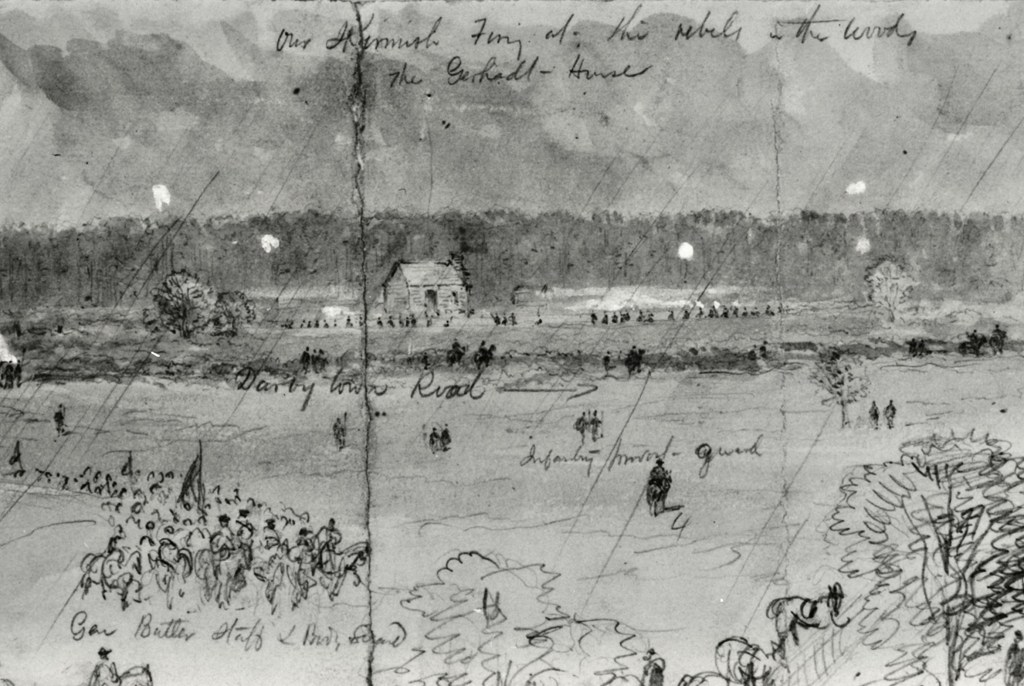


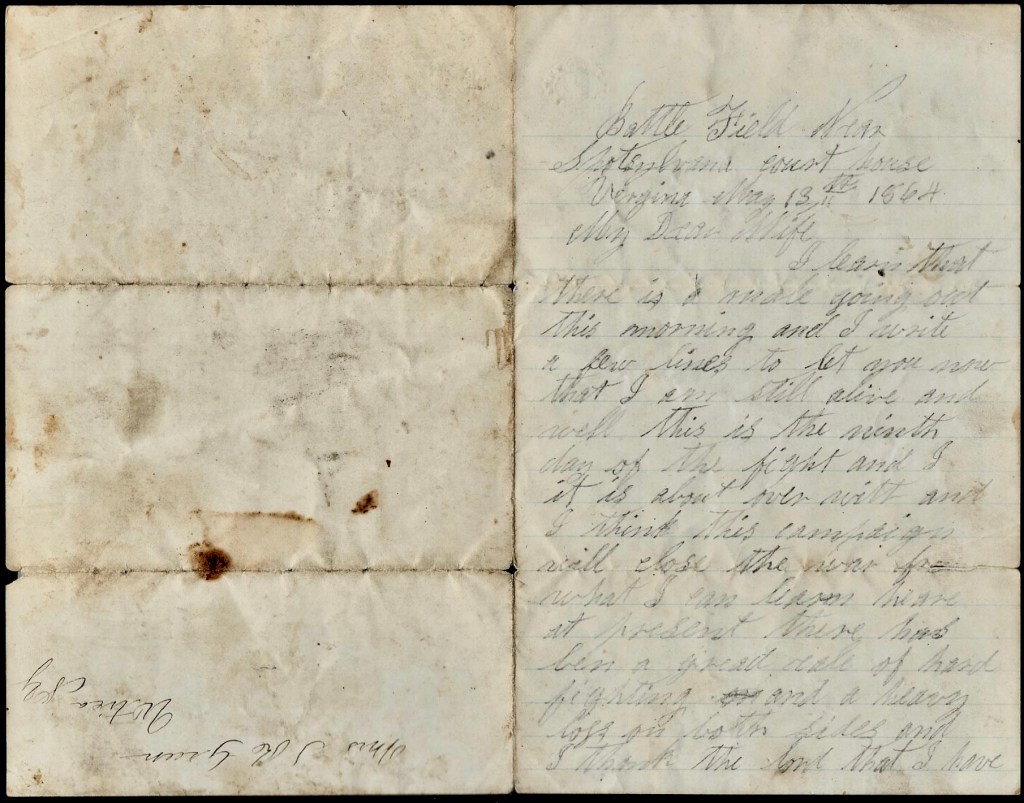


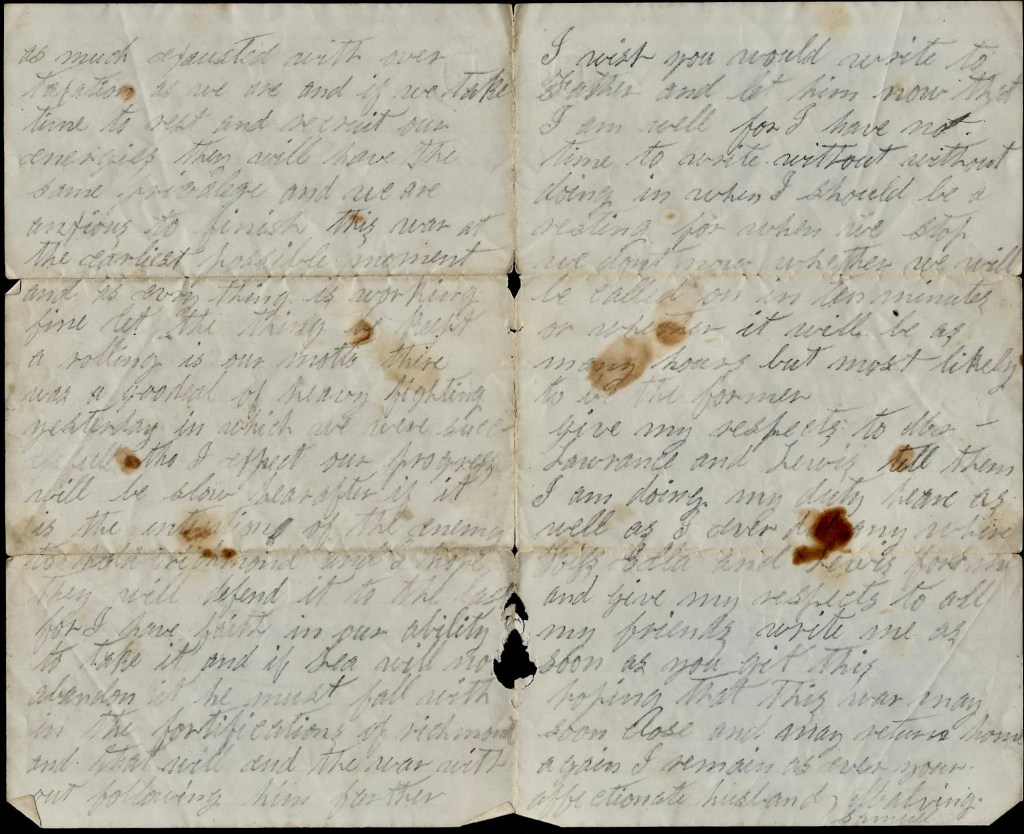
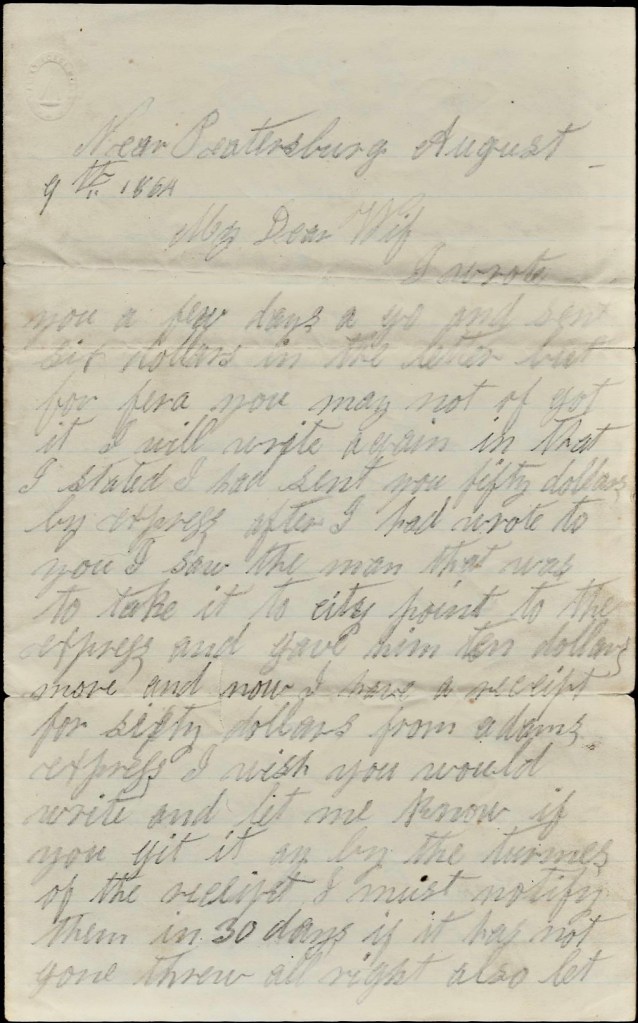


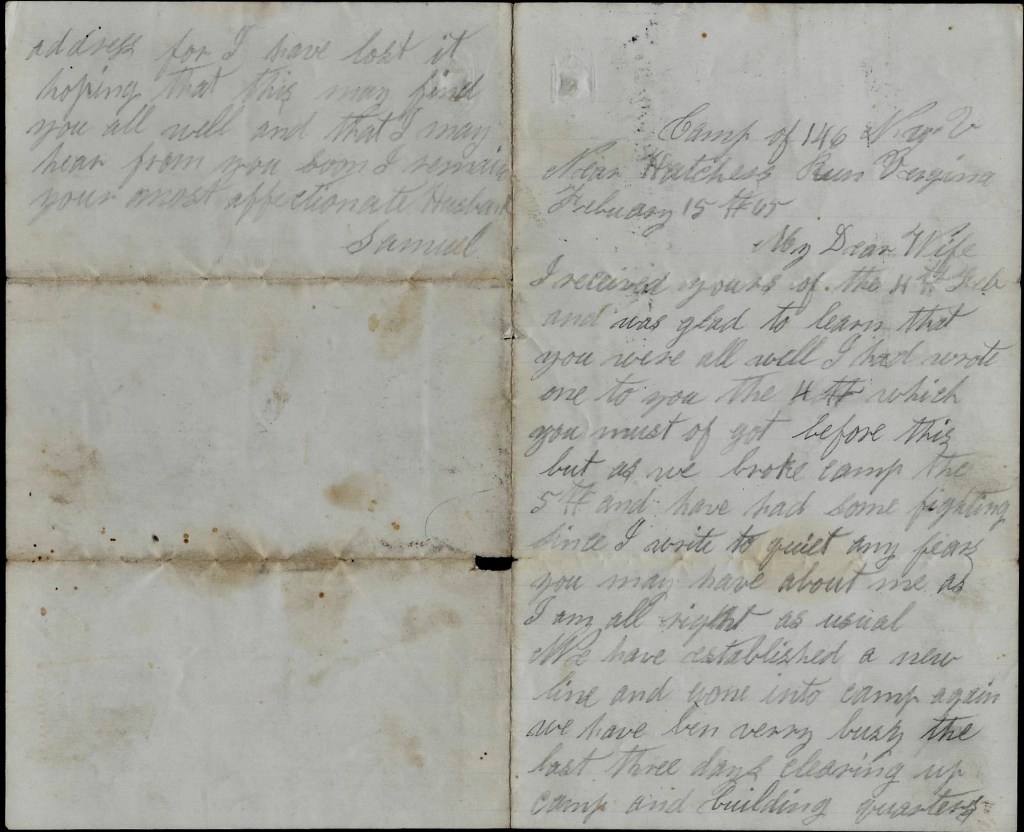
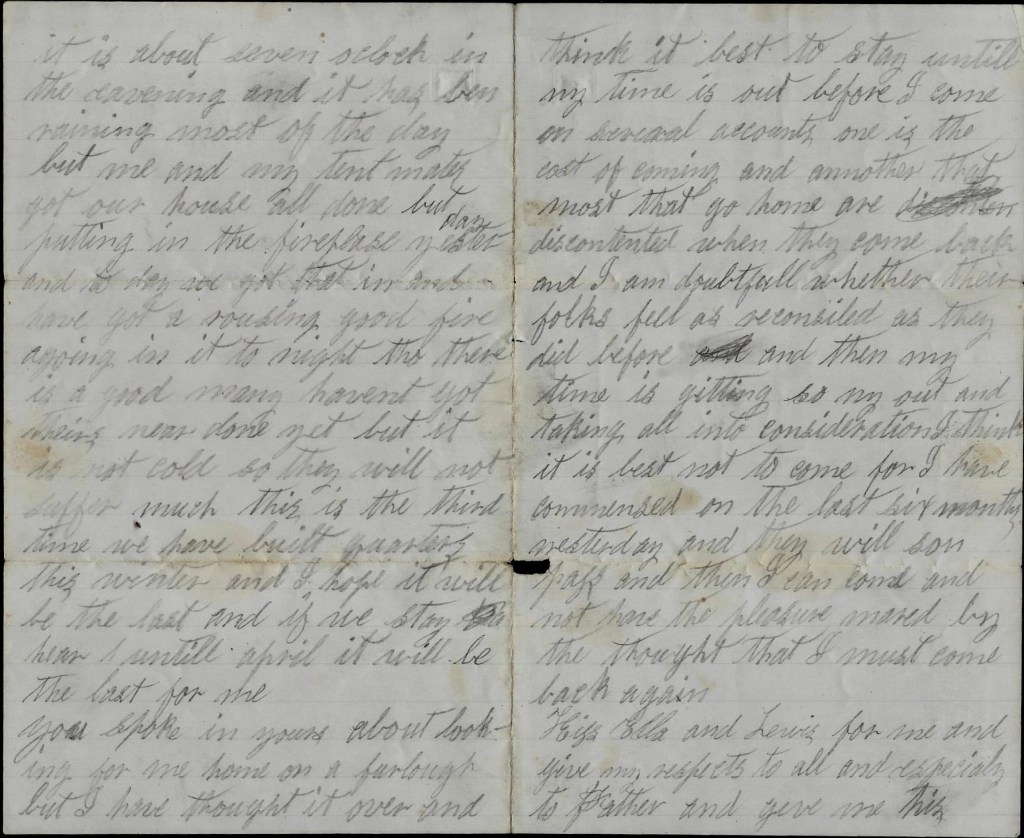




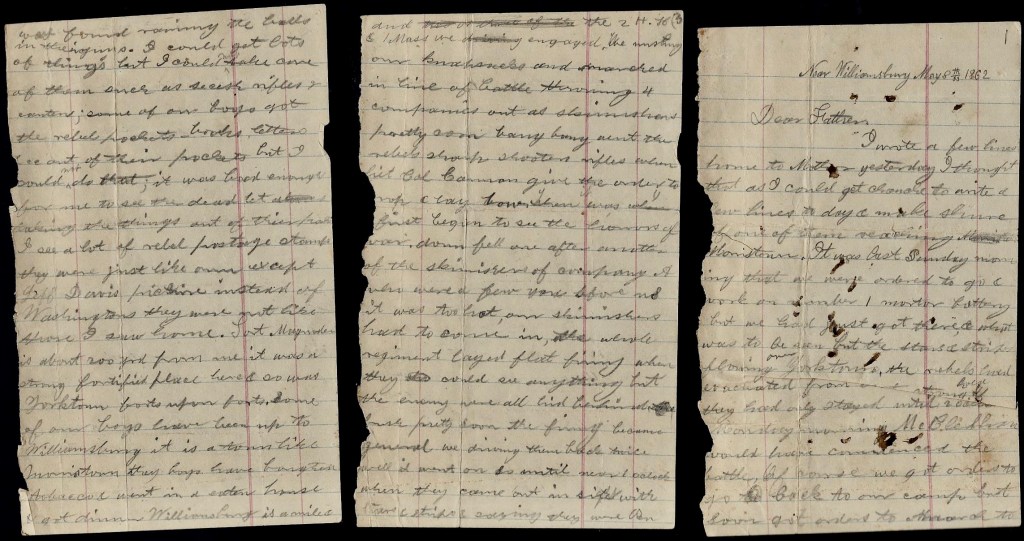
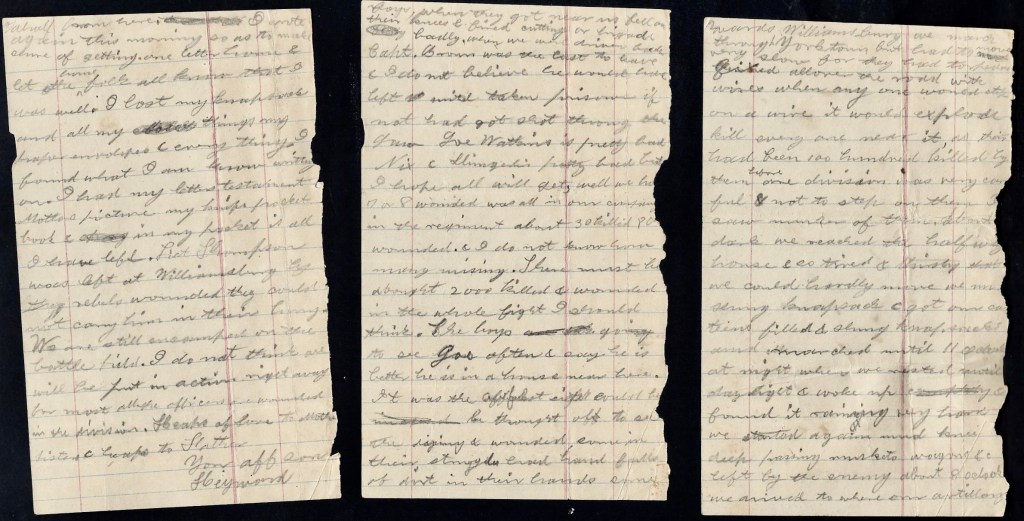
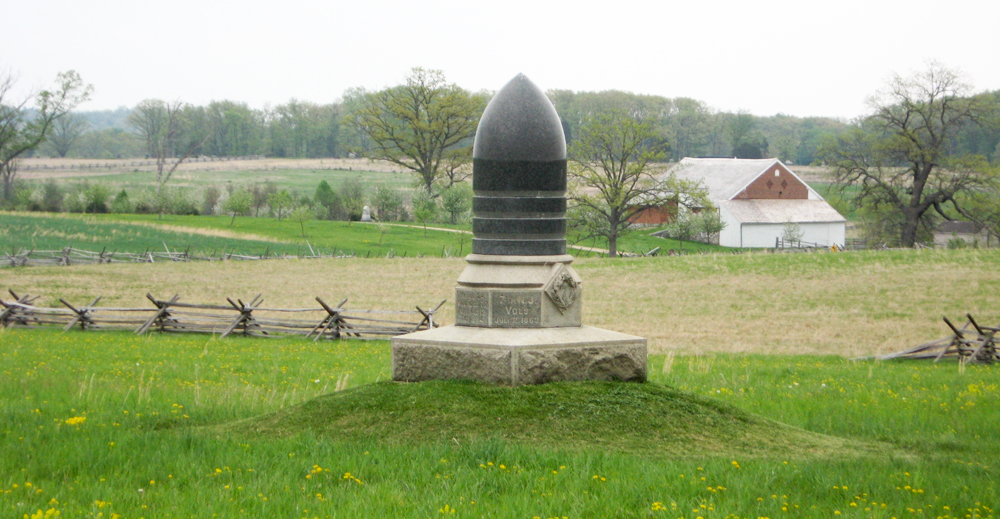


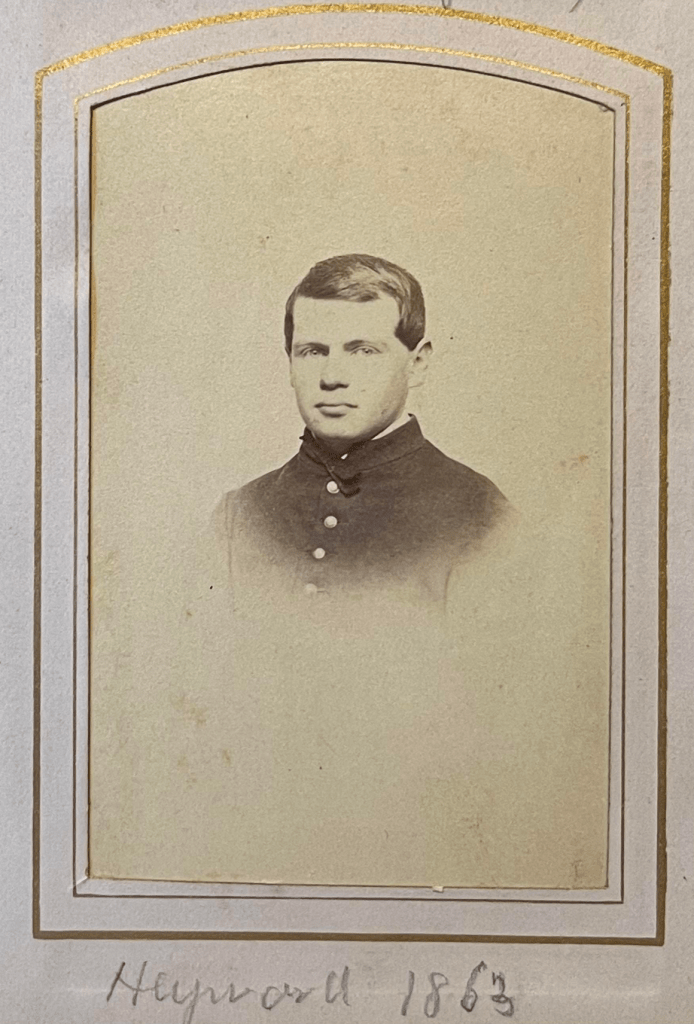
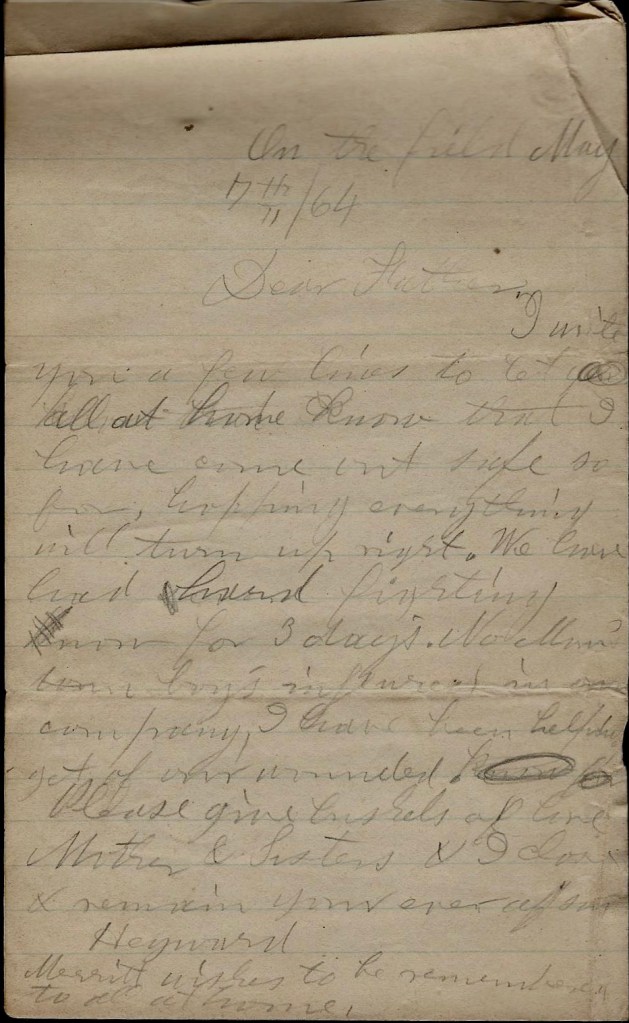


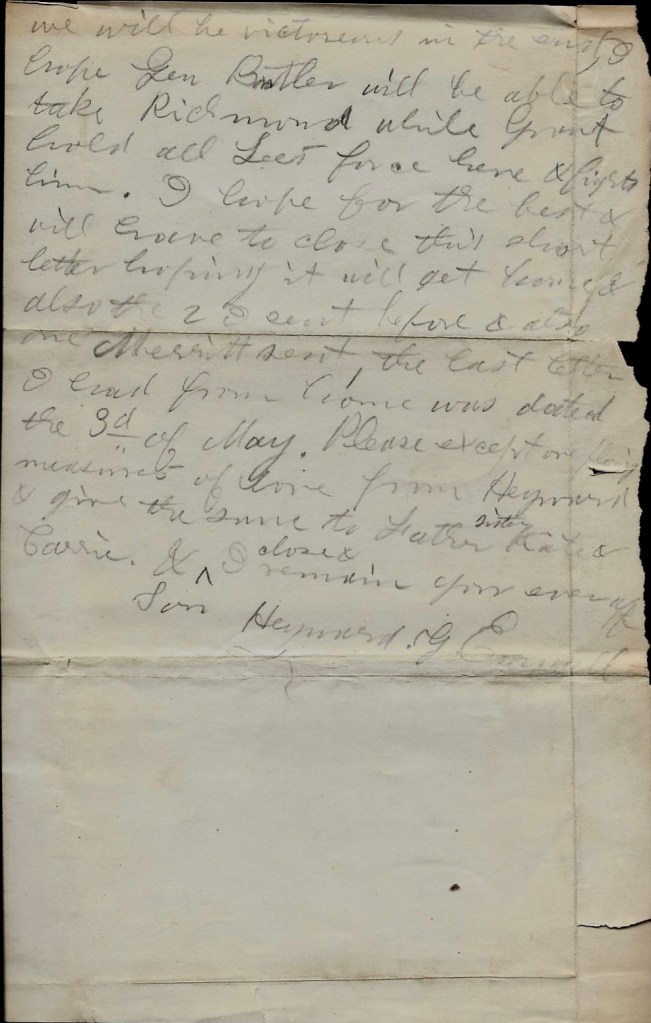
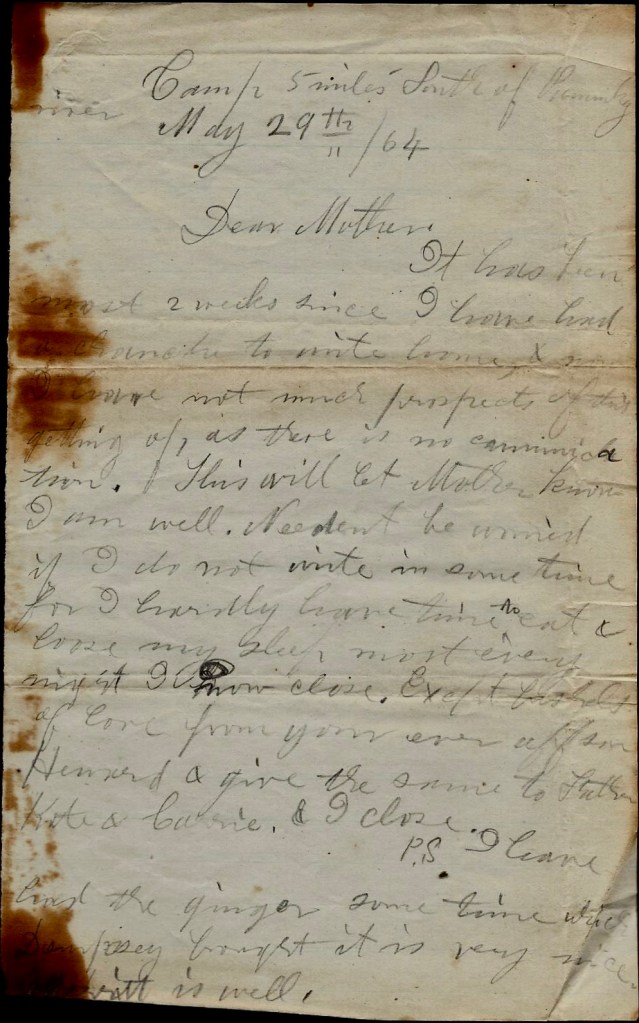
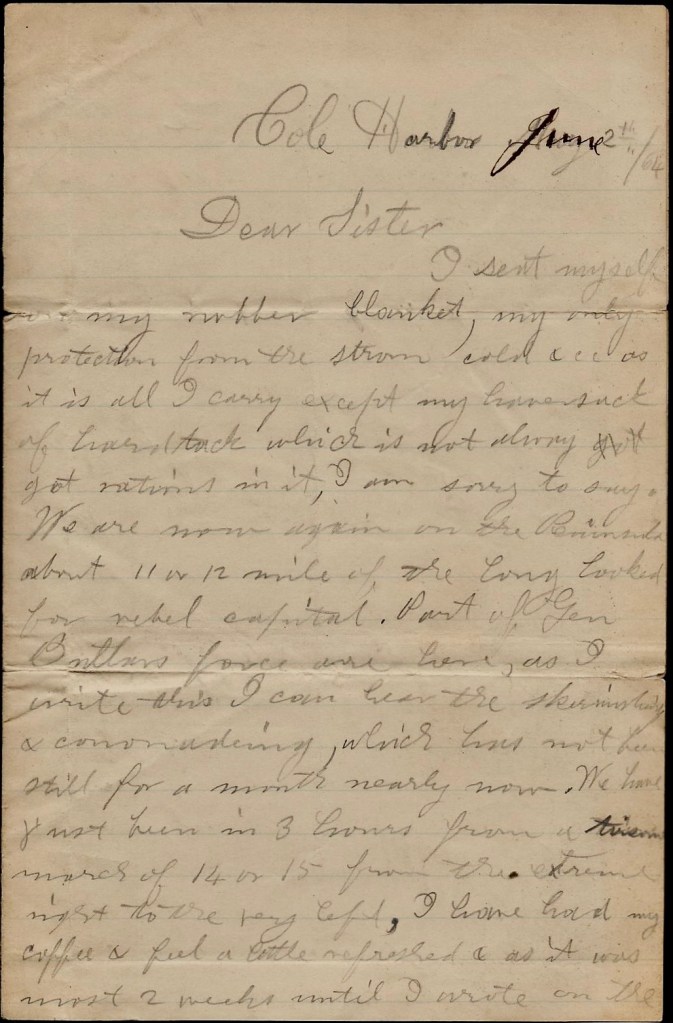
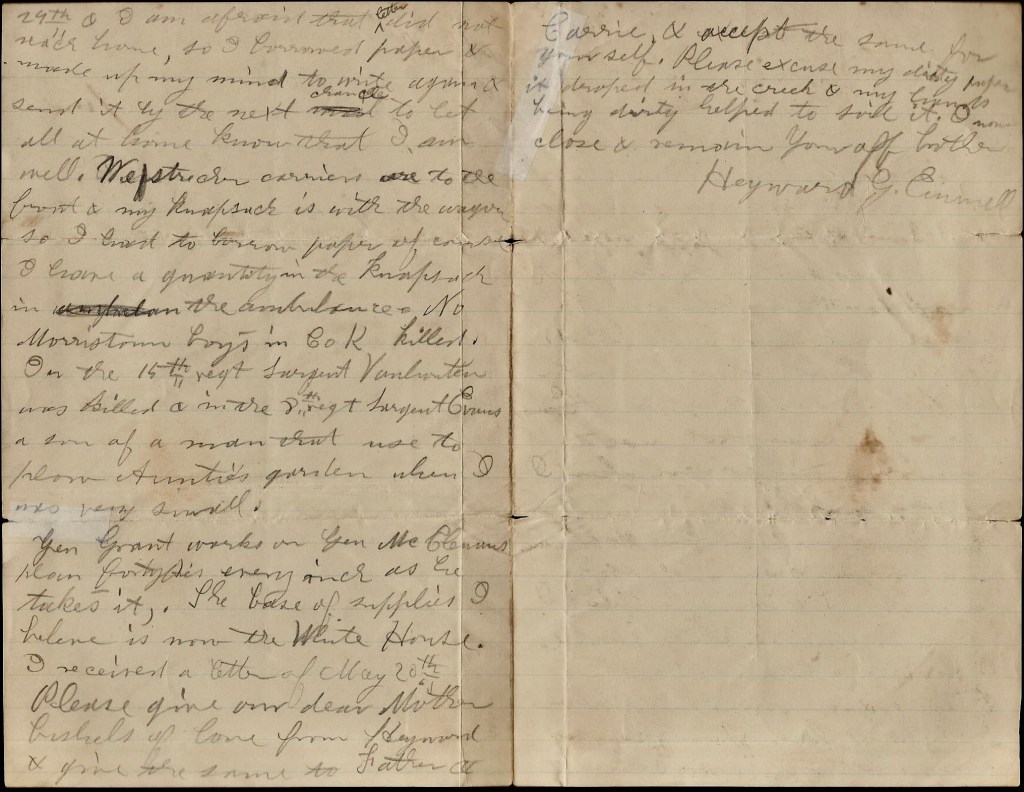
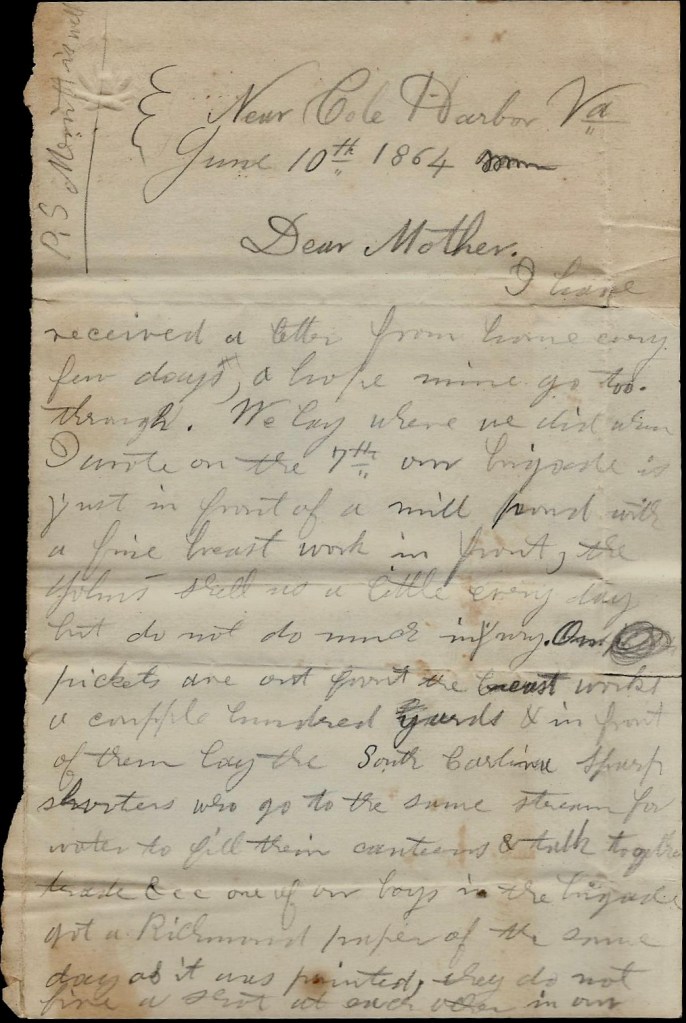


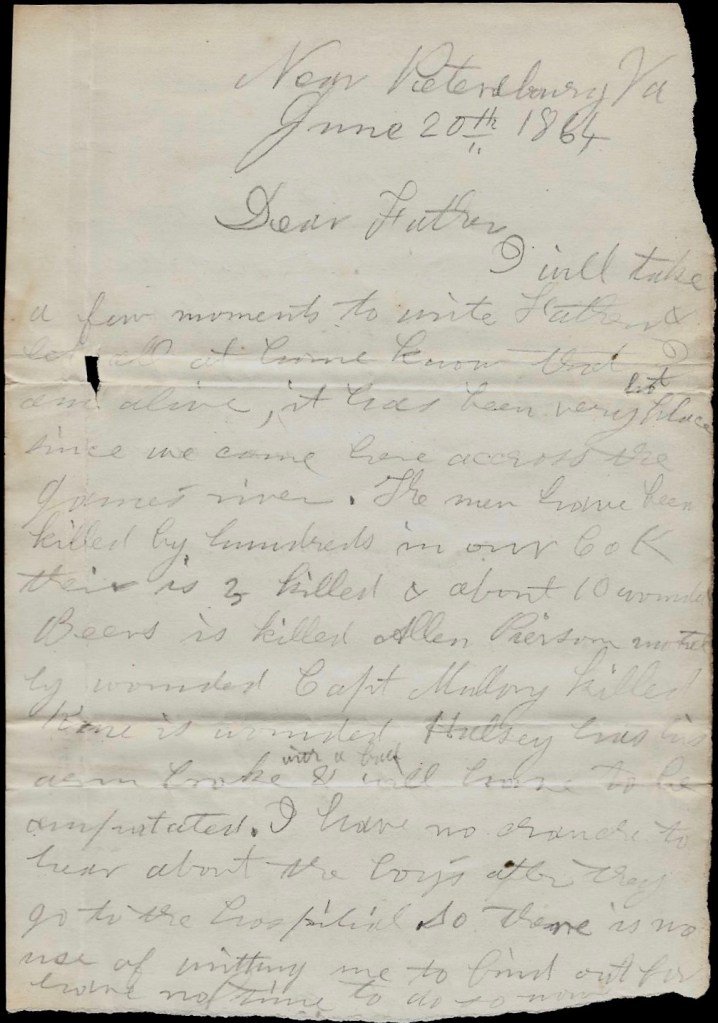


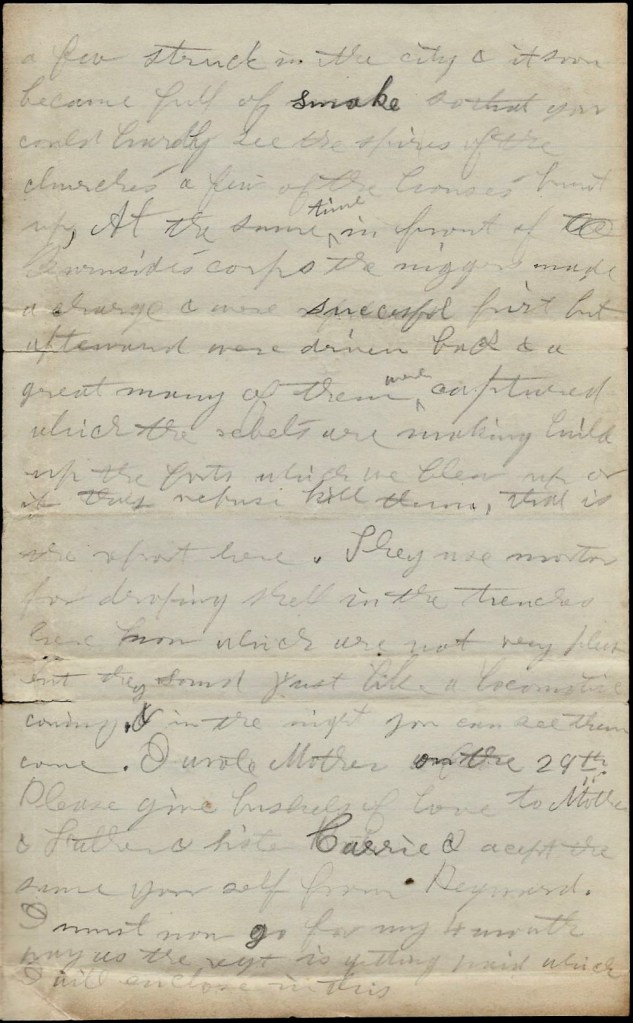

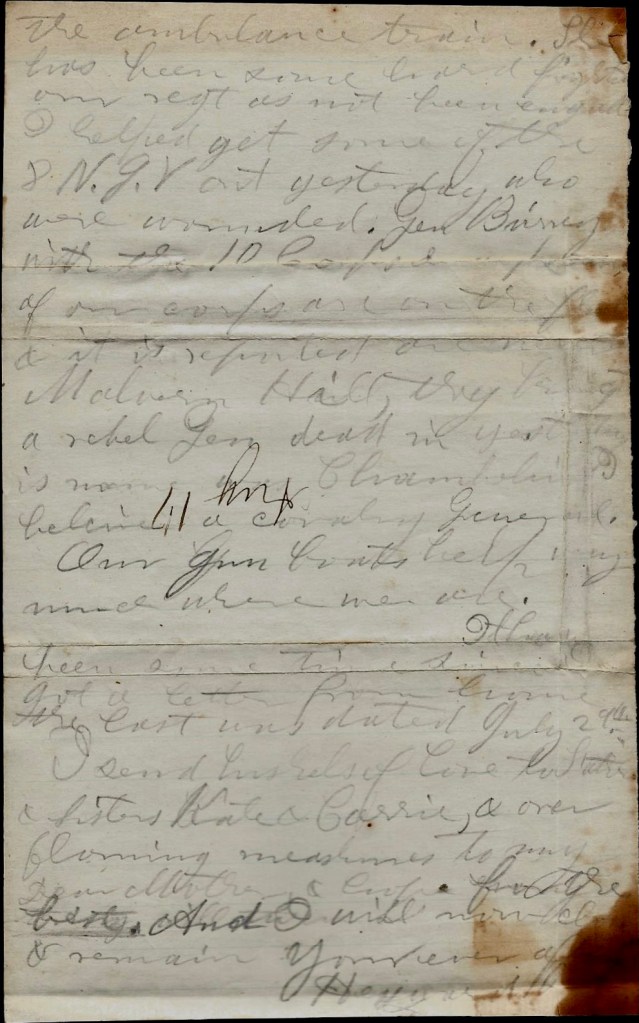

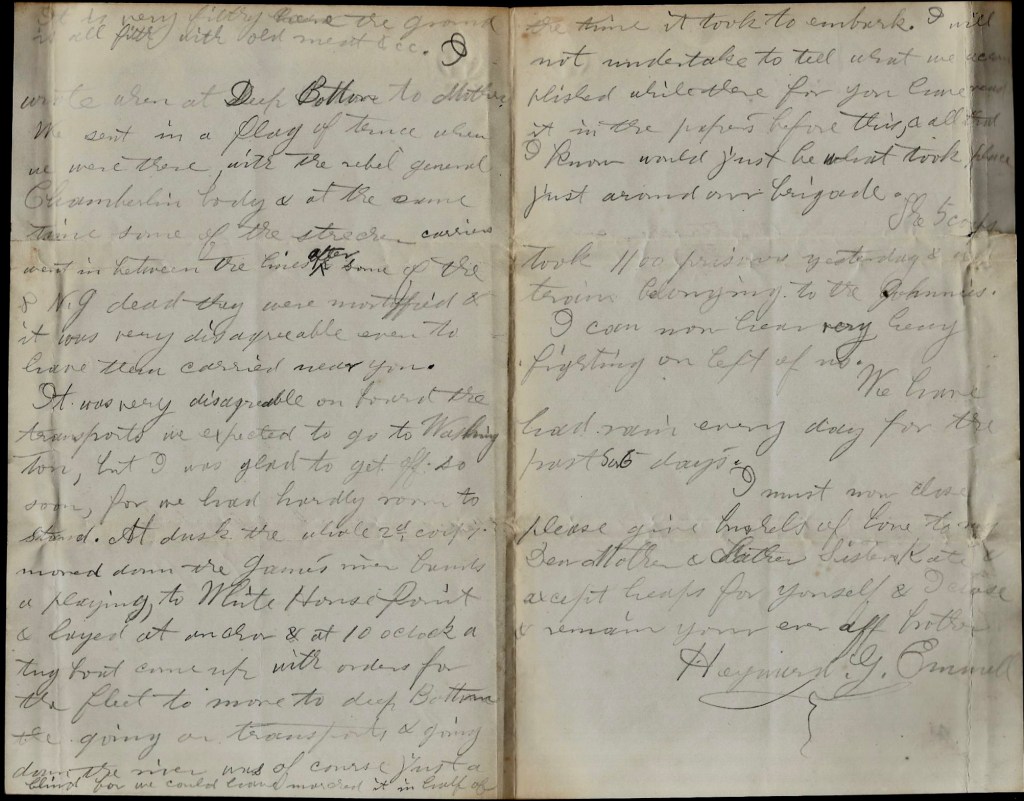
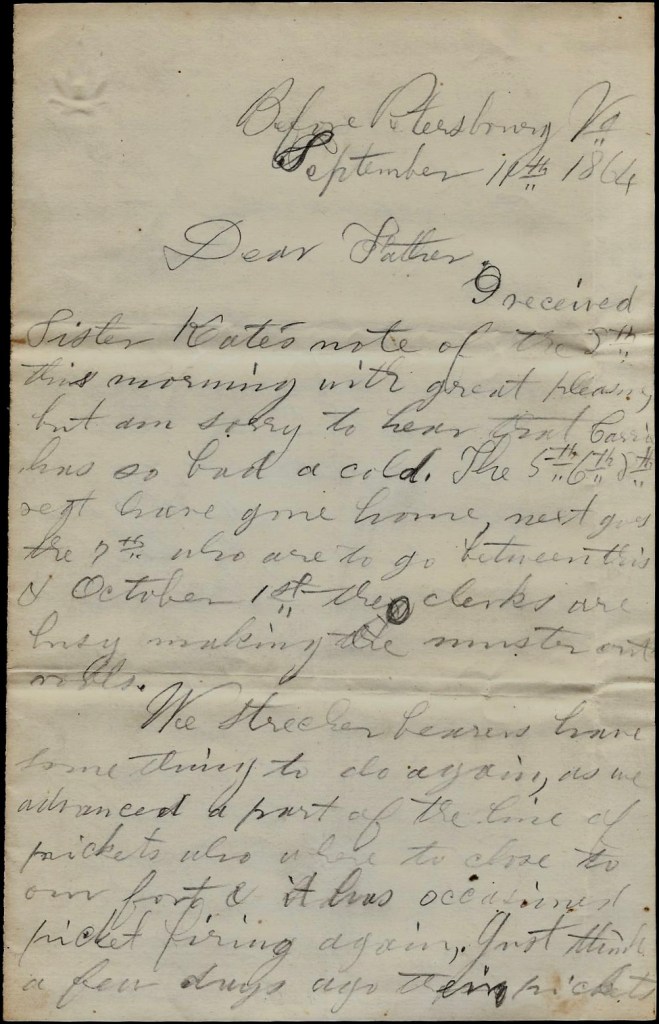


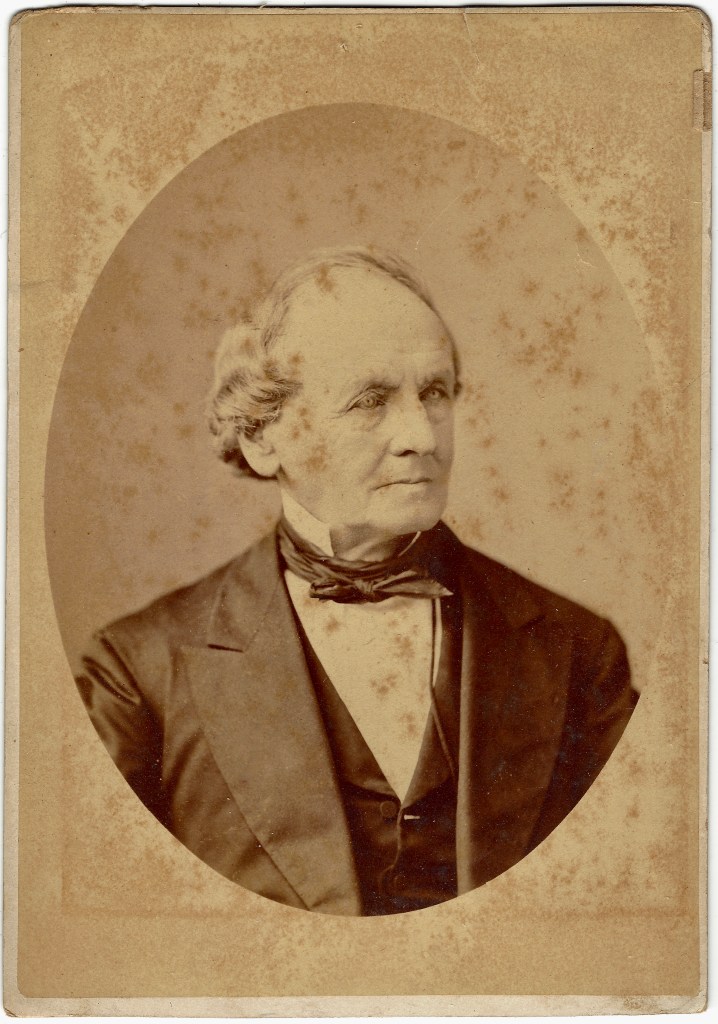


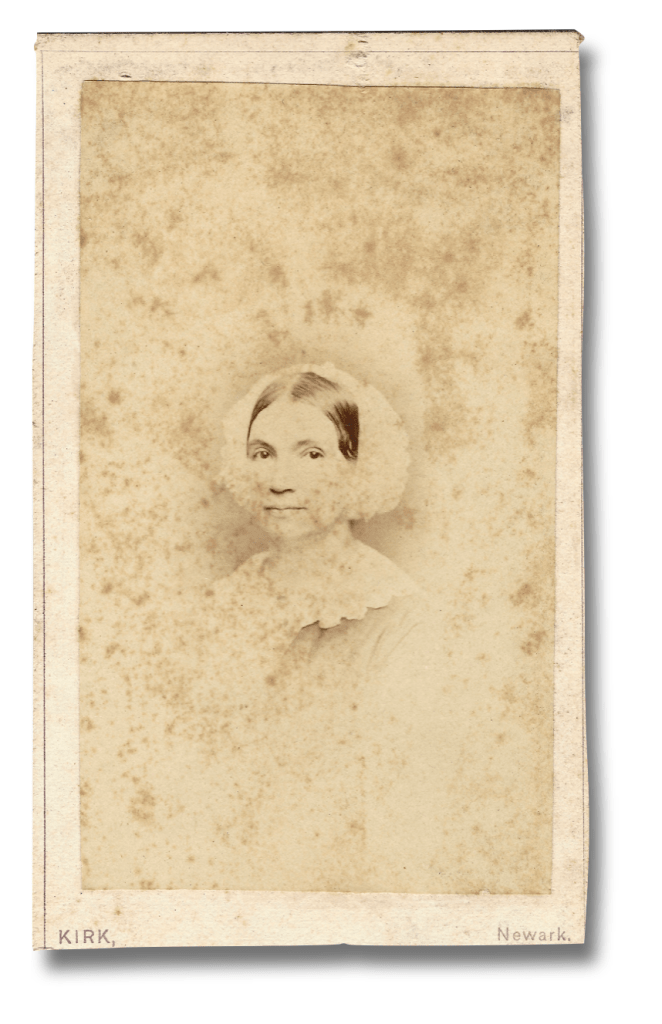
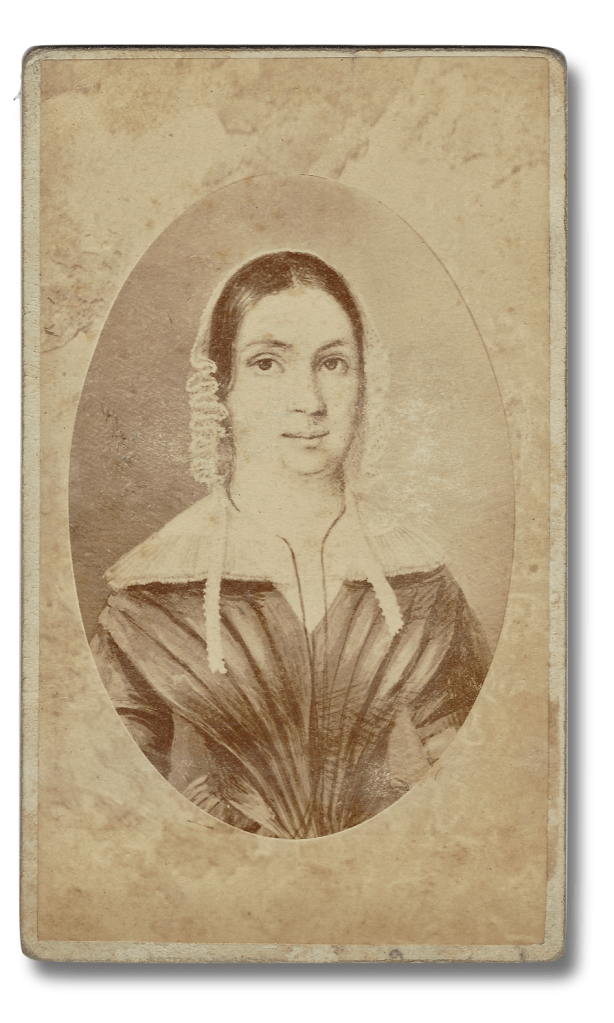

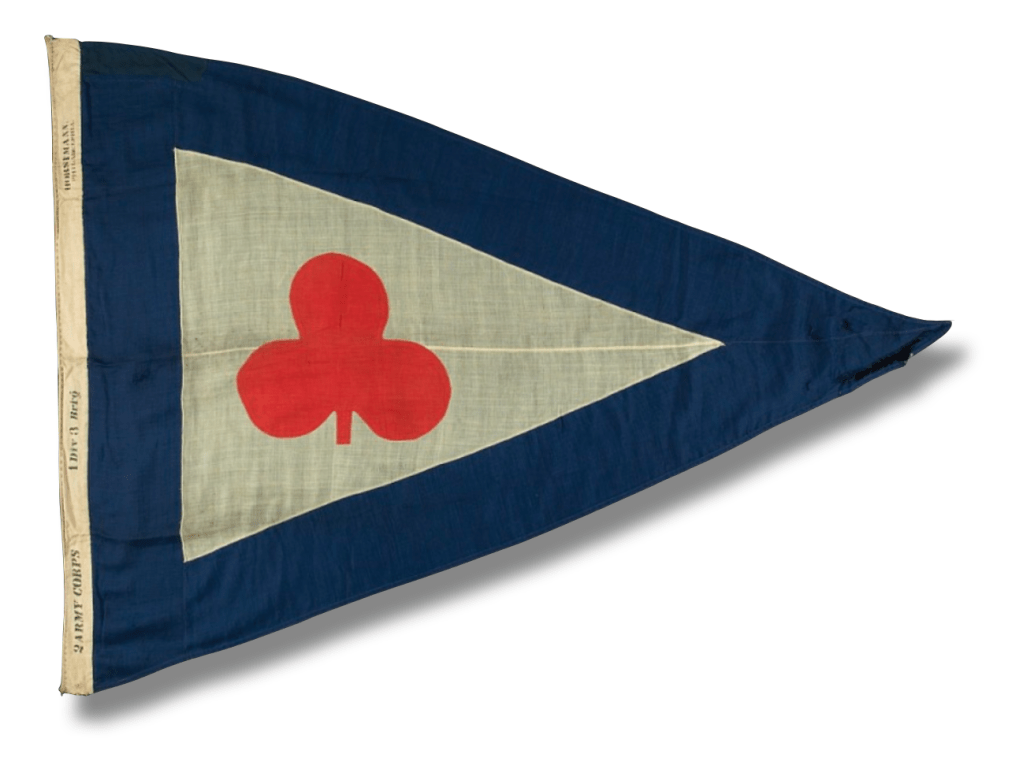


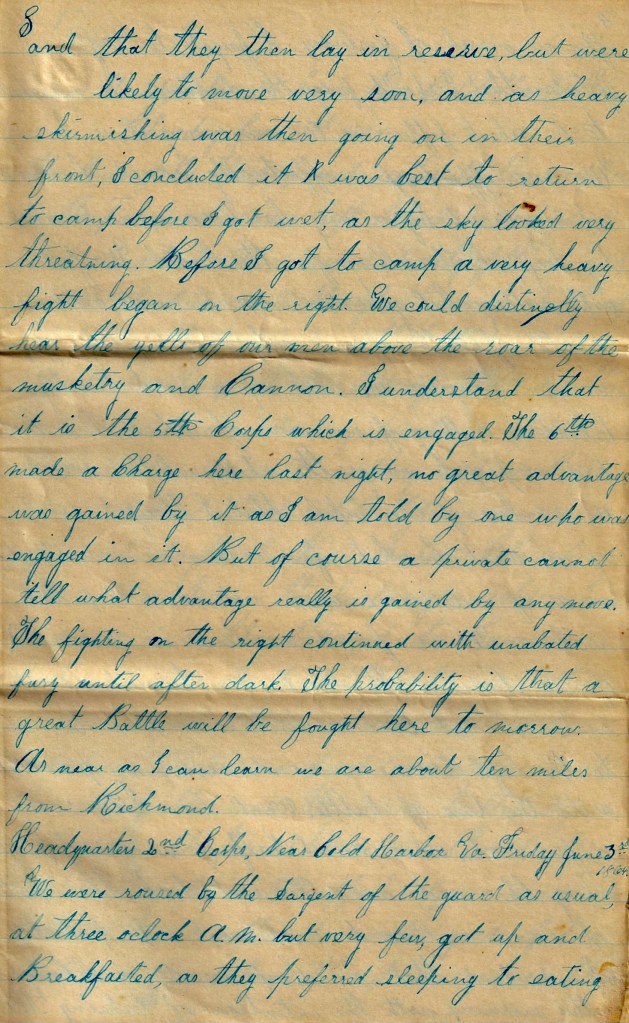


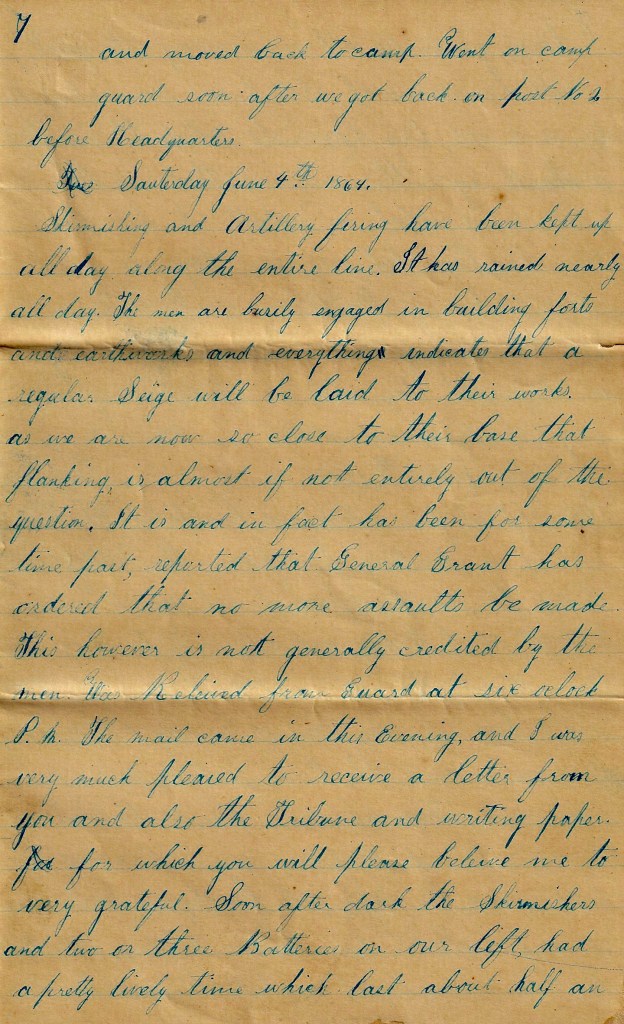
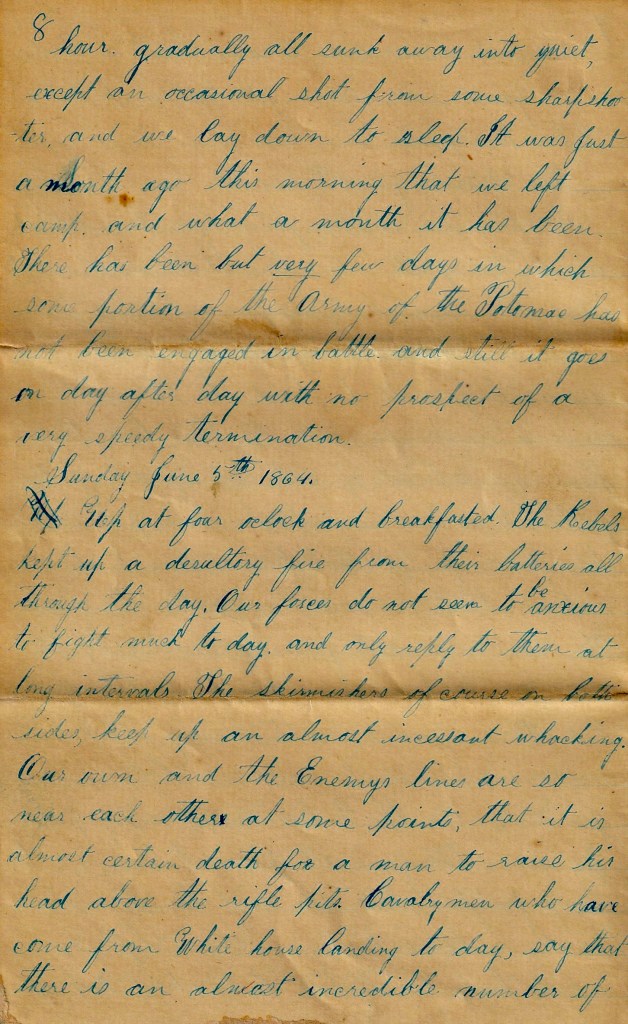


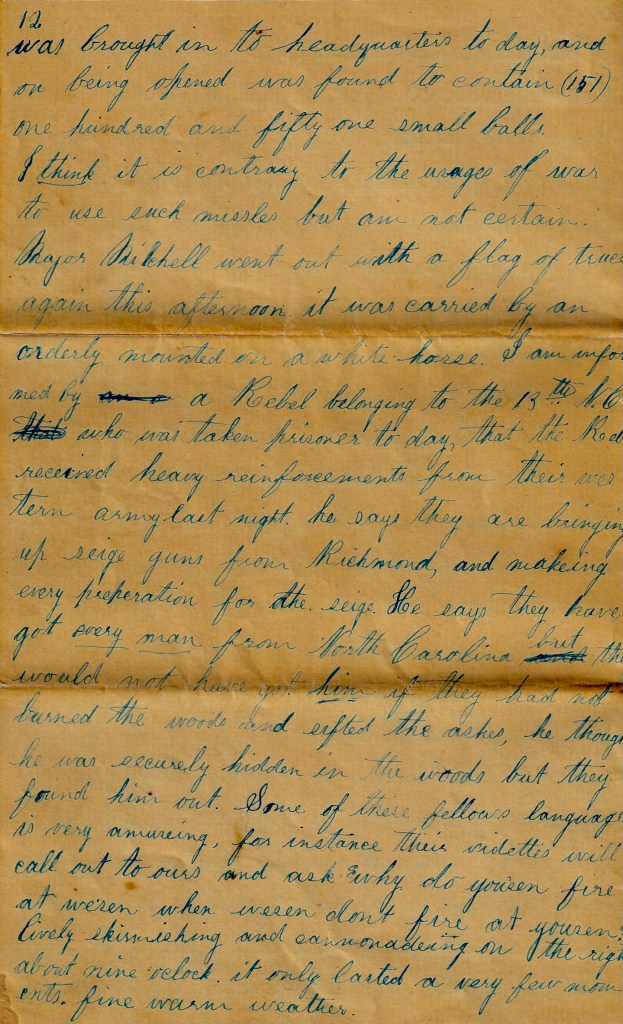
 Spared & Shared 23