The following letter was written by Major Amos J. Holahan (1842-1899) of the 19th Pennsylvania Cavalry. He enlisted at Philadelphia on 6 October 1863 and was wounded on 17 December 1864 in the Battle of Nashville. He resigned his commission and was mustered out of the regiment on 6 February 1865.
Following the war, Amos apparently returned to Philadelphia where he was unsuccessful in whatever business he pursued as he filed bankruptcy in June 1868. Later census records suggest he worked as a Broker. He may have been affiliated with the Holahan family of Philadelphia that engaged in the liquor supply and tavern business.
Amos wrote the letter to Charles Lacroix Pascal, a hatter in Philadelphia, who he called his uncle. Charles was born in Philadelphia in 1818. He was the son of John Pascal (1784-1856), a tavern keeper born in France. Charles’s mother was Ann Polhemus (1783-1853) born in Hopewell, N.J. In 1850, the senior Pascal had real estate holdings worth $30,000. Charles married Mary Stuart Campbell in 1852 in Philadelphia. According to the 1900 Census, her father was born in Scotland. His children, mentioned at the close of this letter were Kate (b. 1854) and Campbell (b. 1858). Charles was granted a patent in December 1861 for a hat/havelock creation which he and his partner James Sullender sold to the Commonwealth of Pennsylvania for use by a number of its cavalry regiments (including the 2nd, 6th and 15th). The hat’s most distinctive feature was a brim which could be raised to “present a neat ornamental appearance” and lowered “as to afford protection to the the wearer’s neck from both the heat of the sun and the effect of storms.”
Amos composed the letter on stationery that featured his lithographic image prominently displayed in the letterhead—an unusual and extravagant cost for someone of his rank as a Major.
T R A N S C R I P T I O N
Gravelly Springs, Alabama January 29th 1865
My dear Uncle,
I would have answered your letter of November 22, 1864, long ago but I received it on the eve of my departure from Memphis, and I have been on the march nearly all the time since. The “Army of the Cumberland” is in winter quarters at this place. There is about thirty thousand infantry and twenty five thousand cavalry, all under Maj. Genl. Thomas. This is called Gravelly Springs, why? It is impossible for me to say. It puts me very much in mind of one of those bogus building association lots that look so very nice on paper. Gravelly Springs is nothing but a steamboat landing on the Tennessee River some ten or twelve miles below Eastport, Mississippi. The “Springs” or “Town” or “City” of Gravelly Springs is a myth.
Enclosed you will find Charlies letter. From what he says, he must have a rough time of it in Dixie. I sincerely hope he will soon be released.
Last month we had some very severe fighting in front of Nashville and after the 16th of December, the cavalry did all the fighting and drove Hood across the Tennessee [river]. At about nine o’clock A.M. on the 17th of December, your humble servant was placed “hors de combat.” I was wounded in the head and in the groin, and was taken back to Nashville and placed in the officers Hospital where I remained until January the 20th when I joined my regiment again at this place. I am almost well now of my injuries.
You ask me for a list of Generals in and around Memphis. They are as follows, “viz”:
Maj. Gen. C. C. Washburne Commanding “Dist. West Tenn.” since superseded by Maj. Gen. Dana Brig. Gen. Buckland, Commanding “Dist of Memphis” Brig. Gen. Orme, Superintendent Shipping Govt. cotton and permits Brig. Gen. B. H. Grierson, Commanding Cavalry Corps, West Tenn. Brig. Gen. Hatch, Commanding 1st Division, Cavalry Corps, West Tenn. Brig. Gen. Winslow, Commanding 2nd Division, Cavalry Corps, West Tenn. Brig. Gen. Chetlain, Commanding Colored Troops, Dist. Memphis Brig. Gen. Dustan of Militia, Commanding Militia of Memphis.
This is all. There may have been some changed since I left. I think Gen. Buckland has been elected to Congress since from Ohio. I have forgotten one General “Brig. Gen. Veatch, commanding Fort Pickering.”
I sent in my resignation on the 25th inst. on account of my physical disability from wounds received on the 17th of December. I expect to be home some time next month. Give my love to Aunt Mary, Katie and Campbell/ Also remember me to Mr. p ]. Hoping this will find you in the enjoyment of health, I remain your affectionate nephew, — A.J. Holahan
My directions are Major A. J. Holahan, 19th Penna. Cavalry, 1st Brigade, 7th Division, Cavalry Corps M. D. M., Eastport, Mississippi
M. D. M. means Military Division of the Mississippi. Please excuse me franking this letter. I am entirely out of postage stamps and we are so far isolated from all civilization that at present it is impossible for e to obtain any. — Amos
The following diary was kept by Cyrenius Whetstone (1839-1922) of New Baltimore, Stark county, Ohio. He enlisted in Battery A, 1st Ohio Light Artillery (“Goodspeed’s Battery”) on 25 September 1861 and served until 31 July 1865. He was married to Charlotte (“Lottie”) Scovel in 1879. He was the son of Solomon Whetstone (1810-1873) and Catherine D. Stickler (1808-1860). A pension record gives his date and place of death as 26 June 1922 at Rock Falls, Illinois.
A brief biographical sketch appears in a history of the battery which reads: “Cyrenius Whetstone enlisted with the Battery at its organization and served with it in all the marches through Kentucky and Tennessee. At the Battle of Stones River, after his gun squad had lost its gun, he used a musket in the day’s battle with the 42nd Illinois Volunteer Infantry. He also participated in the battles of Liberty Gap and Chickamauga, and in the whole of the campaign to and from Atlanta during 1864; was promoted to Corporal on the 13th of September, 1864. Discharged at Cleveland, Ohio, on July 31st 1865.”
Battery A was mustered into national service for three-years at Camp Chase, Columbus, Ohio, in September 1861. They were immediately moved to Gallipolis, Ohio and assigned to Brigadier General Cox and on 22 October 1861 ordered to report to General A.M. McCook, at Camp Nevin, Kentucky. By 1862 the unit had moved to Green River; Louisville; Nashville; Pittsburgh Landing; and the advance on Corinth. Still assigned to McCook they marched to Florence, Alabama; Battle Creek; Jasper; Decard Station; Winchester; Tullahoma; Shelbyville; and Nashville. With General Buell, they marched into Kentucky and fought at Dog Walk and Bowling Green, Kentucky. They also fought with General Rosecrans at Stones River.
In 1863 Battery A was combined with the 20th OIB and Simonson’s Indiana Battery to constitute an artillery brigade in the Army of the Cumberland’s Second Division. The brigade accompanied McCook at Tullahoma; Liberty; Hoovers Gap and over Sand Mountain. They fought with gallantry in the battle of Chickamauga, and for defense of Chattanooga. On October 18th, 1863, Battery A reported to General Speer, at Sale Creek. They advanced through East Tennessee to relive Burnside at Knoxville, and had daily engagements with confederate cavalry until the middle of January 1864.
The unit mustered out at the beginning of 1864, but by February, after a 30 day furlough, most of the men rejoined the unit in Cincinnati, Ohio. Battery A first returned to Nashville, and then on to Catoosa Springs, where they joined the Second Division, Fourth Army Corps, with General Sherman. After joining Sherman’s Army, the unit moved on to Gallatin, Tennessee. Towards the end of the war Battery A was sent to New Orleans with Stanley’s Division, and remained there until they were finally mustered out of national service on July 31, 1865. By the end of the war, the battery had lost 15 men killed in action and 33 to disease. A free book on the History of Goodspeed’s Battery can be found online written by Henry M. Davidson.
This diary spans the year 1864 with the rendezvous of the Battery at Cincinnati until after the Battle of Nashville in mid December 1864.
For those interested in reading letters transcribed by Spared & Shared written by members of the 1st Ohio Light Artillery, among its various Batteries, see:
This diary is the property of Evan Iannone and was made available for transcription and publication on Spared & Shared by express consent.
Identified as Battery A, 1st Ohio Light Artillery, by Larry Strayer in the book, Chickamauga by Time-Life Books. The original albumen photograph is said to have been taken by the Nashville firm of A.S. Morse.
T R A N S C R I P T I O N
Friday, January 1, 1864—Lay in camp at Buffalo Creek, Tennessee.
Wednesday, January 13, 1864—Left Buffalo Creek, Marched about fourteen miles and camped for the night.
Wednesday, January 20, 1864—Arrived at Camp Nelson at nine o’clock a.m. Went to General Hospital to see [brother] Allen [104th OVI]. Stayed with him till the Battery came up. Boarded with the convalescents.
Thursday, January 21, 1864—Allen went to Frankfort. I remained at Camp Nelson till noon. Then started for Nicholasville and remained at the above named place during the night.
Friday, January 22, 1864—Took the cars at Nicholasville for Covington, Kentucky. Arrived at Covington at 11 o’clock in the night. Rendezvoused at the barracks.
Saturday, 23, 1864—Arrived at Cincinnati about ten o’clock a.m. Rendezvoused at Sixth Street Bazaar. Boarded at the Soldiers’ Home.
Monday, February 1, 1864—Took the cars at Cincinnati for Cleveland at 6 a.m. Arrived at Cleveland at 4 p.m. Took supper at the Depot and lodging at the New England Hotel.
Friday, February 5, 1864—Received a furlough at Camp Cleveland to continue 30 days.
Saturday, February 6, 1864—Left Cleveland at 8 a.m. Arrived at Ravenna at ten a.m. Went to the Town Hall where there was an address delivered by Judge Day. Then took dinner at the Taylor House. Started for Randolph at 7 p.m. Stayed with William Ch___ the 7th.
Sunday, February 7, 1864—Arrived at R, M. Hamilton’s at 11 a.m. Took dinner with them. Arrived at Balty [New Baltimore, Stark county, OH] at 4 p.m. Stopped at A. Hamilton’s
Monday, March 7, 1864—Left New Baltimore about noon. Went to R. M. Hamilton’s. Mate & I went to Davis’s, then to W. Hutchen’s, then back to Davis’s again. At 4 p.m., Genl. & I started for Atwater Station. Arrived at Cleveland at 10 p.m. Stayed at the New England Hotel.
Tuesday, March 8, 1864—Went to Camp Cleveland at 8 a.m. Went back to the New England Hotel and stayed that. Genl. and I went to 65, told some lies, then went to the Algier House, took supper, then went with Jim Kendrick and had an oyster supper.
Wednesday, March 9, 1864—Went to Picture Gallery. Had an Ambrotype taken. Then went to Camp. Drew clothing. Went to New England Hotel. Stayed all night. Wrote a letter to A. Hamilton. Sent him physiognomy of those taken.
Thursday, March 10, 1864—Left Cleveland at 9 a.m. Arrived Cincinnati at 8 p.m. Bivouacked in the Depot for the night.
Friday, March 11, 1864—Left Cincinnati at 9 a.m. Arrived Louisville 12 p.m. On the Ohio and Mississippi Railroad. Arrived at Seymour about noon. Stay in the depot till twelve o’clock that night. Had a prayer meeting. The Boys had a big time bumming it around town.
Saturday, March 12, 1864—Arrived at Louisville 12 a.m. Rendezvoused on the corner of Main and 1st Streets. Went to a Picture Gallery and sat for one dozen photographs. Went to see the 19th Ohio Vol. Vet. Infantry. Visited Jink Davis. He went to my quarters with me & he and I played [illegible].
Sunday, March 13, 1864—Left Louisville at 3 p.m. Went to Picture Gallery and received half dozen photographs.
Monday, March 14, 1864—Arrived at Nashville at 6 a.m. Went out to camp and pitched tents. Wrote a letter to Harriet Whetstone & sent her a photograph.
Tuesday, March 15, 1864—Lay in camp at Nashville. Wrote a letter to Allen. We had quite a snow storm. Had a big time initiating the new recruits.
Wednesday, March 16, 1864—Battery C left for the front. Battery A occupied their quarters. I went to Nashville, got shaved, then went and visited Jink Davis. Took dinner with him. Played a game of Seven-Up and beat our opponents 4 out of 7.
Thursday, March 17, 1864—Wrote a letter to Lidia Hollabough. Sent her a photograph. Swept the park. Jink Davis & Perry Woods are here. There were a number of promotions made among the corporals and sergeants. Enjoyed a dance this evening in the Park.
Friday, March 18, 1864—Drilled foot drill at 9 a.m. After drill I went to Nashville. Went to the Post Office. Then to a hardware store. Purchased a frying pan. Paid $1 for it. Returned to camp and wrote a letter to photographers at Louisville, Ky.
Tuesday, April 26, 1864—Received orders to prepare to march to the front. Drew ten days rations & cooked them. Drew dog tents and clothing.
Wednesday, April 27, 1864—Left Camp Brough at 7 a.m. Arrived at Lavergne about three p.m. and camped for the night. Had a big time pitching our new dog tents.
Thursday, April 28, 1864—Left Lavergne at 8 a.m. Had a devil of a rain storm last night and pump tent blew down & had a gay time. Had potatoes, meat, coffee and bread for breakfast. Arrived at Murfreesboro at 12 M. Camped near Camp Sill at Stone River.
Friday, April 29, 1864—Arrived at Shelbyville about 2 p.m. Pitched tents on the bank of Duck River. Went in bathing. Had a big time swimming horses. Marched 22 miles.
Saturday, April 30, 1864—Left Shelbyville at 7 a.m. Had quite a rain storm. Got lost in the wilderness & had a devil of a time. Marched about 22 miles. Arrived at Tullahoma at 2 p.m. WEnt to the Depit. Pitched tents near our old camping ground. Had some of Mate;s tea for supper.
Sunday, May 1, 1864—Left Tullahoma at 7 a.m. Crossed Elk River. Passed through Decherd about noon. Arrived at Cowan Station about ten o’clock p.m. and camped for the night. Marched 20 miles.
Monday, May 2, 1864—Left Cowan Station at 7 a.m., crossed the Cumberland Mountains. Arrived at the Blue Springs at two p.m. and camped for the night. Marched about 20 miles.
Tuesday, May 3, 1864—Left Blue Springs in Sweden’s Cove about 7 a.m. Stopped to rest at our old camping ground. Visited the grave of Walton Phelps. Arrived at Bridgeport about two p.m. & camped for the night. The 7th OVI left for the front just before our arrival. Drew a large supply of Sanitary stores.
Wednesday, May 4, 1864—Left Bridgeport this morning. Crossed the Tennessee River on the railroad bridge. Marched through the narrows 18 miles. Camped for the night 10 miles from Chattanooga in Wahatchie Valley.
Thursday, May 5, 1864—Arrived at Chattanooga about noon. Camped for the night on our old camping ground. Drew a 12-pound Battery. Went to the river to water horses. Wrote two letters—one to Emeline & one to A. Hamilton.
THE ATLANTA CAMPAIGN
Friday, May 6, 1864—Left Chattanooga at 7 a.m. on road to join our Division. Passed over the Chickamauga Battlefield. Saw bones of our dead soldiers bleaching in the sun. Came by the way of Gordon’s Mill. Arrived at Ringgold & joined our Division sometime after dark. Marched about 25 miles.
Saturday, May 7, 1864—Was on guard last night. Had reveille at 2 a.m. and at four. We left for the front at six. Took a position in line of battle. Took a 2nd position near Tunnel Hill. Our Brigade advanced & battery halted. Here we saw General Willich & his Brigade. All fighting done today on the right by Hooker.
Sunday, May 8, 1864—Stayed in camp near Tunnel Hill all day and the preceding night. Had considerable skirmishing. Our forces occupied Tunnel Hill. Wrote a letter to Lide but did not send it out.
Monday, May 9, 1864—Left camp near Tunnel Hill at 6 o’clock and moved to the left about 1.5 miles Parked the Battery in a corn field near an old log house. Lay idle all day. Had heavy skirmishing on Face Rock [Rocky Face] Ridge. John Shook and I went to top of ridge. Saw the 42nd Illinois Boys.
Tuesday, May 10, 1864—Encamped last night near the ridge and on the left of the line. Had constant but light skirmishing all day. Commenced raining about noon and continued to rain all the latter part of the day. Battery M, 1st Ohio Battery went out & threw a few shell on the right of our Division.
Wednesday, May 11, 1864—Remain in our same position. Skirmishing still continues but light. Rained like the Devil last night. Went upon the ridge this morning. Nothing new. Saw two Rebel engines coming into Dalton [illegible].
Thursday, May 12, 1864—Had reveille at two o’clock & moved at four. Marched about 7.5 miles to the left and relieved the 23rd Army Corps. They moved to the right wing. Kept falling back during the day. Skirmishing continued as usually light. Threw up barricades at last position.
Friday, May 13, 1864—Had reveille at two. Marched at four a.m. Arrived at Dalton about ten and found it evacuated. Rested an hour. Had a gay time ransacking the town. Marched 8 miles from town and camped for the night. Cavalry had quite a skirmish in the evening.
Saturday, May 14, 1864—Had reveille at 3 a.m. Left camp about 6 a.m. Took position in line of battle about eight. Changed position several times. The fighting commenced fifteen minutes before one p.m. The Battery was not engaged. Fighting heavy on the left.
Sunday, May 15, 1864—Took position in fortifications at 3 p.m. Done some digging. Skirmishing quite brisk. Battery commenced firing. Fired 12 rounds. Vack [Victor B.?] Stanford badly wounded by premature discharge. Darius Roe, W[ilson] Davidson, A[uston] D. Bishop, & J. Van Ornum wounded by premature discharge.
[Editor’s note: Victor B. Stanford was wounded in the Battle of Resaca and died on 4 June 1864 at Chattanooga. Regrettably, it appears that his wounds were due to a premature discharge of their own guns—not enemy fire. The other four men listed appear to have been wounded in the same manner though not mortally.]
Monday, May 16, 1864—Had reveille at 3 o’clock & marched at 6 a.m. Found the Rebs had absconded. Arrived at Coosa River about noon. Rested about two hours. Crossed the river and after marching a while, halted. Skirmishing continues. Resaca evacuated.
Tuesday, May 17, 1864—Left camp near Calhoun about daylight. Skirmished through the town. Advanced about two miles when skirmishing commenced quite brisk. Battery halted and came into position. Camped for the night four miles from Calhoun.
Wednesday, May 18, 1864—Left camp about 8 a.m.. Advanced very cautiously. The Rebs falling back but were very stubborn. Had quite a fight in the evening. Camped for the night about a mile from town called Deerville.
Thursday, May 19, 1864—Left Camp about 7 a.m. Arrived at Deerville about 9 & halted till noon. The [illegible]/ Skirmishing in front today. Camped for the night about [ ] miles from Deerville.
Friday, May 20, 1864—Left camp at early dawn. Arrived at Kingston at 11 a.m. and halted for dinner. Advanced at 12 M & after marching two miles found the enemy in line of battle. Drove them till dark, then camped for the night.
Saturday, May 21, 1864—Moved back from the front about a mile & camped for a day or two’s rest. Perry Woods was here today. Went with him to the 19th OVI. Jink Davis came with me when I returned to my quarters. In the evening went to the 42nd Illinois.
Sunday, May 22, 1864—Lay in camp. Done my washing & played poker during the remainder of the day. In the evening Clint Allen & I went to see some Rebel prisoners and had quite a conversation with them.
Monday, May 23, 1864—We still remain in camp. [Gen.] Thomas’s Headquarters which were located near us moved this morning. Left camp about noon. Arrived at the river and crossed about 9 o’clock. Marched about 11 miles. Went into camp at midnight.
Tuesday, May 24, 1864—Left camp at 7 a.m. Marched through the pine regions about ten miles. Camped in a narrow valley. Was detailed to cut a road through the woods. Rained like the very Devil. Were five miles in the rear of our Division.
Wednesday, May 25, 1864—Left camp about 8 a.m. Had to double teams to ascend the ridge. The country traveled over today is very hilly & is but very thinly settled. The timber is principally pine. Water rather scarce. Heavy fighting in front of Dallas. Commenced at 5.
Thursday, May 26, 1864—Camped in a wheat field last night. Had a rain storm. Remained in camp till about 6 p.m., then started to join our Division which was then at the front, a distance of about five miles. Arrived at front about 8 p.m. Went in line. No. 1 & 2 went on picket.
Friday, May 27, 1864—Cannonading opened quite brisk about six a.m. Moved a mile to the left. Remained there till [ ]. The Rebs shelled us like the Devil. Moved to the right a mile, took position in front earthworks. Worked till 2 a.m. last night.
Saturday, May 28, 1864—Got up at about 3 a.m. At 11 a.m., the Rebs made a demonstration in our front. Came over their fortifications. We gave them double charge of canister which sent them back flying.
Sunday, May 29, 1864—Worked last night till two a.m. The Rebs commenced heavy firing along the whole line which was returned. Our Battery fired about six rounds to each gun. The firing continued a half hour when the Rebs dried up.
Monday, May 30, 1864—But very little artillery firing today. Musketry is kept up brisk now from behind fortifications. Was on guard last night. The enemy made quite a noise chopping. Could hear them talking very distinct. Was called to my post about 2 a.m.
Tuesday, May 31, 1864—Was called up at early dawn. Considerable cannonading on the left. James Robinson was wounded today in the left leg. Had it amputated. Received a letter from Helen R. today.
[Editors Note: James T. Robinson died on June 25, 1864, at Chattanooga, Term., of wounds received in action at Dalton, Ga.]
Wednesday, June 1, 1864—Was called to our post once last night. Wrote a letter to Em C. today. Nothing worthy of note occurred during the latter part of the day.
Thursday, June 2, 1864—Still remain in fortifications. Skirmishing continues as usual. Had pretty hard fighting on the left today. Had quite a rain storm in the afternoon.
Friday, June 3, 1864—Remain in fortifications. Firing continues as usual. The right section moved somewhere to the left last night. Wrote a letter to Helen R. Commenced raining about noon & continued raining all day and night.
Saturday, June 4, 1864—Moved our piece into the place that No. 1 occupied. Was on guard. Pickets run in last night. Were all called to our posts. Ed[ward] Cain was wounded this morning. [illegible]
Sunday, June 5, 1864—Were relieved last night by one of Genl. Osterhaus’ Bsatteries. When arrived at the caissons, it was a.m. Found the Rebel works in front of Dallas evacuated this morning. Pulled out of Park about noon. Moved a little to the right and went to fortifying.
Monday, June 6, 1864—Moved out of fortifications this morning and followed the retreating Rebels. Marched about 8 miles and went into camp at 5 p.m. This camp was about 3 miles from Altoona Station pass.
Tuesday, June 7, 1864—Remained in camp today. Done my washing today & changed clothes. Hiram Swartz paid us a visit today. Wrote a letter today. In the evening went to the 42nd Illinois [illegible].
Wednesday, June 8, 1864—Remained in camp. Wrote a letter to Samantha Chain. Perry Woods came to see us today. Commenced raining at 1 p.m. Went to see Davis Boys in the evening. Saw D. Reichard. He is looking well.
Thursday, June 9, 1864—Still remain in camp. Several of our boys who have been prisoners returned today and brought us the sad intelligence that Vack Stanford died on the 5th. Jink Davis was here today and also some of the 42nd Illinois Boys.
Friday, June 10, 1864—Left camp at 8 a.m. Marched very slow & cautiously. Passed Hooker’s Corps. Arrived at the front in the evening. There was but very little firing done today. Marched about three miles.
Saturday, June 11, 1864—Camped at an old house last night. Rained like the very devil. Marched at about 9 a.m. Advanced very cautiously. Went into park near the lines in the evening. Marched about two miles but very little firing today.
Sunday, June 12, 1864—Still continues to rain. Gen. Woods’ Division passed from our left toward the right. Wrote a letter to Ben Switzer. Heard but very little firing today. Rained all day without ceasing.
Monday, June 13, 1864—Ceased raining about 2 p.m. Went out to the lines today. Called at Harker’s Headquarters for mail. Did not get any. Skirmishing continues but light.
Tuesday, June 14, 1864—Cannonading heavy this morning. Was on guard last night. It is reported that McPherson captured a thousand prisoners on the left yesterday. [ ] up at noon. Heavy skirmishing at 5 p.m. Moved a mile to the left front and camped for the night. Reb Gen. Polk killed.
Wednesday, June 15, 1864—Marched at noon. After going a mile, the Battery came into position and on our way to this place I came across Myron. Skirmishing heavy today. The 42nd [Illinois] was engaged. Myron was with the regiment. Came to our gun and stayed all night with me.
Thursday, June 16, 1864—Moved our gun to the front and throwing good works. All the pieces but Nos. 2 & 3 done some firing. In the evening, the Battery moved three hundred yards to the front & took position in [illegible].
Friday, June 17, 1864—Was on guard last night. Our skirmishers advanced at early dawn & found the Rebel works evacuated. Battery moved at 8 a.m. Heavy skirmishing & cannonading commenced at noon. At 5 p.m. the Battery came to position at an old house a little [ ] Brigade. Fired 20 rounds to a gun.
Saturday, June 18, 1864—Moved three hundred yards to the front. Found the enemy again in force & fortified. Battery remained here all day. Rained like the Devil. Battery fired 470 rounds. [Archibald A.] McMasters was hurt by a primer which he supposed had failed. Stepped in & pulled it out just as the [illegible] is changed.
[Editor’s note: Muster rolls indicate that Archibald A. McMasters “was wounded June 18, 1864, in battle of Kennesaw Mountain, Ga.”]
Sunday, June 19th, 1864—Moved at 8 a.m. The Rebs having again evacuated [illegible].
Monday, June 20, 1864—[see Battle of Kennesaw Mountain] Remained in position at the cotton gin till in the afternoon when our battery & Spencer’s Battery [H] moved to the front & took a position in front of the hill. Commenced firing at 4 p.m. Had a hot time with some Rebel batteries. Dock [Levi] Griswold was wounded in wrist by a shell.
Tuesday, June 21, 1864—The 14th Corps relieved our Corps last night. Battery moved back to the cotton gin this morning. Moved to the right, our Corps having relieved the 20th Corps Hookers. Our Corps advanced the line half a mile. Our Battery took a position with Wood’s Division by an old house near the 19th OVVI.
Wednesday, June 22, 1864—Were on the front line all day. Changed position several times. Our piece fired 5 shots [illegible]. Hooker [?] advanced the line with some hard fighting but [?] the enemy [illegible].
Thursday, June 23, 1864—Moved a half mile to the right and took a position in open field by an old chimney. Battery fired 72 rounds of solid [shot]. Stanley’s men drove the Rebs out of their picket pits & held the pits.
Friday, June 24, 1864—We threw up works for our guns last night. [James] Courtney died this morning [of wounds in field hospital near Kennesaw Mountain]. Captain [Wilbur F.] Goodspeed relieved Captain [Charles] Aleshire as Chief of Artillery of our Division, Very quiet along the lines all day.
Saturday, June 25, 1864—Heavy cannonading on the line this morning. [Samuel M.] McDowell’s Battery moved into the line of works in front of us in night. The Battery drew clothing. I received a letter [illegible].
Sunday, June 26, 1864—Were called to our posts with orders to be reeady to commence firing. Commenced firing at 9 a.m. Fired 12 rounds. Our Division & Stanley’s Division charged the Rebel works &some of [them] succeeded in taking the works but were compelled to fall back. Heard today Gen’l. [Charles G.] Harker was killed. [Daniel] McCook wounded.
Monday, June 27, 1864—Strengthened our works with sand bags last night. Visited the 42nd [Illinois Boys] today. Was very quiet today along the whole line.
Tuesday, June 28, 1864—[no entry]
Wednesday, June 29, 1864—Turned our Nos. 3 & 5 pieces and drew two from McDowell’s Battery. Our men are out between the lines with a [Flag of] Truce burying the dead. The boys are exchanging papers with the enemy and also trading coffee for tobacco.
Thursday, June 30, 1864—Last night the enemy made a demonstration in front of our Division. Musketry was very heavy [while it] lasted. Twenty-four of our pieces [ ] to the rear & Battery M filled their places. Wrote letter to Eliza.
Friday, July 1, 1864—Had another [ ] last night. Lasted 15 minutes. John Shook and I went to the 19th OVI. At 5 p.m. the Battery fired 30 rounds at the Rebel works [illegible].
Saturday, July 2, 1864—Were called to our posts at four. Commenced firing at 6 a.m Fired ten rounds. In the evening our Division moved a mile and a half to the left to relieve one Division of the 14th Army Corps. The Battery relieved Battery I of our regiment.
Sunday, July 3, 1864—Got up this morning & found the enemy had evacuated their position in front of Kennesaw Mountain. Moved at 6 a.m. Arrived at Marietta about noon. Passed to the right of the town. Marched 9 miles.
Monday, July 4, 1864—Camped in a field by the railroad. Was on guard last night. Reveille at 4 o’clock. Lieutenant [Henry C.] Grant’s Section & Battery M moved to the front. Found the enemy again fortified. Remained by the Battery. Moved out. Camp by an old house in a [ ] orchard.
Tuesday, July 5, 1864—Moved at 6 a.m. The Rebs had good works which they left very hastily. Skirmishing continued at 4 p.m. We arrived at the Chattahoochee River [and found] the enemy have again taken up a very strong position on the south side of the river. I went on the hill where Atlanta could be seen.
Wednesday, July 6, 1864—Last night we took position on a ridge near the river. The Pioneers built works for the Battery this morning. We strengthened our works. Gen. Thomas & a number of Corps generals were here. The Battery was ordered to fire at Reb picket pits. Fired two rounds.
Thursday, July 7, 1864—Wrote a letter to Sue Whetstone. At 6 p.m., Battery fired 18 rounds. At 8, all the artillery in the Corps had orders to fire, our Battery giving the signal. Battery fired 72 rounds. This firing was done to attract the attention of the Rebs while Schofield laid a pontoon [bridge] across the river. Was a [success?].
Friday, July 8, 1864—Rebel pontoon bridge was moved last night. Is very quiet along the lines today. The Johnny Rebs & Yanks went in battling with each other. Built a bowery over our gun today.
Saturday, July 9, 1864—At 7 a.m, our Division started on an expedition up the river to a town by the name of Roswell, distance 16 miles. Arrived there at 5 p.m. The infantry crossed the river. Several men died from sun stroke. The heat was intense.
Sunday, Jul 10, 1864—Battery is lying in Roswell. Heavy cannonading on the right of us. Is supposed to be Schofield. Two Divisions of the 16th Army Corps came in today, crossed the river, and relieved our Division. Received a letter from Allen.
Monday, July 11, 1864—Lay in camp at Roswell. John Shook and I went after blackberries. Had blackberry dumplings, stewed berries, apple sauce & biscuit for dinner. Done my washing, then went to town after soap. Visited nearly all the houses & also the ruins of the factories.
Tuesday, July 12, 1864—The Division marched from Roswell at 8 a.m. Went back to our former camp at the railroad. Had a gay time smashing our furniture. Camped near the pontoon bridge.
Wednesday, July 13, 1864—Left camp at 8 a.m., crossed the river on pontoon [bridge] at 9 a.m. After marching 2.5 miles, parked the Battery. Right and Left sections went to the front and took position. John Shook and I went after berries. Wrote letter to Ell. Worked on fortifications till ten p.m.
Thursday, July 14, 1864—Lay in camp. Part of the 23rd Army Corps passed by this morning. Is very quiet at the front today. Received a letter from Robb Crockett. Am on guard tonight. Had quite a rain storm. Jink Davis paid us a visit this evening.
Friday, July 15, 1864—Battery still remains in camp. Jink Davis and I were to the 104th OVI. Took dinner with Captain Andrew J. Southworth [of Co. B]. Had a game of Seven Up with the Boys. Wrote a letter to Robb Crockett.
From the History of the 104th Ohio Volunteer Infantry, page 56.
Saturday, July 16, 1864—In camp. Wrote a letter to Elvira G. Went to the 42nd [Illinois] and found [illegible]. Our Division made a reconnaissance. Found the enemy. All quiet at the front.
Sunday, July 17, 1864—Remained in camp today. Done my washing. Wrote a letter to Hal and received one from Em. Went to see Myron this evening. He was detailed to the Division Ambulance Corps.
Monday, July 18, 1864—Had reveille at 3 o’clock. Marched at 5 Had slight skirmishing. Marched 7 miles. Are now within 5 miles of Atlanta. Have formed a line of battle. Battery is in position at an old house. Received a letter from [ ].
Tuesday, July 19, 1864—All is quiet this morning. Our forces are fortifying. There are apparently [ ] Rebels near. Heavy cannonading commenced about noon & continued throughout the day. In the evening we advanced two miles to Battle Creek [illegible].
Wednesday, July 20, 1864—In position at Peach Tree Creek. All is quiet this morning. At 10 a.m., our forces advanced & drove the Rebs from their skirmish pits. At 3 p.m., the Battery crossed Peach Tree Creek [and] took a position in line of battle. At 4 p.m., the Rebs charged us & were repulsed with terrible slaughter. Battery fired 74 rounds.
Robert Jenkins’ book, published in 2021, explores this battle in detail.
[Editor’s Note: “When Sherman began his final push toward Atlanta, he divided his forces, sending Thomas’s Army of the Cumberland directly toward the city and ordering Schofield’s Army of the Ohio and McPherson’s Army of the Tennessee around Atlanta to the east. Hood viewed this as an opportunity to strike a blow for the Confederacy. In order to approach Atlanta, Thomas’s army had to cross Peachtree Creek in several places. Johnston had been aware of that while still in command and had devised a plan to attack Thomas’s soldiers at the time of the crossing. When the crossing took place on July 20, Hood implemented Johnston’s plan. Unfortunately for the Southerners, Thomas’s army had already crossed the creek when the attack began at about 4:00 p.m., instead of the planned time of 1 p.m. The assault initially showed some promise, but the Federals were able to hold their ground, eventually punishing the Rebels with high casualties. The Battle of Peachtree Creek cost the Confederacy nearly 5,000 men killed, wounded, and captured or missing, compared to about 1,700 for the Union.” Source: Ohio Civil War]
Thursday, July 21, 1864—Very quiet on the lines today. Our forces are burying the Rebel dead. The Rebel General [Clement Hoffman] Stevens [of Georgia Brigade] was killed. Fortified last night. Remained in our works today.
Friday, July 22, 1864—Advanced at 8 a.m. After marching 1.5 miles, again encountered the enemy. Battery came into position and fired 74 rounds. The Rebs done splendid artillery firing. At 5 p.m., the enemy charged McPherson & was repulsed with great loss. Hear Gen. McPherson was killed.
Saturday, July 23, 1864—Worked on fortifications last night and this morning. The Johnnies keep up a continual artillery firing & also considerable musketry. Gen. [William T.] Sherman & also Gen. [Lovell] Rousseau passed us today.
Sunday, July 24, 1864—Remained in works today. The Johnnies keep up a continuous firing from their batteries but do very little damage. Wrote a letter to Em___.
Monday, July 25, 1864—Rebs done considerable cannonading last night. Could hear them fighting on the Right Wing at 12 o’clock last night. Built a line of works in front. Cannoneers built embrasures. Moved into the works at 4 p.m.
Tuesday, July 26, 1864—Built a bowery over our gun this morning. Allen was here last night. He and I went to see Myron. Allen went back to him command this morning. Our section moved to the left at five p.m. and took a position to guard a ravine.
Wednesday, July 27, 1864—Built a fort for our gun this morning. Wrote a letter to Bobb Crockett. Gen. McPherson’s forces are moving to the right. A brisk firing is kept up to attract the Johnnies’ attention in our front.
Thursday, July 28, 1864—Wrote a letter to Em today. A continual musketry firing & also cannonading is kept up in our front to attract the Johnnies’ attention while the flank is moving round.
Friday, July 29, 1864—Made an addition to our fort today. Is quiet in our front today. Heavy firing was heard on the right. Lasted for about an hour. The fighting was done by the 15th Corps. The Rebs were repulsed with heavy loss. Wrote a letter to Henry.
Saturday, July 30, 1864—Still remain in our fort. Is very quiet in our lines but heavy skirmishing in the 20th Corps which drove the Johnnies from their skirmish pits.
Sunday, July 31, 1864—Hitched up and prepared for inspection at 9 a.m. The inspecting officer failed to come. At 5 p.m., we were relieved by Battery M, 1st O. L. A. Battery moved to the rear and parked near Corps Headquarters & pitched tents.
Monday, August 1, 1864—Made preparations to build boweries over our tents. The 23rd Corps is moving to the right. Our Corps is building a line of works one half mile in the rear of our present lines. Have orders to cease work—that we are going to move further to the rear. Climb a tree and took a peep at the City [of Atlanta].
Tuesday, August 2, 1864—Moved to the rear a mile and a half and went into camp. Policed the Park. Then write a letter to Corp. Roe. The 23rd Army Corps moved by our camp this morning. Myron was to the Battery this evening. The 32nd Indiana non vets started home today.
Wednesday, August 3, 1864—Was on guard last night & today. Built a bowery over my tent this morning. Went to see Myron. Came back, policed the Park, then took a shave. Is very quiet on the lines today. The skirmish line advanced but had to fall back again.
Thursday, August 4, 1864—Policed the Park this morning. The Boys went out foraging today. In the afternoon, I took a stroll along the lines. Visited Jink [Jenkins] Davis. Returned to camp and had some green corn and apple sauce for supper.
Friday, August 5, 1864—Joseph Ulm and I done our washing this morning. Heavy cannonading on the right. Received a letter from A. Hamilton and also one from A. Whetstone.
Saturday, August 6, 1864—Took our carriages to the creek today and washed them. Prepare for inspection [illegible].
Sunday, August 7, 1864—Was on guard last night and today. Had quite a rain storm last night. Did not have an inspection today. Received a letter from E. G. with photo enclosed.
Monday, August 8, 1864—Took a walk today along the lines. Went to the right as far as the 16th Army Corps. Witnessed the shelling of the City by our long ranged batteries. Joseph Ulm and I were to the Corps Hospital.
Tuesday, August 9, 1864—Commenced building a stable for our horses today. Had quite a rain storm. There was considerable cannonading along the lines. Rebs do not reply with their artillery.
Wednesday, August 10, 1864—Finished our barn today. Is raining again. Cannonading heavy along the whole line. Wrote a letter to E. G. Was on guard last night. Rained all night.
Thursday, August 11, 1864—Was out foraging today. Was very warm. Came near getting sun struck. Had green corn for supper.
Friday, August 12, 1864—Heavy cannonading on the right. Is very quit in our front. The long ranged batteries [fire] a gun every five minutes. Was ill and in bed all day.
Saturday, August 13, 1864—Very quiet in the lines. Reported good news from Mobile. The boys are oiling their harnesses today. Jet [Justin] Rogers & I went after beef shanks this evening.
Sunday, August 14, 1864—Joseph Ulm and I are detailed to boil out some Neats’ Foot Oil today. Had an inspection at 9 a.m. I and Joe were not present.
Monday, August 15, 1864—Was on guard last night. Today heavy musketry on the right at 3 o’clock last night. The usual quiet prevailed on the lines today.
Tuesday, August 16, 1864—Wrote a letter to Helen R. today. Had a General Inspection at 2 p.m. Received the sad intelligence through the papers that Allen [S.] Whetstone was among the missing of the 4th Kentucky Mounted Infantry.
[Editor’s note: Allen S. Whetstone (1837-1909) Served in the 104th Ohio Infantry (U.S.A.) as private from August 11, 1862 to April 9, 1864. Served in the 4th Kentucky Mounted Infantry (U.S.A.) as first lieutenant from April 16, 1864 to December 9, 1864.]
Wednesday, August 17, 1864—Considerable firing on the lines today. Wrote a letter to Harriet today. Made a feint along the lines in our Corps tonight. Our Battery moved about two miles to [ ], made considerable noise, then returned to camp. Arrived in camp at 12 midnight.
Thursday, August 18, 1864—Heavy cannonading by the Johnnies this morning. Went up to the front this afternoon. Seen nothing of importance. Drew five days rations last night.
Friday, August 19, 1864—Was on guard last night and today. Terrific artillery firing at 4 o’clock this morning. Was done mostly by our batteries. It is reported in camp today that Kilpatrick has cut the Macon Railroad. Had a rain storm this evening.
Saturday, August 20, 1864—Is very quiet along the lines today. Jenk Davis paid us a visit this afternoon. Received a letter from Sue Whetstone & also one from Em with photo enclosed. Had a rain storm today.
Sunday, August 21, 1864—Went out foraging this morning—like Hell I did. Rained nearly all day. Wrote a letter to Em Whetstone. B. Maxwell and George Bissett were here on a visit.
Monday, August 22, 1864—Went out foraging this morning. Received a letter from Corp. Roe and also one from Samantha Chain. Replied to Alex’s letter.
Tuesday, August 23, 1864—All quiet in the lines this morning. Was to the 19th OVVI on a visit today. Played a big game of Seven Up.
Wednesday, August 24, 1864—Marched at 1 p.m. Moved about three miles to the right. Occupied the works which the 11th Army Corps had abandoned. Camped for the night just in rear of the line.
Thursday, August 25, 1864—Had reveille at early dawn. The 2nd & 3rd Divisions passed the 1st Division which was guarding the rear. The Battery was left with the 1st Division. Pulled out of the works about 10 a.m. The Johnnies threw a few shell this morning. Marched about 6 miles. Camped close to Battery M, 1st Ohio.
Friday, August 26, 1864—Left camp at 8 a.m. Marched about four miles. The infantry threw up a line of works after relieving the cavalry. Went into camp about 4 p.m. Parked on a hill in a grove. There was some slight skirmishing today.
Saturday, August 27, 1864—Moved at 10 a.m. The whole 14th Corps train passed us. Didn’t march over a mile during the day. Built a bridge over a small creek in the afternoon. Started to join our Corps at 8 p.m. Marched 4 miles. Arrived at camp at 12 o’clock. Had a big time going through a swamp.
August 28 through September 1, 1864 [No entries]
Friday, September 2, 1864—Our Corps struck the Macon Railroad this morning & was engaged in destroying it all day. At 4 p.m. the 14th Army Corps attacked the Johnnies in front of Jonesboro and gave them a sound thrashing. Captured 1600 of them and 16 pieces of artillery. The Battery camped for the night on the left of the RR near the battlefield.
Major Gen. Thomas John Wood, 4th Cavalry US Army, suffered a leg wound in the Battle of Lovejoy’s Station.
Saturday, September 3, 1864—The Johnnies evacuated Atlanta last night. The 20th Army Corps occupied the city this morning. Our Corps advanced at 9 a.m. After marching five miles, found the Johnnies again in line of battle. At 5 p.m., Gen. Wood’s [cavalry] charged the Rebs [at Lovejoy’s Station] and were repulsed. Col. [Charles F.] Manderson and Gen. [Thomas John] Wood were wounded.
Sunday, September 4, 1864–Battery lay at cotton gin all day. No important news from the front. Had a rain storm. No. 5 & 6 went out on the lines & done some firing.
Monday, September 5, 1864—Lay at cotton gin. Wrote a letter to Matt Chain. In the evening the Army abandoned its position in front of Lovejoy Station and fall back 7 miles toward Atlanta. Battery went into camp at 12 o’clock. Parked in a field near the railroad.
Tuesday, September 6, 1864—Moved this morning at 8 a.m. After marching about 1.5 miles, pitched tents with orders to remain during the night. Marched with the Artillery Brigade today.
Wednesday, September 7, 1864—Had reveille at 2 o’clock this morning. Marched at 4. After marching 6 miles, went into camp within 7 miles of Atlanta. Joseph Ulm, Jacob Fifer, and I went out after forage.
Thursday, September 8, 1864—Arrived at Atlanta about two p.m. Went into camp on the Decatur Railroad a mile east of the City on the battlefield where McPherson fell.
September 9, 1864 through October 2, 1864 [No entries]
Monday, October 3, 1864—Camp at Atlanta. Had reveille at 2 o’clock. Left camp at early dawn to start for Johnnie Hood who had gone to our rear. Crossed the pontoon bridge at Vining Station. Camped within 5 miles of Marietta. Marched 13 miles.
Tuesday, October 4, 1864—Had reveille at early dawn. Marched at noon. Passed through Marietta about 4 p.m. Went into camp at Kennesaw Mountain. Marched 6 miles today. Battle at Altoona Pass. Rebel loss 600.
Wednesday, October 5, 1864—In camp at Kennesaw Mountain. Marched at 5 p.m. After marching 5 miles, went into camp about a mile from Pine Mountain & near the old house from which we fired on the 17th of June when in position with Willich’s Brigade.
Thursday, October 6, 1864—Lay in camp today. Nothing worthy of note occurred. Rain quite hard all day. Was on guard last night & today.
Friday, October 7, 1864—Changed camp at 9 a.m. After marching a mile, we joined our Corps and went into camp near Pine Mountain. Heard some cannonading on the left this evening. The Johnniesattacked the 15th ARmy Corps and were repulsed.
Saturday, October 8, 1864—In camp near Pine Mountain. Lay close to Willich’s Brigade. Was in my tent all day reading a novel. Moved at 3 p.m. Marched 8 miles. Went into camp in an open field near Acworth. Was 10 p.m. when we pulled into Park.
Sunday, October 9, 1864—Changed camp this morning at 10 a.m. Move about a mile. Our camp located near the railroad & close to Acworth. Had an order read to us at Roll Call concerning the fight at Altoona.
Monday, October 10, 1864—In camp at Acworth. Went out grazing horses. Returned to camp and marched at 3 p.m. Passed through Altoona at dusk. Arrived at Cartersville at 10 p.m. and camped for the night. Marched 9 miles.
Tuesday, October 11, 1864—Had reveille at 4 o’clock. Marched at early dawn. Passed through Cartersville. Arrived at Kingston at 2 p.m. and halted for dinner and held an election. Camped for the night in a woods a mile from Kingston. Received mail this evening.
Wednesday, October 12, 1864—Had reveille at early dawn. Marched at 9 a.m. Heard some cannonading on the left today. Marched about 22 miles and camped within three miles of Rome, Georgia.
Thursday, October 13, 1864—In camp three miles from Rome. The Boys are all out after forage. Heard some cannonading on the right of Rome. Battery moved at 4 p.m. After marching 15 miles, went into camp at one o’clock. Camped in the woods on a high hill 9 miles from Calhoun, Georgia. Skirmish at Resaca this morning.
Friday, October 14, 1864—Marched at 8 a.m. Passed through Calhoun about 10 a.m. and arrived at Resaca at noon. Camped for the night two miles north of town. A Negro Regiment captured at Dalton today.
Hubbard Pryor show at the time of his enlistment (left) and after donning the uniform of the 44th USCT.
[Editor’s Note: The Negro regiment captured at Dalton, Georgia, was the 44th USCT consisting of about 600 Black soldiers and 150 white officers, who were guarding the railroad when they were surprised by General John Bell Hood’s forces. While white officers were quickly paroled, the Black soldiers faced re-enslavement or harsh conditions as prisoners, highlighting the brutal racial disparity in treatment during the Civil War, with one soldier, Hubbard Pryor, surviving to tell his story.]
Saturday, October 15, 1864—Left camp near Resaca at 8 a.m. Marched six miles toward Dalton, then halted. The infantry marched over Rocky Face Ridge at dusk. We went back to Resaca with the wagon train. Battery took a position in Reb works and camped for the night.
Sunday, October 16, 1864—Left camp at 7 a.m. on route for Snake Creek Gap. Halted for dinner at the entrance of the Gap. Passed the Gap two miles & camped for the night at White Church.
Monday, October 17, 1864—Lay in camp at the White Church. Visited the 104th OVI. Received orders to forage off of the country for our subsistence.
Tuesday, October 18, 1864—Left camp at the White Church at 8 a.m. Passed through Dug Gap. Marched 16 miles and camped in a hill in an open field.
Wednesday, October 19, 1864—Lay in camp till the 14th Army Corps passed us. J. Shook and myself went out foraging. Killed a pig. Battery moved at 12 noon. Marched 15 miles. Camped at Summerville, Alabama.
Thursday, October 20, 1864—Left camp at Summerville at 7 a.m. Marched 20 miles. Camped at Gaylesville, Alabama. Passed through some excellent country today.
Friday, October 21, 1864—In camp near Gaylesville. Received mail this morning. Got a letter from Myron and one from Mate Hamilton. Changed camp in the evening. Moved half a mile.
Saturday, October 22, 1864—Was on guard last night and today. Write a letter to Myron today.
October 23, 1864 through November 26, 1864 [No entries]
Sunday, November 27, 1864—Lay in ditch at Columbia, Tennessee. Rained all day. In the evening, Battery moved 1.5 miles to the left. Found the pontoon bridge broken down. Remained in the woods that night.
Monday, November 28, 1864—Moved back to our works again. In the evening forded Duck River. Went into camp two miles from the crossing. Saw Battery I.
Tuesday, November 29, 1864—Battle fought at Spring Hill. The battery participated. Hazen J. Corlis killed. Fred Fairchilds wounded slightly in foot.
[Editor’s Note: Whetstone records very little of this action though the role played by the Battery was significant. Gen. Stanley later admitted that, “The Union forces were only saved from irretrievable loss by the stubborn resistance which Battery A made with well directed volleys of shell and canister, and its concentration of fire under the direction of Capt. Goodspeed.” Source: History of Battery A by Henry M. Davidson, page 132.]
Wednesday, November 30, 1864—Battle of Franklin. Battery fired but a few rounds. Captain Scovill slightly wounded [in the breast by a musket ball].
Thursday, December 1, 1864—Arrived at Nashville. Lay in camp near Fort Negley. Saw Milt Whetstone this eve.
Friday, December 2, 1864—Moved a mile to the right. Took a position in the line on the Charlotte Pike.
December 2, 1864 through December 13, 1864 [No entries]
Wednesday, December 14, 1864—Was relieved from the 4th Army Corps. Battery E, 1st Michigan taking our place.
Thursday, December 15, 1864—Battle at Nashville fought.
The following journal was kept by Reuben Cross Norton (1838-1920), the son of Hoel Buell Norton (1797-1876) and Margaret Cross (1799-1866) of Rockford, Illinois. Reuben’s father was born in East Bloomfield, New York; his mother was born in Sligo, Ireland. The Norton’s were residing in Bridgewater, Michigan in the late 1830s when Reuben was born. They moved to Rockford, Illinois, in 1852. It’s noted that Reuben’s father’s name is spelled “Hoel” on his grave marker and in the cemetery records. Upon his death in 1876, he was remembered by his friends for his “strict integrity and probity.”
Reuben first entered the war in September 1861, enlisting in Co. G (the “Northwestern Rifles”), 44th Illinois Infantry, with his brother Marcus Norton. Reuben rose in the ranks and was commissioned 1st Lieutenant of Co. G in April 1862 but resigned in January 1863. Though a veteran, he was drafted into the same company on 30 March 1864 and served in the ranks of the 44th Illinois as a private throughout the Atlanta Campaign. After he was wounded in the Battle of Franklin in late November 1864, he was transferred to the Field & Staff (F&S) to serve as a hospital steward with Dr. Emery Merrifield. He remained in this capacity until 25 September 1865 when he mustered out of the regiment at Port Lavaca, Texas. At the time of his enlistment he was described as a dark-haired, dark-eyed mechanic who stood just shy of five and a half feet tall.
A post war cabinet card of Reuben
After he returned to civilian life, Reuben married Miss Flora M. Holbart in 1874 and settled in Rockford where he worked as a pattern maker in the Love Manufacturing Company. He died of pneumonia in 1920.
Several years ago I transcribed a couple of other letters by the Norton family. One was by Samuel Norton (1839-1926), Reuben’s younger brother who became a druggist in Rockford. He was a frequent correspondent with Reuben. See—1865: Samuel Norton to Reuben Cross Norton.
Another brother, Robert (“Bob”) F. Norton (1836-1918) moved to Minneoah, Minnesota, in 1854 and then enlisted in Co. B, 7th Minnesota Infantry, during the Civil War. See—1865: Robert F. Norton to Katie Hinds.
The journal, 1865 letter, and cdv of Reuben C. Nelson are all from the collection of Allen Cebula and made available for transcription and publication on Spared & Shared by express consent.
An AI enhanced image from a very poor quality tintype posted in the Norton Family Tree said to be Reuben’s parents, Robert and Margaret, with an older brother, William Norton who died in 1860.
R. C. Norton, Co. G, 44th Illinois Veteran Volunteers, 1st Brigade, 2nd Division, 4th Army Corps, Department of Cumberland
Sunday, September 25, 1864—Left Atlanta by rail for Chattanooga where we arrived safe on the 26th September. Went into camp at [ ] Crutchfield. From this date until the 18th of October we were on the wing along the railroad and I had no opportunity to write.
October 18, 1864—Broke camp at Bridgeport and took the cars for Chattanooga. From here we marched w3 miles and camped at dusk on the Chickamauga battleground.
19th—Broke camp 7 o’clock and marched a distance of 15 miles. Camped at Lafayette.
20th—Marched at 6. Went 15 miles and camped only 10 miles from Lafayette. Went 2.5 miles out of the way.
21st—Broke camp at 6 and marched to Alpine, a distance of 12 miles and camped for the night.
22nd—Laid by today. Did some foraging in the way of apples and sweet potatoes, pigs, sheep, and chickens were brought into camp by the thousand.
23rd—Still in camp. Forage wagons gone out again. Don’t know what we are laying here for. At noon I, together with about a dozen of the 44th, went to a mill about 6 miles from here and got a wagon load of flour. I rather like raiding. It brings a change of diet which is very beneficial to health.
24th—Still in camp. Orders to take anything that we need to eat. Our policy seems to be to clean this valley completely of forage so that the Rebs never can take advantage of it again to slip from our grasp.
25th—On picket today. Quiet.
An artist’s rendition of the “Red-headed Beast of Georgia”(John Pemberton Gatewood)
26th—The 44th left Alpine and went to a mill 12 miles distant with orders to run it and live on the country during our stay. The mill is a good one with two run of stone—one for flour and the other for meal.
27th—Busy today inn fixing quarters. Forage teams out. Are going ot built a fort for protection against guerrillas who are very plenty around here. Two men were killed a day or two ago by some of Gatewood’s men—a notorious band of bushwhackers and cutthroats. Woe be to them if they fall into our hands.
[Editor’s Note: John Pemberton Gatewood (b. 1845) was a controversial guerrilla fighter from the Fentress county, Tennessee, raised amidst the conflicting loyalties of Confederate and Union supporters. During the Civil War, paranoia tore communities apart, leading to brutal rivalries. Known as the “Red-headed Beast of Georgia” for his size and wild hair, Gatewood’s ferocity stemmed from his family’s deep Confederate roots in East Tennessee, an area of Union sympathizers. He joined Champ Ferguson’s guerrillas when he learned of his family’s mistreatment by Union soldiers.]
28th—On guard over a bushwhacker taken during the day by our pickets. Regiment marched at noon. Went to Lafayette 12 miles.
29th—Marched 24 miles and camped 4 miles out of Chattanooga.
30th—Marched through town and camped on Lookout Creek at the foot of the mountain. Laid in this camp all day worked on Pay Rolls.
31st—Laid in same camp today. Pay rolls signed by the men.
November 1, 1864—Took the cars this morning at Chattanooga, Tennessee, for Athens, Alabama, where we arrived about two o’clock on the morning of the 2nd.
2nd—Left the cars and marched 3 miles and went into camp for the night.
3rd—Broke camp at 12 M and marched 10 miles. Rained all day. Slept cold all night.
4th—Broke camp at 7 o’clock and marched 17 miles. Crossed the Elk River. Had to ford it. Water four feet deep and cold as Greenland. Twas hard on the little ones. After crossing the river, we struck a good turnpike road.
5th—-Marched 5 miles. Passed through the city of Pulaski and camped in a hill 1.5 miles from town.
6th—Moved camp on the other side of town. We are to fortify our position. The Rebs are reported advancing on this place in force. Let them come. They will find the old 4th Corps ready for them. Wrote to Sam first letter in two or three weeks. Had no stamps to put on them. The weather is quite cold. Need three or four blankets over us at night. Will soon have to go into winter quarters.
7th—Commenced work on the breastworks. Worked four hours on the fort. Went on police guard at night. 7 reliefs.
8th—More work. The heavy work on the fort is nearly done. The rest is to be done by detail. Moved camp inside fort.
November 9, 1864—Worked very busily on our quarters. Got them up in good shape. Rain all day. Went on police guard at night.
10th—Put up a chimney and fireplace to our tent. The weather has come off clear and cold and a fire in the tent is a great luxury.
11th—Received our pay from the government. $118.30. Buck paid me $5.50. Al Hobart $2.50, N[at] Ramsdell $1.00. Paid sutler $10.50. Paid [Wilson] Johnson $3.00. Paid Sebastion $2.50. Paid Zack 10 cents.
12th—Weather growing cold fast. The wind has dried up the mud in the roads and the going is quite possible. It is rumored that we leave this place for Nashville or Columbia. How much reliance we may put in this grape vine, I cannot say. Time will tell. Are we never to have rest? Ever since the first of May we have been on the wing, not being in one place long enough to was our clothes hardly or at least we dare not commence the operation of washing for fear that we would be obliged to march before they would have time to dry and for us to carry wet clothes in addition to our load is out of the question.
13th—On picket guard today. Very strict orders. Are not allowed to sit down on post. Have to carry our guns at shoulder arms or right shoulder shift. The weather is very cold.
14th—Nothing unusual going on today. Had a mail but I got no letters. The recruits of the 36th Illinois came up today. Got a Spencer gun yesterday. Paid $25 for it.
15th—Rained all night last night. Lowery and black today. Wrote to Mac and Eliza. On police guard last night. Rain quite hard.
16th—Rain all day just for a change. Mud up to knees or less. Dress parade at 4 o’clock. Twenty men from the regiment in the line. The rest on guard.
17th—Rain. Rain. On police guard last night. Weather growing cold.
18th—A very material change in the weather. Rain just for a change. Nothing unusual going on. The usual camp routine.
Sgt. Benjamin Rolph of Co. B, 44th Illinois Infantry (Dan Binder Collection)
19th—Rain, will it never cease. The mud is getting something to be dreaded. Up to my knees or less. Not much less either. Have no letters from home yet. It has now been over 6 weeks since I have had a letter from any of my friends or relatives. There is a report that there is a large mail for our Corps at the depot. Hope there will be some for me as I am quite anxious to hear from home. The regiment is nearly all drunk today. Well let them drink. I was no whiskey on my plate. Coffee or cold water will do very well for Rube. I have seen too much of the evil arising from the too free use of liquor. It makes a beast of a man [and] unfits him for the duties for which he is here. It promotes quarrels and discord and I verily believe that the death of one quarter of our soldiers are occasioned through the agency of liquor.
20th—No rain today but the sky is overcast with clouds and weather is quite chilly. That large mail arrived at camp safe but there was none for me. Al stil receives from one to three a day, yet he writes but half as many as I do. Stamps are played out and none are to be had in this place. The indications are that we will soon be on the march again. On police guard tonight.
21st—Orders were received to march this morning but for some reason we did not go. Snow today quite hard.
22nd—Marched this morning at 8 o’clock. Our regiment led the division. Went 12 miles and camped at Linnville. Very cold. Freezing all day. On picket. Cold comfort.
23rd—Very cold today. Relieved from picket at dark this eve.
24th—At 12 M, broke camp. At 4 o’clock this morning marched to Columbia, a distance of 23 miles. Formed line of battle and got coffee. Slight skirmishing near town. Two hundred recruits joined the regiment today.
25th—Considerable skirmishing today. Our regiment took no part in it. Built breastworks at night. Our division moved round to the right.
26th—Battle commenced in earnest this morning. Worked last night on breastworks. No general engagement in our front. Rained nearly all day quite hard. Had orders to move this eve but did not march.
27th—Cloudy but no rain this morning. Skirmishing quite brisk. Fell back across the river. Mud knee deep in places. Crossed the river on pontoons.
28th—Moved about thre e miles to the left and formed our lines near and parallel to the river. Here we had orders to out up camp and make ourselves as comfortable as circumstances would permit. A sharp artillery was kept all day at the river. Also considerable skirmishing.
29th—Fell back at 8 in the morning to Spring Hill where we had a severe skirmish with Reb cavalry. They were going for our train but did not succeed in getting at it.
30th—Rear guard today. Marched in line of battle to Franklin 10 miles, Rebs close at our heels but very cautious of our artillery. Fell back to our breastworks. Rebs came for us about 3 o’clock but were repulsed. They made 7 or 8 charges and were repulsed every time. I received a slight would in the left shoulder about 5 o’clock. Do not think it will lay me up a great while. This was one of the most severe fights of the war. It is estimated that the Rebs lost 10 times the men that we did.
December 1, 1864—Wound quite sore today. Walked from Franklin to Nashville last night, 18 miles. Saw Doc this morning. Joined the regiment as soon as it came in. Rebs did not come on us today.
2nd—All quiet this morning. Moved camp about 1 mile to the right. Skirmishing still continues along the lines.
3rd—Appointed hospital steward to rank from the 15th September. All quiet today along the lines. Moved on to the front lines. Strengthened the works. Rebs showed themselves in considerable numbers in our front today. Wound doing finely. Got a letter from Mack with $4 worth of stamps.
4th—Wound getting better. Saw 7th Minnesota, Al Huff and Tom Hanly.
5th—Saw Waterhouse Battery. George and Charley Manlove. Saw Hank Ballou.
6th—Everthing is lovely and the goose hangs high. No unusual demonstration in our front today. Considerable firing kept up by the pickets on both sides
7th—Reported for duty.
8th—Wound almost well. Suffer no inconvenience from it.
9th—We are having quite a snow storm today. Two inches now on the ground. 2 p.m. and no prospect of a cessation in the storm.
10th—Nothing unusual today.
11th—Cold as Greenland today. Snow still on the ground. Sent three men to Division Hospital—Miller, Dutchman, and a man from Co. C. Had a letter from Sam yesterday. Al Haugh was here to dinner.
12th—Little warmer today. Sent 6 men to hospital. Harned from Co. G.
13th—Cold again/ Snow still on the ground.
14th—Went to town today. Nothing unusual on the lines.
15th—Broke camp at 6 a.m. Brigade formed in front of the works. 44th as skirmish line to cover the Brigade inside the works. I went forward with the Brigade in company with Doc. [Emery A.] Merrifield. The Johnnies were driven out of their works. A large number of prisoners were taken and several pieces of artillery.
Battle of Nashville
16th—Regiment came up this morning. Went on the front line. There is a large number of or regiment wounded. How many it is impossible now to tell. The fight raged with great fury until night came on, shutting out the Rebs from our view. The 44th lost heavily owing to its being on the front line. The number lost was 35.
17th—Rebs in full retreat today. We are after them hot. Cavalry took in a large number of prisoners. Rebs lost in this battle 56 pieces of artillery and some 6 or 8 thousand small arms. Camped for the night near Franklin.
18th—Crossed the Harpeth River and marched 18 miles and camped in a cornfield, mud up to knees.
Boston Evening Transcript, 7 January 1865
19th—Found the Johnnies at Duck Creek. Went into camp for the night.
20th—Marched at 12 M. Crossed Duck Creek and went into camp 3 miles.
21st—Lay in camp all day. Snow and cold as Greenland. Received two letters from Eliza. Also from [ ]. Wrote an answer to both.
22nd—Laid in camp all day and at night marched about 4 miles and crossed Duck River. Passed through Columbia.
23rd—Marched at 2 p.m. Went about 4 miles and went into camp. Cavalry had a brisk skirmish with Forrest’s command.
24th—Marched 16 miles and went into camp. Our Brigade led the Corps. Cavalry skirmishing all day briskly. Passed through Linnville today. Christmas eve. How different from last year at this time. I remember that at about this hour of the evening I was enjoying myself hugely with —— in a horse an cutter [sleigh] “two forty on the pike. But here we are in camp after a hard days march with nothing to shelter us but the blue canopy of Heaven. Yet I would not exchange places. I am content knowing that we are fast winding up the Rebellion and when that is accomplished, we can all go home and enjoy ourselves at our hearts content.
25th—Christmas. Rainy and disagreeable. Marched at 9 o’clock. Our Brigade in the rear of the Corps. Went 14 miles. Passed through Pulaski. Here we left the pike. Roads very muddy. Afterwards cavalry had a very severe fight. Had to call on the infantry to recapture some artillery the Rebs had taken from them. They accomplished their object and report has it took a Brigade of Rebel cavalry. There is another report in circulation to the effect that the Johnnies took a regiment of our cavalry. How true these reports are I am unable to say. At all events, it is evident that the Rebs were hard pressed as they left large quantities of ammunition for both artillery and small arms besides some 20 or 30 wagons.
26th—Laid by today to draw rations. Drew three to last five. Some rain last night but none during the day.
27th—Marched at 7 a.m. Went 10 miles. Went into camp in a high hill at 2.30 p.m. The roads are very muddy, 6 to 8 inches deep. Hard on artillery. Almost impossible to get along. Our cavalry is pecking at their rear, pushing them hard.
28th—Our Brigade led the Corps today. Marched 13 miles and went into camp about 3 o’clock. Roads not quite as bad today as they were yesterday. The day was clear and pleasant.
29th—Laid in camp today. Foraging parties gone out. The report is this morning that the Johnnies are all across the river. The Pioneers were all ordered to take the back track to repair the roads. The rumor is that we will all move back in the morning.
30th—Laid in camp today. Nothing unusual going on.
31st—Division marched at 9 o’clock. Took the back track as far as Lexington where we took the road for Athens. Our regiment rear guard for the train. Did not get into camp until 7 o’clock p.m. Drew three days rations to last five.
Oliver Rodgers of Co. G, 44th Illinois Infantry (Civil War in Tennessee Collection)
1865
January 1, 1865—The new year was ushered in bright and clear, not a cloud obscured the Heavens. The weather is quite cold but just right for marching. Broke camp at 8 o’clock and marched a distance of 8 miles. This we did without halting once. Although we made the distance without a halt, I never marched the same distance with as much ease. There is plenty of forage in this vicinity and the boys are improving their time to good advantage. They are coming into camp with hams and bacon with now and then a hog.
January 2nd 1865—Laid in camp today. 1st and 3rd Divisions are building a bridge across the Elk River. We will have to lay here until it is completed when we will again resume our march. The boys are going in so “heavy on the forage” that Gen. Wood has issued an order calling for a roll call six times a day making it the duty of commanding officers to report all absentees and such will be dealt with severely. Passes are to be given to a sufficient number to obtain all the forage necessary for the companies. Well, it does look rather hard to take so much from the citizens but look at it in another light, it is all right. If it were not for some citizens we would not be here now and the sooner they are starved out the sooner we can go home. In that light, I look at it.
3rd—Orders to march at 2 o’clock. Went about a mile and a half for an ambulance to take a sick man from Co. I to the Division Field Hospital. Did not get it as the Lieutenant in charge of the train thought it would be useless to go up to the Brigade and back again as the ambulances would have to pass the regiment on the march and the patient could be taken in. Marched 6 miles. Crossed the Elk River on a bridge made of logs and rails.
4th—Marched at daylight this morning. Went 22 [miles] and camped at sundown. Passed through Athens.
5th—Marched at daylight. Went 10 miles and got into camp at 11.30 o’clock. Struck a splendid pike in three miles of Huntsville. Made one of the quickest marches today that I ever did. Went four miles in one hour over the muddiest kind of road. Cavalry is nowhere to the Flying Infantry of the 1st Brigade.
6th—Laid in camp today. Fatigue men sent out to chop logs for winter quarters. Sent two men to Division Hospital.
7th—Have not moved camp yet. Will not until the quarters are done at work on them.
8th—Still in our tents. Work on quarters is progressing rather slow.
9th—Still in same camp.
10th—At work on Shebang. Logs all cut. Will commence pulling up in the morning.
11th—Got the logs all at camp by night and in the eve put them up. Got the last log on at 10.30 o’clock.
12th—Work on the house. Get along slow on account of a scarcity of nails.
13th—Worked on the shebang. Put up bunks, built chimney, got the roof on so that we can live in it.
14th—Still at work on house. Moved in today. Weather mild and clear, Wrote to Eb and Colonel Bunnell.
15th—I wrote to Sam today concerning box. Sent for Spiritus Ter. &c.
16th—Getting somewhat settled down in the Brigade. Looks quite citified. There is about 500 houses in the Brigade, all built alike—or at least of the same size.
17th—Wrote to Dell. No unusual stir in camp today.
18th—Wrote to Pearly Sage, Rochester, Gambro county, Minnesota. The boys was inspected today by the Inspector, Capt. Layton. The weather continues fine. Reminds one of spring in the Northern States.
19th—Wrote to Eb. Also to R. F. Mercer, Nashville, concerning ballad, Battle of Nashville. Enclosed $5 for 100 copies. Also to [sister] Eliza. Col. Russell arrived in camp today. Dress Parade.
Huntsville, Alabama January 19, 1865
Dear Sister [Eliza],
I am not in debt to you for a letter. Nevertheless will write. I make a practice when it is so that I can to write at least once a week to all my correspondents whether I hear from them or not. Our Division has gone into winter quarters at this place. We arrived here on the 5th of this month and immediately commenced the construction of quarters. We have them done and are in them. They are built of logs 7×10 in size, 6 feet high and covered with our shelter tents. Each house is calculated to accommodate 4 men, are furnished with a chimney large enough to do our cooking, and altogether are very comfortable. The house I am in is built a little larger (9×18). Five of us occupy it 9the non-commissioned staff). I have not heard from home direct since the Battle of Nashville so do not know how our folks are getting on. I hear from Eber quite often. He seems to be [paper torn] with his wife as well he may. I was somewhat acquainted with her before he married her and always thought her a very sensible woman. She was at the time of her marriage with Ebe a widow with one child—a very bright boy some two or three years of age. I am proud to claim her as sister Sarah.
I hear from Hattie once in a while. She was teaching school when I heard from her last. She don’t get married yet. More the wonder. Let me see. She is 25 years old, is she not? If this war does not end in the course of the year, her chances in the matrimonial market will be very poor. There are so many girls—so much younger girls—who when the war broke out were in short dresses that I am afraid her chance will be slim, especially as the young men are nearly all killed off. I saw Doc the other day. he is well. Had been laying back to Pulaski with the artillery but is now in town. The prospect is good for our laying here two months at least, perhaps three. I sent to Mother for a box to be sent by Express to this place. She is going to send butter cake and such like [paper torn] but I forgot to mention her [paper torn].
I lost all my traps when I was wounded at Franklin. Among other things, a new housewife which she had just sent me. It contained needles, thread, &c. and came very handy. I meant to tell her to send me another one. This same Battle of Franklin was the most severe to the Rebels of any since the war began. In ancient or modern history we find no accounts of as bloody a battle. In the space of two hours, some (7,000) seven thousand Rebels were killed or wounded while the Yanks lost some 2,000. While following Hood in his retreat, we passed over the battlefield. 3432 Rebel graves were counted and citizens of Franklin say that large numbers of the dead were claimed by friends and carried away.
My wound is nearly healed over. I suffer no inconvenience from it. I have got the ball that inflicted the wound. Will save it if possible until I get home. T’will be a good trophy of that battle at least. Will close. Write soon. Yours, &c. — Rube Norton
21st—Rain all day. Will have to pay for the fine weather we have been having lately.
22nd—Wrote to Hattie today. Nothing unusual in the wind.
23rd—Wrote to Monroe Carpenter.
24th—Nothing unusual going on in the regiment today.
25th—Ditto.
26th—Also ditto.
27th—Took our chimney down and rebuilt it. Draws like fun now. Weather still continues clear and cold. Ground froze to the depth of [ ]. Received a letter from Sam and answered it. [Fairy Bell poem]
The way a raw recruit was taken in and done for. The “Chappe” upon whom this trick was performed is a young man of German birth not overstocked with common sense but possessing self esteem enough for three common mortals.
We had been riding on the cars from one point to another for several days scarcely once getting off the train and had stopped at Bridgeport for the night. The Colonel let the boys get off the train and put up their tents. Consequently, they were in good spirits and rife for any fun. It was the first time Charley had ever been in camp and he was very much bewildered at the numerous camp fires and asked us a great many foolish questions in regard to them. To learn him a thing or two the “Scout” was gotten up.
Among ourselves it was arranged that a few of us who were in the secret were to leave the camp a short distance and act as Secesh guards while others would talk the matter up before Charley and get him in good spirits for the trial. Everything being arranged, Nat Ramsdell came up to the fire around which we were sitting saying he had a detail from Col. Russell for him and Charley to scout the Rebel camp and learn if possible the intentions of the enemy in regard to our movements. After much talk and considerable bantering, we got them started and we took our posts. We had not been long at our posts when we heard them coming along very cautiously. The sentinel discovered them and demanded them to halt and make known their business. Nat answered that they were friends with the countersign. He advanced until near enough for his purpose when he dealt the unsuspecting sentinel a blow over the head with the butt of is gun which laid him out.
He then beckoned the now terrified Charley to come up assuring him the guard was past doing them harm, that they were now inside the Rebel lines and must proceed with the utmost caution. Charley came up trembling giving the body of the supposed Reb a wide berth and the two passed on. They had proceeded but a short distance when they run directly on a Battery (an old barrel filled with oyster cans). A few commands given in a loud voice caused them to come to a sudden halt. Nat turned and caught Charley by the arm and told him in a tone that sent a chill of horror through the boy’s frame that they had run on a masked battery and their on;y salvation was in flight. They started off on the run, taking the direction of our own camp (Charley in his fright supposed the fires in his front were those of the Rebel camp). Our whole party started in pursuit yelling out to stop the Yankee spies. This scared Charley nearly out of his wits causing him to make greater speed. It was all Nat could do to keep within sight of him but by making almost superhuman exertions, he succeeded. Of course they distanced us and finally eluded us altogether in the darkness.
Nat, perceiving that they were not pursued, halted to take breath telling Charley that all danger from the guards was past and that they would now creep up to the fire and learn all they could and steal back to our camp with the information thus gained. They moved cautiously along when the boys around the fire, seeing them and thinking the boy had been through enough, called for Nat to come in. But Nat “couldn’t see it in that light” but proposed to see the thing through. So turning to Charley he said, “Now you see they know me and unless we can reach that house, we are done for. I got friends there and if we succeed in reaching it, we are safe. Otherwise, death is our portion. Now,” continued Nat,” in order to reach the house you see, we will have to pass close to that squad of men standing the fire, but if we take a run for it and go like the devil, I think we will make the siffle [?].”
Charley received these instructions with open mouth and beating heart and they started. They went with the speed of a whirlwind but twas no use. Just as they were opposite the fire, the squad charged them and succeeded in capturing Nat but Charley got away and would have reached the house had not Nat implored him in piteous tones not to leave him in that fix but to render him some assistance. Charley turned with the intention of helping him when the squad in a body made a dash for him at the same time, giving an unearthly yell. This was too much for Charley and he started off like a rocket. He made such speed that no attempt was made to capture him. In fact, t’would have been useless to have attempted his capture as a locomotive under full speed would have been a “slow coach” in regard to speed compared with his time made on that occasion.
After wandering around among the numerous camps, he finally found his company. At sight of him the boys gathered around him to hear his adventures. With eyes starting from his head he told his story, winding up by informing us that we were in great danger from a Rebel battery planted only a few hundred yards off and trained directly upon us and unless we got out of that place and that right speedily, we would be blown to the devil. Here the boys could hold in no longer but burst into uncontrollable fits of laughter while Charley sneaked off to his with a faint idea that he had been sold. This scrape furnished us material for a good laugh for a long time. Often I have waked up at night and found myself laughing at it.
March 5, 1864—Quite an amusing scene occurred in camp a day or so ago. It seems that one of the regimental horses had been missing for several days and it was generally believed that it had been stolen by some of the Darkies who are often seen prowling around camp with the evident design of confiscating whatever they could lay hands upon.
Reuben’s unflattering sketch of a Negro
The Colonel [Wallace W. Barrett] had occasion to go to the rear of the camp for some purpose where he espied a couple of little Darkies in the act of hiding in a clump of bushes. He called to them in no gentle terms to come out which they did, seeing that further concealment was useless. By using terrible threats he learned the whereabouts of the animal. He then took them into camp and turned them over to the police guard giving the officer orders to shoot them upon the slightest show of resistance or any attempt to get away. One of the boys was sent after the horse while the other was left as hostage. Before starting, the little fellow was given to understand that unless he was back with the horse inside of two hours, his brother would be shot. And what added more to his discomfiture was him to thrown in [illegible] the boys that they were to be sacrificed anyhow.
Inside the allotted time, the horse was back in camp and the Colonel deeming it prudent to make an example of them led them out of camp under a strong guard giving them to understand that they were to be shot in some timber and told to kneel down with their faces to their homes which they were destined never to see more. At the same time the guard was drawn up in line awaiting the fatal word which would send them out of existence.
The cries of the little ones for mercy and their promises to do better in future if let off this time were truly ludicrous considering that it was not for a moment intended to carry the threat into execution. The Colonel. appearing to be softened by their entreaties told them he would give them a chance for their lives on the consideration that they would never be found within a mile of our camp again. They were to be given a start of 20 rods [110 yards] before a shot should be fired and then they were to trust their heels for the rest. This was enough for them. They waited to hear no more but jumped to their feet and started on the run. Lord how they did run. A shot fired over their heads tended to accelerate their speed and the last seen of them was their little woolly heads poking up and down as they made their tracks through the tall grass for the timber. I will venture to say they were never caught within the proscribed limits.
March 28, [1865]—Left camp at Huntsville this morning at 10 o’clock. Took the cars for Chattanooga where we arrived the next morning at 4.30 o’clock.
29th—Left Chattanooga this morning for Knoxville by the same train. We got some three miles beyond Cleveland when the train ahead of us ran off the track, killing one man and wounding several. The cars were badly smashed up and will detain us a long time. The train was mostly loaded with baggage and horses. Only a few men were on it. If the accident had happened to our train, the loss of life and limb would have been fearful. About dar, the wreck was removed and the track repaired. We again started on our way, There were four smashups on this road today. All severe.
30th—When we woke up this morning we were within 25 miles of Knoxville. Arrived at the latter place at 11 o’clock. Laid around waiting for orders until 1 o’clock when we moved out on the K & L Railroad and laid by for the night.
31st—At 4 p.m. left for Bull Gap. Run out 29 miles and laid over for the night.
April 1 [1865]—Arrived at Bulls Gap about noon today. Left the train and went into camp on a ridge within sight of the railroad.
2nd & 3rd—Laid in camp.
4th—Marched 9 miles and went into camp at Midway on the railroad. Saw Dock.
5th—Put up a shebang and moved into it. Regiment went on picket guard. Remaining last report sick=2, wounded=3. Total 5.
April 15th—5 sick, 1 wounded.
April 19th—Left this camp this morning for Bulls Gap at 5 o’clock a.m. Boys in good spirits. Never did like this camp and it is rumored that we go to Nashville, there to lay in camp. We reached the Gap about 9 o’clock. Passed through and went into camp about 1 mile out. Whole distance traveled today 12 miles.
June 15, 1865—Left Nashville via Northwestern Railroad for Johnsonville on the Tennessee River. Got aboard the train at 2 o’clock p.m. Now crowded in our car. Arrived at JOhnsonville at 8 o’clock p.m. Stayed on the cars till morning.
16th—Got aboard the steamer National at 10 o’clock a.m. Drunken row on the boat about noon, very near being a serious things but was finally quieted down without anyone being seriously hurt although at one time it had a serious aspect. Laid on the boat all night. Boat tied to the shore.
17th—Boat moved out at 6 o’clock this morning. The weather is clear and beautiful. We passed down as far as Cairo without accident farther than getting aground once or twice. On our way down we stopped at Paducah to give the men a chance to cook coffee.
18th—This morning found us still at Cairo. The boat has yet to coal up. Strong guards are out on shore to prevent the boys from getting into town while on the river two monitors are laying to keep them from getting out that way. Notwithstanding all this precaution, large numbers are off. It’s impossible to keep men on board. Left Cairo at 2 o’clock p.m. Stopped at Island No. 10 for supper. Laid up for the night a few miles below New Madrid. About 700 men deserted the Division since we left Nashville.
[June] 19th—On the move early this morning. Fine weather. Passed Fort Pillow at 8 o’clock a.m. Arrived in sight of Memphis at 2 o’clock p.m. where we were put off on an island while the boat went to coal up. No signs of mutiny now. While laying here the bodies of some 7 or 8 of the victims of the [April 27th] Sultana disaster were picked up and buried by our boys. They were very much decomposed. We were unable to find the P. O. address of but one. His was printed on his arm with India ink.
An artist’s rendering of the Sultana steamboat in flames, 27 April 1865.
20th—Boat came for us at 2 this morning and started down the river at daylight. The day is bright and clear—not a cloud to be seen. A gentle breeze blowing on the river which makes it quite pleasant riding. Cools the air off finely. Passed Helena about 9 o’clock a.m.. Not much of a town. Stopped at White River Landing for supper about 5 p.m. Passed Napoleon at dusk. This place was nearly all burned by our forces in retaliation for firing into our transports near the place. Laid up about four hours at an island.
21st—Weather fair as usual. Arrived at Vicksburg at 4 p.m. Laid opposite the town while the boat went to coal up. Wrote to Col. Bunnell. Sent a ring in the letter for Frank.
22nd—The boat run all night. At 7 this morning we passed Natchez, Mississippi. Little of the place is to be seen from the river. The most of the place is on a high bluff back from the river. Passed Baton Rouge about 4.30 p.m.—a very pretty place of about 6,000 inhabitants, 110 miles from New Orleans.
23rd—Arrived at New Orleans about daylight this morning after a 7 day trip. Distance traveled about 1400 miles.
July 16, 1865—Broke up our camp at New Orleans and shipped aboard the steamship Champion for Matagorda Bay. The vessel is a first class one and where we are is not overcrowded.
17th—This morning at 3 o’clock the boat started down the river. Arrived at the mouth at 1 o’clock p.m. As soon as we struck salt water, the boys were sea sick, myself among the rest though not as bad as some. It lasted on me only four hours while some were troubled three or four days.
18th—Out at sea. Saw shark, dolphin, and other saltwater fish. Nothing unusual.
19th—Out at sea. Nothing today.
20th—Arrived off the bay at dusk this eve. Dropped anchor 7 miles from shore.
21st—Still at anchor in sight of shore. No sign of getting to shore. Our boat can’t go over the bar. Draws too much water.
22nd—A propellor came this morning early and took the troops off the boat. Took us to Powderhorn on Matagorda Bay where we again shipped on schooners and went 14 miles farther and landed at a small fort at the head of the bay. From here we marched 6 miles into the country and camped for the night.
23rd—Marched this morn at daylight. Went 12 miles and went into camp. Tis supposed we will stop here about three weeks.
Out of Service
Sunday, September 24th, 1865—Our regiment was mustered out of service of the United States and Tuesday, 26th left our camp on the El Pulsador for Lavaca on the coast. Here we laid waiting for transportation until today, Sunday, October 1st. As yet there is no signs of getting off. The regiment have been quartered in houses during our stay in town.
For the last two or three days, I have been troubled with what the citizen doctors call Bonebreak Fever. Bonebreak it surely is for every bone in a person’s body is in pain. I have become very weak from the effects of the disease. Am now on the gain. Should be all right I think if I were away from this unhealthy shore.
[Editor’s Note: Bone break fever is another name for dengue fever, a viral infection transmitted by mosquitoes that causes symptoms like high fever, severe headaches, pain behind the eyes, and excruciating muscle and joint pain. While dengue does not actually cause bones to break, the intense aches and pains lead to its nickname. Most people with dengue recover in 1–2 weeks, but some develop severe dengue, which can be fatal.]
On the evening of the 1st, we got off from Lavaca via steamer Mustang. This boat took us to Indianola where we got aboard the ocean steamer Matagorda. The boat got under weigh at 11 o’clock a.m. and arrived at Galveston the next day at 8 o’clock a.m. She makes but poor time as her boilers are in poor condition. She runs under a ten pound pressure of steam making about 5 miles an hour. Arrived at New Orleans on the morning of the 6th at 2 a.m. Here we laid until the next day till 5 p.m. when we got aboard the U. S. Mail Steamer Elenora Carrol. Arrived at Vicksburg after a ride of 53 hours. Here we took on coal and again started on our way at 12 o’clock night. Today, Tuesday, we are about 50 miles above Vicksburg.
12th October [1865]—Thursday 12 M arrived at Memphis. Here we have a large freight to put off. Also to coal up. It is nearly three months ago that we were at this place on our way to Texas. How different our feelings. We have been just 95 hours coming from New Orleans 840 miles. We have yet 200 to go before we get off the boat.
Saturday the 14th October—At 12 M we arrived at Cairo after a trip of just one week. Distance 1040 miles. Left Cairo via Illinois Central Railroad at 4 o’clock p.m. same day for Springfield where we arrived at 4 p.m. next day. Went into Camp Butler. Here we laid until the 20th when we marched to town and got our pay and [ ]. Left for Chicago same night.
When this cruel war is over no Irish need apply For everything is lovely and the goose hangs high That young girl from New Jersey Oh wilt thou be my bride And off in the stilly night We’ll all take a ride.
Let me kiss him for his mother He’s a gay young gambolier I’m going to fight wit Sigel and de bully lager beer Hunky boy is Yankee Doodle When the cannons loudly roar We are coming Father Abraham Three hundred dollars more.
In the days when I was hard up And my Mary Ann my Johnny Was a shoemaker or any other man The captain with his whiskers and Annie of the vale Along with Bob Ridley A riding on the rail On rock we used to sleep Mother I’m going around the barn I’m not myself at all, Mother I’m a batchelor forlorn.
Mother is the battle over What are the men about How are you Horace Greely does your Mother know you are out. We won’t go home till morning with the bold privateer Annie Lisle and Zouave Johnny riding in a railroad keer.
We are coming sister Mary with the folks that put on airs We are marching along with the four and thirty stars. You are way far away So goodbye at the door And did you see my sister with the ring my mother wore.
Our Union starry banner the flag of Washington shall float victorious over the land from Maine to Oregon.
Words to the tune of “Glory Hallelujah” about Jeff Davis
Items purchased from the sutler while keeping this journal.
Record of correspondence kept by Reuben C. Norton.
A ten dollar Confederate bill tucked into back pocket of Reuben’s journal.
A twenty dollar Confederate bill tucked into back pocket of Reuben’s journal.
I could not find an image of Theodore but here is one of John Franklin Copenhaver who served in Co. G, 23rd Michigan. (Ancestry.com)
The following letter was written by Theodore P. Hoyt, Jr. (b. 1844), the son of Theodore P. Hoyt, Sr. (1815-1874) and Abigail Ann Bristol (1817-1890) of Maple Rapids, Clinton county, Michigan. Theodore was 18 years old when he enlisted in July 1862 to serve as a private in Co. A, 23rd Michigan Infantry. He mustered out of the regiment on 28 June 1865 at Salisbury, North Carolina.
The 23rd Michigan participated in the Atlanta Campaign, the battles of Jonesboro, Franklin and Nashville, and finally in the Campaign of the Carolinas. At Franklin, they repulsed an assault in a desperate hand to hand struggle. At Nashville, the regiment made “a daring assault the first day upon the enemy, posted behind a stone wall on a hill, carrying the position in a gallant manner and capturing more prisoners than there were men in the line of the regiment.” At war’s end, the regiment had suffered 3 officers and 70 enlisted men killed in action or mortally wounded and 4 officers and 257 enlisted men who died of disease, for a total of 334 fatalities.
T R A N S C R I P T I O N
Addressed to Mr. Marcus Bentley, Maple Rapids, Clinton Co., Michigan
Camp near Columbia, Tennessee December 26th 1864
Friend Marcus,
I seat myself for the purpose of addressing you a few words hoping that these few scattered words will find you enjoying good health as it leaves me sick a bed. We are camped just across Duck river from Columbia. We came in here this afternoon and to tell you where Old Hood and his command is, I can’t, but is somewhere in this vicinity trying to get away but don’t know which way to go. We give him one the [best] whippings that he never had before. I was in both day’s fights at Nashville and we charged their works and took them and their two artillery. We captured most all of their artillery. They was in all 61 pieces captured in all and how many prisoners I can’t tell for certain—somewhere near 15,000 killed and wounded and prisoners.
The most talk is now that the rebs are about to played [out] and that there will be peace inside of 8 months but I don’t know. But I hope so anyhow for I have had enough of it and I am tired of it already. But I han’t but 7 months from today longer to stay and then I come home and stay awhile if possible. Cornelius is all right and he and I bunk together yet. He has hone out a foraging this after[noon] to get a hog for supper.
No more at present. Give my best respects to all enquiring friends, — Theodore Hoyt
I could not find a war time image of Tally but here is one of Alva Townsend who served as a private in Co. H, 51st Indiana Infantry (Photo Sleuth)
The following diary was kept by William “Tally” Wicker (1842-1914), the son of Thomas Tally Wicker (1821-1909) and Nancy A. Zike (1824-1909) of Union township, Shelby county, Indiana.
Tally mustered into Co. F, 51st Indiana Infantry as a 21 year-old recruit on 10 September 1863 and mustered out on 14 June 1865. Not long after he mustered out of the regiment, he was married in Shelby county to Sarah Elizabeth McKay (1842-1917).
The Wicker property was located in Union Township of eastern Shelby county. It was rich farmland between the Big Blue and Little Blue rivers southeast of Morristown, which is roughly 25 miles from downtown Indianapolis.
The Wicker (“Whicker”) farm was located in the red circle of this map of Union Township.
This diary is from the personal collection of Greg Herr and was offered for transcription and publication on Spared & Shared by express consent.
Transcription
December 1864
Dec. 13th 1864—The non-vets relieved from duty. The skirmishing the same as usual Paid off the 2nd up to the 30th of August. The skirmishing began at Nashville the 3rd of December.
December 15, 1864—Began moving to the right. A slight fight on the left about noon. Gen. Smith cut their lines and our Corps charged the works in our front. Took them with slight loss. Laid still till near four o’clock though the fighting was in progress on our right. At four o’clock our Division charged their main mine capturing 12 pieces of artillery and several prisoners. Their entire line was drove, capturing near 1200 prisoners & 18 pieces of artillery.
December 16th 1864—Moved out at day on the Franklin Pike. Met with no resistance till near four miles from town when we came to their skirmishers. Drove them in and the 2nd Division charged their works and took the first line. Heavy artillery firing till near 4 o’clock and our division charged their works on the Franklin Pike & were repulsed. The 2nd & first charged on our right and took their works & we again advanced and took near 1,000 prisoners. Followed them two miles & camped. Our loss near 1,000 killed & wounded. Rebs about the same. [See “Snapshots of Hell: A visit to Nashville’s Peach Orchard Hill” by John Banks]
December 17th—Advanced to Fran[klin]. The cavalry had continual skirmishing & took 500 prisoners. Camped at night at Franklin and drew rations during the night. The cavalry took three pieces of artillery five miles from Franklin.
December 18th—Marched from Franklin to three miles beyond Spring Hill. Continual skirmishing. The last three days it has rained almost all the time. I did not get to camp till next morn.
A couple of pages from Tally’s diary to show his handwriting.
December 19th—Moved out early in the morn but did not go over two miles, the enemy being in force across a creek. Camped all night. Cleared off at night and turned cold.
December 20th—Cloudy and cold. Dried our clothes and tents. Moved out to Duck River and camped.
December 21st—On picket. A flag of truce in force. Talked with the Rebs. No firing. Cold with snow.
December 22nd—On picket. Cold. A detail to cross the river. Crossed firing. Began in the morn. Crossed on pontoons. Right smart skirmishing. [Thomas] Al. Morrison and J. Melay wounded. Twelve wounded. Deployed and advanced. Had some fighting. Got in conversation with Rebel surgeons. Pontoons laid, troops crossing at night. Stayed in town all night. Got near a gallon of honey. Plenty of meal.
December 23rd—Moved out two miles and stayed till noon. Marched five miles and camped. Beautiful weather. Ground froze and a skiff of snow.
December 24th—Beautiful morn. Marched beyond Lynnville and camped. Foraged 1 ham & some honey.
December 25th—Marched all day. Passed through Pulaski and five miles beyond. The cavalry had a brisk engagement late in the evening. Raining slightly.
December 26th—Foggy and misting rain. Laid in camp all day.
December 27th—Moved 12 miles through a barren wilderness road. Almost impassable. Camped at night. Got a letter.
December 28th—Fine morning. Moved about 12 miles and camped. Rather cool. Came to some cleared land. The day was clear & the roads impassable or near about. Got to a little town called Lexington & camped.
December 29th—Laid in camp. Some of the boys went a foraging. Rained a little.
December 30th—Laid in camp & went a foraging. Rained & snowed at night.
December 31st—Moved out towards Athens. Marched about 18 miles over a rather rough country. Camped within four miles of Elk river.
January 1865
Huntsville, Alabama, during the Civil War
[January 1-6, 1865 missing; regiment setting up winter quarters in Huntsville, Alabama]
January 7, 1865—Passed out beyond the pickets with ten others looking for forage. Went near 8 miles to the Tennessee river. Got our dinners & got some soap and other necessaries. Marched near 20 miles. Saw one reb.
January 8, 1865—Had a pass beyond the lines to get lumber. Six of us got lumber for a bunk and worked at a chimney in the morning. Finished our chimney. Cloudy. Heard the gunboats firing in the evening.
January 9, 1865—Worked on our tents. Finished covering them & [ ] the house. Rained all day, Rather windy. Drew some clothing. The ground thoroughly soaked & the lake rising. No news of importance.
January 10, 1865—Laid in camp & finished our quarters & washed our clothes & other things of a like kind for our comfort. The weather has been fair today and rather cold at night for comfort.
January 11, 1865—Nothing special to break the monotony of camp life. Fixing our clothes & quarters so as to be comfortable such as mending our clothes for we have not got our commissaries & other things up.
January 12, 1865—Nothing special to break the monotony of camp life. Finishing our [winter] quarters. Cleared off camp and preparing for to live comfortable. Got a letter from home. The weather has been beautiful.
January 13, 1865—Everything quiet & the quarters most finished. Clearing off camp. I was out in country after lumber for headquarters. Went out near five miles, Got two letters. Beautiful weather.
January 14, 1865—Nothing new. Laid in camp. Was on Brigade Guard. Rather cold at night. On guard with a Kansas officer. The weather has been beautiful for the last week. Clear and heavy frosts at night.
January 15, 1865—Beautiful day. Clear. Laid in camp. Nothing unusual. Our duty is fatigue and Brigade Camp Guard & going out foraging & grinding flour. Get good rations of coffee & bread but not enough meat.
January 16, 1865—Nothing unusual to disturb the quiet of camp life. Had regimental inspection and laid quiet the rest of the day. Got orders to send the non vets their descriptive lists. Beautiful weather.
January 17, 1865—All quit. Laid in camp. I and Pete Camper went to Huntsville. I got some meat & saw a part of Gen. [Hylan B.] Lyon’s command that were captured over the river—about 300 in number.
January 18, 1865—All quiet, Nothing to disturb the monotony of camp life. Washed my clothes in the morn. The regiment drew clothing at night. Some of the discharged soldiers of our company came back. Beautiful weather.
January 19, 1865—Laid in camp. Fine weather. Cold at night & pleasant of a day time. Drew clothing & heard of the capture of Fort Fisher by the Army & Navy. All quiet in this department.
January 20, 1865—Nothing unusual to disturb the monotony of camp life. I was on guard—Brigade Camp Guard. Rained at night & cold. No news of importance.
January 21, 1865—Wet and cold. Laid in camp. Misted rain most all day. Our rations have been pretty good with the exception of meat. This is very poor. In fact we get hardly any good meat.
January 22, 1865—Cloudy & misting rain. Had company inspection. This we have every evening at retreat. Making out pay rolls. Nothing unusual occurred to mar the quiet of camp life.
January 23, 1865—Laid in camp. All quiet. In fact, there has not been anything except the usual camp duty for the last week. It has been raining for the last three days and some snow.
January 24, 1865—Cloudy and cold and some snow. The ground slightly frozen. Rather cold for comfort. Wrote a letter. Drill in the evening. Nothing of special note. We commenced building houses on the guard lines.
January 25, 1865—Laid in camp. Got a pass to go to town & went in the country. Had a nice time. Got some meal and corn and milk. Got my dinner. The weather fine. The ground frozen so that it would bear a wagon.
January 26, 1865—Laid in camp. On Brigade Camp Guard. Very cold for this latitude. The ground frozen hard enough to bear up a horse and wagon. No news of special note. Some talk of peace.
January 27, 1865—Clear and cold. Laid in camp. Came off of guard. Had an old [ ] condemned. Ready for inspection. I got two letters and wrote one.
January 28, 1865—Nothing unusual transpired today. I received two letters. Passed the day cleaning our quarters and guns for the inspection on Sunday morning. No particular news. The weather fine, clear and rather cold.
January 29, 1865—All quiet. Had Sunday inspection. Washed our clothes today. Is rather warmer than usual. The ground thawed smartly. I sent home a letter. Everything quiet.
January 30, 1865—Quiet in camp all day. Nothing of special note occurred. The weather beautiful and spring like. The regular routine of camp duty, guard and picket.
January 31, 1865—The day is gine. Laid in camp all day. Got news of our having to leave in the morn. Our regiment and the 89th Illinois had a quarrel. Had to stand in line of battle.
February 1865
February 1, 1865—Struck tents early. The rest of the brigade left before day. Our regiment & the 41st OVI were detailed to guard the train. Started at 8 o’clock. Marched about 15 miles & camped. The weather foggy.
February 2, 1865—Moved out early in the morn. Our regiment in the advance. Some of the companies along the train. Weather cloudy & warm & some rain. Reached Athens at night. Camped. Marched 16 miles.
February 3, 1865—Left Athens early in the morning. Roads very bad. Moved out to Elk River 15 miles. Reached at 4 o’clock in the evening. Laid overnight.
February 4, 1865—Crossed Elk River early in the morn. The river fordable. Roads almost impassible. Moved out 12 miles to a small creek & camped all night. Snowed at morn.
February 5, 1865—Moved out on the back track in the morning. Roads very muddy & almost impassible. Recrossed the Elk River in the evening & camped 1 mile from the river.
February 6, 1865—Moved out early in the morn for Athens. Rather cold. Misting snow. The roads almost impassible. I have been guarding the train. Reached there at sundown. Colder and raining. Camped at the same ground we did as we went up.
February 7, 1865—Started early in the morning. A right smart skiff of snow three inches deep. The roads almost impassable. Had a great deal of trouble with our teams. Moved out 12 miles from Athens towards Huntsville.
February 8, 1865—Had 13 miles to march. Moved out early in the morn. Had very heavy roads and some right hard times with the teams. Our teams stuck. Warm in the morning and turned cold in the evening and snowed some. Got back to camp at night.
February 9, 1865—In our old camp. Found our bunks gone. Had new ones to build. Weather cold. Fixed up our quarters. I got two letters from home. Nothing of special note occurred. Our brigade commanded by Col. Hotchkiss.
February 10, 1865—Laid in camp. The day rather cold for this latitude. The weather clear & rather cold. No news of special note. Engaged in fixing up our quarters.
February 11, 1865—Nothing occurred to disturb the monotony of camp life. The weather fine again. Fixed for living. Drew rations for five days. Heard some talk of peace.
[Entries for February 12-17, 1865 Missing (lost page)]
February 18, 1865—Laid in camp. Everything going on quietly and we are seeing very good times, Nothing to do but go on guard every 8 days. Beautiful weather.
February 19, 1865—All quiet and fine weather. This Corps drawing clothing and preparing for the summer campaign. The weather beautiful indeed. Warm and almost spring like.
Huntsville, Alabama
February 20, 1865—Nothing but the usual routine of camp duty. I and James L. Phares got a pass and went to the 1st Division and saw B. Rice. Went to town and wrote a letter. Received news of the evacuation of Charlestown [Charleston].
February 21, 1865—Laid in camp. Had nothing but our regular policing and inspection and guard duty to do. Weather beautiful and warm The frogs are awake. In fact, the buds are swelling for to open.
February 22, 1865—Windy and raining. Last night was very windy and some rain. No news of import. Nothing unusual to excite our curiosity. Our regiment on Brigade Guard.
February 23, 1865—Rainy and damp. Weather like the breaking up of winter in our country. I wrote a letter. Nothing seemed of note. Some talk of getting discharged. Heard that the House had passed the bill. [Reference to the 13th Amendment]
February 24, 1865—Cloudy and damp but no rain of any account. No news of any note. We have not drew rations enough here of late to do us—especially of meat.
February 25, 1865—I was on picket. Sunny in the morning and very windy. Cleared off at night and now a beautiful night, No mail and no news of importance. All quiet in this department.
February 26, 1865—Beautiful day. Had inspection and preaching in the evening. I washed some clothes. I got a letter from James Tillison. No news of importance. In fact, we did not get the papers.
February 27, 1865—Fine day, almost spring like. Had company drill in the morning. The day beautiful for the season of the year. All quiet here abouts.
February 28, 1865—Nothing of special note transpired. Clear and windy. Had company drill. I got on extra duty for something I did while we were drilling. No news of importance transpired in this department worthy of note.
March 1864
March 1, 1865—Cloudy and misted rain. A sad accident occurred in the 8th Kansas [infantry]. A man killed by a tree falling on the quarters and three others wounded. Will Armstrong discharged and started home. No news of special note.
March 2, 1865—Rained most all day. A very heavy mist at night. No news of special note and nothing new in this department. Some talk of our getting paid off.
March 3, 1865—Cloudy and windy with some rain. A very heavy rainstorm at night. No news of special note. Some talk of us being paid off and some talk of the recruits being discharged.
March 4, 1865—Cloudy and rather cold for comfort. Green[up] Weekly came to the company. Ben Rice came over from the 9th Indiana. Nothing new. No news of special note. I got no mail for three days.
March 5, 1865—Rained and was cloudy all day. Nothing of special note occurred. Heard that there was several bridges washed away on the railroad. There was no mail came in.
March 6, 1865—Beautiful day. Laid in camp. All quiet. Entirely out of rations and heard that we could not draw any till the 9th of the month. Drew some [ ] fot to last the day.
March 7, 1865—I was on guard guarding prisoners at [ ]. The brigade out on drill. Drew rations of bread and some meat. Nothing of special note occurred.
March 8, 1865—Cloudy and misting rain all day. Laid in camp. Received the first copy of the Huntsville Union. No news of special note. The trains not coming through yet, Heard that they would get mail this evening.
March 9, 1865—Rain in the morning, Cloudy all day. Of the mail, I got two letters, No news of special note. Some good news from Gen. Sheridan. Drew rations in the morn. Hill court martialed yesterday. Wrote Suzy a letter.
March 10, 1865—Fine day. Lain in camp. Nothing special occurred. Had company drill as usual. The Tennessee [river] very high. Backed water clear up to our camp. The cars running through.
March 11, 1865—Nothing occurred to disturb the monotony of camp life. The weather fine—almost spring like. No news of special note. The trains running through regularly. No special.
March 12, 1865—Fine day. No news of special note. Talk of our getting out. Colonel [Abel D.] Streight resigned Our regiment under Captain Hamilton, he being the ranking officer. Lieut. Morgan took charge of Co. A.
March 13, 1865—Nothing special occurred with the exception that we received marching orders to go to Knoxville. It sprinkled rain and the weather was warm and comfortable. No mail. Col. Streight made a speech to our regiment. A member of the 41st Ohio paraded before the Brigade with the traitor.
March 14, 1865—Cloudy and windy with some rain. Had company drill. Green[up] Weekly was court martialed for absence without leave. No special news. The boys all well. Al Morrison & James S. Gatewood came to the company. Received marching orders.
March 15, 1865—Drew rations in the morn. Did not strike tents till in the eve. Marched down to town and got aboard the train at sundown. I subscribed for Indiana Roll of Honor. Rained all night.
March 16, 1865—Arrived at Chattanooga in the morning. Laid there till 2 o’clock, started forKnoxville. Arrived at Lenoir during the night. The weather clear and cold. Got some cider.
March 17, 1865—Laid at Lenoir till near 3 o’clock letting train pass from above. Had to carry water for the engine. Moved out for Knoxville. Passed there during the night and arrived at Newmarket in the morn. Beautiful day.
March 18, 1865—Bivouacked at Newmarket & drawing rations. No particular news. Moved out to camp 1 half mile from town. Cleared off camp and pitched our tents. Weather beautiful. Farmers sowing oats.
March 19, 1865—Fine morn on picket. No news of special note. Got mail one letter from Miss C. The country here about is fine, rolling country and is very fertile and from appearances is very healthy. No news of special note. On picket.
March 20, 1865. Relieved from picket. fine day. Had inspection in the evening. Our company being the praise of the Brigade. Inspector General Wood visited our camp. No news of note. Beautiful locality for a camp. All quiet in this department.
March 21, 1865—Raining this morning and looking dreary. Several citizens in camp selling pies and cakes. The farmers sowing oats and breaking up for corn. Heard that Lige was married. I wrote two letters—one to Miss C., and one to Miss Y. Mail came in.
March 22, 1865—Fine day. Laid in camp and drilled. No news of special note. Capt. Delano and Lieut. Gude came into our lines at Mossy Creek. Also one of the Ala. co. captains. They look very bad. Gude and the Alabamian had on rebel clothes and look very bad.
March 23, 1865—Very windy and rather cold for comfort. Laid in camp and drilled. Rations very scarce. In fact, hardly anything. Went to church at night.
March 24, 1865—Not so windy but rather cold yet. Engaged in fixing our quarters. Our company setting cedars in the streets. Also made a wreath and hung the letter of the company in it. Capt. S beastly drunk.
March 25, 1865—Fine day. I was on picket. No news of special interest. The 1st Division moved out for Morristown. Our term not through yet. The nights very cold. Heard that Sheridan had taken Lynchburg. No news of note in this department. Kimball came to the company.
March 26, 1865—Relieved from on picket. Had inspection and the regiment was visited by Maj. Gen. Wood & Col. Hotchkiss. The regiment highly complimented by the General for such fine quarters and neat camp. I learned the distance from Knoxville to Bristol 125 miles from Newmarket to Knoxville 25 miles.
March 27, 1865—Fine morning. Our regiment again on picket. A great many citizens coming in. They are very friendly disposed. The Division wagon train coming up and the Division drawing rations. Washed my clothes. Nothing new.
March 28, 1865—Laid in camp. Got orders to prepare for a campaign. Turned over the wall tents & camp equipage. No special news. The 2nd Division had not come up yet. Ours and the first & some cavalry preparing to move.
March 29, 1865—Got orders to move at 6 o’clock in the morn. Struck tents & moved out for Morristown. Passed Mossy Creek 4 miles from Newmarket, crossed one other creek. Marched 13 miles & camped. Distance from Newmarket to Morristown 10 miles from Newmarket to Knoxville, 25 & to Bristol 110.
March 30, 1865—Struck tents. Rained most all night. Marched, passed through Morristown & to Russellville. From Morristown to Russellville 7 miles. Marched 12 miles and camped at Russellville. Rained till near noon. The country through which we passed is very fine and land. We passed several fine dwellings. Morristown and Russellville are small villages. Some smallpox through the country.
March 31, 1865—Struck tents and moved out early in the morn. Passed through Russellville last eve. Reached the Gap at noon & camped in the Gap. Drew rations. The 1st Division camped 4 miles beyond the Gap. The cavalry moving on. This Gap is a place easily to hold and is naturally very strong.
April 1865
April 1, 1865—Fine morning. Received our mail, I received a letter from Kate. No news od special note. I wrote one letter to Kate. The 2nd Division coming out on the train. The weather is beautiful for the last two days. Everything quiet in this department.
April 2, 1865—Had company inspection. Last night 5 rebs came in to Gen. Woods quarters & the Lieut. was outing the General’s horse and the guard ordered him to halt & struck him with the bayonet. The Lieut. drew a revolver and shot the guard. The Lieut. was shot & his leg had to be amputated.
April 3, 1865—Laid in camp. Had inspection. I was detailed for fatigue. The weather fine and everything looks gay. Got the news of the capture of Petersburg & the probable evacuation [of Richmond]. Received a letter from home & I wrote one. Received orders to be ready to move at 7 in the morning.
April 4, 1865—Cloudy. Tents struck and ready to move. Passed through the Gap & passed the 1st Div. Our Divoision and the 2nd marched to Blue Springs. The 2nd stopped there and we moved on 10 miles to Greenville. Reached there at night. A good stout village. The country rather poor from the Gap to Greenville. Weather fine.
April 5, 1865—Policing quarters. No news of special note. George McCormack dead. Struck tents and prepared to move. Moved to the other side of town, The 3rd Brigade went to Jonesboro. Pitched tents and began building bunks. Received the news that Grant had taken 20,000 prisoners. Rained at night.
April 6, 1865—Raining in the morn. I was detailed to cut cross ties. 300 out of the Brigade. Cut over 1,000 trees. Our regiment moved camp. The 2nd Brigade went to North Carolina. Corps Headquarters moved to this place. Division Headquarters. We also received mail. Rained at night.
April 7, 1865—Very disagreeable morning. Raining and cold, Nothing particular transpired. Heard of Sheridan’s success & the capture of Gen. Ewell & others. Also 14 pieces of artillery. This country is rather poor though I think it is healthy.
April 8, 1865—Beautiful day. Our regiment on picket. Company guards the Signal Corps to a new station. No news of special note. A great many citizens coming in. The 80th Illinois here. Drew some clothing & rations. Bridwell came to the company.
April 9, 1865—Had company inspection. Passed the day in camp. Various rumors about the fighting in Virginia. Rained most all day. I went to church at night. One of Company D took the smallpox.
April 10, 1865—Fine morning. Received the news of the surrender of Lee’s whole army to Gen. Grant on the 9th. The dispatch confirmed. Great enthusiasm. The 2nd Brigade came in. Also the Artillery Brigade. Heard heavy firing at night. Heard it was the 2nd D. on a bust. I was on camp guard. No mail.
April 11, 1865—Cloudy and windy. No news of special note. Had company drill. I washed my clothes. In the evening had company inspection & wrote Father a letter. Everything quiet here abouts. Very strict on us—four roll calls a day.
April 12, 1865—Rained all day. Laid in camp. No news of special note. Some talk of peace. The rebels seem to be very much discouraged & they come into our lines in squads. I went to church at night. The chaplain of the 80th Illinois preached an excellent sermon.
April 13, 1865—Raining till near noon. Then cleared off and was fair. I and Jimet [?] went to the Christian Commission rooms & wrote letters. I wrote one to Pa. The mail came in last eve. I got none. Beautiful evening. The trees leafing out & every thing looks gay. All quiet in the Department.
April 14, 1865—Thanksgiving Day. 100 rounds fired by the Artillery Brigade in honor of the raising of a flag over Fort Sumter. There has been meeting held all the time at this place. A detail from our regiment went to Midway for sanitary goods. Beautiful day & warm.
April 15, 1865—Rained most all day. I wrote Davy a letter. Heard that Jeff Davis asked if he would be allowed to go to Europe. Received the news of the assassination of President Lincoln and Secretary Seward. Drew rations in the eve. Drew some sanitary goods. Cleared off at night. Everything quiet.
April 16, 1865—Had company inspection. The day clear and warm. Received the official news of the death of Abraham Lincoln and the wounding of Sward. Two of the 3rd Ohio officers came to our camp in rebel uniform. Meting at night. Talk of moving back. All quiet in this quarter.
April 17, 1865—Fine morning. All quiet. 14 men came into our lines from North Carolina. Three of them cousins of Wids. and six of them L____. I wrote a short letter and sent it to Father by W. W. Linville. Had company drill. Went to church at night.
April 18, 1865—I was detailed to go a foraging. Went near ten miles down Chuckie river to Alen’s Bridge. Got ferry at the bridge & got to camp at four o’clock. Rained most all day. I wasn’t well. No special news.
April 19, 1865—Beautiful day. Very warm. Had company inspection. Drilled in bayonet exercise. There was 40 rebels came into our lines under a flag of truce & surrendered and went on to Knoxville. They were allowed to keep their horses.
April 20, 1865—Beautiful day. This morning the cars came in for the first time since the Yanks occupied this place. Today General Stoneman arrived from a trip in North Carolina. The mail came in at night. The Brigade officers had a spree. The regiments took their colors from the [ ]. Reported that we are going to Texas.
April 21, 1865—Fine morning. Received the mail. I got a letter from Pa. Also a shirt & pair of socks & an handkerchief. The 3rd Brigade came down from Jonesboro. The whole division received orders to be ready to move in the morn. I sent Pa a letter. [ ] came to the company.
April 22, 1865—Struck tents & prepared to move. Moved out at sunrise & marched to Bull’s Gap. Reached there at three o’clock, having marched 18 miles. The day was cool and the roads in fine order. Turned cold at night. Very cold for this season. Received the mail.
April 23, 1865—Cold & windy. The 2nd Division loading on the cars. Our baggage loading. The wagon train moved out early for Knoxville with orders to turn their teams over, then the wagon train moved out early. The 2nd Division all got off. Te weather moderated in the evening.
April 24, 1865—Fine morning. Still at the Gap. Got the news of the cessation of hostilities & the surrender of Johnston. Near 300 rebs came through on parole from Lee’s Army. Also 1100 rebs taken by Stoneman.
April 25, 1865—Beautiful morning. Went down to the train & saw the piece of artillery that Gen. Stoneman’s force captured. It shot 85 balls at one discharge, breach-loading. Also 11 other pieces captured at the same time. Three of them taken from our forces at Chickamauga. No news of special note.
April 26, 1865—Fine morning. All the troops gone except our Brigade. Three men detailed for picket with orders to come in at reveille. In the morning a brigade of rebels from Lee’s army camped close to us. Got acquainted with a Mr. Harmen. Had orders to move in the morn.
April 27, 1865—This morning got aboard the train early and started for Knoxville. Roads are rough. Arrived at Knoxville at 3 in the evening. Laid by till near 11 o’clock at night. No news of special note. The train loading with wagons.
April 28, 1865—Between Knoxville and& Chat. Fine day. Passed the ambulance train Arrived at Chattanooga near noon. Laid there only a few minutes. Moved on to Stevenson at dark. Laid there till 9 o’clock.
April 29, 1865—On our road from Stevenson to Nashville. Reached Murfreesboro at 9 in the morn. Arrived at Nashville at noon. Moved out four miles from town and camped. I received a letter from Will Phares & one from [ ]. John Berry came to the company. Maj. Denny [?] came to the regiment.
April 30, 1865—Cloudy. Policing quarters and drawing rations/ I wrote a letter to [ ]. Policing quarters and fixing our camp. The evening was fine. No news of special note. Got the news of the surrender of Gen. Johnston. Company inspection.
May 1865
May 1, 1865—The first day of April was a beautiful day. Clear and pleasant. No special news. The duty the same as usual. I washed my clothes. Had General Inspection and was ordered to change full rig. Some talk of being discharged.
May 2, 1865—Fine morning. The weather beautiful. Drew some sanitary grub. The guard duty being strict. Some talk of being discharged. Policing quarters & camp duty. No special news. I received three letters. One from Dave and one from Kate and one from Sarah.
May 3, 1865—Fine morning. Went to the Christian Commission & wrote Kate a letter. Drew rations. Received orders to get ready [ ]. Talk of being mustered out. Heard that [ ] had surrendered.
May 4, 1865—Beautiful day. Drew clothing. I drew one hat. Drew some sanitary goods. I went to the commission rooms & wrote Sarah one letter. Went through the movements of review. So special news. I have not been well for the last four days.
May 5, 1865—Beautiful day. No news of special note. Drew clothing and ordnance preparatory to grand Review. Had regimental drill. I wrote a letter. Various reports about going home. All quiet in this department.
May 6, 1865—Fine day. Detailed to police quarters. Duty here as division guard. No person allowed to go to town without a pass.
May 7, 1865—Beautiful day. Clear and fresh breezes. Had regimental inspection in the morning. Our encampment is near 4 miles from town on the [ ] Pike.
May 8, 1865—Laid in camp. Various reports about mustering out men. Nothing of special note occurred, The weather fine and warm. Our encampment very poor. Wet, swampy ground and poor water. Nothing to do but Brigade Guard.
May 9, 1865—Had Grand Review and entire Corps out. Wagons and artillery reviewed by Gen. Thomas, Stanley & Wood. A great many citizens out to see the review. The day very hot. No news of special note.
May 10, 1865—Cloudy and raining. I was on camp guard. No news of note. Rained very hard at night. Just getting well of a very bad cold. Our company turned over to Lieut. Smith yesterday & today all quiet.
May 11, 1865—Raining most all day and turned very cold for this season of the year and latitude. No news from any quarter of note Some talk of Jeff Davis being captured. Looking to be sent to our respective states.
May 12, 1865—Beautiful day. No news of special note. Our regiment out on drill. The talk the same as usual. Some talk of going to Jonesville to be mustered out. The boys all well. No news from home.
May 13, 1865—Beautiful day. Clear and warm. Laid in camp. Drew wood in the evening. Capt. Joel A. Delano came to the company and brought his wife. No news of note. I wrote to [ ]. The evening beautiful.
May 14, 1865—Beautiful day. Laid in camp. The usual routine of camp duty besides regimental inspection in the morning and company inspection in the evening. Received the news of the capture of Jeff Davis and party by Col. [Benjamin D.] Pritchard of the 4th Michigan Cav.
May 15, 1865—Nothing of special note occurred. I was detailed for police—the regular camp duty. The weather very warm even for this latitude.
May 16, 1865—I and James Phares & Tom Hendrickson & Jager & [Samuel] Phipps got a pass to the [Nashville] battlefield. Stepped the distance from our battery the last day to the rebs. 700 yards. Took minute observations of the works and ours & of the field in general. No news of note.
May 17, 1865—Beautiful morn till near noon. Then a very heavy rainstorm. I was on picket duty. No news of special note. I received two letters—one from B and one from [ ]. The talk of being mustered out the same.
May 18, 1865—Raining most all day. Occupied the time in raising our tent & building a bunk out of poles. The corn here large enough to plow. Mr. Smith came to town. Nothing news transpired.
May 19, 1865—Cloudy. Occupied the time in cleaning quarters. Had company drill in the morning. Had a new Brigade Commander—Brigadier General Doolittle. Wrote Pa a letter. No news of importance. Detailed for picket.
May 20, 1865—On guard. The day clear and pleasant. James Pyle struck Green[up] Weekly with a hatchet and tried to escape. Smith’s father was out at camp. No news of importance. The bridge washed away between here & G____.
May 21, 1865—Relieved from picket early in the morning. Regimental inspection. A very heavy rainstorm in the evening and some hail fell. Drew tenting. Cut down a tree in the [ ]. The Cumberland [river] very high.
May 22, 1865—Beautiful day. Laid in camp. Had company drill. Washed my clothes. Had orders to prepare for Brigade Inspection. Turned over condemned property. No news of note. Was on fatigue duty. [William S.] Woodsworth of Co. H drowned.
May 23, 1865—Fine morning. The regiment inspected by Brig. Gen. Doolittle. The arms and quarters very minutely. The day very warm. No mail for the last three days owing to the high water. James Pyle tried by Maj. Denny. No special news.
May 24, 1865—Beautiful day. Laid in camp all day. Had regimental drill in the evening. Miss Delano went home. Nothing special occurred.
May 25, 1865—Detailed to get poles and hauled a bunch for camp. Rained in the evening. The mail came in. No news of special note. drew rations. Heard that Kirby Smith was killed.
May 26, 1865—Nothing special occurred. There was an order came to the division to muster out the 62 men or to not pay any that their term of service expired previous to the first of October next.
May 27, 1865—I went to Division Headquarters and got two guns repaired. Dress parade in the eve. Heard that Hiram G___ was dead. Nothing new. The weather very good.
May 28, 1865—Beautiful day. Clear and pleasant. Regimental inspection in the morning. Company inspection in the evening and dress parade. Some rumors that Kirby Smith had surrendered. No news with the exception of preparing to muster out.
May 29, 1865—Very fine day. I was on camp guard. The conspirators for the assassination of President Lincoln on trial. General Sheridan on his way to Texas. The archives of the State of Tennessee returned by force.
May 30, 1865—The weather continues good. Fine for growing. There has been considerable sickness in our regiment. Passed the day in laying around. Took a swim in the creek. Corn big enough to plow. Heard that John C____ was dead.
May 31, 1865—Beautiful day. Laid in camp cleaning up for inspection by the Division Inspection. Had regimental inspection. The rolls came back. Signed them. Talk of our getting pay and going to New Orleans. All quiet.
June 1865
June 1, 1865—Very warm. Had inspection of arms and accoutrements and camps by the Division Inspector. I received a letter from mine and wrote one. Joel had his mess & tent taken for a negative for photo. I had a half dozen taken yesterday.
June 2, 1865—The weather for the last 10 days has been very warm with frequent thunder showers. No news of special note. The brigade formed a torchlight procession to welcome Brig. Gen. A[ugust] Willich.
June 3, 1865—Very warm. The wheat beginning to ripen. Corn knee high. Had brigade drill by Gen. [August] Willich in the morning. there was an order came yesterday to discharge all 62 men that came in or that their time expired by the 31st of September.
June 4, 1865—Capt. House went to Division Headquarters & got orders to be ready to be mustered out by friday. Had regimental inspection by the Major. Company inspection in the evening.
June 5, 1865—Very warm. Laid in camp making out the rolls, A detail to make a shade over the Captain’s tent. Regimental drill by Gen. Willich in the evening. The post master came to the brigade.
June 6, 1865—Preparing to pay off. Signing the rolls. Making out our rolls for discharge. Brigade drill and regimental in the evening. No news of special note. Some talk of the Corps going to New Orleans.
June 7, 1865—The weather the same as usual with regimental and parade drill. The wheat ripe enough to cut. Corn looks well. No news from home for the last month. Nothing special in the papers.
June 8, 1865—Laying around in the shade to keep cool. The other brigades in our division paid off. The drill as usual. Rained in the evening. We heard that there will be a meeting to choose a [ ].
June 9, 1865—Fine morning. Cool and balmy. Turned our guns and knapsacks and haversacks and canteen over. Received orders to stay in camp for pay. Paid off at night 8 months pay up to the 1st of May.
June 10, 1865—Preparing to be mustered out. the rolls made out.
June 11, 1865—Laid in camp, Had regimental inspection and the rest of the day spent in lounging about making out new rolls and discharges. Talk of trying to raise a meeting by some of the brigades.
June 12, 1865—Nothing new occurred of any note. Consolidating the various regiments into two brigades, 1st and 3rd under Gen. Willich & Beatty. All the 62 troops mustered out. The Gen. talks of the Corps going to Texas.
June 13, 1865—Passed the time in lounging about camp. Our rolls all ready to be signed in the morning and to be mustered out. The boys on a spree for several days. All the other 62 men mustered out. Capt. House making out our rolls.
June 14, 1865—The mustering officer came over and examined our rolls and mustered us out. Started for Nashville. Got transportation for Louisville. Started at 7. The other companies did not get off.
June 15, 1865— Arrived at Louisville and crossed over to Jeffersonville. Got aboard the train and started for Indianapolis. Some wheat cut. Arrived at Indianapolis at 12. Took our rolls to the pay master. Got aboard the train for Shelbyville. Arrived at home 12 at night.
June 16, 1865—At home and enjoyed myself looking over the farm and greeting my old friends and relations. No news of special note.
June 17, 1865—I and Pa went to town and to mill. Heard that the boys had left for Texas. I bought a coat & a vest & one linen coat & three for $7. and one [ ] for $21.
Tally Wicker sits second from left; his parents Thomas and Nancy Wicker sit at center.
The following letter was written by Alonzo Jenkins who was most likely a civilian working in Nashville late in the Civil War and the immediate years that followed. The letter suggests he was employed in 1864-65 by the City Hotel, on the east side of the public square, as a steward (managing dining operations). The 1867-1869 Nashville City Directories reveal that he held a similar position at the St. Cloud Hotel.
Alonzo’s letter informs us that following the Battle of Nashville, the City Hotel was taken over by the military as a hospital but apparently not for long as he indicates that a meeting with Gen. Thomas resulted in the agreement to restore the building to public use. There is a List of Military Hospitals in Nashville used during the Civil War but the City Hotel is not among the buildings listed. This may be due to its brief use following the Battle of Nashville or because its use was not known until now.
“The City Hotel (far left) was built in 1827 on the site of the old Talbot’s Hotel, fronting the East side of the Nashville Public Square. The back of the hotel overlooked the Cumberland River and the Edgefield community that lay beyond. James R. Winbourn and his mother Mary B. Winbourn leased the City Hotel in December of 1861 from Enoch Ensley. The Winbourns had previously managed two other hotels in the city, the Broadway House and the Watson House. The amount of the rent for the year 1862 was $3000. The leased was renewed for the years 1862, 63 and 64 for the same amount. In 1865 the amount of the rent was raised to $8000 and that amount was charged in 1866. In February of 1866 the Winbourns sold their interests in the City Hotel including the furniture to Hare and Roberts. During their proprietorship at the City Hotel, Mary Winbourn managed the hotel while her son James took care of a farm the Winbourn’s had purchased in order to supply vegetables and milk for the hotel.” (Nashville History)
Transcription
Nashville [Tennessee] January 6, 1865
Dear Brother,
I have not heard from you. for some time. Think I wrote you last but as the trains are frequently destroyed between here and Louisville, you may have not received it. I am quite well. Am still at City Hotel. Things are about as usual here.
We have had a great battle in front of this city which resulted in the defeat of the Rebel army which is now south of the Tennessee river. The Hotel was taken one week ago for a hospital by order of the Military. This House is the largest in the city and consequently the seizure of which would involve the proprietors in great loss of property. They wished me to go to the front and see Gen. Thomas now commanding this Department and get it released. I went. Rode on horseback some 200 miles alone through the country where both armies had been. Nothing but desolation marked their path. There was not an ear of corn nor a mouthful of anything to eat for man or beast. I paid twenty-five cents an ear for corn, 50 cents for a glass of milk, slept in barns to watch my horse, arrived at Headquarters of the General, transacted my business and returned all safe and sound having been gone 4 days.
We think now without doubt we shall get this house open in a few days.
I was on the battlefield every day of this fight. It was a great scene. The Simpson Boys are all here. John—the one that was in the Rebel army—deserted while their forces were here and is now here a citizen. George is running a mill. Ed Johnston from Haverhill is here. We have had no snow and no freeze of any account [but] considerable rain.
I understand Griffen is at Montpelier who works for you now. How is Metcalf and Meserve? Tell them to write me. How is business? Have you got your place fixed? How is Sarah’s health? Is Hellen there now? How is Hobart? How Clark & Bascom, Frary, and all the people? In short, write me all the news. Who did Albert Rogers of Pierpont marry? Did you ever build a monument for that man at Corinth Hollow for his son. What is Bixby doing?
In short, write me all the news and write soon. — Alonzo Jenkins
The following letter was written by Andrew Fern (1843-1919), the son of James Fern, Jr. (1806-1852) and Ann Coon (1804-1886) of Milford, Otsego county, New York. In August 1862, at the time of Andrew’s enlistment, he was a resident of Marengo, McHenry County, Illinois. As such, he enlisted as a private in Co. E, 95th Illinois Infantry. The enrolling officer recorded his description as a 5’5″ light-haired, blue-eyed farmer. He served out his enlistment, mustering out of the regiment on 17 August 1865 at Springfield, Illinois, as a corporal.
I could not find an image of Andrew but here is one of Pvt. Thomas Rees of Co. H, 95th Illinois Infantry (Ancestry.com)
The 95th Illinois had an extensive and proud record of service in the western theatre of the war, including their participation in the Battle of Nashville that took place on 15-16 December 1864—just ten days after this letter was penned. In this letter to his family back in New York, Andrew informs them that his regiment is well fortified at Nashville anticipating an attack any hour from Hood’s army and though he accurately estimated the Union strength at 55,000 men, he grossly overestimated the Confederate strength at 75,000 men. In actuality, Hood’s forces approximated only 30,000. Hood’s defeat at Nashville signaled the end for his Army of Tennessee. In six months of campaigning, they had lost nearly 75% of their fighting force and ceased to be a serious threat to the Federals. The Union victory at Nashville shattered Hood’s Army of Tennessee and effectively ended the war in Tennessee. Following Nashville, the fall of the Southern Confederacy was now only a matter of time.
Transcription
Nashville, Tennessee December 5th 1864
Brothers at Home,
I take a few leisure moments to write you a few lines. We are now at Nashville, Tennessee. The regiment is now all together with the exception of one company and that is Company K. We expect them here in a couple of days.
For nearly one week we have been working on two breastworks and we have got breastworks made all around the city. General Hood, Forrest, and General Bragg had had a fight with our General Thomas and have drove him into this place and Smith’s forces have been here and fortified and their intention is now to hold him here until we can get force enough to send in the rear of him. We expect that he will make an assault into our lines every day so we are in readiness. Their pickets and ours are only about 40 rods [220 yards] apart. The artillery is playing at them all the time but they are very quiet with theirs and their force, we think that they are making preparations to make an assault onto our lines. Their forces altogether is estimated at about 75,000 and ours about 55,000.
I suppose that before long there will be a great battle fought here. We are looking every hour for it. The boys are usual well and in good spirits, although we have got a lot of recruits in the regiment and I don’t know how they will perform into a battle but they look like good old war dogs.
I am in good health with the exception of a bad cold. My partner is well as usual, McKendry Bishop—he is a son of Leander Bishop. I will close by saying that you must write soon. I will write in a few days again if nothing happens to me and tell [you] how it comes off.
A well wish from your true brother, — Andrew Fern
To Mother and Brothers at Home. Direct by way of Nashville, Tenn.
The following letters were written by Otis Whitney (1821-1901) who served in Co. H, 27th Iowa Infantry. The following biographical sketch summarizes his life very well.
Otis Whitney, Jr., was born 13 Jun 1831, in the town of Seneca, Ontario County, state of New York, where he lived till nearly thirty years of age, working on the farm, attending school and studying law; was admitted to the practice in the supreme court of the state of New York at a general term of the court held in the city of Auburn, county of Cayuga, on the first day of November, 1847, but never engaged actively in practice, having no relish or respect for it. He traveled and taught school for three years, and then went into partnership with his brother-in-law, Tyler H. Abbey, who was a successful merchant at Watkins, Schuyler County, state of New York, and continued in business up to the fall of 1854, when he caught the western fever and decided to take the advice of Horace Greeley to “go west and grow up with the country.”
Before leaving he was united in marriage with the daughter of Dr. Enos Barnes, in western New York, a well known and popular physician and surgeon, and one of the earliest settlers on the west side of Seneca Lake. The newly married couple started immediately on the journey west, and finally located in Quasqueton, Buchanan County, state of Iowa, where he purchased two hundred acres of land, intending to make a farm of it, but finding more satisfactory employment in town never settled on the land. Most of the time up to 1862 was spent in clerking, overseeing flour and saw mills, and acting justice of the peace, for which office his previous study of law was especially helpful. In the fall of 1862 he went into the army as first lieutenant of Company H, Twenty-seventh Regiment Iowa Volunteer Infantry. In camp of instruction he was familiar with the drill, etc., as he had been studying the tactics from the commencement of the war and in command of and drilling a company of home guards for more than a year. In a few weeks the regiment was ordered to the field, or as the popular phrase is, to the front, and not more than half drilled or disciplined. On 10 Apr 1863, he became captain of the company by reason of resignation of Captain Jacob M. Miller, the previous captain, who became disabled and unable to endure active field service. Whitney was captain of the company up to the close of the war, and was discharged with the company and regiment at Clinton, IA, 8 Aug 1865.
He returned to his home in Quasqueton, which he had not seen in three years, worn out, run down, and weak from constant for three years, and which continued for more than fifteen years after the war. Finding no place of business obtainable he with his family, wife and two children, went on a visit to the old folks at home in the state of New York. While on this visit he was induced to engage in an enterprise to be consummated at Richmond, VA, in the establishment of a dairy farm. The project was a complete failure, and mindful still of the advice of Greeley he again went west with his family to grow up again, locating on government land in Oswego Township, Labette County, Kansas, in the spring of 1867. Upon this place he lived seventeen years, when he sold out and moved into the city of Oswego, two and a half miles distant.
[Note: These letters are from the private collection of Greg Herr and have been transcribed and published on Spared & Shared by express consent.]
Letter 1
Camp Gilbert 6 miles above St. Paul October 15, 1862
My dear wife,
It is now one hour past midnight of the 14th. I am in a room with eight others (one sick with a fever) trying to pass away the night. No beds in the room. The reason why I am here is because I happened to be chosen to act as one of the clerks of election which we held on the boat and came here to canvass the votes. Our camp is about half a mile above Fort Snelling. Our tent is up but no arrangements made for sleeping & the weather is so cold we did not like to occupy it tonight. Ice froze half an inch thick last night in pails that were sitting on the hurricane deck of the steamboat we four companies came up on.
We embarked Sunday morning & had a pleasant trip with some little adventure. Sunday night, just at dark, a snag (a large tree trunk) smashed through the guard deck near the bow of the boat & came very near throwing some of the boys overboard. A few minutes before there were several standing on the very spot where the crash was made. Last night a steamer coming down undertook for some unexplained reason to run our boat down but by the skill of our pilot, we avoided being struck but in doing so, the stern of the boat was thrown so near the shore that a tree on the shore crashed through the side of the boat & tore out the entire side of the barber shop to the great fright of several men who were sleeping on the floor & in chairs. The fright was not without cause as it came near sweeping off several men.
The affair I spoke about when I wrote Saturday night was more serious than I then supposed as you have probably learned by the papers before this time. We brought the corpse of the young man with us to McGregor’s Landing. It is hard to see stout young men killed in that way. It is feared the affair will not end so but that more blood will be spilt. Tomorrow 6 companies of our regiment are ordered north to guard the U S Paymaster in paying off the Chippewas their annuity. My company H remains here. 1 Some think we shall be called out to fight the Sioux. It is thought we shall be sent to Kentucky within three weeks.
You need not be alarmed at any stories you hear. I am now enjoying good health and shall probably live out my allotted time.
I got the comforter you sent & it was very acceptable. I ought not to write any more as I would like to sleep a little if I can on the floor. Kiss Emma & little Eddie for me. Much love to yourself. — O. Whitney
P. S. SEnd me the description of lots where the house stands. The deed is in the top part of the box you keep in the drawers. — O. W.
1 Companies “A,” “B,” “C,” “E,” “F” and “G.” Moved to Mille Lac’s, Minn. October 17, thence moved to Cairo, Ill., November 4. Companies “D,” “I,” “H” and “K” at Fort Snelling, Minn., till November 1. Moved to Cairo, Ill., November 1.
Letter 2
Camp Defiance Cairo, Illinois November 19th 1862
My Dear Wife,
I have just received your letters & all the articles. The socks are particularly acceptable as those I have on hand are getting the worse for wear.
I have not opened the can to see what is in it. The corn will be very good if I can get it cooked. That is the great difficulty in the way of enjoying any such thing that may be sent us. It is impossible to get any cooked unless it goes into the general mess. The bandages will be carefully preserved against time of need. I hope I shall have no occasion to use them.
You say you hope we will go into winter quarters here. If you could look around & see the position we occupy, you would soon change your mind. It would be difficult selecting as bad a place for quartering soldiers in the state of Iowa as this. It is mud everywhere and such mud as you do not see in Quasqueton. It sticks fast to ones boots until they are completely loaded down. But this is not the worst of our position. It is very unhealthy. Dr. Hastings is afraid there will not be well ones enough by Saturday night to take care of the sick.
Several of us officers occupy an old shanty on the top of the embankment that keeps the Mississippi and Ohio from overflowing the town in high water. The boys and many of the officers sleep on a level with the Mississippi in ordinary stage of water. The place, Cairo, is one of the most God-forsaken places it has ever been my misfortune to visit. Almost every place is a drinking saloon. The place boasts a theatre all on the ground floor. Steamboats and gunboats swarm.
Yesterday 750 secession prisoners embarked for Vicksburg to be exchanged—forlorn God-forsaken wretches—they breathe out blasphemy & threats against the Union.
My quarters are within six feet of one of the sentinels around the battery that defends Cairo. At daylight our quarters are shaken by the thunder of a great cannon.
The sick, wounded and crippled are all around us. War is a horrible thing. I had intended to close my letter with this page but as I have just heard a rumor that we are to go to Memphis soon, I will fill up the fourth page.Our regiment is in most miserable condition to meet the enemy. Poorly supplied with poor guns and many of them unfit for us. God have mercy on us if we have to go into battle in our present condition.
I thank Alice for her kindness with kind regards. Hand over to crooks all of Mt. Buell’s notes with orders to put them into Judgments after requesting payment. Also all other notes except mine. Take his receipt for them. Those charges of Elie’s are correct. Keep the piano. Take William’s word. I shall write to Father & Columbus today. Give my love and respects to Mr. Henry’s family. I will try and write often. Don’t send stamps.
With a kiss for Emma and Eddie, I bid you goodbye for the present. With much love, — Otis
P. S. It is not certain we go to Memphis. Direct to this place care of Col. Gilbert, 27th Regt. Iowa Vol.
Letter 3
Mrs. H. N. Whitney, Quasqueton, Buchan county, Iowa
State of Mississippi November 29, 1862
My dear wife,
I write you a few lines upon a camp chest, my candlestick a bayonet stuck in the ground.
I am now about thirty-three miles from Memphis. The camp is on a great broad flat, mostly covered with timber. The locality of the 27th Iowa is in a cornfield together with several other regiments. Our whole force I do not know but probably not far from 40,000. It may be more & may be less. On three sides are hills, mostly covered with timber. The fourth side is a continuation of the flat, heavily timbered & inaccessible by a large force. Batteries are posted on the hills around.
Our march from Memphis was very tedious yet I endured it very well—much better that I expected. The first two days I was able to relieve the men by carrying their guns for them. The third day I had all I could do to get along myself well as I could. You may think it a small matter to march only 33 miles in three days but it was not so.
The first day we did not start until in the afternoon but was on foot all day. We reached camp about nine o’clock p.m. Pitched tents, got supper, and got to bed about midnight. The next morning was on the march before sunrise [and] encamped about sun down. Troops were arriving till 2 o’clock in the morning. The third day were up before daylight but did not march till nearly noon. Waiting, waiting, waiting—more tedious than marching. We reached this camp sometime after dark. We marched by a round about course so that we have actually come more than 33 miles.
The tedium of the march is partly owing to repeated halts—some not lasting a minute. I presume we were over an hour passing over the last mile. The men were mostly exhausted, some miserably footsore. Others were weak with sickness. I was troubled with both. Today we have lain in camp. Tomorrow morning we have to march at 7 o’clock without bag or baggage except what we can carry on our backs.
We have an object in view. That is to cut off Van Dorn and Price from forming a junction with Bragg. We look for a battle tomorrow or next day—a severe one. We have had pale cheeks in camp already. I do not intend to say anything to excite your fears. This may be the last letter I can write you & yet I may be spared to write many more & come home to stay for many happy years. God only knows.
It is very possible that Price may run too fast to be caught. If we do intercept him, we shall have a battle. If I survive or am able, I will write as soon as possible. If I go down, I commit you and the children to God & such friends as you can find. I intend writing a short letter home asking their sympathy in your behalf. I send you an order on P C. Wilcox from his nephew for ten dollars. My wages due from the government some $200, you may get after awhile. I cannot tell how now.
It grieved me to leave you in such straightened circumstances but it cannot be helped. I must not write more now. I need strength for te march. Forget and forgive my many failings since we have journeyed together. God bless you and Emma & Eddie. A kiss for them & much love for you. — Otis
Letter 4
State of Mississippi December 6th 1862
My Dear Wife,
I have not heard from home since leaving Cairo & it is hard telling when letters will arrive. As usual we are in suspense & uncertain of our future movements. One thing, however, seems probably certain and that is that we are not very likely to have an action with Price’s forces for the present. I dare say you are glad of it & so am I, although I would try not to flinch from any duty. Price seems to be the prince of Generals at retreat & a middling good fighter when he can engage an enemy far inferior to him in numbers.
The cannonading I wrote you about was Gen. Grant shelling Price out of some fortifications on the Tallahatchie river about four miles from our present camp. Price evacuated in the night precipitously leaving sixteen of his heaviest guns spiked. His night retreat saved his army from being cut off ot our division from a defeat. We make no calculations for defeat & with an equal force numerically I think we need not. We expected to move some nine miles this morning but owing to a scarcity of provisions the march was postponed one day. So we march tomorrow or expect to on Sunday, of course. Almost all of our movements are begun on Sunday.
We are encamped in the woods on good dry ground & are very comfortable although deprived of many conveniences of home. You would be surprised to see the water we drink for common. It is about a good straw color, mostly caught in mud puddles. Sometimes the boys go to the river after water which is much better though highly colored with the yellow clay of the banks. It is no small job to go one and a half miles through clay mud after water. All our cooking is done with water except occasionally a fry. It is very difficult to cook rice, beans, mush, or anything of that kind without burning. Yesterday they commenced cooking a kettle of beans and had made great calculations on a cup of bean soup for breakfast but when I tasted, it was burnt & bitter with smoke & fire. I got hold of a piece of beef & roasted it on a stick.
The next move we make we may be situated where we can get sweet potatoes, sugar, and some chickens but a stay of two or three days exhausts the supply and then we come down to bare army rations which are how reduced to through greater rations & counting a 42 lb. box of crackers at 52 lb. I am feeling middling well though not strong. Night before last we had a visit from several of the boys in the Iowa 5th—Wm. Brown, Henry McWilliams among them. They are well & in good spirits.
I wish you would write me about the cistern, the house painting, and the floor in the shanty. The bills, &c.
The sergeant major was just here to notify us that we move in the morning at 7:30 for a place called Oxford 10 or 15 miles down the river. Our last camp was about a mile from a little place called Chulahoma. With a kiss for Emma and Eddie, as usual, yours with love, — Otis
P. S. Direct to Cairo, Illinois Co. H, 27th Regt. Iowa Vols.
Letter 5
Holly Springs, Mississippi December 23rd 1862
You see I am in the famous place called Holly Springs—a place I little expected to see when we passed it some 12 miles west in chase of Price. I have sent you two letters within ten days. As one or both have probably been taken & destroyed by the secessionists, I shall have to go back a little further than I would otherwise.
Our third camp before this was at Waterford from which place we moved down the railroad 5 or 6 miles on the Tallahatchie where we (the regiment) was divided up and posted along the railroad to guard it. My company and another was posted something like a mile above and towards Waterford & ordered to throw up breastworks which we endeavored to do with all alacrity & perseverance but before they were half completed, we obliged to leave under the following circumstances.
On Saturday morning (the 20th, I believe) report came into camp that Holly Springs was attacked and taken by the secesh and that a body of their cavalry were on the way to either attack us or pass nearby to destroy a bridge below us. We were accordingly hurried out of quarters with no baggage or provision to march some mile or two, resist the passage, and then return to stay over night. It was afternoon when we started. Reached the post, formed line of battle, stacked arms—built a great high rail fence 30 or 40 rods long (of old rails handy by) then took positions by companies & waited for the enemy. No enemy came, and after waiting two or three hours, word was received to march for Holly Springs by way of Waterfordm whole distance about 15 miles.
We trudged on for Waterford which we reached just at dark where we found troops pouring in by the wholesale. We camped—or rather lay out at Waterford over night, for our blankets & overcoats did not reach us until about 12 p.m.
Before going any further, I will go back & relate a little incident exhibiting the varied fortunes of war.
On Satirday morning at daylight, 14 secession cavalrymen rushed upon a hospital a mile from our camp, made prisoners of the guards—some 12 in number, took what horses they could find (among them Doctor Hasting’s horse) and left in a hurry. No one in our company had the misfortune to be taken. Doctor Hastings can owe his freedom to the comfortable habit of waiting for the sun to rise first. However, the boys are all paroled as we hear today—out of the service until exchanged.
On Sunday morning early we commenced the march for Holly Springs, nine miles distant, which we reached about 2 p.m. The rebels fled Saturday night after destroying immense army supplies, railroad cars, and burning some of the best blocks in the town. They also destroyed a heavy mail and ransacked the Post Office. They also took some 1000 [prisoners], most of who, they immediately paroled, not having time to parole all. Several were killed and wounded. We cannot learn how many. You can learn by the papers long before we shall know. That is the only way we have of learning what we have done,
Yesterday morning my company was called out for picket guard. Slept in the woods over night. Had my blankets so that I got along very comfortably. As Lieutenant, I stay at the reserve & can usually rest most of the night. Sleeping on the ground in fair weather is not so very bad after one gets used to it but in wet weather it is decidedly uncomfortable. Our future destination is not yet disclosed. Some say our tents and camp equippage will be brought to us tonight.
Holly Springs is a beautiful place of some 2,000 inhabitants. The beauty of the place consists mostly in the ornamental trees, evergreens, surpass anything I have ever seen in the North. They elicit the unbounded admiration of the boys. There are some very fine dwelling houses equal to anything we see at the North. The planters’ houses are generally off some distance from the road. Generally very comfortable and capacious, flanked on either hand by negro huts, also in the rear. The impression the boys get is that the planters live very well—in fact, much easier than northern farmers.
I can’t tell you anything more now. I am getting tired sitting on the ground leaning against the sharp end of a board. The boys have plundered all they could since coming to this place—against orders. Preserves, jelly, marmalade, and many fancy articles. I am writing with a splendid five dollar pen [made by] A. L. Shurtleff, found on paper jayhawked, all supported upon a splendid quorto quill & Morocco-bound volume entitled, National Portraits, 1836, also with ink that was not bought.
The boys seize many fancy articles of no earthly use to them and which they destroy or throw away when they march. Yesterday I went over the battlefield. The most noticeable feature was broken guns—broken purposely by the victorious party. The dead and wounded are out of sight. The newspaper paragraph recording the fight should be headed, Disgraceful Surrender at Holly Springs, or as Artemus Ward has it, “words to that effect.” There was criminal carelessness on the part of the commander of the post—or treachery.
I do not know when I can send this as our communication is cut off. If you have received the trunk I sent home, open it immediately and air the things. One of the boys gives me a paper of uncle’s to send home. Direct to Holly Springs.
Love to all, remembering the kiss for Emma and Eddie. Yours with love, — Otis
Letter 6
Jackson, Tennessee January 10, 1863
My Dear Wife,
I have lately received 12 or 15 letters of yours so I concluded I have received all you have written. I have not written you for nearly or quite two weeks. You must not expect letters every two or three days as it is impossible for me to write so often. Today we may have nothing to do & so it may be for several days & then we may be put on a march for several days when it is utterly impossible to find time to write [even] if I had the material for writing.
The last few days of 1862 we were moving from one point to another until on the last day of the year at 2 o’clock a.m. we were landed at this place. Got two hours sleep before morning. After breakfast I lay down and slept two hours more when orders were received to change camp to another part of town. Camp was changed & we had fixed up a very comfortable bed with leaves. The boys being very tired and sleepy, went to bed early but not to sleep for at 7 p.m. orders were such that none took more than a canteen, haversack without plate, knife, or fork, and one blanket. Orders were left with the cooks to have breakfast ready for our return in the morning.
Daylight in the morning found us 14 miles distant on the road to Lexington and night (9 p.m.) found us 33 miles from our tails, bedding and provisions. Thus we spent the last night of the old year & new years day marching most of the time for 24 consecutive hours with 1 and a half hours stop for sleep & that in the open air without fires as they were forbidden to be built. You must not suppose it took 22 hours to march 33 miles. Marching is done by hitches and starts. The stopping is more tedious than marching unless the stop is long enough to allow of siting down. The marching is very different too from taking a walk down street. Everyone must carry a blanket & heavy overcoat besides his arms. A soldier’s weighs not far from 25 lbs. (a little more than a pail of water; the whole load more than two pails of water.) These overcoats and blankets when wet are very heavy.
The 2nd day of January at 4 a.m., up and at 5 on the march making 30 miles this day by 8 p.m. Fixed a comfortable bed of corn stalks & got nearly asleep at 12 p.m. when orders came for Company H to fall in & report at the General’s Headquarters. Did so, the captain too sick to go with the company. Gen. sent is with another company to check an expected attack. Just as we were falling into line to go to the General Headquarters, two volleys of musketry were heard out on the picket line we were going to guard. The firing was two companies of the 18th Illinois firing into each other—one company mistaking the other for rebels. The result was two killed on the spot, one mortally wounded, and nine others wounded. Before we reached our post, it commenced raining & continued most of the night. Our post was close by the road in a grove of cedar. The ambulances passing by us for the dead and dying & wounded. I got a little sleep on the rocks & did not get very wet. Were relieved a little after daylight. Returned to camp & got a little sleep.
About 10 a.m., cannonading was heard over on the Tennessee river and word was given to fall in. Now commenced one of the most serious marches we have yet had. The distance is 12 miles to a point on the river we wished to reach.
The soil is a miserable kind of clay—sometimes red, sometimes yellow, and sometimes a mixture of red and yellow, ochre, but in places ledges of rocks. The mud was indescribable, soft, slippery, sticky and deep, and yet under the excitement of the cannonade the soldiers, 3 regiments of infantry, our battery, and a part of a regiment of cavalry, made the march to within 2 and a half miles of the river in two hours, as near as it was safe for us to approach, the enemy having the advantage of us in cannon and position. Besides, they had effected a crossing & we could not get at them if we would. The cannonading was all on the rebel’s side. We now commenced a retreat for our position was one of great danger, exposing us to a surround in a position impossible to defend.
It was dark long before we reached our old encampment. Some of the men came in with one shote on, some bare foot, and some did not come in at all that night. Capt. Miller must have been 3/4 of an hour passing the last quarter quarter of a mile. So passed the 3rd day of the New Year.
The 4th, Sunday, we were permitted to lie in camp except to go through with battalion inspection. The 5th at daylight were on the way for as we supposed Jackson by way of Lexington. Made 18 miles. Rained in the night. Most got very wet. 6th at daylight on the march. Made 18 miles. Camped 3 or 4 miles from a place called Henderson on the Memphis and Corinth Railroad, 17 miles from Jackson. The march today very hard owing to blankets being wet & more gave out than usual.
7th, on the march before daylight and made Bethel on the Memphis & Corinth Railroad (32 miles from Jackson) at about 2 p.m. Were then marched to the railroad to take the cars for Jackson. Waited by the railroad track 3 or 4 hours before the cars came along. Reached Jackson about 11 p.m. safe and sound. Cars stopped by two girls who had extinguished a fire built by the rebels to throw the train off. Conductor gave the girls $5.
Boys are very glad to get back to their tents and cooking utensils. Some nights parts of companies would have to be up all night to cook mush enough to eat. Many had to leave in the morning without a breakfast.
9th, lay in camp undisturbed except to clean off camp ground. 10th, writing letters and battalion drill. So you see we have been pretty generally employed for the last 8 or ten days. Soldiers in the service 18 months say it was the hardest trip they have had.
You wish me to answer your questions, &c. Let Dr. Hastings’ account stand. There must be some mistake about it. Let Mr. Hyde, Mr. Alford, and all others wait till I get money & then if they have not done the fair thing, let them wait. I am sorry you wrote to Frank Smith. My charges were only made as a means of defense in case she should sue me on the note I signed which she holds against Ed….Do not trouble yourself to write more than once a week. With a kiss for Emma and Eddie, I remain yours with love, — O. Whitney
Letter 7
Camp Reed near Jackson, Tenn. February 1st 1863
My Dear Wife,
I have just returned from picket duty & find a letter from you of the 25th together with the directions for making an allotment. I have seen the system before & had Mr. Lakin to explain the business. I did not think it worth while to make an arrangement to have any part of my wages sent home for the reason that no money will be sent only while or at the time we are paid & probably not until after the paymaster should make his returns to the War Department. We can probably find opportunities to send money home when we get it to send.
I find you are sometimes mislead by the papers as to our position, &c. I have already written you that we are under Col. Dunham acting as Brig. General, The brigade is made up on the 103rd Illinois, 50th Indiana, 1st Tennessee, and 27th Iowa. We are at present in Gen. Sullivan’s Division. Now that I think of it, I will say that you can shorten your direction of letters to me. Direct them to Cairo, Illinois, 27th Regt. Iowa Vols. Writing to the care of Col. Gilbert does not amount to anything. we are supposed to be still in Grant’s Army.
I wish you would send me F. N. Shurtleff’s letter as soon as possible. If it is what I have looked for, I am more than usually interested. I should like to hear from Ed again but I am afraid it will be some time first. I don’t know but he may be disappointed about the Thompson notes. I sent him two two notes I had taken up from which he could see the amounts, yet I am afraid he had the impression that I had taken up the large note that Thompson still holds against him and being so disappointed does not feel inclined to write me anymore. You know he owes me $100. It is very possible he would not have sent that if he had not supposed I was paying off the large note. I never gave him to understand or never intended to do so that I was paying or should undertake to pay it.
One thing is certain, if I ever return from this war, I must have better paying business than I have had in Quasqueton or my friends or the town will have to support us. I dare say there will be time to talk of these things hereafter if at all necessary to talk of them.
Our cook is hurrying up the supper and I must hurry out of the way. Our chaplain is now holding a meeting within ten rods but I shall not go to hear him. This is the second time I have known of his preaching.
You speak about my coming home as if you did not want me to come home until my time is out or the war closed. If that is the case, I am afraid I shall hardly come home again. You look upon this war differently from what the soldier does. He—or most—can see no end & but few feel able to endure the three years. As to seeing the hand of God on our side, I can’t. He may favor a great principle we may have in view but He must certainly abhor the principles of the men endeavoring to sustain that principle. I see no end unless a new policy is adopted. How will the North like another call next fall for 600,000 more?
I must go out to dress parade. Kiss the children for me. Affectionately yours, — O. Whitney
Letter 8
Camp Reed near Jackson, Tennessee February 5th 1863
My dear wife,
As it is a stormy, snowy day 7 not much to do, I will improve the opportunity to write you a few lines, in other words & perhaps a less hackneyed expression—write you a short letter.
as you see, we are still in the old camp at Jackson and are making a long stay for the 27th [Iowa]. We have just experienced another Tennessee snow storm & it is now raining which may terminate in another snow. Residents and those familiar with the country say February and March are the winter months, If so, we shall probably yet be subject to considerable exposure and inconvenience from inclement weather.
Our military operations are now confined to camp guard and picket duty of which we have enough & to spare. Once in about four or five days the 27th furnishes from 300 to 350 men for picket duty. Picket duty runs like this. Our camp is some mile and a half north of town from which the guard formed in line march to Gen. Lawler’s Headquarters in town where the guard is detailed in squads of from ten to twenty, each squad with a commissioned officer and are stationed on the several roads leading into town. These squads are posted out on these several roads from a mile and a half to two and a half miles out of town. The quad is posted at some convenient place to observe the road outwards & have to keep posted on the lookout from one to five, who are relieved every two hours, ready to give the alarm if the enemy should appear. They have to examine papers and take them up of persons leaving town and make those coming in show their oath of allegiance. In the night, none but soldiers are allowed to pass out or in on giving the countersign. Citizens with the countersign are to be arrested and handed over to headquarters in the morning. The regular time for picket is 24 hours but they cannot leave the station until relieved if it is nor in a week or more.
On most of the picket stations there is a rude shelter, or some the “heavens with a blanket for a cover.” The most disagreeable part of standing picket is in the probability that in case of an attack, the picket will be either shot or taken prisoners. There is one consolation—that the enemy will not come in on more than two or three of the ten or a dozen roads leading into town.
Co. H is not called upon to furnish very heavy guards for the very good reason that we have only 18 men reported fit for duty. Yesterday we had 35 men reported sick. today we have 38. The addition consisted of the orderly Wilcox, Charles Coulson, & Jim Haskin. The orderly cut his foot (not very bad) with an ax. Jim said he had the cramp colic through the night. Charles Coulson had the ball of his thumb cut with a butcher knife. Day before yesterday the Captain [Jacob M. Miller] went to the hospital in town. He has done nothing but give orders in the tent since returning from the Tennessee Expedition. [William G.] Donnan has been with Col. Dunham of late—will probably stay there.
Day before yesterday morning, five companies were sent by rail to Henderson 18 miles toward Corinth to forage, &c. At present we are without the prospect of an immediate change & yet the change may come all the sooner. If there is any move, I must lead the company. I don’t like the way things go. Capt. M[iller] is considered by the men a wonderful good man while for myself, I don’t think I am very well liked. Difference. Capt. M[iller] has never been on battalion drill but two or three times, has not drilled the company an hour, & has been away from it nearly half the time. [Lt. William G.] Donnan has represented the company on company & battalion drill not over five days—the time I was at home & with you in Dubuque. I have never been reported sick, have never been absent from company or battalion drill or dress parade except when at home or with you except once—[that was] dress parade on Sunday when the hour was changed without my knowledge.
Out of 13 non-commissioned officers, we have but two to act. I might say some things more pointed but will not for fear it may come back. Our sutler, Mr. Candy of Independence, has just come and I shall probably have to pay him $15 for a pair of boots. Alf[red] and A[lbert] Cordell, Henry Turner, Jacob Glass, E. F. Porter, A[lonzo] L. Shurtleff, A[dam] Hoover, Henry French, B[enton] F. Colburn, & one of the Chase boys are on the sick list of those from Quasqueton.
My health is good except a bad cold. I am satisfied I cannot endure much exposure. Tell me the news when you write. Give my respects to Alice and the girls. Kiss the children as usual. Yours as ever, — O. Whitney
Letter 9
Camp Reed, Jackson, Tennessee March 6th 1863
My dear wife,
Our regiment is now obliged to do picket duty every other day & expecting to be gone on such duty tomorrow, I conclude to write you a few lines now for fear I may not do it under several days if I neglect doing it now.
The 50th Indiana left this morning, their destination said to be Lexington, some 35 to 40 miles east and north of Jackson. Their tents were left behind & I should think they had not more than one blanket apiece & many no overcoats. It was raining when they marched out of their camp. I expect we shall be called upon to leave in the same way one of these days. In such exposure there is necessarily much suffering & those who are delicate run the risk of losing life. One great difficulty the soldiers experience on such expeditions it that of getting wholesome food. For want of that, many become sick. A regiment, as today, may be accompanied with but four teams which with almost impassable roads allows of but scanty supplies for only a few days. Each company may have not to exceed two camp kettles & two spiders. With these must get all they have to eat & you may be assured it frequently makes lively work & many got to bed hungry after a long march. In the morning, if the march is renewed at an early hour, many commence the day’s march hungry. There are always some of the men ready to find fault with any kind of usage they may receive. Such curse and swear at their officers & blame them as the sole cause of all their trouble, while there are others who do not grumble at any kind of usage in the unavoidable line of duty.
You have written several times about sending some things to me. From what I have seen, I am content to let you & my kind friends keep their good things to eat or wear them at their leisure. The two boxes Mr. Candy (our sutler) brought with him from Buchanan county cost $24 just to get across the Mississippi & then after the things (food mostly) reached here they were eaten in such quantities as to make many of the boys sick. Some parents were so foolish as to send liquor to their sons. It is needless to say the liquor was drunk with the usual effects & results. The inducements to drink in the army are so great that friends and relatives need not be to the trouble of sending intoxicating liquors. After the Mississippi is fairly open to navigation, the expense of transportation will not be probably one half what it is now.
For myself, I want no boxes sent or consigned to me until I get a supply of money. You will find one one of my letters directions about strawberries and raspberries.
Our, or this brigade, is broken up for the present, but the direction of letters will be the same as heretofore. Give my respects to all friends. Remembering the children as usual. Affectionately, — O Whitney
Letter 10
Camp Reed Jackson, Tennessee March 19th 1863
My Dear Wife,
Yesterday morning I went out on picket guard & did not return till noon today & found a letter from you. Some things in yours are more interesting than agreeable. For instance, the report nuisance circulates of you & Mrs. H. It is needless to take any notice of his slanders. No one that knows him believes anything he says unless they first know it to be true. I could name certainly one more of the same stripe.
I cannot learn anything definite about pay. It will probably come some time unless the government breaks down in which case greenbacks will be of no account. Although we are doing nothing in a military view, I am for one kept busy almost all the time. So many sick to visit & then the dead or their effects to attend to. Two more of my company have died within a week—Joseph Moore and B[artimeus] McGonigil. The latter died yesterday. A[lonzo] L. Shurtleff is thought to be getting better. Warren Chase is at the post hospital. The left top of his lungs is said by the doctors to be entirely consolidated. [The] Cordell boys [Albert & Alfred] about as usual. Witten doing duty. Henry French has a large swelling on his neck. I can only send you a short letter now but will try and write often. We know nothing of going to Vicksburg.
I have just received the papers & bundle of linens. Respects to friends, &c. Kisses for the children. Love for you. — O. Whitney
Letter 11
Medon, Tennessee
May 6th 1863
My dear wife,
You see I am in a new place (Medon). It is 13 miles from Jackson, southeast on the Ohio & Mobile Railroad. It is the rout taken by the cars to and from Memphis. The cars at Corinth are 93 miles from Memphis by the Charleston & Memphis Railroad but there is a link out from Corinth to what is called Grand Junction which is not in repair so the cars have to run to Jackson some 64 miles and then they are still 92 miles from Memphis. The roads run somewhat like the following diagram. Corinth is lower down than I have represented.
Yesterday we moved everything from Camp Reed to a new campground much nearer Jackson & a very pleasant place. We had pitched our tents and were beginning to provide for something besides the bare ground to sleep on & were getting along finely when word came that we were to move in the morning. The morning came, this morning, & by 8:30 a.m.we—the whole regiment—were at the depot of the Ohio & Mobile Railroad. Co. H & B were under the charge of Major [George W.] Howard [and] ordered to Medon. Other companies went farther down towards the Junction. We moved off about 10 a.m. & reached Medon about 11:30 a.m. where I am at present with most of, or, a part of the men. After landing here, a very heavy detail was made for the purpose of relieving the pickets that were then out. I will give as near as I can a diagram of roads and picket stations. The men stay at the stockades three days before they are relieved. The pickets regular are relieved each day in the morning.
8 o’clock p.m., May 7, 1863
Last night I was too tired to finish this letter & contrary to my usual practice, I did not burn it up but left it to finish tonight. And if I do not finish it this evening, I may leave it for some other time. Notwithstanding we are moving here & there & do not know from day to day when we shall be the next, the soldier’s life has a sort of varied monotony about it that makes a diary less interesting than you at home would suppose.
Yesterday we landed in the little dilapidated town of Medon, sent out pickets, & relived 11 stations. Then I mounted a horse and rode 8 hours to visit the picket stations after which, attempting to write you a letter, failed from fatigue, made up my bed on the floor and went to sleep dreaming of home & everything else that one ever thought of—and more too. And that makes up about the sum total of the day’s labors & though other days may be different, the difference is in quantity & not in kind.
This place seems to be built for the sake of having a place to look at or name, I could not say which. It must have contained not to exceed one hundred and fifty people in prosperous times, and there must have been 8 or 10 stores. Most every house holds a widow and a few darkies attached in the little darkey houses. I have called on two of these widows in this place, one just before dark of whom I purchased two pair of cotton socks for $1. She is a great raw-boned double-jawed woman, has two married & three unmarried daughters living with her, & the usual complement of negroes. I did not fall in love with her or her daughters nor the wenches. The other widow is something more of a personage. She is accounted to be rich but she says she is nearly ruined by the soldiers. I was Officer of the Day yesterday & as such she sent to have me come & see her. A new set of soldiers coming in, she felt a great anxiety to see what kind of Yanks were to guard the town & if possible conciliate them so that safe might be safe from pecuniary loss. I did the best I could to assure the lady that she need not fear harm from our detachment of the 27th Iowa if she would preserve a strict neutrality which of course she promised to do. Today I called on her & found her in good spirits, safe & sound to all appearances. She keeps a piano but does not play it. Has a little daughter called Peter something (I don’t recollect what now). The last name is Swink. The daughter is some 11 years old, goes to school, does not play the piano. The widow has a few wenches. The balance are in Texas. The widow is smart but too old to captivate. Southern women vary very much in what constitutes female charms, &c. Some are somewhat attractive, and some are somewhat otherwise. Most of the ladies in this part of Dixie either chew tobacco or dip snuff. You probably know what chewing means, Dipping snuff is in this fashion. They take a stick of Dogwood & split one end up fine, then dip into snuff, then chew & suck it. Sweet pretty-looking young ladies will spout tobacco spit like a barroom loafer.
I have not smoked since the 22nd of February. I will not try to write more now. It ia very hard work for me to think of anything. Kisses for the children. Yours with love as ever. — O. Whitney
Letter 12
Camp Opposite Little Rock, Arkansas October 4th 1863
My Dear Wife,
Yesterday I was gratified at the reception of three of your letters dated August 30th, September 6th, and September 13th. It had been nearly or quite a month since receiving any intelligence from you. I was anxious to learn whether you have received the money I sent by the chaplain although I had previously been informed that the money was left at Independence [Iowa].
I hope you will keep the money as safely as possible for I send you all but what I spend for my own personal expenses. I wish you would let me know when you answer this how much you have on hand. I would like to know that I may make some calculation as to the amount I can save. When I leave the service, I shall be out of any income and also out of business & as there will be thousands in the same situation, it may be difficult getting into business. Those who have no money on hand will be driven to work at perhaps uncongenial employment. I expect you will live well & dress well & your judgment satisfies me. Some wives of soldiers act like fools. I have heard of some that received the $50 county bounty & 30 or $40 in cash & at the first opportunity, went to town & laid out the last dime for clothes, buying everything that pleased the fancy as long as money lasted.
It is very difficult finding any clothing here and when it is found, very costly. Boots from $10 to 15 per pair. Pants the same. Dress coat from $30 to $40. And overcoat from $40 to $60, and other things in proportion. Soldiers clothes can be had of Post Quartermaster at very low figures but the service will not allow officers to dress entirely like the men in the ranks & the officers cannot complain as the government pays them liberally & has a right to expect they will wear the uniform of officers. You must not expect me to give an very minute answer to your letter. I am very glad to find that Eddie recognized me & now that I think of it, I will enclose the other likeness in this letter. It is so small I think Eddie will be puzzled to make out the original.
I hope you will not allow yourself to become nervous on account of my absence. The soldiers wives are much worse situated than you are for when furloughs are being granted, only five in a hundred can go home at once and generally by the time one set gets back, the order granting furloughs is revoked or the regiment is under marching orders & then it costs a soldier several months pay to go home & return. It costs an officer more than a private as it is customary to charge them higher fare on the river and full fare on the railroad. If the order should be renewed allowing leaves of absence, I shall make an immediate application but I do not expect any opportunity for some time. It will depend entirely upon what is intended to be done with us. If we should be posted here, we shall be allowed furloughs & leaves of absence. You must make no calculation on seeing me until I let you know. Now that you have a house full of friends, I dare say you wil not be lonesome.
I have no news of interest. We go to bed at night without any fear of enemies or of being disturbed. There are more Union people here than we have found at any other place. The Arkansas River is very low—so low that the boys wade it in places. The evenings are very cold, not freezing, but if anything worse. One feels the cold here more than in the North. The atmosphere is different here from Iowa, rendering a slight degree of cold very penetrating & uncomfortable. I wish you could make me a couple of good shirts—fine woolen of some delicate tasty color. If you should make them, have them made very large, a fold & buttons in front with a band round the neck. You could send them by mail. Others have them sent by mail. You need not send me paper as I can get it readily. Postage stamps cannot be had for money. I will close this prosy letter but not with the promise of doing any better next time. With love as ever, — Otis Whitney
Letter 13
Camp near Little Rock, Arkansas October 20, 1863
My Dear Wife,
As it has been a number of days since I have written to you, I conclude to write you a few lines now although I have nothing to communicate but the old story—as well as usual & doing nothing of any account. A soldier’s life is one the most calculated to make anyone reckless & lazy. I have stopped writing long enough to eat breakfast & now that we are about prepared to to put up a log cabin. I must be very brief for we must move the tent to another place to make way for the cabin. I shall not have an opportunity to work today as I have quarterly report of ordnance and ordnance stores to make out.
In some respects we are living very well & comfortably. For breakfast we had nice white fish, corn meal, quick cakes with melted sugar and coffee. I get our supplies from the Division Commissary & do not have to pay as high as you do at home. Sometimes we get potatoes but generally go without for the best of reasons. We have been well supplied with sweet potatoes lately at $1.50 per bushel. Chickens are to be had occasionally at 50 cents apiece. We now have very nice persimmons. I wish the children could have some. They cannot be transported because when fit to eat, they are as soft as a thoroughly rotten apple. They are very harmless & the saying is that no one can eat too many.
The 50th Indiana have been removed fifty miles up the river. We have received no mail a long time. The occasion of the long delay is that the White River is getting unprecedentedly low and the fleet sticks on the sand bars for days at a time.
I have just stopped long enough to move the tent & everything is covered with dust half an inch deep or less. The wind has been blowing for two or three days is the reason of so much dust. There are yet no signs of leaves of absence & I begin to thing the expense from this point too much. I should not think so if it were not that I may be holden by the government for $200 or $300 worth of company property that has been lost, destroyed, & thrown away. I could not afford both now. The government hold captains [responsible] for every article put into mens hands.
I cannot write more now. I hope to hear from you soon. Love to all & yourself, — O. Whitney
Letter 14
[Note: The following letter is from the collection of Greg Herr and was transcribed and published on Spared & Shared by express consent.]
Camp near Little Rock, Arkansas November 1st 1863
My Dear Wife,
I have before me your letters of the 5th, 8th & 12th of October & I suppose it will not be out of order to answer them all at once—especially as i have sent you one letter since receiving these. It was sealed up and stamp on envelope or I should have opened & at least acknowledged the receipt of these last letters. Your stamps & photographs came safe & are very welcome—the first because it saves me considerable inconvenience & the latter because it places your image before me in the best possible form. I think it is a fine likeness and those of your acquaintances to whom I have shown it pronounce it perfect. It seems to me you are thin—more so than usual. You do not take after your Father i that respect, but rather imitate your worthy stepmother, who I believe was not remarkably adipose. I believe, however, she was a slippery creature if not very greasy. But I will turn the leaf & change the subject.
It is now nearly 3 p.m. & I have just completed a muster & payroll having worked continually on it today. I have not a complete set of muster & pay rolls made out for the months of September & October & am ready for the pay master to come along as soon as he pleases which he may do in two weeks, a month, 2 months, or longer. Every two months we are and all the forces are mustered & the periods are stated to wit: the 31st of October, 31st December, 28th or 29th of February, 30th of April, & so on through the year. Those that are not mustered lose their pay for that term unless they get an order which restores them to pay.
Mustering is this—after we are in the U. S. Service, the muster roll is made out with all the names of those belonging to the company, their date of enlistment, where enlisted, by who enlisted, when mustered into the U. S. Service, for what period, where mustered, by whom mustered, by whom last paid, to what time paid. Then the company is paraded & the names of all answering present are put down in a column as present & all those absent. Their absence must be explained in a column of remarks. That is what is called mustering for pay. Muster and pay rolls are just alike with the exception that the payroll extends to the right 6 or 8 inches further with columns for amount of pay, time to be paid for stoppages, &c. &c. &c. a column for each man to sign his name as a receipt to his pay, and then a column for a commissioned officer to witness the receipt of each man. I will not take up more room with this.
Last night I had the pleasure of spending the evening in the company of Mr. & Mrs. Hastings at the St. Anthony Hotel in Little Rock. They reached the place Thursday night & got tipped over before crossing the river. Tipped over in the sand in an ambulance from the depot to the hotel. They came as all have to come, by the river to DuVall’s Bluff, thence to this place on platform railroad cars. They had proceeded down the river as far as the famous place Vicksburg—the doctor being on his way to join the Engineer Corps—when McPherson’s adjutant ordered him to report at Helena, Arkansas, and from there proceed to his regiment, the 27th Iowa, at Little Rock. Yesterday the doctor was very busy trying to find a place to live. I think Mrs. Hastings will not find it very agreeable here.
I have been writing so much that I will stop with this page. My health is very good as usual. One of our captains started home this morning for Iowa to get recruits. He will probably have an opportunity to stay some months and get better acquainted with a wife he married a month or two since when home for a few days on leave of absence.
If you send me shirts, you can send by express as there is an agency here. With respects to all and love to yourself & the children, goodbye for the present. — O. Whitney
Letter 15
Memphis, Tennessee January 1, 1864
My dear wife,
I wish you a Happy New Year—also Emma and Eddy. I am trying to have a comfortable New Year’s day if not a happy one. I am writing with my paper on a book called Order Book & am sitting close up & almost over the little sheet iron stove. Yesterday towards night the weather became very cold (for this latitude), blowing the snow like a regular Iowa storm. It is to me the severest storm I have experienced in the South. This morning it is very cold—the ground frozen hard. My ink froze up in the night. We should perish if out in the open field as we were last year unless in the woods where the trees break the wind and where we could build up large fires. Day before yesterday I was field officer of the day. The morning was fine and I thought I should have a pleasant day but I was disappointed.
Just after dark it commenced raining and rained more or less all night. A little after 12 p.m., I started out & went twice along the picket line & returned a little before 5 p.m. The distance around the picket line is about 5 miles. It is not a very agreeable job in the night. I have blankets that I can keep warm nights & when the wind does not blow & it is not so excessively cold, I can keep warm enough.
We are having disagreeable times with the field officers of the regiment. Charges & specifications have been drawn up & served upon Col. [James I.] Gilbert, also upon Lieut. [William G.] Donnan. I think Dr. H. is at the bottom. The worst of it is they have my name down as a witness against the Colonel & the first witness against Lieut. Donnan. I do not know what they expect to prove by me. Lieut. Donnan thinks I am interested in the prosecution against him when I cannot think what they want me to testify to & knew nothing of the charges until they were drawn up & did not know I was a witness until after the charges were handed in. The result of the thing is I shall have no friends on either side. I wish we had at the head of the regiment some men who understood military a little better. I have not yet called to see Mrs. D. and now I shall not. We have hitherto had very good feeling among the line officers of the regiment, but I am afraid it will not continue long.
I expect you will exercise your own judgement in the conduct of your affairs. If you choose to give Henry’s family the cold shoulder, I have no objections, or if you wish to become somewhat isolated from society. When I wrote about your coming down here I had intended or expected if you come you would stay 3 or 4 months or perhaps so long as the regiment remained here, or at any rate until spring. You probably noticed on the envelope of the letter of the 28th that my application for a leave of absence was not granted. I did not much expect it would be, My chances for getting one are less now than at any previous time because Lieut. Wilcox is Acting Regimental Quartermaster & Lieut. Donnan is Acting Adjutant of the Regiment so that if I should go away, there would be no commissioned officer with the company. Lieut. Donnan has never been with the company but a few days at a time since we left Dubuque & I do not expect that Lieut. Wilcox will ever be with the company again to do duty.
Mr. John Smyser, Orderly’s father, made us a first rate visit. He brought a lot of sausages, butter, honey, & so on. We have plenty of butter and honey yet. With love to you and kisses for the children. As ever, — O. Whitney
Letter 16
Union capture of Fort De Russy, Louisiana, March 15, 1864
[Note: Whitney refers to Fort De Russy throughout this letter as Ft. La Rogue for some reason.]
At Alexandria, Louisiana On board Steamer Diadem [a sternwheel packet] March 19th 1864
My dear wife,
We have been at this place three days and how much longer we shall stay, I doubt if anyone knows. The next day after the taking of Ft. La Rogue [Fort De Russy] , we went aboard the fleet & moved up to this place meeting no opposition. Gen. [A. J.] Smith with some gunboats & 5 transports remained at Ft. La Rogue to finish up the job by removing the cannon and blowing up the works. They came up last night having accomplished the object. In the bursting of one of the cannon which they purposely burst, several men were killed & wounded. One Lieutenant had his head completely blown away. One man had both legs cut off. Another both arms. All the result of carelessness.
The same day after reaching this place, the men were disembarked & all but the sick have been shore since. Many are getting the ague & fever & it seems to be very unhealthy. When we marched upon Ft. La Rogue we left behind some said to be sick with the small pox. Most if not all of the soldiers have been vaccinated so that I think they will not be likely to have more than the varioloid. I have been vaccinated twice since being in the army. Almost all of the river towns have more or less cases of small pox in them.
It is the expectation that we shall be joined here by Gen. Banks who has a large force of mounted infantry & that after a little, we shall advance up to Shreveport, distant by land 184 miles & nearly 300 by water. I hope we shall not attempt to go if we have to walk for I do not feel like walking 368 miles now & in this climate.
We have some 22 gunboats along and I suppose the good people at home think the infantry will not have much to do with such help—especially where some of those gunboats carry as high as 30 cannon, but a little observation would correct some mistaken notions with regard to the supposed invincibility of gunboat fleets. The little Fort La Rogue defied our whole fleet of gunboats & persons said they would have driven back our fleet or sunk it. Certain it is that the gunboats fired but our shell to my knowledge, & that bursty directly over the heads of Co. H, 27th Iowa Infantry.
Living is rather expensive on the boat for the line officers $1.50 per day. I am in hopes the expedition will do up its business as soon as possible & return. I believe we were ordered to report at Memphis or Columbus. This country is full of sugar. 100’s of hogsheads of sugar have been found. The gunboats are very busy taking on cotton, When sold, they get a part of the proceeds as prize money. With love as usual. Yours affectionately, — O. Whitney
Letter 17
Camp back of Memphis, Tennessee June 17th 1864
My dear wife,
I received yours of the 5th and 8th on the 13th and 14th—one on my birthday and the other the day after. You must know pretty near how old I am for when we were married, I was several years the older or elder. At any rate, I am so old it hurts my feelings to talk about it. Where the years have gone to & how they went is a mystery to me.
My sister Martha 2 years younger than I am is now a little old maid & I can think of her as only a girl just home from school. Well, it can’t be helped. Neither can I help thinking of myself as an old fool. But I hope if I am permitted to live for years to come, I can do something more for my family that I have yet done or shown any ability to do. Those children are not at all provided for and in less time than we have been in Iowa, Emma become a married woman when I presume she will expect a setting out, & in a few years Eddie will want a farm or some other substantial evidence of his Father & Mother’s economy and thrift. My wish is to be able to do something for them. But to do it, things must prosper more in future than in the past. One of the great desires in my life is to live to see the children grow up.
You write to me about resigning. Now that is a thing that cannot be done very easily. If I should undertake it & be successful, I could not probably get around under 3 or 4 months & perhaps much longer. I have been tempted often to undertake it. One consideration that has kept me back is that I might be drafted. When I hear from Mr. Shurtleff’s folks in Oregon & how successful they are, I wish myself there away from the commotion & uncertainty of war. They, from accounts, appear to be doing well and like the country much.
The condition of things & the prospect in this country is very dark to me & I begin to feel as if I would prefer to have rest. Notwithstanding the noble & continual efforts of many at home & in the army, I begin to feel as if we do not deserve success in this struggle. The northern towns & cities swarm with those who do not wish our cause success and the army is almost controlled by those who wish the war prolonged indefinitely. Favoritism & partiality are carried to that extent as to become disgusting & disheartening. True patriotism is scarce & many of our most prominent men are ready to barter the best interests of the country for some prominent office or for money. I am not sure but the taunts of the South that the mercenary spirit of the North would prove its ruin. While the South is sacrificing everything for its cause, the North is reveling in wealth the profits of the war. Those who contribute most are least able to contribute. I wish you would keep an eye on this & not be too liberal for when the war closes, or even before, I expect there will be a reaction that will grind the face of the poor into the very dust.
The swimming times that now prevail in the North will not last always and not even as long as the war has already continued. It looks to me as if the wheels are getting clogged. These 100 days men called out is the beginning of temporary expedients—the drowning man catching at straws. If Grant is successful in taking Richmond, all will go well. If he is not, then the botch work will appear.
My health is improving. We are under orders to be ready to march at an hour’s notice—after [Gen.] Forrest I suppose. I received Martha’s letter and will write to her soon. The annual interest of $10 has not yet been paid Father. We expect pay soon. There is no use in applying for leave of absence. Remember me to the children. Yours affectionately, — O. Whitney
Letter 18
Holly Springs, Mississippi August 11, 1864
Dear Father,
As I have an opportunity, I am trying to improve it by writing some short letters to my friends. I with my company, regiment, & brigade (2nd Brigade, 3rd Division) have been camped at this place since the 4th waiting for the railroad bridge to be built across the Tallahatchie River, To build that bridge the rebels had to be driven back from the opposite bank where they were entrenched—that was done yesterday by Gen. [Joseph A.] Mower who commands the 1st Division, 16th Army Corps. He is a fighting general & is undoubtedly working for the 2nd Star as he only wears one now. Waterford is 10 miles farther south on the railroad & the bridge crossing the Tallahatchie River is some 7 or 8 miles further on.
“Col. David Moore…is a perfect savage. He will order his men to charge without any preliminaries upon a battery regardless of men or guns.”
This expedition consisting of 15 or 20, or 25,000 men is under command of Major General [Andrew J.] Smith. I think on the whole everything considered, he is a safe commander of such number of forces as we have here. He is a fighting man & seems to delight in the thunder of artillery. I have seen him sit on his horse where the shot and shell and Enfield rifle bullets were howling and whistling all about, as cool & unconcerned as most persons could be sitting down to eat in his own house. Gen. Mower the same. And Col. [David] Moore who commanded our [3rd] division in the late expedition & Battle at Tupelo is a perfect savage. He will order his men to charge without any preliminaries upon a battery regardless of men or guns. For example, he ordered us to charge upon the battery at Lake Village on our return up the Mississippi River from the Red River expedition & after we had got up to within close canister range, we came to a bayou that we could not cross. Their lines of infantry was also in ambush on the opposite bank from 10 to 15 rods off. As might be expected, our men were slaughtered. But we outnumbered them so that we should soon have cut off their retreat & they fled after they found our men would not fall back.
As yet my clothes even have not been touched but I have had many very close calls—too many to specify in a letter. At the Battle of Tupelo, however, I had one so strange that I must tell it that you may see by what singular circumstances one’s life is saved. Our brigade was supporting the front line within about 15 rods & was by order lying down. The bullets, shot and shell struck the ground just behind us mostly so that if we had not lain down, hardly a man could have escaped untouched. Most of the time while laying there, I had rested upon my elbow so as to look around & see what was going on, but getting tired, I dropped my head down flat on the ground which I had hardly done before a 6 lb. solid shot passed over me lengthwise within three inches of my back and heels, bounded out & stopped within two rods. The only man who was fidgety & got up in the heaviest of the fight had his right forefinger shot off. In some places our brigade suffered more severely than the front line.
The next day we charged on a battery and might have been easily used up if the enemy had not run when they heard the order for us to fix bayonets. We had to charge so far that not more than one quarter of the line of the 27th Iowa Regiment was able to come up to where the enemy had their line. The rest were exhausted or struggling along as their strength would permit. It was very hot & many fell down blind & sun struck. But I will not continue this letter further in this strain.
The country is full of Rebs & they seem to love to fight. The country is full of corn with some cotton. When we subjugate this country by force of arms, I shall expect to be an old man. If the backbone of slavery is broken, there is no excuse for continuing the war to free the slave. If the freeing of the slave is not the object, but independence on the part of the South, who has counted the cost of subjugation? And can it be done? But I will stop.
My health is good. I hope to hear from you & that you & mother & all are well. I have heard nothing of Olive in a long time. With love to Ma and all the rest, I remain with the greatest respect your affectionate son, — Otis Whitney
Letter 19
Camp at Nashville, Tennessee December 6th 1864
My dear wife,
I have seated myself on my roll of blankets & commenced a letter to you not knowing whether I shall have an opportunity to finish before having to fall into line to repel Gen. Hood’s army. We are entrenched behind strong temporary works which we have thrown up since the 3rd inst. We are on a high and commanding hill with a section of a battery planted on it. Cannonading has been going on almost all the time since we took our position with the exception of part of the night & it has just now commenced again 8:30 a.m.
We have no fears of an attack in the daytime, nor much in the night. But a night attack would to a great extent deprive us of the use of our artillery. It is no doubt the intention & policy of the rebels to attack us in the night & then by force of numbers to overwhelm us—precipitating themselves upon us in massed columns with insane and reckless fury, hoping to break our lines. We have a force large enough to whip the rebels in the field, I think, but it is not the intention of our commander to move outside our works to fight. Gen. Hood cannot afford to remain long before the city & if he attempts to retreat, that retreat must soon be converted into a flight. The rebels do not reply to our artillery & have not except once the first afternoon when they planted a section of a battery (2 guns) and attempted to shell us but soon gave up the attempt as useless as they could not reach us with their shell. Judging from appearances, they are short of artillery ammunition. We have a line of entrenchments 7 miles long that is the outside line. Inside are rifle pits and two formidable & very commanding forts full of heavy siege guns.
Yesterday Gen. Hood under a flag-of-truce sent in a demand for an unconditional surrender of the place with all the men, arms, munitions, &c. as a means of saving the needless effusion of blood. I do not know what reply was returned to the demand, but we are still here & still unattacked except that lively skirmishing is going on all the time night and day. Tonight my company go on picket—or rather into the skirmish line. We were on the first night after taking this position but there was no skirmishing that night. The skirmishing has been almost entirely on our left. On our left to the river above Nashville where our lines touch the river, it is upwards of three miles.
Nashville is a rough, to me, not very pleasant place. There are quite a number of fine houses in town & some very fine residences just outside of town. The Capitol is built on a hill overlooking the city and is a fine structure, said to have been at one time the finest Capitol in the U. S.
Lt. Smyser has been sick since reaching this place—that is, he has not attended to any company duty in the field. I do not think he will be sick long. At any rate, I hope not, as I expect we shall soon have a long march to make either after Hood, or away from him. Our men are all in good spirits & I believe would rather have an attack from Hood than not. The weather has been quite comfortable since our arrival here with a slight rain at two different times. Today I expect to get a dog tent & then I shall be as comfortable as a dog can well be in a strange place away from home. The other day I saw Lt. Johnson who brought the doll for Eva Scott. He said it cost only $5. I would have bought one for Emma if I had had a chance. I am Officer-of-the-Day & must be looking around. Accept love and kisses for the children and yourself, — O. Whitney
Letter 20
Camp 12 miles from Columbia, Tennessee December 20th 1864
My dear wife,
I avail myself of a few minutes leisure, or rather respite from marching, to send you a few lines. You have probably heard long before this all the particulars of the two days fight before Nashville & how the Federal forces defeated Hood’s forces. The battles were on the 15th and 16th. On the 17th our forces commenced the pursuit—that is, the infantry. The cavalry were in pursuit the night after the fight. The roads were very bad & it rained most of the day. The 18th continued the chase & camped long after dark on the battlefield of Franklin with the evidences of the sanguinary contest all around us—cast away knapsacks, haversacks, blankets, cartridge boxes, and various kinds of small arms. Dead horses lay scattered around and new made graves were in the midst of our camp & long rows in sight near our fortifications.
The 19th yesterday we were up prepared for the march at 8 a.m. Left encampment at 8:30 a.m. but did not make a half mile before noon—raining all the time and weather cold. We had a very disagreeable march of 12 miles to this encampment. We are now resting in camp for one or two reasons. Our division supply team is not yet up although wagons were coming up all night. Besides, we are within 10 or 12 miles of Duck River over which it is reported our forces cannot cross—the late heavy rains having swelled the river too much to be forded. Hood’s forces are across & he is probably making every effort to reach and cross the Tennessee River. Our march thus far has been on what is called the Franklin Pike. The Pike or road is nothing more or less than a graded macadamized road. It would be entirely out of the question to march on a common earth road. On such, I do not think our army could make two miles a day. The Pike is getting out of repair which delays our march very much, at times obliging us to stand hours waiting for teams to get past a broken place in the road. I rained part of night before last and all day yesterday.
We may be ordered to move any minute so that I must hurry up. I passed through the battles unharmed but was dreadfully fatigued. In the charge on the 16th, I had a full haversack & canteen, a rubber blanket, and my overcoat which was wet and very heavy. Although not carrying near so much load as many others, I gave out with fatigue for a time and fell behind apiece but regained the front before the line permanently halted. I am feeling very well—better than one could expect after being exposed to so much inclement weather & especially sleeping under & on wet blankets.
I received yours of December 12th with a few lines from Uncle Nathan. I had written him a letter. Randolph I have observed does not feel very much inclined to carry on correspondence except on business.
There is a sound of heavy skirmishing on the left & it may be possible the cavalry are trying to pen up some of the rebs. I do not know when I can send this. Love and kisses for you and the children, — O. Whitney
December 23, 1864 I have not had an opportunity to send this till today and now I only put it into the hands of our postmaster. We are camped on the banks of Duck River near Columbia. The weather has been very stormy but now it is fair but very cold. I am well. Yours with love, — O. Whitney
Letter 21
[Note: The following letter is from the collection of Greg Herr and was transcribed and published on Spared & Shared by express consent.]
Camp 27th Iowa Infantry 6 miles below New Orleans, La. February 22d 1865
My Dear Wife,
Here we are at last in the mud & rain waiting for further orders & on the identical ground where the British army was defeated by Andrew Jackson some 49 years ago. We reached New Orleans yesterday afternoon, lay on the opposite side of the river an hour os so, and then moved down to this encampment. Yesterday we were amused & interested in watching the scenery on either bank of the river as moved along down. After passing Baton Rouge, the banks present the appearance of fine residences in the suburbs of a great city. All the time there were from one to a dozen sugarhouses in sight. There were many beautiful mansions and nearby the negro quarters gave the appearance of fine little villages. On some of the plantations there must have been fifty or sixty negro houses generally painted white—sometimes yellow. One house the main part had 15 windows in a tier & was three stories high making forty-five windows in front and then one each side were wings, themselves fine houses. All around were heavy pillars. The grounds around were planted with large evergreens, live oak most conspicuous. Orange trees in profusion shining with golden colored oranges, but they are not fit to eat being as sour as lemons. Among the large shrubbery, the dark green foliage of the fig was prominent. Notwithstanding these beautiful sights, there is an unsatisfactory feeling pervading that I can account for in no other way than that one does not like the location of a residence nearby a vast river several feet higher than all the surrounding country.
The river is dammed up on both sides or the whole country where those large mansions are would be overflowed so that river steamers might float at pleasure. We have seen no sunshine for two or three days and last night the regiment debarked in the rain. I was brigade officer of the day & remained on the boat over night.
It is expected that we shall be on board Gulf Steamers within a few days. We shall no doubt have a touch of that nautical complaint sea sickness. Out destination is said to be Mobile. There we shall have a new experience in warfare. Dr. Hastings has gone into a hospital in the city or expected to last night when I last saw him. He may get an order to proceed North as Lt. Snyder did at Vicksburg. I suppose he—the Dr.—has written to Mrs. Hastings. If not, and this should be the first she hears of his being sick, say to her that the Dr.’s trouble is neuralgia in the head. I think he will be about in a few days and perhaps accompany us to Mobile.
I have frequently heard the Dr. speak of New Orleans as a very healthy place at this season of the year & for that reason am induced to think he will stay in the city unless on account of being with his brother he should prefer to to to Memphis if he could get an order to that effect. Give my respect to Mrs. Hastings. It has been some time since I have received any word from you. I suppose of course that you and the children are well & enjoying the winter, cold as it may be. It is not very warm here yet. Since being here we have had a stiff sea breeze, generally cool with occasionally warm streaks intermixed. The boys say they have seen peas in blossom in the gardens. My health is good but every day makes me more and more tired of soldiering. With love and kisses for yourself and the children, I remain as ever yours, — O. Whitney
I could not find an image of Sanford but here is one of Sergt. Finley M. Smock of the 5th Iowa Cavalry(Michael Huston Collection)
This letter was written by Sanford Tuttle Bliss (1839-1897) of Dubuque, Iowa. Sanford enlisted on 6 September as a private in Co. E, 5th Iowa Cavalry, and was promoted quickly to sergeant. He reenlisted as a veteran in January 1864 and mustered out with the regiment at Nashville on 11 August 1865.
Sanford was born in Hartwick, Otsego county, New York, the son of Jesse and Fanny (Tuttle) Bliss. Sanford’s older brother, Norman Ingles Bliss (1814-1882) became a mormon, lived at Navoo, Illinois, for a time and traveled with Brigham Young’s party to Utah in 1848.
Prior to the Civil War, Sanford had been a student at the Hartwick Theological and Classical Seminary.
Transcription
Camp near Nashville [Tennessee] January 4th 1865
Dear Nephew,
Your last very interesting epistle has remained some time unanswered for the simple reason that I haven’t had time to write. Old Hood wished to take his Christmas dinner in Nashville but Thomas very unreasonably objected and to settle the difficulty many valuable lives were lost and much property destroyed in Tennessee. Three weeks ago our army moved out and gave the Rebs battle. Whipped them bad & have had a running fight of it ever since, Old Hood is glad to get across the Tennessee [River], I guess as he has from the last account from the front, with part of his army having lost nearly all his artillery & wagon train and many of his men although he had the largest & best part of the reel army in the West.
We were on the right wing & fought their cavalry & artillery for a week when I had an attack of fever & ague & had to go to the hospital. The weather was perfectly awful—raining continually & cold some of the time. Our clothes and blankets would get wet through and then freeze on us.
I went to the hospital at Spring Hill, staid a short time till I got a little better, and then went to a Lady’s house as safe guard to keep the soldiers from ribbing and insulting her and her two lovely daughters. I saved considerable of their property and consequently walked into the affections of the whole family and had a most agreeable time for two weeks. On leaving, received a pressing invitation to make my home there if I ever got sick or wanted a furlough.
I am staying with the dismounted part of the regiment. As soon as we get horses, shall join the regiment near Pulaski.
You seem to be having pleasant times at the old sem[inary] this winter but you must not neglect your studies too much for pleasure, if there are ever so many pretty girls there.
How did you spend the holidays? Sleigh riding with the Miss Davidson any? She used to be a nice little girl. I would liked to have been in Old Otsego about that time to [have] got a good Christmas dinner of roast turkey, mince pies, &c. &c. I didn’t enjoy my furlough last winter much for I was sick all the time. But if I was there now, I think I could do a little better.
Dinner is ready and I must close. Write soon. You have plenty of time. Yours &c. — S. T. Bliss
Addressed to Kent Jarvis, Esq., Hartwick Sem., Otsego, New York

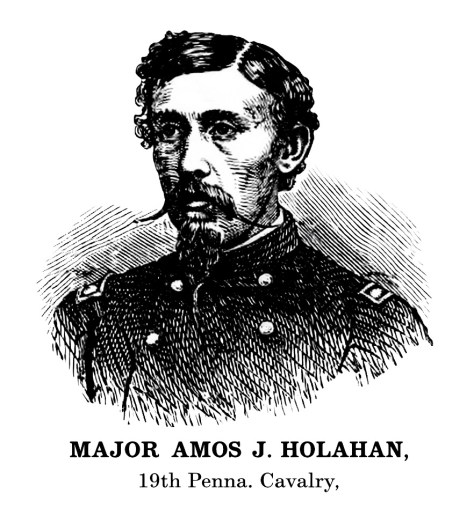
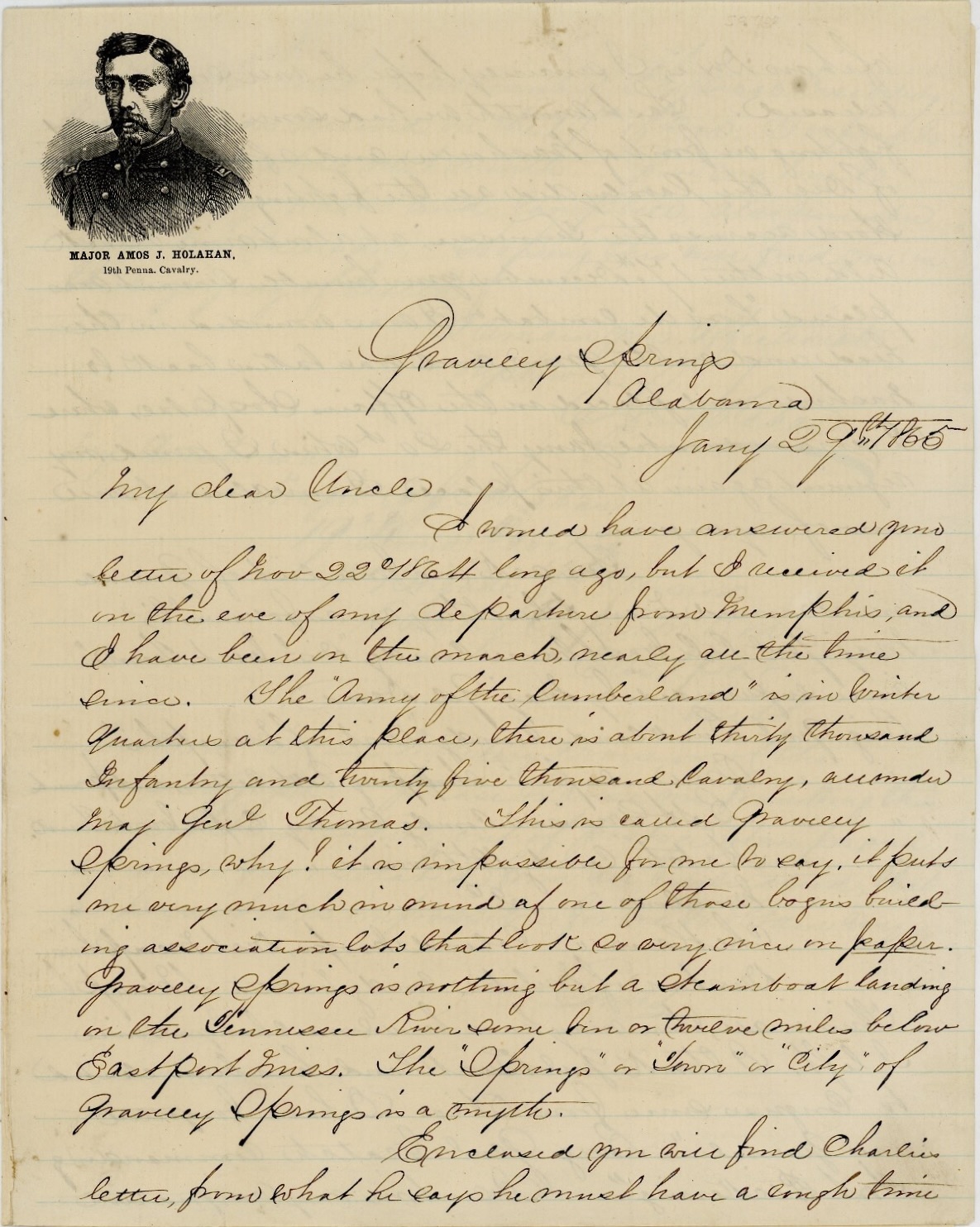
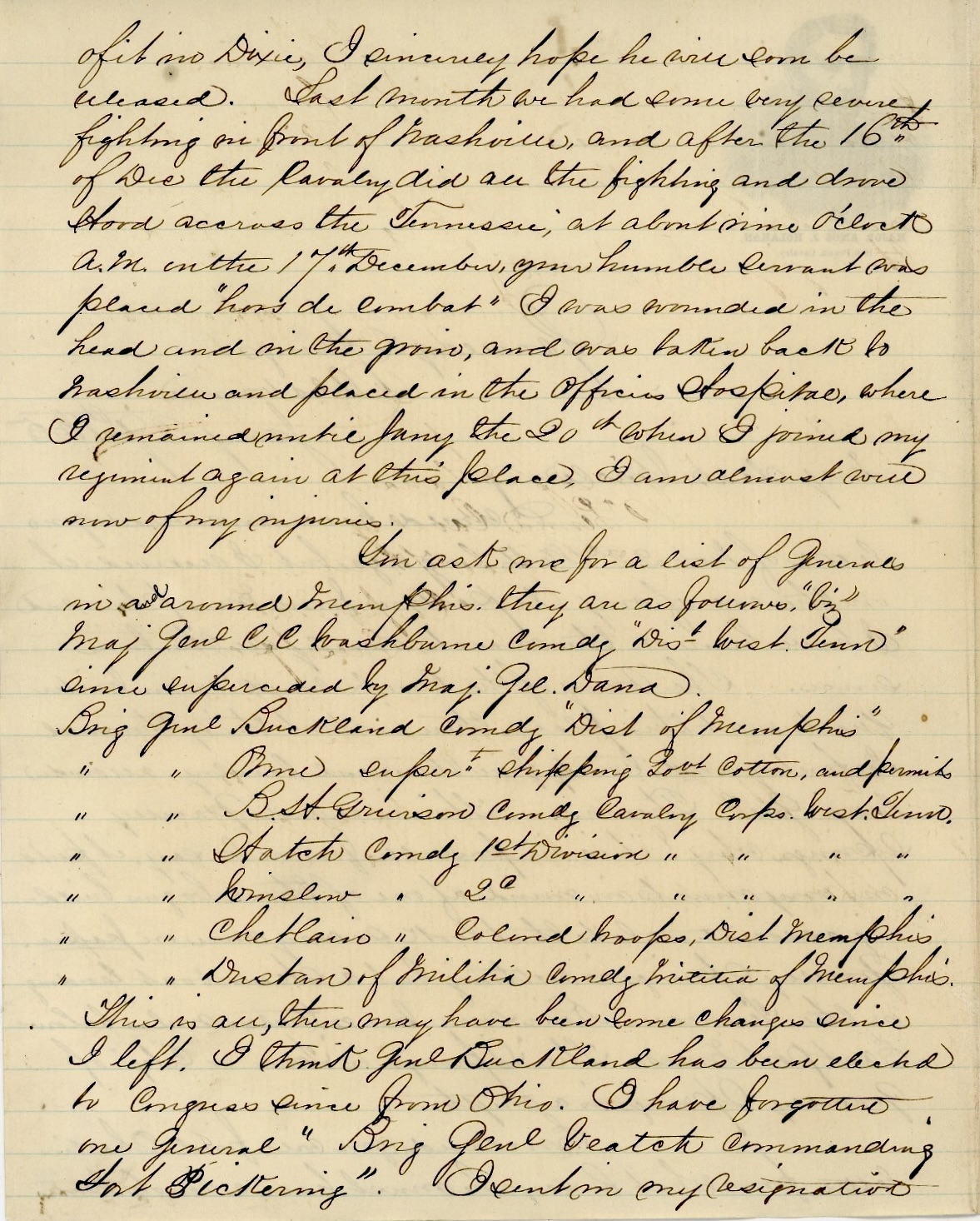
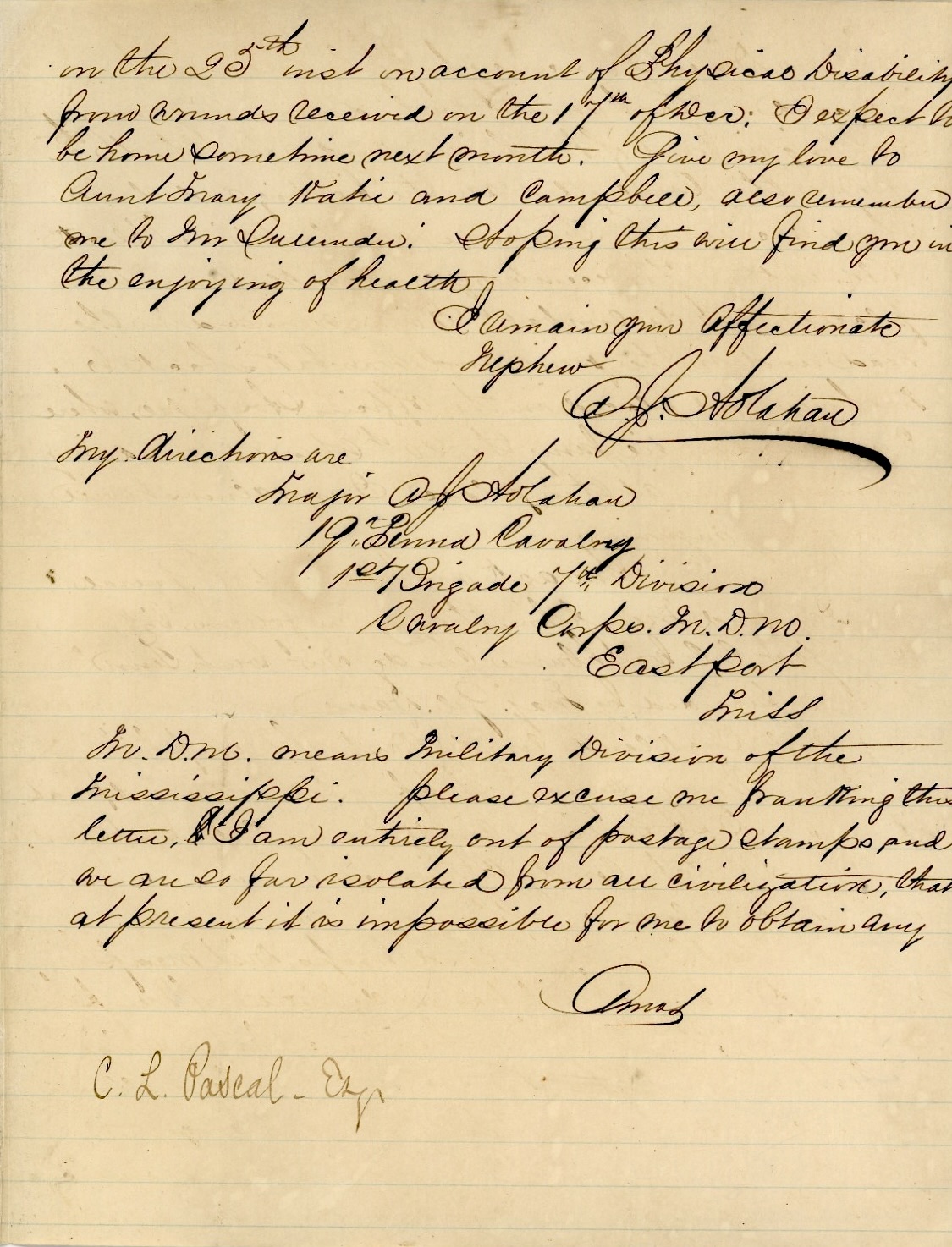
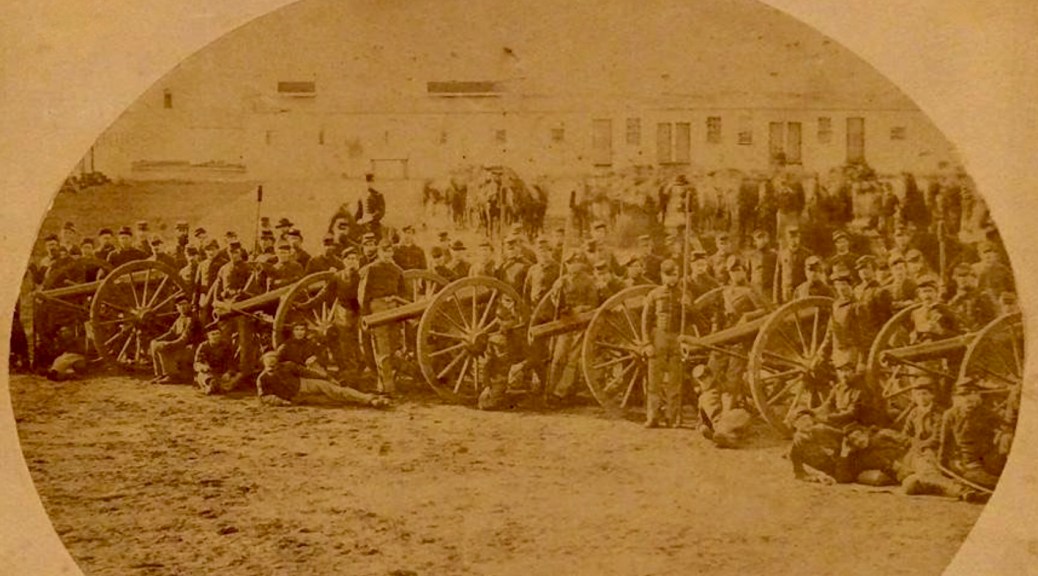


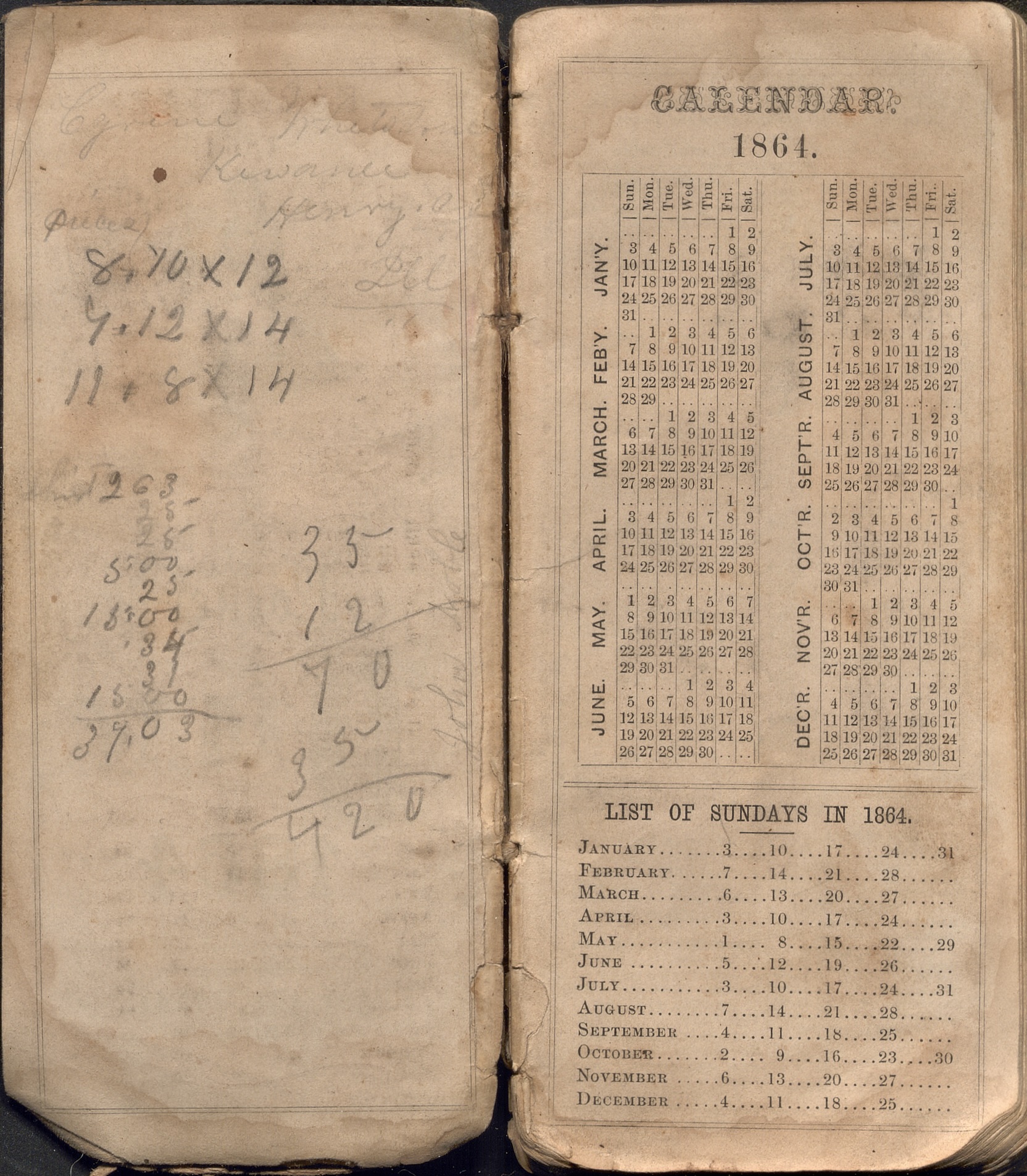
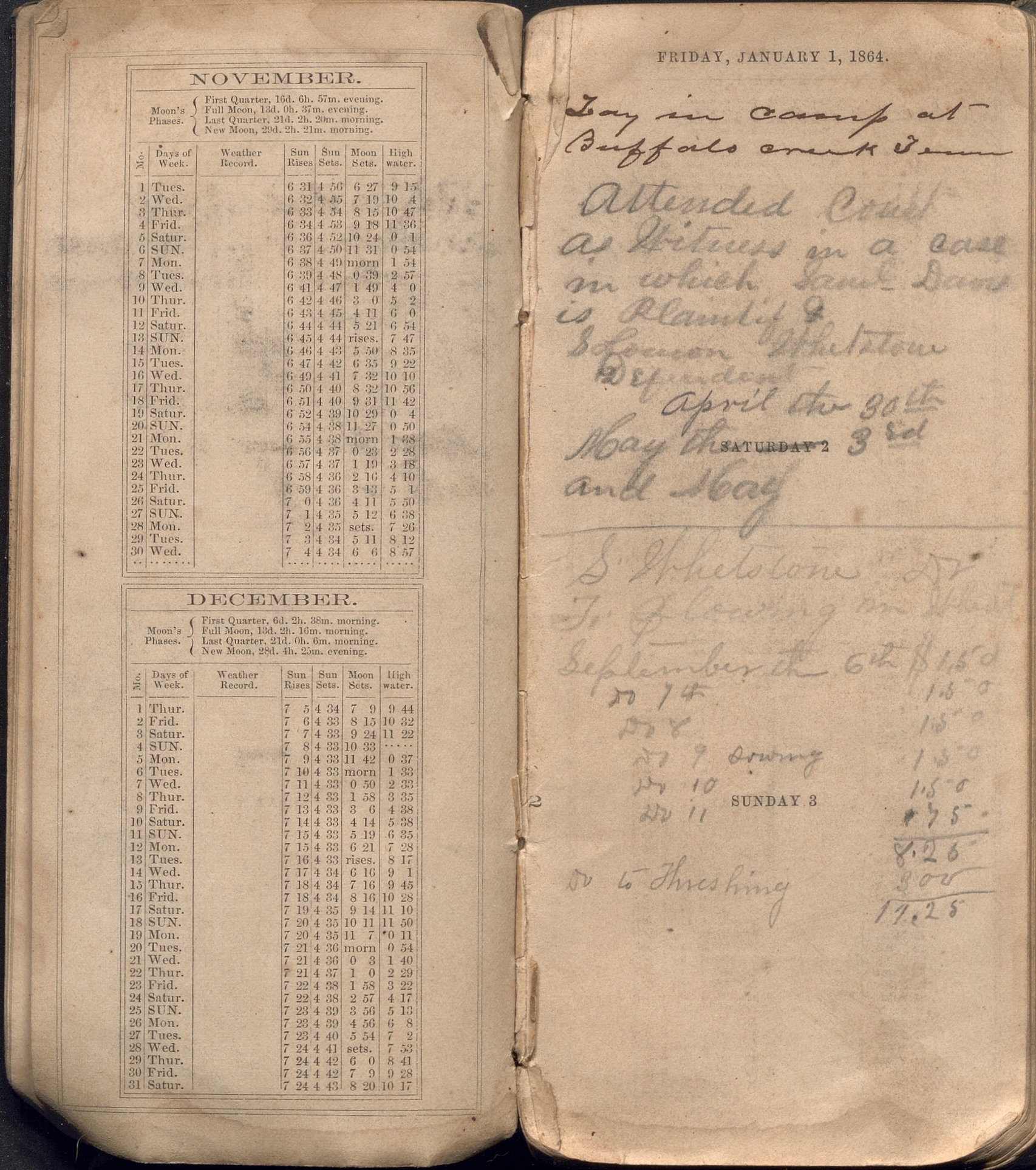
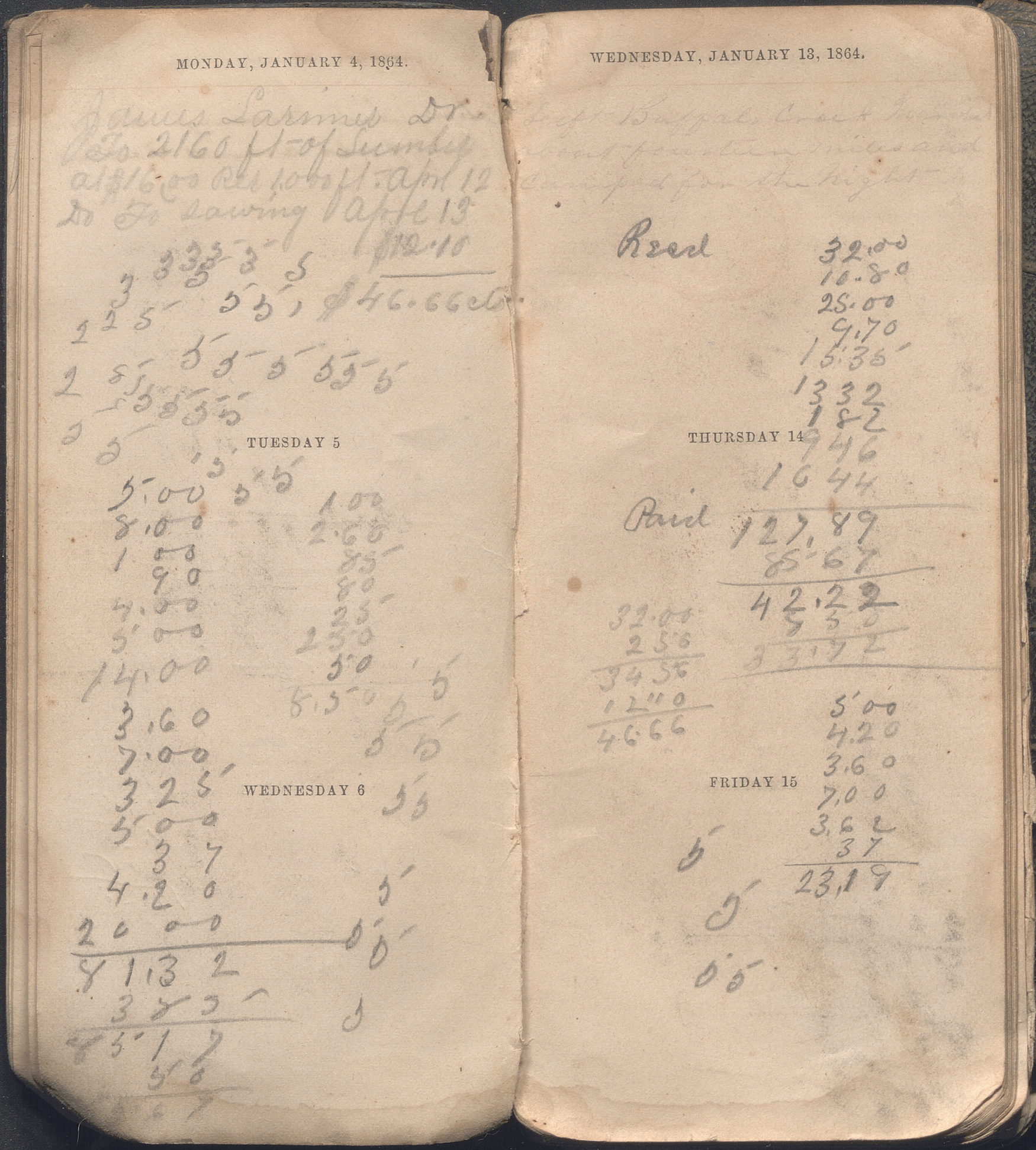
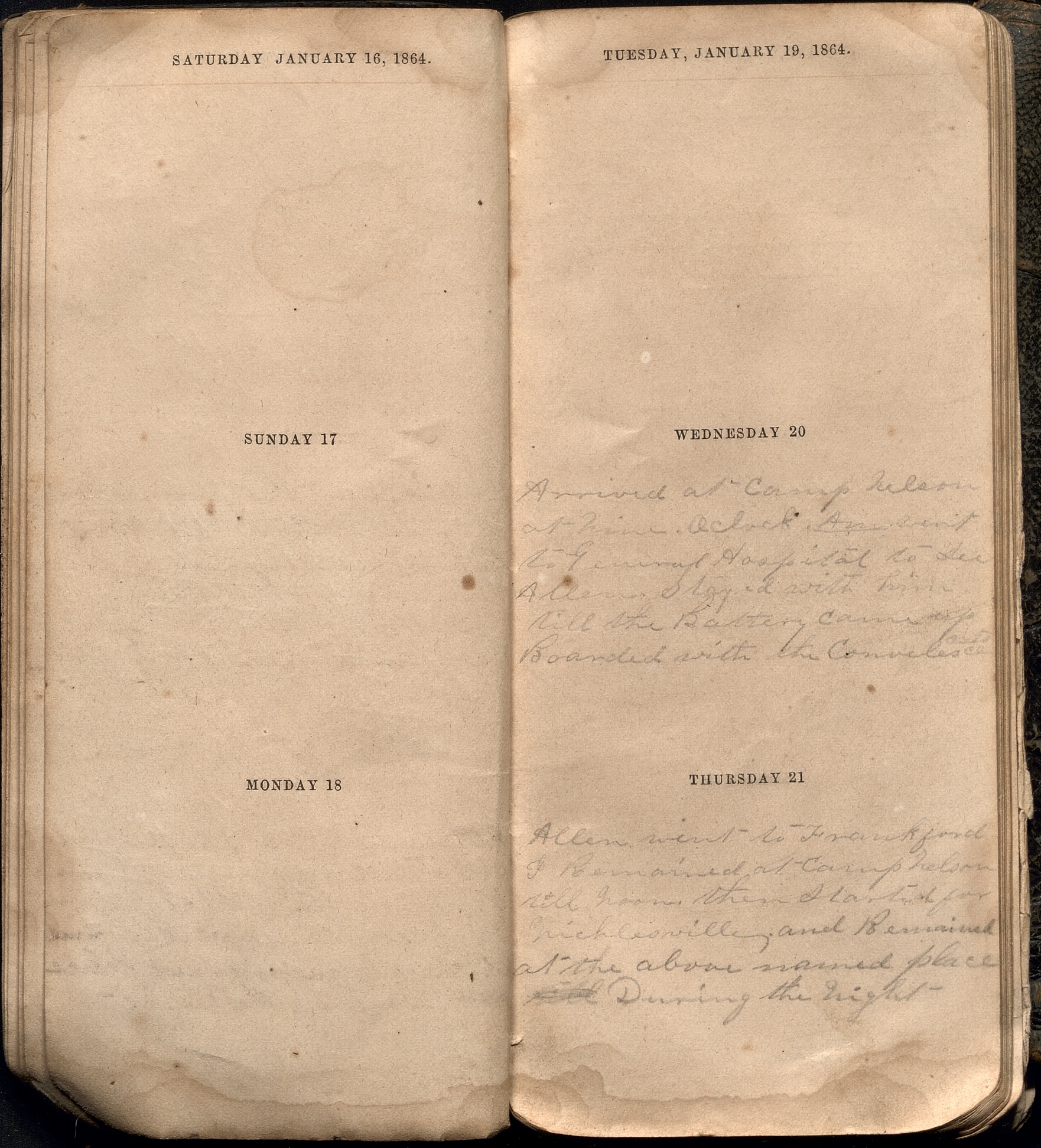
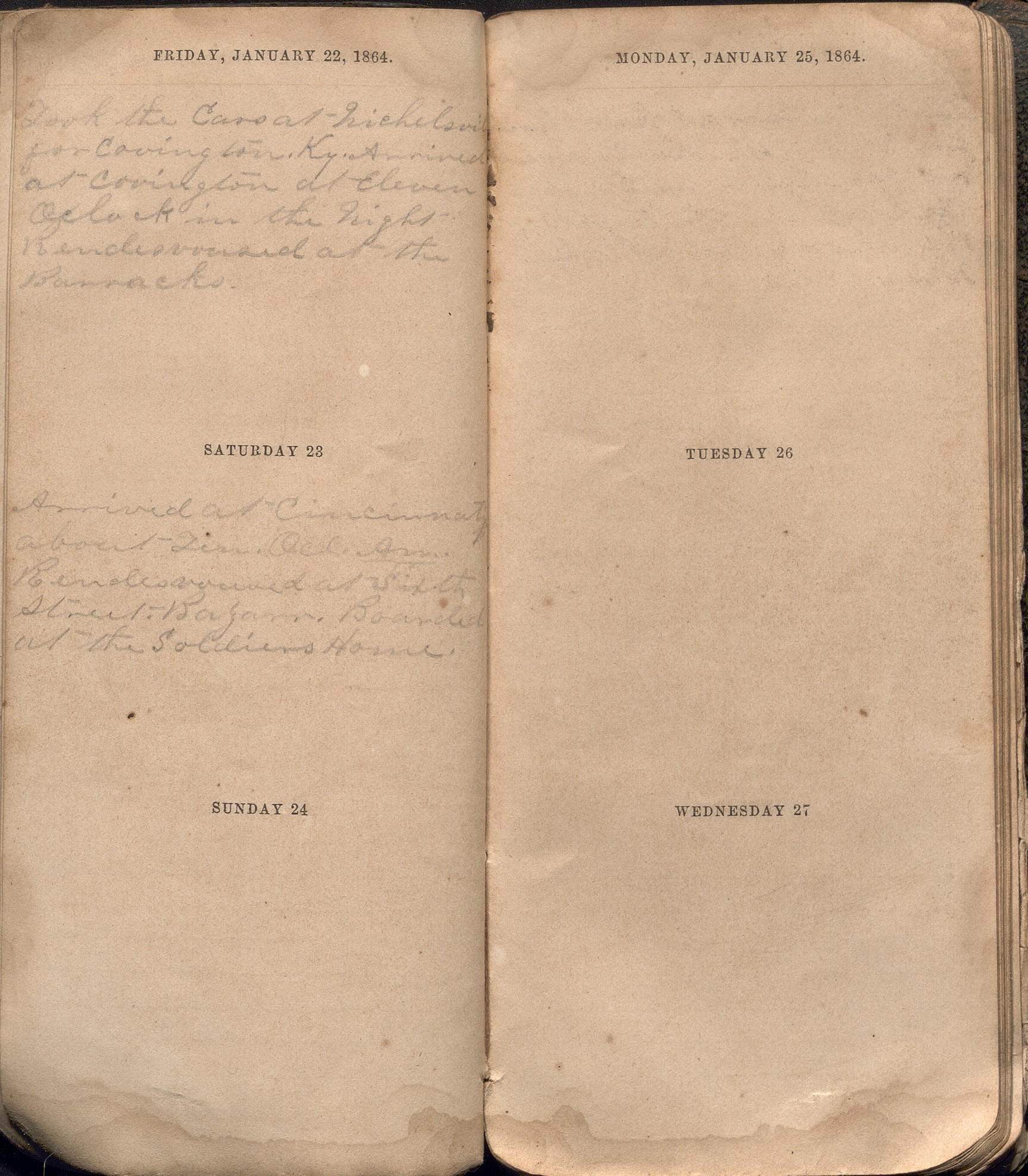

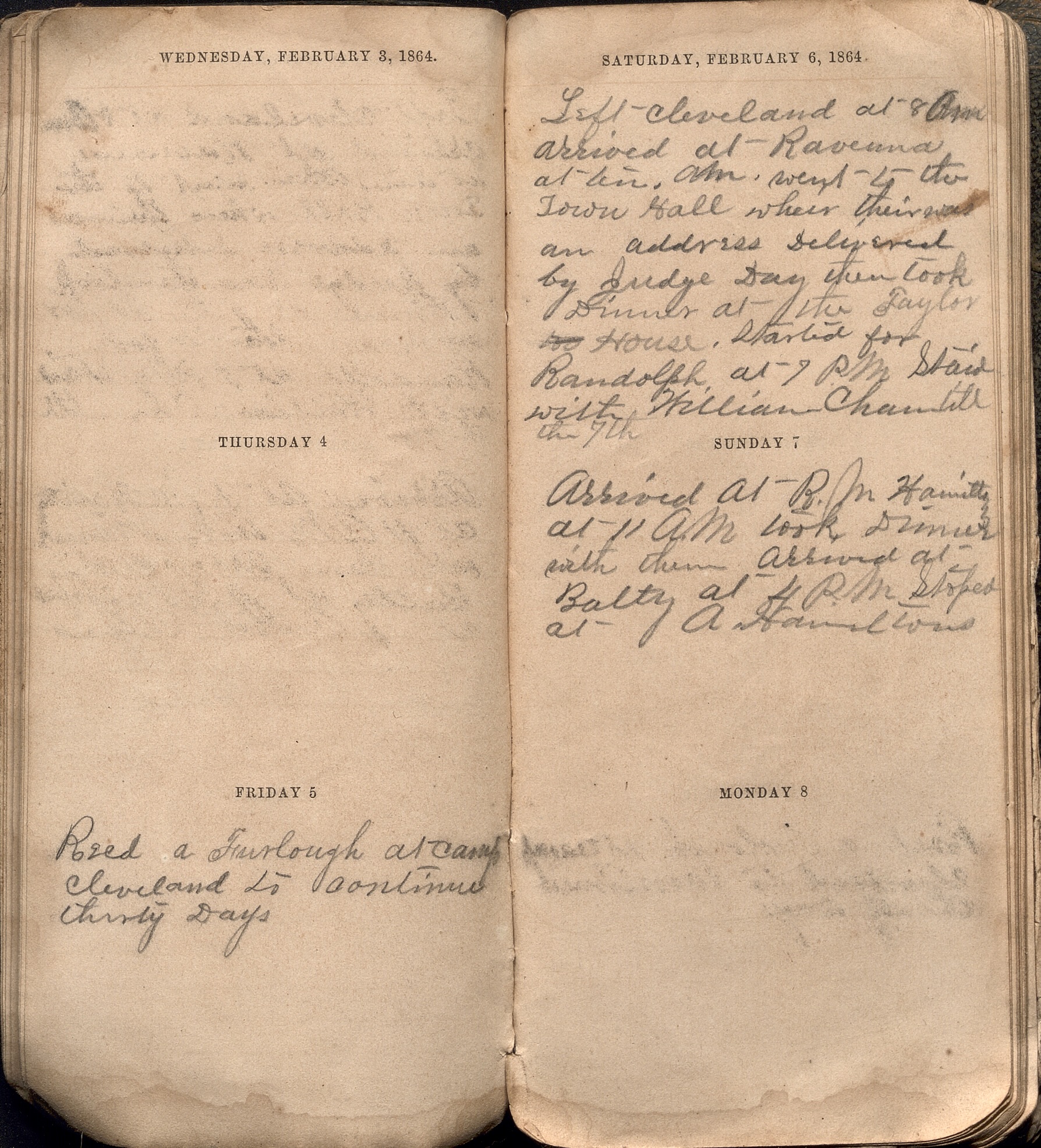
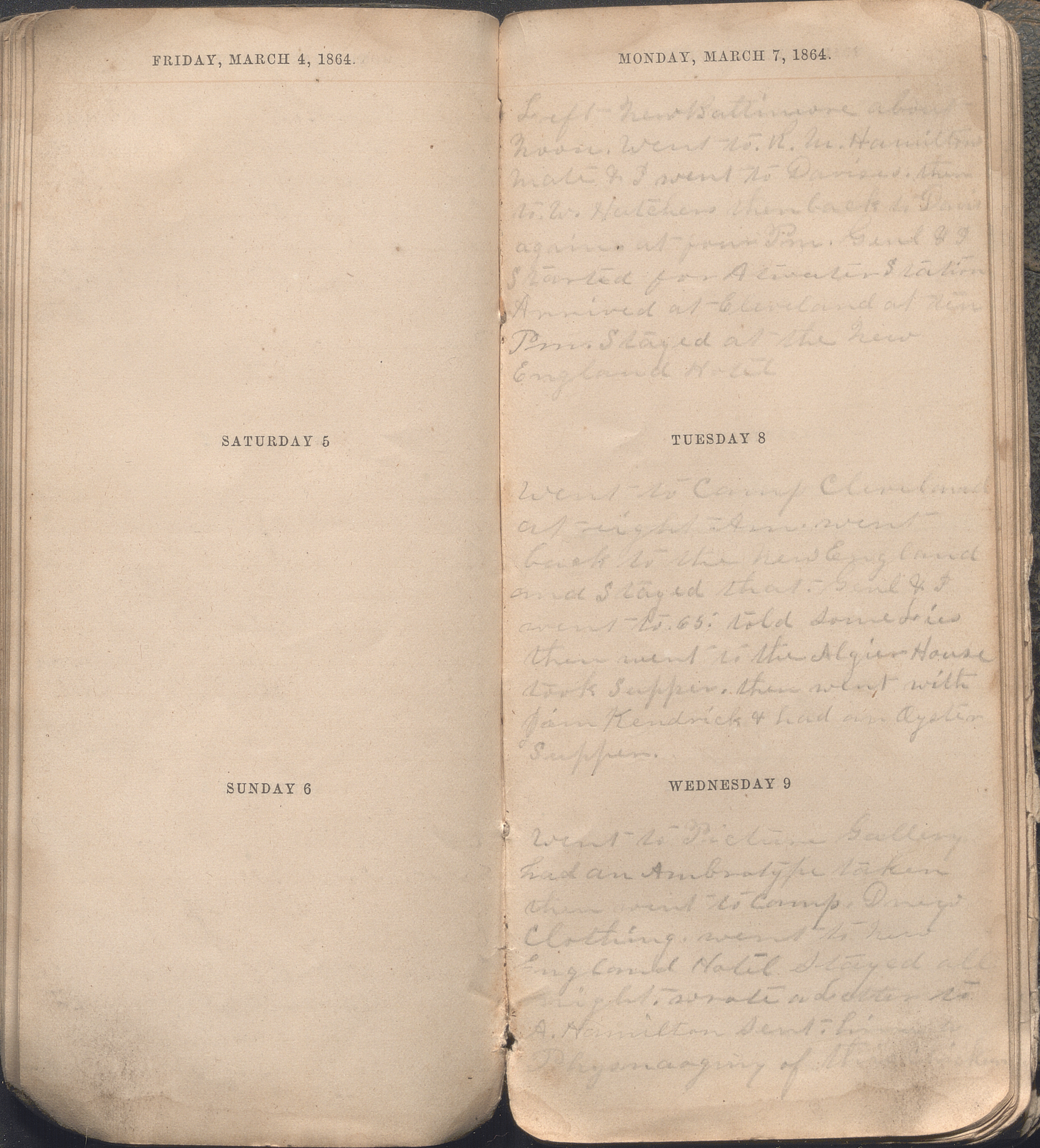
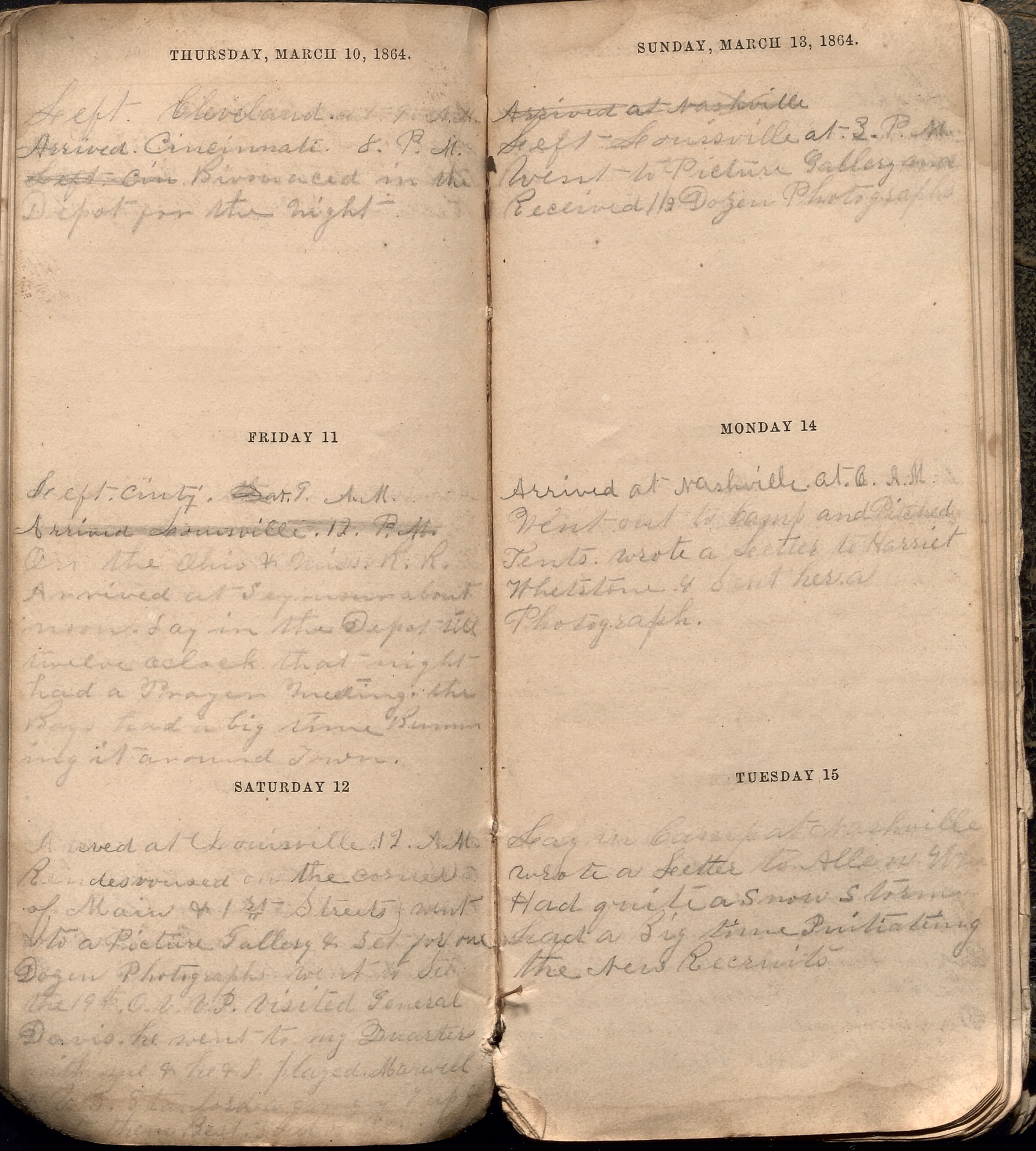
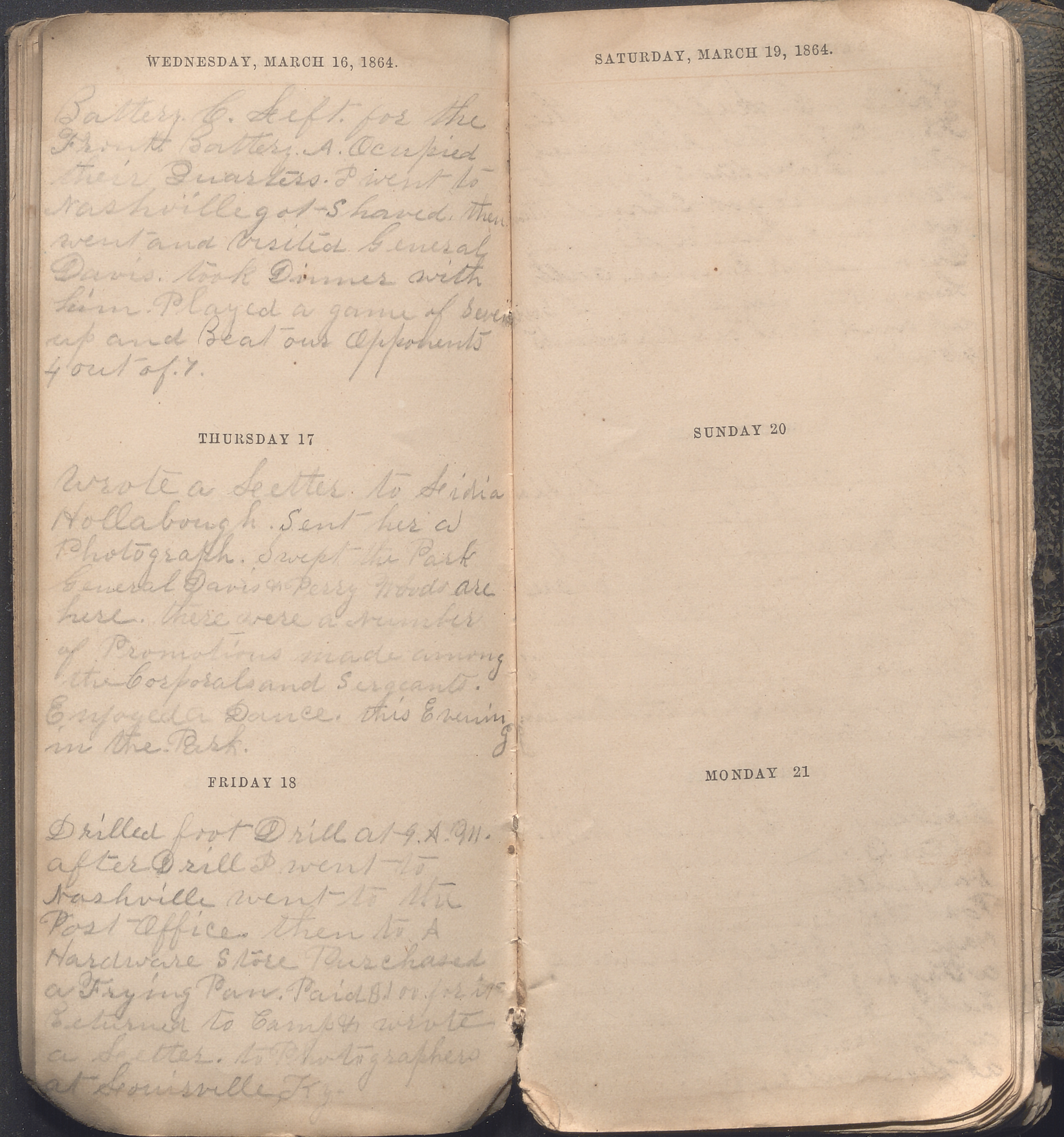
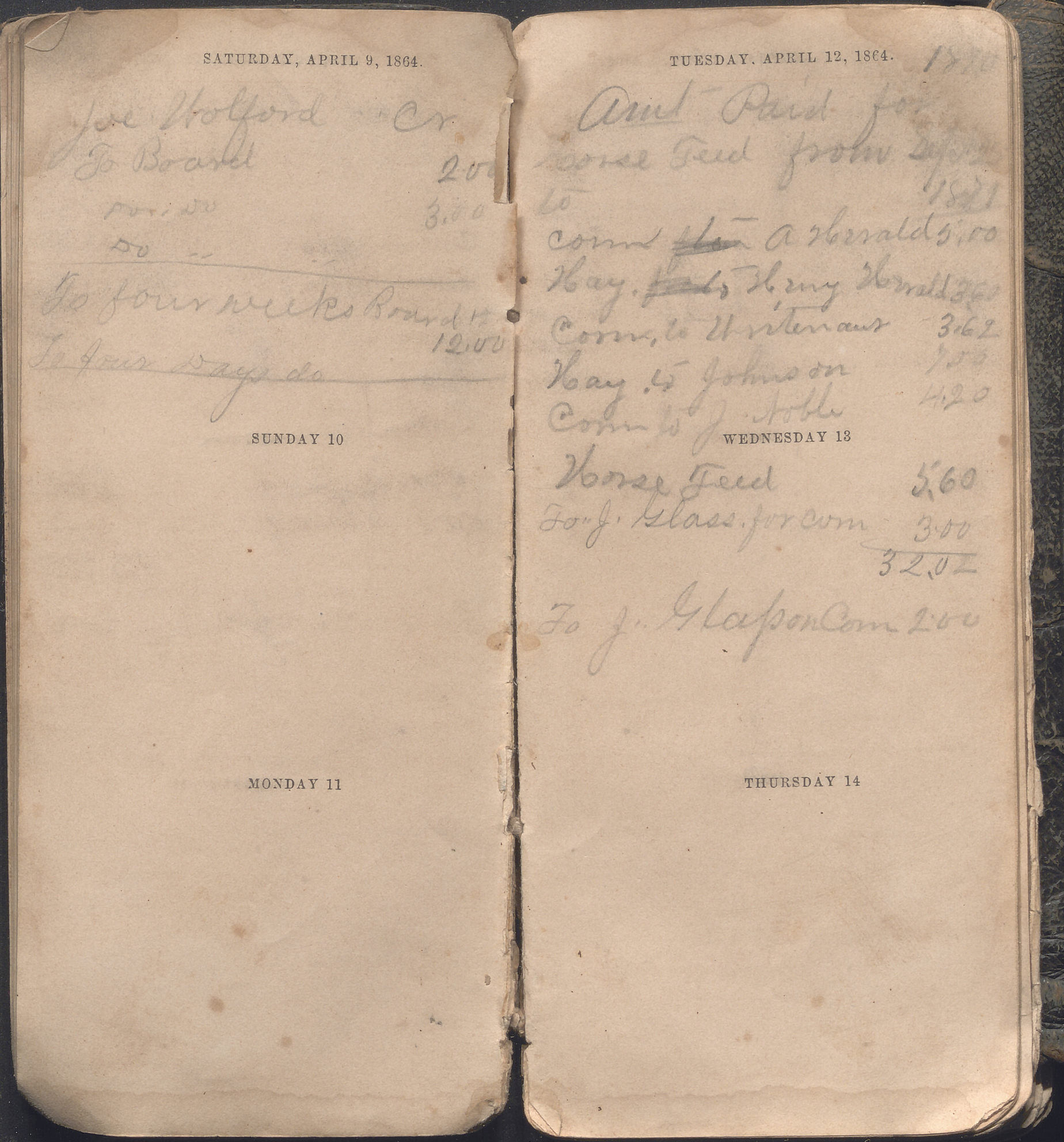
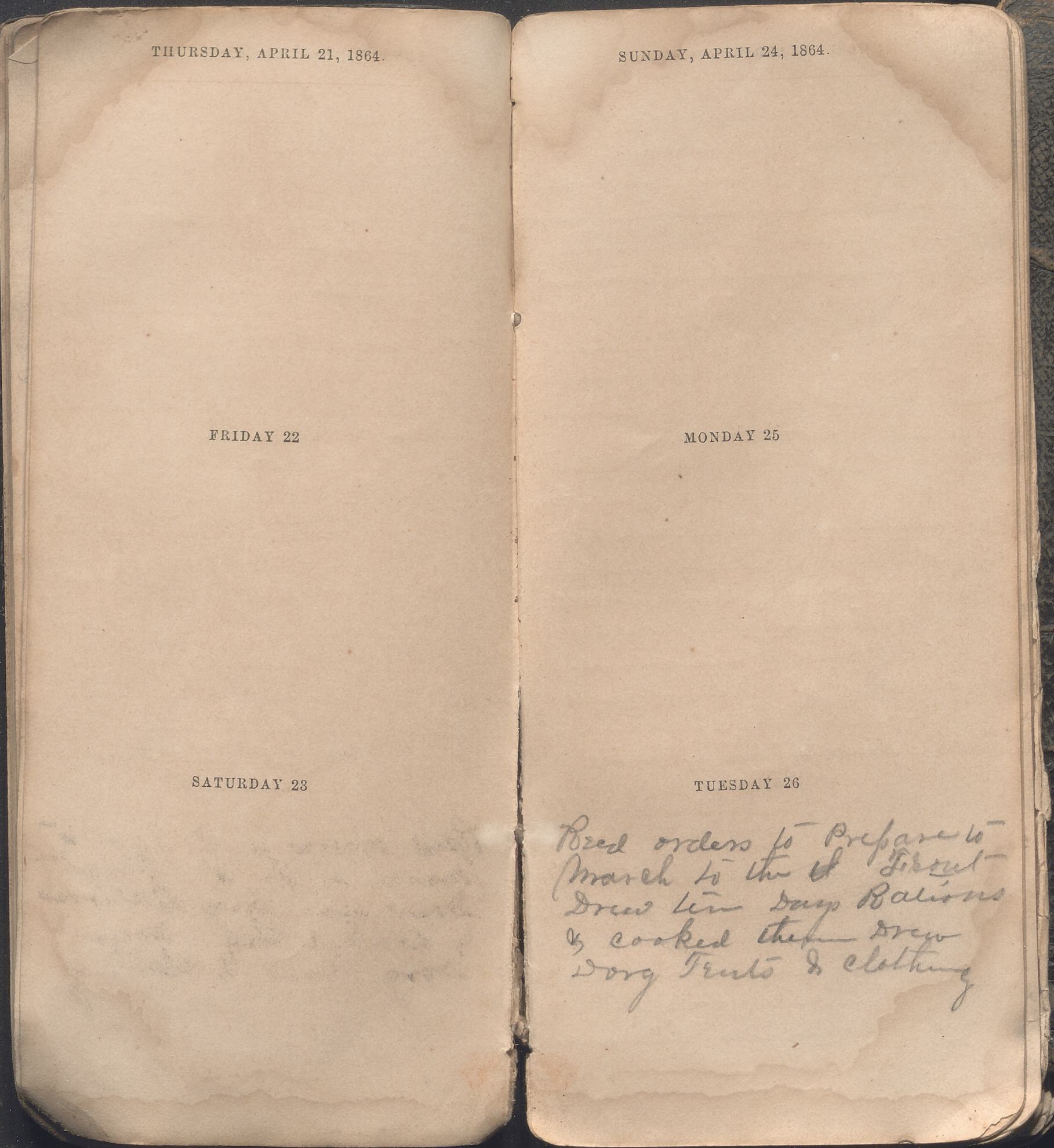
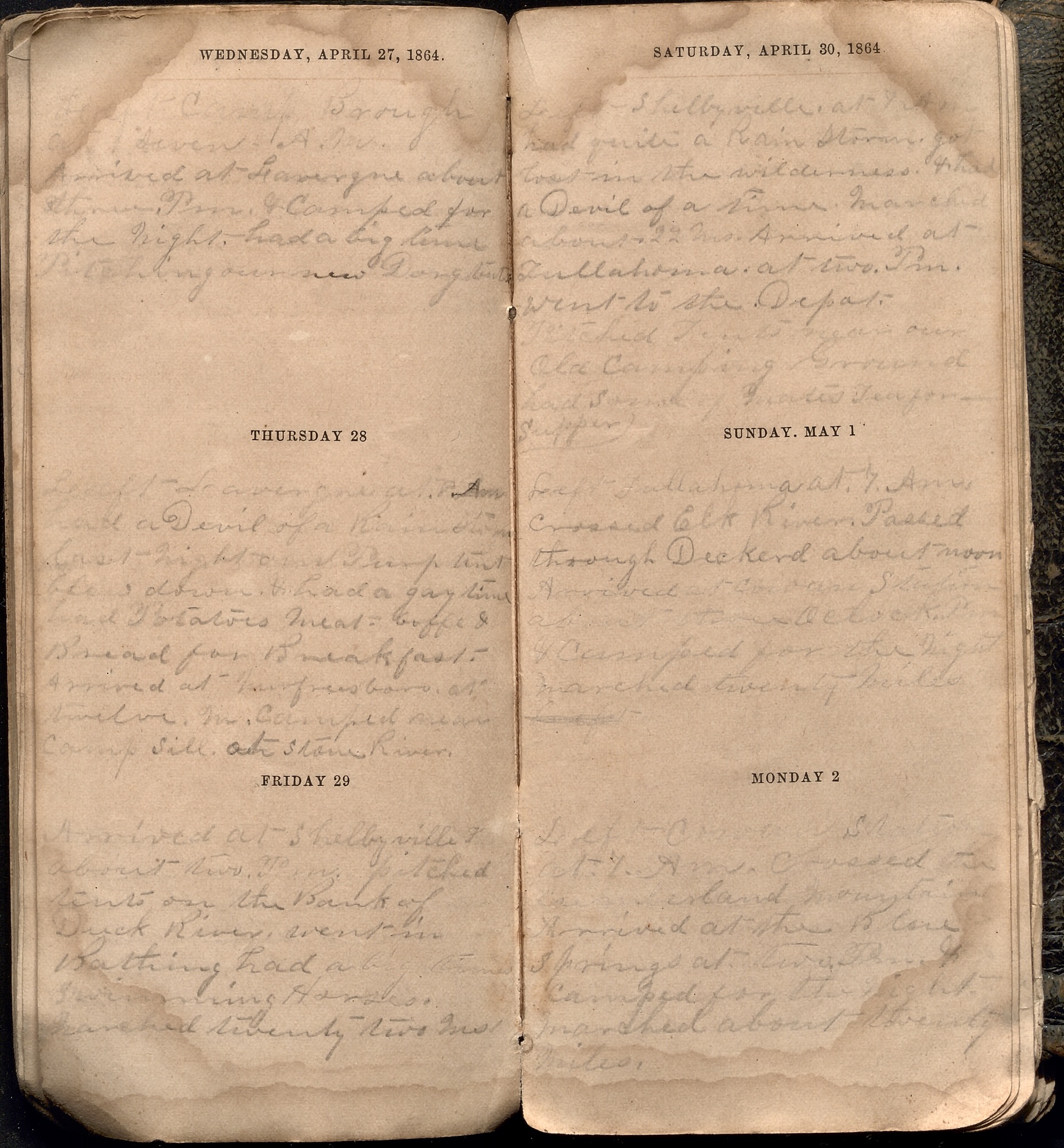
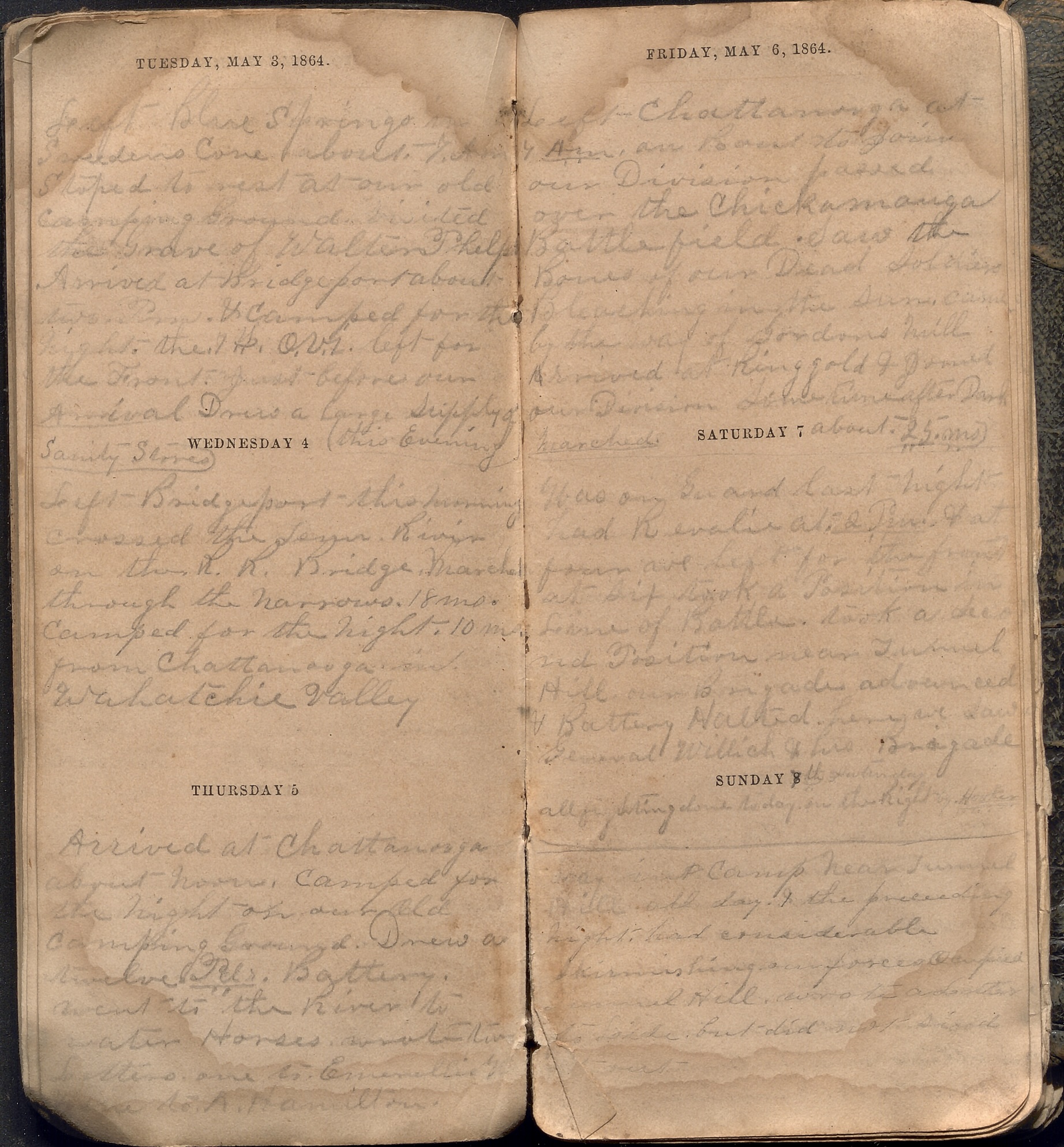
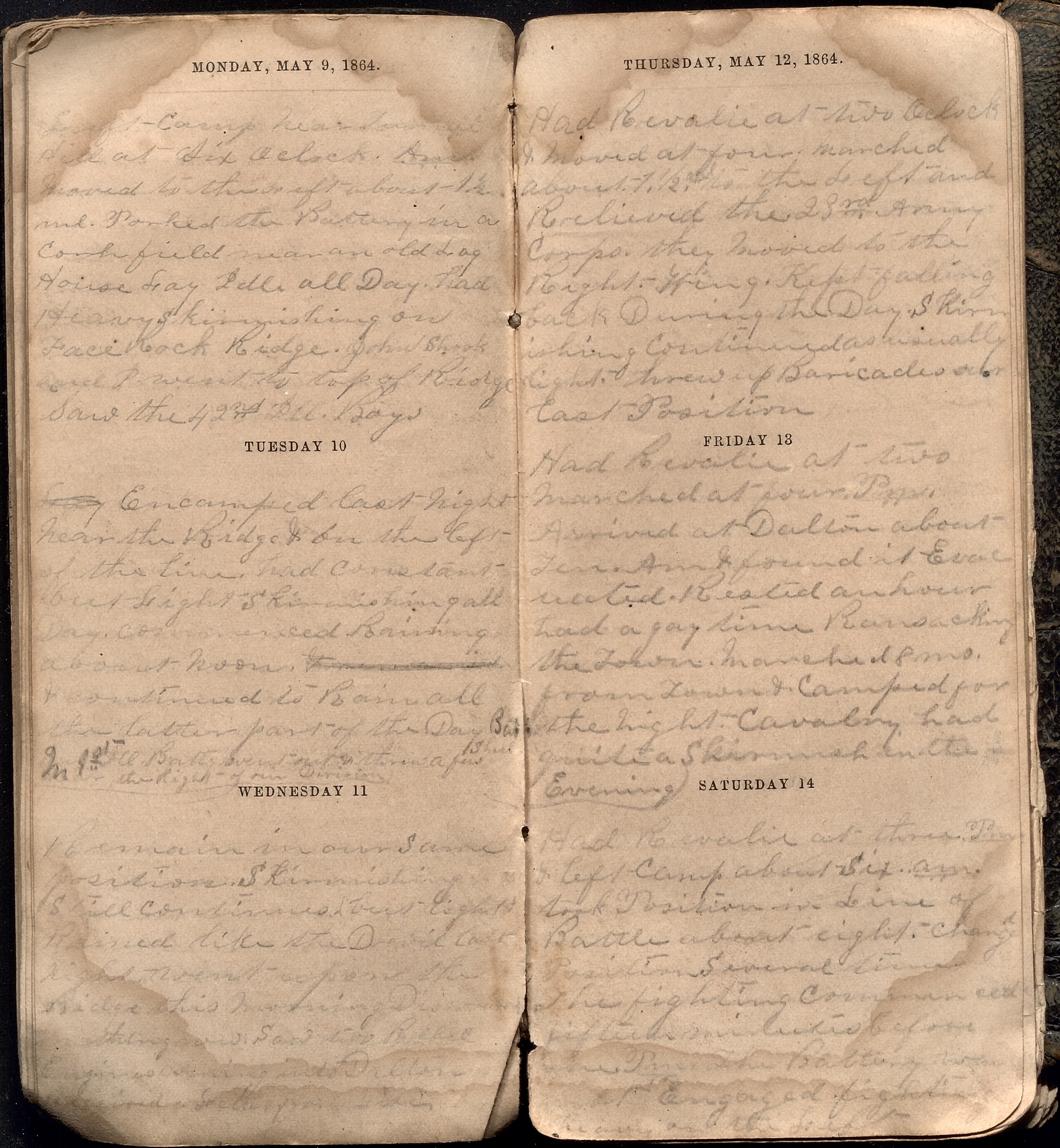
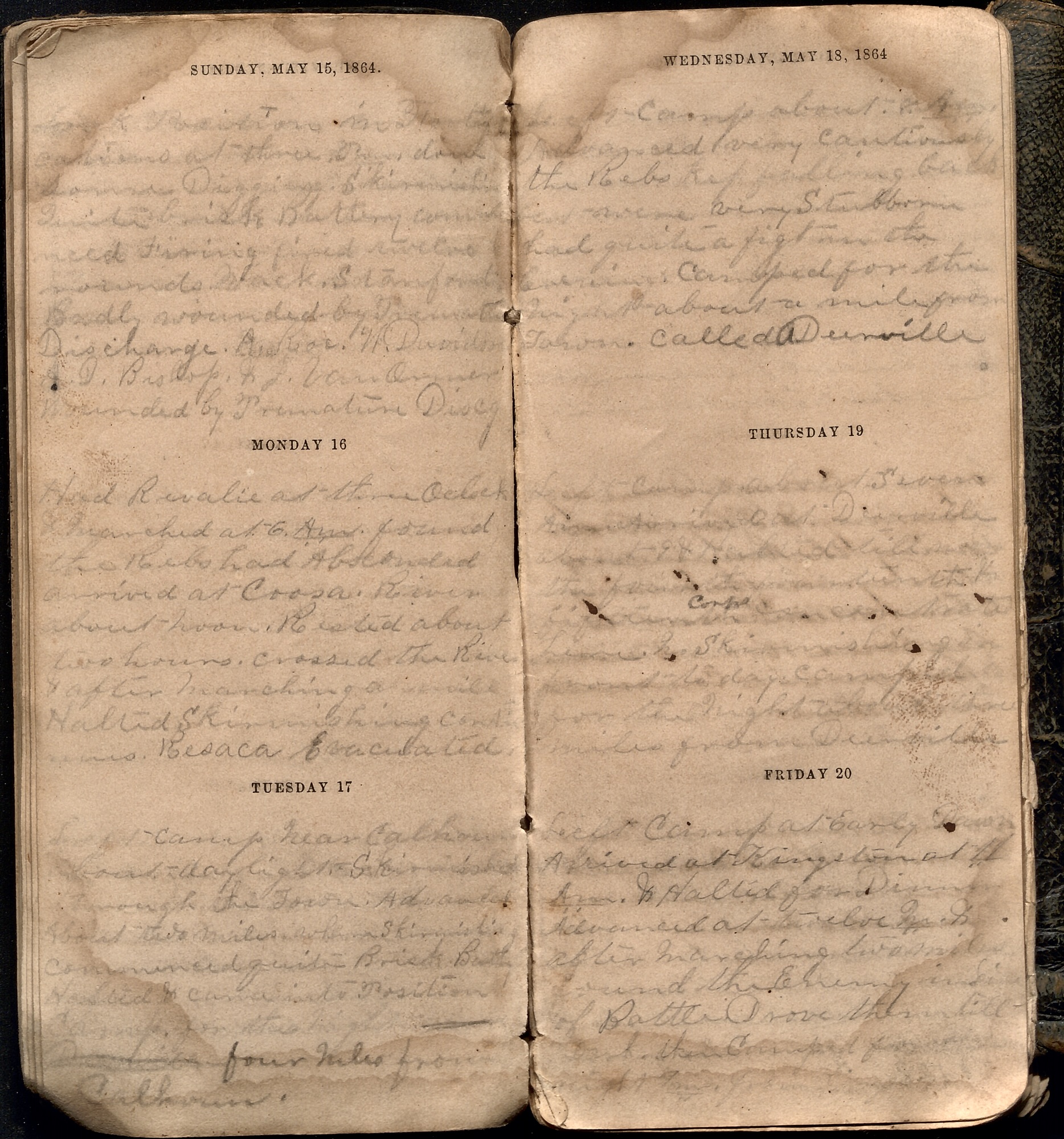

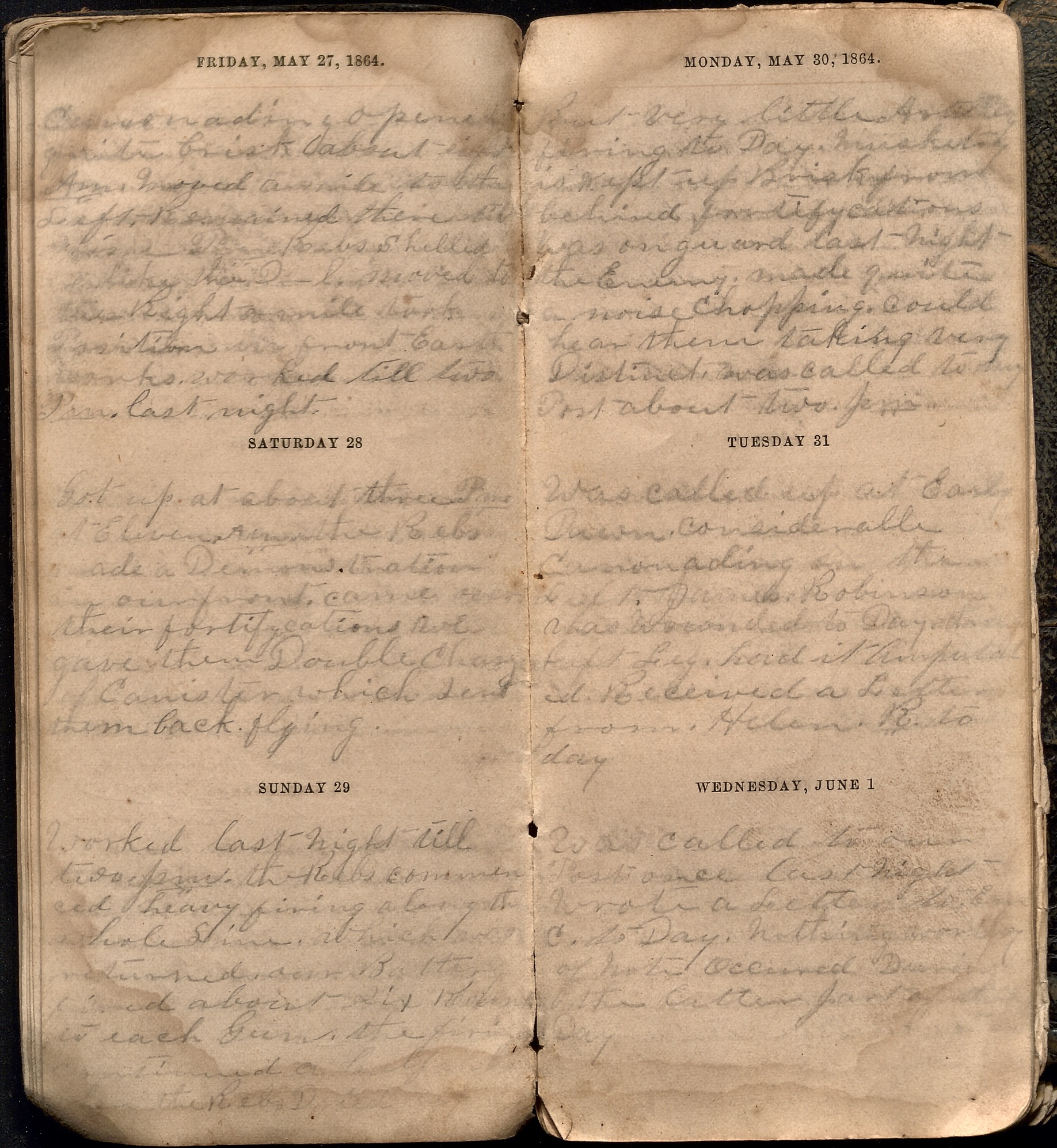
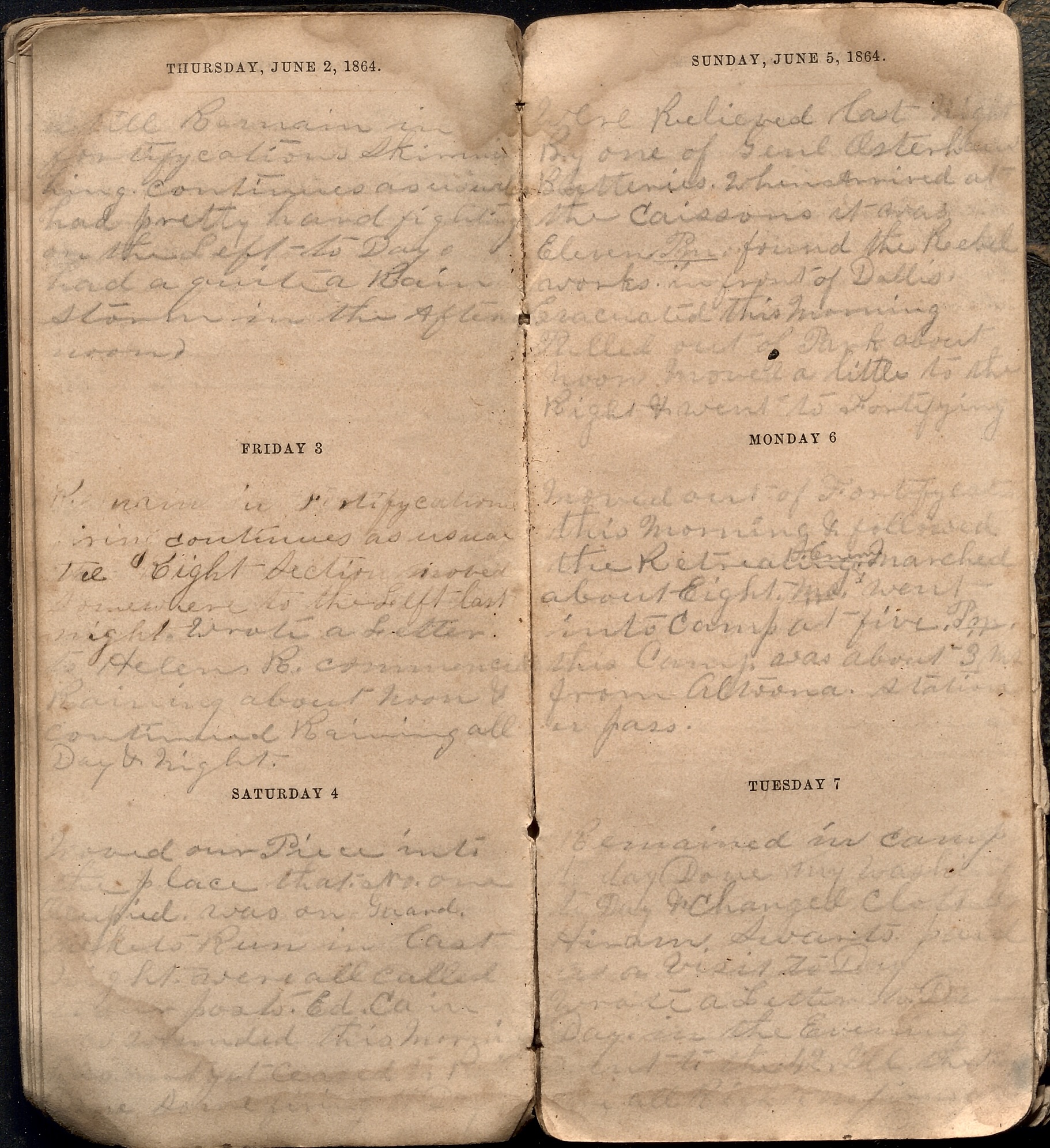
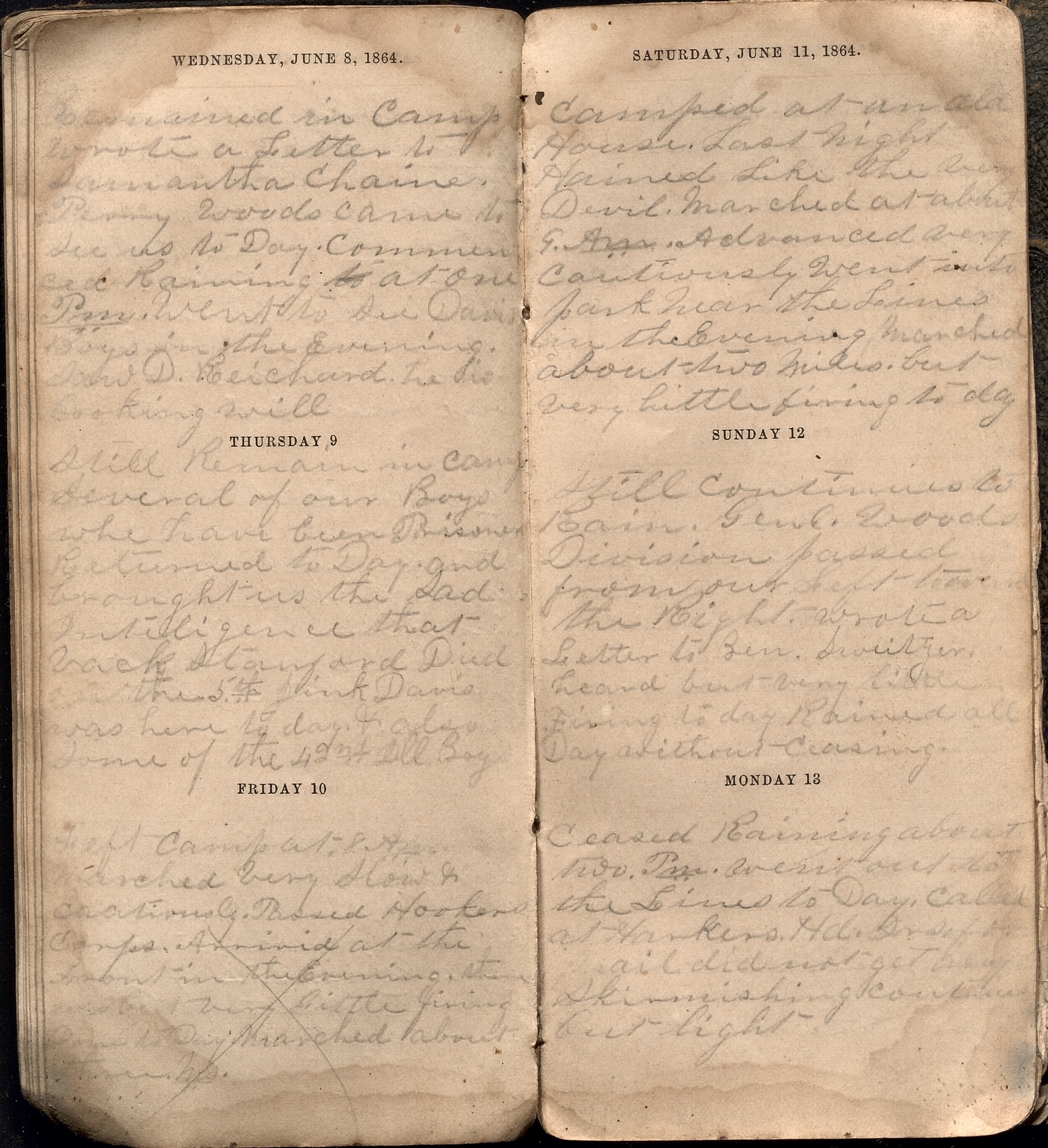

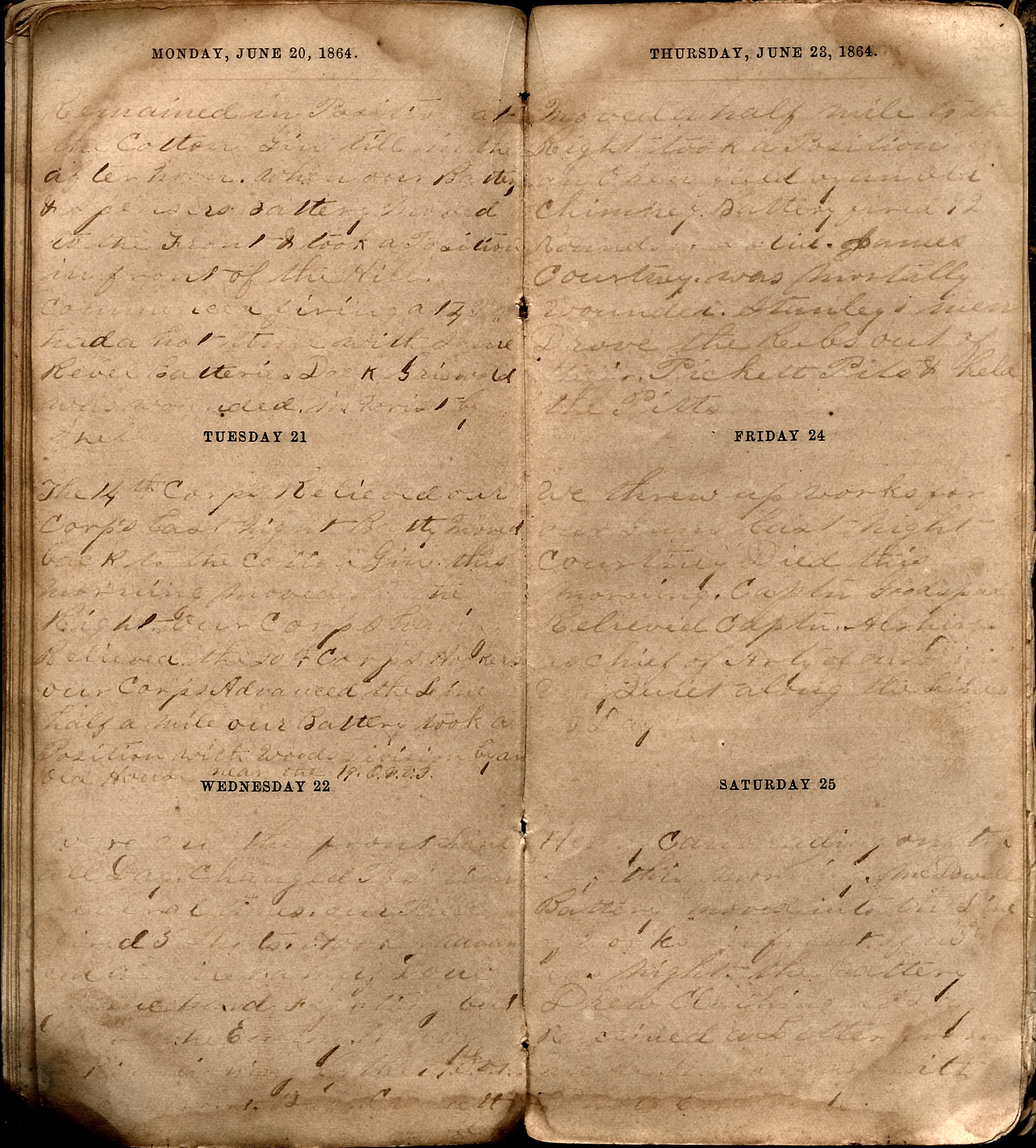
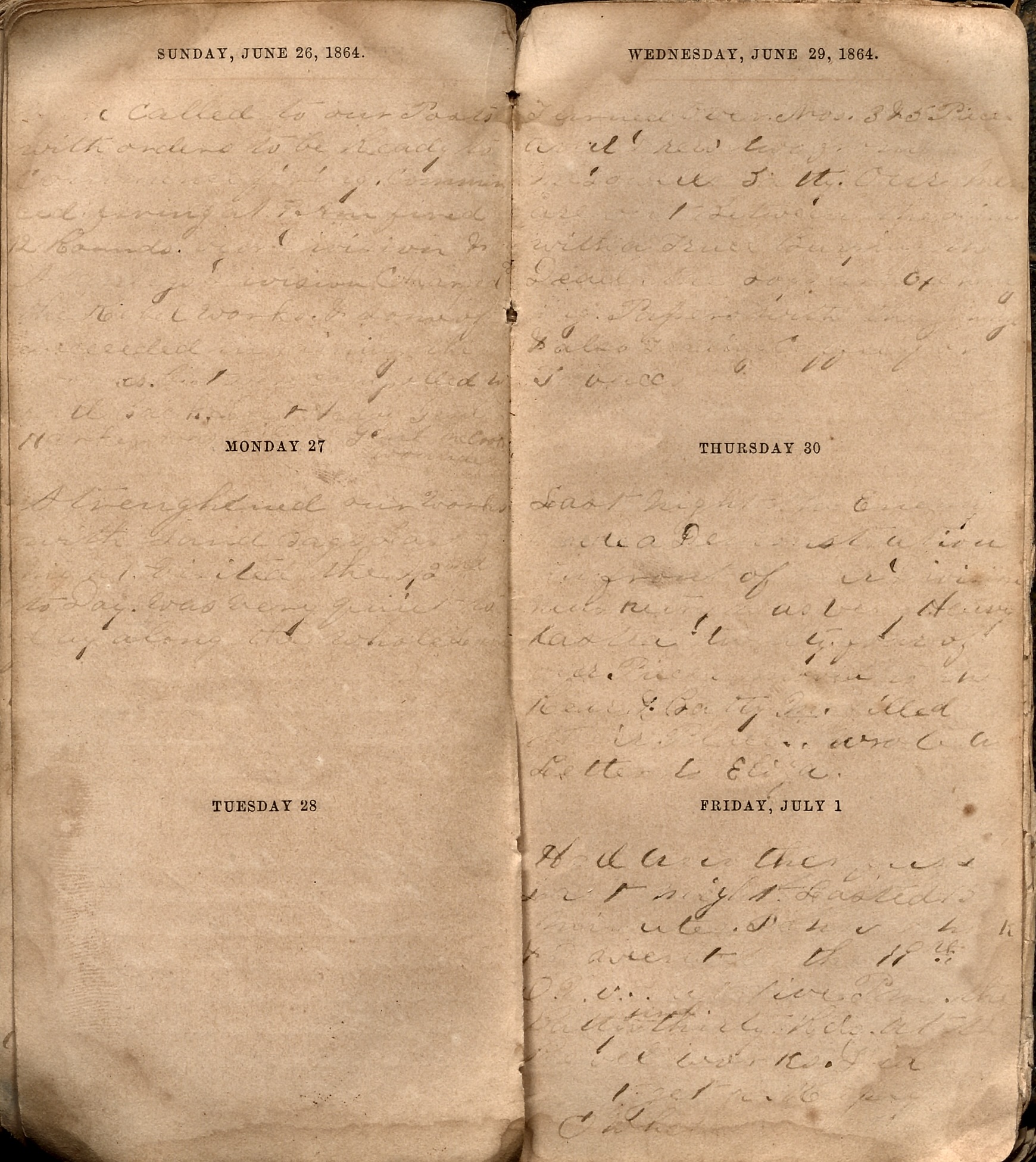
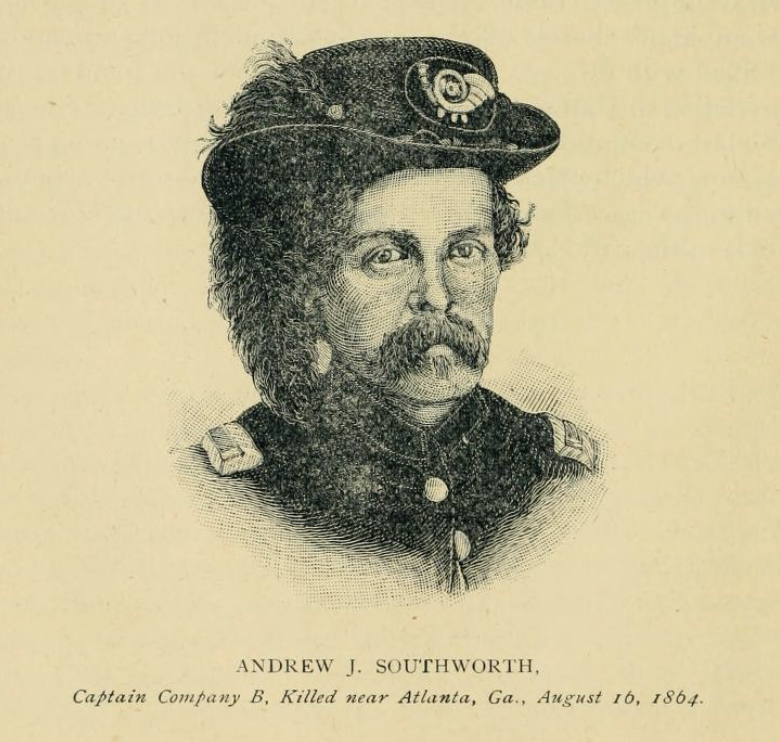
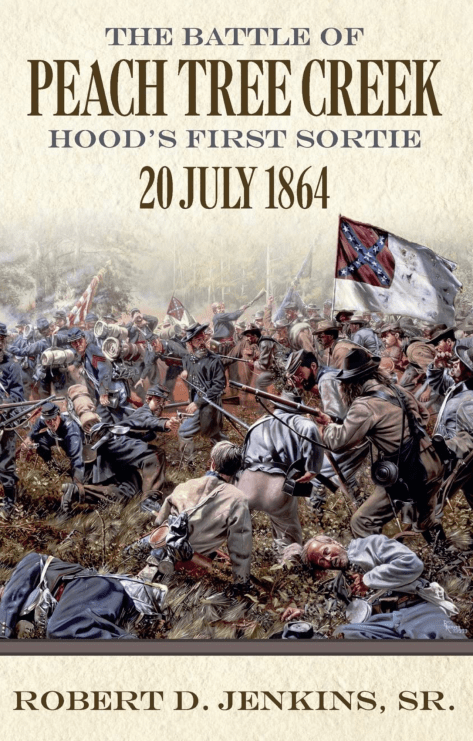

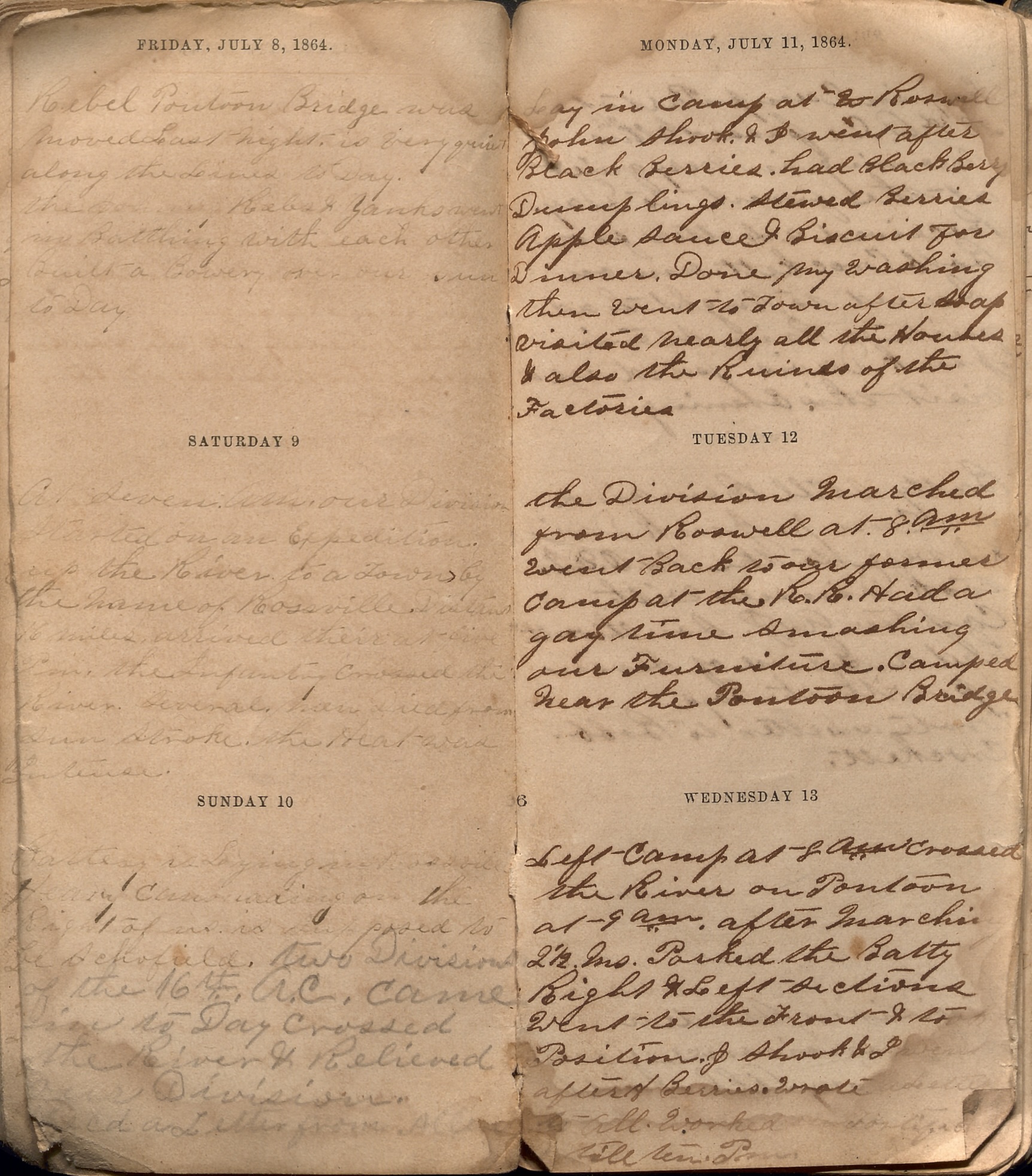
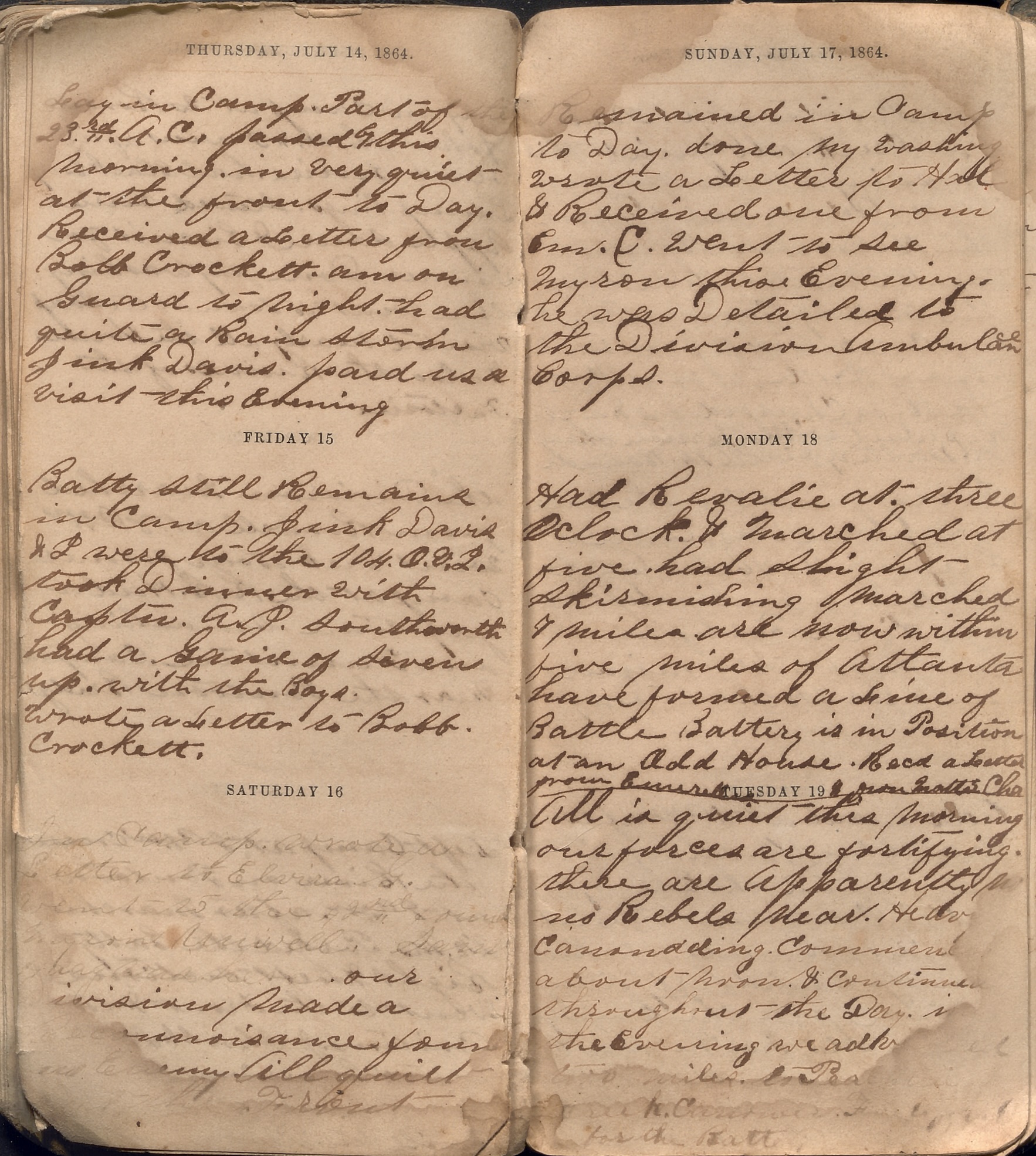
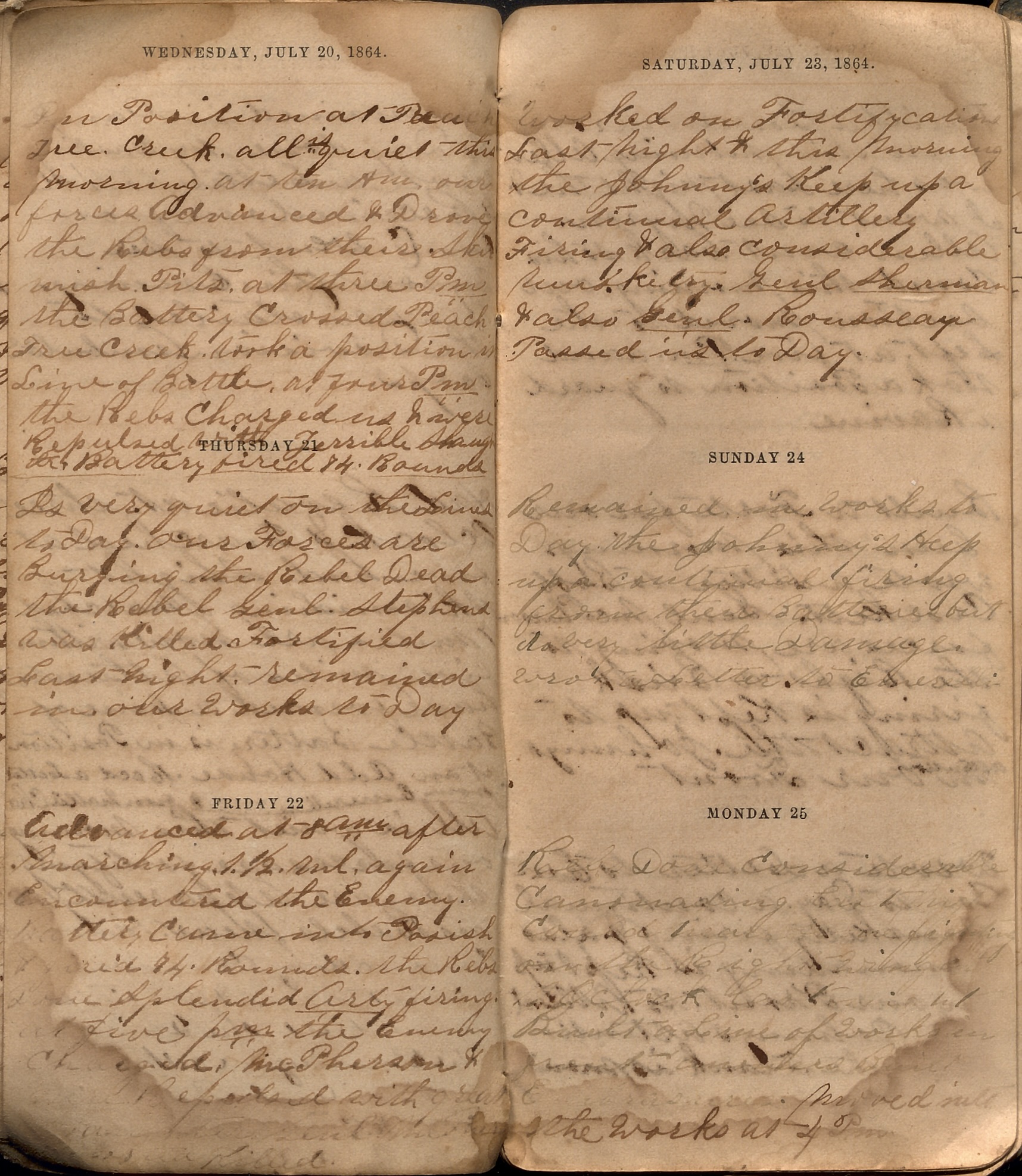
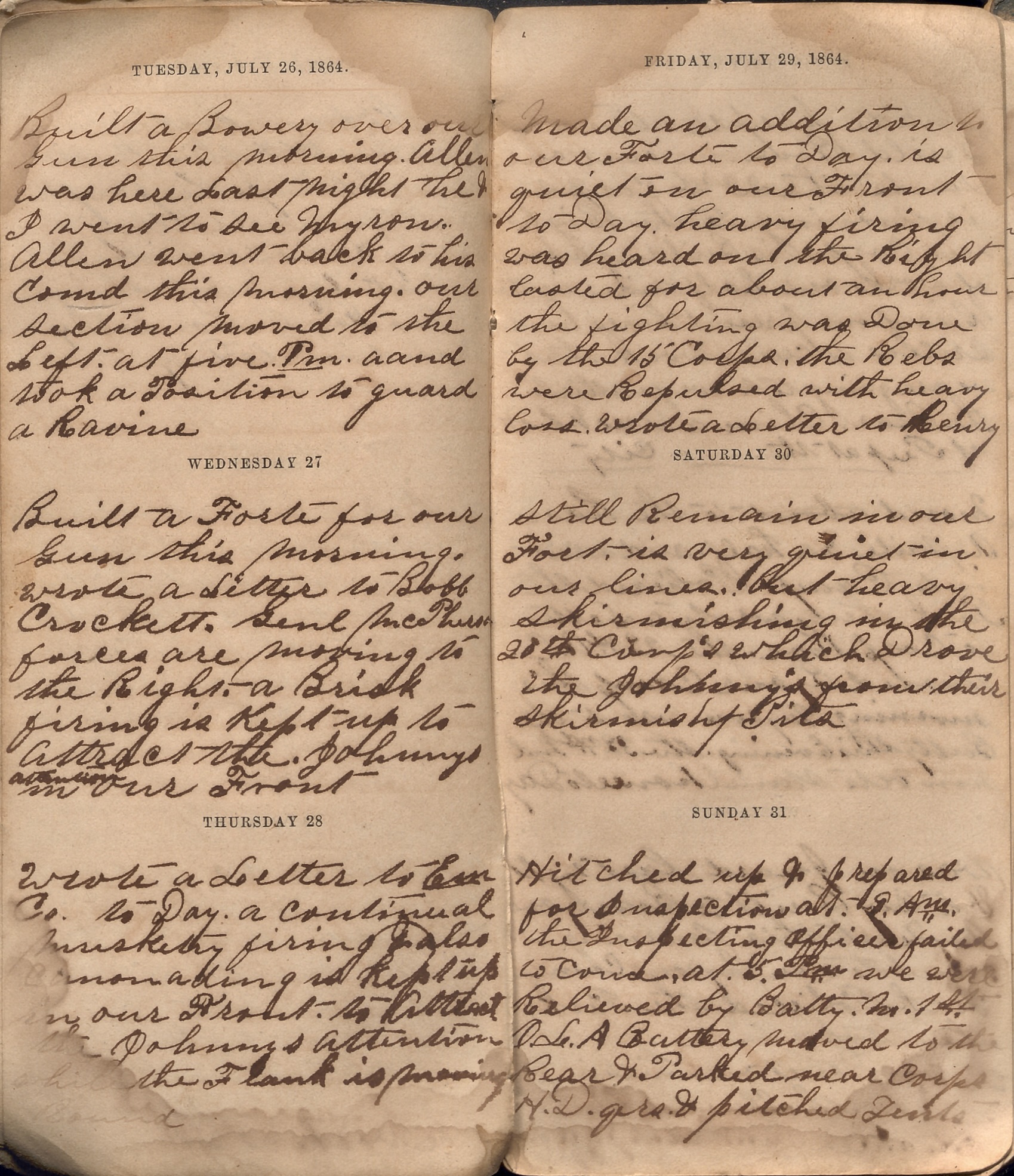

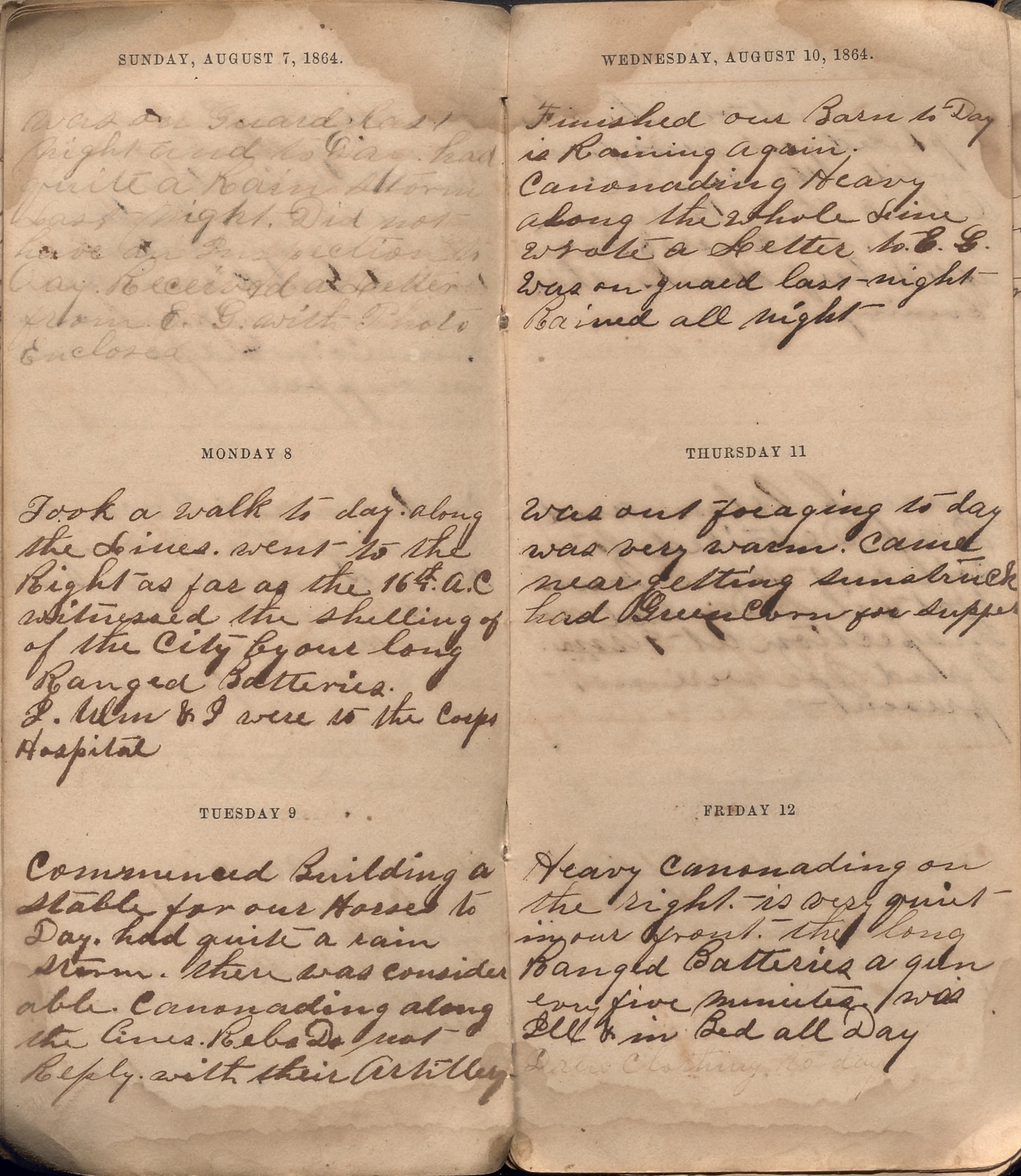
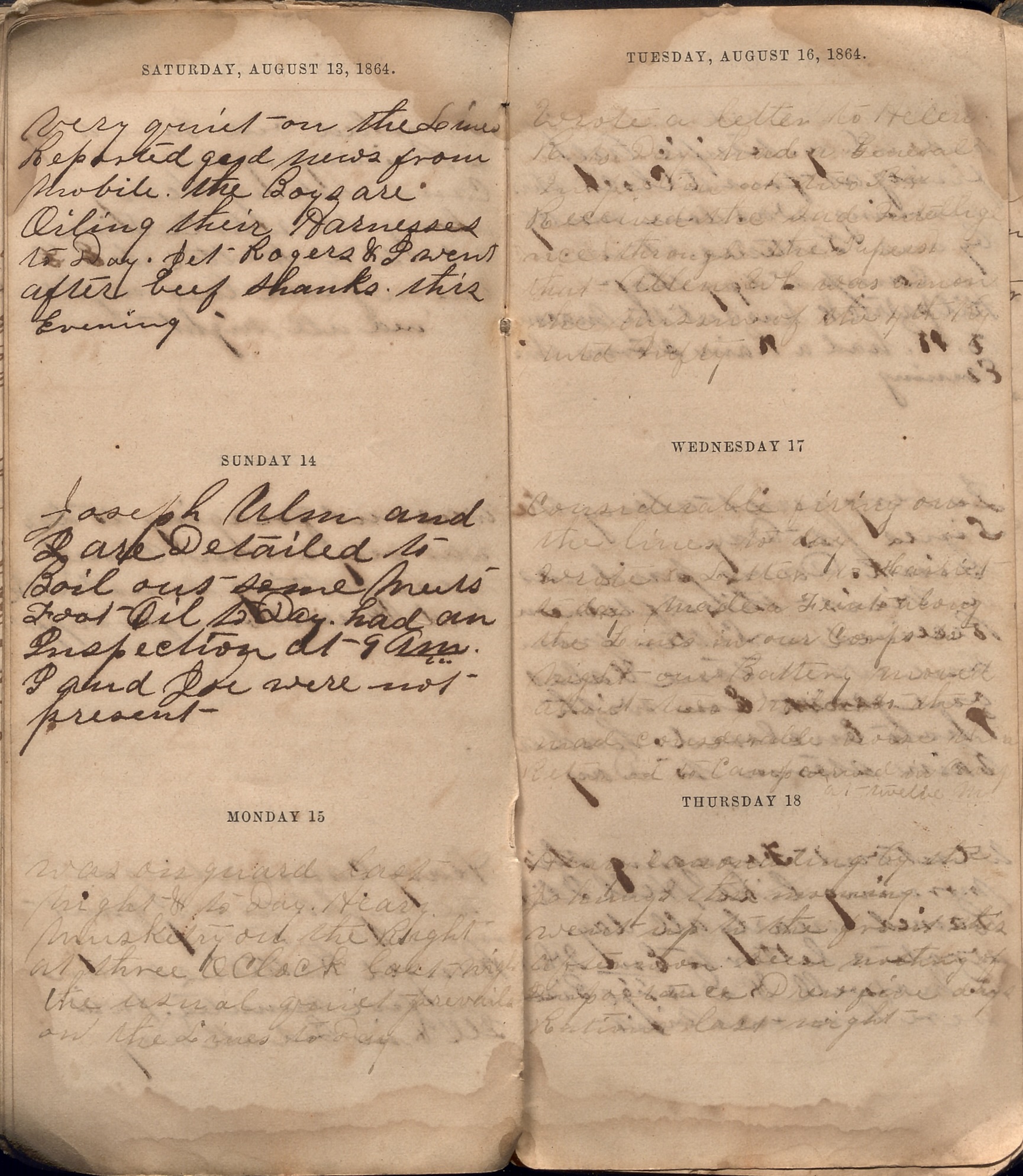
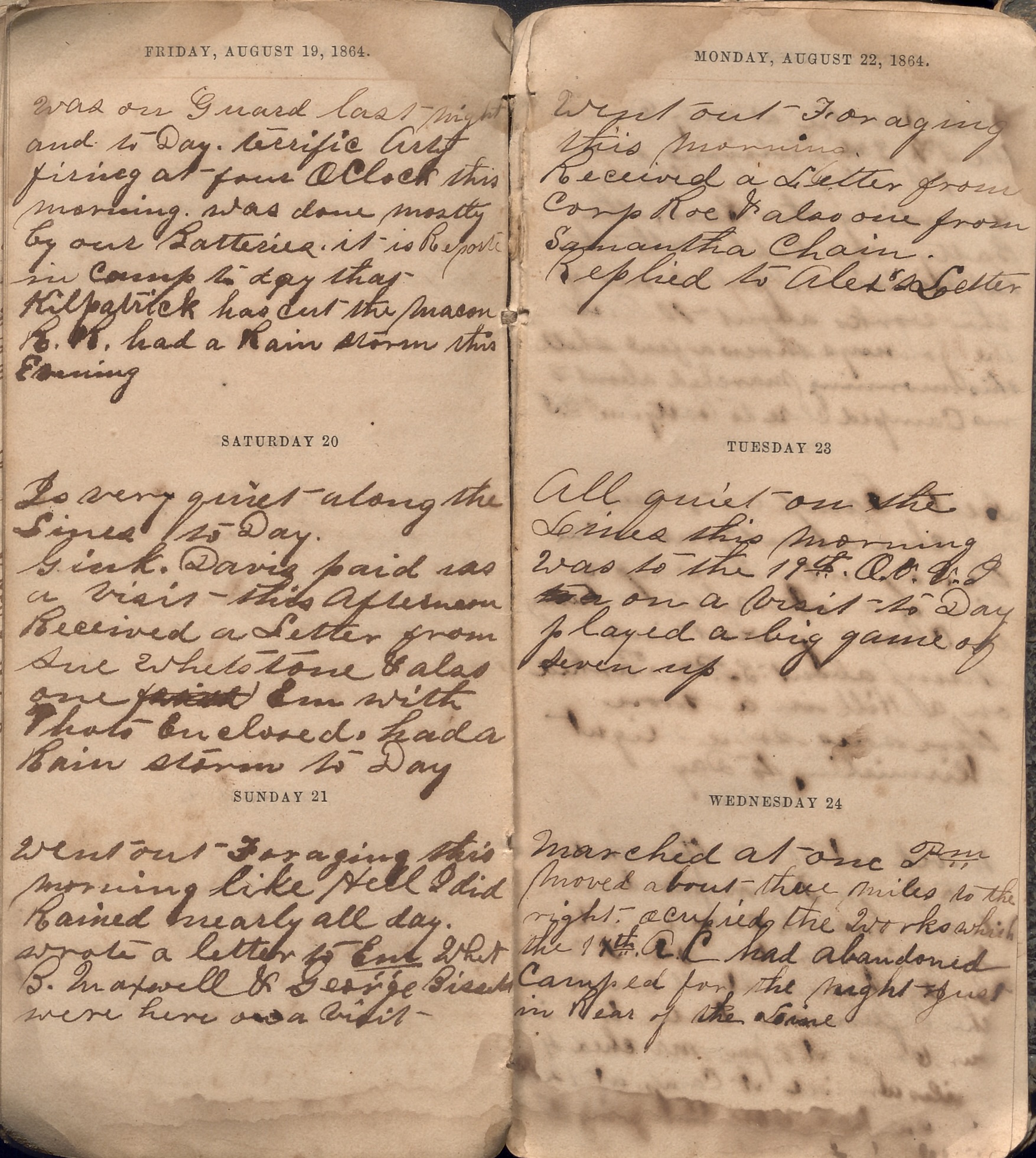
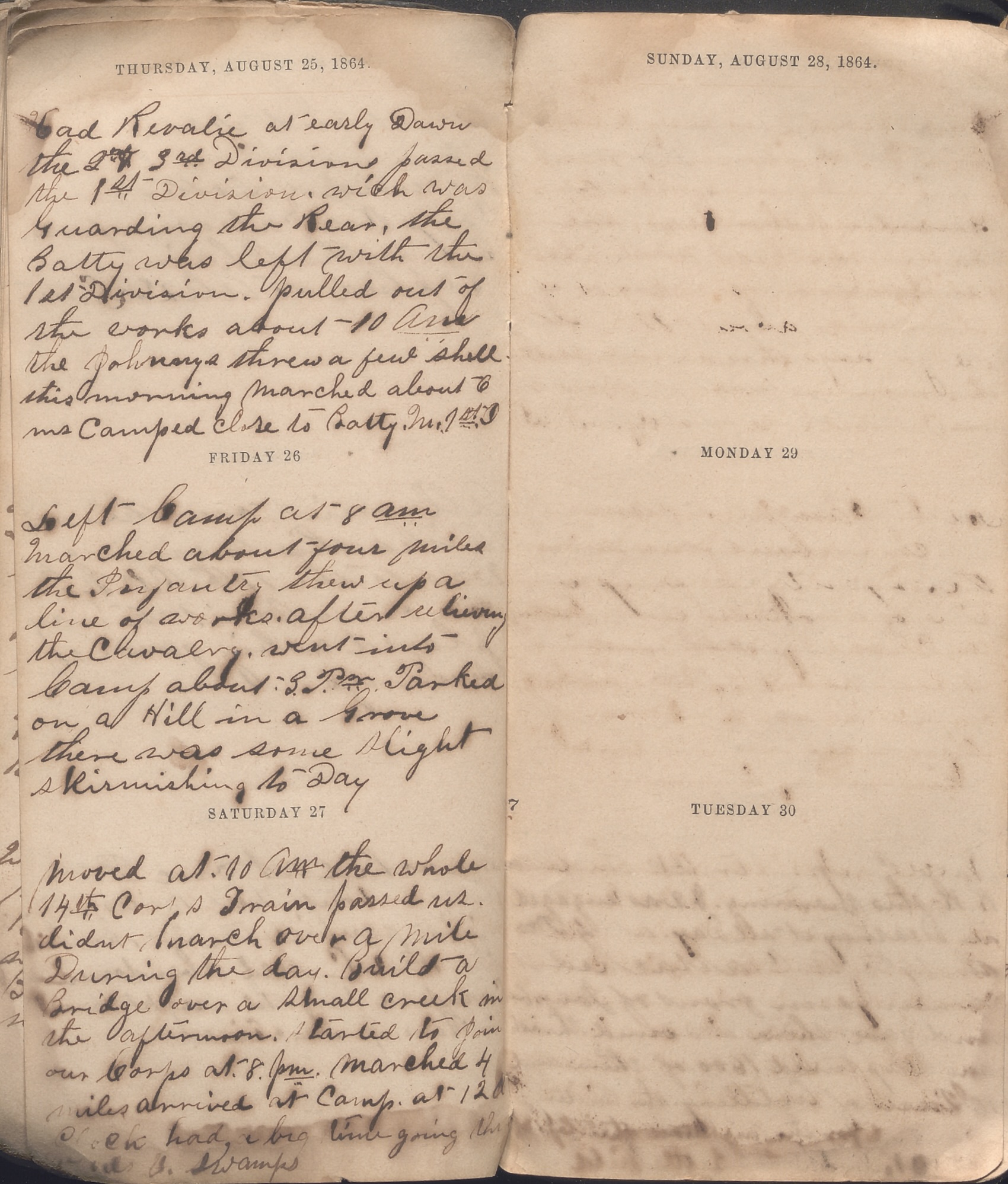
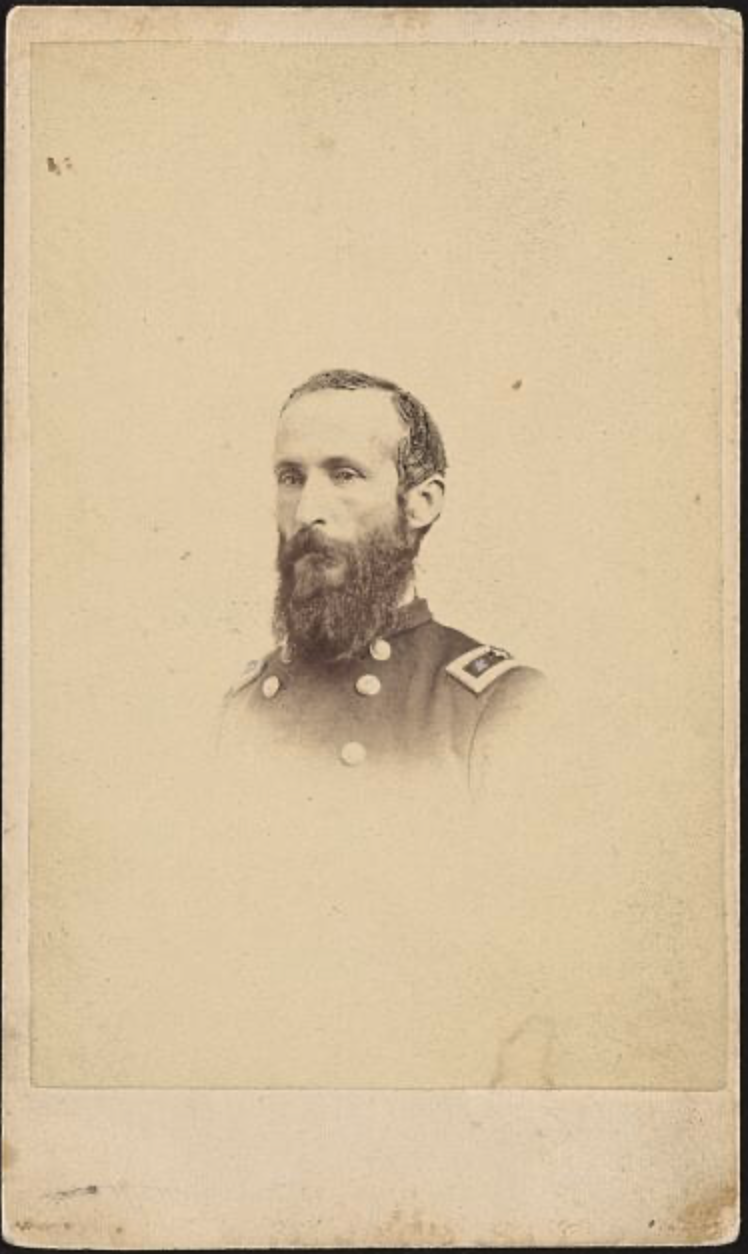
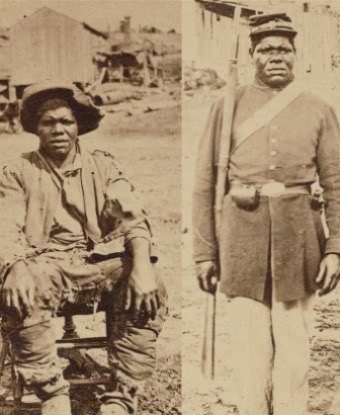
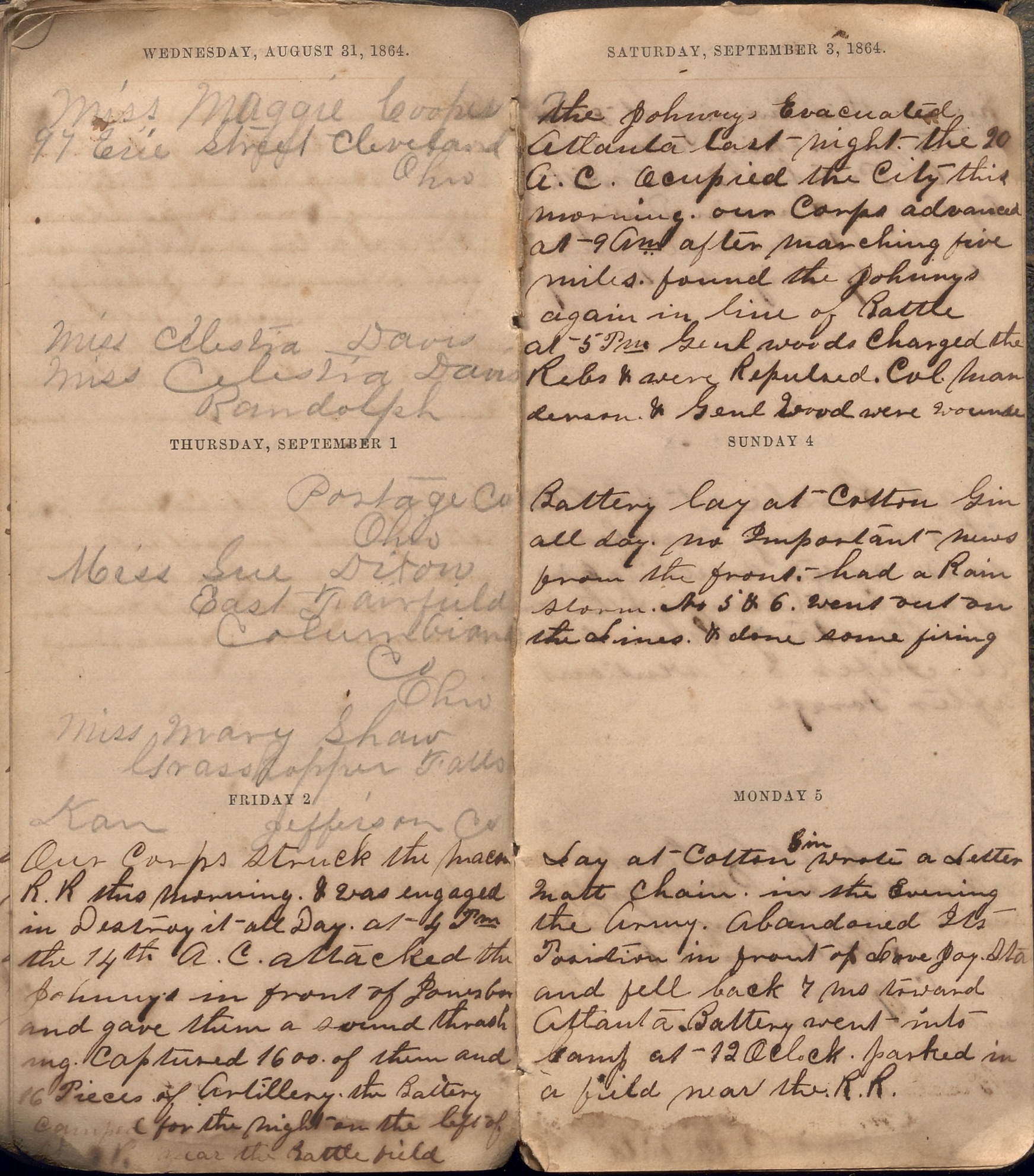
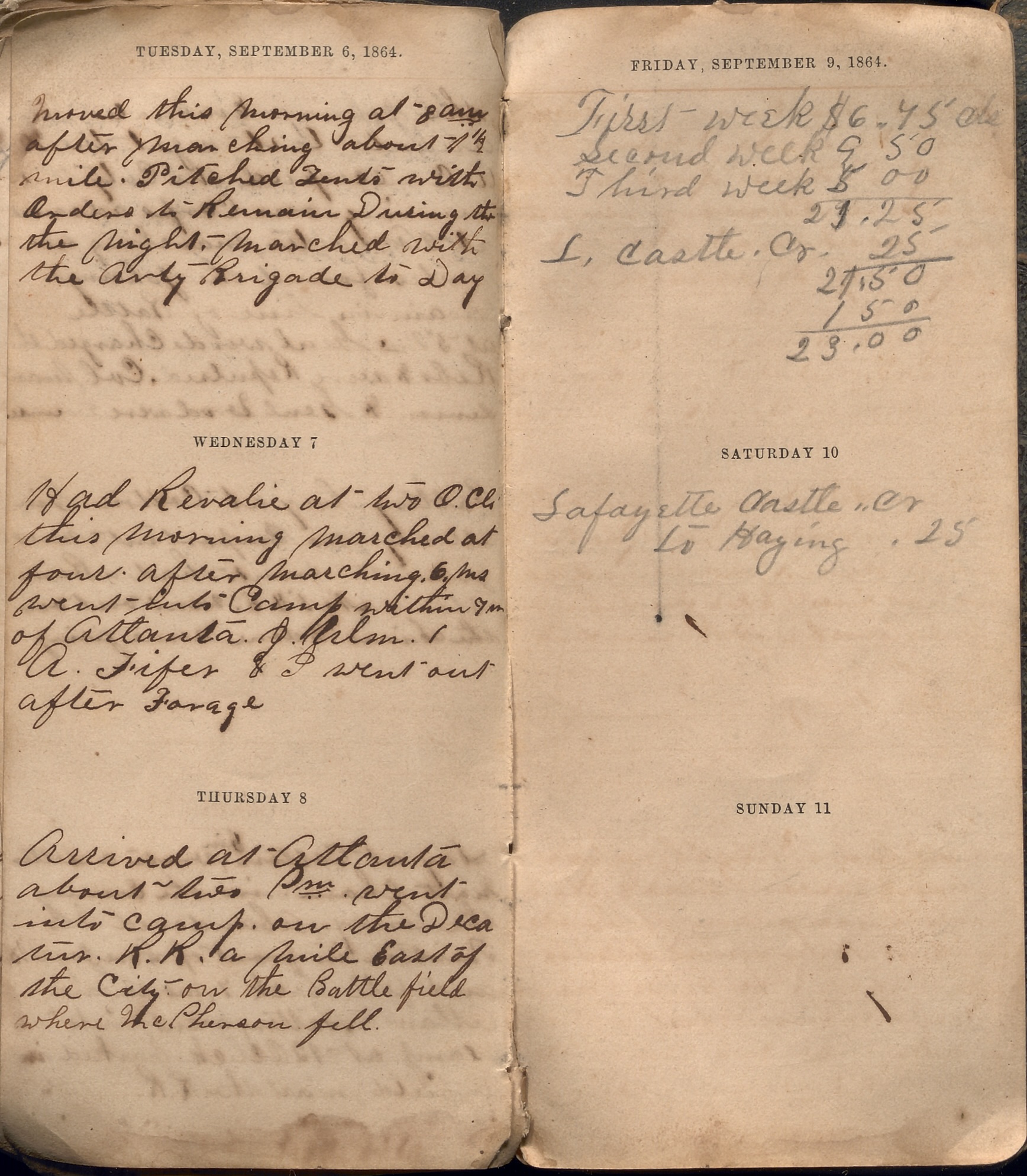
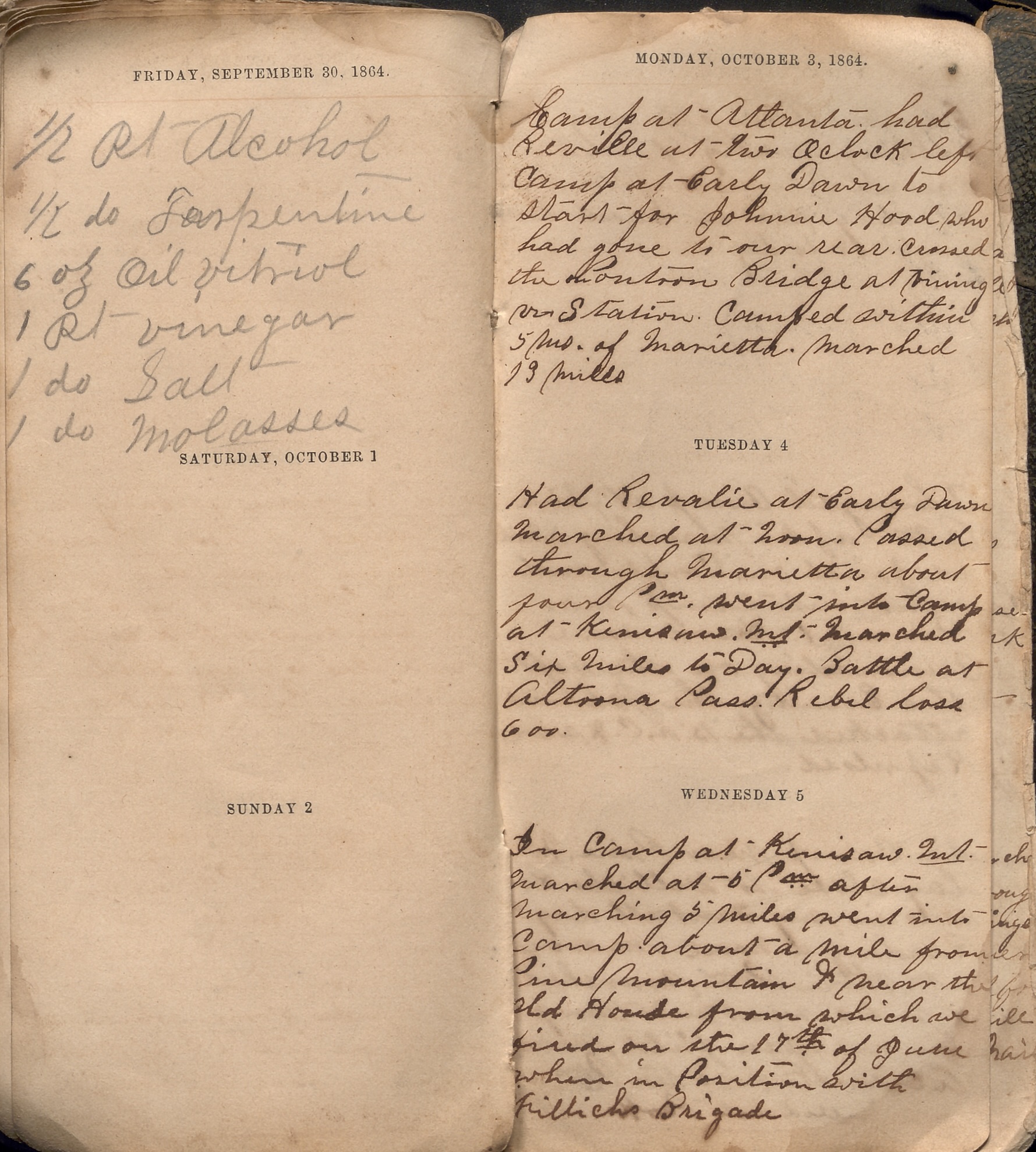

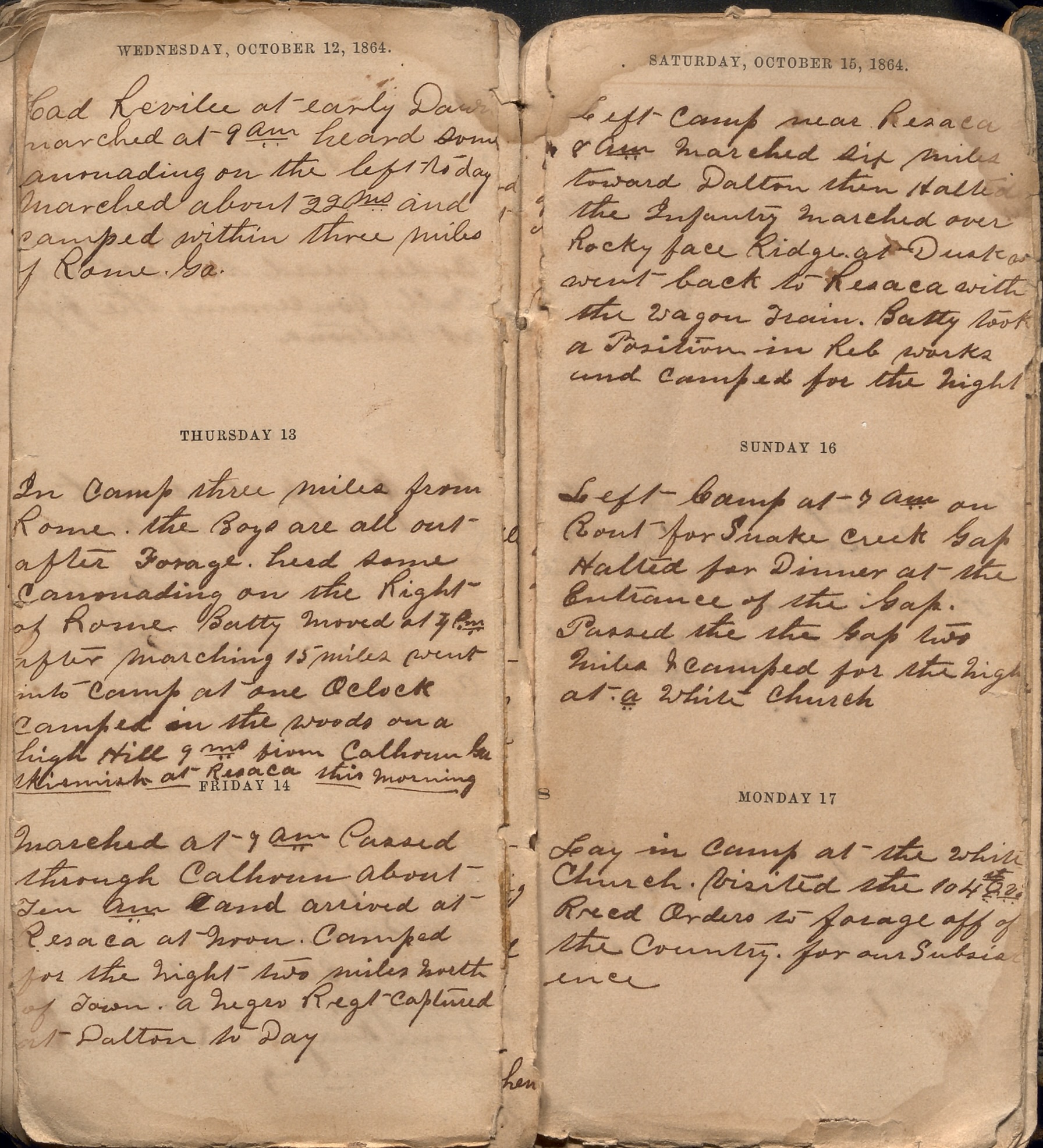
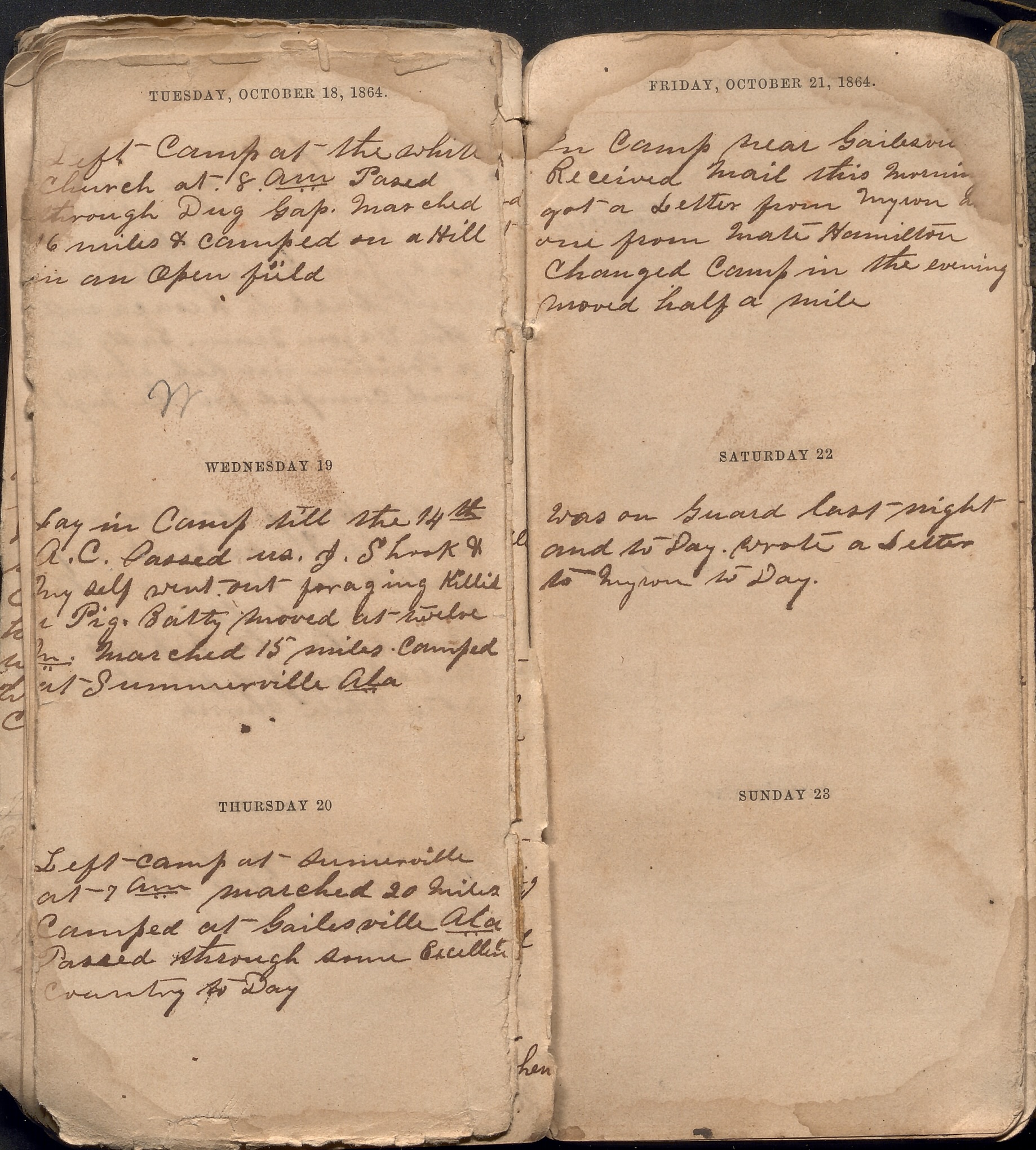
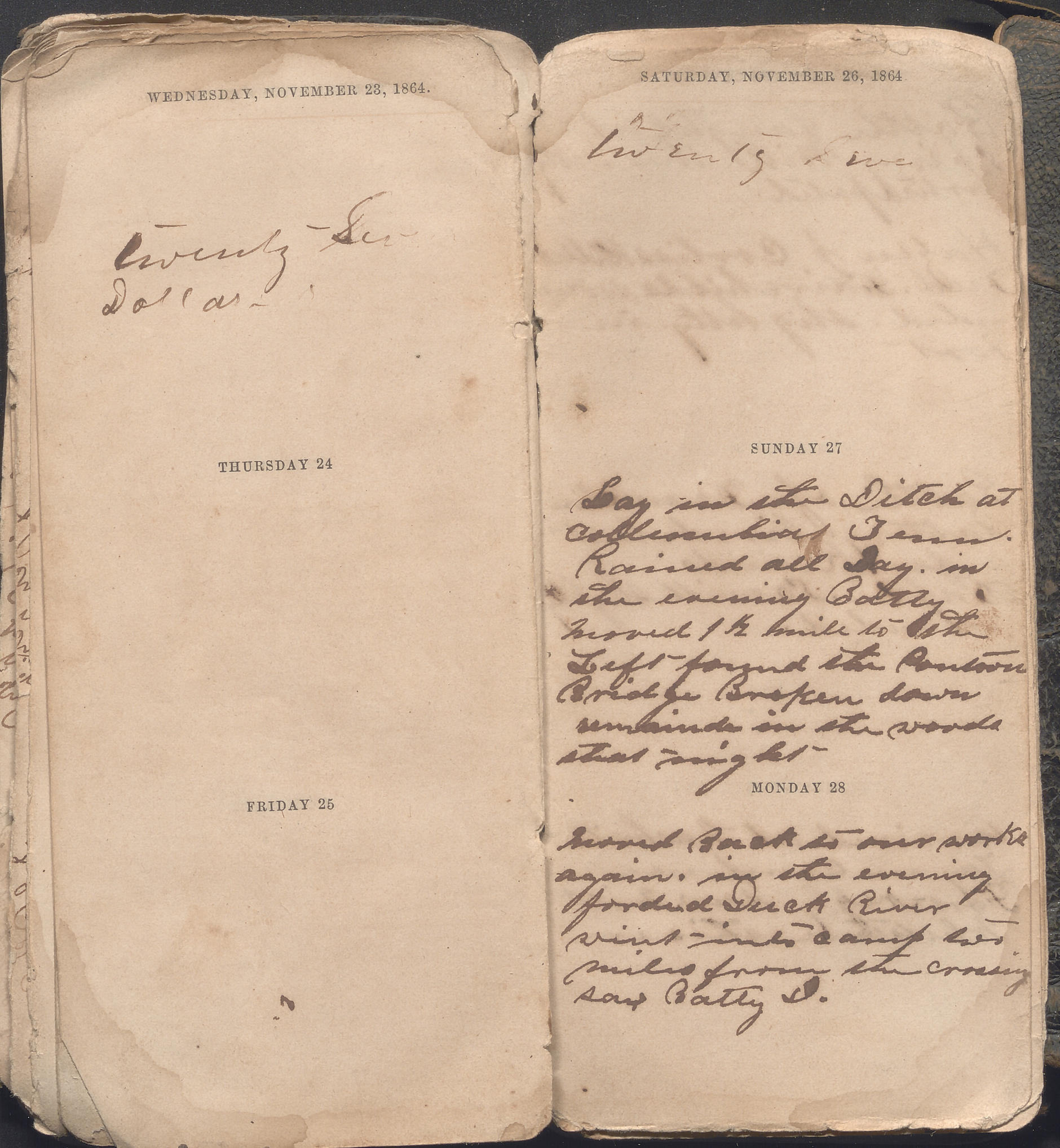

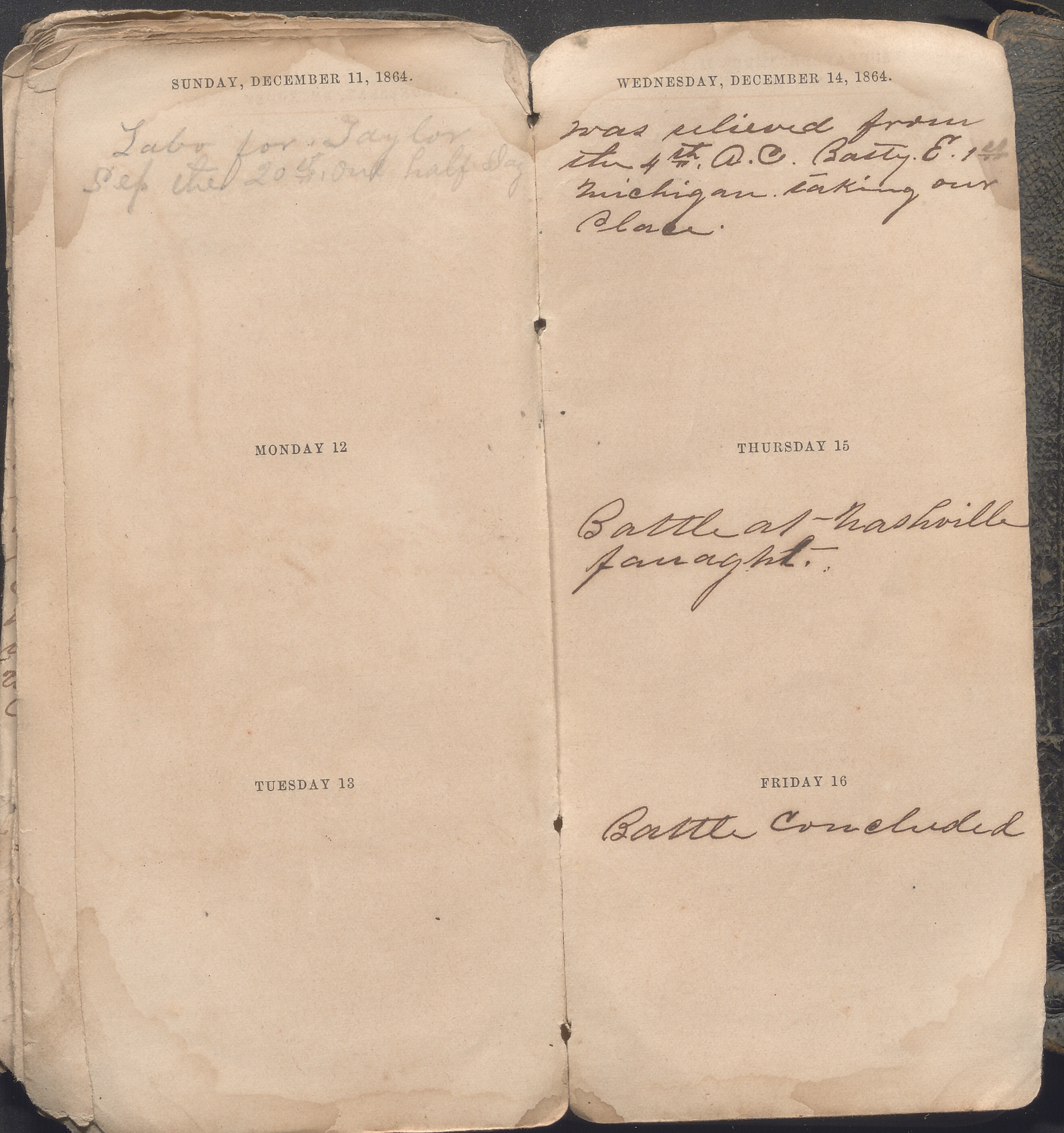
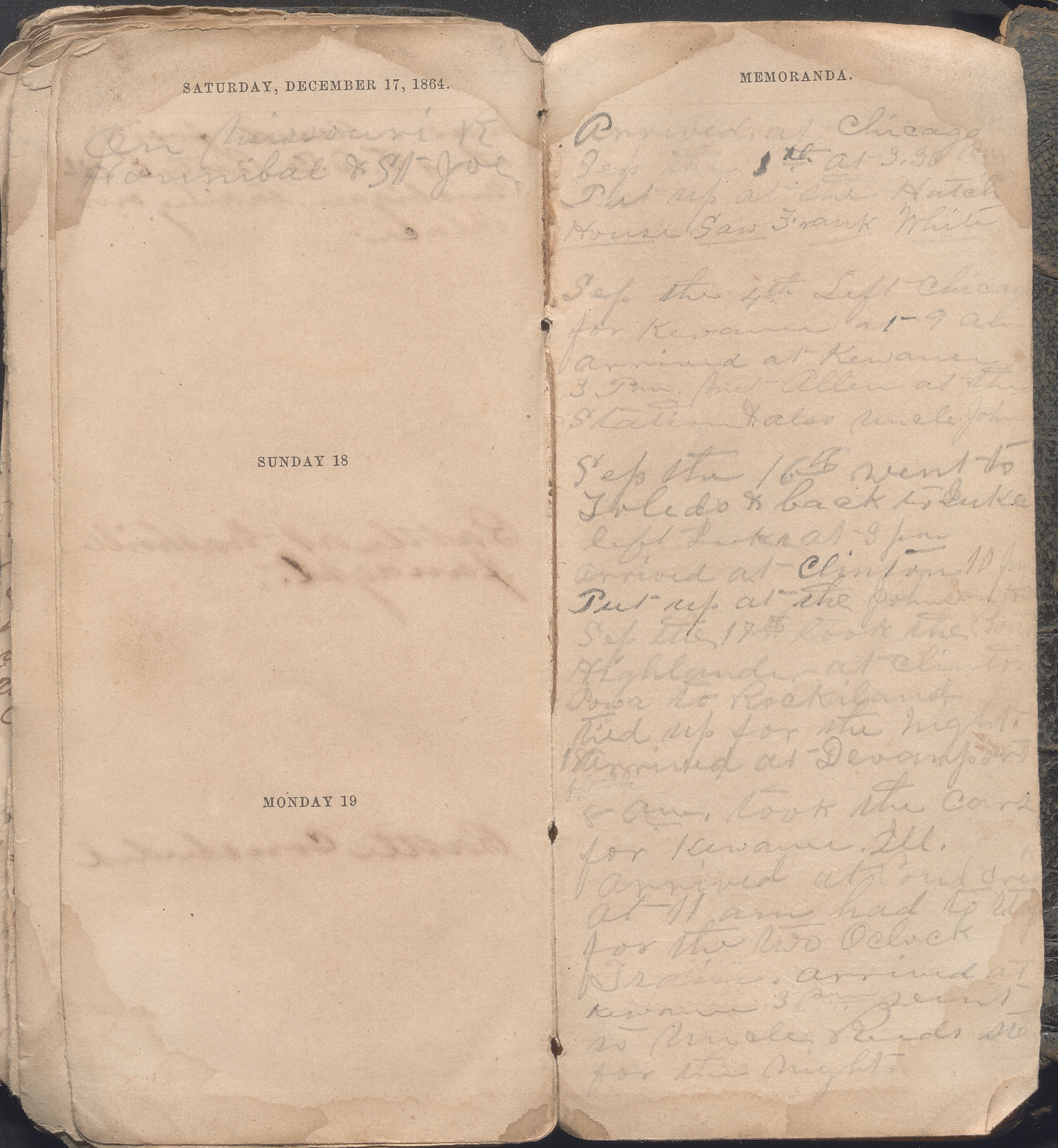
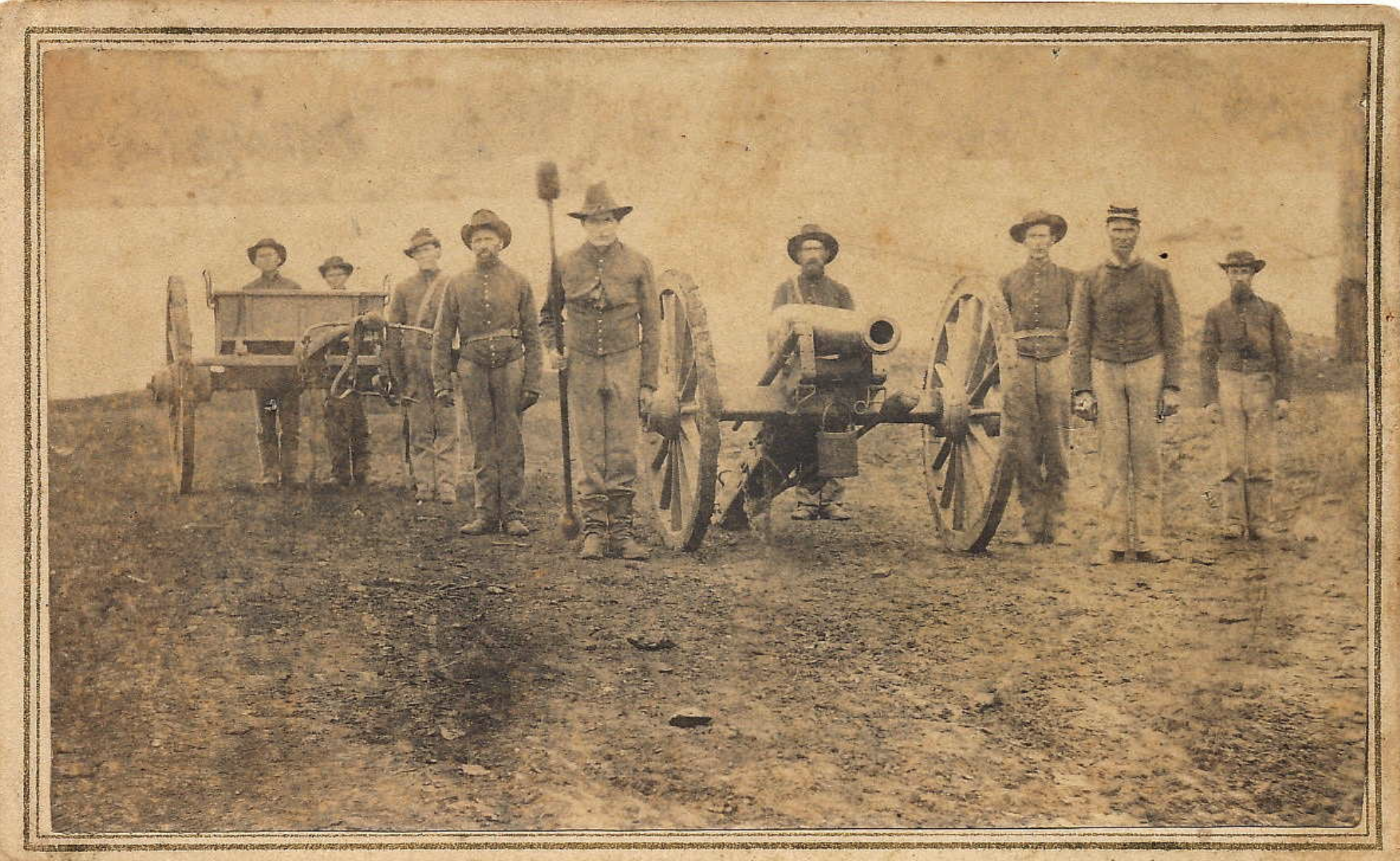


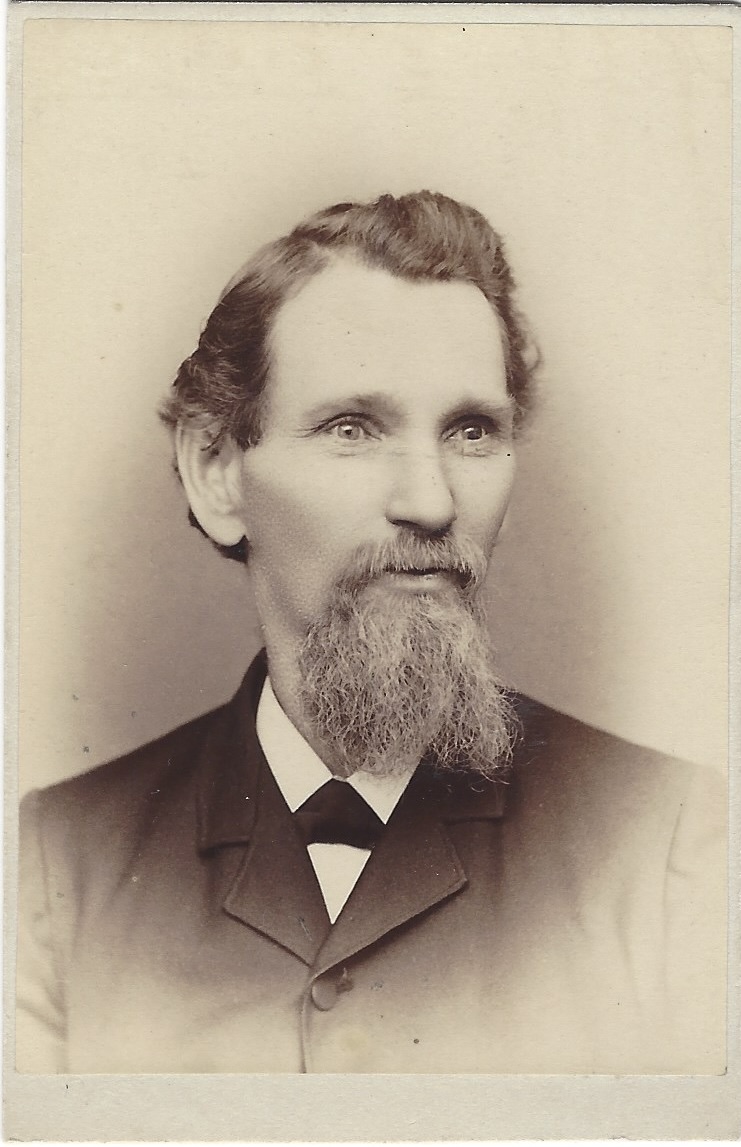


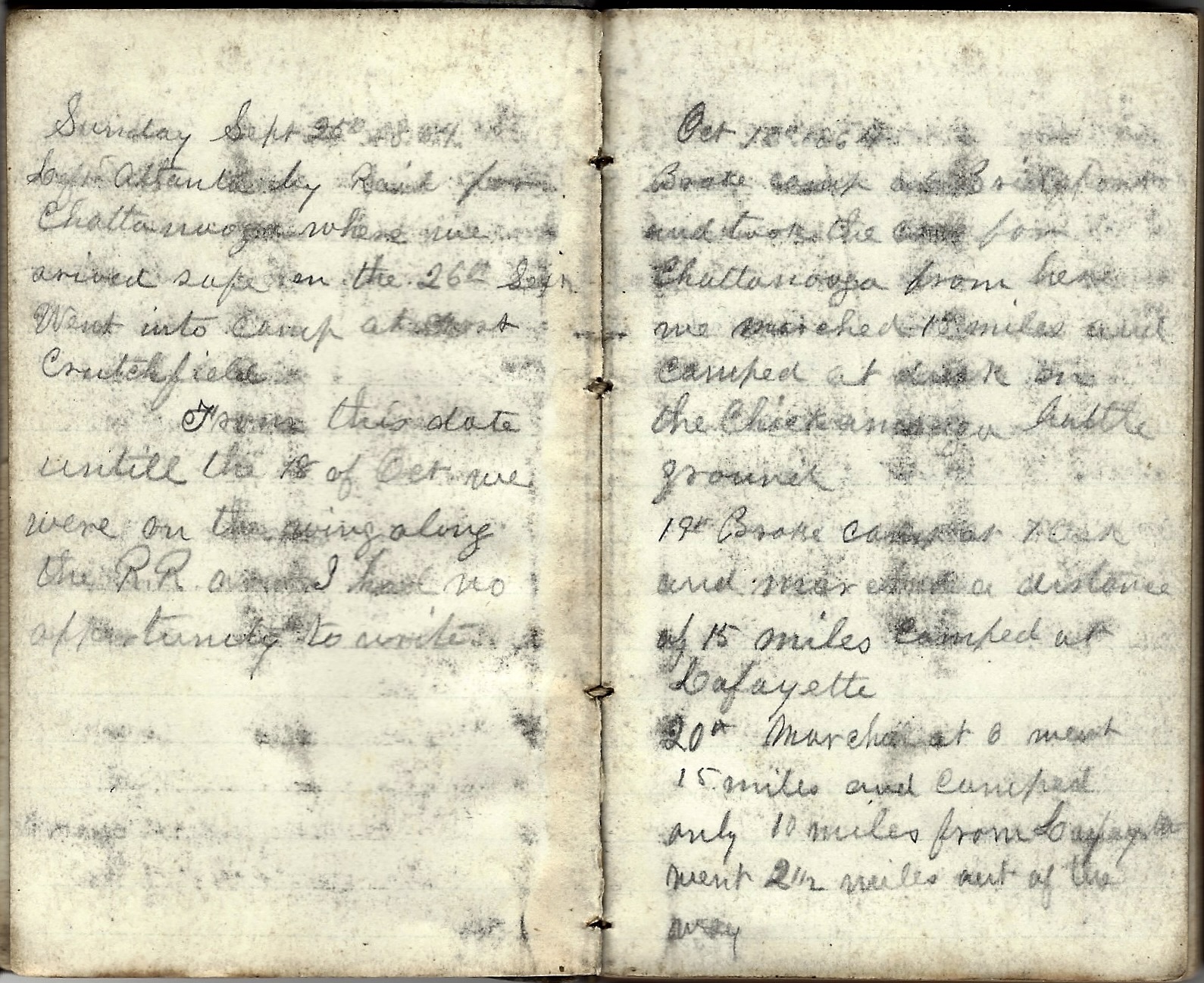

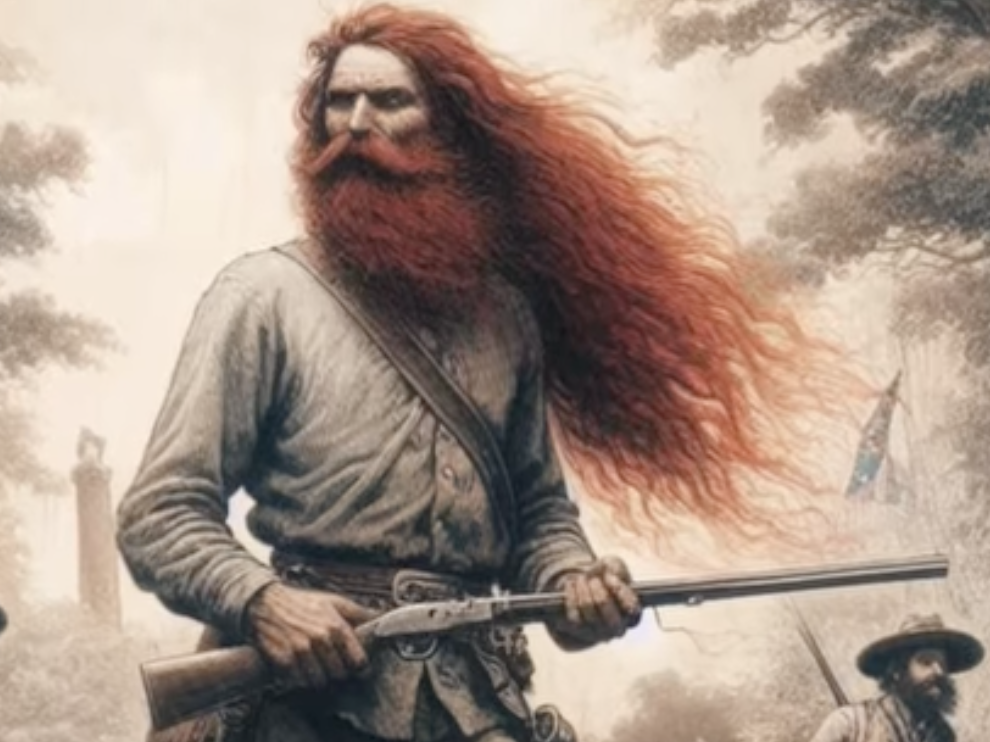
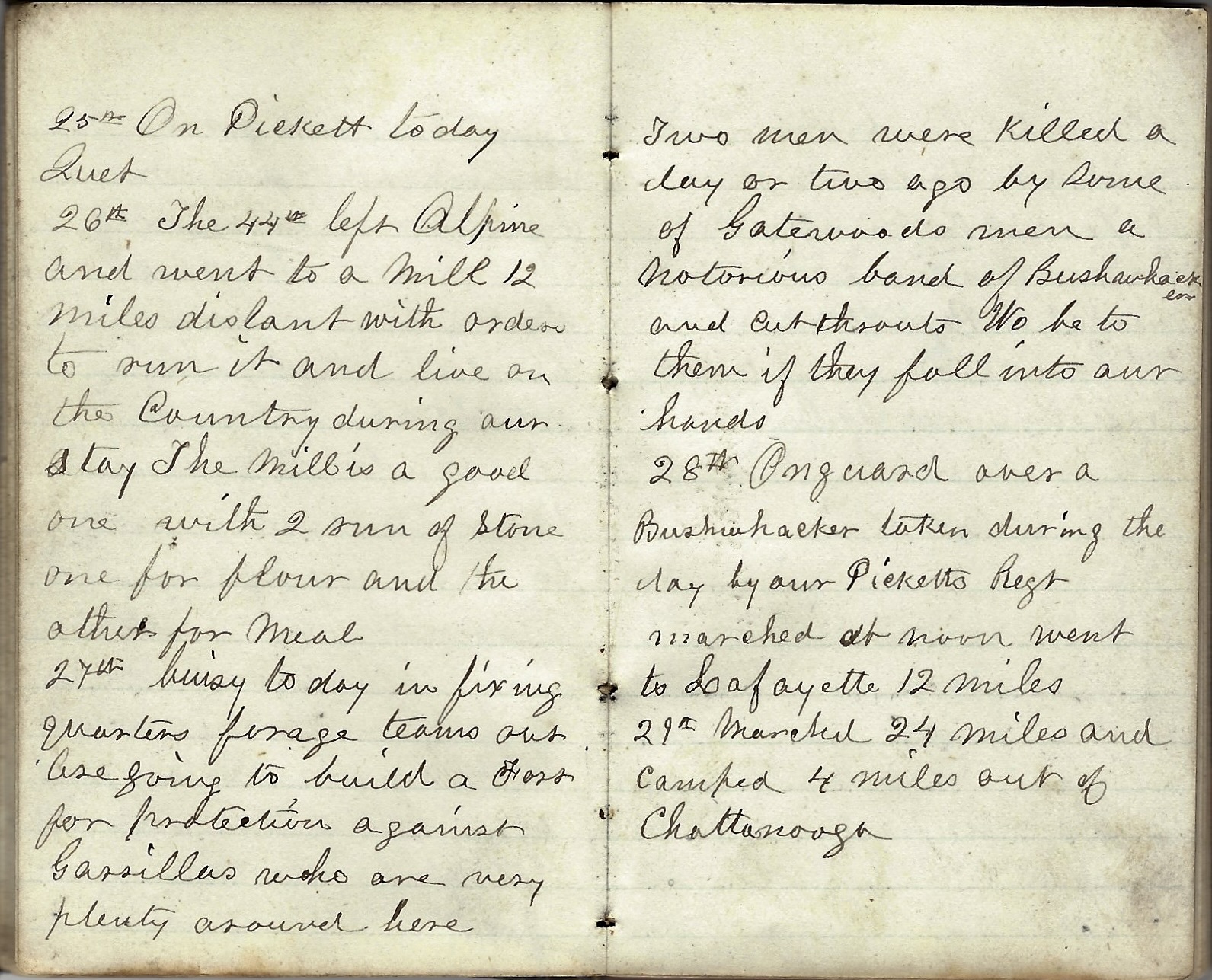

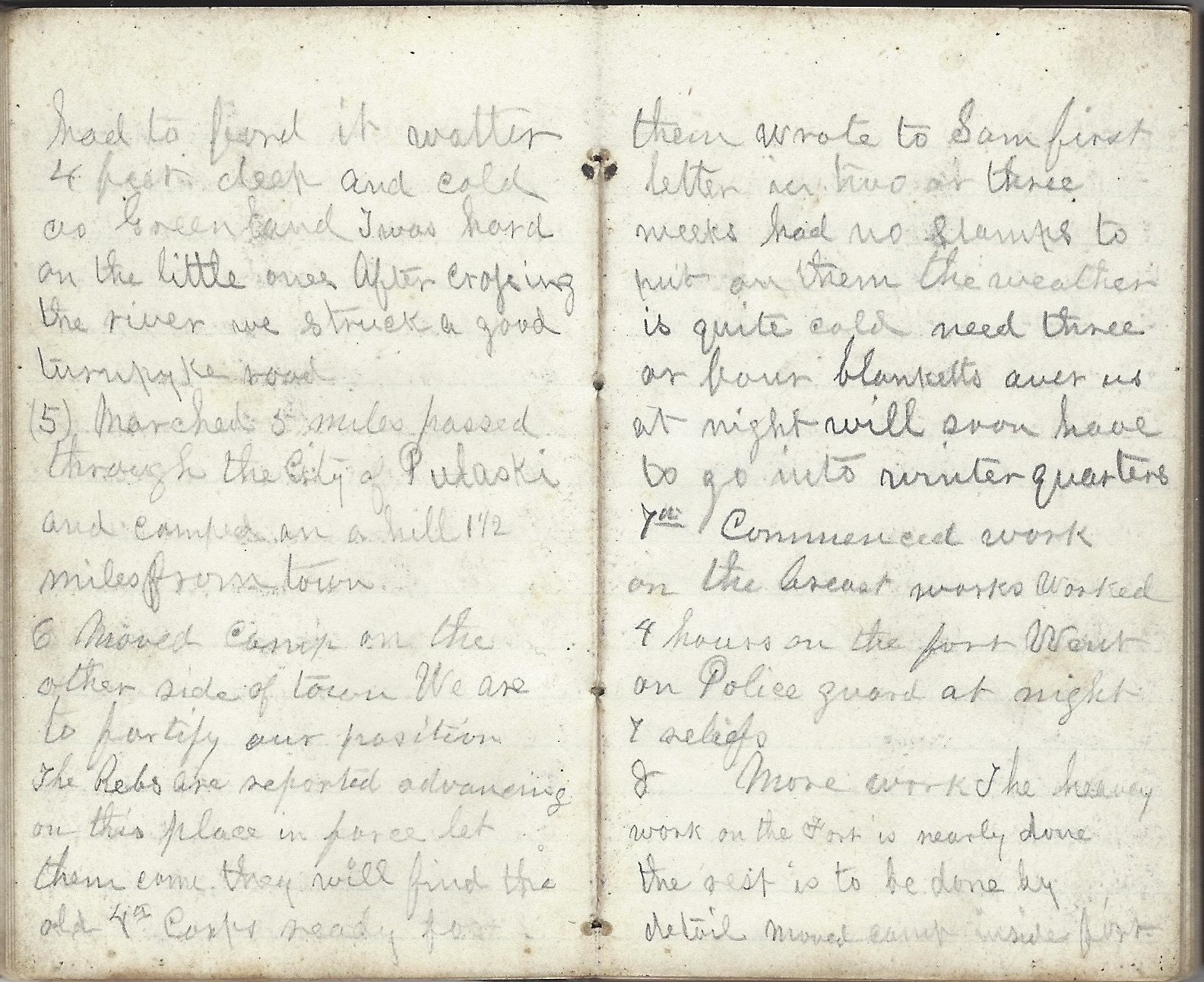
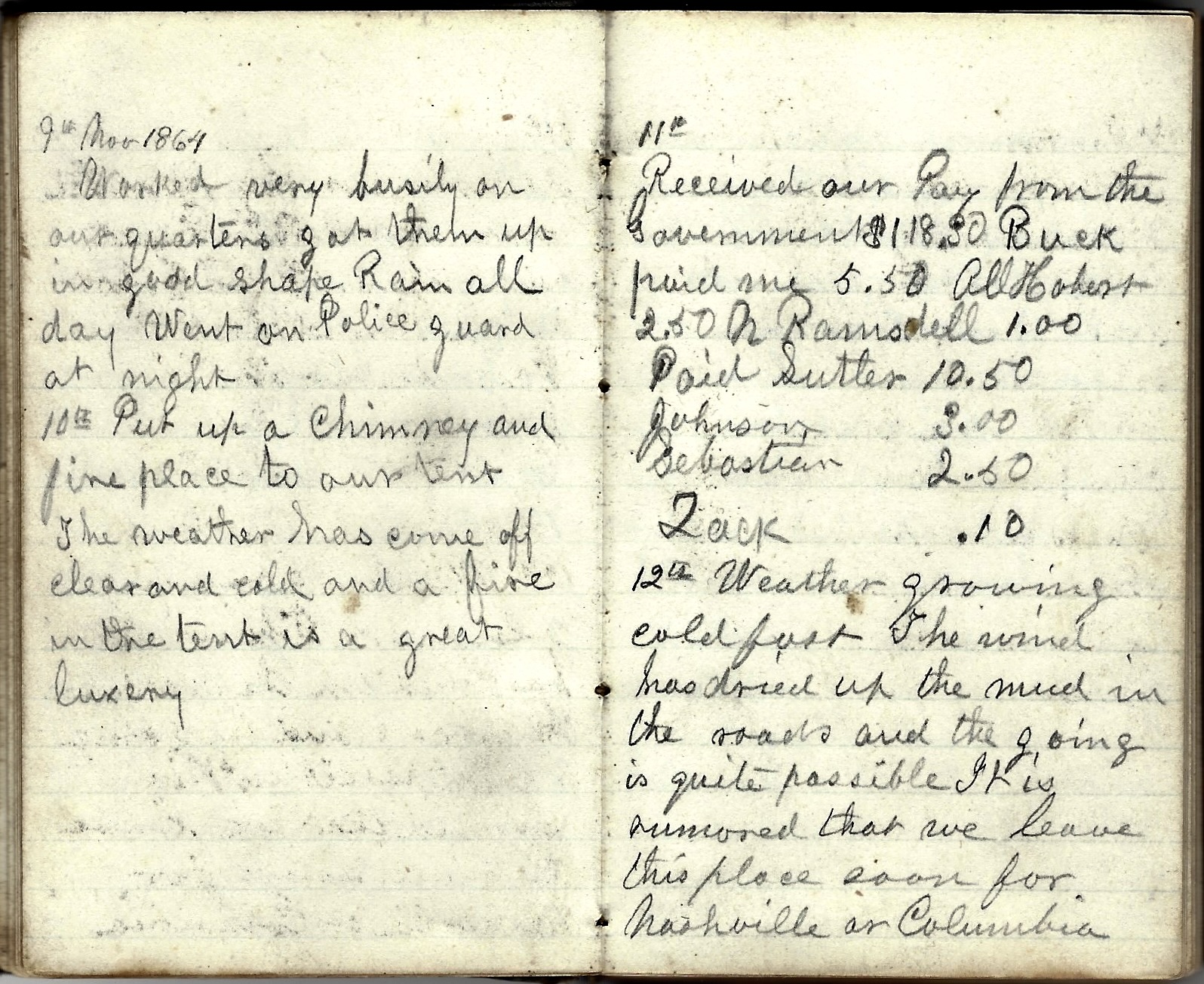

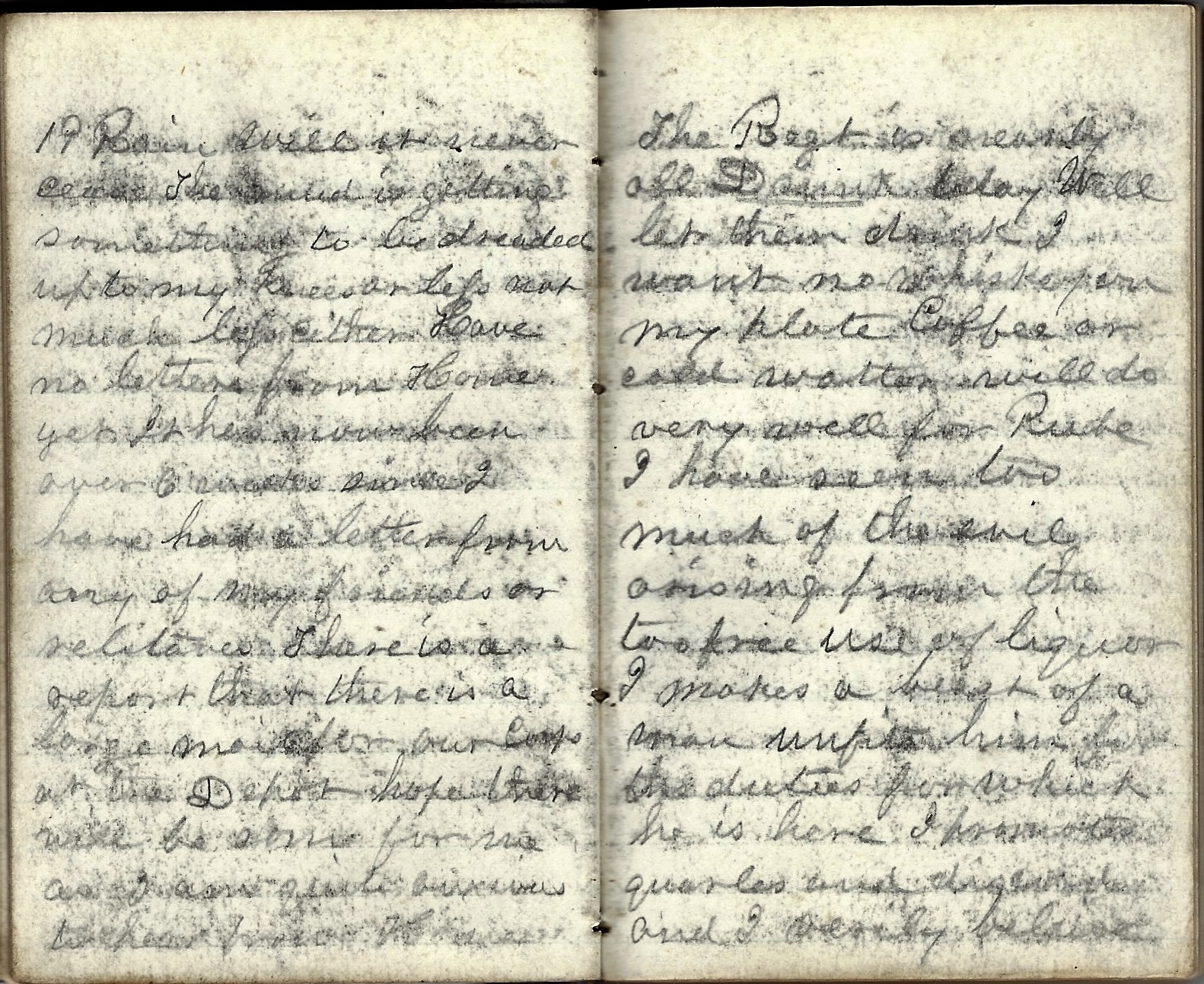


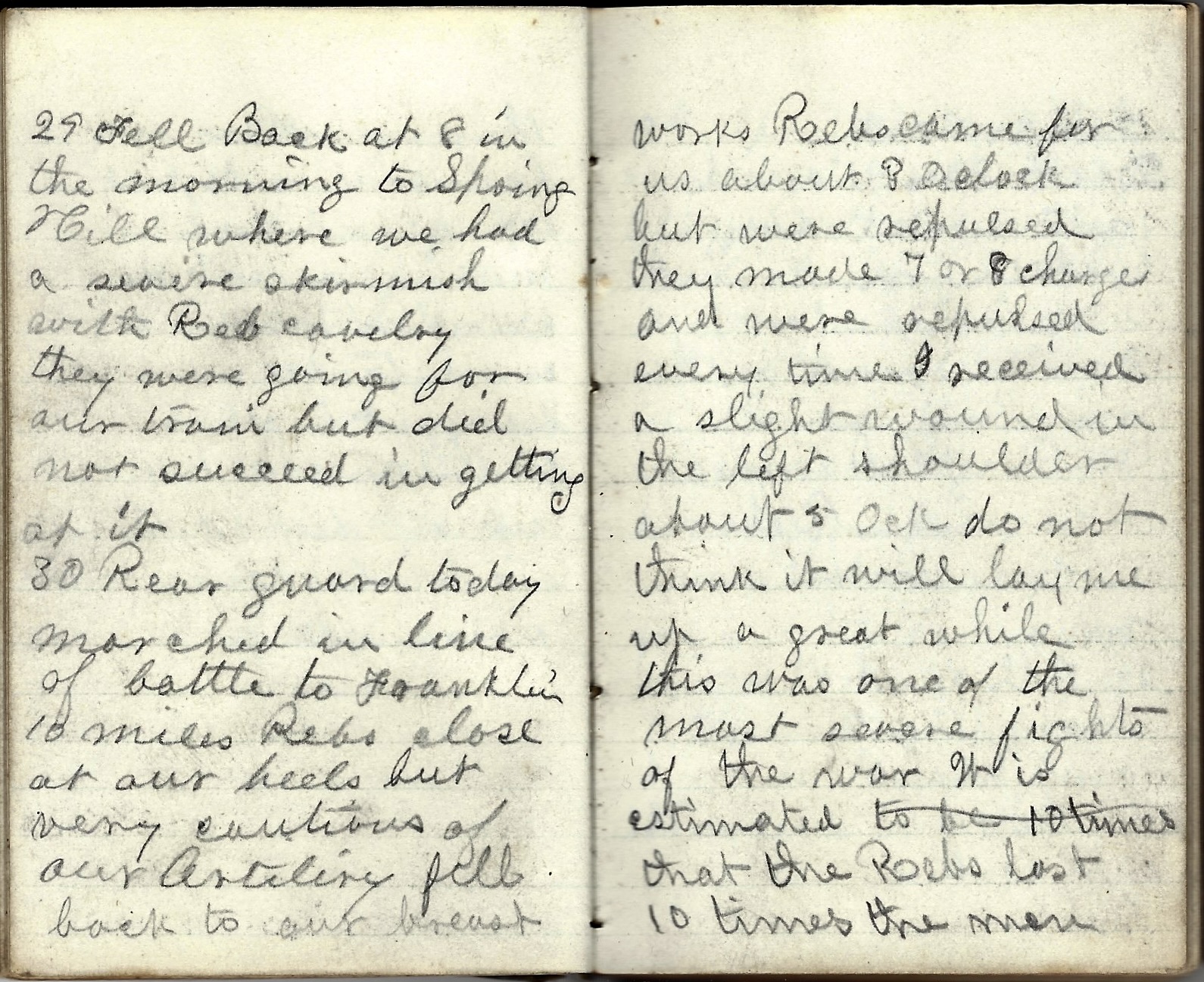

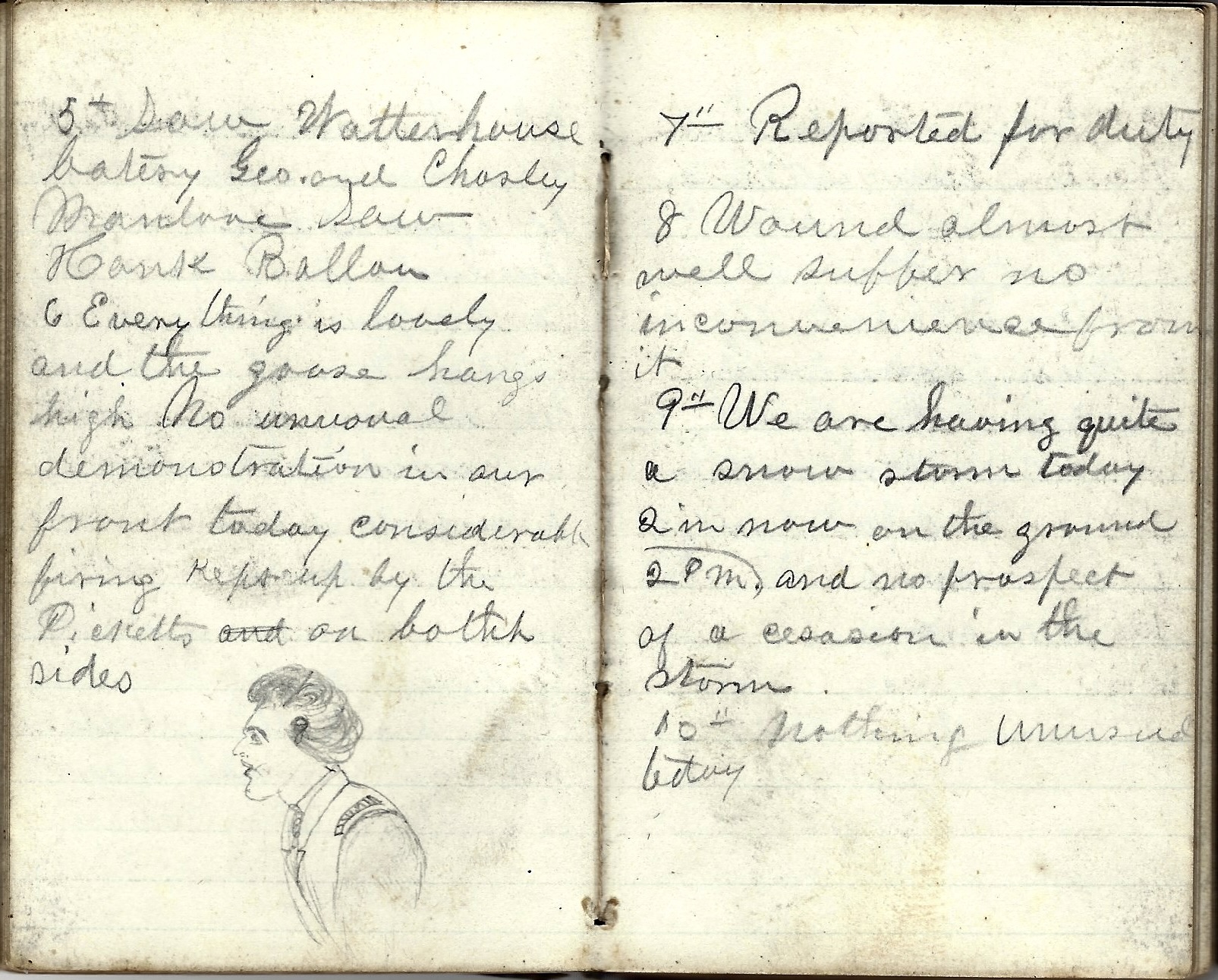

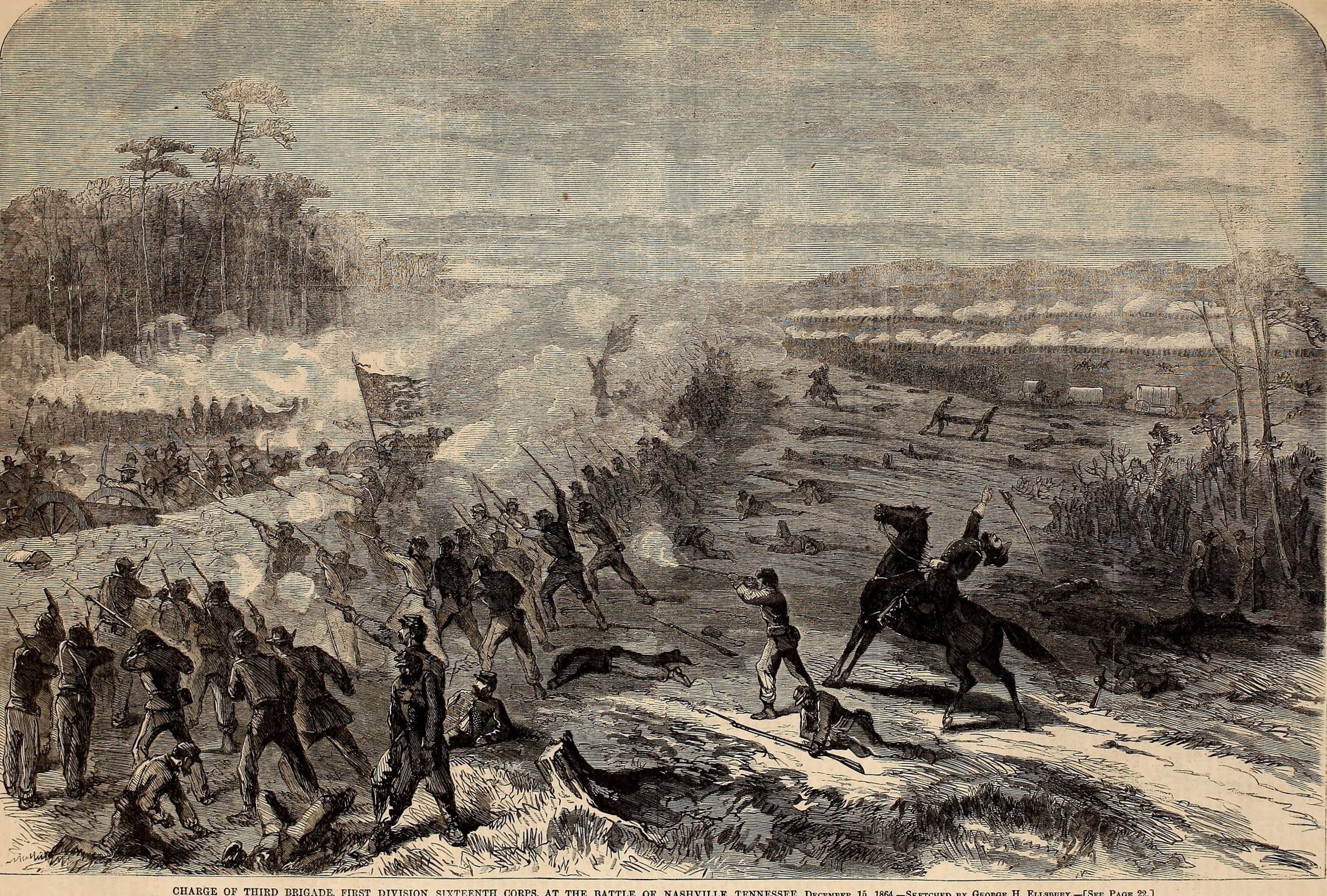


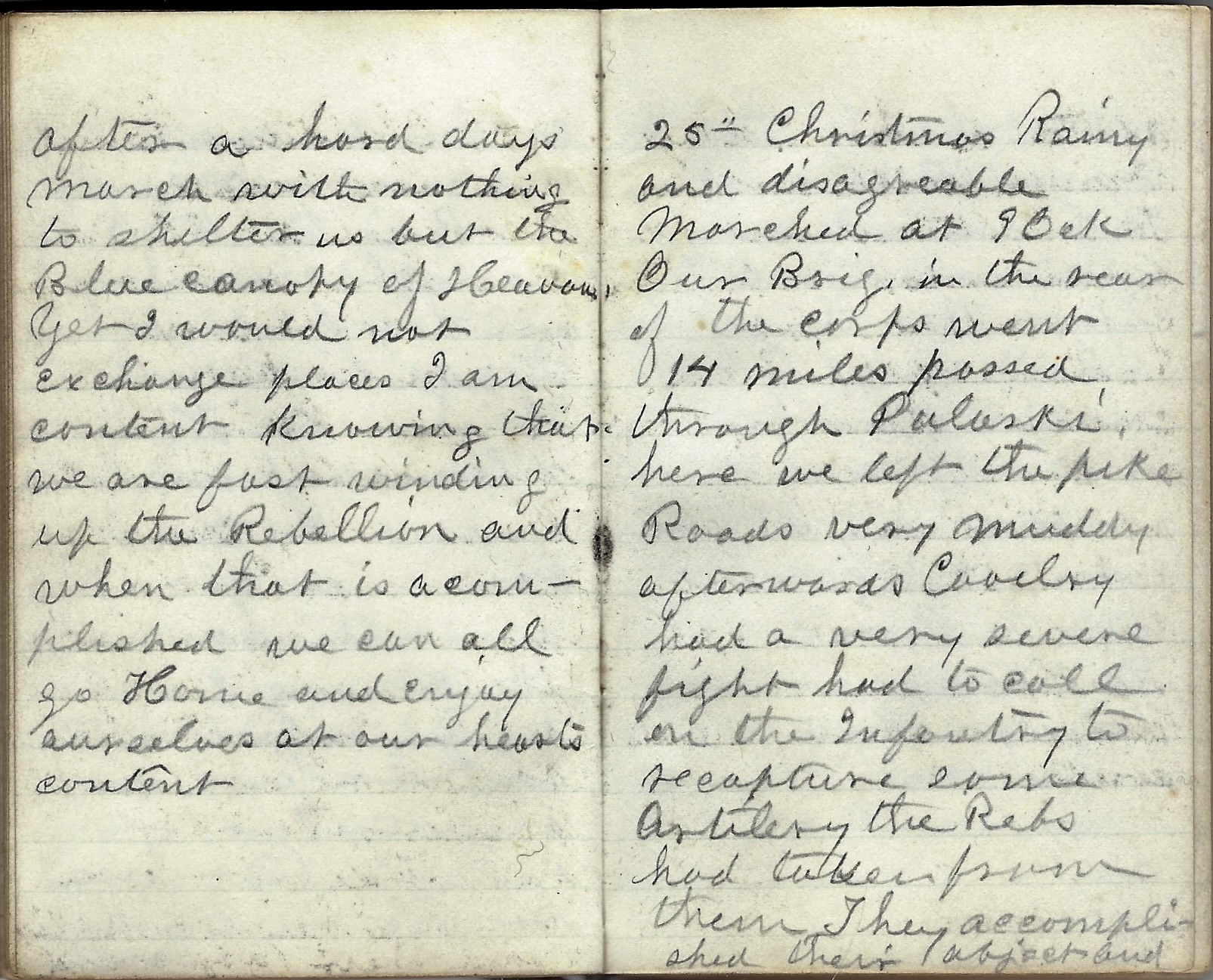


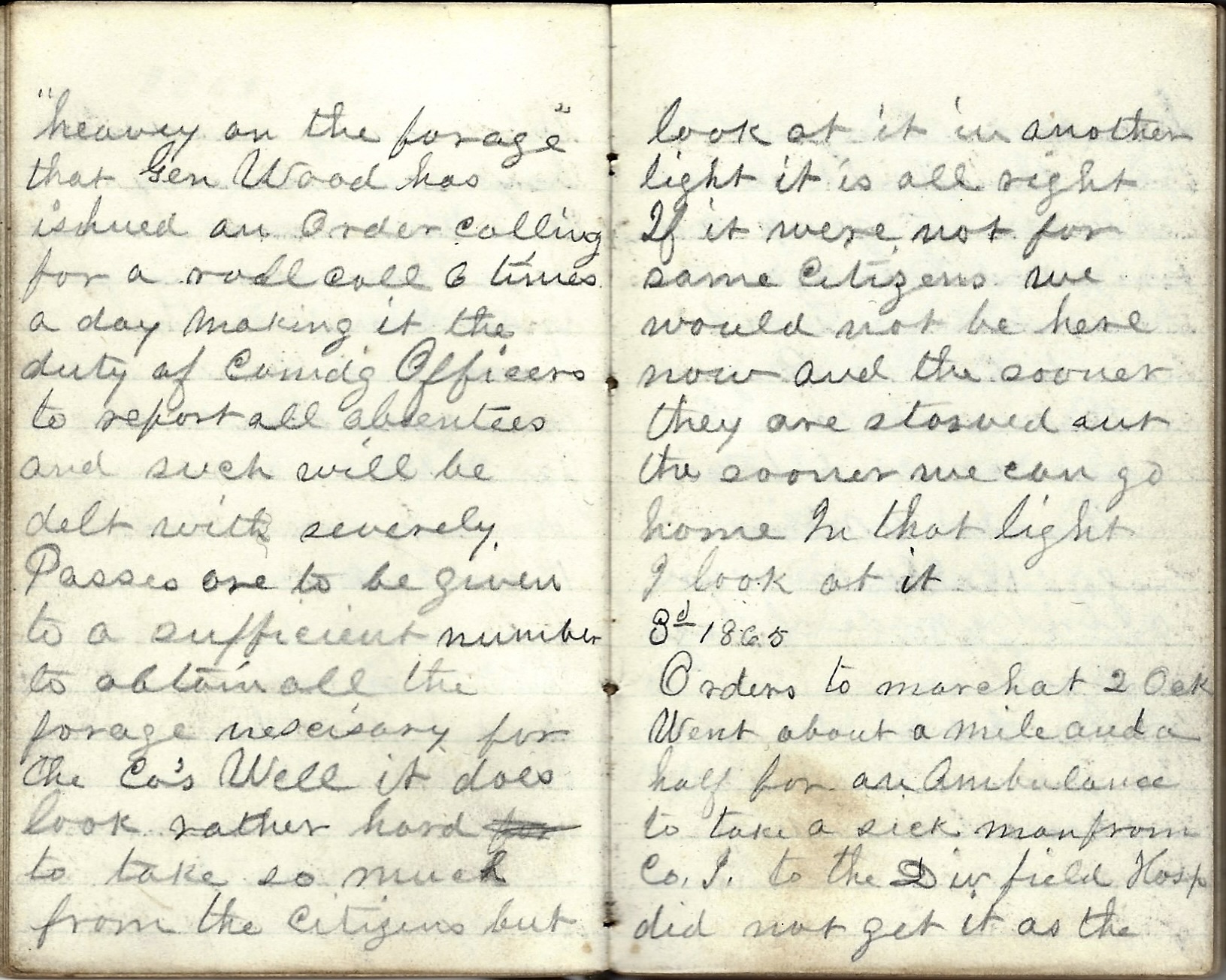

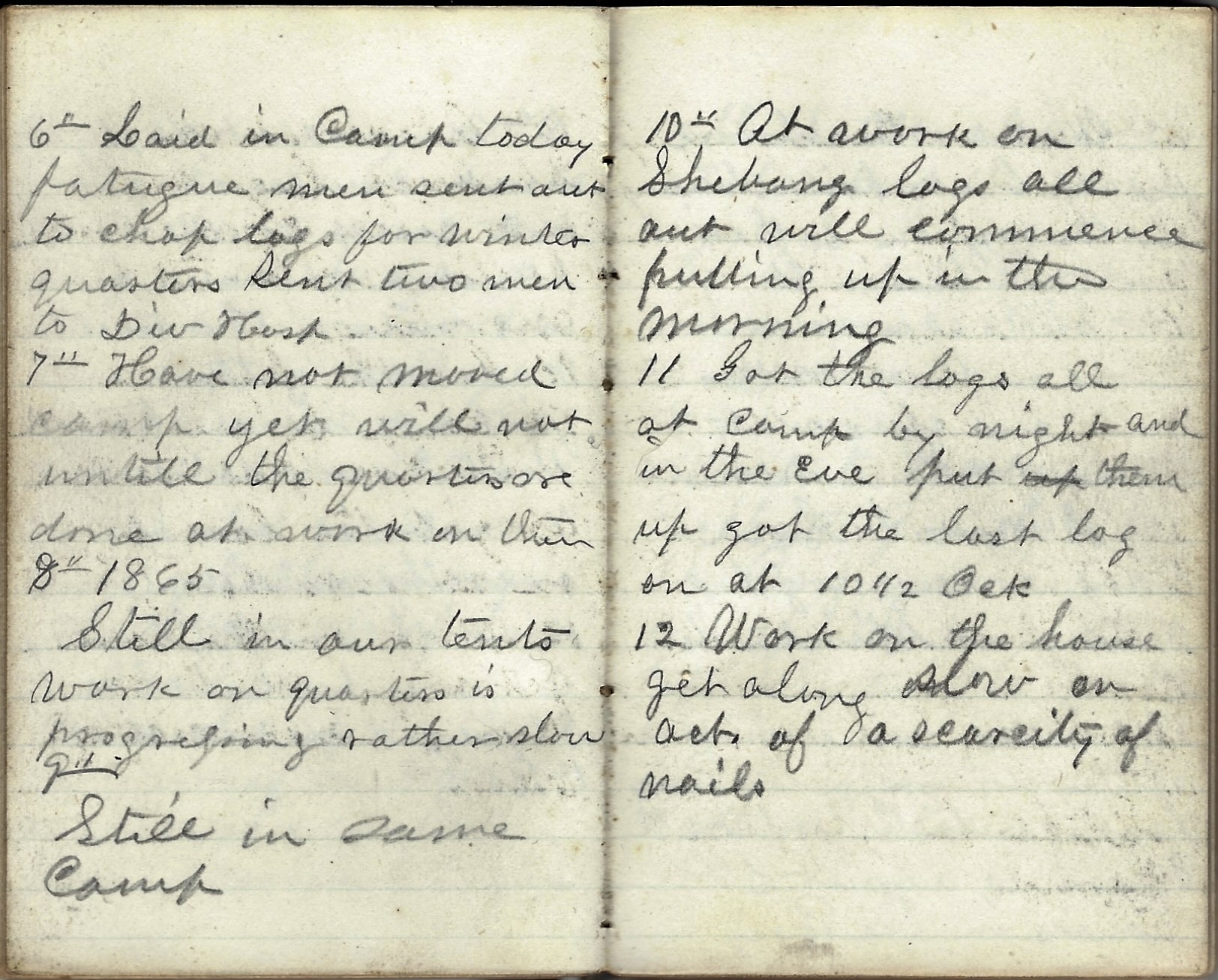

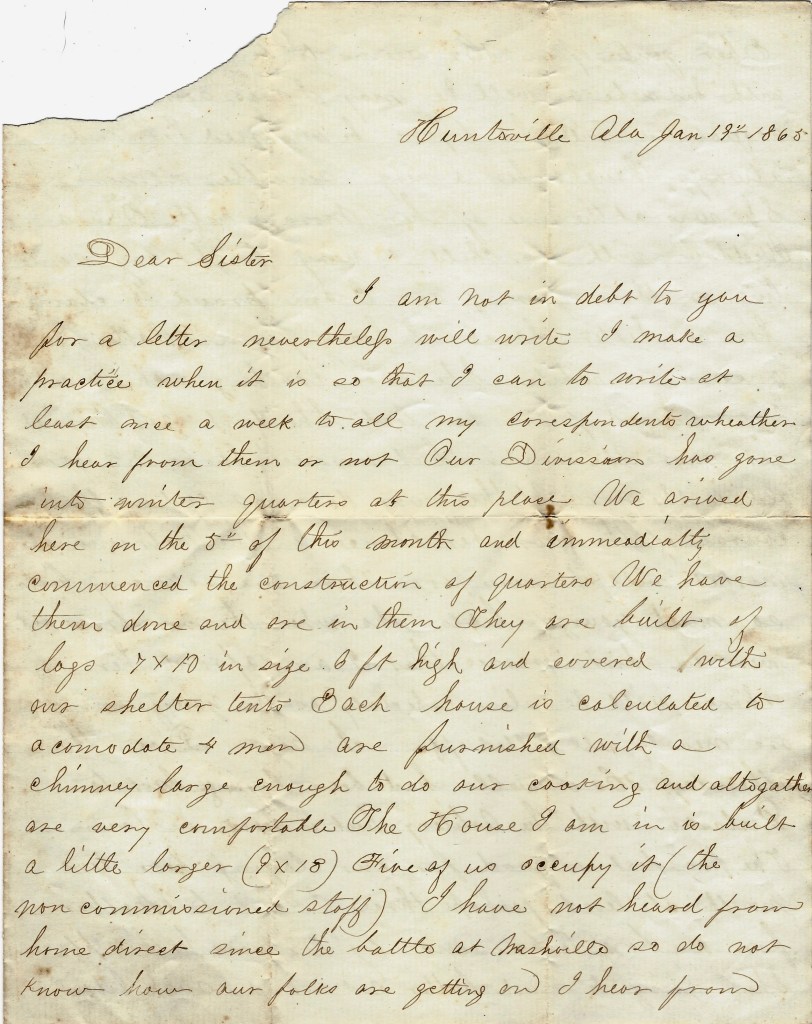

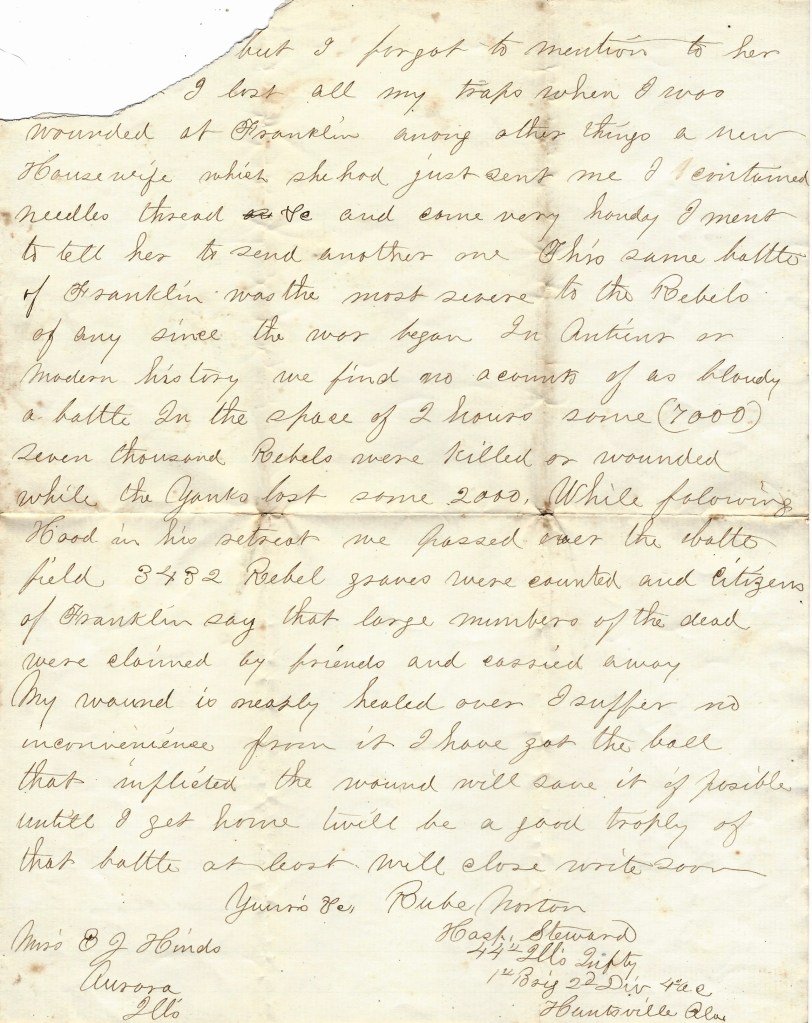


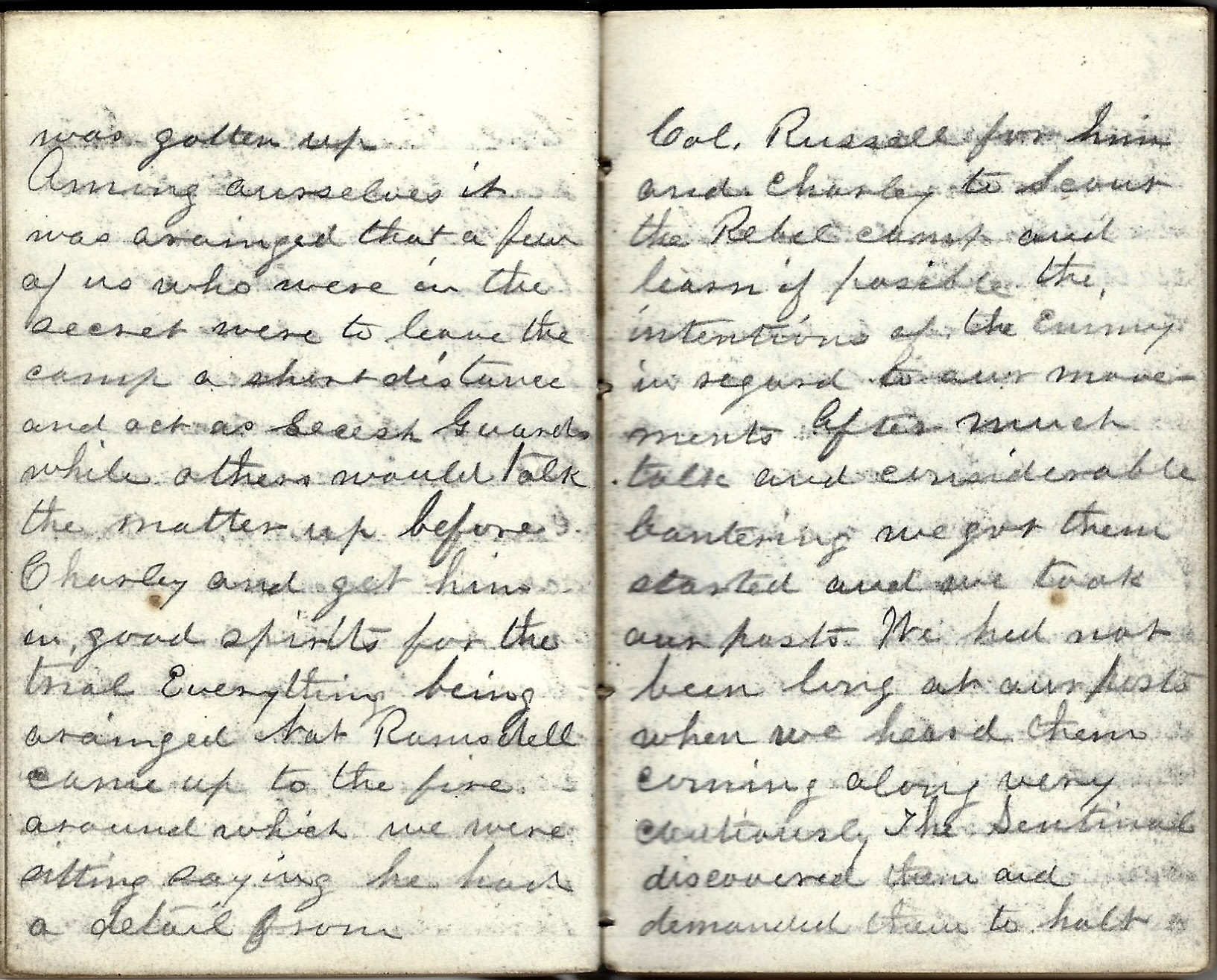


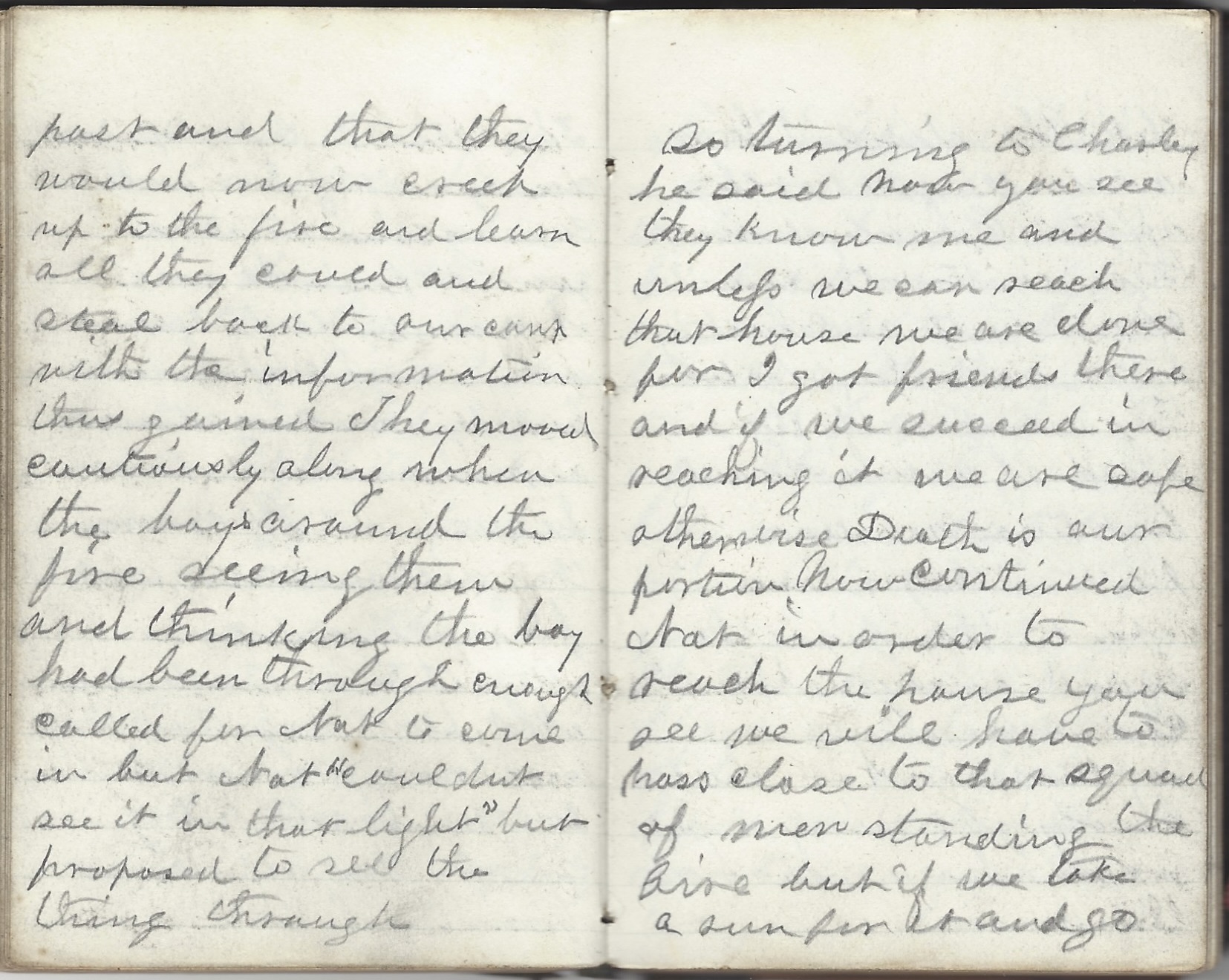


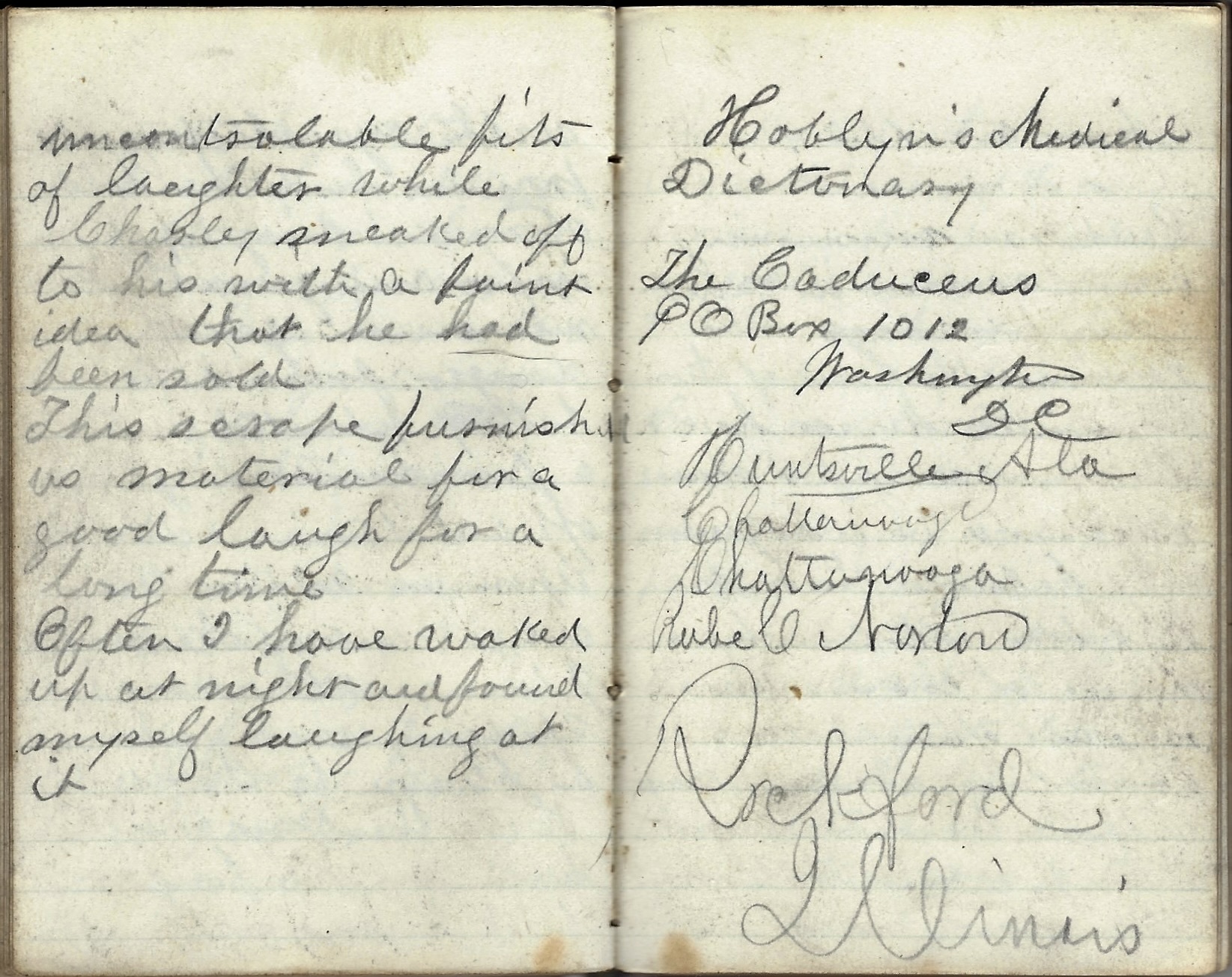


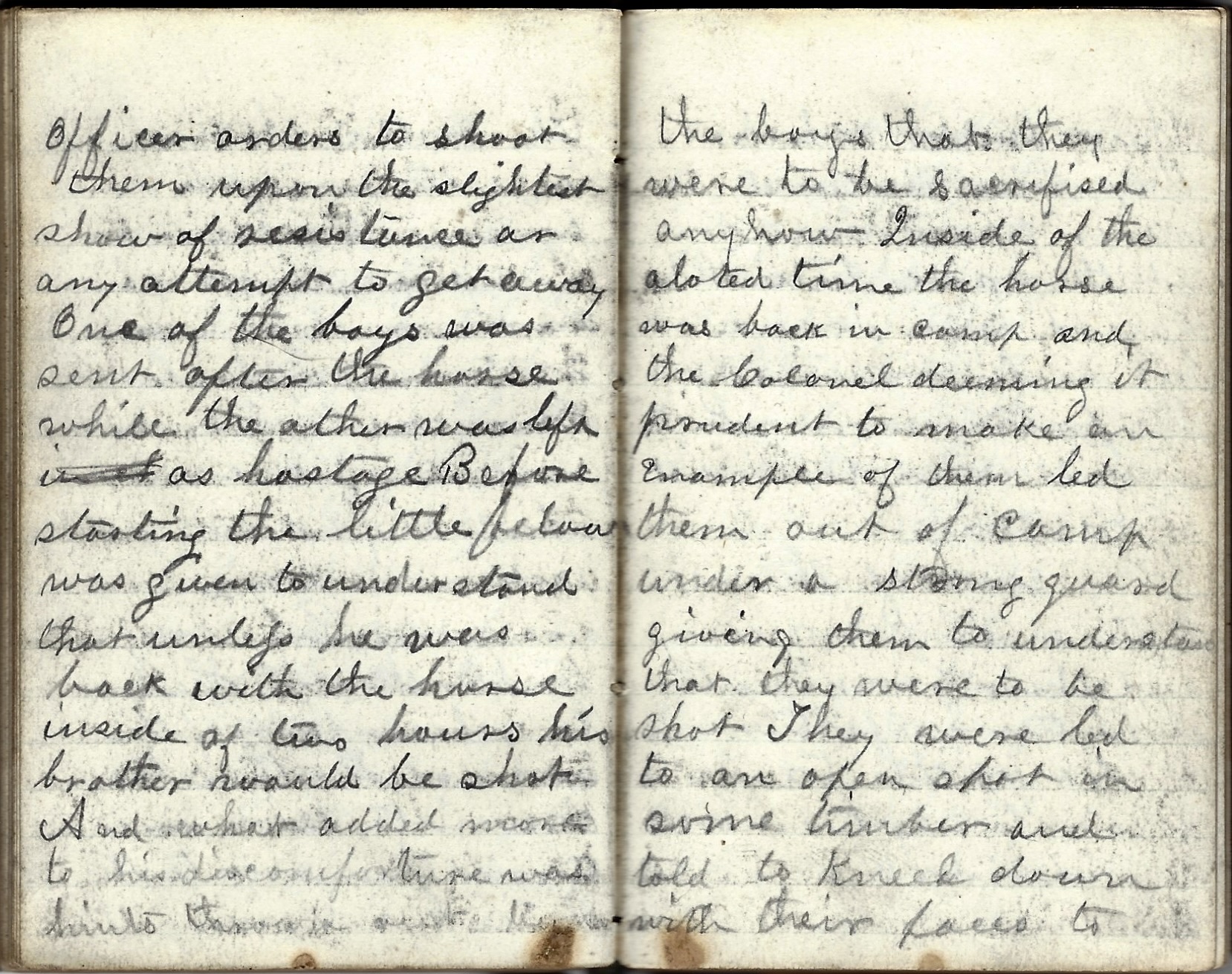


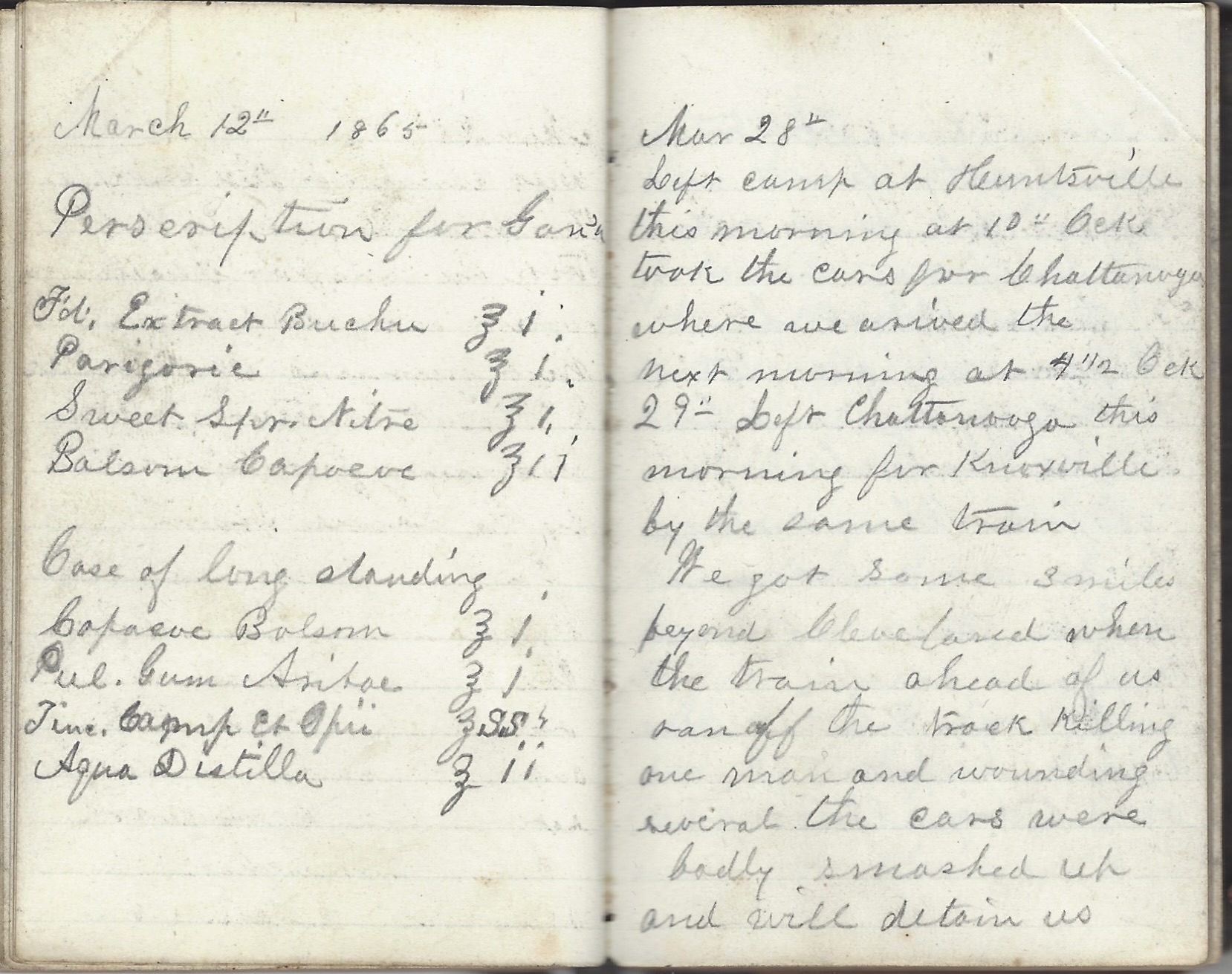
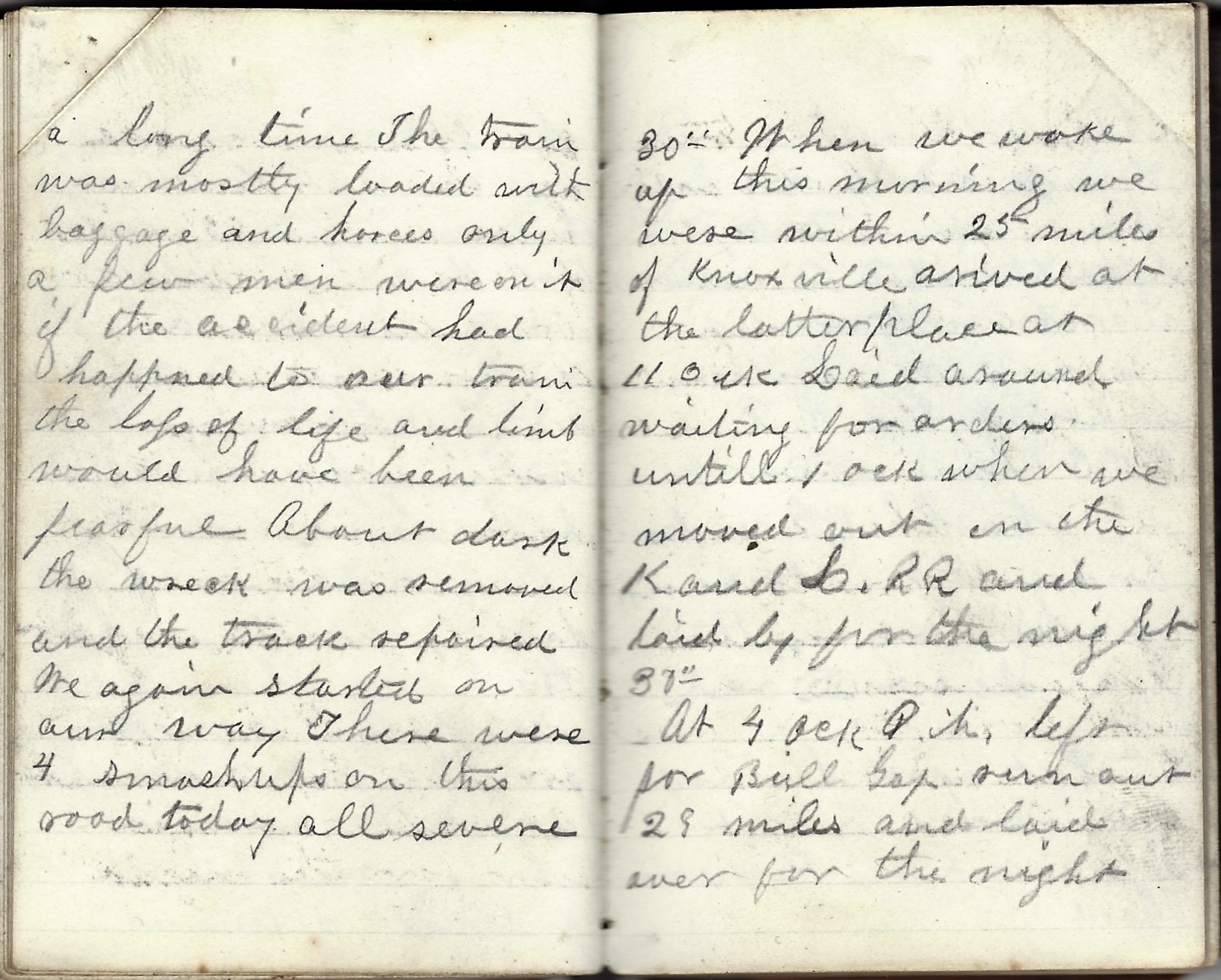
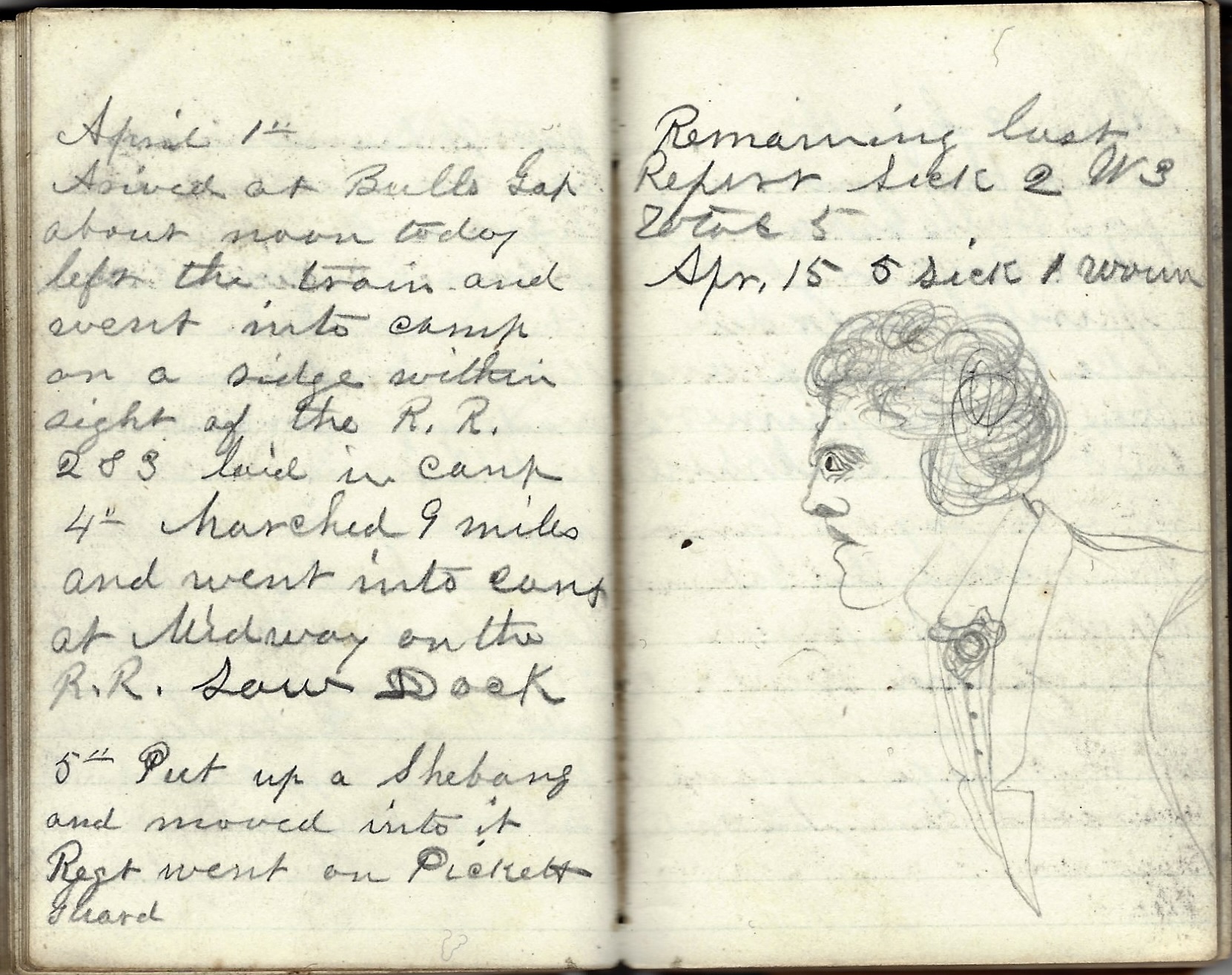
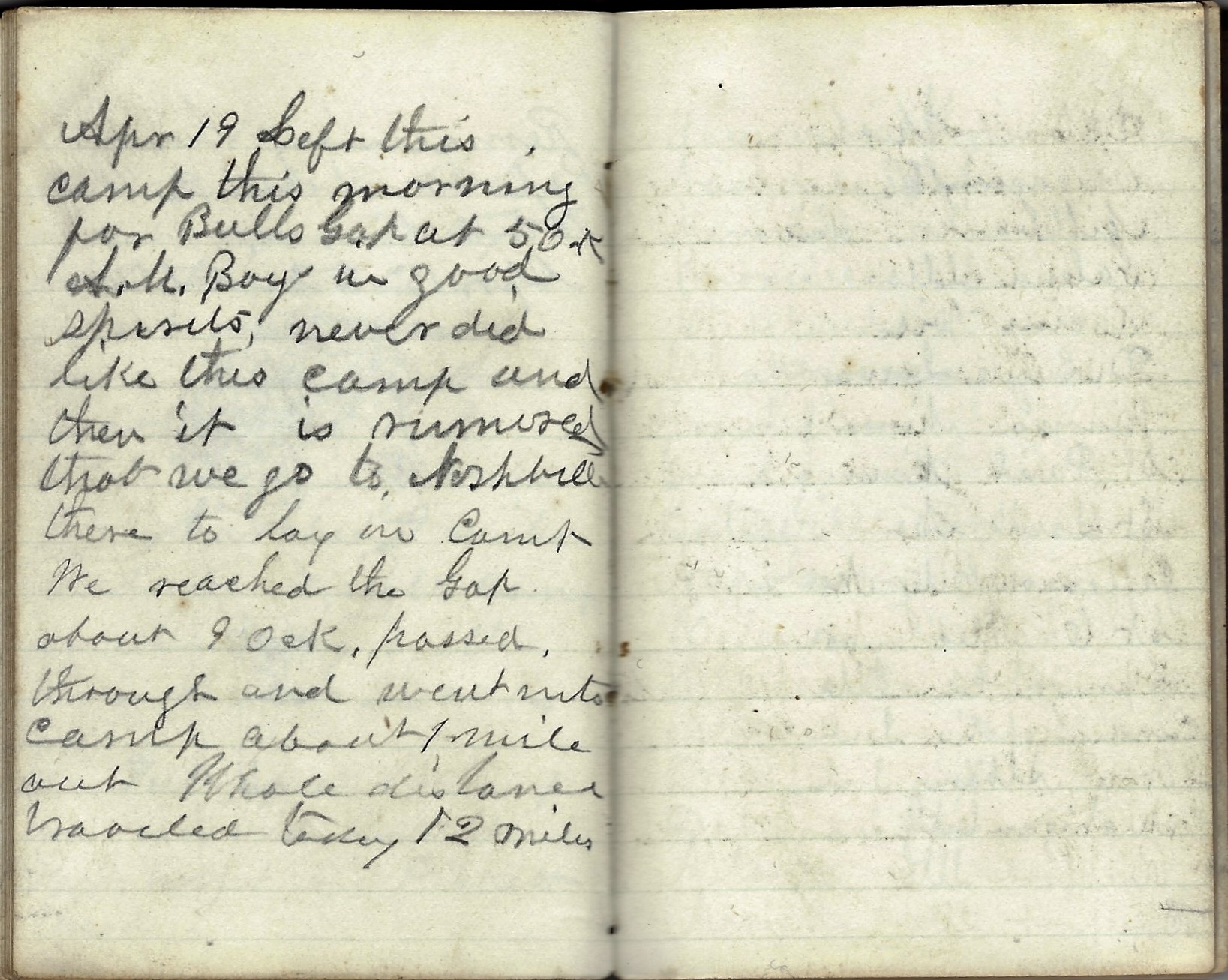

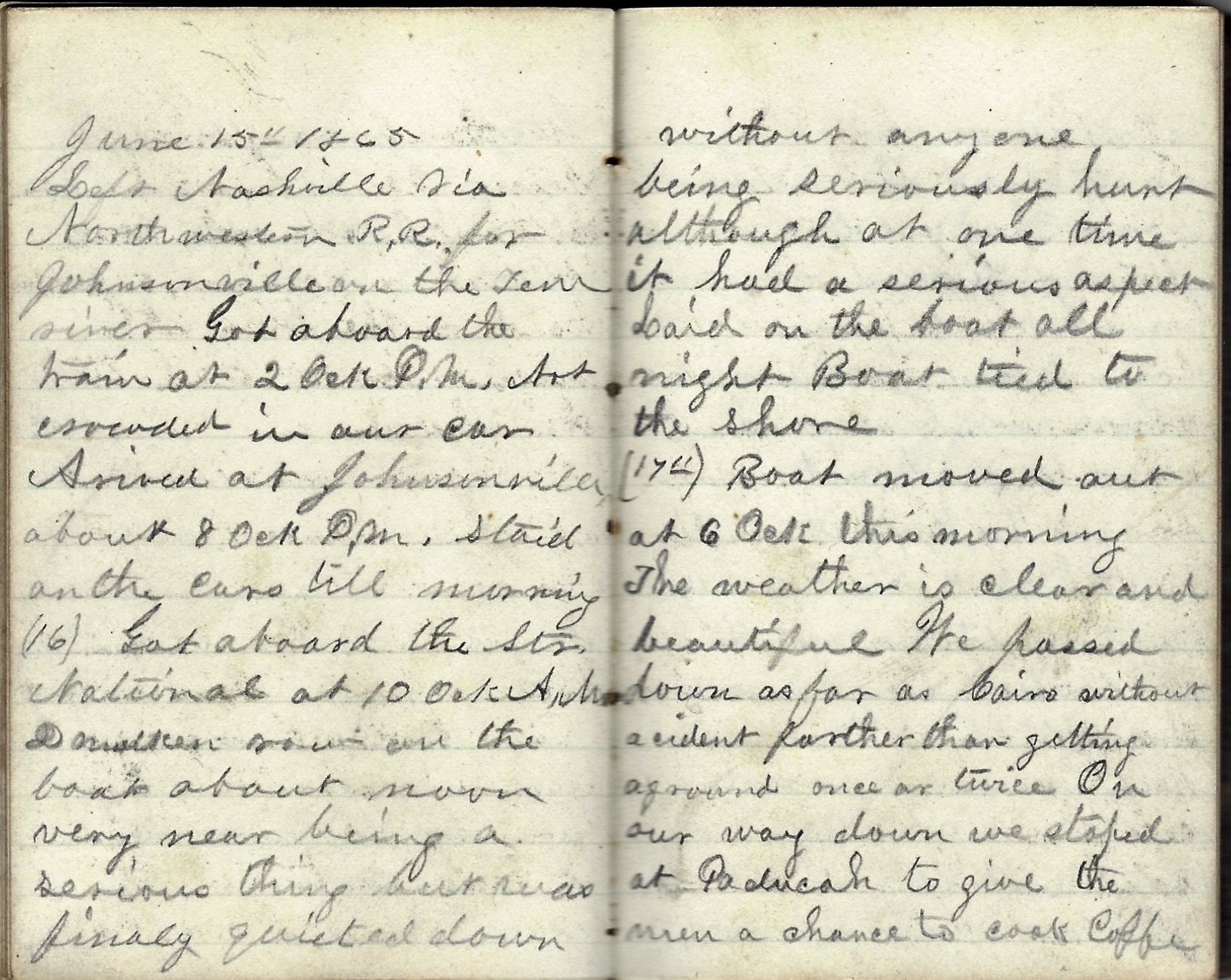


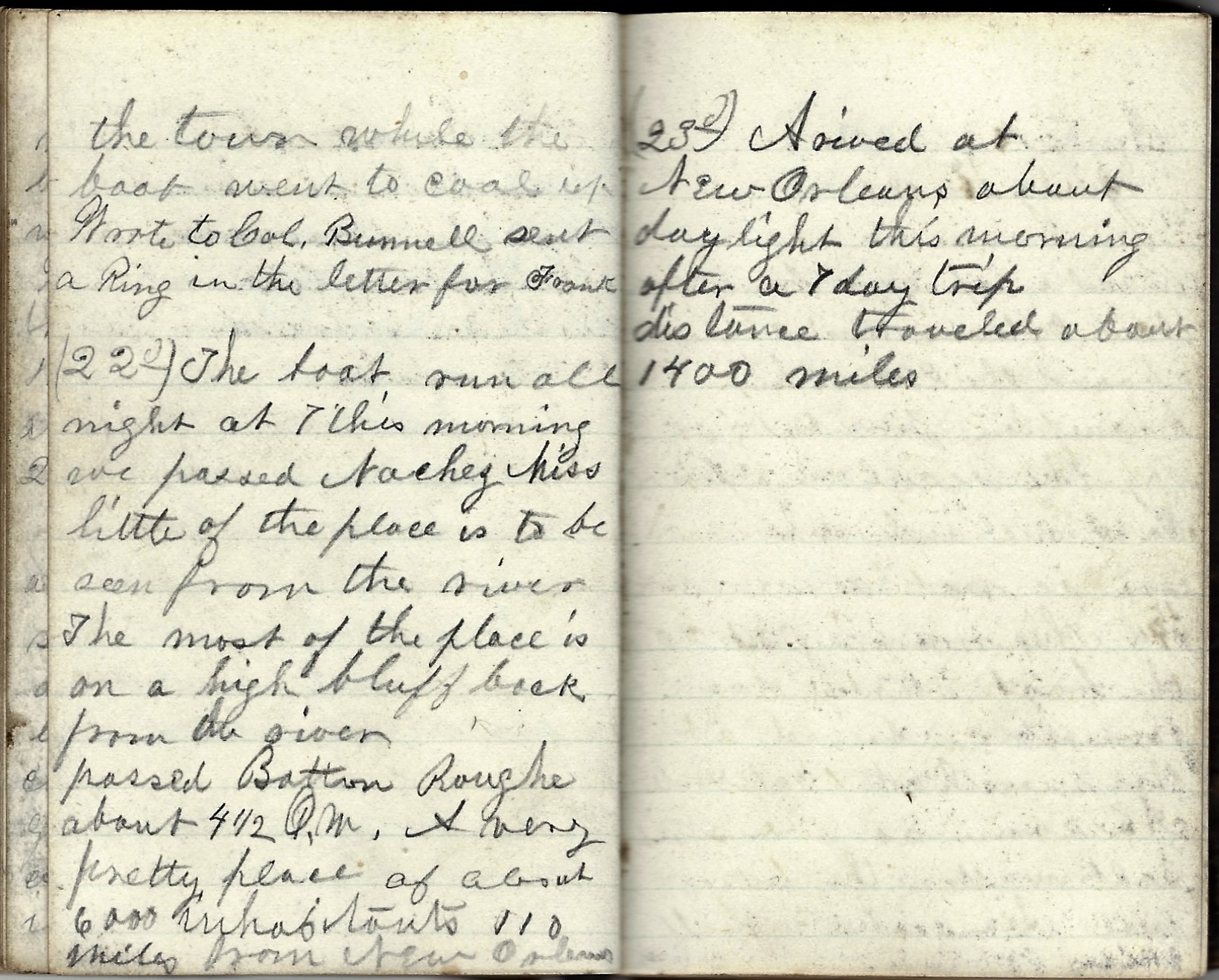


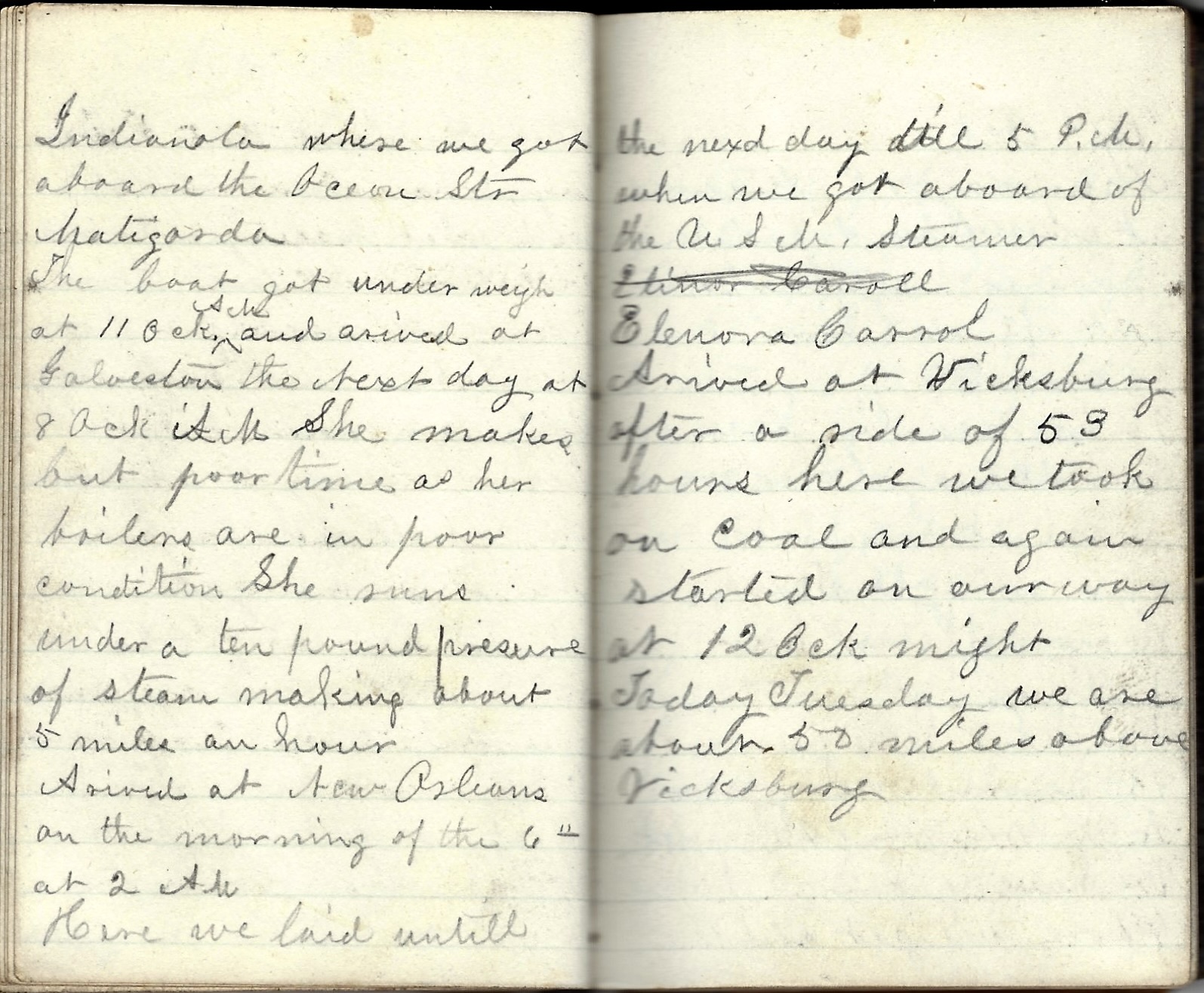
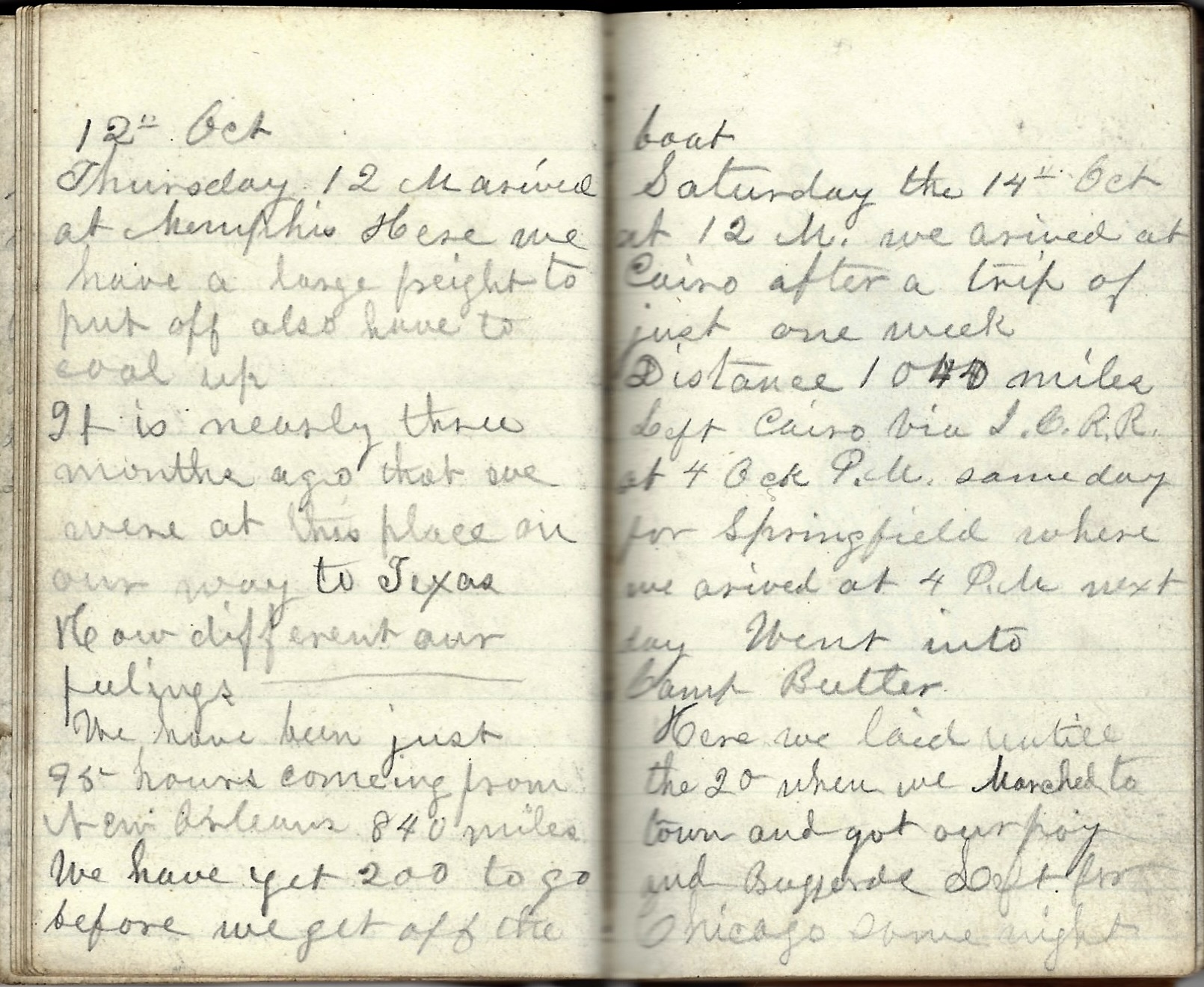
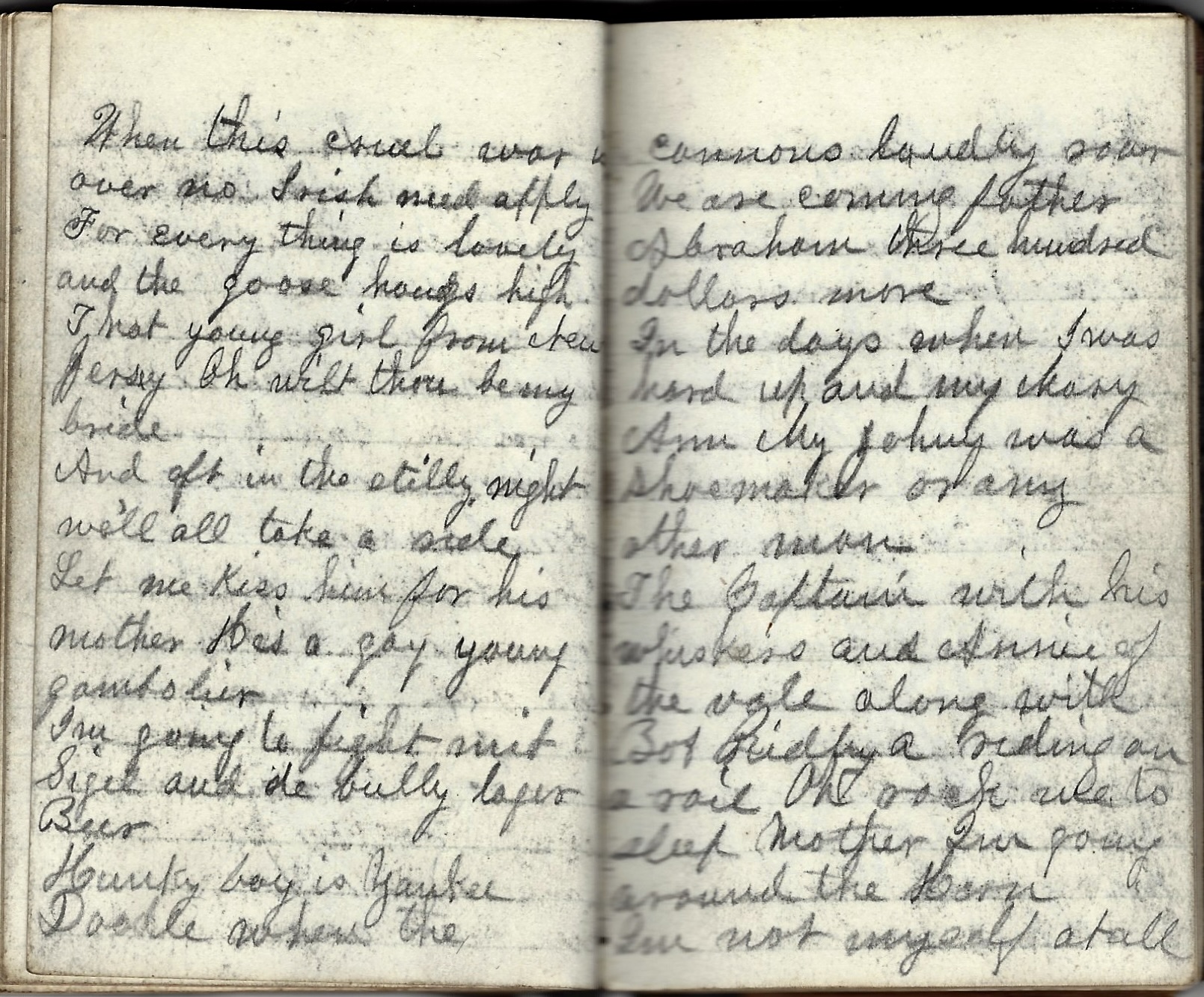
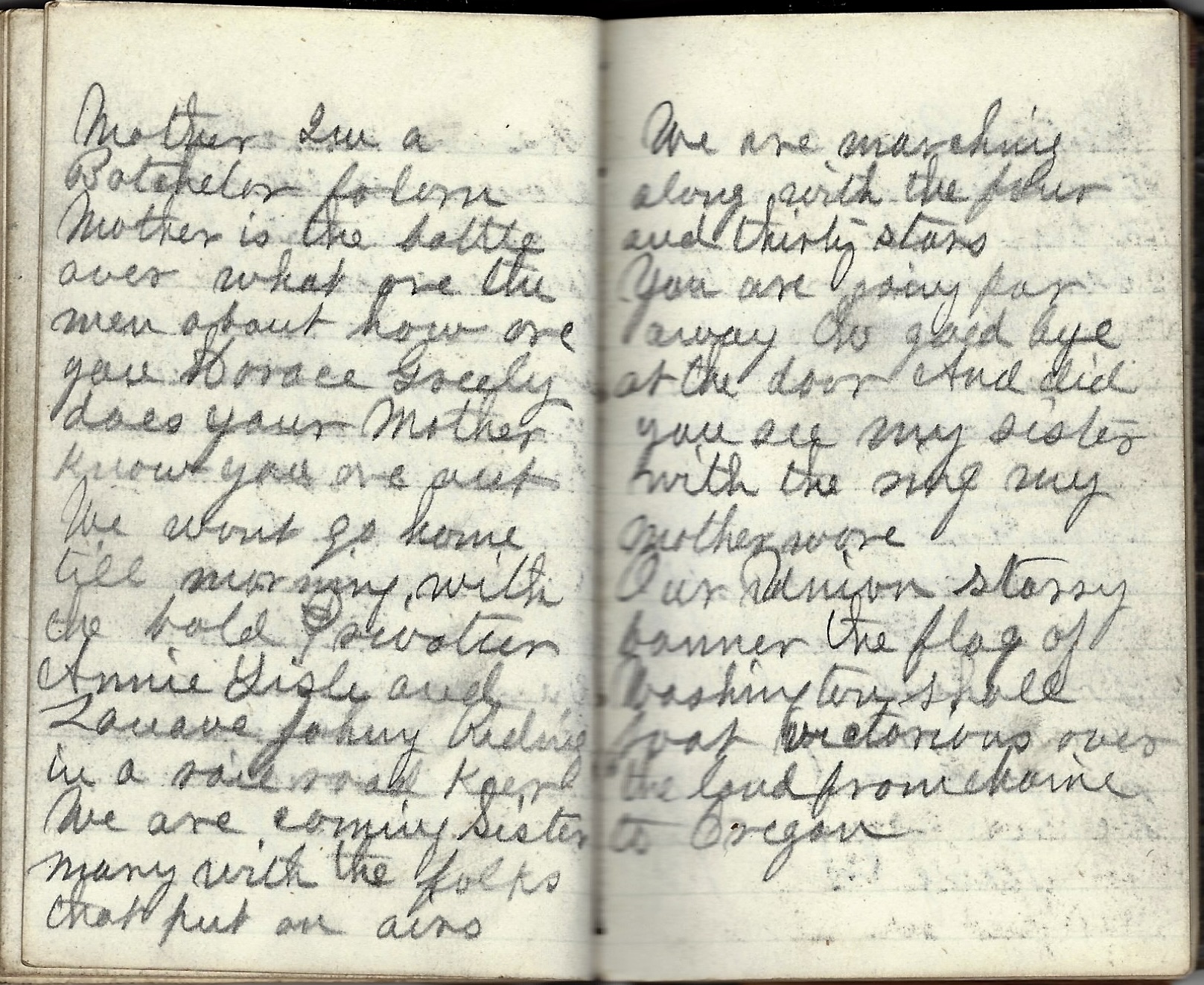


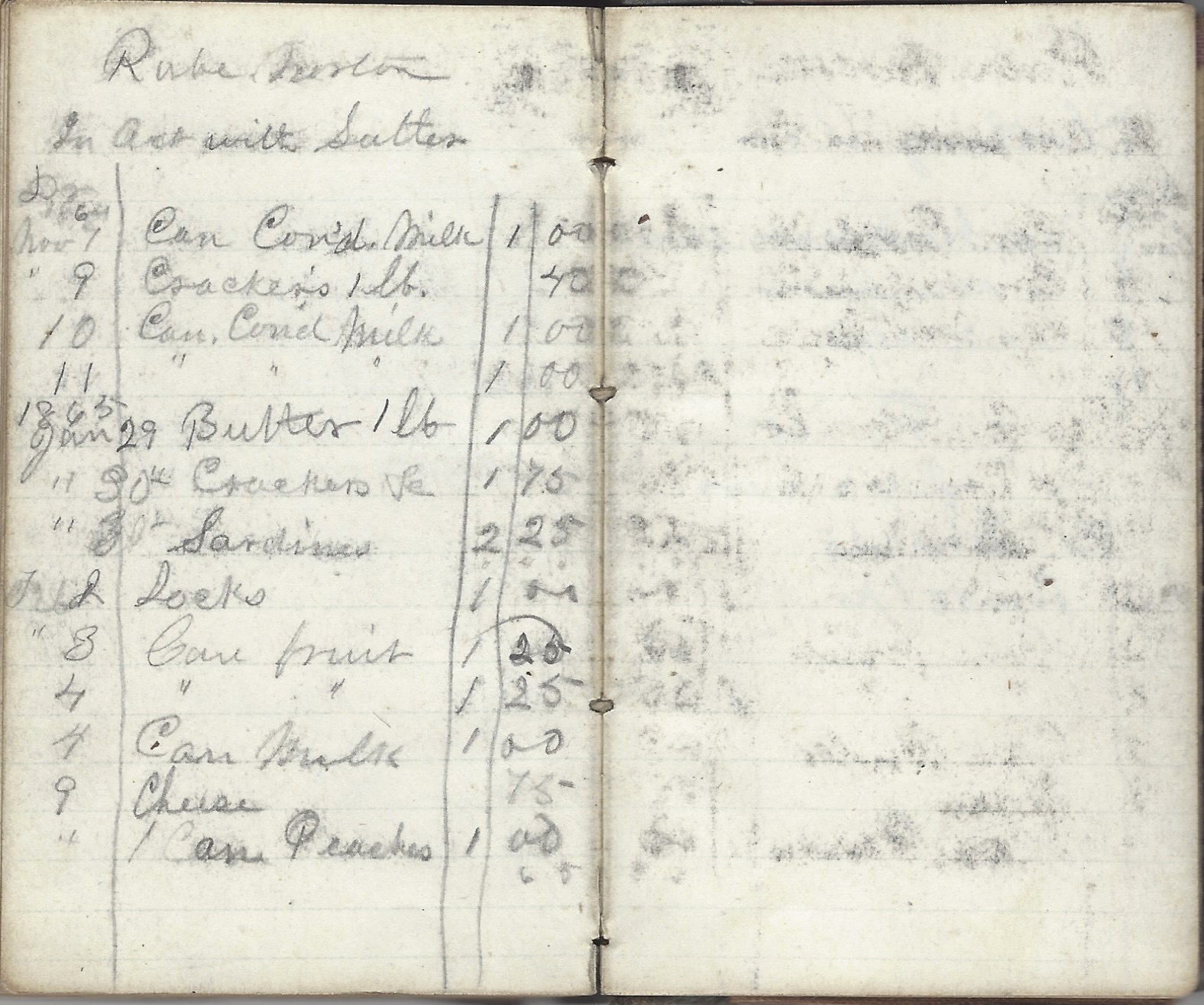
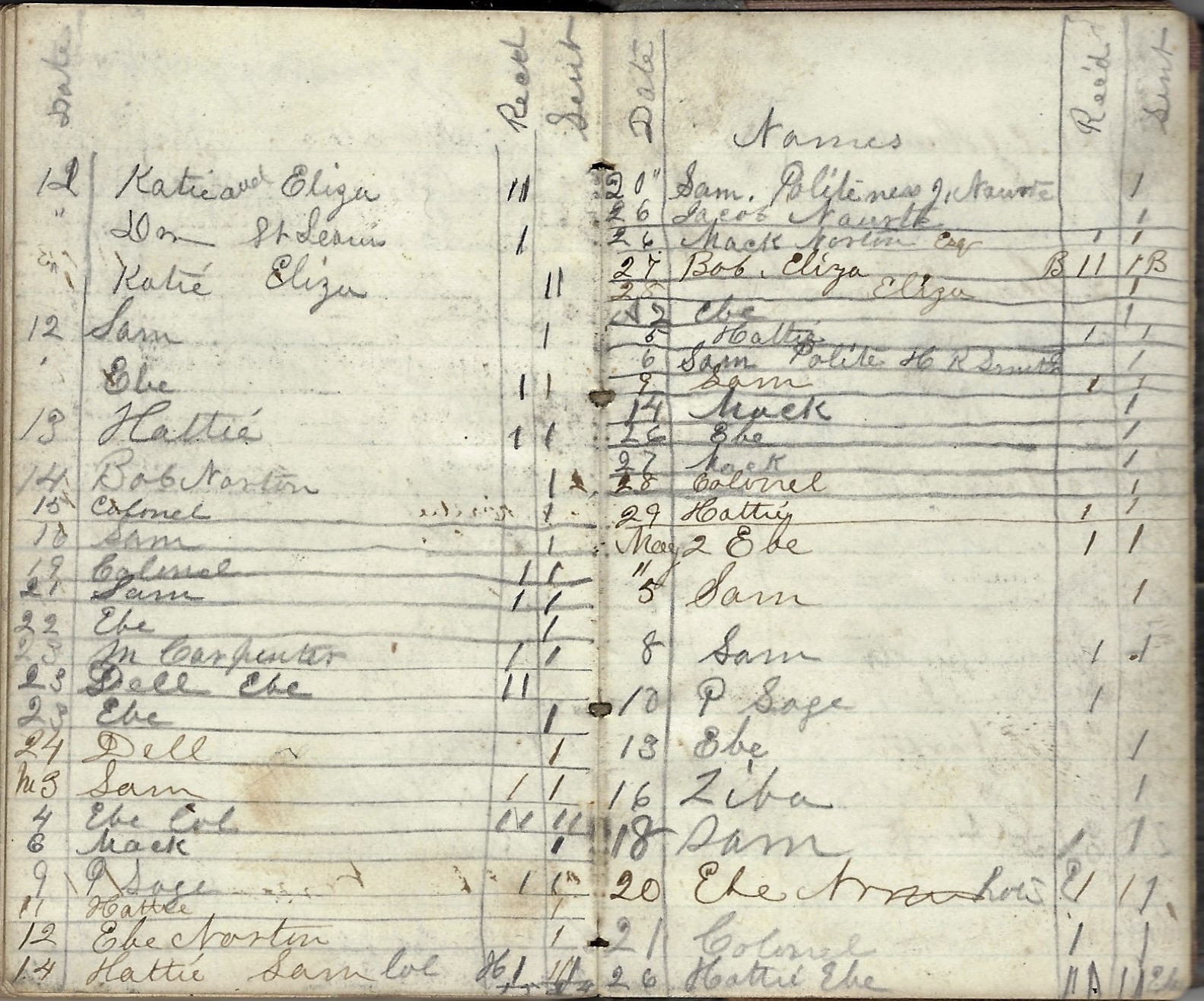

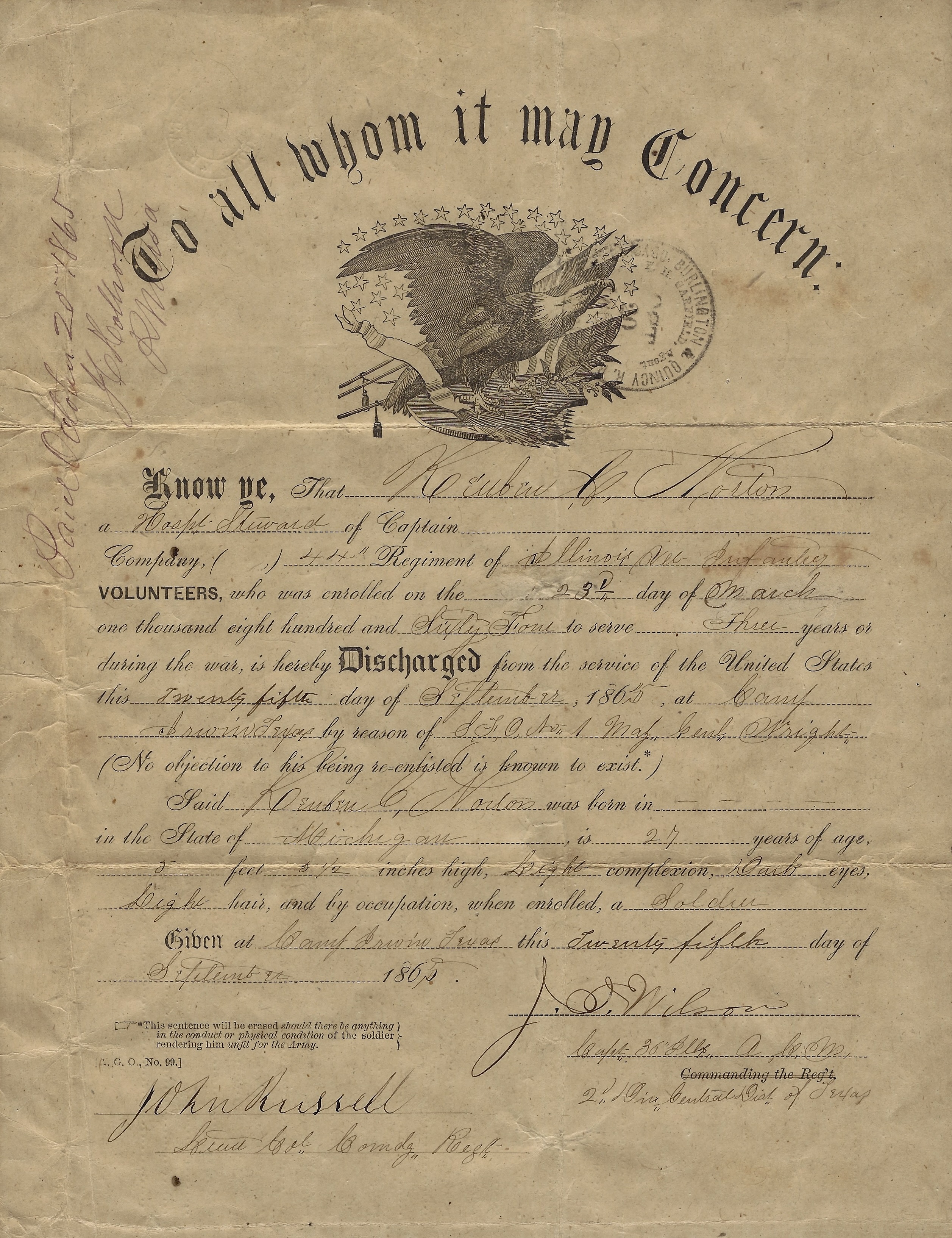




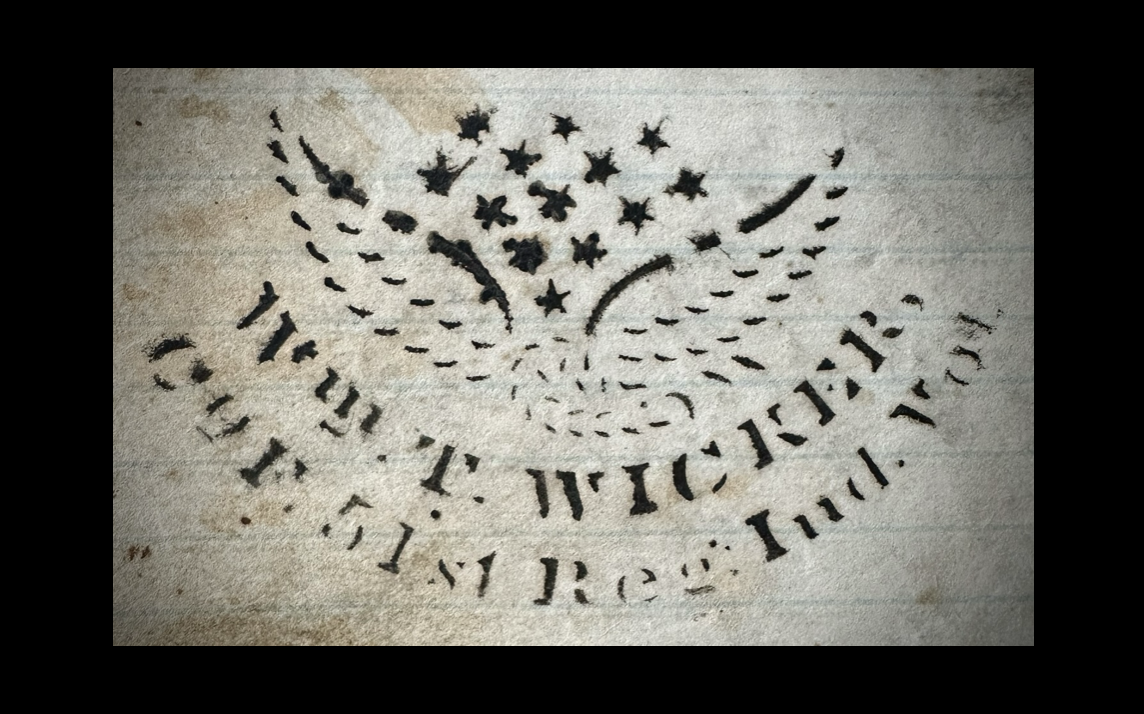


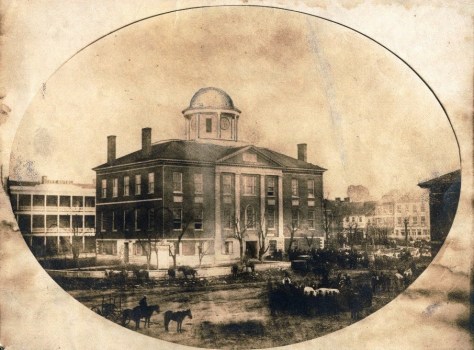
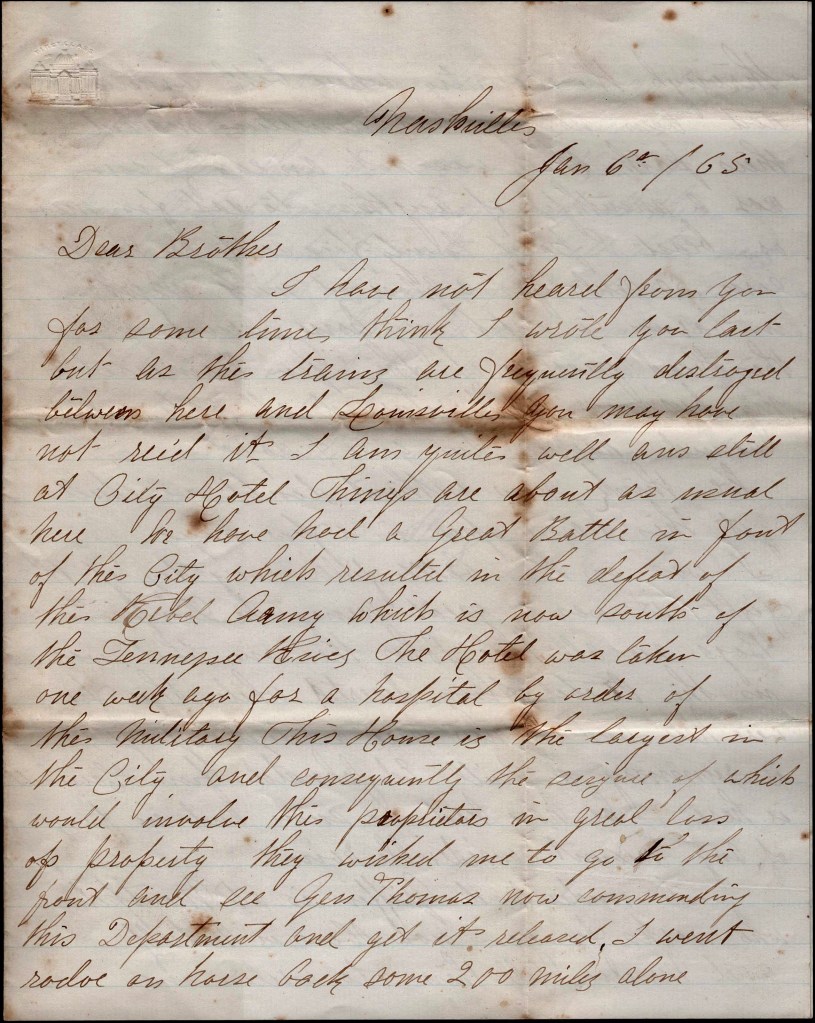
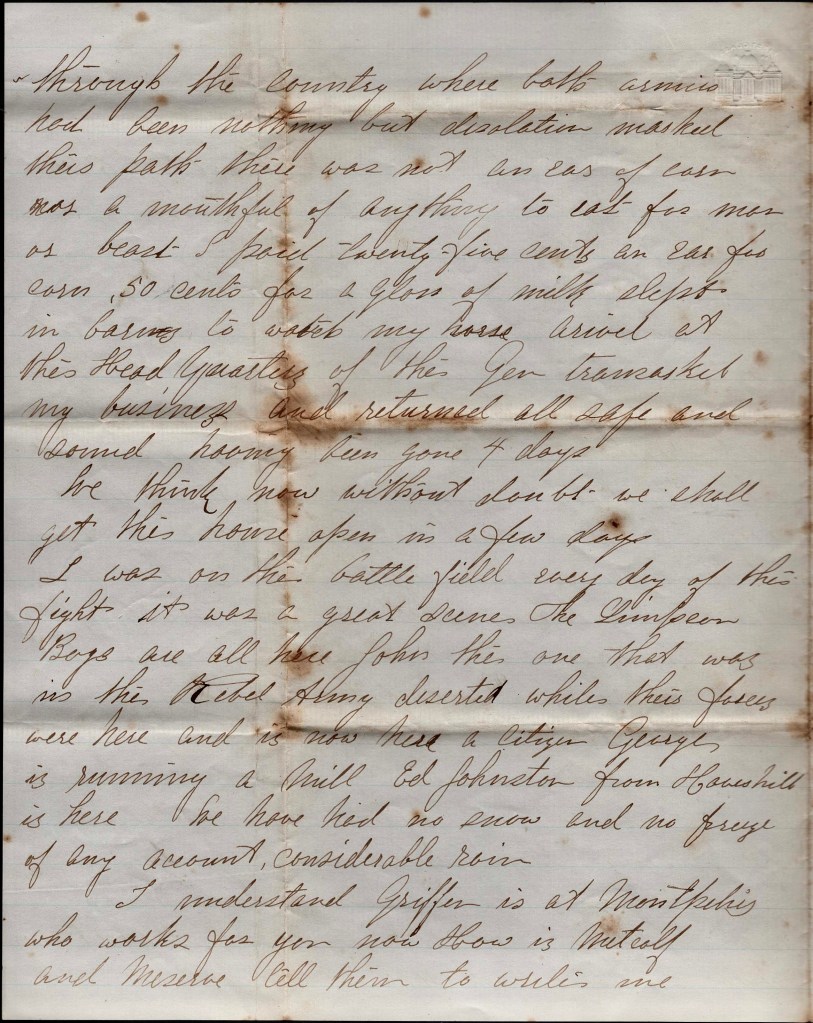


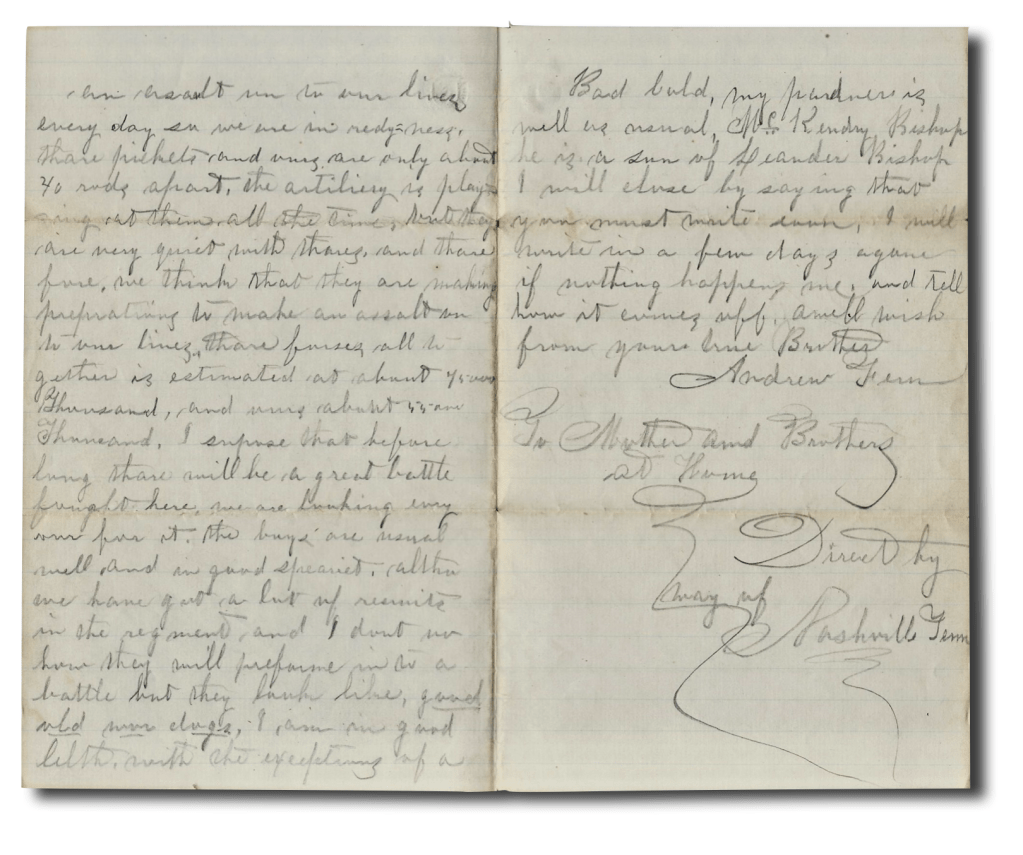

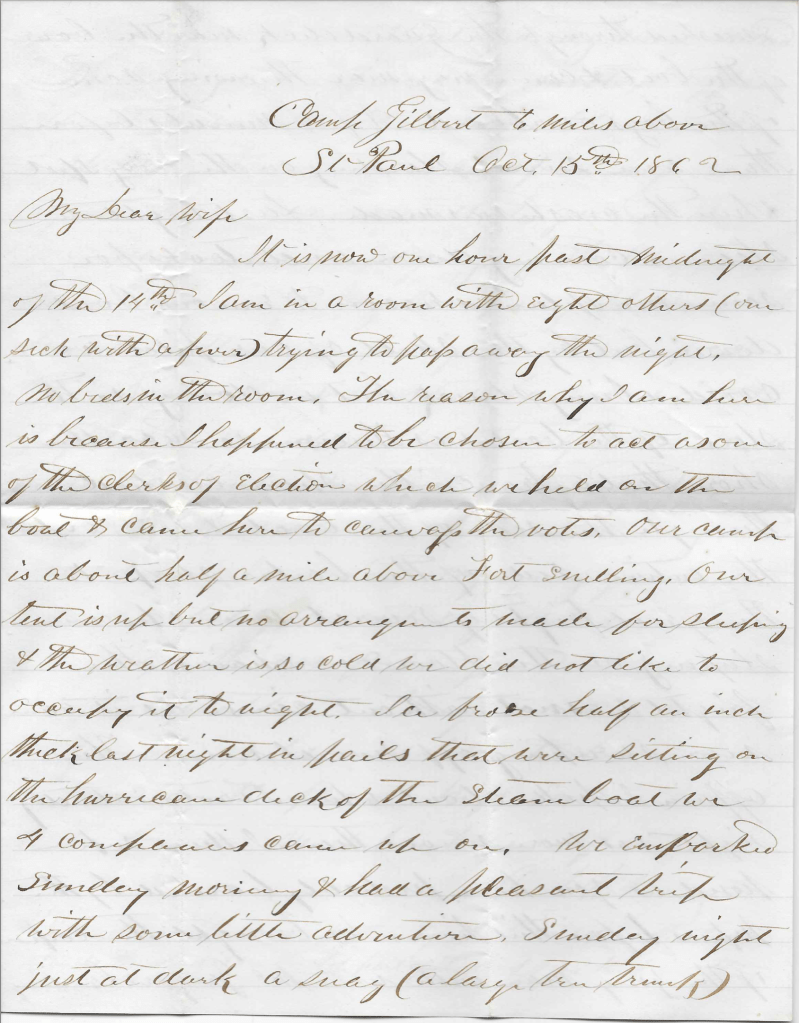

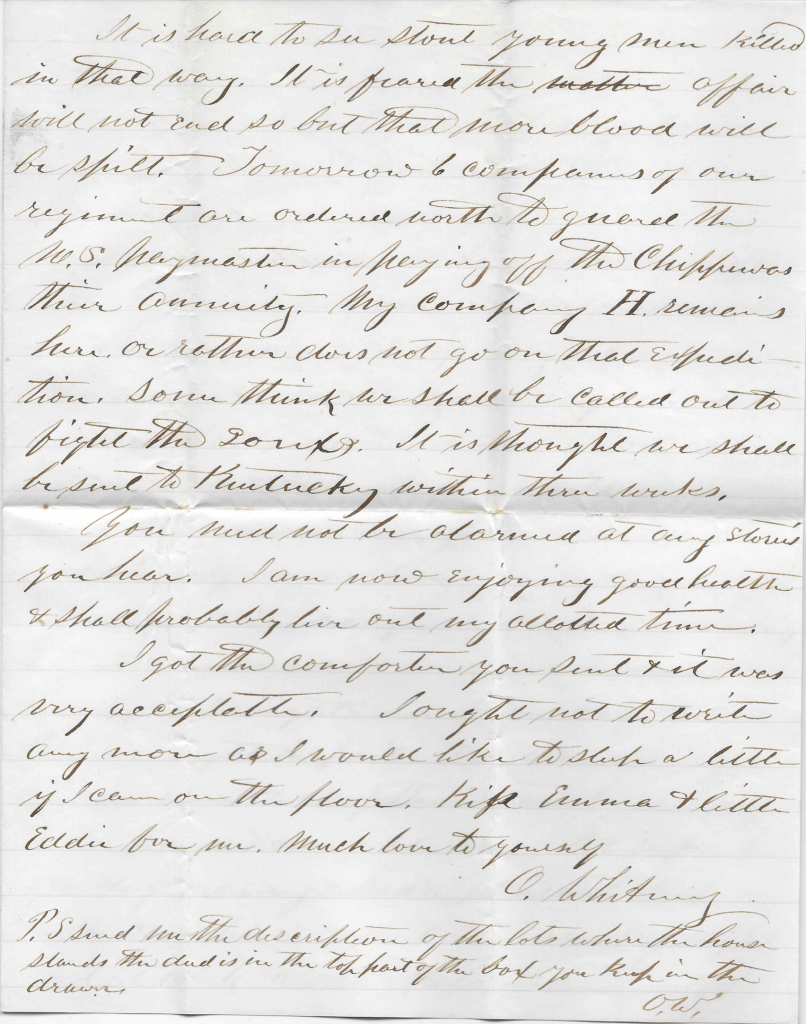
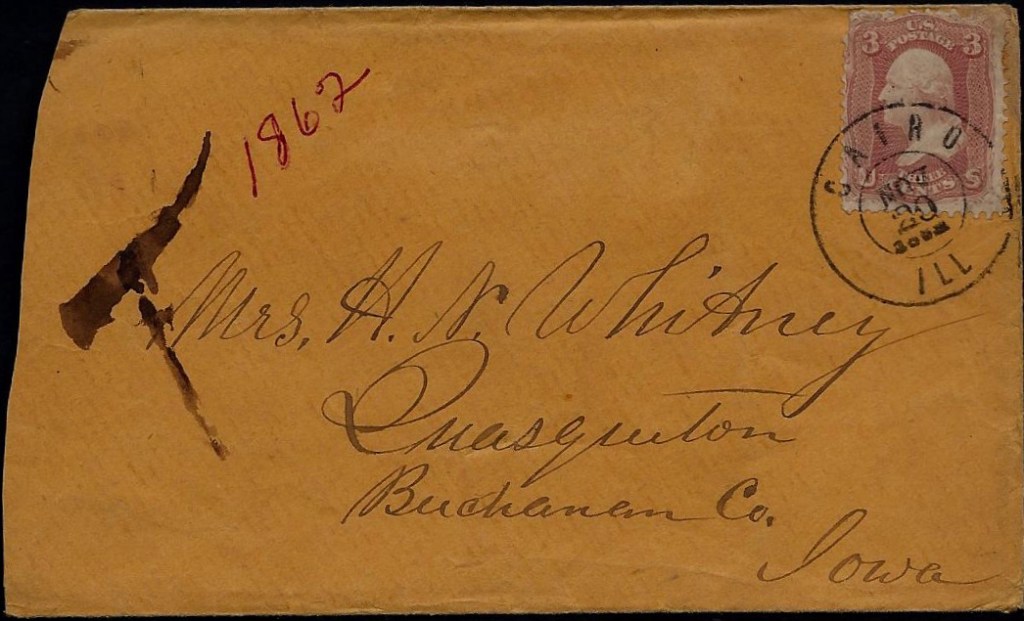

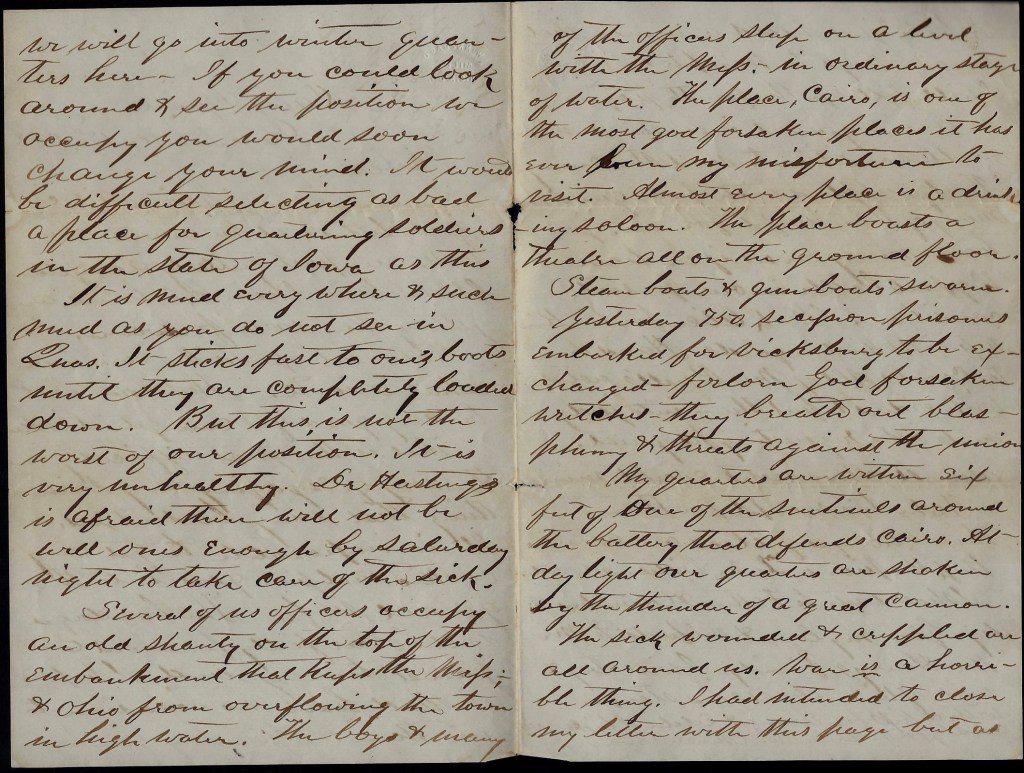
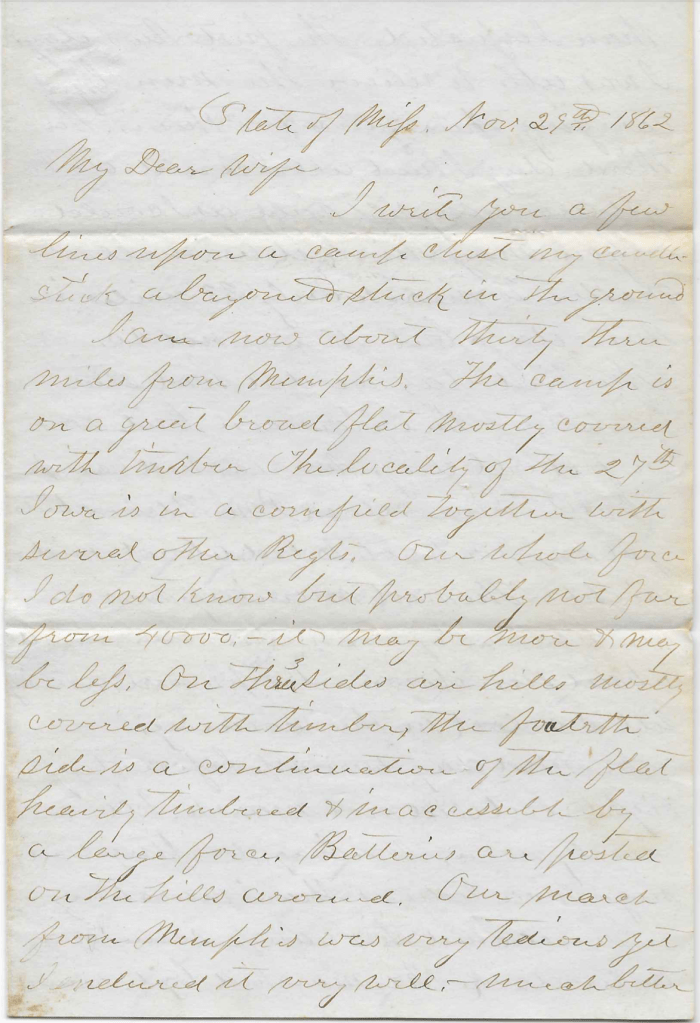
























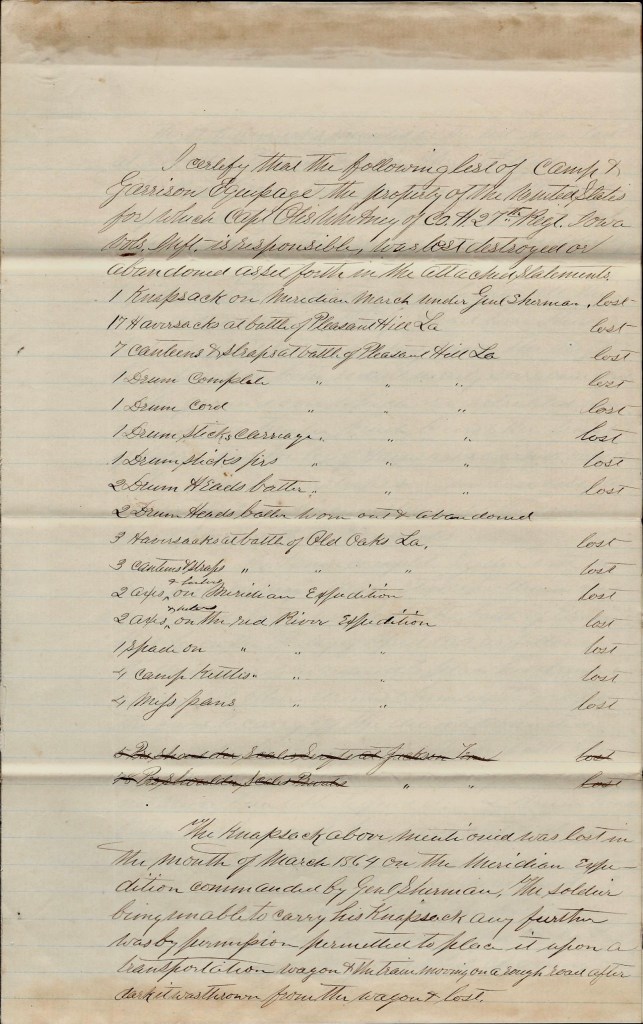
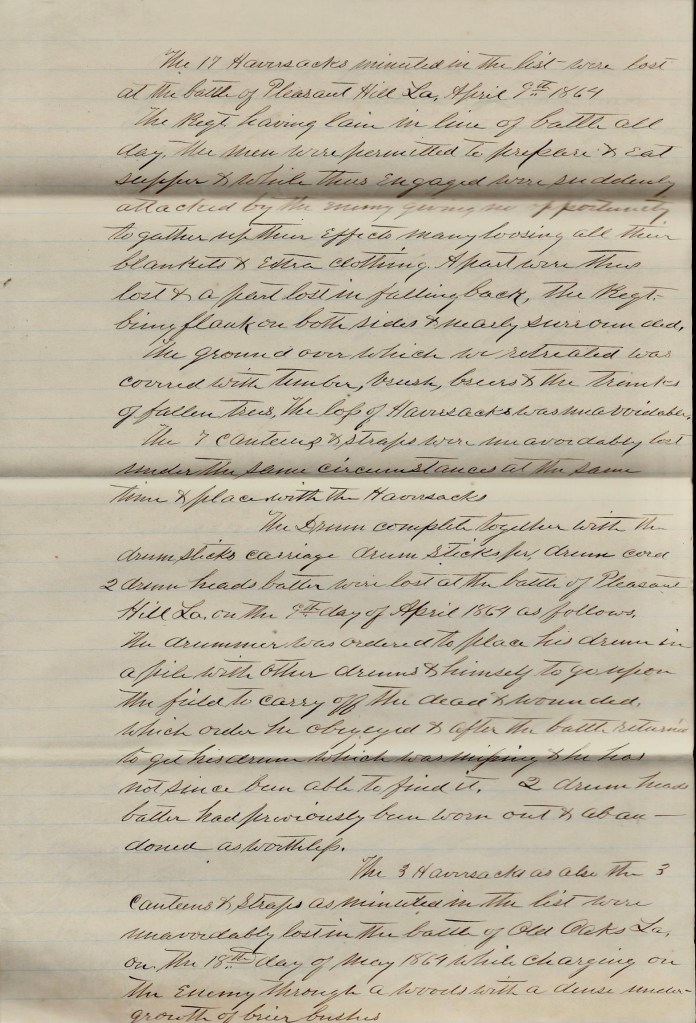


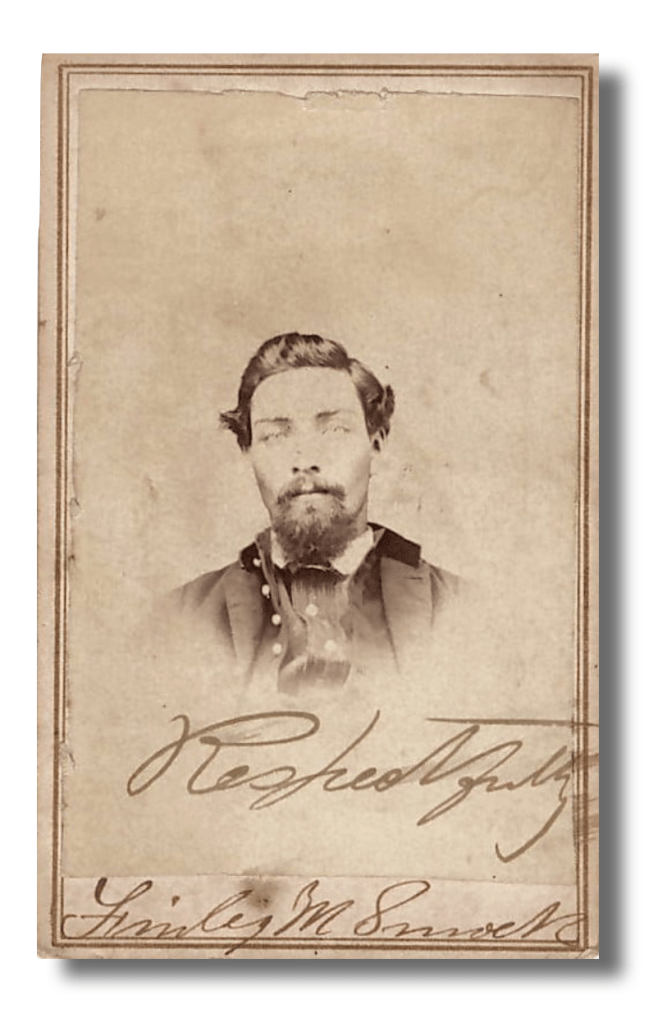


 Spared & Shared 23