The following letter was written William (“Bill”) H. Debell (1844-1864) who accepted a $70 bounty and enlisted when he was 18 as a private in Co. A, 109th New York Infantry. He was the son of Daniel W. DeBell (1810-1881)—sometimes spelled Dibble—and Phebe Ann Fairchild (1814-1910) of Danby, Tompkins county, New York. Bill was not close to his father. His father and mother separated in January 1858 leaving Phebe without property and offered no further support to his wife and the four children (including Bill) who were left in the household. In the 1850 census, the DeBell family was enumerated in Shandaken, Ulster county, New York, where Bill’s father worked as a millwright. At that time, there seven children in the family ranging in age from 1 to 16.
(courtesy Don Andrew Collection)
Company A of the 109th New York Infantry was primarily recruited from the towns of Newfield, Caroline, and Danby in Tompkins County, New York. Bill took his place in the ranks with other young men from Tompkins county, many of whom were his friends from Danby. The Regiment began its assignment during the first week of September, 1862. A few days later several companies were detached to garrison Laurel, MD (about 8 miles SE of Annapolis Junction) to guard the main railroad junctions located there. The 109th remained at this assignment but was reassigned in October 1862 to the 22nd Army Corps as railroad guards and part of the 22nd’s overall defense of the Capital at Washington, DC against the threat of Gen. Robert E. Lee’s Army of Northern Virginia’s presumed invasion. The invasion never came. Their job was tedious and boring and they saw no military action of any kind.
The 109th did its duty from September 1862, the remainder of 1862, all of 1863 and through the end of March 1864. Then in April, 1864 the 109th was ordered to join the 9th Army Corps then assembling at Annapolis, MD in preparation for action against General Lee at Petersburg, VA. The 109th Regiment became part of Hartranft’s battle-tried 1st Brigade, Wilcox’s 3rd Division, 9th Army Corps, Army of the Potomac. The 9th Corps left Annapolis on 23 April, 1864 headed for the crossing at the Rapidan arriving there on the 4th of May, 1864. The next morning, 5 May, 1864, the 109th, after crossing the Rapidan as one of the lead units, were immediately fully engaged with the enemy in the Battle of the Wilderness. Though they had been in the service 1 year, 8 months, and 9 days since they organized in the late summer of 1862 at Binghamton, New York, it was their first taste of battle.
Bill would go on to fight in eight major pitched battles with the 109th New York until he was finally cut down in the Battle of Weldon Railroad on 19 August 1864. there are seven letters presented here by Bill DeBell and two by William A. Hance, a comrade in Co. A who wrote letters to Bill’s family informing them and providing some details of Bill’s death.
These letters are from the personal collection of Don Andrew who sent them to me for transcription and publication on Spared & Shared by express consent.
Those interested in the 109th New York may find any of the following published on Spared & Shared equally good reading:
It is with mingled emotions of joy that I now write you. I am well at present and hope these few lines will find you the same. Ma, I am away down South among the rebels. We left Binghamton last Sauturday morning and arrived at this Junction on Monday noon. Our camp is situated in a nice place. It is in a ten-acre lot, all level land. We are situated in a little valley all surrounded with woods. The railroad runs right in front of our camp. There are several of the rebels around through the woods. Two of them were caught today and put in the guard house. I don’t know what they will do with them.
Monday morning, 8 o’clock a.m. Ma, you must excuse me for not finishing this before for there is so much excitement here at present that it is hard for me to get my thoughts together but I will try and finish. Our regiment is all broke up. Five of our companies is down to Washington guarding a railroad bridge and David and myself and ten others is about a mile from camp guarding a switch. We have caught several prisoners—[Union] deserters mostly. Last night we caught a rebel spy. We took him up to the guard house. I think it will be pretty hard on him. I suppose you have heard that Old [Stonewall] Jackson and forty thousand troops have crossed the Potomac. We expect they will attack us before long. This is one of their spies.
I like a soldier’s life very well so far but I would like to see home once more and tell Mary, Carrie, and Hattie that I would like to see them all very much but I cannot yet a spell. The best I can do is to send you all my love and a kiss. Give Annie my love too. I have received all of my pay and have lent David 30 of it and have kept the rest to use. He said he would pay me as son as he got his month’s pay. Did I do right, Ma? I want you to send me all of your pictures. I have got Mary’s. No more at present so goodbye from your own son, — Will H. DeBell
Direct to Annapolis Junction, Maryland Co. A, 109th Regt. N. Y. State Volunteers in care of B. R. McAllaster. Write as soon as you get this.
Letter 2
[Not transcribed. Words to Just Before the Battle, Mother.]
Letter 3
[Editor’s Note: In this 16 page letter to his mother of 17 May, 1864, Bill describes seeing the elephant for the first time.]
Spotsylvania Court House, Va. May 17th 1864
Dear Ma,
Once more I am seated to write to you although I may never get the letter finished for I am on picket within 20 rods [@ 100 yards] of the enemy and they are firing at us every moment. There are three of us on a post and we have a little breastwork thrown up before us about two feet high. I am sitting close down behind it writing on my cartridge box & every moment a bullet whistles over my head. I wrote you a letter when we was at Warrington Junction. Little did I think then that we was coming so soon to the front but we left there the day after I wrote to you and never stopped until we arrived at Wilderness Church. We was three days a marching it. We crossed the Rapidan in the afternoon & was marched about 5 miles & put on picket—
Dear Ma, just as I wrote the word picket, one of the men that was on post with me was shot through both thighs [?]. Poor fellow. I sent to the regiment and some of his company came and got him.
—and kept on all night and about 5 o’clock in the morning we fell in and was marched about 3 miles without any breakfast to the battlefield. Oh! I cannot tell my feelings when we was marched up in front of the Rebel batteries, the shell a flying. but we did not flinch and only 8 of us men was wounded, none killed.
About noon we fell in [and] marched off to the left. As we was marching by the left flank, the rebels poured a whole volley into us that confused and excited us and we fronted and fired on them and we fought there all the afternoon and only three got wounded out of our company, none killed. We made four charges and drove the enemy out of their rifle pits and captured about 5 prisoners. Our firing ceased about dark and we built breastworks and lay in them two or three days and held our position. Then one night the rebels set up a terrible hootin’ and hollerin’ and we thought they was agoing to charge on us but it was [only] to blind a movement. They moved off to our right so that night about 2 o’clock we was ordered to fall in and was marched until daylight and made a halt for breakfast after which we took up the line of march again & marched until about 4 p.m. and made a halt and drew 5 days rations.
Stayed there until 5 in the morning and marched again to this place & was double quicked up a long hill through shot and shell to the very front, formed in line, and drove the enemy back. Then we throwed up breastworks with our bayonets and plates & lay there two or three days, the enemy making several desperate attacks to break our line but did not.
On May 11th, they made their last attempt at that point and here is memoranda I kept from that time. “May 11th, 6 p.m. The enemy commenced shelling us in our rifle pits and their pickets advanced on us at the same time so we sent out 100 men out of our regiment as skirmishers and they advanced and drove them back a ways. Then our batteries opened on them and soon silenced theirs. Then we was ordered to advance out of our pits so the whole Brigade marched over and cautiously approached them. We—the 109th—had went only a short distance when we was ordered to support the 8th Michigan Regiment. We was marched by the right face, then left flank and formed in about 50 rods behind them and lay down flat. The bullets flew very thick but there was but a few wounded. One poor fellow from the 8th Michigan got his leg shot off.
Well, we lay in that position about an hour. Then we was ordered to form a junction with the breastworks we had just left, so the Brigade formed in line and marched directly southeast until we came to a piece of woods. Then we changed direction to the right and marched southwest about a mile and fronted, then lay down & watched until morning. At daylight we was ordered to build breastworks so we went at them and have them done and are waiting for the attack.
It is Friday, 13th. I left off writing the 11th while in the above named breastworks. Well, we had no attack that day. About 3 o’clock we was ordered to fall in. We did so and was marched to the rear—that is, off the field. Then it commenced raining very hard. Well, we was marched down in an open field and those that had tents put them up and those that did not had to take the rain. Well we had just got our suppers a cooking and the order came to fall in double quick. We did so and was marched back about halfway to the field and halted and we stood there in the rain and mud about an hour (Ma, could you but have known my thoughts while standing there, cold and wet. Be it ever so humble, there is no place like home!) Then the order came to about face and was marched back where we started from and camped down. Our things was all wet and it was quite cold.
Well [Daniel] Mc[Pherson] & G[eorge] Roe & me went off and got a couple of rods of rails apiece and built a large fire and we spread our rubber blankets and lay down. (We had nothing to put over us for we threw everything away in the first battle at Wilderness Church.) We all being very tired, soon fell asleep and slept sound until 2 o’clock. Then we was woke up and packed our things and marched up here where I now sit and was formed in line of battle but was held in reserve until noon. Then we was ordered to charge on a Rebel battery and we marched up in the edge of the woods andjust as we got there, they opened upon [us] with shot and shell and our men fell like grass before a scythe. But on we went, but did not get the battery. We had to fall back and when we got out of the woods, all we could count out of 400 was 150. We was cut bad, I tell you. General Burnside said it was the boldest charge that he ever saw made. He said he would remember us. We are called a brave regiment. Several other regiments broke and run but ours stood right up to the mark.
Well, after we came back, we went at it and built breastworks—(in the morning it commenced raining and rained very hard all day)—so that we could hold our position. Well we got them done and got in them, mud up to our knees, but we had to lie down and we lay there all night and are here yet and this is the 3rd day.
May 15th—Well here we are yet and still it rains and the mud. Last night the enemy’s pickets bothered us all night and it was so cold and it rained so hard that it was very uncomfortable. It is morning now and we are still in the mud and rain but there is some very encouraging news and it [illegible]…Colonel told us that we had taken 8,000 prisoners and 40 pieces of artillery and also Richmond was in our possession. I hope it is so. I just heard from our chaplain that there was two Corps down to the rear that was agoing to relieve us and I must say I hope they will for this is the tenth day we have been out to the very front of the battle. I never heard of such a thing before—keeping men out on the front so long without a relief. Our men are getting very tired and wore out (tell Sarh she would not know the 109th if she should see it now. The regiment looks when it’s all together about like a good company).
It is Sunday the 15th. We are still in the pit and we begin to think we are agoing to stay in them for all being relieved. The enemy was very quiet in our front last night, but on our left they had a heavy battle. Yesterday afternoon the Johnnies charged on one of our batteries & they opened on them with 16 pieces and cut them full as bad as they did us the 12th. The Rebel sharpshooters troubles us very much for every time one of us raises our heads or stirs around, they shoot at us too and there was two men from some other regiment got killed yesterday, the 12th, and one today. Every man that goes out has to go on his hands and knees or go half double. The officers is the main thing they are after.
May 16th. Still in the entrenchments. The sharpshooters trouble us yet but they do not advance. We sent out a heavy line of skirmishers today so as to advance our pickets. Done t without much trouble. Last night our Corps fetched us up a kettle of beef stew. It was good, I tell you, for we was all very hungry.
May 18th. There is my memoranda from the 11th to 17th. I am back in with the company. I was relieved last night about six o’clock from picket. Came here and George Roe 1 had my supper ready for me. I eat it and we spread our rubber [blankets] and lay down. Slept until morning when we was woke up for our coffee. After we drank that and eat our crackers, we was startled by the rattle of musketry on our front. We jumped to our places, sat there a spell, and found it was nothing but the pickets. But about half an hour and our batteries opened, the enemy’s replied, and they kept up all the forenoon. It has ceased now but expect every moment when they will open again but it is hopeful that they will keep still for them shells are very disagreeable—especially when they come so close that the wind of one will blow your hat off as one did me the 12th in that battle. I have always heard say it was an awful feeling to go into battle but never thought it was such a feeling as it really is. I can’t begin to tell nor explain but after you have been in a little while, you don’t mind it so much.
There is 230 killed, wounded and missing in the battle, 21 out of our company. Namely: May 6th, wounded, John Conners in the arm; Peter Swint [in the] leg, and William Smith [in the] hand. May 12th, wounded, Henry Beardsley [in the] leg. John Sumers [in the] hip, Colins Causdale [in the] hand, Alfred Earsley [in the] hand, Sturgis Williams [in the] hand, Dwight Ostrander [in the] leg, Philander Evans [in the] leg, Horace Todd [on the] arm, Charles Truesdell [in the] arm, Lewnis Purdy [in the] leg. Killed, John [G.] Nichols, Amos Barber, Henry Person, Abram Scales, George Pierson, William Lours. Missing, Harrison Little. These are all from our company.
After we fought the last battle, the Capt. Mc[Allister] was taken sick and went to Fredericksburg to the hospital. Col. [Benjamin F.] Tracy has resigned. The Lt. Colonel [Isaac S. Catlin] takes his place.
Ma, just imagine you are looking on a side hill and along the edge of a piece of woods along which you see a large ditch dug (or first say it has been raining a week very hard) with the dust all thrown out on one side making a bank high enough so that a man can stand on his feet and look over and occasionally you will see a small piece of [ ] stuck up. Well down in this pit or ditch you will see all along against the bank a row of guns with bayonets on and down in the bottom you will see men dying in all shapes in the mind. In imaging this, you will see the 109th and about the center of the pit you will see one with a small piece of board on his knee with pencil & paper writing. You may guess who it is. This paper I picked up in the battlefield. Some of the boys said that they saw David go through Chancellorsville the other day. You will, perhaps, know more about it than I would for I presume you hear from him and I don’t. I hope he has not been in this last battle for there was a large number of cavalry captured and poor Franky might have been one of them.
Ma, I will have to bring this to a close for the muskets begin to rattle and I am afraid I cannot send it at all. Goodbye. Write soon. — Will H. DeBell
Goodbye all until you hear from me again. Write soon.
1 George Roe (1831-1864) served with Bill DeBell in Co. A, 109th New York. They were both from Danby in Tompkins county, New York. Three of his letters were published on Spared & Shared in April 2025 (see 1863: George W. Roe to Sarah Adeline (McPherson) Roe.) In his letter of 9 September 1863 written from Annapolis, George mentions William DeBell as follows: “Reuben Youngs got his face severely burned this afternoon. It happened in this way. William DeBell—one of our tent mates—got a cannon cartridge while on patrol down to Savage & brought it to camp & hung it up in the tent. While he was out, Harrison [Tompkins] and Reuben thought they would come a joke on Bill so Rube took the powder & some matches & went out back to explode it. He placed a piece of paper on the powder & placed fire at the other end. He thought it was not going & so he moved the paper so that the wind would blow it towards the powder [and] at that instant, sparks blew into the powder & it exploded & burned his face quite badly. I think, however, he will get along without much trouble as it is not burned very deep.”
Letter 4
Near Petersburg, Virginia June 20, 1864
Dear Ma,
Again I am seated to write a few lines to you. Since I last wrote to you, we have [illegible due to crease in paper] marching and fighting. The night of the same day I wrote my last letter, we evacuated our position & started we knew not where. We started as soon as it was dark & marched all night and all day, stopping just long enough to make a little [illegible due to crease in paper]…all we had to eat was corn & coffee and when we got to the James River we made a half of one day & drew rations and started again just night and they marched us all night and next day until about 3 o’clock when we halted and made a little coffee.
Then we was marched through a piece of woods and formed in line (the rebs had made a stand), joining on the 2nd Corps line, and at 5 o’clock we advanced or rather charged on their works. The order came “Fix bayonets, charge double quick” made, we started with a loud yell through one of the heaviest fires I ever was in, the enemy pouring the grape and canister in us from three sides from a line of forts that was built behind their breastworks. But on we went and took them all—breastworks, forts, cannon, horses and part of the men. Well we charged and fought all night and next day and next night until about 12 o’clock when we was relieved and came to this place where I now sit. It is what we call the rear.
There are three lines of battle in our front. We are resting. When we came out of the last charge, all the guns our regiment could stack was 23. A good many straggled but all we can stack now is [ ]. We was cut up very bad. We are expecting every moment when we will have to go in again. The 6th Corps is fighting now very hard on our right. There is a line of works in our front that has got to be taken and it is the opinion of most all our division that we will have to make the charge but I hope not for I don’t like these charges.
We are in sight of Petersburg now and if we have as good luck as we have had, it will soon be ours. We have got our batteries in a good position and I think they will do good execution.
Dear me, the mail carrier has just come after the mail so I will have to close hoping and praying that war will soon close & I will be permitted to return to you again. May God save, bless and protect you all. From your affectionate son. — Will H. DeBell
There has two mails come in and I have received no letter. Write often. My love to you all.
P. S. Our batteries is now throwing shells into Petersburg. We are in sight of there. We have got the rebs in such a position so that they cannot use their batteries unless they sink them in the ground so that nothing is above ground but the muzzle.
Letter 5
On picket near Petersburg, Va. June 28, 1864
Dear Ma,
Again I am seated to write you a few lines to inform you that I am still alive and well and hope this will find you all the same. I have written two letters to you since I have received any. Our mail comes in regular every day & I can’t imagine why I don’t get them. I can’t think but what you have written but maybe I will get one tomorrow so I will wait patiently.
I came on picket night before last & have been on nearly 48 hours. I was to be relieved last night but the whole regiment came out on the picket line to stay 48 hours so I had to stay with them so that will keep me on 84 hours. I was on the advance line yesterday which is within a stones throw of the reb’s main line. They have got a very strong line. Every little ways they have a piece of artillery planted. Both armies are building and strengthening their works. Our men are preparing to siege them and I hardly think there will be much infantry fighting unless they attack our lines and that is just what we want so we don’t feel much alarmed.
The rebs have got two large forts in sight of us & our men are digging under one of them to blow it up. They are half way now and I think in the course of a week, they will lift it with powder. Our armies has got an awful strong position here. Artillery siege pieces & mortars—there is no end to them. We all expect a hard time when they commence the siege. The rebs are getting the range of us with their mortars now. Every once in a while a large fifty to a hundred pound shell will come over in our lines and burst.
In the 2nd Corps joining on our corps there is brass band playing “When this Cruel War is Over.” Oh it does sound splendid. The sun is down and it is cool & pleasant. All is quiet except the picket firing. Oh, if it was only in time of peace and I was sitting in the door of our house, just had my supper, and all the work done, oh how we could enjoy ourselves. Oh, then if I could hear a band play, I could enjoy it. But here it sounds so lonely and brings afresh all the ties of home. Sometimes when I am sitting all alone and get to thinking of my loves ones at home, then the thought of where I am comes back again. Well I won’t try to tell the feeling that comes over me for a few moments. Then after that, it will be three or four days, perhaps a week, before I think of it again. But enough of this.
I expect we will have a lively time tonight with the mortars from both sides for our men has got ever so many of them (mortars) planted and I think they will open them as soon as it is dark & it is so near that now I will have to stop writing until tomorrow. So good night.
Wednesday, June 29th & 4 p.m. Again I am seated. I have just had a good nap and finished a part of a can of beans that I had left from my dinner and I feel some better. It was not as I expected last night—about the shelling. All was quiet except the pickets. The Rebs kept up a steady fire all night which made it very disagreeable for their bullets come fairly closae—especially to where I lay. I have got a little post about ten feet from the company all alone by myself. It would be very pleasant if it was not for them (the bullets). It is a little hole dug in the ground about two feet deep and long enough to lie down in with the dirt all thrown upon one side for a breastwork. Then up on the top of that, I have a heavy log laid with holes under to look through. Then I have my piece of tent & rubber blanket put together for a shelter or shade and my wool blanket under me.
Our regiment grows smaller and smaller as the time passes on. Most every day, one or more of our men is killed. Last Saturday a man in our company by the name og John Cortright [of Owego] was killed and one in Co. K day before yesterday by the name of Edward [Edwin] Wilber [of Owego] and another wounded. I did not hear his name. And today one of Co. F was shot through the right eye and was killed instantly. Take our sick and all together our regiment won’t number over 400 and when we came in the field, it was 1015 strong so you can see that we have been cut up pretty bad.
Our men has just sent mortars and the rebs is replying but the shells from both sides goes over us. Well Ma, it is getting late and I will have to close for we are to be relieved as soon as it is dark and I will have to get my supper and pack up my things. I wish you all could take supper with me tonight. I am going to have fried pork, fried hard tack, ad coffee. But I think I had rather take supper with you but I hope you will eat just as though I was there & I will try and eat just as though you was here. Do all of you write to me often. I bid you all an affectionate goodbye until you hear from me again. I remain your affectionate son, — Will H. DeBell
Washington D. C. Co. A, 109th N. Y. S. V. 1st Brigade, 3rd Division, 9th Army Corps
P. S. I give my love to all the girls and tell them to write. It is quite lonesome here in the company for me now for all of my old tent mates is away. George is sick, off to the hospital. Also [William] H. Forsyth and D[aniel] McPherson is Co. cook. He only comes to the company once in a while.
Letter 6
Still on the Front Line near Petersburg, Va. July 3rd 1864
Dear Ma,
Again I am seated to write to you. I received your long looked for letter yesterday and was very glad to hear from you and hear you was well. I am well and doing as well as can be expected. It is all quiet in our front but on the right and left, there is some fighting every day. But perhaps you hear of the news as quick or quicker than we do. I hear it rumored that the siege is to commence tomorrow but we can’t tell much about it. I hardly know how to commence or finish this unless I commence back and give you the details of my diary from the time we left Cold Harbor.
Sunday, June 12th. Still on duty as supporting picket of the fort. There is great excitement today and it is said the 9th Corps evacuates their position.
13th—As I expected, last night as soon as darkness covered our movements, moved out in a southern direction. Marched all night.
14th—Today crossed the Chickahominy and at night found ourselves near the James River where we encamped for the night.
15th—Today are lying where we camped last night, resting out. D[aniel] H. McPherson and me have just been down to the river bathing. Swam to the island, Then drew 4 days rations—coffee, pork, hard tack.
16th—Last night was routed out just dark, crossed the [James] River on pontoons, traveled all night and all day today—a forced march. Have reached the rebs’ works near Petersburg & formed in line of battle.
Friday, 17th—It will never be forgotten by the 9th A. C. Fought all day and charged on the Rebs four times and lost nearly all the remainder of the regiment. After the fight, we had only 37 men to stack arms.
18th—Still fighting and gradually gaining ground although it costs heavy and blood and life. Petersburg is plain to be seen from the parts we took from the Johnnies.
19th—Have been lying in the woods facing the enemy. No fighting in our corps today except the pickets.
20th—Last night charged across the railroad and took the heights beyond but again fell back into the woods where we now are.
21st—Today have had general inspection and every regiment in our Brigade has orders to be ready to move at a moment’s notice.
22nd—Moved some distance to the right last night but still on the same line of works.
23rd—We are still holding our position. I was on picket yesterday and was relieved last night. All quiet along the lines. Under marching orders.
24th—Last night were relieved by the 10th Corps and moved some distance to the left. We are next to the front line and are supported by our Colored Division.
25th—Started constructing a new line of works or rather pits. The enemy’s sharpshooters annoy us incessantly.
26th—This morning a man in our company by the name of John Cortright 1 was shot on picket line and died in two hours. I helped carry him off the picket line.
27th—Today our Colored Division has been busy filling bags with sand. They are to be used for breastworks.
1 John Cortright (1816-1864) was a 40 year-old farmer from Owego, Tioga county, New York, when he enlisted in December 1863 in Co. A, 109th New York Infantry.
Letter 7
Near Petersburg, Virginia August 10th 1864
Dear Sister,
I am seated in a bomb proof to write you a few lines as it is raining and it is very lonesome here on the picket line. We came here last Saturday night and expect to stay until next Saturday night. We are all in great fear here on the line for the rebs is undermining us as we did them. Our men are countermining as fast as they can but the rebs has several days the start of us and we are all afraid they will blow us up before we can stop them. But we have got stay and run our chances the same as in battle.
I presume you have read in the papers before this time about the undermining of the reb fort. Well our regiment was on the picket line at the time it was hoisted (the same line we are on now). Well the night before is was hoisted, as I said before, about 5 o’clock in the afternoon, we had orders to be ready to move at a moments notice and we supposed we was agoing to be relieved for we had been on the line 15 days. Well we got ready and sat around until dark and the expected relief did not come. Some of the boys fell asleep and some sat talking and wondering why the relief did not come. I was numbered with the sleepers.
Well, about 11 o’clock p.m., I was woke up and ordered to report to Headquarters. I did so and found a squad there and we was sent to Brigade Headquarters after spades and picks. Well then I began to smell the rat (I knew that the fort was all ready to blow up.) Well, we got them (the spades & picks), came back, and distributed them among the companies. Then I lay down and soon fell asleep with my things all on and when I awoke, it was 3 a.m. and there was a line of men formed in our rear in the same pits and we all thought sure they was the long wished for relief. But not so.
The explosion that created the Crater. From a contemporary sketch by Alfred Waud entitled “Before Petersburg at sunrise, July 30th 1864”
We had just got in line when to our astonishment we felt the ground rise up under our feet but we looked over the works and —– oh —— the awfullest sight that ever man beheld was there to be seen. Men’s heads, legs, arms, hands and whole bodies, artillery rails, mortars flying in the air. I took but one look and turned my head. But to see a sight which made another chill run through me, I saw a heavy line of battle moving forward. Then I knew for certain that we had to charge. On they came over our works. They went with a terrible yell (as soon as they got over our works in the line of battle, all the artillery along our line opened) and into the heap of ruins they went. And they had just got there when the rebs recovered from their panic and they opened all along their line.
Then the order [came] to our ears, “Forward 109th!” I looked in the direction the order came from and saw Col. [Isaac] Catlin 1 up on the breastworks swinging his sword, crying out, “Forward Boys!” and over we went. Well, I have been in several battles and I never was under such a heavy fire before. Well, a great many never reached the fort and oh! another such a sight. Men cut in all sorts of pieces and twisted in all shapes, some with their heads sticking out of the dirt, some with a hand and arm out, some with their legs out. It was awful. But we went to work and made good use of the “shubels & picks” in rescuing some of the rebs from being buried alive. Well, we got out several and took a number of others prisoners. Then we rallied on the next line and stood and fought about three hours, the rebs making several desperate charges to retake the line.
Then on came our colored troops with a rush and we thought sure we could walk right into Petersburg and we could [have] had the black buggers stood up to their work, but they was cowards and run and thus we lost our hold. As soon as they run, the General gave orders to retreat. Well, all went back or I say all. They all started back (but a great many never got there) but about 8 hundred, and six of them was our company, myself included. Well we stood there and fought and tried to hold the works but we could not see that very plain for we could see the rebs massing their forces and we knew we would have to all be taken prisoners or run the risk of getting shot in going back to our line. The rebs had a cross fire from both sides on us when we went across there.
Well, we six made up our minds to be taken and we sat down waiting for them to come when I happened to think about the niggers and about Fort Pillow [where] no quarter was shown them there nor their officers and I thought perhaps it would be the same here. So I spoke to the boys about it and they said we must run across the field to our works. Run for life, [indeed]. Well I was to take the lead. I raised up and saw the rebs had started. Then there was no time to be lost so over the lot of the fort I went and dropped down between two dead men and looked across the field towards our line. I could see it plain—about 40 rods [over 200 yards] distance. Two men started from just ahead of me and was shot before they reached the works. Then I was most discouraged but something told me I could reach them in safety. I raised up and looked around me again and could hear the enemy coming and saw some photographs, some of which I sent in my last letter to Ma lying on the ground near me. I picked them up and took one more look across the field and started and thank God, I reached our lines in safety and although I had several close calls, I was not hurt. When I was about halfway across the field, running as fast as I could, a ball came and cut my cup off of my haversack. That was the same as a blow of a whip on a horse. It made me go a little faster.
But I am alright and am sitting here in what we call a bum [bomb] proof to protect us from shells. It is a whole dug in the ground and heavy timbers over and dirt on them, some like a potato hole. Just think you see me sitting on a knapsack writing on a hard tack box, the boys lying around me in all shapes, heads and pints cross ways and every other way.
Well my paper is most gone and I am agoing to close and see if I can find ay place to curl down and sleep. I wouldn’t mind (if I could just as well as not getting in one of your beds to pass the remainder of the night. I bet I could sleep onyour parlor floor but I guess I will get along some way here in my hole. At least I will try it very shortly. Now this is the 2nd letter I have written to you and have none in return…
I like to forgot to say that the other 5 boys got out safe into our lines. If you want me to write again, you must send me some stamps as it is very hard to get them here. Write and tell me all the particulars concerning the fair maids &c. &c. of Ithaca. David & Frank also. I wrote to them some time ago but have received no answer. When you answer this, you must think up enough to full up two sheets at least. Now remember. Well here goes for a sleep so good night. May God protect you all. Goodbye.
1 Isaac Catlin was Promoted to full colonel on July 29, 1864, he led the 109th New York in the Battle of the Crater at Petersburg, Virginia, the next day. During the battle, he was seriously wounded but returned to the field and continued to lead his regiment until being struck a second time. The second wound necessitated the amputation of his right leg. For this action, he was given a brevet promotion to major general on March 13, 1865, and awarded the Medal of Honor several decades later, on January 13, 1899.
Col. Isaac Catlin lost a leg leading the 109th New York Infantry at the Battle of the Crater.
Letter 8
[Editor’s Note: The following letter was written by William A. Hance, the son of John L. Hance and Almira Bruster, who also served in Co. A, 109th New York Infantry. He enlisted at Danby on 12 August 1862 and mustered out with the company on 5 June 1865. His letter informs Hattie DeBell of the death of her brother Bill, killed in the Battle of Weldon Railroad on 19 August 1864 and of his burial on the battlefield.]
Headquarters Ist Brigade, 3rd Division, 9th A. C. On the Weldon R. R., near Petersburg, Va., August 23, 1864
Mrs. DeBell,
Dear Madam, It is with a sad heart I seize upon this moment of spare time to address a few lines to you. I have news to tell of a nature most melancholy. William is dead. He fell in the bloody charge made by the Rebels on the 19th to recover the railroad which was taken from them the day before.
At the time he was struck, he was in advance of the company, supposing we had one line of battle between them and the Rebels. He soon discovered the mistake. Taking off his hat and swinging it around his head, he cried out, “Come on boys, they are Johnnys!” Those were the last words he ever uttered [before] he cruel messenger of death struck him down. Striking his right arm, [the ball] passed through, glanced and entered his side, passing through his lung, killing him instantly. By his death, I have lost a much loved friend and Co. A one of its best and bravest soldiers. We have been separated a great portion of the time since the opening of this bloody campaign but have occasionally met and spoken together of home and friends far away and anticipated the happiness in store for us when this cruel war should end. But alas, he is gone and all our bright hopes with him. And I am left to tell the gloomy intelligence.
William was a good soldier—always to be found at his post, discharging his duty nobly and manfully. His place in the company, as well as in the memory of those who knew him in this life, can never be filled until we have followed him to that same mysterious end. Allow me in behalf of Co. A to tender you our heartfelt sympathies in your bereavement. Having lost two brothers in the same manner, I can sympathize with you. But I suppose I cannot realize a mother’s feelings on such a subject. Asking you to excuse this hastily written sketch, I subscribe myself, respectfully yours, Wm. A. Hance, 1st Brigade Band, 3rd Division.
P. S. I have William’s testament and pocket book which I will forward to you the first opportunity. — W. A. Hance.
Letter 9
[Editor’s Note: The following letter was written by William A. Hance who also served in Co. A, 109th New York Infantry. He enlisted at Danby on 12 August 1862 and mustered out with the company on 5 June 1865. His letter informs Hattie DeBell of the death of her brother Bill, killed in the Battle of Weldon Railroad on 19 August 1864 and of his burial on the battlefield.]
Headquarters, Ist Brigade, 3rd Division, 9th A. C. Near Petersburg, Va. September 13, 1864
Miss Hattie,
Having a few moments to spare, the first I have had since the receipt of yours containing inquiries concerning your poor brother, I concluded to devote them in answering them as well as I can. I was out to the regiment the 11th and made inquiries of all I saw that I thought would know anything of him. All I could learn was that another regiment were detailed to bury the dead, but that Will was buried by our pioneers & who they were, I could not find out. There are but few of the boys left and nearly all of my acquaintances are either dead or wounded or sick. I shall try and find where his grave is. I do not know whether the Rebels or our men hold the ground for since the battle, things have changed. Our lines have been formed on the most advantageous ground and our division has moved several times since. We are now about three miles from where he fell.
But rest assured Miss Hattie, I will make every effort to find his resting place and will mark it so in case you should ever want to find the spot, there will be something to show you the spot where your brave soldier brother sleeps.
You ask how many battles Will was engaged in. There were eight pitched battles, 1 Wilderness, 2 Spotsylvania, 3 Bethesda Church, 4 near Hanover Church, 5 Cold Harbor, 6 near Petersburg, June 18th, 7 July 30th near Petersburg [The Crater], 8 Weldon R. R. Aug. 19th, besides numerous skirmishes on the picket line. After all he had passed through unharmed, it seemed doubly hard to believe that he could be taken down by a traitor’s bullet. You inquired about D[aniel] H. MePherson. The last I saw of him was the 17th of July. Your brother was helping him to the hospital. He was taken with typhoid fever [and] he died a short time after. I will inform you of whatever I learn concerning Will. Asking you to excuse this, I will close by presenting my best respects to your mother. I remain your friend, — W[illiam] A. Hance
I could not find an image of David but here is one of Daniel S. Hazelton of Co. C, 179th New York Infantry (CW Photo Sleuth)
The following letter was written by David H. Shepard (1836-1864) who was mustered into Co. A (the “Horseheads Company”), 179th New York Infantry on 5 April 1864. At the time of his entry into the service, he was described a 5 ft. 4 in. tall, blue-eyed, light haired 28 year-old farmer. According to his muster roll records, David was wounded in the Battle of the Crater on 30 July 1864 and died of his wounds on 14 November 1864 while on furlough from St. Mary’s Hospital in Rochester, New York. David was the son of Miles Shepard (1812-1883) and Maria Underwood (1816-1876) of Van Etten, Chemung county, New York.
As documented in his letter, the 179th New York Infantry was among the first regiments deployed by Brig. Gen. James H. Ledlie into the crater following the mine explosion in the early hours of July 30, 1864. They were preceded solely by the 2nd Pennsylvania Provisional Heavy Artillery and the 14th New York Artillery. The 3rd line of battle consisted of four companies from the 3rd Maryland and seven companies from the 79th New York, all part of the 2nd Brigade of the 1st Division. It was nearly three hours after the mine explosion before Ledlie ordered in the Black USCT soldiers of the 4th Division, and when their efforts proved as unsuccessful as those of the previous white soldiers, they were unjustly designated as scapegoats for the failed assault. After action investigations of the battle subsequently laid the blame more properly on the Union commanders.
T R A N S C R I P T I O N
City Point July 31, 1864
Dear Father and mother,
By the grace of God I am yet alive and well with the exception of a little mark I got the 29th, but I thought my time was close at hand. But God see fit to spare my life for some reason unless it was because I asked Him to spare my life. We had a very hard fight. We fight for [our] life. We blowed up their fort and took their breastworks. We thought we had the Johnnies in our hands. Then the niggers was going to make charge. They charged but they let the rebs drive them back to us. We drove them back again. They made another charge but they came back again. We was in the rebs breastworks [when] the niggers jump onto us so we could not fight and they would not fight. I know that to be so. So we had to retreat.
They took a good many of our men. A good many of my regiment was taken but I made my escape. I expect[ed] to be shot when [I] climbed over the breastworks but I did not. I took my heels down across the lot. I expected to fall [with] every step. I seen the boys fall on every side of me, sure enough I did. I never expected to raise my head again. I don’t know how long I laid there but I don’t think I laid there long [before] I came to myself again. I thought I would try my luck again. They didn’t put only three holes through my old cap. There didn’t only one ball strike my head but I wagged along till I got to the wagon. They loaded me in and took me to the hospital but it was a long time before they got my wound dressed.
I stayed there till the next day. Then they took me to City Point. I am where they take good care of me. I have a good bed to sleep and enough to eat. I think I shall be to the regiment in a little while if nothing happens to me.
I shall have to bring my letter to a close. I have not received no letter from you in four weeks. I got a letter from Jim Fish. So goodbye. — D. H. Shepard
The following letter was only signed “John” and leaves us with too few clues to confirm his identity but he was most certainly a member of the U. S. Signal Corps attached to Gen. Benjamin F. Butler’s Army of the James which was encamped on Bermuda Hundred.
“Although telegraphy was used extensively during the Petersburg campaign, signal trees, towers and buildings remained vital tools for each army to observe the movements of the enemy from an elevated vantage point. Information gained from such observations could then be relayed through all available means of communication, including signaling by flag or torch. Military uses of these locations included artillery spotting, mapping, and photography. The fourth estate also climbed these posts as special artists drew the siege lines and battlefields and reported war news.”
1864. “Bermuda Hundred, Virginia. Headquarters of Gen. Benjamin Butler.” Future congressman and governor of Massachusetts. Wet plate glass negative from the Civil War Photograph Collection, Library of Congress.
T R A N S C R I P T I O N
Headquarters Gen. Butler in the Field Near Bermuda Hundred July 3rd 1864
Dear Brother,
I received a letter from you containing my certificate a weeks ago today. There is not much of interest to write but I thought I would send you a few lines.
I have been acting as cook during the past week and one of the other boys was to take his turn tomorrow but we concluded as it was so warm weather that ut would be best to hire a cook, so today we engaged a colored gentleman for that office at the low price of fourteen dollars a month. We have eight men in our mess—two sergeants, two clerks, and four men. The latter run the [signal] station. It will be much better for us now that we do not have to be round a fire this hot weather and more than all that, our darky keeps the flies off while we are eating.
Gen. [Benjamin F.] Butler has been trying some experiments today with bomb shells which are rather dangerous play things to handle. He went about twenty rods [110 yards] to the rear of camp and touched them off while resting on the ground, probably to try the force of them. They went screeching over camp, some of the pieces striking in the road about twenty rods from the front of our tent. One piece went just over the commissary tent and came within three feet of an old mule. They are about eleven inch shell, I should think. I think he must have made a mistake and mistaken today for the “Fourth.”
There was quite brisk firing yesterday. It is reported that Gen. Grant is mining one of the most formidable of the rebel forts in front of the city and two days ago had proceeded more than half way 1 and perhaps tomorrow he will open the celebration of the “Fourth” by a grand explosion and finish up by taking the city.
No rain yet and no signs of any. Enclosed I send you two pictures of our tent. The small cedars at the left of the picture, where the flag is, is our station. As the station we communicate with is only a mile from us, we are not obliged to have a high station, but watch on the ground within those little trees, which are cedars, that we cut down in the woods and set them out round the station for shade. I wish you would get the pictures put on cardboard and have them framed.
“As the station we communicate with is only a mile from us, we are not obliged to have a high station, but watch on the ground.” William Waud Sketch. Night signalling by torches across the James River.
Today is mother’s birthday. I believe also Sallie Everett’s. Please write as often as possible. From your brother, — John
1 Digging the mine for the Battle of the Crater started on June 25, 1864. The Union miners, primarily from the 48th Pennsylvania Infantry Regiment, including many experienced coal miners, made rapid progress, sometimes digging 40 feet a day. By July 17, 1864, they had excavated a shaft reaching 511 feet (510.8 feet according to one source), bringing the mine to a point 20-22 feet below the Confederate position at Elliott’s Salient. Although the exact date when the mine was “half done” is not specified, it can be inferred from the available information that the main shaft, which extended under the Confederate lines, was approximately completed by mid-July, around July 17th. The lateral tunnel was then dug and completed by July 23rd, and the mine was packed with explosives by July 27th. The explosives were detonated on the morning of July 30, 1864.
Daniel Kester, 13th Ohio Volunteer Cavalry, see Footnote 2.
The following letter was written by Wilbert Granger (1845-1904), the son of Dr. George Granger of Westfield, Morrow county, Ohio. Wilbert enlisted initially in Co. B, Fifth Independent Battalion, Ohio Volunteer. Cavalry (OVC) and then reenlisted 5 May 1864 in Co. B of the 13th OVC when the 4th and 5th Cavalry Battalions were consolidated. The regiment left Ohio for Annapolis, Md., in May and then moved to White House Landing, Va. where they soon joined Grant’s Overland Campaign. According to his obituary, Wilbert “participated in all the battles in which his regiment was engaged. In one battle he received an injury which resulted in partial deafness and at the Battle of Dinwiddie Court House he received a wound in his left shoulder” that troubled him the remainder of his life. He was married in 1867 to Mary A. Olds and lived out his days in Olathe, Kansas.
Gilbert wrote this letter on 29 July 1864, the day before the mine explosion that initiated the Battle of the Crater in which the 13th Ohio Volunteer Cavalry were only partially involved. See footnote 2.
T R A N S C R I P T I O N
Near Petersburg, Va. July 29th [1864]
Dear mother,
I once more take my pen in hand to answer your kind and much welcome letter that I received yesterday which found me in good health as usual. I have got the diarrhea for the last two days. I hope that when these few lines find you, they may find you in good health and the rest of the family well.
We are in the rifle pits yet and God only knows when we will get relieved. We are in the same pits as we have been and all the rest of our regiment but two companies—B and H—was left here to guard a couple of forts here. We are laying between them. It keeps my head aching all the time.
There has been eighteen or twenty been wounded out of our regiment and three killed. There is three out of our company. One of them was wounded yesterday by the name of William Wolf. Bill Ward is back to the company.
Sgt. Qualls Tibbs, 27th USCT
Well, there is not much fighting a going on here now but I have been visiting [George] Washington Doty from Ashley. He is a [1st] Lieutenant in [Co. G of] the 27th Ohio Negro Regiment and is back in the woods. 1 I expect that they will blow up a Rebel fort or try it in the course of a couple of days for they are most ready. They have got done digging. They are putting in the powder to blow it up. Then I expect that there will be a charge made then.
The rest of our boys are on the front line. I don’t know how long it will be till our company will have to go it and as dangerous as it is, I have forgot it is a very close place here. Well I now close for this time. Write soon. From Wilbert Granger
To Adah Granger
Near Petersburg, Virginia, July 28th, 1864
Dear cousin, I once more take the present opportunity to answer your kind letter that I got yesterday. It fond me enjoying good health as usual but low spirits for I have to work so hard. We are on fatigue duty for five days and nights in a week at some hard work. Well, I will have to quit now for I am on duty. Write soon. — W. G.
Excuse my short letter but I have to go on duty. Goodbye.
1 The 27th USCT was the second black regiment organized in Ohio. The state government of Ohio was slow to organize black regiments and the first African Americans from the state to join the Union army from Ohio were those who enlisted in the 54th Massachusetts in the early months of 1863. The 27th was not organized until January of 1864. It participated in the Overland Campaign guard supply trains and did not experience its first real combat until the Battle of the Crater. Because it was one of the last Black regiments to enter the battle, it did not suffer as many casualties as the other Black regiments.
2 The 13th OVC and the Battle of the Crater: “Through July 29, 1864 the men of the 13th Ohio would be engaged in direct, position to position line fire. Most of the wounds received would be to men who were unlucky enough to break their cover, and a good number of the dead were the result of disease. The harshness of the campaign would take a visible toll on the men, their appearance from when they first moved out on the march until now differs substantially. They are now dirty, their clothes are ragged and torn, hair is a mess, and to make matters worse most of the food was bad. Their hardtack was infested with bugs, a problem that was solved simply by dipping it in hot coffee, forcing the bugs out. Their meat had turned rancid and the water used for drinking and cooking was gathered from contaminated sources from the battling raging around them, yet the men would still report that they were generally a jolly set of men. Most of the men had not washed their shirts in over a month at this point.
Sometime during July 29, 1864, the men received orders to leave their positions and return to the rear. A chance would finally be granted for them to clean up, and they received word that The Christian Commision had sent them a large shipment of canned fruit, red herring, tobacco and bandages. Around 2 a.m., on Saturday July 30,1864, the men would hear the troops that they thought were coming to relieve them approaching. When the men of the 13th Ohio could see them, to their surprise, they were equipped with bayonets fixed on their rifles. The boys of the 13th Ohio asked, “What’s up?” And they were met with the reply of “Don’t know, but guess we’re going to make a charge. The 13th Ohio Volunteer Cavalry Regiment poured out of their breast works, formed a column, and moved to a depression in the bluff towards an open space that sloped and ran up to the breast works. Here in the predawn darkness, the boys could see a large body of troops from other Union units, they now knew for sure they were to make an assault.
During the time the boy of the 13th Ohio Volunteer Cavalry Regiment manned their positions across from Elliots Sailent, Colonel Pleassants and of his men (the 48th Pennsylvania Regiment, composed mostly of men who had worked in the coal mines), had done what they knew best. They dug a tunnel that reached all the way under the confederates position, they excavated two or three rooms at the end of the tunnel and rolled barrels, totaling approximately 8,000 pounds of black powder, into said rooms and ran a fuse back to the mouth of the makeshift mine. Colonel Pleassants would light the fuse at approximately 3:15 a.m. but due to a malfunction at the fuse splice approximately halfway through the tunnel, he would have to crawl back in and relight it from that point. It would finally go off right after sunrise, the ground could be felt rumbling as dirt, dust, smoke and a 200 foot fireball could be seen coming from Elliott’s Salient.
Leslie’s First Division was to spearhead the attack. Meanwhile Potter’s Second Division (on the right side), and Willcox’s 13th Ohio (on the left side) followed directly behind. The men watched as the explosion blew Confederate soldiers into the air, and in some cases to pieces. Due to a last minute change of personnel, prior the attack, it was approximately a full ten minutes before the assault commenced, but the surrounding forts opened up every gun aimed at the Rebel positions immediately. The 13th Ohio Boys watched as cannon balls and other heavy ammunition bounced off the ground and through the enemy. During this the Union men receive the order to move forward over their breast works. They fought through all of the carnage going on in the air until they were forced to lay down in a covered position approximately halfway between their original positions to the “crater”.
After the firing let up just a little bit the Union men were able to advance on the crater. What they found were horrors they could not imagine. The bodies of horses, wreckage of gun carriages and half bodied rebels, some still alive and begging for help, littered the ground. The crater, which was no more than the result of the black powder explosion the Union Army let off, was a hole approximately 150 feet long, 60 feet wide and 30 to 40 feet deep.
As it took more time than originally thought, by the time the assault force of The Union Army reached the lip of the crater, the surviving Confederates soldiers had a few minutes to compose themselves and line up along their top ridge of the crater. As the Union soldiers (approximately 2,000) entered the crater, the Rebels had a turkey shoot, picking off the men who were piled up in the confusion inside of the hole, as well as directing artillery directly into the crater. A large group of approximately 300 Union Army troops stood at the base of the edge, staring up at the Rebels, and firing to hopefully help defend their comrades towards the opposite end of the crater.
Some small groups that were able to escape the crater and flank to the right engaged the Rebels directly at their lines. Engaging in very close hand to hand fighting, the Union troops drove the Rebels back for several hours until another group of rebels reinforced their men and drove the Union Soldiers back to the East for good.
The battle would rage on until approximately 3 p.m. on August 1, 1864, when the men reached a ceasefire. It would be a technical Confederate win, resulting in 3,798 Union Casualties. 1,413 were missing or captured, 1,881 would be wounded and 504 would be killed. Sometime during this carnage of “The Battle of The Crater”, Daniel Kester would receive a bullet wound to his left shoulder in which he would later succumb to, most likely due to blood loss. Many of the men of the 13th Ohio Volunteer Cavalry Regiment could be identified only by their distinctive cavalry jackets.
It is not known with 100% certainty where the mortal remains of Daniel Kester are buried. Due to the lack of a publicly recorded grave site, it is believed that he is buried in the Civil War Unknowns Memorial, located in Arlington National Cemetery, along remains of over 2,100 other soldiers who were not able to be identified after the hostilities of The Civil War ended.” [Source: Mid Ohio Military Collection: A Traveling Museum Exhibit’s Post]
The following fifteen letters were written by Joseph Martin Reed (1845-1927), the son of Joseph W. Reed (1821-1898) and Mehitable C. Wyman of Charlestown, Massachusetts. Joseph enlisted as a private on 29 December 1863 to serve in the 11th Massachusetts Battery. He survived the war and mustered out on 16 June 1865 at Camp Meigs, Readville, Massachusetts.
Joseph’s obituary states that he was born in Woburn and that he enlisted before he was 18 years old. After he was discharged, he returned to Massachusetts and was employed as a conductor on the Eastern Railroad, running from Boston to Rockport. He married Ellen Eames, daughter of Ezra Eames, a well-known granite magnate of his time, and made his home in Rockport. Joseph’s father worked as a teamster in Charlestown for most of his life. Joseph’s parents home at 20 Essex Street in Cambridge still stands, built in the 1850s.
Jones’s 11th Massachusetts Battery before Petersburg, 1864. Mathew Brady.
Letter 1
Addressed to Mrs. M. C. Reed. No. 20 Essex Street, Charlestown, Massachusetts
Camp Barry March 20th, 1864
Dear Parents,
I received my box last Tuesday the 15th and since then I have received a letter from you. The eatables that you sent me are all demolished. They went very good. I gave a pie to the Captain. He thanked me very kindly for it. He said it was very nice and can back it up. They were nice—too nice to last. The other things suit me well. I have got a solid 12 lb. shot to send home as soon as I get some money. Also a piece of a spherical case shot.
We are situated on ground where the rebels have been and probably these were fired by them. Every thing that I got in the Box was very good except the tobacco—that is very poor. I wish father would get me some plug tobacco. That was what I wanted before; only it was cut up fine. If I was paid off, I would not ask you to get it, but I am not, and I don’t know when I shall. We have not got our Battery yet and they say we shall not get it until July. If we don’t, we will have to stay here a good while. We all want to go to the front as soon as possible where we shall live in tents and be more healthy. I was unwell for a few days, but nothing serious. I’m well now and a growing fat. I have got [ac]climated now and can guard myself from disease. I don’t want you to think I am not on good terms with George for we are just as fast as we ever were and are going to be. Don’t you feel alarmed about us. We are all right; both of us are well.
You wanted to know if I hadn’t rather sleep on a good soft feather bed than a soft pine board. A good feather bed would go good, that is a fact, but when you know you can’t have it, you must not think of it. I have got so I sleep just as sound on a board as I did when I was at home. I had rather be here than at home. It is much pleasanter. We have good times all the time. I would not give a cent to be in Charlestown. It is such a lonesome, dead place—only to see my folks and friends. I am not homesick at all. [I] like [it] first rate. Tell Abby I would like to write to her separately but I have so many letters to write, I can’t half write what I want to. I have got 8 letters to answer now. I must close. Love to all. From your son, –J. M. Reed
Letter 2
Battlefield ten miles from Ellson Green and fifteen from Richmond. We are beyond the Green. 1 May 31st. 1864
Amidst the flying of shells and the whizzing of bullets, I seat myself under a tree to write to you. Mother, I should really like to be at home tonight to supper—to get some hot biscuits and butter, and a cup of tea. Mother, how would you like to be a soldier without hardly anything to eat as I am? All I had yesterday was one “Hard-tack,” one spoonful of coffee, and one of sugar. Today I have neither. For a fortnight we have been drawing quarter rations but now we don’t get that. The reason is we are so far from our base of supply. Tomorrow the supply train will reach here I hope. We are agoing to draw whiskey rations—a gill a day. It makes the men hold out longer for we are so hard up. We are in good spirits. I have thought myself—although I never use the stuff—that a little whiskey would do me good, when we have been marching all day and night, no water to drink. I tell you, it makes a fellow think of home.
We have got so that we live cheap. I find no fault as long as we are so near Richmond and gaining ground every day. Last night our folks found the Rebs building breastworks. They waited till they had got it most finished and were putting their men behind them, when our boys charged on them and took it and hold it now. What an aggravation it must be for Rebs to work so hard for Feds.
We haven’t lost a man in our Battery but have had a few horses killed. One shell killed two. Tell Abby to tell Charley Blanchard that his brother was well the last time I saw him which was on the twelfth. Frank Knowles is safe and well—so be I.
Mother, you must not be discouraged if you do not get a letter for some time. I think it a blessing to get a chance to write. I would write every day if the mail could be sent but it is once in a great while that we get a mail or are allowed to send one. It makes me feel very bad to have you write [and ask] why I don’t let you know where I am and why I don’t write. I do the best I can to get you a letter. You must write me two letters a week certain and send lot of papers—daily papers preferred—and when the campaign is over and we get to camp, I will send for a box of eatables and see if I can’t have something to eat once, something in the shape of pies and cake, fried pies and doughnuts. I want you to have a lot of preserves made up this season so that I can have some when I send for it. I received that box all right. I bought me a rubber coat in Washington before we left.
Now Mother, write real often and let me know how the babies are getting along. Write often. Tell my friends to write. I shall write as often as I can. We are going to take Richmond. We expect to be at home next spring. Direct to J. N. Reed, 11th Massachusetts Battery, 2nd Division, 9th Corps. Washington D. C.
1 I have not been able to pinpoint this position but assume it was at or near Totopotomy Creek in which the 11th Massachusetts Battery played a part in the battle there on 29-31 May 1864.
Letter 3
At the siege of Petersburg July 9, 1864
Dear parents,
I received a letter from you last night dated the 3rd stating that you were glad that I was in the rear. For my part, I had rather be up front. I feel more at home. But as it is not my place to be there, I shall do my duty as well as I can at the rear where I am doing duty as driver. Why don’t you keep drumming me about my money. What will come next. I don’t know. But every letter I get worrying about something. It makes me feel discouraged. I had as just as leave throw my life away here at the front than to be so discomforted. You cannot imagine one quarter wat a soldier has to suffer during a campaign—especially one like this. The privations, the hard marching, and the danger of his life is nought to make one feel down sometimes without having anything discouraging from home. You ought to cheer up the spirit of a soldier. I have never pitied anyone so much as I have the soldier.
Mr. Briggs, if he has been in the army, he has not seen any more of it than I have. I have seen very little gambling since I have been intimate that I have gambled my money away. It [rest of letter missing]
P. S. You can send me a dollar or two if you feel like it. — J. M. Reed
Letter 4
In front of Petersburg July 22, 1864
Dear Parents,
I received two letters from you last night with money, ginger, and mustard in them. They are all right. The rhubarb has not come yet. What is the reason? Did you put it in a letter or in the papers? I should like it very much. Mr. Stone of Charlestown, the policeman there, he is after his son who is very sick. This letter I send by him. Also my watch and a piece of clay which came from under a “Reb” fort that our folks are undermining. It is a very peculiar kind of clay. I want you to be very careful of it. Embedded in the clay is a silver badge which I had made at Camp Barry. My watch I want you to keep running and in running order all of the time, but not to be carried. That money came in play very well just now. I bought a pound of butter which cost 75 cts. to eat on my soft bread, and a part of the balance I spent for lemons. Through the kindness of Mr. Stone I send all of these things home to you to take care off. All curiosities that I send home, you know how to take [care] of.
Yesterday I took one of my horses and went over to the right of the line. On one of the old fortifications I could see plainly five church steeples, a foundry chimney, and a flag staff and a number of houses. It was very smoky. But for that, I could have seen more of the city [of Petersburg]. It is as large as the city of Charlestown. I have just one postage stamp left, so you see that I cannot send you but one letter more until you send some more. When I get paid off, I will not send home for anything. I shall send my money all home for you to take care of. Have it put to interest if you can. I kept my money the last time I was paid off and most of the boys sent theirs home but were sorry for it, for they have needed it. But now I am going to send mine home and the most of the boys are going to keep theirs for themselves. I shall keep a little by me to get stuff that I cannot do without out. I am well. So are the rest of the boys. I cannot write anymore now so goodbye. From your son, — J. M. Reed
You will find a piece from our Battery in Sunday Herald of the 17th of July.
P. S. We have excellent water here to drink—the clearest I think I ever drank, cool and nice. Also all we want to eat. — J. M. R.
Letter 5
Near Petersburg July 24, 1864
Dear Parents,
I received the paper with the rhubarb in it, but it was too late. I am all well of the jaundice and partly of the diarrhea. However, it will come in play sometime.
Mr. Stone is on his way home with [his] son. I wish I was in his place, don’t you? Only I should not like to be as sick as he has been. I have sent home my watch by him. Do you know a Mrs. Prescott in Charlestown whose husband is bugler in this Battery? Mr Prescott says his wife is acquainted with you.
The weather is not so hot as it is at home, I don’t believe. It is very comfortable here now. I take one of my horses and go to ride almost every day. I went over to the 10th Mass Battery yesterday to see George Deveraux, son of Mr. John Deveraux, the sail maker, who lives on Main Street. The Warren Phalanx is near us. That company is in the 36th Mass. Regiment. George Bradford and Edward Blanchard are in the Phalanx. They are old chums of mine. I have picked up a good many old friends since I have come into the army—some that I knew in New Hampshire. One fellow that is—or was—in this Battery was wounded at the Spottsylvania fight and has gone home to his folks. They live in West Lebanon, N. H. His name is Gilman. Write and tell Aunt Cynthia that he is at home and if she wants to hear anything about the engagements we have been in, he will tell her. I presume, if he is able, he can tell them about the marches we have had until he was wounded. Since then he cannot tell anything about the Battery.
I want you to send me a pack of cards in some papers. Pack half a pack in one bundle of papers and half in another. Don’t think I want them to gamble with. I want them to pass the time away, for we have nothing to do. We stay here in the same old spot. I suppose you think that the army is not doing anything. I think we are doing well. Petersburg is quite a large city and the key to “Richmond.” It takes some work and a good deal of time to siege a place like this. Our miners are at work night and day undermining the Rebel forts and earthworks. We have got one fort most ready. They have got most 16 tons of powder under it. Think of the noise it will make, say nothing of the other works and the roar of our artillery and muskets.
Oh, I tell you, you must not feel so blue at home. Everything is going on all right. Wait until Mr. Stone gets home and he will tell you what he thinks about it. He said here that if the folks at the North knew what the army was doing, they would not complain about Grant and the army laying still.
As I came down from the front last night, I stopped to see a fellow soldier buried. He was brought to the edge of the hole on a stretcher and on removing the blanket from his face, I saw that he was shot in the head. And when he was removed from the stretcher, it was covered with blood and a part of his brains. They took a ring off of his finger and laid him in the grave. He was rolled up in a blanket and laid in the grave. Just think—that ring placed on his finger, probably by his mother or well wishers or some loved one at home, is sent back to them as it was taken from his dead body. I wish you would send me some lamp wicking to put in a slush lamp as it takes the place of candles. I cannot write anymore at present so good bye from your son. — J. M. Reed
P. S. Write as often as you can. Love to all, tell somebody to write. I am going to write uncle Frank in a day or two. Yours in haste — J. M. Reed
This is our Corps Badge. I wish you would get a lot of these envelopes and have then stamped like this one.
The Battle of the Crater took place just a week or so after Joseph wrote the last letter. He does not have an account of the battle but another member of his Battery named William Hazen Flanders described it in a letter to his friend, Millie E. Stevens of Boston. The letter was posted on The Siege of Petersburg website. It was then (2014) in the possession of Gary Skinner. The relevant portion reads:
“….You remember I have written you from time to time of the mining operations part of the ninth corps under a large rebel fort. Last week the mining operations were finished, the powder was carried in (6 tons) on Thursday and Friday, and Saturday morning was fixed upon for an attack by our corps.
At 4:00 AM Saturday morning the fort was blown up, killing a large number of rebels, mostly South Carolina soldiers and dismantling their guns, throwing the dirt in all directions. I was up to the front and I will never forget what a noise the explosion made, this was the signal for artillery to open, and immediately our batteries on the line, and others “some 200 guns” opened a terrific fire on the rebels and kept up our fire about 4 hours. In the meantime our infantry charged on the rebel works and took the 1st line, then charged on the 2nd . When the 4th division of our corps (colored) were brought into position, everything indicated success for us, the rebels were leaving their guns and works, but when they saw the colored troops they charged on them, driving them in disorder back to our works, and they rushing back so it tended to confuse our white soldiers, and no commanding officers to be found to rally them for the simple reason that they were in the rear drunk, incapable of doing anything. That our gallant boys were defeated with great loss in killed and wounded, besides losing several stands of colors, and we are now in the same position we were before the attack. It was an unfortunate affair, it being the first defeat we have experienced in the Army of the Potomac since the campaign opened. It was not the fault of our brave soldiers by no means, but can be summed up in 3 letters “rum was the cause of it.”
On Monday a flag of truce was sent out to bring off the wounded and bury the dead. I went out onto the late battlefield and truly it was a sad sight to view—one I shall never forget. Our wounded had been laying between the two lines for 48 hours in the hot sun, only 21 (one) alive for brought off the field and their wounds were alive with maggots. You could not distinguish a white man from a colored one, all turned black, &c.
I saw the rebel general Hill and other officers. Hill is a splendid looking man. It seemed odd to see our man and the Johnnies trading when only a short time before they were trying to kill each other. I conversed was several of them and they all said if the colored troops had been kept out of the fight, we would have gained the day, but when they saw them they were determined not to surrender to them, but if some of the Generals commanding certain divisions had been in their right mind as they should have been, no such disaster would have occurred to us. Our boys felt disheartened at first, but are ready to try again and I think we will not be so unlucky. I suppose the matter will be kept quiet as to the cause, but it will work out sooner or later by letters sent north from the soldiers. I trust the officers who are guilty will be punished as they deserve and receive the just merit due them for the conduct unbecoming in an officer and a gentleman.
General Burnside feels mortified at our defeat and I hear from good authority that several officers in the corps will be court martialed. I am happy to say although our batteries were under a severe fire from the rebel artillery and musketry, none of our boys were killed or wounded. Since I wrote to you though, we have had a 3 men wounded severely. Probably one of them will lose the use of his left arm. The battery is still in position on the skirmish line of having been there since July 5th….”
Letter 6
Jones House near Petersburg October 1, 1864
I have received two letters from you lately and one with a receipt for the box. The box has not got along yet but expect it as soon as the battle is over. We are having a big battle [see Battle of Vaughan Road]. I think that the Rebs have lost all this time. We are on the move again. There is a big battle going on now. Sheridan and Sherman are cooperating with this army. We have nearly surrounded Lee. Sherman is at Lynchburg and Sheridan is within two miles of Richmond. His pickets [are] within one mile and a half from the city. These are all rumors and we believe it.
Siege of Petersburg, Andrew McCallum
Our pieces are in position in Fort Howard on the front line and our caissons were ordered to the rear about three miles and as I am a driver on one of them, I have to be at the rear. We were ordered to have four days rarions in our knapsacks but we did not get but about two and today is the third day and I feel a little kind of hungry and wish I had my box. Why didn’t you send a list of the articles that you sent in the box. I do not expect the box until this battle is over.
We have whipped them so far this battle which has been going on two days. I cannot write any more now.
I want another box about Thanksgiving time with a lot of good eatables—turkey, pies, cake, preserves. What did you send this time? I am well. — J. M. Reed
Don’t feel worried about me. I am all right.
Letter 7
Peeble’s House, Va. Oct. 25, 1864
Dear Mother,
I will now take my pen in hand—or pencil rather—to answer your last kind letter. I shall only be able to write you a few words. I will be as brief as possible. What I wish to say is that there is another move on foot. It is now 10 o’clock at night and I hardly know whether to turn in or not. We are expecting orders every minute to harness up and strike tents. Hark! I hear the tramp of a horse in front of Headquarters. It is an orderly with a furlough for one of the boys. Thank the Lord it is not an order to harness up. We have got orders to be ready at a moments notice and so we expect it every moment. We are going to push our lines to the Appomattox River across the Southside Railroad.
I am nearer danger now that I was a short time ago. I am now driver on the piece—the pole team. Before this I was driver on the caisson in the rear. If a shell strikes the limber chest and explodes, up goes the chest and down goes horses and riders. I shall write at the earliest possible date, so don’t worry—that is, if nothing happens. We are having a gay time. It is rather cold here excepting in the middle of the day. I want a pair of buckskin gloves [with] gauntlets sent out to take care of my horses with. Also [ ] right away, but don’t send anymore McClellan papers out to me. I got that secesh paper—the Post. Don’t send any more. I looked at the first page and that was enough to condemn it. I applied the torch to destroy it. Burn ye traitor’s editorial.
There is going to be a heavy battle fought in a few days and I hope I shall come out safe as I expect to have a hand at it. Some of the boys have got furloughs for not over 15 days. I shall not apply for one until winter, say about February, so to be at home on my birthday when I shall be of age. I shall want some preparations made to receive me and my friends if I do come. I don’t wish to come home yet awhile—not because I don’t want to see you all because I do. But it is because I am contented where [ ]. — J. M. R.
Letter 8
Peeble’s House, Va. Oct. 28th 1864
Dear Parents,
I received your last letter on Thursday last. We were all packed up ready to move then and were waiting for the fight to commence. We lay outdoors all night long, our tents being packed on our horses. Oh, I tell you it was cold and cloudy—looked like rain. The next day the fight commenced. It lasted all day long and that night. Our loss was very small. We took a good many prisoners. We advanced our line about three miles. Our Battery was not engaged in this raid. One section (2 guns) of our Battery forms part of the garrison of Fort Sampson and the other two sections (4 guns) is the entire garrison of Fort Cummings. These forts are on the front line.
We were all ready to move out of our old camp by we didn’t have to move. What we have gained in this movement, I am not able to say as I have not learned the particulars. The heaviest fighting was way down on the right where Butler is and this move on the left was merely a feint to draw the Rebs from the right—to give Butler a chance to do something. I think that is what this move was for, for we heard heavy guns and [could] see the flashes of the guns in the night. 1
The line of works that we are on is about 30 miles long. Butler is on the right and we on the left, so you can imagine what a distance cannonading can be heard and see how far apart we are, and what a force of troops we have got to take Richmond with.
I want you to send me out a new portfolio, a lead pencil, and a pair of gloves—buckskin ones. It is very cold here nights. I wish I were at home just for Thanksgiving time, but I cannot come. I want you to send me a Thanksgiving box. Start it about the 10th of November and I shall get it by Thanksgiving; from the 10th to the 15th. I guess you didn’t send me much sugar. What you did send was soaked with candle grease. Send me a plug of navy tobacco such as you sent before by mail right away. Now don’t delay. I shall expect this and the gloves and lead pencil this week for I need them. Also send tobacco in the box—a lot of it. One plug don’t last a great while. I must have a pipe in my mouth. It is food and comfort. Kills time and drowns sorrow. Goodbye. — J. M. Reed
The National Park Service offers this crude sketch of the various forts in the Union line near Petersburg in 1864-65. Forts Sampson and Cummings, where the 11th Massachusetts Battery had its guns planted can be seen at the lower left.
1 The Union offensive described in this letter refers to Grant’s Sixth Offensive which was an effort to capture the South Side Railroad, cutting off a major supply line to the besieged cities of Petersburg and Richmond. If successful, it would have been a major Union victory prior to the Presidential election of 1864. A two pronged attack was launched, with Butler’s troops attacking the Richmond defenses north of the James River while elements of the 2nd, 5th, and 9th Corps skirted the rebel defenses southwest of Petersburg to get at the South Side Railroad. Fort Cummings, where 4 guns of the 11th Massachusetts Battery were planted, was the point in the Union defensive line from which the 5th and 9th Corps launched their marches. Joseph’s interpretation of events was incorrect; the attack on the right by Butler was intended to hold Confederate troops between Richmond and Petersburg into position while the main objective was to capture the South Ride Railroad on the left.
Letter 9
Peeble’s House, Virginia November 1, 1864
Dear Mother,
I don’t know if you can read this note. This is the best I can do.
Nov. 6th. I could not finish my letter on the first for this reason. On the morning of the first of the month, as I was going in from behind my horses to feed them, one of them kicked me in the hand, shattering the forefinger of my right hand very badly. The bone of the forefinger is fractured. They are both getting along nicely. I am just able to write now with my thumb and little finger. You see by the writing of the first part of the letter that it is written very badly. It was written with the left hand. The doctor says if I catch cold in my fingers, I may have to have them cut off. I hope I shant.
Everything looks lovely and pleasant here. We got orders the day I got hurt to go into Winter Quarters and today I have got a good log hut about 5 feet wide and 8 feet long with a bunk for two in it, a fireplace, mantle piece, bench and table. Everything’s gay. We are right in a pine grove under a hill. Oh, it is a pleasant place. My hut was not all of my own building. All that I could do was to do all that I could do with one hand, such as lugging logs on my shoulder and helping. My tent mates did the rest. It is a log cabin built of logs and plastered with mud outside and in. And to make it more pleasant, I want you to send me out a nice box just as quick as you can for Thanksgiving. You cannot start it any too quickly. If you send it as soon as you get this letter, I shant get it by thanksgiving time. I supposed you would have started one before now. Send a lot of tobacco and a lot of stuff to eat. Also 2 lb. of board nails to build with, a pair of suspenders, a lot of candles because we have to use slush lamps 1 when we don’t get candles. I will tell you what a slush lamp is as you have often asked what they were. They are this—an old can that is little, filled with pork fat and a piece of my tent for a wick which is cotton, soak it in the fat, and light it. This is a slush lamp. Send me a candle stick. Send the box right away. Also something to read these long winter evenings. So goodbye. Write soon. — J. M. Reece, 11th Massachusetts Battery
I have had a letter from Uncle Levi this week. I can get a furlough next month if I only had some important business for an excuse. Money matters or something. There are 5 of our boys home on furlough now. We shall all get them now.
A closeup map of Fort Samson (bottom center) where Joseph’s Section (2-guns) of the 11th Massachusetts Battery was positioned. To the right of it on this map can be seen the “Peeble’s House”—Headquarters of the 9th Corps.
1 “Slush lamps” were made from cooking grease and a cloth wick when candles were scarce.
Letter 10
Peebles Farm, Virginia November 12th 1864
Dear Mother,
It is Saturday and I am on guard tonight so I thought I would write to you. You needn’t feel at all alarmed about my position for as long as our pieces stay in position, I shall be in the rear with my horses. I have got a better position than I had before. My finger is getting along nicely. It is very stiff but does not hinder me from writing now.
I have received two letters and four papers this week from you. I am going to send you a sample of the stuff that we have to eat in the army at the present time. It is Hard-tack—very good for the kind. It is between good and bad. Just break it, if you can. This and salt pork and fresh meat and m___ and then a few potatoes and coffee is all that we poor fellows have to eat. Taste of the hard-tack. I am well and fat. I wish I was at home. I look so well and fat. Write often do.
—J. M. Reed
P.S. I expect a furlough soon. Goodbye, J.M.R.
Send the Box as quickly as you can.
Letter 11
Winter Quarters, Peebles Farm, Va. November 20, 1864
Dear Mother,
I received your last letter with recipe of box therein. Also a list of costs. I would like to know if the articles—pies, h___, molasses, salt, cranberry sauce, apples—I hope you bought on purpose to send me. If so, I will pay for them. If you didn’t, I don’t see why I should pay for them. But if you say I shall pay for them, I will do so. I shall get the box this week—just in time for Thanksgiving. I am very sorry you did not send me more tobacco. That will go but very little way. However, when I get paid off, I shall send home $5 to be spent for tobacco—all of it. That clay pipe you sent out to me I have smoked so much in it that it is as black as a coal.
Now there is an article that I want right away. I want it now. It is my watch. I want father to take it over to the Waltham Watch C0. on Washington St. and inquire for Charles Fuller, bookkeeper, a friend of mine, and tell him I want my watch put in good running order, perhaps cleaned, and a good key, and as pretty a steel chain as can be got. I guess Abby can get the chain. I don’t want one with a snap on the end to hook on to the watch, but a screw loop. I want it packed very nicely in cotton batten and put into a little paste board box and sent by Adams Express Co. Abby, I want you to get me a fancy steel chain with a bar on one end to put in the button hole of my vest and screw loop on the other end. Don’t get a big link chain.
Now send the watch as quick as you can, and I will pay all damages when I get paid off. Also send my suspenders and a small rubber course pocket comb and a wallet by mail at different times. Now don’t forget these things, will you. I am all out of money at the present time. But for my tent mate, or my “old woman” wife as I call him, I should go hungry. He has got some money and as it is natural to soldiers not to go hungry when they can get anything to eat, we buy potatoes of the sutler at 10 cents a pound, and a whole liver at a time of the Brigade butcher. Now tomorrow morning, if you will call into my cabin, No. 14 Jones Row, at four o’clock, you will see my old woman in front of the fireplace cooking breakfast. We shall have fried liver and potatoes and soft bread. We are hard up for butter so you will have to bring some with you. We have an excellent hut to live in this winter if we don’t happen to move. I want you to send me out a lot of kerosine oil wicks [and] I don’t mean one wick when I say a lot. Don’t do the same as you did with the tobacco when I sent for a lot [and] I only got 90 cents worth.
I am well and my finger is getting along nicely although I cannot bend it. The doctor says I have got to keep it done up all winter. If I don’t and it froze, I shall lose my finger and perhaps my right arm. We have a doctor with our Battery now. I cannot write more now. Send that watch right away now as it is getting time to have a watch about me so when I go away, I shall know when to get back [and] to be on hand when the bugle blows. We are in camp now, you know, and have to have bugle calls. I will name some of them. Viz: reveille, stable call, feed call, water call, retreat—this retreat means police call, tattoo—when the sun’s down, retiring to rest, recalls from stable, taps in the far west, supper call.
Write soon, — J. M. Reed
Send the watch and pay the express on it. Be sure and have the value put down. Value $40 as that is what it is worth. It’s worth over 50 to me.
Letter 12
Popular Grove Church Va. November 28th, 1864
Dear parents,
I have received two letters from you and have hesitated to answer them until now. I have received my box all right. Everything was in perfect order and I should like another one for Christmas. I got this box on the 22nd of the month. I want you to send that watch and don’t wait to have me send for it again as I need it very much.
I had a very good time Thanksgiving. Beans for breakfast, turkey for dinner, pie & cake, bread, butter, sauce for supper. Massachusetts soldiers did not get much of the stuff she sent out for Thanksgiving. I will tell you what her troops in this noble 11th Battery got. Viz: one lb. turkey, 2 apples, and half of a common size seed-cake to each man, and this the next day after Thanksgiving. The Old Bay State did well to send us the stuff. But the stuff was consumed mostly by officers, only giving the privates a very small share. Never mind; in two years more I hope to be out of this army. I am very well and living high all the time. I wish you could see me when I am eating my frugal meal. Ill bet you would laugh.
I am on guard tonight so I cannot write any more tonight. So I must bid you good bye hoping that you are all well. How are the babies? I will write more next time. So goodbye. — J. M. Reed
Letter 13
Breakers Ahead Before Petersburg, Virginia Near Birneys Station December 4th 1864
Dear Pazents,
I received your kind letter last Thursday night. I am very sorry to say that we have left our good quarters on the extreme left and have marched below the city of Petersburg near Bermuda Hundred. We are right in sight of the city. It is a gay looking place. Oh, I tell you, they do throw the shells into our forts fearfully. I don’t know how soon I shall have to write you [of] the death of one of our numbers for we are in a very bad place. We are in Fort McGilvery on the extreme right of the Army of the Potomac. We have built us very comfortable quarters out of logs. We are not exactly in winter quarters [but] we were ordered to make ourselves as comfortable as possible, so we call it winter quarters. We are more comfortable than we were before. We are now 20 miles from where we were the left—where I wrote you last.
The National Park Service offers this crude sketch of the various forts in the Union line near Petersburg in 1864-65. Fort McCilvery can be seen in the upper right hand portion of the map, due East of Petersburg and very near. According to Joseph, the 11th Massachusetts Battery was relocated to this position in early December, 1864.
When I wrote you before, I sent for my watch and I never send and I never send for a thing without I want it. Now I want you to send that watch as soon as you get this letter. I don’t care if there is another campaign or not, I want the watch. Now you send it! If You don’t I shant write again. What do you suppose I sent for it for if I didn’t want it. I want you to send the watch as I directed you to and then I want you to send me out a Box for Christmas. And send me out two pairs under shirts and drawers and two pairs outside woolen shirts of the handsomest figure you can find in the market. Don’t make up any plain stuff now. Remember I want you to write me what they cost and I will send you the money as soon as I get paid off. Get some stout, fancy flannel—not very thick as the weather is moderate and I shall not need them thick. Also, send me the stuff I have sent for in previous letters. Read my letters more carefully and see what I write. Read them a second time if you cannot understand them the first. Don’t let me ask you to send my watch again, but send it this time and not delay. If you don’t I shall not write until you do send it. I want a comb and wallet and suspenders. Send box Christmas & New Years. 1
Write often, — Joseph M. Reed
P. S. My box came through all right. Not a thing was spoilt. Where is that box of books that somebody was going to send me? I wish the would send them now. Sed box of tobacco in my boxes.
1 It’s not often I feel compelled to share a personal observation, but I can’t help saying that this paragraph is perhaps the most rudely worded one among the thousands of soldier’s letters I’ve ever transcribed.
Letter 14
In front of Petersburg, [Va.] December 14th 1864
Dear Mother,
I recieved about 10 days ago a splendid library from No 13 Cornhill, Boston, containing 26 very choice cloth bound books. They are all pious books. I tell you, it makes my cabin look gay. I have made a bookcase for them. There are 4 of us in the hut together. Our hut is built larger than the one we had up on the left. It is 12 x 8 feet, I think, with a splendid brick fireplace.
I will tell you what we had for supper tonight. It was fried liver, soft bread and butter, and coffee. Tomorrow evening we shall have hot biscuit and butter for tea. Please make a call in the afternoon and stop to supper. Bring you knitting work so to spend the evening by an old fashioned fireside. You would think you were in grandmother’s kitchen if you were in our hut. But don’t let me tantalize you with my story. I think I had rather sit by Grandmothers fireplace than this one. I will write more next time. I hope you have sent my watch. Love to all.
— J. M. R.
Letter 15
Near Fort Lyons Alexandria, Virginia May 26th 1865
Dear Mother,
I received your letter of the 24th inst. together with the pictures. The pictures were not taken very well. Do you think they were? How big and fleshy they were, I should not known them had I got home before she died.
How is times at home? The two dollars you said you sent me has not reached me yet. I wish you would send me 5 or 6 dollars for I need it very much and the army is not going to be paid off until mustered out of service. I don’t expect to get out of it for two or three months yet. What I want money for is to buy soft bread and butter. Butter is 50 cents a pound and bread, four loaves for a quarter. We do not live so well as we did at the front. I suppose rations are running short. What is butter worth at home? If I knew that the butter wouldn’t melt coming, I would have you send me 5 or 6 pounds. And another thing, I am out of postage stamps. I put the last one onto this letter. Please send me a few.
Bill Daily was here to see me yesterday. He has a cousin in this Battery. It was the first time I had seen him since he left Burlington. He is in Co. B, 19th Massachusetts Regt, 2nd Army Corps.
I was up to Mount Vernon, the home of Washington, last week. It is a splendid place. I saw a great may curiosities there and brought away some. I got some flowers out of Washington’s garden and some pebbles out of his tomb. I shall send the flower in this letter. Take care and preserve it.
The boys are getting money from home and are buying stuff to eat. It makes me down in the mouth to see them eating all they want and I not half what I want. It does seem strange, as near as we are to supplies, that we don’t get enough to eat. George Bradford, Ed Blanchard, and a few more of my old schoolmates will be at home soon. They are in the 36th Regiment. Please send a greenback as soon as you get this. In haste. I am well. — J. M. Reed
The following letters were written by Thomas C. Edwards (b. 1835) who served in Co. B, 8th New York Heavy Artillery. The regiment was organized at Lockport, New York as the 129th New York Volunteer Infantry and mustered on August 22, 1862, for three years service under the command of Colonel Peter Augustus Porter. Because heavy artillery regiments were needed for the defenses of Baltimore, the regiment was converted from infantry on October 3, 1862, and became the 8th New York Heavy Artillery on December 19, 1862. Companies L and M joined the regiment at Baltimore in February 1864.
Thomas C. Edwards—Age, 25 years. Enlisted, July 29, 1862, at Lockport; mustered in as corporal, Co. B, 129th Infantry, July 29, 1862 (which became the Eighth Heavy Artillery, December 19, 1862), to serve three years; promoted sergeant, April 25, 1863; quartermaster-sergeant, February 1, 1865; mustered out with company, June 5, 1865, at Munsons Hill, Va., as Thomas C. Edwards.
Letter 1
[This letter contains a description of the fighting at Harris Farm in the Battle of Spotsylvania Court House. The 8th New York Heavy Artillery was one of five Heavy Artillery regiments serving as infantrymen in the fight. Others included the 1st Maine HA, the 1st Mass. HA, the 2nd & 7th New York HA regiments.]
Addressed to Amanda J. Edwards, Lockport, New York
Army of Potomac Friday noon. May 20th 1864
Dear Sister,
The 8th had our first severe fight yesterday & last night. I am still safe, thanks to that kind Providence who has ever kept me. We fought Ewell’s Corps from 5 p.m. till nearly midnight & whipped him severely. The field was covered with dead rebs this morning. They had retreated during the night & this morning we came back to our old camp. Our loss was severe but the 8th did not suffer much—9 killed and 35 wounded. Only one slightly wounded in Co. B but the bullets whizzed by us good. Co. D suffered the most, Daniel Haller 1 was slightly wounded. Capt. Holmes 2 & company are all safe. The 1st Maine and 1st Massachusetts Heavy Artillery suffered the most. The 2nd, 7th, and 8th Heavy Artillery were also in the fight. Most of the firing was done with musketry & it was a severe musketry fight. No doubt you will read of it. We were under Gen. [Robert O.] Tyler. All the boys did nobly & we were highly complimented this morning by Gen. Tyler & Gen. Meade.
We had to double quick three miles to the battlefield. I lost my knapsack and almost everything I had—portfolio, paper, clothes, and all. I can’t write more now. I had a letter written to Libbie but lost it. Tell her this is for her too. I will write to her soon if I can. I can’t write often. Goodbye, — Thomas
1 Daniel D. Haller—Age, 23 years. Enlisted, August 12, 1862, at Lockport; mustered in as private, Go. D, One Hundred and Twenty-ninth Infantry, August 11, 1862 (which became the Eighth Artillery, December 19, 1862), to serve three years; wounded at Cold Harbor, Va., June 3, 1861; discharged to date, August 12, 1861.
2 Joseph W. Holmes—Age, 41 years. Enrolled, August 12, 1862, at Lockport; mustered in as captain, Co. E, One Hundred and Twenty-ninth Infantry, August 12, 1862 (which became the Eighth Artillery, December 19, 1862), to serve three years; mustered in as major, October 21, 1864; lieutenant-colonel, February 4,1865; mustered out with regiment, June 5, 1865, at Munsons Hill, Va.; commissioned captain, September 10,1862, with rank from August 12,1862, original; major, September 16,1864, with rank from June 19,1864, vice E. L. Blake, died of wounds received in action; lieutenant-colonel, January 30, 1865, with rank from January 14, 1865, vice J . B. Baker, promoted.
Letter 2
Camp in the field Near Mechanicsville, Va. June 1st 1864
Dearest sister & home friends,
Wouldn’t you like to have a chat with me this pleasant June morning? How pleasant it would be, wouldn’t it, if I could see you for a little time? No doubt you have all been very anxious about me of late and have wondered why I have not written more frequent. I have written as often as I could. Have written to you twice and once to Libbie. Don’t know whether you have yet received any of them nor when you will, but hope you will have heard from me ‘ere this. I am feeling very well this morning for we have had quite a rest for two days past which has done us all good for we were nearly worn out with hard marching, hard work, sleepless nights, &c. &c. We have had a hard time of it since we came out here but the boys seem to bear it all very cheerfully.
It is wonderful to see how much we can endure, but we are on the way to Richmond & are hoping victory will crown our efforts by & by & we will endure almost anything that Richmond may fall and we may see this wicked rebellion put down. We have been in line of battle almost every day for two weeks, have been under fire nearly half of the time, have laid on our arms and tried to sleep I should say nearly every night, while we were not marching or throwing up breastworks. But we stand it well. Have lost but few men as yet and certainly as a regiment have been highly favored. We have seen war through its terrible realities. We have seen its horrors which never can be described, and we have also seen some of its grandure which like the other cannot be described. And when once seen, can never be forgotten.
Now we are resting behind our breastworks waiting for further orders and a few of us are improving the time in writing. Our line of battle is in front of us & some distance beyond that is another line of skirmishers which keep up a little music with their muskets and a little to our left, the 19th Battery not long ago sent their morning compliments over to the rebs (Johnny’s—we call them) in the shape of a few shells. But the Johnny’s seem to be quite still all along our front & only once in a while do we hear the peculiar singing of a bullet as it strays over our way. It is so pleasant and so quiet we almost wonder if there really is war all over this fair land of ours. And then we wonder if the rebs won’t soon give up and conclude it is best after all to stay in the Old Union. Then we wonder what the late war news is, what our forces have been & are now doing, whether the rebels are really as discouraged & nearly whipped as we hear. All are camp rumors. The fact is we know nothing of what is being done more than what we as a Division or Corps have done ourselves. Queer, isn’t it?
Well we haven’t seen any newspaper since we left Baltimore and we have no other means of knowing what is being done by the army. We do know we have made a great flank movement and the rebel army has thus far been well out-generaled. The 2nd Corps are now not far from Mechanicsville, we hear between there and Hanover Court House. We hear we are 10 or 11 miles from Richmond. We know we are in a beautiful country & are now in one of the most beautiful cornfields I ever saw. How is it? Has Father planted his corn yet? Tell him before me is nearly 100 acres of corn now nearly a foot in height, good color, and I never saw a more even field in my life. It is splendid. We have seen a great deal of corn growing as we came along & most all of it looked well. But we think it will never do the rebs much good.
But I am going to tell you what more we hear. We hear the 6th Corps is on our right and were yesterday within six miles of Richmond & that Burnside is on our left & yesterday captured Fair Oaks and still holds it. And then we hear Lee is really dead. The rebels are suing for peace, any part of which we hardly know whether to believe or not. But we have great confidence in Grant and do think some part of the army is nearer Richmond that we and we (our army) shall capture it by and by.
I saw Uncle Lemuel day before yesterday. He was well. Took a letter I had just finished to mail for me. That one was to Libbie. Those to her will have to do for you & yours for her & all our folks & the friends. It will be impossible for me to write much at present and it is almost impossible to get those we do write mailed. We have received no mail, only a little. Some of our boys brought us one week from the day we left Baltimore. I received four letters then—one from Libbie, one from you written the same day we left Baltimore. & one from Lucy and one from Monroe. These I will answer when I can. Lucy will feel disappointed that I have left Baltimore but we couldn’t remain there & be here helping to take Richmond too. We don’t live here as we did in Baltimore, are dirty, ragged. and often some of us hungry. But all are cheerful and happy as larks.
The weather has been very dry & as we march and dig, our clothes get filled with dust. Sometimes we have an opportunity to wash and slick up but it doesn’t do much good for it may not be an hour before we are ordered on another march or to digging or sometimes to lie down flat on our faces in three inches of dust & perhaps have to remain there for hours, sometimes all night, and we have had the bullets kick the dust about us good sometimes. What think you? Is there much use of our trying to keep clean while on this campaign? You will not wonder this paper gets mussed and dirty, will you? This paper is some I picked up the other day. You know I lost all my things at the time of our first fight—all except my Bible and my Journal. Those I hope never to lose. I have kept a little memoranda of our every day move and some day will try and write you a little history of our “On to Richmond.”
Perhaps you’d like to know how we live just now. We don’t have cake & pies, bread and butter, & milk, though we often dream of them and think we are living sumptuously. Sometimes we have a little meat and sometimes we don’t. Sometimes we don’t have ant time to make coffee but our most sumptuous fare is hard tack and coffee, with a little meat perhaps once a day. Our breakfast is three hard tack with a cup of coffee. If you ask how we make our coffee, each has his little cup. We fill it half full of water, put in a spoonful of coffee and a litle sugar, sit it on the fire, and when it boils, take it off and fill it up with water to cool and settle it. If we have a little meat, fry it in the end of a stick over the fire and our good meal is ready. Thus we cook our dinner & supper.
But I must close for just now we have received orders to prepare to march. Hoping you are all well and with much love to you all, I remain ever your loving brother, — Thomas
P. S. Fred Button is well. Also Eugene Fuller and nearly all of Co. B. Very much love to Libbie & yourself.
Saturday, June 4th 1864
Dearest sister, yesterday was a terrible day to us. Our regiment was ordered to charge on some strong rebel works and were all cut to pieces. The boys did nobly but the work was too hard for them. Our loss is severe. Oh it is too bad, too bad. Co. B. lost two-thirds of our men. We charged a half mile clear up to the rebel works & we cannot yet get the bodies of some who fell there. Col. Porter is dead and still lies on the field. Col. Bates is safe. Maj. Willet is severely wounded. Capt. Baker is safe. Also Sergt. [Romeo G.] Burns, myself, Corp. Harmon, Fred Button, and some others. Eugene Fuller is wounded in the leg but is doing well. Charley G. also. Lieut. [James] Low is wounded in the leg—not severe. Lieut. Nichols slight in the arm. Lieut. Brown is dead. Poor fellow. Pitcher severely wounded. I cannot yet give you all the casualties. No doubt you will see a list soon. May God bless the mourning ones at home & save the 8th from another so terrible of a slaughter. Oh what a sad, sad day this is to us. Oh when will this terrible war end. May it be soon. Much love, — Thomas
Letter 3
[This letter contains a description of the 3 June 1864 early morning assault by the 8th New York Heavy artillery on Colquitt’s Georgians at Cold Harbor. For a great summary of that action, see Dan Masters’ “Struck down at Cold Harbor: In action with the 8th New York Heavy Artillery” posted on 11 April 2022.]
Cold Harbor June 6th 1764
Dearest Sister and loved ones at home,
Again I have the pleasure of penning you a few lines. It is a pleasure for I know you are all anxious, very anxious, to hear from me and I am happy to say I am still safe & well though I have passed through many dangers. God has been with me & has thus far kept me safe from harm for which I am thankful & I will continue to strive to trust in Him to watch over and keep me until this cruel war shall have ended & return me safe to all the loved ones. But oh! how my heart aches when I think of the many of our number who have so lately fallen. It is too sad to think of. Oh how must their friends feel. Let them all remember that we mourn with them for while they have lost a loved one—a son, or father, or brother—we feel that we have lost dear friends & companions we loved as brothers.
No doubt you will hear of all the losses in our regiment ere this reaches you. It was terrible but not so severe as we at first supposed. It seems Co. B suffered worse than any other company. We were on the right where they got a cross fire on us & their grape & canister mowed us down terribly. I wrote you the next day after the charge & told you somewhat of our loss. I hope you received the letter. Since then a few whom we thought dead have since been brought in and we hear there are still some live ones left there but we cannot help them. Isn’t it dreadful? They are hardly a half mile from us but are lying near the rebel breastworks & when we attempt to go out there, they shoot our boys down. We have worked every way to get off our boys & in spite of their fire & though several have been wounded in the attempt, we have crept up to them and saved some of them during the night. We have wished we could get all but it has been impossible to do so. We heard there was to be a flag of truce sent in this afternoon to give us an opportunity to bring in our dead & wounded but the skirmishers keep up such a firing all the time I fear such an opportunity will not be given us.
Wayside Marker on Cold Harbor Battlefield Walking Tour
Our Colonel’s [Peter A. Porter] body was brought in Saturday night, he having laid on the ground two days and one night. And we hear his body has now gone home. All our wounded have been sent on to Washington or Baltimore & no doubt many of them will soon go home on furloughs. Some of our wounded have since died. I cannot tell you how many of our boys are missing. Quite a number are. We think most of them dead now but some may be taken prisoners & some may still be saved of our company. Among the missing are still Sergt. [Job] Cornell [and] Sergt. [Nathan] Peterson. We think them dead. Also Corps. [John] Root, Taylor, and [William H.] Saddleson. Then there are many other boys—25 or more in all, 25 killed and as many wounded. We went into the fight with 120 and came out with but 38 safe. Some of the other companies suffered little more than half as bad. Others scarce any. Lieut. [John H.] Nichols was slightly wounded in the arm but is still with us, being our only officer now. Captain [J. B. Baker] is acting Major.
The charge was made at five in the morning…It was a rash move and amounted to nothing but slaughter. We hope no more such charges will ever be ordered.”
—Thomas Edward, 8th New York Heavy Artillery
The charge was made at five in the morning, was led by Brig. Gen. [Robert O.] Tyler who lost a leg we hear. 1 It was a rash move and amounted to nothing but slaughter. We hope no more such charges will ever be ordered. The whole brigade started in line of battle at a double quick, had to go almost a half mile, were not fired upon much until they were more than half way when a most terrible fire of artillery and musketry was opened upon them. But the boys halted not. On they went, some of them clear up to the rebel works, & then the few who were left turned and came back to our old present line and listened to the stories of each of his narrow escape. Then we helped off the wounded. I worked all the afternoon & that night & all the next forenoon. Seems to me I never worked harder. I was just drawing rations for the company and was not with them in the charge so have nothing to say of my bravery. I do not know how long we are to remain here. They are firing at our works all day so we lay close behind our works. It is not very pleasant for us.
Yesterday afternoon we heard heavy firing on our left & hear the 5th Corps crossed the Chickahominy. Today we hear firing on our right where is the 6th Corps. The 151st are in that corps and are not far from us now. Just now Watson McHall came to see me. Is well. Says Uncle is well.
We are holding our ground and occasionally drive the rebels back a little. Soon the siege will commence here, I think. A great many guns are being planted near us & soon there will be the most terrible shelling we ever heard. We hear Gaines Hill is two miles from us and we hope the rebels will soon be driven back beyond that. They now have a good position but we trust Grant will soon have their stronghold and ere long Richmond will be ours.
May God bless our efforts that we may soon see an end to war. Love to all. Pray for your loving brother, — Thomas
1 Gen. Robert Ogden Tyler took a bullet in the ankle which ended his military career in the field. He received the brevet rank of Major General of volunteers for “great gallantry at the Battle of Cold Harbor.” He died at the age of 42 in 1874.
Letter 4
Cold Harbor [Virginia] June 10th 1864
Dearest sister,
Once more I have a little time for writing & will spend it with you & the loved ones at home for I’m sure I cannot do better. I cannot write many letters and those few must be to those I hold most dear—my sisters, parents, brothers, and that dear one who is more than a sister to me. Though this is directed to you, tell Libbie it is her letter too and I will try and write the next one to her. I have received quite a number of letters of late and am sorry I cannot answer them all now but I cannot while we remain here. So all must be content to hear from me by you. When we get where I can procure plenty of writing material & have plenty of time, then I will write them all. I suppose I won’t receive many letters for at time. At least I can expect them, but I wish all would write though I cannot just now. They would if they knew how much good their letters do us. We can’t tell how glad we are to receive letters & papers too. I am ever so thankful for the papers you sent me. I received only two the other day—the Rural and another Rochester paper. No doubt the others will come soon. You are very kind to think to send me the American. I shall be very glad to see that. It will seem like seeing an old friend….Now we will receive our mail more regular, i suppose two or three times a week which will seem good to us. We hope our friends will write as often as they can and we will try and make it up some time—perhaps when we get to Richmond. But we don’t know when that will be. We hope the time is not very far distant.
There has been but little done near us for a week past and we don’t know what any part of the army is doing, but we hope something. We expect Grant is busy somewhere. We believe he is not idle. We are just holding our ground here—that seems to be all. There are rumors of wonders being done such as the late capture of Fort Darling and our forces being within four miles of Richmond—that we are to move by the left flank again and make the James river our base of supplies instead of White House Landing, &c. &c. which we think may be but we hear so many reports we don’t believe any of them at first. We have moved a little to the left since I last wrote to you and are now in the second line of works from the enemy on a little hill in a beautiful pine forest. It is pleasant, but we have to keep close during the daytime for the sharpshooters are most of the time at work and we occasionally lose a man. Most every day some of our regiment are killed or wounded & men from other regiments are killed or wounded & men from other regiments near us. Our company have lost none since the charge made just one week ago this morning. Some days all is quiet still and it seems so strange to hear no boom of cannon or crack of musketry.
Last Tuesday afternoon [June 7th] the rebels hoisted a flag of truce just in front of us & the firing all ceased. Our men went out and picked up and buried the dead and the rebels buried them. It seemed so strange to see men who but a few minutes before had been doing their best to destroy each other now conversing with and shaking hands even & exchanging newspapers with each other. It seemed so strange to us. The 7th Michigan & a New Jersey regiment were on our right & a little in advance of us & [Sgt.] Romeo [Burns] and I went out to their line that we might better see what was being done. We were not allowed to go over the line but there was a line of skirmishers & sharpshooters in front & the rebs talked with them. One fine looking reb stood up on their works and held up a newspaper. Soon came one of our men holding up one. They both advanced, shook each other by the hand, exchanged papers, and returned again. Perhaps I could tell more which will entreat you.
The flag of truce was to last but a short time. Then we expected the leaden misiles that had been daily picking off our men would again be flying and our men would again be popping at the rebs. Soon we heard the boom of the signal gun, telling us to look out for bullets. But the bullets didn’t come. All still remained quiet. there was no firing that night and the next morning all was still. As we saw the rebs standing on their works and many of our men so cool and unconcerned, we wondered why. It was soon learned that the pickets and sharpshooters had agreed not to fire upon each other. The rebs were tired of it as well as our men & said they would not fire if our men would not. Our men did not choose to fire so we had peace nearly all day. Again some of our men advanced, shook hands with and conversed with the rebs. One in the 64th New York recognized his brother (a rebel) and shook hands with him. How can brother fight against brother thus?
Day before yesterday, firing ceased on our left & our men and the rebels came out to the same spring of water. All was quiet for a time the next morning but soon a reb hallowed to our boys to keep their heads down now for they had orders to open fire soon. All the men were behind the works and the rifles were cracking away. Some of the rebels are heartless wretches, we know, but they are not all so. Some of them are men with noble hearts & would that this terrible war were at an end, but their homes are in the South and of course their sympathies are there. I cannot look upon the men of the rebel army as I used to. The war would not last very long were it not for the rebel leaders. The men would soon throw down their arms if they could.
Well, how do you all do at home this pleasant morning? Has the rain ceased & the ground dried so your folks can go on with their spring work. Things must be very backward there. The weather has been delightful most of the time since we came to the Army of the Potomac. Today the air is cool and the sky is as clear as in some pleasant spring day. We have had some very hot days though, but most of us have stood it well. My health is still excellent and i cannot be too thankful for that great blessing. May that kind Providence continue to watch over and keep your absent brother, and when this cruel war is over, return me safely to you all. Oh that it might soon end that not many more precious lives shall be sacrificed. It is so terrible to think of mens being so destroyed and so many rushed into eternity unprepared. May our kind Heavenly Father hear the prayers of a mourning nation & with His own power put down this wicked rebellion. We hope it cannot—we pray that it may not last much longer.
I suppose you have heard of that fatal charge our regiment made one week ago ere this. Have you seen a list of the killed, wounded, and missing of the regiment & of Co. B? Oh! how terrible must be the feelings of our friends at home now. Never before we think did any regiment lose so man at once and so soon cause so much mourning at home. Has the Lockport paper had much to say about it yet? I should like to see some of them. Do you remember reading of three brothers who had lately enlisted & the poetry written about them? Their names were Coe. Two of them [Nelson & Bedford] were wounded & one [Elwood] was killed. The one killed was married. Now I hear the loss of our own regiment in killed, wounded, and missing is 655, twenty-five of them commissioned officers. I can not tell how many ewre killed nor how many are missing. Our whole regiment is now here, or all but a few men, but all were not here the morning of the charge. Capt. Holmes was in the fight & came out safe. Ham[ilton] Ingalls was wounded in the hand, I hear, I do not know how bad. Fred Button tells me George Pool was killed. Daniel Haller was wounded again. I think not badly. Albert was wounded too, I hear. I hope not badly. Was shot through the leg, i heard. Do you see Ann of late?
One of the wounded boys from the Bloody 8th, shot in the left leg at Cold Harboron 3 June 1864.
Now we find the loss in our company is 78; 13 killed and 15 missing. All the missing must be dead now we think. There were about 20 but a few have since been heard of, are in the hospital wounded. If the rebels would have ceased firing sooner than Tuesday, we might have found the bodies of all the boys, we think, but when we were permitted to go out, most all the bodies had been picked up and buried by the rebs and some of our men. Those we know are dead are: Lieut. Brown, Sergt. Peterson, Corp. John Root, M. G. Stiles, B[enjamin] J. Rose, E[lwood] Coe, [Gus L.] Maynard, G[eorge] W. Johnson, William Watson, E[mory] Wilcox, T[heodore] Myer, and J[ohn] Howell.
The missing [are] Sergt. [Job] Cornell, Corp. Taylor, Corp. [William H.] Saddleson, F. E. Morrison, George Day, W. E. Elton, J. Starrow, C. Minwald, W[illiam] Ireland, W[illiam] Hall, A Sapworth, J[ohn] Walden, J[ames] Brewer, J[ohn] Bowman, and J[acob] Senn. There were 50 wounded. I cannot give you all their names, It seems now as though the best of our little company were gone. Many of the wounded will soon be able to come back again but some will never be with us more.
Charles Gifford received a bad wound in his arm and it will be a long time before he will be able to do duty. Corp. [Robert] Furman had a leg amputated. Also John Walker and M[artin] L. Swift. Mr. Nichols’ people knew J. Walker. Tell them J[ohn] Vedder was taken sick and was left at a hospital some distance back. I have not heard from him since. Hope he is not very sick. It is noon now and I must get my dinner. If I have time this afternoon, I will try and write some from my journal.
Afternoon. I have just finished reading two more letters just received—one from Libbie and one from you. You can tell perhaps how glad I was to hear from you both for I know you are glad to receive my letters now. Yours was written on the Monday of the 30th. You said you had not received any letter from me of late. You have since, have you not? I wrote the day after the battle & have written almost every week, sometimes twice a week to you or Libbie. I hope you will receive all my letters. You had lately heard of our first battle of the 19th and how well the 8th did but the thought of killed & wounded in our regiment made you sad. You have heard of another loss since then, haven’t you? Oh that the lost were no greater than the first, there wouldn’t be so terrible wailing in our home land as there now is. In spite of us, as we few in number gather round our little company circle and talk & think of our dead comrades who are with us no more, who have fallen in the struggle for Richmond.
In a previous letter you spoke of receiving the memorial I sent and how well you liked it. I am so glad those pictures are on it too. I have no other of Lieut. Brown and money would not buy that one now. Be very choise of that memorial. I know you will. Has Libbie seen it? And how does she like it?
I was somewhat surprised to hear of Delavan’s being married. I hope he has done well.
But you would like to hear all about our marches, &c. &c. I will write you something of what we have seen and passed through and will try and make it go interesting as I can though I did not have room to write much each day in my journal.
Sunday, May 15th. Left our little home at Fort No. 5 early this morning. After bidding a few friends there goodbye and promising to call and see them if we ever came to Baltimore & had our opportunity of doing so, and started for Washington Depot. Found we had some warm friends at No. 5 who were true friends to the Union soldiers. Stayed at the depot until afternoon, then with most of the regiment, took the cars for Washington. The rain has been falling in torrents most of the afternoon.
Monday, 16th—Stayed in Washington last night and this morning took the steamer George Washington and came down the river to Belle Plain and went into camp back on a hill a mile or so. The ride down the river was pleasant. The day has been warm and showers. Saw Charles Gregory this evening. He is quite well.
Tuesday, 17th—All are feeling well this morning. I drew five days rations for the company & about nine we started on a march for Fredericksburg. Are brigaded under Gen. Tyler with several heavy artillery regiments making a very large brigade. Did not stop at Fredericksburg as we had expected to but after eating our supper and resting a little, we came on, marched until two the next morning when we arrived at the front with the Army of the Potomac. All were very tired having marched nearly 30 miles.
Wednesday 18th—Did not sleep much last night. We were so tired. Were called up early this morning and brought in line of battle. Hear some firing about two miles in advance of us. After a little time we were ordered to the right two or three miles. Were marched up near the firing under a hill where we were halted. Saw a few wounded going to the rear as a few shell went whizzing over our heads. We began to realize for the first time we were near the field of battle and bloodshed. Did not remain there long when we were ordered to the left four or five miles and pitched our tents for the night in a pleasant woods.
Thursday 19th—Stayed here last night. Saw the 6th Corps pass us on their way to the left. The 151st [New York] were with them & we saw many with whom we were acquainted. Uncle came to see me last evening. Was well. Saw Gardiner Corlls [?] this morning. All was quiet most of the day. Just before night, heavy firing commenced on our right and soon we received orders to advance on the enemy.
Friday, 20th—Advanced at a double quick about two miles last evening when we came upon the enemy, had a hard fight with them until late at night when they were driven from the field. Learned part of Ewell’s Corps first attacked the 1st Maine [H.A.] who were guarding one of our wagon trains. They were driven back for a time but soon the 1st Mass. [H.A.], the 8th & 7th New York [H.A.] came to their support when the enemy began to fall back and were finally severely whipped. We lay on our arms all night and this morning came back to our old camping ground. Found the loss in our regiment was 7 or 8 killed and about 30 wounded. But one in our company slightly.
Saturday, 21st—Left our camp at 11 last night, marched to the left in a southerly direction. Marched all night and most of the day today. Are with Gen. Hancock’s Corps & a portion of another is with us. We hear more than 40,000 in all. Can see as far as we can see each way. Never saw so great an army before. Passed through some beautiful country. Passed through Bowling Green in the p.m.—a pleasant little village.
Sunday, 22nd—Stopped last night one mile south of Millford and a small river, having marched 25 or more miles. At ten in the evening, our regiment were called up and marched about two miles to some breastworks. Co. B was then sent out on picket. Did not sleep much and we feel very much worn out today. Were relieved a little before noon and marched back to our camp. Were soon sent a mile or two from here to some new unfinished breastworks where we worked hard all the p.m. expecting Lee on his retreat will soon attack us. A few of our boys came in from Baltimore and brought us some of our mail which we were very glad to receive. The boys are all in good spirits but feel very tired and lame.
Monday, 23rd—All was quiet during the night and early this morning. We started on our march again, marched nearly all day and were near the North Anna river & Hanover Junction when we met the rebels and our advance commenced fighting. The artillery and musketry firing is now severe. Also hear heavy firing on our extreme right.
Tuesday, 24th—About nine last evening we were called to the front but the fighting for the night soon ceased. The rebels had been driven across the North Anna. The rebs commenced shelling us this morning and we retreated to the woods. Has been nearby firing all day. Hear [that] our forces have been crossing the river since early this morning and are driving back the enemy. Just before night we were ordered across. The rebels threw shell into us just before we crossed the bridge & killed Sergt. Thomas of Co. I almost instantly. We did not go far. Has been hard fighting a little in the advance all the evening. We hear Burnsides Corp is now with us.
Wednesday, 25th—Was more quiet this morning & has been quite still all day though we had expected hard fighting. A heavy rain storm came up just before night. Did not last long. After dark we were ordered back across the river to the right a mile or more and worked all night building breastworks.
Thursday, 26th—All is quiet this morning. Is raining hard again. We are just in the edge of the wood about a half mile from the river. Can distinctly see the rebel works on the other side. The rain ceased before noon and the afternoon has been pleasant. Heavy firing in front of us commenced just at dark and we were called out but it did not last long and we did not take part in it. Lay all night on our arms on the bank of the river near the bridge.
Friday, 27th—Found our forces were recrossing and going to the left. All night long they passed us & just at day break we brought up the rear. Hear most of the Army of the Potomac is ahead of us. All day long we marched and until late at night when we halted & rested two or three hours.
Saturday, 28th—In the morning, marched again until late in tyhe morning when we halted for a little more rest and for breakfast, but many of us were too tired to eat any. Do not know where we are. Soon started again in a southerly direction, marched nearly all day. Just before night crossed the Pamunkey river and went into camp not far from it in a large wheat field. Hear we are not far from Hanover Court House. Hear no news and know nothing—only what little we have seen.
Sunday, 29th—Rested well last night & rested most of the forenoon. About noon went about two miles toward the southwest & went to building breastworks again. Are resting here this evening. I have not felt very well most of the day. Uncle Lemuel came to see me. Says their regiment is near us.
Monday, 30th—Feel much better this morning. Hear we are about 17 miles from White House Landing which is now to be our base of supplies. We are about the same distance from Richmond also. After breakfast left our camp and went about three or four miles toward Richmond and have heard firing in front of us all day.
Tuesday, 31st—Am feeling quite well this morning. We were called up early and again set to building breastworks. Fighting commenced in advance of us soon after daylight. About ten we left our line of works and advanced a half mile or more to another line. The fighting has been severe all day. Our forces are driving the enemy. Have driven them two or three miles.
Wednesday, June 1st—The day has been beautiful but very warm. All was very quiet until afternoon when the rebels commenced advancing on our forces and heavy firing again commenced. A little before night we were marched two miles to the right and massed in the woods near the rebels.
Thursday, 2nd—Left the woods just after dark and came back to our old camp we had just left. After resting a little, started on another southern march. All night long we trudged away and this morning rested a little while near Prospect Hill, then advanced two or more miles to the front and relieved the 1st Vermont who drove the rebels back to this place last night. The rebels are in sight and have fired at our breastworks all day. There is heavy firing all around us. Hear we are now near Cold Harbor and about two miles from Gaines Hill.
Friday, 3rd—A little before 5 this morning a general advance was ordered. Our regiment jumped over our breastworks and advanced in line of battle at double quick. They went almost to the rebel works when they were so cut down they had to retreat. Our regiment is most all cut to pieces. Our loss is terrible. it has been a terrible day to us—one we shall never forget. You know most of what has transpired since then. I have written this very fine & in a hurry. Hope you can read all. Tell all the friends I shall be very glad to hear from them often. Love to all. Very much to you and Libbie. — Thomas
Letter 5
Near Petersburg June 23d 1864 (Thursday P.M.)
Dearest Sister,
No doubt you would be glad of a good long letter from me this time but I have not time to write much now and had I, my heart is too sad to write much just now. You will read of all our late moves and perhaps of all our casualties ‘ere this reaches you, but I will try and tell you a little about the battle our regiment were in yesterday.
Another flank movement has been made which brought us below and southwest of Petersburg—2½ or 3 miles from it—and today we learn the move drew the rebs away from the east side of it, so that our forces left there advanced and captured the place yesterday. But to our regiment and brigade. As usual we lay all day yesterday near the front under the rebel fire and just before sunset were ordered to charge, and charge they did, but again they were met by a terrible fire and were mowed down. Our noble Lieut. Colonel fell this time, pierced through the body with a rebel bullet, and I fear must die. We had hoped he would be spared to us, but alas, how vain our hopes. Why was he not spared to us. Ah why?
Captain Baker (acting major) must now be the leader of our shattered little band unless some of our majors—Willet or Spaulding—are soon able to be with us. We don’t know the loss of the regiment but it was large in proportion to the number left. Those of us who are still safe are all worn out with long marches and hard work.
I received your letter day before yesterday and the line yesterday with papers and envelopes. Many thanks. I have written to you often though paper was sometimes hard to get. Hope my letters have been received ‘ere this. I wrote the day after the charge at Cold Harbor and have written just after nearly or all our engagements. I wrote you with ink, one very long, two-sheeted letter. Have you received that? I hope so. I have read several papers from you of late, also one American of the 4th, an Advocate and two Lockport papers—one of the 15th, all of which were read over and over with great interest. For a few days past we have had an opportunity of purchasing papers. This morning I had the Herald of the 20th which gave us a better idea of things than we had before and I conclude we are seeing the darkest side only—that the Army is doing more than we are aware of, and our confidence is still great in Grant’s ability to succeed; certainly he is driving things at a crushing rate. By the way, I have had the pleasure of seeing him several times.
But you wished to know more of my duties and how I stand the fatigues. We commissaries have found it a hard task to try to do all the duties of the soldier and attend to drawing and distributing rations to each of our companies. Sometimes while others were resting, we have had to go miles to the rear with a squad & of men, and hunt up the supply wagons, draw and carry our rations to the regiment, and distribute to the hungry tired boys. It was too hard and we could not stand all the work, so our officers told us to turn in our guns and equipment and keep with the regiment while on the march, and just attend to the rations. Of late we do not carry a gun, so I have not been with the regiment while they made those charges.
I was with them yesterday while they lay in the woods and the shells fell all around us, but when they advanced, I did not, but soon went up and helped back some of the wounded. Was not very well and was too tired to come clear back to the hospital (2 miles) so Lyman Pyle, who was wounded in the foot, and I came as far as we could and lay down until this morning. Started on after making us a little coffee, and this forenoon I tried to wait on our wounded boys. Peter Marcig is badly wounded through the body. William Matson hip broken; John Nagle, shot through the back; William Green, arm badly shattered, are the worst cases and only two were killed. There were hundreds of other poor mangled fellows who were suffering for the want of care, though all were doing all we could. We worked all the forenoon with them, and when I became too tired to stand it longer, I came back a little way to the edge of the woods and have tried to get a little rest. I feel a little better now. Will try and go to the regiment in the morning.
Our wounded are being moved away now to the river. Now I have written you quite a letter. Goodbye. Much love to Libbie, you, and all. — Thomas
Letter 6
Near Petersburg July 1, 1864
Dearest Sister,
What a pleasant July morning this is. Is it so pleasant at home? The sun which is now a little above the horizon is shining brightly but it is not too warm for the air is cool [illegible] but what is most pleasant [illegible]. We are in the woods in as pleasant a camp as I ever saw. The ground has been fixed off very nicely and they are making [illegible].
Let me see, we were on picket when I last wrote, were we not? Well we moved from there the next day to this place which is about four miles from [ ]. We are now nearly south of Petersburg four or five miles. We are still having a rest for we are not on the front line of works. We are behind a very strong line of breastworks but there are other lines in advance of us. We hear pretty heavy firing on our right this morning not far from Petersburg, I think it must be. Things have seemed very quiet for a few days past. We have not heard of much being done at least.
The [New York] Herald says there is still fighting going on. We should know nothing of this were it not for the papers. We have them every morning now. We hear some of our Cavalry have had a hard time of late & yesterday we heard the 6th Corp—which we relieved here—were sent to their relief, & though they were a little late, they were in time to do the rebels much damage . I see in the fight it is reported we lost more prisoners than we were at first aware of. The writer says nearly three thousand. He may be right, but we think not. I do not think we lost over a thousand prisoners there if we did that number.
The 1st & 3rd Brigades of our Division were sent out a little in advance of us to support the 19th Battery which had been ordered clear to the front. It seems the forces on the left of the 1st Brigade did not advance to connect with it, so the rebels had a good opportunity to march a heavy force in the rear of the brigades & the Battery & ere our men were aware, many of them were surrounded by the rebs. A portion of the 1st Brigade made good their escape also most of the 3rd but the Battery could not be got away The boys did not even have time to spike their guns. They said the rebs came swarming around them like bees. It is a wonder so many got away as there were but the boys said they run & told the rebs they couldn’t see Libby Prison just yet.
But then was where the tug of war came for us. All that advanced line had given away & the rebs were coming in upon us. They must be stopped or our old line would be broken & thrown back. The 2nd & 4th Brigades were ordered up, clear up to where the first line was. Our boys leaped over their works & on they went, through a shower of shot & shell which felt thick & fast around them & though many of the boys fell to the ground [illegible]. That was a hard time for the boys but they did nobly. The Lt. Colonel [ ] you remember [ ] great man…
Can you read this? One of our boys made the ink and it’s a little too thin & pale. With a great deal of love to you all, I remain your brother, — Thomas
Letter 7
In our old camp near Petersburg, Va. Wednesday morning, July 6th 1864
Dearest Sister,
Again I have the opportunity of writing to you and as I wrote you before, I am still dafe & well, for which great blessings I am very thankful. We still remain near our place of rest from which I last wrote to you in the woods, behind a line of breastworks [in] the reserve line, some two miles from the enemy, and we think about four miles south of Petersburg. You don’t know how much good this rest has done us but could you have seen our lank, weary, jaded-looking faces, and tottering step ten days ago, and see us now, you would see the great changes. We were a wary worn lot of boys, I assure you, But now we feel quite as well as ever, with but few exceptions. The great fatigue seems to have been too much for two or three of our company. Two of them new recruits are sick with some fever we think and we fear they will not be with us long. Two or three others are complaining a little. Our rations are very good of late and we think the situation a very healthy one so if we are careful, we think the health of the regiment may be good, even if we should remain here some days or even weeks as is talked of now. But of course we don’t know how long we shall remain here. No doubt our stay will depend upon circumstances. If Gen. Grant thinks we are in the right place and sees fit to let us stay for a time, no doubt we shall stay. We don’t think the rebels will drive us out very soon.
Perhaps you would like to know what the government furnishes us to eat now. We have had some vegetables of late and they have done us much good. We draw soft bread two or three times a week, then we have beside hard tack, coffe and sugar, good salt pork and plenty of good fresh beef, beans, some potatoes, some sour kraut—or pickled cabbage, some pickles and vinegar, and yesterday we drew string beans and new cabbage. We also have salt and pepper. Then of late sutlers are near us so we can buy good canned fruit, bread, butter ($75 per lb.), cakes and cheese, lemons, &c. &c. so we have managed to live pretty well for ten days past. For something extra for the 4th [of July], the Sanitary Commission gave our regiment several boxes of canned tomatoes, splendid lemons, & tobacco which was quite a treat for us. But we did not all relish the latter. I cooked my tomatoes in my little coffee cup and had a good slice of toast bread to eat with them the way I like them, you know, and I thought I never had a better breakfast. We are not deprived of all luxuries by any means though we are in the Great Army of the Potomac.
How we cook? Each man has his little cup and does his own cooking, or two or three in a tent cook together. Some of us have plates to fry our meat and potatoes, hard tack and vegetables in & some boil all their little cup and fry their meat on the end of a sharp stick held over the hot coals. You would laugh to see the boys huddling around a little fire just after roll call in the morning, cooking their morning meal & you would be surprised to see how good of a breakfast some of them will get up, all with a little tin cup & a little tin plate. Then we sit down on the ground & eat with a spoon or our finger except a few lucky ones who like myself have a pocket knife, fork & spoon combined such as Harvey saw when with us. I have that worth a great deal to me since we came out. Any money would hardly tempt me to part with it.
How we live? Each of us has a shelter tent and a piece of canopy about four feet square & most of us have besides a rubber or oil cloth blanket or woolen one. While we were on those marches, we rolled ourselves up in them as best we could & slept in the ground anywhere whenever we could get a chance. In camp we have them pitched in rows, like those you have seen at Lockport, only thy are not half so large. We take two and button the ends together and by placing the middle over a little pole held about four feet from the ground by two crotches. then we fasten the other end of each tent to the ground with little stakes. Our little pitches roofed house is complete. This is for two—sometimes four of us go into one. Then we have a tent to fasten up each end of our little house. But we wanted the ends of our tents open in the summer time. Here we have made ours a little extra. It is pitched under a large old pine tree which makes a shade for most of the day. The trees are very scattering just here. We have lengthened the stakes of our about two feet which sets it up well & gives us more room and more air. We have a nice floor & bed of pine boughs and on one side is a little shelf upon one end of which I am writing, The other holds our haversacks & furniture (four little cup & one plate). Stephen Aldrich’s, Gilbert Fellows’, Lyman Pyle’s and my own. One end of our tent is covered with bushes and though the day is very hot, it is quite comfortable.
Do you enjoy yourselves? We do, I assure you. A soldier’s life is not all a sad one. But I must change the subject or you will tire of this and my letter will be too long. The weather still continues warm and very dry. We did have a little rain the morning of the fourth, but it hardly cooled the air any. The clouds soon all cleared away and the sun came out just as red and smoky & warm as ever. Charles Gregory was here to see me this morning. Is well and seems to enjoy himself well. they have new guns now. Their battery is only a few rods from us. Zeb [Zebulon Stow Parsons, 151st NY Infantry] was here to see me yesterday & I had a real good visit with him. He is very healthy. Says their boys are well. Uncle is well. He says there never was a better Chaplin. In speaking of Grant, he thinks there never was another such general. He has all confidence in him as have most of us. Stephen has just returned from the front where he with a few of them have been on picket 24 hours. Says all very quiet there southwest of us. Forty rebs came into our lines yesterday and gave themselves up. Said they were almost starving—that all their provisions had to come from Richmond in wagons. They could not stand it so long. So much for the Johnny’s story. The rest we leave with our noble U. S. Grant.
Just now we hear Ewell has gone with a heavy force up the valley and already has captured Martinsburg. Also we hear a part of the 6th Corps have started that way. If all prove true, we will look for great news from near Washington soon.
I have received three or four papers from you since I last wrote and two letters—one written the 27th and one the 30th. Also two letters from Libbie and one from John. I am very glad to hear all are still well. You are trying to enjoy yourselves. You think you may not have received all my letters. I am not sure but think I dis write between the 10th and 18th. Did you receive a long two-sheeted letter I wrote you? It was written very fine, two lines in one. I think was written about the 12th or 15th.
So our people are busy haying, or have been? You have been out helping them. Wonder if I could do as much as you if I were there? By the way, do you help as much as Emma did us one summer? Excuse me if I do stop and laugh a little while. I can’t help it. Is the hay crop going to be good? I had not expected you were going to frame that memorial. Did you attend the Union [Meeting] at its close? Was all pleasant? Did John come and did he bring those two fine young ladies? Who were they? So you have an Aide Society organized? I hope it may succeed. You don’t know how much good these societies—the Sanitary and Christian Commission—are doing. I hope the people will not be discouraged in well doing. They are saving the lives of thousands of our sick and wounded soldiers. How did that picnic pass off? Did you all enjoy it? We had expected a noisy cracking time but the artillery didn’t continue firing as we heard they were going to and altogether the day was rather quiet and passed pleasantly. Sunday was a quiet, pleasant day. In that afternoon our chaplain preached an excellent sermon from 2nd Corinthians, 4th Chapter, 17th and 18th verses. Oh it was so good. I wish you could have heard it.. But goodbye, your brother, Thomas
Letter 8
Below Petersburg July 10th 1864 Sabbath Evening
Dearest sister and loved ones around home,
Another Sabbath day has almost passed but ‘ere it has entirely left us I wish to write you a few lines. It has been clear and warm—very warm—most of the day, has passed quietly & pleasantly, though I have heard no preaching today as our Chaplain has gone home on a short furlough. I think he will be back this week. We miss him much. I spent most of the forenoon reading as I had lots of papers to read (thanks to kind friends). Beside your letter of the 5th received last evening, I received 3 papers from you & one from Libbie & then I bought the Washington Chronicle of the 8th last evening so you see I have not lacked for reading today. But we moved after dinner and I haven’t had much time to myelf this afternoon.
We (our Brigade) moved to the left about a mile and a half and are now in the open field & in the thick dust. It is terrible. You have no idea what a place the army make where they have been in camp a week or two—especially in dry weather. It is all kept neat & clean, but so many traveling over the ground have made the dust almost over shoe & the little wind that has been stirring this afternoon has made it fly like feathers. The sun has set now & with it the wind has gone down. It does really seem pleasant. There are heavy dark clouds in the west & we hope we may have rain soon. We will if all [ ] don’t fail.
My health is still excellent. I have thus far stood all the warm weather remarkably. Fred [Buttons] is well. Was just sitting by me but has now gone to stand guard by the breastworks four or five rods distant. Most of the boys are feeling quite well now.
Are you all well at home this afternoon? Is it pleasant and quiet there? Have you heard from me yet? I mean have you received any more of my letters? You say you had not received any in a long time & were very anxious about me as Uncle Samuel had written to Uncle Seneca as he did. If you have received my letters, all is explained ‘ere this. I was a little unwell the 21st, 22nd, 23rd, and the 22nd went back to the hospital partly to doctor myself and get rested and partly to help take care of our poor wounded boys. I wrote you a letter there the 23rd. That evening I was much better & joined our regiment. Uncle came up to the regiment and not finding me there, left for the hospital just soon enough to miss me, and not finding me there was told I had gone to City Point & wrote so to Uncle Seneca. Am sorry you did not receive my letter in time to save you so much anxiety. I was not sick there—only a little worn out. I saw Uncle the next day & when he told me he had looked for me & wrote home what he heard of me, I wrote you another letter the 25th, I think. I have written to you or Libbie almost every other day since…
Camp near Petersburg Monday, July 11th
Dear Sister, I wrote you a letter yesterday and expected to have mailed it ‘ere this…I was busy all the forenoon fixing bushes over our tent and drawing rations for the men, and expected to have a rest this afternoon but before we had finished our [ ], orders came for us to strike tents and fall in. We were soon in line in front of our breastworks & expected to move off somewhere but the order to move didn’t come so after standing there in the sun for more than an hour, we were told to break ranks and seek the shade of our bushes. It is almost sunset now and we have not received any other orders yet. I have just finished my supper of coffee & two slices of soft bread & sugar with a little raw pork which has refreshed me much & now though I may hear the words, “Fall in” any minute, I will try to write a little to you. I do not know where we are to go. Some say City Point. Maybe so and maybe not. We shan’t know till we get there. We don’t trouble ourselves about that. We have learned to fall in when we are told to & go where ever we are ordered, not knowing nor caring where that may be, and when we stop, there is home just as much as the one we left a few hours before….
We don’t hear much news today. Don’t know but Lee has sent so much of his force away north. Grant is going to take advantage of his absence or the absence of so many of his troops. We are willing to trust all with him.
July 13th. That letter has not been mailed yet so I will send a little more…All of us are well. We did not move day before yesterday as I had thought we would. We hade worked most of the night destroying our breastworks and just at daylight yesterday morning we marched away. Went to the right about a mile and a half where we halted and soon [ ] marched came part way back and [illegible]…did not remain there very long. Next went toward the rear and left. Marched about most all day and at night found ourselves within a few rods of where we started in te morning & we had picket duty for the night. Are on picket still. Our lines here have been withdrawn near [ ]. We are the outside line now on the front line facing the west. Most all the breastworks [illegible].
We saw thousands of troops marching all day yesterday. Some to the right and some to the left….
As ever, your loving brother, — Thomas
Letter 9
In Front of Petersburg July 20, 1864 Wednesday Eve
Dearest Sister,
[illegible] in the pine woods where we were when I last wrote you/ Time is passing pleasantly and as nothing of importance has transpired since then, I have no news to write you. Yet, we had a good rain yesterday—the first we have had in a while [illegible]…
The 2nd Corps is all going to Maryland to take the place of the 8th Corps, that we are going to [ ] the defenses of Baltimore very soon and many other such things which we don’t see just yet and can’t believe in till we get nearer Baltimore than we now are. We may possible get back there this fall some time but I think not very soon. We read that the rebel invaders have all been driven from Maryland soil and have made good their escape with most of their plunder and we gear the 151st [New York] lost very heavily in the battle near Washington. Captain [Joseph W.] Holmes says Zeb was killed there. 1 We hope it is not so. It does not seem to [illegible]
Great news comes from Sherman’s army. The papers say he has crossed the river near Atlanta and is in a fair way to soon have possession of it (Atlanta) and rumor says he has captured six or eight thousand prisoners there. Pretty good, isn’t it? If it were only true. But enough of this.
Did I tell you I read [illegible]…I felt not a little flattered when I read what our Chaplain 2 told you. It was certainly very kind in him to tell you so many good things about me. Well, well, I’m glad you went to hear him and it did you so much good to shake hands with him and to have a little talk with him. I knew you would enjoy [ ] if you could only hear him. Am so glad Libbie heard him. She said she liked him ever so much. He is a noble, good man. We have missed him and shall be glad when he is with is once more. Beside your letter and [illegible]…from Mary R., a very good [ ] was from Rowland Harmon from a New York Hospital in which he says his wound is doing well and he is able to get about on crutches a little though he cannot [ ] his leg any yet. He expects a furlough very soon & was going home. How glad his friends will be…. We shall be glad to see Lieut. Low with us again. We expect him here next week. Stephen left those shears in Baltimore with many other things we left there. I left a little chest full of things, coat, pants, and other smaller articles.
Are there many steamboats going on the canal this summer? …
I bid you goodbye, — Thomas
1 Sgt. Zebulon (“Zeb”) Stow Parsons (1834-1864) served in Co. B, 151st New York Infantry. He was killed on 9 July 1864 in the Battle of Monocacy, Maryland. He was the son of Aaron Parsons (1797-18660 and Emily S. Stow (1800-1878).
2 Gilbert De La Matyr served as the Chaplain most of the war. He graduated from a theological course in 1854 and became an itinerant elder. From 1879-1881, he served as a US Representative from Indiana in the US Congress.
Letter 10
In Front of Petersburg July 24th 1864 Sunday, 2 o’clock
Dearest Sister,
You have received other letters from me have you not since you wrote last—the 17th? I presume so for I have written a good many of late. I hope you are all still well and are enjoying a quiet Sabbath day. My health is very good and I am enjoying the day very well but it is not exactly a quiet day with us. Often we hear the roaring cannon and the whizzing shell, but the firing is not heavy and as we are a little farther from Petersburg than we were. It does seem real quiet, and were it not for the noise of scores of axes that axes we hear around us falling down the old forest trees, it might seem very much like the Sabbath.
We are not in the pine woods where I once was and where I wrote the letter of which you spoke. We have moved many times since then. We are now not very far from where I last wrote you, where we came yesterday. It is a pleasant place—is also in a pine woods, but the trees are fast disappearing for they are cutting most all of them down. Those who once lived here could hardly find their homes now—all is so changed. Their homes have been town down or burned , fences destroyed, orchards (some of them splendid ones) cut down and forests disappear like the morning dew. Once beautiful fields are piled in heaps, roads dug up or filled with trees, all to help carry on this great war to a successful termination. I have seen hundreds of acres of beautiful pine timber cut down and destroyed. Two days ago we came here near this place and all was a dense woods around us. But the old army has been at work and now the woods is far in our rear.
We haven’t had a great deal of rest for two days for when we were not moving, the boys have been chopping and building breast works night and day. We hope to have more rest soon for we are tired of this work. Breastworks are being built all along the rear of our army & all is being well-fortified, to be prepared for any flank movement should the rebels try to make one & attack us from this way I suppose. We don’t expect they will ever do such a thing, but Grant no doubt intends to go sure and always be on the safe side.
Received your letter with one from Della & one from Libbie night before last, and last night one came from Lucy. Was as usual very glad to receive them & hear from the friends. Also read the three papers you send me at the same time your letter came. Also the Intelligencer of the 20th from B.
You have seen Uncle’s letter have you not, and the list of killed, wounded & missing of this regiment. That was a sad record, wasn’t it? We heard the 6th Corps had returned to City Point but don’t know. How sad that Zeb [Zebulon Stow Parsons, Co. B, 151st NY Infantry] should be killed there. I shall never forget that visit he made me the day before they left here. I enjoyed his visit so much and little did I think when he gave me his hand and bid me goodbye I should never see him again on earth. I hope we may all meet him in heaven. I remember we spoke of our Corps. and Corps commander (Hancock) and he did not like him much. Thought he was not careful & prudent, and said he, “Thomas, you are in the wrong corps, the unlucky one, you should be in the 6th Corps.” I almost thought so then but since have thought, all corps are suffering about alike, and if Gen. Wright is a good general, Hancock is quite his equal. And we are doubtless just as safe and can do just as much good in the one we are in as any other.
Did you also see a letter written by one of the I9th Battery? He is a good writer and we were very much pleased with the story. I think he was a little [illegible].. Harper Weekly the I4th N. Y. [Heavy] Artillery so majestically crossing the James under a galling fire. It was the bridge over the North Anna they were represented to be crossing and we were not a little pleased with that picture for we were witnessing that majestic movement. They were represented to be bravely marching across at a double quick and the shell were flying all around them. We had just crossed the bridge and we did run, I assure you, for the rebels shelled us terribly and brought down some of our regiment. One shell passed through the ranks of Co. I and struck one of their Sergeants beyond tearing him frightfully and killing him almost instantly, some others were hurt.
Grants’ Great Campaign-the New York 14th Heavy Artillery crossing Chesterfield Bridge, on the North Anna, under a heavy artillery fire.
We went on and had gone nearly a half mile when we saw the 14th coming down the hill toward the bridge. The rebel batteries opened on them. They came on until the advance were on the bridge when the shell whizzed so thick & fast, they turned and ran back up the hill and away on to the right like a flock of frightened sheep. The rebs shelled them harder when they turned to go back which added to their majestic movement and we laughed in spite of ourselves. We don’t brag, but we didn’t run back though they did shell us, and perhaps it was our regiment the artist saw instead of the 14th. But no matter. If so, the 14th got the credit of it, just as the 5th N.Y. used to receive credit for all we ever did of any note while were in Baltimore, even if anything was said (in the papers) of our bands playing at any place or meeting, it was the splendid brass band of the 5th N.Y. Arty that discoursed so sweet music & added greatly to the interest of the occasion.
There was another letter in the Intelligencer. Captain Maginnis’. Do you remember he said at the battle of Cold Harbor [illegible]…the 1st Battalion broke & returned to their old breastworks, but the 2nd held their ground until night. What bravery! They did hold to the ground—pretty close too, and remained there because they couldn’t get away! That was the reason they held their ground—they fell flat on their faces in a little ravine that just covered them from that shower of bullets which flew over them most all day.
The weather has been a little cooler for two or three days past. The nights have been almost uncomfortable. Looks very much like rain this afternoon.
I hear our chaplain has returned but have not see him yet, Hope I may soon. Perhaps he would have preached to us but most of the men have to work & cannot come together. Should like to have heard Br. Buck’s address that Sabbath of which you spoke. The collection was certainly a good one and speaks well for the people of Pendleton….
We hear the best of war news… Thomas
Letter 11
Near Petersburg, [Virginia] July 31, 1864 Sunday morning
Dear Sister,
No doubt you will think me a long time writing but it could not very well be helped. I wrote to Libbie some time ago & to Elvira the middle of the week & have not mailed the letter yet as I had no opportunity to do so & had I had time to write to you, you could not have heard from me sooner than today.
We have had another hard march & pretty tough time of it though we did not fight nor have we lost many men, if any—only a few who dragged. Some have not come up yet. We are back to our old camp again where we started from last Tuesday and most of us feel old and tired this morning and hope we may now have a little more rest. I am well—only tired & sore—but I have stood it remarkably. I wrote to Elvira Friday and told her what we had done up to that time.
That evening we recrossed the river and returned to Petersburg about three miles from where we now are. It was a hard march we had, all that long weary night, and when the division halted just at day light near Petersburg, our regiment didn’t have one third their men present. Company B only had five & one officer, Lieut. [Romeo G.] Burns. Other companies did not do much better in proportion to their number. Most of the men came up the next morning. The men would have done better had they had one more days rest before they came back, but then they had not half recovered from the long weary all night march up there. It is cooler marching in the night & there is not so much dust, but it is hard work to go stumbling through the woods & fields in the dark night and some of the time feel so sleepy we can not keep our eyes open, and oftten find ourselves on the ground, or coming up to a dead halt against some old pine tree. You see I with others fell out for I did not mean to kill myself. I stopped only about a mile back, had two hours good sleep, and came up to the regiment after sunrise.
We lay in an awful hot sun during the day yesterday & last night returned to this place, had two or three hours good sleep this morning and now feel pretty well. We had expected to go into a fight yesterday & were ready to move any minute but were not called upon. It was a hard day for many of our troops—the 9th and 18th Corps—for they were fighting nearly all day. Some of the time the firing was terrible and made me think of old Cold Harbor.
Early in the morning the artillery firing commenced & for two hours there was a terrible fuss & hum & roar like a score of thunder storms. Then there was an advance of our lines which we hear was pretty successful, though I supposed our loss was very heavy as well as the rebs. We hear 3 lines of the rebel works were taken, a good many prisoners, one fort, and some pieces of artillery. The fort had been undermined and was blown up killing several hundred men. Is still held by our forces but the rebs charged so furiously on our men they retook two lines of the works they had lost. Our forces still hold one line, we hear. The negroes lost very heavily but they say the rebs were well paid also. They were piled up in heaps where they charged our forces. We were where we could hear all the firing & see the smoke of battle but the trees & little hills hid the scene from our view. We could distinctly se Petersburg & could occasionally see where a shell would strike & soon a great cloud of black, thick smoke would rise from the ruined building. Petersburg must have been a beautiful city surrounded as it is by little hills & once beautiful—yes, grand—old shade trees. But it isn’t beautiful Petersburg now. The hills are dug & torn & piled up or down. Many of the shade trees are gone and the city itself is almost a mass of ruins. Soon I think it will be in our hands or there will be nothing left of it. We learned day before yesterday they commenced shelling it. Nothing is being done today, we think, as all is quiet and it seems good to have the Sabbath so respected. I believe our Nation will never lose anything by remembering the Sabbath day.
Now we hear the reason we went to the James river is a heavy force of rebels were coming down the other side of the river and a brigade of the 9th Corps was sent to hold the place and hold them back. The rebs [ ], so our Corps being at the rear & being the [ ] of the army were sent up. As soon as the 10th could be relieved from the front here, they went up & took the place of the 2nd and 19th Corps. Then we had a forced march back. We hear the rebels there did not attack our forces last night but did the next day and got well thrashed. Before we left, our forces had made a long line of masked breastworks and the rebels came in strong force onto that not knowing they were so near a trap when our boys (the 10th Corps) gave them a warm reception. We hear this but don’t know how true it is.
We see Sherman has been having terrible fighting of late but holds a portion of Atlanta now. We hope he may be entirely successful.
I received another letter from Libbie this morning making two [ ] I have to answer. Did she go over to our house last Friday as she thought of doing? I received your letter of the 20th and 25th the day before we left here and the one sent with Harvey’s the 29th. Am glad to hear from you all so often. Hope you are all still well. How does Eugene get along? Is he still gaining, and Albert? Do you hear from Charles Gifford? I heard he had died in the hospital but can’t believe it. I wrote to him to Wilson a long time agi but have received no answer. Wish his folks would write me something of him if they know how he is. Is Gardiner still gaining? He will not be able to come back to the army very soon, will he? I see Frank King occasionally who is in the same battery. He is well. So is John…
Oh dear, how warm it is—[so warm that I] could not write and I can hardly keep my eyes open. The days are very warm of late—terrible almost. But the nights are cold. I hope it is not so warm at home. If it is, you won’t go to meeting I guess….
We were a little surprised to hear that John Vedder was a prisoner. We were glad to hear that three others who were missing are still living. They are also in the Libby Prison—Sergeant Peterson, Wm. Ireland, and Washington Elton. We hope the others will yet be heard from.
I want to write to Libbie this afternoon so will have to close. I see heavy, dark clouds [ ] hear the roar of distant thunder. Hope we may have rain soon & cool the air a little. Love to all the friends. Much love to you all. I am as ever yours lovingly, — Thomas
Letter 12
Near Petersburg August 5th 1864 Friday afternoon
Dear Sister,
How do you tame this warm weather. Is it as warm there as it is here? If so I don’t believe you are doing much of anything. We don’t try to do much here. Have not had to shave for two or three days and about all we do is to sit in the shade and read or sleep. Some of the boys have considerable to do for we have a few on camp guard and there are fatigue parties who are clearing away the logs and bushes around us. Already our woods look almost like a garden. I wish you could see it. I have often thought what a splendid place it would be for picnics or a camp meeting.
I drew rations again this forenoon and this afternoon have been washing and since have been trying to rest a little. I think there is not much being done around Petersburg this week. We do not hear much firing. Some of the boys from the front whom we occasionally see tell of a little digging still going on and a prospect of some more blowing up of forts soon. They say too the rebels are under mining some of our forts. If so, the fun may be on the other side soon but we haven’t many fears.
The army feel our late failures and are sadly disappointed. I fear unless Gen. Grant does a big thing soon, he will lose the friendship and confidence of the Potomac Army boys and Abraham too. Already we hear many saying they will never vote for Old Abe. He will not be our next President, &c. &c. I don’t know what the result will be but I fear things will not go well the coming fall. There has been a wonderful change in the mind of the army within two weeks past. But we will continue to hope all will be well in the end.
I have not received many letters of late. Your last, the 27th, was received last Monday. Also one from Libbie. I hope I may receive a letter this evening from each of you. I shall feel disappointed if I do not. I do not often have to go so long without one of your good letters, not while we are in camp I mean. Have you seen her of late? Are crops growing forward? How is the garden looking? How is father’s corn. Will that be much of a crop? Sugar is very high here. We buy it at the sales wagons—the wagons that keep supplies for the officers go at government prices…Seems to me things are going up in the North. It must be very hard for poor people to live, isn’t it? How does Mr. Hanlin get along? I suppose he still remembers me. How is that little bunny of his?
I suppose Clark is just the same ambitious boy he always was. I hope he will not work too hard this fall threshing. I should think he would get tired of the machine. Are Uncle Reuben’s boys at home this summer? How do they get along? I was just surprised to hear Sarah had a daughter. How do they all do now? Stephen is waiting for this to mail it so I must hasten. I will try & write again soon. With love to you all. Ever your loving brother, — Thomas
Letter 13
Near Petersburg August 17th [1864] Thursday 5 p.m.
Dearest Sister,
I have just mailed a letter to Libbie and will now try and finish the one I commenced to you yesterday—that is, I will try and write what I did not have time to put in my yesterday letter. I don’t feel quite as much like writing this afternoon as I did yesterday and can’t think of all then wanted to write. But I will do the best I can. I am well but don’t feel in a real writing mood. I guess you know we sometimes feel more like writing than we do at other times.
The day has been much cooler than yesterday was. We have enjoyed a cool southwest breeze all day which has been very refreshing to us. Some of our sick are feeling better. We hear this afternoon that Lieut. [Romeo] Burns is better and will soon be with us which we are very glad to hear. Lieut. [James] Low—Captain, I should say—has not arrived yet. We expect him the last of the week or the first of next. We heard Gov. Seymour was going to send us a Captain and we did not like it very much. Are glad it is not so though. All the boys liked Lieut. Low so well and would not have been satisfied with anyone else for Captain. We shall be very glad to see him.
I heard today that our chaplain is intending to go home soon as his wife is sick, He has been back to the hospital taking care of the sick and I have not seen him for some time past.
Nothing very unusual is transpiring with us of late more than the regiment have to drill three or four hours a day, We hear good news from Sherman still. Also from Maryland—that the raiders are being driven back while glorious news comes to us from Mobile. We hope the stars and stripes float over that place ‘ere this. Surely we should not be discouraged. Grant will make all right here by and by. But you know sometimes we can’t help feeling a little low-spirited and discouraged. I was feeling a little so I guess when I wrote you a letter a few days ago.
I received three letters last evening—one from John, one from Elvira, and one from R. C. Harmon. 1 He is at home but not gaining very fast. I fear—no, I am mistaken about the time of receiving his letter. I received that the night before. It was Alice Parker’s letter I received last evening and it was a good, long cheerful one too, I assure you. Alice sometimes writes me excellent letters. The other letters I received were [ ] good. [illegible]
The dishes are all washed up and put away so we will resume our visit. Do you ask what we had for supper? Boiled rice and sugar, coffee and hard tack. For dinner we had boiled mashed potatoes and onions with friend meat pork and flour gravy made by putting flour and water into the spider after the meat was fried and cooking it. Then with our hard tack and cabbage and onions sliced in vinegar for our desert. We made out a very good dinner. We think we are learning to cook some—at least we can get up a pretty good meal when we are hungry especially. But this won’t be very interesting to you.
You must have had a pleasant and interesting time at the meeting at Lockport. I would like to hear Br. Hunt speak or preach again. Should think he would request the man for the place he now has.
How I should liked to have gone up to the orchard with Elvira when she went after apples. I get so apple hungry sometimes. Do you remember how well we used to like apples? I have that same appetite for them still, I believe. I have seen a few poor ones of late at the sutler’s—little fellows for five cents apiece. Tempting ain’t it? Perhaps it is best I do not have money here. Are the early apples good now? You will have to eat my share, I guess Are the cherries all gone? Did father’s trees bear many this year? You had a fine time while at Buffalo, I guess? How did mother enjoy being alone while you were away? In a previous letter I asked you [illegible]…
That church must be very nice now. I hope the people will like to turn out to hear the preaching more than they used to. I would like to see how nice it is. I suppose I would hardly know the place. I should have enjoyed being with you at Buffalo to have attended the Association and heard those addresses that were so interesting to you, to have seen Lieut. Low and gone to those places of interest with you and him, and then to have gone with you to Emma’s. Also to Mr. Chamberlain’s. Do you think Emma would like to see me? I would like to receive a letter from Eugene. He must be [ ] now. Then to have attended church with you that day of fasting and prayer. It was something like a Sunday here but we had no preaching. It seems to hear no preaching for so long a time. Of late we have no meetings of any kind.
So you saw some of our boys in the hospital? I remember some of those you named. Our regiment is very small now. A great many are leaving us who are sick with fever or diarrhea. We have only about forty in our company now and more than half of them are unwell. Little more than four hundred men in our regiment.
The pay rolls have just come and we must go and sign them. Will receive our pay tomorrow, I think. The boys are feeling very well…It is nearly four months since we have received any pay. Here comes the mail too and three items for me. Excuse me a little while, won’t you. while I read them. One is from Charley Gifford whom although [ ]. He is in a hospital in Philadelphia and not able to get home yet, but thinks [illegible]. Hope he will recover but I fear it will be a long time first. Another letter is from you and one from Libbie. Your last letter I wil try and answer next time. Am glad you have heard from me again. Libbie had not received a letter from me in a long time and was feeling very sad….Am sorry she worried so…
Goodnight. Accept a kiss from — Thomas
1 Rollin C. Harmon—Age, 27 years. Enlisted, July 29, 1862, at Lockport; mustered in as private, Co. B, 129 Infantry, July 29,1862 (which became the Eighth Heavy Artillery, December 19, 1862), to serve three years; promoted corporal, April 25, 1863; wounded, June 18, 1864, before Peters-burg, Va.; mustered out with company, June 5, 1865, at Munsons Hill, Va., as Harman, Rollins C. and Rouland C.
Letter 14
[Describes activities at Strawberry Plains, Deep Bottom]
Near the James [River] August 18th 1864 Thursday evening
Dearest Sister,
It is almost night now. Still I think I will have time to write you a short letter before dark. With us it has been a day of quiet and we have enjoyed the good showers that have fallen during the day very much, but it has not been quiet all around us. Most all the day we have heard the boom of the heavy cannon in the direction of Petersburg, and all night long there was a continuous roar of artillery in that direction. We do not know the result.
Not long since, a terrible musketry fire opened on our right and for a few minutes the noise was almost deafening. Then there was a lull and soon a little farther to the right, it commenced again, and then farther on still and now away in the distance I hear another roar—all said to be an advance of the 10th Corps. Now the artillery opens and the rebels reply sharply. Some of the shells fly almost over our heads making the air sing and whiz. There goes another bang, bang, bang—a perfect roar of musketry. And just now I hear that fearful scream that denotes a charge—a fearful one. A battle is near us. May God give us the victory. As yet there is not firing in front of our brigade but it is coming nearer and nearer. I am just back of our regiment who are on the front line where they have been most of the time since we came up here. I cannot write more now. Will try and finish this in the morning.
Friday morning. All is quiet this morning so I think I can finish my letter undisturbed. That was a terrible struggle the 10th Corps had with the enemy last night though it did not last very long. I think I never heard sharper firing. Have not learned the result but hear the rebels made a charge. Hardly think they accomplished anything. The firing was along the live for two miles in length, I should think, and though at one time it came very near us, none of our brigade were engaged and I believe none were harmed during the night.
We moved to the left a mile or more and spent the remainder of the night building breastworks. Now the boys are resting behind them. We see the works of the enemy and the Johnnies very distinctly on the hill about a half mile from us. The pickets are not firing by mutual agreement. Some have no fears of standing and walking about if we like. A good deal of the time since we landed on the banks of the river our regiment have been on picket or on the skirmish line. And we have lost quite a number more of our men. Last Tuesday was the most severe day we have seen here. I started for the regiment that morning as I had been back by the river since we landed and just before I came up to the regiment, I heard they were on skirmish line and soon our Sergt. [W. H.] Crawley was brought back on a stretcher badly wounded in the neck and shoulder. I went to him and as he wished me to go back to the hospital with him, I did so and remained with him most of the afternoon. His wound, though a bad one, was not considered dangerous. The ball went sideways through the front part of his neck and marked the top of his right shoulder a little. The doctor said it was a narrow escape for him. Crawley could whisper a little and told me he was on the skirmish line, that they were just advancing and he had just brought up his gun to fire when the ball struck him and passed on, hitting the Orderly of Co. H just above the eye and came out near the opposite ear, wounding the poor fellow so severely he only lived a few hours. I saw hi at the hospital before he died. He suffered dreadfully.
I came to the regiment that night and the next day heard Crawley had gone to City Point Hospital that morning. Was feeling pretty well. We hope he will recover but it will be a long time first no doubt. None others of our company were injured. Since then we have been behind works except some who were from day to day detailed for picket. Major Baker is still in command of the regiment and is getting along well. We do not hear from the sick of late but hear they are doing well. They have excellent care. Most of the boys here are well but very tired. I still stand it pretty well. The weather is cooler of late. This is a cloudy day and the coolest we have had in a long time. Looks like rain now and does already rain a little.
The morning paper speaks of a renewal of the fight at Petersburg. We heard heavy firing last night and most all day yesterday and night before last. Most all night long there was a perfect roar of artillery in the direction of the doomed city. I never before heard so heavy a roar of artillery. We hear our forces have taken most of the [ ] in front of it we have been so long striving for. Perhaps by this time the rebs conclude Grant is not quite ready to remove his army to Washington.
I was very glad to receive another letter from you this morning. I came very near losing it, however, as it was not properly directed. Instead of Q. M. Sergeant, Co. B, it was thus, Co. M Sergt, Co. B, so went to Co. M. But they recognized the name and I received the letter after a time. I have three of your letters to answer now. And I see by the first I have not written to you since the 11th or 12th. A long time, isn’t it?
….two or three times I have been attacked with that disease [diarrhea], but I have succeeded in soon checking it once with strawberry leaves. Now I carry with me a bottle of Jamaica Ginger which I have an excellent medicine.
Am glad Emily made you a good visit. Capt. [Joseph W.] Holmes is quite well—as well as any of the men at least. And would you believe it, has proved himself one of our bravest officers. Just now orders came for me to draw two days rations…
Accept love from, — Thomas
Letter 15
Near the Weldon Railroad South of Petersburg August 23rd 1864
Dearest Sister,
Do you remember where I was one year ago today? Of course you do, and how happy you were to see the soldier boy. I remember the time well and have almost wished I were with you again just for a little time. But that pleasure cannot be granted us now so I must try to be patient one year longer. Then if we are spared I trust we shall meet again. See, one year today the 23rd was Sunday. I went with you to church. Then in the afternoon we went over to see Libbie and remember just how glad she was to see me, and how happy I was then too, but I imagine now our happiness would be much greater could I see her again.
Last evening I thought of the time I lived at home and how differently I was situated from then. I was not sick as then, it is true, but I was not very pleasantly situated. It rained terrible just before night and continued late in the night. I had my tent up to keep the rain off me but the water had become so deep on the ground one could hardly find a dry spot. About the time of evening I walked into the house and surprised mother, I was scrambling and contriving some means to keep above water. I thought there was quite a contrast—quite a difference in my situation. But the rain ceased, the water dried away, and I succeeded in getting some sleep which was quite refreshing. But I thought when I awoke this morning the little piece of hard tack box which I tried to lie on during the night must feel pretty sore for my hip felt as though they had hurt it considerably. Perhaps it is better now.
We are now camped in a large field where we have been since Sunday and have enjoyed the rest very much. Saturday night we left the James [river] and that was a long weary march we had down to this place, but we stood it pretty well and have felt very well since. The day has been cool and beautiful. Cash was here to see me this morning but made a very short stay. Sent twenty dollars ($20) by him to father. He will give it to him when he goes home. Said he did not know how long he would stay about here. He might [stay] two or three weeks. Mr. Nye, Frank’s father, also came here to see Frank this morning and thinks of remaining with the regiment a few days. Frank was very glad to see him. Has not been very well for a few weeks past and his father’s presence will no doubt do him good. He has seemed very lonely and low-spirited since his brother was killed and our long marches have been very hard for him too.
Away Down South Wednesday afternoon.
I had to stop my letter very short yesterday afternoon as we had orders to fall in in a hurry. We moved a little to the rear and struck the Jerusalem Plank Road, then followed it down and as we were marched so fast, we began to think another flank movement or raid was at hand. We were hurried on until nine o’clock when we halted for the night. At three this morning we were called up and soon started on in a westerly direction. About eight we halted behind breastworks where we now are and they tell us we will have a little rest here. We hope so for we need it much. We are close by the railroad and a portion of our brigade—the 164th New York—have been working on it all day tearing it up. 1 They tell us we are at Reams Station, fourteen miles from Petersburg on the weldon Railroad and we are to hold it for a time. the breastworks here are very strong and a good defense. Have been built lately. They [rebs] commenced them, they say, but our people drove them away and finished them.
We are now in a pleasant place. The day is cool and beautiful. The country here is very level and not as pleasant as some we have passed through, but green corn is plenty around us, just large enough to boil and roast and we all had a good dinner of it. Orrin boiled some for our dinner and it was excellent. Have you had any boiled corn yet? We have had a few ripe apples too, natural fruit, but they taste good. Of course I am careful not to eat much. I think a little will do us all good.
Your letter of the 17th I received Monday the 22nd. Also another good long letter from Libbie. I have since received a letter from John too in which he tells me of his good visit home, the visit at the Falls, &c. &c. That must have been very pleasant. It seems most too bad you did not go. He seemed disappointed because you did not. I hope Elvira will like the school at Lima and learn a great deal. I should think you would miss her very much.
I did not lose any of my pictures with my knapsack. I had the photographs in my journal in my blouse—the Ambrotype in my vest pocket. I could not leave that nor any of my pictures in my knapsack. i have managed to keep them al very nice—especially the Ambrotype…
It is supper time now so I must lay this by and go to eating. Wouldn’t you like to eat with me. I am going to have coffee and boiled rice and sugar. You would rather I would take tea with you, wouldn’t you? Of course But goodbye. Accept love, — Thomas
1 In August 1864, the 8th New York Heavy Artillery was brigaded with the 155th, 164th, 170th, and 182nd New York Infantry regiments under the command of Col. Mathew Murphy, in John Gibbon’s 2nd Division of Hancock’s 2nd Corps.
Letter 16
Army of the Potomac In front of Petersburg, Va. September 1st 1864
Dearest Sister,
For the first in a long time I have a little leisure and now that I have had a good nap, I will spend a few minutes writing to you and the loved at home. Are you all well as usual and does time pass pleasantly? I stand it pretty well but have had to work rather harder of late than is for my comfort at least as there is no other sergeant or corporal to do anything. Lieut. Low and I have been busy making out Pay Rolls but as that is about done now, I hope we will soon have easier times. Two more of our men have been taken sick and sent to hospital and now I have only seven well men left. When I go out to call the roll and see the little remnant of Co. B, I need not tell you I feel sad and lonely. Sometimes I almost wonder that I am still left. Truly our Heavenly Father is very merciful to me in thus sparing me while so many have gone. I know He hears the prayer of those at home who are praying for me. Oh how much I need your prayers that I may have grace and strength sufficient for me in this time of trial and sadness. May my trust ever be strong in Hi,.
Lieut. [Eli Sterling] Nichols is feeling a little better than he was. Is now acting adjutant for the regiment. Major Baker is quite unwell and Captain [Joseph W.] Holmes is now in command of the regiment. He seems to stand it pretty well.
The twelve missing boys of our last fight (Reams Station) we hear nothing from. I wrote to Mrs. Button this afternoon. What sad news this will be to her. We hope Fred is still living but don’t know what is his fate. 1 Lieut. Nichols was the last who came off the ground and he says none of the missing were hurt he feels sure, but were taken prisoners. He was with them until all were surrounded and the rebs were all among them. He could put his hand on some of them. He wonders how he ever got away.
We moved again the other day and are now in front of Petersburg near the rebs where the 5th Corp were a eek or two ago. Most of the time it has been quiet in front of us and the Johnnies stand on their works and talk to our boys, exchange tobacco for coffee, &c. &c. But a mile to our right, they (10th Corps) bang away most all the time. This forenoon they had a real artillery duel and they say (as usual) the Johnnies got the worst of it. The weather is pleasant and quite cool.
Received a good though short letter from cousin J. B. Foote the other day. All were quite well, he said. Your letter and one from Libbie came yesterday. Was glad to hear from you again.
Friday afternoon. I had to leave this yesterday and help Lieut. and will now go at it again. It is nearly time for the mail to go out and I will try and get this finished so it may go this evening and soon reach you or I fear you will be worrying about me again. Am feeling quite well. I have been very busy until just now ever since light this morning helping make out the pay rolls, writing, &c. and attending to drawing rations. That is not very hard work now, however, as we don’t have many men to draw for. Was made very glad again this morning by receiving three letters….
Are you having pleasant weather now? It is delightful here but we find the nights pretty cool—real chilly some of them are. Am glad you received as good and patriotic a lettter from Uncle Samuel. You say I did not write of his coming to see me. I thought I did. I was a long time ago, just after their terrible fight near Washington. He only stopped a few minutes with me. Said he would see me again in a day or two as the Corps were at City Point then and were coming back to their old position here, but I guess they did not come as he had expected for I have not seen him since nor have I seen any of the 6th Corps. here.
Am glad father sold some of his sheep…
I will write again as soon as I can. With much love to all, I remain your loving brother, — T. C. Edwards
1Frederick (“Fred”) Button was taken prisoner at Reams Station on 25 August 1864. He died on 9 October 1864 of disease onboard the flag-of-truce on its way from the Richmond to Annapolis.
Letter 17
Army of the Potomac In front of Petersburg September 4th 1864
Dear Sister,
Joel B. Baker, 8th New York Heavy Artillery, wearing Captain’s uniform.
Major [Joel B.] Baker having received a few days leave of absence on account of his health is to start for home tonight and as he kindly offers to take whatever I wish to send home, I gladly improve the opportunity to send you a few lines. I don’t know that I have anything to send you. I might have had some letters had I preserved them but I could not carry all I had received so I had to destroy them which I very much disliked to do but I could not well send them to you. I am feeling quite well today. Have not quite as much to do now as we have our pay and muster rolls made out and off our hands. Lieut. Low is well and is all the time busy. Has been very kind to me and tries to make all as easy and pleasant for me as he can which, all my officers have also tried to do. Major is just as kind and noble as ever. I hope he may recover his health so as to be able to soon return to us.
The weather is still cool and quite pleasant. Times passes very pleasantly though I should get very lonely at times had I not a good deal to do. All is quiet most of the time. Occasionally the Johnnies amuse themselves by annoying us with a few of their shells—just enough to let us know they are still alive and usually they find out some of our artillery boys are still alive too. Some of the rebels shell have come pretty close to us but as yet none of us have been hurt.
I received a letter from Sergt. [William H.] Crawley this morning. He is not doing very well I fear. Says the gangrene has got into his wound in his throat and the day before he wrote the doctor tried to burn it out. I hope he may not have a very bad time with it but it is a bad place for such a wound.
No doubt you will see the Major soon and hear from me, and all about what we have seen and passed through of late. I hope the Major may have pleasant time home as no doubt he will. How glad his friends will be to see him. When I think of it, I think too of my own home & how happy you would all be to see me, and I almost wish I could see you all just for a little while even, but when such longings for home come over me, I try to check my feelings and look forward to the time when I can return to stay with you.
My three years will soon have expired. Then, if spared, I hope to see you all. My trust is still in that kind Providence who has kept me safely thus far and will I trust go with me through all danger and spare me to return to you. Sometimes I have thought it was providential that I have been partially kept from some of our most severe battles. Isn’t it almost strange that not one of our company is left who has been in all our engagements. Lieut. [Eli Sterling] Nichols is the only officer and he was not in the first one at Spottsylvania. Our Major has been Providentially preserved through all our most severe battles but he has not been in the dangers the company has seen while on picket and the skirmish line. Out last battle [2nd Reams Station] too all our remaining boys. I have thought of this often of late. (The few who survived our last battle have not been in all other engagements.)
I have changed my mind a little and thinking might be a pleasure for you to make me a couple, or you would do so, I will send you some money to purchase the cloth and let you make them and send them to me. I will send five dollars with this letter and if that is not sufficient, let me know, and I will send you the balance some time. Make them about as you made those for me last fall, only not quite so high in the neck and not so wide collars. Collars quite narrow, just as well if there are no collars on them—nothing but a binding so I can wear a boughten collar when I like. Then if mother would like to send me a pair of sicks—thick ones—they would be very acceptable. Also a little woolen yard to darn them with. And a housewife too would be very acceptable as I have none and have to depend upon the boys for thread and needles when I wish to sew. A few small one that I can easily carry in my blouse pocket if I wish to, with a few needles and a small piece of bees wax, also a small pair of scissors and a few quill toothpicks, and other little things that you think I would like and have forgotten to mention—but only a few, as I cannot carry a great amount with me. Perhaps Libbie would like to make the housewife for me. You might if you wish just let her know that I would like such an article. But I must hasten for the Major is abot going and I wish to send this by him.
Give him the articles in a small bundle just before he returns and he will bring them to me. Of course you will want to go and see him. Love to all. Yours affectionately, — Thomas
Letter 18
Army of the Potomac Before Petersburg, Va. September 12, 1864
Dearest Sister,
The wind is blowing almost a gale this afternoon—so hard I can hardly keep my paper from blowing away. Still I will try and write you a few lines. How is it at home? Are you having winter? We have had some very cool weather of late and some of the nights are so cold we can hardly keep from suffering. It is nearly clear now and were I at home, I should think by appearances it would freeze ice at leasty a quarter of an inch in thickness. I fear there will be early frost throughout the North, But such cool weather will be more healthy for the soldiers no doubt so we will not complain. Already we seem to have new life.
We are still resting where we were when I last wrote you. Have drills every day and this evening had dress parade. It passed off very well but did not seem much like some of our old parades. Our band is not with us nor have they been for a long time past. For a time they were the brigade band but so many of them were taken sick they gave up their music for the present and the remaining ones went back to the hospital to help take care of the sick. Our whole Division is in camp near us and all last evening a splendid band played for us. the evening was pleasant and we enjoyed the music much. It was splendid. I wish you could have heard it too. There is something so cheering in a brass band in the field. It does one good to hear them occasionally, but we have sometimes been very tired of them.
Yesterday seemed a little like Sunday but I should hardly have known it had it not been for my journal. The sutlers were ordered to close their tents, however, and respect the Sabbath. A few who refused to do so we saw marching to Divsion Headquarters under guard, so you see what becomes of those who wil not obey orders. The day passed quite pleasantly. What spare time I had I spent in reading. Had just read some papers from you, one of which George sent you. I noticed the marked pieces and liked the paper. That Gen. Garfield I have seen adn heard him speak in Baltimore. He is a noble fellow. Gen. Sheridan I have also seen. Friday night I received a letter from you. Expect another tonight. Last evening received one from Libbie and one from John, but none from Elvira yet. Has she forgotten me? I hope I shall receive a letter from her soon.
Just now I heard from one of our boys who was taken prisoner at Reams Station. Capt. Low received a notice from Annapolis stating that H. J. Elton was there, had just been paroled. Some from other companies were there also but no more from our company. Homer must have been wounded. I wish we could hear from the others. We will write to Homer & see if he can tell us about any of them. None from our regiment went back to help bury the dead. We do not know that all the missing are still alive, but Lieut. [Eli S.] Nichols was among the last who got away, and as there a was not much firing just there after that, he feels sure the boys were not hurt. But it seems Homer must have been wounded and I fear some of the others were wounded or killed. One of our regiment tells me he saw several start to run away, but were shot down. But we will hope for the best.
I have written to Mrs. Button and told all I could about Fred. I was with the regiment and him until just before the last rebel charge. The company were then in the trench behind the breastworks and I sat on the ground with Lieut. Nichols, a few feet back of them. The bullets were whizzing all about us, occasionally hitting someone, but none of our company, and the shot & shell cut the trees and tore up the ground about us. One musket ball struck the ground very near me. I picked it up and found it to be a brass ball about an inch in length. Am sorry I did not preserve it but I did not think it worthwhile then, and tossed it to Fred. He thought it a queer thing to fire from a gun & concluded lead must be scarce. Then [he] asked me why I remained there as I had no gun. Said if he were in my place, he would go back farther from danger—that I was exposing myself needlessly. The shell soon began to fly thicker & I went back a little way—twenty rods perhaps, and stopped behind the ice house just back of the 1st Division where they soon broke and ran by me like wild sheep. You can guess what I did. That was the last time I saw Fred & the last conversation I had with him. Little did we think then our lines would so soon be broken & we would have so terrible a time.
Some of our boys who saw more of the battle than I did tell it a little different from what I wrote you. They say the 1st Division—or a portion of it—broke and run before the rebels got near their works. I have since read several accounts of the battle but many of them are far from being correct. The best I have seen is in the Weekly Herald dated Sept. 3rd. There is an excellent sketch of our lines too. Procure the paper & read it if you have not. Thursday morning we moved from the extreme right, the end of the works, to where you see the 2nd Division are in the picture. We were near the center of the 2nd Brigade, but after the fight had fairly commenced the two regiments on our right went to our left which left us next to the enemy & they came upon our right first.
Do you know if William Ingalls has heard anything of Hamilton? I fear he was wounded. Captain Holmes thinks he is dead. I hope not. Some of their boys (Co. E) say they saw him lying in the trench, and thought he was badly wounded & could not get away. Some others say they think he is all right. I fear we will never hear from some of them. They will be missing as is Charlie Robinson, and their friends will never know their fate. How terrible the thought. May our Father in Heaven be very near to those mourning ones.
I heard Charles Gregory was also a prisoner but have had no opportunity to see any of the battery boys since to learn the particulars. I will do so as soon as I can. Am glad to hear you had another pleasant visit with Libbie. Think could I have been with you, our happiness would have been greater. Was somewhat surprised to hear John Benjamin had enlisted. Am glad to hear it. Will Ann or George ever write to me again? Frank Nye is still safe but has not been very well for some time past. Remember me kindly to all the friends and accept very much love from, — Thomas
Letter 19
Army of the Potomac Before Petersburg, Va. September 17th 1864
Dearest Sister,
I have been working on reports most all the forenoon and as I now have a little time to myself, will visit with you. If it were only a real visit, it would be so pleasant—much more pleasant than for me to sit here and write. Still I am very glad of this privilege and the privilege of often hearing from you, a long time it seems to me. I hope I may receive a letter soon. Have not received any from Elvira yet. I fear she has written and the letter has been lost.
The weather is beautiful and time passes very pleasantly. Lyman Fuller came to see me day before yesterday afternoon when he started for City Point. He seems to like living at Baltimore very well.
We still remain where I last wrote you though we had expected to leave ‘ere this. Yesterday morning we unexpectedly had orders to pack up and heard the rebs were making a raid in our rear between us and City Point, but so many troops were seen on their way to the scene of action we were not called away so last night pitched our tents again & again feel at home. This morning we hear all the men and cattle the rebels captured yesterday are retaken & 900 of them are captured. If so, our boys have done pretty well we think & the rebs will not wish to try raiding in this direction again soon.
Of late news from the North seems very encouraging inspiring the army with new courage and hope, and many of us hope we may soon see an end to the rebellion. If the people continue true to the interests of our country and send Gen. Grant a good supply of reinforcements soon, and rally to the support of Abraham, we may well hope our General will end the rebellion in 50 days. Everything looks encouraging now and we hope for the best.
Is the draft to come off in Niagara county next Monday? or have the people done so well there will be no draft? I see it is to be enforced immediately.
I received two papers from you last evening and one from the office of the Intelligencer (the 14th). Was not a little surprised to see the notice of the marriage of <r. Leman Stedman to Miss Nellie Phelp. But when I thought this is “Leap Year” all was accounted for. Seems to me a great many of the elder ladies (Misses) of Niagara county are taking advantage of this year. Well, perhaps it is good that we do occasionally have leap years. If things go on so charmingly, the remainder of the year, there won’t be man old maids left, will there? Nor old bashful bachelors either.
Have our people finished sowing their wheat? How much do they put in this fall? Are they getting along well with the fall work? Is Tommy still helping them? I suppose he would be very much pleased to see me and others would too, wouldn’t they? I’m sure I would like to see you all.
Jane must have given her scholars very nice presents. Did not want them to forget her pretty face, I suppose. Isn’t it too bad that I could not have been there and got a picture too? Maybe she wouldn’t be as willing now to give me her picture though as she once was.
Do you know if Mrs. Button has yet heard anything of Fred? I have heard nothing from the missing boys of late. Have you seen Major Baker yet? Is his health improving? Are you wearied with my many questions? Well, I don’t know that I have more to ask you this time so accept much love from your loving brother, — T. C. Edwards
Letter 20
Army of the Potomac Before Petersburg, Va. September 20th 1864
Dearest Sister,
I am “monarch of all I survey” this afternoon, that is all our boys are away on fatigue. Went early this morning & as this is the day to draw rations, I stayed to attend to them. My work is over now so I will spend a part of the afternoon writing to you. How pleasant if I could be with you this afternoon so we could have a real visit. Or if you could be with me just a little while, wouldn’t we visit, though, and let writing go. But perhaps it is best we do not always have all our wishes and everything just as we like. Had I my wishes I would be very likely to give you a call soon, wouldn’t you be glad to see me? I know you would, but don’t think me homesick by what I write. I am not in the least. But I came so near to having a furlough of a few days or weeks that it has made me think more of home and seeing you and the friends than I did before I heard of it. But you do not understand what I mean so I will explain.
Early this morning, Captain came in and told me six men were to go from this regiment home recruiting in a day or two, and had there been any other sergeant here, or anyone in the company to take my place, I could have gone. But as it was, he could not possibly spare me, so sent Adolphus Stein. “Dolph” (as we call him) was wounded slightly at Cold Harbor and has just resturned from a fifty days furlough home, has been promoted to corporal since he came back. If he goes, no doubt he will have a fine time. You see I came near being the lucky one, but “a miss is as good as a mile” is the old saying which seems to be true in this case. It would have been so pleasant if I could go home this fall & see you all. But I try to think “all is for the best.” Perhaps it will be best for me not to go home before my time is out. That is only eleven months more, you know. If I am spared, then I can return to you. I trust that kind Providence who has watched over & kept e thus far will continue to go with me and keep me from sickness and harm in the future as He has preserved me in time past. How thankful I am for His great mercies & blessings. We will continue to trust all with Him and strive to do His will in all things and love him more and more.
I was glad to receive another letter from you Saturday last and though it was a little late, I thought its length made up for the waiting so you need not call yourself naughty for not writing sooner. Am glad my letters and the money I sent reached you safely and in good time. I had expected the cloth and other things for me would cost much more than I sent you. I will send you some more money after pay day. Can you wait until then? I haven’t a great deal of money by me now. How much more than the cost of the shirts shall I send you? You paid out more money than just the cost of the cloth, did you not?
You were fortunate to see the Major in Lockport. Have you made him the visit yet? Is his health still improving? I hope he will soon be well. We have Major Holmes with us now and would you believe it, he is very popular with us. He is still in command of the regiment. Is quite well. I think [he] makes a good regimental commander.
Of late the weather is warm & very pleasant but the boys have a great deal of fatigue duty to do which keeps them from getting much rest. Now they are working on the railroad near us, digging through a hill or lowering it so as to level the new track and at the same time throwing up an embankment of earth so as to hide the cares from rebel view & their shell. They have thrown a few shell through some of the cars already.
Evening. I could not finish this in the afternoon and now that roll call is over, I will talk with you a little before retiring. Have you heard the good news that Sheridan is whipping the rebel army at Winchester, has had a great fight with them, captured about three thousand and killed and wounded as many more who are in our hands. Our forces have driven the enemy clear through Winchester and are still following & fighting their retreating columns. Such is the official news we had read to us on dress parade this evening. While we rejoice at this glorious news, we hope for still greater, and that success may be given to our forces everywhere so we may speedily see an end to this wicked rebellion.
How encouraging everything is looking of late and how our successes and the McClellan platform, and lastly the nomination of Seymour have changed the minds of our soldiers. A few weeks ago, Abraham had few friends. All were going to vote for “Little Mac.” Now we can hardly find one who dare say he will vote for him. Everyone seems to think the reelection of Lincoln will nearly put an end to the rebellion—that if he is reelected, war will not last much longer. God grant it may be so.
I have just been reading the great speech of Mr. Colfax in the “Weekly Washington Chronicle.” It is truly a great speech. Have you seen it? I will send you the paper. Also the daily which I received this morning. I like the Chronicle very much. Have received the papers containing the verses of which you spoke and will send them with this. They are good, very.
You speak of Uncle Seneca’s going on his journey soon. Where did he think of going? And did you induce Father and Mother to go East? I hope so. The journey would do them so much good.
This morning Capt. of Co. K received a letter from one of his boys now in Annapolis who was taken prisoner with others at Reams Stations and went to Belle Island with them. Says there were over two hundred of our regiment there—none of them hurt. All the missing of Co. K (16) were there safe. Said nothing about any of our boys, but we hope all of them are safe. I believe I answered in a previous letter your questions in regard to Captain Low. He received his commission since he came back. Am glad you had a good visit with Hattie. No doubt some of those apples such as you sent Elvira would taste good to me but I am not entirely deprived of them here. I occasionally buy one. Only five cents apiece & small at that. About the pumpkin pie, I guess I would have liked a piece, but I can do without that luxury a while longer.
Now we live on soft bread and butter and pancakes. Good, I tell you. Make the cakes of flour & meal, mixed up with water. Don’t you think they are light & good? They are good. Nye is not very well yet but a little better. Wish you could see the shells just now flying through the air on our right, some distance away, they are having a sharp cannonading just now from both sides I guess. The sight from here is beautiful. But it is late & I must seek rest, so good night. Accept much love, — Thomas
Letter 21
Before Petersburg, Va. Fort Morton September 25th 1864
Dearest sister,
I was very glad to receive another good letter from you last Thursday and I too felt to rejoice at the good news it brought me—namely, that our dear sister was trying to love and serve Jesus. Oh how I left to rejoice at this good news. Now we are all striving to love and serve our dear Savior, and will hope to rejoice together in His love here and all meet in our happy home above hereafter. We will continue to pray for our dear sister that she may continue to persevere on in the good way. May she ever feel to put er whole trust in Jesus. I have not received a letter from her yet. John wrote me—received the same day as yours—the same good news your letter contained.
I thought to write to you yesterday but could not find time. Now you see we are in a different place. Last night we moved. Our corps relieved the 10th Corps and we are now at the front again. Our regiment are in a pleasant fort named “Fort Morton” so you see we are in garrison again. Thus far we like it very much. Our forces have one line of works in front of us so we are not very close to the enemy—are hardly half a mile from the rebel fort that was blown in July. Have been busy most of the day fixing up our houses which are bomb proof—gofer holes we call them. Are large rooms built in the side of the bank. One side is open. Are very dry and comfortable quarters for us. All has been very quiet during the day.
Yesterday morning at eight o’clock a salute was fired from all the guns along our line, which gave us music enough for a half hour or so. Was for another great victory in the Valley we learned. Isn’t the news cheering? Gen. Sheridan’s new style of “getting up Early” will put an end to raiding in the Valley, won’t it? Our army were never in better spirits than now we think. All seem so hopeful of a speedy end to the war.
Yesterday was warm and it rained very hard just before night, but today has been very pleasant though cool. It has hardly seemed like Sabbath to us.
The boys have got supper ready for me now, so I will leave you a little while. I have finished my hard tack and coffee and will return to my letter. It is evening now—quite pleasant Sabbath evening, so pleasant I almost wish I were with you to enjoy it. Where are you this evening? at home writing to me? Are all well at the old home? Father, Mother, brother & sister? Have you been to church today and has the day passed pleasantly with you? Have you seen Mrs. Button today and has she heard anything more of him? I have not sent the money for her yet. (The twenty dollars Fred handed me.) I hardly like to send it by letter. Have waited for some better opportunity. I am quite anxious to hear the result of the draft in our town. Hope Harvey was not drafted. If so, he best try and go into a battery of light artillery—that is much the best and most pleasant branch of service. But can he have any choice if drafted? I wish to write to Libbie now so I must close this letter. Accept very much love from your loving brother, — Thomas
Letter 22
Army of the Potomac Before Petersburg, Va. Sunday, October 2nd 1864
Dearest Sister,
I have been quite busy all day and though I am feeling a little tired & sleepy having had but little rest for two nights past, still I must take a little time to write to you and answer one received the 30th & one the 29th. First don’t look too sharp at this paper for you may see it is a little soiled but never mind, it is the best I can do this time and I trust the contents (I have forgotten how to spell) will be just as acceptable. We are trying to get a little rest this afternoon and recover from the severe wetting and chill we received yesterday and last night for we left our little fort early yesterday morning and though we did not go far, were out in the heavy cold rain most all day yesterday & last night, and were a little wet this morning. But the day has been quite warm & pleasant and now we are feeling much better, but most of the company have to go on picket tonight which will be hard for them.
We have had exciting times of late and as most of the boys have been kept up for several nights past, they are already feeling, worn, and weary. But all are trying to be cheerful and help put down this great and wicked rebellion. This is the third day we have heard heavy firing and hard fighting around Petersburg but as yet we have escaped, most of it being farther down to our left. Day before yesterday we heard heavy firing nearly west of the city and yesterday a little to the left of it, and near there today. We do’t know the result, but rumor says our forces are doing well. We hear they have reached the other railroad. All this time too we have heard the distant roar of the heavy artillery on our right that tells us our forces are doing something near Richmond as well as we here—so we cheerfully work away hoping for great results soon.
The night before we left the fort we had a little scare near us. The rebels charged our lines with quite a force, but our pickets were wide awake and the rebs failed even to drive them in. There was sharp exciting work on both sides. For a half hour or so, the air was alive with shell, & the roar of musketry was terrible. After the rebels returned to their works, our boys shouted for them to come on again. They were ready for them. But doubtless they (the rebs) couldn’t see it—at least they kept very close during the remainder of the night. We hear their loss was nearly a thousand killed and wounded. As our boys were behind works, of course ours was slight.
We are now only about a mile to the left of Fort Morton and not far above the old plank road.
Elvira’s long looked-for letter came to hand day before yesterday. A real good cheering one. She is enjoying her school and the good meetings very much. Hoe the good news rejoiced my heart. May she ever love and serve our dear Savior. Libbie’s good long letter received last evening informed me of her good health and pleasant visit with you. How she wanted to visit you the past week but could not. Have father & mother returned from their visit? Father must write me all about it. Did you attend the fair? How did that pass off? Am glad Harvey was not drafted but was Tristran Corliss? I see a name in the list of drafted that might pass for his name. Have you seen the Major again? We received the official notice of the death of Lyman Pyle & Charles S. Wright this morning. How sad! Crawley is at home on furlough. Says he is nearly well & will be with us soon. We shall be very glad to see him. No word from Homer Elton yet. But here comes an order for me to draw two days rations so goodbye. With love to all and a sweet kiss for you. I ever remain your loving brother, — Thomas
Letter 23
Army of the Potomac Before Petersburg, Va. October 8, 1864
Dear Sister,
Were you here to put some pockets in my new blouse fr me you might look for a long letter, but as I must sew them in myself, I shall not have much time for writing. I would have answered your letter sooner but have been too busy of late. We have moved so often we have been busy much of the time building our houses and packing up again. Lt. Pitcher came two days ago and has helped us some but he is on picket today. Is looking quite well but his arm is still weak. Of late we are having a great deal of picket duty to do but the boys like it well. Say they sometimes have lots of fun with the Johnnies.
Our Corps are now holding all the line along here, we think. Often the Johnnies attack our pickets and make quite a muss but as yet they have accomplished nothing—only given us lots of fun and a splendid view of fireworks. All day yesterday we heard terrible banging in the direction of Fort Darling and hear all sorts of rumors about it. Hope our forces have done well. Some say our gunboats are above the fort. One of the rebel pickets said to one of our boys yesterday evening, “Don’t you’s know, Yanks, we licked you’s up there this morning? Of course he was told that we didn’t “see it in that light.”
I have two of your letters to answer this time, one received the 5th and one the 8th this morning. You forgot to seal this one. I guess it came through. It had not been sealed at all. Both of them found me in the enjoyment of good health and haing had a little more rest of late. I am not as much wearied as I was three or four days ago. At times we are very tired moving about so often and fixing up so much, being broke of our rest, &c. &c. for all our moves (nearly) are made during the night. But this is far preferable to fighting the way we used to. Other corps seem to be doing most of the hard fighting now.
What a fine time you must have had visiting with the cousin and friends. I know I should have enjoyed being with you so much but never mind, I enjoy reading your letters of your good visits. And when this cruel war is over, if I am spared to return to you, I hope we may have some of those good visits over again. I would very much like to visit Aunt Sarah and many aunts, uncles, and cousins—especially the cousin who lately made you a visit. I should very much like to see her. By your description of her, she must be a fine girl and fine looking too. Is she not? But looks are not very much after all. “Handsome is that handsome does,” is an old & true saying. Guess she is brought up to work. Perhaps all the boys have gone to the war. Has she any brothers? Don’t you think I am quite inquisitive? Have fallen in love with her, do you say? Ha ha. What would Libbie say if she knew this? I don’t think she would worry much though, do you?…
Our chaplain has not come yet. John King just came here to see me. He is well now. You remember he was wounded at Reams Station. Is real cold today. I can’t write more this time. Love to all & a kiss from, — Thomas
Letter 24
Before Petersburg, Va. October 12, 1864
Dearest Sister,
I have been writing to Eugene Fuller & Charles Gifford this afternoon and will now try and spend what time I can before mail time writing to you. I am still well and time passes pleasantly. Are having fine weather. It has been very cool but is much warmer now. Looks much like Indian Summer today. All goes about as usual with us. Sometimes the Johnnies get a little uneasy & try our lines but thus far they have found plenty of en with powder & lead behind our works to receive them. Last night they kicked up quite a muss so we had to turn out just as we had got to sleeping so nicely. But the pickets didn’t need any of our help so after we had commented on the whang, crack, bang, and roar, and admired the splendid fireworks for a little time, we returned to our tents and soon all the roar was drowned in sleep, and we slept as sweetly and as soundly, I doubt not, as we would had there not been ten thousand Johnnies whanging away at our great piles of dirt that make the sides of “our houses at the front.” I guess though our pickets fired about as fast as they did and most of the roar of artillery was from our side. This accounts for our admiration of the fireworks. We would see one, two, six, sometimes ten great balls of fire sailing through the air at once, some of them racing it for the Johnnies forts. Like the boy and the frogs, it was fun for us but death of the Johnnies. Sometimes though it is visa versa. At Reams Station, for instance, such a getting out of the wilderness as that was I never did see.
Do you know if Mrs. Button has heard from Fred yet? I received the good news this morning in a letter from Washington that he and five others had just been paroled. What rejoicing news this will be for Mrs. Button and how rejoiced all the friends of the boys will be. I heard no particulars. Hope to hear more soon. Hope some of them will write us a letter. This was just a few words some one of them got the Commission to write…
Am sorry to hear any of our relatives are in favor of McClellan. Our only hope of peace & prosperity is in the reelection of Lincoln who I trust will be our next President. But the people at home ust be up & doing. We fight the enemies in the field; they must attend to those at home.
Has Major made you the visit yet? I hope you had a pleasant time. Last night we heard more cheering news from Sheridan that he had again routed Early’s army, taken 9 pieces of artillery and a supply train with several hundred prisoners. We hear Butler is doing well. Hear some firing there today. It was the 1st Division of our Corps that went on an excursion down to the weldon Railroad of which you spoke.
Did Tristram succeed in procuring a substitute? The papers came all safely. Would you like to ready Charley Gifford’s letter? I will send it with this. You can put it with my other letters. With much love to you all, I remain yours, — Thomas
October 14, 1864, Friday afternoon.
Dear sister, what will you think for being so negligent? I wrote you a letter day before yesterday but did not have time to mail it so put it in my portfolio and forgot all about it until this afternoon, and now you are cheated of a letter or have been, but lucky it is that I did not seal it, and now I will write a little more &send with it
I am still well and time is passing as pleasantly as usual. The weather is very pleasant but cool—very cool nights we are having now. We hear you have had snow. We had a little rain a few days ago but no snow yet.
Have been at work fixing up our house so we can keep a little more comfortable. We have a gay little house now—Orrin, Adolphus, and I—made mostly of logs and covered over with dirt, with a nice little fireplace and everything to make us comfortable. We shall enjoy it if we can stay here a week longer.
Richard Crowley came here yesterday & since then we have been voting. I voted yesterday—that is, I put my vote into an envelope, the way we vote, and sent it to Fathre. He will take it to the polls election day and my vote will count there just the same as though I were at home. It was sent to Pendleton. Richard wished it addressed thus.
Richard says he will remain about here a week or more. Thinks he would not like soldiering much. He is not accustomed to a soldier’s life. It is a hard life for one who is not used to it, but we are so accustomed to it we do enjoy ourselves even here.
I recieved a letter from Edson Gregory yesterday. A real good one. And this morning received two—one from Rowland Harmon and one from Libbie. Rowland says he is gaining slowly but still has to go with a crutch. Said he saw you & Harvey a few days ago. All of which you wrote me. Libbie’s letter was just as good as ever. I could not wish for better letters than she writes me. Had you heard Kate has another son? Kate must feel very rich. But I am at the bottom of the page & must close. Hope to hear from you tomorrow. Accept love, — Thomas
Letter 25
Before Petersburg, Virginia October 19th 1864
Dear Sister,
Another day has passed away and this pleasant evening finds us still in our old camp, me in my little house with Orrin & Adlophus, before our cozy little fireplace which is as comfortable & pleasant as can be. The guns stil keep popping away in front of us and things go just about as usual. Occasionally we get waked up with the big guns and sometimes the Johnnie’s shells come pretty close to us, but they most always cease firing when our batteries open upon them. The day has been beautiful and this is a lovely evening though the air is cool these nights of late. We have had splendid Indian Summer weather for a week past, and we have enjoyed it too. Though I have been quite busy all day, I am not very tired. A feeling very well tonight. Do not have to work as hard since Lieut. Pitcher came back and find I do not feel as tired when it comes night as I used to. The boys tell me I am growing fat and I conclude I am when I look in the glass, for we do have a little glass in our little parlor—an old fashioned Virginia glass with a very long frame one of the boys found before we came here.
Perhaps you would like to know just how I am looking now. Well, we don’t have any artists here so I can’t send you my picture, but Richard was here today and when he gets home he can tell you how he found me & all of us here at the “front.” Richard laighed as I shook hands with him his old-fashioned good-natured laugh and said so home like, “How do you do, Thomas. A real soldier, are you? You are looking pretty well, &c. &c.” I tell you, it did me good to shake hands with him but I was going to say you have his opinion of my looks at present, pretty & well—very good recommends. But you know how I look now. Ha! Ha! Richard started for home this afternoon. I have seen him two or three times, but have hardly had any time for a visit. I intended to send some money by him but when he told me he would not be home before November and had so many places to go before returning to Lockport, I concluded not to send it and will wait for another opportunity. Richard has had a good opportunity to see how we live & how things look & how all is going on in front of Petersburg. He will have a great many things to tell you, no doubt, when you see him.
I was very glad to receive your letter with Harvey’s & Lucy’s yesterday morning. This morning I received one from John from Buffalo. Your letter with Father’s came in due time & I answered his the same day, I think it was. You will see that we had received official notice of Fred’s death. We have heard nothing since. Mrs. Button heard that [her son] Fred was paroled. What terrible news to hear of his death now. Oh, isn’t it sad. I fear the boys must have suffered severely while prisoners. Oh, we hope & pray this terrible war will not last very much longer. It does not seem as though it would. Every day brings to us good cheer from both North & South. We think the army were never in better spirits nor more hopeful of a speedy end to war & bloodshed. Did you read in last week’s Intelligencer written by a Lieutenant of the 15th New York Cavalry? [And by] Lieut. Maxwell? Such letters are needed now, at home and in the army too, for a few (would that the number were less) are so blind & ignorant of their own great interests as to vote for McClellan. Isn’t it strange?
Have you received a paper I sent you a few days ago? It contained an official report from General Sherman which I thought worth preserving and in it you will find some cotton just as we picked it. You have seen cotton bulbs before though have you not?
You fear I will ned my clothes before Major comes back. I am in no hurry for them. Have enough to make me comfortable for the present. A month from now would do just as well if the weather is not very severe. Did the Major finally make you a visit or were you entirely disappointed? If so, it is most too bad. I will send you two dollars in this toward paying for the shirts & will send some more after another pay day.
Am sorry you have not a change in a minister but they have a good one at Royalton. You must try and go there occasionally. Am glad Clark takes so great an interest in the welfare of the church. He would be missed now, wouldn’t he? Your great Mass Meeting is to take place tomorrow, I believe. Hope it will be a pleasant day. It would be pleasant if I could be there. I would like to see it and especially as so many ladies are to be present. We see one here about once a month & hardly that. Would you wonder if we became a little wild separated so long from their society, or deprived of it, I should say. But who is to represent some of our rebellious sister states? Some sad one for Virginia, I should judge. Have you seen Uncle Samuel? Tell Harvey I will try & answer his letter soon. Am glad Lucy can visit you often. Love to her & to all the friends. Your loving brother, — Thomas
Letter 26
[Note: This letter describes the Battle of Boydton Plank Road (or 1st Hatcher’s Run)—an attempt to seize the Boydton & Petersburg Plank Road and cut off the South Side Railroad near Petersburg. The fighting occurred on 27 October 1864 and was considered a Confederate victory. Union casualties were twice as many as Confederate casualties.]
Before Petersburg, Va. Saturday Morning, Oct. 29, 64
Dearest Sister,
‘Ere this reaches you, you will have heard of another sudden dash of the 2nd Corps into the enemy’s country & their hard fighting. We had a hard time fighting nearly all the day, day before yesterday, but wonderful to tell, we escaped with scarce any loss. Are back a little to the right of our old camp this morning feeling pretty well though very tired & lame. Many of us had narrow escapes, but He who hath kept us from other dangers was with us & preserved us from harm. We feel thankful that we are still safe & well.
Soon after I last wrote you, we left our pleasant camp and Monday night worked on a new fort a little to the left. Tuesday moved back about two miles near breast works in the rear of our line. Wednesday afternoon our Division with the 3rd started on a march with six days rations, moved to the left five or six miles and near the 9th Corp. Then left our line of works & started as we suppose[d] for the Lynchburg Railroad, halted for a little rest about midnight, soon moved on. Just after light, [we] came upon the enemy & our Division were sent on as skirmishers continued to drive them back until about 8 or 9 A. M. when we came to their first line of breastworks on the bank of a little creek. Here the enemy made their first stand.
Our skirmish line lost a few men and one officer—[Frank J. Spalter, Lt.-]Col. of the 4th Ohio—who was killed almost instantly by a sharpshooter. I had often seen him while on our marches & thought him a noble little officer. Soon we charged & took the works with several prisoners. Our boys had to charge through the creek waist deep & up a a high steep bank. They rushed on nobly, continued to drive the enemy back through the thick woods & brush—a real wilderness, until nearly 2 P.M. I should think, when we found them in strong force & behind works. Here the fighting commenced in good earnest.
Our brigade charged & took their first line of works, drove them over a hill, a cleared field, and into the thick woods, capturing several prisoners. Several times they charged on our boys & tried to retake the ground but could not & lost heavily each time. Fought hard all the afternoon, took about a thousand prisoners, but they were so heavily reenforced they had us nearly surrounded at dark, & during the night we evacuated the place & returned to the rear of the 9th Corps. Do not know where we were nor the object of the movement, nor whether all was accomplished that was expected to be. But we know our boys did nobly & received considerable praise from our Commanding General.
Gen. Winfield S. Hancock—“as usual was in the thickest of the fight [and] brought us off safely”
Thought at one time it was [going to be] another Reams Station affair, but though we were nearly surrounded, our lines were not broken as then, and in spite of our fears of all being captured, Hancock—who as usual was in the thickest of the fight—brought us off safely. We do not know our whole loss there, but it was not heavy. Our regiment lost 5 killed, 25 wounded, and a few are missing. Co. B had 3 slightly wounded.
We arrived near here a little before night & last night marched to this place, a little to the right of our old camp, and near the front line, and are to go into camp here. Had two or three hours refreshing sleep early this morning, it being the first opportunity we had had for sleep since Tuesday night. You may know we do not feel very keen today after two days and most of three nights hard marching & one day hard fighting. We feel the need of rest now. Guess we enjoyed our coffee too this morning as most of us had no opportunity to make any or cook anything since Wednesday morning. Seems to me hard tack & raw fat pork never tasted sweeter. I’m sure I never ate it with a better relish. How do you think you would like that fare for a week? and could you go a whole day & longer without water as some of us did? We often wonder we can endure so much. One doesn’t know how much they can endure, but we are thankful that we have come through this safely and are back where we feel at home again. Would you believe we have learned to love our old place here before Petersburg, and that is does seem almost like a home to us?
Engraving captioned “The Army of the Potomac Battle of Hatcher’s Creek, Va., October 27th, 1864–The Second Corps, under Major General Hancock, flanking the Confederate Works at Armstrong’s Mill.” From Frank Leslie’s Scenes and Portraits of the Civil War (1894)
Well, how do you al do at home this pleasant morning? Are you having pleasant weather now? Yesterday was quite pleasant but night before last was very cold & rainy. We were so wet & chilled our bones really ached. But we don’t often have so hard times as that.
I was glad to receive another good letter from you last evening. Also a good long one from Libbie. What a time you must have had as the Mass Meeting. I am sure I should have enjoyed being there. Did Mr. Goodridge’s people attend? A, sorry to hear Father is so unewll. How is he now? Is his sickness more than a hard cold? I hope he will not be sick long.
Am glad all difficulties in our district are settled. Hope there will never be any great trouble. It is so unpleasant. Will Harvey engage the school for the coming winter? How is Tristram’s health now? Am glad you had a pleasant visit at Royalton & the pleasure of having. Br. Burlingham preach. Merritt has concluded to make farming his business for life, hasn’t he? He has a good farm to start with. Do you know how much he is in debt for it? It is too bad that Uncle Seneca thinks of leaving Royalton. He never out to leave the old homestead. I fear he will never return to that place again and live there. I t will hardly seem like Royalton anymore, will it? But we have some friends left there still whom we can visit, and of course we shall want to visit the old homestead & Oliver too but it won’t be Uncle Seneca’s, will it?
‘Ere this you have doubtless received my letter stating the death of Fred Button. Libbie wrote me that Mrs. Button was almost distracted. Poor woman. How soon was her joy turned to sadness. Since I wrote you, we have another letter from S. Dean. He says all who were paroled were sick with Chronic Diarrhea. That he was at Annapolis getting better. That Fred & Augustus Beach died while coming down the James [river]. How many, many homes this cruel war is desolating. O, we hope & pray it may not last much longer. With much love to you all, I remain your loving brother, — Thomas
Letter 27
Before Petersburg, Va. November 3, 1864
Dearest Sister,
I have just finished drawing rations for the company and will now try and write to you. What sort of weather are you having at home now? It is very disagreeable here. Commenced raining yesterday morning and has been raining ever since. A real cold northeast storm snowed some yesterday. It is very muddy and unpleasant where we now are in camp and so cold we hardly like to stir at all. We hope we will have sunshine soon for it seems very dull when we have so cold rains. Most of the boys are on picket now and say they have a much better place to stay than we have here.
Col. James M. Willett
Yesterday there was considerable cannonading along our front lines, but today all has been very quiet. Col. Willett still commands our brigade but we hear another Colonel is to take command of it tomorrow and he will return to the regiment. Things seem to go better with us since he came back—not that he is a better commander than Capt. (now Major) Holmes, but the rank is more respected. We find it makes quite a difference whether a regt is commanded by a captain or a colonel. Col. Willett is a noble man and officer. Maj. Holmes is very popular too with the regiment.
Our regiment did so well the other day we hear we are to have our colors again. You will see the orders which were read to us the other evening on parade, in the papers soon no doubt. Our Brigade & Brigade commander and Division commander are highly spoken of. I see today’s paper speaks of the 5th Corp doing all that was done there. I suppose they did save us from being captured as they came up when we were nearly or quite surrounded, but we were not aware that they took any part in the fight. I saw Gen. Hancock, Meade & Grant that day. They were there and saw how things were going. Hancock was with us all the time and in the thickest of the fight. I saw Gen. Warren the next morning. Had never seen him before. He is very young looking but has a noble, interesting look.
I might tell you a great many things of that fight and what I saw there had I time, but cannot write them. Must let them got until I can see you which I hope to another fall if spared. Some of the sights I saw were too sad to write—to think of even. What terrible work the rebel shell made with some of our men. A member of the Co. “D” was all blown to pieces. The Orderly of Col. “L” was shot through the breast from side to side with a shell or shot which made a six inch hole through his body, cutting him almost in two. Of course he was instantly killed. I saw many others terribly mangled, but why should I sadden my letter with this which is too dreadful to write. You no doubt have heard of the death of Lieut. Rector of Co. “F.” He was wounded through the body and died in Division Hospital the next day. His body has been sent home.
I received your letter last Monday. Also one from Libbie. Does Mrs. Button hear anything more in regard to Fred’s death? I wrote a letter yesterday and told them what I could of Fred. What a sad house that must be. Libbie told me of the terrible grief of Mrs. Button. May she strive to look to Jesus for comfort and consolation now. I sent the money in the letter [to Father] and hope it may reach him safely and I hope too the letter may reach him before election. Still, I don’t know as I wrote anything that would change his vote. I did the best I could but feared to write much. I would have written sooner had I not been so busy working on our pay rolls, but I finished them yesterday and now feel as though I had a good job off my hands. Captain had me do most of the writing on them and they have occupied all my spare time for more than a week.
If I could only see and talk with Mr. Gaul, I think I might perhaps influence him some and maybe save his vote. Many of us might have had an opportunity to go home could we not vote in the field. Many from other states have lately gone, some whole brigades. There has been so much forgery and fraud of late forging votes. I fear our state will be lost. Had you heard about it? Men have been sending on forged votes by the thousand, so the Washington Chronicle says. Isn’t that too bad? I fear the soldiers’ privilege of voting in the field will be worse than no votes. But we will soon know how the state goes. We hope for the best.
I received a letter from Elvira yesterday—an excellent one. She seems very busy and very happy. Spoke of seeing Uncle Lemuel at the Conference, and was so glad to see him. Expected to see the home friends in two weeks. I should enjoy being with you then too. Is Uncle Lemuel still at home? Am glad you conclude to let the Major bring my things for I am in no hurry for them. I am not suffering for the want of them yet.
I have received a paper speaking of the great Mass Meeting. You had a great time.
How is Father’s health now? I hope he will soon be well. Are all the rest of you still well? Harvey has to work pretty hard, don’t he? Are those potatoes dug yet. and how are they? Tell Harvey if he wants help to just bring the field down here and we will soon dig and pick up his potatoes for him, and we could very soon cook and eat them too. We are great at cooking potatoes. Guess we could husk corn too if it was here. But goodbye. Love to you and all, — Thomas
Letter 28
Before Petersburg, Va. Monday afternoon, November 7, 1864
Dear Sister,
We have moved again since I last wrote to you a little nearer the front lines that we were. Still we are some distance from the rebels but the Captain just tells me we are to move again tonight to the front line so we will soon be nearer the music than we have been. There is but very little more danger there than here and we are not half as liable to be moved about so we prefer being there and having a little home for a week or so at a time, to being so far to the rear and remaining but one or two nights in a place. Though it doesn’t take us long to pack up and get ready for a move, it isn’t real pleasant some of these cold nights so we think.
It is much warmer today than it has been for several days past. Has been smoky & rainy most all day. A very mild “September like” rain. Has been more quiet today than yesterday. Night before last the rebs captured a part of our picket line down to our left near Fort Morton. They very soon waked up our artillery & musketry, which played so lively a time the Johnnies soon had to skedaddle losing part of their prisoners & many of their own men were killed and captured—so many killed they have had a “flag of truce” out today to bury their dead, so we conclude they didn’t make a great deal by the move. They did make a stir among though, calling us up just after we had retired for the night (“turned in” I should say) and we went nearer the music were we could hear it more distinctly and help play some too if necessary but though the music was kept up most of the night and most of the day yesterday, our regiment did not take part in the play—only a few who were out on picket.
I am not feeling quite as well today as usual. Have had a severe headache most of the day, Think perhaps I have taken a little cold. Hope I will soon feel better again.
Received your letter this morning. Was glad to hear Father was better. Hope he will soon be well I have two of your letters to answer this time for another of yours came day before yesterday.
Ere this no doubt you have received my letters dating of our move & the fight on the 27th and know that I am still safe. I received those papers yesterday, read the speech of which you wrote. Also Edward Everett’s Address. The speech sounded just like “Sum er”—tomorrow decides his fate. I hope the fraud has not been carried to such an extent that he will be reelected. Hardly think it can possibly be so. Edward Everett’s address I liked much.
I saw a piece in the “Northern Christian Advocate” the other day that I thought so good. I cut it out and will send it to you. Perhaps you have not seen it & would like to read it. I wish everybody might read & remember it. Another letter from Libbie this morning. Am glad her health is so good. She is attending the Institute now she tells me and likes it much.
What can be the reason you do not hear from George & Ann? It can’t be they have gone to Michigan, can it? Remember me kindly to them when you see them & tell them not to quite forget the soldier boy. Of course I should be glad to hear from them when they have plenty of time to write.
Have you visited Mrs. Button’s yet? and how is she now? Has he (Mr. Gaul) received my letter & the money I sent to her? You speak in your last of Frank Boyd. That is sad but we had expected he would have been discharged or receive some hard sentence long before. For a long time his conduct has been such we could not respect him. Major [Joseph W.] Holmes had tried all he could to save him. The Major is still safe and well except a hurt he received the other night while visiting the picket, fell in a hole and hurt his knee and is still a little lame.
So you think you can tell a McClellan man by seeing him? Well, I think your ideas of them are pretty good. It is not very hard to tell them usually. It will be easier still to tell them tomorrow evening, will it not? But I cannot write more now for I must get ready to move. Will add more in the morning if I can. Good night. Lovingly, your brother, — Thomas
Tuesday afternoon. We moved last evening as we had expected to and are now on the front line. Can keep behind the works in safety if we are very careful and keep our heads low. One of our Lieutenants (Lt. Claff of Co. M) was badly wounded while on picket this morning. We fear he cannot live. He was a very fine, young officer and will be missed much by the regiment.
Today is warm and cloudy. Was a little rainy last night. I am feeling must better than yesterday. Quite well today. Orrin Babcock has just started for home—Michigan, on a twenty day furlough. Never had had one and as a few furloughs were being granted, he applied for one a few days ago and it came around much sooner than he had expected. He will have a fine time. This will be a great day in York State. We are very hopeful of the results that not only our own state, but the whole of the Northern States will show to the world that they are for truth and justice. With love to all, I remain as ever, — Thomas
Letter 29
Before Petersburg, Va. Friday evening, November 11, 1864
Dear Sister,
How do you all do this lovely evening? for it is a splendid moonlight evening here. I am still well though I feel pretty tired tonight for I have been busy most all day. Have been acting regimental commissary today and find the new business rather tiresome. Our regimental commissary has gone home on furlough and this morning I was appointed to act during his absence. I like the business very well but that added to my other duties will keep me very busy. Maybe you will not receive quite as long letters for a time but you will not be disappointed, will you? I will try and make up for short letters when I have time. I wish I could have a good chat with you this evening. Your advice might be a benefit to me, still I don’t know as it would change my mind. Maybe you would tell me I have not done right. At least you would say I am not very aspiring and perhaps not very patriotic.
This afternoon Captain Low came to me and told me if I would accept of one, he would give me a commission. I told him I was satisfied where I was and would rather he would give it to someone else so I suppose someone else will have the promotion. Now what think you? did I do wrong to refuse it? I had several reasons for refusing. I am now excused from all picket and guard duty and can usually have rest nights which if I were deprived of as some are I fear I should lose my health. I do not have to go into battle and am not so exposed to danger now as I would then be and I do not like to take the responsibility of the company. To be sure my wages would be increased, but I could not save much more than I now do and I think I am serving my country in my present position just as well as if I had a commission. The rank is something but the associations would not be better for me I think, if as good. Officers are expected to spend a great deal of money and thus will form habits which may be an injury to them through life. I might resist all these temptations perhaps, but I think it is better and safer not to be thrown in the way of them. You see I am satisfied where I am. Will try and do my duty in my present position and perhaps can do quite as much good. I was offered a promotion once before, some time ago, but refused it. Now what think you? Would you have advised me differently?
I received a letter from you this morning which was perused as usual with great interest and pleasure. A letter from loved ones at home; do you know how we prize one? Oh what would we do without them. They are the links that bind us to that home and often I think keep the absent soldier from straying from the path of right and truth. How cheering to know “They think of me at home.” Oh how strong we feel when we know the loved ones at home are praying for us. Yes, we feel stronger to battle on, trusting all with Jesus who has promised to “be with us always.” I also received a letter from Libbie and one from John. Am glad Father’s health is improving. Hope he will soon be well.
Of late the weather is more mild and has been very pleasant. The picket firing is still kept up and now and then the artillery opens, throwing shell and shot so ew have to keep low heads. The rebels shelled us considerably this afternoon and one of our regiment, Co. L, had his leg nearly torn off with a shell. It has since been amputated—poor fellow.
I was out on the picket line yesterday morning about a half mile to the right of us, on the bank of the Appomattox and had a good view of the City we have so lone been striving to gain possession of. There is was not more than a half mile distant, in plain view, and still we dare not, could not, take possession of it. But we hope it will not be long ere our own stars & stripes will wave over it.
Election day has passed and resulted favorably to our cause, we hear. We do not yet know the exact figures but hear Lincoln has received a grand majority. I suppose we will soon know how it (election) went in all the states and in our own county and town. I hope Pendleton did well. I just received three papers from you—two Lockport and one Buffalo, but have not yet had time to read them. I read in the Herald & Washington paper all about that fraud.
I suppose Elvira is at home now. Is she well? Does she think of going back to school again? Was very much surprised to hear Alvin Foote was married. Who did he marry? Anyone I know? I suppose I will soon see by the papers though.
Samuel Dean lived near Warren’s Corner but I hardly think is at home. I think he is still at Annapolis. We hear nothing from them of late.
I am not particular about your sending me every Baltimore paper for we have the Washington paper nearly every day. Now I think I have written you quite a letter and as it is quite late, I must bid you good night. With love to you all and a kiss for you. I am your loving brother, — Thomas
Letter 30
Before Petersburg, Va. Monday p.m., November 14, 1864
Dearest Sister,
Another good letter was received from you last evening. Also a short one from Libbie * one from Stephen Addrich who is now at home on furlough from hospital where he has been some time sick. Are you having sunshine and more pleasant weather of late? This is a beautiful day and yesterday was very pleasant also, but cold as winter almost, and we suffer some with the cold of late for wood near us is growing scarce where we now are. We have hard work to find enough to do our cooking with.
If our battle lines remain here all winter, I don’t know what we will do for wood. Most all the beautiful shade trees with which the country did abound have already disappeared but perhaps our army will not have to remain here very long. We hope a portion of it at least may winter in Petersburg & Richmond.
All goes with us about as usual. The pickets still keep up the firing and occasionally the roar of the artillery makes everything jar. Gen. Egan who commanded our Division in our last battle, now commanding the 1st Brigade of it, was wounded while visiting the pickets last night and Col. Willett is now to take his place—only for the present, I suppose. Major Baker now commands our regiment as he returned night before last. He is looking quite well. Says he is very well. We were very glad to see him. I have been so busy I have not had time to talk with him much yet. Hear that he saw Samuel Dean while on his return, that Samuel has succeeded in getting a furlough & has gone home. Major says he is a sad sight to look at. Is only just alive and says that only Samuel, Fred & young Beach were paroled (besides Elton). All the others were set south and Fred & Beach died on their way to Annapolis. Samuel lives as I before wrote you near Warren’s Corners. I hope Mrs. Button will soon be able to see him & hear more of Fred. No doubt he knows all about Fred’s sickness & death. Can you go down & see him? He will be glad to see you. Has heard me speak of you often. Tell him I wrote to him some time ago at Annapolis. Perhaps he did not receive the letter. Tell him to write to me. Who sent the things to Mrs. Button & who wrote to her—was it Samuel?
Major brought my things all safe, I guess, though they were all undone and I fear some things from the housewife might have been lost. In it was five needles, wax, thread and yarn, a small very nice comb, the tooth picks, some tape, the scissors, and some very nice soap. I guess nothing was lost. All is just as nice as I could wish but who am I to thank for it? Libbie or yourself? There was nothing to tell me who is the donor of so nice a gift. I will thank you for it now at least & if Libbie did make it, why some time I will thank her of course and when I can do more than to thank you, I will. (Some buttons I found also). But those shirts are splendid, so I say, and so all who have seen them say, and think I have a very kind sister. I tell them there never was a better (now don’t box my ears, ha, ha.) I have one of the shorts on. How they are just the fit and just what I wanted. The socks are very nice too. Also the towel. A great many thanks for them all and as many and as good and long letters as I can write to boot, besides. Major had a load of.
Letter 31
Before Petersburg Thursday morning, November 24, 1864
Dearest Sister,
What are you all doing at home this Thanksgiving morning? Having a fine time no doubt. Are you to have a thanksgiving dinner and do you expect company, or has someone invited you to take dinner with them? We are to have a dinner too, they say of turkey, which the State is sending to her soldiers. No doubt the boys will enjoy it. All of us are feeling quite well this morning though some of the boys have severe colds which they have taken during the severe storms we have had of late. We have had a terrible rain but it cleared away day before yesterday and since then has been oh so cold. Some of the boys have nearly froze but the air is much warmer today and it is going to be a beautiful clear day. Froze very hard last night so the ice on the ponds near us was almost an inch in thickness. Pretty odd for this place, isn’t it? But I suppose you have seen much colder weather ere this. Have you had much snow yet? and any sleigh rides? We have had but little snow here.
Our boys are still doing picket duty. Last night one Johnnie came into the lines where one of our boys were. A great many are deserting of late. Some come into our lines ever night. Night before last, they say two companies came in. I do not wonder they feel as though their cause was hopeless. Wish all might lay down their arms. We do not hear much news of late. They say Sherman is going to do something great soon. We don’t know what it is. I think our army here were just on the eve of some great move when this late storm commenced. Now it will be delayed some time.
Did I tell you that Romeo Burnes returned last Sunday? He is quite well now. Lieut. Clapp who was wounded the other day while on picket line is now dead. And day before yesterday one of Co. C boys was shot dead while on picket. But little firing has been done of late along our lines and it seems almost strange to have quiet so long. Has Elvira written to me yet? I looked for a letter this morning but none came. I hope I will receive a letter from her tomorrow. I don’t receive many letters of late. I hardly know why unless it is because I have not written many of late. I don’t have much time for writing. Have to draw rations for the regiment every day now which takes about half my time.
Received a short letter of the 17th yesterday morning; also one from Libbie. She has the Mapleton school, she tells me. I hope she will not have to work so hard this winter. How is Father> Id his health still improving? Has Elvira become tired of talking to you, telling you of her school and so many things which you would like to hear about? I wish I might listen to her conversation a while too. But she will have to talk on paper to me. Hope she will find time to write me a long letter. I haven’t heard from John is some time. I am looking for a letter from him. Has he been home of late?
You say Clark would like to borrow some money of me. I would like to accommodate him, but cannot send any money home just now as I have lent most of what I had to the boys here until pay day. I don’t know when we will be paid again. I fear not until after New Years. Much love to you and all, — Thomas
Letter 32
Near Petersburg, Virginia December 3rd 1864
Dearest sister,
Don’t you think you have been neglected this time. Well, I am sorry. I hope you do not think I am sick. I am still enjoying excellent health for which great blessing I am so thankful. The reason I have not written is we have been on the move again and I have been too busy to write. Have been almost a week trying to write a letter to Libbie. Of course that must be finished before commencing this as it was commenced first. I sat up and finished it last night by candle light so now comes your turn for a letter.
It is Saturday afternoon. Though the third day of winter, it is as beautiful a day as I ever saw in Indian Summer time. We have had splendid weather ever since that cold storm for which many of us suffered so much. Last Tuesday I think it was we left the front line and moved around to the left two or three miles beyond the Weldon Railroad and are now building winter quarters in what a few days ago was a beautiful pine woods—now one vast field of stump and log cabins—a young city it seems, inhabited by a very industrious people one would think by the sound of the hundreds of axes we hear from morn till night. The 9th Corps relieved us and we take their places. Our Division having been on the front line so long are to remain back and rest awhile, I guess. Are building log houses and preparing streets and everything necessary for a very nice winter camp. Are soe distance from the front line. Hear no picket firing and the little artillery firing we have heard since we came here was toward Petersburg nearly east of us, so we are on the other side of the city now. Are on a little rise of ground surrounded by a beautiful level country. The new railroad is only a few rods from us and often we hear the puff of the steam horse, reminding us of peace and prosperity, rather than the terrible war that is raging in our land.
I have been relieved of my command as Commissary Taylor has returned and so many of our boys have returned I shall not have to work as I used to . I believe I told you Romeo had returned. Since then Lieut. Crawley came and Orderly Sergeant E. C. Fuller and Corporal Babcock who was home on furlough and Corporal Ward and two others came last night—Ezra Cole & Bradford Coe. So we now have forty with the company.
You would like to know how our Thanksgiving passed, would you not? Much as other days—only our chaplain gave us a very short good discourse in the morning. Saturday we had our dinner and had we received what was each one’s share of the things sent, we would have enjoyed it but as it was divided, we only just got a taste of the things. Each had three apples, but except those, a large teacup would have held all. Each had turkey, chicken, pie, cake, cheese, pickles, and all. The friends at home did nobly. All thanks to them for thus remembering us but the things came through the hands of so many quartermasters, clerks, and commissaries, when they reached us, we had to take up with the crumbs and broken pieces and but very little of those. There were bushels of cake, splendid pounds of butter, and other things came to the Brigade which the men never tasted and though they told us all was for the men, none for the officers, some of the Brigade officers had more than they could eat in a whole week, so we hear. So much for our great Thanksgiving dinner. We hope when the friends at home wish to give the soldiers another dinner, they will send the things direct to a company or regiment. Then the soldiers will have their share of the things sent.
I have three of your letters to answer now—one received the 25th, one the 28th, and the last last evening containing cousin’s letter & picture. All was read with interest and pleasure—and the picture. I was very glad you sent it to me. I like her looks much and should say she is a noble girl. The letter is good too and your sending them to me has given me quite an introduction to the new cousin. It almost seems as though I had seen her now. I would like to make her a visit some time. Hope we both may. Wouldn’t it be pleasant if you and I could sometime make her a visit? Don’t you think she looks in the picture a little like Uncle Daniel—her forehead—and when I first saw it, I thought her face looked a little like Hattie Green, especially the mouth and lip. Good disposition, I guess, isn’t she? and full of life and fun too. Wonder if she didn’t ever do such a thing as to tie up poor grandfather’s coat sleeve? Ha! Ha!
I will return to the picture & letter soon. A letter from John and one from Elvira lately. Elvira has gone back to school again I suppose. You ask of Lieut. Low of Ransom’s Battery. They have received a great many recruits so their Battery is more than full & Captain told me this morning Thomas has made application to bring 150 of his men to our regiment and he (captain) thinks he will soon. I do not see the Atlantic. I shall be very glad to help pay for that present after pay day. That is a nice birthday present. Do you know today is Libbie’s birthday? I have thought of it all day…Now, goodbye again. With love & a kiss from, — Thomas
Letter 33
Camp in the Field near Petersburg, Va. December 9th 1864
Dearest sister and loved ones at home,
I feel that I have been almost negligent again in not writing to you ere this for almost a week has passed since I last wrote, but we have been marching & working & have been so busy it seemed as though I could hardly find time to write. I think I told you we were to build winter quarters. Well, we commenced them and were getting along finely with out litle 8 by 10 log cabins when orders came for us to draw extra rations which we knew meant prepare for a march. Then our work stopped for we did not like to work for nothing. Day before yesterday early in the morning the whole of the 5th Corps left their nice winter quarters and started on a raid, our 3rd Division going with them.
We left our camp supposing we were to go with them, but halted not very far distant and took their places. Soon moved again and are now near some new forts on the left flank, are acting as a support. Are now but a little way from our old camp (our commenced huts, I mean) but do not know as we will ever go back to them. And now we think all our work building them was only to blind the rebels and make then think we had given up the campaign for this fall while the real object was to get the troops massed here for this great raid. Now we hear the 2nd Division were left here to hold the line while the others are gone so at present we may not have to move very far. We do not know where the forces have gone but Gen. Warren and his forty or fifty thousand men will soon be heard from no doubt for they will strike a terrible blow somewhere that will shake the trembling confederacy. God grant that this move may be crowned wit success.
As yet we hear but little from them. Some say they were to move on the Danville Railroad while others think they have gone south and have already cut all communication in their rear. Perhaps you will have learned by the papers all about the movement ere this reaches you. This evening the 1st & 3rd Divisions of the 6th Corps passed us going farther to the left. We expect to hear great news soon—news that will come with a crash on the whole South and tell the world that General Grant is in earnest in putting down rebellion. We hope & pray this great move may not only end this terrible campaign but end this cruel war also. Oh may our Heavenly Father give us a great victory this time also, that peace and prosperity may speedily be restored to our bleeding, suffering country.
Did I tell you the 6th Corps were with us again? They came a few days ago and day before yesterday Uncle Lemuel came to see me. He is looking very rugged and healthy. Said he was very glad to see me looking so well. Thought I stood being “in the field” well. My health is still excellent, was never better, I think, for which I am very thankful. I have just about enough to do of late to keep me hale & hearty but I am not quite as fleshy as I was two winters ago.
Lyman Harwood came to the company yesterday morning. Also one of our boys who was wounded at Hatcher’s Run. Both are quite well now. Lyman was wounded at Cold Harbor in the leg and has had rather a hard summer, he says.
Now let me warm my fingers a little by our good fire and then I will try and tell you what the weather has been since I last wrote. Come into our little hut, will you if you can creep under our little tented roof and you may see how we are living this terrible winter night. None but Hopkins Rose is with me just now and he keeps up the fire while I write. It is a new hut, but partly finished you see, so low we cannot straighten up under our tent cover, but we can sit on our little bunk and write very comfortably on the Quartermaster Sergeant’s nice new table made of hard tack boxes.
December 6th 1864 Our fire place you see is not a fire place yet—only a little hole cut through the side of the building for a fireplace but by putting a few short logs in a little half circle outside to the height of two or three feeet, we make it draw very well. the building has not been plastered yet so today to keep the wind out I stuffed al the cracks between the logs with moss as well as I could. Do you hear the wind whistle outside and shiver and call it cold here? We call it real comfortable tonight. Last night we slept in the open air and as it was so cold it froze the ground and very thick ice, you may guess we thought it decidedly cold. We didn’t freeze, however, though we feared we should. But we almost feared we would shake our teeth out before morning and it took all the forenoon to get our bones thawed so we felt like ourselves.
It is wonderful how much a soldier can stand. We feel now as though the cold had never hurt us any—only our fingers are numb from holding the pens. But I fear many of the boys won’t sleep much tonight as they have not as good a place as I. We very much feel the need of winter quarters now. For some time the weather has been warm and as beautiful as summer until day before yesterday it commenced raining and rained considerably during the day and night. Cleared away the next forenoon and began to grow cold. Froze very hard last night and has been growing cold today. Has been a cold north wind and has hardly thawed any during the day. Is colder and more frosty tonight and has been snowing a little cold bits of snow or hail. I hope the weather will soon moderate for it is very hard for the soldier to be thus exposed to its inclemency.
I was very glad to receive another letter from you last Tuesday. Have looked for a long time for one from Libbie but do not receive any. Suppose she is very busy with her school duties. I think I have received all your letters. I wrote of cousin’s letter and picture. She is a noble, dignified looking girl. I like to look at the picture. Will send it to you in my next letter. The snow is falling so it is spoiling my writing so I will put iy by & finish in the morning. Good night and pleasant dreams, — Thomas
Saturday morning. How do you all do this morning? I am feeling very well though fear I took a little cold during the night. Have a slight headache this morning. It stormed hard most of the night—cold snow & hail at first, then the air became warmer and it almost turned to rain. This morning the snow and ice is nearly two inches deep and everything is covered with a crust of ice. Will soon thaw no doubt & be very sloppy. Looks more like fair weather this morning and I think will soon be very pleasant again.
Heard some cannonading away in the distance in a southwesterly direction early this morning, but do not hear any news. Will soon no doubt. No more letters from any one of late. I surely thought I would have one or two this morning. Hope I won’t be disappointed of a letter tomorrow.
Have you most of that sewing done now? Don’t you wish I were there to help you? You don’t know how much I have improved in that art. I can manage to do my own sewing pretty well at least. The other day I went to work at my old vest—the one I bought at home, and by fixing it over have made almost a new one of it and a better one than it was at first. Most of it is new…
Charles Gifford is not with us yet & I fear will not be able to come back this winter. Frank Nye is still at the hospital. I heard he had a firlough home. Do not know how he is getting along. Has Harvey taken that school? You will miss him this winter, won’t you? I should think Father could hardly spare him. Hope he will have a good school in a good neighborhood. He had a hard time when he taught before. Wouldn’t it be pleasant if I could visit you this winter. I am going to try but you need not say anything about it for I may not get one and if I do, I would like to surprise some of you. Ha! Ha! a great surprise to you now, wouldn’t it be? I though I wouldn’t write to anyone anything about it, but you see I couldn’t keep it entirely to myself. I must tell someone.
Captain told me if they continued to grant furloughs, I could have one in a month or two. Now I must hasten this to the office. With love to you all. Ever, — Thomas
Letter 34
In my little house Tuesday afternoon, December 13th 1864
Dear Sister,
It is very quiet here just now for I am all alone, Hopkins having gone to the company with their bread and pork and all the others being on picket. I have finished my forenoon’s work and will now try and write to you. No letter from you of late and none from Libbie. None from anybody for me. What can the matter be? Am I forgotten or are the friends all sick that they do not write? I hope neither but it is so long since I have received any letters, it seems strange. Sometimes I fear Libbie is sick, but I try to think not, and that I will soon hear from her again, that she is still well & enjoying herself. It is nearly two weeks now since I have received a letter from her. A very long time it seems, & it is a ewek since I have received a letter from you or anyone except Lucie Foote. She continues to write. I owe no one but her a letter now and I shall try and answer her soon. Then my debts will all be paid. But somebody will be owing me a good many letters, I fear, unless they go to writing soon for I shall continue to write as usual if I can.
How is Eliza now? and how do you all do? I hope all are well. I am & am still growing fat they say. Am regimental commissary again as Sergt. Taylor is appointed Brigade Commissary. I like the place very well. The work is not severe. Do not know how long I may continue to act but probably while Taylor is Brigade Commissary which may be as long at least as we remain in the field. I will not be with the company all the time as I will have to remain near the Quartermaster’s. It does not seem quite as pleasant for me to be away from the boys but I will not have to move to often from place to place and will not have so many hardships to endure. Hopkins Rose is to take my place for the present. Most of the boys are well and endure the cold very well but it is hard for them to be without shelter so much of the time. The weather is still cold & frosty, the ground frozen hard, and the snow & ice has not all thawed away. The boys are needing gloves or mittens very much as many are without. Some time ago I heard all of us were to draw mittens but they have not come & I hear nothing of them of late.
The great raiding party have returned having accomplished all they intended they say, which was to tear up & destroy fifteen or twenty miles of the Weldon Railroad down almost to North Carolina, and an immense amount of property. Did not see many rebels and lost but few men—mostly stragglers. Another move is on foot, I think. Troops are going to the left and only a few minutes ago I heard our regiment & brigade had marching orders. Some say the whole 2nd Corps is to move.
Just now I stepped to the door and saw a long line of men coming which they told me is a portion of our Division. Wouldn’t you like to see them just now as far as I can see up the road and away down the road going past it is filled with troops, more than a mile in length they extend, and this is only a portion of the 2nd Division. But what would you think to see the whole army in motion when it would take nearly a day to pass by a place. That is a sight. But the greatest sight—the grandest I have yet seen—was the cavalry that went with us to Deep Bottom last summer. 20 or 30 thousand, they say, under command of Gen. Sheridan. They commenced crossing the pontoon bridge early in the morning just as we came up and were until the middle of the afternoon galloping across. I never saw more splendid horses than some of those were. Hour after hour I watched them as they galloped on up the hill toward the enemy seeming eager for the fight. 20,000 noble steeds dashing on and on. What a sight!
Pontoon Bridge at Deep Bottom, July 1864
But I must close. I will send the letter & picture of cousins with this. I hope we may make her a visit some time. I’m sure we would enjoy it. Am very glad you sent the letter & picture for me to see. Saw our chaplain this morning. He is well. Wished to be remembered to my sisters. Now shall I hear from you soon? Hoping to and that all are well. I am with much love ever your loving brother, — T. C. Edwards
Letter 35
Near Petersburg, Va. Friday eve. December 16, 1864
Dearest Sister,
After a pause of three days I again find myself seated for a chat with you and the home loved ones. Are you all well this evening?…I am here far, far from home & loved ones, trying to serve my country, and though I long so much to be with you again, I do not regret that I am here, that I am a soldier. I am trying to do my duty and am contented and happy. Yes, I am happy, and why shouldn’t I be? God is good to me, has done so much for me, has watched over me and kept me from harm thus far. Is still giving me health and strength and so many numberless blessings, and has given me so many friends to love me…
Of late it is delightful here, like Indian Summer again, and is as warm this evening. We scarcely need a fire to keep ourselves comfortable. I am still in the little house Herbert and I went into the other day. Am some distance from the regiment now as they have moved again but we expect to move near them tomorrow. You see I remain near the commissary tent now and do not have to move every time the regiment does. But I like to be near them where I can see the boys often. Have I told you who Herbert is? Then I will do so. He is brother to one whose place I have taken, and is detailed to help with the Commissary Department now. He helps me and we are keeping house together. He used to live near Medina, I think. Is quite young but a very steady boy and excellent company. Is a great reader withal, and all the evening he has been reading the papers. I received the [Christian] Advocate & Intelligencer. Seems to like them much. He has several papers & magazines set him so I will have more good reading now. He often has the Atlantic Monthly among others, and now has the Novermber number, but I have been so busy this far I have only had time to look it through. After we get moved & settled if we do not have to move again soon, I hope to have more time for reading & writing. Now I have no company duties to do.
Have no great news to write for I haven’t had time to read any of late, have hardly seen the inside of the newspapers for a week. Most of the boys are well. Are building winter quarters again. Lieut. Crowley who was sick is again well & with the company. Majors Baker and Holmes are looking very rugged and healthy. Captain is well & as good and cheerful as ever. Last evening he invited me in to eat cake and chestnuts with him—some he had just received from home. Said if I had been there to dinner, I should have had some of his mince pie & splendid turkey. Loroy Pike who has been home on furlough brought back a trunk full of things for him (captain) and some others. Leroy lives at Pekin. Had a splendid time while home, he said. Of course who would not…
I must bid you goodbye until another time. With much love & a good night kiss. I am as ever your loving brother, — Thomas
Letter 36
In my little Cabin Near Petersburg, Va. Wednesday, December 21, 1864
Dearest Sister,
It has bee nraining hard this morning and has been so wet I did not venture out until nearly noon when I went to the company to get my mail. We have not moved to the regiment yet you see. I have just returned and am going to write a few letters this afternoon as we have nothing more to do today. Herbert sits near the fire reading as usual and as he thinks of going to the regiment this afternoon, he will take my letters to the office. I sat up quite late last night writing as I had several letters to write and we intended to move our house today, but when I awoke this morning and heard the rain pouring on our little tented roof, I concluded we could not very well move so went to sleep again and it was quite late when we did get up. Then our fireplace was so wet and some of the mud had caved in so we had a time getting the fire started and would you believe it, was noon before we got our breakfast. Lazy boys, do I hear you say? Yes, I suppose so, but who has a better right to be? And whose business is it if we have nothing to do & can afford it.
The rain has ceased now and our little fire is burning brightly seeming so warm and pleasant, we almost forget the many who are wet and cold with no comfortable fire to warm and cheer them. We even forget that we have sometimes been out in just such storms and have suffered with the wet & cold but little care we for the past if we can only be comfortable now. The air is now growing a little cooler and it is looking more like fair weather. Still it is not as cool as yesterday. That was a real cold day. But the weather moderated during the night. I found most of the boys feeling quite well this morning for they have nice, comfortable houses now.
Eugene had one letter for me, one from Mr. Gregory and a good long one it was too. Mr. Gregory writes very patriotic and seems very hopeful of a speedy overthrow of rebellion and an end to war and slavery. Said they could hear nothing of Charles. I fear Charles has been sent south. Hope he may be spared to return to his home and friends. But how very much the boys have to suffer. It is terrible to think prisoners should be treated so. The South will be well paid for such cruelty. How can they even hope for any success? I had expected another letter or two but suppose I will hear from you and Libbie again by tomorrow. Are you all well? Have you heard from Harvey and Elvira of late? Did I tell you I had received a letter from her since she returned to her school? She was quite well and the school seemed as pleasant, or more pleasant, than ever. The teachers were so good and the scholars so kind. All seemed so glad to see her again. Am glad she finds it so pleasant.
Lieut. Nichols started for home on furlough Monday evening last. He will have a pleasant time during the Holidays. I intended to give you a little surprise there too but it is all up with me now. I had made out a furlough and Captain and Major had signed it and sent it to Brigade Headquarters for approval when an order came round stopping all our furloughs. And now I may not get one this winter. Had such an order not been published, I think I should have been at home next week. But perhaps all is for the best. I try to think so. If I can get a furlough after New Years, perhaps you will have just as much time to visit with me and I can visit with you all just as well. But I had thought next week would be so good a time for Libbie to have a little vacation and Elvira & Harvey and John could be at home better than any other time. Perhaps though another time would do just as well, though it might not be as pleasant as good a time for Libbie to close school as next week would be. If she teaches next week, she can have a weeks vacation another time if I do get a furlough before Spring. I wrote her last night that I had thought of coming home but could not now…
We still have to do picket duty a portion of the regiment at a time—three or four from each company each day—so the duty is not severe. All is quiet along our lines of late. We hear of no great movement. Sunday morning we heard heavy cannonading in the direction of Petersburg and heard it was a salute fired for the capture of Savannah, but cannot learn yet that that has been captured. Hope it has. All the news we do hear seems to be so good and encouraging. I hope our forces may still continue successful and the rebellion can’t last very much longer. Do you have any more sleigh rides? Have you seen Libbie of late? The sleigh ride with you all a week ago would have been pleasant. What has become of Lucy? No letter from her in a long, long time, nor Dellie either. Tell them to write. Remember me kindly to all the friends. Ever your loving brother, — T. C. Edwards
Letter 37
Near Petersburg, Va. Sabbath eve, December 25, 1864
Dearest Sister,
Are you all at home this evening and how do you all do? How is Elvira now? I hope better. It is too bad that she had to leave her school but I think it will be best for her to remain at home and rest a while. I hope Uncle John’s medicine will soon sure her. How have you spent Christmas day? Suppose you have been to church and heard a good sermon. And maybe this evening you are thinking of the absent one, wondering how and where he is, and how he enjoyed Christmas. If you could only take a peep into my little log cabin, you might see how I am and how I look and I would tell you where I am and how I have enjoyed the day. Well just imagine yourself here, can’t you for a few minutes. You may take a seat by my side near our little fireplace where you will be warm & comfortable even though the air without is damp & chilly. You want to see me first, do you? Well I guess I look about as usual—not as I did when you last saw me but rugged and healthy and as I have not shaved this winter, my face does not look just as it did at home.
I am feeling pretty well, better than I did this morning for I have been working so hard for a couple of days past I almost made myself sick. Herbert and I have been putting up a house near the regiment. It is not finished yet, but we have made it quite comfortable so we are living in it. A few hours tomorrow will finish the plastering and fix us a bunk. Then we will call it done. And if we remain here a few weeks, we will enjoy our labors. It seems so pleasant to be with the regiment again. All are so comfortably situated now we hope we will not have to move again while the severe cold weather lasts.
You can hear the boys outside talking and just now the drums are rattling all along the whole line of our Division for we are all near here. It is time for roll call. Don’t you think they make music enough? It is a noisy place in such a camp in winter but I enjoy it. I have spent the day reading and resting. It has been a day of real rest to me. Received two papers from you this morning and a letter from Libbie. She is still enjoying herself much. Am sorry she cannot get my letters oftener. Received a letter from you yesterday.
The regiment have been busy all day. Had inspection this morning and after dinner, review before General Meade, the whole Brigade together, and a great dress parade this evening. They have four hours drill each day so do not have much time for play. Of late we are having pleasant but cool weather.
How good the news still from our armies south and west. Sherman will soon have Savannah if he has not taken it already and Hoods army is nearly destroyed. Wonder what the rebels will try to do next. If our armies can continue successful a little longer, we will have peace—a peace that will be permanent, we trust, with slavery rooted out of our land, and the rebellious brought back under the protection of the old flag. There will be no more cause for another rebellion and war and bloodshed.
Are you having sleighing now? Perhaps you have had a good Christmas ride today. I have not had anything more than a good beef soup for dinner which was excellent and a good rest that has done me a great deal of good—and a good Christmas letter from Libbie which was the best of all. Yesterday I received with your letter a good one from Lucy. She writes me excellent letters. I will try and answer it soon. You have received some from me since you last wrote have you not? I usually write often but have not written to you since the 21st, I think. Received one of your letters the 22nd so have two to answer. Are you still so busy with your work? Clark is very kind to take you to the lectures. Did you hear the great lecturer? And was it interesting? Of course it was. Wish I could be there to hear [John Bartholomew] Gough’s [Temperance] lecture but I don’t know as I shall be at home this winter.
Am glad that Mr. Button’s body was found & sent home. It will be a great comfort to his friends to have him buried where they can often visit his grave. How is Mrs. Button now?
I fear Emily will not see Major Holmes [this] New Years if even this winter. He is quite well.
Am sorry Newton Baker brings such evil reports. True, some officers are poor, are overbearing, and abuse their men, but they are exceptions. Usually good soldiers have no reason to complain of their officers. I notice here the poorest soldiers are the most bitter complainers. Will this do for this time? I wish to write another letter tonight so goodbye with love and a kiss from your loving brother, — Thomas
A Merry Christmas to you all!
Letter 38
Headquarters 8th N. Y. Artillery Near Petersburg, Va. Wednesday Eve., December 28th 1864
Dear Sister,
Our mail did not arrive last evening as usual—not until this afternoon and it brought me quite a present too. Those nice mittens you worked hard to finish, beside a letter form you written the 22nd, two papers, and a letter from John. The mittens are very nice and ever so acceptable. I thought you would send me some but I had not looked for them so soon. Now I hope I will not suffer with the cold as I did last week, handling barrels & boxes, nearly froze my hands. But just now we have no need of mittens for a few days. It has been most as warm as summer. Is raining hard tonight so may soon be cold again. How is that snow storm of which you spoke progressing now? Met with a sudden reverse, hasn’t it? It must have been a severe one. How strange it seems to hear of such severe cold storms which we here are having such warm pleasant weather. But if I mistake not, we had some cold days about the time you wrote. Those mittens I may call my Christmas present, may I not? A great many thanks for them. I may have the handling of the boxes if they come to us New Years and I will be on the look out for the things you sent. Hope I may find some of those apples and those cakes. Are the friends to send a box, or boxes from Lockport? We hear the other counties are doing quite a good deal to give our regiment a great New Years dinner and today I hear Mrs. Porter (Col’s wife) has donated twelve nice turkeys for our dinner. If so, she is very kind. Many thanks to all who are thus kindly remembering us.
Am glad to hear Elvira is better. Is she still improving? Hope under your good care she will soon be well. Did Libbie come to see you Friday? She wrote me she intended to go there. I wrote her that I could not come home now. She will feel disappointed, won’t she? It may yet be so I can be home in March, but I would not wish to tell her so for fear she might again be disappointed. I don’t now as I can get a furlough this winter. They are now offering furloughs to the best & neatest man soldier in each brigade of the 2nd Division and for two weeks past there has been quite a strife among some in the different regiments. At inspection last Sunday one of Co. A of our regiment (Thomas Leonard, another brother of Michael’s) had the best looking gun & equipments and was pronounced the neatest looking and best soldier in our regiment so was sent ot brigade headquarters and was there pronounced the best in the brigade and upon being inspected by the Division Inspector was the best in the Division which pleased us not a little as our regiment had been pronounced the poorest in the brigade and not been used fairly we think ever since August last, though we do not like to complain. But we think with fairness shown, we are quite equal if not a little ahead of any in the Division as this inspection has shown. Maybe we are a little conceited but we always thought we were as good as any & now it does us good to come out a little ahead. One other in the Division was as soldierly & neat as Leonard they said but Leonard had on government clothes throughout & he did not so Leonard was pronounced best.
Today they had inspection again in the regiment & brigade and the Col. commanding—Murphy of the 69th New York—said a corporal from Co. K of our regiment had his gun & equipments in the best order of any in the brigade but the straps to his knapsack were not buckled just as he thought they should be so he gave one of the 69th the preference.
Well, what think you of Sherman’s great victory in the capture of Savannah? Pretty good, isn’t it? It seems as though he was sweeping everything before him. And Hood’s wonderful army that was going to do so much out West is nearly destroyed. Everything seems encouraging for the Union cause.
We hope to see peace ere long. I have not seen Uncle as of late. Watson McHall was here to see me a few days ago. Had just returned to the regiment, he said, but as he was mustered out of the service was intending to go home soon. As their regiment has been reduced to a battalion, their Colonel, several of their officers and sergeants could not hold their positions so were mustered out of service. I heard they could not have a chaplain but I believe Uncle is going to remain with them…
We use about two hundred pounds of salt pork a day. About the same quantity of fresh beef. Besides 75 pounds of good brown sugar, 40 of coffee and wagon loads of salt-bread, hard tack, beans, potatoes, onions, &c. &c. so you see it costs Uncle Sam something to keep his boys. We ought to be good hadn’t we? Sometimes we think some of the men in his employ try to keep back a little of that bountiful supply though. Then some of us look pretty hungry and scowl and growl a little but we don’t lay up anything against Uncle Sam. We love him just as well & try to work for im just as faithfully as ever. With a wish you all a happy new year, I will close. A good night kiss from, — Thomas
The following remarkable letters were written by Helen Louise Gilson, a native of Boston, but raised in Chelsea, Massachusetts. Her parents, Asa Gilson (1772-1835) and Lydia Cutter (1775-1838) died when Helen was but a little girl. She was the niece of the Honorable Frank Brigham Fay, former Mayor of Chelsea, and she was his ward. Helen wrote all of these letters to her older sister, Mary Ann (Gilson) Holmes (1824-1906), the wife of Galen Holmes, Jr. (1813-1892) of Boston. Their children were Helen (“Nellie”),b. 1850; Carrie, b. 1853; Galen Franklin (“Frank”), b. 1856; and Marian, b. 1859.
Mr. Fay took an active interest in the Union cause during the Civil War, devoting his time, his wealth and his personal efforts to the welfare of the soldiers. Beginning in the autumn of 1861, Gilson’s uncle Frank Fay went in person to every battle in which the Army of the Potomac fought. He went promptly to the battlefield and moved gently among the dead and wounded, soothing those who were parched with fever, crazed with thirst, or lying neglected in the last agonies of death.
Frank Brigham Fay of Chelsea, Mass.
Helen Gilson was greatly influenced by her uncle’s selfless work and wanted to assist him. She applied to Dorothea Dix, the Superintendent of Female Nurses. She was rejected because she was too young, but that did not prevent her from fulfilling her desire to minister to the sick and wounded. Gilson was allowed to work directly with her uncle and his assistants. They had their own tent, formed a tight-knit group, and even created something of a home life. She was present at almost every great battle of the Army of the Potomac, except the first Battle of Bull Run.
In the summer of 1862, Gilson was for some time attached to the Hospital Transport Service, and was on board the ship Knickerbocker at White House and at Harrison’s Landing, Virginia, during the severe battles of McClellan’s movement from the Chickahominy to the James River, called the Peninsula Campaign.
When not more actively employed, she sat by the bedsides of the suffering men. She sang for them and knelt beside their beds amid all the agonizing sights and sounds of the hospital wards. She exerted a remarkable influence over the wounded soldiers. The United States Sanitary Commission had been established in 1861 to care for sick and wounded soldiers, but they had no field agents, and did not attempt to care for the wounded until they were brought to the field hospitals.
In 1863, Mr. Fay took to the Sanitary Commission his plans for an Auxiliary Relief Corps, which would give personal relief to the wounded soldier in the field, and to help him bear his suffering until he could be seen by a surgeon or be transferred to a hospital. For less serious wounds, the Corps would furnish the necessary dressings and attention. The Sanitary Commission adopted these plans, and made Mr. Fay chief of the Auxiliary Relief Corps. He served in that capacity until December 1864, when he resigned, but he continued his independent work until the war ended. Helen Gilson collected supplies and arranged for the transportation of wounded soldiers. She obtained a contract from the government to make army clothing, and kept soldiers’ wives and daughters busy raising money so she could attract more workers by paying a better wage than other contractors.
Gilson always shrank from publicity in regard to her work, but thousands witnessed her ability to evoke order out of chaos, and providing for thousands of sick and wounded men where most people would have been completely overwhelmed. From the reports of the Sanitary Commission, the following passage refers to her:
“Upon Miss Gilson’s services, we scarcely dare trust ourselves to comment. Upon her experience we relied for counsel, and it was chiefly due to her advice and efforts that the work in our hospital went on so successfully. Always quiet, self-possessed and prompt in the discharge of duty, she accomplished more than anyone else could for the relief of the wounded, besides being a constant example and embodiment of earnestness for all. Her ministrations were always grateful to the wounded men, who devotedly loved her for her self-sacrificing spirit. Said one of the Fifth New Jersey in our hearing, “There isn’t a man in our regiment who wouldn’t lay down his life for Miss Gilson.”
But Gilson’s crowning work was performed during the last series of battles in the war, the Overland Campaign. Fought entirely in Virginia, from the Battle of the Wilderness to Spotsylvania Court House to Cold Harbor to Petersburg to Appomattox, this campaign was marked by almost a year of constant fighting, and ended the most destructive war of modern times. Gilson took the field with Mr. Fay at the beginning of the campaign, and was tireless in her efforts to relieve the suffering caused by those horrible battles in May of 1864, in which the dead and wounded were numbered by scores of thousands.
Not until the battles of June 15 through June 18 of 1864 had there been any considerable number of the colored troops among the wounded of Army of the Potomac. In those engagements and the actions immediately around Petersburg, they suffered terribly. The wounded were brought rapidly to City Point, where a temporary hospital had been provided.
Helen Louise Gilson, Library of Congress
“It was, in no other sense a hospital, than that it was a depot for wounded men. There were defective management and chaotic confusion. The men were neglected, the hospital organization was imperfect, and the mortality was in consequence frightfully large. Their condition was horrible. The severity of the campaign in a malarious country had prostrated many with fevers, and typhoid, in its most malignant forms, was raging with increasing fatality.
These stories of suffering reached Miss Gilson at a moment when the previous labors of the campaign had nearly exhausted her strength; but her duty seemed plain. There were no volunteers for the emergency, and she prepared to go. Her friends declared that she could not survive it; but replying that she could not die in a cause more sacred, she started out alone.
A hospital was to be created, and this required all the tact, finesse and diplomacy of which a woman is capable. Official prejudice and professional pride was to be met and overcome. A new policy was to be introduced, and it was to be done without seeming to interfere. Her doctrine and practice always were instant, silent, and cheerful obedience to medical and disciplinary orders, without any qualification whatever; and by this she overcame the natural sensitiveness of the medical authorities.
A hospital kitchen was to be organized upon her method of special diet; nurses were to learn her way, and be educated to their duties; while cleanliness, order, system, were to be enforced in the daily routine. Moving quietly on with her work of renovation, she took the responsibility of all changes that became necessary; and such harmony prevailed in the camp that her policy was vindicated as time rolled on.
The rate of mortality was lessened, and the hospital was soon considered the best in the department. This was accomplished by a tact and energy which sought no praise, but modestly veiled themselves behind the orders of officials. The management of her kitchen was like the ticking of a clock—regular discipline, gentle firmness, and sweet temper always. The diet for the men was changed three times a day; and it was her aim to cater as far as possible to the appetites of individual men.
Her daily rounds in the wards brought her into personal intercourse with every patient, and she knew his special need. At one time, when nine hundred men were supplied from her kitchen (with seven hundred rations daily), I took down her diet list for one dinner, and give it here in a note, to show the variety of the articles, and her careful consideration of the condition of separate men.”
Through all the war, from the Seven Days’ conflict on the Peninsula in those early July days of 1862, through the campaigns of Antietam, Fredericksburg, Chancellorsville and Gettysburg, and the fierce battles that were fought for the possession of Richmond and Petersburg in 1864 and 1865, Helen Gilson labored on until the end.
Through scorching heat and bitter cold, in the tent or on the open field, in the ambulance or in the saddle, through rain and snow, under fire on the battlefield, or in the more insidious dangers of contagion, she worked quietly, doing her part with all womanly tact and skill, until she finally rested, with the sense of a noble work done, and with the blessings and prayers of the thousands whose sufferings she has relieved, or whose lives she has saved.
As was the case with nearly every woman who cared for the sick and wounded, Helen Gilson suffered from malarious fever. As often as possible, she went home for a short time to rest and regain her strength, and it was those brief intervals of rest that enabled her to remain at her post until several months after General Lee’s surrender ended the war.
Helen Louise Gilson finally left Richmond in July 1865, and spent the remainder of the summer at a quiet retreat on Long Island, where she partially recovered her impaired health. In the autumn, she returned to her home in Chelsea, Massachusetts.
[Letterhead—US Sanitary Commission, Adams’ House, 244 F Street Washington D. C.]
November 18th 1862
My drew Little Chickadee—dees. I call you chicks because when I come to see you, you run like little chicks to their mother. I want to see you all very much for I work very hard and do not see many little children. I think every night that I wish I could hold you on my knees and talk to you and tickle you, but then I have only two knees and there are four children. I tell you how I should manage. I should hold Nellie and Carrie and then I should take Frank and Marian, if baby would come. Do not forget to sing your little songs—especially “the Ark.” You must learn some new ones so as to sing to me when I come home. I hope you are very good little children and do not quarrel. You must mind mother always the first time she speaks.
The other day your Aunt Tiny was riding in a wagon to find some sick soldiers when the naughty Rebels fired some brawny guns and killed two men very near to me, but your Aunt Tiny was not hurt and you know who took care of her and kept her from all harm. It was our dear Heavenly Father who loves us—-how much He loves us. We ought to be very good.
Carrie must write again. The letters were very neatly printed. Mother and Father must not help you or correct any mistakes. Now goodbye little children. Give my love to Grandma and Mother & Father. From your Aunt Tiny
Letter 2
[US Sanitary Commission Letterhead, Washington D. C.] April 15, 1864
Dear Mary,
I was very glad to get yours of April 7th although going to the ARmy it dd not reach me till yesterday as I came up from the Army on Tuesday last. Mr. Fay is still at the Front and will probably come up tomorrow. Then I shall be able to decide upon some course for myself. All ladies have been ordered away with much other extra baggage from the Army [of the] Potomac. It alters my plans materially and I am very much disappointed, I can assure you, but a few women have made trouble and the innocent must suffer with the guilty. There is a good field for labor among the Paroled Prisoners at Annapolis. Also I have had a call to go to Louisville, Kentucky but at present I am in chaos.
I received a most beautiful present of a diamond ring worth $110 and a Pearl Cross $100 the day before I came away. You can imagine I was delighted because it came from patients and officers of Potomac Creek Hospital.
I am glad to hear that Grandma’s foot is better. Give my warmest regards to her. Her journey on Earth has been a weary one, but there’s rest for the weary in Heaven.
I am glad Galen is improving so fast. He has harder battles to fight than some, to be sure. But every heart has its evil to conquer and we must all fight our battles daily, from Cyrus Hanks up to Dr. Bellows, and we all need to look up to a Higher Power to help us.
I am glad you are not going to move for you all enjoy the garden so much and you may now hope to gather your strawberries with your own hand,
I will send my drawers soon so that you may go on with the, I am glad you called on Delia. She has been kindly remembered by her friends and seems very happy. Their means are very limited, however, and they will have to economize. But Leander is enterprising and bound to get ahead. That is a good deal and while he tries to help himself, Mr. Fay will help him. Write me soon. Love to all the children and to Carrie. Very truly and affectionately your sister, — Helen
Letter 3
Addressed to Mrs. Galen Holmes, 65 State Street, Boston, Massachusetts
On Board Steamer Kent. off Port Royal [May] 1864
Dear Sister,
It is a long time since you have heard from me. Indeed, I have had no time for many letters until now that we are on board this steamer where we can breathe a spell. Our wounded are all removed from Frederickburg and today we leave this place for White House Landing—the scene of our old labors of two summers since. We left Fredericksburg Thursday, bringing down wounded and now we expect tonight to go to White House. Today I have been ashore with Prof. [John Potter] Marshall of Tuft’s College—Mr. Fay’s particular friend—and he has been making sketches of old buildings and beautiful scenery. You cannot imagine what a scene of confusion an Army Base is—wagons, mules, fresh troops, forage. barges and steamers throng the place and make a scene of great confusion, and yet with all this Army life, in twenty-four hours everything will have left and all will be quiet—not a sound to be heard in this lovely spot on the Rappahannock’s banks except the splash of the waves and the sighing of the breezes.
Our last wounded have gone off today from Port Royal and at present we are lying at the landing, just in sight of a whole boatload of Contrabands who are making themselves happy by departing to the land of Freedom.
We had a hard experience in Fredericksburg—never so hard, I believe. Mr. [William Alfred] Hovey was not able to come down, or rather was not able to stand the life, so he went home. I was sick two days after ten of hard days and nights too. I hope I shall not be so busy after this. We all seem to think that Grant will besiege Richmond and we hope it will be with but little bloodshed.
Give my love to Galen, Grandma and the little children, to Carrie, Gus, and little Meand. In this I shall send you $10 (ten) Boston money for the Drawers. It is coming summer and you will need it.
Affectionately your sister, — Helen
Letter 4
Colored Hospital, City Point, Va. August 2nd 1864
Dear Mary,
Yours of the 27th came yesterday and I was glad to get it indeed. It is terribly hot here and we have plenty work. We had a number of wounded came in yesterday to the Colored Hospitals. The negroes made a charge the day before. They told lively stories of the undermining of that fort, describing the scene in glowing colors—of frying pans and tin plates filling the air. It seems they surprised the Rebs at breakfast. [see Battle of the Crater]
I have little news but no matter. If my letter don’t contain the news, you won’t care—if it is only a word from me. It looks as if City Point would be a base for some time to come and we must have hard fighting I think to gain the end. You keep me posted on all the news of your family and the Hollis’s I am glad Sarah has taken a vacation and hope she will be quite alone.
I hope you will, or have seen Mr. Fay. He said he should call on you. I expect him back tomorrow. Howie did finely at his examination, it seems, and his father and mother have reason to be proud. Mr. Fay as usual ascribes all the praise to me saying, after speaking at the Exhibition, “I think you would have been proud if you had been here and you have a right to be for you helped to make Howie what he is—I have done less and claim no credit.”
So you see he appreciates my labors in behalf of his children. I am glad Frank and Carrie did so well. I want them to be good scholars for the more highly educated one is, they better they can fill any station in life. I will not except, the humblest.
I believe I did not tell you I had a letter from Susan. She sent me photos of her children and house. I will enclose them and you may take care of them for me. She is well and says she has no hard feelings toward you, but didn’t suppose you cared about her. Now I want you to write her for there is no earthly reason why there should be any break in our family of three sisters and I shall never recognize any.
Now the mail closes. With love to all, old & young, I am affectionately your sister, — Helen
Letter 5
Addressed to Mrs. Galen Holmes, Jr. 65 State Street, Boston, Massachusetts
Colored Hospital November 29, 1864
My dear Mary,
I wrote a long letter to Mrs. Hovey detailing my journey, requesting her to let you read it. Being an account of my travels—it may interest you. We arrived in Camp last Sunday week, a rainy day and cold. However, our reception was a warm one & that makes up for a great deal you know. If I ever have a home, I know I shall have a warm welcome to give my friends.
The Colored men and the Contrabands said they were “being glad to see Miss Helen and now day she’d come, ebery ting would go straight.” Every difficulty that had occurred during my absence in the contraband camp was left for me to settle. Several couples had quarreled and were contemplating a divorce but had concluded “dat Miss Helen mus’ be consulted” but my opinion was similar to that expressed by Aunt Charlotte some time since. I didn’t approve of Disvosements no how. We take each other for better or for wuss, and the Lord knows we often get the Wuss—so I advised my sable friends to bear with each other and pray always without ceasing—hoping for strength from on high. It is a hard doctrine to carry out—this learning to “labor and to wait” but the Lord knows how much fire we need that we may rid ourselves of our Evils and be purified.
We are just now having beautiful Indian Summer. Tis so warm that I am really uncomfortable with thick clothes. But I enjoy the warmth and the sunshine. I like the climate of the South and am invariably better here. When we arrived in camp, Mr. Fay had a new tent for me—and some Massachusetts men had built me a nice fireplace so that now we have an open fire every evening and that is a greater luxury than some millionaires enjoy.
A few days ago the Colored Troops were all transferred to the Army of the James under Butler and we are expecting to break up or rather transfer this hospital farther up the James river to that Department, but I think I shall settle this winter in some white hospital ay the Front. The fact is, I am not quite strong enough to work as hard this winter as I did this summer and I must take a smaller hospital where there will not be quite as much responsibility. I want to last till the war closes—if tis a possible thing.
Roger Atkinson Pryor (July 19, 1828 – March 14, 1919) was a Virginian newspaper editor and politician who became known for his fiery oratory in favor of secession. He entered the Confederate army as colonel of the 3rd Virginia Infantry Regiment. He was promoted to brigadier general on April 16, 1862. His brigade fought in the Peninsula Campaign and at Second Manassas. Pryor was captured on November 28, 1864, and confined in Fort Lafayette in New York as a suspected spy. After several months, he was released on parole by order of President Lincoln and returned to Virginia.
Mr. Fay continues well. Mrs. Fay is enjoying herself very much, and goes about the Wards assisting among the sick men. She has been to ride horseback and enjoys it much. Yesterday we took the Rebel General Roger A. Pryor prisoner. He came down to our picket line dressed in civilian’s clothes to change newspapers and was “gobbled up” according to Army phrase by our men. He hung his head as he walked onto the boat.
I hope this will find you all well and happy. My love to Grandma and the children. Your affectionate sister, — Helen
Tell Grandma at last I have found a Gregg. He is 2nd Lieutenant in the 61st Massachusetts and called on me today to say that he was related to Grandma but I was engaged at the time he called and didn’t see him. However, I shall have another opportunity as the regiment is encamped only about two miles from here.
The following letters, written in pencil from the breastworks before Petersburg in the summer of 1864, were composed by 38 year-old David Hopkins of Buffalo who mustered in as a sergeant in December 1862 to serve in the 27th New York Battery. He was discharged in early February 1865 to accept a commission as 2nd Lieutenant of Co. C, the 13th Heavy Artillery Colored Troops, joining the regiment at its post in Smithland, Kentucky.
David’s letter informs us that the 27th Battery, New York Light Artillery was in Burnside’s IX Corps, Ledlie’s 1st Division, and joined by two other batteries—the 2nd Maine Light Artillery and the 14th Massachusetts Light Artillery. The 1st Division black troops were the 56th, 57th, and 59th Massachusetts Regiments.
These two letters, in combination, make interesting reading. One was written roughly a month before the Battle of the Crater and the other a few days after that “big fizzle” as he termed it. The contrast in attitudes toward the Black soldiers is evident and unfortunate as they the USCT were made the scapegoats for the poorly executed battle plan of the Union leadership.
US Colored Troops at Petersburg (1864)
Letter 1
Addressed to Mrs. W. W. Hopkins, West Andover, Ashtabula County, Ohio
In the field June 23rd 1864
Dear Sister,
I am now lying in the breastworks of our front lines, beside of my gun & occasionally firing a shot at the enemy & keeping my head out of sight as much as possible when not necessary to otherways. The sharp shooters are busy on both sides and make it very unpleasant, to say the least about it, for one dare not stir outside of the breast works.
We came into the present position at two o’clock this morning. How long we shall have to lay here is hard to tell. Our breastworks are within about three hundred yards of the Petersburg & City Point Railroad which constitutes our skirmish line. The rebel works are about the same distance beyond the railroad. Consequently we are firing over our own skirmish line. This is the second time we have been in the front line. The night of the 16th inst., we were in a warm place about two miles in rear of this place & lost three men wounded—one of whom has since died. Two more have been slightly grazed since we came here—all by sharp shooters. It is rumored that there is to be a charge made tonight & an attempt made to drive the enemy from his present position in front of us. If we are successful, it will leave us in the rear once more where we can hold up our heads.
“The knowing ones say that the colored troops are to make the charge. All former prejudice against the colored man has given way to words of praise. Every man is now willing that the negro should be a man & enjoy the rights of man with themselves.”
David Hopkins, 27th N. Y. Battery, 23 June 1864
The knowing ones say that the colored troops are to make the charge. All former prejudice against the colored man has given way to words of praise. Every man is now willing that the negro should be a man & enjoy the rights of man with themselves.
I trust you will excuse anything wrong in writing or composition in this sheet, for to be honest, I am not any cooler than I ought to be to sight a gun properly, for whilst I am writing, some of our own guns are firing which shakes the ground so that I can feel it very sensibly, and then a Mass. Battery which lays on our left & a little in the rear of us is sending her compliments to the enemy in the shape of rifled shell which scream like mad as they pass over our heads.
But I must close as the company clerk is around gathering up the letters of the men for mail. Please write often. Remember me in your prayers. I feel that I have great need of help from above at this time more than ever before. Much love to all the family. I have not time to write all separately. They must take will for the deed & consider this a family letter and all answer it. A little tin, if you can afford it, of black pepper in each letter or paper will be very thankfully received as I can’t get such things here in such quantities as are needed. Tea I cant get at all at any price.
Address 27th New York Battery, 1st Division, 9th Corps. There is a band playing national airs at the present time about one mile in the rear but we can hear it very distinctly & no doubt the Rebs can too, which must be anything but pleasing to them. But I don’t suppose that Grant intends to do anything to please them if can avoid it. But I must close. Goodby & may God bless you all, — David Hopkins
Letter 2
Monday, August 1, 1864
Dear brother Charley,
Yours of the 26th came to hand in due season. Also the fourth paper containing tobacco which many thanks. Also for the postage stamps which were just on time.
You have no doubt ere this read an account of the big fizzle which came off here the 30th ult. & whilst I think of it I wish you would send me a full account of the affair as you can obtain, for although we were within long range of a good deal of the fighting, we know nothing about [it] and never shall unless we can get it from home. My private opinion is that the whole affair was very badly planned and worse executed. One thing is entirely certain, the execution was disgraceful & would have been so considered if nothing but schoolboys had been engaged in it. I sincerely hope for the sake of the cause that General Grant can find some hole to get out of for it would not do to have him fail.
We never left our park. We were ordered to turn out at 2 o’clock a.m. & hitch up and pack ourselves in readiness to march at a moment’s notice, & that was just as near as we came to moving. In the afternoon we unharnessed again and pitched our tents. The story has got around amongst the soldiers that the colored troops were the cause of the whole disaster. I hope this will not prove true. There’s plenty of white officers, however, who will leave nary stone unturned to make it so appear. If this rumor should go uncontradicted through the army, it will injure the Union cause more than a dozen such defeats produced in any other way. Men who were naturally prejudiced against the colored man & who had just begun to come to respect him, are now more bitter than ever. The Copperheads have got a new hold & mercy knows when they will cease to howl.
But enough of this. Just send me the best accounts of the affair you get. I will try & make good use of them.
Speaking of my letters not being directed in my own hand requires that I ought to have mentioned the cause. I have not always had ink & I have asked the officers to direct and mail my letters for me. As a general rule I shall direct my own but in any event, try and give yourself as little uneasiness as may be about. Be sure I shall not expose myself needlessly & if I fall to rise no more here, I hope to live in that other & better world wherewars will not trouble me.
My health is still poor & I am only half able to do duty & in fact, don’t pretend to do anything. I have not even energy enough left to wash my own shirts. And unless some important change takes place, I shall not write many letters for some days to come. But don’t you stop.
I wrote to Brother W. W. yesterday at West Andover. He may be gone before it reaches there but no matter. I shall slaim one ahead all the same. Goodbye, — David
I could not find an image of Emmett but here is one of Madison Walts who served with Emmett in Co. I, 14th NY H.A. (Photo Sleuth)
These letters were written by Emmett H. Waller (1843-Aft1890) who enlisted in late December 1863 at Burke, New York, to serve three years in Co. I, 14th New York Heavy Artillery. He was mustered into the company officially on 4 January 1864. At the time of his enlistment, he gave his birthplace as Pierrepont, St. Lawrence county, New York, his occupation as “mechanic,” and he was described as standing 5 feet 7 inches tall, with blue eyes and dark hair. A note in the muster roll abstracts claims that he was on detached duty from the regiment, serving as a clerk in the headquarters of the 1st Division, 9th Army Corps.
Emmett was the son of Asabel Waller (1799-1876) and Jerusha Dorothy (1804-1881) of St. Lawrence county, New York. Emmett’s father earned his living as a joiner and also served as the postmaster in East Pierrpont.
After he was discharged from the service in 1865, Emmett moved to Muskegon, Michigan, where he worked he opened a business under the name “Waller & Beerman” selling pianos, organs, and sewing machines. Emmett did not marry Lucy to whom he sent “a hundred kisses” to close the following letter. He did not marry until 1881 when he took Elizabeth (“Betsy”) Houghton as his wife.
Letter 1
Emmett wrote this letter from Elmira, New York. It was sent on official stationery of the “Headquarters Depot for Drafted Men” which was operated almost as rigidly as the prison sited there for Confederate soldiers. By this late date in the war, drafted men had to be watched closely to make certain they did not desert as many of them were there involuntarily. Rigid rules were laid down to keep draftees in camp while they were being organized and drilled for assignment to Union regiments.
Addressed to Miss Lucy F. Waite, Russell, St. Lawrence county, New York
Headquarters Depot for Drafted Men Elmira, New York April 3rd 1864
Your letter was received safe and sound and I was glad to hear from you so soon although it pained me very much to learn of your illness. You said if you had been a soldier you would have been reported unfit for duty. Yes, and I would have done your fatigue duty for you and all the time if I could have the honor.
Livey, I am afraid you work too much and too hard. You must not work so as to hurt yourself as you are well aware that you are not able to and you ought to be very careful—not do any heavy work such as lifting.
As to my ride home on Monday, I had a very pleasant time and all the time wished that Lucy was along with me. Yes, and that I could have introduced her into my father’s family as a member and to know that she was mine. Yes, my heart was in enough [word missing], I will bet you. You know that and you remember that tree or little knoll where I kissed your lovely face. You will remember about that, I presume. I speak of it often enough to have you…
Since I was at home or since I came [here], we have had a foot of snow fall in one night and the next night all gone again so I did not have time to get a sleigh ride.
Since I have got back, am having very nice times. I just made out Telegrams and Special Orders for the A.A.A. General and issue the passes to all soldiers on detached service. The passes have to be recorded making a good deal of work. It commenced with the 31st of March, all soldiers found in this city without a pass from my signature are put in the guard house. We all have to wear our uniforms now. An order—No. 16—reads thus: “All soldiers found in the city without the prescribed uniform, the patrol guard are ordered to arrest and confine in the guard house.” I did not like it much when I made it but it was the old Colonel’s orders. I will close. I have written so much of the last few days, I am tired. It is not a very long letter but I write so much oftener than you do, that you must excuse. I hope when this reaches you, you will be a great deal better and able to be around enjoying yourself.
— E. H. Waller
You must answer this as soon as time will admit and oft oblige a friend. Hundred kisses to close with and a smiling countenance is read your answer.
Letter 2
Addressed to Miss Lucy F. Waite, Canton, St. Lawrence county, New York
In Camp Fort Haskell January 28, 1865
Lucy,
I have written you so often of late and have received no answer. I well know the reason—or at least think this it, that you were offended at the photograph I sent you entitled “excuse my back, sir.” The reason I sent it was this. It was given me and I thought it a very comical picture and still not bawdy. I sent it with the idea that you would laugh at the novelty and think, yes, and know, that I meant no evil intent. You have often told me that I was gentlemanly in conversation, never used vulgar language, and God knows I never thought of wrong in your presence, nor any other, but that of true devotion. I have often thought, yes, and hourly, that had I not sent it, I would give hundreds of dollars and then the thought has entreat my mind can it be that she has only been waiting for me to do something for you to say farewell.
Oh! I fear for myself what my end will be here. I am in the land where the enemy’s missiles fly thick and fast, and since I came, I have not felt the least fear of. I do not care it seems whether I lay my bones here or not. Were I dead, my mind would be at rest and you would not be troubled with my declarations of love. You would feel at rest that you were freed from a troublesome trouble.
I have been on picket 24 hours and on fort guard 4 hours only since I joined this Regiment, but visit the picket line every night to trade with the Johnnies and visit. The Johnnies meet us half way and often come into our lines—called picket pits, we promising them that they may go back and we let them too. [But] sometimes our officers finding them in our pits, keep them. This is wrong when they had the promise to go back. There was a Lieutenant of theirs come over last night and stayed by his own request. They are deserting very fast. They reported last night that Charlestown was taken by our folks; also that we took Gen. Joe Johnston. I have not invested much stock in this yet; perhaps it is true. I will close now and go down and see the Johnnies and have a chat. Then on the morrow if nothing happens, I will finish this. It is now 10 o’clock eve. Goodbye.
Good morning, Lucy. I left you last eve to go down and see the Johnnie Rebs and met four of them at our picket pits. They had cartloads of tobacco and wanted hard tack bread meat coffee knives and almost everything but tobacco. They say they will starve in a short time. Their only hope now is that they be a settlement and cessation of hostilities. They have the story now that there is an armistice of 80 days. The most of them say they are only waiting for their pay which they expect to get on or before the 15th day of March. Then they can buy things with their money and desert to our lines. We have various rumors—first, that we are to be relieved and move to the left; others that we are going to New York; and others that we are to go to Baltimore. I think we shall stay here and fight just when there is any fighting to do.
I was over to see Alvah Beach’s grave the other day. It is only a few rods from here. Many of the 14th boys are buried around these works. It is but a few rods from here where our regiment made the charge on the 30th of July at the great explosion [see Battle of the Crater] and this very ground was fought over. There are dead you can see their bones laying between the picket posts on top of their knapsacks just as they fell. It is horrible—horrible! The boys tell me that there was some of them lay there for 3 and 4 days wounded and unable to walk or crawl that had to lay there and starve to death, they hearing them groan all the time, but darst not go after them. One boy had a brother in this place. He heard his groans for 3½ days [and] finally could not endure it longer. He got a long rope and threw it to him in the night and succeeded in getting him and saving his life. He had his thigh broken.
Becker Collection 22484 detail. “Siege of Petersburg — Charge into the Crater.” Andrew McCallum, artist.
I am not well now. Yesterday I went to the doctor for medicine. I cannot speak a loud word on account of a severe cold on my lungs. The doctor excused me yesterday from all duty. Gave me 4 quinine powders to take one every three hours. I did take one every three hours and threw them in the fire today, I did not go near him and tomorrow he goes home on a furlough. Just as well. Doctors in the army are a nuisance.
I received a letter from home this week saying my Mother had gone to Ogdensburgh on a visit. My brother’s wife who lives there is very sick. Her old complaint consumption. I fear she will go this time to her long home. I will close for this time and wait an answer. — Emmett
Co. I. 14th New York Heavy Artillery, Washington, D. C.
I could not find an image of Charles but here is a CDV of Charles O. Donham of Co. E, 31st Maine Infantry (Photo Sleuth)
These letters were written by Charles William Dill (1842-1885), the son of Enoch Dill (1813-1864) and Mary Jane Marson, of Gardiner, Kennebec county, Maine. In his letters, Charles frequently mentions his brother Orrin Dill —three years his senior.
During the Civil War, Charles served in two different regiments. He first enlisted in Co. I, 24th Maine Infantry—a 9-month’s organization, serving from September 1862 to June 1863. He then served in Co. C, 31st Maine Infantry from February 1864 to July 1865.
Charles’ letters are relatively mundane until he joins his regiment before Petersburg in July 1864. By this time, after fighting through the Wilderness, Spottsylvania, Topotomy, Cold Harbor, and Bethesda Church, there were very few of the regiment left. Charles claimed there were only 160 fit for duty in the entire regiment. The letters written before Petersburg datelined just before and after the Battle of the Crater where “we blowed them higher than the Northern Lights,” are pretty interesting.
Letter 1
[The 24th Maine was mustered into the service on 16 October 1862 and left the state for New York City on 29 October. There were on duty at East New York till 12 January 1863 when they moved to Fortress Monroe and then on to New Orleans where they were attached to the Department of the Gulf until July 1863.]
East New York November 26, 1862
Dear Mother,
I take my pen in hand to write a few lines to let you know that I am well and hope these few lines will find you the same. I have wrote you two letters and have not received any from you and this makes three. I want you to write and let me know what is the matter. If you are sick, I want to know it.
There is a good many of the boys sick but I am tough yet. The Jews Agent has run away but Old Cate Mister Garry is with us yet. Albert said that quilt that you carried down for him you keep and give the blanket to Bill Tailor. The blanket was Bill’s but the quilt was Albert’s and I want you to send it home.
I had a letter from Wiley. He was well. He is to Fort Schuyler. Give my love to Father and Orrin and tell them I should like to see them. Mother, I see you every day.
We are going to have a Thanksgiving dinner for we are going to steal a goose. We can have one as well as not because all they raise here is geese and goats. Well send you a ring and if it don’t suit, you can give it to Orrin if you are a mind to. This is all the soldiers have to do when it rains.
Joseph Hooker has been pretty sick but is better now. This is all at present. So I will close. Write as soon as you get this. From your son, — C. W. Dill
We have not been paid off yet. I don’t know when we shall leave here.
Letter 2
Camp near Alexandria [Virginia] April 25, 1864
Dear Mother,
It is with pleasure that I sit down to let you know that I am well and I hope these few lines will find you the same. We got into camp last Friday night and we had a good time coming on. We expect to go on a march soon but I don’t know where. I should like it pretty well if we had any kind of place to sleep. Worring J. Hooker was over to see us last night and he is fat as a pig. This ain’t much like New Orleans here.
Give my love to Father and to Ormy. So I must close my letter by bidding you good day. I wrote to Lucinda last night. I have got rid of standing guard and drilling and dress parade. I was detailed as pioneer and that is for building roads and bridges for army wagons.
This is from your son, — Charles W. Dill
Letter 3
Fairfax St Hospital May 27th 1864
Dear Mother,
I got your kind letter this morning. It was dated the 24th of May. I was very glad to get it. You said my letter was very civil. I thought it wasn’t very civil according to the way that Lucinda wrote. I think she is doing great business now.
I have got some pretty hard letters from her lately. It don’t make any great difference to me. I like for her to behave herself.
You wanted to know if she sent my letters back. She did and it is alright if she has got with Liza Reed. She will got it right smart. Tell Lucinda she hain’t paid much doing as she has. Tell her this world is as wide as it ever was and as good fish in it as there ever was and I can catch them. That money to Augusta—you ought now to have got the rest of it. It is the next building to the bridge. You go and see about it when you get the money. You get my discharge with it. The doctor wants me to stay here and help take care of the wounded but I guess I shall go to the regiment as soon as I get a little smarter.
Mrs. Dill, if you see Caroline, tell her that we ain’t left here yet and she can write once more and when we leave, we will write. Expected to go right off but we ain’t gone yet. S, here is my respects to you and your family. I cut Charley’s hair this morning. He looks like a white headed Devil. So goodbye. — David Page
Mother, I hain’t got any more to write this time. So goodbye.
I have used her goods better than she has me. I hope God will bless her for it. Tell Father I hope I shall get home to see him once more. Tell him to take good care of himself as he can. I would like to see you all very well. My health is pretty good at present. Trouble is war then sickness to me. It is nobody’s blame, only my own. So, it is all right. I will be to home one of these days and make things straight then.
We had a lot more wounded come in last night—45 of them—some pretty hard cases. two of them died last night. The doctor took a pint of maggots out of one man’s leg where it was cut off. He died last night.
Tell the postmaster to not let anybody have your letters. I have got smart enough to help take care of the wounded you spoke about. Write soon. From yours, — C. W. Dill
Letter 4
Near Petersburg, Virginia July 2, 1864
Dear Mother,
Tis with pleasure that I seat myself down to write you a few lines to let you know how my health is which is very good at present and I hope these few lines will reach you and find you the same.
I got to my regiment all right. We are on duty now in rifle pits. You can see the devil’s heads. We had one boy wounded today. The shots came buzzing over our heads. There is no danger if we keep in behind the works. There is only about a hundred and sixty in the whole regiment. Part is dead and wounded and sick.
I have wrote to Lucinda to day but didn’t know whether she can read it or not. Tell her when I write again I will try to write better. Give my love to her. Tell her that I think we will be paid off soon.
I think we will have hot work the Fourth. Grant will do the thing this time, but he has lost a good many men. But you had ought to see the Rebel works that the boys has taken/ It looks as if they could not take them.
Tell Miss Weber that Charley is well. He is the fattest in the company. Give my love to Aaron and tell him to be a good boy and never be a soldier unless he wants to hear bees fly over his head. There was a shell come close by. We had to lay down and it gets my paper all dirty.
Dear Father, I thought I would write you a few lines when I hear from you. I hope you are well. Be well. I am as tough as a pile of tough leather. We all lay on the ground. Our captain and Lieutenant Tibbets is dead. They was both good men.
Father, keep ip good courage and I will. The boys don’t mind what cannons are going all the time. I want you to tell Bill Taylor that I am much obliged for his wiset [?] that he made me the last day I was down to see him. Uncle Ben is wounded and gone to the hospital. I must close. Take good care of my little wife.
Good day, — C. W. Dill
Letter 5
Co. C, 31st Maine 5th day of July, 1864
Dear Mother,
Tis with pleasure that I seat myself down to write to you a few lines to let you know how my health is which is very good at present and I hope these will lines will find you the same. I have got to my regiment. I feel very well and i like it better than I did in the hospital. But they haven’t any of the Gardiner [boys] with the regiment. They are all gone to the hospital sick call—all but Thomas Page and Aaron Dudley, C___ Taylor, and Charley Weber. Them is all the Gardiner boys with the regiment and the rest is played out and they have seen hard fighting enough too.
We are going to have another fight soon. We are getting ready for it now. We are going on picket tonight. The Rebs picket line and ours is almost close [enough] together so we can talk together and we are going on picket tonight. We have got to stay two days and then we will be relieved and go to the rear.
I would write to Father but I am too busy. But he can hear from me. Tell him to keep good heart and i will too.
We haven’t had any fights lately but the pickets are firing all the time. They wounded a Bath man of our company. I think they will have another fight soon.
Give my love to Arel and tell him to be a good boy and tell him to not work for Nathan this summer for they can’t get money for nothing. They will have to pay for their work this year. Give my love to my little wife and tell her that I would like to see her. I have wrote her two letters and this makes two that I have wrote to you. I can’t think of anything more now. From — C. W. Dill
Letter 6
On picket near Petersburg, Va. July 24, 1864
Dear Mother,
I thought I would write you a few lines. I was not very busy today and I thought you would like to hear from me.
Everything is lovely here—for war. We fire at them and they fire back. They shoot two or three [soldiers] every day. I suppose we kill some of them. I hope we do. But we can’t see them—only when they show their heads and fire through sand bags. They have the same chance at us but think we make some of them sick. They throw shells but they don’t do much hurt. We can shell them much as they can us.
We are building some forts and getting ready to give them some. The Rebs opened at us and we opened at them and it sounded like snapping ginger cakes.
I will try to finish it now. I have been two days writing this. I guess I will try to finish it. We have got off from picket. We are back to the rear now. Write soon. From — C. W. Dill
Letter 7
Camp of the 31st Maine Volunteers Near Petersburg, Va. August 8, 1864
Dear Mother,
Tis with pleasure that I seat myself down to pen you a few lines to let you know how my health is which is very good at present and I hope these few lines will reach you and find you the same.
We have not been in any more fights since we blowed them up. They tried to blow up one of our forts at the right but they did not dig further nor enough. I was very near it but we had all the guns manned, out and in order in it when they blowed. They blowed up the ground. They charged out of their pits. They thought they had the Yankees. Then the guns that they thought they blowed up in the air was throwing grape shot onto them. They had to go back. I think that was played well on the Greybacks.
I got your letter that you sent to me with 50 cents postage stamps. That is the last letter I have got from home.
There is three in the company, four with me. Our sergeant was hit with a ball yesterday. It just cut blood a the top of his head. Tis Billy Ware from Augusta. He is some relation to George Ware.
Tell Miss Webber that Charley is all right. He is a good soldier. Tom Page is all right. Ike Baker is all right.
I had nothing to do and I thought I would write. Give my love to father and tell him that I am all right and I hope he and all is the same. Tell Aaron to piss up his back and call it a sweat. I am tough and dirty, lousy.
Good day. Write all the good things in your next to Lucinda in our next. — C. W. Dill
Send me a pen…
Letter 8
[Before Petersburg, Va.] August 18th 1864
Dear Mother,
Tis with pleasure that I seat myself down to answer your kind letter that I received this morning. I got 5 pens in it. They write very well. I am all right now. I got a letter yesterday. It had a dollar in it. I got one from Lucinda the same day and I answered it. There was some postage stamps in it. I forgot to tell here that there was any postage stamps in it/
Father, you must excuse me for not writing to you. I will write a few lines this time. Father, we have good times now. We have moved about a mile down to the right. We don’t have any firing now. One of the men fired at a Johnny Reb and they tied a rail on his back and made him lug it all day. That is the way the Johnnies do to their men when they fire at us. It seems like home to talk with them. Their pickets and ours can’t be more than 3 rods apart.
Tom Page is all right and sends his love to you all. Charley Weber sends his love to you all and says that we are all coming home this fall. He says he wants you to have a good lot of that special beer at hand. Isaac Croker has got to the hospital. He was pretty sick.
Don’t go hungry as long as there is a cent left. Tell Lucinda that I am sorry that her letters did not come right. Tell her to direct just as you do and they will come all right. Aaron, I will write you a few lines. I suppose I had ought to write you all a letter. Aaron, I guess you are getting to be a good boy. I hear that you are to work. That is good news for me. Aaron, do the best you can and I will try to do the same.
Tell ‘Gusta Black to rub her nose into her ass. I have not forgot Daniel yet.
This is all that I can think of now, only I think Lucinda is good as the Adley’s. Don’t let Lucinda read this. From your son, – C. H. Dill
[In front of Petersburg, Va.] 4th day of September 1864
Dear Mother,
I am well and I wish you all was. I get enough to eat. We have not been in any fights since we blowed up the fort. All the boys is well that is here. There is no Gariner boys left but me. We draw rations for 11 men in our company and we have had two come the other day. Charley Weber and Tom Page is sick and gone to the hospital.
Tell Bill Taylor that if he is coming back to come soon for I want to see him. Tell him that if he will come, I will learn him how to fight. Tell him we have got where we can hear the bulldogs and if he don’t believe it, to come and try with us. Tell Bill that John Asten has got back. That done me good to see him.
…Give my love to Martin Taylor and ask him how his huff gets. Tell him that we played a trick on the Johnnies that the Devil never thought to play on anybody. We blowed them higher than the Northern Lights and then we charged on them but they drove us back about as soon as we got in. They threw rotten in by the peck. That was the place where the Johnnies gives us “Root Hog or Die.”
Ike Coker has gone to the hospital. He is on the Peninsula. That was where I was when I was sick. I can’t think of anything now so I must close by bidding you good day for this time. From your son, — C. W. Dill
Give my love to Lucinda and tell her that I got a letter from her.


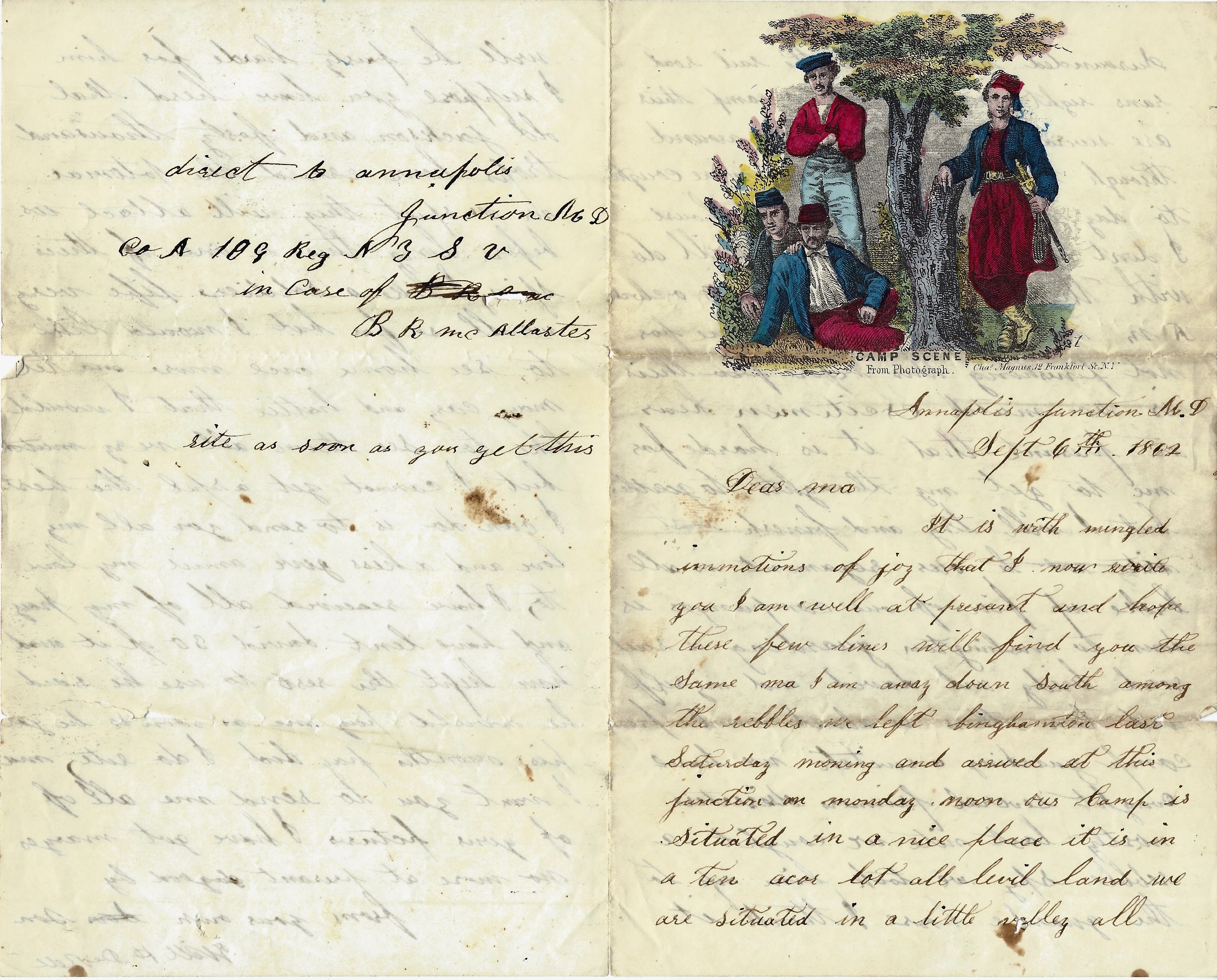


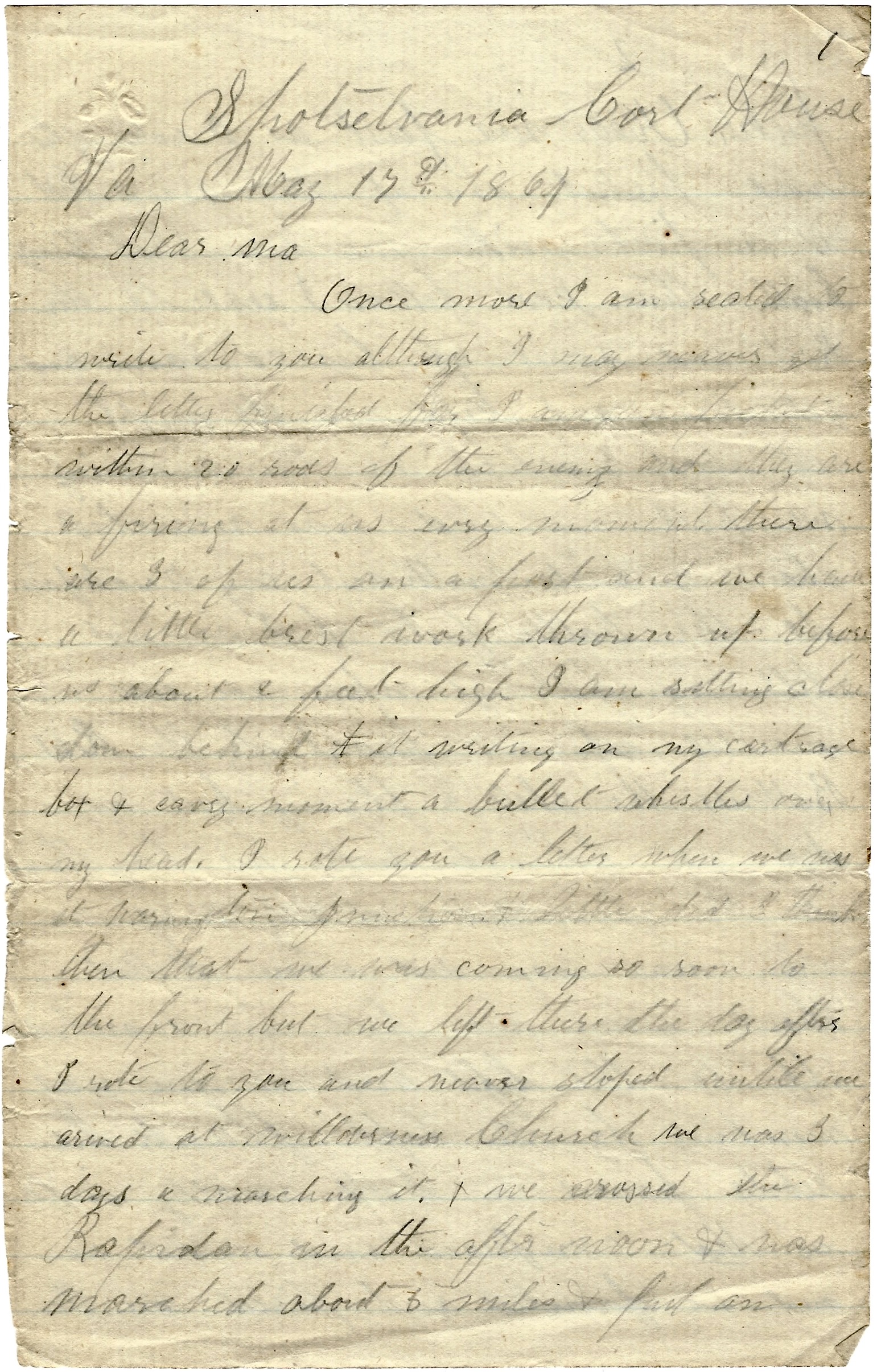


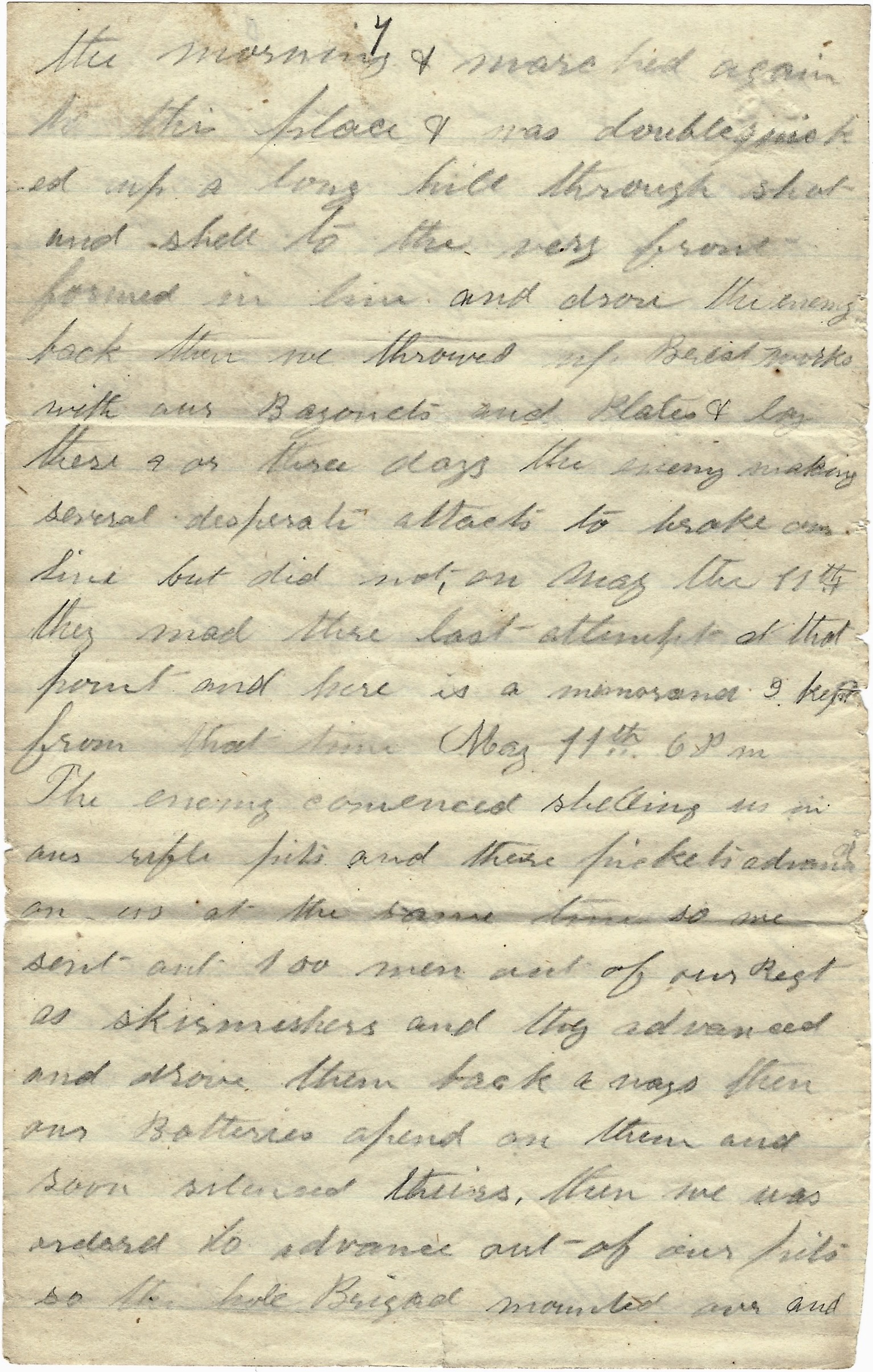
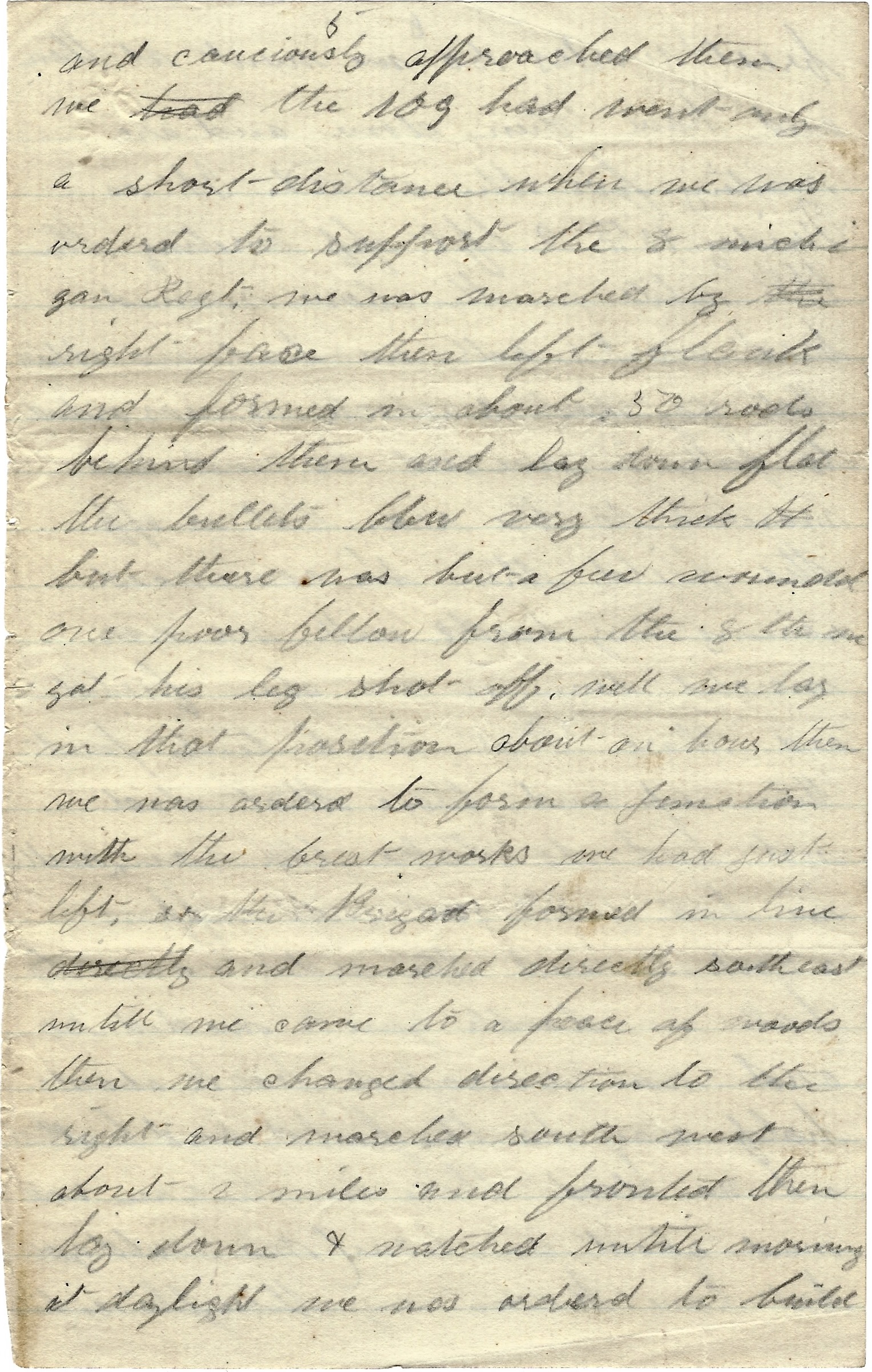
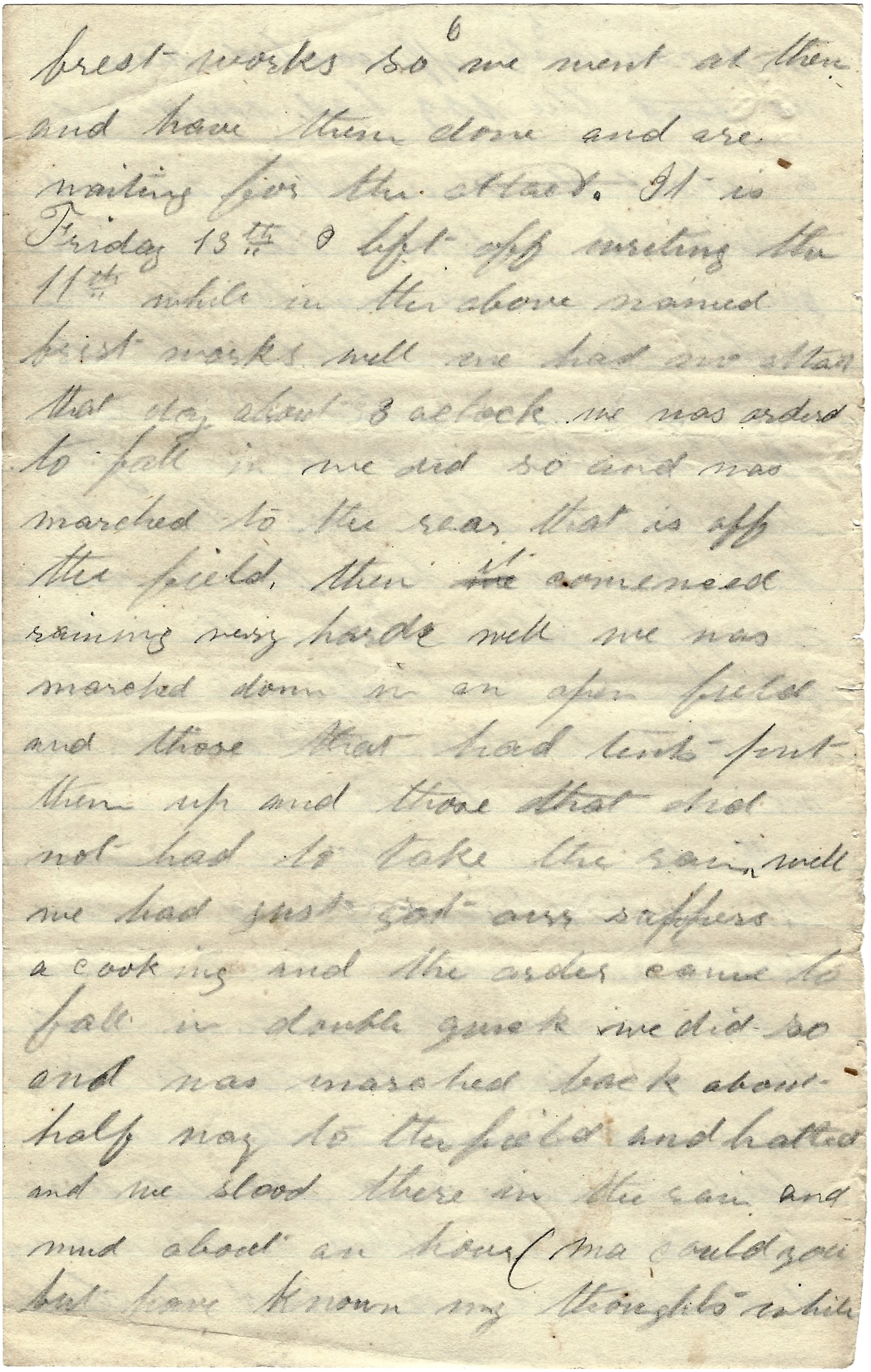

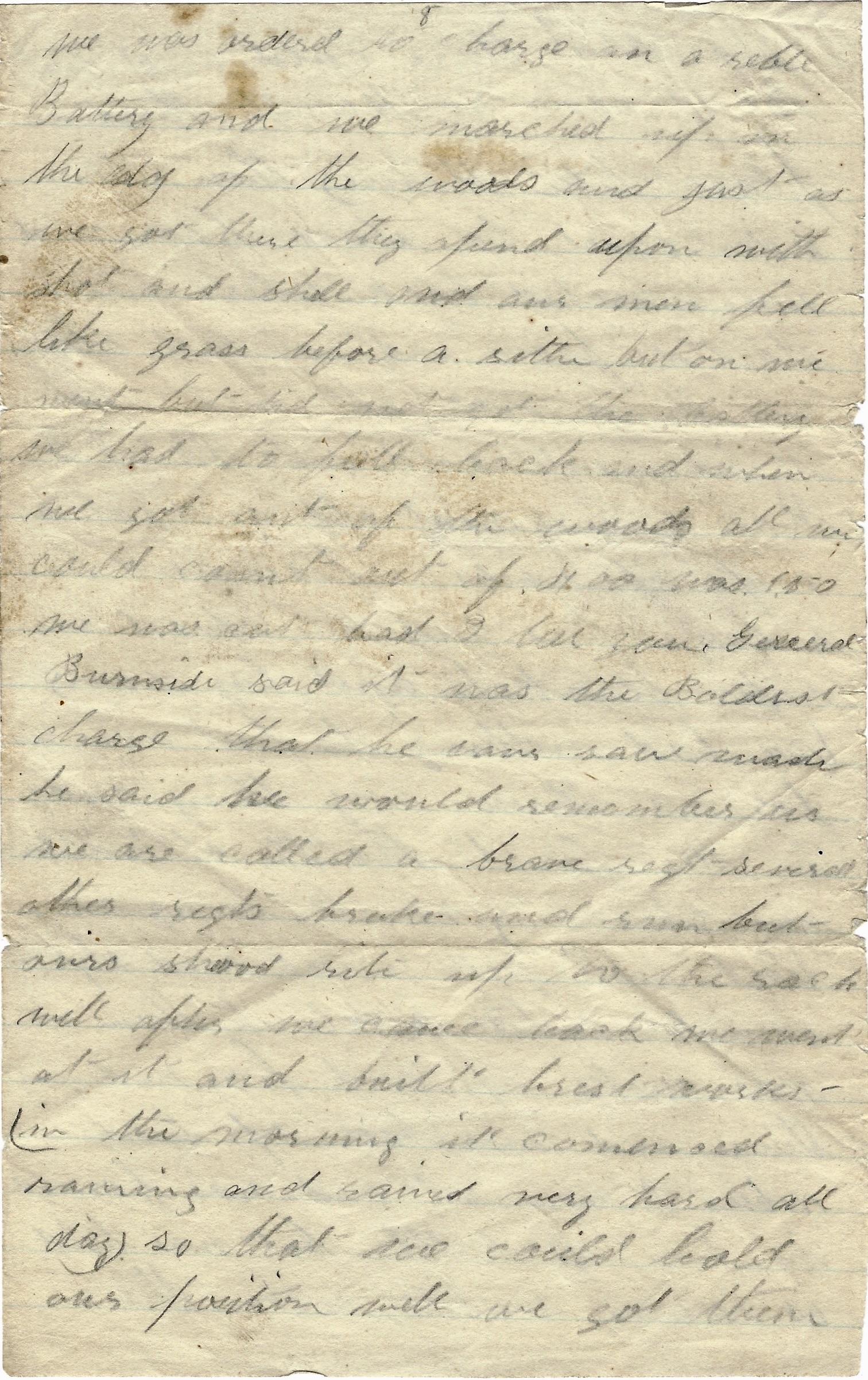


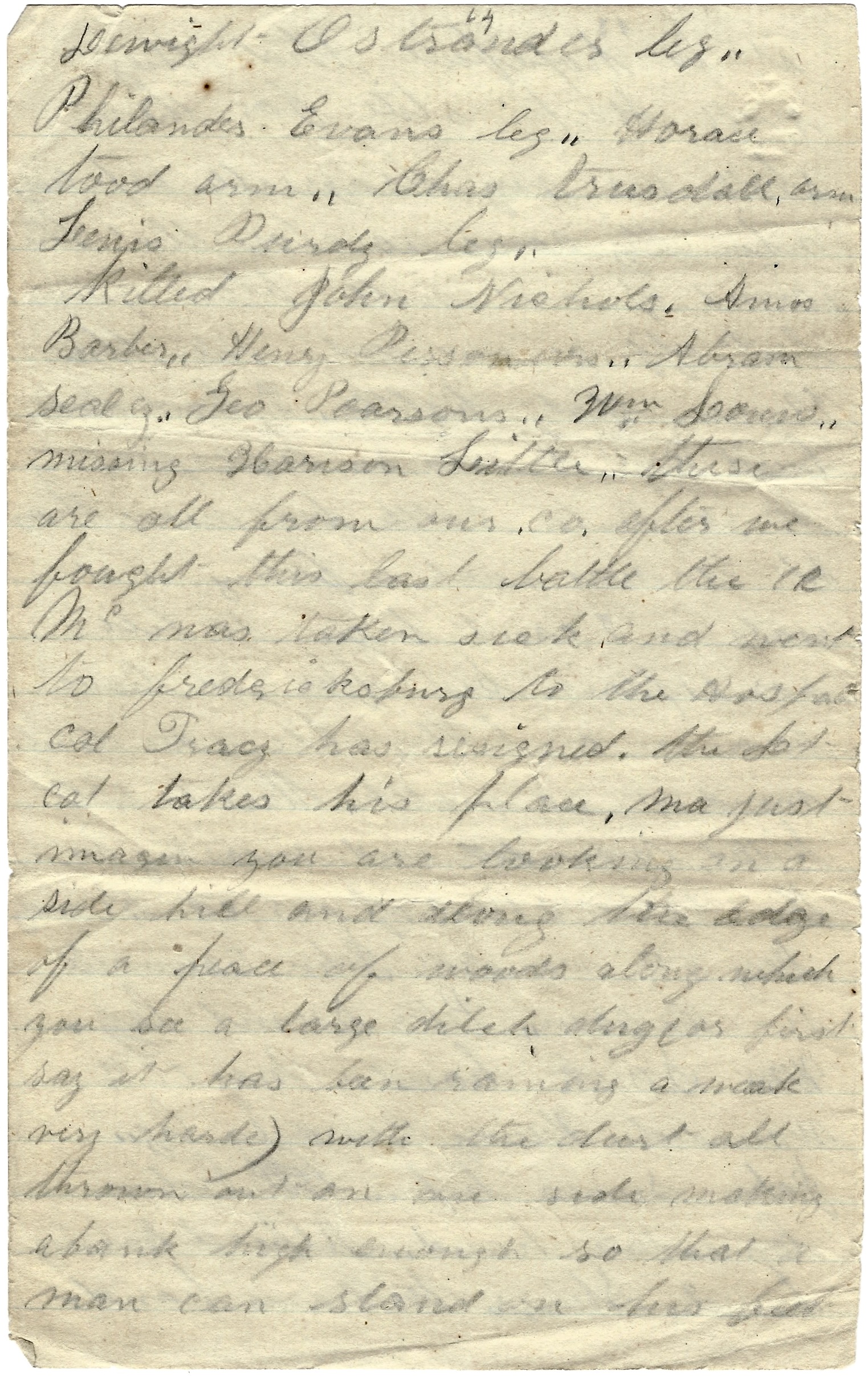


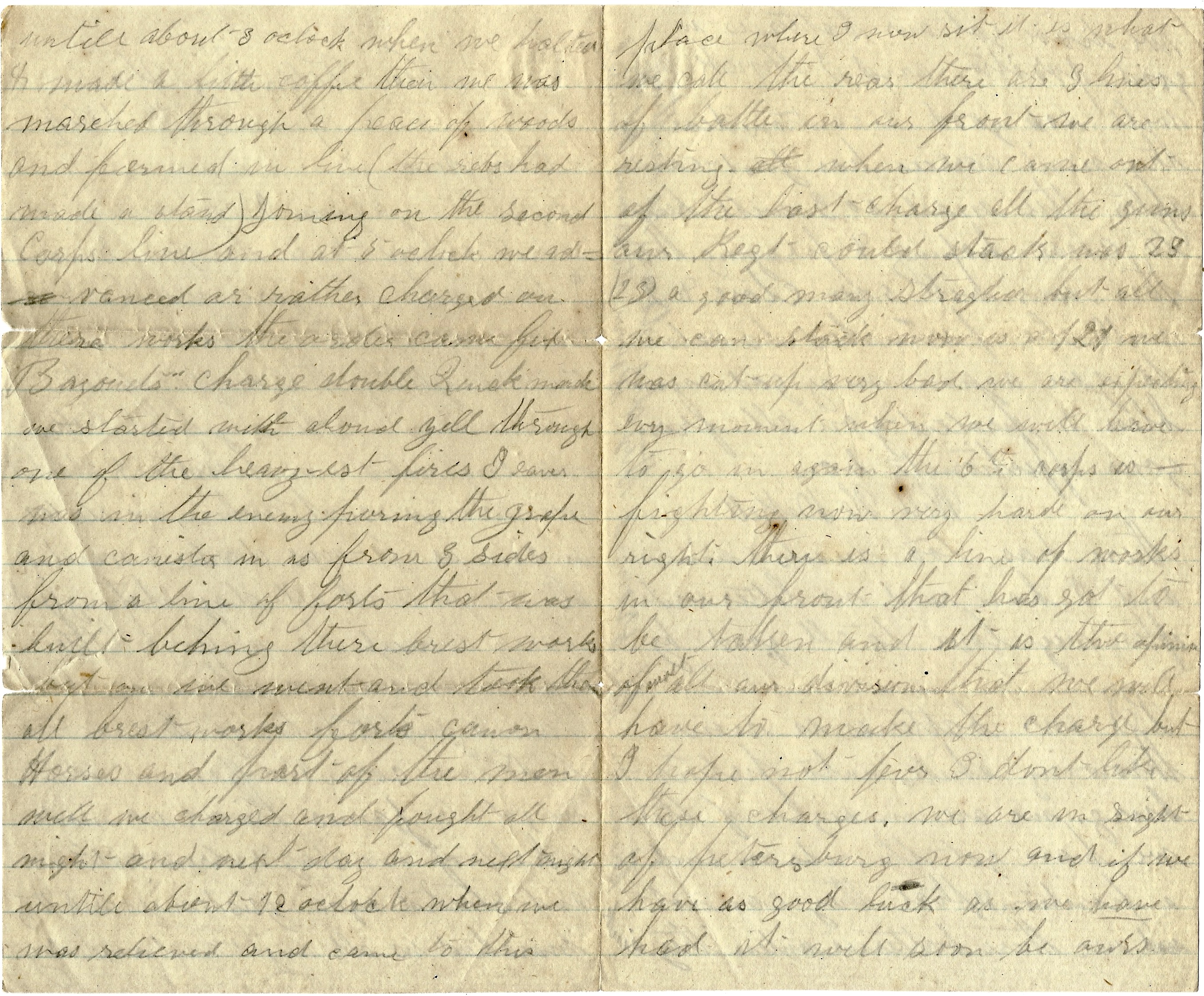





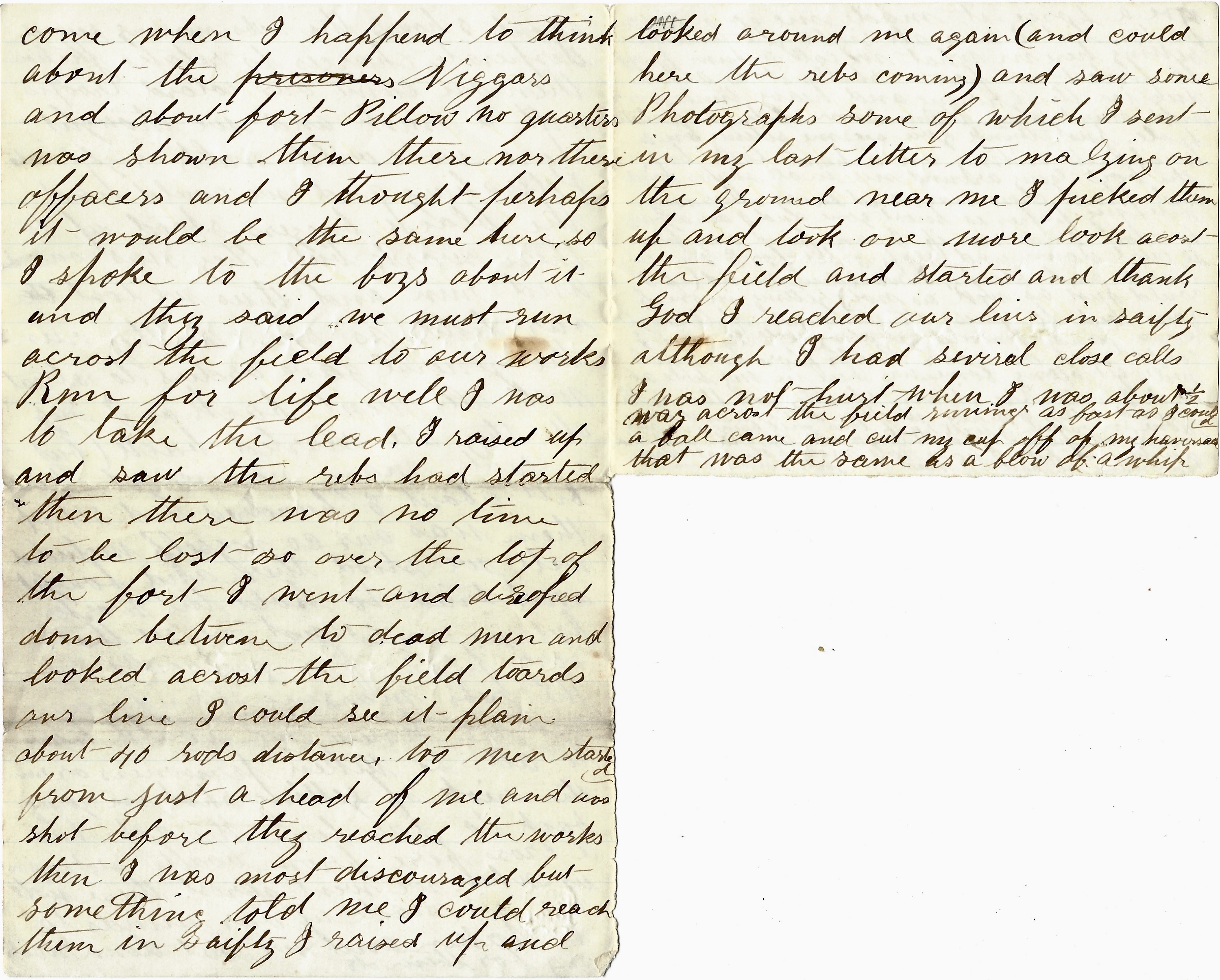
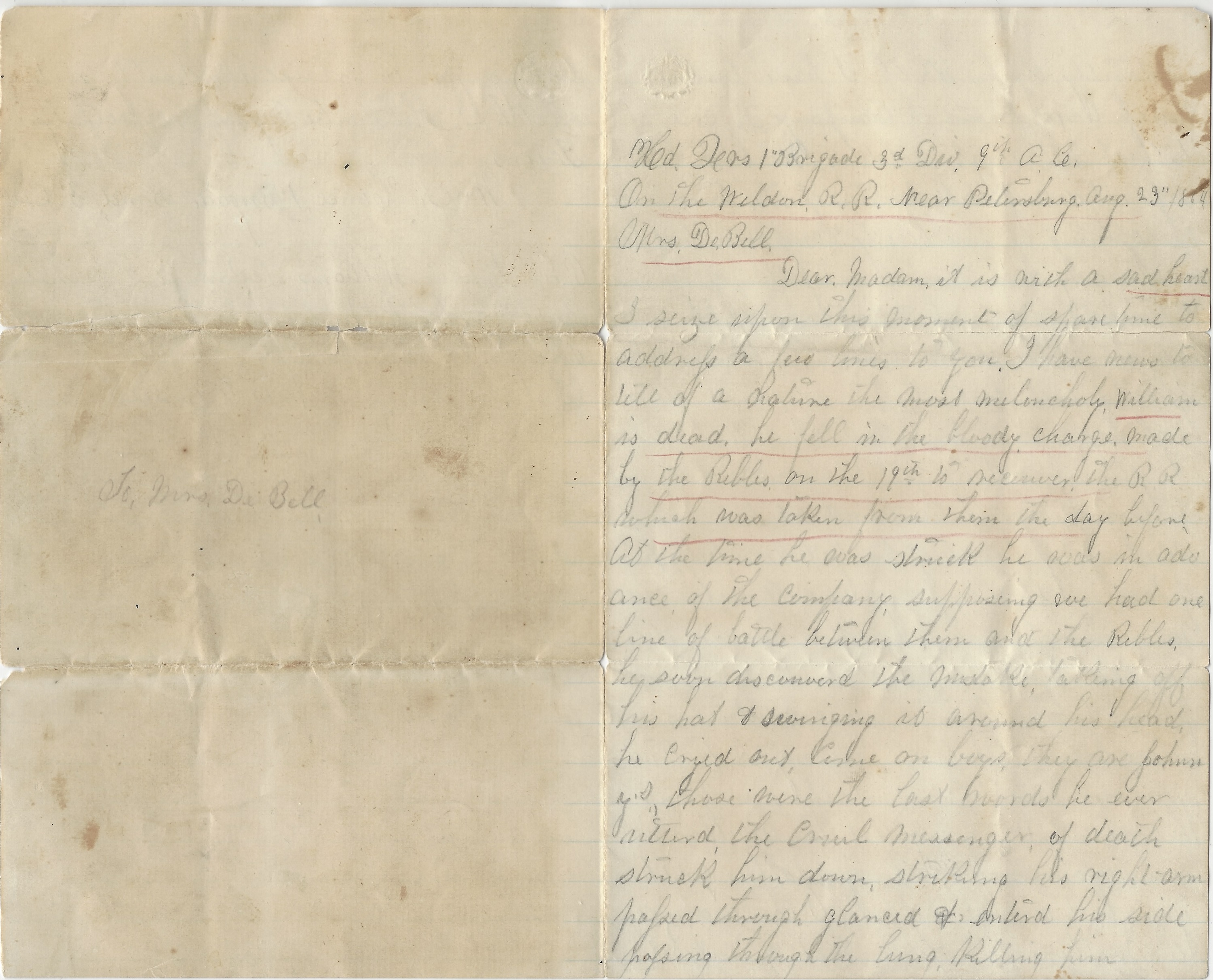


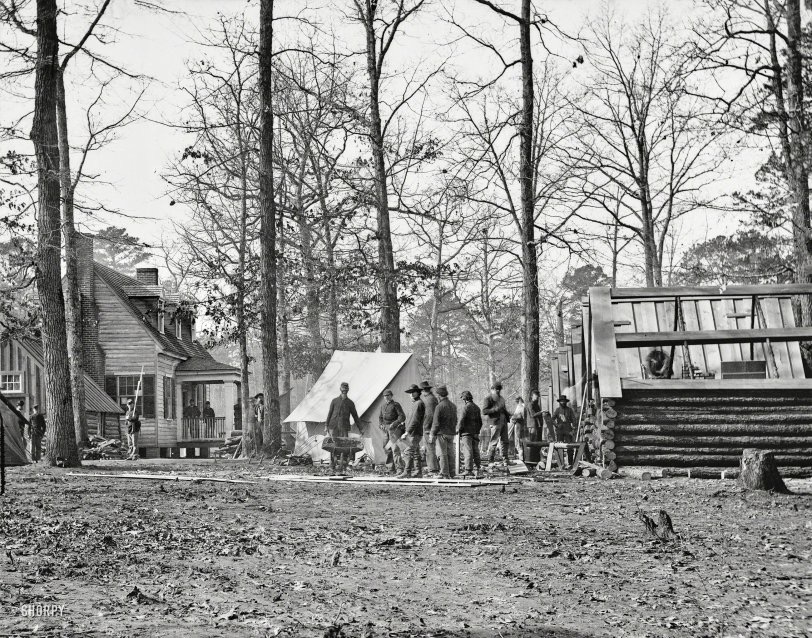

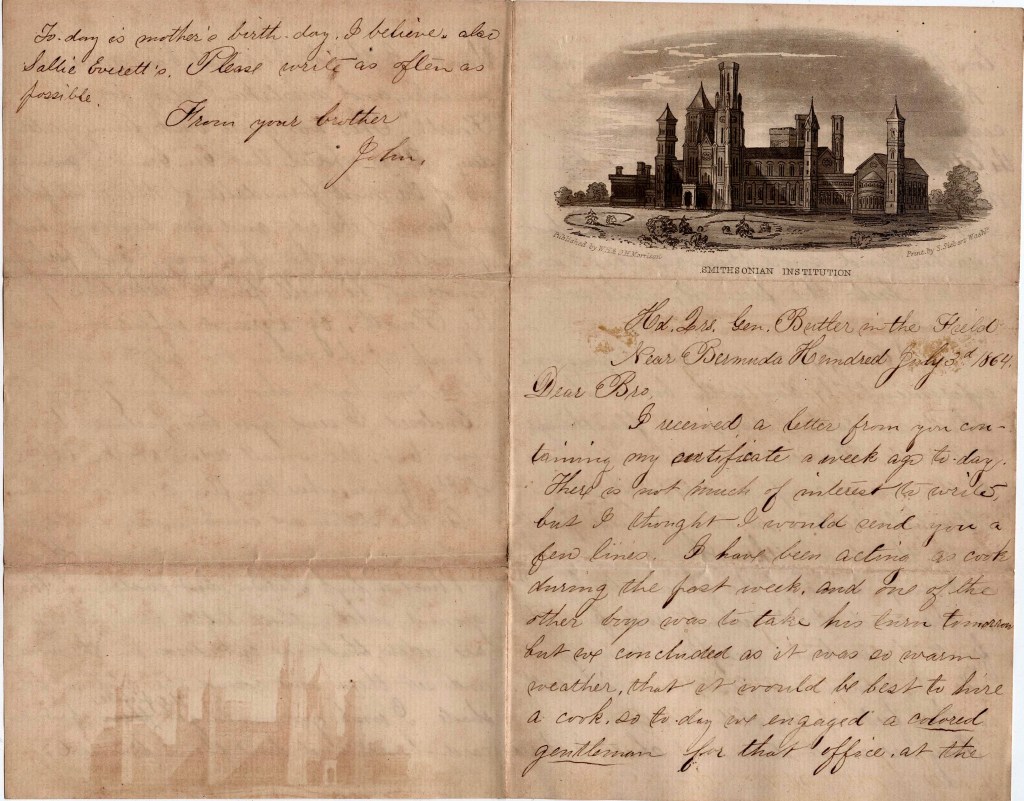
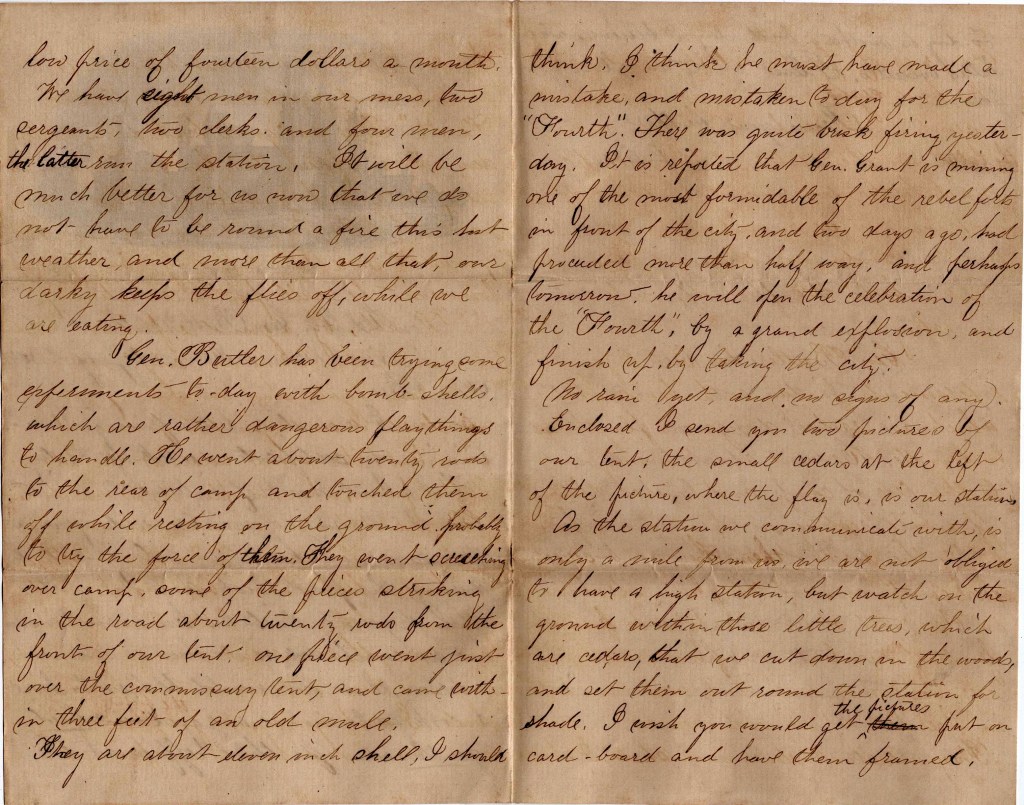
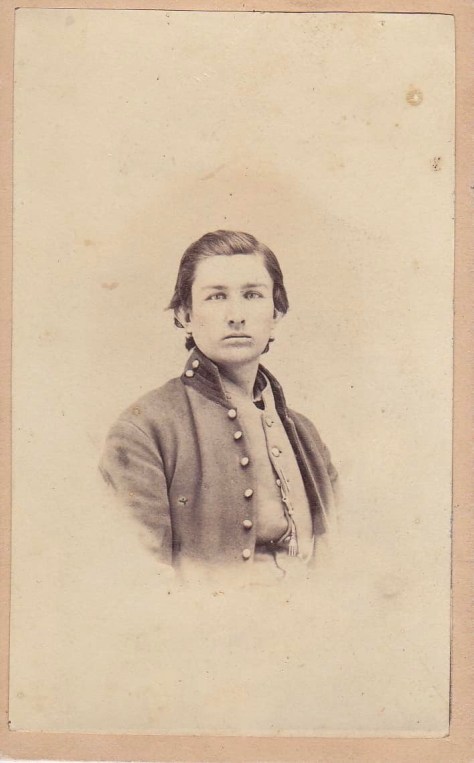
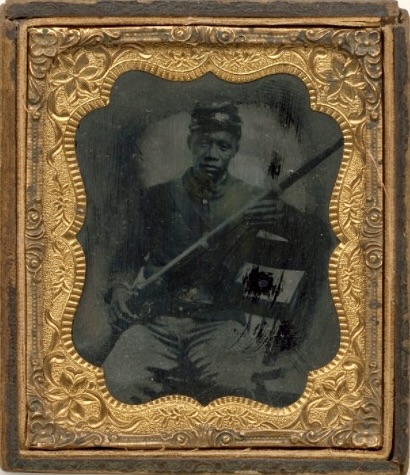
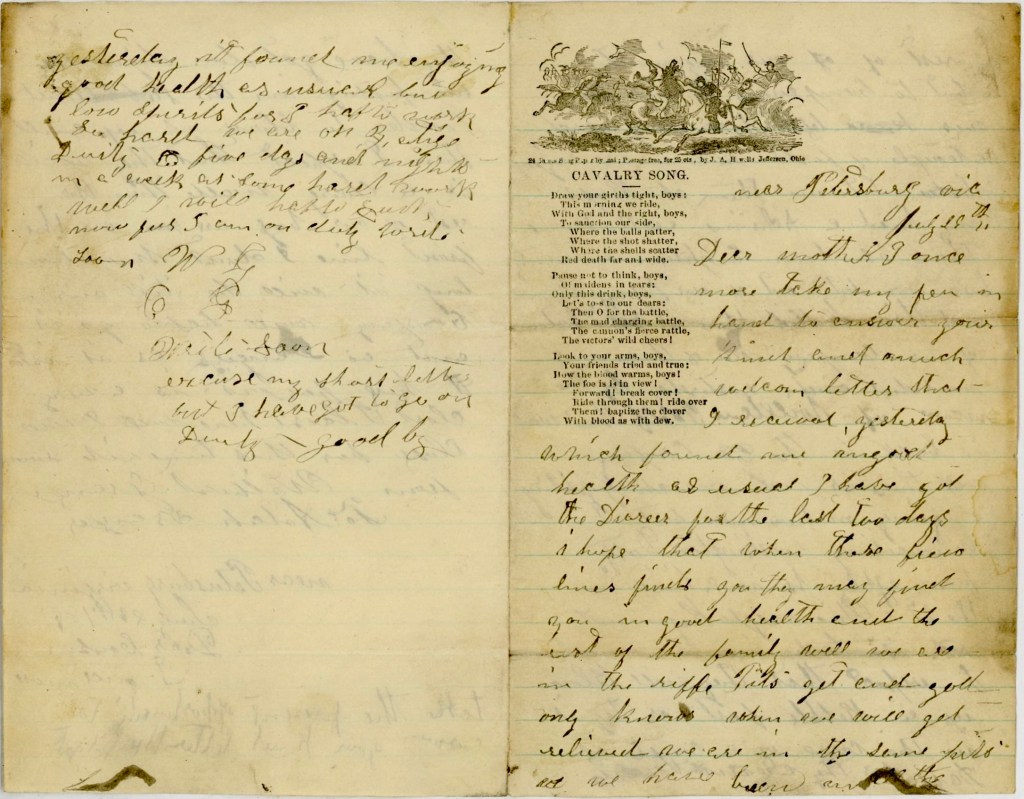

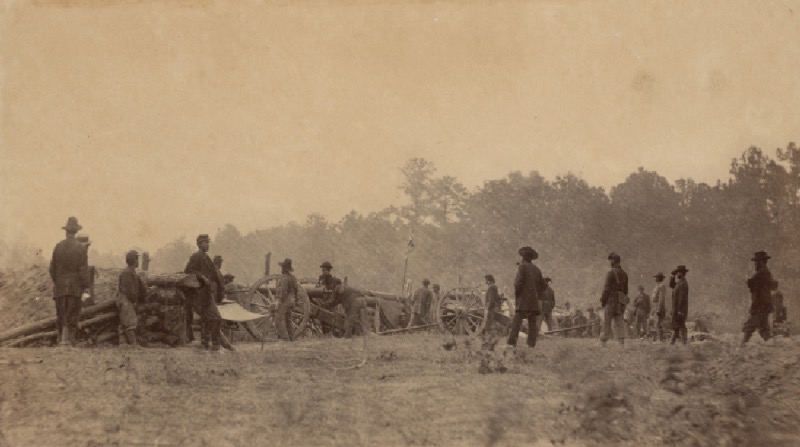

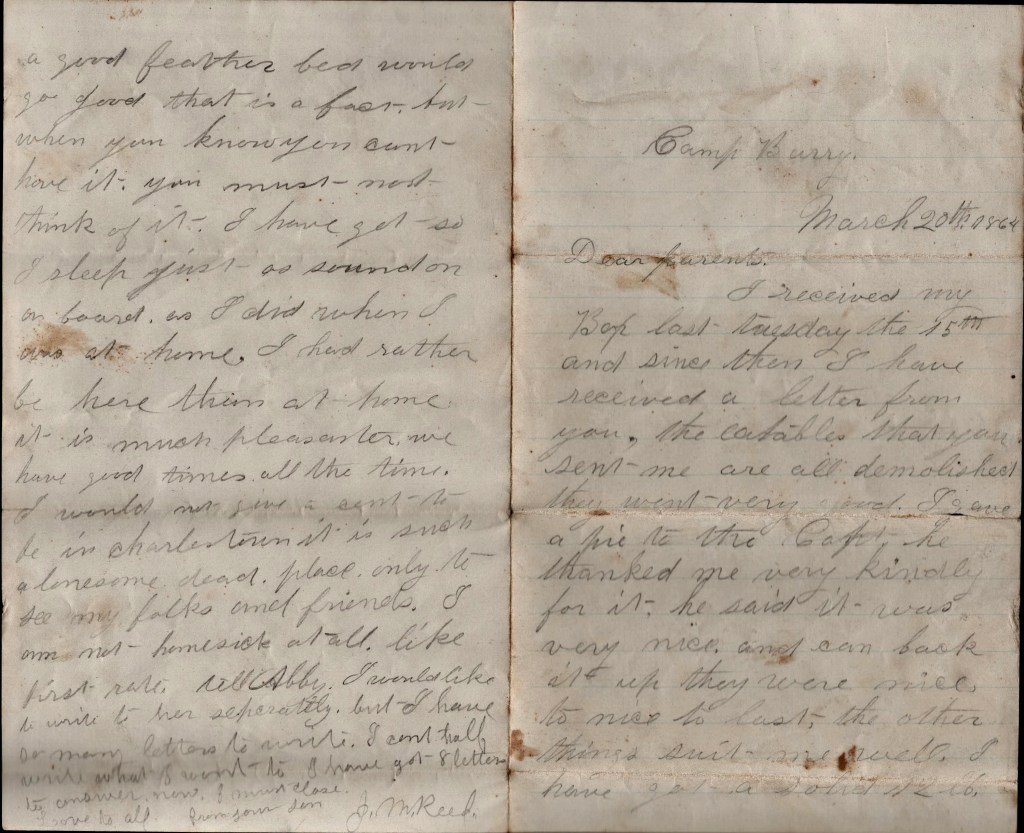


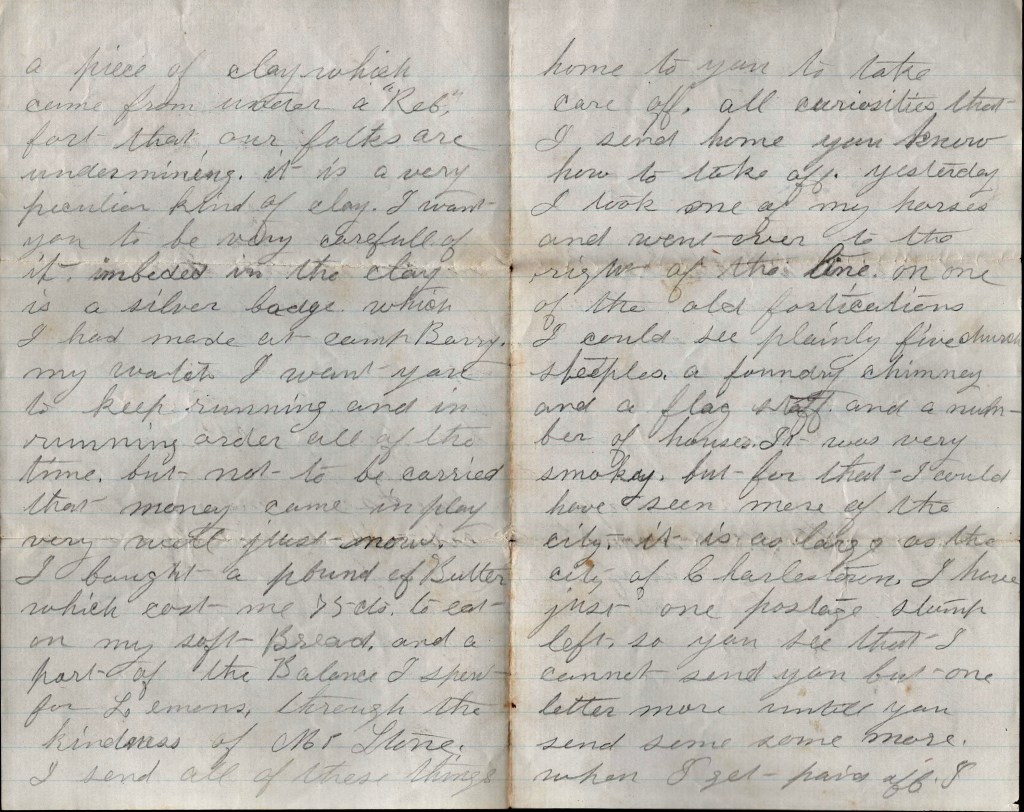
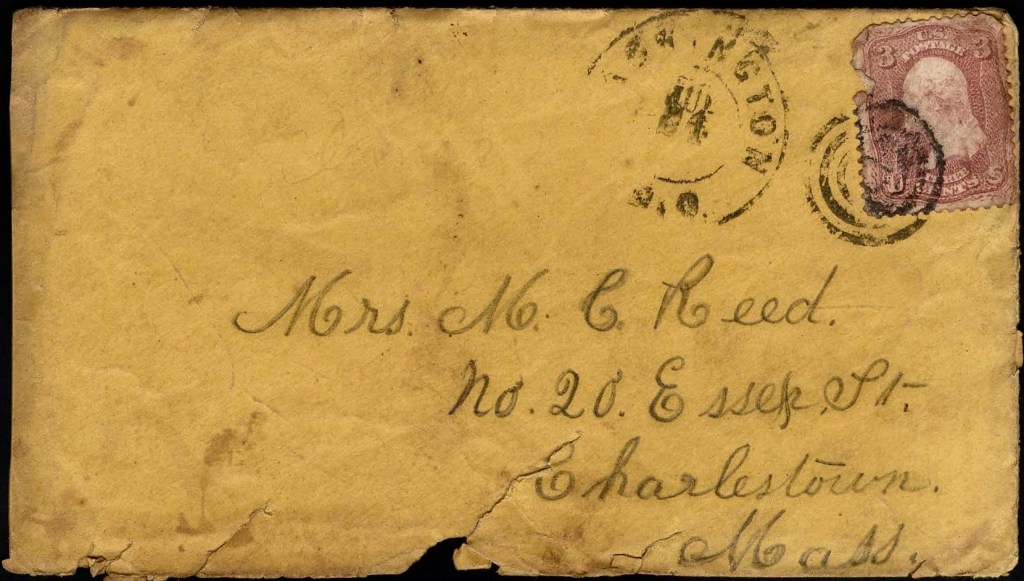

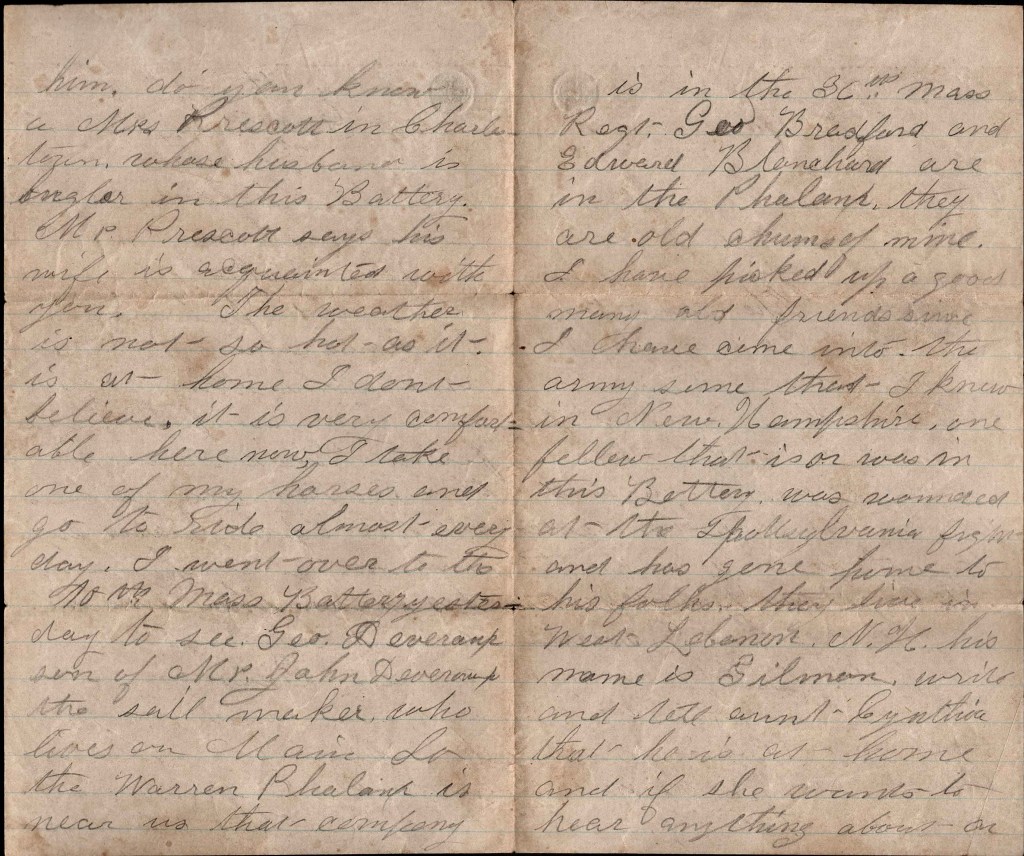

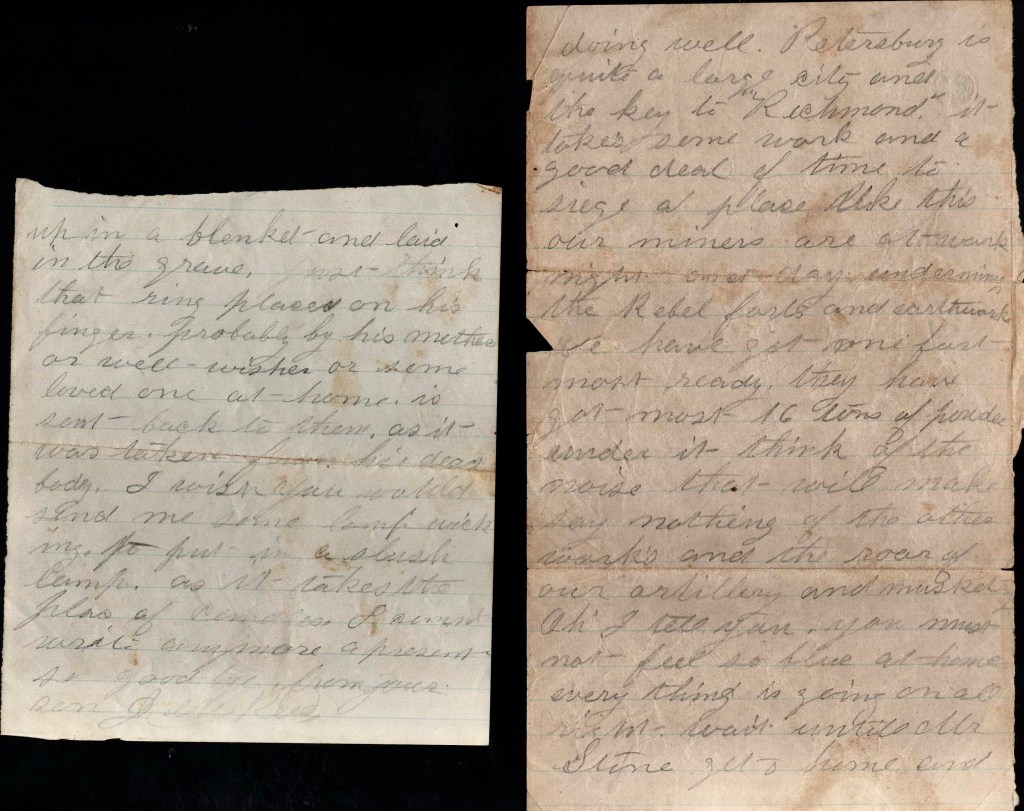

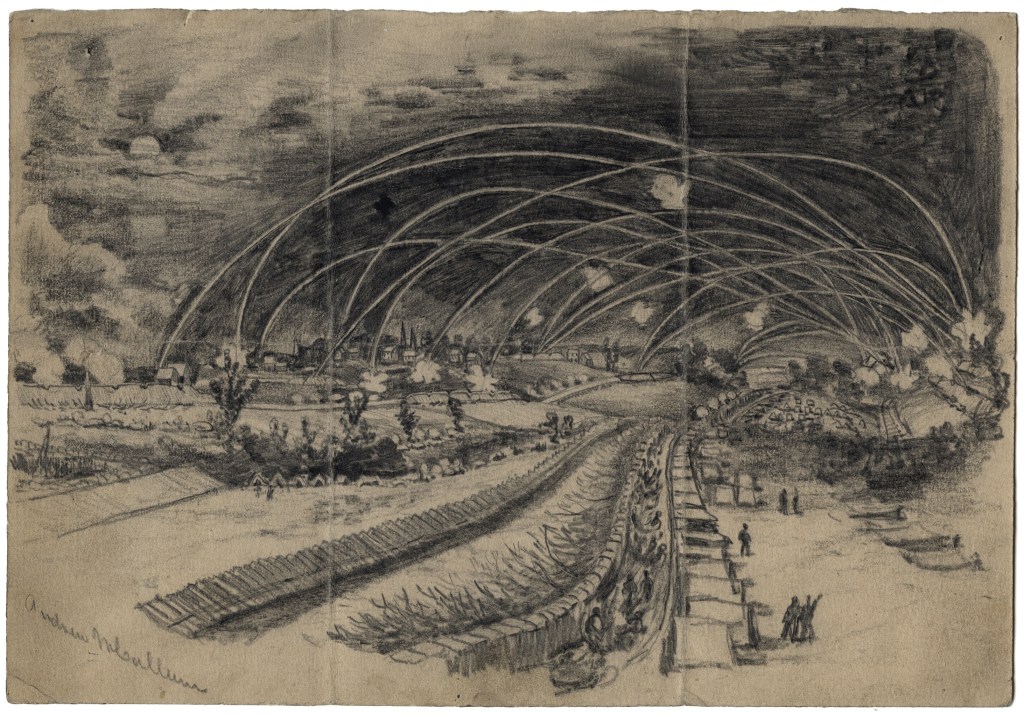


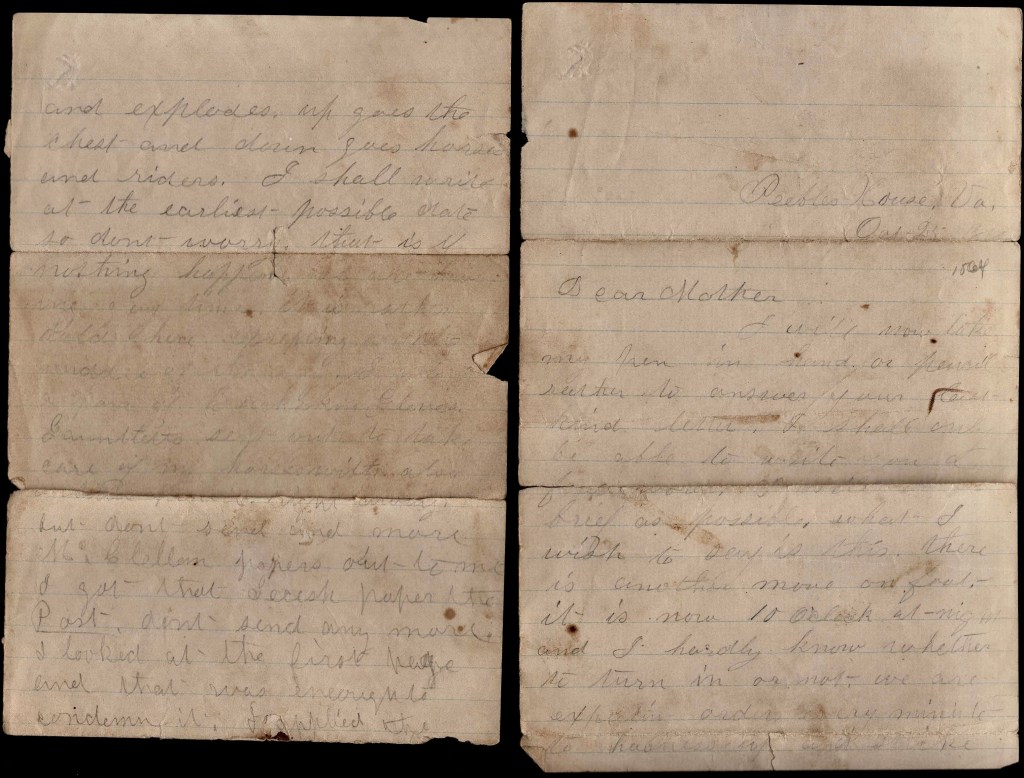

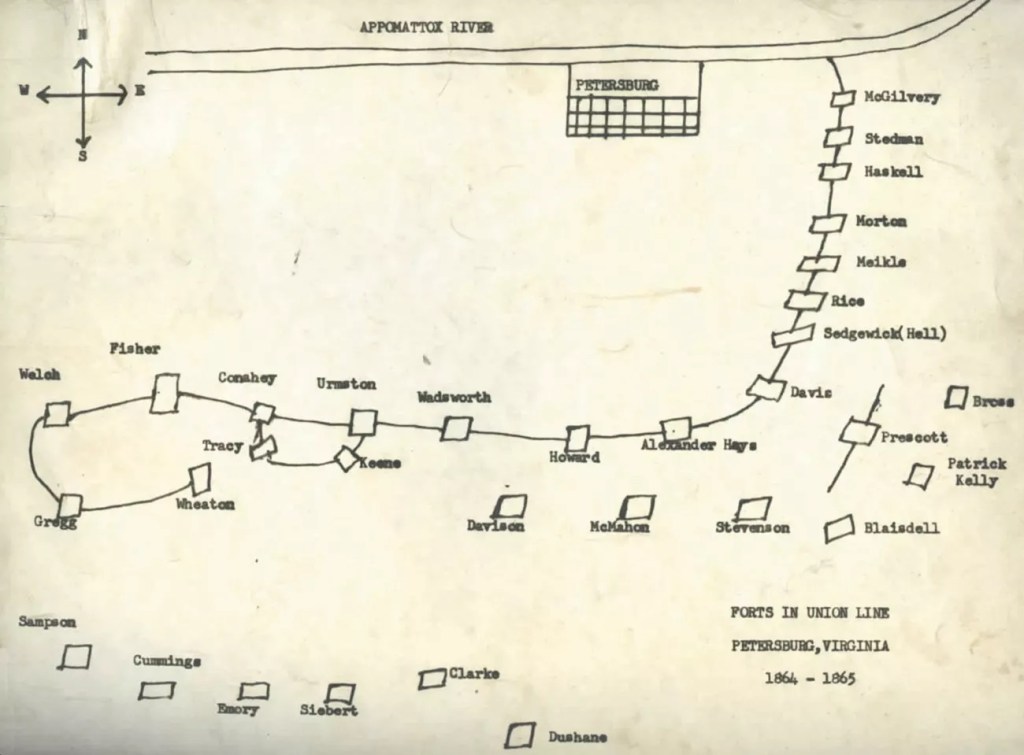


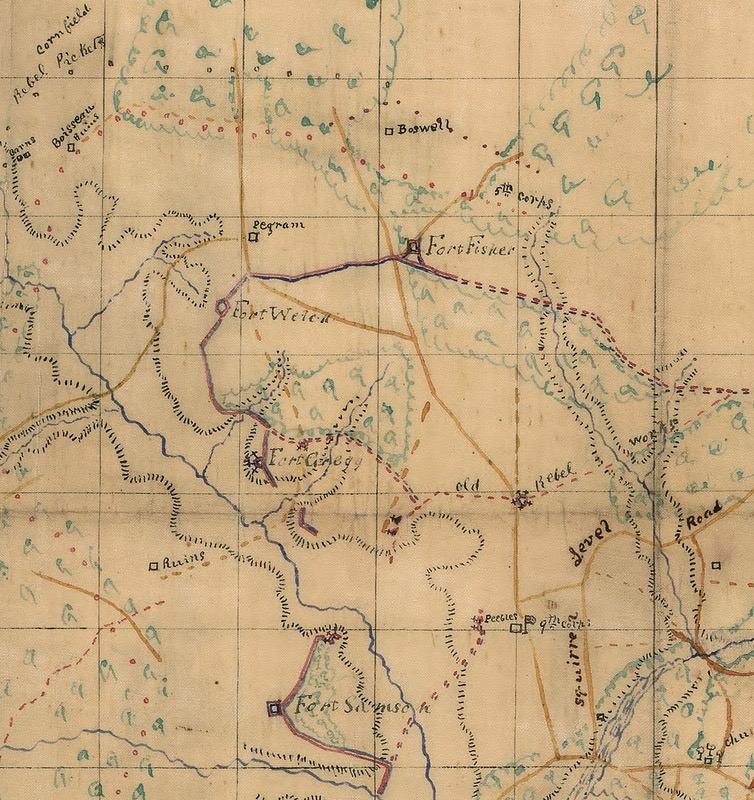
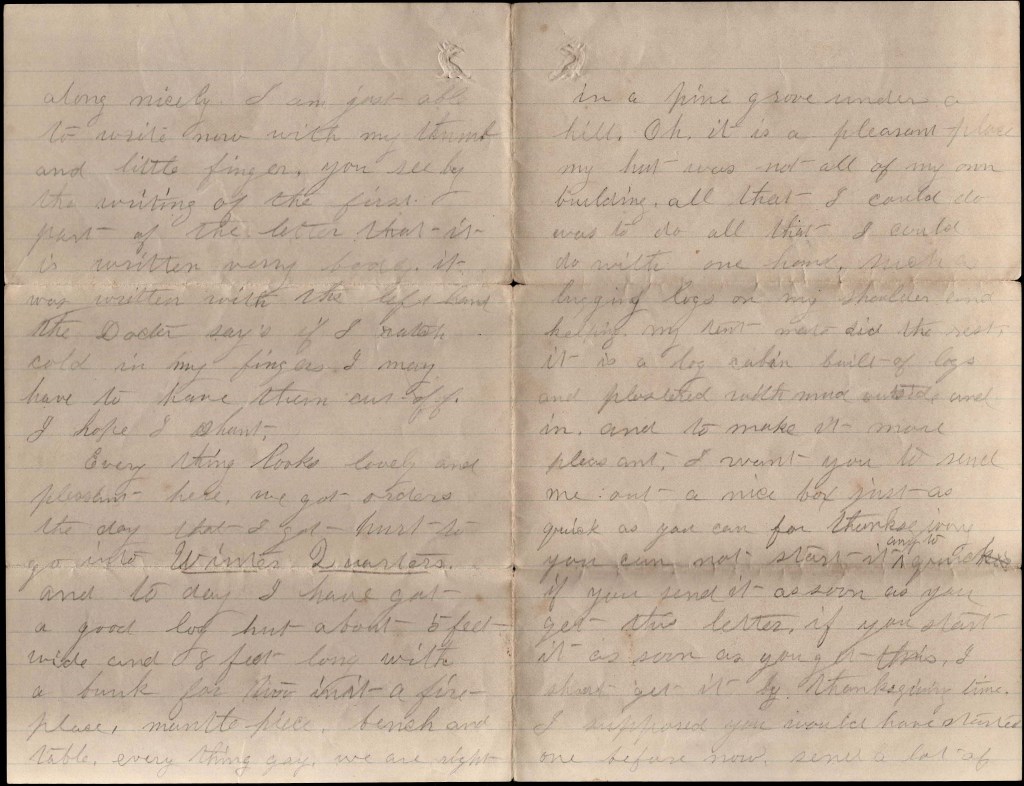

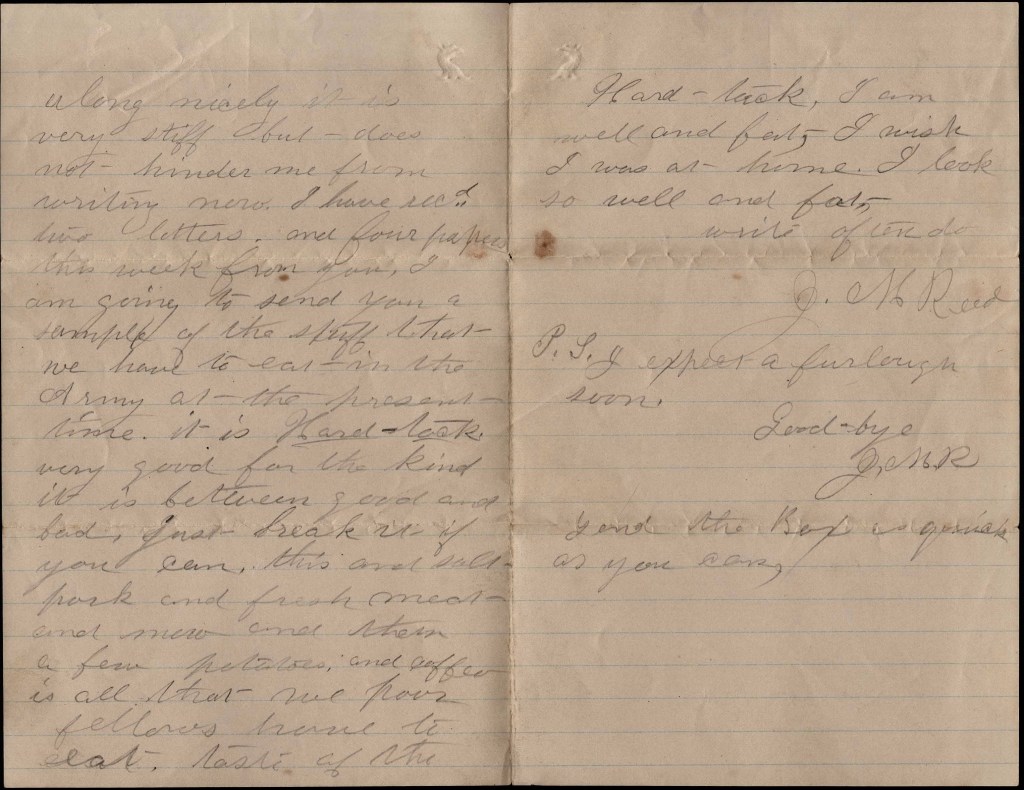
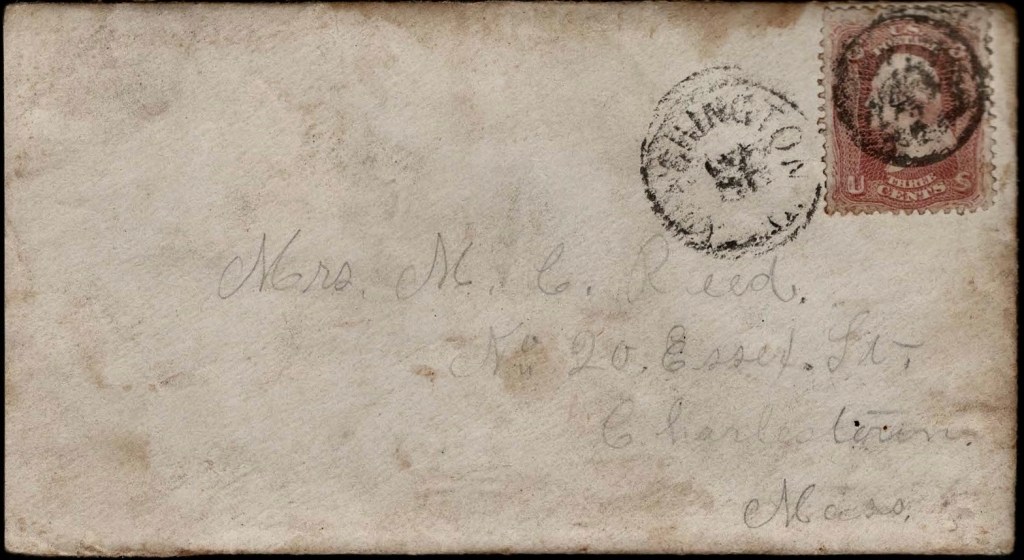


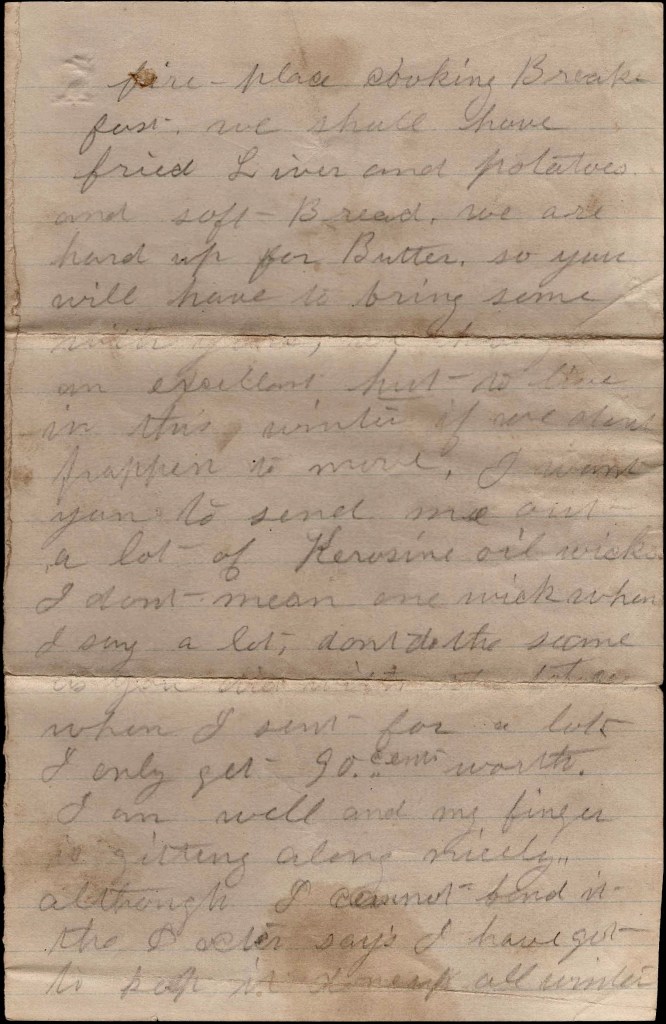


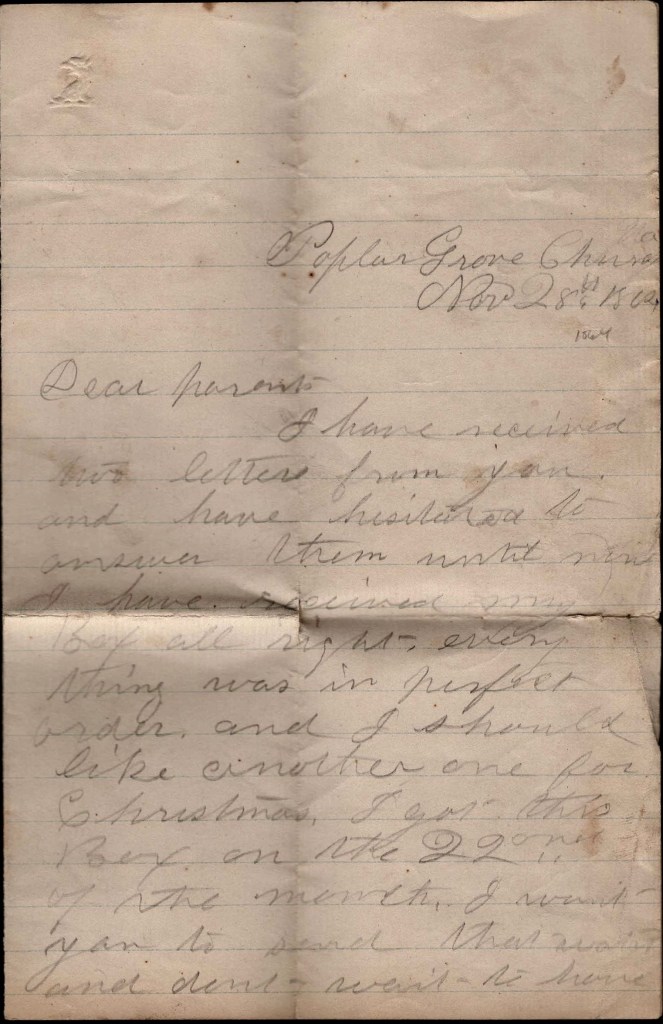


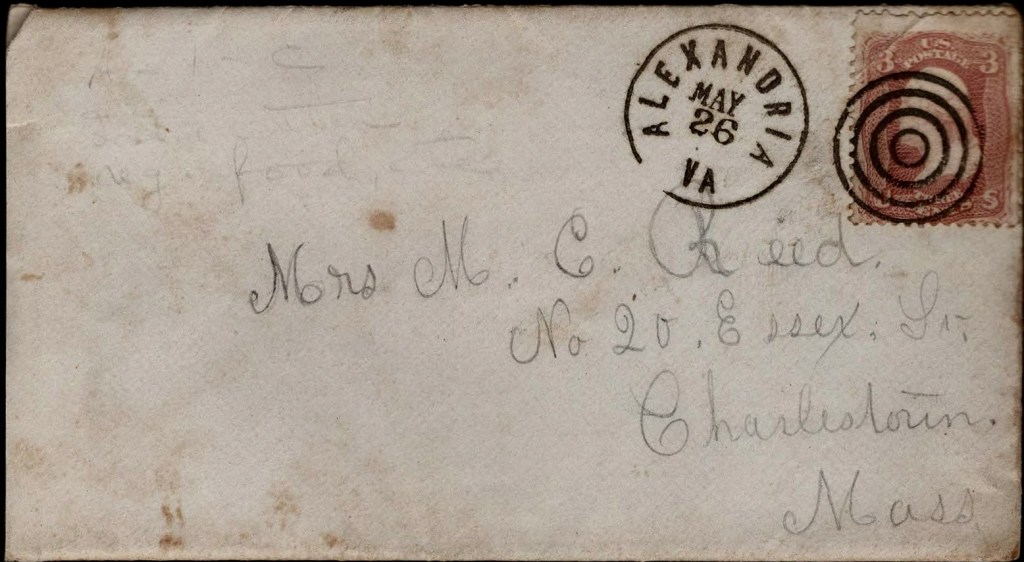

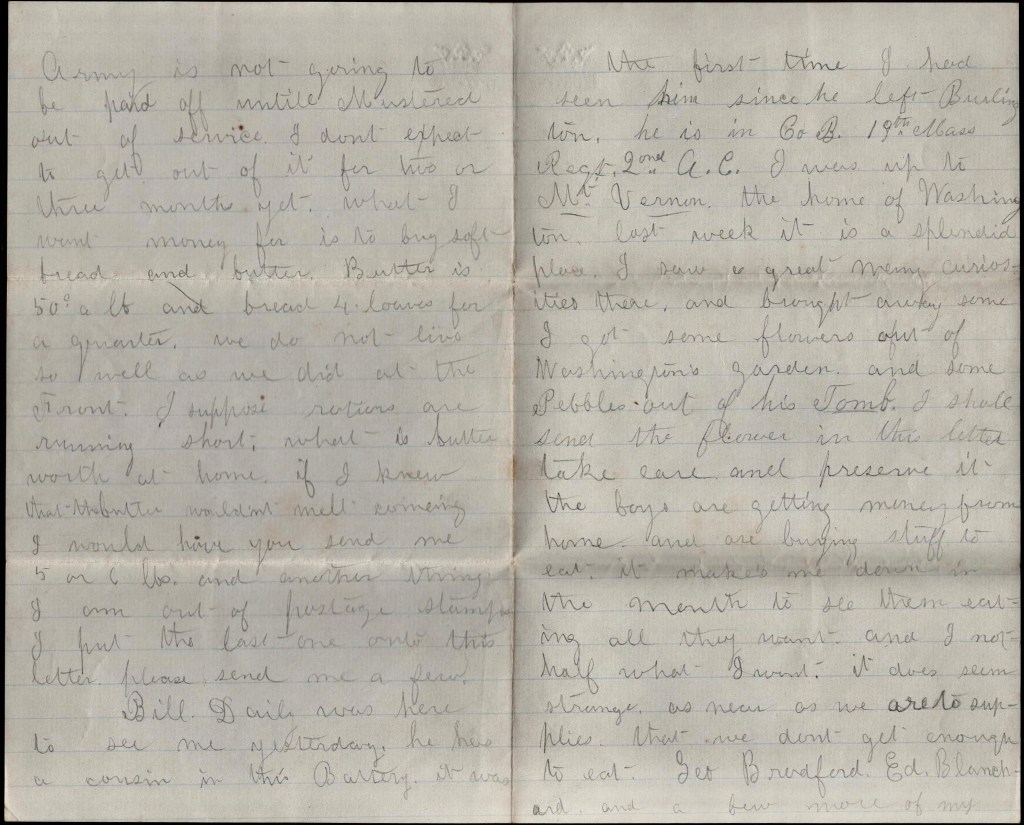

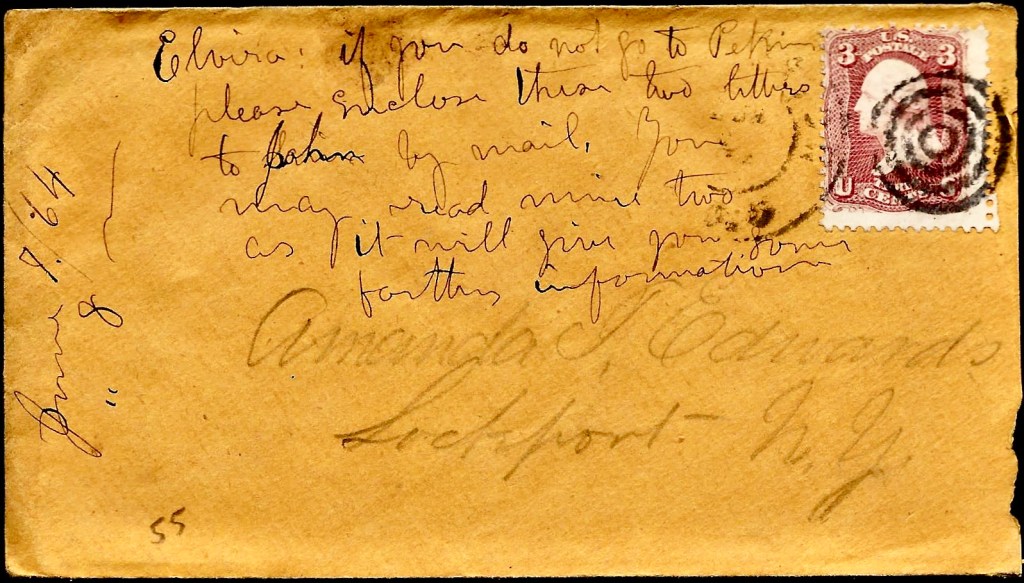
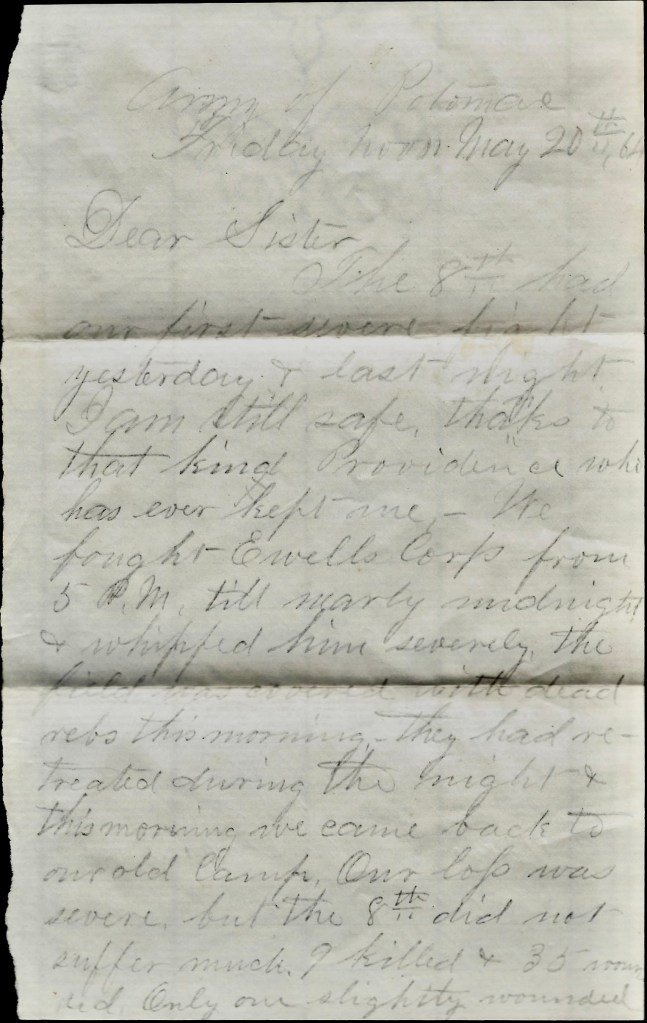
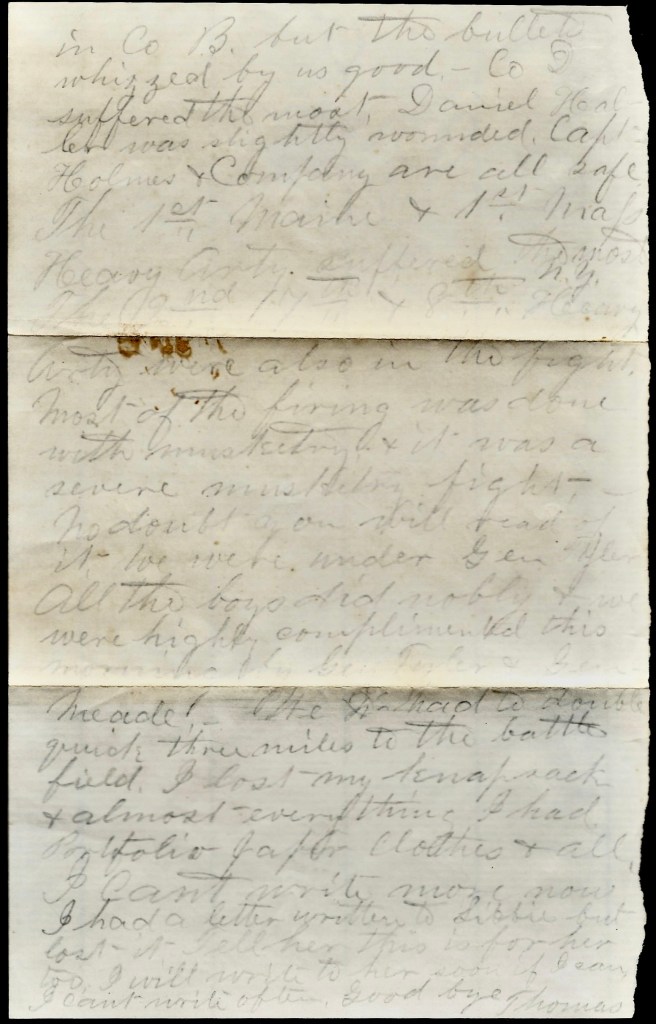


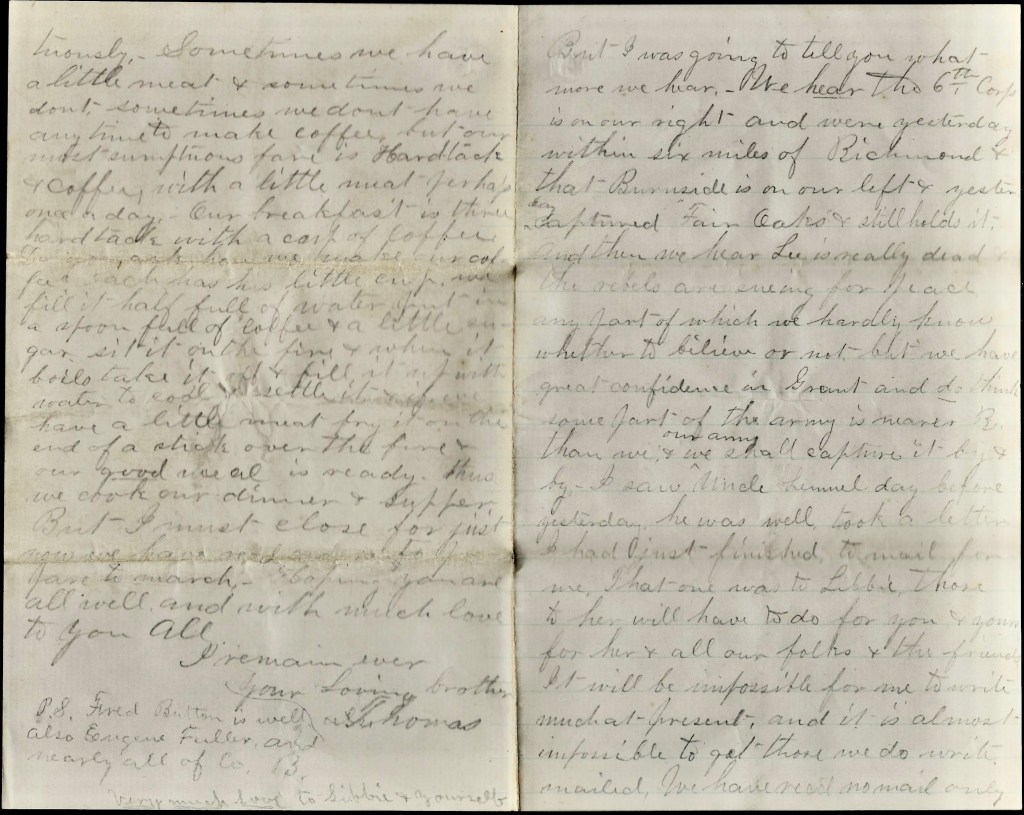


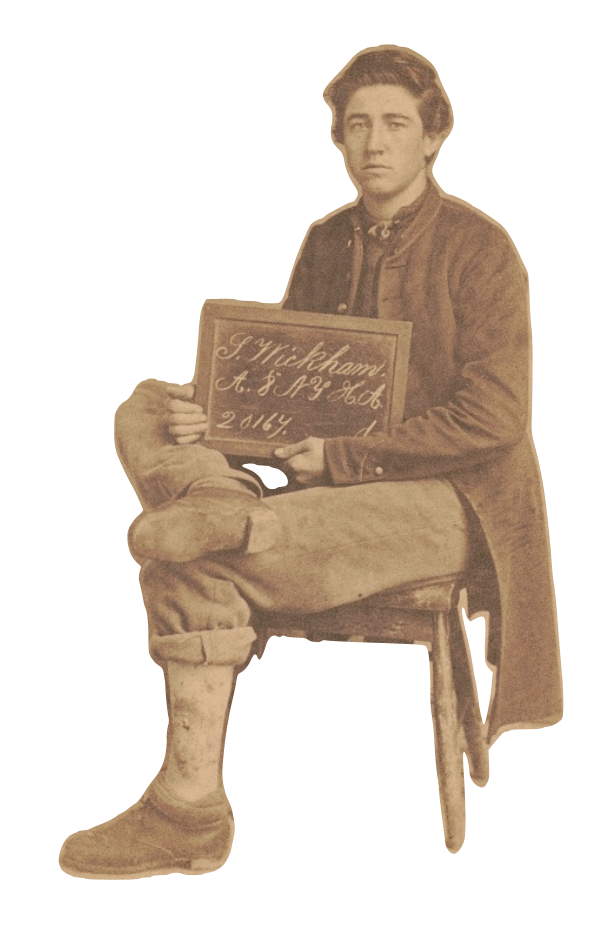


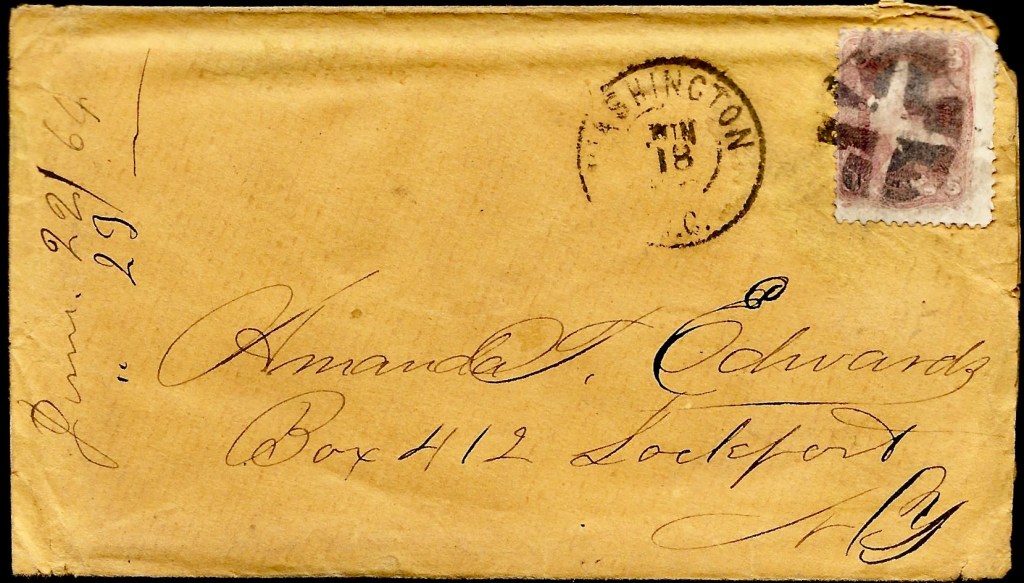
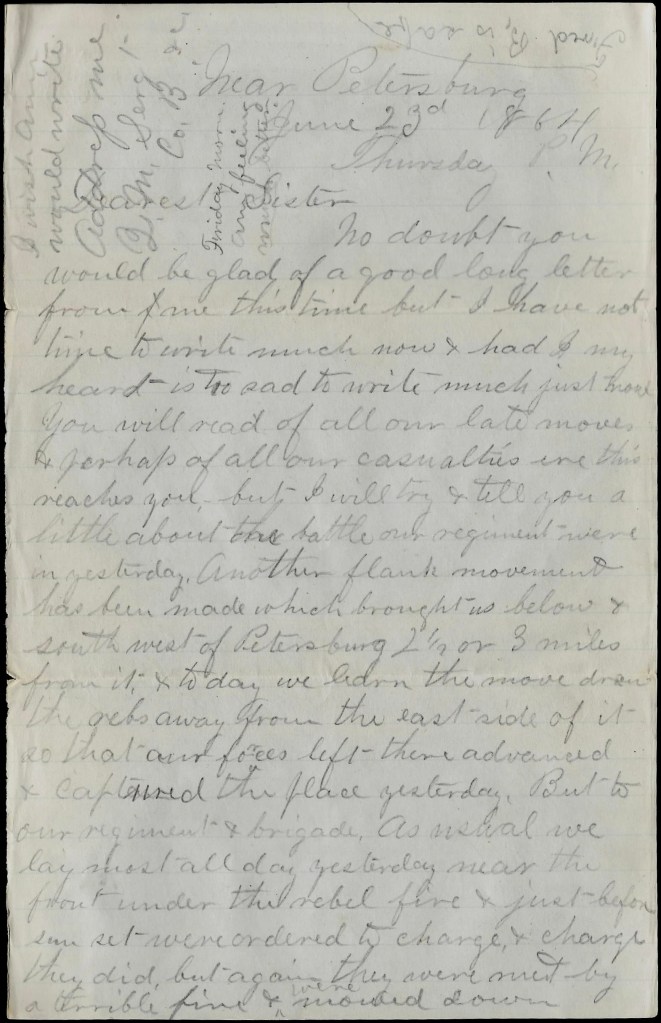
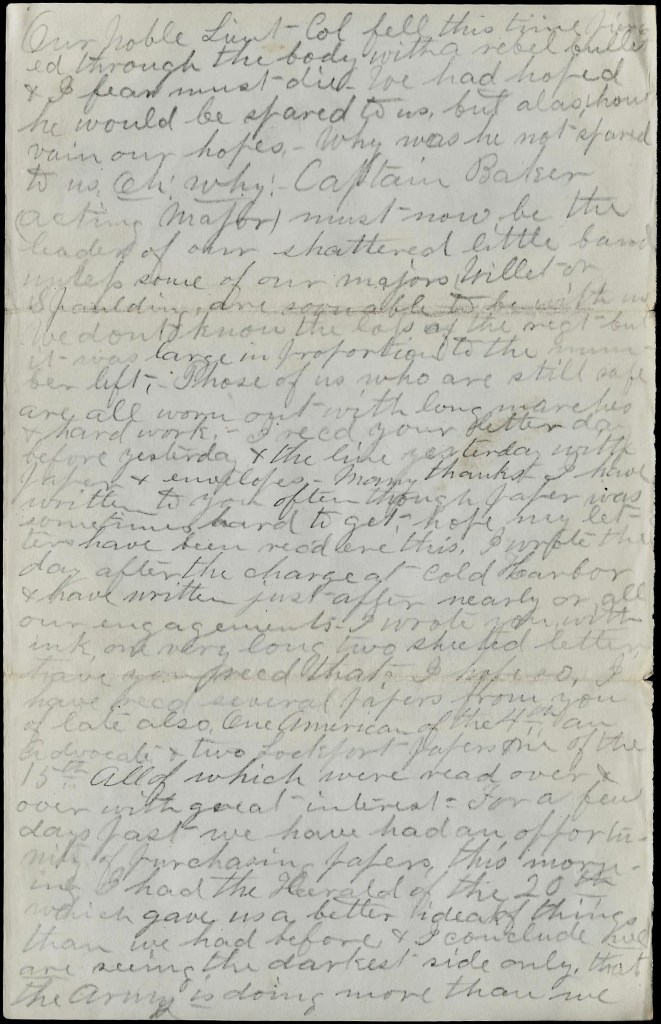

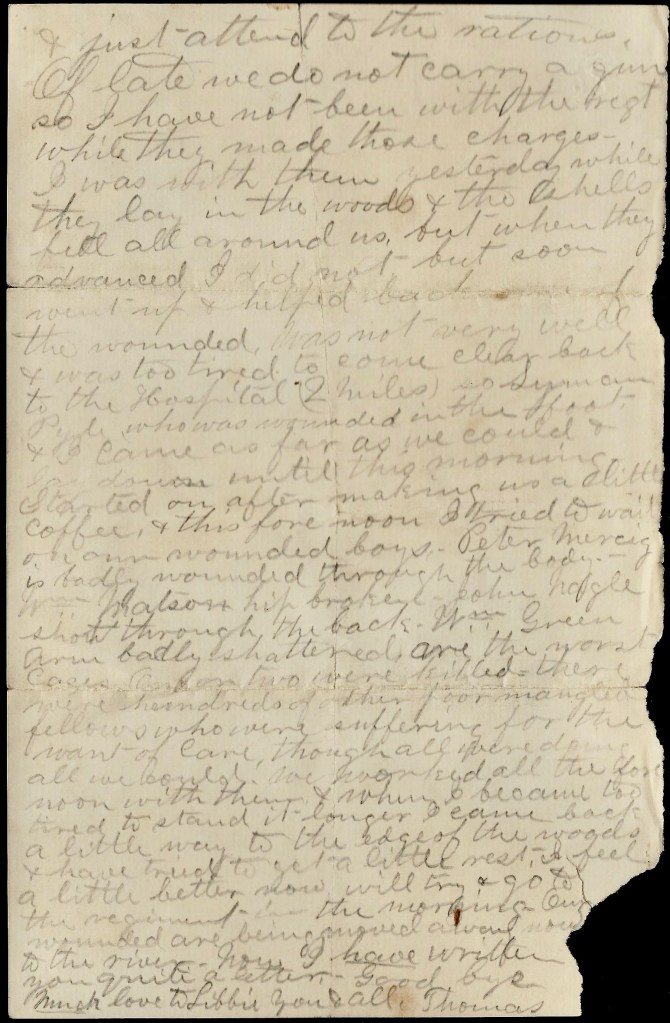







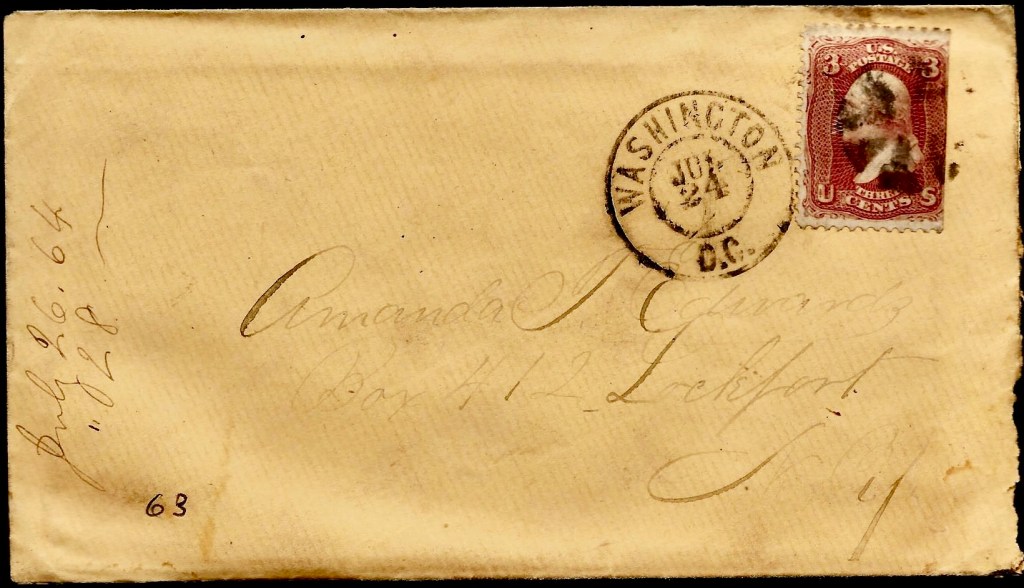








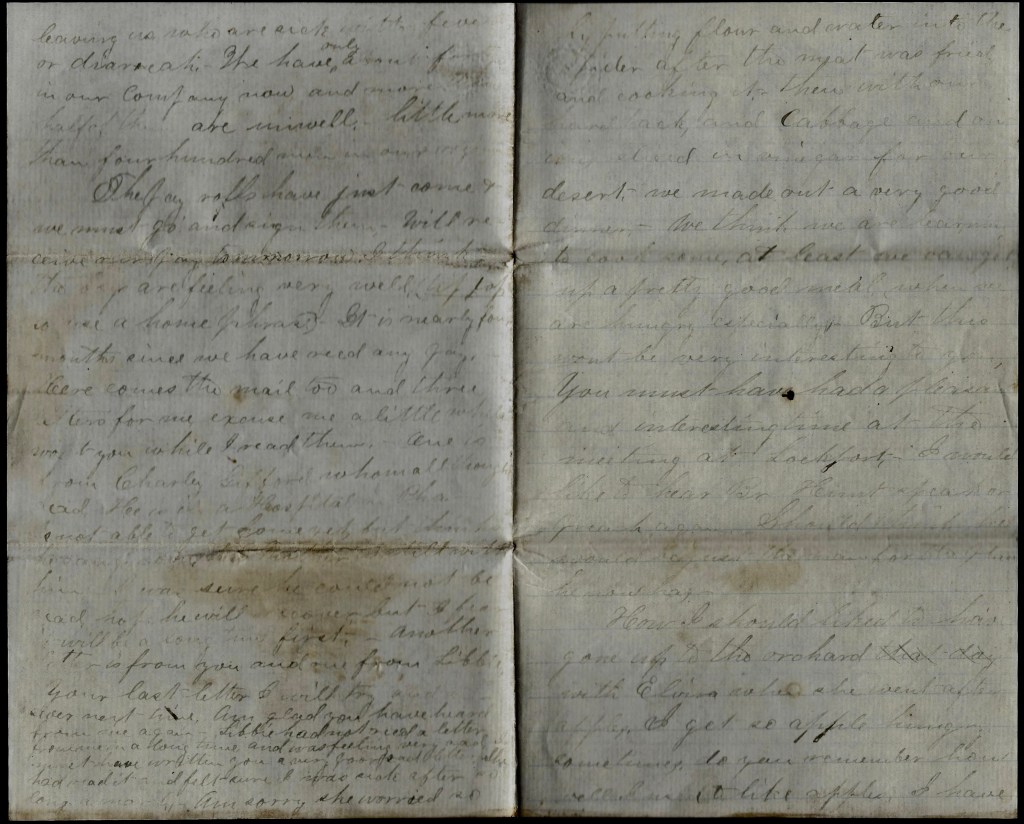

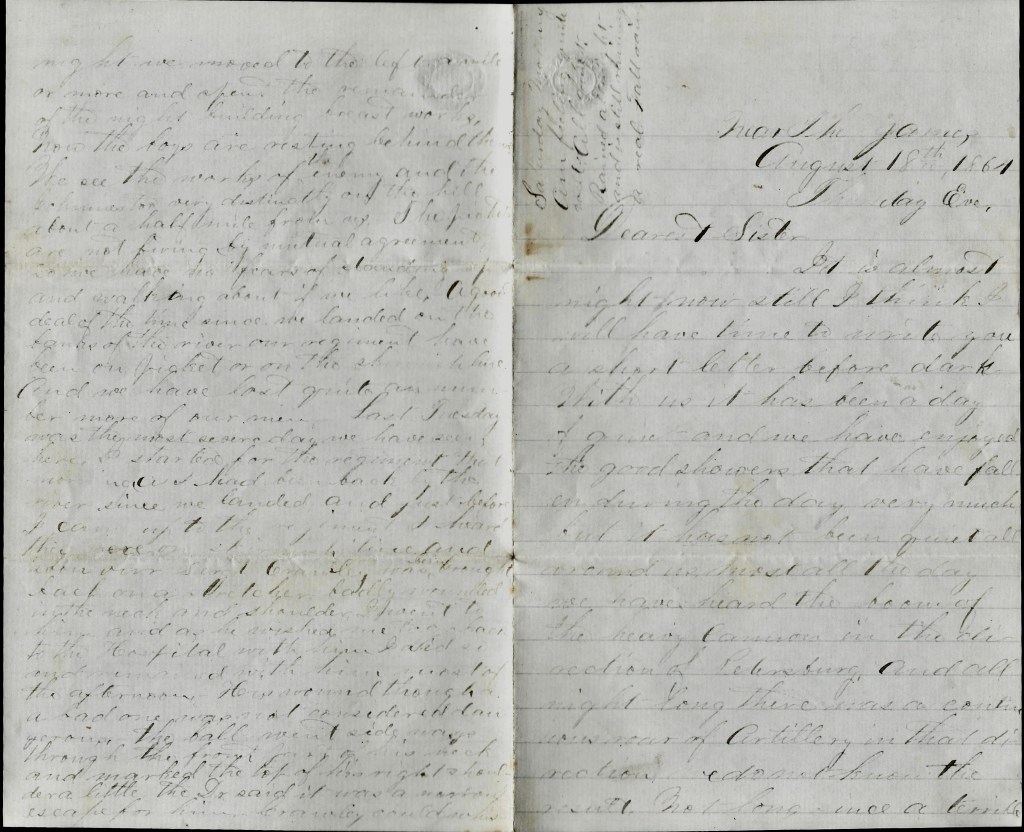
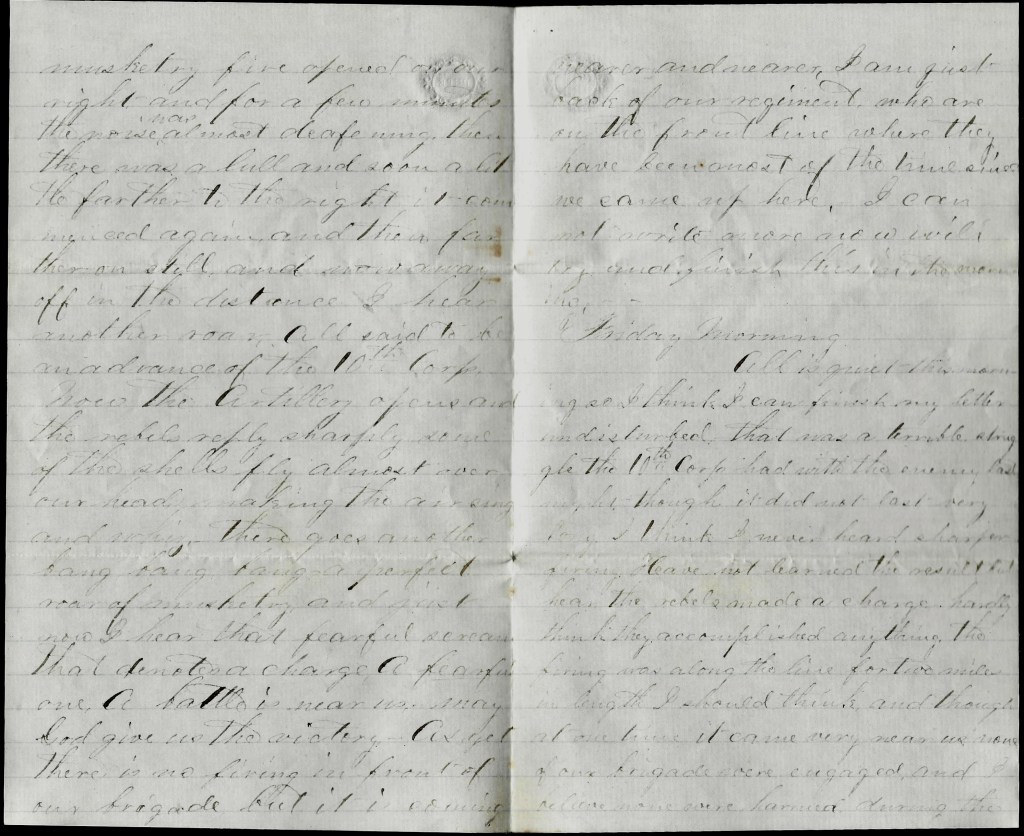

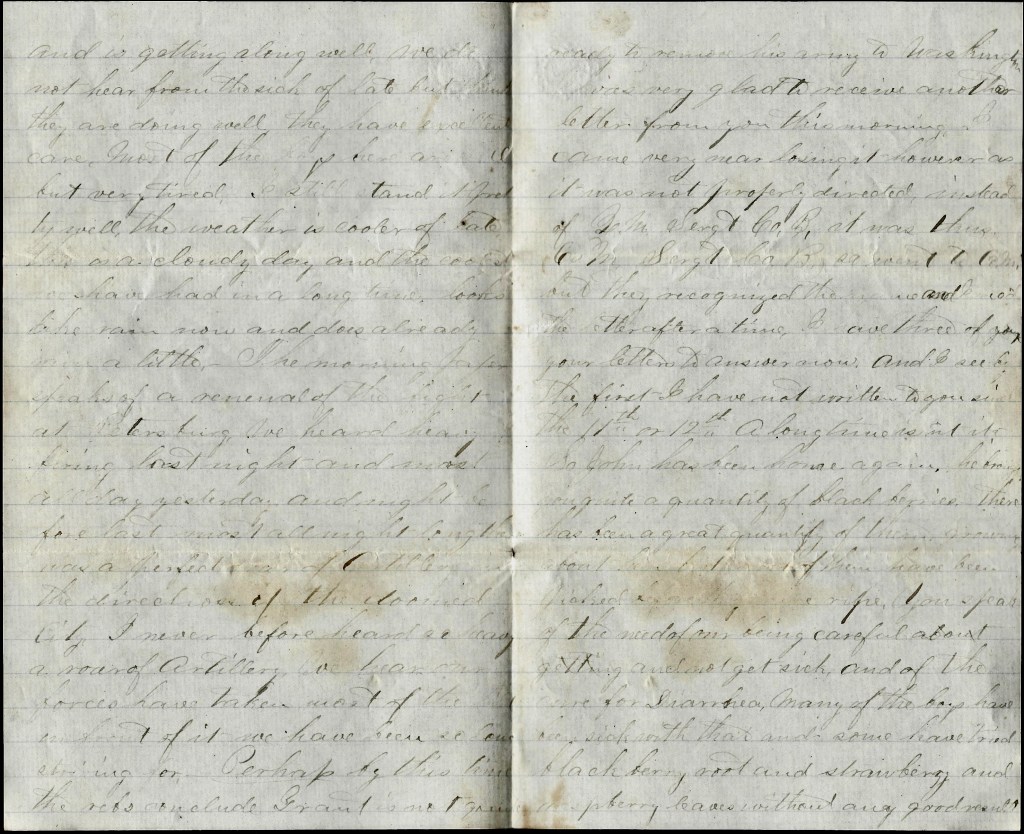


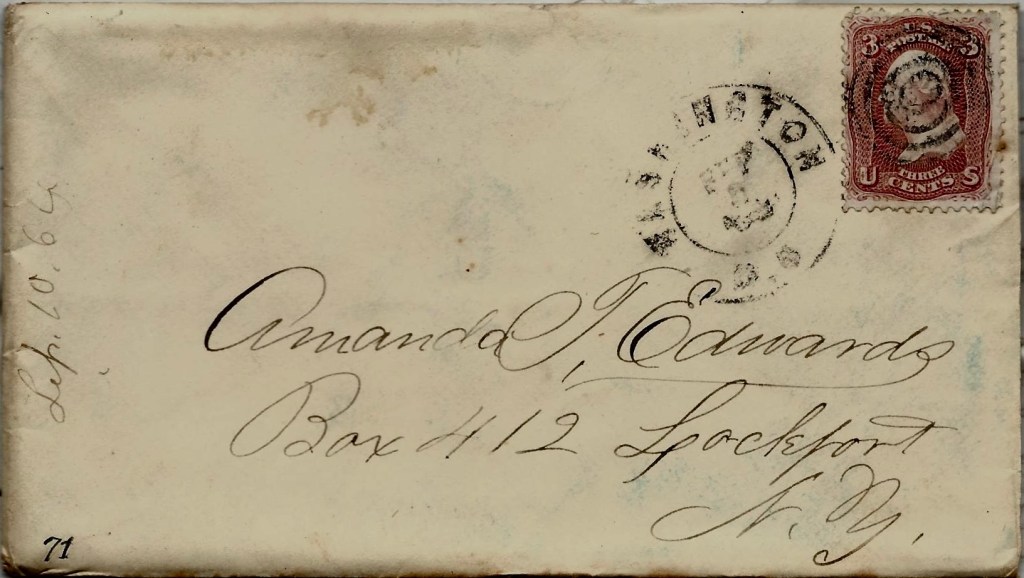

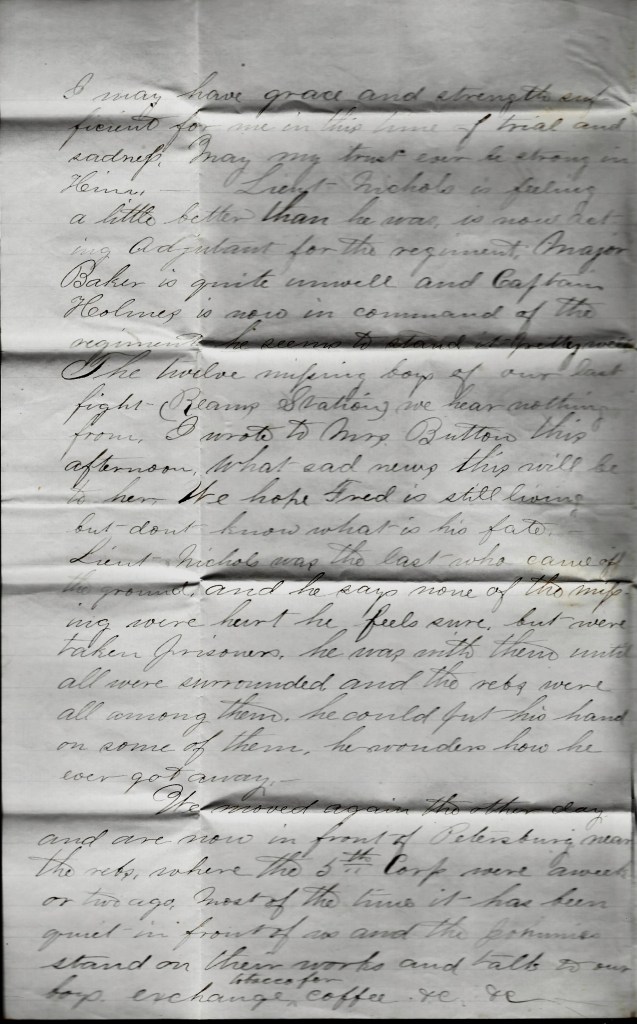

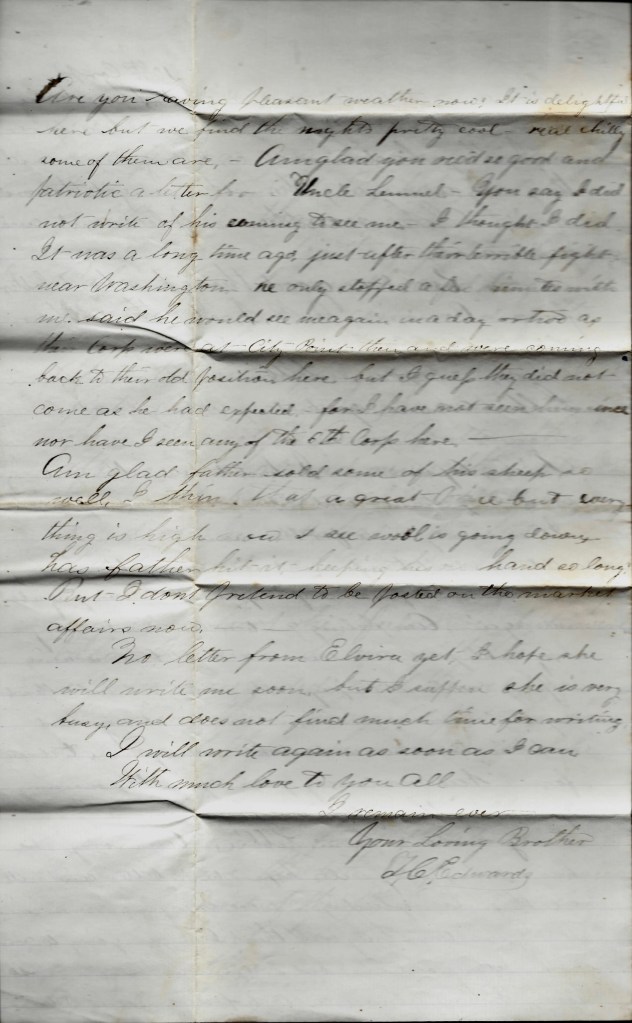

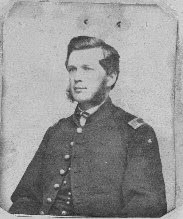
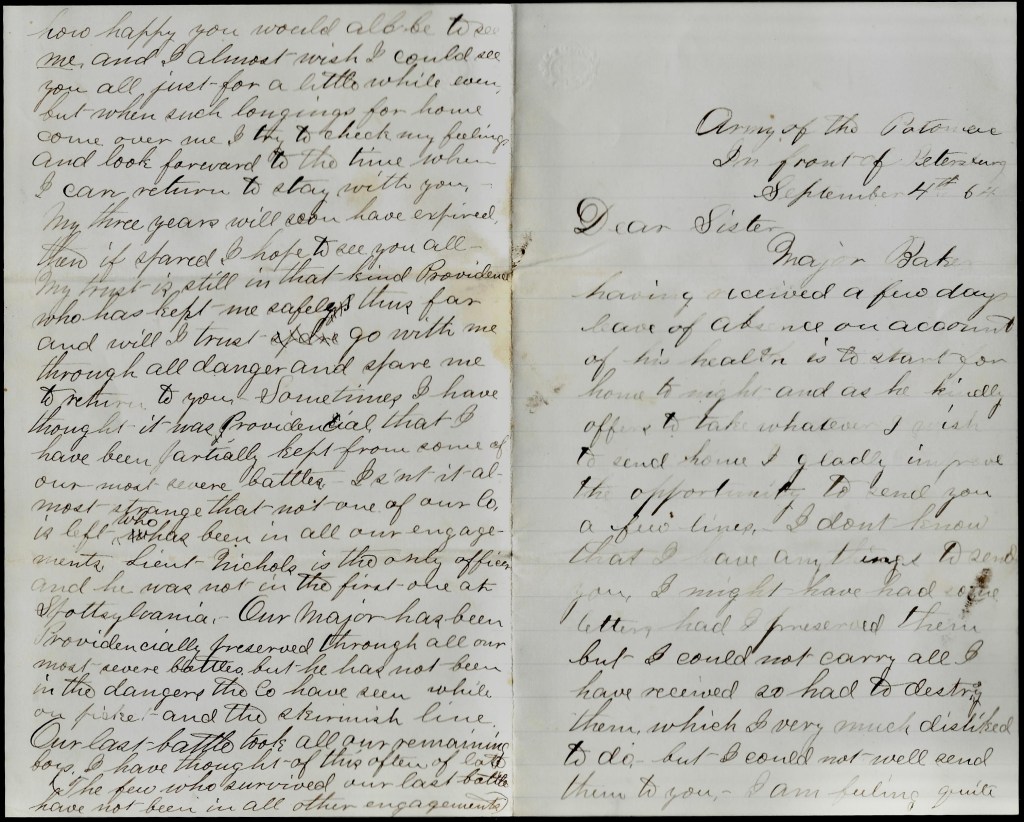


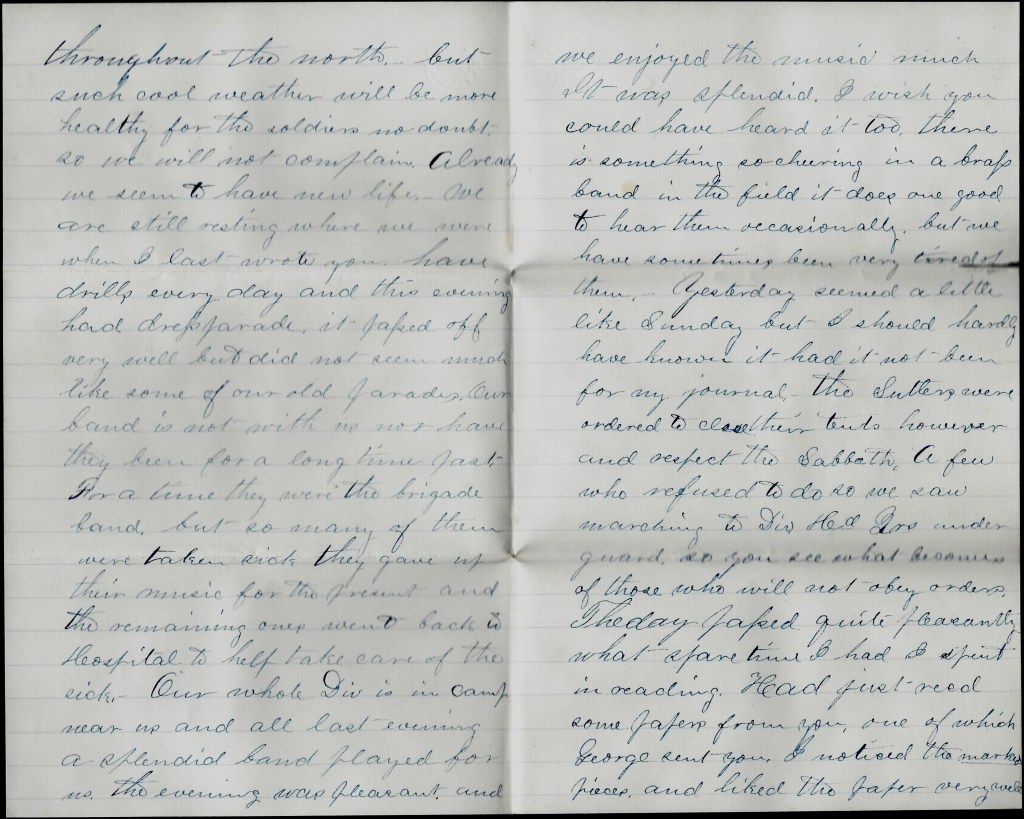


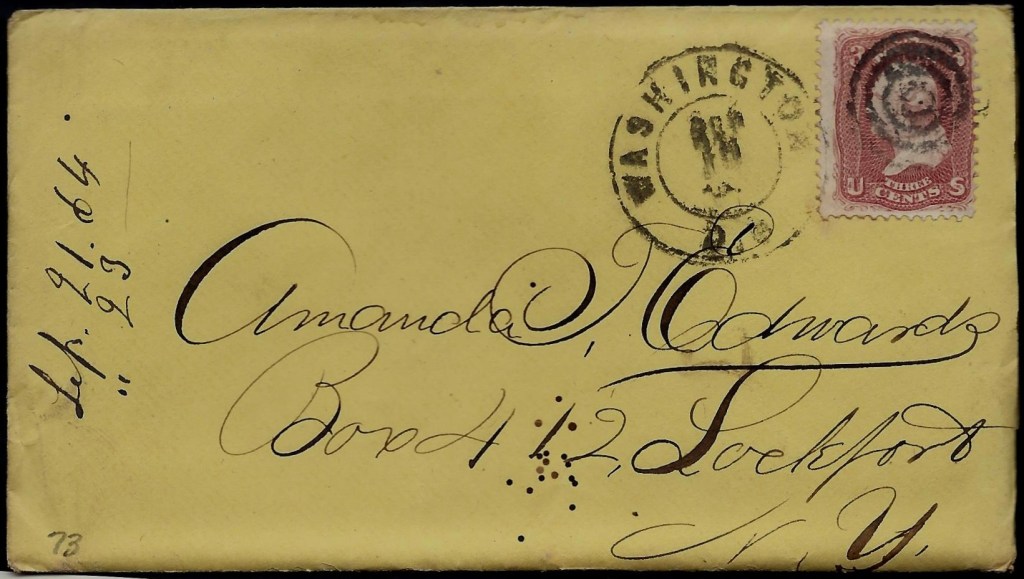




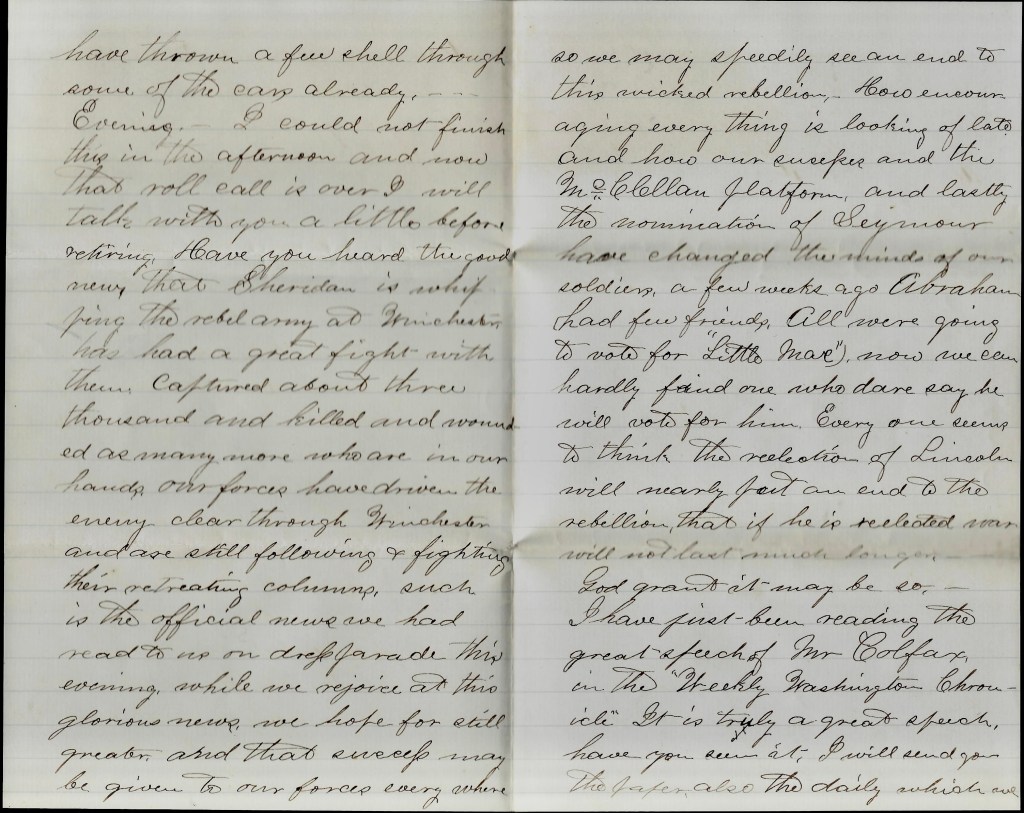

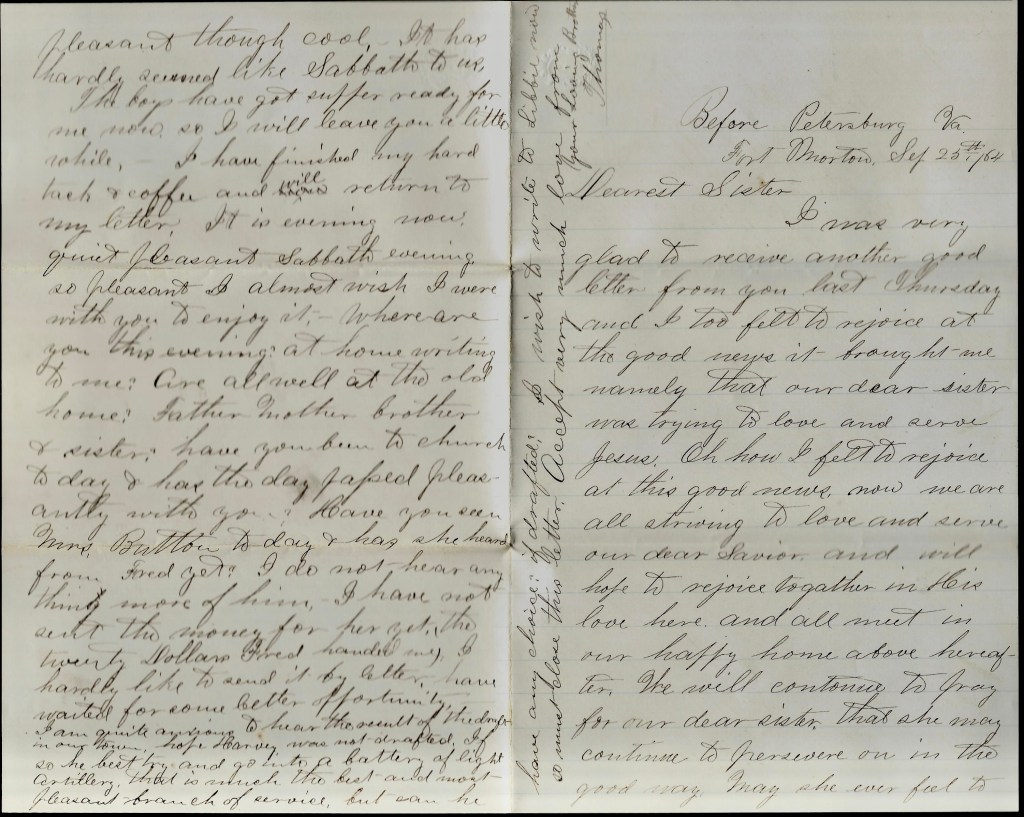


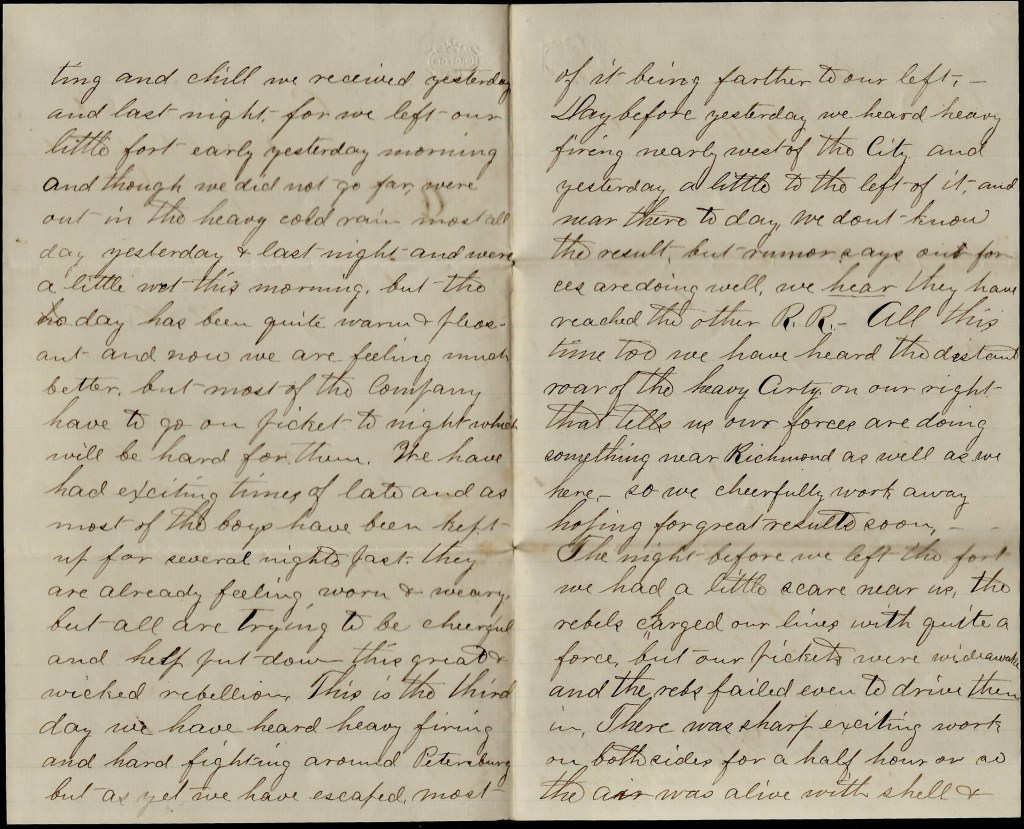


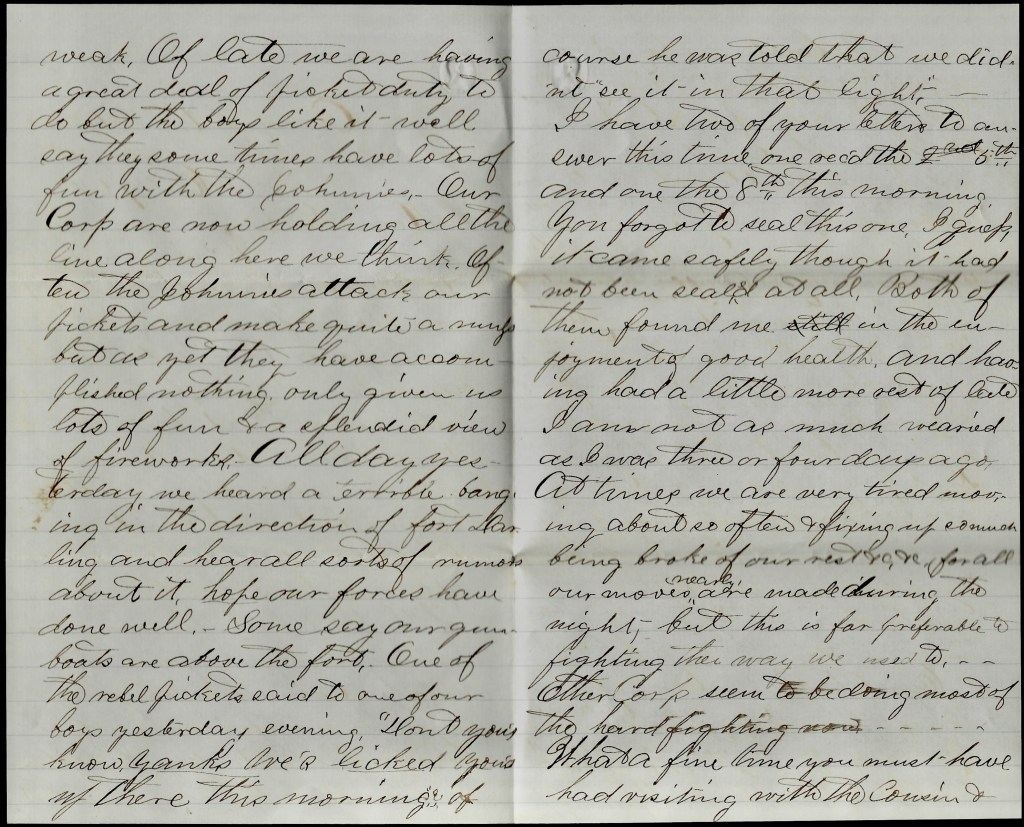


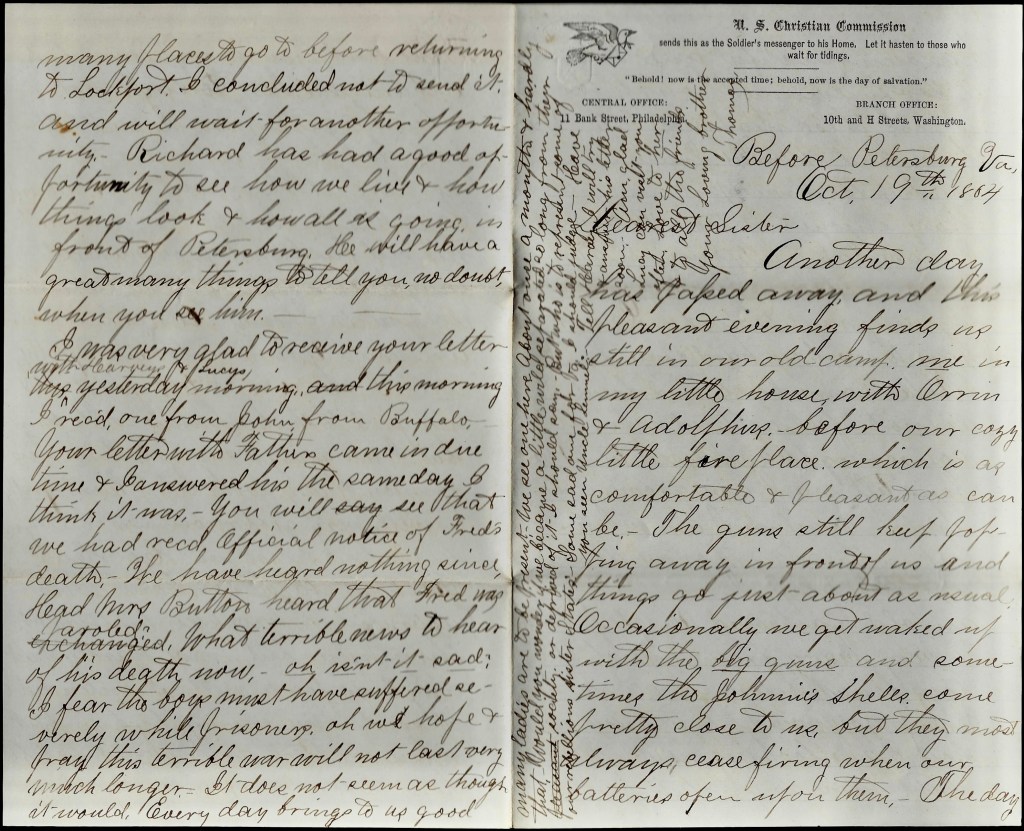


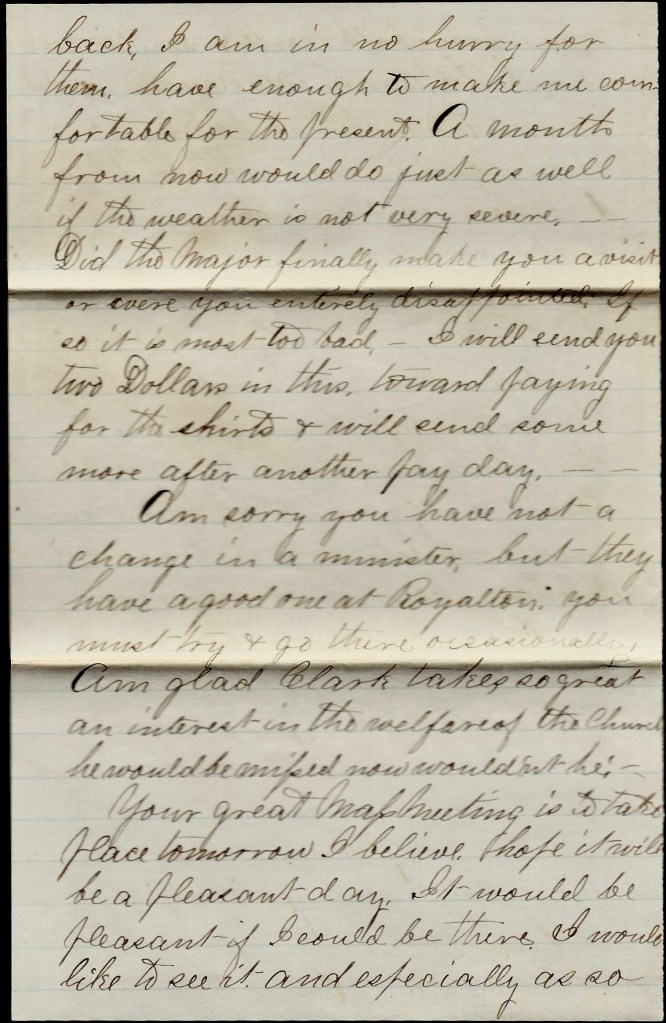

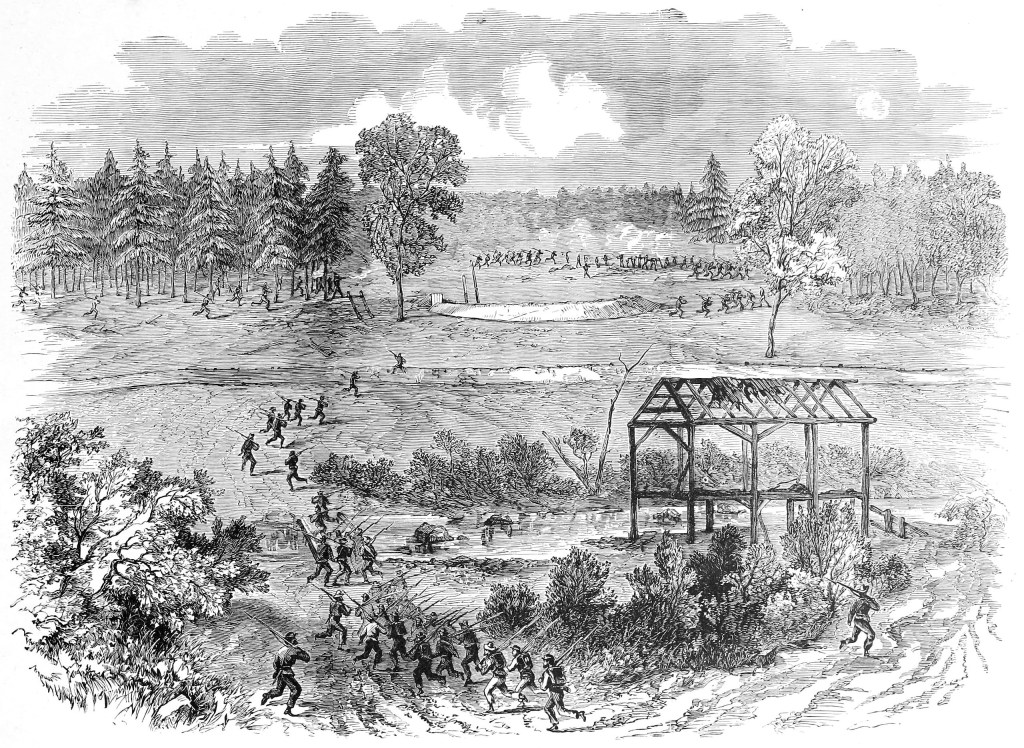

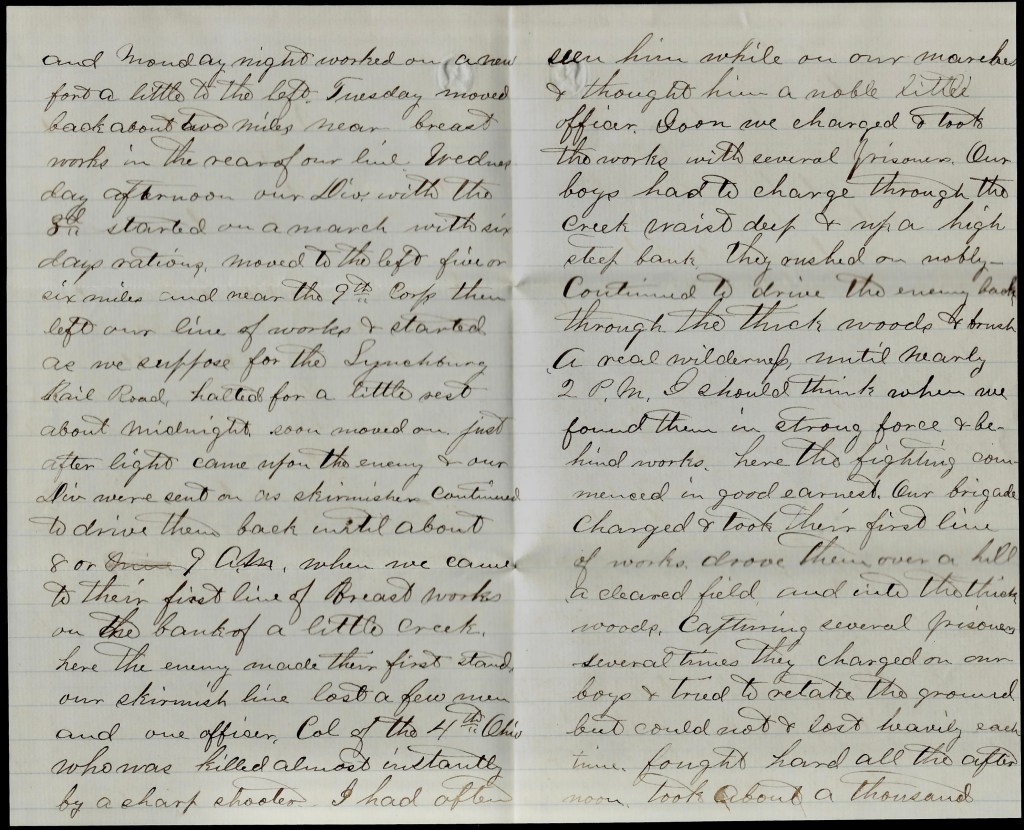

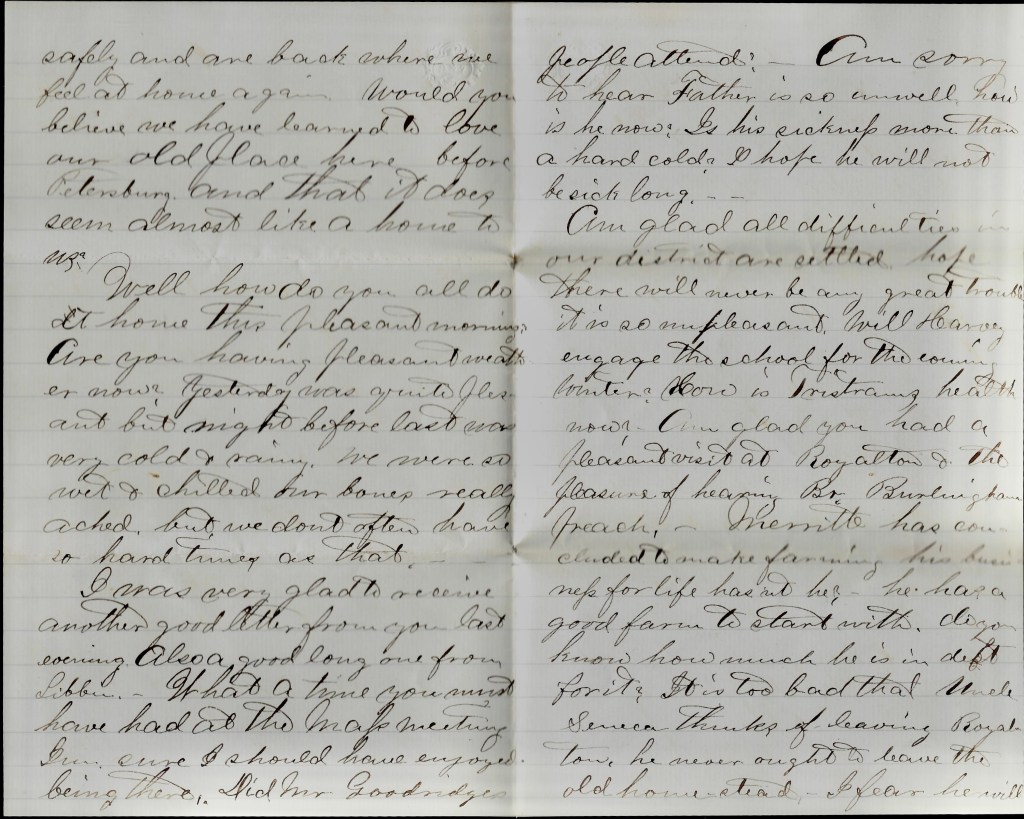
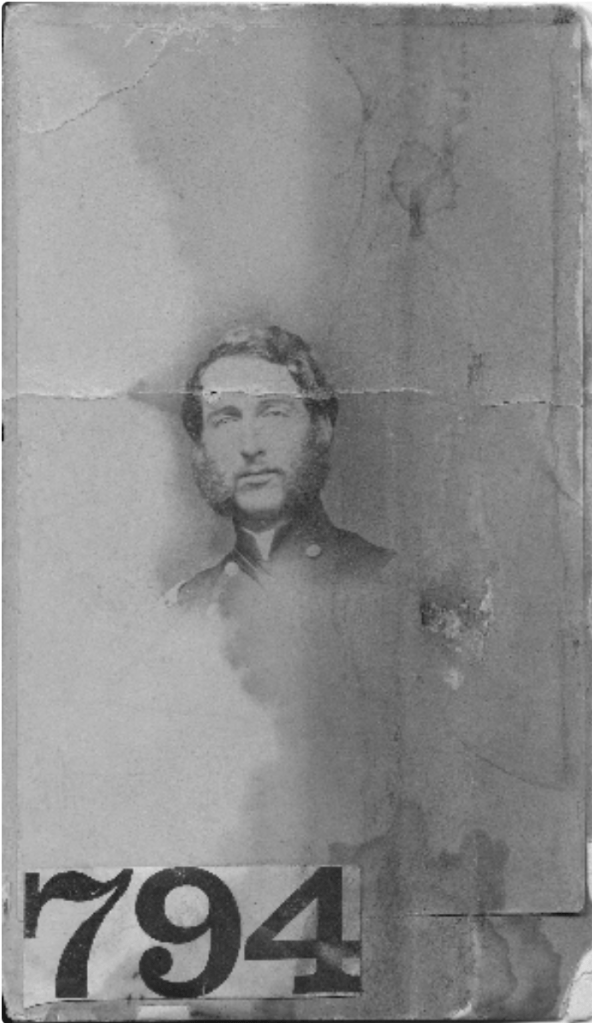


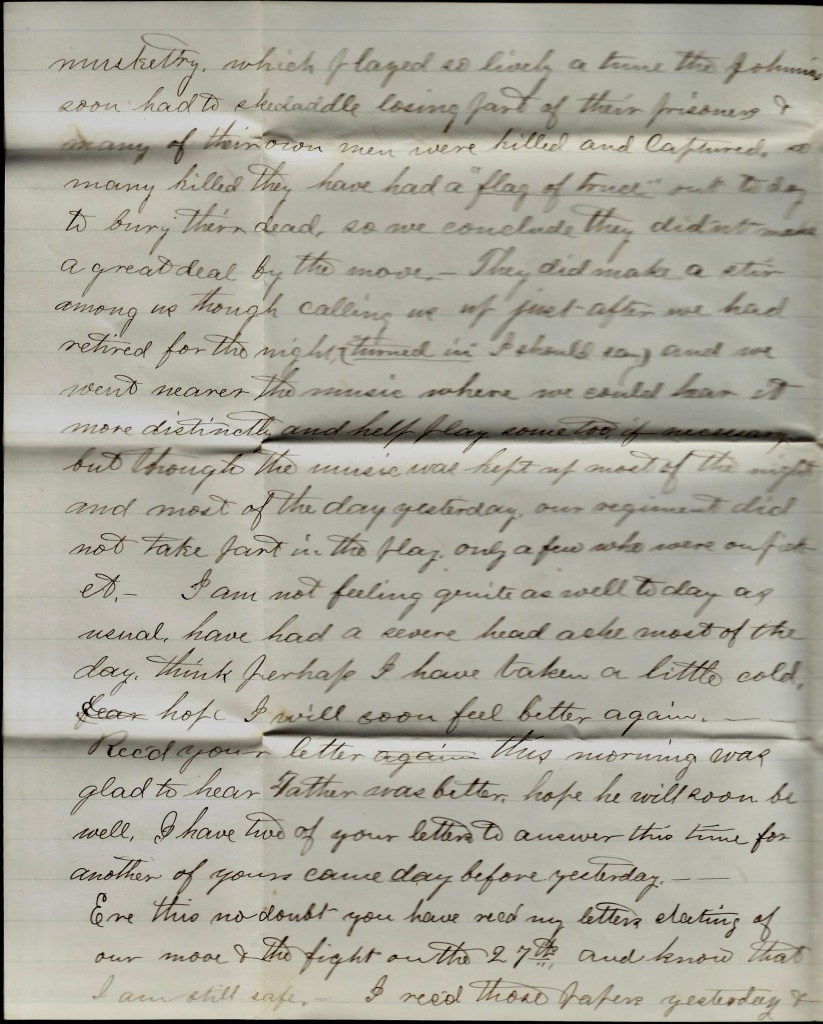
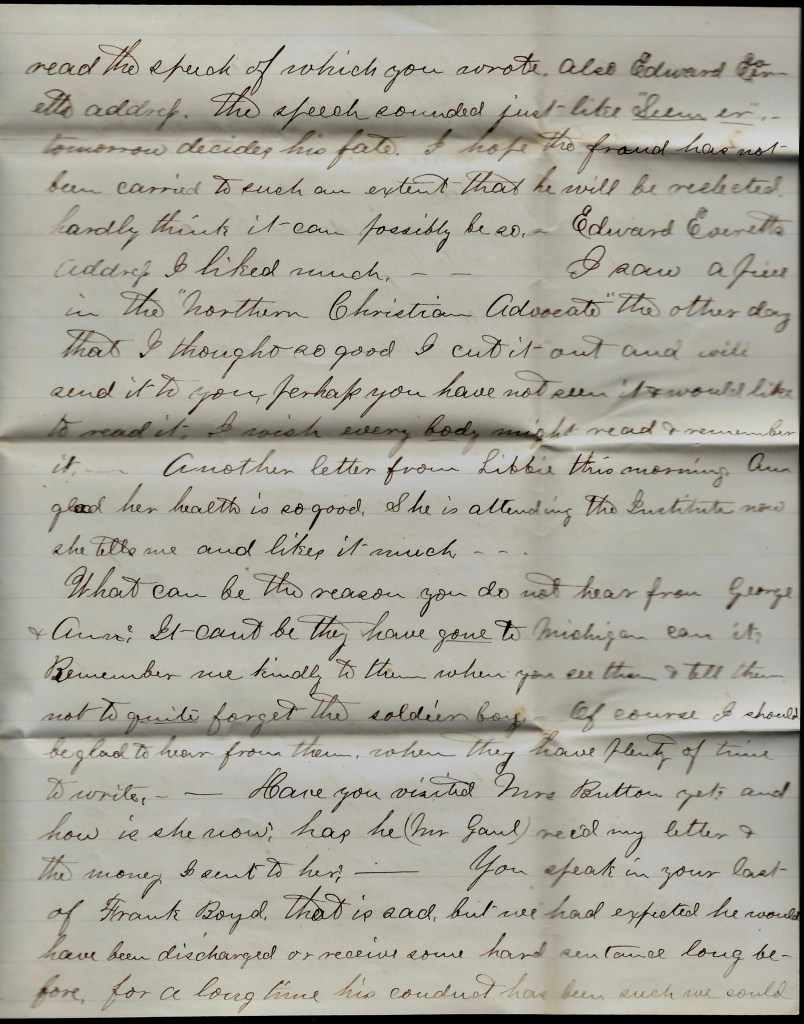
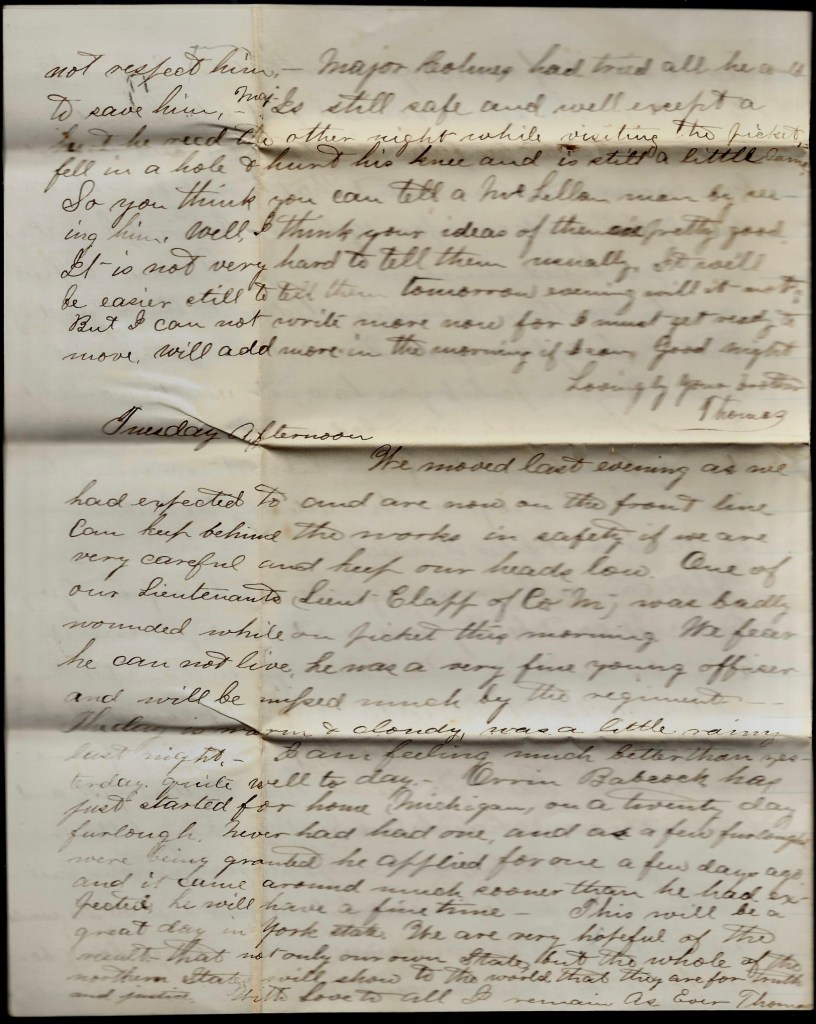


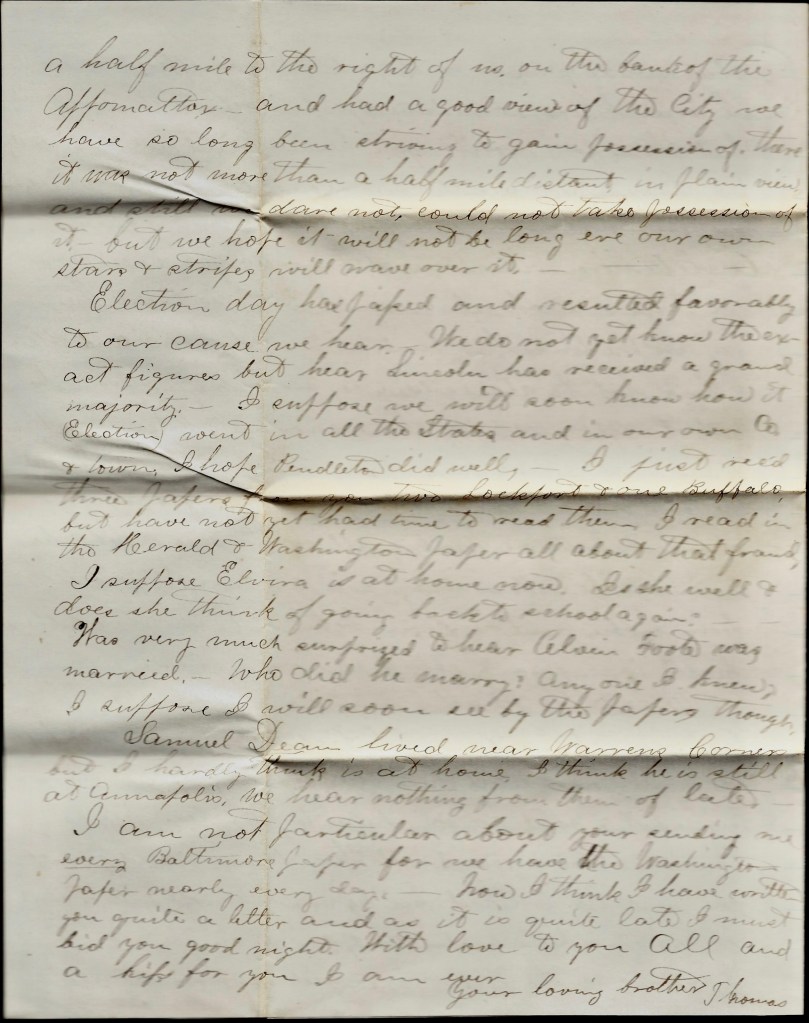






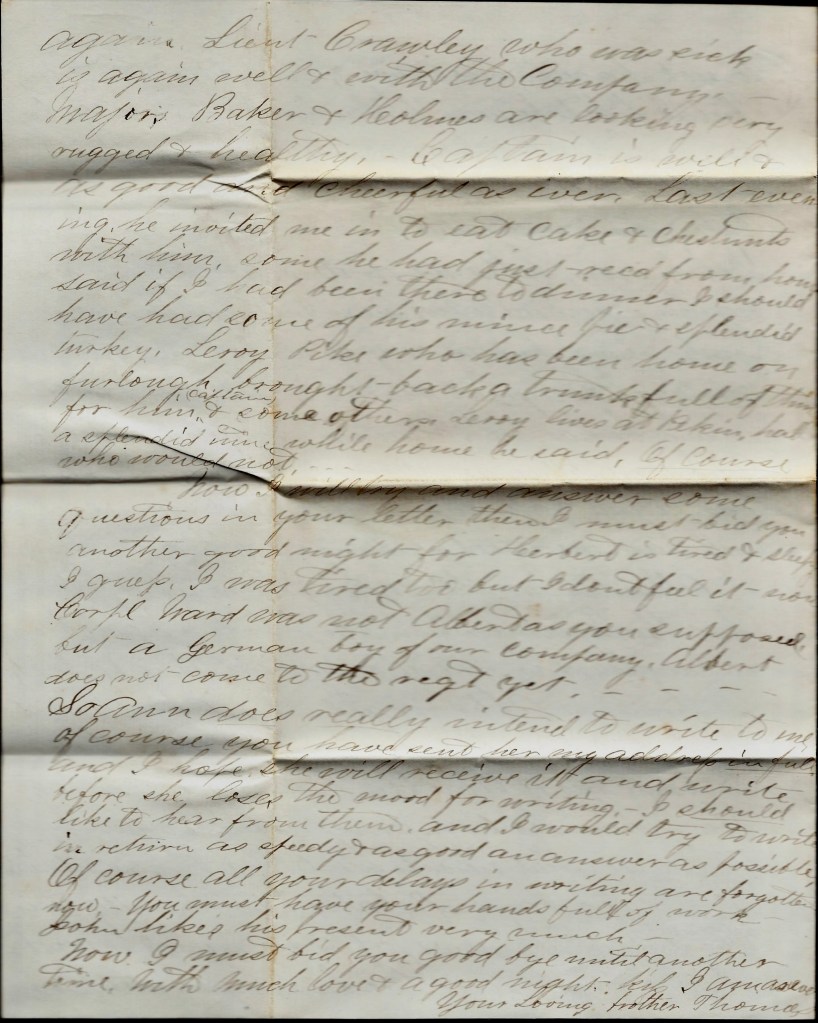


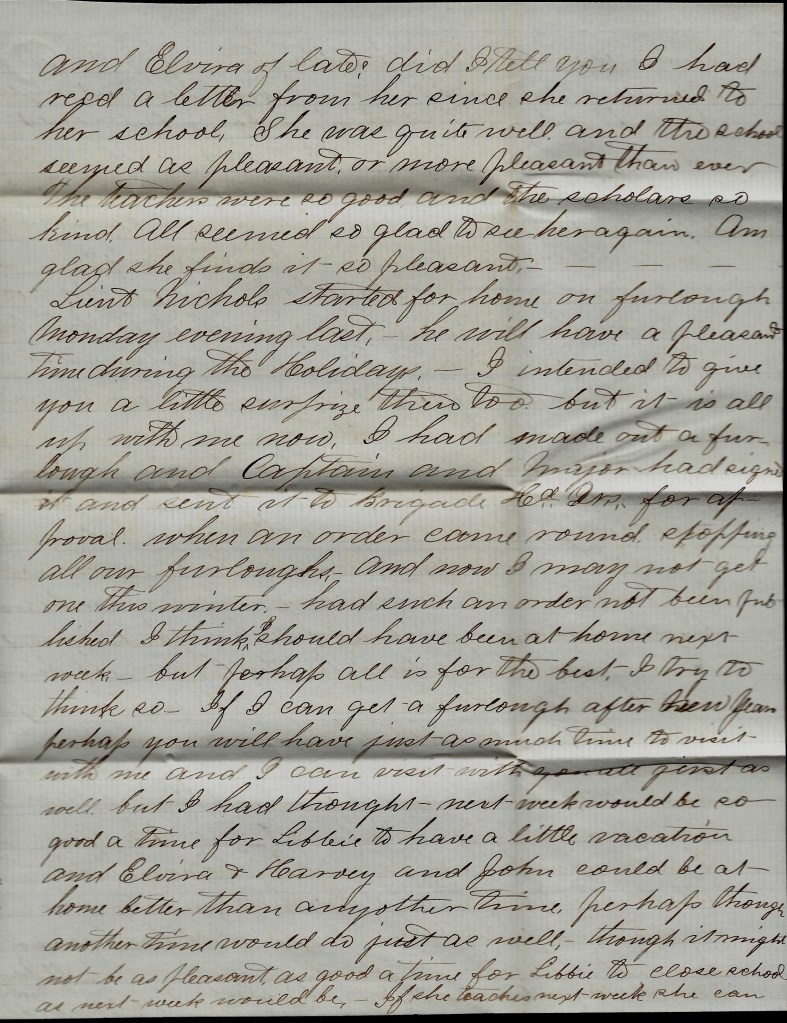


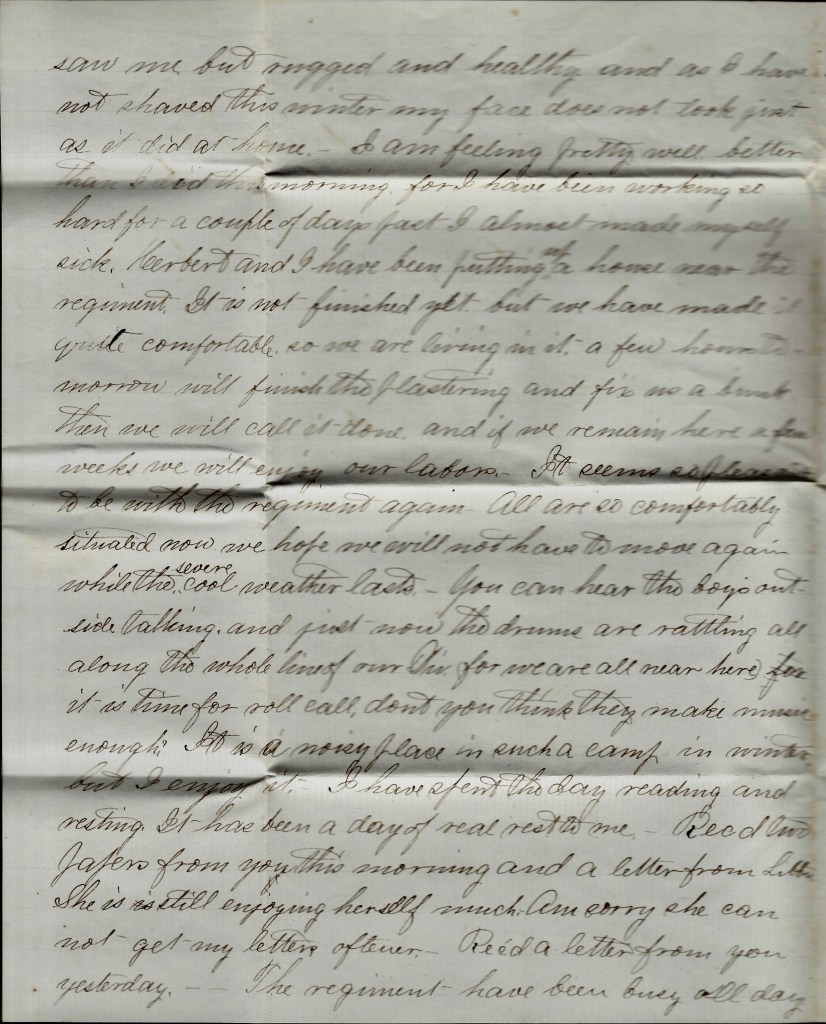


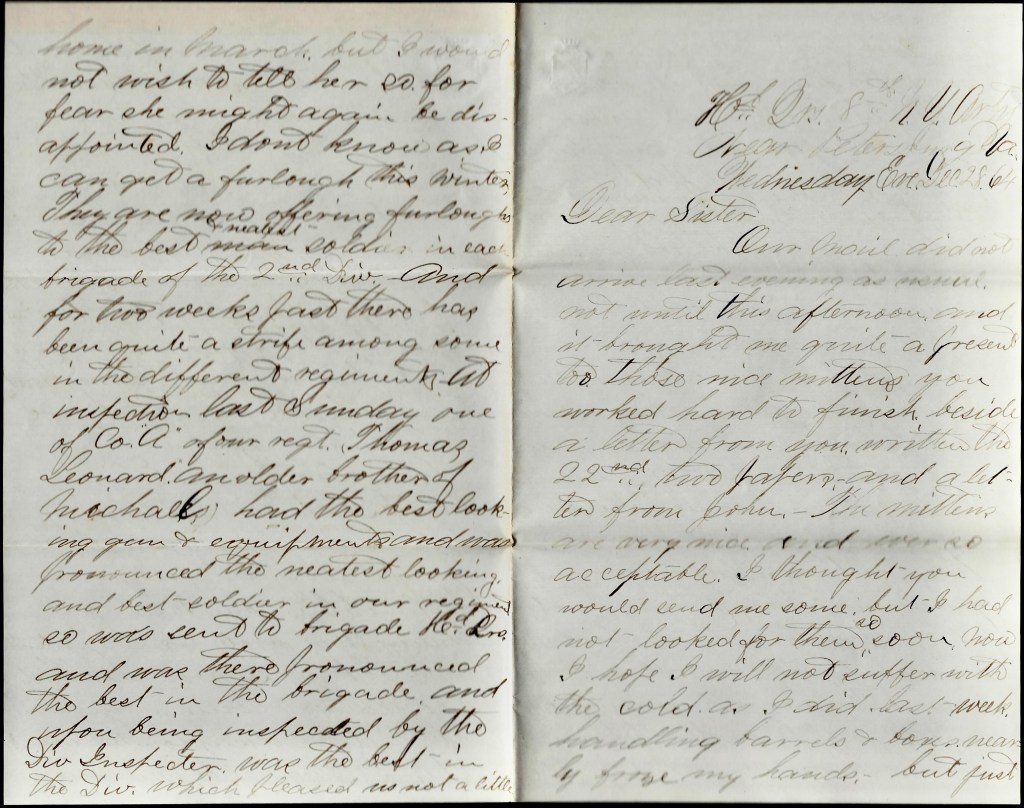


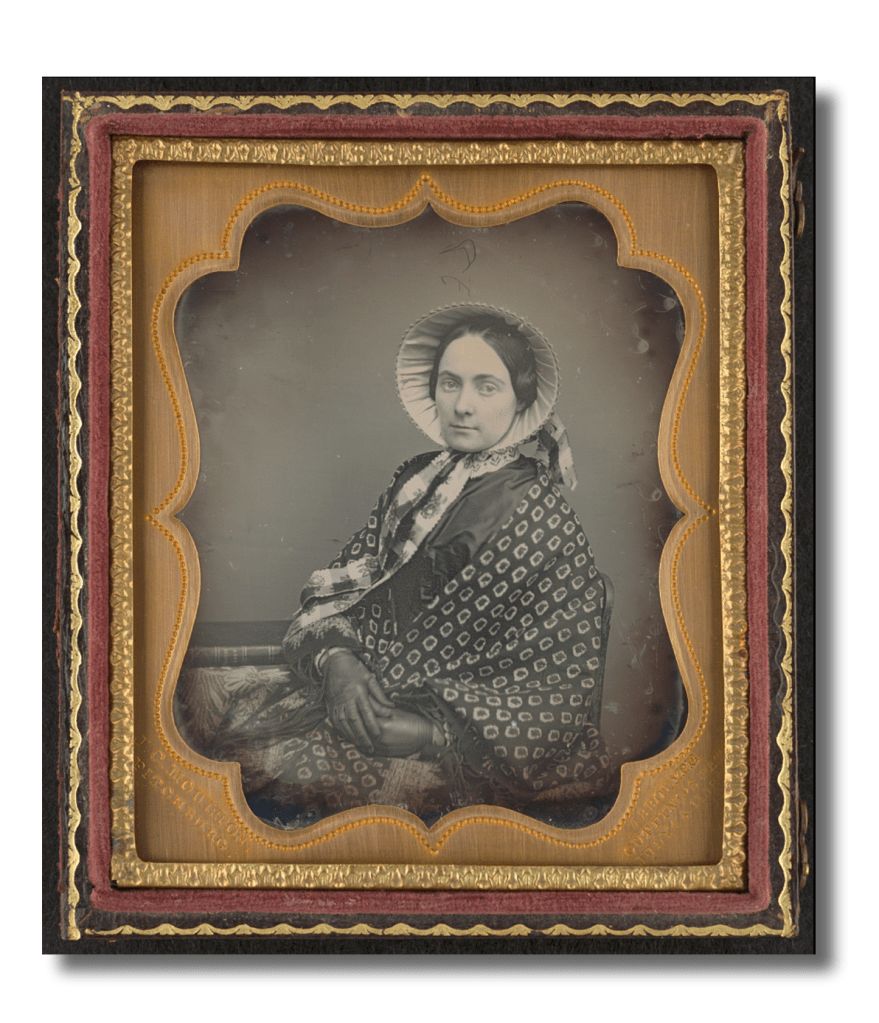

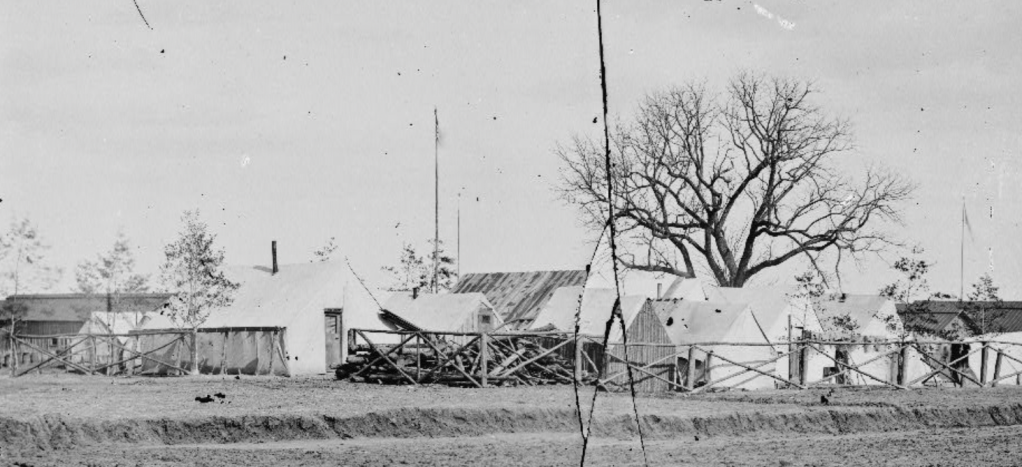





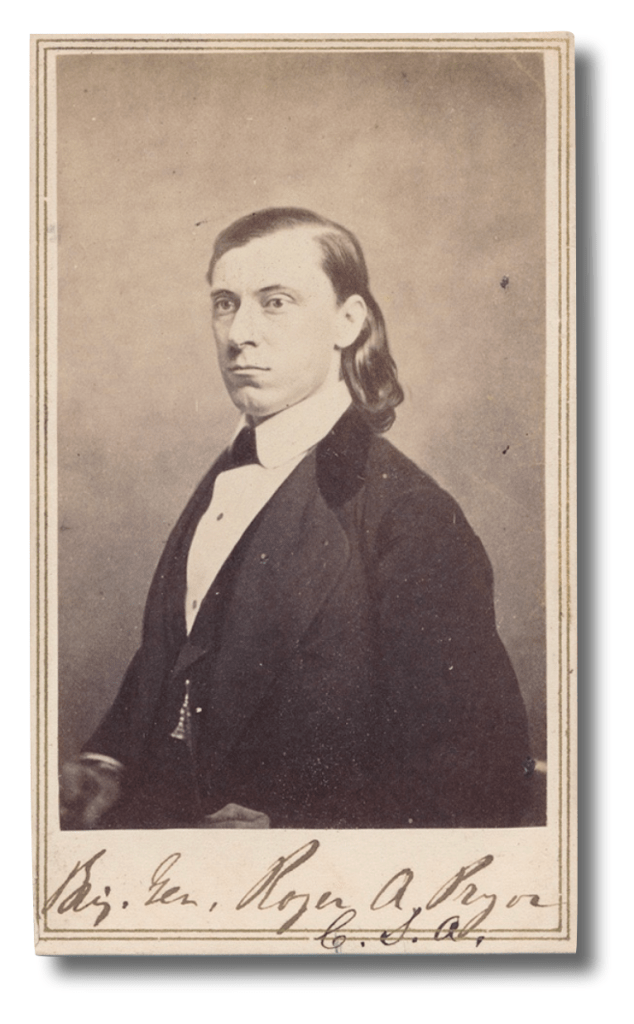
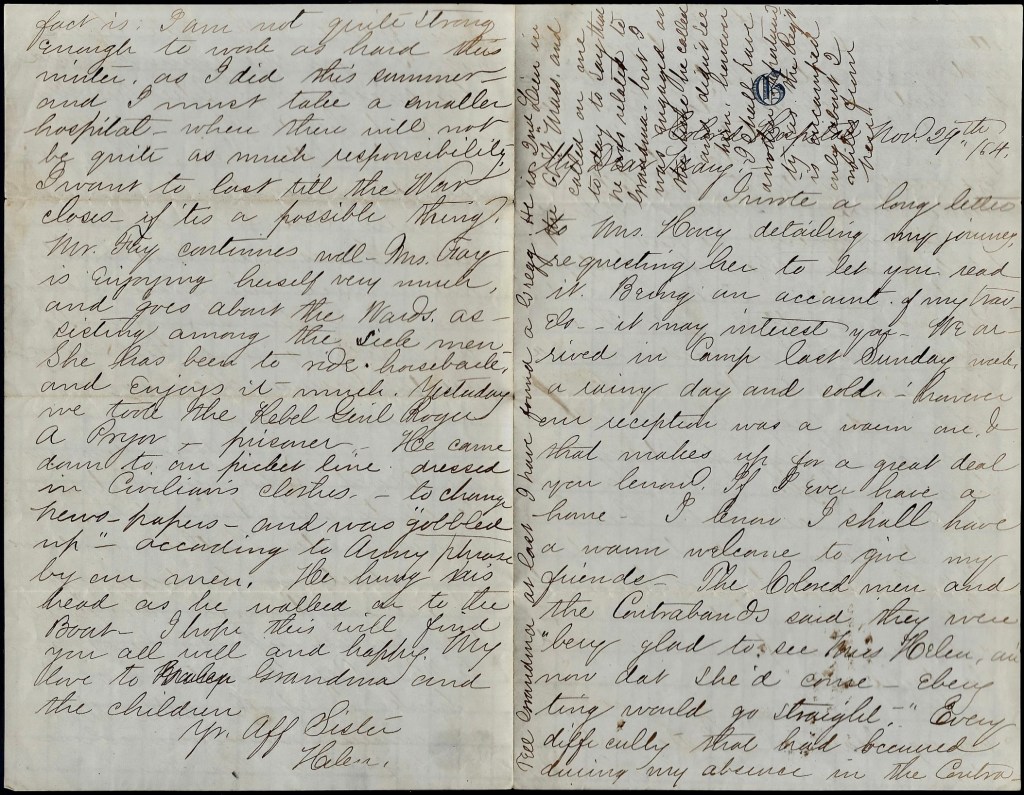
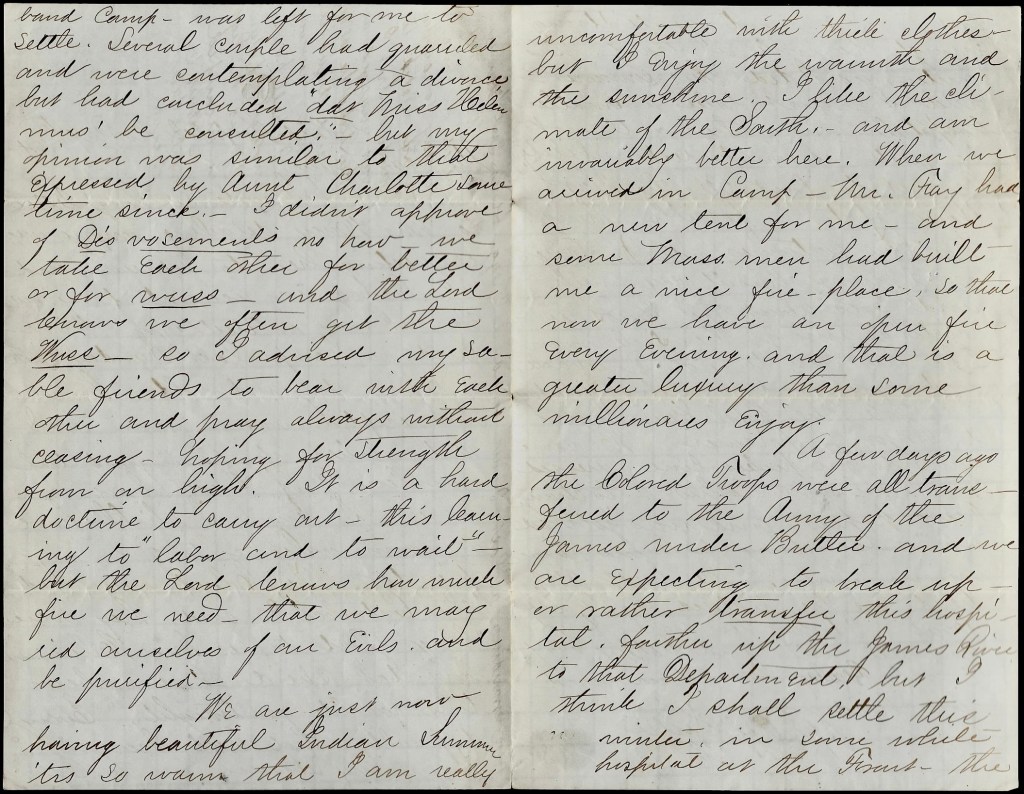

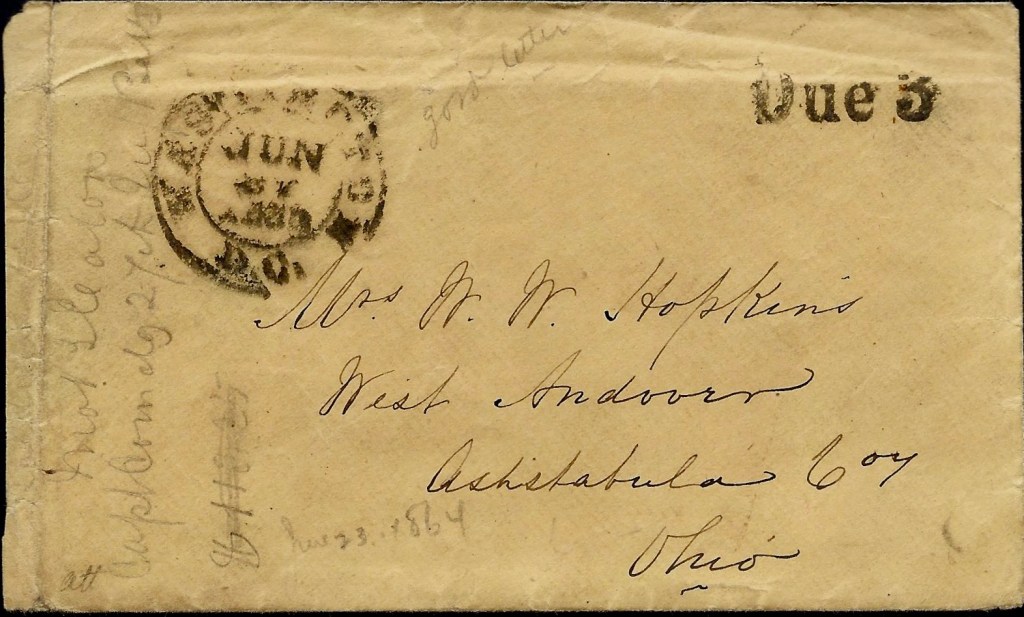

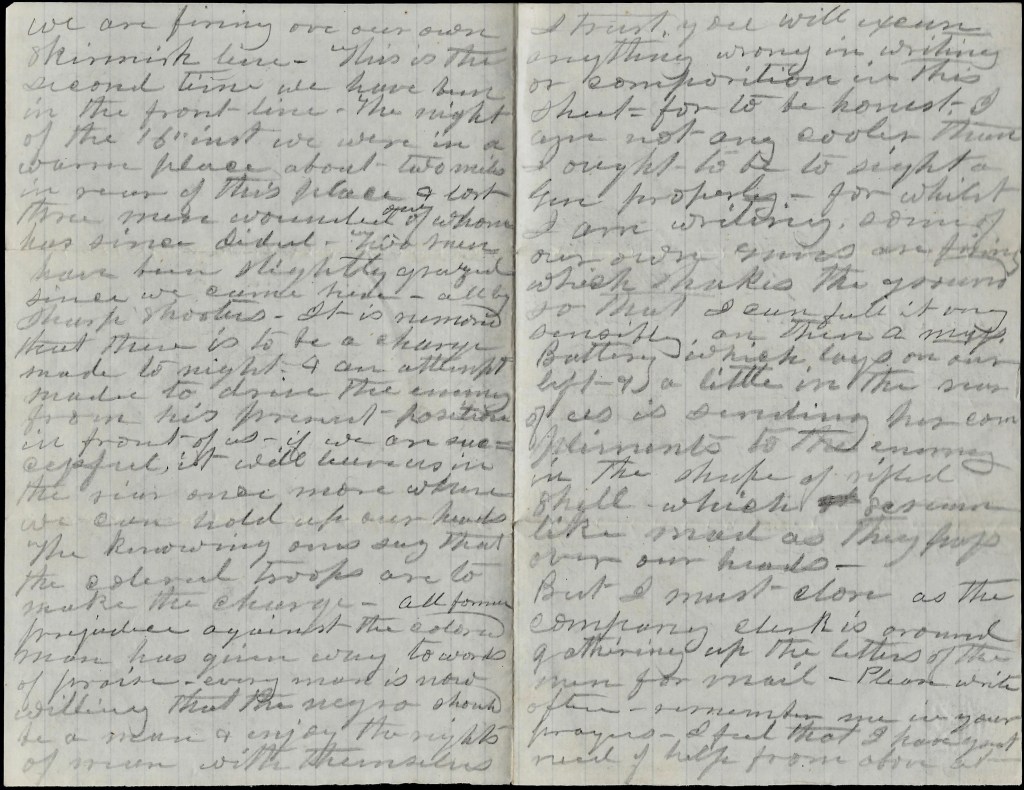


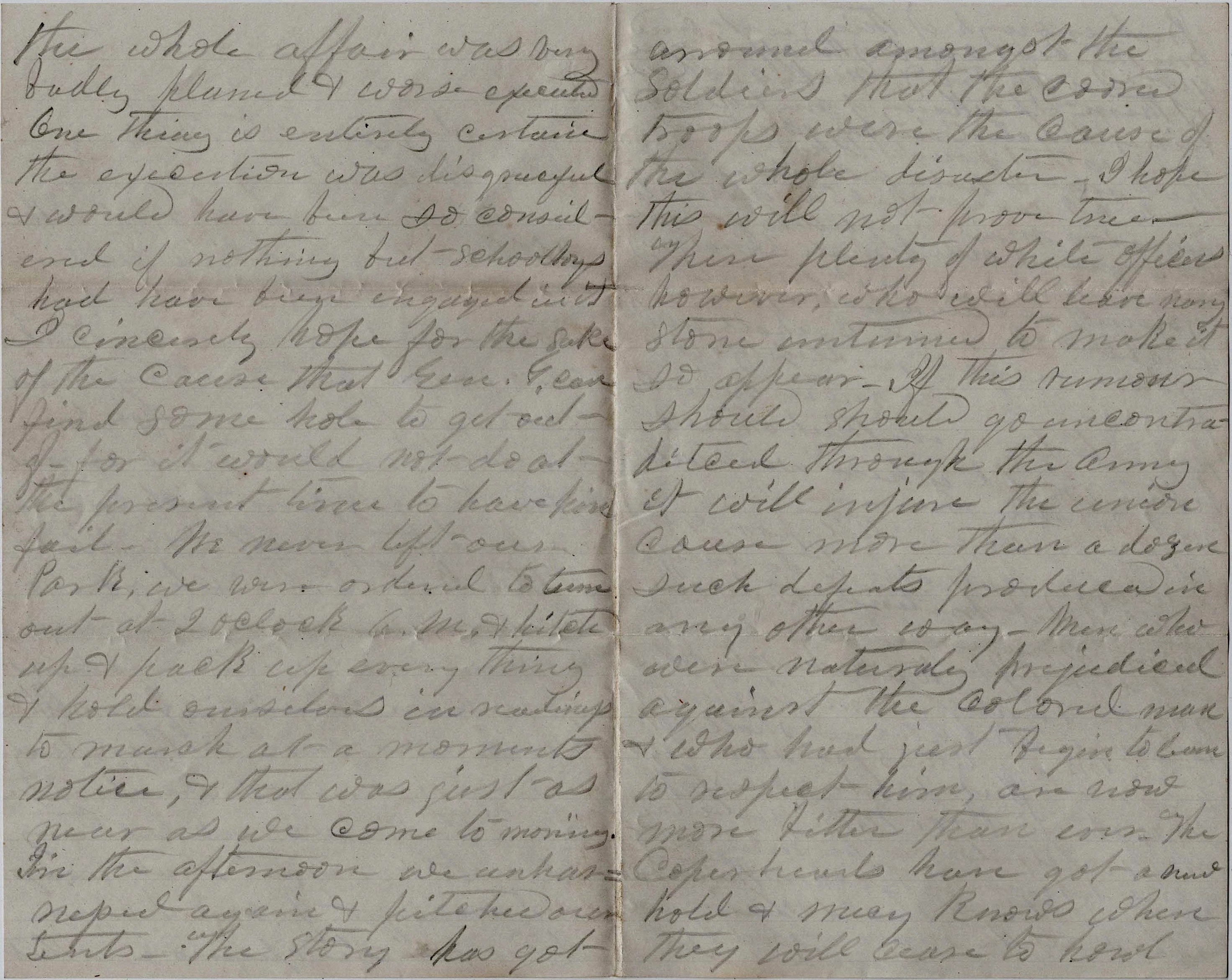
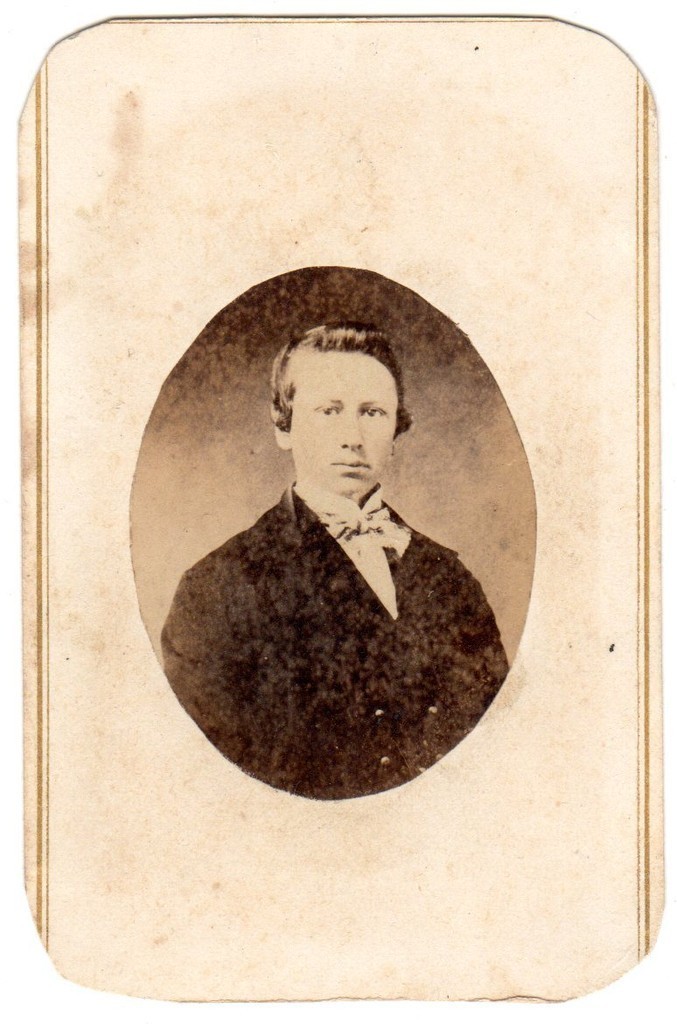
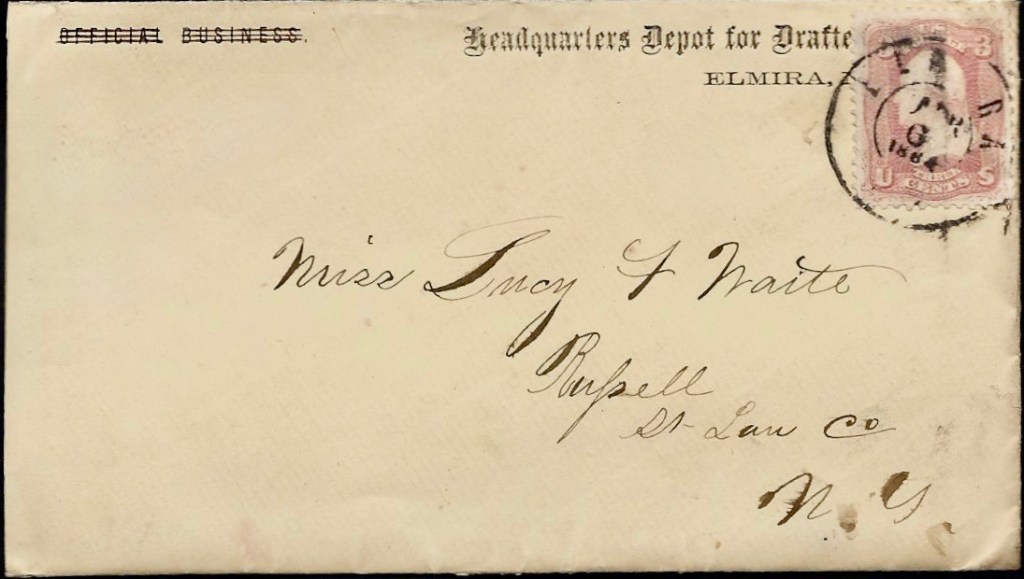



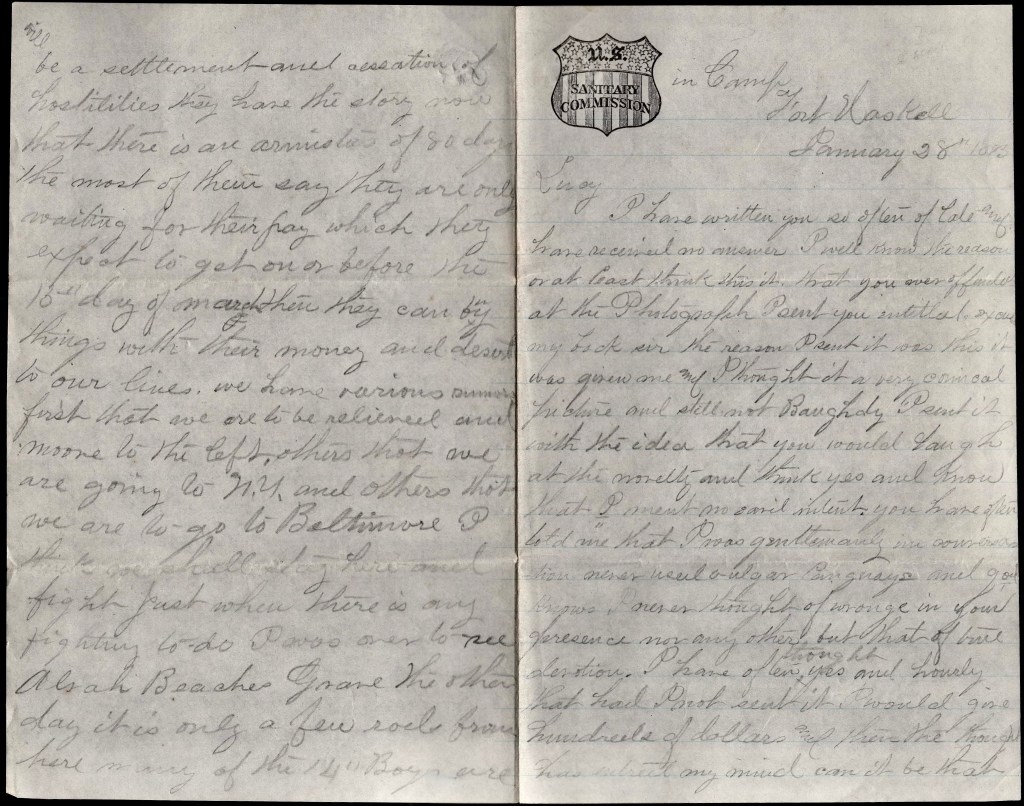
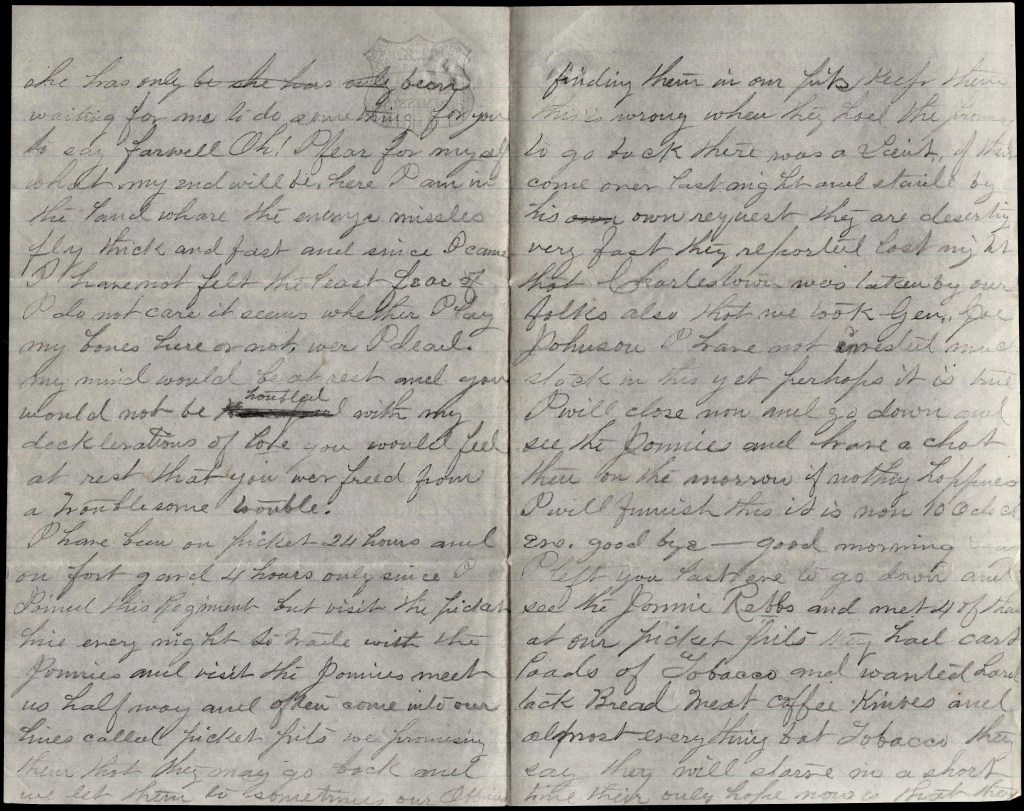

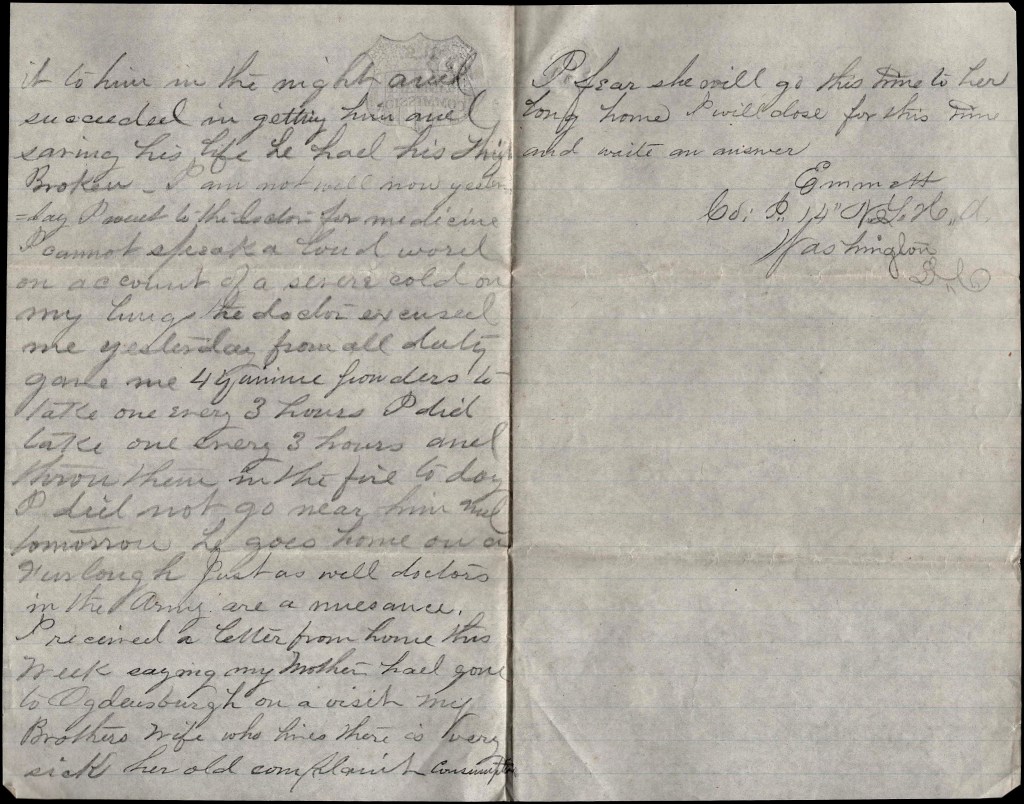

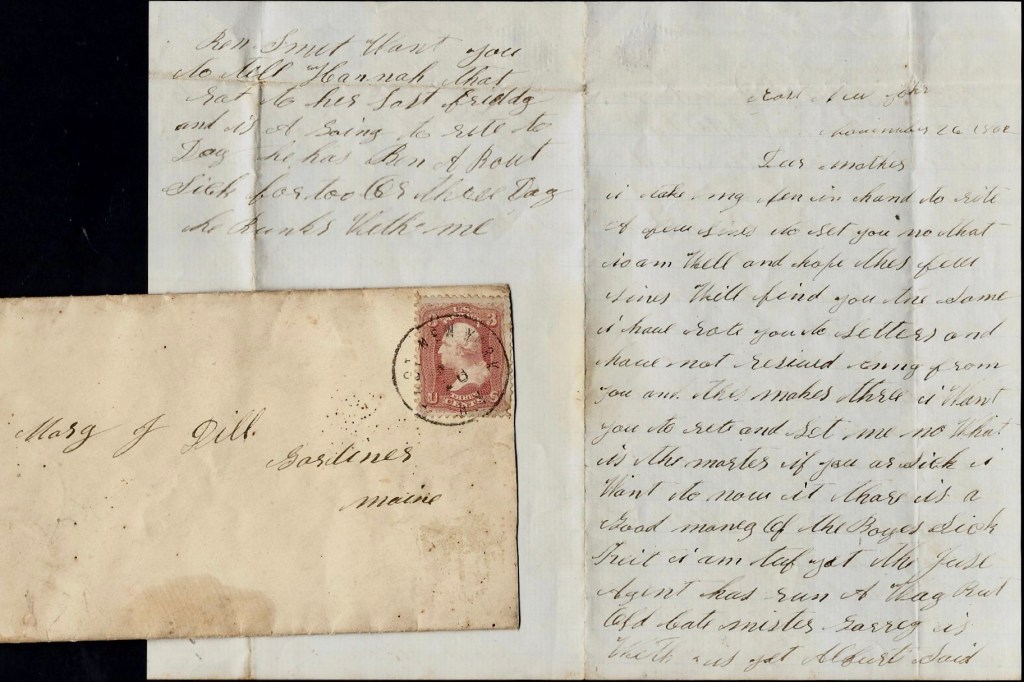

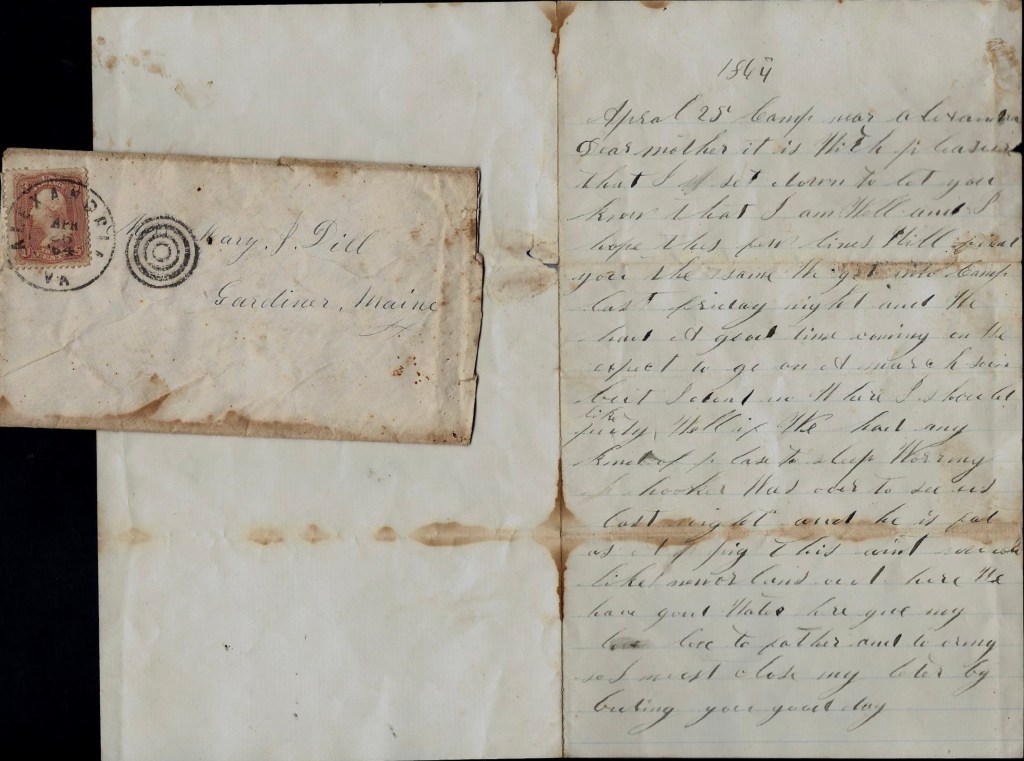


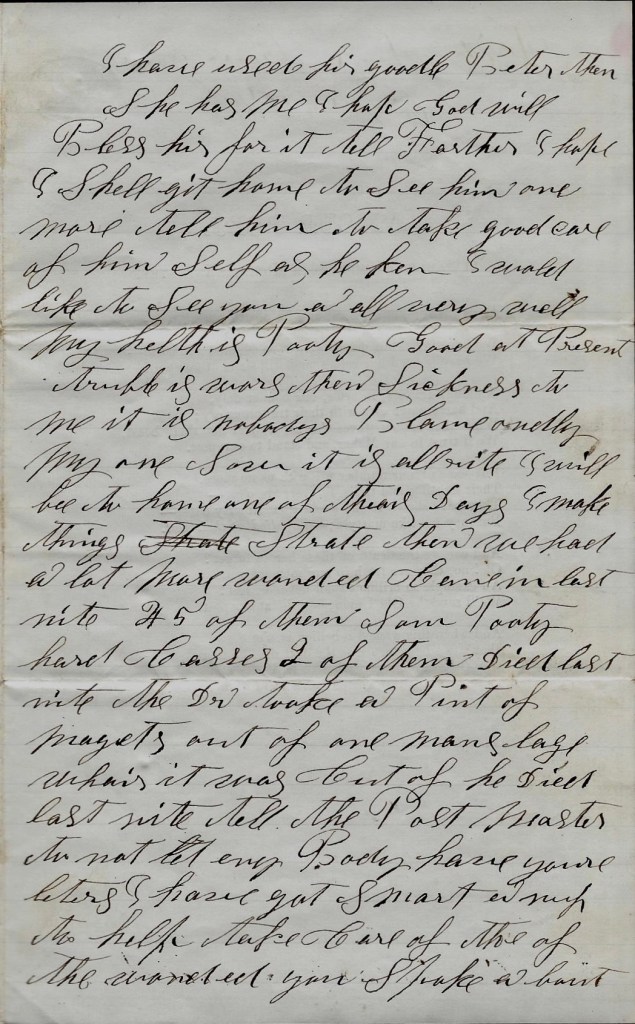
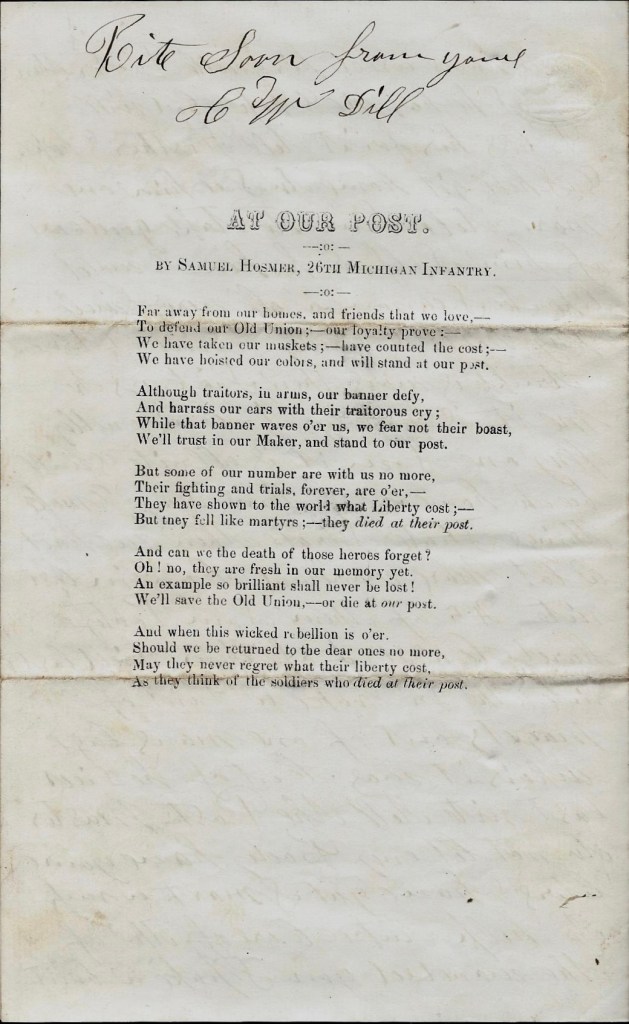


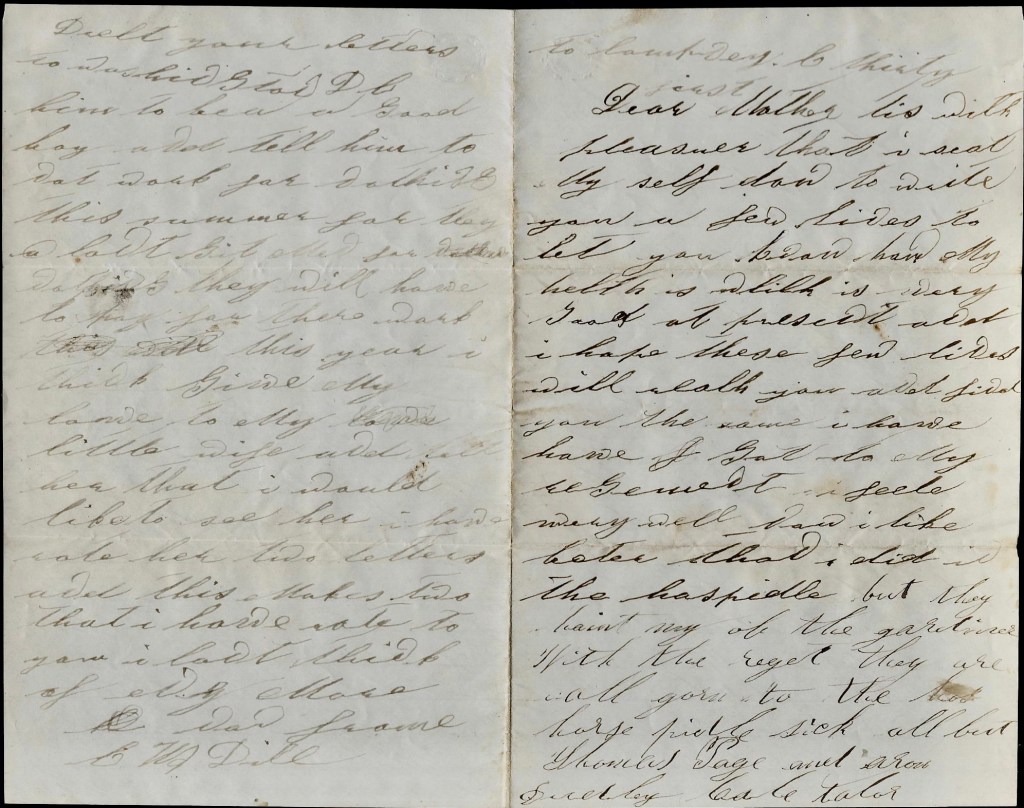
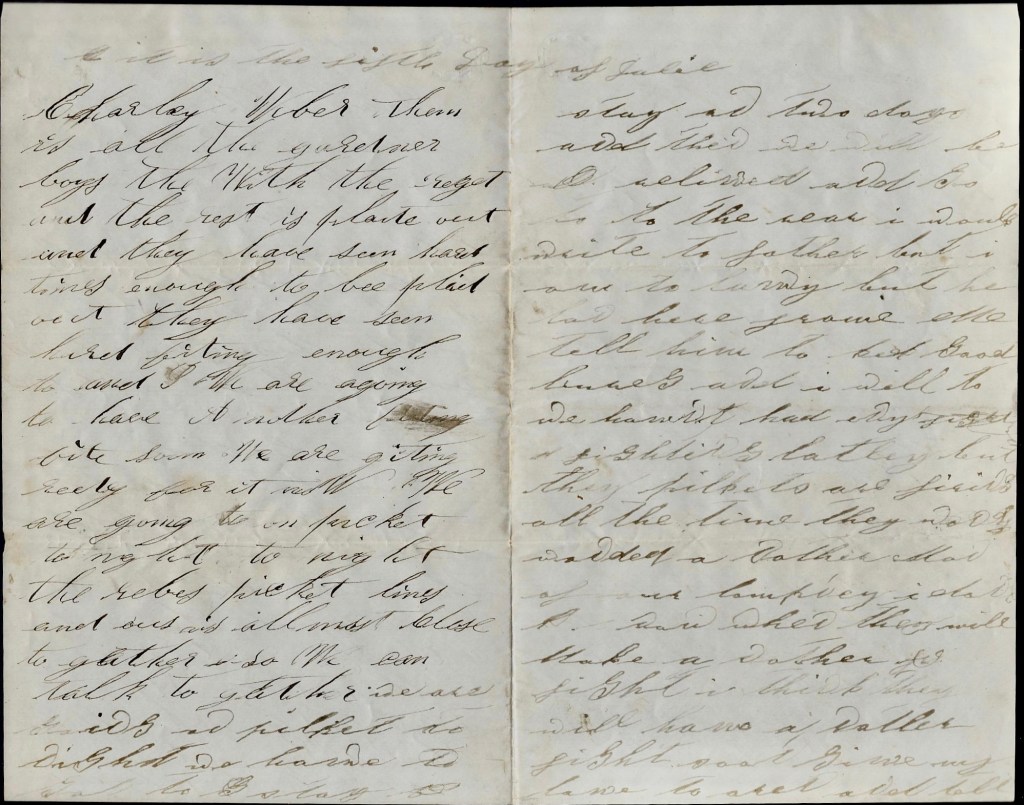







 Spared & Shared 23