Category Archives: Camp Fenton, Washington D. C.

1861: Charles Deforest Huntington to Friend Hattie

The following letter was written by Charles Deforest Huntington (1843-1869), the son of David Huntington (1812-1885) and Adaline Gordon (1815-1894) of East Randolph, Cattaraugus county, New York. Charles enlisted with his brother Monroe as a private in Co. E, 9th New York Cavalry. He mustered out of the regiment in late October 1861 with a surgeon’s certificate of disability.

Charles wrote this letter from Camp Fenton which was located north of Washington City on Meridian Hill about two miles from Pennsylvania Avenue.

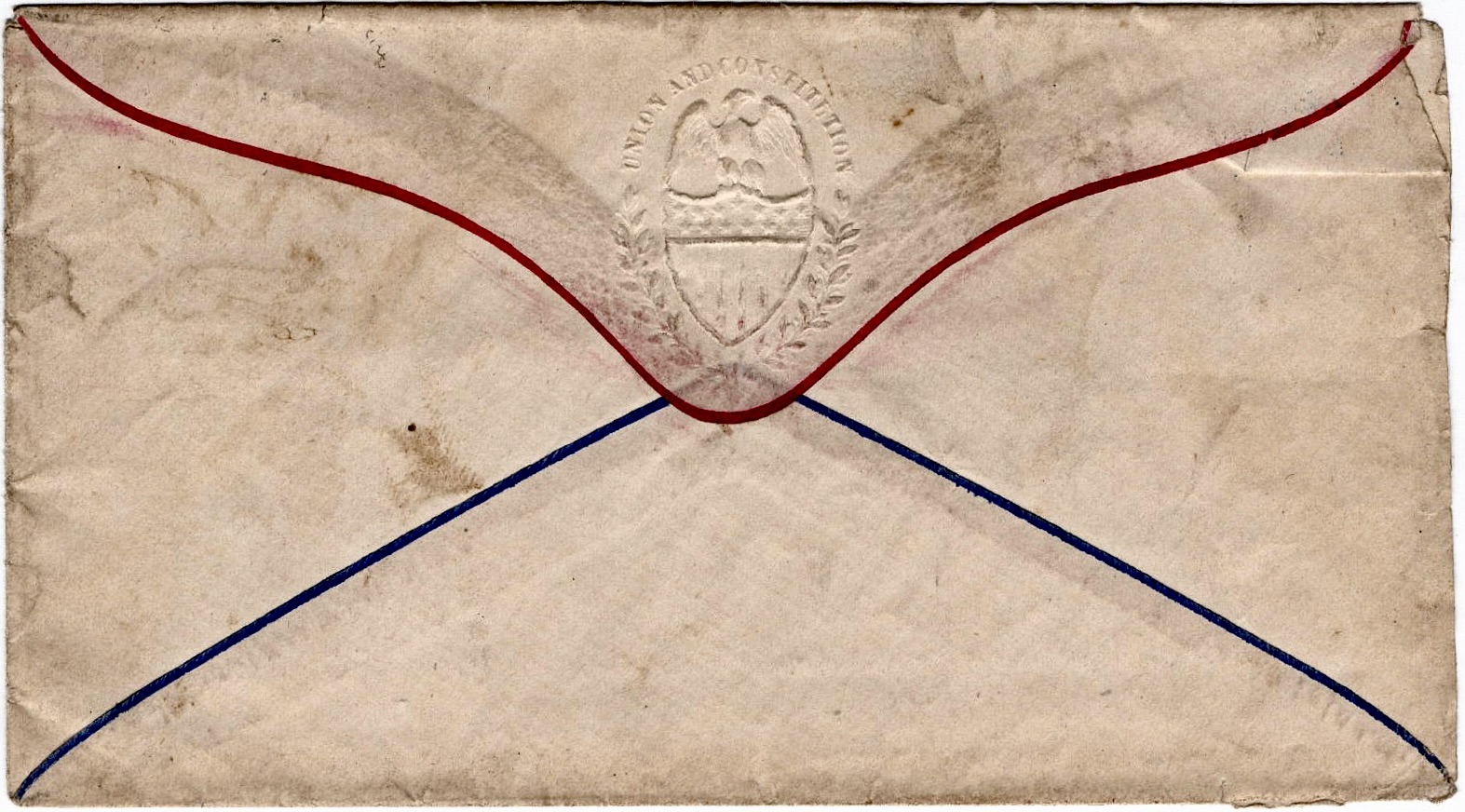
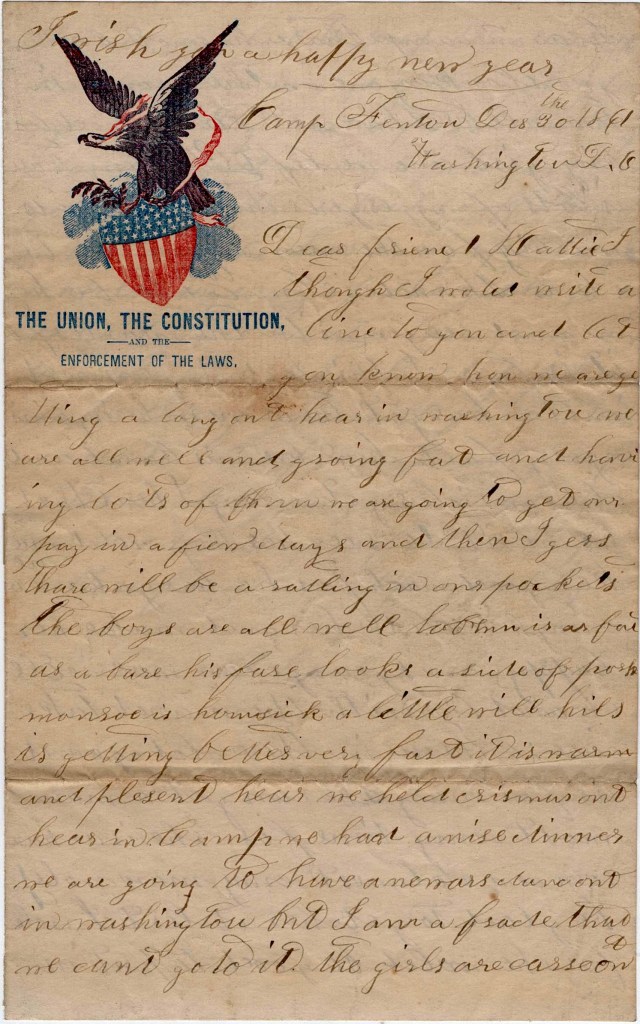
Patriotic header on Charles’ stationery

T R A N S C R I P T I O N

Camp Fenton
December 30, 1861
Washington D. C.

Dear Friend Hattie,

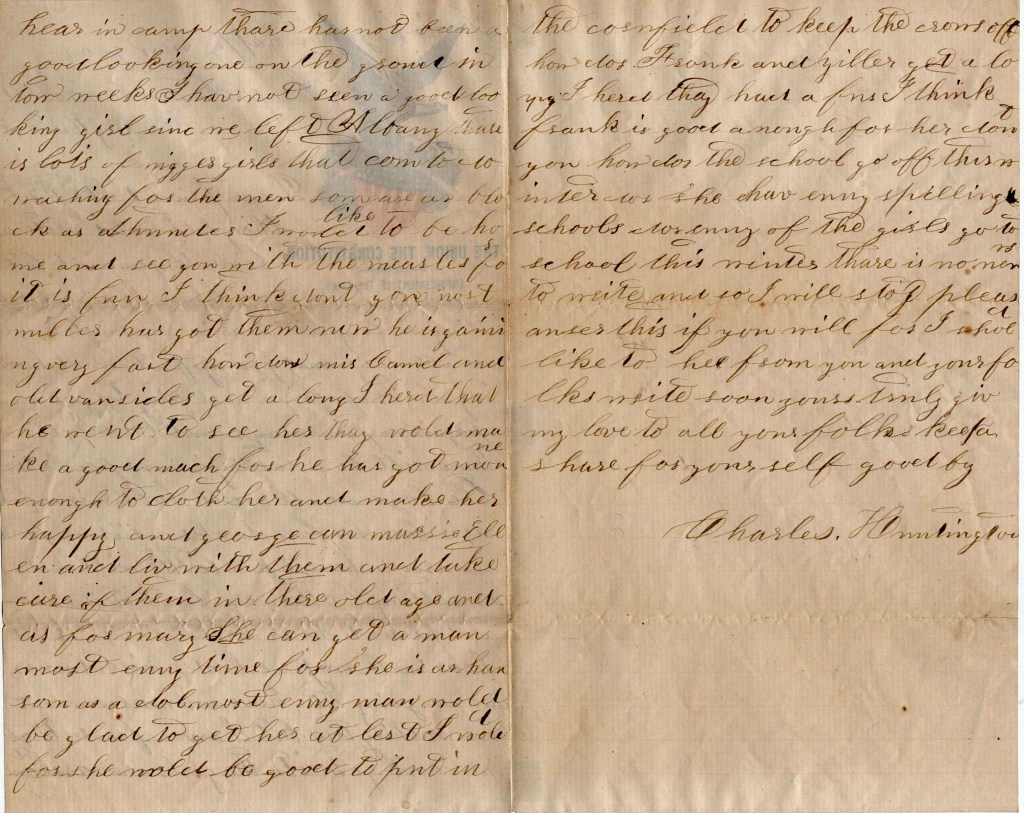
I thought I would write a line to you and let you know how we are getting along out here in Washington. We are all well and growing fat and having lots of fun. We are going to get our pay in a few days and then I guess there will be a rattling in our pockets. The boys are all well. Cobern is as fit as a bear. His face looks [like] a side of pork. Monroe [Huntington] is homesick a little. Will[iam] Hills is getting better very fast.

It is warm and pleasant here. We held Christmas out here in camp. We had a nice dinner. We are going to have a New Years’ dance out in Washington but I am afraid that we can’t go to it. The girls are scarce out here in camp. There has not been a good looking one on the ground in two weeks. I have not seen a good looking girl since we left Albany. There is lots of nigger girls that come to do washing for the men. Some are as black as thunder.

I would like to be home and see you with the measles for it is fun. I think, don’t you? Nort[on] Miller has got them now. He is gaining very fast. How does Miss Camel and old Vansites get along? I heard that he went to see her. They would make a good match for he has got money enough to clothe her and make her happy. And George can marry Ellen and live with them and take care of them in their old age. And as for Mary, she can get a man most any time for she is as handsome as a doll. Most any man would be glad to get her—at least I would for she would be good to put in the cornfield to keep the crows off.

How does Frank and Ziller get along? I heard they had a fuss. I think Frank is good enough for her, don’t you? How does the school go off this winter? Does she have any spelling schools? Do any of the girls go to school this winter?

There is no news to write and so I will stop. Please answer this if you will for I should like to hear from you and your folks. Keep a share for yourself. Goodbye, — Charles Huntington

I wish you a Happy New Year!
1862: John Tolles Phillips to Kate N. Tolles

The following letter was written by John Tolles Phillips (1838-1905) who enlisted at the age of 23 on September 20, 1861, at Warsaw. He mustered in as private in Co. A, October 5, 1861, to serve three years. As noticed in this letter, the regiment was not fitted out as a cavalry unit until June 1862. Prior to that they were detached as reserve artillery or as train guards in the Army of the Potomac. John was wounded at Berryville, Va., on December 1, 1862 and later transferred on March 31, 1864, to the 49th Company, Second Battalion, Veteran Reserve Corps.

John wrote the letter to his cousin, Kate N. Tolles of Attica, Wyoming county, New York. According to find-a-grave, John was born in Orangeville and while an infant his parents moved to Attica where he lived for 66 years.

T R A N S C R I P T I O N

Headquarters Camp Fenton, Washington D. C.
9th Regt. N. Y. Volunteers, Co. A
February 9, 1862

Dear Cousin,

Your Father’s [letter] of the 30th came to hand the 6th and I assure you I was glad to hear from him. I have regained my health so that I think I can stand it. We have not moved from where we first went into camp and I do not see much prospect of it. Some of our boys are getting homesick and trying to get discharged but it is more work to get a discharge than it is worth. If I could be certain that I should have my health, I do not want to come home till this war is closed. We have not got any of our arms yet but our sabers and I do not know as we ever shall. The orders has come here that the cavalry is going to be reduced to fifty regiments. There is talk here that the remainder are going to be mustered into infantry. If our captain and company goes, I am going to go with them and if they come home, I shall come too.

We have got our Sibley tents. Our company bought lumber and made a floor to these. There has to be twelve in a tent. We have a circle stove but we have two small sheet iron stoves and we do our own cooking on them. Most of the boys do their washing. We can get it done for four cents apiece. I do my own.

Has Mrs. Hubbard consented to let her sons go yet? There is a man in our company that looks like Clark and if he had come from Bennington, I should have thought it was him. hardly a day passes but what the ambulance passes here carrying the soldiers to their long home. There was eight or ten died in our regiment since we come here.

Where is Ralph now? Has he been home since he went away, or has Ed been back yet? How do they get along? Are they satisfied? Where is George this winter? Does he peddle milk? We can get milk here by paying five cents a pint and half water.

It rains here most of the time. The mud is getting so deep it is most impossible to get around. I do not believe that you can read what I have wrote so I guess I will stop. Write soon. — J. T. Phillips