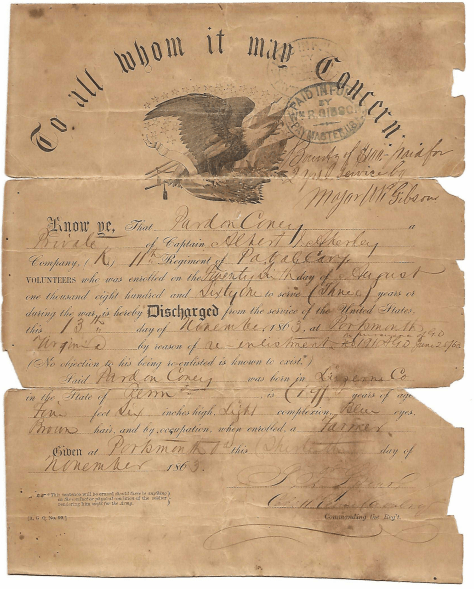
The following letter was written by Pardon Edgar Covey (1843-1896), the son of Almeron Covey (1813-1903) and Mary Ann Sisco (1817-1896) of Abington, Luzerne county, Pennsylvania. Pardon enlisted in Co. K of the 11th Pennsylvania Cavalry (108th Volunteers)—sometimes called “Harlan’s Light Cavalry.” He served from 25 August 1861 to 13 November 1863 according to his discharge papers, though the company muster rolls say he served until 1865.
The 11th Pennsylvania Cavalry was ordered to Fortress Monroe, Virginia, in mid-November 1861 and they remained there on duty at nearby Camp Hamilton until May 1862. Covey’s letters speaks of the arrival of infantry at Camp Hamilton as McClellan began his build up for launching the Peninsula Campaign.
Pardon Covey’s Discharge Papers
Transcription
Camp Hamilton, Virginia March 23, 1862
Dear Cousin,
I take the present time to answer your kind letter to let you know that I am well and hope this may find you the same. It has been quite unpleasant for the last few days but it is looking more now like good weather now. It looks like spring for the green grass is springing up fast and soon will be good feed for cattle. What few farmers that is left here has commenced planting potatoes and making garden. It looks like May with us. The leaves putting forth their leaves and the flowers is blooming on every bush.
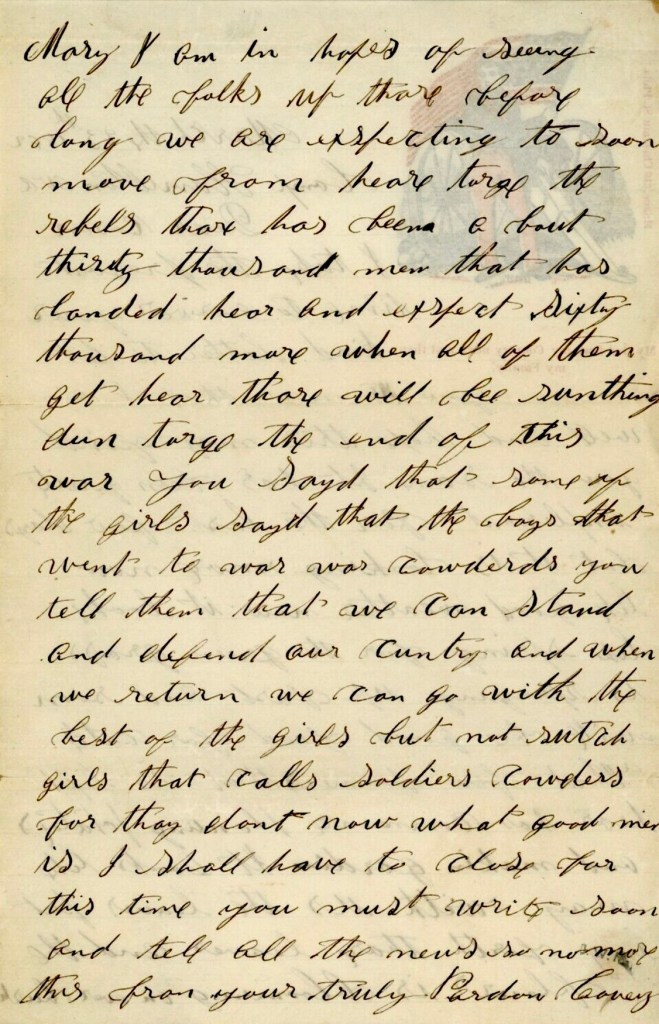
Mary, I am in hopes of seeing all the folks up there before long. We are expecting to soon move from here toward the rebels. There has been about thirty thousand men that has landed here and expect sixty thousand more. When all of them get here, there will be something done towards the end of this war.
You said that some of the girls said that the boys that went to war was cowards. You tell them that we can stand and defend our country and when we return we can go with the best of the girls but not such gurls that calls soldiers cowards for they don’t know what good men is. I shall have to close for this time. You must write soon and tell all the news. So no more. This from yours truly, — Pardon Covey
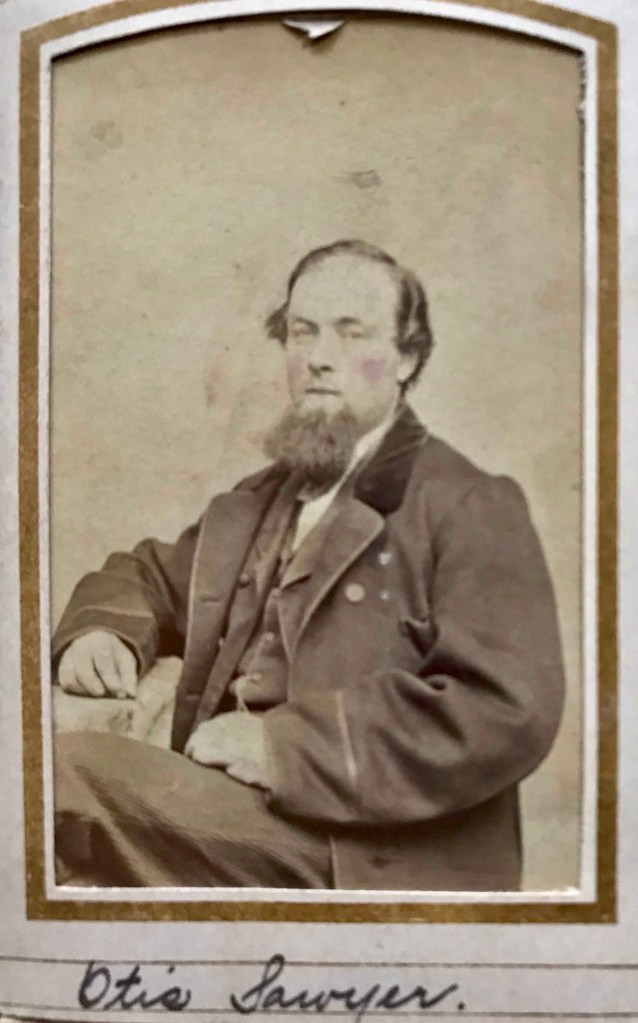
I can safely attribute the following letter to Samuel “Otis” Sawyer (1839-1908), a carpenter in Cambridge, Massachusetts, at the time of his enlistment on 2 July 1861 as a private in Co. A, 16th Massachusetts Infantry. He mustered out of the regiment on 27 March 1864 after nearly three years service. The letter mentions another soldier—John Wilson—who also served in the same company from Cambridge.
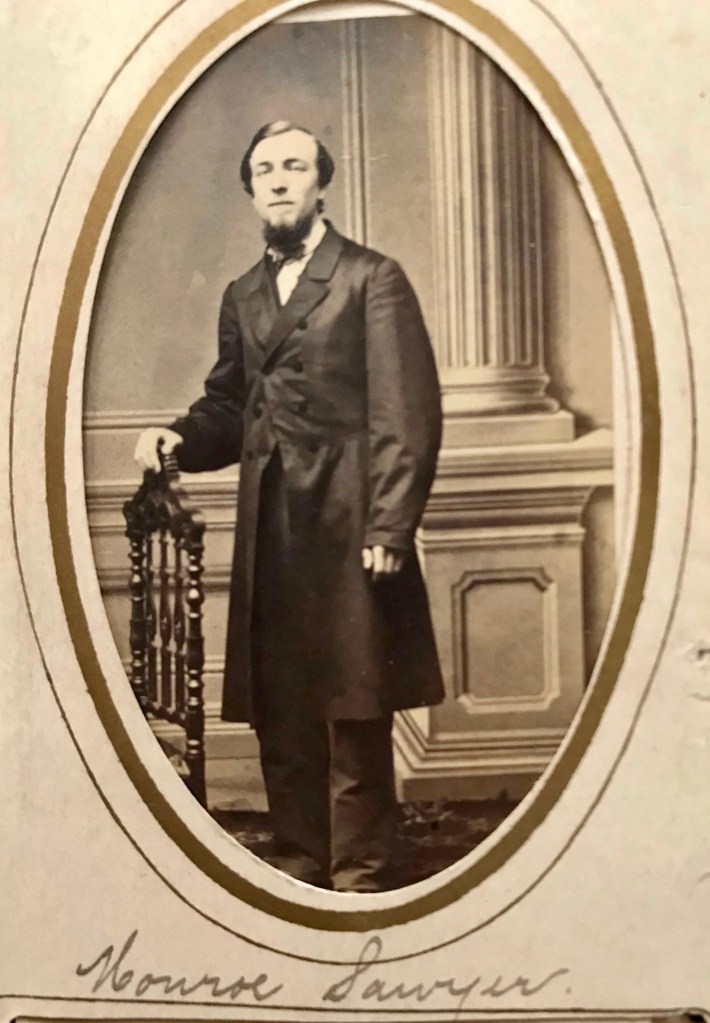
Otis was the son of Samuel James Sawyer (1816-1854) and Eleanor Dodge Morgan (1816-1890) of Exeter, New Hampshire. He wrote the letter to his younger brother James “Monroe” Sawyer (1841-1863), a clerk living with their widowed mother in Cambridge at the time. As a matter of curiosity, Otis survived the war as a soldier but his younger brother James, who never enlisted, was fatally stabbed on 18 August 1863 by Edward Owens and James Farris while defending two women in August 1863. He died of his wounds three days later. Otis married Mary E. Marston (b. 1845) in December 1866.
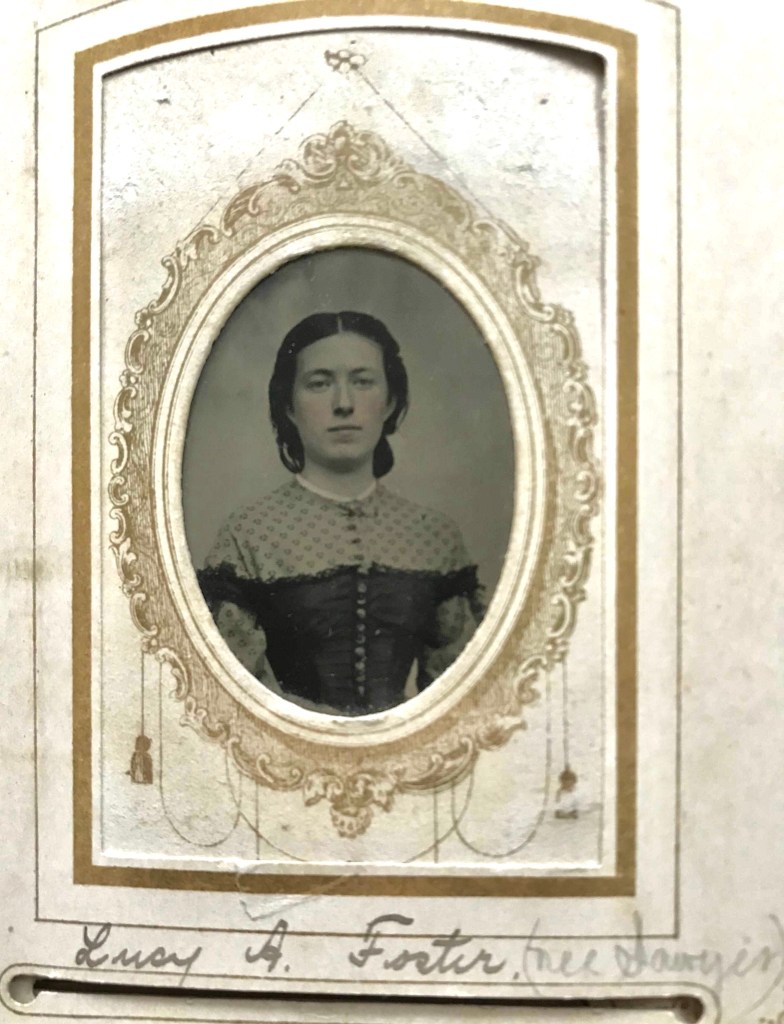
Otis and Monroe (who were both called by their middle names) had a younger sister named Lucy Ann Sawyer (1845-1900) who married George Henry Foster (1844-1906) of Cambridge. Lucy’s first-born, Lilliam Monroe Foster (1867-1945) kept a family photo album that included the pictures below of her mother and two uncles, Otis and Monroe.
This remains the only Samuel Otis Sawyer letter I have found via an internet search. In his recent book, “The Men of the 16th Massachusetts: A Civil War Roster and History,” Alden Ellis, Jr. informs us that the 16th Massachusetts was “one of a few Massachusetts regiments whose history was not recorded. From 1861-1864, it was deeply embroiled in the operations of the Army of the Potomac. Suffering from a lack of skilled leadership and later from horrific living conditions, the 16th saw heavy casualties. Of more than 1300 men, 112 were killed in battle, 360 were wounded and 52 died from their wounds. Disease claimed 115 and 65 were taken as prisoners of war, 32 of them dying in Confederate prisons. Another 344 went home afflicted with wounds or disease as disability discharges.”
Otis SawyerMonroe SawyerLucy (Sawyer) Foster
See also some letters by Asa Smith of Co. K, 16th Massachusetts that I transcribed and published just last month on Spared & Shared. 1862: Asa Dennis Smith to his Family.
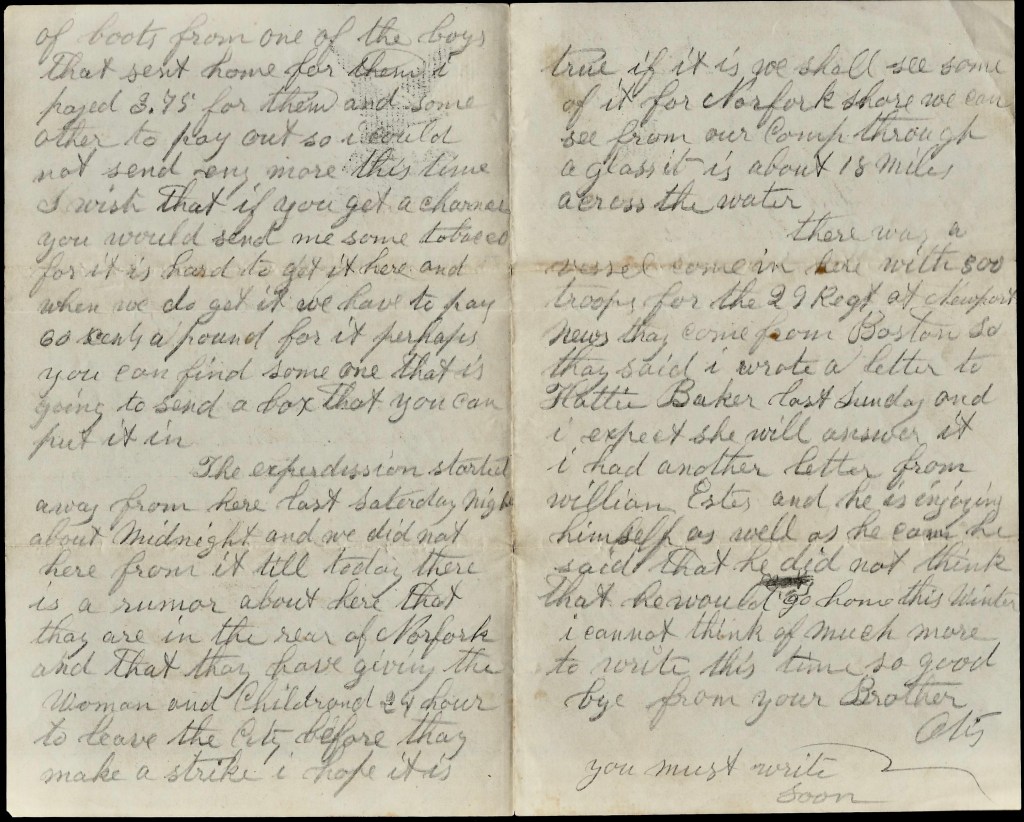
Transcription
The camp of the 16th Massachusetts at “Camp Hamilton” near Fortress Monroe in the winter of 1861-62.
Camp Hamilton, Fortress Monroe January 17, 1862
Dear Brother,
I received the box that you sent me and found everything in good condition. I gave John Wilson the things that you told me to and he told me to tell you that he was much obliged to you and he sent his best respects to you.
Tell Mother that I am much obliged to her for the quilt and the rest of the things. I shall send 15 dollars in this letter for you to do as you think best with it. I would send more but I bought a pair of boots from one of the boys that sent home for them and some other to pay out so I could not send any more this time. I wish that if you get a chance you would send me some tobacco for it hard to get it here and when we do get it, we have to pay 60 cents a pound for it. Perhaps you can find someone that is going to send a box that you can put it in.
The expedition started away from here last Saturday night about midnight and we did not hear from it till today. There is a rumor about here that they are in the rear of Norfolk and that they have given the women and children 24 hours to leave the city before they make a strike. I hope it is true. If it is, we shall see some of it for Norfolk shore we can see from our camp through a glass. It is about 18 miles across the water.
There was a vessel come in here with 500 troops for the 29th [Massachusetts] Regt. at Newport News. They come from Boston so they said. I wrote a letter to Hattie Baker last Sunday and I expect she will answer it. I had another letter from William Estes and he is enjoying himself as well as he can. He said that he did not think that he would go home this winter.
I cannot think of much more to write this time so goodbye from your brother, — Otis
You must write soon. I sent two pictures that was taken out of Hampton the night of the fire and a cotton ball by the Captain. I wish you would let me know if you got them [when] you write.




 Spared & Shared 23