Category Archives: Camp Morton

1864: Josiah Lawson Rainey to Anne (Jones) Rainey

The following Prisoner of War letter was written by Pvt. Josiah Lawson Rainey (1832-1905), the son of Thomas Muttor Rainey (1799-1859) and Mary Claiborne Echols (1797-1847) of Maury county, Tennessee. Josiah was married to Nancy Ann Jones (1837-1912) in June 1854 and by the time this letter was written in 1864, the couple had three young boys—William (b. 1857), Josiah (b. 1860), and John (b. 1862).
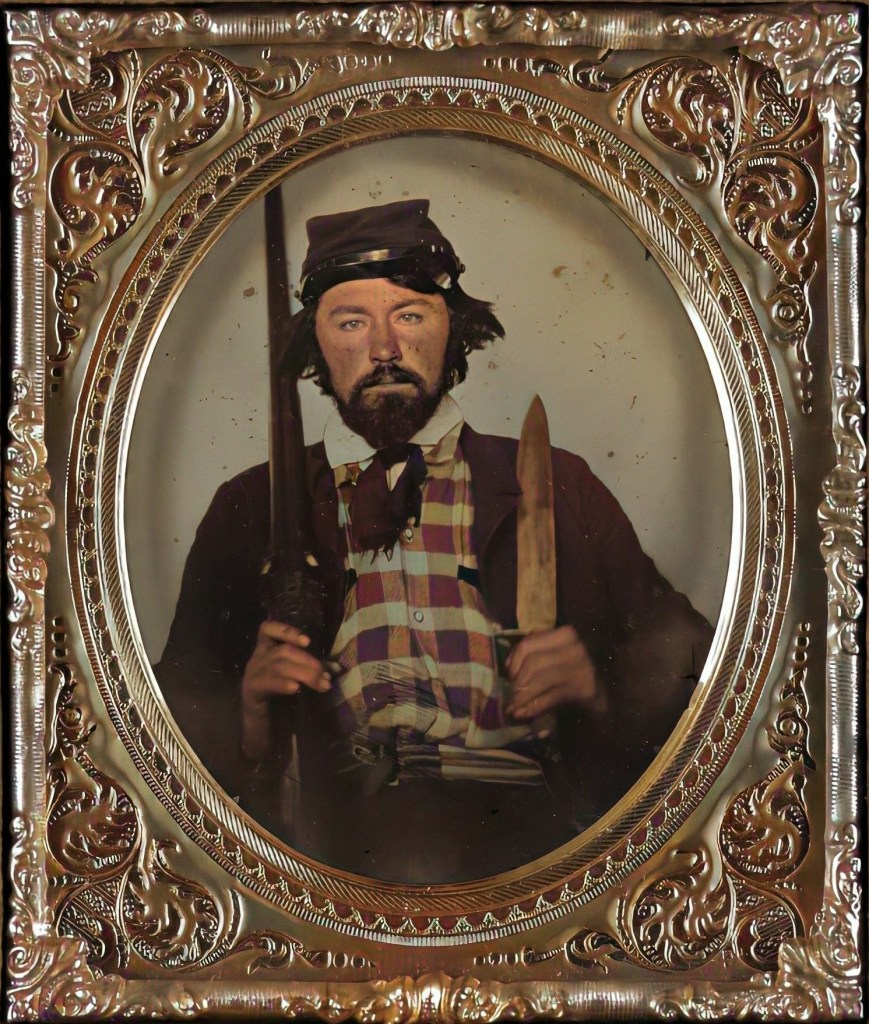
I could not find an image of Josiah but here is one of Hiram Hendley, also of Maury county, who served in Co. A, 9th Tennessee Cavalry (M. Williams Colorizations)

Josiah enlisted in October 1862 in Co. E. of Biffle’s 19th Regiment, Tennessee Cavalry [his name sometimes appearing as Raines on roster]. This regiment—usually known as “Biffle’s 9th Cavalry“—fought at Parker’s Cross Roads, Thompson’s Station, Brentwood, and Chickamauga. Later it skirmished in Tennessee and was then active in the Atlanta Campaign and Forrest’s operations during Hood’s Campaign. I could not find the date of Josiah’s capture but presume it was in 1864.

At the time of his release from prison, upon signing the Oath of Allegiance at Camp Morton on 25 October 1864, Josiah was described as standing 5’10” tall, with brown hair and grey eyes. After the war, Josiah settled in Henry county, Tennessee, where he served his community as a physician.

Josiah L. Rainey’s signed Oath of Allegiance, dated 25 October 1864, Camp Morton (Fold 3)

Transcription

Camp Morton, Ind[ianapolis, Indiana]
Sunday evening, July 3rd 1864

My Dear Annie,

This is the 5th [letter] I shall have written you since receiving one from you. My health is much the same as when I wrote last. Mrs. Lawrence’s letter was dated June 3rd but she must have meant 23rd for your last was dated the 5th June. I immediately answered it and am much grieved that you are all sick and particularly that you are sick for when you are not able to wait upon the little children who are sick too, I fear that they and you will suffer for want of nursing. But I do hope that e’re this, you are all better, if not entirely well. I have a letter from Mug stating that sister was packed up and ready to start here to see me and then to go on to Tennessee, if able to travel. But she is in very bad health and I am very doubtful of her being able to go on to see you immediately. but if she is, she will go on without any more than necessary delay. In the mean time if you are able, you had better return home and make such arrangements for her reception and comfort as best you can for she will need all the attention that you will be able to give her. And should anything occur to prevent her going on, I will let you know it if possible. Please write to me immediately for it would seem that you had forgotten that I am intensely anxious always to hear from you and the poor “little ones.” Give them my love and kiss them by sister. Goodbye. Write soon.

Eternally, — Jo. L. Rainey

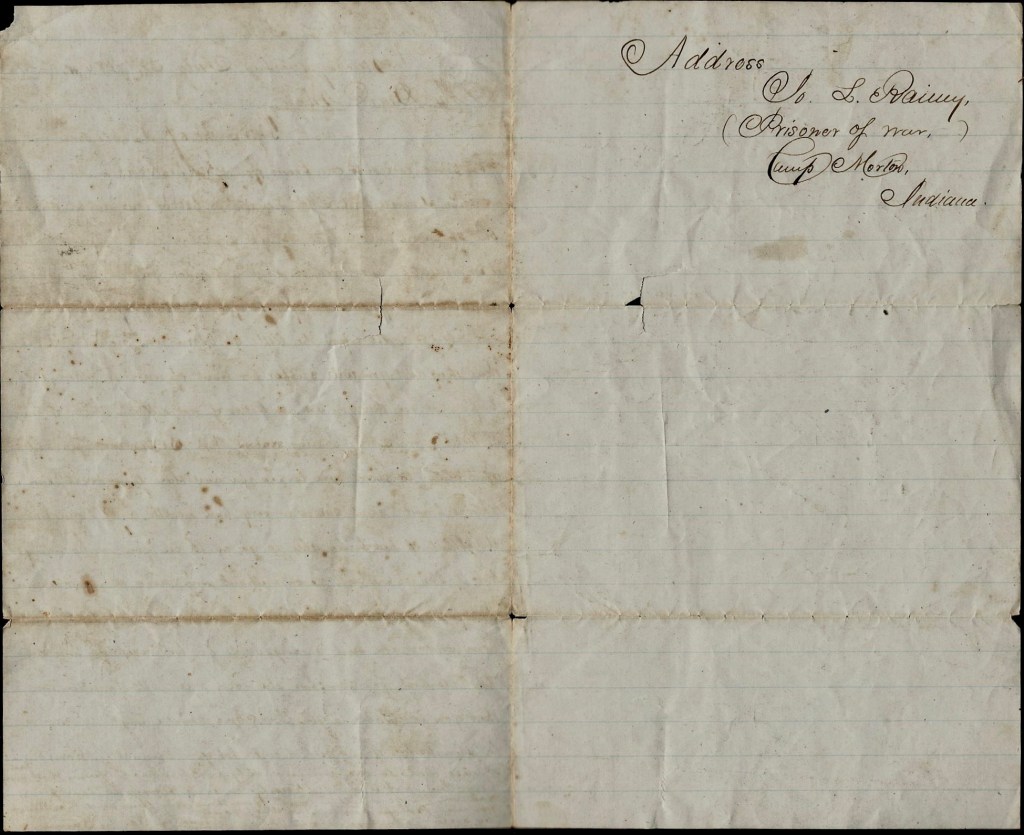
Address Jo. L. Rainey (Prisoner of War) Camp Morton, Indiana

to Mrs. Jo. L. Rainey, Culleoka, Tennessee
In care of commanding office of Post

1862: Alexander Edwards and Richard Cox to William D. Cox

I could not find an image of Alexander or Richard but here is one of Stephen Burkdall of Co. G, 67th Indiana (Photo Sleuth)

This letter was written by two soldiers serving as privates in Co. H, 67th Indiana Infantry while being held prisoner at Camp Morton near Indianapolis in November 1862. The letter had been previously sold as having been written by Confederate soldiers but the content suggested Union to me which led me to the discovery of their identity. Co. H and most all of the 67th Indiana Infantry—yet raw and untrained—participated in the Battle of Munfordville in Kentucky in mid-September 1862 where they were all captured. Too many prisoners for Confederate military prisons to handle, they were paroled and sent back to Indianapolis to await exchange. That exchange did not occur until early December 1862, when the regiment headed west to the Mississippi River to become part of the Vicksburg campaign.

Co. H. was recruited from Lawrence county in southern Indiana and it was here that I found our two boys. Alexander Edwards (1844-1923) was the son of Henderson Edwards but seems to have been raised by the Cox family. He married Sarah Jane Pipher (1846-1915) in 1874.

Richard Cox (1844-1917) was the son of Alexander and Mary Cox of Spice Valley. Lawrence county, Indiana. This letter was written to Richard’s younger brother, William D. Cox (b. 1846).

Transcription

Camp Morton
Indianapolis [Indiana]
November 9th 1862

Dear Brother,

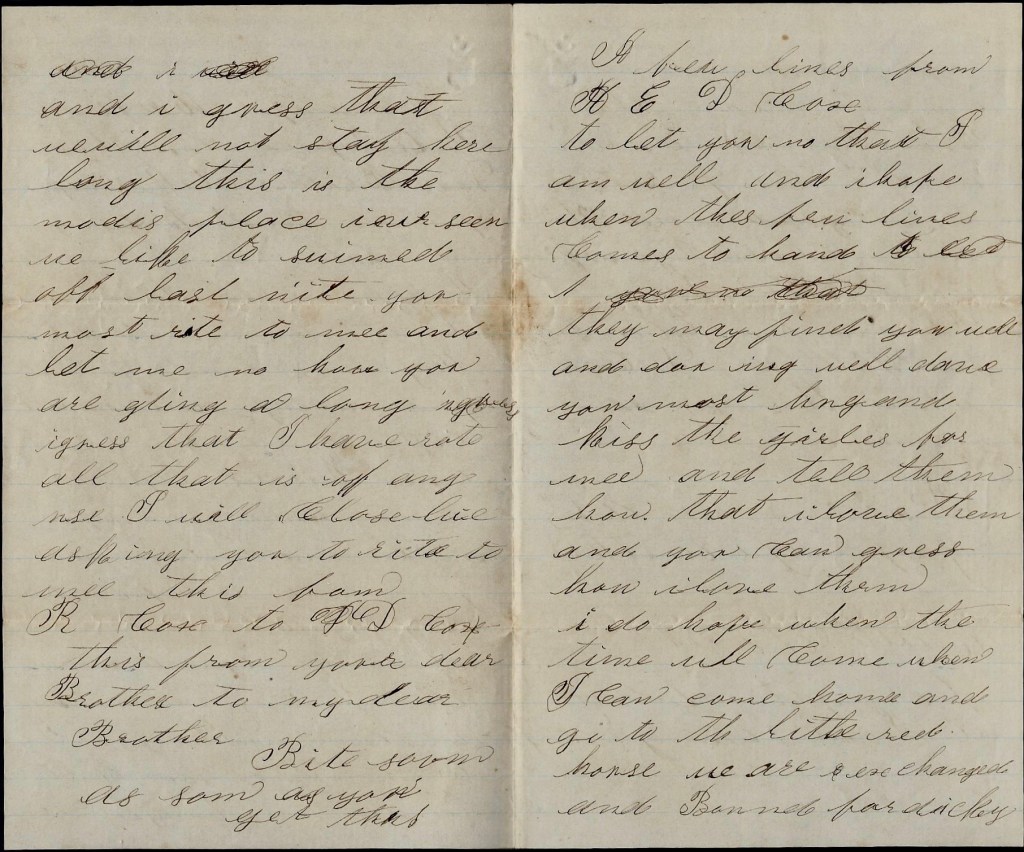
I take my pen in hand to let you know that I am well and I hope when these few lines come to hand, they may find you well and doing well. I would like to see [you] the best kind. I would like to come home and spend a few more days with you and I hope when the day will come when I can come home to stay with you.

I can say to you that we are exchanged and I guess that we will not stay here long. This is the muddiest place I ever seen. We like to swimmed off last night.

You must write to me and let me know how you are getting along. I guess that I have wrote all that is of any use. I will close by asking you to write to me. This from R. Cox to D. Cox.

This from your dear brother to my dear brother. Write soon as you get this.

A few lines from A. E. D. Cox to let you know that I am well and I hope when these few lines comes to hand, they may find you well and doing well.

Well, Dave, you must hug and kiss the girls for me and tell them how that I love them and you can guess how I love them. I do hope when the time will come when I can come home and go to the little red house.

We are exchanged and bound for Dixie. I must close. The boys has come in and I can’t write to do no good and I will close by asking you to write. This from Alexander Edward to William D. Cox

When this you see, remember me. Write soon as you get this and don’t forget to write about the girls.

1864: John Wesley Daniels to Col. James Taylor

This letter was written by John Wesley Daniels (1832-1915) of Grants Lick, Campbell county, Kentucky. Daniels served as a private in Co. C, 1st Kentucky Cavalry (Butler’s). He was married to Cynthia Bryant Colvin (1834-1909) in 1850 and divorced during or soon after the war. He married his second wife, Mary Ann Bravard in 1868.

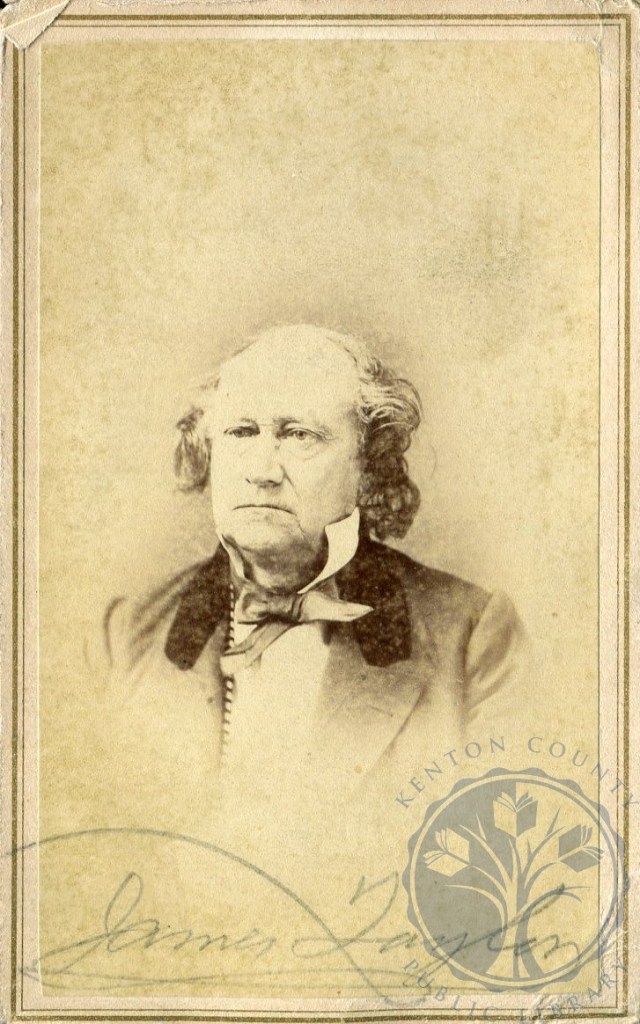
Daniels wrote the letter to Col. James J. Taylor of Campbell county, Kentucky, a wealthy man who may have been sympathetic to his pro-Confederacy neighbors but remained a Union man throughout the war.
(Kenyon County Public Library)

Daniels wrote the letter while serving as a prisoner of war at Camp Morton near Indianapolis. The camp was located on a tract of land bordered by 22nd Street, Talbott Avenue, 19th Street and Central Avenue. The land had been established as state fairgrounds. In 1861 it was converted to a military training camp, and named after the governor. In 1862 the facilities were used to house Confederate prisoners of war. Approximately 4,000 prisoners arrived in February of that year. In the summer of 1864 the prisoner population reached nearly 5,000. Weary of fighting many took the oath of allegiance to the United States Constitution and to the Union according to Lincoln’s Proclamation of Amnesty and Reconstruction of 8 December 1863. On 1 April 1865 1,408 prisoners were at the camp. In June 1865 the last of the Confederate prisoners were released. In 1868 the State Fair returned to this location, where it continued to be held until 1892.

Daniels wrote the letter to Col. James Jones Taylor (1802-1883) of Campbell county, Kentucky.

Camp Morton in Indianapolis, Library of Congress

Transcription

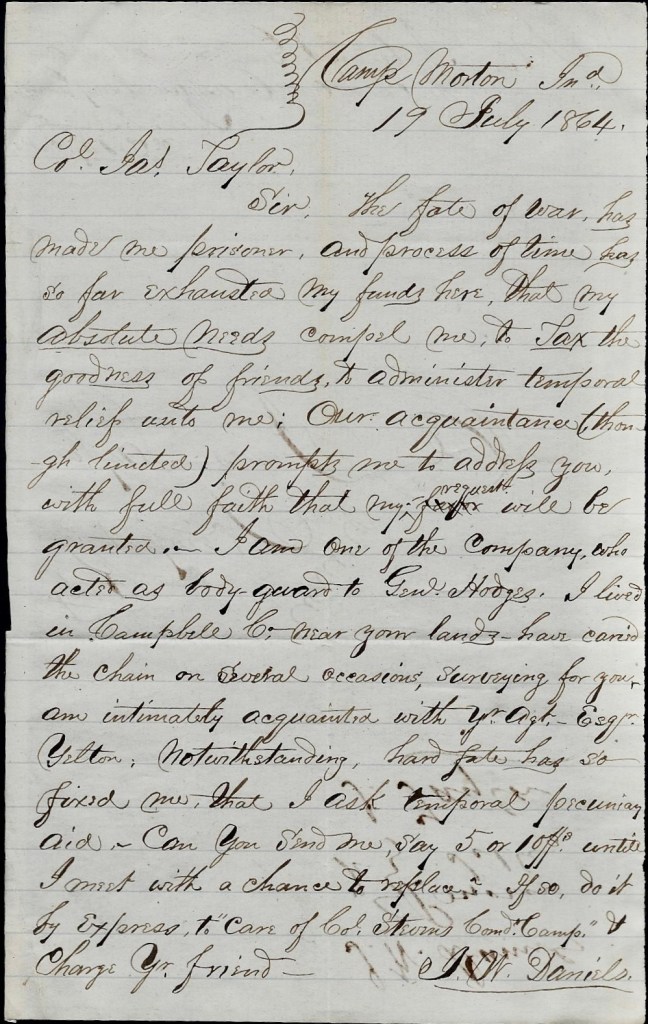
Camp Morton, Indiana
19 July 1864

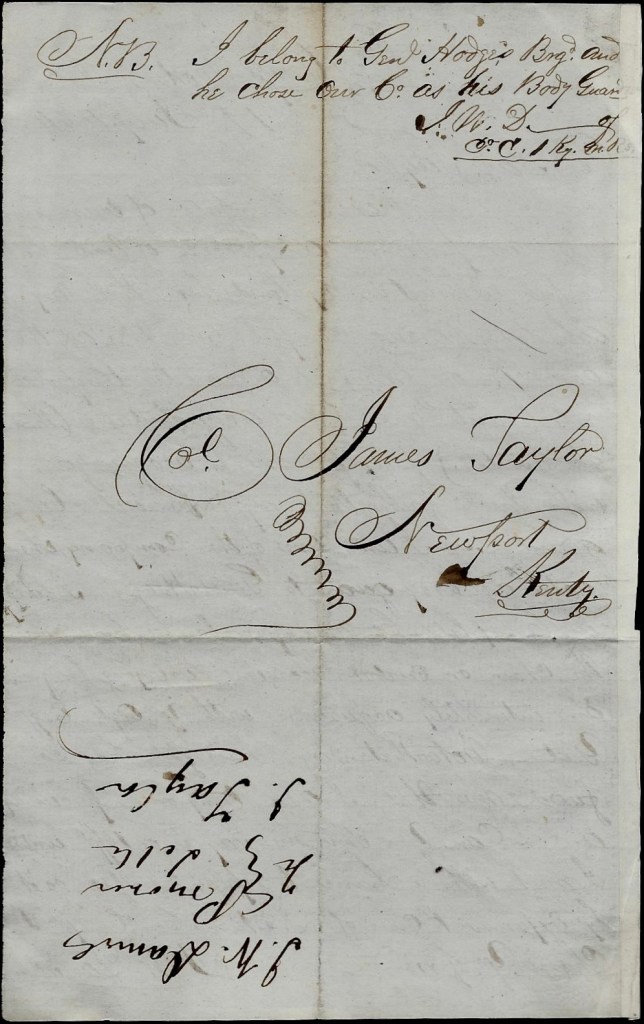
Col. James Taylor
Sir,

The fate of war has made me prisoner and process of time has so far exhausted my funds here that my absolute needs compel me to tax the goodness of friends to administer temporal relief unto me. Our acquaintance (though limited) prompts me to address you with full faith that my request will be granted.

I am one of the company who acted as body guard to General [George Baird] Hodge. I lived in Campbell County near your lands, have carried the chain on several occasions surveying for you, [and] am intimately familiar with your agent, Esqr. Yelton. Notwithstanding, hard fate has so fixed me that I ask temporal pecuniary aid. Can you send me say 5 or $10 until I meet with a chance to replace? If so, do it by express to “care of Col. [Ambrose A.] Stevens 1 Command & Camp” and charge your friend, — J. W. Daniels

N. B. I belong to General Hodge’s Brigade and he chose our company as his body guard. — J. W. D of Co. C, 1st Ky.


1 Col. Ambrose A. Stevens of the 5th Indiana Regiment became the commandant of the Camp Morton Prison near Indianapolis in November 1863. He found the camp “a disgrace to the name of military prison—filthy in every respect.” Camp Morton had the third highest number of dead for both January and February among Union prisoner of war camps. Almost twenty-five years after the war controversy over the condition at Camp Morton during that winter surfaced again in the form of an article in The Century Magazine written by a former prisoner of war, Dr. John Wyeth. Entitled “Cold Cheer at Camp Morton” the article charged camp officials with deliberate cruelty.

The prison lacked the order, discipline, and cleanliness found among properly managed soldiers. The April 29 inspection report by A.M. Clark, Surgeon and acting inspector of prisoners of war reported that the barracks had been whitewashed and improved through ridge ventilation, but that the sinks were simply open excavations and needed improvement. Rations were sufficient but scurvy was still common due to a lack of vegetables. Over the next three months 2,500 prisoners arrived as Col. Stevens continued to try to improve the camp. In mid May he reported to Hoffman that he had “commenced a thorough cleansing” of the barracks and grounds and planned to build a bathhouse, a laundry and a cookhouse.

An increase in the mortality rate over the summer drew the attention of the federal authorities and on 30 July Charles J. Kipp, Surgeon, U.S. Volunteers, replied to a request for an explanation regarding the number of recent deaths among the prisoners. Dr. Kipp wrote that the lack of vegetables, the overcrowded, poorly ventilated barracks and the crowding of almost 5,000 men into 4.5 acres accounted for the mortality rate. He calculated that the prisoners had approximately 80 cubic feet of air space. The reply is forwarded to the U.S. Medical Director’s office with a note by Tripler that unless these conditions improves “the large mortality of last year will occur again.”

“I find this camp in anything but a favorable condition.” was the conclusion reached by C.T. Alexander in his August 6 inspection report which also determined that the camp was too small with 4,885 men held in less than 5 acres. The barracks were “overcrowded and not sufficiently well policed,” the tents old and worn, and prisoners clothing bad and deficient. He found the hospital in relatively good condition and blamed the 81 deaths (9% mortality) of the previous month on the “crowded state of the camp, quarters, and tents, the want of change in the positions of the tents, the foul condition of the sinks, the want of good police, the want of vegetables…, and is influenced some what by the inevitable nostalgia existing among the prisoners.'” [Indiana Archives & Record Administration]