Category Archives: Civil War Poem

1864: Stewart C. Allen to Ann (Foland) Allen

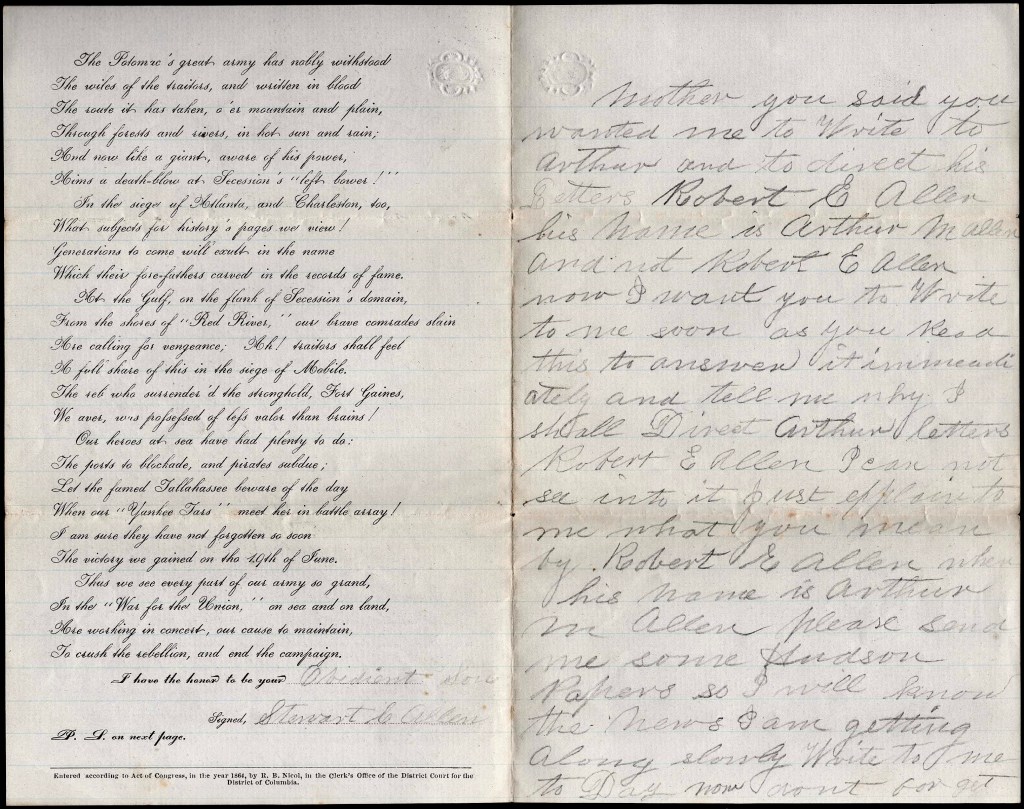
The following letter was written on most unusual stationery by Stewart C. Allen (1843-1918), the son of Edward Allen (1799-1848) and Harriet Ann Foland (1811-1885) of Hudson, Columbia county, New York.

Stewart enlisted on 14 February 1862 as a private in Co. B, 93rd New York Infantry. He received a severe wound in the right shoulder during the Battle of Spottsylvania Court House on 10 May 1864 and wrote this letter while recuperating from that wound at Campbell General Hospital in Washington D. C.

The letter was a pre-formatted letter, written in prose, enabling the soldier to merely fill in a few blanks and then add a personal note as a post script. Stewart’s post script begs his mother to explain why he should address letters to his younger brother (Arthur M. Allen, b. 1845) by some name other than his given name. Apparently he was operating under an alias for some reason.

I have searched for the poem on the internet and could not find it published so have transcribed it in entirety.

As a matter of curiosity, Stewart did not marry until 1899 when he was 46 years old. He married 22 year-old Edith Carter and she lived on her husband’s war pension until her death in 1968.

[Note: The bold lettered font is what Stewart wrote; the italicized font was pre-printed.]

Transcription

Campbell Hospital
Ward Nine
October 30th
1864

Dear Mother and Sister,

As writing materials often are scarce,
I purpose to write you a letter in verse;
To condense my ideas, save paper and time,
Is my object for writing the letter in rhyme.
Of course you will now it is one of my pranks!
It will take but a minute to fill up the blanks.

I received your kind letter just one day ago,
Which found me a member of “Uncle Sam’s Show,”
And for
two months or better, expect to remain,
Unless like full many, I chance to be slain;
Should this be my fate, the last boon I crave
Is to mark on my tomb-stone, “A Patriot’s Grave!”

In the hist’ry of wars, as we carefully scan,
Since the first one was waged by man against man,
In all the fierce conflicts no records remain
Which will be compared to the present campaign.
The war has been general, on both land and sea,
And many have fallen for “Liberty’s Tree!”
It would fill many volumes to pass in review
What our various armies this year have been through,
Though my space is not large, yet ’twill not be amiss
To give a slight sketch on a small sheet like this.

The Potomac’s great army has nobly with stood
The wile’s of the traitors, and written in blood
The route it has taken, o’er mountain and plain,
Through forests and rivers, in hot sun and rain;
And now like a giant, aware of his power,
Aims a death-blow at Secession’s “left bower!”

In the siege of Atlanta and Charleston too,
What subjects for history’s pages we view!
Generations to come will exult in the name

of which their fore-fathers carved in the records of fame.

At the Gulf, on the flank of Secession’s domain,
From the shores of “Red River” our brave comrades slain
Are calling for vengeance; Ah! traitors shall feel
A full share of this in the siege of Mobile.
The reb who surrender’d the stronghold Fort Gaines,
We aver, was possessed of less valor than brains!

Our heroes at sea have had plenty to do:
The ports to blockade, and pirates subdue;
Let the famed Tallahassee beware of the day
When our “Yankee Tars” meet her in battle array!
I am sure they have not forgotten so soon,
the victory we gained on the 10th of June.

Thus we see every part of our army so grand,
In the “War for the Union,” on sea and on land,
Are working in concert, our cause to maintain,
To crush the rebellion, and end the campaign.

I have the honor to be your obedient son. Signed, Stewart C. Allen

P. S. on next page.

Mother, you said you wanted me to write to Arthur and to direct his letters Robert E. Allen. His name is Arthur M. Allen and not Robert E. Allen. Now I want you to write to me soon as you read this to answer it immediately and tell me why I shall direct Arthur letters, “Robert E. Allen.” I cannot see into it. Just explain to me what you mean by Robert E. Allen when his name is Arthur M. Allen. Please send me some Hudson papers so I will know the news. I am getting along slowly. Write to me today. Now don’t forget.

Who wrote the poem, “On Guard”?

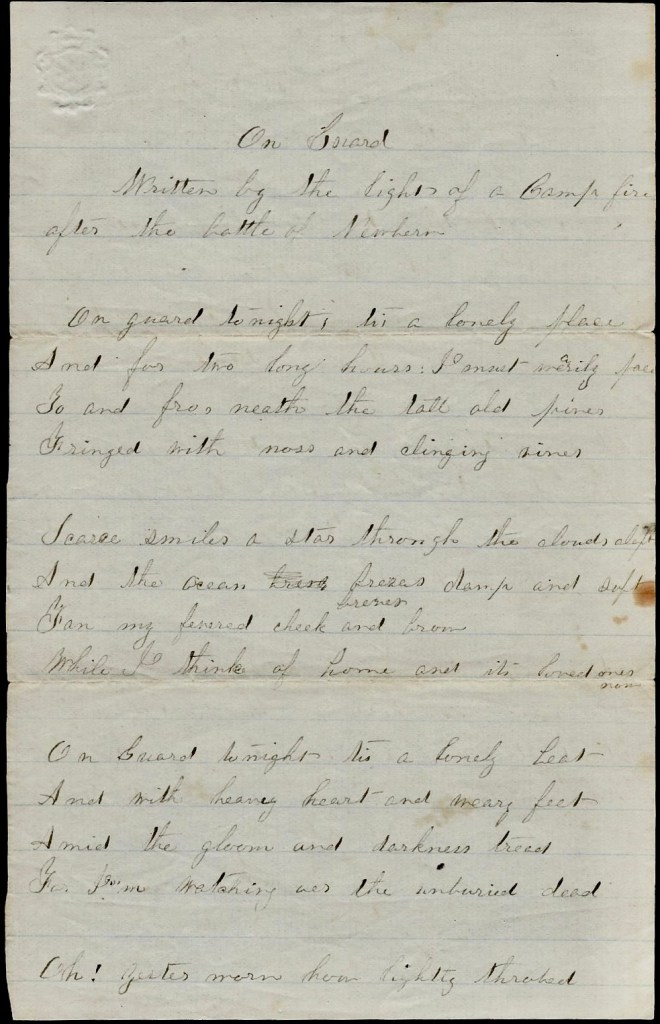
The following piece was sent to me for transcription and research. It was represented to be an original poem “written by the light of a fire after the Battle of Newbern” which took place on 14 March 1862. The poem was signed by the initials “H. C. W.” but there was no date nor indication that H. C. W. was even a soldier. It may have been copied from a newspaper or some other publication and passed off as original. It has the appearance of being a copy—there are no line-outs or word substitutions which would suggest original composition. The question is, was it a copy made by the author of his original composition, or did he (or she) copy it from some publication of another’s work.

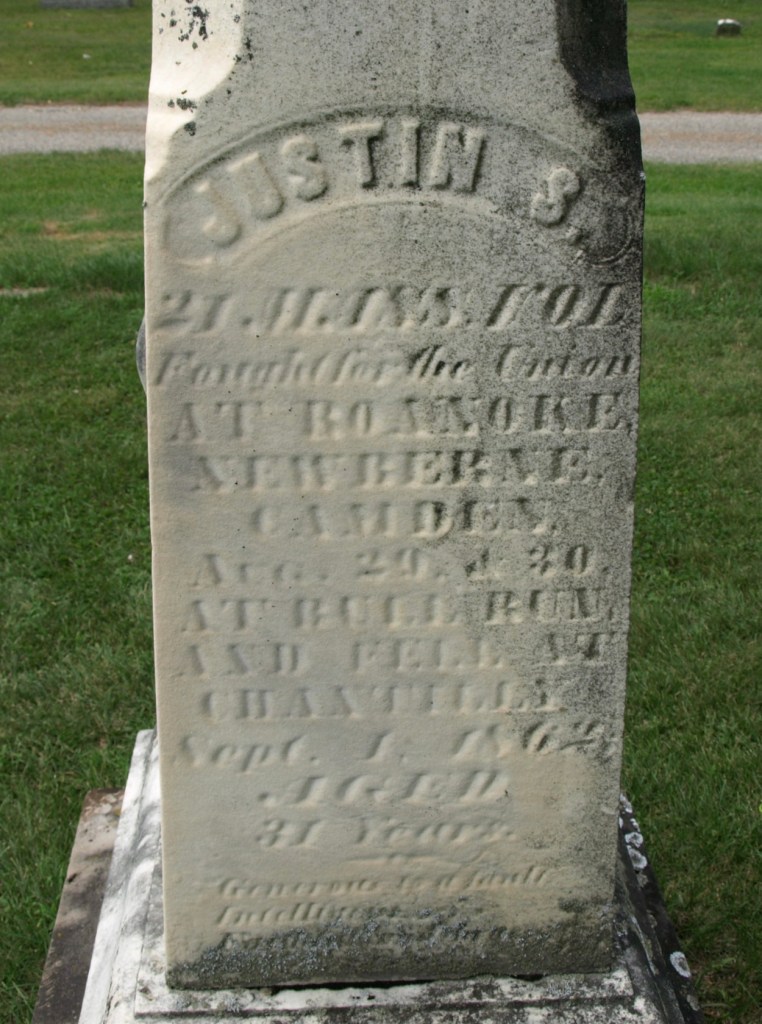
Grave marker of Justin Smith Cressy

I have found at least one publication of the poem that appeared in the Pittsfield Sun (Pittsfield, Berkshire county, Mass.) on 11 December 1862. That publication credited its authorship to Justin Smith Cressy (1831-1862). * Justin was a sergeant from Berkshire county who served in the 21st Massachusetts Infantry. He was the son of Alonzo and Sophia Mariette (Smith) Cressy and was married in Pittsfield to Harriet Elizabeth Stevens in April 1856. Prior to his enlistment, Justin was a telegraph operator so he must have been educated beyond average. The 21st Massachusetts was one of the regiments participating in the Battle of Roanoke Island and the Battle of New Bern before being recalled to Virginia in July 1862. Justin was mortally wounded in the Battle of Chantilly and died on 24 September 1862. His authorship of this poem cannot be ruled out though I might note that unless the company was shorthanded, typically a sergeant would not have stood guard in the manner suggested by this poem. Justin began and ended his service as a sergeant in Co. I and so if he was on guard detail, he would have been the sergeant of the guard and not typically confined to a post. On the other hand, sergeants or corporals who oversaw the posts generally had time to write letters (or compose poems) during the time they were on guard duty whereas the privates had to walk the beat.

I have also found the entire poem published in the True Flag (Boston, Mass) on 3 January 1863—attributed to Annie Hathaway; in the Norwich Morning Bulletin (Norwich, VT) on 28 September 1910—attributed to Thomas Francis Dowd, Camp Ferris, Barrancas, Florida, 30 April 1863; in the Palmetto Herald (Port Royal, S. C.) of 24 March 1864—submitted by anonymous contributor claiming to have seen it published in a small New Hampshire village newspaper; in the Rockland County Messenger (Haverstraw, NY) on 11 June 1863—no attribution given; and in the Lewistown Gazette (Lewistown, Pa.) on 14 December 1864—attributed to an unnamed soldier who fell in the first day’s battle of the Wilderness, supposedly penned in camp on the Potomac near Belle Plain, Va. on 24 March 1864. There are more instances of newspaper publications I am sure.

I also found a portion of the poem appearing in the History of the Seventh Illinois Regiment published in 1868 by Daniel Leib Ambrose (see page 202). The last two stanzas of the poem were included in a diary entry made on 30 October 1863 as if it were an original composition by the author.

And finally I found the words of the poem appearing in a letter penned by John D. Cottrell, Co. D, 48th New York datelined from Palatka, Florida, on 28 March 1864. In a most shameless plagiaristic manner, “Jersey Jack” Cottrell broke the poem apart into sentences, disrupting the rhythm and rhyme so as to disguise the source. This letter was included in the 2000 publication, “Brothers ’til Death” by William Jones, Richard M. Trimble, and Thomas Jones.

* The Grand Traverse Herald of 4 July 1862 also published this poem, crediting Sergt. J. S. Cressy. They claimed to pick the poem up from the Janesville Independent.

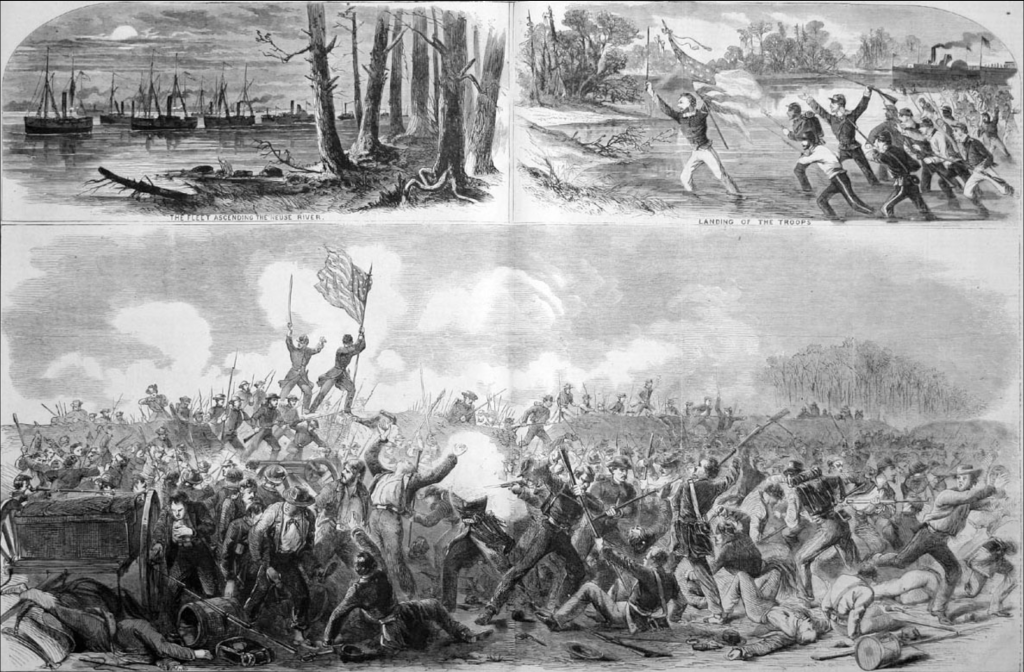
From Harper’s weekly, 5 April 1862

Transcription

On Guard

Written by the light of a camp fire after the Battle of Newbern

On guard tonight; tis a lonely place
And for two long hours I must wearily pace
To and fro, neath the tall old pines
Fringed with moss and clinging vines

Scarce smiles a star through the clouds aloft
And the ocean breezes damp and soft
Fan my fevered cheek and brow
While I think of home and its loved ones now

On guard tonight tis a lonely beat
And with heavy heart and weary feet
Amid the gloom and darkness tread
For I’m watching o’er the unburied dead

Oh! yester morn how lightly throbbed
Full many a heart that death has robbed
Of its pulses warm, and the caskets lie
As cold as the winter’s starless sky

How sad the thought that another day
Will bring again the battle fray
And ere the close of tomorrow’s light
I too may sleep like those tonight

Past midnight hour and I long to hear
The step to the soldier’s heart most dear
A sound that banishes all his grief
The welcome tread of the next relief

Ah hear they come and now I can keep
The next four hours in the land of sleep
And dream of home and its loved ones there
Who never may know a soldier’s care.

— H. C. W.

“Soldier’s Tear”—a Poem by Thomas Haynes Bayly

This morning I saw a post on Yankee Rebel Antiques by my friend Ron Coddington, author and editor of Military Images Magazine, in which he referred to a poem entitled “Soldier’s Tear” that was published by James Gates of Cincinnati during the Civil War. He described the piece as having been folded, suggesting that someone had possibly carried it with them—perhaps a soldier given to him by a loved one.

As I read the poem it occurred to me that I had read at least a portion of it before but couldn’t remember where. Thinking was on an envelope, I searched Civil War envelopes and found one with the familiar words (though retitled “Soldier’s Farewell”) and an engraving of a soldier waving goodbye to his family. The poem and stationery was sold by James Gates, the proprietor of the Union Envelope Manufacturing company located at the southeast corner of 4th & Hammond Streets. While there were many manufacturers who produced stationery with patriotic scenes on them during the war, Gates took his marketing to a new level, even going so far as selling entire “kits” of not only paper and envelopes (a set of 12), but a pen, a pencil, and a “Union pin or other piece of jewelry” suitable for gifting to a loved one. Soldiers often purchased these kits as they passed through Cincinnati and early war letters are commonly found on his stationery. [See Union & Confederate Soldiers’ Stationery, Their Designs & Purposes, by Steven R. Boyd]

What I found to be most unusual about this piece, however, is that it was written not by an American, but by an Englishman named Thomas Haynes Bayly (1797-1839) whose songs and ballads, including this one, were published in Philadelphia under the title, “Songs and Ballads, Grave & Gay” in 1844. If you are observant, you will notice that he also died in 1839, more than twenty years before the Civil War. I don’t know for sure when Thomas wrote the piece “Soldier’s Tear,” but it was published in the New Yorker in June 1837 so it had to be prior to that. The preface to Songs & Ballads defines him as “unquestionably the most popular English song-writer of his age…unequalled as he is for graceful imagery and delicately turned expression…”

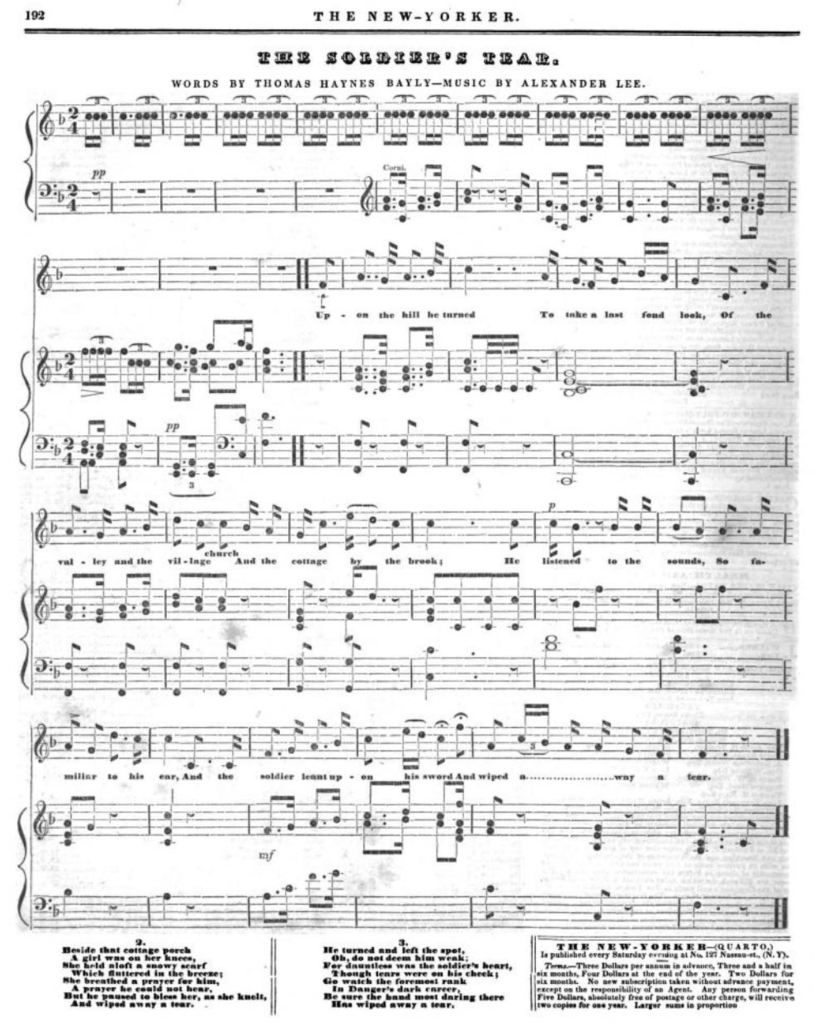
Thomas wrote the lyrics for a tune written by Alexander Lee which was also published in the New Yorker:

The Soldier’s Tear

Wanting to hear the tune played and sung, I found the following clip on YouTube: