
The following letter was undoubtedly written by 27 year-old Daniel Bacon Messinger, who was enumerated in the Draft Registration Records taken in June 1863 (just prior to the date of this letter) as a resident—a “surgeon”—of Hillsdale, Columbia county, New York. A search of military records reveals that he was not in the service, however, at the time that he wrote this letter from the headquarters of the 6th Missouri Cavalry at Camp Wright on 2 July 1863. The location of the camp is not given but it is presumed they were among the troops laying siege to Vicksburg at the time. How or why Daniel came to be at the camp remains a mystery but my hunch is that he was hired as a civilian to augment the medical staff. Civilian doctors were hired during the Civil War but held no commissions and did not wear uniforms. There was little or no military board review for volunteer or contracts surgeons either. It is estimated that as many as 5500 civilian doctors assisted the military during the war.
Daniel attended the University of Michigan in 1864 and in 1871 graduated from the Bellevue Medical College of New York. He was born in Egremont, Berkshire county, Massachusetts, on 7 May 1836, the son of William Henry Messenger (1793-1852) who emigrated from Massachusetts to Michigan before his death in 1852. His mother was Annie Winchell (1793-1877).
Transcription
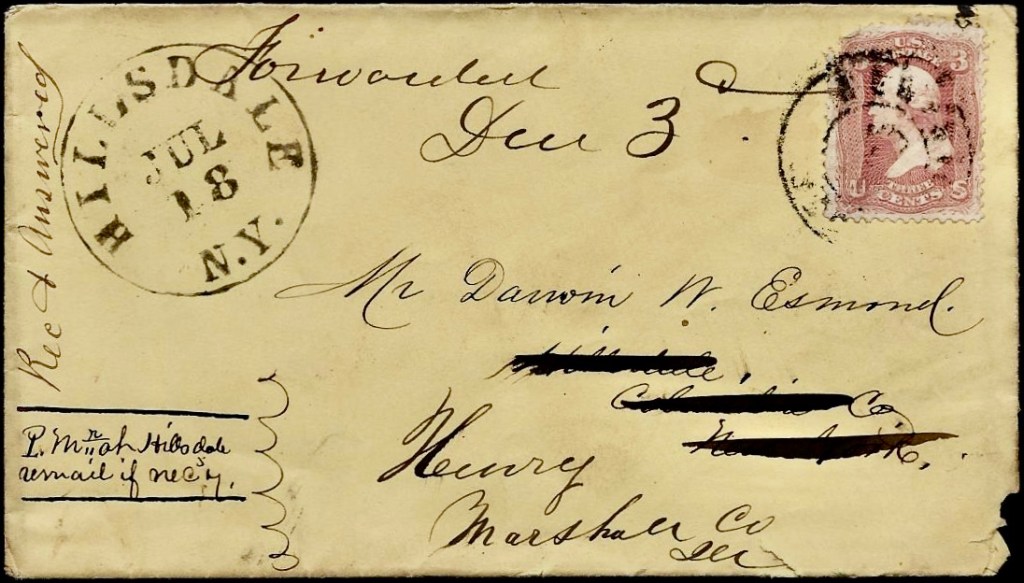
In the Field
Headquarters 6th Missouri Cavalry
at Camp Wright
July 2, 1863
Darwin Esmond, Esqr.,
Dear Cousin. You promised me when I parted with you that all letters you received from me wold be duly answered. You said this in a smiling manner but I presume you were in earnest and that you will keep your word. I have for several obvious reasons neglected writing to you and therefore, you will not be surprised to receive a letter from me at this late date. I have the satisfactions of informing you that I am very well though how long I may be is a dubious proposition for the weather is very dry & hot & being camped on level ground and among timber (something like I have seen in “openings” in Michigan or the blue grass region of Kentucky), the breezes do not play through my tent to tent to the extent I would like.
But the nights are beautiful now, cool and pleasant, and during these moonlit nights I have frequently been impressed with the requisite beauty of the scene spread before me—the fading campfires, the pale radiance of the glinting moon beams on the foliage and tents, squads of our troopers coming in from a scout or going out to relieve pickets, the swelling cadence of a few singing praises to God, the mellow notes of the bugle calling retreat to quarters—-all this and more attracts my notice & thrills me with its peculiar power.

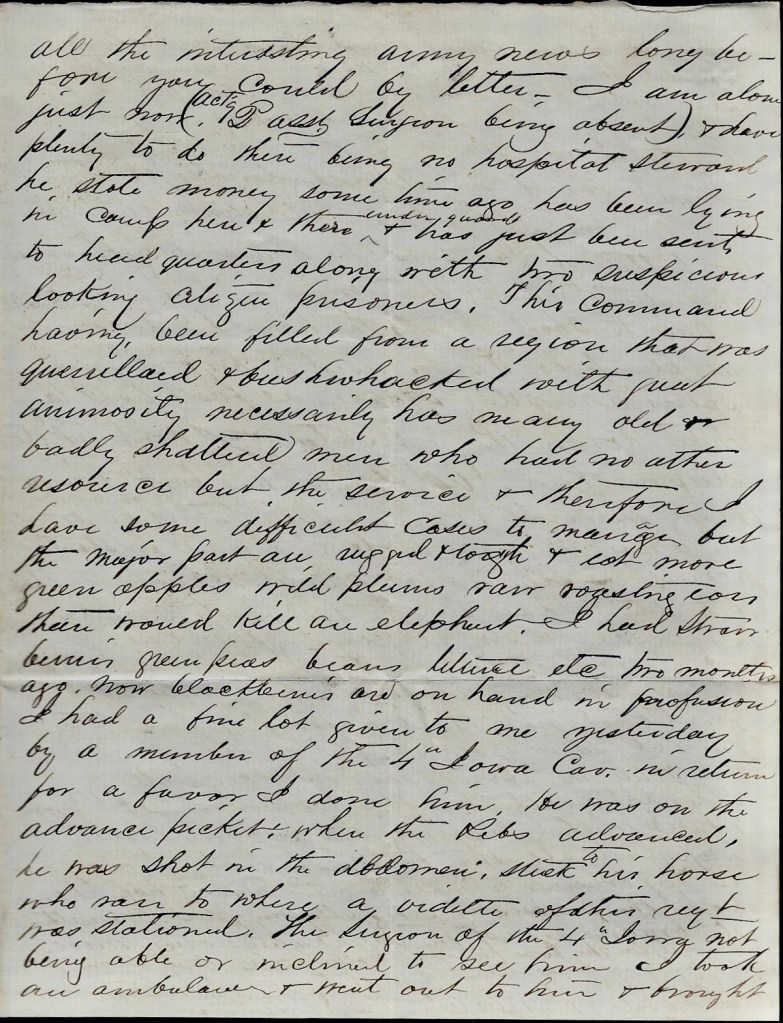
The regiment was raised in southwest Missouri and many of the officers and men are of the fearless type of frontiersmen. They have been in over 20 fights & have not been whipped but once and then [only] by overpowering numbers. The chaplain quit some time since in Missouri having been elected member of Legislature. Whiskey, poker, and Seven Up 1, etc. etc. are sometimes heard of here. And the only way I can tell when the Sabbath comes is by the extra number of negro wenches gaudily dressed who perambulate about the camp, visiting the cooks and servants of the officers. One ambulance driver and two cooks for surgeon’s mess & hospital on blocks. I write you these trifles incident to camp in lieu of anything more important knowing that you get by telegraph all the interesting army news long before you could by letter.
I am alone just now (acting 2nd Asst. Surgeon being absent) & have plenty to do, there being no hospital steward. He stole money some time ago, has been lying in camp here and there under guard, and has just been sent to headquarters along with two suspicious-looking citizen prisoners. This command having been filled from a region that was guerrilla’d and bushwhacked with great animosity necessarily has many old & badly shattered men who had no other recourse but the service & therefore I have some difficult cases to manage. But the major part are rugged and tough and eat more green apples, wild plums, raw roasting ears than would kill an elephant. I had strawberries, green peas, beans, lettuce, &c. two months ago.
Now blackberries are on hand in profusion. I had a fine lot given to me yesterday by a number of the 4th Iowa Cavalry in return for a favor I done him. He was on the advance picket when the Rebs advanced. He was shot in the abdomen, stuck to his horse who ran to where a vidette of another regiment was stationed. The surgeon of the 4th Iowa not being able or inclined to see him, I took an ambulance and went out to him and brought him into our camp. He had concluded he would have to sink or swim along until he saw me. One would of a ball through the left lung he has recovered from, is young and tough, and will recover & join his regiment soon.
I met one of my old school mates at the Division Hospital & had a pleasant reunion & chatted of “Lang Syne.” He had a very romantic narrative—more so than mine.
Owing to short rations, the horse I ride is not as plump as “Prince” used to be & I find spurs are getting scarce. As fasts as I lay them down, they get stolen & I don’t like to sleep in them. Asst. Gardner has lost divers (he says innumerable) knives & says that if he was on a jury, he would sentence a man for stealing a knife same as for murder. I have only had three stolen. I have seen the last pants a man had taken. This is a very free country down here.
I wish you to give me the Hillsdale [New York] news—in fact, anything you think will interest me for I have not heard a word from there since I saw you so put on your thinking cap and tell me about my “julockeys” all.
This hot weather has taken me down 15 lbs. from what I weighed last winter, but my health is improving all the time just now. I may have an opportunity to make a visit home & hope I can have the pleasure of seeing all of my friends and breathe the bracing air of the Saghkanics once more. Give my love to your Mother and all. Write soon. Yours truly, — D. B. Messinger
Address Care of Col. Clark Wright, 6th Cav. Mo., 9th Division, 13th Army Corps, Dept. of the Tennessee
1 Seven-up was a popular card game in the Civil War. It was also known as “Old Sledge” or High Low Jack.”



 Spared & Shared 23