
This letter was written by 50 year-old Mason Brayman (1813-1895) while commanding the Union forces in the District of Natchez in August 1864.
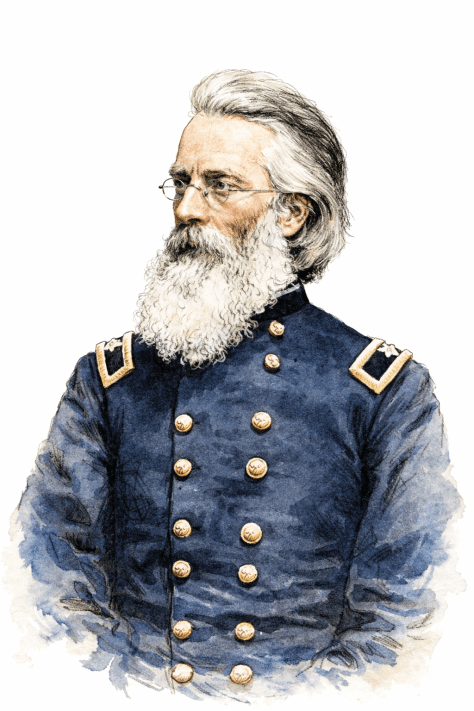
Brayman was born in Buffalo, N. Y., May 23, 1813. Brought up on a farm, he became a printer, then editor of the Buffalo “Bulletin,” studied law, and in 1836 was admitted to the bar. Removing to the West, he became city attorney of Monroe, Mich., in 1838, editor of the Louisville “Adviser” in 1841, opened a law office in Springfield, Ill., in 1842, and in 1844-45 revised the state statutes. In 1843, as special government commissioner, he adjusted the Mormon disturbances at Nauvoo, and conducted the negotiations which resulted in the withdrawal of the Mormons from Illinois. He was from 1851 to 1855 attorney for the Illinois Central railroad, and then, until the outbreak of the Civil war, was a promoter of railroad enterprises in Missouri, Arkansas and the southwest.
In 1861 Brayman joined the Union army as major of the 29th Ill. volunteers, became colonel of the regiment in May, 1862, and fought with such conspicuous gallantry at the battles of Belmont, Fort Donelson and Shiloh that he was promoted brigadier-general of volunteers. He was in command at Bolivar, Tenn., when Van Dorn’s attack was successfully repulsed. He afterwards reorganized about sixty Ohio regiments, at Fort Dennison; was president of a board of inquiry to investigate the conduct of Gen. Sturgis, commanded at Natchez, Tenn., from July, 1864, to May, 1865, and was presiding officer of a committee to investigate cotton claims. He was mustered out of the service at the close of the war with the brevet rank of major-general of volunteers. After the war he was engaged in reviving railroad interests in the south, was editor of the “Illinois State Journal” in 1872-73, practiced law in Ripon, Wis., from 1873 to 1877, and was then appointed by President Hayes governor of Idaho. At the expiration of his term, in 1880, he resumed the practice of his profession in Ripon, Wis. He afterwards settled in Kansas City, Mo., and died there Feb. 27, 1895.
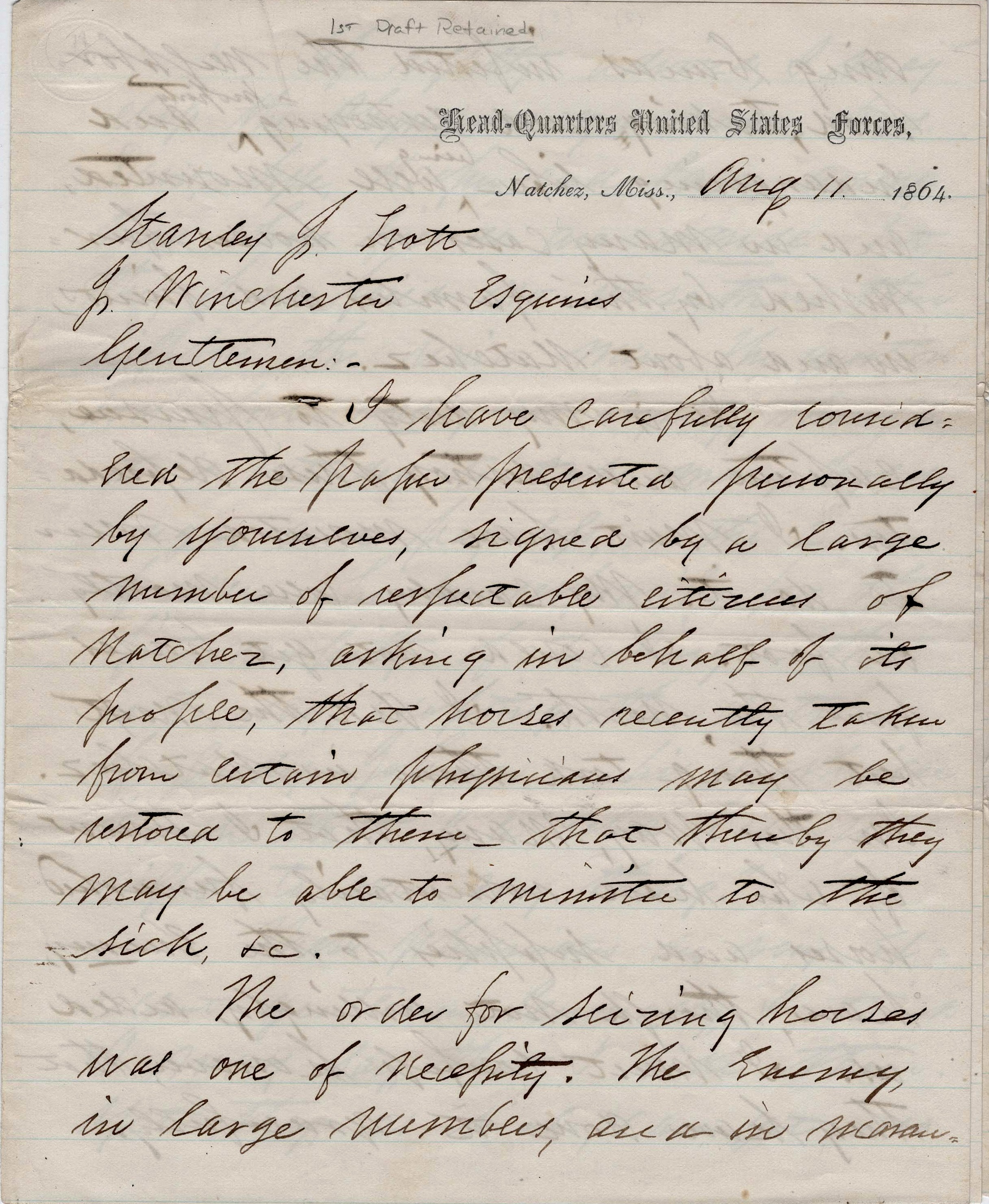
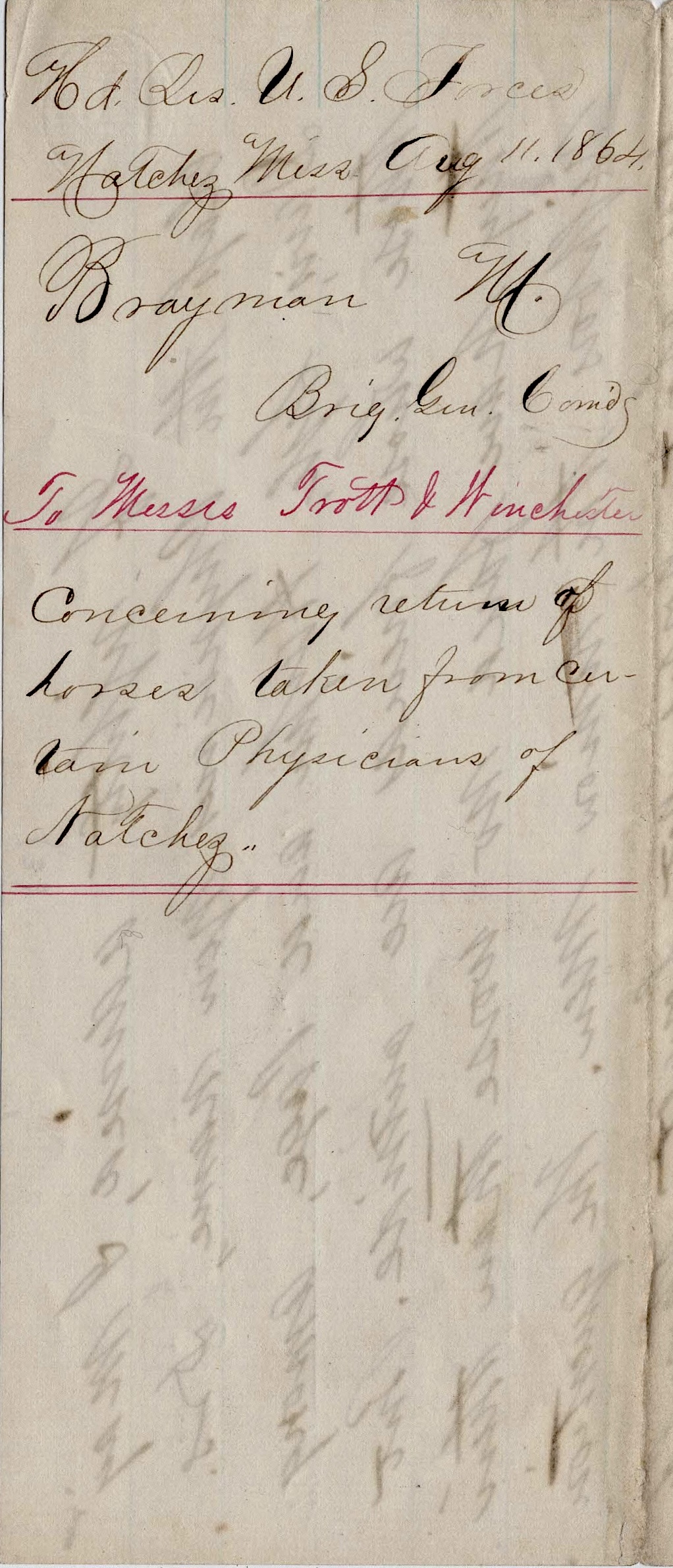
Brayman’s letter formally addresses a request from the citizens of Natchez for the return of horses that had been seized by his order to equip his cavalry in the pursuit of rebels and guerrillas within his District. He respectfully declines the request, citing military necessity as the rationale for commandeering the horses, while simultaneously expressing an understanding of the vital role that these animals play in supporting civilian physicians who care for the ill both in town and the surrounding areas. Brayman assures the citizens that he will facilitate the provision of horses liberated from the rebels as soon as it is feasible to do so.
One of the two gentleman that Brayman addressed his letter to was Judge Josiah Winchester, a native of Salem, Massachusetts, who studied law in Boston before moving to Natchez. His uncle, George Winchester, was a prominent lawyer, member of the Mississippi Supreme Court, and the longtime tutor to Varina Howell, future wife of Confederate President Jefferson Davis. He married in 1846 to Margaret Graham Sprague, a first cousin on Varina Howell—an attendant to Varina’s wedding to Jefferson Davis the previous year. He was a prominent Union sympathizer despite his ties to Jefferson Davis.
T R A N S C R I P T I O N
Headquarters United States Forces
Natchez, Mississippi
August 11, 1864
Stanley J. Trott & J[osiah] Winchester, Esq’s.,
Gentlemen,
I have carefully considered the paper presented personally by yourselves, signed by a large number of respectable citizens of Natchez, asking in behalf of its people that horses recently taken from certain physicians may be restored to them that thereby they may be able to minister to the sick, &c.
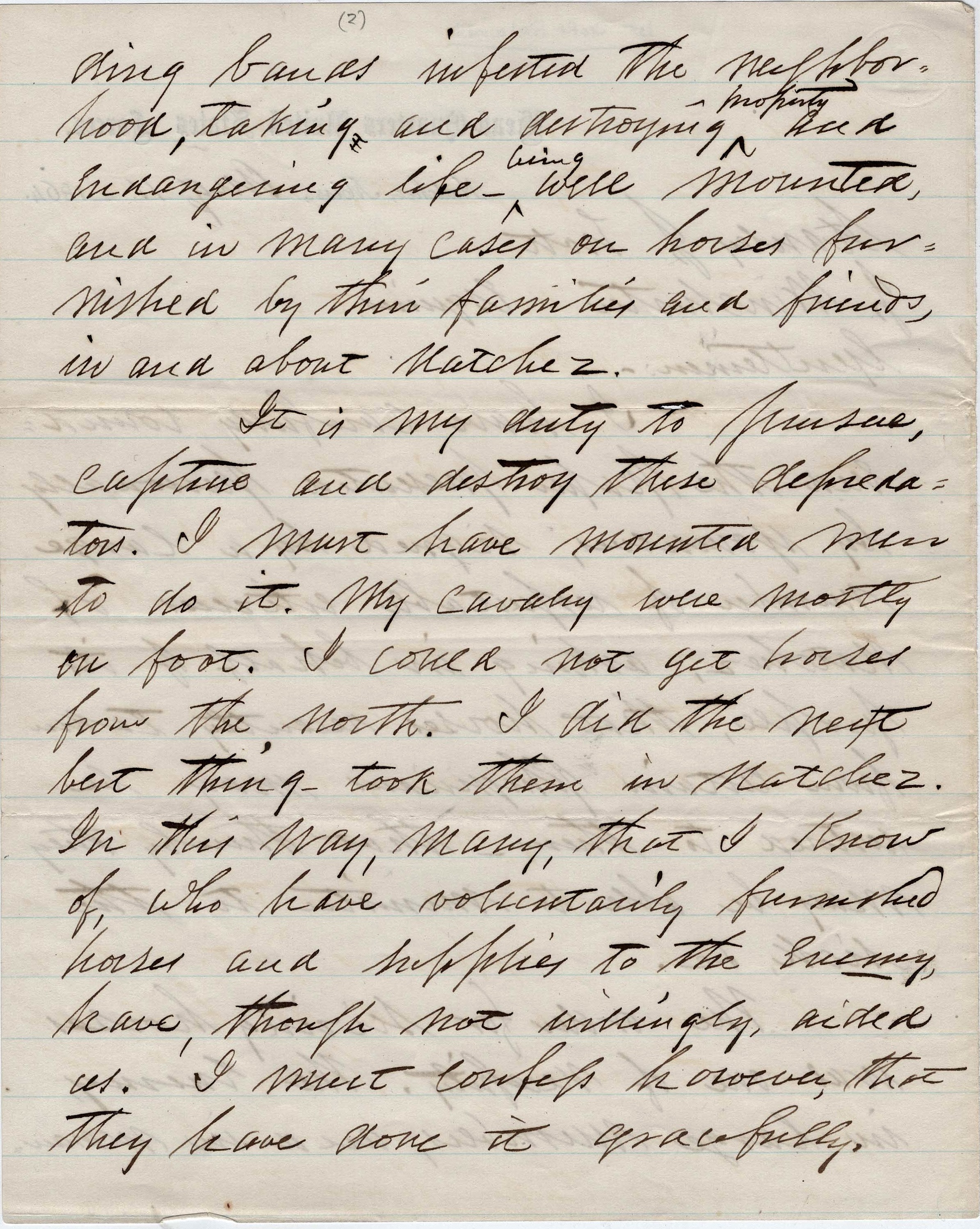
The order for seizing horses was one of necessity. The enemy in large numbers and in marauding bands infested the neighborhood, taking and destroying property and endangering life, being well mounted and in many cases on horses furnished by their families and friends in and about Natchez. It is my duty to pursue, capture, and destroy these depredators. I must have mounted men to do it. My cavalry were mostly on foot. I could not get horses from the North. I did the next best thing—took them in Natchez. In this way, many that I know of, who have voluntarily furnished horses and supplies to the enemy have, though not willingly, aided us. I must confess, however, that they have done it gracefully.
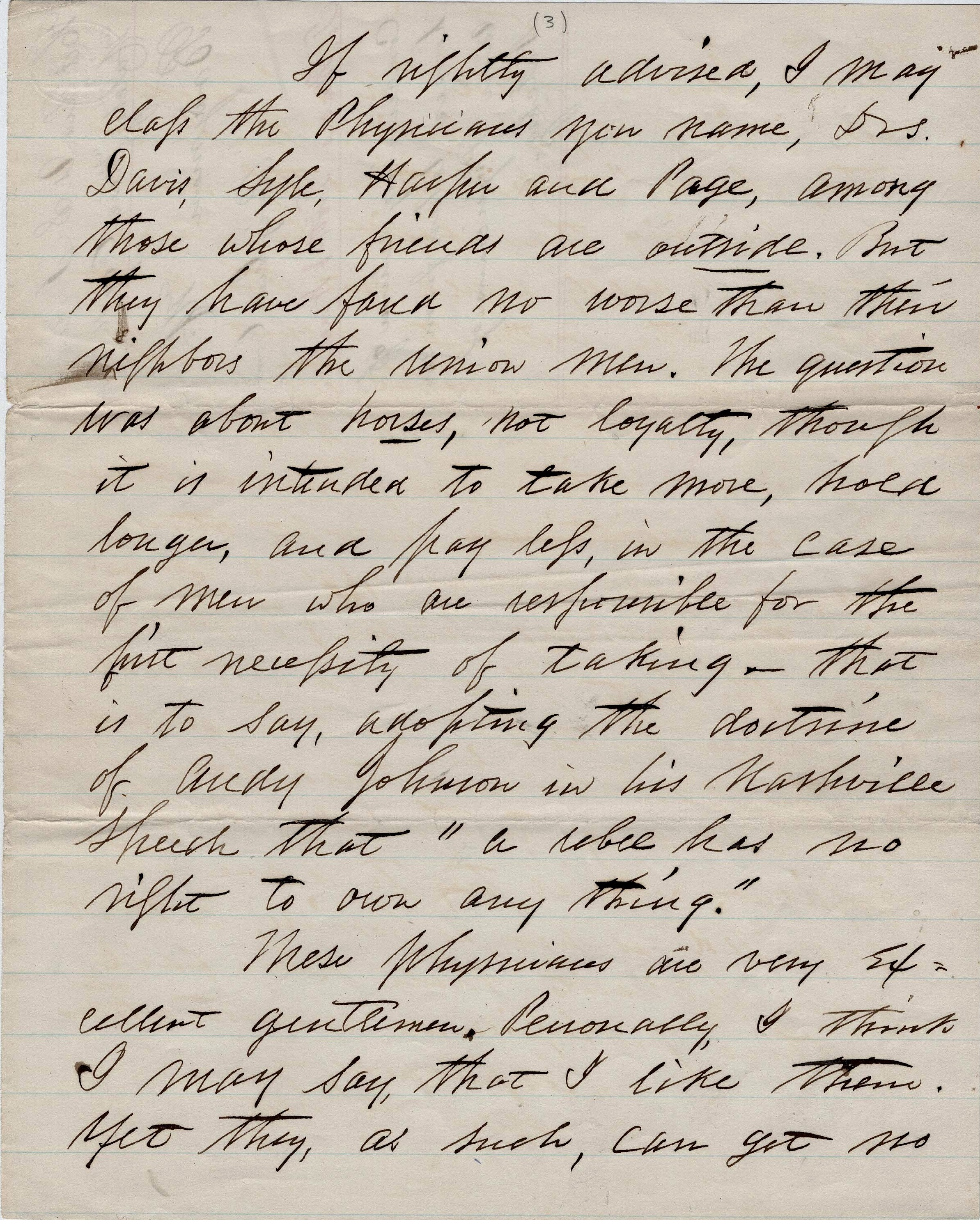
If rightly advised, I may class the physicians you name, Drs. Davis, Lyle, Harper and Page, among whose friends are outside. But they have fared no worse than their neighbors, the Union men. The question was about horses, not loyalty, though it is intended to take more, hold longer, and pay less, in the case of men who are responsible for the first necessity of taking—that is to say, adopting the doctrine of Andy Johnson in his Nashville speech that, “a rebel has no right to own anything.”
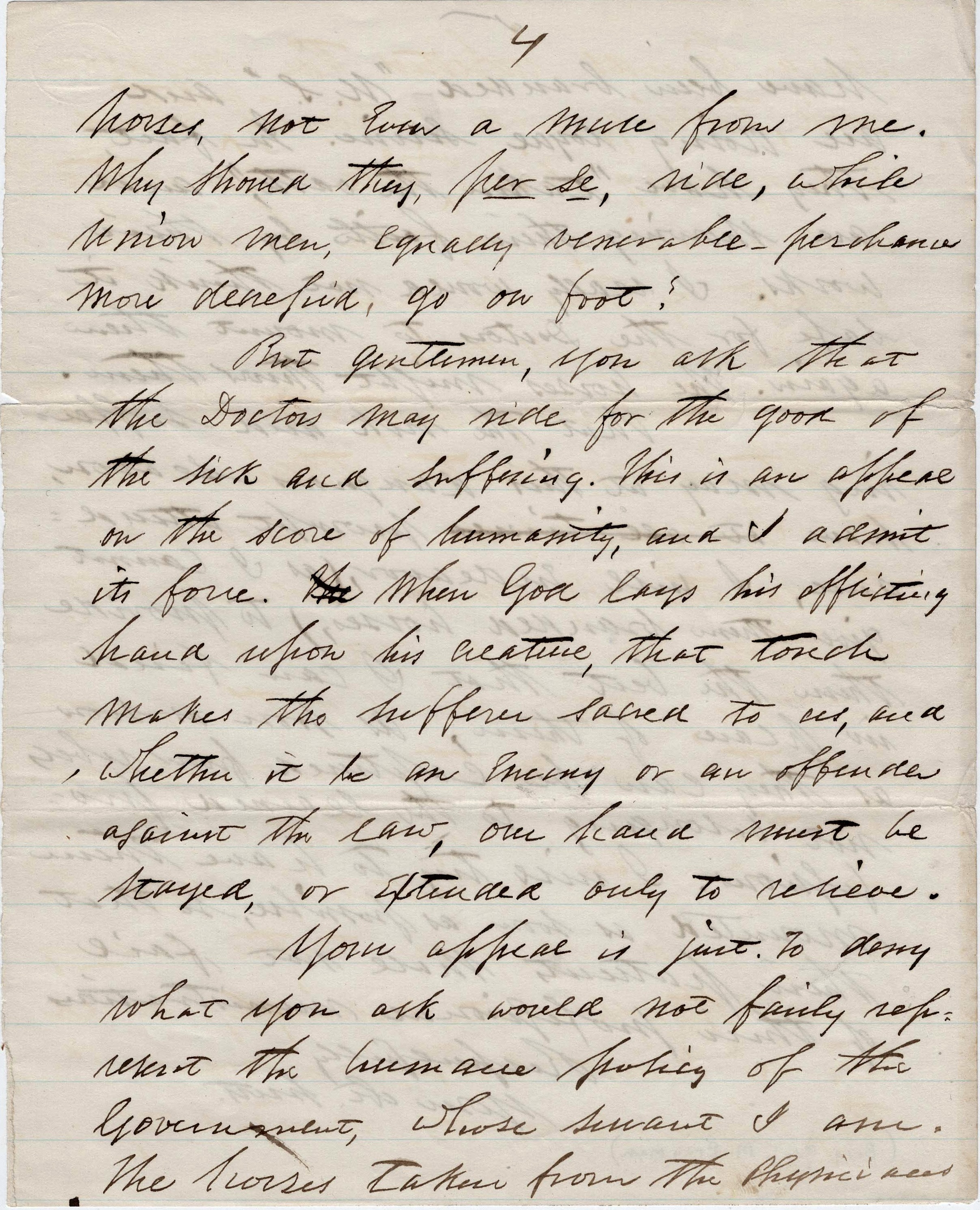
These physicians are very excellent gentlemen. Personally I think I may say that I like them. Yet they, as such, can get no horses, not even a mule from me. Why should they, per se, ride, while Union men, equally venerable—perchance more denefied [?], go on foot? But gentlemen, you ask that the doctors may ride for the good of the sick and suffering. This is an appeal on the score of humanity and I admit its force. When God lays his afflicting hand upon his creature, that touch makes the sufferer sacred to us, and, whether it be an enemy or an offender against the law, our hand must be stayed or extended only to relieve.
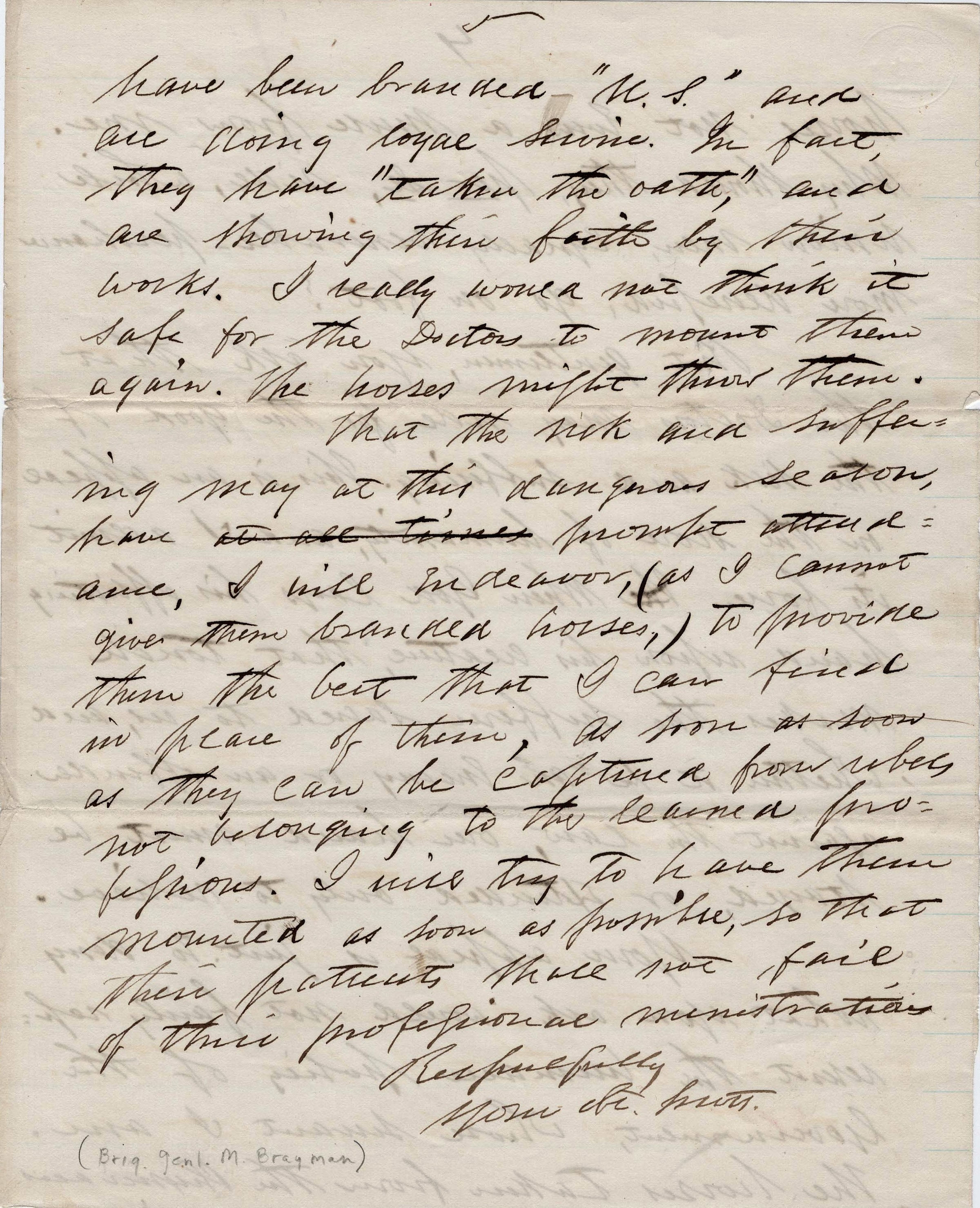
Your appeal is just to deny what you ask would not fairly represent the humane policy of the Government, whose servant I am. The horses taken from the physicians have been branded “U. S.” and are doing loyal service. In fact, they have “taken the oath” and are showing their faith by their works. I really would not think it safe for the doctors to mount them again. The horses might throw them.
That the sick and suffering may at this dangerous section have prompt attendance, I will endeavor (as I cannot give them branded horses) to provide them the best that I can find in place of them as soon as they can be captured from rebels not belonging to the learned professions. I will try to have them mounted as soon as possible so that their patients shall not fail of their professional ministrations. Respectfully, your obedient servant.
[1st draft retained]
 Spared & Shared 23