Category Archives: CSS Alabama

1863: Henry E. Milford to Isaac Merritt Singer

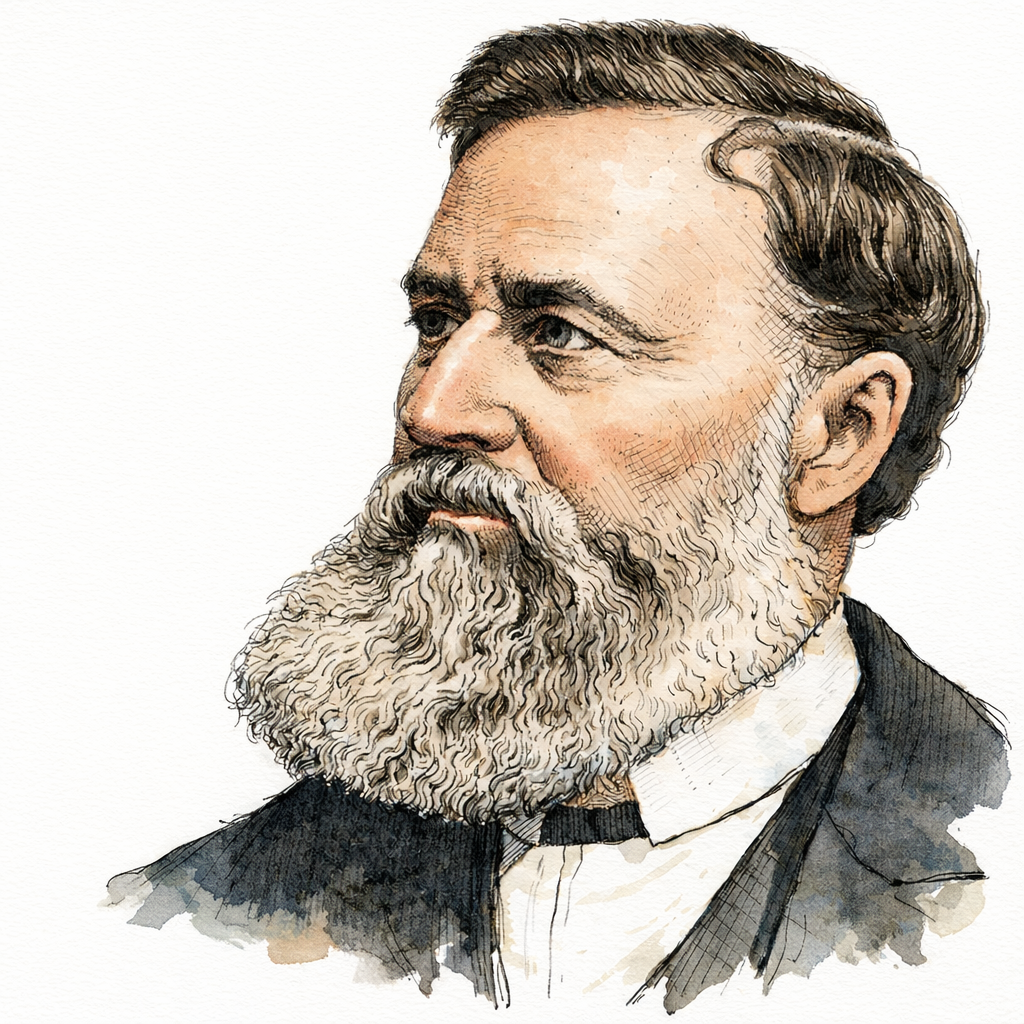
Isaac Merritt Singer

This letter was written by Henry E. Milford (1817-1882), an agent of the Singer Sewing Company. He was located in Rio de Janeiro, Brazil, at the time he wrote this letter in July 1863. Henry’s parents were Edward Milford (1794-1845) and Elizabeth Hipwood (1800-1852), natives of Wales and Scotland respectively. Henry was born in New York City and labored as a bookkeeper and an accountant in the metropolis until taking the position as a salesman for Isaac Merritt Singer who machines revolutionized the sewing industry and first introduced installment purchasing.

T R A N S C R I P T I O N

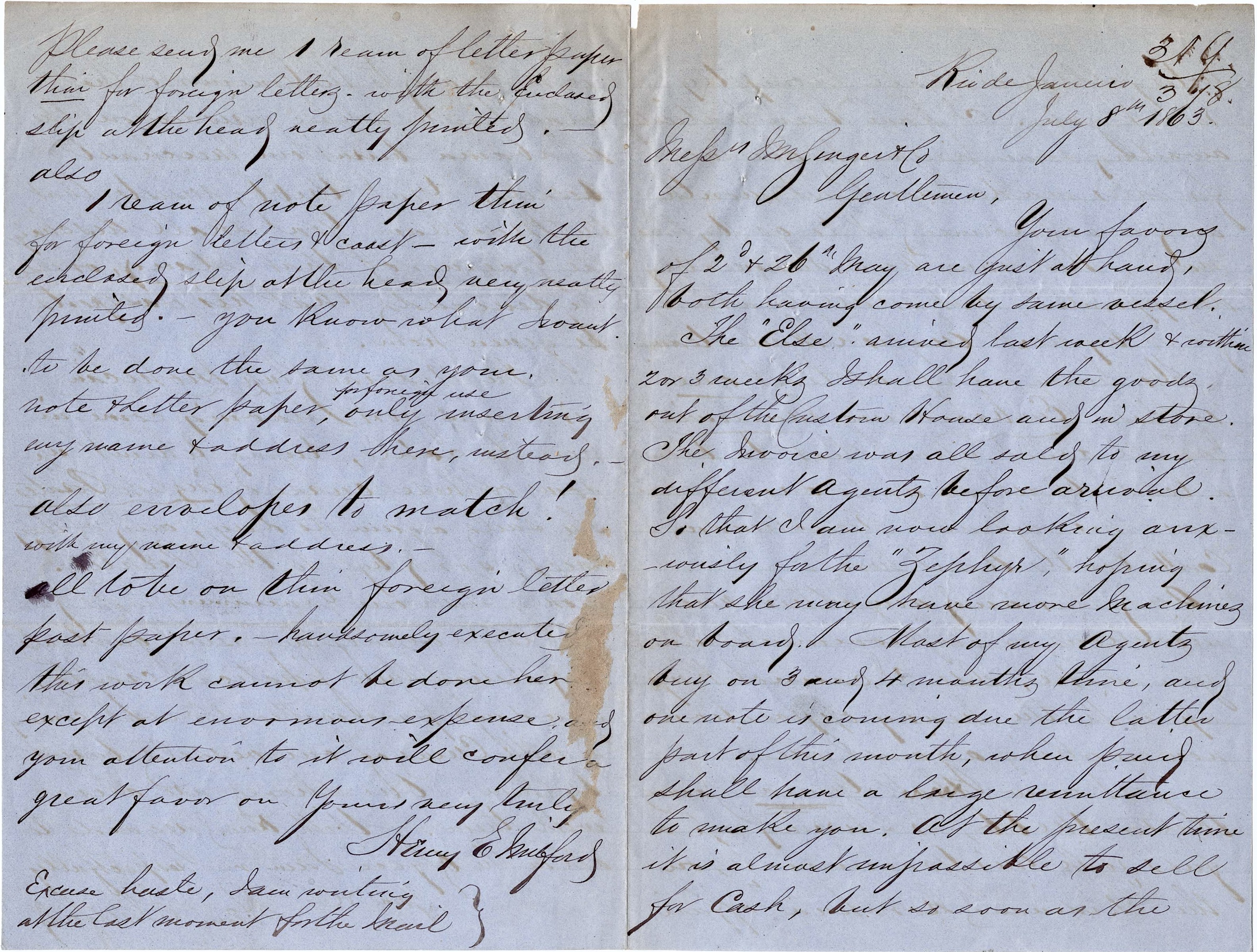
Rio de Janeiro
July 8, 1863

Messer. I. M. Singer & Co.

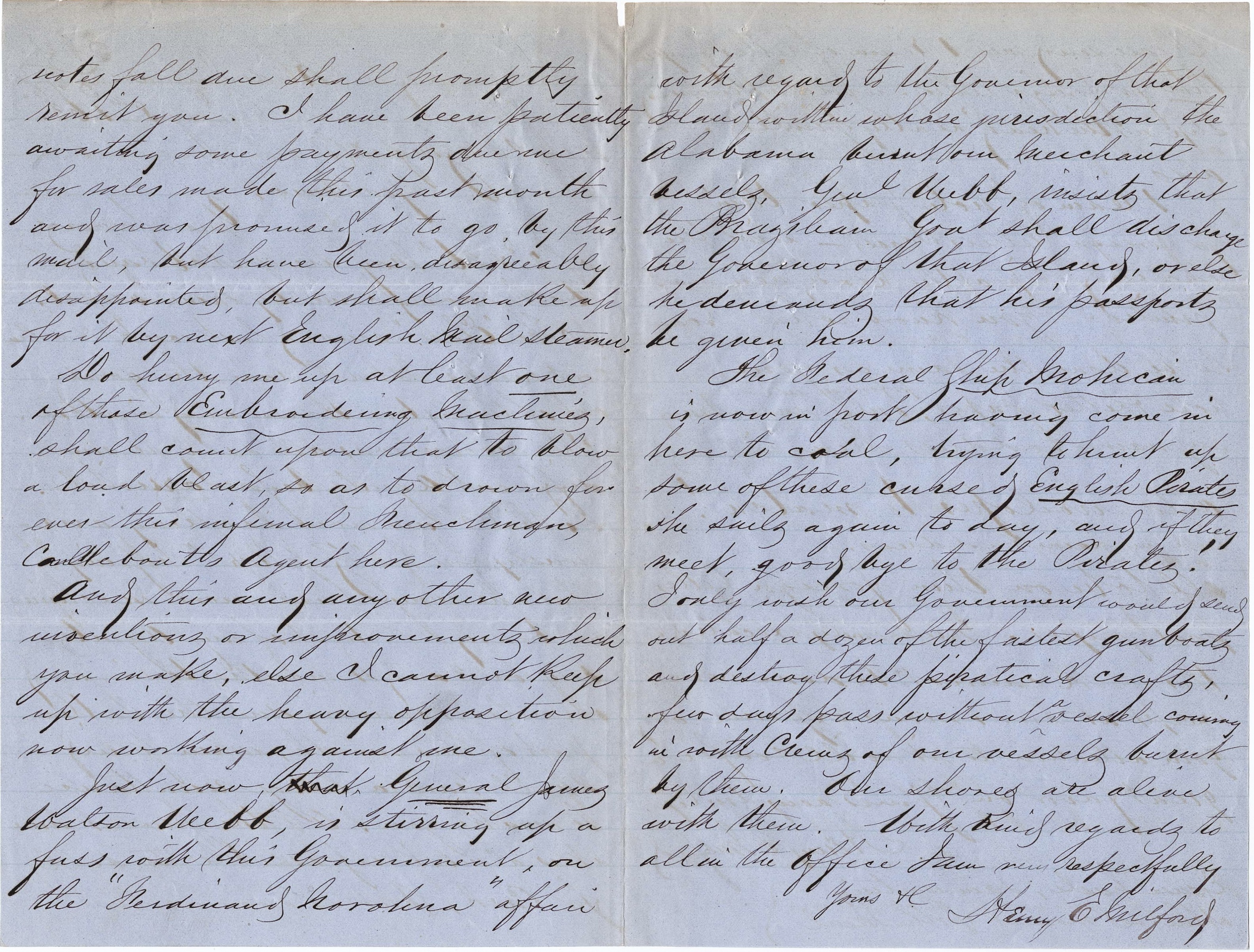
Gentlemen, your favors pf the 2nd and 26th May are just at hand, both having come by same vessel. The “Else” arrived last week & within 2 or 3 weeks I shall have the goods out of the Custom House and in store. The invoice was all sold to my different agents before arrival, so that I am now looking anxiously for the “Zephyr,” hoping that she may have more machines on boards. Most of the agents buy on 3 and 4 months time, and one note is coming due the latter part of this month, when paid shall have a large remittance to make you. At the present time it is almost impossible to sell for cash, but so soon as the notes fall due, shall promptly remit you.

I have been patiently awaiting som payments due me for sales made this past month and was promised it to go by this mail, but have been disagreeably disappointed, but shall make up for it by next English Mail steamer. Do hurry me up at least one of those Embroidering Machines. Shall count upon that to blow a loud blast, so as to drown forever this infernal Frenchman, C______ [?] agent here. And this and any other new inventions or improvements which you make, else I cannot keep up with the heavy opposition now working against me.

Just now, General James Watson Webb 1 is stirring up a fuss with this government on the ” “Ferdinand [Fernand] Noronha” affair with regard to the Governor of that Island within whose jurisdiction the Alabama burnt our merchant vessels. 2 General Webb insists that the Brazilian government shall discharge the Governor of that Island or else he demands that his passports be given him.

The Federal Ship Mohican is now in port having come in here to coal, trying to hunt up some of these cursed English Pirates. She sails again today and if they meet, goodbye to the Pirates! I only wish our government would send out half a dozen of the fastest gunboats and destroy these piratical crafts. Few days pass without a vessel coming in with crews of our vessels burnt by them. Our shores are alive with them. With kind regards to all in the office, I am respectfully yours, &c. — Henry E. Milford

Please send me a ream of letter paper thin for foreign letters with the enclosed slip at the head neatly printed.

Also, one ream of note paper thin for foreign letters and coast, with the enclosed slip at the head neatly printed. You know what I want to be done the same as your note & letter, for foreign use only inserting my name & address here instead. Also envelopes to match! with my name & address. All to be on thin letter post paper, handsomely executed. This work cannot be done here except at enormous expense and your attention to it will confer a great favor on yours very truly, — Henry E. Milford

Excuse haste, I am writing at the last moment for the mail.


1 James Watson Webb (1802-1884) was the American Minister to Brazil during the Lincoln Administration. He was accused of extorting a large sum of money from the Brazilian government for favors, Carl Sandburg wrote that Webb “believed that Lincoln should have appointed him major general, rating himself a grand strategist, having fought white men in duels and red men in frontier war.” [Wikipedia]

2 In the spring of 1863, the Confederate Commerce raider, CSS Alabama, commanded by Captain Rafael Semmes, conducted a series of captures of American vessels near Brazil. Semmes used the port on the island as his base for several months while carrying out these raids. The US later sought compensation from Britain for the damages caused these vessels because these raiding vessels were typically British-built and hid themselves in British ports.
1865: Thomas Hubbard to Erastus Hubbard

Unfortunately there is no photograph of Thomas but here’s a CDV from the period of time with an unidentified gentleman approximately his age.

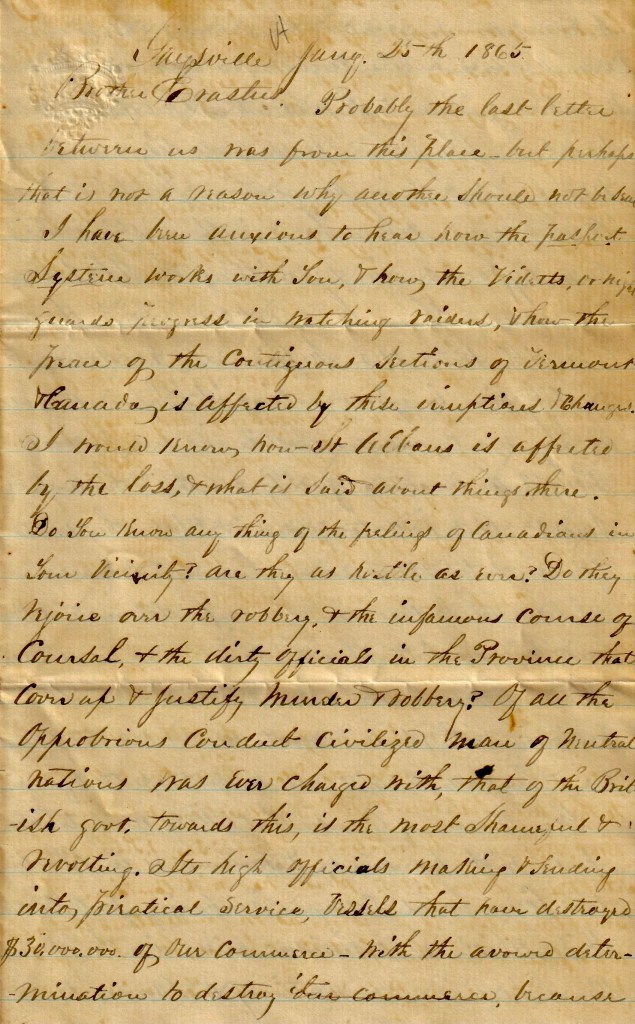
The following 4-page letter was written on 15 January 1865 by 54 year-old Rev. Thomas Hubbard (1811-1907) in Gaysville, Vermont (in the central part of the state) to his older brother Erastus Hubbard (1798-1877) in Franklin, Vermont (on the border with Quebec). Thomas and Erastus were the son s of Samuel Hubbard (1763-1844) and Elizabeth Swan (1767-1840). Thomas was an 1834 graduate of Middlebury College and an 1838 graduate of the Andover Theological Seminary. He then entered the pastorate of the Congregational Church and served in various pulpits throughout Vermont.

In his letter, Thomas expresses the outrage of Vermont citizenry with the notorious October 1864 Confederate raid on St. Albans and the Canadian government’s handling of the matter. The raid was conducted by 21 Confederate soldiers crossing into Vermont from Canada for the purpose of robbing banks to raise money for the Confederacy and to trick the Union army into diverting troops to defend their northern border against further raids. They got the money, killed a local, and escaped back to Canada with apparent impunity. As an unintended consequence, the raid served to turn many Canadians against the Confederacy since they felt that Canada was being drawn into the conflict without its consent.

Hubbard also conveys his anger at the British government for their actions in support of the Confederacy, mentioning specifically their association with Confederate naval vessels, including the Alabama,  which plundered Union shipping. In this regard, he specifically mentions the British Premier, Lord Palmerston, as well as the Foreign Secretary, John Russell, both of whom were ready at various times during the war to support the South (though they never formally did so). In addition he mentions Henry Ward Beecher as a source of his information as to British sentiments; Beecher being a very well-known Union preacher and writer who visited Britain in 1863 on a lecture tour, in which he encouraged British support for the Union cause. The name Beecher is actually now more frequently associated with Beecher’s sister, Harriet Beecher Stowe, who in 1852, wrote Uncle Tom’s Cabin, a book which also served to accentuate feelings against the Confederacy. 

Hubbard goes on to briefly discuss the negative response of the Vermont citizenry towards the Federal draft call of 19 December 1864 which was extremely unpopular, coming, as it did at a time when many in the Union had had enough of the war. Most of the men whose names were pulled in the draft lottery found some way out, often by purchasing a substitute, as noted in this letter, leading to charges of class favoritism by the government.

Finally, Hubbard discusses various matters of discord within the British Anglican Church and the linked American Episcopal Churches, in which considerable turmoil was present during the time of the Civil War.

[Note: This letter is from the private collection of Richard Weiner and was transcribed and published by express consent on Spared & Shared.]

Transcription

Gaysville, Vermont
January 25th 1865

Brother Erastus,

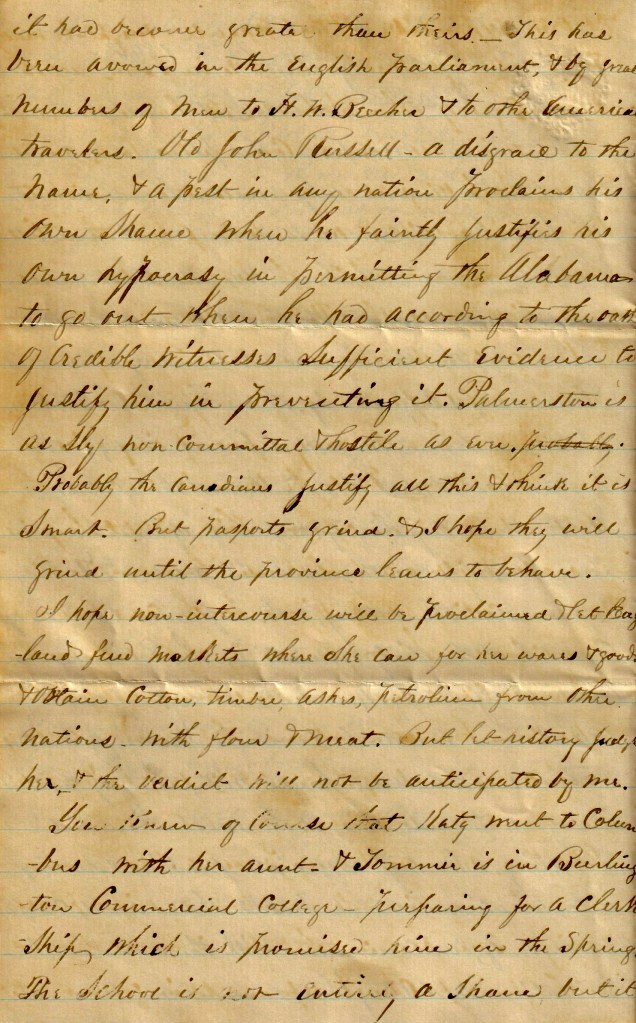
Probably the last letter between us was from this place but perhaps that is not a reason why another should not be sent. I have been anxious to hear how the passport system works with you & how the Videtts, or night guards, progress in watching raiders, & how the peace of the contiguous sections of Vermont & Canada is affected by these eruptions & changes, I would [like to] know it St. Albans is affected by the loss, & what is said about things there. Do you know anything of the feelings of Canadians in your vicinity? Are they as hostile as ever? Do they rejoice over the robbery, and the infamous course of Coursal, & the dirty officials in the Province that cover up and justify murder & robbery? Of all the opprobrious conduct civilized man of neutral nations was ever charged with, that of the British government towards this is the most shameful & revolting. Its high officials making and sending into practical service vessels that have destroyed $30,000,000 of our commerce—with the avowed determination to destroy its commence because it had become greater than theirs. This has been avowed in the English parliament & by great numbers of men to [Rev.] H. W. Beecher & to other American travelers.

Old John Russell—a disgrace to the name and a pest in any nation—proclaims his own shame when he faintly justifies his own hypocrisy in permitting the Alabama to go out when he had according to oath of credible witnesses sufficient evidence to justify him in preventing it. Palmerston is as sly noncommittal & hostile as ever. Probably the Canadians justify all this & think it is smart. But passports grind & I hope they will grind until the province learns to behave.

I hope non-intercourse will be proclaimed & let England find markets where she can for her wares & goods & obtain cotton, timber, ashes, petroleum from other nations—with flour and meat. But let history judge her & the verdict will not be anticipated by me. 

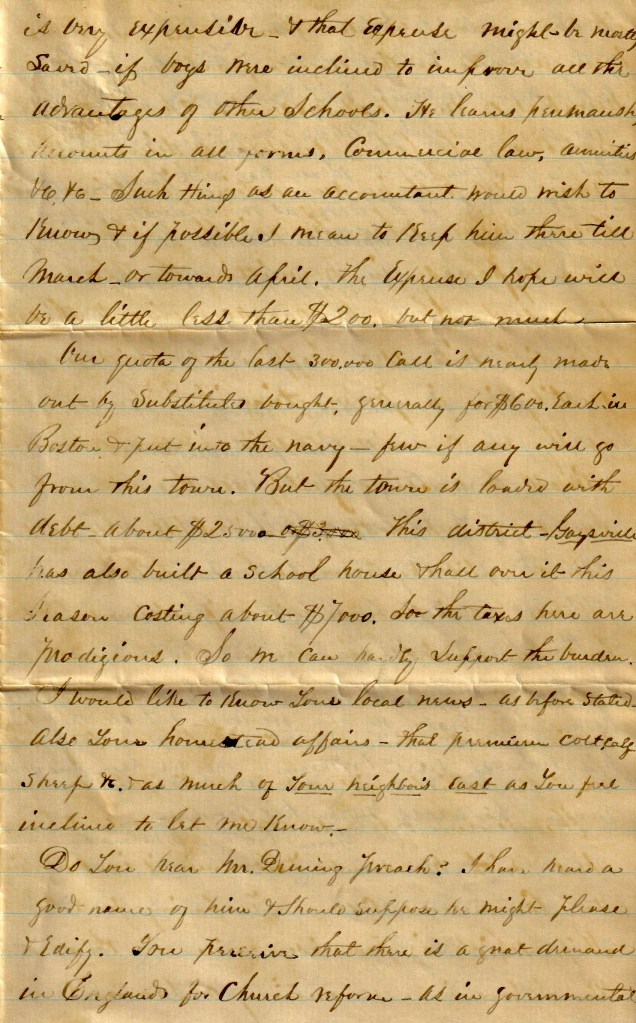
You know of course that Katy went to Columbus with her aunt & Tommie is in Burlington Commercial College preparing for a clerkship which is promised him in the spring. The school is not entirely a [    ], but it is very expensive & that expense might be mostly saved if boys were inclined to improve all their advantages of other schools. He learns penmanship, accounts in all forms, commercial law, annuities, &c. &c. Such things as an accountant would wish to know and if possible, I mean to keep him there till March, or towards April. The expense, I hope, will be a little less than $200, but not much.

Our quota of the last 300,000 call is nearly made out by substitutes bought, generally for $600 each in Boston & put into the Navy. Few if any will go from this town. But the town is loaded with debt—about $25,000. This district—Gaysville—has also built a school house, shall own it this season, costing about $7,000. So the taxes here are prodigious. So we can hardly support the burden.

I would like to know your local news, as before stated. Also your homestead affairs—that premium colt, calf, sheep, &c. and as much of your neighbors East as you feel inclined to let me know.

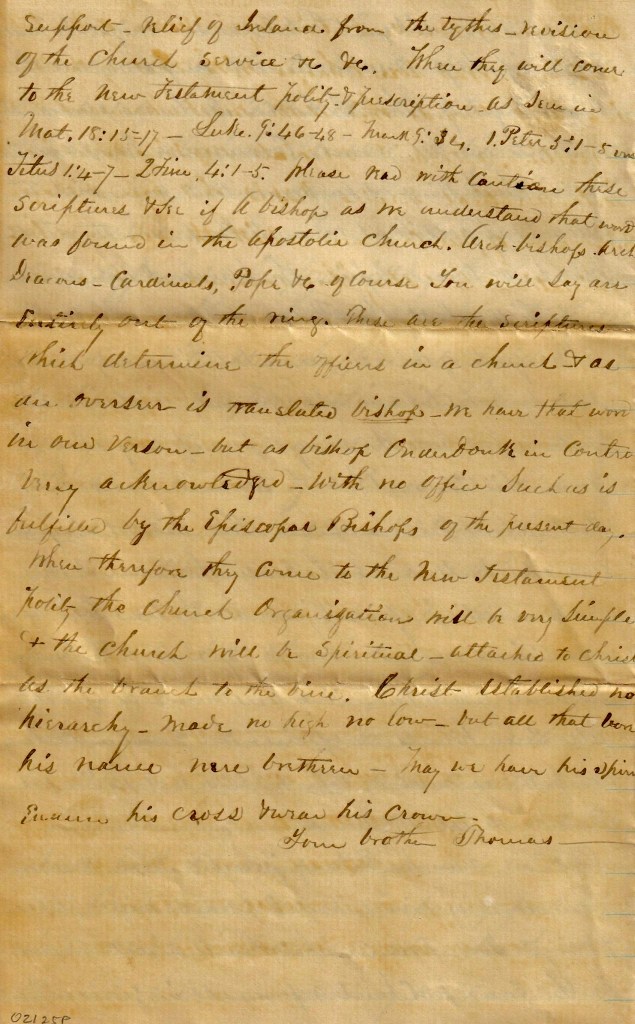
Do you hear Mr. Deming preach? I have heard a good name of him & should suppose he might please & edify. You perceive that there is a great demand in England for Church reform—as in governmental support—relief of Ireland from the tithes—revision of the church service, &c. &c. Where they will cover to the New Testament polity & prescription as seen in Mat. 18:15-17, Luke 9:46-48, Mark 9:34, 1 Peter 5:1-5, Titus 1:4-7, and 2 Fin 5:1-6/ Please read with caution these scriptures and see if a bishop as we understand that work was found in the Apostolic Church. Arch. Bishops, Arch Deacons, Cardinals, Pope, &c of course you will say are entirely out of the ring. These are the scriptures which determine the officers in a church & as an overseer is translated bishop. We hear that word in our version—but as Bishop Onderdonk in controversy acknowledged—with no office such as is fulfilled by the Episcopal Bishops of the present day. Where therefore they come to the New Testament polity the church organization will be very simple & the church will be spiritual—attached to Christ as the branch to the vine. Christ established this heirachy—made no high no low—but all that bore his name were brethren. May we hear his spirit, endure his cross, & wear his crown.

From your brother, — Thomas